Lecture 0
INT108:: PYTHON PROGRAMMING
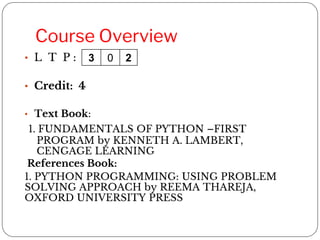
Course Overview
• L T P :
• Credit: 4
• Text Book:
1. FUNDAMENTALS OF PYTHON –FIRST
PROGRAM by KENNETH A. LAMBERT,
CENGAGE LEARNING
References Book:
1. PYTHON PROGRAMMING: USING PROBLEM
SOLVING APPROACH by REEMA THAREJA,
OXFORD UNIVERSITY PRESS
3 0 2
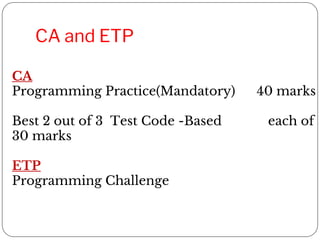
CA and ETP
CA
Programming Practice(Mandatory) 40 marks
Best 2 out of 3 Test Code -Based each of
30 marks
ETP
Programming Challenge
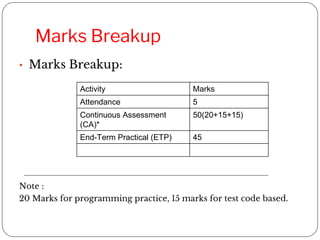
Marks Breakup
• Marks Breakup:
Note :
20 Marks for programming practice, 15 marks for test code based.
Activity Marks
Attendance 5
Continuous Assessment
(CA)*
50(20+15+15)
End-Term Practical (ETP) 45
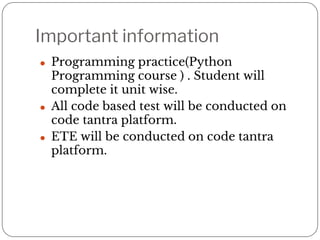
Important information
⚫ Programming practice(Python
Programming course ) . Student will
complete it unit wise.
⚫ All code based test will be conducted on
code tantra platform.
⚫ ETE will be conducted on code tantra
platform.
Mandatory conditions for ca
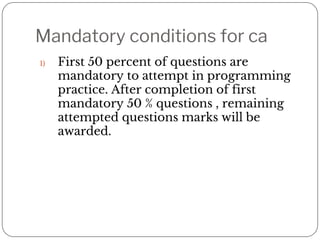
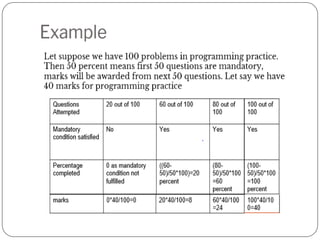
1) First 50 percent of questions are
mandatory to attempt in programming
practice. After completion of first
mandatory 50 % questions , remaining
attempted questions marks will be
awarded.
Mandatory conditions for ca
⚫ Programming practice marks will be
awarded based upon performance in best
2 Code based test. There are total 3 code
best test out of which best 2 will be
considered.
⚫ Each Code based test will contain 10 MCQ
questions each of 1 marks and 2 coding
questions each of 10 marks.
⚫ Duration for code based test will be 1
hours
Performance in best 2 Code based
test[x]
Weightage of programming practice
x>=81 percent 100 percent marks of programming
practice
71<=x<=80 70 percent marks of programming
practice
51<=x<=70 50 percent marks of programming
practice
30<=x<=50 30 percent marks of programming
practice
X<30 No marks will be awarded in
programming practice
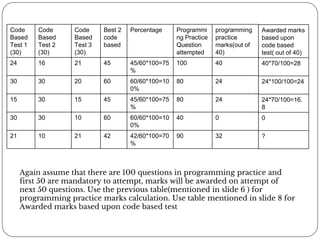
Code
Based
Test 1
(30)
Code
Based
Test 2
(30)
Code
Based
Test 3
(30)
Best 2
code
based
Percentage Programmi
ng Practice
Question
attempted
programming
practice
marks(out of
40)
24 16 21 45 45/60*100=75
%
100 40
30 30 20 60 60/60*100=10
0%
80 24
15 30 15 45 45/60*100=75
%
80 24
30 30 10 60 60/60*100=10
0%
40 0
21 10 21 42 42/60*100=70
%
90 32
Again assume that there are 100 questions in programming practice and
first 50 are mandatory to attempt, marks will be awarded on attempt of
next 50 questions. Use the previous table(mentioned in slide 6 ) for
programming practice marks calculation. Use table mentioned in slide 8 for
Awarded marks based upon code based test
Awarded marks
based upon
code based
test( out of 40)
40*70/100=28
24*100/100=24
24*70/100=16.
8
0
?
Answer
16
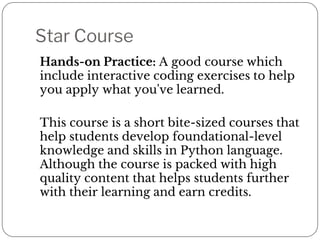
Star Course
Hands-on Practice: A good course which
include interactive coding exercises to help
you apply what you've learned.
This course is a short bite-sized courses that
help students develop foundational-level
knowledge and skills in Python language.
Although the course is packed with high
quality content that helps students further
with their learning and earn credits.
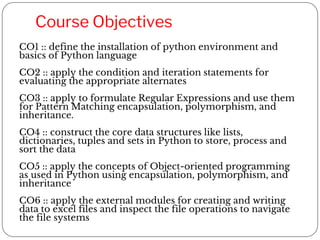
Course Objectives
CO1 :: define the installation of python environment and
basics of Python language
CO2 :: apply the condition and iteration statements for
evaluating the appropriate alternates
CO3 :: apply to formulate Regular Expressions and use them
for Pattern Matching encapsulation, polymorphism, and
inheritance.
CO4 :: construct the core data structures like lists,
dictionaries, tuples and sets in Python to store, process and
sort the data
CO5 :: apply the concepts of Object-oriented programming
as used in Python using encapsulation, polymorphism, and
inheritance
CO6 :: apply the external modules for creating and writing
data to excel files and inspect the file operations to navigate
the file systems
Why languages?
COMPUTER IS SMART
?????
https://www.youtube.com/watch?v=lfuUiBanV
DM
Computer Language vs. Human
Language
Different Computer Languages
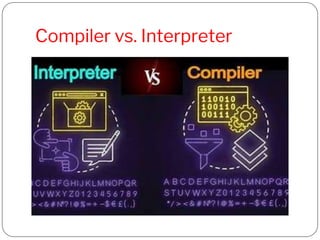
Compiler vs. Interpreter
Make language your Friend
Overview of Unit 1
Unit 1
Setting up your Programming Environment :
Python versions, Python on windows, running a
‘Hello World’ program
Variables, Expression and Statements: Naming
and using variables, Avoiding Name Error when
using variables, Values and types, variables,
variables name and keywords, statements,
operators and operand, order of operations,
operations on string, composition and comments
Overview of Unit 2
Unit 2
Conditional statements : modulus operator,
Random numbers, Boolean expressions, logic
operators, conditional, nested conditionals
Iterative statements : while statements, for
loop statement, Nested for, Nested while,
Random numbers in loops, encapsulation and
generalization
Unit 3
Functions and recursion : function calls, type
conversion and coercion, math functions,
adding new function, parameters and
argument, recursion and its use
Unit 4
String : string a compound data type,
length, string traversal, string slices,
comparison, find function, looping and
counting
Lists : list values, length, membership,
operations, slices, deletion, accessing
elements, list and for loops, list parameters
and nested list
Tuples and Dictionaries : mutability and
tuples, tuple assignment, tuple as return
values, dictionaries operations and
methods, sparse matrices, aliasing and
coping
Unit 5
Classes and objects : Creating classes, creating
instance objects, accessing attributes
Object oriented programming terminology : Class
Inheritance, Overriding Methods, Data Hiding,
Function Overloading
Unit 6
Files and Exceptions : text files, writing
variables, Reading from a file, writing to a
file, directories, pickling, handling the zero
Division error exception, using try-except
blocks, The else block, Handling the File
Not found error exception
Regular Expressions : Concept of regular
expression, various types of regular
expressions, using match function, Web
Scraping by using Regular Expressions
INT108L0 (2).pptx

INT108L0 (2).pptx

  • 1.
  • 2.
    Course Overview • LT P : • Credit: 4 • Text Book: 1. FUNDAMENTALS OF PYTHON –FIRST PROGRAM by KENNETH A. LAMBERT, CENGAGE LEARNING References Book: 1. PYTHON PROGRAMMING: USING PROBLEM SOLVING APPROACH by REEMA THAREJA, OXFORD UNIVERSITY PRESS 3 0 2
  • 3.
    CA and ETP CA ProgrammingPractice(Mandatory) 40 marks Best 2 out of 3 Test Code -Based each of 30 marks ETP Programming Challenge
  • 4.
    Marks Breakup • MarksBreakup: Note : 20 Marks for programming practice, 15 marks for test code based. Activity Marks Attendance 5 Continuous Assessment (CA)* 50(20+15+15) End-Term Practical (ETP) 45
  • 5.
    Important information ⚫ Programmingpractice(Python Programming course ) . Student will complete it unit wise. ⚫ All code based test will be conducted on code tantra platform. ⚫ ETE will be conducted on code tantra platform.
  • 6.
    Mandatory conditions forca 1) First 50 percent of questions are mandatory to attempt in programming practice. After completion of first mandatory 50 % questions , remaining attempted questions marks will be awarded.
  • 8.
    Mandatory conditions forca ⚫ Programming practice marks will be awarded based upon performance in best 2 Code based test. There are total 3 code best test out of which best 2 will be considered. ⚫ Each Code based test will contain 10 MCQ questions each of 1 marks and 2 coding questions each of 10 marks. ⚫ Duration for code based test will be 1 hours
  • 9.
    Performance in best2 Code based test[x] Weightage of programming practice x>=81 percent 100 percent marks of programming practice 71<=x<=80 70 percent marks of programming practice 51<=x<=70 50 percent marks of programming practice 30<=x<=50 30 percent marks of programming practice X<30 No marks will be awarded in programming practice
  • 10.
    Code Based Test 1 (30) Code Based Test 2 (30) Code Based Test3 (30) Best 2 code based Percentage Programmi ng Practice Question attempted programming practice marks(out of 40) 24 16 21 45 45/60*100=75 % 100 40 30 30 20 60 60/60*100=10 0% 80 24 15 30 15 45 45/60*100=75 % 80 24 30 30 10 60 60/60*100=10 0% 40 0 21 10 21 42 42/60*100=70 % 90 32 Again assume that there are 100 questions in programming practice and first 50 are mandatory to attempt, marks will be awarded on attempt of next 50 questions. Use the previous table(mentioned in slide 6 ) for programming practice marks calculation. Use table mentioned in slide 8 for Awarded marks based upon code based test Awarded marks based upon code based test( out of 40) 40*70/100=28 24*100/100=24 24*70/100=16. 8 0 ?
  • 11.
  • 12.
    Star Course Hands-on Practice:A good course which include interactive coding exercises to help you apply what you've learned. This course is a short bite-sized courses that help students develop foundational-level knowledge and skills in Python language. Although the course is packed with high quality content that helps students further with their learning and earn credits.
  • 13.
    Course Objectives CO1 ::define the installation of python environment and basics of Python language CO2 :: apply the condition and iteration statements for evaluating the appropriate alternates CO3 :: apply to formulate Regular Expressions and use them for Pattern Matching encapsulation, polymorphism, and inheritance. CO4 :: construct the core data structures like lists, dictionaries, tuples and sets in Python to store, process and sort the data CO5 :: apply the concepts of Object-oriented programming as used in Python using encapsulation, polymorphism, and inheritance CO6 :: apply the external modules for creating and writing data to excel files and inspect the file operations to navigate the file systems
  • 14.
  • 15.
  • 16.
    Computer Language vs.Human Language
  • 17.
  • 18.
  • 19.
  • 22.
  • 23.
    Unit 1 Setting upyour Programming Environment : Python versions, Python on windows, running a ‘Hello World’ program Variables, Expression and Statements: Naming and using variables, Avoiding Name Error when using variables, Values and types, variables, variables name and keywords, statements, operators and operand, order of operations, operations on string, composition and comments
  • 24.
  • 25.
    Unit 2 Conditional statements: modulus operator, Random numbers, Boolean expressions, logic operators, conditional, nested conditionals Iterative statements : while statements, for loop statement, Nested for, Nested while, Random numbers in loops, encapsulation and generalization
  • 26.
    Unit 3 Functions andrecursion : function calls, type conversion and coercion, math functions, adding new function, parameters and argument, recursion and its use
  • 27.
    Unit 4 String :string a compound data type, length, string traversal, string slices, comparison, find function, looping and counting Lists : list values, length, membership, operations, slices, deletion, accessing elements, list and for loops, list parameters and nested list Tuples and Dictionaries : mutability and tuples, tuple assignment, tuple as return values, dictionaries operations and methods, sparse matrices, aliasing and coping
  • 28.
    Unit 5 Classes andobjects : Creating classes, creating instance objects, accessing attributes Object oriented programming terminology : Class Inheritance, Overriding Methods, Data Hiding, Function Overloading
  • 29.
    Unit 6 Files andExceptions : text files, writing variables, Reading from a file, writing to a file, directories, pickling, handling the zero Division error exception, using try-except blocks, The else block, Handling the File Not found error exception Regular Expressions : Concept of regular expression, various types of regular expressions, using match function, Web Scraping by using Regular Expressions