More Related Content

PDF
main memory chapter 9 for cs and its a way to present it 
PPTX
Chapter 9 Operating Systems silberschatz 
PPTX

PPTX

PPTX
operating system chapter 9 syllabus.pptx 
PPTX
To lean about os easy way to understanding 
PPT
Chapter Five main management of memory .ppt 
PPT
Memory : operating system ( Btech cse ) Similar to PowerPoint presentation on chapter Nine extended

PDF
ch8.pdf operating systems by galvin to learn 
PPT

PPT
The Council of Architecture (COA) has been constituted by the Government of I... 
PPTX
OS Memory Management.pptx 
PPT

PPT

PPT

PPTX
Main memory operating system 
PPTX
cs8493 - operating systems unit 3 
PPT

PPT
ch8.ppt ejejnenjfjrnjnrjngjngktgtmtommgt 
PPT
ch8_Engineering presentation for cse.ppt 
PPT
Unit4-ch8.ppt operating system bankers algorithm 
PPT
Main memory is explained in the presentation its 
PPT
Chapter 5: Main Memory Management (Operating Systems) 
PPT
Main Memory Management (Operating Systems) 
PPT
ch8 Memory management and Virtual Memory.ppt 
PPTX
Operating system- memory management this ppt elaborated the concepts related ... 
PDF
{OS}-U2-ch2-Memory Management chapter(PPT).pdf 
PPT
ch8 Memory management (Operating System).ppt Recently uploaded

PDF
Blue / Green: Troop Leading Procedure (TLP) Overview.pdf 
PPTX
Details of Muscular-and-Nervous-Tissues.pptx 
PDF
Types of Vegetable Gardens, College of Agriculture Balaghat.pdf 
PDF
Prescription Writing- Elements, Parts, and Exercises 
PPTX
What is the Post load hook in Odoo 18 
PPTX
15 December 2025 Education for human flourishing Michael Stevenson .pptx 
PDF
The Drift Principle: When Information Accelerates Faster Than Minds Can Compress 
PPTX
Campfens "The Data Qualify Challenge: Publishers, institutions, and funders r... 
PDF
The Pity of War: Form, Fragment, and the Artificial Echo | Understanding War ... 
PDF
DHA OPTOMETRY MCQ Question /HAAD/MOH.pdf 
PPTX
Searching in PubMed andCochrane_Practical Presentation.pptx 
PDF
The Tale of Melon City poem ppt by Sahasra 
PDF
Unit-III pdf (Basic listening Skill, Effective Writing Communication & Writin... 
PDF
BỘ TEST KIỂM TRA CUỐI HỌC KÌ 1 - TIẾNG ANH 6-7-8-9 GLOBAL SUCCESS - PHIÊN BẢN... 
DOCX
Mobile applications Devlopment ReTest year 2025-2026 
PPTX
Hypothesis. its definition and typrs pptx 
PDF
Handwritten notes of Toxicity 1. Genotoxicity 2 Carcinogenicity 3 Teratogenic... 
PDF
1ST APPLICATION FOR ANNULMENT (4)8787666.pdf 
DOCX
TOXICITY AND ITS MANAGEMENT 6th sem unit 5, PHARMACOLOGY-III B. PHARMACY 
PPTX
ICH Harmonization A Global Pathway to Unified Drug Regulation.pptx PowerPoint presentation on chapter Nine extended
- 1.
- 2.
9.2 Silberschatz, Galvinand Gagne ©2013
Operating System Concepts – 9th
Edition
Chapter 9: Memory Management
Background
Swapping
Contiguous Memory Allocation
Segmentation
Paging
Structure of the Page Table
Example: The Intel 32 and 64-bit Architectures
Example: ARM Architecture
- 3.
9.3 Silberschatz, Galvinand Gagne ©2013
Operating System Concepts – 9th
Edition
Objectives
To provide a detailed description of various ways of
organizing memory hardware
To discuss various memory-management techniques,
including paging and segmentation
To provide a detailed description of the Intel Pentium,
which supports both pure segmentation and segmentation
with paging
- 4.
9.4 Silberschatz, Galvinand Gagne ©2013
Operating System Concepts – 9th
Edition
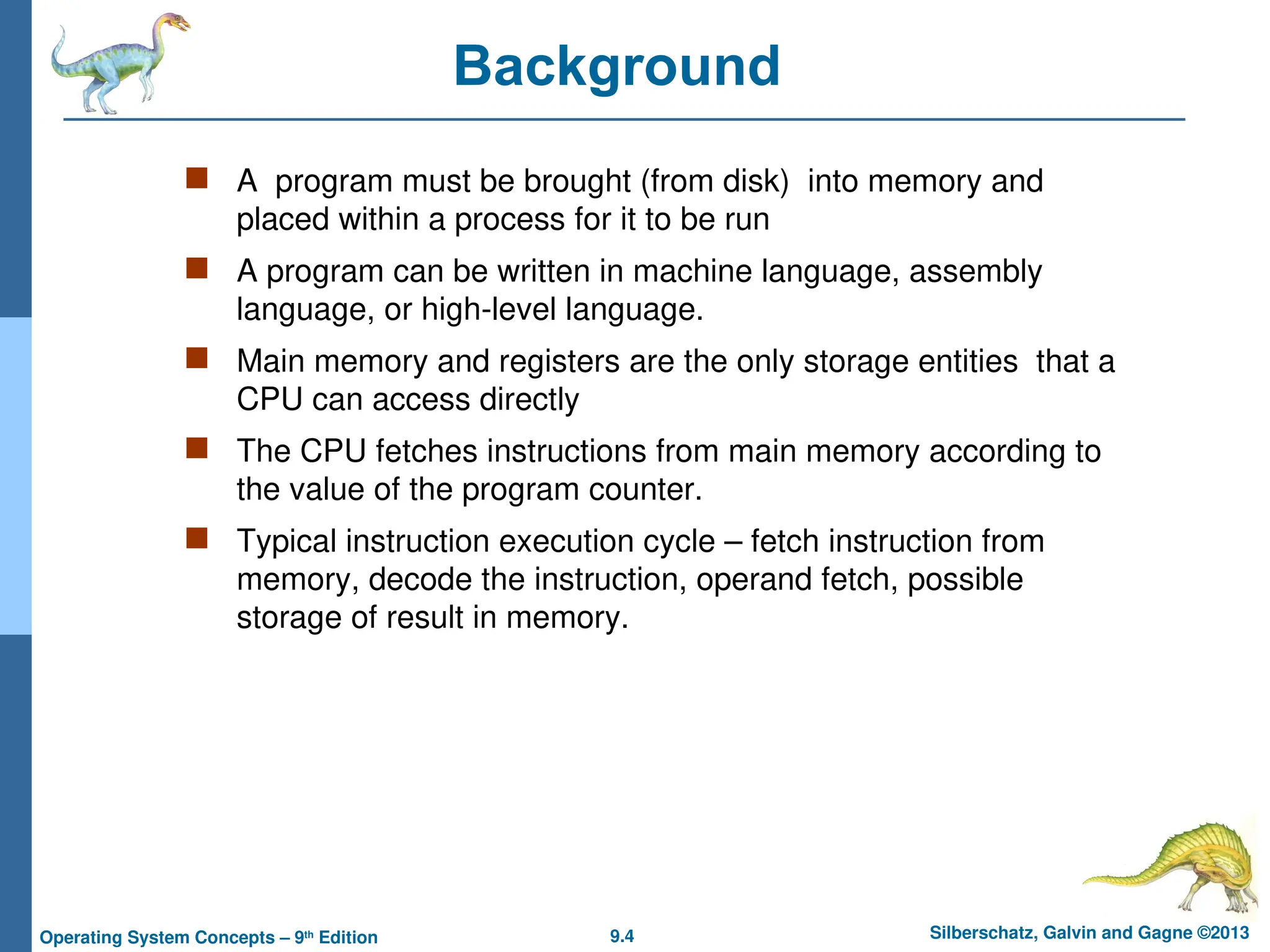
Background
A program must be brought (from disk) into memory and
placed within a process for it to be run
A program can be written in machine language, assembly
language, or high-level language.
Main memory and registers are the only storage entities that a
CPU can access directly
The CPU fetches instructions from main memory according to
the value of the program counter.
Typical instruction execution cycle – fetch instruction from
memory, decode the instruction, operand fetch, possible
storage of result in memory.
- 5.
9.5 Silberschatz, Galvinand Gagne ©2013
Operating System Concepts – 9th
Edition
Background (Cont.)
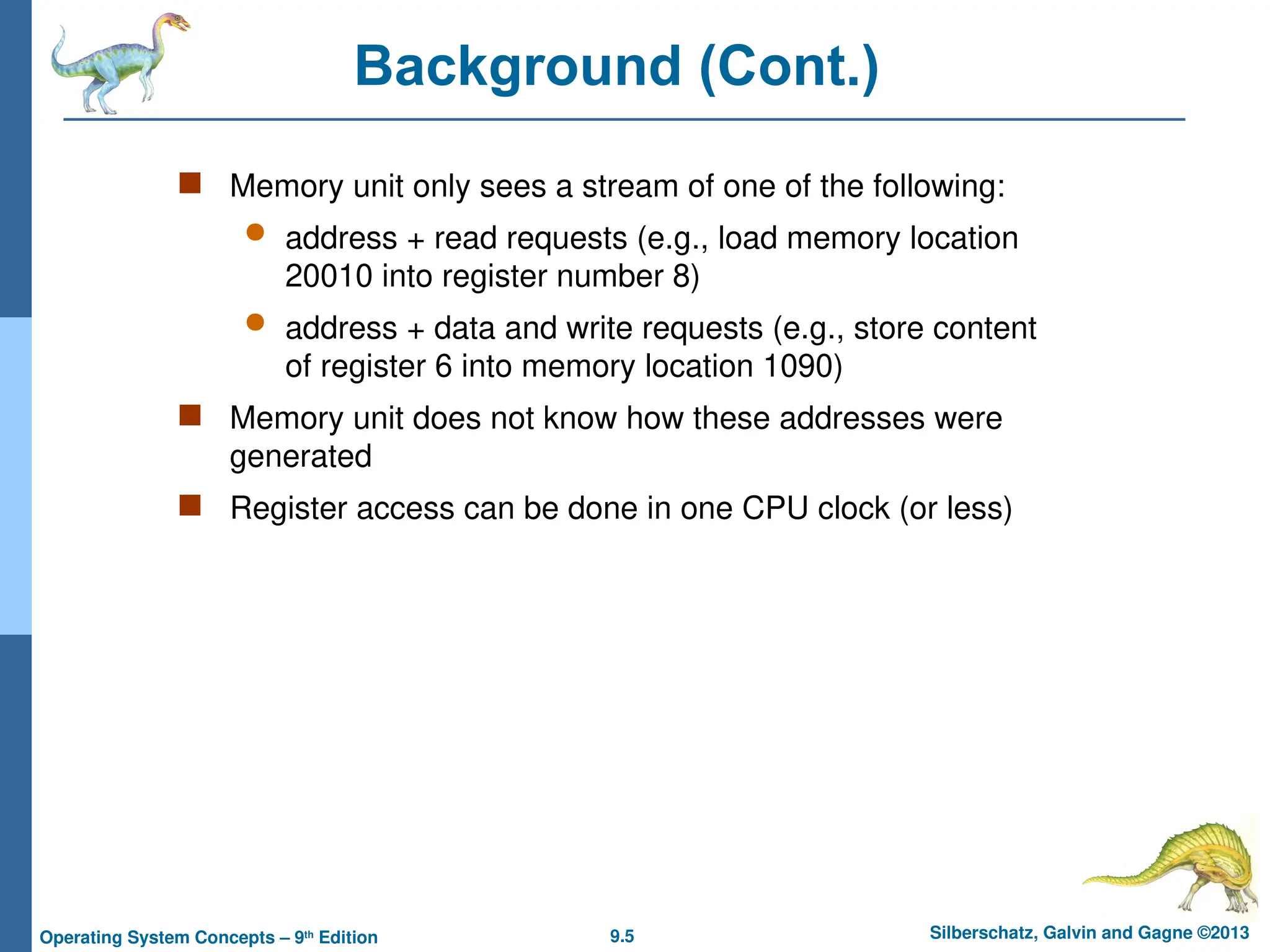
Memory unit only sees a stream of one of the following:
address + read requests (e.g., load memory location
20010 into register number 8)
address + data and write requests (e.g., store content
of register 6 into memory location 1090)
Memory unit does not know how these addresses were
generated
Register access can be done in one CPU clock (or less)
- 6.
9.6 Silberschatz, Galvinand Gagne ©2013
Operating System Concepts – 9th
Edition
Background (Cont.)
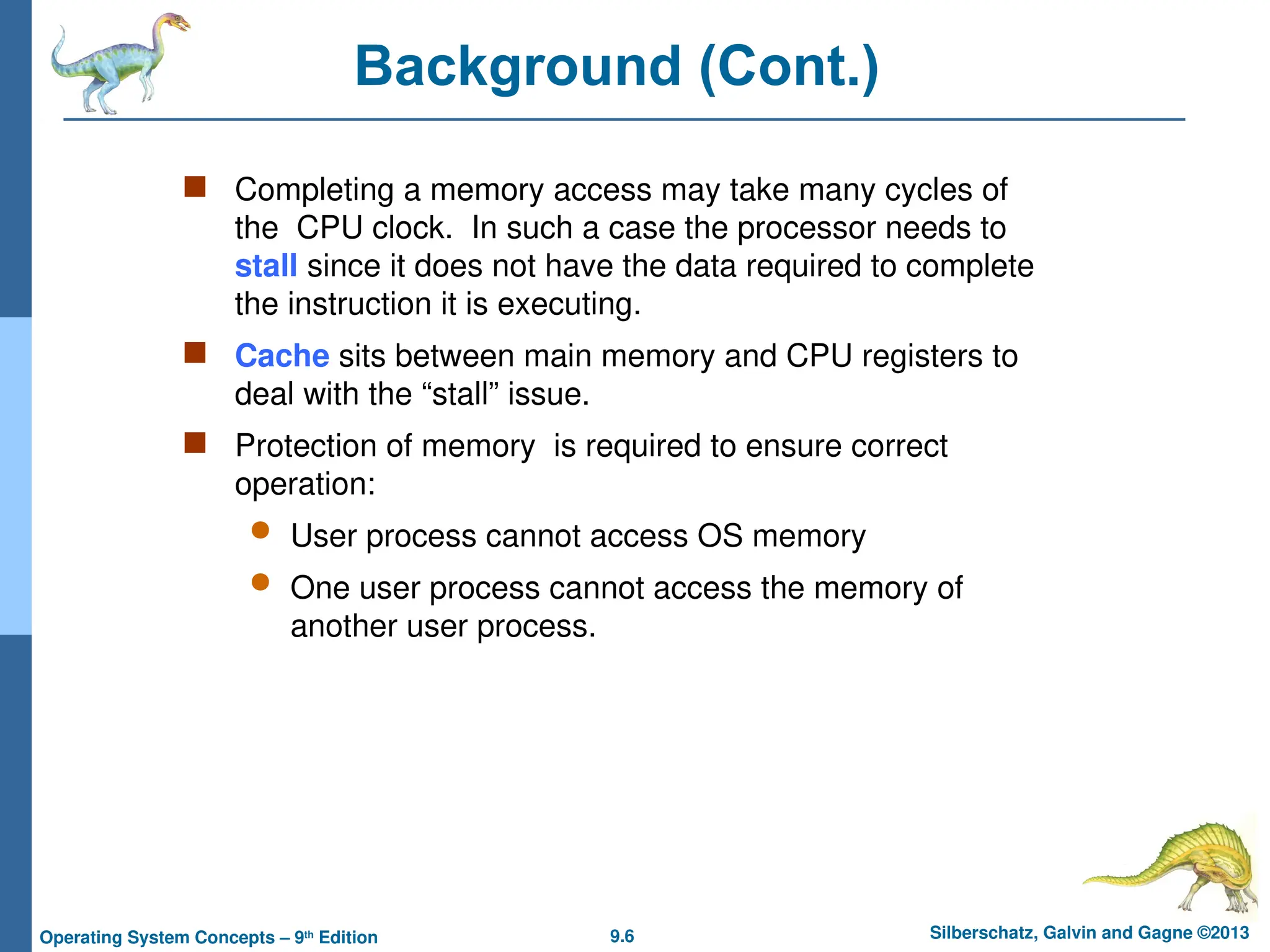
Completing a memory access may take many cycles of
the CPU clock. In such a case the processor needs to
stall since it does not have the data required to complete
the instruction it is executing.
Cache sits between main memory and CPU registers to
deal with the “stall” issue.
Protection of memory is required to ensure correct
operation:
User process cannot access OS memory
One user process cannot access the memory of
another user process.
- 7.
9.7 Silberschatz, Galvinand Gagne ©2013
Operating System Concepts – 9th
Edition
Memory Protection
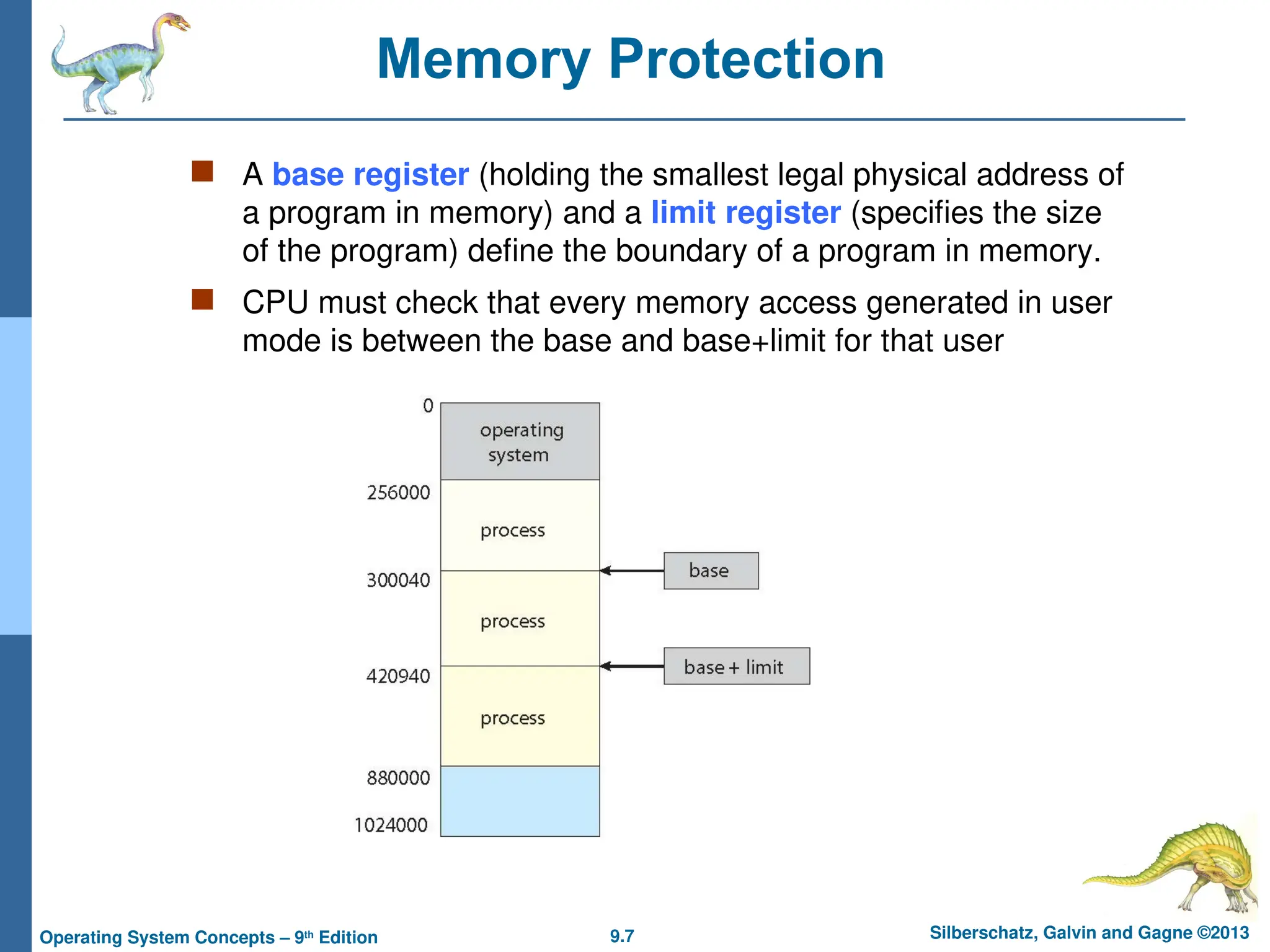
A base register (holding the smallest legal physical address of
a program in memory) and a limit register (specifies the size
of the program) define the boundary of a program in memory.
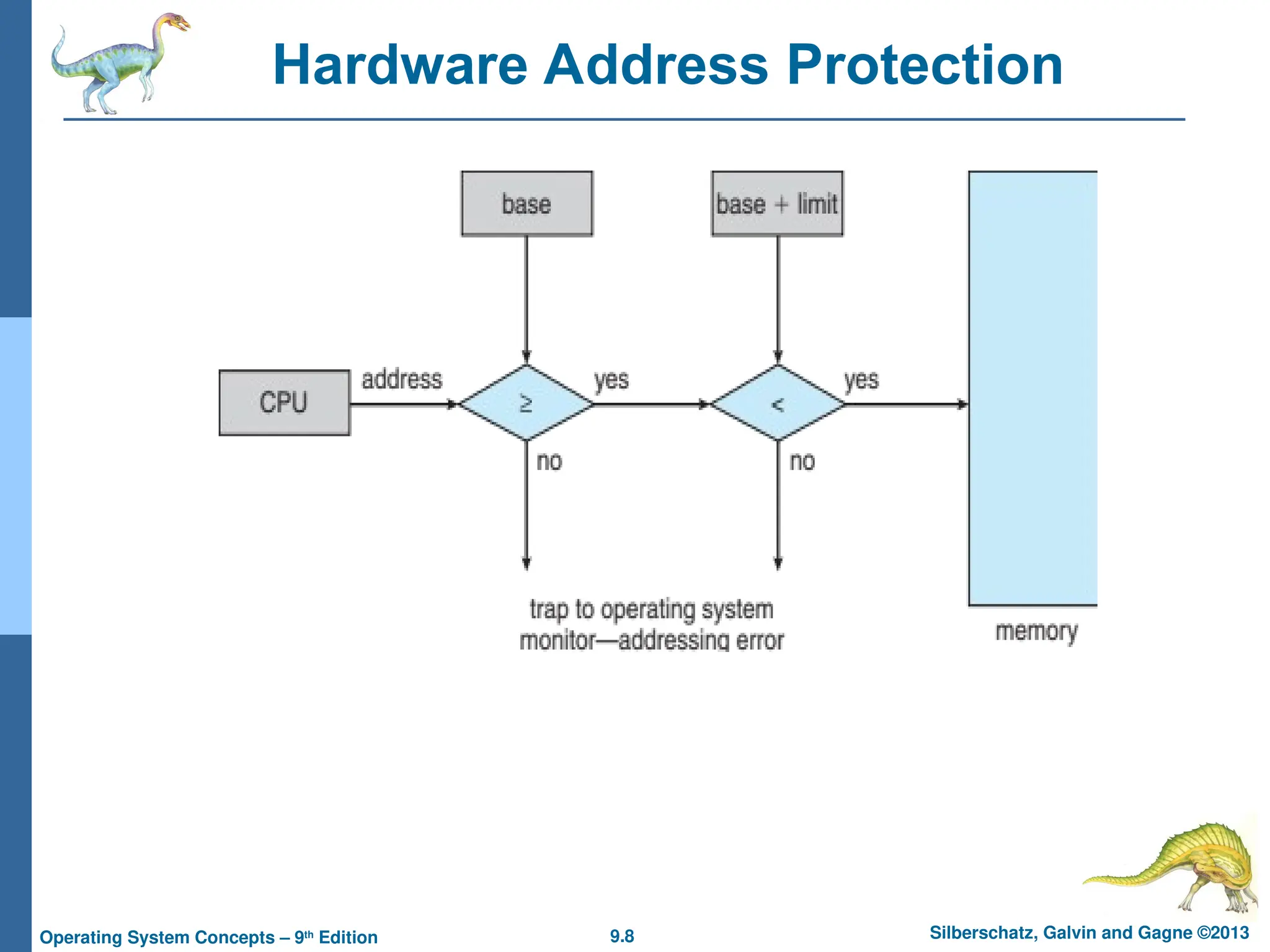
CPU must check that every memory access generated in user
mode is between the base and base+limit for that user
- 8.
- 9.
9.9 Silberschatz, Galvinand Gagne ©2013
Operating System Concepts – 9th
Edition
Address Binding
A program residing on the disk needs to be brought into
memory in order to execute. Such a program is usually
stored as a binary executable file and is kept in an input
queue.
In general, we do not know a priori where the program is
going to reside in memory. Therefore, it is convenient to
assume that the first physical address of a program always
starts at location 0000.
Without some hardware or software support, program must
be loaded into address 0000
It is impractical to have first physical address of user
process to always start at location 0000.
Most (all) computer systems provide hardware and/or
software support for memory management,
- 10.
9.10 Silberschatz, Galvinand Gagne ©2013
Operating System Concepts – 9th
Edition
Address Binding (Cont.)
In general, addresses are represented in different ways at
different stages of a program’s life
Addresses in the source program are generally symbolic
i.e., variable “count”
A compiler typically binds these symbolic addresses to
relocatable addresses
i.e., “14 bytes from beginning of this module”
Linker or loader will bind relocatable addresses to
absolute (physical) addresses
i.e., 74014
Each binding maps one address space to another
address space
- 11.
9.11 Silberschatz, Galvinand Gagne ©2013
Operating System Concepts – 9th
Edition
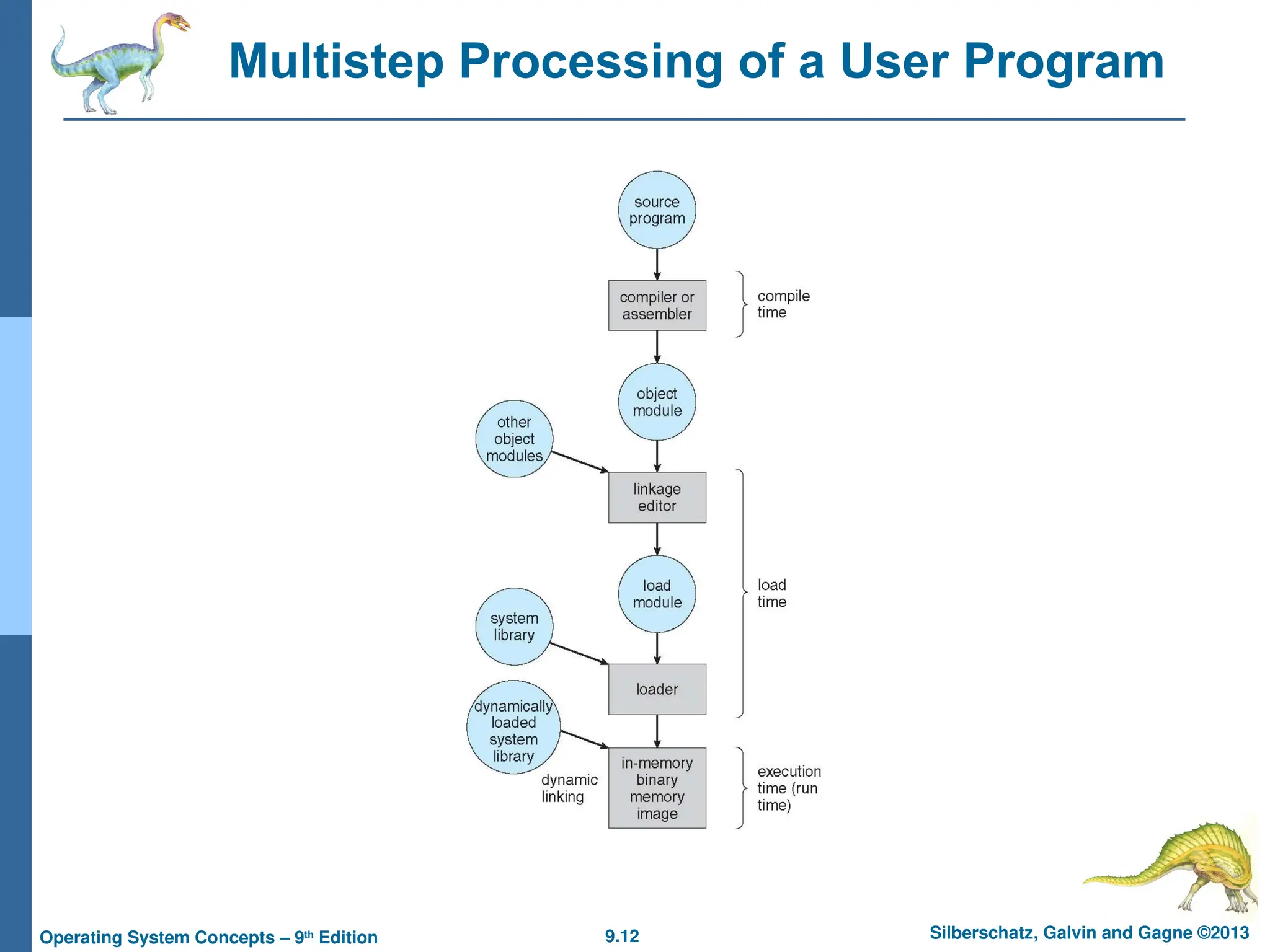
Binding of Instructions and Data to Memory
Compile time: If memory location known a priori,
absolute code can be generated; must recompile code if
starting location changes.
Load time: If memory location is not known at compile
time and no hardware support is available, relocatable
code must be generated (in software).
Execution time: Binding delayed until run time if the
process can be moved during its execution from one
memory segment to another
Need hardware support for address maps (e.g., base
and limit registers)
Address binding of instructions and data to memory
addresses can happen at three different points in time:
- 12.
- 13.
9.13 Silberschatz, Galvinand Gagne ©2013
Operating System Concepts – 9th
Edition
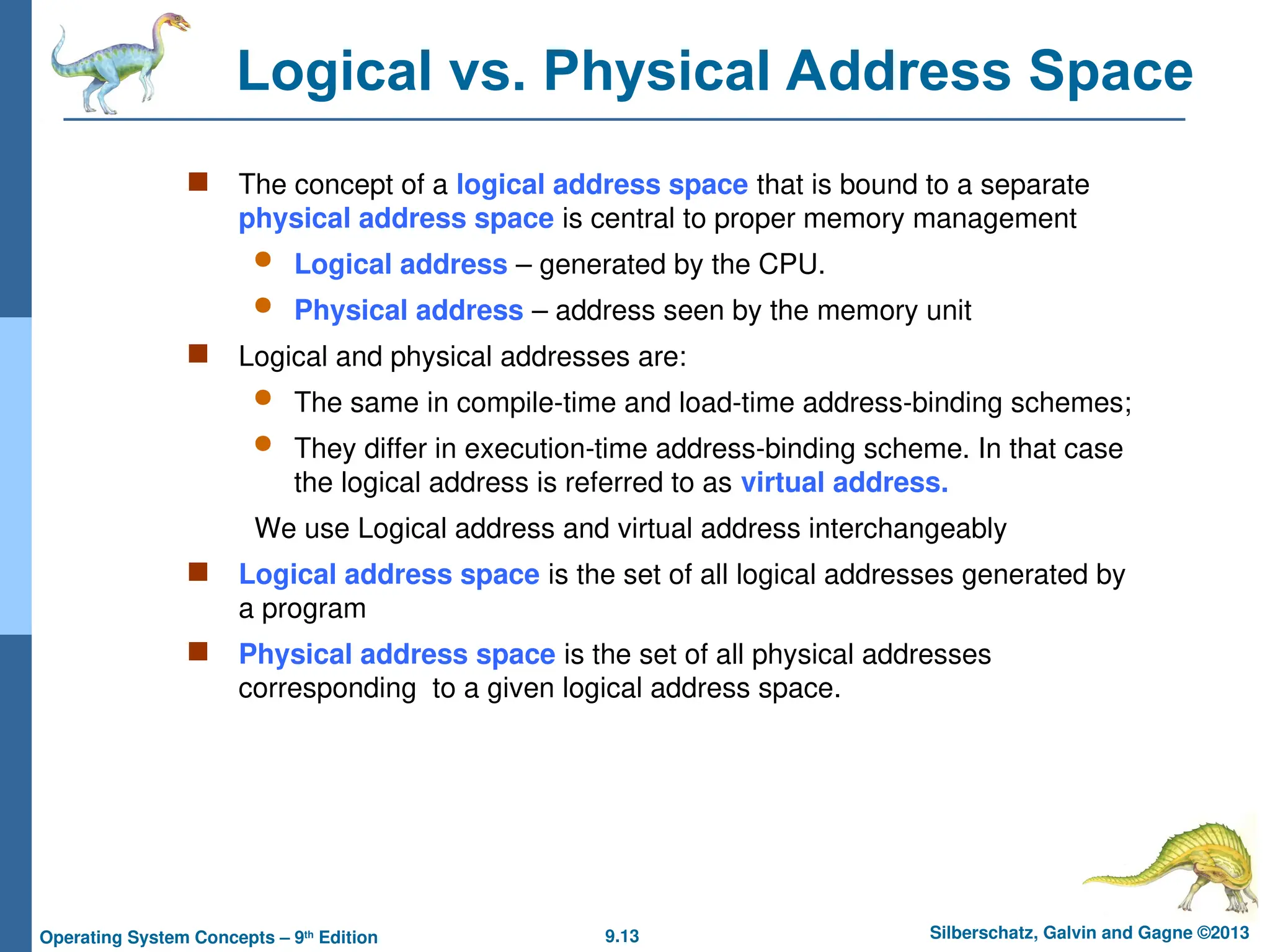
Logical vs. Physical Address Space
The concept of a logical address space that is bound to a separate
physical address space is central to proper memory management
Logical address – generated by the CPU.
Physical address – address seen by the memory unit
Logical and physical addresses are:
The same in compile-time and load-time address-binding schemes;
They differ in execution-time address-binding scheme. In that case
the logical address is referred to as virtual address.
We use Logical address and virtual address interchangeably
Logical address space is the set of all logical addresses generated by
a program
Physical address space is the set of all physical addresses
corresponding to a given logical address space.
- 14.
9.14 Silberschatz, Galvinand Gagne ©2013
Operating System Concepts – 9th
Edition
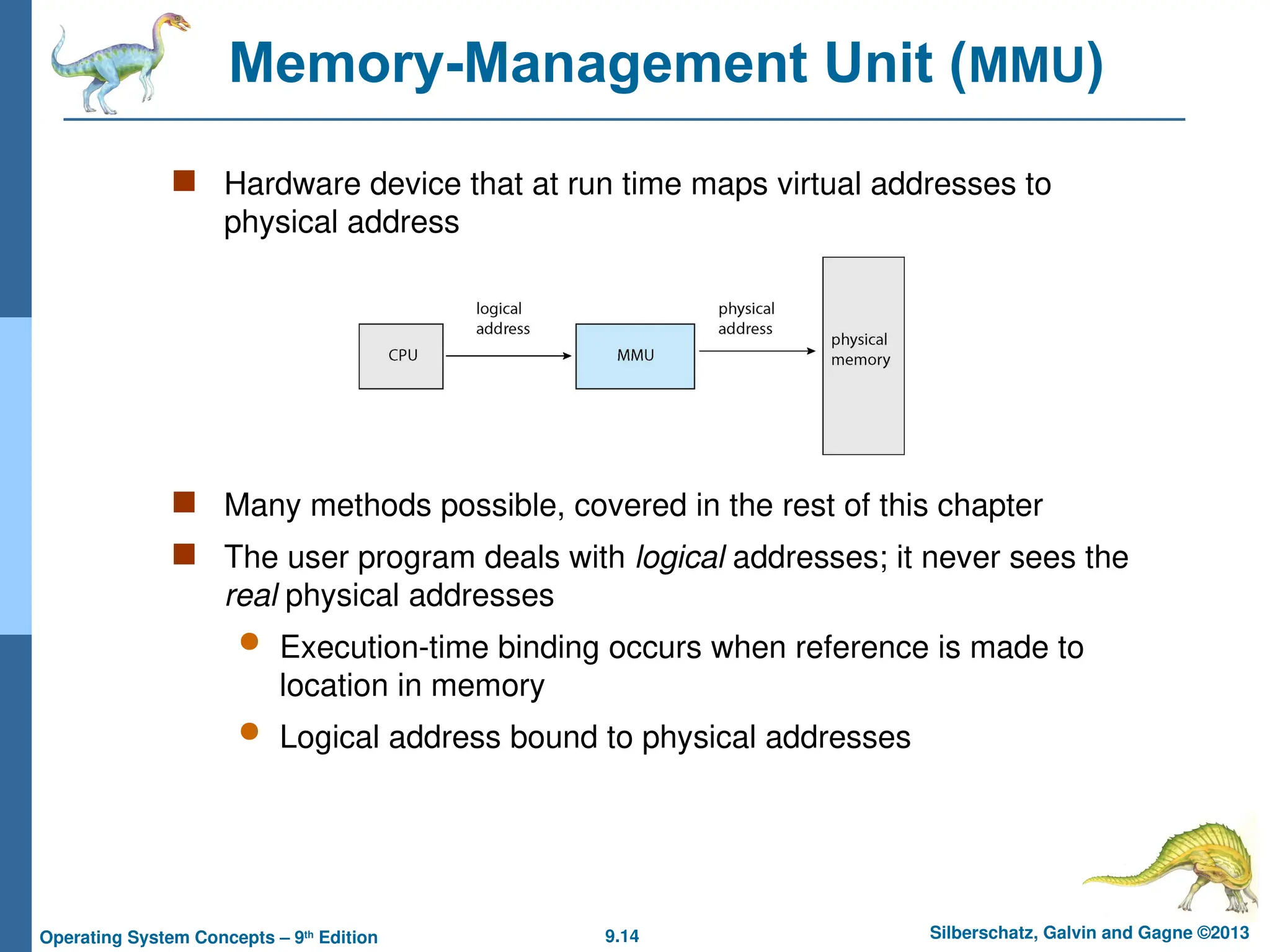
Memory-Management Unit (MMU)
Hardware device that at run time maps virtual addresses to
physical address
Many methods possible, covered in the rest of this chapter
The user program deals with logical addresses; it never sees the
real physical addresses
Execution-time binding occurs when reference is made to
location in memory
Logical address bound to physical addresses
- 15.
9.15 Silberschatz, Galvinand Gagne ©2013
Operating System Concepts – 9th
Edition
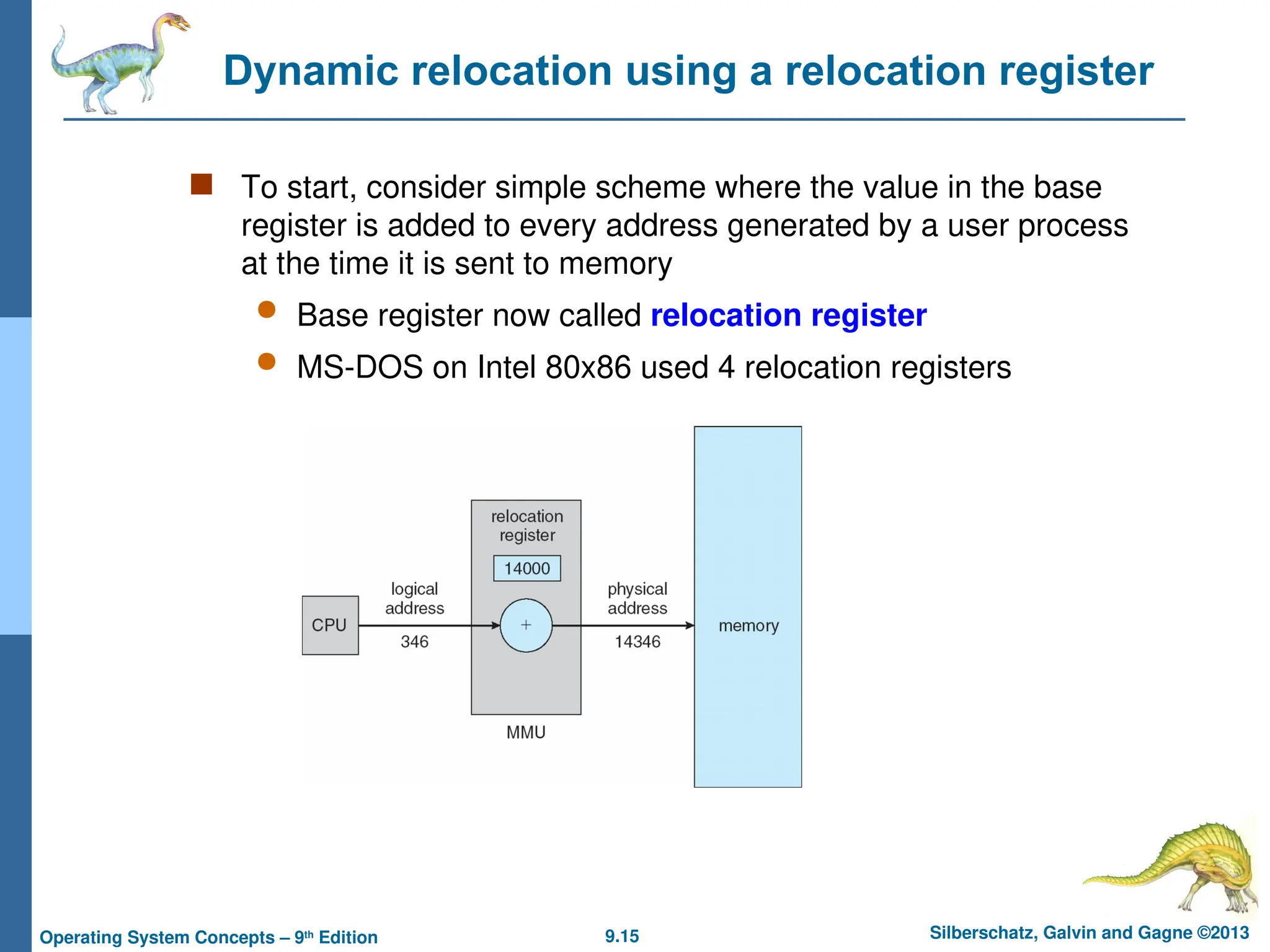
Dynamic relocation using a relocation register
To start, consider simple scheme where the value in the base
register is added to every address generated by a user process
at the time it is sent to memory
Base register now called relocation register
MS-DOS on Intel 80x86 used 4 relocation registers
- 16.
9.16 Silberschatz, Galvinand Gagne ©2013
Operating System Concepts – 9th
Edition
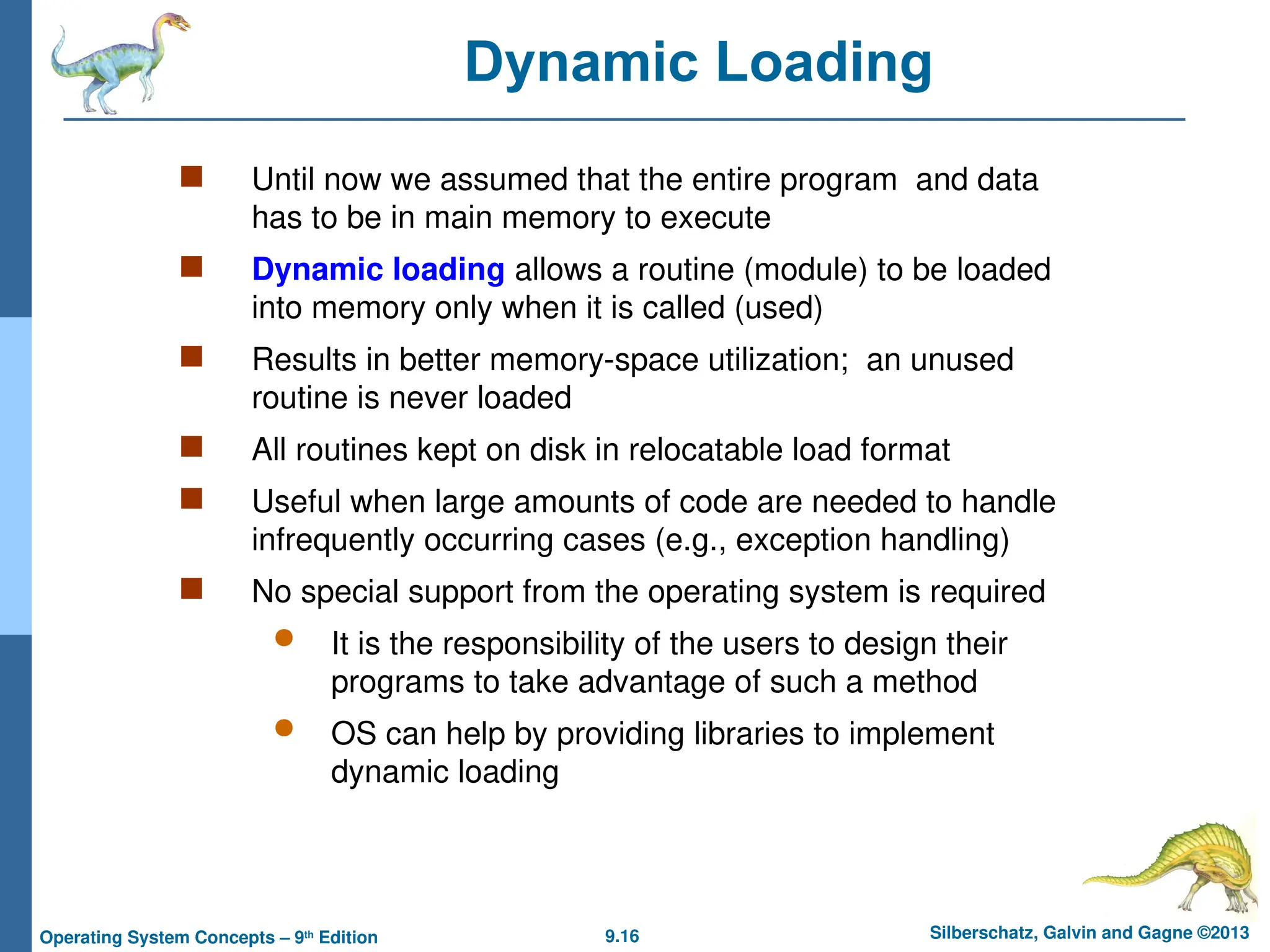
Dynamic Loading
Until now we assumed that the entire program and data
has to be in main memory to execute
Dynamic loading allows a routine (module) to be loaded
into memory only when it is called (used)
Results in better memory-space utilization; an unused
routine is never loaded
All routines kept on disk in relocatable load format
Useful when large amounts of code are needed to handle
infrequently occurring cases (e.g., exception handling)
No special support from the operating system is required
It is the responsibility of the users to design their
programs to take advantage of such a method
OS can help by providing libraries to implement
dynamic loading
- 17.
9.17 Silberschatz, Galvinand Gagne ©2013
Operating System Concepts – 9th
Edition
Dynamic Linking
Dynamically linked libraries – system libraries that are linked
to user programs when the programs are run.
Similar to dynamic loading. But, linking rather than loading
is postponed until execution time
Small piece of code, stub, used to locate the appropriate
memory-resident library routine
Stub replaces itself with the address of the routine, and
executes the routine
Operating system checks if routine is in processes’ memory
address
If not in address space, add to address space
Dynamic linking is particularly useful for libraries
System also known as shared libraries
- 18.
9.18 Silberschatz, Galvinand Gagne ©2013
Operating System Concepts – 9th
Edition
Contiguous Allocation
Main memory must support both OS and user processes
Limited resource -- must allocate efficiently
Contiguous allocation is one early method
Main memory is usually divided into two partitions:
Resident operating system, usually held in low memory
with interrupt vector
User processes are held in high memory
Each process contained in single contiguous section of
memory
- 19.
9.19 Silberschatz, Galvinand Gagne ©2013
Operating System Concepts – 9th
Edition
Contiguous Allocation (Cont.)
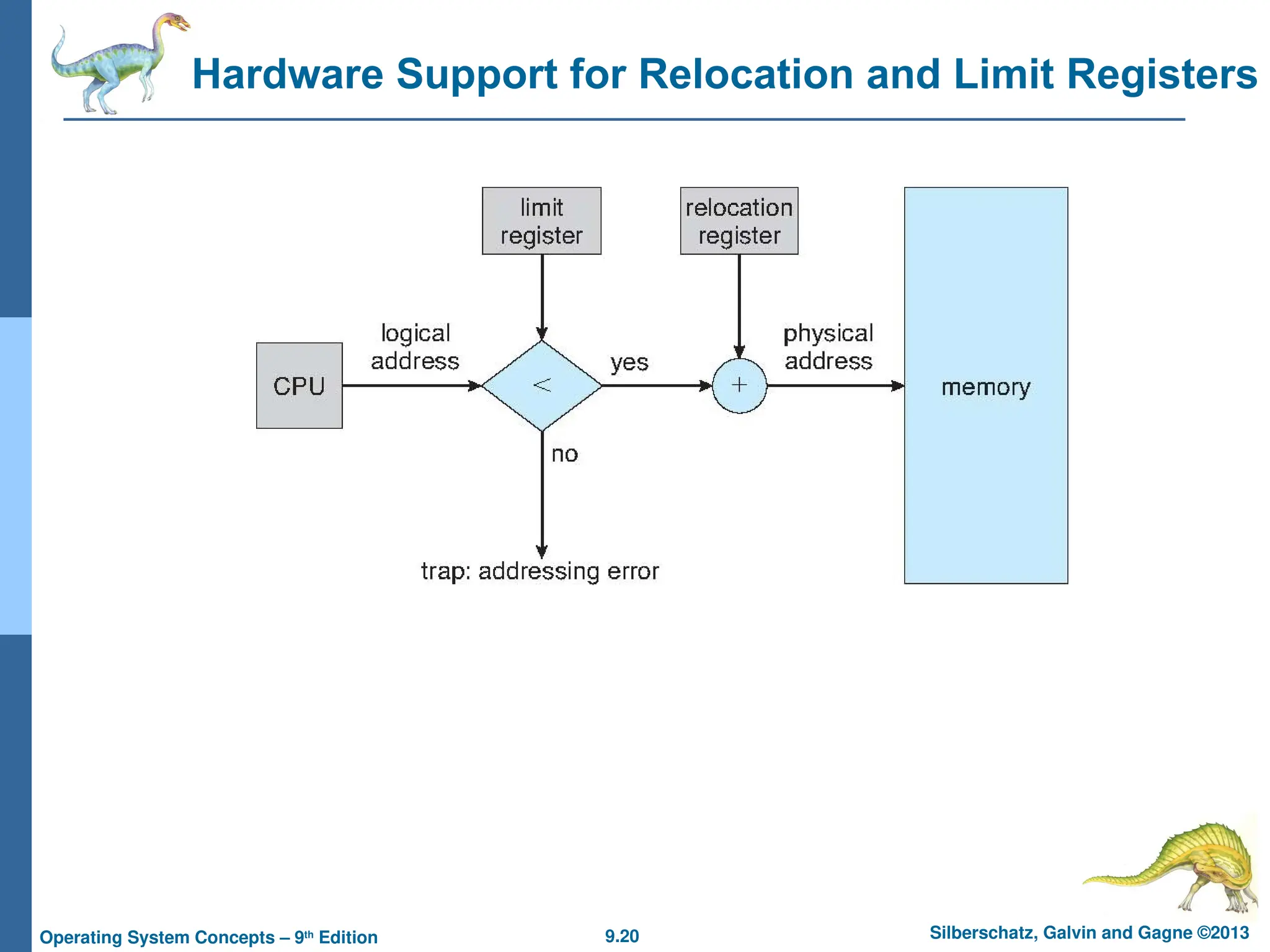
Relocation registers used to protect user processes from each
other, and from changing operating-system code and data
Base register contains value of smallest physical address
Limit register contains range of logical addresses – each
logical address must be less than the limit register
MMU maps logical address dynamically
Can then allow actions such as kernel code being
transient – comes and goes as needed. Thus, kernel can
change size dynamically.
- 20.
9.20 Silberschatz, Galvinand Gagne ©2013
Operating System Concepts – 9th
Edition
Hardware Support for Relocation and Limit Registers
- 21.
9.21 Silberschatz, Galvinand Gagne ©2013
Operating System Concepts – 9th
Edition
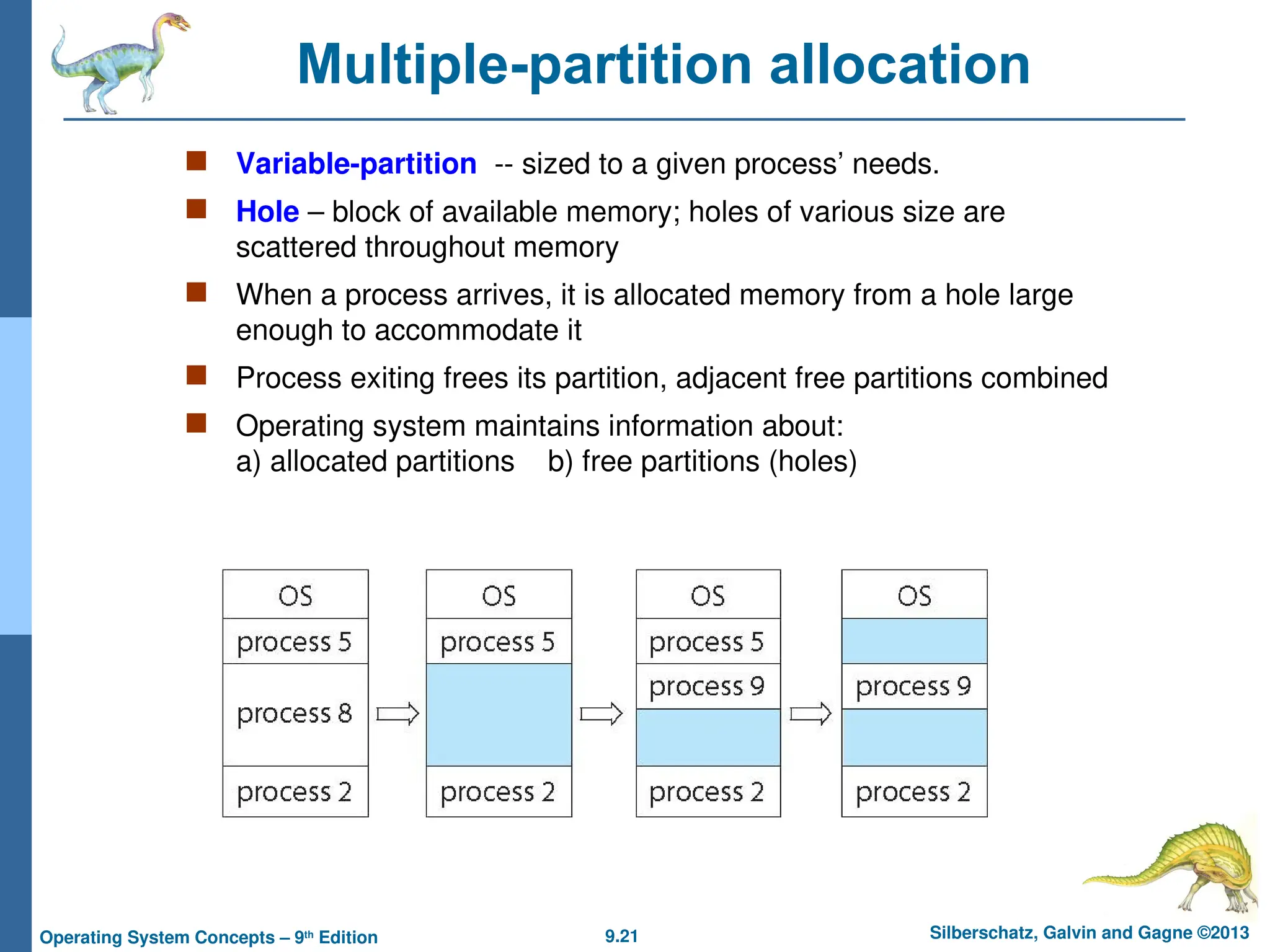
Multiple-partition allocation
Variable-partition -- sized to a given process’ needs.
Hole – block of available memory; holes of various size are
scattered throughout memory
When a process arrives, it is allocated memory from a hole large
enough to accommodate it
Process exiting frees its partition, adjacent free partitions combined
Operating system maintains information about:
a) allocated partitions b) free partitions (holes)
- 22.
9.22 Silberschatz, Galvinand Gagne ©2013
Operating System Concepts – 9th
Edition
Dynamic Storage-Allocation Problem
How to satisfy a request of size n from a list of free holes?
First-fit: Allocate the first hole that is big enough
Best-fit: Allocate the smallest hole that is big enough;
must search entire list, unless the list is ordered by size.
Produces the smallest leftover hole
Worst-fit: Allocate the largest hole; must also search
entire list, unless the list is ordered by size
Produces the largest leftover hole
First-fit and best-fit are better than worst-fit in terms of speed
and storage utilization
- 23.
9.23 Silberschatz, Galvinand Gagne ©2013
Operating System Concepts – 9th
Edition
Fragmentation
External Fragmentation – total memory space exists to
satisfy a request, but it is not contiguous and therefore
cannot be used.
First fit analysis reveals that given N allocated blocks,
another 0.5 N blocks will be lost to fragmentation
1/3 of memory may be unusable -> 50-percent rule
Internal Fragmentation – allocated memory may be slightly
larger than requested memory.
Can happen if there is hole of size 15,000 bytes and a
process needs 14,900 bytes; Keeping a hole of size 100
bytes is not worth the effort so the process is allocated
15,000 bytes.
The size difference of 100 bytes is memory internal to a
partition, but not being used
- 24.
9.24 Silberschatz, Galvinand Gagne ©2013
Operating System Concepts – 9th
Edition
Fragmentation (Cont.)
Shuffle memory contents to place all free memory
together in one large block
Compaction is possible only if relocation is dynamic, and
is done at execution time
I/O problem -- cannot perform compaction while I/O is in
progress involving memory that is being compacted.
Latch job in memory while it is involved in I/O
Do I/O only into OS buffers
Reduce external fragmentation by compaction
- 25.
9.25 Silberschatz, Galvinand Gagne ©2013
Operating System Concepts – 9th
Edition
Non-contiguous Allocation
Partition the a program into a number of small units, each
of which can reside in a different part of the memory.
Need hardware support.
Various methods to do the partitions:
Segmentation.
Paging
paged segmentation.
- 26.
9.26 Silberschatz, Galvinand Gagne ©2013
Operating System Concepts – 9th
Edition
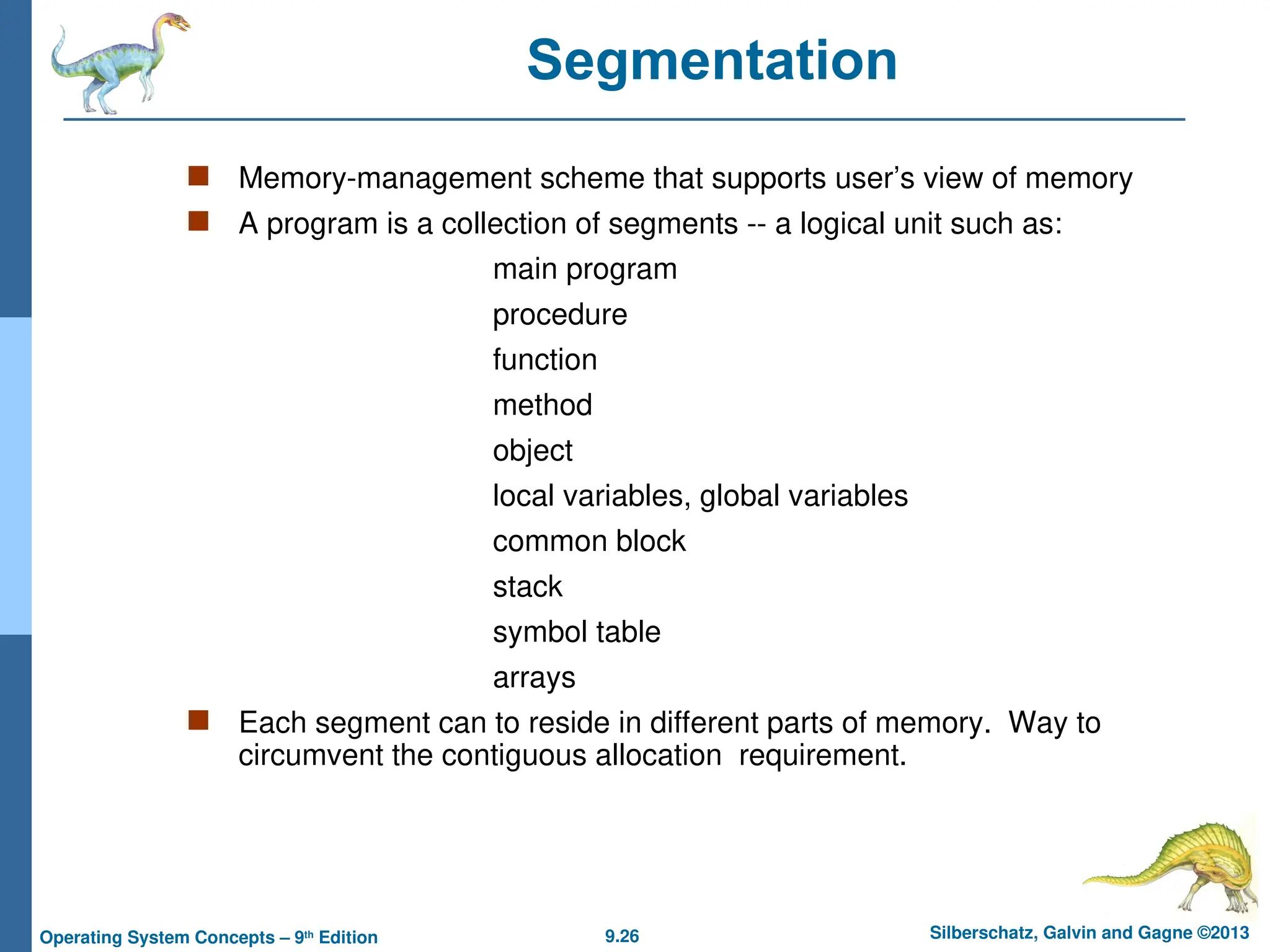
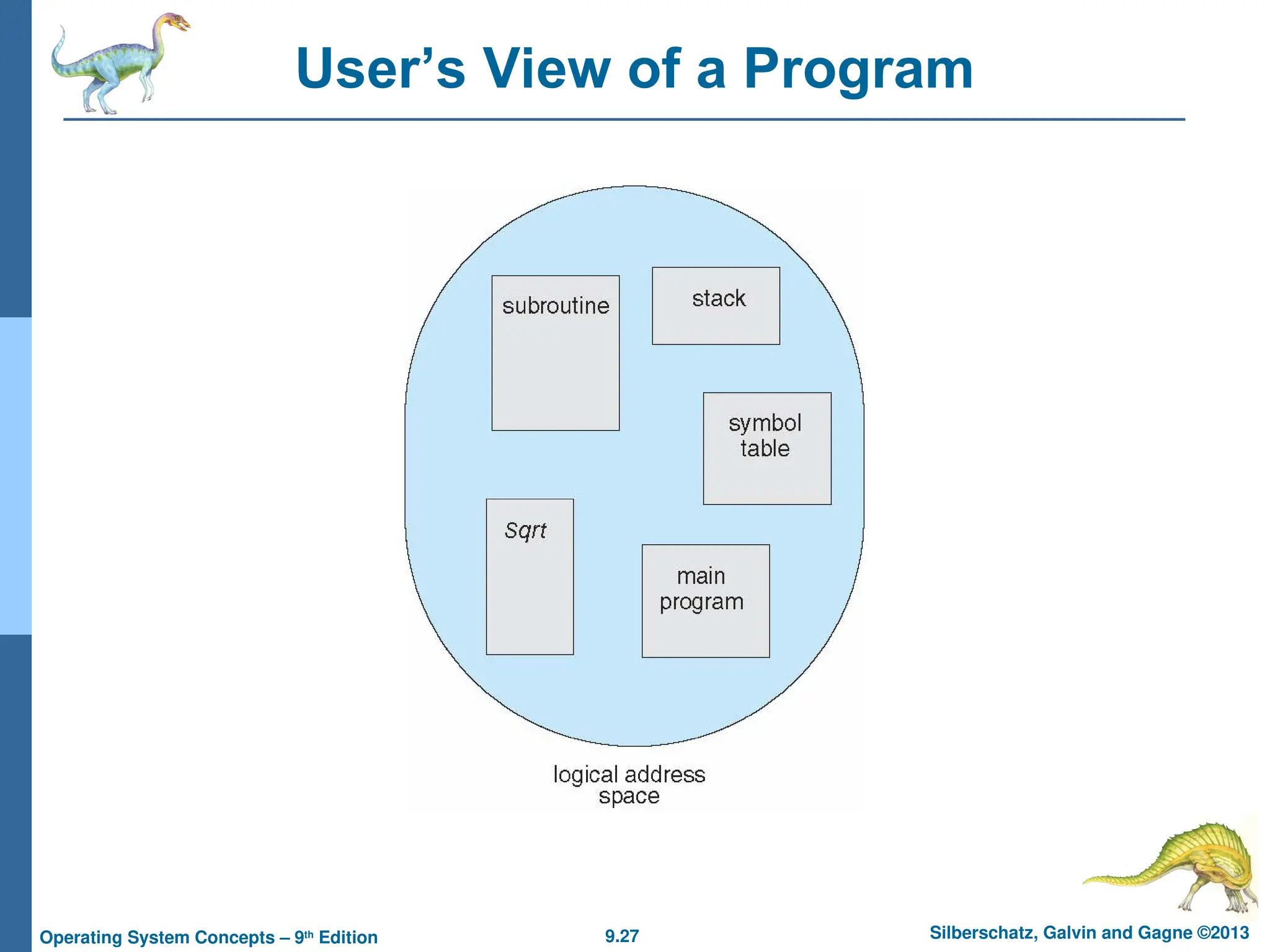
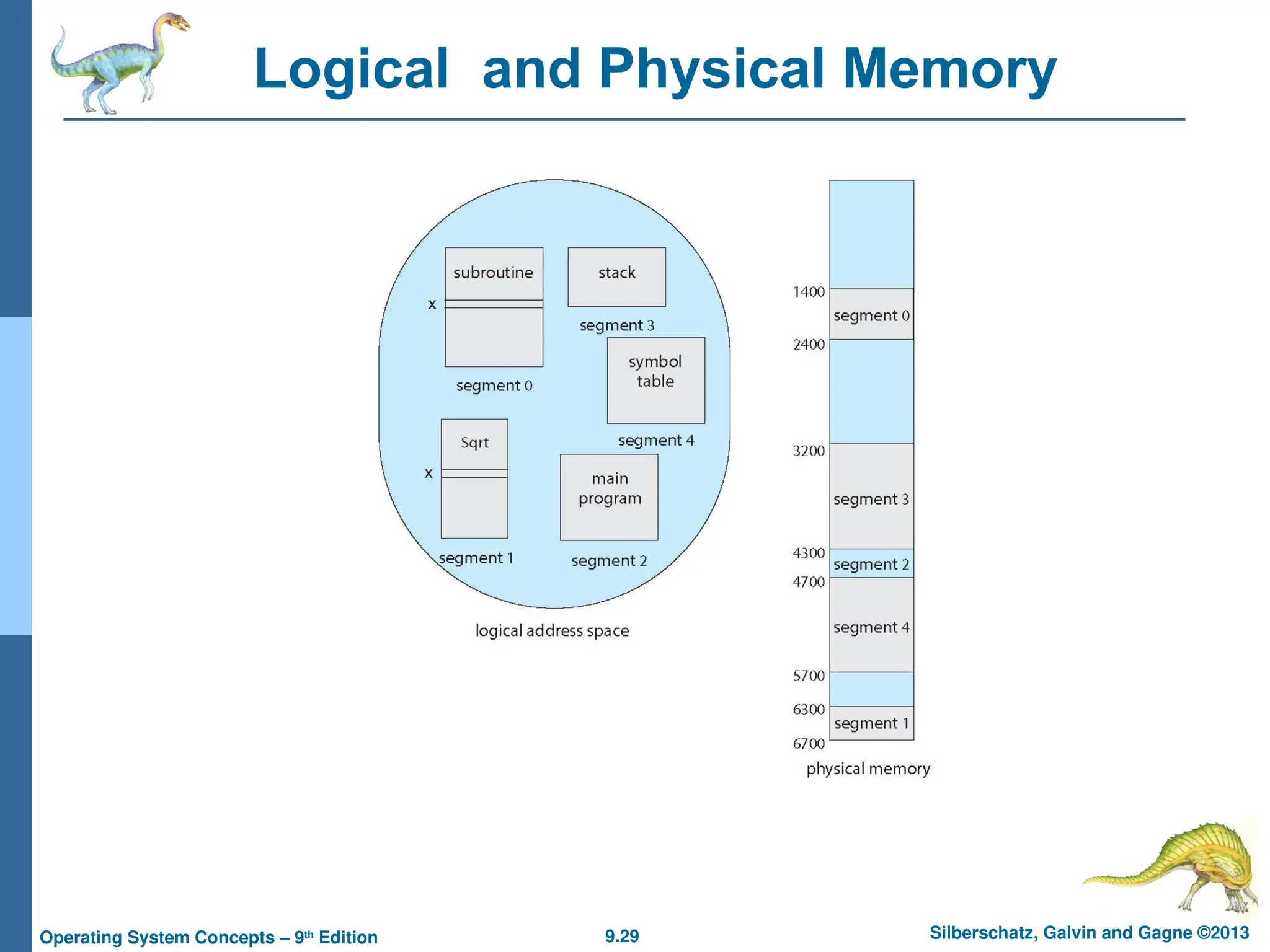
Segmentation
Memory-management scheme that supports user’s view of memory
A program is a collection of segments -- a logical unit such as:
main program
procedure
function
method
object
local variables, global variables
common block
stack
symbol table
arrays
Each segment can to reside in different parts of memory. Way to
circumvent the contiguous allocation requirement.
- 27.
- 28.
- 29.
- 30.
9.30 Silberschatz, Galvinand Gagne ©2013
Operating System Concepts – 9th
Edition
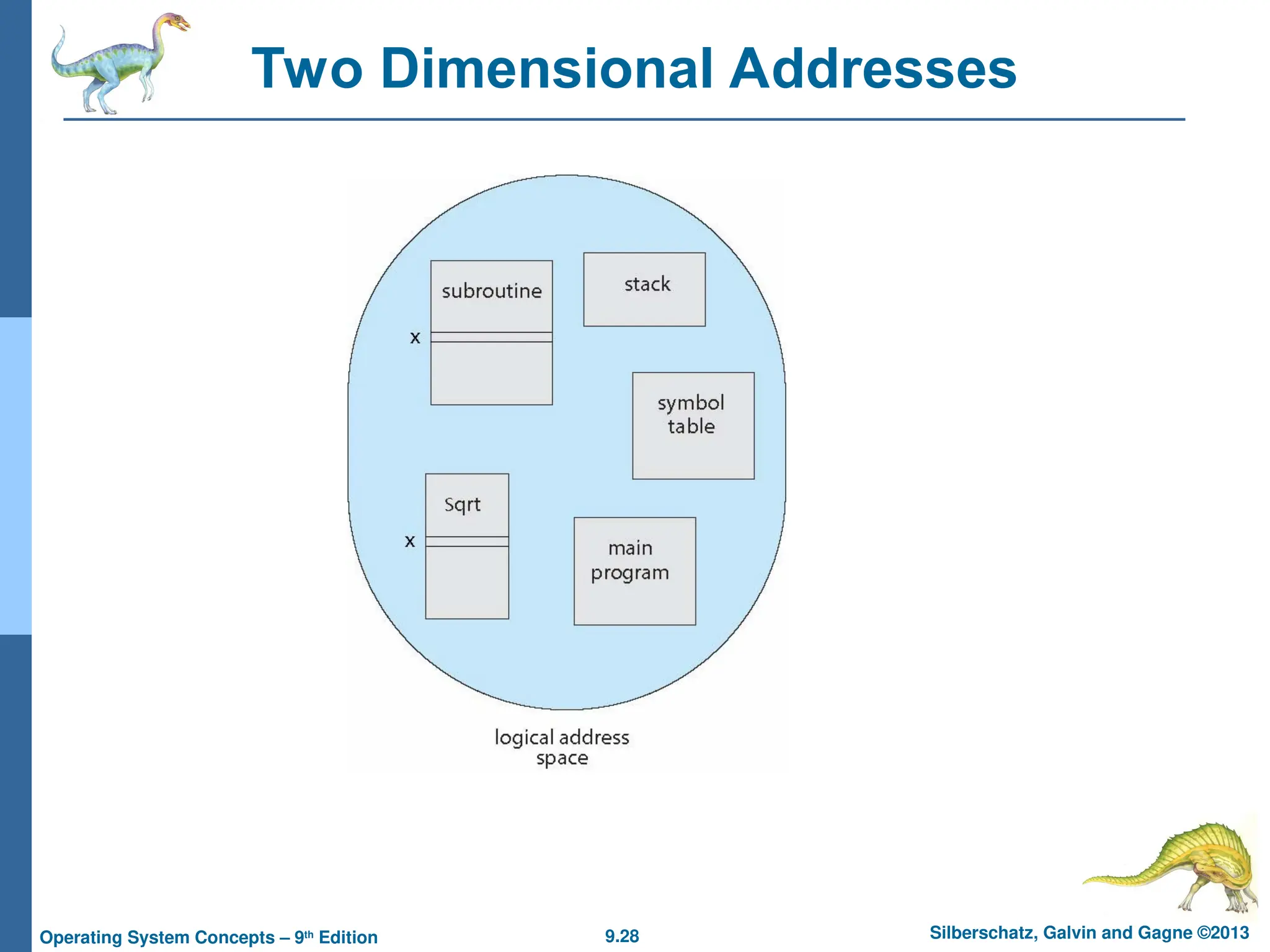
Segmentation Architecture
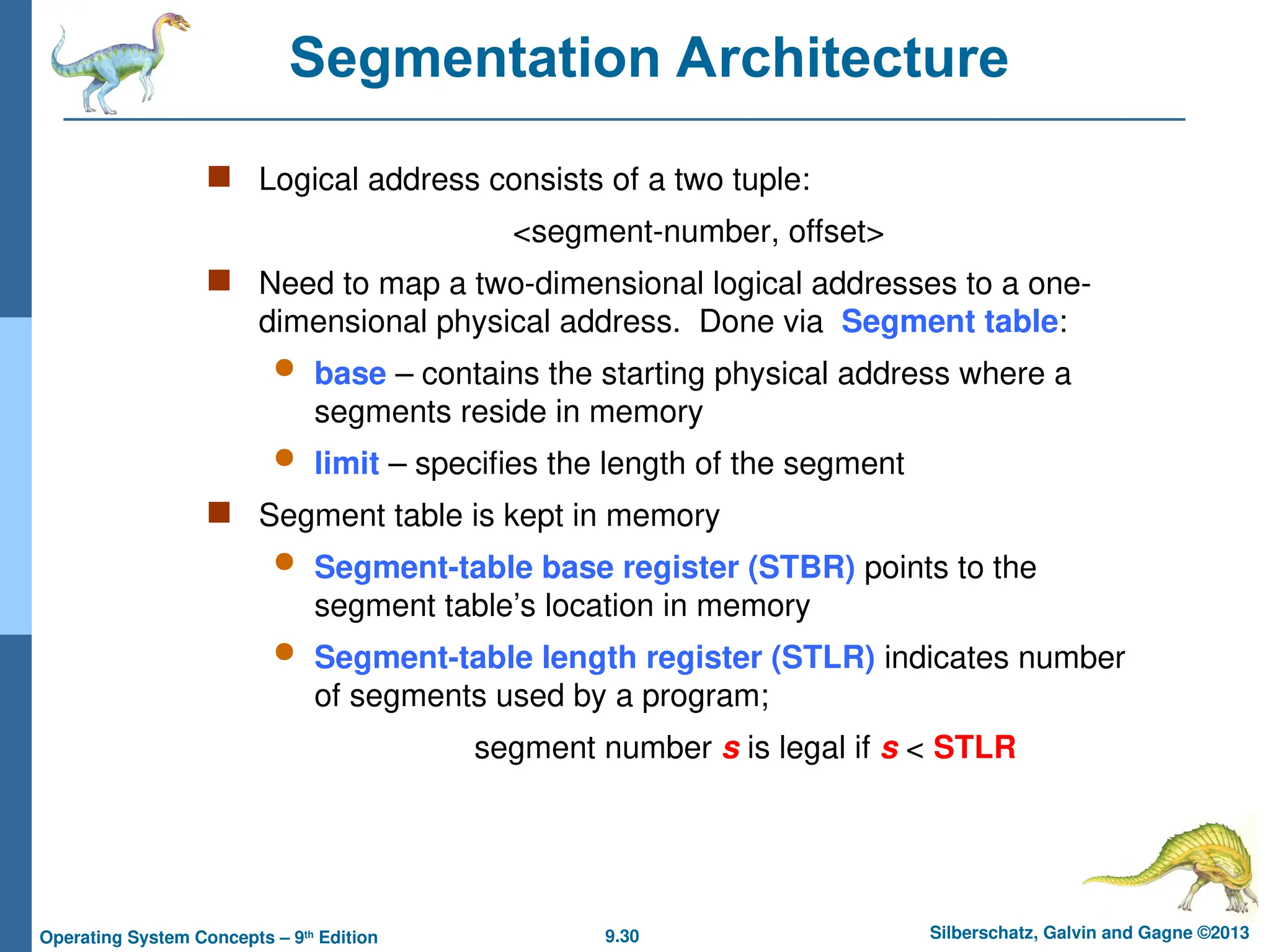
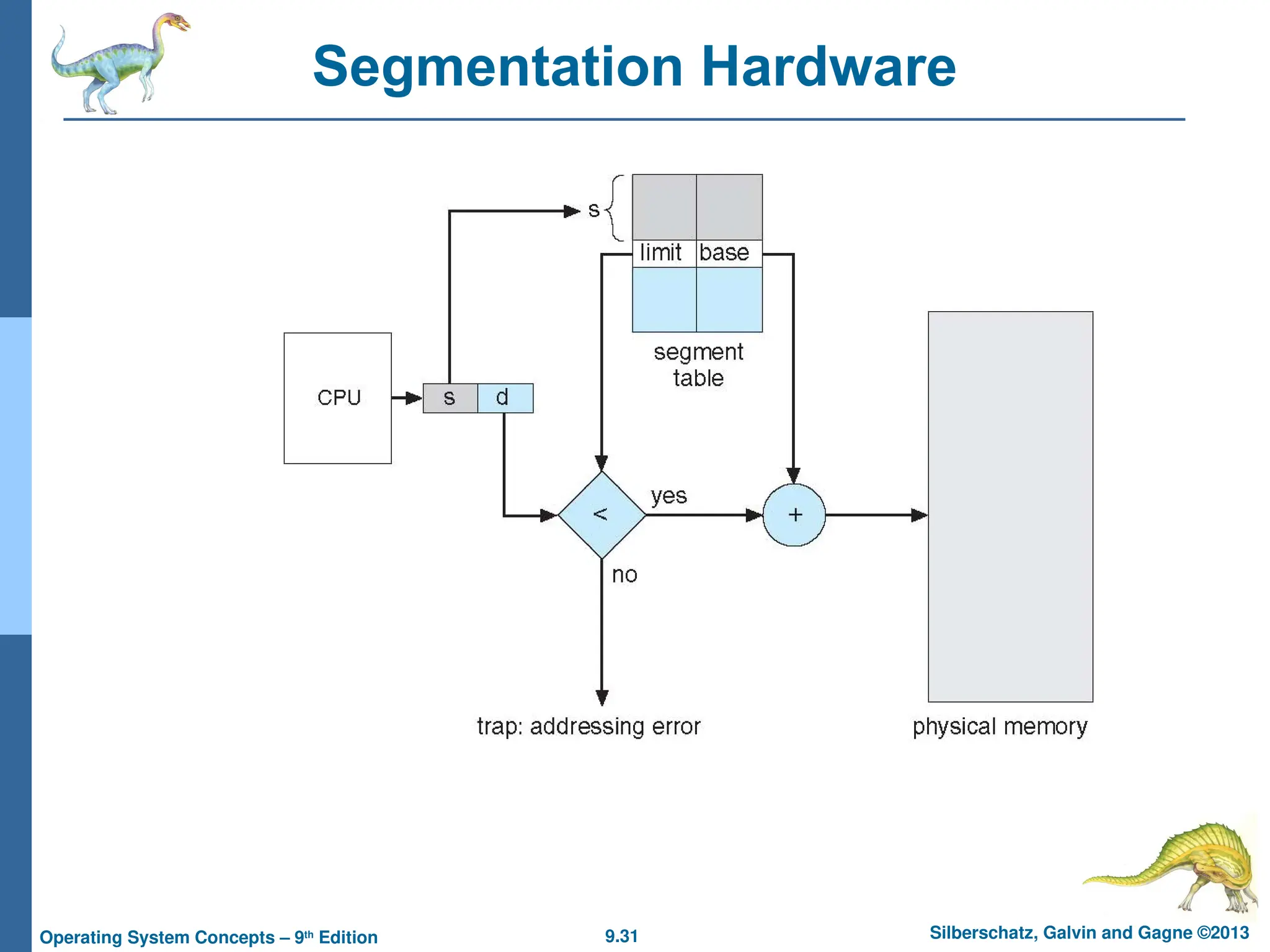
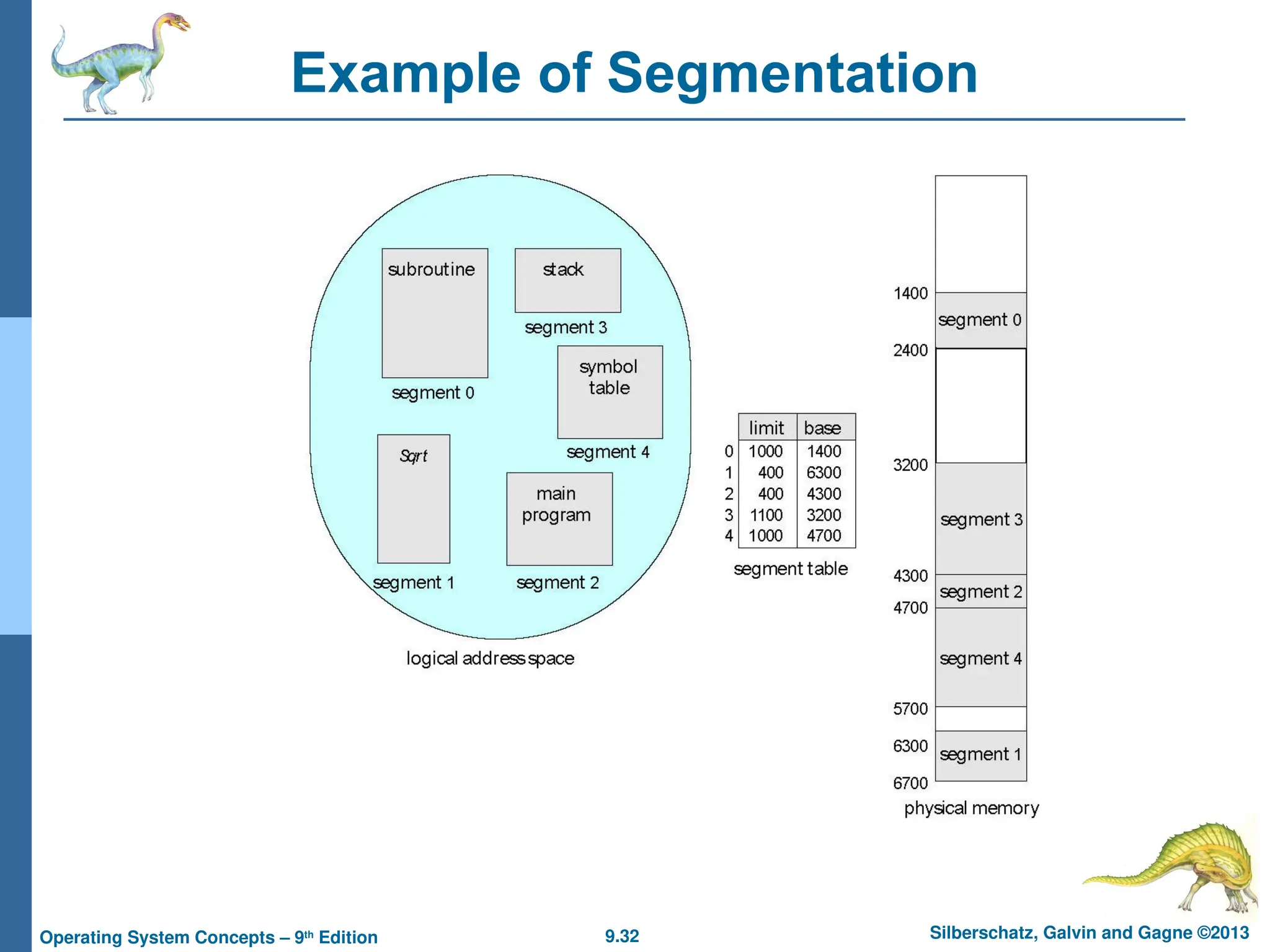
Logical address consists of a two tuple:
<segment-number, offset>
Need to map a two-dimensional logical addresses to a one-
dimensional physical address. Done via Segment table:
base – contains the starting physical address where a
segments reside in memory
limit – specifies the length of the segment
Segment table is kept in memory
Segment-table base register (STBR) points to the
segment table’s location in memory
Segment-table length register (STLR) indicates number
of segments used by a program;
segment number s is legal if s < STLR
- 31.
- 32.
- 33.
9.33 Silberschatz, Galvinand Gagne ©2013
Operating System Concepts – 9th
Edition
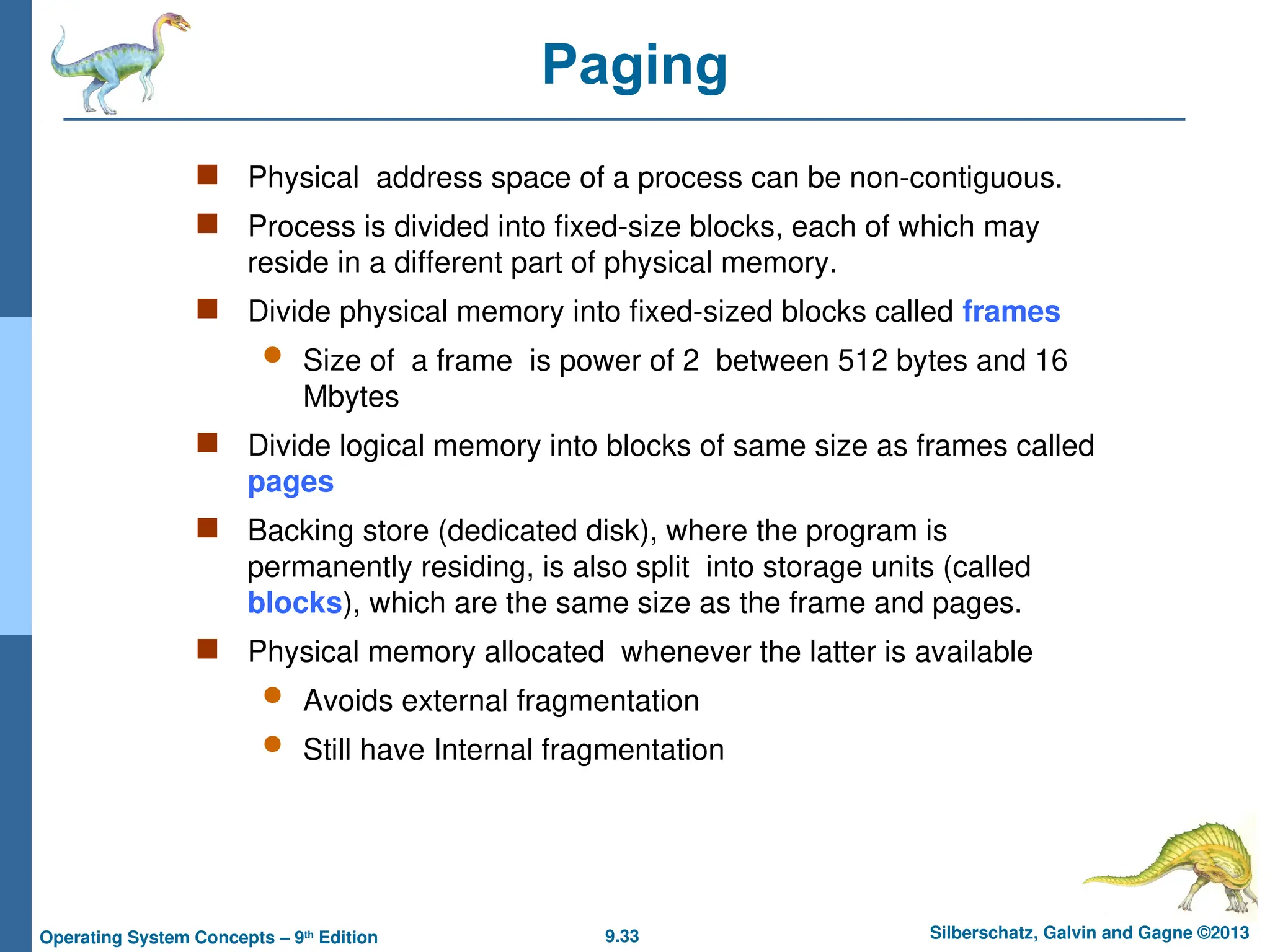
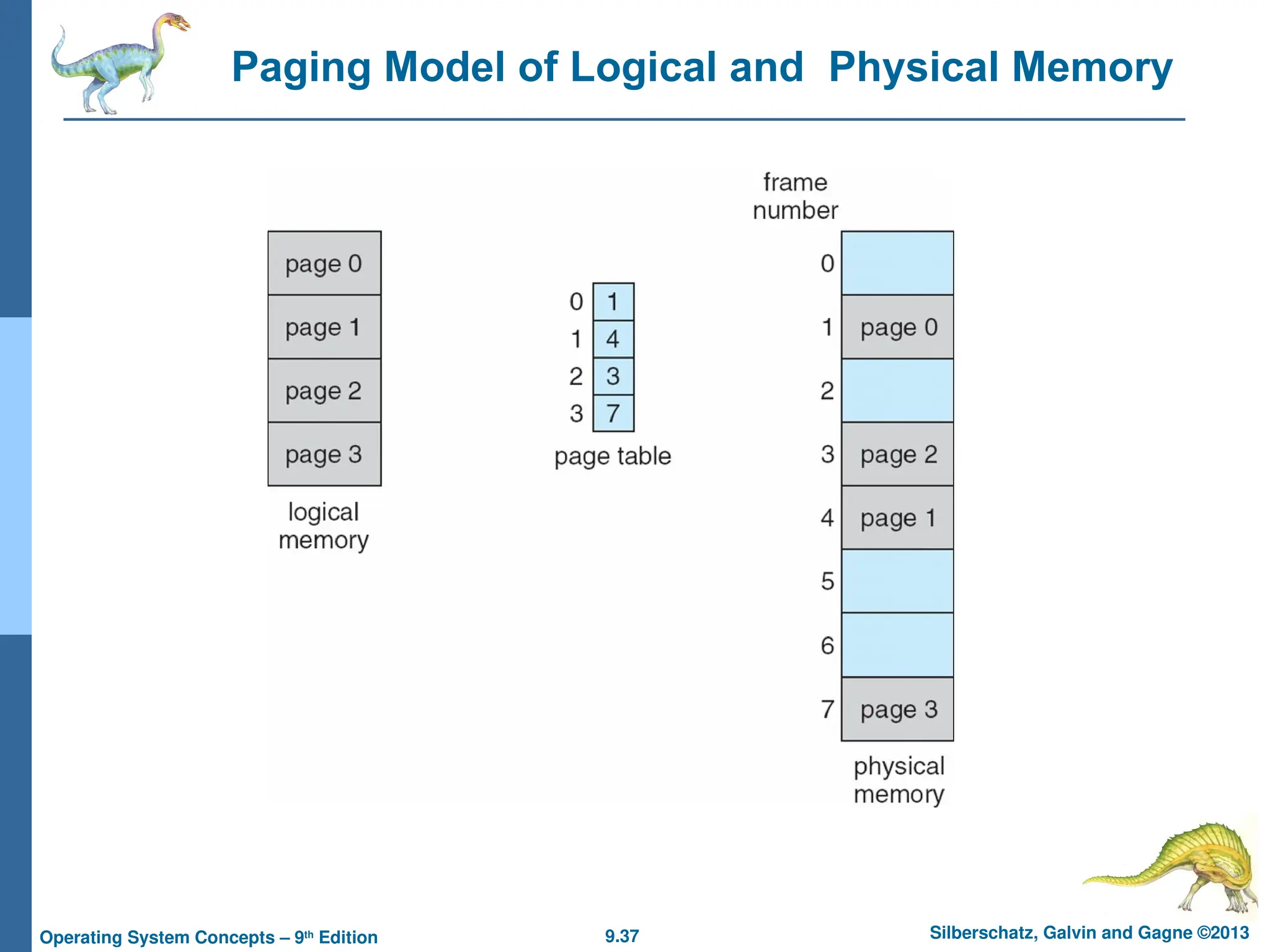
Paging
Physical address space of a process can be non-contiguous.
Process is divided into fixed-size blocks, each of which may
reside in a different part of physical memory.
Divide physical memory into fixed-sized blocks called frames
Size of a frame is power of 2 between 512 bytes and 16
Mbytes
Divide logical memory into blocks of same size as frames called
pages
Backing store (dedicated disk), where the program is
permanently residing, is also split into storage units (called
blocks), which are the same size as the frame and pages.
Physical memory allocated whenever the latter is available
Avoids external fragmentation
Still have Internal fragmentation
- 34.
9.34 Silberschatz, Galvinand Gagne ©2013
Operating System Concepts – 9th
Edition
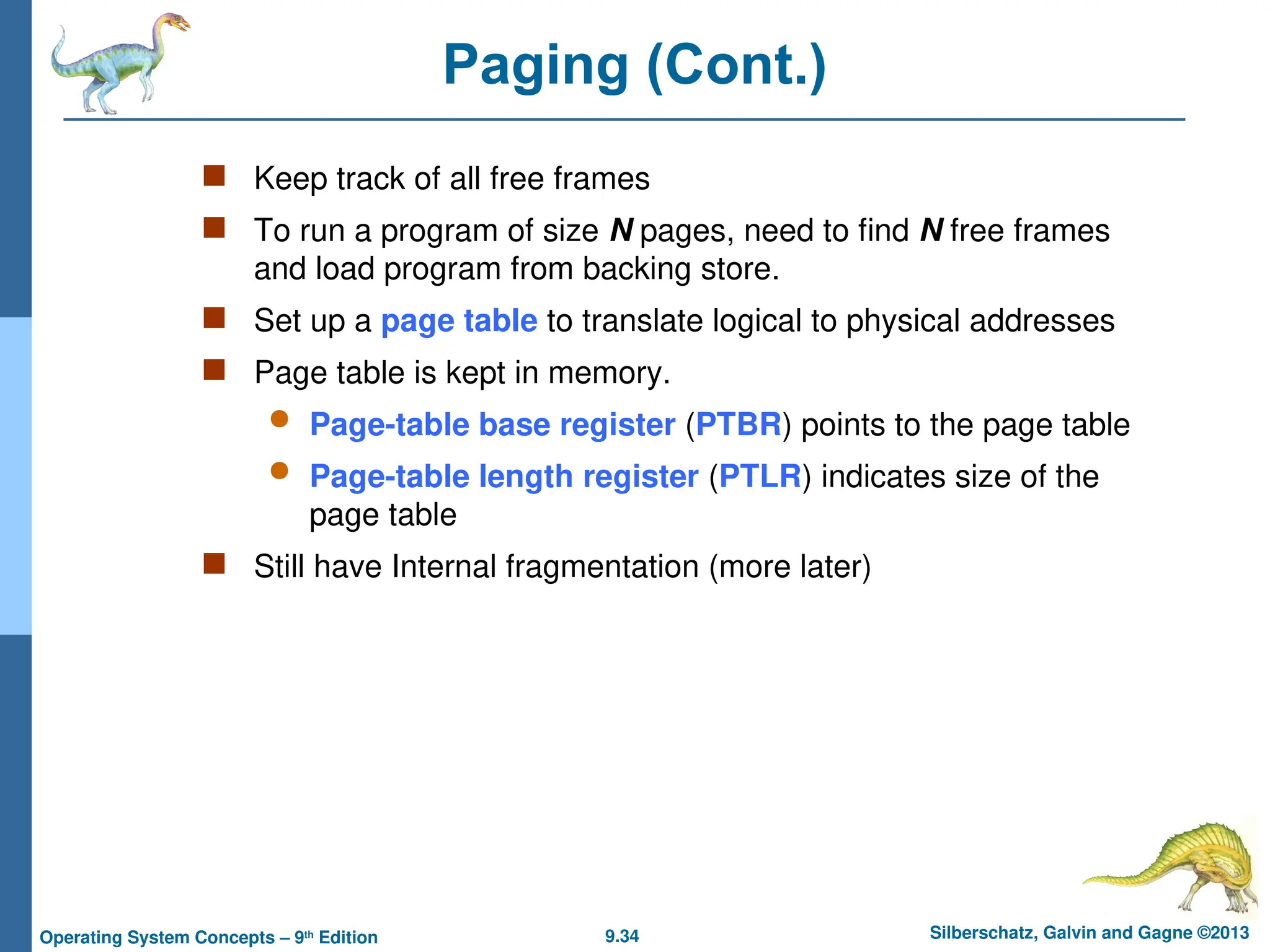
Paging (Cont.)
Keep track of all free frames
To run a program of size N pages, need to find N free frames
and load program from backing store.
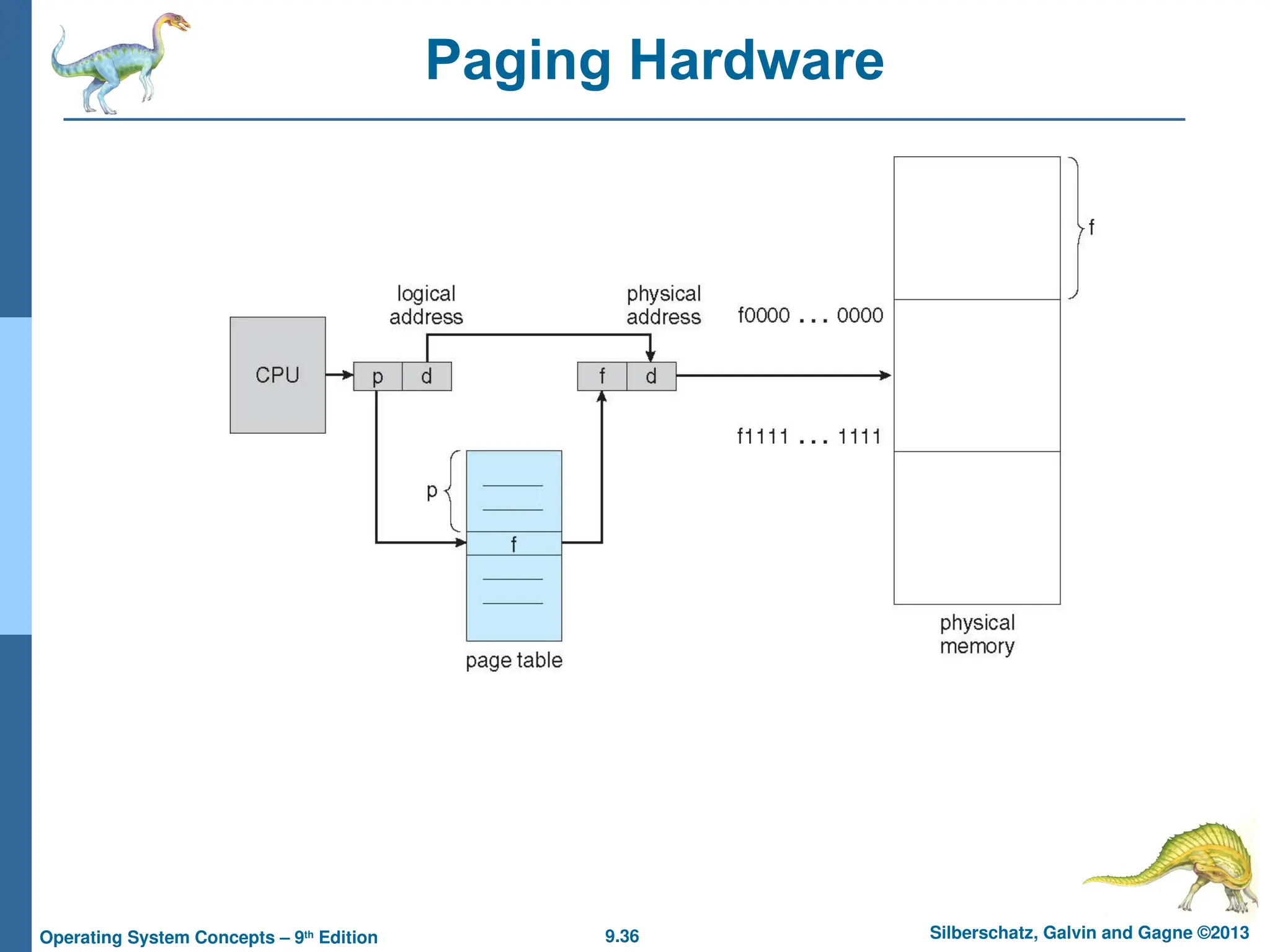
Set up a page table to translate logical to physical addresses
Page table is kept in memory.
Page-table base register (PTBR) points to the page table
Page-table length register (PTLR) indicates size of the
page table
Still have Internal fragmentation (more later)
- 35.
9.35 Silberschatz, Galvinand Gagne ©2013
Operating System Concepts – 9th
Edition
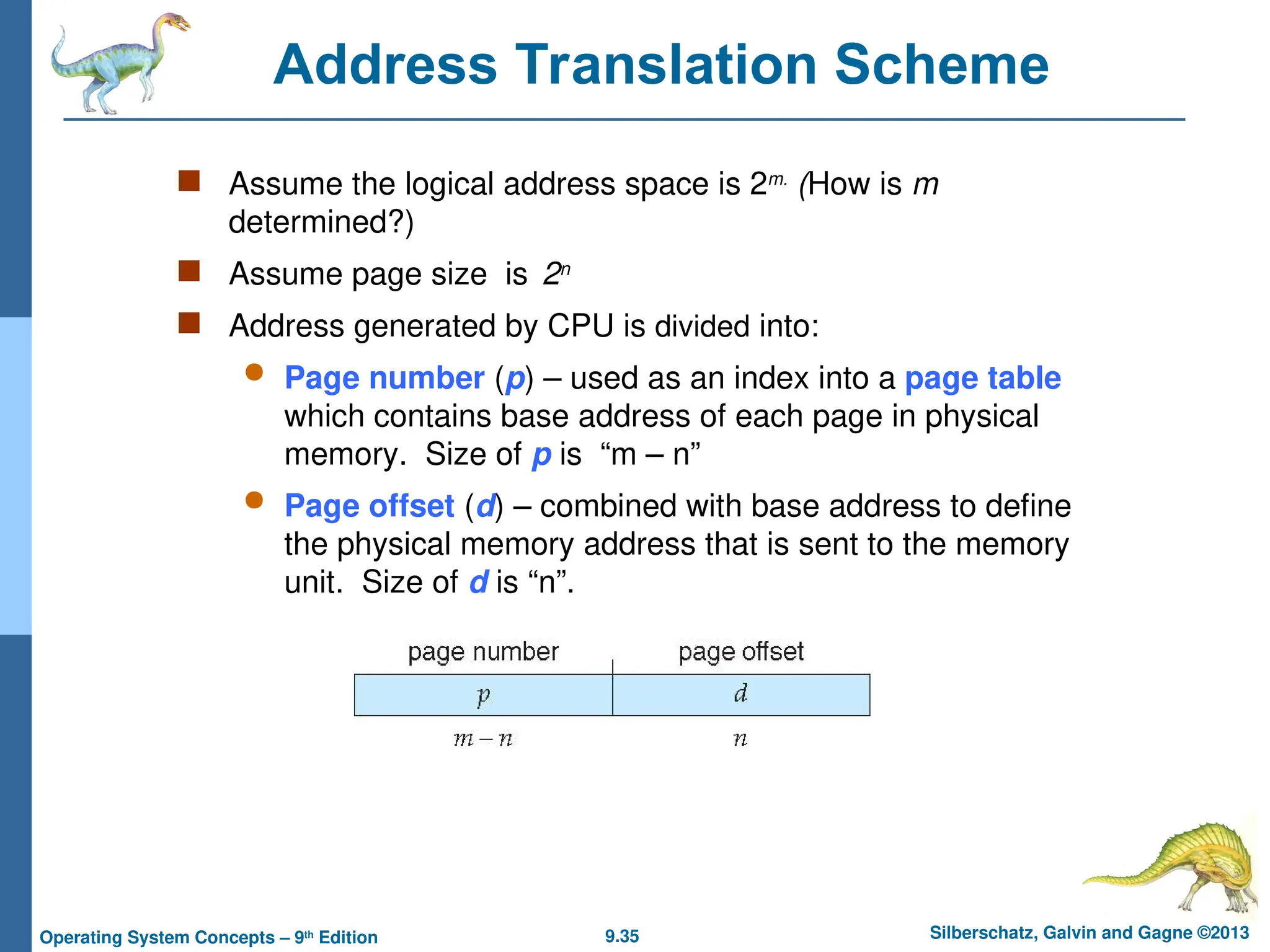
Address Translation Scheme
Assume the logical address space is 2m.
(How is m
determined?)
Assume page size is 2n
Address generated by CPU is divided into:
Page number (p) – used as an index into a page table
which contains base address of each page in physical
memory. Size of p is “m – n”
Page offset (d) – combined with base address to define
the physical memory address that is sent to the memory
unit. Size of d is “n”.
- 36.
- 37.
- 38.
9.38 Silberschatz, Galvinand Gagne ©2013
Operating System Concepts – 9th
Edition
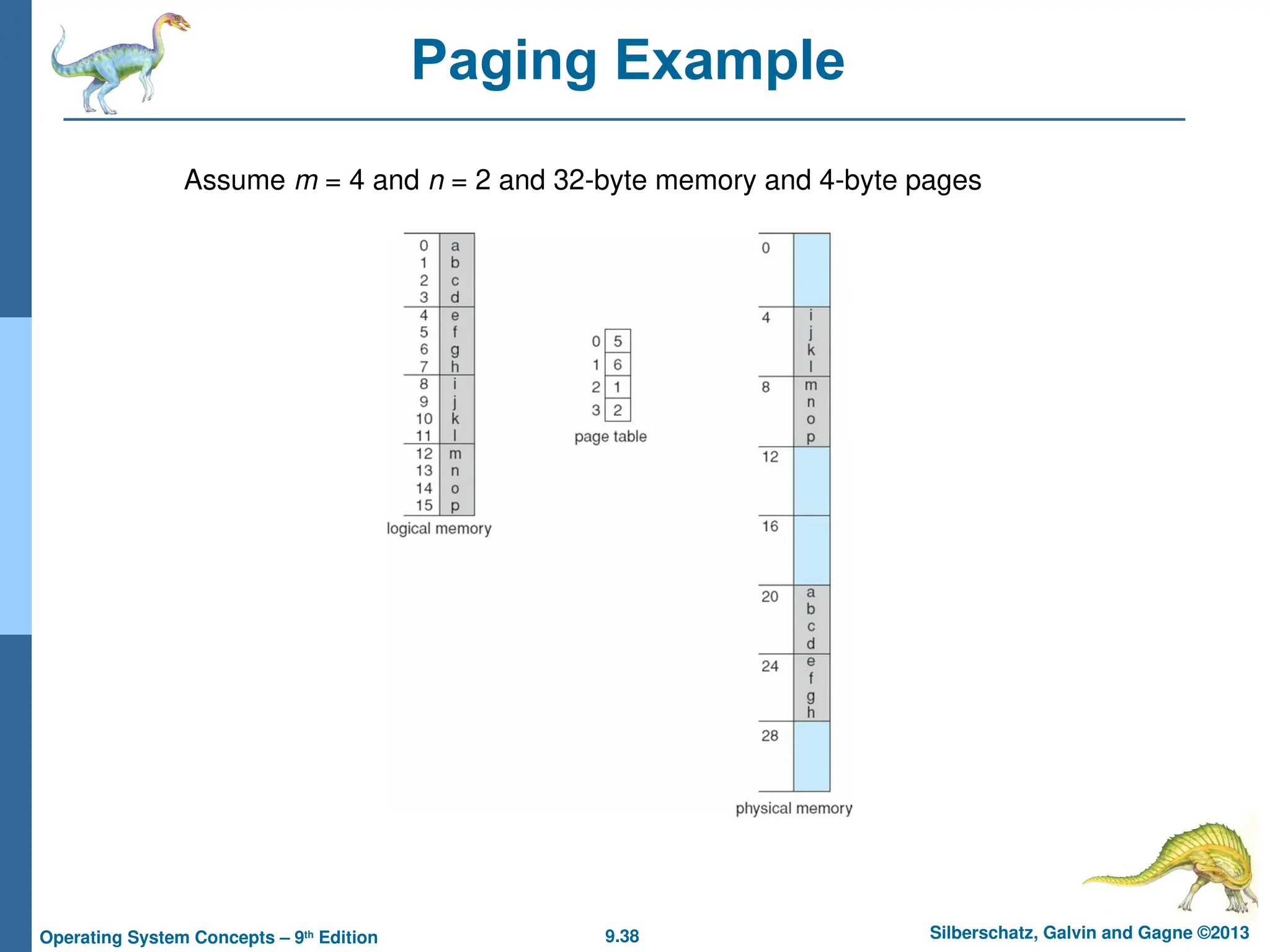
Paging Example
Assume m = 4 and n = 2 and 32-byte memory and 4-byte pages
- 39.
9.39 Silberschatz, Galvinand Gagne ©2013
Operating System Concepts – 9th
Edition
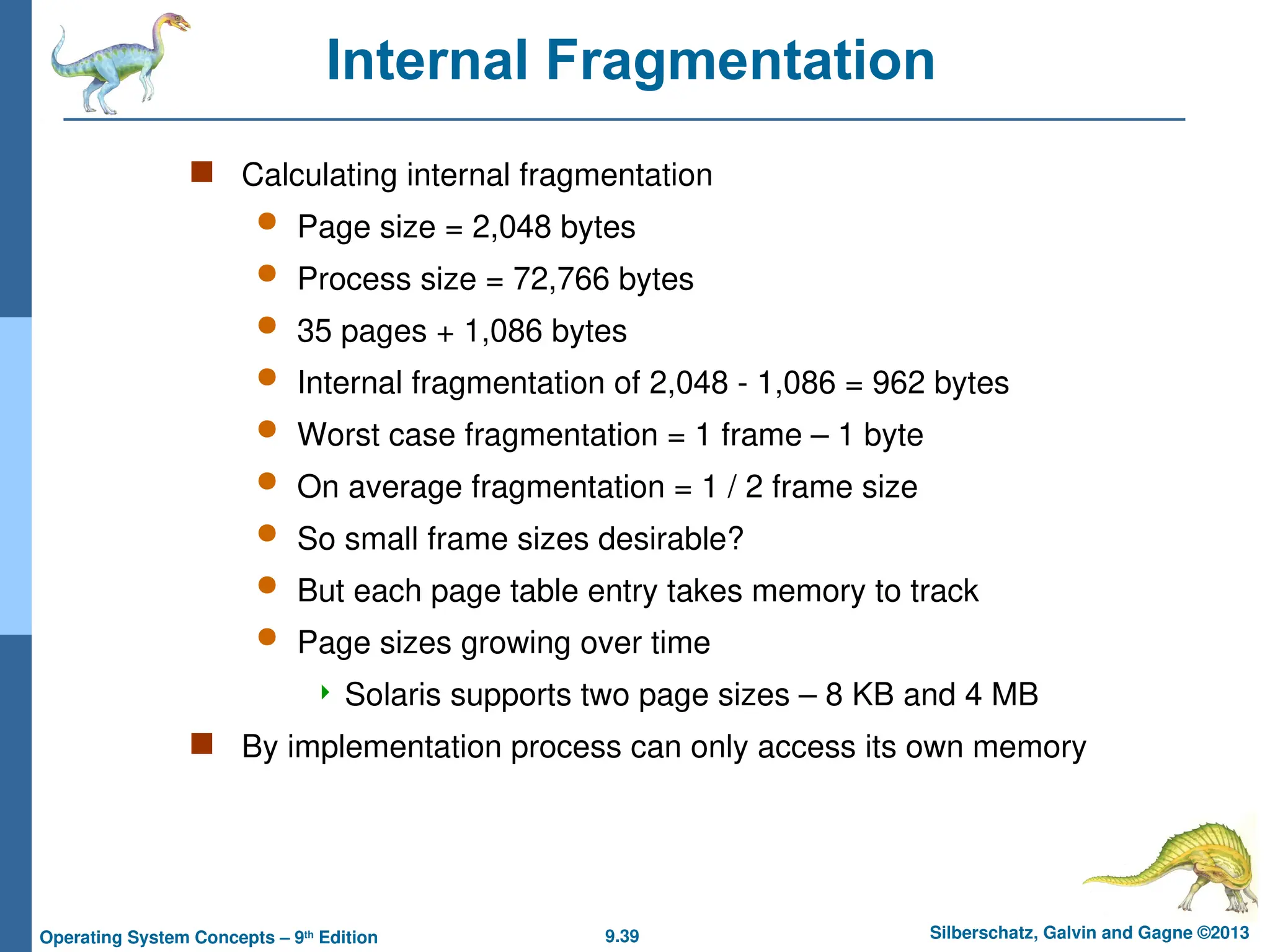
Internal Fragmentation
Calculating internal fragmentation
Page size = 2,048 bytes
Process size = 72,766 bytes
35 pages + 1,086 bytes
Internal fragmentation of 2,048 - 1,086 = 962 bytes
Worst case fragmentation = 1 frame – 1 byte
On average fragmentation = 1 / 2 frame size
So small frame sizes desirable?
But each page table entry takes memory to track
Page sizes growing over time
Solaris supports two page sizes – 8 KB and 4 MB
By implementation process can only access its own memory
- 40.
9.40 Silberschatz, Galvinand Gagne ©2013
Operating System Concepts – 9th
Edition
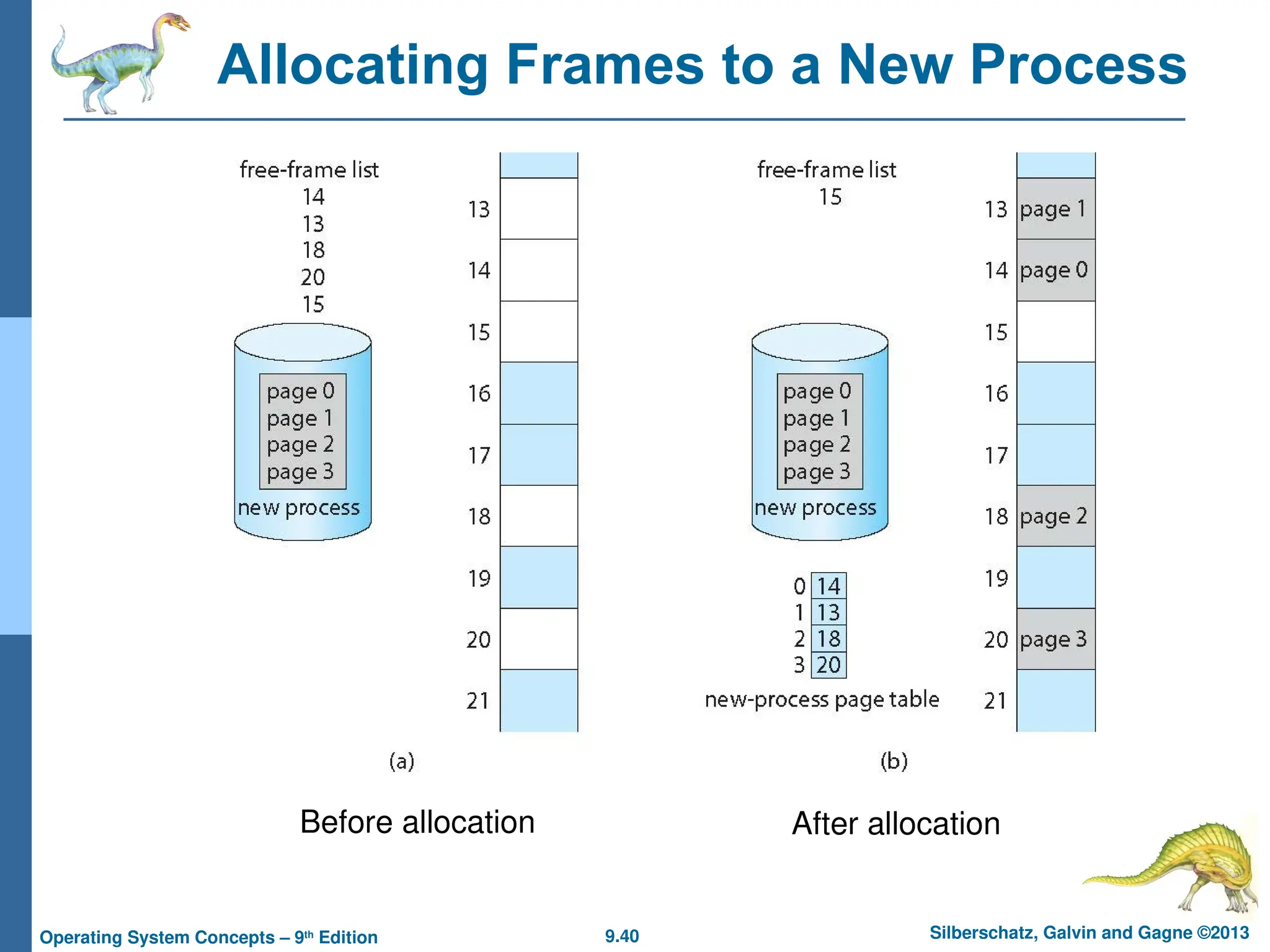
Allocating Frames to a New Process
Before allocation After allocation
- 41.
9.41 Silberschatz, Galvinand Gagne ©2013
Operating System Concepts – 9th
Edition
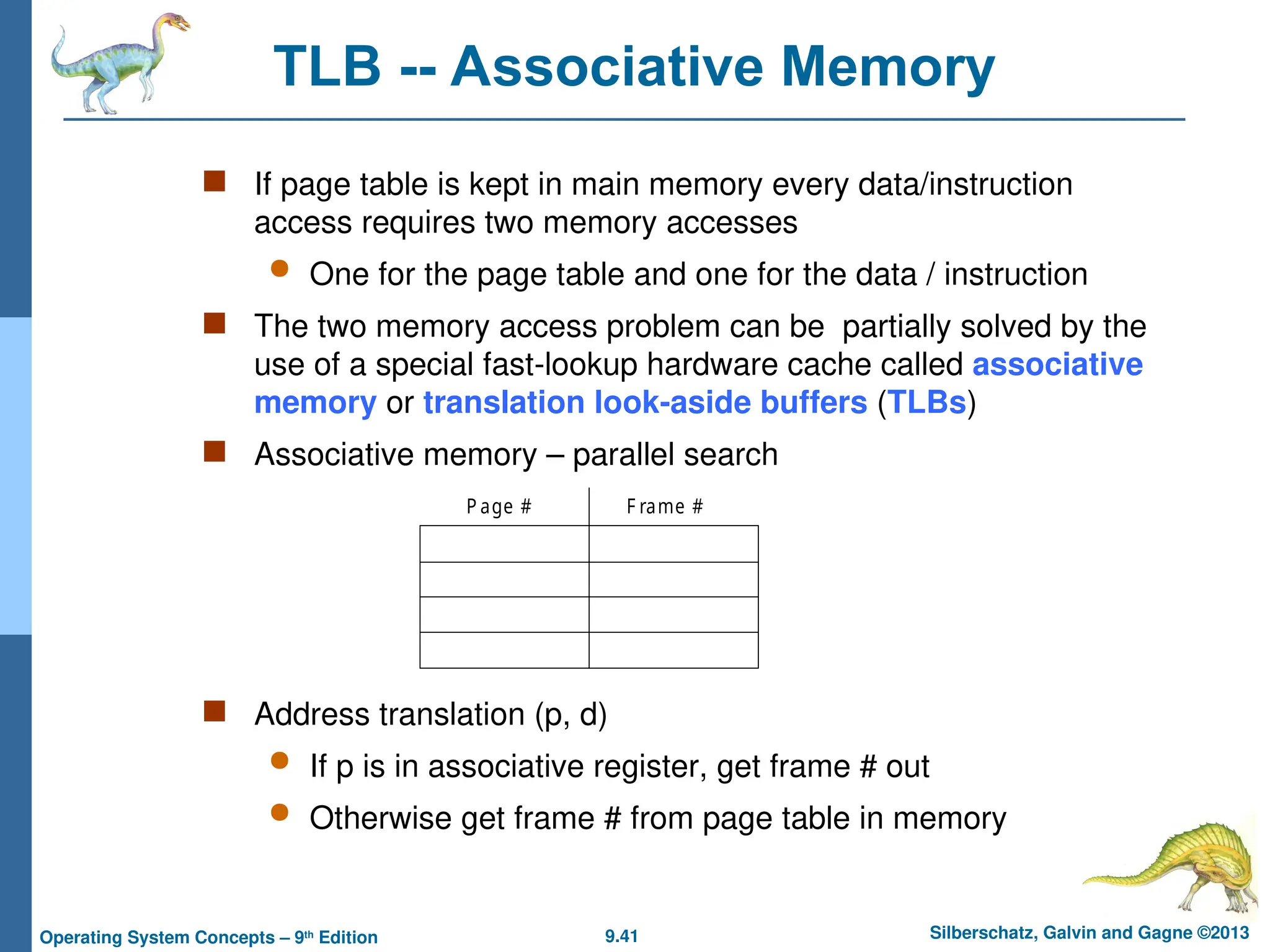
TLB -- Associative Memory
If page table is kept in main memory every data/instruction
access requires two memory accesses
One for the page table and one for the data / instruction
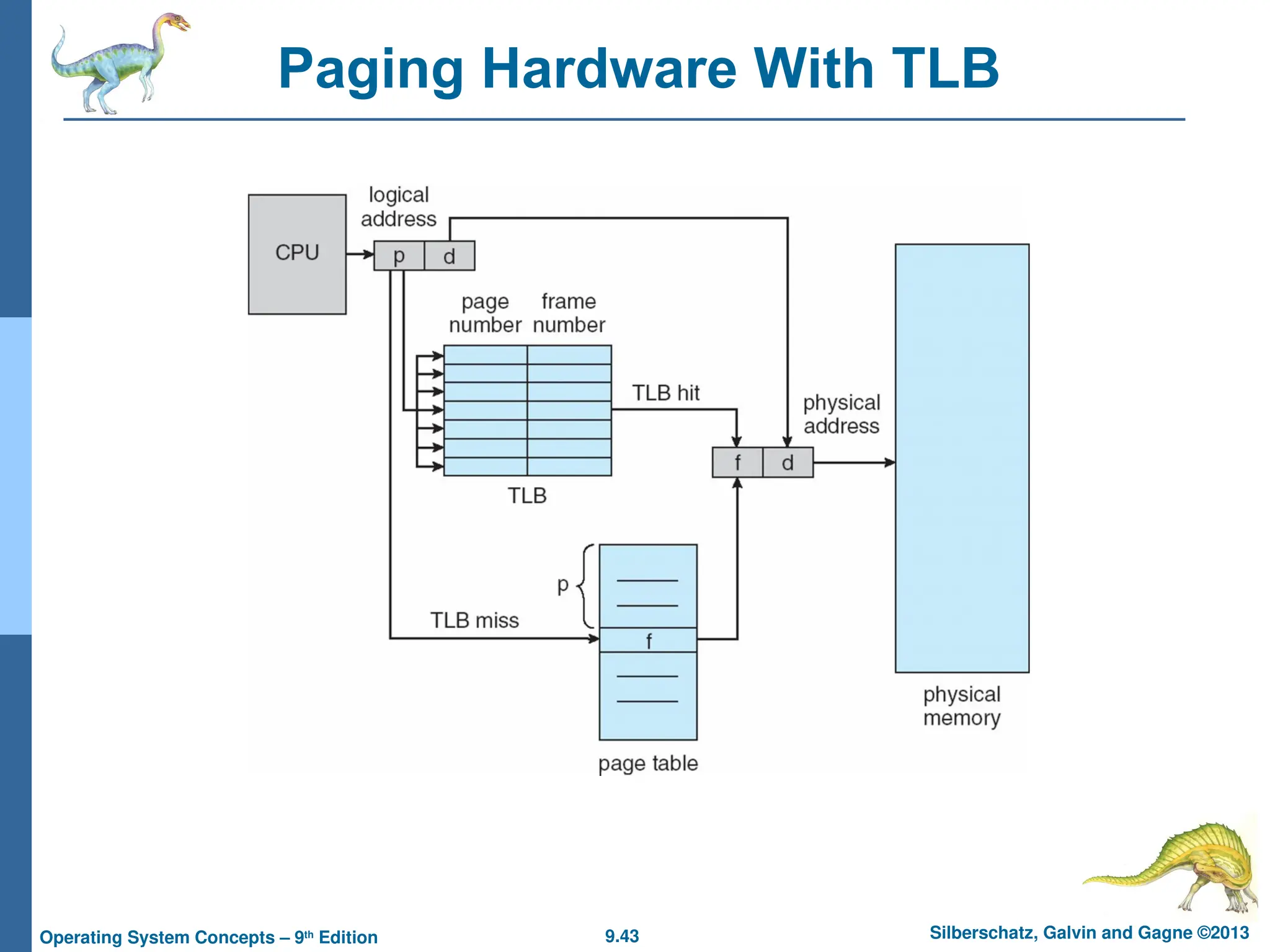
The two memory access problem can be partially solved by the
use of a special fast-lookup hardware cache called associative
memory or translation look-aside buffers (TLBs)
Associative memory – parallel search
Address translation (p, d)
If p is in associative register, get frame # out
Otherwise get frame # from page table in memory
P age # F rame #
- 42.
9.42 Silberschatz, Galvinand Gagne ©2013
Operating System Concepts – 9th
Edition
TLB issues
TLB is typically small (64 to 1,024 entries)
On a TLB miss, the value of the (missed page-table and
frame-number), is loaded into the TLB for faster access
next time that address is used.
What if there is no free TLB entry? Replacement
policies must be considered
Some entries can be wired down for permanent fast
access
Some TLBs store address-space identifiers (ASIDs) in
each TLB entry – uniquely identifies each process to
provide address-space protection for that process
Otherwise need to flush TLB at every context switch
- 43.
- 44.
9.44 Silberschatz, Galvinand Gagne ©2013
Operating System Concepts – 9th
Edition
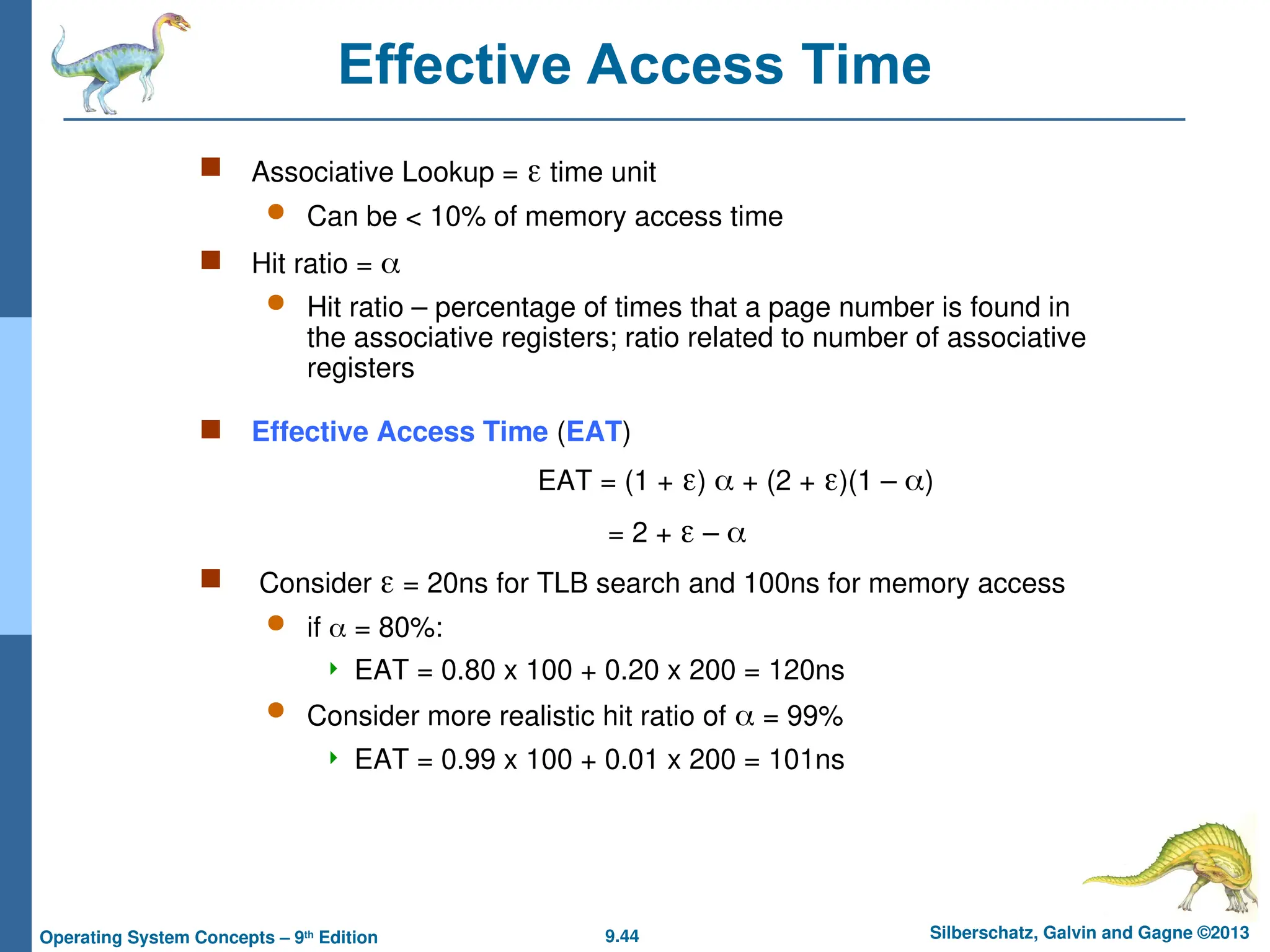
Effective Access Time
Associative Lookup = time unit
Can be < 10% of memory access time
Hit ratio =
Hit ratio – percentage of times that a page number is found in
the associative registers; ratio related to number of associative
registers
Effective Access Time (EAT)
EAT = (1 + ) + (2 + )(1 – )
= 2 + –
Consider = 20ns for TLB search and 100ns for memory access
if = 80%:
EAT = 0.80 x 100 + 0.20 x 200 = 120ns
Consider more realistic hit ratio of = 99%
EAT = 0.99 x 100 + 0.01 x 200 = 101ns
- 45.
9.45 Silberschatz, Galvinand Gagne ©2013
Operating System Concepts – 9th
Edition
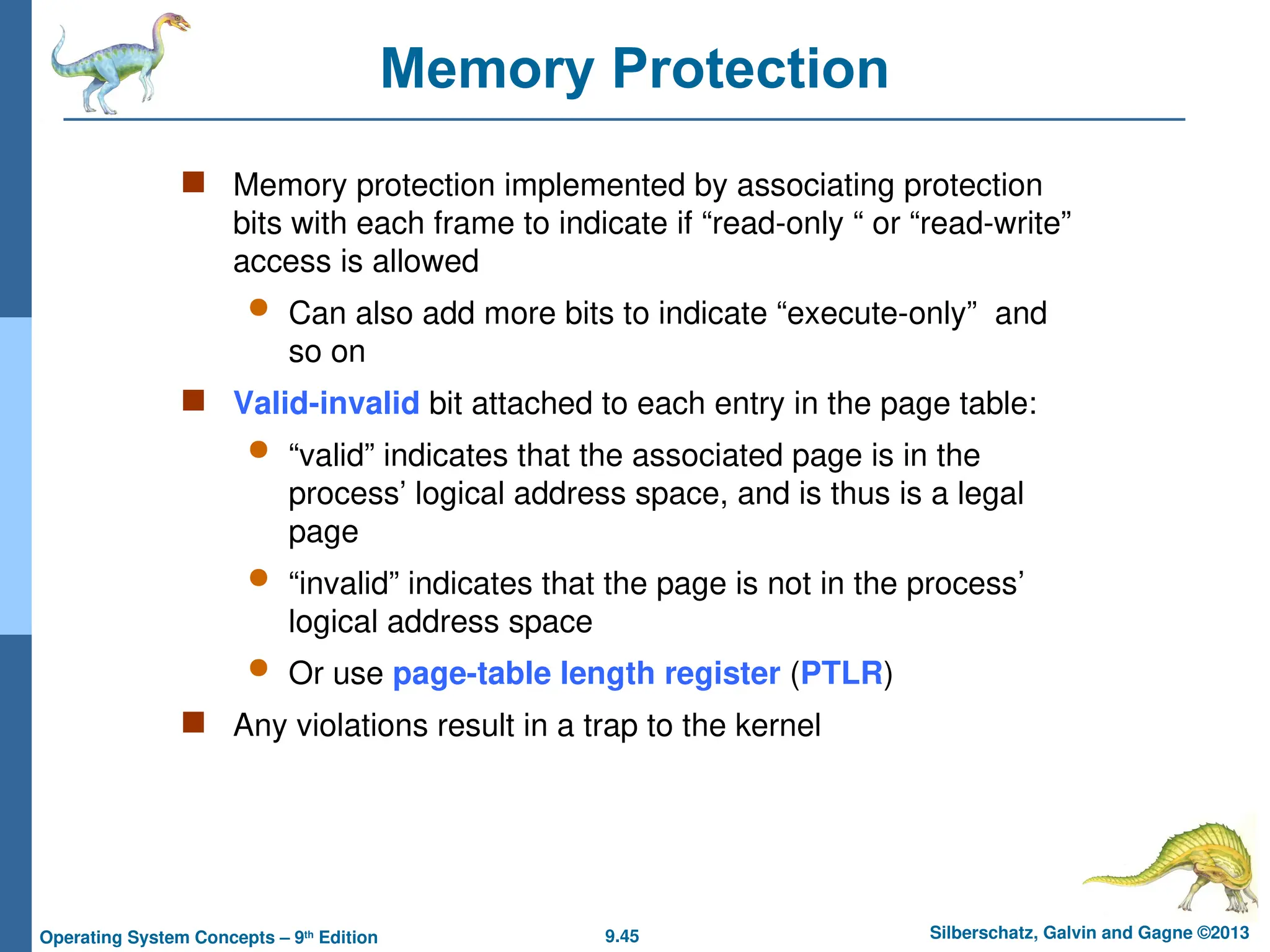
Memory Protection
Memory protection implemented by associating protection
bits with each frame to indicate if “read-only “ or “read-write”
access is allowed
Can also add more bits to indicate “execute-only” and
so on
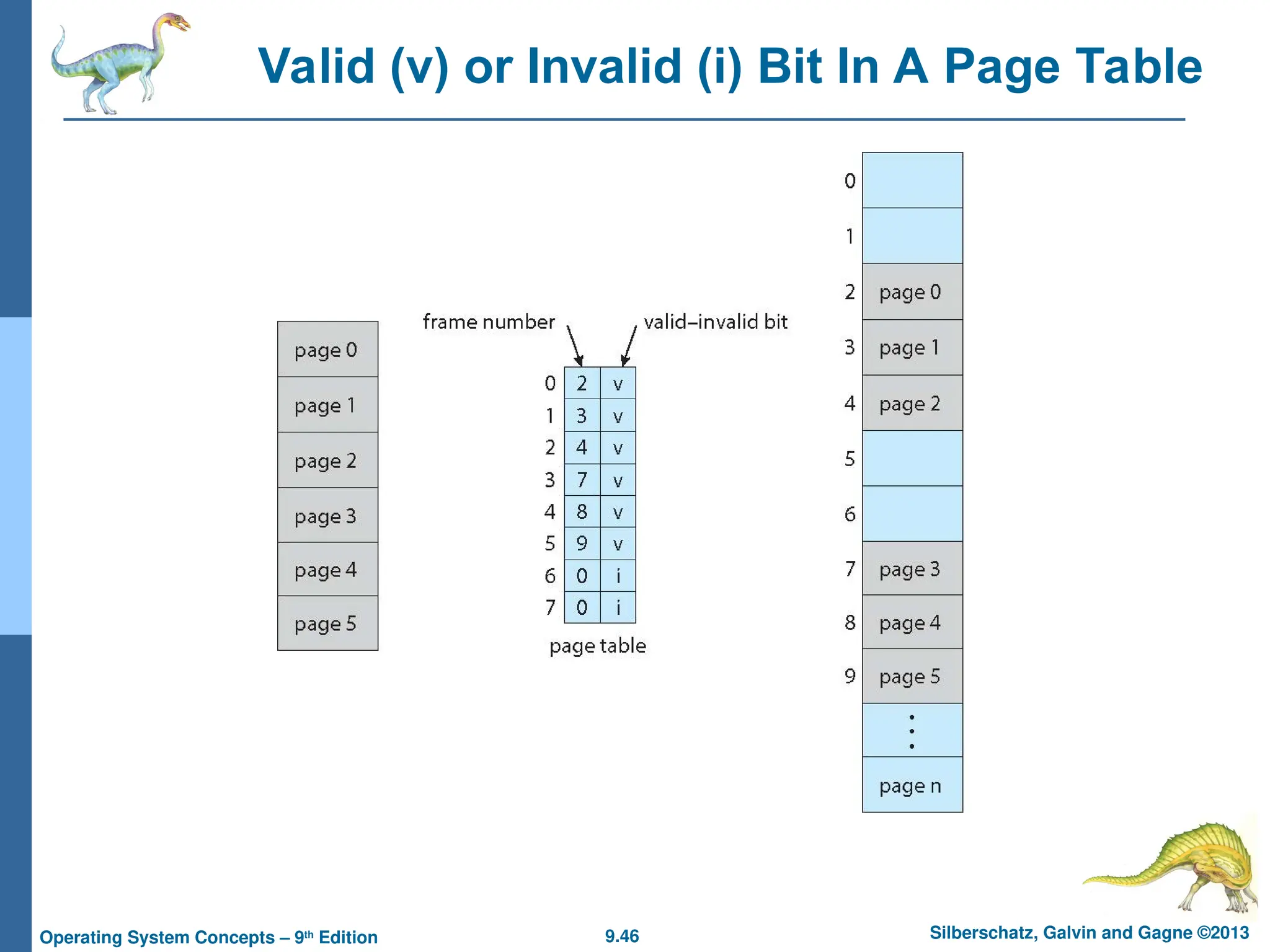
Valid-invalid bit attached to each entry in the page table:
“valid” indicates that the associated page is in the
process’ logical address space, and is thus is a legal
page
“invalid” indicates that the page is not in the process’
logical address space
Or use page-table length register (PTLR)
Any violations result in a trap to the kernel
- 46.
9.46 Silberschatz, Galvinand Gagne ©2013
Operating System Concepts – 9th
Edition
Valid (v) or Invalid (i) Bit In A Page Table
- 47.
9.47 Silberschatz, Galvinand Gagne ©2013
Operating System Concepts – 9th
Edition
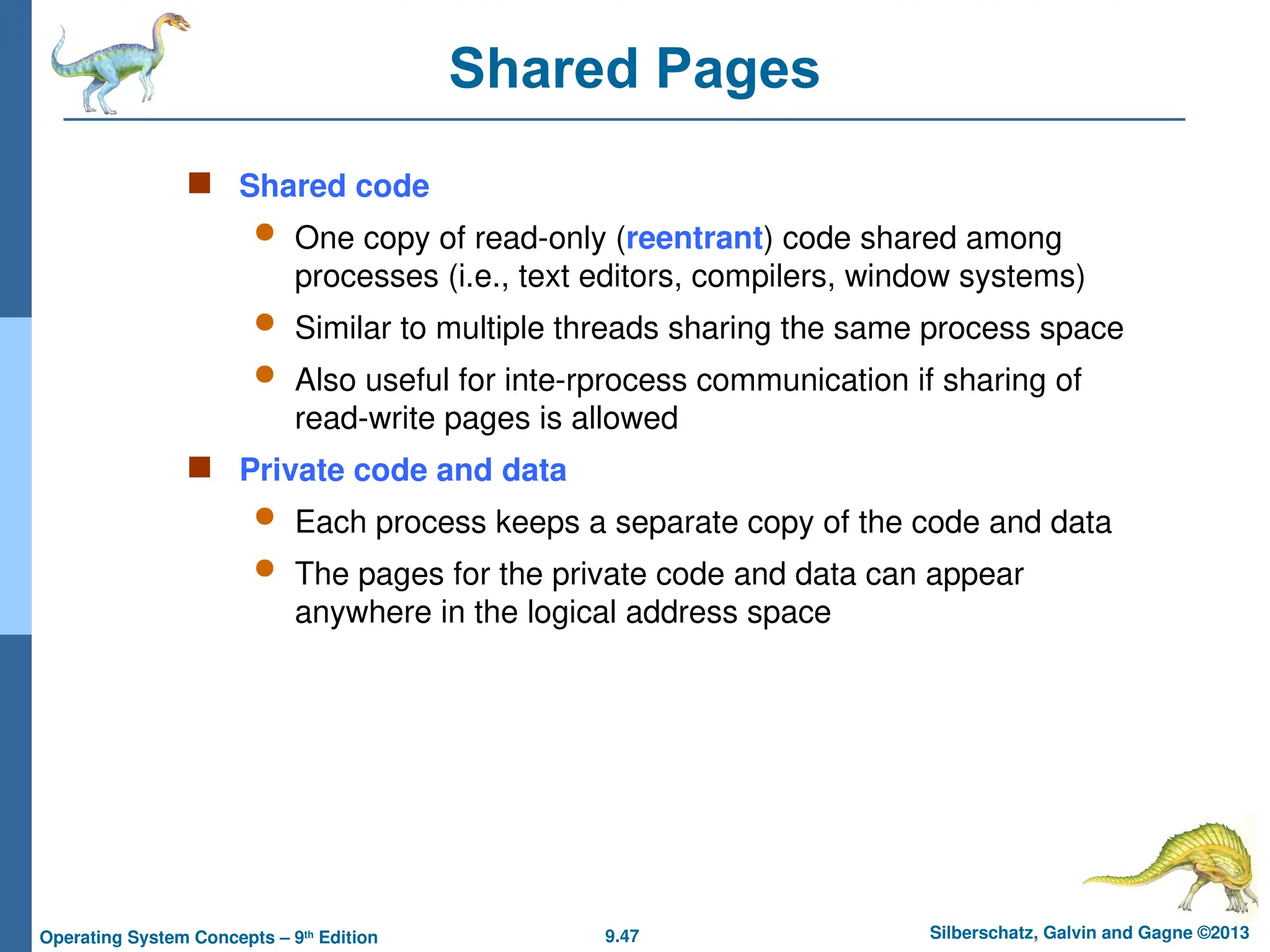
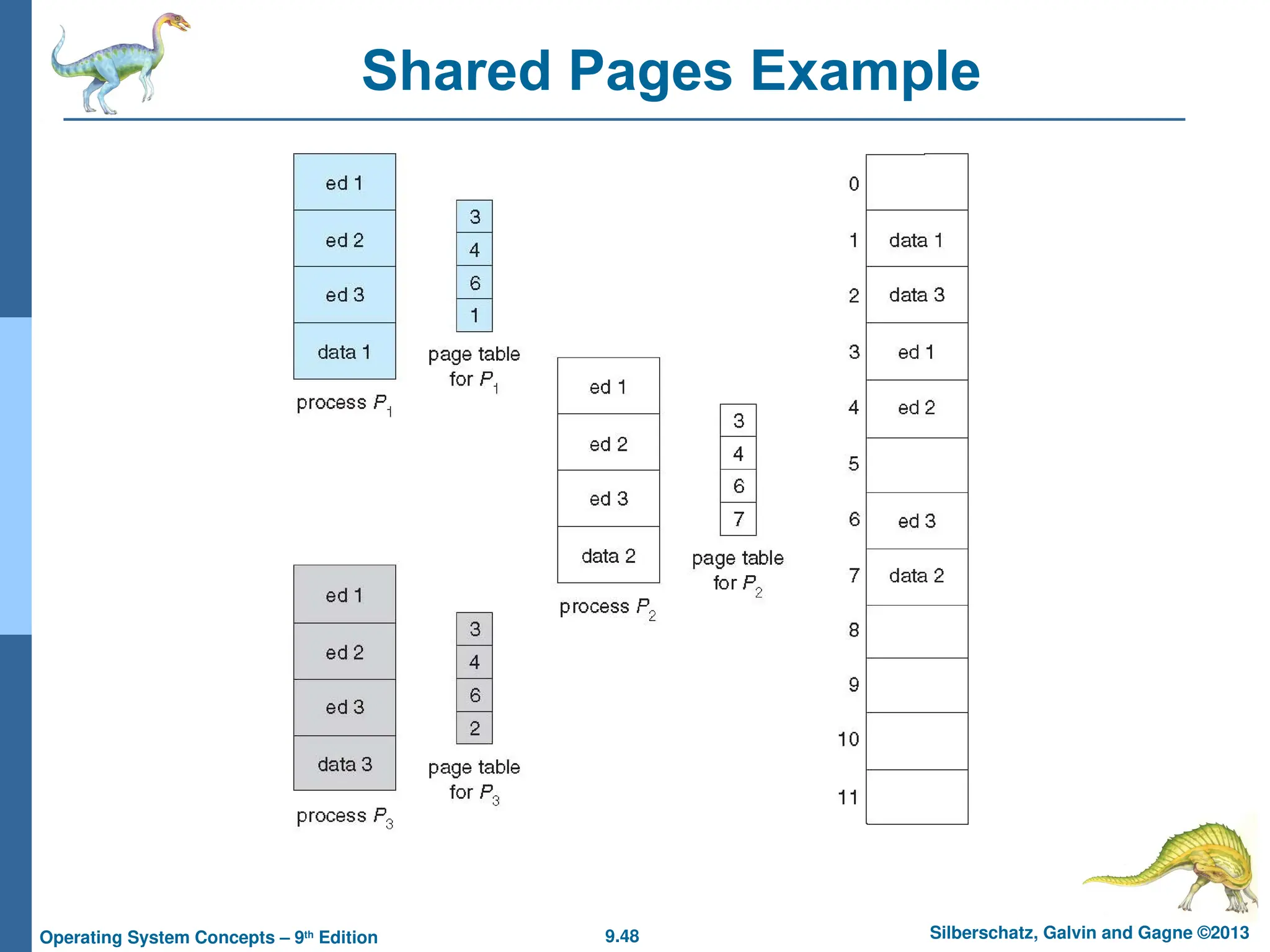
Shared Pages
Shared code
One copy of read-only (reentrant) code shared among
processes (i.e., text editors, compilers, window systems)
Similar to multiple threads sharing the same process space
Also useful for inte-rprocess communication if sharing of
read-write pages is allowed
Private code and data
Each process keeps a separate copy of the code and data
The pages for the private code and data can appear
anywhere in the logical address space
- 48.
- 49.
9.49 Silberschatz, Galvinand Gagne ©2013
Operating System Concepts – 9th
Edition
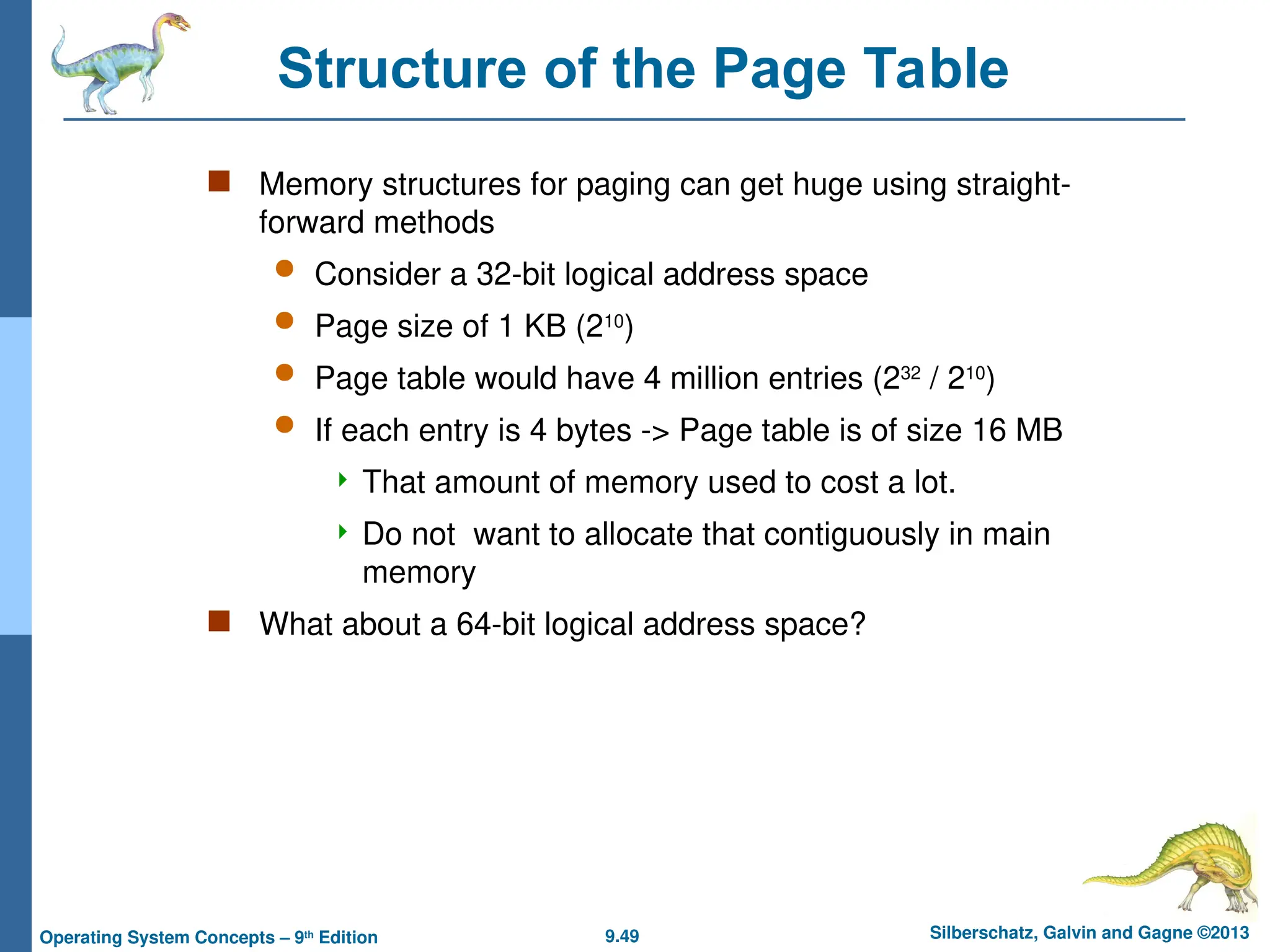
Structure of the Page Table
Memory structures for paging can get huge using straight-
forward methods
Consider a 32-bit logical address space
Page size of 1 KB (210
)
Page table would have 4 million entries (232
/ 210
)
If each entry is 4 bytes -> Page table is of size 16 MB
That amount of memory used to cost a lot.
Do not want to allocate that contiguously in main
memory
What about a 64-bit logical address space?
- 50.
9.50 Silberschatz, Galvinand Gagne ©2013
Operating System Concepts – 9th
Edition
Page Table for Large address space
Hierarchical Paging
Hashed Page Tables
Inverted Page Tables
- 51.
9.51 Silberschatz, Galvinand Gagne ©2013
Operating System Concepts – 9th
Edition
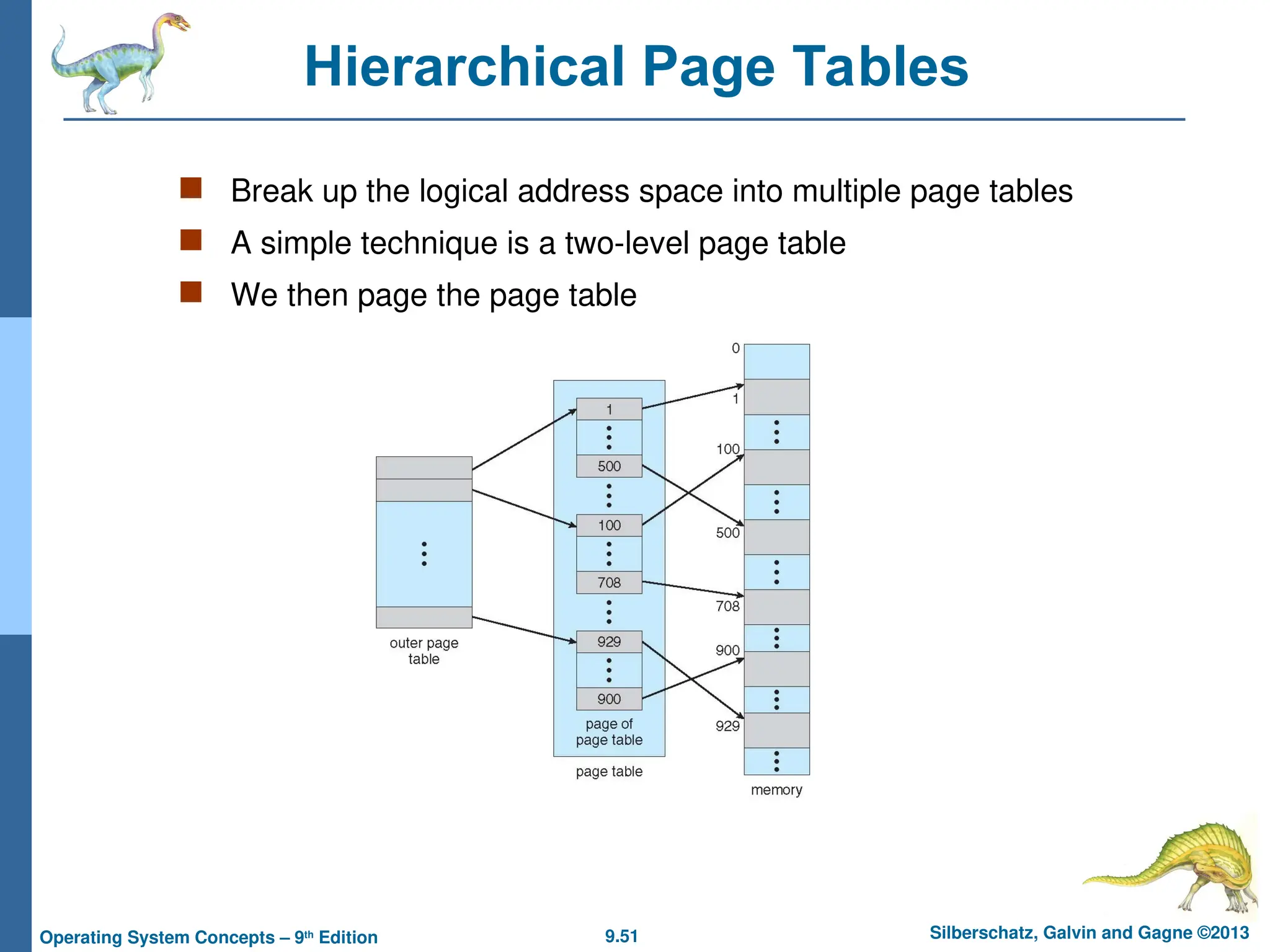
Hierarchical Page Tables
Break up the logical address space into multiple page tables
A simple technique is a two-level page table
We then page the page table
- 52.
9.52 Silberschatz, Galvinand Gagne ©2013
Operating System Concepts – 9th
Edition
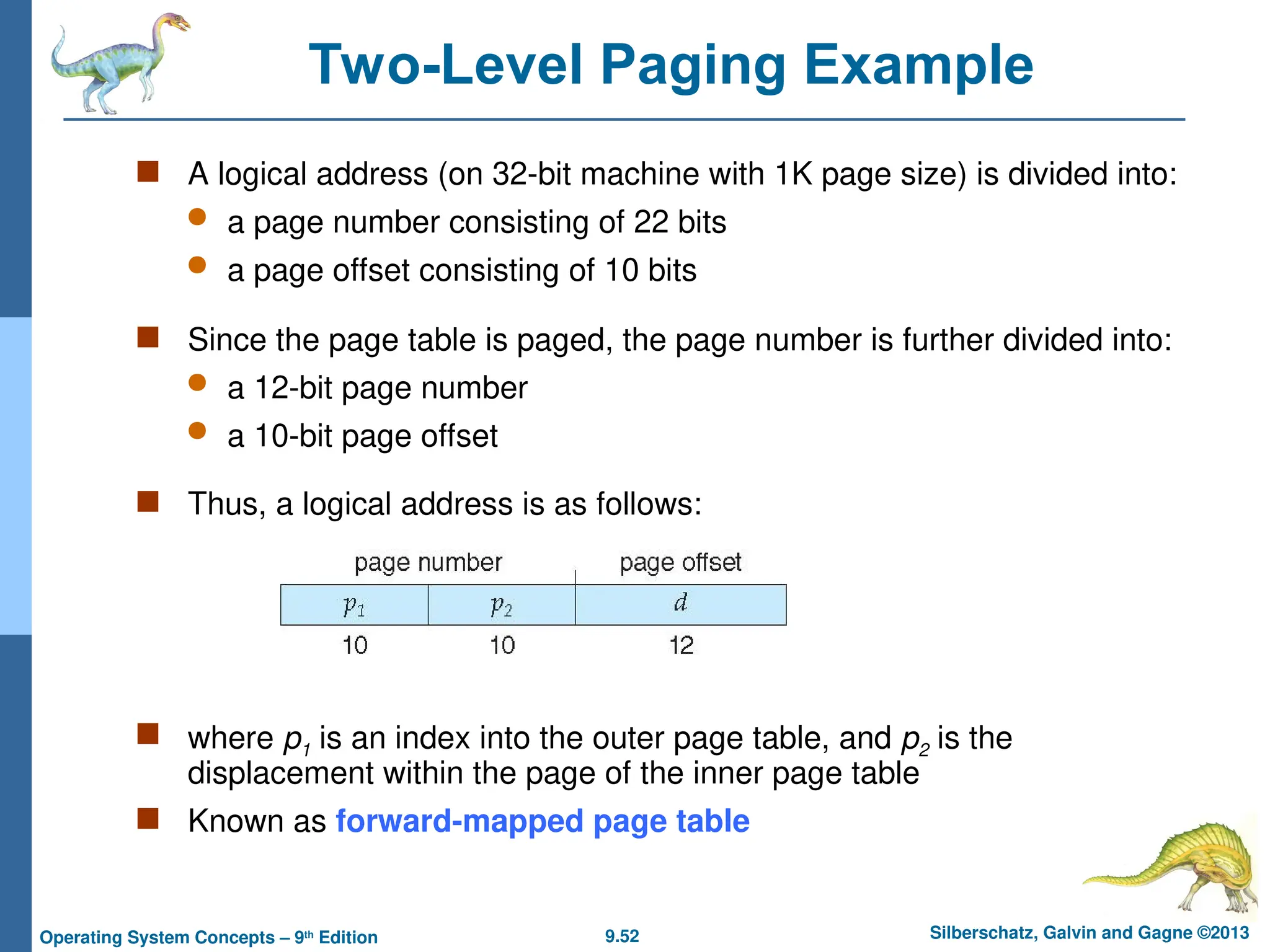
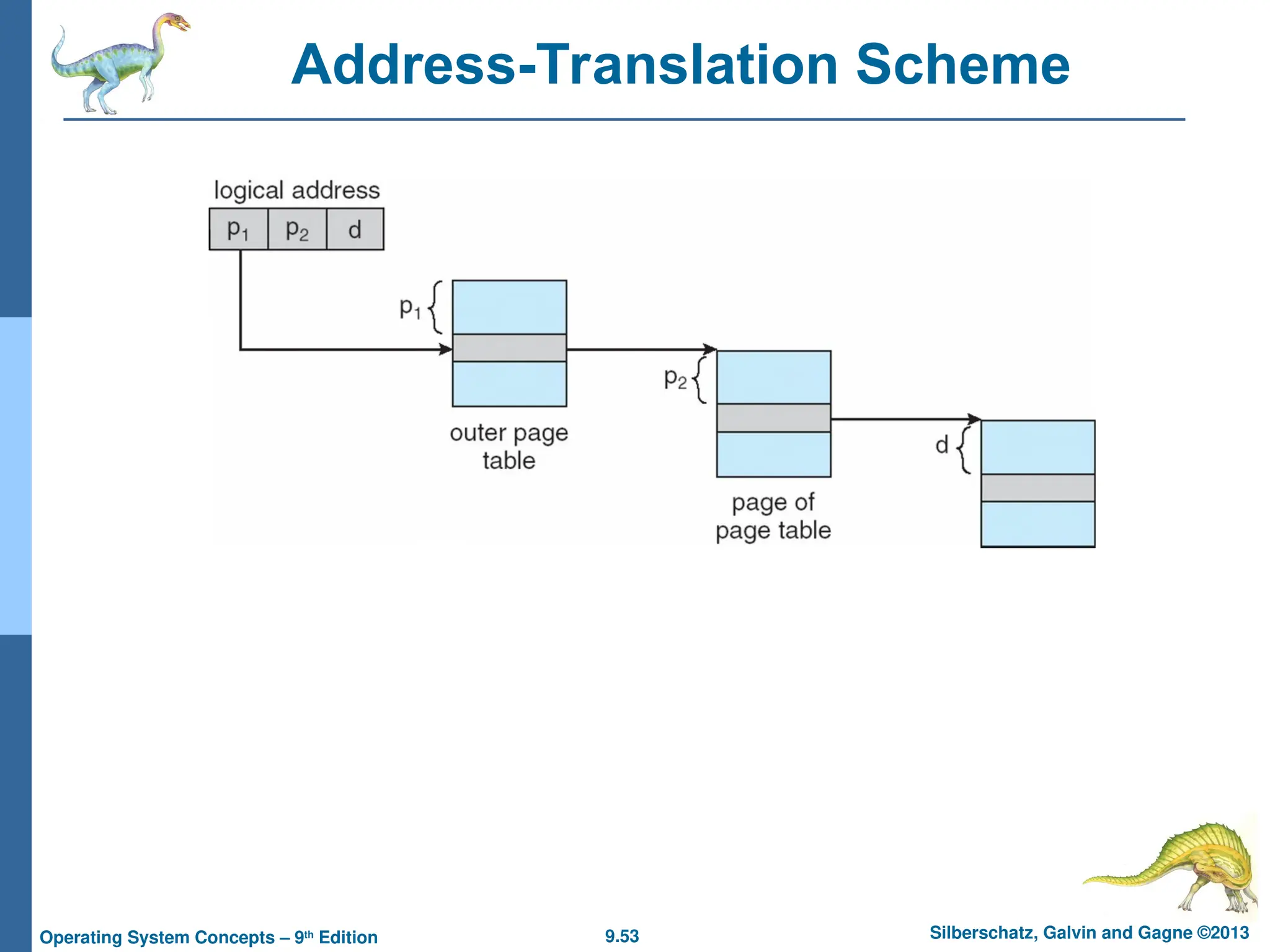
Two-Level Paging Example
A logical address (on 32-bit machine with 1K page size) is divided into:
a page number consisting of 22 bits
a page offset consisting of 10 bits
Since the page table is paged, the page number is further divided into:
a 12-bit page number
a 10-bit page offset
Thus, a logical address is as follows:
where p1 is an index into the outer page table, and p2 is the
displacement within the page of the inner page table
Known as forward-mapped page table
- 53.
- 54.
9.54 Silberschatz, Galvinand Gagne ©2013
Operating System Concepts – 9th
Edition
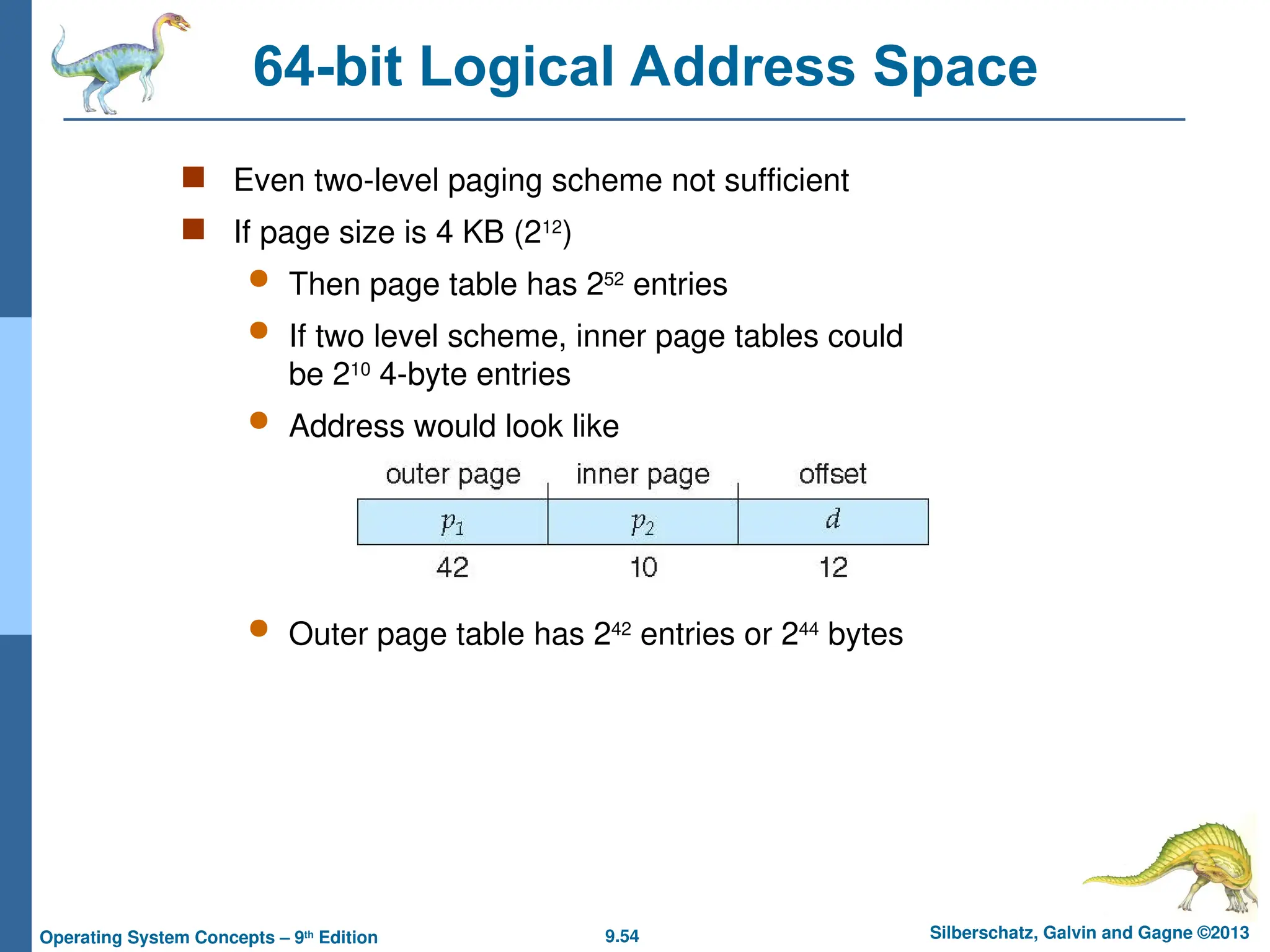
64-bit Logical Address Space
Even two-level paging scheme not sufficient
If page size is 4 KB (212
)
Then page table has 252
entries
If two level scheme, inner page tables could
be 210
4-byte entries
Address would look like
Outer page table has 242
entries or 244
bytes
- 55.
9.55 Silberschatz, Galvinand Gagne ©2013
Operating System Concepts – 9th
Edition
64-bit Logical Address Space (Cont.)
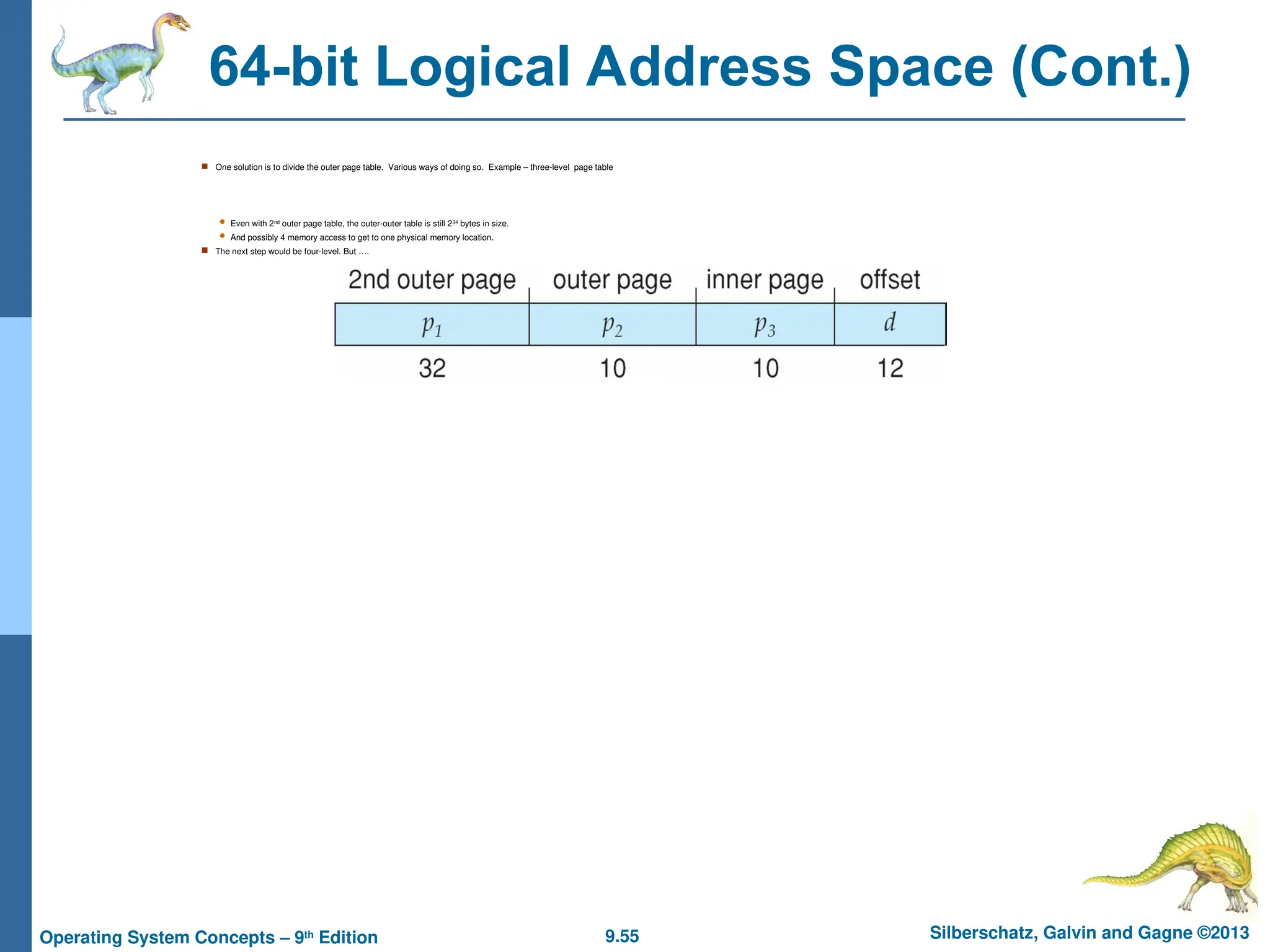
One solution is to divide the outer page table. Various ways of doing so. Example – three-level page table
Even with 2nd outer page table, the outer-outer table is still 234 bytes in size.
And possibly 4 memory access to get to one physical memory location.
The next step would be four-level. But ….
- 56.
9.56 Silberschatz, Galvinand Gagne ©2013
Operating System Concepts – 9th
Edition
64-bit Logical Address Space (Cont.)
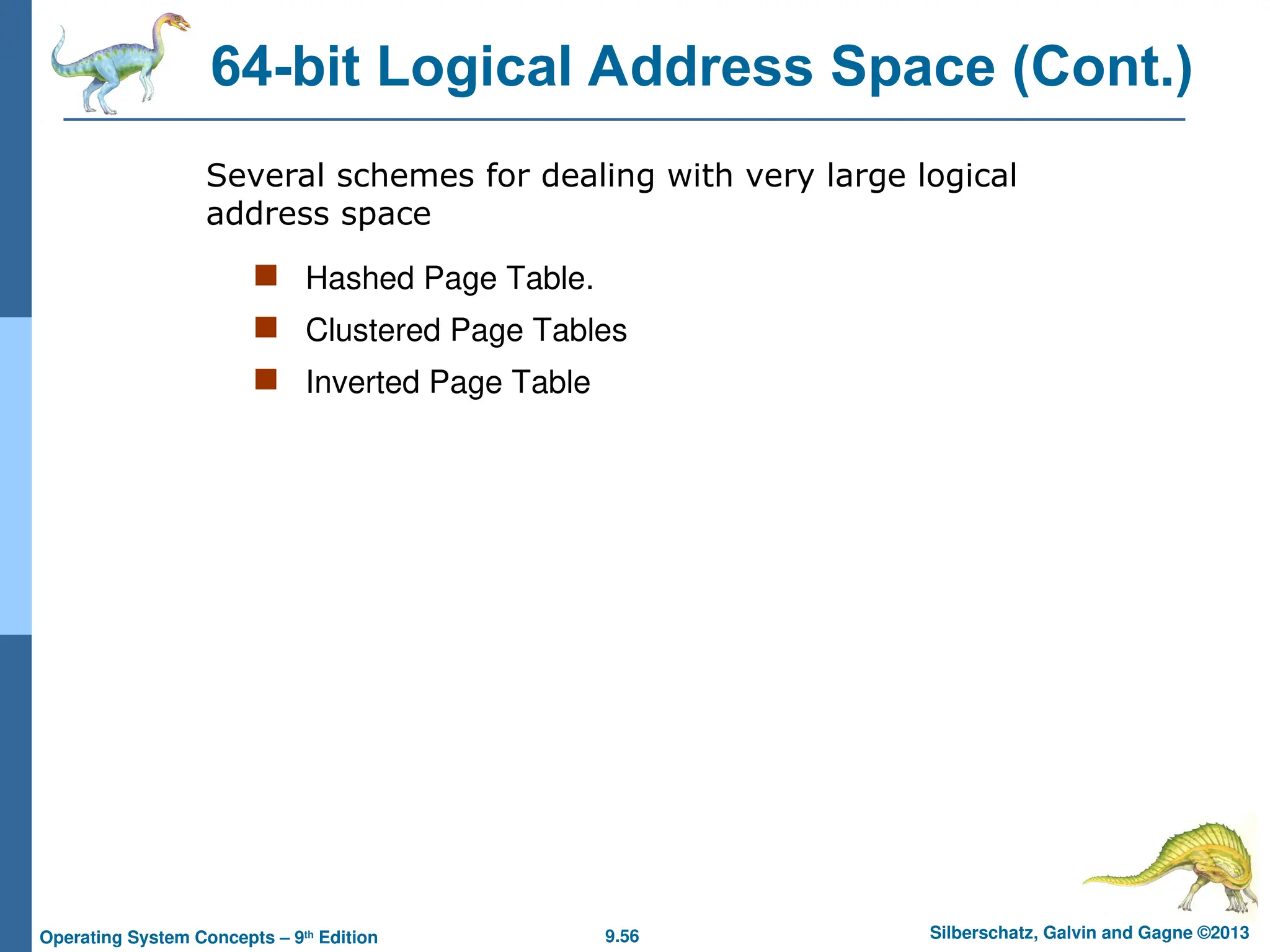
Hashed Page Table.
Clustered Page Tables
Inverted Page Table
Several schemes for dealing with very large logical
address space
- 57.
9.57 Silberschatz, Galvinand Gagne ©2013
Operating System Concepts – 9th
Edition
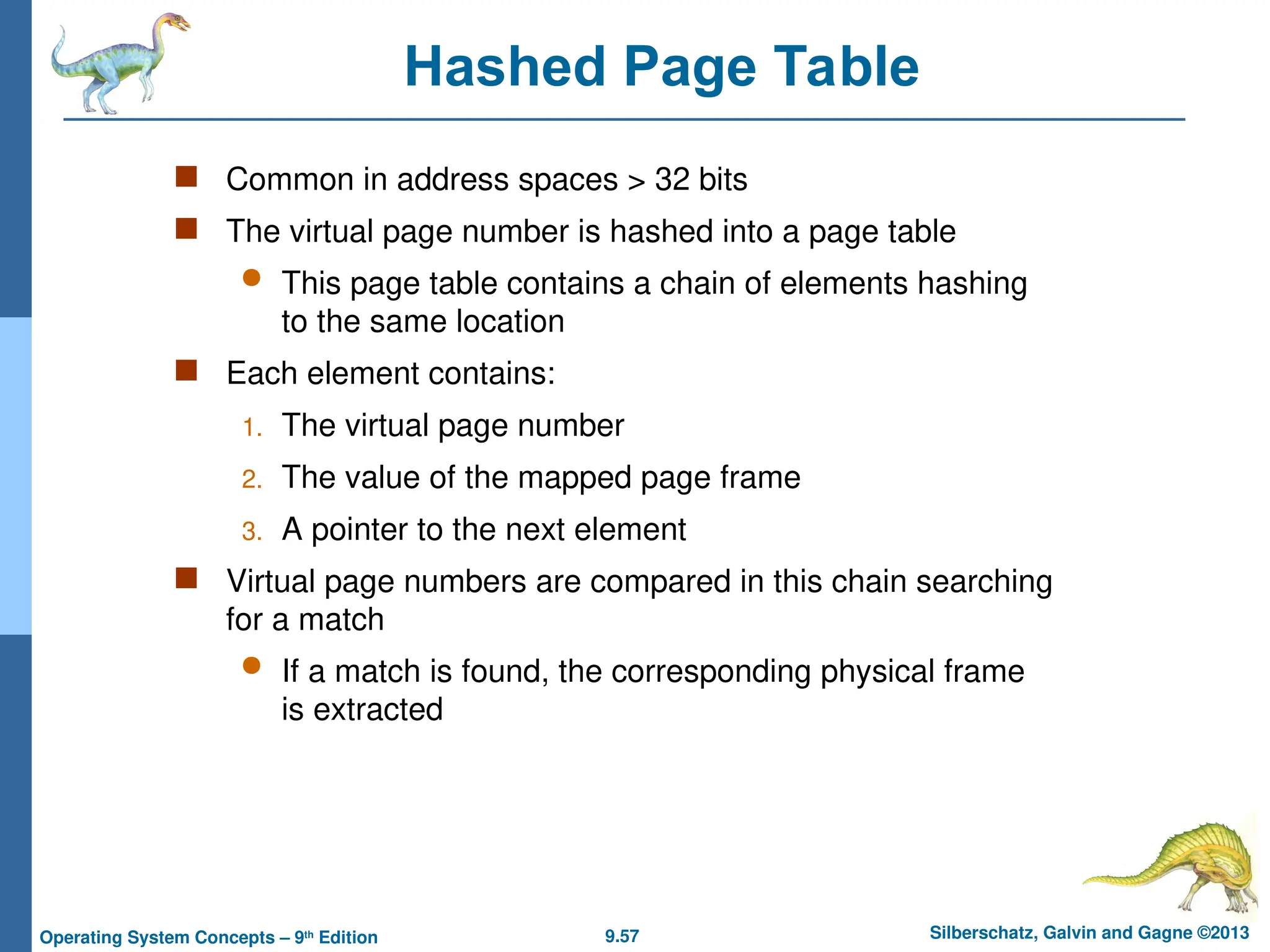
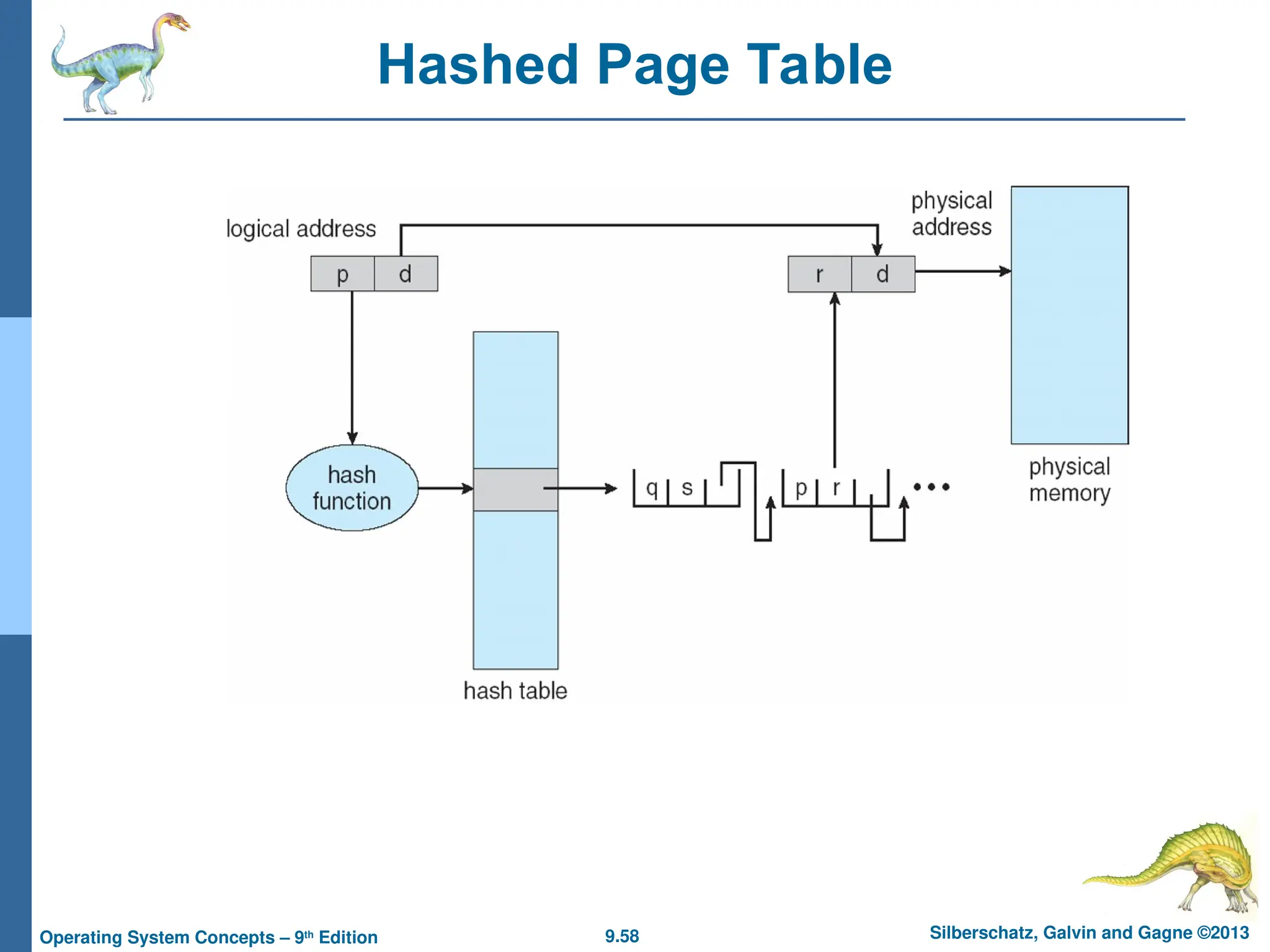
Hashed Page Table
Common in address spaces > 32 bits
The virtual page number is hashed into a page table
This page table contains a chain of elements hashing
to the same location
Each element contains:
1. The virtual page number
2. The value of the mapped page frame
3. A pointer to the next element
Virtual page numbers are compared in this chain searching
for a match
If a match is found, the corresponding physical frame
is extracted
- 58.
- 59.
9.59 Silberschatz, Galvinand Gagne ©2013
Operating System Concepts – 9th
Edition
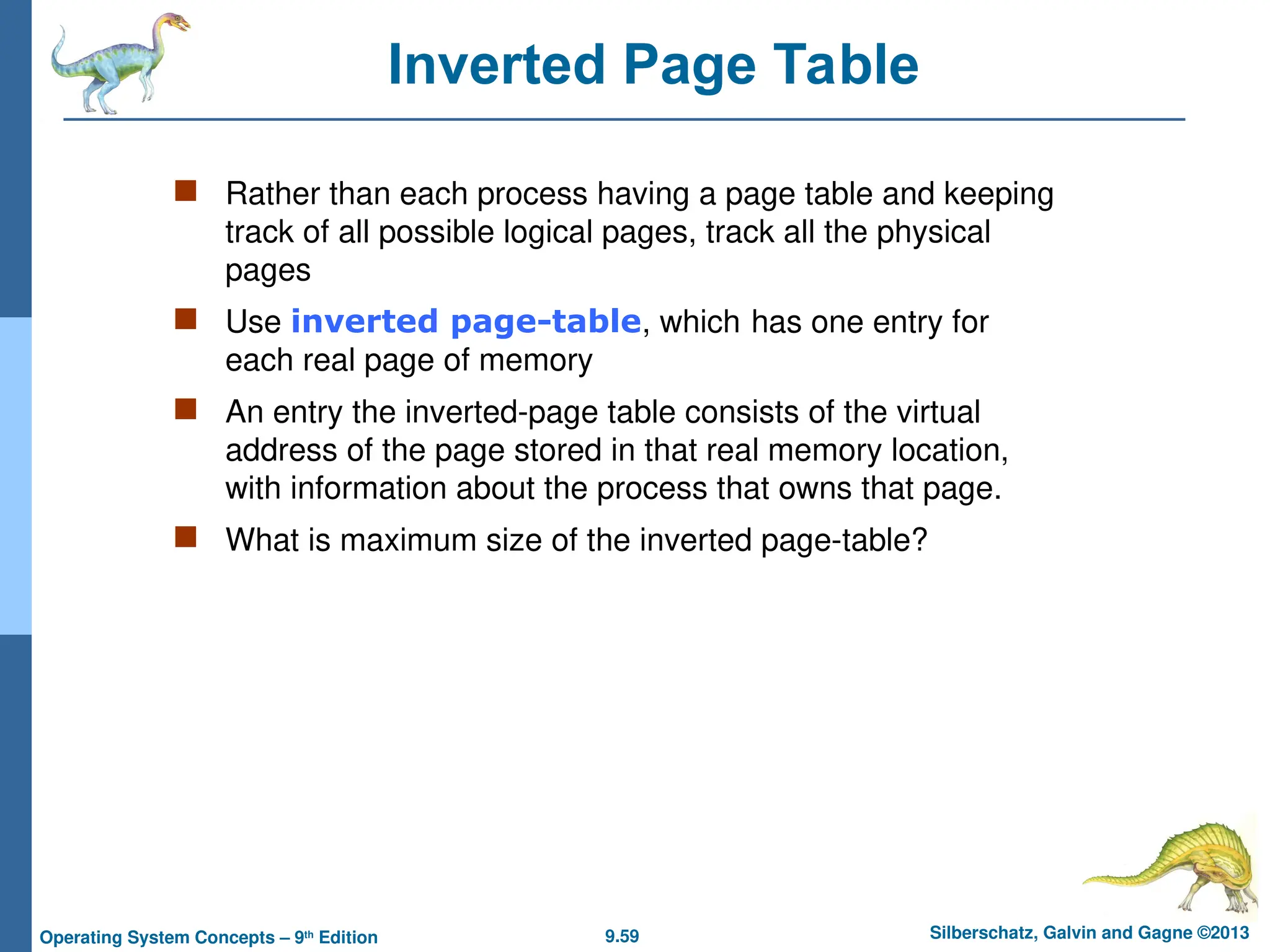
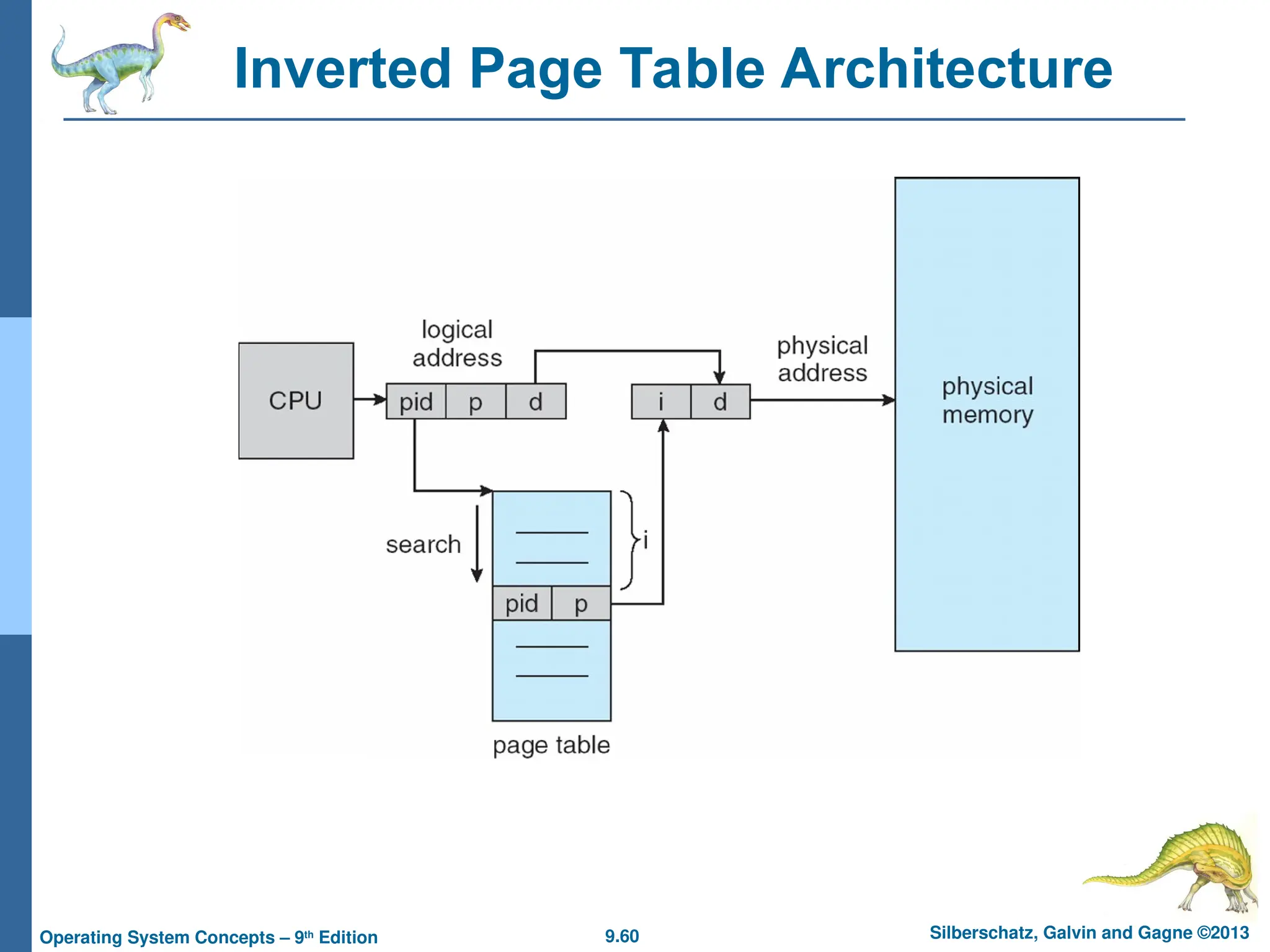
Inverted Page Table
Rather than each process having a page table and keeping
track of all possible logical pages, track all the physical
pages
Use inverted page-table, which has one entry for
each real page of memory
An entry the inverted-page table consists of the virtual
address of the page stored in that real memory location,
with information about the process that owns that page.
What is maximum size of the inverted page-table?
- 60.
- 61.
9.61 Silberschatz, Galvinand Gagne ©2013
Operating System Concepts – 9th
Edition
Inverted Page Table (Cont.)
Decreases memory needed to store each individual page
table, but increases time needed to search the inverted
page table when a page reference occurs
Use hash table to limit the search to one — or at most a
few — page-table entries
TLB can accelerate access
But how to implement shared memory?
One mapping of a virtual address to the shared
physical address
- 62.
9.62 Silberschatz, Galvinand Gagne ©2013
Operating System Concepts – 9th
Edition
Oracle SPARC Solaris
Consider modern, 64-bit operating system example with
tightly integrated HW
Goals are efficiency, low overhead
Based on hashing, but more complex
Two hash tables
One kernel and one for all user processes
Each maps memory addresses from virtual to physical
memory
Each entry represents a contiguous area of mapped
virtual memory,
More efficient than having a separate hash-table entry
for each page
Each entry has base address and span (indicating the
number of pages the entry represents)
- 63.
9.63 Silberschatz, Galvinand Gagne ©2013
Operating System Concepts – 9th
Edition
Oracle SPARC Solaris (Cont.)
TLB holds translation table entries (TTEs) for fast hardware lookups
A cache of TTEs reside in a translation storage buffer (TSB)
Includes an entry per recently accessed page
Virtual address reference causes TLB search
If miss, hardware walks the in-memory TSB looking for the TTE
corresponding to the address
If match found, the CPU copies the TSB entry into the TLB
and translation completes
If no match found, kernel interrupted to search the hash table
– The kernel then creates a TTE from the appropriate hash
table and stores it in the TSB, Interrupt handler returns
control to the MMU, which completes the address
translation.
- 64.
9.64 Silberschatz, Galvinand Gagne ©2013
Operating System Concepts – 9th
Edition
Example: The Intel 32 and 64-bit Architectures
Dominant industry chips
Pentium CPUs are 32-bit and called IA-32
architecture
Current Intel CPUs are 64-bit and called IA-64
architecture
Many variations in the chips, cover the main ideas
here
- 65.
9.65 Silberschatz, Galvinand Gagne ©2013
Operating System Concepts – 9th
Edition
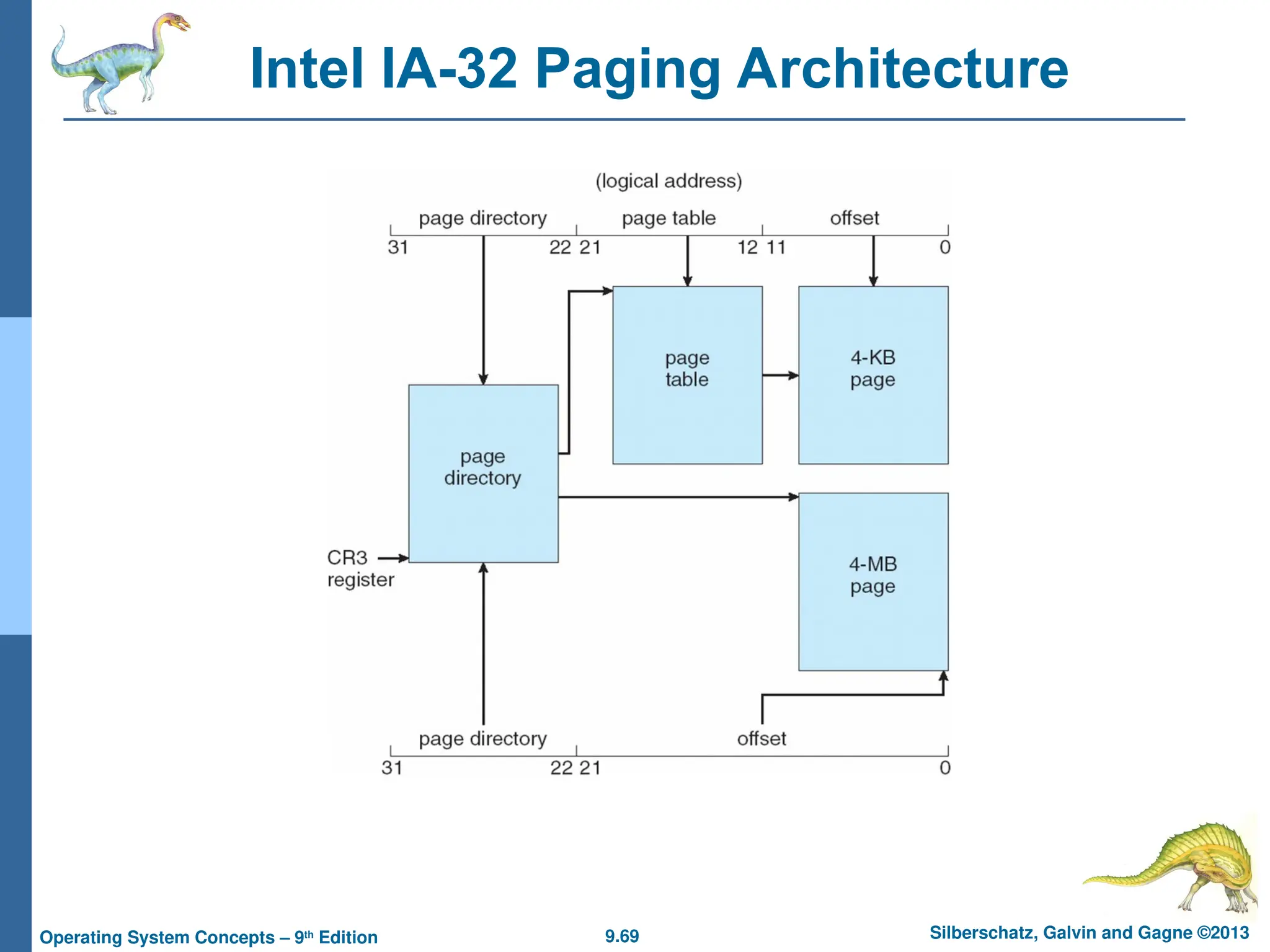
Example: The Intel IA-32 Architecture
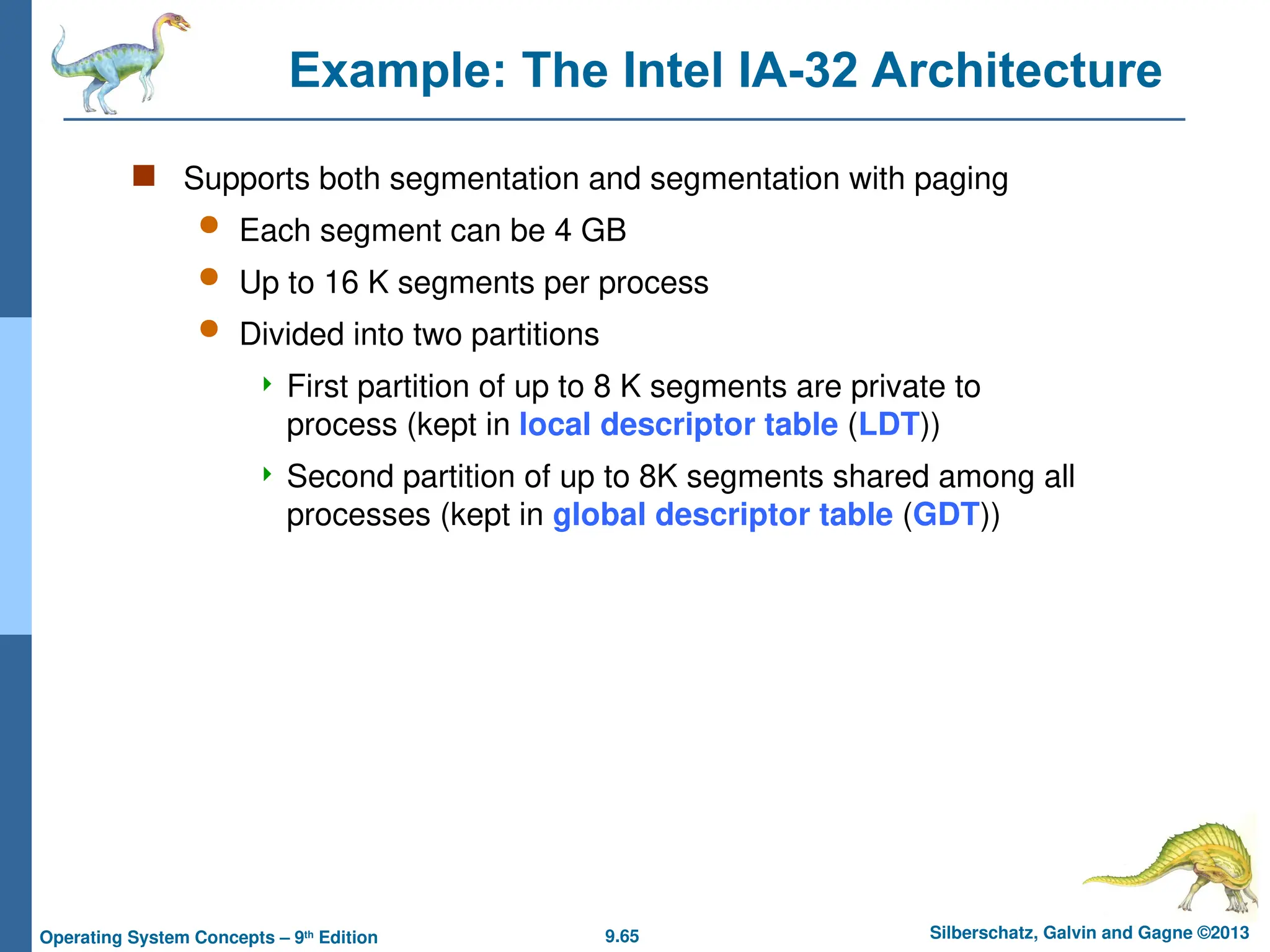
Supports both segmentation and segmentation with paging
Each segment can be 4 GB
Up to 16 K segments per process
Divided into two partitions
First partition of up to 8 K segments are private to
process (kept in local descriptor table (LDT))
Second partition of up to 8K segments shared among all
processes (kept in global descriptor table (GDT))
- 66.
9.66 Silberschatz, Galvinand Gagne ©2013
Operating System Concepts – 9th
Edition
Example: The Intel IA-32 Architecture (Cont.)
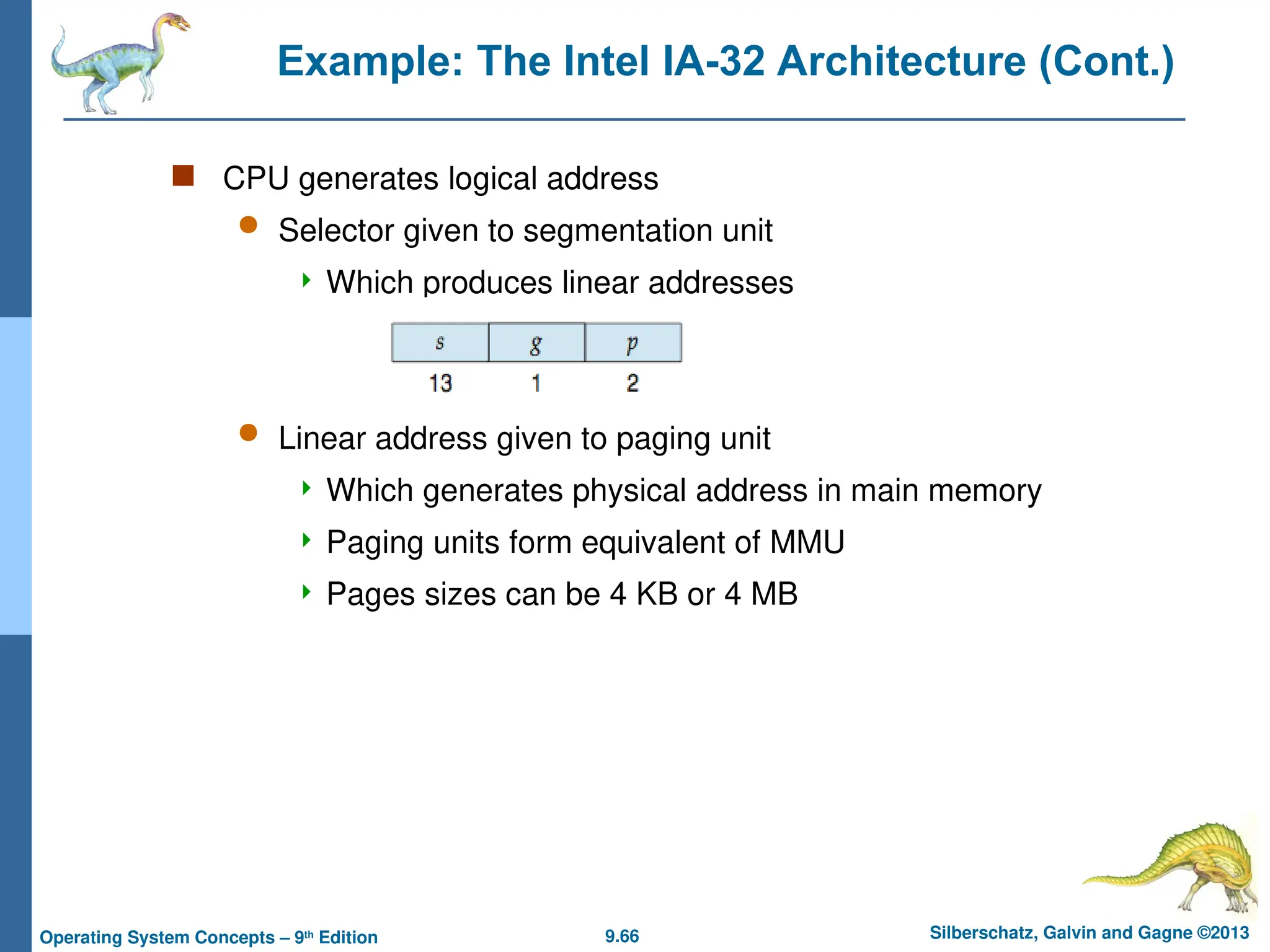
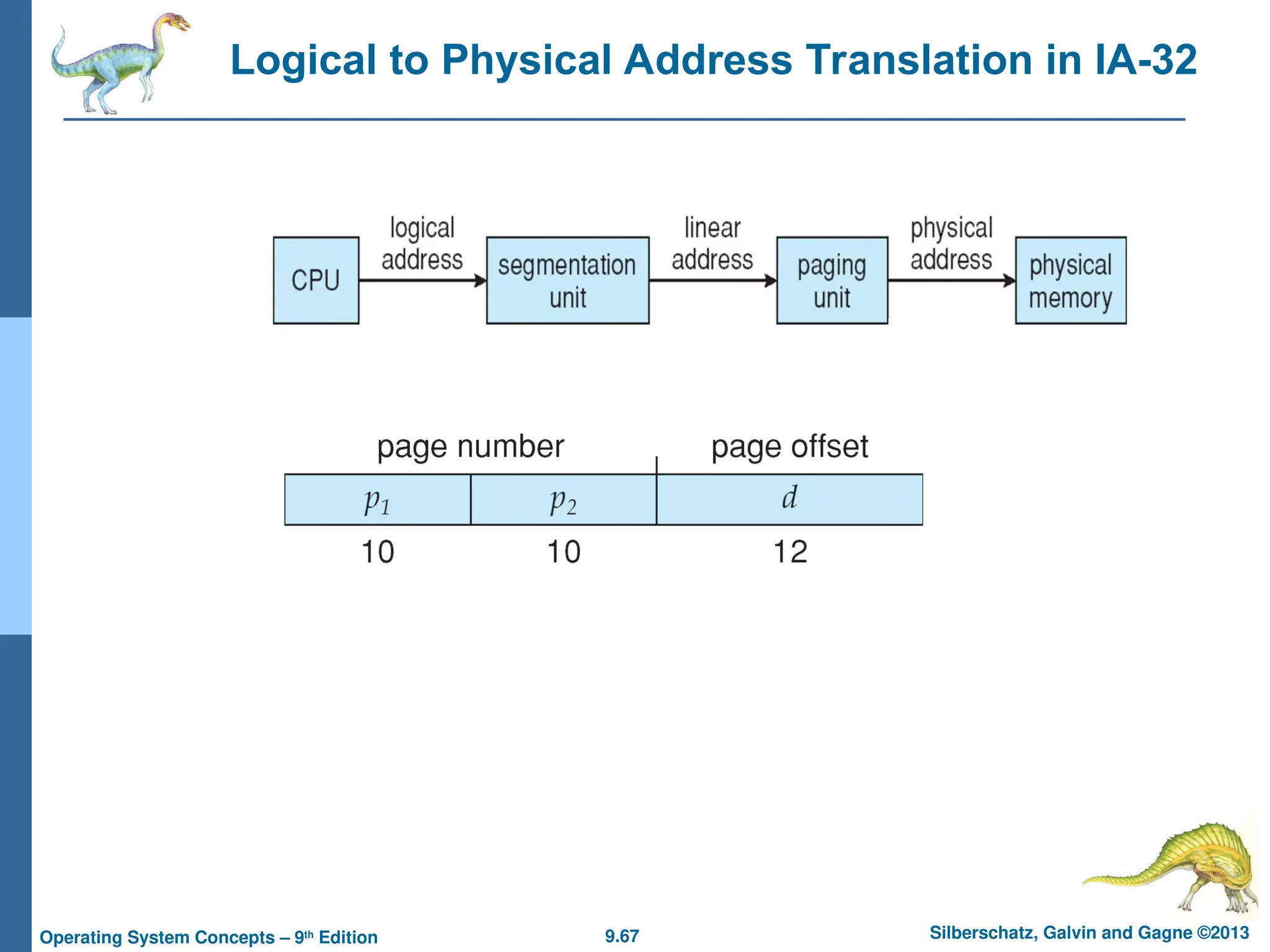
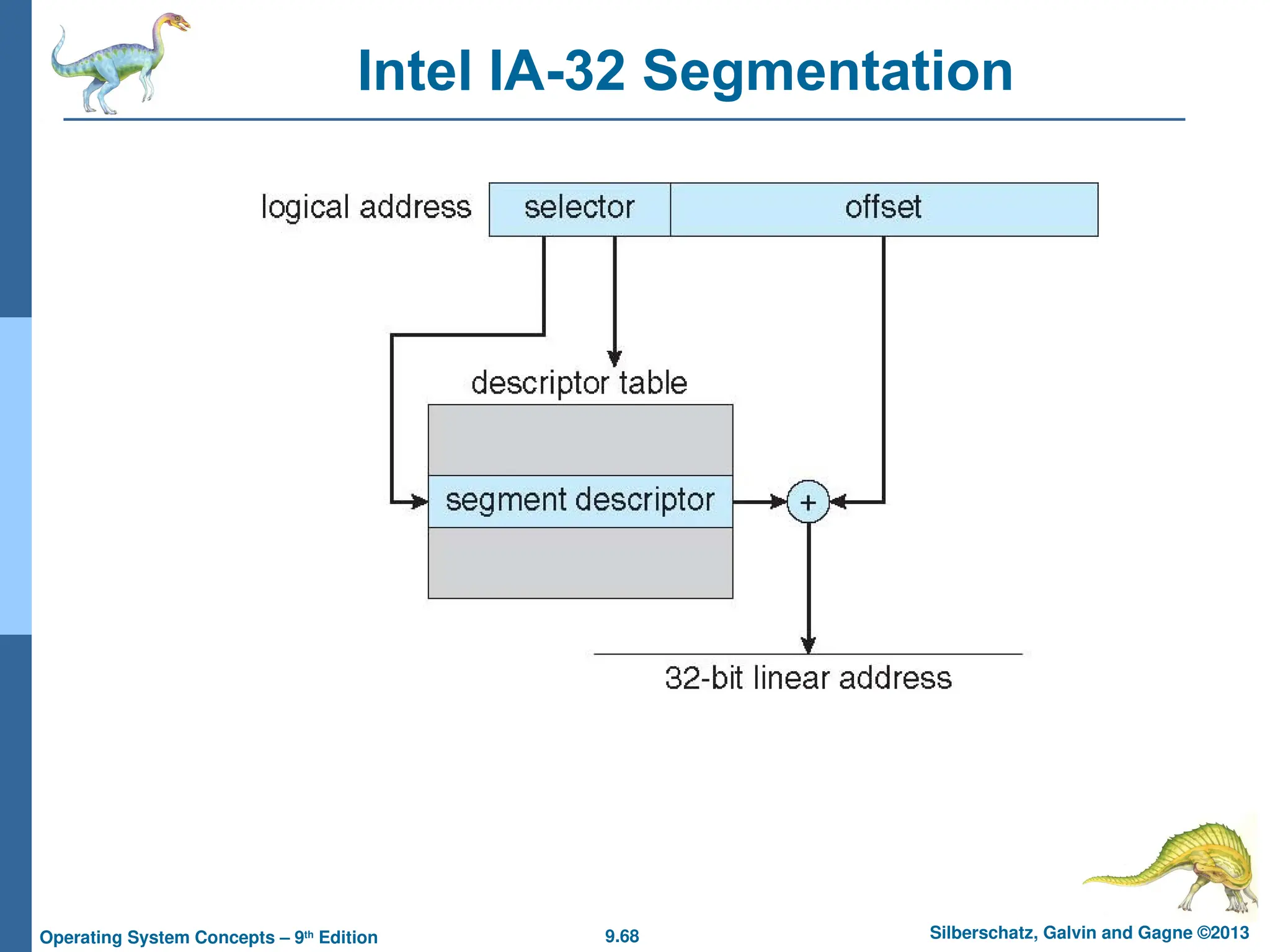
CPU generates logical address
Selector given to segmentation unit
Which produces linear addresses
Linear address given to paging unit
Which generates physical address in main memory
Paging units form equivalent of MMU
Pages sizes can be 4 KB or 4 MB
- 67.
9.67 Silberschatz, Galvinand Gagne ©2013
Operating System Concepts – 9th
Edition
Logical to Physical Address Translation in IA-32
- 68.
- 69.
- 70.
9.70 Silberschatz, Galvinand Gagne ©2013
Operating System Concepts – 9th
Edition
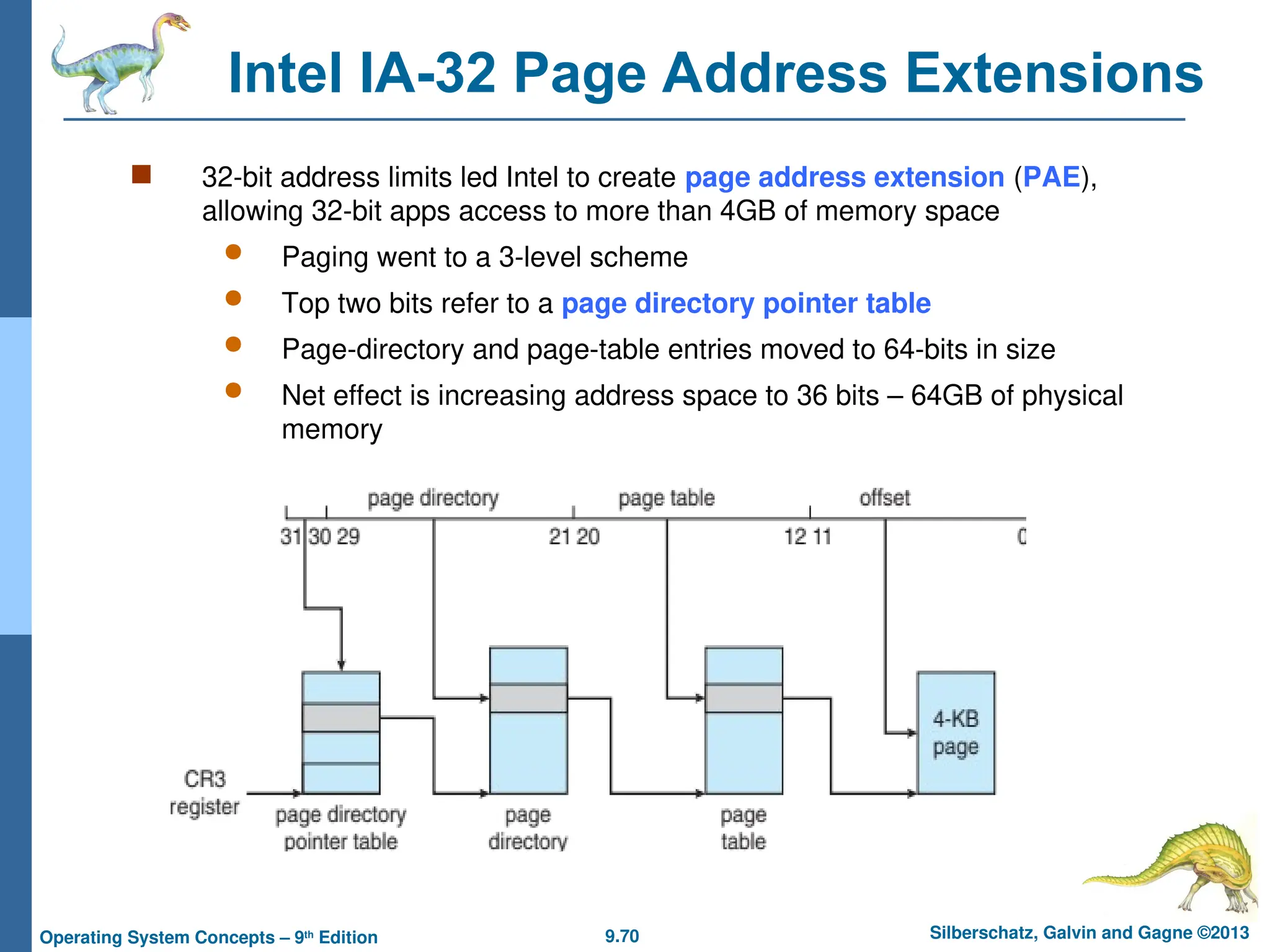
Intel IA-32 Page Address Extensions
32-bit address limits led Intel to create page address extension (PAE),
allowing 32-bit apps access to more than 4GB of memory space
Paging went to a 3-level scheme
Top two bits refer to a page directory pointer table
Page-directory and page-table entries moved to 64-bits in size
Net effect is increasing address space to 36 bits – 64GB of physical
memory
- 71.
9.71 Silberschatz, Galvinand Gagne ©2013
Operating System Concepts – 9th
Edition
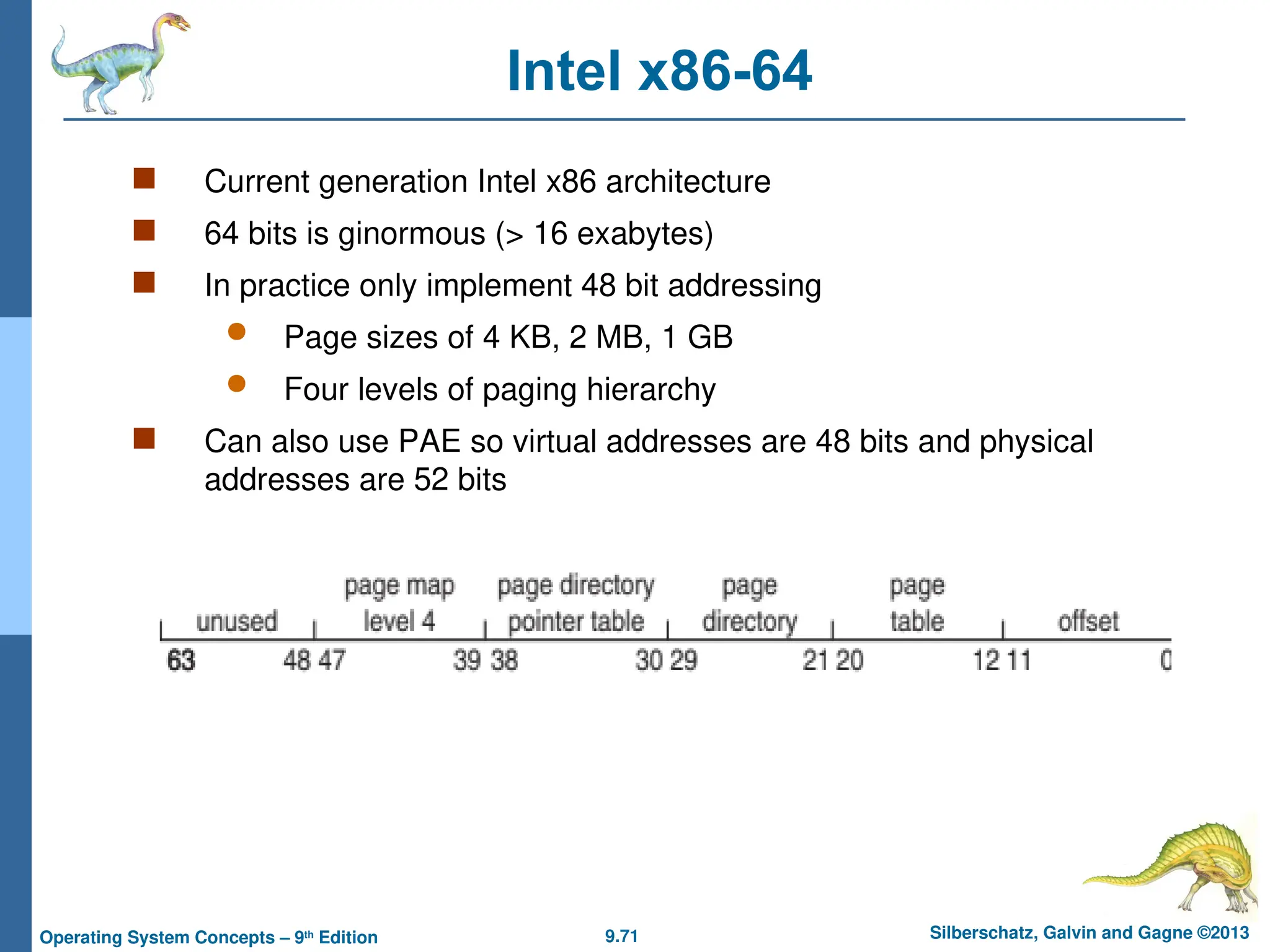
Intel x86-64
Current generation Intel x86 architecture
64 bits is ginormous (> 16 exabytes)
In practice only implement 48 bit addressing
Page sizes of 4 KB, 2 MB, 1 GB
Four levels of paging hierarchy
Can also use PAE so virtual addresses are 48 bits and physical
addresses are 52 bits
- 72.
9.72 Silberschatz, Galvinand Gagne ©2013
Operating System Concepts – 9th
Edition
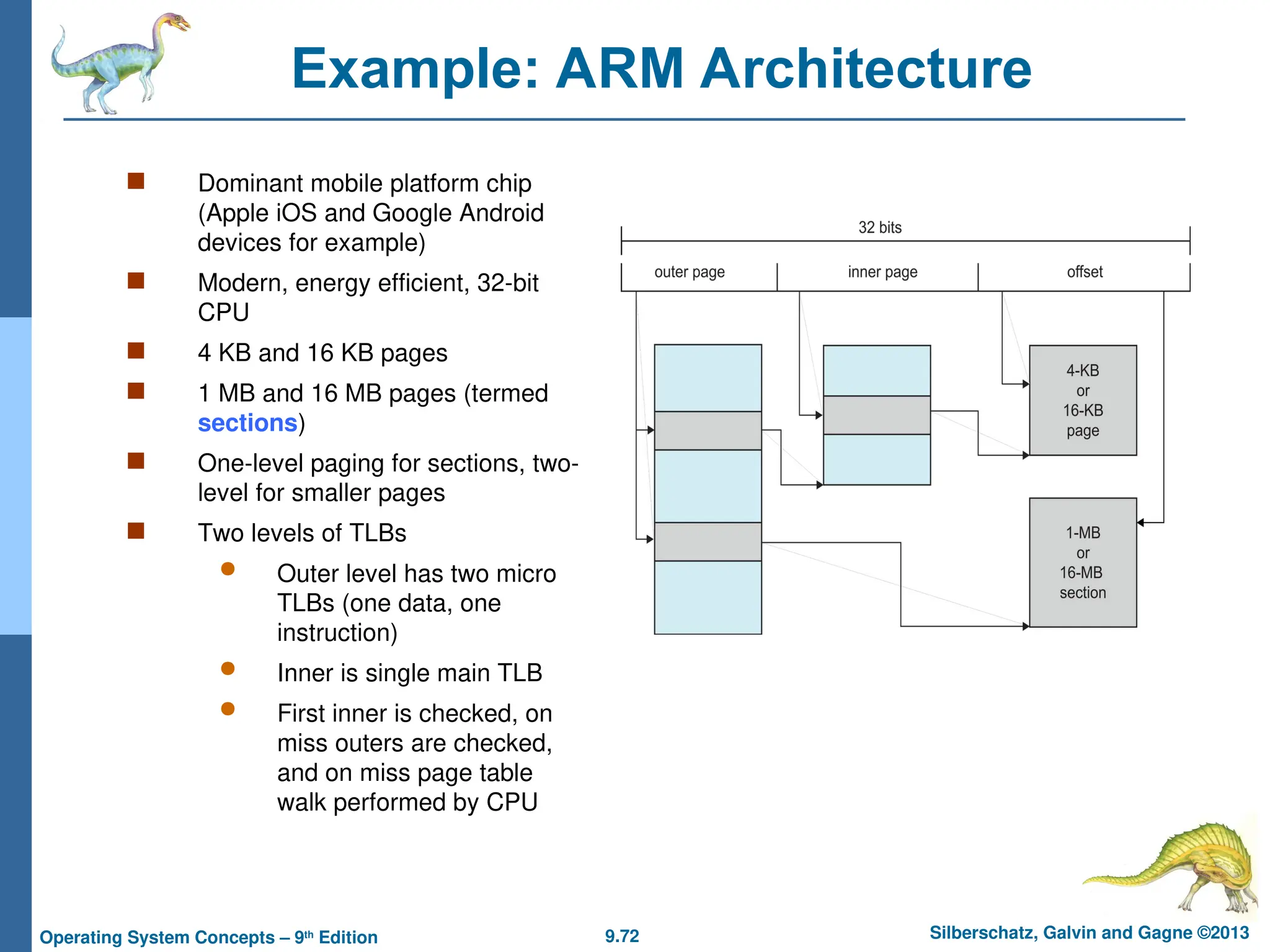
Example: ARM Architecture
Dominant mobile platform chip
(Apple iOS and Google Android
devices for example)
Modern, energy efficient, 32-bit
CPU
4 KB and 16 KB pages
1 MB and 16 MB pages (termed
sections)
One-level paging for sections, two-
level for smaller pages
Two levels of TLBs
Outer level has two micro
TLBs (one data, one
instruction)
Inner is single main TLB
First inner is checked, on
miss outers are checked,
and on miss page table
walk performed by CPU
- 73.