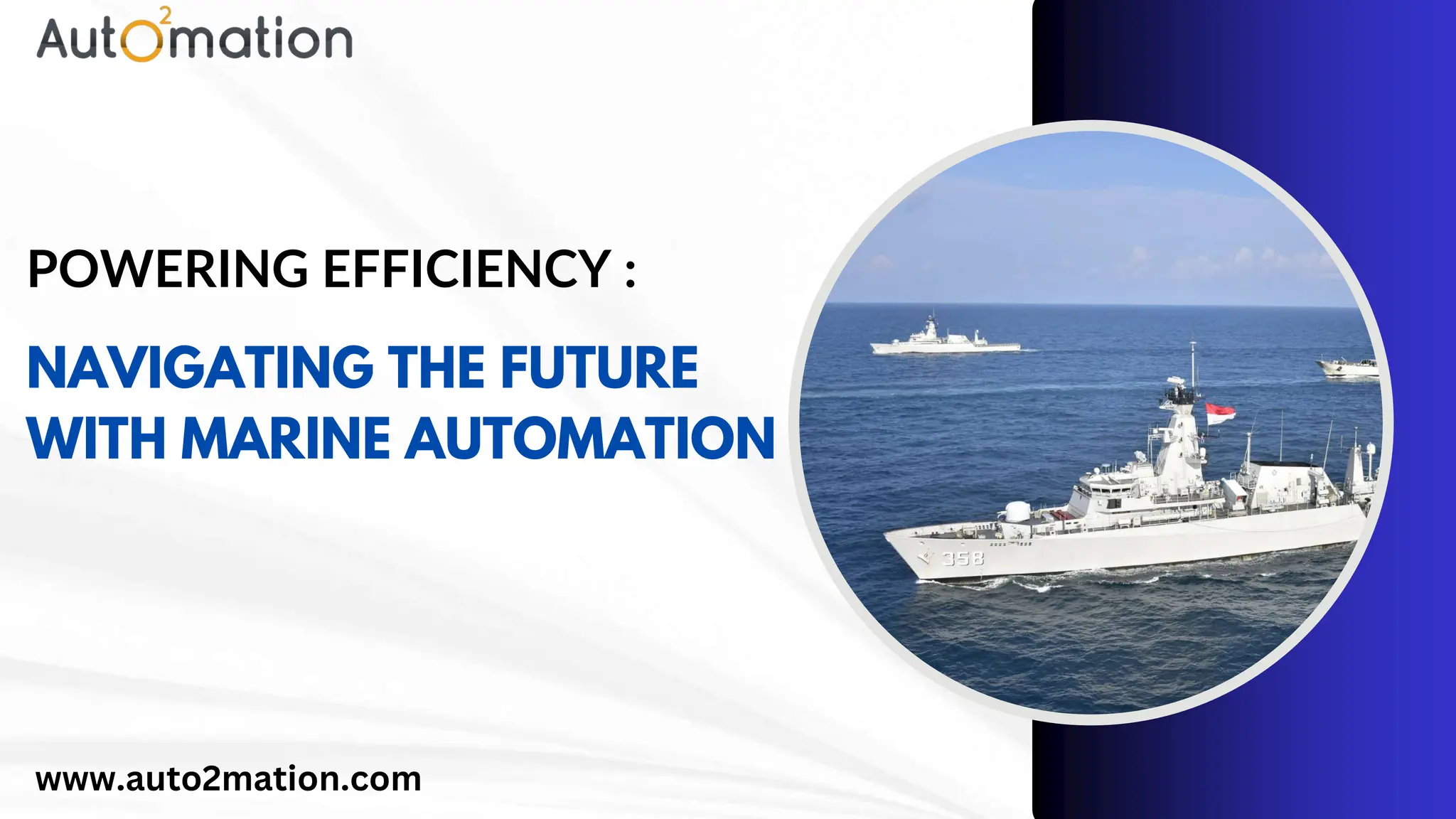
POWERING EFFICIENCY :
NAVIGATING THE FUTURE
WITH MARINE AUTOMATION
www.auto2mation.com
INTRODUCTION TO
MARINE AUTOMATION
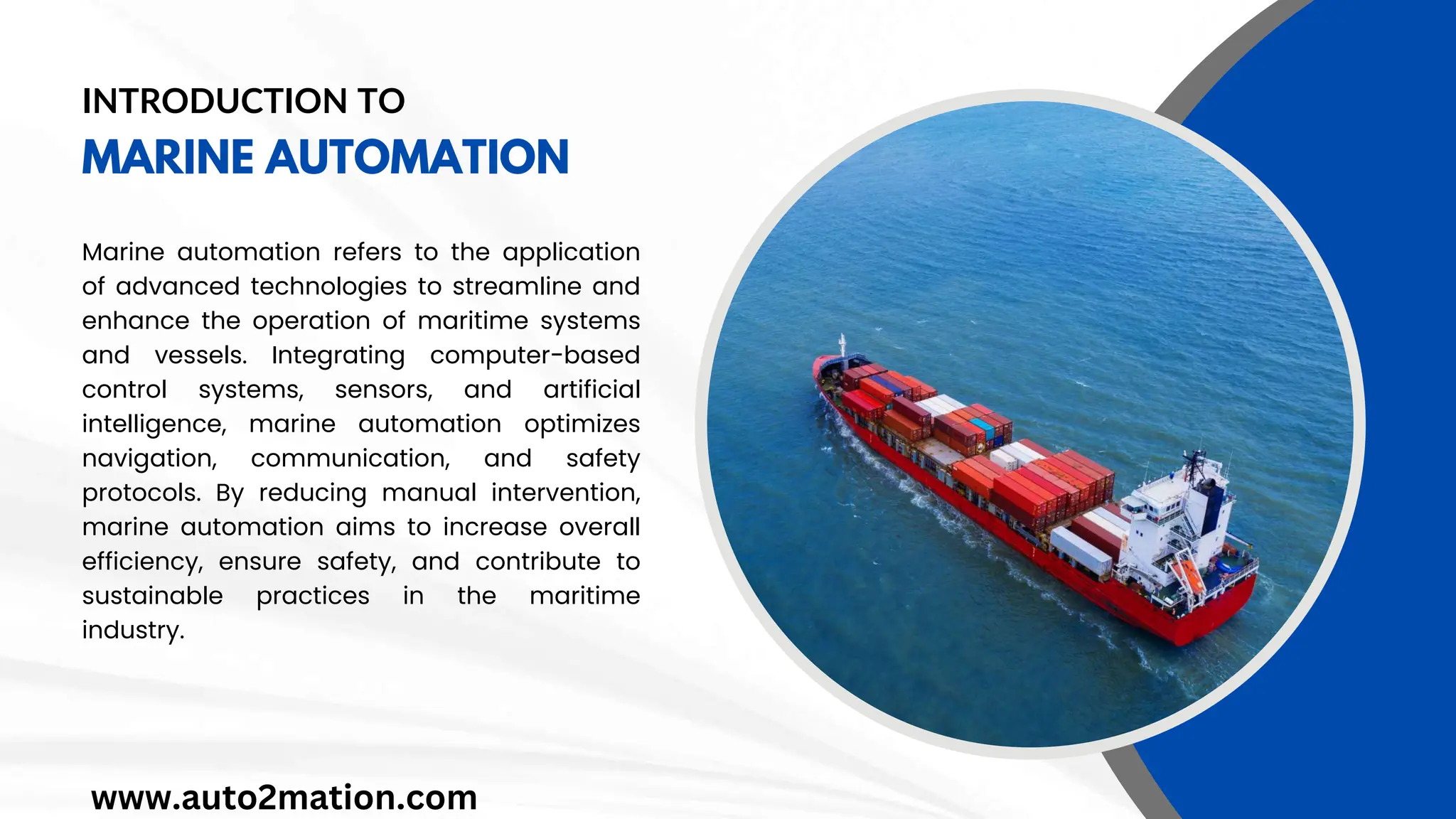
Marine automation refers to the application
of advanced technologies to streamline and
enhance the operation of maritime systems
and vessels. Integrating computer-based
control systems, sensors, and artificial
intelligence, marine automation optimizes
navigation, communication, and safety
protocols. By reducing manual intervention,
marine automation aims to increase overall
efficiency, ensure safety, and contribute to
sustainable practices in the maritime
industry.
www.auto2mation.com
ADVANCEMENTS IN
VESSEL CONTROL SYSTEMS
Advancements in Vessel Control Systems
have revolutionized maritime navigation,
steering ships into a new era of efficiency
and precision. Traditional methods give way
to cutting-edge technologies, featuring
integrated sensors, automated controls, and
complicated data analytics. These systems
empower sailors with real-time insights into
navigation, momentum, and safety
protocols. The evolution encompasses not
only improved accuracy but also
streamlined operations, reducing human
error and attractive overall vessel
performance.
www.auto2mation.com
ARTIFICIAL INTELLIGENCE IN
MARITIME OPERATIONS
The integration of Artificial Intelligence (AI)
in maritime operations represents a
pattern shift, revolutionizing traditional
navigation and ship management. AI
algorithms analyze huge datasets in real-
time, enhancing decision-making
processes for route optimization, collision
avoidance, and fuel efficiency. Automation
in predictive maintenance ensures vessel
reliability, while smart systems enable
adaptive responses to dynamic sea
conditions.
www.auto2mation.com
SAFETY AND RELIABILITY IN
AUTOMATED MARINE SYSTEMS
Ensuring the safety and reliability of
automated marine systems is vital in
navigating the seas of progress. Advanced
technologies demand particular attention
to system integrity and performance,
mitigating risks inbuilt in autonomous
operations. Accurate safety protocols,
redundancy measures, and continuous
monitoring make stronger these systems
against potential failures, fostering
confidence in their reliability.
www.auto2mation.com
CHALLENGES AND SOLUTIONS IN
MARINE AUTOMATION
Navigating the implementation of marine
automation presents challenges such as
technical complexities, cyber security
concerns, and workforce adaptation.
Vessel operators struggle with integrating
advanced technologies while ensuring
safety and reliability. Solutions involve
robust cyber security protocols,
comprehensive training programs for crew
members, and collaborative industry
efforts to establish standardized
automation practices.
www.auto2mation.com
FUTURE TRENDS AND INNOVATIONS IN
MARINE AUTOMATION
The future of marine automation holds
exciting scenario, with trends and
innovations set to redefine maritime
operations. Independent vessels, propelled
by advancements in artificial intelligence
and sensor technologies, promise
increased efficiency and safety. As
technology continues to evolve, the
horizon of marine automation unveils a
dynamic landscape, shaping a future
where innovation navigates the seas
towards unique levels of efficiency and
environmental responsibility.
www.auto2mation.com
CONCLUSION
In closing, "Powering Efficiency: Navigating
the Future with Marine Automation" unfolds
the exciting advancements navigation the
maritime world. From smarter ship controls
to using Artificial Intelligence, it shows how
automation is transforming the industry.
Safety and sustainability take center stage,
with real-world examples showcasing
successful changes. It's a journey towards
a promising automated era in the
maritime world, where technology and
progress set steer hand in hand,
navigating us into a bright future on the
open seas.
www.auto2mation.com

Powering Efficiency: Navigating the Future with Marine Automation.pptx

  • 1.
    POWERING EFFICIENCY : NAVIGATINGTHE FUTURE WITH MARINE AUTOMATION www.auto2mation.com
  • 2.
    INTRODUCTION TO MARINE AUTOMATION Marineautomation refers to the application of advanced technologies to streamline and enhance the operation of maritime systems and vessels. Integrating computer-based control systems, sensors, and artificial intelligence, marine automation optimizes navigation, communication, and safety protocols. By reducing manual intervention, marine automation aims to increase overall efficiency, ensure safety, and contribute to sustainable practices in the maritime industry. www.auto2mation.com
  • 3.
    ADVANCEMENTS IN VESSEL CONTROLSYSTEMS Advancements in Vessel Control Systems have revolutionized maritime navigation, steering ships into a new era of efficiency and precision. Traditional methods give way to cutting-edge technologies, featuring integrated sensors, automated controls, and complicated data analytics. These systems empower sailors with real-time insights into navigation, momentum, and safety protocols. The evolution encompasses not only improved accuracy but also streamlined operations, reducing human error and attractive overall vessel performance. www.auto2mation.com
  • 4.
    ARTIFICIAL INTELLIGENCE IN MARITIMEOPERATIONS The integration of Artificial Intelligence (AI) in maritime operations represents a pattern shift, revolutionizing traditional navigation and ship management. AI algorithms analyze huge datasets in real- time, enhancing decision-making processes for route optimization, collision avoidance, and fuel efficiency. Automation in predictive maintenance ensures vessel reliability, while smart systems enable adaptive responses to dynamic sea conditions. www.auto2mation.com
  • 5.
    SAFETY AND RELIABILITYIN AUTOMATED MARINE SYSTEMS Ensuring the safety and reliability of automated marine systems is vital in navigating the seas of progress. Advanced technologies demand particular attention to system integrity and performance, mitigating risks inbuilt in autonomous operations. Accurate safety protocols, redundancy measures, and continuous monitoring make stronger these systems against potential failures, fostering confidence in their reliability. www.auto2mation.com
  • 6.
    CHALLENGES AND SOLUTIONSIN MARINE AUTOMATION Navigating the implementation of marine automation presents challenges such as technical complexities, cyber security concerns, and workforce adaptation. Vessel operators struggle with integrating advanced technologies while ensuring safety and reliability. Solutions involve robust cyber security protocols, comprehensive training programs for crew members, and collaborative industry efforts to establish standardized automation practices. www.auto2mation.com
  • 7.
    FUTURE TRENDS ANDINNOVATIONS IN MARINE AUTOMATION The future of marine automation holds exciting scenario, with trends and innovations set to redefine maritime operations. Independent vessels, propelled by advancements in artificial intelligence and sensor technologies, promise increased efficiency and safety. As technology continues to evolve, the horizon of marine automation unveils a dynamic landscape, shaping a future where innovation navigates the seas towards unique levels of efficiency and environmental responsibility. www.auto2mation.com
  • 8.
    CONCLUSION In closing, "PoweringEfficiency: Navigating the Future with Marine Automation" unfolds the exciting advancements navigation the maritime world. From smarter ship controls to using Artificial Intelligence, it shows how automation is transforming the industry. Safety and sustainability take center stage, with real-world examples showcasing successful changes. It's a journey towards a promising automated era in the maritime world, where technology and progress set steer hand in hand, navigating us into a bright future on the open seas. www.auto2mation.com