POSTURE
TOPIC:
SUBMITTED TO: SIR MURTAZA
SUBMITTED BY: AMAR HUSSAIN
(24PUPPT05)
CONTENTS
ļ‚§POSTURE
ļ‚§TYPES OF POSTURE
ļ‚§MUSCLE TONE AND ITS PATHOLOGY
ļ‚§MUSCLE POWER
ļ‚§ROLE OF SPINE IN POSTURE
ļ‚§PRIMARY,SECONDARY CURVE
ļ‚§POSTURAL DEVIATION AND PATHOLOGIES
POSTURE
 Posture is the attitude assumed by the body either
with support during muscular inactivity, or by
means of coordinated action of many muscles
working to maintain stability.
Posture refers to the alignment and positioning of
the body in space. and it plays a crucial role in
biomechanics and kinesiology.
It is an automatic and unconscious position and it
represents the body’s reaction to the force of gravity.
TYPES OF
POSTURE
ļ‚§ STATIC POSTURE
ļ‚§ DYNAMIC POSTURE
STATIC
POSTURE
The alignment of the body when at rest,
such as standing or sitting.
These are the postural habits that should be
followed while sitting .
Head aligned over the shoulder.
Shoulder should be level and relaxed.
The natural curve of the spine should be
maintained.
STATIC
POSTURE
 Knees should be straight making an angle
of 90 or >90 with the feet.
 Feet should be pointing forward and
weight evenly distributed.
 Pelvis should be in neutral position not tilted
forward or backward.
DYNAMIC
POSTURE
The alignment of the body when moving , such as
during physical exercises
These are the postural habits that should be
followed while moving .
Balance and equilibrium.
Coordination of musculoskeletal system.
Proper alignment helps to distribute forces evenly
and reduce strain on tissues.
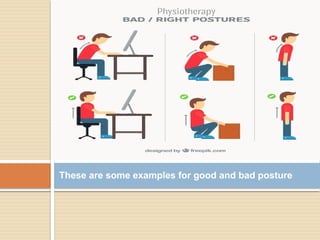
Lets do a comparison what a good and bad
posture is
GOOD POSTURE
 Least abnormal forces
act on the body.
 Work done will be bio
mechanically efficient
 Less stress on the
muscle, and effort
done will be less.
 For example back
straight, shoulder
back and tummy in
BAD POSTURE
 Maximum amount of
abnormal forces act on
the body.
 Work done will not be bio
mechanically efficient
 Great stress on the
muscles and max effort
done.
 Examples will be head
tilted forward, slumped
These are some examples for good and bad posture
Click icon to add picture
MUSCLE TONE
Muscle tone refers to
the constant tension in a
muscle, which helps
maintain posture and allows
for seamless movement.
FLAACCIDITY
 It is a problem of muscle in
which muscle tone decreases
(hypotonicity).
 It occurs in the lower motor region of
the spine (area below the AHC)
 It is neurological pathology
 Reflexes will be slow .
SPASTICITY
 It is abnormal muscle tightness due
to prolonged muscle contractions in
which muscle tone increases (hyper
tonicity).
 It occurs in the upper motor region
of the spine (area above the AHC)
 It is neurological pathology
 increase in tendon Reflexes,
stronger involuntary contractions.
MUSCLE
STRENGTH
Muscle strength is the amount of
force a muscle can produce, and it
is related to voluntary muscle
movement and physical activities.
ROLE OF SPINE IN
POSTURE
The Spine allows for a range of movements
including flexon, extension ,lateral bending and
rotation .These movements Enable the body to
adjust and maintain the posture during various
activities. The Spine bears the weight of head
and torso by distributing Forces between
upper and lower body .This distribution Helps
to Prevent excessive stress on single part of
the body.
PRIMARY CURVE
OF SPINE
Natural outward curves present in the spinal cord
from birth are called primary curves. These curves
are part of the normal fetus and early postnatal
spine and remains the same in adult.
Slight outward curves are called Kyphosis.
Two types of normal kyphosis present in spine.
Thoracic kyphosis
 Located in the thoracic
region of the spine.
 Thoracic curve of the
Spine. Outward curve
(kyphosis)
 This curve Is present from
birth and helps in the
development of thoracic
cavity which houses vital
organs like heart and
lungs.
Sacral kyphosis
 Located in the sacral
region of spine which
includes sacrum and
coccyx .
 Outward curvature
(kyphosis).
 Present from birth and
contributes in overall
Stability of pelvis. provide
essential support For
upper body weight.
SECONDARY
CURVE OF SPINE
The secondary curve of the spine
develops after the birth as the child learns
to sit upright, stand and walk. These
curves are present in cervical and lumbar
Region and these curves unlike primary
curves have inward curvature called
lordosis.
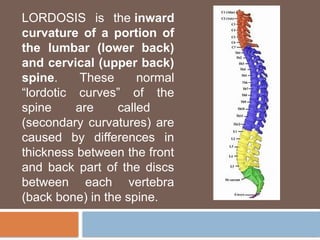
LORDOSIS is the inward
curvature of a portion of
the lumbar (lower back)
and cervical (upper back)
spine. These normal
ā€œlordotic curvesā€ of the
spine are called
(secondary curvatures) are
caused by differences in
thickness between the front
and back part of the discs
between each vertebra
(back bone) in the spine.
POSTURAL
PATHOLOGY IN
SPINE
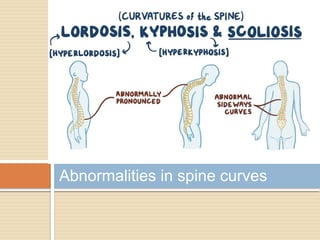
• KYPHOSIS:
• LORDOSIS
• SCOLIOSIS
• ANKYLOSING
SPONDYLITIS(AS)
KYPHOSIS
Kyphosis is an abnormal outward curve in the upper
spine . This produce a rounding in the upper back
sometimes called ā€œhunchbackā€ in older people
kyphosis is often due to weakness in the spinal
bones .In younger ones due to bad posture for
example while working on a laptop our head lean
forward and back hunch appears.
TREATMENT:
This condition is treatable by medication
or physical therapy
LORDOSIS
Lordotic curve is normal but Lordosis is an exaggerated
inward curve of the spine also called swayback .it can affect
either at the neck or lower back. One of the main symptom
is swayback or during pregnancy due to the excessive
stress muscle pain due to the inward back curve. Obesity
might be the reason of n the back muscles.
TREATMENT:
EXERCISE can increase strength and stability in the
muscles of the lower back region
Management of weight using exercise and proper diet
if one is obese.
Use of back brace to support back.
SCOLIOSIS
condition in which Increase in the lateral
curve of spine can be seen and a person’s
spine has an irregular curve. The curve is
usually S or C shaped. Mild scoliosis does
not typically cause problems but more
severe cases can affect breathing and
movement
Abnormalities in spine curves
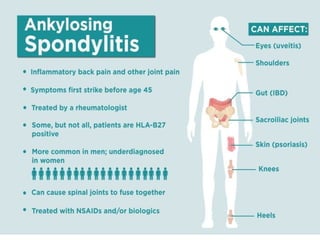
ANKYLOSING
SPONDYLITIS
Ankylo means fused spine
It is a rare type of auto immune disorder in your spine. It is
life long condition that usually starts in your lower back.
It can spread up to your neck or damage joints in other
parts of your body. Most common is SACROILIAC joint.
TREATMENT:
Medication to help with pain and inflammation
Exercise regularly at home
Apply heat or cold to soothe sore joints
Surgery in severe case.
posture presentation by Amar Hussain pptx

posture presentation by Amar Hussain pptx

  • 1.
    POSTURE TOPIC: SUBMITTED TO: SIRMURTAZA SUBMITTED BY: AMAR HUSSAIN (24PUPPT05)
  • 2.
    CONTENTS ļ‚§POSTURE ļ‚§TYPES OF POSTURE ļ‚§MUSCLETONE AND ITS PATHOLOGY ļ‚§MUSCLE POWER ļ‚§ROLE OF SPINE IN POSTURE ļ‚§PRIMARY,SECONDARY CURVE ļ‚§POSTURAL DEVIATION AND PATHOLOGIES
  • 3.
    POSTURE  Posture isthe attitude assumed by the body either with support during muscular inactivity, or by means of coordinated action of many muscles working to maintain stability. Posture refers to the alignment and positioning of the body in space. and it plays a crucial role in biomechanics and kinesiology. It is an automatic and unconscious position and it represents the body’s reaction to the force of gravity.
  • 4.
    TYPES OF POSTURE ļ‚§ STATICPOSTURE ļ‚§ DYNAMIC POSTURE
  • 5.
    STATIC POSTURE The alignment ofthe body when at rest, such as standing or sitting. These are the postural habits that should be followed while sitting . Head aligned over the shoulder. Shoulder should be level and relaxed. The natural curve of the spine should be maintained.
  • 6.
    STATIC POSTURE  Knees shouldbe straight making an angle of 90 or >90 with the feet.  Feet should be pointing forward and weight evenly distributed.  Pelvis should be in neutral position not tilted forward or backward.
  • 7.
    DYNAMIC POSTURE The alignment ofthe body when moving , such as during physical exercises These are the postural habits that should be followed while moving . Balance and equilibrium. Coordination of musculoskeletal system. Proper alignment helps to distribute forces evenly and reduce strain on tissues.
  • 8.
    Lets do acomparison what a good and bad posture is GOOD POSTURE  Least abnormal forces act on the body.  Work done will be bio mechanically efficient  Less stress on the muscle, and effort done will be less.  For example back straight, shoulder back and tummy in BAD POSTURE  Maximum amount of abnormal forces act on the body.  Work done will not be bio mechanically efficient  Great stress on the muscles and max effort done.  Examples will be head tilted forward, slumped
  • 9.
    These are someexamples for good and bad posture Click icon to add picture
  • 10.
    MUSCLE TONE Muscle tonerefers to the constant tension in a muscle, which helps maintain posture and allows for seamless movement.
  • 11.
    FLAACCIDITY  It isa problem of muscle in which muscle tone decreases (hypotonicity).  It occurs in the lower motor region of the spine (area below the AHC)  It is neurological pathology  Reflexes will be slow .
  • 12.
    SPASTICITY  It isabnormal muscle tightness due to prolonged muscle contractions in which muscle tone increases (hyper tonicity).  It occurs in the upper motor region of the spine (area above the AHC)  It is neurological pathology  increase in tendon Reflexes, stronger involuntary contractions.
  • 13.
    MUSCLE STRENGTH Muscle strength isthe amount of force a muscle can produce, and it is related to voluntary muscle movement and physical activities.
  • 14.
    ROLE OF SPINEIN POSTURE The Spine allows for a range of movements including flexon, extension ,lateral bending and rotation .These movements Enable the body to adjust and maintain the posture during various activities. The Spine bears the weight of head and torso by distributing Forces between upper and lower body .This distribution Helps to Prevent excessive stress on single part of the body.
  • 15.
    PRIMARY CURVE OF SPINE Naturaloutward curves present in the spinal cord from birth are called primary curves. These curves are part of the normal fetus and early postnatal spine and remains the same in adult. Slight outward curves are called Kyphosis. Two types of normal kyphosis present in spine.
  • 16.
    Thoracic kyphosis  Locatedin the thoracic region of the spine.  Thoracic curve of the Spine. Outward curve (kyphosis)  This curve Is present from birth and helps in the development of thoracic cavity which houses vital organs like heart and lungs. Sacral kyphosis  Located in the sacral region of spine which includes sacrum and coccyx .  Outward curvature (kyphosis).  Present from birth and contributes in overall Stability of pelvis. provide essential support For upper body weight.
  • 17.
    SECONDARY CURVE OF SPINE Thesecondary curve of the spine develops after the birth as the child learns to sit upright, stand and walk. These curves are present in cervical and lumbar Region and these curves unlike primary curves have inward curvature called lordosis.
  • 18.
    LORDOSIS is theinward curvature of a portion of the lumbar (lower back) and cervical (upper back) spine. These normal ā€œlordotic curvesā€ of the spine are called (secondary curvatures) are caused by differences in thickness between the front and back part of the discs between each vertebra (back bone) in the spine.
  • 19.
    POSTURAL PATHOLOGY IN SPINE • KYPHOSIS: •LORDOSIS • SCOLIOSIS • ANKYLOSING SPONDYLITIS(AS)
  • 20.
    KYPHOSIS Kyphosis is anabnormal outward curve in the upper spine . This produce a rounding in the upper back sometimes called ā€œhunchbackā€ in older people kyphosis is often due to weakness in the spinal bones .In younger ones due to bad posture for example while working on a laptop our head lean forward and back hunch appears. TREATMENT: This condition is treatable by medication or physical therapy
  • 21.
    LORDOSIS Lordotic curve isnormal but Lordosis is an exaggerated inward curve of the spine also called swayback .it can affect either at the neck or lower back. One of the main symptom is swayback or during pregnancy due to the excessive stress muscle pain due to the inward back curve. Obesity might be the reason of n the back muscles. TREATMENT: EXERCISE can increase strength and stability in the muscles of the lower back region Management of weight using exercise and proper diet if one is obese. Use of back brace to support back.
  • 22.
    SCOLIOSIS condition in whichIncrease in the lateral curve of spine can be seen and a person’s spine has an irregular curve. The curve is usually S or C shaped. Mild scoliosis does not typically cause problems but more severe cases can affect breathing and movement
  • 23.
  • 24.
    ANKYLOSING SPONDYLITIS Ankylo means fusedspine It is a rare type of auto immune disorder in your spine. It is life long condition that usually starts in your lower back. It can spread up to your neck or damage joints in other parts of your body. Most common is SACROILIAC joint. TREATMENT: Medication to help with pain and inflammation Exercise regularly at home Apply heat or cold to soothe sore joints Surgery in severe case.

Editor's Notes