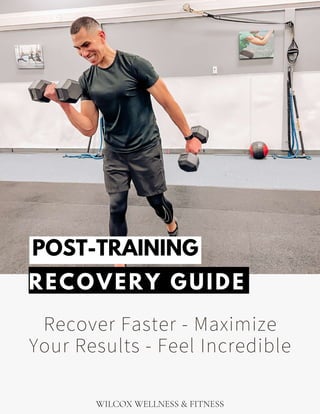
RECOVERY GUIDE
Recover Faster - Maximize
Your Results - Feel Incredible
POST-TRAINING
WILCOX WELLNESS & FITNESS
WELCOME
to optimum recovery
Thank you for downloading your copy of
The Post-Training & Recovery Guide.
If you’re reading this, you’re serious about
your training sessions, your performance,
and even more importantly, your results.
This guide will outline simple steps you
can take to help you maximize your
results – whether you’re a diehard fitness
enthusiast or brand new to working out.
At Wilcox Wellness & Fitness we help
people enhance their lives by forming
healthy habits that they can sustain for a
lifetime.
We hope this guide helps you not only
reach your goals faster but shows you
just how much YOU can truly achieve!
Committed to Your Success,
WILCOX WELLNESS & FITNESS
Wilcox Wellness & Fitness
One of the BEST things you can do to
maximize results from your training
sessions and other fitness-related
activities is to …
TRAIN SMART!
This goes for everyone, from fitness
walkers to Ironman competitors to
world-class athletes! Getting fitter and
stronger is a delicate balancing act.
That’s because fitness actually has
many components:
Cardiovascular fitness
Muscular strength
Muscular stamina/endurance
Flexibility
A WELL DESIGNED
TRAINING PROGRAM
That’s not to mention any skill-related components
needed for sports you may enjoy, like speed, agility,
and balance.
Making sure you do just enough – and not too much –
to maintain and improve those areas of physical
fitness is the key.
Getting fitter and stronger means you have to
challenge your body. Then, you have to let your body
work its magic by giving it time to repair, rebuild, and
recover.
The best programs take that into consideration.
Our Training Program is designed with the 6 keys
to set you up for success.
SMART
TRAIN
WILCOX WELLNESS & FITNESS
program design
To allow you to move
freely and gracefully
without any
compensation.
To build strength on all
planes of movement.
We incorporate
movements that
prepare your body for
everyday life.
For a healthy heart.
To prevent injury and
promote recovery.
Keeping you in proper
form, giving you a solid
support system, and a
lot of accountability.
Because 70% of results
will come from this
area.
WILCOX TRAINING
WILCOX WELLNESS & FITNESS
Mobility
Functional
Training
Cardiovascular
Conditioning
Flexibility Coaching Nutrition
WILCOX WELLNESS & FITNESS
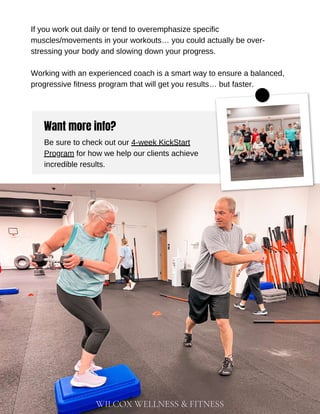
If you work out daily or tend to overemphasize specific
muscles/movements in your workouts… you could actually be over-
stressing your body and slowing down your progress.
Working with an experienced coach is a smart way to ensure a balanced,
progressive fitness program that will get you results… but faster.
Want more info?
Be sure to check out our 4-week KickStart
Program for how we help our clients achieve
incredible results.
You’ve just finished your amazingly well-
designed training session. Now what?
It is very important for you to take the
time to gradually slow down your heart
rate.
This can help stop blood from pooling in
your extremities, which can make you
feel dizzy, lightheaded, or even faint.
We encourage you to take a walk
around the gym or your home, or simply
move your body, gradually decreasing
your intensity.
POST-TRAINING
COOL DOWN
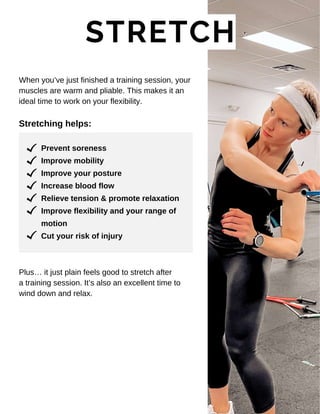
When you’ve just finished a training session, your
muscles are warm and pliable. This makes it an
ideal time to work on your flexibility.
Stretching helps:
Plus… it just plain feels good to stretch after
a training session. It’s also an excellent time to
wind down and relax.
Prevent soreness
Improve mobility
Improve your posture
Increase blood flow
Relieve tension & promote relaxation
Improve flexibility and your range of
motion
Cut your risk of injury
STRETCH
STANDING CALF STRETCH
HAMSTRING STRETCH
QUADRICEPS STRETCH
KNEELING LAT STRETCH
LEG CROSSOVER STRETCH
MODIFIED HURDLER STRETCH
While the most important time to foam roll is before your workout, it can also be
helpful to use a roller after your workout. This is especially true if you have any
trouble spots, muscle imbalances, or did a focused workout targeting a specific
muscle group.
To foam roll after your workout, simply roll the targeted body part until you feel
a tender spot. Hold that spot for 60-90 seconds until the discomfort reduces,
and move on to the next tender spot or body part. (Be sure not to roll over any
injuries or joints.)
FOAM ROLLING
While pre-training stretches are active (aka
dynamic), your post-training routine can
focus on static (non-moving) stretches,
which you can hold for 30-60 seconds.
Sample stretches to incorporate into your
routine:
STRETCH
HYDRATE
It is so very important to hydrate and
replenish those fluids!
If you’ve worked out hard or gotten
sweaty from your workout, make sure
you drink at least 16 oz (475 ml) of water
or other post-training drink.
Staying hydrated can help your body get
stronger, experience less soreness, and
even improve your flexibility.
REMEMBER: Our goal is to drink half our
body weight in fluid ounces daily in
water!
WILCOX WELLNESS & FITNESS
REFUEL
There’s an important window of time right
after your training session when you have
the opportunity to kickstart your recovery
– and your results!
This is still an emerging area of research
but studies show that during the 30-45
minutes after your workout, your body
appears to be especially receptive to two
key nutrients: carbs and protein.
The carbs will help restore your glycogen
levels, which will help with both energy
and recovery.
Protein, meanwhile, contains important
amino acids that help your muscles
repair, recover, and rebuild.
WILCOX WELLNESS & FITNESS
REFUEL
Greek yogurt with fruit
Turkey wrap
Tuna and whole-grain crackers
A protein-rich smoothie (use whole food sources: yogurt, cottage
cheese, or tofu)
For most people, eating a simple protein-carb snack or meal will get the
job done.
A few ideas:
1 to 1.5 grams of carbs per kilogram (1 kg = 2.2 lbs) of
bodyweight
15-25 grams of protein
A person weighing 150 lbs (68 kg) would aim for a snack containing 15-
25 grams of protein and 68-102 grams of carbs.
If you want to get super technical when it comes to exactly how many
grams of carbs and protein to eat after your workout, here are some
guidelines from the National Academy of Sports Medicine:
POST-WORKOUT NUTRITION Optimized!
ACTIVE RECOVERY
& REST DAYS
Your training sessions create two kinds of
stress on your muscles:
When you challenge your muscles properly,
you’re creating microscopic damage in your
muscles – don’t worry it’s a good thing! – that
is necessary to help your body get stronger.
Your muscles generally need 24-48 hours
between workouts to repair, recover, and
rebuild from this type of stress.
Working out depletes your muscles of
glycogen (energy). Continuous days of
workouts (especially if they’re intense) can
leave you feeling drained and exhausted...
STRESS 1 Mechanical Stress
STRESS 2 Metabolic Stress
WILCOX WELLNESS & FITNESS
ACTIVE RECOVERY
& REST DAYS
Taking a rest or active recovery day can give your body the extra “oomph” it
needs to keep performing at a high level during the days that you workout.
Reasons to take a rest day:
Avoiding physical burnout: inadequate rest can leave you feeling
depleted, stale, and sore.
Spending time with your family and friends.
Preventing mental burnout: constantly pushing yourself can set
you up for mental fatigue and make you start dreading (vs. looking
forward to) your workouts.
Creating a more balanced life: fitness IS super important, but so
are your other hobbies and interests!
“Adulting.” Grocery shopping, meal prepping, chores, errands,
etc. have to get done at some point.
Active recovery days fall somewhere between training days and rest days.
These are days when you’re not working out as hard as you would on a
“workout day” – but you’re also not leaving a big dent on the couch from
binge-watching your latest streaming obsession.
This is when you take a yoga class, go for a hike, play softball, go
swimming at the beach, go mountain biking or anything else that involves
gentle to moderate activity.
Active recovery days can be even more beneficial than complete rest days
because they can help keep your blood flowing and better help your
muscles recover and rebuild.
Working with a coach can help you build the right amount of rest &
recovery into your routine, so you can continue getting results while ALSO
living a full and balanced life.
"ACTIVE RECOVERY" DAYS?
But What About
WILCOX WELLNESS & FITNESS
SLEEP
FROM A RECOVERY STANDPOINT, SLEEP IS CRITICAL
AT A CELLULAR AND HORMONAL LEVEL.
Catabolic hormones contribute to the breakdown of tissue, and
these include cortisol and adrenaline, which are linked with
(among other things) stress. When you don’t get enough
quality sleep, you can have higher levels of these hormones.
Anabolic hormones (like human growth hormone – HGH) help
your muscles recover and grow. HGH is released during
periods of non-dream deep sleep.
7-8 HOURS OF QUALITY SLEEP IS VITAL TO THE
SUCCESS OF YOUR TRAINING SESSIONS
Plus, the more energized you feel after a good night of sleep,
the more energy you can bring to your training sessions.
The big one is safety: when you go into a workout tired, your
risk of injury increases.
Earlier we talked about how stress can affect
you at a hormonal level.
Your body is well equipped to handle short-
term acute bouts of stress, such as a bad day
at work. But too much stress over a long
period of time – aka chronic stress – can take
a toll!
This is why it’s important to have healthy
habits in place to help you manage stress
before it manages you.
STRESS
Some proven ways to manage stress:
Meditation or breath work
Exercise
Being in nature
“Unplug” time with friends & family
Reading
Massage

Post-Training Recovery Guide

  • 1.
    RECOVERY GUIDE Recover Faster- Maximize Your Results - Feel Incredible POST-TRAINING WILCOX WELLNESS & FITNESS
  • 2.
    WELCOME to optimum recovery Thankyou for downloading your copy of The Post-Training & Recovery Guide. If you’re reading this, you’re serious about your training sessions, your performance, and even more importantly, your results. This guide will outline simple steps you can take to help you maximize your results – whether you’re a diehard fitness enthusiast or brand new to working out. At Wilcox Wellness & Fitness we help people enhance their lives by forming healthy habits that they can sustain for a lifetime. We hope this guide helps you not only reach your goals faster but shows you just how much YOU can truly achieve! Committed to Your Success, WILCOX WELLNESS & FITNESS Wilcox Wellness & Fitness
  • 3.
    One of theBEST things you can do to maximize results from your training sessions and other fitness-related activities is to … TRAIN SMART! This goes for everyone, from fitness walkers to Ironman competitors to world-class athletes! Getting fitter and stronger is a delicate balancing act. That’s because fitness actually has many components: Cardiovascular fitness Muscular strength Muscular stamina/endurance Flexibility A WELL DESIGNED TRAINING PROGRAM
  • 4.
    That’s not tomention any skill-related components needed for sports you may enjoy, like speed, agility, and balance. Making sure you do just enough – and not too much – to maintain and improve those areas of physical fitness is the key. Getting fitter and stronger means you have to challenge your body. Then, you have to let your body work its magic by giving it time to repair, rebuild, and recover. The best programs take that into consideration. Our Training Program is designed with the 6 keys to set you up for success. SMART TRAIN WILCOX WELLNESS & FITNESS
  • 5.
    program design To allowyou to move freely and gracefully without any compensation. To build strength on all planes of movement. We incorporate movements that prepare your body for everyday life. For a healthy heart. To prevent injury and promote recovery. Keeping you in proper form, giving you a solid support system, and a lot of accountability. Because 70% of results will come from this area. WILCOX TRAINING WILCOX WELLNESS & FITNESS Mobility Functional Training Cardiovascular Conditioning Flexibility Coaching Nutrition
  • 6.
    WILCOX WELLNESS &FITNESS If you work out daily or tend to overemphasize specific muscles/movements in your workouts… you could actually be over- stressing your body and slowing down your progress. Working with an experienced coach is a smart way to ensure a balanced, progressive fitness program that will get you results… but faster. Want more info? Be sure to check out our 4-week KickStart Program for how we help our clients achieve incredible results.
  • 7.
    You’ve just finishedyour amazingly well- designed training session. Now what? It is very important for you to take the time to gradually slow down your heart rate. This can help stop blood from pooling in your extremities, which can make you feel dizzy, lightheaded, or even faint. We encourage you to take a walk around the gym or your home, or simply move your body, gradually decreasing your intensity. POST-TRAINING COOL DOWN
  • 8.
    When you’ve justfinished a training session, your muscles are warm and pliable. This makes it an ideal time to work on your flexibility. Stretching helps: Plus… it just plain feels good to stretch after a training session. It’s also an excellent time to wind down and relax. Prevent soreness Improve mobility Improve your posture Increase blood flow Relieve tension & promote relaxation Improve flexibility and your range of motion Cut your risk of injury STRETCH
  • 9.
    STANDING CALF STRETCH HAMSTRINGSTRETCH QUADRICEPS STRETCH KNEELING LAT STRETCH LEG CROSSOVER STRETCH MODIFIED HURDLER STRETCH While the most important time to foam roll is before your workout, it can also be helpful to use a roller after your workout. This is especially true if you have any trouble spots, muscle imbalances, or did a focused workout targeting a specific muscle group. To foam roll after your workout, simply roll the targeted body part until you feel a tender spot. Hold that spot for 60-90 seconds until the discomfort reduces, and move on to the next tender spot or body part. (Be sure not to roll over any injuries or joints.) FOAM ROLLING While pre-training stretches are active (aka dynamic), your post-training routine can focus on static (non-moving) stretches, which you can hold for 30-60 seconds. Sample stretches to incorporate into your routine: STRETCH
  • 10.
    HYDRATE It is sovery important to hydrate and replenish those fluids! If you’ve worked out hard or gotten sweaty from your workout, make sure you drink at least 16 oz (475 ml) of water or other post-training drink. Staying hydrated can help your body get stronger, experience less soreness, and even improve your flexibility. REMEMBER: Our goal is to drink half our body weight in fluid ounces daily in water! WILCOX WELLNESS & FITNESS
  • 11.
    REFUEL There’s an importantwindow of time right after your training session when you have the opportunity to kickstart your recovery – and your results! This is still an emerging area of research but studies show that during the 30-45 minutes after your workout, your body appears to be especially receptive to two key nutrients: carbs and protein. The carbs will help restore your glycogen levels, which will help with both energy and recovery. Protein, meanwhile, contains important amino acids that help your muscles repair, recover, and rebuild. WILCOX WELLNESS & FITNESS
  • 12.
    WILCOX WELLNESS &FITNESS REFUEL Greek yogurt with fruit Turkey wrap Tuna and whole-grain crackers A protein-rich smoothie (use whole food sources: yogurt, cottage cheese, or tofu) For most people, eating a simple protein-carb snack or meal will get the job done. A few ideas: 1 to 1.5 grams of carbs per kilogram (1 kg = 2.2 lbs) of bodyweight 15-25 grams of protein A person weighing 150 lbs (68 kg) would aim for a snack containing 15- 25 grams of protein and 68-102 grams of carbs. If you want to get super technical when it comes to exactly how many grams of carbs and protein to eat after your workout, here are some guidelines from the National Academy of Sports Medicine: POST-WORKOUT NUTRITION Optimized!
  • 13.
    ACTIVE RECOVERY & RESTDAYS Your training sessions create two kinds of stress on your muscles: When you challenge your muscles properly, you’re creating microscopic damage in your muscles – don’t worry it’s a good thing! – that is necessary to help your body get stronger. Your muscles generally need 24-48 hours between workouts to repair, recover, and rebuild from this type of stress. Working out depletes your muscles of glycogen (energy). Continuous days of workouts (especially if they’re intense) can leave you feeling drained and exhausted... STRESS 1 Mechanical Stress STRESS 2 Metabolic Stress
  • 14.
    WILCOX WELLNESS &FITNESS ACTIVE RECOVERY & REST DAYS Taking a rest or active recovery day can give your body the extra “oomph” it needs to keep performing at a high level during the days that you workout. Reasons to take a rest day: Avoiding physical burnout: inadequate rest can leave you feeling depleted, stale, and sore. Spending time with your family and friends. Preventing mental burnout: constantly pushing yourself can set you up for mental fatigue and make you start dreading (vs. looking forward to) your workouts. Creating a more balanced life: fitness IS super important, but so are your other hobbies and interests! “Adulting.” Grocery shopping, meal prepping, chores, errands, etc. have to get done at some point.
  • 15.
    Active recovery daysfall somewhere between training days and rest days. These are days when you’re not working out as hard as you would on a “workout day” – but you’re also not leaving a big dent on the couch from binge-watching your latest streaming obsession. This is when you take a yoga class, go for a hike, play softball, go swimming at the beach, go mountain biking or anything else that involves gentle to moderate activity. Active recovery days can be even more beneficial than complete rest days because they can help keep your blood flowing and better help your muscles recover and rebuild. Working with a coach can help you build the right amount of rest & recovery into your routine, so you can continue getting results while ALSO living a full and balanced life. "ACTIVE RECOVERY" DAYS? But What About WILCOX WELLNESS & FITNESS
  • 16.
    WILCOX WELLNESS &FITNESS SLEEP FROM A RECOVERY STANDPOINT, SLEEP IS CRITICAL AT A CELLULAR AND HORMONAL LEVEL. Catabolic hormones contribute to the breakdown of tissue, and these include cortisol and adrenaline, which are linked with (among other things) stress. When you don’t get enough quality sleep, you can have higher levels of these hormones. Anabolic hormones (like human growth hormone – HGH) help your muscles recover and grow. HGH is released during periods of non-dream deep sleep. 7-8 HOURS OF QUALITY SLEEP IS VITAL TO THE SUCCESS OF YOUR TRAINING SESSIONS Plus, the more energized you feel after a good night of sleep, the more energy you can bring to your training sessions. The big one is safety: when you go into a workout tired, your risk of injury increases.
  • 17.
    Earlier we talkedabout how stress can affect you at a hormonal level. Your body is well equipped to handle short- term acute bouts of stress, such as a bad day at work. But too much stress over a long period of time – aka chronic stress – can take a toll! This is why it’s important to have healthy habits in place to help you manage stress before it manages you. STRESS Some proven ways to manage stress: Meditation or breath work Exercise Being in nature “Unplug” time with friends & family Reading Massage