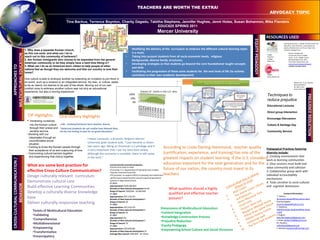
TEACHERS ARE WORTH THE EXTRA!							ADVOCACY TOPIC							Tina Backus, Terrence Boynton, Charity Dagadu, Tabitha Stephens, Jennifer Hughes, Jenni Holes, Susan Bohannon, Mike FlandersEDUC625 SPRING 2011Mercer UniversityRESOURCES USEDDarling-Hammond, L. (2010). The flat world and education: How America’s commitment to equity will determine our future. New York: Teachers College Press.1. Why does a separate Korean church, as this one exist, and what can I do to reach out to this community of believers?2. Are Korean immigrants who choose to be separated from the general American community or do they simply have a hard time fitting in? 3. What can I do as an American-born citizen to help people of other nations feel as though they are welcome and that our country is now their home?One culture is able to embrace another by extending an invitation to join them inan event, such as a cookout or an integrated service. No man, or culture, seeks to be an island, but desires to be part of the whole. Moving out of our owncomfort zone to embrace another culture was not only an educationalexperience, but also a moving experience.Korean Presbyterian Community Church KAMR: Home . (n.d.). KAMR: Home . Retrieved March 20, 2011, from http://www.kamr.org Image: Teachers College Press.comEQUITY PEDAGOGYwww.ed.gov/category/program/teacher-incentive-fund Image: www.atlanta.netAPPROACHES TO MULTICULTURAL EDUCATIONWhat to do. (n.d.). Atlanta. Retrieved March 20, 2011, from www.atlanta.net Techniques to reduce prejudiceEducational LecturesDirect group InteractionEncourage DiscussionCulture & Heritage DayCommunity ServicePREJUDICE REDUCTION CIP Highlights:Immersing ourselves     into the Korean culture    through their praise and    worship service.Bonding with our     classmates through an   uncomfortable social   situation. Coming to know the Korean people through   their acceptance of us and outpouring of love. Overcoming cultural barriers together    and experiencing that victory together. Oral History Highlights.Mr.. Lindsey/Jamaican born teacher shares,  “American students do not realize how blessed they are by not having to pay for an good education.”HawaLansanah, a Brussels, Belgium Mercer University grad student said, “I just became a citizen two years ago. Being an American is a privilege and it is very important that I use my time here wisely. Although the economy is unstable, there is still value in the land."According to Linda Darling-Hammond,  teacher quality (certification, experience, and training) has one of the greatest impacts on student learning. If the U.S. considers education important for the next generation and for the future of our nation, the country must invest in its teachers.Pedagogical Practices fostering diversity include:1. Creating environments that work as learning communities2. Class sessions must build and value community and cohesion3. Collaborative group work with individual accountability mechanisms4. Tasks sensitive to socio-cultural and  cognitive dimensionsCurrent teacher incentive programs:Varies from state to state

Poster final[1]

  • 1.
    TEACHERS ARE WORTHTHE EXTRA! ADVOCACY TOPIC Tina Backus, Terrence Boynton, Charity Dagadu, Tabitha Stephens, Jennifer Hughes, Jenni Holes, Susan Bohannon, Mike FlandersEDUC625 SPRING 2011Mercer UniversityRESOURCES USEDDarling-Hammond, L. (2010). The flat world and education: How America’s commitment to equity will determine our future. New York: Teachers College Press.1. Why does a separate Korean church, as this one exist, and what can I do to reach out to this community of believers?2. Are Korean immigrants who choose to be separated from the general American community or do they simply have a hard time fitting in? 3. What can I do as an American-born citizen to help people of other nations feel as though they are welcome and that our country is now their home?One culture is able to embrace another by extending an invitation to join them inan event, such as a cookout or an integrated service. No man, or culture, seeks to be an island, but desires to be part of the whole. Moving out of our owncomfort zone to embrace another culture was not only an educationalexperience, but also a moving experience.Korean Presbyterian Community Church KAMR: Home . (n.d.). KAMR: Home . Retrieved March 20, 2011, from http://www.kamr.org Image: Teachers College Press.comEQUITY PEDAGOGYwww.ed.gov/category/program/teacher-incentive-fund Image: www.atlanta.netAPPROACHES TO MULTICULTURAL EDUCATIONWhat to do. (n.d.). Atlanta. Retrieved March 20, 2011, from www.atlanta.net Techniques to reduce prejudiceEducational LecturesDirect group InteractionEncourage DiscussionCulture & Heritage DayCommunity ServicePREJUDICE REDUCTION CIP Highlights:Immersing ourselves into the Korean culture through their praise and worship service.Bonding with our classmates through an uncomfortable social situation. Coming to know the Korean people through their acceptance of us and outpouring of love. Overcoming cultural barriers together and experiencing that victory together. Oral History Highlights.Mr.. Lindsey/Jamaican born teacher shares, “American students do not realize how blessed they are by not having to pay for an good education.”HawaLansanah, a Brussels, Belgium Mercer University grad student said, “I just became a citizen two years ago. Being an American is a privilege and it is very important that I use my time here wisely. Although the economy is unstable, there is still value in the land."According to Linda Darling-Hammond, teacher quality (certification, experience, and training) has one of the greatest impacts on student learning. If the U.S. considers education important for the next generation and for the future of our nation, the country must invest in its teachers.Pedagogical Practices fostering diversity include:1. Creating environments that work as learning communities2. Class sessions must build and value community and cohesion3. Collaborative group work with individual accountability mechanisms4. Tasks sensitive to socio-cultural and cognitive dimensionsCurrent teacher incentive programs:Varies from state to state