Gonial Angle and Mandibular Torus
                                                                                                                                                                                  Adam Martinetti and Karina Coscuna
                                                                                            Humboldt Center for Evolutionary Anthropology, Department of Anthropology, Humboldt State University, Arcata, California
                                                                                                           American Association of Physical Anthropologists 82nd Annual Meeting, Tennessee, April 2013

              Introduction                                                                                                                                                                                    Results
                                                                                           • The mandibular torus is an exostosis manifesting (usually bilaterally)
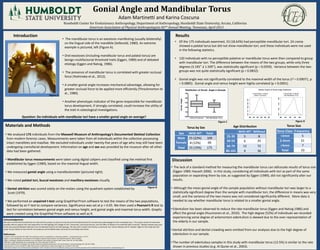
                                                                                             on the lingual side of the mandible (Sellevold, 1980). An extreme                                               • Of the 175 individuals examined, 33 (18.64%) had perceptible mandibular tori. 24 crania
                                                                                             example is pictured, left (Figure A).                                                                             showed a palatal torus but did not show mandibular tori, and these individuals were not used
                                                                                                                                                                                                               in the following statistics.
                                                                                           • Oral exostoses (including mandibular torus and palatal torus) are
                                                                                             benign multifactorial threshold traits (Eggen, 1989) and of debated                                             • 120 individuals with no perceptible palatine or mandibular torus were then compared to group
                                                                                             etiology (Eggen and Natvig, 1986).                                                                                with mandibular tori. The difference between the means of the two groups, while only three
                                                                                                                                                                                                               degrees (3.195° ± 1.509°), was statistically significant (p = 0.0359). Variance between the two
                                                                                           • The presence of mandibular torus is correlated with greater occlusal                                              groups was not quite statistically significant (p = 0.0832).
                                                                                             force (Yoshinaka et al., 2012).
                                                                                                                                                                                                             • Gonial angle was not significantly correlated to the maximal width of the torus (r2 = 0.09071, p
                                                                                           • A smaller gonial angle increases mechanical advantage, allowing for                                               = 0.0885). Gonial angle and ramus height were highly correlated (p < 0.0001).
                                                                                             greater occlusal force to be applied more efficiently (Throckmorton et                                                             Distribution of Gonial Angle in Sample
                                                                                             al., 1980).                                                                                                                        150
                                                                      Figure A
                                                                                                                                                                                                                                140


                                                                                                                                                                                                                 Gonial Angle
                                                                                           • Another phenotypic indicator of the gene responsible for mandibular                                                                130

                                                                                             torus development, if strongly correlated, could increase the utility of                                                           120
                                                                                             the trait in osteological investigations.                                                                                          110


                           Question: Do individuals with mandibular tori have a smaller gonial angle on average?                                                                                                                100
                                                                                                                                                                                                                                      Without Exostoses   With Mandibular Torus

                                                                                                                                                                                                                                                                         Figure C                                        Figure D
 Materials and Methods                                                                                                                                                                                                            Torus by Sex                                         Age Distribution             Torus Size
                                                                                                                                                                                                                                                                                          With MT Without    Torus Class Frequency
 • We analyzed 175 individuals from the Maxwell Museum of Anthropology’s Documented Skeletal Collection                                                                                                         Sex                   With MT             Total
                                                                                                                                                                                                                                                                                   25-39      5          8     <2mm            5
  from modern forensic cases. Measurements were taken from all individuals within the collection possessing                                                                                                    Male                   25 (23%)             109
                                                                                                                                                                                                                                                                                   40-59      6         35     2-4mm          21
  intact mandibles and maxillae. We excluded individuals under twenty-five years of age who may still have been                                                                                               Female                  8 (12%)               66
  undergoing craniofacial development. Information on age and sex was provided by the museum after all other                                                                                                                                                                       60-79     13         72     >4mm            7
                                                                                                                                                                                                               Total                  33 (19%)             175
  data had been gathered.                                                                                                                                                                                                                                                         80-101      4         36      Total         33

 • Mandibular torus measurements were taken using digital calipers and classified using the method first                                                                                                   Discussion
  established by Eggen (1989), based on the maximal lingual width.
                                                                                                                                                                                                           • The lack of a standard method for measuring the mandibular torus can obfuscate results of torus size
 • We measured gonial angle using a mandibulometer (pictured right).                                                                                                                                        (Eggen 1989; Hassett 2006). In this study, considering all individuals with tori as part of the same
                                                                                                                                                                                                            population or separating them by size, as suggested by Eggen (1989), did not significantly alter our
 • We noted palatal tori, buccal exostoses and maxillary exostoses visually.                                                                                                                                results.

 • Dental attrition was scored solely on the molars using the quadrant-system established by                                                                                                   Figure B    • Although the mean gonial angle of the sample population without mandibular tori was larger to a
   Scott (1979).                                                                                                                                                                                            statistically significant degree than the sample with mandibular tori, the difference in means was very
                                                                                                                                                                                                            small, and the variance of the two means was not considered significantly different. More data is
 • We performed an unpaired t-test using GraphPad Prism software to test the means of the two populations,                                                                                                  needed to say whether mandibular torus is related to a smaller gonial angle.
  followed by an F-test to compare variances. Significance was set at p < 0.05. We then used a Pearson’s R test to
  test for correlation between gonial angle and ramus height, and gonial angle and maximal torus width. Graphs                                                                                             • Edentulism has been observed to reduce the rate mandibular torus (Eggen and Natvig 1986) and
  were created using the GraphPad Prism software as well as R.                                                                                                                                               affect the gonial angle (Huumonen et al., 2010). The high degree (52%) of individuals we recorded
                                                                                                                                                                                                             experiencing some degree of antemortem edentulism is skewed due to the over-representation of
Acknowledgments
We wish to thank Ariel Gruenthal for her help with this project as well as the faculty at the Humboldt Center for Evolutionary Anthropology for their invaluable input. This project would not have been     the elderly in our sample.
possible without support from the Department of Anthropology, the College of Arts, Humanities, and Social Sciences, and the Office of Research at Humboldt State University. Skeletal samples were part
of the Documented Skeletal Collection from the Maxwell Museum of Anthropology. We also wish to thank their faculty, in particular, Ms. Carmen Mosley and Dr. Heather Edgar for their help with this
study. Sincere thanks to Yoon Kim for his assistance and Humboldt State University for providing travel funds.                                                                                             • Dental attrition and dental crowding were omitted from our analyses due to the high degree of
References                                                                                                                                                                                                   edentulism in our sample.
Al Quran F a M, and Al-Dwairi ZN. 2006. Torus palatinus and torus mandibularis in edentulous patients. J Contemp Dent Pract 7:112–9.
Eggen, S. Torus mandibularis: an estimation of the degree of genetic determination. Acta Odontol Scand 47: 409–15 (1989).
Eggen S. & Natvig B. Relationship between torus mandibularis and number of present teeth. Scand J Dent 94, 233-240 (1986).
Sellevold, B. 1980. Mandibular torus morphology. Am J Phys Anthropol 53:569–72.
Scott GR, Halffman CM, and Pedersen PO. Dental conditions of Medieval Norsemen in the North Atlantic. Acta Archaeologica 62: 183–207 (1991).
                                                                                                                                                                                                           • The number of edentulous samples in this study with mandibular torus (12.5%) is similar to the rate
Throckmorton G, Finn R, and Bell W. 1980. Biomechanics of differences in lower facial height. Am J Orthod 77:410–420.
Yoshinaka M, Ikebe K, Furuya-Yoshinaka M, and Maeda Y. 2012. Prevalence of torus mandibularis among a group of elderly Japanese and its relationship with occlusal force. Gerodontology:1–6.
                                                                                                                                                                                                             shown in previous studies (e.g. Al Quran et al., 2003).

Gonial-Angle-Mandibular-Torus

  • 1.
    Gonial Angle andMandibular Torus Adam Martinetti and Karina Coscuna Humboldt Center for Evolutionary Anthropology, Department of Anthropology, Humboldt State University, Arcata, California American Association of Physical Anthropologists 82nd Annual Meeting, Tennessee, April 2013 Introduction Results • The mandibular torus is an exostosis manifesting (usually bilaterally) on the lingual side of the mandible (Sellevold, 1980). An extreme • Of the 175 individuals examined, 33 (18.64%) had perceptible mandibular tori. 24 crania example is pictured, left (Figure A). showed a palatal torus but did not show mandibular tori, and these individuals were not used in the following statistics. • Oral exostoses (including mandibular torus and palatal torus) are benign multifactorial threshold traits (Eggen, 1989) and of debated • 120 individuals with no perceptible palatine or mandibular torus were then compared to group etiology (Eggen and Natvig, 1986). with mandibular tori. The difference between the means of the two groups, while only three degrees (3.195° ± 1.509°), was statistically significant (p = 0.0359). Variance between the two • The presence of mandibular torus is correlated with greater occlusal groups was not quite statistically significant (p = 0.0832). force (Yoshinaka et al., 2012). • Gonial angle was not significantly correlated to the maximal width of the torus (r2 = 0.09071, p • A smaller gonial angle increases mechanical advantage, allowing for = 0.0885). Gonial angle and ramus height were highly correlated (p < 0.0001). greater occlusal force to be applied more efficiently (Throckmorton et Distribution of Gonial Angle in Sample al., 1980). 150 Figure A 140 Gonial Angle • Another phenotypic indicator of the gene responsible for mandibular 130 torus development, if strongly correlated, could increase the utility of 120 the trait in osteological investigations. 110 Question: Do individuals with mandibular tori have a smaller gonial angle on average? 100 Without Exostoses With Mandibular Torus Figure C Figure D Materials and Methods Torus by Sex Age Distribution Torus Size With MT Without Torus Class Frequency • We analyzed 175 individuals from the Maxwell Museum of Anthropology’s Documented Skeletal Collection Sex With MT Total 25-39 5 8 <2mm 5 from modern forensic cases. Measurements were taken from all individuals within the collection possessing Male 25 (23%) 109 40-59 6 35 2-4mm 21 intact mandibles and maxillae. We excluded individuals under twenty-five years of age who may still have been Female 8 (12%) 66 undergoing craniofacial development. Information on age and sex was provided by the museum after all other 60-79 13 72 >4mm 7 Total 33 (19%) 175 data had been gathered. 80-101 4 36 Total 33 • Mandibular torus measurements were taken using digital calipers and classified using the method first Discussion established by Eggen (1989), based on the maximal lingual width. • The lack of a standard method for measuring the mandibular torus can obfuscate results of torus size • We measured gonial angle using a mandibulometer (pictured right). (Eggen 1989; Hassett 2006). In this study, considering all individuals with tori as part of the same population or separating them by size, as suggested by Eggen (1989), did not significantly alter our • We noted palatal tori, buccal exostoses and maxillary exostoses visually. results. • Dental attrition was scored solely on the molars using the quadrant-system established by Figure B • Although the mean gonial angle of the sample population without mandibular tori was larger to a Scott (1979). statistically significant degree than the sample with mandibular tori, the difference in means was very small, and the variance of the two means was not considered significantly different. More data is • We performed an unpaired t-test using GraphPad Prism software to test the means of the two populations, needed to say whether mandibular torus is related to a smaller gonial angle. followed by an F-test to compare variances. Significance was set at p < 0.05. We then used a Pearson’s R test to test for correlation between gonial angle and ramus height, and gonial angle and maximal torus width. Graphs • Edentulism has been observed to reduce the rate mandibular torus (Eggen and Natvig 1986) and were created using the GraphPad Prism software as well as R. affect the gonial angle (Huumonen et al., 2010). The high degree (52%) of individuals we recorded experiencing some degree of antemortem edentulism is skewed due to the over-representation of Acknowledgments We wish to thank Ariel Gruenthal for her help with this project as well as the faculty at the Humboldt Center for Evolutionary Anthropology for their invaluable input. This project would not have been the elderly in our sample. possible without support from the Department of Anthropology, the College of Arts, Humanities, and Social Sciences, and the Office of Research at Humboldt State University. Skeletal samples were part of the Documented Skeletal Collection from the Maxwell Museum of Anthropology. We also wish to thank their faculty, in particular, Ms. Carmen Mosley and Dr. Heather Edgar for their help with this study. Sincere thanks to Yoon Kim for his assistance and Humboldt State University for providing travel funds. • Dental attrition and dental crowding were omitted from our analyses due to the high degree of References edentulism in our sample. Al Quran F a M, and Al-Dwairi ZN. 2006. Torus palatinus and torus mandibularis in edentulous patients. J Contemp Dent Pract 7:112–9. Eggen, S. Torus mandibularis: an estimation of the degree of genetic determination. Acta Odontol Scand 47: 409–15 (1989). Eggen S. & Natvig B. Relationship between torus mandibularis and number of present teeth. Scand J Dent 94, 233-240 (1986). Sellevold, B. 1980. Mandibular torus morphology. Am J Phys Anthropol 53:569–72. Scott GR, Halffman CM, and Pedersen PO. Dental conditions of Medieval Norsemen in the North Atlantic. Acta Archaeologica 62: 183–207 (1991). • The number of edentulous samples in this study with mandibular torus (12.5%) is similar to the rate Throckmorton G, Finn R, and Bell W. 1980. Biomechanics of differences in lower facial height. Am J Orthod 77:410–420. Yoshinaka M, Ikebe K, Furuya-Yoshinaka M, and Maeda Y. 2012. Prevalence of torus mandibularis among a group of elderly Japanese and its relationship with occlusal force. Gerodontology:1–6. shown in previous studies (e.g. Al Quran et al., 2003).