P R E N S S I O D E
I N G Y U L L B Y C B E R
N E I R O V M N T L A E N
I S U E S S
T A G E N E E
Y C N G A N E P R
E S A M
X S E
E G M R R A I A
POSITION
PAPER
A position paper is an essay that
expresses a position on an issue. It

gives arguments that support the
opinion of the writer based on the
facts collected.
A position paper presents an arguable opinion
about an issue. The goal of a position paper is to
convince the audience that your opinion is valid
and worth listening to. Ideas that you are
considering need to be carefully examined in
choosing a topic, developing your argument, and
organizing your paper.
POSITION
PAPER
It is very important to ensure that
you are addressing all sides of the
issue and presenting it in a manner
that is easy for your audience to
understand. Your job is to take one
side of the argument and persuade
your audience that you have well-
founded knowledge of the topic
being presented.
It is important to support your
argument with evidence to ensure
the validity of your claims, as well
as to address the counterclaims to
show that you are well informed
about both sides.
To take a side on a subject, you should first establish the plausibility
of a topic that interests you. Ask yourself the following questions to
ensure that you will be able to present a strong argument:
 Is it a real issue, with genuine controversy and uncertainty?
 Can you distinctly identify two positions?
 Are you personally interested in advocating one of these
positions?
 Is the issue narrow enough to be manageable?
Issue Criteria
Once your topic is selected, you should do some research on the
subject matter. While you may already have an opinion on your
topic and an idea about which side of the argument you want to
take, you need to ensure that your position is well supported.
Listing out the pro and con sides of the topic will help you examine
your ability to support your counterclaims, along with a list of
supporting evidence for both sides.
Analyzing an Issue and
Developing an Argument
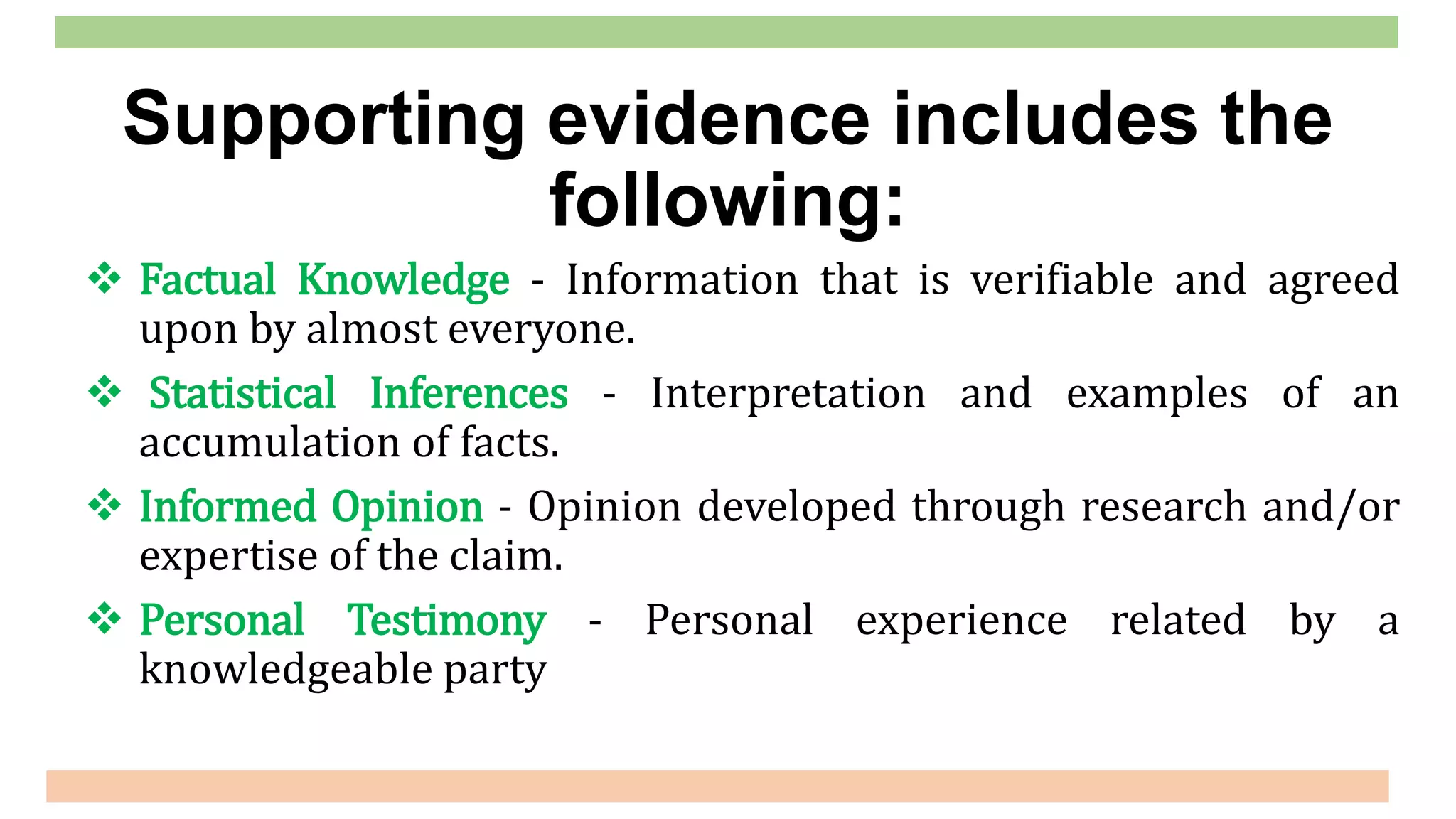
 Factual Knowledge - Information that is verifiable and agreed
upon by almost everyone.
 Statistical Inferences - Interpretation and examples of an
accumulation of facts.
 Informed Opinion - Opinion developed through research and/or
expertise of the claim.
 Personal Testimony - Personal experience related by a
knowledgeable party
Supporting evidence includes the
following:
Once you have made your pro and con lists,
compare the information side by side.
Considering your audience, as well as your own viewpoint,
choose the position you will take.
 Who is your audience?
 What do they believe?
 Where do they stand on the issue?
 How are their interests involved?
 What evidence is likely to be effective with them?
In considering the audience, ask
yourself the following questions:
 Is your topic interesting?
 Can you manage the material within the specifications set by the
instructor?
 Does your topic assert something specific and propose a plan of
action?
 Do you have enough material to support your opinion?
In determining your viewpoint, ask
yourself the following:
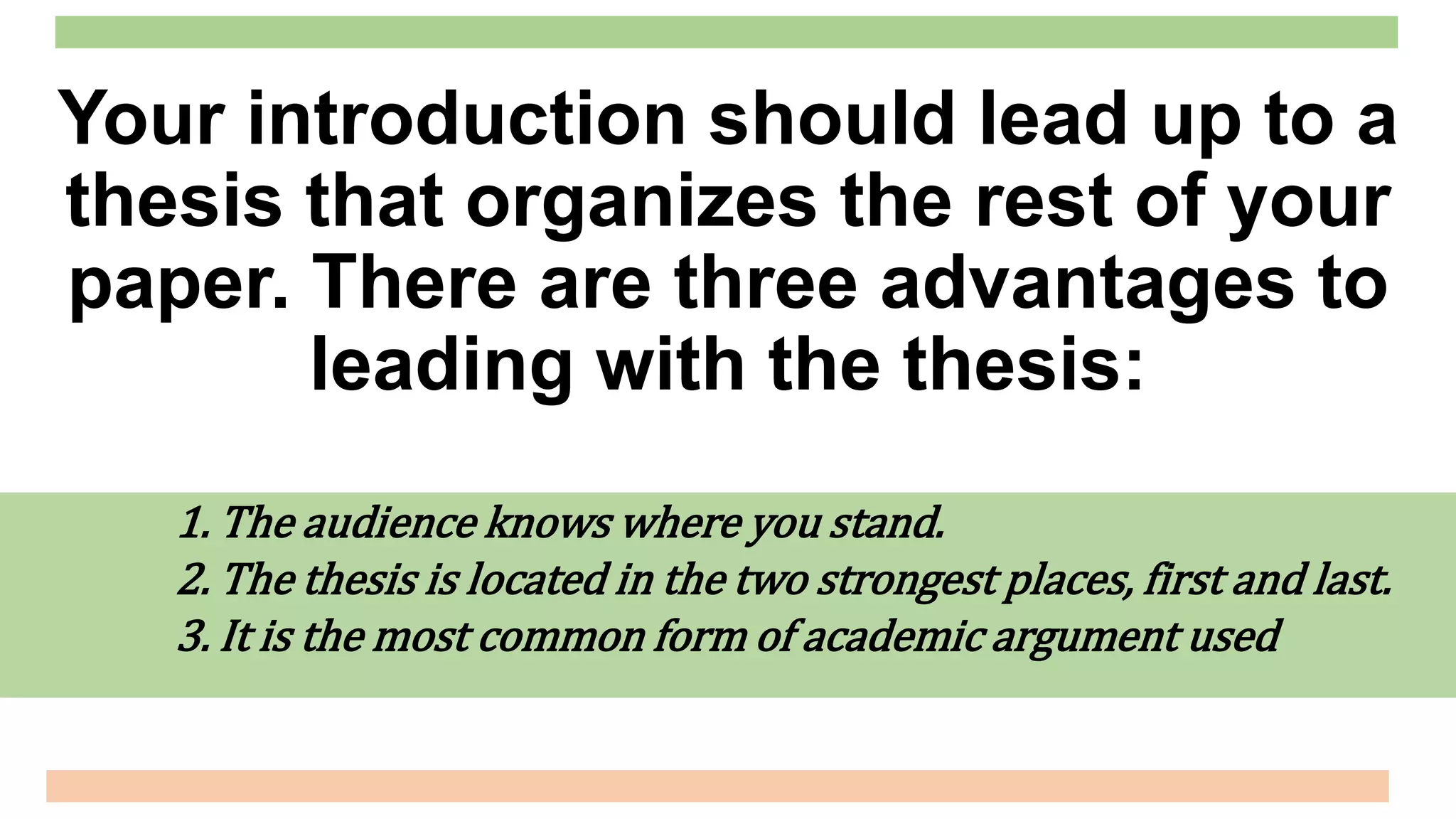
1. The audience knows where you stand.
2. The thesis is located in the two strongest places, first and last.
3. It is the most common form of academic argument used
Your introduction should lead up to a
thesis that organizes the rest of your
paper. There are three advantages to
leading with the thesis:
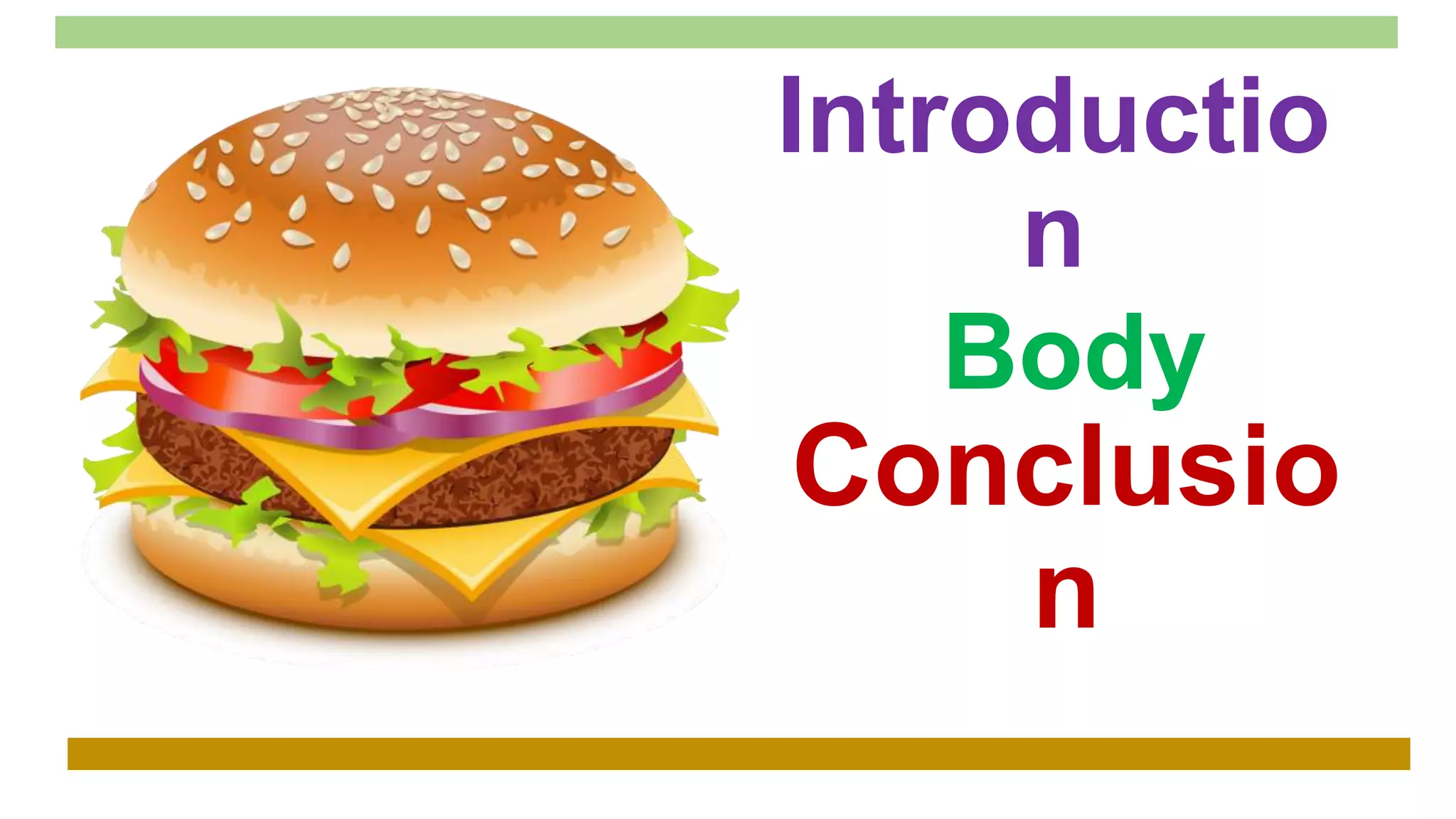
Introductio
n
Conclusio
n
Body
Introduction
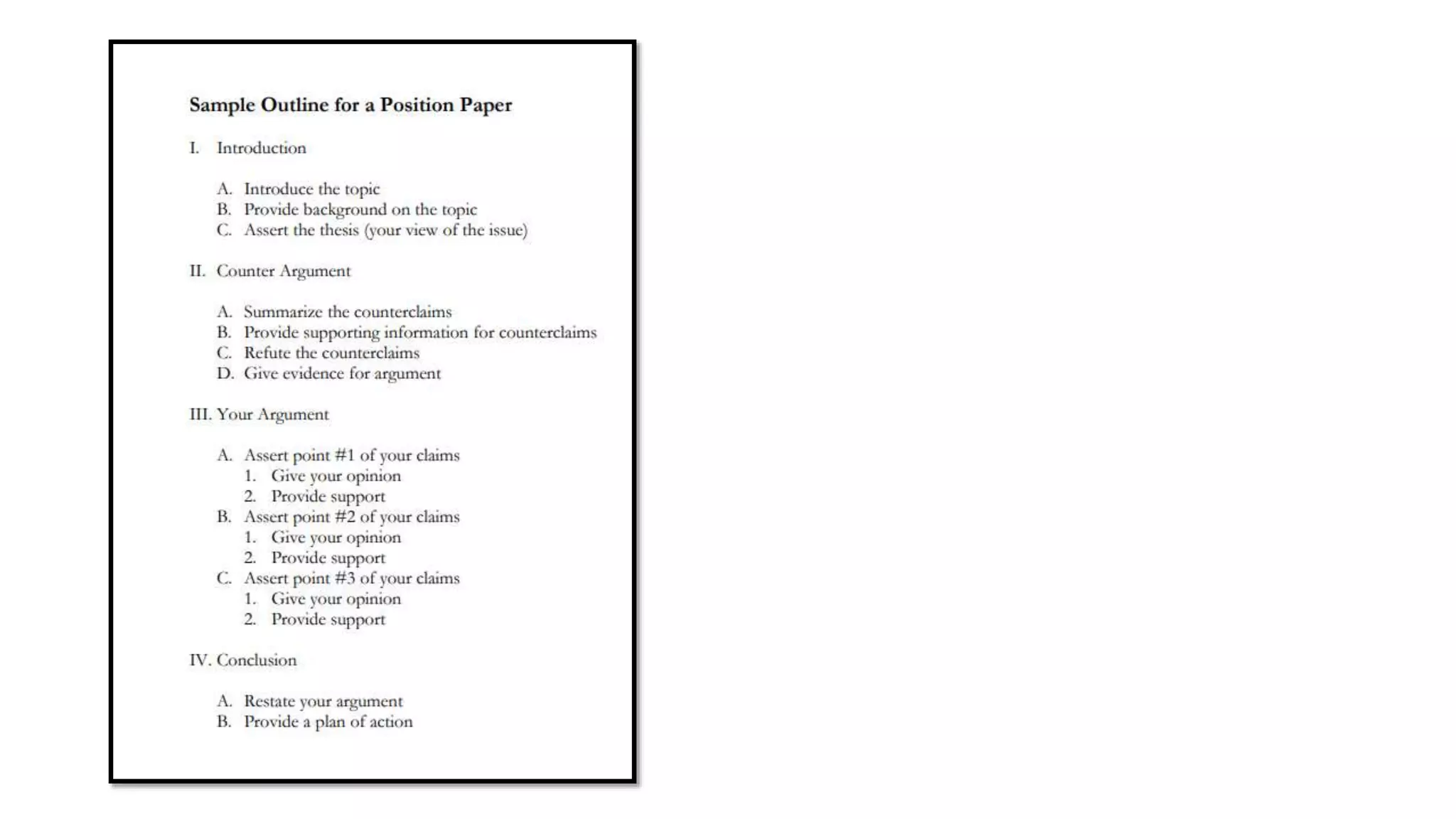
You have to introduce the topic, and then
provide history or background of the
issue. You may also describe the issue on-
hand so do your research.
Body
Now, you can restate both sides of the
argument, summarize the three
arguments made in your essay. Lastly,
provide a call for action.
Conclusion
You have to state the opposing argument by briefly describing
them. You may also include details that support the opposing
claim. Then, after writing the counter argument, now write your
argument and give your point of view. Provide evidence that
support your claim. Now you state your second argument followed
by your third argument. Make sure to provide details that support
the argument given.
Evaluation:
In a ¼ sheet of paper, identify which
method of characterization is utilized
by the writer in the given scenario:
1. On his head he wore a helmet shaped like an eagle. On his shoulder perched two black
ravens called Memory and Thought. And at his feet crouched two snarling wolves.
2. The fair elves had promised they would help his children of the earth. The elves were
tiny people who lived between heaven and earth. They were so small that they flit
about doing their work unseen.
3. Even the dwarfs, who lived in the heart of the mountains, agreed to help. They forged
iron and metals, made tools and weapons.
4. All seem to be going well. Odin found it hard to think of evil times. But he knew that
the frost giants were only waiting for the chance to bring trouble to his children. They
were the ones who brought cold and ice to the world and shook the earth in anger.
5. “The price of one drink from this well is not cheap,” Mimir said. “And once you have
drunk and gazed into the mirror of life, you may wish you had not. For sorrow and
death as well as joy are pictured there so you should think again before you ask to
drink.”
1. On his head he wore a helmet shaped like an eagle. On his shoulder perched two black
ravens called Memory and Thought. And at his feet crouched two snarling wolves.
(Physical description)
2. The fair elves had promised they would help his children of the earth. The elves were
tiny people who lived between heaven and earth. They were so small that they flit
about doing their work unseen. (Physical Description)
3. Even the dwarfs, who lived in the heart of the mountains, agreed to help. They forged
iron and metals, made tools and weapons. (Actions/Behavior/Attitude)
4. All seem to be going well. Odin found it hard to think of evil times. But he knew that
the frost giants were only waiting for the chance to bring trouble to his children. They
were the ones who brought cold and ice to the world and shook the earth in anger.
(Inner Thoughts)
5. “The price of one drink from this well is not cheap,” Mimir said. “And once you have
drunk and gazed into the mirror of life, you may wish you had not. For sorrow and
death as well as joy are pictured there so you should think again before you ask to
drink.” (Speech)
Assignment
Read the Filipino short story “BIG
SISTER” by Consorcio Borje and describe
the characteristics and traits of Inciang,
Itong, and their father.
Position Paper.pptx
Position Paper.pptx
Position Paper.pptx
Position Paper.pptx
Position Paper.pptx
Position Paper.pptx
Position Paper.pptx

Position Paper.pptx

  • 5.
    P R EN S S I O D E
  • 6.
    I N GY U L L B Y C B E R
  • 7.
    N E IR O V M N T L A E N I S U E S S
  • 8.
    T A GE N E E Y C N G A N E P R
  • 9.
    E S AM X S E E G M R R A I A
  • 12.
    POSITION PAPER A position paperis an essay that expresses a position on an issue. It gives arguments that support the opinion of the writer based on the facts collected.
  • 13.
    A position paperpresents an arguable opinion about an issue. The goal of a position paper is to convince the audience that your opinion is valid and worth listening to. Ideas that you are considering need to be carefully examined in choosing a topic, developing your argument, and organizing your paper. POSITION PAPER
  • 14.
    It is veryimportant to ensure that you are addressing all sides of the issue and presenting it in a manner that is easy for your audience to understand. Your job is to take one side of the argument and persuade your audience that you have well- founded knowledge of the topic being presented.
  • 15.
    It is importantto support your argument with evidence to ensure the validity of your claims, as well as to address the counterclaims to show that you are well informed about both sides.
  • 16.
    To take aside on a subject, you should first establish the plausibility of a topic that interests you. Ask yourself the following questions to ensure that you will be able to present a strong argument:  Is it a real issue, with genuine controversy and uncertainty?  Can you distinctly identify two positions?  Are you personally interested in advocating one of these positions?  Is the issue narrow enough to be manageable? Issue Criteria
  • 17.
    Once your topicis selected, you should do some research on the subject matter. While you may already have an opinion on your topic and an idea about which side of the argument you want to take, you need to ensure that your position is well supported. Listing out the pro and con sides of the topic will help you examine your ability to support your counterclaims, along with a list of supporting evidence for both sides. Analyzing an Issue and Developing an Argument
  • 18.
     Factual Knowledge- Information that is verifiable and agreed upon by almost everyone.  Statistical Inferences - Interpretation and examples of an accumulation of facts.  Informed Opinion - Opinion developed through research and/or expertise of the claim.  Personal Testimony - Personal experience related by a knowledgeable party Supporting evidence includes the following:
  • 19.
    Once you havemade your pro and con lists, compare the information side by side. Considering your audience, as well as your own viewpoint, choose the position you will take.
  • 20.
     Who isyour audience?  What do they believe?  Where do they stand on the issue?  How are their interests involved?  What evidence is likely to be effective with them? In considering the audience, ask yourself the following questions:
  • 21.
     Is yourtopic interesting?  Can you manage the material within the specifications set by the instructor?  Does your topic assert something specific and propose a plan of action?  Do you have enough material to support your opinion? In determining your viewpoint, ask yourself the following:
  • 22.
    1. The audienceknows where you stand. 2. The thesis is located in the two strongest places, first and last. 3. It is the most common form of academic argument used Your introduction should lead up to a thesis that organizes the rest of your paper. There are three advantages to leading with the thesis:
  • 24.
  • 25.
    Introduction You have tointroduce the topic, and then provide history or background of the issue. You may also describe the issue on- hand so do your research.
  • 26.
    Body Now, you canrestate both sides of the argument, summarize the three arguments made in your essay. Lastly, provide a call for action.
  • 27.
    Conclusion You have tostate the opposing argument by briefly describing them. You may also include details that support the opposing claim. Then, after writing the counter argument, now write your argument and give your point of view. Provide evidence that support your claim. Now you state your second argument followed by your third argument. Make sure to provide details that support the argument given.
  • 28.
    Evaluation: In a ¼sheet of paper, identify which method of characterization is utilized by the writer in the given scenario:
  • 29.
    1. On hishead he wore a helmet shaped like an eagle. On his shoulder perched two black ravens called Memory and Thought. And at his feet crouched two snarling wolves. 2. The fair elves had promised they would help his children of the earth. The elves were tiny people who lived between heaven and earth. They were so small that they flit about doing their work unseen. 3. Even the dwarfs, who lived in the heart of the mountains, agreed to help. They forged iron and metals, made tools and weapons. 4. All seem to be going well. Odin found it hard to think of evil times. But he knew that the frost giants were only waiting for the chance to bring trouble to his children. They were the ones who brought cold and ice to the world and shook the earth in anger. 5. “The price of one drink from this well is not cheap,” Mimir said. “And once you have drunk and gazed into the mirror of life, you may wish you had not. For sorrow and death as well as joy are pictured there so you should think again before you ask to drink.”
  • 30.
    1. On hishead he wore a helmet shaped like an eagle. On his shoulder perched two black ravens called Memory and Thought. And at his feet crouched two snarling wolves. (Physical description) 2. The fair elves had promised they would help his children of the earth. The elves were tiny people who lived between heaven and earth. They were so small that they flit about doing their work unseen. (Physical Description) 3. Even the dwarfs, who lived in the heart of the mountains, agreed to help. They forged iron and metals, made tools and weapons. (Actions/Behavior/Attitude) 4. All seem to be going well. Odin found it hard to think of evil times. But he knew that the frost giants were only waiting for the chance to bring trouble to his children. They were the ones who brought cold and ice to the world and shook the earth in anger. (Inner Thoughts) 5. “The price of one drink from this well is not cheap,” Mimir said. “And once you have drunk and gazed into the mirror of life, you may wish you had not. For sorrow and death as well as joy are pictured there so you should think again before you ask to drink.” (Speech)
  • 31.
    Assignment Read the Filipinoshort story “BIG SISTER” by Consorcio Borje and describe the characteristics and traits of Inciang, Itong, and their father.