International Research Journal of Engineering and Technology (IRJET) e-ISSN: 2395-0056
Volume: 11 Issue: 01 | Jan 2024 www.irjet.net p-ISSN: 2395-0072
© 2024, IRJET | Impact Factor value: 8.226 | ISO 9001:2008 Certified Journal | Page 39
Polyurea Uses in the Construction Industry
Ruchi Anil Patil1, Prof. Priyanka Patil2
1Ruchi Anil Patil: Student, Dept. of Construction Management, MIT College of Management, Pune, Maharashtra,
India
2Prof. Priyanka Patil: Professor, Dept. of Construction Management, MIT College of Management, Pune,
Maharashtra, India
---------------------------------------------------------------------***---------------------------------------------------------------------
Abstract - Polyurea coatings have become an essential
technology in the construction industry due to their
remarkable properties such as rapid curing, durability,
chemical resistance, and waterproofing. They are widely used
to protect surfaces, structures, and infrastructure from wear
and tear, which minimizes downtime and enables shorter
construction schedules. These coatings are ideal for roofing,
basements, and water containment systems as they create a
flawless, waterproof barrier. They are also suitable for
chemical processing plants, industrial facilities, and
containment areas due to their exceptional chemical
resistance. Moreover, their flexibilityallowsthemtowithstand
temperature fluctuations without fracturing, making them
ideal for extreme climate regions. Polyurea coatings can be
applied to various substrates, creating a seamless, uniform
finish. They are also used in industrial and marine settings to
protect steel structures from corrosion. These coatings offer
customization options for decorative and architectural
purposes and can be designed for slip-resistant safety. Their
longer service life reduces maintenance costs, making them a
cost-effective solution for the construction industry
Key Words: Polyurea coating, Rapid Curing Etc.
1. INTRODUCTION
Polyurea coatings are widely used in industries such as
construction, automotive, and marineduetotheirdurability,
fast curing time, and versatility. These coatings, including
polyurea, polyurethane, and polyurethane-polyurea resins,
serve as effective anti-corrosive and anti-wear agents,
protecting against abrasion, tearing, andscratches.They can
be applied on various surfaces, including metal, wood,
concrete, and plastics, offering both decorative and specific
mechanical properties. Additionally, polymers likepolyurea
are utilized as cover layers for armored vehicles, ballistic
shields, loading areas, and waterproof surfaces, while also
providing vibration and sound absorption capabilities. To
enhance the properties of polyurea coatings, modifications
with glass fabric and hemp fiber are employed. The
application process involves sandblasting or the use of an
epoxy resin-based intermediatelayer.Inthisstudy,an epoxy
resin intermediate layer was utilized, and the primer was
modified with glass fabric and hemp fiber toimproveimpact
resistance and vibration absorption. Samples with and
without the polyurea layer were prepared to assess the
influence of each constituent. Natural fibers, such as hemp
fiber, were chosen for their low density and ability to
dampen acoustic waves, making them commonly used as
fillers in vehicle interior composite elements within the
automotive industry. However, it is important to consider
the temperature limit as a technological constraint in the
natural fiber-reinforced composites industry, as it can lead
to fiber degradation.
The study aimed to determine the adhesion force of
polymeric coatings to steel bases, compare the impact
resistance of multilayer coatings, and investigate the
influence of the coating on static mechanical properties and
fatigue lifetime. The most widely used strategy for fatigue
lifetime improvement is strengthening metallic structures
using CFRP (carbon fiber reinforced polymer) patches.
Polyurea, also known as polyurea elastomer, is a modern
construction material with extraordinary properties,suchas
high durability and strong resistance to atmospheric,
chemical, and biological factors. Polyurea coatings are used
to protect steel structures against corrosion from exposure
to saltwater and other corrosive elements. They provide
customization options for decorative and architectural
purposes, including color, texture, and thickness. They can
also be designed to be slip-resistant, enhancing safety in
areas where traction is crucial. Polyurea coatings have a
longer service life than other coating systems, resulting in
reduced maintenance costs. In conclusion,polyurea coatings
have revolutionized theconstructionindustrybyprovidinga
robust and versatile solution for protective and decorative
applications. Theirexceptional properties,suchasdurability,
rapid curing, and resistance to chemicalsandenvironmental
factors, make them an invaluable asset in constructing long-
lasting, resilient, and safe structures.
Polyurea is a highly durable and elastic material that is
created through a reaction of polyamine and isocyanate. It
consists of a chain-type structure with"n"moleculesthat are
strongly combined, giving it its exceptional properties.
Originally used in ballistic systems anddevicesforitsenergy
absorption capabilities, polyurea has found numerous
applications in the construction field. It is commonlyused as
a hydro-isolation coating for industrial floors and as a
strengthening coating for steel and concrete. This
elaboration focuses onpresentingpolyurea asa construction
material, considering bothitsadvantagesanddisadvantages.
Additionally, it summarizes the current research on the
material and explores future directions and areas of use
International Research Journal of Engineering and Technology (IRJET) e-ISSN: 2395-0056
Volume: 11 Issue: 01 | Jan 2024 www.irjet.net p-ISSN: 2395-0072
© 2024, IRJET | Impact Factor value: 8.226 | ISO 9001:2008 Certified Journal | Page 40
1.2. AIM
This study on polyurea coatings aims to comprehensively
understand the properties, applications, and potential
benefits of this versatile coating material.
1. Characterization of Material Properties:
Understanding the fundamental properties of
polyurea, including its mechanical, thermal,
chemical, and adhesion properties, is a key aim of
such studies. This characterizationprovidesinsights
into the material's suitability for various
applications.
2. Application Techniques and Methods: Researchers
aim to explore the different application techniques
and methods for polyurea coatings, including spray
application, hand application, and various
equipment used. A comprehensive study can help
identify the most effective application methods for
different scenarios.
3. Performance Evaluation: Researchers often aim to
evaluate the performance of polyurea coatings in
various environmental and operational conditions.
This may involve testing their durability, resistance
to abrasion, chemical resistance, and ability to
withstand extreme temperatures.
4. Waterproofing Capabilities: Many studies focus on
the waterproofing properties of polyurea coatings.
The aim is to assess their effectivenessinpreventing
water infiltration in applications such as roofing,
basements, and water containment systems.
5. Corrosion Protection: For applications involving
metal substrates, researchers aim to assess the
corrosion protection capabilities of polyurea
coatings, particularly in marine and industrial
settings.
6. Environmental Impact: Understanding the
environmental impact of polyurea coatings is a
growing concern. Studies aim to evaluate their
sustainability, potential for VOC (volatile organic
compound)emissions,andlong-termenvironmental
effects.
7. Customization Options: Researchers aim to explore
the customization options available with polyurea
coatings, such as color, texture, and thickness. This
provides insights into the versatility of these
coatings for various applications, including
decorative and architectural uses.
8. Cost-Effectiveness: Studies may aim to assess the
cost-effectiveness of using polyurea coatings in
comparison to alternative coating materials. This
evaluation can help project planners and engineers
make informed decisions regarding budget
allocations.
9. Safety Considerations: Research can aim to identify
safety considerations when working with polyurea
coatings, particularly in terms of handling,
ventilation, and potential health hazards during
application.
10. Comparative Analysis: Aims of studies often include
comparing polyurea coatings to other coating
materials to understand their advantages and
disadvantages in different scenarios.
11. Innovations and Advancements: Keeping pace with
the latestadvancementsinpolyureatechnologyisan
essential aim of research. Researchers aim to
identify new formulations, application techniques,
and emerging trends in the field.
The study aims to provideacomprehensiveunderstandingof
polyureacoatings, their applications, and theirsuitabilityfor
various industries, aiding in informed decision-making in
construction and industrial settings.
1.3. SCOPE
The future of polyurea coatings in the construction industry
is promising, with sustainability being a key focus. Research
into low-VOC formulationsandrecyclablematerialsiscrucial
for advancements in UV degradation resistance, flexibility,
and chemical resistance. Nanotechnology integration is also
growing, enhancing UV resistance, hardness, and self-
cleaning capabilities. The InternetofThings(IoT)mayleadto
smart coatings with embedded sensors for real-time
monitoring. Customization options in color, texture, and
design are expectedtoexpand.Polyureacoatingscanaddress
issues surrounding aging infrastructure repair and
rehabilitation, providing innovative solutions for restoring
and protecting critical infrastructure. Polyurea coatings are
expected to become more efficient and precise in the future,
with automation and robotics expected to play a more
significant role in spray application.
Hybrid coatings with unique properties, such as self-healing
polyurea, are being developedtoaddressminordamagesand
prolong structures' lifespan. These coatings are particularly
useful in niche areas like cultural heritage sites and historic
buildings. The global expansion of polyurea coatings is
expected to drive innovation and standardization, while
stricter environmental regulations will necessitate stricter
standards for future coatings.
The future of polyurea coatings in construction is marked by
innovation, sustainability, and expanding applications.
International Research Journal of Engineering and Technology (IRJET) e-ISSN: 2395-0056
Volume: 11 Issue: 01 | Jan 2024 www.irjet.net p-ISSN: 2395-0072
© 2024, IRJET | Impact Factor value: 8.226 | ISO 9001:2008 Certified Journal | Page 41
Advanced formulations, customization options, and smart
coatings will contribute to their versatilityandsustainability.
2. LITERATURE REVIEW
Polyurea is a polymer material which offers dynamic
properties resulting from the specific structure of the
material. Considerable tests, as well as developed scientific
procedures, which allow for unequivocal statements about
the properties of the polymer structure material, have been
performed in recent years.
1. Yi j. - The study examined the behavior of a single
polyurea sample and three polyurethane samples
under compressive force using a Hopkinson
pressure bar system, revealing a non-linear stress-
strain relationshipsignificantly influenced by strain
rate.
2. Sarve SS.- Sarva SS. et al. conducted a study on
polyurea and polyurethane behavior at various
strain rates. They used various testing methods,
including a Zwick screw drive mechanical tester for
low strain rates, an enhanced servo-hydraulic axial
testing machine for medium strain rates, and two
configurations of the Hopkinson pressure bar for
high strain rates.
3. S. N. Raman - S. N. Raman and colleagues conducted
a study on a polyurea sample to gather data for
calibrating a material model in software using a
finite elements model like ANSYS® AUTODYN®,
emphasizing the importance of polyurea.
4. D. Mohotti - D. Mohotti et al. conducted experiments
on polyurea samples subjected to high strain rates
using the INSTRON® VHS 8800 device. They
proposed a novel model called Rate Dependent
Mooney Rivlin (RDMR) to predict nonlinear, hyper-
elastic polyurea behavior. The model requires only
one set of material parameters for a specific strain
rate and automatically calculates values for other
parameters for different strain rates. This model is
expected to simplify simulations and have potential
applications in finite element methods.
5. Arunkumar T. - Arunkumar T. et al. conducted a
study on polyurea adhesion to steel using AISI 1018
steel due to its strength, elasticity, and high
mechanical characteristics. They applied varying
thicknesses of polyurea coatings to steel samples,
spraying them at a distance of 50 mm from the steel.
The study aimed to understand the interaction
between polyurea and various materials and the
impact of temperatureonthesubstance'sproperties
and structure. The research aimed to provide
insights into the properties and structure of
polyurea.
6. Thirumal M. - Thirumal M. et al.'s 2010 study found
that adding oxidized phosphorus to polyurea and
epoxy resin significantly improved thermal stability
and fire resistance. Triphenyl phosphate was found
to be most effective in enhancing fire resistance in
polyurea.
Year Progress
1981 Developed for automotive RIM Parts
1987 Polyurea Spray technology introduced by
Texaco
1988 First commercial usage as a Field Coating
1993 Several Formulators enter the market
3. METHODOLOGY
Polyurea elastomeric coating, used since the late 1980s, is a
remarkable product for construction due to its exceptional
tensile strength and ability to move with the substrate up to
90%. It creates a seamless, high-abrasion liner that can
withstandharshenvironmentsandischemicallyresistant,UV
tolerant, and resistant to H2S gases.
APPLICATION MANNER –
The application of polyurea on the isolated surface is a very
complex process. It consists of three technological stages:
preparation of the surface, mixing of the components, and
application.
1. Surface Preparation –
Surface preparation is crucial forapplyingmaterial,ensuring
the surface is clean, dry, and free from contaminants like oil
and grease. If contamination is detected, blast cleaning or
sand-blast cleaning may be necessary. Chemical agents
should be used to remove oil stains or other contaminants.
Priming paints can enhance adhesion.Thesestepsensurethe
material coatingissecurelyattachedtothesurface,impacting
the resulting materialquality.Surfacepreparationisthemost
critical stage in the process.
2. Mixing the components-
Polyurea is a two-component composite material that
requires a suitable apparatus to create optimal temperature
and pressure conditions. The blending occurs in a heated
environment usingaspecializedpneumaticorelectricdevice.
Accurate mixing and dosing are crucial for successful
polyurea spray application, as they ensure the proper
application of the composite material.
The spraying parameters, including temperature and
pressure, must be closely monitored and matched to the
manufacturer's specifications in the Product Data Sheet
(DPS). Continuous monitoring of component volume and
weight ratios is also crucial for ensuring the highest quality
polyurea coating outcome.
3. Coating application –
The mixtureis applied on a dust-free surface,withtwolayers
of coating applied, one directly onto thesurfaceandtheother
perpendicular to it, to ensure complete impermeability and
absence of seams or joints.
International Research Journal of Engineering and Technology (IRJET) e-ISSN: 2395-0056
Volume: 11 Issue: 01 | Jan 2024 www.irjet.net p-ISSN: 2395-0072
© 2024, IRJET | Impact Factor value: 8.226 | ISO 9001:2008 Certified Journal | Page 42
4. Device for spraying polyurea coating system –
The system employs aggregates machines, capable of
generating pressure between 120 and 210 bar and heating
resin to temperatures between 650C and 800C. These
complex machines have real-time monitoring controls for
pressureand temperature, with numerous sensors placed in
key parts for operator control.
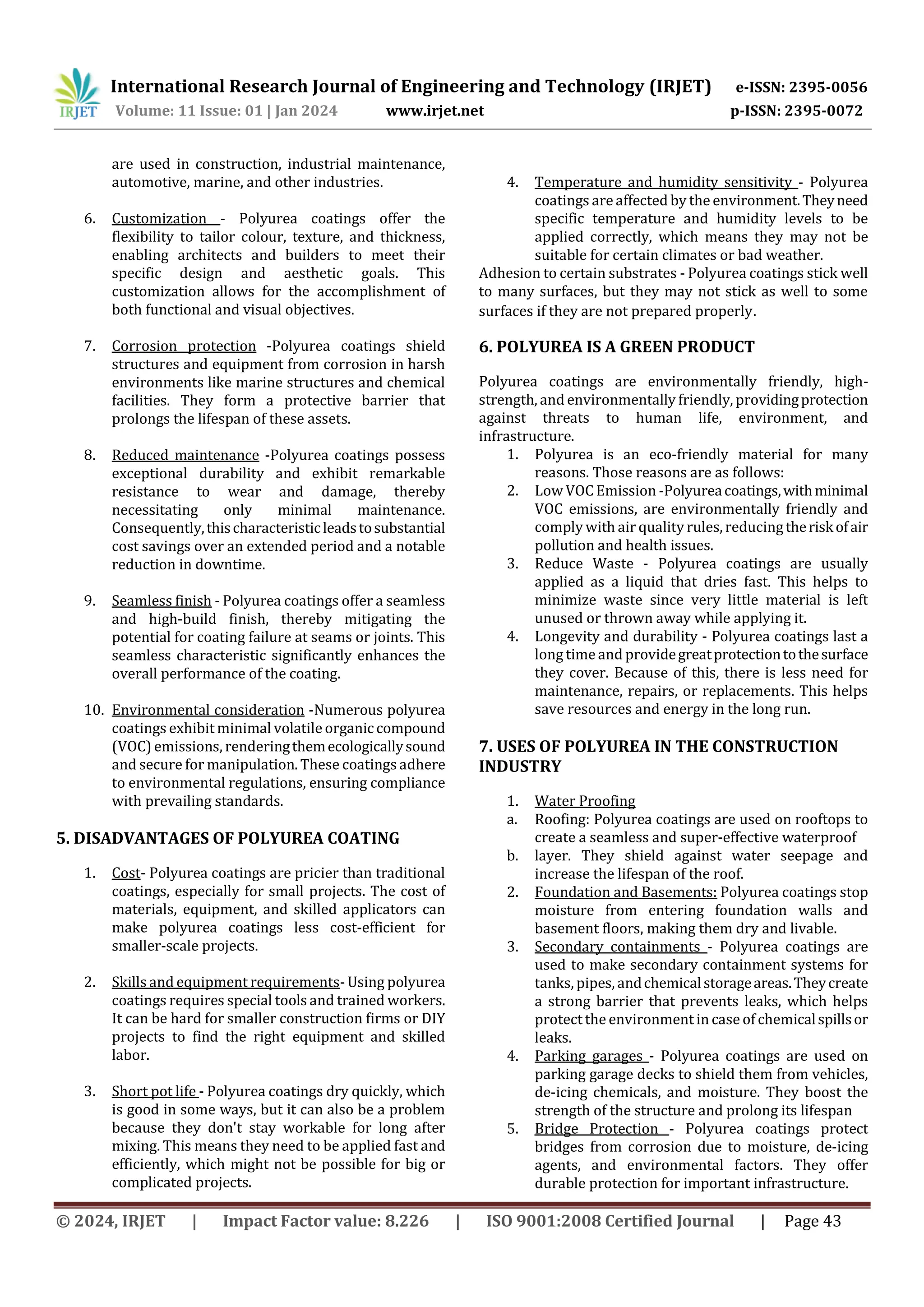
The diagram depicts a set of machines for spraying polyurea
coating or foams, including a combustion engine, electricity
generator, and air compressor, enabling real-time control of
mixture parameters.
A – barrel with Polyaminate component,
B – barrel with polyisocyanate component,
C – reactor feeder (the place where high-pressure pumps
with heaters used to provide A and B ingredients are
located)
D - heated hose (a hose equipped with heaters used for
maintaining an appropriate temperature of the
ingredients),
E - spray gun (a device where ingredients A and B are
mixed and then instantly sprayed onto the surface at a very
high pressure),
F - hoses providing air (the hoses providing air for the
pumps and the stirrer),
G - hoses providing the ingredients A and B to the reactor
feeder,
H - recirculation ducts (used for moving ingredients A and
B around heaters),
I - Main control module of the device.
The polyurea coating application process is complex and
requires manufacturers to provide product data sheets and
manuals. These documents provide detailed information on
mixture parameters, surface preparation, and application
systems.
1. Curing - Polyurea coatings cure quickly, sometimes
in seconds or minutes. Follow the manufacturer's
instructions for curing and make sure the
environment is suitable for curing, including
temperature and humidity.
2. Quality Control - Check the coating for defects like
pinholes, air bubbles, or inconsistencies. Fix any
problems right away. Also, measure the coating's
thickness to make sure it meets the required
standards.
3. Topcoat (Optional) - A topcoat can be added to
improve UV resistance, colour retention, or other
properties, depending on the application and
performance needs.
4. Clean Up - Clean spray equipment and tools right
after use with the suggested solvents and cleaning
methods.
5. Safety - During the entire process, make sure to
follow safety guidelines. This includes wearing the
right personal protective equipment (PPE) and
ensuring there is proper ventilation in enclosed
spaces.
Polyurea coating application varies based on product and
project needs, necessitating manufacturer instructions,
project conditions, and professional training for successful
application.
4. ADVANTAGES OF POLYUREA COATING
Polyurea coatings present numerous benefits that render
them a favored option for a diverse array of applications
across various industries. The following are the primary
advantages of polyurea coating.
1. Exceptional durability –Polyurea coatings have
gained recognition for their exceptional durability
and remarkable resistance to wear, abrasion, and
impact. These coatings exhibit an impressive ability
to endureheavy traffic andendureharshconditions,
rendering them highly suitable for environments
that demand the utmost performance.
2. Rapid curing time - Polyurea coatings exhibit an
exceptionally rapid curing time, frequently ranging
from mere seconds to minutes. This expeditious
curingprocessfacilitatespromptprojectfinalization,
thereby minimizing downtime and curtailing labor
expenses.
3. Waterproofingproperties -Polyureacoatingsexhibit
exceptional efficacy as waterproofing agents,
effectively establishinganunbrokenandimpervious
shield against moisture. These coatings find
widespread application in roofing, foundation, and
containment scenarios, effectively thwarting the
infiltration of water.
4. Chemical resistance - These coatings are highly
resistant tovariouschemicals,makingthemidealfor
use in chemical processing plants, industrial
facilities, and containment structures.
5. Versatility - Polyurea coatings are used on different
surfaces like concrete, steel, wood, and more. They
International Research Journal of Engineering and Technology (IRJET) e-ISSN: 2395-0056
Volume: 11 Issue: 01 | Jan 2024 www.irjet.net p-ISSN: 2395-0072
© 2024, IRJET | Impact Factor value: 8.226 | ISO 9001:2008 Certified Journal | Page 43
are used in construction, industrial maintenance,
automotive, marine, and other industries.
6. Customization - Polyurea coatings offer the
flexibility to tailor colour, texture, and thickness,
enabling architects and builders to meet their
specific design and aesthetic goals. This
customization allows for the accomplishment of
both functional and visual objectives.
7. Corrosion protection -Polyurea coatings shield
structures and equipment from corrosion in harsh
environments like marine structures and chemical
facilities. They form a protective barrier that
prolongs the lifespan of these assets.
8. Reduced maintenance -Polyurea coatings possess
exceptional durability and exhibit remarkable
resistance to wear and damage, thereby
necessitating only minimal maintenance.
Consequently,thischaracteristicleadstosubstantial
cost savings over an extended period and a notable
reduction in downtime.
9. Seamless finish - Polyurea coatings offer a seamless
and high-build finish, thereby mitigating the
potential for coating failure at seams or joints. This
seamless characteristic significantly enhances the
overall performance of the coating.
10. Environmental consideration -Numerous polyurea
coatings exhibit minimal volatile organiccompound
(VOC) emissions, renderingthemecologicallysound
and secure for manipulation. These coatings adhere
to environmental regulations, ensuring compliance
with prevailing standards.
5. DISADVANTAGES OF POLYUREA COATING
1. Cost- Polyurea coatings are pricier than traditional
coatings, especially for small projects. The cost of
materials, equipment, and skilled applicators can
make polyurea coatings less cost-efficient for
smaller-scale projects.
2. Skills and equipment requirements- Using polyurea
coatings requires special tools and trained workers.
It can be hard for smaller construction firms or DIY
projects to find the right equipment and skilled
labor.
3. Short pot life - Polyurea coatings dry quickly, which
is good in some ways, but it can also be a problem
because they don't stay workable for long after
mixing. This means they need to be applied fast and
efficiently, which might not be possible for big or
complicated projects.
4. Temperature and humidity sensitivity - Polyurea
coatings are affected by the environment.Theyneed
specific temperature and humidity levels to be
applied correctly, which means they may not be
suitable for certain climates or bad weather.
Adhesion to certain substrates - Polyurea coatings stick well
to many surfaces, but they may not stick as well to some
surfaces if they are not prepared properly.
6. POLYUREA IS A GREEN PRODUCT
Polyurea coatings are environmentally friendly, high-
strength, and environmentally friendly, providingprotection
against threats to human life, environment, and
infrastructure.
1. Polyurea is an eco-friendly material for many
reasons. Those reasons are as follows:
2. Low VOC Emission -Polyureacoatings,withminimal
VOC emissions, are environmentally friendly and
comply with air quality rules, reducingtheriskofair
pollution and health issues.
3. Reduce Waste - Polyurea coatings are usually
applied as a liquid that dries fast. This helps to
minimize waste since very little material is left
unused or thrown away while applying it.
4. Longevity and durability - Polyurea coatings last a
long timeand providegreatprotectiontothesurface
they cover. Because of this, there is less need for
maintenance, repairs, or replacements. This helps
save resources and energy in the long run.
7. USES OF POLYUREA IN THE CONSTRUCTION
INDUSTRY
1. Water Proofing
a. Roofing: Polyurea coatings are used on rooftops to
create a seamless and super-effective waterproof
b. layer. They shield against water seepage and
increase the lifespan of the roof.
2. Foundation and Basements: Polyurea coatings stop
moisture from entering foundation walls and
basement floors, making them dry and livable.
3. Secondary containments - Polyurea coatings are
used to make secondary containment systems for
tanks, pipes, andchemicalstorageareas.Theycreate
a strong barrier that prevents leaks, which helps
protect the environment in case of chemicalspillsor
leaks.
4. Parking garages - Polyurea coatings are used on
parking garage decks to shield them from vehicles,
de-icing chemicals, and moisture. They boost the
strength of the structure and prolong its lifespan
5. Bridge Protection - Polyurea coatings protect
bridges from corrosion due to moisture, de-icing
agents, and environmental factors. They offer
durable protection for important infrastructure.
International Research Journal of Engineering and Technology (IRJET) e-ISSN: 2395-0056
Volume: 11 Issue: 01 | Jan 2024 www.irjet.net p-ISSN: 2395-0072
© 2024, IRJET | Impact Factor value: 8.226 | ISO 9001:2008 Certified Journal | Page 44
6. Infrastructurerehabilitation- Polyurea coatingsare
used to repair and protect aging infrastructure such
as bridges, tunnels, and wastewater treatment
plants. They enhance the strength and longevity of
these structures.
7. Concrete Protection - Polyurea coatings safeguard
concrete surfaces from damage caused by wear and
abrasion. They are utilized on concretefloors,decks,
and walls in industrial facilities, parking structures,
and other similar settings
8. CONCLUSION
Polyurea coatings are a valuable asset in the construction
industry due to their exceptional durability and resilience,
which can withstand harsh environmental conditions, wear
and tear, chemical exposure, and heavy traffic. They offer
quick projectcompletion,reducingdowntimeandlaborcosts,
making them suitable for various construction needs.
Polyurea coatings can be customized in terms of color,
texture, and thickness, allowing architects and builders to
achieve specific design and aestheticgoals.Theyalsoprovide
a protective shield against corrosion, extending the lifespan
of structures and equipment. Polyurea coatings require
minimal maintenance, leading to long-term cost savings and
reduced downtime. They are environmentally friendly and
safe to handle, with many having low VOC emissions.
Reflective polyurea coatings can reduce heat absorption,
reducing cooling costs in urban environments. They are
suitable for various applications, including roofing, flooring,
tank linings, bridge protection, and architectural
enhancements. Proper application and maintenance
contributeto the durability and performance of construction
projects
REFERENCES
[1] S. N. Raman, T. Ngo, J. Lu, P. Mendis, Experimental
investigation on the tensile behavior of polyuria at high
strain rates. Materials and Design 50 (2013) pp. 124 –
129.
[2] Mohotti, M. Ali, T. Ngo, J. Lu, P. Mendis, Strain rate
dependent constitutive model for predicting the
material behavior of polyurea under high strain rate
tensile loading. Materials and Design 53 (2014)pp.830-
8371989.
[3] Arunkumar T., S. Ramachandran,AdhesionBehaviourof
Polyurea Coating on Mild Steel. International Journal of
Applied Engineering Research ISSN 0973-4562 Volume
10, Number 1 (2015) pp. 1143-1149
[4] Arunkumar T.,Thermal andFire-RetardantBehaviourof
Polyurea, International Journal of Applied Engineering
Research ISSN 0973-4562 Volume 10, Number 11
(2015) pp. 10159-10162

Polyurea Uses in the Construction Industry

  • 1.
    International Research Journalof Engineering and Technology (IRJET) e-ISSN: 2395-0056 Volume: 11 Issue: 01 | Jan 2024 www.irjet.net p-ISSN: 2395-0072 © 2024, IRJET | Impact Factor value: 8.226 | ISO 9001:2008 Certified Journal | Page 39 Polyurea Uses in the Construction Industry Ruchi Anil Patil1, Prof. Priyanka Patil2 1Ruchi Anil Patil: Student, Dept. of Construction Management, MIT College of Management, Pune, Maharashtra, India 2Prof. Priyanka Patil: Professor, Dept. of Construction Management, MIT College of Management, Pune, Maharashtra, India ---------------------------------------------------------------------***--------------------------------------------------------------------- Abstract - Polyurea coatings have become an essential technology in the construction industry due to their remarkable properties such as rapid curing, durability, chemical resistance, and waterproofing. They are widely used to protect surfaces, structures, and infrastructure from wear and tear, which minimizes downtime and enables shorter construction schedules. These coatings are ideal for roofing, basements, and water containment systems as they create a flawless, waterproof barrier. They are also suitable for chemical processing plants, industrial facilities, and containment areas due to their exceptional chemical resistance. Moreover, their flexibilityallowsthemtowithstand temperature fluctuations without fracturing, making them ideal for extreme climate regions. Polyurea coatings can be applied to various substrates, creating a seamless, uniform finish. They are also used in industrial and marine settings to protect steel structures from corrosion. These coatings offer customization options for decorative and architectural purposes and can be designed for slip-resistant safety. Their longer service life reduces maintenance costs, making them a cost-effective solution for the construction industry Key Words: Polyurea coating, Rapid Curing Etc. 1. INTRODUCTION Polyurea coatings are widely used in industries such as construction, automotive, and marineduetotheirdurability, fast curing time, and versatility. These coatings, including polyurea, polyurethane, and polyurethane-polyurea resins, serve as effective anti-corrosive and anti-wear agents, protecting against abrasion, tearing, andscratches.They can be applied on various surfaces, including metal, wood, concrete, and plastics, offering both decorative and specific mechanical properties. Additionally, polymers likepolyurea are utilized as cover layers for armored vehicles, ballistic shields, loading areas, and waterproof surfaces, while also providing vibration and sound absorption capabilities. To enhance the properties of polyurea coatings, modifications with glass fabric and hemp fiber are employed. The application process involves sandblasting or the use of an epoxy resin-based intermediatelayer.Inthisstudy,an epoxy resin intermediate layer was utilized, and the primer was modified with glass fabric and hemp fiber toimproveimpact resistance and vibration absorption. Samples with and without the polyurea layer were prepared to assess the influence of each constituent. Natural fibers, such as hemp fiber, were chosen for their low density and ability to dampen acoustic waves, making them commonly used as fillers in vehicle interior composite elements within the automotive industry. However, it is important to consider the temperature limit as a technological constraint in the natural fiber-reinforced composites industry, as it can lead to fiber degradation. The study aimed to determine the adhesion force of polymeric coatings to steel bases, compare the impact resistance of multilayer coatings, and investigate the influence of the coating on static mechanical properties and fatigue lifetime. The most widely used strategy for fatigue lifetime improvement is strengthening metallic structures using CFRP (carbon fiber reinforced polymer) patches. Polyurea, also known as polyurea elastomer, is a modern construction material with extraordinary properties,suchas high durability and strong resistance to atmospheric, chemical, and biological factors. Polyurea coatings are used to protect steel structures against corrosion from exposure to saltwater and other corrosive elements. They provide customization options for decorative and architectural purposes, including color, texture, and thickness. They can also be designed to be slip-resistant, enhancing safety in areas where traction is crucial. Polyurea coatings have a longer service life than other coating systems, resulting in reduced maintenance costs. In conclusion,polyurea coatings have revolutionized theconstructionindustrybyprovidinga robust and versatile solution for protective and decorative applications. Theirexceptional properties,suchasdurability, rapid curing, and resistance to chemicalsandenvironmental factors, make them an invaluable asset in constructing long- lasting, resilient, and safe structures. Polyurea is a highly durable and elastic material that is created through a reaction of polyamine and isocyanate. It consists of a chain-type structure with"n"moleculesthat are strongly combined, giving it its exceptional properties. Originally used in ballistic systems anddevicesforitsenergy absorption capabilities, polyurea has found numerous applications in the construction field. It is commonlyused as a hydro-isolation coating for industrial floors and as a strengthening coating for steel and concrete. This elaboration focuses onpresentingpolyurea asa construction material, considering bothitsadvantagesanddisadvantages. Additionally, it summarizes the current research on the material and explores future directions and areas of use
  • 2.
    International Research Journalof Engineering and Technology (IRJET) e-ISSN: 2395-0056 Volume: 11 Issue: 01 | Jan 2024 www.irjet.net p-ISSN: 2395-0072 © 2024, IRJET | Impact Factor value: 8.226 | ISO 9001:2008 Certified Journal | Page 40 1.2. AIM This study on polyurea coatings aims to comprehensively understand the properties, applications, and potential benefits of this versatile coating material. 1. Characterization of Material Properties: Understanding the fundamental properties of polyurea, including its mechanical, thermal, chemical, and adhesion properties, is a key aim of such studies. This characterizationprovidesinsights into the material's suitability for various applications. 2. Application Techniques and Methods: Researchers aim to explore the different application techniques and methods for polyurea coatings, including spray application, hand application, and various equipment used. A comprehensive study can help identify the most effective application methods for different scenarios. 3. Performance Evaluation: Researchers often aim to evaluate the performance of polyurea coatings in various environmental and operational conditions. This may involve testing their durability, resistance to abrasion, chemical resistance, and ability to withstand extreme temperatures. 4. Waterproofing Capabilities: Many studies focus on the waterproofing properties of polyurea coatings. The aim is to assess their effectivenessinpreventing water infiltration in applications such as roofing, basements, and water containment systems. 5. Corrosion Protection: For applications involving metal substrates, researchers aim to assess the corrosion protection capabilities of polyurea coatings, particularly in marine and industrial settings. 6. Environmental Impact: Understanding the environmental impact of polyurea coatings is a growing concern. Studies aim to evaluate their sustainability, potential for VOC (volatile organic compound)emissions,andlong-termenvironmental effects. 7. Customization Options: Researchers aim to explore the customization options available with polyurea coatings, such as color, texture, and thickness. This provides insights into the versatility of these coatings for various applications, including decorative and architectural uses. 8. Cost-Effectiveness: Studies may aim to assess the cost-effectiveness of using polyurea coatings in comparison to alternative coating materials. This evaluation can help project planners and engineers make informed decisions regarding budget allocations. 9. Safety Considerations: Research can aim to identify safety considerations when working with polyurea coatings, particularly in terms of handling, ventilation, and potential health hazards during application. 10. Comparative Analysis: Aims of studies often include comparing polyurea coatings to other coating materials to understand their advantages and disadvantages in different scenarios. 11. Innovations and Advancements: Keeping pace with the latestadvancementsinpolyureatechnologyisan essential aim of research. Researchers aim to identify new formulations, application techniques, and emerging trends in the field. The study aims to provideacomprehensiveunderstandingof polyureacoatings, their applications, and theirsuitabilityfor various industries, aiding in informed decision-making in construction and industrial settings. 1.3. SCOPE The future of polyurea coatings in the construction industry is promising, with sustainability being a key focus. Research into low-VOC formulationsandrecyclablematerialsiscrucial for advancements in UV degradation resistance, flexibility, and chemical resistance. Nanotechnology integration is also growing, enhancing UV resistance, hardness, and self- cleaning capabilities. The InternetofThings(IoT)mayleadto smart coatings with embedded sensors for real-time monitoring. Customization options in color, texture, and design are expectedtoexpand.Polyureacoatingscanaddress issues surrounding aging infrastructure repair and rehabilitation, providing innovative solutions for restoring and protecting critical infrastructure. Polyurea coatings are expected to become more efficient and precise in the future, with automation and robotics expected to play a more significant role in spray application. Hybrid coatings with unique properties, such as self-healing polyurea, are being developedtoaddressminordamagesand prolong structures' lifespan. These coatings are particularly useful in niche areas like cultural heritage sites and historic buildings. The global expansion of polyurea coatings is expected to drive innovation and standardization, while stricter environmental regulations will necessitate stricter standards for future coatings. The future of polyurea coatings in construction is marked by innovation, sustainability, and expanding applications.
  • 3.
    International Research Journalof Engineering and Technology (IRJET) e-ISSN: 2395-0056 Volume: 11 Issue: 01 | Jan 2024 www.irjet.net p-ISSN: 2395-0072 © 2024, IRJET | Impact Factor value: 8.226 | ISO 9001:2008 Certified Journal | Page 41 Advanced formulations, customization options, and smart coatings will contribute to their versatilityandsustainability. 2. LITERATURE REVIEW Polyurea is a polymer material which offers dynamic properties resulting from the specific structure of the material. Considerable tests, as well as developed scientific procedures, which allow for unequivocal statements about the properties of the polymer structure material, have been performed in recent years. 1. Yi j. - The study examined the behavior of a single polyurea sample and three polyurethane samples under compressive force using a Hopkinson pressure bar system, revealing a non-linear stress- strain relationshipsignificantly influenced by strain rate. 2. Sarve SS.- Sarva SS. et al. conducted a study on polyurea and polyurethane behavior at various strain rates. They used various testing methods, including a Zwick screw drive mechanical tester for low strain rates, an enhanced servo-hydraulic axial testing machine for medium strain rates, and two configurations of the Hopkinson pressure bar for high strain rates. 3. S. N. Raman - S. N. Raman and colleagues conducted a study on a polyurea sample to gather data for calibrating a material model in software using a finite elements model like ANSYS® AUTODYN®, emphasizing the importance of polyurea. 4. D. Mohotti - D. Mohotti et al. conducted experiments on polyurea samples subjected to high strain rates using the INSTRON® VHS 8800 device. They proposed a novel model called Rate Dependent Mooney Rivlin (RDMR) to predict nonlinear, hyper- elastic polyurea behavior. The model requires only one set of material parameters for a specific strain rate and automatically calculates values for other parameters for different strain rates. This model is expected to simplify simulations and have potential applications in finite element methods. 5. Arunkumar T. - Arunkumar T. et al. conducted a study on polyurea adhesion to steel using AISI 1018 steel due to its strength, elasticity, and high mechanical characteristics. They applied varying thicknesses of polyurea coatings to steel samples, spraying them at a distance of 50 mm from the steel. The study aimed to understand the interaction between polyurea and various materials and the impact of temperatureonthesubstance'sproperties and structure. The research aimed to provide insights into the properties and structure of polyurea. 6. Thirumal M. - Thirumal M. et al.'s 2010 study found that adding oxidized phosphorus to polyurea and epoxy resin significantly improved thermal stability and fire resistance. Triphenyl phosphate was found to be most effective in enhancing fire resistance in polyurea. Year Progress 1981 Developed for automotive RIM Parts 1987 Polyurea Spray technology introduced by Texaco 1988 First commercial usage as a Field Coating 1993 Several Formulators enter the market 3. METHODOLOGY Polyurea elastomeric coating, used since the late 1980s, is a remarkable product for construction due to its exceptional tensile strength and ability to move with the substrate up to 90%. It creates a seamless, high-abrasion liner that can withstandharshenvironmentsandischemicallyresistant,UV tolerant, and resistant to H2S gases. APPLICATION MANNER – The application of polyurea on the isolated surface is a very complex process. It consists of three technological stages: preparation of the surface, mixing of the components, and application. 1. Surface Preparation – Surface preparation is crucial forapplyingmaterial,ensuring the surface is clean, dry, and free from contaminants like oil and grease. If contamination is detected, blast cleaning or sand-blast cleaning may be necessary. Chemical agents should be used to remove oil stains or other contaminants. Priming paints can enhance adhesion.Thesestepsensurethe material coatingissecurelyattachedtothesurface,impacting the resulting materialquality.Surfacepreparationisthemost critical stage in the process. 2. Mixing the components- Polyurea is a two-component composite material that requires a suitable apparatus to create optimal temperature and pressure conditions. The blending occurs in a heated environment usingaspecializedpneumaticorelectricdevice. Accurate mixing and dosing are crucial for successful polyurea spray application, as they ensure the proper application of the composite material. The spraying parameters, including temperature and pressure, must be closely monitored and matched to the manufacturer's specifications in the Product Data Sheet (DPS). Continuous monitoring of component volume and weight ratios is also crucial for ensuring the highest quality polyurea coating outcome. 3. Coating application – The mixtureis applied on a dust-free surface,withtwolayers of coating applied, one directly onto thesurfaceandtheother perpendicular to it, to ensure complete impermeability and absence of seams or joints.
  • 4.
    International Research Journalof Engineering and Technology (IRJET) e-ISSN: 2395-0056 Volume: 11 Issue: 01 | Jan 2024 www.irjet.net p-ISSN: 2395-0072 © 2024, IRJET | Impact Factor value: 8.226 | ISO 9001:2008 Certified Journal | Page 42 4. Device for spraying polyurea coating system – The system employs aggregates machines, capable of generating pressure between 120 and 210 bar and heating resin to temperatures between 650C and 800C. These complex machines have real-time monitoring controls for pressureand temperature, with numerous sensors placed in key parts for operator control. The diagram depicts a set of machines for spraying polyurea coating or foams, including a combustion engine, electricity generator, and air compressor, enabling real-time control of mixture parameters. A – barrel with Polyaminate component, B – barrel with polyisocyanate component, C – reactor feeder (the place where high-pressure pumps with heaters used to provide A and B ingredients are located) D - heated hose (a hose equipped with heaters used for maintaining an appropriate temperature of the ingredients), E - spray gun (a device where ingredients A and B are mixed and then instantly sprayed onto the surface at a very high pressure), F - hoses providing air (the hoses providing air for the pumps and the stirrer), G - hoses providing the ingredients A and B to the reactor feeder, H - recirculation ducts (used for moving ingredients A and B around heaters), I - Main control module of the device. The polyurea coating application process is complex and requires manufacturers to provide product data sheets and manuals. These documents provide detailed information on mixture parameters, surface preparation, and application systems. 1. Curing - Polyurea coatings cure quickly, sometimes in seconds or minutes. Follow the manufacturer's instructions for curing and make sure the environment is suitable for curing, including temperature and humidity. 2. Quality Control - Check the coating for defects like pinholes, air bubbles, or inconsistencies. Fix any problems right away. Also, measure the coating's thickness to make sure it meets the required standards. 3. Topcoat (Optional) - A topcoat can be added to improve UV resistance, colour retention, or other properties, depending on the application and performance needs. 4. Clean Up - Clean spray equipment and tools right after use with the suggested solvents and cleaning methods. 5. Safety - During the entire process, make sure to follow safety guidelines. This includes wearing the right personal protective equipment (PPE) and ensuring there is proper ventilation in enclosed spaces. Polyurea coating application varies based on product and project needs, necessitating manufacturer instructions, project conditions, and professional training for successful application. 4. ADVANTAGES OF POLYUREA COATING Polyurea coatings present numerous benefits that render them a favored option for a diverse array of applications across various industries. The following are the primary advantages of polyurea coating. 1. Exceptional durability –Polyurea coatings have gained recognition for their exceptional durability and remarkable resistance to wear, abrasion, and impact. These coatings exhibit an impressive ability to endureheavy traffic andendureharshconditions, rendering them highly suitable for environments that demand the utmost performance. 2. Rapid curing time - Polyurea coatings exhibit an exceptionally rapid curing time, frequently ranging from mere seconds to minutes. This expeditious curingprocessfacilitatespromptprojectfinalization, thereby minimizing downtime and curtailing labor expenses. 3. Waterproofingproperties -Polyureacoatingsexhibit exceptional efficacy as waterproofing agents, effectively establishinganunbrokenandimpervious shield against moisture. These coatings find widespread application in roofing, foundation, and containment scenarios, effectively thwarting the infiltration of water. 4. Chemical resistance - These coatings are highly resistant tovariouschemicals,makingthemidealfor use in chemical processing plants, industrial facilities, and containment structures. 5. Versatility - Polyurea coatings are used on different surfaces like concrete, steel, wood, and more. They
  • 5.
    International Research Journalof Engineering and Technology (IRJET) e-ISSN: 2395-0056 Volume: 11 Issue: 01 | Jan 2024 www.irjet.net p-ISSN: 2395-0072 © 2024, IRJET | Impact Factor value: 8.226 | ISO 9001:2008 Certified Journal | Page 43 are used in construction, industrial maintenance, automotive, marine, and other industries. 6. Customization - Polyurea coatings offer the flexibility to tailor colour, texture, and thickness, enabling architects and builders to meet their specific design and aesthetic goals. This customization allows for the accomplishment of both functional and visual objectives. 7. Corrosion protection -Polyurea coatings shield structures and equipment from corrosion in harsh environments like marine structures and chemical facilities. They form a protective barrier that prolongs the lifespan of these assets. 8. Reduced maintenance -Polyurea coatings possess exceptional durability and exhibit remarkable resistance to wear and damage, thereby necessitating only minimal maintenance. Consequently,thischaracteristicleadstosubstantial cost savings over an extended period and a notable reduction in downtime. 9. Seamless finish - Polyurea coatings offer a seamless and high-build finish, thereby mitigating the potential for coating failure at seams or joints. This seamless characteristic significantly enhances the overall performance of the coating. 10. Environmental consideration -Numerous polyurea coatings exhibit minimal volatile organiccompound (VOC) emissions, renderingthemecologicallysound and secure for manipulation. These coatings adhere to environmental regulations, ensuring compliance with prevailing standards. 5. DISADVANTAGES OF POLYUREA COATING 1. Cost- Polyurea coatings are pricier than traditional coatings, especially for small projects. The cost of materials, equipment, and skilled applicators can make polyurea coatings less cost-efficient for smaller-scale projects. 2. Skills and equipment requirements- Using polyurea coatings requires special tools and trained workers. It can be hard for smaller construction firms or DIY projects to find the right equipment and skilled labor. 3. Short pot life - Polyurea coatings dry quickly, which is good in some ways, but it can also be a problem because they don't stay workable for long after mixing. This means they need to be applied fast and efficiently, which might not be possible for big or complicated projects. 4. Temperature and humidity sensitivity - Polyurea coatings are affected by the environment.Theyneed specific temperature and humidity levels to be applied correctly, which means they may not be suitable for certain climates or bad weather. Adhesion to certain substrates - Polyurea coatings stick well to many surfaces, but they may not stick as well to some surfaces if they are not prepared properly. 6. POLYUREA IS A GREEN PRODUCT Polyurea coatings are environmentally friendly, high- strength, and environmentally friendly, providingprotection against threats to human life, environment, and infrastructure. 1. Polyurea is an eco-friendly material for many reasons. Those reasons are as follows: 2. Low VOC Emission -Polyureacoatings,withminimal VOC emissions, are environmentally friendly and comply with air quality rules, reducingtheriskofair pollution and health issues. 3. Reduce Waste - Polyurea coatings are usually applied as a liquid that dries fast. This helps to minimize waste since very little material is left unused or thrown away while applying it. 4. Longevity and durability - Polyurea coatings last a long timeand providegreatprotectiontothesurface they cover. Because of this, there is less need for maintenance, repairs, or replacements. This helps save resources and energy in the long run. 7. USES OF POLYUREA IN THE CONSTRUCTION INDUSTRY 1. Water Proofing a. Roofing: Polyurea coatings are used on rooftops to create a seamless and super-effective waterproof b. layer. They shield against water seepage and increase the lifespan of the roof. 2. Foundation and Basements: Polyurea coatings stop moisture from entering foundation walls and basement floors, making them dry and livable. 3. Secondary containments - Polyurea coatings are used to make secondary containment systems for tanks, pipes, andchemicalstorageareas.Theycreate a strong barrier that prevents leaks, which helps protect the environment in case of chemicalspillsor leaks. 4. Parking garages - Polyurea coatings are used on parking garage decks to shield them from vehicles, de-icing chemicals, and moisture. They boost the strength of the structure and prolong its lifespan 5. Bridge Protection - Polyurea coatings protect bridges from corrosion due to moisture, de-icing agents, and environmental factors. They offer durable protection for important infrastructure.
  • 6.
    International Research Journalof Engineering and Technology (IRJET) e-ISSN: 2395-0056 Volume: 11 Issue: 01 | Jan 2024 www.irjet.net p-ISSN: 2395-0072 © 2024, IRJET | Impact Factor value: 8.226 | ISO 9001:2008 Certified Journal | Page 44 6. Infrastructurerehabilitation- Polyurea coatingsare used to repair and protect aging infrastructure such as bridges, tunnels, and wastewater treatment plants. They enhance the strength and longevity of these structures. 7. Concrete Protection - Polyurea coatings safeguard concrete surfaces from damage caused by wear and abrasion. They are utilized on concretefloors,decks, and walls in industrial facilities, parking structures, and other similar settings 8. CONCLUSION Polyurea coatings are a valuable asset in the construction industry due to their exceptional durability and resilience, which can withstand harsh environmental conditions, wear and tear, chemical exposure, and heavy traffic. They offer quick projectcompletion,reducingdowntimeandlaborcosts, making them suitable for various construction needs. Polyurea coatings can be customized in terms of color, texture, and thickness, allowing architects and builders to achieve specific design and aestheticgoals.Theyalsoprovide a protective shield against corrosion, extending the lifespan of structures and equipment. Polyurea coatings require minimal maintenance, leading to long-term cost savings and reduced downtime. They are environmentally friendly and safe to handle, with many having low VOC emissions. Reflective polyurea coatings can reduce heat absorption, reducing cooling costs in urban environments. They are suitable for various applications, including roofing, flooring, tank linings, bridge protection, and architectural enhancements. Proper application and maintenance contributeto the durability and performance of construction projects REFERENCES [1] S. N. Raman, T. Ngo, J. Lu, P. Mendis, Experimental investigation on the tensile behavior of polyuria at high strain rates. Materials and Design 50 (2013) pp. 124 – 129. [2] Mohotti, M. Ali, T. Ngo, J. Lu, P. Mendis, Strain rate dependent constitutive model for predicting the material behavior of polyurea under high strain rate tensile loading. Materials and Design 53 (2014)pp.830- 8371989. [3] Arunkumar T., S. Ramachandran,AdhesionBehaviourof Polyurea Coating on Mild Steel. International Journal of Applied Engineering Research ISSN 0973-4562 Volume 10, Number 1 (2015) pp. 1143-1149 [4] Arunkumar T.,Thermal andFire-RetardantBehaviourof Polyurea, International Journal of Applied Engineering Research ISSN 0973-4562 Volume 10, Number 11 (2015) pp. 10159-10162