®
Date Prepared/Revised: May 11, 2015
Z:MSDSPOXYQuickStickA-15.docx
1. Identification
Product Identifier: PolyPoxy®
Quick Stick Adhesive Part A
Product Code(s): QUICKSTICKA
Use: Epoxy resin for epoxy system.
For Industrial/Professional use only.
Manufacturer: Polytek Development Corp.
55 Hilton St., Easton, PA 18042 USA
Phone Number: +1 610-559-8620 (9 a.m. to 5 p.m. EST)
Emergency Phone: CHEMTREC 800-424-9300 or
+1 703-527-3887
E-mail: sds@polytek.com
2. Hazards Identification
GHS Classification:
Skin Irritation Category 2
Eye Irritation Category 2A
Skin Sensitizer Category 1
Aquatic Toxicity - Chronic Category 2
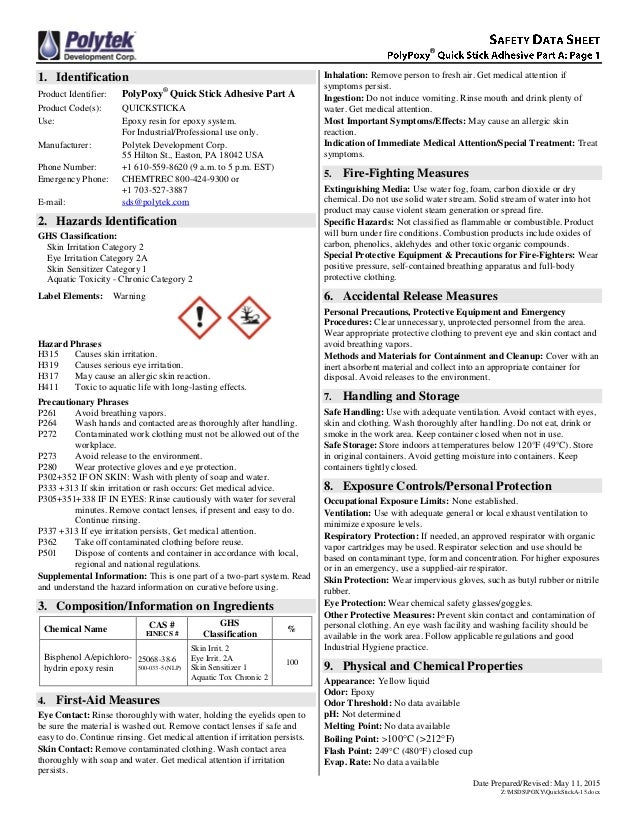
Label Elements: Warning
Hazard Phrases
H315 Causes skin irritation.
H319 Causes serious eye irritation.
H317 May cause an allergic skin reaction.
H411 Toxic to aquatic life with long-lasting effects.
Precautionary Phrases
P261 Avoid breathing vapors.
P264 Wash hands and contacted areas thoroughly after handling.
P272 Contaminated work clothing must not be allowed out of the
workplace.
P273 Avoid release to the environment.
P280 Wear protective gloves and eye protection.
P302+352 IF ON SKIN: Wash with plenty of soap and water.
P333 +313 If skin irritation or rash occurs: Get medical advice.
P305+351+338 IF IN EYES: Rinse cautiously with water for several
minutes. Remove contact lenses, if present and easy to do.
Continue rinsing.
P337 +313 If eye irritation persists, Get medical attention.
P362 Take off contaminated clothing before reuse.
P501 Dispose of contents and container in accordance with local,
regional and national regulations.
Supplemental Information: This is one part of a two-part system. Read
and understand the hazard information on curative before using.
3. Composition/Information on Ingredients
Chemical Name CAS #
EINECS #
GHS
Classification
%
Bisphenol A/epichloro-
hydrin epoxy resin
25068-38-6
500-033-5 (NLP)
Skin Irrit. 2
Eye Irrit. 2A
Skin Sensitizer 1
Aquatic Tox Chronic 2
100
4. First-Aid Measures
Eye Contact: Rinse thoroughly with water, holding the eyelids open to
be sure the material is washed out. Remove contact lenses if safe and
easy to do. Continue rinsing. Get medical attention if irritation persists.
Skin Contact: Remove contaminated clothing. Wash contact area
thoroughly with soap and water. Get medical attention if irritation
persists.
Inhalation: Remove person to fresh air. Get medical attention if
symptoms persist.
Ingestion: Do not induce vomiting. Rinse mouth and drink plenty of
water. Get medical attention.
Most Important Symptoms/Effects: May cause an allergic skin
reaction.
Indication of Immediate Medical Attention/Special Treatment: Treat
symptoms.
5. Fire-Fighting Measures
Extinguishing Media: Use water fog, foam, carbon dioxide or dry
chemical. Do not use solid water stream. Solid stream of water into hot
product may cause violent steam generation or spread fire.
Specific Hazards: Not classified as flammable or combustible. Product
will burn under fire conditions. Combustion products include oxides of
carbon, phenolics, aldehydes and other toxic organic compounds.
Special Protective Equipment & Precautions for Fire-Fighters: Wear
positive pressure, self-contained breathing apparatus and full-body
protective clothing.
6. Accidental Release Measures
Personal Precautions, Protective Equipment and Emergency
Procedures: Clear unnecessary, unprotected personnel from the area.
Wear appropriate protective clothing to prevent eye and skin contact and
avoid breathing vapors.
Methods and Materials for Containment and Cleanup: Cover with an
inert absorbent material and collect into an appropriate container for
disposal. Avoid releases to the environment.
7. Handling and Storage
Safe Handling: Use with adequate ventilation. Avoid contact with eyes,
skin and clothing. Wash thoroughly after handling. Do not eat, drink or
smoke in the work area. Keep container closed when not in use.
Safe Storage: Store indoors at temperatures below 120°F (49°C). Store
in original containers. Avoid getting moisture into containers. Keep
containers tightly closed.
8. Exposure Controls/Personal Protection
Occupational Exposure Limits: None established.
Ventilation: Use with adequate general or local exhaust ventilation to
minimize exposure levels.
Respiratory Protection: If needed, an approved respirator with organic
vapor cartridges may be used. Respirator selection and use should be
based on contaminant type, form and concentration. For higher exposures
or in an emergency, use a supplied-air respirator.
Skin Protection: Wear impervious gloves, such as butyl rubber or nitrile
rubber.
Eye Protection: Wear chemical safety glasses/goggles.
Other Protective Measures: Prevent skin contact and contamination of
personal clothing. An eye wash facility and washing facility should be
available in the work area. Follow applicable regulations and good
Industrial Hygiene practice.
9. Physical and Chemical Properties
Appearance: Yellow liquid
Odor: Epoxy
Odor Threshold: No data available
pH: Not determined
Melting Point: No data available
Boiling Point: >100C (>212F)
Flash Point: 249C (480F) closed cup
Evap. Rate: No data available
®
Date Prepared/Revised: May 11, 2015
Z:MSDSPOXYQuickStickA-15.docx
Upper/Lower Flammability Limits: No data available
Vapor Pressure: <0.01 mm Hg @ 25C
Vapor Density: No data available
Relative Density: 1.1 @ 25C
Solubility: Insoluble in water
Partition Coefficient: n-octanol/Water: log POW 3.2 (estimated)
Auto-Ignition Temp: No data available
Decomposition Temp: No data available
Viscosity: 4,500-6,500 cP @ 25C
10. Stability and Reactivity
Reactivity: Not normally reactive.
Chemical Stability: Stable under recommended conditions. After
prolonged storage, may crystallize.
Possibility of Hazardous Reactions: Masses of ≥1 lb (0.5 kg) plus
aliphatic amine will cause irreversible polymerization with considerable
heat build-up. Material will polymerize with sodium hydroxide.
Conditions to Avoid: Avoid excessive heat.
Incompatible Materials: Avoid contact with strong oxidizing agents,
acids, alkalis, amines, mercaptans.
Hazardous Decomposition Products: Uncontrolled exothermic reaction
of epoxy resin releases carbon monoxide, carbon dioxide, phenolics, and
aldehydes.
11. Toxicological Information
Eye Contact: Causes serious eye irritation, pain, redness.
Skin Contact: Causes skin irritation. May cause sensitization. Once
sensitized, a severe allergic reaction may occur when subsequently
exposed to very low levels.
Inhalation: Vapors from heated product may cause respiratory irritation.
Ingestion: Low toxicity.
Chronic Health Effects: Allergic skin reaction.
Acute Toxicity Values: Estimated Oral rat LD50 >5,000 mg/kg; Dermal
rabbit LD50 >4,000 mg/kg.
Respiratory Sensitization: Components are not respiratory sensitizers.
Skin Sensitization: Causes allergic skin reaction.
Germ Cell Mutagenicity: Components are not mutagens.
Carcinogenicity: Components are not carcinogens.
Reproductive Toxicity: Components are not reproductive toxins.
Specific Target Organ Toxicity: Not classified based on available data.
12. Ecological Information
Ecotoxicity: Based on data for epoxy resin, product is classified as
hazardous to the aquatic environment (Aquatic Toxicity - Chronic
Category 2).
LC50 (fathead minnow) 3.1 mg/L/96 hr
EC50 (Daphnia magna) 3.6 mg/L/24 hr.
Persistence and Degradability: Not readily biodegradable.
Bioaccumulative Potential: Low potential to bioaccumulate.
Mobility in Soil: No data available.
13. Disposal Considerations
Dispose according to local, state and federal regulations. Do not dump in
drains or sewers.
14. Transport Information
U.S.: UN3082, Environmentally hazardous substance, liquid, n.o.s.
(epoxy resin), 9, III. Not regulated as a hazardous material by US DOT in
containers of ≤5-gallons.
International shipments: UN3082, Environmentally hazardous
substance, liquid, n.o.s. (epoxy resin), 9, III. Excepted from IMDG and
IATA regulations in containers of ≤5 liters (see IATA SP A197 and
IMDG 2.10.2.7).
Emergency Shipping Information: Call CHEMTREC,800-424-9300or
+1-703-527-3887
15. Regulatory Information
U.S. FEDERAL REGULATIONS:
CERCLA 103 Reportable Quantity: This product is not subject to
reporting under CERCLA. Some states have more stringent reporting
requirements.
SARA TITLE III
Section 311/312: Acute Health
Section 313 Toxic Chemicals: This product contains no chemicals
subject to SARA Title III Section 313 Reporting requirements.
Section 302 Extremely Hazardous Substances (TPQ): None
EPA Toxic Substances Control Act (TSCA) Status: Component in this
product is listed on TSCA.
STATE REGULATIONS:
California Proposition 65: WARNING: This product contains a
chemical known to the State of California to cause cancer and birth
defects or other reproductive harm (traces of epichlorohydrin and/or
benzene).
16. Other Information
Training Advice: All personnel using/handling this product should be
trained in proper chemical handling and the need for and use of
engineering controls and protective equipment.
Recommended Uses and Restrictions: This product is intended for
industrial/professional use only.
SDS Revision Notes: New GHS SDS. Replaces SDS dated Aug. 9,
2011.
Disclaimer: The information contained herein is considered accurate; however,
Polytek®
Development Corp. makes no warranty regarding the accuracy of the
information. The user must determine the suitability of the product for the
intended use and accepts all risk and liability associated with that use.

PolyPoxy® Quick Stick Adhesive Part A

  • 1.
    ® Date Prepared/Revised: May11, 2015 Z:MSDSPOXYQuickStickA-15.docx 1. Identification Product Identifier: PolyPoxy® Quick Stick Adhesive Part A Product Code(s): QUICKSTICKA Use: Epoxy resin for epoxy system. For Industrial/Professional use only. Manufacturer: Polytek Development Corp. 55 Hilton St., Easton, PA 18042 USA Phone Number: +1 610-559-8620 (9 a.m. to 5 p.m. EST) Emergency Phone: CHEMTREC 800-424-9300 or +1 703-527-3887 E-mail: sds@polytek.com 2. Hazards Identification GHS Classification: Skin Irritation Category 2 Eye Irritation Category 2A Skin Sensitizer Category 1 Aquatic Toxicity - Chronic Category 2 Label Elements: Warning Hazard Phrases H315 Causes skin irritation. H319 Causes serious eye irritation. H317 May cause an allergic skin reaction. H411 Toxic to aquatic life with long-lasting effects. Precautionary Phrases P261 Avoid breathing vapors. P264 Wash hands and contacted areas thoroughly after handling. P272 Contaminated work clothing must not be allowed out of the workplace. P273 Avoid release to the environment. P280 Wear protective gloves and eye protection. P302+352 IF ON SKIN: Wash with plenty of soap and water. P333 +313 If skin irritation or rash occurs: Get medical advice. P305+351+338 IF IN EYES: Rinse cautiously with water for several minutes. Remove contact lenses, if present and easy to do. Continue rinsing. P337 +313 If eye irritation persists, Get medical attention. P362 Take off contaminated clothing before reuse. P501 Dispose of contents and container in accordance with local, regional and national regulations. Supplemental Information: This is one part of a two-part system. Read and understand the hazard information on curative before using. 3. Composition/Information on Ingredients Chemical Name CAS # EINECS # GHS Classification % Bisphenol A/epichloro- hydrin epoxy resin 25068-38-6 500-033-5 (NLP) Skin Irrit. 2 Eye Irrit. 2A Skin Sensitizer 1 Aquatic Tox Chronic 2 100 4. First-Aid Measures Eye Contact: Rinse thoroughly with water, holding the eyelids open to be sure the material is washed out. Remove contact lenses if safe and easy to do. Continue rinsing. Get medical attention if irritation persists. Skin Contact: Remove contaminated clothing. Wash contact area thoroughly with soap and water. Get medical attention if irritation persists. Inhalation: Remove person to fresh air. Get medical attention if symptoms persist. Ingestion: Do not induce vomiting. Rinse mouth and drink plenty of water. Get medical attention. Most Important Symptoms/Effects: May cause an allergic skin reaction. Indication of Immediate Medical Attention/Special Treatment: Treat symptoms. 5. Fire-Fighting Measures Extinguishing Media: Use water fog, foam, carbon dioxide or dry chemical. Do not use solid water stream. Solid stream of water into hot product may cause violent steam generation or spread fire. Specific Hazards: Not classified as flammable or combustible. Product will burn under fire conditions. Combustion products include oxides of carbon, phenolics, aldehydes and other toxic organic compounds. Special Protective Equipment & Precautions for Fire-Fighters: Wear positive pressure, self-contained breathing apparatus and full-body protective clothing. 6. Accidental Release Measures Personal Precautions, Protective Equipment and Emergency Procedures: Clear unnecessary, unprotected personnel from the area. Wear appropriate protective clothing to prevent eye and skin contact and avoid breathing vapors. Methods and Materials for Containment and Cleanup: Cover with an inert absorbent material and collect into an appropriate container for disposal. Avoid releases to the environment. 7. Handling and Storage Safe Handling: Use with adequate ventilation. Avoid contact with eyes, skin and clothing. Wash thoroughly after handling. Do not eat, drink or smoke in the work area. Keep container closed when not in use. Safe Storage: Store indoors at temperatures below 120°F (49°C). Store in original containers. Avoid getting moisture into containers. Keep containers tightly closed. 8. Exposure Controls/Personal Protection Occupational Exposure Limits: None established. Ventilation: Use with adequate general or local exhaust ventilation to minimize exposure levels. Respiratory Protection: If needed, an approved respirator with organic vapor cartridges may be used. Respirator selection and use should be based on contaminant type, form and concentration. For higher exposures or in an emergency, use a supplied-air respirator. Skin Protection: Wear impervious gloves, such as butyl rubber or nitrile rubber. Eye Protection: Wear chemical safety glasses/goggles. Other Protective Measures: Prevent skin contact and contamination of personal clothing. An eye wash facility and washing facility should be available in the work area. Follow applicable regulations and good Industrial Hygiene practice. 9. Physical and Chemical Properties Appearance: Yellow liquid Odor: Epoxy Odor Threshold: No data available pH: Not determined Melting Point: No data available Boiling Point: >100C (>212F) Flash Point: 249C (480F) closed cup Evap. Rate: No data available
  • 2.
    ® Date Prepared/Revised: May11, 2015 Z:MSDSPOXYQuickStickA-15.docx Upper/Lower Flammability Limits: No data available Vapor Pressure: <0.01 mm Hg @ 25C Vapor Density: No data available Relative Density: 1.1 @ 25C Solubility: Insoluble in water Partition Coefficient: n-octanol/Water: log POW 3.2 (estimated) Auto-Ignition Temp: No data available Decomposition Temp: No data available Viscosity: 4,500-6,500 cP @ 25C 10. Stability and Reactivity Reactivity: Not normally reactive. Chemical Stability: Stable under recommended conditions. After prolonged storage, may crystallize. Possibility of Hazardous Reactions: Masses of ≥1 lb (0.5 kg) plus aliphatic amine will cause irreversible polymerization with considerable heat build-up. Material will polymerize with sodium hydroxide. Conditions to Avoid: Avoid excessive heat. Incompatible Materials: Avoid contact with strong oxidizing agents, acids, alkalis, amines, mercaptans. Hazardous Decomposition Products: Uncontrolled exothermic reaction of epoxy resin releases carbon monoxide, carbon dioxide, phenolics, and aldehydes. 11. Toxicological Information Eye Contact: Causes serious eye irritation, pain, redness. Skin Contact: Causes skin irritation. May cause sensitization. Once sensitized, a severe allergic reaction may occur when subsequently exposed to very low levels. Inhalation: Vapors from heated product may cause respiratory irritation. Ingestion: Low toxicity. Chronic Health Effects: Allergic skin reaction. Acute Toxicity Values: Estimated Oral rat LD50 >5,000 mg/kg; Dermal rabbit LD50 >4,000 mg/kg. Respiratory Sensitization: Components are not respiratory sensitizers. Skin Sensitization: Causes allergic skin reaction. Germ Cell Mutagenicity: Components are not mutagens. Carcinogenicity: Components are not carcinogens. Reproductive Toxicity: Components are not reproductive toxins. Specific Target Organ Toxicity: Not classified based on available data. 12. Ecological Information Ecotoxicity: Based on data for epoxy resin, product is classified as hazardous to the aquatic environment (Aquatic Toxicity - Chronic Category 2). LC50 (fathead minnow) 3.1 mg/L/96 hr EC50 (Daphnia magna) 3.6 mg/L/24 hr. Persistence and Degradability: Not readily biodegradable. Bioaccumulative Potential: Low potential to bioaccumulate. Mobility in Soil: No data available. 13. Disposal Considerations Dispose according to local, state and federal regulations. Do not dump in drains or sewers. 14. Transport Information U.S.: UN3082, Environmentally hazardous substance, liquid, n.o.s. (epoxy resin), 9, III. Not regulated as a hazardous material by US DOT in containers of ≤5-gallons. International shipments: UN3082, Environmentally hazardous substance, liquid, n.o.s. (epoxy resin), 9, III. Excepted from IMDG and IATA regulations in containers of ≤5 liters (see IATA SP A197 and IMDG 2.10.2.7). Emergency Shipping Information: Call CHEMTREC,800-424-9300or +1-703-527-3887 15. Regulatory Information U.S. FEDERAL REGULATIONS: CERCLA 103 Reportable Quantity: This product is not subject to reporting under CERCLA. Some states have more stringent reporting requirements. SARA TITLE III Section 311/312: Acute Health Section 313 Toxic Chemicals: This product contains no chemicals subject to SARA Title III Section 313 Reporting requirements. Section 302 Extremely Hazardous Substances (TPQ): None EPA Toxic Substances Control Act (TSCA) Status: Component in this product is listed on TSCA. STATE REGULATIONS: California Proposition 65: WARNING: This product contains a chemical known to the State of California to cause cancer and birth defects or other reproductive harm (traces of epichlorohydrin and/or benzene). 16. Other Information Training Advice: All personnel using/handling this product should be trained in proper chemical handling and the need for and use of engineering controls and protective equipment. Recommended Uses and Restrictions: This product is intended for industrial/professional use only. SDS Revision Notes: New GHS SDS. Replaces SDS dated Aug. 9, 2011. Disclaimer: The information contained herein is considered accurate; however, Polytek® Development Corp. makes no warranty regarding the accuracy of the information. The user must determine the suitability of the product for the intended use and accepts all risk and liability associated with that use.