Editors
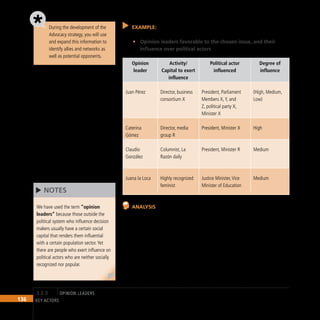
María Antonieta Alcalde Castro
Rodrigo Arroniz Pérez
Gabriela Cano Azcárraga
Author
Rodrigo Arroniz Pérez
Copy Editor
Flor Hunt
Pierre LaRamee
Judith Filc
Translator
Judith Filc
Layout
Diana Eugenia Pérez González
dp.creativity@gmail.com
Handbook for Political Analysis and Mapping
International Planned Parenthood Federation
Western Hemisphere Region, Inc.
120 Wall Street, 9th Floor, New York, NY 10005-3902
T: 212 248 6400, F 212 248 4221, E info@ippfwhrorg
www.ippfwhr.org
This edition consists of 1,000 copies.
Mexico, D.F., January 2010.
PEFC/04-4-0008
We are very proud to share with you this publication, which is the result of three years of work by the Advocacy
team of the International Planned Parenthood Federation (IPPF/WHR). The Handbook for Political Analysis and
Mapping is part of the series Advocacy Tools. It aims at building the capacities of IPPF Member Associations and of
other organizations to design effective advocacy projects that will facilitate the advancement of the political agenda
in favor of sexual and reproductive rights.
Political advocacy is central to the work of the IPPF. Only with governments’ steady political and financial
commitment shall we be able to achieve both universal access to reproductive health and respect and protection for
the sexual and reproductive health rights of all individuals, so that they may exercise these rights freely.
To develop this handbook, the IPPF-WHR Advocacy team reviewed several models and designed a methodology
that was implemented and tested with the IPPF Member Associations in three Caribbean and seven Latin American
countries. Each workshop conducted allowed us to change and strengthen our methodological model to produce
the tool we are offering you here.
With this handbook, IPPF/WHR also expects to contribute to the work of organized civil society in favor of sexual
and reproductive rights. It aims at strenghtening civil society’s advocacy actions as well as to provide a tool
to systematically influence both the domestic and international political scenes. This tool will help civil society
organizations to demand greater transparency and accountability to their governments regarding health care and
sexual and reproductive rights.
We hope that this publication will fulfill its goals and become a reference point for Advocacy work.
Carmen Barroso
Regional Director
International Planned Parenthood Federation
Western Hemisphere Region
Pierre LaRamee
Director of Development and Public Affairs
International Planned Parenthood Federation
Western Hemisphere Region
5
Handbook for Political Analysis and Mapping
The development of the methodology we are presenting in this handbook was possible thanks to the
support of the Board Directors of the International Planned Parenthood Federation – Western Hemisphere
Region (IPPF-WHR). To strengthen the political work of Member Associations and of the movement for
Sexual and Reproductive Rights movement, the IPPF-WHR decided to invest in the creation of Advocacy tools.
The work of Rodrigo Arróniz Pérez, who designed and tested the methodology suggested here, was
invaluable. So was that of María Antonieta Alcalde Castro and Gabriela Cano Azcárraga, who assessed
and edited the handbook along with Rodrigo.
Many people contributed to produce this manual. We are especially grateful to Pierre LaRamee, Laura
Malajovich, Flor Hunt, Mari-Sol Agui, Giselle Carino, Marcela Rueda, Jennifer Friedman, Carrie Tatum,
and Jocelyn Ban, whose comments greatly enriched this publication.
We would like to express our great appreciation for the help of the Member Associations that allowed
us to test and improve our methodology through the design and implementation of Advocacy projects.
Thanks to the Asociación Chilena de Protección de la Familia (APROFA), Asociación Dominicana Pro-
Bienestar de la Familia (PROFAMILIA), Asociación Panameña para el Planeamiento de la Familia (APLAFA),
Asociación Pro-Bienestar de la Familia Nicaragüense (PROFAMILIA), Centro de Investigación, Educación y
Servicios (CIES), Fundación Mexicana para la Planeación Familiar (MEXFAM), and the Instituto Peruano de
Paternidad Responsable (INPPARES).
We could not end without thanking the Governance and Transparency Fund of the UK Department for
International Development (DFID), Hewlett Foundation, Agencia Española de Cooperación Internacional
para el Desarrollo (Spanish Agency for International Cooperation for Development) (AECID) and the
United Nations Population Fund (UNFPA), whose financial support made it possible to design and print
this handbook.
ACKNOWLEDGMENTS
7
Handbook for Political Analysis and Mapping
PresentaTION
As part of its efforts to foster its partners’ active participation in the political processes of their respective
countries, the IPPF/WHR has developed a number of publications aiming to provide an instrument to
build the organizations capacity to create, design, and implement Advocacy projects. The publications are
divided into three tools, namely, Political Mapping, Budget Analysis, and Advocacy Planning. The first is
the Political Analysis and Mapping tool, because users will obtain information that will constitute the
primary input to plan and construct the Advocacy project.
The Handbook for Political Analysis and Mapping is in turn divided into three sections. The first one
analyzes all the structural and institutional features of the state that are related to the issue of Advocacy.
The second one comprises activities that seek to give a comprehensive political content to the information
analyzed in the first part. The last one is the analysis of the key actors involved.
While actor analysis is essential for any process of political advocacy, actors are constantly shifting due to
the dynamics of cyclical political processes, to changes in political groups, or to contextual circumstances
that modify the political stage. The tool developed by IPPF/WHR has been designed as an analytical model
that allows us to build comprehensive and renewable political maps adaptable to each political context
and region in accordance with the specific traits of the prevailing political system.
Given that decision making in public policy is conditioned by different kinds of factors, the Handbook
has been conceived to help its users understand all the elements that affect political actors’ decisions.
Even though these actors represent public and private ideologies, doctrines and interests, there are
other elements that also affect their decisions. The political mapping tool facilitates our understanding
of structural factors that condition decision-making processes so that we may analyze contextual issues
first, and then specific circumstances and characteristics of the actors to be mapped. The goal of such an
approach is that handbook users may develop a map that will not need to be substantially modified due
to changes in the political stage.
Finally, the Political Mapping section is divided into three modules. Modules, in turn, are divided into
sessions, and sessions, into activities. At the end of the book, readers will find a section containing all
the addendums needed to carry out the activities.
8 Handbook for Political Analysis and Mapping
Introduction
How this handbook works
MODULE 1. IDENTIFYING ENTRY POINTS TO THE POLITICAL SYSTEM
Session 1.1. Social Structure
Activity 1.1.1. Social Indicators
Session 1.2. Legal Framework
Activity 1.2.1. Study of the Legal Framework
Activity 1.2.2. Analysis of the Legal Framework
Session 1.3. Executive Branch
Activity 1.3.1. General Structure
Activity 1.3.2. Operational Structure
Activity 1.3.3. Plans, Programs, Public Policy, and Government Actions
Activity 1.3.4. Key Areas
Session 1.4. Legislative Branch
Activity 1.4.1. Functions of the Legislative Branch
Activity 1.4.2. Operational Structure
Session 1.5. Territorial Structure
Activity 1.5.1. Territorial Structure I
Activity 1.5.2. Territorial Structure II
MODULE 2. UNDERSTANDING THE POLITICAL CONTEXT
Session 2.1. Electoral and Party Systems
Activity 2.1.1. Electoral and Party Systems
Activity 2.1.2. Political and Electoral Calendars
TABLE OF CONTENTS
11
13
15
15
17
21
24
29
33
36
36
40
45
49
50
54
57
59
63
69
70
71
83
9
Handbook for Political Analysis and Mapping
Session 2.2. Ideological Stance, Social Doctrine and Citizen Representation
Activity 2.2.1. Ideological position, Social Doctrine, and Political Platforms
Activity 2.2.2. Citizen Representation
Session 2.3. Balance of Power
Activity 2.3.1. Balance of Power. Executive Branch
Activity 2.3.2. Balance of Power. Legislative Branch
Activity 2.3.3. Balance of Power. Territory
Activity 2.3.4 Summary: Balance of Power Analysis
MODULE 3. KEY ACTORS
Session 3.1. Political Actors
Activity 3.1.1. Executive Branch
Activity 3.1.2. Legislative Branch
Activity 3.1.3. Other Political Actors
Session 3.2. Social Actors
Activity 3.2.1. Interest Groups
Activity 3.2.2. Social Organizations
Activity 3.2.3. Opinion Leaders
Addendums
89
91
102
105
106
108
113
117
121
121
123
127
128
130
131
133
135
139
11
Handbook for Political Analysis and Mapping
introduction
Introduction
Before starting the political mapping exercise, it is essential that the mapping team facilitate a session
with the leadership and members of the organization that will be in charge of the Advocacy project. The
goal of this session is to define the Advocacy problem or issue they want to address.
The choice of advocacy issue is based on various elements. The most significant ones are:
The organization’s interest in contributing to the solution of an important social problem in which
•
the state has intervened with little result.
The organization’s interest in participating in political processes that will place an issue they
•
consider relevant in the public agenda.
The intention of the organization’s partners or of other agencies or organizations to support a
•
specific issue.
Political circumstances that create windows of opportunity or threats in relation to a specific
•
issue.
Remind the group that performing Advocacy work necessarily means performing political work. The main
purpose of Advocacy strategies is to influence the decisions and actions taken by the state to solve a
specific social problem.
To choose the Advocacy issue, reflect with the group on the following points:
In your opinion, which sexual and reproductive health issues require immediate action by the state?
01.
In which of these issues is it strategically relevant for the organization to take a public stance?
02.
In which of these issues are there opportunities to implement an Advocacy project?
03.
Opportunities may be:
Political.
• When there are clear legislative or public policy vacuums; when the government must
present governance reports (regarding both domestic and international policy) during electoral
periods, among others.
Alliances.
• When other partners, organizations or agencies want to invest in Advocacy work in
relation to this specific issue.
12 Handbook for Political Analysis and Mapping
Introduction
By means of this discussion, the group must define the issue that will be the basis for their Advocacy
project.
Remember that at this time you must choose a broad issue. In this way, the political mapping may
comprehensively analyze the reality of which this issue is part. Subsequently, during the planning phase
the group will be able to identify, through a participatory process, the specific elements it must approach.
Some examples of Advocacy issues may be:
Meeting the millennium development goals related to health
•
Obtaining access to comprehensive sex education
•
Reducing maternal mortality
•
Achieving universal access to HIV/AIDS prevention, treatment, and care
•
Eradicating gender-based violence
•
Achieving access to legal abortion
•
Gaining legal recognition of sexual rights
•
The outcomes of the Handbook for Political Analysis and Mapping will constitute one of the main inputs
for our work with the Advocacy Handbook. From these outcomes will stem the goals, strategies, and
actions of our Advocacy project. For this reason, in the political analysis and mapping stage we must
conduct research that will allow us to understand the broad context of the situation or issue we want to
address. We will thus have a clear view of the state of the Advocacy issue within the political context of
our country.
13
Handbook for Political Analysis and Mapping
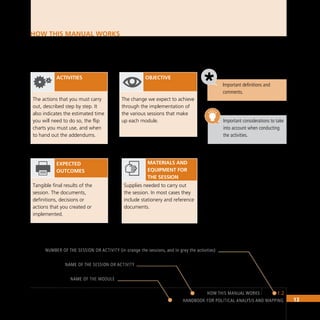
Important definitions and
comments.
HOW THIS MANUAL WORKS
In each module you will find the following elements:
OBJECTIVE
The change we expect to achieve
through the implementation of
the various sessions that make
up each module.
MATERIALS AND
EQUIPMENT FOR
THE SESSION
Supplies needed to carry out
the session. In most cases they
include stationery and reference
documents.
Important considerations to take
into account when conducting
the activities.
ACTIVITIES
The actions that you must carry
out, described step by step. It
also indicates the estimated time
you will need to do so, the flip
charts you must use, and when
to hand out the addendums.
1.2
HOW THIS MANUAL WORKS
EXPECTED
OUTCOMES
Tangible final results of the
session. The documents,
definitions, decisions or
actions that you created or
implemented.
Name of the session or activity
Number of the session or activity (in orange the sessions, and in grey the activities)
Name of the module
14 Handbook for Political Analysis and Mapping
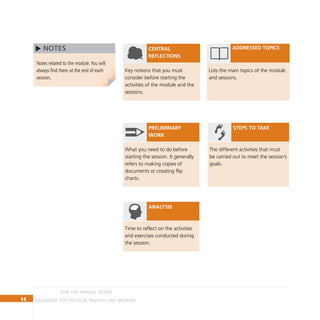
CENTRAL
REFLECTIONS
Key notions that you must
consider before starting the
activities of the module and the
sessions.
PRELIMINARY
WORK
What you need to do before
starting the session. It generally
refers to making copies of
documents or creating flip
charts.
ANALYSIS
Time to reflect on the activities
and exercises conducted during
the session.
STEPS TO TAKE
The different activities that must
be carried out to meet the session’s
goals.
ADDRESSED TOPICS
Lists the main topics of the module
and sessions.
Notes related to the module.You will
always find them at the end of each
session.
NOTES
HOW THIS MANUAL WORKS
IDENTIFYING ENTRY
POINTS TO THE
POLITICAL SYSTEM
1
16
What is the problem, and why should it be solved through
state action? What are the reasons why your organization and
your coalition want to implement an Advocacy project to pro-
mote such political change?
ADVOCACY issue
Session 1.1. Social Structure
Activity 1.1.1. Social Indicators
Session 1.2. Legal Framework
Activity 1.2.1. Study of the Legal Framework
Activity 1.2.2.Analysis of the Legal Framework
Session 1.3. Executive Branch
Activity 1.3.1. General Structure
Activity 1.3.2. Operational Structure
Activity 1.3.3. Plans, Programs, Public Policy, and Government Actions
Activity 1.3.4. Key Areas
Session 1.4. Legislative Branch
Activity 1.4.1. Functions of the Legislative Branch
Activity 1.4.2. Operational Structure
Session 1.5 Territorial Structure
Activity 1.5.1.Territorial Structure I
Activity 1.5.2.Territorial Structure II
Bringing the Module to a close
Page
15
17
21
24
29
33
36
36
40
45
49
50
54
57
59
63
68
15
IDENTIFYING ENTRY POINTS TO THE POLITICAL SYSTEM
1.1
social structure
Computer
•
Internet access
•
Recent publications with statistical
•
demographic data on the issue of
interest, as well as other related data.
materials and
equipment for the
session
MODULE 1.
IDENTIFYING ENTRY POINTS TO THE POLITICAL SYSTEM
In this section we will analyze the structural and formal aspects associated
with our Advocacy issue. A political system is the space that contains those
political institutions, laws, norms, and mechanisms better known as the state.
Generally this system is rigid by definition, because its flow dynamics evince
a cyclical and closed logic. Yet a political system must have entry points that
enable the population, interest groups, or organized civil society to gain access
when they have a petition, demand, or need that requires state intervention
in order to be satisfied. In this section we will analyze the entry points that
will allow us to incorporate our issue into the political system.
SESSION 1.1. SOCIAL STRUCTURE
ACTIVIty BRief description
Social Indicators Determining the data that will contribute to a
preliminary identification of a social problem with
which the political mapping team is concerned and
that may become an Advocacy project.
Objective
At the end of this exercise you will be able to handle demographic statistical
data that will allow you to soundly interpret the social problem or situation
that you are interested in addressing through an Advocacy process. Your
command of indicators and statistics will be a necessary and powerful tool
during the entire political advocacy process.
Expected outcomes
Tables, graphics, and reflections that portray a broad and detailed picture of
the issue or situation you want to work on through an Advocacy process.
16 IDENTIFYING ENTRY POINTS TO THE POLITICAL SYSTEM
A table with social statistics that support your reflections on the issue of interest or the problem you want
to tackle.
Central reflections
An Advocacy project seeks to generate political change that will promote, and be reflected in, social
change. Social change may be measured through people’s perception of a certain phenomenon or
problem. To verify that something has changed, however, we need statistical indicators. For this reason,
the first step in an Advocacy project is defining the universe that will be represented by our issue of
interest, that is, the universe we would like to modify through the action of the state and its institutions.
Statistics are social indicators designed with a specific end in mind – to get to know the characteristics
of the population of a certain place. Traditionally, academic centers (universities, research institutes, and
so on) have been in charge of creating statistics, but since the mid-twentieth century, governments have
taken up this function. Yet thanks to an increasingly more sophisticated global relations network (trade
and solidarity links), civil organizations and multilateral agencies may produce their own data. It is well
known that governments sometimes design indicators that enable them to establish and justify certain
public policies. Such information is methodologically biased to suit decision makers. It is also known that
certain governments manipulate the construction of indicators because the latter are the primary source
of information for decision making in the area of public policy – for the definition of goals, actions,
budget, and expected outcomes. We believe that government data constitute an indispensable source
for our analysis. We recommend, however, that you explore other sources, as long as they comply with
minimal methodological and impartiality standards.
Addressed topics
Statistics, sociodemographic indicators.
social structure
1.1
17
IDENTIFYING ENTRY POINTS TO THE POLITICAL SYSTEM
ACTIVITY 1.1.1. SOCIAL INDICATORS
Preliminary Work
To have a broad view of the social reality that concerns the team, we
recommend that you use the following sources:
Official databases
a. provided by government statistics centers, such as
population or quality of life surveys.
Databases provided by government areas
b. that carry out actions
connected with the issue we want to explore. For instance, if we want
to know more about data concerning educational matters, we need
to search the databases of the Ministry of Education. If we want to
know more about youth, we need to look up the studies conducted by
national institutes of youth.
Databases of international cooperation agencies.
c. Some relevant
examples are the Human Development Index, reports on progress
on the Millennium Development Goals written by the UNDP, and
databases of agencies such as the World Bank, the IMF, the WHO or
any other multilateral agency.
Publications, research, and studies by non-governmental organizations
d.
belonging to the international cooperation network. Some of these
institutions work with other organizations or conduct their own studies
with mostly reliable indicators.
Polls, surveys, or research carried out by universities or educational
e.
institutes related to the issue you want to get to know. Preferably,
you should use studies that have already been published, and have
therefore undergone appropriate reviews.
Opinion polls, surveys, and other public opinion research tools
f. , which
are very popular today. It is important to take into account that these
studies are often ordered by a party that wants to show something in
particular. You must be very careful and choose only those that are as
independent and reliable as possible.
Research conducted by newspapers, magazines, or other mass media.
g.
We must always take into account that their information may be
biased.
1.1.1
social indicators
You won’t always have time to
consult all the sources listed
above. Nonetheless, you should
look up at least two or three of
the suggested categories so that
you may have various statistical
viewpoints on the issue you are
studying.
A demographic indicator
is but an outline of a series of
circumstances that condition
it. No statistical indicator or
figure is disconnected from
other variables or problems,
which enhance or reduce its
prevalence.That is why we
suggest that you search for
indicators adjacent to the
main indicator so that you may
determine the scope of the issue
of interest more rigorously.
18 IDENTIFYING ENTRY POINTS TO THE POLITICAL SYSTEM
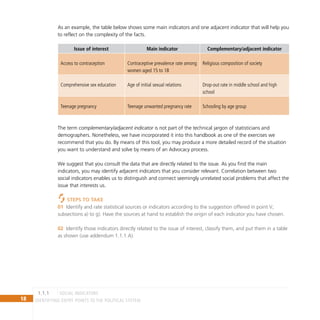
As an example, the table below shows some main indicators and one adjacent indicator that will help you
to reflect on the complexity of the facts.
Issue of interest Main indicator Complementary/adjacent indicator
Access to contraception Contraceptive prevalence rate among
women aged 15 to 18
Religious composition of society
Comprehensive sex education Age of initial sexual relations Drop-out rate in middle school and high
school
Teenage pregnancy Teenage unwanted pregnancy rate Schooling by age group
The term complementary/adjacent indicator is not part of the technical jargon of statisticians and
demographers. Nonetheless, we have incorporated it into this handbook as one of the exercises we
recommend that you do. By means of this tool, you may produce a more detailed record of the situation
you want to understand and solve by means of an Advocacy process.
We suggest that you consult the data that are directly related to the issue. As you find the main
indicators, you may identify adjacent indicators that you consider relevant. Correlation between two
social indicators enables us to distinguish and connect seemingly unrelated social problems that affect the
issue that interests us.
Steps to take
Identify and rate statistical sources or indicators according to the suggestion offered in point V,
01
subsections a) to g). Have the sources at hand to establish the origin of each indicator you have chosen.
Identify those indicators directly related to the issue of interest, classify them, and put them in a table
02
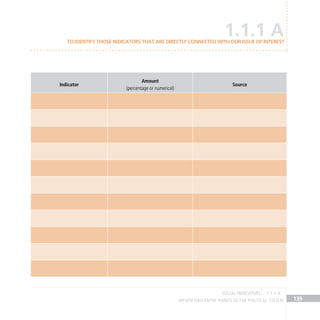
as shown (use addendum 1.1.1 A).
social indicators
1.1.1
19
IDENTIFYING ENTRY POINTS TO THE POLITICAL SYSTEM
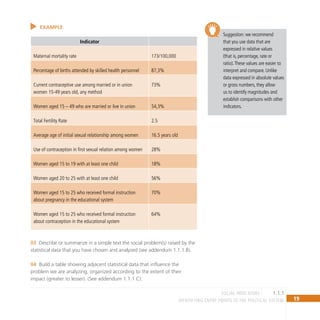
Indicator
Maternal mortality rate 173/100,000
Percentage of births attended by skilled health personnel 87,3%
Current contraceptive use among married or in union
women 15-49 years old, any method
73%
Women aged 15 – 49 who are married or live in union 54,3%
Total Fertility Rate 2.5
Average age of initial sexual relationship among women 16.5 years old
Use of contraception in first sexual relation among women 28%
Women aged 15 to 19 with at least one child 18%
Women aged 20 to 25 with at least one child 56%
Women aged 15 to 25 who received formal instruction
about pregnancy in the educational system
70%
Women aged 15 to 25 who received formal instruction
about contraception in the educational system
64%
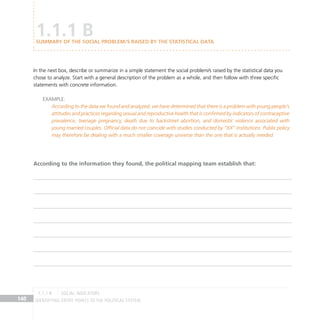
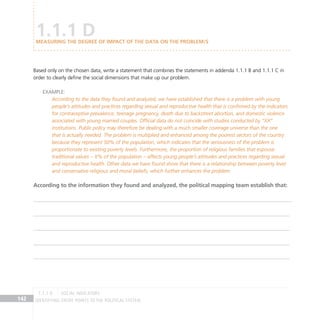
Describe or summarize in a simple text the social problem(s) raised by the
03
statistical data that you have chosen and analyzed (see addendum 1.1.1 B).
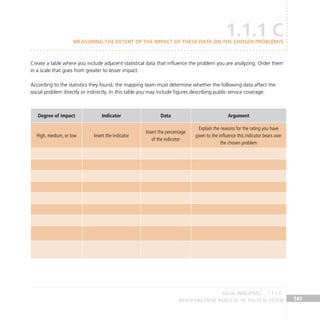
Build a table showing adjacent statistical data that influence the
04
problem we are analyzing, organized according to the extent of their
impact (greater to lesser). (See addendum 1.1.1 C).
Suggestion: we recommend
that you use data that are
expressed in relative values
(that is, percentage, rate or
ratio).These values are easier to
interpret and compare. Unlike
data expressed in absolute values
or gross numbers, they allow
us to identify magnitudes and
establish comparisons with other
indicators.
1.1.1
social indicators
Example:
20 IDENTIFYING ENTRY POINTS TO THE POLITICAL SYSTEM
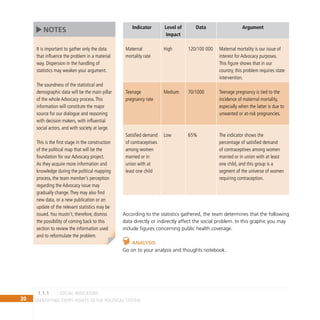
Indicator Level of
Impact
Data Argument
Maternal
mortality rate
High 120/100 000 Maternal mortality is our issue of
interest for Advocacy purposes.
This figure shows that in our
country, this problem requires state
intervention.
Teenage
pregnancy rate
Medium 70/1000 Teenage pregnancy is tied to the
incidence of maternal mortality,
especially when the latter is due to
unwanted or at-risk pregnancies.
Satisfied demand
of contraceptives
among women
married or in
union with at
least one child
Low 65% The indicator shows the
percentage of satisfied demand
of contraceptives among women
married or in union with at least
one child, and this group is a
segment of the universe of women
requiring contraception.
According to the statistics gathered, the team determines that the following
data directly or indirectly affect the social problem. In this graphic you may
include figures concerning public health coverage.
Analysis
Go on to your analysis and thoughts notebook.
It is important to gather only the data
that influence the problem in a material
way. Dispersion in the handling of
statistics may weaken your argument.
The soundness of the statistical and
demographic data will be the main pillar
of the whole Advocacy process.This
information will constitute the major
source for our dialogue and reasoning
with decision makers, with influential
social actors, and with society at large.
This is the first stage in the construction
of the political map that will be the
foundation for our Advocacy project.
As they acquire more information and
knowledge during the political mapping
process, the team member’s perception
regarding the Advocacy issue may
gradually change.They may also find
new data, or a new publication or an
update of the relevant statistics may be
issued.You mustn’t, therefore, dismiss
the possibility of coming back to this
section to review the information used
and to reformulate the problem.
NOTES
social indicators
1.1.1
21
IDENTIFYING ENTRY POINTS TO THE POLITICAL SYSTEM
SESSION 1.2. LEGAL FRAMEWORK
ACTIVITY BRIEF DESCRIPTION
Review of the legal
framework
Analyzing the legal instruments that regulate state
action in relation to the Advocacy issue. Mastering
these instruments to acquire a broad view of the rights
and guarantees established by the laws. Becoming
familiar with the hierarchical structure of the laws.
Analysis of the legal
framework
Analyzing the legal framework associated with the
Advocacy issue.Analyzing the appropriateness of
the legal framework and rating the degree to which
the laws force the state to ensure the exercise of the
various human and social rights. Identifying entry
points to the political system based on the legal
framework.
Objective
That the political mapping team acquire thorough knowledge of the
legal framework surrounding the issue of interest. In this way, you may
determine which legal instruments affect this issue or incorporate it into the
state policy. At the same time, the team will identify the instruments that
may serve as entry points to the political system. Analyzing the laws will
allow them both to map the government institutions that must enforce or
implement current legislation and to detect the legal instruments that may
be changed by means of an Advocacy process.
Central reflections
The law and legal systems are structures that have evolved along with
civilization as societies created rules for living together that have become
complex legal systems. Today there are at least two major legal systems
–one based on Continental or Civil Law, and one based on British or
Common Law. They correspond to two different state models, namely, the
1.2
legal framework
Computer
•
Internet access
•
All the national laws related to the
•
Advocacy issue
materials and
equipment for the
session
22 IDENTIFYING ENTRY POINTS TO THE POLITICAL SYSTEM
parliamentary system, on the one hand, and the semi-presidential and presidential systems on the other.
The difference between these legal systems influences social relations and determines the degree of state
intervention in private life.
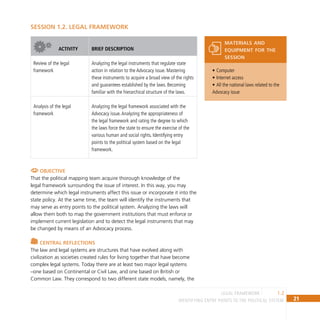
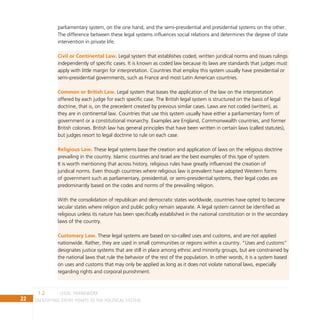
Civil or Continental Law. Legal system that establishes coded, written juridical norms and issues rulings
independently of specific cases. It is known as coded law because its laws are standards that judges must
apply with little margin for interpretation. Countries that employ this system usually have presidential or
semi-presidential governments, such as France and most Latin American countries.
Common or British Law. Legal system that bases the application of the law on the interpretation
offered by each judge for each specific case. The British legal system is structured on the basis of legal
doctrine, that is, on the precedent created by previous similar cases. Laws are not coded (written), as
they are in continental law. Countries that use this system usually have either a parliamentary form of
government or a constitutional monarchy. Examples are England, Commonwealth countries, and former
British colonies. British law has general principles that have been written in certain laws (called statutes),
but judges resort to legal doctrine to rule on each case.
Religious Law. These legal systems base the creation and application of laws on the religious doctrine
prevailing in the country. Islamic countries and Israel are the best examples of this type of system.
It is worth mentioning that across history, religious rules have greatly influenced the creation of
juridical norms. Even though countries where religious law is prevalent have adopted Western forms
of government such as parliamentary, presidential, or semi-presidential systems, their legal codes are
predominantly based on the codes and norms of the prevailing religion.
With the consolidation of republican and democratic states worldwide, countries have opted to become
secular states where religion and public policy remain separate. A legal system cannot be identified as
religious unless its nature has been specifically established in the national constitution or in the secondary
laws of the country.
Customary Law. These legal systems are based on so-called uses and customs, and are not applied
nationwide. Rather, they are used in small communities or regions within a country. “Uses and customs”
designates justice systems that are still in place among ethnic and minority groups, but are constrained by
the national laws that rule the behavior of the rest of the population. In other words, it is a system based
on uses and customs that may only be applied as long as it does not violate national laws, especially
regarding rights and corporal punishment.
legal framework
1.2
23
IDENTIFYING ENTRY POINTS TO THE POLITICAL SYSTEM
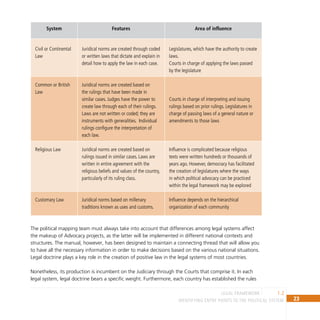
System Features Area of influence
Civil or Continental
Law
Juridical norms are created through coded
or written laws that dictate and explain in
detail how to apply the law in each case.
Legislatures, which have the authority to create
laws.
Courts in charge of applying the laws passed
by the legislature
Common or British
Law
Juridical norms are created based on
the rulings that have been made in
similar cases. Judges have the power to
create law through each of their rulings.
Laws are not written or coded; they are
instruments with generalities. Individual
rulings configure the interpretation of
each law.
Courts in charge of interpreting and issuing
rulings based on prior rulings. Legislatures in
charge of passing laws of a general nature or
amendments to those laws
Religious Law Juridical norms are created based on
rulings issued in similar cases. Laws are
written in entire agreement with the
religious beliefs and values of the country,
particularly of its ruling class.
Influence is complicated because religious
texts were written hundreds or thousands of
years ago. However, democracy has facilitated
the creation of legislatures where the ways
in which political advocacy can be practiced
within the legal framework may be explored
Customary Law Juridical norms based on millenary
traditions known as uses and customs.
Influence depends on the hierarchical
organization of each community
The political mapping team must always take into account that differences among legal systems affect
the makeup of Advocacy projects, as the latter will be implemented in different national contexts and
structures. The manual, however, has been designed to maintain a connecting thread that will allow you
to have all the necessary information in order to make decisions based on the various national situations.
Legal doctrine plays a key role in the creation of positive law in the legal systems of most countries.
Nonetheless, its production is incumbent on the Judiciary through the Courts that comprise it. In each
legal system, legal doctrine bears a specific weight. Furthermore, each country has established the rules
1.2
legal framework
24 IDENTIFYING ENTRY POINTS TO THE POLITICAL SYSTEM
to apply and interpret it. Our analysis of our country’s legislation must inevitably resort to this source of
law. Consequently, we have included an exercise in this session to complement the legal map associated
with the Advocacy issue.
addressed Topics
Legal structure, legal framework, legal doctrine, and ranking and analysis of the laws.
ACTIVITY 1.2.1. Study of the Legal Framework
Preliminary Work
In most cases it is easy to access current juridical norms on line. You may even find national laws in world
(continental, regional) legal databases, for instance, Political Database of the Americas:
http://pdba.georgetown.edu/.
If you cannot access all the necessary documents for this section on line, you should find alternative
sources. Some possibilities are congressional or parliamentary libraries, or the libraries of universities and
legal research institutes.
Expected outcomes
A table with the legal instruments associated with the Advocacy issue. This should include all the
articles that directly or indirectly address or regulate this issue, with emphasis on the human, social, and
economic rights surrounding it.
Steps to take (Use addendum 1.2.1 A.)
Check the type of national
01 legal system:
Common Law.
•
Civil Law.
•
Religious Law
•
Hybrid System (establish)
•
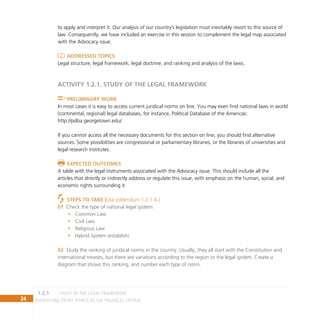
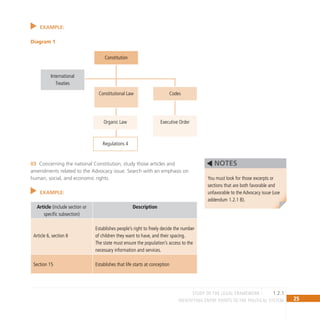
Study the ranking of juridical norms in the country. Usually, they all start with the Constitution and
02
international treaties, but there are variations according to the region or the legal system. Create a
diagram that shows this ranking, and number each type of norm.
Study of the Legal Framework
1.2.1
25
IDENTIFYING ENTRY POINTS TO THE POLITICAL SYSTEM
EXAMPLE:
Diagram 1
Concerning the national Constitution, study those articles and
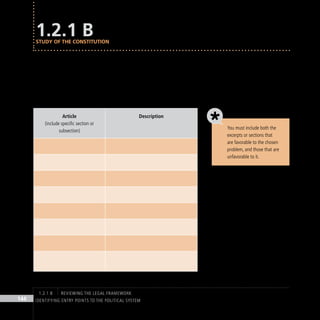
03
amendments related to the Advocacy issue. Search with an emphasis on
human, social, and economic rights.
EXAMPLE:
Article (include section or
specific subsection)
Description
Article 6, section II
Establishes people’s right to freely decide the number
of children they want to have, and their spacing.
The state must ensure the population’s access to the
necessary information and services.
Section 15 Establishes that life starts at conception
You must look for those excerpts or
sections that are both favorable and
unfavorable to the Advocacy issue (use
addendum 1.2.1 B).
NOTES
Constitutional Law
International
Treaties
Organic Law
Regulations 4
Executive Order
Constitution
Codes
1.2.1
Study of the Legal Framework
26 IDENTIFYING ENTRY POINTS TO THE POLITICAL SYSTEM
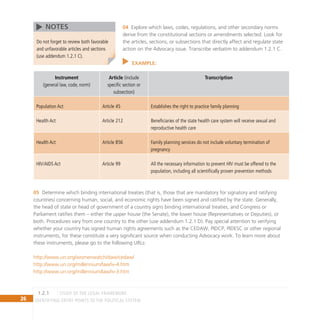
Explore which laws, codes, regulations, and other secondary norms
04
derive from the constitutional sections or amendments selected. Look for
the articles, sections, or subsections that directly affect and regulate state
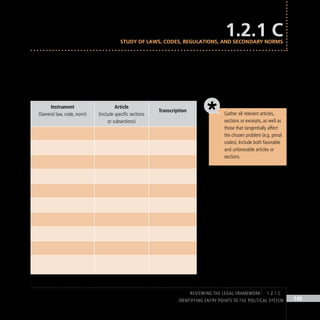
action on the Advocacy issue. Transcribe verbatim to addendum 1.2.1 C.
EXAMPLE:
Instrument
(general law, code, norm)
Article (include
specific section or
subsection)
Transcription
Population Act Article 45 Establishes the right to practice family planning
Health Act Article 212 Beneficiaries of the state health care system will receive sexual and
reproductive health care
Health Act Article 856 Family planning services do not include voluntary termination of
pregnancy
HIV/AIDS Act Article 99 All the necessary information to prevent HIV must be offered to the
population, including all scientifically proven prevention methods
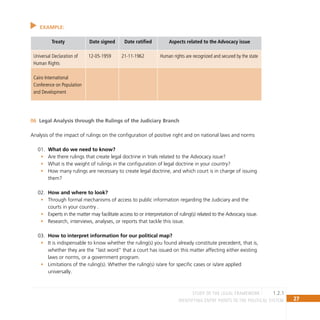
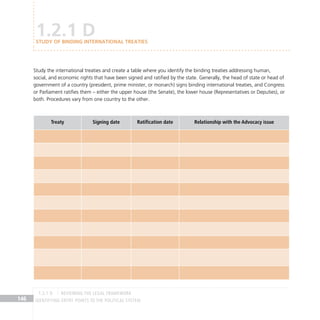
Determine which binding international treaties (that is, those that are mandatory for signatory and ratifying
05
countries) concerning human, social, and economic rights have been signed and ratified by the state. Generally,
the head of state or head of government of a country signs binding international treaties, and Congress or
Parliament ratifies them – either the upper house (the Senate), the lower house (Representatives or Deputies), or
both. Procedures vary from one country to the other (use addendum 1.2.1 D). Pay special attention to verifying
whether your country has signed human rights agreements such as the CEDAW, PIDCP, PIDESC or other regional
instruments, for these constitute a very significant source when conducting Advocacy work. To learn more about
these instruments, please go to the following URLs:
http://www.un.org/womenwatch/daw/cedaw/
http://www.un.org/millennium/law/iv-4.htm
http://www.un.org/millennium/law/iv-3.htm
Do not forget to review both favorable
and unfavorable articles and sections
(use addendum 1.2.1 C).
NOTES
Study of the Legal Framework
1.2.1
27
IDENTIFYING ENTRY POINTS TO THE POLITICAL SYSTEM
EXAMPLE:
Treaty Date signed Date ratified Aspects related to the Advocacy issue
Universal Declaration of
Human Rights
12-05-1959 21-11-1962 Human rights are recognized and secured by the state
Cairo International
Conference on Population
and Development
Legal Analysis through the Rulings of the Judiciary Branch
06
Analysis of the impact of rulings on the configuration of positive right and on national laws and norms
What do we need to know?
01.
Are there rulings that create legal doctrine in trials related to the Advocacy issue?
•
What is the weight of rulings in the configuration of legal doctrine in your country?
•
How many rulings are necessary to create legal doctrine, and which court is in charge of issuing
•
them?
How and where to look?
02.
Through formal mechanisms of access to public information regarding the Judiciary and the
•
courts in your country .
Experts in the matter may facilitate access to or interpretation of ruling(s) related to the Advocacy issue.
•
Research, interviews, analyses, or reports that tackle this issue.
•
How to interpret information for our political map?
03.
It is indispensable to know whether the ruling(s) you found already constitute precedent, that is,
•
whether they are the “last word” that a court has issued on this matter affecting either existing
laws or norms, or a government program.
Limitations of the ruling(s). Whether the ruling(s) is/are for specific cases or is/are applied
•
universally.
1.2.1
Study of the Legal Framework
28 IDENTIFYING ENTRY POINTS TO THE POLITICAL SYSTEM
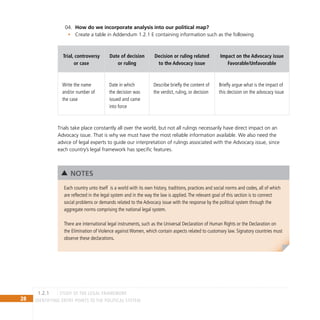
How do we incorporate analysis into our political map?
04.
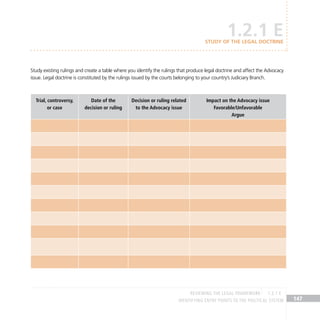
Create a table in Addendum 1.2.1 E containing information such as the following
•
Trial, controversy
or case
Date of decision
or ruling
Decision or ruling related
to the Advocacy issue
Impact on the Advocacy issue
Favorable/Unfavorable
Write the name
and/or number of
the case
Date in which
the decision was
issued and came
into force
Describe briefly the content of
the verdict, ruling, or decision
Briefly argue what is the impact of
this decision on the advocacy issue
Trials take place constantly all over the world, but not all rulings necessarily have direct impact on an
Advocacy issue. That is why we must have the most reliable information available. We also need the
advice of legal experts to guide our interpretation of rulings associated with the Advocacy issue, since
each country’s legal framework has specific features.
Study of the Legal Framework
1.2.1
Each country unto itself is a world with its own history, traditions, practices and social norms and codes, all of which
are reflected in the legal system and in the way the law is applied.The relevant goal of this section is to connect
social problems or demands related to the Advocacy issue with the response by the political system through the
aggregate norms comprising the national legal system.
There are international legal instruments, such as the Universal Declaration of Human Rights or the Declaration on
the Elimination of Violence against Women, which contain aspects related to customary law. Signatory countries must
observe these declarations.
NOTES
29
IDENTIFYING ENTRY POINTS TO THE POLITICAL SYSTEM
ACTIVITY 1.2.2. Analysis of the Legal Framework
Preliminary Work
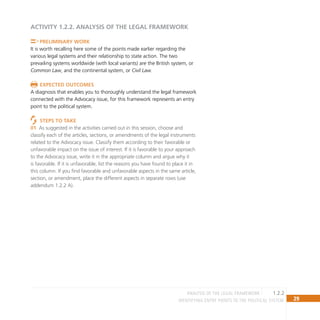
It is worth recalling here some of the points made earlier regarding the
various legal systems and their relationship to state action. The two
prevailing systems worldwide (with local variants) are the British system, or
Common Law, and the continental system, or Civil Law.
Expected outcomes
A diagnosis that enables you to thoroughly understand the legal framework
connected with the Advocacy issue, for this framework represents an entry
point to the political system.
Steps to take
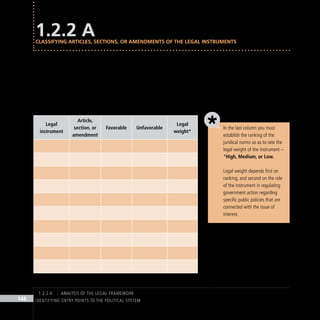
As suggested in the activities carried out in this session, choose and
01
classify each of the articles, sections, or amendments of the legal instruments
related to the Advocacy issue. Classify them according to their favorable or
unfavorable impact on the issue of interest. If it is favorable to your approach
to the Advocacy issue, write it in the appropriate column and argue why it
is favorable. If it is unfavorable, list the reasons you have found to place it in
this column. If you find favorable and unfavorable aspects in the same article,
section, or amendment, place the different aspects in separate rows (use
addendum 1.2.2 A).
1.2.2
Analysis of the Legal Framework
30 IDENTIFYING ENTRY POINTS TO THE POLITICAL SYSTEM
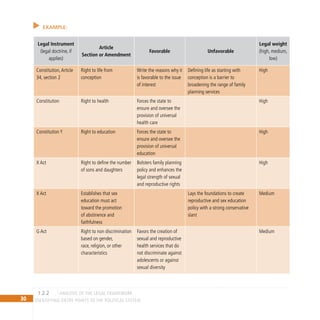
EXAMPLE:
Legal Instrument
(legal doctrine, if
applies)
Article
Section or Amendment
Favorable Unfavorable
Legal weight
(high, medium,
low)
Constitution,Article
34, section 2
Right to life from
conception
Write the reasons why it
is favorable to the issue
of interest
Defining life as starting with
conception is a barrier to
broadening the range of family
planning services
High
Constitution Right to health Forces the state to
ensure and oversee the
provision of universal
health care
High
Constitution Y Right to education Forces the state to
ensure and oversee the
provision of universal
education
High
X Act Right to define the number
of sons and daughters
Bolsters family planning
policy and enhances the
legal strength of sexual
and reproductive rights
High
X Act Establishes that sex
education must act
toward the promotion
of abstinence and
faithfulness
Lays the foundations to create
reproductive and sex education
policy with a strong conservative
slant
Medium
G Act Right to non discrimination
based on gender,
race, religion, or other
characteristics
Favors the creation of
sexual and reproductive
health services that do
not discriminate against
adolescents or against
sexual diversity
Medium
Analysis of the Legal Framework
1.2.2
31
IDENTIFYING ENTRY POINTS TO THE POLITICAL SYSTEM
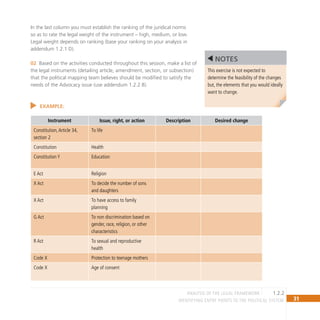
In the last column you must establish the ranking of the juridical norms
so as to rate the legal weight of the instrument – high, medium, or low.
Legal weight depends on ranking (base your ranking on your analysis in
addendum 1.2.1 D).
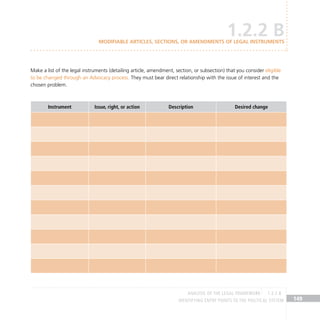
Based on the activities conducted throughout this session, make a list of
02
the legal instruments (detailing article, amendment, section, or subsection)
that the political mapping team believes should be modified to satisfy the
needs of the Advocacy issue (use addendum 1.2.2 B).
EXAMPLE:
Instrument Issue, right, or action Description Desired change
Constitution,Article 34,
section 2
To life
Constitution Health
Constitution Y Education
E Act Religion
X Act To decide the number of sons
and daughters
X Act To have access to family
planning
G Act To non discrimination based on
gender, race, religion, or other
characteristics
R Act To sexual and reproductive
health
Code X Protection to teenage mothers
Code X Age of consent
This exercise is not expected to
determine the feasibility of the changes
but, the elements that you would ideally
want to change.
NOTES
1.2.2
Analysis of the Legal Framework
32 IDENTIFYING ENTRY POINTS TO THE POLITICAL SYSTEM
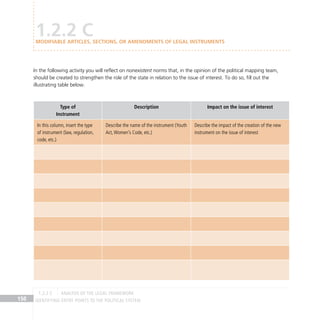
So far, we have worked with existing instruments that are currently in force. Yet the creation of new
03
juridical norms is part of the political process worldwide, for these norms fulfill new social demands or
needs. In the following activity, you will reflect on nonexistent norms that the political mapping team
considers should be created in order to strengthen the role of the state in relation to the issue of interest.
To do so, fill out the illustrating table below (use addendum 1.2.2 C).
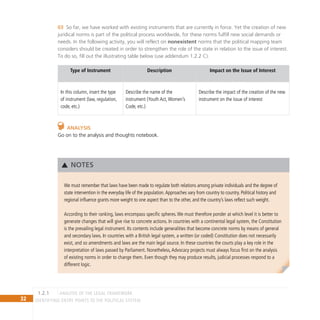
Type of Instrument Description Impact on the Issue of Interest
In this column, insert the type
of instrument (law, regulation,
code, etc.)
Describe the name of the
instrument (Youth Act,Women’s
Code, etc.)
Describe the impact of the creation of the new
instrument on the issue of interest
Analysis
Go on to the analysis and thoughts notebook.
We must remember that laws have been made to regulate both relations among private individuals and the degree of
state intervention in the everyday life of the population.Approaches vary from country to country. Political history and
regional influence grants more weight to one aspect than to the other, and the country’s laws reflect such weight.
According to their ranking, laws encompass specific spheres.We must therefore ponder at which level it is better to
generate changes that will give rise to concrete actions. In countries with a continental legal system, the Constitution
is the prevailing legal instrument. Its contents include generalities that become concrete norms by means of general
and secondary laws. In countries with a British legal system, a written (or coded) Constitution does not necessarily
exist, and so amendments and laws are the main legal source. In these countries the courts play a key role in the
interpretation of laws passed by Parliament. Nonetheless,Advocacy projects must always focus first on the analysis
of existing norms in order to change them. Even though they may produce results, judicial processes respond to a
different logic.
NOTES
Analysis of the Legal Framework
1.2.1
33
IDENTIFYING ENTRY POINTS TO THE POLITICAL SYSTEM
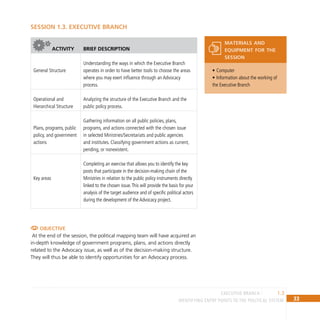
SESSION 1.3. EXECUTIVE BRANCH
ACTIVITY BRIEF DESCRIPTION
General Structure
Understanding the ways in which the Executive Branch
operates in order to have better tools to choose the areas
where you may exert influence through an Advocacy
process.
Operational and
Hierarchical Structure
Analyzing the structure of the Executive Branch and the
public policy process.
Plans, programs, public
policy, and government
actions
Gathering information on all public policies, plans,
programs, and actions connected with the chosen issue
in selected Ministries/Secretariats and public agencies
and institutes. Classifying government actions as current,
pending, or nonexistent.
Key areas
Completing an exercise that allows you to identify the key
posts that participate in the decision-making chain of the
Ministries in relation to the public policy instruments directly
linked to the chosen issue.This will provide the basis for your
analysis of the target audience and of specific political actors
during the development of the Advocacy project.
Objective
At the end of the session, the political mapping team will have acquired an
in-depth knowledge of government programs, plans, and actions directly
related to the Advocacy issue, as well as of the decision-making structure.
They will thus be able to identify opportunities for an Advocacy process.
1.3
EXECUTIVE BRANCH
Computer
•
Information about the working of
•
the Executive Branch
materials and
equipment for the
session
34 IDENTIFYING ENTRY POINTS TO THE POLITICAL SYSTEM
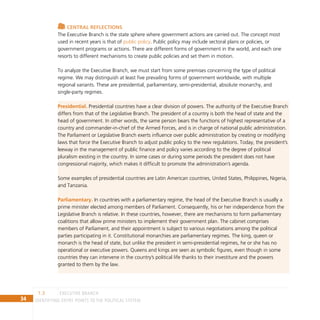
Central Reflections
The Executive Branch is the state sphere where government actions are carried out. The concept most
used in recent years is that of public policy. Public policy may include sectoral plans or policies, or
government programs or actions. There are different forms of government in the world, and each one
resorts to different mechanisms to create public policies and set them in motion.
To analyze the Executive Branch, we must start from some premises concerning the type of political
regime. We may distinguish at least five prevailing forms of government worldwide, with multiple
regional variants. These are presidential, parliamentary, semi-presidential, absolute monarchy, and
single-party regimes.
Presidential. Presidential countries have a clear division of powers. The authority of the Executive Branch
differs from that of the Legislative Branch. The president of a country is both the head of state and the
head of government. In other words, the same person bears the functions of highest representative of a
country and commander-in-chief of the Armed Forces, and is in charge of national public administration.
The Parliament or Legislative Branch exerts influence over public administration by creating or modifying
laws that force the Executive Branch to adjust public policy to the new regulations. Today, the president’s
leeway in the management of public finance and policy varies according to the degree of political
pluralism existing in the country. In some cases or during some periods the president does not have
congressional majority, which makes it difficult to promote the administration’s agenda.
Some examples of presidential countries are Latin American countries, United States, Philippines, Nigeria,
and Tanzania.
Parliamentary. In countries with a parliamentary regime, the head of the Executive Branch is usually a
prime minister elected among members of Parliament. Consequently, his or her independence from the
Legislative Branch is relative. In these countries, however, there are mechanisms to form parliamentary
coalitions that allow prime ministers to implement their government plan. The cabinet comprises
members of Parliament, and their appointment is subject to various negotiations among the political
parties participating in it. Constitutional monarchies are parliamentary regimes. The king, queen or
monarch is the head of state, but unlike the president in semi-presidential regimes, he or she has no
operational or executive powers. Queens and kings are seen as symbolic figures, even though in some
countries they can intervene in the country’s political life thanks to their investiture and the powers
granted to them by the law.
EXECUTIVE BRANCH
1.3
35
IDENTIFYING ENTRY POINTS TO THE POLITICAL SYSTEM
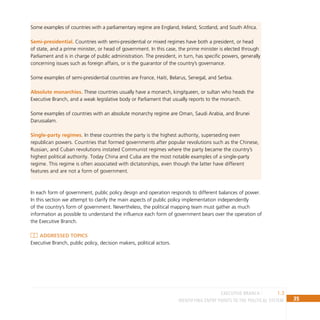
Some examples of countries with a parliamentary regime are England, Ireland, Scotland, and South Africa.
Semi-presidential. Countries with semi-presidential or mixed regimes have both a president, or head
of state, and a prime minister, or head of government. In this case, the prime minister is elected through
Parliament and is in charge of public administration. The president, in turn, has specific powers, generally
concerning issues such as foreign affairs, or is the guarantor of the country’s governance.
Some examples of semi-presidential countries are France, Haiti, Belarus, Senegal, and Serbia.
Absolute monarchies. These countries usually have a monarch, king/queen, or sultan who heads the
Executive Branch, and a weak legislative body or Parliament that usually reports to the monarch.
Some examples of countries with an absolute monarchy regime are Oman, Saudi Arabia, and Brunei
Darussalam.
Single-party regimes. In these countries the party is the highest authority, superseding even
republican powers. Countries that formed governments after popular revolutions such as the Chinese,
Russian, and Cuban revolutions instated Communist regimes where the party became the country’s
highest political authority. Today China and Cuba are the most notable examples of a single-party
regime. This regime is often associated with dictatorships, even though the latter have different
features and are not a form of government.
In each form of government, public policy design and operation responds to different balances of power.
In this section we attempt to clarify the main aspects of public policy implementation independently
of the country’s form of government. Nevertheless, the political mapping team must gather as much
information as possible to understand the influence each form of government bears over the operation of
the Executive Branch.
Addressed topics
Executive Branch, public policy, decision makers, political actors.
1.3
EXECUTIVE BRANCH
36 IDENTIFYING ENTRY POINTS TO THE POLITICAL SYSTEM
ACTIVITY 1.3.1. GENERAL STRUCTURE
Preliminary Work
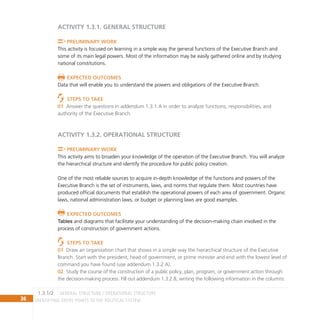
This activity is focused on learning in a simple way the general functions of the Executive Branch and
some of its main legal powers. Most of the information may be easily gathered online and by studying
national constitutions.
Expected Outcomes
Data that will enable you to understand the powers and obligations of the Executive Branch.
Steps to take
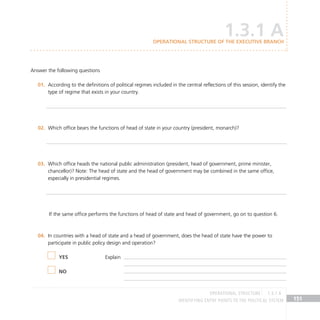
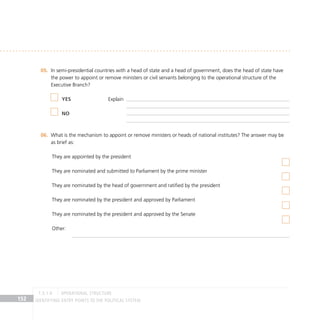
Answer the questions in addendum 1.3.1 A in order to analyze functions, responsibilities, and
01
authority of the Executive Branch.
ACTIVITY 1.3.2. OPERATIONAL STRUCTURE
Preliminary Work
This activity aims to broaden your knowledge of the operation of the Executive Branch. You will analyze
the hierarchical structure and identify the procedure for public policy creation.
One of the most reliable sources to acquire in-depth knowledge of the functions and powers of the
Executive Branch is the set of instruments, laws, and norms that regulate them. Most countries have
produced official documents that establish the operational powers of each area of government. Organic
laws, national administration laws, or budget or planning laws are good examples.
Expected Outcomes
Tables and diagrams that facilitate your understanding of the decision-making chain involved in the
process of construction of government actions.
Steps to Take
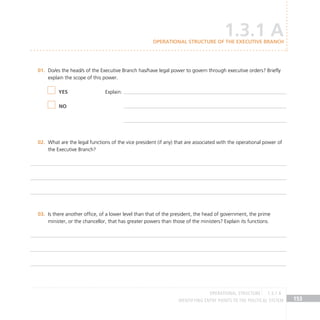
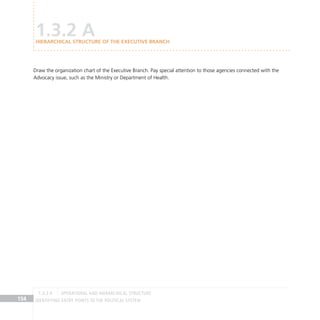
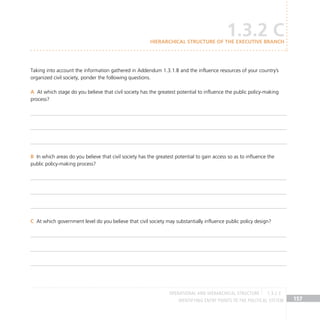
Draw an organization chart that shows in a simple way the hierarchical structure of the Executive
01
Branch. Start with the president, head of government, or prime minister and end with the lowest level of
command you have found (use addendum 1.3.2 A).
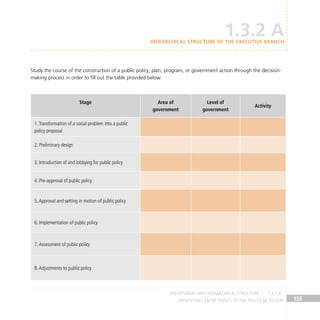
Study the course of the construction of a public policy, plan, program, or government action through
02
the decision-making process. Fill out addendum 1.3.2 B, writing the following information in the columns:
GENERAL structure / operational structure
1.3.1/2
37
IDENTIFYING ENTRY POINTS TO THE POLITICAL SYSTEM
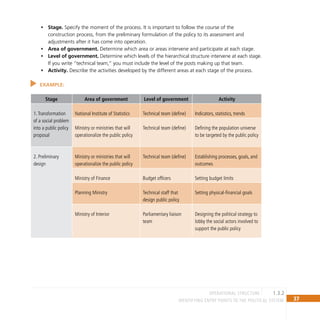
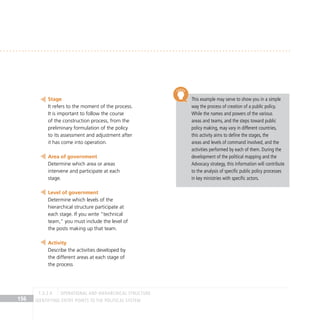
Stage.
• Specify the moment of the process. It is important to follow the course of the
construction process, from the preliminary formulation of the policy to its assessment and
adjustments after it has come into operation.
Area of government.
• Determine which area or areas intervene and participate at each stage.
Level of government.
• Determine which levels of the hierarchical structure intervene at each stage.
If you write “technical team,” you must include the level of the posts making up that team.
Activity.
• Describe the activities developed by the different areas at each stage of the process.
EXAMPLE:
Stage Area of government Level of government Activity
1.Transformation
of a social problem
into a public policy
proposal
National Institute of Statistics Technical team (define) Indicators, statistics, trends
Ministry or ministries that will
operationalize the public policy
Technical team (define) Defining the population universe
to be targeted by the public policy
2. Preliminary
design
Ministry or ministries that will
operationalize the public policy
Technical team (define) Establishing processes, goals, and
outcomes
Ministry of Finance Budget officers Setting budget limits
Planning Ministry Technical staff that
design public policy
Setting physical-financial goals
Ministry of Interior Parliamentary liaison
team
Designing the political strategy to
lobby the social actors involved to
support the public policy
1.3.2
operational structure
38 IDENTIFYING ENTRY POINTS TO THE POLITICAL SYSTEM
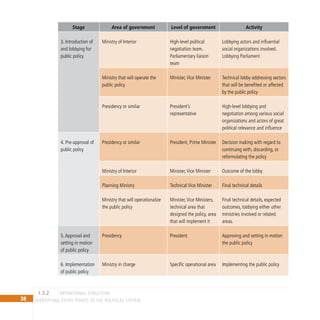
Stage Area of government Level of government Activity
3. Introduction of
and lobbying for
public policy
Ministry of Interior High-level political
negotiation team.
Parliamentary liaison
team
Lobbying actors and influential
social organizations involved.
Lobbying Parliament
Ministry that will operate the
public policy
Minister,Vice Minister Technical lobby addressing sectors
that will be benefited or affected
by the public policy
Presidency or similar President’s
representative
High-level lobbying and
negotiation among various social
organizations and actors of great
political relevance and influence
4. Pre-approval of
public policy
Presidency or similar President, Prime Minister Decision making with regard to
continuing with, discarding, or
reformulating the policy
Ministry of Interior Minister,Vice Minister Outcome of the lobby
Planning Ministry Technical Vice Minister Final technical details
Ministry that will operationalize
the public policy
Minister,Vice Ministers,
technical area that
designed the policy, area
that will implement it
Final technical details, expected
outcomes, lobbying either other
ministries involved or related
areas.
5.Approval and
setting in motion
of public policy
Presidency President Approving and setting in motion
the public policy
6. Implementation
of public policy
Ministry in charge Specific operational area Implementing the public policy
operational structure
1.3.2
39
IDENTIFYING ENTRY POINTS TO THE POLITICAL SYSTEM
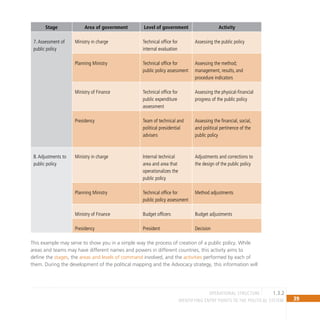
Stage Area of government Level of government Activity
7.Assessment of
public policy
Ministry in charge Technical office for
internal evaluation
Assessing the public policy
Planning Ministry Technical office for
public policy assessment
Assessing the method;
management, results, and
procedure indicators
Ministry of Finance Technical office for
public expenditure
assessment
Assessing the physical-financial
progress of the public policy
Presidency Team of technical and
political presidential
advisers
Assessing the financial, social,
and political pertinence of the
public policy
8.Adjustments to
public policy
Ministry in charge Internal technical
area and area that
operationalizes the
public policy
Adjustments and corrections to
the design of the public policy
Planning Ministry Technical office for
public policy assessment
Method adjustments
Ministry of Finance Budget officers Budget adjustments
Presidency President Decision
This example may serve to show you in a simple way the process of creation of a public policy. While
areas and teams may have different names and powers in different countries, this activity aims to
define the stages, the areas and levels of command involved, and the activities performed by each of
them. During the development of the political mapping and the Advocacy strategy, this information will
1.3.2
operational structure
40 IDENTIFYING ENTRY POINTS TO THE POLITICAL SYSTEM
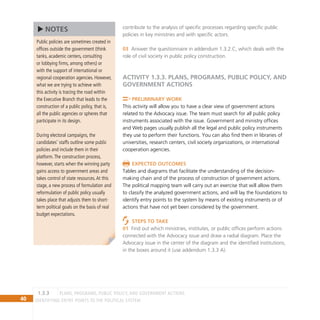
contribute to the analysis of specific processes regarding specific public
policies in key ministries and with specific actors.
Answer the questionnaire in addendum 1.3.2.C, which deals with the
03
role of civil society in public policy construction.
ACTIVITY 1.3.3. Plans, Programs, Public Policy, and
Government Actions
Preliminary Work
This activity will allow you to have a clear view of government actions
related to the Advocacy issue. The team must search for all public policy
instruments associated with the issue. Government and ministry offices
and Web pages usually publish all the legal and public policy instruments
they use to perform their functions. You can also find them in libraries of
universities, research centers, civil society organizations, or international
cooperation agencies.
Expected Outcomes
Tables and diagrams that facilitate the understanding of the decision-
making chain and of the process of construction of government actions.
The political mapping team will carry out an exercise that will allow them
to classify the analyzed government actions, and will lay the foundations to
identify entry points to the system by means of existing instruments or of
actions that have not yet been considered by the government.
Steps to Take
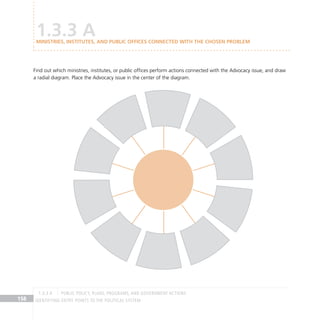
Find out which ministries, institutes, or public offices perform actions
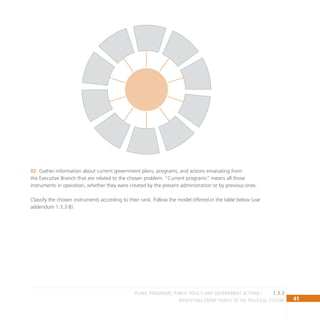
01
connected with the Advocacy issue and draw a radial diagram. Place the
Advocacy issue in the center of the diagram and the identified institutions,
in the boxes around it (use addendum 1.3.3 A).
Public policies are sometimes created in
offices outside the government (think
tanks, academic centers, consulting
or lobbying firms, among others) or
with the support of international or
regional cooperation agencies. However,
what we are trying to achieve with
this activity is tracing the road within
the Executive Branch that leads to the
construction of a public policy, that is,
all the public agencies or spheres that
participate in its design.
During electoral campaigns, the
candidates’ staffs outline some public
policies and include them in their
platform.The construction process,
however, starts when the winning party
gains access to government areas and
takes control of state resources.At this
stage, a new process of formulation and
reformulation of public policy usually
takes place that adjusts them to short-
term political goals on the basis of real
budget expectations.
NOTES
Plans, Programs, Public Policy, and Government Actions
1.3.3
41
IDENTIFYING ENTRY POINTS TO THE POLITICAL SYSTEM
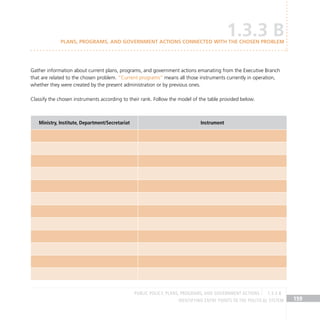
Gather information about current government plans, programs, and actions emanating from
02
the Executive Branch that are related to the chosen problem. “Current programs” means all those
instruments in operation, whether they were created by the present administration or by previous ones.
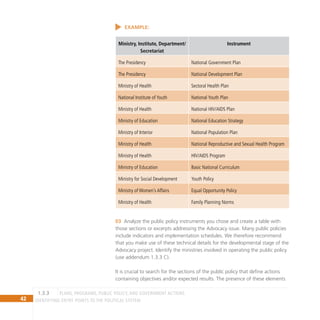
Classify the chosen instruments according to their rank. Follow the model offered in the table below (use
addendum 1.3.3 B).
1.3.3
Plans, Programs, Public Policy, and Government Actions
42 IDENTIFYING ENTRY POINTS TO THE POLITICAL SYSTEM
EXAMPLE:
Ministry, Institute, Department/
Secretariat
Instrument
The Presidency National Government Plan
The Presidency National Development Plan
Ministry of Health Sectoral Health Plan
National Institute of Youth National Youth Plan
Ministry of Health National HIV/AIDS Plan
Ministry of Education National Education Strategy
Ministry of Interior National Population Plan
Ministry of Health National Reproductive and Sexual Health Program
Ministry of Health HIV/AIDS Program
Ministry of Education Basic National Curriculum
Ministry for Social Development Youth Policy
Ministry of Women’s Affairs Equal Opportunity Policy
Ministry of Health Family Planning Norms
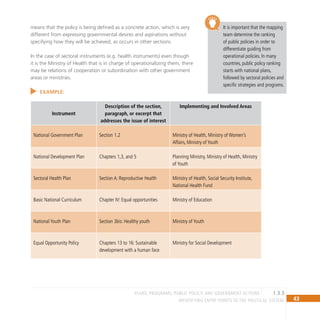
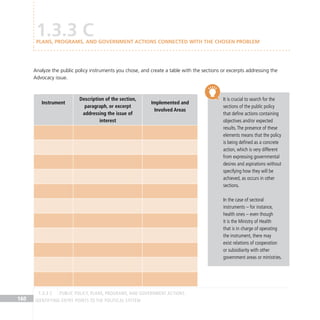
Analyze the public policy instruments you chose and create a table with
03
those sections or excerpts addressing the Advocacy issue. Many public policies
include indicators and implementation schedules. We therefore recommend
that you make use of these technical details for the developmental stage of the
Advocacy project. Identify the ministries involved in operating the public policy
(use addendum 1.3.3 C).
It is crucial to search for the sections of the public policy that define actions
containing objectives and/or expected results. The presence of these elements
Plans, Programs, Public Policy, and Government Actions
1.3.3
43
IDENTIFYING ENTRY POINTS TO THE POLITICAL SYSTEM
means that the policy is being defined as a concrete action, which is very
different from expressing governmental desires and aspirations without
specifying how they will be achieved, as occurs in other sections.
In the case of sectoral instruments (e.g. health instruments) even though
it is the Ministry of Health that is in charge of operationalizing them, there
may be relations of cooperation or subordination with other government
areas or ministries.
EXAMPLE:
Instrument
Description of the section,
paragraph, or excerpt that
addresses the issue of interest
Implementing and Involved Areas
National Government Plan Section 1.2 Ministry of Health, Ministry of Women’s
Affairs, Ministry of Youth
National Development Plan Chapters 1,3, and 5 Planning Ministry, Ministry of Health, Ministry
of Youth
Sectoral Health Plan Section A: Reproductive Health Ministry of Health, Social Security Institute,
National Health Fund
Basic National Curriculum Chapter IV: Equal opportunities Ministry of Education
National Youth Plan Section 3bis: Healthy youth Ministry of Youth
Equal Opportunity Policy Chapters 13 to 16: Sustainable
development with a human face
Ministry for Social Development
It is important that the mapping
team determine the ranking
of public policies in order to
differentiate guiding from
operational policies. In many
countries, public policy ranking
starts with national plans,
followed by sectoral policies and
specific strategies and programs.
1.3.3
Plans, Programs, Public Policy, and Government Actions
44 IDENTIFYING ENTRY POINTS TO THE POLITICAL SYSTEM
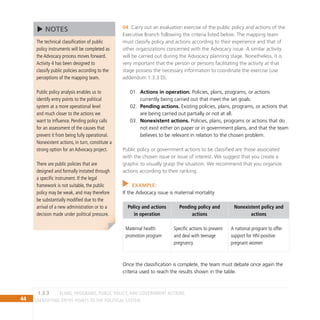
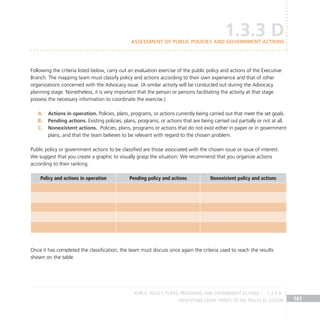
Carry out an evaluation exercise of the public policy and actions of the
04
Executive Branch following the criteria listed below. The mapping team
must classify policy and actions according to their experience and that of
other organizations concerned with the Advocacy issue. A similar activity
will be carried out during the Advocacy planning stage. Nonetheless, it is
very important that the person or persons facilitating the activity at that
stage possess the necessary information to coordinate the exercise (use
addendum 1.3.3 D).
Actions in operation.
01. Policies, plans, programs, or actions
currently being carried out that meet the set goals.
Pending actions.
02. Existing policies, plans, programs, or actions that
are being carried out partially or not at all.
Nonexistent actions.
03. Policies, plans, programs or actions that do
not exist either on paper or in government plans, and that the team
believes to be relevant in relation to the chosen problem.
Public policy or government actions to be classified are those associated
with the chosen issue or issue of interest. We suggest that you create a
graphic to visually grasp the situation. We recommend that you organize
actions according to their ranking.
EXAMPLE:
If the Advocacy issue is maternal mortality
Policy and actions
in operation
Pending policy and
actions
Nonexistent policy and
actions
Maternal health
promotion program
Specific actions to prevent
and deal with teenage
pregnancy
A national program to offer
support for HIV-positive
pregnant women
Once the classification is complete, the team must debate once again the
criteria used to reach the results shown in the table.
Plans, Programs, Public Policy, and Government Actions
1.3.3
The technical classification of public
policy instruments will be completed as
the Advocacy process moves forward.
Activity 4 has been designed to
classify public policies according to the
perceptions of the mapping team.
Public policy analysis enables us to
identify entry points to the political
system at a more operational level
and much closer to the actions we
want to influence. Pending policy calls
for an assessment of the causes that
prevent it from being fully operational.
Nonexistent actions, in turn, constitute a
strong option for an Advocacy project.
There are public policies that are
designed and formally instated through
a specific instrument. If the legal
framework is not suitable, the public
policy may be weak, and may therefore
be substantially modified due to the
arrival of a new administration or to a
decision made under political pressure.
NOTES
45
IDENTIFYING ENTRY POINTS TO THE POLITICAL SYSTEM
ACTIVITY 1.3.4. KEY AREAS
Preliminary Work
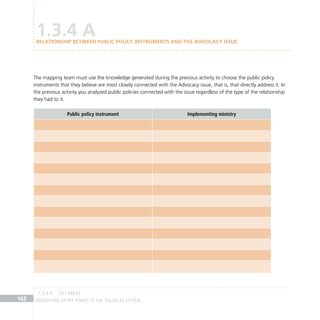
The mapping team must use the knowledge generated during the previous activity to choose the public
policy instruments that they believe are most closely connected with the Advocacy issue. Once the
instruments have been chosen, the team must carry out a thorough inquiry among the people who have
in-depth knowledge of the operation of each chosen ministry. Interviews with people who work at the
ministries are highly recommended. The higher the level of the person interviewed, the more reliable the
information you may get regarding both the posts participating in public policy operation and the type
and magnitude of the resources each position may use to influence policy development. At the same
time, it is advisable that you have access to the ministries’ functions and procedures manuals, because
they detail the specific legal powers of each position.
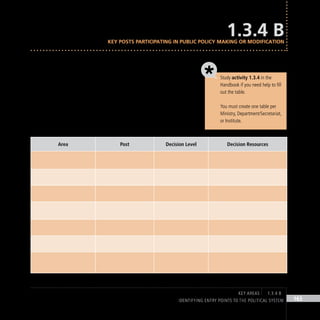
Expected Outcomes
Table containing specific information about the powers and resources of each post intervening in the
decision-making process of the chosen public policies
Steps to Take
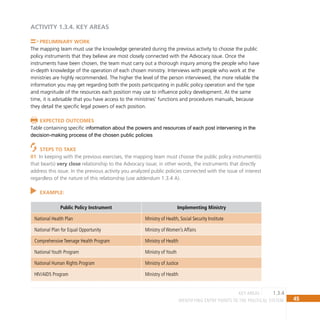
In keeping with the previous exercises, the mapping team must choose the public policy instrument(s)
01
that bear(s) very close relationship to the Advocacy issue; in other words, the instruments that directly
address this issue. In the previous activity you analyzed public policies connected with the issue of interest
regardless of the nature of this relationship (use addendum 1.3.4 A).
EXAMPLE:
Public Policy Instrument Implementing Ministry
National Health Plan Ministry of Health, Social Security Institute
National Plan for Equal Opportunity Ministry of Women’s Affairs
Comprehensive Teenage Health Program Ministry of Health
National Youth Program Ministry of Youth
National Human Rights Program Ministry of Justice
HIV/AIDS Program Ministry of Health
1.3.4
key Areas
46 IDENTIFYING ENTRY POINTS TO THE POLITICAL SYSTEM
The mapping team will analyze the instrument(s) chosen and will use it/
02
them to identify the key posts participating in the decision-making process for
the construction, modification, or adjustment of public policy. In this section
the team must choose posts belonging to the ministries. In this activity you do
not need to include the names of the people holding these posts.
External advisers (who do not belong to the structure of a ministry) must be
analyzed in Section 3. Key Actors. In that section, analysis will be based
on the groups that occupy the posts at the time of the activity and on the
groups and individuals that bear influence over the decision-making process
(use addendum 1.3.4 B).
EXAMPLE:
Area Post Decision Level Decision Resources
Office of the Ministry of
Health
Minister Top management Political, technical, financial,
human, material
Vice Ministry of Health Vice Minister Top management Political, technical, financial,
material
Office of Operations and
Programs
Director General of Operations Senior
management
Technical, operational,
financial, human, material
Office of Operations Director of Area “A” Middle
management
Technical, operational, human,
material
Office of Programs Director of Area “B” Middle
management
Technical, operational
Office of Operations Deputy Director of sexual and
reproductive health programs
Operational Operational
Office of Operations Head of the division of sexual and
reproductive health
Operational Operational
key Areas
1.3.4
You must create one table per
Ministry, Department/Secretariat,
or Institute.
47
IDENTIFYING ENTRY POINTS TO THE POLITICAL SYSTEM
1.3.4
key Areas
This table serves as a guide to integrate information. At the same time, it is flexible enough to adjust to
each ministerial or operational structure, insofar as the criteria for inclusion in each column are observed.
In the
01. Area column you must choose up to the third level of command, starting from the office
of the minister. In this way, the information on specific operation areas will not be diffused, and
the chain of command will remain clear.
In the
02. Post column, however, you must go down the chain of command as far as you want so
that the process of supervision, management, and operation of a specific public policy will be
complete.
In the
03. Decision level column you must use four categories:
Top management.
• They determine public policy but do not intervene directly in the operation of
government actions. They stipulate and make decisions about most Ministry resources. Example:
The most representative examples are first-level posts in an administration, such as President,
Head of government, Prime Minister, and Ministers or Secretaries of State, Vice Ministers,
Secretaries, or Deputy secretaries.
Senior management.
• They manage specific areas of implementation of government actions.
They are in charge of operational, financial, human, and specific assessment areas, and their
decision-making level is high in all of them. Example: Public servants or officials at the level of
director general or head of unit, or posts at the third level of governing responsibility (the third
level is counted starting from the president, prime minister, or head of government, depending
on who heads the government and the national public administration).
Middle management.
• They run specific areas of operation. They are in charge of implementing
government actions, and their decision-making level is medium in all of them. Includes levels
lower than the third government level.
Operational.
• Posts with low or nonexistent decision-making power. These are the areas in
charge of the specific and detailed operation of each public policy action.
The following categories are recommended for the
04. Decision Resources column:
Political resource
• . Capacity to make decisions based on political circumstances. Decision
makers have the power to modify key aspects of the implementation of a pubic policy under
certain circumstances. Political resource is usually reserved for high levels within the structure
48 IDENTIFYING ENTRY POINTS TO THE POLITICAL SYSTEM
of a ministry. Yet there are posts that have the power to use this
resource by their very nature.
Technical resource
• . Capacity to make decisions on essential
technical aspects of a public policy. The technical resource facilitates
the modification of fundamental aspects of a public policy such
as objectives, implementation mechanisms, actions, or assessment
mechanisms. The capacity to make technical decisions will
necessarily affect financial, human, and material resources.
Financial resource
• . Capacity to manage monetary resources and
make decisions regarding their use. This capacity depends on the
decision level. Top management may make decisions about large
sums of money, while senior and middle management levels have
decision-making power over more specific aspects of the operation.
The latter’s freedom to determine the allocation of the financial
resource is relative.
Human resource
• . Capacity to make decisions and manage the
staff and teams that make up the various areas. This capacity is
ranked starting with top management, which may create or modify
whole offices, and ending with middle management, which may
only appoint staff for specific operational matters.
Material resource
• . Capacity to make decisions and manage the
whole operational infrastructure of ministries and their various
areas. This resource is ranked starting with top management, which
may decide upon the building or purchase of facilities (hospitals,
clinics, schools, offices to serve the public) and ending with senior
and middle management, which have influence over operational
equipment (furniture, vehicles, stationery) for the actions they must
implement.
Analysis
Go on to the analysis and thoughts notebook.
key Areas
1.3.4
It is very important that the team know
clearly what this activity seeks to achieve.
That is why it is worth recalling that the
objective is to analyze and identify those
public posts with legal power to intervene
in the decision-making process related to
the Advocacy issue.
The analysis of the resources of each
post is very important, for it allows us
to learn who decides about what.There
are low-level officials who may have the
ability to handle resources that affect the
implementation of a certain public policy.
Sometimes organizations performing
Advocacy actions do not know or
understand public policy operation in
depth. Such ignorance leads to poor
strategy; they risk choosing the wrong
actors (those believed to have a large
decision-making resource capital).
There are posts that, while not being
the highest ones within a ministry,
control many processes, including those
associated with the criteria underlying
public policy creation.
NOTES
49
IDENTIFYING ENTRY POINTS TO THE POLITICAL SYSTEM
1.4
LEGISLATIVE BRANCH
SESSION 1.4. LEGISLATIVE BRANCH
ACTIVITY BRIEF DESCRIPTION
Functions of the Legislative
Branch
Studying the main functions of the Legislative Branch
in order to understand the parliamentary procedure to
create or modify national laws
Operational Structure Studying the key areas within the Legislative Branch
that are connected with the Advocacy issue
Objective
At the end of this session the political mapping team will understand the
operation of the Legislative Branch and will identify entry points to the
political system through parliamentary committees and internal government
agencies.
Central Reflections
The Legislative Branch is the state sphere where the laws comprising the
legal corpus of a society are created. This branch has changed its shape
over time to adjust to democratic and politically plural environments. It has
eventually consolidated as the space where the different social sectors find
representation for their private interests.
The Legislative Branch materializes in parliaments and congresses, and each
country has its own form of parliamentarism. Each region of the world
and each country have established specific parliamentary processes for the
creation of laws. According to each state regime and form of government,
parliaments participate in law creation, public policy design, and/or official
appointments.
In parliamentary or semi-presidential regimes the person in charge of the
Executive Branch is a member of parliament, and the same is true about
cabinet ministers. For this reason, the separation of powers is not as clear
Computer
•
Internet access
•
Information about the operation of
•
the Legislative Branch
materials and
equipment for the
session
50 IDENTIFYING ENTRY POINTS TO THE POLITICAL SYSTEM
as it is in presidential regimes. Nonetheless, this section focuses on the legislative powers of parliaments,
that is, on the creation or modification of laws.
In every country in the world, even those with totalitarian regimes, there is a legislative body in charge
of approving the country’s legal framework. Most countries replicate the British bicameral model – an
upper house or chamber of Senators, and a lower house or chamber of Deputies, Representatives, or
Assemblymen and women. Each house represents a sphere of the country. In most cases, the nation’s
regions are represented in the upper house, and the population as a whole – the people – is represented
in the lower house. The mechanism for the election of members of parliament shapes their relationship
with their constituents and with their party. Another factor that affects legislators’ behavior and
incentives is the electoral mechanism, which tends to differ from one chamber to the other.
The powers of each house vary according to the country. Consequently, understanding the powers that
directly affect the legislative process of the Advocacy issue is one of the relevant matters in this section.
Addressed Topics
Legislative Branch, law creation, legislative process, committees, and legislators.
ACTIVITY 1.4.1. functions of the LEGISLATIVE BRANCH
Preliminary Work
The political mapping team must review official documents that regulate the operation of the Legislative
Branch. National constitutions usually include detailed information about functions and powers of the
legislative houses or chambers. Consulting with an expert on this topic will be of great help to process
information faster.
Expected Outcomes
Tables allowing you to visualize the general composition and operation of the Legislative Branch; Precise
information about the Legislative Branch that will facilitate and simplify the analysis during the creation of
an Advocacy project
functions of the LEGISLATIVE BRANCH
1.4.1
51
IDENTIFYING ENTRY POINTS TO THE POLITICAL SYSTEM
1.4.1
functions of the LEGISLATIVE BRANCH
Steps to Take
Study the calendars of the parliamentary session periods and complete the following information
01
using the first graphic of addendum 1.4.1 A.
Identify the parliamentary calendars set by the law. You may generally find these in the
A.
Constitution or in the laws regulating Parliament. Names and periods may change from one
country to the other, so we suggest that you create a table similar to the one below. If it applies,
review the calendar for each house or chamber and verify whether there is a period when houses
hold joint sessions.
Parliamentary sessions are periods when different types of legislation are debated. It is important,
B.
therefore, to know whether specific laws are debated and passed in different types of sessions in
your country. Inquire into what type of legislation is debated and approved in the various kinds of
sessions.
Using the second table in addendum 1.4.1 A, identify and study the calendar established by law for
02
parliamentary committee sessions throughout one year.
Month Jan Feb Mar Apr May Jun Jul Aug Sept Oct Nov Dec
Committees are in session in:
Using addendum 1.4.1 B, create a table with the required steps to approve the creation or
03
modification of a legal instrument.
52 IDENTIFYING ENTRY POINTS TO THE POLITICAL SYSTEM
EXAMPLE:
Stage Process
1 Introduction of the bill to the committee of origin
2 Reading and first opinion after debate
3 Reading and second opinion
4 Vote and approval by committee
5 Reading and introduction before the full membership of the chamber of origin
6 Vote and passage
7 Bill referred to reviewing chamber
8 Reading and opinion by committee
9 Reading and introduction before the full membership of the reviewing chamber
10 Vote and passage
11 Bill sent to the Executive Branch for reviewing and publication
12 Publication
13 Coming into force
Answer the questionnaire in addendum 1.4.1 C
04
Fill out the table in addendum 1.4.1 D with the mechanisms and voting percentages necessary to pass
05
or modify a law.
functions of the LEGISLATIVE BRANCH
1.4.1
53
IDENTIFYING ENTRY POINTS TO THE POLITICAL SYSTEM
EXAMPLE:
Type of Law Modification
requirements
Description % Numeric
quantity
(if applies)
Constitution
Qualified
majority or
supermajority
Two thirds of a
chamber 75% 375 votes
Constitutional
law
Relative
majority
One half plus one of
the total number of
legislators
51%
Secondary law Simple majority
The simple majority of
those present at the
time of the vote
Code Simple majority
The simple majority of
those present at the
time of the vote
Decree
Relative
majority
One half plus one of
the total number of
legislators
51% 251 votes
The number of votes and percentages required to pass a law vary from
country to country. The team must thoroughly review the meaning of
concepts such as “simple majority,” “two thirds,” and “relative majority”
because there is no universal formula. In some cases, the number of votes
needed to pass a law refers to present members of parliament and not to all
members, or vice versa.
Answer the questions in addendum 1.4.1 E.
06
In later sessions we will analyze the
configuration of Parliament at the time
the activities are being developed.
Functions and actors have been separated,
because the former are stable variables
that allow us to understand and assess
the mechanisms of law passage without
considering currently acting political forces.
These forces are dynamic variables that
change with each election, and must
therefore be analyzed separately.
The analysis of the mechanism to elect
members of parliament is of secondary
relevance for an Advocacy process. It
does not constitute an entry point to
the political system, but a tool to devise
a strategy in keeping with the political
interests and incentives affecting
decisions made by parliament members.
Later we will study electoral calendars to
connect them with the analysis carried
out in this section. In this way, we will
reach a comprehensive diagnosis that
will be useful for the construction of the
Advocacy project.
NOTES
The Numeric quantity column
refers to those cases where the
number of minimum necessary
votes is specified.
functions of the LEGISLATIVE BRANCH 1.4.1
54 IDENTIFYING ENTRY POINTS TO THE POLITICAL SYSTEM
ACTIVITY 1.4.2. operational structure
Preliminary Work
The mapping team must look for the right sources to identify committees or special committees whose
work is connected with the Advocacy issue. Technological progress has led states to create Web
pages where it is relatively easy to gain access to the information required for this activity. In addition,
parliaments usually have libraries open to the public, where you can also learn about committees and
about the relation of forces within Congress.
Expected Outcomes
Tables with information that serves to identify entry points to the political system through the legislature
Steps to Take
Using addendum 1.4.1A, create a table with the committees and/or special committees whose work
01
is connected with the Advocacy issue.
EXAMPLE:
Comittee Number of
members
Education Committee 8
Health Committee 7
Human Rights Committee 6
Justice Committee 8
Constitutional Affairs Committee 10
Women’s, Childhood, and Children’s
Committee
6
Comittee Number of
members
Education Committee 15
Health Committee 15
Human Rights Committee 18
Justice Committee 18
Constitutional Affairs Committee 18
Women’s, Childhood, and Children’s
Committee
12
operational structure
Upper Chamber Lower Chamber
1.4.2
55
IDENTIFYING ENTRY POINTS TO THE POLITICAL SYSTEM
Find out if there are bills associated with the Advocacy issue that are favorable or unfavorable to it.
02
Include those that may have indirect impact on the chosen problem. Fill out addendum 1.4.2 B using the
following criteria:
Chamber of origin
• . Chamber where it was presented
Committee.
• Committee where it was introduced
Political actor.
• Member of Parliament, head of the Executive Branch, prime minister (individual
with the legal power to introduce bills)
Drafting
• . Group of experts or social organizations that intervened in the creation and drafting of
the bill
Title
• . Generic title of the bill
Stage.
• Stage of the legislative process where the bill is at the moment
General content
• . General aspects, spirit of the bill
Relationship with the chosen problem
• . Identify those articles, sections, or paragraphs that
directly address the chosen problem.
Comitee Number of members
Education Committee 15
Health Committee 15
Human Rights Committee 18
Justice Committee 18
Constitutional Affairs Committee 18
Women’s, Childhood, and Children’s
Committee
12
Both Chambers
operational structure 1.4.2
56 IDENTIFYING ENTRY POINTS TO THE POLITICAL SYSTEM
EXAMPLE:
Chamber Committee Title of the
bill
Political
actor who
introduced
it
Drafting Stage General
Content
Relationship
with the
established
problem
Upper Chamber
or Senate
Health Sexual and
Reproductive
HealthAct
Dep. John
Doe
National
Collective for
Sexual and
Reproductive
Rights and
aids to Dep.
John Doe
Drafting
of the first
opinion
Raises the
enshrinement
of sexual and
reproductive
rights in a legal
instrument.
Dictates
concrete state
actions to
ensure citizens’
enjoyment of
such rights
The entire
instrument is
connected with
the problem
Lower Chamber
or Chamber
of Deputies/
Representatives
Education Education
Act
President
Ministry of
Education,
teachers’
union,
National
Education
Association
Awaiting
passage
by the
Upper
Chamber
Poses a
reform of the
educational
system.
Strengthens
children’s rights
to receive
good quality
education
- Proposes a
secular education
- Proposes the
inclusion of
comprehensive
sexual education
in the basic
curriculum
Analysis
Go on to your analysis and thoughts notebook.
operational structure
1.4.2
57
IDENTIFYING ENTRY POINTS TO THE POLITICAL SYSTEM
SESSION 1.5. TERRITORIAL STRUCTURE
ACTIVITY BRIEF DESCRIPTION
Territorial Organization Establishing some general criteria that will allow you to
define the sphere of activity for each government level
(national, regional, or local) based on the powers granted
by law.Analyzing some of the pubic policies, plans,
programs or government actions at the regional or local
level that are independent from the national ones.
Territorial Operation Analyzing the articulation among national, regional, and
municipal policies in order to identify each level’s limitations,
scope, and boundaries with respect to the next one.
Objective
At the end of the session the mapping team will be familiar with the
articulation of national, regional, and local policy. They will thus have a clear
view of the dynamics of influence and cooperation among government
levels to solve a social problem or meet a demand.
The Legislative Branch is usually the state institution with the greatest political dynamics. Here political parties turn their platforms
and ideologies into bills or laws, and the country’s relevant questions are debated from every ideological perspective. In countries
with presidential governments, Congress constitutes a very strong counterbalance, while in parliamentary or semi-presidential
systems it co-governs and oversees the prime minister.
From an Advocacy perspective, the analysis of the Legislative Branch must start with its structures and processes, and then move
on to the political forces and actors that constitute it at the time of the mapping.
NOTES
territorial structure 1.5
Computer
•
Internet access
•
Information about the territory and
•
its administrative and political regime
materials and
equipment for the
session
58 IDENTIFYING ENTRY POINTS TO THE POLITICAL SYSTEM
Central reflections
Countries are territorially divided into national, regional, and local governments, but these divisions differ
worldwide. Culture, history, and the making of the population substantially influence each country’s
political-territorial organization. That is why analysis must start with the most stable elements of a state –
its institutions and the laws that configure it – and then gradually move down to dynamic elements such
as regional or local policies and programs, which change with the advent of new administrations.
In the contemporary world there are two major typologies of political-territorial organization – centralized
and federal systems. Each, in turn, may be subdivided, in turn, into manifold subcategories. Nevertheless
for the purpose of this handbook, we have gathered these subcategories in an independent variable
called decentralization, with its various modes. Territorial decentralization has acquired great relevance
along with the development of the notion of representative democracy. In some countries with
centralized systems, where the national government holds political and administrative control over
regions, a process of decentralization of powers is currently taking place that seeks to set operational and
public expenditure priorities according to regional needs. In some cases, decentralization goes together
with a process of transfer of political power to the regions. Such transfer tends to modify the national
power map, and therefore affects public policy designed at the local level.
There are federalist countries with regional sovereign governments and parliaments, where the national
government still exerts strong political and administrative control. Nonetheless, like in unitary states or
provinces, the progress of representative democracy has exerted pressures towards a gradual increase of
the political and administrative authority of the states comprising the federation. Consequently, regional
governments also enjoy increased power to set their own parameters for public policy implementation.
Activities in this section will allow the mapping team to understand the territorial organization of their
country and its impact on public policy implementation. These activities also aim to broaden your options
for entry points to the political system. They will, therefore, facilitate your analysis of the feasibility of
achieving regional political influence by means of an Advocacy project, if necessary. Yet they focus on
the understanding of the articulation of national and regional policies to determine the scope of each of
them. The team will use this information when defining all the necessary premises to choose the state
sphere to be targeted by the Advocacy project.
Addressed topics
Local governments, federalism, centralism, decentralization
territorial structure
1.5
59
IDENTIFYING ENTRY POINTS TO THE POLITICAL SYSTEM
ACTIVITY 1.5.1. TERRITORIAL STRUCTURE I
Preliminary Work
Identify the names that designate government levels in your country, for instance, province, municipality,
canton, district, and township.
Expected outcomes
Tables and statements that will enable you to identify entry points to the political system at the local level
and to understand the articulation of laws and public policy at this level
Steps to Take
Fill out addendum 1.5.1 A, which refers to territorial divisions.
01
Definitions of the various territorial organization models
A.
As is the case with forms of government, each country’s territorial organization is peculiar to its history,
development, and consolidation as a nation. However, there are general features that serve to group and
classify countries according to their territorial structure and organization.
Federated state or Federation.
• The territory is divided into sovereign states or provinces
with a high degree of autonomy from the national government. States or provinces have their
own branches of government and the power to pass local laws, as long as these laws are in
agreement with national laws.
Unitary state.
• The territory is divided into states or provinces that are highly dependent on the
national government. Provinces cannot legislate autonomously, although they do have certain
power to legislate at the regional level.
In the case of both federated and unitary states, there are several subsidiary concepts that may combine
to grant special features to the territorial configuration of a country. Among the most common ones are
the following:
Autonomy.
• It refers to the existence of regions that are largely independent from the national
government regarding both political and budget management matters. Some autonomous
regions have the capacity to legislate, and others do not.
territorial structure I 1.5.1
60 IDENTIFYING ENTRY POINTS TO THE POLITICAL SYSTEM
Decentralization
• . Decentralization is a process of transfer of
political and administrative authority from the national government
to the regions. It may be understood in different ways, but its main
feature is the transfer of responsibilities and financial authority
to the regions. Such transfer increases their freedom to allocate
resources according to local needs. Decentralization may occur in
both federated and unitary countries, but the transfer mechanism is
different in each case.
Determine how each branch is elected in each government level.
B.
EXAMPLE:
Executive Branch Legislative Branch
Regional (states, provinces) Governor appointed by
the president
Elected by the people for
a four-year term
Local (municipalities, cantons,
townships)
Mayor elected by the
people for a three-year
term
Council elected for a
three-year term
District Appointed by the
governor
None
Using addendum 1.5.1 B, create a table that includes the legal
02
instruments regulating the relationship among the various government
levels and the most relevant powers attributed to each of them. We
suggest that you consider only those instruments or sections of instruments
that configure a general framework and those that directly address the
Advocacy issue. Open as many rows as you need.
The notions of autonomy
and decentralization are not
rigid, nor have they been fully
delineated in a theoretical corpus.
That is why the political mapping
team must carefully read the
formal (legal and public policy)
documents specifying the factors
involved in the process of transfer
of responsibilities and authority to
the regions.
territorial structure I
1.5.1
61
IDENTIFYING ENTRY POINTS TO THE POLITICAL SYSTEM
EXAMPLE:
Instrument General description
They regulate territorial organization
Sections related to the chosen issue
Political Constitution It establishes the general guidelines for
decentralization
Articles 213 to 220
Political Constitution It establishes the territorial organization and
regime, forms of government, and authority
Article 320
Treasury Act It establishes fiscal limitations to expenditure
for regions and localities
Article 65, Section III, chapter 2
General Health Act It refers to decentralization of public health
services
Article 4, Subsection II
To ponder the political influence of a region, we must learn the authority and functions of each
government level. It is indispensable to know and be familiar with the boundaries between the various
government levels set by law. Having enough elements to clearly grasp what must be done by whom will
allow you to design an Advocacy project that will be much more consistent with your objectives.
Using addendum 1.5.1 C, analyze at least three public policies, programs, plans, or actions of the
03
local government that have direct connection with the Advocacy issue. Create a table where you
can measure the degree of consistency they show with equivalent national public policies. Degrees of
consistency may be:
High.
• Local public policies show high consistency with national policies in terms of approach,
goals, and implementation mechanisms.
Medium.
• Local public policies show medium consistency with national policies. The approach,
goals, and implementation mechanisms are somewhat similar.
Low.
• Local public policies show low consistency with national policies. The approach is dissimilar
in terms of both goals and implementation mechanisms.
territorial structure I 1.5.1
62 IDENTIFYING ENTRY POINTS TO THE POLITICAL SYSTEM
EXAMPLE:
Regional
Public
Policy
Government
Level
Description Analogous
National
Policy
Degree of
Consistency
Give the
official name
of the public
policy
Regional, local
General
description of
the policy with
emphasis on
those aspects
that are
directly related
to the chosen
issue
Name the
national policy
or policies
(analyzed in
the Executive
Branch
section)
that is/are
analogous
to the one
analyzed here
High, Medium,
Low
Analysis
Go on to the analysis and thoughts notebook.
In both unitary and federalist states,
policy related to sexual and reproductive
health usually gives rise to controversy
among the different government levels.
Generally, such controversy depends
on the ideological stance of the various
political actors with regard to these
issues.That is why it is important to
learn what powers are granted to each
government level by law so that we may
better understand the authority of each
government level to intervene in public
policy operation.
In each territorial structure, national,
regional, and local public policies differ
in their scope and their impact on
the population.You must study these
features closely so as to target the
government level that will ensure the
greatest impact for the Advocacy project.
NOTES
territorial structure I
1.5.1
63
IDENTIFYING ENTRY POINTS TO THE POLITICAL SYSTEM
ACTIVITY 1.5.2. TERRITORIAL structure II
Preliminary Work
To get to know the operational mechanisms of public policies in detail, you must resort to primary
sources that will give you the information you need for this activity. Interviews with political actors
that master the topic are highly advisable, as is the review of specialized literature about territorial
organization. Civil society organizations that work on issues at the territorial and national levels are also a
good source of reliable information.
Expected Outcomes
Tables and statements that will allow the political mapping team to set some premises for the
incorporation of territorial analysis to the analysis of the political map
Steps to Take
Fill out addendum 1.5.2 A based on the previous activity and on the definitions and examples offered
01
below. Rate the various degrees of independence and/or autonomy of a government level with regard to
the higher one.
Use the following categories to rate degree of autonomy:
Very high
• . Indicates a very high degree of autonomy of a government level with regard to the
one above it. This means that a certain government level has enough political, budgetary, and
operational power to head its government with minimal or no intervention by higher government
levels.
High
• . Indicates a high degree of autonomy of a government level with regard to the higher level.
The degree of political and administrative autonomy is high but not absolute. There are control
mechanisms managed by the higher territorial level.
Medium
• . Indicates a medium level of autonomy of a government with regard to the higher level.
Despite having its own political and administrative authority, the government’s dependence on
central or national decisions is significant regarding both the construction and the operation of
public policy.
Low
• . Indicates a low degree of autonomy of a government with regard to the higher level. This
means that the higher level greatly controls the decisions made in that territory, and that the
degree of autonomy of provinces or states is low.
Very low
• . Indicates a very low degree of autonomy of a government level with regard to the
higher one. Political and administrative control is very strong, and provincial or local governments
territorial structure II 1.5.2
64 IDENTIFYING ENTRY POINTS TO THE POLITICAL SYSTEM
have almost no power to act. They participate neither in the design nor in the operation of public
policy.
Nil
• . Indicates the lack of autonomy of a government level with regard to the higher one. There
is no political or administrative independence. Lower-level officials are utterly subject to the
decisions made at the higher or national level. They do not control any budgetary or financial
aspect of government.
Based on the following directions, fill out each of the tables in addendum 1.5.2 A:
A. Political independence and/or autonomy
Government level Regional
(state, provincial)
Local (municipal) District (if applies)
National
Indicate the degree of
political autonomy of the
regional power with regard
to the national government
Indicate the degree of
autonomy of the local
power with regard to the
national government
Indicate the degree of
autonomy of the district
power with regard to the
national government
Regional (state, province)
Indicate the degree of
autonomy of the local
power with regard to the
regional government
Indicate the degree of
autonomy of the district
with regard to the
regional power
Local
Indicate the degree of
autonomy of the district
with respect to the local
power
This table rates the degree of real autonomy. There are countries with a federalist territorial organization
where sovereignty is relative in practice because the central power interferes with local political life.
Likewise, regional powers may have great political influence over the appointment of local governments
because it is thus established by law or by practice.
territorial structure II
1.5.2
65
IDENTIFYING ENTRY POINTS TO THE POLITICAL SYSTEM
Government level Regional
(state, provincial)
Local (municipal) District (if applies)
National
Indicate the degree
of autonomy in the
implementation of regional
public policy with regard to
national policy
Indicate the degree
of autonomy in the
implementation of local
public policy with regard
to national policy
Indicate the degree
of autonomy in the
implementation of district
public policy with regard
to national policy
Regional (state, province)
Indicate the level
of autonomy in the
implementation of local
public policy with regard
to regional policy
Indicate the degree
of autonomy in the
implementation of district
public policy with regard
to regional policy
Local
Indicate the degree
of autonomy in the
implementation of district
public policy with regard
to local policy
B. Degree of autonomy of public policy operation and management
Indicate the degree of autonomy in the implementation of public policies that have been designed at the
regional, local, or district level with regard to national, regional, or local public policy, depending on the case.
territorial structure II 1.5.2
66 IDENTIFYING ENTRY POINTS TO THE POLITICAL SYSTEM
Government level Regional
(state, provincial)
Local (municipal)
District (if applies)
National
Indicate the escope of
regional public policies with
regard to national policies
Indicate the scope of
local public policies
with regard to national
policies
Indicate the scope of
district public policies
with regard to national
policies
Regional (state, province)
Indicate the scope of
local public policies
with regard to regional
policies
Indicate the scope of
district pubic policies with
regard to regional policies
Local
Indicate the scope of
district public policies
with regard to local
policies
Indicate the magnitude of population coverage of public policy designed by the regional, local, or district
level with regard to policies stemming from higher government levels.
Answer the questions in addendum 1.5.2B, which refer to the degree of autonomy of the various
02
territorial government levels.
C. Scope of public policies
territorial structure II
1.5.2
67
IDENTIFYING ENTRY POINTS TO THE POLITICAL SYSTEM
It is important that the analyzing team reflect on the government level and the
beneficiaries in relation to a specific program. In other words, in your country, do the
beneficiaries of a government program register voluntarily at the level they want to
register? Or does their residency determine the territorial policy level of which they are
beneficiaries?
Concerning the specific Advocacy issue, it is also important that the team find out
whether people can choose to benefit from a regional or national policy, or if there is
a regulation that determines which level must provide that specific service.
To analyze a specific government level in detail, we recommend that you use the
following sections: 1.1 Social Structure and Role of the State, 1.2. Legal
Structure, 1.3. Executive Branch, and 1.4. Legislative Branch. This section is
devoted to contextualizing the articulation of public policies at the various government
levels within a national territory.
Territorial analysis is essential because it allows us to grasp the real scope of
responsibility of national policy.At the same time, it enables the mapping team to
outline the actual limits to the scope of government actions at the different levels.This
matter acquires greater relevance in federalist countries, where the impact of local
policies is more effective and direct than that of national policy and there is a lack of
consistency between them, allowed by the legal framework.
By means of territorial analysis, the mapping team may identify windows of
opportunity to calculate national or regional influence. Let us consider a hypothetical
situation regarding issues connected with sexual and reproductive health. Despite the
existence of highly conservative policies at the national level, the political-territorial
regime may make it feasible to start antagonistic actions at the regional or local
level, insofar as we know in advance the scope that may be achieved at this level. Or
contrariwise, a national public policy highly favorable to the enjoyment of sexual and
reproductive rights may be undermined by public policy originated in a regional or
local conservative government.
NOTES
territorial structure II 1.5.2
68 IDENTIFYING ENTRY POINTS TO THE POLITICAL SYSTEM
BRINGING THE MODULE TO A CLOSE
Throughout Module 1, the mapping team succeeded in identifying some of the entry points to the
political system that are most important for an Advocacy project. By carrying out all the activities, they
gathered a large amount of information that will help them to distinguish more clearly their opportunities
to influence each of the decision-making spheres within the state.
So far, they have identified the social dimension of the issue on which they want to focus their Advocacy
efforts. They have reviewed the legal framework regulating this issue and analyzed government actions
connected with it. They have also studied the composition and functions of the Legislative Branch, and
identified parliamentary committees and procedures where they may carry out Advocacy actions. In
addition, they have detected initiatives to create, modify, or eliminate laws or fragments of laws related
to the chosen issue. Finally, they have reviewed the government structure at its various levels of action,
and studied the relationship between this structure and public policy operation, scope, subordination,
and impact at the different government levels.
At this time, they already have a very clear idea of the role of the state with regard to the issue of
interest. This is the first stage of a good political map, but is not enough to devise suitable strategies. This
outline is only the first level of analysis you need to create a consistent Advocacy project that is based on
comprehensive information.
In the next module you will study the structure and context in which the state functions, and how it
influences decision-making processes. We know that decisions are made by people, but we also know
that we need to find out which factors outside their reach may condition their decisions. Contemporary
societies have welcomed democracy and the representative system as the most suitable mechanism
to form governments regulated by a system of checks and balances and subject to society’s scrutiny
through the vote. As we will see later, electoral systems and party mechanisms that configure social
representation are strong forces that determine the incentives of political actors to make decisions.
BRINGING THE MODULE TO A CLOSE
Understanding
the Political
Context2
70
Session 2.1. Electoral and Party Systems
Activity 2.1.1. Electoral and Party Systems
Activity 2.1.2. Political and Electoral Calendars
Session 2.2. Ideological Stance, Social Doctrine and Citizen Representation
Activity 2.2.1. Ideological position, Social Doctrine, and Political Platforms
Activity 2.2.2. Citizen Representation
Session 2.3. Balance of Power
Activity 2.3.1. Balance of Power. Executive Branch
Activity 2.3.2. Balance of Power. Legislative Branch
Activity 2.3.3. Balance of Power.Territory
Activity 2.3.4 Summary: Balance of Power Analysis
Bringing the Module to a close
Page
70
71
83
89
91
102
105
106
108
113
117
118
69
Understanding the Political Structural Context
MODULE 2.
Understanding the Political Structural Context
In the first part of this handbook you carried out activities that served to identify entry points to the
political system. These entry points will be analyzed during the development of the Advocacy project
in order to choose the appropriate sphere for Advocacy actions. Activities were conducted based on a
principle of structural stability. In other words, they served to analyze elements such as demographic
indicators or laws, which are constant features of the state and influence decision-making processes, and
gradually move on to more dynamic elements such as public policies and government programs.
In this module you will perform activities following the same principle. You will start with the more stable
variables (that is, variables that do not undergo cyclical variations), such as the electoral system and
election formulas, to go on to more dynamic variables such as election calendars and results.
Then you will analyze the parties’ doctrines and will place them in the ideological spectrum so as to
identify allies and opponents more clearly. You will also analyze the parties’ social representation. In this
way, you will have a precise view of the population sectors each party seeks to represent in public office,
and the relationship of such representation to the Advocacy issue. Finally, you will study the balance of
power, which is but the actual political power wielded by each party depending on tthe votes it obtained
in the most recent election.
Elections and election results constitute an indispensable variable to understand the dynamics of
everyday state activities. They provide the most concrete data to determine and interpret decision-making
tendencies among political actors. Even though election results and the power obtained by each political
party or government coalition after an election do not solely determine decision-making incentives, they
represent a fertile ground for the projection of some of the decisions that will be made. This projection
will allow you to devise Advocacy strategies suitable for the structural political context.
70 Understanding the Political Structural Context
SESSION 2.1. Electoral and Party Systems
ACTIVITIES BRIEF DESCRIPTION
Electoral System, Party
System
Analyzing the influence of electoral and party systems
on the public decision-making process.
Electoral Calendars Identifying electoral calendars for popularly elected
offices. Establishing relevant dates for regional and
local elections.
Objective
That the team obtain enough information to understand how the electoral
and party systems shape the incentives political actors have to decide
whether or not to promote a certain agenda. That the team obtain the
necessary election data to determine the power and influence of each
political party in each of the spheres analyzed in the previous session. This
information will serve to identify the political capital of each party to make
decisions concerning both the operation and functioning of the state, and
national public policy.
Central Reflections
Electoral formulas – which dictate how the various offices are filled
through popular election – constitute a variable that affects the behavior
of politicians and decision makers. Each electoral formula in each form of
government poses different incentives to political actors to define platforms
and government agendas and to prioritize the social demands that emerge
during their tenure. The interaction between the electoral and party systems
plays a significant role in the analyses and debates of political scientists.
There is no conclusive theoretical corpus that allows us to make analytic
generalizations to precisely define the combined influence of electoral
and party systems over the mechanism of political representation (to what
extent and how well they represent the citizenry) and over the definition
electoral and party systems
2.1
Computer
•
Internet access
•
Election information about the
•
Executive Branch
materials and
equipment for the
session
71
Understanding the Political Structural Context
of government agendas (what motivates a political actor to make a decision). Yet by analyzing only
the general aspects of the electoral and party systems that bear clear and verified influence on the
behavior of political actors, we will not be able to set premises to help identify opportunities during the
development of an Advocacy project.
Addressed topics
Party system, electoral system, incentives
ACTIVITY 2.1.1. ELECTORAL AND PARTY SYSTEMS
Preliminary Work
Study and analyze the evolution of the electoral and party systems in your country. You will thus acquire a
general view that will enable you to understand the relevance of these systems for government formation
and for the configuration of government agendas in the recent past. You may easily obtain studies that
address these topics in an accessible way at the universities and electoral institutes of most countries.
This activity has specific sections for each kind of government regime. Before you start, you must identify
which regime is in place in your country. Remember that you analyzed it in Session 1.3. Executive Branch.
Choose the right form of government for the country where you will work. Answer only the questions in
the appropriate sections.
Presidential: Section 1 (use only addendum 2.1.1 A)
•
Semi-presidential: Section 2 (use only addendum 2.1.1 B)
•
Parliamentary (includes constitutional monarchies): Section 3 (use only addendum 2.1.1 C)
•
Expected Outcomes
Information about electoral formulas and their impact on the behavior of political actors.
Steps to Take
Section 1. Presidential form of government
Complete addendum 2.1.1A in full. For the following subsections, take into account the instructions and
examples provided below.
2.1.1
electoral and party systems
72 Understanding the Political Structural Context
Executive Branch
EXAMPLE:
Mechanism Results Threshold
Simple majority x No threshold
Relative majority x 35%
Second ballot x 50%
Electoral court x No threshold
Other criteria
Formulate a statement describing the election mechanism for president
01
and vice president (if applies).
Create a table like the one below where you analyze the degree of
02
legitimacy and political power granted to the president by the polls. We
recommend that you conduct this analysis to examine and determine
with which sectors the president will or will not be forced to ally himself
or herself in order to govern; and whether election results support the
president’s political strength, or if this will be a weak administration with
little voter endorsement, which will hinder the progress of the president’s
policy agenda.
If presidents win by a high margin of votes with regard to their closest
opponent, it is likely that they will not have to forge alliances to govern.
Their electoral strength will allow them to carry out their agenda.
Victory threshold refers to the
minimum percentage of votes
required to win an election. For
instance, there are countries
where the minimum percentage
of votes for presidential elections
is 50%. If this threshold is
not achieved, there must be
a second ballot to reach the
required percentage. Only the two
candidates with the most votes
are allowed to run in this ballot.
The president is elected by
relative majority. If a candidate
wins more than 35% of the votes,
he or she is declared winner. If no
candidate obtains that percentage,
a second ballot takes place where
the candidate winning 51% of the
votes is pronounced winner.
electoral and party systems
2.1.1
73
Understanding the Political Structural Context
Example:
2.1.1
electoral and party systems
Premise High Low Nil Argue briefly
The election mechanism compels presidential
candidates to forge alliances with strategic sectors
rather than to persuade broad sectors of the
population.
x Since there is a second ballot
in my country, the winning
candidate must reach
agreements with power groups
so as to obtain the necessary
number of votes.
The election mechanism grants direct legitimacy to the
winner, regardless of election numbers.
In my country, the candidate
who obtains a simple
majority wins the election.
The population accepts these
rules, regardless of the actual
number of votes obtained by the
candidate who won the largest
amount.
There is a direct relationship between votes won
by the president and his or her political strength to
implement the government agenda.
x Once the winner is declared, the
number of votes does not affect
the configuration of his or her
government agenda.
The election mechanism forces the president to forge
alliances with social sectors in order: to be able to put
forward his or her government agenda.
x Votes come from broad social
sectors, and to win reelection,
the president will perform
government actions in favor of
his or her constituency.
74 Understanding the Political Structural Context
Remember that in Session 1.4
Legislative Branch, you verified
the number of chambers in your
country’s legislature.
An incentive is an incitement,
a motivation to perform or
neglect to perform a specific
action. Political incentives are
the motivations politicians or
political groups have to increase
their political capital, that is,
to maximize it.The notions of
“incentive” and “maximization”
stem from the field of public
economics, which analyzes public
decision making.We have decided
to use them in this handbook
because we believe that they
effectively describe the behavior
of the political actors we are
analyzing here. Incentives may
come from diverse sources, but as
competitive democratic regimes
consolidate further, incentives
tend to be more pragmatic – they
concern short-term decisions.
Legislative Branch, presidential regime
Use the following concepts to define what mechanism is in place in
01
your country to choose parliament members.
Uninominal.
• Election mechanism whereby electoral districts vote
for only one candidate. The candidate obtaining the majority of
direct votes wins the election.
Proportional representation.
• Election mechanism whereby voters
elect lists of parliament members in electoral districts. Seats are
distributed among political parties according to the percentage of
votes obtained by each of them.
First minority.
• Election mechanism that grants some parliamentary
seats to the political party that came in third place.
Hybrid.
• Mechanism that combines uninominal direct election with
proportional representation.
To determine the extent of the influence of election mechanisms and
02
formulas over the incentives parliament members have to be accountable
to their constituents, take into consideration that the combination of the
election method and the existence of immediate reelection creates a very
significant incentive mechanism for legislators.
electoral and party systems
2.1.1
75
Understanding the Political Structural Context
EXAMPLE:
Premise High Medium Nil Argue Briefly
The electoral system creates
incentives for parliament
members to be accountable
to their parties rather than to
their constituents.
Parties choose the candidates, and the
plurinominal election mechanism results in a lack
of accountability toward constituents.
If the election mechanism is direct popular
election, there are incentives for parliament
members to be accountable to their constituents.
The election mechanism that
includes immediate reelection
motivates parliament members
to be accountable to their
constituents.
In countries where legislators cannot be reelected
for the next term, they are not likely to have
incentives to be accountable to their constituents.
Legislators who may be reelected for the next
term through a relative majority mechanism have
incentives to be accountable to their constituents
and to perform actions that are consistent with
their platforms and their campaign promises.
The election mechanism that
includes immediate reelection
motivates parliament members
to be accountable to their
political party.
Parliament members who are elected by means
of the proportional representation principle and
may be reelected for the next term are likely to
have incentives to be loyal to their political party.
They feel a stronger sense of loyalty toward their
party than toward their constituents because the
election lists are put together by the party’s most
influential leaders.
2.1.1
electoral and party systems
76 Understanding the Political Structural Context
Political representation is
the activity of gathering the
population’s demands and
concerns, and translating them
into political platforms, bills, and
government actions.
Use the following categories to rate the level of political representation
03
of political parties in your country.
Very adequate. Officially registered political parties represent the various
social expressions of my country in a very adequate way.
Adequate. Officially registered political parties represent the various social
expressions of my country in an adequate way.
Somewhat adequate. Officially registered political parties represent the
various social expressions of my country in a somewhat adequate way.
Poor. Officially registered political parties represent the various social
expressions of my country poorly.
Inadequate. Officially registered political parties represent the various
social expressions of my country in an inadequate way.
Very inadequate. Officially registered political parties represent the various
social expressions of my country in a very inadequate way.
electoral and party systems
2.1.1
77
Understanding the Political Structural Context
Remember that in Session 1.4.
Legislative Branch, you verified
the number of chambers in your
country’s legislature.
An incentive is an incitement,
a motivation to perform or
neglect to perform a specific
action. Political incentives are
the motivations politicians or
political groups have to increase
their political capital, that is,
to maximize it.The notions of
“incentive” and “maximization”
stem from the economic schools
of public decision-making analysis.
We have decided to use them in
this handbook because we believe
that they effectively describe the
behavior of the political actors we
are analyzing here. Incentives may
come from diverse sources, but as
competitive democratic regimes
consolidate further, incentives
tend to be more pragmatic – they
concern short-term decisions.
2. Semi-presidential form of government
Complete addendum 2.1.1 B. For the following subsections, take into
account the instructions and examples provided below.
Executive Branch
As we have already pointed out, the dynamics of checks and balances
between prime minister and president in a semi-presidential form of
government depends on the functions and powers of each office. All forms
of government seek to attain and maintain a balance of public powers.
Analyzing power distribution is essential to understand the authority of
each office.
Legislative Power. Semi-presidential form of government
Use the following concepts to determine the mechanism used in your
01
country to choose parliament members.
Uninominal.
• Election mechanism whereby electoral districts vote
for only one candidate. The candidate obtaining the majority of
direct votes wins the election.
Proportional representation.
• Election mechanism whereby voters
elect lists of parliament members in electoral districts. Seats are
distributed among political parties according to the percentage of
votes obtained by each of them.
First minority.
• Election mechanism that grants some parliamentary
seats to the political party that came in third place.
Hybrid.
• Mechanism that combines uninominal direct election with
proportional representation.
To determine the extent of the influence of election mechanisms and
02
formulas over the incentives parliament members have to be accountable
to their constituents, take into consideration that the combination of the
election method and the existence of immediate reelection creates a very
significant incentive mechanism for legislators.
2.1.1
electoral and party systems
78 Understanding the Political Structural Context
Example:
Premise High Medium Nil Argue Briefly
The electoral system creates
incentives for parliament
members to be accountable
to their parties rather than to
their constituents.
Parties choose the candidates, and the
plurinominal election mechanism results in a lack
of accountability toward constituents.
If the election mechanism is direct popular
election, there are incentives for parliament
members to be accountable to their constituents.
The election mechanism that
includes immediate reelection
motivates parliament
members to be accountable
to their constituents.
In countries where legislators cannot be reelected
for the next term, they are not likely to have
incentives to be accountable to their constituents.
Legislators who may be reelected for the next
term through a relative majority mechanism have
incentives to be accountable to their constituents
and to perform actions that are consistent with
their platforms and their campaign promises.
The election mechanism that
includes immediate reelection
motivates parliament
members to be accountable
to their political party.
Parliament members who are elected by means
of the proportional representation principle and
may be reelected for the next term are likely to
have incentives to be loyal to their political party.
They feel a stronger sense of loyalty toward their
party than toward their constituents because the
election lists are put together by the party’s most
influential leaders.
electoral and party systems
2.1.1
79
Understanding the Political Structural Context
Political representation is
the activity of gathering the
population’s demands and
concerns and translating them
into political platforms, bills, and
government actions.
Use the following categories to rate the level of political representation
03
of political parties in your country.
Very adequate. Officially registered political parties represent the various
social expressions of my country in a very adequate way.
Adequate. Officially registered political parties represent the various social
expressions of my country in an adequate way.
Somewhat adequate. Officially registered political parties represent the
various social expressions of my country in a somewhat adequate way.
Poor. Officially registered political parties represent the various social
expressions of my country poorly.
Inadequate. Officially registered political parties represent the various
social expressions of my country in an inadequate way.
Very inadequate. Officially registered political parties represent the various
social expressions of my country in a very inadequate way.
2.1.1
electoral and party systems
80 Understanding the Political Structural Context
Remember that in Session 1.4.
Legislative Branch, you verified
the number of chambers in your
country’s legislature.
An incentive is an incitement,
a motivation to perform or
neglect to perform a specific
action. Political incentives are
the motivations politicians or
political groups have to increase
their political capital, that is,
to maximize it.The notions of
“incentive” and “maximization”
stem from the economic schools
of public decision-making analysis.
We have decided to use them in
this handbook because we believe
that they effectively describe the
behavior of the political actors we
are analyzing here. Incentives may
come from diverse sources, but as
competitive democratic regimes
consolidate further, incentives
tend to be more pragmatic – they
concern short-term decisions.
3. Parliamentary form of government (includes countries
with constitutional monarchy regimes).
Complete addendum 2.1.1 B. For the following subsections, take into
account the instructions and examples provided below.
Legislative Branch. Parliamentary form of government
Use the following concepts to determine the mechanism used in your
01
country to choose parliament members.
Uninominal.
• Election mechanism whereby electoral districts vote
for only one candidate. The candidate obtaining the majority of
direct votes wins the election.
Proportional representation.
• Election mechanism whereby voters
elect lists of parliament members in electoral districts. Seats are
distributed among political parties according to the percentage of
votes obtained by each of them.
First minority.
• Election mechanism that grants some parliamentary
seats to the political party that came in third place.
Hybrid.
• Mechanism that combines uninominal direct election with
proportional representation.
To determine the extent of the influence of election mechanisms and
02
formulas over the incentives parliament members have to be accountable
to their constituents, take into consideration that the combination of the
election method and the existence of immediate reelection creates a very
significant incentive mechanism for legislators.
electoral and party systems
2.1.1
81
Understanding the Political Structural Context
Example:
Premise High Medium Nil Argue Briefly
The electoral system
creates incentives for
parliament members to
be accountable to their
parties rather than to their
constituents.
Parties choose the candidates, and the plurinominal
election mechanism results in a lack of
accountability toward constituents.
If the election mechanism is direct popular election,
there are incentives for parliament members to be
accountable to their constituents.
The election mechanism
that includes immediate
reelection motivates
parliament members to
be accountable to their
constituents.
In countries where legislators cannot be reelected
for the next term, they are not likely to have
incentives to be accountable to their constituents.
Legislators who may be reelected for the next
term through a relative majority mechanism have
incentives to be accountable to their constituents
and to perform actions that are consistent with their
platforms and their campaign promises.
The election mechanism
that includes immediate
reelection motivates
parliament members to
be accountable to their
political party.
Parliament members who are elected by means of
the proportional representation principle and may
be reelected for the next term are likely to have
incentives to be loyal to their political party.They
feel a stronger sense of loyalty toward their party
than toward their constituents because the election
lists are put together by the party’s most influential
leaders.
2.1.1
electoral and party systems
82 Understanding the Political Structural Context
Political representation is
the activity of gathering the
population’s demands and
concerns and translating them
into political platforms, bills, and
government actions.
Use the following categories to rate the level of political representation
03
of political parties in your country.
Very adequate. Officially registered political parties represent the various
social expressions of my country in a very adequate way.
Adequate. Officially registered political parties represent the various social
expressions of my country in an adequate way.
Somewhat adequate. Officially registered political parties represent the
various social expressions of my country in a somewhat adequate way.
Poor. Officially registered political parties represent the various social
expressions of my country poorly.
Inadequate. Officially registered political parties represent the various
social expressions of my country in an inadequate way.
Very inadequate. Officially registered political parties represent the various
social expressions of my country in a very inadequate way.
electoral and party systems
2.1.1
83
Understanding the Political Structural Context
ACTIVITY 2.1.2. ELECTORAL CALENDARS
Preliminary Work
Study the electoral calendars of the most recent and of the next general elections.
Expected Outcomes
Tables with the relevant dates for the election of the various popularly elected offices
Steps to Take
Executive Branch
Based on the following directions, fill out the first table in addendum 2.1.2 A in order to determine
01
the electoral calendar for the presidential or head of state election.
ExAMPLE:
Election
date
Inauguration
date
Official starting
date for
the election
campaign
Election date
First ballot
Election date
Second ballot
Inauguration
date of the new
Executive
Establish the
date of the
presidential
election that
led to the
victory of
the current
president
Date of the
coming to power
of the current
president
Date marked in
official (legal)
calendars as the
beginning of
election campaigns
Date of the next
presidential
election, first
ballot
Date of the next
presidential
election, second
ballot
Date in which the
next president takes
office
2.1.2
electoral calendars
84 Understanding the Political Structural Context
Electoral calendars represent a
pattern of incentives that is very
important for decision-making
processes. Determine when an
administration can define priorities
in the political agenda in relation
to the proximity or remoteness of
the general or local elections.
Fill out the table in addendum 2.1.2 B indicating the stage of the
02
presidential term at the time of the creation of the political map and of the
Advocacy project. Use the following categories:
Beginning of the term.
• The president has just won the election
and has the legal legitimacy to start his or her government
programs based on his or her agenda and according to the
commitments made toward the social sectors that supported him or
her. He or she forms his or her first team of closest advisors and his
or her cabinet based on alliances and political quotas.
Between the first quarter and first half of the term.
• The
president and his or her team of advisors start to consolidate
and set in motion their public policy. Since there is no pressure
stemming from approaching elections, it is possible to enter into
political agreements to achieve concrete, relevant actions that entail
changes in the legislation or in the structure of the political system.
The president replaces those ministers who have not achieved the
expected results or who had been appointed because of political
commitments.
Midterm.
• The president and his or her team are at the peak of their
term. Actions and changes achieved so far will prevail as the specific
hallmark of his or her administration. The second half of the term
is about to start, and then the electoral climate will affect future
political decisions. The president must hasten the choice of new
ministers who will strengthen his or her administration.
Between the first half and the third quarter of the term.
• The
administration may start to build reliable indicators of the outcome
of programs and public policies and of their impact on social
perceptions. Its teams conduct the first estimations and polls to
measure the feasibility of reelection, or of the victory of a candidate
of the same party. These studies allow the administration to make
last-minute adjustments that will mark the closing of the term and
will be relevant for the beginning of the pre-campaign period. At
this stage, the administration is seeking to neutralize the effects of
actions carried out by opposition parties at the local government
level or in Parliament.
electoral calendars
2.1.2
85
Understanding the Political Structural Context
The categories described above
are based on general premises.
That is why we suggest that
you adjust your answers to the
general context of your country.
In this way, you will reach a
better diagnosis that will allow
you to make timely decisions
when you develop your Advocacy
project.
End of the term.
• Marks the beginning of the closing process at
all government levels and in all government areas. No substantial
modifications to public policy are usually undertaken, unless it is a
radical change that will affect the perceptions of society and of the
constituency. The president, the cabinet, and the president’s party
highlight the most relevant aspects of their administration and seek
to forge the necessary alliances to participate in the new election.
The exercise may show significant differences in keeping with each country’s
form of government. In countries with presidential regimes, it is easier to
analyze the relationship between electoral calendars and the course of the
decision-making process regarding public policies, because the president
is simultaneously head of state, head of the Executive Branch and head
of government. In countries with semi-presidential regimes, the president
or head of state shares governing responsibilities with the prime minister,
who is accountable to Parliament. The influence of the presidential electoral
calendar is hence linked to the parliamentary electoral calendar. In both
cases, the parliamentary electoral calendar will also affect the definition of
the government agenda, especially in relation to new legislation or changes
to existing legislation.
2.1.2
electoral calendars
86 Understanding the Political Structural Context
The previous categories were
defined based on general
premises. For this reason, we
recommend that you adjust your
answers to the context of your
country so as to reach a better
diagnosis, which will allow you to
make timely decisions when you
plan your Advocacy project.
Legislative Branch
Fill out the first table of addendum 2.1.2 C to establish the electoral calendar for the Lower and
01
Upper Houses (if applies) based on the following directions.
Election date Swearing-in
date
Official
starting date
of the election
campaign
Election date
First ballot
Election date
Second ballot
(If applies)
Swearing-in
date for the
new Parliament
Establish the
date of the
parliamentary
elections
for current
parliament
members
Date in which
the current
Parliament took
office
Date marked
in the official
(legal) calendars
as the beginning
of election
campaigns
Date of the
first ballot
for the next
parliamentary
election
Date of
second ballot
for the next
parliamentary
election
Date in which the
next Parliament
will take office
Fill out the following tables in addendum 2.1.2 C to determine the
02
stage of the term of the current Parliament at the time this political map
is being created. Next are some examples of activities carried out by
Parliament at the various stages.
Beginning of the term
• . Parliament starts legislative activities.
Parties negotiate the composition of committees, and appoint
authorities and administrative positions. The term’s legislative
agenda is established.
First quarter.
• Parliament is in session, and debates, passes, or
modifies laws. Parliamentary activities will vary depending on the
form of government.
Midterm.
• Parliament prepares the legislative agenda for the second
half of the term.
Third quarter.
• Parties are defining the lists of candidates for the
coming election (nominal or plurinominal representation lists). The
legislative agenda will be influenced by this circumstance.
electoral calendars
2.1.2
87
Understanding the Political Structural Context
End of the term.
• Parliament members are in the midst of the electoral campaign. This process
differs depending on whether or not immediate reelection is allowed. The electoral formula
(proportional or uninominal representation) will influence the behavior of parliament members.
. Based on the following example, fill out the first table in addendum 2.1.2 D.
03
Beginning of
term
First quarter Midterm Third quarter End of term
President or
head of state
There are
opportunities to
exert influence
over the new
ministers. It is
possible to affect
the definition
of government
programs.
There are
opportunities to
exert influence
over public policy
operation.
There are
opportunities to
exert influence
over the
assessment of
some public
policies.
There are
opportunities to
exert influence
over the teams
that seek to
remain in their
roles as public
policy managers.
There are
opportunities to
exert influence
over candidates
so as to generate
campaign
commitments that
will materialize in
the next term.
Prime Minister
Lower House
parliament
member
It is possible to
exert influence
over the
parliamentary
agenda.
It is possible to
carry out long-
term work to raise
the awareness
of parliament
members.
Since the
election is far
away, parliament
members debate
controversial
issues.
It is possible to
exert influence
over parliament
members who
seek reelection.
It is possible
to exert
influence over
the definition
of campaign
promises.
Upper House
parliament
member
It is possible to
carry out long-
term work to raise
the awareness
of parliament
members.
2.1.2
electoral calendars
88 Understanding the Political Structural Context
Fill out the first table in addendum 2.1.2 D based on the following example
04
Beginning of
term
First quarter Midterm Third quarter End of term
President or
head of state
The president
has enough
margin of votes
to be able to
set his or her
agenda without
negotiating
with other
social groups.
The remoteness
of the next
election renders
the government
impervious to
new proposals.
The government’s
estimation that the
base of support is
against the project
hinders our ability
to influence public
policy assessment.
Public policy is
no longer subject
to revision and
reformulation.
Potential reelection
or continuity
exerts influence
through the need
to maintain the
electoral base of
support.
It is hard to
influence the
decision-making
processes of the
teams that are
ending their term.
Prime minister
Lower
Chamber
Parliament
member
Campaign
commitments
toward
interest groups
impede our
influencing the
parliamentary
agenda.
The remoteness
of the next
election renders
parliament
members
impervious to
issues that are
outside their
personal, group,
or party agenda.
The remoteness of
the next election
renders parliament
members impervious
to issues that
are outside their
personal, group, or
party agenda.
Parliament
members do not
consider these
issues profitable
regarding the
expansion of their
electoral base of
support.
Parliament
members do not
consider these
issues profitable
in view of the
next election.
Upper
Chamber
Parliament
member
electoral calendars
2.1.2
89
Understanding the Political Structural Context
SESSION 2.2. IDEOLOGICAL STANCE, SOCIAL DOCTRINE,
AND CITIZEN REPRESENTATION
ACTIVITY BRIEF DESCRIPTION
Ideology, social doctrine,
and political platforms
Identifying the ideological stance and social doctrine of
political parties that hold popularly elected office
Citizen representation Connecting political parties with their social base of
support
Objective
That the mapping team hone their tools to classify political parties
according to the parties’ ideological stance and social doctrine through
the interpretation of their platforms and speeches. That the team identify
the social base of support of the parties in the various social and territorial
strata in order to supplement their diagnosis of each party.
The analysis of all the information
gathered during this activity
is crucial to identify the
opportunities and risks for the
Advocacy project provided by
the calendar of government and
legislation activities.
During the process of creation of the Advocacy project, the team will reexamine
electoral formulas and calendars in the state spheres where they want to generate
political change. Nonetheless, their having a broad perspective prior to the definition
of the expected Advocacy outcome will provide them with a sounder basis to identify
potential spaces for action.
NOTES
Computer
•
Internet access
•
materials and
equipment for the
session
2.2
IDEOLOGICAL STANCE, SOCIAL DOCTRINE, AND CITIZEN REPRESENTATION
90 Understanding the Political Structural Context
IDEOLOGICAL STANCE, SOCIAL DOCTRINE, AND CITIZEN REPRESENTATION
2.2
Central reflections
The evolution and consolidation of democracy has established electoral competition and universal vote
as key rules of the political game. Through representative democracy, political parties have become the
bridge between society and the political system.
Despite the existence of different forms of government, state regimes, and electoral and party systems,
the rules of the democratic game are increasingly similar worldwide. That is why it is possible to set some
general premises to analyze and classify political parties according to their political ideology and social
doctrine. This information will become part of the political map we are building.
For the purpose of this handbook, we use the category political ideology to identify parties based
on their position within the right-center-left spectrum. In each world region, in each country even, this
classification bears different meanings and programmatic approaches. Throughout this section, however,
you will carry out activities where you start from general features and then adjust the taxonomy to your
national reality.
The category social doctrine classifies parties according to their conservative-neutral-progressive
stance regarding sexual and reproductive health, gender, human rights, youth identities, death penalty,
abortion, sexual diversity, communitarianism or villageism and related issues. This classification is essential
to obtain a preliminary outline of opportunities and risks regarding political parties.
The relationship between a right-wing political ideology and a conservative social doctrine, or between
a left-wing political ideology and a progressive social doctrine, is not a necessary condition. A country’s
right wing may be represented by liberal1
business sectors in favor of a globalized market economy, and
have progressive views concerning reproductive rights. Contrariwise, there are left-wing parties that
uphold traditional (Marxist-Leninist or Maoist) positions, and therefore favor social equality, but that do
not espouse progressive views regarding gender equity, because they consider such views a capitalist
ideological tool.
Nonetheless, in most cases right-wing parties are strongly influenced by religious ideas, while left-wing
parties tend to be secular, and therefore have a larger base of support among the more progressive
sectors.
1 Here and in ensuing occasions, “liberal” is used in the traditional (European) sense of the term.
91
Understanding the Political Structural Context
In this section, the political mapping team will seek to find a taxonomy of political parties that allows
them to make decisions based on a broad analysis of political parties. In this way, they will be able to
clearly identify potential allies and opponents.
Addressed topics
Political parties, ideology, social doctrine, base of representation
ACTIVITY 2.2.1. Ideological position, social doctrine, and political
platforms
Preliminary Work
Obtain recent documents that describe the position of political parties regarding various issues. You will
need the political platform, the government plan, and the legislative agenda used during the campaign.
We recommend that you consult with party members or experts in those parties so that the answers you
receive are as close to reality as possible. In this section you will only analyze political parties that have
representation in the political system. Parties that are legally registered to run for election but have no
popular representatives nor hold popularly elected offices will be analyzed in Session 3.1 Political Actors.
Expected Outcomes
Tables and graphics that allow you to draw an ideological map to locate political parties and determine
potential alliances
Steps to Take
Fill out addendum 2.2.1 A in order to identify political parties that hold popularly elected offices in
01
the Executive and Legislative branches at the national and local levels. In this graphic you must include
sections or excerpts from official party documents concerning these topics.
2.2.1
Ideological position, social doctrine, and political platforms
92 Understanding the Political Structural Context
The parties’ political ideology
is associated with their position
in relation to the economic model
and the role of the state.
Their social doctrine, in turn,
will tell us about the kind of
social order they uphold and
promote.The parties’ political
ideology usually fits into a
right-left spectrum, while their
social doctrine depends on
their conservative-progressive
approach. Next we explain the
range of ideologies and doctrines
in more detail.
Remember that in this table you must
only include excerpts from the main
party documents, without rating or
classifying their content.
NOTES
Ideological position, social doctrine, and political platforms
2.2.1
EXAMPLE:
MAIN POLITICAL PARTIES IN MEXICO
Political party Political ideology Social doctrine
PAN
PARTIDO ACCIÓN
NACIONAL
(National Action
Party)
The PAN claims to be a
liberal party that believes
market forces should regulate
economic activity.
The PAN bases its social
doctrine on a Christian-
democratic outlook. It sees
the traditional family and
the dignity of the human
person as the core values
of society.
PRI
PARTIDO
REVOLUCIONARIO
INSTITUCIONAL
(Institutional
Revolutionary Party)
The PRI sees the role of
the state as essential to
regulate the economy without
affecting the latter’s natural
development.
The PRI sees society
as plural, diverse, and
multiethnic.
PRD
PARTIDO DE LA
REVOLUCIÓN
DEMOCRÁTICA
(Party of the
Democratic
Revolution)
The PRD has a social approach
to the economy.According
to this approach, the state
must ensure the exercise of
all human and social rights
enshrined in the constitution.
The PRD believes that
society is built on its
differences, and promotes
the recognition of all the
social expressions that
constitute it.
93
Understanding the Political Structural Context
2.2.1
Ideological position, social doctrine, and political platforms
Political ideology. You must identify it based on the stance of the political party regarding the political
and economic model. Since the emergence of the left-right division two centuries ago, during the French
Revolution (because Robespierre’s Jacobins sat on the left wing of the French Parliament), the meaning
of each end of the spectrum has maintained some constant features. With the appearance of Karl Marx’s
studies on capitalism and his projections of the progress of society toward socialism and communism,
the left came to be defined according to this ideological paradigm. From then on, the traditional left has
embodied the fight against the inequalities produced by the capitalist free market model and the state
institutions emerging from that model, and in favor of an economic model of shared property and profit.
The creation of totalitarian socialist states in the twentieth century (especially after World War II)
enhanced the ideological division between left and right. By the time the Berlin Wall fell the left was
immersed in a profound ideological and programmatic crisis. New left-wing alternatives bore social-
democratic positions that combined the adoption of the values (or virtues) of the market economy
with a view of the state as an interventionist entity that would balance the inequalities brought
about by capitalism. Social-democratic parties were willing to run for election and to accept the rules
of representative democracy (although they granted such democracy a broader dimension of social
participation). So far, the left has drawn from countless social demands whose common denominator
is the promotion of changes in the production model in order to reduce poverty and exclusion among
the greater part of the world population. With regional and local nuances, the left has shifted from the
Marxist paradigm to a more liberal one, but it tends to maintain a critical position regarding present-day
globalized capitalism and its effects – lack of income distribution and a deep imbalance between rich and
poor countries.
Right-wing ideology, by contrast, is tied to the capitalist economic model and the state institutions that
make it viable. The right has built its political platforms along with the development of the social sectors
benefited by capitalism. This ideology has been identified with the defense of an economic and political
model that sees inequality as a necessary – or even natural – condition. It views the state as a structure in
charge of regulating relationships among private individuals when the latter cannot reach an agreement
on their own. The state should not intervene in economic and market relations, let alone attempt to solve
imbalances caused by the economic model.
Social doctrine refers to the parties’ position with regard to controversial issues adjacent to the political
and economic model. By controversial issues we mean those concerning society and its values, practices,
and diversity. As their name indicates, conservative parties usually aspire to conserve the state of affairs,
values, and customs so that they will remain unchanged. Consequently, they do not welcome the
emergence of social demands that call for a new society with new practices and dynamics. Political
94 Understanding the Political Structural Context
parties’ views on the family and its structure may help us identify their social doctrine. Progressive parties,
which uphold the establishment of new conditions for social coexistence, base part of their platforms
and government agendas on demands to perform state actions that ensure the enjoyment of these
new conditions. In this sense, the issues endorsed by such parties are close to the ideas of feminism,
lesbian and gay movements, indigenous movements, or racial minorities. They promote gender equity,
equal opportunities, sexual and reproductive rights, youth identities, and modes of domestic partnership
different from the traditional nuclear family.
Another way to differentiate conservative from progressive parties is their position concerning freedom.
Even though freedom is a category associated with economic liberalism (and hence with the capitalist
model), this category acquires different dimensions when we analyze the social doctrine of a party.
For the sake of conserving the state of affairs, conservative parties favor social policies that facilitate
population control and levy hard punishment on those who transgress the established norms, rules, and
values. The doctrine of a conservative party, combined with a right-wing political ideology, understands
freedom in terms of the extent of state intervention (less state intervention, greater individual freedom).
Progressive parties, by contrast, whose political ideology is left wing, understand freedom as the
enjoyment of equal conditions for the whole population, and consider that the state must intervene to
ensure such freedom (more state intervention, greater freedom for society, albeit not necessarily for the
individual).
Progressive parties view freedom as the intertwining of various dimensions, starting with individual
freedom to make decisions on one’s life based on one’s tools and knowledge, in an environment free
of moral prejudice or religious dogma. That is why parties with a progressive social doctrine support a
state that ensures universal access to comprehensive education and health and promotes values such as
tolerance and coexistence based on respect for social diversity – religious, racial, of sexual preference,
of youth identity, and so on. It is not common to find parties with a right-wing political ideology and
a progressive social doctrine, for the latter faces strong resistance when combined with the economic
model and the role of the state. Yet there are parties with a left-wing political ideology that do not
necessarily promote or uphold a progressive agenda; such agenda would represent an idea of freedom
contrary to the notion of freedom with equality. Generally speaking, parties with a progressive agenda
do not use public force or establish population control mechanisms. They are not, therefore, in favor of
forms of corporal punishment such as the death penalty.
Even though freedom of expression is a value that has rapidly become an inalienable right in most
countries, state practices still prevail in some regions that curtail this right. The defense of freedom of
expression may be part of the political ideology of a party, but it may become more or less evident when
Ideological position, social doctrine, and political platforms
2.2.1
95
Understanding the Political Structural Context
its social doctrine is put into practice. Most political parties worldwide do not officially promote actions
that constrain freedom of expression. In practice, however, we may even find in the government agenda
or in the country’s laws subtle manifestations of a party’s lack of openness to promote, uphold, and
respect the various expressions coexisting in a certain society. Freedom of expression must be analyzed as
part of our study of social doctrine because both right- and left-wing parties may promote or hinder it.
We must analyze political parties in their ideological and doctrinal dimensions in order to identify all
the features that will be useful to us during the creation and development of an Advocacy project.
The combination of political ideology and social doctrine results in different types of political parties.
Ideological coincidences among parties do not necessarily entail coincidences among their social
doctrines, and vice versa.
Once you have reviewed the parties’ bylaws and platforms, fill out addendum 2.2.1 B in order to
02
classify parties according to their political ideology. Before filling out the table, read the premises offered
below so that you may devise a more effective classification.
EXAMPLE:
Party Radical right Moderate right Center Moderate left Radical left
PAN x
PRD x
PRI x
We have repeatedly stated that the notions of right and left vary from region to region and from country
to country. Nonetheless, we offer some general premises that will help you classify the parties’ ideology.
Radical right. Ultra radical agendas that promote the construction of societies based on class, racial,
religious, or cultural differences. In these societies, party members and their electoral base of support
would occupy the top of the social pyramid. These parties have an economic agenda that favors the
interests of national business sectors and supports the existence of monopolies. They tend to uphold
nationalist views based on the supremacy of certain social strata. They mistrust the prevalence of foreign
over domestic capital. Their program is usually associated with a religious dogma. Democracy is seen as
2.2.1
Ideological position, social doctrine, and political platforms
96 Understanding the Political Structural Context
a formula to gain power rather than a plan for social coexistence in a climate of tolerance, equity, or
equal opportunities. State intervention must be reserved for the creation of the conditions to maintain
the privileges of the elite sector, not to ensure the reduction of social inequality. They tend to dismiss
issues related to the protection of the environment. They are likely to use state violence to maintain social
stability and to establish political regimes with an authoritarian slant. They are suspicious of broad human
rights, although they uphold first-generation ones in their political platforms.
Moderate right. These parties’ agenda usually supports the maintenance of privileges for the dominant
economic strata, whose superiority is based on different modes of stratification (racial, foundational,
and titled). Their economic program is tied to the market economy, and generally also to the tenets of
the Washington Consensus. The state rarely intervenes in the economy. Social policy is subordinated
to the virtues of the market. In other words, it is based on the principle that sooner or later the market
economy will naturally balance the great inequalities produced by the model. For this reason, these
parties do not tend to balance inequality through artificial means such as subsidies or redistributive taxes,
which affect the income of the upper social sectors. Moderate right parties promote the values of simple
representative democracy and the institutionality of the state. They support first- and second-generation
human rights insofar as they are not contrary to religious values. They believe that the role of the state
should be reserved to the management of public services, public safety, and justice. Consequently, they
do not promote interventionist policies to correct the imbalances caused by market economy. They
represent the interests of business or dominant groups. They include general environmental issues in their
platforms, but they do not usually promote agendas that negatively affect the interests of the industrial
sector. They favor the use of public force to tackle social unrest or insurgent groups. Part of their agenda
is generally linked to the tenets of a religion, but they tolerate the existence of others.
Center. Today, political parties running for office in countries with a stable democracy tend to move
toward the ideological center because that is where most of the electorate concentrates. Yet the
population’s electoral behavior may be very dynamic – it may not be committed to a specific party. Center
parties usually shift toward one or the other end of the ideological spectrum depending on circumstantial
conditions that affect voting intentions.
Center parties have an economic agenda that upholds the free market, globalization, and free trade. They
believe, however, that the state must intervene to offset some of the imbalances caused by the economic
model. Yet such intervention does not include causing a budget deficit to finance populist social programs.
Center parties uphold broad democratic values including equality, equity, tolerance and first- and second-
generation human rights. Depending on their political alliances, they may also support third-generation
human rights and the agenda of minority groups. Their doctrine does not include clearly religious elements,
Ideological position, social doctrine, and political platforms
2.2.1
97
Understanding the Political Structural Context
even though they may tend to move toward the moderate right. Their environmental platform is usually
superficial, with generally accepted tenets. They do not have a clear position regarding boundaries to the
use of public force and of state violence, but they do not tend to promote it.
Moderate left. Self-proclaimed as social democracy, Its agenda is that of a progressive liberalism that
combines market economy with state intervention to correct the imbalances caused by the economic
model. With regional and national variations, the moderate left maintains elements of the traditional
left, whose ideas were based on Marxist postulates – the class struggle, dialectics, and socialism or
communism as necessary stages after the collapse of capitalism. Consequently, moderate left-wing
parties accept the rules and values of representative democracy, but see the latter as a transition toward
a fairer and more egalitarian economic model. Social democracy seeks power in order to create an
institutional state model that promotes social justice as a goal – very much in the manner of the welfare
states of the 1950s, 1960s, and 1970s. It mistrusts the virtues of the free market and of the neoclassical
economic model known as “neoliberalism,” as well as the penetration of multinational corporations to
replace the domestic production base. These parties tend to associate their economic platform with the
“third way.” They promote third-generation human rights, but place emphasis on second-generation
ones. In recent years they have marginally incorporated demands from minority sectors such as the
feminist, LGBT, youth, sexual and reproductive rights, and abortion rights movements, as well as from
ethnic and religious minorities. They show a great tendency to include environmental issues, especially
demands related to environmental degradation resulting from industrialization. They consider that the use
of public force is an extreme measure that would only be justified by a clear situation of social danger.
Their political position is not associated with religious doctrines, even though they do not reject the
participation of religious groups with kindred ideas.
Radical left. Radical left may mean different things in different parts of the world, but all or most parties
that espouse this ideology share some general features. These parties seek to refound the structures of
the state and the latter’s relationship with the population. In most cases, they have inherited a Marxist-
Leninist or Maoist ideology, whereby socialism and communism are stages that will be reached through
(armed or unarmed) revolution. They see capitalism, neoliberalism, and market globalization as their
main enemies. Moreover, they believe that representative democracy is a tool of imperialist ideology.
They tend, therefore, to promote single-party or narrowly pluralistic forms of government, where the
opposition cannot embody an antagonistic ideology. In some regions, the radical left is linked to ethnic,
popular, or separatist guerrilla movements.
Radical left parties accept the general concept of human rights insofar as these rights include broad social
and economic rights. In other words, they believe that a fair society is one where there is no economic
2.2.1
Ideological position, social doctrine, and political platforms
98 Understanding the Political Structural Context
inequality and where the entire population has access to education, health, and a clean environment. For
this reason, they consider that the state must control the economy and the income of public and private
businesses so as to prevent any form of wealth concentration. Their position is hence cautious regarding
the promotion of human rights – third-generation human rights may be accepted by separatist left-wing
parties, but not by Marxist left-wing parties. They do not generally espouse specific religious doctrines,
but they do not reject the participation of religious groups with kindred ideas.
Radical left parties tend to include gender equity issues, but only in the context of the new state/
economic institutions. They believe that both men and women are an integral part of an egalitarian
society that benefits all its members. Environmental issues may be strongly linked to insurgent
environmentalist movements whose approach is closer to these parties in political and economic matters
(in favor of food sovereignty, against genetically modified food business and imperialist depredation)
rather than in scientific matters. They may show a strong nationalist slant, but with a different perspective
from that of the radical right. The radical left may support a society based on rigid coexistence rules, and
therefore favor the use of public force and disciplinary corporal punishment.
Once you have revised the bylaws and platforms of the political parties, fill out addendum 2.2.1 C.
03
To classify parties more effectively according to their social doctrine, read the premises provided below
before you fill out the table.
EXAMPLE:
Party Radical
conservative
Moderate
conservative
Neutral Moderate
progressive
Radical
progressive
PAN X
PRD X
PRI X
Ideological position, social doctrine, and political platforms
2.2.1
99
Understanding the Political Structural Context
Radical conservative. These parties base their platform on religious doctrines. Generally speaking,
they consider that women’s role is to be mothers and housekeepers. They tend to maintain gender and
racial inequality by means of practices such as neglecting to criminalize domestic violence (or doing so
under very specific circumstances). They do not tolerate social expressions that question the established
order. They are intolerant and hostile toward the feminist, LGBT, youth, and sexual and reproductive
rights movements. They tend to promote a rigid family structure. Consequently, they do not accept
divorce or alternative forms of domestic partnership. They consider that abortion and almost all forms of
contraception are unacceptable, and see sex as having the exclusive goal of reproduction. For this reason,
these parties do not tolerate the initiation and practice of sexuality for other purposes. The only form of
contraception they accept is sexual abstinence. They uphold corporal punishment, including torture and
the death penalty. They tend to rigidly control freedom of expression, particularly if the latter promotes
different approaches from those they support. They are likely to resort to intimidation tactics based on
fear so as to maintain a high level of social cohesion.
Moderate conservative. Religious principles are likely to have significant influence over the social
platform of parties with a conservative social doctrine. Yet sometimes (as in the case of radical left
parties) the parties’ social conservatism stems from the principles of their political ideology. Moderate
conservative parties usually include issues such as gender equality and equity in their platforms, always
accompanied by the exaltation of the family and of the twofold role of women – as mothers and as
individuals. They tolerate gender-based domestic violence in private, but they condemn gender-based
social violence in public.
These parties keep their distance from issues such as feminism, homosexuality, youth identities, and racial
minorities. They promote responsible motherhood and fatherhood based on “values and morality.” They
disapprove of comprehensive sex education and of premarital sex, even though they do not usually have
a position regarding the exercise of sexuality within the marriage for purposes other than reproduction.
They have great reservations about contraceptive practices. They only tolerate them for HIV prevention,
and to a lesser extent for the prevention of STDs in general. They tend to promote abstinence as the
natural contraceptive method. They usually favor the death penalty, as well as rigid social control
measures. They promote freedom of expression because it is a value of representative democracy and it
fosters social stability. Yet they are reluctant to accept criticism and to publicly debate the foundations
of many of their tenets, especially those related to business or religious agendas. In many countries, the
degree of existing freedom of expression is linked to the complicity between conservative governments
and media owners or license holders with regard to content control. Moderate conservative parties are
likely to resort to exaggeration and fear-provoking techniques to manipulate the public agenda.
2.2.1
Ideological position, social doctrine, and political platforms
100 Understanding the Political Structural Context
Neutral. These political parties only tangentially include controversial issues in their social doctrine.
Their platforms tend to address them summarily. They do not show influence by any religious doctrine,
even though such influence should not be dismissed. These parties usually emerge in electoral periods,
and seek electoral or government alliances with bigger parties that will allow them to remain officially
registered and to maintain parliamentary quotas. Their support to specific initiatives usually depends on
the alliances they have forged. Their analysis and classification must therefore take into account their
current circumstances. They do not have a clear position concerning the death penalty, but they do not
promote it. They do not tend to resort to intimidation tactics to control the population.
Moderate progressive. These parties have incorporated so-called “third-generation human rights” into
their platforms. They support feminist movements, but are cautious regarding issues such as abortion and
the age of initiation of sexual relations. They uphold “minority” rights, including sexual preference and
racial minorities. They endorse the coexistence of governments based on uses and customs, as long as
their norms do not go against national legislation.
Moderate parties have a high commitment toward issues such as sex education, contraception, and
the right to a comprehensive sex life and to family planning. They accept the existence of non-nuclear
families, and tend to promote legislation that protects the various types of familial bonds, including
gay marriage. They usually incorporate issues such as the decriminalization of drug use for some drugs,
although this matter is not necessarily central to their platform. They promote the expansion of the
definition of legal abortion, even though they do not necessarily uphold full decriminalization.
Moderate progressive parties endorse gender equity and equal opportunities at every level. That is why
they may support the use of affirmative action to balance the distortions of patriarchal societies. They do
not favor the death penalty, and see crime and social rehabilitation as a problem that concerns society
as a whole. They foster freedom of expression in all its dimensions and modes, although their moderate
nature leads them to be cautious with some forms of expression. They do not resort to fear to intimidate
the population. On the contrary, they believe that more transparency leads to a better informed society
that can participate in public interest decisions.
Radical progressive. Their political agenda and platform includes third-generation human rights.
They promote and lead women’s, LGBT, youth identity, and sexual and reproductive rights
movements. They consider that it is indispensable to create wide-ranging sex education programs
starting in childhood. They uphold public policy that fosters contraceptive use and develops sexual
health counseling services for adolescents. They endorse the total decriminalization of abortion and
the notion that each woman must be able to make comprehensive decisions about her body.
Ideological position, social doctrine, and political platforms
2.2.1
101
Understanding the Political Structural Context
They promote alternative lifestyles. They support the decriminalization
of drugs, and tend to mistrust genetic modification of crops. Their
environmental agenda may set forth radical steps to stop environmental
degradation, going as far as advancing proposals that incorporate
communitarianism and villageism as well as a whole series of lifestyle
alternatives to industrial society’s. They strongly oppose all forms of corporal
punishment, including the death penalty. They promote and defend
freedom of expression in all its dimensions and forms. They reject any kind
of social intimidation or ideologization based on fear or exaggeration; they
believe that these tactics go against the principle of freedom based on
quality knowledge. They reject any social policy that uses these tactics to
create cohesion around a project.
In addendum 2.2.1 D, write your thoughts about how the political
04
ideology and social doctrine of each of your country’s political parties
represent opportunities or obstacles to advance the Advocacy issue. These
thoughts must be based on the analysis you undertook for this activity.
The analysis of political ideology and
social doctrine is relevant to identify
and establish the strategies you
will use with each party during the
development of the Advocacy process.
As electoral competition progresses,
parties tend to move away from the
ends of the ideological spectrum in
order to broaden their electoral base.
Nonetheless, they will always bear
characteristic traits that will enable us
to classify them.
NOTES
2.2.1
Ideological position, social doctrine, and political platforms
102 Understanding the Political Structural Context
ACTIVITY 2.2.2. CITIZEN REPRESENTATION
Preliminary Work
Based on the existing general knowledge on the country’s political parties, the political mapping team
must identify the social sector or sectors each party seeks to represent. Likewise, they must identify the
types of regions or population settlements where parties hold or aim to obtain a base of support. Even
though both categories seem to define the same thing, this activity is actually intended to refine the
analysis of political representation. It will thus help you to develop a more detailed strategy during the
creation and implementation of the Advocacy project.
Expected Outcomes
Tables with information about the political parties’ social representation, and thoughts concerning how such
representation affects the Advocacy issue
Steps to Take
Fill out the table in addendum 2.2.2 A and determine the population universe that each party
01
represents or seeks to represent. Carry out the following activity based on the experience you have gathered
throughout the development of the handbook and on your enquiries into the various political parties.
EXAMPLE:
Sector and priority
Party High Medium Low
PAN
Businesspeople, religious groups,
upper-middle class youth, medium-
sized businesspeople, upper class
housewives
Lower-middle class youth,
civil servants, union
members
University students, intellectuals,
academics, artists, peasants, youth
identities, indigenous peoples, LGBT
PRI
Middle classes, civil servants,
unions, peasants, medium-sized
businesspeople
Housewives, middle and
popular classes, youth,
peasants, people with
disabilities, religious groups
Indigenous peoples, artists,
intellectuals, LGBT, youth, progressive
sectors
PRD
Popular classes, academics,
intellectuals, independent artists,
progressive youth, independent unions
Popular sector housewives,
LGBT, feminists, medium-
sized business people
Upper business sectors, religious
people, upper-class housewives
CITIZEN REPRESENTATION
2.2.2
103
Understanding the Political Structural Context
The exercise can be easily adjusted to the categories set by the mapping team. You may use as many
categories as you need to cover the population universe that each party represents or seeks to represent.
For instance, “academics” is not a category in itself, so you must be more specific: “academics working
at private institutions; conservative academics”: The category “youth” is too broad. You must therefore
define more specifically which youth sector you are describing.
Fill out addendum 2.2.2 B to determine party representation based on territorial distribution, level of
03
urban equipment, and income of the resident population.
This activity aims to provide you with better information to analyze political parties and the social sectors
they represent. This information is indispensable for Advocacy planning; it will allow you to create
appropriate communication strategies for each sector or segment of the population you want to address.
You will also be able to devise specific messages and strategies for each political party. You will have
detailed knowledge about the sector of the electorate it wants to persuade, and about where to place
your issue of interest within its political agenda.
Before you fill out the table, read and review the list of categories for each column in order to become
familiar with what they represent.
Urban A.
• High-income urban zones with full public services and urban equipment
Urban B.
• Middle-income urban zones with full public services and urban equipment
Urban C.
• Low-income urban zones with irregular urban equipment and partial urban services;
marginalized zones with low levels of indigence or extreme poverty
Urban D.
• Urban zones of extreme poverty in irregular settlements with no basic public services or
urban equipment; marginalized zones with high levels of indigence and extreme poverty
Semi-urban A.
• High-income zones in small towns, country estates, and hamlets, with average
urban equipment and all public services readily available
Semi-urban B.
• Middle-income zones in small towns with average urban equipment and all basic
public services readily available
Semi-urban C.
• Low-income zones in small towns with poor urban equipment and basic public
service infrastructure absent or poor
Semi-urban D.
• Zones in small towns with high levels of indigence or extreme poverty; total
absence of urban infrastructure and public services
Rural A.
• High-income small towns, estates, ranches, farms, hamlets, and agricultural zones with
little urban equipment and all public services readily available
2.2.2
CITIZEN REPRESENTATION
104 Understanding the Political Structural Context
Party Urban A Urban B Urban C Urban D Semi
urban A
Semi
urban B
Semi
urban C
Semi
urban D
Rural A Rural B Rural
C
Rural
D
Party 1 High Medium Low Low High High Low Low Medium Medium Low Low
Party 2 Medium Medium High Medium High High High Medium Medium High High Low
Party 3 Low Medium Medium High Low High Medium Medium Low Low High Low
The analysis of citizen representation is relevant because it allows you to identify the population sectors that form the electoral
base of each party. During the development and implementation of theAdvocacy project, this information will help you to
devise strategies for social communication as well as discursive and linguistic strategies geared toward the target audience.
Even though these activities have not been designed to conduct a thorough study of political parties, you must acquire
the greatest possible amount of information to carry them out so that your analysis will be objective and rational.We
recommend that you resort to the help of political analysts who are experts on each party, or to party members with
sufficient knowledge to provide reliable information.
NOTES
Rural B.
• Middle-income towns, estates, ranches, farms, hamlets, and agricultural zones with little
urban equipment and almost all public services readily available
Rural C.
• Low-income small towns, ranches, farms, hamlets, and agricultural zones with poor or
nonexistent urban equipment, and few or no public services
Rural D.
• Zones with high level of indigence or extreme poverty; agricultural zones with no urban
equipment or public services
Example:
Regions represented / of influence
Analysis
Write a final summary of this activity in your analysis notebook. Describe how the political ideology and
social doctrine of each of your country’s political parties pose opportunities or obstacles for the progress
of the Advocacy issue. This reflection must be based on the analysis developed by means of the tables
provided for this activity.
CITIZEN REPRESENTATION
2.2.2
105
Understanding the Political Structural Context
SESSION 2.3. BALANCE OF POWER
ACTIVITY BRIEF DESCRIPTION
Balance of power
•  Executive Branch
•  Legislative Branch
•  Territory
Establishing the degree of power wielded by each party
based on its strength in Parliament. Determining the
degree of power wielded by the president based on the
election results that led to his or her victory. Identifying
the territorial balance of power.
Balance of power analysis Connecting the Advocacy issue with the analysis of the
political electoral context in your country on the basis of
the experience gained throughout the session.You will
then be able to determine the relevance of this context
for the construction and implementation of an Advocacy
project.
Objective
That the political mapping team determine the political capital of each party
based on the balance of power and the relation of forces shown by the
analysis of election results. That the team identify relationships between
the electoral and party systems, party ideologies and doctrines, citizen
representation and balance of power on the one hand, and the Advocacy
issue on the other. In this way, they will be able to set some of the premises
for the creation and implementation of the Advocacy project.
Central reflections
To precisely define how much power each party wields, we must take into
account manifold factors, many of which are hard to measure in a rational
and quantitative way. Nonetheless, the power a party exerts thanks to the
size of its electoral base of representation adequately serves to determine
the quantity of political capital it may use to influence the decision-making
process. In previous activities you completed exercises that enabled you
Computer
•
Internet access
•
Information about national election
•
results
materials and
equipment for the
session
2.3
balance of power
106 Understanding the Political Structural Context
to identify the social sectors among which each party has greater influence on the basis of the party’s
ideology and doctrine. Now you will combine this analysis with the measurement of the actual political
power granted to each party by the number of votes received both in general elections – presidential
(where it applies) or parliamentary – and territorial elections.
With the progress and consolidation of representative democracy, elections have become dynamic
competitions where voting changes depending on a variety of factors. For this reason, election results are
useful from both a historical perspective (because historical trends and series allow us to establish future
projections) and a contextual approach (because we may analyze the period in between elections).
In this section you will only determine the current balance of power, that is, the power wielded by the
parties between elections at the time the handbook is being developed. Historical analysis of electoral
trends is relevant, but for the purpose of this manual, if the project calls for such an analysis you may use
other, external tools such as surveys, polls, and opinion studies.
Addressed topics
Political parties, election results, balance of power
ACTIVITY 2.3.1. BALANCE OF POWER. Executive branch
Preliminary Work
Compile information about the latest election results in your country. These results may be easily found
in national Web pages or international databases. Make sure that the information you use is reliable and
based on official results.
Expected Outcomes
Tables and graphics with election results, and an analysis of the balance of political power in the country
BALANCE OF POWER. executive branch
2.3.1
107
Understanding the Political Structural Context
Steps to Take
Executive Branch. President and head of state
Fill out the table in addendum 2.3.1A in order to analyze the election results for the electoral process
01
that ended with the victory of the current president or head of state.
In Section 2.1 Electoral and Party Systems, you conducted an analysis of the influence exerted by the
electoral and party systems on the incentives that motivate political actors’ decisions. Such influence may
be exercised through the election mechanism, the power or legitimacy of political actors, or the electoral
calendar. In Section 2.2 Political Ideology and Social Doctrine, you analyzed in detail the positions of your
country’s political parties in relation to their ideology and social doctrine. In this section you will expand
the knowledge obtained in those sections and connect it with the power currently wielded by each party
in the various popularly elected offices.
Conduct the analysis suggested in addendum 2.3.1A, where you must compare election results.
02
In this point we suggest that you determine whether the winning candidate was beginning to show a clear
majority in the first ballot, or if he or she had to forge alliances and make commitments in order to win the
second ballot. When two candidates go on to a second ballot, parties and candidates that were left out of
the race usually form alliances with those who are still running. These alliances translate into commitments
and agreements that the winner must fulfill once he or she takes office. Consequently, requests by allied
parties may affect the distribution of public offices or the content of the government agenda.
To carry out this exercise, we suggest that you take into account the following elements.
The difference between the number of votes won by the president in the first and second
•
ballots. This difference is important because it shows the actual electoral strength obtained by
the president in the first round, and how it increased in the second round. Remember that we
are analyzing number rather than percentage of votes, because we are seeking to determine the
number of people who chose the current president.
The degree of legitimacy and acceptance of the current president based on election results.
•
Determine whether or not election numbers provide the president with a legitimacy bonus. There are
countries where winning candidates’ power and their legitimacy to promote their government agenda
with ample leeway is proportional to the total number of votes they obtained.
2.3.1
BALANCE OF POWER. executive branch.
108 Understanding the Political Structural Context
In your analysis notebook, describe intra- and inter-party alliances that the current president had to
03
forge in order to win the election. Determine how these alliances affect his or her position and field of
action in connection with the Advocacy issue.
ACTIVITY 2.3.2. BALANCE OF POWER. LEGISLATIVE BRANCH
Preliminary Work
Gather data on the latest election, where current legislators were chosen. Search the Congress Web site
for information on the parties that make up the committees you had already selected.
Expected Outcomes
Tables and graphics that will allow you to see in a simple way the relation of forces within Parliament,
both in the chosen committees and in the entire legislature
Steps to Take
Fill out the table in addendum 2.3.2 A with the election results for both houses of the current
01
congress. In this section you will not analyze results according to the election mechanism (uninominal or
plurinominal), nor will you analyze second ballots in detail.
EXAMPLE:
Party Total seats
PPT 200
PJU 95
TRE 9
Total
Party Total seats
PPT 30
PJU 15
TRE 1
Total
Lower House Upper House
BALANCE OF POWER. legislative BRANCH
2.3.2
109
Understanding the Political Structural Context
In addendum 2.3.2 A, draw a pie chart for each of the previous tables.
02
To make it easier, you can use a spreadsheet application such as Excel or
Numbers.
EXAMPLE:
Lower House Upper House
TRE TRE
PPT PPT
PJU PJU
Study the coalitions or alliances formed in Parliament, and fill out the
03
tables in addendum 2.3.2 B with this information.
Typically, a parliamentary coalition is formed among several parties
that agree to create a government bloc in parliamentary and semi-
presidential forms of government. They thus aim to obtain the minimum
required majority to govern and to be in charge of the country’s public
administration. When a coalition collapses, drastic changes usually take
place in the government. Parliament may be dissolved in order to call for a
new election that will configure a new relation of forces. In these regimes,
the opposition may also form coalitions to present a stronger front against
the governing alliance. The opposition party with the most seats and its
leader head the coalition.
Parliamentary alliances and coalitions
have different meanings and are used in
different ways in each country. However,
they bear certain traits that make it
easier to draw distinctions among them
and to determine the meaning they
have in your country.
NOTES
2.3.2
BALANCE OF POWER. legislative BRANCH
110 Understanding the Political Structural Context
Some alliances are circumstantial agreements between two or more parties to promote a shared agenda.
Such alliances emerge more commonly in presidential countries, where no congressional majority is
needed for the president to govern. They may form and break depending on political parties’ current
interests. Some may be more enduring than others, but the difference with coalitions is that they do
not legally affect government operation in the Executive Branch, albeit they do affect it politically.
Alliances may also be forged among opposition parties. In some countries, these alliances may surpass
the number of deputies of the governing party, acquiring a very significant weight in the creation of the
administration’s agenda.
EXAMPLE:
Coalition or Alliance Total seats
Government coalition 180
Opposition coalition 100
Independent coalition 16
Total
Coalition or Alliance Total seats
Government coalition 60
Opposition coalition 50
Independent coalition 3
Total
Lower House Upper House
BALANCE OF POWER. legislative BRANCH
2.3.2
111
Understanding the Political Structural Context
In addendum 2.3.2 B, create a pie chart for each of the previous tables. To make it easier, you may
04
use a spreadsheet application such as Excel or Numbers.
EXAMPLE:
Determine whether there are significant variations between the parties’ percentage of seats in the
05
lower house and in the upper house. Using addendum 2.3.2 B, write a paragraph explaining possible
causes for such variations.
Noticeable percentage differences in the constitution of both houses may stem from the electoral
formula (if each house is elected by a different mechanism, and this difference affects the final result) or
from voter behavior (the electorate may vote differently for deputies or senators). You must then ponder
the constituents’ incentives and motives for choosing one or another political option so that you may
better understand their voting behavior. You will thus be able to improve the strategy devised in your
Advocacy project to address both the general population and Parliament members.
Fill out the table in addendum 2.3.2 C. For each of the parliamentary committees chosen in Session
06
1.4 Legislative Branch, addendum 1.4.2 A, write the number of Parliament members of each party who
participate in it. Create a table for each committee of each house.
Lower House Upper House
TRE TRE
PPT PPT
PJU PJU
2.3.2
BALANCE OF POWER. legislative BRANCH
112 Understanding the Political Structural Context
Party Number of Parliament
members
Party 1 8
Party 2 4
Party 3 7
Total 19
Party Number of Parliament
members
Party 1 3
Party 2 8
Party 3 6
Total 17
Education Committee
LOWER HOUSE
Health Committee
Example:
ANALYSIS
In your analysis notebook, describe how the composition of Parliament generates opportunities or
challenges to put forth the Advocacy issue. Take into account the makeup of both houses and of their
committees, as well as the analysis carried out in Session 2.2 on the ideology, social doctrine, and
platform of each party.
Party Number of Parliament
members
Party 1 5
Party 2 9
Party 3 6
Total 20
Rights Committee
UPPER HOUSE
BALANCE OF POWER. legislative BRANCH
2.3.2
113
Understanding the Political Structural Context
ACTIVITY 2.3.3. BALANCE OF POWER. TERRITORY
Preliminary Work
The analysis of the power wielded by each party across the length and
breadth of the country may be complicated due to the large number of
town and city councils and of autonomous entities. In addition, territorial
organization differs from country to country.
Analyzing the balance of power in a federalist country is easier than in a
unitary or decentralized country. Consequently, this activity includes exercises
that may be adapted to each reality and each territorial organization.
If the country you are analyzing has a federalist form of
•
government, use only Section 1 and fill out addendum 2.3.3 A.
If the country you are analyzing has a unitary form of government,
•
use only Section 2 and fill out addendum 2.3.3 B.
If the country you are analyzing has a transitional form of
•
government, for instance, a unitary state undergoing a
decentralization process, fill out both sections.
Expected Outcomes
Tables and data that will enable you to determine the strength of each
political party across the territory based on election results or political
representation
SECTION 1
Territorial balance of power. Federalist form of government
Fill out the tables in addendum 2.3.3 A. List all the provinces or states of
01
the country you are analyzing, the governing party, and the party that has
the majority in the local Congress.
Describe in your analysis notebook how the relation of forces among
02
the parties across the territory generates opportunities or challenges to set
forth the Advocacy issue.
In countries with a federalist
territorial regime, regional and
local powers have a high degree
of autonomy with regard to the
central government.
Remember to base your
description on the analysis carried
out in Session 2.2 concerning
the ideology, social doctrine, and
platform of each party.
2.3.3
BALANCE OF POWER. territory
114 Understanding the Political Structural Context
SECTION 2
Territorial balance of power. Unitary form of government
If the president appoints state/provincial governors, you must analyze
territorial power based on the geographical representation of political parties
in Parliament. Choose a form of analysis that makes it possible to relate a
certain region to the political parties that represent it at the national level.
Fill out the table in addendum 2.3.3 B, where you must connect the
01
region represented by the senators with the party to which they belong.
Example:
State/
Province
Number of
Parliament
members
Party 1
Number of
Parliament
members
Party 2
Number of
Parliament
members
Party 3
Total number
of Parliament
members for each
state/province
State/
Province A
2 1 3
State/
Province B
2 1 3
State/
Province C
1 2 3
Total number
of Parliament
members for
each party
Carry out the same exercise for the lower house, if applies.
02
If the country has two houses,
carry out this exercise for each of
them.
The balance of power analysis
supplements the analysis of political
parties. It allows us to reach a clear
diagnosis of the relation of forces
among them and of its connection with
the issue we want to incorporate into
the political agenda by means of an
Advocacy project.
If the organization or network that
will implement the Advocacy project is
interested in bringing about political
change at the regional or local level,
the mapping team must use this
handbook to draw a national map,
and then use the same tools to draw a
state/provincial or regional map. The
territorial analysis you carry out now
will be part of the diagnosis of the
opportunities or challenges that the
Advocacy issue may face in the various
areas of the national government.
NOTES
BALANCE OF POWER. territory
2.3.3
115
Understanding the Political Structural Context
ANALYSIS
In your analysis notebook, describe how the relation of forces among
parties in the territory creates opportunities or challenges to set forth the
Advocacy issue. Remember to base your description on the analysis carried
out in Session 2.2 on the ideology, social doctrine, and political platform of
each party.
ACTIVITY 2.3.4. Summary: Balance of Power
Analysis
Preliminary Work
You must read the questions in order to draft the arguments to answer
them. Gather as much information as possible on each party’s position
regarding the Advocacy issue. Bylaws, regulations, electoral platforms, bills,
and other documents may be useful.
Expected Outcomes
Tables and thoughts about the political context and about the relevance of
analyzing the balance of power for Advocacy projects
Steps to Take
Fill out the table in addendum 2.3 A. List all the political parties and
01
analyze them according to the features suggested below.
Degree of political power
• of each party according to the previous
analysis of the balance of power. The degree of political power is
determined by the votes obtained by the party in the most recent
elections.
Degree of affinity
• with the Advocacy issue. The degree of affinity
is determined by the party’s position with regard to this issue.
In the “Grounds” column, include
the party’s kindred ideas that you
selected and used for classification
purposes.
2.3.4
Summary: Balance of Power Analysis
116 Understanding the Political Structural Context
Categories of degree of affinity
Total.
• The party has total affinity with the Advocacy issue because this issue is central to its
bylaws, platform, speeches, and/or legislative or government actions.
Very high.
• The party has a very high affinity with the Advocacy issue because it shows a highly
favorable point of view in this matter in all or most of its documents, speeches, and public
positions. Its agenda includes other priorities, but your issue is one of the most important ones.
High
• . The political party has a high affinity with the Advocacy issue, and manifests it both in its official
documents and in some of the speeches of its leaders and members. This issue is part of its agenda,
but is not among the most relevant ones to which the party devotes its entire political capital.
Medium.
• The party grasps the significance of the Advocacy issue, but such understanding is
not reflected on its documents, or is reflected only in a very subtle way. The issue is mentioned
favorably in its leaders’ speeches, but the party does not commit political capital to advancing
this particular agenda. It is not a priority, and so the party does not invest political capital or
government actions in it.
Low.
• The party does not fully grasp the significance of the Advocacy issue, nor does it include this
issue in any of its official documents. In addition, it is unlikely that its leaders will speak favorable
about it – it is likely that their position will be conflicting or unfavorable. The party’s public agenda
and its government actions do not show a different approach from that of the team.
Very low.
• There are no statements associated with the Advocacy issue in any of the party’s
official documents or in the speeches of its leaders. It is very likely that the latter have an
unsympathetic position, and they are not interested in espousing a favorable view on the issue.
They do not incorporate any aspect related to this matter or contrary to the team’s position into
their government actions.
Nil.
• The party has no affinity with the Advocacy issue. On the contrary, it takes an opposite
stance, and invests part of its political capital and of its leaders’ discourse to take a position
clearly conflicting with yours. It focuses government activity on creating unfavorable actions or on
keeping the issue off the public agenda.
Summary: Balance of Power Analysis
2.3.4
117
Understanding the Political Structural Context
Example:
Party Degree of
affinity
Grounds Degree of power
(political party)
PRG Total Their platform includes aspects that the team has
identified as essential.They have promoted changes in
favor of the issue in the political agenda, both in the
legislative and in the executive branches.
Medium
NAL Very high They have presented X bills in agreement with the
team’s approach to the issue.
Low
PANAL High They have declared themselves in favor of the issue and
have voted for it in Parliament.
Medium
FMLN Medium They are in favor of the issue, but have not performed
or promoted concrete actions.
High
ARENA Low Their agenda shows little sympathy toward the issue,
and they have not declared themselves in favor of it.
High
RGRE Very low They have voted in opposition to the Advocacy issue. Medium
OGTE Nil They openly oppose the issue, and their actions and
speeches are hostile to including it in the public
agenda.
Low
2.3.4
Summary: Balance of Power Analysis
118 Understanding the Political Structural Context
ANALYSIS
Write a final summary of this activity in your analysis notebook. Think
about the party with the highest affinity and about its degree of power,
comparing it to that of opposing parties. Determine how this dynamics
affects the Advocacy issue. Reflect also upon electoral calendars and their
influence on decision-making processes related to the Advocacy issue in
the current circumstances. Connect this analysis with the development of a
strategy for an Advocacy project.
BRINGING THE MODULE TO A CLOSE
By the end of Module 2, you have conducted a thorough analysis of the
influence of context and political structure on decision-making processes.
You have learned that the election mechanism and the party system
influence the decisions of political actors because they condition the
incentives actors have to increase their political capital.
As we have reiterated, there is a tendency among political parties to move
issues on the national agenda farther and farther away from ideological
extremes, and to focus on “neutral” political platforms and proposals that
appeal to a broader range of constituents. Nonetheless, parties and their
members have ideas, views, and positions about a variety of issues that still
allow us to situate them within the ideological spectrum. This analysis has
helped us to start identifying alliances and rivalries based on ideology and
social doctrine and on the social sector the parties seek to represent.
You have analyzed the balance of power, which is essential to identify
each party’s real ability to place an issue in the political agenda and to make
the agenda materialize in government actions. Now you have better tools to
understand the various factors that condition political actors’ decision making.
Having finished Modules 1 and 2, you have a comprehensive, panoramic
view of the connection between the issue you want to transform into an
Advocacy project, and state action. You can now identify more precisely the
key areas where relevant decisions are being made concerning this issue,
and the political and structural factors determining these decisions.
From now on, the mapping team will
have enough elements to produce a
diagnosis rich in information about
the relationship between the Advocacy
issue and the state.The next activity
will serve to define and identify political
and social actors who participate in the
decision-making chain at the time of the
mapping, whether in the Executive or
the Legislative Branch.
NOTES
BRINGING THE MODULE TO A CLOSE
119
Understanding the Political Structural Context
The last step to complete our political map is the analysis of all the actors participating in the political
stage who will make decisions that will affect our issue of interest. We have repeatedly insisted that
because of the high turnout of public offices, actor analysis is the most dynamic of the analyses
undertaken here. That is why the first modules of the handbook focused on more enduring and stable
aspects of the state and the political system. Such approach allowed you to obtain basic information that
need not be modified with each political change. Rather, it provides the general context where political
actors interact. The latter do change and shift with much greater dynamism than laws, electoral systems,
and territorial organizations.
The last module is exclusively devoted to the analysis of actors, their positions, and the degree of power
they wield. At the same time, you will analyze those actors who exert influence on those who have the
authority to make decisions. You will thus have a comprehensive political map that will provide you with
detailed information to plan your Advocacy project.
BRINGING THE MODULE TO A CLOSE
key actors3
122
Session 3.1. Political Actors
Activity 3.1.1. Executive Branch
Activity 3.1.2. Legislative Branch
Activity 3.1.3. Other Political Actors
Session 3.2. Social Actors
Activity 3.2.1. Interest Groups
Activity 3.2.2. Social Organizations
Activity 3.2.2. Opinion Leaders
Bringing the Module to a close
Page
121
123
127
128
130
131
133
135
137
121
key actors
MODULE 3.
KEY ACTORS
Key actors are those specific individuals or institutions that intervene in
the decision-making process regarding public and general interest issues
at a certain time. The category “key actor” is ambiguous – it includes an
array of people who move in different levels and spheres and who have
different interests. For the purpose of this handbook, we have subdivided
this category into two subcategories – political and social actors. Political
actors are those who hold public office with legal power to make decisions
connected with the Advocacy issue. Social actors are individuals and civil
society organizations that bear some degree of influence over the decisions
made by political actors.
With the analysis of key actors you will finish the political map. You will then
have all the necessary elements to start developing your Advocacy project.
SESSION 3.1. Political Actors
ACTIVITY BRIEF DESCRIPTION
Executive Branch Identifying the people who occupy the key posts established
in Activity 1.3.1 at the time of the mapping. Determining their
position, weight, and interest regarding the Advocacy issue.
Legislative Branch Identifying the people who occupy the key posts established
in Activity 1.4.2 at the time of the mapping. Determining their
position, weight, and interest regarding the Advocacy issue.
Other political actors Identifying other actors who are part of the political system
(that is, public officials and congressmen and women) who
bear a certain degree of influence over the actors chosen
in those activities. Determining their position, weight, and
interest regarding the Advocacy issue.
3.1
political actors
Computer
•
Internet access
•
Pen
•
Paper
•
Information about Executive Branch
•
officials and about Parliament members
materials and
equipment for the
session
122 key actors
Objective
That the political mapping team identify the political actors who hold the
previously chosen posts at the time of the mapping.
Central reflections
Throughout the development of the political map, you carried out activities
aimed at obtaining a clear and detailed view of the situation of the
Advocacy issue in the state and its institutions. You identified entry points
to the political system and grasped the structural context in which the issue
of interest is processed. You moved from the more stable to the more
dynamic elements of the system.
That is why the last part of the Handbook for Political Analysis and Mapping
focuses on the most mobile elements in a political system – the people
holding public office who participate in the creation and operation of
government actions connected with the chosen issue.
By political actors we understand the people who occupy a post of any type
or level within the state and the political system. Due to the nature of their
post, these people take part in the decision-making chain in relation to the
Advocacy issue. Political actors have decision resources, that is, legal power
to make decisions in keeping with the level of their post.
Decision making is a field of political analysis that must be approached from
multiple perspectives so that it serves to make projections of the decisions
made by the various political actors. Throughout this module we set forth
the formal dimensions that constitute general decision-making parameters.
From the legal framework to the electoral context, they influence the
behavior of political actors because the latter respond to a series of
incentives (personal, group, political, and financial incentives) that lead
them in one direction or another when making decisions.
We all know that in this process, political actors are influenced by internal
and external factors. In this module you will also analyze those internal
political actors (that is, people who belong to the political system) who
marginally or tangentially influence key actors, even though they do not
You will conduct this exercise
more thoroughly when you choose
your target audience for the
Advocacy project. Consequently,
this activity constitutes a
preliminary look at the political
actors connected with the chosen
issue.
political actors
3.1
123
key actors
have a direct institutional connection with the Advocacy issue. We will designate these actors as Other
Political Actors. They may be ministers, vice presidents, parliament members, first ladies, or even advisory
teams who may bear influence over key actors.
Addressed topics
Political actors, influence, position in relation to the chosen issue
ACTIVITY 3.1.1. EXECUTIVE BRANCH
Preliminary Work
Obtain the greatest possible amount of information on the decision makers who are most relevant to the
Advocacy issue. Information may include professional and educational background, interests, and so on It
should be both reliable and verifiable.
Expected Outcomes
Tables and relevant data on political actors that will allow you to develop the profile of the decision
makers, especially concerning the Advocacy issue
Steps to Take
Verify and transfer all the information from the table in addendum 1.3.4 B to the table in addendum
01
3.1.1 A. Add the names of the political actors who hold these posts at the time of the mapping.
EXAMPLE:
Area Post Political Actor Decision Level Decision resources and
power
Office of the Minister
of Health
Minister Julia Dorantes Top Management Political, technical, financial,
human, material
Vice Ministry of
Health
Vice Minister Dolores Estrada Top Management Political, technical, financial,
material
3.1.1
EXECUTIVE BRANCH
124 key actors
The profile must be brief and
contain reliable information
that will allow you to conduct
a preliminary analysis.You will
expand this analysis once you
choose the target audience for the
Advocacy project. If you cannot
easily access information, go down
only to the third level starting from
the office of the minister or the
head of an agency.
Fill out addendum 3.1.1 B. Create a table with the profile of each political
02
actor chosen for the previous table. Remember that you must create one
table for each ministry, agency, or institute in the Executive Branch.
Example:
A. Ministry of Education
Post Actor Brief Profile
Minister Jorge Pérez Economist by profession, with graduate studies
in pedagogy. His political career has been
close to the president’s/prime minister’s. He
has not had much experience in the education
field.
Vice Minister
A
Luisa Fuentes Lawyer, expert in education policy issues. Has
held various posts in the Ministry of Education
in the past twenty years.
Vice Minister
B
Helen Keller Economist by profession. Has collaborated
closely with the minister. Has no experience in
the education sector. Has worked in the private
sector in the divisions of human and financial
resources.
EXECUTIVE BRANCH
3.1.1
125
key actors
Some of the sources that may
be of use for this activity are
journalistic reports, interviews,
electoral platforms, and speeches
and statements by the chosen
political actors concerning the
Advocacy issue.
B. Ministry of Health
Post Actor Brief Profile
Fill out the table in addendum 1.3.1 C. Determine the position
03
regarding the Advocacy issue of each political actor listed in the previous
table. Remember that you must create one table for each ministry or
government institution.
C. Ministry of Education
Post Political actor Highly
favorable
Favorable Indifferent Unfavorable Highly
unfavorable
X
X
X
3.1.1
EXECUTIVE BRANCH
126 key actors
Fill out the table in addendum 1.3.1 D using the previous tables as input.
04
Draw a chart with actors who are Favorable, Indifferent, and Unfavorable to
the chosen issue. Rate the degree of power (decision-making power) of each
actor, use the categories Very High, High, Medium, Low, and Very Low. You
do not need to draw a table for each ministry in this exercise.
Very High.
• Equivalent to Top Management posts described in
Activity 1.3.4
High.
• Equivalent to Senior Management posts described in Activity 1.3.4
Medium.
• Equivalent to Medium Management posts described in
Activity 1.3.4
Low and Very Low.
• Equivalent to Operational posts described in
Activity 1.3.4
Example
A. Political actors who are favorable to the chosen problem
Political actor Post Area of
government
Degree of
decision-making
power
Johnny Walker Prime Minister Office of the
Prime Minister
Very High
Elena Garro Vice Minister of
Health
Ministry of
Health
High
Elba Esther Director,Adolescent
Program
Ministry of
Health
Medium
Analysis
Write a final summary of this activity in your analysis notebook. Describe the
relation of forces among the favorable, indifferent, and unfavorable political
actors, and the challenges and opportunities it poses for the Advocacy issue.
The main purpose of this activity is
identifying the political actors who have
decision making resources at the time
of the development of the Advocacy
project. So far, you have analyzed
different spheres and levels within the
state, but when you start devising your
Advocacy project you must choose
specific actors in specific spheres.At
that stage, your analysis of the actors
holding the chosen posts must be
thorough and detailed.
It is generally hard to find information
about officials in positions lower than
vice minister or director general (fourth
level starting from the president, prime
minister, or head of government). For
this reason, the political mapping team
must devise ways to obtain information
at least about those actors who are truly
relevant to the decision-making process.
The team may resort to direct interviews
with the actors or with people who
know them well.
NOTES
EXECUTIVE BRANCH
3.1.1
127
key actors
ACTIVITY 3.1.2. Legislative Branch
Preliminary Work
Gather as much information as possible about the professional, educational,
and personal background of members of Parliament. Focus on those who
have a predominant role in decision-making processes, such as parliament
speakers, party whips, or coalition heads, as well as members of committees
connected with the Advocacy issue. Make sure that the information you use
is verifiable and comes from reliable sources.
Expected Outcomes
Tables and relevant data concerning the career and positions of Parliament
members connected with the Advocacy issue. This information will allow
you to analyze the opportunities and challenges of working with the
Legislative Branch.
Steps to Take
Fill out the tables in addendum 3.1.2 A with information about the
01
party whip of each political party and about coalition heads. Create one
table for each chamber. You must identify one leader for each party, and
one for each coalition or alliance.
Fill out addendum 3.1.2 B with information about Parliament members
02
who are part of the legislative committees chosen in addendum 1.4.2 B
Committees Connected with the Advocacy Issue. Separate lower-house
from upper-house committees.
Fill out the table in addendum 3.1.2 C with the names of Parliament
03
members identified in the previous tables. Determine their positions
regarding the Advocacy issue.
Analysis
Write a final summary of this activity in your analysis notebook. Based
on the tables you have just drawn and on the analysis you carried out in
Activity 2.3.3 Balance of Power. Legislative Branch, assess the relation of
forces in Parliament with regard to the Advocacy issue.
When designing the Advocacy project, if
you decide that Parliament must be the
target audience you must analyze it in
more detail.
NOTES
Some useful sources for this
activity are journalistic reports,
interviews, electoral platforms,
and speeches and statements
by the chosen political actors in
connection with the Advocacy
issue.
3.1.2
legislative BRANCH
128 key actors
ACTIVITY 3.1.3. Other POLITICAL ACTORS
Preliminary Work
Obtain as much information as possible about the political actors who,
albeit not directly concerned with decision making regarding the Advocacy
issue, may still influence it. Information may include professional and
educational background, interests and so on. It is important to use verifiable
information from reliable sources.
Other Political Actors refers to people holding posts in the political system
who are not directly engaged in operational or legislative activities that
affect the Advocacy issue, but who have a certain degree of influence over
decision makers directly involved with it.
Expected Outcomes
Tables and relevant data about the career and positions of secondary
political actors connected with the Advocacy issue
Steps to Take
Fill out the tables in addendum 3.1.3 A with the names of secondary
01
political actors who bear influence over the key actors analyzed in
the previous activity. Separate them according to their belonging to
the Executive Branch, the Legislative Branch, the Judiciary Branch, or
autonomous agencies.
We recommend that you use the following categories to classify the actors
according to the type of influence they bear:
Political Influence.
• Influence stemming either from a party
alliance, agreement, or commitment, or from a political agreement
that grants the secondary actor power over the decisions of the
main political actor. Political influence cannot be measured with
technical or legal instruments because it remains outside the
institutional realm. It is the product of a more personal type of
relationship.
This category may include vice
presidents, judges, justices,
ministers, governors, mayors,
the national human rights
ombudsperson, a team of advisors,
or a particular advisor (advisors
who hold institutional posts).
External advisors and consultants
will be analyzed in the next
session.
This is a preliminary activity.
When you devise your Advocacy
strategy, some of the actors
analyzed here may become part
of the target audience.
other POLITICAL ACTORS
3.1.3
129
key actors
Technical Influence.
• Influence stemming from the secondary actor’s institutional capacity
to voice a technical opinion about the programs developed by the main actor and about the
decisions he or she has made. In this case, the institutional relationship is more relevant than
the personal one. Technical influence may be exerted by experts coming from other government
spheres where actions are assessed and monitored, or by advisors who do not have direct
decision power but may influence the direction of the decisions.
Financial Influence
• . Influence that a secondary actor may bear on the decisions made by a main
actor regarding budgetary or financial aspects of the government programs you are analyzing.
Ministers and technicians in budget areas tend to voice opinions regarding the financial viability
of public policies, opinions that have considerable weight in public policy decisions. The actors’
institutional and technical relationship and influence prevail over their personal relationship.
Moral Influence.
• Influence stemming from the moral, family, emotional, academic, religious,
and/or ideological ascendance of the secondary actor over the main actor. Such ascendance
allows him or her to voice opinions regarding the decisions to be made by the main actor.
Influence clearly happens at the personal level. Even though it is hard to objectively measure it,
we must take it into account when we analyze secondary political actors.
Analysis
In your analysis notebook, write your thoughts regarding the relevance of secondary political actors to the
progress of the Advocacy issue.
3.1.3
other POLITICAL ACTORS
130 key actors
SESSION 3.2. Social Actors
ACTIVITY BRIEF DESCRIPTION
Interest groups Analyzing those interest groups that influence the
decisions made by the political actors studied in the
previous session
International organizations,
social organizations
Identifying the international organizations and national
social organizations that influence the decisions of the
political actors analyzed in the previous session
Opinion leaders Identifying the opinion leaders (people) who influence
the decisions of the political actors analyzed in the
previous session
Objective
That the political mapping team identify those groups, organizations, or
people who externally influence the political decisions associated with the
Advocacy issue, and determine their position concerning this issue as well
as the degree of power each of them has to influence decision-making
processes.
Central reflections
Throughout the process of creation of your political map, you carried out
activities helped you acquire a clear view of the political scene and its
relationship to the Advocacy issue, and identify entry points to the political
system.
As we pointed out in the previous session, decision-making research is a
field of political analysis that uses manifold tools to make projections about
the decisions to be made by the various political actors. During the previous
activities you analyzed political actors with legal and legitimate power to
make public, general interest decisions, as well as other political actors with
social actors
3.2
Computer
•
Internet access
•
materials and
equipment for the
session
131
key actors
enough power to influence the main actors. In this activity you will study so-called social actors, that
is, those organizations or people who wield power to condition or influence the decisions made by the
various key political actors.
We know that political actors forge alliances with civil society groups or people in order to strengthen
their political capital. The nature of such alliances may differ. There are ideological and financial alliances;
there are alliances based on social doctrine or on the exchange of political favors. These alliances are
formed with sectors that have enough weight to become profitable to the political actor.
On many occasions, political actors owe a large part of their (political) capital to certain interest groups,
and therefore consult with them to make decisions. In other cases, political actors decide to consult with
pressure or interest groups so as to create a positive environment for governance and negotiation, even
though these groups are not necessarily sympathetic to them. That is why, as much as the information
available allows you, you must include as many categories of social actors with influence over decision-
making processes as possible.
Addressed topics
Social actors, influence, position in relation to the chosen topic
ACTIVITY 3.2.1. INTEREST GROUPS
Preliminary Work
You must carefully choose those national or international interest groups that influence decisions
made by the main political actors analyzed in Session 3.1. and that either have a position regarding the
Advocacy issue or are interested in it for some reason. The category “interest group” is ambiguous. You
may include in it an array of social actors who are not easy to categorize. “Interest groups” alludes to
business groups, the media, and intellectual, religious, political, union, and professional associations,
among others.
Expected Outcomes
Tables with relevant information on interest groups that influence the decisions made by key political actors
3.2.1
interest groups
132 key actors
Steps to Take
Identify the interest groups linked to the Advocacy issue and classify them according to their position
01
and the degree of their influence over decision-making processes.
Using addendum 3.2.1 A, create a table where you may insert the chosen interest groups that are
02
favorable to the Advocacy issue, and another one where you may insert those that are unfavorable to it.
Create a table with the interest groups
03
Interest groups with positions that are
• favorable to the Advocacy issue and their
influence over political actors
Organization Organization field Political actor Degree of influence
Business Council Business President. Justice Minister,
Health Minister
High
National Television Media President High
Electricians’ Union Unions Labor Minister Medium
Interest groups with positions that are
• unfavorable to the Advocacy issue and their
influence over political actors
Organization Organization field Political actor Degree of influence
Cano corporate group Construction, real estate Minister of Education, Health
Minister
High
La Razón daily Written press President, Minister of
Education, Justice Minister
High
Catholic Church Religious Parliament member X,
Deputy Y
Medium
interest groups
3.2.1
133
key actors
ACTIVITY 3.2.2. SOCIAL ORGANIZATIONS
Preliminary Work
Choose carefully those national and international civil, social, and non-governmental organizations
whose activities are directly connected with the Advocacy issue and that have influence over the decisions
made by the political actors analyzed in the previous session. In this activity you will analyze international
cooperation agencies, and national and international associations and NGOs. You must include advising
or consulting companies hired to participate in the decision-making process, either to provide advice or to
design components of a certain public policy.
Expected Outcomes
Tables and relevant information about influential social organizations
Steps to Take
Identify civil society organizations and private sector institutions that work on matters connected with
01
the Advocacy issue.
Using addendum 3.2.1 A, create a table for the chosen social organizations that are
02 favorable to the
Advocacy issue, and another one for the organizations that are unfavorable to it.
Create a table with national and international social organizations.
03
National and international organizations whose positions are
• favorable to the Advocacy
issue, and their influence over political actors
Organization Organization field Political actor Degree of influence
3.2.2
SOCIAL ORGANIZATIONS
134 key actors
It is very important that the mapping
team choose only those groups that
have influence over decision makers in
connection with theAdvocacy issue. Once
you have determined the political actors
to be targeted by the project (when you
draw the power map during the creation
of theAdvocacy project), you will analyze
potential allies and opponents and their
influence more thoroughly.
This exercise serves to complete the
analysis of the factors that affect
political actors’ decisions.We have
repeatedly stated that these decisions
are based on manifold factors, many
of which are hard to measure in an
objective and rational way.
Kindred organizations that have no
identifiable influence on political actors
must not be included in this activity.You
will analyze these organizations when it
is time to form networks and alliances.
You must avoid choosing organizations
that do not exercise identifiable and
significant influence.
National and international organizations whose positions are
•
unfavorable to the Advocacy issue, and their influence over
political actors
Organization Organization field Political actor Degree of influence
The political mapping team will discuss and analyze the results shown
04
on the tables they created. They will judge the context of the social
organizations influencing the decision-making process in connection with
the chosen issue as favorable or unfavorable.
NOTES
SOCIAL ORGANIZATIONS
3.2.2
135
key actors
ACTIVITY 3.2.3. Opinion Leaders
Preliminary Work
Carefully choose those opinion leaders who, for a variety of reasons, have a certain connection with or a
position regarding the Advocacy issue. They must also possess some kind of capital that allows them to
influence the decision makers you chose in the previous session. In this session you will analyze religious
leaders, politicians who are not currently in office, journalists, academics, intellectuals, artists, popular
and social leaders, communicators, and so on.
The first lady is a political actor who plays a significant public role in many countries, and may even
participate in decision making. Based on the analysis of the legal nature of her post, the mapping
team must determine whether she is a political actor or an opinion leader. In countries with a
presidential or semi-presidential regime, party leaders are not always members of Parliament or
public officials. For this reason, they must be classified as opinion leaders. Party leaders holding
government posts (in the Executive or Legislative Branch) will be classified in Activity 3.1.3:
Secondary Political Actors.
Expected Outcomes
Tables and relevant data about opinion leaders
Steps to Take
Using addendum 3.2.3, create two tables with the opinion leaders who influence political actors’
01
decisions. Include those who have a favorable position concerning the Advocacy issue in one table, and
those whose opinion is unfavorable in the other.
3.2.3
opinion leaders
136 key actors
EXAMPLE:
Opinion leaders favorable to the chosen issue, and their
•
influence over political actors
Opinion
leader
Activity/
Capital to exert
influence
Political actor
influenced
Degree of
influence
Juan Pérez Director, business
consortium X
President, Parliament
Members X,Y, and
Z, political party X,
Minister X
(High, Medium,
Low)
Caterina
Gómez
Director, media
group R
President, Minister X High
Claudio
González
Columnist, La
Razón daily
President, Minister R Medium
Juana la Loca Highly recognized
feminist
Justice Minister,Vice
Minister of Education
Medium
Analysis
In your analysis notebook, write your thoughts about the relevance of key
actors in relation to the Advocacy issue.
Analyze the results shown on the tables you created. Judge the context
of the opinion leaders who influence decision making in relation to the
Advocacy issue as favorable or unfavorable.
opinion leaders
3.2.3
During the development of the
Advocacy strategy, you will use
and expand this information to
identify allies and networks as
well as potential opponents.
We have used the term “opinion
leaders” because those outside the
political system who influence decision
makers usually have a certain social
capital that renders them influential
with a certain population sector.Yet
there are people who exert influence on
political actors who are neither socially
recognized nor popular.
NOTES
137
key actors
BRINGING THE MODULE TO A CLOSE
Now that you have finished Module 3, you have enough information to start planning your Advocacy
project.
Module 3 has served you to identify relevant political and social actors who are somehow linked to
your issue of interest. Actors are people – human beings with virtues and shortcomings, with personal,
familial, and social convictions. Their personalities and beliefs are reflected in their understanding of
society and of the role the state plays in it, a viewpoint that conditions their decision making.
Nonetheless, in Modules 1 and 2 we have seen that political actors’ decisions are determined first, by
the legal framework, and second, by a series of incentives produced by each country’s political system.
That is why you now have a powerful tool with detailed information that will help you to make decisions
when you reach the planning stage of your Advocacy project. In addition, it will provide you with better
judgment criteria when circumstances change and you have to reorient your strategies.
In the modules presented in the Handbook for Advocacy Planning, you will use all the information you
compiled for the political map. You will then be able to appreciate how each activity of the first section
may serve to develop your Advocacy project.
addendumsA
140
IDENTIFYING ENTRY POINTS TO THE POLITICAL SYSTEM 139
Indicator
Amount
(percentage or numerical)
Source
1.1.1 A
1.1.1 A
To identify those indicators that are directly connected with our issue of interest
social indicators
IDENTIFYING ENTRY POINTS TO THE POLITICAL SYSTEM
140
In the next box, describe or summarize in a simple statement the social problem/s raised by the statistical data you
chose to analyze. Start with a general description of the problem as a whole, and then follow with three specific
statements with concrete information.
Example:
According to the data we found and analyzed, we have determined that there is a problem with young people’s
attitudes and practices regarding sexual and reproductive health that is confirmed by indicators of contraceptive
prevalence, teenage pregnancy, death due to backstreet abortion, and domestic violence associated with
young married couples. Official data do not coincide with studies conducted by “XX” institutions. Public policy
may therefore be dealing with a much smaller coverage universe than the one that is actually needed.
1.1.1 B
Summary of the social problem/s raised by the statistical data
According to the information they found, the political mapping team establish that:
social indicators
1.1.1 B
IDENTIFYING ENTRY POINTS TO THE POLITICAL SYSTEM 141
Create a table where you include adjacent statistical data that influence the problem you are analyzing. Order them
in a scale that goes from greater to lesser impact.
According to the statistics they found, the mapping team must determine whether the following data affect the
social problem directly or indirectly. In this table you may include figures describing public service coverage.
Degree of impact Indicator Data Argument
High, medium, or low Insert the indicator
Insert the percentage
of the indicator
Explain the reasons for the rating you have
given to the influence this indicator bears over
the chosen problem
1.1.1 C
Measuring the extent of the impact of these data on the chosen problem/s
social indicators 1.1.1 C
IDENTIFYING ENTRY POINTS TO THE POLITICAL SYSTEM
142
Based only on the chosen data, write a statement that combines the statements in addenda 1.1.1 B and 1.1.1 C in
order to clearly define the social dimensions that make up our problem.
Example:
According to the data they found and analyzed, we have established that there is a problem with young
people’s attitudes and practices regarding sexual and reproductive health that is confirmed by the indicators
for contraceptive prevalence, teenage pregnancy, death due to backstreet abortion, and domestic violence
associated with young married couples. Official data do not coincide with studies conducted by “XX”
institutions. Public policy may therefore be dealing with a much smaller coverage universe than the one
that is actually needed. The problem is multiplied and enhanced among the poorest sectors of the country
because they represent 50% of the population, which indicates that the seriousness of the problem is
proportionate to existing poverty levels. Furthermore, the proportion of religious families that espouse
traditional values – X% of the population – affects young people’s attitudes and practices regarding sexual
and reproductive health. Other data we have found show that there is a relationship between poverty level
and conservative religious and moral beliefs, which further enhances the problem.
According to the information they found and analyzed, the political mapping team establish that:
1.1.1 D
Measuring the degree of impact of the data on the problem/s
social indicators
1.1.1 D
IDENTIFYING ENTRY POINTS TO THE POLITICAL SYSTEM 143
Check the type of national
01. legal system
British or Common Law
•
Continental or Civil Law
•
Religious Law
•
Hybrid Law (establish)
•
In the country where the Advocacy process will take place the legal system is:
Study the ranking of legal norms in the country. Usually this ranking starts with the Constitution and
02.
international treaties, but it varies depending on the region and the legal system. Create a graphic with the
ranking, and number each type of law.
1
2
3
4
5
6
1.2.1 A
The legal system
REVIEWING THE LEGAL FRAMEWORK 1.2.1 A
IDENTIFYING ENTRY POINTS TO THE POLITICAL SYSTEM
144
Study the articles and amendments connected with the issue of interest and/or chosen problem. Focus on human,
social, and economic rights.
Create a table similar to the one provided below:
Article
(include specific section or
subsection)
Description
1.2.1 B
Study of the Constitution
REVIEWING THE LEGAL FRAMEWORK
1.2.1 B
You must include both the
excerpts or sections that
are favorable to the chosen
problem, and those that are
unfavorable to it.
IDENTIFYING ENTRY POINTS TO THE POLITICAL SYSTEM 145
Explore which laws, codes, regulations, and other secondary norms derive from the constitutional sections or
amendments selected. Look for the articles, sections, or excerpts that directly affect and regulate state action on the
chosen problem. Transcribe verbatim to the next table.
Instrument
(General law, code, norm)
Article
(include specific sections
or subsections)
Transcription
1.2.1 C
Study of laws, codes, regulations, and secondary norms
REVIEWING THE LEGAL FRAMEWORK 1.2.1 C
Gather all relevant articles,
sections or excerpts, as well as
those that tangentially affect
the chosen problem (e.g. penal
codes). Include both favorable
and unfavorable articles or
sections.
IDENTIFYING ENTRY POINTS TO THE POLITICAL SYSTEM
146
Study the international treaties and create a table where you identify the binding treaties addressing human,
social, and economic rights that have been signed and ratified by the state. Generally, the head of state or head of
government of a country (president, prime minister, or monarch) signs binding international treaties, and Congress
or Parliament ratifies them – either the upper house (the Senate), the lower house (Representatives or Deputies), or
both. Procedures vary from one country to the other.
Treaty Signing date Ratification date Relationship with the Advocacy issue
1.2.1 D
Study of binding international treaties
REVIEWING THE LEGAL FRAMEWORK
1.2.1 D
IDENTIFYING ENTRY POINTS TO THE POLITICAL SYSTEM 147
Study existing rulings and create a table where you identify the rulings that produce legal doctrine and affect the Advocacy
issue. Legal doctrine is constituted by the rulings issued by the courts belonging to your country’s Judiciary Branch.
Trial, controversy,
or case
Date of the
decision or ruling
Decision or ruling related
to the Advocacy issue
Impact on the Advocacy issue
Favorable/Unfavorable
Argue
1.2.1 E
Study of the legal doctrine
REVIEWING THE LEGAL FRAMEWORK 1.2.1 E
IDENTIFYING ENTRY POINTS TO THE POLITICAL SYSTEM
148
Choose and classify each of the articles, sections, or amendments of the legal instruments connected with the Advocacy
issue. Classify them according to their favorable or unfavorable relationship with the issue of interest. If the piece of
legislation is favorable to your approach to the Advocacy issue, write it in the appropriate column and argue why it is
favorable. If it is unfavorable, list the reasons you have found to place it in this column. If you find favorable and unfavorable
aspects in the same article, section, or amendment, place the different aspects in separate rows.
Legal
instrument
Article,
section, or
amendment
Favorable Unfavorable
Legal
weight*
Classifying articles, sections, or amendments of the legal instruments
In the last column you must
establish the ranking of the
juridical norms so as to rate the
legal weight of the instrument –
*High, Medium, or Low.
Legal weight depends first on
ranking, and second on the role
of the instrument in regulating
government action regarding
specific public policies that are
connected with the issue of
interest.
Analysis of the Legal Framework
1.2.2 A
1.2.2 A
IDENTIFYING ENTRY POINTS TO THE POLITICAL SYSTEM 149
Make a list of the legal instruments (detailing article, amendment, section, or subsection) that you consider eligible
to be changed through an Advocacy process. They must bear direct relationship with the issue of interest and the
chosen problem.
Instrument Issue, right, or action Description Desired change
1.2.2 B
Modifiable articles, sections, or amendments of legal instruments
Analysis of the Legal Framework 1.2.2 B
IDENTIFYING ENTRY POINTS TO THE POLITICAL SYSTEM
150
In the following activity you will reflect on nonexistent norms that, in the opinion of the political mapping team,
should be created to strengthen the role of the state in relation to the issue of interest. To do so, fill out the
illustrating table below.
Type of
Instrument
Description Impact on the issue of interest
In this column, insert the type
of instrument (law, regulation,
code, etc.)
Describe the name of the instrument (Youth
Act,Women’s Code, etc.)
Describe the impact of the creation of the new
instrument on the issue of interest
1.2.2 C
Modifiable articles, sections, or amendments of legal instruments
Analysis of the Legal Framework
1.2.2 C
IDENTIFYING ENTRY POINTS TO THE POLITICAL SYSTEM 151
Answer the following questions
According to the definitions of political regimes included in the central reflections of this session, identify the
01.
type of regime that exists in your country.
Which office bears the functions of head of state in your country (president, monarch)?
02.
Which office heads the national public administration (president, head of government, prime minister,
03.
chancellor)? Note: The head of state and the head of government may be combined in the same office,
especially in presidential regimes.
If the same office performs the functions of head of state and head of government, go on to question 6.
In countries with a head of state and a head of government, does the head of state have the power to
04.
participate in public policy design and operation?
				
1.3.1 A
Operational structure of the Executive Branch
YES
NO
Explain
OPERATIONAL STRUCTURE 1.3.1 A
IDENTIFYING ENTRY POINTS TO THE POLITICAL SYSTEM
152
In semi-presidential countries with a head of state and a head of government, does the head of state have
05.
the power to appoint or remove ministers or civil servants belonging to the operational structure of the
Executive Branch?
What is the mechanism to appoint or remove ministers or heads of national institutes? The answer may be
06.
as brief as:
They are appointed by the president
They are nominated and submitted to Parliament by the prime minister
They are nominated by the head of government and ratified by the president
They are nominated by the president and approved by Parliament
They are nominated by the president and approved by the Senate
Other:
YES
NO
Explain
OPERATIONAL STRUCTURE
1.3.1 A
IDENTIFYING ENTRY POINTS TO THE POLITICAL SYSTEM 153
Do/es the head/s of the Executive Branch has/have legal power to govern through executive orders? Briefly
01.
explain the scope of this power.
What are the legal functions of the vice president (if any) that are associated with the operational power of
02.
the Executive Branch?
Is there another office, of a lower level than that of the president, the head of government, the prime
03.
minister, or the chancellor, that has greater powers than those of the ministers? Explain its functions.
YES
NO
Explain:
OPERATIONAL STRUCTURE 1.3.1 A
1.3.1 A
Operational structure of the Executive Branch
IDENTIFYING ENTRY POINTS TO THE POLITICAL SYSTEM
154
Draw the organization chart of the Executive Branch. Pay special attention to those agencies connected with the
Advocacy issue, such as the Ministry or Department of Health.
1.3.2 A
Hierarchical structure of the Executive Branch
OPERATIONAL AND HIERARCHICAL STRUCTURE
1.3.2 A
IDENTIFYING ENTRY POINTS TO THE POLITICAL SYSTEM 155
Study the course of the construction of a public policy, plan, program, or government action through the decision-
making process in order to fill out the table provided below.
Stage Area of
government
Level of
government
Activity
1.Transformation of a social problem into a public
policy proposal
2. Preliminary design
3. Introduction of and lobbying for public policy
4. Pre-approval of public policy
5.Approval and setting in motion of public policy
6. Implementation of public policy
7.Assessment of public policy
8.Adjustments to public policy
1.3.2 a
Hierarchical structure of the Executive Branch
OPERATIONAL AND HIERARCHICAL STRUCTURE 1.3.2 A
IDENTIFYING ENTRY POINTS TO THE POLITICAL SYSTEM
156
Stage
It refers to the moment of the process.
It is important to follow the course
of the construction process, from the
preliminary formulation of the policy
to its assessment and adjustment after
it has come into operation.
Area of government
Determine which area or areas
intervene and participate at each
stage.
Level of government
Determine which levels of the
hierarchical structure participate at
each stage. If you write “technical
team,” you must include the level of
the posts making up that team.
Activity
Describe the activities developed by
the different areas at each stage of
the process
This example may serve to show you in a simple
way the process of creation of a public policy.
While the names and powers of the various
areas and teams, and the steps toward public
policy making, may vary in different countries,
this activity aims to define the stages, the
areas and levels of command involved, and the
activities performed by each of them. During the
development of the political mapping and the
Advocacy strategy, this information will contribute
to the analysis of specific public policy processes
in key ministries with specific actors.
OPERATIONAL AND HIERARCHICAL STRUCTURE
1.3.2 A
IDENTIFYING ENTRY POINTS TO THE POLITICAL SYSTEM 157
Taking into account the information gathered in Addendum 1.3.1.B and the influence resources of your country’s
organized civil society, ponder the following questions.
At which stage do you believe that civil society has the greatest potential to influence the public policy-making
A
process?
In which areas do you believe that civil society has the greatest potential to gain access so as to influence the
B
public policy-making process?
At which government level do you believe that civil society may substantially influence public policy design?
C
1.3.2 C
Hierarchical structure of the Executive Branch
OPERATIONAL AND HIERARCHICAL STRUCTURE 1.3.2 C
IDENTIFYING ENTRY POINTS TO THE POLITICAL SYSTEM
158
Find out which ministries, institutes, or public offices perform actions connected with the Advocacy issue, and draw
a radial diagram. Place the Advocacy issue in the center of the diagram.
1.3.3 A
Ministries, institutes, and public offices connected with the chosen problem
PUBLIC POLICY, PLANS, PROGRAMS, AND GOVERNMENT ACTIONS
1.3.3 A
IDENTIFYING ENTRY POINTS TO THE POLITICAL SYSTEM 159
Gather information about current plans, programs, and government actions emanating from the Executive Branch
that are related to the chosen problem. “Current programs” means all those instruments currently in operation,
whether they were created by the present administration or by previous ones.
Classify the chosen instruments according to their rank. Follow the model of the table provided below.
Ministry, Institute, Department/Secretariat Instrument
1.3.3 B
Plans, programs, and government actions connected with the chosen problem
PUBLIC POLICY, PLANS, PROGRAMS, AND GOVERNMENT ACTIONS 1.3.3 B
IDENTIFYING ENTRY POINTS TO THE POLITICAL SYSTEM
160
Analyze the public policy instruments you chose, and create a table with the sections or excerpts addressing the
Advocacy issue.
Instrument
Description of the section,
paragraph, or excerpt
addressing the issue of
interest
Implemented and
Involved Areas
1.3.3 C
Plans, programs, and government actions connected with the chosen problem
It is crucial to search for the
sections of the public policy
that define actions containing
objectives and/or expected
results.The presence of these
elements means that the policy
is being defined as a concrete
action, which is very different
from expressing governmental
desires and aspirations without
specifying how they will be
achieved, as occurs in other
sections.
In the case of sectoral
instruments – for instance,
health ones – even though
it is the Ministry of Health
that is in charge of operating
the instrument, there may
exist relations of cooperation
or subsidiarity with other
government areas or ministries.
PUBLIC POLICY, PLANS, PROGRAMS, AND GOVERNMENT ACTIONS
1.3.3 C
IDENTIFYING ENTRY POINTS TO THE POLITICAL SYSTEM 161
Following the criteria listed below, carry out an evaluation exercise of the public policy and actions of the Executive
Branch. The mapping team must classify policy and actions according to their own experience and that of other
organizations concerned with the Advocacy issue. (A similar activity will be conducted out during the Advocacy
planning stage. Nonetheless, it is very important that the person or persons facilitating the activity at that stage
possess the necessary information to coordinate the exercise.)
Actions in operation.
A. Policies, plans, programs, or actions currently being carried out that meet the set goals.
Pending actions.
B. Existing policies, plans, programs, or actions that are being carried out partially or not at all.
Nonexistent actions.
C. Policies, plans, programs or actions that do not exist either in paper or in government
plans, and that the team believes to be relevant with regard to the chosen problem.
Public policy or government actions to be classified are those associated with the chosen issue or issue of interest.
We suggest that you create a graphic to visually grasp the situation. We recommend that you organize actions
according to their ranking.
Policy and actions in operation Pending policy and actions Nonexistent policy and actions
Once it has completed the classification, the team must discuss once again the criteria used to reach the results
shown on the table.
1.3.3 D
Assessment of public policies and government actions
PUBLIC POLICY, PLANS, PROGRAMS, AND GOVERNMENT ACTIONS 1.3.3 D
IDENTIFYING ENTRY POINTS TO THE POLITICAL SYSTEM
162
1.3.4 A
Relationship between public policy instruments and the advocacy issue
The mapping team must use the knowledge generated during the previous activity to choose the public policy
instruments that they believe are most closely connected with the Advocacy issue, that is, that directly address it. In
the previous activity you analyzed public policies connected with the issue regardless of the type of the relationship
they had to it.
Public policy instrument Implementing ministry
key areas
1.3.4 A
IDENTIFYING ENTRY POINTS TO THE POLITICAL SYSTEM 163
Analyze the instrument(s) chosen in order to identify the key posts
participating in the decision-making process for the construction,
modification, or adjustment of public policy. Choose posts belonging to
the ministries. Do not include the names of the civil servants holding these
posts. In this way, you will be able to adapt the map to the people or
groups holding these posts when you analyze specific political actors.
Area Post Decision Level Decision Resources
1.3.4 B
Key posts participating in public policy making or modification
Study activity 1.3.4 in the
Handbook if you need help to fill
out the table.
You must create one table per
Ministry, Department/Secretariat,
or Institute.
key areas 1.3.4 B
IDENTIFYING ENTRY POINTS TO THE POLITICAL SYSTEM
164
1.4.1 A
Legislative calendar for both chambers
Study the information you have gathered on the parliamentary calendars
A
established by law. Determine the periods when the houses are in session
and when specific laws are debated and passed, depending on the type
of session. Establish what type of legislation is debated and passed in the
various types of sessions
Chamber:
Type of session
From (day and month) to (day and
month)
Type of legislation passed
Ordinary
Extraordinary
Other
Study the calendar marked by law for the work of parliamentary
B
committees throughout the year.
Month Jan Feb Mar Apr May Jun Jul Aug Sept Oct Nov Dec
Committees are
in session in:
Draw one table for each chamber.
Do not include specific
committees.
FUNCTIONS OF THE LEGISLATIVE BRANCH
1.4.1 A
IDENTIFYING ENTRY POINTS TO THE POLITICAL SYSTEM 165
Create a table with the required steps to approve the creation or modification of a legal instrument.
Stage Process
1
2
3
4
5
6
7
8
9
10
11
12
13
1.4.1 B
Legislative calendar for both chambers
FUNCTIONS OF THE LEGISLATIVE BRANCH 1.4.1 B
IDENTIFYING ENTRY POINTS TO THE POLITICAL SYSTEM
166
1.4.1 C
Legislative Calendar for both chambers
What happens to a bill when it is rejected by the committee of origin?
A.
What happens to a bill when it is rejected by the full membership of the chamber of origin?
B.
What happens to a bill when it is rejected by the reviewing chamber?
C.
If applies. What happens to a bill when it is vetoed by the Executive Branch or returned to the Legislative
D.
Branch with objections?
If applies. What happens to a bill when it is rejected by local or regional authorities?
E.
FUNCTIONS OF THE LEGISLATIVE BRANCH
1.4.1 C
IDENTIFYING ENTRY POINTS TO THE POLITICAL SYSTEM 167
1.4.1 D
Legislative calendar for both chambers
Create a table with the mechanisms and voting percentages needed to pass or modify a law.
Type of law Modification
requirements
Description % Numeric quantity
(if applies)
FUNCTIONS OF THE LEGISLATIVE BRANCH 1.4.1 D
IDENTIFYING ENTRY POINTS TO THE POLITICAL SYSTEM
168
Enquire and answer.
In countries with bicameral legislatures, each house or chamber has specific powers to legislate on certain
A.
matters. Is there a specific chamber that has the power to introduce bills in relation to the issue of interest?
Who has the right to introduce bills in your country (Executive Branch, legislative committees, organized civil
B.
society, autonomous agencies, and so on)?
Is there a mechanism for citizens to formulate or introduce bills? Explain under what conditions civil society
C.
would be able to do so.
1.4.1 E
Legislative calendar for both chambers
FUNCTIONS OF THE LEGISLATIVE BRANCH
1.4.1 E
IDENTIFYING ENTRY POINTS TO THE POLITICAL SYSTEM 169
Create a table with the committees and/or special committees whose work is connected with the Advocacy issue.
Determine the number of members.
1.4.2 A
COMMITTEES CONNECTED WITH THE ADVOCACY ISSUE
Committee Number of
members
Committee Number of
members
Committee Number of members
Lower House
Joint Committees (both houses)
Upper House
STRUCTURE OF THE LEGISLATIVE BRANCH 1.4.2 A
IDENTIFYING ENTRY POINTS TO THE POLITICAL SYSTEM
170
Find out if there are any bills associated with the Advocacy issue that are favorable or unfavorable to it. Include
those that may bear indirect impact on the chosen problem. Create a table with at least eight columns. Name them
according to the categories provided below.
Chamber of origin.
• Chamber where it was presented
Committee.
• Committee where it was introduced
Political actor.
• Member of Parliament, head of the Executive Branch, prime minister (individual with the
legal power to introduce bills)
Drafting.
• Group of experts or social organizations that participated in the creation and drafting of the bill
Title.
• Generic title of the bill
Stage.
• Stage of the legislative process where the bill is at the moment
General content.
• General aspects, spirit of the bill
Relationship to the chosen problem.
• Identify those articles, sections, or paragraphs that directly address
the chosen problem.
Chamber Committee Title of
the bill
Political
actor who
introduced
it
Drafting Stage General
content
Relationship
to the chosen
problem
1.4.2 B
COMMITTEES CONNECTED WITH THE ADVOCACY ISSUE
FUNCTIONS OF THE LEGISLATIVE BRANCH
1.4.2 B
IDENTIFYING ENTRY POINTS TO THE POLITICAL SYSTEM 171
Enquire and answer.
Based on the definitions offered in this section, determine your country’s territorial organization:
A
Unitary
•
Decentralized unitary
•
Federalist
•
Decentralized federalist
•
Federation of autonomous states
•
Other
•
Determine how each branch is elected at each government level
B
Executive Branch Legislative Branch Judiciary Branch
Regional (states, provinces)
Local (municipalities, cantons,
townships)
District
1.5.1 A
TERRITORIAL ORGANIZATION OF THE COUNTRY
ANALYSIS OF THE TERRITORIAL STRUCTURE 1.5.1 A
IDENTIFYING ENTRY POINTS TO THE POLITICAL SYSTEM
172
Create a table that includes the legal instruments regulating the relationship among the various government levels
and the most relevant powers attributed to each of them. We suggest that you consider only those instruments or
sections of instruments that configure a general framework, and those that directly address the Advocacy issue.
Open as many rows as you need.
Instrument General description
They regulate territorial organization
Sections related to the chosen issue
Political
Constitution
Treasury Act
General Health Act
1.5.1 B
TERRITORIAL ORGANIZATION OF THE COUNTRY
ANALYSIS OF THE TERRITORIAL STRUCTURE
1.5.1 B
IDENTIFYING ENTRY POINTS TO THE POLITICAL SYSTEM 173
Obtain and analyze at least three public policies, programs, plans, or actions of the local government that have direct
connection with the Advocacy issue. Create a table where you can measure the degree of consistency they show
with equivalent national public policies. Degrees of consistency will be as follows.
High.
• Local public policies show HIGH consistency with national policies in terms of approach, goals, and
implementation mechanisms
Medium.
• Local public policies show MEDIUM consistency with national policies. The approach, goals, and
implementation mechanisms are somewhat similar.
Low.
• Local public policies show LOW consistency with national policies. The approach is dissimilar in terms
of both goals and implementation mechanisms.
Regional public policy Government
level
Description Analogous
national policy
Degree of
Consistency
1.5.1 C
TERRITORIAL ORGANIZATION OF THE COUNTRY
ANALYSIS OF THE TERRITORIAL STRUCTURE 1.5.1 C
IDENTIFYING ENTRY POINTS TO THE POLITICAL SYSTEM
174
Based on the previous activity, rate the different degrees of autonomy of a government level with regard to the one
immediately above it. Create a table. Name columns and rows according to the name given to each government
level in your country. Use the following rating categories.
Very High.
• It indicates a very high degree of autonomy of a government level with regard to the one above it.
High.
• It indicates a high degree of autonomy of a government level with regard to the higher one.
Medium.
• It indicates a medium level of autonomy of a government level with regard to the higher one.
Low.
• It indicates a low degree of autonomy of a government level with regard to the higher one.
Very Low
• It indicates a very low degree of autonomy of a government level with regard to the higher one.
Nill.
• It indicates the lack of autonomy of a government level with regard to the higher one.
A. Degree of political autonomy
Government level Regional Local District (if applies)
National
Regional (state, province)
Local
1.5.2 A
DEGREE OF AUTONOMY BETWEEN GOVERNMENT LEVELS
TERRITORIAL OPERATION
1.5.2 A
IDENTIFYING ENTRY POINTS TO THE POLITICAL SYSTEM 175
B- Degree of autonomy for public policy operation and management
Government level Regional Local District (if applies)
National
Regional (state, province)
Local
C- Scope of public policies
Government level Regional Local District (if applies)
National
Regional (state, province)
Local
TERRITORIAL OPERATION 1.5.2 A
IDENTIFYING ENTRY POINTS TO THE POLITICAL SYSTEM
176
Answer the following questions.
According to the analysis conducted in this session and in the session devoted to the Executive Branch,
01.
which public policies connected with the Advocacy issue have the greatest scope: national policies, regional
policies, local policies, or all of them combined? Explain.
Are there national and regional policies connected with the Advocacy issue that have opposite goals?
02.
Explain.
If a national public policy, plan, program, or government action goes in one direction and a local public
03.
policy, plan, program, or government action goes in the other, is there an appropriate legal framework that
allows this to happen? Enquire and explain.
If the answer is yes, answer question 4.
If the answer is no, go on to question 5.
1.5.2 B
DEGREE OF AUTONOMY BETWEEN GOVERNMENT LEVELS
TERRITORIAL OPERATION
1.5.2 B
IDENTIFYING ENTRY POINTS TO THE POLITICAL SYSTEM 177
According to the legal framework, how are conflicts between these policies resolved?
04.
According to your analysis of national and local public policy connected with the Advocacy issue, is one
05.
policy subsidiary of the other? In other words, is the scope of one policy complementary to the scope of the
other? Explain .
In the case of public policy connected with the Advocacy issue, can a citizen choose the government level of
06.
which he or she is a beneficiary? Or are their rigid residence or other criteria that define which government
level provides the service? Explain
In the case of public policy connected with the Advocacy issue, can a beneficiary of a national public policy
07.
be the beneficiary of a regional or local policy at the same time? Explain
According to the analysis conducted in this session, do you think that the regional, local, or district
08.
government level may be the object of an Advocacy project? Argue which level and why.
TERRITORIAL OPERATION 1.5.2 B
Understanding the Political Structural Context
178
2.1.1 A
Presidential form of government: Executive Branch
Follow instructions for each item in this activity. If you have doubts about the concepts or need examples, check
A
Activity 2.1.1 of the Handbook.
Check the election mechanism for president and vice president. If applies, indicate victory thresholds, criteria to
B
run in second ballots, and threshold for the second ballot.
Mechanism Results Threshold
Simple majority
Relative majority
Second ballot
Threshold for second ballot
Electoral court
Other criteria
Presidential form of government
electoral and party systems
2.1.1 A
Understanding the Political Structural Context 179
Formulate a statement describing the election mechanism for president and vice president (if applies) and include
C
an example .
Premise A lot A little Not at all Argue briefly
The election mechanism affects the party’s ideological
platform, and the platform is developed in agreement with
the presidential candidate.
The election mechanism conditions the presidential
candidate to forge alliances with strategic sectors rather
than to convince broad sectors of the population.
The election mechanism grants the winner direct legitimacy
regardless of electoral numbers.
There is a direct relationship between votes received and the
political strength of the president to implement his or her
government agenda.
The election mechanism forces the president to forge
alliances with social sectors to advance his or her
government agenda.
If presidents obtain an ample margin of votes with regard to their closest opponent, do you think that they do
D
not have to modify their government agenda because they have a legitimacy bonus that allows them to govern in
adherence to in adherence to it? Explain your answer .
electoral and party systems 2.1.1 A
Understanding the Political Structural Context
180
Presidential form of government: Legislative Branch
Choose one option. In your country the Legislative Branch is:
A
Unicameral
•
Bicameral
•
Check and describe the mechanisms used in your country to choose Parliament members for the lower house or
B
chamber of Deputies, and for the upper house or chamber of Senators. (If it does not apply, write N/A)
Mechanism
Lower house or
Chamber of Deputies
Upper house or
Chamber of Senators
Description
Uninominal
Proportional representation
First minority
Hybrid
Other
Determine the number of Parliament members in each chamber according to the election mechanism.
C
Lower chamber Number of seats Upper chamber Number of seats
Relative majority Relative majority
Proportional representation Proportional representation
First minority First minority
Other mechanism Other mechanism
Total Total
electoral and party systems
2.1.1 A
Understanding the Political Structural Context 181
Determine which Parliament members enjoy the right to immediate reelection. Classify them according to the
D
election mechanism or formula, and answer.
Lower Chamber Immediate reelection
yes/no
Upper Chamber Immediate reelection
yes/no
Relative majority Relative majority
Proportional
representation
Proportional
representation
Other mechanism Other mechanism
According to the electoral system in your country, enquire into the extent of the influence of election mechanisms
E
and formulas over the incentives for Parliament members to be accountable to their constituents. Fill out the table
provided below.
A lot A little Not at all Argue briefly
The electoral system creates incentives for Parliament
members to be accountable to their parties rather than to
their constituents.
According to the election mechanism, immediate
reelection motivates Parliament members to be
accountable to their constituents.
According to the election mechanism, immediate
reelection motivates Parliament members to be
accountable to their political party.
electoral and party systems 2.1.1 A
Understanding the Political Structural Context
182
Determine your country’s political party system based on the number of parties that are officially registered.
F
Two-party
•
Moderate pluralism (fewer than five parties)
•
Multi-party (five or more parties)
•
State party (single party)
•
Other (specify) )
•
Rate the level of political representation of your country’s party system in relation to the makeup of the
G
population. Give the reasons for your rating.
Argue
Taking into account all the information you have collected, write a paragraph with your thoughts regarding the
H
potential to influence the Advocacy issue through political parties.
Very adequate Poor
Adequate Inadequate
Somewhat adequate	 Very inadequate
electoral and party systems
2.1.1 A
Understanding the Political Structural Context 183
Semi-presidential form of government: Executive Branch
Follow the instructions for each item in this activity. If you have doubts about the concepts or you need examples,
A
check Activity 2.1.1 in the Handbook.
Determine the election mechanism for president or head of state.
B
Mechanism Result
First ballot
First ballot threshold
Second ballot
Second ballot threshold
Electoral court
Other criteria
Describe the election mechanism for prime minister or head of government.
C
2.1.1 B
Semi-presidential form of government
electoral and party systems 2.1.1 B
Understanding the Political Structural Context
184
Describe the election mechanism for prime minister or head of government.
D
Yes No Notes
The president has the power to remove, veto, or censure
the prime minister and his or her cabinet.
The president has the power to appoint a new prime
minister. Name the powers granted by law (if applies).
The president has the power to dissolve Parliament.
The president has the power to call a new general
election after dissolving Parliament.
Parliament has the power to remove, veto, or censure the
prime minister and his or her cabinet.
Parliament has the power to remove the president or
head of state. Specify when it applies.
Ponder how the relationship between the president and the prime minister affects civil society’s ability to influence
E
the Advocacy issue. Write a paragraph with your thoughts.
electoral and party systems
2.1.1 B
Understanding the Political Structural Context 185
Semi-presidential form of government: Legislative Branch
In your country the Legislative Branch is:
A
Bicameral
•
Unicameral
•
Check and describe the mechanisms used in your country to choose Parliament members in the lower house or
B
chamber of Deputies, and in the upper house or chamber of Senators. (If it does not apply, write N/A.)
Mechanism
Lower house
or Chamber of
Deputies
Upper house
or Chamber of
Senators
Description
Uninominal
Proportional representation
First minority
Hybrid
Other
Establish the number of Parliament members in each chamber
C
Lower house Number of seats Upper house Number of seats
Relative majority Relative majority
Proportional representation Proportional representation
First minority First minority
Other mechanism Other mechanism
Total Total
electoral and party systems 2.1.1 B
Understanding the Political Structural Context
186
Based on the election mechanism, determine which Parliament members have the right to run for immediate
D
reelection.
Lower house Immediate reelection y/n Upper house Immediate reelection
y/n
Relative majority Relative majority
Proportional
representation
Proportional
representation
Other mechanism Other mechanism
Analyze, and fill out the table provided below
E
A lot A little Not at all Argue briefly
The electoral system creates incentives for parliament
members to be accountable to their parties rather than to
their constituents.
According to the election mechanism, immediate
reelection motivates parliament members to be
accountable to their constituents.
According to the election mechanism, immediate
reelection motivates parliament members to be
accountable to their political party.
electoral and party systems
2.1.1 B
Understanding the Political Structural Context 187
Determine the political party system in your country:
F
Two-party
•
Moderate pluralism (fewer than five parties)
•
Multi-party (five or more parties)
•
State party (single party)
•
Other (specify)
•
Rate the level of political representation of the party system in your country in relation to the makeup of the
G
population. Give the reasons for your rating.
Explain briefly.
Very adequate Poor
Adequate Inadequate
Somewhat adequate Very inadequate
electoral and party systems 2.1.1 B
Understanding the Political Structural Context
188
Parliamentary Form of Government
(includes countries with constitutional monarchy regimes): Executive Branch
Establish the election mechanism for prime ministers and their cabinet.
A
Yes No Explain
Parliament grants a vote of confidence to prime ministers to
ratify them in their post.
If Parliament withdraws confidence from the prime minister,
the latter must resign.
The upper house participates in the appointment of prime
ministers.
The upper house participates in the dismissal of prime
ministers.
If prime ministers govern in a coalition with others, they must
substantially modify their government agenda.
Prime ministers have the power to dissolve Parliament and
call a general election.
If their party does not have majority in the upper house,
prime ministers are forced to modify their government
agenda.
electoral and party systems
2.1.1 B
Understanding the Political Structural Context 189
Parliamentary Form of Government. Legislative Branch
In your country the Legislative Branch is:
A
Bicameral
•
Unicameral
•
Mechanism Lower house or
Chamber of Deputies
Upper house or
Chamber of Senators
Description
Uninominal
Proportional representation
First minority
Hybrid
Other
Establish the number of Parliament members in each house or chamber.
B
Lower chamber Number of seats Upper chamber Number of seats
Relative majority Relative majority
Proportional representation Proportional representation
First minority First minority
Other mechanism Other mechanism
Total Total
electoral and party systems 2.1.1 B
Understanding the Political Structural Context
190
Based on the election mechanism, determine which Parliament members may run for immediate reelection.
C
Lower chamber Immediate reelection y/n Upper chamber Immediate reelection
y/n
Relative majority Relative majority
Proportional
representation
Proportional
representation
Other mechanism Other mechanis
A lot A little Not at
all
Argue briefly
The electoral system creates incentives for
Parliament members to be accountable to their
parties rather than to their constituents.
According to the election mechanism, immediate
reelection motivates Parliament members to be
accountable to their constituents.
According to the election mechanism, immediate
reelection motivates Parliament members to be
accountable to their political party.
electoral and party systems
2.1.1 B
191
Understanding the Political Structural Context
Establish the political party system in your country
D
Two-party
•
Moderate pluralism (fewer than five parties)
•
Multi-party (five or more parties)
•
State party (single party)
•
Other (specify)
•
Rate the level of political representation of the party system in your country in relation to the makeup of the
E
population. Give the reasons for your rating.
Explain briefly.
Very adequate POOR
Adequate Inadequate
Somewhat adequate Very inadequate
electoral and party systems 2.1.1 B
Understanding the Political Structural Context
192
Determine the electoral calendar for the election of the president or head or state according to the table provided
A
below
Election date Inauguration date Official starting
date for
the election
campaign
Election date
First ballot
Election date
Second ballot
Inauguration of
the new Executive
2.1.2 A
ELECTORAL CALENDARS
electoral calendars
2.1.2 A
Understanding the Political Structural Context 193
Establish the stage of the presidential term at the time of the development of the political map and the Advocacy
project
Stage of the presidential term at
the time of the political mapping
Stage of the presidential term
throughout the implementation
of the Advocacy project
Beginning of the term
Between the first quarter and first half
of the term
Midterm
Between the first half and third
quarter of the term
End of the term
2.1.2 B
SEMI-PRESIDENTIAL FORM OF GOVERNMENT
electoral calendars 2.1.2 B
Understanding the Political Structural Context
194
2.1.2 C
PRESIDENTIAL FORM OF GOVERNMENT
Lower House
Election
date
Swearing-in
date
Official starting
date for
the election
campaign
Election date
First ballot
Election date
Second ballot (if
applies)
Swearing-in
date for the new
Parliament
Upper House
Election
date
Swearing-in
date
Official starting
date for
the election
campaign
Election date
First ballot
Election date
Second ballot (if
applies)
Swearing-in
date for the new
Parliament
PRESIDENTIAL FORM OF GOVERNMENT
2.1.2 C
195
Understanding the Political Structural Context
Establish the stage of the parliamentary term at the time of the creation of this political map. Check it in the table
A
provided below.
State Upper House Lower House
Beginning of term
First quarter
Midterm
Third quarter
End of term
PRESIDENTIAL FORM OF GOVERNMENT 2.1.2 C
Understanding the Political Structural Context
196
Based on the previous information, identify opportunities to exert influence with regard to the Advocacy issue. Take into
A
account the electoral calendar and the incentives for decision makers in connection with it.
Beginning of term First quarter Midterm Third quarter End of term
President or head of state
Prime minister
Lower house Parliament
member
Upper house Parliament
member
Based on the previous information, identify risks to put forth the agenda connected with the Advocacy issue. Take into
B
account the electoral calendar and the incentives for decision makers in relation to it.
Beginning of term First quarter Midterm Third quarter End of term
President or head of state
Prime minister
Lower house Parliament
member
Upper house Parliament
member
Based on the tables created in Addendums 2.1.2 A to D, write a sentence that summarizes the analysis conducted
C
in this activity. Do not forget to include examples.
2.1.2D
PRESIDENTIAL FORM OF GOVERNMENT
electoral calendars
2.1.2 D
Understanding the Political Structural Context 197
Identify the parties that hold popularly elected offices in the Executive and Legislative Branches at the national,
regional, and local levels.
Political party Political ideology Social doctrine
2.2.1 A
IDEOLOGICAL STANCE, SOCIAL DOCTRINE, AND POLITICAL PLATFORMS
Ideological position, social doctrine, and political platforms 2.2.1 A
Understanding the Political Structural Context
198
Once you have reviewed fragments or excerpts of the parties’ bylaws and platforms, classify the parties according to
their political ideology.
Party Radical right Moderate right Center Moderate left Radical left
2.2.1 B
IDEOLOGICAL STANCE, SOCIAL DOCTRINE, AND POLITICAL PLATFORMS
Ideological position, social doctrine, and political platforms
2.2.1 B
Understanding the Political Structural Context 199
Once you have revised the parties’ bylaws and platforms, classify the parties according to their social doctrine.
Party Radical
conservative
Moderate
conservative
Neutral Moderate
progressive
Radical
progressive
2.2.1 C
IDEOLOGICAL STANCE, SOCIAL DOCTRINE, AND POLITICAL PLATFORMS
Ideological position, social doctrine, and political platforms 2.2.1 C
Understanding the Political Structural Context
200
2.2.1 D
IDEOLOGICAL STANCE, SOCIAL DOCTRINE, AND POLITICAL PLATFORMS
Write your thoughts about the ways in which the political ideology and social doctrine of each of your country’s
political parties represent opportunities or obstacles to advance the Advocacy issue.
IDEOLOGICAL STANCE, SOCIAL DOCTRINE, AND POLITICAL PLATFORMS
2.2.1 D
Understanding the Political Structural Context 201
Create a table where you include all the population sectors that each party represents or seeks to represent. Classify
sectors according to the priority they constitute for each political party.
Sector and Priority
Party High Medium Low
2.2.2 A
CITIZEN REPRESENTATION
CITIZEN REPRESENTATION 2.2.2 A
Understanding the Political Structural Context
202
2.2.2 B
CITIZEN REPRESENTATION
Determine party representation based on territorial distribution, level of urban equipment, and income of the
resident population. Use the categories provided in the columns. Rate the degree of representation as High or Low.
Regions represented / of influence
Party
Urban
A
Urban
B
Urban
C
Urban
D
Semi
urban A
Semi
urban B
Semi
urban C
Semi
urban D Rural A Rural B Rural C Rural D
CITIZEN REPRESENTATION
2.2.2 B
Understanding the Political Structural Context 203
Create a table with the election results that granted victory to the current president or head of state. Create one
A
table for each electoral ballot, if applies.
First ballot
Party Candidate Total votes % of votes
Total
Second ballot
Party Candidate Total votes % of votes
Total
2.3.1 A
Executive Branch. President and Head of State
If the election mechanism includes a second ballot,
B
write a paragraph where you analyze the difference
between the number of total votes received by the
candidates in the first and second ballots. Find out if
there is also a relevant variation between the number of
voters in the first and second ballots.
To conduct this analysis, we recommend that you
take into account the following elements:
Number of votes won by the president in the
•
first and second ballots
Degree of legitimacy and acceptance of the
•
current president based on election results.
BALANCE OF POWER 2.3.1 A
Understanding the Political Structural Context
204
Create a table with the election results for each chamber of the current Congress.
A
Draw a pie chart for each of the previous tables.
B
Write a paragraph where you analyze possible causes for variations between the parties’ percentage of seats in
C
the lower house and their percentage of seats in the upper house.
2.3.2 A
Legislative Branch
Party Total seats
Total
Party Total seats
Total
upper chamber lower chamber
balance of power. legislative BRANCH
2.3.2 A
Understanding the Political Structural Context 205
Fill out the tables provided below indicating the number of Parliament members of each party in each parliamentary
committee connected with the Advocacy issue. Add as many tables as necessary.
2.3.2 B
EXECUTIVE POWER, PRESIDENT AND HEAD OF STATE
Party Number of Parliament
members
Party Number of Parliament
members
Party Number of Parliament
members
Party Number of Parliament
members
Committee
Committee
Committee
Committee
Upper House
Lower House
BALANCE OF POWER. EXECUTIVE BRANCH 2.3.2 B
Understanding the Political Structural Context
206
List all the provinces or states of the country you are analyzing. For each province or state, insert the governing party
and the party that has the majority in the local Congress.
2.3.3 A
BALANCE OF POWER. TERRITORY. Countries with a Federalist Territorial Organization
Province or state Governing party
Province or state Majority party in the local Congress
BALANCE OF POWER. territory
2.3.3 A
Understanding the Political Structural Context 207
List all the regions, provinces or states, depending on the country. Use the table provided below to connect the
A
region represented by the senators with the party to which they belong.
Province or state
Party 1
(NumberofParliament
members)
Party 2
(NumberofParliament
members)
Party 3
(NumberofParliament
members)
Total Parliament members
for each province/state
Total Parliament members for
each party
List all the regions, provinces or states, depending on the country. Use the table provided below to connect the
B
region represented by the deputies with the party to which they belong.
Province or state
Party 1
(NumberofParliament
members)
Party 2
(NumberofParliament
members)
Party 3
(NumberofParliament
members)
Total Parliament members
for each province/state
Total Parliament members for
each party
2.3.3 B
Balance of Power. Unitary Form of Government
BALANCE OF POWER. territory 2.3.3 B
Understanding the Political Structural Context
208
List all the political parties and analyze them according to the following criteria
Party Degree of political
power
Degree of affinity Grounds
2.3.4 A
BALANCE OF POWER ANALYSIS: SUMMARY
BALANCE OF POWER. territory
2.3.4 A
key actors 209
Transfer all the information from table 1.3.4 B to the table provided below. In the Political Actor column list the
names of the political actors who hold posts in the Executive Branch at the time of the political mapping.
Area Post Political Actor Decision Level Decision Resources and Power
3.1.1 A
POLITICAL ACTORS. EXECUTIVE POWER
EXECUTIVE BRANCH 3.1.1 A
key actors
210
Fill out the tables provided below with information concerning each political actor listed in the previous exercise
according to the Ministry where he or she works.
A. Ministry
Post Actor Brief profile
B. Ministry
Post Actor Brief profile
C. InstitutE
Post Actor Brief profile
3.1.1 B
POLITICAL ACTORS. EXECUTIVE POWER
EXECUTIVE BRANCH
3.1.1 B
key actors 211
Fill out a table for each ministry or institution. Indicate the position of each political actor regarding the
A
Advocacy issue.
A. ministry
Post Political actor Highly
favorable
Favorable Indifferent Unfavorable Highly
unfavorable
B. ministry
Post Political actor Highly
favorable
Favorable Indifferent Unfavorable Highly
unfavorable
3.1.1 C
POLITICAL ACTORS. EXECUTIVE POWER
EXECUTIVE BRANCH 3.1.1 C
key actors
212
C. ministry
Post Political actor Highly
favorable
Favorable Indifferent Unfavorable Highly
unfavorable
Fill out the table provided below using the previous tables as input. List all the political actors, classify their
B
position regarding the Advocacy issue, and rate the degree of power they have (decision-making power according to
post). You do not need to divide actors by ministry or institution.
A. Political actors favorable to the Advocacy issue
Political actor Post Area of government Degree of decision power
EXECUTIVE BRANCH
3.1.1 C
key actors 213
B. Political actors indifferent to the Advocacy issue
Political actor Post Area of government Degree of decision power
C. Political actors unfavorable to the Advocacy issue
Political actor Post Area of government Degree of decision power
EXECUTIVE BRANCH 3.1.1 C
key actors
214
Fill out the tables provided below with information about both party whips and coalition heads.
Lower Chamber
Party and Coalition or
Alliance
Party whip or Coalition head Election mechanism Brief profile
Upper Chamber
Party and Coalition or
Alliance
Party whip or Coalition head Election mechanism Brief profile
3.1.2 A
POLITICAL ACTORS. LEGISLATIVE POWER
legislative BRANCH
3.1.2 A
key actors 215
Fill out the tables provided below with the names of the Parliament members who form each of the legislative
committees you chose in addendum 1.4.2 B. Create as many tables as committees you have chosen.
A. Lower-Chamber committees
Committee
Parliament member Position in the committee Party Brief profile
Committee
Parliament member Position in the committee Party Brief profile
3.1.2 B
POLITICAL ACTORS. LEGISLATIVE POWER
legislative BRANCH 3.1.2 B
key actors
216
B. Upper-Chamber committees
Committee
Parliament member Position in the committee Party Brief profile
Committee
Parliament member Position in the committee Party Brief profile
legislative BRANCH
3.1.2 B
key actors 217
Fill out the table provided below with the names of the Parliament members identified in the previous graphics.
Establish their position regarding the Advocacy issue
Parliament member Political party Favorable Indifferent Unfavorable
3.1.2C
POLITICAL ACTORS. LEGISLATIVE POWER
legislative BRANCH 3.1.2C
key actors
218
Fill out the tables provided below with the names of the secondary political actors who bear influence on the key
actors analyzed in the previous activity
A. Executive Branch
Political actor Post Type of influence Brief profile
B. Legislative Branch
Political actor Post Type of influence Brief profile
3.1.3 A
SECONDARY POLITICAL ACTORS
3.1.3 A
key actors 219
C. Judiciary Branch
Political actor Post Type of influence Brief profile
D. Autonomous Agencies
Political actor Post Type of influence Brief profile
SECONDARY POLITICAL ACTORS 3.1.3 A
key actors
220
Create a table with the interest groups you identified that are favorable to the Advocacy issue, and another table
with those that are unfavorable to the Advocacy issue
Interest groups with positions that are favorable to the Advocacy issue and their influence over political actors
Organization Organization field Political actor Degree of influence
Interest groups with positions that are unfavorable to the Advocacy issue and their influence over
political actors
Organization Organization field Political actor Degree of influence
3.2.1 A
INTEREST GROUPS
interest groups
3.2.1 A
key actors 221
Create a table with the national and international organizations that are favorable to the Advocacy issue, and
another table with those that are unfavorable to the Advocacy issue
National and international organizations whose positions are favorable to the Advocacy issue, and their
influence over political actors
Organization Organization field Political actor Degree of influence
National and international organizations whose positions are unfavorable to the Advocacy issue, and
their influence over political actors
Organization Organization field Political actor Degree of influence
3.2.2 A
social organizations
social organizations 3.2.2 A
key actors
222
Create a table with the opinion leaders who are favorable to the Advocacy issue, and another table with those
A
who are unfavorable to the Advocacy issue
Opinion leaders whose positions are favorable to the Advocacy issue, and their influence over
political actors
Opinion leader Political actor influenced Degree of influence Activity/Capital to exert
influence
Opinion leaders whose positions are unfavorable to the Advocacy issue, and their influence over
political actors
Opinion leader Political actor influenced Degree of influence Activity/Capital to exert
influence
3.2.3 A
opinion leaders
opinion leaders
3.2.3 A
Political Analysis and Mapping web version.pdf

Political Analysis and Mapping web version.pdf

  • 4.
    Editors María Antonieta AlcaldeCastro Rodrigo Arroniz Pérez Gabriela Cano Azcárraga Author Rodrigo Arroniz Pérez Copy Editor Flor Hunt Pierre LaRamee Judith Filc Translator Judith Filc Layout Diana Eugenia Pérez González dp.creativity@gmail.com Handbook for Political Analysis and Mapping International Planned Parenthood Federation Western Hemisphere Region, Inc. 120 Wall Street, 9th Floor, New York, NY 10005-3902 T: 212 248 6400, F 212 248 4221, E info@ippfwhrorg www.ippfwhr.org This edition consists of 1,000 copies. Mexico, D.F., January 2010. PEFC/04-4-0008
  • 5.
    We are veryproud to share with you this publication, which is the result of three years of work by the Advocacy team of the International Planned Parenthood Federation (IPPF/WHR). The Handbook for Political Analysis and Mapping is part of the series Advocacy Tools. It aims at building the capacities of IPPF Member Associations and of other organizations to design effective advocacy projects that will facilitate the advancement of the political agenda in favor of sexual and reproductive rights. Political advocacy is central to the work of the IPPF. Only with governments’ steady political and financial commitment shall we be able to achieve both universal access to reproductive health and respect and protection for the sexual and reproductive health rights of all individuals, so that they may exercise these rights freely. To develop this handbook, the IPPF-WHR Advocacy team reviewed several models and designed a methodology that was implemented and tested with the IPPF Member Associations in three Caribbean and seven Latin American countries. Each workshop conducted allowed us to change and strengthen our methodological model to produce the tool we are offering you here. With this handbook, IPPF/WHR also expects to contribute to the work of organized civil society in favor of sexual and reproductive rights. It aims at strenghtening civil society’s advocacy actions as well as to provide a tool to systematically influence both the domestic and international political scenes. This tool will help civil society organizations to demand greater transparency and accountability to their governments regarding health care and sexual and reproductive rights. We hope that this publication will fulfill its goals and become a reference point for Advocacy work. Carmen Barroso Regional Director International Planned Parenthood Federation Western Hemisphere Region Pierre LaRamee Director of Development and Public Affairs International Planned Parenthood Federation Western Hemisphere Region
  • 7.
    5 Handbook for PoliticalAnalysis and Mapping The development of the methodology we are presenting in this handbook was possible thanks to the support of the Board Directors of the International Planned Parenthood Federation – Western Hemisphere Region (IPPF-WHR). To strengthen the political work of Member Associations and of the movement for Sexual and Reproductive Rights movement, the IPPF-WHR decided to invest in the creation of Advocacy tools. The work of Rodrigo Arróniz Pérez, who designed and tested the methodology suggested here, was invaluable. So was that of María Antonieta Alcalde Castro and Gabriela Cano Azcárraga, who assessed and edited the handbook along with Rodrigo. Many people contributed to produce this manual. We are especially grateful to Pierre LaRamee, Laura Malajovich, Flor Hunt, Mari-Sol Agui, Giselle Carino, Marcela Rueda, Jennifer Friedman, Carrie Tatum, and Jocelyn Ban, whose comments greatly enriched this publication. We would like to express our great appreciation for the help of the Member Associations that allowed us to test and improve our methodology through the design and implementation of Advocacy projects. Thanks to the Asociación Chilena de Protección de la Familia (APROFA), Asociación Dominicana Pro- Bienestar de la Familia (PROFAMILIA), Asociación Panameña para el Planeamiento de la Familia (APLAFA), Asociación Pro-Bienestar de la Familia Nicaragüense (PROFAMILIA), Centro de Investigación, Educación y Servicios (CIES), Fundación Mexicana para la Planeación Familiar (MEXFAM), and the Instituto Peruano de Paternidad Responsable (INPPARES). We could not end without thanking the Governance and Transparency Fund of the UK Department for International Development (DFID), Hewlett Foundation, Agencia Española de Cooperación Internacional para el Desarrollo (Spanish Agency for International Cooperation for Development) (AECID) and the United Nations Population Fund (UNFPA), whose financial support made it possible to design and print this handbook. ACKNOWLEDGMENTS
  • 9.
    7 Handbook for PoliticalAnalysis and Mapping PresentaTION As part of its efforts to foster its partners’ active participation in the political processes of their respective countries, the IPPF/WHR has developed a number of publications aiming to provide an instrument to build the organizations capacity to create, design, and implement Advocacy projects. The publications are divided into three tools, namely, Political Mapping, Budget Analysis, and Advocacy Planning. The first is the Political Analysis and Mapping tool, because users will obtain information that will constitute the primary input to plan and construct the Advocacy project. The Handbook for Political Analysis and Mapping is in turn divided into three sections. The first one analyzes all the structural and institutional features of the state that are related to the issue of Advocacy. The second one comprises activities that seek to give a comprehensive political content to the information analyzed in the first part. The last one is the analysis of the key actors involved. While actor analysis is essential for any process of political advocacy, actors are constantly shifting due to the dynamics of cyclical political processes, to changes in political groups, or to contextual circumstances that modify the political stage. The tool developed by IPPF/WHR has been designed as an analytical model that allows us to build comprehensive and renewable political maps adaptable to each political context and region in accordance with the specific traits of the prevailing political system. Given that decision making in public policy is conditioned by different kinds of factors, the Handbook has been conceived to help its users understand all the elements that affect political actors’ decisions. Even though these actors represent public and private ideologies, doctrines and interests, there are other elements that also affect their decisions. The political mapping tool facilitates our understanding of structural factors that condition decision-making processes so that we may analyze contextual issues first, and then specific circumstances and characteristics of the actors to be mapped. The goal of such an approach is that handbook users may develop a map that will not need to be substantially modified due to changes in the political stage. Finally, the Political Mapping section is divided into three modules. Modules, in turn, are divided into sessions, and sessions, into activities. At the end of the book, readers will find a section containing all the addendums needed to carry out the activities.
  • 10.
    8 Handbook forPolitical Analysis and Mapping Introduction How this handbook works MODULE 1. IDENTIFYING ENTRY POINTS TO THE POLITICAL SYSTEM Session 1.1. Social Structure Activity 1.1.1. Social Indicators Session 1.2. Legal Framework Activity 1.2.1. Study of the Legal Framework Activity 1.2.2. Analysis of the Legal Framework Session 1.3. Executive Branch Activity 1.3.1. General Structure Activity 1.3.2. Operational Structure Activity 1.3.3. Plans, Programs, Public Policy, and Government Actions Activity 1.3.4. Key Areas Session 1.4. Legislative Branch Activity 1.4.1. Functions of the Legislative Branch Activity 1.4.2. Operational Structure Session 1.5. Territorial Structure Activity 1.5.1. Territorial Structure I Activity 1.5.2. Territorial Structure II MODULE 2. UNDERSTANDING THE POLITICAL CONTEXT Session 2.1. Electoral and Party Systems Activity 2.1.1. Electoral and Party Systems Activity 2.1.2. Political and Electoral Calendars TABLE OF CONTENTS 11 13 15 15 17 21 24 29 33 36 36 40 45 49 50 54 57 59 63 69 70 71 83
  • 11.
    9 Handbook for PoliticalAnalysis and Mapping Session 2.2. Ideological Stance, Social Doctrine and Citizen Representation Activity 2.2.1. Ideological position, Social Doctrine, and Political Platforms Activity 2.2.2. Citizen Representation Session 2.3. Balance of Power Activity 2.3.1. Balance of Power. Executive Branch Activity 2.3.2. Balance of Power. Legislative Branch Activity 2.3.3. Balance of Power. Territory Activity 2.3.4 Summary: Balance of Power Analysis MODULE 3. KEY ACTORS Session 3.1. Political Actors Activity 3.1.1. Executive Branch Activity 3.1.2. Legislative Branch Activity 3.1.3. Other Political Actors Session 3.2. Social Actors Activity 3.2.1. Interest Groups Activity 3.2.2. Social Organizations Activity 3.2.3. Opinion Leaders Addendums 89 91 102 105 106 108 113 117 121 121 123 127 128 130 131 133 135 139
  • 13.
    11 Handbook for PoliticalAnalysis and Mapping introduction Introduction Before starting the political mapping exercise, it is essential that the mapping team facilitate a session with the leadership and members of the organization that will be in charge of the Advocacy project. The goal of this session is to define the Advocacy problem or issue they want to address. The choice of advocacy issue is based on various elements. The most significant ones are: The organization’s interest in contributing to the solution of an important social problem in which • the state has intervened with little result. The organization’s interest in participating in political processes that will place an issue they • consider relevant in the public agenda. The intention of the organization’s partners or of other agencies or organizations to support a • specific issue. Political circumstances that create windows of opportunity or threats in relation to a specific • issue. Remind the group that performing Advocacy work necessarily means performing political work. The main purpose of Advocacy strategies is to influence the decisions and actions taken by the state to solve a specific social problem. To choose the Advocacy issue, reflect with the group on the following points: In your opinion, which sexual and reproductive health issues require immediate action by the state? 01. In which of these issues is it strategically relevant for the organization to take a public stance? 02. In which of these issues are there opportunities to implement an Advocacy project? 03. Opportunities may be: Political. • When there are clear legislative or public policy vacuums; when the government must present governance reports (regarding both domestic and international policy) during electoral periods, among others. Alliances. • When other partners, organizations or agencies want to invest in Advocacy work in relation to this specific issue.
  • 14.
    12 Handbook forPolitical Analysis and Mapping Introduction By means of this discussion, the group must define the issue that will be the basis for their Advocacy project. Remember that at this time you must choose a broad issue. In this way, the political mapping may comprehensively analyze the reality of which this issue is part. Subsequently, during the planning phase the group will be able to identify, through a participatory process, the specific elements it must approach. Some examples of Advocacy issues may be: Meeting the millennium development goals related to health • Obtaining access to comprehensive sex education • Reducing maternal mortality • Achieving universal access to HIV/AIDS prevention, treatment, and care • Eradicating gender-based violence • Achieving access to legal abortion • Gaining legal recognition of sexual rights • The outcomes of the Handbook for Political Analysis and Mapping will constitute one of the main inputs for our work with the Advocacy Handbook. From these outcomes will stem the goals, strategies, and actions of our Advocacy project. For this reason, in the political analysis and mapping stage we must conduct research that will allow us to understand the broad context of the situation or issue we want to address. We will thus have a clear view of the state of the Advocacy issue within the political context of our country.
  • 15.
    13 Handbook for PoliticalAnalysis and Mapping Important definitions and comments. HOW THIS MANUAL WORKS In each module you will find the following elements: OBJECTIVE The change we expect to achieve through the implementation of the various sessions that make up each module. MATERIALS AND EQUIPMENT FOR THE SESSION Supplies needed to carry out the session. In most cases they include stationery and reference documents. Important considerations to take into account when conducting the activities. ACTIVITIES The actions that you must carry out, described step by step. It also indicates the estimated time you will need to do so, the flip charts you must use, and when to hand out the addendums. 1.2 HOW THIS MANUAL WORKS EXPECTED OUTCOMES Tangible final results of the session. The documents, definitions, decisions or actions that you created or implemented. Name of the session or activity Number of the session or activity (in orange the sessions, and in grey the activities) Name of the module
  • 16.
    14 Handbook forPolitical Analysis and Mapping CENTRAL REFLECTIONS Key notions that you must consider before starting the activities of the module and the sessions. PRELIMINARY WORK What you need to do before starting the session. It generally refers to making copies of documents or creating flip charts. ANALYSIS Time to reflect on the activities and exercises conducted during the session. STEPS TO TAKE The different activities that must be carried out to meet the session’s goals. ADDRESSED TOPICS Lists the main topics of the module and sessions. Notes related to the module.You will always find them at the end of each session. NOTES HOW THIS MANUAL WORKS
  • 17.
    IDENTIFYING ENTRY POINTS TOTHE POLITICAL SYSTEM 1
  • 18.
    16 What is theproblem, and why should it be solved through state action? What are the reasons why your organization and your coalition want to implement an Advocacy project to pro- mote such political change? ADVOCACY issue Session 1.1. Social Structure Activity 1.1.1. Social Indicators Session 1.2. Legal Framework Activity 1.2.1. Study of the Legal Framework Activity 1.2.2.Analysis of the Legal Framework Session 1.3. Executive Branch Activity 1.3.1. General Structure Activity 1.3.2. Operational Structure Activity 1.3.3. Plans, Programs, Public Policy, and Government Actions Activity 1.3.4. Key Areas Session 1.4. Legislative Branch Activity 1.4.1. Functions of the Legislative Branch Activity 1.4.2. Operational Structure Session 1.5 Territorial Structure Activity 1.5.1.Territorial Structure I Activity 1.5.2.Territorial Structure II Bringing the Module to a close Page 15 17 21 24 29 33 36 36 40 45 49 50 54 57 59 63 68
  • 19.
    15 IDENTIFYING ENTRY POINTSTO THE POLITICAL SYSTEM 1.1 social structure Computer • Internet access • Recent publications with statistical • demographic data on the issue of interest, as well as other related data. materials and equipment for the session MODULE 1. IDENTIFYING ENTRY POINTS TO THE POLITICAL SYSTEM In this section we will analyze the structural and formal aspects associated with our Advocacy issue. A political system is the space that contains those political institutions, laws, norms, and mechanisms better known as the state. Generally this system is rigid by definition, because its flow dynamics evince a cyclical and closed logic. Yet a political system must have entry points that enable the population, interest groups, or organized civil society to gain access when they have a petition, demand, or need that requires state intervention in order to be satisfied. In this section we will analyze the entry points that will allow us to incorporate our issue into the political system. SESSION 1.1. SOCIAL STRUCTURE ACTIVIty BRief description Social Indicators Determining the data that will contribute to a preliminary identification of a social problem with which the political mapping team is concerned and that may become an Advocacy project. Objective At the end of this exercise you will be able to handle demographic statistical data that will allow you to soundly interpret the social problem or situation that you are interested in addressing through an Advocacy process. Your command of indicators and statistics will be a necessary and powerful tool during the entire political advocacy process. Expected outcomes Tables, graphics, and reflections that portray a broad and detailed picture of the issue or situation you want to work on through an Advocacy process.
  • 20.
    16 IDENTIFYING ENTRYPOINTS TO THE POLITICAL SYSTEM A table with social statistics that support your reflections on the issue of interest or the problem you want to tackle. Central reflections An Advocacy project seeks to generate political change that will promote, and be reflected in, social change. Social change may be measured through people’s perception of a certain phenomenon or problem. To verify that something has changed, however, we need statistical indicators. For this reason, the first step in an Advocacy project is defining the universe that will be represented by our issue of interest, that is, the universe we would like to modify through the action of the state and its institutions. Statistics are social indicators designed with a specific end in mind – to get to know the characteristics of the population of a certain place. Traditionally, academic centers (universities, research institutes, and so on) have been in charge of creating statistics, but since the mid-twentieth century, governments have taken up this function. Yet thanks to an increasingly more sophisticated global relations network (trade and solidarity links), civil organizations and multilateral agencies may produce their own data. It is well known that governments sometimes design indicators that enable them to establish and justify certain public policies. Such information is methodologically biased to suit decision makers. It is also known that certain governments manipulate the construction of indicators because the latter are the primary source of information for decision making in the area of public policy – for the definition of goals, actions, budget, and expected outcomes. We believe that government data constitute an indispensable source for our analysis. We recommend, however, that you explore other sources, as long as they comply with minimal methodological and impartiality standards. Addressed topics Statistics, sociodemographic indicators. social structure 1.1
  • 21.
    17 IDENTIFYING ENTRY POINTSTO THE POLITICAL SYSTEM ACTIVITY 1.1.1. SOCIAL INDICATORS Preliminary Work To have a broad view of the social reality that concerns the team, we recommend that you use the following sources: Official databases a. provided by government statistics centers, such as population or quality of life surveys. Databases provided by government areas b. that carry out actions connected with the issue we want to explore. For instance, if we want to know more about data concerning educational matters, we need to search the databases of the Ministry of Education. If we want to know more about youth, we need to look up the studies conducted by national institutes of youth. Databases of international cooperation agencies. c. Some relevant examples are the Human Development Index, reports on progress on the Millennium Development Goals written by the UNDP, and databases of agencies such as the World Bank, the IMF, the WHO or any other multilateral agency. Publications, research, and studies by non-governmental organizations d. belonging to the international cooperation network. Some of these institutions work with other organizations or conduct their own studies with mostly reliable indicators. Polls, surveys, or research carried out by universities or educational e. institutes related to the issue you want to get to know. Preferably, you should use studies that have already been published, and have therefore undergone appropriate reviews. Opinion polls, surveys, and other public opinion research tools f. , which are very popular today. It is important to take into account that these studies are often ordered by a party that wants to show something in particular. You must be very careful and choose only those that are as independent and reliable as possible. Research conducted by newspapers, magazines, or other mass media. g. We must always take into account that their information may be biased. 1.1.1 social indicators You won’t always have time to consult all the sources listed above. Nonetheless, you should look up at least two or three of the suggested categories so that you may have various statistical viewpoints on the issue you are studying. A demographic indicator is but an outline of a series of circumstances that condition it. No statistical indicator or figure is disconnected from other variables or problems, which enhance or reduce its prevalence.That is why we suggest that you search for indicators adjacent to the main indicator so that you may determine the scope of the issue of interest more rigorously.
  • 22.
    18 IDENTIFYING ENTRYPOINTS TO THE POLITICAL SYSTEM As an example, the table below shows some main indicators and one adjacent indicator that will help you to reflect on the complexity of the facts. Issue of interest Main indicator Complementary/adjacent indicator Access to contraception Contraceptive prevalence rate among women aged 15 to 18 Religious composition of society Comprehensive sex education Age of initial sexual relations Drop-out rate in middle school and high school Teenage pregnancy Teenage unwanted pregnancy rate Schooling by age group The term complementary/adjacent indicator is not part of the technical jargon of statisticians and demographers. Nonetheless, we have incorporated it into this handbook as one of the exercises we recommend that you do. By means of this tool, you may produce a more detailed record of the situation you want to understand and solve by means of an Advocacy process. We suggest that you consult the data that are directly related to the issue. As you find the main indicators, you may identify adjacent indicators that you consider relevant. Correlation between two social indicators enables us to distinguish and connect seemingly unrelated social problems that affect the issue that interests us. Steps to take Identify and rate statistical sources or indicators according to the suggestion offered in point V, 01 subsections a) to g). Have the sources at hand to establish the origin of each indicator you have chosen. Identify those indicators directly related to the issue of interest, classify them, and put them in a table 02 as shown (use addendum 1.1.1 A). social indicators 1.1.1
  • 23.
    19 IDENTIFYING ENTRY POINTSTO THE POLITICAL SYSTEM Indicator Maternal mortality rate 173/100,000 Percentage of births attended by skilled health personnel 87,3% Current contraceptive use among married or in union women 15-49 years old, any method 73% Women aged 15 – 49 who are married or live in union 54,3% Total Fertility Rate 2.5 Average age of initial sexual relationship among women 16.5 years old Use of contraception in first sexual relation among women 28% Women aged 15 to 19 with at least one child 18% Women aged 20 to 25 with at least one child 56% Women aged 15 to 25 who received formal instruction about pregnancy in the educational system 70% Women aged 15 to 25 who received formal instruction about contraception in the educational system 64% Describe or summarize in a simple text the social problem(s) raised by the 03 statistical data that you have chosen and analyzed (see addendum 1.1.1 B). Build a table showing adjacent statistical data that influence the 04 problem we are analyzing, organized according to the extent of their impact (greater to lesser). (See addendum 1.1.1 C). Suggestion: we recommend that you use data that are expressed in relative values (that is, percentage, rate or ratio).These values are easier to interpret and compare. Unlike data expressed in absolute values or gross numbers, they allow us to identify magnitudes and establish comparisons with other indicators. 1.1.1 social indicators Example:
  • 24.
    20 IDENTIFYING ENTRYPOINTS TO THE POLITICAL SYSTEM Indicator Level of Impact Data Argument Maternal mortality rate High 120/100 000 Maternal mortality is our issue of interest for Advocacy purposes. This figure shows that in our country, this problem requires state intervention. Teenage pregnancy rate Medium 70/1000 Teenage pregnancy is tied to the incidence of maternal mortality, especially when the latter is due to unwanted or at-risk pregnancies. Satisfied demand of contraceptives among women married or in union with at least one child Low 65% The indicator shows the percentage of satisfied demand of contraceptives among women married or in union with at least one child, and this group is a segment of the universe of women requiring contraception. According to the statistics gathered, the team determines that the following data directly or indirectly affect the social problem. In this graphic you may include figures concerning public health coverage. Analysis Go on to your analysis and thoughts notebook. It is important to gather only the data that influence the problem in a material way. Dispersion in the handling of statistics may weaken your argument. The soundness of the statistical and demographic data will be the main pillar of the whole Advocacy process.This information will constitute the major source for our dialogue and reasoning with decision makers, with influential social actors, and with society at large. This is the first stage in the construction of the political map that will be the foundation for our Advocacy project. As they acquire more information and knowledge during the political mapping process, the team member’s perception regarding the Advocacy issue may gradually change.They may also find new data, or a new publication or an update of the relevant statistics may be issued.You mustn’t, therefore, dismiss the possibility of coming back to this section to review the information used and to reformulate the problem. NOTES social indicators 1.1.1
  • 25.
    21 IDENTIFYING ENTRY POINTSTO THE POLITICAL SYSTEM SESSION 1.2. LEGAL FRAMEWORK ACTIVITY BRIEF DESCRIPTION Review of the legal framework Analyzing the legal instruments that regulate state action in relation to the Advocacy issue. Mastering these instruments to acquire a broad view of the rights and guarantees established by the laws. Becoming familiar with the hierarchical structure of the laws. Analysis of the legal framework Analyzing the legal framework associated with the Advocacy issue.Analyzing the appropriateness of the legal framework and rating the degree to which the laws force the state to ensure the exercise of the various human and social rights. Identifying entry points to the political system based on the legal framework. Objective That the political mapping team acquire thorough knowledge of the legal framework surrounding the issue of interest. In this way, you may determine which legal instruments affect this issue or incorporate it into the state policy. At the same time, the team will identify the instruments that may serve as entry points to the political system. Analyzing the laws will allow them both to map the government institutions that must enforce or implement current legislation and to detect the legal instruments that may be changed by means of an Advocacy process. Central reflections The law and legal systems are structures that have evolved along with civilization as societies created rules for living together that have become complex legal systems. Today there are at least two major legal systems –one based on Continental or Civil Law, and one based on British or Common Law. They correspond to two different state models, namely, the 1.2 legal framework Computer • Internet access • All the national laws related to the • Advocacy issue materials and equipment for the session
  • 26.
    22 IDENTIFYING ENTRYPOINTS TO THE POLITICAL SYSTEM parliamentary system, on the one hand, and the semi-presidential and presidential systems on the other. The difference between these legal systems influences social relations and determines the degree of state intervention in private life. Civil or Continental Law. Legal system that establishes coded, written juridical norms and issues rulings independently of specific cases. It is known as coded law because its laws are standards that judges must apply with little margin for interpretation. Countries that employ this system usually have presidential or semi-presidential governments, such as France and most Latin American countries. Common or British Law. Legal system that bases the application of the law on the interpretation offered by each judge for each specific case. The British legal system is structured on the basis of legal doctrine, that is, on the precedent created by previous similar cases. Laws are not coded (written), as they are in continental law. Countries that use this system usually have either a parliamentary form of government or a constitutional monarchy. Examples are England, Commonwealth countries, and former British colonies. British law has general principles that have been written in certain laws (called statutes), but judges resort to legal doctrine to rule on each case. Religious Law. These legal systems base the creation and application of laws on the religious doctrine prevailing in the country. Islamic countries and Israel are the best examples of this type of system. It is worth mentioning that across history, religious rules have greatly influenced the creation of juridical norms. Even though countries where religious law is prevalent have adopted Western forms of government such as parliamentary, presidential, or semi-presidential systems, their legal codes are predominantly based on the codes and norms of the prevailing religion. With the consolidation of republican and democratic states worldwide, countries have opted to become secular states where religion and public policy remain separate. A legal system cannot be identified as religious unless its nature has been specifically established in the national constitution or in the secondary laws of the country. Customary Law. These legal systems are based on so-called uses and customs, and are not applied nationwide. Rather, they are used in small communities or regions within a country. “Uses and customs” designates justice systems that are still in place among ethnic and minority groups, but are constrained by the national laws that rule the behavior of the rest of the population. In other words, it is a system based on uses and customs that may only be applied as long as it does not violate national laws, especially regarding rights and corporal punishment. legal framework 1.2
  • 27.
    23 IDENTIFYING ENTRY POINTSTO THE POLITICAL SYSTEM System Features Area of influence Civil or Continental Law Juridical norms are created through coded or written laws that dictate and explain in detail how to apply the law in each case. Legislatures, which have the authority to create laws. Courts in charge of applying the laws passed by the legislature Common or British Law Juridical norms are created based on the rulings that have been made in similar cases. Judges have the power to create law through each of their rulings. Laws are not written or coded; they are instruments with generalities. Individual rulings configure the interpretation of each law. Courts in charge of interpreting and issuing rulings based on prior rulings. Legislatures in charge of passing laws of a general nature or amendments to those laws Religious Law Juridical norms are created based on rulings issued in similar cases. Laws are written in entire agreement with the religious beliefs and values of the country, particularly of its ruling class. Influence is complicated because religious texts were written hundreds or thousands of years ago. However, democracy has facilitated the creation of legislatures where the ways in which political advocacy can be practiced within the legal framework may be explored Customary Law Juridical norms based on millenary traditions known as uses and customs. Influence depends on the hierarchical organization of each community The political mapping team must always take into account that differences among legal systems affect the makeup of Advocacy projects, as the latter will be implemented in different national contexts and structures. The manual, however, has been designed to maintain a connecting thread that will allow you to have all the necessary information in order to make decisions based on the various national situations. Legal doctrine plays a key role in the creation of positive law in the legal systems of most countries. Nonetheless, its production is incumbent on the Judiciary through the Courts that comprise it. In each legal system, legal doctrine bears a specific weight. Furthermore, each country has established the rules 1.2 legal framework
  • 28.
    24 IDENTIFYING ENTRYPOINTS TO THE POLITICAL SYSTEM to apply and interpret it. Our analysis of our country’s legislation must inevitably resort to this source of law. Consequently, we have included an exercise in this session to complement the legal map associated with the Advocacy issue. addressed Topics Legal structure, legal framework, legal doctrine, and ranking and analysis of the laws. ACTIVITY 1.2.1. Study of the Legal Framework Preliminary Work In most cases it is easy to access current juridical norms on line. You may even find national laws in world (continental, regional) legal databases, for instance, Political Database of the Americas: http://pdba.georgetown.edu/. If you cannot access all the necessary documents for this section on line, you should find alternative sources. Some possibilities are congressional or parliamentary libraries, or the libraries of universities and legal research institutes. Expected outcomes A table with the legal instruments associated with the Advocacy issue. This should include all the articles that directly or indirectly address or regulate this issue, with emphasis on the human, social, and economic rights surrounding it. Steps to take (Use addendum 1.2.1 A.) Check the type of national 01 legal system: Common Law. • Civil Law. • Religious Law • Hybrid System (establish) • Study the ranking of juridical norms in the country. Usually, they all start with the Constitution and 02 international treaties, but there are variations according to the region or the legal system. Create a diagram that shows this ranking, and number each type of norm. Study of the Legal Framework 1.2.1
  • 29.
    25 IDENTIFYING ENTRY POINTSTO THE POLITICAL SYSTEM EXAMPLE: Diagram 1 Concerning the national Constitution, study those articles and 03 amendments related to the Advocacy issue. Search with an emphasis on human, social, and economic rights. EXAMPLE: Article (include section or specific subsection) Description Article 6, section II Establishes people’s right to freely decide the number of children they want to have, and their spacing. The state must ensure the population’s access to the necessary information and services. Section 15 Establishes that life starts at conception You must look for those excerpts or sections that are both favorable and unfavorable to the Advocacy issue (use addendum 1.2.1 B). NOTES Constitutional Law International Treaties Organic Law Regulations 4 Executive Order Constitution Codes 1.2.1 Study of the Legal Framework
  • 30.
    26 IDENTIFYING ENTRYPOINTS TO THE POLITICAL SYSTEM Explore which laws, codes, regulations, and other secondary norms 04 derive from the constitutional sections or amendments selected. Look for the articles, sections, or subsections that directly affect and regulate state action on the Advocacy issue. Transcribe verbatim to addendum 1.2.1 C. EXAMPLE: Instrument (general law, code, norm) Article (include specific section or subsection) Transcription Population Act Article 45 Establishes the right to practice family planning Health Act Article 212 Beneficiaries of the state health care system will receive sexual and reproductive health care Health Act Article 856 Family planning services do not include voluntary termination of pregnancy HIV/AIDS Act Article 99 All the necessary information to prevent HIV must be offered to the population, including all scientifically proven prevention methods Determine which binding international treaties (that is, those that are mandatory for signatory and ratifying 05 countries) concerning human, social, and economic rights have been signed and ratified by the state. Generally, the head of state or head of government of a country signs binding international treaties, and Congress or Parliament ratifies them – either the upper house (the Senate), the lower house (Representatives or Deputies), or both. Procedures vary from one country to the other (use addendum 1.2.1 D). Pay special attention to verifying whether your country has signed human rights agreements such as the CEDAW, PIDCP, PIDESC or other regional instruments, for these constitute a very significant source when conducting Advocacy work. To learn more about these instruments, please go to the following URLs: http://www.un.org/womenwatch/daw/cedaw/ http://www.un.org/millennium/law/iv-4.htm http://www.un.org/millennium/law/iv-3.htm Do not forget to review both favorable and unfavorable articles and sections (use addendum 1.2.1 C). NOTES Study of the Legal Framework 1.2.1
  • 31.
    27 IDENTIFYING ENTRY POINTSTO THE POLITICAL SYSTEM EXAMPLE: Treaty Date signed Date ratified Aspects related to the Advocacy issue Universal Declaration of Human Rights 12-05-1959 21-11-1962 Human rights are recognized and secured by the state Cairo International Conference on Population and Development Legal Analysis through the Rulings of the Judiciary Branch 06 Analysis of the impact of rulings on the configuration of positive right and on national laws and norms What do we need to know? 01. Are there rulings that create legal doctrine in trials related to the Advocacy issue? • What is the weight of rulings in the configuration of legal doctrine in your country? • How many rulings are necessary to create legal doctrine, and which court is in charge of issuing • them? How and where to look? 02. Through formal mechanisms of access to public information regarding the Judiciary and the • courts in your country . Experts in the matter may facilitate access to or interpretation of ruling(s) related to the Advocacy issue. • Research, interviews, analyses, or reports that tackle this issue. • How to interpret information for our political map? 03. It is indispensable to know whether the ruling(s) you found already constitute precedent, that is, • whether they are the “last word” that a court has issued on this matter affecting either existing laws or norms, or a government program. Limitations of the ruling(s). Whether the ruling(s) is/are for specific cases or is/are applied • universally. 1.2.1 Study of the Legal Framework
  • 32.
    28 IDENTIFYING ENTRYPOINTS TO THE POLITICAL SYSTEM How do we incorporate analysis into our political map? 04. Create a table in Addendum 1.2.1 E containing information such as the following • Trial, controversy or case Date of decision or ruling Decision or ruling related to the Advocacy issue Impact on the Advocacy issue Favorable/Unfavorable Write the name and/or number of the case Date in which the decision was issued and came into force Describe briefly the content of the verdict, ruling, or decision Briefly argue what is the impact of this decision on the advocacy issue Trials take place constantly all over the world, but not all rulings necessarily have direct impact on an Advocacy issue. That is why we must have the most reliable information available. We also need the advice of legal experts to guide our interpretation of rulings associated with the Advocacy issue, since each country’s legal framework has specific features. Study of the Legal Framework 1.2.1 Each country unto itself is a world with its own history, traditions, practices and social norms and codes, all of which are reflected in the legal system and in the way the law is applied.The relevant goal of this section is to connect social problems or demands related to the Advocacy issue with the response by the political system through the aggregate norms comprising the national legal system. There are international legal instruments, such as the Universal Declaration of Human Rights or the Declaration on the Elimination of Violence against Women, which contain aspects related to customary law. Signatory countries must observe these declarations. NOTES
  • 33.
    29 IDENTIFYING ENTRY POINTSTO THE POLITICAL SYSTEM ACTIVITY 1.2.2. Analysis of the Legal Framework Preliminary Work It is worth recalling here some of the points made earlier regarding the various legal systems and their relationship to state action. The two prevailing systems worldwide (with local variants) are the British system, or Common Law, and the continental system, or Civil Law. Expected outcomes A diagnosis that enables you to thoroughly understand the legal framework connected with the Advocacy issue, for this framework represents an entry point to the political system. Steps to take As suggested in the activities carried out in this session, choose and 01 classify each of the articles, sections, or amendments of the legal instruments related to the Advocacy issue. Classify them according to their favorable or unfavorable impact on the issue of interest. If it is favorable to your approach to the Advocacy issue, write it in the appropriate column and argue why it is favorable. If it is unfavorable, list the reasons you have found to place it in this column. If you find favorable and unfavorable aspects in the same article, section, or amendment, place the different aspects in separate rows (use addendum 1.2.2 A). 1.2.2 Analysis of the Legal Framework
  • 34.
    30 IDENTIFYING ENTRYPOINTS TO THE POLITICAL SYSTEM EXAMPLE: Legal Instrument (legal doctrine, if applies) Article Section or Amendment Favorable Unfavorable Legal weight (high, medium, low) Constitution,Article 34, section 2 Right to life from conception Write the reasons why it is favorable to the issue of interest Defining life as starting with conception is a barrier to broadening the range of family planning services High Constitution Right to health Forces the state to ensure and oversee the provision of universal health care High Constitution Y Right to education Forces the state to ensure and oversee the provision of universal education High X Act Right to define the number of sons and daughters Bolsters family planning policy and enhances the legal strength of sexual and reproductive rights High X Act Establishes that sex education must act toward the promotion of abstinence and faithfulness Lays the foundations to create reproductive and sex education policy with a strong conservative slant Medium G Act Right to non discrimination based on gender, race, religion, or other characteristics Favors the creation of sexual and reproductive health services that do not discriminate against adolescents or against sexual diversity Medium Analysis of the Legal Framework 1.2.2
  • 35.
    31 IDENTIFYING ENTRY POINTSTO THE POLITICAL SYSTEM In the last column you must establish the ranking of the juridical norms so as to rate the legal weight of the instrument – high, medium, or low. Legal weight depends on ranking (base your ranking on your analysis in addendum 1.2.1 D). Based on the activities conducted throughout this session, make a list of 02 the legal instruments (detailing article, amendment, section, or subsection) that the political mapping team believes should be modified to satisfy the needs of the Advocacy issue (use addendum 1.2.2 B). EXAMPLE: Instrument Issue, right, or action Description Desired change Constitution,Article 34, section 2 To life Constitution Health Constitution Y Education E Act Religion X Act To decide the number of sons and daughters X Act To have access to family planning G Act To non discrimination based on gender, race, religion, or other characteristics R Act To sexual and reproductive health Code X Protection to teenage mothers Code X Age of consent This exercise is not expected to determine the feasibility of the changes but, the elements that you would ideally want to change. NOTES 1.2.2 Analysis of the Legal Framework
  • 36.
    32 IDENTIFYING ENTRYPOINTS TO THE POLITICAL SYSTEM So far, we have worked with existing instruments that are currently in force. Yet the creation of new 03 juridical norms is part of the political process worldwide, for these norms fulfill new social demands or needs. In the following activity, you will reflect on nonexistent norms that the political mapping team considers should be created in order to strengthen the role of the state in relation to the issue of interest. To do so, fill out the illustrating table below (use addendum 1.2.2 C). Type of Instrument Description Impact on the Issue of Interest In this column, insert the type of instrument (law, regulation, code, etc.) Describe the name of the instrument (Youth Act,Women’s Code, etc.) Describe the impact of the creation of the new instrument on the issue of interest Analysis Go on to the analysis and thoughts notebook. We must remember that laws have been made to regulate both relations among private individuals and the degree of state intervention in the everyday life of the population.Approaches vary from country to country. Political history and regional influence grants more weight to one aspect than to the other, and the country’s laws reflect such weight. According to their ranking, laws encompass specific spheres.We must therefore ponder at which level it is better to generate changes that will give rise to concrete actions. In countries with a continental legal system, the Constitution is the prevailing legal instrument. Its contents include generalities that become concrete norms by means of general and secondary laws. In countries with a British legal system, a written (or coded) Constitution does not necessarily exist, and so amendments and laws are the main legal source. In these countries the courts play a key role in the interpretation of laws passed by Parliament. Nonetheless,Advocacy projects must always focus first on the analysis of existing norms in order to change them. Even though they may produce results, judicial processes respond to a different logic. NOTES Analysis of the Legal Framework 1.2.1
  • 37.
    33 IDENTIFYING ENTRY POINTSTO THE POLITICAL SYSTEM SESSION 1.3. EXECUTIVE BRANCH ACTIVITY BRIEF DESCRIPTION General Structure Understanding the ways in which the Executive Branch operates in order to have better tools to choose the areas where you may exert influence through an Advocacy process. Operational and Hierarchical Structure Analyzing the structure of the Executive Branch and the public policy process. Plans, programs, public policy, and government actions Gathering information on all public policies, plans, programs, and actions connected with the chosen issue in selected Ministries/Secretariats and public agencies and institutes. Classifying government actions as current, pending, or nonexistent. Key areas Completing an exercise that allows you to identify the key posts that participate in the decision-making chain of the Ministries in relation to the public policy instruments directly linked to the chosen issue.This will provide the basis for your analysis of the target audience and of specific political actors during the development of the Advocacy project. Objective At the end of the session, the political mapping team will have acquired an in-depth knowledge of government programs, plans, and actions directly related to the Advocacy issue, as well as of the decision-making structure. They will thus be able to identify opportunities for an Advocacy process. 1.3 EXECUTIVE BRANCH Computer • Information about the working of • the Executive Branch materials and equipment for the session
  • 38.
    34 IDENTIFYING ENTRYPOINTS TO THE POLITICAL SYSTEM Central Reflections The Executive Branch is the state sphere where government actions are carried out. The concept most used in recent years is that of public policy. Public policy may include sectoral plans or policies, or government programs or actions. There are different forms of government in the world, and each one resorts to different mechanisms to create public policies and set them in motion. To analyze the Executive Branch, we must start from some premises concerning the type of political regime. We may distinguish at least five prevailing forms of government worldwide, with multiple regional variants. These are presidential, parliamentary, semi-presidential, absolute monarchy, and single-party regimes. Presidential. Presidential countries have a clear division of powers. The authority of the Executive Branch differs from that of the Legislative Branch. The president of a country is both the head of state and the head of government. In other words, the same person bears the functions of highest representative of a country and commander-in-chief of the Armed Forces, and is in charge of national public administration. The Parliament or Legislative Branch exerts influence over public administration by creating or modifying laws that force the Executive Branch to adjust public policy to the new regulations. Today, the president’s leeway in the management of public finance and policy varies according to the degree of political pluralism existing in the country. In some cases or during some periods the president does not have congressional majority, which makes it difficult to promote the administration’s agenda. Some examples of presidential countries are Latin American countries, United States, Philippines, Nigeria, and Tanzania. Parliamentary. In countries with a parliamentary regime, the head of the Executive Branch is usually a prime minister elected among members of Parliament. Consequently, his or her independence from the Legislative Branch is relative. In these countries, however, there are mechanisms to form parliamentary coalitions that allow prime ministers to implement their government plan. The cabinet comprises members of Parliament, and their appointment is subject to various negotiations among the political parties participating in it. Constitutional monarchies are parliamentary regimes. The king, queen or monarch is the head of state, but unlike the president in semi-presidential regimes, he or she has no operational or executive powers. Queens and kings are seen as symbolic figures, even though in some countries they can intervene in the country’s political life thanks to their investiture and the powers granted to them by the law. EXECUTIVE BRANCH 1.3
  • 39.
    35 IDENTIFYING ENTRY POINTSTO THE POLITICAL SYSTEM Some examples of countries with a parliamentary regime are England, Ireland, Scotland, and South Africa. Semi-presidential. Countries with semi-presidential or mixed regimes have both a president, or head of state, and a prime minister, or head of government. In this case, the prime minister is elected through Parliament and is in charge of public administration. The president, in turn, has specific powers, generally concerning issues such as foreign affairs, or is the guarantor of the country’s governance. Some examples of semi-presidential countries are France, Haiti, Belarus, Senegal, and Serbia. Absolute monarchies. These countries usually have a monarch, king/queen, or sultan who heads the Executive Branch, and a weak legislative body or Parliament that usually reports to the monarch. Some examples of countries with an absolute monarchy regime are Oman, Saudi Arabia, and Brunei Darussalam. Single-party regimes. In these countries the party is the highest authority, superseding even republican powers. Countries that formed governments after popular revolutions such as the Chinese, Russian, and Cuban revolutions instated Communist regimes where the party became the country’s highest political authority. Today China and Cuba are the most notable examples of a single-party regime. This regime is often associated with dictatorships, even though the latter have different features and are not a form of government. In each form of government, public policy design and operation responds to different balances of power. In this section we attempt to clarify the main aspects of public policy implementation independently of the country’s form of government. Nevertheless, the political mapping team must gather as much information as possible to understand the influence each form of government bears over the operation of the Executive Branch. Addressed topics Executive Branch, public policy, decision makers, political actors. 1.3 EXECUTIVE BRANCH
  • 40.
    36 IDENTIFYING ENTRYPOINTS TO THE POLITICAL SYSTEM ACTIVITY 1.3.1. GENERAL STRUCTURE Preliminary Work This activity is focused on learning in a simple way the general functions of the Executive Branch and some of its main legal powers. Most of the information may be easily gathered online and by studying national constitutions. Expected Outcomes Data that will enable you to understand the powers and obligations of the Executive Branch. Steps to take Answer the questions in addendum 1.3.1 A in order to analyze functions, responsibilities, and 01 authority of the Executive Branch. ACTIVITY 1.3.2. OPERATIONAL STRUCTURE Preliminary Work This activity aims to broaden your knowledge of the operation of the Executive Branch. You will analyze the hierarchical structure and identify the procedure for public policy creation. One of the most reliable sources to acquire in-depth knowledge of the functions and powers of the Executive Branch is the set of instruments, laws, and norms that regulate them. Most countries have produced official documents that establish the operational powers of each area of government. Organic laws, national administration laws, or budget or planning laws are good examples. Expected Outcomes Tables and diagrams that facilitate your understanding of the decision-making chain involved in the process of construction of government actions. Steps to Take Draw an organization chart that shows in a simple way the hierarchical structure of the Executive 01 Branch. Start with the president, head of government, or prime minister and end with the lowest level of command you have found (use addendum 1.3.2 A). Study the course of the construction of a public policy, plan, program, or government action through 02 the decision-making process. Fill out addendum 1.3.2 B, writing the following information in the columns: GENERAL structure / operational structure 1.3.1/2
  • 41.
    37 IDENTIFYING ENTRY POINTSTO THE POLITICAL SYSTEM Stage. • Specify the moment of the process. It is important to follow the course of the construction process, from the preliminary formulation of the policy to its assessment and adjustments after it has come into operation. Area of government. • Determine which area or areas intervene and participate at each stage. Level of government. • Determine which levels of the hierarchical structure intervene at each stage. If you write “technical team,” you must include the level of the posts making up that team. Activity. • Describe the activities developed by the different areas at each stage of the process. EXAMPLE: Stage Area of government Level of government Activity 1.Transformation of a social problem into a public policy proposal National Institute of Statistics Technical team (define) Indicators, statistics, trends Ministry or ministries that will operationalize the public policy Technical team (define) Defining the population universe to be targeted by the public policy 2. Preliminary design Ministry or ministries that will operationalize the public policy Technical team (define) Establishing processes, goals, and outcomes Ministry of Finance Budget officers Setting budget limits Planning Ministry Technical staff that design public policy Setting physical-financial goals Ministry of Interior Parliamentary liaison team Designing the political strategy to lobby the social actors involved to support the public policy 1.3.2 operational structure
  • 42.
    38 IDENTIFYING ENTRYPOINTS TO THE POLITICAL SYSTEM Stage Area of government Level of government Activity 3. Introduction of and lobbying for public policy Ministry of Interior High-level political negotiation team. Parliamentary liaison team Lobbying actors and influential social organizations involved. Lobbying Parliament Ministry that will operate the public policy Minister,Vice Minister Technical lobby addressing sectors that will be benefited or affected by the public policy Presidency or similar President’s representative High-level lobbying and negotiation among various social organizations and actors of great political relevance and influence 4. Pre-approval of public policy Presidency or similar President, Prime Minister Decision making with regard to continuing with, discarding, or reformulating the policy Ministry of Interior Minister,Vice Minister Outcome of the lobby Planning Ministry Technical Vice Minister Final technical details Ministry that will operationalize the public policy Minister,Vice Ministers, technical area that designed the policy, area that will implement it Final technical details, expected outcomes, lobbying either other ministries involved or related areas. 5.Approval and setting in motion of public policy Presidency President Approving and setting in motion the public policy 6. Implementation of public policy Ministry in charge Specific operational area Implementing the public policy operational structure 1.3.2
  • 43.
    39 IDENTIFYING ENTRY POINTSTO THE POLITICAL SYSTEM Stage Area of government Level of government Activity 7.Assessment of public policy Ministry in charge Technical office for internal evaluation Assessing the public policy Planning Ministry Technical office for public policy assessment Assessing the method; management, results, and procedure indicators Ministry of Finance Technical office for public expenditure assessment Assessing the physical-financial progress of the public policy Presidency Team of technical and political presidential advisers Assessing the financial, social, and political pertinence of the public policy 8.Adjustments to public policy Ministry in charge Internal technical area and area that operationalizes the public policy Adjustments and corrections to the design of the public policy Planning Ministry Technical office for public policy assessment Method adjustments Ministry of Finance Budget officers Budget adjustments Presidency President Decision This example may serve to show you in a simple way the process of creation of a public policy. While areas and teams may have different names and powers in different countries, this activity aims to define the stages, the areas and levels of command involved, and the activities performed by each of them. During the development of the political mapping and the Advocacy strategy, this information will 1.3.2 operational structure
  • 44.
    40 IDENTIFYING ENTRYPOINTS TO THE POLITICAL SYSTEM contribute to the analysis of specific processes regarding specific public policies in key ministries and with specific actors. Answer the questionnaire in addendum 1.3.2.C, which deals with the 03 role of civil society in public policy construction. ACTIVITY 1.3.3. Plans, Programs, Public Policy, and Government Actions Preliminary Work This activity will allow you to have a clear view of government actions related to the Advocacy issue. The team must search for all public policy instruments associated with the issue. Government and ministry offices and Web pages usually publish all the legal and public policy instruments they use to perform their functions. You can also find them in libraries of universities, research centers, civil society organizations, or international cooperation agencies. Expected Outcomes Tables and diagrams that facilitate the understanding of the decision- making chain and of the process of construction of government actions. The political mapping team will carry out an exercise that will allow them to classify the analyzed government actions, and will lay the foundations to identify entry points to the system by means of existing instruments or of actions that have not yet been considered by the government. Steps to Take Find out which ministries, institutes, or public offices perform actions 01 connected with the Advocacy issue and draw a radial diagram. Place the Advocacy issue in the center of the diagram and the identified institutions, in the boxes around it (use addendum 1.3.3 A). Public policies are sometimes created in offices outside the government (think tanks, academic centers, consulting or lobbying firms, among others) or with the support of international or regional cooperation agencies. However, what we are trying to achieve with this activity is tracing the road within the Executive Branch that leads to the construction of a public policy, that is, all the public agencies or spheres that participate in its design. During electoral campaigns, the candidates’ staffs outline some public policies and include them in their platform.The construction process, however, starts when the winning party gains access to government areas and takes control of state resources.At this stage, a new process of formulation and reformulation of public policy usually takes place that adjusts them to short- term political goals on the basis of real budget expectations. NOTES Plans, Programs, Public Policy, and Government Actions 1.3.3
  • 45.
    41 IDENTIFYING ENTRY POINTSTO THE POLITICAL SYSTEM Gather information about current government plans, programs, and actions emanating from 02 the Executive Branch that are related to the chosen problem. “Current programs” means all those instruments in operation, whether they were created by the present administration or by previous ones. Classify the chosen instruments according to their rank. Follow the model offered in the table below (use addendum 1.3.3 B). 1.3.3 Plans, Programs, Public Policy, and Government Actions
  • 46.
    42 IDENTIFYING ENTRYPOINTS TO THE POLITICAL SYSTEM EXAMPLE: Ministry, Institute, Department/ Secretariat Instrument The Presidency National Government Plan The Presidency National Development Plan Ministry of Health Sectoral Health Plan National Institute of Youth National Youth Plan Ministry of Health National HIV/AIDS Plan Ministry of Education National Education Strategy Ministry of Interior National Population Plan Ministry of Health National Reproductive and Sexual Health Program Ministry of Health HIV/AIDS Program Ministry of Education Basic National Curriculum Ministry for Social Development Youth Policy Ministry of Women’s Affairs Equal Opportunity Policy Ministry of Health Family Planning Norms Analyze the public policy instruments you chose and create a table with 03 those sections or excerpts addressing the Advocacy issue. Many public policies include indicators and implementation schedules. We therefore recommend that you make use of these technical details for the developmental stage of the Advocacy project. Identify the ministries involved in operating the public policy (use addendum 1.3.3 C). It is crucial to search for the sections of the public policy that define actions containing objectives and/or expected results. The presence of these elements Plans, Programs, Public Policy, and Government Actions 1.3.3
  • 47.
    43 IDENTIFYING ENTRY POINTSTO THE POLITICAL SYSTEM means that the policy is being defined as a concrete action, which is very different from expressing governmental desires and aspirations without specifying how they will be achieved, as occurs in other sections. In the case of sectoral instruments (e.g. health instruments) even though it is the Ministry of Health that is in charge of operationalizing them, there may be relations of cooperation or subordination with other government areas or ministries. EXAMPLE: Instrument Description of the section, paragraph, or excerpt that addresses the issue of interest Implementing and Involved Areas National Government Plan Section 1.2 Ministry of Health, Ministry of Women’s Affairs, Ministry of Youth National Development Plan Chapters 1,3, and 5 Planning Ministry, Ministry of Health, Ministry of Youth Sectoral Health Plan Section A: Reproductive Health Ministry of Health, Social Security Institute, National Health Fund Basic National Curriculum Chapter IV: Equal opportunities Ministry of Education National Youth Plan Section 3bis: Healthy youth Ministry of Youth Equal Opportunity Policy Chapters 13 to 16: Sustainable development with a human face Ministry for Social Development It is important that the mapping team determine the ranking of public policies in order to differentiate guiding from operational policies. In many countries, public policy ranking starts with national plans, followed by sectoral policies and specific strategies and programs. 1.3.3 Plans, Programs, Public Policy, and Government Actions
  • 48.
    44 IDENTIFYING ENTRYPOINTS TO THE POLITICAL SYSTEM Carry out an evaluation exercise of the public policy and actions of the 04 Executive Branch following the criteria listed below. The mapping team must classify policy and actions according to their experience and that of other organizations concerned with the Advocacy issue. A similar activity will be carried out during the Advocacy planning stage. Nonetheless, it is very important that the person or persons facilitating the activity at that stage possess the necessary information to coordinate the exercise (use addendum 1.3.3 D). Actions in operation. 01. Policies, plans, programs, or actions currently being carried out that meet the set goals. Pending actions. 02. Existing policies, plans, programs, or actions that are being carried out partially or not at all. Nonexistent actions. 03. Policies, plans, programs or actions that do not exist either on paper or in government plans, and that the team believes to be relevant in relation to the chosen problem. Public policy or government actions to be classified are those associated with the chosen issue or issue of interest. We suggest that you create a graphic to visually grasp the situation. We recommend that you organize actions according to their ranking. EXAMPLE: If the Advocacy issue is maternal mortality Policy and actions in operation Pending policy and actions Nonexistent policy and actions Maternal health promotion program Specific actions to prevent and deal with teenage pregnancy A national program to offer support for HIV-positive pregnant women Once the classification is complete, the team must debate once again the criteria used to reach the results shown in the table. Plans, Programs, Public Policy, and Government Actions 1.3.3 The technical classification of public policy instruments will be completed as the Advocacy process moves forward. Activity 4 has been designed to classify public policies according to the perceptions of the mapping team. Public policy analysis enables us to identify entry points to the political system at a more operational level and much closer to the actions we want to influence. Pending policy calls for an assessment of the causes that prevent it from being fully operational. Nonexistent actions, in turn, constitute a strong option for an Advocacy project. There are public policies that are designed and formally instated through a specific instrument. If the legal framework is not suitable, the public policy may be weak, and may therefore be substantially modified due to the arrival of a new administration or to a decision made under political pressure. NOTES
  • 49.
    45 IDENTIFYING ENTRY POINTSTO THE POLITICAL SYSTEM ACTIVITY 1.3.4. KEY AREAS Preliminary Work The mapping team must use the knowledge generated during the previous activity to choose the public policy instruments that they believe are most closely connected with the Advocacy issue. Once the instruments have been chosen, the team must carry out a thorough inquiry among the people who have in-depth knowledge of the operation of each chosen ministry. Interviews with people who work at the ministries are highly recommended. The higher the level of the person interviewed, the more reliable the information you may get regarding both the posts participating in public policy operation and the type and magnitude of the resources each position may use to influence policy development. At the same time, it is advisable that you have access to the ministries’ functions and procedures manuals, because they detail the specific legal powers of each position. Expected Outcomes Table containing specific information about the powers and resources of each post intervening in the decision-making process of the chosen public policies Steps to Take In keeping with the previous exercises, the mapping team must choose the public policy instrument(s) 01 that bear(s) very close relationship to the Advocacy issue; in other words, the instruments that directly address this issue. In the previous activity you analyzed public policies connected with the issue of interest regardless of the nature of this relationship (use addendum 1.3.4 A). EXAMPLE: Public Policy Instrument Implementing Ministry National Health Plan Ministry of Health, Social Security Institute National Plan for Equal Opportunity Ministry of Women’s Affairs Comprehensive Teenage Health Program Ministry of Health National Youth Program Ministry of Youth National Human Rights Program Ministry of Justice HIV/AIDS Program Ministry of Health 1.3.4 key Areas
  • 50.
    46 IDENTIFYING ENTRYPOINTS TO THE POLITICAL SYSTEM The mapping team will analyze the instrument(s) chosen and will use it/ 02 them to identify the key posts participating in the decision-making process for the construction, modification, or adjustment of public policy. In this section the team must choose posts belonging to the ministries. In this activity you do not need to include the names of the people holding these posts. External advisers (who do not belong to the structure of a ministry) must be analyzed in Section 3. Key Actors. In that section, analysis will be based on the groups that occupy the posts at the time of the activity and on the groups and individuals that bear influence over the decision-making process (use addendum 1.3.4 B). EXAMPLE: Area Post Decision Level Decision Resources Office of the Ministry of Health Minister Top management Political, technical, financial, human, material Vice Ministry of Health Vice Minister Top management Political, technical, financial, material Office of Operations and Programs Director General of Operations Senior management Technical, operational, financial, human, material Office of Operations Director of Area “A” Middle management Technical, operational, human, material Office of Programs Director of Area “B” Middle management Technical, operational Office of Operations Deputy Director of sexual and reproductive health programs Operational Operational Office of Operations Head of the division of sexual and reproductive health Operational Operational key Areas 1.3.4 You must create one table per Ministry, Department/Secretariat, or Institute.
  • 51.
    47 IDENTIFYING ENTRY POINTSTO THE POLITICAL SYSTEM 1.3.4 key Areas This table serves as a guide to integrate information. At the same time, it is flexible enough to adjust to each ministerial or operational structure, insofar as the criteria for inclusion in each column are observed. In the 01. Area column you must choose up to the third level of command, starting from the office of the minister. In this way, the information on specific operation areas will not be diffused, and the chain of command will remain clear. In the 02. Post column, however, you must go down the chain of command as far as you want so that the process of supervision, management, and operation of a specific public policy will be complete. In the 03. Decision level column you must use four categories: Top management. • They determine public policy but do not intervene directly in the operation of government actions. They stipulate and make decisions about most Ministry resources. Example: The most representative examples are first-level posts in an administration, such as President, Head of government, Prime Minister, and Ministers or Secretaries of State, Vice Ministers, Secretaries, or Deputy secretaries. Senior management. • They manage specific areas of implementation of government actions. They are in charge of operational, financial, human, and specific assessment areas, and their decision-making level is high in all of them. Example: Public servants or officials at the level of director general or head of unit, or posts at the third level of governing responsibility (the third level is counted starting from the president, prime minister, or head of government, depending on who heads the government and the national public administration). Middle management. • They run specific areas of operation. They are in charge of implementing government actions, and their decision-making level is medium in all of them. Includes levels lower than the third government level. Operational. • Posts with low or nonexistent decision-making power. These are the areas in charge of the specific and detailed operation of each public policy action. The following categories are recommended for the 04. Decision Resources column: Political resource • . Capacity to make decisions based on political circumstances. Decision makers have the power to modify key aspects of the implementation of a pubic policy under certain circumstances. Political resource is usually reserved for high levels within the structure
  • 52.
    48 IDENTIFYING ENTRYPOINTS TO THE POLITICAL SYSTEM of a ministry. Yet there are posts that have the power to use this resource by their very nature. Technical resource • . Capacity to make decisions on essential technical aspects of a public policy. The technical resource facilitates the modification of fundamental aspects of a public policy such as objectives, implementation mechanisms, actions, or assessment mechanisms. The capacity to make technical decisions will necessarily affect financial, human, and material resources. Financial resource • . Capacity to manage monetary resources and make decisions regarding their use. This capacity depends on the decision level. Top management may make decisions about large sums of money, while senior and middle management levels have decision-making power over more specific aspects of the operation. The latter’s freedom to determine the allocation of the financial resource is relative. Human resource • . Capacity to make decisions and manage the staff and teams that make up the various areas. This capacity is ranked starting with top management, which may create or modify whole offices, and ending with middle management, which may only appoint staff for specific operational matters. Material resource • . Capacity to make decisions and manage the whole operational infrastructure of ministries and their various areas. This resource is ranked starting with top management, which may decide upon the building or purchase of facilities (hospitals, clinics, schools, offices to serve the public) and ending with senior and middle management, which have influence over operational equipment (furniture, vehicles, stationery) for the actions they must implement. Analysis Go on to the analysis and thoughts notebook. key Areas 1.3.4 It is very important that the team know clearly what this activity seeks to achieve. That is why it is worth recalling that the objective is to analyze and identify those public posts with legal power to intervene in the decision-making process related to the Advocacy issue. The analysis of the resources of each post is very important, for it allows us to learn who decides about what.There are low-level officials who may have the ability to handle resources that affect the implementation of a certain public policy. Sometimes organizations performing Advocacy actions do not know or understand public policy operation in depth. Such ignorance leads to poor strategy; they risk choosing the wrong actors (those believed to have a large decision-making resource capital). There are posts that, while not being the highest ones within a ministry, control many processes, including those associated with the criteria underlying public policy creation. NOTES
  • 53.
    49 IDENTIFYING ENTRY POINTSTO THE POLITICAL SYSTEM 1.4 LEGISLATIVE BRANCH SESSION 1.4. LEGISLATIVE BRANCH ACTIVITY BRIEF DESCRIPTION Functions of the Legislative Branch Studying the main functions of the Legislative Branch in order to understand the parliamentary procedure to create or modify national laws Operational Structure Studying the key areas within the Legislative Branch that are connected with the Advocacy issue Objective At the end of this session the political mapping team will understand the operation of the Legislative Branch and will identify entry points to the political system through parliamentary committees and internal government agencies. Central Reflections The Legislative Branch is the state sphere where the laws comprising the legal corpus of a society are created. This branch has changed its shape over time to adjust to democratic and politically plural environments. It has eventually consolidated as the space where the different social sectors find representation for their private interests. The Legislative Branch materializes in parliaments and congresses, and each country has its own form of parliamentarism. Each region of the world and each country have established specific parliamentary processes for the creation of laws. According to each state regime and form of government, parliaments participate in law creation, public policy design, and/or official appointments. In parliamentary or semi-presidential regimes the person in charge of the Executive Branch is a member of parliament, and the same is true about cabinet ministers. For this reason, the separation of powers is not as clear Computer • Internet access • Information about the operation of • the Legislative Branch materials and equipment for the session
  • 54.
    50 IDENTIFYING ENTRYPOINTS TO THE POLITICAL SYSTEM as it is in presidential regimes. Nonetheless, this section focuses on the legislative powers of parliaments, that is, on the creation or modification of laws. In every country in the world, even those with totalitarian regimes, there is a legislative body in charge of approving the country’s legal framework. Most countries replicate the British bicameral model – an upper house or chamber of Senators, and a lower house or chamber of Deputies, Representatives, or Assemblymen and women. Each house represents a sphere of the country. In most cases, the nation’s regions are represented in the upper house, and the population as a whole – the people – is represented in the lower house. The mechanism for the election of members of parliament shapes their relationship with their constituents and with their party. Another factor that affects legislators’ behavior and incentives is the electoral mechanism, which tends to differ from one chamber to the other. The powers of each house vary according to the country. Consequently, understanding the powers that directly affect the legislative process of the Advocacy issue is one of the relevant matters in this section. Addressed Topics Legislative Branch, law creation, legislative process, committees, and legislators. ACTIVITY 1.4.1. functions of the LEGISLATIVE BRANCH Preliminary Work The political mapping team must review official documents that regulate the operation of the Legislative Branch. National constitutions usually include detailed information about functions and powers of the legislative houses or chambers. Consulting with an expert on this topic will be of great help to process information faster. Expected Outcomes Tables allowing you to visualize the general composition and operation of the Legislative Branch; Precise information about the Legislative Branch that will facilitate and simplify the analysis during the creation of an Advocacy project functions of the LEGISLATIVE BRANCH 1.4.1
  • 55.
    51 IDENTIFYING ENTRY POINTSTO THE POLITICAL SYSTEM 1.4.1 functions of the LEGISLATIVE BRANCH Steps to Take Study the calendars of the parliamentary session periods and complete the following information 01 using the first graphic of addendum 1.4.1 A. Identify the parliamentary calendars set by the law. You may generally find these in the A. Constitution or in the laws regulating Parliament. Names and periods may change from one country to the other, so we suggest that you create a table similar to the one below. If it applies, review the calendar for each house or chamber and verify whether there is a period when houses hold joint sessions. Parliamentary sessions are periods when different types of legislation are debated. It is important, B. therefore, to know whether specific laws are debated and passed in different types of sessions in your country. Inquire into what type of legislation is debated and approved in the various kinds of sessions. Using the second table in addendum 1.4.1 A, identify and study the calendar established by law for 02 parliamentary committee sessions throughout one year. Month Jan Feb Mar Apr May Jun Jul Aug Sept Oct Nov Dec Committees are in session in: Using addendum 1.4.1 B, create a table with the required steps to approve the creation or 03 modification of a legal instrument.
  • 56.
    52 IDENTIFYING ENTRYPOINTS TO THE POLITICAL SYSTEM EXAMPLE: Stage Process 1 Introduction of the bill to the committee of origin 2 Reading and first opinion after debate 3 Reading and second opinion 4 Vote and approval by committee 5 Reading and introduction before the full membership of the chamber of origin 6 Vote and passage 7 Bill referred to reviewing chamber 8 Reading and opinion by committee 9 Reading and introduction before the full membership of the reviewing chamber 10 Vote and passage 11 Bill sent to the Executive Branch for reviewing and publication 12 Publication 13 Coming into force Answer the questionnaire in addendum 1.4.1 C 04 Fill out the table in addendum 1.4.1 D with the mechanisms and voting percentages necessary to pass 05 or modify a law. functions of the LEGISLATIVE BRANCH 1.4.1
  • 57.
    53 IDENTIFYING ENTRY POINTSTO THE POLITICAL SYSTEM EXAMPLE: Type of Law Modification requirements Description % Numeric quantity (if applies) Constitution Qualified majority or supermajority Two thirds of a chamber 75% 375 votes Constitutional law Relative majority One half plus one of the total number of legislators 51% Secondary law Simple majority The simple majority of those present at the time of the vote Code Simple majority The simple majority of those present at the time of the vote Decree Relative majority One half plus one of the total number of legislators 51% 251 votes The number of votes and percentages required to pass a law vary from country to country. The team must thoroughly review the meaning of concepts such as “simple majority,” “two thirds,” and “relative majority” because there is no universal formula. In some cases, the number of votes needed to pass a law refers to present members of parliament and not to all members, or vice versa. Answer the questions in addendum 1.4.1 E. 06 In later sessions we will analyze the configuration of Parliament at the time the activities are being developed. Functions and actors have been separated, because the former are stable variables that allow us to understand and assess the mechanisms of law passage without considering currently acting political forces. These forces are dynamic variables that change with each election, and must therefore be analyzed separately. The analysis of the mechanism to elect members of parliament is of secondary relevance for an Advocacy process. It does not constitute an entry point to the political system, but a tool to devise a strategy in keeping with the political interests and incentives affecting decisions made by parliament members. Later we will study electoral calendars to connect them with the analysis carried out in this section. In this way, we will reach a comprehensive diagnosis that will be useful for the construction of the Advocacy project. NOTES The Numeric quantity column refers to those cases where the number of minimum necessary votes is specified. functions of the LEGISLATIVE BRANCH 1.4.1
  • 58.
    54 IDENTIFYING ENTRYPOINTS TO THE POLITICAL SYSTEM ACTIVITY 1.4.2. operational structure Preliminary Work The mapping team must look for the right sources to identify committees or special committees whose work is connected with the Advocacy issue. Technological progress has led states to create Web pages where it is relatively easy to gain access to the information required for this activity. In addition, parliaments usually have libraries open to the public, where you can also learn about committees and about the relation of forces within Congress. Expected Outcomes Tables with information that serves to identify entry points to the political system through the legislature Steps to Take Using addendum 1.4.1A, create a table with the committees and/or special committees whose work 01 is connected with the Advocacy issue. EXAMPLE: Comittee Number of members Education Committee 8 Health Committee 7 Human Rights Committee 6 Justice Committee 8 Constitutional Affairs Committee 10 Women’s, Childhood, and Children’s Committee 6 Comittee Number of members Education Committee 15 Health Committee 15 Human Rights Committee 18 Justice Committee 18 Constitutional Affairs Committee 18 Women’s, Childhood, and Children’s Committee 12 operational structure Upper Chamber Lower Chamber 1.4.2
  • 59.
    55 IDENTIFYING ENTRY POINTSTO THE POLITICAL SYSTEM Find out if there are bills associated with the Advocacy issue that are favorable or unfavorable to it. 02 Include those that may have indirect impact on the chosen problem. Fill out addendum 1.4.2 B using the following criteria: Chamber of origin • . Chamber where it was presented Committee. • Committee where it was introduced Political actor. • Member of Parliament, head of the Executive Branch, prime minister (individual with the legal power to introduce bills) Drafting • . Group of experts or social organizations that intervened in the creation and drafting of the bill Title • . Generic title of the bill Stage. • Stage of the legislative process where the bill is at the moment General content • . General aspects, spirit of the bill Relationship with the chosen problem • . Identify those articles, sections, or paragraphs that directly address the chosen problem. Comitee Number of members Education Committee 15 Health Committee 15 Human Rights Committee 18 Justice Committee 18 Constitutional Affairs Committee 18 Women’s, Childhood, and Children’s Committee 12 Both Chambers operational structure 1.4.2
  • 60.
    56 IDENTIFYING ENTRYPOINTS TO THE POLITICAL SYSTEM EXAMPLE: Chamber Committee Title of the bill Political actor who introduced it Drafting Stage General Content Relationship with the established problem Upper Chamber or Senate Health Sexual and Reproductive HealthAct Dep. John Doe National Collective for Sexual and Reproductive Rights and aids to Dep. John Doe Drafting of the first opinion Raises the enshrinement of sexual and reproductive rights in a legal instrument. Dictates concrete state actions to ensure citizens’ enjoyment of such rights The entire instrument is connected with the problem Lower Chamber or Chamber of Deputies/ Representatives Education Education Act President Ministry of Education, teachers’ union, National Education Association Awaiting passage by the Upper Chamber Poses a reform of the educational system. Strengthens children’s rights to receive good quality education - Proposes a secular education - Proposes the inclusion of comprehensive sexual education in the basic curriculum Analysis Go on to your analysis and thoughts notebook. operational structure 1.4.2
  • 61.
    57 IDENTIFYING ENTRY POINTSTO THE POLITICAL SYSTEM SESSION 1.5. TERRITORIAL STRUCTURE ACTIVITY BRIEF DESCRIPTION Territorial Organization Establishing some general criteria that will allow you to define the sphere of activity for each government level (national, regional, or local) based on the powers granted by law.Analyzing some of the pubic policies, plans, programs or government actions at the regional or local level that are independent from the national ones. Territorial Operation Analyzing the articulation among national, regional, and municipal policies in order to identify each level’s limitations, scope, and boundaries with respect to the next one. Objective At the end of the session the mapping team will be familiar with the articulation of national, regional, and local policy. They will thus have a clear view of the dynamics of influence and cooperation among government levels to solve a social problem or meet a demand. The Legislative Branch is usually the state institution with the greatest political dynamics. Here political parties turn their platforms and ideologies into bills or laws, and the country’s relevant questions are debated from every ideological perspective. In countries with presidential governments, Congress constitutes a very strong counterbalance, while in parliamentary or semi-presidential systems it co-governs and oversees the prime minister. From an Advocacy perspective, the analysis of the Legislative Branch must start with its structures and processes, and then move on to the political forces and actors that constitute it at the time of the mapping. NOTES territorial structure 1.5 Computer • Internet access • Information about the territory and • its administrative and political regime materials and equipment for the session
  • 62.
    58 IDENTIFYING ENTRYPOINTS TO THE POLITICAL SYSTEM Central reflections Countries are territorially divided into national, regional, and local governments, but these divisions differ worldwide. Culture, history, and the making of the population substantially influence each country’s political-territorial organization. That is why analysis must start with the most stable elements of a state – its institutions and the laws that configure it – and then gradually move down to dynamic elements such as regional or local policies and programs, which change with the advent of new administrations. In the contemporary world there are two major typologies of political-territorial organization – centralized and federal systems. Each, in turn, may be subdivided, in turn, into manifold subcategories. Nevertheless for the purpose of this handbook, we have gathered these subcategories in an independent variable called decentralization, with its various modes. Territorial decentralization has acquired great relevance along with the development of the notion of representative democracy. In some countries with centralized systems, where the national government holds political and administrative control over regions, a process of decentralization of powers is currently taking place that seeks to set operational and public expenditure priorities according to regional needs. In some cases, decentralization goes together with a process of transfer of political power to the regions. Such transfer tends to modify the national power map, and therefore affects public policy designed at the local level. There are federalist countries with regional sovereign governments and parliaments, where the national government still exerts strong political and administrative control. Nonetheless, like in unitary states or provinces, the progress of representative democracy has exerted pressures towards a gradual increase of the political and administrative authority of the states comprising the federation. Consequently, regional governments also enjoy increased power to set their own parameters for public policy implementation. Activities in this section will allow the mapping team to understand the territorial organization of their country and its impact on public policy implementation. These activities also aim to broaden your options for entry points to the political system. They will, therefore, facilitate your analysis of the feasibility of achieving regional political influence by means of an Advocacy project, if necessary. Yet they focus on the understanding of the articulation of national and regional policies to determine the scope of each of them. The team will use this information when defining all the necessary premises to choose the state sphere to be targeted by the Advocacy project. Addressed topics Local governments, federalism, centralism, decentralization territorial structure 1.5
  • 63.
    59 IDENTIFYING ENTRY POINTSTO THE POLITICAL SYSTEM ACTIVITY 1.5.1. TERRITORIAL STRUCTURE I Preliminary Work Identify the names that designate government levels in your country, for instance, province, municipality, canton, district, and township. Expected outcomes Tables and statements that will enable you to identify entry points to the political system at the local level and to understand the articulation of laws and public policy at this level Steps to Take Fill out addendum 1.5.1 A, which refers to territorial divisions. 01 Definitions of the various territorial organization models A. As is the case with forms of government, each country’s territorial organization is peculiar to its history, development, and consolidation as a nation. However, there are general features that serve to group and classify countries according to their territorial structure and organization. Federated state or Federation. • The territory is divided into sovereign states or provinces with a high degree of autonomy from the national government. States or provinces have their own branches of government and the power to pass local laws, as long as these laws are in agreement with national laws. Unitary state. • The territory is divided into states or provinces that are highly dependent on the national government. Provinces cannot legislate autonomously, although they do have certain power to legislate at the regional level. In the case of both federated and unitary states, there are several subsidiary concepts that may combine to grant special features to the territorial configuration of a country. Among the most common ones are the following: Autonomy. • It refers to the existence of regions that are largely independent from the national government regarding both political and budget management matters. Some autonomous regions have the capacity to legislate, and others do not. territorial structure I 1.5.1
  • 64.
    60 IDENTIFYING ENTRYPOINTS TO THE POLITICAL SYSTEM Decentralization • . Decentralization is a process of transfer of political and administrative authority from the national government to the regions. It may be understood in different ways, but its main feature is the transfer of responsibilities and financial authority to the regions. Such transfer increases their freedom to allocate resources according to local needs. Decentralization may occur in both federated and unitary countries, but the transfer mechanism is different in each case. Determine how each branch is elected in each government level. B. EXAMPLE: Executive Branch Legislative Branch Regional (states, provinces) Governor appointed by the president Elected by the people for a four-year term Local (municipalities, cantons, townships) Mayor elected by the people for a three-year term Council elected for a three-year term District Appointed by the governor None Using addendum 1.5.1 B, create a table that includes the legal 02 instruments regulating the relationship among the various government levels and the most relevant powers attributed to each of them. We suggest that you consider only those instruments or sections of instruments that configure a general framework and those that directly address the Advocacy issue. Open as many rows as you need. The notions of autonomy and decentralization are not rigid, nor have they been fully delineated in a theoretical corpus. That is why the political mapping team must carefully read the formal (legal and public policy) documents specifying the factors involved in the process of transfer of responsibilities and authority to the regions. territorial structure I 1.5.1
  • 65.
    61 IDENTIFYING ENTRY POINTSTO THE POLITICAL SYSTEM EXAMPLE: Instrument General description They regulate territorial organization Sections related to the chosen issue Political Constitution It establishes the general guidelines for decentralization Articles 213 to 220 Political Constitution It establishes the territorial organization and regime, forms of government, and authority Article 320 Treasury Act It establishes fiscal limitations to expenditure for regions and localities Article 65, Section III, chapter 2 General Health Act It refers to decentralization of public health services Article 4, Subsection II To ponder the political influence of a region, we must learn the authority and functions of each government level. It is indispensable to know and be familiar with the boundaries between the various government levels set by law. Having enough elements to clearly grasp what must be done by whom will allow you to design an Advocacy project that will be much more consistent with your objectives. Using addendum 1.5.1 C, analyze at least three public policies, programs, plans, or actions of the 03 local government that have direct connection with the Advocacy issue. Create a table where you can measure the degree of consistency they show with equivalent national public policies. Degrees of consistency may be: High. • Local public policies show high consistency with national policies in terms of approach, goals, and implementation mechanisms. Medium. • Local public policies show medium consistency with national policies. The approach, goals, and implementation mechanisms are somewhat similar. Low. • Local public policies show low consistency with national policies. The approach is dissimilar in terms of both goals and implementation mechanisms. territorial structure I 1.5.1
  • 66.
    62 IDENTIFYING ENTRYPOINTS TO THE POLITICAL SYSTEM EXAMPLE: Regional Public Policy Government Level Description Analogous National Policy Degree of Consistency Give the official name of the public policy Regional, local General description of the policy with emphasis on those aspects that are directly related to the chosen issue Name the national policy or policies (analyzed in the Executive Branch section) that is/are analogous to the one analyzed here High, Medium, Low Analysis Go on to the analysis and thoughts notebook. In both unitary and federalist states, policy related to sexual and reproductive health usually gives rise to controversy among the different government levels. Generally, such controversy depends on the ideological stance of the various political actors with regard to these issues.That is why it is important to learn what powers are granted to each government level by law so that we may better understand the authority of each government level to intervene in public policy operation. In each territorial structure, national, regional, and local public policies differ in their scope and their impact on the population.You must study these features closely so as to target the government level that will ensure the greatest impact for the Advocacy project. NOTES territorial structure I 1.5.1
  • 67.
    63 IDENTIFYING ENTRY POINTSTO THE POLITICAL SYSTEM ACTIVITY 1.5.2. TERRITORIAL structure II Preliminary Work To get to know the operational mechanisms of public policies in detail, you must resort to primary sources that will give you the information you need for this activity. Interviews with political actors that master the topic are highly advisable, as is the review of specialized literature about territorial organization. Civil society organizations that work on issues at the territorial and national levels are also a good source of reliable information. Expected Outcomes Tables and statements that will allow the political mapping team to set some premises for the incorporation of territorial analysis to the analysis of the political map Steps to Take Fill out addendum 1.5.2 A based on the previous activity and on the definitions and examples offered 01 below. Rate the various degrees of independence and/or autonomy of a government level with regard to the higher one. Use the following categories to rate degree of autonomy: Very high • . Indicates a very high degree of autonomy of a government level with regard to the one above it. This means that a certain government level has enough political, budgetary, and operational power to head its government with minimal or no intervention by higher government levels. High • . Indicates a high degree of autonomy of a government level with regard to the higher level. The degree of political and administrative autonomy is high but not absolute. There are control mechanisms managed by the higher territorial level. Medium • . Indicates a medium level of autonomy of a government with regard to the higher level. Despite having its own political and administrative authority, the government’s dependence on central or national decisions is significant regarding both the construction and the operation of public policy. Low • . Indicates a low degree of autonomy of a government with regard to the higher level. This means that the higher level greatly controls the decisions made in that territory, and that the degree of autonomy of provinces or states is low. Very low • . Indicates a very low degree of autonomy of a government level with regard to the higher one. Political and administrative control is very strong, and provincial or local governments territorial structure II 1.5.2
  • 68.
    64 IDENTIFYING ENTRYPOINTS TO THE POLITICAL SYSTEM have almost no power to act. They participate neither in the design nor in the operation of public policy. Nil • . Indicates the lack of autonomy of a government level with regard to the higher one. There is no political or administrative independence. Lower-level officials are utterly subject to the decisions made at the higher or national level. They do not control any budgetary or financial aspect of government. Based on the following directions, fill out each of the tables in addendum 1.5.2 A: A. Political independence and/or autonomy Government level Regional (state, provincial) Local (municipal) District (if applies) National Indicate the degree of political autonomy of the regional power with regard to the national government Indicate the degree of autonomy of the local power with regard to the national government Indicate the degree of autonomy of the district power with regard to the national government Regional (state, province) Indicate the degree of autonomy of the local power with regard to the regional government Indicate the degree of autonomy of the district with regard to the regional power Local Indicate the degree of autonomy of the district with respect to the local power This table rates the degree of real autonomy. There are countries with a federalist territorial organization where sovereignty is relative in practice because the central power interferes with local political life. Likewise, regional powers may have great political influence over the appointment of local governments because it is thus established by law or by practice. territorial structure II 1.5.2
  • 69.
    65 IDENTIFYING ENTRY POINTSTO THE POLITICAL SYSTEM Government level Regional (state, provincial) Local (municipal) District (if applies) National Indicate the degree of autonomy in the implementation of regional public policy with regard to national policy Indicate the degree of autonomy in the implementation of local public policy with regard to national policy Indicate the degree of autonomy in the implementation of district public policy with regard to national policy Regional (state, province) Indicate the level of autonomy in the implementation of local public policy with regard to regional policy Indicate the degree of autonomy in the implementation of district public policy with regard to regional policy Local Indicate the degree of autonomy in the implementation of district public policy with regard to local policy B. Degree of autonomy of public policy operation and management Indicate the degree of autonomy in the implementation of public policies that have been designed at the regional, local, or district level with regard to national, regional, or local public policy, depending on the case. territorial structure II 1.5.2
  • 70.
    66 IDENTIFYING ENTRYPOINTS TO THE POLITICAL SYSTEM Government level Regional (state, provincial) Local (municipal) District (if applies) National Indicate the escope of regional public policies with regard to national policies Indicate the scope of local public policies with regard to national policies Indicate the scope of district public policies with regard to national policies Regional (state, province) Indicate the scope of local public policies with regard to regional policies Indicate the scope of district pubic policies with regard to regional policies Local Indicate the scope of district public policies with regard to local policies Indicate the magnitude of population coverage of public policy designed by the regional, local, or district level with regard to policies stemming from higher government levels. Answer the questions in addendum 1.5.2B, which refer to the degree of autonomy of the various 02 territorial government levels. C. Scope of public policies territorial structure II 1.5.2
  • 71.
    67 IDENTIFYING ENTRY POINTSTO THE POLITICAL SYSTEM It is important that the analyzing team reflect on the government level and the beneficiaries in relation to a specific program. In other words, in your country, do the beneficiaries of a government program register voluntarily at the level they want to register? Or does their residency determine the territorial policy level of which they are beneficiaries? Concerning the specific Advocacy issue, it is also important that the team find out whether people can choose to benefit from a regional or national policy, or if there is a regulation that determines which level must provide that specific service. To analyze a specific government level in detail, we recommend that you use the following sections: 1.1 Social Structure and Role of the State, 1.2. Legal Structure, 1.3. Executive Branch, and 1.4. Legislative Branch. This section is devoted to contextualizing the articulation of public policies at the various government levels within a national territory. Territorial analysis is essential because it allows us to grasp the real scope of responsibility of national policy.At the same time, it enables the mapping team to outline the actual limits to the scope of government actions at the different levels.This matter acquires greater relevance in federalist countries, where the impact of local policies is more effective and direct than that of national policy and there is a lack of consistency between them, allowed by the legal framework. By means of territorial analysis, the mapping team may identify windows of opportunity to calculate national or regional influence. Let us consider a hypothetical situation regarding issues connected with sexual and reproductive health. Despite the existence of highly conservative policies at the national level, the political-territorial regime may make it feasible to start antagonistic actions at the regional or local level, insofar as we know in advance the scope that may be achieved at this level. Or contrariwise, a national public policy highly favorable to the enjoyment of sexual and reproductive rights may be undermined by public policy originated in a regional or local conservative government. NOTES territorial structure II 1.5.2
  • 72.
    68 IDENTIFYING ENTRYPOINTS TO THE POLITICAL SYSTEM BRINGING THE MODULE TO A CLOSE Throughout Module 1, the mapping team succeeded in identifying some of the entry points to the political system that are most important for an Advocacy project. By carrying out all the activities, they gathered a large amount of information that will help them to distinguish more clearly their opportunities to influence each of the decision-making spheres within the state. So far, they have identified the social dimension of the issue on which they want to focus their Advocacy efforts. They have reviewed the legal framework regulating this issue and analyzed government actions connected with it. They have also studied the composition and functions of the Legislative Branch, and identified parliamentary committees and procedures where they may carry out Advocacy actions. In addition, they have detected initiatives to create, modify, or eliminate laws or fragments of laws related to the chosen issue. Finally, they have reviewed the government structure at its various levels of action, and studied the relationship between this structure and public policy operation, scope, subordination, and impact at the different government levels. At this time, they already have a very clear idea of the role of the state with regard to the issue of interest. This is the first stage of a good political map, but is not enough to devise suitable strategies. This outline is only the first level of analysis you need to create a consistent Advocacy project that is based on comprehensive information. In the next module you will study the structure and context in which the state functions, and how it influences decision-making processes. We know that decisions are made by people, but we also know that we need to find out which factors outside their reach may condition their decisions. Contemporary societies have welcomed democracy and the representative system as the most suitable mechanism to form governments regulated by a system of checks and balances and subject to society’s scrutiny through the vote. As we will see later, electoral systems and party mechanisms that configure social representation are strong forces that determine the incentives of political actors to make decisions. BRINGING THE MODULE TO A CLOSE
  • 73.
  • 74.
    70 Session 2.1. Electoraland Party Systems Activity 2.1.1. Electoral and Party Systems Activity 2.1.2. Political and Electoral Calendars Session 2.2. Ideological Stance, Social Doctrine and Citizen Representation Activity 2.2.1. Ideological position, Social Doctrine, and Political Platforms Activity 2.2.2. Citizen Representation Session 2.3. Balance of Power Activity 2.3.1. Balance of Power. Executive Branch Activity 2.3.2. Balance of Power. Legislative Branch Activity 2.3.3. Balance of Power.Territory Activity 2.3.4 Summary: Balance of Power Analysis Bringing the Module to a close Page 70 71 83 89 91 102 105 106 108 113 117 118
  • 75.
    69 Understanding the PoliticalStructural Context MODULE 2. Understanding the Political Structural Context In the first part of this handbook you carried out activities that served to identify entry points to the political system. These entry points will be analyzed during the development of the Advocacy project in order to choose the appropriate sphere for Advocacy actions. Activities were conducted based on a principle of structural stability. In other words, they served to analyze elements such as demographic indicators or laws, which are constant features of the state and influence decision-making processes, and gradually move on to more dynamic elements such as public policies and government programs. In this module you will perform activities following the same principle. You will start with the more stable variables (that is, variables that do not undergo cyclical variations), such as the electoral system and election formulas, to go on to more dynamic variables such as election calendars and results. Then you will analyze the parties’ doctrines and will place them in the ideological spectrum so as to identify allies and opponents more clearly. You will also analyze the parties’ social representation. In this way, you will have a precise view of the population sectors each party seeks to represent in public office, and the relationship of such representation to the Advocacy issue. Finally, you will study the balance of power, which is but the actual political power wielded by each party depending on tthe votes it obtained in the most recent election. Elections and election results constitute an indispensable variable to understand the dynamics of everyday state activities. They provide the most concrete data to determine and interpret decision-making tendencies among political actors. Even though election results and the power obtained by each political party or government coalition after an election do not solely determine decision-making incentives, they represent a fertile ground for the projection of some of the decisions that will be made. This projection will allow you to devise Advocacy strategies suitable for the structural political context.
  • 76.
    70 Understanding thePolitical Structural Context SESSION 2.1. Electoral and Party Systems ACTIVITIES BRIEF DESCRIPTION Electoral System, Party System Analyzing the influence of electoral and party systems on the public decision-making process. Electoral Calendars Identifying electoral calendars for popularly elected offices. Establishing relevant dates for regional and local elections. Objective That the team obtain enough information to understand how the electoral and party systems shape the incentives political actors have to decide whether or not to promote a certain agenda. That the team obtain the necessary election data to determine the power and influence of each political party in each of the spheres analyzed in the previous session. This information will serve to identify the political capital of each party to make decisions concerning both the operation and functioning of the state, and national public policy. Central Reflections Electoral formulas – which dictate how the various offices are filled through popular election – constitute a variable that affects the behavior of politicians and decision makers. Each electoral formula in each form of government poses different incentives to political actors to define platforms and government agendas and to prioritize the social demands that emerge during their tenure. The interaction between the electoral and party systems plays a significant role in the analyses and debates of political scientists. There is no conclusive theoretical corpus that allows us to make analytic generalizations to precisely define the combined influence of electoral and party systems over the mechanism of political representation (to what extent and how well they represent the citizenry) and over the definition electoral and party systems 2.1 Computer • Internet access • Election information about the • Executive Branch materials and equipment for the session
  • 77.
    71 Understanding the PoliticalStructural Context of government agendas (what motivates a political actor to make a decision). Yet by analyzing only the general aspects of the electoral and party systems that bear clear and verified influence on the behavior of political actors, we will not be able to set premises to help identify opportunities during the development of an Advocacy project. Addressed topics Party system, electoral system, incentives ACTIVITY 2.1.1. ELECTORAL AND PARTY SYSTEMS Preliminary Work Study and analyze the evolution of the electoral and party systems in your country. You will thus acquire a general view that will enable you to understand the relevance of these systems for government formation and for the configuration of government agendas in the recent past. You may easily obtain studies that address these topics in an accessible way at the universities and electoral institutes of most countries. This activity has specific sections for each kind of government regime. Before you start, you must identify which regime is in place in your country. Remember that you analyzed it in Session 1.3. Executive Branch. Choose the right form of government for the country where you will work. Answer only the questions in the appropriate sections. Presidential: Section 1 (use only addendum 2.1.1 A) • Semi-presidential: Section 2 (use only addendum 2.1.1 B) • Parliamentary (includes constitutional monarchies): Section 3 (use only addendum 2.1.1 C) • Expected Outcomes Information about electoral formulas and their impact on the behavior of political actors. Steps to Take Section 1. Presidential form of government Complete addendum 2.1.1A in full. For the following subsections, take into account the instructions and examples provided below. 2.1.1 electoral and party systems
  • 78.
    72 Understanding thePolitical Structural Context Executive Branch EXAMPLE: Mechanism Results Threshold Simple majority x No threshold Relative majority x 35% Second ballot x 50% Electoral court x No threshold Other criteria Formulate a statement describing the election mechanism for president 01 and vice president (if applies). Create a table like the one below where you analyze the degree of 02 legitimacy and political power granted to the president by the polls. We recommend that you conduct this analysis to examine and determine with which sectors the president will or will not be forced to ally himself or herself in order to govern; and whether election results support the president’s political strength, or if this will be a weak administration with little voter endorsement, which will hinder the progress of the president’s policy agenda. If presidents win by a high margin of votes with regard to their closest opponent, it is likely that they will not have to forge alliances to govern. Their electoral strength will allow them to carry out their agenda. Victory threshold refers to the minimum percentage of votes required to win an election. For instance, there are countries where the minimum percentage of votes for presidential elections is 50%. If this threshold is not achieved, there must be a second ballot to reach the required percentage. Only the two candidates with the most votes are allowed to run in this ballot. The president is elected by relative majority. If a candidate wins more than 35% of the votes, he or she is declared winner. If no candidate obtains that percentage, a second ballot takes place where the candidate winning 51% of the votes is pronounced winner. electoral and party systems 2.1.1
  • 79.
    73 Understanding the PoliticalStructural Context Example: 2.1.1 electoral and party systems Premise High Low Nil Argue briefly The election mechanism compels presidential candidates to forge alliances with strategic sectors rather than to persuade broad sectors of the population. x Since there is a second ballot in my country, the winning candidate must reach agreements with power groups so as to obtain the necessary number of votes. The election mechanism grants direct legitimacy to the winner, regardless of election numbers. In my country, the candidate who obtains a simple majority wins the election. The population accepts these rules, regardless of the actual number of votes obtained by the candidate who won the largest amount. There is a direct relationship between votes won by the president and his or her political strength to implement the government agenda. x Once the winner is declared, the number of votes does not affect the configuration of his or her government agenda. The election mechanism forces the president to forge alliances with social sectors in order: to be able to put forward his or her government agenda. x Votes come from broad social sectors, and to win reelection, the president will perform government actions in favor of his or her constituency.
  • 80.
    74 Understanding thePolitical Structural Context Remember that in Session 1.4 Legislative Branch, you verified the number of chambers in your country’s legislature. An incentive is an incitement, a motivation to perform or neglect to perform a specific action. Political incentives are the motivations politicians or political groups have to increase their political capital, that is, to maximize it.The notions of “incentive” and “maximization” stem from the field of public economics, which analyzes public decision making.We have decided to use them in this handbook because we believe that they effectively describe the behavior of the political actors we are analyzing here. Incentives may come from diverse sources, but as competitive democratic regimes consolidate further, incentives tend to be more pragmatic – they concern short-term decisions. Legislative Branch, presidential regime Use the following concepts to define what mechanism is in place in 01 your country to choose parliament members. Uninominal. • Election mechanism whereby electoral districts vote for only one candidate. The candidate obtaining the majority of direct votes wins the election. Proportional representation. • Election mechanism whereby voters elect lists of parliament members in electoral districts. Seats are distributed among political parties according to the percentage of votes obtained by each of them. First minority. • Election mechanism that grants some parliamentary seats to the political party that came in third place. Hybrid. • Mechanism that combines uninominal direct election with proportional representation. To determine the extent of the influence of election mechanisms and 02 formulas over the incentives parliament members have to be accountable to their constituents, take into consideration that the combination of the election method and the existence of immediate reelection creates a very significant incentive mechanism for legislators. electoral and party systems 2.1.1
  • 81.
    75 Understanding the PoliticalStructural Context EXAMPLE: Premise High Medium Nil Argue Briefly The electoral system creates incentives for parliament members to be accountable to their parties rather than to their constituents. Parties choose the candidates, and the plurinominal election mechanism results in a lack of accountability toward constituents. If the election mechanism is direct popular election, there are incentives for parliament members to be accountable to their constituents. The election mechanism that includes immediate reelection motivates parliament members to be accountable to their constituents. In countries where legislators cannot be reelected for the next term, they are not likely to have incentives to be accountable to their constituents. Legislators who may be reelected for the next term through a relative majority mechanism have incentives to be accountable to their constituents and to perform actions that are consistent with their platforms and their campaign promises. The election mechanism that includes immediate reelection motivates parliament members to be accountable to their political party. Parliament members who are elected by means of the proportional representation principle and may be reelected for the next term are likely to have incentives to be loyal to their political party. They feel a stronger sense of loyalty toward their party than toward their constituents because the election lists are put together by the party’s most influential leaders. 2.1.1 electoral and party systems
  • 82.
    76 Understanding thePolitical Structural Context Political representation is the activity of gathering the population’s demands and concerns, and translating them into political platforms, bills, and government actions. Use the following categories to rate the level of political representation 03 of political parties in your country. Very adequate. Officially registered political parties represent the various social expressions of my country in a very adequate way. Adequate. Officially registered political parties represent the various social expressions of my country in an adequate way. Somewhat adequate. Officially registered political parties represent the various social expressions of my country in a somewhat adequate way. Poor. Officially registered political parties represent the various social expressions of my country poorly. Inadequate. Officially registered political parties represent the various social expressions of my country in an inadequate way. Very inadequate. Officially registered political parties represent the various social expressions of my country in a very inadequate way. electoral and party systems 2.1.1
  • 83.
    77 Understanding the PoliticalStructural Context Remember that in Session 1.4. Legislative Branch, you verified the number of chambers in your country’s legislature. An incentive is an incitement, a motivation to perform or neglect to perform a specific action. Political incentives are the motivations politicians or political groups have to increase their political capital, that is, to maximize it.The notions of “incentive” and “maximization” stem from the economic schools of public decision-making analysis. We have decided to use them in this handbook because we believe that they effectively describe the behavior of the political actors we are analyzing here. Incentives may come from diverse sources, but as competitive democratic regimes consolidate further, incentives tend to be more pragmatic – they concern short-term decisions. 2. Semi-presidential form of government Complete addendum 2.1.1 B. For the following subsections, take into account the instructions and examples provided below. Executive Branch As we have already pointed out, the dynamics of checks and balances between prime minister and president in a semi-presidential form of government depends on the functions and powers of each office. All forms of government seek to attain and maintain a balance of public powers. Analyzing power distribution is essential to understand the authority of each office. Legislative Power. Semi-presidential form of government Use the following concepts to determine the mechanism used in your 01 country to choose parliament members. Uninominal. • Election mechanism whereby electoral districts vote for only one candidate. The candidate obtaining the majority of direct votes wins the election. Proportional representation. • Election mechanism whereby voters elect lists of parliament members in electoral districts. Seats are distributed among political parties according to the percentage of votes obtained by each of them. First minority. • Election mechanism that grants some parliamentary seats to the political party that came in third place. Hybrid. • Mechanism that combines uninominal direct election with proportional representation. To determine the extent of the influence of election mechanisms and 02 formulas over the incentives parliament members have to be accountable to their constituents, take into consideration that the combination of the election method and the existence of immediate reelection creates a very significant incentive mechanism for legislators. 2.1.1 electoral and party systems
  • 84.
    78 Understanding thePolitical Structural Context Example: Premise High Medium Nil Argue Briefly The electoral system creates incentives for parliament members to be accountable to their parties rather than to their constituents. Parties choose the candidates, and the plurinominal election mechanism results in a lack of accountability toward constituents. If the election mechanism is direct popular election, there are incentives for parliament members to be accountable to their constituents. The election mechanism that includes immediate reelection motivates parliament members to be accountable to their constituents. In countries where legislators cannot be reelected for the next term, they are not likely to have incentives to be accountable to their constituents. Legislators who may be reelected for the next term through a relative majority mechanism have incentives to be accountable to their constituents and to perform actions that are consistent with their platforms and their campaign promises. The election mechanism that includes immediate reelection motivates parliament members to be accountable to their political party. Parliament members who are elected by means of the proportional representation principle and may be reelected for the next term are likely to have incentives to be loyal to their political party. They feel a stronger sense of loyalty toward their party than toward their constituents because the election lists are put together by the party’s most influential leaders. electoral and party systems 2.1.1
  • 85.
    79 Understanding the PoliticalStructural Context Political representation is the activity of gathering the population’s demands and concerns and translating them into political platforms, bills, and government actions. Use the following categories to rate the level of political representation 03 of political parties in your country. Very adequate. Officially registered political parties represent the various social expressions of my country in a very adequate way. Adequate. Officially registered political parties represent the various social expressions of my country in an adequate way. Somewhat adequate. Officially registered political parties represent the various social expressions of my country in a somewhat adequate way. Poor. Officially registered political parties represent the various social expressions of my country poorly. Inadequate. Officially registered political parties represent the various social expressions of my country in an inadequate way. Very inadequate. Officially registered political parties represent the various social expressions of my country in a very inadequate way. 2.1.1 electoral and party systems
  • 86.
    80 Understanding thePolitical Structural Context Remember that in Session 1.4. Legislative Branch, you verified the number of chambers in your country’s legislature. An incentive is an incitement, a motivation to perform or neglect to perform a specific action. Political incentives are the motivations politicians or political groups have to increase their political capital, that is, to maximize it.The notions of “incentive” and “maximization” stem from the economic schools of public decision-making analysis. We have decided to use them in this handbook because we believe that they effectively describe the behavior of the political actors we are analyzing here. Incentives may come from diverse sources, but as competitive democratic regimes consolidate further, incentives tend to be more pragmatic – they concern short-term decisions. 3. Parliamentary form of government (includes countries with constitutional monarchy regimes). Complete addendum 2.1.1 B. For the following subsections, take into account the instructions and examples provided below. Legislative Branch. Parliamentary form of government Use the following concepts to determine the mechanism used in your 01 country to choose parliament members. Uninominal. • Election mechanism whereby electoral districts vote for only one candidate. The candidate obtaining the majority of direct votes wins the election. Proportional representation. • Election mechanism whereby voters elect lists of parliament members in electoral districts. Seats are distributed among political parties according to the percentage of votes obtained by each of them. First minority. • Election mechanism that grants some parliamentary seats to the political party that came in third place. Hybrid. • Mechanism that combines uninominal direct election with proportional representation. To determine the extent of the influence of election mechanisms and 02 formulas over the incentives parliament members have to be accountable to their constituents, take into consideration that the combination of the election method and the existence of immediate reelection creates a very significant incentive mechanism for legislators. electoral and party systems 2.1.1
  • 87.
    81 Understanding the PoliticalStructural Context Example: Premise High Medium Nil Argue Briefly The electoral system creates incentives for parliament members to be accountable to their parties rather than to their constituents. Parties choose the candidates, and the plurinominal election mechanism results in a lack of accountability toward constituents. If the election mechanism is direct popular election, there are incentives for parliament members to be accountable to their constituents. The election mechanism that includes immediate reelection motivates parliament members to be accountable to their constituents. In countries where legislators cannot be reelected for the next term, they are not likely to have incentives to be accountable to their constituents. Legislators who may be reelected for the next term through a relative majority mechanism have incentives to be accountable to their constituents and to perform actions that are consistent with their platforms and their campaign promises. The election mechanism that includes immediate reelection motivates parliament members to be accountable to their political party. Parliament members who are elected by means of the proportional representation principle and may be reelected for the next term are likely to have incentives to be loyal to their political party.They feel a stronger sense of loyalty toward their party than toward their constituents because the election lists are put together by the party’s most influential leaders. 2.1.1 electoral and party systems
  • 88.
    82 Understanding thePolitical Structural Context Political representation is the activity of gathering the population’s demands and concerns and translating them into political platforms, bills, and government actions. Use the following categories to rate the level of political representation 03 of political parties in your country. Very adequate. Officially registered political parties represent the various social expressions of my country in a very adequate way. Adequate. Officially registered political parties represent the various social expressions of my country in an adequate way. Somewhat adequate. Officially registered political parties represent the various social expressions of my country in a somewhat adequate way. Poor. Officially registered political parties represent the various social expressions of my country poorly. Inadequate. Officially registered political parties represent the various social expressions of my country in an inadequate way. Very inadequate. Officially registered political parties represent the various social expressions of my country in a very inadequate way. electoral and party systems 2.1.1
  • 89.
    83 Understanding the PoliticalStructural Context ACTIVITY 2.1.2. ELECTORAL CALENDARS Preliminary Work Study the electoral calendars of the most recent and of the next general elections. Expected Outcomes Tables with the relevant dates for the election of the various popularly elected offices Steps to Take Executive Branch Based on the following directions, fill out the first table in addendum 2.1.2 A in order to determine 01 the electoral calendar for the presidential or head of state election. ExAMPLE: Election date Inauguration date Official starting date for the election campaign Election date First ballot Election date Second ballot Inauguration date of the new Executive Establish the date of the presidential election that led to the victory of the current president Date of the coming to power of the current president Date marked in official (legal) calendars as the beginning of election campaigns Date of the next presidential election, first ballot Date of the next presidential election, second ballot Date in which the next president takes office 2.1.2 electoral calendars
  • 90.
    84 Understanding thePolitical Structural Context Electoral calendars represent a pattern of incentives that is very important for decision-making processes. Determine when an administration can define priorities in the political agenda in relation to the proximity or remoteness of the general or local elections. Fill out the table in addendum 2.1.2 B indicating the stage of the 02 presidential term at the time of the creation of the political map and of the Advocacy project. Use the following categories: Beginning of the term. • The president has just won the election and has the legal legitimacy to start his or her government programs based on his or her agenda and according to the commitments made toward the social sectors that supported him or her. He or she forms his or her first team of closest advisors and his or her cabinet based on alliances and political quotas. Between the first quarter and first half of the term. • The president and his or her team of advisors start to consolidate and set in motion their public policy. Since there is no pressure stemming from approaching elections, it is possible to enter into political agreements to achieve concrete, relevant actions that entail changes in the legislation or in the structure of the political system. The president replaces those ministers who have not achieved the expected results or who had been appointed because of political commitments. Midterm. • The president and his or her team are at the peak of their term. Actions and changes achieved so far will prevail as the specific hallmark of his or her administration. The second half of the term is about to start, and then the electoral climate will affect future political decisions. The president must hasten the choice of new ministers who will strengthen his or her administration. Between the first half and the third quarter of the term. • The administration may start to build reliable indicators of the outcome of programs and public policies and of their impact on social perceptions. Its teams conduct the first estimations and polls to measure the feasibility of reelection, or of the victory of a candidate of the same party. These studies allow the administration to make last-minute adjustments that will mark the closing of the term and will be relevant for the beginning of the pre-campaign period. At this stage, the administration is seeking to neutralize the effects of actions carried out by opposition parties at the local government level or in Parliament. electoral calendars 2.1.2
  • 91.
    85 Understanding the PoliticalStructural Context The categories described above are based on general premises. That is why we suggest that you adjust your answers to the general context of your country. In this way, you will reach a better diagnosis that will allow you to make timely decisions when you develop your Advocacy project. End of the term. • Marks the beginning of the closing process at all government levels and in all government areas. No substantial modifications to public policy are usually undertaken, unless it is a radical change that will affect the perceptions of society and of the constituency. The president, the cabinet, and the president’s party highlight the most relevant aspects of their administration and seek to forge the necessary alliances to participate in the new election. The exercise may show significant differences in keeping with each country’s form of government. In countries with presidential regimes, it is easier to analyze the relationship between electoral calendars and the course of the decision-making process regarding public policies, because the president is simultaneously head of state, head of the Executive Branch and head of government. In countries with semi-presidential regimes, the president or head of state shares governing responsibilities with the prime minister, who is accountable to Parliament. The influence of the presidential electoral calendar is hence linked to the parliamentary electoral calendar. In both cases, the parliamentary electoral calendar will also affect the definition of the government agenda, especially in relation to new legislation or changes to existing legislation. 2.1.2 electoral calendars
  • 92.
    86 Understanding thePolitical Structural Context The previous categories were defined based on general premises. For this reason, we recommend that you adjust your answers to the context of your country so as to reach a better diagnosis, which will allow you to make timely decisions when you plan your Advocacy project. Legislative Branch Fill out the first table of addendum 2.1.2 C to establish the electoral calendar for the Lower and 01 Upper Houses (if applies) based on the following directions. Election date Swearing-in date Official starting date of the election campaign Election date First ballot Election date Second ballot (If applies) Swearing-in date for the new Parliament Establish the date of the parliamentary elections for current parliament members Date in which the current Parliament took office Date marked in the official (legal) calendars as the beginning of election campaigns Date of the first ballot for the next parliamentary election Date of second ballot for the next parliamentary election Date in which the next Parliament will take office Fill out the following tables in addendum 2.1.2 C to determine the 02 stage of the term of the current Parliament at the time this political map is being created. Next are some examples of activities carried out by Parliament at the various stages. Beginning of the term • . Parliament starts legislative activities. Parties negotiate the composition of committees, and appoint authorities and administrative positions. The term’s legislative agenda is established. First quarter. • Parliament is in session, and debates, passes, or modifies laws. Parliamentary activities will vary depending on the form of government. Midterm. • Parliament prepares the legislative agenda for the second half of the term. Third quarter. • Parties are defining the lists of candidates for the coming election (nominal or plurinominal representation lists). The legislative agenda will be influenced by this circumstance. electoral calendars 2.1.2
  • 93.
    87 Understanding the PoliticalStructural Context End of the term. • Parliament members are in the midst of the electoral campaign. This process differs depending on whether or not immediate reelection is allowed. The electoral formula (proportional or uninominal representation) will influence the behavior of parliament members. . Based on the following example, fill out the first table in addendum 2.1.2 D. 03 Beginning of term First quarter Midterm Third quarter End of term President or head of state There are opportunities to exert influence over the new ministers. It is possible to affect the definition of government programs. There are opportunities to exert influence over public policy operation. There are opportunities to exert influence over the assessment of some public policies. There are opportunities to exert influence over the teams that seek to remain in their roles as public policy managers. There are opportunities to exert influence over candidates so as to generate campaign commitments that will materialize in the next term. Prime Minister Lower House parliament member It is possible to exert influence over the parliamentary agenda. It is possible to carry out long- term work to raise the awareness of parliament members. Since the election is far away, parliament members debate controversial issues. It is possible to exert influence over parliament members who seek reelection. It is possible to exert influence over the definition of campaign promises. Upper House parliament member It is possible to carry out long- term work to raise the awareness of parliament members. 2.1.2 electoral calendars
  • 94.
    88 Understanding thePolitical Structural Context Fill out the first table in addendum 2.1.2 D based on the following example 04 Beginning of term First quarter Midterm Third quarter End of term President or head of state The president has enough margin of votes to be able to set his or her agenda without negotiating with other social groups. The remoteness of the next election renders the government impervious to new proposals. The government’s estimation that the base of support is against the project hinders our ability to influence public policy assessment. Public policy is no longer subject to revision and reformulation. Potential reelection or continuity exerts influence through the need to maintain the electoral base of support. It is hard to influence the decision-making processes of the teams that are ending their term. Prime minister Lower Chamber Parliament member Campaign commitments toward interest groups impede our influencing the parliamentary agenda. The remoteness of the next election renders parliament members impervious to issues that are outside their personal, group, or party agenda. The remoteness of the next election renders parliament members impervious to issues that are outside their personal, group, or party agenda. Parliament members do not consider these issues profitable regarding the expansion of their electoral base of support. Parliament members do not consider these issues profitable in view of the next election. Upper Chamber Parliament member electoral calendars 2.1.2
  • 95.
    89 Understanding the PoliticalStructural Context SESSION 2.2. IDEOLOGICAL STANCE, SOCIAL DOCTRINE, AND CITIZEN REPRESENTATION ACTIVITY BRIEF DESCRIPTION Ideology, social doctrine, and political platforms Identifying the ideological stance and social doctrine of political parties that hold popularly elected office Citizen representation Connecting political parties with their social base of support Objective That the mapping team hone their tools to classify political parties according to the parties’ ideological stance and social doctrine through the interpretation of their platforms and speeches. That the team identify the social base of support of the parties in the various social and territorial strata in order to supplement their diagnosis of each party. The analysis of all the information gathered during this activity is crucial to identify the opportunities and risks for the Advocacy project provided by the calendar of government and legislation activities. During the process of creation of the Advocacy project, the team will reexamine electoral formulas and calendars in the state spheres where they want to generate political change. Nonetheless, their having a broad perspective prior to the definition of the expected Advocacy outcome will provide them with a sounder basis to identify potential spaces for action. NOTES Computer • Internet access • materials and equipment for the session 2.2 IDEOLOGICAL STANCE, SOCIAL DOCTRINE, AND CITIZEN REPRESENTATION
  • 96.
    90 Understanding thePolitical Structural Context IDEOLOGICAL STANCE, SOCIAL DOCTRINE, AND CITIZEN REPRESENTATION 2.2 Central reflections The evolution and consolidation of democracy has established electoral competition and universal vote as key rules of the political game. Through representative democracy, political parties have become the bridge between society and the political system. Despite the existence of different forms of government, state regimes, and electoral and party systems, the rules of the democratic game are increasingly similar worldwide. That is why it is possible to set some general premises to analyze and classify political parties according to their political ideology and social doctrine. This information will become part of the political map we are building. For the purpose of this handbook, we use the category political ideology to identify parties based on their position within the right-center-left spectrum. In each world region, in each country even, this classification bears different meanings and programmatic approaches. Throughout this section, however, you will carry out activities where you start from general features and then adjust the taxonomy to your national reality. The category social doctrine classifies parties according to their conservative-neutral-progressive stance regarding sexual and reproductive health, gender, human rights, youth identities, death penalty, abortion, sexual diversity, communitarianism or villageism and related issues. This classification is essential to obtain a preliminary outline of opportunities and risks regarding political parties. The relationship between a right-wing political ideology and a conservative social doctrine, or between a left-wing political ideology and a progressive social doctrine, is not a necessary condition. A country’s right wing may be represented by liberal1 business sectors in favor of a globalized market economy, and have progressive views concerning reproductive rights. Contrariwise, there are left-wing parties that uphold traditional (Marxist-Leninist or Maoist) positions, and therefore favor social equality, but that do not espouse progressive views regarding gender equity, because they consider such views a capitalist ideological tool. Nonetheless, in most cases right-wing parties are strongly influenced by religious ideas, while left-wing parties tend to be secular, and therefore have a larger base of support among the more progressive sectors. 1 Here and in ensuing occasions, “liberal” is used in the traditional (European) sense of the term.
  • 97.
    91 Understanding the PoliticalStructural Context In this section, the political mapping team will seek to find a taxonomy of political parties that allows them to make decisions based on a broad analysis of political parties. In this way, they will be able to clearly identify potential allies and opponents. Addressed topics Political parties, ideology, social doctrine, base of representation ACTIVITY 2.2.1. Ideological position, social doctrine, and political platforms Preliminary Work Obtain recent documents that describe the position of political parties regarding various issues. You will need the political platform, the government plan, and the legislative agenda used during the campaign. We recommend that you consult with party members or experts in those parties so that the answers you receive are as close to reality as possible. In this section you will only analyze political parties that have representation in the political system. Parties that are legally registered to run for election but have no popular representatives nor hold popularly elected offices will be analyzed in Session 3.1 Political Actors. Expected Outcomes Tables and graphics that allow you to draw an ideological map to locate political parties and determine potential alliances Steps to Take Fill out addendum 2.2.1 A in order to identify political parties that hold popularly elected offices in 01 the Executive and Legislative branches at the national and local levels. In this graphic you must include sections or excerpts from official party documents concerning these topics. 2.2.1 Ideological position, social doctrine, and political platforms
  • 98.
    92 Understanding thePolitical Structural Context The parties’ political ideology is associated with their position in relation to the economic model and the role of the state. Their social doctrine, in turn, will tell us about the kind of social order they uphold and promote.The parties’ political ideology usually fits into a right-left spectrum, while their social doctrine depends on their conservative-progressive approach. Next we explain the range of ideologies and doctrines in more detail. Remember that in this table you must only include excerpts from the main party documents, without rating or classifying their content. NOTES Ideological position, social doctrine, and political platforms 2.2.1 EXAMPLE: MAIN POLITICAL PARTIES IN MEXICO Political party Political ideology Social doctrine PAN PARTIDO ACCIÓN NACIONAL (National Action Party) The PAN claims to be a liberal party that believes market forces should regulate economic activity. The PAN bases its social doctrine on a Christian- democratic outlook. It sees the traditional family and the dignity of the human person as the core values of society. PRI PARTIDO REVOLUCIONARIO INSTITUCIONAL (Institutional Revolutionary Party) The PRI sees the role of the state as essential to regulate the economy without affecting the latter’s natural development. The PRI sees society as plural, diverse, and multiethnic. PRD PARTIDO DE LA REVOLUCIÓN DEMOCRÁTICA (Party of the Democratic Revolution) The PRD has a social approach to the economy.According to this approach, the state must ensure the exercise of all human and social rights enshrined in the constitution. The PRD believes that society is built on its differences, and promotes the recognition of all the social expressions that constitute it.
  • 99.
    93 Understanding the PoliticalStructural Context 2.2.1 Ideological position, social doctrine, and political platforms Political ideology. You must identify it based on the stance of the political party regarding the political and economic model. Since the emergence of the left-right division two centuries ago, during the French Revolution (because Robespierre’s Jacobins sat on the left wing of the French Parliament), the meaning of each end of the spectrum has maintained some constant features. With the appearance of Karl Marx’s studies on capitalism and his projections of the progress of society toward socialism and communism, the left came to be defined according to this ideological paradigm. From then on, the traditional left has embodied the fight against the inequalities produced by the capitalist free market model and the state institutions emerging from that model, and in favor of an economic model of shared property and profit. The creation of totalitarian socialist states in the twentieth century (especially after World War II) enhanced the ideological division between left and right. By the time the Berlin Wall fell the left was immersed in a profound ideological and programmatic crisis. New left-wing alternatives bore social- democratic positions that combined the adoption of the values (or virtues) of the market economy with a view of the state as an interventionist entity that would balance the inequalities brought about by capitalism. Social-democratic parties were willing to run for election and to accept the rules of representative democracy (although they granted such democracy a broader dimension of social participation). So far, the left has drawn from countless social demands whose common denominator is the promotion of changes in the production model in order to reduce poverty and exclusion among the greater part of the world population. With regional and local nuances, the left has shifted from the Marxist paradigm to a more liberal one, but it tends to maintain a critical position regarding present-day globalized capitalism and its effects – lack of income distribution and a deep imbalance between rich and poor countries. Right-wing ideology, by contrast, is tied to the capitalist economic model and the state institutions that make it viable. The right has built its political platforms along with the development of the social sectors benefited by capitalism. This ideology has been identified with the defense of an economic and political model that sees inequality as a necessary – or even natural – condition. It views the state as a structure in charge of regulating relationships among private individuals when the latter cannot reach an agreement on their own. The state should not intervene in economic and market relations, let alone attempt to solve imbalances caused by the economic model. Social doctrine refers to the parties’ position with regard to controversial issues adjacent to the political and economic model. By controversial issues we mean those concerning society and its values, practices, and diversity. As their name indicates, conservative parties usually aspire to conserve the state of affairs, values, and customs so that they will remain unchanged. Consequently, they do not welcome the emergence of social demands that call for a new society with new practices and dynamics. Political
  • 100.
    94 Understanding thePolitical Structural Context parties’ views on the family and its structure may help us identify their social doctrine. Progressive parties, which uphold the establishment of new conditions for social coexistence, base part of their platforms and government agendas on demands to perform state actions that ensure the enjoyment of these new conditions. In this sense, the issues endorsed by such parties are close to the ideas of feminism, lesbian and gay movements, indigenous movements, or racial minorities. They promote gender equity, equal opportunities, sexual and reproductive rights, youth identities, and modes of domestic partnership different from the traditional nuclear family. Another way to differentiate conservative from progressive parties is their position concerning freedom. Even though freedom is a category associated with economic liberalism (and hence with the capitalist model), this category acquires different dimensions when we analyze the social doctrine of a party. For the sake of conserving the state of affairs, conservative parties favor social policies that facilitate population control and levy hard punishment on those who transgress the established norms, rules, and values. The doctrine of a conservative party, combined with a right-wing political ideology, understands freedom in terms of the extent of state intervention (less state intervention, greater individual freedom). Progressive parties, by contrast, whose political ideology is left wing, understand freedom as the enjoyment of equal conditions for the whole population, and consider that the state must intervene to ensure such freedom (more state intervention, greater freedom for society, albeit not necessarily for the individual). Progressive parties view freedom as the intertwining of various dimensions, starting with individual freedom to make decisions on one’s life based on one’s tools and knowledge, in an environment free of moral prejudice or religious dogma. That is why parties with a progressive social doctrine support a state that ensures universal access to comprehensive education and health and promotes values such as tolerance and coexistence based on respect for social diversity – religious, racial, of sexual preference, of youth identity, and so on. It is not common to find parties with a right-wing political ideology and a progressive social doctrine, for the latter faces strong resistance when combined with the economic model and the role of the state. Yet there are parties with a left-wing political ideology that do not necessarily promote or uphold a progressive agenda; such agenda would represent an idea of freedom contrary to the notion of freedom with equality. Generally speaking, parties with a progressive agenda do not use public force or establish population control mechanisms. They are not, therefore, in favor of forms of corporal punishment such as the death penalty. Even though freedom of expression is a value that has rapidly become an inalienable right in most countries, state practices still prevail in some regions that curtail this right. The defense of freedom of expression may be part of the political ideology of a party, but it may become more or less evident when Ideological position, social doctrine, and political platforms 2.2.1
  • 101.
    95 Understanding the PoliticalStructural Context its social doctrine is put into practice. Most political parties worldwide do not officially promote actions that constrain freedom of expression. In practice, however, we may even find in the government agenda or in the country’s laws subtle manifestations of a party’s lack of openness to promote, uphold, and respect the various expressions coexisting in a certain society. Freedom of expression must be analyzed as part of our study of social doctrine because both right- and left-wing parties may promote or hinder it. We must analyze political parties in their ideological and doctrinal dimensions in order to identify all the features that will be useful to us during the creation and development of an Advocacy project. The combination of political ideology and social doctrine results in different types of political parties. Ideological coincidences among parties do not necessarily entail coincidences among their social doctrines, and vice versa. Once you have reviewed the parties’ bylaws and platforms, fill out addendum 2.2.1 B in order to 02 classify parties according to their political ideology. Before filling out the table, read the premises offered below so that you may devise a more effective classification. EXAMPLE: Party Radical right Moderate right Center Moderate left Radical left PAN x PRD x PRI x We have repeatedly stated that the notions of right and left vary from region to region and from country to country. Nonetheless, we offer some general premises that will help you classify the parties’ ideology. Radical right. Ultra radical agendas that promote the construction of societies based on class, racial, religious, or cultural differences. In these societies, party members and their electoral base of support would occupy the top of the social pyramid. These parties have an economic agenda that favors the interests of national business sectors and supports the existence of monopolies. They tend to uphold nationalist views based on the supremacy of certain social strata. They mistrust the prevalence of foreign over domestic capital. Their program is usually associated with a religious dogma. Democracy is seen as 2.2.1 Ideological position, social doctrine, and political platforms
  • 102.
    96 Understanding thePolitical Structural Context a formula to gain power rather than a plan for social coexistence in a climate of tolerance, equity, or equal opportunities. State intervention must be reserved for the creation of the conditions to maintain the privileges of the elite sector, not to ensure the reduction of social inequality. They tend to dismiss issues related to the protection of the environment. They are likely to use state violence to maintain social stability and to establish political regimes with an authoritarian slant. They are suspicious of broad human rights, although they uphold first-generation ones in their political platforms. Moderate right. These parties’ agenda usually supports the maintenance of privileges for the dominant economic strata, whose superiority is based on different modes of stratification (racial, foundational, and titled). Their economic program is tied to the market economy, and generally also to the tenets of the Washington Consensus. The state rarely intervenes in the economy. Social policy is subordinated to the virtues of the market. In other words, it is based on the principle that sooner or later the market economy will naturally balance the great inequalities produced by the model. For this reason, these parties do not tend to balance inequality through artificial means such as subsidies or redistributive taxes, which affect the income of the upper social sectors. Moderate right parties promote the values of simple representative democracy and the institutionality of the state. They support first- and second-generation human rights insofar as they are not contrary to religious values. They believe that the role of the state should be reserved to the management of public services, public safety, and justice. Consequently, they do not promote interventionist policies to correct the imbalances caused by market economy. They represent the interests of business or dominant groups. They include general environmental issues in their platforms, but they do not usually promote agendas that negatively affect the interests of the industrial sector. They favor the use of public force to tackle social unrest or insurgent groups. Part of their agenda is generally linked to the tenets of a religion, but they tolerate the existence of others. Center. Today, political parties running for office in countries with a stable democracy tend to move toward the ideological center because that is where most of the electorate concentrates. Yet the population’s electoral behavior may be very dynamic – it may not be committed to a specific party. Center parties usually shift toward one or the other end of the ideological spectrum depending on circumstantial conditions that affect voting intentions. Center parties have an economic agenda that upholds the free market, globalization, and free trade. They believe, however, that the state must intervene to offset some of the imbalances caused by the economic model. Yet such intervention does not include causing a budget deficit to finance populist social programs. Center parties uphold broad democratic values including equality, equity, tolerance and first- and second- generation human rights. Depending on their political alliances, they may also support third-generation human rights and the agenda of minority groups. Their doctrine does not include clearly religious elements, Ideological position, social doctrine, and political platforms 2.2.1
  • 103.
    97 Understanding the PoliticalStructural Context even though they may tend to move toward the moderate right. Their environmental platform is usually superficial, with generally accepted tenets. They do not have a clear position regarding boundaries to the use of public force and of state violence, but they do not tend to promote it. Moderate left. Self-proclaimed as social democracy, Its agenda is that of a progressive liberalism that combines market economy with state intervention to correct the imbalances caused by the economic model. With regional and national variations, the moderate left maintains elements of the traditional left, whose ideas were based on Marxist postulates – the class struggle, dialectics, and socialism or communism as necessary stages after the collapse of capitalism. Consequently, moderate left-wing parties accept the rules and values of representative democracy, but see the latter as a transition toward a fairer and more egalitarian economic model. Social democracy seeks power in order to create an institutional state model that promotes social justice as a goal – very much in the manner of the welfare states of the 1950s, 1960s, and 1970s. It mistrusts the virtues of the free market and of the neoclassical economic model known as “neoliberalism,” as well as the penetration of multinational corporations to replace the domestic production base. These parties tend to associate their economic platform with the “third way.” They promote third-generation human rights, but place emphasis on second-generation ones. In recent years they have marginally incorporated demands from minority sectors such as the feminist, LGBT, youth, sexual and reproductive rights, and abortion rights movements, as well as from ethnic and religious minorities. They show a great tendency to include environmental issues, especially demands related to environmental degradation resulting from industrialization. They consider that the use of public force is an extreme measure that would only be justified by a clear situation of social danger. Their political position is not associated with religious doctrines, even though they do not reject the participation of religious groups with kindred ideas. Radical left. Radical left may mean different things in different parts of the world, but all or most parties that espouse this ideology share some general features. These parties seek to refound the structures of the state and the latter’s relationship with the population. In most cases, they have inherited a Marxist- Leninist or Maoist ideology, whereby socialism and communism are stages that will be reached through (armed or unarmed) revolution. They see capitalism, neoliberalism, and market globalization as their main enemies. Moreover, they believe that representative democracy is a tool of imperialist ideology. They tend, therefore, to promote single-party or narrowly pluralistic forms of government, where the opposition cannot embody an antagonistic ideology. In some regions, the radical left is linked to ethnic, popular, or separatist guerrilla movements. Radical left parties accept the general concept of human rights insofar as these rights include broad social and economic rights. In other words, they believe that a fair society is one where there is no economic 2.2.1 Ideological position, social doctrine, and political platforms
  • 104.
    98 Understanding thePolitical Structural Context inequality and where the entire population has access to education, health, and a clean environment. For this reason, they consider that the state must control the economy and the income of public and private businesses so as to prevent any form of wealth concentration. Their position is hence cautious regarding the promotion of human rights – third-generation human rights may be accepted by separatist left-wing parties, but not by Marxist left-wing parties. They do not generally espouse specific religious doctrines, but they do not reject the participation of religious groups with kindred ideas. Radical left parties tend to include gender equity issues, but only in the context of the new state/ economic institutions. They believe that both men and women are an integral part of an egalitarian society that benefits all its members. Environmental issues may be strongly linked to insurgent environmentalist movements whose approach is closer to these parties in political and economic matters (in favor of food sovereignty, against genetically modified food business and imperialist depredation) rather than in scientific matters. They may show a strong nationalist slant, but with a different perspective from that of the radical right. The radical left may support a society based on rigid coexistence rules, and therefore favor the use of public force and disciplinary corporal punishment. Once you have revised the bylaws and platforms of the political parties, fill out addendum 2.2.1 C. 03 To classify parties more effectively according to their social doctrine, read the premises provided below before you fill out the table. EXAMPLE: Party Radical conservative Moderate conservative Neutral Moderate progressive Radical progressive PAN X PRD X PRI X Ideological position, social doctrine, and political platforms 2.2.1
  • 105.
    99 Understanding the PoliticalStructural Context Radical conservative. These parties base their platform on religious doctrines. Generally speaking, they consider that women’s role is to be mothers and housekeepers. They tend to maintain gender and racial inequality by means of practices such as neglecting to criminalize domestic violence (or doing so under very specific circumstances). They do not tolerate social expressions that question the established order. They are intolerant and hostile toward the feminist, LGBT, youth, and sexual and reproductive rights movements. They tend to promote a rigid family structure. Consequently, they do not accept divorce or alternative forms of domestic partnership. They consider that abortion and almost all forms of contraception are unacceptable, and see sex as having the exclusive goal of reproduction. For this reason, these parties do not tolerate the initiation and practice of sexuality for other purposes. The only form of contraception they accept is sexual abstinence. They uphold corporal punishment, including torture and the death penalty. They tend to rigidly control freedom of expression, particularly if the latter promotes different approaches from those they support. They are likely to resort to intimidation tactics based on fear so as to maintain a high level of social cohesion. Moderate conservative. Religious principles are likely to have significant influence over the social platform of parties with a conservative social doctrine. Yet sometimes (as in the case of radical left parties) the parties’ social conservatism stems from the principles of their political ideology. Moderate conservative parties usually include issues such as gender equality and equity in their platforms, always accompanied by the exaltation of the family and of the twofold role of women – as mothers and as individuals. They tolerate gender-based domestic violence in private, but they condemn gender-based social violence in public. These parties keep their distance from issues such as feminism, homosexuality, youth identities, and racial minorities. They promote responsible motherhood and fatherhood based on “values and morality.” They disapprove of comprehensive sex education and of premarital sex, even though they do not usually have a position regarding the exercise of sexuality within the marriage for purposes other than reproduction. They have great reservations about contraceptive practices. They only tolerate them for HIV prevention, and to a lesser extent for the prevention of STDs in general. They tend to promote abstinence as the natural contraceptive method. They usually favor the death penalty, as well as rigid social control measures. They promote freedom of expression because it is a value of representative democracy and it fosters social stability. Yet they are reluctant to accept criticism and to publicly debate the foundations of many of their tenets, especially those related to business or religious agendas. In many countries, the degree of existing freedom of expression is linked to the complicity between conservative governments and media owners or license holders with regard to content control. Moderate conservative parties are likely to resort to exaggeration and fear-provoking techniques to manipulate the public agenda. 2.2.1 Ideological position, social doctrine, and political platforms
  • 106.
    100 Understanding thePolitical Structural Context Neutral. These political parties only tangentially include controversial issues in their social doctrine. Their platforms tend to address them summarily. They do not show influence by any religious doctrine, even though such influence should not be dismissed. These parties usually emerge in electoral periods, and seek electoral or government alliances with bigger parties that will allow them to remain officially registered and to maintain parliamentary quotas. Their support to specific initiatives usually depends on the alliances they have forged. Their analysis and classification must therefore take into account their current circumstances. They do not have a clear position concerning the death penalty, but they do not promote it. They do not tend to resort to intimidation tactics to control the population. Moderate progressive. These parties have incorporated so-called “third-generation human rights” into their platforms. They support feminist movements, but are cautious regarding issues such as abortion and the age of initiation of sexual relations. They uphold “minority” rights, including sexual preference and racial minorities. They endorse the coexistence of governments based on uses and customs, as long as their norms do not go against national legislation. Moderate parties have a high commitment toward issues such as sex education, contraception, and the right to a comprehensive sex life and to family planning. They accept the existence of non-nuclear families, and tend to promote legislation that protects the various types of familial bonds, including gay marriage. They usually incorporate issues such as the decriminalization of drug use for some drugs, although this matter is not necessarily central to their platform. They promote the expansion of the definition of legal abortion, even though they do not necessarily uphold full decriminalization. Moderate progressive parties endorse gender equity and equal opportunities at every level. That is why they may support the use of affirmative action to balance the distortions of patriarchal societies. They do not favor the death penalty, and see crime and social rehabilitation as a problem that concerns society as a whole. They foster freedom of expression in all its dimensions and modes, although their moderate nature leads them to be cautious with some forms of expression. They do not resort to fear to intimidate the population. On the contrary, they believe that more transparency leads to a better informed society that can participate in public interest decisions. Radical progressive. Their political agenda and platform includes third-generation human rights. They promote and lead women’s, LGBT, youth identity, and sexual and reproductive rights movements. They consider that it is indispensable to create wide-ranging sex education programs starting in childhood. They uphold public policy that fosters contraceptive use and develops sexual health counseling services for adolescents. They endorse the total decriminalization of abortion and the notion that each woman must be able to make comprehensive decisions about her body. Ideological position, social doctrine, and political platforms 2.2.1
  • 107.
    101 Understanding the PoliticalStructural Context They promote alternative lifestyles. They support the decriminalization of drugs, and tend to mistrust genetic modification of crops. Their environmental agenda may set forth radical steps to stop environmental degradation, going as far as advancing proposals that incorporate communitarianism and villageism as well as a whole series of lifestyle alternatives to industrial society’s. They strongly oppose all forms of corporal punishment, including the death penalty. They promote and defend freedom of expression in all its dimensions and forms. They reject any kind of social intimidation or ideologization based on fear or exaggeration; they believe that these tactics go against the principle of freedom based on quality knowledge. They reject any social policy that uses these tactics to create cohesion around a project. In addendum 2.2.1 D, write your thoughts about how the political 04 ideology and social doctrine of each of your country’s political parties represent opportunities or obstacles to advance the Advocacy issue. These thoughts must be based on the analysis you undertook for this activity. The analysis of political ideology and social doctrine is relevant to identify and establish the strategies you will use with each party during the development of the Advocacy process. As electoral competition progresses, parties tend to move away from the ends of the ideological spectrum in order to broaden their electoral base. Nonetheless, they will always bear characteristic traits that will enable us to classify them. NOTES 2.2.1 Ideological position, social doctrine, and political platforms
  • 108.
    102 Understanding thePolitical Structural Context ACTIVITY 2.2.2. CITIZEN REPRESENTATION Preliminary Work Based on the existing general knowledge on the country’s political parties, the political mapping team must identify the social sector or sectors each party seeks to represent. Likewise, they must identify the types of regions or population settlements where parties hold or aim to obtain a base of support. Even though both categories seem to define the same thing, this activity is actually intended to refine the analysis of political representation. It will thus help you to develop a more detailed strategy during the creation and implementation of the Advocacy project. Expected Outcomes Tables with information about the political parties’ social representation, and thoughts concerning how such representation affects the Advocacy issue Steps to Take Fill out the table in addendum 2.2.2 A and determine the population universe that each party 01 represents or seeks to represent. Carry out the following activity based on the experience you have gathered throughout the development of the handbook and on your enquiries into the various political parties. EXAMPLE: Sector and priority Party High Medium Low PAN Businesspeople, religious groups, upper-middle class youth, medium- sized businesspeople, upper class housewives Lower-middle class youth, civil servants, union members University students, intellectuals, academics, artists, peasants, youth identities, indigenous peoples, LGBT PRI Middle classes, civil servants, unions, peasants, medium-sized businesspeople Housewives, middle and popular classes, youth, peasants, people with disabilities, religious groups Indigenous peoples, artists, intellectuals, LGBT, youth, progressive sectors PRD Popular classes, academics, intellectuals, independent artists, progressive youth, independent unions Popular sector housewives, LGBT, feminists, medium- sized business people Upper business sectors, religious people, upper-class housewives CITIZEN REPRESENTATION 2.2.2
  • 109.
    103 Understanding the PoliticalStructural Context The exercise can be easily adjusted to the categories set by the mapping team. You may use as many categories as you need to cover the population universe that each party represents or seeks to represent. For instance, “academics” is not a category in itself, so you must be more specific: “academics working at private institutions; conservative academics”: The category “youth” is too broad. You must therefore define more specifically which youth sector you are describing. Fill out addendum 2.2.2 B to determine party representation based on territorial distribution, level of 03 urban equipment, and income of the resident population. This activity aims to provide you with better information to analyze political parties and the social sectors they represent. This information is indispensable for Advocacy planning; it will allow you to create appropriate communication strategies for each sector or segment of the population you want to address. You will also be able to devise specific messages and strategies for each political party. You will have detailed knowledge about the sector of the electorate it wants to persuade, and about where to place your issue of interest within its political agenda. Before you fill out the table, read and review the list of categories for each column in order to become familiar with what they represent. Urban A. • High-income urban zones with full public services and urban equipment Urban B. • Middle-income urban zones with full public services and urban equipment Urban C. • Low-income urban zones with irregular urban equipment and partial urban services; marginalized zones with low levels of indigence or extreme poverty Urban D. • Urban zones of extreme poverty in irregular settlements with no basic public services or urban equipment; marginalized zones with high levels of indigence and extreme poverty Semi-urban A. • High-income zones in small towns, country estates, and hamlets, with average urban equipment and all public services readily available Semi-urban B. • Middle-income zones in small towns with average urban equipment and all basic public services readily available Semi-urban C. • Low-income zones in small towns with poor urban equipment and basic public service infrastructure absent or poor Semi-urban D. • Zones in small towns with high levels of indigence or extreme poverty; total absence of urban infrastructure and public services Rural A. • High-income small towns, estates, ranches, farms, hamlets, and agricultural zones with little urban equipment and all public services readily available 2.2.2 CITIZEN REPRESENTATION
  • 110.
    104 Understanding thePolitical Structural Context Party Urban A Urban B Urban C Urban D Semi urban A Semi urban B Semi urban C Semi urban D Rural A Rural B Rural C Rural D Party 1 High Medium Low Low High High Low Low Medium Medium Low Low Party 2 Medium Medium High Medium High High High Medium Medium High High Low Party 3 Low Medium Medium High Low High Medium Medium Low Low High Low The analysis of citizen representation is relevant because it allows you to identify the population sectors that form the electoral base of each party. During the development and implementation of theAdvocacy project, this information will help you to devise strategies for social communication as well as discursive and linguistic strategies geared toward the target audience. Even though these activities have not been designed to conduct a thorough study of political parties, you must acquire the greatest possible amount of information to carry them out so that your analysis will be objective and rational.We recommend that you resort to the help of political analysts who are experts on each party, or to party members with sufficient knowledge to provide reliable information. NOTES Rural B. • Middle-income towns, estates, ranches, farms, hamlets, and agricultural zones with little urban equipment and almost all public services readily available Rural C. • Low-income small towns, ranches, farms, hamlets, and agricultural zones with poor or nonexistent urban equipment, and few or no public services Rural D. • Zones with high level of indigence or extreme poverty; agricultural zones with no urban equipment or public services Example: Regions represented / of influence Analysis Write a final summary of this activity in your analysis notebook. Describe how the political ideology and social doctrine of each of your country’s political parties pose opportunities or obstacles for the progress of the Advocacy issue. This reflection must be based on the analysis developed by means of the tables provided for this activity. CITIZEN REPRESENTATION 2.2.2
  • 111.
    105 Understanding the PoliticalStructural Context SESSION 2.3. BALANCE OF POWER ACTIVITY BRIEF DESCRIPTION Balance of power • Executive Branch • Legislative Branch • Territory Establishing the degree of power wielded by each party based on its strength in Parliament. Determining the degree of power wielded by the president based on the election results that led to his or her victory. Identifying the territorial balance of power. Balance of power analysis Connecting the Advocacy issue with the analysis of the political electoral context in your country on the basis of the experience gained throughout the session.You will then be able to determine the relevance of this context for the construction and implementation of an Advocacy project. Objective That the political mapping team determine the political capital of each party based on the balance of power and the relation of forces shown by the analysis of election results. That the team identify relationships between the electoral and party systems, party ideologies and doctrines, citizen representation and balance of power on the one hand, and the Advocacy issue on the other. In this way, they will be able to set some of the premises for the creation and implementation of the Advocacy project. Central reflections To precisely define how much power each party wields, we must take into account manifold factors, many of which are hard to measure in a rational and quantitative way. Nonetheless, the power a party exerts thanks to the size of its electoral base of representation adequately serves to determine the quantity of political capital it may use to influence the decision-making process. In previous activities you completed exercises that enabled you Computer • Internet access • Information about national election • results materials and equipment for the session 2.3 balance of power
  • 112.
    106 Understanding thePolitical Structural Context to identify the social sectors among which each party has greater influence on the basis of the party’s ideology and doctrine. Now you will combine this analysis with the measurement of the actual political power granted to each party by the number of votes received both in general elections – presidential (where it applies) or parliamentary – and territorial elections. With the progress and consolidation of representative democracy, elections have become dynamic competitions where voting changes depending on a variety of factors. For this reason, election results are useful from both a historical perspective (because historical trends and series allow us to establish future projections) and a contextual approach (because we may analyze the period in between elections). In this section you will only determine the current balance of power, that is, the power wielded by the parties between elections at the time the handbook is being developed. Historical analysis of electoral trends is relevant, but for the purpose of this manual, if the project calls for such an analysis you may use other, external tools such as surveys, polls, and opinion studies. Addressed topics Political parties, election results, balance of power ACTIVITY 2.3.1. BALANCE OF POWER. Executive branch Preliminary Work Compile information about the latest election results in your country. These results may be easily found in national Web pages or international databases. Make sure that the information you use is reliable and based on official results. Expected Outcomes Tables and graphics with election results, and an analysis of the balance of political power in the country BALANCE OF POWER. executive branch 2.3.1
  • 113.
    107 Understanding the PoliticalStructural Context Steps to Take Executive Branch. President and head of state Fill out the table in addendum 2.3.1A in order to analyze the election results for the electoral process 01 that ended with the victory of the current president or head of state. In Section 2.1 Electoral and Party Systems, you conducted an analysis of the influence exerted by the electoral and party systems on the incentives that motivate political actors’ decisions. Such influence may be exercised through the election mechanism, the power or legitimacy of political actors, or the electoral calendar. In Section 2.2 Political Ideology and Social Doctrine, you analyzed in detail the positions of your country’s political parties in relation to their ideology and social doctrine. In this section you will expand the knowledge obtained in those sections and connect it with the power currently wielded by each party in the various popularly elected offices. Conduct the analysis suggested in addendum 2.3.1A, where you must compare election results. 02 In this point we suggest that you determine whether the winning candidate was beginning to show a clear majority in the first ballot, or if he or she had to forge alliances and make commitments in order to win the second ballot. When two candidates go on to a second ballot, parties and candidates that were left out of the race usually form alliances with those who are still running. These alliances translate into commitments and agreements that the winner must fulfill once he or she takes office. Consequently, requests by allied parties may affect the distribution of public offices or the content of the government agenda. To carry out this exercise, we suggest that you take into account the following elements. The difference between the number of votes won by the president in the first and second • ballots. This difference is important because it shows the actual electoral strength obtained by the president in the first round, and how it increased in the second round. Remember that we are analyzing number rather than percentage of votes, because we are seeking to determine the number of people who chose the current president. The degree of legitimacy and acceptance of the current president based on election results. • Determine whether or not election numbers provide the president with a legitimacy bonus. There are countries where winning candidates’ power and their legitimacy to promote their government agenda with ample leeway is proportional to the total number of votes they obtained. 2.3.1 BALANCE OF POWER. executive branch.
  • 114.
    108 Understanding thePolitical Structural Context In your analysis notebook, describe intra- and inter-party alliances that the current president had to 03 forge in order to win the election. Determine how these alliances affect his or her position and field of action in connection with the Advocacy issue. ACTIVITY 2.3.2. BALANCE OF POWER. LEGISLATIVE BRANCH Preliminary Work Gather data on the latest election, where current legislators were chosen. Search the Congress Web site for information on the parties that make up the committees you had already selected. Expected Outcomes Tables and graphics that will allow you to see in a simple way the relation of forces within Parliament, both in the chosen committees and in the entire legislature Steps to Take Fill out the table in addendum 2.3.2 A with the election results for both houses of the current 01 congress. In this section you will not analyze results according to the election mechanism (uninominal or plurinominal), nor will you analyze second ballots in detail. EXAMPLE: Party Total seats PPT 200 PJU 95 TRE 9 Total Party Total seats PPT 30 PJU 15 TRE 1 Total Lower House Upper House BALANCE OF POWER. legislative BRANCH 2.3.2
  • 115.
    109 Understanding the PoliticalStructural Context In addendum 2.3.2 A, draw a pie chart for each of the previous tables. 02 To make it easier, you can use a spreadsheet application such as Excel or Numbers. EXAMPLE: Lower House Upper House TRE TRE PPT PPT PJU PJU Study the coalitions or alliances formed in Parliament, and fill out the 03 tables in addendum 2.3.2 B with this information. Typically, a parliamentary coalition is formed among several parties that agree to create a government bloc in parliamentary and semi- presidential forms of government. They thus aim to obtain the minimum required majority to govern and to be in charge of the country’s public administration. When a coalition collapses, drastic changes usually take place in the government. Parliament may be dissolved in order to call for a new election that will configure a new relation of forces. In these regimes, the opposition may also form coalitions to present a stronger front against the governing alliance. The opposition party with the most seats and its leader head the coalition. Parliamentary alliances and coalitions have different meanings and are used in different ways in each country. However, they bear certain traits that make it easier to draw distinctions among them and to determine the meaning they have in your country. NOTES 2.3.2 BALANCE OF POWER. legislative BRANCH
  • 116.
    110 Understanding thePolitical Structural Context Some alliances are circumstantial agreements between two or more parties to promote a shared agenda. Such alliances emerge more commonly in presidential countries, where no congressional majority is needed for the president to govern. They may form and break depending on political parties’ current interests. Some may be more enduring than others, but the difference with coalitions is that they do not legally affect government operation in the Executive Branch, albeit they do affect it politically. Alliances may also be forged among opposition parties. In some countries, these alliances may surpass the number of deputies of the governing party, acquiring a very significant weight in the creation of the administration’s agenda. EXAMPLE: Coalition or Alliance Total seats Government coalition 180 Opposition coalition 100 Independent coalition 16 Total Coalition or Alliance Total seats Government coalition 60 Opposition coalition 50 Independent coalition 3 Total Lower House Upper House BALANCE OF POWER. legislative BRANCH 2.3.2
  • 117.
    111 Understanding the PoliticalStructural Context In addendum 2.3.2 B, create a pie chart for each of the previous tables. To make it easier, you may 04 use a spreadsheet application such as Excel or Numbers. EXAMPLE: Determine whether there are significant variations between the parties’ percentage of seats in the 05 lower house and in the upper house. Using addendum 2.3.2 B, write a paragraph explaining possible causes for such variations. Noticeable percentage differences in the constitution of both houses may stem from the electoral formula (if each house is elected by a different mechanism, and this difference affects the final result) or from voter behavior (the electorate may vote differently for deputies or senators). You must then ponder the constituents’ incentives and motives for choosing one or another political option so that you may better understand their voting behavior. You will thus be able to improve the strategy devised in your Advocacy project to address both the general population and Parliament members. Fill out the table in addendum 2.3.2 C. For each of the parliamentary committees chosen in Session 06 1.4 Legislative Branch, addendum 1.4.2 A, write the number of Parliament members of each party who participate in it. Create a table for each committee of each house. Lower House Upper House TRE TRE PPT PPT PJU PJU 2.3.2 BALANCE OF POWER. legislative BRANCH
  • 118.
    112 Understanding thePolitical Structural Context Party Number of Parliament members Party 1 8 Party 2 4 Party 3 7 Total 19 Party Number of Parliament members Party 1 3 Party 2 8 Party 3 6 Total 17 Education Committee LOWER HOUSE Health Committee Example: ANALYSIS In your analysis notebook, describe how the composition of Parliament generates opportunities or challenges to put forth the Advocacy issue. Take into account the makeup of both houses and of their committees, as well as the analysis carried out in Session 2.2 on the ideology, social doctrine, and platform of each party. Party Number of Parliament members Party 1 5 Party 2 9 Party 3 6 Total 20 Rights Committee UPPER HOUSE BALANCE OF POWER. legislative BRANCH 2.3.2
  • 119.
    113 Understanding the PoliticalStructural Context ACTIVITY 2.3.3. BALANCE OF POWER. TERRITORY Preliminary Work The analysis of the power wielded by each party across the length and breadth of the country may be complicated due to the large number of town and city councils and of autonomous entities. In addition, territorial organization differs from country to country. Analyzing the balance of power in a federalist country is easier than in a unitary or decentralized country. Consequently, this activity includes exercises that may be adapted to each reality and each territorial organization. If the country you are analyzing has a federalist form of • government, use only Section 1 and fill out addendum 2.3.3 A. If the country you are analyzing has a unitary form of government, • use only Section 2 and fill out addendum 2.3.3 B. If the country you are analyzing has a transitional form of • government, for instance, a unitary state undergoing a decentralization process, fill out both sections. Expected Outcomes Tables and data that will enable you to determine the strength of each political party across the territory based on election results or political representation SECTION 1 Territorial balance of power. Federalist form of government Fill out the tables in addendum 2.3.3 A. List all the provinces or states of 01 the country you are analyzing, the governing party, and the party that has the majority in the local Congress. Describe in your analysis notebook how the relation of forces among 02 the parties across the territory generates opportunities or challenges to set forth the Advocacy issue. In countries with a federalist territorial regime, regional and local powers have a high degree of autonomy with regard to the central government. Remember to base your description on the analysis carried out in Session 2.2 concerning the ideology, social doctrine, and platform of each party. 2.3.3 BALANCE OF POWER. territory
  • 120.
    114 Understanding thePolitical Structural Context SECTION 2 Territorial balance of power. Unitary form of government If the president appoints state/provincial governors, you must analyze territorial power based on the geographical representation of political parties in Parliament. Choose a form of analysis that makes it possible to relate a certain region to the political parties that represent it at the national level. Fill out the table in addendum 2.3.3 B, where you must connect the 01 region represented by the senators with the party to which they belong. Example: State/ Province Number of Parliament members Party 1 Number of Parliament members Party 2 Number of Parliament members Party 3 Total number of Parliament members for each state/province State/ Province A 2 1 3 State/ Province B 2 1 3 State/ Province C 1 2 3 Total number of Parliament members for each party Carry out the same exercise for the lower house, if applies. 02 If the country has two houses, carry out this exercise for each of them. The balance of power analysis supplements the analysis of political parties. It allows us to reach a clear diagnosis of the relation of forces among them and of its connection with the issue we want to incorporate into the political agenda by means of an Advocacy project. If the organization or network that will implement the Advocacy project is interested in bringing about political change at the regional or local level, the mapping team must use this handbook to draw a national map, and then use the same tools to draw a state/provincial or regional map. The territorial analysis you carry out now will be part of the diagnosis of the opportunities or challenges that the Advocacy issue may face in the various areas of the national government. NOTES BALANCE OF POWER. territory 2.3.3
  • 121.
    115 Understanding the PoliticalStructural Context ANALYSIS In your analysis notebook, describe how the relation of forces among parties in the territory creates opportunities or challenges to set forth the Advocacy issue. Remember to base your description on the analysis carried out in Session 2.2 on the ideology, social doctrine, and political platform of each party. ACTIVITY 2.3.4. Summary: Balance of Power Analysis Preliminary Work You must read the questions in order to draft the arguments to answer them. Gather as much information as possible on each party’s position regarding the Advocacy issue. Bylaws, regulations, electoral platforms, bills, and other documents may be useful. Expected Outcomes Tables and thoughts about the political context and about the relevance of analyzing the balance of power for Advocacy projects Steps to Take Fill out the table in addendum 2.3 A. List all the political parties and 01 analyze them according to the features suggested below. Degree of political power • of each party according to the previous analysis of the balance of power. The degree of political power is determined by the votes obtained by the party in the most recent elections. Degree of affinity • with the Advocacy issue. The degree of affinity is determined by the party’s position with regard to this issue. In the “Grounds” column, include the party’s kindred ideas that you selected and used for classification purposes. 2.3.4 Summary: Balance of Power Analysis
  • 122.
    116 Understanding thePolitical Structural Context Categories of degree of affinity Total. • The party has total affinity with the Advocacy issue because this issue is central to its bylaws, platform, speeches, and/or legislative or government actions. Very high. • The party has a very high affinity with the Advocacy issue because it shows a highly favorable point of view in this matter in all or most of its documents, speeches, and public positions. Its agenda includes other priorities, but your issue is one of the most important ones. High • . The political party has a high affinity with the Advocacy issue, and manifests it both in its official documents and in some of the speeches of its leaders and members. This issue is part of its agenda, but is not among the most relevant ones to which the party devotes its entire political capital. Medium. • The party grasps the significance of the Advocacy issue, but such understanding is not reflected on its documents, or is reflected only in a very subtle way. The issue is mentioned favorably in its leaders’ speeches, but the party does not commit political capital to advancing this particular agenda. It is not a priority, and so the party does not invest political capital or government actions in it. Low. • The party does not fully grasp the significance of the Advocacy issue, nor does it include this issue in any of its official documents. In addition, it is unlikely that its leaders will speak favorable about it – it is likely that their position will be conflicting or unfavorable. The party’s public agenda and its government actions do not show a different approach from that of the team. Very low. • There are no statements associated with the Advocacy issue in any of the party’s official documents or in the speeches of its leaders. It is very likely that the latter have an unsympathetic position, and they are not interested in espousing a favorable view on the issue. They do not incorporate any aspect related to this matter or contrary to the team’s position into their government actions. Nil. • The party has no affinity with the Advocacy issue. On the contrary, it takes an opposite stance, and invests part of its political capital and of its leaders’ discourse to take a position clearly conflicting with yours. It focuses government activity on creating unfavorable actions or on keeping the issue off the public agenda. Summary: Balance of Power Analysis 2.3.4
  • 123.
    117 Understanding the PoliticalStructural Context Example: Party Degree of affinity Grounds Degree of power (political party) PRG Total Their platform includes aspects that the team has identified as essential.They have promoted changes in favor of the issue in the political agenda, both in the legislative and in the executive branches. Medium NAL Very high They have presented X bills in agreement with the team’s approach to the issue. Low PANAL High They have declared themselves in favor of the issue and have voted for it in Parliament. Medium FMLN Medium They are in favor of the issue, but have not performed or promoted concrete actions. High ARENA Low Their agenda shows little sympathy toward the issue, and they have not declared themselves in favor of it. High RGRE Very low They have voted in opposition to the Advocacy issue. Medium OGTE Nil They openly oppose the issue, and their actions and speeches are hostile to including it in the public agenda. Low 2.3.4 Summary: Balance of Power Analysis
  • 124.
    118 Understanding thePolitical Structural Context ANALYSIS Write a final summary of this activity in your analysis notebook. Think about the party with the highest affinity and about its degree of power, comparing it to that of opposing parties. Determine how this dynamics affects the Advocacy issue. Reflect also upon electoral calendars and their influence on decision-making processes related to the Advocacy issue in the current circumstances. Connect this analysis with the development of a strategy for an Advocacy project. BRINGING THE MODULE TO A CLOSE By the end of Module 2, you have conducted a thorough analysis of the influence of context and political structure on decision-making processes. You have learned that the election mechanism and the party system influence the decisions of political actors because they condition the incentives actors have to increase their political capital. As we have reiterated, there is a tendency among political parties to move issues on the national agenda farther and farther away from ideological extremes, and to focus on “neutral” political platforms and proposals that appeal to a broader range of constituents. Nonetheless, parties and their members have ideas, views, and positions about a variety of issues that still allow us to situate them within the ideological spectrum. This analysis has helped us to start identifying alliances and rivalries based on ideology and social doctrine and on the social sector the parties seek to represent. You have analyzed the balance of power, which is essential to identify each party’s real ability to place an issue in the political agenda and to make the agenda materialize in government actions. Now you have better tools to understand the various factors that condition political actors’ decision making. Having finished Modules 1 and 2, you have a comprehensive, panoramic view of the connection between the issue you want to transform into an Advocacy project, and state action. You can now identify more precisely the key areas where relevant decisions are being made concerning this issue, and the political and structural factors determining these decisions. From now on, the mapping team will have enough elements to produce a diagnosis rich in information about the relationship between the Advocacy issue and the state.The next activity will serve to define and identify political and social actors who participate in the decision-making chain at the time of the mapping, whether in the Executive or the Legislative Branch. NOTES BRINGING THE MODULE TO A CLOSE
  • 125.
    119 Understanding the PoliticalStructural Context The last step to complete our political map is the analysis of all the actors participating in the political stage who will make decisions that will affect our issue of interest. We have repeatedly insisted that because of the high turnout of public offices, actor analysis is the most dynamic of the analyses undertaken here. That is why the first modules of the handbook focused on more enduring and stable aspects of the state and the political system. Such approach allowed you to obtain basic information that need not be modified with each political change. Rather, it provides the general context where political actors interact. The latter do change and shift with much greater dynamism than laws, electoral systems, and territorial organizations. The last module is exclusively devoted to the analysis of actors, their positions, and the degree of power they wield. At the same time, you will analyze those actors who exert influence on those who have the authority to make decisions. You will thus have a comprehensive political map that will provide you with detailed information to plan your Advocacy project. BRINGING THE MODULE TO A CLOSE
  • 127.
  • 128.
    122 Session 3.1. PoliticalActors Activity 3.1.1. Executive Branch Activity 3.1.2. Legislative Branch Activity 3.1.3. Other Political Actors Session 3.2. Social Actors Activity 3.2.1. Interest Groups Activity 3.2.2. Social Organizations Activity 3.2.2. Opinion Leaders Bringing the Module to a close Page 121 123 127 128 130 131 133 135 137
  • 129.
    121 key actors MODULE 3. KEYACTORS Key actors are those specific individuals or institutions that intervene in the decision-making process regarding public and general interest issues at a certain time. The category “key actor” is ambiguous – it includes an array of people who move in different levels and spheres and who have different interests. For the purpose of this handbook, we have subdivided this category into two subcategories – political and social actors. Political actors are those who hold public office with legal power to make decisions connected with the Advocacy issue. Social actors are individuals and civil society organizations that bear some degree of influence over the decisions made by political actors. With the analysis of key actors you will finish the political map. You will then have all the necessary elements to start developing your Advocacy project. SESSION 3.1. Political Actors ACTIVITY BRIEF DESCRIPTION Executive Branch Identifying the people who occupy the key posts established in Activity 1.3.1 at the time of the mapping. Determining their position, weight, and interest regarding the Advocacy issue. Legislative Branch Identifying the people who occupy the key posts established in Activity 1.4.2 at the time of the mapping. Determining their position, weight, and interest regarding the Advocacy issue. Other political actors Identifying other actors who are part of the political system (that is, public officials and congressmen and women) who bear a certain degree of influence over the actors chosen in those activities. Determining their position, weight, and interest regarding the Advocacy issue. 3.1 political actors Computer • Internet access • Pen • Paper • Information about Executive Branch • officials and about Parliament members materials and equipment for the session
  • 130.
    122 key actors Objective Thatthe political mapping team identify the political actors who hold the previously chosen posts at the time of the mapping. Central reflections Throughout the development of the political map, you carried out activities aimed at obtaining a clear and detailed view of the situation of the Advocacy issue in the state and its institutions. You identified entry points to the political system and grasped the structural context in which the issue of interest is processed. You moved from the more stable to the more dynamic elements of the system. That is why the last part of the Handbook for Political Analysis and Mapping focuses on the most mobile elements in a political system – the people holding public office who participate in the creation and operation of government actions connected with the chosen issue. By political actors we understand the people who occupy a post of any type or level within the state and the political system. Due to the nature of their post, these people take part in the decision-making chain in relation to the Advocacy issue. Political actors have decision resources, that is, legal power to make decisions in keeping with the level of their post. Decision making is a field of political analysis that must be approached from multiple perspectives so that it serves to make projections of the decisions made by the various political actors. Throughout this module we set forth the formal dimensions that constitute general decision-making parameters. From the legal framework to the electoral context, they influence the behavior of political actors because the latter respond to a series of incentives (personal, group, political, and financial incentives) that lead them in one direction or another when making decisions. We all know that in this process, political actors are influenced by internal and external factors. In this module you will also analyze those internal political actors (that is, people who belong to the political system) who marginally or tangentially influence key actors, even though they do not You will conduct this exercise more thoroughly when you choose your target audience for the Advocacy project. Consequently, this activity constitutes a preliminary look at the political actors connected with the chosen issue. political actors 3.1
  • 131.
    123 key actors have adirect institutional connection with the Advocacy issue. We will designate these actors as Other Political Actors. They may be ministers, vice presidents, parliament members, first ladies, or even advisory teams who may bear influence over key actors. Addressed topics Political actors, influence, position in relation to the chosen issue ACTIVITY 3.1.1. EXECUTIVE BRANCH Preliminary Work Obtain the greatest possible amount of information on the decision makers who are most relevant to the Advocacy issue. Information may include professional and educational background, interests, and so on It should be both reliable and verifiable. Expected Outcomes Tables and relevant data on political actors that will allow you to develop the profile of the decision makers, especially concerning the Advocacy issue Steps to Take Verify and transfer all the information from the table in addendum 1.3.4 B to the table in addendum 01 3.1.1 A. Add the names of the political actors who hold these posts at the time of the mapping. EXAMPLE: Area Post Political Actor Decision Level Decision resources and power Office of the Minister of Health Minister Julia Dorantes Top Management Political, technical, financial, human, material Vice Ministry of Health Vice Minister Dolores Estrada Top Management Political, technical, financial, material 3.1.1 EXECUTIVE BRANCH
  • 132.
    124 key actors Theprofile must be brief and contain reliable information that will allow you to conduct a preliminary analysis.You will expand this analysis once you choose the target audience for the Advocacy project. If you cannot easily access information, go down only to the third level starting from the office of the minister or the head of an agency. Fill out addendum 3.1.1 B. Create a table with the profile of each political 02 actor chosen for the previous table. Remember that you must create one table for each ministry, agency, or institute in the Executive Branch. Example: A. Ministry of Education Post Actor Brief Profile Minister Jorge Pérez Economist by profession, with graduate studies in pedagogy. His political career has been close to the president’s/prime minister’s. He has not had much experience in the education field. Vice Minister A Luisa Fuentes Lawyer, expert in education policy issues. Has held various posts in the Ministry of Education in the past twenty years. Vice Minister B Helen Keller Economist by profession. Has collaborated closely with the minister. Has no experience in the education sector. Has worked in the private sector in the divisions of human and financial resources. EXECUTIVE BRANCH 3.1.1
  • 133.
    125 key actors Some ofthe sources that may be of use for this activity are journalistic reports, interviews, electoral platforms, and speeches and statements by the chosen political actors concerning the Advocacy issue. B. Ministry of Health Post Actor Brief Profile Fill out the table in addendum 1.3.1 C. Determine the position 03 regarding the Advocacy issue of each political actor listed in the previous table. Remember that you must create one table for each ministry or government institution. C. Ministry of Education Post Political actor Highly favorable Favorable Indifferent Unfavorable Highly unfavorable X X X 3.1.1 EXECUTIVE BRANCH
  • 134.
    126 key actors Fillout the table in addendum 1.3.1 D using the previous tables as input. 04 Draw a chart with actors who are Favorable, Indifferent, and Unfavorable to the chosen issue. Rate the degree of power (decision-making power) of each actor, use the categories Very High, High, Medium, Low, and Very Low. You do not need to draw a table for each ministry in this exercise. Very High. • Equivalent to Top Management posts described in Activity 1.3.4 High. • Equivalent to Senior Management posts described in Activity 1.3.4 Medium. • Equivalent to Medium Management posts described in Activity 1.3.4 Low and Very Low. • Equivalent to Operational posts described in Activity 1.3.4 Example A. Political actors who are favorable to the chosen problem Political actor Post Area of government Degree of decision-making power Johnny Walker Prime Minister Office of the Prime Minister Very High Elena Garro Vice Minister of Health Ministry of Health High Elba Esther Director,Adolescent Program Ministry of Health Medium Analysis Write a final summary of this activity in your analysis notebook. Describe the relation of forces among the favorable, indifferent, and unfavorable political actors, and the challenges and opportunities it poses for the Advocacy issue. The main purpose of this activity is identifying the political actors who have decision making resources at the time of the development of the Advocacy project. So far, you have analyzed different spheres and levels within the state, but when you start devising your Advocacy project you must choose specific actors in specific spheres.At that stage, your analysis of the actors holding the chosen posts must be thorough and detailed. It is generally hard to find information about officials in positions lower than vice minister or director general (fourth level starting from the president, prime minister, or head of government). For this reason, the political mapping team must devise ways to obtain information at least about those actors who are truly relevant to the decision-making process. The team may resort to direct interviews with the actors or with people who know them well. NOTES EXECUTIVE BRANCH 3.1.1
  • 135.
    127 key actors ACTIVITY 3.1.2.Legislative Branch Preliminary Work Gather as much information as possible about the professional, educational, and personal background of members of Parliament. Focus on those who have a predominant role in decision-making processes, such as parliament speakers, party whips, or coalition heads, as well as members of committees connected with the Advocacy issue. Make sure that the information you use is verifiable and comes from reliable sources. Expected Outcomes Tables and relevant data concerning the career and positions of Parliament members connected with the Advocacy issue. This information will allow you to analyze the opportunities and challenges of working with the Legislative Branch. Steps to Take Fill out the tables in addendum 3.1.2 A with information about the 01 party whip of each political party and about coalition heads. Create one table for each chamber. You must identify one leader for each party, and one for each coalition or alliance. Fill out addendum 3.1.2 B with information about Parliament members 02 who are part of the legislative committees chosen in addendum 1.4.2 B Committees Connected with the Advocacy Issue. Separate lower-house from upper-house committees. Fill out the table in addendum 3.1.2 C with the names of Parliament 03 members identified in the previous tables. Determine their positions regarding the Advocacy issue. Analysis Write a final summary of this activity in your analysis notebook. Based on the tables you have just drawn and on the analysis you carried out in Activity 2.3.3 Balance of Power. Legislative Branch, assess the relation of forces in Parliament with regard to the Advocacy issue. When designing the Advocacy project, if you decide that Parliament must be the target audience you must analyze it in more detail. NOTES Some useful sources for this activity are journalistic reports, interviews, electoral platforms, and speeches and statements by the chosen political actors in connection with the Advocacy issue. 3.1.2 legislative BRANCH
  • 136.
    128 key actors ACTIVITY3.1.3. Other POLITICAL ACTORS Preliminary Work Obtain as much information as possible about the political actors who, albeit not directly concerned with decision making regarding the Advocacy issue, may still influence it. Information may include professional and educational background, interests and so on. It is important to use verifiable information from reliable sources. Other Political Actors refers to people holding posts in the political system who are not directly engaged in operational or legislative activities that affect the Advocacy issue, but who have a certain degree of influence over decision makers directly involved with it. Expected Outcomes Tables and relevant data about the career and positions of secondary political actors connected with the Advocacy issue Steps to Take Fill out the tables in addendum 3.1.3 A with the names of secondary 01 political actors who bear influence over the key actors analyzed in the previous activity. Separate them according to their belonging to the Executive Branch, the Legislative Branch, the Judiciary Branch, or autonomous agencies. We recommend that you use the following categories to classify the actors according to the type of influence they bear: Political Influence. • Influence stemming either from a party alliance, agreement, or commitment, or from a political agreement that grants the secondary actor power over the decisions of the main political actor. Political influence cannot be measured with technical or legal instruments because it remains outside the institutional realm. It is the product of a more personal type of relationship. This category may include vice presidents, judges, justices, ministers, governors, mayors, the national human rights ombudsperson, a team of advisors, or a particular advisor (advisors who hold institutional posts). External advisors and consultants will be analyzed in the next session. This is a preliminary activity. When you devise your Advocacy strategy, some of the actors analyzed here may become part of the target audience. other POLITICAL ACTORS 3.1.3
  • 137.
    129 key actors Technical Influence. •Influence stemming from the secondary actor’s institutional capacity to voice a technical opinion about the programs developed by the main actor and about the decisions he or she has made. In this case, the institutional relationship is more relevant than the personal one. Technical influence may be exerted by experts coming from other government spheres where actions are assessed and monitored, or by advisors who do not have direct decision power but may influence the direction of the decisions. Financial Influence • . Influence that a secondary actor may bear on the decisions made by a main actor regarding budgetary or financial aspects of the government programs you are analyzing. Ministers and technicians in budget areas tend to voice opinions regarding the financial viability of public policies, opinions that have considerable weight in public policy decisions. The actors’ institutional and technical relationship and influence prevail over their personal relationship. Moral Influence. • Influence stemming from the moral, family, emotional, academic, religious, and/or ideological ascendance of the secondary actor over the main actor. Such ascendance allows him or her to voice opinions regarding the decisions to be made by the main actor. Influence clearly happens at the personal level. Even though it is hard to objectively measure it, we must take it into account when we analyze secondary political actors. Analysis In your analysis notebook, write your thoughts regarding the relevance of secondary political actors to the progress of the Advocacy issue. 3.1.3 other POLITICAL ACTORS
  • 138.
    130 key actors SESSION3.2. Social Actors ACTIVITY BRIEF DESCRIPTION Interest groups Analyzing those interest groups that influence the decisions made by the political actors studied in the previous session International organizations, social organizations Identifying the international organizations and national social organizations that influence the decisions of the political actors analyzed in the previous session Opinion leaders Identifying the opinion leaders (people) who influence the decisions of the political actors analyzed in the previous session Objective That the political mapping team identify those groups, organizations, or people who externally influence the political decisions associated with the Advocacy issue, and determine their position concerning this issue as well as the degree of power each of them has to influence decision-making processes. Central reflections Throughout the process of creation of your political map, you carried out activities helped you acquire a clear view of the political scene and its relationship to the Advocacy issue, and identify entry points to the political system. As we pointed out in the previous session, decision-making research is a field of political analysis that uses manifold tools to make projections about the decisions to be made by the various political actors. During the previous activities you analyzed political actors with legal and legitimate power to make public, general interest decisions, as well as other political actors with social actors 3.2 Computer • Internet access • materials and equipment for the session
  • 139.
    131 key actors enough powerto influence the main actors. In this activity you will study so-called social actors, that is, those organizations or people who wield power to condition or influence the decisions made by the various key political actors. We know that political actors forge alliances with civil society groups or people in order to strengthen their political capital. The nature of such alliances may differ. There are ideological and financial alliances; there are alliances based on social doctrine or on the exchange of political favors. These alliances are formed with sectors that have enough weight to become profitable to the political actor. On many occasions, political actors owe a large part of their (political) capital to certain interest groups, and therefore consult with them to make decisions. In other cases, political actors decide to consult with pressure or interest groups so as to create a positive environment for governance and negotiation, even though these groups are not necessarily sympathetic to them. That is why, as much as the information available allows you, you must include as many categories of social actors with influence over decision- making processes as possible. Addressed topics Social actors, influence, position in relation to the chosen topic ACTIVITY 3.2.1. INTEREST GROUPS Preliminary Work You must carefully choose those national or international interest groups that influence decisions made by the main political actors analyzed in Session 3.1. and that either have a position regarding the Advocacy issue or are interested in it for some reason. The category “interest group” is ambiguous. You may include in it an array of social actors who are not easy to categorize. “Interest groups” alludes to business groups, the media, and intellectual, religious, political, union, and professional associations, among others. Expected Outcomes Tables with relevant information on interest groups that influence the decisions made by key political actors 3.2.1 interest groups
  • 140.
    132 key actors Stepsto Take Identify the interest groups linked to the Advocacy issue and classify them according to their position 01 and the degree of their influence over decision-making processes. Using addendum 3.2.1 A, create a table where you may insert the chosen interest groups that are 02 favorable to the Advocacy issue, and another one where you may insert those that are unfavorable to it. Create a table with the interest groups 03 Interest groups with positions that are • favorable to the Advocacy issue and their influence over political actors Organization Organization field Political actor Degree of influence Business Council Business President. Justice Minister, Health Minister High National Television Media President High Electricians’ Union Unions Labor Minister Medium Interest groups with positions that are • unfavorable to the Advocacy issue and their influence over political actors Organization Organization field Political actor Degree of influence Cano corporate group Construction, real estate Minister of Education, Health Minister High La Razón daily Written press President, Minister of Education, Justice Minister High Catholic Church Religious Parliament member X, Deputy Y Medium interest groups 3.2.1
  • 141.
    133 key actors ACTIVITY 3.2.2.SOCIAL ORGANIZATIONS Preliminary Work Choose carefully those national and international civil, social, and non-governmental organizations whose activities are directly connected with the Advocacy issue and that have influence over the decisions made by the political actors analyzed in the previous session. In this activity you will analyze international cooperation agencies, and national and international associations and NGOs. You must include advising or consulting companies hired to participate in the decision-making process, either to provide advice or to design components of a certain public policy. Expected Outcomes Tables and relevant information about influential social organizations Steps to Take Identify civil society organizations and private sector institutions that work on matters connected with 01 the Advocacy issue. Using addendum 3.2.1 A, create a table for the chosen social organizations that are 02 favorable to the Advocacy issue, and another one for the organizations that are unfavorable to it. Create a table with national and international social organizations. 03 National and international organizations whose positions are • favorable to the Advocacy issue, and their influence over political actors Organization Organization field Political actor Degree of influence 3.2.2 SOCIAL ORGANIZATIONS
  • 142.
    134 key actors Itis very important that the mapping team choose only those groups that have influence over decision makers in connection with theAdvocacy issue. Once you have determined the political actors to be targeted by the project (when you draw the power map during the creation of theAdvocacy project), you will analyze potential allies and opponents and their influence more thoroughly. This exercise serves to complete the analysis of the factors that affect political actors’ decisions.We have repeatedly stated that these decisions are based on manifold factors, many of which are hard to measure in an objective and rational way. Kindred organizations that have no identifiable influence on political actors must not be included in this activity.You will analyze these organizations when it is time to form networks and alliances. You must avoid choosing organizations that do not exercise identifiable and significant influence. National and international organizations whose positions are • unfavorable to the Advocacy issue, and their influence over political actors Organization Organization field Political actor Degree of influence The political mapping team will discuss and analyze the results shown 04 on the tables they created. They will judge the context of the social organizations influencing the decision-making process in connection with the chosen issue as favorable or unfavorable. NOTES SOCIAL ORGANIZATIONS 3.2.2
  • 143.
    135 key actors ACTIVITY 3.2.3.Opinion Leaders Preliminary Work Carefully choose those opinion leaders who, for a variety of reasons, have a certain connection with or a position regarding the Advocacy issue. They must also possess some kind of capital that allows them to influence the decision makers you chose in the previous session. In this session you will analyze religious leaders, politicians who are not currently in office, journalists, academics, intellectuals, artists, popular and social leaders, communicators, and so on. The first lady is a political actor who plays a significant public role in many countries, and may even participate in decision making. Based on the analysis of the legal nature of her post, the mapping team must determine whether she is a political actor or an opinion leader. In countries with a presidential or semi-presidential regime, party leaders are not always members of Parliament or public officials. For this reason, they must be classified as opinion leaders. Party leaders holding government posts (in the Executive or Legislative Branch) will be classified in Activity 3.1.3: Secondary Political Actors. Expected Outcomes Tables and relevant data about opinion leaders Steps to Take Using addendum 3.2.3, create two tables with the opinion leaders who influence political actors’ 01 decisions. Include those who have a favorable position concerning the Advocacy issue in one table, and those whose opinion is unfavorable in the other. 3.2.3 opinion leaders
  • 144.
    136 key actors EXAMPLE: Opinionleaders favorable to the chosen issue, and their • influence over political actors Opinion leader Activity/ Capital to exert influence Political actor influenced Degree of influence Juan Pérez Director, business consortium X President, Parliament Members X,Y, and Z, political party X, Minister X (High, Medium, Low) Caterina Gómez Director, media group R President, Minister X High Claudio González Columnist, La Razón daily President, Minister R Medium Juana la Loca Highly recognized feminist Justice Minister,Vice Minister of Education Medium Analysis In your analysis notebook, write your thoughts about the relevance of key actors in relation to the Advocacy issue. Analyze the results shown on the tables you created. Judge the context of the opinion leaders who influence decision making in relation to the Advocacy issue as favorable or unfavorable. opinion leaders 3.2.3 During the development of the Advocacy strategy, you will use and expand this information to identify allies and networks as well as potential opponents. We have used the term “opinion leaders” because those outside the political system who influence decision makers usually have a certain social capital that renders them influential with a certain population sector.Yet there are people who exert influence on political actors who are neither socially recognized nor popular. NOTES
  • 145.
    137 key actors BRINGING THEMODULE TO A CLOSE BRINGING THE MODULE TO A CLOSE Now that you have finished Module 3, you have enough information to start planning your Advocacy project. Module 3 has served you to identify relevant political and social actors who are somehow linked to your issue of interest. Actors are people – human beings with virtues and shortcomings, with personal, familial, and social convictions. Their personalities and beliefs are reflected in their understanding of society and of the role the state plays in it, a viewpoint that conditions their decision making. Nonetheless, in Modules 1 and 2 we have seen that political actors’ decisions are determined first, by the legal framework, and second, by a series of incentives produced by each country’s political system. That is why you now have a powerful tool with detailed information that will help you to make decisions when you reach the planning stage of your Advocacy project. In addition, it will provide you with better judgment criteria when circumstances change and you have to reorient your strategies. In the modules presented in the Handbook for Advocacy Planning, you will use all the information you compiled for the political map. You will then be able to appreciate how each activity of the first section may serve to develop your Advocacy project.
  • 147.
  • 148.
  • 149.
    IDENTIFYING ENTRY POINTSTO THE POLITICAL SYSTEM 139 Indicator Amount (percentage or numerical) Source 1.1.1 A 1.1.1 A To identify those indicators that are directly connected with our issue of interest social indicators
  • 150.
    IDENTIFYING ENTRY POINTSTO THE POLITICAL SYSTEM 140 In the next box, describe or summarize in a simple statement the social problem/s raised by the statistical data you chose to analyze. Start with a general description of the problem as a whole, and then follow with three specific statements with concrete information. Example: According to the data we found and analyzed, we have determined that there is a problem with young people’s attitudes and practices regarding sexual and reproductive health that is confirmed by indicators of contraceptive prevalence, teenage pregnancy, death due to backstreet abortion, and domestic violence associated with young married couples. Official data do not coincide with studies conducted by “XX” institutions. Public policy may therefore be dealing with a much smaller coverage universe than the one that is actually needed. 1.1.1 B Summary of the social problem/s raised by the statistical data According to the information they found, the political mapping team establish that: social indicators 1.1.1 B
  • 151.
    IDENTIFYING ENTRY POINTSTO THE POLITICAL SYSTEM 141 Create a table where you include adjacent statistical data that influence the problem you are analyzing. Order them in a scale that goes from greater to lesser impact. According to the statistics they found, the mapping team must determine whether the following data affect the social problem directly or indirectly. In this table you may include figures describing public service coverage. Degree of impact Indicator Data Argument High, medium, or low Insert the indicator Insert the percentage of the indicator Explain the reasons for the rating you have given to the influence this indicator bears over the chosen problem 1.1.1 C Measuring the extent of the impact of these data on the chosen problem/s social indicators 1.1.1 C
  • 152.
    IDENTIFYING ENTRY POINTSTO THE POLITICAL SYSTEM 142 Based only on the chosen data, write a statement that combines the statements in addenda 1.1.1 B and 1.1.1 C in order to clearly define the social dimensions that make up our problem. Example: According to the data they found and analyzed, we have established that there is a problem with young people’s attitudes and practices regarding sexual and reproductive health that is confirmed by the indicators for contraceptive prevalence, teenage pregnancy, death due to backstreet abortion, and domestic violence associated with young married couples. Official data do not coincide with studies conducted by “XX” institutions. Public policy may therefore be dealing with a much smaller coverage universe than the one that is actually needed. The problem is multiplied and enhanced among the poorest sectors of the country because they represent 50% of the population, which indicates that the seriousness of the problem is proportionate to existing poverty levels. Furthermore, the proportion of religious families that espouse traditional values – X% of the population – affects young people’s attitudes and practices regarding sexual and reproductive health. Other data we have found show that there is a relationship between poverty level and conservative religious and moral beliefs, which further enhances the problem. According to the information they found and analyzed, the political mapping team establish that: 1.1.1 D Measuring the degree of impact of the data on the problem/s social indicators 1.1.1 D
  • 153.
    IDENTIFYING ENTRY POINTSTO THE POLITICAL SYSTEM 143 Check the type of national 01. legal system British or Common Law • Continental or Civil Law • Religious Law • Hybrid Law (establish) • In the country where the Advocacy process will take place the legal system is: Study the ranking of legal norms in the country. Usually this ranking starts with the Constitution and 02. international treaties, but it varies depending on the region and the legal system. Create a graphic with the ranking, and number each type of law. 1 2 3 4 5 6 1.2.1 A The legal system REVIEWING THE LEGAL FRAMEWORK 1.2.1 A
  • 154.
    IDENTIFYING ENTRY POINTSTO THE POLITICAL SYSTEM 144 Study the articles and amendments connected with the issue of interest and/or chosen problem. Focus on human, social, and economic rights. Create a table similar to the one provided below: Article (include specific section or subsection) Description 1.2.1 B Study of the Constitution REVIEWING THE LEGAL FRAMEWORK 1.2.1 B You must include both the excerpts or sections that are favorable to the chosen problem, and those that are unfavorable to it.
  • 155.
    IDENTIFYING ENTRY POINTSTO THE POLITICAL SYSTEM 145 Explore which laws, codes, regulations, and other secondary norms derive from the constitutional sections or amendments selected. Look for the articles, sections, or excerpts that directly affect and regulate state action on the chosen problem. Transcribe verbatim to the next table. Instrument (General law, code, norm) Article (include specific sections or subsections) Transcription 1.2.1 C Study of laws, codes, regulations, and secondary norms REVIEWING THE LEGAL FRAMEWORK 1.2.1 C Gather all relevant articles, sections or excerpts, as well as those that tangentially affect the chosen problem (e.g. penal codes). Include both favorable and unfavorable articles or sections.
  • 156.
    IDENTIFYING ENTRY POINTSTO THE POLITICAL SYSTEM 146 Study the international treaties and create a table where you identify the binding treaties addressing human, social, and economic rights that have been signed and ratified by the state. Generally, the head of state or head of government of a country (president, prime minister, or monarch) signs binding international treaties, and Congress or Parliament ratifies them – either the upper house (the Senate), the lower house (Representatives or Deputies), or both. Procedures vary from one country to the other. Treaty Signing date Ratification date Relationship with the Advocacy issue 1.2.1 D Study of binding international treaties REVIEWING THE LEGAL FRAMEWORK 1.2.1 D
  • 157.
    IDENTIFYING ENTRY POINTSTO THE POLITICAL SYSTEM 147 Study existing rulings and create a table where you identify the rulings that produce legal doctrine and affect the Advocacy issue. Legal doctrine is constituted by the rulings issued by the courts belonging to your country’s Judiciary Branch. Trial, controversy, or case Date of the decision or ruling Decision or ruling related to the Advocacy issue Impact on the Advocacy issue Favorable/Unfavorable Argue 1.2.1 E Study of the legal doctrine REVIEWING THE LEGAL FRAMEWORK 1.2.1 E
  • 158.
    IDENTIFYING ENTRY POINTSTO THE POLITICAL SYSTEM 148 Choose and classify each of the articles, sections, or amendments of the legal instruments connected with the Advocacy issue. Classify them according to their favorable or unfavorable relationship with the issue of interest. If the piece of legislation is favorable to your approach to the Advocacy issue, write it in the appropriate column and argue why it is favorable. If it is unfavorable, list the reasons you have found to place it in this column. If you find favorable and unfavorable aspects in the same article, section, or amendment, place the different aspects in separate rows. Legal instrument Article, section, or amendment Favorable Unfavorable Legal weight* Classifying articles, sections, or amendments of the legal instruments In the last column you must establish the ranking of the juridical norms so as to rate the legal weight of the instrument – *High, Medium, or Low. Legal weight depends first on ranking, and second on the role of the instrument in regulating government action regarding specific public policies that are connected with the issue of interest. Analysis of the Legal Framework 1.2.2 A 1.2.2 A
  • 159.
    IDENTIFYING ENTRY POINTSTO THE POLITICAL SYSTEM 149 Make a list of the legal instruments (detailing article, amendment, section, or subsection) that you consider eligible to be changed through an Advocacy process. They must bear direct relationship with the issue of interest and the chosen problem. Instrument Issue, right, or action Description Desired change 1.2.2 B Modifiable articles, sections, or amendments of legal instruments Analysis of the Legal Framework 1.2.2 B
  • 160.
    IDENTIFYING ENTRY POINTSTO THE POLITICAL SYSTEM 150 In the following activity you will reflect on nonexistent norms that, in the opinion of the political mapping team, should be created to strengthen the role of the state in relation to the issue of interest. To do so, fill out the illustrating table below. Type of Instrument Description Impact on the issue of interest In this column, insert the type of instrument (law, regulation, code, etc.) Describe the name of the instrument (Youth Act,Women’s Code, etc.) Describe the impact of the creation of the new instrument on the issue of interest 1.2.2 C Modifiable articles, sections, or amendments of legal instruments Analysis of the Legal Framework 1.2.2 C
  • 161.
    IDENTIFYING ENTRY POINTSTO THE POLITICAL SYSTEM 151 Answer the following questions According to the definitions of political regimes included in the central reflections of this session, identify the 01. type of regime that exists in your country. Which office bears the functions of head of state in your country (president, monarch)? 02. Which office heads the national public administration (president, head of government, prime minister, 03. chancellor)? Note: The head of state and the head of government may be combined in the same office, especially in presidential regimes. If the same office performs the functions of head of state and head of government, go on to question 6. In countries with a head of state and a head of government, does the head of state have the power to 04. participate in public policy design and operation? 1.3.1 A Operational structure of the Executive Branch YES NO Explain OPERATIONAL STRUCTURE 1.3.1 A
  • 162.
    IDENTIFYING ENTRY POINTSTO THE POLITICAL SYSTEM 152 In semi-presidential countries with a head of state and a head of government, does the head of state have 05. the power to appoint or remove ministers or civil servants belonging to the operational structure of the Executive Branch? What is the mechanism to appoint or remove ministers or heads of national institutes? The answer may be 06. as brief as: They are appointed by the president They are nominated and submitted to Parliament by the prime minister They are nominated by the head of government and ratified by the president They are nominated by the president and approved by Parliament They are nominated by the president and approved by the Senate Other: YES NO Explain OPERATIONAL STRUCTURE 1.3.1 A
  • 163.
    IDENTIFYING ENTRY POINTSTO THE POLITICAL SYSTEM 153 Do/es the head/s of the Executive Branch has/have legal power to govern through executive orders? Briefly 01. explain the scope of this power. What are the legal functions of the vice president (if any) that are associated with the operational power of 02. the Executive Branch? Is there another office, of a lower level than that of the president, the head of government, the prime 03. minister, or the chancellor, that has greater powers than those of the ministers? Explain its functions. YES NO Explain: OPERATIONAL STRUCTURE 1.3.1 A 1.3.1 A Operational structure of the Executive Branch
  • 164.
    IDENTIFYING ENTRY POINTSTO THE POLITICAL SYSTEM 154 Draw the organization chart of the Executive Branch. Pay special attention to those agencies connected with the Advocacy issue, such as the Ministry or Department of Health. 1.3.2 A Hierarchical structure of the Executive Branch OPERATIONAL AND HIERARCHICAL STRUCTURE 1.3.2 A
  • 165.
    IDENTIFYING ENTRY POINTSTO THE POLITICAL SYSTEM 155 Study the course of the construction of a public policy, plan, program, or government action through the decision- making process in order to fill out the table provided below. Stage Area of government Level of government Activity 1.Transformation of a social problem into a public policy proposal 2. Preliminary design 3. Introduction of and lobbying for public policy 4. Pre-approval of public policy 5.Approval and setting in motion of public policy 6. Implementation of public policy 7.Assessment of public policy 8.Adjustments to public policy 1.3.2 a Hierarchical structure of the Executive Branch OPERATIONAL AND HIERARCHICAL STRUCTURE 1.3.2 A
  • 166.
    IDENTIFYING ENTRY POINTSTO THE POLITICAL SYSTEM 156 Stage It refers to the moment of the process. It is important to follow the course of the construction process, from the preliminary formulation of the policy to its assessment and adjustment after it has come into operation. Area of government Determine which area or areas intervene and participate at each stage. Level of government Determine which levels of the hierarchical structure participate at each stage. If you write “technical team,” you must include the level of the posts making up that team. Activity Describe the activities developed by the different areas at each stage of the process This example may serve to show you in a simple way the process of creation of a public policy. While the names and powers of the various areas and teams, and the steps toward public policy making, may vary in different countries, this activity aims to define the stages, the areas and levels of command involved, and the activities performed by each of them. During the development of the political mapping and the Advocacy strategy, this information will contribute to the analysis of specific public policy processes in key ministries with specific actors. OPERATIONAL AND HIERARCHICAL STRUCTURE 1.3.2 A
  • 167.
    IDENTIFYING ENTRY POINTSTO THE POLITICAL SYSTEM 157 Taking into account the information gathered in Addendum 1.3.1.B and the influence resources of your country’s organized civil society, ponder the following questions. At which stage do you believe that civil society has the greatest potential to influence the public policy-making A process? In which areas do you believe that civil society has the greatest potential to gain access so as to influence the B public policy-making process? At which government level do you believe that civil society may substantially influence public policy design? C 1.3.2 C Hierarchical structure of the Executive Branch OPERATIONAL AND HIERARCHICAL STRUCTURE 1.3.2 C
  • 168.
    IDENTIFYING ENTRY POINTSTO THE POLITICAL SYSTEM 158 Find out which ministries, institutes, or public offices perform actions connected with the Advocacy issue, and draw a radial diagram. Place the Advocacy issue in the center of the diagram. 1.3.3 A Ministries, institutes, and public offices connected with the chosen problem PUBLIC POLICY, PLANS, PROGRAMS, AND GOVERNMENT ACTIONS 1.3.3 A
  • 169.
    IDENTIFYING ENTRY POINTSTO THE POLITICAL SYSTEM 159 Gather information about current plans, programs, and government actions emanating from the Executive Branch that are related to the chosen problem. “Current programs” means all those instruments currently in operation, whether they were created by the present administration or by previous ones. Classify the chosen instruments according to their rank. Follow the model of the table provided below. Ministry, Institute, Department/Secretariat Instrument 1.3.3 B Plans, programs, and government actions connected with the chosen problem PUBLIC POLICY, PLANS, PROGRAMS, AND GOVERNMENT ACTIONS 1.3.3 B
  • 170.
    IDENTIFYING ENTRY POINTSTO THE POLITICAL SYSTEM 160 Analyze the public policy instruments you chose, and create a table with the sections or excerpts addressing the Advocacy issue. Instrument Description of the section, paragraph, or excerpt addressing the issue of interest Implemented and Involved Areas 1.3.3 C Plans, programs, and government actions connected with the chosen problem It is crucial to search for the sections of the public policy that define actions containing objectives and/or expected results.The presence of these elements means that the policy is being defined as a concrete action, which is very different from expressing governmental desires and aspirations without specifying how they will be achieved, as occurs in other sections. In the case of sectoral instruments – for instance, health ones – even though it is the Ministry of Health that is in charge of operating the instrument, there may exist relations of cooperation or subsidiarity with other government areas or ministries. PUBLIC POLICY, PLANS, PROGRAMS, AND GOVERNMENT ACTIONS 1.3.3 C
  • 171.
    IDENTIFYING ENTRY POINTSTO THE POLITICAL SYSTEM 161 Following the criteria listed below, carry out an evaluation exercise of the public policy and actions of the Executive Branch. The mapping team must classify policy and actions according to their own experience and that of other organizations concerned with the Advocacy issue. (A similar activity will be conducted out during the Advocacy planning stage. Nonetheless, it is very important that the person or persons facilitating the activity at that stage possess the necessary information to coordinate the exercise.) Actions in operation. A. Policies, plans, programs, or actions currently being carried out that meet the set goals. Pending actions. B. Existing policies, plans, programs, or actions that are being carried out partially or not at all. Nonexistent actions. C. Policies, plans, programs or actions that do not exist either in paper or in government plans, and that the team believes to be relevant with regard to the chosen problem. Public policy or government actions to be classified are those associated with the chosen issue or issue of interest. We suggest that you create a graphic to visually grasp the situation. We recommend that you organize actions according to their ranking. Policy and actions in operation Pending policy and actions Nonexistent policy and actions Once it has completed the classification, the team must discuss once again the criteria used to reach the results shown on the table. 1.3.3 D Assessment of public policies and government actions PUBLIC POLICY, PLANS, PROGRAMS, AND GOVERNMENT ACTIONS 1.3.3 D
  • 172.
    IDENTIFYING ENTRY POINTSTO THE POLITICAL SYSTEM 162 1.3.4 A Relationship between public policy instruments and the advocacy issue The mapping team must use the knowledge generated during the previous activity to choose the public policy instruments that they believe are most closely connected with the Advocacy issue, that is, that directly address it. In the previous activity you analyzed public policies connected with the issue regardless of the type of the relationship they had to it. Public policy instrument Implementing ministry key areas 1.3.4 A
  • 173.
    IDENTIFYING ENTRY POINTSTO THE POLITICAL SYSTEM 163 Analyze the instrument(s) chosen in order to identify the key posts participating in the decision-making process for the construction, modification, or adjustment of public policy. Choose posts belonging to the ministries. Do not include the names of the civil servants holding these posts. In this way, you will be able to adapt the map to the people or groups holding these posts when you analyze specific political actors. Area Post Decision Level Decision Resources 1.3.4 B Key posts participating in public policy making or modification Study activity 1.3.4 in the Handbook if you need help to fill out the table. You must create one table per Ministry, Department/Secretariat, or Institute. key areas 1.3.4 B
  • 174.
    IDENTIFYING ENTRY POINTSTO THE POLITICAL SYSTEM 164 1.4.1 A Legislative calendar for both chambers Study the information you have gathered on the parliamentary calendars A established by law. Determine the periods when the houses are in session and when specific laws are debated and passed, depending on the type of session. Establish what type of legislation is debated and passed in the various types of sessions Chamber: Type of session From (day and month) to (day and month) Type of legislation passed Ordinary Extraordinary Other Study the calendar marked by law for the work of parliamentary B committees throughout the year. Month Jan Feb Mar Apr May Jun Jul Aug Sept Oct Nov Dec Committees are in session in: Draw one table for each chamber. Do not include specific committees. FUNCTIONS OF THE LEGISLATIVE BRANCH 1.4.1 A
  • 175.
    IDENTIFYING ENTRY POINTSTO THE POLITICAL SYSTEM 165 Create a table with the required steps to approve the creation or modification of a legal instrument. Stage Process 1 2 3 4 5 6 7 8 9 10 11 12 13 1.4.1 B Legislative calendar for both chambers FUNCTIONS OF THE LEGISLATIVE BRANCH 1.4.1 B
  • 176.
    IDENTIFYING ENTRY POINTSTO THE POLITICAL SYSTEM 166 1.4.1 C Legislative Calendar for both chambers What happens to a bill when it is rejected by the committee of origin? A. What happens to a bill when it is rejected by the full membership of the chamber of origin? B. What happens to a bill when it is rejected by the reviewing chamber? C. If applies. What happens to a bill when it is vetoed by the Executive Branch or returned to the Legislative D. Branch with objections? If applies. What happens to a bill when it is rejected by local or regional authorities? E. FUNCTIONS OF THE LEGISLATIVE BRANCH 1.4.1 C
  • 177.
    IDENTIFYING ENTRY POINTSTO THE POLITICAL SYSTEM 167 1.4.1 D Legislative calendar for both chambers Create a table with the mechanisms and voting percentages needed to pass or modify a law. Type of law Modification requirements Description % Numeric quantity (if applies) FUNCTIONS OF THE LEGISLATIVE BRANCH 1.4.1 D
  • 178.
    IDENTIFYING ENTRY POINTSTO THE POLITICAL SYSTEM 168 Enquire and answer. In countries with bicameral legislatures, each house or chamber has specific powers to legislate on certain A. matters. Is there a specific chamber that has the power to introduce bills in relation to the issue of interest? Who has the right to introduce bills in your country (Executive Branch, legislative committees, organized civil B. society, autonomous agencies, and so on)? Is there a mechanism for citizens to formulate or introduce bills? Explain under what conditions civil society C. would be able to do so. 1.4.1 E Legislative calendar for both chambers FUNCTIONS OF THE LEGISLATIVE BRANCH 1.4.1 E
  • 179.
    IDENTIFYING ENTRY POINTSTO THE POLITICAL SYSTEM 169 Create a table with the committees and/or special committees whose work is connected with the Advocacy issue. Determine the number of members. 1.4.2 A COMMITTEES CONNECTED WITH THE ADVOCACY ISSUE Committee Number of members Committee Number of members Committee Number of members Lower House Joint Committees (both houses) Upper House STRUCTURE OF THE LEGISLATIVE BRANCH 1.4.2 A
  • 180.
    IDENTIFYING ENTRY POINTSTO THE POLITICAL SYSTEM 170 Find out if there are any bills associated with the Advocacy issue that are favorable or unfavorable to it. Include those that may bear indirect impact on the chosen problem. Create a table with at least eight columns. Name them according to the categories provided below. Chamber of origin. • Chamber where it was presented Committee. • Committee where it was introduced Political actor. • Member of Parliament, head of the Executive Branch, prime minister (individual with the legal power to introduce bills) Drafting. • Group of experts or social organizations that participated in the creation and drafting of the bill Title. • Generic title of the bill Stage. • Stage of the legislative process where the bill is at the moment General content. • General aspects, spirit of the bill Relationship to the chosen problem. • Identify those articles, sections, or paragraphs that directly address the chosen problem. Chamber Committee Title of the bill Political actor who introduced it Drafting Stage General content Relationship to the chosen problem 1.4.2 B COMMITTEES CONNECTED WITH THE ADVOCACY ISSUE FUNCTIONS OF THE LEGISLATIVE BRANCH 1.4.2 B
  • 181.
    IDENTIFYING ENTRY POINTSTO THE POLITICAL SYSTEM 171 Enquire and answer. Based on the definitions offered in this section, determine your country’s territorial organization: A Unitary • Decentralized unitary • Federalist • Decentralized federalist • Federation of autonomous states • Other • Determine how each branch is elected at each government level B Executive Branch Legislative Branch Judiciary Branch Regional (states, provinces) Local (municipalities, cantons, townships) District 1.5.1 A TERRITORIAL ORGANIZATION OF THE COUNTRY ANALYSIS OF THE TERRITORIAL STRUCTURE 1.5.1 A
  • 182.
    IDENTIFYING ENTRY POINTSTO THE POLITICAL SYSTEM 172 Create a table that includes the legal instruments regulating the relationship among the various government levels and the most relevant powers attributed to each of them. We suggest that you consider only those instruments or sections of instruments that configure a general framework, and those that directly address the Advocacy issue. Open as many rows as you need. Instrument General description They regulate territorial organization Sections related to the chosen issue Political Constitution Treasury Act General Health Act 1.5.1 B TERRITORIAL ORGANIZATION OF THE COUNTRY ANALYSIS OF THE TERRITORIAL STRUCTURE 1.5.1 B
  • 183.
    IDENTIFYING ENTRY POINTSTO THE POLITICAL SYSTEM 173 Obtain and analyze at least three public policies, programs, plans, or actions of the local government that have direct connection with the Advocacy issue. Create a table where you can measure the degree of consistency they show with equivalent national public policies. Degrees of consistency will be as follows. High. • Local public policies show HIGH consistency with national policies in terms of approach, goals, and implementation mechanisms Medium. • Local public policies show MEDIUM consistency with national policies. The approach, goals, and implementation mechanisms are somewhat similar. Low. • Local public policies show LOW consistency with national policies. The approach is dissimilar in terms of both goals and implementation mechanisms. Regional public policy Government level Description Analogous national policy Degree of Consistency 1.5.1 C TERRITORIAL ORGANIZATION OF THE COUNTRY ANALYSIS OF THE TERRITORIAL STRUCTURE 1.5.1 C
  • 184.
    IDENTIFYING ENTRY POINTSTO THE POLITICAL SYSTEM 174 Based on the previous activity, rate the different degrees of autonomy of a government level with regard to the one immediately above it. Create a table. Name columns and rows according to the name given to each government level in your country. Use the following rating categories. Very High. • It indicates a very high degree of autonomy of a government level with regard to the one above it. High. • It indicates a high degree of autonomy of a government level with regard to the higher one. Medium. • It indicates a medium level of autonomy of a government level with regard to the higher one. Low. • It indicates a low degree of autonomy of a government level with regard to the higher one. Very Low • It indicates a very low degree of autonomy of a government level with regard to the higher one. Nill. • It indicates the lack of autonomy of a government level with regard to the higher one. A. Degree of political autonomy Government level Regional Local District (if applies) National Regional (state, province) Local 1.5.2 A DEGREE OF AUTONOMY BETWEEN GOVERNMENT LEVELS TERRITORIAL OPERATION 1.5.2 A
  • 185.
    IDENTIFYING ENTRY POINTSTO THE POLITICAL SYSTEM 175 B- Degree of autonomy for public policy operation and management Government level Regional Local District (if applies) National Regional (state, province) Local C- Scope of public policies Government level Regional Local District (if applies) National Regional (state, province) Local TERRITORIAL OPERATION 1.5.2 A
  • 186.
    IDENTIFYING ENTRY POINTSTO THE POLITICAL SYSTEM 176 Answer the following questions. According to the analysis conducted in this session and in the session devoted to the Executive Branch, 01. which public policies connected with the Advocacy issue have the greatest scope: national policies, regional policies, local policies, or all of them combined? Explain. Are there national and regional policies connected with the Advocacy issue that have opposite goals? 02. Explain. If a national public policy, plan, program, or government action goes in one direction and a local public 03. policy, plan, program, or government action goes in the other, is there an appropriate legal framework that allows this to happen? Enquire and explain. If the answer is yes, answer question 4. If the answer is no, go on to question 5. 1.5.2 B DEGREE OF AUTONOMY BETWEEN GOVERNMENT LEVELS TERRITORIAL OPERATION 1.5.2 B
  • 187.
    IDENTIFYING ENTRY POINTSTO THE POLITICAL SYSTEM 177 According to the legal framework, how are conflicts between these policies resolved? 04. According to your analysis of national and local public policy connected with the Advocacy issue, is one 05. policy subsidiary of the other? In other words, is the scope of one policy complementary to the scope of the other? Explain . In the case of public policy connected with the Advocacy issue, can a citizen choose the government level of 06. which he or she is a beneficiary? Or are their rigid residence or other criteria that define which government level provides the service? Explain In the case of public policy connected with the Advocacy issue, can a beneficiary of a national public policy 07. be the beneficiary of a regional or local policy at the same time? Explain According to the analysis conducted in this session, do you think that the regional, local, or district 08. government level may be the object of an Advocacy project? Argue which level and why. TERRITORIAL OPERATION 1.5.2 B
  • 188.
    Understanding the PoliticalStructural Context 178 2.1.1 A Presidential form of government: Executive Branch Follow instructions for each item in this activity. If you have doubts about the concepts or need examples, check A Activity 2.1.1 of the Handbook. Check the election mechanism for president and vice president. If applies, indicate victory thresholds, criteria to B run in second ballots, and threshold for the second ballot. Mechanism Results Threshold Simple majority Relative majority Second ballot Threshold for second ballot Electoral court Other criteria Presidential form of government electoral and party systems 2.1.1 A
  • 189.
    Understanding the PoliticalStructural Context 179 Formulate a statement describing the election mechanism for president and vice president (if applies) and include C an example . Premise A lot A little Not at all Argue briefly The election mechanism affects the party’s ideological platform, and the platform is developed in agreement with the presidential candidate. The election mechanism conditions the presidential candidate to forge alliances with strategic sectors rather than to convince broad sectors of the population. The election mechanism grants the winner direct legitimacy regardless of electoral numbers. There is a direct relationship between votes received and the political strength of the president to implement his or her government agenda. The election mechanism forces the president to forge alliances with social sectors to advance his or her government agenda. If presidents obtain an ample margin of votes with regard to their closest opponent, do you think that they do D not have to modify their government agenda because they have a legitimacy bonus that allows them to govern in adherence to in adherence to it? Explain your answer . electoral and party systems 2.1.1 A
  • 190.
    Understanding the PoliticalStructural Context 180 Presidential form of government: Legislative Branch Choose one option. In your country the Legislative Branch is: A Unicameral • Bicameral • Check and describe the mechanisms used in your country to choose Parliament members for the lower house or B chamber of Deputies, and for the upper house or chamber of Senators. (If it does not apply, write N/A) Mechanism Lower house or Chamber of Deputies Upper house or Chamber of Senators Description Uninominal Proportional representation First minority Hybrid Other Determine the number of Parliament members in each chamber according to the election mechanism. C Lower chamber Number of seats Upper chamber Number of seats Relative majority Relative majority Proportional representation Proportional representation First minority First minority Other mechanism Other mechanism Total Total electoral and party systems 2.1.1 A
  • 191.
    Understanding the PoliticalStructural Context 181 Determine which Parliament members enjoy the right to immediate reelection. Classify them according to the D election mechanism or formula, and answer. Lower Chamber Immediate reelection yes/no Upper Chamber Immediate reelection yes/no Relative majority Relative majority Proportional representation Proportional representation Other mechanism Other mechanism According to the electoral system in your country, enquire into the extent of the influence of election mechanisms E and formulas over the incentives for Parliament members to be accountable to their constituents. Fill out the table provided below. A lot A little Not at all Argue briefly The electoral system creates incentives for Parliament members to be accountable to their parties rather than to their constituents. According to the election mechanism, immediate reelection motivates Parliament members to be accountable to their constituents. According to the election mechanism, immediate reelection motivates Parliament members to be accountable to their political party. electoral and party systems 2.1.1 A
  • 192.
    Understanding the PoliticalStructural Context 182 Determine your country’s political party system based on the number of parties that are officially registered. F Two-party • Moderate pluralism (fewer than five parties) • Multi-party (five or more parties) • State party (single party) • Other (specify) ) • Rate the level of political representation of your country’s party system in relation to the makeup of the G population. Give the reasons for your rating. Argue Taking into account all the information you have collected, write a paragraph with your thoughts regarding the H potential to influence the Advocacy issue through political parties. Very adequate Poor Adequate Inadequate Somewhat adequate Very inadequate electoral and party systems 2.1.1 A
  • 193.
    Understanding the PoliticalStructural Context 183 Semi-presidential form of government: Executive Branch Follow the instructions for each item in this activity. If you have doubts about the concepts or you need examples, A check Activity 2.1.1 in the Handbook. Determine the election mechanism for president or head of state. B Mechanism Result First ballot First ballot threshold Second ballot Second ballot threshold Electoral court Other criteria Describe the election mechanism for prime minister or head of government. C 2.1.1 B Semi-presidential form of government electoral and party systems 2.1.1 B
  • 194.
    Understanding the PoliticalStructural Context 184 Describe the election mechanism for prime minister or head of government. D Yes No Notes The president has the power to remove, veto, or censure the prime minister and his or her cabinet. The president has the power to appoint a new prime minister. Name the powers granted by law (if applies). The president has the power to dissolve Parliament. The president has the power to call a new general election after dissolving Parliament. Parliament has the power to remove, veto, or censure the prime minister and his or her cabinet. Parliament has the power to remove the president or head of state. Specify when it applies. Ponder how the relationship between the president and the prime minister affects civil society’s ability to influence E the Advocacy issue. Write a paragraph with your thoughts. electoral and party systems 2.1.1 B
  • 195.
    Understanding the PoliticalStructural Context 185 Semi-presidential form of government: Legislative Branch In your country the Legislative Branch is: A Bicameral • Unicameral • Check and describe the mechanisms used in your country to choose Parliament members in the lower house or B chamber of Deputies, and in the upper house or chamber of Senators. (If it does not apply, write N/A.) Mechanism Lower house or Chamber of Deputies Upper house or Chamber of Senators Description Uninominal Proportional representation First minority Hybrid Other Establish the number of Parliament members in each chamber C Lower house Number of seats Upper house Number of seats Relative majority Relative majority Proportional representation Proportional representation First minority First minority Other mechanism Other mechanism Total Total electoral and party systems 2.1.1 B
  • 196.
    Understanding the PoliticalStructural Context 186 Based on the election mechanism, determine which Parliament members have the right to run for immediate D reelection. Lower house Immediate reelection y/n Upper house Immediate reelection y/n Relative majority Relative majority Proportional representation Proportional representation Other mechanism Other mechanism Analyze, and fill out the table provided below E A lot A little Not at all Argue briefly The electoral system creates incentives for parliament members to be accountable to their parties rather than to their constituents. According to the election mechanism, immediate reelection motivates parliament members to be accountable to their constituents. According to the election mechanism, immediate reelection motivates parliament members to be accountable to their political party. electoral and party systems 2.1.1 B
  • 197.
    Understanding the PoliticalStructural Context 187 Determine the political party system in your country: F Two-party • Moderate pluralism (fewer than five parties) • Multi-party (five or more parties) • State party (single party) • Other (specify) • Rate the level of political representation of the party system in your country in relation to the makeup of the G population. Give the reasons for your rating. Explain briefly. Very adequate Poor Adequate Inadequate Somewhat adequate Very inadequate electoral and party systems 2.1.1 B
  • 198.
    Understanding the PoliticalStructural Context 188 Parliamentary Form of Government (includes countries with constitutional monarchy regimes): Executive Branch Establish the election mechanism for prime ministers and their cabinet. A Yes No Explain Parliament grants a vote of confidence to prime ministers to ratify them in their post. If Parliament withdraws confidence from the prime minister, the latter must resign. The upper house participates in the appointment of prime ministers. The upper house participates in the dismissal of prime ministers. If prime ministers govern in a coalition with others, they must substantially modify their government agenda. Prime ministers have the power to dissolve Parliament and call a general election. If their party does not have majority in the upper house, prime ministers are forced to modify their government agenda. electoral and party systems 2.1.1 B
  • 199.
    Understanding the PoliticalStructural Context 189 Parliamentary Form of Government. Legislative Branch In your country the Legislative Branch is: A Bicameral • Unicameral • Mechanism Lower house or Chamber of Deputies Upper house or Chamber of Senators Description Uninominal Proportional representation First minority Hybrid Other Establish the number of Parliament members in each house or chamber. B Lower chamber Number of seats Upper chamber Number of seats Relative majority Relative majority Proportional representation Proportional representation First minority First minority Other mechanism Other mechanism Total Total electoral and party systems 2.1.1 B
  • 200.
    Understanding the PoliticalStructural Context 190 Based on the election mechanism, determine which Parliament members may run for immediate reelection. C Lower chamber Immediate reelection y/n Upper chamber Immediate reelection y/n Relative majority Relative majority Proportional representation Proportional representation Other mechanism Other mechanis A lot A little Not at all Argue briefly The electoral system creates incentives for Parliament members to be accountable to their parties rather than to their constituents. According to the election mechanism, immediate reelection motivates Parliament members to be accountable to their constituents. According to the election mechanism, immediate reelection motivates Parliament members to be accountable to their political party. electoral and party systems 2.1.1 B
  • 201.
    191 Understanding the PoliticalStructural Context Establish the political party system in your country D Two-party • Moderate pluralism (fewer than five parties) • Multi-party (five or more parties) • State party (single party) • Other (specify) • Rate the level of political representation of the party system in your country in relation to the makeup of the E population. Give the reasons for your rating. Explain briefly. Very adequate POOR Adequate Inadequate Somewhat adequate Very inadequate electoral and party systems 2.1.1 B
  • 202.
    Understanding the PoliticalStructural Context 192 Determine the electoral calendar for the election of the president or head or state according to the table provided A below Election date Inauguration date Official starting date for the election campaign Election date First ballot Election date Second ballot Inauguration of the new Executive 2.1.2 A ELECTORAL CALENDARS electoral calendars 2.1.2 A
  • 203.
    Understanding the PoliticalStructural Context 193 Establish the stage of the presidential term at the time of the development of the political map and the Advocacy project Stage of the presidential term at the time of the political mapping Stage of the presidential term throughout the implementation of the Advocacy project Beginning of the term Between the first quarter and first half of the term Midterm Between the first half and third quarter of the term End of the term 2.1.2 B SEMI-PRESIDENTIAL FORM OF GOVERNMENT electoral calendars 2.1.2 B
  • 204.
    Understanding the PoliticalStructural Context 194 2.1.2 C PRESIDENTIAL FORM OF GOVERNMENT Lower House Election date Swearing-in date Official starting date for the election campaign Election date First ballot Election date Second ballot (if applies) Swearing-in date for the new Parliament Upper House Election date Swearing-in date Official starting date for the election campaign Election date First ballot Election date Second ballot (if applies) Swearing-in date for the new Parliament PRESIDENTIAL FORM OF GOVERNMENT 2.1.2 C
  • 205.
    195 Understanding the PoliticalStructural Context Establish the stage of the parliamentary term at the time of the creation of this political map. Check it in the table A provided below. State Upper House Lower House Beginning of term First quarter Midterm Third quarter End of term PRESIDENTIAL FORM OF GOVERNMENT 2.1.2 C
  • 206.
    Understanding the PoliticalStructural Context 196 Based on the previous information, identify opportunities to exert influence with regard to the Advocacy issue. Take into A account the electoral calendar and the incentives for decision makers in connection with it. Beginning of term First quarter Midterm Third quarter End of term President or head of state Prime minister Lower house Parliament member Upper house Parliament member Based on the previous information, identify risks to put forth the agenda connected with the Advocacy issue. Take into B account the electoral calendar and the incentives for decision makers in relation to it. Beginning of term First quarter Midterm Third quarter End of term President or head of state Prime minister Lower house Parliament member Upper house Parliament member Based on the tables created in Addendums 2.1.2 A to D, write a sentence that summarizes the analysis conducted C in this activity. Do not forget to include examples. 2.1.2D PRESIDENTIAL FORM OF GOVERNMENT electoral calendars 2.1.2 D
  • 207.
    Understanding the PoliticalStructural Context 197 Identify the parties that hold popularly elected offices in the Executive and Legislative Branches at the national, regional, and local levels. Political party Political ideology Social doctrine 2.2.1 A IDEOLOGICAL STANCE, SOCIAL DOCTRINE, AND POLITICAL PLATFORMS Ideological position, social doctrine, and political platforms 2.2.1 A
  • 208.
    Understanding the PoliticalStructural Context 198 Once you have reviewed fragments or excerpts of the parties’ bylaws and platforms, classify the parties according to their political ideology. Party Radical right Moderate right Center Moderate left Radical left 2.2.1 B IDEOLOGICAL STANCE, SOCIAL DOCTRINE, AND POLITICAL PLATFORMS Ideological position, social doctrine, and political platforms 2.2.1 B
  • 209.
    Understanding the PoliticalStructural Context 199 Once you have revised the parties’ bylaws and platforms, classify the parties according to their social doctrine. Party Radical conservative Moderate conservative Neutral Moderate progressive Radical progressive 2.2.1 C IDEOLOGICAL STANCE, SOCIAL DOCTRINE, AND POLITICAL PLATFORMS Ideological position, social doctrine, and political platforms 2.2.1 C
  • 210.
    Understanding the PoliticalStructural Context 200 2.2.1 D IDEOLOGICAL STANCE, SOCIAL DOCTRINE, AND POLITICAL PLATFORMS Write your thoughts about the ways in which the political ideology and social doctrine of each of your country’s political parties represent opportunities or obstacles to advance the Advocacy issue. IDEOLOGICAL STANCE, SOCIAL DOCTRINE, AND POLITICAL PLATFORMS 2.2.1 D
  • 211.
    Understanding the PoliticalStructural Context 201 Create a table where you include all the population sectors that each party represents or seeks to represent. Classify sectors according to the priority they constitute for each political party. Sector and Priority Party High Medium Low 2.2.2 A CITIZEN REPRESENTATION CITIZEN REPRESENTATION 2.2.2 A
  • 212.
    Understanding the PoliticalStructural Context 202 2.2.2 B CITIZEN REPRESENTATION Determine party representation based on territorial distribution, level of urban equipment, and income of the resident population. Use the categories provided in the columns. Rate the degree of representation as High or Low. Regions represented / of influence Party Urban A Urban B Urban C Urban D Semi urban A Semi urban B Semi urban C Semi urban D Rural A Rural B Rural C Rural D CITIZEN REPRESENTATION 2.2.2 B
  • 213.
    Understanding the PoliticalStructural Context 203 Create a table with the election results that granted victory to the current president or head of state. Create one A table for each electoral ballot, if applies. First ballot Party Candidate Total votes % of votes Total Second ballot Party Candidate Total votes % of votes Total 2.3.1 A Executive Branch. President and Head of State If the election mechanism includes a second ballot, B write a paragraph where you analyze the difference between the number of total votes received by the candidates in the first and second ballots. Find out if there is also a relevant variation between the number of voters in the first and second ballots. To conduct this analysis, we recommend that you take into account the following elements: Number of votes won by the president in the • first and second ballots Degree of legitimacy and acceptance of the • current president based on election results. BALANCE OF POWER 2.3.1 A
  • 214.
    Understanding the PoliticalStructural Context 204 Create a table with the election results for each chamber of the current Congress. A Draw a pie chart for each of the previous tables. B Write a paragraph where you analyze possible causes for variations between the parties’ percentage of seats in C the lower house and their percentage of seats in the upper house. 2.3.2 A Legislative Branch Party Total seats Total Party Total seats Total upper chamber lower chamber balance of power. legislative BRANCH 2.3.2 A
  • 215.
    Understanding the PoliticalStructural Context 205 Fill out the tables provided below indicating the number of Parliament members of each party in each parliamentary committee connected with the Advocacy issue. Add as many tables as necessary. 2.3.2 B EXECUTIVE POWER, PRESIDENT AND HEAD OF STATE Party Number of Parliament members Party Number of Parliament members Party Number of Parliament members Party Number of Parliament members Committee Committee Committee Committee Upper House Lower House BALANCE OF POWER. EXECUTIVE BRANCH 2.3.2 B
  • 216.
    Understanding the PoliticalStructural Context 206 List all the provinces or states of the country you are analyzing. For each province or state, insert the governing party and the party that has the majority in the local Congress. 2.3.3 A BALANCE OF POWER. TERRITORY. Countries with a Federalist Territorial Organization Province or state Governing party Province or state Majority party in the local Congress BALANCE OF POWER. territory 2.3.3 A
  • 217.
    Understanding the PoliticalStructural Context 207 List all the regions, provinces or states, depending on the country. Use the table provided below to connect the A region represented by the senators with the party to which they belong. Province or state Party 1 (NumberofParliament members) Party 2 (NumberofParliament members) Party 3 (NumberofParliament members) Total Parliament members for each province/state Total Parliament members for each party List all the regions, provinces or states, depending on the country. Use the table provided below to connect the B region represented by the deputies with the party to which they belong. Province or state Party 1 (NumberofParliament members) Party 2 (NumberofParliament members) Party 3 (NumberofParliament members) Total Parliament members for each province/state Total Parliament members for each party 2.3.3 B Balance of Power. Unitary Form of Government BALANCE OF POWER. territory 2.3.3 B
  • 218.
    Understanding the PoliticalStructural Context 208 List all the political parties and analyze them according to the following criteria Party Degree of political power Degree of affinity Grounds 2.3.4 A BALANCE OF POWER ANALYSIS: SUMMARY BALANCE OF POWER. territory 2.3.4 A
  • 219.
    key actors 209 Transferall the information from table 1.3.4 B to the table provided below. In the Political Actor column list the names of the political actors who hold posts in the Executive Branch at the time of the political mapping. Area Post Political Actor Decision Level Decision Resources and Power 3.1.1 A POLITICAL ACTORS. EXECUTIVE POWER EXECUTIVE BRANCH 3.1.1 A
  • 220.
    key actors 210 Fill outthe tables provided below with information concerning each political actor listed in the previous exercise according to the Ministry where he or she works. A. Ministry Post Actor Brief profile B. Ministry Post Actor Brief profile C. InstitutE Post Actor Brief profile 3.1.1 B POLITICAL ACTORS. EXECUTIVE POWER EXECUTIVE BRANCH 3.1.1 B
  • 221.
    key actors 211 Fillout a table for each ministry or institution. Indicate the position of each political actor regarding the A Advocacy issue. A. ministry Post Political actor Highly favorable Favorable Indifferent Unfavorable Highly unfavorable B. ministry Post Political actor Highly favorable Favorable Indifferent Unfavorable Highly unfavorable 3.1.1 C POLITICAL ACTORS. EXECUTIVE POWER EXECUTIVE BRANCH 3.1.1 C
  • 222.
    key actors 212 C. ministry PostPolitical actor Highly favorable Favorable Indifferent Unfavorable Highly unfavorable Fill out the table provided below using the previous tables as input. List all the political actors, classify their B position regarding the Advocacy issue, and rate the degree of power they have (decision-making power according to post). You do not need to divide actors by ministry or institution. A. Political actors favorable to the Advocacy issue Political actor Post Area of government Degree of decision power EXECUTIVE BRANCH 3.1.1 C
  • 223.
    key actors 213 B.Political actors indifferent to the Advocacy issue Political actor Post Area of government Degree of decision power C. Political actors unfavorable to the Advocacy issue Political actor Post Area of government Degree of decision power EXECUTIVE BRANCH 3.1.1 C
  • 224.
    key actors 214 Fill outthe tables provided below with information about both party whips and coalition heads. Lower Chamber Party and Coalition or Alliance Party whip or Coalition head Election mechanism Brief profile Upper Chamber Party and Coalition or Alliance Party whip or Coalition head Election mechanism Brief profile 3.1.2 A POLITICAL ACTORS. LEGISLATIVE POWER legislative BRANCH 3.1.2 A
  • 225.
    key actors 215 Fillout the tables provided below with the names of the Parliament members who form each of the legislative committees you chose in addendum 1.4.2 B. Create as many tables as committees you have chosen. A. Lower-Chamber committees Committee Parliament member Position in the committee Party Brief profile Committee Parliament member Position in the committee Party Brief profile 3.1.2 B POLITICAL ACTORS. LEGISLATIVE POWER legislative BRANCH 3.1.2 B
  • 226.
    key actors 216 B. Upper-Chambercommittees Committee Parliament member Position in the committee Party Brief profile Committee Parliament member Position in the committee Party Brief profile legislative BRANCH 3.1.2 B
  • 227.
    key actors 217 Fillout the table provided below with the names of the Parliament members identified in the previous graphics. Establish their position regarding the Advocacy issue Parliament member Political party Favorable Indifferent Unfavorable 3.1.2C POLITICAL ACTORS. LEGISLATIVE POWER legislative BRANCH 3.1.2C
  • 228.
    key actors 218 Fill outthe tables provided below with the names of the secondary political actors who bear influence on the key actors analyzed in the previous activity A. Executive Branch Political actor Post Type of influence Brief profile B. Legislative Branch Political actor Post Type of influence Brief profile 3.1.3 A SECONDARY POLITICAL ACTORS SECONDARY POLITICAL ACTORS 3.1.3 A
  • 229.
    key actors 219 C.Judiciary Branch Political actor Post Type of influence Brief profile D. Autonomous Agencies Political actor Post Type of influence Brief profile SECONDARY POLITICAL ACTORS 3.1.3 A
  • 230.
    key actors 220 Create atable with the interest groups you identified that are favorable to the Advocacy issue, and another table with those that are unfavorable to the Advocacy issue Interest groups with positions that are favorable to the Advocacy issue and their influence over political actors Organization Organization field Political actor Degree of influence Interest groups with positions that are unfavorable to the Advocacy issue and their influence over political actors Organization Organization field Political actor Degree of influence 3.2.1 A INTEREST GROUPS interest groups 3.2.1 A
  • 231.
    key actors 221 Createa table with the national and international organizations that are favorable to the Advocacy issue, and another table with those that are unfavorable to the Advocacy issue National and international organizations whose positions are favorable to the Advocacy issue, and their influence over political actors Organization Organization field Political actor Degree of influence National and international organizations whose positions are unfavorable to the Advocacy issue, and their influence over political actors Organization Organization field Political actor Degree of influence 3.2.2 A social organizations social organizations 3.2.2 A
  • 232.
    key actors 222 Create atable with the opinion leaders who are favorable to the Advocacy issue, and another table with those A who are unfavorable to the Advocacy issue Opinion leaders whose positions are favorable to the Advocacy issue, and their influence over political actors Opinion leader Political actor influenced Degree of influence Activity/Capital to exert influence Opinion leaders whose positions are unfavorable to the Advocacy issue, and their influence over political actors Opinion leader Political actor influenced Degree of influence Activity/Capital to exert influence 3.2.3 A opinion leaders opinion leaders 3.2.3 A