POINTER
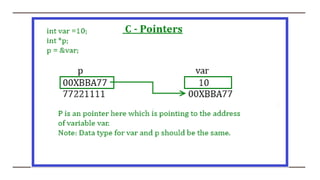
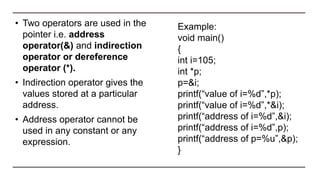
• Two operators are used in the
pointer i.e. address
operator(&) and indirection
operator or dereference
operator (*).
• Indirection operator gives the
values stored at a particular
address.
• Address operator cannot be
used in any constant or any
expression.
Example:
void main()
{
int i=105;
int *p;
p=&i;
printf(“value of i=%d”,*p);
printf(“value of i=%d”,*&i);
printf(“address of i=%d”,&i);
printf(“address of i=%d”,p);
printf(“address of p=%u”,&p);
}
• Pointer assignment
int i=10;
int *p=&i;//value assigning to the pointer
• Here declaration tells the compiler that ‘p’ will be used to store
the address of integer value or in other word ‘p’ is a pointer to
an integer and *p reads the value at the address contain in p.
• We can assign value of 1 pointer variable to other when their
base type and data type is same or both the pointer points to
the same variable as in the array.
Int *p1,*p2;
P1=&a[1];
P2=&a[3];
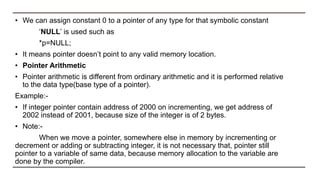
• We can assign constant 0 to a pointer of any type for that symbolic constant
‘NULL’ is used such as
*p=NULL;
• It means pointer doesn’t point to any valid memory location.
• Pointer Arithmetic
• Pointer arithmetic is different from ordinary arithmetic and it is performed relative
to the data type(base type of a pointer).
Example:-
• If integer pointer contain address of 2000 on incrementing, we get address of
2002 instead of 2001, because size of the integer is of 2 bytes.
• Note:-
When we move a pointer, somewhere else in memory by incrementing or
decrement or adding or subtracting integer, it is not necessary that, pointer still
pointer to a variable of same data, because memory allocation to the variable are
done by the compiler.
But in case of array it is possible, since there data are stored in a
consecutive
manner.
Ex:-
void main( )
{
static int a[ ]={20,30,105,82,97,72,66,102};
int *p,*p1;
P=&a[1];
P1=&a[6];
printf(“%d”,*p1-*p);
printf(“%d”,p1-p);
}
• Arithmetic operation never
perform on pointer are:
-addition, multiplication
and division of two pointer.
-multiplication between
the pointer by any number.
-division of pointer by
any number
-add of float or double
value to the pointer.
Operation performed in
pointer are:-
/* Addition of a number
through pointer */
Example
int i=100;
int *p;
p=&i;
p=p+2;
p=p+3;
p=p+9;
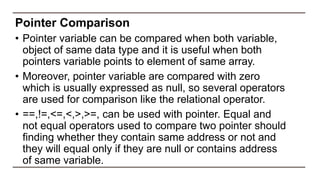
Pointer Comparison
• Pointer variable can be compared when both variable,
object of same data type and it is useful when both
pointers variable points to element of same array.
• Moreover, pointer variable are compared with zero
which is usually expressed as null, so several operators
are used for comparison like the relational operator.
• ==,!=,<=,<,>,>=, can be used with pointer. Equal and
not equal operators used to compare two pointer should
finding whether they contain same address or not and
they will equal only if they are null or contains address
of same variable.
Ex:-
void main()
{
static int arr[]={20,25,15,27,105,96}
int *x,*y;
x=&a[5];
y=&(a+5);
if(x==y)
printf(“same”);
else
printf(“not”);
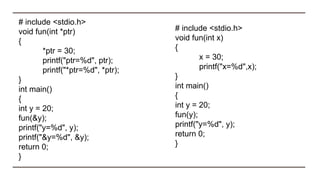
# include <stdio.h>
void fun(int *ptr)
{
*ptr = 30;
printf("ptr=%d", ptr);
printf("*ptr=%d", *ptr);
}
int main()
{
int y = 20;
fun(&y);
printf("y=%d", y);
printf("&y=%d", &y);
return 0;
}
# include <stdio.h>
void fun(int x)
{
x = 30;
printf("x=%d",x);
}
int main()
{
int y = 20;
fun(y);
printf("y=%d", y);
return 0;
}
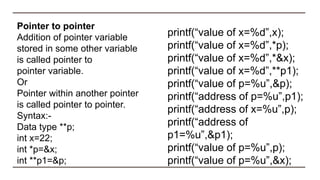
printf(“value of x=%d”,x);
printf(“value of x=%d”,*p);
printf(“value of x=%d”,*&x);
printf(“value of x=%d”,**p1);
printf(“value of p=%u”,&p);
printf(“address of p=%u”,p1);
printf(“address of x=%u”,p);
printf(“address of
p1=%u”,&p1);
printf(“value of p=%u”,p);
printf(“value of p=%u”,&x);
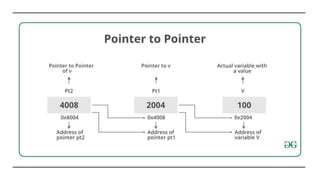
Pointer to pointer
Addition of pointer variable
stored in some other variable
is called pointer to
pointer variable.
Or
Pointer within another pointer
is called pointer to pointer.
Syntax:-
Data type **p;
int x=22;
int *p=&x;
int **p1=&p;
Pointer vs array
Example :-
#include<stdio.h>
int main()
{
int arr[5] = { 1, 2, 3, 4, 5 };
int *ptr = arr;
printf("%pn", ptr);
return 0;
}
• In this program, we have a pointer ptr that points to the
0th element of the array. Similarly, we can also declare a
pointer that can point to whole array instead of only one
element of the array.
• Syntax:
• data_type (*var_name)[size_of_array];
Example:
int (*ptr)[10];
• Here ptr is pointer that can point to an array of 10 integers.
Since subscript have higher precedence than indirection, it is
necessary to enclose the indirection operator and pointer name
inside parentheses. Here the type of ptr is ‘pointer to an array
of 10 integers’.
Note : The pointer that points to the
0th element of array and the pointer
that points to the whole array are
totally different. The following
program shows this:
#include<stdio.h>
int main()
{
// Pointer to an integer
int *p;
// Pointer to an array of
5 integers
int (*ptr)[5];
int arr[5];
// Points to 0th element of the arr.
p = arr;
// Points to the whole array arr.
ptr = &arr;
printf("p = %p,ptr = %pn", p, ptr);
p++;
ptr++;
printf("p = %p,ptr = %pn", p, ptr);
return 0;
}
p = 0x7fff4f32fd50, ptr = 0x7fff4f32fd50 p =
0x7fff4f32fd54, ptr = 0x7fff4f32fd64
p: is pointer to 0th element of the
array arr, while ptr is a pointer that
points to the whole array arr.
•The base type of p is int while base
type of ptr is ‘an array of 5 integers’.
•We know that the pointer arithmetic is
performed relative to the base size, so if
we write ptr++, then the pointer ptr will
be shifted forward by 20 bytes.
include<stdio.h>
int main()
{
int arr[] = { 3, 5, 6, 7, 9 };
int *p = arr;
int (*ptr)[5] = &arr;
printf("p = %p, ptr = %pn", p,
ptr);
printf("*p = %d, *ptr = %pn", *p,
*ptr);
printf("sizeof(p) = %lu, sizeof(*p)
= %lun",sizeof(p),sizeof(*p));
printf("sizeof(ptr) = %lu,
sizeof(*ptr) = %lun",sizeof(ptr),
sizeof(*ptr));
return 0;
}
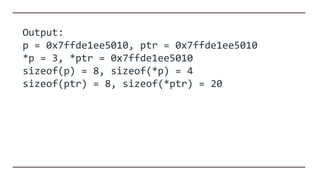
Output:
p = 0x7ffde1ee5010, ptr = 0x7ffde1ee5010
*p = 3, *ptr = 0x7ffde1ee5010
sizeof(p) = 8, sizeof(*p) = 4
sizeof(ptr) = 8, sizeof(*ptr) = 20

pointers of the programming in c most efficient.pptx

  • 1.
  • 3.
    • Two operatorsare used in the pointer i.e. address operator(&) and indirection operator or dereference operator (*). • Indirection operator gives the values stored at a particular address. • Address operator cannot be used in any constant or any expression. Example: void main() { int i=105; int *p; p=&i; printf(“value of i=%d”,*p); printf(“value of i=%d”,*&i); printf(“address of i=%d”,&i); printf(“address of i=%d”,p); printf(“address of p=%u”,&p); }
  • 4.
    • Pointer assignment inti=10; int *p=&i;//value assigning to the pointer • Here declaration tells the compiler that ‘p’ will be used to store the address of integer value or in other word ‘p’ is a pointer to an integer and *p reads the value at the address contain in p. • We can assign value of 1 pointer variable to other when their base type and data type is same or both the pointer points to the same variable as in the array. Int *p1,*p2; P1=&a[1]; P2=&a[3];
  • 5.
    • We canassign constant 0 to a pointer of any type for that symbolic constant ‘NULL’ is used such as *p=NULL; • It means pointer doesn’t point to any valid memory location. • Pointer Arithmetic • Pointer arithmetic is different from ordinary arithmetic and it is performed relative to the data type(base type of a pointer). Example:- • If integer pointer contain address of 2000 on incrementing, we get address of 2002 instead of 2001, because size of the integer is of 2 bytes. • Note:- When we move a pointer, somewhere else in memory by incrementing or decrement or adding or subtracting integer, it is not necessary that, pointer still pointer to a variable of same data, because memory allocation to the variable are done by the compiler.
  • 6.
    But in caseof array it is possible, since there data are stored in a consecutive manner. Ex:- void main( ) { static int a[ ]={20,30,105,82,97,72,66,102}; int *p,*p1; P=&a[1]; P1=&a[6]; printf(“%d”,*p1-*p); printf(“%d”,p1-p); }
  • 7.
    • Arithmetic operationnever perform on pointer are: -addition, multiplication and division of two pointer. -multiplication between the pointer by any number. -division of pointer by any number -add of float or double value to the pointer. Operation performed in pointer are:- /* Addition of a number through pointer */ Example int i=100; int *p; p=&i; p=p+2; p=p+3; p=p+9;
  • 11.
    Pointer Comparison • Pointervariable can be compared when both variable, object of same data type and it is useful when both pointers variable points to element of same array. • Moreover, pointer variable are compared with zero which is usually expressed as null, so several operators are used for comparison like the relational operator. • ==,!=,<=,<,>,>=, can be used with pointer. Equal and not equal operators used to compare two pointer should finding whether they contain same address or not and they will equal only if they are null or contains address of same variable.
  • 12.
    Ex:- void main() { static intarr[]={20,25,15,27,105,96} int *x,*y; x=&a[5]; y=&(a+5); if(x==y) printf(“same”); else printf(“not”);
  • 13.
    # include <stdio.h> voidfun(int *ptr) { *ptr = 30; printf("ptr=%d", ptr); printf("*ptr=%d", *ptr); } int main() { int y = 20; fun(&y); printf("y=%d", y); printf("&y=%d", &y); return 0; } # include <stdio.h> void fun(int x) { x = 30; printf("x=%d",x); } int main() { int y = 20; fun(y); printf("y=%d", y); return 0; }
  • 14.
    printf(“value of x=%d”,x); printf(“valueof x=%d”,*p); printf(“value of x=%d”,*&x); printf(“value of x=%d”,**p1); printf(“value of p=%u”,&p); printf(“address of p=%u”,p1); printf(“address of x=%u”,p); printf(“address of p1=%u”,&p1); printf(“value of p=%u”,p); printf(“value of p=%u”,&x); Pointer to pointer Addition of pointer variable stored in some other variable is called pointer to pointer variable. Or Pointer within another pointer is called pointer to pointer. Syntax:- Data type **p; int x=22; int *p=&x; int **p1=&p;
  • 16.
    Pointer vs array Example:- #include<stdio.h> int main() { int arr[5] = { 1, 2, 3, 4, 5 }; int *ptr = arr; printf("%pn", ptr); return 0; }
  • 17.
    • In thisprogram, we have a pointer ptr that points to the 0th element of the array. Similarly, we can also declare a pointer that can point to whole array instead of only one element of the array. • Syntax: • data_type (*var_name)[size_of_array]; Example: int (*ptr)[10]; • Here ptr is pointer that can point to an array of 10 integers. Since subscript have higher precedence than indirection, it is necessary to enclose the indirection operator and pointer name inside parentheses. Here the type of ptr is ‘pointer to an array of 10 integers’.
  • 18.
    Note : Thepointer that points to the 0th element of array and the pointer that points to the whole array are totally different. The following program shows this: #include<stdio.h> int main() { // Pointer to an integer int *p; // Pointer to an array of 5 integers int (*ptr)[5]; int arr[5]; // Points to 0th element of the arr. p = arr; // Points to the whole array arr. ptr = &arr; printf("p = %p,ptr = %pn", p, ptr); p++; ptr++; printf("p = %p,ptr = %pn", p, ptr); return 0; } p = 0x7fff4f32fd50, ptr = 0x7fff4f32fd50 p = 0x7fff4f32fd54, ptr = 0x7fff4f32fd64
  • 19.
    p: is pointerto 0th element of the array arr, while ptr is a pointer that points to the whole array arr. •The base type of p is int while base type of ptr is ‘an array of 5 integers’. •We know that the pointer arithmetic is performed relative to the base size, so if we write ptr++, then the pointer ptr will be shifted forward by 20 bytes. include<stdio.h> int main() { int arr[] = { 3, 5, 6, 7, 9 }; int *p = arr; int (*ptr)[5] = &arr; printf("p = %p, ptr = %pn", p, ptr); printf("*p = %d, *ptr = %pn", *p, *ptr); printf("sizeof(p) = %lu, sizeof(*p) = %lun",sizeof(p),sizeof(*p)); printf("sizeof(ptr) = %lu, sizeof(*ptr) = %lun",sizeof(ptr), sizeof(*ptr)); return 0; }
  • 20.
    Output: p = 0x7ffde1ee5010,ptr = 0x7ffde1ee5010 *p = 3, *ptr = 0x7ffde1ee5010 sizeof(p) = 8, sizeof(*p) = 4 sizeof(ptr) = 8, sizeof(*ptr) = 20