PUNTLAND STATE OF SOMALIA
MINISTRY OF EDUCATION
NATIONAL EXAMINATIONS BOARD
FORM FOUR BIOLOGY EXAMINATION MAY 2014
TIME 2:10 HOURS
INSTRUCTIONS TO CANDIDATES
Instructions to the candidate (please read carefully)
This paper consist of 19 pages, count them now, if there is missing please inform the
invigilator.
 Answer ALL questions in section A and B.
 Write your working on the space provided below the question.
 This paper consist of two parts
 PART 1: (10 multiple choices) = 10 marks
 PART 2: (13 structured questions) = 90 marks
Total = 100 marks
NAME OF THE STUDENT
NAME OF THE SCHOOL
ROLL NUMBER
Ministry of Education Puntland National Examinations Board
Form Four Biology Examination, May 2014
2 © PNEB2014
Use this page for rough work. It will NOT be marked.
………………………………………………………………………………………………………
………………………………………………………………………………………………………
………………………………………………………………………………………………………
………………………………………………………………………………………………………
………………………………………………………………………………………………………
………………………………………………………………………………..……………………
…………………………………………………………………………………..…………………
………………………..……………………………………………………………………………
………………………………………………………………………………………………………
………………………………………………………………………………………………………
………………………………………………………………………………………………………
…..…………………………………………………………………………………………………
……..………………………………………………………………………………………………
………………………………………………………………………………………………………
………………………………………………………………………………………………………
………………………………………………………………………………………………………
………………………………………………..……………………………………………………
…………………………………………………..…………………………………………..……
………………………………………………………………………………………………………
………………………………………………………………………………………………………
………………………………………………………………………………………………………
……………………………………………………………………………………………..………
………………………………………………………………………………………………..……
………………………………………………………………………………………………………
………………………………………………………………………………………………………
………………………………………………………………………………………………………
………………………………………………………………………………………………………
…………………………………..…………………………………………………………………
……………………………………..……………………………………………………………….
Ministry of Education Puntland National Examinations Board
Form Four Biology Examination, May 2014
3 © PNEB2014
SECTION A: MULTIPLE CHOICE QUESTIONS (10 MARKS)
Circle the correct answer.
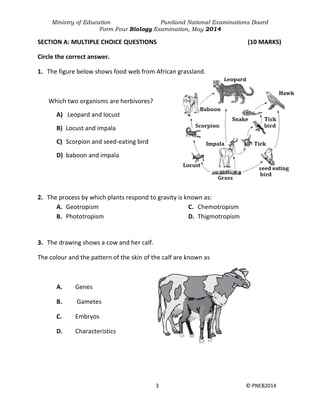
1. The figure below shows food web from African grassland.
Which two organisms are herbivores?
A) Leopard and locust
B) Locust and impala
C) Scorpion and seed-eating bird
D) baboon and impala
2. The process by which plants respond to gravity is known as:
A. Geotropism
B. Phototropism
C. Chemotropism
D. Thigmotropism
3. The drawing shows a cow and her calf.
The colour and the pattern of the skin of the calf are known as
A. Genes
B. Gametes
C. Embryos
D. Characteristics
Ministry of Education Puntland National Examinations Board
Form Four Biology Examination, May 2014
4 © PNEB2014
4. Name the tissue that transports sucrose
A. Xylem
B. Cambium
C. Cortex
D. Phloem
5. Cystic fibrosis (CF) is caused by recessive alleles.
The table shows the phenotype of 400 children born from parents who were both
heterozygous.
number of children without CF number of children with CF
300 100
How many of the 400 children would you expect to be heterozygous?
A. 100
B. 200
C. 300
D. 400
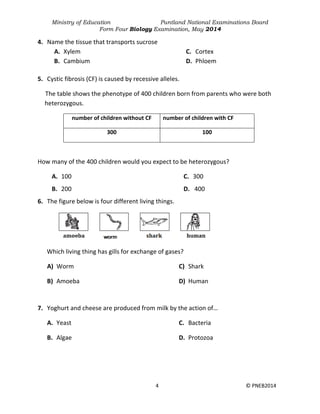
6. The figure below is four different living things.
Which living thing has gills for exchange of gases?
A) Worm
B) Amoeba
C) Shark
D) Human
7. Yoghurt and cheese are produced from milk by the action of…
A. Yeast
B. Algae
C. Bacteria
D. Protozoa
Ministry of Education Puntland National Examinations Board
Form Four Biology Examination, May 2014
5 © PNEB2014
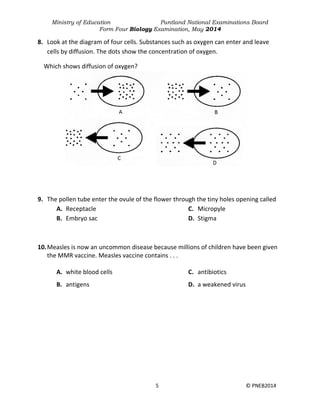
8. Look at the diagram of four cells. Substances such as oxygen can enter and leave
cells by diffusion. The dots show the concentration of oxygen.
Which shows diffusion of oxygen?
9. The pollen tube enter the ovule of the flower through the tiny holes opening called
A. Receptacle
B. Embryo sac
C. Micropyle
D. Stigma
10.Measles is now an uncommon disease because millions of children have been given
the MMR vaccine. Measles vaccine contains . . .
A. white blood cells
B. antigens
C. antibiotics
D. a weakened virus
Ministry of Education Puntland National Examinations Board
Form Four Biology Examination, May 2014
6 © PNEB2014
SECTION B: STRUCTURAL QUESTIONS (90 MARKS)
Answer all the following questions in the space provided.
QUESTION ONE (5 MARKS)
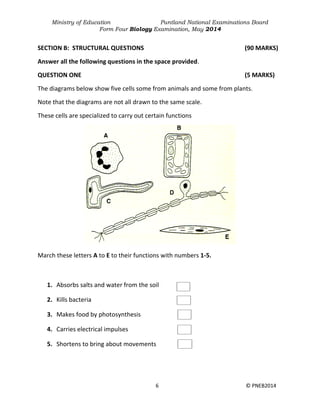
The diagrams below show five cells some from animals and some from plants.
Note that the diagrams are not all drawn to the same scale.
These cells are specialized to carry out certain functions
March these letters A to E to their functions with numbers 1-5.
1. Absorbs salts and water from the soil
2. Kills bacteria
3. Makes food by photosynthesis
4. Carries electrical impulses
5. Shortens to bring about movements
Ministry of Education Puntland National Examinations Board
Form Four Biology Examination, May 2014
7 © PNEB2014
QUESTION TWO (8 MARKS)
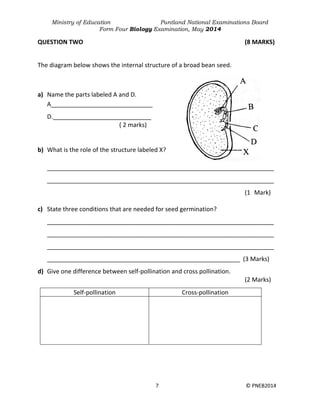
The diagram below shows the internal structure of a broad bean seed.
a) Name the parts labeled A and D.
A______________________________
D._____________________________
( 2 marks)
b) What is the role of the structure labeled X?
___________________________________________________________________
___________________________________________________________________
(1 Mark)
c) State three conditions that are needed for seed germination?
___________________________________________________________________
___________________________________________________________________
___________________________________________________________________
_________________________________________________________ (3 Marks)
d) Give one difference between self-pollination and cross pollination.
(2 Marks)
Self-pollination Cross-pollination
Ministry of Education Puntland National Examinations Board
Form Four Biology Examination, May 2014
8 © PNEB2014
QUESTION THREE (7 MARKS)
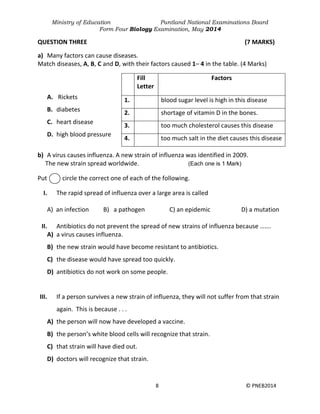
a) Many factors can cause diseases.
Match diseases, A, B, C and D, with their factors caused 1– 4 in the table. (4 Marks)
A. Rickets
B. diabetes
C. heart disease
D. high blood pressure
b) A virus causes influenza. A new strain of influenza was identified in 2009.
The new strain spread worldwide. (Each one is 1 Mark)
Put circle the correct one of each of the following.
I. The rapid spread of influenza over a large area is called
A) an infection B) a pathogen C) an epidemic D) a mutation
II. Antibiotics do not prevent the spread of new strains of influenza because …….
A) a virus causes influenza.
B) the new strain would have become resistant to antibiotics.
C) the disease would have spread too quickly.
D) antibiotics do not work on some people.
III. If a person survives a new strain of influenza, they will not suffer from that strain
again. This is because . . .
A) the person will now have developed a vaccine.
B) the person’s white blood cells will recognize that strain.
C) that strain will have died out.
D) doctors will recognize that strain.
Fill
Letter
Factors
1. blood sugar level is high in this disease
2. shortage of vitamin D in the bones.
3. too much cholesterol causes this disease
4. too much salt in the diet causes this disease
Ministry of Education Puntland National Examinations Board
Form Four Biology Examination, May 2014
9 © PNEB2014
QUESTION FOUR (8 MARKS)
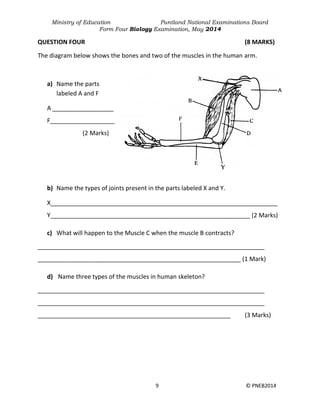
The diagram below shows the bones and two of the muscles in the human arm.
a) Name the parts
labeled A and F
A __________________
F___________________
(2 Marks)
b) Name the types of joints present in the parts labeled X and Y.
X___________________________________________________________________
Y___________________________________________________________ (2 Marks)
c) What will happen to the Muscle C when the muscle B contracts?
___________________________________________________________________
____________________________________________________________ (1 Mark)
d) Name three types of the muscles in human skeleton?
___________________________________________________________________
___________________________________________________________________
_________________________________________________________ (3 Marks)
Ministry of Education Puntland National Examinations Board
Form Four Biology Examination, May 2014
10 © PNEB2014
QUESTION FIVE (10 MARKS)
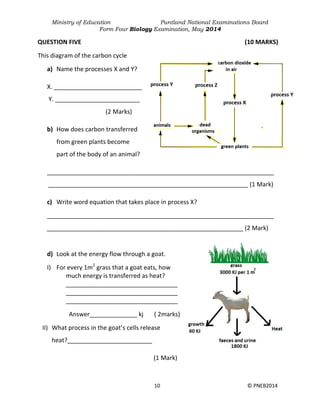
This diagram of the carbon cycle
a) Name the processes X and Y?
X. __________________________
Y. _________________________
(2 Marks)
b) How does carbon transferred
from green plants become
part of the body of an animal?
___________________________________________________________________
___________________________________________________________ (1 Mark)
c) Write word equation that takes place in process X?
___________________________________________________________________
__________________________________________________________ (2 Mark)
d) Look at the energy flow through a goat.
I) For every 1m2
grass that a goat eats, how
much energy is transferred as heat?
_________________________________
_________________________________
_________________________________
Answer______________ kj ( 2marks)
II) What process in the goat’s cells release
heat?_________________________
(1 Mark)
Ministry of Education Puntland National Examinations Board
Form Four Biology Examination, May 2014
11 © PNEB2014
III) What percentage of the energy in 1m2
of the grass is used for goat’s growth?
_____________________________________________________________
Answer__________% ( 2Marks)
QUESTION SIX (6 MARKS)
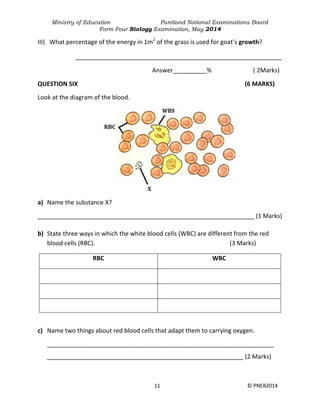
Look at the diagram of the blood.
a) Name the substance X?
________________________________________________________________ (1 Marks)
b) State three ways in which the white blood cells (WBC) are different from the red
blood cells (RBC). (3 Marks)
RBC WBC
c) Name two things about red blood cells that adapt them to carrying oxygen.
___________________________________________________________________
__________________________________________________________ (2 Marks)
Ministry of Education Puntland National Examinations Board
Form Four Biology Examination, May 2014
12 © PNEB2014
QUESTION SEVEN (7 MARKS)
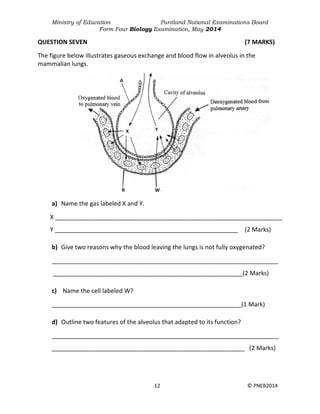
The figure below illustrates gaseous exchange and blood flow in alveolus in the
mammalian lungs.
a) Name the gas labeled X and Y.
X ___________________________________________________________________
Y ______________________________________________________ (2 Marks)
b) Give two reasons why the blood leaving the lungs is not fully oxygenated?
___________________________________________________________________
________________________________________________________(2 Marks)
c) Name the cell labeled W?
________________________________________________________(1 Mark)
d) Outline two features of the alveolus that adapted to its function?
___________________________________________________________________
_________________________________________________________ (2 Marks)
Ministry of Education Puntland National Examinations Board
Form Four Biology Examination, May 2014
13 © PNEB2014
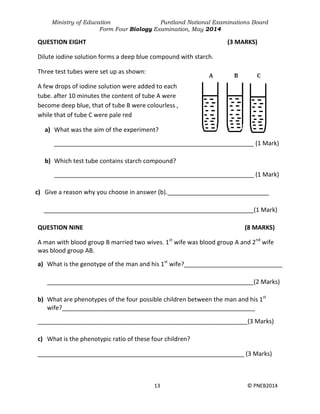
QUESTION EIGHT (3 MARKS)
Dilute iodine solution forms a deep blue compound with starch.
Three test tubes were set up as shown:
A few drops of iodine solution were added to each
tube. after 10 minutes the content of tube A were
become deep blue, that of tube B were colourless ,
while that of tube C were pale red
a) What was the aim of the experiment?
___________________________________________________________ (1 Mark)
b) Which test tube contains starch compound?
___________________________________________________________ (1 Mark)
c) Give a reason why you choose in answer (b).______________________________
______________________________________________________________(1 Mark)
QUESTION NINE (8 MARKS)
A man with blood group B married two wives. 1st
wife was blood group A and 2nd
wife
was blood group AB.
a) What is the genotype of the man and his 1st
wife?_____________________________
_____________________________________________________________(2 Marks)
b) What are phenotypes of the four possible children between the man and his 1st
wife?_________________________________________________________
______________________________________________________________(3 Marks)
c) What is the phenotypic ratio of these four children?
_____________________________________________________________ (3 Marks)
Ministry of Education Puntland National Examinations Board
Form Four Biology Examination, May 2014
14 © PNEB2014
QUESTION TEN (8 MARKS)
Malaria is tropical disease spread by mosquitoes.
a) Here are five sentences describing the spread of malaria. They are in the wrong
order. (2 Marks)
A The mosquito sucks up the blood of the infected person.
B Eggs hatch into tiny larvae which live just below the water surface, Later
young mosquitoes hatch out.
C Female mosquitoes lay egg on the surface of ponds.
D The mosquitoes transmits the disease to any health person it bites.
E The female mosquito bites a person infected with malaria.
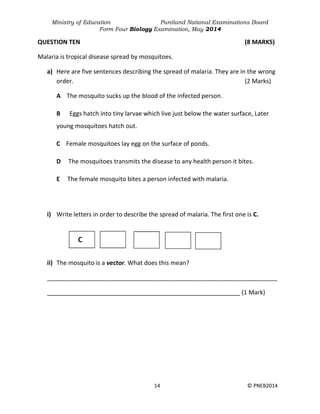
i) Write letters in order to describe the spread of malaria. The first one is C.
ii) The mosquito is a vector. What does this mean?
____________________________________________________________________
_________________________________________________________ (1 Mark)
Ministry of Education Puntland National Examinations Board
Form Four Biology Examination, May 2014
15 © PNEB2014
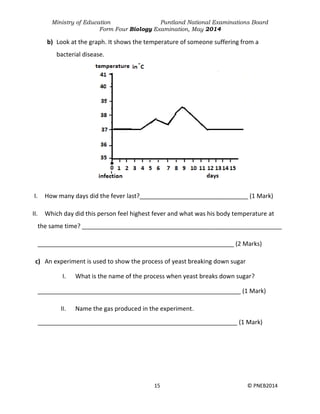
b) Look at the graph. It shows the temperature of someone suffering from a
bacterial disease.
I. How many days did the fever last?________________________________ (1 Mark)
II. Which day did this person feel highest fever and what was his body temperature at
the same time? ___________________________________________________________
__________________________________________________________ (2 Marks)
c) An experiment is used to show the process of yeast breaking down sugar
I. What is the name of the process when yeast breaks down sugar?
____________________________________________________________ (1 Mark)
II. Name the gas produced in the experiment.
___________________________________________________________ (1 Mark)
Ministry of Education Puntland National Examinations Board
Form Four Biology Examination, May 2014
16 © PNEB2014
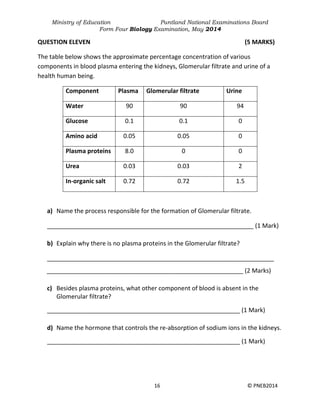
QUESTION ELEVEN (5 MARKS)
The table below shows the approximate percentage concentration of various
components in blood plasma entering the kidneys, Glomerular filtrate and urine of a
health human being.
Component Plasma Glomerular filtrate Urine
Water 90 90 94
Glucose 0.1 0.1 0
Amino acid 0.05 0.05 0
Plasma proteins 8.0 0 0
Urea 0.03 0.03 2
In-organic salt 0.72 0.72 1.5
a) Name the process responsible for the formation of Glomerular filtrate.
_____________________________________________________________ (1 Mark)
b) Explain why there is no plasma proteins in the Glomerular filtrate?
___________________________________________________________________
__________________________________________________________ (2 Marks)
c) Besides plasma proteins, what other component of blood is absent in the
Glomerular filtrate?
_________________________________________________________ (1 Mark)
d) Name the hormone that controls the re-absorption of sodium ions in the kidneys.
_________________________________________________________ (1 Mark)
Ministry of Education Puntland National Examinations Board
Form Four Biology Examination, May 2014
17 © PNEB2014
QUESTION THIRTEEN (9 MARKS)
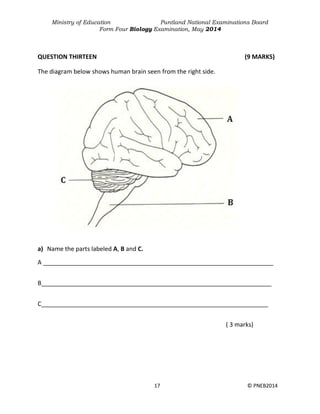
The diagram below shows human brain seen from the right side.
a) Name the parts labeled A, B and C.
A ____________________________________________________________________
B____________________________________________________________________
C___________________________________________________________________
( 3 marks)
Ministry of Education Puntland National Examinations Board
Form Four Biology Examination, May 2014
18 © PNEB2014
b) Give two functions of the part labeled B.
___________________________________________________________________
___________________________________________________________________
___________________________________________________________________
___________________________________________________________________
(2 Marks)
c) The brain monitors the concentration of the blood passing through it. If the
concentration is too high, the pituitary gland releases ADH (anti-diuretic hormone)
to the target organ.
I. What does “target organ” mean?
______________________________________________________________
(1 Mark)
II. Explain how does ADH balance the level of the blood concentration?
___________________________________________________________________
___________________________________________________________________
___________________________________________________________________
___________________________________________________________________
(3 Marks)
Ministry of Education Puntland National Examinations Board
Form Four Biology Examination, May 2014
19 © PNEB2014
QUESTION TWELVE (6 MARKS)
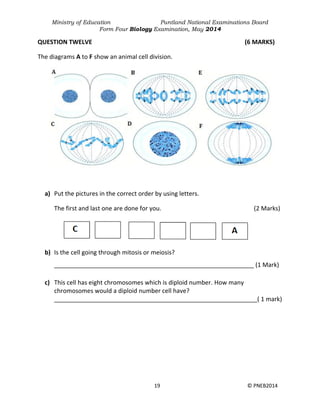
The diagrams A to F show an animal cell division.
a) Put the pictures in the correct order by using letters.
The first and last one are done for you. (2 Marks)
b) Is the cell going through mitosis or meiosis?
___________________________________________________________ (1 Mark)
c) This cell has eight chromosomes which is diploid number. How many
chromosomes would a diploid number cell have?
____________________________________________________________( 1 mark)
Ministry of Education Puntland National Examinations Board
Form Four Biology Examination, May 2014
20 © PNEB2014
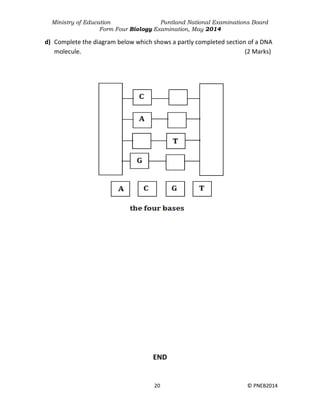
d) Complete the diagram below which shows a partly completed section of a DNA
molecule. (2 Marks)
END

PNEB - BIOLOGY 2014

  • 1.
    PUNTLAND STATE OFSOMALIA MINISTRY OF EDUCATION NATIONAL EXAMINATIONS BOARD FORM FOUR BIOLOGY EXAMINATION MAY 2014 TIME 2:10 HOURS INSTRUCTIONS TO CANDIDATES Instructions to the candidate (please read carefully) This paper consist of 19 pages, count them now, if there is missing please inform the invigilator.  Answer ALL questions in section A and B.  Write your working on the space provided below the question.  This paper consist of two parts  PART 1: (10 multiple choices) = 10 marks  PART 2: (13 structured questions) = 90 marks Total = 100 marks NAME OF THE STUDENT NAME OF THE SCHOOL ROLL NUMBER
  • 2.
    Ministry of EducationPuntland National Examinations Board Form Four Biology Examination, May 2014 2 © PNEB2014 Use this page for rough work. It will NOT be marked. ……………………………………………………………………………………………………… ……………………………………………………………………………………………………… ……………………………………………………………………………………………………… ……………………………………………………………………………………………………… ……………………………………………………………………………………………………… ………………………………………………………………………………..…………………… …………………………………………………………………………………..………………… ………………………..…………………………………………………………………………… ……………………………………………………………………………………………………… ……………………………………………………………………………………………………… ……………………………………………………………………………………………………… …..………………………………………………………………………………………………… ……..……………………………………………………………………………………………… ……………………………………………………………………………………………………… ……………………………………………………………………………………………………… ……………………………………………………………………………………………………… ………………………………………………..…………………………………………………… …………………………………………………..…………………………………………..…… ……………………………………………………………………………………………………… ……………………………………………………………………………………………………… ……………………………………………………………………………………………………… ……………………………………………………………………………………………..……… ………………………………………………………………………………………………..…… ……………………………………………………………………………………………………… ……………………………………………………………………………………………………… ……………………………………………………………………………………………………… ……………………………………………………………………………………………………… …………………………………..………………………………………………………………… ……………………………………..……………………………………………………………….
  • 3.
    Ministry of EducationPuntland National Examinations Board Form Four Biology Examination, May 2014 3 © PNEB2014 SECTION A: MULTIPLE CHOICE QUESTIONS (10 MARKS) Circle the correct answer. 1. The figure below shows food web from African grassland. Which two organisms are herbivores? A) Leopard and locust B) Locust and impala C) Scorpion and seed-eating bird D) baboon and impala 2. The process by which plants respond to gravity is known as: A. Geotropism B. Phototropism C. Chemotropism D. Thigmotropism 3. The drawing shows a cow and her calf. The colour and the pattern of the skin of the calf are known as A. Genes B. Gametes C. Embryos D. Characteristics
  • 4.
    Ministry of EducationPuntland National Examinations Board Form Four Biology Examination, May 2014 4 © PNEB2014 4. Name the tissue that transports sucrose A. Xylem B. Cambium C. Cortex D. Phloem 5. Cystic fibrosis (CF) is caused by recessive alleles. The table shows the phenotype of 400 children born from parents who were both heterozygous. number of children without CF number of children with CF 300 100 How many of the 400 children would you expect to be heterozygous? A. 100 B. 200 C. 300 D. 400 6. The figure below is four different living things. Which living thing has gills for exchange of gases? A) Worm B) Amoeba C) Shark D) Human 7. Yoghurt and cheese are produced from milk by the action of… A. Yeast B. Algae C. Bacteria D. Protozoa
  • 5.
    Ministry of EducationPuntland National Examinations Board Form Four Biology Examination, May 2014 5 © PNEB2014 8. Look at the diagram of four cells. Substances such as oxygen can enter and leave cells by diffusion. The dots show the concentration of oxygen. Which shows diffusion of oxygen? 9. The pollen tube enter the ovule of the flower through the tiny holes opening called A. Receptacle B. Embryo sac C. Micropyle D. Stigma 10.Measles is now an uncommon disease because millions of children have been given the MMR vaccine. Measles vaccine contains . . . A. white blood cells B. antigens C. antibiotics D. a weakened virus
  • 6.
    Ministry of EducationPuntland National Examinations Board Form Four Biology Examination, May 2014 6 © PNEB2014 SECTION B: STRUCTURAL QUESTIONS (90 MARKS) Answer all the following questions in the space provided. QUESTION ONE (5 MARKS) The diagrams below show five cells some from animals and some from plants. Note that the diagrams are not all drawn to the same scale. These cells are specialized to carry out certain functions March these letters A to E to their functions with numbers 1-5. 1. Absorbs salts and water from the soil 2. Kills bacteria 3. Makes food by photosynthesis 4. Carries electrical impulses 5. Shortens to bring about movements
  • 7.
    Ministry of EducationPuntland National Examinations Board Form Four Biology Examination, May 2014 7 © PNEB2014 QUESTION TWO (8 MARKS) The diagram below shows the internal structure of a broad bean seed. a) Name the parts labeled A and D. A______________________________ D._____________________________ ( 2 marks) b) What is the role of the structure labeled X? ___________________________________________________________________ ___________________________________________________________________ (1 Mark) c) State three conditions that are needed for seed germination? ___________________________________________________________________ ___________________________________________________________________ ___________________________________________________________________ _________________________________________________________ (3 Marks) d) Give one difference between self-pollination and cross pollination. (2 Marks) Self-pollination Cross-pollination
  • 8.
    Ministry of EducationPuntland National Examinations Board Form Four Biology Examination, May 2014 8 © PNEB2014 QUESTION THREE (7 MARKS) a) Many factors can cause diseases. Match diseases, A, B, C and D, with their factors caused 1– 4 in the table. (4 Marks) A. Rickets B. diabetes C. heart disease D. high blood pressure b) A virus causes influenza. A new strain of influenza was identified in 2009. The new strain spread worldwide. (Each one is 1 Mark) Put circle the correct one of each of the following. I. The rapid spread of influenza over a large area is called A) an infection B) a pathogen C) an epidemic D) a mutation II. Antibiotics do not prevent the spread of new strains of influenza because ……. A) a virus causes influenza. B) the new strain would have become resistant to antibiotics. C) the disease would have spread too quickly. D) antibiotics do not work on some people. III. If a person survives a new strain of influenza, they will not suffer from that strain again. This is because . . . A) the person will now have developed a vaccine. B) the person’s white blood cells will recognize that strain. C) that strain will have died out. D) doctors will recognize that strain. Fill Letter Factors 1. blood sugar level is high in this disease 2. shortage of vitamin D in the bones. 3. too much cholesterol causes this disease 4. too much salt in the diet causes this disease
  • 9.
    Ministry of EducationPuntland National Examinations Board Form Four Biology Examination, May 2014 9 © PNEB2014 QUESTION FOUR (8 MARKS) The diagram below shows the bones and two of the muscles in the human arm. a) Name the parts labeled A and F A __________________ F___________________ (2 Marks) b) Name the types of joints present in the parts labeled X and Y. X___________________________________________________________________ Y___________________________________________________________ (2 Marks) c) What will happen to the Muscle C when the muscle B contracts? ___________________________________________________________________ ____________________________________________________________ (1 Mark) d) Name three types of the muscles in human skeleton? ___________________________________________________________________ ___________________________________________________________________ _________________________________________________________ (3 Marks)
  • 10.
    Ministry of EducationPuntland National Examinations Board Form Four Biology Examination, May 2014 10 © PNEB2014 QUESTION FIVE (10 MARKS) This diagram of the carbon cycle a) Name the processes X and Y? X. __________________________ Y. _________________________ (2 Marks) b) How does carbon transferred from green plants become part of the body of an animal? ___________________________________________________________________ ___________________________________________________________ (1 Mark) c) Write word equation that takes place in process X? ___________________________________________________________________ __________________________________________________________ (2 Mark) d) Look at the energy flow through a goat. I) For every 1m2 grass that a goat eats, how much energy is transferred as heat? _________________________________ _________________________________ _________________________________ Answer______________ kj ( 2marks) II) What process in the goat’s cells release heat?_________________________ (1 Mark)
  • 11.
    Ministry of EducationPuntland National Examinations Board Form Four Biology Examination, May 2014 11 © PNEB2014 III) What percentage of the energy in 1m2 of the grass is used for goat’s growth? _____________________________________________________________ Answer__________% ( 2Marks) QUESTION SIX (6 MARKS) Look at the diagram of the blood. a) Name the substance X? ________________________________________________________________ (1 Marks) b) State three ways in which the white blood cells (WBC) are different from the red blood cells (RBC). (3 Marks) RBC WBC c) Name two things about red blood cells that adapt them to carrying oxygen. ___________________________________________________________________ __________________________________________________________ (2 Marks)
  • 12.
    Ministry of EducationPuntland National Examinations Board Form Four Biology Examination, May 2014 12 © PNEB2014 QUESTION SEVEN (7 MARKS) The figure below illustrates gaseous exchange and blood flow in alveolus in the mammalian lungs. a) Name the gas labeled X and Y. X ___________________________________________________________________ Y ______________________________________________________ (2 Marks) b) Give two reasons why the blood leaving the lungs is not fully oxygenated? ___________________________________________________________________ ________________________________________________________(2 Marks) c) Name the cell labeled W? ________________________________________________________(1 Mark) d) Outline two features of the alveolus that adapted to its function? ___________________________________________________________________ _________________________________________________________ (2 Marks)
  • 13.
    Ministry of EducationPuntland National Examinations Board Form Four Biology Examination, May 2014 13 © PNEB2014 QUESTION EIGHT (3 MARKS) Dilute iodine solution forms a deep blue compound with starch. Three test tubes were set up as shown: A few drops of iodine solution were added to each tube. after 10 minutes the content of tube A were become deep blue, that of tube B were colourless , while that of tube C were pale red a) What was the aim of the experiment? ___________________________________________________________ (1 Mark) b) Which test tube contains starch compound? ___________________________________________________________ (1 Mark) c) Give a reason why you choose in answer (b).______________________________ ______________________________________________________________(1 Mark) QUESTION NINE (8 MARKS) A man with blood group B married two wives. 1st wife was blood group A and 2nd wife was blood group AB. a) What is the genotype of the man and his 1st wife?_____________________________ _____________________________________________________________(2 Marks) b) What are phenotypes of the four possible children between the man and his 1st wife?_________________________________________________________ ______________________________________________________________(3 Marks) c) What is the phenotypic ratio of these four children? _____________________________________________________________ (3 Marks)
  • 14.
    Ministry of EducationPuntland National Examinations Board Form Four Biology Examination, May 2014 14 © PNEB2014 QUESTION TEN (8 MARKS) Malaria is tropical disease spread by mosquitoes. a) Here are five sentences describing the spread of malaria. They are in the wrong order. (2 Marks) A The mosquito sucks up the blood of the infected person. B Eggs hatch into tiny larvae which live just below the water surface, Later young mosquitoes hatch out. C Female mosquitoes lay egg on the surface of ponds. D The mosquitoes transmits the disease to any health person it bites. E The female mosquito bites a person infected with malaria. i) Write letters in order to describe the spread of malaria. The first one is C. ii) The mosquito is a vector. What does this mean? ____________________________________________________________________ _________________________________________________________ (1 Mark)
  • 15.
    Ministry of EducationPuntland National Examinations Board Form Four Biology Examination, May 2014 15 © PNEB2014 b) Look at the graph. It shows the temperature of someone suffering from a bacterial disease. I. How many days did the fever last?________________________________ (1 Mark) II. Which day did this person feel highest fever and what was his body temperature at the same time? ___________________________________________________________ __________________________________________________________ (2 Marks) c) An experiment is used to show the process of yeast breaking down sugar I. What is the name of the process when yeast breaks down sugar? ____________________________________________________________ (1 Mark) II. Name the gas produced in the experiment. ___________________________________________________________ (1 Mark)
  • 16.
    Ministry of EducationPuntland National Examinations Board Form Four Biology Examination, May 2014 16 © PNEB2014 QUESTION ELEVEN (5 MARKS) The table below shows the approximate percentage concentration of various components in blood plasma entering the kidneys, Glomerular filtrate and urine of a health human being. Component Plasma Glomerular filtrate Urine Water 90 90 94 Glucose 0.1 0.1 0 Amino acid 0.05 0.05 0 Plasma proteins 8.0 0 0 Urea 0.03 0.03 2 In-organic salt 0.72 0.72 1.5 a) Name the process responsible for the formation of Glomerular filtrate. _____________________________________________________________ (1 Mark) b) Explain why there is no plasma proteins in the Glomerular filtrate? ___________________________________________________________________ __________________________________________________________ (2 Marks) c) Besides plasma proteins, what other component of blood is absent in the Glomerular filtrate? _________________________________________________________ (1 Mark) d) Name the hormone that controls the re-absorption of sodium ions in the kidneys. _________________________________________________________ (1 Mark)
  • 17.
    Ministry of EducationPuntland National Examinations Board Form Four Biology Examination, May 2014 17 © PNEB2014 QUESTION THIRTEEN (9 MARKS) The diagram below shows human brain seen from the right side. a) Name the parts labeled A, B and C. A ____________________________________________________________________ B____________________________________________________________________ C___________________________________________________________________ ( 3 marks)
  • 18.
    Ministry of EducationPuntland National Examinations Board Form Four Biology Examination, May 2014 18 © PNEB2014 b) Give two functions of the part labeled B. ___________________________________________________________________ ___________________________________________________________________ ___________________________________________________________________ ___________________________________________________________________ (2 Marks) c) The brain monitors the concentration of the blood passing through it. If the concentration is too high, the pituitary gland releases ADH (anti-diuretic hormone) to the target organ. I. What does “target organ” mean? ______________________________________________________________ (1 Mark) II. Explain how does ADH balance the level of the blood concentration? ___________________________________________________________________ ___________________________________________________________________ ___________________________________________________________________ ___________________________________________________________________ (3 Marks)
  • 19.
    Ministry of EducationPuntland National Examinations Board Form Four Biology Examination, May 2014 19 © PNEB2014 QUESTION TWELVE (6 MARKS) The diagrams A to F show an animal cell division. a) Put the pictures in the correct order by using letters. The first and last one are done for you. (2 Marks) b) Is the cell going through mitosis or meiosis? ___________________________________________________________ (1 Mark) c) This cell has eight chromosomes which is diploid number. How many chromosomes would a diploid number cell have? ____________________________________________________________( 1 mark)
  • 20.
    Ministry of EducationPuntland National Examinations Board Form Four Biology Examination, May 2014 20 © PNEB2014 d) Complete the diagram below which shows a partly completed section of a DNA molecule. (2 Marks) END