MEASUREMENT
Particle range Spherical equivalent size (based on RI of 1.5, S of 1.65) 0.38 to 40
Size categorisation Number of software bins 24
Sampling interval Histogram period (seconds) 1 to 30
Total flow rate (typical) L/min 1.2
Sample flow rate (typical) mL/min 220
Max particle count rate Particles/second 10,000
Max coincidence probability %concentration at 106
particles/L 0.84
%concentration at 500 particles/L 0.24
POWER
Measurement mode mA (typical) 175
Standyby mode mA (typical) < 50
Voltage range VDC 4.8 to 5.2
Switch-on transient mW for 1ms < 5000
DATA
Digital interface/connections SPI (real-time data and communications)
Micro USB (firmware updates and standalone mode)
Data storage micro-SD (.CSV format) (GB) 16
KEYSPECIFICATIONS
Digital interface SPI (Mode 1), USB
Laser classification as enclosed housing Class 1
Temperature range °C -10 to 50
Humidity range % rh (continuous) 0 to 95 (non-condensing)
Weight g < 105
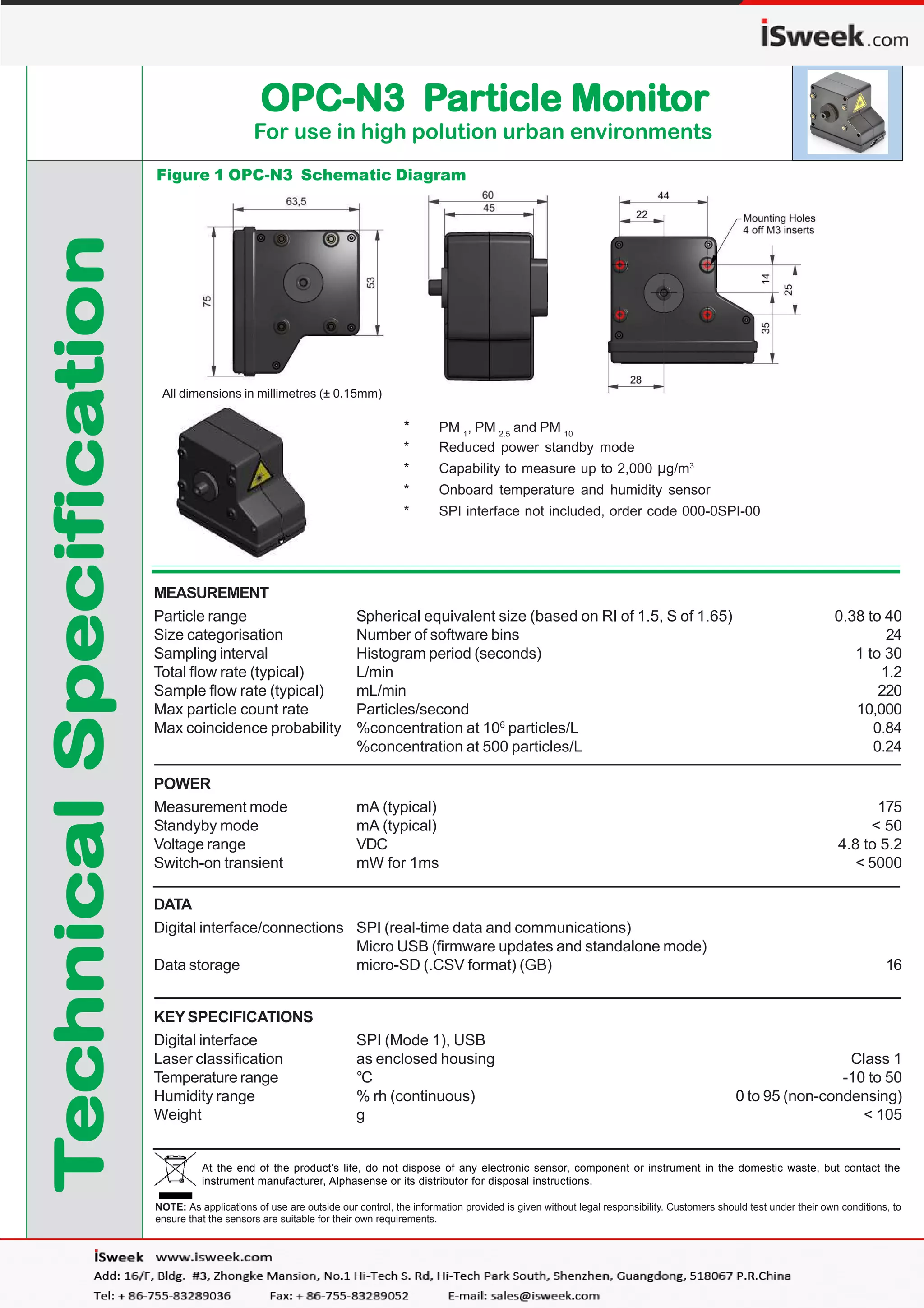
Figure 1 OPC-N3 Schematic Diagram
NOTE: As applications of use are outside our control, the information provided is given without legal responsibility. Customers should test under their own conditions, to
ensure that the sensors are suitable for their own requirements.
At the end of the product’s life, do not dispose of any electronic sensor, component or instrument in the domestic waste, but contact the
instrument manufacturer, Alphasense or its distributor for disposal instructions.
OPC-N3 POPC-N3 POPC-N3 POPC-N3 POPC-N3 Parararararticticticticticle Monitorle Monitorle Monitorle Monitorle MonitorTTTTTececececechnicalSpecifhnicalSpecifhnicalSpecifhnicalSpecifhnicalSpecificaicaicaicaicationtiontiontiontion
* PM 1
, PM 2.5
and PM 10
* Reduced power standby mode
* Capability to measure up to 2,000 µg/m3
* Onboard temperature and humidity sensor
* SPI interface not included, order code 000-0SPI-00
All dimensions in millimetres (± 0.15mm)
For use in high polution urban environments
OPC-N3 POPC-N3 POPC-N3 POPC-N3 POPC-N3 Perferferferferformance Daormance Daormance Daormance Daormance Datatatatata
TTTTTececececechnicalSpecifhnicalSpecifhnicalSpecifhnicalSpecifhnicalSpecificaicaicaicaicationtiontiontiontion
In the interest of continued product improvement, we reserve the right to change design features and specifications without prior notification. The data contained in this
document is for guidance only. Alphasense Ltd accepts no liability for any consequential losses, injury or damage resulting from the use of this document or the informa-
tion contained within. ( ©ALPHASENSE LTD ) Doc. Ref. OPC-N3/OCT17
For further information on the performance of this sensor, on other sensors in the range or any other subject, please contact
Alphasense Ltd. For Application Notes visit “www.alphasense.com”.
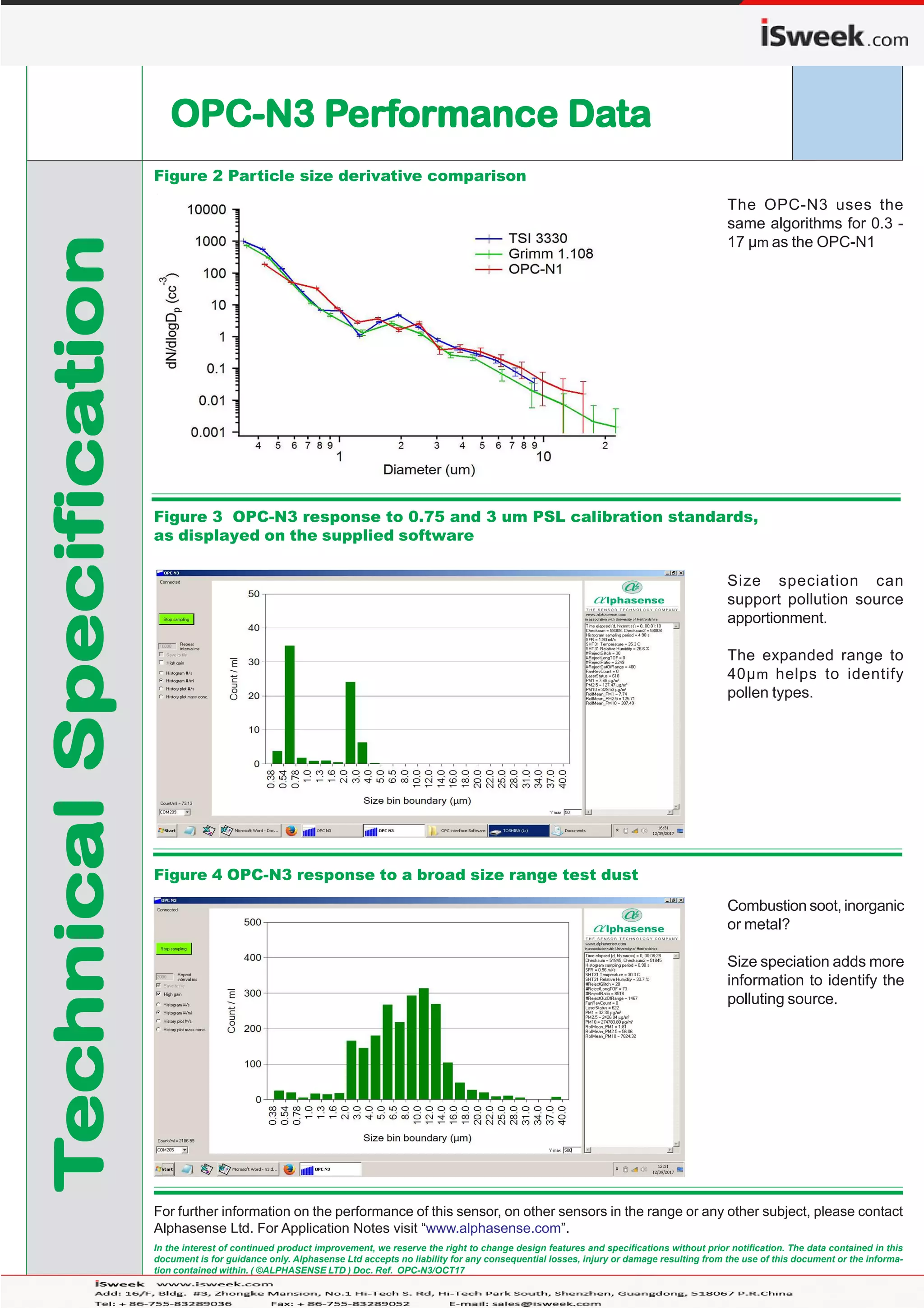
Figure 2 Particle size derivative comparison
The OPC-N3 uses the
same algorithms for 0.3 -
17 µm as the OPC-N1
Figure 3 OPC-N3 response to 0.75 and 3 um PSL calibration standards,
as displayed on the supplied software
Figure 4 OPC-N3 response to a broad size range test dust
Size speciation can
support pollution source
apportionment.
The expanded range to
40µm helps to identify
pollen types.
Combustion soot, inorganic
or metal?
Size speciation adds more
information to identify the
polluting source.

Pm2.5 particle sensor opc-n3

  • 1.
    MEASUREMENT Particle range Sphericalequivalent size (based on RI of 1.5, S of 1.65) 0.38 to 40 Size categorisation Number of software bins 24 Sampling interval Histogram period (seconds) 1 to 30 Total flow rate (typical) L/min 1.2 Sample flow rate (typical) mL/min 220 Max particle count rate Particles/second 10,000 Max coincidence probability %concentration at 106 particles/L 0.84 %concentration at 500 particles/L 0.24 POWER Measurement mode mA (typical) 175 Standyby mode mA (typical) < 50 Voltage range VDC 4.8 to 5.2 Switch-on transient mW for 1ms < 5000 DATA Digital interface/connections SPI (real-time data and communications) Micro USB (firmware updates and standalone mode) Data storage micro-SD (.CSV format) (GB) 16 KEYSPECIFICATIONS Digital interface SPI (Mode 1), USB Laser classification as enclosed housing Class 1 Temperature range °C -10 to 50 Humidity range % rh (continuous) 0 to 95 (non-condensing) Weight g < 105 Figure 1 OPC-N3 Schematic Diagram NOTE: As applications of use are outside our control, the information provided is given without legal responsibility. Customers should test under their own conditions, to ensure that the sensors are suitable for their own requirements. At the end of the product’s life, do not dispose of any electronic sensor, component or instrument in the domestic waste, but contact the instrument manufacturer, Alphasense or its distributor for disposal instructions. OPC-N3 POPC-N3 POPC-N3 POPC-N3 POPC-N3 Parararararticticticticticle Monitorle Monitorle Monitorle Monitorle MonitorTTTTTececececechnicalSpecifhnicalSpecifhnicalSpecifhnicalSpecifhnicalSpecificaicaicaicaicationtiontiontiontion * PM 1 , PM 2.5 and PM 10 * Reduced power standby mode * Capability to measure up to 2,000 µg/m3 * Onboard temperature and humidity sensor * SPI interface not included, order code 000-0SPI-00 All dimensions in millimetres (± 0.15mm) For use in high polution urban environments
  • 2.
    OPC-N3 POPC-N3 POPC-N3POPC-N3 POPC-N3 Perferferferferformance Daormance Daormance Daormance Daormance Datatatatata TTTTTececececechnicalSpecifhnicalSpecifhnicalSpecifhnicalSpecifhnicalSpecificaicaicaicaicationtiontiontiontion In the interest of continued product improvement, we reserve the right to change design features and specifications without prior notification. The data contained in this document is for guidance only. Alphasense Ltd accepts no liability for any consequential losses, injury or damage resulting from the use of this document or the informa- tion contained within. ( ©ALPHASENSE LTD ) Doc. Ref. OPC-N3/OCT17 For further information on the performance of this sensor, on other sensors in the range or any other subject, please contact Alphasense Ltd. For Application Notes visit “www.alphasense.com”. Figure 2 Particle size derivative comparison The OPC-N3 uses the same algorithms for 0.3 - 17 µm as the OPC-N1 Figure 3 OPC-N3 response to 0.75 and 3 um PSL calibration standards, as displayed on the supplied software Figure 4 OPC-N3 response to a broad size range test dust Size speciation can support pollution source apportionment. The expanded range to 40µm helps to identify pollen types. Combustion soot, inorganic or metal? Size speciation adds more information to identify the polluting source.