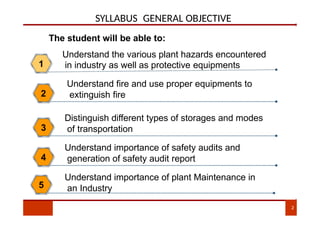
SYLLABUS GENERAL OBJECTIVE
1
2
Understandfire and use proper equipments to
extinguish fire
The student will be able to:
Understand the various plant hazards encountered
in industry as well as protective equipments
3
Distinguish different types of storages and modes
of transportation
4
Understand importance of safety audits and
generation of safety audit report
5
2
Understand importance of plant Maintenance in
an Industry
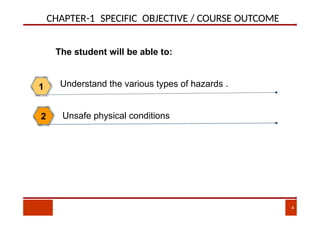
CHAPTER-1 SPECIFIC OBJECTIVE/ COURSE OUTCOME
Understand the various types of hazards .
1
The student will be able to:
Unsafe physical conditions
2
4
5.
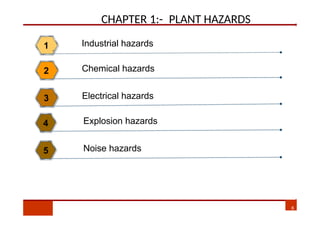
LECTURE 1:- PLANTHAZARDS
Need of Plant Safety
•Accident-Accidents can be defined as any
occurrence that interferes with the orderly progress
of activity.
•These accidents are the main reason for the
direct and indirect losses of an industry.
•Thus the main objective of Plant Safety is to
reduce these accidents.
5
Causes of Industrialaccidents
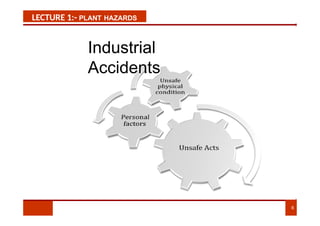
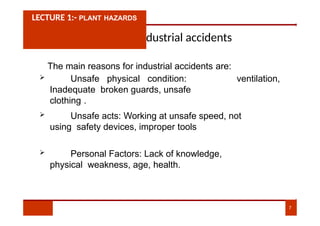
The main reasons for industrial accidents are:
ventilation,
Unsafe physical condition:
Inadequate broken guards, unsafe
clothing .
LECTURE 1:- PLANT HAZARDS
Unsafe acts: Working at unsafe speed, not
using safety devices, improper tools
Personal Factors: Lack of knowledge,
physical weakness, age, health.
7
8.
LECTURE 1:- PLANTHAZARDS
Preventive Measures
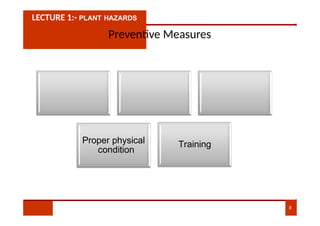
Fencing Use of PPE Maintenance
Proper physical
condition
Training
8
LECTURE 1:- PLANTHAZARDS
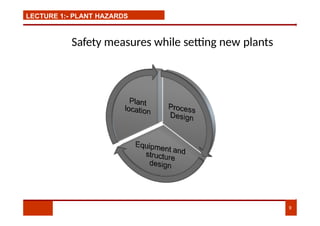
Safety measures while setting new plants
Plant Location: Selection of plot from the point of
view of safety is necessary. Geographical and natural
advantages should be considered
Process Design: Physiochemical and
thermodynamic properties of the process elements are to
be considered from the point of view of safety. Fail safe
process routes are very necessary
Equipment and structure design: MOC of equipment
10
should be properly chosen. Equipments to be
designed to withstand overload and
have
high
level
parameters so that they do not cause accidents.
LECTURE 2:- PLANTHAZARDS
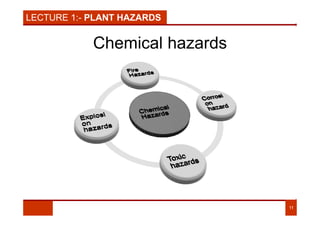
Fire hazard
• Causes of fire hazard:
1. Leakages
2. Hot jobs
3. Short Circuiting
4. Electrical Sparks
5. Static Electricity and Friction
12
13.
LECTURE 2:- PLANTHAZARDS
Explosion hazard
◉This causes greater damage and loss of property as
compared to fire hazard.
◉Common Causes:
1. External use of energy
2. Internal exothermic reaction
3. Result of sudden release of internal energy
4. Dust explosion
5. Salt bath explosion
13
14.
LECTURE 2:- PLANTHAZARDS
Toxic hazard
◉Hazards caused due to exposure of toxic chemicals is
called toxic hazards.
◉Common Causes:
1. Investigation
2. Inhalation
3. Contact with skin
4. Contact with eyes
14
15.
LECTURE 2:- PLANTHAZARDS
Corrosion hazards
◉Corrosion causing chemicals constitute to the corrosion
hazards
◉Common causes:
1. Splash of Corrosive chemicals
2. Exposure to corrosive chemicals
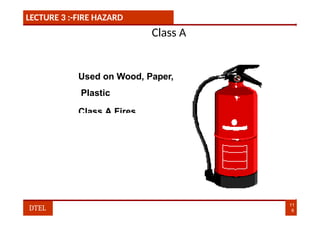
3. Leakage from valves, pipelines.
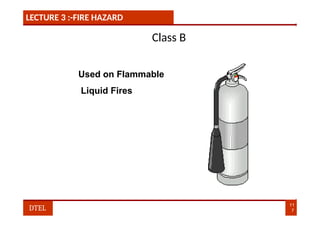
4. Escape from vent of chimneys.
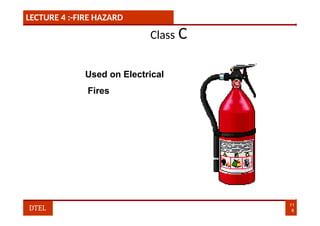
5. Release of gases at start-up.
15
16.
LECTURE 2:- PLANTHAZARDS
Hazard control
Low inventory of chemicals
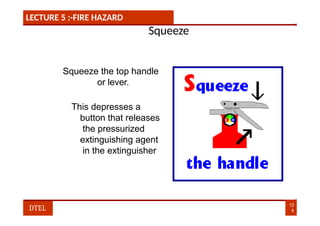
Time factor
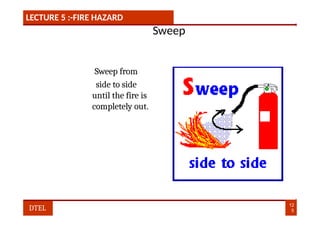
Exposure factor
Temperature factor
Exposure-Area Relation
Good Design and area installation
Pressure Vessels
Inspection and Preventive Maintenance
16
17.
LECTURE 2 :-PLANT HAZARDS
Hazard control
Training
Utilities
Storage and disposal of waste
Instrumentation
Laboratory Safety
Emergency procedures
Mutual AID
PP
17
18.
LECTURE 2:- PLANTHAZARDS
Objectives of overall scheme of safety
• To reduce exposure of personnel to chemical hazards
• To minimize build up of unsafe conditions.
• To implement planned program for accident prevention.
18
19.
LECTURE2:- PLANT HAZARDS
First-aid
•A First-AID box must be provided to a person who will
be available through-out the working hours so that the
workers and take advantage of the given facility.
• The First-AID box should have adequate amount of
supplies to fulfill the needs of their workers.
19
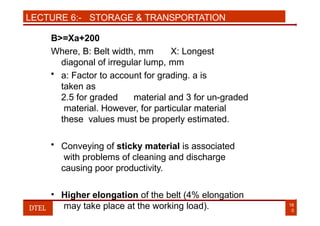
20.
LECTURE 3- PLANTHAZARDS
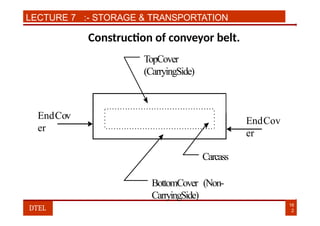
Principles of good layout
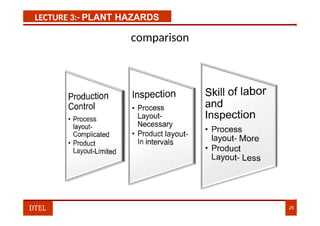
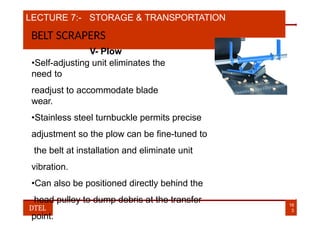
• Overall Integration of Factors
• Minimum movement
• Unidirectional flow
• Effective use of available space
• Maximum visibility
• Maximum accessibility
• Minimum Handling
• Inherent safety
• Safe and improved environment
• Maximum flexibility
• Maximum Security
DTEL 20
21.
LECTURE 3:- PLANTHAZARDS
Plant layout
◉Plant layout means the proper placing of all the facilities
and services of the plant within the site selected.
◉Layout problems occur when:
1. Decision to build a new plant
2. Introduction of new product
3. Withdrawal of obsolete facilities
4. Adoption of new safety standards
5. Overcoming the deficiencies of existing layout
DTEL 21
22.
LECTURE 3:- PLANTHAZARDS
Types Of layout
• Process or Functional layout
• Product or line layout
• Project or Fixed position layout
DTEL 22
LECTURE 4:- PLANTHAZARDS
Importance of safety
• In the chemical process industry plant safety is
important. Knowledge of plant safety is essential
• To prevent accidents and damages while working in
plant. Maintenance of plant and machinery is one of
• The most important aspects of process industry. This
subject deals with safe practices, various types of
• Maintenance and their significance
DTEL 26
LECTURE4:- PLANT HAZARDS
Importanceof safety
• The most important aspects of process industry. This
subject deals with safe practices, various types of
• Maintenance and their significance is also very
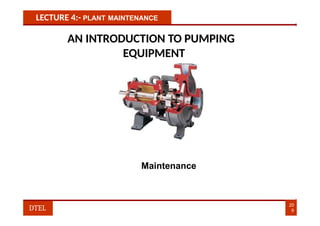
important
DTEL 28
29.
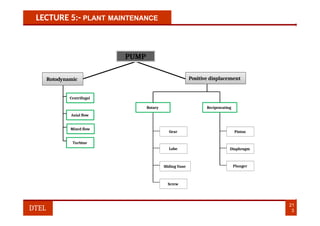
LECTURE 4:- PLANTHAZARDS
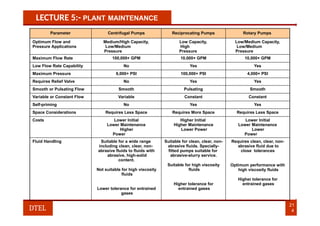
Importance of safety
• In the chemical process industry plant safety
is important. Knowledge of plant safety is essential
• To prevent accidents and damages while working in
plant. Maintenance of plant and machinery is one of
• The most important aspects of process industry. This
subject deals with safe practices, various types of
• Maintenance and their significance
DTEL 29
30.
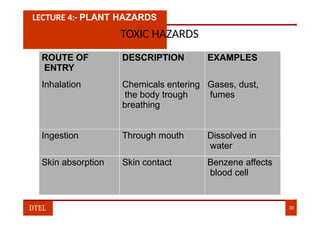
LECTURE 4:- PLANTHAZARDS
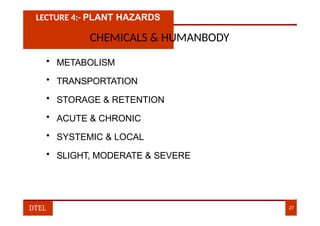
TOXIC HAZARDS
ROUTE OF
ENTRY
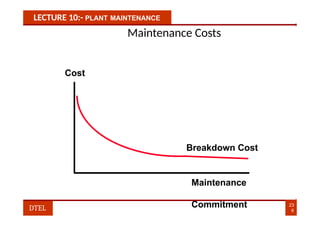
DESCRIPTION EXAMPLES
Inhalation Chemicals entering
the body trough
breathing
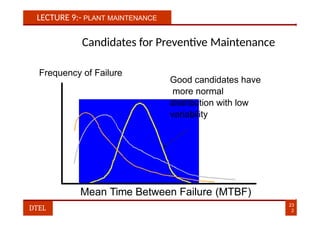
Gases, dust,
fumes
Ingestion Through mouth Dissolved in
water
Skin absorption Skin contact Benzene affects
blood cell
DTEL 30
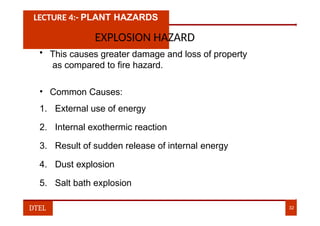
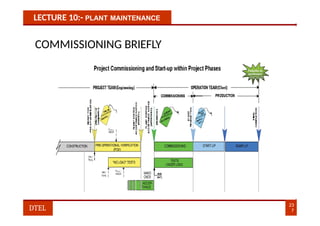
LECTURE 4:- PLANTHAZARDS
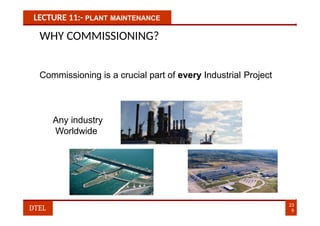
EXPLOSION HAZARD
• This causes greater damage and loss of property
as compared to fire hazard.
• Common Causes:
1. External use of energy
2. Internal exothermic reaction
3. Result of sudden release of internal energy
4. Dust explosion
5. Salt bath explosion
DTEL 32
LECTURE 2:- NUMBERSYSTEM
LECTURE 5:- PLANT HAZARDS
RADIATION HAZARDS
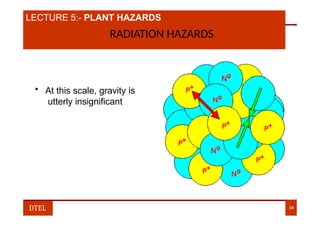
• At this scale, gravity is
utterly insignificant
DTEL 34
35.
LECTURE 2:- NUMBERSYSTEM
LECTURE 5 :- PLANT HAZARDS
Two types of nuclear forces bind particles
together
Very short range.
Protons are repelled by electromagnetic force
DTEL 35
36.
LECTURE 2:- NUMBERSYSTEM
LECTURE 5 :- PLANT HAZARDS
Nuclear Decay
• Too many protons (>83, Bi): nuclear forces cannot
hold nucleus together
• Too many neutrons also unstable
• Unstable nuclei emit particles and energetic radiation
(gamma rays)
DTEL 36
37.
LECTURE 2:- NUMBERSYSTEM
LECTURE 5 :- PLANT HAZARDS
• Massive nuclei can sometimes split
catastrophically (fission)
– Natural or Spontaneous
– Nuclear Reactor
– Nuclear Weapon
DTEL 37
38.
LECTURE 6 :-PLANT HAZARDS
Isotopes
• Atoms of element with different number of neutrons
• Protons = Atomic Number
• Protons + Neutrons = Atomic Weight
• Example: Uranium-238
– 92 protons by definition
– 238-92 = 146 neutrons
• Carbon-14
– 6 protons (by definition), 8 neutrons
DTEL 38
LECTURE 6 :-PLANT HAZARDS
Radiation and Half-Life
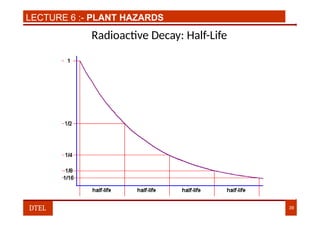
• Decay Constant: fraction of atoms that decay/time
• Half-life = 0.693/Decay Constant
• Example: 10% decay per hour: Half Life =
0.693/(0.1/hour) = 6.9 hours
• Shorter Half Life = More Radiation Per
Unit Time
DTEL 40
41.
LECTURE 6 :-PLANT HAZARDS
Half-Life and Hazard
• Very short half-life (days or less)
– Extremely high radiation hazard
– Decays very quickly
– Probably won’t move far during lifetime
• Extremely long half-life (geological)
– Radiation hazard negligible
– Chemical toxicity is worst hazard
– Daughter products (radon) can be a problem
DTEL 41
42.
LECTURE 6 :-PLANT HAZARDS
Effects of Nuclear Weapons
• Direct ionizing radiation
• Heat (Fireball)
– Rising fireball sucks dust upward, creates
“mushroom cloud”
– Any large explosion will create a “mushroom
cloud”
• Blast (Expansion of Fireball)
• Fallout
DTEL 42
43.
LECTURE 6 :-PLANT HAZARDS
Alpha Radiation
• Given off by decay of uranium and thorium and
daughter products (including radon and radium)
• Cannot penetrate skin
• +2 electric charge = high ionizing ability
• Least dangerous externally, most dangerous
internally
DTEL 43
44.
LECTURE 7 :-PLANT HAZARDS
Beta Radiation
• Given off by light and medium nuclei, including most
fission products (fallout and reactor waste)
• Can penetrate a few mm into tissue
• Electrons, -1 charge = moderately high ionizing
ability
• Minor external hazard, fairly serious internal hazard
DTEL 44
45.
LECTURE 7 :-PLANT HAZARDS
Gamma Rays
• Produced by all nuclear decays
• Need not be accompanied by particle emission
• Penetrates tissue easily, requires 1 cm lead to reduce
by ½
• Most serious external hazard
DTEL 45
46.
LECTURE 7 :-PLANT HAZARDS
Units of Radiation Dose
• Roentgen – Ability to create a specified electric
charge per volume of air
• Rem (Roentgen equivalent man) –Biological effect of
one roentgen of X-rays
• Rad (Radiation absorbed dose) – Energy absorption:
400,000 rads heat H2O 1 deg
DTEL 46
47.
LECTURE 7 :-PLANT HAZARDS
NOISE HAZARDS
• Objectives and Responsibilities
• The Effects of Noise
• Factors Affecting Hearing Loss
• Hearing Conservation Program
• Noise Hazard Assessments
• Noise Exposure and Monitoring Results
• Audiometric Testing
• Noise Control Measures
• Hearing Protection Devices
• Recordkeeping and Employee Training
DTEL 47
48.
LECTURE 7 :-PLANT HAZARDS
The Effects of Noise
• Psychological – can startle, annoy, and disrupt
concentration, sleep, or relaxation.
• Interference with communication, resulting in
interference with job performance and safety.
• Physiological – noise induced hearing loss, aural
pain, or even nausea.
DTEL 48
49.
LECTURE 8 :-PLANT HAZARDS
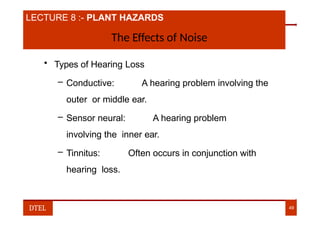
The Effects of Noise
• Types of Hearing Loss
– Conductive: A hearing problem involving the
outer or middle ear.
– Sensor neural: A hearing problem
involving the inner ear.
– Tinnitus: Often occurs in conjunction with
hearing loss.
DTEL 49
50.
LECTURE 8 :-PLANT HAZARDS
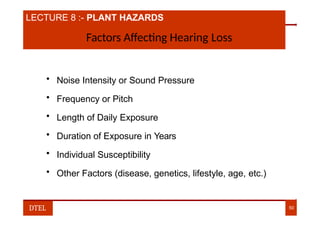
Factors Affecting Hearing Loss
• Noise Intensity or Sound Pressure
• Frequency or Pitch
• Length of Daily Exposure
• Duration of Exposure in Years
• Individual Susceptibility
• Other Factors (disease, genetics, lifestyle, age, etc.)
DTEL 50
51.
LECTURE 8 :-PLANT HAZARDS
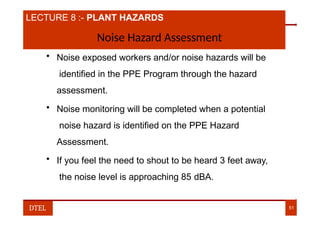
Noise Hazard Assessment
• Noise exposed workers and/or noise hazards will be
identified in the PPE Program through the hazard
assessment.
• Noise monitoring will be completed when a potential
noise hazard is identified on the PPE Hazard
Assessment.
• If you feel the need to shout to be heard 3 feet away,
the noise level is approaching 85 dBA.
DTEL 51
52.
LECTURE 8 :-PLANT HAZARDS
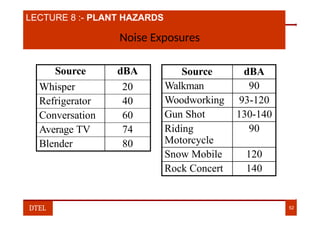
Noise Exposures
Source dBA
Whisper 20
Refrigerator 40
Conversation 60
Average TV 74
Blender 80
DTEL 52
Source dBA
Walkman 90
Woodworking 93-120
Gun Shot 130-140
Riding
Motorcycle
90
Snow Mobile 120
Rock Concert 140
53.
LECTURE 8 :-PLANT HAZARDS
Noise Control Measures
• Identify noise hazardous equipment.
• Modify the noise source so it is quieter.
• Increase distance between the employee and the
noise hazard.
• Limit exposure time.
• Use hearing protection devices when the above
measures are not feasible and/or do not decrease
noise levels below a TWA-8 of 85 dBA.
DTEL 53
54.
LECTURE 8 :-PLANT HAZARDS
Hearing Protection Devices
• Purpose of Hearing Protectors
• Advantages and Disadvantages
• Attenuation of Various Types
• Selection Instructions
• Fitting
• Use
• Care
DTEL 54
55.
LECTURE 9 :-PLANT HAZARDS
Hearing Protection Devices
• Purpose of Hearing Protectors
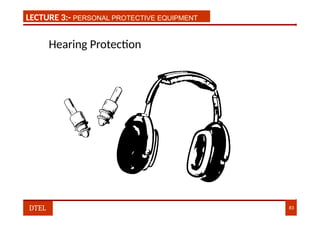
– Hearing protection devices include ear plugs (pre-
molded, foam rubber, custom molded), ear muffs
and canal caps.
– The purpose of hearing protection devices is to
reduce the harmful auditory and/or annoying
effects of sound.
DTEL 55
56.
LECTURE 9 :-PLANT HAZARDS
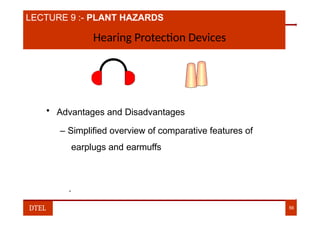
Hearing Protection Devices
• Advantages and Disadvantages
– Simplified overview of comparative features of
earplugs and earmuffs
DTEL 56
.
57.
LECTURE 9 :-PLANT HAZARDS
Hearing Protection Devices
• Attenuation
– The process of reducing noise to acceptable
levels.
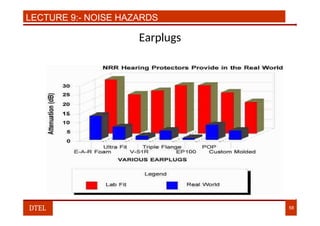
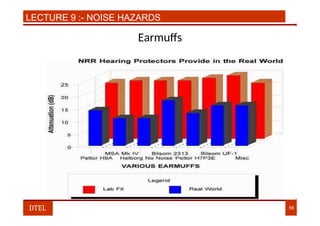
• Attenuation of Various Types
– Attenuation is different for different types and
styles of hearing protection devices.
DTEL 57
LECTURE 9 :-NOISE HAZARDS
Hearing Protection Devices (HPD)
• Noise Reduction Rating (NRR)
– HPD’s have an NRR that is used to determine how
effectively HPD’s reduce employee exposure by
subtracting the NRR from the employees
exposure.
– However, the NRR does not accurately reflect
attenuation and a safety factor of 7 must be used.
DTEL 60
61.
LECTURE 9 :-NOISE HAZARDS
• Noise Reduction Rating (NRR)
– Estimated A-weighted TWA under Hearing
Protection
– Employee TWA (dBA) – (NRR -
7dB)
• A combination of ear muffs and earplugs or other
HPD provides greater protection than either device
alone.
DTEL 61
62.
LECTURE 10 :-AMMONIA HAZARDS
What are the potential health effects of
ammonia?
Main Routes of Exposure:
Inhalation. Skin contact. Eye contact.
•Inhalation: VERY TOXIC, can cause death. Can cause
severe irritation of the nose and throat. Can cause life-
threatening accumulation of fluid in the lungs (pulmonary
edema). Symptoms may include coughing, shortness of
breath, difficult breathing and tightness in the chest.
Symptoms may develop hours after exposure and are
made worse by physical effort. Long-term damage may
result from a severe short-term exposure
DTEL 62
63.
LECTURE 10 :-AMMONIA HAZARDS
Skin Contact: CORROSIVE.
• The gas irritates or burns the skin.
•Permanent scarring can result.
•Direct contact with the liquefied gas can chill or freeze
the skin (frostbite).
•Symptoms of more severe frostbite include a burning
sensation and stiffness.
•The skin may become waxy white or yellow.
Blistering, tissue death and infection may develop in
severe cases.
DTEL 63
64.
LECTURE 10 :-AMMONIA HAZARDS
•Eye Contact: CORROSIVE.
•The gas irritates or burns the eyes.
•Permanent damage including blindness can
result.
• Direct contact with the liquefied gas can freeze
the eye. Permanent eye damage or blindness can
result.
Ingestion: Not a relevant route of exposure (gas).
DTEL 64
65.
LECTURE 10 :-AMMONIA HAZARDS
•Effects of Long-Term (Chronic) Exposure: May harm
the respiratory system. Can irritate and inflame the
airways.
•Carcinogenicity: Not known to cause cancer.
International Agency for Research on Cancer (IARC): Not
specifically evaluated.
American Conference for Governmental Industrial
Hygienists (ACGIH): Not specifically designated
DTEL 65
66.
LECTURE 10 :-CHLORINE HAZARDS
Chlorine in an emergency
Inhalation: VERY TOXIC,
•can cause death.
•Can cause severe irritation of
the nose and throat.
•Can cause severe lung injury.
•Can cause life-threatening accumulation of fluid in the lungs
(pulmonary edema).
•Symptoms may include coughing, shortness of breath,
difficult breathing and tightness in the chest.
•Symptoms may develop hours after exposure and are made
worse by physical effort.
DTEL 66
67.
LECTURE 10 :-CHLORINE HAZARDS
Chlorine in an emergency
•Long-term damage may result from a severe short-term
exposure.
•A single exposure to a high concentration can cause a long-
lasting condition like asthma.
•If this occurs, many things like other chemicals or cold
temperatures can easily irritate the airways.
•Symptoms may include shortness of breath, tightness in the
chest and wheezing. {Reactive Airways Dysfunction
Syndrome (RADS)}.
DTEL 67
68.
LECTURE 10 :-CHLORINE HAZARDS
Chlorine in an emergency
Skin Contact:
•CORROSIVE. The gas irritates or burns the skin.
Permanent scarring can result.
•Direct contact with the liquefied gas can chill or freeze
the skin (frostbite). Symptoms of mild frostbite include
numbness, prickling and itching.
•Symptoms of more severe frostbite include a burning
sensation and stiffness.
•The skin may become waxy white or yellow. Blistering,
tissue death and infection may develop in severe cases.
DTEL 68
69.
LECTURE 10 :-CHLORINE HAZARDS
Chlorine in an emergency
Eye Contact: CORROSIVE. The gas irritates or burns
the eyes. Permanent damage including blindness can
result. Direct contact with the liquefied gas can freeze
the eye. Permanent eye damage or blindness can result.
DTEL 69
70.
Chapter 1 QuestionBank
•State importance and objectives of plant safety.
•What are the effects of radiation hazards?
•Give controlling methods for toxic chemical hazards like ammonia and chlorine.
•Write causes and remedies for toxic hazards in chemical plants.
•Explain trouble shooting of chemical plants with two examples.
• State any four requirements of good plant layout.
• Write safety measures against explosion hazards.
• What type of instrumentation is provided for safe plant operation?
• Write causes and remedies for electrical hazards.
•Write basic steps / measures necessary for controlling plant hazards
•What are the causes of accidents in an industry?
•What is noise hazard? What are the health hazards associated with noise?
•Explain the objectives of safety.
•How to control the hazards of ammonia?
•Give any two types of mechanical hazard in industry. Explain the methods to
prevent these hazards.
•What are the common sources of electrical hazard?
•What are the general safety activities in an industry?
•Explain plant safety provisions in an industry.
DTEL 73
71.
CHAPTER 2:- PERSONALPROTECTIVE EQUIPMENTS
.
Type
s
1
Respiratory
2
Non-Respiratory
3
dtel 74
72.
CHAPTER-2 SPECIFIC OBJECTIVE/ COURSE OUTCOME
Understand the various types of personal protective equipment.
1
The student will be able to:
Awareness of equipment
2
DTEL 72
73.
LECTURE 1:- PERSONALPROTECTIVE EQUIPMENT
Personal Protective Equipment
Definition: Devices used to protect an employees
from injury or illness resulting from contact with
chemical , radiological, physical, electrical,
mechanical, or other workplace hazards.
The need for PPE and the type of PPE used is
based on hazard present; each situation must be
evaluated independently.
DTEL 73
74.
LECTURE 1:- PLANTHAZARDS
LECTURE 1:- Personal Protective Equipment
Some Caveats
• PPE is used as a last resort
• The use of PPE signifies that the hazard could not be
controlled by other methods, such as:
– administrative controls (i.e., shift rotation)
– engineering or industrial hygiene controls
DTEL 74
75.
LECTURE 1:- PLANTHAZARDS
LECTURE 1:- PERSONAL PROTECTIVE EQUIPMENT
Engineering & IH Controls
• Design (remove hazard from process)
• Substitution (of less hazardous materials)
• Process modification (how and where)
• Isolate the process or the worker
• Wet methods for dust reduction
• Local exhaust ventilation (at source)
• Dilution ventilation (area)
• Good housekeeping
DTEL 75
76.
LECTURE 1:- PLANTHAZARDS
LECTURE 1:- PERSONAL PROTECTIVE EQUIPMENT
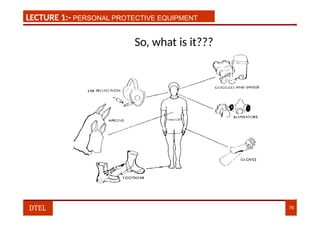
So, what is it???
DTEL 76
77.
LECTURE 1:- PLANTHAZARDS
LECTURE 2:- Personal Protective Equipment
•Head protection
•Eye and Face protection
•Hearing protection
•Respiratory protection
•Arm and Hand protection
•Foot and Leg protection
•Protective clothing
DTEL 77
78.
LECTURE 1:- PLANTHAZARDS
LECTURE 2:- PERSONAL PROTECTIVE EQUIPMENT
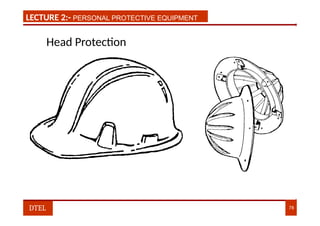
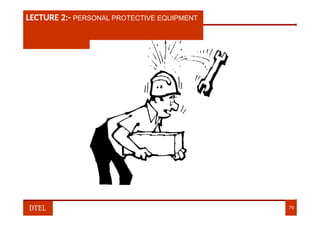
Head Protection
DTEL 78
79.
LECTURE 1:- PLANTHAZARDS
LECTURE 2:- PERSONAL PROTECTIVE EQUIPMENT
DTEL 79
LECTURE 1:- PLANTHAZARDS
LECTURE 3:- PERSONAL PROTECTIVE EQUIPMENT
Hearing Protection Basics
• Noise induced hearing loss can occur with exposures
>90 dBA
• A hearing conservation program becomes a
requirement at exposures >85dBA
• Higher levels of noise exposure have shorter
allowable exposure times
DTEL 84
85.
LECTURE 1:- PLANTHAZARDS
LECTURE 4
Hearing Protection
• Rule of Thumb - if you cannot carry on a
conversation in a normal tone of voice with someone
at arm’s length, you are likely near 90dBA
• All hearing protection devices should have a Noise
Reduction Rating (NRR) = # of decibels they will
reduce noise levels
• Be conservative when using NRRs
DTEL 85
86.
LECTURE 1:- PLANTHAZARDS
LECTURE 4:- PERSONAL PROTECTIVE EQUIPMENT
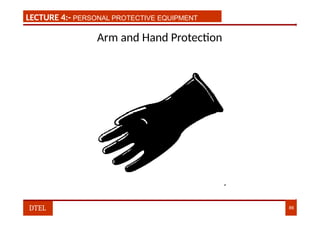
Arm and Hand Protection
DTEL 86
87.
LECTURE 1:- PLANTHAZARDS
LECTURE 4:- PERSONAL PROTECTIVE EQUIPMENT
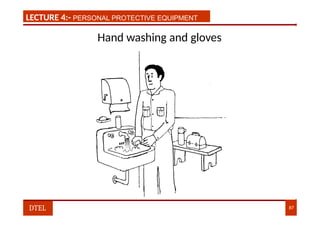
Hand washing and gloves
DTEL 87
88.
LECTURE 1:- PLANTHAZARDS
LECTURE 4:- PERSONAL PROTECTIVE EQUIPMENT
Gloves - Typical Uses
• Chemical protection
• Biohazard protection
• Abrasion protection
• Friction protection
• Protection from extremes of heat and cold
DTEL 88
89.
LECTURE 1:- PLANTHAZARDS
LECTURE 5:- PERSONAL PROTECTIVE EQUIPMENT
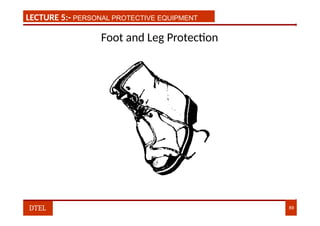
Foot and Leg Protection
DTEL 89
90.
LECTURE 1:- PLANTHAZARDS
LECTURE 5:- PERSONAL PROTECTIVE EQUIPMENT
Protective Footwear
• Steel-toed footwear, preferably with metatarsal
guards, is used to protect feet from crushing injuries
caused by heavy objects
• Rubber boots are often used to protect feet from
exposure to liquids
• Chaps or leggings are used in certain applications
(i.e., using a chainsaw)
DTEL 90
91.
LECTURE 1:- PLANTHAZARDS
LECTURE 5:- PERSONAL PROTECTIVE EQUIPMENT
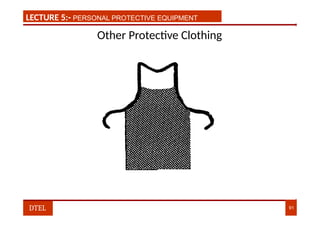
Other Protective Clothing
DTEL 91
LECTURE 1:- PLANTHAZARDS
LECTURE 5:- PERSONAL PROTECTIVE EQUIPMENT
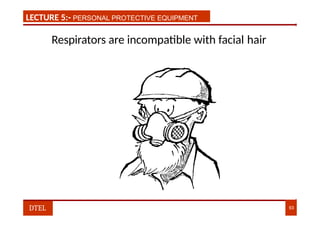
Respirators are incompatible with facial hair
DTEL 93
94.
LECTURE 1:- PLANTHAZARDS
LECTURE 5:- PERSONAL PROTECTIVE EQUIPMENT
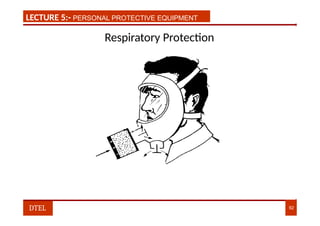
Respiratory Protection
• Protects users by removing harmful materials that
may enter the body via the lungs
• Inhalation is one of the quickest, most efficient ways
to introduce lethal levels of hazardous materials
into the body
DTEL 94
95.
LECTURE 1:- PLANTHAZARDS
LECTURE 5:- PERSONAL PROTECTIVE EQUIPMENT
Respirators - A Big Caveat!!!
• Employees should not wear a respirator unless they
have been medically cleared to do so!
• This clearance may take the form of a questionnaire,
physical examination, pulmonary function testing,
chest X-Ray, or a combination of the above
DTEL 95
96.
LECTURE 1:- PLANTHAZARDS
LECTURE 5:- PERSONAL PROTECTIVE EQUIPMENT
Respirators - types
• Air Purifying Respirators (APR)
– Half-face
– Full Face
• Powered Air Purifying Respirators (PAPR)
• Self Contained Breathing Apparatus (SCBA)
DTEL 96
97.
LECTURE 1:- PLANTHAZARDS
LECTURE 5:- PERSONAL PROTECTIVE EQUIPMENT
Respirators
• Does not include:
– surgical masks
– dust masks
• N-95 respirators are a special class of respiratory
protection primarily used in the health care field
10
0
DTEL
98.
LECTURE 1:- PLANTHAZARDS
LECTURE 5:- PERSONAL PROTECTIVE EQUIPMENT
Why?
• Respirators put additional resistance against the
respiratory system of the wearer
• Persons with undiagnosed respiratory system or
cardiovascular problems could trigger a serious
medical problem (respiratory distress, asthma, heart
attack, etc.) by using a respirator
10
1
DTEL
99.
LECTURE 1:- PLANTHAZARDS
LECTURE 5:- PERSONAL PROTECTIVE EQUIPMENT
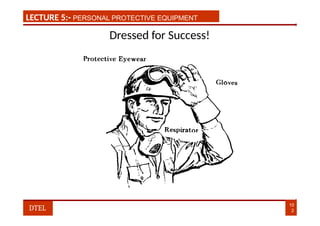
Dressed for Success!
10
2
DTEL
100.
Chapter 2 QuestionBank
LECTURE 5:-
•Write importance of high efficiency dust respirator and blasting helmets.
•Give precautions related with ‘eye’ and ‘ear’ & its importance.
•Explain protective equipments while fire fighting in chemical plant
•What are the factors to be considered for selection of proper respiratory
devices?
•What are the protective devices used in industry for (1) face (2) eyes.
•Explain the working of air line respirators.
DTEL 103
101.
CHAPTER 3:- FIREPREVENTION
.
Classification of Fire
1
Fire extinguisher
2
Types & working
3
dtel
10
4
102.
CHAPTER-3 SPECIFIC OBJECTIVE/ COURSE OUTCOME
Understand the various causes of fire hazards.
1
The student will be able to:
Understand working of fire extinguisher
2
10
5
DTEL
LECTURE 1 :-FIREHAZARD
What you will learn…
– Types of Fires
– Fire Triangle
– Types of Extinguishers
– How to Use an Extinguisher
– Rules for Fires
10
7
DTEL
105.
LECTURE 1 :-FIREHAZARD
Types of Fires
Fires Are Classified by
the type FUEL they burn.
The 4 Types are
– A
– B
– C
– D
10
8
DTEL
106.
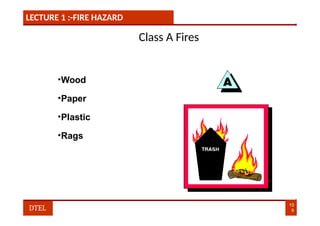
LECTURE 1 :-FIREHAZARD
Class A Fires
•Wood
•Paper
•Plastic
•Rags
10
9
DTEL
107.
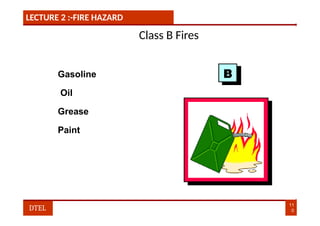
LECTURE 2 :-FIREHAZARD
Class B Fires
Gasoline
Oil
Grease
Paint
11
0
DTEL
LECTURE 2 :-FIREHAZARD
Fire Triangle
Fires Require
– Air
– Fuel
– Heat
11
2
DTEL
110.
LECTURE 2 :-FIREHAZARD
Air
Air is required as a
catalyst
Can be oxygen
Fuel
For a fire to start
there must be
something to Burn
Heat
from the air
OR
From the Fuel
itself
11
3
DTEL
For a Fire
to Start,
there must
be a heat or
ignition
source
111.
LECTURE 3 :-FIREHAZARD
Causes of fire
1. Sparking or short circuit
2. Friction in rotating equipments
3. Open flame
4. Smoking & matches spontaneous ignition of trash
5. Hot surfaces
6. Static electricity
7. Leakages of flammable liquids, vapours
8. Sparks from combustion
11
4
DTEL
112.
LECTURE 3 :-FIREHAZARD
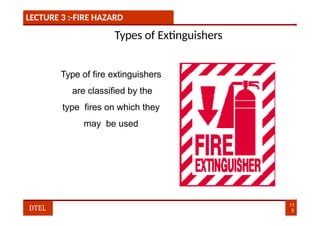
Types of Extinguishers
Type of fire extinguishers
are classified by the
type fires on which they
may be used
11
5
DTEL
113.
LECTURE 3 :-FIREHAZARD
Class A
Used on Wood, Paper,
Plastic
Class A Fires
11
6
DTEL
114.
LECTURE 3 :-FIREHAZARD
Class B
Used on Flammable
Liquid Fires
11
7
DTEL
115.
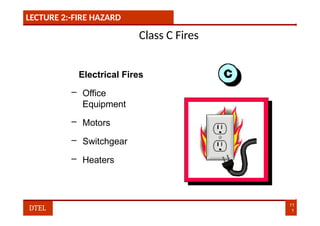
LECTURE 4 :-FIREHAZARD
Class C
Used on Electrical
Fires
11
8
DTEL
LECTURE 4 :-FIREHAZARD
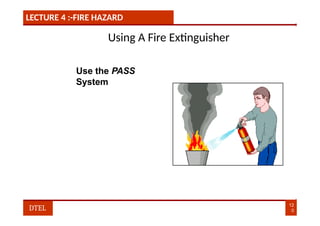
Using A Fire Extinguisher
Use the PASS
System
12
0
DTEL
118.
LECTURE 4 :-FIREHAZARD
PAS
S
Pull
Aim
Squeeze
Sweep
12
1
DTEL
119.
LECTURE 5 :-FIREHAZARD
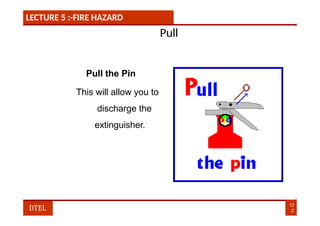
Pull
Pull the Pin
This will allow you to
discharge the
extinguisher.
12
2
DTEL
120.
LECTURE 5 :-FIREHAZARD
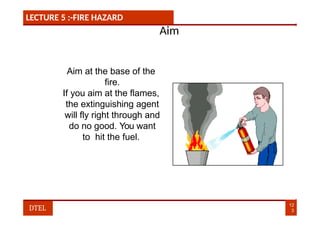
Aim
Aim at the base of the
fire.
If you aim at the flames,
the extinguishing agent
will fly right through and
do no good. You want
to hit the fuel.
12
3
DTEL
121.
LECTURE 5 :-FIREHAZARD
Squeeze
Squeeze the top handle
or lever.
This depresses a
button that releases
the pressurized
extinguishing agent
in the extinguisher
12
4
DTEL
122.
LECTURE 5 :-FIREHAZARD
Sweep
Sweep from
side to side
until the fire is
completely out.
12
5
DTEL
123.
LECTURE 6 :-FIREHAZARD
DTEL
12
6
Rules for Fires
– Fires are very dangerous
– Be certain that you will not endanger
yourself or others when attempting to put
out a fire.
– Pull the Fire Alarm
– Call 911
– Assist anyone danger
124.
LECTURE 6 :-FIREHAZARD
Fire Rules
Never Fight a Fire if you don't know what is
burning
If you don't know what is burning, you don't know
what type of extinguisher to use.
Even if you have an ABC extinguisher, there may be
something in the fire which is going to explode or
produce highly toxic smoke.
12
7
DTEL
125.
LECTURE 6 :-FIREHAZARD
Fire Rules
Never Fight a Fire if the fire is spreading rapidly
beyond the spot where it started
The time to use an extinguisher is in the incipient, or
beginning, stages of a fire. If the fire is already
spreading quickly, it is best to simply evacuate the
building, closing doors and windows behind you as
you leave.
12
8
DTEL
126.
LECTURE 6 :-FIREHAZARD
Fire Rules
Never Fight a fire if you don't have adequate or
appropriate equipment
If you don't have the correct type or large enough
extinguisher, it is best not to try to fight the fire.
Never fight a fire if your instincts tell you not
to.
If you are uncomfortable with the situation for any
reason, just let the fire department do their job.
12
9
DTEL
127.
LECTURE 6 :-FIREHAZARD
The final rule is to always position yourself with
an exit or means of escape at your back before you
attempt to use an extinguisher to put out a fire.
In case the extinguisher malfunctions, or
something unexpected happens, you need to be able
to get out quickly, and you don't want to become
trapped. Just remember, always keep an exit at your
back.
13
0
DTEL
128.
Chapter 3 QuestionBank
LECTURE 6 :-
•How fires are classified? State their causes. (Any two).
•Write technical specifications of foam type fire extinguisher and write its
applications. (Any two).
•Explain fire triangle.
•Explain how to use dry chemical powder type fire extinguisher.
•Explain the classification of explosives.
•State characteristics & use of dry chemical extinguisher systems.
•Explain construction and working of portable extinguisher and state its
use.
•Explain the classes of fire and the type of extinguishers used for each
type.
•With a diagram explain the principle and working of soda acid type fire
extinguisher.
DTEL 131
129.
CHAPTER 4:- STORAGEAND TRANSPORTATION
.
Introduction
1
Methods of storage
2
Function & principle
3
dtel
Different equipments
2
4
13
130.
CHAPTER-4 SPECIFIC OBJECTIVE/ COURSE OUTCOME
Understand the various types of Methods of storage
.
1
The student will be able to:
. Understand Function & principle
2
13
3
DTEL
131.
LECTURE 1:- STORAGE& TRANSPORTATION
CLASSIFICATION OF MATERIALS
• RAW MATERIALS:-
Raw materials are the goods on which the manufacturing
process will operate to produce saleable products.
• GOODS IN PROCESS:-
This category refers to goods which have completed
some but not all of the manufacturing process
• FINISHED GOODS:-
These goods are those which have completed the
manufacturing process and are stored in inventory to fill
customer orders.
13
4
DTEL
132.
LECTURE 1:- STORAGE& TRANSPORTATION
METHODS OF STORAGE AND PRESERVATION OF
MATERIALS
1. BULK STORAGE:-
The bulk pulverized solids such as sulfur, coal etc. are
usually stored outdoors in large piles.
INVENTORY:-
The mass of solid in pile is calculated by finding the
volume of the pile by ground surveys and multiplying
it by bulk density of material.
13
5
DTEL
133.
LECTURE 1:- STORAGE& TRANSPORTATION
MATERIAL FEEDING ARRANGEMENTS
• BELT FEEDER
• SHUTTLE
• TRIPPER DISCHARGE
13
6
DTEL
134.
LECTURE 1:- STORAGE& TRANSPORTATION
BIN STORAGE:-
Valuable materials are stored in bins, hoppers
or silos which are cylindrical or rectangular vessel made
of concrete or metal.
CLASSIFICATION:-
The storage bins are classified based
upon
• Flow pattern of bulk material discharged,
• Funnel flow or plug flow,
• Mass flow,
• Composite flow.
13
7
DTEL
135.
LECTURE 2:- STORAGE& TRANSPORTATION
UNDERGROUND STORAGE:-
Liquid are stored underground in porous media
between impervious rocks. Cavities are formed in salt
domes by dissolving the salt and pumping it out. This
method has extensive application for storing the
petroleum product.
13
8
DTEL
136.
LECTURE 2:- STORAGE& TRANSPORTATION
LIQUID STORAGE:-
Open atm. Tanks are used for storing liquids
that
will not harmed by water, weather, or atm. pollution.
Closed tanks have fixed or floating roof. Fixed roof
are usually domed or coned with intermediate support.
13
9
DTEL
137.
LECTURE 2:- STORAGE& TRANSPORTATION
GAS STORAGE:-
Certain gases are stored by dissolving them in
liquid. (e.g NH3 in water).use of this method depends
upon weather the end use of stored gas requires the
anhydrous or the liquid state.
14
0
DTEL
138.
LECTURE 2:- STORAGE& TRANSPORTATION
STORAGE OF NUT-BOLTS,PIPES,SCREWS &
NAILS
Nut-bolt, screws, and nails are coated with
grease to prevent rusting and they are stored in grades
and sizes. Pipes are stored in grades, size and lengths.
14
1
DTEL
139.
LECTURE 3:- STORAGE& TRANSPORTATION
• PACKING OF SOLIDS:-
The solids are packed in
1. Bags
2. Boxes
3. Drums
4. Metal containers
5. Wood containers
6. Corrugated cardboard
containers
7. Tote boxes & bins.
14
2
DTEL
140.
LECTURE 3:- STORAGE& TRANSPORTATION
PALLETIZATION OF UNIT LOADS
Pallets are usually supports, carrier
surfaces, or
storing structures, for unit loads. pallets are usually made up
of wood, and the type of wood depends on load capacity.
The style of wood pallets are;
•Single-face pallet
•Double-face pallet
1. Reversible
2. Non-reversible
14
3
DTEL
141.
LECTURE 3:- STORAGE& TRANSPORTATION
TYPES OF PALLETS:-
1. EXPANDABLE WOOD PALLETS
2. METAL PALLETS
3. CORUGATED METAL PALLETS
4. ALL STEELM, SINGLE FACE PALLETS
5. ONE-PIECE, FORMED-METAL PALLETS
6. WIRE MESH PALLETS
7. CARDBOARD PALLETS
8. PLASTIC PALLETS.
14
4
DTEL
142.
LECTURE 3:- STORAGE& TRANSPORTATION
PACKAGING OPERATIONS:-
The dry-bulk packaging operations involves;
1. Weighing of materials:-
This method is generally used for valves bags,
pouches, bulk boxes, and bags in boxes.
Weighing of bulk solids:-
1. Batch Weighing
2. Continuous Weighing
3. Check Weighing
4. Fork-lift trucks
14
5
DTEL
143.
LECTURE 4:- STORAGE& TRANSPORTATION
TRANSPORTATIONOF MATERIALS:-
• Materials handling may be defined as the art and
science of movement,
materials during differing
14
6
DTEL
handling and
storage of
stagesof
manufacturing
considered as materials flow into, through and away
from the plant.
144.
LECTURE 4:- STORAGE& TRANSPORTATION
CAUSES OF MATERIAL HANDLING
1. Large num. of unskilled contract labour to
handle materials.
2. Bad housekeeping
3. Over crowded areas
4. Badly damaged floor
5. Excessive loading
6. Frequent breakdown
7. Difficulties in locating things when req.
14
7
DTEL
145.
LECTURE 4:- STORAGE& TRANSPORTATION
OBJECTIVES OF MATERIAL HANDLING
1. Safety in material handling
2. Better housekeeping
3. Minimization of fatigue and drudgery
4. Speed and economy in movement of materials
5. Higher plant efficiency
6. Efficient storekeeping
7. Lower investment in work-in-process
14
8
DTEL
146.
LECTURE 4:- STORAGE& TRANSPORTATION
ENGINEERING FACTORS
1. Building and plant layout
2. Manufacturing process and equipment
3. Nature of materials
4. Product to be handled
5. Material handling equipments
14
9
DTEL
147.
LECTURE 5:- STORAGE& TRANSPORTATION
BUILDING AND PLANT LAYOUT
1. Processes and departments to be tied
2. Width of aisles
3. Locations of columns
4. Ceilings heights
5. Number of floower
15
0
DTEL
148.
LECTURE 5:- STORAGE& TRANSPORTATION
MANUFACTURING PROCESS AND
EQUIPMENT
1. Production equipment
2. Method of production
3. Sequence of operations
4. Quantities of materials involved
15
1
DTEL
LECTURE 5:- STORAGE& TRANSPORTATION
Apron Feeder
Scalping grizzly feeder
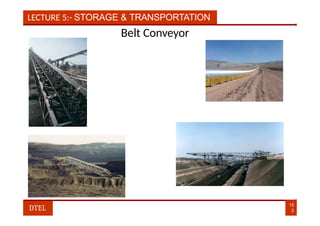
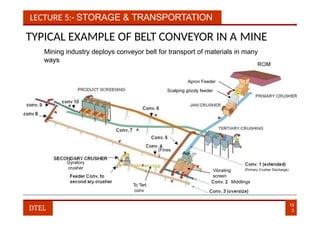
TYPICAL EXAMPLE OF BELT CONVEYOR IN A MINE
Mining industry deploys conveyor belt for transport of materials in many
ways
(Primary Crusher Discharge)
Vibrating
screen
(Fines
)
Middlings
Gyratory
crusher
To Tert.
conv
15
3
DTEL
151.
LECTURE 6 :-STORAGE & TRANSPORTATION
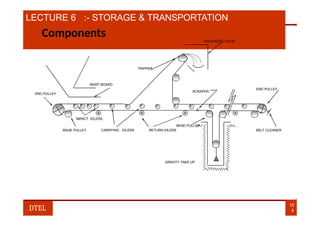
END PULLEY
END PULLEY
TRIPPER
SKIRT BOARD
DISCHARGE HOOD
SCRAPER
Components
SNUB PULLEY
BEND PULLEY
RETURN IDLERS
CARRYING IDLERS
GRAVITY TAKE-UP
IMPACT IDLERS
BELT CLEANER
15
4
DTEL
152.
LECTURE 5 :-STORAGE & TRANSPORTATION
Application and Limitations
A wider range of material can be handled which
pause problems in other transportation means.
Belt conveyor can be used for abrasive, wet, dry,
sticky or dirty material. The lump size of the
transported material is limited by the width of the
belt. Belts up to 3000 mm wide are used in mining
industry.
Higher capacity can be handled than any other
form of conveyor at a considerably lower cost per
tonne kilometer. Conveyor belts with capacity of
11000t/h and even higher can be deployed to
match with higher capacity mining machinery.
15
5
DTEL
153.
LECTURE 5 :-STORAGE & TRANSPORTATION
Longer distances can be covered more economically
than any other transportation system. A single belt
conveyor or a series of belt conveyors can do this. Belt
conveyors can be adopted for cross-country laying.
By the use of many forms of ancillary equipment such
as mobile trippers or spreaders bulk material can be
distributed and deposited wherever required.
15
6
DTEL
154.
LECTURE 5 :-STORAGE & TRANSPORTATION
• Many other functions can be performed with the basic
conveying like weighing, sorting, picking, sampling,
blending, spraying, cooling, drying etc.
• Structurally it is one of the lightest forms of conveying
machine. It is comparatively cheaper and supporting
structures can be used for many otherwise
impossible structures such as crossing rivers, streets
and valleys.
15
7
DTEL
155.
LECTURE 6:- STORAGE& TRANSPORTATION
• The belt conveyor can be adopted for special purposes
(fire resistant, wear resistant, corrosion resistant,
high angle negotiation etc.) and can be integrated with
other equipment.
• It can be horizontal, incline or decline or
combination
of all.
• Minimum labor is required for the operation and
maintenance of belt conveyor system.
• In underground mine transport, belt conveyor can be
used in thin seams as it eliminates the rock works that
might otherwise be required to gain haulage height.
Moreover, belt conveyor can provide continuous
haulage service from pit bottom to the surface.
15
8
DTEL
156.
LECTURE 6 :-STORAGE & TRANSPORTATION
Limitations
• The loading and transfer points need to be properly
designed.
• Numbers of protective devices have to be incorporated to
save the belt from getting damaged by operational problems.
• The belt needs higher initial tension (40-200% of useful pull).
• The use of belt is restricted by the lump size. If the maximum
diagonal of a irregular lump is X then the belt width (B) is
approximately given by:
15
9
DTEL
157.
LECTURE 6:- STORAGE& TRANSPORTATION
B>=Xa+200
Where, B: Belt width, mm X: Longest
diagonal of irregular lump, mm
• a: Factor to account for grading. a is
taken as
2.5 for graded material and 3 for un-graded
material. However, for particular material
these values must be properly estimated.
• Conveying of sticky material is associated
with problems of cleaning and discharge
causing poor productivity.
• Higher elongation of the belt (4% elongation
may take place at the working load). 16
0
DTEL
158.
LECTURE 6:- STORAGE& TRANSPORTATION
Essential Belt Properties
The belt works as a tractive element as well as load-carrying
element. It may be used for different kind of material
transportation at a higher speed ( 6-8 m/s). For this
purpose the belt need to have the following essential
properties:
Flexibility
Transverse rigidity
Low mass per unit length
High strength
Simplicity and inexpensive
Longer life
Wear resistant
Fire resistant
16
1
DTEL
159.
LECTURE 7 :-STORAGE & TRANSPORTATION
TopCover
(CarryingSide)
Construction of conveyor belt.
EndCov
er
EndCov
er
Carcass
BottomCover (Non-
CarryingSide)
16
2
DTEL
160.
LECTURE 7:- STORAGE& TRANSPORTATION
BELT SCRAPERS
V- Plow
•Self-adjusting unit eliminates the
need to
readjust to accommodate blade
wear.
•Stainless steel turnbuckle permits precise
adjustment so the plow can be fine-tuned to
the belt at installation and eliminate unit
vibration.
•Can also be positioned directly behind the
head pulley to dump debris at the transfer
point.
16
3
DTEL
161.
LECTURE 7 :-STORAGE & TRANSPORTATION
BELT SCRAPERS
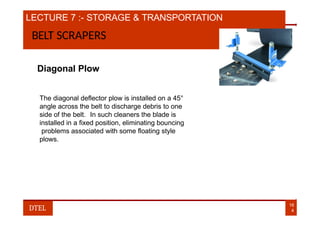
Diagonal Plow
The diagonal deflector plow is installed on a 45°
angle across the belt to discharge debris to one
side of the belt. In such cleaners the blade is
installed in a fixed position, eliminating bouncing
problems associated with some floating style
plows.
16
4
DTEL
162.
Chapter 4 QuestionBank
LECTURE6 :-
•Give any four characteristics of each of the chemicals like acid and phenol for
storage
•Give safety precautions in the transportation of inflammable liquids. (Any four)
•Explain different methods of storage of chemicals.
•Write various modes of transport and their suitability.
•Explain various methods for storing liquids.
•How mass flow bins for storage works ? What are its advantages ?
•With a diagram explain the working of belt conveyor
•Draw a neat diagram of a bucket elevator and name the parts.
•Explain the working of pneumatic conveyor.
DTEL 165
CHAPTER-5 SPECIFIC OBJECTIVE/ COURSE OUTCOME
Understand the various types of safety audit .
1
The student will be able to:
. Prepare safety audit report & safety report
2
16
7
DTEL
165.
LECTURE 1:- SAFETYAUDIT
Benefits of Good Safety Management
• Reduction in the cost of medical and workers’
compensation
• Greater productivity
• Improved product or research quality
• Overall operation improvement
16
8
DTEL
166.
LECTURE 1:- SAFETYAUDIT
Basic Principles of Good
Safety Management
Management Commitment
Documented Safety Philosophy
Safety Goals and Objectives
Committee Organization for Safety
Line Responsibility for Safety
Supportive Safety Staff
16
9
DTEL
167.
LECTURE 1:- SAFETYAUDIT
Supervisor’s Responsibilities
• Know, communicate, and enforce existing standards
• Recognize the need for revised standards
• Develop new procedures and rules when necessary
• Train employees to follow all rules and procedures
17
0
DTEL 167
168.
LECTURE 1:- SAFETYAUDIT
PPD’s Audit Program
• An opportunity to spend a few minutes observing
activities in the workplace and then discuss what you’ve
seen with your employees
• This is done with an eye towards safe, and unsafe,
behavior
• Mitigate hazards
• Record observations
17
1
DTEL 168
169.
LECTURE 2:- SAFETYAUDIT
Purpose of PPD’s Safety Audit
– Identify safe and unsafe, acts or conditions
– Identify areas for improvement
– Follow up when mitigating actions are indicated
– Accumulate data for tracking trends related to safety
17
2
DTEL 169
170.
LECTURE 2:- SAFETYAUDIT
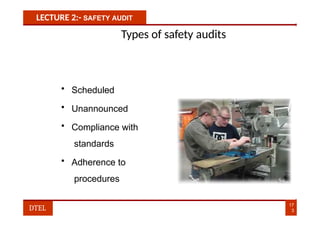
Types of safety audits
• Scheduled
• Unannounced
• Compliance with
standards
• Adherence to
procedures
17
3
DTEL
171.
LECTURE 2:- SAFETYAUDIT
DTEL
17
Benefits of safety audits
• Promote safe behavior
• Test for compliance with standards
• Establish standards
• Identify weaknesses
• Accumulate data
• Prevent injuries
4
174
172.
LECTURE 2:- SAFETYAUDIT
Who conducts PPD safety audits?
• Division Office
• Department Heads
• Group Leaders
• Supervisors
• ES&H Staff
• Project Management
17
5
DTEL
LECTURE 3:- SAFETYAUDIT
Elements of our Safety Audit Process
• Read the Audit Checklist prior to the walkthrough
• Visit the work area and talk with employees (without
paperwork in hand)
• Mitigate any unsafe situation
• After the walkthrough: Complete the checklist and the
Audit Form
• Follow up, if necessary
17
7
DTEL
175.
LECTURE 3:- SAFETYAUDIT
What to look for during an audit
• Reactions of people
• Positions of people
• Personal Protective Equipment (PPE)
• Tools and equipment
• Procedures
• Housekeeping
17
8
DTEL
176.
LECTURE 3:- SAFETYAUDIT
What to look for during an audit (cont.)
• Reactions of people
– Does anyone adjust PPE, change position, or
rearrange job when the safety auditor appears?
– Does anyone abruptly stop work, attach grounds, or
perform LOTO?
• Positions of people
– Is anyone in danger of injuring himself by pulling or
lifting heavy objects?
– Is anyone in a position where he or she could fall, be
trapped, collide with anything, or be hit?
17
9
DTEL
177.
LECTURE 4:- SAFETYAUDIT
• Personal Protective Equipment (PPE)
– Are employees using the required protective
equipment?
– Are they using the PPE properly?
– If not, why not? Is the PPE inconvenient to obtain or
hampering the job in some way?
18
0
DTEL
178.
LECTURE 4:- SAFETYAUDIT
What to look for during an audit (cont.)
• Tools and equipment
– Are they being used properly?
– Are they in safe condition?
– Are homemade tools (not properly
designed) being used
• Procedures
– Are they adequate? Do they prevent all
unnecessary risks?
– Are they followed?
18
1
DTEL
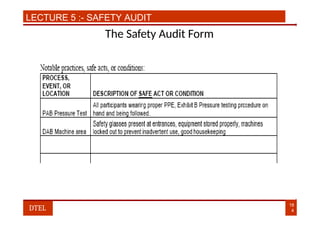
LECTURE 5 :-SAFETY AUDIT
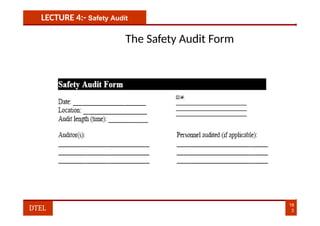
The Safety Audit Form
18
4
DTEL
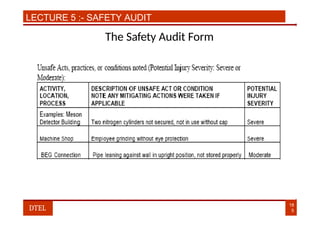
182.
LECTURE 5 :-SAFETY AUDIT
The Safety Audit Form
18
5
DTEL
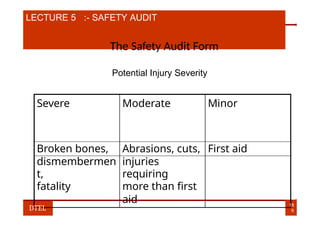
183.
LECTURE 5 :-SAFETY AUDIT
The Safety Audit Form
Potential Injury Severity
Severe Moderate Minor
Broken bones, Abrasions, cuts, First aid
dismembermen
t,
injuries
requiring
fatality more than first
aid 18
6
DTEL
184.
LECTURE 5 :-SAFETY AUDIT
When Someone is Working Unsafely
• Observe; then get the person’s attention
• Comment on what the employee was doing safely
• Discuss with the employee
– The possible consequences of the unsafe act
– Safer way to do the job
18
7
DTEL
185.
LECTURE 6 :-SAFETY AUDIT
When Someone is Working Unsafely (cont’d)
• Get the employee's agreement to work safely in the
future
• Discuss other safety issues of the job
• Ask the employee what you the supervisor could do
to make the employee’s job safer
• Thank the employee
18
8
DTEL
LECTURE 6 :-SAFETY AUDIT
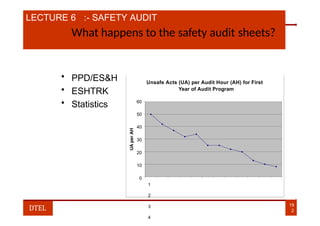
What happens to the safety audit sheets?
• PPD/ES&H
• ESHTRK
• Statistics
Unsafe Acts (UA) per Audit Hour (AH) for First
Year of Audit Program
60
50
40
30
20
10
0
1
2
3
4
UA
per
AH
19
2
DTEL
190.
LECTURE :- SAFETYAUDIT
Conclusion
• All injuries can be prevented
• Management is responsible for preventing injuries
• Working safely is a condition of employment
• Training employees to work safely is essential
• Prevention of personal injuries is good business (and
good science!)
• Audits can play a key role in safety
• And, once again …
19
3
DTEL
191.
Chapter 5 QuestionBank
LECTURE :-
•State objectives of safety audit.
•Distinguish between Audit report and Safety report.
•Name various records to be examined during safety auditing
•Explain the procedure for safety auditing
•Explain in detail procedure for safety auditing.
•What are the objectives of safety audit? How these objectives are achieved in
safety audit?
DTEL 194
CHAPTER-6 SPECIFIC OBJECTIVE/ COURSE OUTCOME
Understand the various types of maintenance .
1
The student will be able to:
Understand on-line maintenance
2
Understand shutdown maintenance
19
6
DTEL
3
194.
LECTURE 1:- PLANTMAINTENANCE
Importance of Plant Maintenance
• Avoid heavy loss
• Leads to inevitable loss of production
• Poor maintenance leads to
• Loss in production time
• Rescheduling
• Overtime
• Work shortage
19
7
DTEL
195.
LECTURE 1:- PLANTMAINTENANCE
Duties, Function & Responsibility of Plant
Maintenance Engg. Dept.
• Inspection
• Engineering
• Maintenance (including preventive Maintenance)
• Repair
• Overhaul
• Construction
• Salvage
• Clerical Work
19
8
DTEL
LECTURE 1:- PLANTMAINTENANCE
Preventive Maintenance
Objectives
• Avoid breakdown.
• Maintain the value of equipment.
• Maintain accuracy of plant.
• Maintain optimum productivity.
• Maximum production at minimum repair cost
• Safe operation
20
0
DTEL
198.
LECTURE 2:- PLANTMAINTENANCE
Preventive Maintenance
• Who should do PM?
• Where to start PM?
• What to inspect in PM?
• What to inspect for PM?
• Inspection frequency
• Schedules
• PM records
20
1
DTEL
199.
LECTURE 2:- PLANTMAINTENANCE
Advantage
s
• Reduction in breakdown
• Greater safety for workers
• Less stand-by
• Increase In production
• Flexibility
20
2
DTEL
200.
LECTURE 2:- PLANTMAINTENANCE
On-line maintenance
• Avoids total shutdown of equipment
• Possible only special fittings
• Example of rotameter
• Under maintenance
• v1 & v2 are closed
• V3 is online
• Maintenance complete
• V3=closed & v1 & v2 are opened
20
3
DTEL
LECTURE 3:- PLANTMAINTENANCE
Commissioning of plant
Check
• P & ID specification
• Welds
• Rivet
• Gasket, bolts & studs
• Pressure vessels
• Pipe & equipment supports
• & all the things as per contract.
20
6
DTEL
204.
LECTURE 3:- PLANTMAINTENANCE
CPM & PERT
Plan , schedule & control the project consisting
no. of inter-related activities
To define & integrate the task in logical
sequence
They show , how the activities are dependent
20
7
DTEL
205.
LECTURE 3:- PLANTMAINTENANCE
CPM & PERT
Focus on most critical activities.
To know progress of the work as related to
scheduling time.
To plan best possible use of resources.
Optimum utilization of resources.
Provide the basis for resources .
20
8
DTEL
206.
LECTURE 4:- PLANTMAINTENANCE
AN INTRODUCTION TO PUMPING
EQUIPMENT
Maintenance
20
9
DTEL
207.
LECTURE 4:- PLANTMAINTENANCE
WHAT IS THE PUMP?
A hydrodynamic pump machine is a
device for converting the energy held by
mechanical energy into fluid.
21
0
DTEL
208.
LECTURE 4:- PLANTMAINTENANCE
Pumps enable a liquid to:
1.Flow from a region or low pressure to one of high
pressure.
2. Flow from a low level to a higher level.
3. Flow at a faster rate.
21
1
DTEL
209.
LECTURE 4:- PLANTMAINTENANCE
Rotodynamic pumps.
There are two main categories of pump:
Positive displacement pumps.
21
2
DTEL
LECTURE 5:- PLANTMAINTENANCE
Parameter Centrifugal Pumps Reciprocating Pumps Rotary Pumps
Optimum Flow and
Pressure Applications
Medium/High Capacity,
Low/Medium
Pressure
Low Capacity,
High
Pressure
Low/Medium Capacity,
Low/Medium
Pressure
Maximum Flow Rate 100,000+ GPM 10,000+ GPM 10,000+ GPM
Low Flow Rate Capability No Yes Yes
Maximum Pressure 6,000+ PSI 100,000+ PSI 4,000+ PSI
Requires Relief Valve No Yes Yes
Smooth or Pulsating Flow Smooth Pulsating Smooth
Variable or Constant Flow Variable Constant Constant
Self-priming No Yes Yes
Space Considerations Requires Less Space Requires More Space Requires Less Space
Costs Lower Initial
Lower Maintenance
Higher
Power
Higher Initial
Higher Maintenance
Lower Power
Lower Initial
Lower Maintenance
Lower
Power
Fluid Handling Suitable for a wide range
including clean, clear, non-
abrasive fluids to fluids with
abrasive, high-solid
content.
Not suitable for high viscosity
fluids
Lower tolerance for entrained
gases
Suitable for clean, clear, non-
abrasive fluids. Specially-
fitted pumps suitable for
abrasive-slurry service.
Suitable for high viscosity
fluids
Higher tolerance for
entrained gases
Requires clean, clear, non-
abrasive fluid due to
close tolerances
Optimum performance with
high viscosity fluids
Higher tolerance for
entrained gases
21
4
DTEL
LECTURE 5:- PLANTMAINTENANCE
•Characteristics of maintenance
•Maintenance and reliability is important
•Maintenance and product quality
•Maintenance and productivity
•Maintenance and safety
•Maintenance and supply chain, JIT
•Failure cause disruption, waste, accident, inconvenience
and expensive
21
6
DTEL
214.
LECTURE 6:- PLANTMAINTENANCE
•Operators less able to do repairs themselves
•Machine and product failure can have effect on
company’s operation and profitability
•Idle workers, facility
•Losses due to breakdown
21
7
DTEL
215.
LECTURE 6:- PLANTMAINTENANCE
Failure
•Failure – inability to produce work in appropriate manner
•Equipment / machine failure on production floor – worn
out bearing, pump, pressure leaks, broken shaft,
overheated machine etc.
•Equipment failure in office – failure of power supply, air-
conditioned system, computer network, photocopy
machine
•Vehicle failure – brake, transmission, engine, cooling
system
21
8
DTEL
LECTURE 6:- PLANTMAINTENANCE
Maintenance
• All actions necessary for retaining an item, or
restoring to it, a serviceable condition, include
servicing, repair, modification, overhaul, inspection
and condition verification
• Increase availability of a system
• Keep system’s equipment in working order
22
0
DTEL
218.
LECTURE 7:- PLANTMAINTENANCE
Question?
• Why do we need maintenance?
• What are the costs of doing maintenance?
• What are the costs of not doing maintenance?
• What are the benefits of maintenance?
• How can maintenance increase profitability of
company?
22
1
DTEL
219.
LECTURE 7:- PLANTMAINTENANCE
Purpose of Maintenance
• Attempt to maximize performance of production
equipment efficiently and regularly
• Prevent breakdown or failures
• Minimize production loss from failures
• Increase reliability of the operating systems
22
2
DTEL
220.
LECTURE 7:- PLANTMAINTENANCE
Principle in Maintenance
• To achieve product quality and customer satisfaction
through adjusted and serviced equipment
• Maximize useful life of equipment
• Keep equipment safe and prevent safety hazards
• Minimize frequency and severity of interruptions
• Maximize production capacity – through high
utilization of facility
22
3
DTEL
221.
LECTURE 7:- PLANTMAINTENANCE
Problems in Maintenance
• Lack of management attention to maintenance
• Little participation by accounting in analyzing and
reporting costs
• Difficulties in applying quantitative analysis
• Difficulties in obtaining time and cost estimates for
maintenance works
• Difficulties in measuring performance
22
4
DTEL
222.
LECTURE 7:- PLANTMAINTENANCE
Problems Exist Due To:
• Failure to develop written objectives and policy
• Inadequate budgetary control
• Inadequate control procedures for work order, service
requests etc.
• Infrequent use of standards
• To control maintenance work
• Absence of cost reports to aid maintenance planning
and control system
22
5
DTEL
223.
LECTURE 8:- PLANTMAINTENANCE
Maintenance Objectives
• Must be consistent with the goals of
production (cost, quality, delivery,
safety)
• Must be comprehensive and include
specific responsibilities
22
6
DTEL
224.
LECTURE 8:- PLANTMAINTENANCE
Maintenance Costs
• Cost to replace or repair
• Losses of output
• Delayed shipment
• Scrap and rework
22
7
DTEL
225.
LECTURE 8:- PLANTMAINTENANCE
Corrective or Breakdown Maintenance
• Corrective or Breakdown maintenance implies that
repairs are made after the equipment is failed and
can not perform its normal function anymore
• Quite justified in small factories where:
– Down times are non-critical and repair
costs are less than other type of maintenance
– Financial justification for scheduling are not felt
22
8
DTEL
226.
LECTURE 8:- PLANTMAINTENANCE
Disadvantages of Corrective Maintenance
• Breakdown generally occurs inappropriate times
leading to poor and hurried maintenance
• Excessive delay in production & reduces output
• Faster plant deterioration
• Increases chances of accidents and less safety for
both workers and machines
• More spoilt materials
• Direct loss of profit
22
9
DTEL
227.
LECTURE 9:- PLANTMAINTENANCE
Scheduled Maintenance
• Scheduled maintenance is a stitch-in-time
procedure and incorporates
– inspection
– lubrication
– repair and overhaul of equipments
• If neglected can result in breakdown
• Generally followed for:
– overhauling of machines
– changing of heavy equipment oils
– cleaning of water and other tanks etc.
23
0
DTEL
228.
LECTURE 9:- PLANTMAINTENANCE
Preventive Maintenance (PM)
• Principle – “Prevention is better than cure”
• Procedure - Stitch-in-time
–locates weak spots of machinery and equipments
–provides them periodic/scheduled inspections and
minor repairs to reduce the danger of unanticipated
breakdowns
23
1
DTEL
229.
LECTURE 9:- PLANTMAINTENANCE
Candidates for Preventive Maintenance
Frequency of Failure
Mean Time Between Failure (MTBF)
Good candidates have
more normal
distribution with low
variability
23
2
DTEL
230.
LECTURE 9:- PLANTMAINTENANCE
Advantages of PM
• Advantages:
–Reduces break down and thereby down time
–Lass odd-time repair and reduces over time of
crews
–Greater safety of workers
–Lower maintenance and repair costs
–Less stand-by equipments and spare parts
–Better product quality and fewer reworks and
scraps
–Increases plant life
–Increases chances to get production incentive
bonus
23
3
DTEL
231.
LECTURE 10:- PLANTMAINTENANCE
Predictive (Condition-based) Maintenance
• In predictive maintenance, machinery conditions are
periodically monitored and this enables the
maintenance crews to take timely actions, such
as machine adjustment, repair or overhaul
• It makes use of human sense and other sensitive
instruments, such as
–audio gauge, vibration analyzer, amplitude meter,
pressure, temperature and resistance strain
gauges etc.
23
4
DTEL
232.
LECTURE 10:- PLANTMAINTENANCE
Predictive Maintenance (Contd.)
• Unusual sounds coming out of a rotating equipment
predicts a trouble
• An excessively hot electric cable predicts a trouble
• Simple hand touch can point out many unusual
equipment conditions and thus predicts a trouble
23
5
DTEL
LECTURE 11:- PLANTMAINTENANCE
WHY COMMISSIONING?
Progress made the choice more than 12 years ago to
specialize in Plant Commissioning
Why?
• Noticed that it’s a major challenge for project
owners
• We perform in this intense environment
• Implemented best practices and methodologies that
work
• Commissioning requires capacities in both technical
and management know-how
• Commissioning managers must be leaders
23
8
DTEL
236.
LECTURE 11:- PLANTMAINTENANCE
WHY COMMISSIONING?
Commissioning is a crucial part of every Industrial Project
Any industry
Worldwide
23
9
DTEL
LECTURE 11:- PLANTMAINTENANCE
WHY COMMISSIONING?
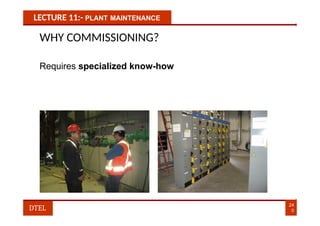
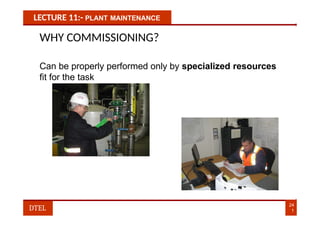
Can be properly performed only by specialized resources
fit for the task
24
1
DTEL
239.
LECTURE 12:- PLANTMAINTENANCE
WHY COMMISSIONING?
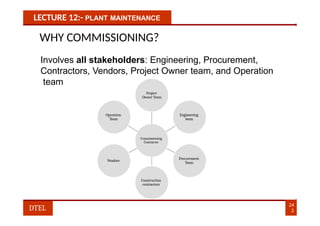
Involves all stakeholders: Engineering, Procurement,
Contractors, Vendors, Project Owner team, and Operation
team
Project
Owner Team
Commissioning
Contractor
24
2
DTEL
Engineering
team
Procurement
Team
Construction
contractors
Vendors
Operation
Team
240.
LECTURE 12:- PLANTMAINTENANCE
WHY COMMISSIONING?
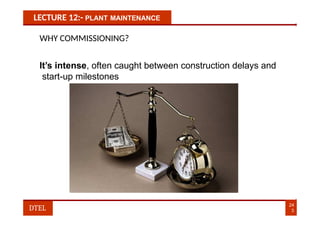
It’s intense, often caught between construction delays and
start-up milestones
24
3
DTEL
241.
LECTURE 12:- PLANTMAINTENANCE
COMMON CONTRACTUAL STRATEGY FOR
COMMISSIONING
• Often the EPC or EPCM consultant is hired for the
commissioning phase also
• Commissioning is a small part of the awarded service
contract
• It’s a later phase so it’s not the immediate focus of
management
• EPC contractors are often not specialized in
commissioning and focus on Engineering and
Construction being the major parts of contract budgets
24
4
DTEL
242.
LECTURE 12:- PLANTMAINTENANCE
• Assigned commissioning manager answers to
the construction manager
• Often assigned late and during the construction
phase
• Lack of know-how and best practices
• Difficulty of EPC contractors to retain
specialized commissioning professionals
24
5
DTEL
243.
LECTURE 13:- PLANTMAINTENANCE
What happen when a Specialized
Commissioning Contractor is contracted for
Commissioning
1Focus is put on that critical phase from day one of
hiring the specialized contractor since he is dedicated to
that task
2Dedicated resources are specialized in commissioning
and not there because of availability only
3Commissioning is the core of the service contract for the
Commissioning Contractor and his only measure of
success
24
6
DTEL
244.
LECTURE 13:- PLANTMAINTENANCE
4Commissioning Contractor answers to the Project
Owner Team and not to the Construction team
5 Applies commissioning know-how and best
practices
6Often positively received by all project stakeholders
including EPC and construction contractors
24
7
DTEL
245.
LECTURE 13:- PLANTMAINTENANCE
SPECIALIZED COMMISSIONING CONTRACTORS
Master:
Scope of work
A proven methodology
Defined deliverables
Coordination of stakeholders
Leadership from mechanical
completion to ramp-up
24
8
DTEL
246.
LECTURE 13:- PLANTMAINTENANCE
SPECIALIZED COMMISSIONING CONTRACTORS
Master:
The application of a health and safety program that is
adequate for the sources of risks and energies present
during commissioning phase
The use of specialized electronic tools to manage the flow
of work from Mechanical completion to the ramp-up phase.
Progesys uses a proprietary software (CMS ) to manage
mechanical completion, pre-commissioning,
commissioning, start-up and ramp-up.
24
9
DTEL
247.
LECTURE 13:- PLANTMAINTENANCE
Out come of commissioning
Specialized commissioning contractors like Progesys are
necessary for project success. They master a crucial phase
of the project cycle and dedicate for it specialized human
and material resources.
Owners pre-qualify and hire the best Engineering firms for
EP contracts, the best Construction Contractors for the
Construction phase and they benefit if they do the same
when it comes to the crucial commissioning phase.
25
0
DTEL
248.
Chapter 6 QuestionBank
•What is online maintenance? State its applications in chemical plant.
•What is maintenance? State its importance in chemical plant.
•State advantages and applications of preventive maintenance. (Any four of each)
•Explain procedure for startup of plant.
•Prepare preventive maintenance chart for any one equipment.
•Write steps involved in commissioning procedure of plant.
•Explain trouble shooting of chemical plants with two examples.
•Why shut down maintenance is preferred for Sugar factory?
•Explain importance of ‘record keeping’ and ‘machine history card’ in maintenance
activity.
•Explain the use of PERT chart for shutdown maintenance activity with suitable
example.
•Give the importance of plant maintenance (any four points).
•Write steps involved in commissioning procedure of a plant.
•Explain with an example on-line maintenance.
•Explain the procedure for start up of a plant
•What are the responsibilities of plant maintenance department (any six
points)?
•Explain the procedure for shut down of plant.
•What are the advantages of preventive maintenance?
•Explain shut down maintenance
•Explain predictive maintenance in detail.
DTEL 248
249.
Recommended Books
1. PlantSafety And Maintenance by D.B.Dhone Nirali Prakashan
2. Chemical Hazards and Safety By Dr. Shrikant Dawande Denett & Co.
3. Safe Handling of Hazardous Chemicals by A.K.Rohatgi J.K.Enterprise
Bombay
4. Plant Maintenance by S.S.Apte Delhi Productivity Council
5. Maintenance Engineer’s Handbook by C.L.Morrow McGraw Hill
6. Safety in Process Plant Design By G.L.Wells, John Wiley & Sons
7. Safety & Accident Prevention in Chemical Operations By H.H.Faucet &
W.S.Wood Interscience Publishers Of Jhon Wiley & Sons , New York
8. Industrial Safety Handbook By William & Handley.
DTEL 249