2-3
Planning a
Personal Activity Program
• Physical fitness: the capacity to
meet the demands of everyday life
with little or no strain.
3 Basics of a
Physical Activity Program
1. Overload-working the body harder than it is
normally worked
2. Progression is the gradual increase in
overload necessary to achieve higher levels
of fitness
3. Specificity indicates that particular
exercises and activities improve particular
areas of health –related fitness
3 Phases of a Workout:
1. Warm-up: an activity that prepares the muscles for
work
2. Workout: the part of an exercise program when
the activity is performed at its highest peak
* To be effective it needs to follow the FITT formula-
frequency, intensity, time/duration, and type of
activity
3. Cool-down: is an activity that prepares the
muscles to a resting state
FITT Formula
F Frequency of exercise: 3 to 5 days per week
I Intensity of exercise: 60% to 90% of
maximum heart rate
T Time of exercise: 20 to 60 minutes per day
T Type: for max benefits devote 75% of your
work out to aerobic activity and 20-25% to
anaerobic activities
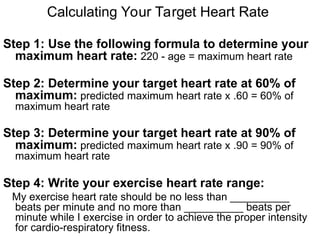
Calculating Your Target Heart Rate
Step 1: Use the following formula to determine your
maximum heart rate: 220 - age = maximum heart rate
Step 2: Determine your target heart rate at 60% of
maximum: predicted maximum heart rate x .60 = 60% of
maximum heart rate
Step 3: Determine your target heart rate at 90% of
maximum: predicted maximum heart rate x .90 = 90% of
maximum heart rate
Step 4: Write your exercise heart rate range:
My exercise heart rate should be no less than __________
beats per minute and no more than __________ beats per
minute while I exercise in order to achieve the proper intensity
for cardio-respiratory fitness.
Health Skills Activity
Goal Setting: Starting a
Physical Activity Program
William wants to start a physical activity
program, but he’s not sure where to begin.
He really wants to improve his cardio-
respiratory and muscle endurance, and he
knows that his flexibility and muscle strength
need work, too. He’s also thinking about
signing up for soccer; tryouts are in three
months. What can William do to improve his
fitness level and make the soccer team?
What would you do? Apply the
5 Goal Setting Steps
Apply the 5 goal-setting
steps to his situation
1. Identify a specific goal and write it down.
2. List the steps you will take to reach your
goal.
3. Identify potential problems and ways to
get help and support from others.
4. Set up checkpoints to evaluate your
progress.
5. Reward yourself once your have
achieved your goal.
Write Your Own Workout Plan
1. Write a brief description of your activity
level during the past month (were you as
active as you want or need to be)
2. Describe a specific goal you want to reach
(try out for a team, build bigger muscles,
maintain or reach a healthy weight)
3. List the steps you will take to reach your
goal (remember to include a warm up,
workout and cool down)
Your Plan Cont.
4. Identify potential problems and ways to get
help and support from others (where you
live, level of health, time and place,
personal safety, comprehensive planning-
addressing all areas of health)
5. Set up checkpoints to evaluate your
progress (start walking 10 minutes 3X a
day-by week 4 be able to walk 30 minutes in
a row)
6. Reward yourself once your have achieved
your goal (buy new MP3 songs)
Group-Workout Plans
• Groups of four
• Each group is to develop a work-out plan
• Groups should be prepared to describe
the plan to the class
• Plan must include the three components of
a workout (warm-up, activity, cool-down)
• If time permits, groups will lead the class
in their work-outs

planning a personal activity program for you

  • 1.
    2-3 Planning a Personal ActivityProgram • Physical fitness: the capacity to meet the demands of everyday life with little or no strain.
  • 4.
    3 Basics ofa Physical Activity Program 1. Overload-working the body harder than it is normally worked 2. Progression is the gradual increase in overload necessary to achieve higher levels of fitness 3. Specificity indicates that particular exercises and activities improve particular areas of health –related fitness
  • 5.
    3 Phases ofa Workout: 1. Warm-up: an activity that prepares the muscles for work 2. Workout: the part of an exercise program when the activity is performed at its highest peak * To be effective it needs to follow the FITT formula- frequency, intensity, time/duration, and type of activity 3. Cool-down: is an activity that prepares the muscles to a resting state
  • 6.
    FITT Formula F Frequencyof exercise: 3 to 5 days per week I Intensity of exercise: 60% to 90% of maximum heart rate T Time of exercise: 20 to 60 minutes per day T Type: for max benefits devote 75% of your work out to aerobic activity and 20-25% to anaerobic activities
  • 7.
    Calculating Your TargetHeart Rate Step 1: Use the following formula to determine your maximum heart rate: 220 - age = maximum heart rate Step 2: Determine your target heart rate at 60% of maximum: predicted maximum heart rate x .60 = 60% of maximum heart rate Step 3: Determine your target heart rate at 90% of maximum: predicted maximum heart rate x .90 = 90% of maximum heart rate Step 4: Write your exercise heart rate range: My exercise heart rate should be no less than __________ beats per minute and no more than __________ beats per minute while I exercise in order to achieve the proper intensity for cardio-respiratory fitness.
  • 8.
    Health Skills Activity GoalSetting: Starting a Physical Activity Program William wants to start a physical activity program, but he’s not sure where to begin. He really wants to improve his cardio- respiratory and muscle endurance, and he knows that his flexibility and muscle strength need work, too. He’s also thinking about signing up for soccer; tryouts are in three months. What can William do to improve his fitness level and make the soccer team? What would you do? Apply the 5 Goal Setting Steps
  • 9.
    Apply the 5goal-setting steps to his situation 1. Identify a specific goal and write it down. 2. List the steps you will take to reach your goal. 3. Identify potential problems and ways to get help and support from others. 4. Set up checkpoints to evaluate your progress. 5. Reward yourself once your have achieved your goal.
  • 10.
    Write Your OwnWorkout Plan 1. Write a brief description of your activity level during the past month (were you as active as you want or need to be) 2. Describe a specific goal you want to reach (try out for a team, build bigger muscles, maintain or reach a healthy weight) 3. List the steps you will take to reach your goal (remember to include a warm up, workout and cool down)
  • 11.
    Your Plan Cont. 4.Identify potential problems and ways to get help and support from others (where you live, level of health, time and place, personal safety, comprehensive planning- addressing all areas of health) 5. Set up checkpoints to evaluate your progress (start walking 10 minutes 3X a day-by week 4 be able to walk 30 minutes in a row) 6. Reward yourself once your have achieved your goal (buy new MP3 songs)
  • 12.
    Group-Workout Plans • Groupsof four • Each group is to develop a work-out plan • Groups should be prepared to describe the plan to the class • Plan must include the three components of a workout (warm-up, activity, cool-down) • If time permits, groups will lead the class in their work-outs

Editor's Notes

  • #4 Overload-builds strength and contributes to overall fitness. It is achieved by increasing reputations or by doing more sets (groups of 6-12 repetitions) of physical activity. Progression-As an activity becomes easier to do, increase the number of repetitions or sets or increase the amount of time spent doing the activity. Specificity-for example, resistance training builds muscular strength and endurance, while aerobic activity improves cardio respiratory endurance.
  • #5 To gain the most benefit from an exercise program, you’ll want to to include three basic states for activity. Theses include warm-up, the workout and cool down. Include each state in every session even when you’re in a hurry. Warm-up: warming up the muscles before exercise prepares them for exercise. It helps avoid injuries. Five minutes of fast walking, slow jogging or push-ups and sit-ups followed by five minutes of stretching prepare the muscles for activity. Work out: an activity that contributes to cardio-respiratory fitness. Cool-down: the cool-down allows the body to adjust back to its resting state. Blood from the working muscles returns to the heart; the heart rate slows down; breathing returns to normal. Five to ten minutes of walking and stretching is a good way to cool down the body. A good way to determine if your body has sufficiently cooled down is to take your heart rate. If your pulse is below 120 to 110 beats per minute, you have adequately cooled down.
  • #8 What are some different activities that William could participate in? List them on the board.
  • #12 Did students include all the components of a fitness work-out? Why is cardio-respiratory fitness the most important component of fitness? How can high school students improve their fitness?