SESSION – 2022 - 23
HAMILTON’S PRINCIPLE AND
CHARACTERISTIC FUNCTION
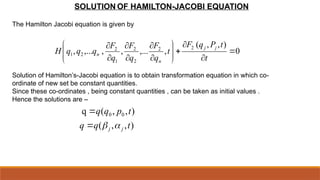
SOLUTION OF HAMILTON-JACOBI EQUATION
The Hamilton Jacobi equation is given by
0
)
,
,
(
,
,...
,
,
,...
,
2
2
2
2
1
2
2
1 

















t
t
P
q
F
t
q
F
q
F
q
F
q
q
q
H
j
j
n
n
Solution of Hamilton’s-Jacobi equation is to obtain transformation equation in which co-
ordinate of new set be constant quantities.
Since these co-ordinates , being constant quantities , can be taken as initial values .
Hence the solutions are –
)
,
,
(
)
,
,
(
q 0
0
t
q
q
t
p
q
q
j
j 



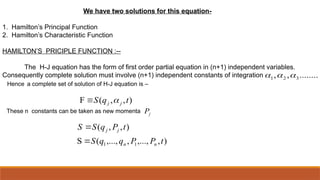
We have two solutions for this equation-
1. Hamilton’s Principal Function
2. Hamilton’s Characteristic Function
HAMILTON’S PRICIPLE FUNCTION :--
The H-J equation has the form of first order partial equation in (n+1) independent variables.
Consequently complete solution must involve (n+1) independent constants of integration ........
,
, 3
2
1 


Hence a complete set of solution of H-J equation is –
)
,
,...,
,
,...,
(
S
)
,
,
(
)
,
,
(
F
1
1 t
P
P
q
q
S
t
P
q
S
S
t
q
S
n
n
j
j
j
j


 
These n constants can be taken as new momenta j
P
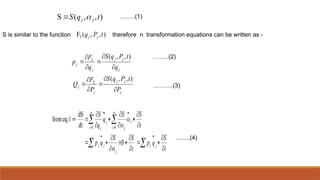
S is similar to the function therefore n transformation equations can be written as -
)
,
,
(
S t
q
S j
j 

)
,
,
(
F2 t
P
q j
j
)
,
,
(
)
,
,
(
2
2
j
j
j
j
j
j
j
j
j
j
P
t
P
q
S
P
F
Q
q
t
P
q
S
q
F
p












t
S
q
p
t
S
S
q
p
t
S
S
q
q
S
j
j
j
j
j
j
n
i j
j
n
i j
































0
dt
dS
eq.1
from
1
1



……..(1)
……..(2)
……….(3)
........(4)
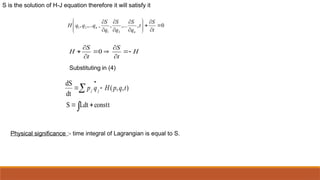
S is the solution of H-J equation therefore it will satisfy it
0
,
,...
,
,
,...
,
2
1
2
1 

















t
S
t
q
S
q
S
q
S
q
q
q
H
n
n
H
t
S
t
S
H 







 0
Substituting in (4)
constt
Ldt
S
)
,
,
(
dt
dS







t
q
p
H
q
p j
j
Physical significance :- time integral of Lagrangian is equal to S.
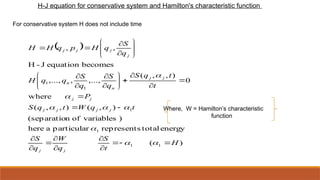
H-J equation for conservative system and Hamilton's characteristic function
For conservative system H does not include time
 
)
(
energy
total
represents
particular
a
here
)
variables
of
n
(separatio
)
,
(
)
,
,
(
where
0
)
,
,
(
,...,
,
,...,
becomes
equation
J
-
H
,
,
1
1
1
1
1
1
H
t
S
q
W
q
S
t
q
W
t
q
S
P
t
t
q
S
q
S
q
S
q
q
H
q
S
q
H
p
q
H
H
j
j
j
j
j
j
j
j
j
j
n
n
j
j
j
j

















































Where, W = Hamilton’s characteristic
function
 
























































constant
action
)
0
(
)
,
(
,
equation
J
-
H
system
ve
conservati
for
so
0
,
-
:
get
we
values
the
ng
substituti
on
1
1
constt
dt
q
p
W
q
p
q
q
W
W
q
q
W
dt
dW
q
W
W
q
S
q
W
q
W
q
H
q
W
q
H
j
j
j
j
j
j
j
j
j
j
j
j
j
j
j
j
j
j
j
j







……..(A)
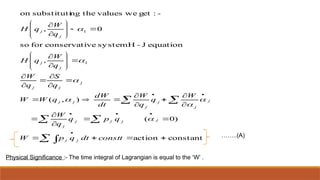
Physical Significance :- The time integral of Lagrangian is equal to the ‘W’ .
REFERENCE BY :
1. CLASS NOTES
2. BOOK - GUPTA KUMAR
THANK
YOU...!
pk classes .ppt.pptx physics MSc classical

pk classes .ppt.pptx physics MSc classical