Running and understanding
the PING project
Lynn Su
10.2.2015
Yokoyama Lab Meeting
• KLOTHO is an aging suppressor
• 2 variants in human KLOTHO gene: rs9536314 (F352V), rs9527025
(c3705) separate together to form a haplotype KL-VS
• KL-VS heterozygosity
• Regulation of insulin
• Wnt, FGF, and N-methyl-D-aspartate (NMDA) receptor signaling
• Transport of ion channels
• Longevity, healthy cardiovascular functions
• Better renal health
• Better global cognition in healthy older adults
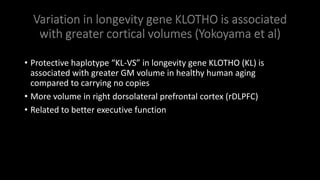
• Protective haplotype “KL-VS” in longevity gene KLOTHO (KL) is
associated with greater GM volume in healthy human aging
compared to carrying no copies
• More volume in right dorsolateral prefrontal cortex (rDLPFC)
• Related to better executive function
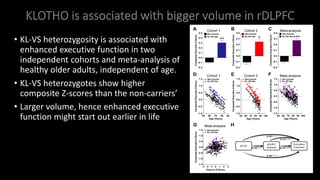
• KL-VS heterozygosity is associated with
enhanced executive function in two
independent cohorts and meta-analysis of
healthy older adults, independent of age.
• KL-VS heterozygotes show higher
composite Z-scores than the non-carriers’
• Larger volume, hence enhanced executive
function might start out earlier in life
We want to find out…
Does the effect of KLOTHO generalize throughout people at younger ages?
PING! (Pediatric Imaging, Neurocognition, and Genetics)
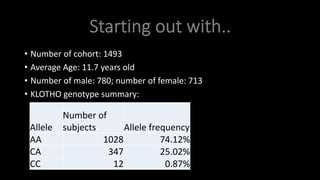
• Number of cohort: 1493
• Average Age: 11.7 years old
• Number of male: 780; number of female: 713
• KLOTHO genotype summary:
Allele
Number of
subjects Allele frequency
AA 1028 74.12%
CA 347 25.02%
CC 12 0.87%
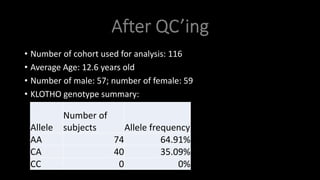
• Number of cohort used for analysis: 116
• Average Age: 12.6 years old
• Number of male: 57; number of female: 59
• KLOTHO genotype summary:
Allele
Number of
subjects Allele frequency
AA 74 64.91%
CA 40 35.09%
CC 0 0%
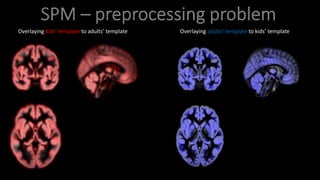
Overlaying kids’ template to adults’ template
We see overestimation all
around the brain
Overlaying adults’ template to kids’ template
We see underestimation all
around the brain
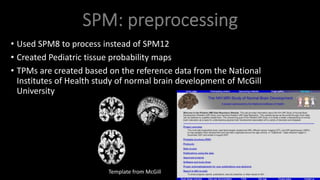
• Used SPM8 to process instead of SPM12
• Created Pediatric tissue probability maps
• TPMs are created based on the reference data from the National
Institutes of Health study of normal brain development of McGill
University
Template from McGill
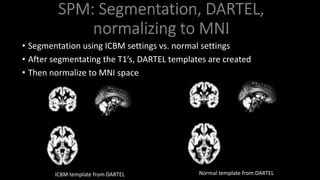
• Segmentation using ICBM settings vs. normal settings
• After segmentating the T1’s, DARTEL templates are created
• Then normalize to MNI space
ICBM template from DARTEL Normal template from DARTEL
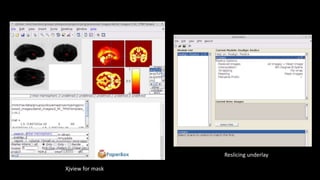
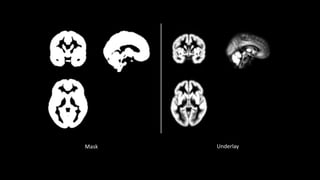
• The existing mask and underlay do not fit the warped and smoothed
images (pixels don’t match)
• Need to create mask from DARTEL template using xjview (a volume
separating program) – basically just saves the grey matter view
• Have to create underlay from reslicing the existing underlay
Xjview for mask
Reslicing underlay
Mask Underlay
• Design file variables:
• KLOTHO genotype
• Age
• Gender
• Race (Europe, Africa, East Asia, Pacific Islander, Central Asia)
• Education
• Scan type (cannot find location)
• Household income
• Delivery complication
• APGAR score in 1 minute
• Head injuries
• Diagnosed with learning problems
• Grey matter volume
• Total intracranial volume
raw T map T
score range
T map with
voxelwise
threshold of p <
0.01
T map with
voxelwise
threshold of p <
0.005
T map with
voxelwise
threshold of p <
0.001
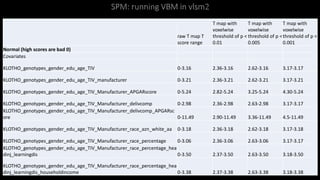
Normal (high scores are bad 0)
Covariates
KLOTHO_genotypes_gender_edu_age_TIV 0-3.16 2.36-3.16 2.62-3.16 3.17-3.17
KLOTHO_genotypes_gender_edu_age_TIV_manufacturer 0-3.21 2.36-3.21 2.62-3.21 3.17-3.21
KLOTHO_genotypes_gender_edu_age_TIV_Manufacturer_APGARscore 0-5.24 2.82-5.24 3.25-5.24 4.30-5.24
KLOTHO_genotypes_gender_edu_age_TIV_Manufacturer_delivcomp 0-2.98 2.36-2.98 2.63-2.98 3.17-3.17
KLOTHO_genotypes_gender_edu_age_TIV_Manufacturer_delivcomp_APGARsc
ore 0-11.49 2.90-11.49 3.36-11.49 4.5-11.49
KLOTHO_genotypes_gender_edu_age_TIV_Manufacturer_race_azn_white_aa 0-3.18 2.36-3.18 2.62-3.18 3.17-3.18
KLOTHO_genotypes_gender_edu_age_TIV_Manufacturer_race_percentage 0-3.06 2.36-3.06 2.63-3.06 3.17-3.17
KLOTHO_genotypes_gender_edu_age_TIV_Manufacturer_race_percentage_hea
dinj_learningdis 0-3.50 2.37-3.50 2.63-3.50 3.18-3.50
KLOTHO_genotypes_gender_edu_age_TIV_Manufacturer_race_percentage_hea
dinj_learningdis_householdincome 0-3.38 2.37-3.38 2.63-3.38 3.18-3.38
raw T map T
score range
T map with
voxelwise
threshold of p <
0.01
T map with
voxelwise
threshold of p <
0.005
T map with
voxelwise
threshold of p <
0.001
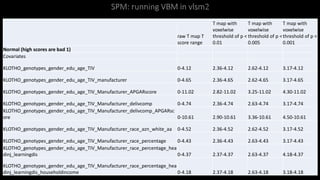
Normal (high scores are bad 1)
Covariates
KLOTHO_genotypes_gender_edu_age_TIV 0-4.12 2.36-4.12 2.62-4.12 3.17-4.12
KLOTHO_genotypes_gender_edu_age_TIV_manufacturer 0-4.65 2.36-4.65 2.62-4.65 3.17-4.65
KLOTHO_genotypes_gender_edu_age_TIV_Manufacturer_APGARscore 0-11.02 2.82-11.02 3.25-11.02 4.30-11.02
KLOTHO_genotypes_gender_edu_age_TIV_Manufacturer_delivcomp 0-4.74 2.36-4.74 2.63-4.74 3.17-4.74
KLOTHO_genotypes_gender_edu_age_TIV_Manufacturer_delivcomp_APGARsc
ore 0-10.61 2.90-10.61 3.36-10.61 4.50-10.61
KLOTHO_genotypes_gender_edu_age_TIV_Manufacturer_race_azn_white_aa 0-4.52 2.36-4.52 2.62-4.52 3.17-4.52
KLOTHO_genotypes_gender_edu_age_TIV_Manufacturer_race_percentage 0-4.43 2.36-4.43 2.63-4.43 3.17-4.43
KLOTHO_genotypes_gender_edu_age_TIV_Manufacturer_race_percentage_hea
dinj_learningdis 0-4.37 2.37-4.37 2.63-4.37 4.18-4.37
KLOTHO_genotypes_gender_edu_age_TIV_Manufacturer_race_percentage_hea
dinj_learningdis_householdincome 0-4.18 2.37-4.18 2.63-4.18 3.18-4.18
raw T map T
score range
T map with
voxelwise
threshold of p <
0.01
T map with
voxelwise
threshold of p <
0.005
T map with
voxelwise
threshold of p <
0.001
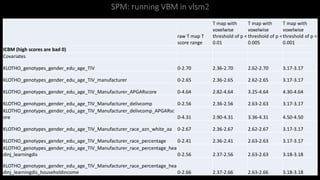
ICBM (high scores are bad 0)
Covariates
KLOTHO_genotypes_gender_edu_age_TIV 0-2.70 2.36-2.70 2.62-2.70 3.17-3.17
KLOTHO_genotypes_gender_edu_age_TIV_manufacturer 0-2.65 2.36-2.65 2.62-2.65 3.17-3.17
KLOTHO_genotypes_gender_edu_age_TIV_Manufacturer_APGARscore 0-4.64 2.82-4.64 3.25-4.64 4.30-4.64
KLOTHO_genotypes_gender_edu_age_TIV_Manufacturer_delivcomp 0-2.56 2.36-2.56 2.63-2.63 3.17-3.17
KLOTHO_genotypes_gender_edu_age_TIV_Manufacturer_delivcomp_APGARsc
ore 0-4.31 2.90-4.31 3.36-4.31 4.50-4.50
KLOTHO_genotypes_gender_edu_age_TIV_Manufacturer_race_azn_white_aa 0-2.67 2.36-2.67 2.62-2.67 3.17-3.17
KLOTHO_genotypes_gender_edu_age_TIV_Manufacturer_race_percentage 0-2.41 2.36-2.41 2.63-2.63 3.17-3.17
KLOTHO_genotypes_gender_edu_age_TIV_Manufacturer_race_percentage_hea
dinj_learningdis 0-2.56 2.37-2.56 2.63-2.63 3.18-3.18
KLOTHO_genotypes_gender_edu_age_TIV_Manufacturer_race_percentage_hea
dinj_learningdis_householdincome 0-2.66 2.37-2.66 2.63-2.66 3.18-3.18
raw T map T
score range
T map with
voxelwise
threshold of p <
0.01
T map with
voxelwise
threshold of p <
0.005
T map with
voxelwise
threshold of p <
0.001
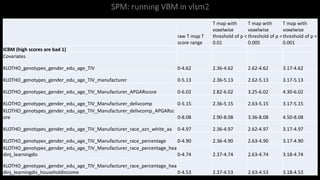
ICBM (high scores are bad 1)
Covariates
KLOTHO_genotypes_gender_edu_age_TIV 0-4.62 2.36-4.62 2.62-4.62 3.17-4.62
KLOTHO_genotypes_gender_edu_age_TIV_manufacturer 0-5.13 2.36-5.13 2.62-5.13 3.17-5.13
KLOTHO_genotypes_gender_edu_age_TIV_Manufacturer_APGARscore 0-6.02 2.82-6.02 3.25-6.02 4.30-6.02
KLOTHO_genotypes_gender_edu_age_TIV_Manufacturer_delivcomp 0-5.15 2.36-5.15 2.63-5.15 3.17-5.15
KLOTHO_genotypes_gender_edu_age_TIV_Manufacturer_delivcomp_APGARsc
ore 0-8.08 2.90-8.08 3.36-8.08 4.50-8.08
KLOTHO_genotypes_gender_edu_age_TIV_Manufacturer_race_azn_white_aa 0-4.97 2.36-4.97 2.62-4.97 3.17-4.97
KLOTHO_genotypes_gender_edu_age_TIV_Manufacturer_race_percentage 0-4.90 2.36-4.90 2.63-4.90 3.17-4.90
KLOTHO_genotypes_gender_edu_age_TIV_Manufacturer_race_percentage_hea
dinj_learningdis 0-4.74 2.37-4.74 2.63-4.74 3.18-4.74
KLOTHO_genotypes_gender_edu_age_TIV_Manufacturer_race_percentage_hea
dinj_learningdis_householdincome 0-4.53 2.37-4.53 2.63-4.53 3.18-4.53
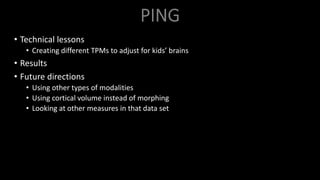
• Technical lessons
• Creating different TPMs to adjust for kids’ brains
• Results
• Future directions
• Using other types of modalities
• Using cortical volume instead of morphing
• Looking at other measures in that data set
Everyone at Yokoyama lab!
LUKE!

PING

  • 1.
    Running and understanding thePING project Lynn Su 10.2.2015 Yokoyama Lab Meeting
  • 2.
    • KLOTHO isan aging suppressor • 2 variants in human KLOTHO gene: rs9536314 (F352V), rs9527025 (c3705) separate together to form a haplotype KL-VS • KL-VS heterozygosity • Regulation of insulin • Wnt, FGF, and N-methyl-D-aspartate (NMDA) receptor signaling • Transport of ion channels • Longevity, healthy cardiovascular functions • Better renal health • Better global cognition in healthy older adults
  • 3.
    • Protective haplotype“KL-VS” in longevity gene KLOTHO (KL) is associated with greater GM volume in healthy human aging compared to carrying no copies • More volume in right dorsolateral prefrontal cortex (rDLPFC) • Related to better executive function
  • 4.
    • KL-VS heterozygosityis associated with enhanced executive function in two independent cohorts and meta-analysis of healthy older adults, independent of age. • KL-VS heterozygotes show higher composite Z-scores than the non-carriers’ • Larger volume, hence enhanced executive function might start out earlier in life
  • 5.
    We want tofind out… Does the effect of KLOTHO generalize throughout people at younger ages? PING! (Pediatric Imaging, Neurocognition, and Genetics)
  • 6.
    • Number ofcohort: 1493 • Average Age: 11.7 years old • Number of male: 780; number of female: 713 • KLOTHO genotype summary: Allele Number of subjects Allele frequency AA 1028 74.12% CA 347 25.02% CC 12 0.87%
  • 7.
    • Number ofcohort used for analysis: 116 • Average Age: 12.6 years old • Number of male: 57; number of female: 59 • KLOTHO genotype summary: Allele Number of subjects Allele frequency AA 74 64.91% CA 40 35.09% CC 0 0%
  • 8.
    Overlaying kids’ templateto adults’ template We see overestimation all around the brain Overlaying adults’ template to kids’ template We see underestimation all around the brain
  • 9.
    • Used SPM8to process instead of SPM12 • Created Pediatric tissue probability maps • TPMs are created based on the reference data from the National Institutes of Health study of normal brain development of McGill University Template from McGill
  • 10.
    • Segmentation usingICBM settings vs. normal settings • After segmentating the T1’s, DARTEL templates are created • Then normalize to MNI space ICBM template from DARTEL Normal template from DARTEL
  • 11.
    • The existingmask and underlay do not fit the warped and smoothed images (pixels don’t match) • Need to create mask from DARTEL template using xjview (a volume separating program) – basically just saves the grey matter view • Have to create underlay from reslicing the existing underlay
  • 12.
  • 13.
  • 14.
    • Design filevariables: • KLOTHO genotype • Age • Gender • Race (Europe, Africa, East Asia, Pacific Islander, Central Asia) • Education • Scan type (cannot find location) • Household income • Delivery complication • APGAR score in 1 minute • Head injuries • Diagnosed with learning problems • Grey matter volume • Total intracranial volume
  • 16.
    raw T mapT score range T map with voxelwise threshold of p < 0.01 T map with voxelwise threshold of p < 0.005 T map with voxelwise threshold of p < 0.001 Normal (high scores are bad 0) Covariates KLOTHO_genotypes_gender_edu_age_TIV 0-3.16 2.36-3.16 2.62-3.16 3.17-3.17 KLOTHO_genotypes_gender_edu_age_TIV_manufacturer 0-3.21 2.36-3.21 2.62-3.21 3.17-3.21 KLOTHO_genotypes_gender_edu_age_TIV_Manufacturer_APGARscore 0-5.24 2.82-5.24 3.25-5.24 4.30-5.24 KLOTHO_genotypes_gender_edu_age_TIV_Manufacturer_delivcomp 0-2.98 2.36-2.98 2.63-2.98 3.17-3.17 KLOTHO_genotypes_gender_edu_age_TIV_Manufacturer_delivcomp_APGARsc ore 0-11.49 2.90-11.49 3.36-11.49 4.5-11.49 KLOTHO_genotypes_gender_edu_age_TIV_Manufacturer_race_azn_white_aa 0-3.18 2.36-3.18 2.62-3.18 3.17-3.18 KLOTHO_genotypes_gender_edu_age_TIV_Manufacturer_race_percentage 0-3.06 2.36-3.06 2.63-3.06 3.17-3.17 KLOTHO_genotypes_gender_edu_age_TIV_Manufacturer_race_percentage_hea dinj_learningdis 0-3.50 2.37-3.50 2.63-3.50 3.18-3.50 KLOTHO_genotypes_gender_edu_age_TIV_Manufacturer_race_percentage_hea dinj_learningdis_householdincome 0-3.38 2.37-3.38 2.63-3.38 3.18-3.38
  • 17.
    raw T mapT score range T map with voxelwise threshold of p < 0.01 T map with voxelwise threshold of p < 0.005 T map with voxelwise threshold of p < 0.001 Normal (high scores are bad 1) Covariates KLOTHO_genotypes_gender_edu_age_TIV 0-4.12 2.36-4.12 2.62-4.12 3.17-4.12 KLOTHO_genotypes_gender_edu_age_TIV_manufacturer 0-4.65 2.36-4.65 2.62-4.65 3.17-4.65 KLOTHO_genotypes_gender_edu_age_TIV_Manufacturer_APGARscore 0-11.02 2.82-11.02 3.25-11.02 4.30-11.02 KLOTHO_genotypes_gender_edu_age_TIV_Manufacturer_delivcomp 0-4.74 2.36-4.74 2.63-4.74 3.17-4.74 KLOTHO_genotypes_gender_edu_age_TIV_Manufacturer_delivcomp_APGARsc ore 0-10.61 2.90-10.61 3.36-10.61 4.50-10.61 KLOTHO_genotypes_gender_edu_age_TIV_Manufacturer_race_azn_white_aa 0-4.52 2.36-4.52 2.62-4.52 3.17-4.52 KLOTHO_genotypes_gender_edu_age_TIV_Manufacturer_race_percentage 0-4.43 2.36-4.43 2.63-4.43 3.17-4.43 KLOTHO_genotypes_gender_edu_age_TIV_Manufacturer_race_percentage_hea dinj_learningdis 0-4.37 2.37-4.37 2.63-4.37 4.18-4.37 KLOTHO_genotypes_gender_edu_age_TIV_Manufacturer_race_percentage_hea dinj_learningdis_householdincome 0-4.18 2.37-4.18 2.63-4.18 3.18-4.18
  • 18.
    raw T mapT score range T map with voxelwise threshold of p < 0.01 T map with voxelwise threshold of p < 0.005 T map with voxelwise threshold of p < 0.001 ICBM (high scores are bad 0) Covariates KLOTHO_genotypes_gender_edu_age_TIV 0-2.70 2.36-2.70 2.62-2.70 3.17-3.17 KLOTHO_genotypes_gender_edu_age_TIV_manufacturer 0-2.65 2.36-2.65 2.62-2.65 3.17-3.17 KLOTHO_genotypes_gender_edu_age_TIV_Manufacturer_APGARscore 0-4.64 2.82-4.64 3.25-4.64 4.30-4.64 KLOTHO_genotypes_gender_edu_age_TIV_Manufacturer_delivcomp 0-2.56 2.36-2.56 2.63-2.63 3.17-3.17 KLOTHO_genotypes_gender_edu_age_TIV_Manufacturer_delivcomp_APGARsc ore 0-4.31 2.90-4.31 3.36-4.31 4.50-4.50 KLOTHO_genotypes_gender_edu_age_TIV_Manufacturer_race_azn_white_aa 0-2.67 2.36-2.67 2.62-2.67 3.17-3.17 KLOTHO_genotypes_gender_edu_age_TIV_Manufacturer_race_percentage 0-2.41 2.36-2.41 2.63-2.63 3.17-3.17 KLOTHO_genotypes_gender_edu_age_TIV_Manufacturer_race_percentage_hea dinj_learningdis 0-2.56 2.37-2.56 2.63-2.63 3.18-3.18 KLOTHO_genotypes_gender_edu_age_TIV_Manufacturer_race_percentage_hea dinj_learningdis_householdincome 0-2.66 2.37-2.66 2.63-2.66 3.18-3.18
  • 19.
    raw T mapT score range T map with voxelwise threshold of p < 0.01 T map with voxelwise threshold of p < 0.005 T map with voxelwise threshold of p < 0.001 ICBM (high scores are bad 1) Covariates KLOTHO_genotypes_gender_edu_age_TIV 0-4.62 2.36-4.62 2.62-4.62 3.17-4.62 KLOTHO_genotypes_gender_edu_age_TIV_manufacturer 0-5.13 2.36-5.13 2.62-5.13 3.17-5.13 KLOTHO_genotypes_gender_edu_age_TIV_Manufacturer_APGARscore 0-6.02 2.82-6.02 3.25-6.02 4.30-6.02 KLOTHO_genotypes_gender_edu_age_TIV_Manufacturer_delivcomp 0-5.15 2.36-5.15 2.63-5.15 3.17-5.15 KLOTHO_genotypes_gender_edu_age_TIV_Manufacturer_delivcomp_APGARsc ore 0-8.08 2.90-8.08 3.36-8.08 4.50-8.08 KLOTHO_genotypes_gender_edu_age_TIV_Manufacturer_race_azn_white_aa 0-4.97 2.36-4.97 2.62-4.97 3.17-4.97 KLOTHO_genotypes_gender_edu_age_TIV_Manufacturer_race_percentage 0-4.90 2.36-4.90 2.63-4.90 3.17-4.90 KLOTHO_genotypes_gender_edu_age_TIV_Manufacturer_race_percentage_hea dinj_learningdis 0-4.74 2.37-4.74 2.63-4.74 3.18-4.74 KLOTHO_genotypes_gender_edu_age_TIV_Manufacturer_race_percentage_hea dinj_learningdis_householdincome 0-4.53 2.37-4.53 2.63-4.53 3.18-4.53
  • 20.
    • Technical lessons •Creating different TPMs to adjust for kids’ brains • Results • Future directions • Using other types of modalities • Using cortical volume instead of morphing • Looking at other measures in that data set
  • 21.

Editor's Notes

  • #10 -kid tpm maps were used to minimize the potential confounds introduced by the differences in cortical thickness, cortical surface area and cortical folding between children and adults inherent in using an adult template -adult templates are wrong -used the kids template we got from NIH but the kids’ head size are all diff so it was still hard to fit – so used the 4-18.5 -used SPM8 because there are only 3 TPMs but SPM12 requires 6
  • #12 -Mask specifies the region on what you want to run -Underlay is for display
  • #15 -Mask specifies the region on what you want to run -Underlay is for display
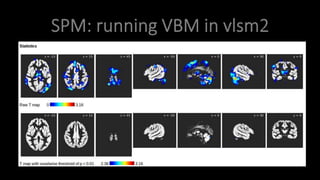
  • #16 -Basically it’s controlling for the other variables after the first one and showing the relationship between the first variable and volume probability -“Highscoresarebad, 1” means that if the first variable (in this case, dosage or KLOTHO genotype) is closer to 1 (KLOTHO heterozygotes), then there’s less volume -“Highscoresarebad, 0” means that if the first variable is closer to 1 (KLOTHO heterozygotes), then there’s more volume  this is what we want since KLOTHO heterozygotes are supposed to have more volumes (better cognition) -The spectrum means the t scores, which are used to make up p values -The higher the t scores, the more significant the results, or the more association there is -So the regions that are colored means they have more association between the KLOTHO genotypes and the volume
  • #17 -Basically it’s controlling for the other variables after the first one and showing the relationship between the first variable and volume probability -“Highscoresarebad, 1” means that if the first variable (in this case, dosage or KLOTHO genotype) is closer to 1 (KLOTHO heterozygotes), then there’s less volume -“Highscoresarebad, 0” means that if the first variable is closer to 1 (KLOTHO heterozygotes), then there’s more volume  this is what we want since KLOTHO heterozygotes are supposed to have more volumes (better cognition) -The spectrum means the t scores, which are used to make up p values -The higher the t scores, the more significant the results, or the more association there is -So the regions that are colored means they have more association between the KLOTHO genotypes and the volume