Physical Therapy Billing Simplified: Key
Codes and Guidelines
Physical therapy (PT) plays a vital role in helping patients recover from injuries, surgeries, or
chronic conditions through rehabilitative exercises, manual therapy, and mobility training.
However, getting reimbursed for those services can be anything but simple. Between evolving
payer rules, complex procedural codes, and strict documentation requirements, billing for
physical therapy can quickly become overwhelming.
That’s why understanding the fundamentals of Physical Therapy Billing is essential—not just
for billing staff, but for physical therapists themselves. Whether you run a stand-alone PT clinic
or provide therapy as part of a larger medical group, mastering the key billing codes and
guidelines will help ensure steady cash flow, minimize claim denials, and maintain compliance.
In this guide, we’ll break down the essential CPT codes, modifiers, and best practices that will
simplify your physical therapy billing process and protect your revenue.
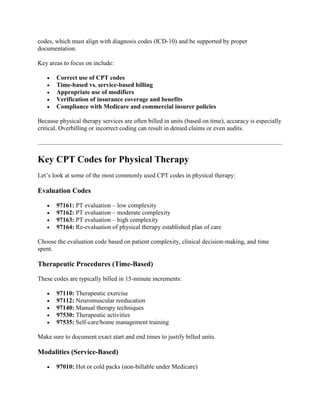
Understanding the Basics of Physical Therapy Billing
Physical therapy billing primarily involves submitting claims based on services provided during
patient sessions. These services are represented by CPT (Current Procedural Terminology)
codes, which must align with diagnosis codes (ICD-10) and be supported by proper
documentation.
Key areas to focus on include:
 Correct use of CPT codes
 Time-based vs. service-based billing
 Appropriate use of modifiers
 Verification of insurance coverage and benefits
 Compliance with Medicare and commercial insurer policies
Because physical therapy services are often billed in units (based on time), accuracy is especially
critical. Overbilling or incorrect coding can result in denied claims or even audits.
Key CPT Codes for Physical Therapy
Let’s look at some of the most commonly used CPT codes in physical therapy:
Evaluation Codes
 97161: PT evaluation – low complexity
 97162: PT evaluation – moderate complexity
 97163: PT evaluation – high complexity
 97164: Re-evaluation of physical therapy established plan of care
Choose the evaluation code based on patient complexity, clinical decision-making, and time
spent.
Therapeutic Procedures (Time-Based)
These codes are typically billed in 15-minute increments:
 97110: Therapeutic exercise
 97112: Neuromuscular reeducation
 97140: Manual therapy techniques
 97530: Therapeutic activities
 97535: Self-care/home management training
Make sure to document exact start and end times to justify billed units.
Modalities (Service-Based)
 97010: Hot or cold packs (non-billable under Medicare)
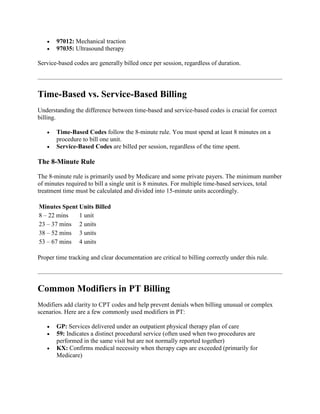
 97012: Mechanical traction
 97035: Ultrasound therapy
Service-based codes are generally billed once per session, regardless of duration.
Time-Based vs. Service-Based Billing
Understanding the difference between time-based and service-based codes is crucial for correct
billing.
 Time-Based Codes follow the 8-minute rule. You must spend at least 8 minutes on a
procedure to bill one unit.
 Service-Based Codes are billed per session, regardless of the time spent.
The 8-Minute Rule
The 8-minute rule is primarily used by Medicare and some private payers. The minimum number
of minutes required to bill a single unit is 8 minutes. For multiple time-based services, total
treatment time must be calculated and divided into 15-minute units accordingly.
Minutes Spent Units Billed
8 – 22 mins 1 unit
23 – 37 mins 2 units
38 – 52 mins 3 units
53 – 67 mins 4 units
Proper time tracking and clear documentation are critical to billing correctly under this rule.
Common Modifiers in PT Billing
Modifiers add clarity to CPT codes and help prevent denials when billing unusual or complex
scenarios. Here are a few commonly used modifiers in PT:
 GP: Services delivered under an outpatient physical therapy plan of care
 59: Indicates a distinct procedural service (often used when two procedures are
performed in the same visit but are not normally reported together)
 KX: Confirms medical necessity when therapy caps are exceeded (primarily for
Medicare)
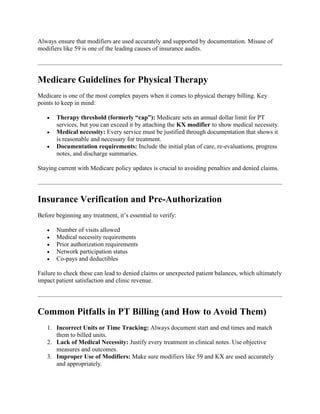
Always ensure that modifiers are used accurately and supported by documentation. Misuse of
modifiers like 59 is one of the leading causes of insurance audits.
Medicare Guidelines for Physical Therapy
Medicare is one of the most complex payers when it comes to physical therapy billing. Key
points to keep in mind:
 Therapy threshold (formerly “cap”): Medicare sets an annual dollar limit for PT
services, but you can exceed it by attaching the KX modifier to show medical necessity.
 Medical necessity: Every service must be justified through documentation that shows it
is reasonable and necessary for treatment.
 Documentation requirements: Include the initial plan of care, re-evaluations, progress
notes, and discharge summaries.
Staying current with Medicare policy updates is crucial to avoiding penalties and denied claims.
Insurance Verification and Pre-Authorization
Before beginning any treatment, it’s essential to verify:
 Number of visits allowed
 Medical necessity requirements
 Prior authorization requirements
 Network participation status
 Co-pays and deductibles
Failure to check these can lead to denied claims or unexpected patient balances, which ultimately
impact patient satisfaction and clinic revenue.
Common Pitfalls in PT Billing (and How to Avoid Them)
1. Incorrect Units or Time Tracking: Always document start and end times and match
them to billed units.
2. Lack of Medical Necessity: Justify every treatment in clinical notes. Use objective
measures and outcomes.
3. Improper Use of Modifiers: Make sure modifiers like 59 and KX are used accurately
and appropriately.
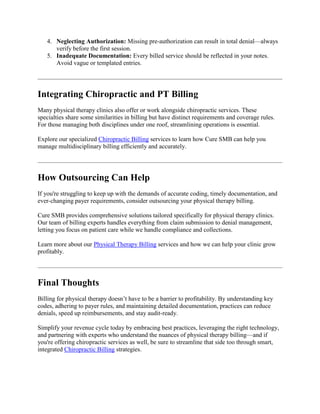
4. Neglecting Authorization: Missing pre-authorization can result in total denial—always
verify before the first session.
5. Inadequate Documentation: Every billed service should be reflected in your notes.
Avoid vague or templated entries.
Integrating Chiropractic and PT Billing
Many physical therapy clinics also offer or work alongside chiropractic services. These
specialties share some similarities in billing but have distinct requirements and coverage rules.
For those managing both disciplines under one roof, streamlining operations is essential.
Explore our specialized Chiropractic Billing services to learn how Cure SMB can help you
manage multidisciplinary billing efficiently and accurately.
How Outsourcing Can Help
If you're struggling to keep up with the demands of accurate coding, timely documentation, and
ever-changing payer requirements, consider outsourcing your physical therapy billing.
Cure SMB provides comprehensive solutions tailored specifically for physical therapy clinics.
Our team of billing experts handles everything from claim submission to denial management,
letting you focus on patient care while we handle compliance and collections.
Learn more about our Physical Therapy Billing services and how we can help your clinic grow
profitably.
Final Thoughts
Billing for physical therapy doesn’t have to be a barrier to profitability. By understanding key
codes, adhering to payer rules, and maintaining detailed documentation, practices can reduce
denials, speed up reimbursements, and stay audit-ready.
Simplify your revenue cycle today by embracing best practices, leveraging the right technology,
and partnering with experts who understand the nuances of physical therapy billing—and if
you're offering chiropractic services as well, be sure to streamline that side too through smart,
integrated Chiropractic Billing strategies.

Physical Therapy Billing Simplified: Key Codes and Guidelines

  • 1.
    Physical Therapy BillingSimplified: Key Codes and Guidelines Physical therapy (PT) plays a vital role in helping patients recover from injuries, surgeries, or chronic conditions through rehabilitative exercises, manual therapy, and mobility training. However, getting reimbursed for those services can be anything but simple. Between evolving payer rules, complex procedural codes, and strict documentation requirements, billing for physical therapy can quickly become overwhelming. That’s why understanding the fundamentals of Physical Therapy Billing is essential—not just for billing staff, but for physical therapists themselves. Whether you run a stand-alone PT clinic or provide therapy as part of a larger medical group, mastering the key billing codes and guidelines will help ensure steady cash flow, minimize claim denials, and maintain compliance. In this guide, we’ll break down the essential CPT codes, modifiers, and best practices that will simplify your physical therapy billing process and protect your revenue. Understanding the Basics of Physical Therapy Billing Physical therapy billing primarily involves submitting claims based on services provided during patient sessions. These services are represented by CPT (Current Procedural Terminology)
  • 2.
    codes, which mustalign with diagnosis codes (ICD-10) and be supported by proper documentation. Key areas to focus on include:  Correct use of CPT codes  Time-based vs. service-based billing  Appropriate use of modifiers  Verification of insurance coverage and benefits  Compliance with Medicare and commercial insurer policies Because physical therapy services are often billed in units (based on time), accuracy is especially critical. Overbilling or incorrect coding can result in denied claims or even audits. Key CPT Codes for Physical Therapy Let’s look at some of the most commonly used CPT codes in physical therapy: Evaluation Codes  97161: PT evaluation – low complexity  97162: PT evaluation – moderate complexity  97163: PT evaluation – high complexity  97164: Re-evaluation of physical therapy established plan of care Choose the evaluation code based on patient complexity, clinical decision-making, and time spent. Therapeutic Procedures (Time-Based) These codes are typically billed in 15-minute increments:  97110: Therapeutic exercise  97112: Neuromuscular reeducation  97140: Manual therapy techniques  97530: Therapeutic activities  97535: Self-care/home management training Make sure to document exact start and end times to justify billed units. Modalities (Service-Based)  97010: Hot or cold packs (non-billable under Medicare)
  • 3.
     97012: Mechanicaltraction  97035: Ultrasound therapy Service-based codes are generally billed once per session, regardless of duration. Time-Based vs. Service-Based Billing Understanding the difference between time-based and service-based codes is crucial for correct billing.  Time-Based Codes follow the 8-minute rule. You must spend at least 8 minutes on a procedure to bill one unit.  Service-Based Codes are billed per session, regardless of the time spent. The 8-Minute Rule The 8-minute rule is primarily used by Medicare and some private payers. The minimum number of minutes required to bill a single unit is 8 minutes. For multiple time-based services, total treatment time must be calculated and divided into 15-minute units accordingly. Minutes Spent Units Billed 8 – 22 mins 1 unit 23 – 37 mins 2 units 38 – 52 mins 3 units 53 – 67 mins 4 units Proper time tracking and clear documentation are critical to billing correctly under this rule. Common Modifiers in PT Billing Modifiers add clarity to CPT codes and help prevent denials when billing unusual or complex scenarios. Here are a few commonly used modifiers in PT:  GP: Services delivered under an outpatient physical therapy plan of care  59: Indicates a distinct procedural service (often used when two procedures are performed in the same visit but are not normally reported together)  KX: Confirms medical necessity when therapy caps are exceeded (primarily for Medicare)
  • 4.
    Always ensure thatmodifiers are used accurately and supported by documentation. Misuse of modifiers like 59 is one of the leading causes of insurance audits. Medicare Guidelines for Physical Therapy Medicare is one of the most complex payers when it comes to physical therapy billing. Key points to keep in mind:  Therapy threshold (formerly “cap”): Medicare sets an annual dollar limit for PT services, but you can exceed it by attaching the KX modifier to show medical necessity.  Medical necessity: Every service must be justified through documentation that shows it is reasonable and necessary for treatment.  Documentation requirements: Include the initial plan of care, re-evaluations, progress notes, and discharge summaries. Staying current with Medicare policy updates is crucial to avoiding penalties and denied claims. Insurance Verification and Pre-Authorization Before beginning any treatment, it’s essential to verify:  Number of visits allowed  Medical necessity requirements  Prior authorization requirements  Network participation status  Co-pays and deductibles Failure to check these can lead to denied claims or unexpected patient balances, which ultimately impact patient satisfaction and clinic revenue. Common Pitfalls in PT Billing (and How to Avoid Them) 1. Incorrect Units or Time Tracking: Always document start and end times and match them to billed units. 2. Lack of Medical Necessity: Justify every treatment in clinical notes. Use objective measures and outcomes. 3. Improper Use of Modifiers: Make sure modifiers like 59 and KX are used accurately and appropriately.
  • 5.
    4. Neglecting Authorization:Missing pre-authorization can result in total denial—always verify before the first session. 5. Inadequate Documentation: Every billed service should be reflected in your notes. Avoid vague or templated entries. Integrating Chiropractic and PT Billing Many physical therapy clinics also offer or work alongside chiropractic services. These specialties share some similarities in billing but have distinct requirements and coverage rules. For those managing both disciplines under one roof, streamlining operations is essential. Explore our specialized Chiropractic Billing services to learn how Cure SMB can help you manage multidisciplinary billing efficiently and accurately. How Outsourcing Can Help If you're struggling to keep up with the demands of accurate coding, timely documentation, and ever-changing payer requirements, consider outsourcing your physical therapy billing. Cure SMB provides comprehensive solutions tailored specifically for physical therapy clinics. Our team of billing experts handles everything from claim submission to denial management, letting you focus on patient care while we handle compliance and collections. Learn more about our Physical Therapy Billing services and how we can help your clinic grow profitably. Final Thoughts Billing for physical therapy doesn’t have to be a barrier to profitability. By understanding key codes, adhering to payer rules, and maintaining detailed documentation, practices can reduce denials, speed up reimbursements, and stay audit-ready. Simplify your revenue cycle today by embracing best practices, leveraging the right technology, and partnering with experts who understand the nuances of physical therapy billing—and if you're offering chiropractic services as well, be sure to streamline that side too through smart, integrated Chiropractic Billing strategies.