PHYSICAL METHODS OF
STERILISATION
By :: Dr. Saurabh Singh, MDS (Oral n Maxillofacial Surgery)
The process by which an article, surface or
medium is freed of all living microorganisms
either in the vegetative or spore state.
“ STERILISATION ”
NEED FOR STERILISATION
• Microorganisms are constantly present in the
external environment and on the human
body.
• Microorganisms are capable of causing
contamination and infection.
HOW CAN MICROORGANISMS BE KILLED
• Denaturation of proteins
• Oxidation
• Filtration
• Interruption of DNA synthesis/repair
• Interference with protein synthesis
• Disruption of cell membranes
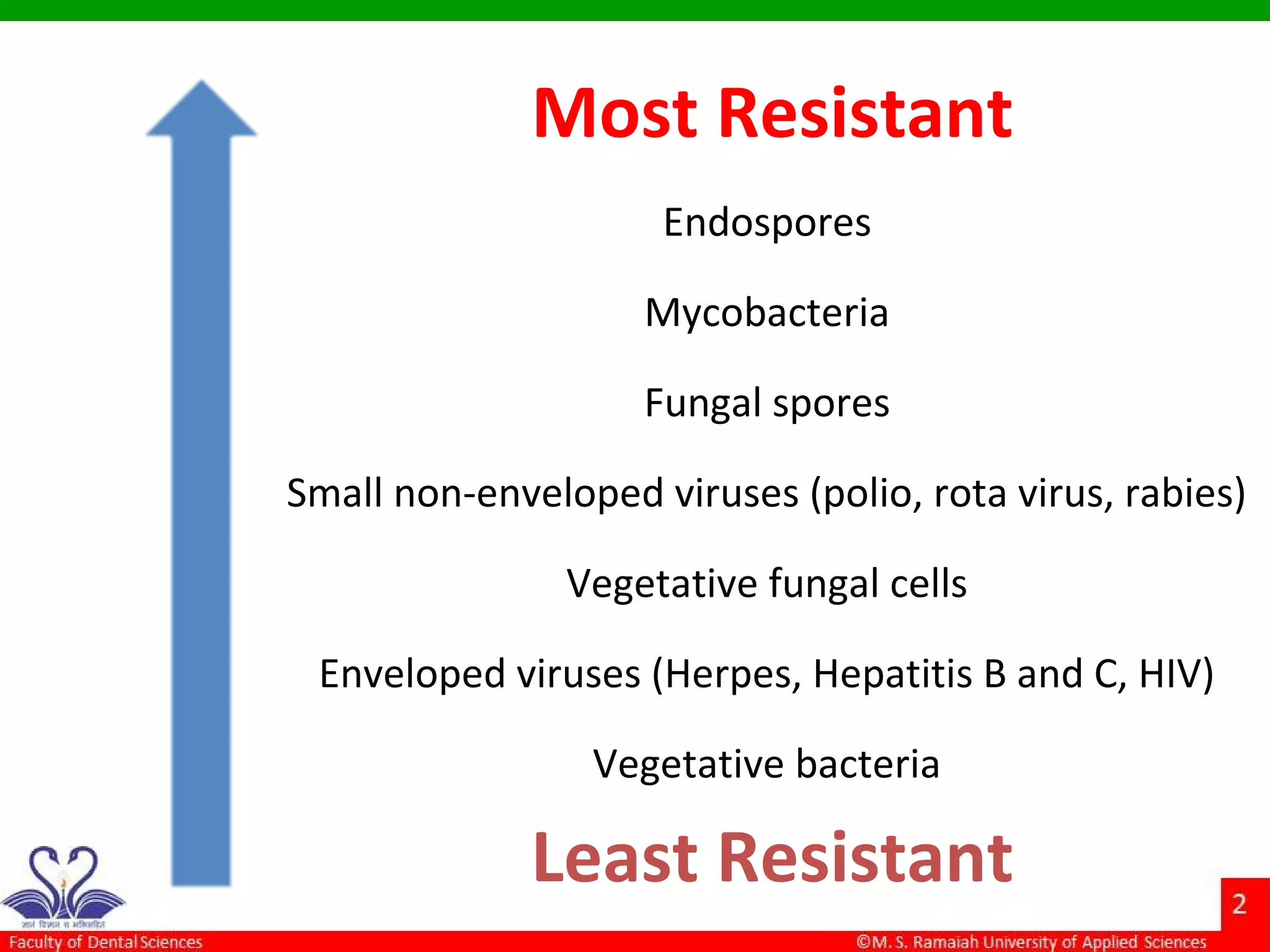
Most Resistant
Least Resistant
Endospores
Mycobacteria
Fungal spores
Small non-enveloped viruses (polio, rota virus, rabies)
Vegetative fungal cells
Enveloped viruses (Herpes, Hepatitis B and C, HIV)
Vegetative bacteria
HOW STERILISATION WORKS
 Disruption of cell wall cannot prevent cell from
bursting due to osmotic effects.
 Damage to cytoplasmic membrane causes cellular
contents to leak out.
 Damage to viral envelope interrupts viral
replication.
• DISINFECTION – The process of destruction or removal of all
pathogenic organisms, or organisms capable of giving rise to
infection.
• ASEPSIS – The avoidance of pathogenic organisms involving
the methods that prevents contamination of wounds and
other sites by ensuring that only sterile objects and fluids
come into contact them and risk of air-borne contamination
is minimized. For eg- no touch technique.
OTHER TERMINOLOGIES
• ANTISEPSIS – The procedure or application of antiseptic
solution or agent which inhibits growth of microorganisms
while remaining in contact with them. For eg- scrubbing up.
Antiseptic solution is betadiene.
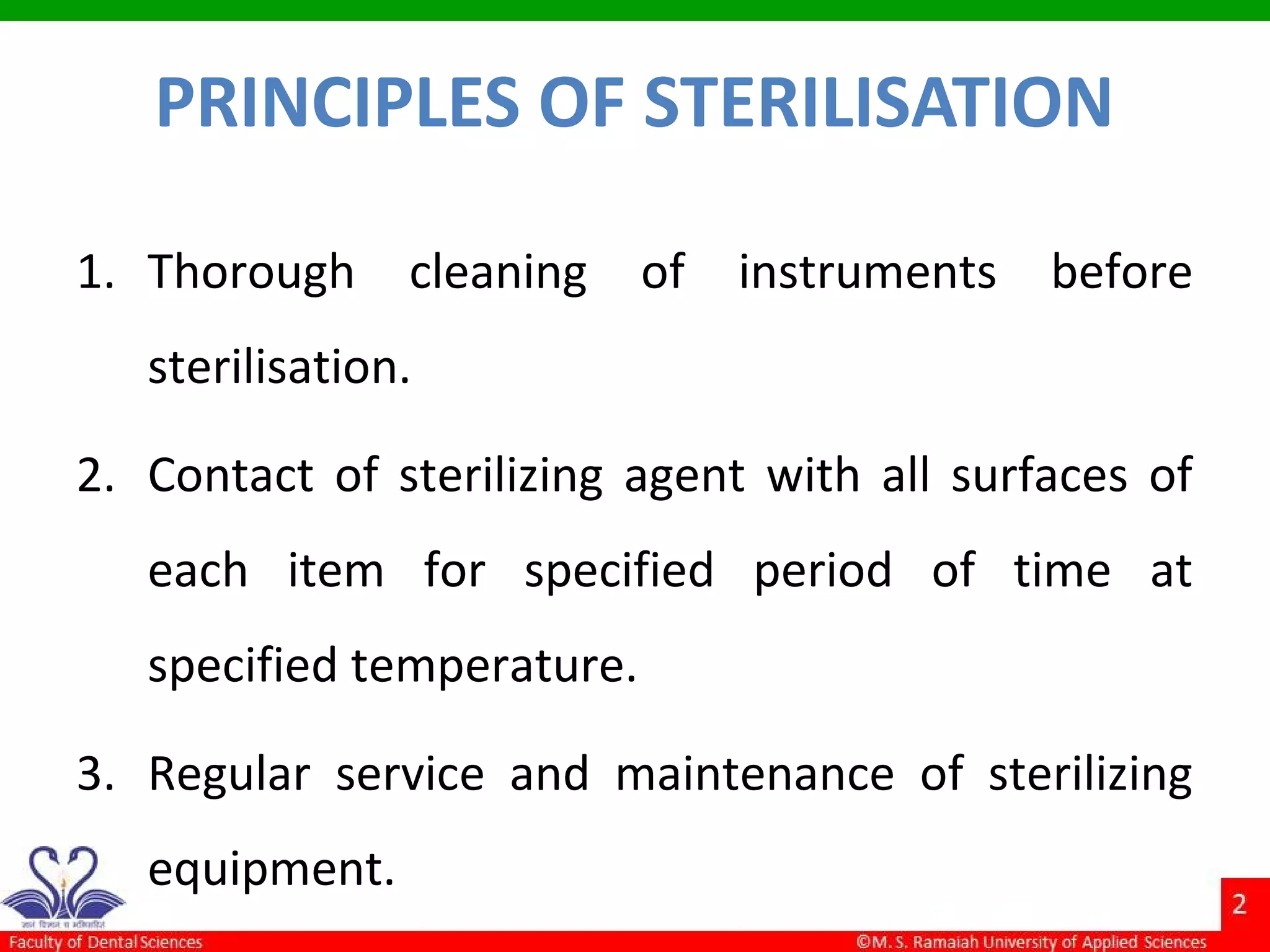
PRINCIPLES OF STERILISATION
1. Thorough cleaning of instruments before
sterilisation.
2. Contact of sterilizing agent with all surfaces of
each item for specified period of time at
specified temperature.
3. Regular service and maintenance of sterilizing
equipment.
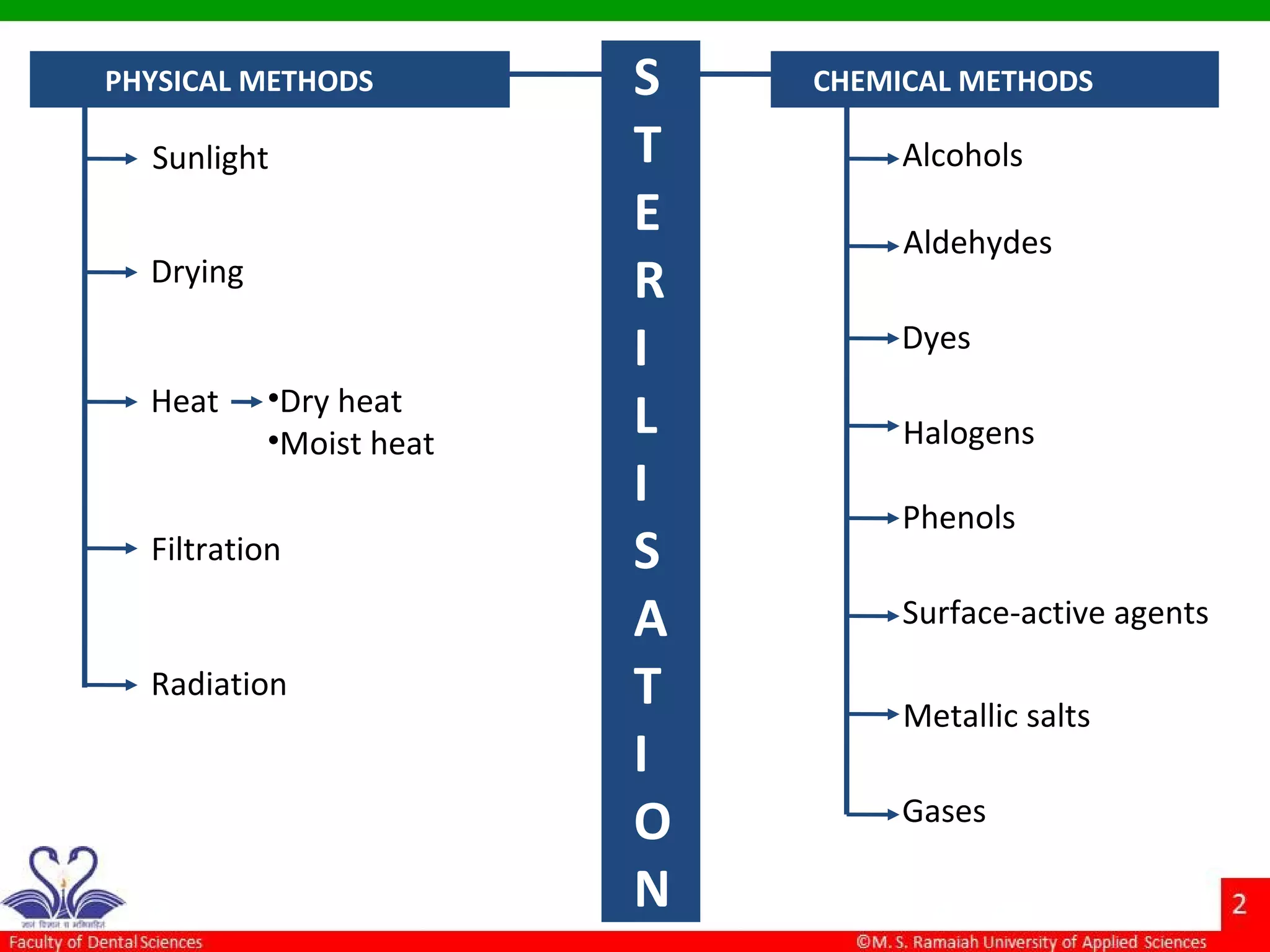
PHYSICAL METHODS CHEMICAL METHODSS
T
E
R
I
L
I
S
A
T
I
O
N
Sunlight
Drying
Heat •Dry heat
•Moist heat
Filtration
Radiation
Alcohols
Aldehydes
Dyes
Halogens
Phenols
Surface-active agents
Metallic salts
Gases
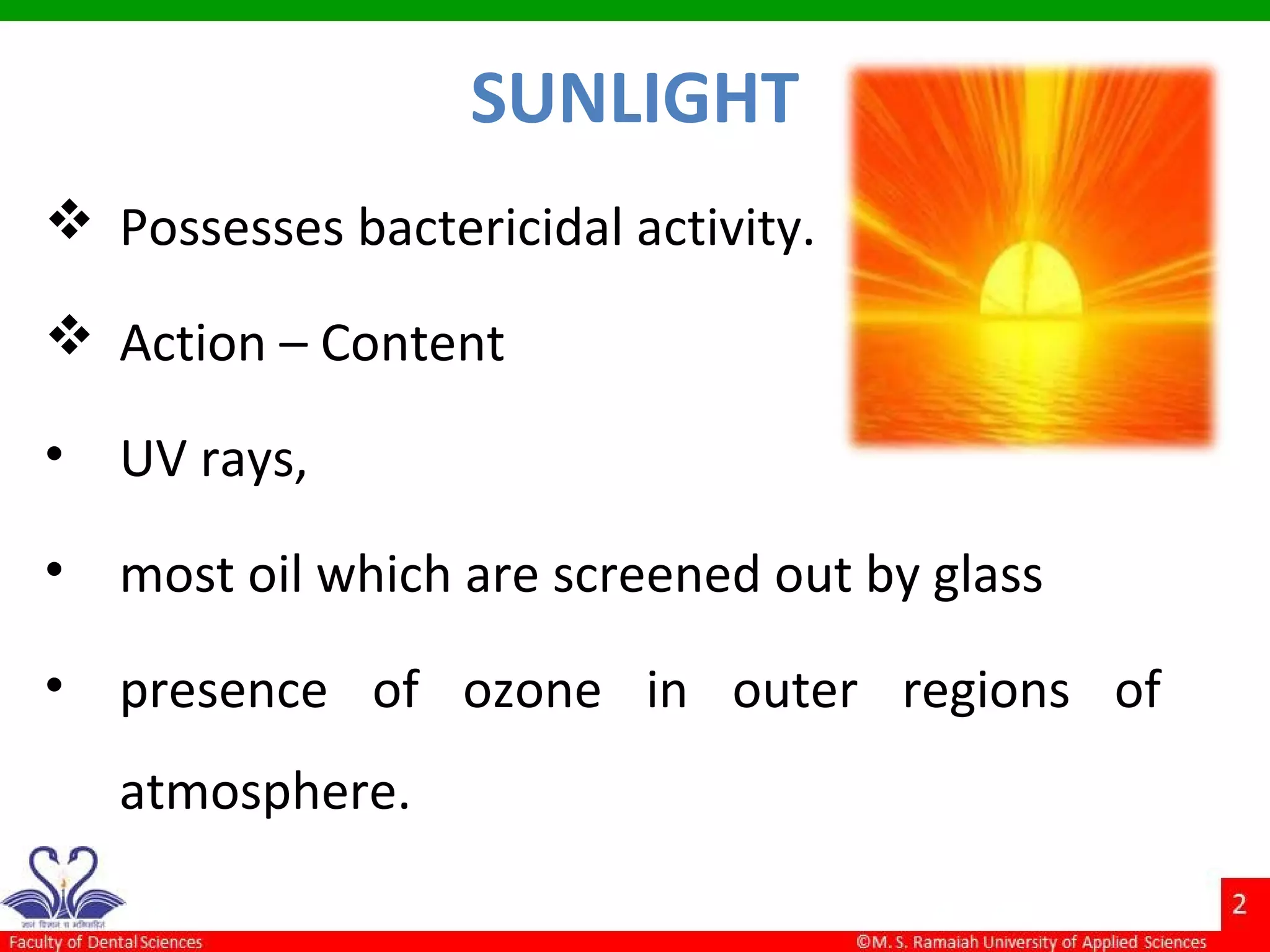
SUNLIGHT
 Possesses bactericidal activity.
 Action – Content
• UV rays,
• most oil which are screened out by glass
• presence of ozone in outer regions of
atmosphere.
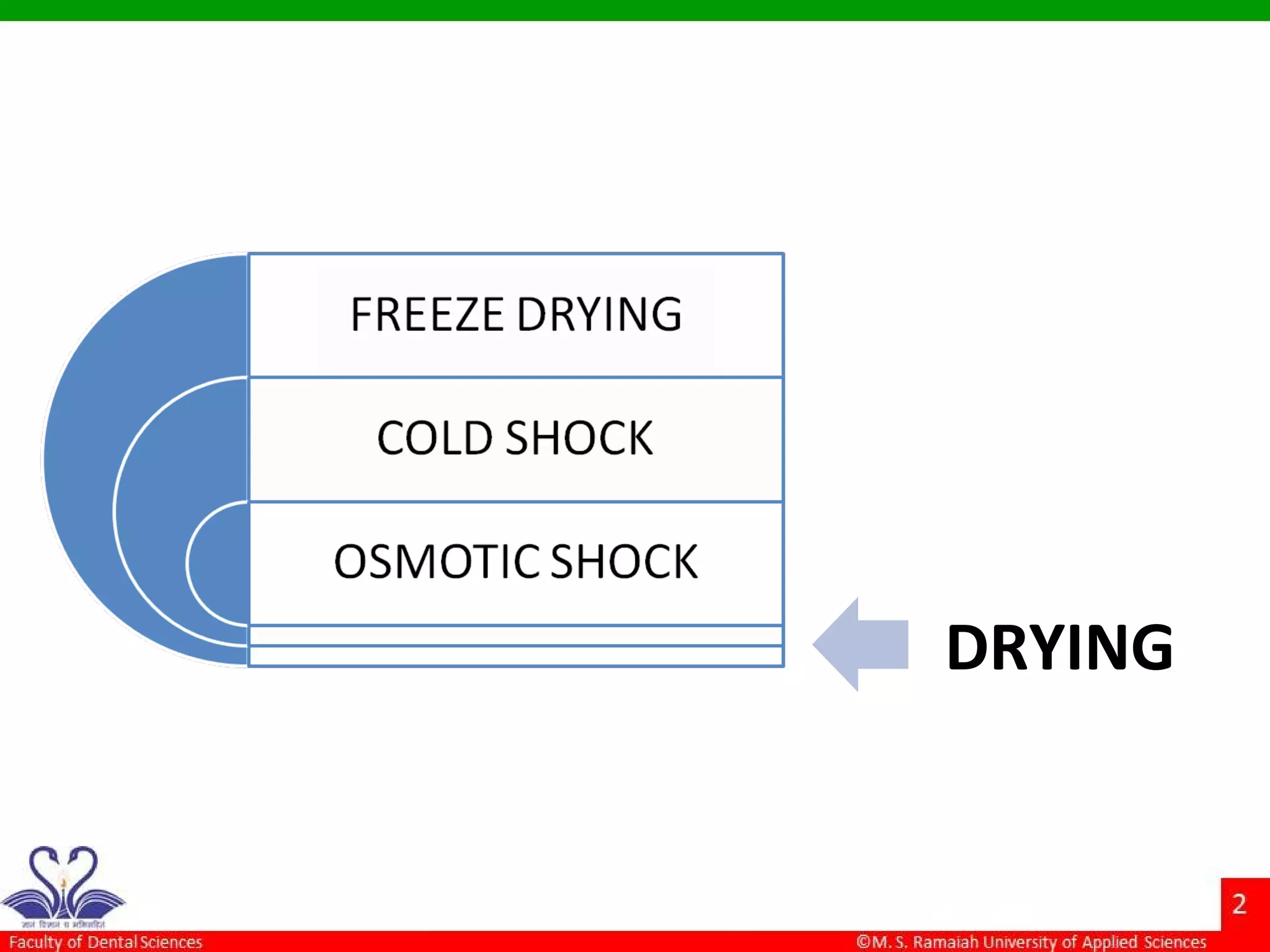
DRYING
 Most of the bacteria grows in moist
environment and thus 4/5th
of their weight is
attributed to water.
DRYING
HEAT
 Most reliable method.
 Can be used either in dry form or moist form.
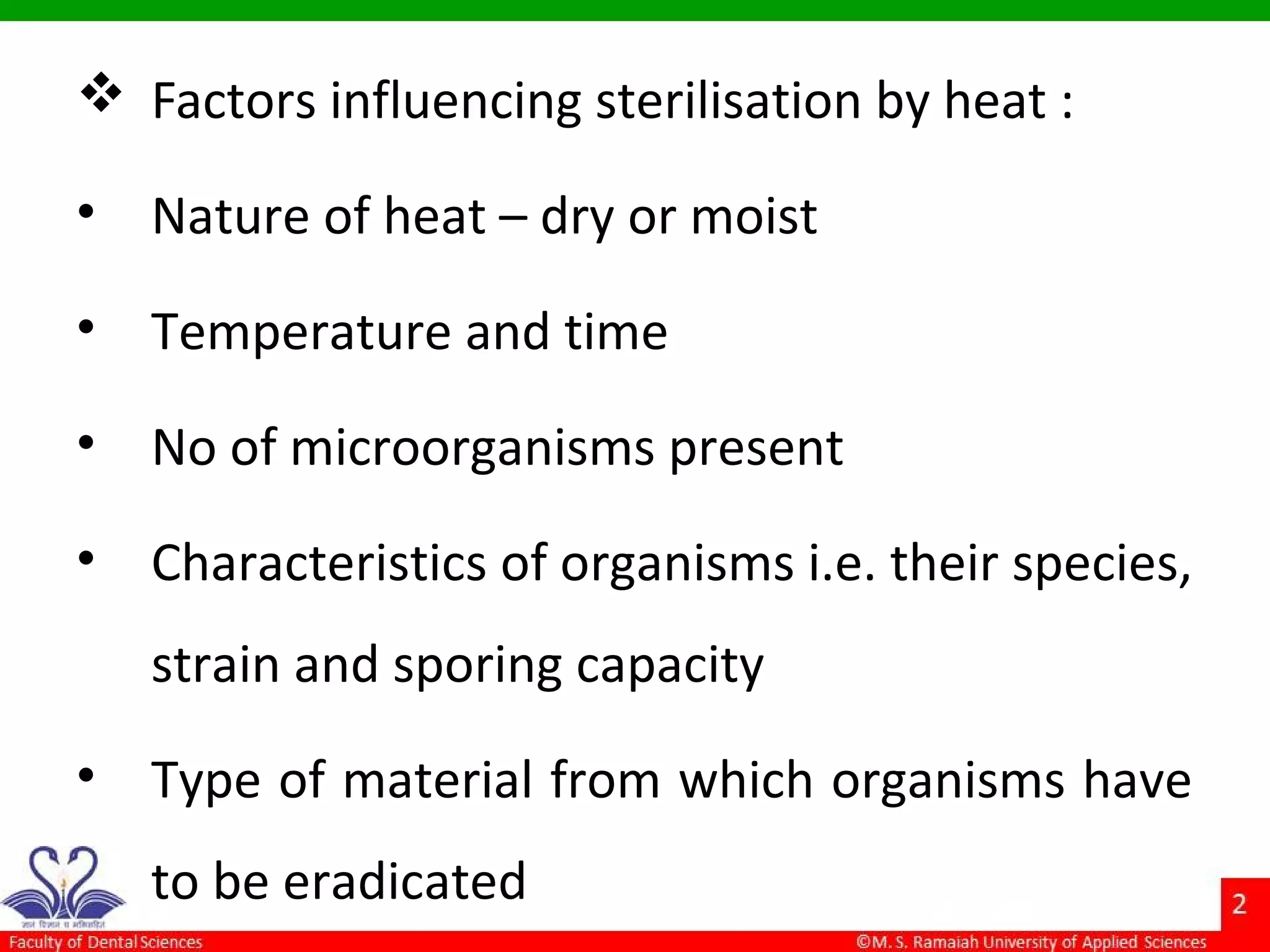
 Factors influencing sterilisation by heat :
• Nature of heat – dry or moist
• Temperature and time
• No of microorganisms present
• Characteristics of organisms i.e. their species,
strain and sporing capacity
• Type of material from which organisms have
to be eradicated
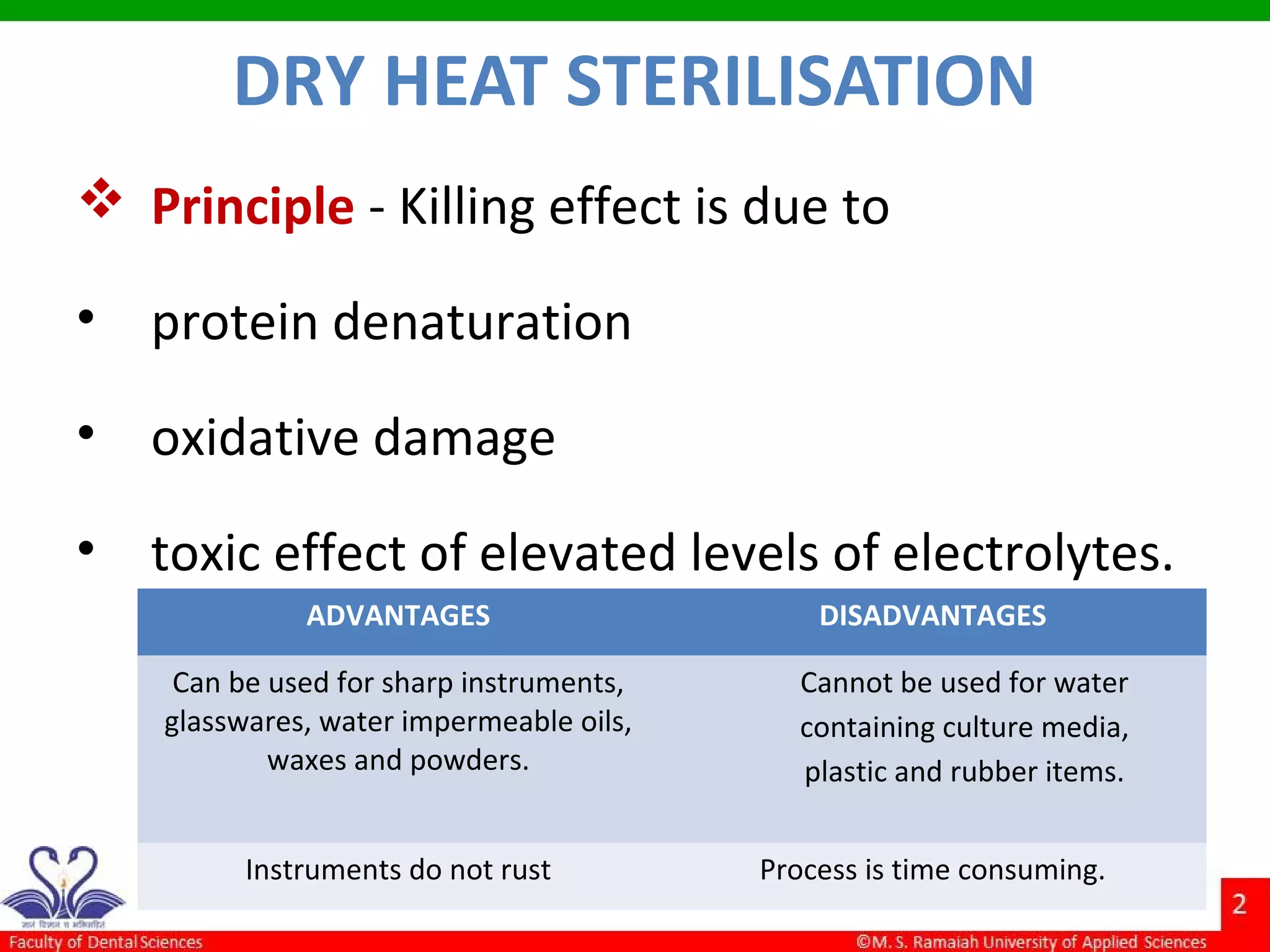
DRY HEAT STERILISATION
 Principle - Killing effect is due to
• protein denaturation
• oxidative damage
• toxic effect of elevated levels of electrolytes.
ADVANTAGES DISADVANTAGES
Can be used for sharp instruments,
glasswares, water impermeable oils,
waxes and powders.
Cannot be used for water
containing culture media,
plastic and rubber items.
Instruments do not rust Process is time consuming.
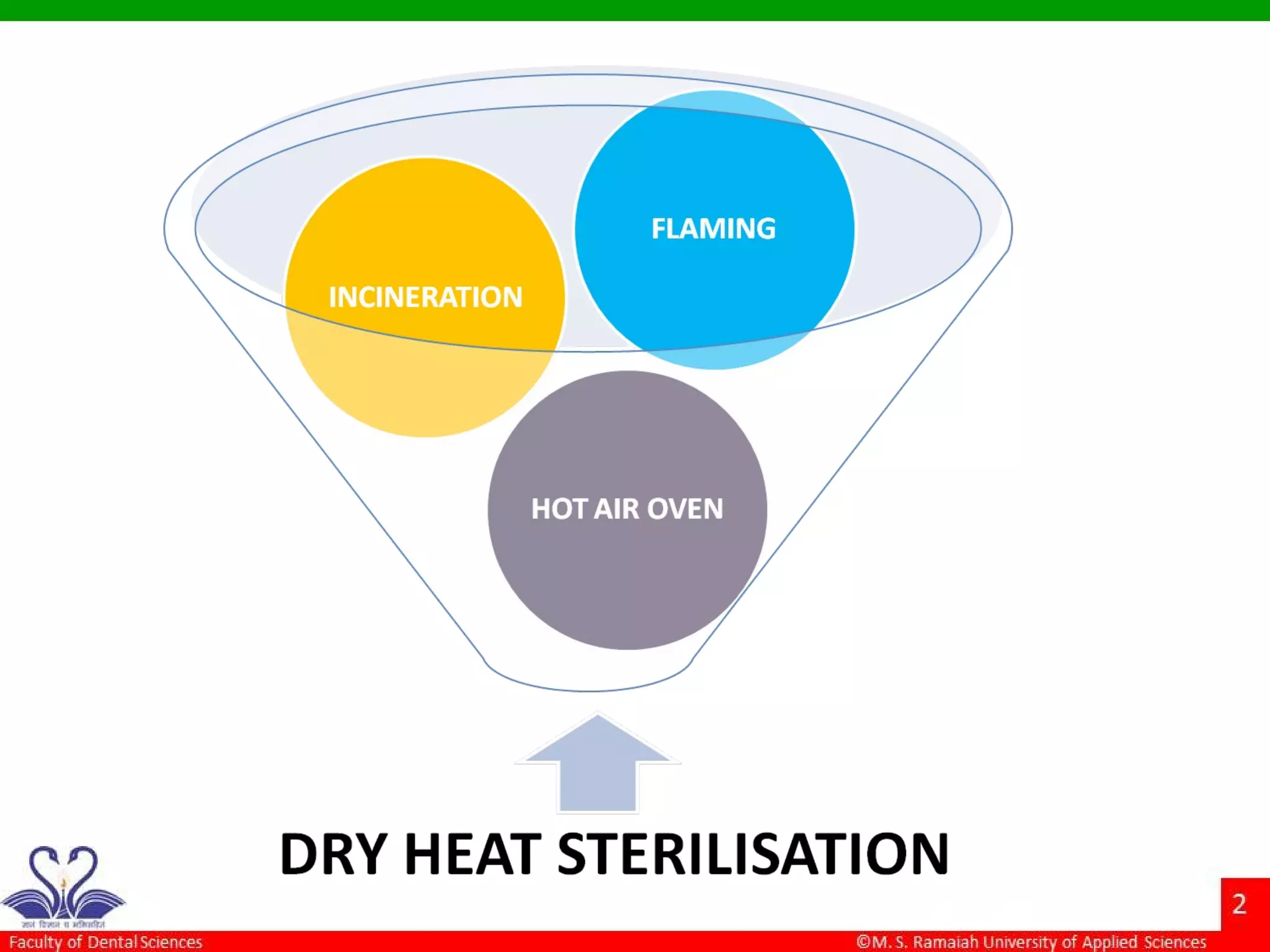
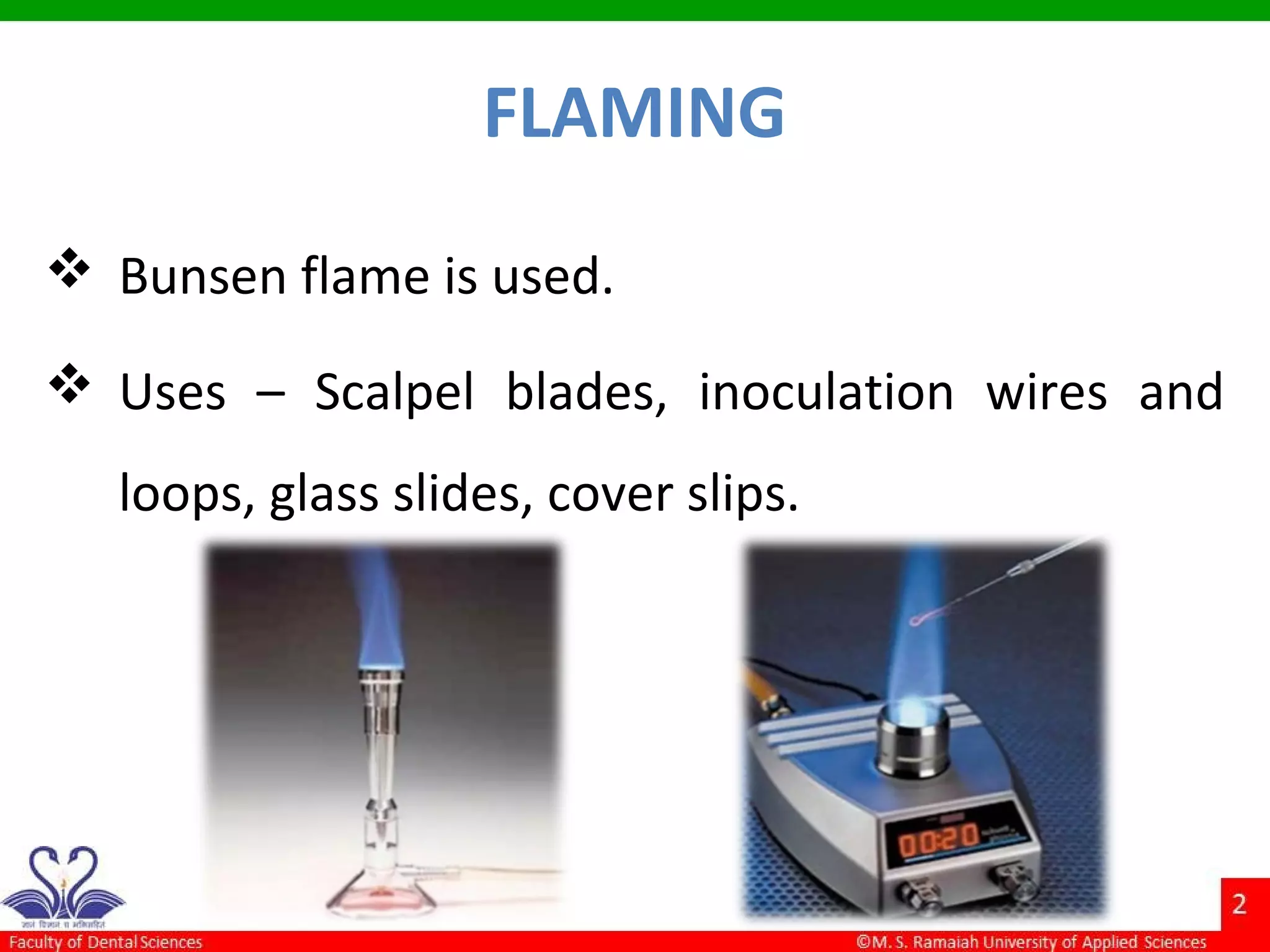
FLAMING
 Bunsen flame is used.
 Uses – Scalpel blades, inoculation wires and
loops, glass slides, cover slips.
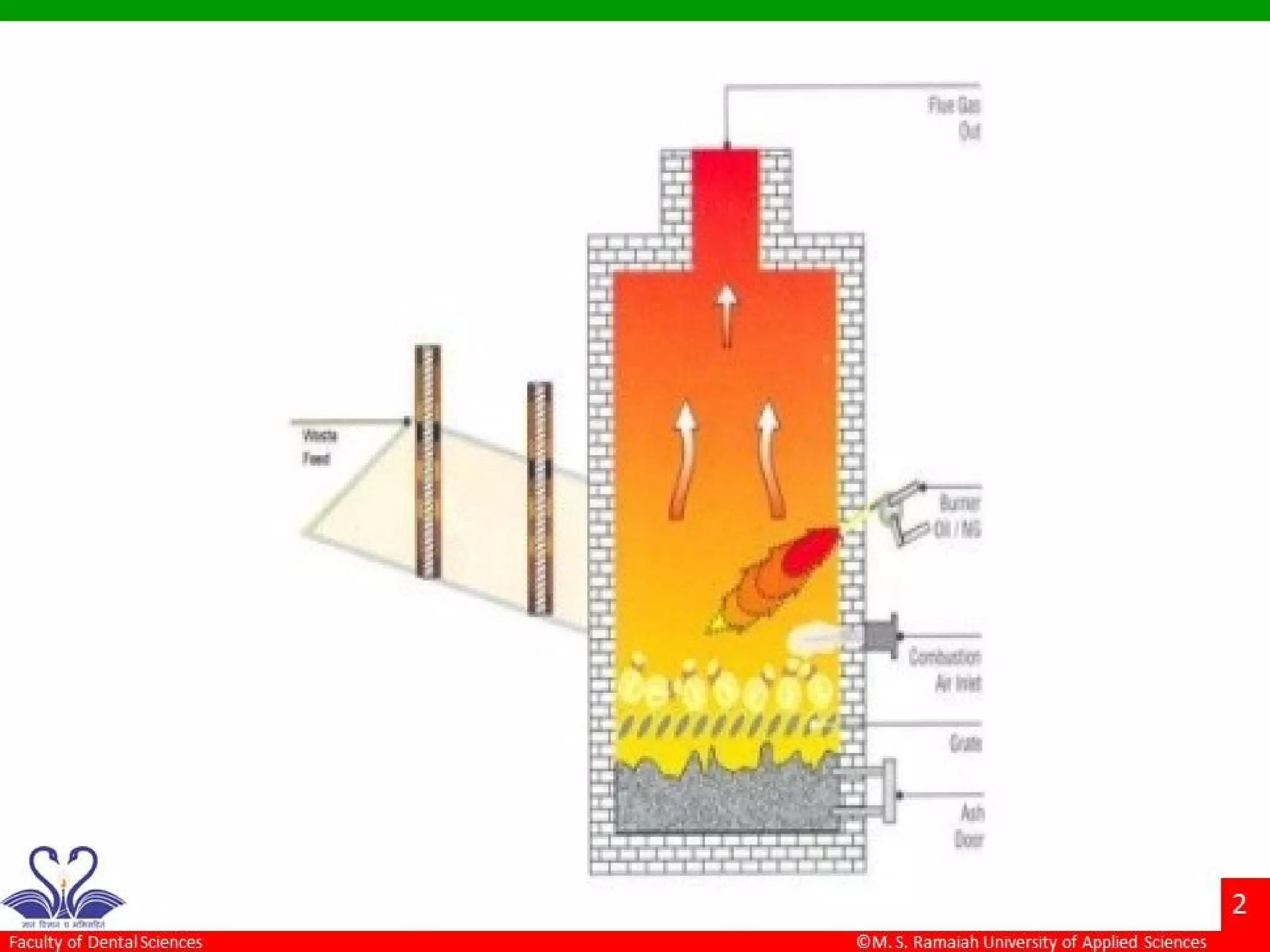
INCINERATION
 Excellent method.
 Materials are reduced to ashes by burning.
 For contaminated and pathological materials
at a high temperature.
HOT AIR OVEN
Employs dry heat that kills by dehydration and
oxidation.
 Devices in Hot air oven
• heating elements in the wall of chamber
• fan
• temperature indicator
• control thermostat
• timer
• open mesh shelving
• Door interlocks
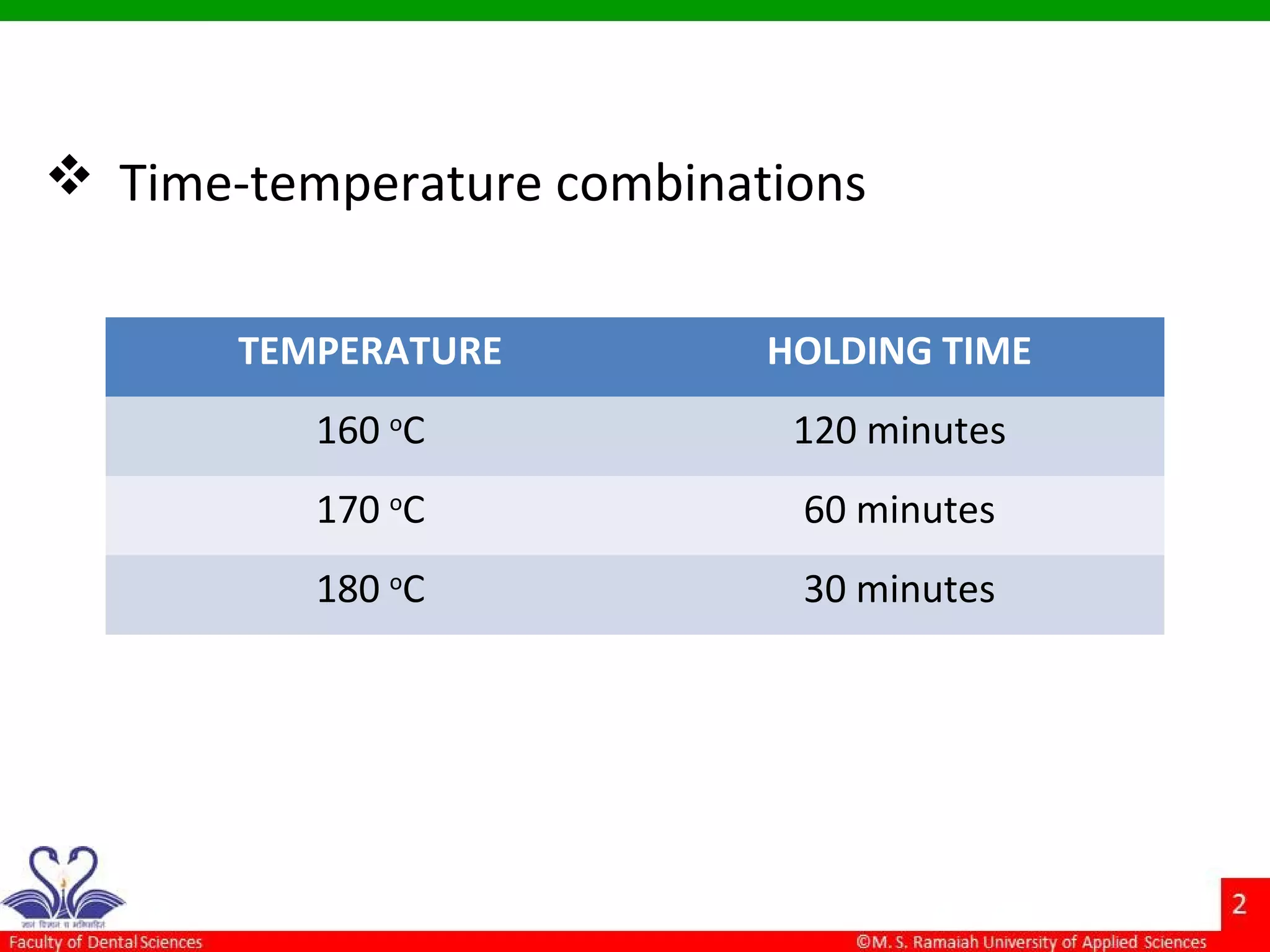
 Time-temperature combinations
TEMPERATURE HOLDING TIME
160 o
C 120 minutes
170 o
C 60 minutes
180 o
C 30 minutes
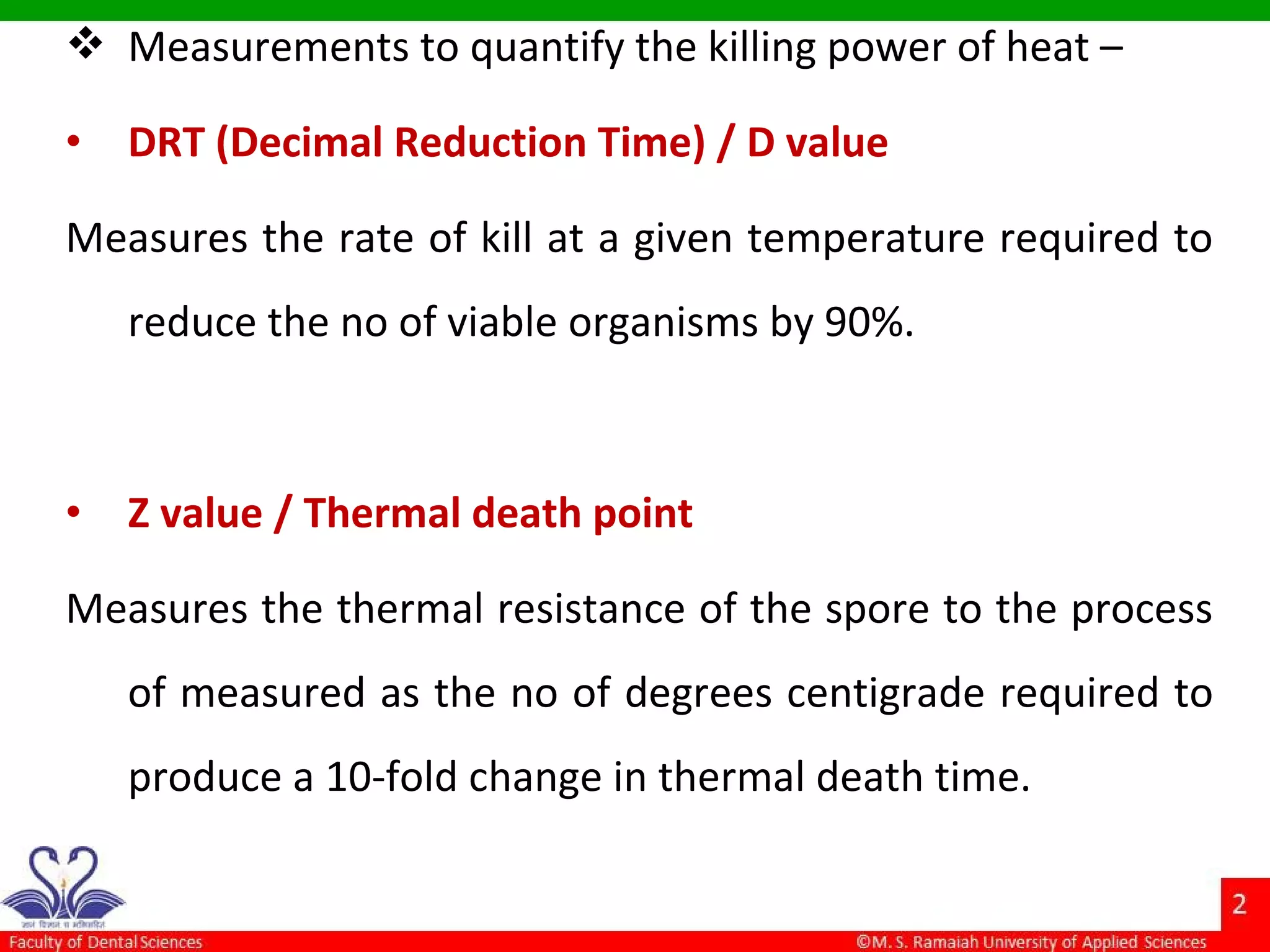
 Measurements to quantify the killing power of heat –
• DRT (Decimal Reduction Time) / D value
Measures the rate of kill at a given temperature required to
reduce the no of viable organisms by 90%.
• Z value / Thermal death point
Measures the thermal resistance of the spore to the process
of measured as the no of degrees centigrade required to
produce a 10-fold change in thermal death time.
 Uses – Glassware, forceps, scissors, scalpels,
all glass syringes, swabs, pharmaceutical
products such as liquid paraffin.
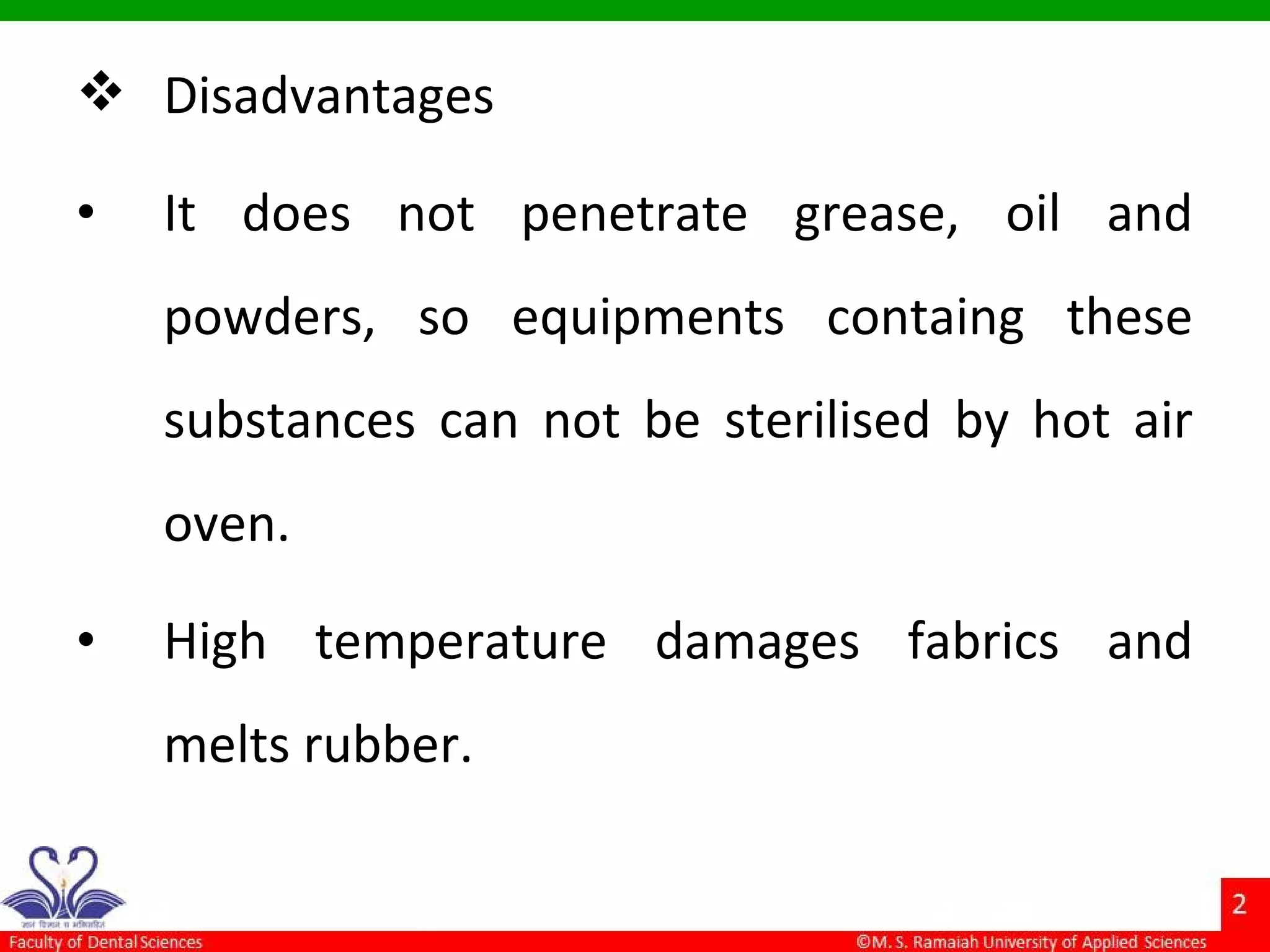
 Disadvantages
• It does not penetrate grease, oil and
powders, so equipments containg these
substances can not be sterilised by hot air
oven.
• High temperature damages fabrics and
melts rubber.
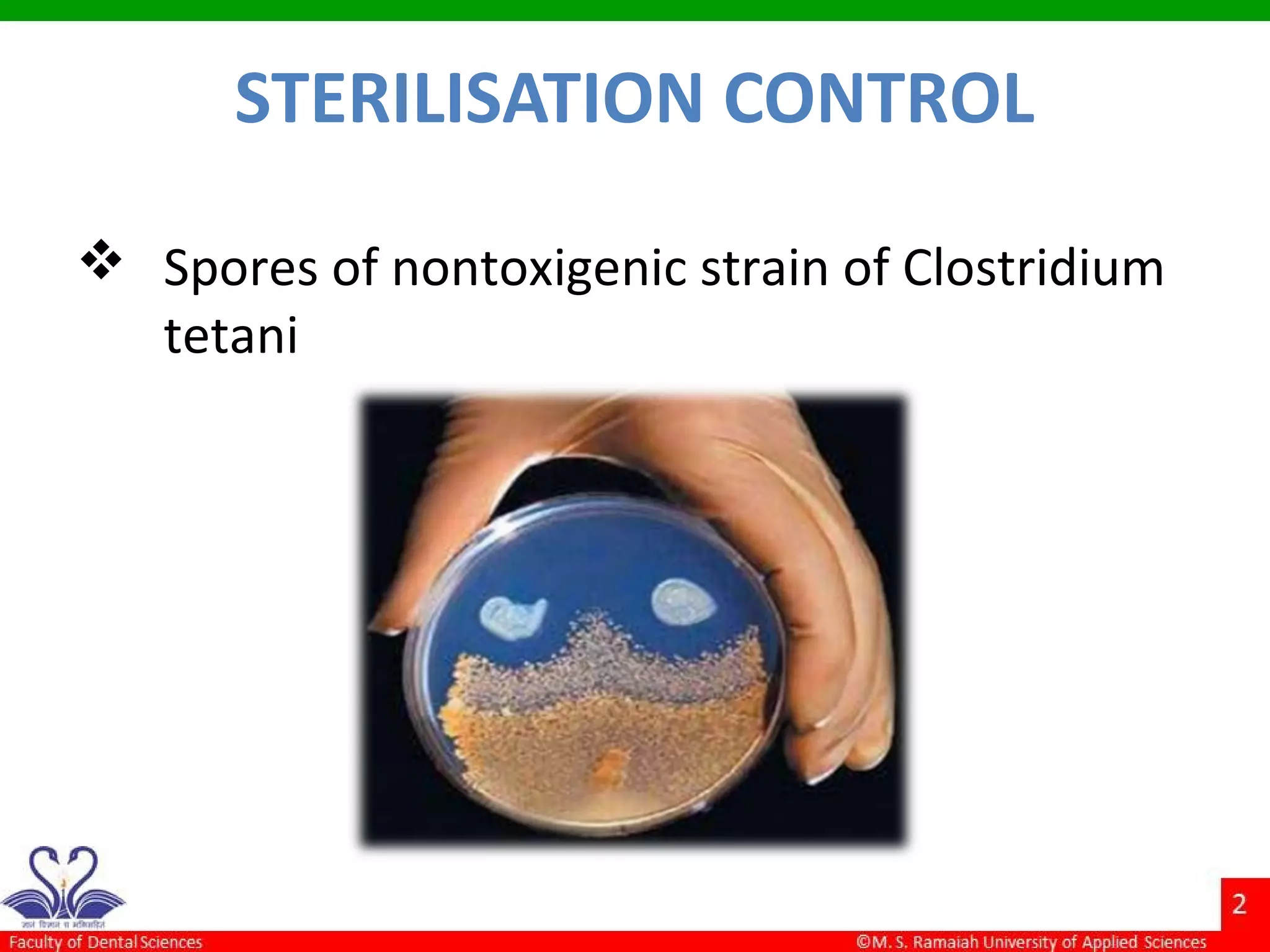
STERILISATION CONTROL
 Spores of nontoxigenic strain of Clostridium
tetani
MOIST / STEAM HEAT STERILISATION
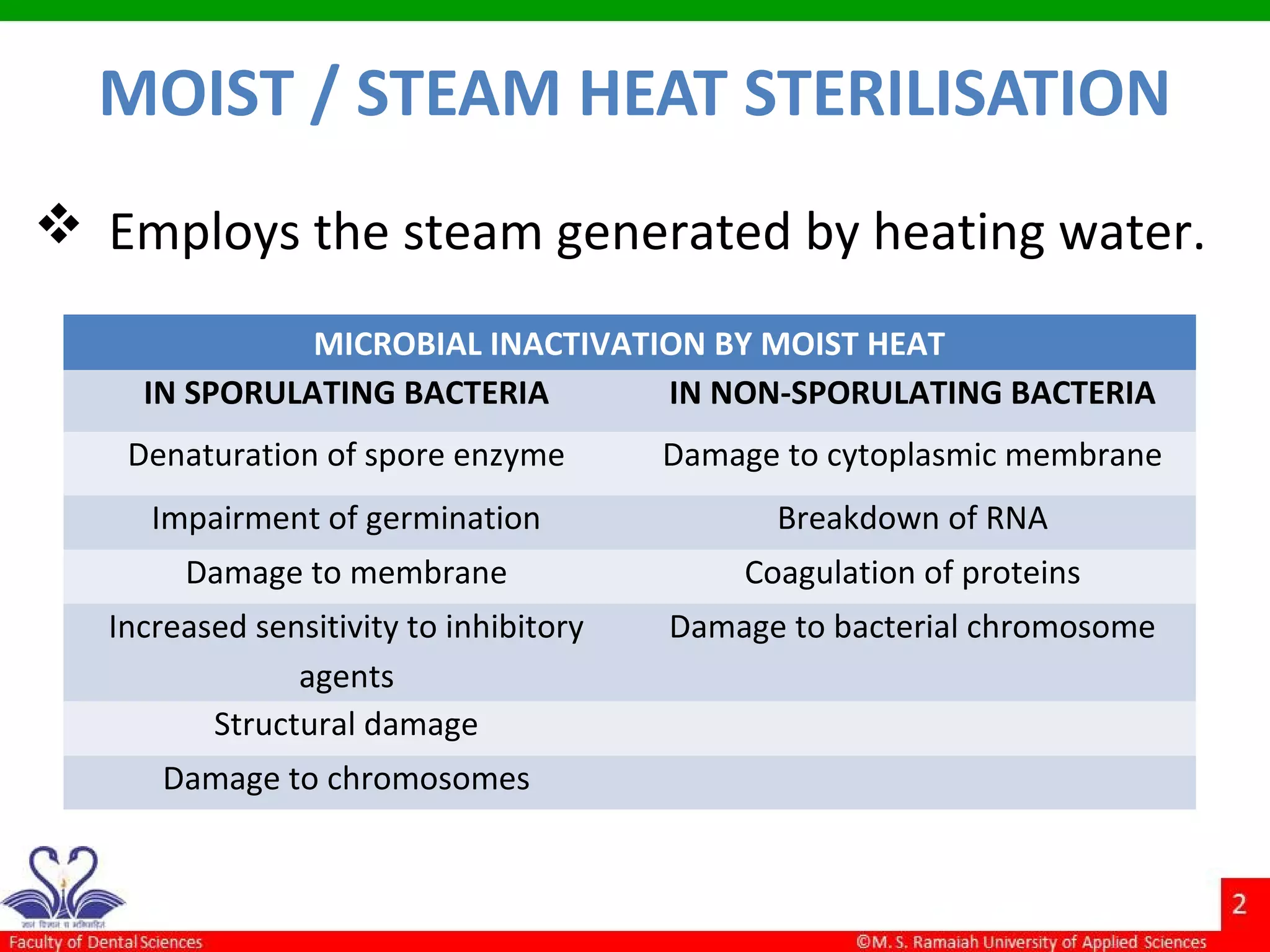
 Employs the steam generated by heating water.
MICROBIAL INACTIVATION BY MOIST HEAT
IN SPORULATING BACTERIA IN NON-SPORULATING BACTERIA
Denaturation of spore enzyme Damage to cytoplasmic membrane
Impairment of germination Breakdown of RNA
Damage to membrane Coagulation of proteins
Increased sensitivity to inhibitory
agents
Damage to bacterial chromosome
Structural damage
Damage to chromosomes
MOIST / STEAM HEAT STERILISATION
TEMPERATURE BELOW 100o
C
(PASTEURISATION)
 Uses – for serum or other
body fluids containing
proteins.
 HOLDER METHOD – Heating
at 63o
C for 30 minutes.
 FLASH PROCESS – Heating at
72o
C for 15-20 seconds.
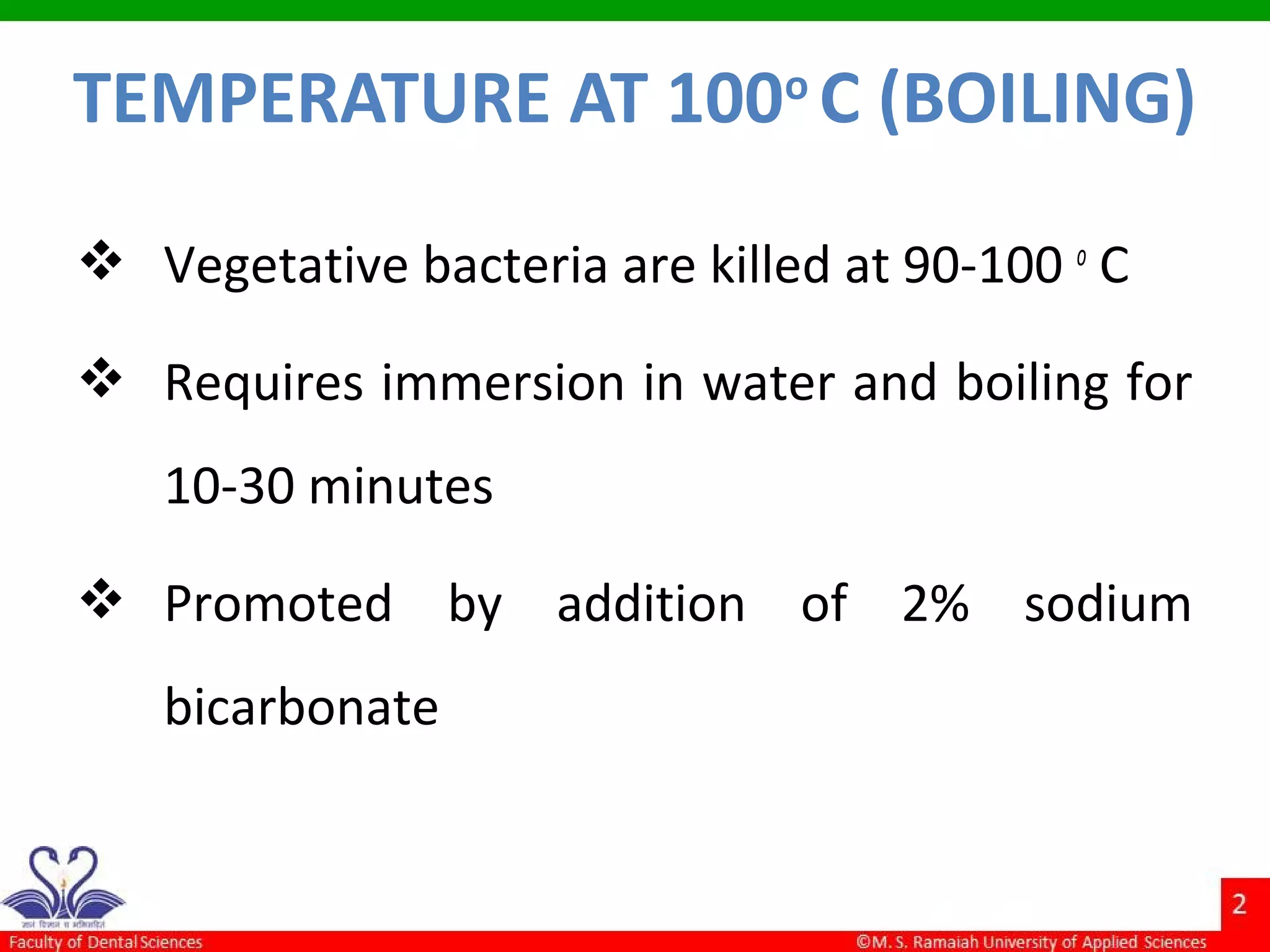
 Vegetative bacteria are killed at 90-100 o
C
 Requires immersion in water and boiling for
10-30 minutes
 Promoted by addition of 2% sodium
bicarbonate
TEMPERATURE AT 100o
C (BOILING)
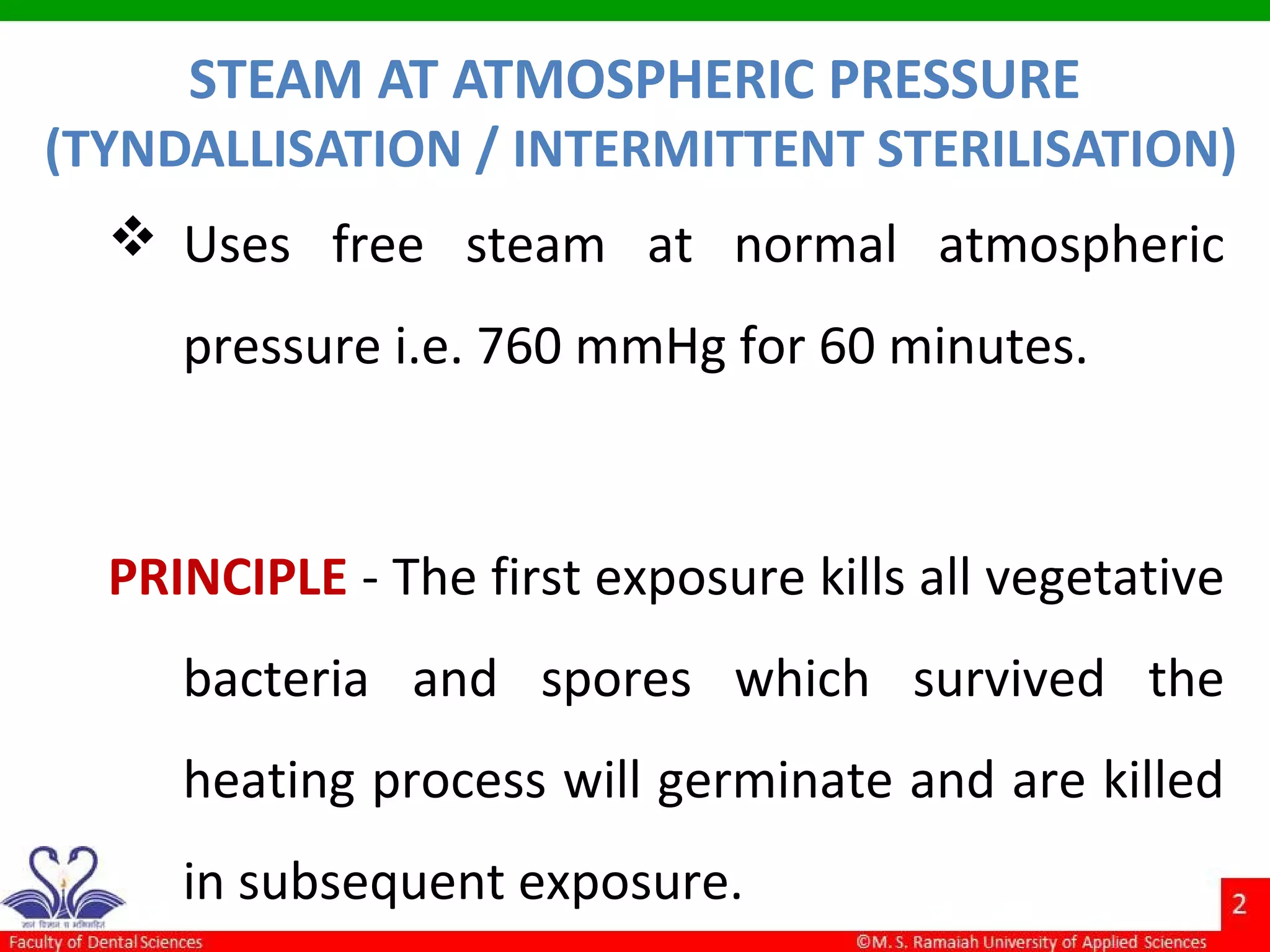
STEAM AT ATMOSPHERIC PRESSURE
(TYNDALLISATION / INTERMITTENT STERILISATION)
 Uses free steam at normal atmospheric
pressure i.e. 760 mmHg for 60 minutes.
PRINCIPLE - The first exposure kills all vegetative
bacteria and spores which survived the
heating process will germinate and are killed
in subsequent exposure.
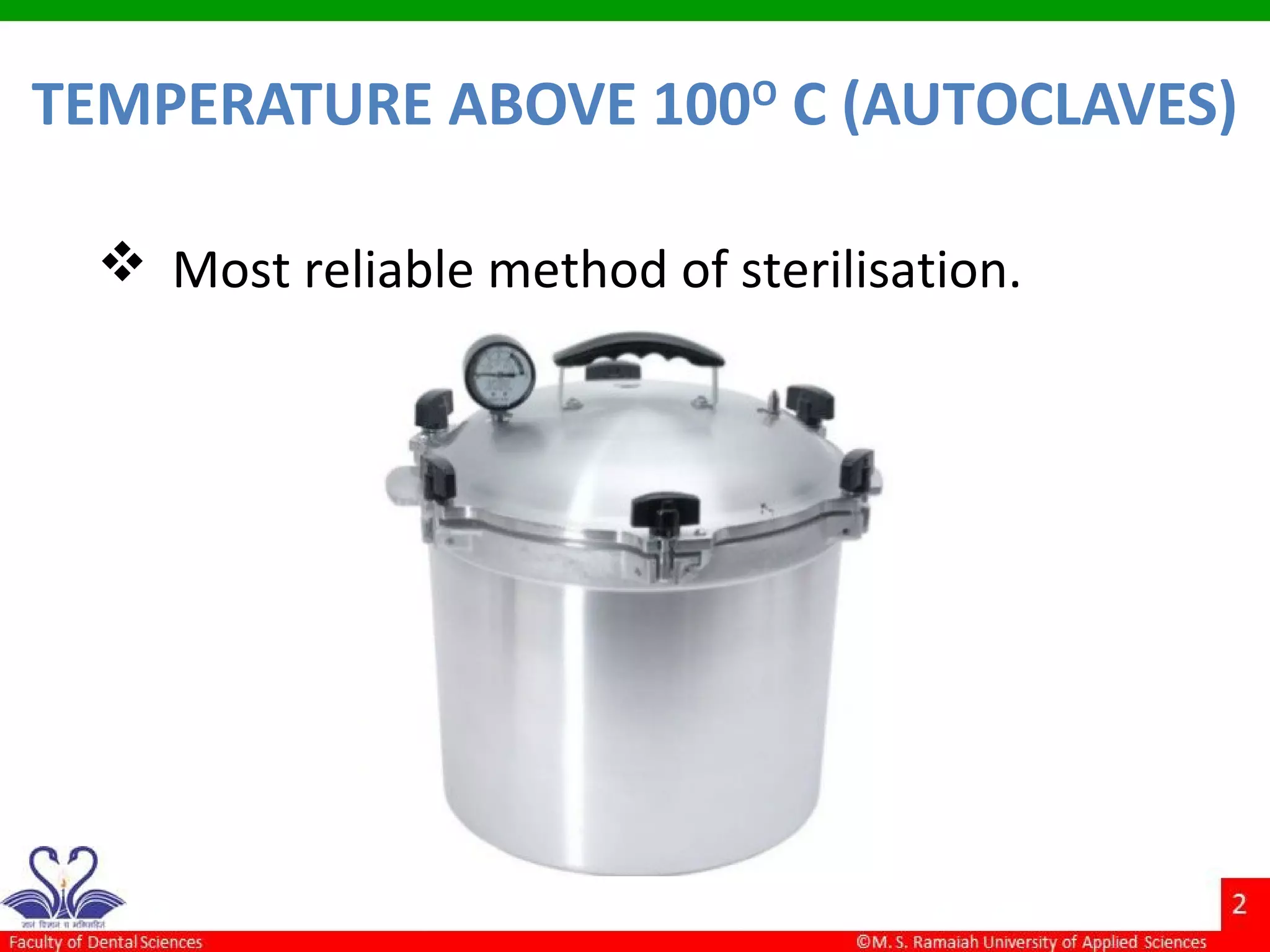
TEMPERATURE ABOVE 100O
C (AUTOCLAVES)
 Most reliable method of sterilisation.
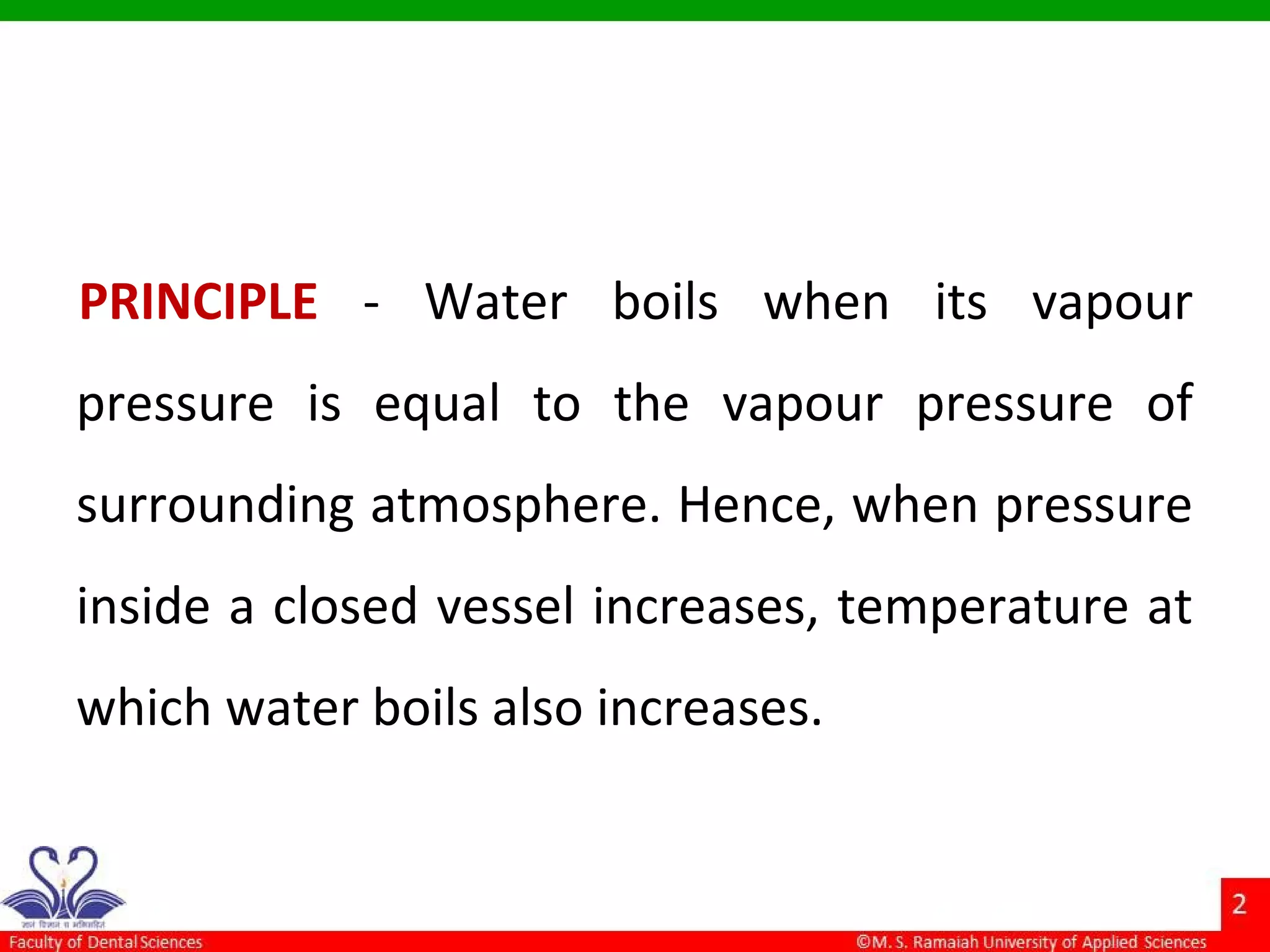
PRINCIPLE - Water boils when its vapour
pressure is equal to the vapour pressure of
surrounding atmosphere. Hence, when pressure
inside a closed vessel increases, temperature at
which water boils also increases.
 3 major factors required for effective
autoclaving
• Pressure - 1 kpa = 0.145 psi
• Temperature - 121o
C
• Time - a minimum of 20 minutes after reaching full
temperature and pressure.
 Sterilisation hold time
 Heat penetration time
 Various combinations of temperature, pressure
and holding times are used for sterilisation with
PURE, DRY, SATURATED steam.
i.e. free from admixture with
air or other non-condensable gas
i.e. free from suspended
droplets of condensed water
i.e. in free molecular balance
with water from which it is formed
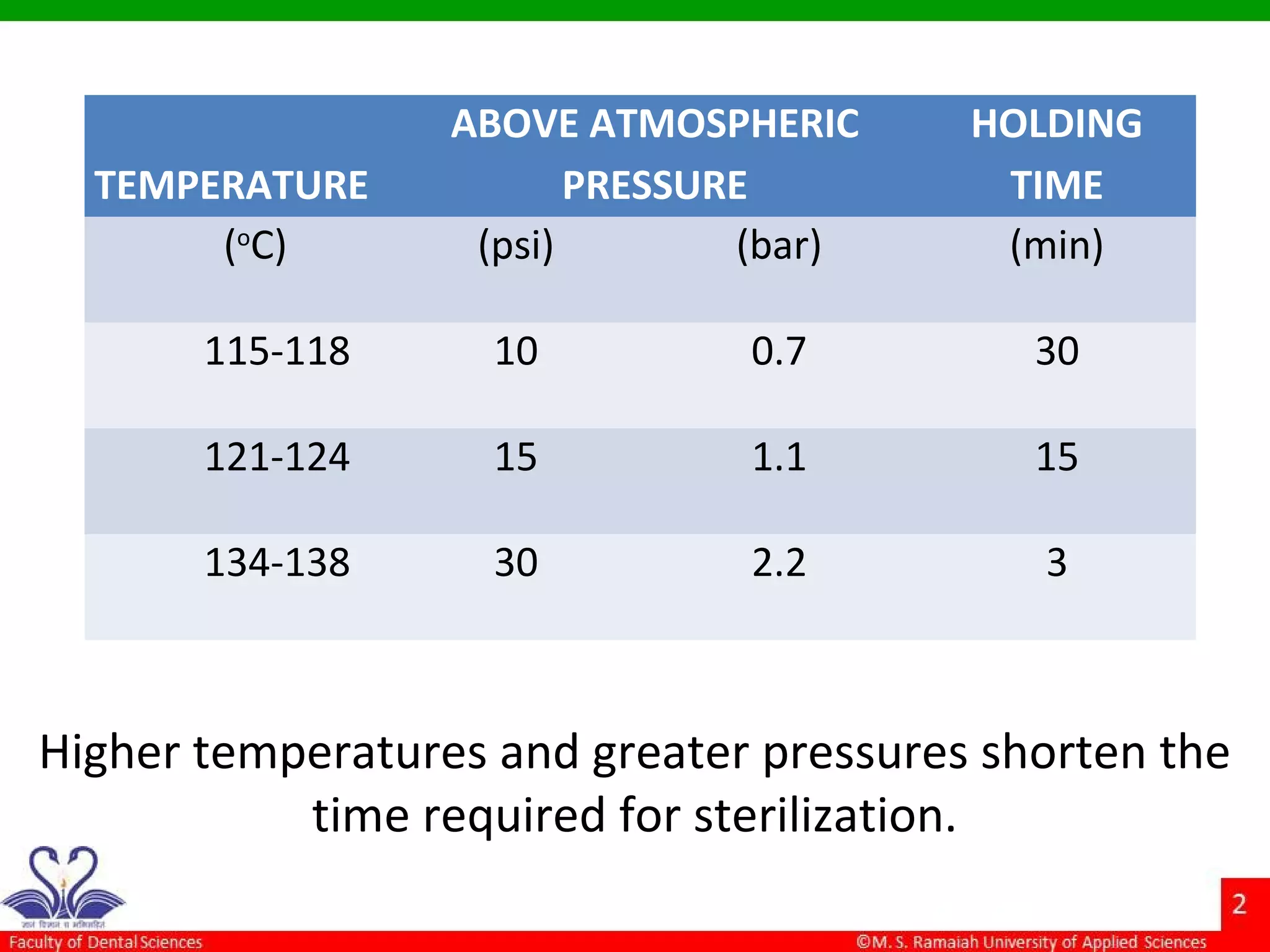
TEMPERATURE
ABOVE ATMOSPHERIC
PRESSURE
HOLDING
TIME
(o
C) (psi) (bar) (min)
115-118 10 0.7 30
121-124 15 1.1 15
134-138 30 2.2 3
Higher temperatures and greater pressures shorten the
time required for sterilization.
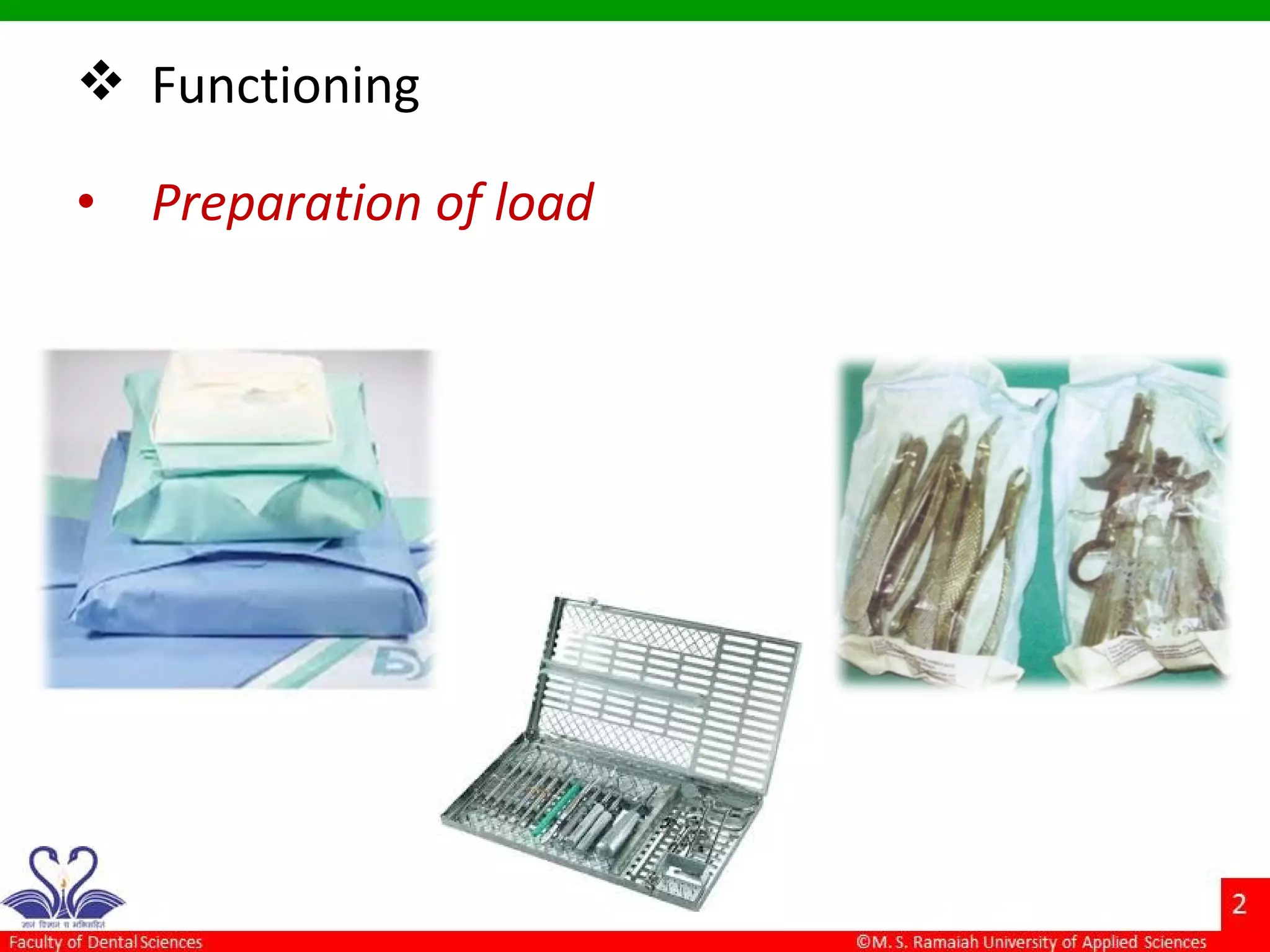
 Functioning
• Preparation of load
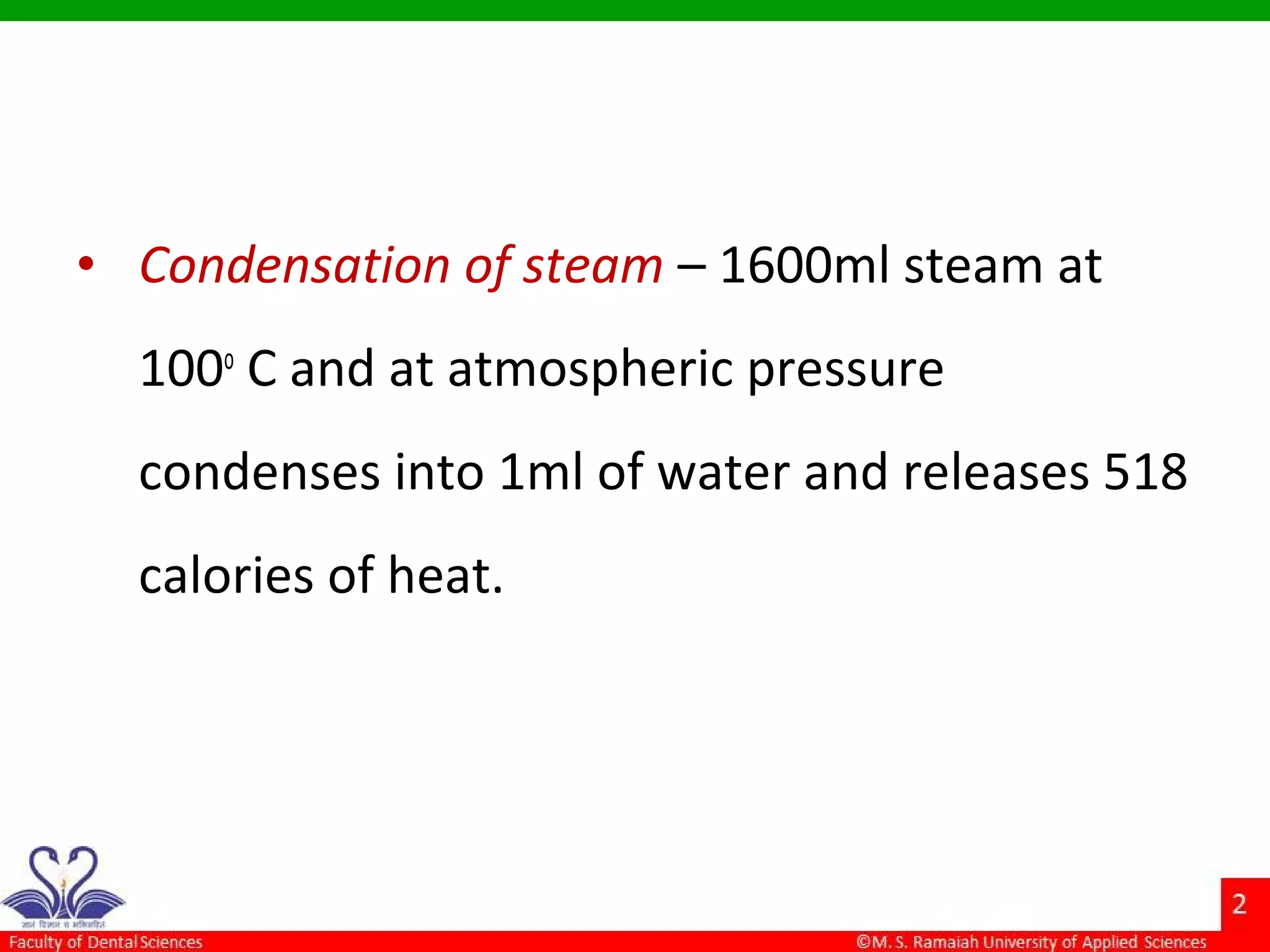
• Condensation of steam – 1600ml steam at
100o
C and at atmospheric pressure
condenses into 1ml of water and releases 518
calories of heat.
 Importance of steam condensation into
water.
• Wetting the microorganisms
• Liberation of latent heat of steam
• Contraction in the volume of the steam
 1670 volumes of steam at 1 bar pressure will
contract to form only 1 condensate.
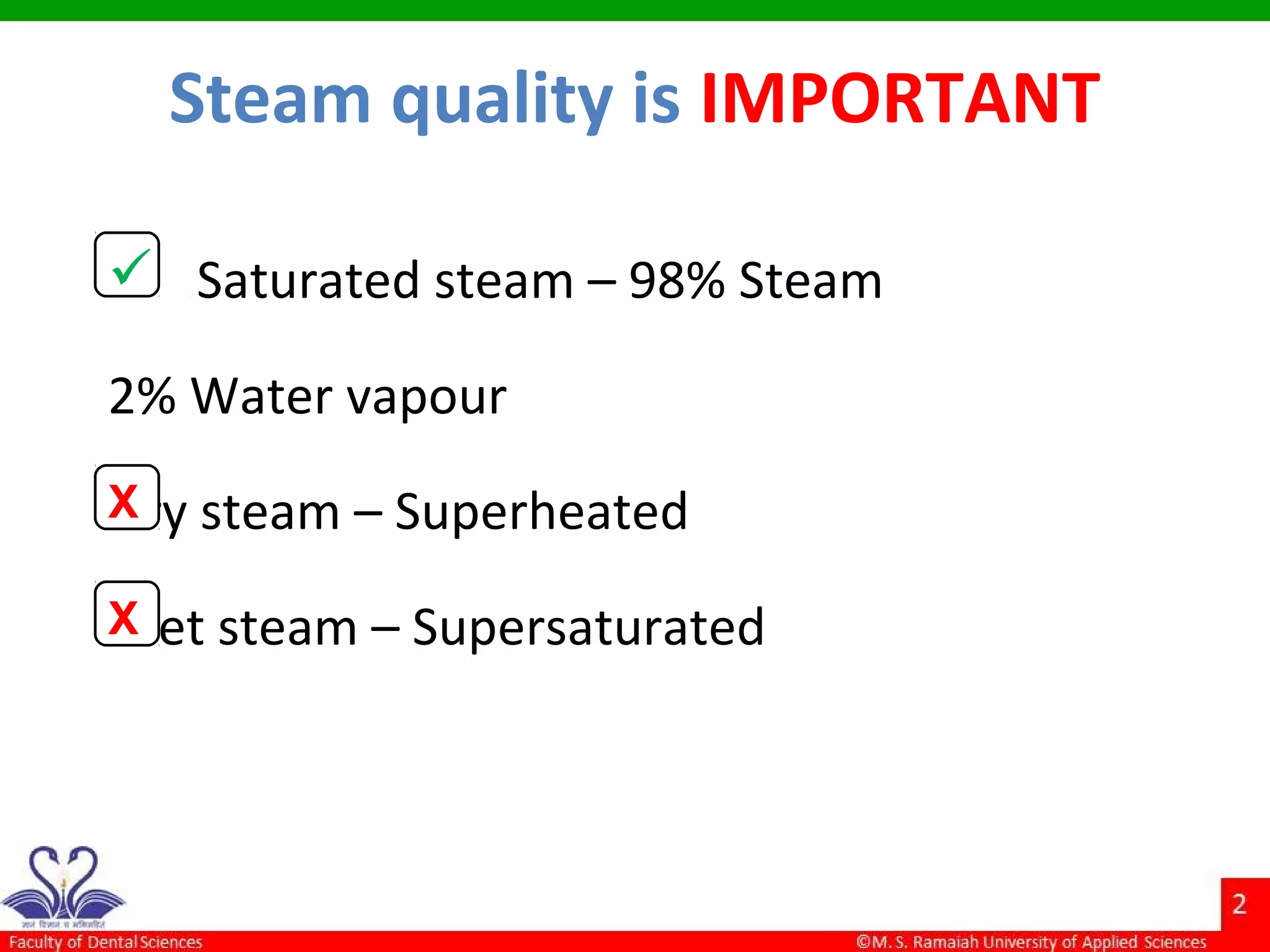
Steam quality is IMPORTANT
 .Saturated steam – 98% Steam
2% Water vapour
Dry steam – Superheated
Wet steam – Supersaturated
X
X
SUPERHEATED STEAM
 Superheating may be caused
• by overheating of the jacket.
• by too great reduction in pressure.
• by processing too dry load of textiles.
SUPERSATURATED STEAM
 Moisture content of steam 1 1
dryness fraction
 Dryness fraction measures the proportion of
latent heat still available in it.
ᴕ
• Air removal – all air should be removed from
the chamber before holding time.
• If air-steam mixture is left then the total
pressure in the chamber will consist of sum of
pressure of air and pressure of steam
according to DALTON’S LAW.
 Reasons for presence of air in chamber
during holding time includes :
• Insufficient time
• Leak in the chamber
• Contamination of steam supply
 Drying the load – promoted by the
application of a vacuum before opening the
autoclave
SIMPLE LABORATORY AUTOCLAVE
 Small, simple, portable autoclave.
 Operates like domestic pressure cooker.
 Sterilisation of small metal or glass
instruments.
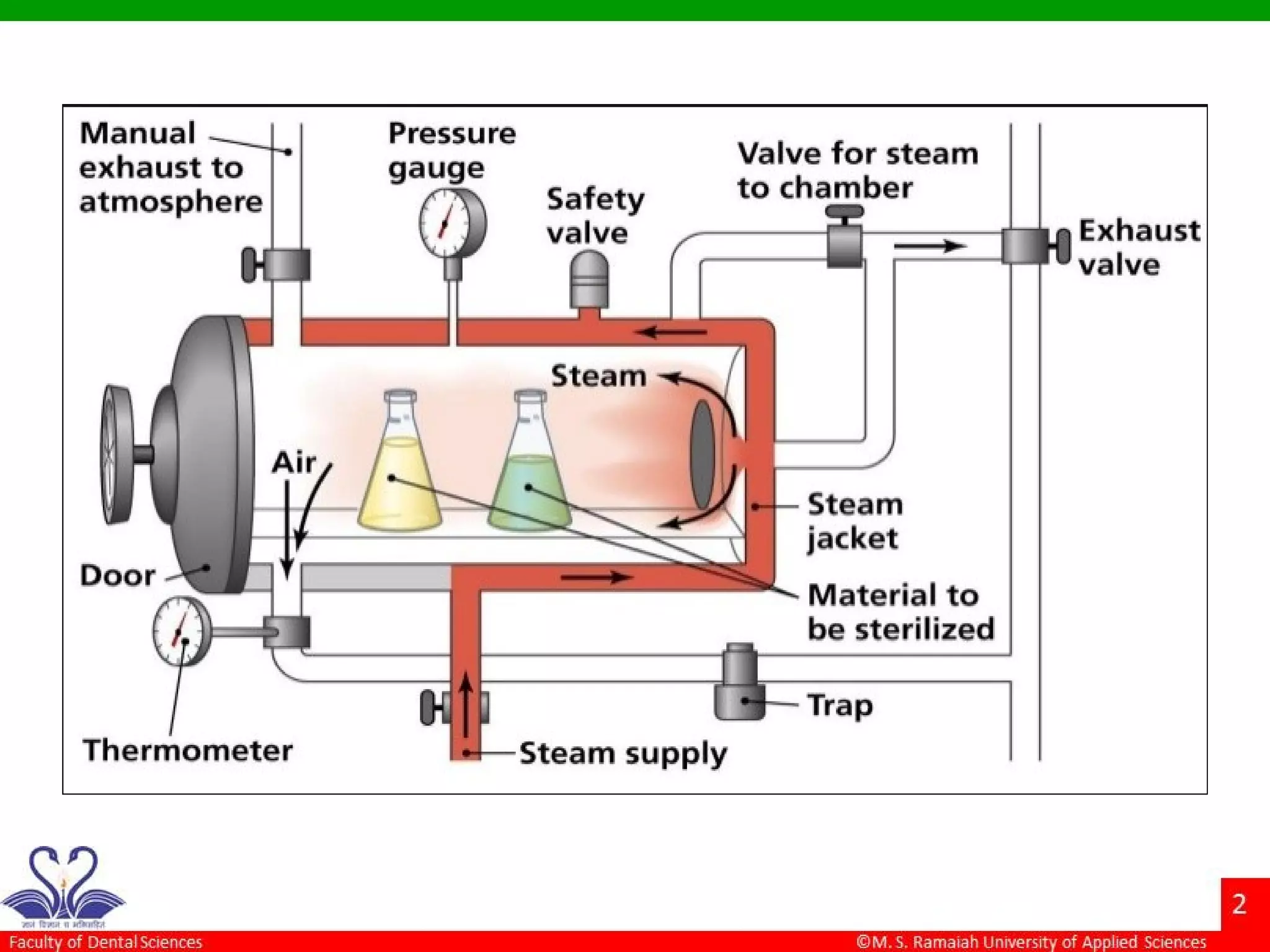
 Devices
• metal tank
• a lid with a gasket
• Manually operated tap
• pressure gauge
• pressurestat
• pressure-regulated (safety) valve
• thermal cut-out device
DOWNWARD DISPLACEMENT LABORATORY
AUTOCLAVE
 Removes air from the chamber and loads
efficiently.
 Devices that
• assist the drying of wrapped and porous loads
• prevent the door from opening while chamber is
under pressure
• brings out the automatic control of the process
MULTI-PURPOSE LABORATORY
AUTOCLAVE
 Efficient assisted air removal and assisted
cooling.
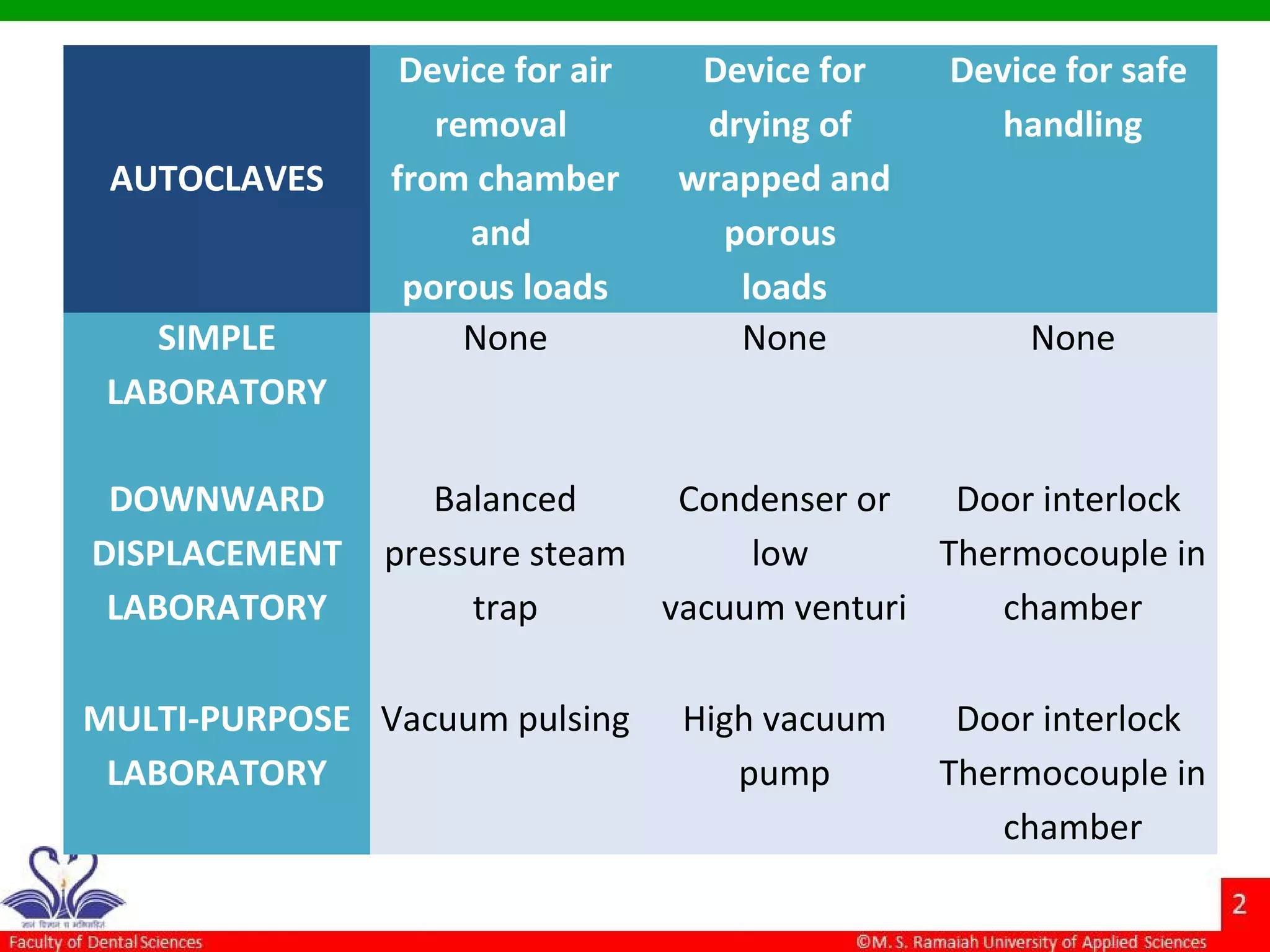
AUTOCLAVES
Device for air
removal
from chamber
and
porous loads
Device for
drying of
wrapped and
porous
loads
Device for safe
handling
SIMPLE
LABORATORY
None None None
DOWNWARD
DISPLACEMENT
LABORATORY
Balanced
pressure steam
trap
Condenser or
low
vacuum venturi
Door interlock
Thermocouple in
chamber
MULTI-PURPOSE
LABORATORY
Vacuum pulsing High vacuum
pump
Door interlock
Thermocouple in
chamber
STERILISATION CONTROL
 Bacterial spores – Bacillus stearothermophilus
 Thermocouple
 Brown’s test
 Autoclave tape
FILTRATION
 Forced passage through a filter of porosity
small enough to retain any microorganisms
contained in them.
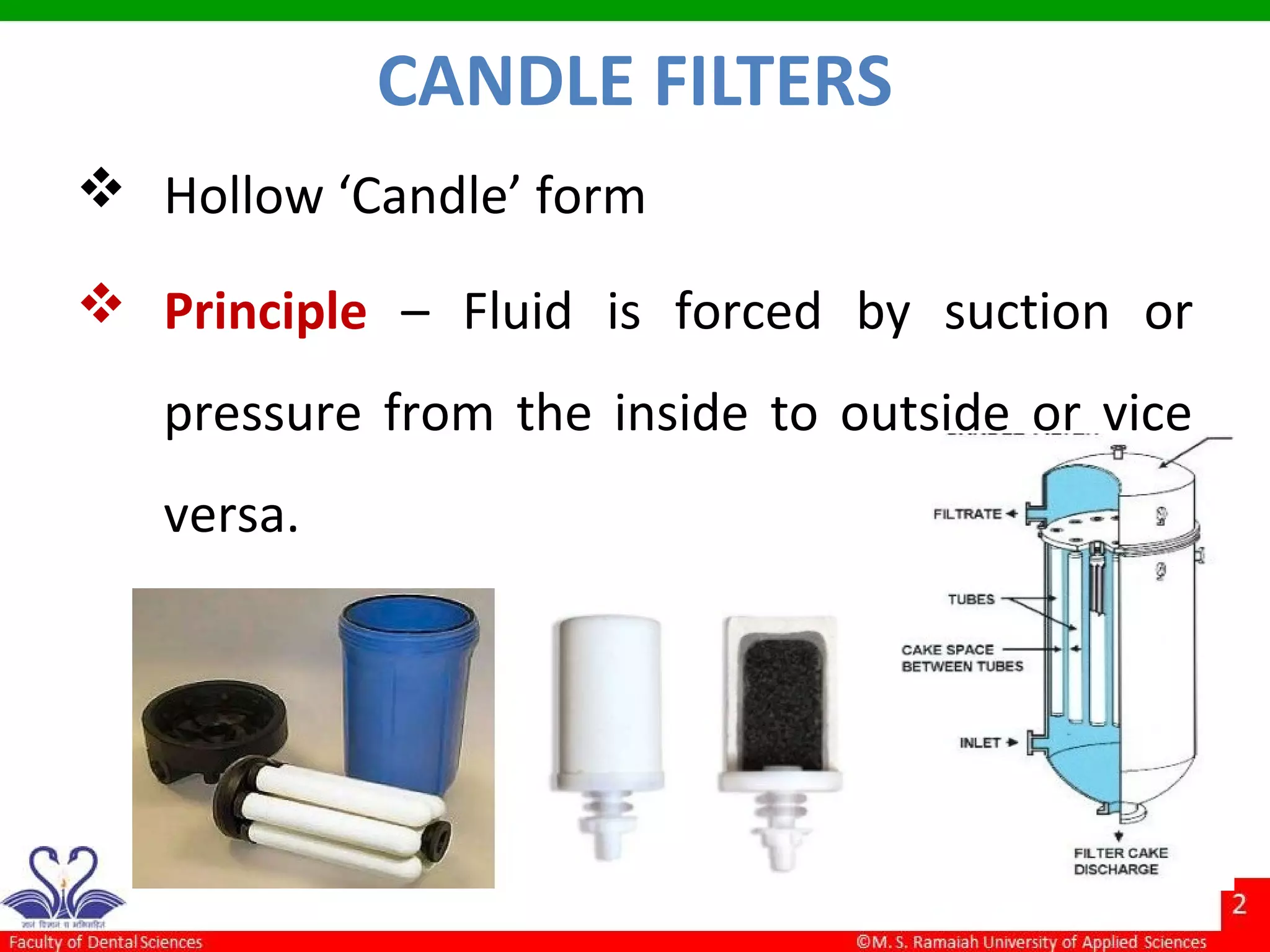
CANDLE FILTERS
 Hollow ‘Candle’ form
 Principle – Fluid is forced by suction or
pressure from the inside to outside or vice
versa.
 2 types-
• Unglazed ceramic filters eg- Chamberland
and Doulton filter
• Diatomaceous earth filters eg- Berkfeld and
Mandler filter
 Cleaning – When they become clogged with
organic matter they should be heated to
redness in a furnace and allowed to cool
slowly
ASBESTOS FILTERS
 Disposable, single use discs with
high adsorbing capacity.
 Discarded – Cariogenic potential
 After use the disc is discarded.
 Examples – Seitz and Sterimat filter.
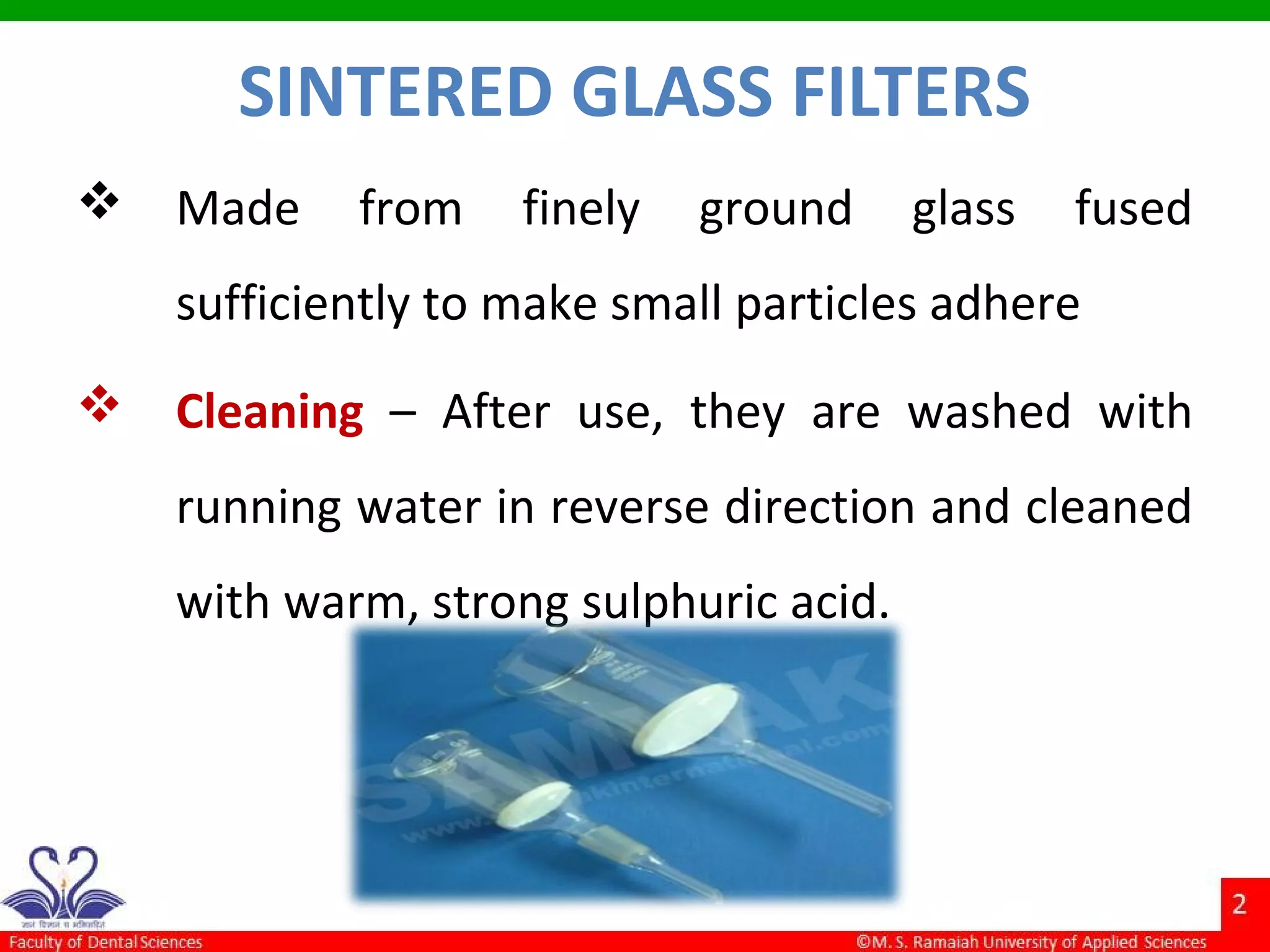
SINTERED GLASS FILTERS
 Made from finely ground glass fused
sufficiently to make small particles adhere
 Cleaning – After use, they are washed with
running water in reverse direction and cleaned
with warm, strong sulphuric acid.
MEMBRANE FILTERS
 Made up of variety of polymeric materials
such as cellulose nitrate, cellulose diacetate,
polycarbonate and polyester.
 Membranes are made in 2 ways-
• Capillary pore membranes
• Labyrinthine pore membranes
SYRINGE FILTERS
 Fitted in syringe
 Fluid is forced through the filter by pressing
down the piston.
 Uses – solutions of heat-labile sugars
AIR FILTERS
 Mainly HEPA (High Efficiency Particle
Arresters) filter is used.
RADIATION
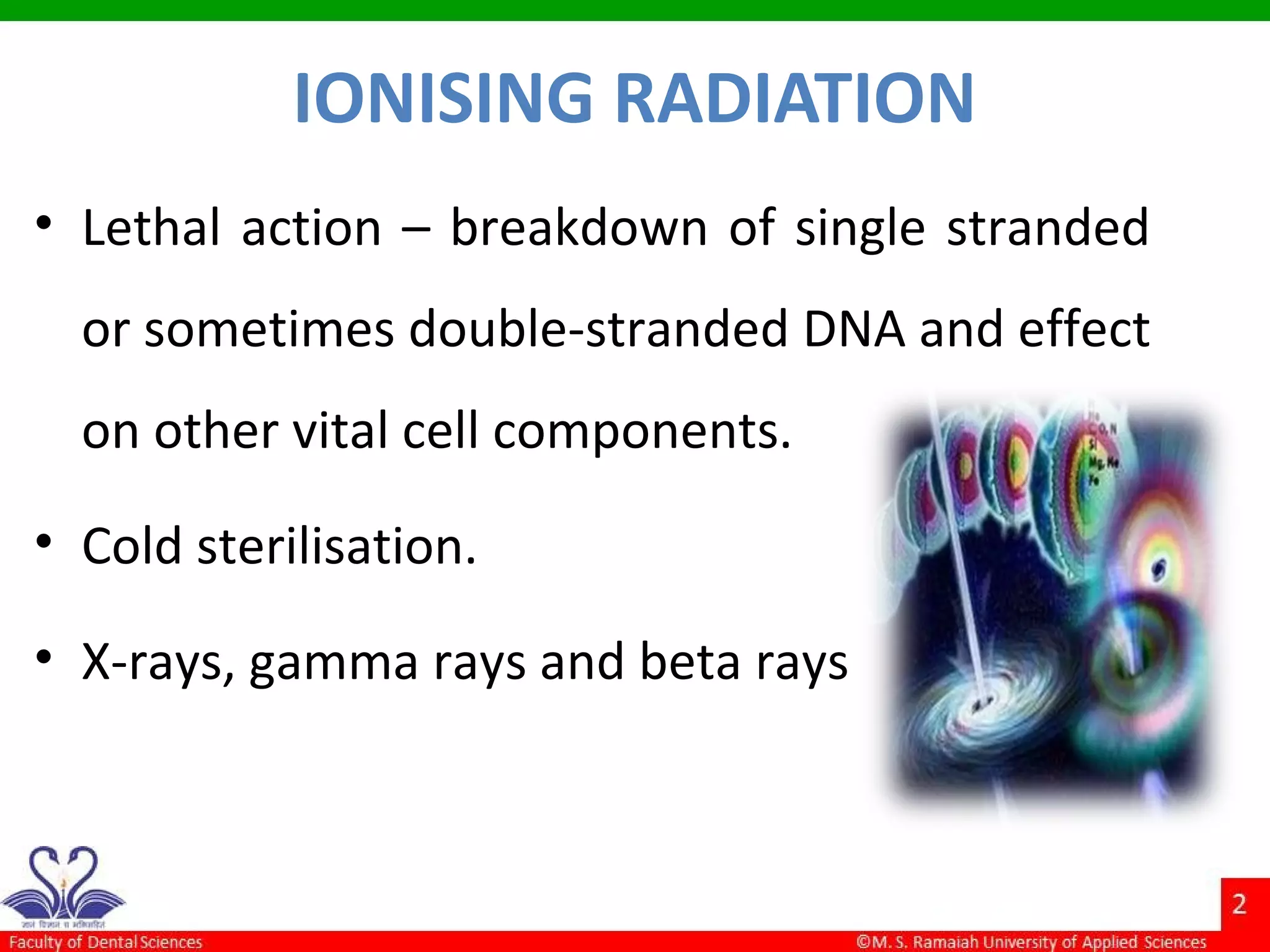
IONISING RADIATION
• Lethal action – breakdown of single stranded
or sometimes double-stranded DNA and effect
on other vital cell components.
• Cold sterilisation.
• X-rays, gamma rays and beta rays
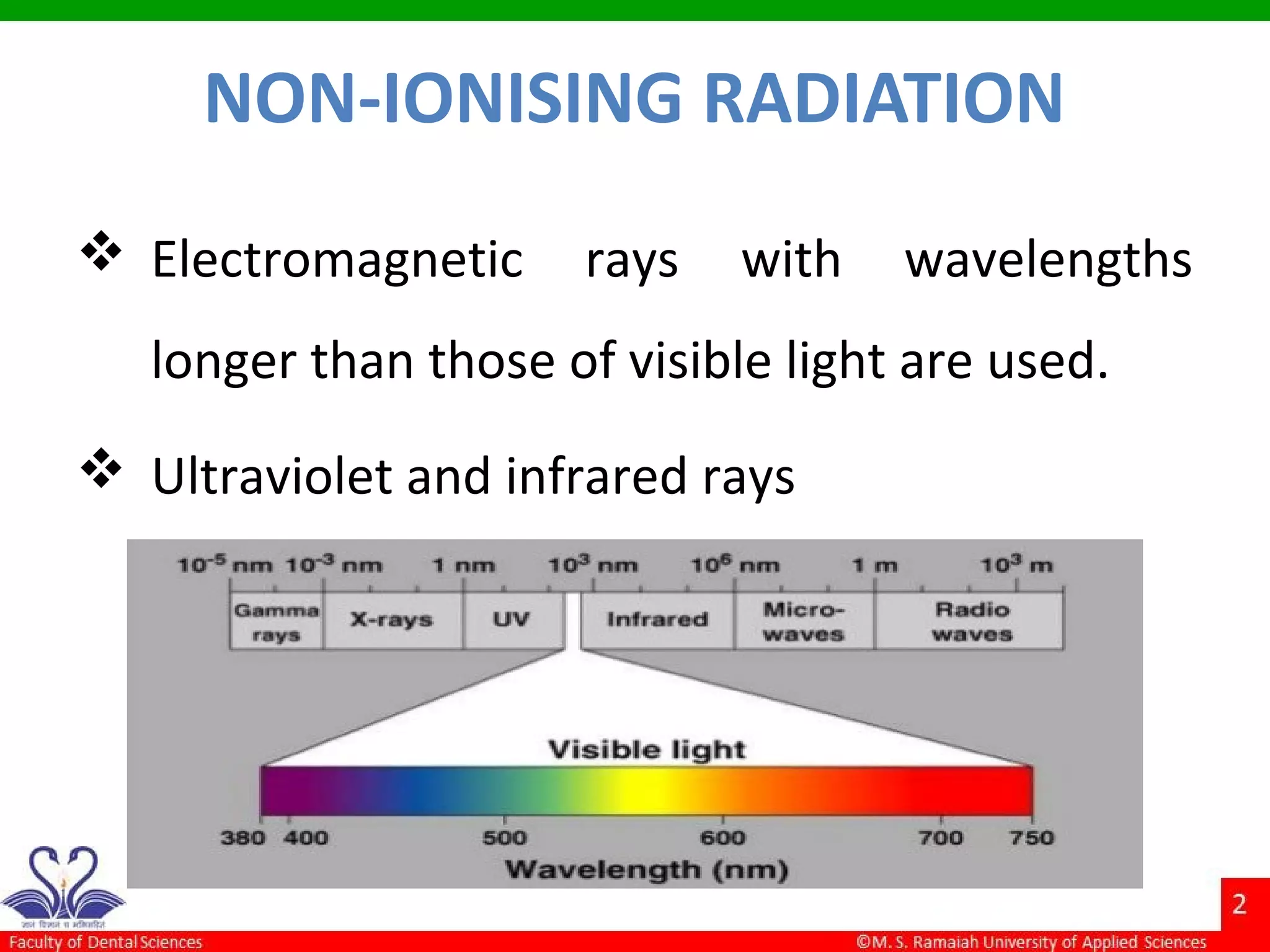
NON-IONISING RADIATION
 Electromagnetic rays with wavelengths
longer than those of visible light are used.
 Ultraviolet and infrared rays
 Ultraviolet rays kills microorganisms by
chemical reaction.
 Low penetrating capacity
 Infrared rays have no penetrating capacity.
REFERENCES
• Textbook of Microbiology (7th
edition)
- by C K J Paniker
• Textbook of Oral and Maxillofacial Surgery
- by Prof Dr Neelima Anil Malik
• Practical Medical Microbiology (13th
edition)
- by J. G. Collee, J. P. Duguid, A.G. Fraser, B.
P.Marmion
• Essentials of Medical Microbiology (3rd
edition)
- by Rajesh Bhatia, Rattan Lal Ichhpujani

PHYSICAL METHODS OF STERILISATION

  • 1.
    PHYSICAL METHODS OF STERILISATION By:: Dr. Saurabh Singh, MDS (Oral n Maxillofacial Surgery)
  • 2.
    The process bywhich an article, surface or medium is freed of all living microorganisms either in the vegetative or spore state. “ STERILISATION ”
  • 3.
    NEED FOR STERILISATION •Microorganisms are constantly present in the external environment and on the human body. • Microorganisms are capable of causing contamination and infection.
  • 4.
    HOW CAN MICROORGANISMSBE KILLED • Denaturation of proteins • Oxidation • Filtration • Interruption of DNA synthesis/repair • Interference with protein synthesis • Disruption of cell membranes
  • 5.
    Most Resistant Least Resistant Endospores Mycobacteria Fungalspores Small non-enveloped viruses (polio, rota virus, rabies) Vegetative fungal cells Enveloped viruses (Herpes, Hepatitis B and C, HIV) Vegetative bacteria
  • 6.
    HOW STERILISATION WORKS Disruption of cell wall cannot prevent cell from bursting due to osmotic effects.  Damage to cytoplasmic membrane causes cellular contents to leak out.  Damage to viral envelope interrupts viral replication.
  • 7.
    • DISINFECTION –The process of destruction or removal of all pathogenic organisms, or organisms capable of giving rise to infection. • ASEPSIS – The avoidance of pathogenic organisms involving the methods that prevents contamination of wounds and other sites by ensuring that only sterile objects and fluids come into contact them and risk of air-borne contamination is minimized. For eg- no touch technique. OTHER TERMINOLOGIES
  • 8.
    • ANTISEPSIS –The procedure or application of antiseptic solution or agent which inhibits growth of microorganisms while remaining in contact with them. For eg- scrubbing up. Antiseptic solution is betadiene.
  • 9.
    PRINCIPLES OF STERILISATION 1.Thorough cleaning of instruments before sterilisation. 2. Contact of sterilizing agent with all surfaces of each item for specified period of time at specified temperature. 3. Regular service and maintenance of sterilizing equipment.
  • 10.
    PHYSICAL METHODS CHEMICALMETHODSS T E R I L I S A T I O N Sunlight Drying Heat •Dry heat •Moist heat Filtration Radiation Alcohols Aldehydes Dyes Halogens Phenols Surface-active agents Metallic salts Gases
  • 11.
    SUNLIGHT  Possesses bactericidalactivity.  Action – Content • UV rays, • most oil which are screened out by glass • presence of ozone in outer regions of atmosphere.
  • 12.
    DRYING  Most ofthe bacteria grows in moist environment and thus 4/5th of their weight is attributed to water.
  • 13.
  • 14.
    HEAT  Most reliablemethod.  Can be used either in dry form or moist form.
  • 15.
     Factors influencingsterilisation by heat : • Nature of heat – dry or moist • Temperature and time • No of microorganisms present • Characteristics of organisms i.e. their species, strain and sporing capacity • Type of material from which organisms have to be eradicated
  • 16.
    DRY HEAT STERILISATION Principle - Killing effect is due to • protein denaturation • oxidative damage • toxic effect of elevated levels of electrolytes. ADVANTAGES DISADVANTAGES Can be used for sharp instruments, glasswares, water impermeable oils, waxes and powders. Cannot be used for water containing culture media, plastic and rubber items. Instruments do not rust Process is time consuming.
  • 18.
    FLAMING  Bunsen flameis used.  Uses – Scalpel blades, inoculation wires and loops, glass slides, cover slips.
  • 19.
    INCINERATION  Excellent method. Materials are reduced to ashes by burning.  For contaminated and pathological materials at a high temperature.
  • 21.
    HOT AIR OVEN Employsdry heat that kills by dehydration and oxidation.
  • 22.
     Devices inHot air oven • heating elements in the wall of chamber • fan • temperature indicator • control thermostat • timer • open mesh shelving • Door interlocks
  • 23.
     Time-temperature combinations TEMPERATUREHOLDING TIME 160 o C 120 minutes 170 o C 60 minutes 180 o C 30 minutes
  • 24.
     Measurements toquantify the killing power of heat – • DRT (Decimal Reduction Time) / D value Measures the rate of kill at a given temperature required to reduce the no of viable organisms by 90%. • Z value / Thermal death point Measures the thermal resistance of the spore to the process of measured as the no of degrees centigrade required to produce a 10-fold change in thermal death time.
  • 25.
     Uses –Glassware, forceps, scissors, scalpels, all glass syringes, swabs, pharmaceutical products such as liquid paraffin.
  • 26.
     Disadvantages • Itdoes not penetrate grease, oil and powders, so equipments containg these substances can not be sterilised by hot air oven. • High temperature damages fabrics and melts rubber.
  • 27.
    STERILISATION CONTROL  Sporesof nontoxigenic strain of Clostridium tetani
  • 28.
    MOIST / STEAMHEAT STERILISATION  Employs the steam generated by heating water. MICROBIAL INACTIVATION BY MOIST HEAT IN SPORULATING BACTERIA IN NON-SPORULATING BACTERIA Denaturation of spore enzyme Damage to cytoplasmic membrane Impairment of germination Breakdown of RNA Damage to membrane Coagulation of proteins Increased sensitivity to inhibitory agents Damage to bacterial chromosome Structural damage Damage to chromosomes
  • 29.
    MOIST / STEAMHEAT STERILISATION
  • 30.
    TEMPERATURE BELOW 100o C (PASTEURISATION) Uses – for serum or other body fluids containing proteins.  HOLDER METHOD – Heating at 63o C for 30 minutes.  FLASH PROCESS – Heating at 72o C for 15-20 seconds.
  • 31.
     Vegetative bacteriaare killed at 90-100 o C  Requires immersion in water and boiling for 10-30 minutes  Promoted by addition of 2% sodium bicarbonate TEMPERATURE AT 100o C (BOILING)
  • 32.
    STEAM AT ATMOSPHERICPRESSURE (TYNDALLISATION / INTERMITTENT STERILISATION)  Uses free steam at normal atmospheric pressure i.e. 760 mmHg for 60 minutes. PRINCIPLE - The first exposure kills all vegetative bacteria and spores which survived the heating process will germinate and are killed in subsequent exposure.
  • 33.
    TEMPERATURE ABOVE 100O C(AUTOCLAVES)  Most reliable method of sterilisation.
  • 34.
    PRINCIPLE - Waterboils when its vapour pressure is equal to the vapour pressure of surrounding atmosphere. Hence, when pressure inside a closed vessel increases, temperature at which water boils also increases.
  • 35.
     3 majorfactors required for effective autoclaving • Pressure - 1 kpa = 0.145 psi • Temperature - 121o C • Time - a minimum of 20 minutes after reaching full temperature and pressure.  Sterilisation hold time  Heat penetration time
  • 36.
     Various combinationsof temperature, pressure and holding times are used for sterilisation with PURE, DRY, SATURATED steam. i.e. free from admixture with air or other non-condensable gas i.e. free from suspended droplets of condensed water i.e. in free molecular balance with water from which it is formed
  • 37.
    TEMPERATURE ABOVE ATMOSPHERIC PRESSURE HOLDING TIME (o C) (psi)(bar) (min) 115-118 10 0.7 30 121-124 15 1.1 15 134-138 30 2.2 3 Higher temperatures and greater pressures shorten the time required for sterilization.
  • 38.
  • 39.
    • Condensation ofsteam – 1600ml steam at 100o C and at atmospheric pressure condenses into 1ml of water and releases 518 calories of heat.
  • 40.
     Importance ofsteam condensation into water. • Wetting the microorganisms • Liberation of latent heat of steam • Contraction in the volume of the steam  1670 volumes of steam at 1 bar pressure will contract to form only 1 condensate.
  • 41.
    Steam quality isIMPORTANT  .Saturated steam – 98% Steam 2% Water vapour Dry steam – Superheated Wet steam – Supersaturated X X
  • 42.
    SUPERHEATED STEAM  Superheatingmay be caused • by overheating of the jacket. • by too great reduction in pressure. • by processing too dry load of textiles.
  • 43.
    SUPERSATURATED STEAM  Moisturecontent of steam 1 1 dryness fraction  Dryness fraction measures the proportion of latent heat still available in it. ᴕ
  • 44.
    • Air removal– all air should be removed from the chamber before holding time. • If air-steam mixture is left then the total pressure in the chamber will consist of sum of pressure of air and pressure of steam according to DALTON’S LAW.
  • 45.
     Reasons forpresence of air in chamber during holding time includes : • Insufficient time • Leak in the chamber • Contamination of steam supply
  • 46.
     Drying theload – promoted by the application of a vacuum before opening the autoclave
  • 48.
    SIMPLE LABORATORY AUTOCLAVE Small, simple, portable autoclave.  Operates like domestic pressure cooker.  Sterilisation of small metal or glass instruments.
  • 49.
     Devices • metaltank • a lid with a gasket • Manually operated tap • pressure gauge • pressurestat • pressure-regulated (safety) valve • thermal cut-out device
  • 50.
    DOWNWARD DISPLACEMENT LABORATORY AUTOCLAVE Removes air from the chamber and loads efficiently.  Devices that • assist the drying of wrapped and porous loads • prevent the door from opening while chamber is under pressure • brings out the automatic control of the process
  • 52.
    MULTI-PURPOSE LABORATORY AUTOCLAVE  Efficientassisted air removal and assisted cooling.
  • 53.
    AUTOCLAVES Device for air removal fromchamber and porous loads Device for drying of wrapped and porous loads Device for safe handling SIMPLE LABORATORY None None None DOWNWARD DISPLACEMENT LABORATORY Balanced pressure steam trap Condenser or low vacuum venturi Door interlock Thermocouple in chamber MULTI-PURPOSE LABORATORY Vacuum pulsing High vacuum pump Door interlock Thermocouple in chamber
  • 54.
    STERILISATION CONTROL  Bacterialspores – Bacillus stearothermophilus  Thermocouple  Brown’s test  Autoclave tape
  • 55.
    FILTRATION  Forced passagethrough a filter of porosity small enough to retain any microorganisms contained in them.
  • 57.
    CANDLE FILTERS  Hollow‘Candle’ form  Principle – Fluid is forced by suction or pressure from the inside to outside or vice versa.
  • 58.
     2 types- •Unglazed ceramic filters eg- Chamberland and Doulton filter • Diatomaceous earth filters eg- Berkfeld and Mandler filter
  • 59.
     Cleaning –When they become clogged with organic matter they should be heated to redness in a furnace and allowed to cool slowly
  • 60.
    ASBESTOS FILTERS  Disposable,single use discs with high adsorbing capacity.  Discarded – Cariogenic potential  After use the disc is discarded.  Examples – Seitz and Sterimat filter.
  • 61.
    SINTERED GLASS FILTERS Made from finely ground glass fused sufficiently to make small particles adhere  Cleaning – After use, they are washed with running water in reverse direction and cleaned with warm, strong sulphuric acid.
  • 62.
    MEMBRANE FILTERS  Madeup of variety of polymeric materials such as cellulose nitrate, cellulose diacetate, polycarbonate and polyester.  Membranes are made in 2 ways- • Capillary pore membranes • Labyrinthine pore membranes
  • 63.
    SYRINGE FILTERS  Fittedin syringe  Fluid is forced through the filter by pressing down the piston.  Uses – solutions of heat-labile sugars
  • 64.
    AIR FILTERS  MainlyHEPA (High Efficiency Particle Arresters) filter is used.
  • 65.
  • 66.
    IONISING RADIATION • Lethalaction – breakdown of single stranded or sometimes double-stranded DNA and effect on other vital cell components. • Cold sterilisation. • X-rays, gamma rays and beta rays
  • 67.
    NON-IONISING RADIATION  Electromagneticrays with wavelengths longer than those of visible light are used.  Ultraviolet and infrared rays
  • 68.
     Ultraviolet rayskills microorganisms by chemical reaction.  Low penetrating capacity  Infrared rays have no penetrating capacity.
  • 69.
    REFERENCES • Textbook ofMicrobiology (7th edition) - by C K J Paniker • Textbook of Oral and Maxillofacial Surgery - by Prof Dr Neelima Anil Malik • Practical Medical Microbiology (13th edition) - by J. G. Collee, J. P. Duguid, A.G. Fraser, B. P.Marmion • Essentials of Medical Microbiology (3rd edition) - by Rajesh Bhatia, Rattan Lal Ichhpujani