SterilizationSterilization
Sterilization: is a process by means of which anSterilization: is a process by means of which an
article,surface or medium is rid of all livingarticle,surface or medium is rid of all living
microorganisms including sporesmicroorganisms including spores
Disinfection:is a process of destruction ofDisinfection:is a process of destruction of
vegetative forms of pathogenic organisms whichvegetative forms of pathogenic organisms which
are capable of producing infection but notare capable of producing infection but not
necessarily resistant spores.necessarily resistant spores.
SterilizationSterilization
• Physical agentsPhysical agents
Sunlight -Sunlight -uv rays and heat hasuv rays and heat has
germicidal activitygermicidal activity
Drying -Drying - spores are unaffectedspores are unaffected
Heat -Heat - most reliable, certain andmost reliable, certain and
rapid method of sterilisationrapid method of sterilisation
Filteration-Filteration-
radiationradiation
Chemical agentsChemical agents
Phenols and cresolsPhenols and cresols
HalogensHalogens
Metallic saltsMetallic salts
AldehydesAldehydes
AlcoholAlcohol
DyesDyes
Vapour-phase disinfectantsVapour-phase disinfectants
Surface- active disinfectantsSurface- active disinfectants
SterilizationSterilization
Red HeatRed Heat - inoculating loops and wires,- inoculating loops and wires,
points of forceps and spatulaspoints of forceps and spatulas
Flaming-Flaming- scalpel blades, needles mouthscalpel blades, needles mouth
of culture tubes, glass slides and coverof culture tubes, glass slides and cover
slipsslips
Incineration –Incineration –rapidly destroysrapidly destroys
contaminated material i.e. soiled dressingscontaminated material i.e. soiled dressings
Hot air ovenHot air oven
Hot air ovenHot air oven
• Principle: eg of dry heat -killing effect is due toPrinciple: eg of dry heat -killing effect is due to
protein denaturation, oxidative damage and toxicprotein denaturation, oxidative damage and toxic
effect of elevated levels of electrolyteseffect of elevated levels of electrolytes
• Used for glass ware like glass syringes, testUsed for glass ware like glass syringes, test
tubes, petri dishes, pipettes, and flasks, metaltubes, petri dishes, pipettes, and flasks, metal
instruments, such as forceps, scissors andinstruments, such as forceps, scissors and
scalpelsscalpels
• Oils, jellies and powders and swab sticks packedOils, jellies and powders and swab sticks packed
in test tubes.in test tubes.
• Holding time at 160Holding time at 160oo
C –1 hourC –1 hour
Hot Air Oven contdHot Air Oven contd
Precautions: -Precautions: -
• should not be overloaded,should not be overloaded,
• substances to be sterilised should be absolutelysubstances to be sterilised should be absolutely
drydry
• Oven should be allowed to cool for 2 hoursOven should be allowed to cool for 2 hours
before opening to prevent cracking of glasswarebefore opening to prevent cracking of glassware
• articles like rubber goods, fabrics,inflammablearticles like rubber goods, fabrics,inflammable
or volatile substances should not be placedor volatile substances should not be placed
insideinside
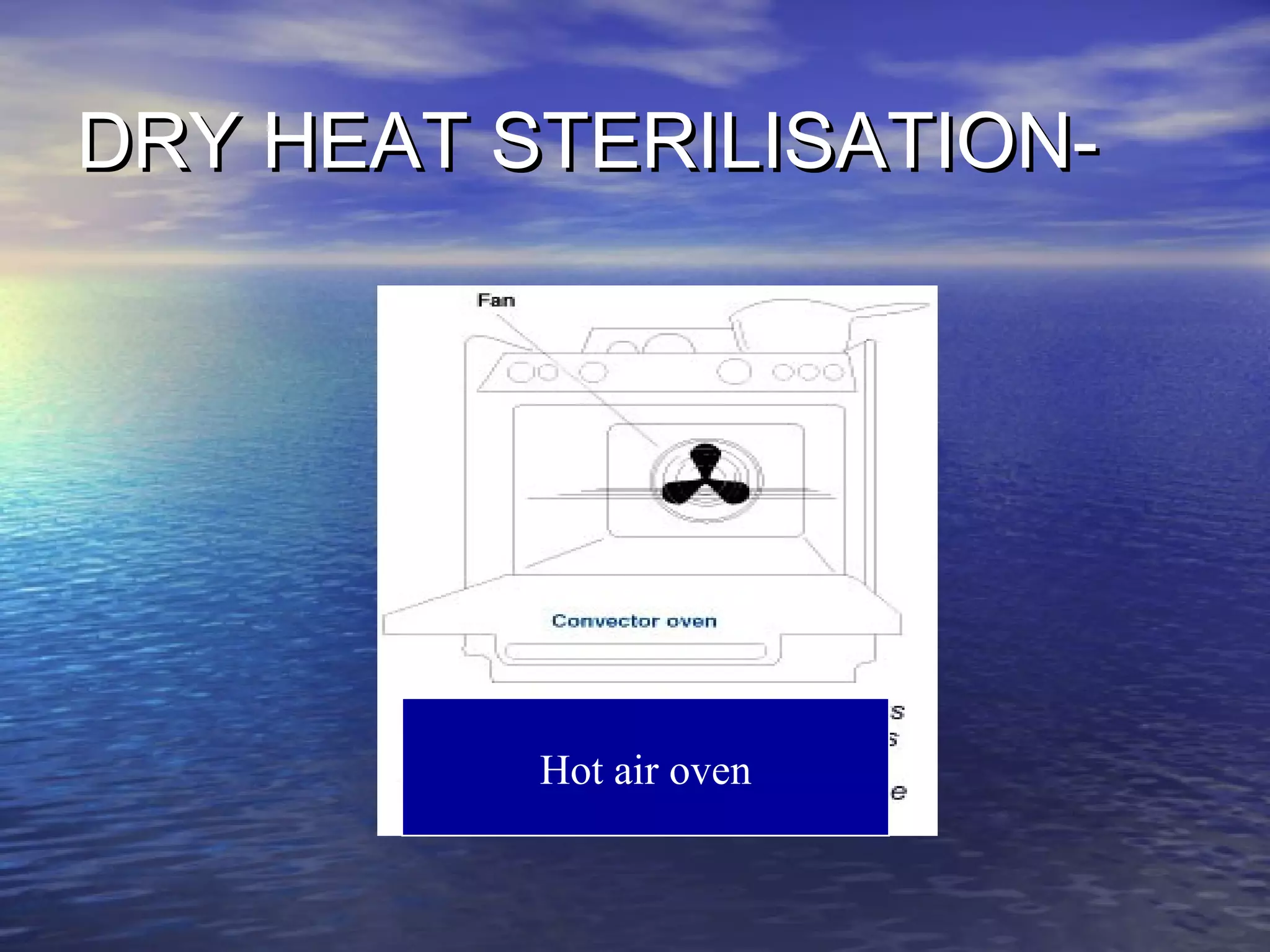
DRY HEAT STERILISATION-DRY HEAT STERILISATION-
Hot air oven
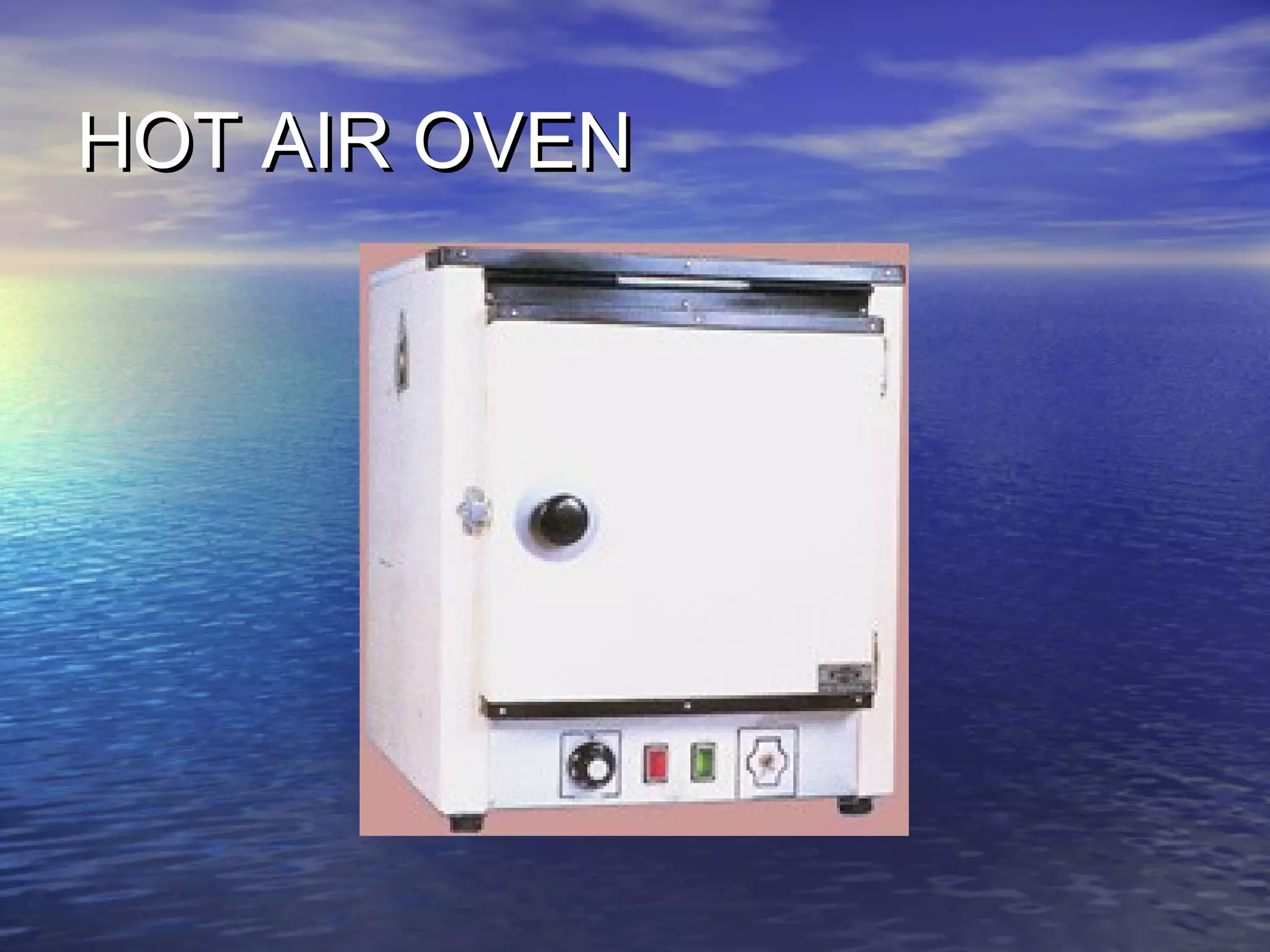
HOT AIR OVENHOT AIR OVEN
Sterilization by moist heatSterilization by moist heat
At temp below 100At temp below 100oo
CC
At a temp of 100At a temp of 100oo
CC
• BoilingBoiling
• Free steamFree steam
• At temp above100At temp above100oo
CC
At temperature below 100At temperature below 100oo
cc
• Heat labile fluids may be disinfectedHeat labile fluids may be disinfected
• PASTEURIZATION :PASTEURIZATION :
*holder method –63*holder method –63oo
c for 30 minutesc for 30 minutes
*flash method- 72*flash method- 72oo
c for 20 secondsc for 20 seconds
followed by rapid cooling at 13followed by rapid cooling at 13 oo
CC
By this method nonsporing organisms likeBy this method nonsporing organisms like
mycobacteria, brucella,and salmonellaemycobacteria, brucella,and salmonellae
are destroyedare destroyed
Moist heat sterilisation at 100Moist heat sterilisation at 100oo
cc
• Boiling at 100Boiling at 100oo
c for 10 to 30 min- at thisc for 10 to 30 min- at this
temp vegetative bacteria and some sporestemp vegetative bacteria and some spores
are killedare killed
• Metals glass and rubber items are boiled,Metals glass and rubber items are boiled,
dried cooled and used.dried cooled and used.
Free steam at 100Free steam at 100oo
cc
• Steam at normal atm pressure is at 100Steam at normal atm pressure is at 100oo
cc
• It has latent heat which on condensing onIt has latent heat which on condensing on
the article to be sterilised releases itsthe article to be sterilised releases its
latent heat.latent heat.
• One single exposure to steam for 90minOne single exposure to steam for 90min
ensures complete sterilization but forensures complete sterilization but for
media containing sugar and gelatinmedia containing sugar and gelatin
contcont
• An exposure of 100An exposure of 100oo
c for 20 minutes onc for 20 minutes on
three consecutive days –three consecutive days –
TYNDALLISATIONTYNDALLISATION
• First exposure to steam kills all vegetativeFirst exposure to steam kills all vegetative
bacteria and any spores present willbacteria and any spores present will
germinate and will be killed on subsequentgerminate and will be killed on subsequent
occasionsoccasions
Moist heat at temp above 100Moist heat at temp above 100oo
cc
• It provides greater lethal action of moistIt provides greater lethal action of moist
heatheat
• It is quicker in heating up the exposedIt is quicker in heating up the exposed
articlesarticles
• It can penetrate easily porous materialIt can penetrate easily porous material
such as cotton wool stoppers, paper,andsuch as cotton wool stoppers, paper,and
clothwrappers, bundles of surgical linenclothwrappers, bundles of surgical linen
and hollow apparatus.and hollow apparatus.
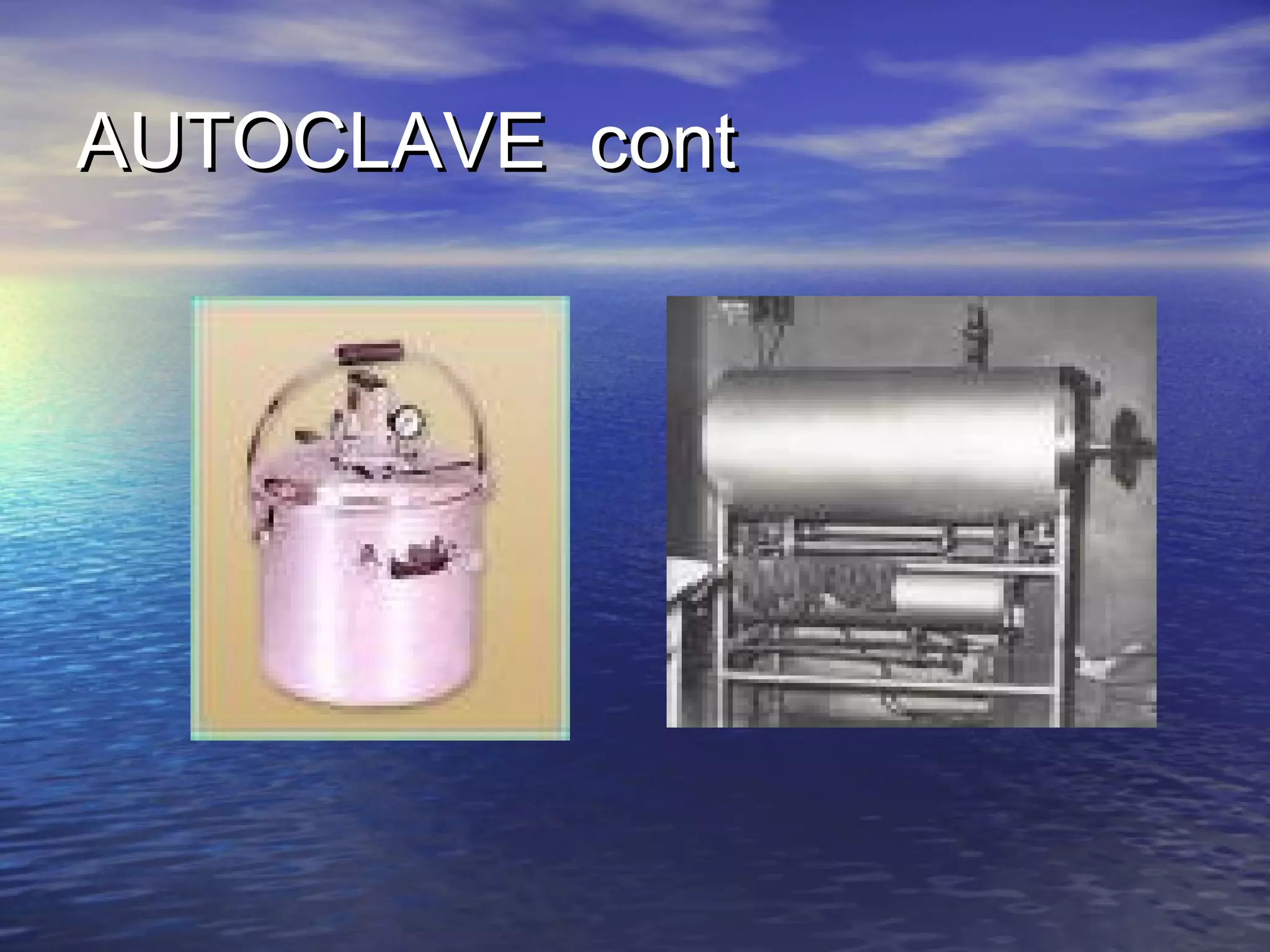
AUTOCLAVEAUTOCLAVE
• Principle:Principle:
water boils when its vapour pressure equals thatwater boils when its vapour pressure equals that
of surrounding atmosphere. Hence whenof surrounding atmosphere. Hence when
pressure inside a closed vessel increases thepressure inside a closed vessel increases the
temperature at which water boils also increases.temperature at which water boils also increases.
Saturated steam has greater penetratingSaturated steam has greater penetrating
power.When steam comes into contact with apower.When steam comes into contact with a
cooler surface it condenses to water and givescooler surface it condenses to water and gives
up its latent heat to that surface.up its latent heat to that surface.
AutoclaveAutoclave
• Sterilisation by steam under pressureSterilisation by steam under pressure
(autoclaving) is suitable for culture media(autoclaving) is suitable for culture media
and aqueous solutions, dressingand aqueous solutions, dressing
materials, linen, gloves etcmaterials, linen, gloves etc
• Satisfactory sterilisation can be achievedSatisfactory sterilisation can be achieved
at 15 pounds pressure per square inch atat 15 pounds pressure per square inch at
121121oo
c for 20 minc for 20 min
AUTOCLAVE contAUTOCLAVE cont
Sterilization controlsSterilization controls
Biological controlBiological control
• Bacillus stearothermophilusBacillus stearothermophilus
• Bacillus subtilisBacillus subtilis
Chemical controlChemical control
• Browne’s tubeBrowne’s tube
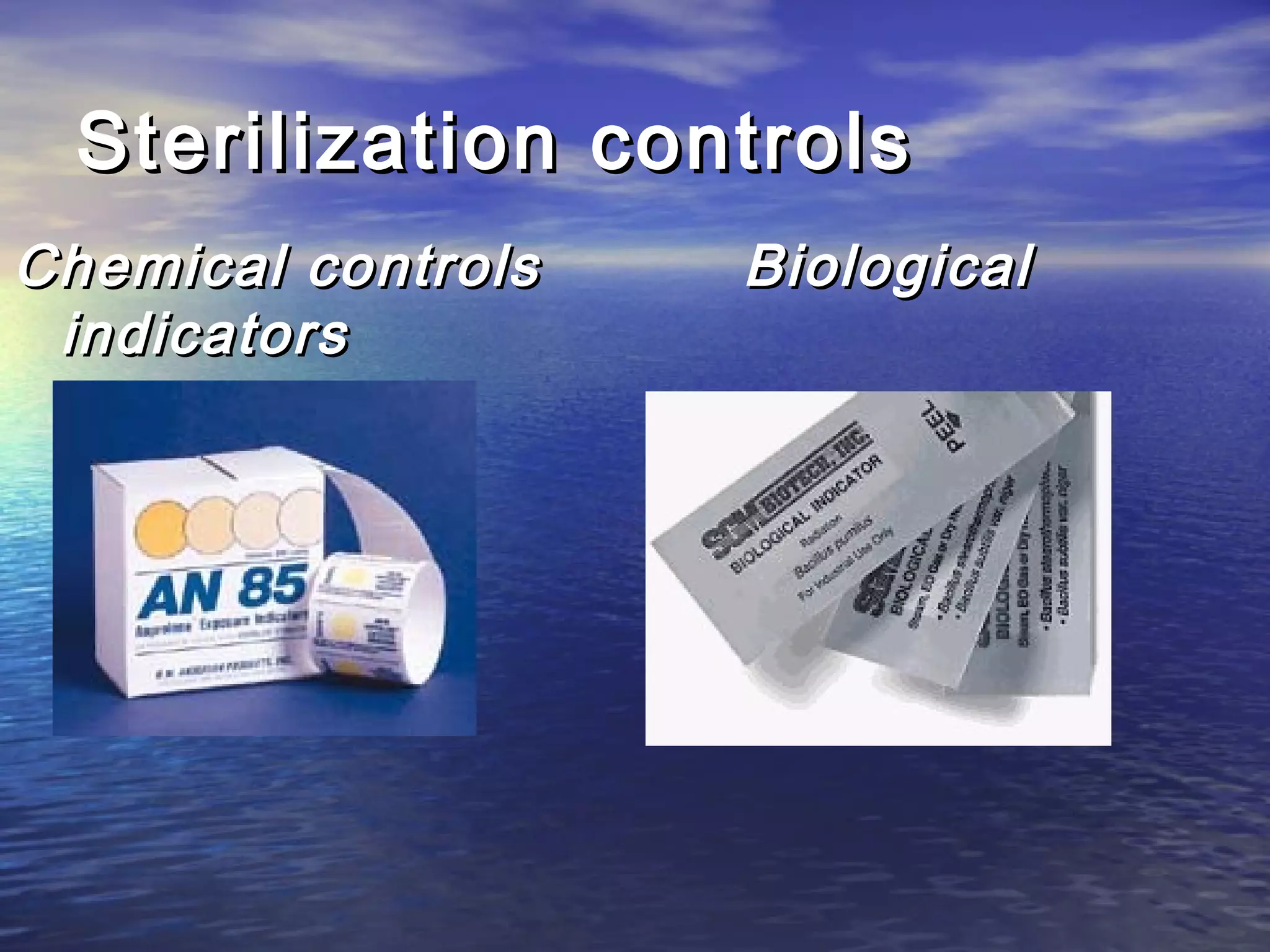
Sterilization controlsSterilization controls
Chemical controls BiologicalChemical controls Biological
indicatorsindicators
FiltrationFiltration
Liquids such as sera and heat labileLiquids such as sera and heat labile
substances such as sugars and urea usedsubstances such as sugars and urea used
for media preparation.for media preparation.
Separation of bacterial toxins fromSeparation of bacterial toxins from
bacteriabacteria
Isolation of organisms which are scanty inIsolation of organisms which are scanty in
fluids.fluids.
Viruses are too small so they cannot beViruses are too small so they cannot be
filteredfiltered
Filtration contdFiltration contd
Earthen ware filtersEarthen ware filters
Asbestos filters (Seitz)Asbestos filters (Seitz)
Sintered filtersSintered filters
Membrane filtersMembrane filters
Syringe filtersSyringe filters
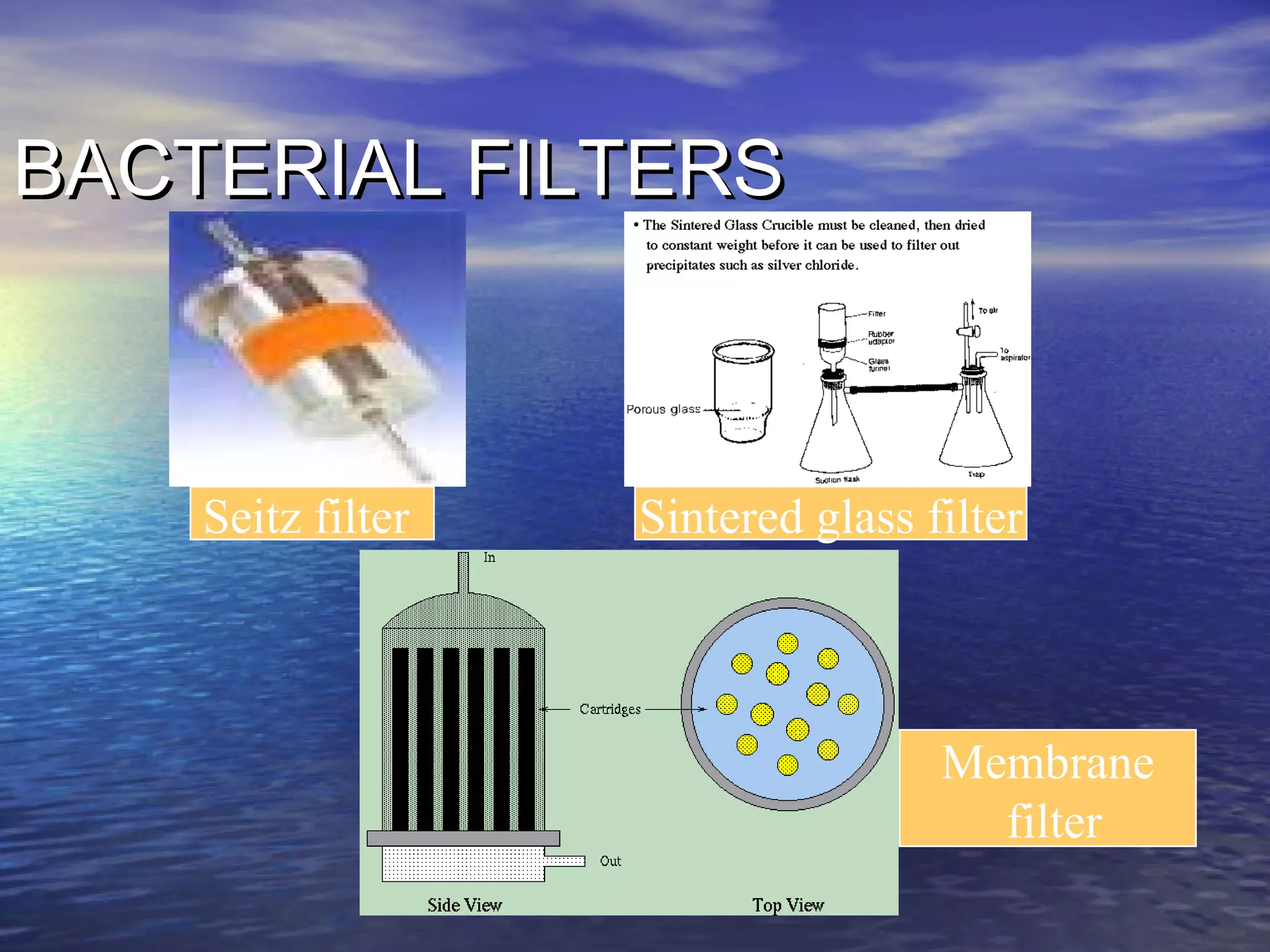
BACTERIAL FILTERSBACTERIAL FILTERS
Seitz filter Sintered glass filter
Membrane
filter
RadiationRadiation
Non ionizingNon ionizing
• UV rays-UV rays- in the range of 250 to 260 nmin the range of 250 to 260 nm
wavelengthwavelength
• Low pressure mercury vapour lampLow pressure mercury vapour lamp
• Spores are resistant to radiationsSpores are resistant to radiations
• Radiations induce interference in the DNARadiations induce interference in the DNA
replicationreplication
Cold sterilizationCold sterilization
IonizingIonizing
• X-raysX-rays
• Gamma raysGamma rays
• Cosmic raysCosmic rays
• High penetrative power lethal to bacteriaHigh penetrative power lethal to bacteria
• Prepacked disposables such as plastic syringes,Prepacked disposables such as plastic syringes,
transfusion sets, catheters, canulas, culturetransfusion sets, catheters, canulas, culture
plates that are unable to withstand heat.plates that are unable to withstand heat.
THANKTHANK

Sterilization based on nursing syllabus

  • 1.
    SterilizationSterilization Sterilization: is aprocess by means of which anSterilization: is a process by means of which an article,surface or medium is rid of all livingarticle,surface or medium is rid of all living microorganisms including sporesmicroorganisms including spores Disinfection:is a process of destruction ofDisinfection:is a process of destruction of vegetative forms of pathogenic organisms whichvegetative forms of pathogenic organisms which are capable of producing infection but notare capable of producing infection but not necessarily resistant spores.necessarily resistant spores.
  • 2.
    SterilizationSterilization • Physical agentsPhysicalagents Sunlight -Sunlight -uv rays and heat hasuv rays and heat has germicidal activitygermicidal activity Drying -Drying - spores are unaffectedspores are unaffected Heat -Heat - most reliable, certain andmost reliable, certain and rapid method of sterilisationrapid method of sterilisation Filteration-Filteration- radiationradiation
  • 3.
    Chemical agentsChemical agents Phenolsand cresolsPhenols and cresols HalogensHalogens Metallic saltsMetallic salts AldehydesAldehydes AlcoholAlcohol DyesDyes Vapour-phase disinfectantsVapour-phase disinfectants Surface- active disinfectantsSurface- active disinfectants
  • 4.
    SterilizationSterilization Red HeatRed Heat- inoculating loops and wires,- inoculating loops and wires, points of forceps and spatulaspoints of forceps and spatulas Flaming-Flaming- scalpel blades, needles mouthscalpel blades, needles mouth of culture tubes, glass slides and coverof culture tubes, glass slides and cover slipsslips Incineration –Incineration –rapidly destroysrapidly destroys contaminated material i.e. soiled dressingscontaminated material i.e. soiled dressings Hot air ovenHot air oven
  • 5.
    Hot air ovenHotair oven • Principle: eg of dry heat -killing effect is due toPrinciple: eg of dry heat -killing effect is due to protein denaturation, oxidative damage and toxicprotein denaturation, oxidative damage and toxic effect of elevated levels of electrolyteseffect of elevated levels of electrolytes • Used for glass ware like glass syringes, testUsed for glass ware like glass syringes, test tubes, petri dishes, pipettes, and flasks, metaltubes, petri dishes, pipettes, and flasks, metal instruments, such as forceps, scissors andinstruments, such as forceps, scissors and scalpelsscalpels • Oils, jellies and powders and swab sticks packedOils, jellies and powders and swab sticks packed in test tubes.in test tubes. • Holding time at 160Holding time at 160oo C –1 hourC –1 hour
  • 6.
    Hot Air OvencontdHot Air Oven contd Precautions: -Precautions: - • should not be overloaded,should not be overloaded, • substances to be sterilised should be absolutelysubstances to be sterilised should be absolutely drydry • Oven should be allowed to cool for 2 hoursOven should be allowed to cool for 2 hours before opening to prevent cracking of glasswarebefore opening to prevent cracking of glassware • articles like rubber goods, fabrics,inflammablearticles like rubber goods, fabrics,inflammable or volatile substances should not be placedor volatile substances should not be placed insideinside
  • 7.
    DRY HEAT STERILISATION-DRYHEAT STERILISATION- Hot air oven
  • 8.
  • 9.
    Sterilization by moistheatSterilization by moist heat At temp below 100At temp below 100oo CC At a temp of 100At a temp of 100oo CC • BoilingBoiling • Free steamFree steam • At temp above100At temp above100oo CC
  • 10.
    At temperature below100At temperature below 100oo cc • Heat labile fluids may be disinfectedHeat labile fluids may be disinfected • PASTEURIZATION :PASTEURIZATION : *holder method –63*holder method –63oo c for 30 minutesc for 30 minutes *flash method- 72*flash method- 72oo c for 20 secondsc for 20 seconds followed by rapid cooling at 13followed by rapid cooling at 13 oo CC By this method nonsporing organisms likeBy this method nonsporing organisms like mycobacteria, brucella,and salmonellaemycobacteria, brucella,and salmonellae are destroyedare destroyed
  • 11.
    Moist heat sterilisationat 100Moist heat sterilisation at 100oo cc • Boiling at 100Boiling at 100oo c for 10 to 30 min- at thisc for 10 to 30 min- at this temp vegetative bacteria and some sporestemp vegetative bacteria and some spores are killedare killed • Metals glass and rubber items are boiled,Metals glass and rubber items are boiled, dried cooled and used.dried cooled and used.
  • 12.
    Free steam at100Free steam at 100oo cc • Steam at normal atm pressure is at 100Steam at normal atm pressure is at 100oo cc • It has latent heat which on condensing onIt has latent heat which on condensing on the article to be sterilised releases itsthe article to be sterilised releases its latent heat.latent heat. • One single exposure to steam for 90minOne single exposure to steam for 90min ensures complete sterilization but forensures complete sterilization but for media containing sugar and gelatinmedia containing sugar and gelatin
  • 13.
    contcont • An exposureof 100An exposure of 100oo c for 20 minutes onc for 20 minutes on three consecutive days –three consecutive days – TYNDALLISATIONTYNDALLISATION • First exposure to steam kills all vegetativeFirst exposure to steam kills all vegetative bacteria and any spores present willbacteria and any spores present will germinate and will be killed on subsequentgerminate and will be killed on subsequent occasionsoccasions
  • 14.
    Moist heat attemp above 100Moist heat at temp above 100oo cc • It provides greater lethal action of moistIt provides greater lethal action of moist heatheat • It is quicker in heating up the exposedIt is quicker in heating up the exposed articlesarticles • It can penetrate easily porous materialIt can penetrate easily porous material such as cotton wool stoppers, paper,andsuch as cotton wool stoppers, paper,and clothwrappers, bundles of surgical linenclothwrappers, bundles of surgical linen and hollow apparatus.and hollow apparatus.
  • 15.
    AUTOCLAVEAUTOCLAVE • Principle:Principle: water boilswhen its vapour pressure equals thatwater boils when its vapour pressure equals that of surrounding atmosphere. Hence whenof surrounding atmosphere. Hence when pressure inside a closed vessel increases thepressure inside a closed vessel increases the temperature at which water boils also increases.temperature at which water boils also increases. Saturated steam has greater penetratingSaturated steam has greater penetrating power.When steam comes into contact with apower.When steam comes into contact with a cooler surface it condenses to water and givescooler surface it condenses to water and gives up its latent heat to that surface.up its latent heat to that surface.
  • 16.
    AutoclaveAutoclave • Sterilisation bysteam under pressureSterilisation by steam under pressure (autoclaving) is suitable for culture media(autoclaving) is suitable for culture media and aqueous solutions, dressingand aqueous solutions, dressing materials, linen, gloves etcmaterials, linen, gloves etc • Satisfactory sterilisation can be achievedSatisfactory sterilisation can be achieved at 15 pounds pressure per square inch atat 15 pounds pressure per square inch at 121121oo c for 20 minc for 20 min
  • 17.
  • 18.
    Sterilization controlsSterilization controls BiologicalcontrolBiological control • Bacillus stearothermophilusBacillus stearothermophilus • Bacillus subtilisBacillus subtilis Chemical controlChemical control • Browne’s tubeBrowne’s tube
  • 19.
    Sterilization controlsSterilization controls Chemicalcontrols BiologicalChemical controls Biological indicatorsindicators
  • 20.
    FiltrationFiltration Liquids such assera and heat labileLiquids such as sera and heat labile substances such as sugars and urea usedsubstances such as sugars and urea used for media preparation.for media preparation. Separation of bacterial toxins fromSeparation of bacterial toxins from bacteriabacteria Isolation of organisms which are scanty inIsolation of organisms which are scanty in fluids.fluids. Viruses are too small so they cannot beViruses are too small so they cannot be filteredfiltered
  • 21.
    Filtration contdFiltration contd Earthenware filtersEarthen ware filters Asbestos filters (Seitz)Asbestos filters (Seitz) Sintered filtersSintered filters Membrane filtersMembrane filters Syringe filtersSyringe filters
  • 22.
    BACTERIAL FILTERSBACTERIAL FILTERS Seitzfilter Sintered glass filter Membrane filter
  • 23.
    RadiationRadiation Non ionizingNon ionizing •UV rays-UV rays- in the range of 250 to 260 nmin the range of 250 to 260 nm wavelengthwavelength • Low pressure mercury vapour lampLow pressure mercury vapour lamp • Spores are resistant to radiationsSpores are resistant to radiations • Radiations induce interference in the DNARadiations induce interference in the DNA replicationreplication
  • 24.
    Cold sterilizationCold sterilization IonizingIonizing •X-raysX-rays • Gamma raysGamma rays • Cosmic raysCosmic rays • High penetrative power lethal to bacteriaHigh penetrative power lethal to bacteria • Prepacked disposables such as plastic syringes,Prepacked disposables such as plastic syringes, transfusion sets, catheters, canulas, culturetransfusion sets, catheters, canulas, culture plates that are unable to withstand heat.plates that are unable to withstand heat.
  • 25.