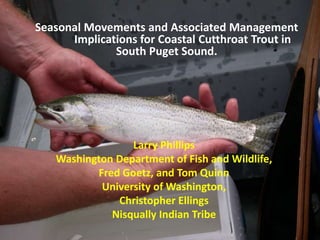
Seasonal Movements and Associated Management
Implications for Coastal Cutthroat Trout in
South Puget Sound.
Larry Phillips
Washington Department of Fish and Wildlife,
Fred Goetz, and Tom Quinn
University of Washington,
Christopher Ellings
Nisqually Indian Tribe
Coastal Cutthroat Trout Management in WA.
 Important sport fish species in South Puget
Sound.
 Historically supported a large harvest fishery
(harvest trout).
 Overharvest resulted in declines (anecdotal).
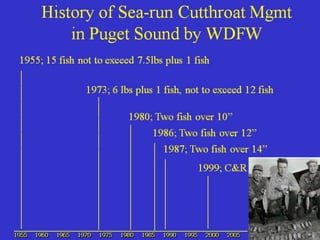
 WDFW responded with conservative
regulations.
 1999 catch and release was implemented in
all marine areas.
Coastal Cutthroat Trout Stock Status
 Status Review of Coastal Cutthroat Trout from
Washington, Oregon, and California (NMFS 1999).
 Six ESU (Puget Sound, Olympic Peninsula, Southwestern
Washington/Columbia River, upper Willamette River,
Oregon Coast, and Southern Oregon/California Coasts).
 Puget Sound ESU includes all streams in Puget Sound
and the Strait of Juan de Fuca.
 NMFS determined that Puget Sound ESU is not in
danger of extinction (decision was based on relatively
few data).
 2000 Washington State, Salmon and Steelhead
Inventory (SaSI), coastal cutthroat (WDFW 2000).
Insufficient data were available to assess stock status
for 32 of the 40 WA stocks.
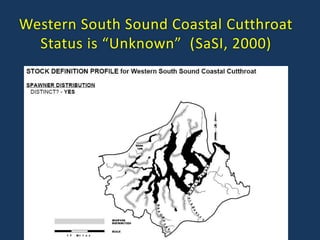
Western South Sound Coastal Cutthroat
Status is “Unknown” (SaSI, 2000)
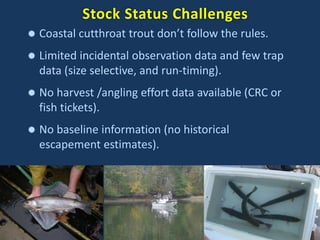
Stock Status Challenges
 Coastal cutthroat trout don’t follow the rules.
 Limited incidental observation data and few trap
data (size selective, and run-timing).
 No harvest /angling effort data available (CRC or
fish tickets).
 No baseline information (no historical
escapement estimates).
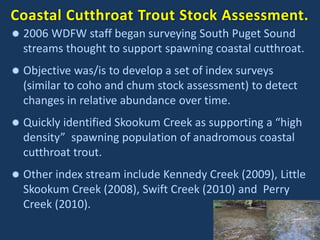
Coastal Cutthroat Trout Stock Assessment.
 2006 WDFW staff began surveying South Puget Sound
streams thought to support spawning coastal cutthroat.
 Objective was/is to develop a set of index surveys
(similar to coho and chum stock assessment) to detect
changes in relative abundance over time.
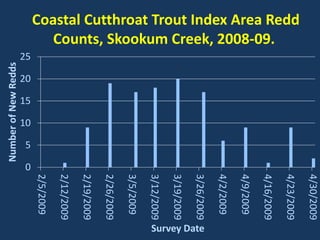
 Quickly identified Skookum Creek as supporting a “high
density” spawning population of anadromous coastal
cutthroat trout.
 Other index stream include Kennedy Creek (2009), Little
Skookum Creek (2008), Swift Creek (2010) and Perry
Creek (2010).
0
10
20
30
40
50
60
70
80
2008 2009 2010
NumberofRedds
Skookum Creek 6.5-7.5 Skookum Creek 5.7-6.5
Little Creek 0-0.4 Kennedy Creek 0-2.3
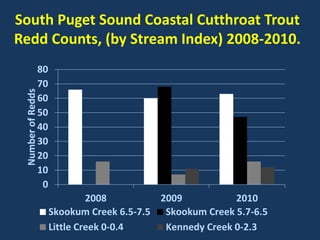
South Puget Sound Coastal Cutthroat Trout
Redd Counts, (by Stream Index) 2008-2010.
0
5
10
15
20
25
2/5/2009
2/12/2009
2/19/2009
2/26/2009
3/5/2009
3/12/2009
3/19/2009
3/26/2009
4/2/2009
4/9/2009
4/16/2009
4/23/2009
4/30/2009
NumberofNewRedds
Survey Date
Coastal Cutthroat Trout Index Area Redd
Counts, Skookum Creek, 2008-09.
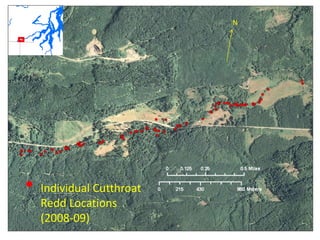
Individual Cutthroat
Redd Locations
(2008-09)
N
2008-09 Acoustic Tagging Project
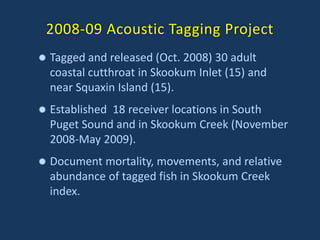
 Tagged and released (Oct. 2008) 30 adult
coastal cutthroat in Skookum Inlet (15) and
near Squaxin Island (15).
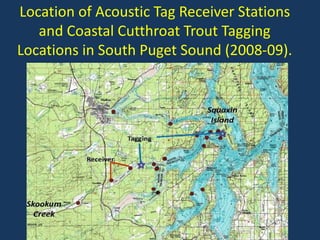
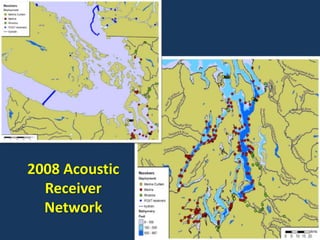
 Established 18 receiver locations in South
Puget Sound and in Skookum Creek (November
2008-May 2009).
 Document mortality, movements, and relative
abundance of tagged fish in Skookum Creek
index.
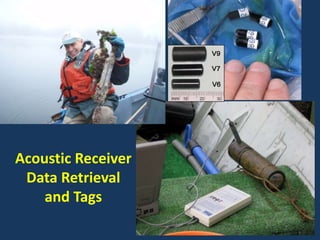
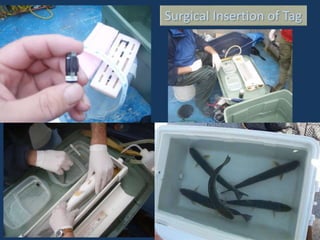
Acoustic Receiver
Data Retrieval
and Tags
Surgical Insertion of Tag
Anchor and Float Rigging for Marine
and Freshwater Deployment
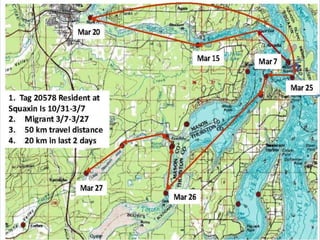
Location of Acoustic Tag Receiver Stations
and Coastal Cutthroat Trout Tagging
Locations in South Puget Sound (2008-09).
2008 Acoustic
Receiver
Network
0%
10%
20%
30%
40%
50%
60%
%Detected
Receiver Location
Skookum Release Group Squaxin Release Group
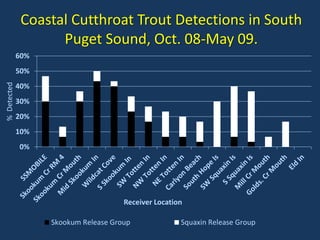
Coastal Cutthroat Trout Detections in South
Puget Sound, Oct. 08-May 09.
0%
20%
40%
60%
80%
100%
Skookum Fish Squaxin Fish
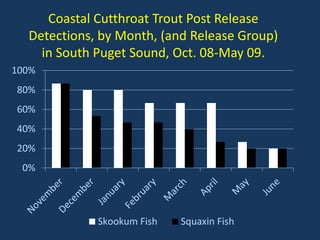
Coastal Cutthroat Trout Post Release
Detections, by Month, (and Release Group)
in South Puget Sound, Oct. 08-May 09.
Results
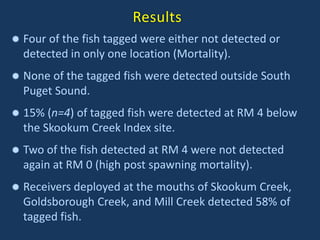
 Four of the fish tagged were either not detected or
detected in only one location (Mortality).
 None of the tagged fish were detected outside South
Puget Sound.
 15% (n=4) of tagged fish were detected at RM 4 below
the Skookum Creek Index site.
 Two of the fish detected at RM 4 were not detected
again at RM 0 (high post spawning mortality).
 Receivers deployed at the mouths of Skookum Creek,
Goldsborough Creek, and Mill Creek detected 58% of
tagged fish.
Conclusions
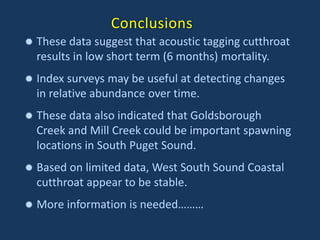
 These data suggest that acoustic tagging cutthroat
results in low short term (6 months) mortality.
 Index surveys may be useful at detecting changes
in relative abundance over time.
 These data also indicated that Goldsborough
Creek and Mill Creek could be important spawning
locations in South Puget Sound.
 Based on limited data, West South Sound Coastal
cutthroat appear to be stable.
 More information is needed………
Tag # 20539
 320mm fish Tagged in Skookum Inlet November
3rd.
 Remained in Skookum Inlet until Jan 1st when
moved to Totten Inlet.
 Returned to Skookum Inlet on Jan 10th and was
illegally harvested on April 1st.
Acknowledgments
Scott Steltzner and Sarah Haque (Squaxin
Indian Tribe), Don Freeman, Hal Boynton,
and Bill Young, Jack Haven (volunteers).
Questions?

Phillips ssss ct presentation larry phillips wdfw

  • 1.
    Seasonal Movements andAssociated Management Implications for Coastal Cutthroat Trout in South Puget Sound. Larry Phillips Washington Department of Fish and Wildlife, Fred Goetz, and Tom Quinn University of Washington, Christopher Ellings Nisqually Indian Tribe
  • 2.
    Coastal Cutthroat TroutManagement in WA.  Important sport fish species in South Puget Sound.  Historically supported a large harvest fishery (harvest trout).  Overharvest resulted in declines (anecdotal).  WDFW responded with conservative regulations.  1999 catch and release was implemented in all marine areas.
  • 4.
    Coastal Cutthroat TroutStock Status  Status Review of Coastal Cutthroat Trout from Washington, Oregon, and California (NMFS 1999).  Six ESU (Puget Sound, Olympic Peninsula, Southwestern Washington/Columbia River, upper Willamette River, Oregon Coast, and Southern Oregon/California Coasts).  Puget Sound ESU includes all streams in Puget Sound and the Strait of Juan de Fuca.  NMFS determined that Puget Sound ESU is not in danger of extinction (decision was based on relatively few data).  2000 Washington State, Salmon and Steelhead Inventory (SaSI), coastal cutthroat (WDFW 2000). Insufficient data were available to assess stock status for 32 of the 40 WA stocks.
  • 5.
    Western South SoundCoastal Cutthroat Status is “Unknown” (SaSI, 2000)
  • 6.
    Stock Status Challenges Coastal cutthroat trout don’t follow the rules.  Limited incidental observation data and few trap data (size selective, and run-timing).  No harvest /angling effort data available (CRC or fish tickets).  No baseline information (no historical escapement estimates).
  • 7.
    Coastal Cutthroat TroutStock Assessment.  2006 WDFW staff began surveying South Puget Sound streams thought to support spawning coastal cutthroat.  Objective was/is to develop a set of index surveys (similar to coho and chum stock assessment) to detect changes in relative abundance over time.  Quickly identified Skookum Creek as supporting a “high density” spawning population of anadromous coastal cutthroat trout.  Other index stream include Kennedy Creek (2009), Little Skookum Creek (2008), Swift Creek (2010) and Perry Creek (2010).
  • 8.
    0 10 20 30 40 50 60 70 80 2008 2009 2010 NumberofRedds SkookumCreek 6.5-7.5 Skookum Creek 5.7-6.5 Little Creek 0-0.4 Kennedy Creek 0-2.3 South Puget Sound Coastal Cutthroat Trout Redd Counts, (by Stream Index) 2008-2010.
  • 9.
  • 10.
  • 11.
    2008-09 Acoustic TaggingProject  Tagged and released (Oct. 2008) 30 adult coastal cutthroat in Skookum Inlet (15) and near Squaxin Island (15).  Established 18 receiver locations in South Puget Sound and in Skookum Creek (November 2008-May 2009).  Document mortality, movements, and relative abundance of tagged fish in Skookum Creek index.
  • 12.
  • 13.
  • 14.
    Anchor and FloatRigging for Marine and Freshwater Deployment
  • 15.
    Location of AcousticTag Receiver Stations and Coastal Cutthroat Trout Tagging Locations in South Puget Sound (2008-09).
  • 16.
  • 17.
    0% 10% 20% 30% 40% 50% 60% %Detected Receiver Location Skookum ReleaseGroup Squaxin Release Group Coastal Cutthroat Trout Detections in South Puget Sound, Oct. 08-May 09.
  • 18.
    0% 20% 40% 60% 80% 100% Skookum Fish SquaxinFish Coastal Cutthroat Trout Post Release Detections, by Month, (and Release Group) in South Puget Sound, Oct. 08-May 09.
  • 20.
    Results  Four ofthe fish tagged were either not detected or detected in only one location (Mortality).  None of the tagged fish were detected outside South Puget Sound.  15% (n=4) of tagged fish were detected at RM 4 below the Skookum Creek Index site.  Two of the fish detected at RM 4 were not detected again at RM 0 (high post spawning mortality).  Receivers deployed at the mouths of Skookum Creek, Goldsborough Creek, and Mill Creek detected 58% of tagged fish.
  • 21.
    Conclusions  These datasuggest that acoustic tagging cutthroat results in low short term (6 months) mortality.  Index surveys may be useful at detecting changes in relative abundance over time.  These data also indicated that Goldsborough Creek and Mill Creek could be important spawning locations in South Puget Sound.  Based on limited data, West South Sound Coastal cutthroat appear to be stable.  More information is needed………
  • 22.
    Tag # 20539 320mm fish Tagged in Skookum Inlet November 3rd.  Remained in Skookum Inlet until Jan 1st when moved to Totten Inlet.  Returned to Skookum Inlet on Jan 10th and was illegally harvested on April 1st.
  • 23.
    Acknowledgments Scott Steltzner andSarah Haque (Squaxin Indian Tribe), Don Freeman, Hal Boynton, and Bill Young, Jack Haven (volunteers).
  • 24.