S. VENU MADHAV
MANAGER - QUALITY ASSURANCE
SRI SAI CHANDANA API PVT. LTD.
What is Pharmaceutical Industry?
The pharmaceutical industry discovers, develops, produces,
and markets drugs or pharmaceutical drugs for use
as medications to be administered to patients (or self-
administered), with the aim to cure them, vaccinate .
Pharmaceutical companies may deal
in generic or brand medications and medical devices them, or
alleviate symptoms
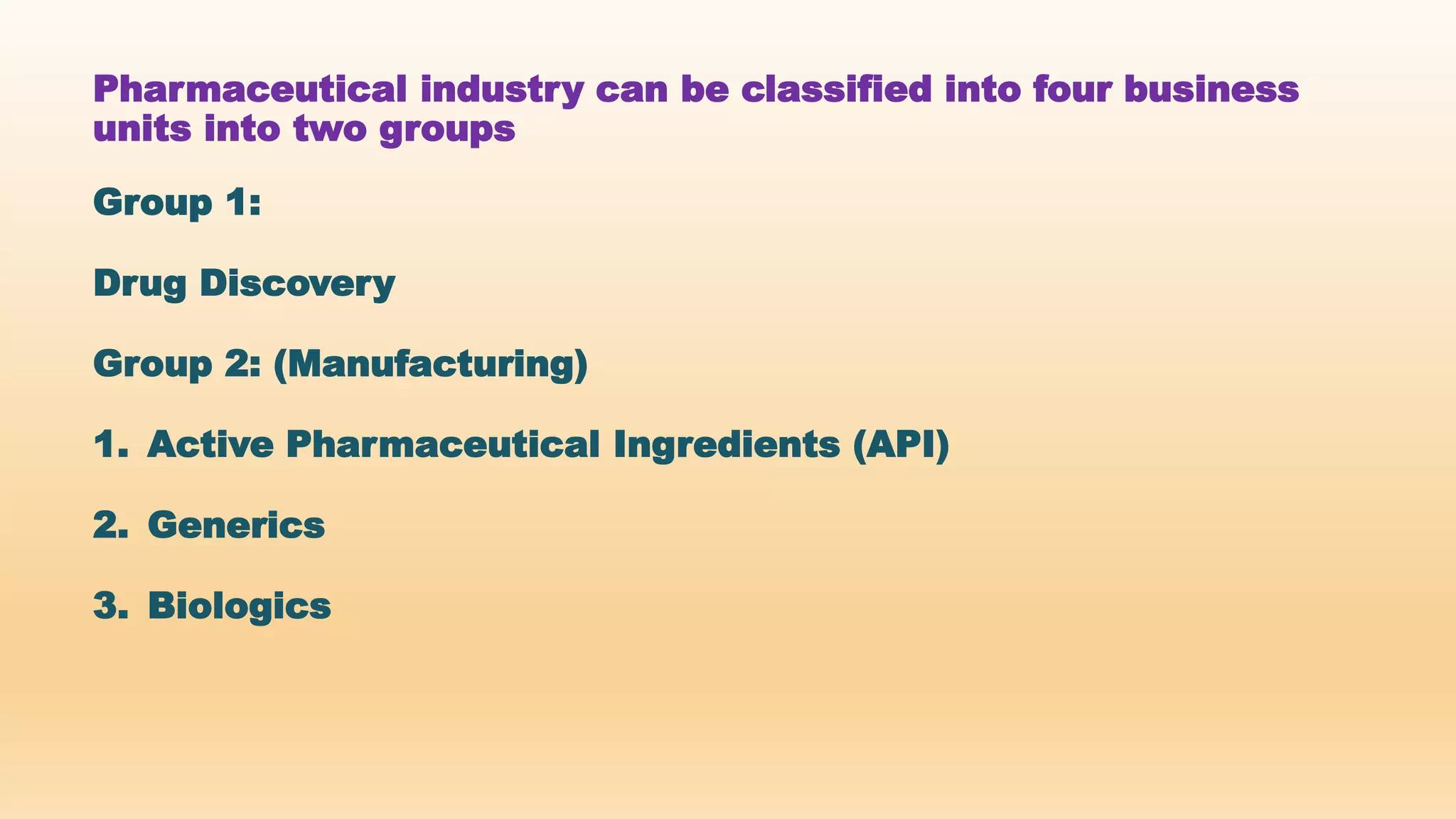
Pharmaceutical industry can be classified into four business
units into two groups
Group 1:
Drug Discovery
Group 2: (Manufacturing)
1. Active Pharmaceutical Ingredients (API)
2. Generics
3. Biologics
Drug Discovery
The success of any pharmaceutical company(ies)y depends on
drug discovery by a dedicated Research & Development team
who continuously keep their efforts in building new molecules
or medicines
Step 1: Target selection
Cellular & genetic targets, Genomics, Proteomics, Bioinformatics
Step 2: Lead discovery
Synthesis & Isolation, Combinatorial chemistry, Assay development & high –
throughput screening
Step 3: Medicinal chemistry
Library development, Structure – activity studies, In-silico screening and
Chemical synthesis
Step 4: In-vitro studies
Drug affinity & selectivity, cellular disease models, Mechanism of action
and lead candidate refinement
Step 5: Clinical trials & Therapeutics
Four Phases
Phase –I: Checking for safety
Phase –II: Checking for efficacy (the ability to produce a
desired or intended result)
Phase – III: Confirm findings in large patient population
Phase – IV: Testing long-term safety in diverse patient
population
1. Discovery
2. Preclinical – In vitro (test tube), In vivo (animals/
animal models), Safety (toxicity).
3. Chemistry, manufacturing and controls – scale up
parallel with preclinical.
4. IND – Investigational drug (Preparation, filling and FDA
approval).
5. Clinical trails – Phase 1, 2 & 3.
6. CMC for New Drug Application.
7. New Drug Application (NDA) – preparation and
submission. FDA review.
8. FDA approval: 12-21 Yrs.
Any changes in formulation, new preclinical studies should be
conducted. Finally get permission to begin testing in human.
Analysts report Scientists, Scientists to Sr. Scientists and Sr.
Scientist to Group leaders followed by HOD.
Scientists – AR&D, Process Development, FR&D, Cell culture
development, Bioassay development, Immunogenicity, Product
purification, Product characterization
• FACTORY LICENSE: Micro, Small, and Medium Enterprises (MSME)/
Udyam Registration Process - Entrepreneurs Memorandum (IEM) &
Unique Aadhaar Number (UAM)
• DIRECTORATE OF FACTORIES – Professional Tax Registration
• DEPARTMENT OF ENERGY – Electrical Inspectorate
• FIRE SERVICES DEPARTMENT – Fire NOC & Occupancy certificate
• POLLUTION CONTROL BOARD – Consent for Establishment/
Operation/Authorization
• LABOUR DEPARTMENT – For Contract Labor deployment
• MINITSTRY OF PETROLEUM – PESO License for
Petrochemicals
• DRUG DEPARTMENT – Drug License & GMP certification
(Export)
• MINISTRY OF COMMERCE & INDUSTRY DIRECTORATE
GENERAL OF FOREIGHN TRADE – Import & Export License
• GOVERNMENT OF INDIA FORM GST REG-06: GST registration
• DISTRICT TOWN & COUNTRY PLANNING – For Building Plan
Approval
• MINISTRY ADMINISTRATION AND URBAN DEVELOPMENT–
Building Occupancy Certificate
• COMMERCIAL TAX – Commercial Tax Professional Tax Regd.
• BOILER DEPARTMENT – Boiler Operation
• PROHIBITION & EXCISE DEPARTMENT - License for Rectified
spirits (Methanol)
Function
Educational Qualification
API Formulations/ Generics Biologics
Production
Diploma (Chemical)
B.Sc/M.Sc. (Chemistry)
B.E. (Chemical)
B.Pharm/ M. Pharm
M.Sc (Biotech/
Biochem/Micro)
B.Tech(Biotech)
Quality Control/
Quality Assurance
M.Sc. (Chemistry/ Life
sciences)
M. Pharm
M.Sc (Biotech/
Biochem/Micro)
B.Tech(Biotech)
Process
Development
M.Sc (Org. Chemistry)
M.Sc (Analytical
Chemistry)
Ph.D(Chemistry)
B.E. (Chemical)
M. Pharm
Ph.D (Pharma)
B.E. (Chemical)
B.E/ M.Sc/Ph.D in
Biotech/Biochem
Process Engg.
B.E./B.Tech (Chemical)
M.E./M.Tech (Chemical)
B.E./B.Tech (Chemical)
M.E./M.Tech (Chemical)
B.E./B.Tech
(Chemical/ Biotech)
M.E./M.Tech
(Chemical/ Biotech)
Function
Educational Qualification
API
Formulations/
Generics
Biologics
Technology Transfer
M.Sc Chemistry
B.E./B.Tech (Chemical)
Or M.E./M.Tech
(Chemical)
M.Pharm
B.E./B.Tech
(Chemical)
Or M.E./M.Tech
(Chemical)
M.Sc (Biotech/ Biochem/Micro)
B.E./B.Tech (Chemical/ Biotech)
M.E./M.Tech (Chemical/
Biotech)
Engineering
services
ITI, Diploma, B.E./B.Tech or M.E./M.Tech in (Mech./Elect./Inst./EEE)
Projects ITI, Diploma, B.E./B.Tech or M.E./M.Tech in (Mech./Elect./Inst./Chem)
Warehouse B.Sc. or B.Com and certified course in material management
Supply chain
management
B.Com, M.Com, MBA (Mktg./ Materials Mgt/ SCM)
Business
development and
strategic
management
MBA (Marketing, International Business, strategic management)
Function
Educational Qualification
API Formulations/ Generics Biologics
Finance B.Com, M.Com, C.A, ICWA, MBA (Finance)
Human Resources MBA (HR or Equivalent)
Information
technology
B.E./B.Tech IT/Certified in networking, MES, SAP, Java
Administration Any graduate or PG with good knowledge in industrial compliance and statutory
Regulatory Affairs
M.Sc or M. Pharm and a certified course in RA and good knowledge on global
markets.
Marketing MBA (Marketing, International Business)
HIERARCHY/ MANAGEMENT PYRAMID
PRODUCTION DEPARTMENT:
• ORGANOGRAM:
PLANT HEAD
PRODUCTION HEAD
PACKAGING MANAGER & PRODUCTION MANAGER
PROCESS ENGG
EXECUTIVE (PRODUCTION & DOCUMENT)
SHIFT IN CHARGES
CHEMISTS
PRODUCTION DEPARTMENT:
• PLANT HEAD – Monitoring planning activities, Sanctioning
leaves to employee and coordination with management and
employee as well as auditors and statutory officers
• PRODUCTION HEAD – Coordinate with production an
packaging managers and employee. Plan for shift and
manpower
• PACKAGING MANAGER – Packaging development and plan
for final packing of commercial dispatch
• PRODUCTION MANAGER- Planning of production and raise
production requirements, plan for commercial dispatch
• PROCESS ENGG – Design and development of process with
respect to equipment
• EXECUTIVE (PRODUCTION & DOCUMENT) – To
follow instructions for batch charging, indent of
raw materials from Warehouse for batch charging,
handover to shift in-charge and monitor and record
the activities online. Check for any discrepancies
and deviations along with conditions of instrument
• SHIFT IN CHARGES – Man power planning and
coordinate with Production Manager for execution
of batches and product planning
• CHEMISTS – Handling of chemicals for batch
charging follow instructions of shift in charge
QUALITY CONTROL DEPARTMENT:
• ORGANOGRAM:
QUALITY CONTROL HEAD/MANAGER/ Sr. MANAGER
DY. MANAGER/ Asst. MANAGER
(MICROBIOLOGY, STABILITY & WET & INSTRUMENTATION)
CHEMIST
QUALITY CONTROL DEPARTMENT:
• QUALITY CONTROL HEAD – Report Management for any quality issue
and coordinate with customer/ regulatory, sanctioning of leaves to
employee.
• DY. MANAGER/ Asst. MANAGER – Follow instructions from QC Head
and instruct the team for analysis, method developments, technology
transfer and support the QA, RA for document submission and fillings
customer / regulatory. Plan for shifts. Support QA during audits
• MICROBIOLOGIST: Carry out Microbial testing of drugs, water
• STABILITY: Initiation of stability of products and conduct in
timely manner
QUALITY CONTROL DEPARTMENT:
• QC (WET & INSTRUMENTATION)- carry analysis and
Validations of Raw materials, In process, packing
materials and finished products.
• CHEMIST: Support the MANAGER/ DY. MANAGER/ Asst.
MANAGER for carrying activities.
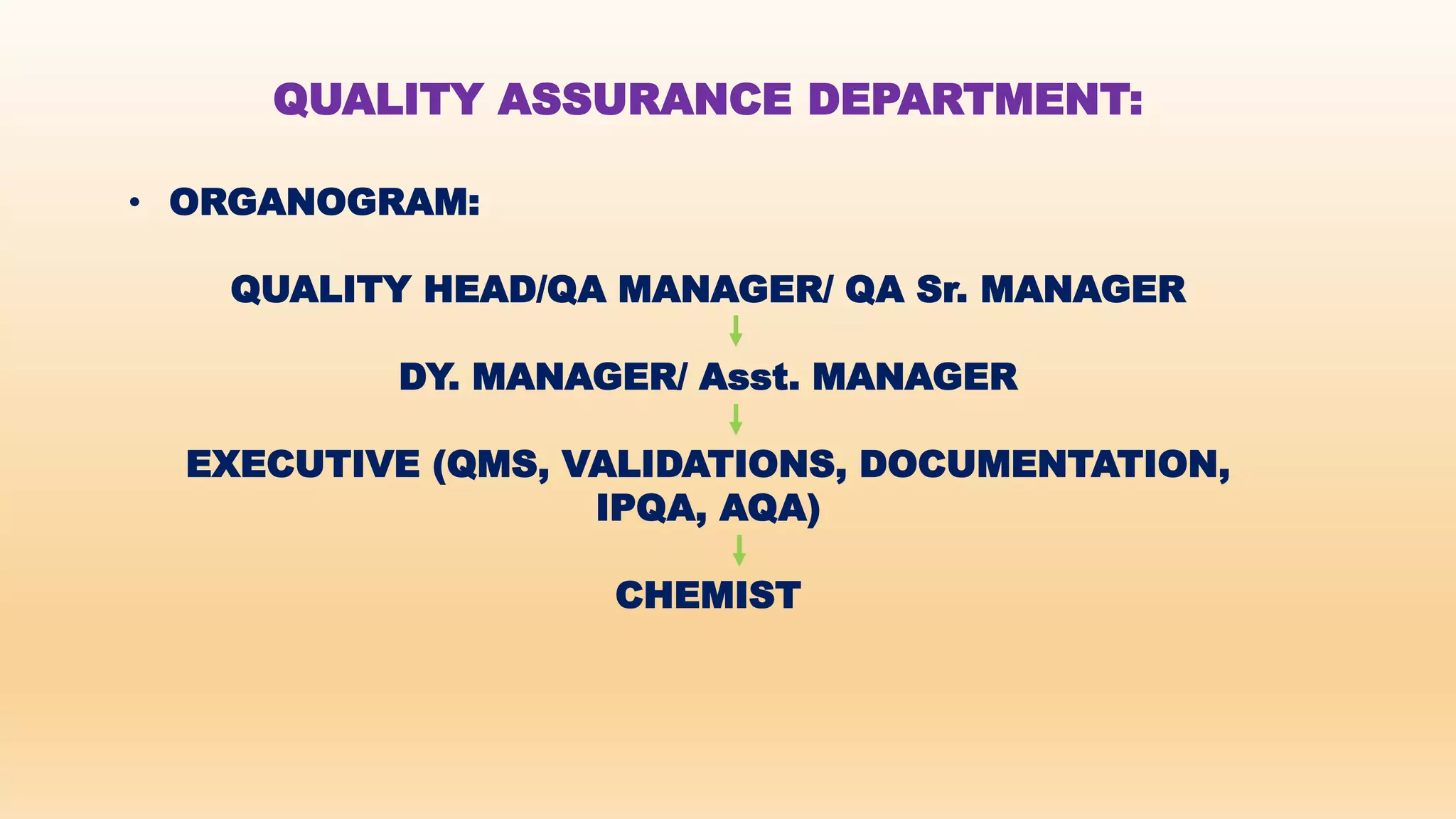
QUALITY ASSURANCE DEPARTMENT:
• ORGANOGRAM:
QUALITY HEAD/QA MANAGER/ QA Sr. MANAGER
DY. MANAGER/ Asst. MANAGER
EXECUTIVE (QMS, VALIDATIONS, DOCUMENTATION,
IPQA, AQA)
CHEMIST
QUALITY ASSURANCE DEPARTMENT:
• QUALITY HEAD/QA MANAGER/ QA Sr. MANAGER – Report to
management for quality related issues, and coordinate with
customer/ regulatory, sanctioning of leaves to employee.
Responsible for Audits. Establishment of procedures(SOP).
Regulatory Fillings and respond to queries and observations
made during audits/submissions.
• DY. MANAGER/ Asst. MANAGER – Follow instructions from
Manager and coordinate with all departments for fulfilling of
document requirements and audits. Conduct Internal audits
and support and guide QA team. Prepare protocols and SOPs
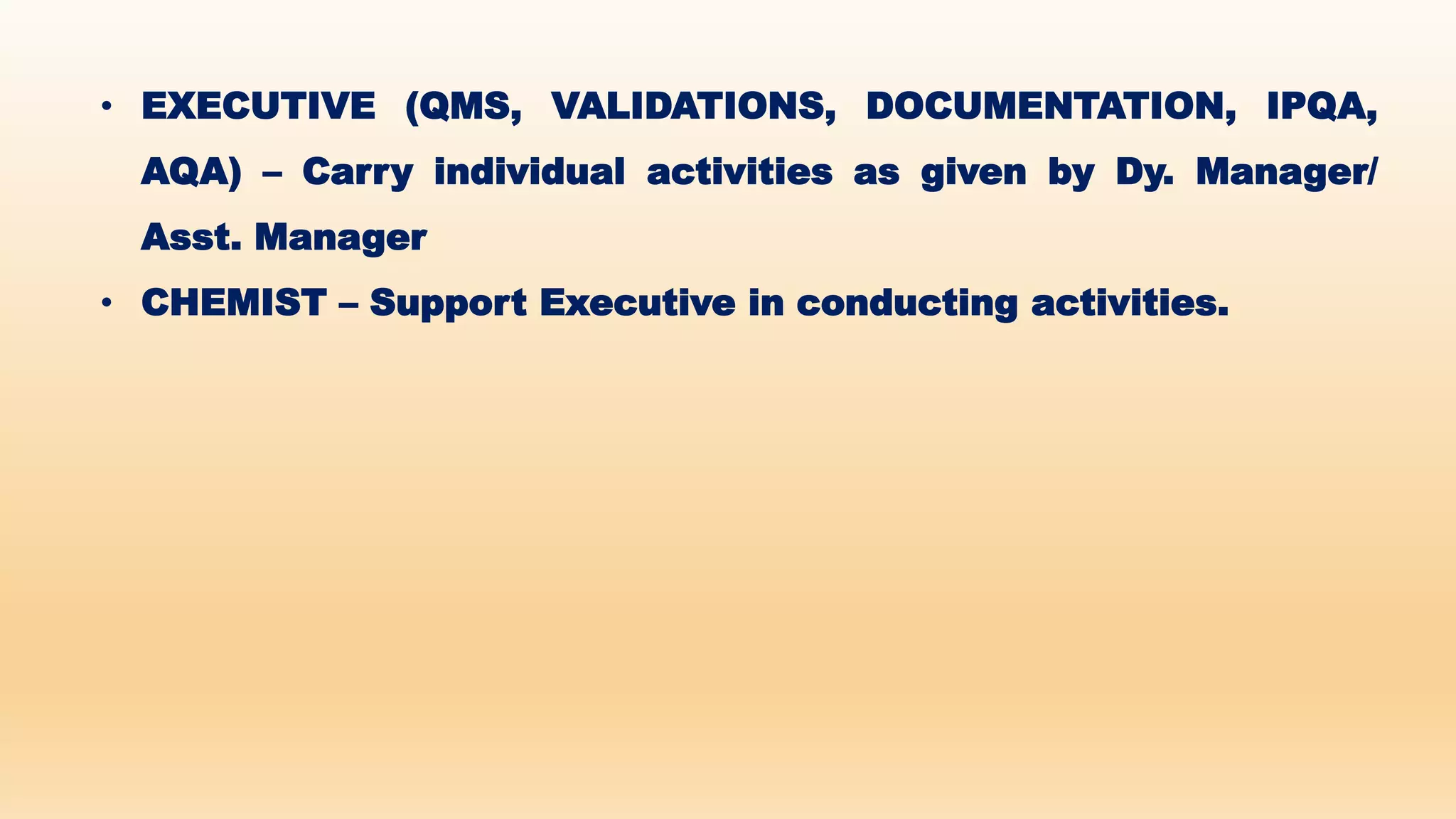
• EXECUTIVE (QMS, VALIDATIONS, DOCUMENTATION, IPQA,
AQA) – Carry individual activities as given by Dy. Manager/
Asst. Manager
• CHEMIST – Support Executive in conducting activities.
PROCESS DEVELOPMENT, PROCESS ENGG.,
TECHNOLOGY TRANSFER:
• Process Development team defines the process of
manufacturing in large scale, Process engineering teams will
ensure the process go smooth and take care of
troubleshooting when required, technology transfer team take
care of developing the process from lab scale to plant scale
(mg/g to g/Kg).
ENGINEERING SERVICES DEPARTMENT:
• ORGANOGRAM:
ENGINEERING HEAD
ENGG - ELECT., MECH., INSTRUMENTATION, CIVIL,
INCHARGE/OPERATOR - AHU/HVAC, BOILER, MECH,CIVIL,
ELECTRICAL, UTILITIES
FITTER/ ELECTRICIAN
PROJECT ENGINEERING :
• GREEN FIELD – SCRATCH TO OPERATIONS
• WHITE FIELD – MODIFICATION OF EXISTING PROJECTS
• ORGANOGRAM:
• HEAD PROJECTS – SITE LAYOUT & DRAWINGS AUTOCAD BUILDINGS/ WATER
SYSTEMS/ EQUIPMENT/ CLEAN ROOMS/ LABORATORY, ETC
• PROJECT MANAGER – SUPPORTS HEAD PROJECTS IN DRAWINGS AND
LAYOUTS
• ENGINEERS – ASSIST PROJECT MANAGER W.R.T.
• INSTRUMENTATION
• CIIVIL
• MECHANICAL
• CHEMICAL
• ELECTRICAL
• PROJECT DESIGN ENGG.
WAREHOUSE DEPARTMENT:
• COORDINATE WITH PLANT AND PURCHASE FOR
FULFILLMENT OF REQUIREMENTS FOR MFG., ANALYSIS
AND DISPATCH
• MAINTAIN RECORDS OF INCOMING AND OUTGOING
MATERIALS INCLUDING, RAW MATERIALS, PACKING
MATERIALS, FINISHED GOODS AND ENGINEERING
MATERIALS.
• MAINTENANCE OF MATERIALS STOCK
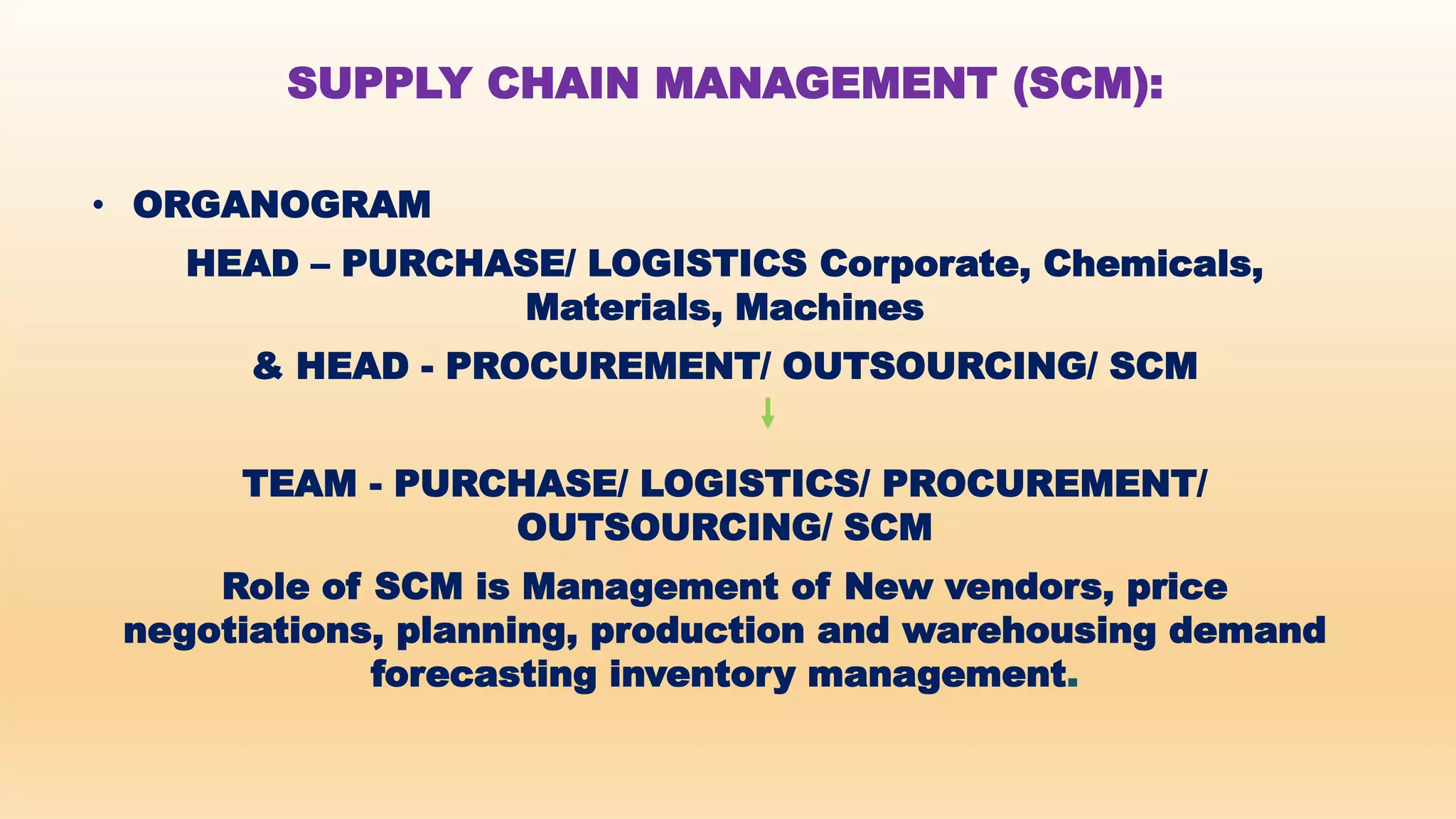
SUPPLY CHAIN MANAGEMENT (SCM):
• ORGANOGRAM
HEAD – PURCHASE/ LOGISTICS Corporate, Chemicals,
Materials, Machines
& HEAD - PROCUREMENT/ OUTSOURCING/ SCM
TEAM - PURCHASE/ LOGISTICS/ PROCUREMENT/
OUTSOURCING/ SCM
Role of SCM is Management of New vendors, price
negotiations, planning, production and warehousing demand
forecasting inventory management.
FINANCE:
• ORGANOGRAM
MANAGER/ HEADS – ACOUNTING, FINANCE, AUDITS
EXECUTIVE
Role of finance is to maintain Accounts, financial transactions
and face the Tax Audits (Income tax, GST), Foreign trades
(Export/ Import), etc. Coordinate with warehouse for
procurement and purchase of necessary items/ materials by
purchase indents. Release of payments to suppliers.
BUSINESS DEVELOPMENT:
• BUSINESS DEVELOPMENT MANAGER /ALLIANCE MANAGER/
MARKET RESEARCH MANAGER/ PROJECT MANAGER
• MANAGER – THIRD PARTY MANUFACTURING
• MARKET ANALYST
Plays a major role in contract manufacturing
HUMAN RESOURCES:
• ORGANOGRAM
HEAD/ MANAGER – HUMAN RESOURCES/ INDUSTRIAL RELATION/
ORGANIZATION DEVELOPMENT
TEAM LEADER/ ASSISTANT HR
Training and Development, Recruitment, Pay rolls, Manpower
acquisition
Role is to provide training to employee, Medical checkup, recruitment
of new employee as per requirement and Manpower supply to
concerned departments. Maintain industrial relations with neighboring
companies.
INFORMATION TECHNOLOGY:
Role of IT department is to maintain online monitoring of
Automated systems with DCS, PLC, HMI etc.
• Backup of documentation and data generated in systems.
• Network support (ex.: LAN, WAN, Sharing), Programming
• Password protection of critical systems
• Installation & upgrade of software
• Assist department(s) during installation of new system
software
• Prevent unauthorized access & VIRUS
ADMINISTRATION/ SECURITY:
Role is to communicate with employee and help in solving
personnel issues acts as communicator with Management,
Maintain discipline and work culture,
Act spontaneously during any emergency
Should have knowledge on industrial compliances (Statutory
regulations) such as Insp. Of factories, PCB, etc.
SAFETY, HEALTH & ENVIRONMENT (EHS):
EHS team consists of
• SAFETY OFFICER
• ONSITE EMERGENCY TEAM
• FIRST AID TEAM
• MEDICAL OFFICER
• PROJECT HEAD
• SECURITY/ ADMIN
Role is to prepare emergency safety plan, maintenance of safety
equipment, monitor safety related issues, Report incidents, near miss,
accidents, coordinate with Health Dept., Inspector of factories, Fire
officers, during any emergency and follow statutory guidelines as per
Factory Act. 1948.
Monitor personnel hygiene
Support Admin for Effluent disposal and statutory inspections
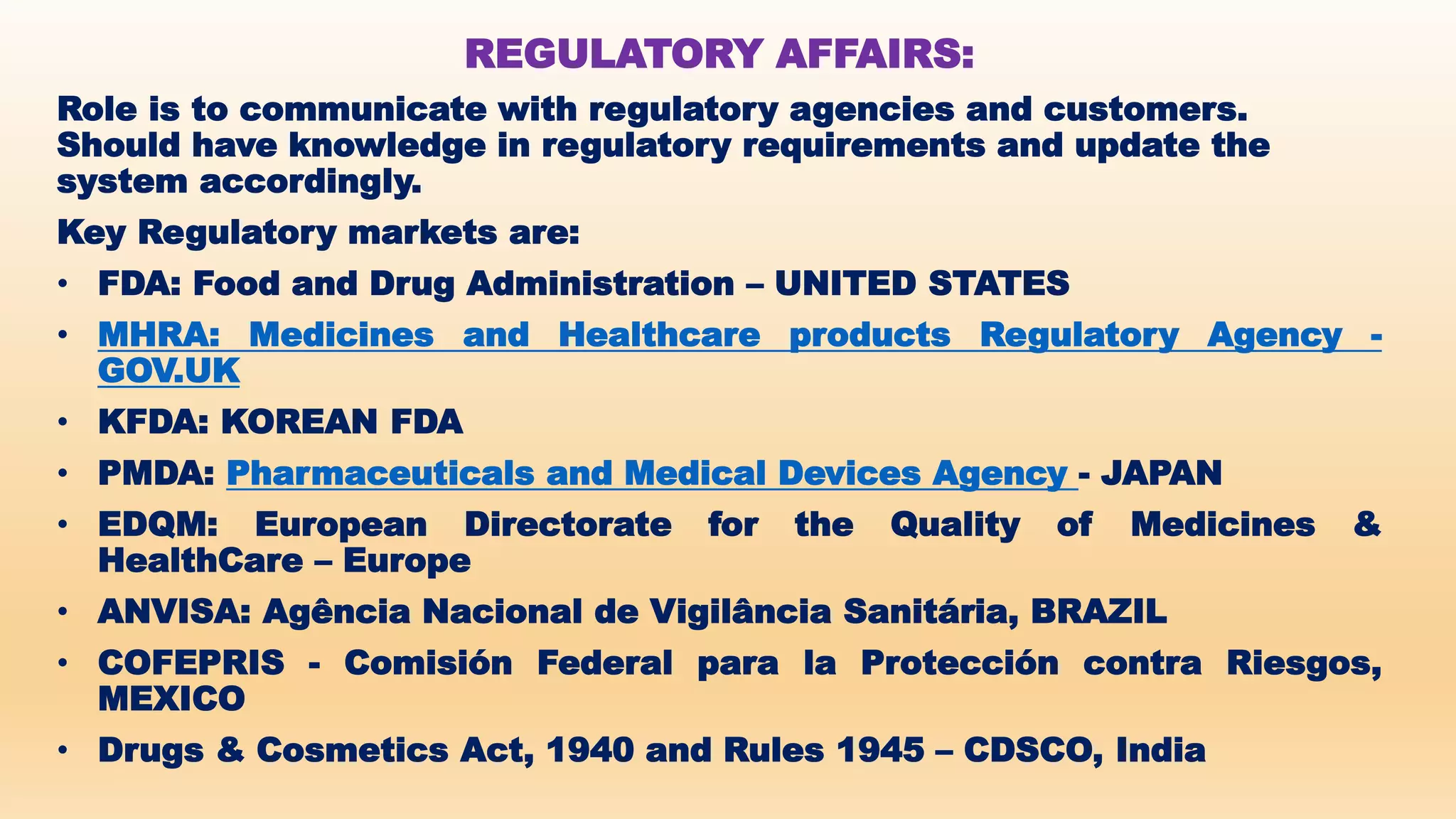
REGULATORY AFFAIRS:
Role is to communicate with regulatory agencies and customers.
Should have knowledge in regulatory requirements and update the
system accordingly.
Key Regulatory markets are:
• FDA: Food and Drug Administration – UNITED STATES
• MHRA: Medicines and Healthcare products Regulatory Agency -
GOV.UK
• KFDA: KOREAN FDA
• PMDA: Pharmaceuticals and Medical Devices Agency - JAPAN
• EDQM: European Directorate for the Quality of Medicines &
HealthCare – Europe
• ANVISA: Agência Nacional de Vigilância Sanitária, BRAZIL
• COFEPRIS - Comisión Federal para la Protección contra Riesgos,
MEXICO
• Drugs & Cosmetics Act, 1940 and Rules 1945 – CDSCO, India
PHARMACEUTICAL ACTIVITIES
MANUFACTURING
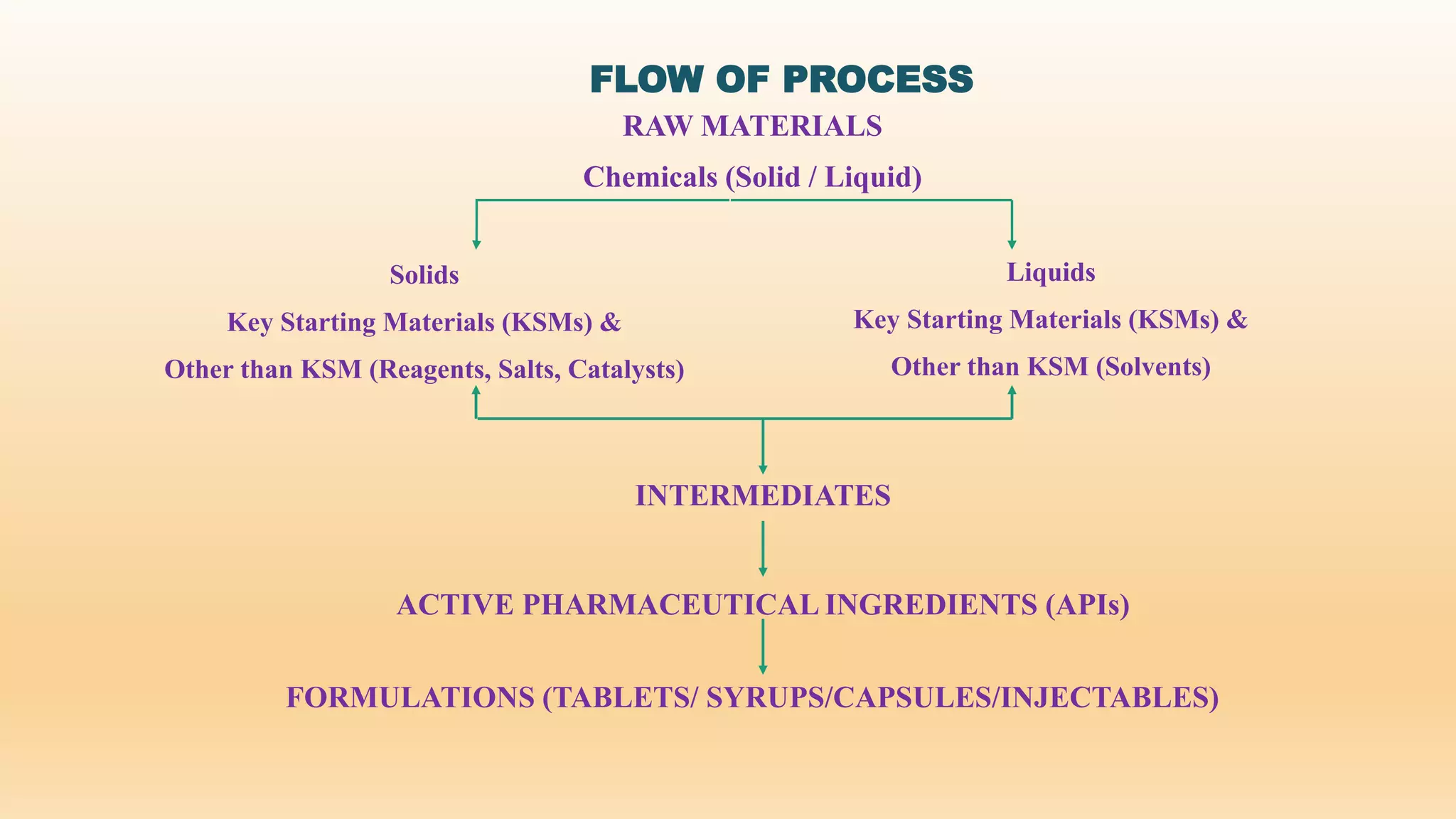
FLOW OF PROCESS
RAW MATERIALS
Chemicals (Solid / Liquid)
Solids
Key Starting Materials (KSMs) &
Other than KSM (Reagents, Salts, Catalysts)
Liquids
Key Starting Materials (KSMs) &
Other than KSM (Solvents)
INTERMEDIATES
ACTIVE PHARMACEUTICAL INGREDIENTS (APIs)
FORMULATIONS (TABLETS/ SYRUPS/CAPSULES/INJECTABLES)
STAGE -I:
CH3
N
+
CH3
O
–
O
F
F
F
F
F
F
O
H
+ +
Catalyst
Water
Solvent 1
Reagent 1
M.F.: C9H10F3NO2
CH3
N
+
CH3
O
–
N
+
O
O
–
M.F.: C7H8N2O3 M.F.:C2H3F3O
M.W .:100.03
OH
O
–
N
H
M.F.: H2NO2
-
M.W :48.02
M.W .:168.15 M.W .: 221.18
COMPOUND - A (KSM) COMPOUND - B
STAGE -I BY PRODUCT
STAGE -II:
ROUTE OF SYNTHESIS (ROS) /SYNTHETIC ROUTE
CH3
N
+
CH3
O
–
O
F
F
F
M.F.: C9H10F3NO2
M.W .: 221.18
CH3
N
O
F
F
F
OH
M.F.: C9H10F3NO2
M.W .:221.18
Solvent 3
Solvent 2
Reagent 2
STAGE-I STAGE-II
YIELD RATIO:
OUTPUT / INPUT = 221.18 / 168.15 = 1.32 (or) 131%
YIELD CALCULATIONS BASED ON ROS
THEORETICAL YIELD (BASED ON MOL. Wt. ):
OUTPUT / INPUT = 221.18 / 168.15 = 1.32 (or) 131%
EXPECTED YIELD RANGE (BASED ON R& D EXPERIMENT AND VALIDATION): Say 0.8 – 1.2
ACTUAL YIELD (YIELD OBTAINED DURING BATCH EXECUTION): ___________
PLANNING
• Market study by marketing team/ BDM for customer requirements with respect to product quantity and
quality (ex.: In-house/ USP/BP/EP)
• Inform management about requirement
• Management discuss with plant head, process development (R&D) & process engg. for product feasibility at
site
• Based on literature w.r.t safety & efficacy, R&D decides whether to execute the project at site or not
Yes/
No
Yes
• Budget plan - cost cutting by finance/ accounts
• R& D Experiment Followed By Drug Application - Establish Yield, Quality & Stability Followed By
Clinical Studies (If New Drug)
PLAN FOR SCALE UPAT SITE
Not OK
RE CONDUCT EXPERIMENT / MODIFY
PROCESS/ STOP EXPERIMENT
OK/
Not OK
• Design Of Project / Site By Project Engg. – SITE QUALIFICATION
• Design Of Process By Process Engineer – PROCESS VALIDATION
• Design Of Equipment By Engineering Services & Process Engineer For Compatibility, Volume, Reaction
Type & Utilities – EQUIPMENT QUALIFICATION
OK
EXECUTION
• Indent requirements by production manager & Engg. Person to warehouse
• Warehouse send the requirement to purchase team
• Purchase/ SCM Dept. obtain quotations and raise Purchase order
• Materials Transport – Logistic Chain By Logistic Dept.
• Arrival of indent items to site warehouse, warehouse records the details and inventory made (SAP/ ERS)
• Warehouse informs respect Dept. about arrival of items & based on request, issue of materials and
maintains stock record
• Batch planning by Production Manager
• Planning of batches based on customer/ market requirement by production head/manager
• Dispatch Planning By Marketing, Finance after approval by QA & QC
MANUFACTURING STEPS
• MATERIAL CHARGING /ADDITION/ MIXING of CHEMICAL or MOs
• REACTION – SYNTHESIS/ FERMENTATION
• FILTRATION/ ISOLATION
• DRYING
• PACKING
• IN PROCESS TEST BY QC
• MATERIALS APPROVED BY QC AFTER TESTING
• EQUIPMENT QUALIFIED BY ENGG. DEPT.
• IN PROCESS TEST BY QC
• FINAL TEST BY QC
• VALIDATE THE BATCHES & COMMERCIALIZE AFTER QAAPPROVAL
• DISTILLATION
• IN PROCESS TEST BY QC
PHARMACEUTICAL GUIDELINES &
GENERAL CHAPTERS
PHARMACEUTICAL GUIDELINES
• INDIAN PHARMACOPOEIA - Standard guidelines for marketing of Drug
in India
• EUROPEAN PHARMACOPOEIA – Standard guidelines for marketing of
Drug in Europe
• BRITISH PHARMACOPOEIA – Standard guidelines for marketing of Drug
in United Kingdom
• JAPAN PHARMACOPOEIA - Standard guidelines for marketing of Drug in
JAPAN
• ANVISA - Standard guidelines for marketing of Drug in Brazil
• WORLD HEALTH ORGANIZATION TECHNICAL REPORT SERIES (WHO TRS) –
Specifications for Pharmaceutical Preparations Technical guidelines in form of
Annexures by Expert committee.
• Ex.: ANNEX 13 - WHO guideline on the implementation of quality management
systems for national regulatory authorities
• International Council for Harmonization (ICH) of Technical Requirements for
Pharmaceuticals for Human Use - an initiative that brings together regulatory
authorities and pharmaceutical industry to discuss scientific and technical
aspects of pharmaceutical product development and registration.
• EUROPEAN DIRECTORATE FOR THE QUALITY OF MEDICINES & HEALTHCARE
(EDQM)– Guidelines for QMS and lab Instruments applications
• PHARMACEUTICAL INSPECTION CO-OPERATION SCHEME (PIC/S) – Guide to Good
Manufacturing Practice for medicinal products.
GENERAL CHAPTERS
• USP GENERAL CHAPTERS- http://www.pharmacopeia.cn/
• <1045>-Biotechnology Derived Articles
• <1056>-Biotechnology-Derived Articles—Polyacrylamide Gel Electrophoresis
• <1231>-Water for pharmaceutical purposes
• <61>-Microbiological Examination Of Non sterile Products: Microbial
Enumeration Tests
• <62> Microbiological Examination Of Non sterile Products: Tests For
Specified Microorganisms
• <621>- Chromatography
GENERAL CHAPTERS
• EP GENERAL CHAPTERS- http://www.pharmacopeia.cn/
• <2.6.13.> Test for specified micro-organisms
• <2.6.12.> Microbial enumeration tests
• <2.2.31.> Electrophoresis
ANALYTICAL TECHNIQUES
Instrument Name Function Application
pH Meter <791> pH monitoring using pH electrode
Raw materials, In process testing
of Reaction mass & Finished
product
TDS/ Conductivity
Meter <645>
Measuring TDS & Conductivity using conductivity cell
and electrode
Water used in process & Effluent
KF Titrator / Auto
titrator <921>
Moisture content (MC)/ Water content determination
with KF reagent
Solvents, Raw materials In
process reaction mass & Finished
product
Ultra Violet
Cabinet
TLC Spotting using mobile phase wavelength 200 –
400nm
TLC (In process testing of
Reaction mass)
Ultra Violet –
Visible spectro
photometer <857>
Using monochromatic radiation in the range of 200–
780 nm detecting the optical transmittance, in
absorbance (A), to measure the stated
absorbance/transmittance at defined wavelength
Detection of Impurities &
cleaning samples study, protein
and nucleic acid studies
Analytical balance
<41>
Weighing
Raw materials, In process,
Finished goods
High Pressure
Liquid
Chromatography
(HPLC) <621>
Identification, Assay & Purity by means of separation
of compounds using UV / Photo Diode Array detector
Raw materials, In process,
Finished products, Stability
testing
Instrument Name Function Application
Gas liquid
Chromatography
(GC) <621>
Identification, Assay & Purity by means of separation
of compounds
Purity of Solvents, Raw materials,
In process, Finished products
testing & Residual solvents
detection
Particle Size
Analyser(PSD)
<429>
Particle size of finished products (Micronized/ jet mill)
using monochromatic light and detector – Light
diffraction study
Finished products used for
Tablets/ Pellets/ Injections
IR Spectroscopy
<197>
Identification of compounds using IR Spectra (3800 cm-
1 to 650 cm-1)
Drugs, Packing materials
identification
Nuclear Magnetic
Resonance
Spectroscopy
<761>
Structure elucidation; thermodynamic, kinetic, and
mechanistic studies; and quantitative analysis of Drugs
and intermediates
using isotopes 13C, 1H,
New drug discovery,
characterization of working
standards, degradation studies
and impurity identification – for
determination of Protons and
Carbon atoms against reference
standard/ software
Instrument Name Function Application
Mass spectrometry
(MS) – (LCMS/
GCMS) <736>
Determination of Mass of drug. Generates ions from
the substances and separates them according to
their mass – to charge ratio (m/z) for C, H, N, S
content in a compound
New drugs, characterization of
working standards, degradation
studies and impurity identification,
Determination of Mass of
compound, Nitrosamine Impurities
Differential
Scanning
Calorimetry (DSC)
<891>
Thermal analysis for Transition temperature,
thermogravimetry and Loss on drying , Glass
Transition,
Melting, Evaporation /Volatilization,
Enthalpic Recovery,
Polymorphic Transition, Decompositions
Melting point
To detect the ignition temperature
of compounds and impurity
determination of new drugs,
characterization studies.
X- Ray Diffraction
<941>
identification of crystalline phases and Polymorphic
forms using X –Ray diffraction studies
Polymorphism / crystalline studies
of new drugs and characterization
study of compounds.
ICPMS (Inductively
Coupled Plasma
Atomic Emission
Spectroscopy)
<233>
used for elemental impurities generally amenable to
detection by inductively coupled plasma–atomic
(optical) emission spectroscopy (ICP–AES or ICP–
OES)
Elemental Impurities in water,
drugs
BIOINFORMATICS APPLICATIONS IN PHARMA
Quantitative structure activity relationship (QSAR)
LAZAR TOXICITY (IN SILICO TOXICOLOGY)
EBI DATABASE
• https://www.ebi.ac.uk/chembl/compound_report_card/CHEMBL406
5616/
SUSTAINABILITY APPROACH OF
PHARMACEUTICAL INDUSTRY
• Maintaining Quality Management System as per Regulatory standards/ ISO /
Customer requirements
• Training of employee on updated guidelines and skill development
• Establishing Policies w.r.t
• Environment management,
• Human rights,
• Anti Corruption,
• Sexual harassment,
• Ethical,
• Whistleblower etc.,
• Establishing committee for
• Audits,
• Emergency Risk management (Climate change, business continuity, technology,
etc.),
• Corporate Social Responsibility,
• Stakeholders’ relationship
• Vendor/ Suppliers/ Third party manufacturers support
• Employee relationship w.r.t
• Health safety,
• Recruitment of talents,
• Benefits (Food, Transport, ESI, PF, Bonus, increments, etc.)
• New innovation and technology development
• Maintaining product life cycle,
• Maintain 3 or 6 sigma rules
• Recommendations and improvements in product based on
Annual Product Quality Review (APQR)
Any
Questions….?
Thank You

PHARMAACEUTICAL INDUSTRY.pptx

  • 1.
    S. VENU MADHAV MANAGER- QUALITY ASSURANCE SRI SAI CHANDANA API PVT. LTD.
  • 2.
    What is PharmaceuticalIndustry? The pharmaceutical industry discovers, develops, produces, and markets drugs or pharmaceutical drugs for use as medications to be administered to patients (or self- administered), with the aim to cure them, vaccinate . Pharmaceutical companies may deal in generic or brand medications and medical devices them, or alleviate symptoms
  • 3.
    Pharmaceutical industry canbe classified into four business units into two groups Group 1: Drug Discovery Group 2: (Manufacturing) 1. Active Pharmaceutical Ingredients (API) 2. Generics 3. Biologics
  • 4.
    Drug Discovery The successof any pharmaceutical company(ies)y depends on drug discovery by a dedicated Research & Development team who continuously keep their efforts in building new molecules or medicines
  • 5.
    Step 1: Targetselection Cellular & genetic targets, Genomics, Proteomics, Bioinformatics Step 2: Lead discovery Synthesis & Isolation, Combinatorial chemistry, Assay development & high – throughput screening Step 3: Medicinal chemistry Library development, Structure – activity studies, In-silico screening and Chemical synthesis Step 4: In-vitro studies Drug affinity & selectivity, cellular disease models, Mechanism of action and lead candidate refinement Step 5: Clinical trials & Therapeutics
  • 7.
    Four Phases Phase –I:Checking for safety Phase –II: Checking for efficacy (the ability to produce a desired or intended result) Phase – III: Confirm findings in large patient population Phase – IV: Testing long-term safety in diverse patient population
  • 8.
    1. Discovery 2. Preclinical– In vitro (test tube), In vivo (animals/ animal models), Safety (toxicity). 3. Chemistry, manufacturing and controls – scale up parallel with preclinical. 4. IND – Investigational drug (Preparation, filling and FDA approval).
  • 9.
    5. Clinical trails– Phase 1, 2 & 3. 6. CMC for New Drug Application. 7. New Drug Application (NDA) – preparation and submission. FDA review. 8. FDA approval: 12-21 Yrs.
  • 10.
    Any changes informulation, new preclinical studies should be conducted. Finally get permission to begin testing in human. Analysts report Scientists, Scientists to Sr. Scientists and Sr. Scientist to Group leaders followed by HOD. Scientists – AR&D, Process Development, FR&D, Cell culture development, Bioassay development, Immunogenicity, Product purification, Product characterization
  • 12.
    • FACTORY LICENSE:Micro, Small, and Medium Enterprises (MSME)/ Udyam Registration Process - Entrepreneurs Memorandum (IEM) & Unique Aadhaar Number (UAM) • DIRECTORATE OF FACTORIES – Professional Tax Registration • DEPARTMENT OF ENERGY – Electrical Inspectorate • FIRE SERVICES DEPARTMENT – Fire NOC & Occupancy certificate • POLLUTION CONTROL BOARD – Consent for Establishment/ Operation/Authorization
  • 13.
    • LABOUR DEPARTMENT– For Contract Labor deployment • MINITSTRY OF PETROLEUM – PESO License for Petrochemicals • DRUG DEPARTMENT – Drug License & GMP certification (Export) • MINISTRY OF COMMERCE & INDUSTRY DIRECTORATE GENERAL OF FOREIGHN TRADE – Import & Export License • GOVERNMENT OF INDIA FORM GST REG-06: GST registration
  • 14.
    • DISTRICT TOWN& COUNTRY PLANNING – For Building Plan Approval • MINISTRY ADMINISTRATION AND URBAN DEVELOPMENT– Building Occupancy Certificate • COMMERCIAL TAX – Commercial Tax Professional Tax Regd. • BOILER DEPARTMENT – Boiler Operation • PROHIBITION & EXCISE DEPARTMENT - License for Rectified spirits (Methanol)
  • 16.
    Function Educational Qualification API Formulations/Generics Biologics Production Diploma (Chemical) B.Sc/M.Sc. (Chemistry) B.E. (Chemical) B.Pharm/ M. Pharm M.Sc (Biotech/ Biochem/Micro) B.Tech(Biotech) Quality Control/ Quality Assurance M.Sc. (Chemistry/ Life sciences) M. Pharm M.Sc (Biotech/ Biochem/Micro) B.Tech(Biotech) Process Development M.Sc (Org. Chemistry) M.Sc (Analytical Chemistry) Ph.D(Chemistry) B.E. (Chemical) M. Pharm Ph.D (Pharma) B.E. (Chemical) B.E/ M.Sc/Ph.D in Biotech/Biochem Process Engg. B.E./B.Tech (Chemical) M.E./M.Tech (Chemical) B.E./B.Tech (Chemical) M.E./M.Tech (Chemical) B.E./B.Tech (Chemical/ Biotech) M.E./M.Tech (Chemical/ Biotech)
  • 17.
    Function Educational Qualification API Formulations/ Generics Biologics Technology Transfer M.ScChemistry B.E./B.Tech (Chemical) Or M.E./M.Tech (Chemical) M.Pharm B.E./B.Tech (Chemical) Or M.E./M.Tech (Chemical) M.Sc (Biotech/ Biochem/Micro) B.E./B.Tech (Chemical/ Biotech) M.E./M.Tech (Chemical/ Biotech) Engineering services ITI, Diploma, B.E./B.Tech or M.E./M.Tech in (Mech./Elect./Inst./EEE) Projects ITI, Diploma, B.E./B.Tech or M.E./M.Tech in (Mech./Elect./Inst./Chem) Warehouse B.Sc. or B.Com and certified course in material management Supply chain management B.Com, M.Com, MBA (Mktg./ Materials Mgt/ SCM) Business development and strategic management MBA (Marketing, International Business, strategic management)
  • 18.
    Function Educational Qualification API Formulations/Generics Biologics Finance B.Com, M.Com, C.A, ICWA, MBA (Finance) Human Resources MBA (HR or Equivalent) Information technology B.E./B.Tech IT/Certified in networking, MES, SAP, Java Administration Any graduate or PG with good knowledge in industrial compliance and statutory Regulatory Affairs M.Sc or M. Pharm and a certified course in RA and good knowledge on global markets. Marketing MBA (Marketing, International Business)
  • 20.
  • 23.
    PRODUCTION DEPARTMENT: • ORGANOGRAM: PLANTHEAD PRODUCTION HEAD PACKAGING MANAGER & PRODUCTION MANAGER PROCESS ENGG EXECUTIVE (PRODUCTION & DOCUMENT) SHIFT IN CHARGES CHEMISTS
  • 24.
    PRODUCTION DEPARTMENT: • PLANTHEAD – Monitoring planning activities, Sanctioning leaves to employee and coordination with management and employee as well as auditors and statutory officers • PRODUCTION HEAD – Coordinate with production an packaging managers and employee. Plan for shift and manpower • PACKAGING MANAGER – Packaging development and plan for final packing of commercial dispatch • PRODUCTION MANAGER- Planning of production and raise production requirements, plan for commercial dispatch • PROCESS ENGG – Design and development of process with respect to equipment
  • 25.
    • EXECUTIVE (PRODUCTION& DOCUMENT) – To follow instructions for batch charging, indent of raw materials from Warehouse for batch charging, handover to shift in-charge and monitor and record the activities online. Check for any discrepancies and deviations along with conditions of instrument • SHIFT IN CHARGES – Man power planning and coordinate with Production Manager for execution of batches and product planning • CHEMISTS – Handling of chemicals for batch charging follow instructions of shift in charge
  • 26.
    QUALITY CONTROL DEPARTMENT: •ORGANOGRAM: QUALITY CONTROL HEAD/MANAGER/ Sr. MANAGER DY. MANAGER/ Asst. MANAGER (MICROBIOLOGY, STABILITY & WET & INSTRUMENTATION) CHEMIST
  • 27.
    QUALITY CONTROL DEPARTMENT: •QUALITY CONTROL HEAD – Report Management for any quality issue and coordinate with customer/ regulatory, sanctioning of leaves to employee. • DY. MANAGER/ Asst. MANAGER – Follow instructions from QC Head and instruct the team for analysis, method developments, technology transfer and support the QA, RA for document submission and fillings customer / regulatory. Plan for shifts. Support QA during audits • MICROBIOLOGIST: Carry out Microbial testing of drugs, water • STABILITY: Initiation of stability of products and conduct in timely manner
  • 28.
    QUALITY CONTROL DEPARTMENT: •QC (WET & INSTRUMENTATION)- carry analysis and Validations of Raw materials, In process, packing materials and finished products. • CHEMIST: Support the MANAGER/ DY. MANAGER/ Asst. MANAGER for carrying activities.
  • 29.
    QUALITY ASSURANCE DEPARTMENT: •ORGANOGRAM: QUALITY HEAD/QA MANAGER/ QA Sr. MANAGER DY. MANAGER/ Asst. MANAGER EXECUTIVE (QMS, VALIDATIONS, DOCUMENTATION, IPQA, AQA) CHEMIST
  • 30.
    QUALITY ASSURANCE DEPARTMENT: •QUALITY HEAD/QA MANAGER/ QA Sr. MANAGER – Report to management for quality related issues, and coordinate with customer/ regulatory, sanctioning of leaves to employee. Responsible for Audits. Establishment of procedures(SOP). Regulatory Fillings and respond to queries and observations made during audits/submissions. • DY. MANAGER/ Asst. MANAGER – Follow instructions from Manager and coordinate with all departments for fulfilling of document requirements and audits. Conduct Internal audits and support and guide QA team. Prepare protocols and SOPs
  • 31.
    • EXECUTIVE (QMS,VALIDATIONS, DOCUMENTATION, IPQA, AQA) – Carry individual activities as given by Dy. Manager/ Asst. Manager • CHEMIST – Support Executive in conducting activities.
  • 32.
    PROCESS DEVELOPMENT, PROCESSENGG., TECHNOLOGY TRANSFER: • Process Development team defines the process of manufacturing in large scale, Process engineering teams will ensure the process go smooth and take care of troubleshooting when required, technology transfer team take care of developing the process from lab scale to plant scale (mg/g to g/Kg).
  • 33.
    ENGINEERING SERVICES DEPARTMENT: •ORGANOGRAM: ENGINEERING HEAD ENGG - ELECT., MECH., INSTRUMENTATION, CIVIL, INCHARGE/OPERATOR - AHU/HVAC, BOILER, MECH,CIVIL, ELECTRICAL, UTILITIES FITTER/ ELECTRICIAN
  • 34.
    PROJECT ENGINEERING : •GREEN FIELD – SCRATCH TO OPERATIONS • WHITE FIELD – MODIFICATION OF EXISTING PROJECTS • ORGANOGRAM: • HEAD PROJECTS – SITE LAYOUT & DRAWINGS AUTOCAD BUILDINGS/ WATER SYSTEMS/ EQUIPMENT/ CLEAN ROOMS/ LABORATORY, ETC • PROJECT MANAGER – SUPPORTS HEAD PROJECTS IN DRAWINGS AND LAYOUTS • ENGINEERS – ASSIST PROJECT MANAGER W.R.T. • INSTRUMENTATION • CIIVIL • MECHANICAL • CHEMICAL • ELECTRICAL • PROJECT DESIGN ENGG.
  • 35.
    WAREHOUSE DEPARTMENT: • COORDINATEWITH PLANT AND PURCHASE FOR FULFILLMENT OF REQUIREMENTS FOR MFG., ANALYSIS AND DISPATCH • MAINTAIN RECORDS OF INCOMING AND OUTGOING MATERIALS INCLUDING, RAW MATERIALS, PACKING MATERIALS, FINISHED GOODS AND ENGINEERING MATERIALS. • MAINTENANCE OF MATERIALS STOCK
  • 36.
    SUPPLY CHAIN MANAGEMENT(SCM): • ORGANOGRAM HEAD – PURCHASE/ LOGISTICS Corporate, Chemicals, Materials, Machines & HEAD - PROCUREMENT/ OUTSOURCING/ SCM TEAM - PURCHASE/ LOGISTICS/ PROCUREMENT/ OUTSOURCING/ SCM Role of SCM is Management of New vendors, price negotiations, planning, production and warehousing demand forecasting inventory management.
  • 37.
    FINANCE: • ORGANOGRAM MANAGER/ HEADS– ACOUNTING, FINANCE, AUDITS EXECUTIVE Role of finance is to maintain Accounts, financial transactions and face the Tax Audits (Income tax, GST), Foreign trades (Export/ Import), etc. Coordinate with warehouse for procurement and purchase of necessary items/ materials by purchase indents. Release of payments to suppliers.
  • 38.
    BUSINESS DEVELOPMENT: • BUSINESSDEVELOPMENT MANAGER /ALLIANCE MANAGER/ MARKET RESEARCH MANAGER/ PROJECT MANAGER • MANAGER – THIRD PARTY MANUFACTURING • MARKET ANALYST Plays a major role in contract manufacturing
  • 39.
    HUMAN RESOURCES: • ORGANOGRAM HEAD/MANAGER – HUMAN RESOURCES/ INDUSTRIAL RELATION/ ORGANIZATION DEVELOPMENT TEAM LEADER/ ASSISTANT HR Training and Development, Recruitment, Pay rolls, Manpower acquisition Role is to provide training to employee, Medical checkup, recruitment of new employee as per requirement and Manpower supply to concerned departments. Maintain industrial relations with neighboring companies.
  • 40.
    INFORMATION TECHNOLOGY: Role ofIT department is to maintain online monitoring of Automated systems with DCS, PLC, HMI etc. • Backup of documentation and data generated in systems. • Network support (ex.: LAN, WAN, Sharing), Programming • Password protection of critical systems • Installation & upgrade of software • Assist department(s) during installation of new system software • Prevent unauthorized access & VIRUS
  • 41.
    ADMINISTRATION/ SECURITY: Role isto communicate with employee and help in solving personnel issues acts as communicator with Management, Maintain discipline and work culture, Act spontaneously during any emergency Should have knowledge on industrial compliances (Statutory regulations) such as Insp. Of factories, PCB, etc.
  • 42.
    SAFETY, HEALTH &ENVIRONMENT (EHS): EHS team consists of • SAFETY OFFICER • ONSITE EMERGENCY TEAM • FIRST AID TEAM • MEDICAL OFFICER • PROJECT HEAD • SECURITY/ ADMIN Role is to prepare emergency safety plan, maintenance of safety equipment, monitor safety related issues, Report incidents, near miss, accidents, coordinate with Health Dept., Inspector of factories, Fire officers, during any emergency and follow statutory guidelines as per Factory Act. 1948. Monitor personnel hygiene Support Admin for Effluent disposal and statutory inspections
  • 43.
    REGULATORY AFFAIRS: Role isto communicate with regulatory agencies and customers. Should have knowledge in regulatory requirements and update the system accordingly. Key Regulatory markets are: • FDA: Food and Drug Administration – UNITED STATES • MHRA: Medicines and Healthcare products Regulatory Agency - GOV.UK • KFDA: KOREAN FDA • PMDA: Pharmaceuticals and Medical Devices Agency - JAPAN • EDQM: European Directorate for the Quality of Medicines & HealthCare – Europe • ANVISA: Agência Nacional de Vigilância Sanitária, BRAZIL • COFEPRIS - Comisión Federal para la Protección contra Riesgos, MEXICO • Drugs & Cosmetics Act, 1940 and Rules 1945 – CDSCO, India
  • 44.
  • 45.
  • 46.
    FLOW OF PROCESS RAWMATERIALS Chemicals (Solid / Liquid) Solids Key Starting Materials (KSMs) & Other than KSM (Reagents, Salts, Catalysts) Liquids Key Starting Materials (KSMs) & Other than KSM (Solvents) INTERMEDIATES ACTIVE PHARMACEUTICAL INGREDIENTS (APIs) FORMULATIONS (TABLETS/ SYRUPS/CAPSULES/INJECTABLES)
  • 47.
    STAGE -I: CH3 N + CH3 O – O F F F F F F O H + + Catalyst Water Solvent1 Reagent 1 M.F.: C9H10F3NO2 CH3 N + CH3 O – N + O O – M.F.: C7H8N2O3 M.F.:C2H3F3O M.W .:100.03 OH O – N H M.F.: H2NO2 - M.W :48.02 M.W .:168.15 M.W .: 221.18 COMPOUND - A (KSM) COMPOUND - B STAGE -I BY PRODUCT STAGE -II: ROUTE OF SYNTHESIS (ROS) /SYNTHETIC ROUTE CH3 N + CH3 O – O F F F M.F.: C9H10F3NO2 M.W .: 221.18 CH3 N O F F F OH M.F.: C9H10F3NO2 M.W .:221.18 Solvent 3 Solvent 2 Reagent 2 STAGE-I STAGE-II YIELD RATIO: OUTPUT / INPUT = 221.18 / 168.15 = 1.32 (or) 131%
  • 48.
    YIELD CALCULATIONS BASEDON ROS THEORETICAL YIELD (BASED ON MOL. Wt. ): OUTPUT / INPUT = 221.18 / 168.15 = 1.32 (or) 131% EXPECTED YIELD RANGE (BASED ON R& D EXPERIMENT AND VALIDATION): Say 0.8 – 1.2 ACTUAL YIELD (YIELD OBTAINED DURING BATCH EXECUTION): ___________
  • 49.
    PLANNING • Market studyby marketing team/ BDM for customer requirements with respect to product quantity and quality (ex.: In-house/ USP/BP/EP) • Inform management about requirement • Management discuss with plant head, process development (R&D) & process engg. for product feasibility at site • Based on literature w.r.t safety & efficacy, R&D decides whether to execute the project at site or not Yes/ No Yes
  • 50.
    • Budget plan- cost cutting by finance/ accounts • R& D Experiment Followed By Drug Application - Establish Yield, Quality & Stability Followed By Clinical Studies (If New Drug) PLAN FOR SCALE UPAT SITE Not OK RE CONDUCT EXPERIMENT / MODIFY PROCESS/ STOP EXPERIMENT OK/ Not OK • Design Of Project / Site By Project Engg. – SITE QUALIFICATION • Design Of Process By Process Engineer – PROCESS VALIDATION • Design Of Equipment By Engineering Services & Process Engineer For Compatibility, Volume, Reaction Type & Utilities – EQUIPMENT QUALIFICATION OK
  • 51.
    EXECUTION • Indent requirementsby production manager & Engg. Person to warehouse • Warehouse send the requirement to purchase team • Purchase/ SCM Dept. obtain quotations and raise Purchase order • Materials Transport – Logistic Chain By Logistic Dept. • Arrival of indent items to site warehouse, warehouse records the details and inventory made (SAP/ ERS) • Warehouse informs respect Dept. about arrival of items & based on request, issue of materials and maintains stock record • Batch planning by Production Manager • Planning of batches based on customer/ market requirement by production head/manager • Dispatch Planning By Marketing, Finance after approval by QA & QC
  • 52.
    MANUFACTURING STEPS • MATERIALCHARGING /ADDITION/ MIXING of CHEMICAL or MOs • REACTION – SYNTHESIS/ FERMENTATION • FILTRATION/ ISOLATION • DRYING • PACKING • IN PROCESS TEST BY QC • IN PROCESS TEST BY QC • IN PROCESS TEST BY QC • MATERIALS APPROVED BY QC AFTER TESTING • EQUIPMENT QUALIFIED BY ENGG. DEPT. • IN PROCESS TEST BY QC • FINAL TEST BY QC • VALIDATE THE BATCHES & COMMERCIALIZE AFTER QAAPPROVAL • DISTILLATION • IN PROCESS TEST BY QC
  • 53.
  • 54.
    PHARMACEUTICAL GUIDELINES • INDIANPHARMACOPOEIA - Standard guidelines for marketing of Drug in India • EUROPEAN PHARMACOPOEIA – Standard guidelines for marketing of Drug in Europe • BRITISH PHARMACOPOEIA – Standard guidelines for marketing of Drug in United Kingdom • JAPAN PHARMACOPOEIA - Standard guidelines for marketing of Drug in JAPAN • ANVISA - Standard guidelines for marketing of Drug in Brazil
  • 55.
    • WORLD HEALTHORGANIZATION TECHNICAL REPORT SERIES (WHO TRS) – Specifications for Pharmaceutical Preparations Technical guidelines in form of Annexures by Expert committee. • Ex.: ANNEX 13 - WHO guideline on the implementation of quality management systems for national regulatory authorities • International Council for Harmonization (ICH) of Technical Requirements for Pharmaceuticals for Human Use - an initiative that brings together regulatory authorities and pharmaceutical industry to discuss scientific and technical aspects of pharmaceutical product development and registration. • EUROPEAN DIRECTORATE FOR THE QUALITY OF MEDICINES & HEALTHCARE (EDQM)– Guidelines for QMS and lab Instruments applications • PHARMACEUTICAL INSPECTION CO-OPERATION SCHEME (PIC/S) – Guide to Good Manufacturing Practice for medicinal products.
  • 56.
    GENERAL CHAPTERS • USPGENERAL CHAPTERS- http://www.pharmacopeia.cn/ • <1045>-Biotechnology Derived Articles • <1056>-Biotechnology-Derived Articles—Polyacrylamide Gel Electrophoresis • <1231>-Water for pharmaceutical purposes • <61>-Microbiological Examination Of Non sterile Products: Microbial Enumeration Tests • <62> Microbiological Examination Of Non sterile Products: Tests For Specified Microorganisms • <621>- Chromatography
  • 57.
    GENERAL CHAPTERS • EPGENERAL CHAPTERS- http://www.pharmacopeia.cn/ • <2.6.13.> Test for specified micro-organisms • <2.6.12.> Microbial enumeration tests • <2.2.31.> Electrophoresis
  • 64.
  • 65.
    Instrument Name FunctionApplication pH Meter <791> pH monitoring using pH electrode Raw materials, In process testing of Reaction mass & Finished product TDS/ Conductivity Meter <645> Measuring TDS & Conductivity using conductivity cell and electrode Water used in process & Effluent KF Titrator / Auto titrator <921> Moisture content (MC)/ Water content determination with KF reagent Solvents, Raw materials In process reaction mass & Finished product Ultra Violet Cabinet TLC Spotting using mobile phase wavelength 200 – 400nm TLC (In process testing of Reaction mass) Ultra Violet – Visible spectro photometer <857> Using monochromatic radiation in the range of 200– 780 nm detecting the optical transmittance, in absorbance (A), to measure the stated absorbance/transmittance at defined wavelength Detection of Impurities & cleaning samples study, protein and nucleic acid studies Analytical balance <41> Weighing Raw materials, In process, Finished goods High Pressure Liquid Chromatography (HPLC) <621> Identification, Assay & Purity by means of separation of compounds using UV / Photo Diode Array detector Raw materials, In process, Finished products, Stability testing
  • 66.
    Instrument Name FunctionApplication Gas liquid Chromatography (GC) <621> Identification, Assay & Purity by means of separation of compounds Purity of Solvents, Raw materials, In process, Finished products testing & Residual solvents detection Particle Size Analyser(PSD) <429> Particle size of finished products (Micronized/ jet mill) using monochromatic light and detector – Light diffraction study Finished products used for Tablets/ Pellets/ Injections IR Spectroscopy <197> Identification of compounds using IR Spectra (3800 cm- 1 to 650 cm-1) Drugs, Packing materials identification Nuclear Magnetic Resonance Spectroscopy <761> Structure elucidation; thermodynamic, kinetic, and mechanistic studies; and quantitative analysis of Drugs and intermediates using isotopes 13C, 1H, New drug discovery, characterization of working standards, degradation studies and impurity identification – for determination of Protons and Carbon atoms against reference standard/ software
  • 67.
    Instrument Name FunctionApplication Mass spectrometry (MS) – (LCMS/ GCMS) <736> Determination of Mass of drug. Generates ions from the substances and separates them according to their mass – to charge ratio (m/z) for C, H, N, S content in a compound New drugs, characterization of working standards, degradation studies and impurity identification, Determination of Mass of compound, Nitrosamine Impurities Differential Scanning Calorimetry (DSC) <891> Thermal analysis for Transition temperature, thermogravimetry and Loss on drying , Glass Transition, Melting, Evaporation /Volatilization, Enthalpic Recovery, Polymorphic Transition, Decompositions Melting point To detect the ignition temperature of compounds and impurity determination of new drugs, characterization studies. X- Ray Diffraction <941> identification of crystalline phases and Polymorphic forms using X –Ray diffraction studies Polymorphism / crystalline studies of new drugs and characterization study of compounds. ICPMS (Inductively Coupled Plasma Atomic Emission Spectroscopy) <233> used for elemental impurities generally amenable to detection by inductively coupled plasma–atomic (optical) emission spectroscopy (ICP–AES or ICP– OES) Elemental Impurities in water, drugs
  • 71.
    BIOINFORMATICS APPLICATIONS INPHARMA Quantitative structure activity relationship (QSAR)
  • 72.
    LAZAR TOXICITY (INSILICO TOXICOLOGY)
  • 73.
  • 74.
  • 75.
  • 76.
    • Maintaining QualityManagement System as per Regulatory standards/ ISO / Customer requirements • Training of employee on updated guidelines and skill development • Establishing Policies w.r.t • Environment management, • Human rights, • Anti Corruption, • Sexual harassment, • Ethical, • Whistleblower etc., • Establishing committee for • Audits, • Emergency Risk management (Climate change, business continuity, technology, etc.), • Corporate Social Responsibility, • Stakeholders’ relationship
  • 77.
    • Vendor/ Suppliers/Third party manufacturers support • Employee relationship w.r.t • Health safety, • Recruitment of talents, • Benefits (Food, Transport, ESI, PF, Bonus, increments, etc.) • New innovation and technology development • Maintaining product life cycle, • Maintain 3 or 6 sigma rules • Recommendations and improvements in product based on Annual Product Quality Review (APQR)
  • 78.
  • 79.