Performance appraisal wording examples
In this file, you can ref useful information about performance appraisal wording examples such
as performance appraisal wording examples methods, performance appraisal wording examples
tips, performance appraisal wording examples forms, performance appraisal wording examples
phrases … If you need more assistant for performance appraisal wording examples, please leave
your comment at the end of file.
Other useful material for you:
• performanceappraisal123.com/1125-free-performance-review-phrases
• performanceappraisal123.com/free-28-performance-appraisal-forms
• performanceappraisal123.com/free-ebook-11-methods-for-performance-appraisal
I. Contents of getting performance appraisal wording examples
==================
These statements, uttered by an engineering manager who was preparing performance reviews,
were the catalyst for linguist Kieran Snyder to see if she could quantify the double standards in
the way male and female employees are evaluated.
In a report for Fortune.com, she collected 248 performance reviews from 28 companies from
large technology corporations to small startups. The reviews came from 180 male and female
managers.
Perhaps unsurprisingly critical feedback was doled out in a much higher ratio to women: 58.9%
of men’s reviews contained critical feedback, while an overwhelming 87.9% of the reviews
received by women did.
Not only did women receive more criticism in their performance reviews, it was less constructive
and more personal. For example, the critical feedback men received was mostly geared toward
suggestions to develop additional skills:
"There were a few cases where it would have been extremely helpful if you had gone deeper
into the details to help move an area forward."
Women received similar constructive feedback, but they also included the personality criticism
such as "watch your tone" and "stop being so judgmental." For example:
"You can come across as abrasive sometimes. I know you don’t mean to, but you need to pay
attention to your tone."
These findings, while from a small sample size, illustrate a well-documented phenomenon for
working women: The Double Bind. The double bind is the idea that if a women is too "nice" at
work or uses stereotypically feminine vocal characteristics she’ll be seen as too soft and won’t be
taken seriously. On the flip side, if a woman is too assertive she’s seen as brusque and bitchy.
"Abrasive alone was used 17 times to describe 13 different women, but the word never appeared
in men’s reviews."
This paralyzing situation was rumored to be part of the reason why New York Times executive
editor Jill Abramson was abruptly fired earlier this year. Even if it wasn’t at the heart of her
dismissal, the familiar critiques "abrasive" and "brusque" were often used to describe her
management style, but not her male successor.
Unfortunately there isn’t an easy solution to this frustrating situation. Snyder found that even
female managers critiqued women’s personalities and not men’s, hinting that these perceptions
and biases are deeply and perhaps unconsciously engrained in the way we view women at work.
The first step is perhaps simply pausing and asking why abrasive is an adjective reserved for
women.
==================
III. Performance appraisal methods
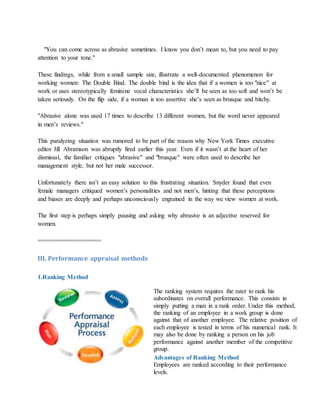
1.Ranking Method
The ranking system requires the rater to rank his
subordinates on overall performance. This consists in
simply putting a man in a rank order. Under this method,
the ranking of an employee in a work group is done
against that of another employee. The relative position of
each employee is tested in terms of his numerical rank. It
may also be done by ranking a person on his job
performance against another member of the competitive
group.
Advantages of Ranking Method
i. Employees are ranked according to their performance
levels.
ii. It is easier to rank the best and the worst employee.
Limitations of Ranking Method
i. The “whole man” is compared with another “whole man”
in this method. In practice, it is very difficult to compare
individuals possessing various individual traits.
ii. This method speaks only of the position where an
employee stands in his group. It does not test anything
about how much better or how much worse an employee
is when compared to another employee.
iii. When a large number of employees are working, ranking
of individuals become a difficult issue.
iv. There is no systematic procedure for ranking individuals
in the organization. The ranking system does not eliminate
the possibility of snap judgements.
2. Rating Scale
Rating scales consists of several numerical scales
representing job related performance criterions such as
dependability, initiative, output, attendance, attitude etc.
Each scales ranges from excellent to poor. The total
numerical scores are computed and final conclusions are
derived. Advantages – Adaptability, easy to use, low cost,
every type of job can be evaluated, large number of
employees covered, no formal training required.
Disadvantages – Rater’s biases
3. Checklist method
Under this method, checklist of statements of traits of
employee in the form of Yes or No based questions is
prepared. Here the rater only does the reporting or
checking and HR department does the actual evaluation.
Advantages – economy, ease of administration, limited
training required, standardization. Disadvantages – Raters
biases, use of improper weighs by HR, does not allow
rater to give relative ratings
4. Critical Incidents Method
The approach is focused on certain critical behaviors of
employee that makes all the difference in the
performance. Supervisors as and when they occur record
such incidents. Advantages – Evaluations are based on
actual job behaviors, ratings are supported by
descriptions, feedback is easy, reduces recency biases,
chances of subordinate improvement are high.
Disadvantages – Negative incidents can be prioritized,
forgetting incidents, overly close supervision; feedback
may be too much and may appear to be punishment.
5. Essay Method
In this method the rater writes down the employee
description in detail within a number of broad categories
like, overall impression of performance, promoteability
of employee, existing capabilities and qualifications of
performing jobs, strengths and weaknesses and training
needs of the employee. Advantage – It is extremely
useful in filing information gaps about the employees
that often occur in a better-structured checklist.
Disadvantages – It its highly dependent upon the writing
skills of rater and most of them are not good writers.
They may get confused success depends on the memory
power of raters.
6. Behaviorally Anchored Rating Scales
statements of effective and ineffective behaviors
determine the points. They are said to be
behaviorally anchored. The rater is supposed to
say, which behavior describes the employee
performance. Advantages – helps overcome rating
errors. Disadvantages – Suffers from distortions
inherent in most rating techniques.
III. Other topics related to Performance appraisal wording examples (pdf
download)
• Top 28 performance appraisal forms
• performance appraisal comments
• 11 performance appraisal methods
• 25 performance appraisal examples
• performance appraisal phrases
• performance appraisal process
• performance appraisal template
• performance appraisal system
• performance appraisal answers
• performance appraisal questions
• performance appraisal techniques
• performance appraisal format
• performance appraisal templates
• performance appraisal questionnaire
• performance appraisal software
• performance appraisal tools
• performance appraisal interview
• performance appraisal phrases examples
• performance appraisal objectives
• performance appraisal policy
• performance appraisal letter
• performance appraisal types
• performance appraisal quotes
• performance appraisal articles

Performance appraisal wording examples

  • 1.
    Performance appraisal wordingexamples In this file, you can ref useful information about performance appraisal wording examples such as performance appraisal wording examples methods, performance appraisal wording examples tips, performance appraisal wording examples forms, performance appraisal wording examples phrases … If you need more assistant for performance appraisal wording examples, please leave your comment at the end of file. Other useful material for you: • performanceappraisal123.com/1125-free-performance-review-phrases • performanceappraisal123.com/free-28-performance-appraisal-forms • performanceappraisal123.com/free-ebook-11-methods-for-performance-appraisal I. Contents of getting performance appraisal wording examples ================== These statements, uttered by an engineering manager who was preparing performance reviews, were the catalyst for linguist Kieran Snyder to see if she could quantify the double standards in the way male and female employees are evaluated. In a report for Fortune.com, she collected 248 performance reviews from 28 companies from large technology corporations to small startups. The reviews came from 180 male and female managers. Perhaps unsurprisingly critical feedback was doled out in a much higher ratio to women: 58.9% of men’s reviews contained critical feedback, while an overwhelming 87.9% of the reviews received by women did. Not only did women receive more criticism in their performance reviews, it was less constructive and more personal. For example, the critical feedback men received was mostly geared toward suggestions to develop additional skills: "There were a few cases where it would have been extremely helpful if you had gone deeper into the details to help move an area forward." Women received similar constructive feedback, but they also included the personality criticism such as "watch your tone" and "stop being so judgmental." For example:
  • 2.
    "You can comeacross as abrasive sometimes. I know you don’t mean to, but you need to pay attention to your tone." These findings, while from a small sample size, illustrate a well-documented phenomenon for working women: The Double Bind. The double bind is the idea that if a women is too "nice" at work or uses stereotypically feminine vocal characteristics she’ll be seen as too soft and won’t be taken seriously. On the flip side, if a woman is too assertive she’s seen as brusque and bitchy. "Abrasive alone was used 17 times to describe 13 different women, but the word never appeared in men’s reviews." This paralyzing situation was rumored to be part of the reason why New York Times executive editor Jill Abramson was abruptly fired earlier this year. Even if it wasn’t at the heart of her dismissal, the familiar critiques "abrasive" and "brusque" were often used to describe her management style, but not her male successor. Unfortunately there isn’t an easy solution to this frustrating situation. Snyder found that even female managers critiqued women’s personalities and not men’s, hinting that these perceptions and biases are deeply and perhaps unconsciously engrained in the way we view women at work. The first step is perhaps simply pausing and asking why abrasive is an adjective reserved for women. ================== III. Performance appraisal methods 1.Ranking Method The ranking system requires the rater to rank his subordinates on overall performance. This consists in simply putting a man in a rank order. Under this method, the ranking of an employee in a work group is done against that of another employee. The relative position of each employee is tested in terms of his numerical rank. It may also be done by ranking a person on his job performance against another member of the competitive group. Advantages of Ranking Method i. Employees are ranked according to their performance levels.
  • 3.
    ii. It iseasier to rank the best and the worst employee. Limitations of Ranking Method i. The “whole man” is compared with another “whole man” in this method. In practice, it is very difficult to compare individuals possessing various individual traits. ii. This method speaks only of the position where an employee stands in his group. It does not test anything about how much better or how much worse an employee is when compared to another employee. iii. When a large number of employees are working, ranking of individuals become a difficult issue. iv. There is no systematic procedure for ranking individuals in the organization. The ranking system does not eliminate the possibility of snap judgements. 2. Rating Scale Rating scales consists of several numerical scales representing job related performance criterions such as dependability, initiative, output, attendance, attitude etc. Each scales ranges from excellent to poor. The total numerical scores are computed and final conclusions are derived. Advantages – Adaptability, easy to use, low cost, every type of job can be evaluated, large number of employees covered, no formal training required. Disadvantages – Rater’s biases 3. Checklist method
  • 4.
    Under this method,checklist of statements of traits of employee in the form of Yes or No based questions is prepared. Here the rater only does the reporting or checking and HR department does the actual evaluation. Advantages – economy, ease of administration, limited training required, standardization. Disadvantages – Raters biases, use of improper weighs by HR, does not allow rater to give relative ratings 4. Critical Incidents Method The approach is focused on certain critical behaviors of employee that makes all the difference in the performance. Supervisors as and when they occur record such incidents. Advantages – Evaluations are based on actual job behaviors, ratings are supported by descriptions, feedback is easy, reduces recency biases, chances of subordinate improvement are high. Disadvantages – Negative incidents can be prioritized, forgetting incidents, overly close supervision; feedback may be too much and may appear to be punishment. 5. Essay Method
  • 5.
    In this methodthe rater writes down the employee description in detail within a number of broad categories like, overall impression of performance, promoteability of employee, existing capabilities and qualifications of performing jobs, strengths and weaknesses and training needs of the employee. Advantage – It is extremely useful in filing information gaps about the employees that often occur in a better-structured checklist. Disadvantages – It its highly dependent upon the writing skills of rater and most of them are not good writers. They may get confused success depends on the memory power of raters. 6. Behaviorally Anchored Rating Scales statements of effective and ineffective behaviors determine the points. They are said to be behaviorally anchored. The rater is supposed to say, which behavior describes the employee performance. Advantages – helps overcome rating errors. Disadvantages – Suffers from distortions inherent in most rating techniques. III. Other topics related to Performance appraisal wording examples (pdf download) • Top 28 performance appraisal forms • performance appraisal comments • 11 performance appraisal methods • 25 performance appraisal examples • performance appraisal phrases • performance appraisal process • performance appraisal template • performance appraisal system • performance appraisal answers • performance appraisal questions • performance appraisal techniques • performance appraisal format
  • 6.
    • performance appraisaltemplates • performance appraisal questionnaire • performance appraisal software • performance appraisal tools • performance appraisal interview • performance appraisal phrases examples • performance appraisal objectives • performance appraisal policy • performance appraisal letter • performance appraisal types • performance appraisal quotes • performance appraisal articles