Richard K. Matta for  PENSCO Wednesday Webinar October 7, 2009 Self-Directed IRA Due Diligence Tips and Legal “Red Flags”
Process  of investigating a proposed investment Legal risk –  can  I invest? Investment risk –  should  I invest? Structural risk –  how  should I invest? Standard of care  by which you conduct the process Generally does not apply when directing your own investments – entirely voluntary Applies to any third-party advisers –  level  of care may vary What is due diligence?
Focus on Legal Risks –  Can  I Invest? IRC prohibits some IRA transactions outright Life insurance Borrowing from the IRA Pledging IRA assets (watch out for this one) IRC may limit the manner of investing Assets must be held by corporate trustee/custodian Assets of multiple IRAs may not be “commingled” except in “common trust fund” or “common investment fund”
Focus on Legal Risks –  Can  I Invest? IRC imposes restrictions on “prohibited transactions” Transactions with “disqualified persons” Fiduciary conflicts Risk includes immediate taxation/loss of exemption Valuation and liquidity issues, including MRDs Potential “disguised contribution” issues
Prohibited transactions with “disqualified persons” What transactions are prohibited? Sale, exchange or leasing of property Lending of money or other extension of credit Furnishing of goods or  services Transfer to or beneficial “use” of IRA assets
Prohibited transactions with “disqualified persons” Who is a disqualified person? Any fiduciary – including the accountholder Any service provider  Entity owned 50% or more by any of the above Officer/director/10% owner of such an entity Family member (ancestor/descendent/spouse)
Prohibited Fiduciary Conflicts Self-dealing Dealing with the income or assets of your IRA in your own interest or for your own account Includes paying a fee to yourself  or to a person in which you have an interest  which may affect the exercise of your best judgment as a fiduciary “ Kickbacks” Receiving benefits from third parties
Persons in whom you have “an interest” Yourself –  definitely Disqualified persons including family members –  yes , according to regulations Other persons –  possibly Other family members Business in which you have an interest Who has the burden of proof – you or the IRS? What is valid proof?
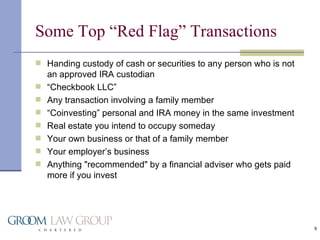
Some Top “Red Flag” Transactions Handing custody of cash or securities to any person who is not an approved IRA custodian “ Checkbook LLC” Any transaction involving a family member “ Coinvesting” personal and IRA money in the same investment Real estate you intend to occupy someday Your own business or that of a family member Your employer’s business Anything "recommended" by a financial adviser who gets paid more if you invest
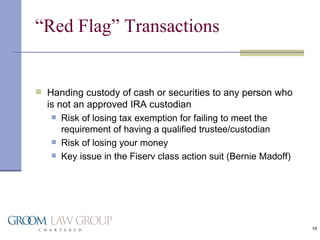
“Red Flag” Transactions Handing custody of cash or securities to any person who is not an approved IRA custodian Risk of losing tax exemption for failing to meet the requirement of having a qualified trustee/custodian Risk of losing your money Key issue in the Fiserv class action suit (Bernie Madoff)
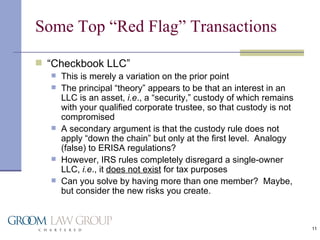
Some Top “Red Flag” Transactions “ Checkbook LLC” This is merely a variation on the prior point The principal “theory” appears to be that an interest in an LLC is an asset,  i.e ., a “security,” custody of which remains with your qualified corporate trustee, so that custody is not compromised A secondary argument is that the custody rule does not apply “down the chain” but only at the first level.  Analogy (false) to ERISA regulations? However, IRS rules completely disregard a single-owner LLC,  i.e ., it  does not exist  for tax purposes Can you solve by having more than one member?  Maybe, but consider the new risks you create.
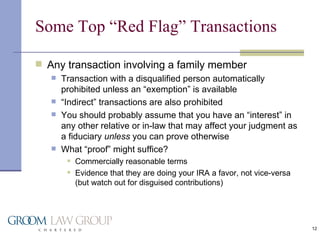
Some Top “Red Flag” Transactions Any transaction involving a family member Transaction with a disqualified person automatically prohibited unless an “exemption” is available “ Indirect” transactions are also prohibited You should probably assume that you have an “interest” in any other relative or in-law that may affect your judgment as a fiduciary  unless  you can prove otherwise What “proof” might suffice? Commercially reasonable terms Evidence that they are doing your IRA a favor, not vice-versa (but watch out for disguised contributions)
Some Top “Red Flag” Transactions “ Coinvesting” personal and IRA money in the same investment Department of Labor has confirmed that it is not  per se  prohibited But note important red flags: If you need the IRA money to meet a minimum investment requirement If you obtain different or better investment terms If the entity in which you are investing, or any other person associated with it, is a disqualified person Need to anticipate future conflicts
Some Top “Red Flag” Transactions Buying real estate you intend to occupy someday – potential problems: Transactions with disqualified persons: Leasing to family member Hiring family member to provide services In-kind distribution as a “sale or exchange” “ Sweat equity” as a possible disguised contribution Problem of distinguishing between managing the IRA and managing the property Liquidity issues Undervaluation issues
Some Top “Red Flag” Transactions Investing in your own business or that of a family member can raise numerous prohibited transaction issues depending on the circumstances, including but not limited to: If you receive any compensation from the business If any of your family members receive any compensation from the business (whether as owners, employees, contractors, etc.) If you use the funds to repay a loan someone else has made to the business If you use the funds to make a distribution (return of capital or dividend)
Some Top “Red Flag” Transactions Investing in your employer’s business If investing in your employer’s business is “expected” as a condition of employment or otherwise linked to a promotion, your salary, etc.
Some Top “Red Flag” Transactions Investing in anything "recommended" by a financial adviser who gets paid more if you invest This is different from all of the previous flags in that it does not create a significant tax or prohibited transaction risk for the IRA owner Is there a “meeting of the minds” as to whether the adviser is a “fiduciary”? Get it in writing. If the adviser is a fiduciary, what steps have they taken to avoid a prohibited transaction?  Are they relying on an exemption? Many advisers do not know, or do not accept, that they are “fiduciaries” by virtue of giving advice to IRAs “ Broker reps” who argue they are not advisers Financial planners who argue that they are advising you personally, not your IRA
Dealing with “Red Flag” Transactions Obtain expert advice – legal, accounting, tax, valuation Carefully evaluate the investment risks Carefully evaluate the investment structure Document the entire decision-making process Consider “isolating” a questionable investment in a separate IRA Ask yourself – can I risk (1) the tax consequences if my IRA is disqualified, and (2) the loss of my entire investment?

Pensco Webinar 10 07 09

  • 1.
    Richard K. Mattafor PENSCO Wednesday Webinar October 7, 2009 Self-Directed IRA Due Diligence Tips and Legal “Red Flags”
  • 2.
    Process ofinvestigating a proposed investment Legal risk – can I invest? Investment risk – should I invest? Structural risk – how should I invest? Standard of care by which you conduct the process Generally does not apply when directing your own investments – entirely voluntary Applies to any third-party advisers – level of care may vary What is due diligence?
  • 3.
    Focus on LegalRisks – Can I Invest? IRC prohibits some IRA transactions outright Life insurance Borrowing from the IRA Pledging IRA assets (watch out for this one) IRC may limit the manner of investing Assets must be held by corporate trustee/custodian Assets of multiple IRAs may not be “commingled” except in “common trust fund” or “common investment fund”
  • 4.
    Focus on LegalRisks – Can I Invest? IRC imposes restrictions on “prohibited transactions” Transactions with “disqualified persons” Fiduciary conflicts Risk includes immediate taxation/loss of exemption Valuation and liquidity issues, including MRDs Potential “disguised contribution” issues
  • 5.
    Prohibited transactions with“disqualified persons” What transactions are prohibited? Sale, exchange or leasing of property Lending of money or other extension of credit Furnishing of goods or services Transfer to or beneficial “use” of IRA assets
  • 6.
    Prohibited transactions with“disqualified persons” Who is a disqualified person? Any fiduciary – including the accountholder Any service provider Entity owned 50% or more by any of the above Officer/director/10% owner of such an entity Family member (ancestor/descendent/spouse)
  • 7.
    Prohibited Fiduciary ConflictsSelf-dealing Dealing with the income or assets of your IRA in your own interest or for your own account Includes paying a fee to yourself or to a person in which you have an interest which may affect the exercise of your best judgment as a fiduciary “ Kickbacks” Receiving benefits from third parties
  • 8.
    Persons in whomyou have “an interest” Yourself – definitely Disqualified persons including family members – yes , according to regulations Other persons – possibly Other family members Business in which you have an interest Who has the burden of proof – you or the IRS? What is valid proof?
  • 9.
    Some Top “RedFlag” Transactions Handing custody of cash or securities to any person who is not an approved IRA custodian “ Checkbook LLC” Any transaction involving a family member “ Coinvesting” personal and IRA money in the same investment Real estate you intend to occupy someday Your own business or that of a family member Your employer’s business Anything "recommended" by a financial adviser who gets paid more if you invest
  • 10.
    “Red Flag” TransactionsHanding custody of cash or securities to any person who is not an approved IRA custodian Risk of losing tax exemption for failing to meet the requirement of having a qualified trustee/custodian Risk of losing your money Key issue in the Fiserv class action suit (Bernie Madoff)
  • 11.
    Some Top “RedFlag” Transactions “ Checkbook LLC” This is merely a variation on the prior point The principal “theory” appears to be that an interest in an LLC is an asset, i.e ., a “security,” custody of which remains with your qualified corporate trustee, so that custody is not compromised A secondary argument is that the custody rule does not apply “down the chain” but only at the first level. Analogy (false) to ERISA regulations? However, IRS rules completely disregard a single-owner LLC, i.e ., it does not exist for tax purposes Can you solve by having more than one member? Maybe, but consider the new risks you create.
  • 12.
    Some Top “RedFlag” Transactions Any transaction involving a family member Transaction with a disqualified person automatically prohibited unless an “exemption” is available “ Indirect” transactions are also prohibited You should probably assume that you have an “interest” in any other relative or in-law that may affect your judgment as a fiduciary unless you can prove otherwise What “proof” might suffice? Commercially reasonable terms Evidence that they are doing your IRA a favor, not vice-versa (but watch out for disguised contributions)
  • 13.
    Some Top “RedFlag” Transactions “ Coinvesting” personal and IRA money in the same investment Department of Labor has confirmed that it is not per se prohibited But note important red flags: If you need the IRA money to meet a minimum investment requirement If you obtain different or better investment terms If the entity in which you are investing, or any other person associated with it, is a disqualified person Need to anticipate future conflicts
  • 14.
    Some Top “RedFlag” Transactions Buying real estate you intend to occupy someday – potential problems: Transactions with disqualified persons: Leasing to family member Hiring family member to provide services In-kind distribution as a “sale or exchange” “ Sweat equity” as a possible disguised contribution Problem of distinguishing between managing the IRA and managing the property Liquidity issues Undervaluation issues
  • 15.
    Some Top “RedFlag” Transactions Investing in your own business or that of a family member can raise numerous prohibited transaction issues depending on the circumstances, including but not limited to: If you receive any compensation from the business If any of your family members receive any compensation from the business (whether as owners, employees, contractors, etc.) If you use the funds to repay a loan someone else has made to the business If you use the funds to make a distribution (return of capital or dividend)
  • 16.
    Some Top “RedFlag” Transactions Investing in your employer’s business If investing in your employer’s business is “expected” as a condition of employment or otherwise linked to a promotion, your salary, etc.
  • 17.
    Some Top “RedFlag” Transactions Investing in anything "recommended" by a financial adviser who gets paid more if you invest This is different from all of the previous flags in that it does not create a significant tax or prohibited transaction risk for the IRA owner Is there a “meeting of the minds” as to whether the adviser is a “fiduciary”? Get it in writing. If the adviser is a fiduciary, what steps have they taken to avoid a prohibited transaction? Are they relying on an exemption? Many advisers do not know, or do not accept, that they are “fiduciaries” by virtue of giving advice to IRAs “ Broker reps” who argue they are not advisers Financial planners who argue that they are advising you personally, not your IRA
  • 18.
    Dealing with “RedFlag” Transactions Obtain expert advice – legal, accounting, tax, valuation Carefully evaluate the investment risks Carefully evaluate the investment structure Document the entire decision-making process Consider “isolating” a questionable investment in a separate IRA Ask yourself – can I risk (1) the tax consequences if my IRA is disqualified, and (2) the loss of my entire investment?