Sistem operasi merupakan perangkat lunak yang mengelola sumber daya komputer dan menyediakan layanan untuk perangkat lunak lain. Beberapa contoh sistem operasi utama adalah Windows, Linux, macOS, dan berbagai turunan UNIX seperti BSD.
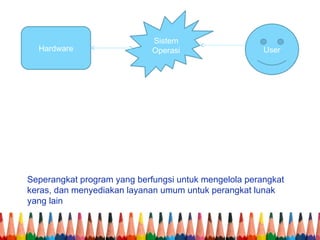
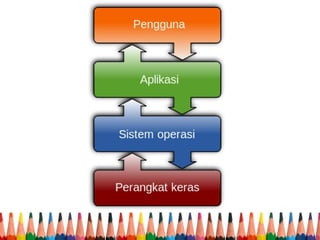
Seperangkat program yangberfungsi untuk mengelola perangkat
keras, dan menyediakan layanan umum untuk perangkat lunak
yang lain
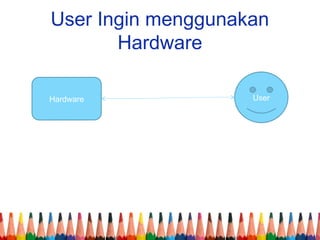
Hardware User
Sistem
Operasi
6.
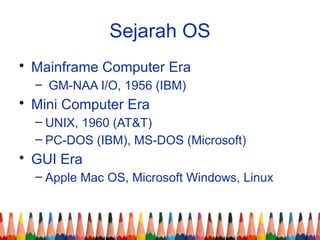
Sejarah OS
• MainframeComputer Era
– GM-NAA I/O, 1956 (IBM)
• Mini Computer Era
– UNIX, 1960 (AT&T)
– PC-DOS (IBM), MS-DOS (Microsoft)
• GUI Era
– Apple Mac OS, Microsoft Windows, Linux
7.
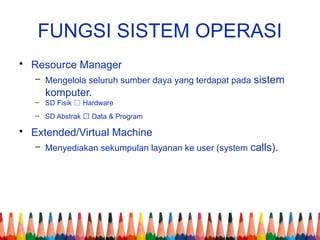
FUNGSI SISTEM OPERASI
•Resource Manager
– Mengelola seluruh sumber daya yang terdapat pada sistem
komputer.
– SD Fisik Hardware
– SD Abstrak Data & Program
• Extended/Virtual Machine
– Menyediakan sekumpulan layanan ke user (system calls).
• Pembuatan Program
•Eksekusi Program
• Akses terhadap I/O
• Akses terhadap Berkas
• Akses terhadap Sistem
• Deteksi & Responsi atas Error
• Akunting
10.
ISU UTAMA DALAMOS
• User Friendly
– GUI : Graphical User Interface
• Reliability
– Dapat diandalkan
• Compatibility
– Hardware, Software, Data
• Security
– Privileges (Hak Akses), Malware
11.
KLASIFIKASI OS
• Workstation
–Windows 9x, XP, Vista; Mac OS X, Linux
• Server
– Windows Server, Mac OS X Server; Linux Server,
BSD Family
• Mobile
– Windows Mobile, Symbian, Android
• Others
– Cisco IOS (Internetwork Operating System), Mikrotik
ROS (Router OS)
• Text Based/Command Line Intrepeter
(CLI)
• Dikembangkan pada 1969
• Oleh beberapa karyawan AT&T
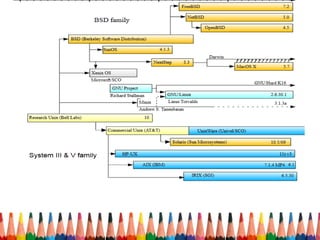
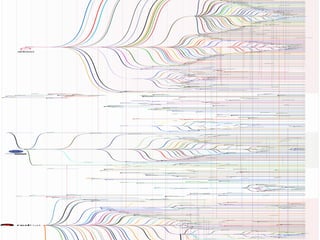
• Memiliki banyak turunan / cabang
• Registered Compliance : Solaris, Mac OS
X
• UNIX-like System : BSD, Linux
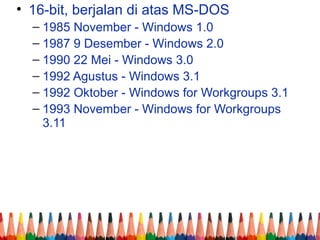
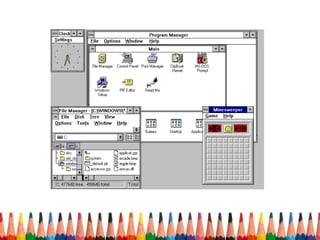
• 16-bit, berjalandi atas MS-DOS
– 1985 November - Windows 1.0
– 1987 9 Desember - Windows 2.0
– 1990 22 Mei - Windows 3.0
– 1992 Agustus - Windows 3.1
– 1992 Oktober - Windows for Workgroups 3.1
– 1993 November - Windows for Workgroups
3.11
18.
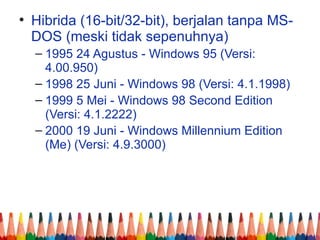
• Hibrida (16-bit/32-bit),berjalan tanpa MS-
DOS (meski tidak sepenuhnya)
– 1995 24 Agustus - Windows 95 (Versi:
4.00.950)
– 1998 25 Juni - Windows 98 (Versi: 4.1.1998)
– 1999 5 Mei - Windows 98 Second Edition
(Versi: 4.1.2222)
– 2000 19 Juni - Windows Millennium Edition
(Me) (Versi: 4.9.3000)
19.
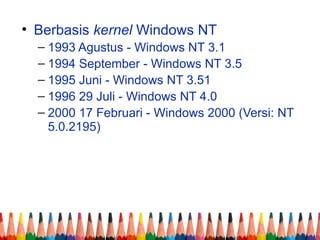
• Berbasis kernelWindows NT
– 1993 Agustus - Windows NT 3.1
– 1994 September - Windows NT 3.5
– 1995 Juni - Windows NT 3.51
– 1996 29 Juli - Windows NT 4.0
– 2000 17 Februari - Windows 2000 (Versi: NT
5.0.2195)
20.
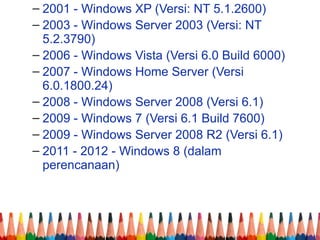
– 2001 -Windows XP (Versi: NT 5.1.2600)
– 2003 - Windows Server 2003 (Versi: NT
5.2.3790)
– 2006 - Windows Vista (Versi 6.0 Build 6000)
– 2007 - Windows Home Server (Versi
6.0.1800.24)
– 2008 - Windows Server 2008 (Versi 6.1)
– 2009 - Windows 7 (Versi 6.1 Build 7600)
– 2009 - Windows Server 2008 R2 (Versi 6.1)
– 2011 - 2012 - Windows 8 (dalam
perencanaan)
22.
BSD
• Berkeley SoftwareDistribution (BSD)
• Dikembangkan oleh University of
Berkeley,California, USA.
• Memiliki beberapa turunan:
– FreeBSD
– OpenBSD
– NetBSD
– Others
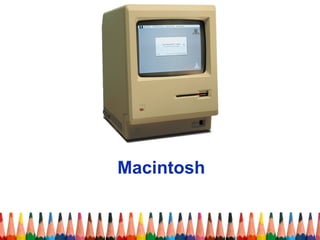
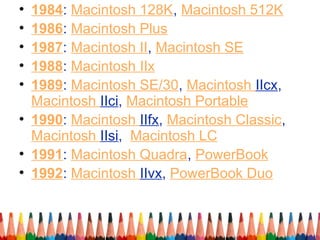
• 1984: Macintosh128K, Macintosh 512K
• 1986: Macintosh Plus
• 1987: Macintosh II, Macintosh SE
• 1988: Macintosh IIx
• 1989: Macintosh SE/30, Macintosh IIcx,
Macintosh IIci, Macintosh Portable
• 1990: Macintosh IIfx, Macintosh Classic,
Macintosh IIsi, Macintosh LC
• 1991: Macintosh Quadra, PowerBook
• 1992: Macintosh IIvx, PowerBook Duo
30.
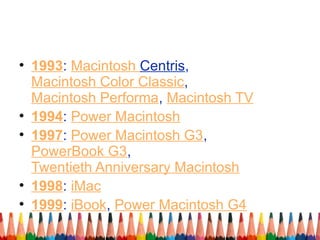
• 1993: MacintoshCentris,
Macintosh Color Classic,
Macintosh Performa, Macintosh TV
• 1994: Power Macintosh
• 1997: Power Macintosh G3,
PowerBook G3,
Twentieth Anniversary Macintosh
• 1998: iMac
• 1999: iBook, Power Macintosh G4
31.
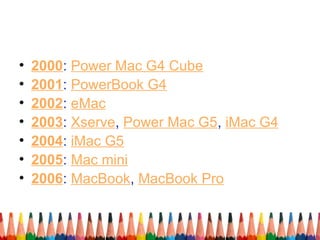
• 2000: PowerMac G4 Cube
• 2001: PowerBook G4
• 2002: eMac
• 2003: Xserve, Power Mac G5, iMac G4
• 2004: iMac G5
• 2005: Mac mini
• 2006: MacBook, MacBook Pro



![Modul Ajar KBC Fikih Kelas 2 MI [MODULKELAS.COM]](https://cdn.slidesharecdn.com/ss_thumbnails/modulajarkbcfikihkelas2mimodulkelas-260129153051-998e7c8f-thumbnail.jpg?width=640&height=640&fit=bounds)


