PELVIC INFLAMMATORY
DISEASE
BY
Sara Mosaad Ali Abd elrazk
Assistant lecturer of obstetrics and gynecology at
Alzahraa University Hospital
Under supervision
of
Prof: Hanaa Omar
OBJECTIVES
:

*
Definition

*
Prevalence

*
Etiology

*
Microbiology

*
Pathogenesis

*
histopathology

*
Long-term complications
DEFINITION
:

PID is an infection of the upper genital tract not
associated with pregnancy or intraperitoneal pelvic
operations
.

Thus it may include infection of any or all of the
following anatomic locations
:

1
.
Endometrium (endometritis)
,

2
.
Oviducts (salpingitis)
,

3
.
Ovary (oophoritis)
,

4
.
Uterine wall (myometritis)
,

5
.
Uterine serosa and

6
.
Broad ligaments (parametritis), and

7
.
Pelvic peritoneum
.
PREVALENCE

Annually, acute PID occurs in 1% to 2% of all
young, sexually active women
.

It is the most common serious infection of women
ages 16 to 25 years
.
*
Approximately 85% of infections are spontaneous
in sexually active females
.

*
15%
of infections develop following procedures
that break the cervical mucus barrier
.


There is a strong correlation between the incidence
of STIs and acute PID that a sexually active female
will develop acute PID İs:1 in 8, in adolescence and 1
in 80 for women older than 25 years
.

For unknown reasons, young women with
colonization of the cervix by Chlamydia have a higher
incidence of upper genital tract infection than older
women
.
ETIOLOGY

*
Ascending infection from the bacterial flora of the
vagina and cervix in more than 99%of cases
..

*
less than 1% of cases, results from: Transperitoneal
spread of infectious material from a perforated appendix
or intra abdominal abscess
.

*
Hematogenous and lymphatic spread to the tubes or
ovaries
.
MICROBIOLOGY

1
-
Neisseria gonorrhea and Chlamydia trachomatis are
commonly identified pathogens in (PID) among sexually
active pre-menopausal females
.

2
-
Mycoplasma genitalium is also likely to be a cause in
the pre-menopausal group
.

3
-
E. coli and colonic anaerobes may be responsible for
the rare cases of PID seen in post-menopausal females
.

4
-
Very rare pathogens identified include Mycobacterium
tuberculosis, Haemophilus influenzae, Streptococcus
pneumoniae, and the agents of actinomycosis
.
NEISSERIA GONORRHEA

N. gonorrhea was the first identified cause of
PID
.

Approximately 15 percent of females with an
endocervical N. gonorrhea infection go on to

develop PID
.

Gonococcal PID tends to be clinically more severe
than chlamydia PID, which may lead to earlier
diagnosis and treatment
.
CHLAMYDIA TRACHOMATIS

Genital chlamydia is the most common bacterial sexually
transmissible disease
.


C. trachomatis accounts for about one-third of cases of PID
.

About 10 to 15 percent of endocervical C. trachomatis
infections produce PID, but asymptomatic subclinical
infections are also common, and these may present years
later as chronic pelvic pain or infertility
.

Females aged 16 to 24 years account for most cases of
chlamydia
.
MYCOPLASMA GENITALIUM

The role of M. genitalium in sexually transmitted
infections among females is emerging
.

There is growing evidence supporting an association
with cervicitis and PID in females
.

The proportion of PID cases that are associated with M.
genitalium is uncertain
;

in one study of females with mild to moderate PID in
the United Kingdom, 10 percent tested positive for M.
genitalium
.
OTHER INITIATING PATHOGENS

Other agents that initiate PID, while almost certainly
sexually transmitted and probably infectious, remain obscure
.

Using molecular amplification with generic primers, a
number of novel bacteria have been identified in the fallopian
tubes of females with PID, including Atopobium, Sneathia,
and Leptotrichia
.

The precise role of these and other anaerobic bacteria in the
pathogenesis of PID remains unclear, but is likely consistent
with their role in the anaerobic microbiology of bacterial
vaginosis
.
MIXED INFECTION

*
Regardless of the initiating pathogen, the
microbiology of PID, especially for clinical purposes,
should be viewed and treated as a mixed polymicrobial
infection
.

*
Older studies found that, among cases of

PID initiated by N. gonorrhea, a mixed polymicrobial
infection was seen in approximately 35 percent
.

*
Another study, identified other organisms in more
than 50 percent of patients with gonococcal PID
.

Other conditions — Complete disruption of the
vaginal ecosystem can occur, in which anaerobic
bacteria assume predominance over the desirable
strains of lactobacilli in the lower genital tract
.

This condition is known as bacterial vaginosis
and affects 15 to 30 percent of American females,
one-half of whom are asymptomatic
.
The presence of bacterial vaginosis likely increases
the risk of PID
.
MICROBIOLOGY AND
PATHOGENESIS

*
Polymicrobial infection that is a mixture of aerobic
and anaerobic bacteria
.

*
More than 20 species of microorganisms have been
cultured from direct tubal aspiration of purulent
material
.

*
The exact microbiologic pathogens in the
fallopian tube cannot/ be known for any given
patient

*
Transvaginal culture of the endocervix,
endometrium, and cul-de-sac contents reveals
different organisms from each site in the same
patient
.
PATHOGENESIS

The vaginal flora of most normal, healthy females includes
a variety of potentially pathogenic Bacteria
.

Among these are species of Prevotella, Leptotrichia,
Atopobium, and other anaerobes
.

Compared with the dominant, non-pathogenic, hydrogen
peroxide-producing Lactobacillus species, these other
organisms are present in low numbers, and flow under the

influence of hormonal changes (eg, pregnancy, menstrual
cycle), contraceptive method, sexual activity, vaginal
hygiene practices, and other as yet unknown factors
.

*
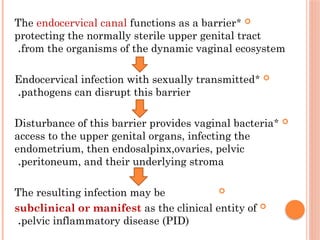
The endocervical canal functions as a barrier
protecting the normally sterile upper genital tract
from the organisms of the dynamic vaginal ecosystem
.

*
Endocervical infection with sexually transmitted
pathogens can disrupt this barrier
.

*
Disturbance of this barrier provides vaginal bacteria
access to the upper genital organs, infecting the
endometrium, then endosalpinx,ovaries, pelvic
peritoneum, and their underlying stroma
.

The resulting infection may be

subclinical or manifest as the clinical entity of
pelvic inflammatory disease (PID)
.

The reasons

why lower genital tract bacteria cause PID in some
females but not others is not fully understood but
may relate to
:

genetic variations in immune response
,

estrogen levels affecting the viscosity of cervical
mucus
,

and the bacterial load of potential pathogens
.
HISTOPATHOLOGY OF PID
The histopathology of PID reveals changes in these
structures due to infection, typically by bacteria such
as Neisseria gonorrhoeae, Chlamydia trachomatis,
anaerobes, and others
.
.1
Fallopian Tubes (Salpingitis)
This is the most commonly affected structure
in PID
.
-
Acute Salpingitis
:
-
Epithelial changes: Loss of the normal
ciliated epithelium of the fallopian tube due
to damage from inflammation
.
-
Inflammatory infiltrates: Abundant
polymorphonuclear leukocytes
(neutrophils) in the lamina propria and
sometimes infiltrating the muscularis
layer
.
-
Exudate: Lumen filled with purulent
exudate composed of necrotic debris,
bacteria, and inflammatory cells
.
-
Edema: Marked subepithelial edema
.
-
Chronic Salpingitis
:
-
-
Fibrosis: Replacement of normal tissue
with fibrous connective tissue
.
-
-
Lymphoplasmacytic infiltrates:
Lymphocytes and plasma cells
predominate, replacing neutrophils
.
-
.
-
-
Scarring and adhesions: Obstruction
and distortion of the tube, leading to
hydrosalpinx or pyosalpinx
.
-
Tubal occlusion: Often a consequence of
repeated or severe infections, contributing
to infertility
.
2
.
Ovaries (Oophoritis)
While less commonly involved in isolation, the
ovaries can be affected
.
-
Acute inflammation: Inflammatory
infiltrates of neutrophils within ovarian stroma
.
-
Abscess formation: Tubo-ovarian abscesses,
where pus fills the ovary and adjacent fallopian
tube
.
-
Chronic inflammation: Scarring and
fibrosis may follow abscess resolution
.
3
.
Endometrium (Endometritis)
Infection often starts in the endometrium
.
-
Acute Endometritis
:
-
Neutrophilic infiltrates in the endometrial
glands and stroma
.
-
Necrosis and ulceration of the endometrial
surface in severe cases
.
-
Presence of bacterial colonies or intracellular
organisms, especially in cases involving Neisseria
gonorrhoeae or Chlamydia trachomatis
.
-
chronic Endometritis
:
-
Plasma cells in the stroma: A key
diagnostic feature
.
-
Lymphocytic infiltration: Diffuse or
perivascular in distribution
.
-
Glandular distortion and fibrosis
.
4
.
Peritoneum and Adjacent Structures
(Peritonitis)
Inflammation can spread to the peritoneal
cavity, especially in severe or untreated
cases
.
-
Acute peritonitis
:
-
Fibrinopurulent exudate with
neutrophils covering serosal surfaces
.
-
Adhesions between pelvic structures
(e.g., ovaries, bowel, and uterus)
.
-
Chronic peritonitis
:
-
Dense fibrous adhesions between pelvic
organs, potentially leading to chronic pelvic
pain and bowel obstruction
.
5
.
Tubo-Ovarian Abscess (TOA)
A late and severe complication of PID
.
-
Abscess cavity
:
-
Filled with purulent material
.
-
Surrounded by a thickened wall
composed of granulation tissue and fibrous
connective tissue
.
-
Histology of wall: Inflammatory cells,
including neutrophils, lymphocytes, and
plasma cells, with areas of necrosis
.
6
.
Vascular Involvement
-
Thrombophlebitis: Inflammation and
thrombosis in pelvic veins
.
Vascular congestion: Prominent in acute
cases
.
Microscopic Findings by Stage
.1
1
.
Acute Phase: Neutrophils dominate,
and there is edema and necrosis
.
2
.
Subacute Phase: Neutrophils decrease,
and lymphocytes/plasma cells begin to
appear
.
3
.
Chronic Phase: Lymphoplasmacytic
infiltrates, fibrosis, and scarring
predominate
.
Special Stains and Diagnostics
-
Gram stain: For identifying bacterial
organisms like gonococci
.
-
Immunohistochemistry: Detects
specific pathogens, e.g., Chlamydia
trachomatis
.
-
Culture and PCR: Complement
histopathological findings by confirming the
infectious agent
.
PROTECTIVE FACTORS

1
.
Monogomy

2
.
Barrier contraception spermicidals – oral
contraceptive pills

3
.
Pregnancy

4
.
Menopause

Barrier contraception — Barrier contraception
protects against PID
.

Condoms are the most effective form, preventing
over 50 percent of endocervical gonococcal and
chlamydial infections if used correctly
.

contraceptives
—

The role of ο trасерtiveѕ in preventing РΙD is
ϲ ո unclear
.

Oral progestins –Progestin-induced

thickening and increased viscosity of cervical mucus has
been hypothesized to inhibit ascent of bacteria
.

Oral contraceptive pills – The protective role of oral
ο trасерtiveѕ in the acquisition of РІD
ϲ ո is controversial,
with some studies reporting that use of oral
ο trасерtiveѕ confers a protective effect against the
ϲ ո
development of chlamydial РІD ,while others do not
.

intrauterine Devices (IUDs) – Overall, the risk of PID in
ІUD users is low
.

The risk of PID is primarily limited to the first three
weeks after IUD insertion and is associated with the
physical introduction of the device
.

In females who develop PID with an IUD already in place,
most guidelines recommend leaving the IUD in place
while treating acute PID with antibiotics with close follow-
up
.

The IUD should, however, be removed if clinical
improvement is delayed beyond a few days
.

While it is rare to have РΙD during pregnancy
because the mucus plug and decidua seal off the

uterus from ascending bacteria, ΡΙD can occur in
the first 12 weeks of gestation before this occurs
.

Older females less commonly present with РІD,
but when they do, the cause is more likely to be

non-SТІ related
.

Patients with PID can present with clinical disease at
any point along a continuum from endometritis (with
normal tubes, ovaries, and peritoneum) to salpingitis
(with inflammation of the fallopian tubes and adjacent
pelvic structures)

This limits the sensitivity of direct visualization of the
fallopian tubes through laparoscopy when making a
diagnosis of PID because endometritis and mild intra
tubal inflammation cannot be seen
.

However, in most cases, the precise microbial
etiology of PID is unknown. Regardless of the
initiating pathogen, PID is clinically

considered a mixed polymicrobial infection
.
PELVIC INFLAMMATORY DISEASE:
LONG-TERM COMPLICATIONS

1
-
Chronic pelvic pain – As many as one-third
of patients with ΡID develop chronic pelvic pain,
defined as menstrual or non-menstrual pain of at
least six months' duration
.

2
-
Tubal damage : Changes to

the fallopian tube, including loss of ciliary action,
fibrosis, and occlusion can lead to

*
Ηуԁrοѕalрinx
-

*
Іոfertilitу
.

*
Ectopic pregnancy

3
-
Associations with unclear significance

*
Ovarian cancer – The association between РІD
and ovarian cancer is unclear; ΡID increases the
risk of low parity and infertility, which are also risk
factors for ovarian cancer. 

*
Е οmetriοѕis
ոԁ – A history of PІD may be
associated with е οmеtrioѕiѕ, however studies are
ոԁ
limited, and both can cause chronic pelvic pain
.
POINT-OF-CARE AND LABORATORY
TESTS

●
Pregnancy test

●
Microscopy of vaginal discharge
.

●
Nucleic acid amplification tests (NAATs) for C.
trachomatis and Neisseria gonorrhea

●
NAAT for Mycoplasma genitalium (where
available)

●
HIV screening

●
Serologic testing for syphilis
.

1
-
pregnancy test to rule out ectopic pregnancy
and complications of an intrauterine pregnancy
.

2
-
Saline microscopy of vaginal discharge is to
assess for increased white blood cells (WBC) in
vaginal fluid which is sensitive for ΡID. The
absence of WBC could thus suggest an alternate
diagnosis. However, the finding is not very specific
for ΡID
.

3
-
Microscopy can also identify coexisting bacterial
vaginosis and trichomoniasis
.

4
-
Positive NAATs for C. trachomatis,N.
gonorrhoeae, or M. genitalium support the diagnosis
of ΡІD, but negative NAATs do not rule out РID
.

5
-
HIV and syphilis testing are to evaluate for other
sexually transmitted infections that share similar
risk factors with РІD
.

6
-
a cervical Gram stain is positive for gram-negative
intracellular diplococci (suggestive of N.gonorrhoeae)
when interpreted by an experienced microscopist, the
probability of PID greatly increases
.

7
-
Ultrаѕοunԁ is generally the preferred imaging
modality if an abscess or adnexal pathology is suspected
clinically, as it produces high-quality images of the
upper genital tract and does not expose the patient to
radiation
.

Otherwise, computed tomography (CT) or magnetic
resonance imaging (MRI) may be more helpful in
identifying gastrointestinal pathology or alternate
diagnoses
.

8
-
араrοѕ oру and transcervical
Լ ϲ endometrial biopsy
are uncommonly performed. because it does not
detect isolated е dоmetritiѕ or mild intra-tubal
ո
Inflammation
.

9
-
Transcervical endometrial biopsy – This can be
used to detect е οmеtritiѕ, which is associated with
ոԁ
sаlрi gitiѕ. However, it is not used routinely because
ո
the correlation is not 100 percent, biopsy results may
not be available in time to inform management, and
there may be difficulty in interpreting the histology
due to the patchy nature of the inflammation
.
REFERENCE
:

1
-
UK Health Security Agency. Table 4: All STI diagnosis and
service numbers in England and regions by gender and
sexual orientation, 2017 to 2021.
https://assets.publishing.service.go

v.uk/government/uploads/system/uploads/attachment_data/
file/1116808/2021-Table-4-AllSTI-diagnoses-and-services-by-
gender-and-sexual-orientation.ods (Accessed on November

30
,
2022
.)

2
-
https://doi.org/10.2147/TCRM.S350750

3
-
https://emedicine.medscape.com/article/256448-
guidelines#g1

Pelvic inflammatory disease (1).pptxjhhh

  • 1.
    PELVIC INFLAMMATORY DISEASE BY Sara MosaadAli Abd elrazk Assistant lecturer of obstetrics and gynecology at Alzahraa University Hospital Under supervision of Prof: Hanaa Omar
  • 2.
  • 3.
    DEFINITION :  PID is aninfection of the upper genital tract not associated with pregnancy or intraperitoneal pelvic operations .  Thus it may include infection of any or all of the following anatomic locations :  1 . Endometrium (endometritis) ,  2 . Oviducts (salpingitis) ,  3 . Ovary (oophoritis) ,  4 . Uterine wall (myometritis) ,  5 . Uterine serosa and  6 . Broad ligaments (parametritis), and  7 . Pelvic peritoneum .
  • 4.
    PREVALENCE  Annually, acute PIDoccurs in 1% to 2% of all young, sexually active women .  It is the most common serious infection of women ages 16 to 25 years . * Approximately 85% of infections are spontaneous in sexually active females .  * 15% of infections develop following procedures that break the cervical mucus barrier . 
  • 5.
     There is astrong correlation between the incidence of STIs and acute PID that a sexually active female will develop acute PID İs:1 in 8, in adolescence and 1 in 80 for women older than 25 years .  For unknown reasons, young women with colonization of the cervix by Chlamydia have a higher incidence of upper genital tract infection than older women .
  • 6.
    ETIOLOGY  * Ascending infection fromthe bacterial flora of the vagina and cervix in more than 99%of cases ..  * less than 1% of cases, results from: Transperitoneal spread of infectious material from a perforated appendix or intra abdominal abscess .  * Hematogenous and lymphatic spread to the tubes or ovaries .
  • 7.
    MICROBIOLOGY  1 - Neisseria gonorrhea andChlamydia trachomatis are commonly identified pathogens in (PID) among sexually active pre-menopausal females .  2 - Mycoplasma genitalium is also likely to be a cause in the pre-menopausal group .  3 - E. coli and colonic anaerobes may be responsible for the rare cases of PID seen in post-menopausal females .  4 - Very rare pathogens identified include Mycobacterium tuberculosis, Haemophilus influenzae, Streptococcus pneumoniae, and the agents of actinomycosis .
  • 8.
    NEISSERIA GONORRHEA  N. gonorrheawas the first identified cause of PID .  Approximately 15 percent of females with an endocervical N. gonorrhea infection go on to  develop PID .  Gonococcal PID tends to be clinically more severe than chlamydia PID, which may lead to earlier diagnosis and treatment .
  • 9.
    CHLAMYDIA TRACHOMATIS  Genital chlamydiais the most common bacterial sexually transmissible disease .   C. trachomatis accounts for about one-third of cases of PID .  About 10 to 15 percent of endocervical C. trachomatis infections produce PID, but asymptomatic subclinical infections are also common, and these may present years later as chronic pelvic pain or infertility .  Females aged 16 to 24 years account for most cases of chlamydia .
  • 10.
    MYCOPLASMA GENITALIUM  The roleof M. genitalium in sexually transmitted infections among females is emerging .  There is growing evidence supporting an association with cervicitis and PID in females .  The proportion of PID cases that are associated with M. genitalium is uncertain ;  in one study of females with mild to moderate PID in the United Kingdom, 10 percent tested positive for M. genitalium .
  • 11.
    OTHER INITIATING PATHOGENS  Otheragents that initiate PID, while almost certainly sexually transmitted and probably infectious, remain obscure .  Using molecular amplification with generic primers, a number of novel bacteria have been identified in the fallopian tubes of females with PID, including Atopobium, Sneathia, and Leptotrichia .  The precise role of these and other anaerobic bacteria in the pathogenesis of PID remains unclear, but is likely consistent with their role in the anaerobic microbiology of bacterial vaginosis .
  • 12.
    MIXED INFECTION  * Regardless ofthe initiating pathogen, the microbiology of PID, especially for clinical purposes, should be viewed and treated as a mixed polymicrobial infection .  * Older studies found that, among cases of  PID initiated by N. gonorrhea, a mixed polymicrobial infection was seen in approximately 35 percent .  * Another study, identified other organisms in more than 50 percent of patients with gonococcal PID .
  • 13.
     Other conditions —Complete disruption of the vaginal ecosystem can occur, in which anaerobic bacteria assume predominance over the desirable strains of lactobacilli in the lower genital tract .  This condition is known as bacterial vaginosis and affects 15 to 30 percent of American females, one-half of whom are asymptomatic . The presence of bacterial vaginosis likely increases the risk of PID .
  • 14.
    MICROBIOLOGY AND PATHOGENESIS  * Polymicrobial infectionthat is a mixture of aerobic and anaerobic bacteria .  * More than 20 species of microorganisms have been cultured from direct tubal aspiration of purulent material .  * The exact microbiologic pathogens in the fallopian tube cannot/ be known for any given patient  * Transvaginal culture of the endocervix, endometrium, and cul-de-sac contents reveals different organisms from each site in the same patient .
  • 15.
    PATHOGENESIS  The vaginal floraof most normal, healthy females includes a variety of potentially pathogenic Bacteria .  Among these are species of Prevotella, Leptotrichia, Atopobium, and other anaerobes .  Compared with the dominant, non-pathogenic, hydrogen peroxide-producing Lactobacillus species, these other organisms are present in low numbers, and flow under the  influence of hormonal changes (eg, pregnancy, menstrual cycle), contraceptive method, sexual activity, vaginal hygiene practices, and other as yet unknown factors .
  • 16.
     * The endocervical canalfunctions as a barrier protecting the normally sterile upper genital tract from the organisms of the dynamic vaginal ecosystem .  * Endocervical infection with sexually transmitted pathogens can disrupt this barrier .  * Disturbance of this barrier provides vaginal bacteria access to the upper genital organs, infecting the endometrium, then endosalpinx,ovaries, pelvic peritoneum, and their underlying stroma .  The resulting infection may be  subclinical or manifest as the clinical entity of pelvic inflammatory disease (PID) .
  • 17.
     The reasons  why lowergenital tract bacteria cause PID in some females but not others is not fully understood but may relate to :  genetic variations in immune response ,  estrogen levels affecting the viscosity of cervical mucus ,  and the bacterial load of potential pathogens .
  • 18.
    HISTOPATHOLOGY OF PID Thehistopathology of PID reveals changes in these structures due to infection, typically by bacteria such as Neisseria gonorrhoeae, Chlamydia trachomatis, anaerobes, and others .
  • 19.
    .1 Fallopian Tubes (Salpingitis) Thisis the most commonly affected structure in PID . - Acute Salpingitis : - Epithelial changes: Loss of the normal ciliated epithelium of the fallopian tube due to damage from inflammation .
  • 20.
    - Inflammatory infiltrates: Abundant polymorphonuclearleukocytes (neutrophils) in the lamina propria and sometimes infiltrating the muscularis layer . - Exudate: Lumen filled with purulent exudate composed of necrotic debris, bacteria, and inflammatory cells . - Edema: Marked subepithelial edema .
  • 21.
    - Chronic Salpingitis : - - Fibrosis: Replacementof normal tissue with fibrous connective tissue . - - Lymphoplasmacytic infiltrates: Lymphocytes and plasma cells predominate, replacing neutrophils . - .
  • 22.
    - - Scarring and adhesions:Obstruction and distortion of the tube, leading to hydrosalpinx or pyosalpinx . - Tubal occlusion: Often a consequence of repeated or severe infections, contributing to infertility .
  • 23.
    2 . Ovaries (Oophoritis) While lesscommonly involved in isolation, the ovaries can be affected . - Acute inflammation: Inflammatory infiltrates of neutrophils within ovarian stroma . - Abscess formation: Tubo-ovarian abscesses, where pus fills the ovary and adjacent fallopian tube . - Chronic inflammation: Scarring and fibrosis may follow abscess resolution .
  • 24.
    3 . Endometrium (Endometritis) Infection oftenstarts in the endometrium . - Acute Endometritis : - Neutrophilic infiltrates in the endometrial glands and stroma . - Necrosis and ulceration of the endometrial surface in severe cases . - Presence of bacterial colonies or intracellular organisms, especially in cases involving Neisseria gonorrhoeae or Chlamydia trachomatis .
  • 25.
    - chronic Endometritis : - Plasma cellsin the stroma: A key diagnostic feature . - Lymphocytic infiltration: Diffuse or perivascular in distribution . - Glandular distortion and fibrosis .
  • 26.
    4 . Peritoneum and AdjacentStructures (Peritonitis) Inflammation can spread to the peritoneal cavity, especially in severe or untreated cases . - Acute peritonitis : - Fibrinopurulent exudate with neutrophils covering serosal surfaces . - Adhesions between pelvic structures (e.g., ovaries, bowel, and uterus) .
  • 27.
    - Chronic peritonitis : - Dense fibrousadhesions between pelvic organs, potentially leading to chronic pelvic pain and bowel obstruction .
  • 28.
    5 . Tubo-Ovarian Abscess (TOA) Alate and severe complication of PID . - Abscess cavity : - Filled with purulent material . - Surrounded by a thickened wall composed of granulation tissue and fibrous connective tissue . - Histology of wall: Inflammatory cells, including neutrophils, lymphocytes, and plasma cells, with areas of necrosis .
  • 29.
    6 . Vascular Involvement - Thrombophlebitis: Inflammationand thrombosis in pelvic veins . Vascular congestion: Prominent in acute cases .
  • 30.
    Microscopic Findings byStage .1 1 . Acute Phase: Neutrophils dominate, and there is edema and necrosis . 2 . Subacute Phase: Neutrophils decrease, and lymphocytes/plasma cells begin to appear . 3 . Chronic Phase: Lymphoplasmacytic infiltrates, fibrosis, and scarring predominate .
  • 31.
    Special Stains andDiagnostics - Gram stain: For identifying bacterial organisms like gonococci . - Immunohistochemistry: Detects specific pathogens, e.g., Chlamydia trachomatis . - Culture and PCR: Complement histopathological findings by confirming the infectious agent .
  • 32.
    PROTECTIVE FACTORS  1 . Monogomy  2 . Barrier contraceptionspermicidals – oral contraceptive pills  3 . Pregnancy  4 . Menopause
  • 33.
     Barrier contraception —Barrier contraception protects against PID .  Condoms are the most effective form, preventing over 50 percent of endocervical gonococcal and chlamydial infections if used correctly .
  • 34.
     contraceptives —  The role ofο trасерtiveѕ in preventing РΙD is ϲ ո unclear .  Oral progestins –Progestin-induced  thickening and increased viscosity of cervical mucus has been hypothesized to inhibit ascent of bacteria .  Oral contraceptive pills – The protective role of oral ο trасерtiveѕ in the acquisition of РІD ϲ ո is controversial, with some studies reporting that use of oral ο trасерtiveѕ confers a protective effect against the ϲ ո development of chlamydial РІD ,while others do not .
  • 35.
     intrauterine Devices (IUDs)– Overall, the risk of PID in ІUD users is low .  The risk of PID is primarily limited to the first three weeks after IUD insertion and is associated with the physical introduction of the device .  In females who develop PID with an IUD already in place, most guidelines recommend leaving the IUD in place while treating acute PID with antibiotics with close follow- up .  The IUD should, however, be removed if clinical improvement is delayed beyond a few days .
  • 36.
     While it israre to have РΙD during pregnancy because the mucus plug and decidua seal off the  uterus from ascending bacteria, ΡΙD can occur in the first 12 weeks of gestation before this occurs .
  • 37.
     Older females lesscommonly present with РІD, but when they do, the cause is more likely to be  non-SТІ related .
  • 38.
     Patients with PIDcan present with clinical disease at any point along a continuum from endometritis (with normal tubes, ovaries, and peritoneum) to salpingitis (with inflammation of the fallopian tubes and adjacent pelvic structures)  This limits the sensitivity of direct visualization of the fallopian tubes through laparoscopy when making a diagnosis of PID because endometritis and mild intra tubal inflammation cannot be seen .
  • 39.
     However, in mostcases, the precise microbial etiology of PID is unknown. Regardless of the initiating pathogen, PID is clinically  considered a mixed polymicrobial infection .
  • 40.
    PELVIC INFLAMMATORY DISEASE: LONG-TERMCOMPLICATIONS  1 - Chronic pelvic pain – As many as one-third of patients with ΡID develop chronic pelvic pain, defined as menstrual or non-menstrual pain of at least six months' duration .  2 - Tubal damage : Changes to  the fallopian tube, including loss of ciliary action, fibrosis, and occlusion can lead to  * Ηуԁrοѕalрinx -  * Іոfertilitу .  * Ectopic pregnancy
  • 41.
     3 - Associations with unclearsignificance  * Ovarian cancer – The association between РІD and ovarian cancer is unclear; ΡID increases the risk of low parity and infertility, which are also risk factors for ovarian cancer.   * Е οmetriοѕis ոԁ – A history of PІD may be associated with е οmеtrioѕiѕ, however studies are ոԁ limited, and both can cause chronic pelvic pain .
  • 42.
    POINT-OF-CARE AND LABORATORY TESTS  ● Pregnancytest  ● Microscopy of vaginal discharge .  ● Nucleic acid amplification tests (NAATs) for C. trachomatis and Neisseria gonorrhea  ● NAAT for Mycoplasma genitalium (where available)  ● HIV screening  ● Serologic testing for syphilis .
  • 43.
     1 - pregnancy test torule out ectopic pregnancy and complications of an intrauterine pregnancy .  2 - Saline microscopy of vaginal discharge is to assess for increased white blood cells (WBC) in vaginal fluid which is sensitive for ΡID. The absence of WBC could thus suggest an alternate diagnosis. However, the finding is not very specific for ΡID .
  • 44.
     3 - Microscopy can alsoidentify coexisting bacterial vaginosis and trichomoniasis .  4 - Positive NAATs for C. trachomatis,N. gonorrhoeae, or M. genitalium support the diagnosis of ΡІD, but negative NAATs do not rule out РID .  5 - HIV and syphilis testing are to evaluate for other sexually transmitted infections that share similar risk factors with РІD .
  • 45.
     6 - a cervical Gramstain is positive for gram-negative intracellular diplococci (suggestive of N.gonorrhoeae) when interpreted by an experienced microscopist, the probability of PID greatly increases .
  • 46.
     7 - Ultrаѕοunԁ is generallythe preferred imaging modality if an abscess or adnexal pathology is suspected clinically, as it produces high-quality images of the upper genital tract and does not expose the patient to radiation .  Otherwise, computed tomography (CT) or magnetic resonance imaging (MRI) may be more helpful in identifying gastrointestinal pathology or alternate diagnoses .
  • 47.
     8 - араrοѕ oру andtranscervical Լ ϲ endometrial biopsy are uncommonly performed. because it does not detect isolated е dоmetritiѕ or mild intra-tubal ո Inflammation .  9 - Transcervical endometrial biopsy – This can be used to detect е οmеtritiѕ, which is associated with ոԁ sаlрi gitiѕ. However, it is not used routinely because ո the correlation is not 100 percent, biopsy results may not be available in time to inform management, and there may be difficulty in interpreting the histology due to the patchy nature of the inflammation .
  • 48.
    REFERENCE :  1 - UK Health SecurityAgency. Table 4: All STI diagnosis and service numbers in England and regions by gender and sexual orientation, 2017 to 2021. https://assets.publishing.service.go  v.uk/government/uploads/system/uploads/attachment_data/ file/1116808/2021-Table-4-AllSTI-diagnoses-and-services-by- gender-and-sexual-orientation.ods (Accessed on November  30 , 2022 .)  2 - https://doi.org/10.2147/TCRM.S350750  3 - https://emedicine.medscape.com/article/256448- guidelines#g1