PEAR for the masses Stephan Schmidt Metrix Internet Design GmbH, Germany O’Reilly Open Source Convention July 26–30, 2004
Agenda About the Speaker What is PEAR The Website Obtaining and Installing PEAR The PEAR Community Using PEAR Components Contributing to PEAR The Future of PEAR
About the speaker Working for Metrix Internet Design GmbH in Karlsruhe, Germany PHP since version 3 Co-founder of PHP Application Tools (www.php-tools.net) Member of the PEAR QA-Core Team Active Contributor to PEAR (Lead developer of 11 packages) Working on C-Extensions for PHP Regular speaker at conferences and author for various magazines
What is PEAR? Of course, but also…
What is PEAR? PEAR is short for  P HP  E xtension and  A pplication R epository, and was founded in 1999 by Stig S.  Bakken. PEAR is several things: A structured library of open-source code for PHP developers. The PEAR website The PEAR Community and Mailinglists The PEAR installer
The Code Library Organized in Categories (Database, File Formats, HTTP, Images, XML, …) Categories contain Packages (HTTP_Client, MP3_ID, XML_Parser, …) Packages are separate projects with their own development team, release cycle and documentation Relations between packages solved by dependencies (HTTP_Client needs HTTP_Request)
PEAR packages Currently more than 230 packages are available Packages contain PHP Files (mostly OOP-Code) Examples Unit Tests (either phpt or PHP_Unit) Documentation (in plain text) Releases have a state (devel, alpha, beta, stable) to indicate the maturity of the package All packages and releases are stored in one central database at pearweb. Based on open licenses like the PHP or LGPL licenses (no GPL allowed)
What is PEAR? PEAR is short for  P HP  E xtension and  A pplication R epository, and was founded in 1999 by Stig S.  Bakken. PEAR is several things: A structured library of open-source code for PHP developers. The PEAR website The PEAR Community and Mailinglists The PEAR installer
The PEAR Website
The PEAR Website (2) Allows users to browse categories and packages using the package browser Provides information about each package Short description Maintainers List of releases Changelog Auto-generated API documentation Each release may be downloaded as a TGZ archive
The PEAR Website (3) The Website also provides: Online documentation (mainly English, some translations) Downloadable documentation Bug Tracking System Account list to browse all developers Possibility to contact each maintainer using an HTML form Support resources (links to mailing list archives and tutorials)
The PEAR Website for Developers Developer features of the website include: Online proposal system for new packages (PEPr) Registering new packages Uploading new releases Editing package information and maintainers The PEAR Website will promote new packages by  announcing them on the website and mailing list.
Interlude: What is PECL? P HP  E xtension  C ommunity  L ibrary Sister project of PEAR for C Extensions Uses the PEAR infrastructure and installer Governed by King Wez (Furlong) Official repository for PHP Extensions Long term plan includes moving all PHP Extensions from the source tree to PECL to allow separate release cycles
What is PEAR? PEAR is short for  P HP  E xtension and  A pplication R epository, and was founded in 1999 by Stig S.  Bakken. PEAR is several things: A structured library of open-source code for PHP developers. The PEAR website The PEAR Community and Mailinglists The PEAR installer
PEAR Community No strict hierarchy All developers vote on important decisions Mailinglists for all institutions [email_address] [email_address] [email_address] PEAR Group 7 developers Developers Quality Assurance Team Doc Team Website Team
PEAR Quality Assurance Ensures high quality of PEAR by enforcing several rules Code must conform to coding standards intuitive API packages should be designed with extensibility in mind visibility of properties and methods No backward compatibility breaks allowed in the same major version Unit tests and documentation are requirements Improved code by peer review
What is PEAR? PEAR is short for  P HP  E xtension and  A pplication R epository, and was founded in 1999 by Stig S.  Bakken. PEAR is several things: A structured library of open-source code for PHP developers. The PEAR website The PEAR Community and Mailinglists The PEAR installer
The PEAR Installer PEAR is installed by default since PHP4.3 If not installed, use http://go-pear.org (interactive script that installs all required components) Various frontends are available Command Line Interface (default) Webinterface GTK Frontend All frontends provide the same commands
PEAR Installer (CLI)
PEAR Installer (Web)
PEAR Installer Features Downloads and installs PEAR packages and  C Extensions Creates packages that can be uploaded at the PEAR Website Automatically checks dependencies on other packages, PHP version and PHP extensions Only installs and upgrades packages of your preferred state (stable, beta, alpha, devel) Can create and install third-party packages
PEAR Installer commands $ pear install <packagename> downloads and installs the package $ pear uninstall <packagename> uninstalls the package $ pear list lists all installed packages $ pear list-upgrades lists packages that have new versions $ pear config-show displays installer configuration … plus some more commands, mainly for developers
PEAR Installer internals Uses XML-RPC to communicate with the  PEAR Website Downloads the tgz archive of a package The package.xml file describes the content of the package as well as any dependencies on other packages Extracts all needed files to your local PEAR installation folders and stores information in the PEAR registry Currently being refactored by Greg Beaver
Shared Hosts PEAR mostly not installed No shell access Manual installation of PEAR All packages contain standard PHP code Download tar.gz from website Unpack Upload to shared host Set include path (.htaccess or ini_set())
PEAR Filesystem Structure All files are stored in one directory on your server Can be set using pear config-set (defaults to /usr/share/pear) Should not be in your webroot Add it to your include path Classnames map to directory structure: HTTP_Request class is in /usr/share/pear/HTTP/Request.php Special folders for tests and docs: /usr/share/pear/tests/XML_Parser/ /usr/share/pear/docs/HTTP_Server
Using PEAR packages Classes may be included by using <?PHP   require_once   'HTTP/Request.php' ; ?> A lot of packages use a driver based architecture: <?PHP   require_once   'DB.php' ;   $dbh  = DB::connect( 'mysql://user:pass@host' ); ?> Unified error handling in all packages using PEAR_Error
PEAR error handling Errors are instances of PEAR_Error that contain Error message and optional code function backtrace to help with debugging Error handling can be set globally or for single instances print the message die on error trigger PHP error handle it using a callback Will be replaced with PEAR_ErrorStack and/or exceptions in PHP5
Example 1 - Database abstraction <?php require_once  'DB.php'; $db  =&DB::connect( 'mysql://usr:pw@localhost/dbnam' ); if   (DB::isError( $db )) { die ( $db ->getMessage()); } $res  =& $db ->query( 'SELECT * FROM mytable' ); while  ( $row  =  $res ->fetchRow()) { echo   $row [0] .  &quot;\n&quot; ; } ?>
Example 1 - Database abstraction Advantages of using PEAR::DB Easy switching between several database backends (currently 13 database types are supported) Very intuitive to use Errors can be checked with DB::isError(  $foo  ) Improves compatibility between databases by lowercasing fieldnames, trimming return values, etc. Emulates prepare/execute for databases that do not support this natively
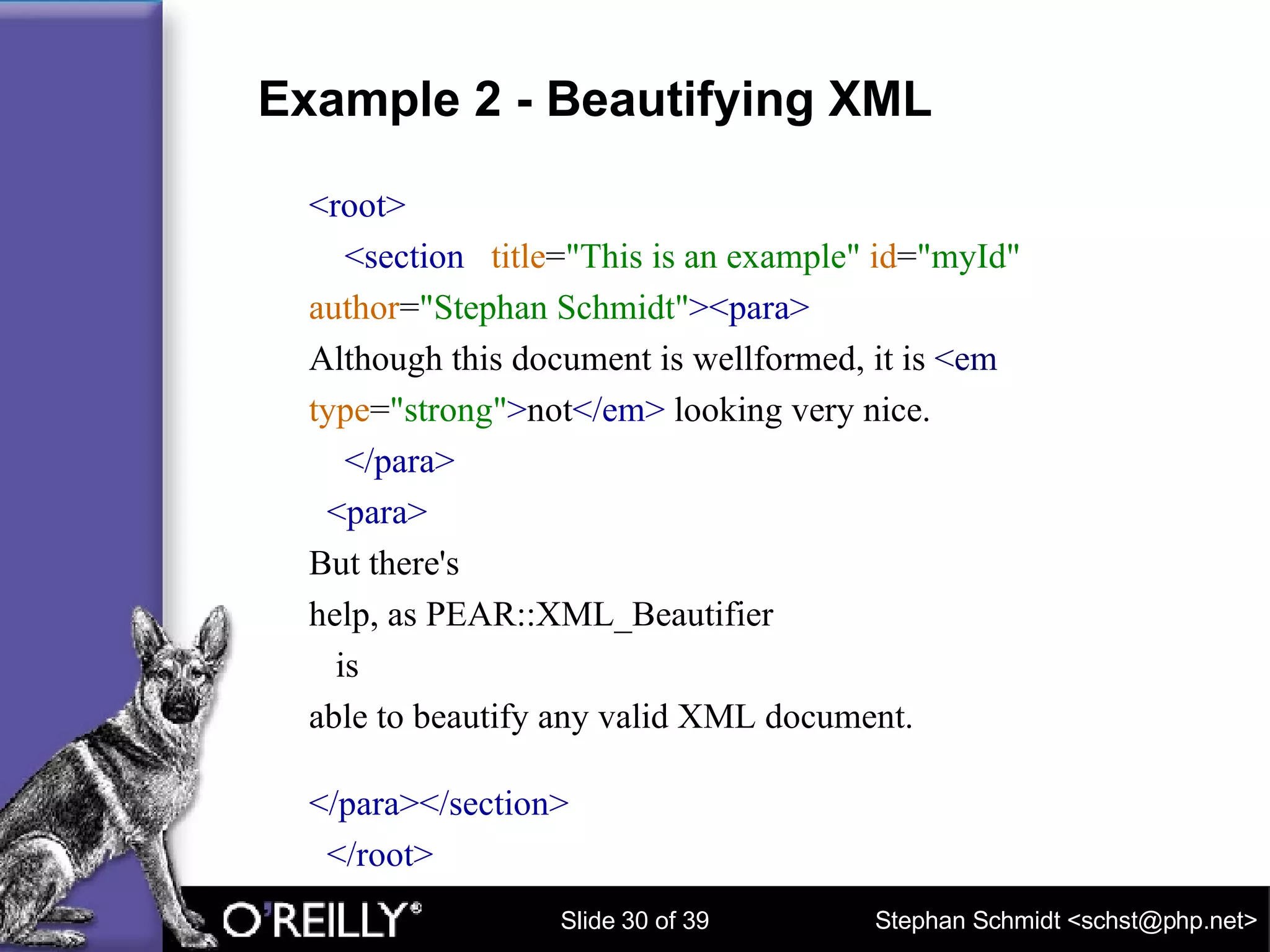
Example 2 - Beautifying XML <root> <section   title = &quot;This is an example&quot;   id = &quot;myId&quot; author = &quot;Stephan Schmidt&quot; ><para> Although this document is wellformed, it is  <em  type = &quot;strong&quot; > not </em>   looking very nice. </para> <para> But there's help, as PEAR::XML_Beautifier is able to beautify any valid XML document. </para></section> </root>
Example 2 - Beautifying XML <?PHP require_once  'XML/Beautifier.php' ; $fmt  = & new  XML_Beautifier(); $result  =  $fmt ->formatFile( 'example1.xml', 'result.xml' ); if  (PEAR::isError( $result )) { echo   $result ->getMessage(); exit (); } ?>
Example 2 - Beautifying XML <root> <section  author = &quot;Stephan Schmidt&quot;   id = &quot;myId&quot;   title = &quot;This is an example&quot; > <para> Although this document is wellformed, it is <em   type = &quot;strong&quot; > not </em> looking very nice. </para> <para> But there&apos;s help, as … valid XML document. </para> </section> </root>
Other interesting PEAR packages phpDocumentor, a tool for generating API documentation from JavaDoc-style inline comments SOAP, complete client and server SOAP library PHPUnit, framework for Unit tests Spreadsheet_Excel_Writer, excel spreadsheet generator without any need for external libraries File_PDF, PDF generator without any need for external libraries XML_Serializer, allround XML reader/writer
Who is using PEAR? Horde (Framework) TikiWiki (Wiki application) S9Y (Weblog application) Savant (Template engine) Seagull PHP Framework (Framework) patUser (PHP Application Tools) YAWP (Application framework) Yawiki (Wiki application) A lot of commercial applications
Contributing to PEAR There are several ways to contribute: By submitting bug reports or patches By translating the documentation By contributing to the documentation By creating new packages
Including new packages Make sure that the functionality is not in PEAR already Make sure you follow the PEAR coding styles and naming standards Make sourcecode, examples and docs available Propose the package in PEPr Discuss your proposal on pear-dev Call for votes Register your package Upload release
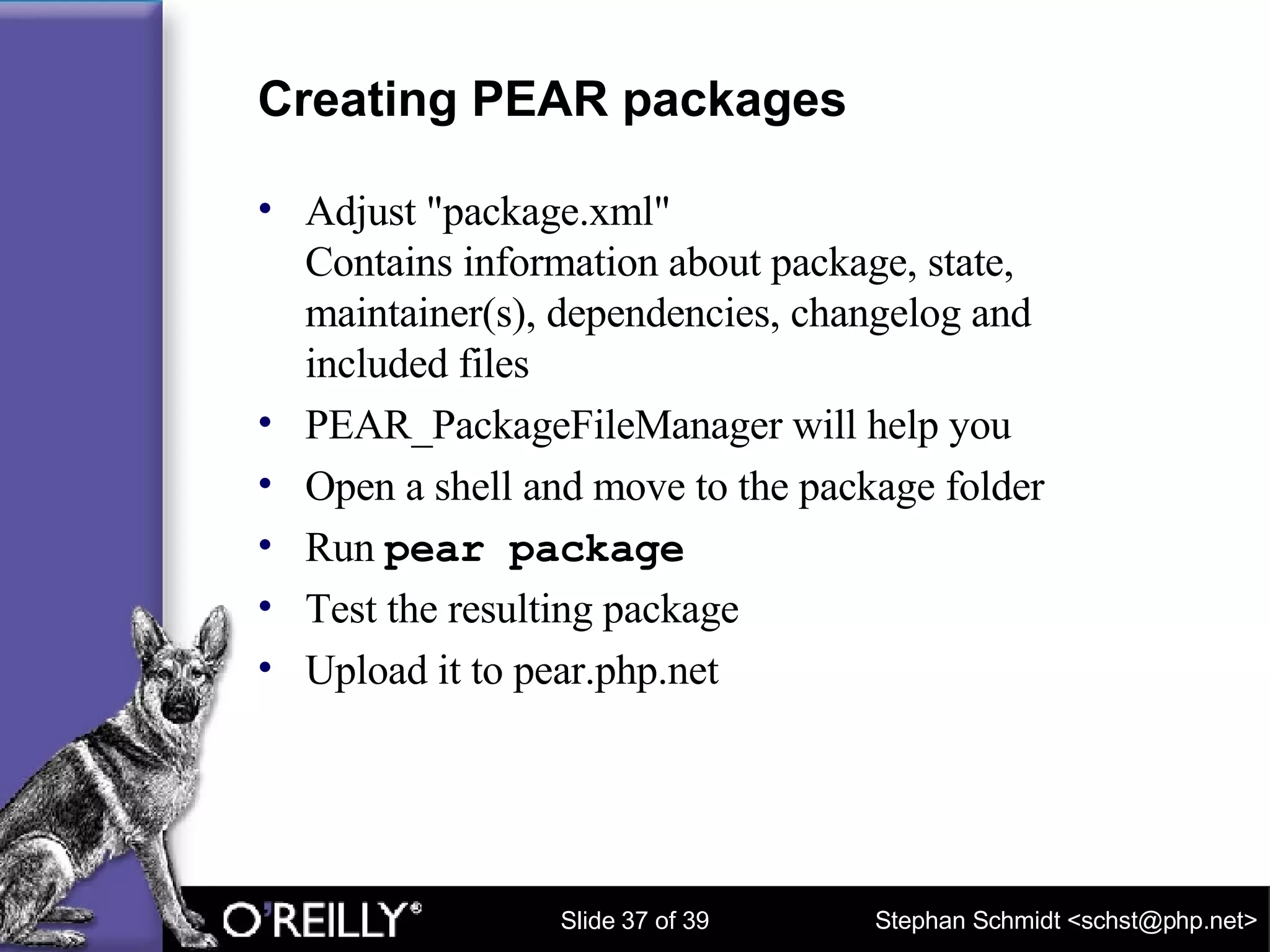
Creating PEAR packages Adjust &quot;package.xml&quot; Contains information about package, state, maintainer(s), dependencies, changelog and included files PEAR_PackageFileManager will help you Open a shell and move to the package folder Run  pear package Test the resulting package Upload it to pear.php.net
The Future of PEAR Channel support Allows you to distribute your own application using PEAR by providing a package server Better support for PHP5 Improved error handling Interfaces Exceptions Improved Quality Assurance
Thank you! Thanks for your attention, feel free to ask any questions now. Links: http://www.php-tools.net  (the slides) http://pear.php.net http://pecl.php.net [email_address]
 

PEAR For The Masses

  • 1.
    PEAR for themasses Stephan Schmidt Metrix Internet Design GmbH, Germany O’Reilly Open Source Convention July 26–30, 2004
  • 2.
    Agenda About theSpeaker What is PEAR The Website Obtaining and Installing PEAR The PEAR Community Using PEAR Components Contributing to PEAR The Future of PEAR
  • 3.
    About the speakerWorking for Metrix Internet Design GmbH in Karlsruhe, Germany PHP since version 3 Co-founder of PHP Application Tools (www.php-tools.net) Member of the PEAR QA-Core Team Active Contributor to PEAR (Lead developer of 11 packages) Working on C-Extensions for PHP Regular speaker at conferences and author for various magazines
  • 4.
    What is PEAR?Of course, but also…
  • 5.
    What is PEAR?PEAR is short for P HP E xtension and A pplication R epository, and was founded in 1999 by Stig S. Bakken. PEAR is several things: A structured library of open-source code for PHP developers. The PEAR website The PEAR Community and Mailinglists The PEAR installer
  • 6.
    The Code LibraryOrganized in Categories (Database, File Formats, HTTP, Images, XML, …) Categories contain Packages (HTTP_Client, MP3_ID, XML_Parser, …) Packages are separate projects with their own development team, release cycle and documentation Relations between packages solved by dependencies (HTTP_Client needs HTTP_Request)
  • 7.
    PEAR packages Currentlymore than 230 packages are available Packages contain PHP Files (mostly OOP-Code) Examples Unit Tests (either phpt or PHP_Unit) Documentation (in plain text) Releases have a state (devel, alpha, beta, stable) to indicate the maturity of the package All packages and releases are stored in one central database at pearweb. Based on open licenses like the PHP or LGPL licenses (no GPL allowed)
  • 8.
    What is PEAR?PEAR is short for P HP E xtension and A pplication R epository, and was founded in 1999 by Stig S. Bakken. PEAR is several things: A structured library of open-source code for PHP developers. The PEAR website The PEAR Community and Mailinglists The PEAR installer
  • 9.
  • 10.
    The PEAR Website(2) Allows users to browse categories and packages using the package browser Provides information about each package Short description Maintainers List of releases Changelog Auto-generated API documentation Each release may be downloaded as a TGZ archive
  • 11.
    The PEAR Website(3) The Website also provides: Online documentation (mainly English, some translations) Downloadable documentation Bug Tracking System Account list to browse all developers Possibility to contact each maintainer using an HTML form Support resources (links to mailing list archives and tutorials)
  • 12.
    The PEAR Websitefor Developers Developer features of the website include: Online proposal system for new packages (PEPr) Registering new packages Uploading new releases Editing package information and maintainers The PEAR Website will promote new packages by announcing them on the website and mailing list.
  • 13.
    Interlude: What isPECL? P HP E xtension C ommunity L ibrary Sister project of PEAR for C Extensions Uses the PEAR infrastructure and installer Governed by King Wez (Furlong) Official repository for PHP Extensions Long term plan includes moving all PHP Extensions from the source tree to PECL to allow separate release cycles
  • 14.
    What is PEAR?PEAR is short for P HP E xtension and A pplication R epository, and was founded in 1999 by Stig S. Bakken. PEAR is several things: A structured library of open-source code for PHP developers. The PEAR website The PEAR Community and Mailinglists The PEAR installer
  • 15.
    PEAR Community Nostrict hierarchy All developers vote on important decisions Mailinglists for all institutions [email_address] [email_address] [email_address] PEAR Group 7 developers Developers Quality Assurance Team Doc Team Website Team
  • 16.
    PEAR Quality AssuranceEnsures high quality of PEAR by enforcing several rules Code must conform to coding standards intuitive API packages should be designed with extensibility in mind visibility of properties and methods No backward compatibility breaks allowed in the same major version Unit tests and documentation are requirements Improved code by peer review
  • 17.
    What is PEAR?PEAR is short for P HP E xtension and A pplication R epository, and was founded in 1999 by Stig S. Bakken. PEAR is several things: A structured library of open-source code for PHP developers. The PEAR website The PEAR Community and Mailinglists The PEAR installer
  • 18.
    The PEAR InstallerPEAR is installed by default since PHP4.3 If not installed, use http://go-pear.org (interactive script that installs all required components) Various frontends are available Command Line Interface (default) Webinterface GTK Frontend All frontends provide the same commands
  • 19.
  • 20.
  • 21.
    PEAR Installer FeaturesDownloads and installs PEAR packages and C Extensions Creates packages that can be uploaded at the PEAR Website Automatically checks dependencies on other packages, PHP version and PHP extensions Only installs and upgrades packages of your preferred state (stable, beta, alpha, devel) Can create and install third-party packages
  • 22.
    PEAR Installer commands$ pear install <packagename> downloads and installs the package $ pear uninstall <packagename> uninstalls the package $ pear list lists all installed packages $ pear list-upgrades lists packages that have new versions $ pear config-show displays installer configuration … plus some more commands, mainly for developers
  • 23.
    PEAR Installer internalsUses XML-RPC to communicate with the PEAR Website Downloads the tgz archive of a package The package.xml file describes the content of the package as well as any dependencies on other packages Extracts all needed files to your local PEAR installation folders and stores information in the PEAR registry Currently being refactored by Greg Beaver
  • 24.
    Shared Hosts PEARmostly not installed No shell access Manual installation of PEAR All packages contain standard PHP code Download tar.gz from website Unpack Upload to shared host Set include path (.htaccess or ini_set())
  • 25.
    PEAR Filesystem StructureAll files are stored in one directory on your server Can be set using pear config-set (defaults to /usr/share/pear) Should not be in your webroot Add it to your include path Classnames map to directory structure: HTTP_Request class is in /usr/share/pear/HTTP/Request.php Special folders for tests and docs: /usr/share/pear/tests/XML_Parser/ /usr/share/pear/docs/HTTP_Server
  • 26.
    Using PEAR packagesClasses may be included by using <?PHP require_once 'HTTP/Request.php' ; ?> A lot of packages use a driver based architecture: <?PHP require_once 'DB.php' ; $dbh = DB::connect( 'mysql://user:pass@host' ); ?> Unified error handling in all packages using PEAR_Error
  • 27.
    PEAR error handlingErrors are instances of PEAR_Error that contain Error message and optional code function backtrace to help with debugging Error handling can be set globally or for single instances print the message die on error trigger PHP error handle it using a callback Will be replaced with PEAR_ErrorStack and/or exceptions in PHP5
  • 28.
    Example 1 -Database abstraction <?php require_once 'DB.php'; $db =&DB::connect( 'mysql://usr:pw@localhost/dbnam' ); if (DB::isError( $db )) { die ( $db ->getMessage()); } $res =& $db ->query( 'SELECT * FROM mytable' ); while ( $row = $res ->fetchRow()) { echo $row [0] . &quot;\n&quot; ; } ?>
  • 29.
    Example 1 -Database abstraction Advantages of using PEAR::DB Easy switching between several database backends (currently 13 database types are supported) Very intuitive to use Errors can be checked with DB::isError( $foo ) Improves compatibility between databases by lowercasing fieldnames, trimming return values, etc. Emulates prepare/execute for databases that do not support this natively
  • 30.
    Example 2 -Beautifying XML <root> <section title = &quot;This is an example&quot; id = &quot;myId&quot; author = &quot;Stephan Schmidt&quot; ><para> Although this document is wellformed, it is <em type = &quot;strong&quot; > not </em> looking very nice. </para> <para> But there's help, as PEAR::XML_Beautifier is able to beautify any valid XML document. </para></section> </root>
  • 31.
    Example 2 -Beautifying XML <?PHP require_once 'XML/Beautifier.php' ; $fmt = & new XML_Beautifier(); $result = $fmt ->formatFile( 'example1.xml', 'result.xml' ); if (PEAR::isError( $result )) { echo $result ->getMessage(); exit (); } ?>
  • 32.
    Example 2 -Beautifying XML <root> <section author = &quot;Stephan Schmidt&quot; id = &quot;myId&quot; title = &quot;This is an example&quot; > <para> Although this document is wellformed, it is <em type = &quot;strong&quot; > not </em> looking very nice. </para> <para> But there&apos;s help, as … valid XML document. </para> </section> </root>
  • 33.
    Other interesting PEARpackages phpDocumentor, a tool for generating API documentation from JavaDoc-style inline comments SOAP, complete client and server SOAP library PHPUnit, framework for Unit tests Spreadsheet_Excel_Writer, excel spreadsheet generator without any need for external libraries File_PDF, PDF generator without any need for external libraries XML_Serializer, allround XML reader/writer
  • 34.
    Who is usingPEAR? Horde (Framework) TikiWiki (Wiki application) S9Y (Weblog application) Savant (Template engine) Seagull PHP Framework (Framework) patUser (PHP Application Tools) YAWP (Application framework) Yawiki (Wiki application) A lot of commercial applications
  • 35.
    Contributing to PEARThere are several ways to contribute: By submitting bug reports or patches By translating the documentation By contributing to the documentation By creating new packages
  • 36.
    Including new packagesMake sure that the functionality is not in PEAR already Make sure you follow the PEAR coding styles and naming standards Make sourcecode, examples and docs available Propose the package in PEPr Discuss your proposal on pear-dev Call for votes Register your package Upload release
  • 37.
    Creating PEAR packagesAdjust &quot;package.xml&quot; Contains information about package, state, maintainer(s), dependencies, changelog and included files PEAR_PackageFileManager will help you Open a shell and move to the package folder Run pear package Test the resulting package Upload it to pear.php.net
  • 38.
    The Future ofPEAR Channel support Allows you to distribute your own application using PEAR by providing a package server Better support for PHP5 Improved error handling Interfaces Exceptions Improved Quality Assurance
  • 39.
    Thank you! Thanksfor your attention, feel free to ask any questions now. Links: http://www.php-tools.net (the slides) http://pear.php.net http://pecl.php.net [email_address]
  • 40.