PHP 5.3 What's New, What's Hot Johannes Schlüter MySQL Engineering Connectors and Client Connectivity Sun Microsystems
PHP Roadmap
PHP 4 Photo: Patricia Hecht
PHP 5.2 Photo: Gabriele Kantel
PHP 5.3 Photo: Jamie Sanford
PHP 6 Photo:  G4Glenno (flickr)
New language (syntax) features in 5.3 Namespaces
Closures
Compile time constants
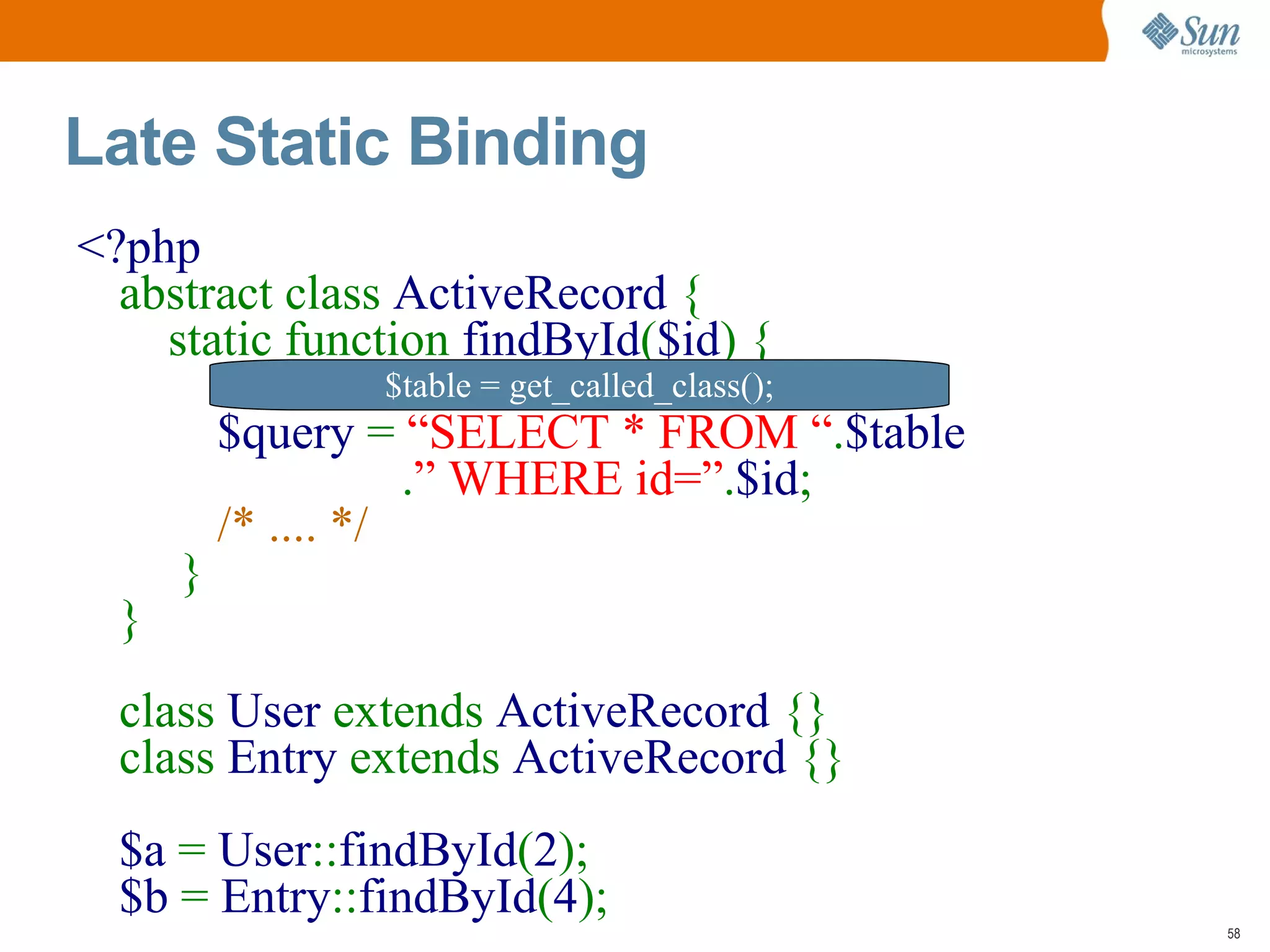
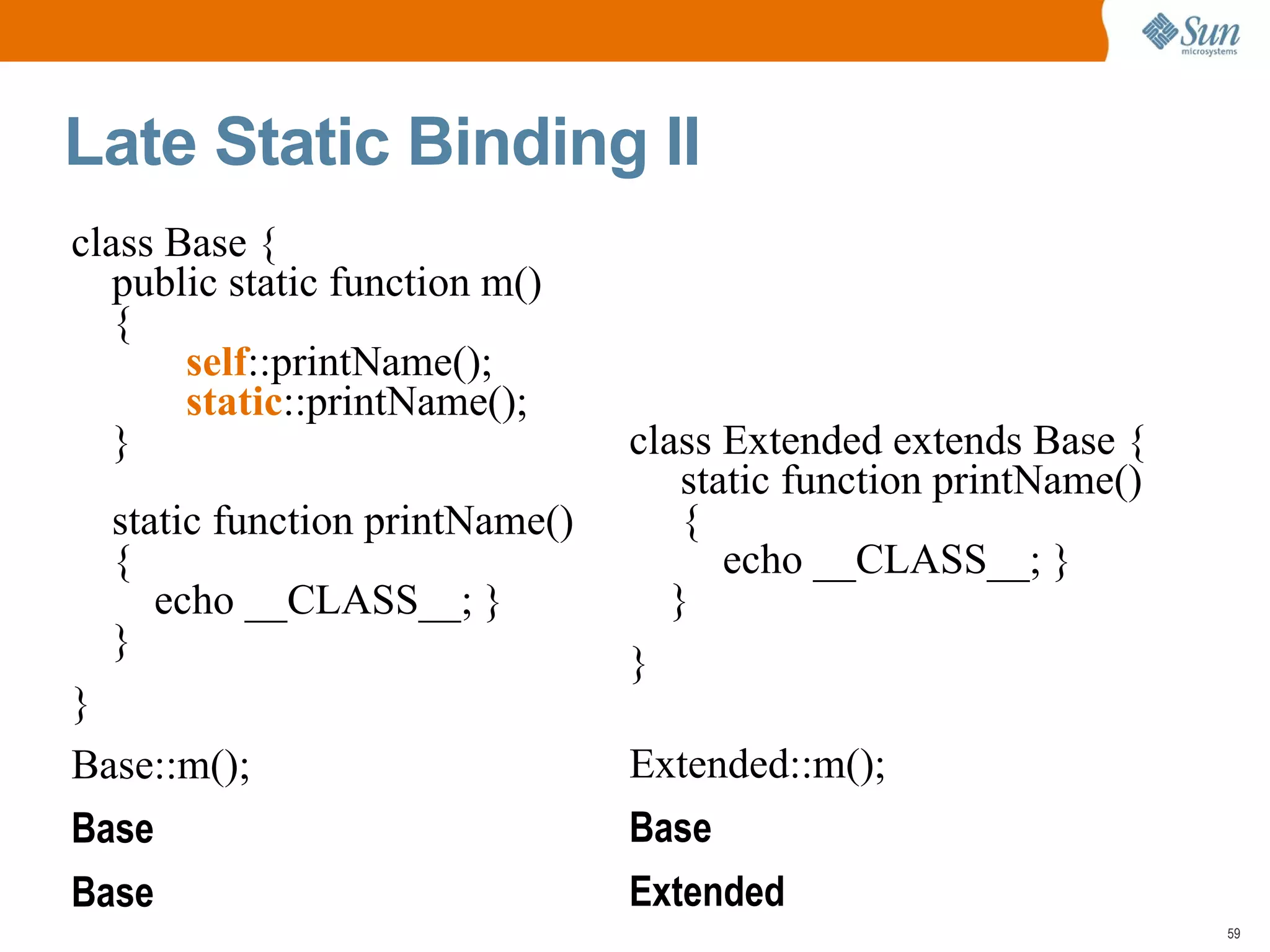
late static binding
New operators ?:
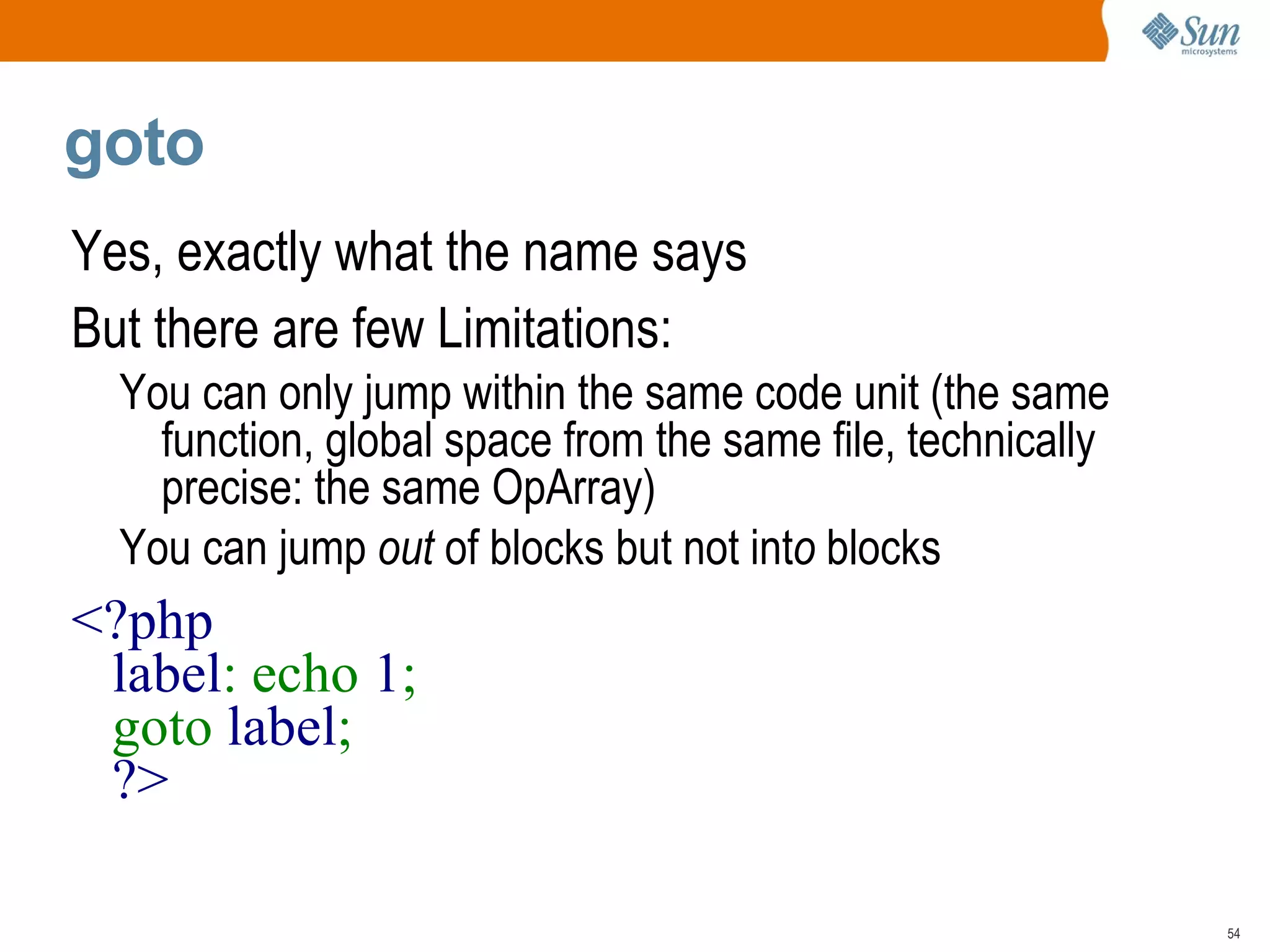
goto
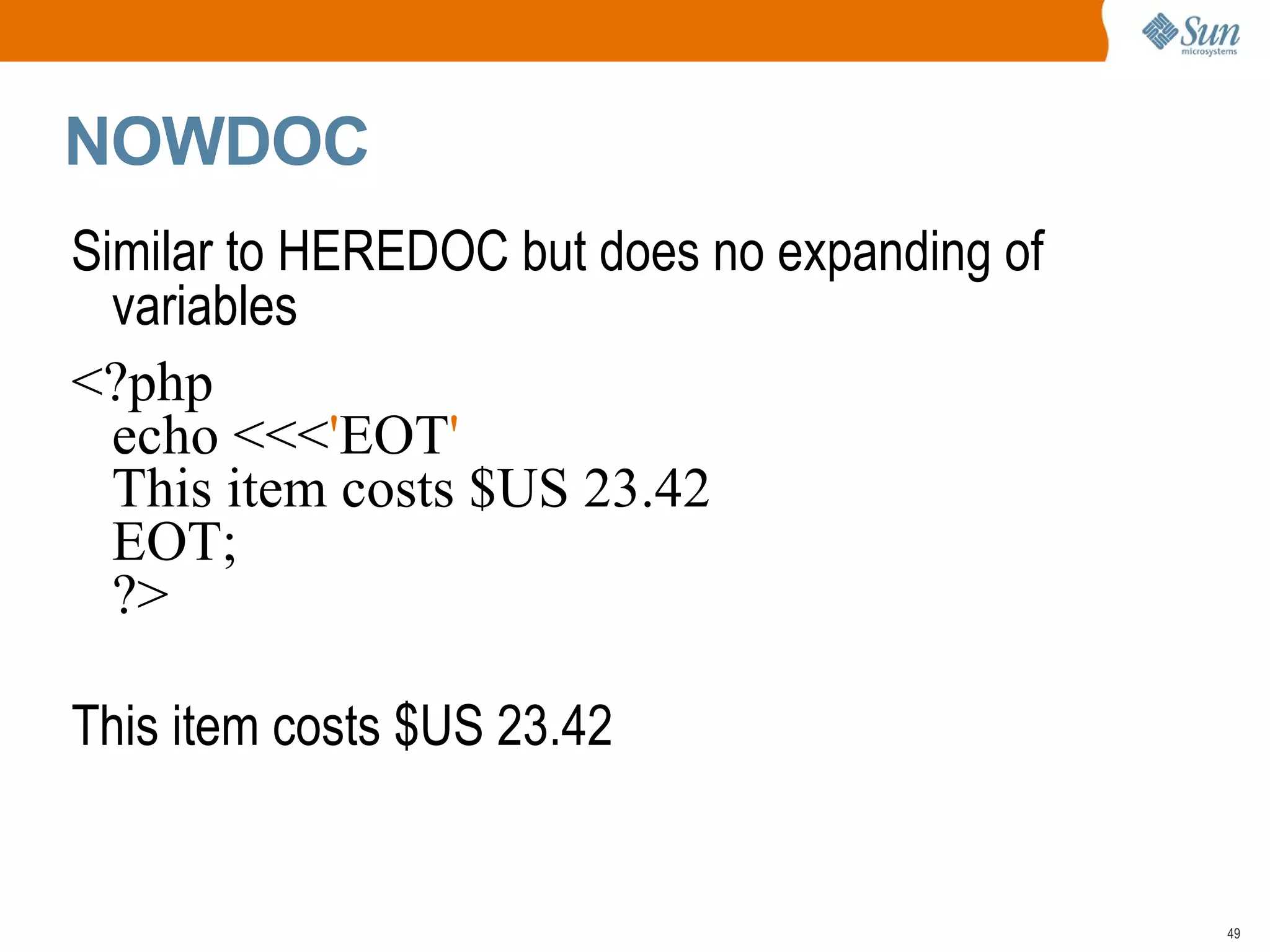
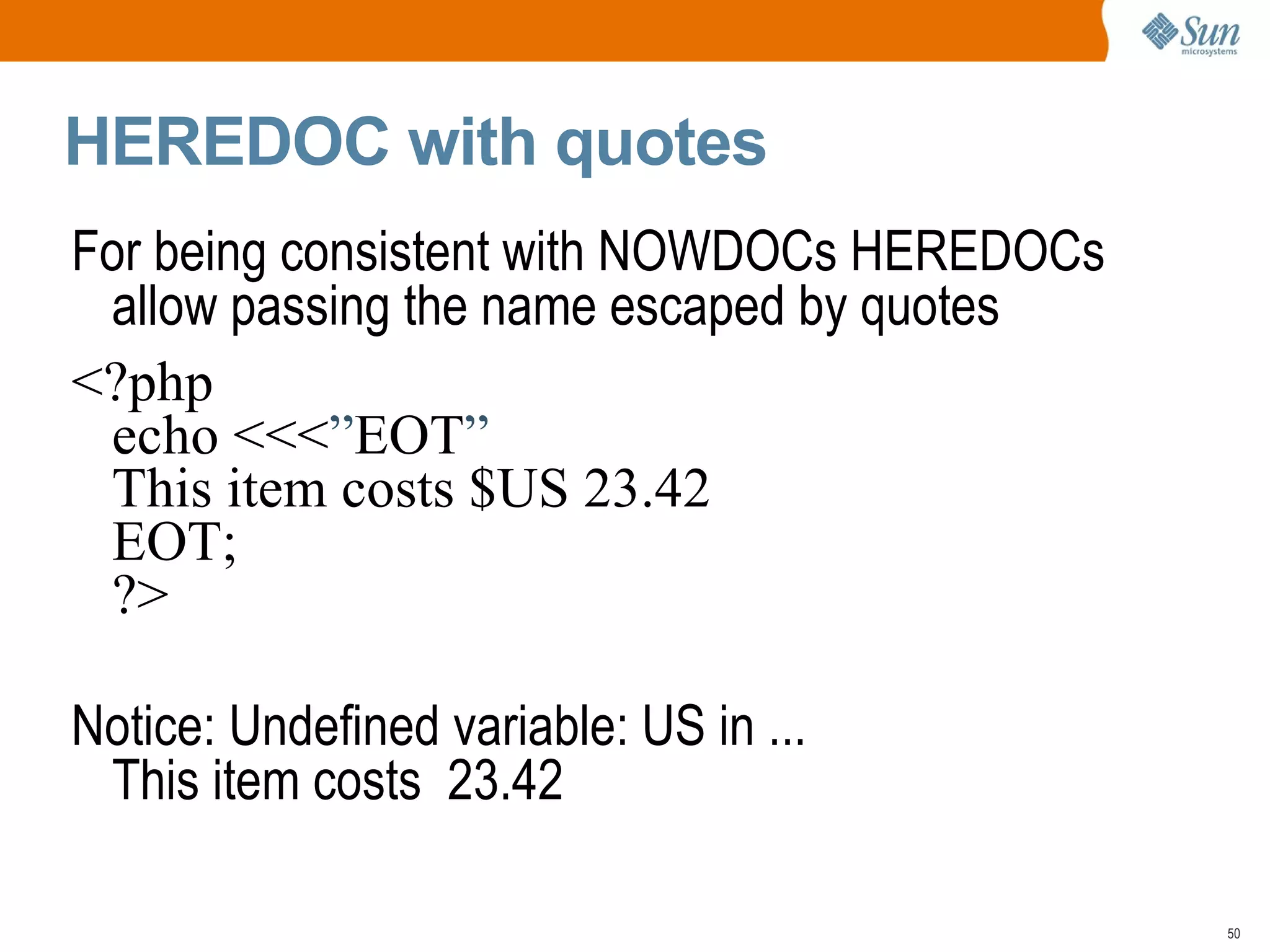
NOWDOC syntax, HEREDOC with quotes dynamic static calls
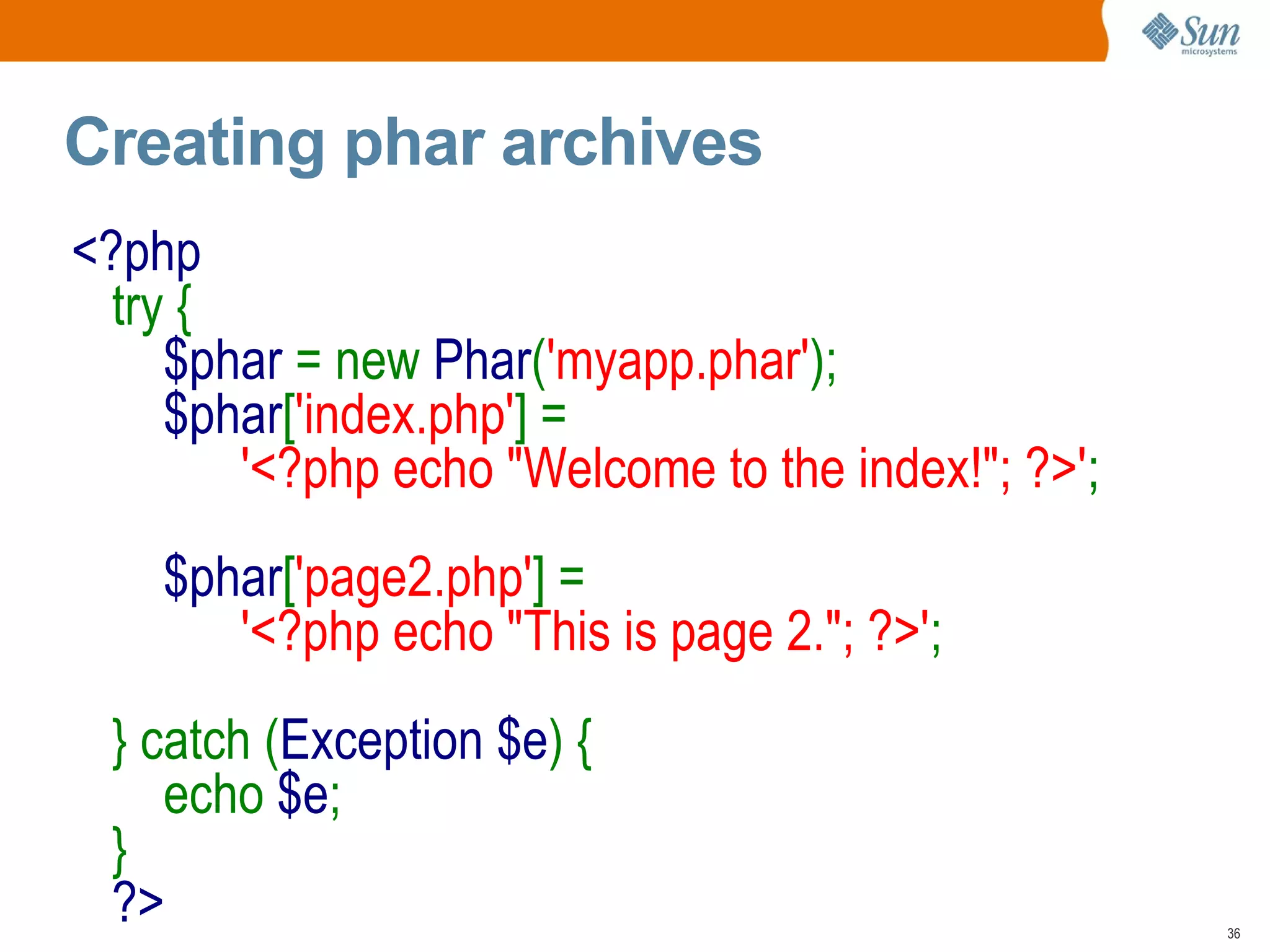
PHP 5.3 – New functionality Phar – PHP archives
New SQLite 3 Extension
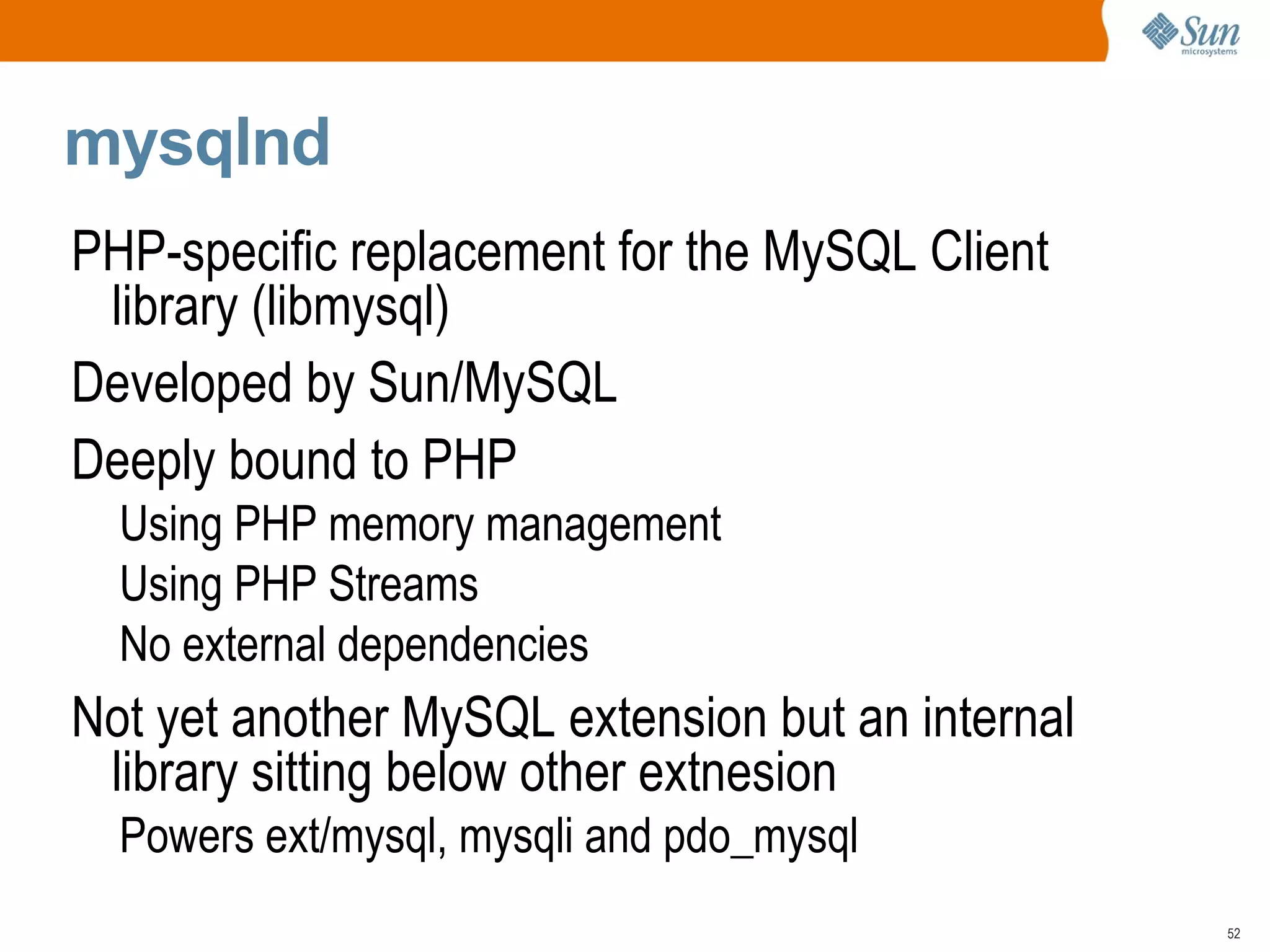
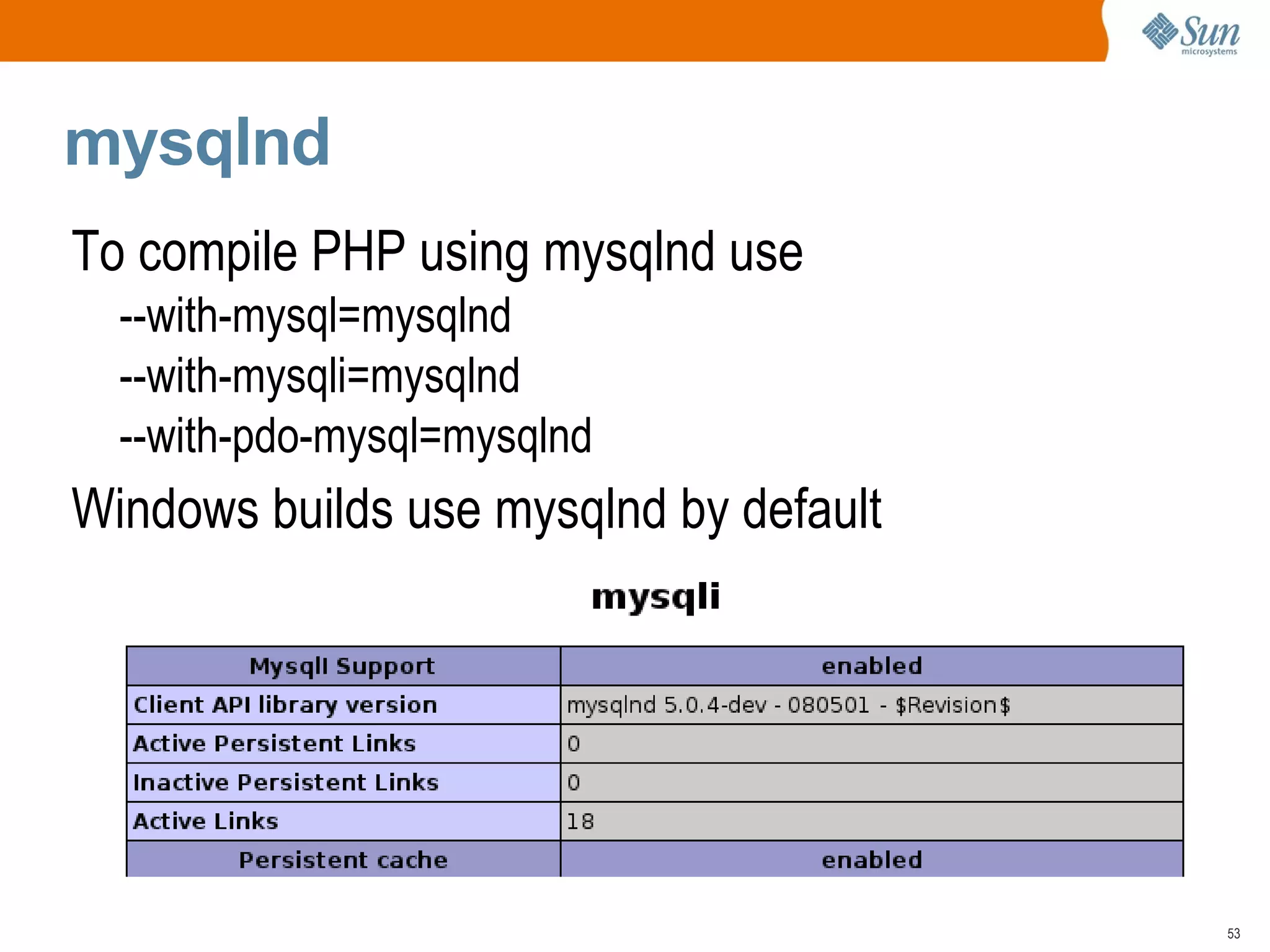
mysqlnd – MySQL native driver
New fileinfo extension
New intl extension
Improved Date support
Improved SPL functionality
Improved php.ini handling
E_DEPRECATED  error level
...
Namespaces
Namespaces – The Reasons Class names have to be unique per running script
PHP runtime developers tend to add class with generic names “ Date ” Class names  tend to be long MyFramework_Category_Helper_FooBar
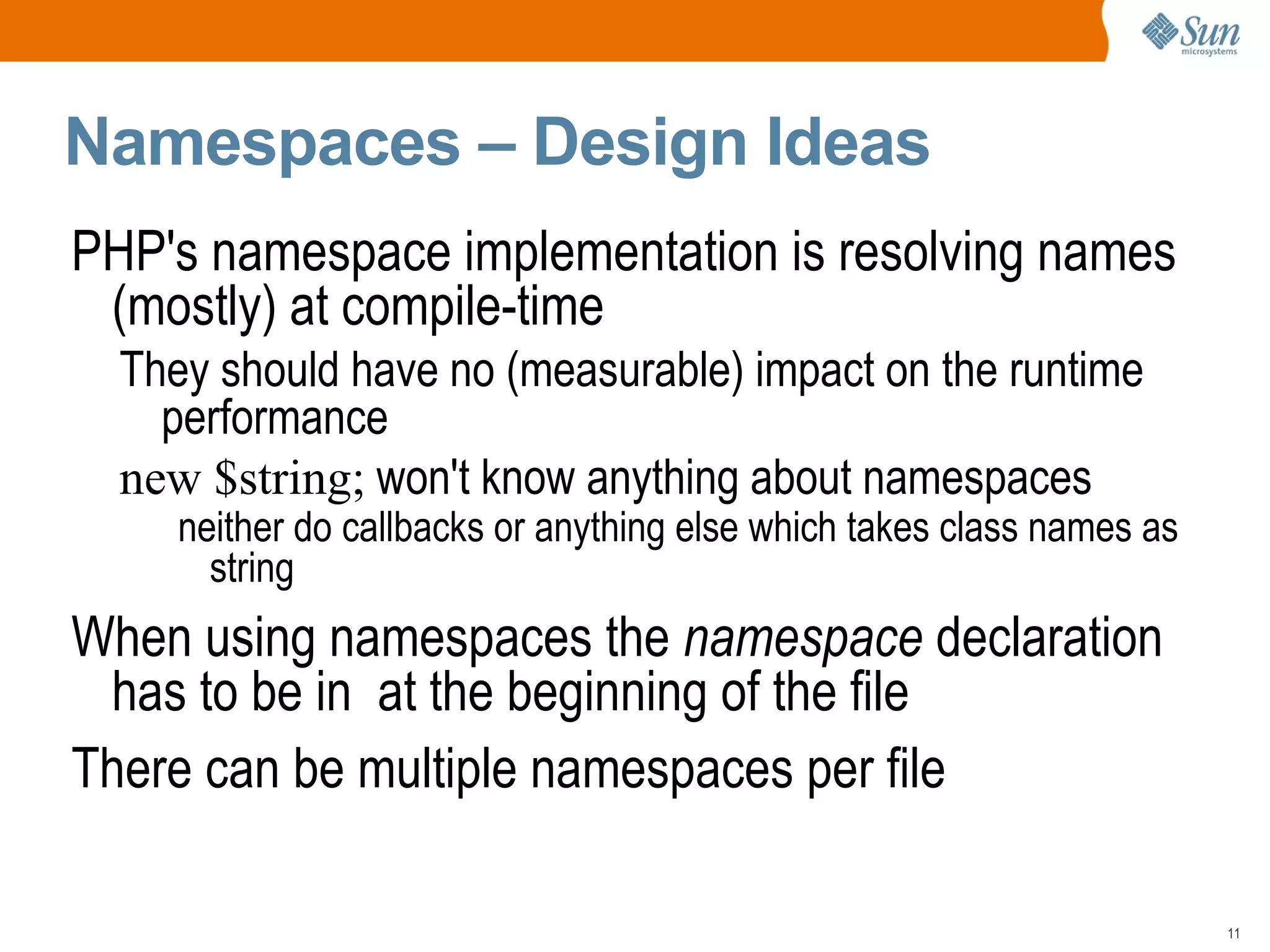
Namespaces – Design Ideas PHP's namespace implementation is resolving names (mostly) at compile-time They should have no (measurable) impact on the runtime performance
new $string;  won't know anything about namespaces neither do callbacks or anything else which takes class names as string When using namespaces the  namespace  declaration has to be in  at the beginning of the file
There can be multiple namespaces per file
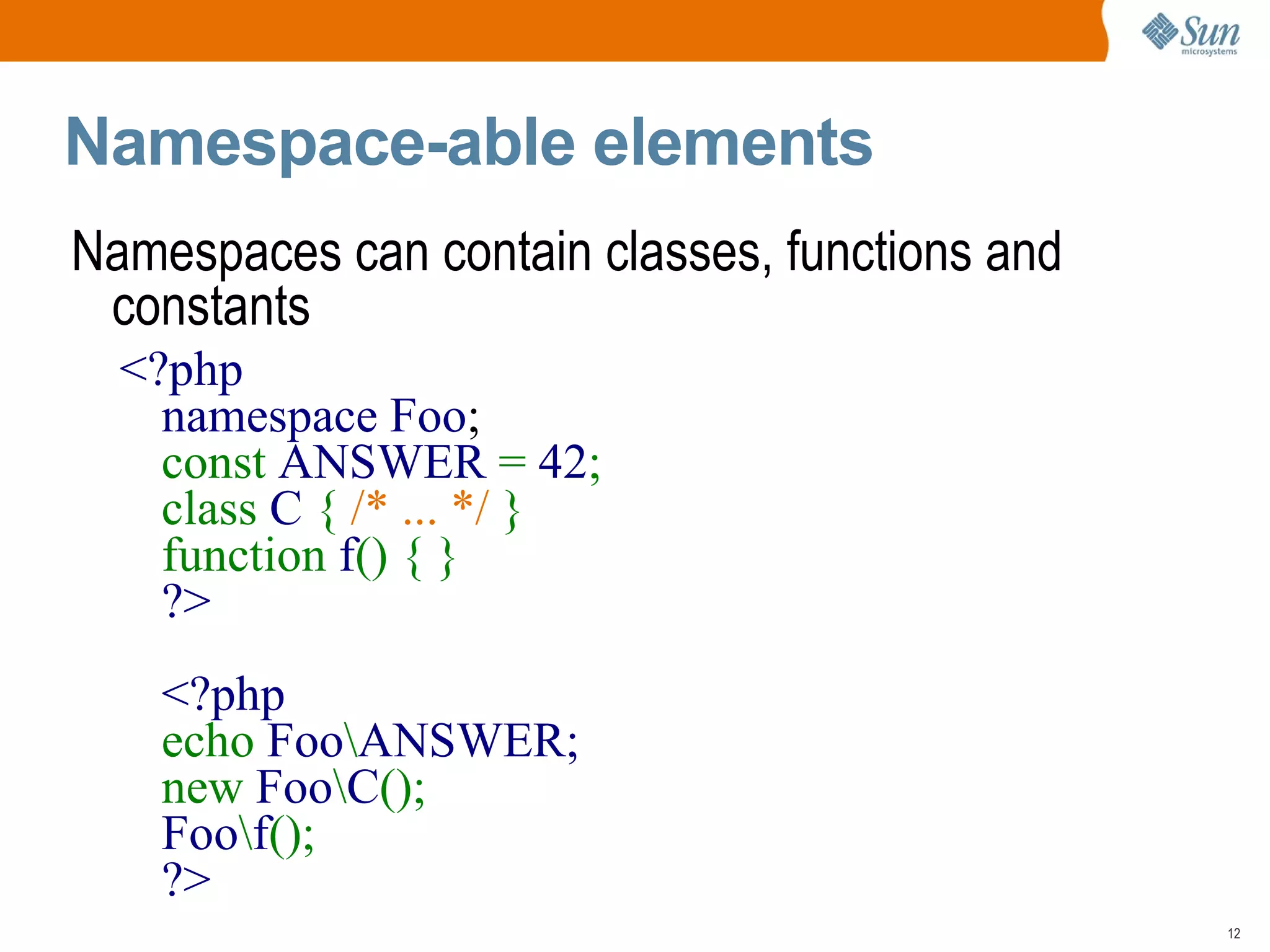
Namespace-able elements Namespaces can contain classes, functions and constants <?php namespace Foo ; const  ANSWER  =  42 ; class  C  {  /* ... */  } function  f () { } ?> <?php echo  Foo \ ANSWER; new  Foo \ C (); Foo \ f (); ?>
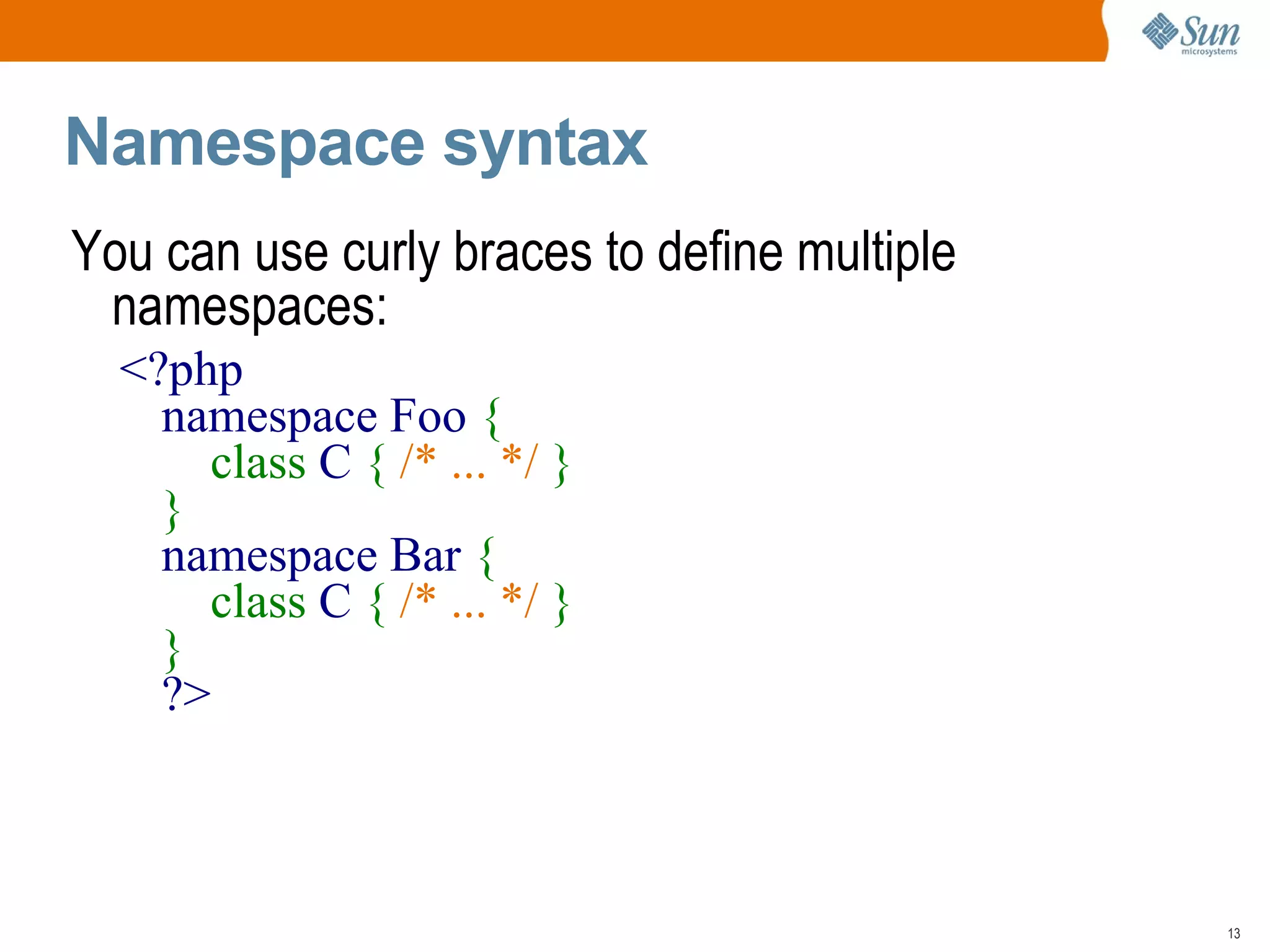
Namespace syntax You can use curly braces to define multiple namespaces: <?php namespace Foo  {   class  C  {  /* ... */  } } namespace Bar  {   class  C  {  /* ... */  } } ?>
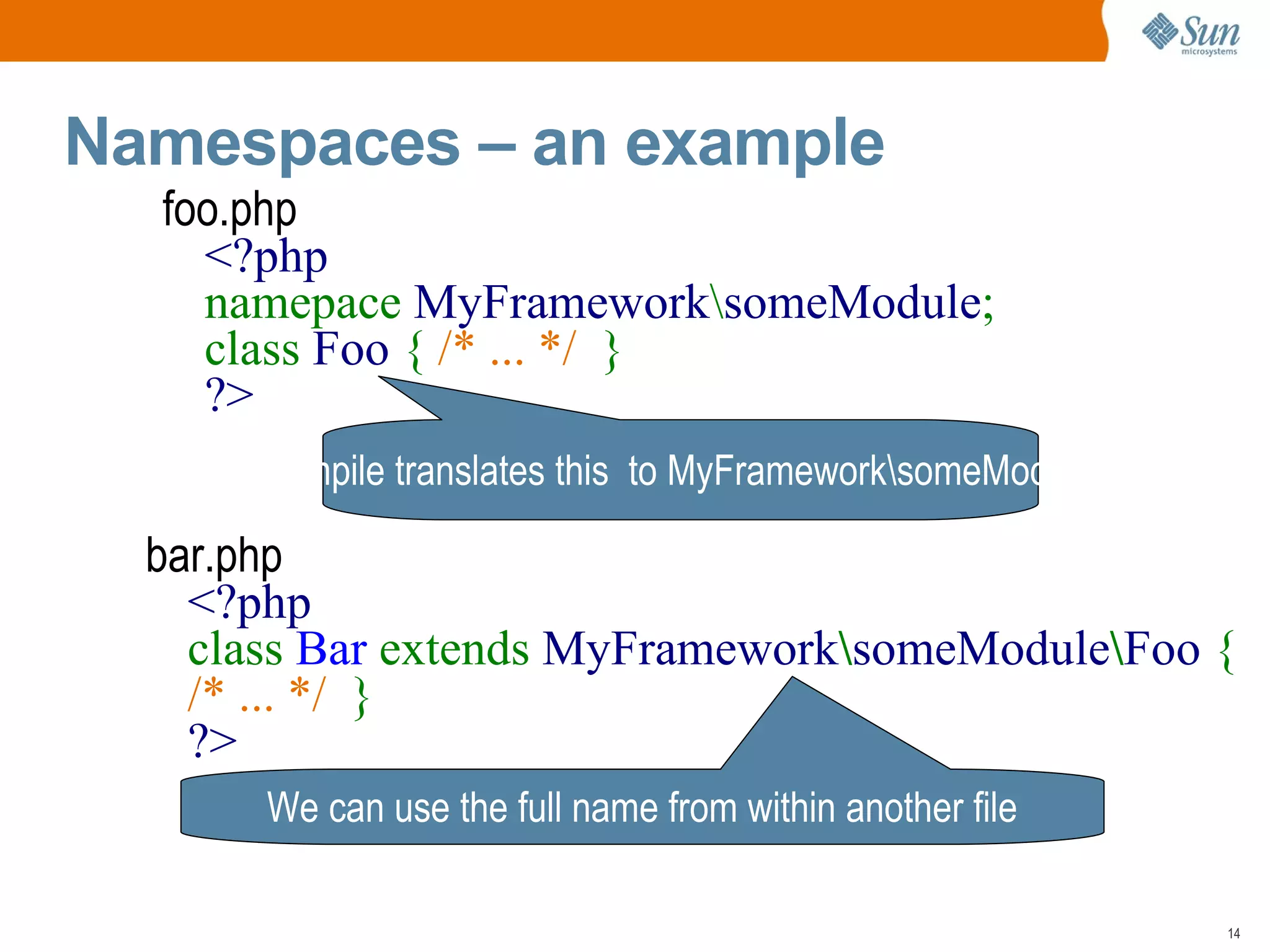
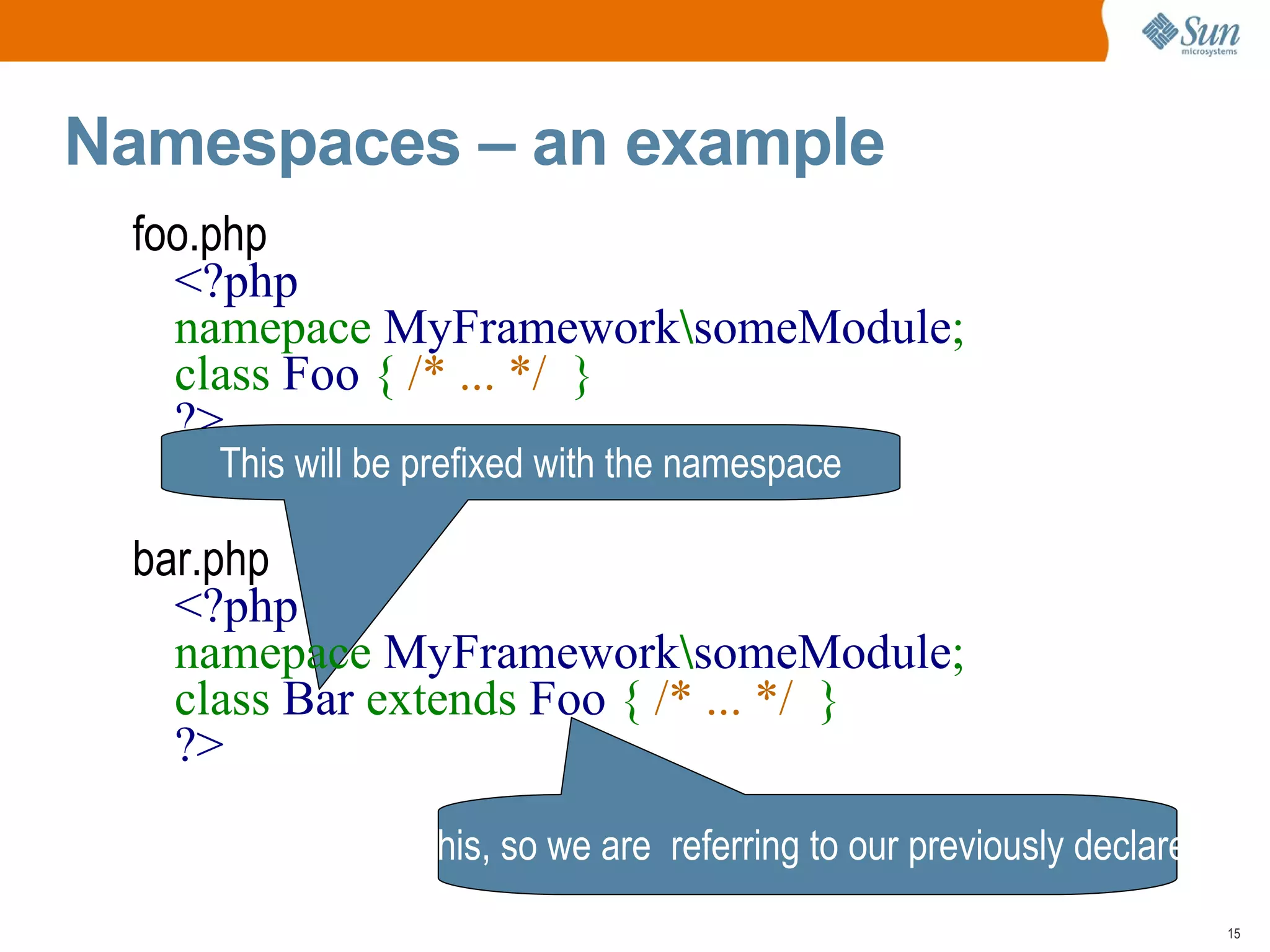
Namespaces – an example foo.php <?php namepace  MyFramework \ someModule ; class  Foo  {  /* ... */   } ?> bar.php <?php class  Bar  extends   MyFramework \ someModule \ Foo   {  /* ... */   } ?> The compile translates this  to MyFramework\someModule\Foo We can use the full name from within another file
Namespaces – an example foo.php <?php namepace  MyFramework \ someModule ; class  Foo  {  /* ... */   } ?> bar.php <?php namepace  MyFramework \ someModule ; class  Bar  extends  Foo  {  /* ... */   } ?> This will be prefixed with the namespace As will this, so we are  referring to our previously declared class
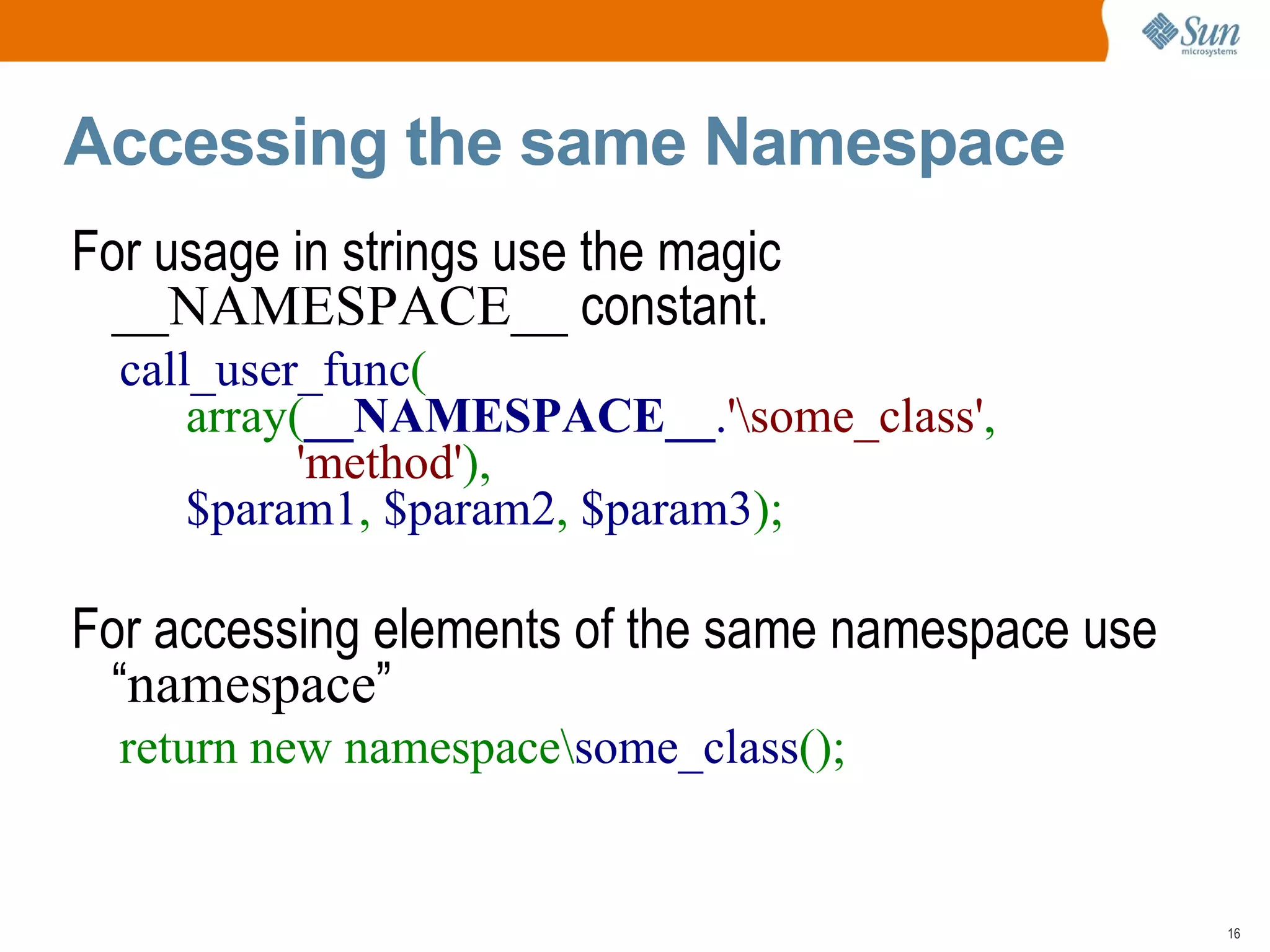
Accessing the same Namespace For usage in strings use the magic  __NAMESPACE__  constant. call_user_func (   array( __NAMESPACE__ . '\some_class' ,   'method' ),   $param1 ,  $param2 ,  $param3 ); For accessing elements of the same namespace use “ namespace ” return new namespace\ some_class ();
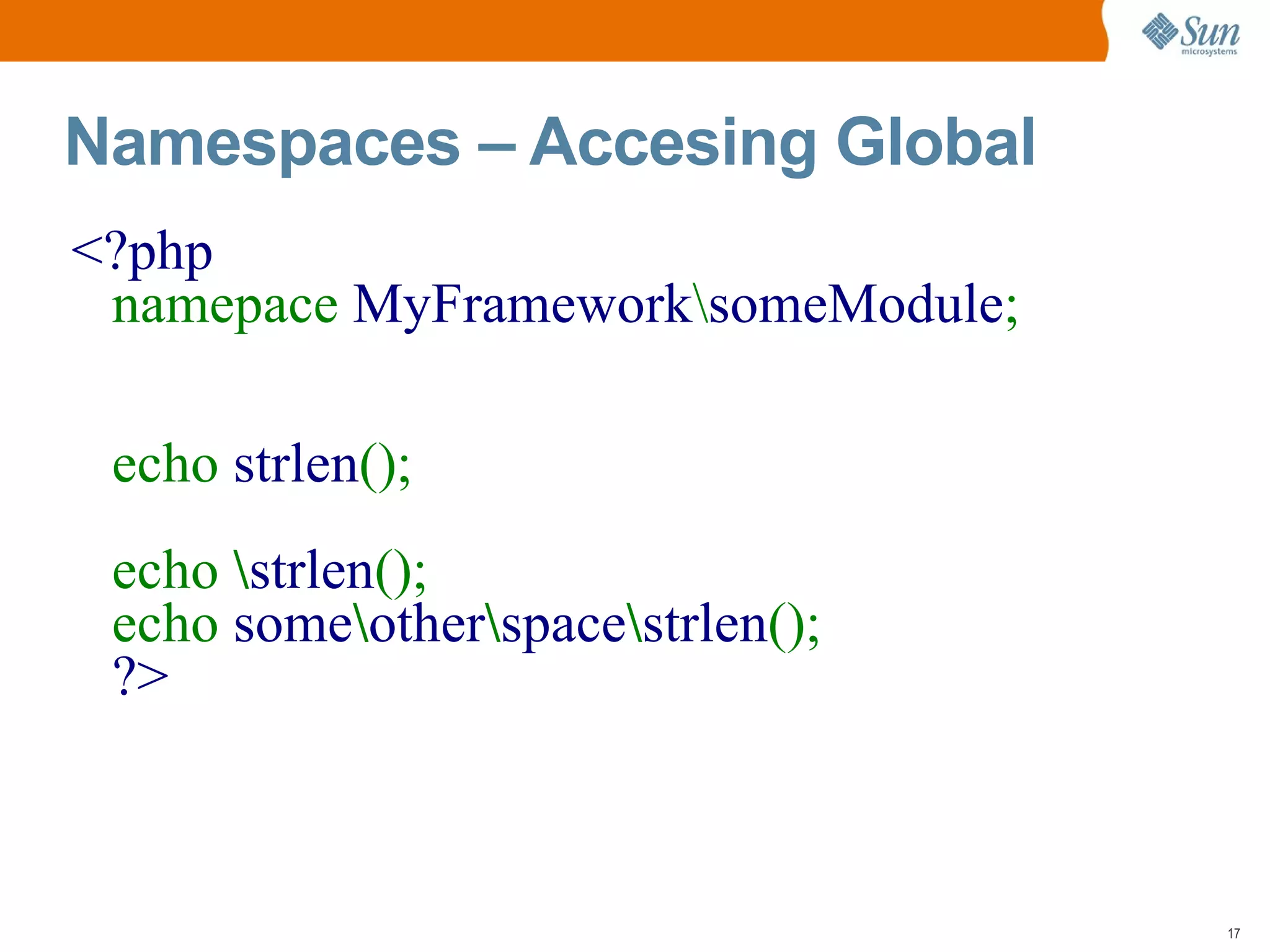
Namespaces – Accesing Global  <?php namepace  MyFramework \ someModule ; echo  strlen (); echo  \ strlen (); echo  some \ other \ space \ strlen (); ?>
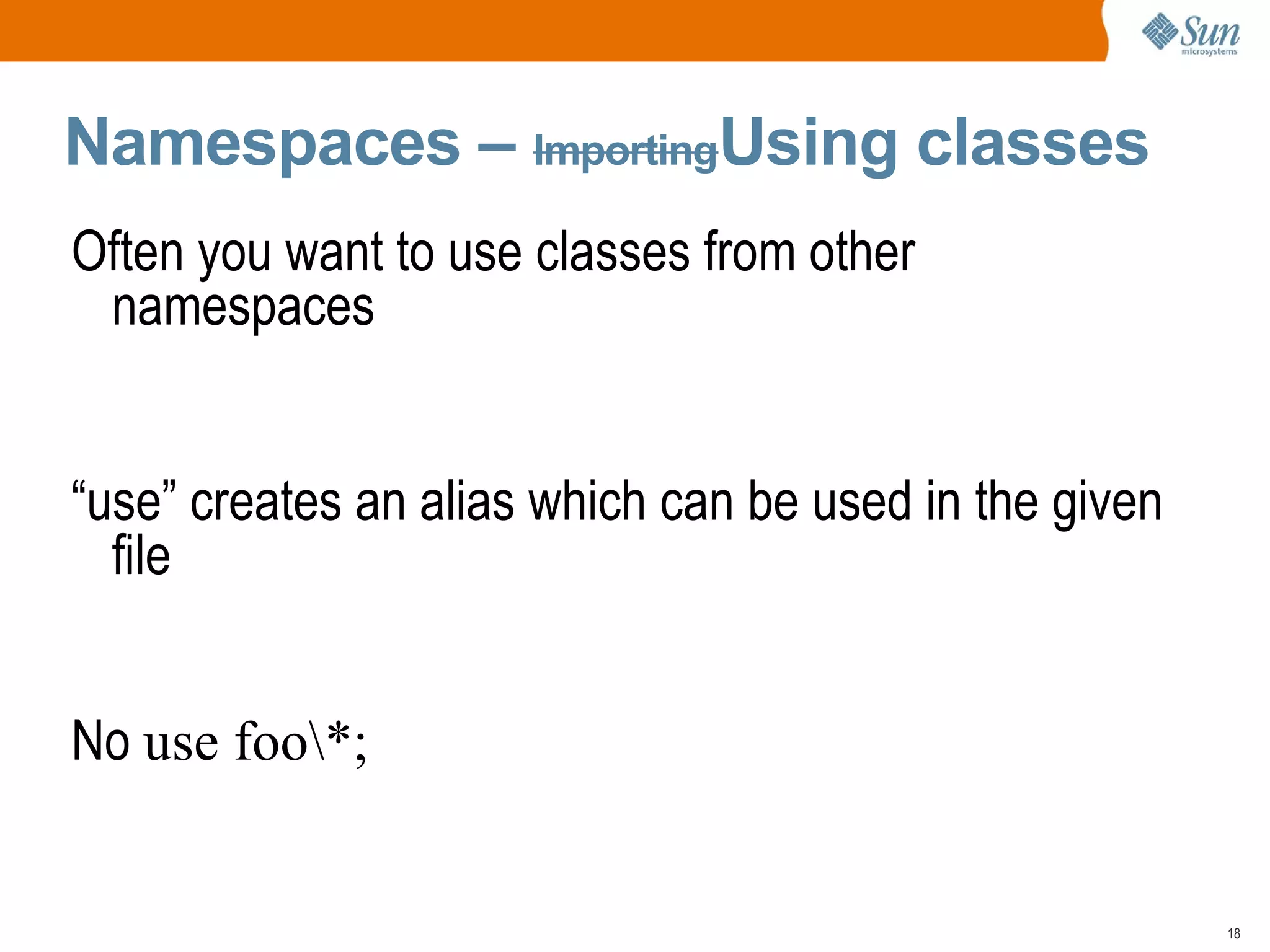
Namespaces –  Importing Using classes Often you want to use classes from other namespaces
“use” creates an alias which can be used in the given file
No  use foo\*;
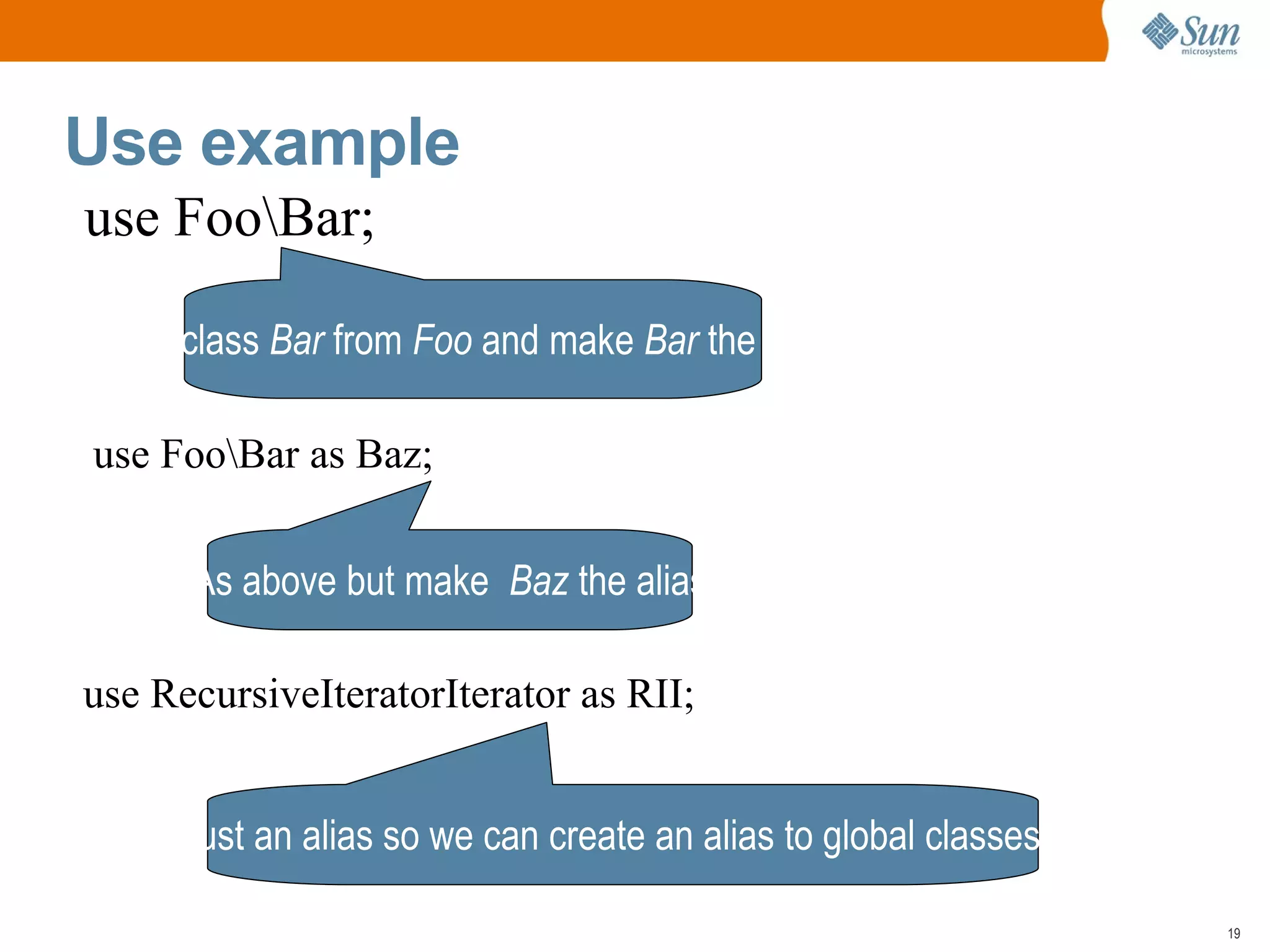
Use example use Foo\Bar; use Foo\Bar as Baz; use RecursiveIteratorIterator as RII; Use class  Bar  from  Foo  and make  Bar  the alias As above but make  Baz  the alias It's just an alias so we can create an alias to global classes, too
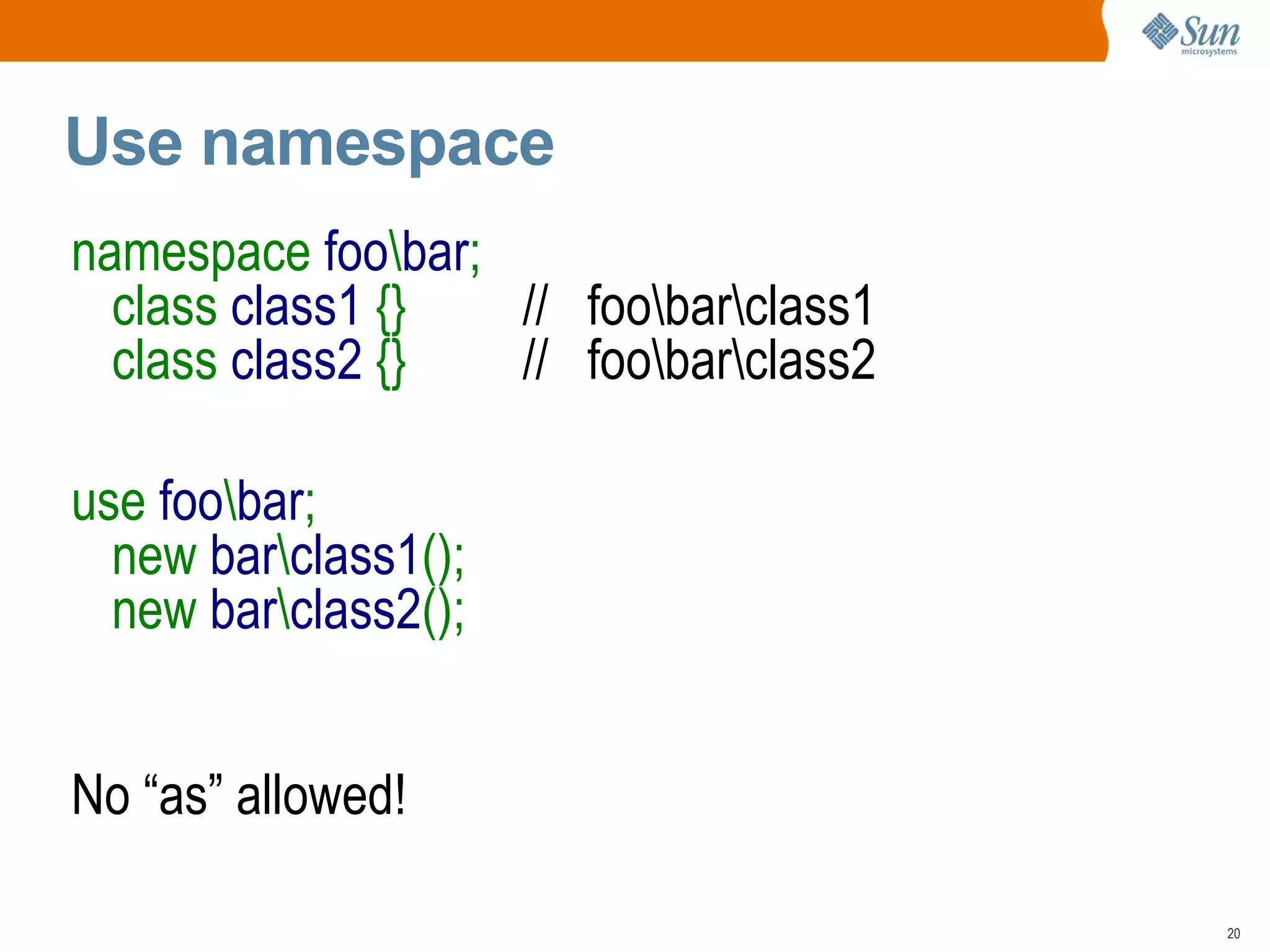
Use namespace namespace  foo \ bar ; class  class1  {}  //  foo\bar\class1 class  class2  {}  //  foo\bar\class2
use  foo \ bar ; new  bar \ class1 (); new  bar \ class2 ();
No “as” allowed!
Closures
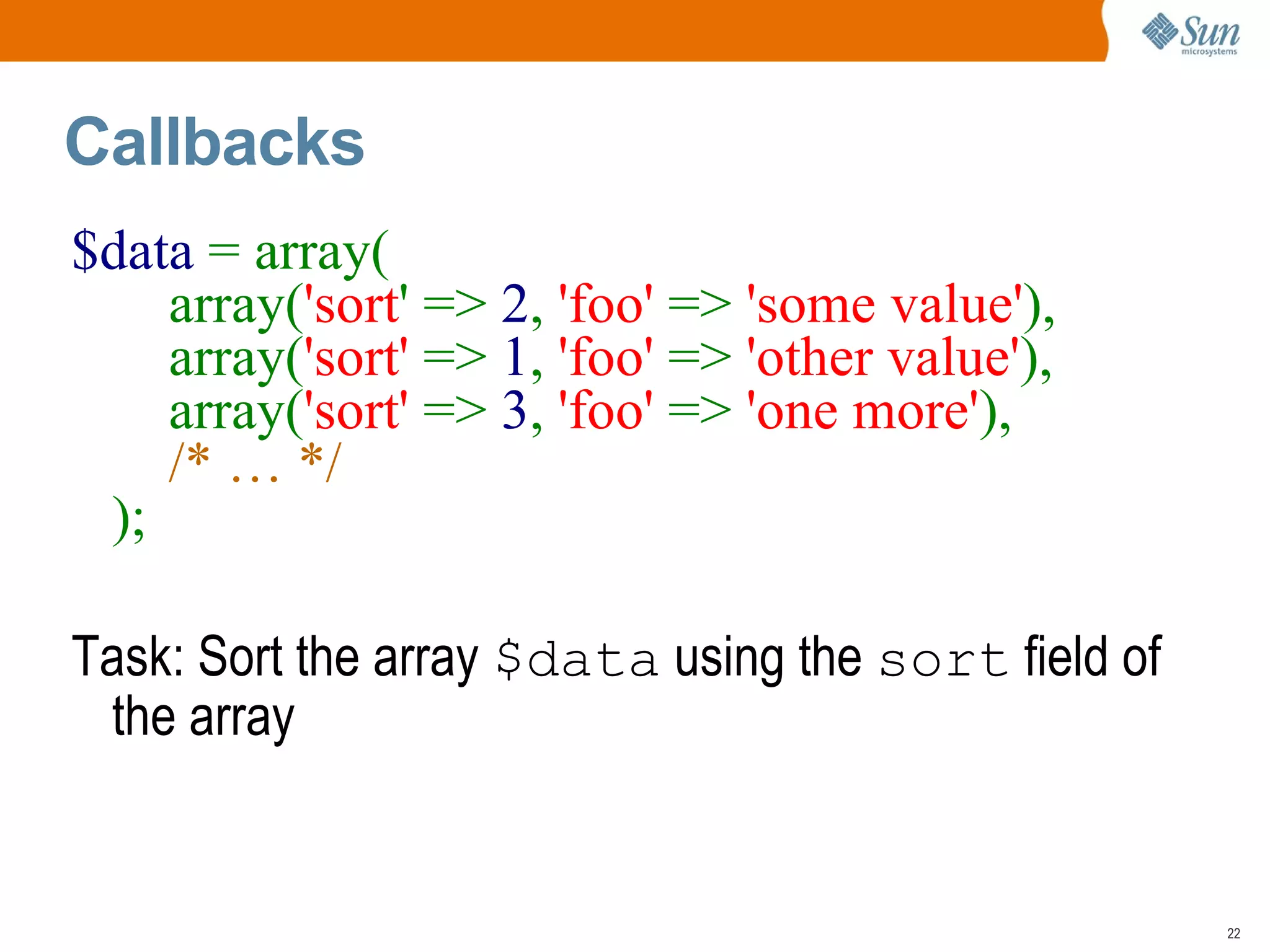
Callbacks $data  = array(   array( 'sort ' =>  2 ,  'foo'  =>  'some value' ),   array( 'sort'  =>  1 ,  'foo'  =>  'other value' ),   array( 'sort'  =>  3 ,  'foo'  =>  'one more' ),   /* … */ );
Task: Sort the array  $data  using the  sort  field of the array
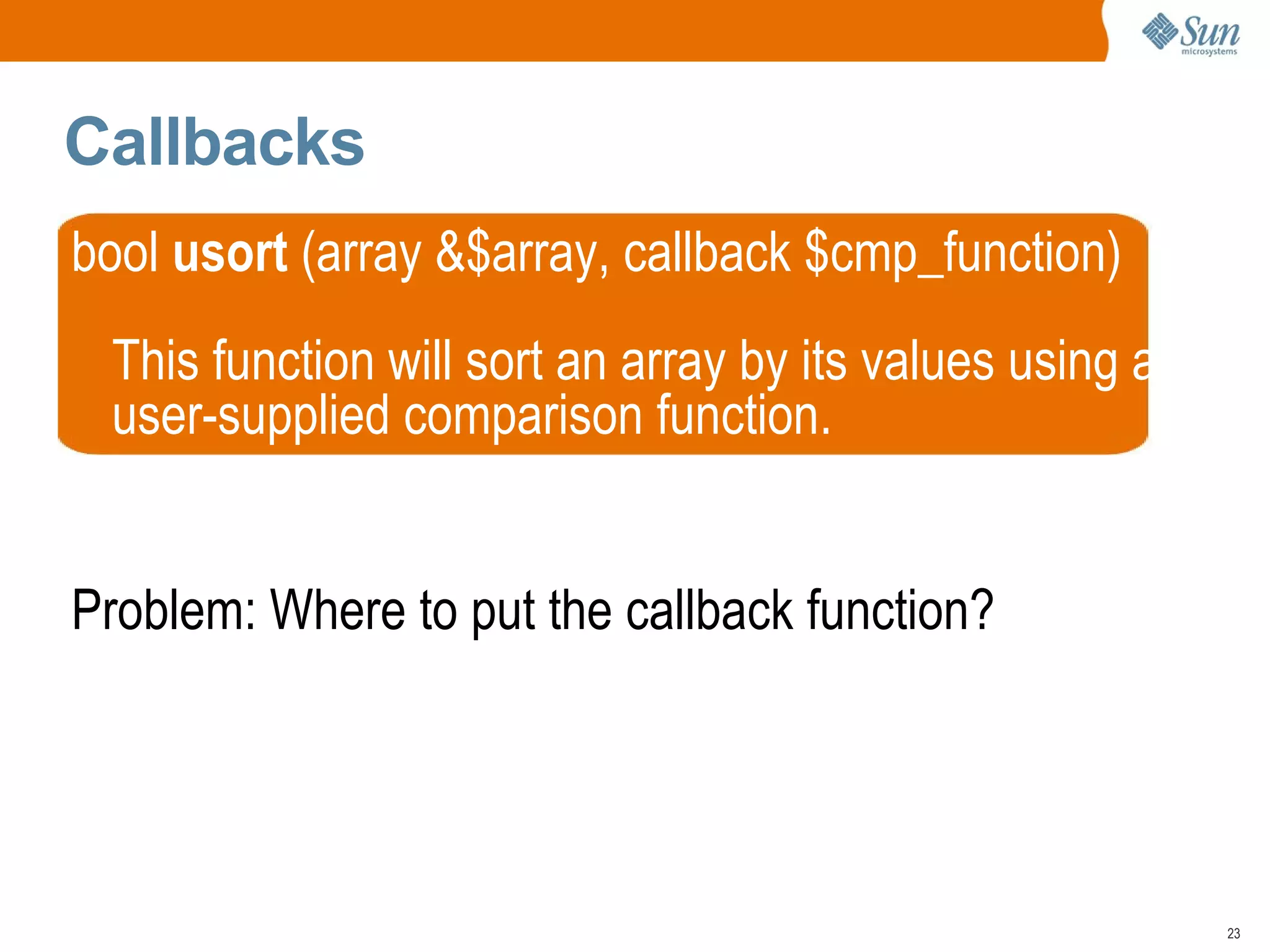
Callbacks bool  usort  (array &$array, callback $cmp_function) This function will sort an array by its values using a user-supplied comparison function. Problem: Where to put the callback function?
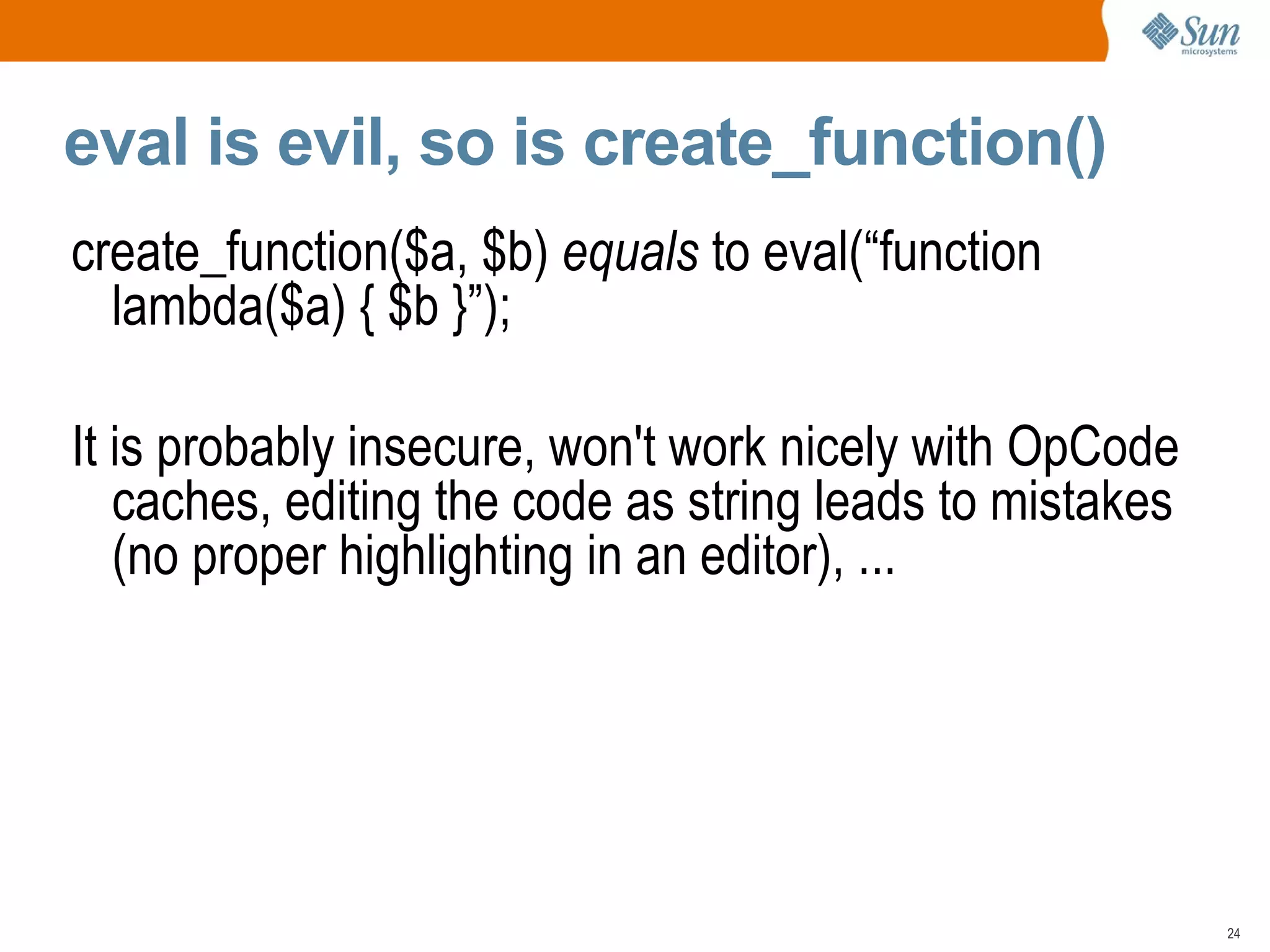
eval is evil, so is create_function() create_function($a, $b)  equals  to eval(“function lambda($a) { $b }”); It is probably insecure, won't work nicely with OpCode caches, editing the code as string leads to mistakes (no proper highlighting in an editor), ...
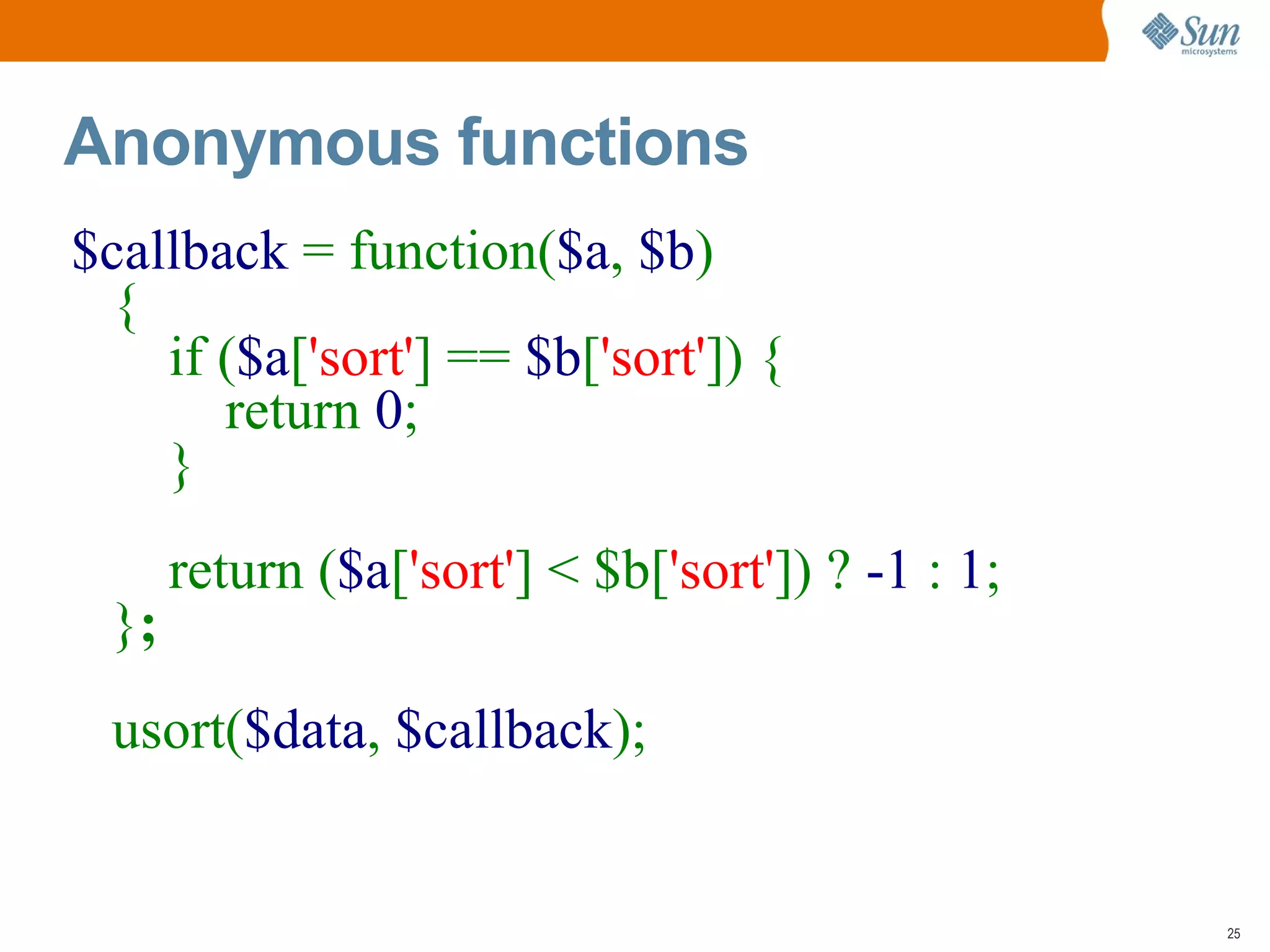
Anonymous functions $callback  = function( $a ,  $b ) {   if ( $a [ 'sort' ] ==  $b [ 'sort' ]) {   return  0 ;   }   return ( $a [ 'sort' ] < $b[ 'sort' ]) ?  -1  :  1 ; } ; usort( $data ,  $callback );
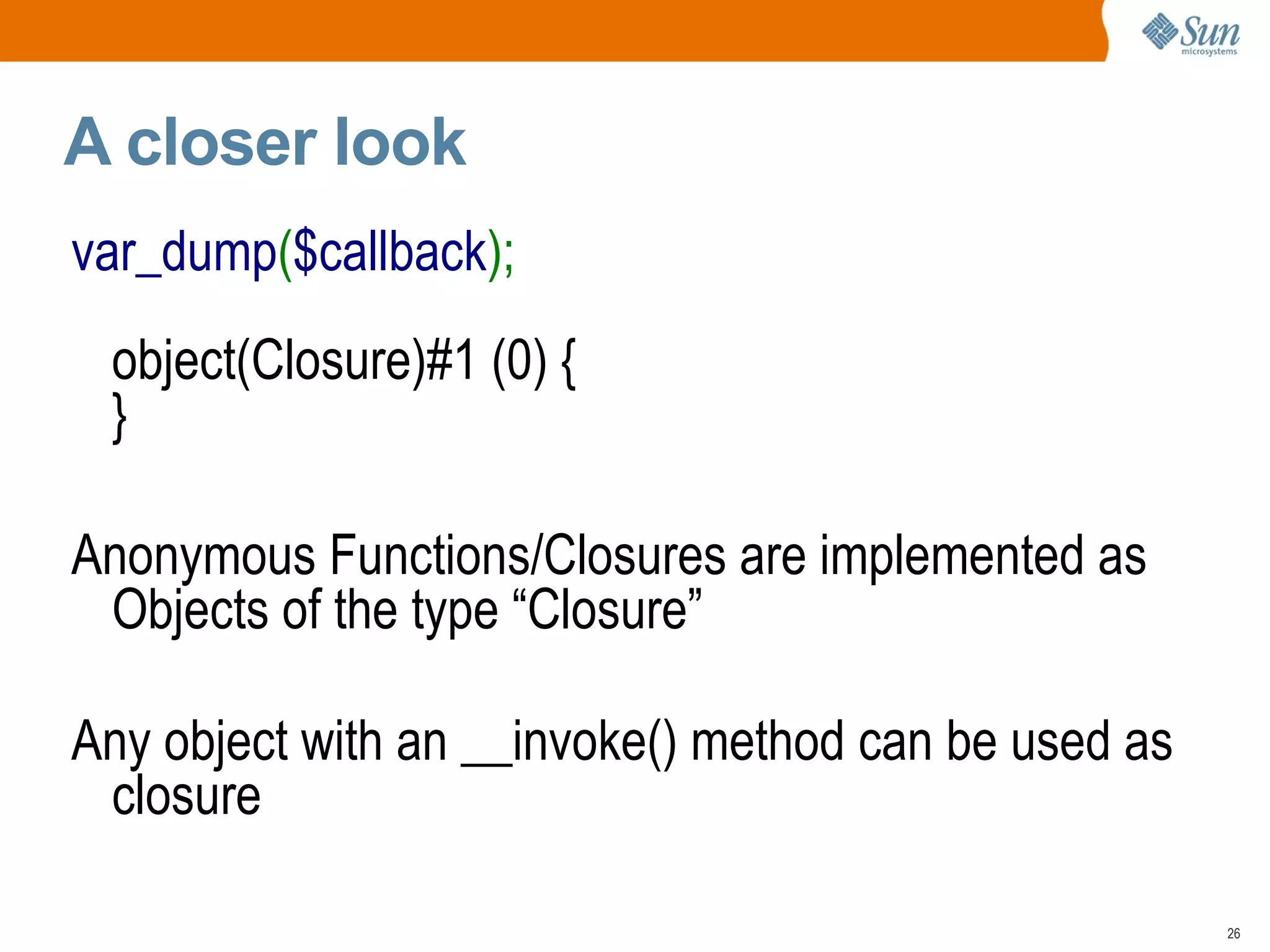
A closer look var_dump ( $callback ); object(Closure)#1 (0) { } Anonymous Functions/Closures are implemented as Objects of the type “Closure”
Any object with an __invoke() method can be used as closure
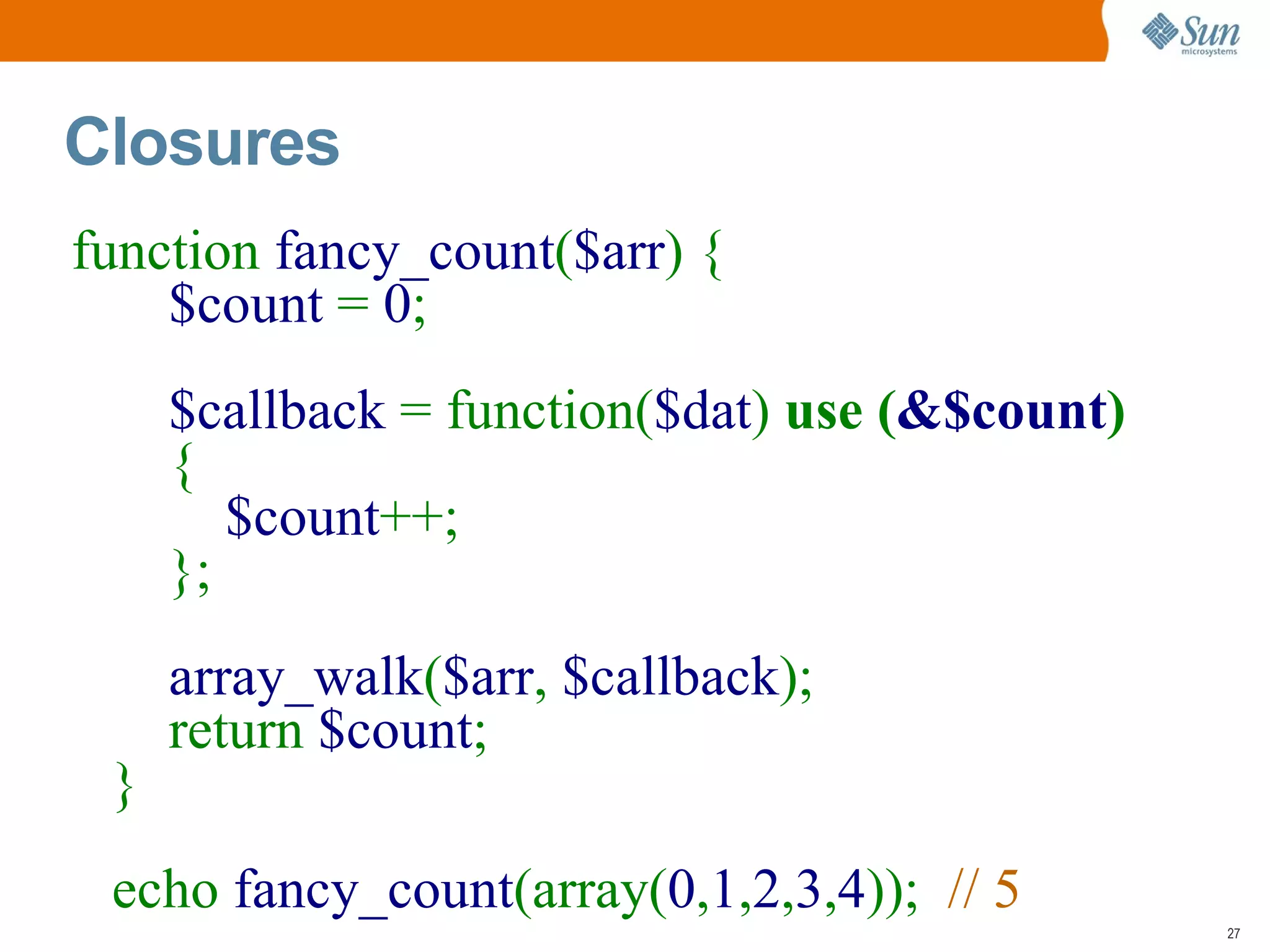
Closures function  fancy_count ( $arr ) {   $count  =  0 ;   $callback  = function( $dat )  use ( &$count )   {   $count ++;   };   array_walk ( $arr ,  $callback );   return  $count ; } echo  fancy_count (array( 0 , 1 , 2 , 3 , 4 ));  // 5
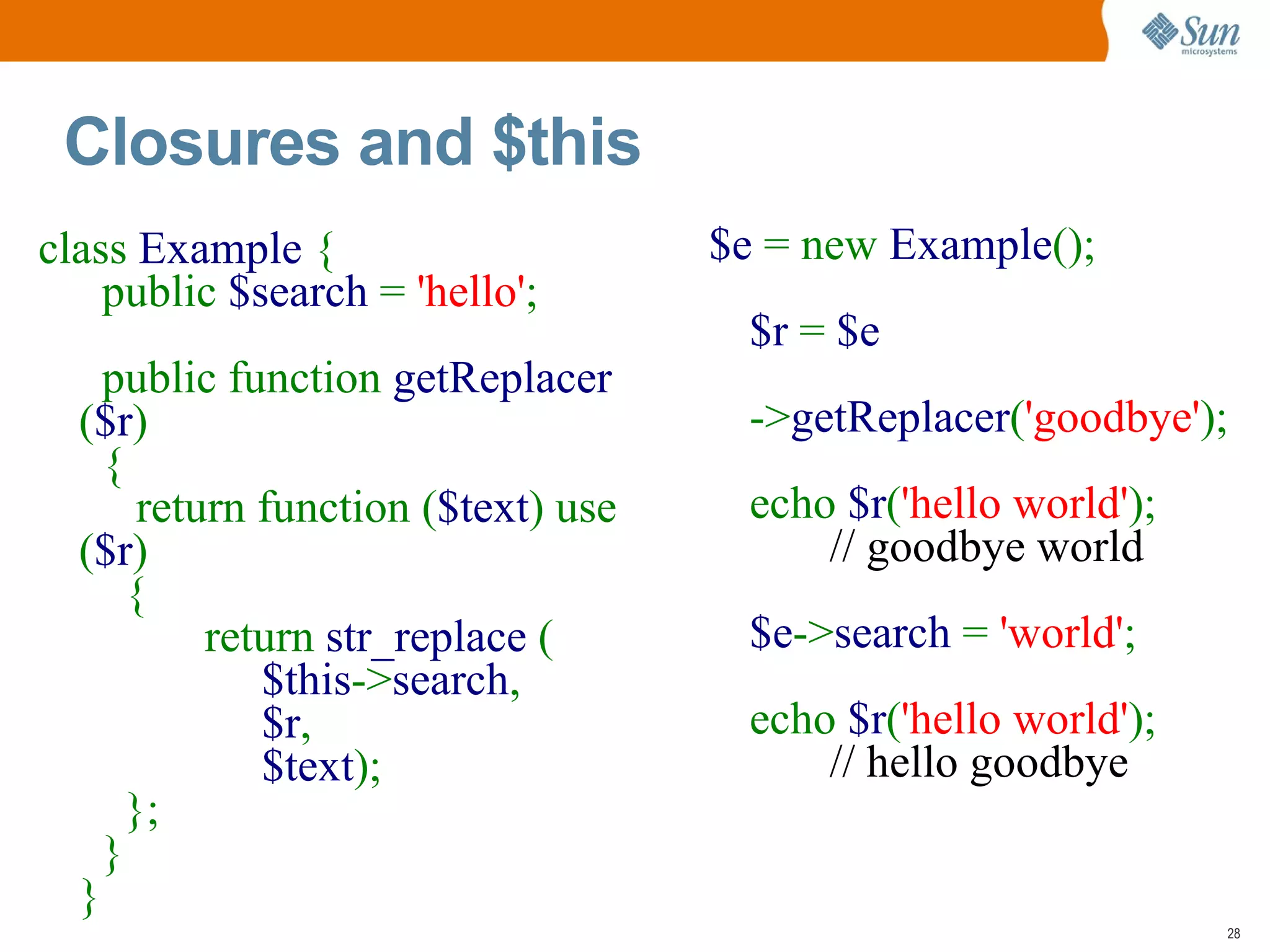
Closures and $this class  Example  {   public  $search  =  'hello' ;   public function  getReplacer  ( $r )   {   return function ( $text ) use ( $r )   {   return  str_replace  (   $this -> search ,   $r ,   $text );   };   } } $e  = new  Example (); $r  =  $e   -> getReplacer ( 'goodbye' ); echo  $r ( 'hello world' );   // goodbye world $e -> search  =  'world' ; echo  $r ( 'hello world' );   // hello goodbye
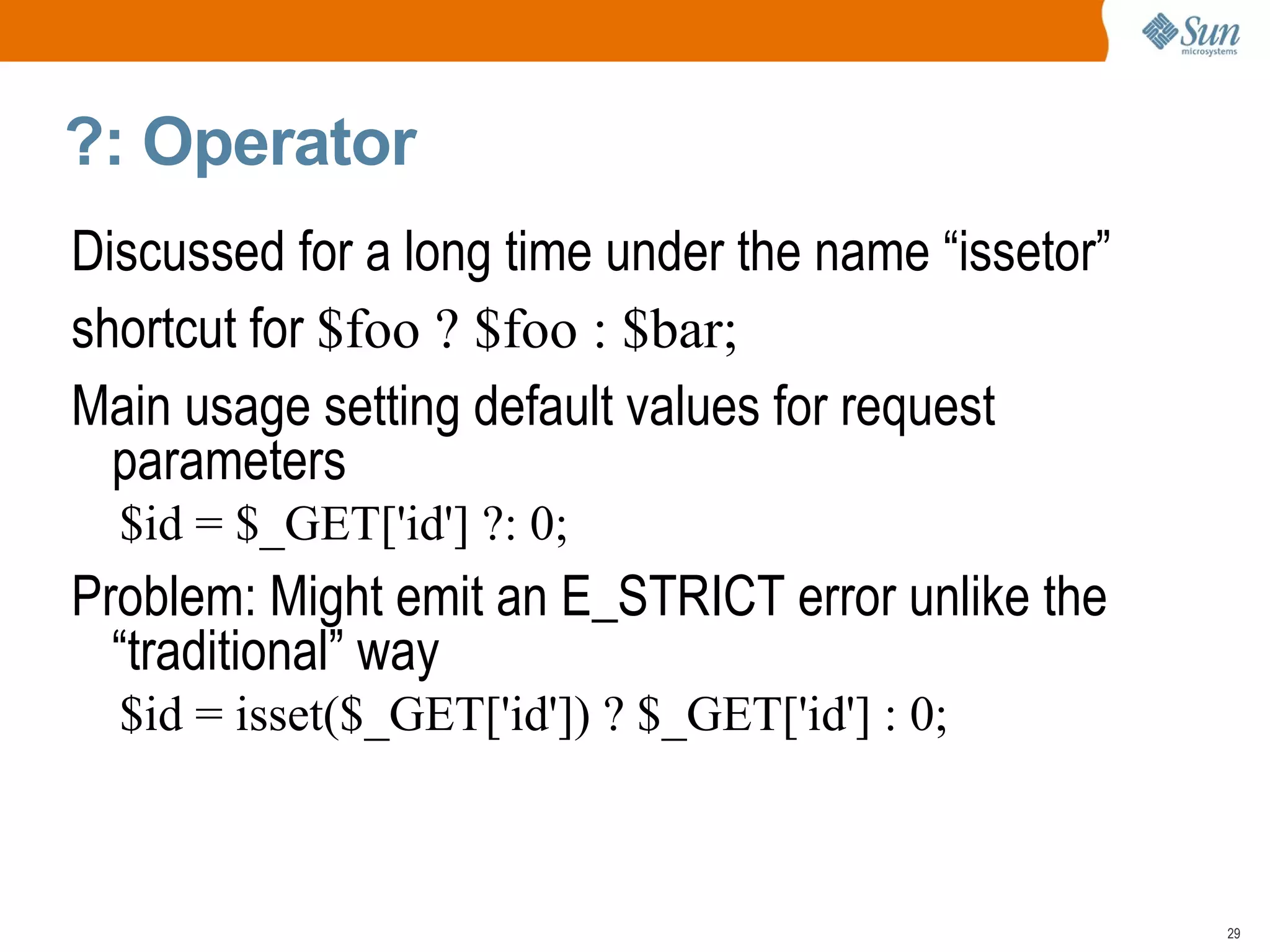
?: Operator Discussed for a long time under the name “issetor”
shortcut for  $foo ? $foo : $bar;
Main usage setting default values for request parameters $id = $_GET['id'] ?: 0; Problem: Might emit an E_STRICT error unlike the “traditional” way $id = isset($_GET['id']) ? $_GET['id'] : 0;
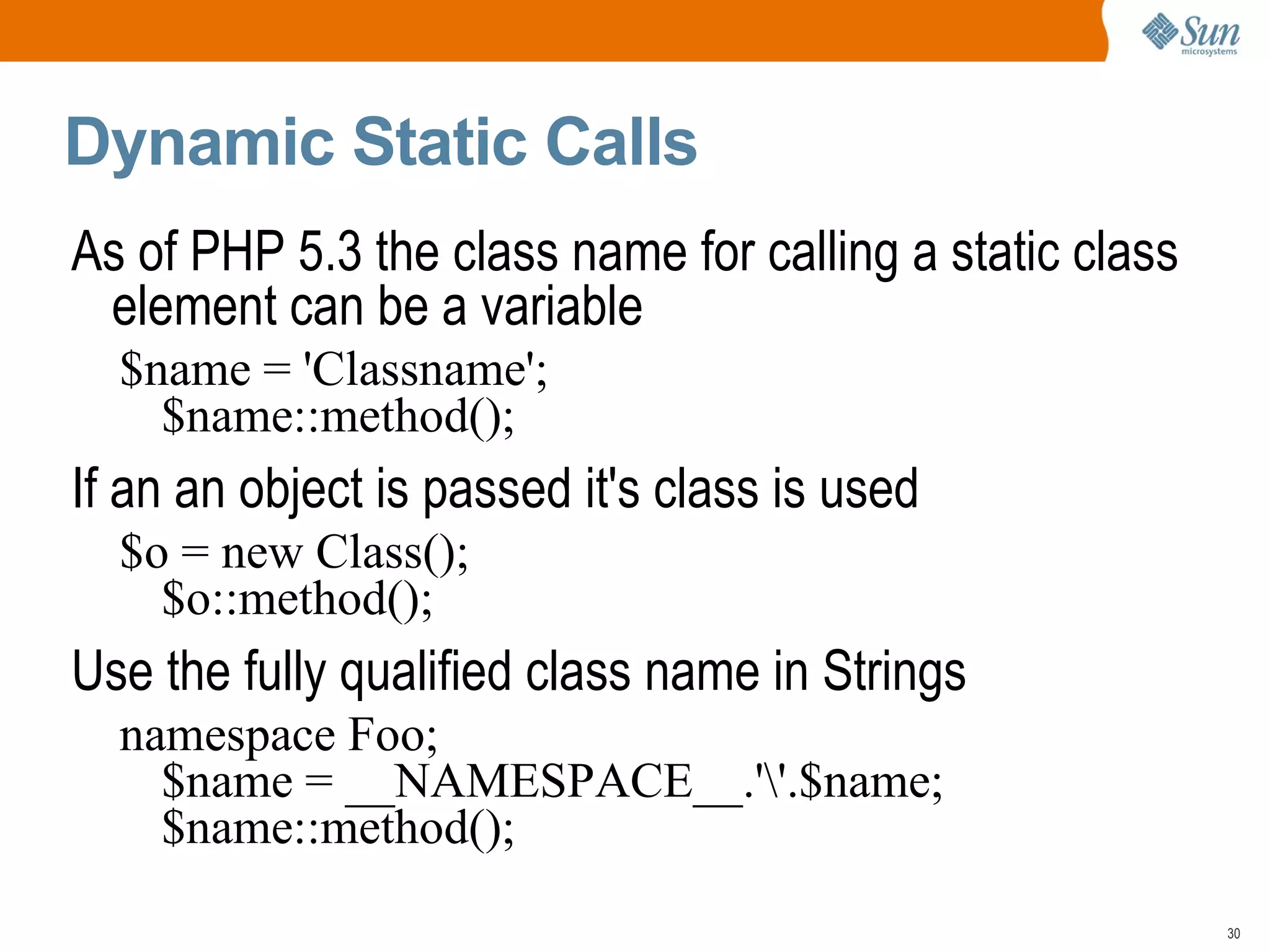
Dynamic Static Calls As of PHP 5.3 the class name for calling a static class element can be a variable $name = 'Classname'; $name::method(); If an an object is passed it's class is used $o = new Class(); $o::method(); Use the fully qualified class name in Strings namespace Foo; $name = __NAMESPACE__.'\'.$name; $name::method();
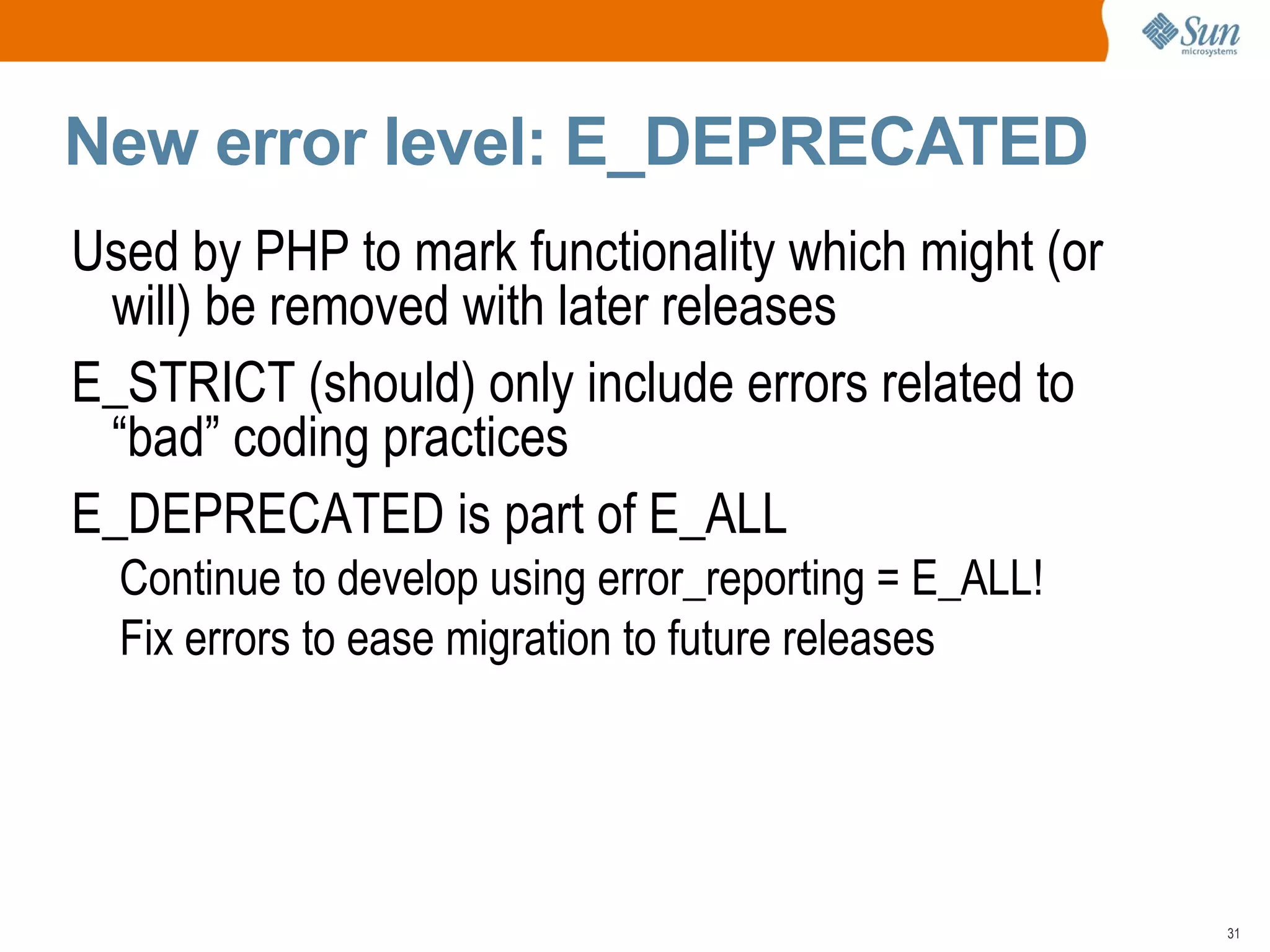
New error level: E_DEPRECATED Used by PHP to mark functionality which might (or will) be removed with later releases
E_STRICT (should) only include errors related to “bad” coding practices
E_DEPRECATED is part of E_ALL Continue to develop using error_reporting = E_ALL!

What's new, what's hot in PHP 5.3

  • 1.
    PHP 5.3 What'sNew, What's Hot Johannes Schlüter MySQL Engineering Connectors and Client Connectivity Sun Microsystems
  • 2.
  • 3.
    PHP 4 Photo:Patricia Hecht
  • 4.
    PHP 5.2 Photo:Gabriele Kantel
  • 5.
    PHP 5.3 Photo:Jamie Sanford
  • 6.
    PHP 6 Photo: G4Glenno (flickr)
  • 7.
    New language (syntax)features in 5.3 Namespaces
  • 8.
  • 9.
  • 10.
  • 11.
  • 12.
  • 13.
    NOWDOC syntax, HEREDOCwith quotes dynamic static calls
  • 14.
    PHP 5.3 –New functionality Phar – PHP archives
  • 15.
    New SQLite 3Extension
  • 16.
    mysqlnd – MySQLnative driver
  • 17.
  • 18.
  • 19.
  • 20.
  • 21.
  • 22.
  • 23.
  • 24.
  • 25.
    Namespaces – TheReasons Class names have to be unique per running script
  • 26.
    PHP runtime developerstend to add class with generic names “ Date ” Class names tend to be long MyFramework_Category_Helper_FooBar
  • 27.
    Namespaces – DesignIdeas PHP's namespace implementation is resolving names (mostly) at compile-time They should have no (measurable) impact on the runtime performance
  • 28.
    new $string; won't know anything about namespaces neither do callbacks or anything else which takes class names as string When using namespaces the namespace declaration has to be in at the beginning of the file
  • 29.
    There can bemultiple namespaces per file
  • 30.
    Namespace-able elements Namespacescan contain classes, functions and constants <?php namespace Foo ; const ANSWER = 42 ; class C { /* ... */ } function f () { } ?> <?php echo Foo \ ANSWER; new Foo \ C (); Foo \ f (); ?>
  • 31.
    Namespace syntax Youcan use curly braces to define multiple namespaces: <?php namespace Foo { class C { /* ... */ } } namespace Bar { class C { /* ... */ } } ?>
  • 32.
    Namespaces – anexample foo.php <?php namepace MyFramework \ someModule ; class Foo { /* ... */ } ?> bar.php <?php class Bar extends MyFramework \ someModule \ Foo { /* ... */ } ?> The compile translates this to MyFramework\someModule\Foo We can use the full name from within another file
  • 33.
    Namespaces – anexample foo.php <?php namepace MyFramework \ someModule ; class Foo { /* ... */ } ?> bar.php <?php namepace MyFramework \ someModule ; class Bar extends Foo { /* ... */ } ?> This will be prefixed with the namespace As will this, so we are referring to our previously declared class
  • 34.
    Accessing the sameNamespace For usage in strings use the magic __NAMESPACE__ constant. call_user_func ( array( __NAMESPACE__ . '\some_class' , 'method' ), $param1 , $param2 , $param3 ); For accessing elements of the same namespace use “ namespace ” return new namespace\ some_class ();
  • 35.
    Namespaces – AccesingGlobal <?php namepace MyFramework \ someModule ; echo strlen (); echo \ strlen (); echo some \ other \ space \ strlen (); ?>
  • 36.
    Namespaces – Importing Using classes Often you want to use classes from other namespaces
  • 37.
    “use” creates analias which can be used in the given file
  • 38.
    No usefoo\*;
  • 39.
    Use example useFoo\Bar; use Foo\Bar as Baz; use RecursiveIteratorIterator as RII; Use class Bar from Foo and make Bar the alias As above but make Baz the alias It's just an alias so we can create an alias to global classes, too
  • 40.
    Use namespace namespace foo \ bar ; class class1 {} // foo\bar\class1 class class2 {} // foo\bar\class2
  • 41.
    use foo\ bar ; new bar \ class1 (); new bar \ class2 ();
  • 42.
  • 43.
  • 44.
    Callbacks $data = array( array( 'sort ' => 2 , 'foo' => 'some value' ), array( 'sort' => 1 , 'foo' => 'other value' ), array( 'sort' => 3 , 'foo' => 'one more' ), /* … */ );
  • 45.
    Task: Sort thearray $data using the sort field of the array
  • 46.
    Callbacks bool usort (array &$array, callback $cmp_function) This function will sort an array by its values using a user-supplied comparison function. Problem: Where to put the callback function?
  • 47.
    eval is evil,so is create_function() create_function($a, $b) equals to eval(“function lambda($a) { $b }”); It is probably insecure, won't work nicely with OpCode caches, editing the code as string leads to mistakes (no proper highlighting in an editor), ...
  • 48.
    Anonymous functions $callback = function( $a , $b ) { if ( $a [ 'sort' ] == $b [ 'sort' ]) { return 0 ; } return ( $a [ 'sort' ] < $b[ 'sort' ]) ? -1 : 1 ; } ; usort( $data , $callback );
  • 49.
    A closer lookvar_dump ( $callback ); object(Closure)#1 (0) { } Anonymous Functions/Closures are implemented as Objects of the type “Closure”
  • 50.
    Any object withan __invoke() method can be used as closure
  • 51.
    Closures function fancy_count ( $arr ) { $count = 0 ; $callback = function( $dat ) use ( &$count ) { $count ++; }; array_walk ( $arr , $callback ); return $count ; } echo fancy_count (array( 0 , 1 , 2 , 3 , 4 )); // 5
  • 52.
    Closures and $thisclass Example { public $search = 'hello' ; public function getReplacer ( $r ) { return function ( $text ) use ( $r ) { return str_replace ( $this -> search , $r , $text ); }; } } $e = new Example (); $r = $e -> getReplacer ( 'goodbye' ); echo $r ( 'hello world' ); // goodbye world $e -> search = 'world' ; echo $r ( 'hello world' ); // hello goodbye
  • 53.
    ?: Operator Discussedfor a long time under the name “issetor”
  • 54.
    shortcut for $foo ? $foo : $bar;
  • 55.
    Main usage settingdefault values for request parameters $id = $_GET['id'] ?: 0; Problem: Might emit an E_STRICT error unlike the “traditional” way $id = isset($_GET['id']) ? $_GET['id'] : 0;
  • 56.
    Dynamic Static CallsAs of PHP 5.3 the class name for calling a static class element can be a variable $name = 'Classname'; $name::method(); If an an object is passed it's class is used $o = new Class(); $o::method(); Use the fully qualified class name in Strings namespace Foo; $name = __NAMESPACE__.'\'.$name; $name::method();
  • 57.
    New error level:E_DEPRECATED Used by PHP to mark functionality which might (or will) be removed with later releases
  • 58.
    E_STRICT (should) onlyinclude errors related to “bad” coding practices
  • 59.
    E_DEPRECATED is partof E_ALL Continue to develop using error_reporting = E_ALL!
  • 60.
    Fix errors toease migration to future releases
  • 61.
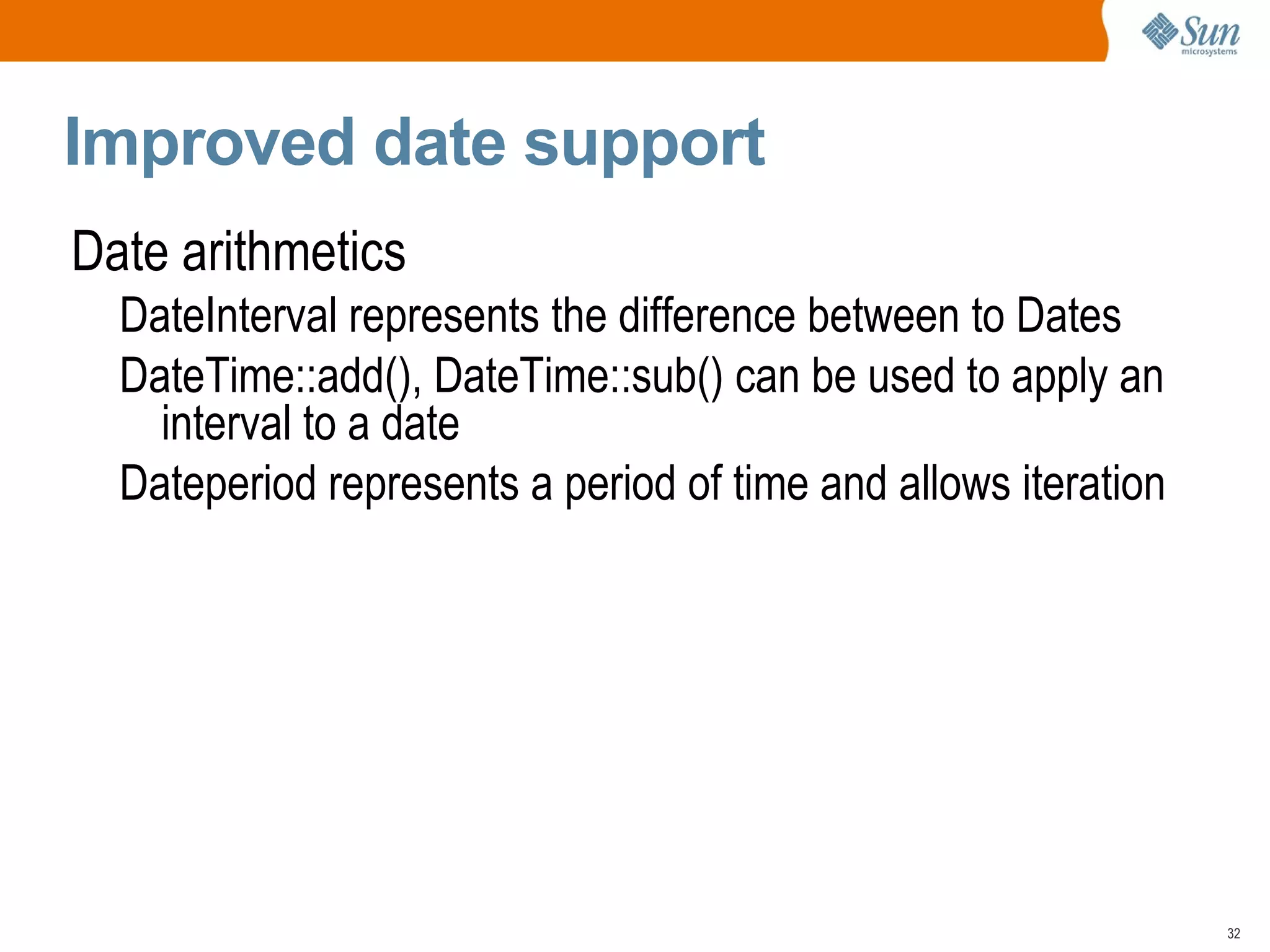
    Improved date supportDate arithmetics DateInterval represents the difference between to Dates
  • 62.
    DateTime::add(), DateTime::sub() canbe used to apply an interval to a date
  • 63.
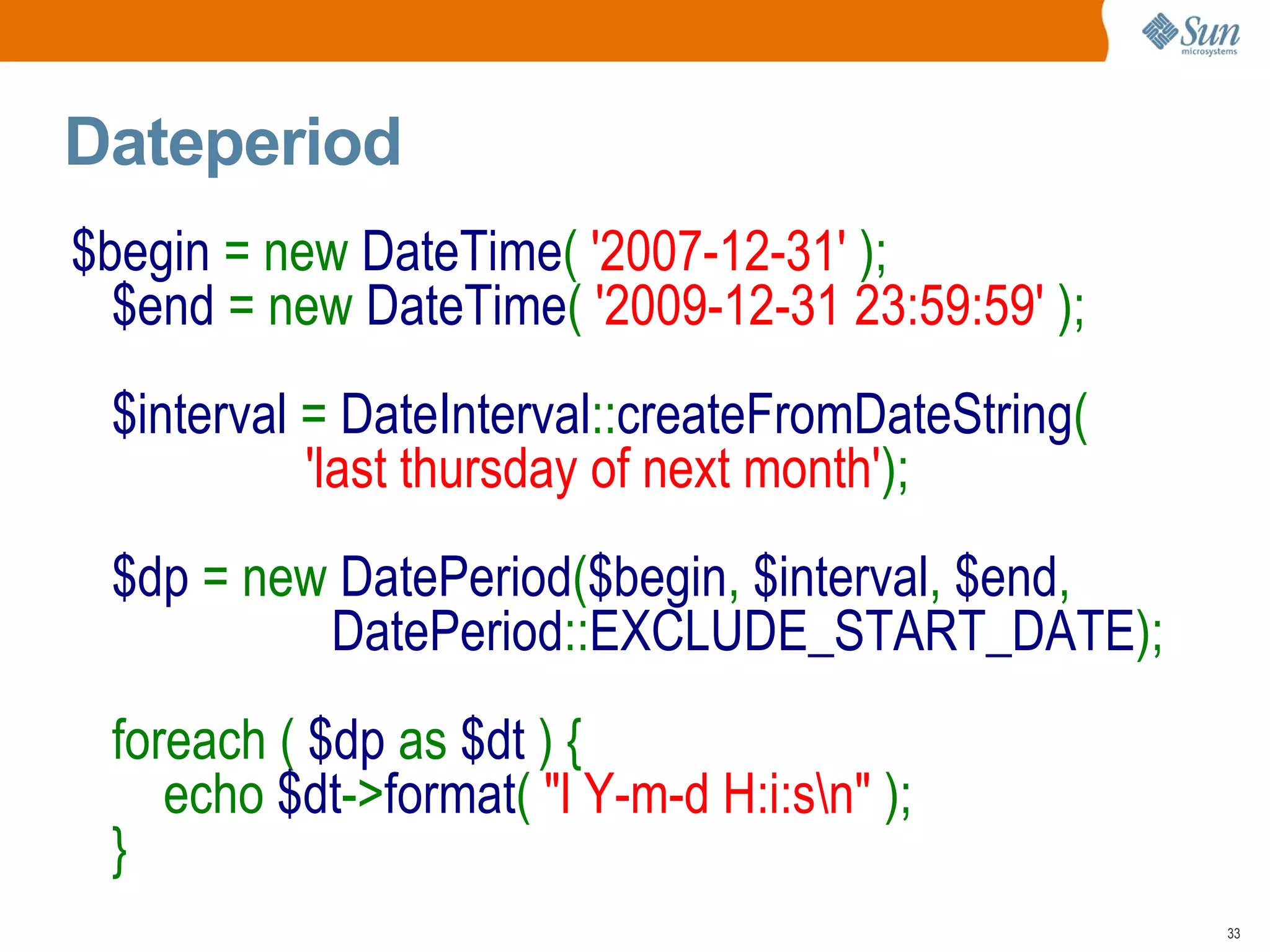
    Dateperiod represents aperiod of time and allows iteration
  • 64.
    Dateperiod $begin = new DateTime ( '2007-12-31' ); $end = new DateTime ( '2009-12-31 23:59:59' ); $interval = DateInterval :: createFromDateString ( 'last thursday of next month' ); $dp = new DatePeriod ( $begin , $interval , $end , DatePeriod :: EXCLUDE_START_DATE ); foreach ( $dp as $dt ) { echo $dt -> format ( &quot;l Y-m-d H:i:s\n&quot; ); }
  • 65.
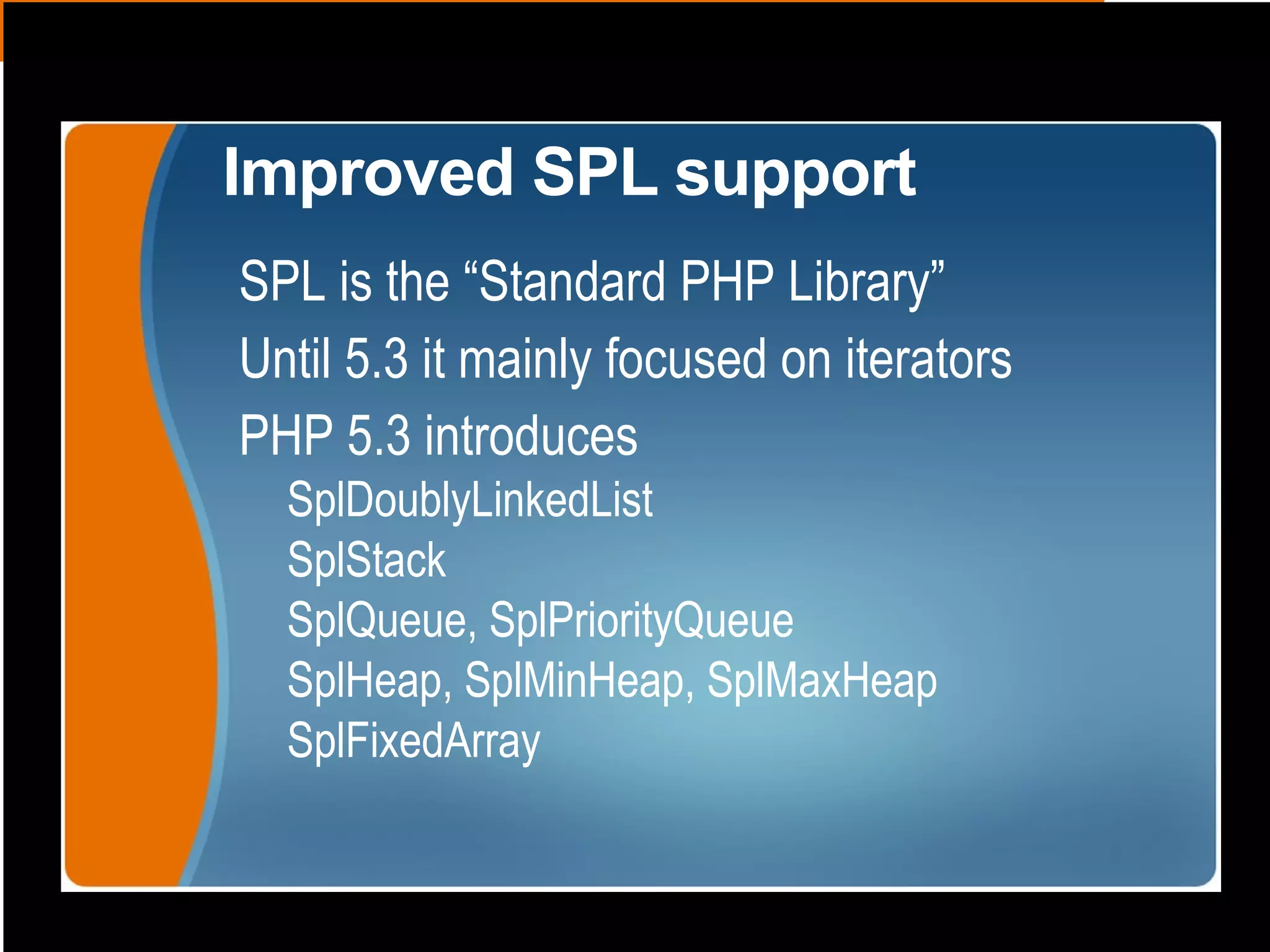
    Improved SPL supportSPL is the “Standard PHP Library”
  • 66.
    Until 5.3 itmainly focused on iterators
  • 67.
    PHP 5.3 introducesSplDoublyLinkedList
  • 68.
  • 69.
  • 70.
  • 71.
  • 72.
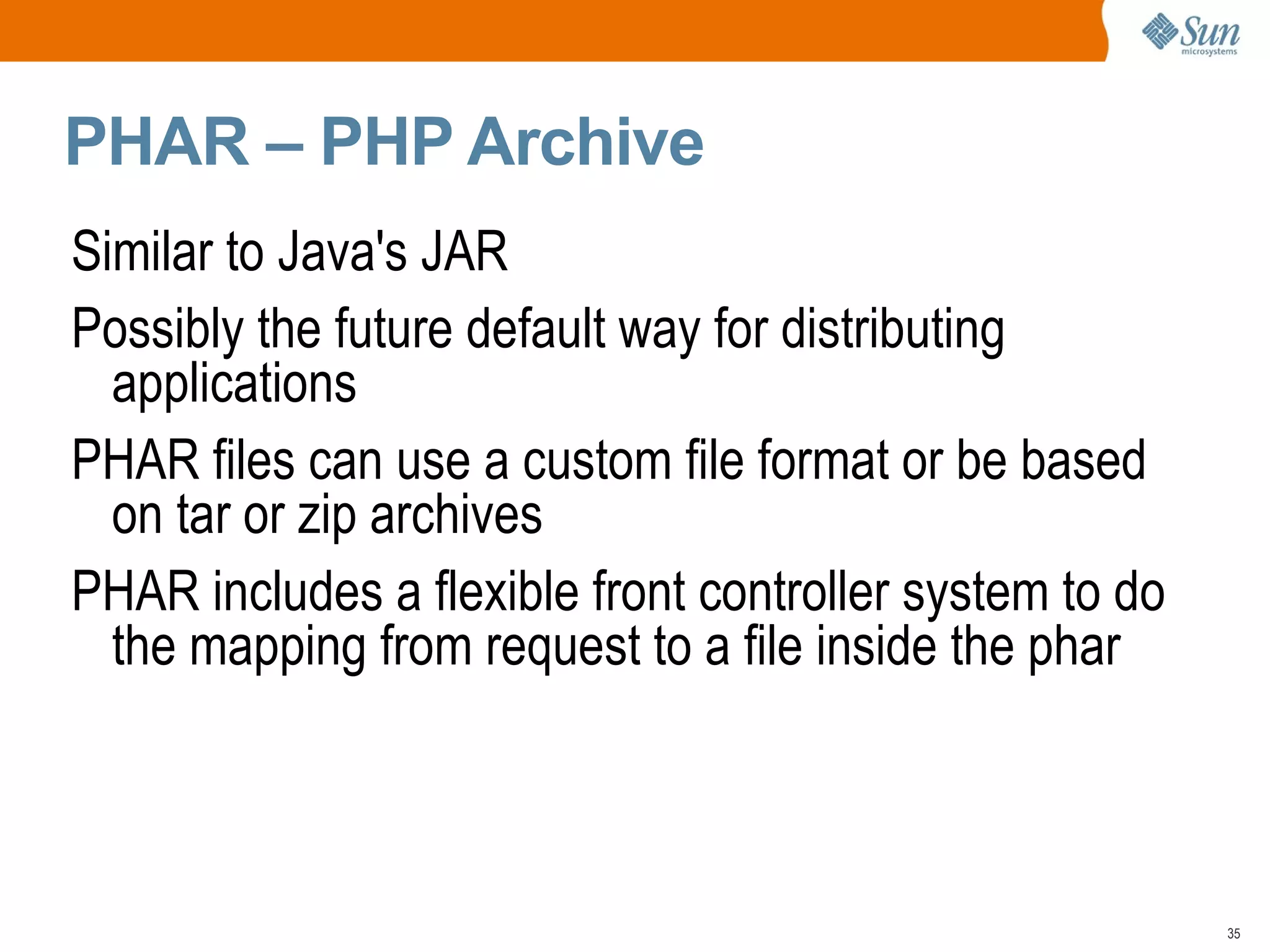
    PHAR – PHPArchive Similar to Java's JAR
  • 73.
    Possibly the futuredefault way for distributing applications
  • 74.
    PHAR files canuse a custom file format or be based on tar or zip archives
  • 75.
    PHAR includes aflexible front controller system to do the mapping from request to a file inside the phar
  • 76.
    Creating phar archives<?php try { $phar = new Phar ( 'myapp.phar' ); $phar [ 'index.php' ] = '<?php echo &quot;Welcome to the index!&quot;; ?>' ; $phar [ 'page2.php' ] = '<?php echo &quot;This is page 2.&quot;; ?>' ; } catch ( Exception $e ) { echo $e ; } ?>
  • 77.
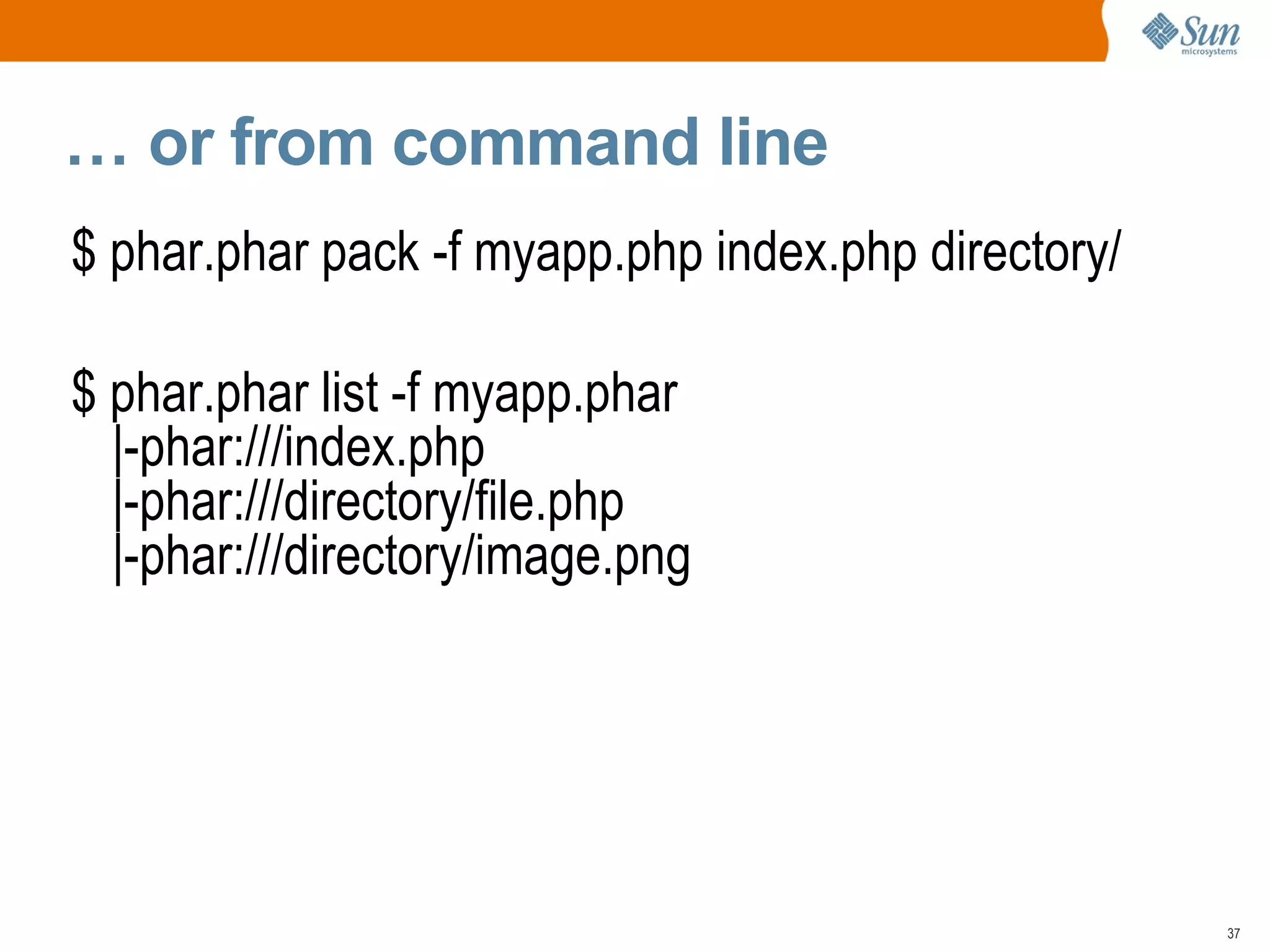
    … or fromcommand line $ phar.phar pack -f myapp.php index.php directory/
  • 78.
    $ phar.phar list-f myapp.phar |-phar:///index.php |-phar:///directory/file.php |-phar:///directory/image.png
  • 79.
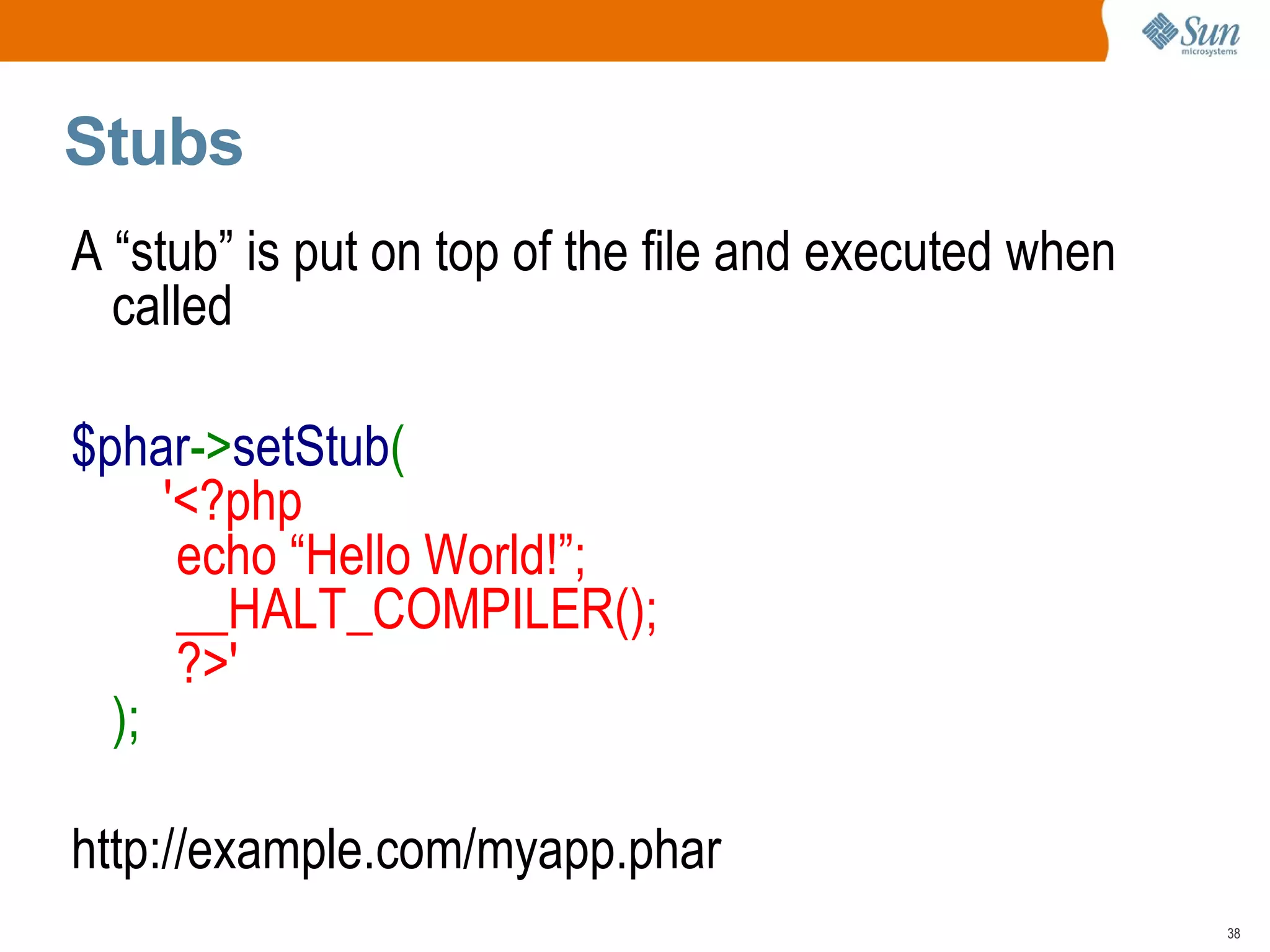
    Stubs A “stub”is put on top of the file and executed when called
  • 80.
    $phar -> setStub( '<?php echo “Hello World!”; __HALT_COMPILER(); ?>' );
  • 81.
  • 82.
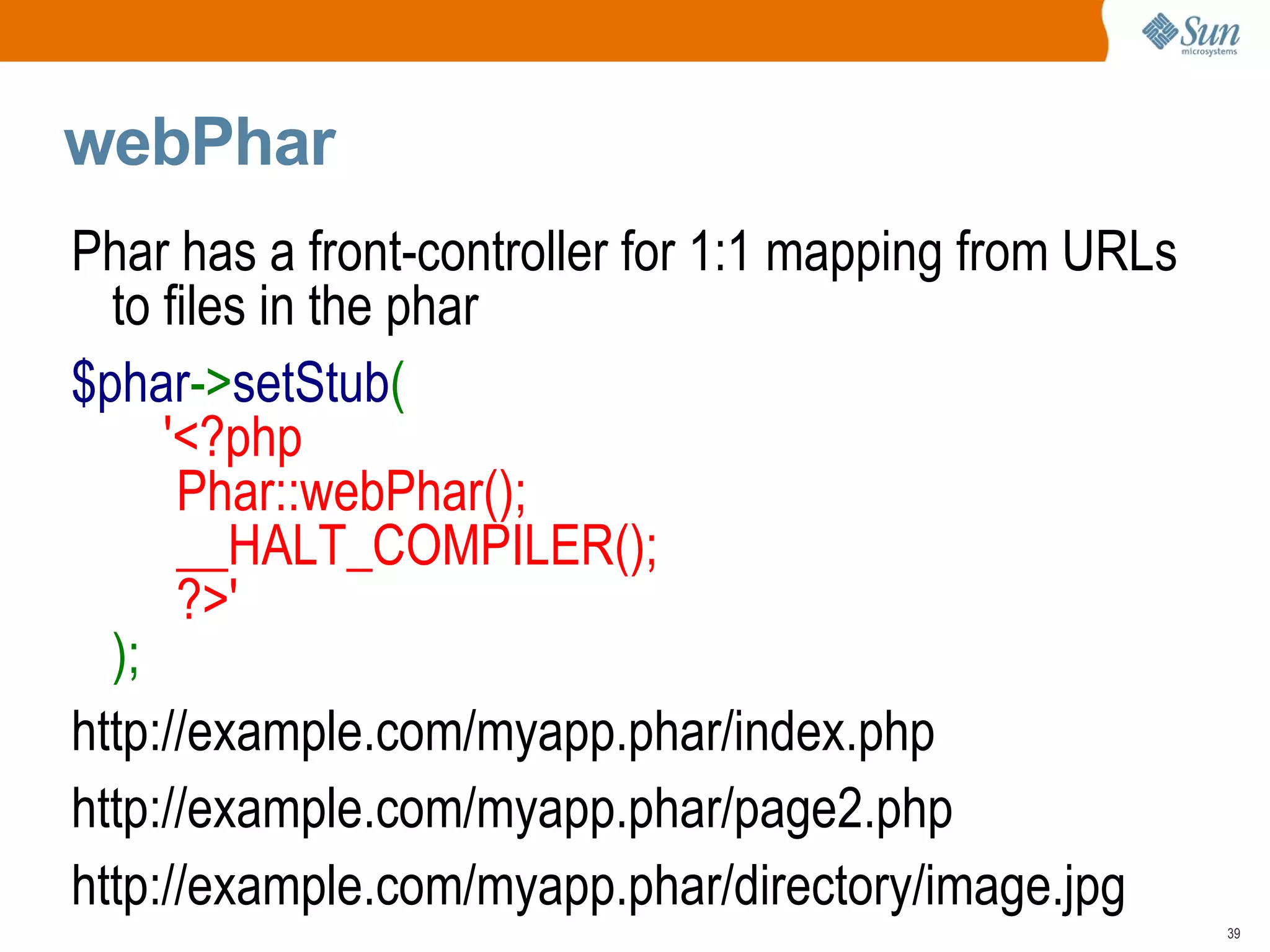
    webPhar Phar hasa front-controller for 1:1 mapping from URLs to files in the phar
  • 83.
    $phar -> setStub( '<?php Phar::webPhar(); __HALT_COMPILER(); ?>' );
  • 84.
  • 85.
  • 86.
  • 87.
  • 88.
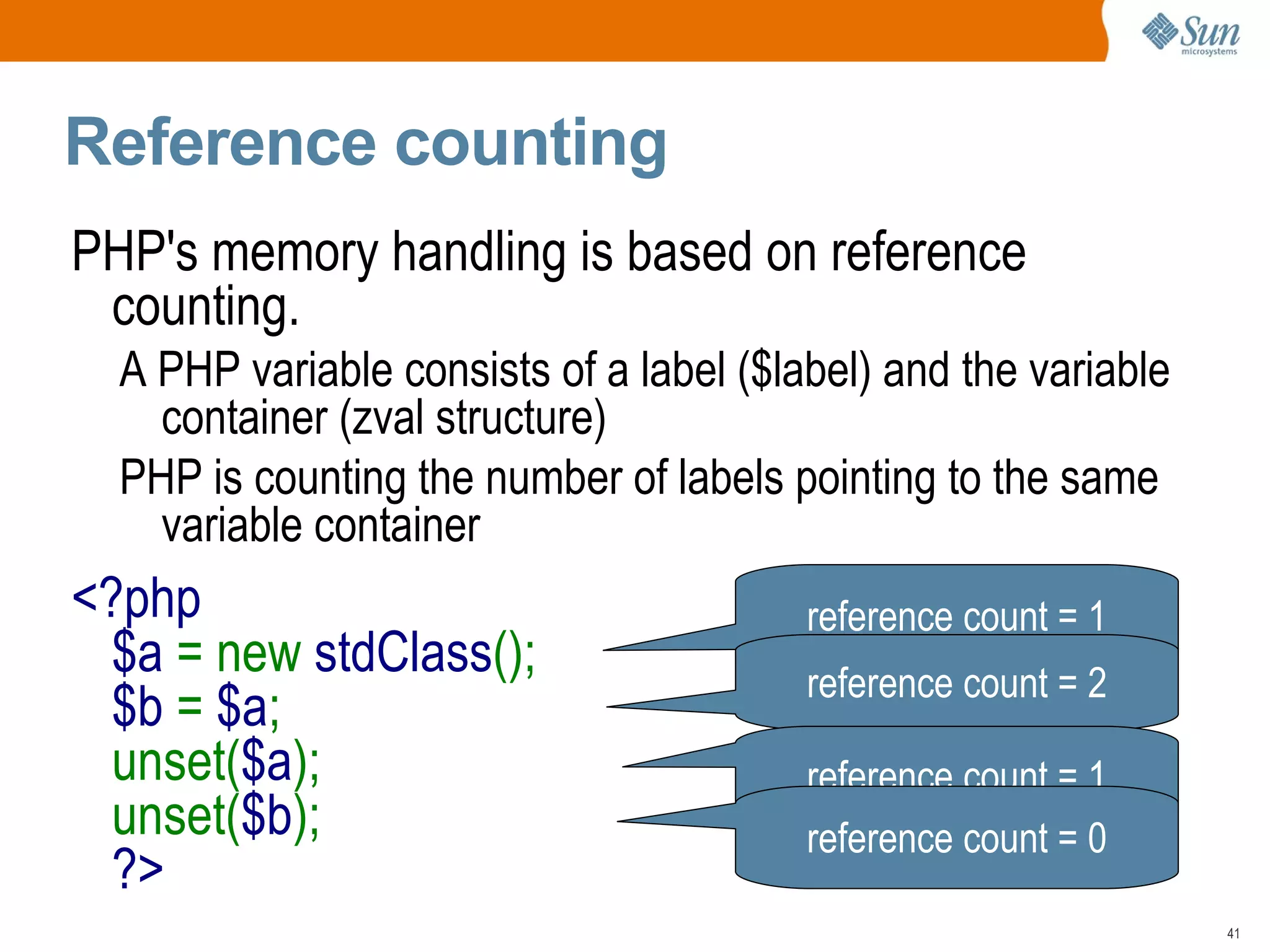
    Reference counting PHP'smemory handling is based on reference counting. A PHP variable consists of a label ($label) and the variable container (zval structure)
  • 89.
    PHP is countingthe number of labels pointing to the same variable container <?php $a = new stdClass (); $b = $a ; unset( $a ); unset( $b ); ?> reference count = 1 reference count = 2 reference count = 1 reference count = 0
  • 90.
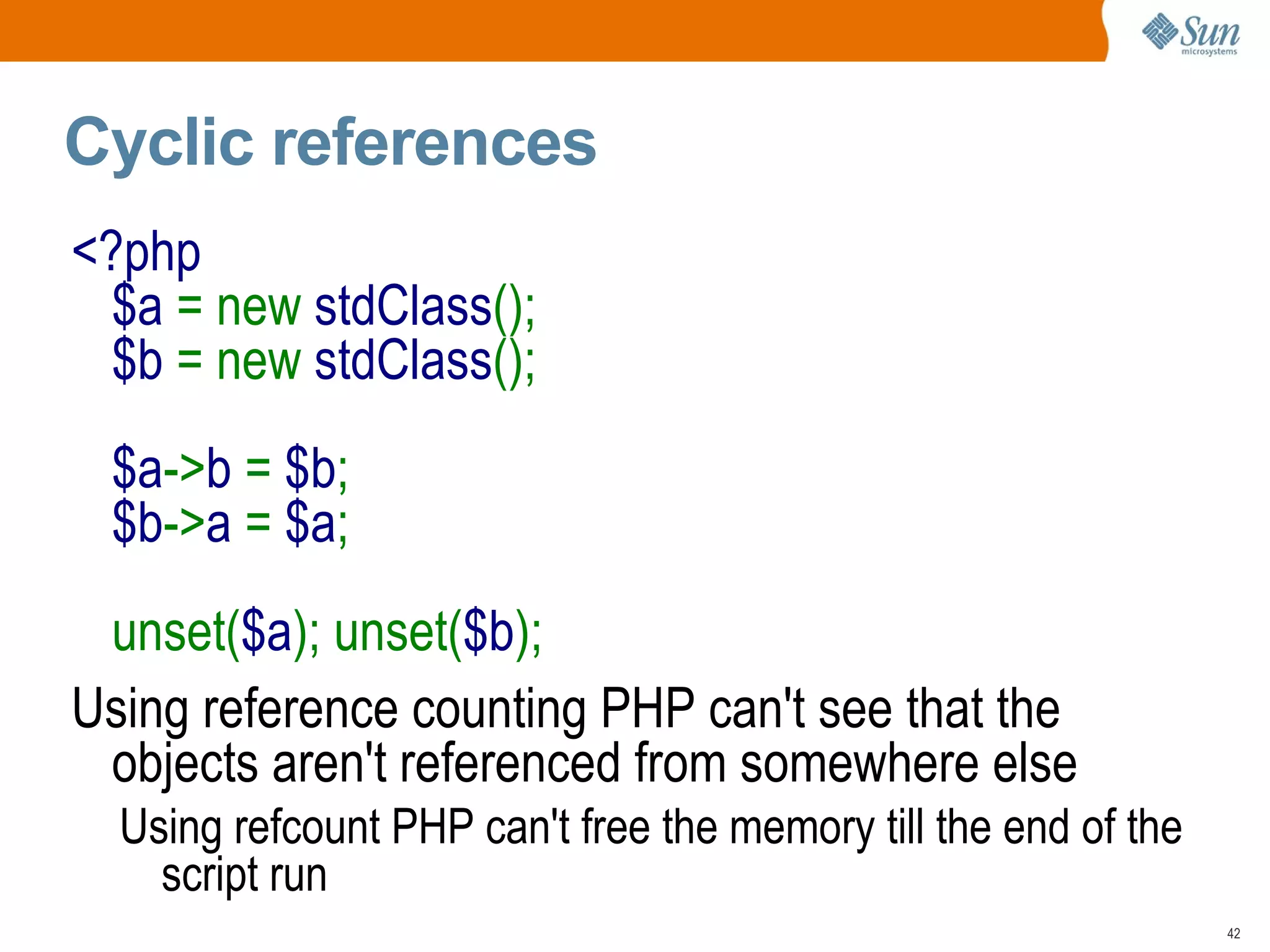
    Cyclic references <?php$a = new stdClass (); $b = new stdClass (); $a -> b = $b ; $b -> a = $a ; unset( $a ); unset( $b );
  • 91.
    Using reference countingPHP can't see that the objects aren't referenced from somewhere else Using refcount PHP can't free the memory till the end of the script run
  • 92.
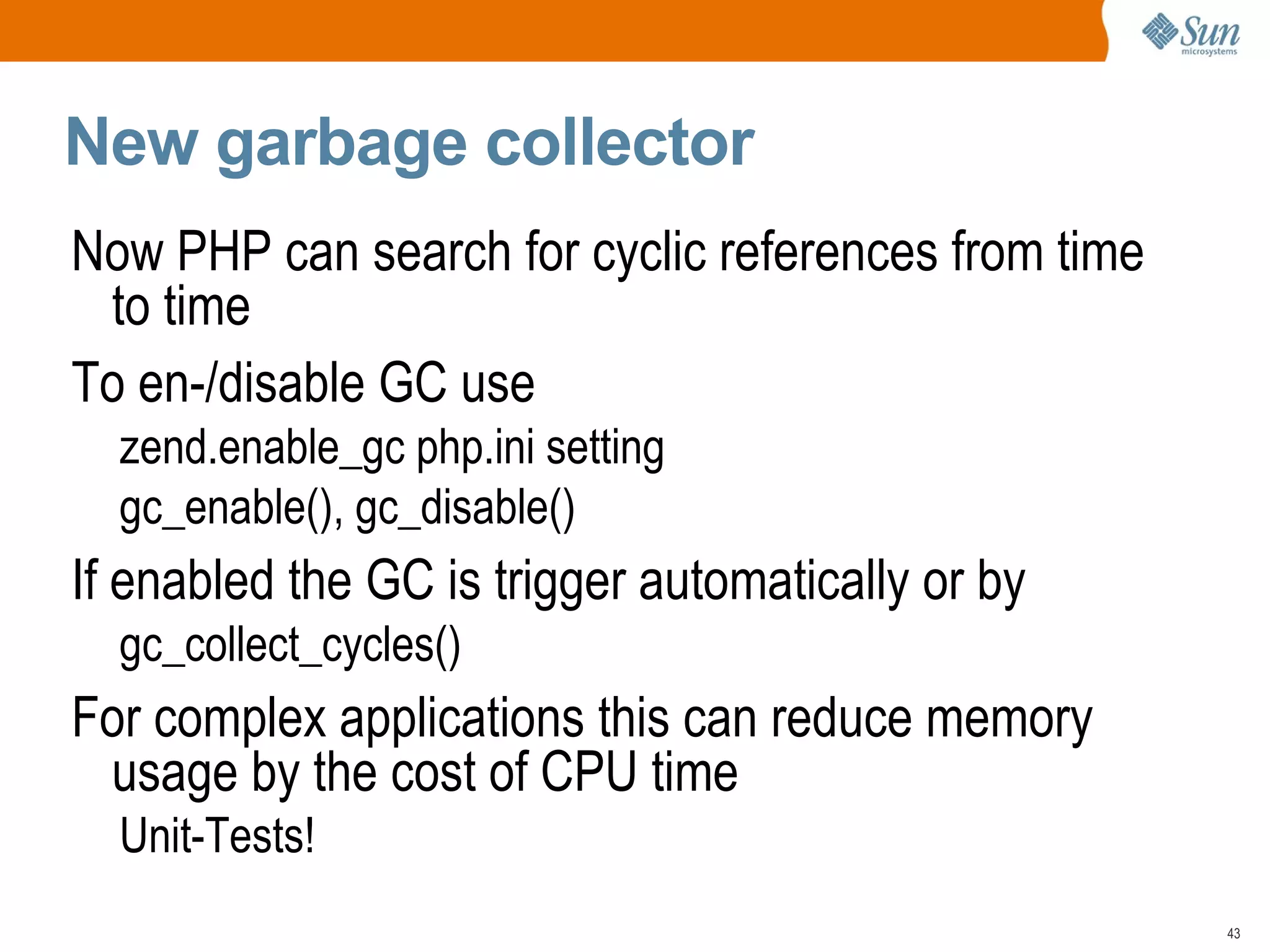
    New garbage collectorNow PHP can search for cyclic references from time to time
  • 93.
    To en-/disable GCuse zend.enable_gc php.ini setting
  • 94.
    gc_enable(), gc_disable() Ifenabled the GC is trigger automatically or by gc_collect_cycles() For complex applications this can reduce memory usage by the cost of CPU time Unit-Tests!
  • 95.
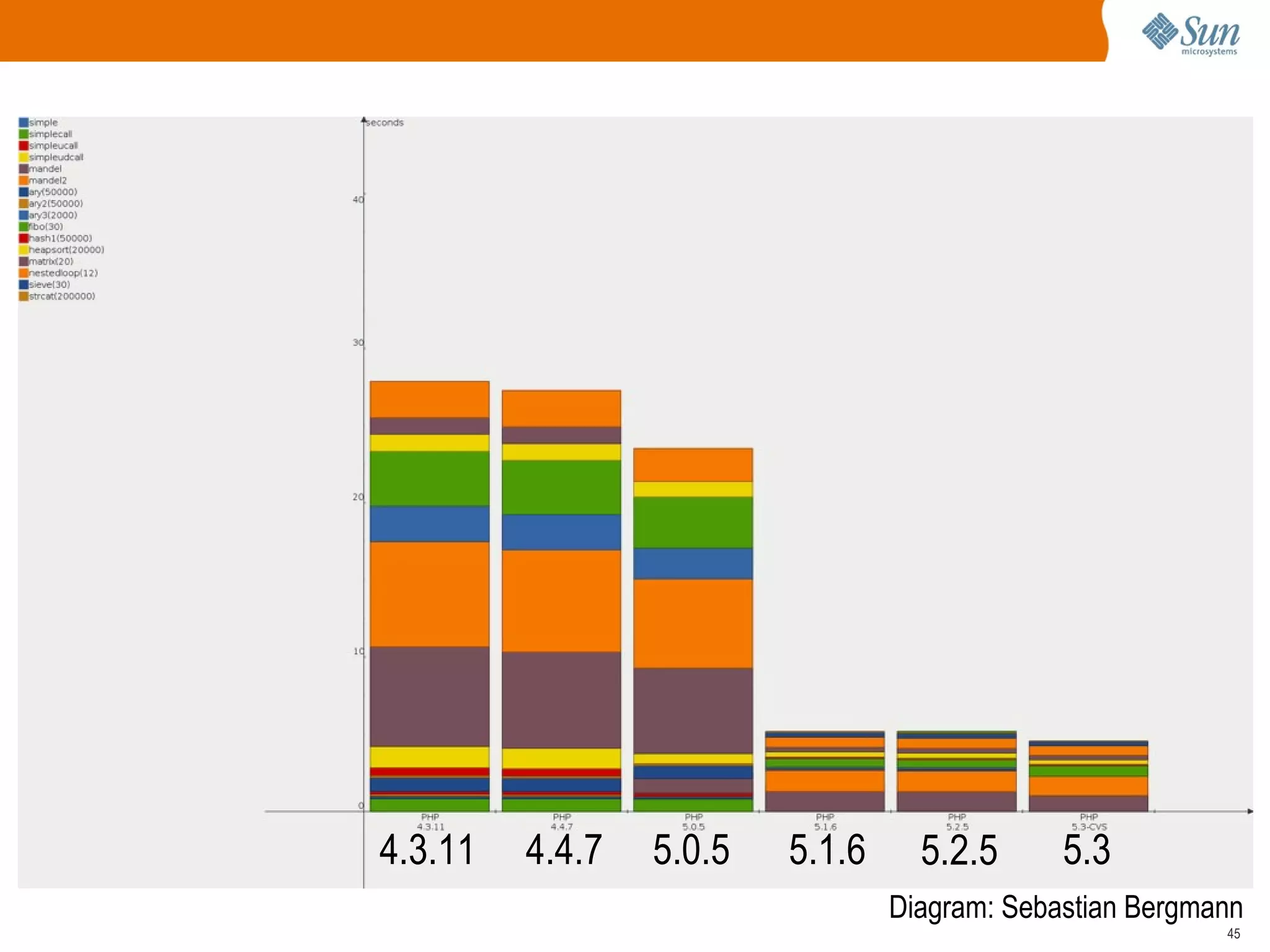
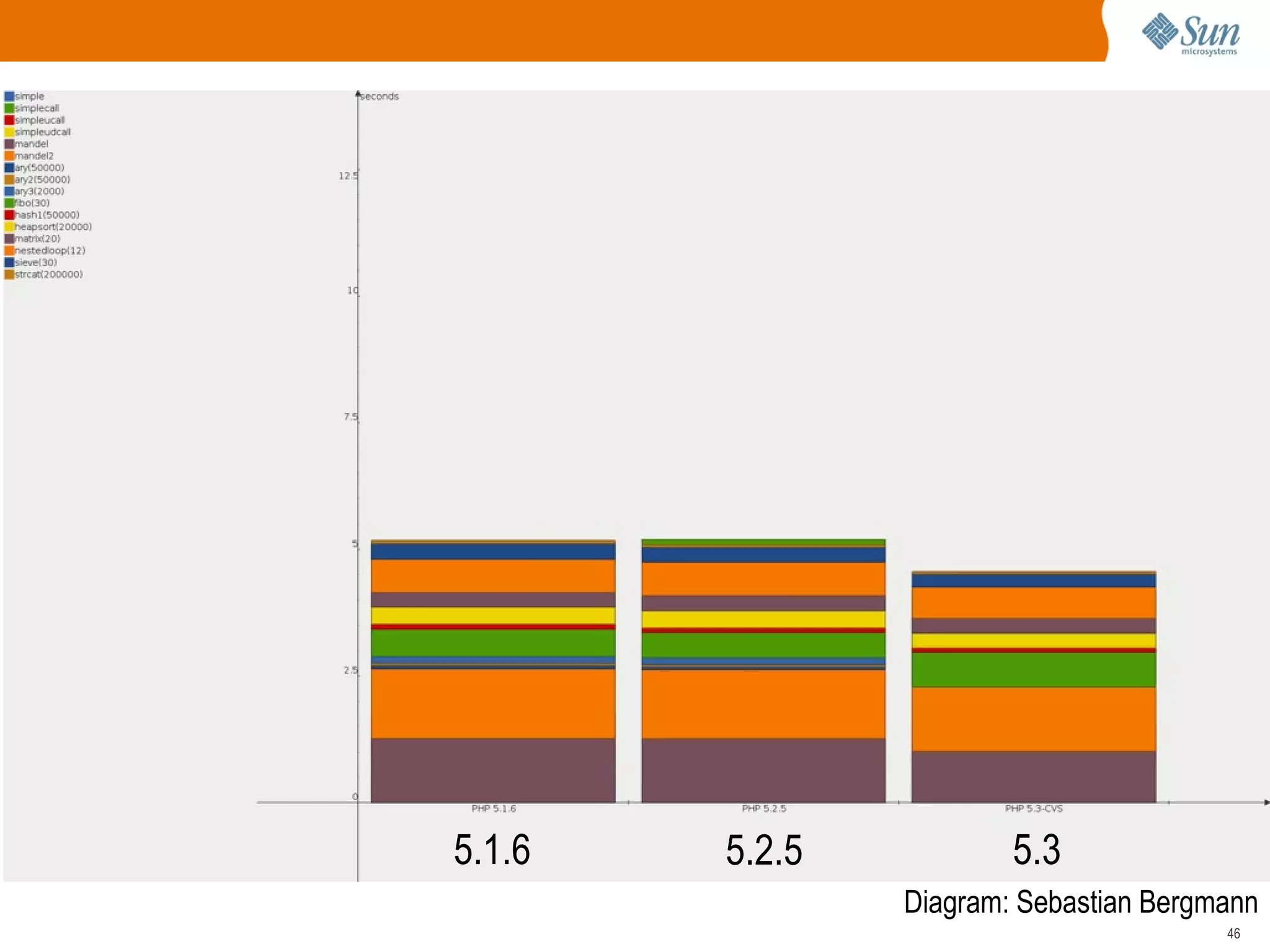
    So much newstuff but still faster!? Yes!
  • 96.
    New scanner (basedon re2c instead of flex)
  • 97.
  • 98.
    Improved access tointernal data structures
  • 99.
  • 100.
    Diagram: Sebastian Bergmann4.3.11 4.4.7 5.0.5 5.1.6 5.2.5 5.3
  • 101.
  • 102.
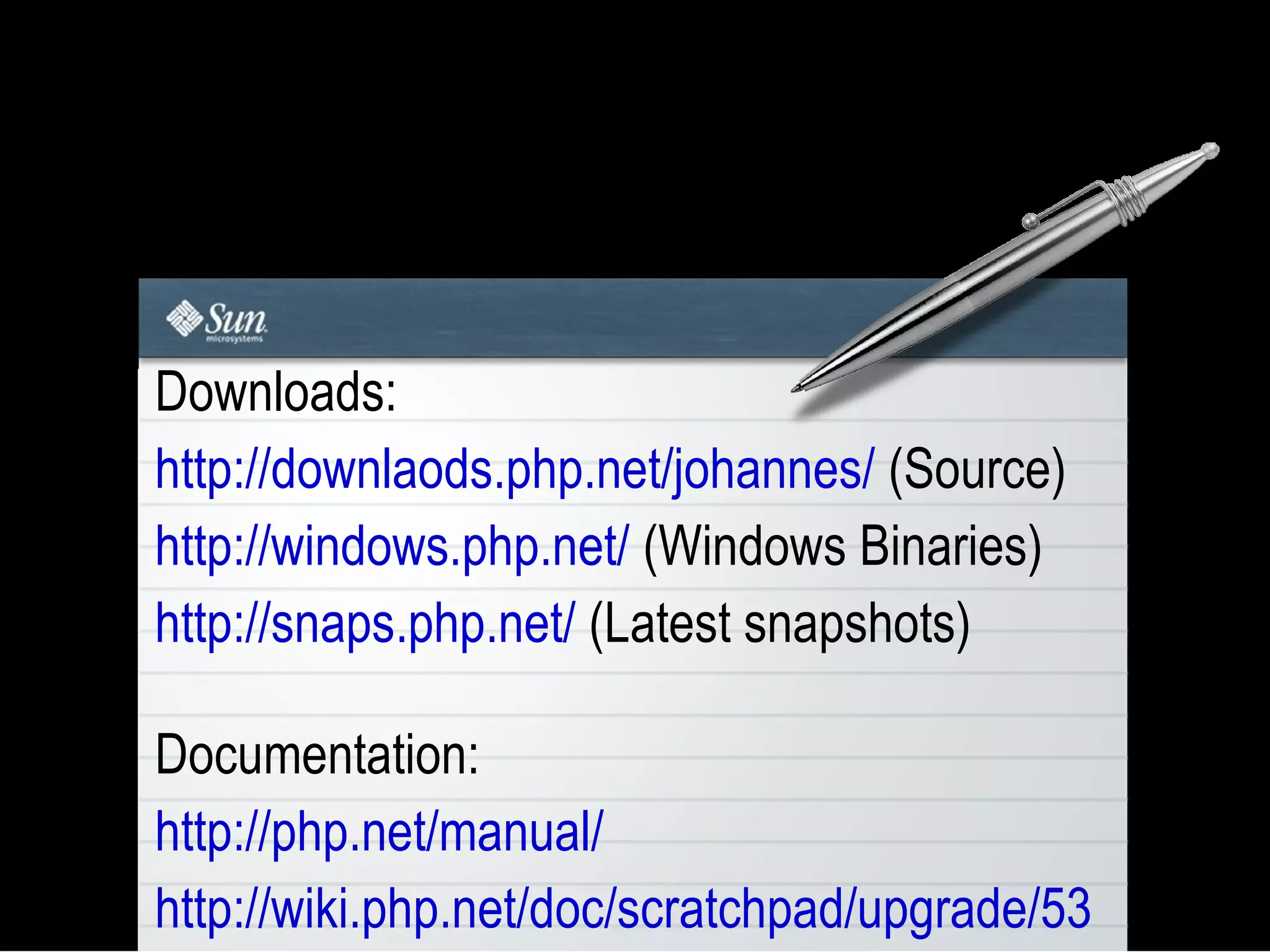
    Links Downloads: http://downlaods.php.net/johannes/ (Source) http://windows.php.net/ (Windows Binaries) http://snaps.php.net/ (Latest snapshots) Documentation: http://php.net/manual/ http://wiki.php.net/doc/scratchpad/upgrade/53
  • 103.
  • 104.
    NOWDOC Similar toHEREDOC but does no expanding of variables
  • 105.
    <?php echo <<<' EOT ' This item costs $US 23.42 EOT; ?>
  • 106.
    This item costs$US 23.42
  • 107.
    HEREDOC with quotesFor being consistent with NOWDOCs HEREDOCs allow passing the name escaped by quotes
  • 108.
    <?php echo <<<” EOT ” This item costs $US 23.42 EOT; ?>
  • 109.
    Notice: Undefined variable:US in ... This item costs 23.42
  • 110.
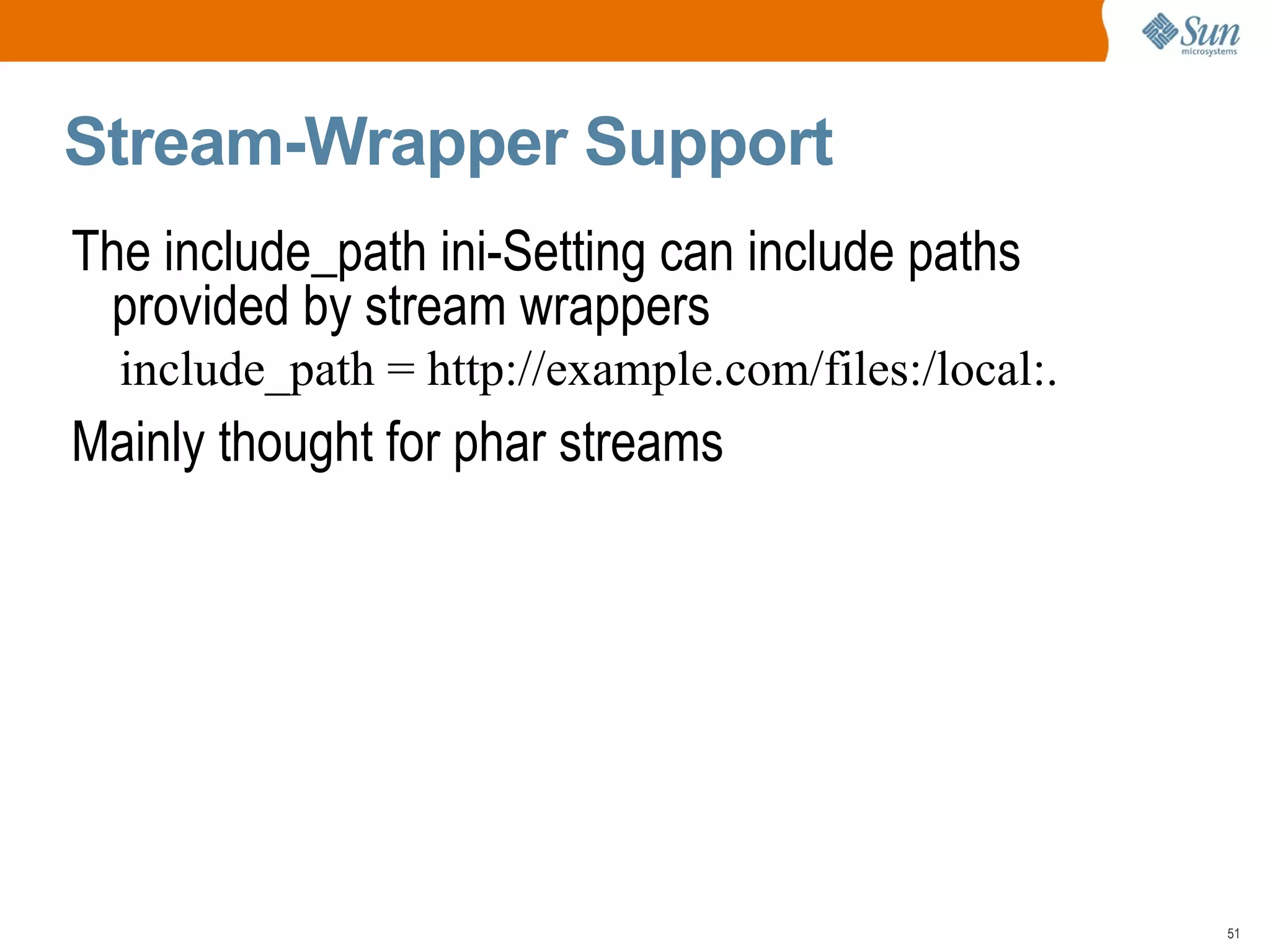
    Stream-Wrapper Support Theinclude_path ini-Setting can include paths provided by stream wrappers include_path = http://example.com/files:/local:. Mainly thought for phar streams
  • 111.
    mysqlnd PHP-specific replacementfor the MySQL Client library (libmysql)
  • 112.
  • 113.
    Deeply bound toPHP Using PHP memory management
  • 114.
  • 115.
    No external dependenciesNot yet another MySQL extension but an internal library sitting below other extnesion Powers ext/mysql, mysqli and pdo_mysql
  • 116.
    mysqlnd To compilePHP using mysqlnd use --with-mysql=mysqlnd
  • 117.
  • 118.
  • 119.
    goto Yes, exactlywhat the name says
  • 120.
    But there arefew Limitations: You can only jump within the same code unit (the same function, global space from the same file, technically precise: the same OpArray)
  • 121.
    You can jump out of blocks but not int o blocks <?php label : echo 1 ; goto label ; ?>
  • 122.
  • 123.
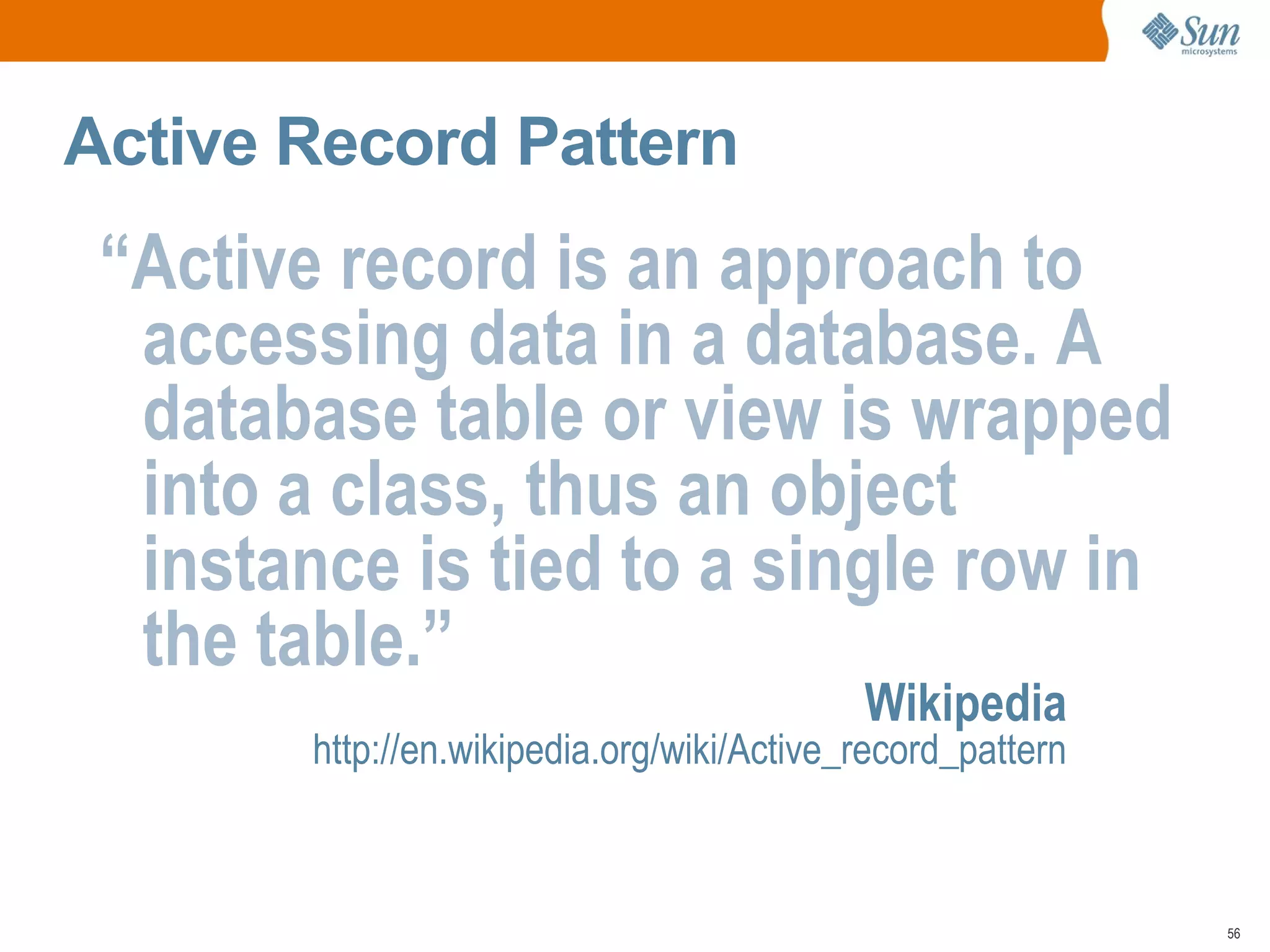
    Active Record Pattern“ Active record is an approach to accessing data in a database. A database table or view is wrapped into a class, thus an object instance is tied to a single row in the table.” Wikipedia http://en.wikipedia.org/wiki/Active_record_pattern
  • 124.
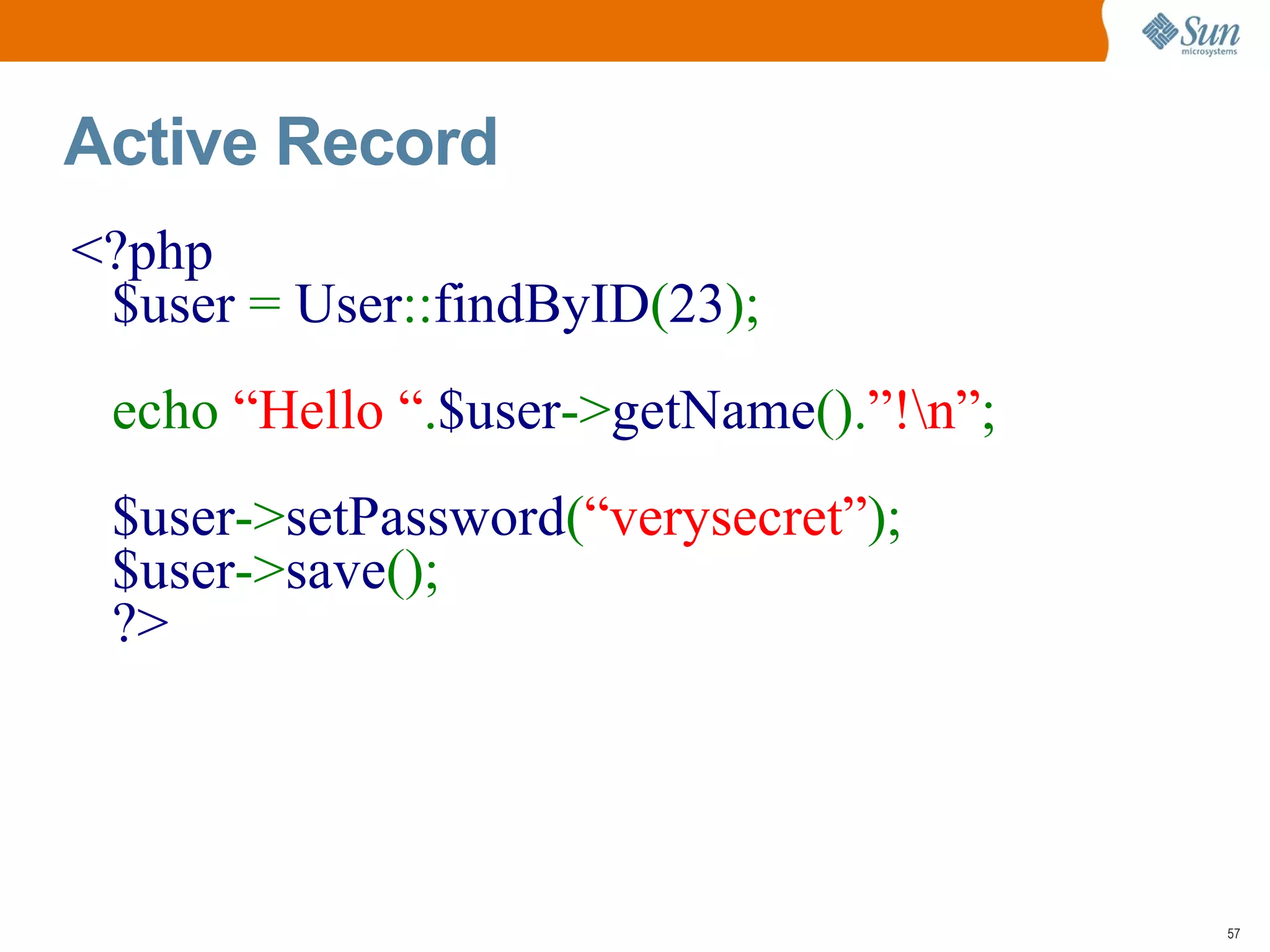
    Active Record <?php$user = User :: findByID ( 23 ); echo “Hello “ . $user -> getName (). ”!\n” ; $user -> setPassword ( “verysecret” ); $user -> save (); ?>
  • 125.
    Late Static Binding<?php abstract class ActiveRecord { static function findById ( $id ) { $table = /* what's the name to use? */ $query = “SELECT * FROM “ . $table . ” WHERE id=” . $id ; /* .... */ } } class User extends ActiveRecord {} class Entry extends ActiveRecord {} $a = User :: findById ( 2 ); $b = Entry :: findById ( 4 ); $table = get_called_class();
  • 126.
    Late Static BindingII class Base { public static function m() { self ::printName(); static ::printName(); } static function printName() { echo __CLASS__; } } } Base::m(); Base Base class Extended extends Base { static function printName() { echo __CLASS__; } } } Extended::m(); Base Extended

Editor's Notes