


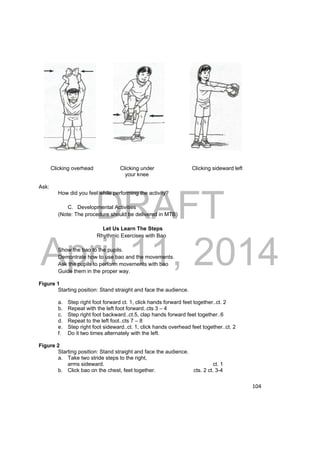
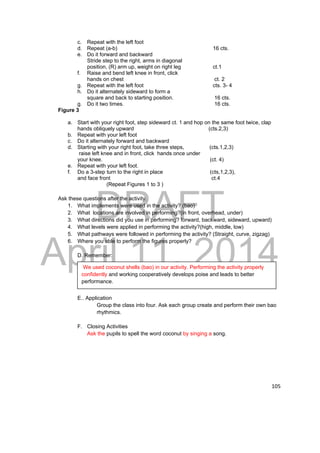
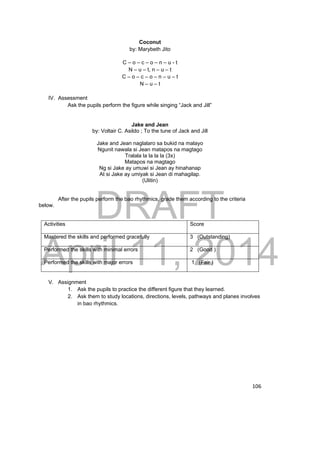
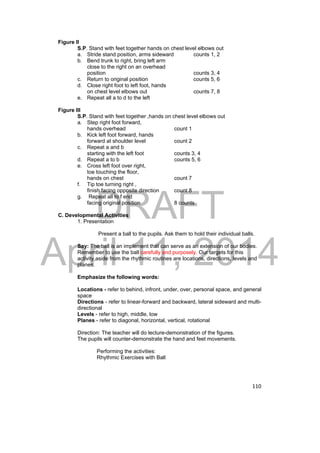
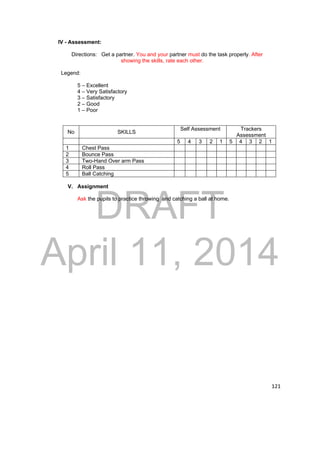
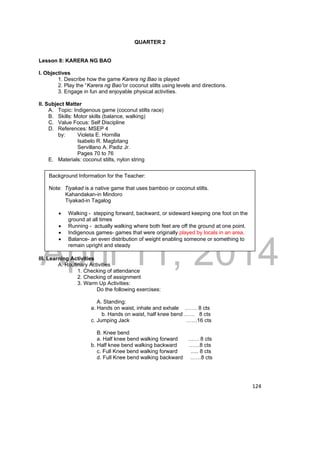
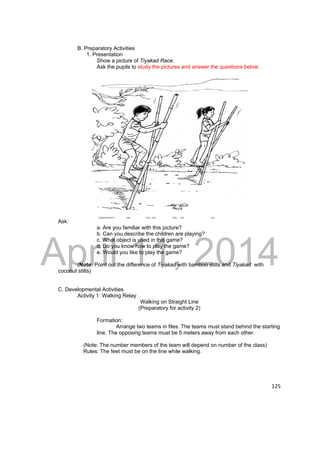
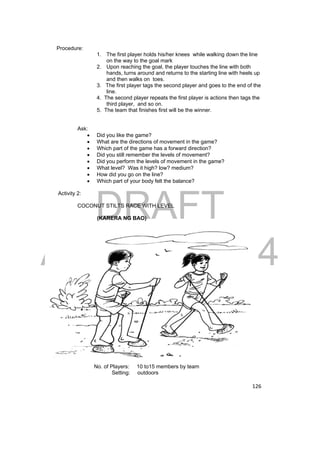
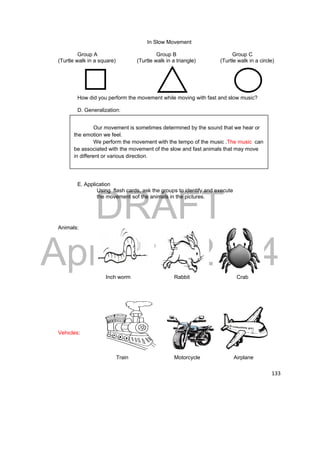
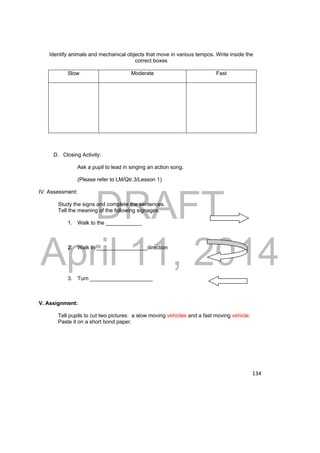
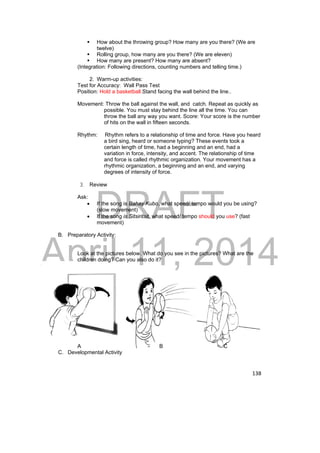
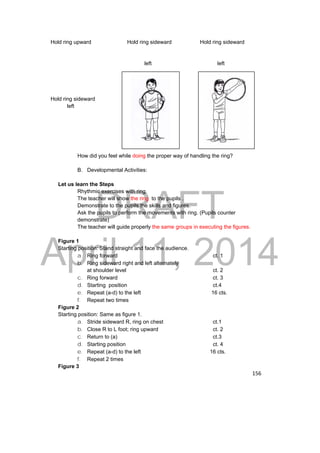



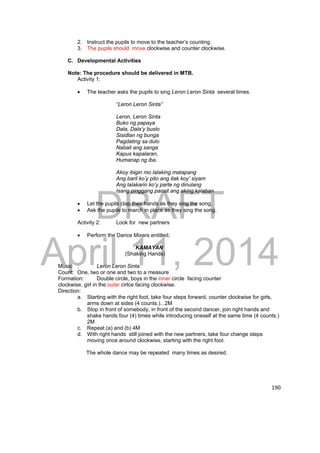
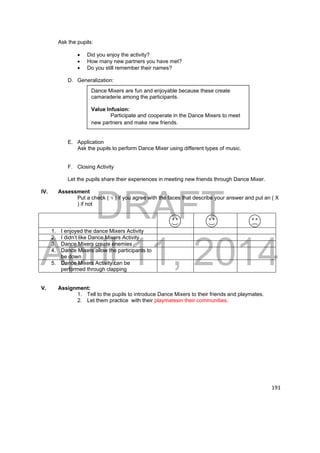
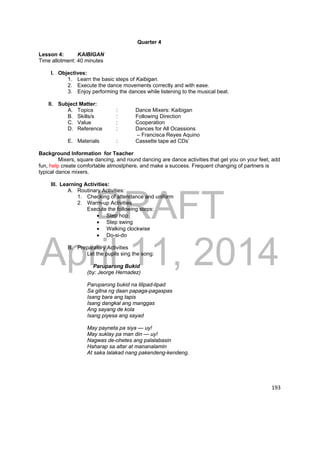
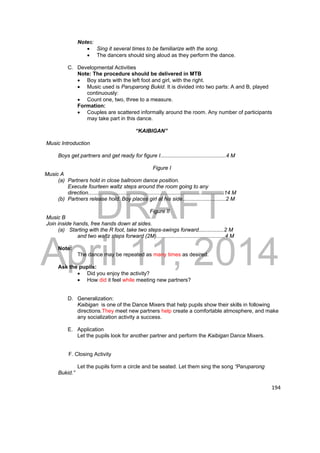
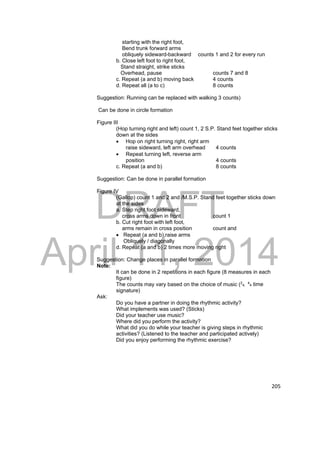
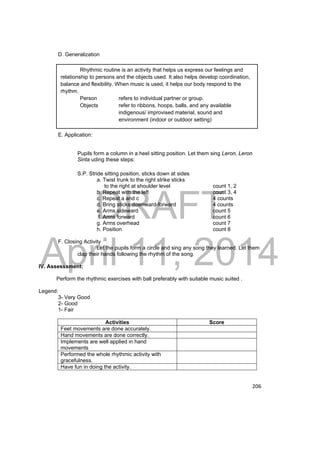

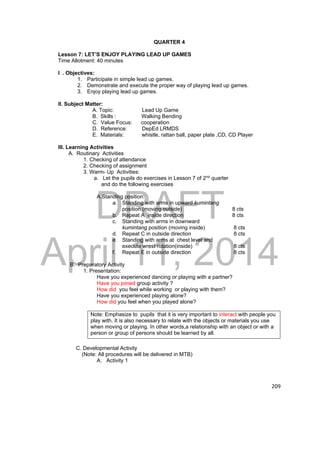
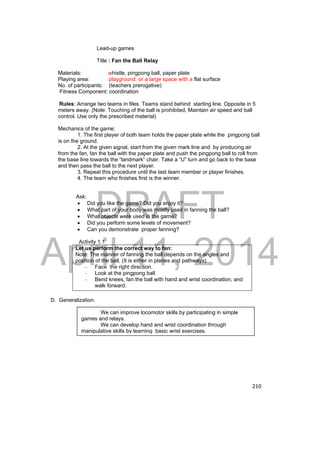
DRAFT 
April 11, 2014 
1 
QUARTER I 
Lesson 1: BODY SHAPES AND ACTION 
Time Allotment: 40 minutes 
I. Objectives: 
1. Describe the proper body mechanics while standing. 
2. Move the body properly in response to sounds and music. 
3. Engage in fun and enjoyable physical activities. 
II. Subject Matter: 
A. Topics: Basic Standing Positions and Movements 
B. Skill/s: Locomotor, and Non-locomotor, Standing 
C. Values: Cooperation, Alertness, Self-Discipline 
D. Reference: TGs and LMs Gr. 2, Enhancing Skills through MAPE 
E. Materials: CD & CD player, and Activity Cards 
III. Learning Activities: 
(Note:The teacher must explain the concept of mirror image and refere to the 
pictures in the LM, while giving instructions to the student.) 
A. Routinary Activities: 
1. Checking of attendance and PE uniform (appropriate attire for physical activities) 
2. Warm-up activities 
a. Jog in place (8 counts) walk in place (8 counts) 
b. Breathing exercise (10 counts) 
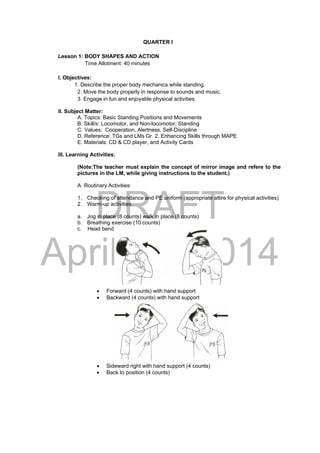
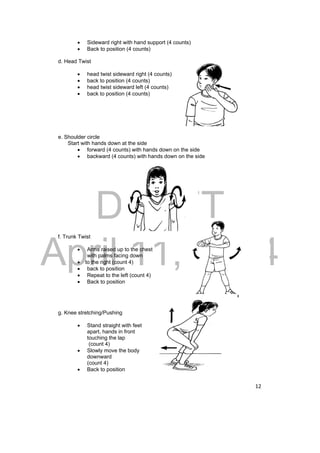
c. Head bend 
 Forward (4 counts) with hand support 
 Backward (4 counts) with hand support 
 Sideward right with hand support (4 counts) 
 Back to position (4 counts)
DRAFT 
April 11, 2014 
2 
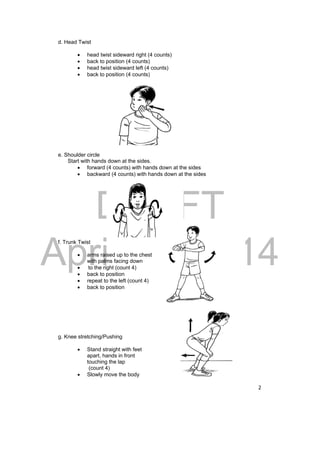
d. Head Twist 
 head twist sideward right (4 counts) 
 back to position (4 counts) 
 head twist sideward left (4 counts) 
 back to position (4 counts) 
e. Shoulder circle 
Start with hands down at the sides. 
 forward (4 counts) with hands down at the sides 
 backward (4 counts) with hands down at the sides 
f. Trunk Twist 
 arms raised up to the chest 
with palms facing down 
 to the right (count 4) 
 back to position 
 repeat to the left (count 4) 
 back to position 
g. Knee stretching/Pushing 
 Stand straight with feet 
apart, hands in front 
touching the lap 
(count 4) 
 Slowly move the body
DRAFT 
April 11, 2014 
3 
downward 
(count 4) 
 Back to position 
(Note: Point out that the knees should 
not go beyond the toes.) 
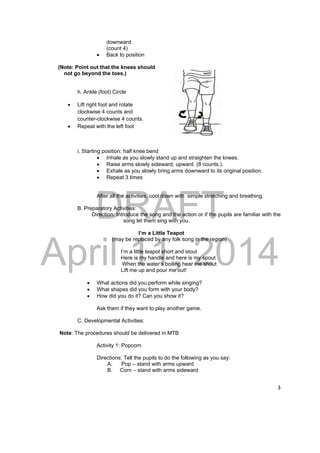
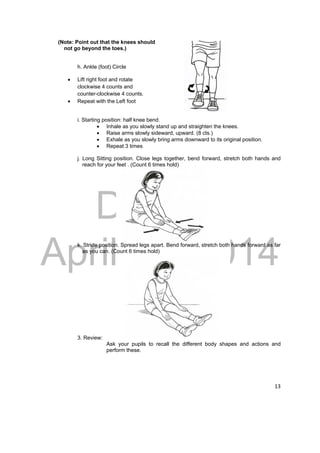
h. Ankle (foot) Circle 
 Lift right foot and rotate 
clockwise 4 counts and 
counter-clockwise 4 counts. 
 Repeat with the left foot 
i. Starting position: half knee bend 
 Inhale as you slowly stand up and straighten the knees. 
 Raise arms slowly sideward, upward. (8 counts.). 
 Exhale as you slowly bring arms downward to its original position. 
 Repeat 3 times 
After all the activities, cool down with simple stretching and breathing. 
B. Preparatory Activities: 
Direction: Introduce the song and the action or if the pupils are familiar with the 
song let them sing with you. 
I’m a Little Teapot 
(may be replaced by any folk song in the region) 
I’m a little teapot short and stout 
Here is my handle and here is my spout 
When the water‘s boiling hear me shout 
Lift me up and pour me out! 
 What actions did you perform while singing? 
 What shapes did you form with your body? 
 How did you do it? Can you show it? 
Ask them if they want to play another game. 
C. Developmental Activities: 
Note: The procedures should be delivered in MTB 
Activity 1: Popcorn 
Directions: Tell the pupils to do the following as you say: 
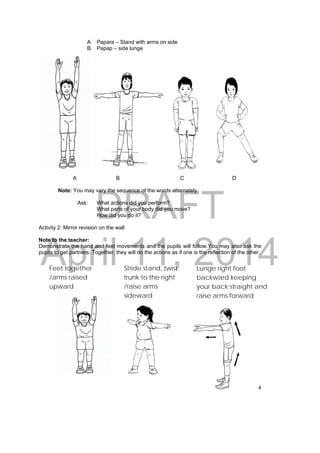
A. Pop – stand with arms upward 
B. Corn – stand with arms sideward
DRAFT 
April 11, 2014 
4 
A. Papara – Stand with arms on side 
B. Papap – side lunge 
A B C D 
Note: You may vary the sequence of the words alternately. 
Ask: What actions did you perform? 
What parts of your body did you move? 
How did you do it? 
Activity 2: Mirror revision on the wall 
Note to the teacher: 
Demonstrate the hand and feet movements and the pupils will follow.You may also ask the 
pupils to get partners. Together, they will do the actions as if one is the reflection of the other. 
Feet together 
/arms raised 
upward 
Stride stand, twist 
trunk to the right 
/raise arms 
sideward 
Lunge right foot 
backward keeping 
your back straight and 
raise arms forward
Our bodies can perform different shapes and lines such as straight, curled and 
twisted.It can also show different shapes and actions. 
If you can move your body and form shapes in many ways, you will enjoy 
exercising. 
Values Infusion 
Cooperation, self discipline, and initiative are important in doing varied activities. 
DRAFT 
April 11, 2014 
5 
Ask the following questions 
What can you say about the movements? 
What different shapes were formed with bodies? 
Can you describe the different positions? 
What body parts were used to form the shapes? 
Can you do it? 
D.Generalization 
E.. Application: 
Merry-Go-Round 
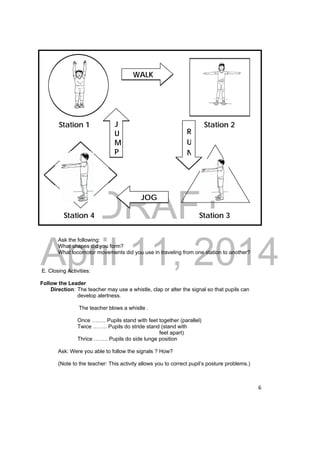
Direction: Using the base method.Devide the pupils into four groups. Ask them to form 
the shape assigned in each base. They should have formed the shapes at 
the end of the song (Twinkle Twinkle Little Star)and move to the next base 
using the prescribed locomotor movement. 
Station 1 – Form a circle shape with arms upward 
Station 2 – Form a square shape with arms sideward 
Station 3 –Form a triangle with arms in front 
Station 4 – Form a diamond shape with arms in fron
WALK 
J 
U 
Station 1 Station 2 
R 
U 
N 
MP 
DRAFT 
JOG 
Station 4 Station 3 
April 11, 2014 
6 
Ask the following: 
What shapes did you form? 
What locomotor movements did you use in traveling from one station to another? 
E. Closing Activities: 
Follow the Leader 
Direction: The teacher may use a whistle, clap or alter the signal so that pupils can 
develop alertness. 
The teacher blows a whistle . 
Once …….. Pupils stand with feet together (parallel) 
Twice …….. Pupils do stride stand (stand with 
feet apart) 
Thrice …….. Pupils do side lunge position 
Ask: Were you able to follow the signals ? How? 
(Note to the teacher: This activity allows you to correct pupil’s posture problems.)
DRAFT 
April 11, 2014 
7 
IV. Assessment: 
Put a check (√) in the box that matches your performance.. 
Yes No 
1. Did you perform correctly? 
a. feet together (parallel) 
b. stride stand 
c. side lunge 
2. Did you perform correctly the following shapes? 
a. straight 
b. curve 
c. twisted 
3. Did you cooperate in the different activities? 
4. Did you enjoy the different activities? 
V. Assignment: 
A. Ask the pupils to practice at home the different body shapes and body actions . 
B. Ask the pupils to list down five exercises that show flexibility.
DRAFT 
April 11, 2014 
11 
QUARTER 1 
Lesson 2: LET’S MOVE AND BE FLEXIBLE! 
Time Allotment: 40 minutes per week 
I. Objectives: 
1. Describe the proper way of bending and stretching to improve flexibility 
2. Execute correct bending and stretching to improve body posture 
3. Enjoy a pair activity for fitness and fun 
II. Subject Matter: 
A. Topics: Body Conditioning and Flexibility 
B. Skill/s: 1) Locomotor 
2) Non-Locomotor: Bending, Stretching 
C. Values: Cooperation, Self-Discipline 
D. Reference: TGs and LMs Gr. 2, Enhancing Skills through MAPE 
E. Materials: Activity card, pictures, flashcards 
III. Learning Activities: 
A. Routinary Activities: 
1. Checking of attendance and PE uniform (appropriate attire 
for physical activities) 
2. Warm-up activities 
a. Jog in place (8 counts) walk in place (8 counts) 
b. Breathing exercise (10 counts) 
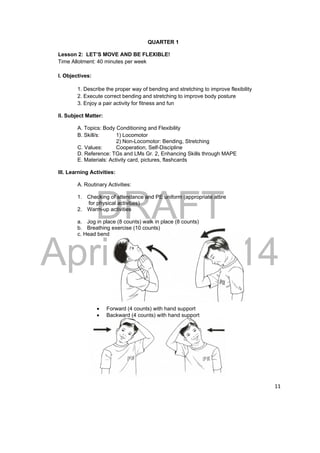
c. Head bend 
 Forward (4 counts) with hand support 
 Backward (4 counts) with hand support
DRAFT 
April 11, 2014 
12 
 Sideward right with hand support (4 counts) 
 Back to position (4 counts) 
d. Head Twist 
 head twist sideward right (4 counts) 
 back to position (4 counts) 
 head twist sideward left (4 counts) 
 back to position (4 counts) 
e. Shoulder circle 
Start with hands down at the side 
 forward (4 counts) with hands down on the side 
 backward (4 counts) with hands down on the side 
f. Trunk Twist 
 Arms raised up to the chest 
with palms facing down 
 to the right (count 4) 
 back to position 
 Repeat to the left (count 4) 
 Back to position 
g. Knee stretching/Pushing 
 Stand straight with feet 
apart, hands in front 
touching the lap 
(count 4) 
 Slowly move the body 
downward 
(count 4) 
 Back to position
DRAFT 
April 11, 2014 
13 
(Note: Point out that the knees should 
not go beyond the toes.) 
h. Ankle (foot) Circle 
 Lift right foot and rotate 
clockwise 4 counts and 
counter-clockwise 4 counts. 
 Repeat with the Left foot 
i. Starting position: half knee bend. 
 Inhale as you slowly stand up and straighten the knees. 
 Raise arms slowly sideward, upward. (8 cts.) 
 Exhale as you slowly bring arms downward to its original position. 
 Repeat 3 times 
j. Long Sitting position. Close legs together, bend forward, stretch both hands and 
reach for your feet . (Count 6 times hold) 
k. Stride position. Spread legs apart. Bend forward, stretch both hands forward as far 
as you can. (Count 6 times hold) 
3. Review: 
Ask your pupils to recall the different body shapes and actions and 
perform these.
DRAFT 
April 11, 2014 
14 
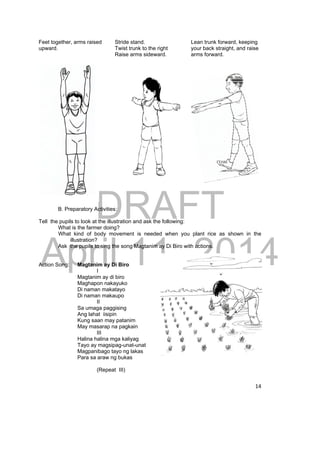
Feet together, arms raised 
upward. 
Stride stand. 
Twist trunk to the right 
Raise arms sideward. 
Lean trunk forward, keeping 
your back straight, and raise 
arms forward. 
B. Preparatory Activities: 
Tell the pupils to look at the illustration and ask the following: 
What is the farmer doing? 
What kind of body movement is needed when you plant rice as shown in the 
illustration? 
Ask the pupils to sing the song Magtanim ay Di Biro with actions. 
Action Song: Magtanim ay Di Biro 
I 
Magtanim ay di biro 
Maghapon nakayuko 
Di naman makatayo 
Di naman makaupo 
II 
Sa umaga paggising 
Ang lahat iisipin 
Kung saan may patanim 
May masarap na pagkain 
III 
Halina halina mga kaliyag 
Tayo ay magsipag-unat-unat 
Magpanibago tayo ng lakas 
Para sa araw ng bukas 
(Repeat III)
DRAFT 
April 11, 2014 
15 
Ask: 
 What kind of body movements do you do when planting rice? 
 Can you show how proper bending is done? 
(Note to the Teacher: Prescribe correct bending posture when 
planting/picking up objects from the floor: bent knees, trunk slightly bent 
forward with back straight) 
What body postures have you done? 
 How do you recover from bent position? (Expected answer: back to 
original position) 
C. Developmental Activities: 
(Note to teacher: Do the warm–up activities here) 
(The procedure should be delivered in MTB) 
Activity 1: Ready Get Set Go 
Directions: Group the class into four columns. Ask the pupils to do the following 
positions.The pupils must wait for the teacher’s Go signal and freeze for five 
seconds. 
Groups who did the positions correctly will move 1 step forward until a group 
reaches the finish line. (Note to the teacher: Use the following commands). 
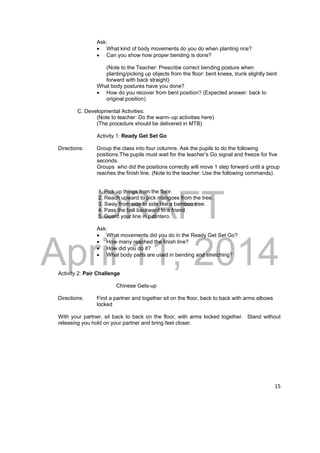
1. Pick up things from the floor. 
2. Reach upward to pick mangoes from the tree. 
3. Sway from side to side like a bamboo tree. 
4. Pass the ball backward to a friend. 
5. Guard your line in patintero. 
Ask: 
 What movements did you do in the Ready Get Set Go? 
 How many reached the finish line? 
 How did you do it? 
 What body parts are used in bending and stretching? 
Activity 2: Pair Challenge 
Chinese Gets-up 
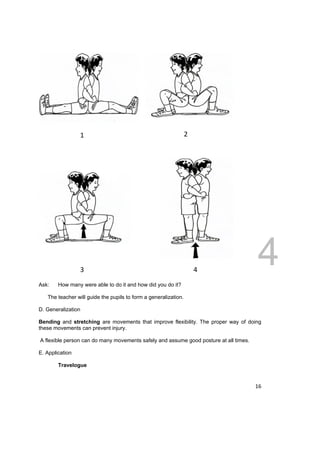
Directions: Find a partner and together sit on the floor, back to back with arms elbows 
locked 
With your partner, sit back to back on the floor, with arms locked together. Stand without 
releasing you hold on your partner and bring feet closer.
1 2 
DRAFT 
April 11, 2014 
16 
3 4 
Ask: How many were able to do it and how did you do it? 
The teacher will guide the pupils to form a generalization. 
D. Generalization 
Bending and stretching are movements that improve flexibility. The proper way of doing 
these movements can prevent injury. 
A flexible person can do many movements safely and assume good posture at all times. 
E. Application 
Travelogue
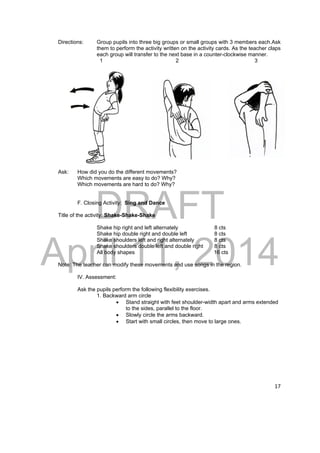
Directions: Group pupils into three big groups or small groups with 3 members each.Ask 
them to perform the activity written on the activity cards. As the teacher claps 
each group will transfer to the next base in a counter-clockwise manner. 
1 2 3 
DRAFT 
April 11, 2014 
17 
Ask: How did you do the different movements? 
Which movements are easy to do? Why? 
Which movements are hard to do? Why? 
F. Closing Activity: Sing and Dance 
Title of the activity: Shake-Shake-Shake 
Shake hip right and left alternately 8 cts 
Shake hip double right and double left 8 cts 
Shake shoulders left and right alternately 8 cts 
Shake shoulders double left and double right 8 cts 
All body shapes 16 cts 
Note: The teacher can modify these movements and use songs in the region. 
IV. Assessment: 
Ask the pupils perform the following flexibility exercises. 
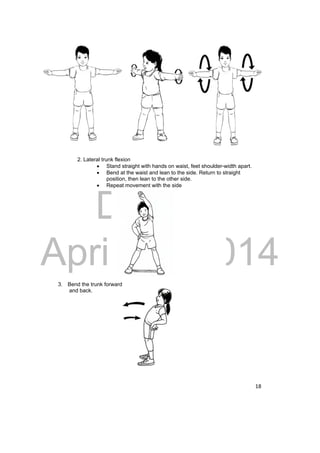
1. Backward arm circle 
 Stand straight with feet shoulder-width apart and arms extended 
to the sides, parallel to the floor. 
 Slowly circle the arms backward. 
 Start with small circles, then move to large ones.
DRAFT 
April 11, 2014 
18 
2. Lateral trunk flexion 
 Stand straight with hands on waist, feet shoulder-width apart. 
 Bend at the waist and lean to the side. Return to straight 
position, then lean to the other side. 
 Repeat movement with the side 
3. Bend the trunk forward 
and back.
DRAFT 
April 11, 2014 
19 
Iv. Assessment: 
A. Check the box on the self assessment portion that matches to your peerformance. 
Legend: 
3 - Very good 
2 - Good 
1 - Needs improvement 
ACTIVITIES Self Assessment Teacher’s 
Assessment 
1. Bend forward 
2. Bend backward 
3. Bend sideward 
B. How did you perform the Chinese Gets up? 
Check one: 
Very good 
Good 
Needs improvement 
Did you like your performance? Why? Why not? 
___________________________________________________________ 
___________________________________________________________ 
V. Assignment: 
A. Practice the different exercises that you learned. 
B. List down five walking movements done with body shapes.
DRAFT 
April 11, 2014 
23 
QUARTER 1 
Lesson 3: LET’S WALK AND SING! 
Time Allotment: 40 minutes (one meeting per week) 
I. Objectives 
1. Walk in different directions with proper body mechanics 
2. Move in different directions in response to sounds and music 
3. Perform flexibility exercises while singing 
4. Enjoy and have fun in walking activities 
II. Subject Matter: 
A. Topic: Walking and Flexibility Exercises 
B. Skill: Movement skill Walking in different directions 
C. Values: Discipline, Patience 
D. References: Fitness for Health & Sports by Patricia G. Avila, M.D 
 Fitness for Children by Curt Hilton, Copyright 1995 
 Materials: CD ,cassette, laptop, pictures 
III. Learning Activities: 
A. Routinary Activities: 
1. Checking of attendance and PE uniform (appropriate attire for physical activities) 
2. Warm-up activities 
(Note to the teacher: warm –up activities must be done before the 
activity ) 
a. Refer to Lesson 1 on warm up exercises. (You can use music to 
accompany the movement) 
b. Pupils must do the stretching exercises. 
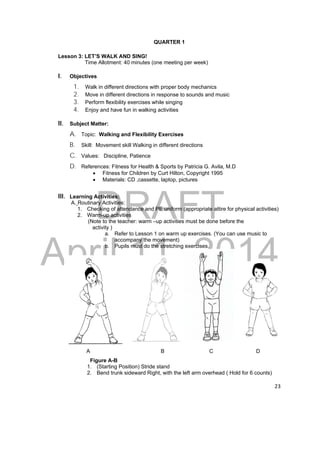
A B C D 
Figure A-B 
1. (Starting Position) Stride stand 
2. Bend trunk sideward Right, with the left arm overhead ( Hold for 6 counts)
3. Back to starting position (Hold for counts 7-8) 
4. Bend trunk sideward left, with the right arm overhead ( Hold for 6 counts) 
5. Back to starting position (Hold for counts 7-8) 
Figure C 
1. (Starting Position) Stride stand 
2. Raise heels, raise arms upward, hold hands together, (Hold for 6 counts) 
3. Back to Starting Position (for counts 7-8) 
Figure D 
1. (Starting Position) Stride stand 
2. Hands on waist (Hold for 6 counts) 
3. Back to Starting Position (for counts 7-8) 
4. Repeat from A-D 
5. Inhale and exhale (8 counts) 
DRAFT 
April 11, 2014 
24 
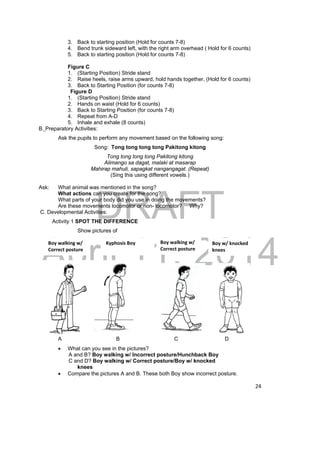
Boy walking w/ 
Correct posture 
Boy w/ knocked 
knees 
Boy walking w/ 
Correct posture 
Kyphosis Boy 
B. Preparatory Activities: 
Ask the pupils to perform any movement based on the following song: 
Song: Tong tong tong tong Pakitong kitong 
Tong tong tong tong Pakitong kitong 
Alimango sa dagat, malaki at masarap 
Mahirap mahuli, sapagkat nangangagat. (Repeat) 
(Sing this using different vowels.) 
Ask: What animal was mentioned in the song? 
What actions can you create for the song? 
What parts of your body did you use in doing the movements? 
Are these movements locomotor or non- locomotor? Why? 
C. Developmental Activities: 
Activity 1 SPOT THE DIFFERENCE 
Show pictures of 
A B C D 
 What can you see in the pictures? 
A and B? Boy walking w/ Incorrect posture/Hunchback Boy 
C and D? Boy walking w/ Correct posture/Boy w/ knocked 
knees 
 Compare the pictures A and B. These both Boy show incorrect posture.
Walking properly in different directions is an enjoyable 
activity that will help the proper functioning of our body 
system. 
Values infusion: Patience and Discipline are 
important when playing with classmates. 
DRAFT 
April 11, 2014 
25 
 Who walks properly, the boy in picture C? or the one in picture D? 
 Who can demonstrate proper walking? 
Pupil will demonstrate proper body mechanics. 
Activity 2 WALKING ALL THE WAY 
Direction: Group the pupils into four columns, with five for each line. 
Upon signal of the teacher (whistle), the pupils will 
execute walking with proper body mechanics (with music). 
(Note for the teacher: The activity should allow you to identify pupils with postural problems.) 
What can you say about walking activity? 
D. Generalization: 
E. Application 
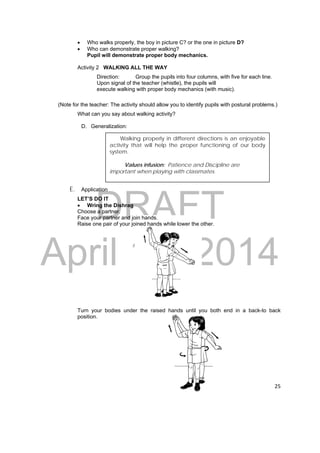
LET’S DO IT 
 Wring the Dishrag 
Choose a partner. 
Face your partner and join hands. 
Raise one pair of your joined hands while lower the other. 
Turn your bodies under the raised hands until you both end in a back-to back 
position.
DRAFT 
April 11, 2014 
26 
D. Closing Activity: 
Now, let’s sing a song with actions. 
Song: Maliit na Gagamba 
Maliit na gagamba umakyat sa sanga 
Dumating ang ulan itinaboy sila 
Sumikat ang araw natuyo ang sanga 
Maliit na gagamba palaging Masaya 
IV. Assessment: 
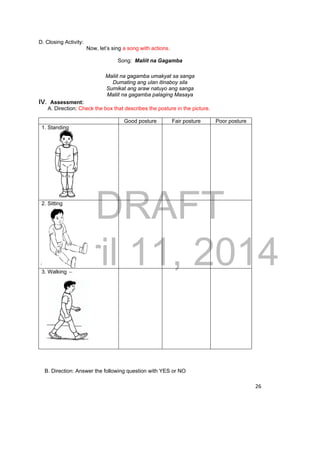
A. Direction: Check the box that describes the posture in the picture. 
Good posture Fair posture Poor posture 
1. Standing 
2. Sitting 
3. Walking 
B. Direction: Answer the following question with YES or NO
DRAFT 
April 11, 2014 
27 
1. Do you walk with arms raised upward? _______ 
2. Do you walk crisscrossed? _______ 
3. Do you walk with knees bent? _______ 
4. Do you walk with arms swinging on the sides? _______ 
5. Do you walk in a straight line? _______ 
V. Assignment: 
A. Use proper body mechanics while walking. 
B. Practice at home the flexibility exercises that you have learned. 
References: Fitness for Health & Sports by: Patricia G. Avila, M.D 
Fitness for Children by Curt Hilton, Copyright 1995
DRAFT 
April 11, 2014 
29 
QUARTER 1 
Lesson 4: LET’S MOVE AND BEND OUR KNEES! 
Time Allotment: 40 minutes 
I. Objectives 
1. Describe flexibility and conditioning exercises in kneeling position 
2. Perform kneeling exercise with proper body mechanics 
3, Engage in fun and enjoyable kneeling activities 
II. Subject Matter: 
A. Topic: Flexibility and Conditioning Exercises 
B. Skill/s: Movement Skills, Bending and Stretching 
C. Values: Cooperation, Patience 
D. Reference: Fitness for Health & Sports by Patricia G. Avila, M.D 
Fitness for Children by Curt Hilton, Copyright 1995 
E. Materials: cassette, CDs’, Laptop, Stick, Pictures 
III. Learning Activities: 
A. Routinary Activities: 
1. Checking of attendance and PE uniform (appropriate attire for physical 
activities) 
2. Warm up activities 
Refer to Lesson 3 on warm up exercises. (You may use music to accompany the 
movements. 
B. Preparatory Activities: 
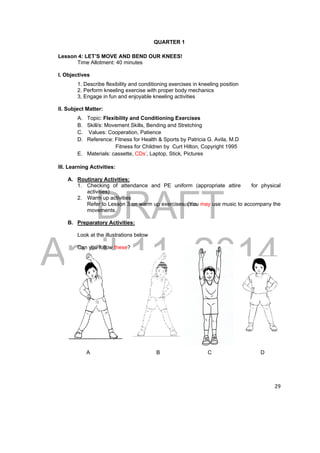
Look at the illustrations below 
Can you follow these? 
A B C D
DRAFT 
April 11, 2014 
30 
Figure A-B 
1. (Starting Position) Stride stand 
2. Bend trunk sideward right, with the left arm overhead ( Hold for 6 counts) 
3. Back to starting position (Hold for counts 7-8) 
4. Bend trunk sideward left, with the right arm overhead ( Hold for 6 counts) 
5. Back to starting position (Hold for counts 7-8) 
Figure C 
1. (Starting Position) Stride stand 
2. Raise heels, raise arms upward, ( Hold for 6 counts) 
3. Back to Starting Position (for counts 7-8) 
Figure D 
1. (Starting Position) Stride stand 
2. Hands on waist, (Hold for 6 counts) 
3. Back to starting position (for counts 7-8) 
4. Repeat from A-D 
5. Inhale and exhale (8 counts) 
C. Developmental Activities: 
(Note: The procedures should be delivered in MTB) 
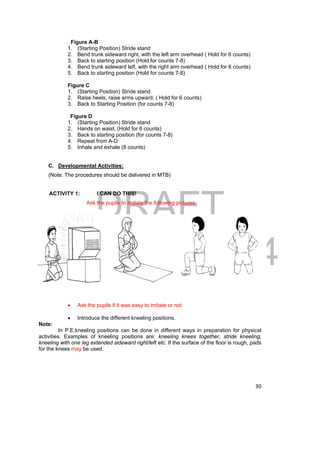
ACTIVITY 1: I CAN DO THIS! 
Ask the pupils to imitate the following pictures: 
 Ask the pupils if it was easy to imitate or not 
 Introduce the different kneeling positions. 
Note: 
In P.E,kneeling positions can be done in different ways in preparation for physical 
activities. Examples of kneeling positions are: kneeling knees together, stride kneeling, 
kneeling with one leg extended sideward right/left etc. If the surface of the floor is rough, pads 
for the knees may be used.
DRAFT 
4‐5 
2‐3 
Only 1 
April 11, 2014 
31 
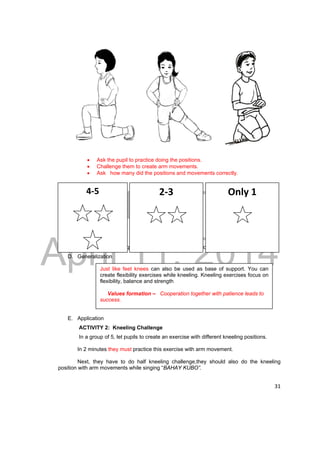
 Ask the pupil to practice doing the positions. 
 Challenge them to create arm movements. 
 Ask how many did the positions and movements correctly. 
The teacher will ask questions to guide the pupils in forming the generalization 
D. Generalization 
Just like feet knees can also be used as base of support. You can 
create flexibility exercises while kneeling. Kneeling exercises focus on 
flexibility, balance and strength 
Values formation – Cooperation together with patience leads to 
success. 
E. Application 
ACTIVITY 2: Kneeling Challenge 
In a group of 5, let pupils to create an exercise with different kneeling positions. 
In 2 minutes they must practice this exercise with arm movement. 
Next, they have to do half kneeling challenge,they should also do the kneeling 
position with arm movements while singing “BAHAY KUBO”.
DRAFT 
April 11, 2014 
32 
F. Closing Activity 
The pupils will sing together the following songs. 
Song: UMUPO, TUMAYO 
(To the tune of Rocking the Boat) 
Umupo, tumayo gumagalaw ang Bangka (3x) 
KUMUSTA KA 
Kumusta ka,ako ay masaya 
Umikot ng umikot at humanap na iba 
(Find a partner and repeat) 
IV. Assessment: 
Self Rating 
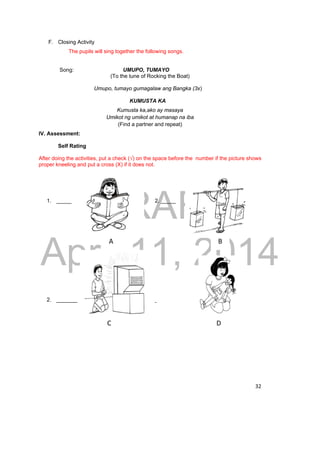
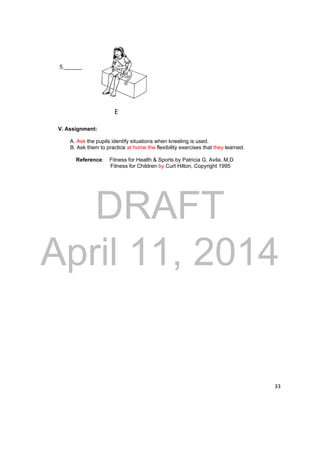
After doing the activities, put a check (√) on the space before the number if the picture shows 
proper kneeling and put a cross (X) if it does not. 
1. _____ 2. _____ 
A B 
2. _______ 4. _____ 
C D
E 
DRAFT 
April 11, 2014 
33 
5.______ 
V. Assignment: 
A. Ask the pupils identify situations when kneeling is used. 
B. Ask them to practice at home the flexibility exercises that they learned. 
Reference: Fitness for Health & Sports by Patricia G. Avila, M.D 
Fitness for Children by Curt Hilton, Copyright 1995
DRAFT 
April 11, 2014 
35 
QUARTER 1 
Lesson 5: LET’S SIT AND CREATE SHAPES! 
Time Allotment: 40 minutes 
I. Objectives: 
1. Perform different sitting positions with correct body 
2. Form different shapes out with one’s body while sitting 
3. Enjoy and have fun participating in simple relay/race 
II. Subject Matter: 
A. Topics: Sitting Positions and Body Shapes 
B. Skills: Individual Stunts; Hip walk (Forward and Backward), Cricket walk 
C. Value Focus: Patience and Cooperation 
D. References: Worktext in Music, Arts and Physical Education 4A Journey 
Through the World of Music, Arts and P.E.3 
E. Materials: Pictures of different sitting positions 
III. Learning Activities 
A. Routinary Activities: 
1. Checking of attendance and P.E. Uniform (appropriate attire for 
physical activities) 
2. Warm – Up Activities 
The pupils do the following bending, stretching, twisting, and 
balancing exercise: 
 Jog in place – 16 counts 
 Bend at the waist forward and backward, side to side – 32 counts 
 Stretch up high, forward and backward, side to side – 32 counts 
 Twist the upper body to the right or left while keeping their feet 
stationary – 32 counts 
 Balance on one foot, raise right foot or left – 32 counts 
 Breathing exercise – 32 counts 
B. Preparatory Activities: 
Ask the pupils to perform the different kneeling positions. 
 Kneel on both legs 
 Stride kneeling 
 Half kneeling 
 Half kneeling with one leg extended sideways 
C. Developmental Activities 
(Note: The procedure should be delivered in MTB) 
Activity 1: Sing and Move with Me 
Action song: “Sit Down, You’re Rocking the Boat” 
What body movements did you do while singing the song? 
Did you enjoy the actions?
DRAFT 
April 11, 2014 
36 
Activity 2: Look at Me 
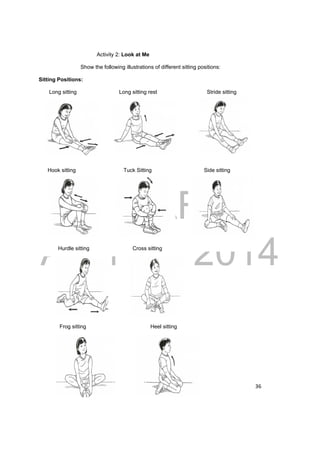
Show the following illustrations of different sitting positions: 
Sitting Positions: 
Long sitting Long sitting rest Stride sitting 
Hook sitting Tuck Sitting Side sitting 
Hurdle sitting Cross sitting 
Frog sitting Heel sitting
Ask the pupils to look at the pictures. 
Ask: What do you see in the picture? 
What is the child doing in the picture? 
Can you do it? 
Demonstrate the different sitting positions. Ask the pupils to observe and imitate. Ask 
DRAFT 
April 11, 2014 
37 
them do it by groups. 
1. What different sitting positions did you do? 
2. Did you perform the different positions with correct body movements? Yes/No? 
3. Which sitting positions did you find difficult to do? Why? 
Activity 3. Creating Body Shapes (Group work) 
Directions: Select three sitting positions and form shapes with your body. 
Rubrics: 
Activities Scores 
Create at least three body shapes 
Create at least two body shapes 
Create at least one body shapes 
Now that you have done the different sitting positions, let us now answer this question. 
Why is it important to know the basic positions properly? 
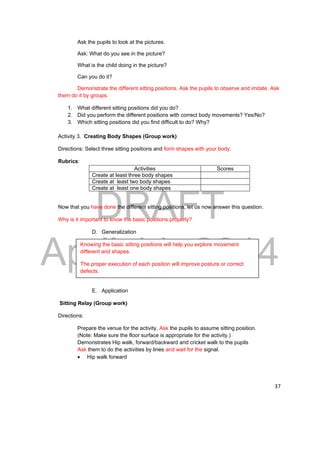
D. Generalization 
Knowing the basic sitting positions will help you explore movement 
different and shapes. 
The proper execution of each position will improve posture or correct 
defects. 
E. Application 
Sitting Relay (Group work) 
Directions: 
Prepare the venue for the activity. Ask the pupils to assume sitting position. 
(Note: Make sure the floor surface is appropriate for the activity.) 
Demonstrates Hip walk, forward/backward and cricket walk to the pupils 
Ask them to do the activities by lines and wait for the signal. 
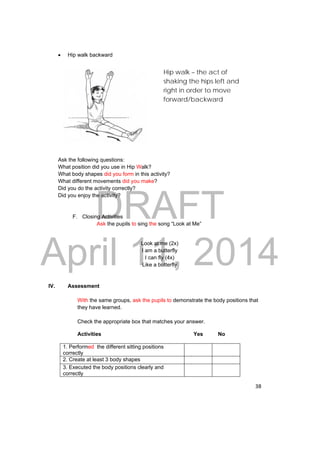
 Hip walk forward
Hip walk – the act of 
shaking the hips left and 
right in order to move 
forward/backward 
DRAFT 
April 11, 2014 
38 
 Hip walk backward 
Ask the following questions: 
What position did you use in Hip Walk? 
What body shapes did you form in this activity? 
What different movements did you make? 
Did you do the activity correctly? 
Did you enjoy the activity? 
F. Closing Activities 
Ask the pupils to sing the song “Look at Me” 
Look at me (2x) 
I am a butterfly 
I can fly (4x) 
Like a butterfly 
IV. Assessment 
With the same groups, ask the pupils to demonstrate the body positions that 
they have learned. 
Check the appropriate box that matches your answer. 
Activities Yes No 
1. Performed the different sitting positions 
correctly 
2. Create at least 3 body shapes 
3. Executed the body positions clearly and 
correctly
DRAFT 
April 11, 2014 
39 
4. Participated in relay and races actively 
5. Worked cooperatively with the group 
V. Assignment 
Ask the pupils practice at home the different sitting positions.
DRAFT 
April 11, 2014 
41 
QUARTER 1 
Lesson 6: STRETCHING CHALLENGE 
Time Allotment: 40 minutes 
I. Objectives: 
1. Describe correct body mechanics in doing simple static and dynamic flexibility 
exercises. 
2. Perform simple static and dynamic flexibility exercises while seated 
3. Enjoy fun games that develop flexibility 
II. Subject Matter: 
A. Topic: Flexibility Exercises 
B. Skill/s: Non-locomotor: Stretching, Bending, Balancing 
C. Values: Cooperation, Patience 
D. References: Fitness for Health & Sports by Patricia G. Avila, 
M.D Fitness for Children by Curt Hilton, Copyright 1995 
E. Materials: floor mat, garter 
III. Learning Activity: 
A. Routinary Activities 
1. Checking of Attendance and PE Uniform (appropriate attire for physical activities) 
2. Warm up Activities: Refer to Lesson 1 on warm up exercises. You may use 
music to accompany movement). 
Note: 
You must do the warm-up before performing the activity. Warm up can 
be done within 5 minutes. 
3. Review 
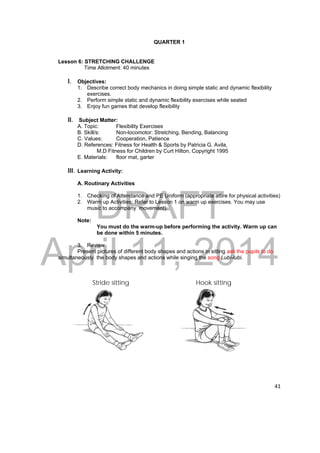
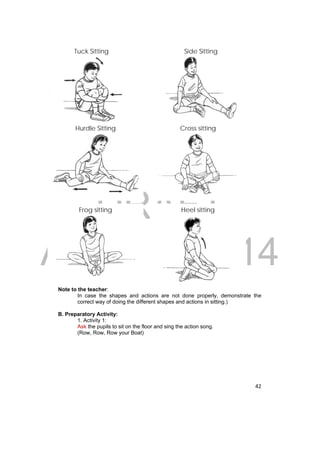
Present pictures of different body shapes and actions in sitting ask the pupils to do 
simultaneously the body shapes and actions while singing the song Lubi-lubi. 
Stride sitting Hook sitting
Tuck Sitting 
Side Sitting 
Hurdle Sitting Cross sitting 
DRAFT 
Frog sitting Heel sitting 
April 11, 2014 
42 
Note to the teacher: 
In case the shapes and actions are not done properly, demonstrate the 
correct way of doing the different shapes and actions in sitting.) 
B. Preparatory Activity: 
1. Activity 1: 
Ask the pupils to sit on the floor and sing the action song. 
(Row, Row, Row your Boat)
DRAFT 
April 11, 2014 
43 
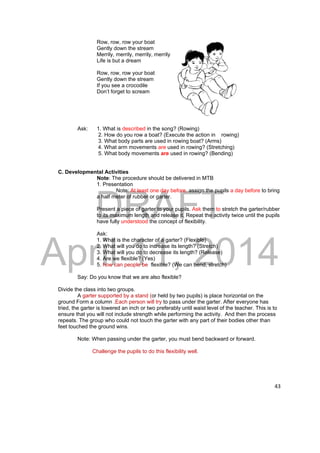
Row, row, row your boat 
Gently down the stream 
Merrily, merrily, merrily, merrily 
Life is but a dream 
Row, row, row your boat 
Gently down the stream 
If you see a crocodile 
Don’t forget to scream 
Ask: 1. What is described in the song? (Rowing) 
2. How do you row a boat? (Execute the action in rowing) 
3. What body parts are used in rowing boat? (Arms) 
4. What arm movements are used in rowing? (Stretching) 
5. What body movements are used in rowing? (Bending) 
C. Developmental Activities 
Note: The procedure should be delivered in MTB 
1. Presentation 
Note: At least one day before, assign the pupils a day before to bring 
a half meter of rubber or garter. 
Present a piece of garter to your pupils. Ask them to stretch the garter/rubber 
to its maximum length and release it. Repeat the activity twice until the pupils 
have fully understood the concept of flexibility. 
Ask: 
1. What is the character of a garter? (Flexible) 
2. What will you do to increase its length? (Stretch) 
3. What will you do to decrease its length? (Release) 
4. Are we flexible? (Yes) 
5. how can people be flexible? (We can bend, stretch) 
Say: Do you know that we are also flexible? 
Divide the class into two groups. 
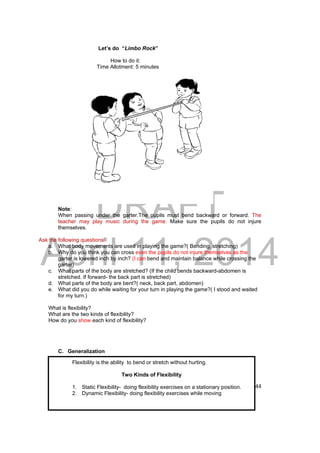
A garter supported by a stand (or held by two pupils) is place horizontal on the 
ground Form a column .Each person will try to pass under the garter. After everyone has 
tried, the garter is lowered an inch or two preferably until waist level of the teacher. This is to 
ensure that you will not include strength while performing the activity. And then the process 
repeats. The group who could not touch the garter with any part of their bodies other than 
feet touched the ground wins. 
Note: When passing under the garter, you must bend backward or forward. 
Challenge the pupils to do this flexibility well.
DRAFT 
April 11, 2014 
44 
Let’s do “Limbo Rock” 
How to do it: 
Time Allotment: 5 minutes 
Note: 
When passing under the garter.The pupils must bend backward or forward. The 
teacher may play music during the game. Make sure the pupils do not injure 
themselves. 
Ask the following questions: 
a. What body movements are used in playing the game?( Bending, stretching) 
b. Why do you think you can cross even the pupils do not injure themselves.as the 
garter is lowered inch by inch? (I can bend and maintain balance while crossing the 
garter) 
c. What parts of the body are stretched? (If the child bends backward-abdomen is 
stretched. If forward- the back part is stretched) 
d. What parts of the body are bent?( neck, back part, abdomen) 
e. What did you do while waiting for your turn in playing the game?( I stood and waited 
for my turn.) 
What is flexibility? 
What are the two kinds of flexibility? 
How do you show each kind of flexibility? 
C. Generalization 
Flexibility is the ability to bend or stretch without hurting. 
Two Kinds of Flexibility 
1. Static Flexibility- doing flexibility exercises on a stationary position. 
2. Dynamic Flexibility- doing flexibility exercises while moving
DRAFT 
April 11, 2014 
45 
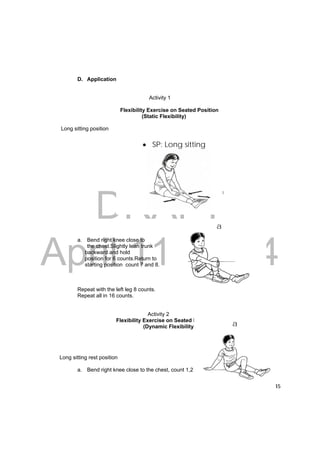
 SP: Long sitting 
a 
D. Application 
Activity 1 
Flexibility Exercise on Seated Position 
(Static Flexibility) 
Long sitting position 
a. Bend right knee close to 
the chest.Slightly lean trunk 
backward and hold 
position for 6 counts.Return to 
starting position count 7 and 8. 
Repeat with the left leg 8 counts. 
Repeat all in 16 counts. 
Activity 2 
Flexibility Exercise on Seated Position 
(Dynamic Flexibility) 
Long sitting rest position 
a. Bend right knee close to the chest, count 1,2 
a
b 
c 
DRAFT 
April 11, 2014 
46 
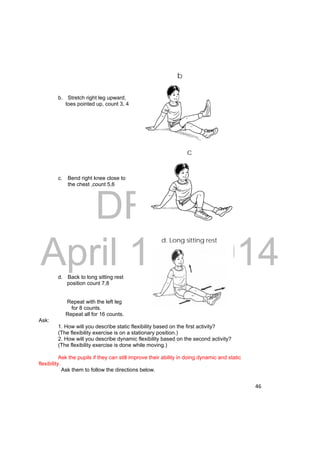
b. Stretch right leg upward, 
toes pointed up, count 3, 4 
c. Bend right knee close to 
the chest ,count 5,6 
d. Back to long sitting rest 
position count 7,8 
Repeat with the left leg 
for 8 counts. 
Repeat all for 16 counts. 
Ask: 
1. How will you describe static flexibility based on the first activity? 
(The flexibility exercise is on a stationary position.) 
2. How will you describe dynamic flexibility based on the second activity? 
(The flexibility exercise is done while moving.) 
Ask the pupils if they can still improve their ability in doing dynamic and static 
flexibility. 
Ask them to follow the directions below. 
d. Long sitting rest
DRAFT 
April 11, 2014 
47 
a 
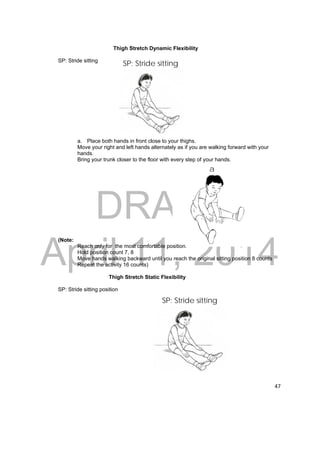
Thigh Stretch Dynamic Flexibility 
SP: Stride sitting 
a. Place both hands in front close to your thighs. 
Move your right and left hands alternately as if you are walking forward with your 
hands. 
Bring your trunk closer to the floor with every step of your hands. 
(Note: 
Reach only for the most comfortable position. 
Hold position count 7, 8 
Move hands walking backward until you reach the original sitting position 8 counts 
Repeat the activity 16 counts) 
Thigh Stretch Static Flexibility 
SP: Stride sitting position 
SP: Stride sitting 
SP: Stride sitting
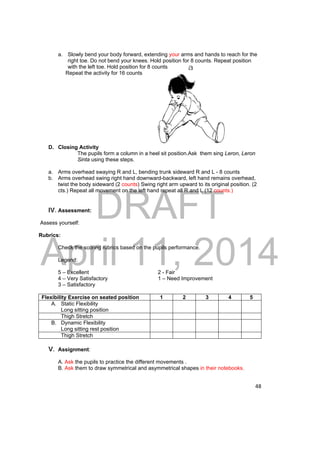
a. Slowly bend your body forward, extending your arms and hands to reach for the 
right toe. Do not bend your knees. Hold position for 8 counts. Repeat position 
with the left toe. Hold position for 8 counts 
Repeat the activity for 16 counts 
DRAFT 
April 11, 2014 
48 
a 
D. Closing Activity 
The pupils form a column in a heel sit position.Ask them sing Leron, Leron 
Sinta using these steps. 
a. Arms overhead swaying R and L, bending trunk sideward R and L - 8 counts 
b. Arms overhead swing right hand downward-backward, left hand remains overhead, 
twist the body sideward (2 counts) Swing right arm upward to its original position. (2 
cts.) Repeat all movement on the left hand repeat all R and L (12 counts.) 
IV. Assessment: 
Assess yourself: 
Rubrics: 
Check the scoring rubrics based on the pupils performance. 
Legend: 
5 – Excellent 2 - Fair 
4 – Very Satisfactory 1 – Need Improvement 
3 – Satisfactory 
Flexibility Exercise on seated position 1 2 3 4 5 
A. Static Flexibility 
Long sitting position 
Thigh Stretch 
B. Dynamic Flexibility 
Long sitting rest position 
Thigh Stretch 
V. Assignment: 
A. Ask the pupils to practice the different movements . 
B. Ask them to draw symmetrical and asymmetrical shapes in their notebooks.
DRAFT 
April 11, 2014 
49
DRAFT 
April 11, 2014 
52 
QUARTER 1 
Lesson 7: SHAPES ON HOLD 
Time Allotment: 40 min. 
I. Objectives 
1. Describe symmetrical and asymmetrical body shapes 
2. Perform momentary stillness in symmetrical and asymmetrical shapes using 
body parts other than the feet as base support. 
3. Respond and act quickly to sounds and music 
4. Enjoy fun physical activities that enhance balance and flexibility 
II. Subject Matter: 
A. Topics: Momentary Stillness in Symmetrical and Asymmetrical Shapes 
Using Body Parts other than Both Feet as a Base of Support. 
B. Skills: Body Balance and Flexibility 
C. Value Focus: Cooperation and Self Discipline 
D. Reference: K to 12 Curriculum Guide 
E. Materials: Mat, CD/DVD player 
III. Learning Activities 
A. Routinary Activities 
1. Checking of attendance 
2. Warm Up Activities 
Do the following exercises: 
A. Refer to Lesson 1 for warm up exercises. You may use music to 
accompany movement. (Note: Warm up must be done before the actual 
activity .) 
B. Preparatory Activities 
1. Presentation: 
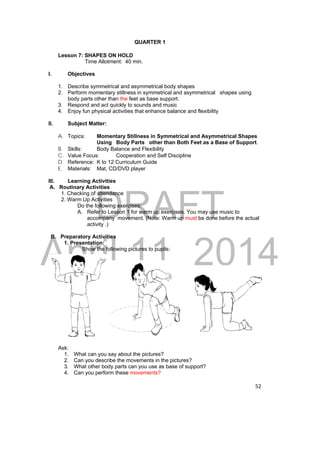
Show the following pictures to pupils: 
Ask: 
1. What can you say about the pictures? 
2. Can you describe the movements in the pictures? 
3. What other body parts can you use as base of support? 
4. Can you perform these movements?
DRAFT 
April 11, 2014 
53 
Unlocking of Difficulties: 
Note: Show pictures of symmetrical and asymmetrical shapes Explain to 
the pupils the meaning of the following words: 
Symmetrical shape 
A shape that shows formal balance. Both sides form a line of 
symmetry and if divided into two will form an identical shape. 
Asymmetrical shape 
Shape that shows informal balance. Both sides do not form a line of 
symmetry and if divided into two will form different shapes. 
C. Developmental Activities: 
1. Presentation: 
Activity 1: TRAVELOGUE (10 minutes for the whole activity) 
a. Divide the class into five groups. Each group will select a leader. 
b. Each group will perform the activity given by the teacher. 
c. Recall some safety precautions while performing the activity. 
d. The groups will perform. 
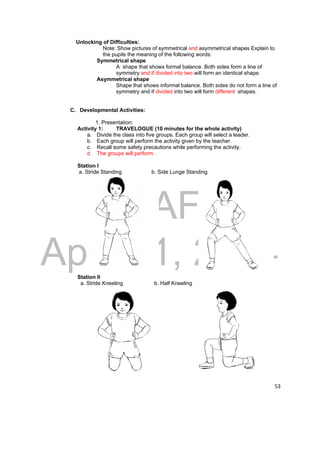
Station I 
a. Stride Standing b. Side Lunge Standing 
Station II 
a. Stride Kneeling b. Half Kneeling
DRAFT 
April 11, 2014 
54 
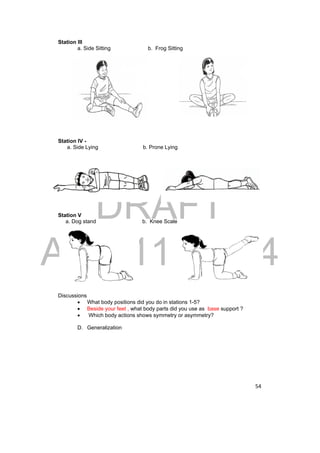
Station III 
a. Side Sitting b. Frog Sitting 
Station IV - 
a. Side Lying b. Prone Lying 
Station V 
a. Dog stand b. Knee Scale 
Discussions 
 What body positions did you do in stations 1-5? 
 Beside your feet , what body parts did you use as base support ? 
 Which body actions shows symmetry or asymmetry? 
D. Generalization
E. Application 
DRAFT 
April 11, 2014 
55 
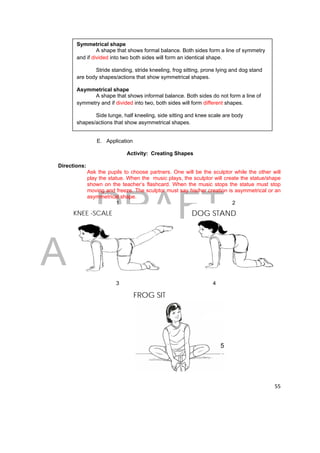
DOG STAND 
FROG SIT 
KNEE -SCALE 
Activity: Creating Shapes 
Directions: 
Ask the pupils to choose partners. One will be the sculptor while the other will 
play the statue. When the music plays, the sculptor will create the statue/shape 
shown on the teacher’s flashcard. When the music stops the statue must stop 
moving and freeze. The sculptor must say his/her creation is asymmetrical or an 
asymmetrical shape. 
1 2 
3 4 
5 
Symmetrical shape 
A shape that shows formal balance. Both sides form a line of symmetry 
and if divided into two both sides will form an identical shape. 
Stride standing, stride kneeling, frog sitting, prone lying and dog stand 
are body shapes/actions that show symmetrical shapes. 
Asymmetrical shape 
A shape that shows informal balance. Both sides do not form a line of 
symmetry and if divided into two, both sides will form different shapes. 
Side lunge, half kneeling, side sitting and knee scale are body 
shapes/actions that show asymmetrical shapes.
DRAFT 
April 11, 2014 
56 
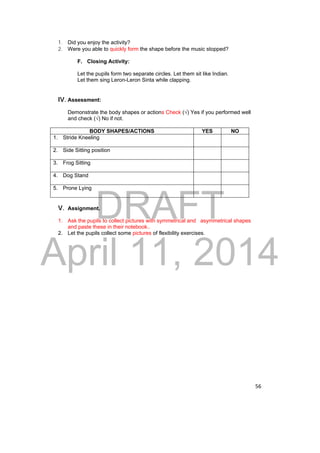
1. Did you enjoy the activity? 
2. Were you able to quickly form the shape before the music stopped? 
F. Closing Activity: 
Let the pupils form two separate circles. Let them sit like Indian. 
Let them sing Leron-Leron Sinta while clapping. 
IV. Assessment: 
Demonstrate the body shapes or actions Check (√) Yes if you performed well 
and check (√) No if not. 
BODY SHAPES/ACTIONS YES NO 
1. Stride Kneeling 
2. Side Sitting position 
3. Frog Sitting 
4. Dog Stand 
5. Prone Lying 
V. Assignment. 
1. Ask the pupils to collect pictures with symmetrical and asymmetrical shapes 
and paste these in their notebook.. 
2. Let the pupils collect some pictures of flexibility exercises.
DRAFT 
April 11, 2014 
59 
QUARTER 1 
Lesson 8: FLEXIBILITY ON TRIAL 
Time Allotment: 40 minutes 
I. Objectives 
1. Determine conditioning and flexibility exercise that will improve body 
posture 
2. Execute correctly leg and arm stretching exercises to improve body 
posture 
3. Participate actively in enjoyable physical activities 
II. Subject Matter: 
A. Topic: Conditioning and Flexibility Exercises for correct posture 
B. Skills : Flexibility 
C. Value Focus: Cooperation , Alertness ,Self Discipline 
D. References: K to 12 Curriculum Guide 
E. Materials: mat, CD, cassette ,pictures 
III. Learning Activities: 
A. Routinary Activities: 
Checking of attendance and proper attire for physical activity for safety and ease of 
movement 
1. Warm Up Activities 
Do the warm up exercises in Lesson 1 
a. Refer to Quarter 1 lesson 1 on warm-up exercises 
B. Preparatory Activities 
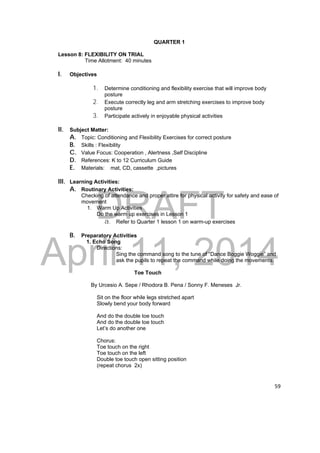
1. Echo Song 
Directions: 
Sing the command song to the tune of “Dance Boggie Woggie” and 
ask the pupils to repeat the command while doing the movements. 
Toe Touch 
By Urcesio A. Sepe / Rhodora B. Pena / Sonny F. Meneses Jr. 
Sit on the floor while legs stretched apart 
Slowly bend your body forward 
And do the double toe touch 
Let’s do another one 
Chorus: 
Toe touch on the right 
Toe touch on the left 
Double toe touch open sitting position 
(repeat chorus 2x)
m c e 
DRAFT 
o y 
April 11, 2014 
60 
C. Developmental Activities: 
(Note: The procedure should be delivered in MTB) 
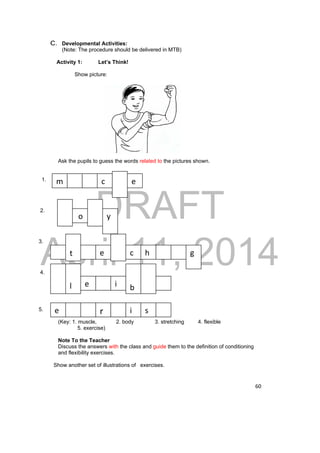
Activity 1: Let’s Think! 
Show picture: 
Ask the pupils to guess the words related to the pictures shown. 
1. 
2. 
3. 
4. 
5. 
t e c h 
l e i 
b 
g 
e r i s 
(Key: 1. muscle, 2. body 3. stretching 4. flexible 
5. exercise) 
Note To the Teacher 
Discuss the answers with the class and guide them to the definition of conditioning 
and flexibility exercises. 
Show another set of illustrations of exercises.
DRAFT 
April 11, 2014 
61 
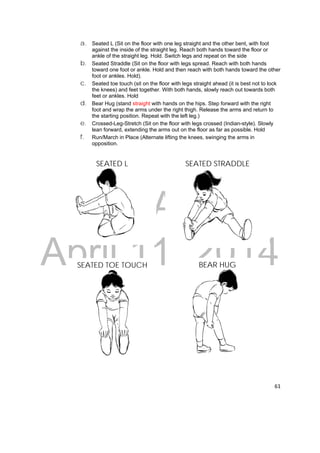
a. Seated L (Sit on the floor with one leg straight and the other bent, with foot 
against the inside of the straight leg. Reach both hands toward the floor or 
ankle of the straight leg. Hold. Switch legs and repeat on the side 
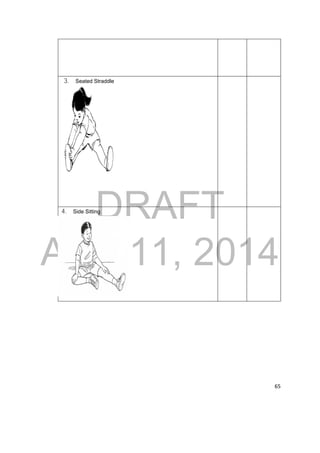
b. Seated Straddle (Sit on the floor with legs spread. Reach with both hands 
toward one foot or ankle. Hold and then reach with both hands toward the other 
foot or ankles. Hold). 
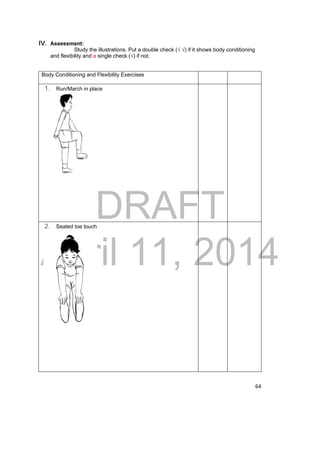
c. Seated toe touch (sit on the floor with legs straight ahead (it is best not to lock 
the knees) and feet together. With both hands, slowly reach out towards both 
feet or ankles. Hold 
d. Bear Hug (stand straight with hands on the hips. Step forward with the right 
foot and wrap the arms under the right thigh. Release the arms and return to 
the starting position. Repeat with the left leg.) 
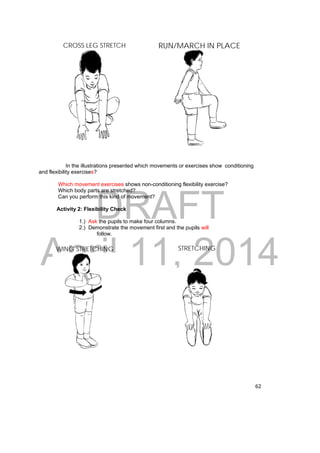
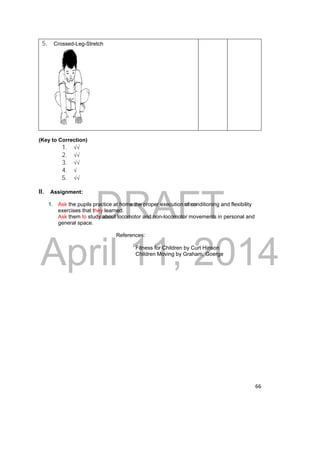
e. Crossed-Leg-Stretch (Sit on the floor with legs crossed (Indian-style). Slowly 
lean forward, extending the arms out on the floor as far as possible. Hold 
f. Run/March in Place (Alternate lifting the knees, swinging the arms in 
opposition. 
SEATED L 
SEATED STRADDLE 
SEATED TOE TOUCH 
BEAR HUG
CROSS LEG STRETCH 
RUN/MARCH IN PLACE 
DRAFT 
April 11, 2014 
62 
In the illustrations presented which movements or exercises show conditioning 
and flexibility exercises? 
Which movement exercises shows non-conditioning flexibility exercise? 
Which body parts are stretched? 
Can you perform this kind of movement? 
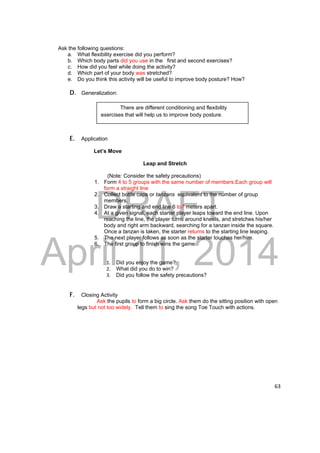
Activity 2: Flexibility Check 
1.) Ask the pupils to make four columns. 
2.) Demonstrate the movement first and the pupils will 
follow. 
WING STRETCHING STRETCHING
There are different conditioning and flexibility 
exercises that will help us to improve body posture. 
DRAFT 
April 11, 2014 
63 
Ask the following questions: 
a. What flexibility exercise did you perform? 
b. Which body parts did you use in the first and second exercises? 
c. How did you feel while doing the activity? 
d. Which part of your body was stretched? 
e. Do you think this activity will be useful to improve body posture? How? 
D. Generalization: 
E. Application 
Let’s Move 
Leap and Stretch 
(Note: Consider the safety precautions) 
1. Form 4 to 5 groups with the same number of members.Each group will 
form a straight line 
2. Collect bottle caps or tanzans equivalent to the number of group 
members. 
3. Draw a starting and end line 6 to7 meters apart. 
4. At a given signal, each starter player leaps toward the end line. Upon 
reaching the line, the player turns around kneels, and stretches his/her 
body and right arm backward, searching for a tanzan inside the square. 
Once a tanzan is taken, the starter returns to the starting line leaping. 
5. The next player follows as soon as the starter touches her/him. 
6. The first group to finish wins the game. 
1. Did you enjoy the game? 
2. What did you do to win? 
3. Did you follow the safety precautions? 
F. Closing Activity 
Ask the pupils to form a big circle. Ask them do the sitting position with open 
legs but not too widely. Tell them to sing the song Toe Touch with actions.
DRAFT 
April 11, 2014 
64 
IV. Assessment: 
Study the illustrations. Put a double check (√ √) if it shows body conditioning 
and flexibility and a single check (√) if not. 
Body Conditioning and Flexibility Exercises 
1. Run/March in place 
2. Seated toe touch
DRAFT 
April 11, 2014 
65 
3. Seated Straddle 
4. Side Sitting
DRAFT 
April 11, 2014 
66 
5. Crossed-Leg-Stretch 
(Key to Correction) 
1. √√ 
2. √√ 
3. √√ 
4. √ 
5. √√ 
II. Assignment: 
1. Ask the pupils practice at home the proper execution of conditioning and flexibility 
exercises that they learned. 
Ask them to study about locomotor and non-locomotor movements in personal and 
general space. 
References: 
Fitness for Children by Curt Hinson 
Children Moving by Graham, Goerge
DRAFT 
April 11, 2014 
67 
QUARTER 2 
Lesson 1: MOVING IN MY PERSONAL SPACE 
Time Allotment: 40 minutes per week 
I. Objectives: 
1. Define personal space 
2. Identify the different non-locomotor movements 
3. Execute properly the non-locomotor movements 
4. Work cooperatively with others 
II. Subject Matter: 
A. Topic: Moving in Personal Space 
B. Skills: Streching, Bending, Pushing, Pulling, Twisting,Turning, Swinging and 
Swaying (Non-locomotor skills) 
C. Values: Cooperation, Concentration 
D. References: Musika, Sining at Edukasyon sa Pagpapalakas ng Katawan 
Baitang 3, Musika Edukasyon sa Pagpapalakas ng katawan Gr. 3 pp.180- 
181, 
MSEP Gr. 3 pp.203-206, LRMDS Portal 
E. Materials: cassette recorder/CD player, any folk music in 2/4 time signature 
III. Learning Activity: 
A. Routinary Activities 
1. Checking of attendance and PE uniform (appropriate attire for 
physical activities) 
2. Warm-up Activities 
Lead the class in doing the warm-up exercises. Stress the 
importance of having a warm-up and the use of safety measures in 
the different exercises. 
a. Jog in place (8 counts) walk in place (8 counts). 
b. Breathing exercise (10 counts). 
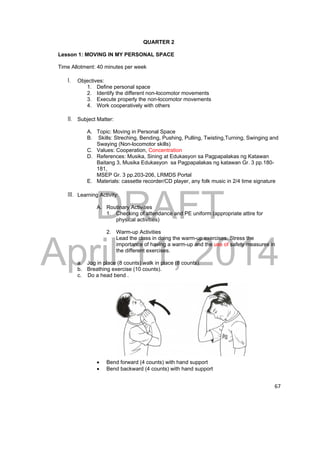
c. Do a head bend . 
 Bend forward (4 counts) with hand support 
 Bend backward (4 counts) with hand support
DRAFT 
April 11, 2014 
68 
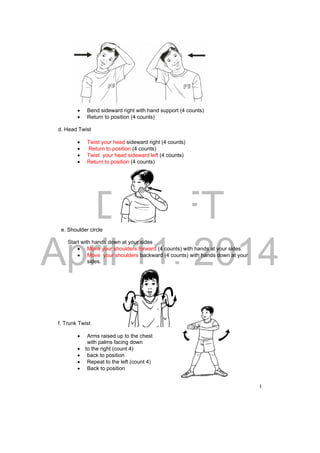
 Bend sideward right with hand support (4 counts) 
 Return to position (4 counts) 
d. Head Twist 
 Twist your head sideward right (4 counts) 
 Return to position (4 counts) 
 Twist your head sideward left (4 counts) 
 Return to position (4 counts) 
e. Shoulder circle 
Start with hands down at your sides 
 Move your shoulders forward (4 counts) with hands at your sides 
 Move your shoulders backward (4 counts) with hands down at your 
sides. 
f. Trunk Twist 
 Arms raised up to the chest 
with palms facing down 
 to the right (count 4) 
 back to position 
 Repeat to the left (count 4) 
 Back to position
DRAFT 
April 11, 2014 
69 
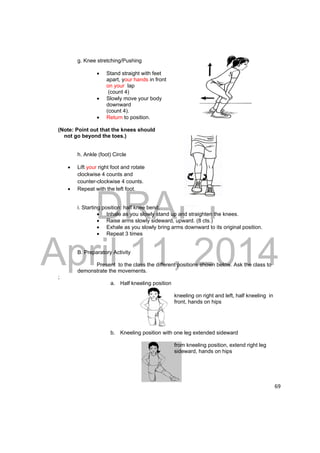
g. Knee stretching/Pushing 
 Stand straight with feet 
apart, your hands in front 
on your lap 
(count 4) 
 Slowly move your body 
downward 
(count 4). 
 Return to position. 
(Note: Point out that the knees should 
not go beyond the toes.) 
h. Ankle (foot) Circle 
 Lift your right foot and rotate 
clockwise 4 counts and 
counter-clockwise 4 counts. 
 Repeat with the left foot. 
i. Starting position: half knee bend. 
 Inhale as you slowly stand up and straighten the knees. 
 Raise arms slowly sideward, upward. (8 cts.) 
 Exhale as you slowly bring arms downward to its original position. 
 Repeat 3 times 
B. Preparatory Activity 
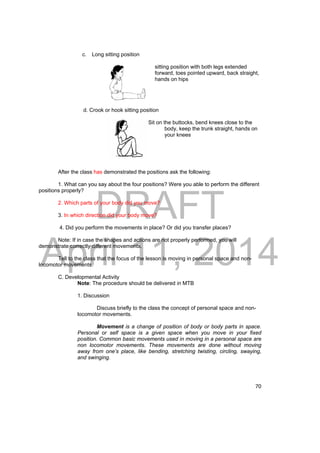
Present to the class the different positions shown below. Ask the class to 
demonstrate the movements. 
; 
a. Half kneeling position 
kneeling on right and left, half kneeling in 
front, hands on hips 
b. Kneeling position with one leg extended sideward 
from kneeling position, extend right leg 
sideward, hands on hips
DRAFT 
April 11, 2014 
70 
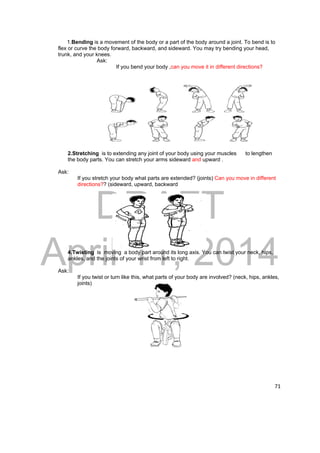
c. Long sitting position 
sitting position with both legs extended 
forward, toes pointed upward, back straight, 
hands on hips 
d. Crook or hook sitting position 
Sit on the buttocks, bend knees close to the 
body, keep the trunk straight, hands on 
your knees 
After the class has demonstrated the positions ask the following: 
1. What can you say about the four positions? Were you able to perform the different 
positions properly? 
2. Which parts of your body did you move? 
3. In which direction did your body move? 
4. Did you perform the movements in place? Or did you transfer places? 
Note: If in case the shapes and actions are not properly performed, you will 
demonstrate correctly different movements. 
Tell to the class that the focus of the lesson is moving in personal space and non-locomotor 
movements. 
C. Developmental Activity 
Note: The procedure should be delivered in MTB 
1. Discussion 
Discuss briefly to the class the concept of personal space and non-locomotor 
movements. 
Movement is a change of position of body or body parts in space. 
Personal or self space is a given space when you move in your fixed 
position. Common basic movements used in moving in a personal space are 
non locomotor movements. These movements are done without moving 
away from one’s place, like bending, stretching twisting, circling, swaying, 
and swinging.
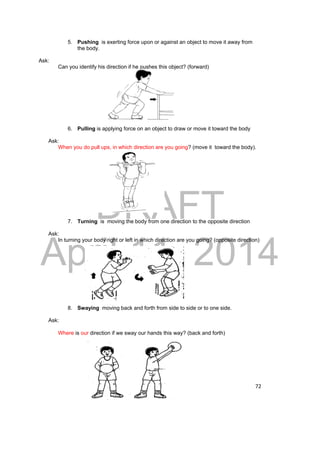
1.Bending is a movement of the body or a part of the body around a joint. To bend is to 
DRAFT 
April 11, 2014 
71 
flex or curve the body forward, backward, and sideward. You may try bending your head, 
trunk, and your knees. 
Ask: 
If you bend your body ,can you move it in different directions? 
2.Stretching is to extending any joint of your body using your muscles to lengthen 
the body parts. You can stretch your arms sideward and upward . 
Ask: 
If you stretch your body what parts are extended? (joints) Can you move in different 
directions?? (sideward, upward, backward 
4.Twisting is moving a body part around its long axis. You can twist your neck, hips, 
ankles, and the joints of your wrist from left to right. 
Ask: 
If you twist or turn like this, what parts of your body are involved? (neck, hips, ankles, 
joints)
DRAFT 
April 11, 2014 
72 
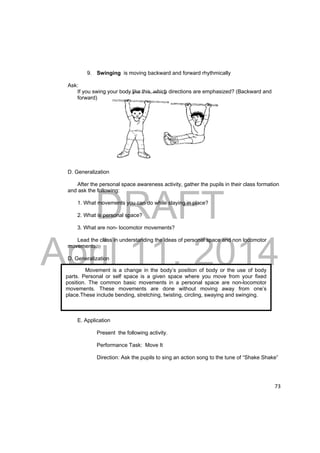
5. Pushing is exerting force upon or against an object to move it away from 
the body. 
Ask: 
Can you identify his direction if he pushes this object? (forward) 
6. Pulling is applying force on an object to draw or move it toward the body 
Ask: 
When you do pull ups, in which direction are you going? (move it toward the body). 
7. Turning is moving the body from one direction to the opposite direction 
Ask: 
In turning your body right or left in which direction are you going? (opposite direction) 
8. Swaying moving back and forth from side to side or to one side. 
Ask: 
Where is our direction if we sway our hands this way? (back and forth)
DRAFT 
April 11, 2014 
73 
9. Swinging is moving backward and forward rhythmically 
Ask: 
If you swing your body like this, which directions are emphasized? (Backward and 
forward) 
D. Generalization 
After the personal space awareness activity, gather the pupils in their class formation 
and ask the following: 
1. What movements you can do while staying in place? 
2. What is personal space? 
3. What are non- locomotor movements? 
Lead the class in understanding the ideas of personal space and non locomotor 
movements. 
D. Generalization 
Movement is a change in the body’s position of body or the use of body 
parts. Personal or self space is a given space where you move from your fixed 
position. The common basic movements in a personal space are non-locomotor 
movements. These movements are done without moving away from one’s 
place.These include bending, stretching, twisting, circling, swaying and swinging. 
E. Application 
Present the following activity. 
Performance Task: Move It 
Direction: Ask the pupils to sing an action song to the tune of “Shake Shake”
DRAFT 
April 11, 2014 
74 
Up and Down 
by:Virgina T. Mahinay 
Up and down and bend, bend, bend 
Up and down and stretch, and stretch 
Twist to the right and twist to the left 
Turn around and sway and swing 
Up and down and bend, bend, bend 
Up and down and stretch and twist 
Twist to right and twist to the left 
Turn around and sway and swing 
Ask the pupils to answer the following questions after the activity. 
1. What movements you can do while staying in place? (bending, stretching, 
twisting, circumduction, swaying & swinging ) 
2. What parts of the body is/are used in doing each movement? (head, neck, 
trunk, leg) 
3. Were you able to create a movement? (yes) 
4. Can you identify the movement? (yes) 
5. Did you transfer from one place to another place while doing those 
movements? (no) 
F. Closing Activity 
In your own space or personal space, perform the following non-locomotor 
movements to the tune of Leron ,Leron Sinta. Do the movements properly as you exercise. 
1. Twist your head (right and left) 16 cts. 
2. Bend your neck downward 16 cts. 
3. Bend your trunk sideways (right and left) 16 cts. 
4. Raise your legs; then, flex (bend)your feet 16 cts. 
5. Raise your legs; then, point your toes downward 16 cts. 
6. Bend your neck sideward (right and left) 16 cts. 
7. Stretch your arms sideward (right and left) 16 cts. 
8. Bend your trunk forward and backward 16 cts. 
List the different parts of the body which can perform the different non-locomotor 
movements. 
stretching bending pushing pulling twisting turning swaying swinging
DRAFT 
April 11, 2014 
75 
1. 
2. 
3. 
4. 
5. 
IV. Assessment: 
Give the assessment tasks to the class. 
1. Paper and Pencil 
Direction: Complete the following sentences. 
1. There is ________________when there is a ___________ of position of 
_____________or body parts in ___________. 
2. Moving in __________________ would mean you are moving in your own 
____________. 
3. ____________________or axial movements are movements you perform without 
_____________ from one place to another. 
2. Self-Assessment 
Direction: Answer the following: 
1. Which non-locomotor movements were you able to perform well? 
2. Which non-locomotor movements were difficult to do? 
3. On a scale of 1-5, with 1as the lowest and 5 as the highest, how would you rate your 
performance in all the activities in the lesson? 
4. Color the stars that describe your performance. 
V. Assignment: 
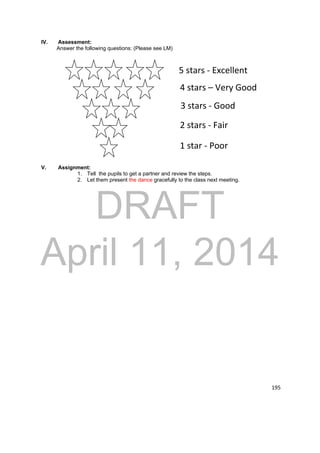
5 stars ‐ Excellent 
4 stars – Very Good 
3 stars ‐ Good 
2 stars ‐ Fair 
1 star ‐ Poor 
A. Ask the pupils to practice the different movements that they learned.
DRAFT 
April 11, 2014 
80 
QUARTER 2 
Lesson 2: MOVING IN MY GENERAL SPACE 
Time Allotment: 40 minutes per week 
I. Objectives: 
1. Define the meaning of general space 
2. Identify basic locomotor movements 
3. Execute properly the different locomotor 
movements 
4. Participate cooperatively in all activities 
II. Subject Matter: 
A. Topic: Moving in General Space (Space Awareness) 
B. Skills: Locomotor Skills 
C. Values: Discipline, Teamwork, Cooperation, Enthusiasm 
D. References: Musika, Sining at Edukasyon sa Pagpapalakas ng Katawan 
Baitang 3, Musika Edukasyon sa Pagpapalakas ng 
Katawan Gr. 3 pp.180, 181,MSEP Gr. 3 pp.203-206, 
LRMDS Portal 
E. Materials: cassette recorder/CD player, any folk music in 2/4 time 
signature, whistle, chair 
III. Learning Activity: 
A. Routinary Activities 
1. Checking of Attendance and PE uniform (appropriate attire for physical activities). 
2. Warm-up Activities 
a. Jog in place (8 counts) walk in place (8 counts) 
b. Breathing exercise (10 counts) 
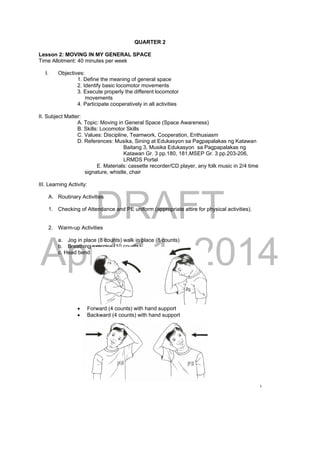
c. Head bend 
 Forward (4 counts) with hand support 
 Backward (4 counts) with hand support
DRAFT 
April 11, 2014 
81 
 Sideward right with hand support (4 counts) 
 Back to position (4 counts) 
d. Head Twist 
 head twist sideward right (4 counts) 
 back to position (4 counts) 
 head twist sideward left (4 counts) 
 back to position (4 counts) 
e. Shoulder circle 
Start with hands down at the side 
 forward (4 counts) with hands down on the side 
 backward (4 counts) with hands down on the side 
f. Trunk Twist 
 Arms raised up to the chest 
with palms facing down 
 to the right (count 4) 
 back to position 
 Repeat to the left (count 4) 
 Back to position 
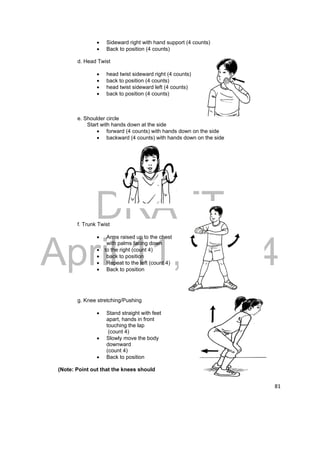
g. Knee stretching/Pushing 
 Stand straight with feet 
apart, hands in front 
touching the lap 
(count 4) 
 Slowly move the body 
downward 
(count 4) 
 Back to position 
(Note: Point out that the knees should
DRAFT 
April 11, 2014 
82 
not go beyond the toes.) 
h. Ankle (foot) Circle 
 Lift right foot and rotate 
clockwise 4 counts and 
counter-clockwise 4 counts. 
 Repeat with the Left foot 
i. Starting position: half knee bend. 
 Inhale as you slowly stand up and straighten the knees. 
 Raise arms slowly sideward, upward. (8 cts.) 
 Exhale as you slowly bring arms downward to its original position. 
 Repeat 3 times 
B. Preparatory Activity 
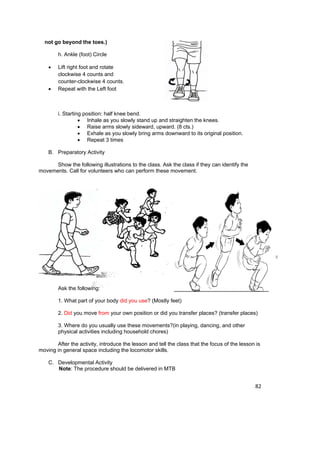
Show the following illustrations to the class. Ask the class if they can identify the 
movements. Call for volunteers who can perform these movement. 
Ask the following: 
1. What part of your body did you use? (Mostly feet) 
2. Did you move from your own position or did you transfer places? (transfer places) 
3. Where do you usually use these movements?(in playing, dancing, and other 
physical activities including household chores) 
After the activity, introduce the lesson and tell the class that the focus of the lesson is 
moving in general space including the locomotor skills. 
C. Developmental Activity 
Note: The procedure should be delivered in MTB
DRAFT 
April 11, 2014 
83 
A. Discussion 
Discuss the idea of general space. 
General space is an unlimited area where you move from one place to 
another. It is the entire space within a room, gymnasium, an outdoor space, 
Locomotor movements are generally used in defining general space.Then 
movements you perform in transferring from one place to another are called 
locomotor movements. 
B. Demonstration 
After a short discussion on the idea of general space, ask the pupils to 
perform the following locomotor movements. Give a demonstration of each 
movement skill and the pupils will make a counter-demonstration of each movement. 
Provide proper cueing for the different movements. You may use folk music to 
accompany the movement activity. 
Emphasize that proper posture should be observed while performing the different 
locomotor movements. 
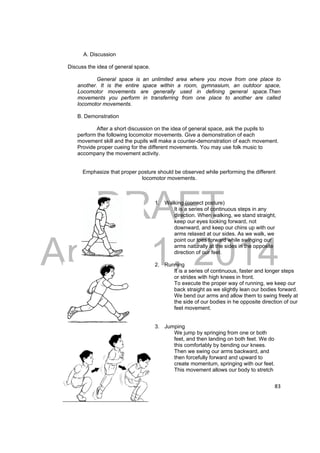
1. Walking (correct posture) 
It is a series of continuous steps in any 
direction. When walking, we stand straight, 
keep our eyes looking forward, not 
downward, and keep our chins up with our 
arms relaxed at our sides. As we walk, we 
point our toes forward while swinging our 
arms naturally at the sides in the opposite 
direction of our feet. 
2. Running 
It is a series of continuous, faster and longer steps 
or strides with high knees in front. 
To execute the proper way of running, we keep our 
back straight as we slightly lean our bodies forward. 
We bend our arms and allow them to swing freely at 
the side of our bodies in he opposite direction of our 
feet movement. 
3. Jumping 
We jump by springing from one or both 
feet, and then landing on both feet. We do 
this comfortably by bending our knees. 
Then we swing our arms backward, and 
then forcefully forward and upward to 
create momentum, springing with our feet. 
This movement allows our body to stretch
DRAFT 
April 11, 2014 
84 
as if reaching upward. Then we land on 
both feet with bent knees for safe landing. 
4. Hopping 
Hopping is springing with one foot, then 
landing on the same foot. We can swing our 
arms and bend our hips, knees, and ankles to 
hop higher or further. We should always 
remember that to land safety, we land with our 
toes, followed by the balls of our feet while 
slowly bending our knees. 
5. Galloping 
It is a combination of a step (full transfer of 
weight on the other foot) and a cut by the 
transfer of weight on the other foot. A cut is a 
displacement of one foot with the other foot. 
6. Sliding 
It is when the lead step is quickly followed by the 
free foot closing to replace the supporting foot. It 
involves gliding the sole of one foot along the 
floor. 
7. Skipping 
A skip is just a combination of a step and a 
hop. We do this by first stepping one foot 
forward and then hopping on the same foot. 
This can also be done with the opposite foot. 
We should observe balance while skipping.
DRAFT 
April 11, 2014 
85 
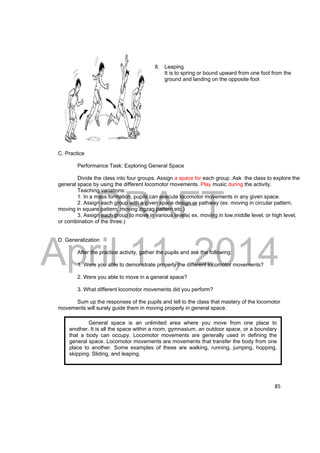
8. Leaping 
It is to spring or bound upward from one foot from the 
ground and landing on the opposite foot 
C. Practice 
Performance Task: Exploring General Space 
Divide the class into four groups. Assign a space for each group .Ask the class to explore the 
general space by using the different locomotor movements. Play music during the activity. 
Teaching variations: 
1. In a mass formation, pupils can execute locomotor movements in any given space. 
2. Assign each group with a given space design or pathway (ex. moving in circular pattern, 
moving in square pattern, moving zigzag pattern etc.) 
3. Assign each group to move in various levels( ex. moving in low,middle level, or high level, 
or combination of the three.) 
D. Generalization 
After the practice activity, gather the pupils and ask the following: 
1. Were you able to demonstrate properly the different locomotor movements? 
2. Were you able to move in a general space? 
3. What different locomotor movements did you perform? 
Sum up the responses of the pupils and tell to the class that mastery of the locomotor 
movements will surely guide them in moving properly in general space. 
General space is an unlimited area where you move from one place to 
another. It is all the space within a room, gymnasium, an outdoor space, or a boundary 
that a body can occupy. Locomotor movements are generally used in defining the 
general space. Locomotor movements are movements that transfer the body from one 
place to another. Some examples of these are walking, running, jumping, hopping, 
skipping. Sliding, and leaping.
Pupils in line Chair 
DRAFT 
April 11, 2014 
86 
E. Application 
Tell the pupils to stay with their groupmates and present this challenging activity. 
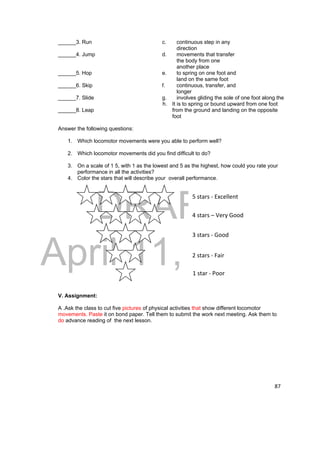
Performance Task: Locomotor Race 
With the same set groups, ask each group to form a straight line. A chair can be 
used as the turning point for each group for the locomotor race.The groups will 
compete each member of the group will do the locomotor movements that the 
teacher will identify. Each player will move from the starting line, go around the chair, 
return to the line and tag the next person. The first group to finish the race for each 
locomotor movement gets a point. 
Emphasize the proper execution of the locomotor movement and ensure safety 
during the performance. 
Group 4 Pupils in line 
F. Closing Activity 
After the activity ask the class to form a circle. Lead the class in the loosen up activity (cool 
down/stretching exercise) activity. Play relaxing music. 
IV. Assessment: 
Match the words in column A with the movements in column B. 
Write the letter of the correct answer on the line before the number. 
A B 
______1. Gallop a. a combination of step 
and hop 
______2. Walk b. to spring on one or both 
feet and land on both feet 
Chair 
Chair 
Group 1 
Pupils in line 
Pupils in line 
Group 2 
Group 3 
Chair
DRAFT 
5 stars ‐ Excellent 
4 stars – Very Good 
April 11, 2014 
87 
______3. Run c. continuous step in any 
direction 
______4. Jump d. movements that transfer 
the body from one 
another place 
______5. Hop e. to spring on one foot and 
land on the same foot 
______6. Skip 
______7. Slide 
______8. Leap 
f. continuous, transfer, and 
longer 
g. involves gliding the sole of one foot along the f 
h. It is to spring or bound upward from one foot 
from the ground and landing on the opposite 
foot 
Answer the following questions: 
1. Which locomotor movements were you able to perform well? 
2. Which locomotor movements did you find difficult to do? 
3. On a scale of 1 5, with 1 as the lowest and 5 as the highest, how could you rate your 
performance in all the activities? 
4. Color the stars that will describe your overall performance. 
3 stars ‐ Good 
2 stars ‐ Fair 
1 star ‐ Poor 
V. Assignment: 
A .Ask the class to cut five pictures of physical activities that show different locomotor 
movements. Paste it on bond paper. Tell them to submit the work next meeting. Ask them to 
do advance reading of the next lesson.
DRAFT 
April 11, 2014 
92 
QUARTER 2 
Lesson 3: TIKLOS BASICS 
Time Allotment: 40 minutes 
I. Objectives: 
1. Identify basic steps in the folkdance Tiklos 
2. Move in different directions in response to sound and music. 
3. Demonstrate the basic steps in the folkdance Tiklos 
II. Subject Matter: 
A. Lesson Title: Learn Tiklos Dance Steps 
B. Skill/s: Dancing 
C. Values: Patriotism, Patience, Cooperation 
D. Reference: Philippine Folk Dances Vol.2, pp.128-129 
E. Materials: cassette tape, CD 
III. Learning Activities: 
A. Routinary Activities 
1. Checking of attendance and PE uniform (appropriate 
attire for physical activities) 
2. Warm-up activities 
(Warm up activities can be done 
prior to the activity proper please refer topages 88-87 Lesson 1. 
B. Preparatory Activities: 
Ask the class to listen to the music of Tiklos. 
Ask the following: 
 Can you identify the tempo of the music? 
Is it fast or slow? 
 Can you clap underplaying beat? 
 Can you identify the time signature? 
 Can you count the rhythmic pattern? 
C. Developmental Activities 
Note: The procedure should be delivered in MTB 
Activity 1. Listen to the rhythm of the music . 
The teacher introduces the lesson with music and ask the pupils to: 
 Listen to the rhythm of the music 
 Clap following the rhythm of the music 
 Count the rhythm of the music 
Activity 2. Let’s enjoy performing the steps! 
Ask the pupils to familiarize the rhythm of the music. And: 
 Get a partner 
 Stand side by side with the partner 
 Upon the signal of the teacher, each 
column performs the steps. 
The teacher demonstrates each steps in Tiklos 
Steps Step pattern 
 Heel and Toe - heel place, point toe 
 Change steps - step, close, step 
 Cut steps - step cut, step cut 
 Gallop step - step gallop, step gallop 
 Jump for stride 
 Touch step - point close
The dance Tiklos is in 2 4 time music with 
countings of 1 2, 1 and 2, in a measure. The 
common dance steps of Tiklos are change 
step, heel and toe change step, cut step and 
point step. 
DRAFT 
April 11, 2014 
93 
Ask: How did you feel while doing the activities? 
Did you enjoy dancing? 
Did you perform the steps properly? 
How did you appreciate our Philippine culture through Folk 
Dance? 
D. Generalization 
E. Application 
Ask the pupils to perform the different steps of the dance. 
F. Closing Activities 
Ask the pupils sing any song they learned from Lesson 2. 
IV. Assessment: 
Check () the box that matches your performance. 
LEGEND: 
Needs Improvement 
Poor 
Good 
Very Good 
Excellent 
1. Heel and Toe 
2. Change steps 
3. Cut steps 
4. Touch step 
5. Gallop steps 
V. Assignment: 
Practice at home to become familiar with the different Tiklos steps. 
Reference: Philippine Folk Dances Vol.2 , pp.128-129
DRAFT 
(Background Information for Teacher 
Tiklos originated from peasants who agree to work together to clear 
the forest and prepare for planting. At noontime ,the people gather to 
eat lunch and rest. During their rest Tiklos music is played with a 
flute, a guitar and the guimbal or the Tambora (kinds of drum). The 
peasants dance the Tiklos.) 
April 11, 2014 
96 
QUARTER 2 
Lesson 4: LET’S DANCE TIKLOS 
Time Allotment: 40 minutes 
I. Objectives: 
1. Learn simple folk dance steps 
2. Perform the different steps in the dance Tiklos . 
3. Enjoy and have fun in dancing Tiklos. 
II. Subject Matter: 
A. Lesson Title: Perform the Dance Tiklos 
B. Skill/s: Dancing 
C. Values: Cooperation, Patriotism and Discipline 
D. References: Fundamental Dance steps and Music 
by; Francisca Reyes Aquino 
Philippine Folk Dances Vol.2 , pp.128-129 
E. Materials: cassette tape, CD 
III. Learning Activities: 
A. Routinary Activities: 
1. Checking of attendance and PE uniform (appropriate 
attire for physical activities) 
2. Warm-up activities 
There teacher will review dance steps to the tune of “It’s A Small World” 
Steps Step pattern 
 Heel and Toe - heel place, point toe 
 Change steps - step, close, step 
 Cut steps - step cut, step cut 
 Gallop step - step gallop, step gallop 
B. Preparatory Activities: 
 The pupils must choose their partners and form _____ columns. 
 Each pupil must stand beside a partner.
DRAFT 
April 11, 2014 
97 
 Upon the signal of the teacher, 
each column must perform the steps. 
D. Developmental Activities: 
Note: The procedures should be delivered in MTB 
Teacher will lead the pupils in dancing Tiklos. 
FORMATION: Partners must stand opposite each other at adistance of six feet . When 
facing audience, the girl stand at the boy’s right side. Any number of pairs may join this 
dance. 
Tiklos 
by: Francisca Reyes Aquino 
Vol. 2 
-- I -- 
Music A. Partners face front. Throughout this figure Girls holds her skirt, Boy 
places hands on waist. 
(a) Starting with R foot, take two heel and toe changes steps forward. . . . . 4 M 
(b) Execute change step sideward, R and L. . . . …………………………….. 2 M 
(c) Starting with R foot, take four steps backward to proper places. . . . . . . . . 2 M 
(d) Repeat all (a-c). . . . . . . . . . . . . . . . . . . . . . . . . . …………………………... 8 M 
Music B. Partners face front. The same hand position as in figure I. 
(a) Cut L backward (ct. 1), cut R forward (ct. 2). Repeat all (cts. 1, 2). ……... 2 M 
(b) Take 3 galop steps sideward right (cts. 1, ah, 
2, ah, 1 ah) step R foot sideward (ct. 2). . . .. . …………………………….. 2 M 
(c) Repeat (a), starting with R cut backward. . . . ……………………………… 2 M 
(d) Repeat (b), going sideward left. . . . . . . . . . . . …………………………….. 2 M 
(e) Repeat all (a-d). . . . . . . . . . . . . . . . . . . . . . . . . . …………………………... 8 M 
-- I I I – 
Music A. Partners face each other. Throughout this figure clap hands in front 
of chest in this manner: Clap three times (cts. 1, and, 2), clap twice (cts.1, 2). Do this for 
sixteen measures. 
(a) Execute change step sideward, starting with R foot (cts. 1, and, 2). hop on R 
and raise L knee in front swinging L foot obliquely right backward across R 
knee in front 
(ct. 1), hop on R and swing L foot obliquely left 
forward (ct. 2). ……………………………………………………………….. 2 M 
(b) Repeat (a) starting with the L foot. . . . . . . . . ……………………………... 2 M 
(c) Execute a three-step turn right in place 
(cts. 1, and 2). Point L in front (ct. 1), point the 
same foot close to R (ct. 2). . . . . . . . . . . . . . . . …………………………… 2 M 
(d) Repeat (c), starting with L foot and turning left. ……………………………. 2 M 
(e) Repeat all (a-d). . . . . . . . . . . . . . . . . . . . . . . . . . …………………………... 8 M 
-- I V --
Tiklos is a dance which originated from peasants who agree to 
work together weekly to clear the forest and prepare the soil for planting. 
The dance has four figures done in 2 4 time music. The basic steps are 
change step, heel and toe change step, changing step, point step and 
cut step. 
DRAFT 
April 11, 2014 
98 
Music B. 
Partners face each other. The same position of hands as in figure I. 
(a) Take two touch steps in front (R, L). . . . . . . . . . …………………………… 2 M 
(b) Jump to cross R in front of L (ct. 1), jump to 
cross L in front of R (ct. 2), jump to cross R in 
front of L (ct. 1), jump to close R to L 
(ct. 2). . . . . . . . . . . . . . ………………………... . . …………………………. 2 M 
(c) Repeat (a) and (b), starting with L foot. . . .. . . …………………………….. 4 M 
(d) Repeat all (a-c). . . . . . . . . . . . . . . . . . . . . . . . . ………………………….. 8 M 
Ask: 
Did you enjoy dancing the Tiklos? 
How does it feel to dance one of our Philippine folk dances? 
E. Generalization 
E. Application 
After the pupils have learned the danceTiklos group them into four. Each group will be 
assigned to a station. At each station they will dance to a figure of the dance tiklos. 
Station 1 – Figure 1 
Station 2 – Figure 2 
Station 3 – Figure 3 
Station 4 – Figure 4 
After a certain period, ask the groups to proceed to the next station until all groups 
have been to all the stations. 
F. Closing Activities: 
Play the music of Tiklos again. Each group must perform some stretching exercises 
as cool down.. 
IV. Assessment: 
Answer the following questions: 
1. Which figure in the dance did you perform well? 
2. Which figure in the dance did you find difficult to do?
3. On a scale of 1 to 5, with 1 as the lowest and 5 as the highest, how will you rate your 
5 stars ‐ Excellent 
4 stars – Very Good 
3 stars ‐ Good 
2 stars ‐ Fair 
1 star ‐ Poor 
DRAFT 
April 11, 2014 
99 
dance performance? 
4. Color the stars that describes your overall performance. 
V. Assignment: 
Ask the pupils to practice and be familiar with the different Tiklos dance steps.
DRAFT 
April 11, 2014 
102 
QUARTER 2 
Lesson 5: BAO RHYTHMICS 
Time Allotment: 40 minutes 
I. Objectives: 
1. Familiarize basic rhythmic positions 
2. Perform rhythmic routines using bao 
3. Demonstrate different steps confidently 
II. Subject Matter: 
A. Topics: Performing Rhythmic Routines with Implements(Bao) 
(Suggested: Ribbons, Hoops, Balls and any available indigenous 
material) 
B. Skills: Manipulative and Rhythmic Skills 
C. Value Focus: Discipline and Cooperation 
D. Reference: K-12 Physical Education Curriculum 
E. Materials: bao 
III. Learning Activities 
A. Routinary Activities 
1. Checking of attendance 
2. Warm Up Activities 
Ask the pupils do the warm up exercises on LM pp.85-87. 
 Jog in place 16 cts. 
 Breathing exercise 16 cts. 
 Stand in stride positions, place hands 
on waist, head bending forward, 
upward 8 cts. 
 Head bending sideward alternately 8 cts. 
 Twist head to the right and left alternately 
hands on waist 16 cts. 
 Head rotation(R-L) 16 cts. 
Note: Make sure the neck is not bent too much. 
 Stand straight, feet together. Bend trunk 
forward , arms touch toes 8cts. 
 Feet apart, bend trunk forward, arms touch 
the floor 8 cts. 
 Arch trunk backward, hands on the back 8 cts. 
 In stride position, bend trunk sideward (R) 
sideward (L) 8 cts. 
 Trunk rotation (8 cts. R 8 cts. L) 16 cts. 
B. Preparatory Activities
DRAFT 
April 11, 2014 
103 
Group Activity: 
After the warm-up, the teacher will demonstrate the bao movements by 
figure. 
1. Group the class into 3 (Groups 1 to 3). 
2. The group leaders will guide their members in demonstrating 
different movements. 
3. The teacher will demonstrate the bao movements. 
Askl the pupils to perform the movements with coconut shell (bao) 
by group firsts, and then as a class. 
Group 1 will perform Column A, Group 2 will perform Column B 
Group 3 will perform Column C. 
Column A Column B Column C 
Clicking forward Clicking behind Clicking obliquely 
Clicking sideward right Clicking upward Clicking on chest
DRAFT 
April 11, 2014 
104 
Clicking overhead Clicking under Clicking sideward left 
your knee 
Ask: 
How did you feel while performing the activity? 
C. Developmental Activities 
(Note: The procedure should be delivered in MTB) 
Let Us Learn The Steps 
Rhythmic Exercises with Bao 
Show the bao to the pupils. 
Demontrate how to use bao and the movements. 
Ask the pupils to perform movements with bao 
Guide them in the proper way. 
Figure 1 
Starting position: Stand straight and face the audience. 
a. Step right foot forward ct. 1, click hands forward feet together..ct. 2 
b. Repeat with the left foot forward..cts 3 – 4 
c. Step right foot backward..ct.5, clap hands forward feet together..6 
d. Repeat to the left foot..cts 7 – 8 
e. Step right foot sideward..ct. 1, click hands overhead feet together..ct. 2 
f. Do it two times alternately with the left. 
Figure 2 
Starting position: Stand straight and face the audience. 
a. Take two stride steps to the right, 
arms sideward. ct. 1 
b. Click bao on the chest, feet together. cts. 2 ct. 3-4
DRAFT 
April 11, 2014 
105 
c. Repeat with the left foot 
d. Repeat (a-b) 16 cts. 
e. Do it forward and backward 
Stride step to the right, arms in diagonal 
position, (R) arm up, weight on right leg ct.1 
f. Raise and bend left knee in front, click 
hands on chest ct. 2 
g. Repeat with the left foot cts. 3- 4 
h. Do it alternately sideward to form a 
square and back to starting position. 16 cts. 
g. Do it two times. 16 cts. 
Figure 3 
a. Start with your right foot, step sideward ct. 1 and hop on the same foot twice, clap 
hands obliquely upward (cts.2,3) 
b. Repeat with your left foot 
c. Do it alternately forward and backward 
d. Starting with your right foot, take three steps, (cts.1,2,3) 
raise left knee and in front, click hands once under 
your knee. (ct. 4) 
e. Repeat with your left foot. 
f. Do a 3-step turn to the right in place (cts,1,2,3), 
and face front ct.4 
(Repeat Figures 1 to 3 ) 
Ask these questions after the activity. 
1. What implements were used in the activity? (bao) 
2. What locations are involved in performing?(in front, overhead, under) 
3. What directions did you use in performing? forward, backward, sideward, upward) 
4. What levels were applied in performing the activity?(high, middle, low) 
5. What pathways were followed in performing the activity? (Straight, curve, zigzag) 
6. Where you able to perform the figures properly? 
D. Remember: 
We used coconut shells (bao) in our activity. Performing the activity properly 
confidently and working cooperatively develops poise and leads to better 
performance. 
E.. Application 
Group the class into four. Ask each group create and perform their own bao 
rhythmics. 
F. Closing Activities 
Ask the pupils to spell the word coconut by singing a song.
DRAFT 
April 11, 2014 
106 
Coconut 
by: Marybeth Jito 
C – o – c – o – n – u - t 
N – u – t, n – u – t 
C – o – c – o – n – u – t 
N – u – t 
IV. Assessment 
Ask the pupils perform the figure while singing “Jack and Jill” 
Jake and Jean 
by: Voltair C. Asildo ; To the tune of Jack and Jill 
Jake and Jean naglalaro sa bukid na malayo 
Ngunit nawala si Jean matapos na magtago 
Tralala la la la la (3x) 
Matapos na magtago 
Ng si Jake ay umuwi si Jean ay hinahanap 
At si Jake ay umiyak si Jean di mahagilap. 
(Ulitin) 
After the pupils perform the bao rhythmics, grade them according to the criteria 
below. 
Activities Score 
Mastered the skills and performed gracefully 3 (Outstanding) 
Performed the skills with minimal errors 2 (Good ) 
Performed the skills with major errors 1 (Fair ) 
V. Assignment 
1. Ask the pupils to practice the different figure that they learned. 
2. Ask them to study locations, directions, levels, pathways and planes involves 
in bao rhythmics.
DRAFT 
April 11, 2014 
109 
QUARTER 2 
Lesson 6: BALL RHYTHMICS 
Time Allotment: 40 minutes 
I. Objectives 
1. Describe correct way of handling a ball during rhythmic routines 
2. Perform correct way of handling a ball during rhythmic routines. 
3. Have fun in handling a ball during rhythmic routines. 
II. Subject Matter 
A. Topic: Rhythmic Routines using a ball in different Locations, Directions, Levels 
Pathways and Planes 
B. Skill/s: Locomotor: Walking, Stances, Non-locomotor, Stretching, Balancing 
C. Values: Cooperation, discipline. 
D. References: Enhancing Skills Through MAPE 
by Perla Tubayan, Ofelia I. Miaga & Gerry T. Atabay 
E. Materials: ball, mat 
III. Learning Activity: 
A. Routinary Activities 
1. Checking of Attendance and PE Uniform (appropriate attire for physical activities) 
checking of ball to be used in activity 
2. Warm-up Activities 
Refer to the warm up exercises on pages 85 to87 of the Lesson 1. You may 
play background music. 
Note: 
You must do the warm up before performing the activity. 
3. Review 
What is the title of the rhythmic activity in Lesson 5? 
What implements were used in the activity? 
Did you enjoy the activity? 
Would you like another activity? 
B. Preparatory Activity 
Direction: The teacher will do a lecture -demonstration on hand and feet 
movements with the use of a ball. 
The pupils will counter-demonstrate these movements. 
Ask the pupils to perform hands and feet movements with ball 
Figure I 
S.P. Stand with feet together, hands on chest level ,palms facing down 
,elbows out 
a. Half-knee bend, raise your hand 
Forward at chest level palms 
facing down counts 1, 2 
b. Position counts 3, 4 
c. Heels raise hands overhead counts 5, 6 
d. Position counts 7, 8
DRAFT 
April 11, 2014 
110 
Figure II 
S.P. Stand with feet together hands on chest level elbows out 
a. Stride stand position, arms sideward counts 1, 2 
b. Bend trunk to right, bring left arm 
close to the right on an overhead 
position counts 3, 4 
c. Return to original position counts 5, 6 
d. Close right foot to left foot, hands 
on chest level elbows out counts 7, 8 
e. Repeat all a to d to the left 
Figure III 
S.P. Stand with feet together ,hands on chest level elbows out 
a. Step right foot forward, 
hands overhead count 1 
b. Kick left foot forward, hands 
forward at shoulder level count 2 
c. Repeat a and b 
starting with the left foot counts 3, 4 
d. Repeat a to b counts 5, 6 
e. Cross left foot over right, 
toe touching the floor, 
hands on chest count 7 
f. Tip toe turning right , 
finish facing opposite direction count 8 
g. Repeat all to f end 
facing original position 8 counts 
C. Developmental Activities 
1. Presentation 
Present a ball to the pupils. Ask them to hold their individual balls. 
Say: The ball is an implement that can serve as an extension of our bodies. 
Remember to use the ball carefully and purposely. Our targets for this 
activity,aside from the rhythmic routines are locations, directions, levels and 
planes. 
Emphasize the following words: 
Locations - refer to behind, infront, under, over, personal space, and general 
space 
Directions - refer to linear-forward and backward, lateral sideward and multi-directional 
Levels - refer to high, middle, low 
Planes - refer to diagonal, horizontal, vertical, rotational 
Direction: The teacher will do lecture-demonstration of the figures. 
The pupils will counter-demonstrate the hand and feet movements. 
Performing the activities: 
Rhythmic Exercises with Ball
DRAFT 
April 11, 2014 
111 
Figure I 
S.P. Stand with feet together ,with ball on chest level elbows out 
a. Move ball forward count 1 
b. Position count 2 
c. Move ball upward count 3 
d. Position count 4 
e. Repeat all a to d 4 counts 
Figure II 
S.P. Stand with feet together ,ball on chest level elbows out 
a. half-knee bend, move ball forward 
with elbows straight at counts 1, 2 
b. Position counts 3, 4 
c. Raise heels, ball upward 
(overhead) counts 5, 6 
d. Position counts 7, 8 
e. Repeat a to d 8 counts 
Figure III 
S.P. Stand with feet together ,ball on chest level elbows out 
a. Step right foot sideward, 
raise arms sideward with ball on the 
right hand counts 1, 2 
b. Bend trunk to right, 
bring left arm close to the right on an 
overhead position counts 3, 4 
c. return to a, counts 5, 6 
d. Close right foot to left foot, 
ball on chest counts 7, 8 
e. Repeat all a to d to the left 
Figure IV 
S.P. Stand with feet together, ball on chest level elbows out 
a. Step right foot forward ball 
upward (overhead) count 1 
b. Kick left foot forward, 
ball forward at shoulder level count 2 
c. Repeat a and b starting 
with the left foot counts 3, 4 
d. Repeat a to b counts 5, 6 
e. Cross left foot over the right 
toe touch the floor, ball on 
chest count 7 
f. Tip toe turning right, finish 
facing opposite direction count 8 
g. Repeat all a to f end 
facing original position 8 counts 
How do you do the hand movements? 
What are the directions of the movements in the activity? 
(over, infront, personal space). Demonstrate these. 
What levels were observed? 
(linear-forward, lateral sideward and multidirectional)
What pathways are implemented? 
Straight? (High, middle, low) 
What planes were applied? 
(Horizontal, Vertical, Rotational) 
What did you do while your teacher was giving instructions? 
(Listened and cooperated actively) 
Did you enjoy performing rhythmic routines? 
Ribbons, hoops, balls, wands, and any indigenous or improvised material are 
simple implements which enhance body movements and develop body coordination, 
balance and flexibility during rhythmic exercises. These materials can serve as 
extensions of our body. 
DRAFT 
April 11, 2014 
112 
Locations - refer to areas behind, in front, under, over personal space, 
and general space 
Directions - refer to the desired route of movement, whether it is up or 
down, forward or backward, right or left 
Levels - defines the relationship of the body to the floor or apparatus 
or height in space, whether it is low, medium or high. 
Planes - refer to somewhat specific pathways defined as circular, 
vertical and horizontal 
D. Remember 
E.. Application 
Group the class into four. Let each group create and perform their own ball 
rhythmics. 
F. Closing Activity 
The pupils must form a column in a stride sitting position. Ask to them sing Leron, Leron 
Sinta using these steps: 
a. Ball upward swaying Right and Left, 
bending trunk sideward R and L 8 counts 
b. Ball upward swing right 
hand downward-backward, 
ball on left hand remains 
upward, twist the body sideward 2 counts 
c. Swing right arm upward to its original position. 2 counts 
d. Repeat all movements on the left hand 
e. Repeat all R and L 12 counts 
f. Bring the ball downward-backward-front, 
repeat on left hand (to form a figure of 
eight) 8 counts
DRAFT 
April 11, 2014 
113 
IV. Assessment 
Assess yourself: 
1. How did you feel while doing Figure I? 
2. What did you observe about following parts of your body while doing Figure II 
Head ____________________________________ 
Eyes ____________________________________ 
Feet ____________________________________ 
Arms ____________________________________ 
Trunk ____________________________________ 
3. Why do you need proper warm up before doing the different figure? 
__________________________________________________________ 
4. Did you find the activities easy or difficult to do?Check (√)the box that marches 
your performance. 
Activities Easy Difficult 
 Half-knee bend 
 Heels raise hands over head 
 Stride stand position 
 Cross left foot over right 
 Tip toe turning right 
V. Assignment: 
A. Ask the pupils to practice the different movements that they learned. 
B.Tell the pupils to bring pictures of a basketball player in action.
DRAFT 
April 11, 2014 
116 
QUARTER 2 
Lesson 7: THROWING AND CATCHING BALL 
Time Allotment: 40 minutes 
I. Objectives 
1. Describe proper throwing and catching of a ball 
2. Demonstrate properly the basic throwing and catching positions at different levels 
and directions. 
3. Participate actively in throwing and catching the ball 
II. Subject Matter: 
A. Topic: Lead-Up Game 
B. Skills: Catching/Passing (throwing) 
C. Value Focus: Sportsmanship, Cooperation, Discipline 
D. References: DepEd LRMDS 
E. Materials: whistle, rattan ball/plastic ball 
Background Information For Teachers 
 Lead-up Game – means a highly organized game that focuses on sports skills 
without actually playing the sports in its entirety 
 Catching – means receiving and controlling of an object by the body or its parts. 
 Passing/Throwing – means transferring an object to another player in the same 
team. 
III. Learning Activities 
A. Routinary Activities 
1. Checking of attendance 
2. Checking of assignment 
3. Warm Up Activities: 
Do the following exercises: 
A. Standing position: 
a. Standing with arms shaking 
upward position…………………………………. 8 cts 
b. Standing with arms shaking in a downward 
position…………………………………………….. 8 cts 
c. Standing lunge (front) position entering 
finger together forward……………………….. 8 cts 
d. Standing lunge (back) position entering 
finger together backward…………………… 8 cts 
e. Right single arm stretch front position………. 8 cts 
f. Left single arm stretch front position………… 8 cts 
g. Low/small jump in place……………………… 8 cts 
h. Jumping jacks………………………………….. 8 cts 
i. Inhale and exhale ……………………………. 16 cts 
B. Preparatory Activity 
Are you ready? 
Study the illustrations
DRAFT 
April 11, 2014 
117 
A B 
Ask: 
 What actions are shown in the pictures? 
 Can you identify the movements 
 What object is in the pictures? 
 Do you think you can perform shown the correct ways of catching and throwing? 
Bounce Catch 
Ask the pupils to form a circle and select a leader. The leader throws a 
rubber ball into the air and calls a number. The pupils try to catch the ball after the 
leader says the number of times it should bounce. For example, if the leader yells the 
number 5, then the players will try to catch the ball after it hits the ground 5 times or 
before it hits the ground on the 6th time. The pupils will compete one another The 
player who correctly catches the ball become the next leader. 
Presentation: 
Motivate the pupils by showing the picture 
2. Ask: 
 What actions are shown in the picture? 
 Can you identify the movement? 
 What object is shown in the pictures? 
 Do you think you can perform the correct ways of catching 
and throwing?
DRAFT 
April 11, 2014 
118 
C. Developmental Activity 
Note: The procedure should be delivered in MTB 
A. Activity 1: Let’s Play! 
Lead-up games 
Title: Catch and Pass Relay 
Materials: whistle, rattan ball/plastic ball 
Playing area: playground covered court 
No. of participants: Two teams (Class) 
Fitness Component: Strength, Agility, Flexibility 
Rules: Arrange two teams in files. The teams must stand behind the 
starting line. The opposing teams must face each other or a distance 
of 5 meters. 
Mechanics of the game: 
1. The starter play of both teams holds the 
rattan/plastic ball and throws to his team mates. 
2. The second player will catch the flying ball down the 
line, and throw to the next player who are now on 
the opposite ends. 
3. The third player of both teams will repeat the 
movement then, and so on. 
4. The last player who will catch and hold the ball will 
run at the back of the starting line and give the ball to the starter 
player of each team. 
5. The team that finishes first wins. 
Ask: 
 Did you enjoy the game? 
 Did you do the movements properly? 
 What did you do when the ball come on your way? 
 What is the correct position of both hand and feet in catching and 
throwing a ball? 
 Can you demonstrate the proper ways of passing throwing and 
catching? 
The teacher will explain and demonstrate the proper ways of catching and 
throwing/passing of a ball. Ask the pupils to do the correct movements correctly.
DRAFT 
April 11, 2014 
119 
CATCHING: 
- Get a partner. Your partner will throw or pass the ball to you. 
Note: The manner of catching the basketball depends on the height of the ball and 
the route where it is intercepted 
‐ Look at the ball. 
‐ Try to open your arms and hands and get ready to catch the ball. 
‐ There should be a coordination of the eyes and the movement of arms and hands. 
‐ The legs must be in a stride position with knees slightly bent. 
THROWING/PASSING: 
Note: The two-hand over arm pass is used for shorter passes. 
The ball is held overhead with arms slightly bent. 
‐ The ball is held overhead with arms slightly bent. 
‐ Grip the sides of the ball . 
‐ Spread your fingers 
‐ Step into a stride position. 
Note: The chest pass is the most effective pass; It is commonly used and done in 
short distances. 
‐ Use your fingertips in holding the ball 
‐ Elbows must be pointed out and kept close to the sides of the body 
‐ With thumbs downward, push the ball forward. Take a fast release with a quick snap 
of the wrists. 
‐ The ball rebounds at the waist level of the catcher.
Do you really know the proper ways of catching and passing/throwing? If you do, you 
Proper ways of throwing and catching a ball at 
different levels and directions will help develop strength, 
agility and flexibility. It will also improve your skills in 
playing ballgames like softball, baseball and basketball. 
DRAFT 
April 11, 2014 
120 
can apply these well in the different lead –up games that you will play. 
D. Generalization 
E. Application 
Enjoyable Game 
Passing and Catching by Rows 
Materials: whistle, rubber ball, plastic ball 
Note: Play lively background music to make the game lively 
Directions: 
 Divide the class into four equal groups. 
 Make four columns with 3 to 4 meters apart. 
 Columns 1 and 2 must face each other and compose Team A. 
 Columns 3 and 4 must face each other and compose Team B. 
 Ask the first player of the group to hold the rubber ball. 
 At a given signal, the first player of the group tosses the ball to his/her 
partner. The partner catches the ball and tosses it to the next member of 
the team. When the ball reaches the last player, he/she tosses it back 
until it reaches the first player. 
 If the ball falls, the member who loses it, picks it up, returns to his/her 
place, and starts tossing again. 
 The group that finishes first wins the game. 
Ask: 
Did you like the game? 
Did you enjoy playing the game? 
How did you play during the game with your groupmates? 
What values did you show while playing the game. 
F. Closing Activity: 
Ask the pupils to form a square and sing the following song with actions to 
the tune of Kumusta Ka. 
IHAGIS MO 
by: Rhodora B. Pena 
Magmartsa ka (2X) 
Humarap sa katapat 
At tingnan mo siya. 
Ihagis ang bola (2X) 
Saluhin, saluhin 
Saluhin mo ‘to. 
(Repeat)
DRAFT 
April 11, 2014 
121 
IV - Assessment: 
Directions: Get a partner. You and your partner must do the task properly. After 
showing the skills, rate each other. 
Legend: 
5 – Excellent 
4 – Very Satisfactory 
3 – Satisfactory 
2 – Good 
1 – Poor 
No SKILLS Self Assessment Trackers 
Assessment 
5 4 3 2 1 5 4 3 2 1 
1 Chest Pass 
2 Bounce Pass 
3 Two-Hand Over arm Pass 
4 Roll Pass 
5 Ball Catching 
V. Assignment 
Ask the pupils to practice throwing and catching a ball at home.
Background Information for the Teacher: 
Note: Tiyakad is a native game that uses bamboo or coconut stilts. 
DRAFT 
Kahandakan-in Mindoro 
Tiyakad-in Tagalog 
 Walking - stepping forward, backward, or sideward keeping one foot on the 
ground at all times 
 Running - actually walking where both feet are off the ground at one point. 
 Indigenous games- games that were originally played by locals in an area. 
 Balance- an even distribution of weight enabling someone or something to 
April 11, 2014 
124 
QUARTER 2 
Lesson 8: KARERA NG BAO 
I. Objectives 
1. Describe how the game Karera ng Bao is played 
2. Play the “Karera ng Bao”or coconut stilts using levels and directions. 
3. Engage in fun and enjoyable physical activities. 
II. Subject Matter 
A. Topic: Indigenous game (coconut stilts race) 
B. Skills: Motor skills (balance, walking) 
C. Value Focus: Self Discipline 
D. References: MSEP 4 
by: Violeta E. Hornilla 
Isabelo R. Magbitang 
Servillano A. Padiz Jr. 
Pages 70 to 76 
E. Materials: coconut stilts, nylon string 
remain upright and steady 
III. Learning Activities 
A. Routinary Activities 
1. Checking of attendance 
2. Checking of assignment 
3. Warm Up Activities: 
Do the following exercises: 
A. Standing: 
a. Hands on waist, inhale and exhale ……. 8 cts 
b. Hands on waist, half knee bend …… 8 cts 
c. Jumping Jack ……16 cts 
B. Knee bend 
a. Half knee bend walking forward …… 8 cts 
b. Half knee bend walking backward ……8 cts 
c. Full Knee bend walking forward ..... 8 cts 
d. Full Knee bend walking backward ……8 cts
DRAFT 
April 11, 2014 
125 
B. Preparatory Activities 
1. Presentation 
Show a picture of Tiyakad Race. 
Ask the pupils to study the pictures and answer the questions below. 
Ask: 
a. Are you familiar with this picture? 
b. Can you describe the children are playing? 
c. What object is used in this game? 
d. Do you know how to play the game? 
e. Would you like to play the game? 
(Note: Point out the difference of Tiyakad with bamboo stilts and Tiyakad with 
coconut stilts) 
C. Developmental Activities 
Activity 1: Walking Relay 
Walking on Straight Line 
(Preparatory for activity 2) 
Formation: 
Arrange two teams in files. The teams must stand behind the starting 
line. The opposing teams must be 5 meters away from each other. 
(Note: The number members of the team will depend on number of the class) 
Rules: The feet must be on the line while walking.
DRAFT 
April 11, 2014 
126 
Procedure: 
1. The first player holds his/her knees while walking down the line 
on the way to the goal mark 
2. Upon reaching the goal, the player touches the line with both 
hands, turns around and returns to the starting line with heels up 
and then walks on toes. 
3. The first player tags the second player and goes to the end of the 
line. 
4. The second player repeats the first player is actions then tags the 
third player, and so on. 
5. The team that finishes first will be the winner. 
Ask: 
 Did you like the game? 
 What are the directions of movement in the game? 
 Which part of the game has a forward direction? 
 Did you still remember the levels of movement? 
 Did you perform the levels of movement in the game? 
 What level? Was it high? low? medium? 
 How did you go on the line? 
 Which part of your body felt the balance? 
Activity 2: 
COCONUT STILTS RACE WITH LEVEL 
(KARERA NG BAO) 
No. of Players: 10 to15 members by team 
Setting: outdoors
Props: 
Each player must have a pair of coconut stilts. This is made by boring a 
hole into one of the “eyes” of half of a coconut shell. A string, about one or 
two meters long, depending on the height of the player is pulled through 
the hole and a big sturdy knot is tied inside the shell at the bottom end. 
Pre-game: 
Ground preparation: Two parallel lines are drawn 10 meters apart. One is 
the starting line and the other is the finish line. 
DRAFT 
April 11, 2014 
127 
Procedure: 
1. The two players stand side by side on the starting line. 
2. Each player puts coconut shells under the feet, pulling the string 
between the big toe and holding the loose ends. 
3. At a given signal, the two players will walk with their coconut stilts toward 
the goal line at high level position.(hold the string in a chest level 
position) 
4. Upon reaching the goal line, player will turn around with stilts and return 
to the starting line at a low level position.(hold the string at chest level) 
5. The first player to reach the starting line will be the winner. 
Ask: 
1. How is the “Karera ng Bao” played? 
2. What materials were used in this game? 
3. Was the game enjoyable? 
4. For the winning group, what did you do to win? 
5. What values did you show during the game? 
6. Did you show alertness and self-discipline during the game? 
7. If you are in the losing group, what will you do better next time? 
D. Generalization: 
Indigenous games refers to traditional games that reflect some cultural traits 
of a group and show a flavor of local culture in the form of exercises. Karera 
ng Bao is one of these games. It uses two pairs of Bao with strings. 
Level defines the relationship of the body to the floor , apparatus or height 
in space whether it is low, medium or high. 
Direction refers to the desired route of movement, whether it is up or 
down, forward or backward, right or left. 
E. Application 
Divide the class into four. Make four columns. Ask each group to perform the Karera ng 
Bao or a low level position.
DRAFT 
April 11, 2014 
128 
F. Closing Activity 
Ask the pupils form an oval shape and sing the song with actions to the tune 
of “Dito ay Masaya”. 
Maglaro Tayo 
by: Sonny F. Meneses Jr.and Rhodora B. Pena 
Tayo ay masaya ,tayo ay masaya 
Lahat dito ay Masaya. 
Halinang maglaro,halinang maglaro 
Upang tayo’y sumigla. 
Lahat tayo’y 
Tumatalon –talon 
At lumakad- lakad 
Tumalon -talon at lumakad -lakad 
Lakad paharap at lakad pabalik 
At tayo’y pumalakpak. 
IV. Assessment: 
A. Put a check (√) mark on the space provided for if the statement describes the 
game Karera ng Bao. Put cross (X) mark if does not. 
_____1. Karera ng Bao is a kind of indigenous game. 
_____2. A ball is used as a material for the game. 
_____3. Each player puts coconut shells under the feet, pulling the string 
between the big toe and holding the loose ends 
_____4. Balance of the body is required in the game. 
_____5. Karera ng Bao needs leg strength. 
B. Put a check mark in the box that matches your answer. 
YES NO 
1. Did you play the “Karera ng Bao” well at high level? 
2. Did you play the “Karera ng Bao” well at low level? 
3. Did you have the proper balance while using the coconut shell “bao”? 
1. Did you enjoy the game? 
5. Did you do it correctly? 
V. Assignment: 
Ask the pupils to do research for some indigenous games that are unique to 
your region.
DRAFT 
April 11, 2014 
131 
QUARTER 3 
Lesson 1: MOVING IN VARYING SPEEDS AND DIRECTIONS 
Time Allotment: 40 minutes 
I. Objectives: 
1. Describe the speed and direction of movement when a person travels from one 
place to another 
2. Show varied ways of movement in response to various tempos 
3. Associate and enjoy in doing the activities with group mates 
II. Subject Matter: 
A. Topic: Speed and Direction of Body Movement 
B. Skills: Rate of speed, sensitivity of tempo, following direction 
formation 
C. Value Focus: Teamwork and cooperation 
D. References: Musika, Sining at Edukasyon sa Pagpapalakas ng Katawan 
Baitang 3, Musika Edukasyon sa Pagpapalakas ng katawan 
Gr.3 ,MSEP Gr. 3 pp. , LRMDS Portal 
E. Materials: pictures, real objects 
III. Learning Activities: 
A. Routinary Activities 
1. Checking of attendance 
Divide the class into small groups. Ask the groups to imitate a slow 
or fast animal movement when the teacher calls the group. 
(Thechildren will do the action as the teacher calls the group.) 
Example: Group A- imitating a turtle (slow) 
Group B – imitating a rabbit (fast) 
Group C – imitating a horse (fast) 
2. Warm-Up Activities 
Tell the class to do the activities in Lesson 1 of the Quarter 3 LM. 
B. Preparatory Activities 
Use the same groups, 
First Round: 
All groups will imitate the movement of an elephant (walking). 
Second Round: 
All groups will imitate the movement of a rabbit (hop or leap). 
Third Round: 
All groups will imitate the movement of a horse (gallop).
DRAFT 
April 11, 2014 
132 
Group A 
Group B 
Group C 
C. Developmental Activities 
Which group arrived first? Why? 
Which group arrived last? Why? 
Note: You may use songs that originated from or unique to your region 
(The procedures should be delivered in Mother tongue). 
Ask the 3 groups to perform the gallop movement to the music “Sitsiritsit” (If there is 
no music, let the children sing.) 
Round I 
In Fast Movement 
Group A Group B Group C 
(Gallop in a straight line) (Gallop in a figure of 8) (Gallop in zigzag) 
This time the children will move like turtle to“Bahay Kubo” music. 
Round II
Our movement is sometimes determined by the sound that we hear or 
the emotion we feel. 
We perform the movement with the tempo of the music .The music can 
be associated with the movement of the slow and fast animals that may move 
in different or various direction. 
DRAFT 
April 11, 2014 
133 
In Slow Movement 
Group A Group B Group C 
(Turtle walk in a square) (Turtle walk in a triangle) (Turtle walk in a circle) 
How did you perform the movement while moving with fast and slow music? 
D. Generalization: 
E. Application 
Using flash cards, ask the groups to identify and execute 
the movement sof the animals in the pictures. 
Animals: 
Inch worm Rabbit Crab 
Vehicles: 
Train Motorcycle Airplane
Identify animals and mechanical objects that move in various tempos. Write inside the 
DRAFT 
April 11, 2014 
134 
correct boxes 
Slow Moderate Fast 
D. Closing Activity: 
Ask a pupil to lead in singing an action song. 
(Please refer to LM/Qtr.3/Lesson 1) 
IV. Assessment: 
Study the signs and complete the sentences. 
Tell the meaning of the following signages. 
1. Walk to the ____________ 
2. Walk in _________________direction 
3. Turn _____________________ 
V. Assignment: 
Tell pupils to cut two pictures: a slow moving vehicles and a fast moving vehicle. 
Paste it on a short bond paper.
DRAFT 
April 11, 2014 
137 
QUARTER 3 
Lesson 2: THROWING AND CATCHING CHALLENGE 
Time Allotment: 40 minutes 
I. Objectives: 
1. Describe the proper way of throwing and catching. 
2. Perform throw and catch at varying distances and levels. 
II. Subject Matter: 
A. Topic: Speed and Direction of Body Movement 
B. Skills: Speed and Direction of Throwing, Catching, Rolling 
C. Value Focus: Time consciousness, teamwork and cooperation 
D. References: Musika, Sining at Edukasyon sa Pagpapalakas ng Katawan 
Baitang 3,Musika Edukasyon sa Pagpapalakas ng Katawan Gr. 3, MSEP Gr. 3 pp., 
LRMDS Portal 
D. Materials: 3 balls 
III. Learning Activities: 
A. Routinary Activities 
1. Form three groups with the following names: Catching, Throwing, and 
Rolling. Let them sing “Where is the Catching Group” to the tune of “Are You 
Sleeping”. 
Directions: 
1. The class will sing “Where is the Catching Groups? 
2. The catching group will stand and answer “Here we are, here we are” 
3. The collecting and throwing group will ask again “How many are you 
there? How many are you there? 
4. The leader will count how many members in the group are present. For 
example ,they are twelve in the group and only ten are present .Their 
group answer is “We are ten, we are ten, lacking two) 
5. The whole class will sing together. Where are the throwing group? 
Where is the throwing group? The throwing group will answer. Here 
we are, here we are. The catching and collecting groups will ask again. 
How many are you there? How many are you there? For example the 
throwing group is complete.Their answer is “We are complete, we are 
complete.” 
6. The class will sing together. Where is the rolling group? Whereis the 
rolling group? Where is the rolling group? The collecting group will 
stand and answer. Here we are, here we are. The throwing, and 
catching group will ask again. How many are you there? How many 
are you there? The group answer is. “We are eleven, we are eleven, 
lacking one.” 
Ask: 
 How many members are there in the catching group? (We are ten 
lacking two because each group is composed of twelve members)
 How about the throwing group? How many are you there? (We are 
DRAFT 
April 11, 2014 
138 
twelve) 
 Rolling group, how many are you there? (We are eleven) 
 How many are present? How many are absent? 
(Integration: Following directions, counting numbers and telling time.) 
2. Warm-up activities: 
Test for Accuracy: Wall Pass Test 
Position: Hold a basketball.Stand facing the wall behind the line.. 
Movement: Throw the ball against the wall, and catch. Repeat as quickly as 
possible. You must stay behind the line all the time. You can 
throw the ball any way you want. Score: Your score is the number 
of hits on the wall in fifteen seconds. 
Rhythm: Rhythm refers to a relationship of time and force. Have you heard 
a bird sing, heard or someone typing? These events took a 
certain length of time, had a beginning and an end, had a 
variation in force, intensity, and accent. The relationship of time 
and force is called rhythmic organization. Your movement has a 
rhythmic organization, a beginning and an end, and varying 
degrees of intensity of force. 
3. Review 
Ask: 
 If the song is Bahay Kubo, what speed/ tempo would you be using? 
(slow movement) 
 If the song is Sitsiritsit, what speed/ tempo should you use? (fast 
movement) 
B. Preparatory Activity: 
Look at the pictures below. What do you see in the pictures? What are the 
children doing? Can you also do it? 
A B C 
C. Developmental Activity
DRAFT 
Throwing and catching are basic to many ball games. Constant 
practice of throwing and catching will enable you to enjoy playing 
games without any difficulty or accident. 
April 11, 2014 
139 
Presentation 
Let the pupils sing “Catching, Throwing and Rolling” to the tune of” Are you 
Sleeping?” with the time signature of 44 . 
Catching,Throwing and Rolling 
By: Virgina T. Mahinay 
Catching, throwing, catching, throwing, rolling, rolling 
Boys and girls are playing; boys and girls are playing, very fast, very slow 
Catching, throwing, catching, throwing, rolling, rolling 
Boys and girls are playing, boys and girls are playing very fast, very slow 
Forward, backward, upward, sideward, right, left, right, left 
Everybody enjoy it, everybody enjoy it very much, very much 
Ask: 
 What movement skills did you hear in the song? (catching, 
throwing, rolling) 
 How did you perform the movements?(some are fast and 
some are slow) 
 What directions were given?(forward, backward, sideward, 
upward, right, left) 
 Did you enjoy it? (yes) ? (very much) 
D. Generalization: 
E. Application. 
Tell your pupils to form two lines facing each other at a distance of 3 to 5 meters. 
First Round : Throw and catch the ball (junior size) with your partner in a slow 
manner. Direct your throw to your partner so he/she can catch it. 
Second Round : Throw the ball upward. Your partner should catch it on its way 
down so it will not fall. 
Third Round : Move backward slowly at a distance of 5 to 10 
meters and repeat the activity in the first and second round. 
F. Closing Activity: 
Let the pupils sing again for mastery “Catching, Throwing and Rolling 
IV. Assessment:
DRAFT 
April 11, 2014 
140 
Evaluate your skills based on your performance for manipulative movements. Put a smile 
figure on the space that matches to your answer. 
SKILLS VERY GOOD GOOD FAIR NEEDS IMPROVEMENT 
Catching 
Throwing 
Rolling 
Four smiles for the group who performed 
catching, throwing and rolling, very well or with minimal 
errors 
Three smiles for the group who performed with minor 
Errors 
Two smiles for the group who performed with more than 
five errors 
V. Assignment: 
A. Let the pupils practice the different movements 
They learned. 
B. Ask them cut pictures of children throwing, catching or rolling any 
object.
DRAFT 
April 11, 2014 
143 
QUARTER 3 
Lesson 3: KUNDAY KUNDAY BASICS 
Time allotment: 40 minutes 
I. Objectives: 
1. Identify the dance steps in Kunday-kunday 
2. Execute change step, point step, kumintang, arms in lateral position and arms in 
reverse T- position correctly. 
3. Enjoy practicing the dance steps and arm movements and positions learned 
II. Subject Matter: 
A. Topic : Different Dance Steps used in Kunday-kunday 
Dance 
Skills : 1. Arm movements: Kunday-kunday, arms in lateral, Arms in 
reverse T position 
2. Dance Step : Change step, point step 
Value : Cooperation, Nationalism 
Reference : I EMI – MAPE IV 
Materials: Cassette Tapes, CD 
Background Information for Teacher 
Kunday means to move the hands gracefully similar to kumintang is used in 
dances in the Tagalog regions. 
III. Learning Activities: 
A. Routinary Activities 
1. Checking of attendance and P.E. uniform 
2. Warm-up Activities 
Tell the class to do the following activities: 
Activity Slow Fast 
Jog in place 8 counts 8 counts ---16 
Shoulder rotation 8 counts 8 counts ---16 
Arm circling 8 counts 8 counts ---16 
Hip bending (right and left) 8 counts 8 counts ---16 
Knee rotation 8 counts 8 counts ---16 
Ankle rotation 8 counts 8 counts ---16 
B. Preparatory Activities 
Ask how the pupils feel after doing the activity. Give brief comments on their 
performance as a class. If the first performance was not good then you could 
give another chance. 
C. Developmental Activities 
1. Introduce the new dance by playing the music of Kunday-kunday. 
a. Ask whether the music is slow or fast. 
b. Ask them to move their body parts in time to the music. 
c. Ask them to feel the rhythm by clapping their hands softly to the 
beat. 
2. Introduce the meaning of Kunday, its nature and description.
(Note to the Teacher) 
Kunday literally means to move the hands gracefully similar to 
kumintang. When adults want small children to show them some artistic hand 
movements they are asked to kunday. Kunday is used in Tagalog regions in 
connection with hand movements. The kunday movement is noticeable in this 
dance. (Francisca Reyes Aquino) 
DRAFT 
April 11, 2014 
144 
3. Introduce the arm position/movements and the dance steps 
(Note: The procedures should be delivered in MTB) 
Activity 1: 
Move to the Rhythms 
Teacher demonstrate; pupil follows. 
 Kumintang – Rotate the wrist clockwise or counter clockwise (R/L) 
 Arms in Lateral Position – place both arms at one side, either sideward right 
or sideward left 
 Arm in Reverse T-Position – Place the arms at the side horizontally, the 
elbows bent at a right angle, the forearms parallel to the head, and the palms 
forward or facing inward.
DRAFT 
April 11, 2014 
145 
 Change Step – Step right foot sideward, close left to the right and step in 
place with the right foot 
Step right foot 
(1) 
 Touch Step. Point right foot forward, close right to the left. Repeat with your 
left foot. 
Close left foot to 
right foot (and) 
Step right foot in 
place 
(2) 
Point right foot 
forward 
(1) 
Close right to left 
(2)
Kunday-kunday is a lively dance that originate from the 
Tagalog region. Kunday means moving the hands 
gracefully similsr to the Kumintang .The basic steps used 
in the dance are change step or point step. Arm 
movements include kunday, arms in lateral and reverse T 
iti 
DRAFT 
April 11, 2014 
146 
D. Remember 
E. Application 
Group the pupils into four. Let them perform arm position/movements and the 
dance steps of Kunday-Kunday 
F. Closing Activity 
Let them share their experiences in performing position/ movements and the dance 
steps of Kunday-Kunday. 
IV. Assessment: 
TASK 
Ask the pupils to: 
 Combine the movements learned with 16 counts each 
 Move in time with the music after practice time 
Do each task properly and ask your partner to rate your performance by using the 
following ratings: 
Legend: 
5 – Excellent 2 – Somewhat Dissatisfactory 
4 – Very Satisfactory 1- Dissatisfactory 
3 – Satisfactory 
5 4 3 2 1 
1. Change Step 
2. Touch Step or Point step 
3. Kumintang 
4. Arms in Lateral Position 
5. Arms in Reverse T Position 
V. Assignment: 
Let the pupils practice the different arm positions/ movements and the dance 
steps of Kunday-Kunday at home.
DRAFT 
April 11, 2014 
149 
QUARTER 3 
Lesson 4: ENJOYING KUNDAY KUNDAY 
Time allotment: 40 minutes 
I. Objectives: 
1. Learn to appreciate the values of folk dancing. 
2. Dance Kunday Kunday properly. 
3. Develop good coordination of body movements while dancing Kunday 
Kunday 
II. Learning Content: 
A. Lesson Title : Kunday Kunday 
B. Skills/s : Hand movements: kunday kunday arms 
in lateral, arms in reverse T position. 
Dance steps: Change step or Point step 
C. Value : Nationalism and Enthusiasm 
D. Reference : Philippine Folk Dance 
– Francisca Aquino 
E. Materials : Cassette, Laptop, CDs 
Background Information for Teacher 
Kunday Kunday – means to move the hands gracefully similar to a Kumintang .When 
adults want small children to show them some artistic hand movements they are asked to 
kunday. It is used in Tagalog regions in connection with hand movements. The Kunday 
movements isnoticeable in this dance. 
III. Learning Activities: 
A. Routinary Activities: 
1. Checking of attendance and PE uniform 
2. Warm-up activities (Refer to Lesson 3 of Quarter 3) 
B. Preparatory Activities. 
a. Use the arm movements and the dance steps learned. Use the 
music of Kunday kunday so the students will be familiar with the 
music and the rhythm. 
C. Developmental Activities 
Use whole-part-whole method. 
1. Dance the complete dance in front of the students. (If you have students 
who can dance with you, you may train them the day before your class). 
Do this with the music 
2. Teach each figure one by one. All facing front first. After each figure let 
the pupils dance it with the music. 
a. Teach Figure I. Let the students dance figure I by counting and 
then with the music. 
b. Teach Figure II. Let the student dance figure II by counting and 
then with the music. 
c. Let the pupils dance Figure I and II with the music. 
d. Teach Figure III. Let the students dance figure III by counting 
and then with music 
e. Let the pupils dance Figure I to III with music.
f. Teach Figure IV. Let the students dance figure IV by counting 
DRAFT 
April 11, 2014 
150 
and then with music. 
g. Let the pupils dance Figures I to IV with music. 
h. Let the students dance Kunday kunday,this time considering the 
directions where they are facing. 
3. Repeat the dance two or three times so that the pupils will learn the 
dance well and find it interesting. 
Kunday-Kunday 
(Francisco Reyes Aquino) 
Vol. ____ 
FORMATION. Partners stand about six feet apart, facing audience, Girl at the right of the 
partner. 
Introduction 
Music introduction. 
Point R foot in front (ct. 1), point sideward (ct. 2), point in front (ct. 1), close R to L (ct. 
2) Girl holds skirt, Boy places 
hands on waist................................................................................................................. 2 M 
- I - 
Music A. 
Partners face front. 
(a) Starting with R foot, take four change steps forward. Kumintang R and L hand 
alternately at every measure, free hand on waist, Kumintang hand two times for every 
measure ( 1ct. for each 
kumintang)....................................................................................................................... 4 M 
(b) Step R foot backward (ct. 1), point L in front (ct. 2), Kumintang R hand, L hand on 
waist................................................................................................................................ 1 M 
(c) Repeat (b), three more times L, R, L. Reverse position of hands every 
measure........................................................................................................................... 3 M 
(d) Repeat all (a-c)............................................................................................. 8 M 
- II - 
Music B. 
Partners face each other. 
(a) Starting with R foot, take two change steps forward to meet at center. Hands as 
in figure I (a) ................................................................................................. 2 M 
(b) Change step sideward, R and L. Arms in lateral position, moving sideward right 
and left with two kumintang of hands at every 
measure....................................................................................................... 2 M 
Turn right about. 
(c) Repeat (a) and (b), going to proper places in (a)......................................... 4 M 
(d) Repeat all (a-c)............................................................................................. 8 M 
- III - 
Music A. 
Partners face each other. 
(a) Change step forward R (cts. 1, and , 2). Hands as in 
figure I (a).................................................................................. ............... 1 M 
(b) Point L in front (cts. 1, 2). R arm in reverse “T” position (no kumintang), L hand 
on waist....................................................1 M 
Turn right about.
Kunday-Kunday means to move the hands gracefully similar to a 
Kumintang when adults want small children to show them some 
artistic hand movement, they are asked to kunday. It is used in 
Tagalog regions in connection with hand movements. The Kunday 
movement is noticeable in this dance. 
DRAFT 
April 11, 2014 
151 
(c) Repeat (a) and (b), starting with L foot to meet at center. Reverse position of 
hands........................................................................ ...................................................... 2 M 
(d) Repeat (a-c), moving backward to proper places ........................................ 4 M 
(e) Repeat all (a-d)............................................................................................. 8 M 
- IV - 
Music B. 
Partners face front. 
(a) Starting with R foot, take three steps forward (cts. 1, 2, 1), close L to R (ct. 2). L 
hand on waist, R arm in reverse “T” position and kumintang on ct. 2 of second 
measure......................................................................................................................... 2 M 
(b) Repeat (a), starting with L foot. Reverse position of arms......................... 2 M 
(c) Change steps sideward R and L. Hands as in figure I (a)......................... 2 M 
(d) Four-step turn right about in place. Girl holds skirt, Boy places hands on 
waist.............................................................................................................................. 2 M 
(e) Repeat all (a-d). Finish with a bow to partner on last count of last 
measure............................................................................................. ........................... 8 M 
D. Generalization: 
E. Application 
Repeat the dance two or three times so that you will learn the interesting dance well. 
F. Closing Acitivity 
How did you find the dance? 
Did you enjoy it? 
Let the pupils share their experiences. 
IV. Assessment: 
Ckeck 9√) your performance by using the following ratings: 
Legend: 
5 – Excellent 2 – Somewhat Dissatisfactory 
4 – Very Satisfactory 1- Dissatisfactory 
3 - Satisfactory 
Activities 5 4 3 2 1 
1. I executed the following steps correctly 
a. Change step 
b. Point step 
2. I executed the following arm position 
movements correctly.
DRAFT 
April 11, 2014 
152 
a. Kumintang 
b. Arms in lateral position 
c. Arms in reverse T position 
3. I mastered the sequence of the dance. 
4. I enjoyed the dance with my partner. 
5. I find the dance interesting and enjoyable. 
V. Assignment 
Let the pupils practice Kunday kunday at home.
DRAFT 
Note to the teacher: 
Performing rhythmic routines with implements is a manipulative skill that 
develops body coordination, gracefulness, and confidence. It also measures how well 
the body moves to the rhythm of the music. 
It is important that one should understand and master the proper use of the 
ring. The elements of time, force, and flow can be used in simple rhythmic routines. 
April 11, 2014 
154 
QUARTER 3 
Lesson 5: RING RHYTHMICS 
Time Allotment: 40 minutes 
I. Objectives: 
1. Identify basic movement skills using rings 
2. Perform rhythmic routines with rings 
3. Enjoy creative works with the use of rings 
II. Subject Matter: 
A. Topics: Rhythmic Routines with Implements( Rings) 
B. Skills: Manipulative Skills and Rhythmic Skills. 
C. Value Focus: Confidence and Coordination 
D. Reference: K-12 Physical Education Curriculum 
E. Materials: Rings : 
Suggested: Ribbons, Hoops, Balls and any available indigenous 
material 
III. Learning Activities 
1. Routinary Activities: 
1. Checking of attendance( The teacher will check the attendance 
by counting off) 
2. Warm – Up Activities 
(Ask the pupils to do the warm up exercises) 
Refer to Warm up Activity of Lesson 1 of Quarter 3. 
A. Preparatory Activities: 
Group activity 
(Note: Procedure should be delivered in MTB.) 
Present the rings to the pupils.. 
Demonstrate to the pupils the movements in using rings properly. 
The teacher will divide the pupils into three groups. 
Ask the pupils to perform movements with rings by groups first and then as a 
class. 
Group 1 will perform column A, Group 2 will perform column B, Group 3 will 
perform column C. Then they will go around to perform all the activities.
DRAFT 
April 11, 2014 
155 
Column A Column B Column C 
Hold ring forward Hold ring upward Hold ring obliquely right 
Hold ring sideward Hold ring downward Hold ring on chest 
right
DRAFT 
April 11, 2014 
156 
Hold ring upward Hold ring sideward Hold ring sideward 
left left 
Hold ring sideward Hold ring on chest Hold ring obliquely 
left left 
How did you feel while doing the proper way of handling the ring? 
B. Developmental Activities: 
Let us learn the Steps 
Rhythmic exercises with ring. 
The teacher will show the ring to the pupils . 
Demonstrate to the pupils the skills and figures. 
Ask the pupils to perform the movements with ring. (Pupils counter 
demonstrate) 
The teacher will guide properly the same groups in executing the figures. 
Figure 1 
Starting position: Stand straight and face the audience. 
a. Ring forward ct. 1 
b. Ring sideward right and left alternately 
at shoulder level ct. 2 
c. Ring forward ct. 3 
d. Starting position ct.4 
e. Repeat (a-d) to the left 16 cts. 
f. Repeat two times 
Figure 2 
Starting position: Same as figure 1. 
a. Stride sideward R, ring on chest ct.1 
b. Close R to L foot; ring upward ct. 2 
c. Return to (a) ct.3 
d. Starting position ct. 4 
e. Repeat (a-d) to the left 16 cts. 
f. Repeat 2 times 
Figure 3
DRAFT 
The ring is one of the many implements that can be 
used in rhythmic routines. Proper handling of the ring 
may allow you to explore various movements and create 
shapes and actions. 
April 11, 2014 
157 
Starting position: Same as Figure1 
a. Half knee bend: ring forward ct. 1 
b. Position ct. 2 
c. Heels raised: ring upward ct. 3 
d. Position ct. 4 
e. Repeat (a-d) 6 cts 
f. Repeat two times 
Figure 4 
Starting Position: Face partner ring down in front 
a. Raise ring sideward right ct. 1 
b. Ring upward ct. 2 
c. Ring sideward ct. 3 
d. Starting Position ct. 4 
e. Repeat (a-d) to the left cts. 5-8 
f. Repeat 2 times more cts. 9-16 
Ask the following questions after the activity. 
1. Which part of the steps is fast? 
2. Which part of the steps is slow? 
3. What force is observed?( light/strong ) 
4. What flow is applied?(smoothness of movement) 
5. Where you able to perform the figures properly? 
C. Generalization 
D. Application 
With the same groups, repeat the movements with the ring and execute 
the figures well. 
E. Closing Activity 
“Jake and Jean “ 
(To the tune of Jack and Jill, By: Voltair C. Asildo) 
Jake and Jean naglalaro sa bukid na malayo 
Ngunit nawala si Jean matapos na magtago 
Tralala la la la la (3x) 
Matapos na magtago. 
Ng si Jake ay umuwi si Jean ay hinahanap 
At si Jake ay umiyak si Jean di mahagilap.
Activities 5 4 3 2 1 
Executed the proper way of 
manipulating the ring 
Followed the steps accurately with 
confidence 
Performed and moved the body to the 
rhythm of the music 
Showed cooperation in working with 
the group 
DRAFT 
April 11, 2014 
158 
(Ulitin hanggang matapos ang figure 4) 
IV. Assessment: 
The teacher will rate the pupils according to their performance by using the following 
criteria. 
Legend: 
5 – Excellent 
4 – Very Good 
3 – Good 
2 – Fair 
1- Needs Improvement 
V. Assignment: 
Let the pupils memorize the figures at home. 
Tell them to study the different ball rhythmics.
QUARTER 3 
Lesson 6: BALL RHYTHMICS 
Time Allotment: 40 minutes 
1. Describe the correct body mechanics in doing rhythmic routines with a ball 
2. Perform rhythmic routines with a ball 
3. Enjoy performing rhythmic routines with a ball 
II. Subject Matter: 
A. Topic: Rhythmic Activities: Ball Routine 
B. Skill/s: Throw and catch, bounce and catch, swing and circle 
C. Values: Cooperation 
D. References: 
E. Materials: Rubber ball or plastic rhythmic ball, mat 
DRAFT 
I. Objectives: 
April 11, 2014 
160 
(Background Information for Teachers 
The ball is an implements used in many rhythmic routines. It develops 
coordination, balance and flexibility. The movements involved are both locomotor and 
non-locomotor. Our targets are the following: 
Time- refers to slow, slower, slowest/ fast, faster, fastest 
Force- refers to light, lighter, lightest/ strong, stronger, strongest 
Flow- refers to smoothness of movement 
III. Learning Activity: 
A. Routinary Activities 
1. Checking of attendance and PE uniform (appropriate attire for physical 
activities) 
2. Warm-up activities 
Refer to Q2 TG Lesson 7 warm up exercises. You may use music to 
accompany the movement) 
Note:Do the warm-up before performing the activity. Warm-up can 
be done within 1 to 2 minutes. 
3. Review 
What implements in the rhythmic activities did you use in Lesson 5? 
(Ring) 
Which part of the figure is fast? 
Which part of the figure is slow? 
Which part of the figure is light? 
Which part of the figure is strong? 
Do you think you can dance gracefully? 
What did you do while your teacher shared the steps in rhythmic 
activities? 
B. Preparatory Activity: 
The teacher will first do the lecture-demo on hands and feet movements with 
proper posture. 
Let the pupils perform hand and feet movements
DRAFT 
April 11, 2014 
161 
Figure I 
Standing Position: Stand feet together hands on chest level palms 
facing down elbows out 
a. Bounce ball count 1 
b. Catch ball count 2 
c. Repeat a and b counts 3, 4 
Figure II 
Standing Position: Stand feet together hands on chest level elbows 
out 
a. Swing ball circle to the right, ball backward-forward 
counts 1,2 
b. Repeat to the left counts 3, 4 
c. Repeat all 4 counts 
Figure III 
Standing Position: Stand feet together hands on chest level elbows 
out 
a. Throw ball upward, raising arms obliquely 
Upward count 1 
b. Catch count 2 
c. Single bounce on the floor, swing arm 
Sideward-downward count 7 
d. Catch count 4 
C. Developmental Activity 
1. Presentation 
Note: At least one day before the activity assign pupils to 
bring a ball (junior size) 
Present a ball and show it to the pupils. Let them hold their individual 
balls. 
Say: We will use this ball in rhythmic routines in response to time, force and 
flow. Emphasize the following qualities of effort: 
Time- refers to slow, slower, slowest/ fast, faster, fastest 
Force- refers to light, lighter, lightest/ strong, stronger, strongest 
Flow- refers to smoothness of movement 
Lecture – Demo the movements by figure and afterwards let the students have 
enough practice time. 
Rhythmic Exercises with Ball in response to Time, Force and Flow 
Figure I 
Standing Position: Stand feet together with ball on chest level elbows out 
a. Bounce ball, swing arms downward-sideward count 1 
b. Catch ball count 2 
c. Repeat a and b counts 3, 4 
d. Half-knee bend trunk slightly leaning forward, 
bounce ball 3 times with both hands counts 5, 6
DRAFT 
April 11, 2014 
162 
e. Position 7, 8 
Figure II 
Standing Position: Stand feet together ball on chest level elbows out 
a. Half-knee bend, twist trunk to the right, 
swing the ball circle,backward-forward counts 1, 2 
b. Repeat to the left counts 3, 4 
c. Throw ball upward (overhead), raising arms 
obliquely upward count 5 
d. Catch count 6 
e. Single bounce on the floor, swing arm 
sideward-downward count 7 
f. Catch to position count 8 
Figure III 
Standing Position: Stand feet together ball on chest level elbows out 
a. Starting with the R foot take 3 steps 
forward (R,L,R) walk forward with 
bent knee and stretching slowly in 
every step counts 1,2,3 
b. Hop on right, bend left knee forward, 
ball in upward position count 4 
c. Full turn right, walk backward starting 
with the left foot (L,R,L) pulling ball 
slowly downward towards the chest in 
every step counts 5,6,7 
d. Close right foot to left foot ,ball on chest count 8 
Figure IV 
Standing Position: Stand feet together ball on chest level elbows out 
a. From starting position, step right foot 
sideward, swing ball to the right count 1 
b. Close left foot to right foot, swing ball 
to the left count 2 
c. Step right foot sideward, swing ball 
to the right count 3 
d. Point left foot sideward, raise ball 
diagonally upward right count 4 
Ask: 
What implements did you use? 
(Ball) 
Which part of the figure is fast? 
 Half-knee bend trunk while bouncing the ball 
 Walk forward with bent knee 
 Step right foot sideward, swing ball to the right 
Which part of the figure is slow? 
 Throw ball upward (overhead) 
Which part of the figure is light? 
 Walk forward with bent knee 
Which part of the figure is strong? 
 Hop on right, bend left knee forward
DRAFT 
April 11, 2014 
163 
Do you think you can dance gracefully? (Pupils will talk about the 
process ) 
What did you do while your teacher shared the steps in rhythmic 
activities? (Listen to your teacher and participate actively) 
D. Generalization 
E. Application 
Use a ball and let the pupils perform again the rhythmic routines in 
response to time, force and flow. 
F. Closing Activity 
Let the pupils sit down in a circle formation while singing Jake & 
Jean (Refer to in Quarter 3 of TG) 
IV. Assessment: 
Ask the pupils form a column in a stride sitting position. Demonstrate to the pupils the 
stride sitting position. Let them sing Leron, Leron Sinta using these steps: 
Standing Position: 
Stride sitting position, ball on chest level elbows out 
a. Sway body right and left 4 counts 
b. Twist trunk to the right, swing the ball 
circle, backward-forward counts 1, 2 
c. Repeat position to the left counts 3, 4 
d. Repeat a and c 4 counts 
e. Throw ball upward (overhead), raising 
arms obliquely upward count 5 
f. Catch count 6 
g. Single bounce on the floor, swing 
arm sideward-downward count 7 
h. Repeat a to c 4 counts 
Perform the rhythmic exercises with a ball preferably with music suited to the 
activity. 
Ribbons, hoops, balls, wand and other indigenous/improvised 
materials are simple implements be used in doing exercises. These 
help develop body coordination, balance and flexibility. These are also 
materials that serve as extensions of our body. Our targets are: 
Time – refers to slow, slower, slowest/fast, faster, fastest 
Force – refers to light, lighter, lightest/strong, stronger, 
strongest 
Flow – refers to smoothness of movement
DRAFT 
April 11, 2014 
164 
Activities Score 
Feet movements are done accurately 
Hand movements are done correctly 
Implements are well applied in every hand 
movements 
Performed the whole rhythmic activity with 
gracefulness 
Legend: 
3- Very Good 
2- Good 
1- Fair 
V. Assignment: 
Let the pupils practice the different movements which they learned.
Background Information for the Teacher 
Explain to the pupils the meaning of the following: 
 Dribbling means to advance the ball, to break for a basket or to 
maneuver out of a difficult situation. 
Process of dribbling: 
1. Slightly bend trunk and knees, both the free hand and 
DRAFT 
dribbling hand in front and head up with eyes looking forward. 
2. With very little arm motion, the ball is pushed with the 
fingertips with a cupped and relaxed hand. 
3. Practice dribbling alternately with both hands. 
 Shooting is an intricate skill in which players need to develop 
consistent and proper techniques. 
April 11, 2014 
167 
QUARTER 3 
Lesson 7 : LET’S DRIBBLE AND SHOOT 
Time Allotment: 40 Minutes 
I. Objectives: 
1. Describe the proper dribbling and shooting position. 
2. Execute correct dribbling and shooting in a fun game. 
3. Participate actively in dribbling and shooting activity. 
II. Subject Matter: 
A. Topic: Lead-Up Games 
B. Skills : Dribbling, shooting 
C. Value Focus: Sportsmanship, self confidence 
D. References: MSEP 3 page 226 - 233 
E. Materials: whistle, rubber ball, pail, CD, CD player 
III. Learning Activities 
A. Routinary Activities 
1. Checking of attendance 
2. Checking of assignment 
3. Warm- Up Activities: 
Standing Position: 
a. Standing in arm shaking upward position 8cts 
b. Standing in arm shaking downward position 8cts 
c. Standing lunge (front) position with arms 
shaking forward 8cts 
d. Standing lunge (back) position with arms 
shaking forward 8cts 
e. Right single arm stretch front position 8cts 
f. Low/small jumps in place 8cts 
g. Jumping jacks 8cts 
h. Inhale/exhale 8cts 
B. Preparatory Activity 
1. Presentation: 
Who among you love basketball? 
Do you play basketball? 
Do you watch basketball together with your family?
DRAFT 
April 11, 2014 
168 
Let them share their experiences in watching basketball. 
C. Developmental Activity 
Activity 1 
Performing the correct dribbling 
Show pictures(high dribbling) 
Explain to the pupils: 
 Head level – refers to dribbling the ball at the head level/head and 
waist in between. 
 Waist level – refers to dribbling the ball at the waist level/waist and 
knee in between. 
 Knee level – refers to dribbling the ball at the knee level/below. 
Explain and execute the movements to pupils and let them follow. 
1. Grip the sides of the ball 
2. Let the ball bounce 
3. Fingers are spread 
4. Step into stride position 
5. Follow through 
Note: The procedures should be delivered in MTB 
Height level of dribbling is performed either slow or fast and depends on the 
rhythm, speed and force. 
The height of the ring depends on the height of the pupils. 
Activity 2: 
Performing Correct Shooting of the Ball 
Teacher demonstrates the skills. 
Process of shooting: 
1. Face the basket with feet slightly apart, weight of the body evenly 
distributed on both feet, toes pointing forward. The ball is held 
between the shoulders at eye level. 
2. Hold the ball with a comfortable grip, where the fingers are spread 
and the elbows raised a little above the shoulders. For a one handed 
shot, the shooting elbow is directly below the ball. 
3. When the decision to shoot is final, the eye is fixed on the ring, 
breathe and attempt to shoot. 
4. At the start of the shot, the wrists are aligned. 
5. The follow-through imparts a slight backspin to the ball. The arms 
are fully extended while the wrists are completely flexed and the 
hand drops down towards the floor. 
Activity 2:1 
Materials: whistle, junior size basketball ball, pail 
Playing area: Playground, covered court 
No. of participants: 5 players 
Fitness Component: accuracy 
Direction: Arrange two teams in files. Teams stand behind the starting line. 
Opposite is 10 meters away. (Note: 5 members in every team) 
Mechanics of the game: 
1. The first player of both teams holds the plastic ball and runs while 
dribbling the ball (5 meters) towards the given line; The player stops
Shooting Line ______________________ 
X 
X 
X 
X 
DRAFT 
April 11, 2014 
169 
and immediately shoots the ball into the pail (another 5 meter 
distance) 
2. The second players of the teams will repeat the movement. 
3. The team that finishes first wins. 
Note: (1) ball for every player 
Ask: 
 Did you enjoy the game? 
 Were you able to bring the ball forward? 
 What do you need to do to score a point? 
D. Generalization 
E. Application: 
Shooting and dribbling are basic skills in basketball. 
Learning through fun but challenging games will help 
you develop coordination and accuracy. 
(Note: The teacher will describe the levels of dribbling during the game) 
One, Two and Three… Dribble Away 
Materials: whistle, rubber ball or junior basketball ball, cone 
Note: Play background music to make the game lively 
( Let the pupils used the original basketball). 
Directions: 
 Divide the class in two equal groups, each team will make a straight line 5 
meters apart. 
 Each group must have a basketball ball . 
 The first player of each team will hold the ball. 
X 
X 
X 
X
 At a given signal the first player will dribble the ball according to the level of 
dribbling assigned by the teacher in a zigzag direction towards the goal mark, 
then turn around back to the starting line with the same movement. 
DRAFT 
X XXXXXXXXX 
X XXXXXXXXX 
April 11, 2014 
170 
 The rest of the members will do the same . 
 The group that finishes first wins the game. 
Ask: 
1. Did you enjoy the game? 
2. Did you execute the proper way of dribbling? 
3. Did you show sportsmanship in the game? How? 
F. Closing Activity: 
Let the pupils take a rest. Let them form a big circle sit “Indian style”. 
Let them sing the song “ Maglaro Tayo”. 
IV – Assessment: 
Choose a partner. You and your partner will do the task and answer the 
questions. 
Ask your partner to rate your performance. 
Legend: 
3 – Excellent 
2 – Good 
1 – Satisfactory 
No Skills 3 2 1 
1 Do the low level dribbling. 
2 Do the waist level dribbling. 
3 Do the head level dribbling 
4 Do the shooting of the ball at a far distance. 
5 Do the shooting of the ball at a close distance. 
V – Assignment: 
Let the pupils read stories about indigenous games. 
( Note: preparatory for the next lessons)
DRAFT 
April 11, 2014 
171
Background Information for the Teachers 
 Native games are organized games that originated from of various 
region or countries. 
 “Crazy Can” is an activity of relatively short duration. Although there 
are two teams, the objective is not to determine a winner or loser, but 
to keep the activity moving just to engage in fun. 
DRAFT 
 Give the children alternatives as a variation of ways to knock down 
or make up the cones stand(either with their feet, heads, elbows, 
knees etc.) 
 Explain to the pupils the meaning of the following: 
‐ Time demonstrates slow, slower, slowest/fast, faster, fastest 
movement. 
April 11, 2014 
173 
QUARTER 3 
Lesson 8 : TUMBANG PRESO CHALLENGE 
I. Objectives: 
1. Describe the skills used in Tumbang Preso. 
2. Walk, run and dodge in slow, moderate and fast pace in varying directions. 
3. Play Tumbang Preso with vigor and enthusiasm 
II. Subject Matter: 
A. Topic: Indigenous Game :Tumbang Preso 
B. Skills: Motor skills: walking, running, dodging, striking 
C. Value Focus: Self Discipline and Honesty 
D. Reference: K to 12 Curriculum Guide 
E. Materials: empty cans (if cones are not available), whistle CD, CD player 
‐ Force demonstrates light, lighter and strong movement. 
‐ Flow shows smoothness of movement. 
III. Learning Activities 
A. Routinary Activities 
1. Checking of attendance 
2. Checking of assignment 
3. Warm- Up Activities: 
Do the following exercises: 
Jog in place 8 counts 8 counts---16 
Shoulder rotation 8 counts 8 counts---16 
Arm circling 8 counts 8 counts---16 
Hip bending (alternately R & L) 8 counts 8 counts---16 
Knee rotation 8 counts 8 counts---16
DRAFT 
April 11, 2014 
174 
Ankle rotation 8 counts 8 counts---16 
Breathing (inhale, exhale) 8 counts 8 counts---16 
B. Preparatory Activities: 
1. Presentation: 
Present a picture of creative game called Crazy Can. 
Let the pupils describe and analyze the picture below 
Ask: 
a. Can you guess why the game is called Crazy Can? 
b. Have you experienced playing this game? 
c. How would you like to play this game? 
C. Developmental Activities 
NOTE: This activity should be performed twice 
Procedures should be delivered in MTB 
 Walking for slow moving 
 Running for fast moving 
Activity 1: Buddy Buddy 
Crazy Can 
Formation: 
Arrange two teams in files.( Be sure the teams are equal). 
Teams stand behind the starting line. 
Arrange 10 cans in two straight lines 5ft. apart and with 5 cones in 
every line (Note: The number of members in a team will depend on 
the class size.) 
Rule: Do it with honesty.
DRAFT 
April 11, 2014 
175 
Procedure: 
1. When the music starts, the first player WALKS towards the file of 
cans and knocks them down one by one. He then RUNS back to 
the starting line to tag the next players who will now return the 
cans to its upright position.. 
2. Knockdown all cans that are standing, while the buddy (partner) 
will walk right after he/she is tagged by the starting player and 
tries to return to upright position all the cans that are lying down. 
The game continues up to the last player. 
3. The team that finishes first wins. 
Note: The variations could be applied to both walking and running 
Ask: 
a. What movements did you use in playing Crazy Can? 
b. Did you enjoy playing the game? 
c. What values did you practice while playing the game? 
Let’s the pupils play Tumbang Preso. Let them use the skills they learned in Crazy 
Can. 
Activity 2. Tumbang Preso 
Materials : empty can of milk and a slipper 
Playing Area: Playground or any available space where students can move 
No. of players: 3 or more 
Rules: 
1. Put an empty can inside the circle which has a diameter of one (1) foot. 
2. The starting line will be 5 to 7 meters away from the empty can. 
3. To determine the “IT”, each player will throw his slipper from the starting line and the 
farthest slipper shall be the “IT” of the game. 
4. Each player will start striking the can with a slipper and every time the can is pulled-out 
from the circle, the “IT” will pick it up and place it again inside the circle in an
Tumbang Preso is a game that calls for agility, accuracy 
and speed. To do this, you need to walk, run and dodge in 
in varying directions and speeds to avoid being tagged by 
the “IT”. Your honesty, sportsmanship and self discipline 
are tested. 
DRAFT 
April 11, 2014 
176 
upright position. Then the player will get the slipper and return to the starting line, 
provided that he can escape being tagged by the “IT”. 
Note: The “IT” cannot tag the player if the empty can is thrown outside the circle. 
Ask 
Did you play Tumbang Preso? 
What skills did you apply while playing the game? 
What are the important things to remember in playing Tumbang Preso in order to 
play it better? 
D. Generalization 
E. Application 
Let the pupils play another game.Invite your classmates to play Hilahang 
Lubid (Tug of War) and use the skills you learned from the previous games. 
Note to the teacher: The procedure should be delivered in MTB. 
Procedure: 
Two teams composed of 4 or more players form a row facing each other and grasp 
each end of the rope. They stand at equal distance from the marked line at the 
center. 
At the signal GO, both teams tug the rope to pull the other players over to their side. 
They continue pulling against each other until one team crosses the marked line. The 
team that entire pulls the other team over the line scores a point. The team players 
repeat the whole procedure. The team that scores three points first wins the game 
E. Closing Activity: 
Let the pupils sing any song that they learned from past lesson. 
IV. Assessment 
Answer the following questions:
DRAFT 
April 11, 2014 
177 
Note: (The assessment should be delivered in MTB) 
QUESTIONS YES NO 
1. I executed the skills correctly in Tumbang Preso in terms of: 
a. Walking 
b. Running 
c. Moving in slow and fast movement in varying directions 
d. Throwing slippers 
e. Escaping from “IT” 
2. I applied the proper values in the games. 
V. Assignment: 
Ask the pupils learn about other indigenous games in their locality. 
Tell them to ask about the rules and materials of the games and write these in their 
P.E. notebooks.
DRAFT 
April 11, 2014 
180 
QUARTER 4 
Lesson 1: ENJOYING LOCOMOTOR AND NON-LOCOMOTOR MOVEMENTS 
Time allotment: 40 minutes 
I. Objectives: 
1. Describe locomotor and non locomotor movements in performing 
activities. 
2. Perform combined movements with partner and in group 
3. Participate in fun and enjoyable physical activities 
II. Subject Matter : 
Topic : Combined Movements 
Skills : Bending,twisting,walking,running,hopping and 
jumping 
Values : Teamwork, cooperation, discipline 
Reference: Enhancing Skills Through MAPE 
By: Perla Tubayan, Ofelia I. Miaga & Gerry T. Atabay 
Materials: flashcards,cones and chairs 
III. Learning Activities 
A. Routinary Activities 
1. Checking of attendance 
Ask the class to count off. 
2. Warm Up Excercise 
Refer to Quarter 1 TG Lessson I. 
3. Review 
Let the pupils recall the games they played last meeting. 
B. Preparatory Activities 
Ask the pupils to sing an Action Song entitled “If You Want Exercise Jump 
in Place” to the tune of “When You’re Happy and You Know it”and tell 
them to execute the movements. 
“If You Want Exercise Jump in Place” 
by: Virginia T. Mahinay 
If you want exercise, jump in place 
If you want exercise, hop in place 
If you want exercise ,bend and twist your body in place 
If you want exercise ,walk in place 
Note to the teacher 
(Replace the underlined phrase with bend your knees, jog in place, 
slide and slide, hop and jump) 
After doing the action song, did you stay at the same place?(No, we moved 
to other places) 
How did you move?(jumped, jogged, slid, hopped) 
Can you name the different movements you performed in general and 
personal spaces?(clap, bend, slide, hop, jump)
DRAFT 
The combination of basic movements help improve physical skills by 
training the body in personal and general spaces. 
Teamwork means dividing the task and contributing to the success 
of the team. 
April 11, 2014 
181 
How do you call these two groups of movements put together? 
(combination of Locomotor and Non-locomotor ) 
C. Developmental Activities 
Note: The procedure should be delivered in MTB 
Activity 1: 
Ask the class to find a partner and form three groups. Let the pupils do the 
activity while singing Sit-si-rit-sit. 
Directions: 
 Hold hands with your partner. 
 Walk towards the first cone and do you trunk bending. 
 Proceed to second cone and twist body from left to right. 
 Continue walking with partner . 
 Turn around the chair, run, hop, jump back to the line and tap the 
next players. 
 The team whose players completes movements first wins. 
Ask: 
 In doing the activity were all the movements the same? Why? (No, 
because we bend, hop, we walk) 
 What movements did you do in personal space?(bending, twisting) 
 How about in general space?(walking, running, jumping and 
hopping) 
 What types of movements did you combine?(locomotor and non 
locomotor ) 
D. Generalization 
E. Application 
Action Song 
Ask the pupils to form four circles.Let them do the movements while 
singing the song “A Jumping We Will Do” to the tune of “A Hunting We Will 
Go”. 
Note: The teacher will have to explain the context of this jumping activity. 
“A Jumping We Will Do” 
by: Virginia T. Mahinay 
A jumping we will do, a bending we will do 
We hop and run everybody let us do 
Tra la la la la la la 
Tra la la la la la 
A twisting we will do, a walking we will do 
Let’s do the action everybody will do
DRAFT 
April 11, 2014 
182 
(Note to teacher: You can change the song) 
 What movements did you perform while singing “ A Jumping We Will Do”? 
( bend, walk, twist) 
 What did you do with the movements when you put these together? 
 Did you enjoy singing while moving?( yes) 
F. Closing Activity 
Let the pupils sing an action song with partner. 
“GOD Said, “I Love You” 
by: Elena Bonocan 
God said, “ I love you” 
And he made the rising sun 
He made the rising sun 
God said, “ I love you” 
And he made the rising sun 
He made the rising sun for us. 
(Replace the underlined phrase with the Flying Birds, the Swaying Trees 
and the Swimming Fish. ) 
What combination of movements did you perform while singing 
the song?(walk and bend) 
Did you enjoy singing the song?(Yes,because we did it together) 
IV. Assessment: 
Check the column that best describes your performance in today’s activity. 
Difficult Average Easy 
Executed the non locomotor 
movement correctly. 
Performed the locomotor 
movement properly. 
Performed the combined 
movements correctly 
Played well with partners and 
groups 
Enjoyed the different activities 
while singing 
V. Assignment: 
A. Let the pupils practice the combined movements they learned. 
B. Tell the pupils to be ready with their materials next meeting.
DRAFT 
WALKING WITH 
ARMS SIDEWARD 
RUN WITH ARMS 
UPWARD 
SLIDE LEFT/RIGHT 
WITH A TWIST 
April 11, 2014 
185 
QUARTER 4 
Lesson 2: FUN WITH MANIPULATIVES 
Time allotment: 40 minutes 
I. Objectives: 
a. Familiarize manipulative skills with relationship to objects. 
b. Perform the common manipulative skills correctly. 
c. Enjoy the activities for fitness and fun. 
d. Show self-determination in doing the activities. 
II. Subject Matter: 
Topic : Manipulative Skills with Person 
Skills : dribbling, rolling, passing and catching 
Values : Self-determination,cooperation, discipline 
Reference: Enhancing Skills Through MAPE 
By: Perla Tubayan, Ofelia I. Miaga & Gerry T. Atabay 
Materials: balls, chairs and flashcards 
III. Learning Activities: 
A. Routinary Activity: 
1. The teacher checks the attendance by counting off. 
2. Warm up Excercise 
Refer to Quarter 1 TG Lesson 1 
3. Review 
Show flash cards with different combined movements and ask the 
pupils to perform the following: 
B. Preparatory Activities: 
The teacher holds a ball and shows it to the class 
Ask : What do you call this object that i hold? (ball) 
What do you expect i can do with the ball? (dribble, kick, pass and 
catch) 
Can you do it? (Yes) 
C. Developmental Activities 
Note: The procedure should be delivered in MTB 
Activity 1: Double Dribble 
(Note: The teacher demonstrate the proper way of double dribble)
DRAFT 
April 11, 2014 
186 
(Note: The procedures should be delivered in MTB.) 
Directions: 
 Mark a distance of at least ten meters between the starting line and 
turning point. 
 The players must stand in the column behind the starting line. 
 Each player kicks the ball until the turning point and dribbles up to 
the starting line. 
 The starting player will pass the ball to the does next player. 
 The second player catches the ball and the same activity as fast as 
possible. 
 The first team to finish wins. 
What movements did you perform? (standing, running) 
What did you use in performing the activity? (ball) 
How did you use the ball? (kick, dribble, throw & catch) 
Did you enjoy playing with each other? Yes 
Activity 2: Game “Hit It” 
Directions: 
 Form three big cirlcles. 
 Choose a leader to stay at the center. 
 The leader dribbles the ball three times. 
 Pass the ball to the chosen player. 
 The chosen player catches and dribbles the ball three times. 
 The first player throws the ball back to the leader. 
 The Leader chooses again another player to do the same until all 
members have played. 
 The member who does not catch and dribble the ball properly will be 
asked to step out. 
Ask : What movements did you perform in doing the game? (dribble, 
catch, throw) 
Did you enjoy playing with your classmates? Why? (Yes, because 
we learned to perform the skills with our classmates.) 
D. Generalization 
Manipulative skills are done with the use of light implements. These skills can 
also be a combination of locomotor and non-locomotor movements. 
For fun and excitement it is also important to interact with people while playing .
DRAFT 
April 11, 2014 
187 
E. Application 
“Pass it Please” 
Directions: 
 Form three big circles with the pupils with standing side by side. 
 When the music starts, pass the ball clockwise. 
 When the music stops, the pupil who holds the ball stops out of the 
game. 
 Play the music again and start passing the ball until all the players 
are done . 
What did you do with the ball? (passed it clockwise) 
What direction did you go? 
Did you enjoy playing the game with your group? (yes) 
F. Closing Activity: 
IV. Check Yourself 
Put a ( √ ) to describe your performance of the following manipulative skills . 
Skills Excellent Good Fair Needs 
Improvement 
1. Dribbling 
2. Passing 
3. Catching 
4. Kicking 
V. Assignment: 
Tell the pupils to be ready with your dance activity next meeting.
DRAFT 
April 11, 2014 
189 
Quarter 4 
Lesson 3: Dance Mixers 
Time allotment: 40 minutes 
I. Objectives: 
1. Introduce the dance mixer to meet new partners. 
2. Learn to appreciate the values of meeting new friends through a dance mixer 
3. Have fun and enjoy performing a dance mixer 
II. Subject Matter: 
A. Lesson Title : Dance Mixer 
B. Skills/s : Creativity and Following Direction 
C. Value : Cooperation 
D. References : Wikipedia 
– Charles V. Coll, Gabrielle Rosierre: Dancing Made Easy 
Dances for All Ocassions 
– Francisca Reyes Aquino 
E. Materials : Cassette tape; CDs’, Laptop 
Background Information for Teacher 
Dance Mixers are a kind of participation dance in a social setting that involves changing 
partners. It encourages skilled dancers to meet new partners, and beginners to dance with more 
advanced partners. 
III. Learning Activities: 
A. Routinary Activities: 
1. Checking of attendance uniform 
2. Warm-up Activitiy 
 Play upbeat music and do stretching and walking exercises in any 
direction. (forward, backward, sideward) 
B. Preparatory Activities 
1. Let the pupils form two (2) big circles with boys in the inner circle facing 
counterclockwise, while girls are in the outer circle facing clockwise. 
Photos of: Pupils form two (2) big circles with boys in the 
inside circle and facing counterclockwise, while girls are 
in the outside circle and facing clockwise.
DRAFT 
April 11, 2014 
190 
2. Instruct the pupils to move to the teacher’s counting. 
3. The pupils should move clockwise and counter clockwise. 
C. Developmental Activities 
Note: The procedure should be delivered in MTB. 
Activity 1: 
 The teacher asks the pupils to sing Leron Leron Sinta several times. 
“Leron Leron Sinta” 
Leron, Leron Sinta 
Buko ng papaya 
Dala, Dala’y buslo 
Sisidlan ng bunga 
Pagdating sa dulo 
Nabali ang sanga 
Kapus kapalaran, 
Humanap ng iba. 
Akoy ibigin mo lalaking matapang 
Ang baril ko’y pito ang itak koy’ siyam 
Ang lalakarin ko’y parte ng dinulang 
Isang pinggang pansit ang aking kalaban 
 Let the pupils clap their hands as they sing the song. 
 Ask the pupils to march in place as they sing the song. 
Activity 2: Look for new partners 
 Perform the Dance Mixers entitled; 
KAMAYAN 
(Shaking Hands) 
Music : Leron Leron Sinta 
Count: One, two or one and two to a measure 
Formation: Double circle, boys in the inner circle facing counter 
clockwise, girl in the outer cirlce facing clockwise. 
Direction: 
a. Starting with the right foot, take four steps forward, counter clockwise for girls, 
arms down at sides (4 counts.)...2M 
b. Stop in front of somebody, in front of the second dancer, join right hands and 
shake hands four (4) times while introducing oneself at the same time (4 counts.) 
2M 
c. Repeat (a) and (b) 4M 
d. With right hands still joined with the new partners, take four change steps 
moving once around clockwise, starting with the right foot. 
The whole dance may be repeated many times as desired.
Dance Mixers are fun and enjoyable because these create 
camaraderie among the participants. 
Value Infusion: 
Participate and cooperate in the Dance Mixers to meet 
new partners and make new friends. 
DRAFT 
April 11, 2014 
191 
Ask the pupils: 
 Did you enjoy the activity? 
 How many new partners you have met? 
 Do you still remember their names? 
D. Generalization: 
E. Application 
Ask the pupils to perform Dance Mixer using different types of music. 
F. Closing Activity 
Let the pupils share their experiences in meeting new friends through Dance Mixer. 
IV. Assessment 
Put a check ( √ ) if you agree with the faces that describe your answer and put an ( X 
) if not 
1. I enjoyed the dance Mixers Activity 
2. I didn’t like Dance Mixers Activity 
3. Dance Mixers create enemies 
4. Dance Mixers allow the participants to 
be down 
5. Dance Mixers Activity can be 
performed through clapping 
V. Assignment: 
1. Tell to the pupils to introduce Dance Mixers to their friends and playmates. 
2. Let them practice with their playmatesin their communities.
DRAFT 
April 11, 2014 
193 
Quarter 4 
Lesson 4: KAIBIGAN 
Time allotment: 40 minutes 
I. Objectives: 
1. Learn the basic steps of Kaibigan. 
2. Execute the dance movements correctly and with ease. 
3. Enjoy performing the dances while listening to the musical beat. 
II. Subject Matter: 
A. Topics : Dance Mixers: Kaibigan 
B. Skills/s : Following Direction 
C. Value : Cooperation 
D. Reference : Dances for All Ocassions 
– Francisca Reyes Aquino 
E. Materials : Cassette tape ad CDs’ 
Background Information for Teacher 
Mixers, square dancing, and round dancing are dance activities that get you on your feet, add 
fun, help create comfortable atmostphere, and make a success. Frequent changing of partners is 
typical dance mixers. 
III. Learning Activities: 
A. Routinary Activities: 
1. Checking of attendance and uniform 
2. Warm-up Activities 
Execute the following steps: 
 Step hop 
 Step swing 
 Walking clockwise 
 Do-si-do 
B. Preparatory Activities 
Let the pupils sing the song: 
Paruparong Bukid 
(by: Jeorge Hernadez) 
Paruparong bukid na lilipad-lipad 
Sa gitna ng daan papaga-pagaspas 
Isang bara ang tapis 
Isang dangkal ang manggas 
Ang sayang de kola 
Isang piyesa ang sayad 
May payneta pa siya — uy! 
May suklay pa man din — uy! 
Nagwas de-ohetes ang palalabasin 
Haharap sa altar at mananalamin 
At saka lalakad nang pakendeng-kendeng.
DRAFT 
April 11, 2014 
194 
Notes: 
 Sing it several times to be familiarize with the song. 
 The dancers should sing aloud as they perform the dance. 
C. Developmental Activities 
Note: The procedure should be delivered in MTB 
 Boy starts with the left foot and girl, with the right. 
 Music used is Paruparong Bukid. It is divided into two parts: A and B, played 
continuously: 
 Count one, two, three to a measure. 
Formation: 
 Couples are scattered informally around the room. Any number of participants 
may take part in this dance. 
“KAIBIGAN” 
Music Introduction 
Boys get partners and get ready for figure I............................................4 M 
Figure I 
Music A 
(a) Partners hold in close ballroom dance position. 
Execute fourteen waltz steps around the room going to any 
direction...........................................................................................14 M 
(b) Partners release hold. Boy places girl at his side.............................2 M 
Figure II 
Music B 
Join inside hands, free hands down at sides. 
(a) Starting with the R foot, take two steps-swings forward.................2 M 
and two waltz steps forward (2M)..............................................4 M 
Note: 
The dance may be repeated as many times as desired. 
Ask the pupils: 
 Did you enjoy the activity? 
 How did it feel while meeting new partners? 
D. Generalization: 
Kaibigan is one of the Dance Mixers that help pupils show their skills in following 
directions.They meet new partners help create a comfortable atmosphere, and make 
any socialization activity a success. 
E. Application 
Let the pupils look for another partner and perform the Kaibigan Dance Mixers. 
F. Closing Activity 
Let the pupils form a circle and be seated. Let them sing the song “Paruparong 
Bukid.”
5 stars ‐ Excellent 
4 stars – Very Good 
3 stars ‐ Good 
2 stars ‐ Fair 
1 star ‐ Poor 
DRAFT 
April 11, 2014 
195 
IV. Assessment: 
Answer the following questions: (Please see LM) 
V. Assignment: 
1. Tell the pupils to get a partner and review the steps. 
2. Let them present the dance gracefully to the class next meeting.
DRAFT 
April 11, 2014 
197 
Quarter 4 
Lesson 5: MARACAS RHYTHMICS 
Time Allotment: 40 minutes 
I. Objectives: 
1. Be familiar with the rhythmic movements of maracas. 
2. Perform rhythmic routines with music using improvised maracas. 
3. Demonstrate different steps of maracas rhythmic movements confidently. 
II. Subject Matter: 
A. Topics: Performing Rhythmic Routines with Implements 
B. Suggested: (Improvised maracas and any available indigenous material) 
C. Skills: Manipulative and Rhythmic Skills. 
D. Value Focus: Cooperation and Dependability 
E. Reference: K-12 Physical Education Curriculum 
F. Materials: Improvised Maracas 
III. Learning Activities 
A. Routinary Activities: 
1. Checking of attendance( The teacher checks the attendance by counting 
off) 
2. Warm – Up Activities (Please refer to Lesson 1 of Quarter 1) 
( Ask the pupils to do the warm up exercise) 
B. Preparatory Activities: 
Note: All procedures will be delivered in MTB 
Group Activity: 
The teacher asks the pupils to group themselves into 3. 
Group 1 Group 2 Group 3 
Present to the pupils the improvised maracas to be used in the 
activity. 
Demonstrate to the pupils the proper movements on using maracas. 
Let the pupils imitate the different movements with the use of 
maracas. 
Ask the pupils to perform movements using maracas by groups first, 
then as class. 
Group 1 will perform column A while Group 2 will perform column B, 
Group 3 will perform column C. Then rotate assignments so that all 
the pupils can perform the skills.
Hold maracas obliquely 
sideward‐ upward right 
Hold maracas forward‐upward 
Hold maracas forward 
DRAFT 
Hold maracas on chest 
Hold maracas forward‐downward 
Hold maracas both arms 
to right 
April 11, 2014 
198 
Column A Column B Column C 
Hold maracas Hold maracas Hold maracas 
forward forward-upward obliquely 
sideward-upward 
right 
Hold maracas Hold maracas Hold maracas 
both arms forward- on chest 
to the right downward 
Hold maracas both arms 
to the left 
Hold maracas sideward 
left 
Hold maracas upward 
Hold maracas Hold maracas Hold maracas
DRAFT 
April 11, 2014 
199 
Upward sideward left both arms to 
the left 
Hold maracas both Hold maracas Hold maracas obliquely 
arms to the left on chest sideward-upward left 
C. Developmental Activities: 
Let us Learn the Steps 
Demonstrate to the pupils how to use maracas and the movements. 
Ask the pupils to perform movements with improvised maracas. 
Use the same groups. Let the pupils execute the figures. 
Guide them properly. 
Figure 1 
Starting position: Stand straight and face the audience. 
a. Shake maracas forward cts. 1-2 
b. Shake maracas sideward cts. 3-4 
c. Repeat (a) cts. 5-6 
d. Shake maracas down at the sides cts.7-8 
e. Repeat (a-d) 8 cts. 
Figure 2 
Starting position: Same as figure 1. 
a. Walk forward,(R,L,R, close) 
raise hands in front at chest level, 
shaking maracas alternately forward 
and backward cts.1-4 
b. Bend knees2x, shake R maracas 
diagonally upward R cts. 5-6 
c. Repeat (b) shaking maracas 
diagonally upward L cts. 7-8 
d. Repeat( a) moving backward. 4 cts. 
e. Repeat (b -c) 4cts. 
Figure 3 
Starting position: Face your partner. 
a. Roll hands clockwise holding maracas 
clockwise in front at chest level Ct. 1 
b. Point right foot sideward, slightly 
bend left knee, stretch right arm 
Hold maracas both arms 
to the left 
Hold maracas 0bliquely 
sideward –upward left 
Hold maracas on chest
DRAFT 
Performing rythmic routines with improvised maracas is a 
April manipulative skill that develops body coordination, gracefulness, and 
confidence. It also tests how well the body moves to the rhythm of the 
music. 
11, 2014 
200 
across the body in front, left hand 
on waist. ct. 2 
c. Repeat( a) ct. 3 
d. Repeat (b) with the left foot 
reverse arm position. ct. 4 
e. Repeat all (a-d) three times. 4 cts. 
Figure 4 
Starting Position: Stand straight, face audience . 
a. Jump to right two times, shake 
maracas in reverse “T” position. cts. 1-2 
b. Repeat (a) to the left . cts. 3-4 
c. Turn right(R,L,R, close) arms sideward. ct. 5-6 
d. Bend knees halfway, shake maracas 
down in front ct. 7 
e. Extend knees or stand up, shake maracas 
In front. ct. 8 
f. Repeat (a-e) 
Ask these questions after the activity. 
1. What implement was used in the activity? 
( improvised maracas ) 
2. In which part of the steps did you have partners? 
3. Where did you perform the activity?( indoor, outdoor ) 
4. Where you able to perform the figures correctly? 
D. Generalization 
E. Application 
Let the pupils perform the figure while singing “Jake and Jean”. Repeat the 
song until figure 4. 
Jake and Jean naglalaro sa bukid na malayo 
Ngunit nawala si Jean matapos na magtago 
Tralala la la la la (3x) 
Matapos na magtago. 
Ng si Jake ay umuwi si Jean ay hinahanap 
At si Jack ay umiyak si Jean di mahagilap. 
(Ulitin hang matapos ang figure 4)
Activities Score 
Followed the steps accurately with confidence 
Performed and moved the body to the rhythm of 
the music 
Showed cooperation in working with the group 
DRAFT 
April 11, 2014 
201 
F. Closing Activity 
Divide the class into groups. Practice the different positions to the rhythm 
of the music. 
IV. Assessment: 
Let the pupils perform the figures with music. 
The teacher will grade the pupils according to the following criteria: 
Legend: 
3 – Very Good 
2 – Good 
1 – Needs Improvement 
V. Assignment 
Ask the pupils memorize the figures at home.
DRAFT 
April 11, 2014 
203 
QUARTER 4 
Lesson 6: STICK RHYTHMICS 
Time Allotment: 40 minutes 
I. Objectives: 
1. Describe the correct the way of manipulating sticks in a rhythmic routine. 
2. Perform the correct way of manipulating sticks in a rhythmic routine. 
3. Have fun manipulating sticks while doing a rhythmic routine. 
II. Subject Matter: 
A. Topic: Rhythmic Routines using Sticks in response to Person and Objects 
B. Skill/s: Body movement management skills: Running, Hopping, Galloping 
,Stretching, Balancing, Kicking 
C. Values: Cooperation, Attentiveness, Discipline 
D. Reference: Enhancing Skills Through MAPE 
By: Perla Tubayan, Ofelia I. Miaga & Gerry T. Atabay 
E. Materials: 2 sticks, mat 
III. Learning Activity: 
A. Routinary Activities 
1. Checking of attendance and uniform (appropriate attire for Physical Activities) 
2. Warm-up activities (Refer to lesson 1 of Quarter 1) 
B. Preparatory Activity: 
Direction: 
The teacher will present a lecture-demonstration on hand and 
feet movements with sticks. 
The pupils will counter-demonstrate hand and feet movements. 
The pupils perform hands and feet movements with sticks. 
Figure I 
(SP) Starting Position 
Stand feet together sticks down at the sides 
a. Stand with feet together, strike sticks together right 
at the shoulder level count 1 
b. Repeat with the left count 2 
c. Jump on right count 3 
d. Repeat with the left count 4 
e. Repeat all (a to d) 4 counts 
Figure II 
(S.P) Starting Position 
Stand feet together sticks down at the sides 
a. Hop on right, strike sticks right count 1 
b. Repeat with the left count 2 
c. Turn right, right arm raise sideward, 
left overhead count 3 
d. Repeat with the left 
e. Repeat all (a to d) 4 counts
DRAFT 
April 11, 2014 
204 
Figure III 
S.P 
Stand with feet together sticks down at the sides 
a. Gallop to the right, arms cross 
down count 2 counts 
b. Repeat with the left 2 counts 
c. Repeat all (a to b) 4 counts 
C. Developmental Activities 
Note: The procedures should be delivered in MTB 
1. Presentation 
Note: At least one day before the activity, assign pupils to bring two flat 
sticks (preferably 1 ½ width and 1 foot length) . 
Present sticks to the pupils. Ask them to hold their individual sticks. 
Say: We will use these sticks in rhythmic routines to respond to persons 
and objects. Be careful when using these sticks. Emphasize the 
following words: 
Person refers to individual partner or group. 
Objects refer to ribbons, hoops, balls, and any available indigenous or 
improvised materials, sounds and environment (indoor or 
outdoor settings) 
Direction: 
The teacher will lecture-demonstrate the figures. 
The pupils will counter-demonstrate the figures. 
Performing the activities: 
Rhythmic Exercises using Sticks in Response to Person and Objects 
Figure I 
(Change step kick) count 1 and 2 and S.P. Stand with feet together 
sticks down at the sides 
a. Step right foot sideward, 
strike sticks together right at 
shoulder level count 1 
b. Close left to right, 
sticks right at shoulder level count and 
c. Leap on right, kick left sideward, 
strike sticks to the right count 2 
d. Repeat (a to c) to the left counts 3, 4 
e. Repeat all (a to d) 3 times 
(Suggestion: Can be done in parallel formation) 
Figure II 
(Running forward-backward) count 1 and 2 and .S.P. Stand with feet 
together sticks down at the sides 
a. Take 6 running steps forward
DRAFT 
April 11, 2014 
205 
starting with the right foot, 
Bend trunk forward arms 
obliquely sideward-backward counts 1 and 2 for every run 
b. Close left foot to right foot, 
Stand straight, strike sticks 
Overhead, pause counts 7 and 8 
c. Repeat (a and b) moving back 4 counts 
d. Repeat all (a to c) 8 counts 
Suggestion: Running can be replaced with walking 3 counts) 
Can be done in circle formation 
Figure III 
(Hop turning right and left) count 1, 2 S.P. Stand feet together sticks 
down at the sides 
 Hop on right turning right, right arm 
raise sideward, left arm overhead 4 counts 
 Repeat turning left, reverse arm 
position 4 counts 
c. Repeat (a and b) 8 counts 
Suggestion: Can be done in parallel formation 
Figure IV 
(Gallop) count 1 and 2 and /M.S.P. Stand feet together sticks down 
at the sides 
a. Step right foot sideward, 
cross arms down in front count 1 
b. Cut right foot with left foot, 
arms remain in cross position count and 
 Repeat (a and b),raise arms 
Obliquely / diagonally 
d. Repeat (a and b) 2 times more moving right 
Suggestion: Change places in parallel formation 
Note: 
It can be done in 2 repetitions in each figure (8 measures in each 
figure) 
The counts may vary based on the choice of music (24, 44 time 
signature) 
Ask: 
Do you have a partner in doing the rhythmic activity? 
What implements was used? (Sticks) 
Did your teacher use music? 
Where did you perform the activity? 
What did you do while your teacher is giving steps in rhythmic 
activities? (Listened to the teacher and participated actively) 
Did you enjoy performing the rhythmic exercise?
DRAFT 
April 11, 2014 
206 
Rhythmic routine is an activity that helps us express our feelings and 
relationship to persons and the objects used. It also helps develop coordination, 
balance and flexibility. When music is used, it helps our body respond to the 
rhythm. 
Person refers to individual partner or group. 
Objects refer to ribbons, hoops, balls, and any available 
indigenous/ improvised material, sound and 
environment (indoor or outdoor setting) 
D. Generalization 
E. Application: 
Pupils form a column in a heel sitting position. Let them sing Leron, Leron 
Sinta uding these steps: 
S.P. Stride sitting position, sticks down at sides 
a. Twist trunk to the right strike sticks 
to the right at shoulder level count 1, 2 
b. Repeat with the left count 3, 4 
c. Repeat a and c 4 counts 
d. Bring sticks downward-forward 4 counts 
e. Arms sideward count 5 
f. Arms forward count 6 
g. Arms overhead count 7 
h. Position count 8 
F. Closing Activity 
Let the pupils form a circle and sing any song they learned. Let them 
clap their hands following the rhythm of the song. 
IV. Assesssment: 
Perform the rhythmic exercises with ball preferably with suitable music suited . 
Legend: 
3- Very Good 
2- Good 
1- Fair 
Activities Score 
Feet movements are done accurately. 
Hand movements are done correctly. 
Implements are well applied in hand 
movements 
Performed the whole rhythmic activity with 
gracefulness. 
Have fun in doing the activity.
DRAFT 
April 11, 2014 
207 
V. Assignment: 
Require the pupils to practice the different movements they learned.
DRAFT 
April 11, 2014 
209 
QUARTER 4 
Lesson 7: LET’S ENJOY PLAYING LEAD UP GAMES 
Time Allotment: 40 minutes 
I . Objectives: 
1. Participate in simple lead up games. 
2. Demonstrate and execute the proper way of playing lead up games. 
3. Enjoy playing lead up games. 
II. Subject Matter: 
A. Topic: Lead Up Game 
B. Skills : Walking Bending 
C. Value Focus: cooperation 
D. Reference: DepEd LRMDS 
E. Materials: whistle, rattan ball, paper plate ,CD, CD Player 
III. Learning Activities 
A. Routinary Activities 
1. Checking of attendance 
2. Checking of assignment 
3. Warm- Up Activities: 
a. Let the pupils do exercises in Lesson 7 of 2nd quarter 
and do the following exercises 
A.Standing position: 
a. Standing with arms in upward kumintang 
position (moving outside) 8 cts 
b. Repeat A inside direction 8 cts 
c. Standing with arms in downward 
kumintang position (moving inside) 8 cts 
d. Repeat C in outside direction 8 cts 
e. Standing with arms at chest level and 
execute wrest rotation(inside) 8 cts 
f. Repeat E in outside direction 8 cts 
B. Preparatory Activity 
1. Presentation: 
Have you experienced dancing or playing with a partner? 
Have you joined group activity ? 
How did you feel while working or playing with them? 
Have you experienced playing alone? 
How did you feel when you played alone? 
Note: Emphasize to pupils that it is very important to interact with people you 
play with. It is also necessary to relate with the objects or materials you use 
when moving or playing. In other words,a relationship with an object or with a 
person or group of persons should be learned by all. 
C. Developmental Activity 
(Note: All procedures will be delivered in MTB) 
A. Activity 1
DRAFT 
April 11, 2014 
210 
Lead-up games 
Title : Fan the Ball Relay 
Materials: whistle, pingpong ball, paper plate 
Playing area: playground or a large space with a flat surface 
No. of participants: (teachers prerogative) 
Fitness Component: coordination 
Rules: Arrange two teams in files. Teams stand behind starting line. Opposite in 5 
meters away. (Note: Touching of the ball is prohibited, Maintain air speed and ball 
control. Use only the prescribed material) 
Mechanics of the game: 
1. The first player of both team holds the paper plate while the pingpong ball 
is on the ground. 
2. At the given signal, start from the given mark line and by producing air 
from the fan, fan the ball with the paper plate and push the pingpong ball to roll from 
the base line towards the “landmark” chair. Take a “U” turn and go back to the base 
and then pass the ball to the next player. 
3. Repeat this procedure until the last team member or player finishes. 
4. The team who finishes first is the winner. 
Ask: 
 Did you like the game? Did you enjoy it? 
 What part of your body was mostly used in fanning the ball? 
 What objects were used in the game? 
 Did you perform some levels of movement? 
 Can you demonstrate proper fanning? 
Activity 1.1 
Let us perform the correct way to fan: 
Note: The manner of fanning the ball depends on the angles and 
position of the ball, (It is either in planes and pathways) 
‐ Face the right direction. 
‐ Look at the pingpong ball. 
‐ Bend knees, fan the ball with hand and wrist coordination, and 
walk forward. 
D. Generalization. 
We can improve locomotor skills by participating in simple 
games and relays. 
We can develop hand and wrist coordination through 
manipulative skills by learning basic wrist exercises.
DRAFT 
April 11, 2014 
211 
E. Application: 
Push me Pull me 
Materials: CD, CD player 
Note: Play background music to make the game lively 
Directions: 
1. Get a partner and do cross sitting position while facing each other. 
2. Place both palms together and hold on to each other 
3. On the given signal, push and pull each other alternately and slowly like swaying. 
F. Closing Activity: 
Let the class form four small circles. Ask them to sing the song “Sitsiritsit” while 
putting hands together in front and side. 
IV. Assessment: 
Check the appropriate column based on your performance in playing lead up 
games. (Please refer to LM/Q4/Lesson 7) 
V. Assignment: 
Ask the pupils practice at home the different wrist movements that they learned 
from the discussion.
DRAFT 
April 11, 2014 
213 
QUARTER 4 
Lesson 8: LUKSONG TINIK CHALLENGE 
I . Objectives: 
1. Describe Luksong-Tinik. 
2. Demonstrate “Leaping ”in Luksong Tinik. 
3. Engage in fun and enjoyable physical activities. 
II. Subject Matter: 
A. Topic: Indigenous Game (Luksong Tinik) 
B. Skills : Motor skills (leaping/running) 
C. Value Focus: Self-discipline 
D. References: K to 12 Curriculum Guide 
E. Materials: rubber mat, garter (2 meter long), meter stick, whistle 
Background Information for theTeachers 
Luksong-tinik (lit. jump over the thorns), two players serve as the base of the tinik 
(thorn) by putting their right or left feet together (soles touching gradually building the 
tinik). A starting point is set by all the players, giving enough runway for the players to 
achieve a higher jump, so as not to hit the tinik. The players of the other team start 
jumping over the tinik, followed by the other team members. 
III. Learning Activities: 
A. Routinary Activities 
1. Checking of attendance 
2. Checking of assignment 
B. Preparatory Activities: 
1. Presentation: 
Warm- Up Activities: 
Do the following exercises: 
A. Standing: 
a. Jumping jacks in place 16 cts. 
b. Breathing Exercise 8 cts. 
c. Head/leg stretching 8 cts. 
d. Side bending left and right 8 cts. 
e. Back and front bending 8 cts. 
f. Knee stretching 8 cts 
g .Ankle stretching 8 cts. 
Note: (The procedure should be delivered in MTB.) 
SHUTTLE RELAY 
Directions: 
1. Divide the class into two groups 
2. Mark a distance of 10 meters between the starting line and turning point 
3. The players of each team stand in two columns behind the starting line. 
4. Number the players of the team consecutively.
5. The player of each team whose number is called leaps and jumps from starting line to the 
DRAFT 
April 11, 2014 
214 
turning point and back to the starting line. 
6. The player who crosses back to the starting line first gets a point for his team. 
7. The first team to get 10 points wins the game. 
Ask: 
a. How did you feel while doing the relay? 
b. What different skills did you apply in playing the relay? 
c. Did you enjoy doing the relay? 
d. What values did you learn from doing the relay? 
C. Developmental Activities 
Activity 1: LUKSONG TINIK 
Ask the following questions. 
a. What can you say about the picture? 
b. Are you familiar with the games? 
c. Can you name some of your favorite indigenous games? 
d. What motor skills are needed to play Luksong Tinik? 
e. Do you want to play the game with your classmates? 
Formation: 
Note: Minimum number of players: 
Usually 3 but 2 can also work 
Having more players is more fun!) 
Equipment required: rubber mat or grassy field 
Recall the safety precautions while playing. 
Procedure: 
1. First the children decide among themselves who will jump first and who will be the two 
who will act as the “thorns” . Thorns have a very important task in the game. Jumpers 
take turns passing the levels. The jumpers form a line and the thorns take their position. 
2. The “IT” sit, facing each other with the soles of their feet touching. This is the first level 
jumpers easily jump through without touching any of their body parts with those of the 
thorns’ bodies. 
3. In the next level, the two thorns must adjust their distance a bit towards each other so 
they can comfortably and successfully create level 2, where one of “thorn A’s” foot is 
used as base, and another of “thorn B’s” foot is the second level above the base. 
4. Then it is thorn A’s foot as base, thorn B’s foot as second layer of base then thorn A’s 
other foot as 3rd level.
5. Then both A and B’s feet alternate to create level 4. Then it is all four feet plus thorn A’s 
hand: Level 5. A &B’s feet and one hand each: Level 6. A&B’s feet and two of A’s hands 
and B’s one hand: Level 7. 
Finally ,level 8 has all four hands and feet alternating. 
6. Successful jumpers are cleared and pass the next level. The group decides how many 
will be given for each attempt. For example, you get one more try. So if you were 
unsuccessful the first attempt, you step aside and wait till everyone has jumped over the 
“thorns”. After this, all the unsuccessful ones take their second attempt. If you still did not 
clear that level, you are out of the game and spend the remaining time watching the rest 
of the kids complete all the rounds. Then you might replace the thorns so that the thorns 
of the current game can take their turn as jumpers in the next game. 
Luksong Tinik is an indigenous game played by three or more players using 
hands and feet as Tinik. The game develops your leg strength and skills in 
jumping. 
Balance means to give equal weight or remain equilibrium 
Leaping means springing or bounding upward from with foot 
from the ground and land on the opposite foot. 
Jumping means springing from one or both feet, and then 
land on both feet. 
DRAFT 
Note: Apply this activity as your assessment of the leaping levels of individuals. 
Suggested height per round or attempt 
- 1/ft 
- 2/ft 
- 3/ft 
(Consider the height of the pupils in determining the level and also the 
performance of the pupils in Chinese Garter. 
April 11, 2014 
215 
2. Discussion: 
Ask 
 How did you feel after the game? Did you enjoy it? 
 What movements were used in the activity? 
 Can you demonstrate the correct way of jumping? 
 How about leaping? 
 Did you perform on various levels of movement? 
 How about the direction of movement?Is there different 
directions of movement in the game? 
 How did you leap in the Luksong Tinik? 
 How did the game become successful? 
D. Generalization: 
E. Application 
Chinese Garter
No. Yes No 
1 Luksong Tinik consists of two 
players who serve as the base of 
the tinik using their feet and hands 
together. 
2 Luksong Tinik usually has three 
players 
3 I executed the leaping skills 
properly . 
4 I executed the jumping skills 
correctly. 
5 I enjoyed playing luksong tinik 
DRAFT 
April 11, 2014 
216 
Procedure: 
Two pupils hold both ends of a stretched garter (2 meter long) horizontally while the 
others attempt to cross over it. The goal is to cross without tripping over the garter. With 
each round, the garter's height is brought higher than the previous round. The game starts 
with the garter at ankle-level, followed by knee-level, until the garter is positioned above the 
head. The higher rounds demand dexterity, and the players generally leap with their feet first 
in the air, so their feet cross over the garter, and they end up landing on the other side. 
F. Closing Activity 
Ask the pupils form a circle and be seated. Sing the song Sitsiritsit. 
IV – Assessment: 
Check the box that describes your performance. 
V – Assignment: 
Tell the pupils to bring pictures that show different indigenous games.

Pe 3 tg full english

  • 1.
    DRAFT April 11,2014 1 QUARTER I Lesson 1: BODY SHAPES AND ACTION Time Allotment: 40 minutes I. Objectives: 1. Describe the proper body mechanics while standing. 2. Move the body properly in response to sounds and music. 3. Engage in fun and enjoyable physical activities. II. Subject Matter: A. Topics: Basic Standing Positions and Movements B. Skill/s: Locomotor, and Non-locomotor, Standing C. Values: Cooperation, Alertness, Self-Discipline D. Reference: TGs and LMs Gr. 2, Enhancing Skills through MAPE E. Materials: CD & CD player, and Activity Cards III. Learning Activities: (Note:The teacher must explain the concept of mirror image and refere to the pictures in the LM, while giving instructions to the student.) A. Routinary Activities: 1. Checking of attendance and PE uniform (appropriate attire for physical activities) 2. Warm-up activities a. Jog in place (8 counts) walk in place (8 counts) b. Breathing exercise (10 counts) c. Head bend  Forward (4 counts) with hand support  Backward (4 counts) with hand support  Sideward right with hand support (4 counts)  Back to position (4 counts)
  • 2.
    DRAFT April 11,2014 2 d. Head Twist  head twist sideward right (4 counts)  back to position (4 counts)  head twist sideward left (4 counts)  back to position (4 counts) e. Shoulder circle Start with hands down at the sides.  forward (4 counts) with hands down at the sides  backward (4 counts) with hands down at the sides f. Trunk Twist  arms raised up to the chest with palms facing down  to the right (count 4)  back to position  repeat to the left (count 4)  back to position g. Knee stretching/Pushing  Stand straight with feet apart, hands in front touching the lap (count 4)  Slowly move the body
  • 3.
    DRAFT April 11,2014 3 downward (count 4)  Back to position (Note: Point out that the knees should not go beyond the toes.) h. Ankle (foot) Circle  Lift right foot and rotate clockwise 4 counts and counter-clockwise 4 counts.  Repeat with the left foot i. Starting position: half knee bend  Inhale as you slowly stand up and straighten the knees.  Raise arms slowly sideward, upward. (8 counts.).  Exhale as you slowly bring arms downward to its original position.  Repeat 3 times After all the activities, cool down with simple stretching and breathing. B. Preparatory Activities: Direction: Introduce the song and the action or if the pupils are familiar with the song let them sing with you. I’m a Little Teapot (may be replaced by any folk song in the region) I’m a little teapot short and stout Here is my handle and here is my spout When the water‘s boiling hear me shout Lift me up and pour me out!  What actions did you perform while singing?  What shapes did you form with your body?  How did you do it? Can you show it? Ask them if they want to play another game. C. Developmental Activities: Note: The procedures should be delivered in MTB Activity 1: Popcorn Directions: Tell the pupils to do the following as you say: A. Pop – stand with arms upward B. Corn – stand with arms sideward
  • 4.
    DRAFT April 11,2014 4 A. Papara – Stand with arms on side B. Papap – side lunge A B C D Note: You may vary the sequence of the words alternately. Ask: What actions did you perform? What parts of your body did you move? How did you do it? Activity 2: Mirror revision on the wall Note to the teacher: Demonstrate the hand and feet movements and the pupils will follow.You may also ask the pupils to get partners. Together, they will do the actions as if one is the reflection of the other. Feet together /arms raised upward Stride stand, twist trunk to the right /raise arms sideward Lunge right foot backward keeping your back straight and raise arms forward
  • 5.
    Our bodies canperform different shapes and lines such as straight, curled and twisted.It can also show different shapes and actions. If you can move your body and form shapes in many ways, you will enjoy exercising. Values Infusion Cooperation, self discipline, and initiative are important in doing varied activities. DRAFT April 11, 2014 5 Ask the following questions What can you say about the movements? What different shapes were formed with bodies? Can you describe the different positions? What body parts were used to form the shapes? Can you do it? D.Generalization E.. Application: Merry-Go-Round Direction: Using the base method.Devide the pupils into four groups. Ask them to form the shape assigned in each base. They should have formed the shapes at the end of the song (Twinkle Twinkle Little Star)and move to the next base using the prescribed locomotor movement. Station 1 – Form a circle shape with arms upward Station 2 – Form a square shape with arms sideward Station 3 –Form a triangle with arms in front Station 4 – Form a diamond shape with arms in fron
  • 6.
    WALK J U Station 1 Station 2 R U N MP DRAFT JOG Station 4 Station 3 April 11, 2014 6 Ask the following: What shapes did you form? What locomotor movements did you use in traveling from one station to another? E. Closing Activities: Follow the Leader Direction: The teacher may use a whistle, clap or alter the signal so that pupils can develop alertness. The teacher blows a whistle . Once …….. Pupils stand with feet together (parallel) Twice …….. Pupils do stride stand (stand with feet apart) Thrice …….. Pupils do side lunge position Ask: Were you able to follow the signals ? How? (Note to the teacher: This activity allows you to correct pupil’s posture problems.)
  • 7.
    DRAFT April 11,2014 7 IV. Assessment: Put a check (√) in the box that matches your performance.. Yes No 1. Did you perform correctly? a. feet together (parallel) b. stride stand c. side lunge 2. Did you perform correctly the following shapes? a. straight b. curve c. twisted 3. Did you cooperate in the different activities? 4. Did you enjoy the different activities? V. Assignment: A. Ask the pupils to practice at home the different body shapes and body actions . B. Ask the pupils to list down five exercises that show flexibility.
  • 8.
    DRAFT April 11,2014 11 QUARTER 1 Lesson 2: LET’S MOVE AND BE FLEXIBLE! Time Allotment: 40 minutes per week I. Objectives: 1. Describe the proper way of bending and stretching to improve flexibility 2. Execute correct bending and stretching to improve body posture 3. Enjoy a pair activity for fitness and fun II. Subject Matter: A. Topics: Body Conditioning and Flexibility B. Skill/s: 1) Locomotor 2) Non-Locomotor: Bending, Stretching C. Values: Cooperation, Self-Discipline D. Reference: TGs and LMs Gr. 2, Enhancing Skills through MAPE E. Materials: Activity card, pictures, flashcards III. Learning Activities: A. Routinary Activities: 1. Checking of attendance and PE uniform (appropriate attire for physical activities) 2. Warm-up activities a. Jog in place (8 counts) walk in place (8 counts) b. Breathing exercise (10 counts) c. Head bend  Forward (4 counts) with hand support  Backward (4 counts) with hand support
  • 9.
    DRAFT April 11,2014 12  Sideward right with hand support (4 counts)  Back to position (4 counts) d. Head Twist  head twist sideward right (4 counts)  back to position (4 counts)  head twist sideward left (4 counts)  back to position (4 counts) e. Shoulder circle Start with hands down at the side  forward (4 counts) with hands down on the side  backward (4 counts) with hands down on the side f. Trunk Twist  Arms raised up to the chest with palms facing down  to the right (count 4)  back to position  Repeat to the left (count 4)  Back to position g. Knee stretching/Pushing  Stand straight with feet apart, hands in front touching the lap (count 4)  Slowly move the body downward (count 4)  Back to position
  • 10.
    DRAFT April 11,2014 13 (Note: Point out that the knees should not go beyond the toes.) h. Ankle (foot) Circle  Lift right foot and rotate clockwise 4 counts and counter-clockwise 4 counts.  Repeat with the Left foot i. Starting position: half knee bend.  Inhale as you slowly stand up and straighten the knees.  Raise arms slowly sideward, upward. (8 cts.)  Exhale as you slowly bring arms downward to its original position.  Repeat 3 times j. Long Sitting position. Close legs together, bend forward, stretch both hands and reach for your feet . (Count 6 times hold) k. Stride position. Spread legs apart. Bend forward, stretch both hands forward as far as you can. (Count 6 times hold) 3. Review: Ask your pupils to recall the different body shapes and actions and perform these.
  • 11.
    DRAFT April 11,2014 14 Feet together, arms raised upward. Stride stand. Twist trunk to the right Raise arms sideward. Lean trunk forward, keeping your back straight, and raise arms forward. B. Preparatory Activities: Tell the pupils to look at the illustration and ask the following: What is the farmer doing? What kind of body movement is needed when you plant rice as shown in the illustration? Ask the pupils to sing the song Magtanim ay Di Biro with actions. Action Song: Magtanim ay Di Biro I Magtanim ay di biro Maghapon nakayuko Di naman makatayo Di naman makaupo II Sa umaga paggising Ang lahat iisipin Kung saan may patanim May masarap na pagkain III Halina halina mga kaliyag Tayo ay magsipag-unat-unat Magpanibago tayo ng lakas Para sa araw ng bukas (Repeat III)
  • 12.
    DRAFT April 11,2014 15 Ask:  What kind of body movements do you do when planting rice?  Can you show how proper bending is done? (Note to the Teacher: Prescribe correct bending posture when planting/picking up objects from the floor: bent knees, trunk slightly bent forward with back straight) What body postures have you done?  How do you recover from bent position? (Expected answer: back to original position) C. Developmental Activities: (Note to teacher: Do the warm–up activities here) (The procedure should be delivered in MTB) Activity 1: Ready Get Set Go Directions: Group the class into four columns. Ask the pupils to do the following positions.The pupils must wait for the teacher’s Go signal and freeze for five seconds. Groups who did the positions correctly will move 1 step forward until a group reaches the finish line. (Note to the teacher: Use the following commands). 1. Pick up things from the floor. 2. Reach upward to pick mangoes from the tree. 3. Sway from side to side like a bamboo tree. 4. Pass the ball backward to a friend. 5. Guard your line in patintero. Ask:  What movements did you do in the Ready Get Set Go?  How many reached the finish line?  How did you do it?  What body parts are used in bending and stretching? Activity 2: Pair Challenge Chinese Gets-up Directions: Find a partner and together sit on the floor, back to back with arms elbows locked With your partner, sit back to back on the floor, with arms locked together. Stand without releasing you hold on your partner and bring feet closer.
  • 13.
    1 2 DRAFT April 11, 2014 16 3 4 Ask: How many were able to do it and how did you do it? The teacher will guide the pupils to form a generalization. D. Generalization Bending and stretching are movements that improve flexibility. The proper way of doing these movements can prevent injury. A flexible person can do many movements safely and assume good posture at all times. E. Application Travelogue
  • 14.
    Directions: Group pupilsinto three big groups or small groups with 3 members each.Ask them to perform the activity written on the activity cards. As the teacher claps each group will transfer to the next base in a counter-clockwise manner. 1 2 3 DRAFT April 11, 2014 17 Ask: How did you do the different movements? Which movements are easy to do? Why? Which movements are hard to do? Why? F. Closing Activity: Sing and Dance Title of the activity: Shake-Shake-Shake Shake hip right and left alternately 8 cts Shake hip double right and double left 8 cts Shake shoulders left and right alternately 8 cts Shake shoulders double left and double right 8 cts All body shapes 16 cts Note: The teacher can modify these movements and use songs in the region. IV. Assessment: Ask the pupils perform the following flexibility exercises. 1. Backward arm circle  Stand straight with feet shoulder-width apart and arms extended to the sides, parallel to the floor.  Slowly circle the arms backward.  Start with small circles, then move to large ones.
  • 15.
    DRAFT April 11,2014 18 2. Lateral trunk flexion  Stand straight with hands on waist, feet shoulder-width apart.  Bend at the waist and lean to the side. Return to straight position, then lean to the other side.  Repeat movement with the side 3. Bend the trunk forward and back.
  • 16.
    DRAFT April 11,2014 19 Iv. Assessment: A. Check the box on the self assessment portion that matches to your peerformance. Legend: 3 - Very good 2 - Good 1 - Needs improvement ACTIVITIES Self Assessment Teacher’s Assessment 1. Bend forward 2. Bend backward 3. Bend sideward B. How did you perform the Chinese Gets up? Check one: Very good Good Needs improvement Did you like your performance? Why? Why not? ___________________________________________________________ ___________________________________________________________ V. Assignment: A. Practice the different exercises that you learned. B. List down five walking movements done with body shapes.
  • 17.
    DRAFT April 11,2014 23 QUARTER 1 Lesson 3: LET’S WALK AND SING! Time Allotment: 40 minutes (one meeting per week) I. Objectives 1. Walk in different directions with proper body mechanics 2. Move in different directions in response to sounds and music 3. Perform flexibility exercises while singing 4. Enjoy and have fun in walking activities II. Subject Matter: A. Topic: Walking and Flexibility Exercises B. Skill: Movement skill Walking in different directions C. Values: Discipline, Patience D. References: Fitness for Health & Sports by Patricia G. Avila, M.D  Fitness for Children by Curt Hilton, Copyright 1995  Materials: CD ,cassette, laptop, pictures III. Learning Activities: A. Routinary Activities: 1. Checking of attendance and PE uniform (appropriate attire for physical activities) 2. Warm-up activities (Note to the teacher: warm –up activities must be done before the activity ) a. Refer to Lesson 1 on warm up exercises. (You can use music to accompany the movement) b. Pupils must do the stretching exercises. A B C D Figure A-B 1. (Starting Position) Stride stand 2. Bend trunk sideward Right, with the left arm overhead ( Hold for 6 counts)
  • 18.
    3. Back tostarting position (Hold for counts 7-8) 4. Bend trunk sideward left, with the right arm overhead ( Hold for 6 counts) 5. Back to starting position (Hold for counts 7-8) Figure C 1. (Starting Position) Stride stand 2. Raise heels, raise arms upward, hold hands together, (Hold for 6 counts) 3. Back to Starting Position (for counts 7-8) Figure D 1. (Starting Position) Stride stand 2. Hands on waist (Hold for 6 counts) 3. Back to Starting Position (for counts 7-8) 4. Repeat from A-D 5. Inhale and exhale (8 counts) DRAFT April 11, 2014 24 Boy walking w/ Correct posture Boy w/ knocked knees Boy walking w/ Correct posture Kyphosis Boy B. Preparatory Activities: Ask the pupils to perform any movement based on the following song: Song: Tong tong tong tong Pakitong kitong Tong tong tong tong Pakitong kitong Alimango sa dagat, malaki at masarap Mahirap mahuli, sapagkat nangangagat. (Repeat) (Sing this using different vowels.) Ask: What animal was mentioned in the song? What actions can you create for the song? What parts of your body did you use in doing the movements? Are these movements locomotor or non- locomotor? Why? C. Developmental Activities: Activity 1 SPOT THE DIFFERENCE Show pictures of A B C D  What can you see in the pictures? A and B? Boy walking w/ Incorrect posture/Hunchback Boy C and D? Boy walking w/ Correct posture/Boy w/ knocked knees  Compare the pictures A and B. These both Boy show incorrect posture.
  • 19.
    Walking properly indifferent directions is an enjoyable activity that will help the proper functioning of our body system. Values infusion: Patience and Discipline are important when playing with classmates. DRAFT April 11, 2014 25  Who walks properly, the boy in picture C? or the one in picture D?  Who can demonstrate proper walking? Pupil will demonstrate proper body mechanics. Activity 2 WALKING ALL THE WAY Direction: Group the pupils into four columns, with five for each line. Upon signal of the teacher (whistle), the pupils will execute walking with proper body mechanics (with music). (Note for the teacher: The activity should allow you to identify pupils with postural problems.) What can you say about walking activity? D. Generalization: E. Application LET’S DO IT  Wring the Dishrag Choose a partner. Face your partner and join hands. Raise one pair of your joined hands while lower the other. Turn your bodies under the raised hands until you both end in a back-to back position.
  • 20.
    DRAFT April 11,2014 26 D. Closing Activity: Now, let’s sing a song with actions. Song: Maliit na Gagamba Maliit na gagamba umakyat sa sanga Dumating ang ulan itinaboy sila Sumikat ang araw natuyo ang sanga Maliit na gagamba palaging Masaya IV. Assessment: A. Direction: Check the box that describes the posture in the picture. Good posture Fair posture Poor posture 1. Standing 2. Sitting 3. Walking B. Direction: Answer the following question with YES or NO
  • 21.
    DRAFT April 11,2014 27 1. Do you walk with arms raised upward? _______ 2. Do you walk crisscrossed? _______ 3. Do you walk with knees bent? _______ 4. Do you walk with arms swinging on the sides? _______ 5. Do you walk in a straight line? _______ V. Assignment: A. Use proper body mechanics while walking. B. Practice at home the flexibility exercises that you have learned. References: Fitness for Health & Sports by: Patricia G. Avila, M.D Fitness for Children by Curt Hilton, Copyright 1995
  • 22.
    DRAFT April 11,2014 29 QUARTER 1 Lesson 4: LET’S MOVE AND BEND OUR KNEES! Time Allotment: 40 minutes I. Objectives 1. Describe flexibility and conditioning exercises in kneeling position 2. Perform kneeling exercise with proper body mechanics 3, Engage in fun and enjoyable kneeling activities II. Subject Matter: A. Topic: Flexibility and Conditioning Exercises B. Skill/s: Movement Skills, Bending and Stretching C. Values: Cooperation, Patience D. Reference: Fitness for Health & Sports by Patricia G. Avila, M.D Fitness for Children by Curt Hilton, Copyright 1995 E. Materials: cassette, CDs’, Laptop, Stick, Pictures III. Learning Activities: A. Routinary Activities: 1. Checking of attendance and PE uniform (appropriate attire for physical activities) 2. Warm up activities Refer to Lesson 3 on warm up exercises. (You may use music to accompany the movements. B. Preparatory Activities: Look at the illustrations below Can you follow these? A B C D
  • 23.
    DRAFT April 11,2014 30 Figure A-B 1. (Starting Position) Stride stand 2. Bend trunk sideward right, with the left arm overhead ( Hold for 6 counts) 3. Back to starting position (Hold for counts 7-8) 4. Bend trunk sideward left, with the right arm overhead ( Hold for 6 counts) 5. Back to starting position (Hold for counts 7-8) Figure C 1. (Starting Position) Stride stand 2. Raise heels, raise arms upward, ( Hold for 6 counts) 3. Back to Starting Position (for counts 7-8) Figure D 1. (Starting Position) Stride stand 2. Hands on waist, (Hold for 6 counts) 3. Back to starting position (for counts 7-8) 4. Repeat from A-D 5. Inhale and exhale (8 counts) C. Developmental Activities: (Note: The procedures should be delivered in MTB) ACTIVITY 1: I CAN DO THIS! Ask the pupils to imitate the following pictures:  Ask the pupils if it was easy to imitate or not  Introduce the different kneeling positions. Note: In P.E,kneeling positions can be done in different ways in preparation for physical activities. Examples of kneeling positions are: kneeling knees together, stride kneeling, kneeling with one leg extended sideward right/left etc. If the surface of the floor is rough, pads for the knees may be used.
  • 24.
    DRAFT 4‐5 2‐3 Only 1 April 11, 2014 31  Ask the pupil to practice doing the positions.  Challenge them to create arm movements.  Ask how many did the positions and movements correctly. The teacher will ask questions to guide the pupils in forming the generalization D. Generalization Just like feet knees can also be used as base of support. You can create flexibility exercises while kneeling. Kneeling exercises focus on flexibility, balance and strength Values formation – Cooperation together with patience leads to success. E. Application ACTIVITY 2: Kneeling Challenge In a group of 5, let pupils to create an exercise with different kneeling positions. In 2 minutes they must practice this exercise with arm movement. Next, they have to do half kneeling challenge,they should also do the kneeling position with arm movements while singing “BAHAY KUBO”.
  • 25.
    DRAFT April 11,2014 32 F. Closing Activity The pupils will sing together the following songs. Song: UMUPO, TUMAYO (To the tune of Rocking the Boat) Umupo, tumayo gumagalaw ang Bangka (3x) KUMUSTA KA Kumusta ka,ako ay masaya Umikot ng umikot at humanap na iba (Find a partner and repeat) IV. Assessment: Self Rating After doing the activities, put a check (√) on the space before the number if the picture shows proper kneeling and put a cross (X) if it does not. 1. _____ 2. _____ A B 2. _______ 4. _____ C D
  • 26.
    E DRAFT April11, 2014 33 5.______ V. Assignment: A. Ask the pupils identify situations when kneeling is used. B. Ask them to practice at home the flexibility exercises that they learned. Reference: Fitness for Health & Sports by Patricia G. Avila, M.D Fitness for Children by Curt Hilton, Copyright 1995
  • 27.
    DRAFT April 11,2014 35 QUARTER 1 Lesson 5: LET’S SIT AND CREATE SHAPES! Time Allotment: 40 minutes I. Objectives: 1. Perform different sitting positions with correct body 2. Form different shapes out with one’s body while sitting 3. Enjoy and have fun participating in simple relay/race II. Subject Matter: A. Topics: Sitting Positions and Body Shapes B. Skills: Individual Stunts; Hip walk (Forward and Backward), Cricket walk C. Value Focus: Patience and Cooperation D. References: Worktext in Music, Arts and Physical Education 4A Journey Through the World of Music, Arts and P.E.3 E. Materials: Pictures of different sitting positions III. Learning Activities A. Routinary Activities: 1. Checking of attendance and P.E. Uniform (appropriate attire for physical activities) 2. Warm – Up Activities The pupils do the following bending, stretching, twisting, and balancing exercise:  Jog in place – 16 counts  Bend at the waist forward and backward, side to side – 32 counts  Stretch up high, forward and backward, side to side – 32 counts  Twist the upper body to the right or left while keeping their feet stationary – 32 counts  Balance on one foot, raise right foot or left – 32 counts  Breathing exercise – 32 counts B. Preparatory Activities: Ask the pupils to perform the different kneeling positions.  Kneel on both legs  Stride kneeling  Half kneeling  Half kneeling with one leg extended sideways C. Developmental Activities (Note: The procedure should be delivered in MTB) Activity 1: Sing and Move with Me Action song: “Sit Down, You’re Rocking the Boat” What body movements did you do while singing the song? Did you enjoy the actions?
  • 28.
    DRAFT April 11,2014 36 Activity 2: Look at Me Show the following illustrations of different sitting positions: Sitting Positions: Long sitting Long sitting rest Stride sitting Hook sitting Tuck Sitting Side sitting Hurdle sitting Cross sitting Frog sitting Heel sitting
  • 29.
    Ask the pupilsto look at the pictures. Ask: What do you see in the picture? What is the child doing in the picture? Can you do it? Demonstrate the different sitting positions. Ask the pupils to observe and imitate. Ask DRAFT April 11, 2014 37 them do it by groups. 1. What different sitting positions did you do? 2. Did you perform the different positions with correct body movements? Yes/No? 3. Which sitting positions did you find difficult to do? Why? Activity 3. Creating Body Shapes (Group work) Directions: Select three sitting positions and form shapes with your body. Rubrics: Activities Scores Create at least three body shapes Create at least two body shapes Create at least one body shapes Now that you have done the different sitting positions, let us now answer this question. Why is it important to know the basic positions properly? D. Generalization Knowing the basic sitting positions will help you explore movement different and shapes. The proper execution of each position will improve posture or correct defects. E. Application Sitting Relay (Group work) Directions: Prepare the venue for the activity. Ask the pupils to assume sitting position. (Note: Make sure the floor surface is appropriate for the activity.) Demonstrates Hip walk, forward/backward and cricket walk to the pupils Ask them to do the activities by lines and wait for the signal.  Hip walk forward
  • 30.
    Hip walk –the act of shaking the hips left and right in order to move forward/backward DRAFT April 11, 2014 38  Hip walk backward Ask the following questions: What position did you use in Hip Walk? What body shapes did you form in this activity? What different movements did you make? Did you do the activity correctly? Did you enjoy the activity? F. Closing Activities Ask the pupils to sing the song “Look at Me” Look at me (2x) I am a butterfly I can fly (4x) Like a butterfly IV. Assessment With the same groups, ask the pupils to demonstrate the body positions that they have learned. Check the appropriate box that matches your answer. Activities Yes No 1. Performed the different sitting positions correctly 2. Create at least 3 body shapes 3. Executed the body positions clearly and correctly
  • 31.
    DRAFT April 11,2014 39 4. Participated in relay and races actively 5. Worked cooperatively with the group V. Assignment Ask the pupils practice at home the different sitting positions.
  • 32.
    DRAFT April 11,2014 41 QUARTER 1 Lesson 6: STRETCHING CHALLENGE Time Allotment: 40 minutes I. Objectives: 1. Describe correct body mechanics in doing simple static and dynamic flexibility exercises. 2. Perform simple static and dynamic flexibility exercises while seated 3. Enjoy fun games that develop flexibility II. Subject Matter: A. Topic: Flexibility Exercises B. Skill/s: Non-locomotor: Stretching, Bending, Balancing C. Values: Cooperation, Patience D. References: Fitness for Health & Sports by Patricia G. Avila, M.D Fitness for Children by Curt Hilton, Copyright 1995 E. Materials: floor mat, garter III. Learning Activity: A. Routinary Activities 1. Checking of Attendance and PE Uniform (appropriate attire for physical activities) 2. Warm up Activities: Refer to Lesson 1 on warm up exercises. You may use music to accompany movement). Note: You must do the warm-up before performing the activity. Warm up can be done within 5 minutes. 3. Review Present pictures of different body shapes and actions in sitting ask the pupils to do simultaneously the body shapes and actions while singing the song Lubi-lubi. Stride sitting Hook sitting
  • 33.
    Tuck Sitting SideSitting Hurdle Sitting Cross sitting DRAFT Frog sitting Heel sitting April 11, 2014 42 Note to the teacher: In case the shapes and actions are not done properly, demonstrate the correct way of doing the different shapes and actions in sitting.) B. Preparatory Activity: 1. Activity 1: Ask the pupils to sit on the floor and sing the action song. (Row, Row, Row your Boat)
  • 34.
    DRAFT April 11,2014 43 Row, row, row your boat Gently down the stream Merrily, merrily, merrily, merrily Life is but a dream Row, row, row your boat Gently down the stream If you see a crocodile Don’t forget to scream Ask: 1. What is described in the song? (Rowing) 2. How do you row a boat? (Execute the action in rowing) 3. What body parts are used in rowing boat? (Arms) 4. What arm movements are used in rowing? (Stretching) 5. What body movements are used in rowing? (Bending) C. Developmental Activities Note: The procedure should be delivered in MTB 1. Presentation Note: At least one day before, assign the pupils a day before to bring a half meter of rubber or garter. Present a piece of garter to your pupils. Ask them to stretch the garter/rubber to its maximum length and release it. Repeat the activity twice until the pupils have fully understood the concept of flexibility. Ask: 1. What is the character of a garter? (Flexible) 2. What will you do to increase its length? (Stretch) 3. What will you do to decrease its length? (Release) 4. Are we flexible? (Yes) 5. how can people be flexible? (We can bend, stretch) Say: Do you know that we are also flexible? Divide the class into two groups. A garter supported by a stand (or held by two pupils) is place horizontal on the ground Form a column .Each person will try to pass under the garter. After everyone has tried, the garter is lowered an inch or two preferably until waist level of the teacher. This is to ensure that you will not include strength while performing the activity. And then the process repeats. The group who could not touch the garter with any part of their bodies other than feet touched the ground wins. Note: When passing under the garter, you must bend backward or forward. Challenge the pupils to do this flexibility well.
  • 35.
    DRAFT April 11,2014 44 Let’s do “Limbo Rock” How to do it: Time Allotment: 5 minutes Note: When passing under the garter.The pupils must bend backward or forward. The teacher may play music during the game. Make sure the pupils do not injure themselves. Ask the following questions: a. What body movements are used in playing the game?( Bending, stretching) b. Why do you think you can cross even the pupils do not injure themselves.as the garter is lowered inch by inch? (I can bend and maintain balance while crossing the garter) c. What parts of the body are stretched? (If the child bends backward-abdomen is stretched. If forward- the back part is stretched) d. What parts of the body are bent?( neck, back part, abdomen) e. What did you do while waiting for your turn in playing the game?( I stood and waited for my turn.) What is flexibility? What are the two kinds of flexibility? How do you show each kind of flexibility? C. Generalization Flexibility is the ability to bend or stretch without hurting. Two Kinds of Flexibility 1. Static Flexibility- doing flexibility exercises on a stationary position. 2. Dynamic Flexibility- doing flexibility exercises while moving
  • 36.
    DRAFT April 11,2014 45  SP: Long sitting a D. Application Activity 1 Flexibility Exercise on Seated Position (Static Flexibility) Long sitting position a. Bend right knee close to the chest.Slightly lean trunk backward and hold position for 6 counts.Return to starting position count 7 and 8. Repeat with the left leg 8 counts. Repeat all in 16 counts. Activity 2 Flexibility Exercise on Seated Position (Dynamic Flexibility) Long sitting rest position a. Bend right knee close to the chest, count 1,2 a
  • 37.
    b c DRAFT April 11, 2014 46 b. Stretch right leg upward, toes pointed up, count 3, 4 c. Bend right knee close to the chest ,count 5,6 d. Back to long sitting rest position count 7,8 Repeat with the left leg for 8 counts. Repeat all for 16 counts. Ask: 1. How will you describe static flexibility based on the first activity? (The flexibility exercise is on a stationary position.) 2. How will you describe dynamic flexibility based on the second activity? (The flexibility exercise is done while moving.) Ask the pupils if they can still improve their ability in doing dynamic and static flexibility. Ask them to follow the directions below. d. Long sitting rest
  • 38.
    DRAFT April 11,2014 47 a Thigh Stretch Dynamic Flexibility SP: Stride sitting a. Place both hands in front close to your thighs. Move your right and left hands alternately as if you are walking forward with your hands. Bring your trunk closer to the floor with every step of your hands. (Note: Reach only for the most comfortable position. Hold position count 7, 8 Move hands walking backward until you reach the original sitting position 8 counts Repeat the activity 16 counts) Thigh Stretch Static Flexibility SP: Stride sitting position SP: Stride sitting SP: Stride sitting
  • 39.
    a. Slowly bendyour body forward, extending your arms and hands to reach for the right toe. Do not bend your knees. Hold position for 8 counts. Repeat position with the left toe. Hold position for 8 counts Repeat the activity for 16 counts DRAFT April 11, 2014 48 a D. Closing Activity The pupils form a column in a heel sit position.Ask them sing Leron, Leron Sinta using these steps. a. Arms overhead swaying R and L, bending trunk sideward R and L - 8 counts b. Arms overhead swing right hand downward-backward, left hand remains overhead, twist the body sideward (2 counts) Swing right arm upward to its original position. (2 cts.) Repeat all movement on the left hand repeat all R and L (12 counts.) IV. Assessment: Assess yourself: Rubrics: Check the scoring rubrics based on the pupils performance. Legend: 5 – Excellent 2 - Fair 4 – Very Satisfactory 1 – Need Improvement 3 – Satisfactory Flexibility Exercise on seated position 1 2 3 4 5 A. Static Flexibility Long sitting position Thigh Stretch B. Dynamic Flexibility Long sitting rest position Thigh Stretch V. Assignment: A. Ask the pupils to practice the different movements . B. Ask them to draw symmetrical and asymmetrical shapes in their notebooks.
  • 40.
  • 41.
    DRAFT April 11,2014 52 QUARTER 1 Lesson 7: SHAPES ON HOLD Time Allotment: 40 min. I. Objectives 1. Describe symmetrical and asymmetrical body shapes 2. Perform momentary stillness in symmetrical and asymmetrical shapes using body parts other than the feet as base support. 3. Respond and act quickly to sounds and music 4. Enjoy fun physical activities that enhance balance and flexibility II. Subject Matter: A. Topics: Momentary Stillness in Symmetrical and Asymmetrical Shapes Using Body Parts other than Both Feet as a Base of Support. B. Skills: Body Balance and Flexibility C. Value Focus: Cooperation and Self Discipline D. Reference: K to 12 Curriculum Guide E. Materials: Mat, CD/DVD player III. Learning Activities A. Routinary Activities 1. Checking of attendance 2. Warm Up Activities Do the following exercises: A. Refer to Lesson 1 for warm up exercises. You may use music to accompany movement. (Note: Warm up must be done before the actual activity .) B. Preparatory Activities 1. Presentation: Show the following pictures to pupils: Ask: 1. What can you say about the pictures? 2. Can you describe the movements in the pictures? 3. What other body parts can you use as base of support? 4. Can you perform these movements?
  • 42.
    DRAFT April 11,2014 53 Unlocking of Difficulties: Note: Show pictures of symmetrical and asymmetrical shapes Explain to the pupils the meaning of the following words: Symmetrical shape A shape that shows formal balance. Both sides form a line of symmetry and if divided into two will form an identical shape. Asymmetrical shape Shape that shows informal balance. Both sides do not form a line of symmetry and if divided into two will form different shapes. C. Developmental Activities: 1. Presentation: Activity 1: TRAVELOGUE (10 minutes for the whole activity) a. Divide the class into five groups. Each group will select a leader. b. Each group will perform the activity given by the teacher. c. Recall some safety precautions while performing the activity. d. The groups will perform. Station I a. Stride Standing b. Side Lunge Standing Station II a. Stride Kneeling b. Half Kneeling
  • 43.
    DRAFT April 11,2014 54 Station III a. Side Sitting b. Frog Sitting Station IV - a. Side Lying b. Prone Lying Station V a. Dog stand b. Knee Scale Discussions  What body positions did you do in stations 1-5?  Beside your feet , what body parts did you use as base support ?  Which body actions shows symmetry or asymmetry? D. Generalization
  • 44.
    E. Application DRAFT April 11, 2014 55 DOG STAND FROG SIT KNEE -SCALE Activity: Creating Shapes Directions: Ask the pupils to choose partners. One will be the sculptor while the other will play the statue. When the music plays, the sculptor will create the statue/shape shown on the teacher’s flashcard. When the music stops the statue must stop moving and freeze. The sculptor must say his/her creation is asymmetrical or an asymmetrical shape. 1 2 3 4 5 Symmetrical shape A shape that shows formal balance. Both sides form a line of symmetry and if divided into two both sides will form an identical shape. Stride standing, stride kneeling, frog sitting, prone lying and dog stand are body shapes/actions that show symmetrical shapes. Asymmetrical shape A shape that shows informal balance. Both sides do not form a line of symmetry and if divided into two, both sides will form different shapes. Side lunge, half kneeling, side sitting and knee scale are body shapes/actions that show asymmetrical shapes.
  • 45.
    DRAFT April 11,2014 56 1. Did you enjoy the activity? 2. Were you able to quickly form the shape before the music stopped? F. Closing Activity: Let the pupils form two separate circles. Let them sit like Indian. Let them sing Leron-Leron Sinta while clapping. IV. Assessment: Demonstrate the body shapes or actions Check (√) Yes if you performed well and check (√) No if not. BODY SHAPES/ACTIONS YES NO 1. Stride Kneeling 2. Side Sitting position 3. Frog Sitting 4. Dog Stand 5. Prone Lying V. Assignment. 1. Ask the pupils to collect pictures with symmetrical and asymmetrical shapes and paste these in their notebook.. 2. Let the pupils collect some pictures of flexibility exercises.
  • 46.
    DRAFT April 11,2014 59 QUARTER 1 Lesson 8: FLEXIBILITY ON TRIAL Time Allotment: 40 minutes I. Objectives 1. Determine conditioning and flexibility exercise that will improve body posture 2. Execute correctly leg and arm stretching exercises to improve body posture 3. Participate actively in enjoyable physical activities II. Subject Matter: A. Topic: Conditioning and Flexibility Exercises for correct posture B. Skills : Flexibility C. Value Focus: Cooperation , Alertness ,Self Discipline D. References: K to 12 Curriculum Guide E. Materials: mat, CD, cassette ,pictures III. Learning Activities: A. Routinary Activities: Checking of attendance and proper attire for physical activity for safety and ease of movement 1. Warm Up Activities Do the warm up exercises in Lesson 1 a. Refer to Quarter 1 lesson 1 on warm-up exercises B. Preparatory Activities 1. Echo Song Directions: Sing the command song to the tune of “Dance Boggie Woggie” and ask the pupils to repeat the command while doing the movements. Toe Touch By Urcesio A. Sepe / Rhodora B. Pena / Sonny F. Meneses Jr. Sit on the floor while legs stretched apart Slowly bend your body forward And do the double toe touch And do the double toe touch Let’s do another one Chorus: Toe touch on the right Toe touch on the left Double toe touch open sitting position (repeat chorus 2x)
  • 47.
    m c e DRAFT o y April 11, 2014 60 C. Developmental Activities: (Note: The procedure should be delivered in MTB) Activity 1: Let’s Think! Show picture: Ask the pupils to guess the words related to the pictures shown. 1. 2. 3. 4. 5. t e c h l e i b g e r i s (Key: 1. muscle, 2. body 3. stretching 4. flexible 5. exercise) Note To the Teacher Discuss the answers with the class and guide them to the definition of conditioning and flexibility exercises. Show another set of illustrations of exercises.
  • 48.
    DRAFT April 11,2014 61 a. Seated L (Sit on the floor with one leg straight and the other bent, with foot against the inside of the straight leg. Reach both hands toward the floor or ankle of the straight leg. Hold. Switch legs and repeat on the side b. Seated Straddle (Sit on the floor with legs spread. Reach with both hands toward one foot or ankle. Hold and then reach with both hands toward the other foot or ankles. Hold). c. Seated toe touch (sit on the floor with legs straight ahead (it is best not to lock the knees) and feet together. With both hands, slowly reach out towards both feet or ankles. Hold d. Bear Hug (stand straight with hands on the hips. Step forward with the right foot and wrap the arms under the right thigh. Release the arms and return to the starting position. Repeat with the left leg.) e. Crossed-Leg-Stretch (Sit on the floor with legs crossed (Indian-style). Slowly lean forward, extending the arms out on the floor as far as possible. Hold f. Run/March in Place (Alternate lifting the knees, swinging the arms in opposition. SEATED L SEATED STRADDLE SEATED TOE TOUCH BEAR HUG
  • 49.
    CROSS LEG STRETCH RUN/MARCH IN PLACE DRAFT April 11, 2014 62 In the illustrations presented which movements or exercises show conditioning and flexibility exercises? Which movement exercises shows non-conditioning flexibility exercise? Which body parts are stretched? Can you perform this kind of movement? Activity 2: Flexibility Check 1.) Ask the pupils to make four columns. 2.) Demonstrate the movement first and the pupils will follow. WING STRETCHING STRETCHING
  • 50.
    There are differentconditioning and flexibility exercises that will help us to improve body posture. DRAFT April 11, 2014 63 Ask the following questions: a. What flexibility exercise did you perform? b. Which body parts did you use in the first and second exercises? c. How did you feel while doing the activity? d. Which part of your body was stretched? e. Do you think this activity will be useful to improve body posture? How? D. Generalization: E. Application Let’s Move Leap and Stretch (Note: Consider the safety precautions) 1. Form 4 to 5 groups with the same number of members.Each group will form a straight line 2. Collect bottle caps or tanzans equivalent to the number of group members. 3. Draw a starting and end line 6 to7 meters apart. 4. At a given signal, each starter player leaps toward the end line. Upon reaching the line, the player turns around kneels, and stretches his/her body and right arm backward, searching for a tanzan inside the square. Once a tanzan is taken, the starter returns to the starting line leaping. 5. The next player follows as soon as the starter touches her/him. 6. The first group to finish wins the game. 1. Did you enjoy the game? 2. What did you do to win? 3. Did you follow the safety precautions? F. Closing Activity Ask the pupils to form a big circle. Ask them do the sitting position with open legs but not too widely. Tell them to sing the song Toe Touch with actions.
  • 51.
    DRAFT April 11,2014 64 IV. Assessment: Study the illustrations. Put a double check (√ √) if it shows body conditioning and flexibility and a single check (√) if not. Body Conditioning and Flexibility Exercises 1. Run/March in place 2. Seated toe touch
  • 52.
    DRAFT April 11,2014 65 3. Seated Straddle 4. Side Sitting
  • 53.
    DRAFT April 11,2014 66 5. Crossed-Leg-Stretch (Key to Correction) 1. √√ 2. √√ 3. √√ 4. √ 5. √√ II. Assignment: 1. Ask the pupils practice at home the proper execution of conditioning and flexibility exercises that they learned. Ask them to study about locomotor and non-locomotor movements in personal and general space. References: Fitness for Children by Curt Hinson Children Moving by Graham, Goerge
  • 54.
    DRAFT April 11,2014 67 QUARTER 2 Lesson 1: MOVING IN MY PERSONAL SPACE Time Allotment: 40 minutes per week I. Objectives: 1. Define personal space 2. Identify the different non-locomotor movements 3. Execute properly the non-locomotor movements 4. Work cooperatively with others II. Subject Matter: A. Topic: Moving in Personal Space B. Skills: Streching, Bending, Pushing, Pulling, Twisting,Turning, Swinging and Swaying (Non-locomotor skills) C. Values: Cooperation, Concentration D. References: Musika, Sining at Edukasyon sa Pagpapalakas ng Katawan Baitang 3, Musika Edukasyon sa Pagpapalakas ng katawan Gr. 3 pp.180- 181, MSEP Gr. 3 pp.203-206, LRMDS Portal E. Materials: cassette recorder/CD player, any folk music in 2/4 time signature III. Learning Activity: A. Routinary Activities 1. Checking of attendance and PE uniform (appropriate attire for physical activities) 2. Warm-up Activities Lead the class in doing the warm-up exercises. Stress the importance of having a warm-up and the use of safety measures in the different exercises. a. Jog in place (8 counts) walk in place (8 counts). b. Breathing exercise (10 counts). c. Do a head bend .  Bend forward (4 counts) with hand support  Bend backward (4 counts) with hand support
  • 55.
    DRAFT April 11,2014 68  Bend sideward right with hand support (4 counts)  Return to position (4 counts) d. Head Twist  Twist your head sideward right (4 counts)  Return to position (4 counts)  Twist your head sideward left (4 counts)  Return to position (4 counts) e. Shoulder circle Start with hands down at your sides  Move your shoulders forward (4 counts) with hands at your sides  Move your shoulders backward (4 counts) with hands down at your sides. f. Trunk Twist  Arms raised up to the chest with palms facing down  to the right (count 4)  back to position  Repeat to the left (count 4)  Back to position
  • 56.
    DRAFT April 11,2014 69 g. Knee stretching/Pushing  Stand straight with feet apart, your hands in front on your lap (count 4)  Slowly move your body downward (count 4).  Return to position. (Note: Point out that the knees should not go beyond the toes.) h. Ankle (foot) Circle  Lift your right foot and rotate clockwise 4 counts and counter-clockwise 4 counts.  Repeat with the left foot. i. Starting position: half knee bend.  Inhale as you slowly stand up and straighten the knees.  Raise arms slowly sideward, upward. (8 cts.)  Exhale as you slowly bring arms downward to its original position.  Repeat 3 times B. Preparatory Activity Present to the class the different positions shown below. Ask the class to demonstrate the movements. ; a. Half kneeling position kneeling on right and left, half kneeling in front, hands on hips b. Kneeling position with one leg extended sideward from kneeling position, extend right leg sideward, hands on hips
  • 57.
    DRAFT April 11,2014 70 c. Long sitting position sitting position with both legs extended forward, toes pointed upward, back straight, hands on hips d. Crook or hook sitting position Sit on the buttocks, bend knees close to the body, keep the trunk straight, hands on your knees After the class has demonstrated the positions ask the following: 1. What can you say about the four positions? Were you able to perform the different positions properly? 2. Which parts of your body did you move? 3. In which direction did your body move? 4. Did you perform the movements in place? Or did you transfer places? Note: If in case the shapes and actions are not properly performed, you will demonstrate correctly different movements. Tell to the class that the focus of the lesson is moving in personal space and non-locomotor movements. C. Developmental Activity Note: The procedure should be delivered in MTB 1. Discussion Discuss briefly to the class the concept of personal space and non-locomotor movements. Movement is a change of position of body or body parts in space. Personal or self space is a given space when you move in your fixed position. Common basic movements used in moving in a personal space are non locomotor movements. These movements are done without moving away from one’s place, like bending, stretching twisting, circling, swaying, and swinging.
  • 58.
    1.Bending is amovement of the body or a part of the body around a joint. To bend is to DRAFT April 11, 2014 71 flex or curve the body forward, backward, and sideward. You may try bending your head, trunk, and your knees. Ask: If you bend your body ,can you move it in different directions? 2.Stretching is to extending any joint of your body using your muscles to lengthen the body parts. You can stretch your arms sideward and upward . Ask: If you stretch your body what parts are extended? (joints) Can you move in different directions?? (sideward, upward, backward 4.Twisting is moving a body part around its long axis. You can twist your neck, hips, ankles, and the joints of your wrist from left to right. Ask: If you twist or turn like this, what parts of your body are involved? (neck, hips, ankles, joints)
  • 59.
    DRAFT April 11,2014 72 5. Pushing is exerting force upon or against an object to move it away from the body. Ask: Can you identify his direction if he pushes this object? (forward) 6. Pulling is applying force on an object to draw or move it toward the body Ask: When you do pull ups, in which direction are you going? (move it toward the body). 7. Turning is moving the body from one direction to the opposite direction Ask: In turning your body right or left in which direction are you going? (opposite direction) 8. Swaying moving back and forth from side to side or to one side. Ask: Where is our direction if we sway our hands this way? (back and forth)
  • 60.
    DRAFT April 11,2014 73 9. Swinging is moving backward and forward rhythmically Ask: If you swing your body like this, which directions are emphasized? (Backward and forward) D. Generalization After the personal space awareness activity, gather the pupils in their class formation and ask the following: 1. What movements you can do while staying in place? 2. What is personal space? 3. What are non- locomotor movements? Lead the class in understanding the ideas of personal space and non locomotor movements. D. Generalization Movement is a change in the body’s position of body or the use of body parts. Personal or self space is a given space where you move from your fixed position. The common basic movements in a personal space are non-locomotor movements. These movements are done without moving away from one’s place.These include bending, stretching, twisting, circling, swaying and swinging. E. Application Present the following activity. Performance Task: Move It Direction: Ask the pupils to sing an action song to the tune of “Shake Shake”
  • 61.
    DRAFT April 11,2014 74 Up and Down by:Virgina T. Mahinay Up and down and bend, bend, bend Up and down and stretch, and stretch Twist to the right and twist to the left Turn around and sway and swing Up and down and bend, bend, bend Up and down and stretch and twist Twist to right and twist to the left Turn around and sway and swing Ask the pupils to answer the following questions after the activity. 1. What movements you can do while staying in place? (bending, stretching, twisting, circumduction, swaying & swinging ) 2. What parts of the body is/are used in doing each movement? (head, neck, trunk, leg) 3. Were you able to create a movement? (yes) 4. Can you identify the movement? (yes) 5. Did you transfer from one place to another place while doing those movements? (no) F. Closing Activity In your own space or personal space, perform the following non-locomotor movements to the tune of Leron ,Leron Sinta. Do the movements properly as you exercise. 1. Twist your head (right and left) 16 cts. 2. Bend your neck downward 16 cts. 3. Bend your trunk sideways (right and left) 16 cts. 4. Raise your legs; then, flex (bend)your feet 16 cts. 5. Raise your legs; then, point your toes downward 16 cts. 6. Bend your neck sideward (right and left) 16 cts. 7. Stretch your arms sideward (right and left) 16 cts. 8. Bend your trunk forward and backward 16 cts. List the different parts of the body which can perform the different non-locomotor movements. stretching bending pushing pulling twisting turning swaying swinging
  • 62.
    DRAFT April 11,2014 75 1. 2. 3. 4. 5. IV. Assessment: Give the assessment tasks to the class. 1. Paper and Pencil Direction: Complete the following sentences. 1. There is ________________when there is a ___________ of position of _____________or body parts in ___________. 2. Moving in __________________ would mean you are moving in your own ____________. 3. ____________________or axial movements are movements you perform without _____________ from one place to another. 2. Self-Assessment Direction: Answer the following: 1. Which non-locomotor movements were you able to perform well? 2. Which non-locomotor movements were difficult to do? 3. On a scale of 1-5, with 1as the lowest and 5 as the highest, how would you rate your performance in all the activities in the lesson? 4. Color the stars that describe your performance. V. Assignment: 5 stars ‐ Excellent 4 stars – Very Good 3 stars ‐ Good 2 stars ‐ Fair 1 star ‐ Poor A. Ask the pupils to practice the different movements that they learned.
  • 63.
    DRAFT April 11,2014 80 QUARTER 2 Lesson 2: MOVING IN MY GENERAL SPACE Time Allotment: 40 minutes per week I. Objectives: 1. Define the meaning of general space 2. Identify basic locomotor movements 3. Execute properly the different locomotor movements 4. Participate cooperatively in all activities II. Subject Matter: A. Topic: Moving in General Space (Space Awareness) B. Skills: Locomotor Skills C. Values: Discipline, Teamwork, Cooperation, Enthusiasm D. References: Musika, Sining at Edukasyon sa Pagpapalakas ng Katawan Baitang 3, Musika Edukasyon sa Pagpapalakas ng Katawan Gr. 3 pp.180, 181,MSEP Gr. 3 pp.203-206, LRMDS Portal E. Materials: cassette recorder/CD player, any folk music in 2/4 time signature, whistle, chair III. Learning Activity: A. Routinary Activities 1. Checking of Attendance and PE uniform (appropriate attire for physical activities). 2. Warm-up Activities a. Jog in place (8 counts) walk in place (8 counts) b. Breathing exercise (10 counts) c. Head bend  Forward (4 counts) with hand support  Backward (4 counts) with hand support
  • 64.
    DRAFT April 11,2014 81  Sideward right with hand support (4 counts)  Back to position (4 counts) d. Head Twist  head twist sideward right (4 counts)  back to position (4 counts)  head twist sideward left (4 counts)  back to position (4 counts) e. Shoulder circle Start with hands down at the side  forward (4 counts) with hands down on the side  backward (4 counts) with hands down on the side f. Trunk Twist  Arms raised up to the chest with palms facing down  to the right (count 4)  back to position  Repeat to the left (count 4)  Back to position g. Knee stretching/Pushing  Stand straight with feet apart, hands in front touching the lap (count 4)  Slowly move the body downward (count 4)  Back to position (Note: Point out that the knees should
  • 65.
    DRAFT April 11,2014 82 not go beyond the toes.) h. Ankle (foot) Circle  Lift right foot and rotate clockwise 4 counts and counter-clockwise 4 counts.  Repeat with the Left foot i. Starting position: half knee bend.  Inhale as you slowly stand up and straighten the knees.  Raise arms slowly sideward, upward. (8 cts.)  Exhale as you slowly bring arms downward to its original position.  Repeat 3 times B. Preparatory Activity Show the following illustrations to the class. Ask the class if they can identify the movements. Call for volunteers who can perform these movement. Ask the following: 1. What part of your body did you use? (Mostly feet) 2. Did you move from your own position or did you transfer places? (transfer places) 3. Where do you usually use these movements?(in playing, dancing, and other physical activities including household chores) After the activity, introduce the lesson and tell the class that the focus of the lesson is moving in general space including the locomotor skills. C. Developmental Activity Note: The procedure should be delivered in MTB
  • 66.
    DRAFT April 11,2014 83 A. Discussion Discuss the idea of general space. General space is an unlimited area where you move from one place to another. It is the entire space within a room, gymnasium, an outdoor space, Locomotor movements are generally used in defining general space.Then movements you perform in transferring from one place to another are called locomotor movements. B. Demonstration After a short discussion on the idea of general space, ask the pupils to perform the following locomotor movements. Give a demonstration of each movement skill and the pupils will make a counter-demonstration of each movement. Provide proper cueing for the different movements. You may use folk music to accompany the movement activity. Emphasize that proper posture should be observed while performing the different locomotor movements. 1. Walking (correct posture) It is a series of continuous steps in any direction. When walking, we stand straight, keep our eyes looking forward, not downward, and keep our chins up with our arms relaxed at our sides. As we walk, we point our toes forward while swinging our arms naturally at the sides in the opposite direction of our feet. 2. Running It is a series of continuous, faster and longer steps or strides with high knees in front. To execute the proper way of running, we keep our back straight as we slightly lean our bodies forward. We bend our arms and allow them to swing freely at the side of our bodies in he opposite direction of our feet movement. 3. Jumping We jump by springing from one or both feet, and then landing on both feet. We do this comfortably by bending our knees. Then we swing our arms backward, and then forcefully forward and upward to create momentum, springing with our feet. This movement allows our body to stretch
  • 67.
    DRAFT April 11,2014 84 as if reaching upward. Then we land on both feet with bent knees for safe landing. 4. Hopping Hopping is springing with one foot, then landing on the same foot. We can swing our arms and bend our hips, knees, and ankles to hop higher or further. We should always remember that to land safety, we land with our toes, followed by the balls of our feet while slowly bending our knees. 5. Galloping It is a combination of a step (full transfer of weight on the other foot) and a cut by the transfer of weight on the other foot. A cut is a displacement of one foot with the other foot. 6. Sliding It is when the lead step is quickly followed by the free foot closing to replace the supporting foot. It involves gliding the sole of one foot along the floor. 7. Skipping A skip is just a combination of a step and a hop. We do this by first stepping one foot forward and then hopping on the same foot. This can also be done with the opposite foot. We should observe balance while skipping.
  • 68.
    DRAFT April 11,2014 85 8. Leaping It is to spring or bound upward from one foot from the ground and landing on the opposite foot C. Practice Performance Task: Exploring General Space Divide the class into four groups. Assign a space for each group .Ask the class to explore the general space by using the different locomotor movements. Play music during the activity. Teaching variations: 1. In a mass formation, pupils can execute locomotor movements in any given space. 2. Assign each group with a given space design or pathway (ex. moving in circular pattern, moving in square pattern, moving zigzag pattern etc.) 3. Assign each group to move in various levels( ex. moving in low,middle level, or high level, or combination of the three.) D. Generalization After the practice activity, gather the pupils and ask the following: 1. Were you able to demonstrate properly the different locomotor movements? 2. Were you able to move in a general space? 3. What different locomotor movements did you perform? Sum up the responses of the pupils and tell to the class that mastery of the locomotor movements will surely guide them in moving properly in general space. General space is an unlimited area where you move from one place to another. It is all the space within a room, gymnasium, an outdoor space, or a boundary that a body can occupy. Locomotor movements are generally used in defining the general space. Locomotor movements are movements that transfer the body from one place to another. Some examples of these are walking, running, jumping, hopping, skipping. Sliding, and leaping.
  • 69.
    Pupils in lineChair DRAFT April 11, 2014 86 E. Application Tell the pupils to stay with their groupmates and present this challenging activity. Performance Task: Locomotor Race With the same set groups, ask each group to form a straight line. A chair can be used as the turning point for each group for the locomotor race.The groups will compete each member of the group will do the locomotor movements that the teacher will identify. Each player will move from the starting line, go around the chair, return to the line and tag the next person. The first group to finish the race for each locomotor movement gets a point. Emphasize the proper execution of the locomotor movement and ensure safety during the performance. Group 4 Pupils in line F. Closing Activity After the activity ask the class to form a circle. Lead the class in the loosen up activity (cool down/stretching exercise) activity. Play relaxing music. IV. Assessment: Match the words in column A with the movements in column B. Write the letter of the correct answer on the line before the number. A B ______1. Gallop a. a combination of step and hop ______2. Walk b. to spring on one or both feet and land on both feet Chair Chair Group 1 Pupils in line Pupils in line Group 2 Group 3 Chair
  • 70.
    DRAFT 5 stars‐ Excellent 4 stars – Very Good April 11, 2014 87 ______3. Run c. continuous step in any direction ______4. Jump d. movements that transfer the body from one another place ______5. Hop e. to spring on one foot and land on the same foot ______6. Skip ______7. Slide ______8. Leap f. continuous, transfer, and longer g. involves gliding the sole of one foot along the f h. It is to spring or bound upward from one foot from the ground and landing on the opposite foot Answer the following questions: 1. Which locomotor movements were you able to perform well? 2. Which locomotor movements did you find difficult to do? 3. On a scale of 1 5, with 1 as the lowest and 5 as the highest, how could you rate your performance in all the activities? 4. Color the stars that will describe your overall performance. 3 stars ‐ Good 2 stars ‐ Fair 1 star ‐ Poor V. Assignment: A .Ask the class to cut five pictures of physical activities that show different locomotor movements. Paste it on bond paper. Tell them to submit the work next meeting. Ask them to do advance reading of the next lesson.
  • 71.
    DRAFT April 11,2014 92 QUARTER 2 Lesson 3: TIKLOS BASICS Time Allotment: 40 minutes I. Objectives: 1. Identify basic steps in the folkdance Tiklos 2. Move in different directions in response to sound and music. 3. Demonstrate the basic steps in the folkdance Tiklos II. Subject Matter: A. Lesson Title: Learn Tiklos Dance Steps B. Skill/s: Dancing C. Values: Patriotism, Patience, Cooperation D. Reference: Philippine Folk Dances Vol.2, pp.128-129 E. Materials: cassette tape, CD III. Learning Activities: A. Routinary Activities 1. Checking of attendance and PE uniform (appropriate attire for physical activities) 2. Warm-up activities (Warm up activities can be done prior to the activity proper please refer topages 88-87 Lesson 1. B. Preparatory Activities: Ask the class to listen to the music of Tiklos. Ask the following:  Can you identify the tempo of the music? Is it fast or slow?  Can you clap underplaying beat?  Can you identify the time signature?  Can you count the rhythmic pattern? C. Developmental Activities Note: The procedure should be delivered in MTB Activity 1. Listen to the rhythm of the music . The teacher introduces the lesson with music and ask the pupils to:  Listen to the rhythm of the music  Clap following the rhythm of the music  Count the rhythm of the music Activity 2. Let’s enjoy performing the steps! Ask the pupils to familiarize the rhythm of the music. And:  Get a partner  Stand side by side with the partner  Upon the signal of the teacher, each column performs the steps. The teacher demonstrates each steps in Tiklos Steps Step pattern  Heel and Toe - heel place, point toe  Change steps - step, close, step  Cut steps - step cut, step cut  Gallop step - step gallop, step gallop  Jump for stride  Touch step - point close
  • 72.
    The dance Tiklosis in 2 4 time music with countings of 1 2, 1 and 2, in a measure. The common dance steps of Tiklos are change step, heel and toe change step, cut step and point step. DRAFT April 11, 2014 93 Ask: How did you feel while doing the activities? Did you enjoy dancing? Did you perform the steps properly? How did you appreciate our Philippine culture through Folk Dance? D. Generalization E. Application Ask the pupils to perform the different steps of the dance. F. Closing Activities Ask the pupils sing any song they learned from Lesson 2. IV. Assessment: Check () the box that matches your performance. LEGEND: Needs Improvement Poor Good Very Good Excellent 1. Heel and Toe 2. Change steps 3. Cut steps 4. Touch step 5. Gallop steps V. Assignment: Practice at home to become familiar with the different Tiklos steps. Reference: Philippine Folk Dances Vol.2 , pp.128-129
  • 73.
    DRAFT (Background Informationfor Teacher Tiklos originated from peasants who agree to work together to clear the forest and prepare for planting. At noontime ,the people gather to eat lunch and rest. During their rest Tiklos music is played with a flute, a guitar and the guimbal or the Tambora (kinds of drum). The peasants dance the Tiklos.) April 11, 2014 96 QUARTER 2 Lesson 4: LET’S DANCE TIKLOS Time Allotment: 40 minutes I. Objectives: 1. Learn simple folk dance steps 2. Perform the different steps in the dance Tiklos . 3. Enjoy and have fun in dancing Tiklos. II. Subject Matter: A. Lesson Title: Perform the Dance Tiklos B. Skill/s: Dancing C. Values: Cooperation, Patriotism and Discipline D. References: Fundamental Dance steps and Music by; Francisca Reyes Aquino Philippine Folk Dances Vol.2 , pp.128-129 E. Materials: cassette tape, CD III. Learning Activities: A. Routinary Activities: 1. Checking of attendance and PE uniform (appropriate attire for physical activities) 2. Warm-up activities There teacher will review dance steps to the tune of “It’s A Small World” Steps Step pattern  Heel and Toe - heel place, point toe  Change steps - step, close, step  Cut steps - step cut, step cut  Gallop step - step gallop, step gallop B. Preparatory Activities:  The pupils must choose their partners and form _____ columns.  Each pupil must stand beside a partner.
  • 74.
    DRAFT April 11,2014 97  Upon the signal of the teacher, each column must perform the steps. D. Developmental Activities: Note: The procedures should be delivered in MTB Teacher will lead the pupils in dancing Tiklos. FORMATION: Partners must stand opposite each other at adistance of six feet . When facing audience, the girl stand at the boy’s right side. Any number of pairs may join this dance. Tiklos by: Francisca Reyes Aquino Vol. 2 -- I -- Music A. Partners face front. Throughout this figure Girls holds her skirt, Boy places hands on waist. (a) Starting with R foot, take two heel and toe changes steps forward. . . . . 4 M (b) Execute change step sideward, R and L. . . . …………………………….. 2 M (c) Starting with R foot, take four steps backward to proper places. . . . . . . . . 2 M (d) Repeat all (a-c). . . . . . . . . . . . . . . . . . . . . . . . . . …………………………... 8 M Music B. Partners face front. The same hand position as in figure I. (a) Cut L backward (ct. 1), cut R forward (ct. 2). Repeat all (cts. 1, 2). ……... 2 M (b) Take 3 galop steps sideward right (cts. 1, ah, 2, ah, 1 ah) step R foot sideward (ct. 2). . . .. . …………………………….. 2 M (c) Repeat (a), starting with R cut backward. . . . ……………………………… 2 M (d) Repeat (b), going sideward left. . . . . . . . . . . . …………………………….. 2 M (e) Repeat all (a-d). . . . . . . . . . . . . . . . . . . . . . . . . . …………………………... 8 M -- I I I – Music A. Partners face each other. Throughout this figure clap hands in front of chest in this manner: Clap three times (cts. 1, and, 2), clap twice (cts.1, 2). Do this for sixteen measures. (a) Execute change step sideward, starting with R foot (cts. 1, and, 2). hop on R and raise L knee in front swinging L foot obliquely right backward across R knee in front (ct. 1), hop on R and swing L foot obliquely left forward (ct. 2). ……………………………………………………………….. 2 M (b) Repeat (a) starting with the L foot. . . . . . . . . ……………………………... 2 M (c) Execute a three-step turn right in place (cts. 1, and 2). Point L in front (ct. 1), point the same foot close to R (ct. 2). . . . . . . . . . . . . . . . …………………………… 2 M (d) Repeat (c), starting with L foot and turning left. ……………………………. 2 M (e) Repeat all (a-d). . . . . . . . . . . . . . . . . . . . . . . . . . …………………………... 8 M -- I V --
  • 75.
    Tiklos is adance which originated from peasants who agree to work together weekly to clear the forest and prepare the soil for planting. The dance has four figures done in 2 4 time music. The basic steps are change step, heel and toe change step, changing step, point step and cut step. DRAFT April 11, 2014 98 Music B. Partners face each other. The same position of hands as in figure I. (a) Take two touch steps in front (R, L). . . . . . . . . . …………………………… 2 M (b) Jump to cross R in front of L (ct. 1), jump to cross L in front of R (ct. 2), jump to cross R in front of L (ct. 1), jump to close R to L (ct. 2). . . . . . . . . . . . . . ………………………... . . …………………………. 2 M (c) Repeat (a) and (b), starting with L foot. . . .. . . …………………………….. 4 M (d) Repeat all (a-c). . . . . . . . . . . . . . . . . . . . . . . . . ………………………….. 8 M Ask: Did you enjoy dancing the Tiklos? How does it feel to dance one of our Philippine folk dances? E. Generalization E. Application After the pupils have learned the danceTiklos group them into four. Each group will be assigned to a station. At each station they will dance to a figure of the dance tiklos. Station 1 – Figure 1 Station 2 – Figure 2 Station 3 – Figure 3 Station 4 – Figure 4 After a certain period, ask the groups to proceed to the next station until all groups have been to all the stations. F. Closing Activities: Play the music of Tiklos again. Each group must perform some stretching exercises as cool down.. IV. Assessment: Answer the following questions: 1. Which figure in the dance did you perform well? 2. Which figure in the dance did you find difficult to do?
  • 76.
    3. On ascale of 1 to 5, with 1 as the lowest and 5 as the highest, how will you rate your 5 stars ‐ Excellent 4 stars – Very Good 3 stars ‐ Good 2 stars ‐ Fair 1 star ‐ Poor DRAFT April 11, 2014 99 dance performance? 4. Color the stars that describes your overall performance. V. Assignment: Ask the pupils to practice and be familiar with the different Tiklos dance steps.
  • 77.
    DRAFT April 11,2014 102 QUARTER 2 Lesson 5: BAO RHYTHMICS Time Allotment: 40 minutes I. Objectives: 1. Familiarize basic rhythmic positions 2. Perform rhythmic routines using bao 3. Demonstrate different steps confidently II. Subject Matter: A. Topics: Performing Rhythmic Routines with Implements(Bao) (Suggested: Ribbons, Hoops, Balls and any available indigenous material) B. Skills: Manipulative and Rhythmic Skills C. Value Focus: Discipline and Cooperation D. Reference: K-12 Physical Education Curriculum E. Materials: bao III. Learning Activities A. Routinary Activities 1. Checking of attendance 2. Warm Up Activities Ask the pupils do the warm up exercises on LM pp.85-87.  Jog in place 16 cts.  Breathing exercise 16 cts.  Stand in stride positions, place hands on waist, head bending forward, upward 8 cts.  Head bending sideward alternately 8 cts.  Twist head to the right and left alternately hands on waist 16 cts.  Head rotation(R-L) 16 cts. Note: Make sure the neck is not bent too much.  Stand straight, feet together. Bend trunk forward , arms touch toes 8cts.  Feet apart, bend trunk forward, arms touch the floor 8 cts.  Arch trunk backward, hands on the back 8 cts.  In stride position, bend trunk sideward (R) sideward (L) 8 cts.  Trunk rotation (8 cts. R 8 cts. L) 16 cts. B. Preparatory Activities
  • 78.
    DRAFT April 11,2014 103 Group Activity: After the warm-up, the teacher will demonstrate the bao movements by figure. 1. Group the class into 3 (Groups 1 to 3). 2. The group leaders will guide their members in demonstrating different movements. 3. The teacher will demonstrate the bao movements. Askl the pupils to perform the movements with coconut shell (bao) by group firsts, and then as a class. Group 1 will perform Column A, Group 2 will perform Column B Group 3 will perform Column C. Column A Column B Column C Clicking forward Clicking behind Clicking obliquely Clicking sideward right Clicking upward Clicking on chest
  • 79.
    DRAFT April 11,2014 104 Clicking overhead Clicking under Clicking sideward left your knee Ask: How did you feel while performing the activity? C. Developmental Activities (Note: The procedure should be delivered in MTB) Let Us Learn The Steps Rhythmic Exercises with Bao Show the bao to the pupils. Demontrate how to use bao and the movements. Ask the pupils to perform movements with bao Guide them in the proper way. Figure 1 Starting position: Stand straight and face the audience. a. Step right foot forward ct. 1, click hands forward feet together..ct. 2 b. Repeat with the left foot forward..cts 3 – 4 c. Step right foot backward..ct.5, clap hands forward feet together..6 d. Repeat to the left foot..cts 7 – 8 e. Step right foot sideward..ct. 1, click hands overhead feet together..ct. 2 f. Do it two times alternately with the left. Figure 2 Starting position: Stand straight and face the audience. a. Take two stride steps to the right, arms sideward. ct. 1 b. Click bao on the chest, feet together. cts. 2 ct. 3-4
  • 80.
    DRAFT April 11,2014 105 c. Repeat with the left foot d. Repeat (a-b) 16 cts. e. Do it forward and backward Stride step to the right, arms in diagonal position, (R) arm up, weight on right leg ct.1 f. Raise and bend left knee in front, click hands on chest ct. 2 g. Repeat with the left foot cts. 3- 4 h. Do it alternately sideward to form a square and back to starting position. 16 cts. g. Do it two times. 16 cts. Figure 3 a. Start with your right foot, step sideward ct. 1 and hop on the same foot twice, clap hands obliquely upward (cts.2,3) b. Repeat with your left foot c. Do it alternately forward and backward d. Starting with your right foot, take three steps, (cts.1,2,3) raise left knee and in front, click hands once under your knee. (ct. 4) e. Repeat with your left foot. f. Do a 3-step turn to the right in place (cts,1,2,3), and face front ct.4 (Repeat Figures 1 to 3 ) Ask these questions after the activity. 1. What implements were used in the activity? (bao) 2. What locations are involved in performing?(in front, overhead, under) 3. What directions did you use in performing? forward, backward, sideward, upward) 4. What levels were applied in performing the activity?(high, middle, low) 5. What pathways were followed in performing the activity? (Straight, curve, zigzag) 6. Where you able to perform the figures properly? D. Remember: We used coconut shells (bao) in our activity. Performing the activity properly confidently and working cooperatively develops poise and leads to better performance. E.. Application Group the class into four. Ask each group create and perform their own bao rhythmics. F. Closing Activities Ask the pupils to spell the word coconut by singing a song.
  • 81.
    DRAFT April 11,2014 106 Coconut by: Marybeth Jito C – o – c – o – n – u - t N – u – t, n – u – t C – o – c – o – n – u – t N – u – t IV. Assessment Ask the pupils perform the figure while singing “Jack and Jill” Jake and Jean by: Voltair C. Asildo ; To the tune of Jack and Jill Jake and Jean naglalaro sa bukid na malayo Ngunit nawala si Jean matapos na magtago Tralala la la la la (3x) Matapos na magtago Ng si Jake ay umuwi si Jean ay hinahanap At si Jake ay umiyak si Jean di mahagilap. (Ulitin) After the pupils perform the bao rhythmics, grade them according to the criteria below. Activities Score Mastered the skills and performed gracefully 3 (Outstanding) Performed the skills with minimal errors 2 (Good ) Performed the skills with major errors 1 (Fair ) V. Assignment 1. Ask the pupils to practice the different figure that they learned. 2. Ask them to study locations, directions, levels, pathways and planes involves in bao rhythmics.
  • 82.
    DRAFT April 11,2014 109 QUARTER 2 Lesson 6: BALL RHYTHMICS Time Allotment: 40 minutes I. Objectives 1. Describe correct way of handling a ball during rhythmic routines 2. Perform correct way of handling a ball during rhythmic routines. 3. Have fun in handling a ball during rhythmic routines. II. Subject Matter A. Topic: Rhythmic Routines using a ball in different Locations, Directions, Levels Pathways and Planes B. Skill/s: Locomotor: Walking, Stances, Non-locomotor, Stretching, Balancing C. Values: Cooperation, discipline. D. References: Enhancing Skills Through MAPE by Perla Tubayan, Ofelia I. Miaga & Gerry T. Atabay E. Materials: ball, mat III. Learning Activity: A. Routinary Activities 1. Checking of Attendance and PE Uniform (appropriate attire for physical activities) checking of ball to be used in activity 2. Warm-up Activities Refer to the warm up exercises on pages 85 to87 of the Lesson 1. You may play background music. Note: You must do the warm up before performing the activity. 3. Review What is the title of the rhythmic activity in Lesson 5? What implements were used in the activity? Did you enjoy the activity? Would you like another activity? B. Preparatory Activity Direction: The teacher will do a lecture -demonstration on hand and feet movements with the use of a ball. The pupils will counter-demonstrate these movements. Ask the pupils to perform hands and feet movements with ball Figure I S.P. Stand with feet together, hands on chest level ,palms facing down ,elbows out a. Half-knee bend, raise your hand Forward at chest level palms facing down counts 1, 2 b. Position counts 3, 4 c. Heels raise hands overhead counts 5, 6 d. Position counts 7, 8
  • 83.
    DRAFT April 11,2014 110 Figure II S.P. Stand with feet together hands on chest level elbows out a. Stride stand position, arms sideward counts 1, 2 b. Bend trunk to right, bring left arm close to the right on an overhead position counts 3, 4 c. Return to original position counts 5, 6 d. Close right foot to left foot, hands on chest level elbows out counts 7, 8 e. Repeat all a to d to the left Figure III S.P. Stand with feet together ,hands on chest level elbows out a. Step right foot forward, hands overhead count 1 b. Kick left foot forward, hands forward at shoulder level count 2 c. Repeat a and b starting with the left foot counts 3, 4 d. Repeat a to b counts 5, 6 e. Cross left foot over right, toe touching the floor, hands on chest count 7 f. Tip toe turning right , finish facing opposite direction count 8 g. Repeat all to f end facing original position 8 counts C. Developmental Activities 1. Presentation Present a ball to the pupils. Ask them to hold their individual balls. Say: The ball is an implement that can serve as an extension of our bodies. Remember to use the ball carefully and purposely. Our targets for this activity,aside from the rhythmic routines are locations, directions, levels and planes. Emphasize the following words: Locations - refer to behind, infront, under, over, personal space, and general space Directions - refer to linear-forward and backward, lateral sideward and multi-directional Levels - refer to high, middle, low Planes - refer to diagonal, horizontal, vertical, rotational Direction: The teacher will do lecture-demonstration of the figures. The pupils will counter-demonstrate the hand and feet movements. Performing the activities: Rhythmic Exercises with Ball
  • 84.
    DRAFT April 11,2014 111 Figure I S.P. Stand with feet together ,with ball on chest level elbows out a. Move ball forward count 1 b. Position count 2 c. Move ball upward count 3 d. Position count 4 e. Repeat all a to d 4 counts Figure II S.P. Stand with feet together ,ball on chest level elbows out a. half-knee bend, move ball forward with elbows straight at counts 1, 2 b. Position counts 3, 4 c. Raise heels, ball upward (overhead) counts 5, 6 d. Position counts 7, 8 e. Repeat a to d 8 counts Figure III S.P. Stand with feet together ,ball on chest level elbows out a. Step right foot sideward, raise arms sideward with ball on the right hand counts 1, 2 b. Bend trunk to right, bring left arm close to the right on an overhead position counts 3, 4 c. return to a, counts 5, 6 d. Close right foot to left foot, ball on chest counts 7, 8 e. Repeat all a to d to the left Figure IV S.P. Stand with feet together, ball on chest level elbows out a. Step right foot forward ball upward (overhead) count 1 b. Kick left foot forward, ball forward at shoulder level count 2 c. Repeat a and b starting with the left foot counts 3, 4 d. Repeat a to b counts 5, 6 e. Cross left foot over the right toe touch the floor, ball on chest count 7 f. Tip toe turning right, finish facing opposite direction count 8 g. Repeat all a to f end facing original position 8 counts How do you do the hand movements? What are the directions of the movements in the activity? (over, infront, personal space). Demonstrate these. What levels were observed? (linear-forward, lateral sideward and multidirectional)
  • 85.
    What pathways areimplemented? Straight? (High, middle, low) What planes were applied? (Horizontal, Vertical, Rotational) What did you do while your teacher was giving instructions? (Listened and cooperated actively) Did you enjoy performing rhythmic routines? Ribbons, hoops, balls, wands, and any indigenous or improvised material are simple implements which enhance body movements and develop body coordination, balance and flexibility during rhythmic exercises. These materials can serve as extensions of our body. DRAFT April 11, 2014 112 Locations - refer to areas behind, in front, under, over personal space, and general space Directions - refer to the desired route of movement, whether it is up or down, forward or backward, right or left Levels - defines the relationship of the body to the floor or apparatus or height in space, whether it is low, medium or high. Planes - refer to somewhat specific pathways defined as circular, vertical and horizontal D. Remember E.. Application Group the class into four. Let each group create and perform their own ball rhythmics. F. Closing Activity The pupils must form a column in a stride sitting position. Ask to them sing Leron, Leron Sinta using these steps: a. Ball upward swaying Right and Left, bending trunk sideward R and L 8 counts b. Ball upward swing right hand downward-backward, ball on left hand remains upward, twist the body sideward 2 counts c. Swing right arm upward to its original position. 2 counts d. Repeat all movements on the left hand e. Repeat all R and L 12 counts f. Bring the ball downward-backward-front, repeat on left hand (to form a figure of eight) 8 counts
  • 86.
    DRAFT April 11,2014 113 IV. Assessment Assess yourself: 1. How did you feel while doing Figure I? 2. What did you observe about following parts of your body while doing Figure II Head ____________________________________ Eyes ____________________________________ Feet ____________________________________ Arms ____________________________________ Trunk ____________________________________ 3. Why do you need proper warm up before doing the different figure? __________________________________________________________ 4. Did you find the activities easy or difficult to do?Check (√)the box that marches your performance. Activities Easy Difficult  Half-knee bend  Heels raise hands over head  Stride stand position  Cross left foot over right  Tip toe turning right V. Assignment: A. Ask the pupils to practice the different movements that they learned. B.Tell the pupils to bring pictures of a basketball player in action.
  • 87.
    DRAFT April 11,2014 116 QUARTER 2 Lesson 7: THROWING AND CATCHING BALL Time Allotment: 40 minutes I. Objectives 1. Describe proper throwing and catching of a ball 2. Demonstrate properly the basic throwing and catching positions at different levels and directions. 3. Participate actively in throwing and catching the ball II. Subject Matter: A. Topic: Lead-Up Game B. Skills: Catching/Passing (throwing) C. Value Focus: Sportsmanship, Cooperation, Discipline D. References: DepEd LRMDS E. Materials: whistle, rattan ball/plastic ball Background Information For Teachers  Lead-up Game – means a highly organized game that focuses on sports skills without actually playing the sports in its entirety  Catching – means receiving and controlling of an object by the body or its parts.  Passing/Throwing – means transferring an object to another player in the same team. III. Learning Activities A. Routinary Activities 1. Checking of attendance 2. Checking of assignment 3. Warm Up Activities: Do the following exercises: A. Standing position: a. Standing with arms shaking upward position…………………………………. 8 cts b. Standing with arms shaking in a downward position…………………………………………….. 8 cts c. Standing lunge (front) position entering finger together forward……………………….. 8 cts d. Standing lunge (back) position entering finger together backward…………………… 8 cts e. Right single arm stretch front position………. 8 cts f. Left single arm stretch front position………… 8 cts g. Low/small jump in place……………………… 8 cts h. Jumping jacks………………………………….. 8 cts i. Inhale and exhale ……………………………. 16 cts B. Preparatory Activity Are you ready? Study the illustrations
  • 88.
    DRAFT April 11,2014 117 A B Ask:  What actions are shown in the pictures?  Can you identify the movements  What object is in the pictures?  Do you think you can perform shown the correct ways of catching and throwing? Bounce Catch Ask the pupils to form a circle and select a leader. The leader throws a rubber ball into the air and calls a number. The pupils try to catch the ball after the leader says the number of times it should bounce. For example, if the leader yells the number 5, then the players will try to catch the ball after it hits the ground 5 times or before it hits the ground on the 6th time. The pupils will compete one another The player who correctly catches the ball become the next leader. Presentation: Motivate the pupils by showing the picture 2. Ask:  What actions are shown in the picture?  Can you identify the movement?  What object is shown in the pictures?  Do you think you can perform the correct ways of catching and throwing?
  • 89.
    DRAFT April 11,2014 118 C. Developmental Activity Note: The procedure should be delivered in MTB A. Activity 1: Let’s Play! Lead-up games Title: Catch and Pass Relay Materials: whistle, rattan ball/plastic ball Playing area: playground covered court No. of participants: Two teams (Class) Fitness Component: Strength, Agility, Flexibility Rules: Arrange two teams in files. The teams must stand behind the starting line. The opposing teams must face each other or a distance of 5 meters. Mechanics of the game: 1. The starter play of both teams holds the rattan/plastic ball and throws to his team mates. 2. The second player will catch the flying ball down the line, and throw to the next player who are now on the opposite ends. 3. The third player of both teams will repeat the movement then, and so on. 4. The last player who will catch and hold the ball will run at the back of the starting line and give the ball to the starter player of each team. 5. The team that finishes first wins. Ask:  Did you enjoy the game?  Did you do the movements properly?  What did you do when the ball come on your way?  What is the correct position of both hand and feet in catching and throwing a ball?  Can you demonstrate the proper ways of passing throwing and catching? The teacher will explain and demonstrate the proper ways of catching and throwing/passing of a ball. Ask the pupils to do the correct movements correctly.
  • 90.
    DRAFT April 11,2014 119 CATCHING: - Get a partner. Your partner will throw or pass the ball to you. Note: The manner of catching the basketball depends on the height of the ball and the route where it is intercepted ‐ Look at the ball. ‐ Try to open your arms and hands and get ready to catch the ball. ‐ There should be a coordination of the eyes and the movement of arms and hands. ‐ The legs must be in a stride position with knees slightly bent. THROWING/PASSING: Note: The two-hand over arm pass is used for shorter passes. The ball is held overhead with arms slightly bent. ‐ The ball is held overhead with arms slightly bent. ‐ Grip the sides of the ball . ‐ Spread your fingers ‐ Step into a stride position. Note: The chest pass is the most effective pass; It is commonly used and done in short distances. ‐ Use your fingertips in holding the ball ‐ Elbows must be pointed out and kept close to the sides of the body ‐ With thumbs downward, push the ball forward. Take a fast release with a quick snap of the wrists. ‐ The ball rebounds at the waist level of the catcher.
  • 91.
    Do you reallyknow the proper ways of catching and passing/throwing? If you do, you Proper ways of throwing and catching a ball at different levels and directions will help develop strength, agility and flexibility. It will also improve your skills in playing ballgames like softball, baseball and basketball. DRAFT April 11, 2014 120 can apply these well in the different lead –up games that you will play. D. Generalization E. Application Enjoyable Game Passing and Catching by Rows Materials: whistle, rubber ball, plastic ball Note: Play lively background music to make the game lively Directions:  Divide the class into four equal groups.  Make four columns with 3 to 4 meters apart.  Columns 1 and 2 must face each other and compose Team A.  Columns 3 and 4 must face each other and compose Team B.  Ask the first player of the group to hold the rubber ball.  At a given signal, the first player of the group tosses the ball to his/her partner. The partner catches the ball and tosses it to the next member of the team. When the ball reaches the last player, he/she tosses it back until it reaches the first player.  If the ball falls, the member who loses it, picks it up, returns to his/her place, and starts tossing again.  The group that finishes first wins the game. Ask: Did you like the game? Did you enjoy playing the game? How did you play during the game with your groupmates? What values did you show while playing the game. F. Closing Activity: Ask the pupils to form a square and sing the following song with actions to the tune of Kumusta Ka. IHAGIS MO by: Rhodora B. Pena Magmartsa ka (2X) Humarap sa katapat At tingnan mo siya. Ihagis ang bola (2X) Saluhin, saluhin Saluhin mo ‘to. (Repeat)
  • 92.
    DRAFT April 11,2014 121 IV - Assessment: Directions: Get a partner. You and your partner must do the task properly. After showing the skills, rate each other. Legend: 5 – Excellent 4 – Very Satisfactory 3 – Satisfactory 2 – Good 1 – Poor No SKILLS Self Assessment Trackers Assessment 5 4 3 2 1 5 4 3 2 1 1 Chest Pass 2 Bounce Pass 3 Two-Hand Over arm Pass 4 Roll Pass 5 Ball Catching V. Assignment Ask the pupils to practice throwing and catching a ball at home.
  • 93.
    Background Information forthe Teacher: Note: Tiyakad is a native game that uses bamboo or coconut stilts. DRAFT Kahandakan-in Mindoro Tiyakad-in Tagalog  Walking - stepping forward, backward, or sideward keeping one foot on the ground at all times  Running - actually walking where both feet are off the ground at one point.  Indigenous games- games that were originally played by locals in an area.  Balance- an even distribution of weight enabling someone or something to April 11, 2014 124 QUARTER 2 Lesson 8: KARERA NG BAO I. Objectives 1. Describe how the game Karera ng Bao is played 2. Play the “Karera ng Bao”or coconut stilts using levels and directions. 3. Engage in fun and enjoyable physical activities. II. Subject Matter A. Topic: Indigenous game (coconut stilts race) B. Skills: Motor skills (balance, walking) C. Value Focus: Self Discipline D. References: MSEP 4 by: Violeta E. Hornilla Isabelo R. Magbitang Servillano A. Padiz Jr. Pages 70 to 76 E. Materials: coconut stilts, nylon string remain upright and steady III. Learning Activities A. Routinary Activities 1. Checking of attendance 2. Checking of assignment 3. Warm Up Activities: Do the following exercises: A. Standing: a. Hands on waist, inhale and exhale ……. 8 cts b. Hands on waist, half knee bend …… 8 cts c. Jumping Jack ……16 cts B. Knee bend a. Half knee bend walking forward …… 8 cts b. Half knee bend walking backward ……8 cts c. Full Knee bend walking forward ..... 8 cts d. Full Knee bend walking backward ……8 cts
  • 94.
    DRAFT April 11,2014 125 B. Preparatory Activities 1. Presentation Show a picture of Tiyakad Race. Ask the pupils to study the pictures and answer the questions below. Ask: a. Are you familiar with this picture? b. Can you describe the children are playing? c. What object is used in this game? d. Do you know how to play the game? e. Would you like to play the game? (Note: Point out the difference of Tiyakad with bamboo stilts and Tiyakad with coconut stilts) C. Developmental Activities Activity 1: Walking Relay Walking on Straight Line (Preparatory for activity 2) Formation: Arrange two teams in files. The teams must stand behind the starting line. The opposing teams must be 5 meters away from each other. (Note: The number members of the team will depend on number of the class) Rules: The feet must be on the line while walking.
  • 95.
    DRAFT April 11,2014 126 Procedure: 1. The first player holds his/her knees while walking down the line on the way to the goal mark 2. Upon reaching the goal, the player touches the line with both hands, turns around and returns to the starting line with heels up and then walks on toes. 3. The first player tags the second player and goes to the end of the line. 4. The second player repeats the first player is actions then tags the third player, and so on. 5. The team that finishes first will be the winner. Ask:  Did you like the game?  What are the directions of movement in the game?  Which part of the game has a forward direction?  Did you still remember the levels of movement?  Did you perform the levels of movement in the game?  What level? Was it high? low? medium?  How did you go on the line?  Which part of your body felt the balance? Activity 2: COCONUT STILTS RACE WITH LEVEL (KARERA NG BAO) No. of Players: 10 to15 members by team Setting: outdoors
  • 96.
    Props: Each playermust have a pair of coconut stilts. This is made by boring a hole into one of the “eyes” of half of a coconut shell. A string, about one or two meters long, depending on the height of the player is pulled through the hole and a big sturdy knot is tied inside the shell at the bottom end. Pre-game: Ground preparation: Two parallel lines are drawn 10 meters apart. One is the starting line and the other is the finish line. DRAFT April 11, 2014 127 Procedure: 1. The two players stand side by side on the starting line. 2. Each player puts coconut shells under the feet, pulling the string between the big toe and holding the loose ends. 3. At a given signal, the two players will walk with their coconut stilts toward the goal line at high level position.(hold the string in a chest level position) 4. Upon reaching the goal line, player will turn around with stilts and return to the starting line at a low level position.(hold the string at chest level) 5. The first player to reach the starting line will be the winner. Ask: 1. How is the “Karera ng Bao” played? 2. What materials were used in this game? 3. Was the game enjoyable? 4. For the winning group, what did you do to win? 5. What values did you show during the game? 6. Did you show alertness and self-discipline during the game? 7. If you are in the losing group, what will you do better next time? D. Generalization: Indigenous games refers to traditional games that reflect some cultural traits of a group and show a flavor of local culture in the form of exercises. Karera ng Bao is one of these games. It uses two pairs of Bao with strings. Level defines the relationship of the body to the floor , apparatus or height in space whether it is low, medium or high. Direction refers to the desired route of movement, whether it is up or down, forward or backward, right or left. E. Application Divide the class into four. Make four columns. Ask each group to perform the Karera ng Bao or a low level position.
  • 97.
    DRAFT April 11,2014 128 F. Closing Activity Ask the pupils form an oval shape and sing the song with actions to the tune of “Dito ay Masaya”. Maglaro Tayo by: Sonny F. Meneses Jr.and Rhodora B. Pena Tayo ay masaya ,tayo ay masaya Lahat dito ay Masaya. Halinang maglaro,halinang maglaro Upang tayo’y sumigla. Lahat tayo’y Tumatalon –talon At lumakad- lakad Tumalon -talon at lumakad -lakad Lakad paharap at lakad pabalik At tayo’y pumalakpak. IV. Assessment: A. Put a check (√) mark on the space provided for if the statement describes the game Karera ng Bao. Put cross (X) mark if does not. _____1. Karera ng Bao is a kind of indigenous game. _____2. A ball is used as a material for the game. _____3. Each player puts coconut shells under the feet, pulling the string between the big toe and holding the loose ends _____4. Balance of the body is required in the game. _____5. Karera ng Bao needs leg strength. B. Put a check mark in the box that matches your answer. YES NO 1. Did you play the “Karera ng Bao” well at high level? 2. Did you play the “Karera ng Bao” well at low level? 3. Did you have the proper balance while using the coconut shell “bao”? 1. Did you enjoy the game? 5. Did you do it correctly? V. Assignment: Ask the pupils to do research for some indigenous games that are unique to your region.
  • 98.
    DRAFT April 11,2014 131 QUARTER 3 Lesson 1: MOVING IN VARYING SPEEDS AND DIRECTIONS Time Allotment: 40 minutes I. Objectives: 1. Describe the speed and direction of movement when a person travels from one place to another 2. Show varied ways of movement in response to various tempos 3. Associate and enjoy in doing the activities with group mates II. Subject Matter: A. Topic: Speed and Direction of Body Movement B. Skills: Rate of speed, sensitivity of tempo, following direction formation C. Value Focus: Teamwork and cooperation D. References: Musika, Sining at Edukasyon sa Pagpapalakas ng Katawan Baitang 3, Musika Edukasyon sa Pagpapalakas ng katawan Gr.3 ,MSEP Gr. 3 pp. , LRMDS Portal E. Materials: pictures, real objects III. Learning Activities: A. Routinary Activities 1. Checking of attendance Divide the class into small groups. Ask the groups to imitate a slow or fast animal movement when the teacher calls the group. (Thechildren will do the action as the teacher calls the group.) Example: Group A- imitating a turtle (slow) Group B – imitating a rabbit (fast) Group C – imitating a horse (fast) 2. Warm-Up Activities Tell the class to do the activities in Lesson 1 of the Quarter 3 LM. B. Preparatory Activities Use the same groups, First Round: All groups will imitate the movement of an elephant (walking). Second Round: All groups will imitate the movement of a rabbit (hop or leap). Third Round: All groups will imitate the movement of a horse (gallop).
  • 99.
    DRAFT April 11,2014 132 Group A Group B Group C C. Developmental Activities Which group arrived first? Why? Which group arrived last? Why? Note: You may use songs that originated from or unique to your region (The procedures should be delivered in Mother tongue). Ask the 3 groups to perform the gallop movement to the music “Sitsiritsit” (If there is no music, let the children sing.) Round I In Fast Movement Group A Group B Group C (Gallop in a straight line) (Gallop in a figure of 8) (Gallop in zigzag) This time the children will move like turtle to“Bahay Kubo” music. Round II
  • 100.
    Our movement issometimes determined by the sound that we hear or the emotion we feel. We perform the movement with the tempo of the music .The music can be associated with the movement of the slow and fast animals that may move in different or various direction. DRAFT April 11, 2014 133 In Slow Movement Group A Group B Group C (Turtle walk in a square) (Turtle walk in a triangle) (Turtle walk in a circle) How did you perform the movement while moving with fast and slow music? D. Generalization: E. Application Using flash cards, ask the groups to identify and execute the movement sof the animals in the pictures. Animals: Inch worm Rabbit Crab Vehicles: Train Motorcycle Airplane
  • 101.
    Identify animals andmechanical objects that move in various tempos. Write inside the DRAFT April 11, 2014 134 correct boxes Slow Moderate Fast D. Closing Activity: Ask a pupil to lead in singing an action song. (Please refer to LM/Qtr.3/Lesson 1) IV. Assessment: Study the signs and complete the sentences. Tell the meaning of the following signages. 1. Walk to the ____________ 2. Walk in _________________direction 3. Turn _____________________ V. Assignment: Tell pupils to cut two pictures: a slow moving vehicles and a fast moving vehicle. Paste it on a short bond paper.
  • 102.
    DRAFT April 11,2014 137 QUARTER 3 Lesson 2: THROWING AND CATCHING CHALLENGE Time Allotment: 40 minutes I. Objectives: 1. Describe the proper way of throwing and catching. 2. Perform throw and catch at varying distances and levels. II. Subject Matter: A. Topic: Speed and Direction of Body Movement B. Skills: Speed and Direction of Throwing, Catching, Rolling C. Value Focus: Time consciousness, teamwork and cooperation D. References: Musika, Sining at Edukasyon sa Pagpapalakas ng Katawan Baitang 3,Musika Edukasyon sa Pagpapalakas ng Katawan Gr. 3, MSEP Gr. 3 pp., LRMDS Portal D. Materials: 3 balls III. Learning Activities: A. Routinary Activities 1. Form three groups with the following names: Catching, Throwing, and Rolling. Let them sing “Where is the Catching Group” to the tune of “Are You Sleeping”. Directions: 1. The class will sing “Where is the Catching Groups? 2. The catching group will stand and answer “Here we are, here we are” 3. The collecting and throwing group will ask again “How many are you there? How many are you there? 4. The leader will count how many members in the group are present. For example ,they are twelve in the group and only ten are present .Their group answer is “We are ten, we are ten, lacking two) 5. The whole class will sing together. Where are the throwing group? Where is the throwing group? The throwing group will answer. Here we are, here we are. The catching and collecting groups will ask again. How many are you there? How many are you there? For example the throwing group is complete.Their answer is “We are complete, we are complete.” 6. The class will sing together. Where is the rolling group? Whereis the rolling group? Where is the rolling group? The collecting group will stand and answer. Here we are, here we are. The throwing, and catching group will ask again. How many are you there? How many are you there? The group answer is. “We are eleven, we are eleven, lacking one.” Ask:  How many members are there in the catching group? (We are ten lacking two because each group is composed of twelve members)
  • 103.
     How aboutthe throwing group? How many are you there? (We are DRAFT April 11, 2014 138 twelve)  Rolling group, how many are you there? (We are eleven)  How many are present? How many are absent? (Integration: Following directions, counting numbers and telling time.) 2. Warm-up activities: Test for Accuracy: Wall Pass Test Position: Hold a basketball.Stand facing the wall behind the line.. Movement: Throw the ball against the wall, and catch. Repeat as quickly as possible. You must stay behind the line all the time. You can throw the ball any way you want. Score: Your score is the number of hits on the wall in fifteen seconds. Rhythm: Rhythm refers to a relationship of time and force. Have you heard a bird sing, heard or someone typing? These events took a certain length of time, had a beginning and an end, had a variation in force, intensity, and accent. The relationship of time and force is called rhythmic organization. Your movement has a rhythmic organization, a beginning and an end, and varying degrees of intensity of force. 3. Review Ask:  If the song is Bahay Kubo, what speed/ tempo would you be using? (slow movement)  If the song is Sitsiritsit, what speed/ tempo should you use? (fast movement) B. Preparatory Activity: Look at the pictures below. What do you see in the pictures? What are the children doing? Can you also do it? A B C C. Developmental Activity
  • 104.
    DRAFT Throwing andcatching are basic to many ball games. Constant practice of throwing and catching will enable you to enjoy playing games without any difficulty or accident. April 11, 2014 139 Presentation Let the pupils sing “Catching, Throwing and Rolling” to the tune of” Are you Sleeping?” with the time signature of 44 . Catching,Throwing and Rolling By: Virgina T. Mahinay Catching, throwing, catching, throwing, rolling, rolling Boys and girls are playing; boys and girls are playing, very fast, very slow Catching, throwing, catching, throwing, rolling, rolling Boys and girls are playing, boys and girls are playing very fast, very slow Forward, backward, upward, sideward, right, left, right, left Everybody enjoy it, everybody enjoy it very much, very much Ask:  What movement skills did you hear in the song? (catching, throwing, rolling)  How did you perform the movements?(some are fast and some are slow)  What directions were given?(forward, backward, sideward, upward, right, left)  Did you enjoy it? (yes) ? (very much) D. Generalization: E. Application. Tell your pupils to form two lines facing each other at a distance of 3 to 5 meters. First Round : Throw and catch the ball (junior size) with your partner in a slow manner. Direct your throw to your partner so he/she can catch it. Second Round : Throw the ball upward. Your partner should catch it on its way down so it will not fall. Third Round : Move backward slowly at a distance of 5 to 10 meters and repeat the activity in the first and second round. F. Closing Activity: Let the pupils sing again for mastery “Catching, Throwing and Rolling IV. Assessment:
  • 105.
    DRAFT April 11,2014 140 Evaluate your skills based on your performance for manipulative movements. Put a smile figure on the space that matches to your answer. SKILLS VERY GOOD GOOD FAIR NEEDS IMPROVEMENT Catching Throwing Rolling Four smiles for the group who performed catching, throwing and rolling, very well or with minimal errors Three smiles for the group who performed with minor Errors Two smiles for the group who performed with more than five errors V. Assignment: A. Let the pupils practice the different movements They learned. B. Ask them cut pictures of children throwing, catching or rolling any object.
  • 106.
    DRAFT April 11,2014 143 QUARTER 3 Lesson 3: KUNDAY KUNDAY BASICS Time allotment: 40 minutes I. Objectives: 1. Identify the dance steps in Kunday-kunday 2. Execute change step, point step, kumintang, arms in lateral position and arms in reverse T- position correctly. 3. Enjoy practicing the dance steps and arm movements and positions learned II. Subject Matter: A. Topic : Different Dance Steps used in Kunday-kunday Dance Skills : 1. Arm movements: Kunday-kunday, arms in lateral, Arms in reverse T position 2. Dance Step : Change step, point step Value : Cooperation, Nationalism Reference : I EMI – MAPE IV Materials: Cassette Tapes, CD Background Information for Teacher Kunday means to move the hands gracefully similar to kumintang is used in dances in the Tagalog regions. III. Learning Activities: A. Routinary Activities 1. Checking of attendance and P.E. uniform 2. Warm-up Activities Tell the class to do the following activities: Activity Slow Fast Jog in place 8 counts 8 counts ---16 Shoulder rotation 8 counts 8 counts ---16 Arm circling 8 counts 8 counts ---16 Hip bending (right and left) 8 counts 8 counts ---16 Knee rotation 8 counts 8 counts ---16 Ankle rotation 8 counts 8 counts ---16 B. Preparatory Activities Ask how the pupils feel after doing the activity. Give brief comments on their performance as a class. If the first performance was not good then you could give another chance. C. Developmental Activities 1. Introduce the new dance by playing the music of Kunday-kunday. a. Ask whether the music is slow or fast. b. Ask them to move their body parts in time to the music. c. Ask them to feel the rhythm by clapping their hands softly to the beat. 2. Introduce the meaning of Kunday, its nature and description.
  • 107.
    (Note to theTeacher) Kunday literally means to move the hands gracefully similar to kumintang. When adults want small children to show them some artistic hand movements they are asked to kunday. Kunday is used in Tagalog regions in connection with hand movements. The kunday movement is noticeable in this dance. (Francisca Reyes Aquino) DRAFT April 11, 2014 144 3. Introduce the arm position/movements and the dance steps (Note: The procedures should be delivered in MTB) Activity 1: Move to the Rhythms Teacher demonstrate; pupil follows.  Kumintang – Rotate the wrist clockwise or counter clockwise (R/L)  Arms in Lateral Position – place both arms at one side, either sideward right or sideward left  Arm in Reverse T-Position – Place the arms at the side horizontally, the elbows bent at a right angle, the forearms parallel to the head, and the palms forward or facing inward.
  • 108.
    DRAFT April 11,2014 145  Change Step – Step right foot sideward, close left to the right and step in place with the right foot Step right foot (1)  Touch Step. Point right foot forward, close right to the left. Repeat with your left foot. Close left foot to right foot (and) Step right foot in place (2) Point right foot forward (1) Close right to left (2)
  • 109.
    Kunday-kunday is alively dance that originate from the Tagalog region. Kunday means moving the hands gracefully similsr to the Kumintang .The basic steps used in the dance are change step or point step. Arm movements include kunday, arms in lateral and reverse T iti DRAFT April 11, 2014 146 D. Remember E. Application Group the pupils into four. Let them perform arm position/movements and the dance steps of Kunday-Kunday F. Closing Activity Let them share their experiences in performing position/ movements and the dance steps of Kunday-Kunday. IV. Assessment: TASK Ask the pupils to:  Combine the movements learned with 16 counts each  Move in time with the music after practice time Do each task properly and ask your partner to rate your performance by using the following ratings: Legend: 5 – Excellent 2 – Somewhat Dissatisfactory 4 – Very Satisfactory 1- Dissatisfactory 3 – Satisfactory 5 4 3 2 1 1. Change Step 2. Touch Step or Point step 3. Kumintang 4. Arms in Lateral Position 5. Arms in Reverse T Position V. Assignment: Let the pupils practice the different arm positions/ movements and the dance steps of Kunday-Kunday at home.
  • 110.
    DRAFT April 11,2014 149 QUARTER 3 Lesson 4: ENJOYING KUNDAY KUNDAY Time allotment: 40 minutes I. Objectives: 1. Learn to appreciate the values of folk dancing. 2. Dance Kunday Kunday properly. 3. Develop good coordination of body movements while dancing Kunday Kunday II. Learning Content: A. Lesson Title : Kunday Kunday B. Skills/s : Hand movements: kunday kunday arms in lateral, arms in reverse T position. Dance steps: Change step or Point step C. Value : Nationalism and Enthusiasm D. Reference : Philippine Folk Dance – Francisca Aquino E. Materials : Cassette, Laptop, CDs Background Information for Teacher Kunday Kunday – means to move the hands gracefully similar to a Kumintang .When adults want small children to show them some artistic hand movements they are asked to kunday. It is used in Tagalog regions in connection with hand movements. The Kunday movements isnoticeable in this dance. III. Learning Activities: A. Routinary Activities: 1. Checking of attendance and PE uniform 2. Warm-up activities (Refer to Lesson 3 of Quarter 3) B. Preparatory Activities. a. Use the arm movements and the dance steps learned. Use the music of Kunday kunday so the students will be familiar with the music and the rhythm. C. Developmental Activities Use whole-part-whole method. 1. Dance the complete dance in front of the students. (If you have students who can dance with you, you may train them the day before your class). Do this with the music 2. Teach each figure one by one. All facing front first. After each figure let the pupils dance it with the music. a. Teach Figure I. Let the students dance figure I by counting and then with the music. b. Teach Figure II. Let the student dance figure II by counting and then with the music. c. Let the pupils dance Figure I and II with the music. d. Teach Figure III. Let the students dance figure III by counting and then with music e. Let the pupils dance Figure I to III with music.
  • 111.
    f. Teach FigureIV. Let the students dance figure IV by counting DRAFT April 11, 2014 150 and then with music. g. Let the pupils dance Figures I to IV with music. h. Let the students dance Kunday kunday,this time considering the directions where they are facing. 3. Repeat the dance two or three times so that the pupils will learn the dance well and find it interesting. Kunday-Kunday (Francisco Reyes Aquino) Vol. ____ FORMATION. Partners stand about six feet apart, facing audience, Girl at the right of the partner. Introduction Music introduction. Point R foot in front (ct. 1), point sideward (ct. 2), point in front (ct. 1), close R to L (ct. 2) Girl holds skirt, Boy places hands on waist................................................................................................................. 2 M - I - Music A. Partners face front. (a) Starting with R foot, take four change steps forward. Kumintang R and L hand alternately at every measure, free hand on waist, Kumintang hand two times for every measure ( 1ct. for each kumintang)....................................................................................................................... 4 M (b) Step R foot backward (ct. 1), point L in front (ct. 2), Kumintang R hand, L hand on waist................................................................................................................................ 1 M (c) Repeat (b), three more times L, R, L. Reverse position of hands every measure........................................................................................................................... 3 M (d) Repeat all (a-c)............................................................................................. 8 M - II - Music B. Partners face each other. (a) Starting with R foot, take two change steps forward to meet at center. Hands as in figure I (a) ................................................................................................. 2 M (b) Change step sideward, R and L. Arms in lateral position, moving sideward right and left with two kumintang of hands at every measure....................................................................................................... 2 M Turn right about. (c) Repeat (a) and (b), going to proper places in (a)......................................... 4 M (d) Repeat all (a-c)............................................................................................. 8 M - III - Music A. Partners face each other. (a) Change step forward R (cts. 1, and , 2). Hands as in figure I (a).................................................................................. ............... 1 M (b) Point L in front (cts. 1, 2). R arm in reverse “T” position (no kumintang), L hand on waist....................................................1 M Turn right about.
  • 112.
    Kunday-Kunday means tomove the hands gracefully similar to a Kumintang when adults want small children to show them some artistic hand movement, they are asked to kunday. It is used in Tagalog regions in connection with hand movements. The Kunday movement is noticeable in this dance. DRAFT April 11, 2014 151 (c) Repeat (a) and (b), starting with L foot to meet at center. Reverse position of hands........................................................................ ...................................................... 2 M (d) Repeat (a-c), moving backward to proper places ........................................ 4 M (e) Repeat all (a-d)............................................................................................. 8 M - IV - Music B. Partners face front. (a) Starting with R foot, take three steps forward (cts. 1, 2, 1), close L to R (ct. 2). L hand on waist, R arm in reverse “T” position and kumintang on ct. 2 of second measure......................................................................................................................... 2 M (b) Repeat (a), starting with L foot. Reverse position of arms......................... 2 M (c) Change steps sideward R and L. Hands as in figure I (a)......................... 2 M (d) Four-step turn right about in place. Girl holds skirt, Boy places hands on waist.............................................................................................................................. 2 M (e) Repeat all (a-d). Finish with a bow to partner on last count of last measure............................................................................................. ........................... 8 M D. Generalization: E. Application Repeat the dance two or three times so that you will learn the interesting dance well. F. Closing Acitivity How did you find the dance? Did you enjoy it? Let the pupils share their experiences. IV. Assessment: Ckeck 9√) your performance by using the following ratings: Legend: 5 – Excellent 2 – Somewhat Dissatisfactory 4 – Very Satisfactory 1- Dissatisfactory 3 - Satisfactory Activities 5 4 3 2 1 1. I executed the following steps correctly a. Change step b. Point step 2. I executed the following arm position movements correctly.
  • 113.
    DRAFT April 11,2014 152 a. Kumintang b. Arms in lateral position c. Arms in reverse T position 3. I mastered the sequence of the dance. 4. I enjoyed the dance with my partner. 5. I find the dance interesting and enjoyable. V. Assignment Let the pupils practice Kunday kunday at home.
  • 114.
    DRAFT Note tothe teacher: Performing rhythmic routines with implements is a manipulative skill that develops body coordination, gracefulness, and confidence. It also measures how well the body moves to the rhythm of the music. It is important that one should understand and master the proper use of the ring. The elements of time, force, and flow can be used in simple rhythmic routines. April 11, 2014 154 QUARTER 3 Lesson 5: RING RHYTHMICS Time Allotment: 40 minutes I. Objectives: 1. Identify basic movement skills using rings 2. Perform rhythmic routines with rings 3. Enjoy creative works with the use of rings II. Subject Matter: A. Topics: Rhythmic Routines with Implements( Rings) B. Skills: Manipulative Skills and Rhythmic Skills. C. Value Focus: Confidence and Coordination D. Reference: K-12 Physical Education Curriculum E. Materials: Rings : Suggested: Ribbons, Hoops, Balls and any available indigenous material III. Learning Activities 1. Routinary Activities: 1. Checking of attendance( The teacher will check the attendance by counting off) 2. Warm – Up Activities (Ask the pupils to do the warm up exercises) Refer to Warm up Activity of Lesson 1 of Quarter 3. A. Preparatory Activities: Group activity (Note: Procedure should be delivered in MTB.) Present the rings to the pupils.. Demonstrate to the pupils the movements in using rings properly. The teacher will divide the pupils into three groups. Ask the pupils to perform movements with rings by groups first and then as a class. Group 1 will perform column A, Group 2 will perform column B, Group 3 will perform column C. Then they will go around to perform all the activities.
  • 115.
    DRAFT April 11,2014 155 Column A Column B Column C Hold ring forward Hold ring upward Hold ring obliquely right Hold ring sideward Hold ring downward Hold ring on chest right
  • 116.
    DRAFT April 11,2014 156 Hold ring upward Hold ring sideward Hold ring sideward left left Hold ring sideward Hold ring on chest Hold ring obliquely left left How did you feel while doing the proper way of handling the ring? B. Developmental Activities: Let us learn the Steps Rhythmic exercises with ring. The teacher will show the ring to the pupils . Demonstrate to the pupils the skills and figures. Ask the pupils to perform the movements with ring. (Pupils counter demonstrate) The teacher will guide properly the same groups in executing the figures. Figure 1 Starting position: Stand straight and face the audience. a. Ring forward ct. 1 b. Ring sideward right and left alternately at shoulder level ct. 2 c. Ring forward ct. 3 d. Starting position ct.4 e. Repeat (a-d) to the left 16 cts. f. Repeat two times Figure 2 Starting position: Same as figure 1. a. Stride sideward R, ring on chest ct.1 b. Close R to L foot; ring upward ct. 2 c. Return to (a) ct.3 d. Starting position ct. 4 e. Repeat (a-d) to the left 16 cts. f. Repeat 2 times Figure 3
  • 117.
    DRAFT The ringis one of the many implements that can be used in rhythmic routines. Proper handling of the ring may allow you to explore various movements and create shapes and actions. April 11, 2014 157 Starting position: Same as Figure1 a. Half knee bend: ring forward ct. 1 b. Position ct. 2 c. Heels raised: ring upward ct. 3 d. Position ct. 4 e. Repeat (a-d) 6 cts f. Repeat two times Figure 4 Starting Position: Face partner ring down in front a. Raise ring sideward right ct. 1 b. Ring upward ct. 2 c. Ring sideward ct. 3 d. Starting Position ct. 4 e. Repeat (a-d) to the left cts. 5-8 f. Repeat 2 times more cts. 9-16 Ask the following questions after the activity. 1. Which part of the steps is fast? 2. Which part of the steps is slow? 3. What force is observed?( light/strong ) 4. What flow is applied?(smoothness of movement) 5. Where you able to perform the figures properly? C. Generalization D. Application With the same groups, repeat the movements with the ring and execute the figures well. E. Closing Activity “Jake and Jean “ (To the tune of Jack and Jill, By: Voltair C. Asildo) Jake and Jean naglalaro sa bukid na malayo Ngunit nawala si Jean matapos na magtago Tralala la la la la (3x) Matapos na magtago. Ng si Jake ay umuwi si Jean ay hinahanap At si Jake ay umiyak si Jean di mahagilap.
  • 118.
    Activities 5 43 2 1 Executed the proper way of manipulating the ring Followed the steps accurately with confidence Performed and moved the body to the rhythm of the music Showed cooperation in working with the group DRAFT April 11, 2014 158 (Ulitin hanggang matapos ang figure 4) IV. Assessment: The teacher will rate the pupils according to their performance by using the following criteria. Legend: 5 – Excellent 4 – Very Good 3 – Good 2 – Fair 1- Needs Improvement V. Assignment: Let the pupils memorize the figures at home. Tell them to study the different ball rhythmics.
  • 119.
    QUARTER 3 Lesson6: BALL RHYTHMICS Time Allotment: 40 minutes 1. Describe the correct body mechanics in doing rhythmic routines with a ball 2. Perform rhythmic routines with a ball 3. Enjoy performing rhythmic routines with a ball II. Subject Matter: A. Topic: Rhythmic Activities: Ball Routine B. Skill/s: Throw and catch, bounce and catch, swing and circle C. Values: Cooperation D. References: E. Materials: Rubber ball or plastic rhythmic ball, mat DRAFT I. Objectives: April 11, 2014 160 (Background Information for Teachers The ball is an implements used in many rhythmic routines. It develops coordination, balance and flexibility. The movements involved are both locomotor and non-locomotor. Our targets are the following: Time- refers to slow, slower, slowest/ fast, faster, fastest Force- refers to light, lighter, lightest/ strong, stronger, strongest Flow- refers to smoothness of movement III. Learning Activity: A. Routinary Activities 1. Checking of attendance and PE uniform (appropriate attire for physical activities) 2. Warm-up activities Refer to Q2 TG Lesson 7 warm up exercises. You may use music to accompany the movement) Note:Do the warm-up before performing the activity. Warm-up can be done within 1 to 2 minutes. 3. Review What implements in the rhythmic activities did you use in Lesson 5? (Ring) Which part of the figure is fast? Which part of the figure is slow? Which part of the figure is light? Which part of the figure is strong? Do you think you can dance gracefully? What did you do while your teacher shared the steps in rhythmic activities? B. Preparatory Activity: The teacher will first do the lecture-demo on hands and feet movements with proper posture. Let the pupils perform hand and feet movements
  • 120.
    DRAFT April 11,2014 161 Figure I Standing Position: Stand feet together hands on chest level palms facing down elbows out a. Bounce ball count 1 b. Catch ball count 2 c. Repeat a and b counts 3, 4 Figure II Standing Position: Stand feet together hands on chest level elbows out a. Swing ball circle to the right, ball backward-forward counts 1,2 b. Repeat to the left counts 3, 4 c. Repeat all 4 counts Figure III Standing Position: Stand feet together hands on chest level elbows out a. Throw ball upward, raising arms obliquely Upward count 1 b. Catch count 2 c. Single bounce on the floor, swing arm Sideward-downward count 7 d. Catch count 4 C. Developmental Activity 1. Presentation Note: At least one day before the activity assign pupils to bring a ball (junior size) Present a ball and show it to the pupils. Let them hold their individual balls. Say: We will use this ball in rhythmic routines in response to time, force and flow. Emphasize the following qualities of effort: Time- refers to slow, slower, slowest/ fast, faster, fastest Force- refers to light, lighter, lightest/ strong, stronger, strongest Flow- refers to smoothness of movement Lecture – Demo the movements by figure and afterwards let the students have enough practice time. Rhythmic Exercises with Ball in response to Time, Force and Flow Figure I Standing Position: Stand feet together with ball on chest level elbows out a. Bounce ball, swing arms downward-sideward count 1 b. Catch ball count 2 c. Repeat a and b counts 3, 4 d. Half-knee bend trunk slightly leaning forward, bounce ball 3 times with both hands counts 5, 6
  • 121.
    DRAFT April 11,2014 162 e. Position 7, 8 Figure II Standing Position: Stand feet together ball on chest level elbows out a. Half-knee bend, twist trunk to the right, swing the ball circle,backward-forward counts 1, 2 b. Repeat to the left counts 3, 4 c. Throw ball upward (overhead), raising arms obliquely upward count 5 d. Catch count 6 e. Single bounce on the floor, swing arm sideward-downward count 7 f. Catch to position count 8 Figure III Standing Position: Stand feet together ball on chest level elbows out a. Starting with the R foot take 3 steps forward (R,L,R) walk forward with bent knee and stretching slowly in every step counts 1,2,3 b. Hop on right, bend left knee forward, ball in upward position count 4 c. Full turn right, walk backward starting with the left foot (L,R,L) pulling ball slowly downward towards the chest in every step counts 5,6,7 d. Close right foot to left foot ,ball on chest count 8 Figure IV Standing Position: Stand feet together ball on chest level elbows out a. From starting position, step right foot sideward, swing ball to the right count 1 b. Close left foot to right foot, swing ball to the left count 2 c. Step right foot sideward, swing ball to the right count 3 d. Point left foot sideward, raise ball diagonally upward right count 4 Ask: What implements did you use? (Ball) Which part of the figure is fast?  Half-knee bend trunk while bouncing the ball  Walk forward with bent knee  Step right foot sideward, swing ball to the right Which part of the figure is slow?  Throw ball upward (overhead) Which part of the figure is light?  Walk forward with bent knee Which part of the figure is strong?  Hop on right, bend left knee forward
  • 122.
    DRAFT April 11,2014 163 Do you think you can dance gracefully? (Pupils will talk about the process ) What did you do while your teacher shared the steps in rhythmic activities? (Listen to your teacher and participate actively) D. Generalization E. Application Use a ball and let the pupils perform again the rhythmic routines in response to time, force and flow. F. Closing Activity Let the pupils sit down in a circle formation while singing Jake & Jean (Refer to in Quarter 3 of TG) IV. Assessment: Ask the pupils form a column in a stride sitting position. Demonstrate to the pupils the stride sitting position. Let them sing Leron, Leron Sinta using these steps: Standing Position: Stride sitting position, ball on chest level elbows out a. Sway body right and left 4 counts b. Twist trunk to the right, swing the ball circle, backward-forward counts 1, 2 c. Repeat position to the left counts 3, 4 d. Repeat a and c 4 counts e. Throw ball upward (overhead), raising arms obliquely upward count 5 f. Catch count 6 g. Single bounce on the floor, swing arm sideward-downward count 7 h. Repeat a to c 4 counts Perform the rhythmic exercises with a ball preferably with music suited to the activity. Ribbons, hoops, balls, wand and other indigenous/improvised materials are simple implements be used in doing exercises. These help develop body coordination, balance and flexibility. These are also materials that serve as extensions of our body. Our targets are: Time – refers to slow, slower, slowest/fast, faster, fastest Force – refers to light, lighter, lightest/strong, stronger, strongest Flow – refers to smoothness of movement
  • 123.
    DRAFT April 11,2014 164 Activities Score Feet movements are done accurately Hand movements are done correctly Implements are well applied in every hand movements Performed the whole rhythmic activity with gracefulness Legend: 3- Very Good 2- Good 1- Fair V. Assignment: Let the pupils practice the different movements which they learned.
  • 124.
    Background Information forthe Teacher Explain to the pupils the meaning of the following:  Dribbling means to advance the ball, to break for a basket or to maneuver out of a difficult situation. Process of dribbling: 1. Slightly bend trunk and knees, both the free hand and DRAFT dribbling hand in front and head up with eyes looking forward. 2. With very little arm motion, the ball is pushed with the fingertips with a cupped and relaxed hand. 3. Practice dribbling alternately with both hands.  Shooting is an intricate skill in which players need to develop consistent and proper techniques. April 11, 2014 167 QUARTER 3 Lesson 7 : LET’S DRIBBLE AND SHOOT Time Allotment: 40 Minutes I. Objectives: 1. Describe the proper dribbling and shooting position. 2. Execute correct dribbling and shooting in a fun game. 3. Participate actively in dribbling and shooting activity. II. Subject Matter: A. Topic: Lead-Up Games B. Skills : Dribbling, shooting C. Value Focus: Sportsmanship, self confidence D. References: MSEP 3 page 226 - 233 E. Materials: whistle, rubber ball, pail, CD, CD player III. Learning Activities A. Routinary Activities 1. Checking of attendance 2. Checking of assignment 3. Warm- Up Activities: Standing Position: a. Standing in arm shaking upward position 8cts b. Standing in arm shaking downward position 8cts c. Standing lunge (front) position with arms shaking forward 8cts d. Standing lunge (back) position with arms shaking forward 8cts e. Right single arm stretch front position 8cts f. Low/small jumps in place 8cts g. Jumping jacks 8cts h. Inhale/exhale 8cts B. Preparatory Activity 1. Presentation: Who among you love basketball? Do you play basketball? Do you watch basketball together with your family?
  • 125.
    DRAFT April 11,2014 168 Let them share their experiences in watching basketball. C. Developmental Activity Activity 1 Performing the correct dribbling Show pictures(high dribbling) Explain to the pupils:  Head level – refers to dribbling the ball at the head level/head and waist in between.  Waist level – refers to dribbling the ball at the waist level/waist and knee in between.  Knee level – refers to dribbling the ball at the knee level/below. Explain and execute the movements to pupils and let them follow. 1. Grip the sides of the ball 2. Let the ball bounce 3. Fingers are spread 4. Step into stride position 5. Follow through Note: The procedures should be delivered in MTB Height level of dribbling is performed either slow or fast and depends on the rhythm, speed and force. The height of the ring depends on the height of the pupils. Activity 2: Performing Correct Shooting of the Ball Teacher demonstrates the skills. Process of shooting: 1. Face the basket with feet slightly apart, weight of the body evenly distributed on both feet, toes pointing forward. The ball is held between the shoulders at eye level. 2. Hold the ball with a comfortable grip, where the fingers are spread and the elbows raised a little above the shoulders. For a one handed shot, the shooting elbow is directly below the ball. 3. When the decision to shoot is final, the eye is fixed on the ring, breathe and attempt to shoot. 4. At the start of the shot, the wrists are aligned. 5. The follow-through imparts a slight backspin to the ball. The arms are fully extended while the wrists are completely flexed and the hand drops down towards the floor. Activity 2:1 Materials: whistle, junior size basketball ball, pail Playing area: Playground, covered court No. of participants: 5 players Fitness Component: accuracy Direction: Arrange two teams in files. Teams stand behind the starting line. Opposite is 10 meters away. (Note: 5 members in every team) Mechanics of the game: 1. The first player of both teams holds the plastic ball and runs while dribbling the ball (5 meters) towards the given line; The player stops
  • 126.
    Shooting Line ______________________ X X X X DRAFT April 11, 2014 169 and immediately shoots the ball into the pail (another 5 meter distance) 2. The second players of the teams will repeat the movement. 3. The team that finishes first wins. Note: (1) ball for every player Ask:  Did you enjoy the game?  Were you able to bring the ball forward?  What do you need to do to score a point? D. Generalization E. Application: Shooting and dribbling are basic skills in basketball. Learning through fun but challenging games will help you develop coordination and accuracy. (Note: The teacher will describe the levels of dribbling during the game) One, Two and Three… Dribble Away Materials: whistle, rubber ball or junior basketball ball, cone Note: Play background music to make the game lively ( Let the pupils used the original basketball). Directions:  Divide the class in two equal groups, each team will make a straight line 5 meters apart.  Each group must have a basketball ball .  The first player of each team will hold the ball. X X X X
  • 127.
     At agiven signal the first player will dribble the ball according to the level of dribbling assigned by the teacher in a zigzag direction towards the goal mark, then turn around back to the starting line with the same movement. DRAFT X XXXXXXXXX X XXXXXXXXX April 11, 2014 170  The rest of the members will do the same .  The group that finishes first wins the game. Ask: 1. Did you enjoy the game? 2. Did you execute the proper way of dribbling? 3. Did you show sportsmanship in the game? How? F. Closing Activity: Let the pupils take a rest. Let them form a big circle sit “Indian style”. Let them sing the song “ Maglaro Tayo”. IV – Assessment: Choose a partner. You and your partner will do the task and answer the questions. Ask your partner to rate your performance. Legend: 3 – Excellent 2 – Good 1 – Satisfactory No Skills 3 2 1 1 Do the low level dribbling. 2 Do the waist level dribbling. 3 Do the head level dribbling 4 Do the shooting of the ball at a far distance. 5 Do the shooting of the ball at a close distance. V – Assignment: Let the pupils read stories about indigenous games. ( Note: preparatory for the next lessons)
  • 128.
  • 129.
    Background Information forthe Teachers  Native games are organized games that originated from of various region or countries.  “Crazy Can” is an activity of relatively short duration. Although there are two teams, the objective is not to determine a winner or loser, but to keep the activity moving just to engage in fun. DRAFT  Give the children alternatives as a variation of ways to knock down or make up the cones stand(either with their feet, heads, elbows, knees etc.)  Explain to the pupils the meaning of the following: ‐ Time demonstrates slow, slower, slowest/fast, faster, fastest movement. April 11, 2014 173 QUARTER 3 Lesson 8 : TUMBANG PRESO CHALLENGE I. Objectives: 1. Describe the skills used in Tumbang Preso. 2. Walk, run and dodge in slow, moderate and fast pace in varying directions. 3. Play Tumbang Preso with vigor and enthusiasm II. Subject Matter: A. Topic: Indigenous Game :Tumbang Preso B. Skills: Motor skills: walking, running, dodging, striking C. Value Focus: Self Discipline and Honesty D. Reference: K to 12 Curriculum Guide E. Materials: empty cans (if cones are not available), whistle CD, CD player ‐ Force demonstrates light, lighter and strong movement. ‐ Flow shows smoothness of movement. III. Learning Activities A. Routinary Activities 1. Checking of attendance 2. Checking of assignment 3. Warm- Up Activities: Do the following exercises: Jog in place 8 counts 8 counts---16 Shoulder rotation 8 counts 8 counts---16 Arm circling 8 counts 8 counts---16 Hip bending (alternately R & L) 8 counts 8 counts---16 Knee rotation 8 counts 8 counts---16
  • 130.
    DRAFT April 11,2014 174 Ankle rotation 8 counts 8 counts---16 Breathing (inhale, exhale) 8 counts 8 counts---16 B. Preparatory Activities: 1. Presentation: Present a picture of creative game called Crazy Can. Let the pupils describe and analyze the picture below Ask: a. Can you guess why the game is called Crazy Can? b. Have you experienced playing this game? c. How would you like to play this game? C. Developmental Activities NOTE: This activity should be performed twice Procedures should be delivered in MTB  Walking for slow moving  Running for fast moving Activity 1: Buddy Buddy Crazy Can Formation: Arrange two teams in files.( Be sure the teams are equal). Teams stand behind the starting line. Arrange 10 cans in two straight lines 5ft. apart and with 5 cones in every line (Note: The number of members in a team will depend on the class size.) Rule: Do it with honesty.
  • 131.
    DRAFT April 11,2014 175 Procedure: 1. When the music starts, the first player WALKS towards the file of cans and knocks them down one by one. He then RUNS back to the starting line to tag the next players who will now return the cans to its upright position.. 2. Knockdown all cans that are standing, while the buddy (partner) will walk right after he/she is tagged by the starting player and tries to return to upright position all the cans that are lying down. The game continues up to the last player. 3. The team that finishes first wins. Note: The variations could be applied to both walking and running Ask: a. What movements did you use in playing Crazy Can? b. Did you enjoy playing the game? c. What values did you practice while playing the game? Let’s the pupils play Tumbang Preso. Let them use the skills they learned in Crazy Can. Activity 2. Tumbang Preso Materials : empty can of milk and a slipper Playing Area: Playground or any available space where students can move No. of players: 3 or more Rules: 1. Put an empty can inside the circle which has a diameter of one (1) foot. 2. The starting line will be 5 to 7 meters away from the empty can. 3. To determine the “IT”, each player will throw his slipper from the starting line and the farthest slipper shall be the “IT” of the game. 4. Each player will start striking the can with a slipper and every time the can is pulled-out from the circle, the “IT” will pick it up and place it again inside the circle in an
  • 132.
    Tumbang Preso isa game that calls for agility, accuracy and speed. To do this, you need to walk, run and dodge in in varying directions and speeds to avoid being tagged by the “IT”. Your honesty, sportsmanship and self discipline are tested. DRAFT April 11, 2014 176 upright position. Then the player will get the slipper and return to the starting line, provided that he can escape being tagged by the “IT”. Note: The “IT” cannot tag the player if the empty can is thrown outside the circle. Ask Did you play Tumbang Preso? What skills did you apply while playing the game? What are the important things to remember in playing Tumbang Preso in order to play it better? D. Generalization E. Application Let the pupils play another game.Invite your classmates to play Hilahang Lubid (Tug of War) and use the skills you learned from the previous games. Note to the teacher: The procedure should be delivered in MTB. Procedure: Two teams composed of 4 or more players form a row facing each other and grasp each end of the rope. They stand at equal distance from the marked line at the center. At the signal GO, both teams tug the rope to pull the other players over to their side. They continue pulling against each other until one team crosses the marked line. The team that entire pulls the other team over the line scores a point. The team players repeat the whole procedure. The team that scores three points first wins the game E. Closing Activity: Let the pupils sing any song that they learned from past lesson. IV. Assessment Answer the following questions:
  • 133.
    DRAFT April 11,2014 177 Note: (The assessment should be delivered in MTB) QUESTIONS YES NO 1. I executed the skills correctly in Tumbang Preso in terms of: a. Walking b. Running c. Moving in slow and fast movement in varying directions d. Throwing slippers e. Escaping from “IT” 2. I applied the proper values in the games. V. Assignment: Ask the pupils learn about other indigenous games in their locality. Tell them to ask about the rules and materials of the games and write these in their P.E. notebooks.
  • 134.
    DRAFT April 11,2014 180 QUARTER 4 Lesson 1: ENJOYING LOCOMOTOR AND NON-LOCOMOTOR MOVEMENTS Time allotment: 40 minutes I. Objectives: 1. Describe locomotor and non locomotor movements in performing activities. 2. Perform combined movements with partner and in group 3. Participate in fun and enjoyable physical activities II. Subject Matter : Topic : Combined Movements Skills : Bending,twisting,walking,running,hopping and jumping Values : Teamwork, cooperation, discipline Reference: Enhancing Skills Through MAPE By: Perla Tubayan, Ofelia I. Miaga & Gerry T. Atabay Materials: flashcards,cones and chairs III. Learning Activities A. Routinary Activities 1. Checking of attendance Ask the class to count off. 2. Warm Up Excercise Refer to Quarter 1 TG Lessson I. 3. Review Let the pupils recall the games they played last meeting. B. Preparatory Activities Ask the pupils to sing an Action Song entitled “If You Want Exercise Jump in Place” to the tune of “When You’re Happy and You Know it”and tell them to execute the movements. “If You Want Exercise Jump in Place” by: Virginia T. Mahinay If you want exercise, jump in place If you want exercise, hop in place If you want exercise ,bend and twist your body in place If you want exercise ,walk in place Note to the teacher (Replace the underlined phrase with bend your knees, jog in place, slide and slide, hop and jump) After doing the action song, did you stay at the same place?(No, we moved to other places) How did you move?(jumped, jogged, slid, hopped) Can you name the different movements you performed in general and personal spaces?(clap, bend, slide, hop, jump)
  • 135.
    DRAFT The combinationof basic movements help improve physical skills by training the body in personal and general spaces. Teamwork means dividing the task and contributing to the success of the team. April 11, 2014 181 How do you call these two groups of movements put together? (combination of Locomotor and Non-locomotor ) C. Developmental Activities Note: The procedure should be delivered in MTB Activity 1: Ask the class to find a partner and form three groups. Let the pupils do the activity while singing Sit-si-rit-sit. Directions:  Hold hands with your partner.  Walk towards the first cone and do you trunk bending.  Proceed to second cone and twist body from left to right.  Continue walking with partner .  Turn around the chair, run, hop, jump back to the line and tap the next players.  The team whose players completes movements first wins. Ask:  In doing the activity were all the movements the same? Why? (No, because we bend, hop, we walk)  What movements did you do in personal space?(bending, twisting)  How about in general space?(walking, running, jumping and hopping)  What types of movements did you combine?(locomotor and non locomotor ) D. Generalization E. Application Action Song Ask the pupils to form four circles.Let them do the movements while singing the song “A Jumping We Will Do” to the tune of “A Hunting We Will Go”. Note: The teacher will have to explain the context of this jumping activity. “A Jumping We Will Do” by: Virginia T. Mahinay A jumping we will do, a bending we will do We hop and run everybody let us do Tra la la la la la la Tra la la la la la A twisting we will do, a walking we will do Let’s do the action everybody will do
  • 136.
    DRAFT April 11,2014 182 (Note to teacher: You can change the song)  What movements did you perform while singing “ A Jumping We Will Do”? ( bend, walk, twist)  What did you do with the movements when you put these together?  Did you enjoy singing while moving?( yes) F. Closing Activity Let the pupils sing an action song with partner. “GOD Said, “I Love You” by: Elena Bonocan God said, “ I love you” And he made the rising sun He made the rising sun He made the rising sun God said, “ I love you” And he made the rising sun He made the rising sun for us. (Replace the underlined phrase with the Flying Birds, the Swaying Trees and the Swimming Fish. ) What combination of movements did you perform while singing the song?(walk and bend) Did you enjoy singing the song?(Yes,because we did it together) IV. Assessment: Check the column that best describes your performance in today’s activity. Difficult Average Easy Executed the non locomotor movement correctly. Performed the locomotor movement properly. Performed the combined movements correctly Played well with partners and groups Enjoyed the different activities while singing V. Assignment: A. Let the pupils practice the combined movements they learned. B. Tell the pupils to be ready with their materials next meeting.
  • 137.
    DRAFT WALKING WITH ARMS SIDEWARD RUN WITH ARMS UPWARD SLIDE LEFT/RIGHT WITH A TWIST April 11, 2014 185 QUARTER 4 Lesson 2: FUN WITH MANIPULATIVES Time allotment: 40 minutes I. Objectives: a. Familiarize manipulative skills with relationship to objects. b. Perform the common manipulative skills correctly. c. Enjoy the activities for fitness and fun. d. Show self-determination in doing the activities. II. Subject Matter: Topic : Manipulative Skills with Person Skills : dribbling, rolling, passing and catching Values : Self-determination,cooperation, discipline Reference: Enhancing Skills Through MAPE By: Perla Tubayan, Ofelia I. Miaga & Gerry T. Atabay Materials: balls, chairs and flashcards III. Learning Activities: A. Routinary Activity: 1. The teacher checks the attendance by counting off. 2. Warm up Excercise Refer to Quarter 1 TG Lesson 1 3. Review Show flash cards with different combined movements and ask the pupils to perform the following: B. Preparatory Activities: The teacher holds a ball and shows it to the class Ask : What do you call this object that i hold? (ball) What do you expect i can do with the ball? (dribble, kick, pass and catch) Can you do it? (Yes) C. Developmental Activities Note: The procedure should be delivered in MTB Activity 1: Double Dribble (Note: The teacher demonstrate the proper way of double dribble)
  • 138.
    DRAFT April 11,2014 186 (Note: The procedures should be delivered in MTB.) Directions:  Mark a distance of at least ten meters between the starting line and turning point.  The players must stand in the column behind the starting line.  Each player kicks the ball until the turning point and dribbles up to the starting line.  The starting player will pass the ball to the does next player.  The second player catches the ball and the same activity as fast as possible.  The first team to finish wins. What movements did you perform? (standing, running) What did you use in performing the activity? (ball) How did you use the ball? (kick, dribble, throw & catch) Did you enjoy playing with each other? Yes Activity 2: Game “Hit It” Directions:  Form three big cirlcles.  Choose a leader to stay at the center.  The leader dribbles the ball three times.  Pass the ball to the chosen player.  The chosen player catches and dribbles the ball three times.  The first player throws the ball back to the leader.  The Leader chooses again another player to do the same until all members have played.  The member who does not catch and dribble the ball properly will be asked to step out. Ask : What movements did you perform in doing the game? (dribble, catch, throw) Did you enjoy playing with your classmates? Why? (Yes, because we learned to perform the skills with our classmates.) D. Generalization Manipulative skills are done with the use of light implements. These skills can also be a combination of locomotor and non-locomotor movements. For fun and excitement it is also important to interact with people while playing .
  • 139.
    DRAFT April 11,2014 187 E. Application “Pass it Please” Directions:  Form three big circles with the pupils with standing side by side.  When the music starts, pass the ball clockwise.  When the music stops, the pupil who holds the ball stops out of the game.  Play the music again and start passing the ball until all the players are done . What did you do with the ball? (passed it clockwise) What direction did you go? Did you enjoy playing the game with your group? (yes) F. Closing Activity: IV. Check Yourself Put a ( √ ) to describe your performance of the following manipulative skills . Skills Excellent Good Fair Needs Improvement 1. Dribbling 2. Passing 3. Catching 4. Kicking V. Assignment: Tell the pupils to be ready with your dance activity next meeting.
  • 140.
    DRAFT April 11,2014 189 Quarter 4 Lesson 3: Dance Mixers Time allotment: 40 minutes I. Objectives: 1. Introduce the dance mixer to meet new partners. 2. Learn to appreciate the values of meeting new friends through a dance mixer 3. Have fun and enjoy performing a dance mixer II. Subject Matter: A. Lesson Title : Dance Mixer B. Skills/s : Creativity and Following Direction C. Value : Cooperation D. References : Wikipedia – Charles V. Coll, Gabrielle Rosierre: Dancing Made Easy Dances for All Ocassions – Francisca Reyes Aquino E. Materials : Cassette tape; CDs’, Laptop Background Information for Teacher Dance Mixers are a kind of participation dance in a social setting that involves changing partners. It encourages skilled dancers to meet new partners, and beginners to dance with more advanced partners. III. Learning Activities: A. Routinary Activities: 1. Checking of attendance uniform 2. Warm-up Activitiy  Play upbeat music and do stretching and walking exercises in any direction. (forward, backward, sideward) B. Preparatory Activities 1. Let the pupils form two (2) big circles with boys in the inner circle facing counterclockwise, while girls are in the outer circle facing clockwise. Photos of: Pupils form two (2) big circles with boys in the inside circle and facing counterclockwise, while girls are in the outside circle and facing clockwise.
  • 141.
    DRAFT April 11,2014 190 2. Instruct the pupils to move to the teacher’s counting. 3. The pupils should move clockwise and counter clockwise. C. Developmental Activities Note: The procedure should be delivered in MTB. Activity 1:  The teacher asks the pupils to sing Leron Leron Sinta several times. “Leron Leron Sinta” Leron, Leron Sinta Buko ng papaya Dala, Dala’y buslo Sisidlan ng bunga Pagdating sa dulo Nabali ang sanga Kapus kapalaran, Humanap ng iba. Akoy ibigin mo lalaking matapang Ang baril ko’y pito ang itak koy’ siyam Ang lalakarin ko’y parte ng dinulang Isang pinggang pansit ang aking kalaban  Let the pupils clap their hands as they sing the song.  Ask the pupils to march in place as they sing the song. Activity 2: Look for new partners  Perform the Dance Mixers entitled; KAMAYAN (Shaking Hands) Music : Leron Leron Sinta Count: One, two or one and two to a measure Formation: Double circle, boys in the inner circle facing counter clockwise, girl in the outer cirlce facing clockwise. Direction: a. Starting with the right foot, take four steps forward, counter clockwise for girls, arms down at sides (4 counts.)...2M b. Stop in front of somebody, in front of the second dancer, join right hands and shake hands four (4) times while introducing oneself at the same time (4 counts.) 2M c. Repeat (a) and (b) 4M d. With right hands still joined with the new partners, take four change steps moving once around clockwise, starting with the right foot. The whole dance may be repeated many times as desired.
  • 142.
    Dance Mixers arefun and enjoyable because these create camaraderie among the participants. Value Infusion: Participate and cooperate in the Dance Mixers to meet new partners and make new friends. DRAFT April 11, 2014 191 Ask the pupils:  Did you enjoy the activity?  How many new partners you have met?  Do you still remember their names? D. Generalization: E. Application Ask the pupils to perform Dance Mixer using different types of music. F. Closing Activity Let the pupils share their experiences in meeting new friends through Dance Mixer. IV. Assessment Put a check ( √ ) if you agree with the faces that describe your answer and put an ( X ) if not 1. I enjoyed the dance Mixers Activity 2. I didn’t like Dance Mixers Activity 3. Dance Mixers create enemies 4. Dance Mixers allow the participants to be down 5. Dance Mixers Activity can be performed through clapping V. Assignment: 1. Tell to the pupils to introduce Dance Mixers to their friends and playmates. 2. Let them practice with their playmatesin their communities.
  • 143.
    DRAFT April 11,2014 193 Quarter 4 Lesson 4: KAIBIGAN Time allotment: 40 minutes I. Objectives: 1. Learn the basic steps of Kaibigan. 2. Execute the dance movements correctly and with ease. 3. Enjoy performing the dances while listening to the musical beat. II. Subject Matter: A. Topics : Dance Mixers: Kaibigan B. Skills/s : Following Direction C. Value : Cooperation D. Reference : Dances for All Ocassions – Francisca Reyes Aquino E. Materials : Cassette tape ad CDs’ Background Information for Teacher Mixers, square dancing, and round dancing are dance activities that get you on your feet, add fun, help create comfortable atmostphere, and make a success. Frequent changing of partners is typical dance mixers. III. Learning Activities: A. Routinary Activities: 1. Checking of attendance and uniform 2. Warm-up Activities Execute the following steps:  Step hop  Step swing  Walking clockwise  Do-si-do B. Preparatory Activities Let the pupils sing the song: Paruparong Bukid (by: Jeorge Hernadez) Paruparong bukid na lilipad-lipad Sa gitna ng daan papaga-pagaspas Isang bara ang tapis Isang dangkal ang manggas Ang sayang de kola Isang piyesa ang sayad May payneta pa siya — uy! May suklay pa man din — uy! Nagwas de-ohetes ang palalabasin Haharap sa altar at mananalamin At saka lalakad nang pakendeng-kendeng.
  • 144.
    DRAFT April 11,2014 194 Notes:  Sing it several times to be familiarize with the song.  The dancers should sing aloud as they perform the dance. C. Developmental Activities Note: The procedure should be delivered in MTB  Boy starts with the left foot and girl, with the right.  Music used is Paruparong Bukid. It is divided into two parts: A and B, played continuously:  Count one, two, three to a measure. Formation:  Couples are scattered informally around the room. Any number of participants may take part in this dance. “KAIBIGAN” Music Introduction Boys get partners and get ready for figure I............................................4 M Figure I Music A (a) Partners hold in close ballroom dance position. Execute fourteen waltz steps around the room going to any direction...........................................................................................14 M (b) Partners release hold. Boy places girl at his side.............................2 M Figure II Music B Join inside hands, free hands down at sides. (a) Starting with the R foot, take two steps-swings forward.................2 M and two waltz steps forward (2M)..............................................4 M Note: The dance may be repeated as many times as desired. Ask the pupils:  Did you enjoy the activity?  How did it feel while meeting new partners? D. Generalization: Kaibigan is one of the Dance Mixers that help pupils show their skills in following directions.They meet new partners help create a comfortable atmosphere, and make any socialization activity a success. E. Application Let the pupils look for another partner and perform the Kaibigan Dance Mixers. F. Closing Activity Let the pupils form a circle and be seated. Let them sing the song “Paruparong Bukid.”
  • 145.
    5 stars ‐Excellent 4 stars – Very Good 3 stars ‐ Good 2 stars ‐ Fair 1 star ‐ Poor DRAFT April 11, 2014 195 IV. Assessment: Answer the following questions: (Please see LM) V. Assignment: 1. Tell the pupils to get a partner and review the steps. 2. Let them present the dance gracefully to the class next meeting.
  • 146.
    DRAFT April 11,2014 197 Quarter 4 Lesson 5: MARACAS RHYTHMICS Time Allotment: 40 minutes I. Objectives: 1. Be familiar with the rhythmic movements of maracas. 2. Perform rhythmic routines with music using improvised maracas. 3. Demonstrate different steps of maracas rhythmic movements confidently. II. Subject Matter: A. Topics: Performing Rhythmic Routines with Implements B. Suggested: (Improvised maracas and any available indigenous material) C. Skills: Manipulative and Rhythmic Skills. D. Value Focus: Cooperation and Dependability E. Reference: K-12 Physical Education Curriculum F. Materials: Improvised Maracas III. Learning Activities A. Routinary Activities: 1. Checking of attendance( The teacher checks the attendance by counting off) 2. Warm – Up Activities (Please refer to Lesson 1 of Quarter 1) ( Ask the pupils to do the warm up exercise) B. Preparatory Activities: Note: All procedures will be delivered in MTB Group Activity: The teacher asks the pupils to group themselves into 3. Group 1 Group 2 Group 3 Present to the pupils the improvised maracas to be used in the activity. Demonstrate to the pupils the proper movements on using maracas. Let the pupils imitate the different movements with the use of maracas. Ask the pupils to perform movements using maracas by groups first, then as class. Group 1 will perform column A while Group 2 will perform column B, Group 3 will perform column C. Then rotate assignments so that all the pupils can perform the skills.
  • 147.
    Hold maracas obliquely sideward‐ upward right Hold maracas forward‐upward Hold maracas forward DRAFT Hold maracas on chest Hold maracas forward‐downward Hold maracas both arms to right April 11, 2014 198 Column A Column B Column C Hold maracas Hold maracas Hold maracas forward forward-upward obliquely sideward-upward right Hold maracas Hold maracas Hold maracas both arms forward- on chest to the right downward Hold maracas both arms to the left Hold maracas sideward left Hold maracas upward Hold maracas Hold maracas Hold maracas
  • 148.
    DRAFT April 11,2014 199 Upward sideward left both arms to the left Hold maracas both Hold maracas Hold maracas obliquely arms to the left on chest sideward-upward left C. Developmental Activities: Let us Learn the Steps Demonstrate to the pupils how to use maracas and the movements. Ask the pupils to perform movements with improvised maracas. Use the same groups. Let the pupils execute the figures. Guide them properly. Figure 1 Starting position: Stand straight and face the audience. a. Shake maracas forward cts. 1-2 b. Shake maracas sideward cts. 3-4 c. Repeat (a) cts. 5-6 d. Shake maracas down at the sides cts.7-8 e. Repeat (a-d) 8 cts. Figure 2 Starting position: Same as figure 1. a. Walk forward,(R,L,R, close) raise hands in front at chest level, shaking maracas alternately forward and backward cts.1-4 b. Bend knees2x, shake R maracas diagonally upward R cts. 5-6 c. Repeat (b) shaking maracas diagonally upward L cts. 7-8 d. Repeat( a) moving backward. 4 cts. e. Repeat (b -c) 4cts. Figure 3 Starting position: Face your partner. a. Roll hands clockwise holding maracas clockwise in front at chest level Ct. 1 b. Point right foot sideward, slightly bend left knee, stretch right arm Hold maracas both arms to the left Hold maracas 0bliquely sideward –upward left Hold maracas on chest
  • 149.
    DRAFT Performing rythmicroutines with improvised maracas is a April manipulative skill that develops body coordination, gracefulness, and confidence. It also tests how well the body moves to the rhythm of the music. 11, 2014 200 across the body in front, left hand on waist. ct. 2 c. Repeat( a) ct. 3 d. Repeat (b) with the left foot reverse arm position. ct. 4 e. Repeat all (a-d) three times. 4 cts. Figure 4 Starting Position: Stand straight, face audience . a. Jump to right two times, shake maracas in reverse “T” position. cts. 1-2 b. Repeat (a) to the left . cts. 3-4 c. Turn right(R,L,R, close) arms sideward. ct. 5-6 d. Bend knees halfway, shake maracas down in front ct. 7 e. Extend knees or stand up, shake maracas In front. ct. 8 f. Repeat (a-e) Ask these questions after the activity. 1. What implement was used in the activity? ( improvised maracas ) 2. In which part of the steps did you have partners? 3. Where did you perform the activity?( indoor, outdoor ) 4. Where you able to perform the figures correctly? D. Generalization E. Application Let the pupils perform the figure while singing “Jake and Jean”. Repeat the song until figure 4. Jake and Jean naglalaro sa bukid na malayo Ngunit nawala si Jean matapos na magtago Tralala la la la la (3x) Matapos na magtago. Ng si Jake ay umuwi si Jean ay hinahanap At si Jack ay umiyak si Jean di mahagilap. (Ulitin hang matapos ang figure 4)
  • 150.
    Activities Score Followedthe steps accurately with confidence Performed and moved the body to the rhythm of the music Showed cooperation in working with the group DRAFT April 11, 2014 201 F. Closing Activity Divide the class into groups. Practice the different positions to the rhythm of the music. IV. Assessment: Let the pupils perform the figures with music. The teacher will grade the pupils according to the following criteria: Legend: 3 – Very Good 2 – Good 1 – Needs Improvement V. Assignment Ask the pupils memorize the figures at home.
  • 151.
    DRAFT April 11,2014 203 QUARTER 4 Lesson 6: STICK RHYTHMICS Time Allotment: 40 minutes I. Objectives: 1. Describe the correct the way of manipulating sticks in a rhythmic routine. 2. Perform the correct way of manipulating sticks in a rhythmic routine. 3. Have fun manipulating sticks while doing a rhythmic routine. II. Subject Matter: A. Topic: Rhythmic Routines using Sticks in response to Person and Objects B. Skill/s: Body movement management skills: Running, Hopping, Galloping ,Stretching, Balancing, Kicking C. Values: Cooperation, Attentiveness, Discipline D. Reference: Enhancing Skills Through MAPE By: Perla Tubayan, Ofelia I. Miaga & Gerry T. Atabay E. Materials: 2 sticks, mat III. Learning Activity: A. Routinary Activities 1. Checking of attendance and uniform (appropriate attire for Physical Activities) 2. Warm-up activities (Refer to lesson 1 of Quarter 1) B. Preparatory Activity: Direction: The teacher will present a lecture-demonstration on hand and feet movements with sticks. The pupils will counter-demonstrate hand and feet movements. The pupils perform hands and feet movements with sticks. Figure I (SP) Starting Position Stand feet together sticks down at the sides a. Stand with feet together, strike sticks together right at the shoulder level count 1 b. Repeat with the left count 2 c. Jump on right count 3 d. Repeat with the left count 4 e. Repeat all (a to d) 4 counts Figure II (S.P) Starting Position Stand feet together sticks down at the sides a. Hop on right, strike sticks right count 1 b. Repeat with the left count 2 c. Turn right, right arm raise sideward, left overhead count 3 d. Repeat with the left e. Repeat all (a to d) 4 counts
  • 152.
    DRAFT April 11,2014 204 Figure III S.P Stand with feet together sticks down at the sides a. Gallop to the right, arms cross down count 2 counts b. Repeat with the left 2 counts c. Repeat all (a to b) 4 counts C. Developmental Activities Note: The procedures should be delivered in MTB 1. Presentation Note: At least one day before the activity, assign pupils to bring two flat sticks (preferably 1 ½ width and 1 foot length) . Present sticks to the pupils. Ask them to hold their individual sticks. Say: We will use these sticks in rhythmic routines to respond to persons and objects. Be careful when using these sticks. Emphasize the following words: Person refers to individual partner or group. Objects refer to ribbons, hoops, balls, and any available indigenous or improvised materials, sounds and environment (indoor or outdoor settings) Direction: The teacher will lecture-demonstrate the figures. The pupils will counter-demonstrate the figures. Performing the activities: Rhythmic Exercises using Sticks in Response to Person and Objects Figure I (Change step kick) count 1 and 2 and S.P. Stand with feet together sticks down at the sides a. Step right foot sideward, strike sticks together right at shoulder level count 1 b. Close left to right, sticks right at shoulder level count and c. Leap on right, kick left sideward, strike sticks to the right count 2 d. Repeat (a to c) to the left counts 3, 4 e. Repeat all (a to d) 3 times (Suggestion: Can be done in parallel formation) Figure II (Running forward-backward) count 1 and 2 and .S.P. Stand with feet together sticks down at the sides a. Take 6 running steps forward
  • 153.
    DRAFT April 11,2014 205 starting with the right foot, Bend trunk forward arms obliquely sideward-backward counts 1 and 2 for every run b. Close left foot to right foot, Stand straight, strike sticks Overhead, pause counts 7 and 8 c. Repeat (a and b) moving back 4 counts d. Repeat all (a to c) 8 counts Suggestion: Running can be replaced with walking 3 counts) Can be done in circle formation Figure III (Hop turning right and left) count 1, 2 S.P. Stand feet together sticks down at the sides  Hop on right turning right, right arm raise sideward, left arm overhead 4 counts  Repeat turning left, reverse arm position 4 counts c. Repeat (a and b) 8 counts Suggestion: Can be done in parallel formation Figure IV (Gallop) count 1 and 2 and /M.S.P. Stand feet together sticks down at the sides a. Step right foot sideward, cross arms down in front count 1 b. Cut right foot with left foot, arms remain in cross position count and  Repeat (a and b),raise arms Obliquely / diagonally d. Repeat (a and b) 2 times more moving right Suggestion: Change places in parallel formation Note: It can be done in 2 repetitions in each figure (8 measures in each figure) The counts may vary based on the choice of music (24, 44 time signature) Ask: Do you have a partner in doing the rhythmic activity? What implements was used? (Sticks) Did your teacher use music? Where did you perform the activity? What did you do while your teacher is giving steps in rhythmic activities? (Listened to the teacher and participated actively) Did you enjoy performing the rhythmic exercise?
  • 154.
    DRAFT April 11,2014 206 Rhythmic routine is an activity that helps us express our feelings and relationship to persons and the objects used. It also helps develop coordination, balance and flexibility. When music is used, it helps our body respond to the rhythm. Person refers to individual partner or group. Objects refer to ribbons, hoops, balls, and any available indigenous/ improvised material, sound and environment (indoor or outdoor setting) D. Generalization E. Application: Pupils form a column in a heel sitting position. Let them sing Leron, Leron Sinta uding these steps: S.P. Stride sitting position, sticks down at sides a. Twist trunk to the right strike sticks to the right at shoulder level count 1, 2 b. Repeat with the left count 3, 4 c. Repeat a and c 4 counts d. Bring sticks downward-forward 4 counts e. Arms sideward count 5 f. Arms forward count 6 g. Arms overhead count 7 h. Position count 8 F. Closing Activity Let the pupils form a circle and sing any song they learned. Let them clap their hands following the rhythm of the song. IV. Assesssment: Perform the rhythmic exercises with ball preferably with suitable music suited . Legend: 3- Very Good 2- Good 1- Fair Activities Score Feet movements are done accurately. Hand movements are done correctly. Implements are well applied in hand movements Performed the whole rhythmic activity with gracefulness. Have fun in doing the activity.
  • 155.
    DRAFT April 11,2014 207 V. Assignment: Require the pupils to practice the different movements they learned.
  • 156.
    DRAFT April 11,2014 209 QUARTER 4 Lesson 7: LET’S ENJOY PLAYING LEAD UP GAMES Time Allotment: 40 minutes I . Objectives: 1. Participate in simple lead up games. 2. Demonstrate and execute the proper way of playing lead up games. 3. Enjoy playing lead up games. II. Subject Matter: A. Topic: Lead Up Game B. Skills : Walking Bending C. Value Focus: cooperation D. Reference: DepEd LRMDS E. Materials: whistle, rattan ball, paper plate ,CD, CD Player III. Learning Activities A. Routinary Activities 1. Checking of attendance 2. Checking of assignment 3. Warm- Up Activities: a. Let the pupils do exercises in Lesson 7 of 2nd quarter and do the following exercises A.Standing position: a. Standing with arms in upward kumintang position (moving outside) 8 cts b. Repeat A inside direction 8 cts c. Standing with arms in downward kumintang position (moving inside) 8 cts d. Repeat C in outside direction 8 cts e. Standing with arms at chest level and execute wrest rotation(inside) 8 cts f. Repeat E in outside direction 8 cts B. Preparatory Activity 1. Presentation: Have you experienced dancing or playing with a partner? Have you joined group activity ? How did you feel while working or playing with them? Have you experienced playing alone? How did you feel when you played alone? Note: Emphasize to pupils that it is very important to interact with people you play with. It is also necessary to relate with the objects or materials you use when moving or playing. In other words,a relationship with an object or with a person or group of persons should be learned by all. C. Developmental Activity (Note: All procedures will be delivered in MTB) A. Activity 1
  • 157.
    DRAFT April 11,2014 210 Lead-up games Title : Fan the Ball Relay Materials: whistle, pingpong ball, paper plate Playing area: playground or a large space with a flat surface No. of participants: (teachers prerogative) Fitness Component: coordination Rules: Arrange two teams in files. Teams stand behind starting line. Opposite in 5 meters away. (Note: Touching of the ball is prohibited, Maintain air speed and ball control. Use only the prescribed material) Mechanics of the game: 1. The first player of both team holds the paper plate while the pingpong ball is on the ground. 2. At the given signal, start from the given mark line and by producing air from the fan, fan the ball with the paper plate and push the pingpong ball to roll from the base line towards the “landmark” chair. Take a “U” turn and go back to the base and then pass the ball to the next player. 3. Repeat this procedure until the last team member or player finishes. 4. The team who finishes first is the winner. Ask:  Did you like the game? Did you enjoy it?  What part of your body was mostly used in fanning the ball?  What objects were used in the game?  Did you perform some levels of movement?  Can you demonstrate proper fanning? Activity 1.1 Let us perform the correct way to fan: Note: The manner of fanning the ball depends on the angles and position of the ball, (It is either in planes and pathways) ‐ Face the right direction. ‐ Look at the pingpong ball. ‐ Bend knees, fan the ball with hand and wrist coordination, and walk forward. D. Generalization. We can improve locomotor skills by participating in simple games and relays. We can develop hand and wrist coordination through manipulative skills by learning basic wrist exercises.
  • 158.
    DRAFT April 11,2014 211 E. Application: Push me Pull me Materials: CD, CD player Note: Play background music to make the game lively Directions: 1. Get a partner and do cross sitting position while facing each other. 2. Place both palms together and hold on to each other 3. On the given signal, push and pull each other alternately and slowly like swaying. F. Closing Activity: Let the class form four small circles. Ask them to sing the song “Sitsiritsit” while putting hands together in front and side. IV. Assessment: Check the appropriate column based on your performance in playing lead up games. (Please refer to LM/Q4/Lesson 7) V. Assignment: Ask the pupils practice at home the different wrist movements that they learned from the discussion.
  • 159.
    DRAFT April 11,2014 213 QUARTER 4 Lesson 8: LUKSONG TINIK CHALLENGE I . Objectives: 1. Describe Luksong-Tinik. 2. Demonstrate “Leaping ”in Luksong Tinik. 3. Engage in fun and enjoyable physical activities. II. Subject Matter: A. Topic: Indigenous Game (Luksong Tinik) B. Skills : Motor skills (leaping/running) C. Value Focus: Self-discipline D. References: K to 12 Curriculum Guide E. Materials: rubber mat, garter (2 meter long), meter stick, whistle Background Information for theTeachers Luksong-tinik (lit. jump over the thorns), two players serve as the base of the tinik (thorn) by putting their right or left feet together (soles touching gradually building the tinik). A starting point is set by all the players, giving enough runway for the players to achieve a higher jump, so as not to hit the tinik. The players of the other team start jumping over the tinik, followed by the other team members. III. Learning Activities: A. Routinary Activities 1. Checking of attendance 2. Checking of assignment B. Preparatory Activities: 1. Presentation: Warm- Up Activities: Do the following exercises: A. Standing: a. Jumping jacks in place 16 cts. b. Breathing Exercise 8 cts. c. Head/leg stretching 8 cts. d. Side bending left and right 8 cts. e. Back and front bending 8 cts. f. Knee stretching 8 cts g .Ankle stretching 8 cts. Note: (The procedure should be delivered in MTB.) SHUTTLE RELAY Directions: 1. Divide the class into two groups 2. Mark a distance of 10 meters between the starting line and turning point 3. The players of each team stand in two columns behind the starting line. 4. Number the players of the team consecutively.
  • 160.
    5. The playerof each team whose number is called leaps and jumps from starting line to the DRAFT April 11, 2014 214 turning point and back to the starting line. 6. The player who crosses back to the starting line first gets a point for his team. 7. The first team to get 10 points wins the game. Ask: a. How did you feel while doing the relay? b. What different skills did you apply in playing the relay? c. Did you enjoy doing the relay? d. What values did you learn from doing the relay? C. Developmental Activities Activity 1: LUKSONG TINIK Ask the following questions. a. What can you say about the picture? b. Are you familiar with the games? c. Can you name some of your favorite indigenous games? d. What motor skills are needed to play Luksong Tinik? e. Do you want to play the game with your classmates? Formation: Note: Minimum number of players: Usually 3 but 2 can also work Having more players is more fun!) Equipment required: rubber mat or grassy field Recall the safety precautions while playing. Procedure: 1. First the children decide among themselves who will jump first and who will be the two who will act as the “thorns” . Thorns have a very important task in the game. Jumpers take turns passing the levels. The jumpers form a line and the thorns take their position. 2. The “IT” sit, facing each other with the soles of their feet touching. This is the first level jumpers easily jump through without touching any of their body parts with those of the thorns’ bodies. 3. In the next level, the two thorns must adjust their distance a bit towards each other so they can comfortably and successfully create level 2, where one of “thorn A’s” foot is used as base, and another of “thorn B’s” foot is the second level above the base. 4. Then it is thorn A’s foot as base, thorn B’s foot as second layer of base then thorn A’s other foot as 3rd level.
  • 161.
    5. Then bothA and B’s feet alternate to create level 4. Then it is all four feet plus thorn A’s hand: Level 5. A &B’s feet and one hand each: Level 6. A&B’s feet and two of A’s hands and B’s one hand: Level 7. Finally ,level 8 has all four hands and feet alternating. 6. Successful jumpers are cleared and pass the next level. The group decides how many will be given for each attempt. For example, you get one more try. So if you were unsuccessful the first attempt, you step aside and wait till everyone has jumped over the “thorns”. After this, all the unsuccessful ones take their second attempt. If you still did not clear that level, you are out of the game and spend the remaining time watching the rest of the kids complete all the rounds. Then you might replace the thorns so that the thorns of the current game can take their turn as jumpers in the next game. Luksong Tinik is an indigenous game played by three or more players using hands and feet as Tinik. The game develops your leg strength and skills in jumping. Balance means to give equal weight or remain equilibrium Leaping means springing or bounding upward from with foot from the ground and land on the opposite foot. Jumping means springing from one or both feet, and then land on both feet. DRAFT Note: Apply this activity as your assessment of the leaping levels of individuals. Suggested height per round or attempt - 1/ft - 2/ft - 3/ft (Consider the height of the pupils in determining the level and also the performance of the pupils in Chinese Garter. April 11, 2014 215 2. Discussion: Ask  How did you feel after the game? Did you enjoy it?  What movements were used in the activity?  Can you demonstrate the correct way of jumping?  How about leaping?  Did you perform on various levels of movement?  How about the direction of movement?Is there different directions of movement in the game?  How did you leap in the Luksong Tinik?  How did the game become successful? D. Generalization: E. Application Chinese Garter
  • 162.
    No. Yes No 1 Luksong Tinik consists of two players who serve as the base of the tinik using their feet and hands together. 2 Luksong Tinik usually has three players 3 I executed the leaping skills properly . 4 I executed the jumping skills correctly. 5 I enjoyed playing luksong tinik DRAFT April 11, 2014 216 Procedure: Two pupils hold both ends of a stretched garter (2 meter long) horizontally while the others attempt to cross over it. The goal is to cross without tripping over the garter. With each round, the garter's height is brought higher than the previous round. The game starts with the garter at ankle-level, followed by knee-level, until the garter is positioned above the head. The higher rounds demand dexterity, and the players generally leap with their feet first in the air, so their feet cross over the garter, and they end up landing on the other side. F. Closing Activity Ask the pupils form a circle and be seated. Sing the song Sitsiritsit. IV – Assessment: Check the box that describes your performance. V – Assignment: Tell the pupils to bring pictures that show different indigenous games.