COS1511/203/1/2017
Tutorial letter 203/1/2017
Introduction to Programming I
COS1511
Semesters 1
School of Computing
This tutorial letter contains the discussion of the solutions to assignment 3 semester 1.
2
DISCUSSION OF ASSIGNMENT 3
Dear Student
Assignment 3 was a multiple choice assignment and was marked electronically.
Please take the trouble to compare your answers to those given in this tutorial letter. Try to understand why your answer
is wrong if it differs from ours. This will help you in acquiring the skill (or art) of programming. The process of becoming a
good programmer, involves building new skills and new knowledge and new insights on top of others. This means that it is
a growing process and all the building blocks are important.
Question 1
With arrays, the data type of the index is always a(n) _____.
1. int
2. float
3. char
4. string
Answer: 1
Question 2
The first variable in a one-dimensional array is assigned an index of _____.
1. 0
2. 1
3. either a or b
4. none of the above
Answer: 1
Question 3
Which of the following statements declares a one-dimensional array containing two integer values?
1. int numbers[3] = {1, 2, 3};
2. char letters[2] = {'a', 'b'};
3. int characters[2] = {45, 87};
4. int ages[6] = {0};
Answer: 3
COS1511/203
3
Question 4
Which of the following statements will store the user’s entry into the second element of the numbers array?
1. numbers[1] = 0;
2. numbers[2] = 0;
3. cin >> numbers[1];
4. cin >> numbers[2];
Answer: 3
Question 5
Arrays in C++ are passed automatically _____ to functions.
1. by value
2. by reference
3. by actual parameters
4. by forma parameters
Answer: 2
Question 6
When passing an array to a function, you code _____ after the formal parameter name of the array in the function header
to indicate it is an array.
1. &
2. []
3. {}
4. ||
Answer: 2
Question 7
Passing an array _____ allows the computer to pass the address of only the first array element.
1. by value
2. by reference
3. by address
4. by scalar
Answer: 2
Question 8
Which of the following statements declares a one-dimensional array called letters to contain the first five lowercase
letters of the alphabet.
1. char letters[5] = {'a', 'b', 'c', 'd', 'e'};
2. char letters[5] = {"a", "b", "c", "d", "e"};
3. char letters[5] = {'a'; 'b'; 'c'; 'd'; 'e'};
4. char letters[5] = {"a"; "b"; "c"; "d"; "e"};
Answer: 1
4
Question 9
What happens when an array declaration statement does not provide an initial value for each of the elements in a
numeric array?
1. The compiler automatically initialises the elements, so the array elements contain 0.
2. The compiler does not automatically initialise the elements, but as it is a numeric array, all array elements contain a
numeric value.
3. The compiler does not automatically initialise the elements, so the array elements may contain garbage.
4. The compiler automatically initialises the elements with 0.
Answer: 3
Question 10
Given the array declaration below, what is stored in numbers[2] ?
int numbers[5] = {1, 2, 3, 4, 5};
1. 0
2. 1
3. 2
4. 3
Answer: 4
Question 11
Given the array declaration below, which assignment statement will place the number 5 into the fifth array element?
int numbers[5] = {0};
1. numbers[4] = 5;
2. numbers[5] = 5;
3. numbers[1+3] = 5;
4. numbers[1+4] = 5;
Answer: 1
Question 12
Given the array declaration below and user prompt, which statement will place the number 1 into the first array element
using the extraction operator.
int numbers[5] = {0};
cout << “Enter the first number: “;
1. cin >> numbers[1];
2. cin >> numbers[0] + 1;
3. cin >> numbers[0] = 1;
4. cin >> numbers[0];
Answer: 4
COS1511/203
5
Question 13
Variables located in the first column in a two-dimensional array are assigned a column subscript of _____.
1. 0
2. 1
3. -1
4. NULL
Answer: 1
Question 14
Variables located in the third row in a two-dimensional array are assigned a row subscript of _____.
1. 2
2. 3
3. 4
4. -3
Answer: 1
Question 15
How many elements will a two-dimensional array with 4 rows and 5 columns contain?
1. 9
2. 12
3. 18
4. 20
Answer: 4
Question 16
Which of the following statements will declare a two-dimensional array called scores to be of the int data type and
contain 3 rows and 4 columns, while also initializing all elements to 0?
1. int scores [4][3] = 0;
2. int scores [3][4] = 0;
3. int scores[3][4] = {0};
4. int scores[12] = {0};
Answer: 3
Question 17
When referencing an element in a two-dimensional array, the _____ is coded before the _____.
1. column index, row index
2. row index, column index
3. column index, array name
4. row index, array name
Answer: 2
6
Question 18
How many loops are necessary to access the contents of a two-dimensional array efficiently?
1. 0
2. 1
3. 2
4. more than 2
Answer: 3
Question 19
How many loops are necessary to access the contents of a one-dimensional array efficiently?
1. 0
2. 1
3. 2
4. more than 2
Answer: 2
Question 20
Given the following array declaration, what is the value stored in the scores[2][3] element?
int scores[5][5] = {5};
1. 0
2. 5
3. 10
4. 25
Answer: 1
Question 21
Given the following array declaration, what is the value stored in the scores[1][1] element?
int scores[5][5] = {5};
1. 0
2. 5
3. 10
4. 25
5. Answer: 1
COS1511/203
7
Question 22
Given the following array declaration, what is the value stored in the scores[1][1] element?
int scores[3][3] = { {1, 2, 3}, {4, 5, 6}, {7, 8, 9} };
1. 1
2. 4
3. 7
4. none of the above
Answer: 4
Question 23
Given the following array declaration, what is the value stored in the scores[2][2] element?
int scores[3][3] = { {1, 2, 3} };
1. 0
2. 1
3. 2
4. 3
Answer: 1
Question 24
You would use _____ to reference the variable located in the first row, first column of the scores two-dimensional array.
1. scores[0][0]
2. scores[1][1]
3. scores[first][first]
4. scores[1,1]
Answer: 1
Question 25
Which statement will create a two-dimensional array called orders of type int with 2 rows and 3 columns and intialises
each element to 0?
1. int orders[2][3];
2. int orders[][] = {0};
3. int orders[3][2] = {0};
4. int orders[2][3] = {0};
Answer: 4
8
Question 26
Which statement will create a 2x2 char array called letterswith and initialses each element 'x'?
1. char letters[][2] = { {'x', 'x'}, {'x', 'x'} };
2. char letters[2][2] = { {'x', 'x'}, {'x', 'x'} };
3. char letters[2][] = { {'x', 'x'}, {'x', 'x'} };
4. char letters[2][2] = {'x'};
Answer: 2
Question 27
Which statement will create a two-dimensional integer array called scores with 3 rows and 2 columns where each
element has the initial value of 100?
1. int scores[3][2] = { {100, 100}, {100, 100}, {100, 100} };
2. int scores[][] = {100};
3. int scores[2][3] = { {100, 100}, {100, 100}, {100, 100} };
4. int scores[3][2] = {100};
Answer: 1
Question 28
Given the declaration below, which statement assigns the element in the first row and first column a value of 99?
int scores[3][2] = {0};
1. scores[1][1] = 99;
2. scores[0][0] = '99';
3. scores[0][0] = 99;
4. scores[1][1] = "99";
Answer: 3
Question 29
Given the declaration below, which statement assigns the element in the last row and last column a value of 99?
int scores[6][7] = {0};
1. scores[4][5] = 99;
2. scores[6][7] = 99;
3. scores[5][6] = 99;
4. scores[5][6] = '99';
Answer: 3
COS1511/203
9
Question 30
Given the declaration below, which statement assigns the element in the first row and first column the value entered by
the user through the prompt below.
int scores[3][2] = {0};
cout << "Please enter the first score: ";
1. cin >> scores[1][1];
2. cin >> scores[0][0];
3. cin >> scores[1][0];
4. cin >> scores[0][1];
Answer: 2
Question 31
Given the declarations below, which nested loop sums all of the elements in the array below.
int scores[3][3] = { {92, 87, 91}, {88, 72, 93}, {100, 94, 97} };
int sum = 0;
1. for (int row = 0; row <= 2; row = row + 1)
for (int col = 1; col <= 3; col = col + 1)
sum = sum + scores[row][col];
2. for (int row = 0; row <= 2; row = row + 1)
for (int col = 0; col <= 2; col = col + 1)
sum = sum + scores[row][col];
3. for (int row = 0; row <= 2; row = row + 1)
for (int col = 0; col <= 2; col = col + 1)
sum = sum + scores[col][row];
4. for (int row = 1; row <= 3; row = row + 1)
for (int col = 0; col <= 2; col = col + 1)
sum = sum + scores[row][col];
Answer: 2
Question 32
What is the output of the program below?
#include<iostream.h>
void main()
{
int n=1;
cout<<endl<<"The numbers are;"<<endl;
do
{
cout <<n<<"t";
n++;
} while (n<=100);
cout <<endl;
}
10
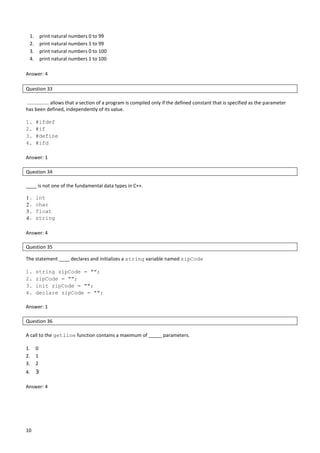
1. print natural numbers 0 to 99
2. print natural numbers 1 to 99
3. print natural numbers 0 to 100
4. print natural numbers 1 to 100
Answer: 4
Question 33
................ allows that a section of a program is compiled only if the defined constant that is specified as the parameter
has been defined, independently of its value.
1. #ifdef
2. #if
3. #define
4. #ifd
Answer: 1
Question 34
____ is not one of the fundamental data types in C++.
1. int
2. char
3. float
4. string
Answer: 4
Question 35
The statement ____ declares and initializes a string variable named zipCode
1. string zipCode = "";
2. zipCode = "";
3. init zipCode = "";
4. declare zipCode = "";
Answer: 1
Question 36
A call to the getline function contains a maximum of _____ parameters.
1. 0
2. 1
3. 2
4. 3
Answer: 4
COS1511/203
11
Question 37
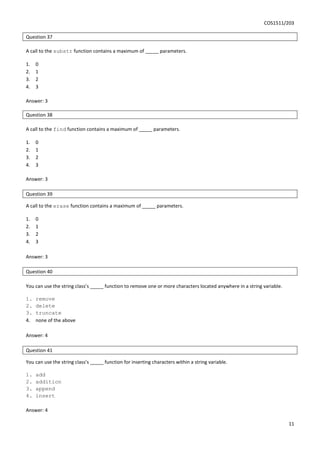
A call to the substr function contains a maximum of _____ parameters.
1. 0
2. 1
3. 2
4. 3
Answer: 3
Question 38
A call to the find function contains a maximum of _____ parameters.
1. 0
2. 1
3. 2
4. 3
Answer: 3
Question 39
A call to the erase function contains a maximum of _____ parameters.
1. 0
2. 1
3. 2
4. 3
Answer: 3
Question 40
You can use the string class’s _____ function to remove one or more characters located anywhere in a string variable.
1. remove
2. delete
3. truncate
4. none of the above
Answer: 4
Question 41
You can use the string class’s _____ function for inserting characters within a string variable.
1. add
2. addition
3. append
4. insert
Answer: 4
12
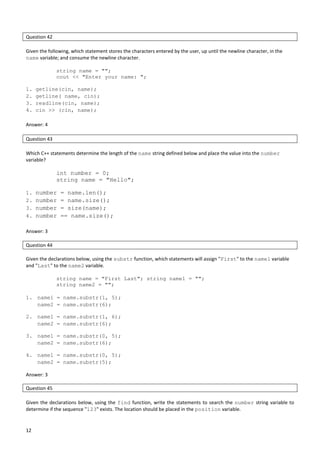
Question 42
Given the following, which statement stores the characters entered by the user, up until the newline character, in the
name variable; and consume the newline character.
string name = "";
cout << "Enter your name: ";
1. getline(cin, name);
2. getline( name, cin);
3. readline(cin, name);
4. cin >> (cin, name);
Answer: 4
Question 43
Which C++ statements determine the length of the name string defined below and place the value into the number
variable?
int number = 0;
string name = "Hello";
1. number = name.len();
2. number = name.size();
3. number = size(name);
4. number == name.size();
Answer: 3
Question 44
Given the declarations below, using the substr function, which statements will assign "First" to the name1 variable
and "Last" to the name2 variable.
string name = "First Last"; string name1 = "";
string name2 = "";
1. name1 = name.substr(1, 5);
name2 = name.substr(6);
2. name1 = name.substr(1, 6);
name2 = name.substr(6);
3. name1 = name.substr(0, 5);
name2 = name.substr(6);
4. name1 = name.substr(0, 5);
name2 = name.substr(5);
Answer: 3
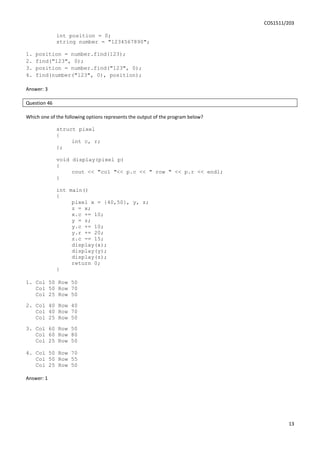
Question 45
Given the declarations below, using the find function, write the statements to search the number string variable to
determine if the sequence "123" exists. The location should be placed in the position variable.
COS1511/203
13
int position = 0;
string number = "1234567890";
1. position = number.find(123);
2. find("123", 0);
3. position = number.find("123", 0);
4. find(number("123", 0), position);
Answer: 3
Question 46
Which one of the following options represents the output of the program below?
struct pixel
{
int c, r;
};
void display(pixel p)
{
cout << "col "<< p.c << " row " << p.r << endl;
}
int main()
{
pixel x = {40,50}, y, z;
z = x;
x.c += 10;
y = z;
y.c += 10;
y.r += 20;
z.c -= 15;
display(x);
display(y);
display(z);
return 0;
}
1. Col 50 Row 50
Col 50 Row 70
Col 25 Row 50
2. Col 40 Row 40
Col 40 Row 70
Col 25 Row 50
3. Col 60 Row 50
Col 60 Row 80
Col 25 Row 50
4. Col 50 Row 70
Col 50 Row 55
Col 25 Row 50
Answer: 1
14
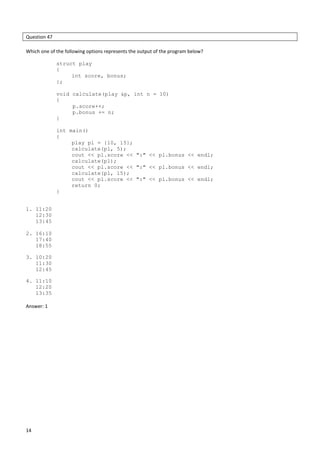
Question 47
Which one of the following options represents the output of the program below?
struct play
{
int score, bonus;
};
void calculate(play &p, int n = 10)
{
p.score++;
p.bonus += n;
}
int main()
{
play pl = {10, 15};
calculate(pl, 5);
cout << pl.score << ":" << pl.bonus << endl;
calculate(pl);
cout << pl.score << ":" << pl.bonus << endl;
calculate(pl, 15);
cout << pl.score << ":" << pl.bonus << endl;
return 0;
}
1. 11:20
12:30
13:45
2. 16:10
17:40
18:55
3. 10:20
11:30
12:45
4. 11:10
12:20
13:35
Answer: 1
COS1511/203
15
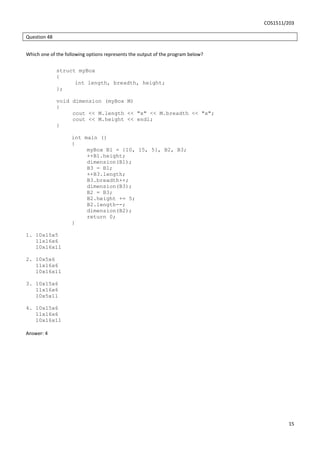
Question 48
Which one of the following options represents the output of the program below?
struct myBox
{
int length, breadth, height;
};
void dimension (myBox M)
{
cout << M.length << "x" << M.breadth << "x";
cout << M.height << endl;
}
int main ()
{
myBox B1 = {10, 15, 5}, B2, B3;
++B1.height;
dimension(B1);
B3 = B1;
++B3.length;
B3.breadth++;
dimension(B3);
B2 = B3;
B2.height += 5;
B2.length--;
dimension(B2);
return 0;
}
1. 10x15x5
11x16x6
10x16x11
2. 10x5x6
11x16x6
10x16x11
3. 10x15x6
11x16x6
10x5x11
4. 10x15x6
11x16x6
10x16x11
Answer: 4
16
Question 49
What is the output produced by the program below?
#include <iostream>
using namespace std;
void encrypt(char theChar[])
{
for (int i = 0; theChar[i] != '0'; i += 2)
if (theChar[i] == 'A' || theChar[i] == 'E')
theChar[i] = '#';
else if (islower(theChar[i]))
theChar[i] = toupper(theChar[i]);
else
theChar[i] = '@';
}
int main()
{
char text[]="SaVE EArtH";
encrypt(text);
cout << text << endl;
return 0;
}
1. #a#E#E@rTH
2. @a@E@E#rtH
3. @a@E@E#rTH
4. #a#E#E#rtH
Answer: 3
Question 50
What is the output produced by the program below?
#include <iostream>
#include <string>
using namespace std;
int main()
{
string name = "CoMPutER";
for (int x = 0; x < name.size(); x++)
if (islower(name [x]))
name [x] = toupper(name[x]);
else
if (isupper(name[x]))
if (x % 2 == 0)
name[x] = tolower(name[x]);
else
name[x] = name[x-1];
cout << name;
return 0;
}
1. CoMPutEr
2. cOmpUTeR
COS1511/203
17
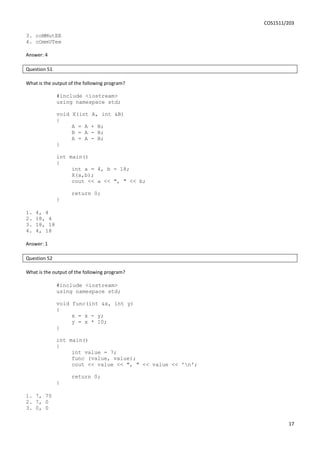
3. coMMutEE
4. cOmmUTee
Answer: 4
Question 51
What is the output of the following program?
#include <iostream>
using namespace std;
void X(int A, int &B)
{
A = A + B;
B = A - B;
A = A - B;
}
int main()
{
int a = 4, b = 18;
X(a,b);
cout << a << ", " << b;
return 0;
}
1. 4, 4
2. 18, 4
3. 18, 18
4. 4, 18
Answer: 1
Question 52
What is the output of the following program?
#include <iostream>
using namespace std;
void func(int &x, int y)
{
x = x - y;
y = x * 10;
}
int main()
{
int value = 7;
func (value, value);
cout << value << ", " << value << 'n';
return 0;
}
1. 7, 70
2. 7, 0
3. 0, 0
18
4. 0, 70
Answer: 3
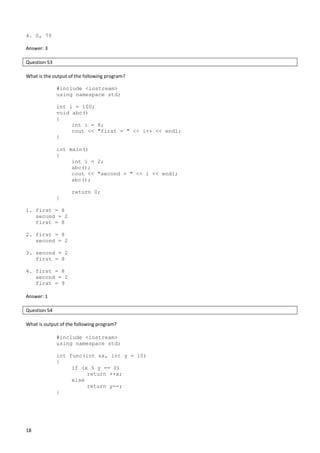
Question 53
What is the output of the following program?
#include <iostream>
using namespace std;
int i = 100;
void abc()
{
int i = 8;
cout << "first = " << i++ << endl;
}
int main()
{
int i = 2;
abc();
cout << "second = " << i << endl;
abc();
return 0;
}
1. first = 8
second = 2
first = 8
2. first = 8
second = 2
3. second = 2
first = 8
4. first = 8
second = 2
first = 9
Answer: 1
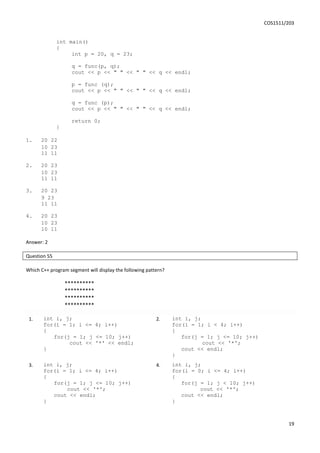
Question 54
What is output of the following program?
#include <iostream>
using namespace std;
int func(int &x, int y = 10)
{
if (x % y == 0)
return ++x;
else
return y--;
}
COS1511/203
19
int main()
{
int p = 20, q = 23;
q = func(p, q);
cout << p << " " << " " << q << endl;
p = func (q);
cout << p << " " << " " << q << endl;
q = func (p);
cout << p << " " << " " << q << endl;
return 0;
}
1. 20 22
10 23
11 11
2. 20 23
10 23
11 11
3. 20 23
9 23
11 11
4. 20 23
10 23
10 11
Answer: 2
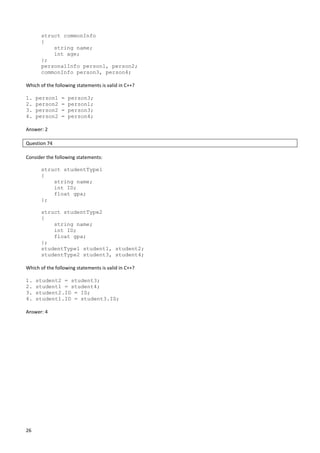
Question 55
Which C++ program segment will display the following pattern?
**********
**********
**********
**********
1. int i, j;
for(i = 1; i <= 4; i++)
{
for(j = 1; j <= 10; j++)
cout << '*' << endl;
}
2. int i, j;
for(i = 1; i < 4; i++)
{
for(j = 1; j <= 10; j++)
cout << '*';
cout << endl;
}
3. int i, j;
for(i = 1; i <= 4; i++)
{
for(j = 1; j <= 10; j++)
cout << '*';
cout << endl;
}
4. int i, j;
for(i = 0; i <= 4; i++)
{
for(j = 1; j < 10; j++)
cout << '*';
cout << endl;
}
20
The following four questions refer to the person structure.
Question 56
Which of the following declarations define a structure named person which has three members: name, age and
salary.
1. struct
{
string name;
int age;
float salary;
} person;
2. struct person
string name;
int age;
float salary;
3. struct person
{
string name;
int age;
float salary;
};
4. person
{
string name;
int age;
float salary;
};
Answer: 3
Question 57
Which of the following statements define a variable of type person?
1. person bill;
2. bill person;
3. person bill[];
4. person[] bill;
Answer: 1
Question 58
Which statement accesses the age member of structure variable bill and assign the value 50 to it.
1. bill[].age = 50;
2. bill[age] = 50;
3. bill(age) = 50;
4. bill.age = 50;
Answer: 4
COS1511/203
21
Question 59
Which one of the following statements declares an array of size 10 with elements of type person?
1. person bill[10];
2. person[] bill;
3. person bill[9];
4. person[10] bill;
Answer: 1
Question 60
What is output of the following program?
#include <iostream>
using namespace std;
int var = 10;
int func()
{
return var;
}
int main()
{
int var = 5;
cout << func() << "n";
return 0;
}
1. 0
2. 15
3. 10
4. 5
Answer: 3
Question 61
Which of the following function header lines is valid for a function called findMax that finds and returns the maximum
value stored in an array of integers that is passed in as a parameter?
1. int findMax(int [])
2. int findMax(int values[])
3. int findMax(int)
4. int findMax([])
Answer: 2
Question 62
Assuming the following declarations:
const int NUMROWS = 3;
const int NUMCOLS = 4;
int val[NUMROWS][NUMCOLS] = {8,16,9,52,3,15,27,6,14,25,2,10};
Which of the following loops correctly outputs each element of the array in row order?
22
1. for (i = 0; i < NUMROWS; i++)
{
for (j = 0; j < NUMCOLS; j++)
cout << setw(4) << val[i][j];
cout << endl;
}
2. for (i = 0; i < NUMROWS; i++)
{
cout << setw(4) << val[i][j];
cout << endl;
}
3. for (i = 0; i < NUMCOLS; i++)
{
cout << setw(4) << val[i][j];
cout << endl;
}
4. for (i = 0; i < NUMROWS*NUMCOLS; i++)
{
cout << setw(4) << val[i][j];
cout << endl;
}
Answer: 1
Question 63
Which of the following function header correctly includes a two dimensional array as its parameter?
1. void display(int [][COLS]);
2. void display(int [ROWS][]);
3. void display(int [][]);
4. void display(int [ROWS][COLS]);
Answer: 2
Question 64
What is the output of this program?
#include <iostream>
using namespace std;
int main ()
{
int array[] = {0, 2, 4, 6, 7, 5, 3};
int n, result = 0;
for (n = 0; n < 8; n++)
{
result += array[n];
}
cout << result;
return 0;
}
1. 24
2. 25
3. 26
4. 27
Answer: 4
COS1511/203
23
Question 65
What is the output of this program?
#include <iostream>
using namespace std;
int main()
{
char str[5] = "ABC";
cout << str[3];
cout << str;
return 0;
}
a. ABC
b. ABCD
c. AB
d. C
Answer: 1
Question 66
Suppose that gamma is an array of 50 elements of type int and j is an int variable. Which of the following for loops
sets the subscript of gamma out-of-range?
1. for (j = 0; j <= 49; j++)
cout << gamma[j] << " ";
2. for (j = 1; j < 50; j++)
cout << gamma[j] << " ";
3. for (j = 0; j <= 50; j++)
cout << gamma[j] << " ";
4. for (j = 0; j <= 48; j++)
cout << gamma[j] << " ";
Answer: 3
Question 67
Which of the following struct definitions is correct in C++?
1. struct studentType
{
int ID;
};
2. struct studentType
{
string name;
int ID;
float gpa;
}
3. int struct studentType
{
ID;
}
24
4. struct studentType
{
int ID = 1;
};
Answer: 1
Question 68
Consider the following struct definition:
struct rectangleData
{
float length;
float width;
float area;
float perimeter;
};
Which of the following variable declarations is correct?
1. rectangle rectangleData;
2. struct rectangleData();
3. rectangleData myRectangle;
4. rectangleData rectangle = new rectangleData();
Answer: 3
Question 69
Consider the following struct definition:
struct temp
{
int b;
};
temp s[50];
The correct syntax to access the member of the ith structure in the array of structures is?
1. s.b.[i];
2. s.[i].b;
3. s.b[i];
4. s[i].b;
Answer: 3
Question 70
The syntax for accessing a struct member is structVariableName ____.
1. .memberName
2. *memberName
3. [memberName]
4. $memberName
Answer: 1
COS1511/203
25
Question 71
Consider the following statements:
struct rectangleData
{
float length;
float width;
float area;
float perimeter;
};
rectangleData bigRect;
Which of the following statements correctly initializes the element length of bigRect?
1. bigRect = {10};
2. bigRect.length = 10;
3. length[0]= 10;
4. bigRect[0]= 10
Answer: 2
Question 72
Consider the following statements:
struct rectangleData
{
float length;
float width;
float area;
float perimeter;
};
rectangleData bigRect;
Which of the following statements is valid in C++?
1. cin >> bigRect;
2. cin >> bigRect.length;
3. perimeter = 2 * (length + width);
4. area = length * width;
Answer: 2
Question 73
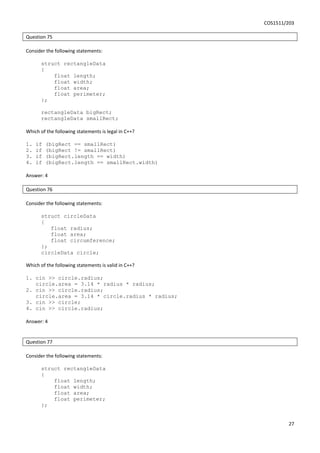
Consider the following statements:
struct personalInfo
{
string name;
int age;
float height;
float weight;
};
26
struct commonInfo
{
string name;
int age;
};
personalInfo person1, person2;
commonInfo person3, person4;
Which of the following statements is valid in C++?
1. person1 = person3;
2. person2 = person1;
3. person2 = person3;
4. person2 = person4;
Answer: 2
Question 74
Consider the following statements:
struct studentType1
{
string name;
int ID;
float gpa;
};
struct studentType2
{
string name;
int ID;
float gpa;
};
studentType1 student1, student2;
studentType2 student3, student4;
Which of the following statements is valid in C++?
1. student2 = student3;
2. student1 = student4;
3. student2.ID = ID;
4. student1.ID = student3.ID;
Answer: 4
COS1511/203
27
Question 75
Consider the following statements:
struct rectangleData
{
float length;
float width;
float area;
float perimeter;
};
rectangleData bigRect;
rectangleData smallRect;
Which of the following statements is legal in C++?
1. if (bigRect == smallRect)
2. if (bigRect != smallRect)
3. if (bigRect.length == width)
4. if (bigRect.length == smallRect.width)
Answer: 4
Question 76
Consider the following statements:
struct circleData
{
float radius;
float area;
float circumference;
};
circleData circle;
Which of the following statements is valid in C++?
1. cin >> circle.radius;
circle.area = 3.14 * radius * radius;
2. cin >> circle.radius;
circle.area = 3.14 * circle.radius * radius;
3. cin >> circle;
4. cin >> circle.radius;
Answer: 4
Question 77
Consider the following statements:
struct rectangleData
{
float length;
float width;
float area;
float perimeter;
};
28
rectangleData bigRect;
Which of the following statements is valid in C++?
1. cin >> bigRect.length >> width;
2. cout << bigRect.length;
3. cout << bigRect;
4. cout << length;
Answer: 2
Question 78
Consider the following statements:
struct supplierType
{
string name;
int supplierID;
};
struct applianceType
{
supplierType supplier;
string modelNo;
float cost;
};
applianceType applianceList[25];
Which of the following best describes applianceList?
1. It is a multidimensional array.
2. It is a struct.
3. It is an array of structs.
4. It is a struct of arrays.
Answer: 3
Question 79
Consider the following statements:
struct supplierType
{
string name;
int supplierID;
};
struct applianceType
{
supplierType supplier;
string modelNo;
float cost;
};
applianceType applianceList[25];
Which of the following statements correctly initializes the cost of each appliance to 0?
COS1511/203
29
1. applianceList.cost = 0;
2. applianceList.cost[25] = 0;
3. for (int j = 1; j < 25; j++)
applianceList.cost[j] = 0;
4. for (int j = 0; j < 25; j++)
applianceList.cost[j] = 0;
Answer: 4
Question 80
What is the output of this program?
#include <iostream>
#include <string>
using namespace std;
struct student
{
int num;
char name[25];
};
int main()
{
student stu;
stu.num = 123;
strcpy(stu.name, "John");
cout << stu.num << endl;
cout << stu.name << endl;
return 0;
}
1. 123
John
2. John
John
3. 123
123
4. compile time error
Answer: 1
©
UNISA
2017

pdf (1).pdfeededwdceffrfrfderferfeeeddwdc

  • 1.
    COS1511/203/1/2017 Tutorial letter 203/1/2017 Introductionto Programming I COS1511 Semesters 1 School of Computing This tutorial letter contains the discussion of the solutions to assignment 3 semester 1.
  • 2.
    2 DISCUSSION OF ASSIGNMENT3 Dear Student Assignment 3 was a multiple choice assignment and was marked electronically. Please take the trouble to compare your answers to those given in this tutorial letter. Try to understand why your answer is wrong if it differs from ours. This will help you in acquiring the skill (or art) of programming. The process of becoming a good programmer, involves building new skills and new knowledge and new insights on top of others. This means that it is a growing process and all the building blocks are important. Question 1 With arrays, the data type of the index is always a(n) _____. 1. int 2. float 3. char 4. string Answer: 1 Question 2 The first variable in a one-dimensional array is assigned an index of _____. 1. 0 2. 1 3. either a or b 4. none of the above Answer: 1 Question 3 Which of the following statements declares a one-dimensional array containing two integer values? 1. int numbers[3] = {1, 2, 3}; 2. char letters[2] = {'a', 'b'}; 3. int characters[2] = {45, 87}; 4. int ages[6] = {0}; Answer: 3
  • 3.
    COS1511/203 3 Question 4 Which ofthe following statements will store the user’s entry into the second element of the numbers array? 1. numbers[1] = 0; 2. numbers[2] = 0; 3. cin >> numbers[1]; 4. cin >> numbers[2]; Answer: 3 Question 5 Arrays in C++ are passed automatically _____ to functions. 1. by value 2. by reference 3. by actual parameters 4. by forma parameters Answer: 2 Question 6 When passing an array to a function, you code _____ after the formal parameter name of the array in the function header to indicate it is an array. 1. & 2. [] 3. {} 4. || Answer: 2 Question 7 Passing an array _____ allows the computer to pass the address of only the first array element. 1. by value 2. by reference 3. by address 4. by scalar Answer: 2 Question 8 Which of the following statements declares a one-dimensional array called letters to contain the first five lowercase letters of the alphabet. 1. char letters[5] = {'a', 'b', 'c', 'd', 'e'}; 2. char letters[5] = {"a", "b", "c", "d", "e"}; 3. char letters[5] = {'a'; 'b'; 'c'; 'd'; 'e'}; 4. char letters[5] = {"a"; "b"; "c"; "d"; "e"}; Answer: 1
  • 4.
    4 Question 9 What happenswhen an array declaration statement does not provide an initial value for each of the elements in a numeric array? 1. The compiler automatically initialises the elements, so the array elements contain 0. 2. The compiler does not automatically initialise the elements, but as it is a numeric array, all array elements contain a numeric value. 3. The compiler does not automatically initialise the elements, so the array elements may contain garbage. 4. The compiler automatically initialises the elements with 0. Answer: 3 Question 10 Given the array declaration below, what is stored in numbers[2] ? int numbers[5] = {1, 2, 3, 4, 5}; 1. 0 2. 1 3. 2 4. 3 Answer: 4 Question 11 Given the array declaration below, which assignment statement will place the number 5 into the fifth array element? int numbers[5] = {0}; 1. numbers[4] = 5; 2. numbers[5] = 5; 3. numbers[1+3] = 5; 4. numbers[1+4] = 5; Answer: 1 Question 12 Given the array declaration below and user prompt, which statement will place the number 1 into the first array element using the extraction operator. int numbers[5] = {0}; cout << “Enter the first number: “; 1. cin >> numbers[1]; 2. cin >> numbers[0] + 1; 3. cin >> numbers[0] = 1; 4. cin >> numbers[0]; Answer: 4
  • 5.
    COS1511/203 5 Question 13 Variables locatedin the first column in a two-dimensional array are assigned a column subscript of _____. 1. 0 2. 1 3. -1 4. NULL Answer: 1 Question 14 Variables located in the third row in a two-dimensional array are assigned a row subscript of _____. 1. 2 2. 3 3. 4 4. -3 Answer: 1 Question 15 How many elements will a two-dimensional array with 4 rows and 5 columns contain? 1. 9 2. 12 3. 18 4. 20 Answer: 4 Question 16 Which of the following statements will declare a two-dimensional array called scores to be of the int data type and contain 3 rows and 4 columns, while also initializing all elements to 0? 1. int scores [4][3] = 0; 2. int scores [3][4] = 0; 3. int scores[3][4] = {0}; 4. int scores[12] = {0}; Answer: 3 Question 17 When referencing an element in a two-dimensional array, the _____ is coded before the _____. 1. column index, row index 2. row index, column index 3. column index, array name 4. row index, array name Answer: 2
  • 6.
    6 Question 18 How manyloops are necessary to access the contents of a two-dimensional array efficiently? 1. 0 2. 1 3. 2 4. more than 2 Answer: 3 Question 19 How many loops are necessary to access the contents of a one-dimensional array efficiently? 1. 0 2. 1 3. 2 4. more than 2 Answer: 2 Question 20 Given the following array declaration, what is the value stored in the scores[2][3] element? int scores[5][5] = {5}; 1. 0 2. 5 3. 10 4. 25 Answer: 1 Question 21 Given the following array declaration, what is the value stored in the scores[1][1] element? int scores[5][5] = {5}; 1. 0 2. 5 3. 10 4. 25 5. Answer: 1
  • 7.
    COS1511/203 7 Question 22 Given thefollowing array declaration, what is the value stored in the scores[1][1] element? int scores[3][3] = { {1, 2, 3}, {4, 5, 6}, {7, 8, 9} }; 1. 1 2. 4 3. 7 4. none of the above Answer: 4 Question 23 Given the following array declaration, what is the value stored in the scores[2][2] element? int scores[3][3] = { {1, 2, 3} }; 1. 0 2. 1 3. 2 4. 3 Answer: 1 Question 24 You would use _____ to reference the variable located in the first row, first column of the scores two-dimensional array. 1. scores[0][0] 2. scores[1][1] 3. scores[first][first] 4. scores[1,1] Answer: 1 Question 25 Which statement will create a two-dimensional array called orders of type int with 2 rows and 3 columns and intialises each element to 0? 1. int orders[2][3]; 2. int orders[][] = {0}; 3. int orders[3][2] = {0}; 4. int orders[2][3] = {0}; Answer: 4
  • 8.
    8 Question 26 Which statementwill create a 2x2 char array called letterswith and initialses each element 'x'? 1. char letters[][2] = { {'x', 'x'}, {'x', 'x'} }; 2. char letters[2][2] = { {'x', 'x'}, {'x', 'x'} }; 3. char letters[2][] = { {'x', 'x'}, {'x', 'x'} }; 4. char letters[2][2] = {'x'}; Answer: 2 Question 27 Which statement will create a two-dimensional integer array called scores with 3 rows and 2 columns where each element has the initial value of 100? 1. int scores[3][2] = { {100, 100}, {100, 100}, {100, 100} }; 2. int scores[][] = {100}; 3. int scores[2][3] = { {100, 100}, {100, 100}, {100, 100} }; 4. int scores[3][2] = {100}; Answer: 1 Question 28 Given the declaration below, which statement assigns the element in the first row and first column a value of 99? int scores[3][2] = {0}; 1. scores[1][1] = 99; 2. scores[0][0] = '99'; 3. scores[0][0] = 99; 4. scores[1][1] = "99"; Answer: 3 Question 29 Given the declaration below, which statement assigns the element in the last row and last column a value of 99? int scores[6][7] = {0}; 1. scores[4][5] = 99; 2. scores[6][7] = 99; 3. scores[5][6] = 99; 4. scores[5][6] = '99'; Answer: 3
  • 9.
    COS1511/203 9 Question 30 Given thedeclaration below, which statement assigns the element in the first row and first column the value entered by the user through the prompt below. int scores[3][2] = {0}; cout << "Please enter the first score: "; 1. cin >> scores[1][1]; 2. cin >> scores[0][0]; 3. cin >> scores[1][0]; 4. cin >> scores[0][1]; Answer: 2 Question 31 Given the declarations below, which nested loop sums all of the elements in the array below. int scores[3][3] = { {92, 87, 91}, {88, 72, 93}, {100, 94, 97} }; int sum = 0; 1. for (int row = 0; row <= 2; row = row + 1) for (int col = 1; col <= 3; col = col + 1) sum = sum + scores[row][col]; 2. for (int row = 0; row <= 2; row = row + 1) for (int col = 0; col <= 2; col = col + 1) sum = sum + scores[row][col]; 3. for (int row = 0; row <= 2; row = row + 1) for (int col = 0; col <= 2; col = col + 1) sum = sum + scores[col][row]; 4. for (int row = 1; row <= 3; row = row + 1) for (int col = 0; col <= 2; col = col + 1) sum = sum + scores[row][col]; Answer: 2 Question 32 What is the output of the program below? #include<iostream.h> void main() { int n=1; cout<<endl<<"The numbers are;"<<endl; do { cout <<n<<"t"; n++; } while (n<=100); cout <<endl; }
  • 10.
    10 1. print naturalnumbers 0 to 99 2. print natural numbers 1 to 99 3. print natural numbers 0 to 100 4. print natural numbers 1 to 100 Answer: 4 Question 33 ................ allows that a section of a program is compiled only if the defined constant that is specified as the parameter has been defined, independently of its value. 1. #ifdef 2. #if 3. #define 4. #ifd Answer: 1 Question 34 ____ is not one of the fundamental data types in C++. 1. int 2. char 3. float 4. string Answer: 4 Question 35 The statement ____ declares and initializes a string variable named zipCode 1. string zipCode = ""; 2. zipCode = ""; 3. init zipCode = ""; 4. declare zipCode = ""; Answer: 1 Question 36 A call to the getline function contains a maximum of _____ parameters. 1. 0 2. 1 3. 2 4. 3 Answer: 4
  • 11.
    COS1511/203 11 Question 37 A callto the substr function contains a maximum of _____ parameters. 1. 0 2. 1 3. 2 4. 3 Answer: 3 Question 38 A call to the find function contains a maximum of _____ parameters. 1. 0 2. 1 3. 2 4. 3 Answer: 3 Question 39 A call to the erase function contains a maximum of _____ parameters. 1. 0 2. 1 3. 2 4. 3 Answer: 3 Question 40 You can use the string class’s _____ function to remove one or more characters located anywhere in a string variable. 1. remove 2. delete 3. truncate 4. none of the above Answer: 4 Question 41 You can use the string class’s _____ function for inserting characters within a string variable. 1. add 2. addition 3. append 4. insert Answer: 4
  • 12.
    12 Question 42 Given thefollowing, which statement stores the characters entered by the user, up until the newline character, in the name variable; and consume the newline character. string name = ""; cout << "Enter your name: "; 1. getline(cin, name); 2. getline( name, cin); 3. readline(cin, name); 4. cin >> (cin, name); Answer: 4 Question 43 Which C++ statements determine the length of the name string defined below and place the value into the number variable? int number = 0; string name = "Hello"; 1. number = name.len(); 2. number = name.size(); 3. number = size(name); 4. number == name.size(); Answer: 3 Question 44 Given the declarations below, using the substr function, which statements will assign "First" to the name1 variable and "Last" to the name2 variable. string name = "First Last"; string name1 = ""; string name2 = ""; 1. name1 = name.substr(1, 5); name2 = name.substr(6); 2. name1 = name.substr(1, 6); name2 = name.substr(6); 3. name1 = name.substr(0, 5); name2 = name.substr(6); 4. name1 = name.substr(0, 5); name2 = name.substr(5); Answer: 3 Question 45 Given the declarations below, using the find function, write the statements to search the number string variable to determine if the sequence "123" exists. The location should be placed in the position variable.
  • 13.
    COS1511/203 13 int position =0; string number = "1234567890"; 1. position = number.find(123); 2. find("123", 0); 3. position = number.find("123", 0); 4. find(number("123", 0), position); Answer: 3 Question 46 Which one of the following options represents the output of the program below? struct pixel { int c, r; }; void display(pixel p) { cout << "col "<< p.c << " row " << p.r << endl; } int main() { pixel x = {40,50}, y, z; z = x; x.c += 10; y = z; y.c += 10; y.r += 20; z.c -= 15; display(x); display(y); display(z); return 0; } 1. Col 50 Row 50 Col 50 Row 70 Col 25 Row 50 2. Col 40 Row 40 Col 40 Row 70 Col 25 Row 50 3. Col 60 Row 50 Col 60 Row 80 Col 25 Row 50 4. Col 50 Row 70 Col 50 Row 55 Col 25 Row 50 Answer: 1
  • 14.
    14 Question 47 Which oneof the following options represents the output of the program below? struct play { int score, bonus; }; void calculate(play &p, int n = 10) { p.score++; p.bonus += n; } int main() { play pl = {10, 15}; calculate(pl, 5); cout << pl.score << ":" << pl.bonus << endl; calculate(pl); cout << pl.score << ":" << pl.bonus << endl; calculate(pl, 15); cout << pl.score << ":" << pl.bonus << endl; return 0; } 1. 11:20 12:30 13:45 2. 16:10 17:40 18:55 3. 10:20 11:30 12:45 4. 11:10 12:20 13:35 Answer: 1
  • 15.
    COS1511/203 15 Question 48 Which oneof the following options represents the output of the program below? struct myBox { int length, breadth, height; }; void dimension (myBox M) { cout << M.length << "x" << M.breadth << "x"; cout << M.height << endl; } int main () { myBox B1 = {10, 15, 5}, B2, B3; ++B1.height; dimension(B1); B3 = B1; ++B3.length; B3.breadth++; dimension(B3); B2 = B3; B2.height += 5; B2.length--; dimension(B2); return 0; } 1. 10x15x5 11x16x6 10x16x11 2. 10x5x6 11x16x6 10x16x11 3. 10x15x6 11x16x6 10x5x11 4. 10x15x6 11x16x6 10x16x11 Answer: 4
  • 16.
    16 Question 49 What isthe output produced by the program below? #include <iostream> using namespace std; void encrypt(char theChar[]) { for (int i = 0; theChar[i] != '0'; i += 2) if (theChar[i] == 'A' || theChar[i] == 'E') theChar[i] = '#'; else if (islower(theChar[i])) theChar[i] = toupper(theChar[i]); else theChar[i] = '@'; } int main() { char text[]="SaVE EArtH"; encrypt(text); cout << text << endl; return 0; } 1. #a#E#E@rTH 2. @a@E@E#rtH 3. @a@E@E#rTH 4. #a#E#E#rtH Answer: 3 Question 50 What is the output produced by the program below? #include <iostream> #include <string> using namespace std; int main() { string name = "CoMPutER"; for (int x = 0; x < name.size(); x++) if (islower(name [x])) name [x] = toupper(name[x]); else if (isupper(name[x])) if (x % 2 == 0) name[x] = tolower(name[x]); else name[x] = name[x-1]; cout << name; return 0; } 1. CoMPutEr 2. cOmpUTeR
  • 17.
    COS1511/203 17 3. coMMutEE 4. cOmmUTee Answer:4 Question 51 What is the output of the following program? #include <iostream> using namespace std; void X(int A, int &B) { A = A + B; B = A - B; A = A - B; } int main() { int a = 4, b = 18; X(a,b); cout << a << ", " << b; return 0; } 1. 4, 4 2. 18, 4 3. 18, 18 4. 4, 18 Answer: 1 Question 52 What is the output of the following program? #include <iostream> using namespace std; void func(int &x, int y) { x = x - y; y = x * 10; } int main() { int value = 7; func (value, value); cout << value << ", " << value << 'n'; return 0; } 1. 7, 70 2. 7, 0 3. 0, 0
  • 18.
    18 4. 0, 70 Answer:3 Question 53 What is the output of the following program? #include <iostream> using namespace std; int i = 100; void abc() { int i = 8; cout << "first = " << i++ << endl; } int main() { int i = 2; abc(); cout << "second = " << i << endl; abc(); return 0; } 1. first = 8 second = 2 first = 8 2. first = 8 second = 2 3. second = 2 first = 8 4. first = 8 second = 2 first = 9 Answer: 1 Question 54 What is output of the following program? #include <iostream> using namespace std; int func(int &x, int y = 10) { if (x % y == 0) return ++x; else return y--; }
  • 19.
    COS1511/203 19 int main() { int p= 20, q = 23; q = func(p, q); cout << p << " " << " " << q << endl; p = func (q); cout << p << " " << " " << q << endl; q = func (p); cout << p << " " << " " << q << endl; return 0; } 1. 20 22 10 23 11 11 2. 20 23 10 23 11 11 3. 20 23 9 23 11 11 4. 20 23 10 23 10 11 Answer: 2 Question 55 Which C++ program segment will display the following pattern? ********** ********** ********** ********** 1. int i, j; for(i = 1; i <= 4; i++) { for(j = 1; j <= 10; j++) cout << '*' << endl; } 2. int i, j; for(i = 1; i < 4; i++) { for(j = 1; j <= 10; j++) cout << '*'; cout << endl; } 3. int i, j; for(i = 1; i <= 4; i++) { for(j = 1; j <= 10; j++) cout << '*'; cout << endl; } 4. int i, j; for(i = 0; i <= 4; i++) { for(j = 1; j < 10; j++) cout << '*'; cout << endl; }
  • 20.
    20 The following fourquestions refer to the person structure. Question 56 Which of the following declarations define a structure named person which has three members: name, age and salary. 1. struct { string name; int age; float salary; } person; 2. struct person string name; int age; float salary; 3. struct person { string name; int age; float salary; }; 4. person { string name; int age; float salary; }; Answer: 3 Question 57 Which of the following statements define a variable of type person? 1. person bill; 2. bill person; 3. person bill[]; 4. person[] bill; Answer: 1 Question 58 Which statement accesses the age member of structure variable bill and assign the value 50 to it. 1. bill[].age = 50; 2. bill[age] = 50; 3. bill(age) = 50; 4. bill.age = 50; Answer: 4
  • 21.
    COS1511/203 21 Question 59 Which oneof the following statements declares an array of size 10 with elements of type person? 1. person bill[10]; 2. person[] bill; 3. person bill[9]; 4. person[10] bill; Answer: 1 Question 60 What is output of the following program? #include <iostream> using namespace std; int var = 10; int func() { return var; } int main() { int var = 5; cout << func() << "n"; return 0; } 1. 0 2. 15 3. 10 4. 5 Answer: 3 Question 61 Which of the following function header lines is valid for a function called findMax that finds and returns the maximum value stored in an array of integers that is passed in as a parameter? 1. int findMax(int []) 2. int findMax(int values[]) 3. int findMax(int) 4. int findMax([]) Answer: 2 Question 62 Assuming the following declarations: const int NUMROWS = 3; const int NUMCOLS = 4; int val[NUMROWS][NUMCOLS] = {8,16,9,52,3,15,27,6,14,25,2,10}; Which of the following loops correctly outputs each element of the array in row order?
  • 22.
    22 1. for (i= 0; i < NUMROWS; i++) { for (j = 0; j < NUMCOLS; j++) cout << setw(4) << val[i][j]; cout << endl; } 2. for (i = 0; i < NUMROWS; i++) { cout << setw(4) << val[i][j]; cout << endl; } 3. for (i = 0; i < NUMCOLS; i++) { cout << setw(4) << val[i][j]; cout << endl; } 4. for (i = 0; i < NUMROWS*NUMCOLS; i++) { cout << setw(4) << val[i][j]; cout << endl; } Answer: 1 Question 63 Which of the following function header correctly includes a two dimensional array as its parameter? 1. void display(int [][COLS]); 2. void display(int [ROWS][]); 3. void display(int [][]); 4. void display(int [ROWS][COLS]); Answer: 2 Question 64 What is the output of this program? #include <iostream> using namespace std; int main () { int array[] = {0, 2, 4, 6, 7, 5, 3}; int n, result = 0; for (n = 0; n < 8; n++) { result += array[n]; } cout << result; return 0; } 1. 24 2. 25 3. 26 4. 27 Answer: 4
  • 23.
    COS1511/203 23 Question 65 What isthe output of this program? #include <iostream> using namespace std; int main() { char str[5] = "ABC"; cout << str[3]; cout << str; return 0; } a. ABC b. ABCD c. AB d. C Answer: 1 Question 66 Suppose that gamma is an array of 50 elements of type int and j is an int variable. Which of the following for loops sets the subscript of gamma out-of-range? 1. for (j = 0; j <= 49; j++) cout << gamma[j] << " "; 2. for (j = 1; j < 50; j++) cout << gamma[j] << " "; 3. for (j = 0; j <= 50; j++) cout << gamma[j] << " "; 4. for (j = 0; j <= 48; j++) cout << gamma[j] << " "; Answer: 3 Question 67 Which of the following struct definitions is correct in C++? 1. struct studentType { int ID; }; 2. struct studentType { string name; int ID; float gpa; } 3. int struct studentType { ID; }
  • 24.
    24 4. struct studentType { intID = 1; }; Answer: 1 Question 68 Consider the following struct definition: struct rectangleData { float length; float width; float area; float perimeter; }; Which of the following variable declarations is correct? 1. rectangle rectangleData; 2. struct rectangleData(); 3. rectangleData myRectangle; 4. rectangleData rectangle = new rectangleData(); Answer: 3 Question 69 Consider the following struct definition: struct temp { int b; }; temp s[50]; The correct syntax to access the member of the ith structure in the array of structures is? 1. s.b.[i]; 2. s.[i].b; 3. s.b[i]; 4. s[i].b; Answer: 3 Question 70 The syntax for accessing a struct member is structVariableName ____. 1. .memberName 2. *memberName 3. [memberName] 4. $memberName Answer: 1
  • 25.
    COS1511/203 25 Question 71 Consider thefollowing statements: struct rectangleData { float length; float width; float area; float perimeter; }; rectangleData bigRect; Which of the following statements correctly initializes the element length of bigRect? 1. bigRect = {10}; 2. bigRect.length = 10; 3. length[0]= 10; 4. bigRect[0]= 10 Answer: 2 Question 72 Consider the following statements: struct rectangleData { float length; float width; float area; float perimeter; }; rectangleData bigRect; Which of the following statements is valid in C++? 1. cin >> bigRect; 2. cin >> bigRect.length; 3. perimeter = 2 * (length + width); 4. area = length * width; Answer: 2 Question 73 Consider the following statements: struct personalInfo { string name; int age; float height; float weight; };
  • 26.
    26 struct commonInfo { string name; intage; }; personalInfo person1, person2; commonInfo person3, person4; Which of the following statements is valid in C++? 1. person1 = person3; 2. person2 = person1; 3. person2 = person3; 4. person2 = person4; Answer: 2 Question 74 Consider the following statements: struct studentType1 { string name; int ID; float gpa; }; struct studentType2 { string name; int ID; float gpa; }; studentType1 student1, student2; studentType2 student3, student4; Which of the following statements is valid in C++? 1. student2 = student3; 2. student1 = student4; 3. student2.ID = ID; 4. student1.ID = student3.ID; Answer: 4
  • 27.
    COS1511/203 27 Question 75 Consider thefollowing statements: struct rectangleData { float length; float width; float area; float perimeter; }; rectangleData bigRect; rectangleData smallRect; Which of the following statements is legal in C++? 1. if (bigRect == smallRect) 2. if (bigRect != smallRect) 3. if (bigRect.length == width) 4. if (bigRect.length == smallRect.width) Answer: 4 Question 76 Consider the following statements: struct circleData { float radius; float area; float circumference; }; circleData circle; Which of the following statements is valid in C++? 1. cin >> circle.radius; circle.area = 3.14 * radius * radius; 2. cin >> circle.radius; circle.area = 3.14 * circle.radius * radius; 3. cin >> circle; 4. cin >> circle.radius; Answer: 4 Question 77 Consider the following statements: struct rectangleData { float length; float width; float area; float perimeter; };
  • 28.
    28 rectangleData bigRect; Which ofthe following statements is valid in C++? 1. cin >> bigRect.length >> width; 2. cout << bigRect.length; 3. cout << bigRect; 4. cout << length; Answer: 2 Question 78 Consider the following statements: struct supplierType { string name; int supplierID; }; struct applianceType { supplierType supplier; string modelNo; float cost; }; applianceType applianceList[25]; Which of the following best describes applianceList? 1. It is a multidimensional array. 2. It is a struct. 3. It is an array of structs. 4. It is a struct of arrays. Answer: 3 Question 79 Consider the following statements: struct supplierType { string name; int supplierID; }; struct applianceType { supplierType supplier; string modelNo; float cost; }; applianceType applianceList[25]; Which of the following statements correctly initializes the cost of each appliance to 0?
  • 29.
    COS1511/203 29 1. applianceList.cost =0; 2. applianceList.cost[25] = 0; 3. for (int j = 1; j < 25; j++) applianceList.cost[j] = 0; 4. for (int j = 0; j < 25; j++) applianceList.cost[j] = 0; Answer: 4 Question 80 What is the output of this program? #include <iostream> #include <string> using namespace std; struct student { int num; char name[25]; }; int main() { student stu; stu.num = 123; strcpy(stu.name, "John"); cout << stu.num << endl; cout << stu.name << endl; return 0; } 1. 123 John 2. John John 3. 123 123 4. compile time error Answer: 1 © UNISA 2017