INTRODUCTION TO C++
C++ is a high level , general-purpose programmi
ng language developed by Bjarne Stroustrup at B
ell Labs in 1983 as an extension of the C progra
mming language.
It is designed for system and application progra
mming and supports multiple programming, para
digms ,including procedural , object oriented , f
unctional and generic programming.
C++ is a cross-platform language that can be use
d to create high-performance application.
3.
OBJECTIVE OF C++
The objective of C++ is to provide a powerful, high-performance, and flexible progra
mming language that supports both low-level system programming (like C) and high-l
evel abstraction (like object-oriented programming). C++ is designed to:
Enable System-Level Programming: C++ allows direct manipulation of hardware, m
emory, and system resources, making it ideal for developing operating systems, devi
ce drivers, and embedded systems.
Support Object-Oriented Programming (OOP): C++ introduces classes and objects,
encapsulation, inheritance, and polymorphism, which help developers design modula
r, reusable, and maintainable code.
Offer High Performance: C++ is designed to be efficient and fast, with minimal runt
ime overhead. Its ability to perform memory management (using pointers and manua
l memory allocation) allows for fine-grained control over performance.
Support Multiple Programming Paradigms: C++ supports procedural programming (li
ke C), object-oriented programming (OOP), and generic programming (via templates
), allowing developers to choose the most appropriate paradigm for their needs.
4.
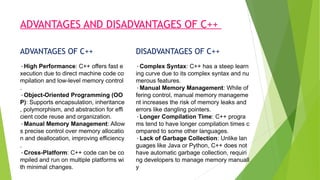
STACKS/QUEUES IN C++
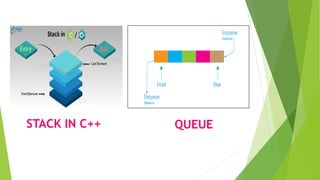
Astack is a linear data structure that follows the Last In, First Out (LIFO) princi
ple. This means that the last element added to the stack is the first one to be re
moved.
Basic Operations:
Push: Adds an element to the top of the stack.
Pop: Removes the element from the top of the stack.
Top: Retrieves the element at the top of the stack without removing it.
Empty: Checks if the stack is empty.
Size: Returns the number of elements in the stack.
ADVANTAGES AND DISADVANTAGESOF C++
ADVANTAGES OF C++ DISADVANTAGES OF C++
•High Performance: C++ offers fast e
xecution due to direct machine code co
mpilation and low-level memory control
.
•Object-Oriented Programming (OO
P): Supports encapsulation, inheritance
, polymorphism, and abstraction for effi
cient code reuse and organization.
•Manual Memory Management: Allow
s precise control over memory allocatio
n and deallocation, improving efficiency
.
•Cross-Platform: C++ code can be co
mpiled and run on multiple platforms wi
th minimal changes.
•Complex Syntax: C++ has a steep learn
ing curve due to its complex syntax and nu
merous features.
•Manual Memory Management: While of
fering control, manual memory manageme
nt increases the risk of memory leaks and
errors like dangling pointers.
•Longer Compilation Time: C++ progra
ms tend to have longer compilation times c
ompared to some other languages.
•Lack of Garbage Collection: Unlike lan
guages like Java or Python, C++ does not
have automatic garbage collection, requiri
ng developers to manage memory manuall
y
7.
CONCLUSION
C++ isa powerful, high-performance programming language that offers a combinat
ion of low-level memory control and high-level abstractions, making it ideal for sy
stems programming, game development, embedded systems, and performance-cri
tical applications. Its support for object-oriented, procedural, and generic progra
mming paradigms gives developers great flexibility and efficiency.
While C++ provides significant advantages like fast execution, cross-platform comp
atibility, and a rich standard library, it also comes with challenges such as a steep
learning curve, manual memory management, and a tendency for complex syntax.
Additionally, C++ can be error-prone if not used carefully, and developers must be
diligent with issues like memory leaks and multi-threading synchronization.
Overall, C++ remains a cornerstone language for many industries due to its versatil
ity, performance, and control. However, it is best suited for developers who need f
ine-grained control over system resources and are prepared to handle its complexi
ty and intricacies.