Sentence Patterns
DILZAR ZUBAIR
YONIS KHALIL
ISRA
SAFWAN WALI
What is sentence pattern?
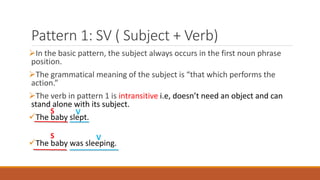
Pattern 1: SV ( Subject + Verb)
In the basic pattern, the subject always occurs in the first noun phrase
position.
The grammatical meaning of the subject is “that which performs the
action.”
The verb in pattern 1 is intransitive i.e, doesn’t need an object and can
stand alone with its subject.
The baby slept.
The baby was sleeping.
S V
S V
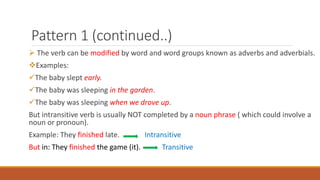
Pattern 1 (continued..)
 The verb can be modified by word and word groups known as adverbs and adverbials.
Examples:
The baby slept early.
The baby was sleeping in the garden.
The baby was sleeping when we drove up.
But intransitive verb is usually NOT completed by a noun phrase ( which could involve a
noun or pronoun).
Example: They finished late. Intransitive
But in: They finished the game (it). Transitive
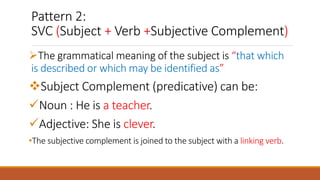
Pattern 2:
SVC (Subject + Verb +Subjective Complement)
The grammatical meaning of the subject is “that which
is described or which may be identified as”
Subject Complement (predicative) can be:
Noun : He is a teacher.
Adjective: She is clever.
•The subjective complement is joined to the subject with a linking verb.
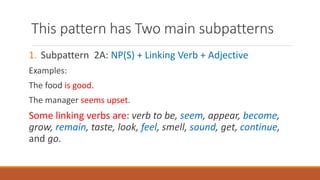
This pattern has Two main subpatterns
1. Subpattern 2A: NP(S) + Linking Verb + Adjective
Examples:
The food is good.
The manager seems upset.
Some linking verbs are: verb to be, seem, appear, become,
grow, remain, taste, look, feel, smell, sound, get, continue,
and go.
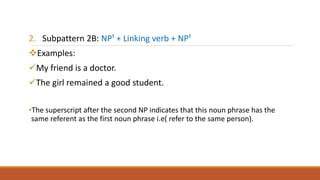
2. Subpattern 2B: NP¹ + Linking verb + NP¹
Examples:
My friend is a doctor.
The girl remained a good student.
•The superscript after the second NP indicates that this noun phrase has the
same referent as the first noun phrase i.e( refer to the same person).
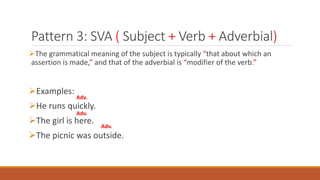
Pattern 3: SVA ( Subject + Verb + Adverbial)
The grammatical meaning of the subject is typically “that about which an
assertion is made,” and that of the adverbial is “modifier of the verb.”
Examples:
He runs quickly.
The girl is here.
The picnic was outside.
Adv.
Adv.
Adv.
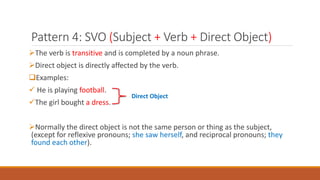
Pattern 4: SVO (Subject + Verb + Direct Object)
The verb is transitive and is completed by a noun phrase.
Direct object is directly affected by the verb.
Examples:
 He is playing football.
The girl bought a dress.
Normally the direct object is not the same person or thing as the subject,
(except for reflexive pronouns; she saw herself, and reciprocal pronouns; they
found each other).
Direct Object
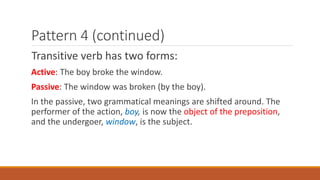
Pattern 4 (continued)
Transitive verb has two forms:
Active: The boy broke the window.
Passive: The window was broken (by the boy).
In the passive, two grammatical meanings are shifted around. The
performer of the action, boy, is now the object of the preposition,
and the undergoer, window, is the subject.
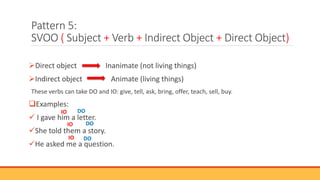
Pattern 5:
SVOO ( Subject + Verb + Indirect Object + Direct Object)
Direct object Inanimate (not living things)
Indirect object Animate (living things)
These verbs can take DO and IO: give, tell, ask, bring, offer, teach, sell, buy.
Examples:
 I gave him a letter.
She told them a story.
He asked me a question.
DO
DO
DO
IO
IO
IO
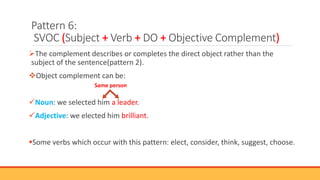
Pattern 6:
SVOC (Subject + Verb + DO + Objective Complement)
The complement describes or completes the direct object rather than the
subject of the sentence(pattern 2).
Object complement can be:
Noun: we selected him a leader.
Adjective: we elected him brilliant.
Some verbs which occur with this pattern: elect, consider, think, suggest, choose.
Same person
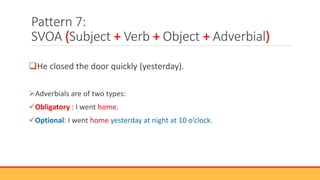
Pattern 7:
SVOA (Subject + Verb + Object + Adverbial)
He closed the door quickly (yesterday).
Adverbials are of two types:
Obligatory : I went home.
Optional: I went home yesterday at night at 10 o’clock.
Tank You!

Patterns

  • 1.
  • 2.
  • 3.
    Pattern 1: SV( Subject + Verb) In the basic pattern, the subject always occurs in the first noun phrase position. The grammatical meaning of the subject is “that which performs the action.” The verb in pattern 1 is intransitive i.e, doesn’t need an object and can stand alone with its subject. The baby slept. The baby was sleeping. S V S V
  • 4.
    Pattern 1 (continued..) The verb can be modified by word and word groups known as adverbs and adverbials. Examples: The baby slept early. The baby was sleeping in the garden. The baby was sleeping when we drove up. But intransitive verb is usually NOT completed by a noun phrase ( which could involve a noun or pronoun). Example: They finished late. Intransitive But in: They finished the game (it). Transitive
  • 5.
    Pattern 2: SVC (Subject+ Verb +Subjective Complement) The grammatical meaning of the subject is “that which is described or which may be identified as” Subject Complement (predicative) can be: Noun : He is a teacher. Adjective: She is clever. •The subjective complement is joined to the subject with a linking verb.
  • 6.
    This pattern hasTwo main subpatterns 1. Subpattern 2A: NP(S) + Linking Verb + Adjective Examples: The food is good. The manager seems upset. Some linking verbs are: verb to be, seem, appear, become, grow, remain, taste, look, feel, smell, sound, get, continue, and go.
  • 7.
    2. Subpattern 2B:NP¹ + Linking verb + NP¹ Examples: My friend is a doctor. The girl remained a good student. •The superscript after the second NP indicates that this noun phrase has the same referent as the first noun phrase i.e( refer to the same person).
  • 8.
    Pattern 3: SVA( Subject + Verb + Adverbial) The grammatical meaning of the subject is typically “that about which an assertion is made,” and that of the adverbial is “modifier of the verb.” Examples: He runs quickly. The girl is here. The picnic was outside. Adv. Adv. Adv.
  • 9.
    Pattern 4: SVO(Subject + Verb + Direct Object) The verb is transitive and is completed by a noun phrase. Direct object is directly affected by the verb. Examples:  He is playing football. The girl bought a dress. Normally the direct object is not the same person or thing as the subject, (except for reflexive pronouns; she saw herself, and reciprocal pronouns; they found each other). Direct Object
  • 10.
    Pattern 4 (continued) Transitiveverb has two forms: Active: The boy broke the window. Passive: The window was broken (by the boy). In the passive, two grammatical meanings are shifted around. The performer of the action, boy, is now the object of the preposition, and the undergoer, window, is the subject.
  • 11.
    Pattern 5: SVOO (Subject + Verb + Indirect Object + Direct Object) Direct object Inanimate (not living things) Indirect object Animate (living things) These verbs can take DO and IO: give, tell, ask, bring, offer, teach, sell, buy. Examples:  I gave him a letter. She told them a story. He asked me a question. DO DO DO IO IO IO
  • 12.
    Pattern 6: SVOC (Subject+ Verb + DO + Objective Complement) The complement describes or completes the direct object rather than the subject of the sentence(pattern 2). Object complement can be: Noun: we selected him a leader. Adjective: we elected him brilliant. Some verbs which occur with this pattern: elect, consider, think, suggest, choose. Same person
  • 13.
    Pattern 7: SVOA (Subject+ Verb + Object + Adverbial) He closed the door quickly (yesterday). Adverbials are of two types: Obligatory : I went home. Optional: I went home yesterday at night at 10 o’clock.
  • 14.