Pronouns Section 33
33A : Pronoun Case 3 Cases Subjective Objective POssessive
Subjective Case USe : when it is a subject, a subject complement, or an appositive renaming a subject or subject complement Examples: She  was passionate about everything. The main supporter of the recycling program was  she . Three colleagues-- Peter, JOhn, and  she -- worked on the program.
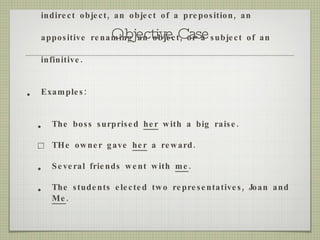
Objective Case USe : when a pronoun functions as a direct or indirect object, an object of a preposition, an appositive renaming an object, or a subject of an infinitive. Examples: The boss surprised  her  with a big raise. THe owner gave  her  a reward. Several friends went with  me . The students elected two representatives, Joan and  Me .
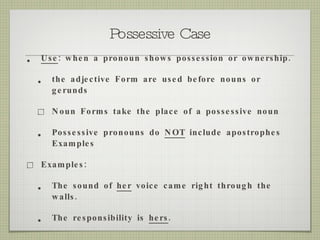
Possessive Case Use : when a pronoun shows possession or ownership. the adjective Form are used before nouns or gerunds  Noun Forms take the place of a possessive noun Possessive pronouns do  NOT  include apostrophes Examples Examples: The sound of  her  voice came right through the walls. The responsibility is  hers .
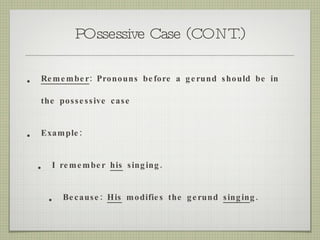
POssessive Case (CONT.) Remember : Pronouns before a gerund should be in the possessive case Example: I remember  his  singing. Because:  His  modifies the gerund  singin g.
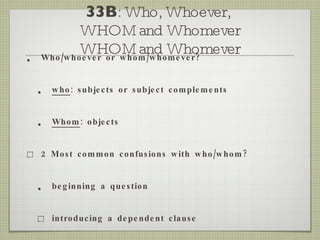
33B : Who, Whoever,  WHOM and Whomever WHOM and Whomever Who/whoever or whom/whomever? who : subjects or subject complements Whom : objects 2 Most common confusions with who/whom? beginning a question introducing a dependent clause
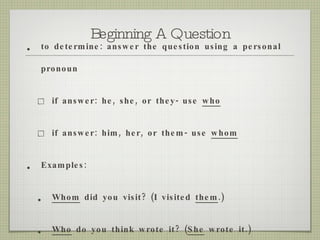
Beginning A Question to determine: answer the question using a personal pronoun  if answer: he, she, or they- use  who if answer: him, her, or them- use  whom Examples: Whom  did you visit? (I visited  them .) Who  do you think wrote it? ( She  wrote it.)
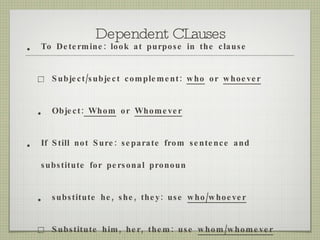
Dependent CLauses To Determine: look at purpose in the clause Subject/subject complement:  who  or  whoever Object:  Whom  or  Whomever If Still not Sure: separate from sentence and substitute for personal pronoun substitute he, she, they: use  who/whoever Substitute him, her, them: use  whom/whomever
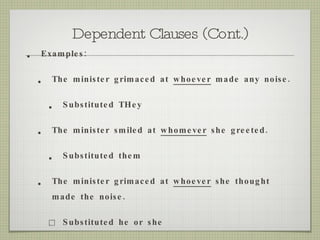
Dependent Clauses (Cont.) Examples:  The minister grimaced at  whoever  made any noise.  Substituted THey The minister smiled at  whomever  she greeted. Substituted them The minister grimaced at  whoever  she thought made the noise. Substituted he or she
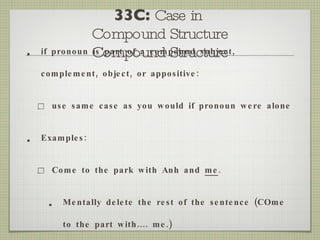
33C:  Case in  Compound Structure Compound Structure if pronoun is part of a compound subject, complement, object, or appositive: use same case as you would if pronoun were alone Examples: Come to the park with Anh and  me . Mentally delete the rest of the sentence (COme to the part with.... me.)
33D:  Case in Elliptical Constructions some words go unspoken in elliptical constructions When E.C. ends in a pronoun: use case for pronoun that you would use if it were complete Examples: His sister has always been more athletic than  he  [is]. Willie likes LIly more than  she  [likes Lily]. Willie likes LIly more than [he likes] Lily.
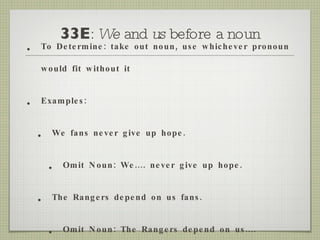
33E :  We  and  us  before a noun To Determine: take out noun, use whichever pronoun would fit without it Examples: We fans never give up hope. Omit Noun: We.... never give up hope. The Rangers depend on us fans. Omit Noun: The Rangers depend on us....
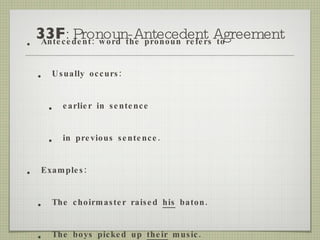
33F : Pronoun-Antecedent Agreement Antecedent: word the pronoun refers to Usually occurs:  earlier in sentence  in previous sentence. Examples: The choirmaster raised  his  baton. The boys picked up  their  music.
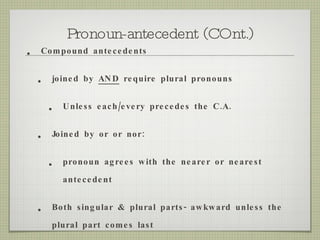
Pronoun-antecedent (COnt.) Compound antecedents joined by  AND  require plural pronouns Unless each/every precedes the C.A. Joined by or or nor: pronoun agrees with the nearer or nearest antecedent Both singular & plural parts- awkward unless the plural part comes last
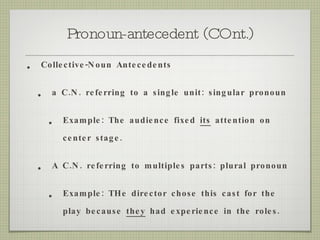
Pronoun-antecedent (COnt.) Collective-Noun Antecedents a C.N. referring to a single unit: singular pronoun Example: The audience fixed  its  attention on center stage. A C.N. referring to multiples parts: plural pronoun Example: THe director chose this cast for the play because  they  had experience in the roles.
Pronoun-antecedent (COnt.) Sexist Pronouns when indefinite pronoun: writers typically use  he  to serve as the pronoun Use plural pronoun when the antecedent is anybody, each, or everyone
33G : Clear  Pronoun Reference Pronoun Reference pronoun antecedent is the word the pronoun substitutes for if pronoun is too far from its antecedent: creates confusion vague use of it, this, that, and which Example: When the senators realized the bill would be defeated, they tried to postpone the vote but failed.  It  was a fiasco. Indefinite use of you, it, they Example: In France,  they  allow dogs in many restaurants.

Comp I Section 33 Ppt

  • 1.
  • 2.
    33A : PronounCase 3 Cases Subjective Objective POssessive
  • 3.
    Subjective Case USe: when it is a subject, a subject complement, or an appositive renaming a subject or subject complement Examples: She was passionate about everything. The main supporter of the recycling program was she . Three colleagues-- Peter, JOhn, and she -- worked on the program.
  • 4.
    Objective Case USe: when a pronoun functions as a direct or indirect object, an object of a preposition, an appositive renaming an object, or a subject of an infinitive. Examples: The boss surprised her with a big raise. THe owner gave her a reward. Several friends went with me . The students elected two representatives, Joan and Me .
  • 5.
    Possessive Case Use: when a pronoun shows possession or ownership. the adjective Form are used before nouns or gerunds Noun Forms take the place of a possessive noun Possessive pronouns do NOT include apostrophes Examples Examples: The sound of her voice came right through the walls. The responsibility is hers .
  • 6.
    POssessive Case (CONT.)Remember : Pronouns before a gerund should be in the possessive case Example: I remember his singing. Because: His modifies the gerund singin g.
  • 7.
    33B : Who,Whoever, WHOM and Whomever WHOM and Whomever Who/whoever or whom/whomever? who : subjects or subject complements Whom : objects 2 Most common confusions with who/whom? beginning a question introducing a dependent clause
  • 8.
    Beginning A Questionto determine: answer the question using a personal pronoun if answer: he, she, or they- use who if answer: him, her, or them- use whom Examples: Whom did you visit? (I visited them .) Who do you think wrote it? ( She wrote it.)
  • 9.
    Dependent CLauses ToDetermine: look at purpose in the clause Subject/subject complement: who or whoever Object: Whom or Whomever If Still not Sure: separate from sentence and substitute for personal pronoun substitute he, she, they: use who/whoever Substitute him, her, them: use whom/whomever
  • 10.
    Dependent Clauses (Cont.)Examples: The minister grimaced at whoever made any noise. Substituted THey The minister smiled at whomever she greeted. Substituted them The minister grimaced at whoever she thought made the noise. Substituted he or she
  • 11.
    33C: Casein Compound Structure Compound Structure if pronoun is part of a compound subject, complement, object, or appositive: use same case as you would if pronoun were alone Examples: Come to the park with Anh and me . Mentally delete the rest of the sentence (COme to the part with.... me.)
  • 12.
    33D: Casein Elliptical Constructions some words go unspoken in elliptical constructions When E.C. ends in a pronoun: use case for pronoun that you would use if it were complete Examples: His sister has always been more athletic than he [is]. Willie likes LIly more than she [likes Lily]. Willie likes LIly more than [he likes] Lily.
  • 13.
    33E : We and us before a noun To Determine: take out noun, use whichever pronoun would fit without it Examples: We fans never give up hope. Omit Noun: We.... never give up hope. The Rangers depend on us fans. Omit Noun: The Rangers depend on us....
  • 14.
    33F : Pronoun-AntecedentAgreement Antecedent: word the pronoun refers to Usually occurs: earlier in sentence in previous sentence. Examples: The choirmaster raised his baton. The boys picked up their music.
  • 15.
    Pronoun-antecedent (COnt.) Compoundantecedents joined by AND require plural pronouns Unless each/every precedes the C.A. Joined by or or nor: pronoun agrees with the nearer or nearest antecedent Both singular & plural parts- awkward unless the plural part comes last
  • 16.
    Pronoun-antecedent (COnt.) Collective-NounAntecedents a C.N. referring to a single unit: singular pronoun Example: The audience fixed its attention on center stage. A C.N. referring to multiples parts: plural pronoun Example: THe director chose this cast for the play because they had experience in the roles.
  • 17.
    Pronoun-antecedent (COnt.) SexistPronouns when indefinite pronoun: writers typically use he to serve as the pronoun Use plural pronoun when the antecedent is anybody, each, or everyone
  • 18.
    33G : Clear Pronoun Reference Pronoun Reference pronoun antecedent is the word the pronoun substitutes for if pronoun is too far from its antecedent: creates confusion vague use of it, this, that, and which Example: When the senators realized the bill would be defeated, they tried to postpone the vote but failed. It was a fiasco. Indefinite use of you, it, they Example: In France, they allow dogs in many restaurants.