
Sentence Semantics: 
Proposition & Thematic 
Roles 
Pr epar ed by; 
ROSEMARIE B. CARO 
EM 204: Structure of English
What is Semantics? 
The study of meaning of words, phrases, 
and sentences. 
• Lexical semantics (words and meaning 
relationship among words) 
•Phrasal/ sentential semantics (syntactic 
units larger than a word)
Propositions 
• The semantic content of a 
clause minus any particular 
syntactic structure as well 
as its intended 
communicative force.
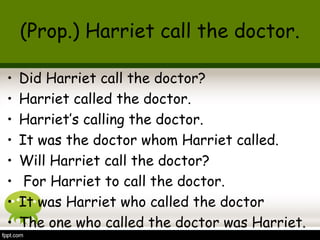
(Prop.) Harriet call the doctor. 
• Did Harriet call the doctor? 
• Harriet called the doctor. 
• Harriet’s calling the doctor. 
• It was the doctor whom Harriet called. 
• Will Harriet call the doctor? 
• For Harriet to call the doctor. 
• It was Harriet who called the doctor 
• The one who called the doctor was Harriet.
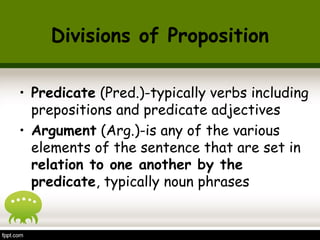
Divisions of Proposition 
• Predicate (Pred.)-typically verbs including 
prepositions and predicate adjectives 
• Argument (Arg.)-is any of the various 
elements of the sentence that are set in 
relation to one another by the 
predicate, typically noun phrases
Predicate and Argument 
Diagramming
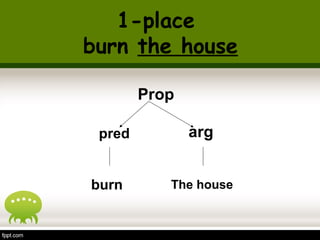
1-place 
burn the house 
Prop 
pred arg 
burn The house
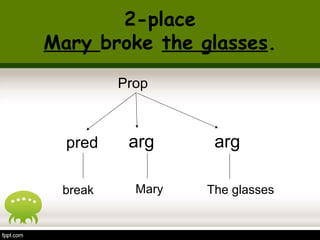
2-place 
Mary broke the glasses. 
Prop 
pred arg arg 
break Mary The glasses
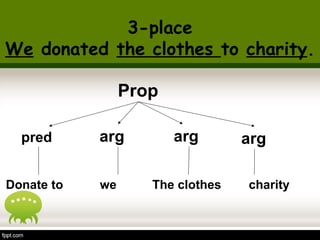
3-place 
We donated the clothes to charity. 
Prop 
pred arg arg arg 
Donate to we The clothes charity
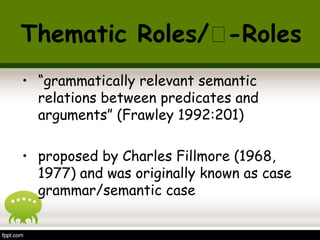
Thematic Roles/ፀ-Roles 
• “grammatically relevant semantic 
relations between predicates and 
arguments” (Frawley 1992:201) 
• proposed by Charles Fillmore (1968, 
1977) and was originally known as case 
grammar/semantic case
Thematic roles & 
expression served by 
arguments in a 
sentence
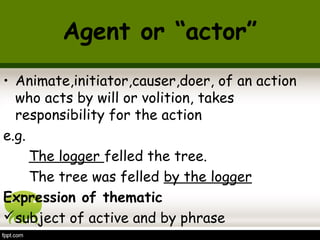
Agent or “actor” 
• Animate,initiator,causer,doer, of an action 
who acts by will or volition, takes 
responsibility for the action 
e.g. 
The logger felled the tree. 
The tree was felled by the logger 
Expression of thematic 
subject of active and by phrase
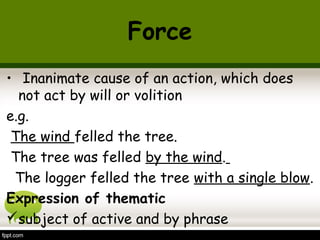
Force 
• Inanimate cause of an action, which does 
not act by will or volition 
e.g. 
The wind felled the tree. 
The tree was felled by the wind. 
The logger felled the tree with a single blow. 
Expression of thematic 
subject of active and by phrase
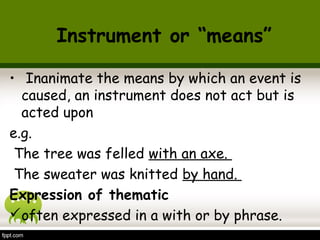
Instrument or “means” 
• Inanimate the means by which an event is 
caused, an instrument does not act but is 
acted upon 
e.g. 
The tree was felled with an axe. 
The sweater was knitted by hand. 
Expression of thematic 
often expressed in a with or by phrase.
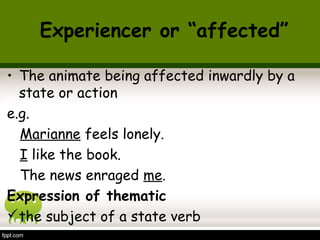
Experiencer or “affected” 
• The animate being affected inwardly by a 
state or action 
e.g. 
Marianne feels lonely. 
I like the book. 
The news enraged me. 
Expression of thematic 
the subject of a state verb
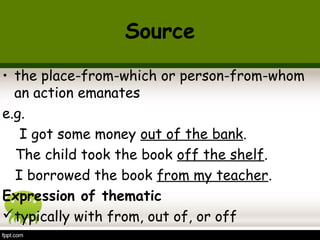
Source 
• the place-from-which or person-from-whom 
an action emanates 
e.g. 
I got some money out of the bank. 
The child took the book off the shelf. 
I borrowed the book from my teacher. 
Expression of thematic 
typically with from, out of, or off
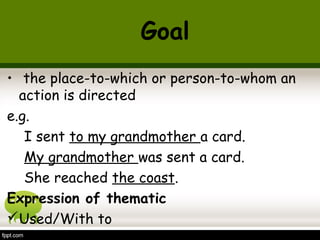
Goal 
• the place-to-which or person-to-whom an 
action is directed 
e.g. 
I sent to my grandmother a card. 
My grandmother was sent a card. 
She reached the coast. 
Expression of thematic 
Used/With to
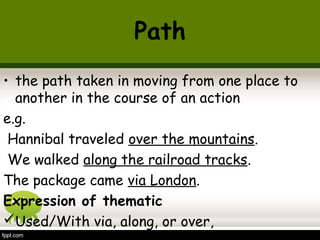
Path 
• the path taken in moving from one place to 
another in the course of an action 
e.g. 
Hannibal traveled over the mountains. 
We walked along the railroad tracks. 
The package came via London. 
Expression of thematic 
Used/With via, along, or over,
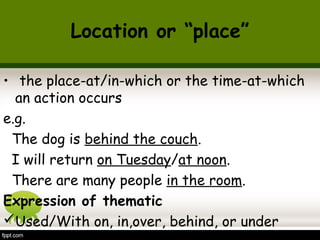
Location or “place” 
• the place-at/in-which or the time-at-which 
an action occurs 
e.g. 
The dog is behind the couch. 
I will return on Tuesday/at noon. 
There are many people in the room. 
Expression of thematic 
Used/With on, in,over, behind, or under
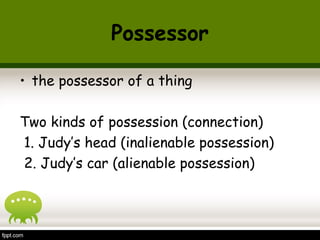
Possessor 
• the possessor of a thing 
Two kinds of possession (connection) 
1. Judy’s head (inalienable possession) 
2. Judy’s car (alienable possession)
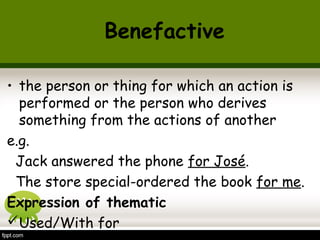
Benefactive 
• the person or thing for which an action is 
performed or the person who derives 
something from the actions of another 
e.g. 
Jack answered the phone for José. 
The store special-ordered the book for me. 
Expression of thematic 
Used/With for
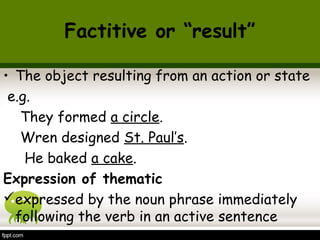
Factitive or “result” 
• The object resulting from an action or state 
e.g. 
They formed a circle. 
Wren designed St. Paul’s. 
He baked a cake. 
Expression of thematic 
expressed by the noun phrase immediately 
following the verb in an active sentence
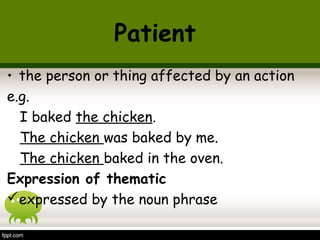
Patient 
• the person or thing affected by an action 
e.g. 
I baked the chicken. 
The chicken was baked by me. 
The chicken baked in the oven. 
Expression of thematic 
expressed by the noun phrase
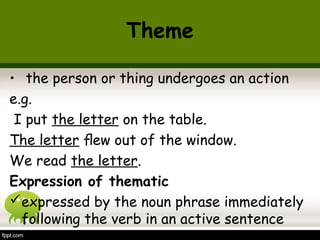
Theme 
• the person or thing undergoes an action 
e.g. 
I put the letter on the table. 
The letter flew out of the window. 
We read the letter. 
Expression of thematic 
expressed by the noun phrase immediately 
following the verb in an active sentence
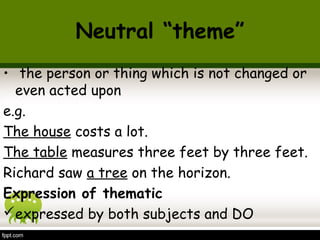
Neutral “theme” 
• the person or thing which is not changed or 
even acted upon 
e.g. 
The house costs a lot. 
The table measures three feet by three feet. 
Richard saw a tree on the horizon. 
Expression of thematic 
expressed by both subjects and DO
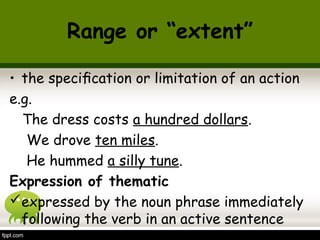
Range or “extent” 
• the specification or limitation of an action 
e.g. 
The dress costs a hundred dollars. 
We drove ten miles. 
He hummed a silly tune. 
Expression of thematic 
expressed by the noun phrase immediately 
following the verb in an active sentence
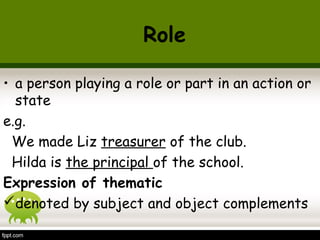
Role 
• a person playing a role or part in an action or 
state 
e.g. 
We made Liz treasurer of the club. 
Hilda is the principal of the school. 
Expression of thematic 
denoted by subject and object complements
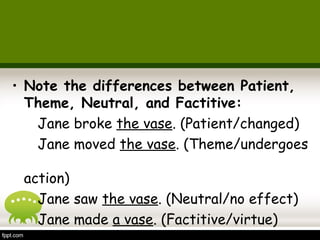
• Note the differences between Patient, 
Theme, Neutral, and Factitive: 
Jane broke the vase. (Patient/changed) 
Jane moved the vase. (Theme/undergoes 
action) 
Jane saw the vase. (Neutral/no effect) 
Jane made a vase. (Factitive/virtue)
Dual Thematic Roles 
arguments of certain classes of verbs.
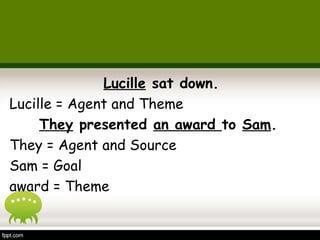
Lucille sat down. 
Lucille = Agent and Theme 
They presented an award to Sam. 
They = Agent and Source 
Sam = Goal 
award = Theme
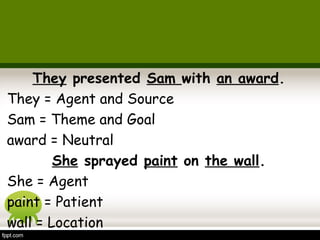
They presented Sam with an award. 
They = Agent and Source 
Sam = Theme and Goal 
award = Neutral 
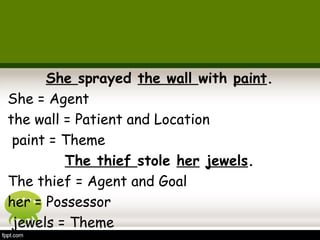
She sprayed paint on the wall. 
She = Agent 
paint = Patient 
wall = Location
She sprayed the wall with paint. 
She = Agent 
the wall = Patient and Location 
paint = Theme 
The thief stole her jewels. 
The thief = Agent and Goal 
her = Possessor 
jewels = Theme
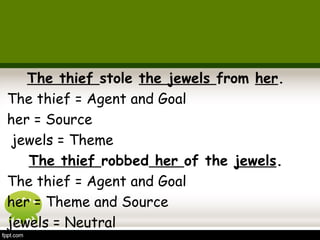
The thief stole the jewels from her. 
The thief = Agent and Goal 
her = Source 
jewels = Theme 
The thief robbed her of the jewels. 
The thief = Agent and Goal 
her = Theme and Source 
jewels = Neutral
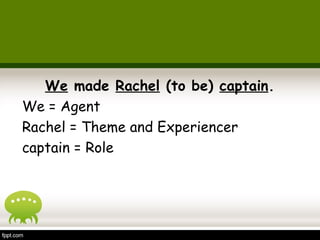
We made Rachel (to be) captain. 
We = Agent 
Rachel = Theme and Experiencer 
captain = Role
THANK YOU

Em 204 semantics

  • 1.
    Sentence Semantics: Proposition& Thematic Roles Pr epar ed by; ROSEMARIE B. CARO EM 204: Structure of English
  • 2.
    What is Semantics? The study of meaning of words, phrases, and sentences. • Lexical semantics (words and meaning relationship among words) •Phrasal/ sentential semantics (syntactic units larger than a word)
  • 3.
    Propositions • Thesemantic content of a clause minus any particular syntactic structure as well as its intended communicative force.
  • 4.
    (Prop.) Harriet callthe doctor. • Did Harriet call the doctor? • Harriet called the doctor. • Harriet’s calling the doctor. • It was the doctor whom Harriet called. • Will Harriet call the doctor? • For Harriet to call the doctor. • It was Harriet who called the doctor • The one who called the doctor was Harriet.
  • 5.
    Divisions of Proposition • Predicate (Pred.)-typically verbs including prepositions and predicate adjectives • Argument (Arg.)-is any of the various elements of the sentence that are set in relation to one another by the predicate, typically noun phrases
  • 6.
  • 7.
    1-place burn thehouse Prop pred arg burn The house
  • 8.
    2-place Mary brokethe glasses. Prop pred arg arg break Mary The glasses
  • 9.
    3-place We donatedthe clothes to charity. Prop pred arg arg arg Donate to we The clothes charity
  • 10.
    Thematic Roles/ፀ-Roles •“grammatically relevant semantic relations between predicates and arguments” (Frawley 1992:201) • proposed by Charles Fillmore (1968, 1977) and was originally known as case grammar/semantic case
  • 11.
    Thematic roles & expression served by arguments in a sentence
  • 12.
    Agent or “actor” • Animate,initiator,causer,doer, of an action who acts by will or volition, takes responsibility for the action e.g. The logger felled the tree. The tree was felled by the logger Expression of thematic subject of active and by phrase
  • 13.
    Force • Inanimatecause of an action, which does not act by will or volition e.g. The wind felled the tree. The tree was felled by the wind. The logger felled the tree with a single blow. Expression of thematic subject of active and by phrase
  • 14.
    Instrument or “means” • Inanimate the means by which an event is caused, an instrument does not act but is acted upon e.g. The tree was felled with an axe. The sweater was knitted by hand. Expression of thematic often expressed in a with or by phrase.
  • 15.
    Experiencer or “affected” • The animate being affected inwardly by a state or action e.g. Marianne feels lonely. I like the book. The news enraged me. Expression of thematic the subject of a state verb
  • 16.
    Source • theplace-from-which or person-from-whom an action emanates e.g. I got some money out of the bank. The child took the book off the shelf. I borrowed the book from my teacher. Expression of thematic typically with from, out of, or off
  • 17.
    Goal • theplace-to-which or person-to-whom an action is directed e.g. I sent to my grandmother a card. My grandmother was sent a card. She reached the coast. Expression of thematic Used/With to
  • 18.
    Path • thepath taken in moving from one place to another in the course of an action e.g. Hannibal traveled over the mountains. We walked along the railroad tracks. The package came via London. Expression of thematic Used/With via, along, or over,
  • 19.
    Location or “place” • the place-at/in-which or the time-at-which an action occurs e.g. The dog is behind the couch. I will return on Tuesday/at noon. There are many people in the room. Expression of thematic Used/With on, in,over, behind, or under
  • 20.
    Possessor • thepossessor of a thing Two kinds of possession (connection) 1. Judy’s head (inalienable possession) 2. Judy’s car (alienable possession)
  • 21.
    Benefactive • theperson or thing for which an action is performed or the person who derives something from the actions of another e.g. Jack answered the phone for José. The store special-ordered the book for me. Expression of thematic Used/With for
  • 22.
    Factitive or “result” • The object resulting from an action or state e.g. They formed a circle. Wren designed St. Paul’s. He baked a cake. Expression of thematic expressed by the noun phrase immediately following the verb in an active sentence
  • 23.
    Patient • theperson or thing affected by an action e.g. I baked the chicken. The chicken was baked by me. The chicken baked in the oven. Expression of thematic expressed by the noun phrase
  • 24.
    Theme • theperson or thing undergoes an action e.g. I put the letter on the table. The letter flew out of the window. We read the letter. Expression of thematic expressed by the noun phrase immediately following the verb in an active sentence
  • 25.
    Neutral “theme” •the person or thing which is not changed or even acted upon e.g. The house costs a lot. The table measures three feet by three feet. Richard saw a tree on the horizon. Expression of thematic expressed by both subjects and DO
  • 26.
    Range or “extent” • the specification or limitation of an action e.g. The dress costs a hundred dollars. We drove ten miles. He hummed a silly tune. Expression of thematic expressed by the noun phrase immediately following the verb in an active sentence
  • 27.
    Role • aperson playing a role or part in an action or state e.g. We made Liz treasurer of the club. Hilda is the principal of the school. Expression of thematic denoted by subject and object complements
  • 28.
    • Note thedifferences between Patient, Theme, Neutral, and Factitive: Jane broke the vase. (Patient/changed) Jane moved the vase. (Theme/undergoes action) Jane saw the vase. (Neutral/no effect) Jane made a vase. (Factitive/virtue)
  • 29.
    Dual Thematic Roles arguments of certain classes of verbs.
  • 30.
    Lucille sat down. Lucille = Agent and Theme They presented an award to Sam. They = Agent and Source Sam = Goal award = Theme
  • 31.
    They presented Samwith an award. They = Agent and Source Sam = Theme and Goal award = Neutral She sprayed paint on the wall. She = Agent paint = Patient wall = Location
  • 32.
    She sprayed thewall with paint. She = Agent the wall = Patient and Location paint = Theme The thief stole her jewels. The thief = Agent and Goal her = Possessor jewels = Theme
  • 33.
    The thief stolethe jewels from her. The thief = Agent and Goal her = Source jewels = Theme The thief robbed her of the jewels. The thief = Agent and Goal her = Theme and Source jewels = Neutral
  • 34.
    We made Rachel(to be) captain. We = Agent Rachel = Theme and Experiencer captain = Role
  • 35.