Contents
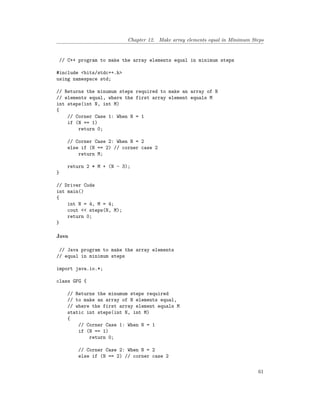
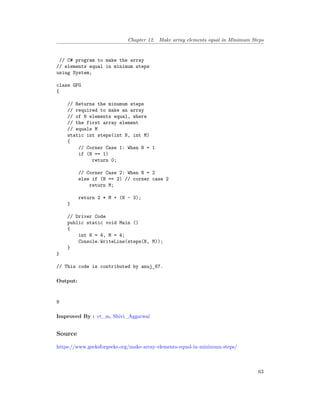
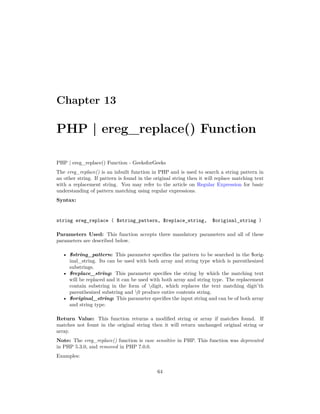
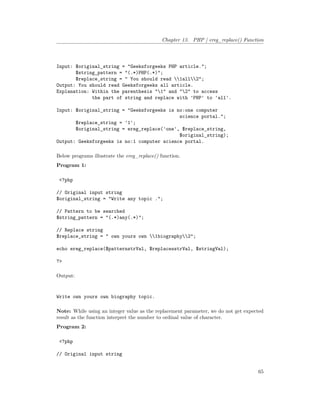
1 Find Nth term of the series 1, 8, 54, 384… 6
Source . . . . . . . . . . . . . . . . . . . . . . . . . . . . . . . . . . . . . . . . 9
2 Find Nth term of the series 0, 2, 4, 8, 12, 18… 10
Source . . . . . . . . . . . . . . . . . . . . . . . . . . . . . . . . . . . . . . . . 12
3 Number of substrings of one string present in other 13
Source . . . . . . . . . . . . . . . . . . . . . . . . . . . . . . . . . . . . . . . . 17
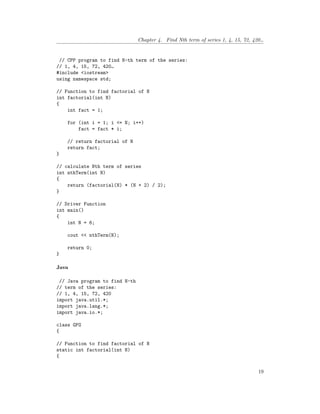
4 Find Nth term of series 1, 4, 15, 72, 420… 18
Source . . . . . . . . . . . . . . . . . . . . . . . . . . . . . . . . . . . . . . . . 22
5 Count Occurences of Anagrams 23
Source . . . . . . . . . . . . . . . . . . . . . . . . . . . . . . . . . . . . . . . . 26
6 Minimum characters to be replaced to remove the given substring 27
Source . . . . . . . . . . . . . . . . . . . . . . . . . . . . . . . . . . . . . . . . 30
7 Custom Building Cryptography Algorithms (Hybrid Cryptography) 31
Source . . . . . . . . . . . . . . . . . . . . . . . . . . . . . . . . . . . . . . . . 36
8 Program to find all match of a regex in a string 37
Source . . . . . . . . . . . . . . . . . . . . . . . . . . . . . . . . . . . . . . . . 39
9 KLA Tencor Interview Experience | Set 3 40
Source . . . . . . . . . . . . . . . . . . . . . . . . . . . . . . . . . . . . . . . . 43
10 Check if a string can be formed from another string using given constraints 44
Source . . . . . . . . . . . . . . . . . . . . . . . . . . . . . . . . . . . . . . . . 46
11 Largest connected component on a grid 47
Source . . . . . . . . . . . . . . . . . . . . . . . . . . . . . . . . . . . . . . . . 57
12 Make array elements equal in Minimum Steps 58
Source . . . . . . . . . . . . . . . . . . . . . . . . . . . . . . . . . . . . . . . . 63
13 PHP | ereg_replace() Function 64
Source . . . . . . . . . . . . . . . . . . . . . . . . . . . . . . . . . . . . . . . . 66
1
Contents
14 Check if strings are rotations of each other or not | Set 2 67
Source . . . . . . . . . . . . . . . . . . . . . . . . . . . . . . . . . . . . . . . . 71
15 DFA for Strings not ending with “THE” 72
Source . . . . . . . . . . . . . . . . . . . . . . . . . . . . . . . . . . . . . . . . 78
16 Check if a string is substring of another 79
Source . . . . . . . . . . . . . . . . . . . . . . . . . . . . . . . . . . . . . . . . 84
17 Program to replace a word with asterisks in a sentence 85
Source . . . . . . . . . . . . . . . . . . . . . . . . . . . . . . . . . . . . . . . . 86
18 Dynamic Programming | Wildcard Pattern Matching | Linear Time and
Constant Space 87
Source . . . . . . . . . . . . . . . . . . . . . . . . . . . . . . . . . . . . . . . . 93
19 Pattern Searching using C++ library 94
Source . . . . . . . . . . . . . . . . . . . . . . . . . . . . . . . . . . . . . . . . 95
20 Longest prefix which is also suffix 96
Source . . . . . . . . . . . . . . . . . . . . . . . . . . . . . . . . . . . . . . . . 108
21 Splitting a Numeric String 109
Source . . . . . . . . . . . . . . . . . . . . . . . . . . . . . . . . . . . . . . . . 115
22 Count of number of given string in 2D character array 116
Source . . . . . . . . . . . . . . . . . . . . . . . . . . . . . . . . . . . . . . . . 119
23 Find minimum shift for longest common prefix 120
Source . . . . . . . . . . . . . . . . . . . . . . . . . . . . . . . . . . . . . . . . 122
24 Frequency of a substring in a string 123
Source . . . . . . . . . . . . . . . . . . . . . . . . . . . . . . . . . . . . . . . . 127
25 Count of occurrences of a “1(0+)1” pattern in a string 128
Source . . . . . . . . . . . . . . . . . . . . . . . . . . . . . . . . . . . . . . . . 132
26 Find all the patterns of “1(0+)1” in a given string | SET 2(Regular
Expression Approach) 133
Source . . . . . . . . . . . . . . . . . . . . . . . . . . . . . . . . . . . . . . . . 135
27 Find all the patterns of “1(0+)1” in a given string | SET 1(General
Approach) 136
Source . . . . . . . . . . . . . . . . . . . . . . . . . . . . . . . . . . . . . . . . 142
28 Boyer Moore Algorithm | Good Suffix heuristic 143
Source . . . . . . . . . . . . . . . . . . . . . . . . . . . . . . . . . . . . . . . . 152
29 is_permutation() in C++ and its application for anagram search 153
Source . . . . . . . . . . . . . . . . . . . . . . . . . . . . . . . . . . . . . . . . 155
2
Contents
30 Match Expression where a single special character in pattern can match
one or more characters 156
Source . . . . . . . . . . . . . . . . . . . . . . . . . . . . . . . . . . . . . . . . 163
31 Maximum length prefix of one string that occurs as subsequence in
another 164
Source . . . . . . . . . . . . . . . . . . . . . . . . . . . . . . . . . . . . . . . . 169
32 Replace all occurrences of string AB with C without using extra space 170
Source . . . . . . . . . . . . . . . . . . . . . . . . . . . . . . . . . . . . . . . . 179
33 Wildcard Pattern Matching 180
Source . . . . . . . . . . . . . . . . . . . . . . . . . . . . . . . . . . . . . . . . 187
34 Find all occurrences of a given word in a matrix 188
Source . . . . . . . . . . . . . . . . . . . . . . . . . . . . . . . . . . . . . . . . 192
35 Aho-Corasick Algorithm for Pattern Searching 193
Source . . . . . . . . . . . . . . . . . . . . . . . . . . . . . . . . . . . . . . . . 200
36 kasai’s Algorithm for Construction of LCP array from Suffix Array 201
Source . . . . . . . . . . . . . . . . . . . . . . . . . . . . . . . . . . . . . . . . 207
37 Search a Word in a 2D Grid of characters 208
Source . . . . . . . . . . . . . . . . . . . . . . . . . . . . . . . . . . . . . . . . 211
38 Z algorithm (Linear time pattern searching Algorithm) 212
Source . . . . . . . . . . . . . . . . . . . . . . . . . . . . . . . . . . . . . . . . 218
39 Online algorithm for checking palindrome in a stream 219
Source . . . . . . . . . . . . . . . . . . . . . . . . . . . . . . . . . . . . . . . . 227
40 Suffix Tree Application 6 – Longest Palindromic Substring 228
Source . . . . . . . . . . . . . . . . . . . . . . . . . . . . . . . . . . . . . . . . 242
41 Manacher’s Algorithm – Linear Time Longest Palindromic Substring –
Part 4 243
Source . . . . . . . . . . . . . . . . . . . . . . . . . . . . . . . . . . . . . . . . 249
42 Manacher’s Algorithm – Linear Time Longest Palindromic Substring –
Part 3 250
Source . . . . . . . . . . . . . . . . . . . . . . . . . . . . . . . . . . . . . . . . 256
43 Manacher’s Algorithm – Linear Time Longest Palindromic Substring –
Part 2 257
Source . . . . . . . . . . . . . . . . . . . . . . . . . . . . . . . . . . . . . . . . 262
44 Manacher’s Algorithm – Linear Time Longest Palindromic Substring –
Part 1 263
Source . . . . . . . . . . . . . . . . . . . . . . . . . . . . . . . . . . . . . . . . 265
3
Contents
45 Suffix Tree Application 5 – Longest Common Substring 266
Source . . . . . . . . . . . . . . . . . . . . . . . . . . . . . . . . . . . . . . . . 278
46 Generalized Suffix Tree 1 279
Source . . . . . . . . . . . . . . . . . . . . . . . . . . . . . . . . . . . . . . . . 290
47 Suffix Tree Application 4 – Build Linear Time Suffix Array 291
Source . . . . . . . . . . . . . . . . . . . . . . . . . . . . . . . . . . . . . . . . 302
48 Suffix Tree Application 3 – Longest Repeated Substring 303
Source . . . . . . . . . . . . . . . . . . . . . . . . . . . . . . . . . . . . . . . . 314
49 Suffix Tree Application 2 – Searching All Patterns 315
Source . . . . . . . . . . . . . . . . . . . . . . . . . . . . . . . . . . . . . . . . 329
50 Suffix Tree Application 1 – Substring Check 330
Source . . . . . . . . . . . . . . . . . . . . . . . . . . . . . . . . . . . . . . . . 340
51 Ukkonen’s Suffix Tree Construction – Part 6 341
Source . . . . . . . . . . . . . . . . . . . . . . . . . . . . . . . . . . . . . . . . 351
52 Ukkonen’s Suffix Tree Construction – Part 5 352
Source . . . . . . . . . . . . . . . . . . . . . . . . . . . . . . . . . . . . . . . . 364
53 Ukkonen’s Suffix Tree Construction – Part 4 365
Source . . . . . . . . . . . . . . . . . . . . . . . . . . . . . . . . . . . . . . . . 372
54 Ukkonen’s Suffix Tree Construction – Part 3 373
Source . . . . . . . . . . . . . . . . . . . . . . . . . . . . . . . . . . . . . . . . 382
55 Ukkonen’s Suffix Tree Construction – Part 2 383
Source . . . . . . . . . . . . . . . . . . . . . . . . . . . . . . . . . . . . . . . . 389
56 Ukkonen’s Suffix Tree Construction – Part 1 390
Source . . . . . . . . . . . . . . . . . . . . . . . . . . . . . . . . . . . . . . . . 402
57 Pattern Searching using a Trie of all Suffixes 403
Source . . . . . . . . . . . . . . . . . . . . . . . . . . . . . . . . . . . . . . . . 411
58 Anagram Substring Search (Or Search for all permutations) 412
Source . . . . . . . . . . . . . . . . . . . . . . . . . . . . . . . . . . . . . . . . 417
59 Suffix Array | Set 2 (nLogn Algorithm) 418
Source . . . . . . . . . . . . . . . . . . . . . . . . . . . . . . . . . . . . . . . . 423
60 Suffix Array | Set 1 (Introduction) 424
Source . . . . . . . . . . . . . . . . . . . . . . . . . . . . . . . . . . . . . . . . 428
61 String matching where one string contains wildcard characters 429
Source . . . . . . . . . . . . . . . . . . . . . . . . . . . . . . . . . . . . . . . . 432
4
Contents
62 Pattern Searching using Suffix Tree 433
Source . . . . . . . . . . . . . . . . . . . . . . . . . . . . . . . . . . . . . . . . 437
63 Boyer Moore Algorithm for Pattern Searching 438
Source . . . . . . . . . . . . . . . . . . . . . . . . . . . . . . . . . . . . . . . . 444
64 Pattern Searching | Set 6 (Efficient Construction of Finite Automata) 445
Source . . . . . . . . . . . . . . . . . . . . . . . . . . . . . . . . . . . . . . . . 448
65 Finite Automata algorithm for Pattern Searching 449
Source . . . . . . . . . . . . . . . . . . . . . . . . . . . . . . . . . . . . . . . . 456
66 Optimized Naive Algorithm for Pattern Searching 457
Source . . . . . . . . . . . . . . . . . . . . . . . . . . . . . . . . . . . . . . . . 460
67 Rabin-Karp Algorithm for Pattern Searching 461
Source . . . . . . . . . . . . . . . . . . . . . . . . . . . . . . . . . . . . . . . . 469
68 KMP Algorithm for Pattern Searching 470
Source . . . . . . . . . . . . . . . . . . . . . . . . . . . . . . . . . . . . . . . . 483
69 Naive algorithm for Pattern Searching 484
Source . . . . . . . . . . . . . . . . . . . . . . . . . . . . . . . . . . . . . . . . 488
5
Chapter 1
Find Nth term of the series 1, 8,
54, 384…
Find Nth term of the series 1, 8, 54, 384... - GeeksforGeeks
Given a number N. The task is to write a program to find the Nth term in the below series:
1, 8, 54, 384...
Examples:
Input : 3
Output : 54
For N = 3
Nth term = ( 3*3) * 3!
= 54
Input : 2
Output : 8
On observing carefully, the Nth term in the above series can be generalized as:
Nth term = ( N*N ) * ( N! )
Below is the implementation of the above approach:
C++
// CPP program to find N-th term of the series:
// 1, 8, 54, 384...
6
Chapter 1. Find Nth term of the series 1, 8, 54, 384…
#include <iostream>
using namespace std;
// calculate factorial of N
int fact(int N)
{
int i, product = 1;
for (i = 1; i <= N; i++)
product = product * i;
return product;
}
// calculate Nth term of series
int nthTerm(int N)
{
return (N * N) * fact(N);
}
// Driver Function
int main()
{
int N = 4;
cout << nthTerm(N);
return 0;
}
Java
// Java program to find N-th term of the series:
// 1, 8, 54, 384...
import java.io.*;
// Main class for main method
class GFG {
public static int fact(int N)
{
int i, product = 1;
// Calculate factorial of N
for (i = 1; i <= N; i++)
product = product * i;
return product;
}
public static int nthTerm(int N)
{
// By using above formula
7
Chapter 1. Find Nth term of the series 1, 8, 54, 384…
return (N * N) * fact(N);
}
public static void main(String[] args)
{
int N = 4; // 4th term is 384
System.out.println(nthTerm(N));
}
}
Python 3
# Python 3 program to find
# N-th term of the series:
# 1, 8, 54, 384…
# calculate factorial of N
def fact(N):
product = 1
for i in range(1, N + 1):
product = product * i
return product
# calculate Nth term of series
def nthTerm(N):
return (N * N) * fact(N)
# Driver Code
if __name__ ==”__main__”:
N = 4
print(nthTerm(N))
# This code is contributed
# by ChitraNayal
C#
// C# program to find N-th
// term of the series:
// 1, 8, 54, 384...
using System;
class GFG
{
public static int fact(int N)
{
int i, product = 1;
// Calculate factorial of N
8
Chapter 1. Find Nth term of the series 1, 8, 54, 384…
for (i = 1; i <= N; i++)
product = product * i;
return product;
}
public static int nthTerm(int N)
{
// By using above formula
return (N * N) * fact(N);
}
// Driver Code
public static void Main(String[] args)
{
int N = 4; // 4th term is 384
Console.WriteLine(nthTerm(N));
}
}
// This code is contributed
// by Kirti_Mangal
PHP
Output:
384
Time Complexity: O(N)
Improved By : Kirti_Mangal, ChitraNayal
Source
https://www.geeksforgeeks.org/find-nth-term-of-the-series-1-8-54-384/
9
Chapter 2
Find Nth term of the series 0, 2,
4, 8, 12, 18…
Find Nth term of the series 0, 2, 4, 8, 12, 18... - GeeksforGeeks
Given a number N. The task is to write a program to find the Nth term in the below series:
0, 2, 4, 8, 12, 18…
Examples:
Input: 3
Output: 4
For N = 3
Nth term = ( 3 + ( 3 - 1 ) * 3 ) / 2
= 4
Input: 5
Output: 12
On observing carefully, the Nth
term in the above series can be generalized as:
Nth term = ( N + ( N - 1 ) * N ) / 2
Below is the implementation of the above approach:
C++
// CPP program to find N-th term of the series:
// 0, 2, 4, 8, 12, 18...
#include <iostream>
10
Chapter 2. Find Nth term of the series 0, 2, 4, 8, 12, 18…
using namespace std;
// calculate Nth term of series
int nthTerm(int N)
{
return (N + N * (N - 1)) / 2;
}
// Driver Function
int main()
{
int N = 5;
cout << nthTerm(N);
return 0;
}
Java
// Java program to find N-th term of the series:
// 0, 2, 4, 8, 12, 18...
import java.io.*;
// Main class for main method
class GFG {
public static int nthTerm(int N)
{
// By using above formula
return (N + (N - 1) * N) / 2;
}
public static void main(String[] args)
{
int N = 5; // 5th term is 12
System.out.println(nthTerm(N));
}
}
Python 3
# Python 3 program to find N-th term of the series:
# 0, 2, 4, 8, 12, 18.
# calculate Nth term of series
11
Chapter 2. Find Nth term of the series 0, 2, 4, 8, 12, 18…
def nthTerm(N) :
return (N + N * (N - 1)) // 2
# Driver Code
if __name__ == "__main__" :
N = 5
print(nthTerm(N))
# This code is contributed by ANKITRAI1
PHP
<?php
// PHP program to find
// N-th term of the series:
// 0, 2, 4, 8, 12, 18...
// calculate Nth term of series
function nthTerm($N)
{
return (int)(($N + $N *
($N - 1)) / 2);
}
// Driver Code
$N = 5;
echo nthTerm($N);
// This code is contributed by mits
?>
Output:
12
Time Complexity: O(1)
Improved By : Mithun Kumar, ANKITRAI1
Source
https://www.geeksforgeeks.org/find-nth-term-of-the-series-0-2-4-8-12-18/
12
Chapter 3
Number of substrings of one
string present in other
Number of substrings of one string present in other - GeeksforGeeks
Suppose we are given a string s1, we need to the find total number of substring(including
multiple occurrences of the same substring) of s1 which are present in string s2.
Examples:
Input : s1 = aab
s2 = aaaab
Output :6
Substrings of s1 are ["a", "a", "b", "aa",
"ab", "aab"]. These all are present in s2.
Hence, answer is 6.
Input :s1 = abcd
s2 = swalencud
Output :3
The idea is to consider all substrings of s1 and check if it present in s2.
C++
// CPP program to count number of substrings of s1
// present in s2.
#include<iostream>
#include<string>
using namespace std;
int countSubstrs(string s1, string s2)
13
Chapter 3. Number of substrings of one string present in other
{
int ans = 0;
for (int i = 0; i < s1.length(); i++) {
// s3 stores all substrings of s1
string s3;
for (int j = i; j < s1.length(); j++) {
s3 += s1[j];
// check the presence of s3 in s2
if (s2.find(s3) != string::npos)
ans++;
}
}
return ans;
}
// Driver code
int main()
{
string s1 = "aab", s2 = "aaaab";
cout << countSubstrs(s1, s2);
return 0;
}
Java
// Java program to count number of
// substrings of s1 present in s2.
import java.util.*;
class GFG
{
static int countSubstrs(String s1,
String s2)
{
int ans = 0;
for (int i = 0; i < s1.length(); i++)
{
// s3 stores all substrings of s1
String s3 = "";
char[] s4 = s1.toCharArray();
for (int j = i; j < s1.length(); j++)
{
14
Chapter 3. Number of substrings of one string present in other
s3 += s4[j];
// check the presence of s3 in s2
if (s2.indexOf(s3) != -1)
ans++;
}
}
return ans;
}
// Driver code
public static void main(String[] args)
{
String s1 = "aab", s2 = "aaaab";
System.out.println(countSubstrs(s1, s2));
}
}
// This code is contributed by ChitraNayal
Python 3
# Python 3 program to count number of substrings of s1
# present in s2.
# Function for counting no. of substring
# of s1 present in s2
def countSubstrs(s1, s2) :
ans = 0
for i in range(len(s1)) :
s3 = ""
# s3 stores all substrings of s1
for j in range(i, len(s1)) :
s3 += s1[j]
# check the presence of s3 in s2
if s2.find(s3) != -1 :
ans += 1
return ans
# Driver code
if __name__ == "__main__" :
s1 = "aab"
s2 = "aaaab"
# function calling
print(countSubstrs(s1, s2))
15
Chapter 3. Number of substrings of one string present in other
# This code is contributed by ANKITRAI1
C#
// C# program to count number of
// substrings of s1 present in s2.
using System;
class GFG
{
static int countSubstrs(String s1,
String s2)
{
int ans = 0;
for (int i = 0; i < s1.Length; i++) { // s3 stores all substrings of s1 String s3 = ””; char[] s4
= s1.ToCharArray(); for (int j = i; j < s1.Length; j++) { s3 += s4[j]; // check the presence
of s3 in s2 if (s2.IndexOf(s3) != -1) ans++; } } return ans; } // Driver code public static void
Main(String[] args) { String s1 = ”aab”, s2 = ”aaaab”; Console.WriteLine(countSubstrs(s1,
s2)); } } // This code is contributed // by Kirti_Mangal [tabby title=”PHP”]
<?php
// PHP program to count number of
// substrings of s1 present in s2.
function countSubstrs($s1, $s2)
{
$ans = 0;
for ($i = 0; $i < strlen($s1); $i++)
{
// s3 stores all substrings of s1
$s3 = "";
for ($j = $i;
$j < strlen($s1); $j++)
{
$s3 += $s1[$j];
// check the presence of s3 in s2
if (stripos($s2, $s3, 0) != -1)
$ans++;
}
}
return $ans;
}
// Driver code
16
Chapter 3. Number of substrings of one string present in other
$s1 = "aab";
$s2 = "aaaab";
echo countSubstrs($s1, $s2);
// This code is contributed
// by ChitraNayal
?>
Output:
6
Improved By : ANKITRAI1, ChitraNayal, Kirti_Mangal
Source
https://www.geeksforgeeks.org/number-of-substrings-of-one-string-present-in-other/
17
Chapter 4
Find Nth term of series 1, 4, 15,
72, 420…
Find Nth term of series 1, 4, 15, 72, 420... - GeeksforGeeks
Given a number N. The task is to write a program to find the Nth
term in the below series:
1, 4, 15, 72, 420…
Examples:
Input: 3
Output: 15
For N = 3, we know that the factorial of 3 is 6
Nth term = 6*(3+2)/2
= 15
Input: 6
Output: 2880
For N = 6, we know that the factorial of 6 is 720
Nth term = 620*(6+2)/2
= 2880
The idea is to first find the factorial of the given number N, that is N!. Now the N-th term
in the above series will be:
N-th term = N! * (N + 2)/2
Below is the implementation of the above approach:
C++
18
Chapter 4. Find Nth term of series 1, 4, 15, 72, 420…
// CPP program to find N-th term of the series:
// 1, 4, 15, 72, 420…
#include <iostream>
using namespace std;
// Function to find factorial of N
int factorial(int N)
{
int fact = 1;
for (int i = 1; i <= N; i++)
fact = fact * i;
// return factorial of N
return fact;
}
// calculate Nth term of series
int nthTerm(int N)
{
return (factorial(N) * (N + 2) / 2);
}
// Driver Function
int main()
{
int N = 6;
cout << nthTerm(N);
return 0;
}
Java
// Java program to find N-th
// term of the series:
// 1, 4, 15, 72, 420
import java.util.*;
import java.lang.*;
import java.io.*;
class GFG
{
// Function to find factorial of N
static int factorial(int N)
{
19
Chapter 4. Find Nth term of series 1, 4, 15, 72, 420…
int fact = 1;
for (int i = 1; i <= N; i++)
fact = fact * i;
// return factorial of N
return fact;
}
// calculate Nth term of series
static int nthTerm(int N)
{
return (factorial(N) * (N + 2) / 2);
}
// Driver Code
public static void main(String args[])
{
int N = 6;
System.out.println(nthTerm(N));
}
}
// This code is contributed by Subhadeep
Python3
# Python 3 program to find
# N-th term of the series:
# 1, 4, 15, 72, 420…
# Function for finding
# factorial of N
def factorial(N) :
fact = 1
for i in range(1, N + 1) :
fact = fact * i
# return factorial of N
return fact
# Function for calculating
# Nth term of series
def nthTerm(N) :
# return nth term
return (factorial(N) * (N + 2) // 2)
20
Chapter 4. Find Nth term of series 1, 4, 15, 72, 420…
# Driver code
if __name__ == "__main__" :
N = 6
# Function Calling
print(nthTerm(N))
# This code is contributed
# by ANKITRAI1
C#
// C# program to find N-th
// term of the series:
// 1, 4, 15, 72, 420
using System;
class GFG
{
// Function to find factorial of N
static int factorial(int N)
{
int fact = 1;
for (int i = 1; i <= N; i++) fact = fact * i; // return factorial of N return fact; } //
calculate Nth term of series static int nthTerm(int N) { return (factorial(N) * (N + 2) / 2);
} // Driver Code public static void Main() { int N = 6; Console.Write(nthTerm(N)); } } //
This code is contributed by ChitraNayal [tabby title=”PHP”]
<?php
// PHP program to find
// N-th term of the series:
// 1, 4, 15, 72, 420…
// Function for finding
// factorial of N
function factorial($N)
{
$fact = 1;
for($i = 1; $i <= $N; $i++)
$fact = $fact * $i;
// return factorial of N
return $fact;
}
// Function for calculating
21
Chapter 4. Find Nth term of series 1, 4, 15, 72, 420…
// Nth term of series
function nthTerm($N)
{
// return nth term
return (factorial($N) *
($N + 2) / 2);
}
// Driver code
$N = 6;
// Function Calling
echo nthTerm($N);
// This code is contributed
// by mits
?>
Output:
2880
Time complexity: O(N)
Note: Above code wouldn’t not work for large values of N. To find the values for large N,
use the concept of Factorial for large numbers.
Improved By : ANKITRAI1, tufan_gupta2000, Mithun Kumar, ChitraNayal
Source
https://www.geeksforgeeks.org/find-nth-term-of-series-1-4-15-72-420/
22
Chapter 5
Count Occurences of Anagrams
Count Occurences of Anagrams - GeeksforGeeks
Given a word and a text, return the count of the occurences of anagrams of the word in the
text(For eg: anagrams of word for are for, ofr, rof etc.))
Examples:
Input : forxxorfxdofr
for
Output : 3
Explanation : Anagrams of the word for - for, orf,
ofr appear in the text and hence the count is 3.
Input : aabaabaa
aaba
Output : 4
Explanation : Anagrams of the word aaba - aaba,
abaa each appear twice in the text and hence the
count is 4.
A simple approach is to traverse from start of the string considering substrings of length
equal to the length of the given word and then check if this substring has all the characters
of word.
// A Simple Java program to count anagrams of a
// pattern in a text.
import java.io.*;
import java.util.*;
public class GFG {
23
Chapter 5. Count Occurences of Anagrams
// Function to find if two strings are equal
static boolean araAnagram(String s1,
String s2)
{
// converting strings to char arrays
char[] ch1 = s1.toCharArray();
char[] ch2 = s2.toCharArray();
// sorting both char arrays
Arrays.sort(ch1);
Arrays.sort(ch2);
// Check for equality of strings
if (Arrays.equals(ch1, ch2))
return true;
else
return false;
}
static int countAnagrams(String text, String word)
{
int N = text.length();
int n = word.length();
// Initialize result
int res = 0;
for (int i = 0; i <= N - n; i++) {
String s = text.substring(i, i + n);
// Check if the word and substring are
// anagram of each other.
if (araAnagram(word, s))
res++;
}
return res;
}
// Driver code
public static void main(String args[])
{
String text = "forxxorfxdofr";
String word = "for";
System.out.print(countAnagrams(text, word));
}
}
24
Chapter 5. Count Occurences of Anagrams
Output:
3
An Efficient Solution is to use count array to check for anagrams, we can construct current
count window from previous window in O(1) time using sliding window concept.
// An efficient Java program to count anagrams of a
// pattern in a text.
import java.io.*;
import java.util.*;
public class GFG {
final static int MAX_CHAR = 256
// Function to find if two strings are equal
static boolean isCountZero(int[] count)
{
for (int i = 0; i < MAX_CHAR; i++)
if (count[i] != 0)
return false;
return true;
}
static int countAnagrams(String text, String word)
{
int N = text.length();
int n = word.length();
// Check for first window. The idea is to
// use single count array to match counts
int[] count = new int[MAX_CHAR];
for (int i = 0; i < n; i++)
count[word.charAt(i)]++;
for (int i = 0; i < n; i++)
count[text.charAt(i)]--;
// If first window itself is anagram
int res = 0;
if (isCountZero(count))
res++;
for (int i = n; i < N; i++) {
// Add last character of current
// window
25
Chapter 5. Count Occurences of Anagrams
count[text.charAt(i)]--;
// Remove first character of previous
// window.
count[text.charAt(i - n)]++;
// If count array is 0, we found an
// anagram.
if (isCountZero(count))
res++;
}
return res;
}
// Driver code
public static void main(String args[])
{
String text = "forxxorfxdofr";
String word = "for";
System.out.print(countAnagrams(text, word));
}
}
Output:
3
Source
https://www.geeksforgeeks.org/count-occurences-of-anagrams/
26
Chapter 6
Minimum characters to be
replaced to remove the given
substring
Minimum characters to be replaced to remove the given substring - GeeksforGeeks
Given two strings str1 and str2. The task is to find the minimum number of characters to
be replaced by $ in string str1 such that str1 does not contain string str2 as any substring.
Examples:
Input: str1 = "intellect", str2 = "tell"
Output: 1
4th character of string "str1" can be replaced by $
such that "int$llect" it does not contain "tell"
as a substring.
Input: str1 = "google", str2 = "apple"
Output: 0
Approach is similar to Searching for Patterns | Set 1 (Naive Pattern Searching).
The idea is to find the leftmost occurrence of the string ‘str2’ in the string ‘str1’. If all
the characters of ‘str1’ match with ‘str2’, we will replace (or increment our answer with
one) the last symbol of occurrence and increment the index of string ‘str1’, such that it
checks again for the substring after the replaced character(that is index i will be equal to
i+length(b)-1).
Below is the implementation of the above approach:
C++
27
Chapter 6. Minimum characters to be replaced to remove the given substring
// C++ implementation of above approach
#include <bits/stdc++.h>
using namespace std;
// function to calculate minimum
// characters to replace
int replace(string A, string B)
{
int n = A.length(), m = B.length();
int count = 0, i, j;
for (i = 0; i < n; i++) {
for (j = 0; j < m; j++) {
// mismatch occurs
if (A[i + j] != B[j])
break;
}
// if all characters matched, i.e,
// there is a substring of 'a' which
// is same as string 'b'
if (j == m) {
count++;
// increment i to index m-1 such that
// minimum characters are replaced
// in 'a'
i += m - 1;
}
}
return count;
}
// Driver Code
int main()
{
string str1 = "aaaaaaaa";
string str2 = "aaa";
cout << replace(str1 , str2);
return 0;
}
28
Chapter 6. Minimum characters to be replaced to remove the given substring
Java
// Java implementation of
// above approach
import java.io.*;
// function to calculate minimum
// characters to replace
class GFG
{
static int replace(String A, String B)
{
int n = A.length(), m = B.length();
int count = 0, i, j;
for (i = 0; i < n; i++)
{
for (j = 0; j < m; j++)
{
// mismatch occurs
if(i + j >= n)
break;
else if (A.charAt(i + j) != B.charAt(j))
break;
}
// if all characters matched, i.e,
// there is a substring of 'a' which
// is same as string 'b'
if (j == m)
{
count++;
// increment i to index m-1 such that
// minimum characters are replaced
// in 'a'
i += m - 1;
}
}
return count;
}
// Driver Code
public static void main(String args[])
29
Chapter 6. Minimum characters to be replaced to remove the given substring
{
String str1 = "aaaaaaaa";
String str2 = "aaa";
System.out.println(replace(str1 , str2));
}
}
// This code is contributed by Subhadeep
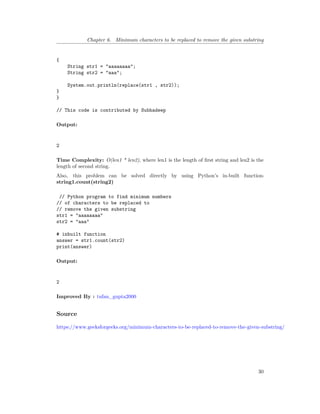
Output:
2
Time Complexity: O(len1 * len2), where len1 is the length of first string and len2 is the
length of second string.
Also, this problem can be solved directly by using Python’s in-built function-
string1.count(string2)
// Python program to find minimum numbers
// of characters to be replaced to
// remove the given substring
str1 = "aaaaaaaa"
str2 = "aaa"
# inbuilt function
answer = str1.count(str2)
print(answer)
Output:
2
Improved By : tufan_gupta2000
Source
https://www.geeksforgeeks.org/minimum-characters-to-be-replaced-to-remove-the-given-substring/
30
Chapter 7
Custom Building Cryptography
Algorithms (Hybrid
Cryptography)
Custom Building Cryptography Algorithms (Hybrid Cryptography) - GeeksforGeeks
Cryptography can be defined as an art of encoding and decoding the patterns
(in the form of messages).
Cryptography is a very straightforward concept which deals with manipulating the strings
(or text) to make them unreadable for the intermediate person. It has a very effective way
to encrypt or decrypts the text coming from the other parties. Some of the examples
are, Caesar Cipher, Viginere Cipher, Columner Cipher, DES, AES and the list continues.
To develop custom cryptography algorithm, hybrid encryption algorithms can be used.
Hybrid Encryption is a concept in cryptography which combines/merge one/two
cryptography algorithms to generate more effective encrypted text.
Example:
FibBil Cryptography Algorithm
Problem Statement:
Program to generate an encrypted text, by computing Fibonacci Series, adding the terms
of Fibonacci Series with each plaintext letter, until the length of the key.
Algorithm:
For Encryption: Take an input plain text and key from the user, reverse the plain text
and concatenate the plain text with the key, Copy the string into an array. After copying,
separate the array elements into two parts, EvenArray, and OddArray in which even index
of an array will be placed in EvenArray and same for OddArray. Start generating the
Fibonacci Series F(i) up-to-the length of the keyj such that c=i+j where c is cipher text
31
Chapter 7. Custom Building Cryptography Algorithms (Hybrid Cryptography)
with mod 26. Append all the cth
elements in a CipherString and, so Encryption Done!.
When sum up concept is use, it highlights of implementing Caesar Cipher.
For Decryption: Vice Versa of the Encryption Algorithm
Example for the Algorithm:
Input: hello
Key: abcd
Output: riobkxezg
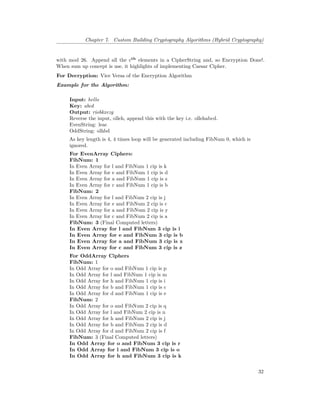
Reverse the input, olleh, append this with the key i.e. ollehabcd.
EvenString: leac
OddString: olhbd
As key length is 4, 4 times loop will be generated including FibNum 0, which is
ignored.
For EvenArray Ciphers:
FibNum: 1
In Even Array for l and FibNum 1 cip is k
In Even Array for e and FibNum 1 cip is d
In Even Array for a and FibNum 1 cip is z
In Even Array for c and FibNum 1 cip is b
FibNum: 2
In Even Array for l and FibNum 2 cip is j
In Even Array for e and FibNum 2 cip is c
In Even Array for a and FibNum 2 cip is y
In Even Array for c and FibNum 2 cip is a
FibNum: 3 (Final Computed letters)
In Even Array for l and FibNum 3 cip is i
In Even Array for e and FibNum 3 cip is b
In Even Array for a and FibNum 3 cip is x
In Even Array for c and FibNum 3 cip is z
For OddArray Ciphers
FibNum: 1
In Odd Array for o and FibNum 1 cip is p
In Odd Array for l and FibNum 1 cip is m
In Odd Array for h and FibNum 1 cip is i
In Odd Array for b and FibNum 1 cip is c
In Odd Array for d and FibNum 1 cip is e
FibNum: 2
In Odd Array for o and FibNum 2 cip is q
In Odd Array for l and FibNum 2 cip is n
In Odd Array for h and FibNum 2 cip is j
In Odd Array for b and FibNum 2 cip is d
In Odd Array for d and FibNum 2 cip is f
FibNum: 3 (Final Computed letters)
In Odd Array for o and FibNum 3 cip is r
In Odd Array for l and FibNum 3 cip is o
In Odd Array for h and FibNum 3 cip is k
32
Chapter 7. Custom Building Cryptography Algorithms (Hybrid Cryptography)
In Odd Array for b and FibNum 3 cip is e
In Odd Array for d and FibNum 3 cip is g
Arrange EvenArrayCiphers and OddArrayCiphers in their index order, so final
String Cipher will be, riobkxezg
Program:
import java.util.*;
import java.lang.*;
class GFG {
public static void main(String[] args)
{
String pass = "hello";
String key = "abcd";
System.out.println(encryptText(pass, key));
}
public static String encryptText(String password, String key)
{
int a = 0, b = 1, c = 0, m = 0, k = 0, j = 0;
String cipher = "", temp = "";
// Declare a password string
StringBuffer pw = new StringBuffer(password);
// Reverse the String
pw = pw.reverse();
pw = pw.append(key);
// For future Purpose
temp = pw.toString();
char stringArray[] = temp.toCharArray();
String evenString = "", oddString = "";
// Declare EvenArray for storing
// even index of stringArray
char evenArray[];
// Declare OddArray for storing
// odd index of stringArray
char oddArray[];
// Storing the positions in their respective arrays
for (int i = 0; i < stringArray.length; i++) {
if (i % 2 == 0) {
oddString = oddString + Character.toString(stringArray[i]);
33
Chapter 7. Custom Building Cryptography Algorithms (Hybrid Cryptography)
}
else {
evenString = evenString + Character.toString(stringArray[i]);
}
}
evenArray = new char[evenString.length()];
oddArray = new char[oddString.length()];
// Generate a Fibonacci Series
// Upto the Key Length
while (m <= key.length()) {
// As it always starts with 1
if (m == 0)
m = 1;
else {
// Logic For Fibonacci Series
a = b;
b = c;
c = a + b;
for (int i = 0; i < evenString.length(); i++) {
// Caesar Cipher Algorithm Start for even positions
int p = evenString.charAt(i);
int cip = 0;
if (p == '0' || p == '1' || p == '2' || p == '3' || p == '4'
|| p == '5' || p == '6'
|| p == '7' || p == '8' || p == '9') {
cip = p - c;
if (cip < '0')
cip = cip + 9;
}
else {
cip = p - c;
if (cip < 'a') {
cip = cip + 26;
}
}
evenArray[i] = (char)cip;
/* Caesar Cipher Algorithm End*/
}
for (int i = 0; i < oddString.length(); i++) {
// Caesar Cipher Algorithm Start for odd positions
int p = oddString.charAt(i);
int cip = 0;
if (p == '0' || p == '1' || p == '2' || p == '3' || p == '4'
|| p == '5' || p == '6'
|| p == '7' || p == '8' || p == '9') {
34
Chapter 7. Custom Building Cryptography Algorithms (Hybrid Cryptography)
cip = p + c;
if (cip > '9')
cip = cip - 9;
}
else {
cip = p + c;
if (cip > 'z') {
cip = cip - 26;
}
}
oddArray[i] = (char)cip;
// Caesar Cipher Algorithm End
}
m++;
}
}
// Storing content of even and
// odd array to the string array
for (int i = 0; i < stringArray.length; i++) {
if (i % 2 == 0) {
stringArray[i] = oddArray[k];
k++;
}
else {
stringArray[i] = evenArray[j];
j++;
}
}
// Generating a Cipher Text
// by stringArray (Caesar Cipher)
for (char d : stringArray) {
cipher = cipher + d;
}
// Return the Cipher Text
return cipher;
}
}
Output:
riobkxezg
Conclusion:
35
Chapter 7. Custom Building Cryptography Algorithms (Hybrid Cryptography)
Hybrid Algorithms for the cryptography are effective and so, it is not very easy to detect
the pattern and decode the message. Here, the algorithm is a combination of mathematical
function and Caesar Cipher, so as to implement Hybrid Cryptography Algorithm.
Source
https://www.geeksforgeeks.org/custom-building-cryptography-algorithms-hybrid-cryptography/
36
Chapter 8
Program to find all match of a
regex in a string
Program to find all match of a regex in a string - GeeksforGeeks
Prerequisite: smatch | Regex (Regular Expressions) in C++
Given a regex, the task is to find all regex matches in a string.
• Without using iterator:
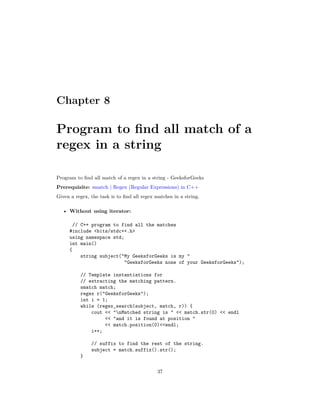
// C++ program to find all the matches
#include <bits/stdc++.h>
using namespace std;
int main()
{
string subject("My GeeksforGeeks is my "
"GeeksforGeeks none of your GeeksforGeeks");
// Template instantiations for
// extracting the matching pattern.
smatch match;
regex r("GeeksforGeeks");
int i = 1;
while (regex_search(subject, match, r)) {
cout << "nMatched string is " << match.str(0) << endl
<< "and it is found at position "
<< match.position(0)<<endl;
i++;
// suffix to find the rest of the string.
subject = match.suffix().str();
}
37
Chapter 8. Program to find all match of a regex in a string
return 0;
}
Output:
Matched string is GeeksforGeeks
and it is found at position 3
Matched string is GeeksforGeeks
and it is found at position 7
Matched string is GeeksforGeeks
and it is found at position 14
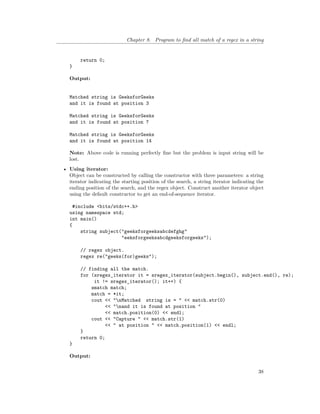
Note: Above code is running perfectly fine but the problem is input string will be
lost.
• Using iterator:
Object can be constructed by calling the constructor with three parameters: a string
iterator indicating the starting position of the search, a string iterator indicating the
ending position of the search, and the regex object. Construct another iterator object
using the default constructor to get an end-of-sequence iterator.
#include <bits/stdc++.h>
using namespace std;
int main()
{
string subject("geeksforgeeksabcdefghg"
"eeksforgeeksabcdgeeksforgeeks");
// regex object.
regex re("geeks(for)geeks");
// finding all the match.
for (sregex_iterator it = sregex_iterator(subject.begin(), subject.end(), re);
it != sregex_iterator(); it++) {
smatch match;
match = *it;
cout << "nMatched string is = " << match.str(0)
<< "nand it is found at position "
<< match.position(0) << endl;
cout << "Capture " << match.str(1)
<< " at position " << match.position(1) << endl;
}
return 0;
}
Output:
38
Chapter 8. Program to find all match of a regex in a string
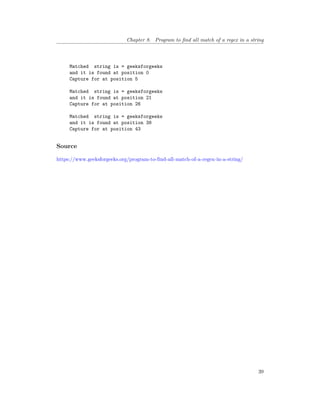
Matched string is = geeksforgeeks
and it is found at position 0
Capture for at position 5
Matched string is = geeksforgeeks
and it is found at position 21
Capture for at position 26
Matched string is = geeksforgeeks
and it is found at position 38
Capture for at position 43
Source
https://www.geeksforgeeks.org/program-to-find-all-match-of-a-regex-in-a-string/
39
Chapter 9
KLA Tencor Interview
Experience | Set 3
KLA Tencor Interview Experience | Set 3 - GeeksforGeeks
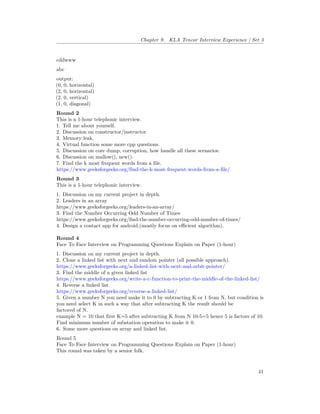
Round 1
Online test on HackerRank contains 2 Coding Questions
1. Given a image represented as 2d array of 0 and 1, find the size of the biggest cluster in
the image.
Cluster one or more adjunct cell with 1 is cluster. Even in a single cell which surrounded
by all 0 will be clustered.
Adjacent cell : cell on left, right, top and bottom diagonal cells are not considered for cluster.
Size-of-Cluster: number of 1 in the cluster
input:
4
5
10001
00110
10000
11110
output:
5
2. Given a 2D char array[m][n] and a word w[k], you need to find all the occurrences of w
in array could be appeared in row(left, right) col(top, bottom) and in any diagonals.
Input:
5
6
abcdef
ahijkl
abccde
bbcuvx
40
Chapter 9. KLA Tencor Interview Experience | Set 3
cddwww
abc
output:
(0, 0, horizontal)
(2, 0, horizontal)
(2, 0, vertical)
(1, 0, diagonal)
Round 2
This is a 1-hour telephonic interview.
1. Tell me about yourself.
2. Discussion on constructor/instructor
3. Memory leak.
4. Virtual function some more cpp questions.
5. Discussion on core dump, corruption, how handle all these scenarios.
6. Discussion on mallow(), new().
7. Find the k most frequent words from a file.
https://www.geeksforgeeks.org/find-the-k-most-frequent-words-from-a-file/
Round 3
This is a 1-hour telephonic interview.
1. Discussion on my current project in depth.
2. Leaders in an array
https://www.geeksforgeeks.org/leaders-in-an-array/
3. Find the Number Occurring Odd Number of Times
https://www.geeksforgeeks.org/find-the-number-occurring-odd-number-of-times/
4. Design a contact app for android.(mostly focus on efficient algorithm).
Round 4
Face To Face Interview on Programming Questions Explain on Paper (1-hour)
1. Discussion on my current project in depth.
2. Clone a linked list with next and random pointer (all possible approach).
https://www.geeksforgeeks.org/a-linked-list-with-next-and-arbit-pointer/
3. Find the middle of a given linked list
https://www.geeksforgeeks.org/write-a-c-function-to-print-the-middle-of-the-linked-list/
4. Reverse a linked list
https://www.geeksforgeeks.org/reverse-a-linked-list/
5. Given a number N you need make it to 0 by subtracting K or 1 from N, but condition is
you need select K in such a way that after subtracting K the result should be
factored of N.
example N = 10 that first K=5 after subtracting K from N 10-5=5 hence 5 is factors of 10.
Find minimum number of substation operation to make it 0.
6. Some more questions on array and linked list.
Round 5
Face To Face Interview on Programming Questions Explain on Paper (1-hour)
This round was taken by a senior folk.
41
Chapter 9. KLA Tencor Interview Experience | Set 3
1. Given a image in the form of 2D array of numbers. You need to corrupt that images and
return.
Condition for corruption is the element at index [x][y] should contain average of surrounding
numbers.
Example.
1234
6789 –here in place of 7 –> 4
2345
2. Next Greater Element
https://www.geeksforgeeks.org/next-greater-element/
Round 6
Face To Face Interview on Design and OOPS(1- hour).
This round was taken by a manager.
1. Design class diagram for coffee machine.(with all possible classes object, functions and
type of data)
Most focus on object interaction.
Round 7
This round was taken by a senior manager.
1. Tell me about your self, your family and all?.
2. What is the one thing that can make you stay with KLA Tencor?
3. Design ola/uber cost estimation functionality Focus on Factory design pattern.
4. More HR related questions.
Round 8
This round was based on Behavioral Skills taken by senior HR Manager.
1. Tell me about your self.
2. Why KLA Tencor.
3. More HR related questions.
I prepared mostly from GeeksforGeeks and I want to say thanks to the content writers of
Geeks for providing the best solutions. This is one of the best sites.
Note-
1. Mostly Focus on algorithm, How efficient you can write algorithm.
2. Also Focus on system design questions. For getting some Idea or to start with system
design question refer to below given link.
https://www.youtube.com/watch?v=UzLMhqg3_Wc&list=PLrmLmBdmIlps7GJJWW9I7N0P0rB0C3eY2
3. To begin with design pattern refer below given link to start with.
https://www.youtube.com/watch?v=rI4kdGLaUiQ&list=PL6n9fhu94yhUbctIoxoVTrklN3LMwTCmd
4. Ask questions at the end of your interview to the interviewers.
5. Before start writing the code try to explain your algorithm.
42
Chapter 9. KLA Tencor Interview Experience | Set 3
Source
https://www.geeksforgeeks.org/kla-tencor-interview-experience-set-3/
43
Chapter 10
Check if a string can be formed
from another string using given
constraints
Check if a string can be formed from another string using given constraints - GeeksforGeeks
Given two strings S1 and S2(all characters are in lower-case). The task is to check if S2 can
be formed from S1 using given constraints:
1. Characters of S2 is there in S1 if there are two ‘a’ in S2, then S1 should have two ‘a’ also.
2. If any character of S2 is not present in S1, check if the previous two ASCII characters
are there in S1. e.g., if ‘e’ is there in S2 and not in S1, then ‘c’ and ‘d’ can be used from S1
to make ‘e’.
Note: All characters from S1 can be used only once.
Examples:
Input: S= abbat, W= cat
Output: YES
‘c’ is formed from ‘a’ and ‘b’, ‘a’ and ‘t’ is present in S1.
Input: S= abbt, W= cat
Output: NO
‘c’ is formed from ‘a’ and ‘b’, but to form the next character
‘a’ in S2, there is no more unused ‘a’ left in S1.
Approach: The above problem can be solved using hashing. The count of all the characters
in S1 is stored in a hash-table. Traverse in the string, and check if the character in S2 is
there in the hash-table, reduce the count of that particular character in the hash-table. If
the character is not there in the hash-table, check if the previous two ASCII characters are
there in the hash-table, then reduce the count of the previous two ASCII characters in the
44
Chapter 10. Check if a string can be formed from another string using given constraints
hash-table. If all the characters can be formed from S1 using the given constraints, the
string S2 can be formed from S1, else it cannot be formed.
Below is the implementation of the above approach:
// CPP program to Check if a given
// string can be formed from another
// string using given constraints
#include <bits/stdc++.h>
using namespace std;
// Function to check if S2 can be formed of S1
bool check(string S1, string S2)
{
// length of strings
int n1 = S1.size();
int n2 = S2.size();
// hash-table to store count
unordered_map<int, int> mp;
// store count of each character
for (int i = 0; i < n1; i++) {
mp[S1[i]]++;
}
// traverse and check for every character
for (int i = 0; i < n2; i++) {
// if the character of s2 is present in s1
if (mp[S2[i]]) {
mp[S2[i]]--;
}
// if the character of s2 is not present in
// S1, then check if previous two ASCII characters
// are present in S1
else if (mp[S2[i] - 1] && mp[S2[i] - 2]) {
mp[S2[i] - 1]--;
mp[S2[i] - 2]--;
}
else {
return false;
}
}
return true;
}
45
Chapter 10. Check if a string can be formed from another string using given constraints
// Driver Code
int main()
{
string S1 = "abbat";
string S2 = "cat";
// Calling function to check
if (check(S1, S2))
cout << "YES";
else
cout << "NO";
}
Output:
YES
Source
https://www.geeksforgeeks.org/check-if-a-string-can-be-formed-from-another-string-using-given-constraints/
46
Chapter 11
Largest connected component
on a grid
Largest connected component on a grid - GeeksforGeeks
Given a grid with different colors in a different cell, each color represented by a different
number. The task is to find out the largest connected component on the grid. Largest
component grid refers to a maximum set of cells such that you can move from any cell to
any other cell in this set by only moving between side-adjacent cells from the set.
Examples:
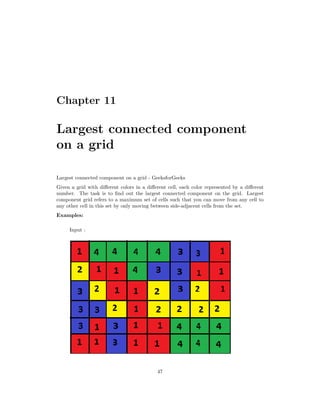
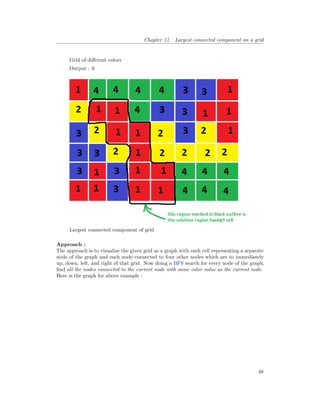
Input :
47
Chapter 11. Largest connected component on a grid
Grid of different colors
Output : 9
Largest connected component of grid
Approach :
The approach is to visualize the given grid as a graph with each cell representing a separate
node of the graph and each node connected to four other nodes which are to immediately
up, down, left, and right of that grid. Now doing a BFS search for every node of the graph,
find all the nodes connected to the current node with same color value as the current node.
Here is the graph for above example :
48
Chapter 11. Largest connected component on a grid
Graph representation of grid
.
At every cell (i, j), a BFS can be done. The possible moves from a cell will be either to
right, left, top or bottom. Move to only those cells which are in range and are of the
same color. It the same nodes have been visited previously, then the largest component
value of the grid is stored in result[][] array. Using memoization, reduce the number of
BFS on any cell. visited[][] array is used to mark if the cell has been visited previously
and count stores the count of the connected component when a BFS is done for every cell.
Store the maximum of the count and print the resultant grid using result[][] array.
Below is the illustration of the above approach:
C++
// CPP program to print the largest
// connected component in a grid
#include <bits/stdc++.h>
using namespace std;
const int n = 6;
const int m = 8;
49
Chapter 11. Largest connected component on a grid
// stores information about which cell
// are already visited in a particular BFS
int visited[n][m];
// result stores the final result grid
int result[n][m];
// stores the count of cells in the largest
// connected component
int COUNT;
// Function checks if a cell is valid i.e it
// is inside the grid and equal to the key
bool is_valid(int x, int y, int key, int input[n][m])
{
if (x < n && y < m && x >= 0 && y >= 0) {
if (visited[x][y] == false && input[x][y] == key)
return true;
else
return false;
}
else
return false;
}
// BFS to find all cells in
// connection with key = input[i][j]
void BFS(int x, int y, int i, int j, int input[n][m])
{
// terminating case for BFS
if (x != y)
return;
visited[i][j] = 1;
COUNT++;
// x_move and y_move arrays
// are the possible movements
// in x or y direction
int x_move[] = { 0, 0, 1, -1 };
int y_move[] = { 1, -1, 0, 0 };
// checks all four points connected with input[i][j]
for (int u = 0; u < 4; u++)
if (is_valid(i + y_move[u], j + x_move[u], x, input))
BFS(x, y, i + y_move[u], j + x_move[u], input);
}
50
Chapter 11. Largest connected component on a grid
// called every time before a BFS
// so that visited array is reset to zero
void reset_visited()
{
for (int i = 0; i < n; i++)
for (int j = 0; j < m; j++)
visited[i][j] = 0;
}
// If a larger connected component
// is found this function is called
// to store information about that component.
void reset_result(int key, int input[n][m])
{
for (int i = 0; i < n; i++) {
for (int j = 0; j < m; j++) {
if (visited[i][j] && input[i][j] == key)
result[i][j] = visited[i][j];
else
result[i][j] = 0;
}
}
}
// function to print the result
void print_result(int res)
{
cout << "The largest connected "
<< "component of the grid is :" << res << "n";
// prints the largest component
for (int i = 0; i < n; i++) {
for (int j = 0; j < m; j++) {
if (result[i][j])
cout << result[i][j] << " ";
else
cout << ". ";
}
cout << "n";
}
}
// function to calculate the largest connected
// component
void computeLargestConnectedGrid(int input[n][m])
{
int current_max = INT_MIN;
51
Chapter 11. Largest connected component on a grid
for (int i = 0; i < n; i++) {
for (int j = 0; j < m; j++) {
reset_visited();
COUNT = 0;
// checking cell to the right
if (j + 1 < m)
BFS(input[i][j], input[i][j + 1], i, j, input);
// updating result
if (COUNT >= current_max) {
current_max = COUNT;
reset_result(input[i][j], input);
}
reset_visited();
COUNT = 0;
// checking cell downwards
if (i + 1 < n)
BFS(input[i][j], input[i + 1][j], i, j, input);
// updating result
if (COUNT >= current_max) {
current_max = COUNT;
reset_result(input[i][j], input);
}
}
}
print_result(current_max);
}
// Drivers Code
int main()
{
int input[n][m] = { { 1, 4, 4, 4, 4, 3, 3, 1 },
{ 2, 1, 1, 4, 3, 3, 1, 1 },
{ 3, 2, 1, 1, 2, 3, 2, 1 },
{ 3, 3, 2, 1, 2, 2, 2, 2 },
{ 3, 1, 3, 1, 1, 4, 4, 4 },
{ 1, 1, 3, 1, 1, 4, 4, 4 } };
// function to compute the largest
// connected component in the grid
computeLargestConnectedGrid(input);
return 0;
}
Java
52
Chapter 11. Largest connected component on a grid
// Java program to print the largest
// connected component in a grid
import java.util.*;
import java.lang.*;
import java.io.*;
class GFG
{
static final int n = 6;
static final int m = 8;
// stores information about which cell
// are already visited in a particular BFS
static final int visited[][] = new int [n][m];
// result stores the final result grid
static final int result[][] = new int [n][m];
// stores the count of
// cells in the largest
// connected component
static int COUNT;
// Function checks if a cell
// is valid i.e it is inside
// the grid and equal to the key
static boolean is_valid(int x, int y,
int key,
int input[][])
{
if (x < n && y < m &&
x >= 0 && y >= 0)
{
if (visited[x][y] == 0 &&
input[x][y] == key)
return true;
else
return false;
}
else
return false;
}
// BFS to find all cells in
// connection with key = input[i][j]
static void BFS(int x, int y, int i,
int j, int input[][])
{
53
Chapter 11. Largest connected component on a grid
// terminating case for BFS
if (x != y)
return;
visited[i][j] = 1;
COUNT++;
// x_move and y_move arrays
// are the possible movements
// in x or y direction
int x_move[] = { 0, 0, 1, -1 };
int y_move[] = { 1, -1, 0, 0 };
// checks all four points
// connected with input[i][j]
for (int u = 0; u < 4; u++)
if ((is_valid(i + y_move[u],
j + x_move[u], x, input)) == true)
BFS(x, y, i + y_move[u],
j + x_move[u], input);
}
// called every time before
// a BFS so that visited
// array is reset to zero
static void reset_visited()
{
for (int i = 0; i < n; i++)
for (int j = 0; j < m; j++)
visited[i][j] = 0;
}
// If a larger connected component
// is found this function is
// called to store information
// about that component.
static void reset_result(int key,
int input[][])
{
for (int i = 0; i < n; i++)
{
for (int j = 0; j < m; j++)
{
if (visited[i][j] ==1 &&
input[i][j] == key)
result[i][j] = visited[i][j];
else
result[i][j] = 0;
54
Chapter 11. Largest connected component on a grid
}
}
}
// function to print the result
static void print_result(int res)
{
System.out.println ("The largest connected " +
"component of the grid is :" +
res );
// prints the largest component
for (int i = 0; i < n; i++)
{
for (int j = 0; j < m; j++)
{
if (result[i][j] != 0)
System.out.print(result[i][j] + " ");
else
System.out.print(". ");
}
System.out.println();
}
}
// function to calculate the
// largest connected component
static void computeLargestConnectedGrid(int input[][])
{
int current_max = Integer.MIN_VALUE;
for (int i = 0; i < n; i++)
{
for (int j = 0; j < m; j++)
{
reset_visited();
COUNT = 0;
// checking cell to the right
if (j + 1 < m)
BFS(input[i][j], input[i][j + 1],
i, j, input);
// updating result
if (COUNT >= current_max)
{
current_max = COUNT;
reset_result(input[i][j], input);
55
Chapter 11. Largest connected component on a grid
}
reset_visited();
COUNT = 0;
// checking cell downwards
if (i + 1 < n)
BFS(input[i][j],
input[i + 1][j], i, j, input);
// updating result
if (COUNT >= current_max)
{
current_max = COUNT;
reset_result(input[i][j], input);
}
}
}
print_result(current_max);
}
// Driver Code
public static void main(String args[])
{
int input[][] = {{1, 4, 4, 4, 4, 3, 3, 1},
{2, 1, 1, 4, 3, 3, 1, 1},
{3, 2, 1, 1, 2, 3, 2, 1},
{3, 3, 2, 1, 2, 2, 2, 2},
{3, 1, 3, 1, 1, 4, 4, 4},
{1, 1, 3, 1, 1, 4, 4, 4}};
// function to compute the largest
// connected component in the grid
computeLargestConnectedGrid(input);
}
}
// This code is contributed by Subhadeep
Output:
The largest connected component of the grid is :9
. . . . . . . .
. 1 1 . . . . .
. . 1 1 . . . .
. . . 1 . . . .
. . . 1 1 . . .
. . . 1 1 . . .
56
Chapter 11. Largest connected component on a grid
Improved By : tufan_gupta2000
Source
https://www.geeksforgeeks.org/largest-connected-component-on-a-grid/
57
Chapter 12
Make array elements equal in
Minimum Steps
Make array elements equal in Minimum Steps - GeeksforGeeks
Given an array of N elements where the first element is a non zero positive number M, and
the rest N – 1 elements are 0, the task is to calculate the minimum number of steps required
to make the entire array equal while abiding by the following rules:
1. The ith
element can be increased by one if and only if i-1th
element is strictly greater
than the ith element
2. If the ith
element is being increased by one then the i+1th
cannot be increased at the
same time.(i.e consecutive elements cannot be increased at the same time)
3. Multiple elements can be incremented simultaneously in a single step.
Examples:
Input : N = 3, M = 4
Output : 8
Explanation:
array is 4 0 0
In 4 steps element at index 1 is increased, so the array becomes {4, 4, 0}. In
the next 4 steps the element at index 3 is increased so array becomes {4, 4, 4}
Thus, 4 + 4 = 8 operations are required to make all the array elements equal
Input : N = 4, M = 4
Output : 9
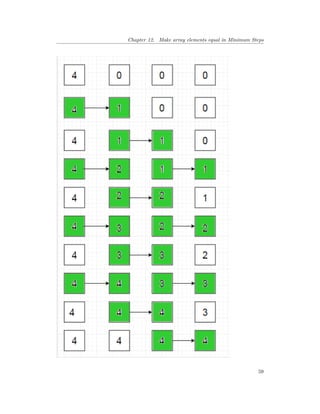
Explanation:
The steps are shown in the flowchart given below
Refer to the flowchart given below.
58
Chapter 12. Make array elements equal in Minimum Steps
59
Chapter 12. Make array elements equal in Minimum Steps
Approach:
To maximise the Number of Increments per Step, more number of Unbalances are created
(array[i]>array[i+1]),
Step 1, element 0 >element 1 so element 1 is incremented,
Step 2, element 1> element 2 so element 2 is incremented by 1
Step 3, element 0 > element 1 and element 2> element 3 so element 1 &3 are incremented
by 1
Step 4, element 1 > element 2 element 3 > element 4 so element 2 & 4 are incremented
Step 5, element 0> element 1; element 2>element 3 ;element 4> element 5; so element 1, 3,
&5 are incremented.
and so on…
Consider the following array,
5 0 0 0 0 0
1) 5 1 0 0 0 0
2) 5 1 1 0 0 0
3) 5 2 1 1 0 0
4) 5 2 2 1 1 0
5) 5 3 2 2 1 1
6) 5 3 3 2 2 1
7) 5 4 3 3 2 2
8) 5 4 4 3 3 2
9) 5 5 4 4 3 3
10) 5 5 5 4 4 3
11) 5 5 5 5 4 4
12) 5 5 5 5 5 4
13) 5 5 5 5 5 5
Notice that after an unbalance is created (i.e array[i]>array[i+1]) the element gets incre-
mented by one in alternate steps. In step 1 element 1 gets incremented to 1, in step 2
element 2 gets incremented to 1, in step 3 element 3 gets incremented to 1, so in step n-1,
n-1th
element will become 1. After that n-1th
element is increased by 1 on alternate steps
until it reaches the value at element 0. Then the entire array becomes equal.
So the pattern followed by the last element is
(0, 0, 0.., 0) till (N – 4)th
element becomes 1 which is n-4 steps
and after that,
(0, 0, 1, 1, 2, 2, 3, 3, 4, 4, … M – 1, M – 1, M) which is 2*m + 1 steps.
So the Final Result becomes (N – 3) + 2 * M
There are a few corner cases which need to be handled, viz. When N = 1, array has only
a single element, so the number of steps required = 0. and When N = 2, number of steps
required equal to M
C++
60
Chapter 12. Make array elements equal in Minimum Steps
// C++ program to make the array elements equal in minimum steps
#include <bits/stdc++.h>
using namespace std;
// Returns the minumum steps required to make an array of N
// elements equal, where the first array element equals M
int steps(int N, int M)
{
// Corner Case 1: When N = 1
if (N == 1)
return 0;
// Corner Case 2: When N = 2
else if (N == 2) // corner case 2
return M;
return 2 * M + (N - 3);
}
// Driver Code
int main()
{
int N = 4, M = 4;
cout << steps(N, M);
return 0;
}
Java
// Java program to make the array elements
// equal in minimum steps
import java.io.*;
class GFG {
// Returns the minumum steps required
// to make an array of N elements equal,
// where the first array element equals M
static int steps(int N, int M)
{
// Corner Case 1: When N = 1
if (N == 1)
return 0;
// Corner Case 2: When N = 2
else if (N == 2) // corner case 2
61
Chapter 12. Make array elements equal in Minimum Steps
return M;
return 2 * M + (N - 3);
}
// Driver Code
public static void main (String[] args)
{
int N = 4, M = 4;
System.out.print( steps(N, M));
}
}
// This code is contributed by anuj_67.
Python3
# Python program to make
# the array elements equal
# in minimum steps
# Returns the minumum steps
# required to make an array
# of N elements equal, where
# the first array element
# equals M
def steps(N, M):
# Corner Case 1: When N = 1
if (N == 1):
return 0
# Corner Case 2: When N = 2
elif(N == 2):
return M
return 2 * M + (N - 3)
# Driver Code
N = 4
M = 4
print(steps(N,M))
# This code is contributed
# by Shivi_Aggarwal.
C#
62
Chapter 12. Make array elements equal in Minimum Steps
// C# program to make the array
// elements equal in minimum steps
using System;
class GFG
{
// Returns the minumum steps
// required to make an array
// of N elements equal, where
// the first array element
// equals M
static int steps(int N, int M)
{
// Corner Case 1: When N = 1
if (N == 1)
return 0;
// Corner Case 2: When N = 2
else if (N == 2) // corner case 2
return M;
return 2 * M + (N - 3);
}
// Driver Code
public static void Main ()
{
int N = 4, M = 4;
Console.WriteLine(steps(N, M));
}
}
// This code is contributed by anuj_67.
Output:
9
Improved By : vt_m, Shivi_Aggarwal
Source
https://www.geeksforgeeks.org/make-array-elements-equal-in-minimum-steps/
63
Chapter 13
PHP | ereg_replace() Function
PHP | ereg_replace() Function - GeeksforGeeks
The ereg_replace() is an inbuilt function in PHP and is used to search a string pattern in
an other string. If pattern is found in the original string then it will replace matching text
with a replacement string. You may refer to the article on Regular Expression for basic
understanding of pattern matching using regular expressions.
Syntax:
string ereg_replace ( $string_pattern, $replace_string, $original_string )
Parameters Used: This function accepts three mandatory parameters and all of these
parameters are described below.
• $string_pattern: This parameter specifies the pattern to be searched in the $orig-
inal_string. Its can be used with both array and string type which is parenthesized
substrings.
• $replace_string: This parameter specifies the string by which the matching text
will be replaced and it can be used with both array and string type. The replacement
contain substring in the form of digit, which replaces the text matching digit’th
parenthesized substring and 0 produce entire contents string.
• $original_string: This parameter specifies the input string and can be of both array
and string type.
Return Value: This function returns a modified string or array if matches found. If
matches not fount in the original string then it will return unchanged original string or
array.
Note: The ereg_replace() function is case sensitive in PHP. This function was deprecated
in PHP 5.3.0, and removed in PHP 7.0.0.
Examples:
64
Chapter 13. PHP | ereg_replace() Function
Input: $original_string = "Geeksforgeeks PHP article.";
$string_pattern = "(.*)PHP(.*)";
$replace_string = " You should read 1all2";
Output: You should read Geeksforgeeks all article.
Explanation: Within the parenthesis "1" and "2" to access
the part of string and replace with 'PHP' to 'all'.
Input: $original_string = "Geeksforgeeks is no:one computer
science portal.";
$replace_string = '1';
$original_string = ereg_replace('one', $replace_string,
$original_string);
Output: Geeksforgeeks is no:1 computer science portal.
Below programs illustrate the ereg_replace() function.
Program 1:
<?php
// Original input string
$original_string = "Write any topic .";
// Pattern to be searched
$string_pattern = "(.*)any(.*)";
// Replace string
$replace_string = " own yours own 1biography2";
echo ereg_replace($patternstrVal, $replacesstrVal, $stringVal);
?>
Output:
Write own yours own biography topic.
Note: While using an integer value as the replacement parameter, we do not get expected
result as the function interpret the number to ordinal value of character.
Program 2:
<?php
// Original input string
65
Chapter 13. PHP | ereg_replace() Function
$original_string = "India To Become World's Fifth
Largest Economy In 2018.";
// Replace string
$replace_string = 5;
// This function call will not show the expected output as the
// function interpret the number to ordinal value of character.
echo ereg_replace('Fifth',$replace_string, $original_string);
$original_string = "India To Become World's Fifth
Largest Economy In 2018.";
// Replace String
$replace_string = '5';
// This function call will show
// the correct expected output
echo ereg_replace('Fifth',$replace_string, $original_string);
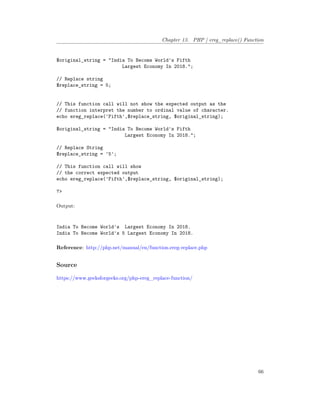
?>
Output:
India To Become World's Largest Economy In 2018.
India To Become World's 5 Largest Economy In 2018.
Reference: http://php.net/manual/en/function.ereg-replace.php
Source
https://www.geeksforgeeks.org/php-ereg_replace-function/
66
Chapter 14
Check if strings are rotations of
each other or not | Set 2
Check if strings are rotations of each other or not | Set 2 - GeeksforGeeks
Given two strings s1 and s2, check whether s2 is a rotation of s1.
Examples:
Input : ABACD, CDABA
Output : True
Input : GEEKS, EKSGE
Output : True
We have discussed an approach in earlier post which handles substring match as a pattern.
In this post, we will be going to use KMP algorithm’s lps (longest proper prefix which is
also suffix) construction, which will help in finding the longest match of the prefix of string
b and suffix of string a. By which we will know the rotating point, from this point match
the characters. If all the characters are matched, then it is a rotation, else not.
Below is the basic implementation of the above approach.
Java
// Java program to check if two strings are rotations
// of each other.
import java.util.*;
import java.lang.*;
import java.io.*;
class stringMatching {
67
Chapter 14. Check if strings are rotations of each other or not | Set 2
public static boolean isRotation(String a, String b)
{
int n = a.length();
int m = b.length();
if (n != m)
return false;
// create lps[] that will hold the longest
// prefix suffix values for pattern
int lps[] = new int[n];
// length of the previous longest prefix suffix
int len = 0;
int i = 1;
lps[0] = 0; // lps[0] is always 0
// the loop calculates lps[i] for i = 1 to n-1
while (i < n) {
if (a.charAt(i) == b.charAt(len)) {
lps[i] = ++len;
++i;
}
else {
if (len == 0) {
lps[i] = 0;
++i;
}
else {
len = lps[len - 1];
}
}
}
i = 0;
// match from that rotating point
for (int k = lps[n - 1]; k < m; ++k) {
if (b.charAt(k) != a.charAt(i++))
return false;
}
return true;
}
// Driver code
public static void main(String[] args)
{
String s1 = "ABACD";
String s2 = "CDABA";
68
Chapter 14. Check if strings are rotations of each other or not | Set 2
System.out.println(isRotation(s1, s2) ? "1" : "0");
}
}
C#
// C# program to check if
// two strings are rotations
// of each other.
using System;
class GFG
{
public static bool isRotation(string a,
string b)
{
int n = a.Length;
int m = b.Length;
if (n != m)
return false;
// create lps[] that will
// hold the longest prefix
// suffix values for pattern
int []lps = new int[n];
// length of the previous
// longest prefix suffix
int len = 0;
int i = 1;
// lps[0] is always 0
lps[0] = 0;
// the loop calculates
// lps[i] for i = 1 to n-1
while (i < n)
{
if (a[i] == b[len])
{
lps[i] = ++len;
++i;
}
else
{
if (len == 0)
{
69
Chapter 14. Check if strings are rotations of each other or not | Set 2
lps[i] = 0;
++i;
}
else
{
len = lps[len - 1];
}
}
}
i = 0;
// match from that
// rotating point
for (int k = lps[n - 1]; k < m; ++k)
{
if (b[k] != a[i++])
return false;
}
return true;
}
// Driver code
public static void Main()
{
string s1 = "ABACD";
string s2 = "CDABA";
Console.WriteLine(isRotation(s1, s2) ?
"1" : "0");
}
}
// This code is contributed
// by anuj_67.
Output:
1
Time Complexity : O(n)
Auxiliary Space : O(n)
Improved By : vt_m
70
Chapter 14. Check if strings are rotations of each other or not | Set 2
Source
https://www.geeksforgeeks.org/check-strings-rotations-not-set-2/
71
Chapter 15
DFA for Strings not ending with
“THE”
DFA for Strings not ending with ”THE” - GeeksforGeeks
Problem – Accept Strings that not ending with substring “THE”. Check if a given string
is ending with “the” or not. The different forms of “the” which are avoided in the end of
the string are:
"THE", "ThE", "THe", "tHE", "thE", "The", "tHe" and "the"
All those strings that are ending with any of the above mentioned forms of “the” are not
accepted.
Determinitis finite automata (DFA) of strings that not ending with “THE” –
The initial and starting state in this dfa is Qo
72
Chapter 15. DFA for Strings not ending with “THE”
Approach used in the program –
In this program, consider the 4 states to be 0, 1, 2 and 3. Now let us take a variable named
DFA which will be initially 0. Whenever any transition takes place, it will update the value
of DFA with the number associated with new state.
Example : If a transition occurs from state 0 to state 1 then the value of DFA will be
updated to 1. If a transition occurs from state 2 to state 3 then the value of dfa will be
updated to 3. In this way, apply this algorithm on entire string and if in the end, then reach
state 0, 1 or 2 then our string will be accepted otherwise not.
Input : XYzabCthe
Output : NOT ACCEPTED
Input : Themaliktth
73
Chapter 15. DFA for Strings not ending with “THE”
Output : ACCEPTED
C++
// CPP program to implement DFS that accepts
// all string that do not end with "THE"
#include <stdio.h>
#include <string.h>
// dfa tells the number associated
// with the present state
int dfa = 0;
// This function is for
// the starting state (zeroth) of DFA
void start(char c)
{
// On receiving 'T' or 't' goto first state (1)
if (c == 't' || c == 'T')
dfa = 1;
}
// This function is for the first state of DFA
void state1(char c)
{
// On receiving 'T' or 't' goto first state (1)
if (c == 't' || c == 'T')
dfa = 1;
// On receiving 'H' or 'h' goto second state (2)
else if (c == 'h' || c == 'H')
dfa = 2;
// else goto starting state (0)
else
dfa = 0;
}
// This function is for the second state of DFA
void state2(char c)
{
// On receiving 'E' or 'e' goto third state (3)
// else goto starting state (0)
if (c == 'e' || c == 'E')
dfa = 3;
else
dfa = 0;
}
74
Chapter 15. DFA for Strings not ending with “THE”
// This function is for the third state of DFA
void state3(char c)
{
// On receiving 'T' or 't' goto first state (1)
// else goto starting state (0)
if (c == 't' || c == 'T')
dfa = 1;
else
dfa = 0;
}
bool isAccepted(char str[])
{
// store length of string
int len = strlen(str);
for (int i=0; i < len; i++) {
if (dfa == 0)
start(str[i]);
else if (dfa == 1)
state1(str[i]);
else if (dfa == 2)
state2(str[i]);
else
state3(str[i]);
}
return (dfa != 3);
}
// driver code
int main()
{
char str[] = "forTHEgeeks";
if (isAccepted(str) == true)
printf("ACCEPTEDn");
else
printf("NOT ACCEPTEDn");
return 0;
}
PHP
<?php
75
Chapter 15. DFA for Strings not ending with “THE”
// PHP program to implement DFS
// that accepts all string that
// do not end with "THE"
// dfa tells the number associated
// with the present state
$dfa = 0;
// This function is for the
// starting state (zeroth) of DFA
function start($c)
{
global $dfa;
// On receiving 'T' or 't'
// goto first state (1)
if ($c == 't' || $c == 'T')
$dfa = 1;
}
// This function is for
// the first state of DFA
function state1($c)
{
global $dfa;
// On receiving 'T' or 't'
// goto first state (1)
if ($c == 't' || $c == 'T')
$dfa = 1;
// On receiving 'H' or 'h'
// goto second state (2)
else if ($c == 'h' || $c == 'H')
$dfa = 2;
// else goto starting state (0)
else
$dfa = 0;
}
// This function is for
// the second state of DFA
function state2($c)
{
global $dfa;
// On receiving 'E' or 'e'
// goto third state (3) else
// goto starting state (0)
if ($c == 'e' || $c == 'E')
76
Chapter 15. DFA for Strings not ending with “THE”
$dfa = 3;
else
$dfa = 0;
}
// This function is for
// the third state of DFA
function state3($c)
{
global $dfa;
// On receiving 'T' or 't'
// goto first state (1) else
// goto starting state (0)
if ($c == 't' || $c == 'T')
$dfa = 1;
else
$dfa = 0;
}
function isAccepted($str)
{
global $dfa;
// store length of string
$len = strlen($str);
for ($i=0; $i < $len; $i++)
{
if ($dfa == 0)
start($str[$i]);
else if ($dfa == 1)
state1($str[$i]);
else if ($dfa == 2)
state2($str[$i]);
else
state3($str[$i]);
}
return ($dfa != 3);
}
// Driver Code
$str = "forTHEgeeks";
if (isAccepted($str) == true)
echo "ACCEPTEDn";
else
77
Chapter 15. DFA for Strings not ending with “THE”
echo "NOT ACCEPTEDn";
// This code is contributed by m_kit
?>
Output :
ACCEPTED
The time complexity of this program is O(n)
Improved By : jit_t
Source
https://www.geeksforgeeks.org/dfa-for-strings-not-ending-with-the/
78
Chapter 16
Check if a string is substring of
another
Check if a string is substring of another - GeeksforGeeks
Given two strings s1 and s2, find if s1 is substring of s2. If yes, return index of first occurrence,
else return -1.
Examples :
Input : s1 = "for", s2 = "geeksforgeeks"
Output : 5
String "for" is present as a substring
of s2.
Input : s1 = "practice", s2 = "geeksforgeeks"
Output : -1.
A simple solution is to one by one check every index of s2. For every index, check if s1 is
present.
C++
// CPP program to check if a string is
// substring of other.
#include <bits/stdc++.h>
using namespace std;
// Returns true if s2 is substring of s1
int isSubstring(string s1, string s2)
{
int M = s1.length();
79
Chapter 16. Check if a string is substring of another
int N = s2.length();
/* A loop to slide pat[] one by one */
for (int i = 0; i <= N - M; i++) {
int j;
/* For current index i, check for pattern match */
for (j = 0; j < M; j++)
if (s2[i + j] != s1[j])
break;
if (j == M)
return i;
}
return -1;
}
/* Driver program to test above function */
int main()
{
string s1 = "for";
string s2 = "geeksforgeeks";
int res = isSubstring(s1, s2);
if (res == -1)
cout << "Not present";
else
cout << "Present at index " << res;
return 0;
}
Java
//Java program to check if a string is
//substring of other.
class GFG {
// Returns true if s2 is substring of s1
static int isSubstring(String s1, String s2)
{
int M = s1.length();
int N = s2.length();
/* A loop to slide pat[] one by one */
for (int i = 0; i <= N - M; i++) {
int j;
/* For current index i, check for
80
Chapter 16. Check if a string is substring of another
pattern match */
for (j = 0; j < M; j++)
if (s2.charAt(i + j) != s1.charAt(j))
break;
if (j == M)
return i;
}
return -1;
}
/* Driver program to test above function */
public static void main(String args[])
{
String s1 = "for";
String s2 = "geeksforgeeks";
int res = isSubstring(s1, s2);
if (res == -1)
System.out.println("Not present");
else
System.out.println("Present at index "
+ res);
}
}
// This code is contributed by JaideepPyne.
Python 3
# Python 3 program to check if
# a string is substring of other.
# Returns true if s2 is substring of s1
def isSubstring(s1, s2):
M = len(s1)
N = len(s2)
# A loop to slide pat[] one by one
for i in range(N – M + 1):
# For current index i,
# check for pattern match
for j in range(M):
if (s2[i + j] != s1[j]):
break
if j + 1 == M :
return i
81
Chapter 16. Check if a string is substring of another
return -1
# Driver Code
if __name__ == “__main__”:
s1 = “for”
s2 = “geeksforgeeks”
res = isSubstring(s1, s2)
if res == -1 :
print(“Not present”)
else:
print(“Present at index ” + str(res))
# This code is contributed by ChitraNayal
C#
//C# program to check if a string is
//substring of other.
using System;
class GFG {
// Returns true if s2 is substring of s1
static int isSubstring(string s1, string s2)
{
int M = s1.Length;
int N = s2.Length;
/* A loop to slide pat[] one by one */
for (int i = 0; i <= N - M; i++) {
int j;
/* For current index i, check for
pattern match */
for (j = 0; j < M; j++)
if (s2[i + j] != s1[j])
break;
if (j == M)
return i;
}
return -1;
}
/* Driver program to test above function */
public static void Main()
{
string s1 = "for";
string s2 = "geeksforgeeks";
82
Chapter 16. Check if a string is substring of another
int res = isSubstring(s1, s2);
if (res == -1)
Console.Write("Not present");
else
Console.Write("Present at index "
+ res);
}
}
// This code is contributed by nitin mittal.
PHP
<?php
// PHP program to check if a
// string is substring of other.
// Returns true if s2
// is substring of s1
function isSubstring($s1, $s2)
{
$M = strlen($s1);
$N = strlen($s2);
// A loop to slide
// pat[] one by one
for ($i = 0; $i <= $N - $M; $i++)
{
$j = 0;
// For current index i,
// check for pattern match
for (; $j < $M; $j++)
if ($s2[$i + $j] != $s1[$j])
break;
if ($j == $M)
return $i;
}
return -1;
}
// Driver Code
$s1 = "for";
$s2 = "geeksforgeeks";
83
Chapter 16. Check if a string is substring of another
$res = isSubstring($s1, $s2);
if ($res == -1)
echo "Not present";
else
echo "Present at index " . $res;
// This code is contributed by mits
?>
Output:
Present at index 5
Time complexity : O(m * n) where m and n are lengths of s1 and s2 respectively.
An efficient solution is to use a O(n) searching algorithm like KMP algorithm, Z algorithm,
etc.
Language implementations :
• Java Substring
• substr in C++
• Python find
Improved By : jaideeppyne1997, nitin mittal, Mithun Kumar, ChitraNayal
Source
https://www.geeksforgeeks.org/check-string-substring-another/
84
Chapter 17
Program to replace a word with
asterisks in a sentence
Program to replace a word with asterisks in a sentence - GeeksforGeeks
For the given sentence as input, censor a specific word with asterisks ‘ * ‘.
Example :
Input : word = “computer”
text = “GeeksforGeeks is a computer science portal for geeks. People who love
computer and computer codes can contribute their valuables/ideas on computer
codes/structures on here.”
Output : GeeksforGeeks is a ******** science portal for geeks. People who love
******** and ******** codes can contribute their valuables/ideas on ********
codes/structures on here.
The idea is to first split given sentence into different words. Then traverse the word list.
For every word in the word list, check if it matches with given word. If yes, then replace
the word with stars in the list. Finally merge the words of list and print.
# Python Program to censor a word
# with asterisks in a sentence
# Function takes two parameter
def censor(text, word):
# Break down sentence by ' ' spaces
# and store each individual word in
# a different list
word_list = text.split()
85
Chapter 17. Program to replace a word with asterisks in a sentence
# A new string to store the result
result = ''
# Creating the censor which is an asterisks
# "*" text of the length of censor word
stars = '*' * len(word)
# count variable to
# access our word_list
count = 0
# Iterating through our list
# of extracted words
index = 0;
for i in word_list:
if i == word:
# changing the censored word to
# created asterisks censor
word_list[index] = stars
index += 1
# join the words
result =' '.join(word_list)
return result
# Driver code
if __name__== '__main__':
extract = "GeeksforGeeks is a computer science portal for geeks.
I am pursuing my major in computer science. "
cen = "computer"
print(censor(extract, cen))
Output :
GeeksforGeeks is a ******** science portal for geeks.
I am pursuing my major in ******** science.
Source
https://www.geeksforgeeks.org/program-censor-word-asterisks-sentence/
86
Chapter 18
Dynamic Programming |
Wildcard Pattern Matching |
Linear Time and Constant
Space
Dynamic Programming | Wildcard Pattern Matching | Linear Time and Constant Space -
GeeksforGeeks
Given a text and a wildcard pattern, find if wildcard pattern is matched with text. The
matching should cover the entire text (not partial text).
The wildcard pattern can include the characters ‘?’ and ‘*’
‘?’ – matches any single character
‘*’ – Matches any sequence of characters (including the empty sequence)
Prerequisite : Dynamic Programming | Wildcard Pattern Matching
Examples:
Text = "baaabab",
Pattern = “*****ba*****ab", output : true
Pattern = "baaa?ab", output : true
Pattern = "ba*a?", output : true
Pattern = "a*ab", output : false
87
Chapter 18. Dynamic Programming | Wildcard Pattern Matching | Linear Time and
Constant Space
Each occurrence of ‘?’ character in wildcard pattern can be replaced with any other character
and each occurrence of ‘*’ with a sequence of characters such that the wildcard pattern
becomes identical to the input string after replacement.
We have discussed a solution here which has O(m x n) time and O(m x n) space complexity.
For applying the optimization, we will at first note the BASE CASE which involves :
If the length of the pattern is zero then answer will be true only if the length of the text
with which we have to match the pattern is also zero.
ALGORITHM | (STEP BY STEP)
Step – (1) : Let i be the marker to point at the current character of the text.
Let j be the marker to point at the current character of the pattern.
Let index_txt be the marker to point at the character of text on which we encounter ‘*’ in
pattern.
Let index_pat be the marker to point at the position of ‘*’ in the pattern.
NOTE : WE WILL TRAVERSE THE GIVEN STRING AND PATTERN US-
ING A WHILE LOOP
Step – (2) : At any instant if we observe that txt[i] == pat[j], then we increment both i and
j as no operation needs to be performed in this case.
88
Chapter 18. Dynamic Programming | Wildcard Pattern Matching | Linear Time and
Constant Space
Step – (3) : If we encounter pat[j] == ‘?’, then it resembles the case mentioned in step –
(2) as ‘?’ has the property to match with any single character.
Step – (4) : If we encounter pat[j] == ‘*’, then we update the value of index_txt and
index_pat as ‘*’ has the property to match any sequence of characters (including the empty
sequence) and we will increment the value of j to compare next character of pattern with
the current character of the text.(As character represented by i has not been answered yet).
Step – (5) : Now if txt[i] == pat[j], and we have encountered a ‘*’ before, then it means
that ‘*’ included the empty sequence, else if txt[i] != pat[j], a character needs to be provided
by ‘*’ so that current character matching takes place, then i needs to be incremented as it
is answered now but the character represented by j still needs to be answered, therefore, j =
index_pat + 1, i = index_txt + 1 (as ‘*’ can capture other characters as well), index_txt++
(as current character in text is matched).
Step – (6) : If step – (5) is not valid, that means txt[i] != pat[j], also we have not encountered
a ‘*’ that means it is not possible for the pattern to match the string. (return false).
Step – (7) : Check whether j reached its final value or not, then return the final answer.
Let us see the above algorithm in action, then we will move to the coding section
:
text = “baaabab”
pattern = “*****ba*****ab”
NOW APPLYING THE ALGORITHM
Step – (1) : i = 0 (i –> ‘b’)
j = 0 (j –> ‘*’)
index_txt = -1
index_pat = -1
NOTE : LOOP WILL RUN TILL i REACHES ITS FINAL
VALUE OR THE ANSWER BECOMES FALSE MIDWAY.
FIRST COMPARISON :-
As we see here that pat[j] == ‘*’, therefore directly jumping on to step – (4).
Step – (4) : index_txt = i (index_txt –> ‘b’)
index_pat = j (index_pat –> ‘*’)
j++ (j –> ‘*’)
After four more comparisons : i = 0 (i –> ‘b’)
j = 5 (j –> ‘b’)
index_txt = 0 (index_txt –> ‘b’)
index_pat = 4 (index_pat –> ‘*’)
SIXTH COMPARISON :-
As we see here that txt[i] == pat[j], but we already encountered ‘*’ therefore using step –
(5).
Step – (5) : i = 1 (i –> ‘a’)
j = 6 (j –> ‘a’)
index_txt = 0 (index_txt –> ‘b’)
index_pat = 4 (index_pat –> ‘*’)
89
Chapter 18. Dynamic Programming | Wildcard Pattern Matching | Linear Time and
Constant Space
SEVENTH COMPARISON :-
Step – (5) : i = 2 (i –> ‘a’)
j = 7 (j –> ‘*’)
index_txt = 0 (index_txt –> ‘b’)
index_pat = 4 (index_pat –> ‘*’)
EIGTH COMPARISON :-
Step – (4) : i = 2 (i –> ‘a’)
j = 8 (j –> ‘*’)
index_txt = 2 (index_txt –> ‘a’)
index_pat = 7 (index_pat –> ‘*’)
After four more comparisons : i = 2 (i –> ‘a’)
j = 12 (j –> ‘a’)
index_txt = 2 (index_txt –> ‘a’)
index_pat = 11 (index_pat –> ‘*’)
THIRTEENTH COMPARISON :-
Step – (5) : i = 3 (i –> ‘a’)
j = 13 (j –> ‘b’)
index_txt = 2 (index_txt –> ‘a’)
index_pat = 11 (index_pat –> ‘*’)
FOURTEENTH COMPARISON :-
Step – (5) : i = 3 (i –> ‘a’)
j = 12 (j –> ‘a’)
index_txt = 3 (index_txt –> ‘a’)
index_pat = 11 (index_pat –> ‘*’)
FIFTEENTH COMPARISON :-
Step – (5) : i = 4 (i –> ‘b’)
j = 13 (j –> ‘b’)
index_txt = 3 (index_txt –> ‘a’)
index_pat = 11 (index_pat –> ‘*’)
SIXTEENTH COMPARISON :-
Step – (5) : i = 5 (i –> ‘a’)
j = 14 (j –> end)
index_txt = 3 (index_txt –> ‘a’)
index_pat = 11 (index_pat –> ‘*’)
SEVENTEENTH COMPARISON :-
Step – (5) : i = 4 (i –> ‘b’)
j = 12 (j –> ‘a’)
index_txt = 4 (index_txt –> ‘b’)
index_pat = 11 (index_pat –> ‘*’)
EIGHTEENTH COMPARISON :-
90
Chapter 18. Dynamic Programming | Wildcard Pattern Matching | Linear Time and
Constant Space
Step – (5) : i = 5 (i –> ‘a’)
j = 12 (j –> ‘a’)
index_txt = 5 (index_txt –> ‘a’)
index_pat = 11 (index_pat –> ‘*’)
NINETEENTH COMPARISON :-
Step – (5) : i = 6 (i –> ‘b’)
j = 13 (j –> ‘b’)
index_txt = 5 (index_txt –> ‘a’)
index_pat = 11 (index_pat –> ‘*’)
TWENTIETH COMPARISON :-
Step – (5) : i = 7 (i –> end)
j = 14 (j –> end)
index_txt = 5 (index_txt –> ‘a’)
index_pat = 11 (index_pat –> ‘*’)
NOTE : NOW WE WILL COME OUT OF LOOP TO RUN STEP – 7.
Step – (7) : j is already present at its end position, therefore answer is true.
Below is the implementation of above optimized approach.
// C++ program to implement wildcard
// pattern matching algorithm
#include <bits/stdc++.h>
using namespace std;
// Function that matches input text
// with given wildcard pattern
bool strmatch(char txt[], char pat[],
int n, int m)
{
// empty pattern can only
// match with empty string.
// Base Case :
if (m == 0)
return (n == 0);
// step-1 :
// initailze markers :
int i = 0, j = 0, index_txt = -1,
index_pat = -1;
while (i < n) {
// For step - (2, 5)
if (txt[i] == pat[j]) {
i++;
91
Chapter 18. Dynamic Programming | Wildcard Pattern Matching | Linear Time and
Constant Space
j++;
}
// For step - (3)
else if (j < m && pat[j] == '?') {
i++;
j++;
}
// For step - (4)
else if (j < m && pat[j] == '*') {
index_txt = i;
index_pat = j;
j++;
}
// For step - (5)
else if (index_pat != -1) {
j = index_pat + 1;
i = index_txt + 1;
index_txt++;
}
// For step - (6)
else {
return false;
}
}
// For step - (7)
while (j < m && pat[j] == '*') {
j++;
}
// Final Check
if (j == m) {
return true;
}
return false;
}
// Driver code
int main()
{
char str[] = "baaabab";
char pattern[] = "*****ba*****ab";
// char pattern[] = "ba*****ab";
92
Chapter 18. Dynamic Programming | Wildcard Pattern Matching | Linear Time and
Constant Space
// char pattern[] = "ba*ab";
// char pattern[] = "a*ab";
if (strmatch(str, pattern,
strlen(str), strlen(pattern)))
cout << "Yes" << endl;
else
cout << "No" << endl;
char pattern2[] = "a*****ab";
if (strmatch(str, pattern2,
strlen(str), strlen(pattern2)))
cout << "Yes" << endl;
else
cout << "No" << endl;
return 0;
}
Output:
Yes
No
Time complexity of above solution is O(m). Auxiliary space used is O(1).
Source
https://www.geeksforgeeks.org/dynamic-programming-wildcard-pattern-matching-linear-time-constant-space/
93
Chapter 19
Pattern Searching using C++
library
Pattern Searching using C++ library - GeeksforGeeks
Given a text txt[0..n-1] and a pattern pat[0..m-1], write a function that prints all occurrences
of pat[] in txt[]. You may assume that n > m.
Examples:
Input : txt[] = "geeks for geeks"
pat[] = "geeks"
Output : Pattern found at index 0
Pattern found at index 10
Input : txt[] = "aaaa"
pat[] = "aa"
Output : Pattern found at index 0
Pattern found at index 1
attern found at index 2
The idea is to use find() in C++ string class.
// CPP program to print all occurrences of a pattern
// in a text
#include <bits/stdc++.h>
using namespace std;
void printOccurrences(string txt, string pat)
{
int found = txt.find(pat);
94
Chapter 19. Pattern Searching using C++ library
while (found != string::npos) {
cout << "Pattern found at index " << found << endl;
found = txt.find(pat, found + 1);
}
}
int main()
{
string txt = "aaaa", pat = "aa";
printOccurrences(txt, pat);
return 0;
}
Output:
Pattern found at index 0
Pattern found at index 1
Pattern found at index 2
Source
https://www.geeksforgeeks.org/pattern-searching-using-c-library/
95
Chapter 20
Longest prefix which is also
suffix
Longest prefix which is also suffix - GeeksforGeeks
Given a string s, find length of the longest prefix which is also suffix. The prefix and suffix
should not overlap.
Examples:
Input : aabcdaabc
Output : 4
The string "aabc" is the longest
prefix which is also suffix.
Input : abcab
Output : 2
Input : aaaa
Output : 2
Simple Solution : Since overlapping of prefix and suffix is not allowed, we break the string
from middle and start matching left and right string. If they are equal return size of any
one string else try for shorter lengths on both sides.
Below is a solution of above approach!
C++
// CPP program to find length of the longest
// prefix which is also suffix
#include <bits/stdc++.h>
using namespace std;
96
Chapter 20. Longest prefix which is also suffix
// Function to find largest prefix which is also a suffix
int largest_prefix_suffix(const std::string &str) {
int n = str.length();
if(n < 2) {
return 0;
}
int len = 0;
int i = n/2;
while(i < n) {
if(str[i] == str[len]) {
++len;
++i;
} else {
if(len == 0) { // no prefix
++i;
} else { // search for shorter prefixes
--len;
}
}
}
return len;
}
// Driver code
int main() {
string s = "blablabla";
cout << largest_prefix_suffix(s);
return 0;
}
Java
// Java program to find length of the longest
// prefix which is also suffix
class GFG {
static int longestPrefixSuffix(String s)
{
97
Chapter 20. Longest prefix which is also suffix
int n = s.length();
if(n < 2) {
return 0;
}
int len = 0;
int i = n/2;
while(i < n) {
if(s.charAt(i) == s.charAt(len)) {
++len;
++i;
}
else
{
if(len == 0) { // no prefix
++i;
}
else
{
// search for shorter prefixes
--len;
}
}
}
return len;
}
// Driver code
public static void main (String[] args)
{
String s = "blablabla";
System.out.println(longestPrefixSuffix(s));
}
}
// This code is contributed by Anant Agarwal.
Python3
# Python3 program to find length
# of the longest prefix which
# is also suffix
def longestPrefixSuffix(s) :
98
Chapter 20. Longest prefix which is also suffix
n = len(s)
for res in range(n // 2, 0, -1) :
# Check for shorter lengths
# of first half.
prefix = s[0: res]
suffix = s[n - res: n]
if (prefix == suffix) :
return res
# if no prefix and suffix match
# occurs
return 0
s = "blablabla"
print(longestPrefixSuffix(s))
# This code is contributed by Nikita Tiwari.
C#
// C# program to find length of the longest
// prefix which is also suffix
using System;
class GFG {
static int longestPrefixSuffix(String s)
{
int n = s.Length;
if(n < 2)
return 0;
int len = 0;
int i = n / 2;
while(i < n) {
if(s[i] == s[len]) {
++len;
++i;
}
else {
if(len == 0) {
99
Chapter 20. Longest prefix which is also suffix
// no prefix
++i;
}
else {
// search for shorter prefixes
--len;
}
}
}
return len;
}
// Driver code
public static void Main ()
{
String s = "blablabla";
Console.WriteLine(longestPrefixSuffix(s));
}
}
// This code is contributed by vt_m.
Output:
3
Efficient Solution : The idea is to use preprocessing algorithm of KMP search. In the
preprocessing algorithm, we build lps array which stores following values.
lps[i] = the longest proper prefix of pat[0..i]
which is also a suffix of pat[0..i].
C++
// Efficient CPP program to find length of
// the longest prefix which is also suffix
#include<bits/stdc++.h>
using namespace std;
// Returns length of the longest prefix
// which is also suffix and the two do
// not overlap. This function mainly is
100
Chapter 20. Longest prefix which is also suffix
// copy computeLPSArray() of in below post
// https://www.geeksforgeeks.org/searching-for-patterns-set-2-kmp-algorithm/
int longestPrefixSuffix(string s)
{
int n = s.length();
int lps[n];
lps[0] = 0; // lps[0] is always 0
// length of the previous
// longest prefix suffix
int len = 0;
// the loop calculates lps[i]
// for i = 1 to n-1
int i = 1;
while (i < n)
{
if (s[i] == s[len])
{
len++;
lps[i] = len;
i++;
}
else // (pat[i] != pat[len])
{
// This is tricky. Consider
// the example. AAACAAAA
// and i = 7. The idea is
// similar to search step.
if (len != 0)
{
len = lps[len-1];
// Also, note that we do
// not increment i here
}
else // if (len == 0)
{
lps[i] = 0;
i++;
}
}
}
int res = lps[n-1];
// Since we are looking for
101
Chapter 20. Longest prefix which is also suffix
// non overlapping parts.
return (res > n/2)? n/2 : res;
}
// Driver program to test above function
int main()
{
string s = "abcab";
cout << longestPrefixSuffix(s);
return 0;
}
Java
// Efficient Java program to find length of
// the longest prefix which is also suffix
class GFG
{
// Returns length of the longest prefix
// which is also suffix and the two do
// not overlap. This function mainly is
// copy computeLPSArray() of in below post
// https://www.geeksforgeeks.org/searching-
// for-patterns-set-2-kmp-algorithm/
static int longestPrefixSuffix(String s)
{
int n = s.length();
int lps[] = new int[n];
// lps[0] is always 0
lps[0] = 0;
// length of the previous
// longest prefix suffix
int len = 0;
// the loop calculates lps[i]
// for i = 1 to n-1
int i = 1;
while (i < n)
{
if (s.charAt(i) == s.charAt(len))
{
len++;
lps[i] = len;
i++;
102
Chapter 20. Longest prefix which is also suffix
}
// (pat[i] != pat[len])
else
{
// This is tricky. Consider
// the example. AAACAAAA
// and i = 7. The idea is
// similar to search step.
if (len != 0)
{
len = lps[len-1];
// Also, note that we do
// not increment i here
}
// if (len == 0)
else
{
lps[i] = 0;
i++;
}
}
}
int res = lps[n-1];
// Since we are looking for
// non overlapping parts.
return (res > n/2)? n/2 : res;
}
// Driver program
public static void main (String[] args)
{
String s = "abcab";
System.out.println(longestPrefixSuffix(s));
}
}
// This code is contributed by Anant Agarwal.
Python3
# Efficient Python 3 program
# to find length of
# the longest prefix
103
Chapter 20. Longest prefix which is also suffix
# which is also suffix
# Returns length of the longest prefix
# which is also suffix and the two do
# not overlap. This function mainly is
# copy computeLPSArray() of in below post
# https://www.geeksforgeeks.org/searching-for-patterns-set-2-kmp-algorithm/
def longestPrefixSuffix(s) :
n = len(s)
lps = [0] * n # lps[0] is always 0
# length of the previous
# longest prefix suffix
l = 0
# the loop calculates lps[i]
# for i = 1 to n-1
i = 1
while (i < n) :
if (s[i] == s[l]) :
l = l + 1
lps[i] = l
i = i + 1
else :
# (pat[i] != pat[len])
# This is tricky. Consider
# the example. AAACAAAA
# and i = 7. The idea is
# similar to search step.
if (l != 0) :
l = lps[l-1]
# Also, note that we do
# not increment i here
else :
# if (len == 0)
lps[i] = 0
i = i + 1
res = lps[n-1]
# Since we are looking for
# non overlapping parts.
if(res > n/2) :
104
Chapter 20. Longest prefix which is also suffix
return n//2
else :
return res
# Driver program to test above function
s = "abcab"
print(longestPrefixSuffix(s))
# This code is contributed
# by Nikita Tiwari.
C#
// Efficient C# program to find length of
// the longest prefix which is also suffix
using System;
class GFG {
// Returns length of the longest prefix
// which is also suffix and the two do
// not overlap. This function mainly is
// copy computeLPSArray() of in below post
// https://www.geeksforgeeks.org/searching-
// for-patterns-set-2-kmp-algorithm/
static int longestPrefixSuffix(string s)
{
int n = s.Length;
int []lps = new int[n];
// lps[0] is always 0
lps[0] = 0;
// length of the previous
// longest prefix suffix
int len = 0;
// the loop calculates lps[i]
// for i = 1 to n-1
int i = 1;
while (i < n)
{
if (s[i] == s[len])
{
len++;
105
Chapter 20. Longest prefix which is also suffix
lps[i] = len;
i++;
}
// (pat[i] != pat[len])
else
{
// This is tricky. Consider
// the example. AAACAAAA
// and i = 7. The idea is
// similar to search step.
if (len != 0)
{
len = lps[len-1];
// Also, note that we do
// not increment i here
}
// if (len == 0)
else
{
lps[i] = 0;
i++;
}
}
}
int res = lps[n-1];
// Since we are looking for
// non overlapping parts.
return (res > n/2) ? n/2 : res;
}
// Driver program
public static void Main ()
{
string s = "abcab";
Console.WriteLine(longestPrefixSuffix(s));
}
}
// This code is contributed by vt_m.
PHP
106
Chapter 20. Longest prefix which is also suffix
<?php
// Efficient PHP program to find length of
// the longest prefix which is also suffix
// Returns length of the longest prefix
// which is also suffix and the two do
// not overlap. This function mainly is
// copy computeLPSArray() of in below post
// https://www.geeksforgeeks.org/searching-for-patterns-set-2-kmp-algorithm/
function longestPrefixSuffix($s)
{
$n = strlen($s);
$lps[$n] = NULL;
// lps[0] is always 0
$lps[0] = 0;
// length of the previous
// longest prefix suffix
$len = 0;
// the loop calculates lps[i]
// for i = 1 to n-1
$i = 1;
while ($i < $n)
{
if ($s[$i] == $s[$len])
{
$len++;
$lps[$i] = $len;
$i++;
}
// (pat[i] != pat[len])
else
{
// This is tricky. Consider
// the example. AAACAAAA
// and i = 7. The idea is
// similar to search step.
if ($len != 0)
{
$len = $lps[$len-1];
// Also, note that we do
// not increment i here
107
Chapter 20. Longest prefix which is also suffix
}
// if (len == 0)
else
{
$lps[$i] = 0;
$i++;
}
}
}
$res = $lps[$n-1];
// Since we are looking for
// non overlapping parts.
return ($res > $n/2)? $n/2 : $res;
}
// Driver Code
$s = "abcab";
echo longestPrefixSuffix($s);
// This code is contributed by nitin mittal
?>
Output:
2
Please refer computeLPSArray() ofKMP search for explanation.
Time Complexity : O(n)
Auxiliary Space : O(n)
Improved By : nitin mittal
Source
https://www.geeksforgeeks.org/longest-prefix-also-suffix/
108
Chapter 21
Splitting a Numeric String
Splitting a Numeric String - GeeksforGeeks
Given a numeric string (length <= 32), split it into two or more integers( if possible), such
that
1) Difference between current and previous number is 1.
2) No number contains leading zeroes
If it is possible to separate a given numeric string then print “Possible” followed by the
first number of the increasing sequence, else print “Not Possible“.
Examples:
Input : 1234
Output : Possible 1
Explanation: String can be split as "1", "2",
"3", "4"
Input : 99100
Output :Possible 99
Explanation: String can be split as "99",
"100"
Input : 101103
Output : Not Possible
Explanation: It is not possible to split this
string under given constraint.
Approach : The idea is to take a substring from index 0 to any index i (i starting from 1)
of the numeric string and convert it to long data type. Add 1 to it and convert the increased
number back to string. Check if the next occurring substring is equal to the increased one.
If yes, then carry on the procedure else increase the value of i and repeat the steps.
Java
109
Chapter 21. Splitting a Numeric String
// Java program to split a numeric
// string in an Increasing
// sequence if possible
import java.io.*;
import java.util.*;
class GFG {
// Function accepts a string and
// checks if string can be split.
public static void split(String str)
{
int len = str.length();
// if there is only 1 number
// in the string then
// it is not possible to split it
if (len == 1) {
System.out.println("Not Possible");
return;
}
String s1 = "", s2 = "";
long num1, num2;
for (int i = 0; i <= len / 2; i++) {
int flag = 0;
// storing the substring from
// 0 to i+1 to form initial
// number of the increasing sequence
s1 = str.substring(0, i + 1);
num1 = Long.parseLong((s1));
num2 = num1 + 1;
// convert string to integer
// and add 1 and again convert
// back to string s2
s2 = Long.toString(num2);
int k = i + 1;
while (flag == 0) {
int l = s2.length();
// if s2 is not a substring
// of number than not possile
if (k + l > len) {
flag = 1;
110
Chapter 21. Splitting a Numeric String
break;
}
// if s2 is the next substring
// of the numeric string
if ((str.substring(k, k + l).equals(s2))) {
flag = 0;
// Incearse num2 by 1 i.e the
// next number to be looked for
num2++;
k = k + l;
// check if string is fully
// traversed then break
if (k == len)
break;
s2 = Long.toString(num2);
l = s2.length();
if (k + 1 > len) {
// If next string doesnot occurs
// in a given numeric string
// then it is not possible
flag = 1;
break;
}
}
else
flag = 1;
}
// if the string was fully traversed
// and conditions were satisfied
if (flag == 0) {
System.out.println("Possible"
+ " " + s1);
break;
}
// if conditions failed to hold
else if (flag == 1 && i > len / 2 - 1) {
System.out.println("Not Possible");
break;
}
}
}
111
Chapter 21. Splitting a Numeric String
// Driver Code
public static void main(String args[])
{
Scanner in = new Scanner(System.in);
String str = "99100";
// Call the split function
// for splitting the string
split(str);
}
}
C#
// C# program to split a numeric
// string in an Increasing
// sequence if possible
using System;
class GFG
{
// Function accepts a
// string and checks if
// string can be split.
static void split(string str)
{
int len = str.Length;
// if there is only 1
// number in the string
// then it is not possible
// to split it
if (len == 1)
{
Console.WriteLine("Not Possible");
return;
}
string s1 = "", s2 = "";
long num1, num2;
for (int i = 0; i < len / 2; i++)
{
int flag = 0;
112
Chapter 21. Splitting a Numeric String
// storing the substring
// from 0 to i+1 to form
// initial number of the
// increasing sequence
s1 = str.Substring(0, i + 1);
num1 = Convert.ToInt64((s1));
num2 = num1 + 1;
// convert string to integer
// and add 1 and again convert
// back to string s2
s2 = num2.ToString();
int k = i + 1;
while (flag == 0)
{
int l = s2.Length;
// if s2 is not a substring
// of number than not possile
if (k + l > len)
{
flag = 1;
break;
}
// if s2 is the next
// substring of the
// numeric string
if ((str.Substring(k, l).Equals(s2)))
{
flag = 0;
// Incearse num2 by 1 i.e
// the next number to be
// looked for
num2++;
k = k + l;
// check if string is fully
// traversed then break
if (k == len)
break;
s2 = num2.ToString();
l = s2.Length;
if (k + 1 > len)
{
// If next string doesnot
113
Chapter 21. Splitting a Numeric String
// occurs in a given numeric
// string then it is not
// possible
flag = 1;
break;
}
}
else
flag = 1;
}
// if the string was fully
// traversed and conditions
// were satisfied
if (flag == 0)
{
Console.WriteLine("Possible" +
" " + s1);
break;
}
// if conditions
// failed to hold
else if (flag == 1 &&
i > len / 2 - 1)
{
Console.WriteLine("Not Possible");
break;
}
}
}
// Driver Code
static void Main()
{
string str = "99100";
// Call the split function
// for splitting the string
split(str);
}
}
// This code is contributed by
// Manish Shaw(manishshaw1)
Output:
114
Chapter 21. Splitting a Numeric String
Possible 99
Improved By : manishshaw1
Source
https://www.geeksforgeeks.org/splitting-numeric-string/
115
Chapter 22
Count of number of given string
in 2D character array
Count of number of given string in 2D character array - GeeksforGeeks
Given a 2-Dimensional character array and a string, we need to find the given string in
2-dimensional character array such that individual characters can be present left to right,
right to left, top to down or down to top.
Examples:
Input : a ={
{D,D,D,G,D,D},
{B,B,D,E,B,S},
{B,S,K,E,B,K},
{D,D,D,D,D,E},
{D,D,D,D,D,E},
{D,D,D,D,D,G}
}
str= "GEEKS"
Output :2
Input : a = {
{B,B,M,B,B,B},
{C,B,A,B,B,B},
{I,B,G,B,B,B},
{G,B,I,B,B,B},
{A,B,C,B,B,B},
{M,C,I,G,A,M}
}
str= "MAGIC"
116
Chapter 22. Count of number of given string in 2D character array
Output :3
We have discussed simpler problem to find if a word exists or not in a matrix.
To count all occurrences, we follow simple brute force approach. Traverse through each
character of the matrix and taking each character as start of the string to be found, try to
search in all the possible directions. Whenever, a word is found, increase the count, and
after traversing the matrix what ever will be the value of count will be number of times
string exists in character matrix.
Algorithm :
1- Traverse matrix character by character and take one character as string start
2- For each character find the string in all the four directions recursively
3- If a string found, we increase the count
4- When we are done with one character as start, we repeat the same process for the next
character
5- Calculate the sum of count for each character
6- Final count will be the answer
C
// C code for finding count
// of string in a given 2D
// character array.
#include <stdio.h>
#include <string.h>
#include <stdlib.h>
#define ARRAY_SIZE(a) (sizeof(a) / sizeof(*a))
// utility function to search
// complete string from any
// given index of 2d char array
int internalSearch(char *needle, int row,
int col, char **hay,
int row_max, int col_max)
{
int found = 0;
if (row >= 0 && row <= row_max && col >= 0 &&
col <= col_max && *needle == hay[row][col])
{
char match = *needle++;
hay[row][col] = 0;
if (*needle == 0) {
found = 1;
117
Chapter 22. Count of number of given string in 2D character array
} else {
// through Backtrack searching
// in every directions
found += internalSearch(needle, row,
col+1, hay,
row_max, col_max);
found += internalSearch(needle, row, col-1,
hay, row_max, col_max);
found += internalSearch(needle, row+1, col,
hay, row_max, col_max);
found += internalSearch(needle, row-1, col,
hay, row_max, col_max);
}
hay[row][col] = match;
}
return found;
}
// Function to search the string in 2d array
int searchString(char *needle, int row, int col,
char **str, int row_count, int col_count)
{
int found = 0;
int r, c;
for (r = 0; r < row_count; ++r) {
for (c = 0; c < col_count; ++c) {
found += internalSearch(needle, r, c, str,
row_count - 1, col_count - 1);
}
}
return found;
}
// Driver code
int main(void){
char needle[] = "MAGIC";
char *input[] = {
"BBABBM",
"CBMBBA",
"IBABBG",
"GOZBBI",
"ABBBBC",
118
Chapter 22. Count of number of given string in 2D character array
"MCIGAM"
};
char *str[ARRAY_SIZE(input)];
int i;
for (i = 0; i < ARRAY_SIZE(input); ++i) {
str[i] = malloc(strlen(input[i]));
strcpy(str[i], input[i]);
}
printf("count: %dn", searchString(needle, 0, 0,
str, ARRAY_SIZE(str), strlen(str[0])));
return 0;
}
Output:
3
Source
https://www.geeksforgeeks.org/find-count-number-given-string-present-2d-character-array/
119
Chapter 23
Find minimum shift for longest
common prefix
Find minimum shift for longest common prefix - GeeksforGeeks
You are given two string str1 and str2 of same length. In a single shift you can rotate one
string (str2) by 1 element such that its 1st element becomes the last and second one becomes
the first like “abcd” will change to “bcda” after one shift operation. You have to find the
minimum shift operation required to get common prefix of maximum length from str1 and
str2.
Examples:
Input : str1[] = "geeks",
str2 = "dgeek"
Output : Shift = 1,
Prefix = geek
Input : str1[] = "practicegeeks",
str2 = "coderpractice"
Output : Shift = 5
Prefix = practice
Naive Approach : Shift second string one by one and keep track the length of longest
prefix for each shift, there are total of n shifts and for each shift finding the length of common
prefix will take O(n) time. Hence, overall time complexity for this approach is O(n^2).
Better Approach : If we will add second string at the end of itself that is str2 = str2
+ str2 then there is no need of finding prefix for each shift separately. Now, after adding
str2 to itself we have to only find the longest prefix of str1 present in str2 and the starting
position of that prefix in str2 will give us the actual number of shift required. For finding
longest prefix we can use KMP pattern search algorithm.
So, in this way our time-complexity will reduces to O(n) only.
120
Chapter 23. Find minimum shift for longest common prefix
// CPP program to find longest common prefix
// after rotation of second string.
#include <bits/stdc++.h>
using namespace std;
// function for KMP search
void KMP(int m, int n, string str2, string str1)
{
int pos = 0, len = 0;
// preprocessing of longest proper prefix
int p[m + 1];
int k = 0;
p[1] = 0;
for (int i = 2; i <= n; i++) {
while (k > 0 && str1[k] != str1[i - 1])
k = p[k];
if (str1[k] == str1[i - 1])
++k;
p[i] = k;
}
// find out the longest prefix and position
for (int j = 0, i = 0; i < m; i++) {
while (j > 0 && str1[j] != str2[i])
j = p[j];
if (str1[j] == str2[i])
j++;
// for new position with longer prefix in str2
// update pos and len
if (j > len) {
len = j;
pos = i - j + 1;
}
}
// print result
cout << "Shift = " << pos << endl;
cout << "Prefix = " << str1.substr(0, len);
}
// driver function
int main()
{
string str1 = "geeksforgeeks";
string str2 = "forgeeksgeeks";
121
Chapter 23. Find minimum shift for longest common prefix
int n = str1.size();
str2 = str2 + str2;
KMP(2 * n, n, str2, str1);
return 0;
}
Output:
Shift = 8
Prefix = geeksforgeeks
Source
https://www.geeksforgeeks.org/find-minimum-shift-longest-common-prefix/
122
Chapter 24
Frequency of a substring in a
string
Frequency of a substring in a string - GeeksforGeeks
Given a input string and a substring. Find the frequency of occurrences of substring in
given string.
Examples:
Input : man (pattern)
dhimanman (string)
Output : 2
Input : nn (pattern)
Banana (String)
Output : 0
Input : man (pattern)
dhimanman (string)
Output : 2
Input : aa (pattern)
aaaaa (String)
Output : 4
A simple solution is to match characters one by one. And whenever we see a complete
match, we increment count. Below is simple solution based on Naive pattern searching.
// Simple C++ program to count occurrences
// of pat in txt.
123
Chapter 24. Frequency of a substring in a string
#include<bits/stdc++.h>
using namespace std;
int countFreq(string &pat, string &txt)
{
int M = pat.length();
int N = txt.length();
int res = 0;
/* A loop to slide pat[] one by one */
for (int i = 0; i <= N - M; i++)
{
/* For current index i, check for
pattern match */
int j;
for (j = 0; j < M; j++)
if (txt[i+j] != pat[j])
break;
// if pat[0...M-1] = txt[i, i+1, ...i+M-1]
if (j == M)
{
res++;
j = 0;
}
}
return res;
}
/* Driver program to test above function */
int main()
{
string txt = "dhimanman";
string pat = "man";
cout << countFreq(pat, txt);
return 0;
}
Output :
2
Time Complexity : O(M * N)
An efficient solution is to use KMP algorithm.
// Java program to count occurrences of pattern
124
Chapter 24. Frequency of a substring in a string
// in a text.
class KMP_String_Matching
{
int KMPSearch(String pat, String txt)
{
int M = pat.length();
int N = txt.length();
// create lps[] that will hold the longest
// prefix suffix values for pattern
int lps[] = new int[M];
int j = 0; // index for pat[]
// Preprocess the pattern (calculate lps[]
// array)
computeLPSArray(pat,M,lps);
int i = 0; // index for txt[]
int res = 0;
int next_i = 0;
while (i < N)
{
if (pat.charAt(j) == txt.charAt(i))
{
j++;
i++;
}
if (j == M)
{
// When we find pattern first time,
// we iterate again to check if there
// exists more pattern
j = lps[j-1];
res++;
// We start i to check for more than once
// appearance of pattern, we will reset i
// to previous start+1
if (lps[j]!=0)
i = ++next_i;
j = 0;
}
// mismatch after j matches
else if (i < N && pat.charAt(j) != txt.charAt(i))
{
// Do not match lps[0..lps[j-1]] characters,
125
Chapter 24. Frequency of a substring in a string
// they will match anyway
if (j != 0)
j = lps[j-1];
else
i = i+1;
}
}
return res;
}
void computeLPSArray(String pat, int M, int lps[])
{
// length of the previous longest prefix suffix
int len = 0;
int i = 1;
lps[0] = 0; // lps[0] is always 0
// the loop calculates lps[i] for i = 1 to M-1
while (i < M)
{
if (pat.charAt(i) == pat.charAt(len))
{
len++;
lps[i] = len;
i++;
}
else // (pat[i] != pat[len])
{
// This is tricky. Consider the example.
// AAACAAAA and i = 7. The idea is similar
// to search step.
if (len != 0)
{
len = lps[len-1];
// Also, note that we do not increment
// i here
}
else // if (len == 0)
{
lps[i] = len;
i++;
}
}
}
}
// Driver program to test above function
126
Chapter 24. Frequency of a substring in a string
public static void main(String args[])
{
String txt = "geeksforgeeks";
String pat = "eeks";
int ans = new KMP_String_Matching().KMPSearch(pat,txt);
System.out.println(ans);
}
}
Output:
2
Time Complexity : O(M + N)
Source
https://www.geeksforgeeks.org/frequency-substring-string/
127
Chapter 25
Count of occurrences of a
“1(0+)1” pattern in a string
Count of occurrences of a ”1(0+)1” pattern in a string - GeeksforGeeks
Given an alphanumeric string, find the number of times a pattern 1(0+)1 occurs in the given
string. Here, (0+) signifies the presence of non empty sequence of consecutive 0’s.
Examples:
Input : 1001010001
Output : 3
First sequence is in between 0th and 3rd index.
Second sequence is in between 3rd and 5th index.
Third sequence is in between 5th and 9th index.
So total number of sequences comes out to be 3.
Input : 1001ab010abc01001
Output : 2
First sequence is in between 0th and 3rd index.
Second valid sequence is in between 13th and 16th
index. So total number of sequences comes out to
be 2.
The idea to solve this problem is to first find a ‘1’ and keep moving forward in the string
and check as mentioned below:
1. If any character other than ‘0’ and ‘1’ is obtained then it means pattern is not valid.
So we go on in the search of next ‘1’ from this index and repeat these steps again.
2. If a ‘1’ is seen, then check for the presence of ‘0’ at previous position to check the
validity of sequence.
128
Chapter 25. Count of occurrences of a “1(0+)1” pattern in a string
Below is the implementation of above idea:
C++
// C++ program to calculate number of times
// the pattern occured in given string
#include<iostream>
using namespace std;
// Returns count of occurrences of "1(0+)1"
// int str.
int countPattern(string str)
{
int len = str.size();
bool oneSeen = 0;
int count = 0; // Initialize result
for (int i = 0; i < len ; i++)
{
// if 1 encountered for first time
// set oneSeen to 1
if (str[i] == '1' && oneSeen == 0)
oneSeen = 1;
// Check if there is any other character
// other than '0' or '1'. If so then set
// oneSeen to 0 to search again for new
// pattern
if (str[i] != '0' && str[i] != '1')
oneSeen = 0;
// Check if encountered '1' forms a valid
// pattern as specified
if (str[i] == '1' && oneSeen == 1)
if (str[i - 1] == '0')
count++;
}
return count;
}
// Driver program to test above function
int main()
{
string str = "100001abc101";
cout << countPattern(str);
return 0;
}
129
Chapter 25. Count of occurrences of a “1(0+)1” pattern in a string
Java
//Java program to calculate number of times
//the pattern occurred in given string
public class GFG
{
// Returns count of occurrences of "1(0+)1"
// int str.
static int countPattern(String str)
{
int len = str.length();
boolean oneSeen = false;
int count = 0; // Initialize result
for(int i = 0; i < len ; i++)
{
char getChar = str.charAt(i);
// if 1 encountered for first time
// set oneSeen to 1
if(getChar == '1' && oneSeen == false)
oneSeen = true;
// Check if there is any other character
// other than '0' or '1'. If so then set
// oneSeen to 0 to search again for new
// pattern
else if(getChar != '0' && str.charAt(i) != '1')
oneSeen = false;
// Check if encountered '1' forms a valid
// pattern as specified
else if (getChar == '1' && oneSeen == true){
if (str.charAt(i - 1) == '0')
count++;
}
}
return count;
}
// Driver program to test above function
public static void main(String[] args)
{
String str = "100001abc101";
System.out.println(countPattern(str));
}
}
130
Chapter 25. Count of occurrences of a “1(0+)1” pattern in a string
// This code is contributed by Sumit Ghosh
Python
# Python program to calculate number of times
# the pattern occured in given string
# Returns count of occurrences of "1(0+)1"
def countPattern(s):
length = len(s)
oneSeen = False
count = 0 # Initialize result
for i in range(length):
# if 1 encountered for first time
# set oneSeen to 1
if (s[i] == '1' and oneSeen == 0):
oneSeen = True
# Check if there is any other character
# other than '0' or '1'. If so then set
# oneSeen to 0 to search again for new
# pattern
if (s[i] != '0' and s[i] != '1'):
oneSeen = False
# Check if encountered '1' forms a valid
# pattern as specified
if (s[i] == '1' and oneSeen):
if (s[i - 1] == '0'):
count += 1
return count
# Driver code
s = "100001abc101"
print countPattern(s)
# This code is contributed by Sachin Bisht
Output:
2
Time Complexity: O( N ), where N is the length of input string.
131
Chapter 25. Count of occurrences of a “1(0+)1” pattern in a string
Source
https://www.geeksforgeeks.org/count-of-occurrences-of-a-101-pattern-in-a-string/
132
Chapter 26
Find all the patterns of
“1(0+)1” in a given string |
SET 2(Regular Expression
Approach)
Find all the patterns of ”1(0+)1” in a given string | SET 2(Regular Expression Approach)
- GeeksforGeeks
In Set 1, we have discussed general approach for counting the patterns of the form 1(0+)1
where (0+) represents any non-empty consecutive sequence of 0’s.In this post, we will discuss
regular expression approach to count the same.
Examples:
Input : 1101001
Output : 2
Input : 100001abc101
Output : 2
Below is one of the regular expression for above pattern
10+1
Hence, whenever we found a match, we increase counter for counting the pattern.As last
character of a match will always ‘1’, we have to again start searching from that index.
133
Chapter 26. Find all the patterns of “1(0+)1” in a given string | SET 2(Regular
Expression Approach)
//Java program to count the patterns
// of the form 1(0+)1 using Regex
import java.util.regex.Matcher;
import java.util.regex.Pattern;
class GFG
{
static int patternCount(String str)
{
// regular expression for the pattern
String regex = "10+1";
// compiling regex
Pattern p = Pattern.compile(regex);
// Matcher object
Matcher m = p.matcher(str);
// counter
int counter = 0;
// whenever match found
// increment counter
while(m.find())
{
// As last character of current match
// is always one, starting match from that index
m.region(m.end()-1, str.length());
counter++;
}
return counter;
}
// Driver Method
public static void main (String[] args)
{
String str = "1001ab010abc01001";
System.out.println(patternCount(str));
}
}
Output:
2
134
Chapter 26. Find all the patterns of “1(0+)1” in a given string | SET 2(Regular
Expression Approach)
Related Articles :
• Regular Expression Java
• Quantifiers
• Extracting each word from a String using Regex
• Check if a given string is a valid number (Integer or Floating Point)
• Print first letter of each word in a string using regex
Source
https://www.geeksforgeeks.org/find-patterns-101-given-string-set-2regular-expression-approach/
135
Chapter 27
Find all the patterns of
“1(0+)1” in a given string |
SET 1(General Approach)
Find all the patterns of ”1(0+)1” in a given string | SET 1(General Approach) - Geeks-
forGeeks
A string contains patterns of the form 1(0+)1 where (0+) represents any non-empty consec-
utive sequence of 0’s. Count all such patterns. The patterns are allowed to overlap.
Note : It contains digits and lowercase characters only. The string is not necessarily a
binary. 100201 is not a valid pattern.
One approach to solve the problem is discussed here, other using Regular expressions is
given in Set 2
Examples:
Input : 1101001
Output : 2
Input : 100001abc101
Output : 2
Let size of input string be n.
1. Iterate through index ‘0’ to ‘n-1’.
2. If we encounter a ‘1’, we iterate till the elements are ‘0’.
3. After the stream of zeros ends, we check whether we encounter a ‘1’ or not.
4. Keep on doing this till we reach the end of string.
Below is the implementation of the above method.
C++
136
Chapter 27. Find all the patterns of “1(0+)1” in a given string | SET 1(General
Approach)
/* Code to count 1(0+)1 patterns in a string */
#include <bits/stdc++.h>
using namespace std;
/* Function to count patterns */
int patternCount(string str)
{
/* Variable to store the last character*/
char last = str[0];
int i = 1, counter = 0;
while (i < str.size())
{
/* We found 0 and last character was '1',
state change*/
if (str[i] == '0' && last == '1')
{
while (str[i] == '0')
i++;
/* After the stream of 0's, we got a '1',
counter incremented*/
if (str[i] == '1')
counter++;
}
/* Last character stored */
last = str[i];
i++;
}
return counter;
}
/* Driver Code */
int main()
{
string str = "1001ab010abc01001";
cout << patternCount(str) << endl;
return 0;
}
Java
// Java Code to count 1(0+)1
// patterns in a string
import java.io.*;
137
Chapter 27. Find all the patterns of “1(0+)1” in a given string | SET 1(General
Approach)
class GFG
{
// Function to count patterns
static int patternCount(String str)
{
/* Variable to store the last character*/
char last = str.charAt(0);
int i = 1, counter = 0;
while (i < str.length())
{
/* We found 0 and last character was '1',
state change*/
if (str.charAt(i) == '0' && last == '1')
{
while (str.charAt(i) == '0')
i++;
// After the stream of 0's, we
// got a '1',counter incremented
if (str.charAt(i) == '1')
counter++;
}
/* Last character stored */
last = str.charAt(i);
i++;
}
return counter;
}
// Driver Code
public static void main (String[] args)
{
String str = "1001ab010abc01001";
System.out.println(patternCount(str));
}
}
// This code is contributed by vt_m.
Python3
# Python3 code to count 1(0+)1 patterns in a
# Function to count patterns
138
Chapter 27. Find all the patterns of “1(0+)1” in a given string | SET 1(General
Approach)
def patternCount(str):
# Variable to store the last character
last = str[0]
i = 1; counter = 0
while (i < len(str)):
# We found 0 and last character was '1',
# state change
if (str[i] == '0' and last == '1'):
while (str[i] == '0'):
i += 1
# After the stream of 0's, we got a '1',
# counter incremented
if (str[i] == '1'):
counter += 1
# Last character stored
last = str[i]
i += 1
return counter
# Driver Code
str = "1001ab010abc01001"
ans = patternCount(str)
print (ans)
# This code is contributed by saloni1297
C#
// C# Code to count 1(0 + )1
// patterns in a string
using System;
class GFG
{
// Function to count patterns
static int patternCount(String str)
{
// Variable to store the
// last character
char last = str[0];
139
Chapter 27. Find all the patterns of “1(0+)1” in a given string | SET 1(General
Approach)
int i = 1, counter = 0;
while (i < str.Length)
{
// We found 0 and last
// character was '1',
// state change
if (str[i] == '0' && last == '1')
{
while (str[i] == '0')
i++;
// After the stream of 0's, we
// got a '1',counter incremented
if (str[i] == '1')
counter++;
}
// Last character stored
last = str[i];
i++;
}
return counter;
}
// Driver Code
public static void Main ()
{
String str = "1001ab010abc01001";
Console.Write(patternCount(str));
}
}
// This code is contributed by nitin mittal
PHP
<?php
// PHP Code to count 1(0+)1 patterns
// in a string
// Function to count patterns
function patternCount($str)
{
// Variable to store the
140
Chapter 27. Find all the patterns of “1(0+)1” in a given string | SET 1(General
Approach)
// last character
$last = $str[0];
$i = 1;
$counter = 0;
while ($i < strlen($str))
{
// We found 0 and last character
// was '1', state change
if ($str[$i] == '0' && $last == '1')
{
while ($str[$i] == '0')
$i++;
// After the stream of 0's,
// we got a '1', counter
// incremented
if ($str[$i] == '1')
$counter++;
}
/* Last character stored */
$last = $str[$i];
$i++;
}
return $counter;
}
// Driver Code
$str = "1001ab010abc01001";
echo patternCount($str) ;
// This code is contributed by nitin mittal
?>
Output :
2
Improved By : nitin mittal
141
Chapter 27. Find all the patterns of “1(0+)1” in a given string | SET 1(General
Approach)
Source
https://www.geeksforgeeks.org/find-patterns-101-given-string/
142
Chapter 28
Boyer Moore Algorithm | Good
Suffix heuristic
Boyer Moore Algorithm | Good Suffix heuristic - GeeksforGeeks
We have already discussed Bad character heuristic variation of Boyer Moore algorithm. In
this article we will discuss Good Suffix heuristic for pattern searching. Just like bad
character heuristic, a preprocessing table is generated for good suffix heuristic.
Good Suffix Heuristic
Let t be substring of text T which is matched with substring of pattern P. Now we shift
pattern until :
1) Another occurrence of t in P matched with t in T.
2) A prefix of P, which matches with suffix of t
3) P moves past t
Case 1: Another occurrence of t in P matched with t in T
Pattern P might contain few more occurrences of t. In such case, we will try to shift the
pattern to align that occurrence with t in text T. For example-
143
Chapter 28. Boyer Moore Algorithm | Good Suffix heuristic
Explanation: In above example, we have got a substring t of text T matched with pattern
P (in green) before mismatch at index 2. Now we will search for occurrence of t (“AB”) in
P. We have found an occurrence starting at position 1 (in yellow background) so we will
right shift the pattern 2 times to align t in P with t in T. This is weak rule of original Boyer
Moore and not much effective, we will discuss a Strong Good Suffix rule shortly.
Case 2: A prefix of P, which matches with suffix of t in T
It is not always likely that we will find occurrence of t in P. Sometimes there is no occurrence
at all, in such cases sometime we can search for some suffix of t matching with some prefix
of P and try to align them by shifting P. For example –
144
Chapter 28. Boyer Moore Algorithm | Good Suffix heuristic
Explanation: In above example, we have got t (“BAB”) matched with P (in green) at
index 2-4 before mismatch . But because there exist no occurrence of t in P we will search
for some some prefix of P which match with some suffix of t. We have found prefix “AB”
(in yellow background) starting at index 0 which matches not with whole t but suffix of t
“AB” starting at index 3. So now we will shift pattern 3 times to align prefix with suffix.
Case 3: P moves past t
If above two cases are not satisfied, we will shift the pattern past the t. For example –
145
Chapter 28. Boyer Moore Algorithm | Good Suffix heuristic
Explanation: If above example, there exist no occurrence of t (“AB”) in P and also there
is no prefix in P which matches with suffix of t. So in that case we can never find any perfect
match before index 4, so we will shift the P past the t ie. to index 5.
Strong Good suffix Heuristic
Suppose substring q = P[i to n] got matched with t in T and c = P[i-1] is the mismatching
character. Now unlike case 1 we will search for t in P which is not preceded by character c.
The closest such occurrence is then aligned with t in T by shifting pattern P. For example –
146
Chapter 28. Boyer Moore Algorithm | Good Suffix heuristic
Explanation: In above example, q = P[7 to 8] got matched with t in T. The mismatching
character c is “C” at position P[6]. Now if we start searching t in P we will get first occurrence
of t starting at position 4. But this occurrence is preceded by “C” which is equal to c, so
we will skip this and carry on searching. At position 1 we got another occurrence of t (in
yellow background). This occurrence is preceded by “A” (in blue) which is not equivalent to
c. So we will shift pattern P 6 times to align this occurrence with t in T.We are doing this
because we already know that character c = “C” causes the mismatch. So any occurrence
of t preceded by c will again causes mismatch when aligned with t, so thats why it is better
to skip this.
Preprocessing for Good suffix heuristic
As a part of preprocessing, an array shift is created. Each entry shift[i] contain the distance
pattern will shift if mismatch occur at position i-1. That is, the suffix of pattern starting at
position i is matched and a mismatch occur at position i-1. Preprocessing is done separately
for strong good suffix and case 2 discussed above.
1) Preprocessing for Strong Good Suffix
Before discussing preprocessing, let us first discuss the idea of border. A border is a
substring which is both proper suffix and proper prefix. For example, in string “ccacc”,
“c” is a border, “cc” is a border because it appears in both end of string but “cca” is not
a border.
As a part of preprocessing an array bpos (border position) is calculated. Each entry bpos[i]
contains the starting index of border for suffix starting at index i in given pattern P.
The suffix � beginning at position m has no border, so bpos[m] is set to m+1 where m is
the length of the pattern.
147
Chapter 28. Boyer Moore Algorithm | Good Suffix heuristic
The shift position is obtained by the borders which cannot be extended to the left. Following
is the code for preprocessing –
void preprocess_strong_suffix(int *shift, int *bpos,
char *pat, int m)
{
int i = m, j = m+1;
bpos[i] = j;
while(i > 0)
{
while(j <= m && pat[i-1] != pat[j-1])
{
if (shift[j] == 0)
shift[j] = j-i;
j = bpos[j];
}
i--; j--;
bpos[i] = j;
}
}
Explanation: Consider pattern P = “ABBABAB”, m = 7.
• The widest border of suffix “AB” beginning at position i = 5 is �(nothing) starting at
position 7 so bpos[5] = 7.
• At position i = 2 the suffix is “BABAB”. The widest border for this suffix is “BAB”
starting at position 4, so j = bpos[2] = 4.
i--;
j--;
bpos[ i ] = j
But if character # at position i-1 do not match with character ? at position j-1 then we
continue our search to the right. Now we know that –
a. Border width will be smaller than the border starting at position j ie. smaller than
x…�
b. Border has to begin with # and end with � or could be empty (no border exist).
With above two facts we will continue our search in sub string x…� from position j to m.
The next border should be at j = bpos[j]. After updating j, we again compare character at
position j-1 (?) with # and if they are equal then we got our border otherwise we continue
our search to right until j>m. This process is shown by code –
148
Chapter 28. Boyer Moore Algorithm | Good Suffix heuristic
while(j <= m && pat[i-1] != pat[j-1])
{
j = bpos[j];
}
i--; j--;
bpos[i]=j;
In above code look at these conditions –
pat[i-1] != pat[j-1]
This is the condition which we discussed in case 2. When the character preceding the
occurence of t in pattern P is different than mismatching character in P, we stop skipping
the occurences and shift the pattern. So here P[i] == P[j] but P[i-1] != p[j-1] so we shift
pattern from i to j. So shift[j] = j-i is recorder for j. So whenever any mismatch occur at
position j we will shift the pattern shift[j+1] positions to the right.
In above code the following condition is very important –
if (shift[j] == 0 )
This condition prevent modification of shift[j] value from suffix having same border. For
example, Consider pattern P = “addbddcdd”, when we calculate bpos[ i-1 ] for i = 4 then
j = 7 in this case. we will be eventually setting value of shift[ 7 ] = 3. Now if we calculate
bpos[ i-1 ] for i = 1 then j = 7 and we will be setting value shift[ 7 ] = 6 again if there is no
test shift[ j ] == 0. This mean if we have a mismatch at position 6 we will shift pattern P
3 positions to right not 6 position.
2) Preprocessing for Case 2
In the preprocessing for case 2, for each suffix the widest border of the whole pattern
that is contained in that suffix is determined.
The starting position of the widest border of the pattern at all is stored in bpos[0]
In the following preprocessing algorithm, this value bpos[0] is stored initially in all free
entries of array shift. But when the suffix of the pattern becomes shorter than bpos[0], the
algorithm continues with the next-wider border of the pattern, i.e. with bpos[j].
Following is the C implementation of search algorithm –
/* C program for Boyer Moore Algorithm with
Good Suffix heuristic to find pattern in
given text string */
#include <stdio.h>
#include <string.h>
149
Chapter 28. Boyer Moore Algorithm | Good Suffix heuristic
// preprocessing for strong good suffix rule
void preprocess_strong_suffix(int *shift, int *bpos,
char *pat, int m)
{
// m is the length of pattern
int i=m, j=m+1;
bpos[i]=j;
while(i>0)
{
/*if character at position i-1 is not equivalent to
character at j-1, then continue searching to right
of the pattern for border */
while(j<=m && pat[i-1] != pat[j-1])
{
/* the character preceding the occurence of t in
pattern P is different than mismatching character in P,
we stop skipping the occurences and shift the pattern
from i to j */
if (shift[j]==0)
shift[j] = j-i;
//Update the position of next border
j = bpos[j];
}
/* p[i-1] matched with p[j-1], border is found.
store the beginning position of border */
i--;j--;
bpos[i] = j;
}
}
//Preprocessing for case 2
void preprocess_case2(int *shift, int *bpos,
char *pat, int m)
{
int i, j;
j = bpos[0];
for(i=0; i<=m; i++)
{
/* set the border postion of first character of pattern
to all indices in array shift having shift[i] = 0 */
if(shift[i]==0)
shift[i] = j;
/* suffix become shorter than bpos[0], use the position of
next widest border as value of j */
if (i==j)
150
Chapter 28. Boyer Moore Algorithm | Good Suffix heuristic
j = bpos[j];
}
}
/*Search for a pattern in given text using
Boyer Moore algorithm with Good suffix rule */
void search(char *text, char *pat)
{
// s is shift of the pattern with respect to text
int s=0, j;
int m = strlen(pat);
int n = strlen(text);
int bpos[m+1], shift[m+1];
//initialize all occurence of shift to 0
for(int i=0;i<m+1;i++) shift[i]=0;
//do preprocessing
preprocess_strong_suffix(shift, bpos, pat, m);
preprocess_case2(shift, bpos, pat, m);
while(s <= n-m)
{
j = m-1;
/* Keep reducing index j of pattern while characters of
pattern and text are matching at this shift s*/
while(j >= 0 && pat[j] == text[s+j])
j--;
/* If the pattern is present at current shift, then index j
will become -1 after the above loop */
if (j<0)
{
printf("pattern occurs at shift = %dn", s);
s += shift[0];
}
else
/*pat[i] != pat[s+j] so shift the pattern
shift[j+1] times */
s += shift[j+1];
}
}
//Driver
151
Chapter 28. Boyer Moore Algorithm | Good Suffix heuristic
int main()
{
char text[] = "ABAAAABAACD";
char pat[] = "ABA";
search(text, pat);
return 0;
}
Output:
pattern occurs at shift = 0
pattern occurs at shift = 5
References
• http://www.iti.fh-flensburg.de/lang/algorithmen/pattern/bmen.htm
Source
https://www.geeksforgeeks.org/boyer-moore-algorithm-good-suffix-heuristic/
152
Chapter 29
is_permutation() in C++ and
its application for anagram
search
is_permutation() in C++ and its application for anagram search - GeeksforGeeks
is_permutations() is used to check if two containers like string and vector are permutation
of each other. It accepts three parameters, the first two parameters are begin and end
positions of first object and third parameter begin position of second object.
// C++ program to demonstrate working of
// is_permutation()
#include <bits/stdc++.h>
using namespace std;
// Driver program to test above
int main()
{
vector<int> v1{1, 2, 3, 4};
vector<int> v2{2, 3, 1, 4};
// v1 and v2 are permutation of each other
if (is_permutation(v1.begin(), v1.end(), v2.begin()))
cout << "Truen";
else
cout << "Falsen";
// v1 and v3 are NOT permutation of each other
vector<int> v3{5, 3, 1, 4};
if (is_permutation(v1.begin(), v1.end(), v3.begin()))
cout << "Truen";
153
Chapter 29. is_permutation() in C++ and its application for anagram search
else
cout << "Falsen";
return 0;
}
Output :
True
False
Application :
Given a pattern and a text, find all occurrences of pattern and its anagrams in text.
Examples:
Input : text ="forxxorfxdofr"
pat = "for"
Output : 3
There are three anagrams of "for"
int text.
Input : word = "aabaabaa"
text = "aaba"
Output : 4
We have discussed a (n) solution her. But in this post it is done using is_permutation().
Although the complexity is higher than previously discussed method, but the purpose is to
explain application of is_permutation().
Let size of pattern to be searched be pat_len. The idea is to traverse given text and for
every window of size pat_len, check if it is a permutation of given pattern or not.
// C++ program to count all permutation of
// given text
#include<bits/stdc++.h>
using namespace std;
// Function to count occurrences of anagrams of pat
int countAnagrams(string text, string pat)
{
int t_len = text.length();
int p_len = pat.length();
154
Chapter 29. is_permutation() in C++ and its application for anagram search
// Start traversing the text
int count = 0; // Initialize result
for (int i=0; i<=t_len-p_len; i++)
// Check if substring text[i..i+p_len]
// is a permutation of pat[].
// Three parameters are :
// 1) Beginning position of current window in text
// 2) End position of current window in text
// 3) Pattern to be mathced with current window
if (is_permutation(text.begin()+i,
text.begin()+i+p_len,
pat.begin()))
count++;
return count;
}
// Driver code
int main()
{
string str = "forxxorfxdofr";
string pat = "for";
cout << countAnagrams(str, pat) << endl;
return 0;
}
Output:
3
Source
https://www.geeksforgeeks.org/is_permutation-c-application-anagram-search/
155
Chapter 30
Match Expression where a
single special character in
pattern can match one or more
characters
Match Expression where a single special character in pattern can match one or more char-
acters - GeeksforGeeks
Given two string, in which one is pattern (Pattern) and other is searching expression. Search-
ing expression contains ‘#’.
The # works in following way:
1. A # matches with one or more characters.
2. A # matches all characters before a pattern match is found. For example if pat =
“A#B”, and text is “ACCBB”, then # would match only with “CC” and pattern is
considered as not found.
Examples :
Input : str = "ABABABA"
pat = "A#B#A"
Output : yes
Input : str = "ABCCB"
pat = "A#B"
Output : yes
Input : str = "ABCABCCE"
156
Chapter 30. Match Expression where a single special character in pattern can match one
or more characters
pat = "A#C#"
Output : yes
Input : str = "ABCABCCE"
pat = "A#C"
Output : no
We can observe that whenever we encounter ‘#’, we have to consider as many characters
till the next character of pattern will not be equal to the current character of given string.
Firstly, we check if the current character of pattern is equal to ‘#’-
a) If not then we check whether the current character of string and pattern are same or
not, if same, then increment both counters else return false from here only. No need for
further checking.
b) If yes, then we have to find the position of a character in text that matches with next
character of pattern.
C++
// C++ program for pattern matching
// where a single special character
// can match one more characters
#include<bits/stdc++.h>
using namespace std;
// Returns true if pat matches with text
int regexMatch(string text, string pat)
{
int lenText = text.length();
int letPat = pat.length();
// i is used as an index in pattern
// and j as an index in text
int i = 0, j = 0;
// Traverse through pattern
while (i < letPat)
{
// If current character of
// pattern is not '#'
if (pat[i] != '#')
{
// If does not match with text
if (pat[i] != text[j])
return false;
// If matches, increment i and j
157
Chapter 30. Match Expression where a single special character in pattern can match one
or more characters
i++;
j++;
}
// Current character is '#'
else
{
// At least one character
// must match with #
j++;
// Match characters with # until
// a matching character is found.
while (text[j] != pat[i + 1])
j++;
// Matching with # is over,
// move ahead in pattern
i++;
}
}
return (j == lenText);
}
// Driver code
int main()
{
string str = "ABABABA";
string pat = "A#B#A";
if (regexMatch(str, pat))
cout << "yes";
else
cout << "no";
return 0;
}
Java
// Java program for pattern matching
// where a single special character
// can match one more characters
import java.util.*;
import java.lang.*;
import java.io.*;
class GFG
158
Chapter 30. Match Expression where a single special character in pattern can match one
or more characters
{
// Returns true if pat
// matches with text.
public static boolean regexMatch
(String text, String pat)
{
int lenText = text.length();
int lenPat = pat.length();
char[] Text = text.toCharArray();
char[] Pat = pat.toCharArray();
// i is used as an index in pattern
// and j as an index in text.
int i = 0, j = 0;
// Traverse through pattern
while (i < lenPat)
{
// If current character of
// pattern is not '#'
if (Pat[i] != '#')
{
// If does not match with text.
if (Pat[i] != Text[j])
return false;
// If matches, increment i and j
i++;
j++;
}
// Current character is '#'
else
{
// At least one character
// must match with #
j++;
// Match characters with # until
// a matching character is found.
while (Text[j] != Pat[i + 1])
j++;
// Matching with # is over,
// move ahead in pattern
i++;
}
159
Chapter 30. Match Expression where a single special character in pattern can match one
or more characters
}
return (j == lenText);
}
// Driver code
public static void main (String[] args)
{
String str = "ABABABA";
String pat = "A#B#A";
if (regexMatch(str, pat))
System.out.println("yes");
else
System.out.println("no");
}
}
// This code is contributed by Mr. Somesh Awasthi
C#
// C# program for pattern matching
// where a single special character
// can match one more characters
using System;
class GFG
{
// Returns true if pat
// matches with text.
public static bool regexMatch
(String text, String pat)
{
int lenText = text.Length;
int lenPat = pat.Length;
char []Text = text.ToCharArray();
char []Pat = pat.ToCharArray();
// i is used as an index in pattern
// and j as an index in text.
int i = 0, j = 0;
// Traverse through pattern
while (i < lenPat)
{
// If current character
// of pattern is not '#'
160
Chapter 30. Match Expression where a single special character in pattern can match one
or more characters
if (Pat[i] != '#')
{
// If does not match with text.
if (Pat[i] != Text[j])
return false;
// If matches, increment i and j
i++;
j++;
}
// Current character is '#'
else
{
// At least one character
// must match with #
j++;
// Match characters with # until
// a matching character is found.
while (Text[j] != Pat[i + 1])
j++;
// Matching with # is over,
// move ahead in pattern
i++;
}
}
return (j == lenText);
}
// Driver code
public static void Main ()
{
String str = "ABABABA";
String pat = "A#B#A";
if (regexMatch(str, pat))
Console.Write("yes");
else
Console.Write("no");
}
}
// This code is contributed by nitin mittal
PHP
161
Chapter 30. Match Expression where a single special character in pattern can match one
or more characters
<?php
// PHP program for pattern matching
// where a single special character
// can match one more characters
// Returns true if pat
// matches with text
function regexMatch($text, $pat)
{
$lenText = strlen($text);
$letPat = strlen($pat);
// i is used as an index in pattern
// and j as an index in text
$i = 0; $j = 0;
// Traverse through pattern
while ($i < $letPat)
{
// If current character of
// pattern is not '#'
if ($pat[$i] != '#')
{
// If does not match with text
if ($pat[$i] != $text[$j])
return false;
// If matches, increment i and j
$i++;
$j++;
}
// Current character is '#'
else
{
// At least one character
// must match with #
$j++;
// Match characters with # until
// a matching character is found.
while ($text[$j] != $pat[$i + 1])
$j++;
// Matching with # is over,
162
Chapter 30. Match Expression where a single special character in pattern can match one
or more characters
// move ahead in pattern
$i++;
}
}
return ($j == $lenText);
}
// Driver code
$str = "ABABABA";
$pat = "A#B#A";
if (regexMatch($str, $pat))
echo "yes";
else
echo "no";
// This code is contributed by nitin mittal
?>
Output:
yes
Improved By : nitin mittal
Source
https://www.geeksforgeeks.org/match-expression-where-a-single-special-character-in-pattern-can-match-one-or-mo
163
Chapter 31
Maximum length prefix of one
string that occurs as
subsequence in another
Maximum length prefix of one string that occurs as subsequence in another - GeeksforGeeks
Given two strings s and t. The task is to find maximum length of some prefix of the string
S which occur in string t as subsequence.
Examples :
Input : s = "digger"
t = "biggerdiagram"
Output : 3
digger
biggerdiagram
Prefix "dig" of s is longest subsequence in t.
Input : s = "geeksforgeeks"
t = "agbcedfeitk"
Output : 4
A simple solutions is to consider all prefixes on by one and check if current prefix of s[] is
a subsequence of t[] or not. Finally return length of the largest prefix.
An efficient solution is based on the fact that to find a prefix of length n, we must first
find the prefix of length n – 1 and then look for s[n-1] in t. Similarly, to find a prefix of
length n – 1, we must first find the prefix of length n – 2 and then look for s[n – 2] and so
on.
Thus, we keep a counter which stores the current length of prefix found. We initialize it
with 0 and begin with the first letter of s and keep iterating over t to find the occurrence
164
Chapter 31. Maximum length prefix of one string that occurs as subsequence in another
of the first letter. As soon as we encounter the first letter of s we we update the counter
and look for second letter. We keep updating the counter and looking for next letter, until
either the string s is found or there are no more letters in t.
Below is the implementation of this approach:
C++
// C++ program to find maximum
// length prefix of one string
// occur as subsequence in another
// string.
#include<bits/stdc++.h>
using namespace std;
// Return the maximum length
// prefix which is subsequence.
int maxPrefix(char s[], char t[])
{
int count = 0;
// Iterating string T.
for (int i = 0; i < strlen(t); i++)
{
// If end of string S.
if (count == strlen(s))
break;
// If character match,
// increment counter.
if (t[i] == s[count])
count++;
}
return count;
}
// Driven Code
int main()
{
char S[] = "digger";
char T[] = "biggerdiagram";
cout << maxPrefix(S, T)
<< endl;
return 0;
}
165
Chapter 31. Maximum length prefix of one string that occurs as subsequence in another
Java
// Java program to find maximum
// length prefix of one string
// occur as subsequence in another
// string.
public class GFG {
// Return the maximum length
// prefix which is subsequence.
static int maxPrefix(String s,
String t)
{
int count = 0;
// Iterating string T.
for (int i = 0; i < t.length(); i++)
{
// If end of string S.
if (count == t.length())
break;
// If character match,
// increment counter.
if (t.charAt(i) == s.charAt(count))
count++;
}
return count;
}
// Driver Code
public static void main(String args[])
{
String S = "digger";
String T = "biggerdiagram";
System.out.println(maxPrefix(S, T));
}
}
// This code is contributed by Sumit Ghosh
Python 3
# Python 3 program to find maximum
# length prefix of one string occur
# as subsequence in another string.
166
Chapter 31. Maximum length prefix of one string that occurs as subsequence in another
# Return the maximum length
# prefix which is subsequence.
def maxPrefix(s, t) :
count = 0
# Iterating string T.
for i in range(0,len(t)) :
# If end of string S.
if (count == len(s)) :
break
# If character match,
# increment counter.
if (t[i] == s[count]) :
count = count + 1
return count
# Driver Code
S = "digger"
T = "biggerdiagram"
print(maxPrefix(S, T))
# This code is contributed
# by Nikita Tiwari.
C#
// C# program to find maximum
// length prefix of one string
// occur as subsequence in
// another string.
using System;
class GFG
{
// Return the maximum length prefix
// which is subsequence.
static int maxPrefix(String s,
String t)
167
Chapter 31. Maximum length prefix of one string that occurs as subsequence in another
{
int count = 0;
// Iterating string T.
for (int i = 0; i < t.Length; i++)
{
// If end of string S.
if (count == t.Length)
break;
// If character match,
// increment counter.
if (t[i] == s[count])
count++;
}
return count;
}
// Driver Code
public static void Main()
{
String S = "digger";
String T = "biggerdiagram";
Console.Write(maxPrefix(S, T));
}
}
// This code is contributed by nitin mittal
PHP
<?php
// PHP program to find maximum
// length prefix of one string
// occur as subsequence in another
// string.
// Return the maximum length
// prefix which is subsequence.
function maxPrefix($s, $t)
{
$count = 0;
// Iterating string T.
for ($i = 0; $i < strlen($t); $i++)
{
168
Chapter 31. Maximum length prefix of one string that occurs as subsequence in another
// If end of string S.
if ($count == strlen($s))
break;
// If character match,
// increment counter.
if ($t[$i] == $s[$count])
$count++;
}
return $count;
}
// Driver Code
{
$S = "digger";
$T = "biggerdiagram";
echo maxPrefix($S, $T) ;
return 0;
}
// This code is contributed by nitin mittal.
?>
Output :
3
Improved By : nitin mittal
Source
https://www.geeksforgeeks.org/maximum-length-prefix-one-string-occurs-subsequence-another/
169
Chapter 32
Replace all occurrences of string
AB with C without using extra
space
Replace all occurrences of string AB with C without using extra space - GeeksforGeeks
Given a string str that may contain one more occurrences of “AB”. Replace all occurrences
of “AB” with “C” in str.
Examples:
Input : str = "helloABworld"
Output : str = "helloCworld"
Input : str = "fghABsdfABysu"
Output : str = "fghCsdfCysu"
A simple solution is to find all occurrences of “AB”. For every occurrence, replace it with
C and more all characters one position back.
C++
// C++ program to replace all occurrences of "AB"
// with "C"
#include <bits/stdc++.h>
void translate(char* str)
{
if (str[0] == '')
return;
170
Chapter 32. Replace all occurrences of string AB with C without using extra space
// Start traversing from second chracter
for (int i=1; str[i] != ''; i++)
{
// If previous character is 'A' and
// current character is 'B"
if (str[i-1]=='A' && str[i]=='B')
{
// Replace previous character with
// 'C' and move all subsequent
// characters one position back
str[i-1] = 'C';
for (int j=i; str[j]!=''; j++)
str[j] = str[j+1];
}
}
return;
}
// Driver code
int main()
{
char str[] = "helloABworldABGfG";
translate(str);
printf("The modified string is :n");
printf("%s", str);
}
Java
// Java program to replace all
// occurrences of "AB" with "C"
import java.io.*;
class GFG {
static void translate(char str[])
{
// Start traversing from second chracter
for (int i = 1; i < str.length; i++)
{
// If previous character is 'A' and
// current character is 'B"
if (str[i - 1] == 'A' && str[i] == 'B')
{
// Replace previous character with
// 'C' and move all subsequent
// characters one position back
171
Chapter 32. Replace all occurrences of string AB with C without using extra space
str[i - 1] = 'C';
int j;
for (j = i; j < str.length - 1; j++)
str[j] = str[j + 1];
str[j] = ' ';
}
}
return;
}
// Driver code
public static void main(String args[])
{
String st = "helloABworldABGfG";
char str[] = st.toCharArray();
translate(str);
System.out.println("The modified string is :");
System.out.println(str);
}
}
// This code is contributed by Nikita Tiwari.
Python3
# Python 3 program to replace all
# occurrences of "AB" with "C"
def translate(st) :
# Start traversing from second chracter
for i in range(1, len(st)) :
# If previous character is 'A'
# and current character is 'B"
if (st[i - 1] == 'A' and st[i] == 'B') :
# Replace previous character with
# 'C' and move all subsequent
# characters one position back
st[i - 1] = 'C'
for j in range(i, len(st) - 1) :
st[j] = st[j + 1]
st[len(st) - 1] = ' '
172
Chapter 32. Replace all occurrences of string AB with C without using extra space
return
# Driver code
st = list("helloABworldABGfG")
translate(st)
print("The modified string is :")
print(''.join(st))
# This code is contributed by Nikita Tiwari.
C#
// C# program to replace all
// occurrences of "AB" with "C"
using System;
class GFG {
static void translate(char []str)
{
// Start traversing from second chracter
for (int i = 1; i < str.Length; i++)
{
// If previous character is 'A' and
// current character is 'B"
if (str[i - 1] == 'A' && str[i] == 'B')
{
// Replace previous character with
// 'C' and move all subsequent
// characters one position back
str[i - 1] = 'C';
int j;
for (j = i; j < str.Length - 1; j++)
str[j] = str[j + 1];
str[j] = ' ';
}
}
return;
}
// Driver code
public static void Main()
{
String st = "helloABworldABGfG";
173
Chapter 32. Replace all occurrences of string AB with C without using extra space
char []str = st.ToCharArray();
translate(str);
Console.WriteLine("The modified string is :");
Console.Write(str);
}
}
// This code is contributed by Nitin Mittal.
Output :
The modified string is :
helloCworldCGfG
Time Complexity : O(n2
)
Auxiliary Space : O(1)
An efficient solution is to keep track of two indexes, one for modified string (i in below
code) and other for original string (j in below code). If we find “AB” at current index j, we
increment j by 2 and i by 1. Otherwise we increment both and copy character from j to i.
Below is implementation of above idea.
C++
// Efficient C++ program to replace all occurrences
// of "AB" with "C"
#include <bits/stdc++.h>
void translate(char* str)
{
int len = strlen(str);
if (len < 2)
return;
int i = 0; // Index in modified string
int j = 0; // Index in original string
// Traverse string
while (j < len-1)
{
// Replace occurrence of "AB" with "C"
if (str[j] == 'A' && str[j+1] == 'B')
{
// Increment j by 2
j = j + 2;
174
Chapter 32. Replace all occurrences of string AB with C without using extra space
str[i++] = 'C';
continue;
}
str[i++] = str[j++];
}
if (j == len-1)
str[i++] = str[j];
// add a null character to terminate string
str[i] = '';
}
// Driver code
int main()
{
char str[] = "helloABworldABGfG";
translate(str);
printf("The modified string is :n");
printf("%s", str);
}
Java
// Efficient Java program to replace
// all occurrences of "AB" with "C"
import java.io.*;
class GFG {
static void translate(char str[])
{
int len = str.length;
if (len < 2)
return;
// Index in modified string
int i = 0;
// Index in original string
int j = 0;
// Traverse string
while (j < len - 1)
{
// Replace occurrence of "AB" with "C"
if (str[j] == 'A' && str[j + 1] == 'B')
{
175
Chapter 32. Replace all occurrences of string AB with C without using extra space
// Increment j by 2
j = j + 2;
str[i++] = 'C';
continue;
}
str[i++] = str[j++];
}
if (j == len - 1)
str[i++] = str[j];
// add a null character to terminate string
str[i] = ' ';
str[len - 1]=' ';
}
// Driver code
public static void main(String args[])
{
String st="helloABworldABGfG";
char str[] = st.toCharArray();
translate(str);
System.out.println("The modified string is :");
System.out.println(str);
}
}
// This code is contributed
// by Nikita Tiwari.
Python3
# Python 3 program to replace all
# occurrences of "AB" with "C"
def translate(st) :
l = len(st)
if (l < 2) :
return
i = 0 # Index in modified string
j = 0 # Index in original string
# Traverse string
while (j < l - 1) :
176
Chapter 32. Replace all occurrences of string AB with C without using extra space
# Replace occurrence of "AB" with "C"
if (st[j] == 'A' and st[j + 1] == 'B') :
# Increment j by 2
j += 2
st[i] = 'C'
i += 1
continue
st[i] = st[j]
i += 1
j += 1
if (j == l - 1) :
st[i] = st[j]
i += 1
# add a null character to
# terminate string
st[i] = ' '
st[l-1] = ' '
# Driver code
st = list("helloABworldABGfG")
translate(st)
print("The modified string is :")
print(''.join(st))
# This code is contributed by Nikita Tiwari.
C#
// Efficient C# program to replace
// all occurrences of "AB" with "C"
using System;
class GFG {
static void translate(char []str)
{
int len = str.Length;
if (len < 2)
return;
// Index in modified string
int i = 0;
177
Chapter 32. Replace all occurrences of string AB with C without using extra space
// Index in original string
int j = 0;
// Traverse string
while (j < len - 1)
{
// Replace occurrence of "AB" with "C"
if (str[j] == 'A' && str[j + 1] == 'B')
{
// Increment j by 2
j = j + 2;
str[i++] = 'C';
continue;
}
str[i++] = str[j++];
}
if (j == len - 1)
str[i++] = str[j];
// add a null character to
// terminate string
str[i] = ' ';
str[len - 1]=' ';
}
// Driver code
public static void Main()
{
String st="helloABworldABGfG";
char []str = st.ToCharArray();
translate(str);
Console.Write("The modified string is :");
Console.Write(str);
}
}
// This code is contributed by nitin mittal.
Output:
The modified string is :
helloCworldCGfG
Time Complexity : O(n)
178
Chapter 32. Replace all occurrences of string AB with C without using extra space
Auxiliary Space : O(1)
Improved By : nitin mittal
Source
https://www.geeksforgeeks.org/replace-occurrences-string-ab-c-without-using-extra-space/
179
Chapter 33
Wildcard Pattern Matching
Wildcard Pattern Matching - GeeksforGeeks
Given a text and a wildcard pattern, implement wildcard pattern matching algorithm that
finds if wildcard pattern is matched with text. The matching should cover the entire text
(not partial text).
The wildcard pattern can include the characters ‘?’ and ‘*’
‘?’ – matches any single character
‘*’ – Matches any sequence of characters (including the empty sequence)
For example,
Text = "baaabab",
Pattern = “*****ba*****ab", output : true
Pattern = "baaa?ab", output : true
Pattern = "ba*a?", output : true
Pattern = "a*ab", output : false
180
Chapter 33. Wildcard Pattern Matching
Each occurrence of ‘?’ character in wildcard pattern can be replaced with any other character
and each occurrence of ‘*’ with a sequence of characters such that the wildcard pattern
becomes identical to the input string after replacement.
Let’s consider any character in the pattern.
Case 1: The character is ‘*’
Here two cases arise
1. We can ignore ‘*’ character and move to next character in the Pattern.
2. ‘*’ character matches with one or more characters in Text. Here we will move to next
character in the string.
Case 2: The character is ‘?’
We can ignore current character in Text and move to next character in the Pattern and
Text.
Case 3: The character is not a wildcard character
If current character in Text matches with current character in Pattern, we move to next
character in the Pattern and Text. If they do not match, wildcard pattern and Text do not
match.
181
Chapter 33. Wildcard Pattern Matching
We can use Dynamic Programming to solve this problem –
Let T[i][j] is true if first i characters in given string matches the first j characters of pattern.
DP Initialization:
// both text and pattern are null
T[0][0] = true;
// pattern is null
T[i][0] = false;
// text is null
T[0][j] = T[0][j - 1] if pattern[j – 1] is '*'
DP relation :
// If current characters match, result is same as
// result for lengths minus one. Characters match
// in two cases:
// a) If pattern character is '?' then it matches
// with any character of text.
// b) If current characters in both match
if ( pattern[j – 1] == ‘?’) ||
(pattern[j – 1] == text[i - 1])
T[i][j] = T[i-1][j-1]
// If we encounter ‘*’, two choices are possible-
// a) We ignore ‘*’ character and move to next
// character in the pattern, i.e., ‘*’
// indicates an empty sequence.
// b) '*' character matches with ith character in
// input
else if (pattern[j – 1] == ‘*’)
T[i][j] = T[i][j-1] || T[i-1][j]
else // if (pattern[j – 1] != text[i - 1])
T[i][j] = false
Below is the implementation of above Dynamic Programming approach.
C++
// C++ program to implement wildcard
// pattern matching algorithm
182
Chapter 33. Wildcard Pattern Matching
#include <bits/stdc++.h>
using namespace std;
// Function that matches input str with
// given wildcard pattern
bool strmatch(char str[], char pattern[],
int n, int m)
{
// empty pattern can only match with
// empty string
if (m == 0)
return (n == 0);
// lookup table for storing results of
// subproblems
bool lookup[n + 1][m + 1];
// initailze lookup table to false
memset(lookup, false, sizeof(lookup));
// empty pattern can match with empty string
lookup[0][0] = true;
// Only '*' can match with empty string
for (int j = 1; j <= m; j++)
if (pattern[j - 1] == '*')
lookup[0][j] = lookup[0][j - 1];
// fill the table in bottom-up fashion
for (int i = 1; i <= n; i++)
{
for (int j = 1; j <= m; j++)
{
// Two cases if we see a '*'
// a) We ignore ‘*’ character and move
// to next character in the pattern,
// i.e., ‘*’ indicates an empty sequence.
// b) '*' character matches with ith
// character in input
if (pattern[j - 1] == '*')
lookup[i][j] = lookup[i][j - 1] ||
lookup[i - 1][j];
// Current characters are considered as
// matching in two cases
// (a) current character of pattern is '?'
// (b) characters actually match
else if (pattern[j - 1] == '?' ||
183
Chapter 33. Wildcard Pattern Matching
str[i - 1] == pattern[j - 1])
lookup[i][j] = lookup[i - 1][j - 1];
// If characters don't match
else lookup[i][j] = false;
}
}
return lookup[n][m];
}
int main()
{
char str[] = "baaabab";
char pattern[] = "*****ba*****ab";
// char pattern[] = "ba*****ab";
// char pattern[] = "ba*ab";
// char pattern[] = "a*ab";
// char pattern[] = "a*****ab";
// char pattern[] = "*a*****ab";
// char pattern[] = "ba*ab****";
// char pattern[] = "****";
// char pattern[] = "*";
// char pattern[] = "aa?ab";
// char pattern[] = "b*b";
// char pattern[] = "a*a";
// char pattern[] = "baaabab";
// char pattern[] = "?baaabab";
// char pattern[] = "*baaaba*";
if (strmatch(str, pattern, strlen(str),
strlen(pattern)))
cout << "Yes" << endl;
else
cout << "No" << endl;
return 0;
}
Java
// Java program to implement wildcard
// pattern matching algorithm
import java.util.Arrays;
public class GFG{
// Function that matches input str with
// given wildcard pattern
184
Chapter 33. Wildcard Pattern Matching
static boolean strmatch(String str, String pattern,
int n, int m)
{
// empty pattern can only match with
// empty string
if (m == 0)
return (n == 0);
// lookup table for storing results of
// subproblems
boolean[][] lookup = new boolean[n + 1][m + 1];
// initailze lookup table to false
for(int i = 0; i < n + 1; i++)
Arrays.fill(lookup[i], false);
// empty pattern can match with empty string
lookup[0][0] = true;
// Only '*' can match with empty string
for (int j = 1; j <= m; j++)
if (pattern.charAt(j - 1) == '*')
lookup[0][j] = lookup[0][j - 1];
// fill the table in bottom-up fashion
for (int i = 1; i <= n; i++)
{
for (int j = 1; j <= m; j++)
{
// Two cases if we see a '*'
// a) We ignore '*'' character and move
// to next character in the pattern,
// i.e., '*' indicates an empty sequence.
// b) '*' character matches with ith
// character in input
if (pattern.charAt(j - 1) == '*')
lookup[i][j] = lookup[i][j - 1] ||
lookup[i - 1][j];
// Current characters are considered as
// matching in two cases
// (a) current character of pattern is '?'
// (b) characters actually match
else if (pattern.charAt(j - 1) == '?' ||
str.charAt(i - 1) == pattern.charAt(j - 1))
lookup[i][j] = lookup[i - 1][j - 1];
185
Chapter 33. Wildcard Pattern Matching
// If characters don't match
else lookup[i][j] = false;
}
}
return lookup[n][m];
}
public static void main(String args[])
{
String str = "baaabab";
String pattern = "*****ba*****ab";
// String pattern = "ba*****ab";
// String pattern = "ba*ab";
// String pattern = "a*ab";
// String pattern = "a*****ab";
// String pattern = "*a*****ab";
// String pattern = "ba*ab****";
// String pattern = "****";
// String pattern = "*";
// String pattern = "aa?ab";
// String pattern = "b*b";
// String pattern = "a*a";
// String pattern = "baaabab";
// String pattern = "?baaabab";
// String pattern = "*baaaba*";
if (strmatch(str, pattern, str.length(),
pattern.length()))
System.out.println("Yes");
else
System.out.println("No");
}
}
// This code is contributed by Sumit Ghosh
Output :
Yes
Time complexity of above solution is O(m x n). Auxiliary space used is also O(m x n).
Further Improvements:
We can improve space complexity by making use of the fact that we only uses the result
from last row.
One more improvement is yo merge consecutive ‘*’ in the pattern to single ‘*’ as they mean
186
Chapter 33. Wildcard Pattern Matching
the same thing. For example for pattern “*****ba*****ab”, if we merge consecutive stars,
the resultant string will be “*ba*ab”. So, value of m is reduced from 14 to 6.
Source
https://www.geeksforgeeks.org/wildcard-pattern-matching/
187
Chapter 34
Find all occurrences of a given
word in a matrix
Find all occurrences of a given word in a matrix - GeeksforGeeks
Given a 2D grid of characters and a word, find all occurrences of given word in grid. A word
can be matched in all 8 directions at any point. Word is said be found in a direction if all
characters match in this direction (not in zig-zag form).
The solution should print all coordinates if a cycle is found. i.e.
The 8 directions are, Horizontally Left, Horizontally Right, Vertically Up, Vertically Down
and 4 Diagonals.
Input:
mat[ROW][COL]= { {'B', 'N', 'E', 'Y', 'S'},
{'H', 'E', 'D', 'E', 'S'},
{'S', 'G', 'N', 'D', 'E'}
};
Word = “DES”
Output:
D(1, 2) E(1, 1) S(2, 0)
D(1, 2) E(1, 3) S(0, 4)
D(1, 2) E(1, 3) S(1, 4)
D(2, 3) E(1, 3) S(0, 4)
D(2, 3) E(1, 3) S(1, 4)
D(2, 3) E(2, 4) S(1, 4)
Input:
char mat[ROW][COL] = { {'B', 'N', 'E', 'Y', 'S'},
{'H', 'E', 'D', 'E', 'S'},
{'S', 'G', 'N', 'D', 'E'}};
char word[] ="BNEGSHBN";
188
Chapter 34. Find all occurrences of a given word in a matrix
Output:
B(0, 0) N(0, 1) E(1, 1) G(2, 1) S(2, 0) H(1, 0)
B(0, 0) N(0, 1)
We strongly recommend you to minimize your browser and try this yourself
first.
This is mainly an extension of this post. Here with locations path is also printed.
The problem can be easily solved by applying DFS() on each occurrence of first character
of the word in the matrix. A cell in 2D matrix can be connected to 8 neighbours. So, unlike
standard DFS(), where we recursively call for all adjacent vertices, here we can recursive
call for 8 neighbours only.
// Program to find all occurrences of the word in
// a matrix
189
Chapter 34. Find all occurrences of a given word in a matrix
#include <bits/stdc++.h>
using namespace std;
#define ROW 3
#define COL 5
// check whether given cell (row, col) is a valid
// cell or not.
bool isvalid(int row, int col, int prevRow, int prevCol)
{
// return true if row number and column number
// is in range
return (row >= 0) && (row < ROW) &&
(col >= 0) && (col < COL) &&
!(row== prevRow && col == prevCol);
}
// These arrays are used to get row and column
// numbers of 8 neighboursof a given cell
int rowNum[] = {-1, -1, -1, 0, 0, 1, 1, 1};
int colNum[] = {-1, 0, 1, -1, 1, -1, 0, 1};
// A utility function to do DFS for a 2D boolean
// matrix. It only considers the 8 neighbours as
// adjacent vertices
void DFS(char mat[][COL], int row, int col,
int prevRow, int prevCol, char* word,
string path, int index, int n)
{
// return if current character doesn't match with
// the next character in the word
if (index > n || mat[row][col] != word[index])
return;
//append current character position to path
path += string(1, word[index]) + "(" + to_string(row)
+ ", " + to_string(col) + ") ";
// current character matches with the last character
// in the word
if (index == n)
{
cout << path << endl;
return;
}
// Recur for all connected neighbours
for (int k = 0; k < 8; ++k)
190
Chapter 34. Find all occurrences of a given word in a matrix
if (isvalid(row + rowNum[k], col + colNum[k],
prevRow, prevCol))
DFS(mat, row + rowNum[k], col + colNum[k],
row, col, word, path, index+1, n);
}
// The main function to find all occurrences of the
// word in a matrix
void findWords(char mat[][COL], char* word, int n)
{
// traverse through the all cells of given matrix
for (int i = 0; i < ROW; ++i)
for (int j = 0; j < COL; ++j)
// occurrence of first character in matrix
if (mat[i][j] == word[0])
// check and print if path exists
DFS(mat, i, j, -1, -1, word, "", 0, n);
}
// Driver program to test above function
int main()
{
char mat[ROW][COL]= { {'B', 'N', 'E', 'Y', 'S'},
{'H', 'E', 'D', 'E', 'S'},
{'S', 'G', 'N', 'D', 'E'}
};
char word[] ="DES";
findWords(mat, word, strlen(word) - 1);
return 0;
}
Output :
D(1, 2) E(1, 1) S(2, 0)
D(1, 2) E(1, 3) S(0, 4)
D(1, 2) E(1, 3) S(1, 4)
D(2, 3) E(1, 3) S(0, 4)
D(2, 3) E(1, 3) S(1, 4)
D(2, 3) E(2, 4) S(1, 4)
191
Chapter 34. Find all occurrences of a given word in a matrix
Source
https://www.geeksforgeeks.org/find-all-occurrences-of-the-word-in-a-matrix/
192
Chapter 35
Aho-Corasick Algorithm for
Pattern Searching
Aho-Corasick Algorithm for Pattern Searching - GeeksforGeeks
Given an input text and an array of k words, arr[], find all occurrences of all words in the
input text. Let n be the length of text and m be the total number characters in all words,
i.e. m = length(arr[0]) + length(arr[1]) + … + length(arr[k-1]). Here k is total numbers of
input words.
Example:
Input: text = "ahishers"
arr[] = {"he", "she", "hers", "his"}
Output:
Word his appears from 1 to 3
Word he appears from 4 to 5
Word she appears from 3 to 5
Word hers appears from 4 to 7
If we use a linear time searching algorithm like KMP, then we need to one by one search
all words in text[]. This gives us total time complexity as O(n + length(word[0]) + O(n +
length(word[1]) + O(n + length(word[2]) + … O(n + length(word[k-1]). This time complex-
ity can be written as O(n*k + m).
Aho-Corasick Algorithm finds all words in O(n + m + z) time where z is total number
of occurrences of words in text. The Aho–Corasick string matching algorithm formed the
basis of the original Unix command fgrep.
1. Prepocessing : Build an automaton of all words in arr[] The automaton has mainly
three functions:
193
Chapter 35. Aho-Corasick Algorithm for Pattern Searching
Go To : This function simply follows edges
of Trie of all words in arr[]. It is
represented as 2D array g[][] where
we store next state for current state
and character.
Failure : This function stores all edges that are
followed when current character doesn't
have edge in Trie. It is represented as
1D array f[] where we store next state for
current state.
Output : Stores indexes of all words that end at
current state. It is represented as 1D
array o[] where we store indexes
of all matching words as a bitmap for
current state.
2. Matching : Traverse the given text over built automaton to find all matching words.
Preprocessing:
1. We first Build a Trie (or Keyword Tree) of all words.
This part fills entries in goto g[][] and output o[].
2. Next we extend Trie into an automaton to support linear time matching.
194
Chapter 35. Aho-Corasick Algorithm for Pattern Searching
This part fills entries in failure f[] and output o[].
Go to :
We build Trie. And for all characters which don’t have an edge at root, we add an edge
back to root.
Failure :
For a state s, we find the longest proper suffix which is a proper prefix of some pattern. This
is done using Breadth First Traversal of Trie.
Output :
For a state s, indexes of all words ending at s are stored. These indexes are stored as bitwise
map (by doing bitwise OR of values). This is also computing using Breadth First Traversal
with Failure.
Below is C++ implementation of Aho-Corasick Algorithm
// C++ program for implementation of Aho Corasick algorithm
// for string matching
using namespace std;
#include <bits/stdc++.h>
// Max number of states in the matching machine.
// Should be equal to the sum of the length of all keywords.
const int MAXS = 500;
// Maximum number of characters in input alphabet
const int MAXC = 26;
// OUTPUT FUNCTION IS IMPLEMENTED USING out[]
// Bit i in this mask is one if the word with index i
// appears when the machine enters this state.
int out[MAXS];
195
Chapter 35. Aho-Corasick Algorithm for Pattern Searching
// FAILURE FUNCTION IS IMPLEMENTED USING f[]
int f[MAXS];
// GOTO FUNCTION (OR TRIE) IS IMPLEMENTED USING g[][]
int g[MAXS][MAXC];
// Builds the string matching machine.
// arr - array of words. The index of each keyword is important:
// "out[state] & (1 << i)" is > 0 if we just found word[i]
// in the text.
// Returns the number of states that the built machine has.
// States are numbered 0 up to the return value - 1, inclusive.
int buildMatchingMachine(string arr[], int k)
{
// Initialize all values in output function as 0.
memset(out, 0, sizeof out);
// Initialize all values in goto function as -1.
memset(g, -1, sizeof g);
// Initially, we just have the 0 state
int states = 1;
// Construct values for goto function, i.e., fill g[][]
// This is same as building a Trie for arr[]
for (int i = 0; i < k; ++i)
{
const string &word = arr[i];
int currentState = 0;
// Insert all characters of current word in arr[]
for (int j = 0; j < word.size(); ++j)
{
int ch = word[j] - 'a';
// Allocate a new node (create a new state) if a
// node for ch doesn't exist.
if (g[currentState][ch] == -1)
g[currentState][ch] = states++;
currentState = g[currentState][ch];
}
// Add current word in output function
out[currentState] |= (1 << i);
}
196
Chapter 35. Aho-Corasick Algorithm for Pattern Searching
// For all characters which don't have an edge from
// root (or state 0) in Trie, add a goto edge to state
// 0 itself
for (int ch = 0; ch < MAXC; ++ch)
if (g[0][ch] == -1)
g[0][ch] = 0;
// Now, let's build the failure function
// Initialize values in fail function
memset(f, -1, sizeof f);
// Failure function is computed in breadth first order
// using a queue
queue<int> q;
// Iterate over every possible input
for (int ch = 0; ch < MAXC; ++ch)
{
// All nodes of depth 1 have failure function value
// as 0. For example, in above diagram we move to 0
// from states 1 and 3.
if (g[0][ch] != 0)
{
f[g[0][ch]] = 0;
q.push(g[0][ch]);
}
}
// Now queue has states 1 and 3
while (q.size())
{
// Remove the front state from queue
int state = q.front();
q.pop();
// For the removed state, find failure function for
// all those characters for which goto function is
// not defined.
for (int ch = 0; ch <= MAXC; ++ch)
{
// If goto function is defined for character 'ch'
// and 'state'
if (g[state][ch] != -1)
{
// Find failure state of removed state
int failure = f[state];
197
Chapter 35. Aho-Corasick Algorithm for Pattern Searching
// Find the deepest node labeled by proper
// suffix of string from root to current
// state.
while (g[failure][ch] == -1)
failure = f[failure];
failure = g[failure][ch];
f[g[state][ch]] = failure;
// Merge output values
out[g[state][ch]] |= out[failure];
// Insert the next level node (of Trie) in Queue
q.push(g[state][ch]);
}
}
}
return states;
}
// Returns the next state the machine will transition to using goto
// and failure functions.
// currentState - The current state of the machine. Must be between
// 0 and the number of states - 1, inclusive.
// nextInput - The next character that enters into the machine.
int findNextState(int currentState, char nextInput)
{
int answer = currentState;
int ch = nextInput - 'a';
// If goto is not defined, use failure function
while (g[answer][ch] == -1)
answer = f[answer];
return g[answer][ch];
}
// This function finds all occurrences of all array words
// in text.
void searchWords(string arr[], int k, string text)
{
// Preprocess patterns.
// Build machine with goto, failure and output functions
buildMatchingMachine(arr, k);
// Initialize current state
int currentState = 0;
198
Chapter 35. Aho-Corasick Algorithm for Pattern Searching
// Traverse the text through the nuilt machine to find
// all occurrences of words in arr[]
for (int i = 0; i < text.size(); ++i)
{
currentState = findNextState(currentState, text[i]);
// If match not found, move to next state
if (out[currentState] == 0)
continue;
// Match found, print all matching words of arr[]
// using output function.
for (int j = 0; j < k; ++j)
{
if (out[currentState] & (1 << j))
{
cout << "Word " << arr[j] << " appears from "
<< i - arr[j].size() + 1 << " to " << i << endl;
}
}
}
}
// Driver program to test above
int main()
{
string arr[] = {"he", "she", "hers", "his"};
string text = "ahishers";
int k = sizeof(arr)/sizeof(arr[0]);
searchWords(arr, k, text);
return 0;
}
Output:
Word his appears from 1 to 3
Word he appears from 4 to 5
Word she appears from 3 to 5
Word hers appears from 4 to 7
Source:
http://www.cs.uku.fi/~kilpelai/BSA05/lectures/slides04.pdf
This article is contributed by Ayush Govil. Please write comments if you find anything
incorrect, or you want to share more information about the topic discussed above
Improved By : PawelWolowiec
199
Chapter 35. Aho-Corasick Algorithm for Pattern Searching
Source
https://www.geeksforgeeks.org/aho-corasick-algorithm-pattern-searching/
200
Chapter 36
kasai’s Algorithm for
Construction of LCP array from
Suffix Array
kasai’s Algorithm for Construction of LCP array from Suffix Array - GeeksforGeeks
Background
Suffix Array : A suffix array is a sorted array of all suffixes of a given string.
Let the given string be “banana”.
0 banana 5 a
1 anana Sort the Suffixes 3 ana
2 nana ----------------> 1 anana
3 ana alphabetically 0 banana
4 na 4 na
5 a 2 nana
The suffix array for “banana” :
suffix[] = {5, 3, 1, 0, 4, 2}
We have discussed Suffix Array and it O(nLogn) construction.
Once Suffix array is built, we can use it to efficiently search a pattern in a text. For example,
we can use Binary Search to find a pattern (Complete code for the same is discussed here)
LCP Array
The Binary Search based solution discussed here takes O(m*Logn) time where m is length
of the pattern to be searched and n is length of the text. With the help of LCP array, we
can search a pattern in O(m + Log n) time. For example, if our task is to search “ana” in
“banana”, m = 3, n = 5.
201
Chapter 36. kasai’s Algorithm for Construction of LCP array from Suffix Array
LCP Array is an array of size n (like Suffix Array). A value lcp[i] indicates
length of the longest common prefix of the suffixes inexed by suffix[i] and suf-
fix[i+1]. suffix[n-1] is not defined as there is no suffix after it.
txt[0..n-1] = "banana"
suffix[] = {5, 3, 1, 0, 4, 2|
lcp[] = {1, 3, 0, 0, 2, 0}
Suffixes represented by suffix array in order are:
{"a", "ana", "anana", "banana", "na", "nana"}
lcp[0] = Longest Common Prefix of "a" and "ana" = 1
lcp[1] = Longest Common Prefix of "ana" and "anana" = 3
lcp[2] = Longest Common Prefix of "anana" and "banana" = 0
lcp[3] = Longest Common Prefix of "banana" and "na" = 0
lcp[4] = Longest Common Prefix of "na" and "nana" = 2
lcp[5] = Longest Common Prefix of "nana" and None = 0
How to construct LCP array?
LCP array construction is done two ways:
1) Compute the LCP array as a byproduct to the suffix array (Manber & Myers Algorithm)
2) Use an already constructed suffix array in order to compute the LCP values. (Kasai
Algorithm).
There exist algorithms that can construct Suffix Array in O(n) time and therefore we can
always construct LCP array in O(n) time. But in the below implementation, a O(n Log n)
algorithm is discussed.
kasai’s Algorithm
In this article kasai’s Algorithm is discussed. The algorithm constructs LCP array from
suffix array and input text in O(n) time. The idea is based on below fact:
Let lcp of suffix beginning at txt[i[ be k. If k is greater than 0, then lcp for suffix beginning
at txt[i+1] will be at-least k-1. The reason is, relative order of characters remain same. If we
delete the first character from both suffixes, we know that at least k characters will match.
For example for substring “ana”, lcp is 3, so for string “na” lcp will be at-least 2. Refer this
for proof.
Below is C++ implementation of Kasai’s algorithm.
// C++ program for building LCP array for given text
#include <bits/stdc++.h>
using namespace std;
// Structure to store information of a suffix
struct suffix
{
int index; // To store original index
202
Chapter 36. kasai’s Algorithm for Construction of LCP array from Suffix Array
int rank[2]; // To store ranks and next rank pair
};
// A comparison function used by sort() to compare two suffixes
// Compares two pairs, returns 1 if first pair is smaller
int cmp(struct suffix a, struct suffix b)
{
return (a.rank[0] == b.rank[0])? (a.rank[1] < b.rank[1] ?1: 0):
(a.rank[0] < b.rank[0] ?1: 0);
}
// This is the main function that takes a string 'txt' of size n as an
// argument, builds and return the suffix array for the given string
vector<int> buildSuffixArray(string txt, int n)
{
// A structure to store suffixes and their indexes
struct suffix suffixes[n];
// Store suffixes and their indexes in an array of structures.
// The structure is needed to sort the suffixes alphabatically
// and maintain their old indexes while sorting
for (int i = 0; i < n; i++)
{
suffixes[i].index = i;
suffixes[i].rank[0] = txt[i] - 'a';
suffixes[i].rank[1] = ((i+1) < n)? (txt[i + 1] - 'a'): -1;
}
// Sort the suffixes using the comparison function
// defined above.
sort(suffixes, suffixes+n, cmp);
// At his point, all suffixes are sorted according to first
// 2 characters. Let us sort suffixes according to first 4
// characters, then first 8 and so on
int ind[n]; // This array is needed to get the index in suffixes[]
// from original index. This mapping is needed to get
// next suffix.
for (int k = 4; k < 2*n; k = k*2)
{
// Assigning rank and index values to first suffix
int rank = 0;
int prev_rank = suffixes[0].rank[0];
suffixes[0].rank[0] = rank;
ind[suffixes[0].index] = 0;
// Assigning rank to suffixes
for (int i = 1; i < n; i++)
203
Chapter 36. kasai’s Algorithm for Construction of LCP array from Suffix Array
{
// If first rank and next ranks are same as that of previous
// suffix in array, assign the same new rank to this suffix
if (suffixes[i].rank[0] == prev_rank &&
suffixes[i].rank[1] == suffixes[i-1].rank[1])
{
prev_rank = suffixes[i].rank[0];
suffixes[i].rank[0] = rank;
}
else // Otherwise increment rank and assign
{
prev_rank = suffixes[i].rank[0];
suffixes[i].rank[0] = ++rank;
}
ind[suffixes[i].index] = i;
}
// Assign next rank to every suffix
for (int i = 0; i < n; i++)
{
int nextindex = suffixes[i].index + k/2;
suffixes[i].rank[1] = (nextindex < n)?
suffixes[ind[nextindex]].rank[0]: -1;
}
// Sort the suffixes according to first k characters
sort(suffixes, suffixes+n, cmp);
}
// Store indexes of all sorted suffixes in the suffix array
vector<int>suffixArr;
for (int i = 0; i < n; i++)
suffixArr.push_back(suffixes[i].index);
// Return the suffix array
return suffixArr;
}
/* To construct and return LCP */
vector<int> kasai(string txt, vector<int> suffixArr)
{
int n = suffixArr.size();
// To store LCP array
vector<int> lcp(n, 0);
// An auxiliary array to store inverse of suffix array
// elements. For example if suffixArr[0] is 5, the
204
Chapter 36. kasai’s Algorithm for Construction of LCP array from Suffix Array
// invSuff[5] would store 0. This is used to get next
// suffix string from suffix array.
vector<int> invSuff(n, 0);
// Fill values in invSuff[]
for (int i=0; i < n; i++)
invSuff[suffixArr[i]] = i;
// Initialize length of previous LCP
int k = 0;
// Process all suffixes one by one starting from
// first suffix in txt[]
for (int i=0; i<n; i++)
{
/* If the current suffix is at n-1, then we don’t
have next substring to consider. So lcp is not
defined for this substring, we put zero. */
if (invSuff[i] == n-1)
{
k = 0;
continue;
}
/* j contains index of the next substring to
be considered to compare with the present
substring, i.e., next string in suffix array */
int j = suffixArr[invSuff[i]+1];
// Directly start matching from k'th index as
// at-least k-1 characters will match
while (i+k<n && j+k<n && txt[i+k]==txt[j+k])
k++;
lcp[invSuff[i]] = k; // lcp for the present suffix.
// Deleting the starting character from the string.
if (k>0)
k--;
}
// return the constructed lcp array
return lcp;
}
// Utility function to print an array
void printArr(vector<int>arr, int n)
{
205
Chapter 36. kasai’s Algorithm for Construction of LCP array from Suffix Array
for (int i = 0; i < n; i++)
cout << arr[i] << " ";
cout << endl;
}
// Driver program
int main()
{
string str = "banana";
vector<int>suffixArr = buildSuffixArray(str, str.length());
int n = suffixArr.size();
cout << "Suffix Array : n";
printArr(suffixArr, n);
vector<int>lcp = kasai(str, suffixArr);
cout << "nLCP Array : n";
printArr(lcp, n);
return 0;
}
Output:
Suffix Array :
5 3 1 0 4 2
LCP Array :
1 3 0 0 2 0
Illustration:
txt[] = "banana", suffix[] = {5, 3, 1, 0, 4, 2|
Suffix array represents
{"a", "ana", "anana", "banana", "na", "nana"}
Inverse Suffix Array would be
invSuff[] = {3, 2, 5, 1, 4, 0}
LCP values are evaluated in below order
We first compute LCP of first suffix in text which is “banana“. We need next suffx in suffix
array to compute LCP (Remember lcp[i] is defined as Longest Common Prefix of suffix[i]
and suffix[i+1]). To find the next suffix in suffixArr[], we use SuffInv[]. The next
suffix is “na”. Since there is no common prefix between “banana” and “na”, the value of
LCP for “banana” is 0 and it is at index 3 in suffix array, so we fill lcp[3] as 0.
206
Chapter 36. kasai’s Algorithm for Construction of LCP array from Suffix Array
Next we compute LCP of second suffix which “anana“. Next suffix of “anana” in suffix
array is “banana”. Since there is no common prefix, the value of LCP for “anana” is 0 and
it is at index 2 in suffix array, so we fill lcp[2] as 0.
Next we compute LCP of third suffix which “nana“. Since there is no next suffix, the value
of LCP for “nana” is not defined. We fill lcp[5] as 0.
Next suffix in text is “ana”. Next suffix of “ana” in suffix array is “anana”. Since there is a
common prefix of length 3, the value of LCP for “ana” is 3. We fill lcp[1] as 3.
Now we lcp for next suffix in text which is “na“. This is where Kasai’s algorithm uses the
trick that LCP value must be at least 2 because previous LCP value was 3. Since there is
no character after “na”, final value of LCP is 2. We fill lcp[4] as 2.
Next suffix in text is “a“. LCP value must be at least 1 because previous value was 2. Since
there is no character after “a”, final value of LCP is 1. We fill lcp[0] as 1.
We will soon be discussing implementation of search with the help of LCP array and how
LCP array helps in reducing time complexity to O(m + Log n).
References:
http://web.stanford.edu/class/cs97si/suffix-array.pdf
http://www.mi.fu-berlin.de/wiki/pub/ABI/RnaSeqP4/suffix-array.pdf
http://codeforces.com/blog/entry/12796
This article is contributed by Prakhar Agrawal. Please write comments if you find any-
thing incorrect, or you want to share more information about the topic discussed above
Source
https://www.geeksforgeeks.org/%c2%ad%c2%adkasais-algorithm-for-construction-of-lcp-array-from-suffix-array/
207
Chapter 37
Search a Word in a 2D Grid of
characters
Search a Word in a 2D Grid of characters - GeeksforGeeks
Given a 2D grid of characters and a word, find all occurrences of given word in grid. A word
can be matched in all 8 directions at any point. Word is said be found in a direction if all
characters match in this direction (not in zig-zag form).
The 8 directions are, Horizontally Left, Horizontally Right, Vertically Up and 4 Diagonal
directions.
Example:
Input: grid[][] = {"GEEKSFORGEEKS",
"GEEKSQUIZGEEK",
"IDEQAPRACTICE"};
word = "GEEKS"
Output: pattern found at 0, 0
pattern found at 0, 8
pattern found at 1, 0
Input: grid[][] = {"GEEKSFORGEEKS",
"GEEKSQUIZGEEK",
"IDEQAPRACTICE"};
word = "EEE"
Output: pattern found at 0, 2
pattern found at 0, 10
pattern found at 2, 2
pattern found at 2, 12
208
Chapter 37. Search a Word in a 2D Grid of characters
Below diagram shows a bigger grid and presence of different words in it.
Source: Microsoft Interview Question
The idea used here is simple, we check every cell. If cell has first character, then we one
by one try all 8 directions from that cell for a match. Implementation is interesting though.
We use two arrays x[] and y[] to find next move in all 8 directions.
Below is C++ implementation of the same.
// C++ programs to search a word in a 2D grid
#include<bits/stdc++.h>
using namespace std;
// Rows and columns in given grid
#define R 3
#define C 14
// For searching in all 8 direction
int x[] = { -1, -1, -1, 0, 0, 1, 1, 1 };
int y[] = { -1, 0, 1, -1, 1, -1, 0, 1 };
// This function searches in all 8-direction from point
// (row, col) in grid[][]
209
Chapter 37. Search a Word in a 2D Grid of characters
bool search2D(char grid[R][C], int row, int col, string word)
{
// If first character of word doesn't match with
// given starting point in grid.
if (grid[row][col] != word[0])
return false;
int len = word.length();
// Search word in all 8 directions starting from (row,col)
for (int dir = 0; dir < 8; dir++)
{
// Initialize starting point for current direction
int k, rd = row + x[dir], cd = col + y[dir];
// First character is already checked, match remaining
// characters
for (k = 1; k < len; k++)
{
// If out of bound break
if (rd >= R || rd < 0 || cd >= C || cd < 0)
break;
// If not matched, break
if (grid[rd][cd] != word[k])
break;
// Moving in particular direction
rd += x[dir], cd += y[dir];
}
// If all character matched, then value of must
// be equal to length of word
if (k == len)
return true;
}
return false;
}
// Searches given word in a given matrix in all 8 directions
void patternSearch(char grid[R][C], string word)
{
// Consider every point as starting point and search
// given word
for (int row = 0; row < R; row++)
for (int col = 0; col < C; col++)
if (search2D(grid, row, col, word))
cout << "pattern found at " << row << ", "
210
Chapter 37. Search a Word in a 2D Grid of characters
<< col << endl;
}
// Driver program
int main()
{
char grid[R][C] = {"GEEKSFORGEEKS",
"GEEKSQUIZGEEK",
"IDEQAPRACTICE"
};
patternSearch(grid, "GEEKS");
cout << endl;
patternSearch(grid, "EEE");
return 0;
}
Output:
pattern found at 0, 0
pattern found at 0, 8
pattern found at 1, 0
pattern found at 0, 2
pattern found at 0, 10
pattern found at 2, 2
pattern found at 2, 12
Exercise: The above solution only print locations of word. Extend it to print the direction
where word is present.
See this for solution of exercise.
This article is contributed by Utkarsh Trivedi. Please write comments if you find anything
incorrect, or you want to share more information about the topic discussed above
Source
https://www.geeksforgeeks.org/search-a-word-in-a-2d-grid-of-characters/
211
Chapter 38
Z algorithm (Linear time
pattern searching Algorithm)
Z algorithm (Linear time pattern searching Algorithm) - GeeksforGeeks
This algorithm finds all occurrences of a pattern in a text in linear time. Let length of text
be n and of pattern be m, then total time taken is O(m + n) with linear space complexity.
Now we can see that both time and space complexity is same as KMP algorithm but this
algorithm is Simpler to understand.
In this algorithm, we construct a Z array.
What is Z Array?
For a string str[0..n-1], Z array is of same length as string. An element Z[i] of Z array stores
length of the longest substring starting from str[i] which is also a prefix of str[0..n-1]. The
first entry of Z array is meaning less as complete string is always prefix of itself.
Example:
Index 0 1 2 3 4 5 6 7 8 9 10 11
Text a a b c a a b x a a a z
Z values X 1 0 0 3 1 0 0 2 2 1 0
More Examples:
str = "aaaaaa"
Z[] = {x, 5, 4, 3, 2, 1}
str = "aabaacd"
Z[] = {x, 1, 0, 2, 1, 0, 0}
str = "abababab"
Z[] = {x, 0, 6, 0, 4, 0, 2, 0}
212
Chapter 38. Z algorithm (Linear time pattern searching Algorithm)
How is Z array helpful in Searching Pattern in Linear time?
The idea is to concatenate pattern and text, and create a string “P$T” where P is pattern,
$ is a special character should not be present in pattern and text, and T is text. Build the Z
array for concatenated string. In Z array, if Z value at any point is equal to pattern length,
then pattern is present at that point.
Example:
Pattern P = "aab", Text T = "baabaa"
The concatenated string is = "aab$baabaa"
Z array for above concatenated string is {x, 1, 0, 0, 0,
3, 1, 0, 2, 1}.
Since length of pattern is 3, the value 3 in Z array
indicates presence of pattern.
How to construct Z array?
A Simple Solution is two run two nested loops, the outer loop goes to every index and
the inner loop finds length of the longest prefix that matches substring starting at current
index. The time complexity of this solution is O(n2
).
We can construct Z array in linear time.
The idea is to maintain an interval [L, R] which is the interval with max R
such that [L,R] is prefix substring (substring which is also prefix).
Steps for maintaining this interval are as follows –
1) If i > R then there is no prefix substring that starts before i and
ends after i, so we reset L and R and compute new [L,R] by comparing
str[0..] to str[i..] and get Z[i] (= R-L+1).
2) If i <= R then let K = i-L, now Z[i] >= min(Z[K], R-i+1) because
str[i..] matches with str[K..] for atleast R-i+1 characters (they are in
[L,R] interval which we know is a prefix substring).
Now two sub cases arise –
a) If Z[K] < R-i+1 then there is no prefix substring starting at
str[i] (otherwise Z[K] would be larger) so Z[i] = Z[K] and
interval [L,R] remains same.
b) If Z[K] >= R-i+1 then it is possible to extend the [L,R] interval
thus we will set L as i and start matching from str[R] onwards and
get new R then we will update interval [L,R] and calculate Z[i] (=R-L+1).
For better understanding of above step by step procedure please check this animation –
http://www.utdallas.edu/~besp/demo/John2010/z-algorithm.htm
213
Chapter 38. Z algorithm (Linear time pattern searching Algorithm)
The algorithm runs in linear time because we never compare character less than R and with
matching we increase R by one so there are at most T comparisons. In mismatch case,
mismatch happen only once for each i (because of which R stops), that’s another at most T
comparison making overall linear complexity.
Below is the implementation of Z algorithm for pattern searching.
C++
// A C++ program that implements Z algorithm for pattern searching
#include<iostream>
using namespace std;
void getZarr(string str, int Z[]);
// prints all occurrences of pattern in text using Z algo
void search(string text, string pattern)
{
// Create concatenated string "P$T"
string concat = pattern + "$" + text;
int l = concat.length();
// Construct Z array
int Z[l];
getZarr(concat, Z);
// now looping through Z array for matching condition
for (int i = 0; i < l; ++i)
{
// if Z[i] (matched region) is equal to pattern
// length we got the pattern
if (Z[i] == pattern.length())
cout << "Pattern found at index "
<< i - pattern.length() -1 << endl;
}
}
// Fills Z array for given string str[]
void getZarr(string str, int Z[])
{
int n = str.length();
int L, R, k;
// [L,R] make a window which matches with prefix of s
L = R = 0;
for (int i = 1; i < n; ++i)
{
// if i>R nothing matches so we will calculate.
// Z[i] using naive way.
214
Chapter 38. Z algorithm (Linear time pattern searching Algorithm)
if (i > R)
{
L = R = i;
// R-L = 0 in starting, so it will start
// checking from 0'th index. For example,
// for "ababab" and i = 1, the value of R
// remains 0 and Z[i] becomes 0. For string
// "aaaaaa" and i = 1, Z[i] and R become 5
while (R<n && str[R-L] == str[R])
R++;
Z[i] = R-L;
R--;
}
else
{
// k = i-L so k corresponds to number which
// matches in [L,R] interval.
k = i-L;
// if Z[k] is less than remaining interval
// then Z[i] will be equal to Z[k].
// For example, str = "ababab", i = 3, R = 5
// and L = 2
if (Z[k] < R-i+1)
Z[i] = Z[k];
// For example str = "aaaaaa" and i = 2, R is 5,
// L is 0
else
{
// else start from R and check manually
L = i;
while (R<n && str[R-L] == str[R])
R++;
Z[i] = R-L;
R--;
}
}
}
}
// Driver program
int main()
{
string text = "GEEKS FOR GEEKS";
string pattern = "GEEK";
search(text, pattern);
215
Chapter 38. Z algorithm (Linear time pattern searching Algorithm)
return 0;
}
Java
// A Java program that implements Z algorithm for pattern
// searching
class GFG {
// prints all occurrences of pattern in text using
// Z algo
public static void search(String text, String pattern)
{
// Create concatenated string "P$T"
String concat = pattern + "$" + text;
int l = concat.length();
int Z[] = new int[l];
// Construct Z array
getZarr(concat, Z);
// now looping through Z array for matching condition
for(int i = 0; i < l; ++i){
// if Z[i] (matched region) is equal to pattern
// length we got the pattern
if(Z[i] == pattern.length()){
System.out.println("Pattern found at index "
+ (i - pattern.length() - 1));
}
}
}
// Fills Z array for given string str[]
private static void getZarr(String str, int[] Z) {
int n = str.length();
// [L,R] make a window which matches with
// prefix of s
int L = 0, R = 0;
for(int i = 1; i < n; ++i) {
216
Chapter 38. Z algorithm (Linear time pattern searching Algorithm)
// if i>R nothing matches so we will calculate.
// Z[i] using naive way.
if(i > R){
L = R = i;
// R-L = 0 in starting, so it will start
// checking from 0'th index. For example,
// for "ababab" and i = 1, the value of R
// remains 0 and Z[i] becomes 0. For string
// "aaaaaa" and i = 1, Z[i] and R become 5
while(R < n && str.charAt(R - L) == str.charAt(R))
R++;
Z[i] = R - L;
R--;
}
else{
// k = i-L so k corresponds to number which
// matches in [L,R] interval.
int k = i - L;
// if Z[k] is less than remaining interval
// then Z[i] will be equal to Z[k].
// For example, str = "ababab", i = 3, R = 5
// and L = 2
if(Z[k] < R - i + 1)
Z[i] = Z[k];
// For example str = "aaaaaa" and i = 2, R is 5,
// L is 0
else{
// else start from R and check manually
L = i;
while(R < n && str.charAt(R - L) == str.charAt(R))
R++;
Z[i] = R - L;
R--;
}
}
}
}
217
Chapter 38. Z algorithm (Linear time pattern searching Algorithm)
// Driver program
public static void main(String[] args)
{
String text = "GEEKS FOR GEEKS";
String pattern = "GEEK";
search(text, pattern);
}
}
// This code is contributed by PavanKoli.
Output:
Pattern found at index 0
Pattern found at index 10
This article is contributed by Utkarsh Trivedi. Please write comments if you find anything
incorrect, or you want to share more information about the topic discussed above
Improved By : pkoli
Source
https://www.geeksforgeeks.org/z-algorithm-linear-time-pattern-searching-algorithm/
218
Chapter 39
Online algorithm for checking
palindrome in a stream
Online algorithm for checking palindrome in a stream - GeeksforGeeks
Given a stream of characters (characters are received one by one), write a function that
prints ‘Yes’ if a character makes the complete string palindrome, else prints ‘No’.
Examples:
Input: str[] = "abcba"
Output: a Yes // "a" is palindrome
b No // "ab" is not palindrome
c No // "abc" is not palindrome
b No // "abcb" is not palindrome
a Yes // "abcba" is palindrome
Input: str[] = "aabaacaabaa"
Output: a Yes // "a" is palindrome
a Yes // "aa" is palindrome
b No // "aab" is not palindrome
a No // "aaba" is not palindrome
a Yes // "aabaa" is palindrome
c No // "aabaac" is not palindrome
a No // "aabaaca" is not palindrome
a No // "aabaacaa" is not palindrome
b No // "aabaacaab" is not palindrome
a No // "aabaacaaba" is not palindrome
a Yes // "aabaacaabaa" is palindrome
Let input string be str[0..n-1]. A Simple Solution is to do following for every character
str[i] in input string. Check if substring str[0…i] is palindrome, then print yes, else print no.
219
Chapter 39. Online algorithm for checking palindrome in a stream
A Better Solution is to use the idea of Rolling Hash used in Rabin Karp algorithm. The
idea is to keep track of reverse of first half and second half (we also use first half and reverse
of second half) for every index. Below is complete algorithm.
1) The first character is always a palindrome, so print yes for
first character.
2) Initialize reverse of first half as "a" and second half as "b".
Let the hash value of first half reverse be 'firstr' and that of
second half be 'second'.
3) Iterate through string starting from second character, do following
for every character str[i], i.e., i varies from 1 to n-1.
a) If 'firstr' and 'second' are same, then character by character
check the substring ending with current character and print
"Yes" if palindrome.
Note that if hash values match, then strings need not be same.
For example, hash values of "ab" and "ba" are same, but strings
are different. That is why we check complete string after hash.
b) Update 'firstr' and 'second' for next iteration.
If 'i' is even, then add next character to the beginning of
'firstr' and end of second half and update
hash values.
If 'i' is odd, then keep 'firstr' as it is, remove leading
character from second and append a next
character at end.
Let us see all steps for example string “abcba”
Initial values of ‘firstr’ and ‘second’
firstr’ = hash(“a”), ‘second’ = hash(“b”)
Start from second character, i.e.,
i = 1
a) Compare ‘firstr’ and ‘second’, they don’t match, so print no.
b) Calculate hash values for next iteration, i.e., i = 2
Since i is odd, ‘firstr’ is not changed and ‘second’ becomes hash(“c”)
i = 2
a) Compare ‘firstr’ and ‘second’, they don’t match, so print no.
b) Calculate hash values for next iteration, i.e., i = 3
Since i is even, ‘firstr’ becomes hash(“ba”) and ‘second’ becomes hash(“cb”)
i = 3
a) Compare ‘first’ and ‘second’, they don’t match, so print no.
b) Calculate hash values for next iteration, i.e., i = 4
Since i is odd, ‘firstr’ is not changed and ‘second’ becomes hash(“ba”)
220
Chapter 39. Online algorithm for checking palindrome in a stream
i = 4
a) ‘firstr’ and ‘second’ match, compare the whole strings, they match, so print yes
b) We don’t need to calculate next hash values as this is last index
The idea of using rolling hashes is, next hash value can be calculated from previous in O(1)
time by just doing some constant number of arithmetic operations.
Below are the implementations of above approach.
C/C++
// C program for online algorithm for palindrome checking
#include<stdio.h>
#include<string.h>
// d is the number of characters in input alphabet
#define d 256
// q is a prime number used for evaluating Rabin Karp's Rolling hash
#define q 103
void checkPalindromes(char str[])
{
// Length of input string
int N = strlen(str);
// A single character is always a palindrome
printf("%c Yesn", str[0]);
// Return if string has only one character
if (N == 1) return;
// Initialize first half reverse and second half for
// as firstr and second characters
int firstr = str[0] % q;
int second = str[1] % q;
int h = 1, i, j;
// Now check for palindromes from second character
// onward
for (i=1; i<N; i++)
{
// If the hash values of 'firstr' and 'second'
// match, then only check individual characters
if (firstr == second)
{
/* Check if str[0..i] is palindrome using
221
Chapter 39. Online algorithm for checking palindrome in a stream
simple character by character match */
for (j = 0; j < i/2; j++)
{
if (str[j] != str[i-j])
break;
}
(j == i/2)? printf("%c Yesn", str[i]):
printf("%c Non", str[i]);
}
else printf("%c Non", str[i]);
// Calculate hash values for next iteration.
// Don't calculate hash for next characters if
// this is the last character of string
if (i != N-1)
{
// If i is even (next i is odd)
if (i%2 == 0)
{
// Add next character after first half at beginning
// of 'firstr'
h = (h*d) % q;
firstr = (firstr + h*str[i/2])%q;
// Add next character after second half at the end
// of second half.
second = (second*d + str[i+1])%q;
}
else
{
// If next i is odd (next i is even) then we
// need not to change firstr, we need to remove
// first character of second and append a
// character to it.
second = (d*(second + q - str[(i+1)/2]*h)%q
+ str[i+1])%q;
}
}
}
}
/* Driver program to test above function */
int main()
{
char *txt = "aabaacaabaa";
checkPalindromes(txt);
getchar();
return 0;
222
Chapter 39. Online algorithm for checking palindrome in a stream
}
Java
// Java program for online algorithm for
// palindrome checking
public class GFG
{
// d is the number of characters in
// input alphabet
static final int d = 256;
// q is a prime number used for
// evaluating Rabin Karp's Rolling hash
static final int q = 103;
static void checkPalindromes(String str)
{
// Length of input string
int N = str.length();
// A single character is always a palindrome
System.out.println(str.charAt(0)+" Yes");
// Return if string has only one character
if (N == 1) return;
// Initialize first half reverse and second
// half for as firstr and second characters
int firstr = str.charAt(0) % q;
int second = str.charAt(1) % q;
int h = 1, i, j;
// Now check for palindromes from second
// character onward
for (i = 1; i < N; i++)
{
// If the hash values of 'firstr' and
// 'second' match, then only check
// individual characters
if (firstr == second)
{
/* Check if str[0..i] is palindrome
using simple character by character
match */
for (j = 0; j < i/2; j++)
{
223
Chapter 39. Online algorithm for checking palindrome in a stream
if (str.charAt(j) != str.charAt(i
- j))
break;
}
System.out.println((j == i/2) ?
str.charAt(i) + " Yes": str.charAt(i)+
" No");
}
else System.out.println(str.charAt(i)+ " No");
// Calculate hash values for next iteration.
// Don't calculate hash for next characters
// if this is the last character of string
if (i != N - 1)
{
// If i is even (next i is odd)
if (i % 2 == 0)
{
// Add next character after first
// half at beginning of 'firstr'
h = (h * d) % q;
firstr = (firstr + h *str.charAt(i /
2)) % q;
// Add next character after second
// half at the end of second half.
second = (second * d + str.charAt(i +
1)) % q;
}
else
{
// If next i is odd (next i is even)
// then we need not to change firstr,
// we need to remove first character
// of second and append a character
// to it.
second = (d * (second + q - str.charAt(
(i + 1) / 2) * h) % q +
str.charAt(i + 1)) % q;
}
}
}
}
/* Driver program to test above function */
public static void main(String args[])
{
String txt = "aabaacaabaa";
224
Chapter 39. Online algorithm for checking palindrome in a stream
checkPalindromes(txt);
}
}
// This code is contributed by Sumit Ghosh
Python
# Python program Online algorithm for checking palindrome
# in a stream
# d is the number of characters in input alphabet
d = 256
# q is a prime number used for evaluating Rabin Karp's
# Rolling hash
q = 103
def checkPalindromes(string):
# Length of input string
N = len(string)
# A single character is always a palindrome
print string[0] + " Yes"
# Return if string has only one character
if N == 1:
return
# Initialize first half reverse and second half for
# as firstr and second characters
firstr = ord(string[0]) % q
second = ord(string[1]) % q
h = 1
i = 0
j = 0
# Now check for palindromes from second character
# onward
for i in xrange(1,N):
# If the hash values of 'firstr' and 'second'
# match, then only check individual characters
if firstr == second:
# Check if str[0..i] is palindrome using
# simple character by character match
225
Chapter 39. Online algorithm for checking palindrome in a stream
for j in xrange(0,i/2):
if string[j] != string[i-j]:
break
j += 1
if j == i/2:
print string[i] + " Yes"
else:
print string[i] + " No"
else:
print string[i] + " No"
# Calculate hash values for next iteration.
# Don't calculate hash for next characters if
# this is the last character of string
if i != N-1:
# If i is even (next i is odd)
if i % 2 == 0:
# Add next character after first half at
# beginning of 'firstr'
h = (h*d) % q
firstr = (firstr + h*ord(string[i/2]))%q
# Add next character after second half at
# the end of second half.
second = (second*d + ord(string[i+1]))%q
else:
# If next i is odd (next i is even) then we
# need not to change firstr, we need to remove
# first character of second and append a
# character to it.
second = (d*(second + q - ord(string[(i+1)/2])*h)%q
+ ord(string[i+1]))%q
# Driver program
txt = "aabaacaabaa"
checkPalindromes(txt)
# This code is contributed by Bhavya Jain
Output:
a Yes
a Yes
b No
a No
a Yes
226
Chapter 39. Online algorithm for checking palindrome in a stream
c No
a No
a No
b No
a No
a Yes
The worst case time complexity of the above solution remains O(n*n), but in general, it
works much better than simple approach as we avoid complete substring comparison most
of the time by first comparing hash values. The worst case occurs for input strings with all
same characters like “aaaaaa”.
This article is contributed by Ajay. Please write comments if you find anything incorrect,
or you want to share more information about the topic discussed above.
Source
https://www.geeksforgeeks.org/online-algorithm-for-checking-palindrome-in-a-stream/
227
Chapter 40
Suffix Tree Application 6 –
Longest Palindromic Substring
Suffix Tree Application 6 - Longest Palindromic Substring - GeeksforGeeks
Given a string, find the longest substring which is palindrome.
We have already discussed Naïve [O(n3
)], quadratic [O(n2
)] and linear [O(n)] approaches in
Set 1, Set 2 and Manacher’s Algorithm.
In this article, we will discuss another linear time approach based on suffix tree.
If given string is S, then approach is following:
• Reverse the string S (say reversed string is R)
• Get Longest Common Substring of S and R given that LCS in S and R must be
from same position in S
Can you see why we say that LCS in R and S must be from same position in S ?
Let’s look at following examples:
• For S = xababayz and R = zyababax, LCS and LPS both are ababa (SAME)
• For S = abacdfgdcaba and R = abacdgfdcaba, LCS is abacd and LPS is aba (DIFFER-
ENT)
• For S = pqrqpabcdfgdcba and R = abcdgfdcbapqrqp, LCS and LPS both are pqrqp
(SAME)
• For S = pqqpabcdfghfdcba and R = abcdfhgfdcbapqqp, LCS is abcdf and LPS is pqqp
(DIFFERENT)
We can see that LCS and LPS are not same always. When they are different ?
When S has a reversed copy of a non-palindromic substring in it which is of same or longer
length than LPS in S, then LCS and LPS will be different.
In 2nd
example above (S = abacdfgdcaba), for substring abacd, there exists a reverse copy
228
Chapter 40. Suffix Tree Application 6 – Longest Palindromic Substring
dcaba in S, which is of longer length than LPS aba and so LPS and LCS are different here.
Same is the scenario in 4th
example.
To handle this scenario we say that LPS in S is same as LCS in S and R given that LCS
in R and S must be from same position in S.
If we look at 2nd
example again, substring aba in R comes from exactly same position in S
as substring aba in S which is ZERO (0th
index) and so this is LPS.
The Position Constraint:
We will refer string S index as forward index (Si) and string R index as reverse index (Ri).
Based on above figure, a character with index i (forward index) in a string S of length N,
will be at index N-1-i (reverse index) in it’s reversed string R.
If we take a substring of length L in string S with starting index i and ending index j (j =
i+L-1), then in it’s reversed string R, the reversed substring of the same will start at index
N-1-j and will end at index N-1-i.
If there is a common substring of length L at indices Si (forward index) and Ri (reverse
index) in S and R, then these will come from same position in S if Ri = (N – 1) – (Si +
L – 1) where N is string length.
So to find LPS of string S, we find longest common string of S and R where both substrings
satisfy above constraint, i.e. if substring in S is at index Si, then same substring should be
in R at index (N – 1) – (Si + L – 1). If this is not the case, then this substring is not LPS
candidate.
Naive [O(N*M2
)] and Dynamic Programming [O(N*M)] approaches to find LCS of two
strings are already discussed here which can be extended to add position constraint to give
LPS of a given string.
Now we will discuss suffix tree approach which is nothing but an extension to Suffix Tree
LCS approach where we will add the position constraint.
While finding LCS of two strings X and Y, we just take deepest node marked as XY (i.e.
the node which has suffixes from both strings as it’s children).
While finding LPS of string S, we will again find LCS of S and R with a condition that
the common substring should satisfy the position constraint (the common substring should
come from same position in S). To verify position constraint, we need to know all forward
and reverse indices on each internal node (i.e. the suffix indices of all leaf children below
the internal nodes).
In Generalized Suffix Tree of S#R$, a substring on the path from root to an internal node is
a common substring if the internal node has suffixes from both strings S and R. The index
of the common substring in S and R can be found by looking at suffix index at respective
leaf node.
If string S# is of length N then:
229
Chapter 40. Suffix Tree Application 6 – Longest Palindromic Substring
• If suffix index of a leaf is less than N, then that suffix belongs to S and same suffix
index will become forward index of all ancestor nodes
• If suffix index of a leaf is greater than N, then that suffix belongs to R and reverse
index for all ancestor nodes will be N – suffix index
Let’s take string S = cabbaabb. The figure below is Generalized Suffix Tree for cab-
baabb#bbaabbac$ where we have shown forward and reverse indices of all children suffixes
on all internal nodes (except root).
Forward indices are in Parentheses () and reverse indices are in square bracket [].
In above figure, all leaf nodes will have one forward or reverse index depending on which
string (S or R) they belong to. Then children’s forward or reverse indices propagate to the
parent.
Look at the figure to understand what would be the forward or reverse index on a leaf with
a given suffix index. At the bottom of figure, it is shown that leaves with suffix indices from
0 to 8 will get same values (0 to 8) as their forward index in S and leaves with suffix indices
9 to 17 will get reverse index in R from 0 to 8.
For example, the highlighted internal node has two children with suffix indices 2 and 9. Leaf
with suffix index 2 is from position 2 in S and so it’s forward index is 2 and shown in ().
Leaf with suffix index 9 is from position 0 in R and so it’s reverse index is 0 and shown in [].
These indices propagate to parent and the parent has one leaf with suffix index 14 for which
reverse index is 4. So on this parent node forward index is (2) and reverse index is [0,4].
230
Chapter 40. Suffix Tree Application 6 – Longest Palindromic Substring
And in same way, we should be able to understand the how forward and reverse indices are
calculated on all nodes.
In above figure, all internal nodes have suffixes from both strings S and R, i.e. all of them
represent a common substring on the path from root to themselves. Now we need to find
deepest node satisfying position constraint. For this, we need to check if there is a forward
index Si on a node, then there must be a reverse index Ri with value (N – 2) – (Si + L –
1) where N is length of string S# and L is node depth (or substring length). If yes, then
consider this node as a LPS candidate, else ignore it. In above figure, deepest node is
highlighted which represents LPS as bbaabb.
We have not shown forward and reverse indices on root node in figure. Because root node
itself doesn’t represent any common substring (In code implementation also, forward and
reverse indices will not be calculated on root node)
How to implement this apprach to find LPS? Here are the things that we need:
• We need to know forward and reverse indices on each node.
• For a given forward index Si on an internal node, we need know if reverse index Ri =
(N – 2) – (Si + L – 1) also present on same node.
• Keep track of deepest internal node satisfying above condition.
One way to do above is:
While DFS on suffix tree, we can store forward and reverse indices on each node in some way
(storage will help to avoid repeated traversals on tree when we need to know forward and
reverse indices on a node). Later on, we can do another DFS to look for nodes satisfying
position constraint. For position constraint check, we need to search in list of indices.
What data structure is suitable here to do all these in quickest way ?
• If we store indices in array, it will require linear search which will make overall approach
non-linear in time.
• If we store indices in tree (set in C++, TreeSet in Java), we may use binary search
but still overall approach will be non-linear in time.
• If we store indices in hash function based set (unordered_set in C++, HashSet in
Java), it will provide a constant search on average and this will make overall approach
linear in time. A hash function based set may take more space depending on values
being stored.
We will use two unordered_set (one for forward and other from reverse indices) in our
implementation, added as a member variable in SuffixTreeNode structure.
// A C++ program to implement Ukkonen's Suffix Tree Construction
// Here we build generalized suffix tree for given string S
// and it's reverse R, then we find
// longest palindromic substring of given string S
#include <stdio.h>
#include <string.h>
#include <stdlib.h>
231
Chapter 40. Suffix Tree Application 6 – Longest Palindromic Substring
#include <iostream>
#include <unordered_set>
#define MAX_CHAR 256
using namespace std;
struct SuffixTreeNode {
struct SuffixTreeNode *children[MAX_CHAR];
//pointer to other node via suffix link
struct SuffixTreeNode *suffixLink;
/*(start, end) interval specifies the edge, by which the
node is connected to its parent node. Each edge will
connect two nodes, one parent and one child, and
(start, end) interval of a given edge will be stored
in the child node. Lets say there are two nods A and B
connected by an edge with indices (5, 8) then this
indices (5, 8) will be stored in node B. */
int start;
int *end;
/*for leaf nodes, it stores the index of suffix for
the path from root to leaf*/
int suffixIndex;
//To store indices of children suffixes in given string
unordered_set<int> *forwardIndices;
//To store indices of children suffixes in reversed string
unordered_set<int> *reverseIndices;
};
typedef struct SuffixTreeNode Node;
char text[100]; //Input string
Node *root = NULL; //Pointer to root node
/*lastNewNode will point to newly created internal node,
waiting for it's suffix link to be set, which might get
a new suffix link (other than root) in next extension of
same phase. lastNewNode will be set to NULL when last
newly created internal node (if there is any) got it's
suffix link reset to new internal node created in next
extension of same phase. */
Node *lastNewNode = NULL;
Node *activeNode = NULL;
/*activeEdge is represeted as input string character
232
Chapter 40. Suffix Tree Application 6 – Longest Palindromic Substring
index (not the character itself)*/
int activeEdge = -1;
int activeLength = 0;
// remainingSuffixCount tells how many suffixes yet to
// be added in tree
int remainingSuffixCount = 0;
int leafEnd = -1;
int *rootEnd = NULL;
int *splitEnd = NULL;
int size = -1; //Length of input string
int size1 = 0; //Size of 1st string
int reverseIndex; //Index of a suffix in reversed string
unordered_set<int>::iterator forwardIndex;
Node *newNode(int start, int *end)
{
Node *node =(Node*) malloc(sizeof(Node));
int i;
for (i = 0; i < MAX_CHAR; i++)
node->children[i] = NULL;
/*For root node, suffixLink will be set to NULL
For internal nodes, suffixLink will be set to root
by default in current extension and may change in
next extension*/
node->suffixLink = root;
node->start = start;
node->end = end;
/*suffixIndex will be set to -1 by default and
actual suffix index will be set later for leaves
at the end of all phases*/
node->suffixIndex = -1;
node->forwardIndices = new unordered_set<int>;
node->reverseIndices = new unordered_set<int>;
return node;
}
int edgeLength(Node *n) {
if(n == root)
return 0;
return *(n->end) - (n->start) + 1;
}
int walkDown(Node *currNode)
{
/*activePoint change for walk down (APCFWD) using
233
Chapter 40. Suffix Tree Application 6 – Longest Palindromic Substring
Skip/Count Trick (Trick 1). If activeLength is greater
than current edge length, set next internal node as
activeNode and adjust activeEdge and activeLength
accordingly to represent same activePoint*/
if (activeLength >= edgeLength(currNode))
{
activeEdge += edgeLength(currNode);
activeLength -= edgeLength(currNode);
activeNode = currNode;
return 1;
}
return 0;
}
void extendSuffixTree(int pos)
{
/*Extension Rule 1, this takes care of extending all
leaves created so far in tree*/
leafEnd = pos;
/*Increment remainingSuffixCount indicating that a
new suffix added to the list of suffixes yet to be
added in tree*/
remainingSuffixCount++;
/*set lastNewNode to NULL while starting a new phase,
indicating there is no internal node waiting for
it's suffix link reset in current phase*/
lastNewNode = NULL;
//Add all suffixes (yet to be added) one by one in tree
while(remainingSuffixCount > 0) {
if (activeLength == 0)
activeEdge = pos; //APCFALZ
// There is no outgoing edge starting with
// activeEdge from activeNode
if (activeNode->children] == NULL)
{
//Extension Rule 2 (A new leaf edge gets created)
activeNode->children] =
newNode(pos, &leafEnd);
/*A new leaf edge is created in above line starting
from an existng node (the current activeNode), and
if there is any internal node waiting for it's suffix
link get reset, point the suffix link from that last
234
Chapter 40. Suffix Tree Application 6 – Longest Palindromic Substring
internal node to current activeNode. Then set lastNewNode
to NULL indicating no more node waiting for suffix link
reset.*/
if (lastNewNode != NULL)
{
lastNewNode->suffixLink = activeNode;
lastNewNode = NULL;
}
}
// There is an outgoing edge starting with activeEdge
// from activeNode
else
{
// Get the next node at the end of edge starting
// with activeEdge
Node *next = activeNode->children] ;
if (walkDown(next))//Do walkdown
{
//Start from next node (the new activeNode)
continue;
}
/*Extension Rule 3 (current character being processed
is already on the edge)*/
if (text[next->start + activeLength] == text[pos])
{
//APCFER3
activeLength++;
/*STOP all further processing in this phase
and move on to next phase*/
break;
}
/*We will be here when activePoint is in middle of
the edge being traversed and current character
being processed is not on the edge (we fall off
the tree). In this case, we add a new internal node
and a new leaf edge going out of that new node. This
is Extension Rule 2, where a new leaf edge and a new
internal node get created*/
splitEnd = (int*) malloc(sizeof(int));
*splitEnd = next->start + activeLength - 1;
//New internal node
Node *split = newNode(next->start, splitEnd);
activeNode->children] = split;
//New leaf coming out of new internal node
split->children] = newNode(pos, &leafEnd);
235
Chapter 40. Suffix Tree Application 6 – Longest Palindromic Substring
next->start += activeLength;
split->children] = next;
/*We got a new internal node here. If there is any
internal node created in last extensions of same
phase which is still waiting for it's suffix link
reset, do it now.*/
if (lastNewNode != NULL)
{
/*suffixLink of lastNewNode points to current newly
created internal node*/
lastNewNode->suffixLink = split;
}
/*Make the current newly created internal node waiting
for it's suffix link reset (which is pointing to root
at present). If we come across any other internal node
(existing or newly created) in next extension of same
phase, when a new leaf edge gets added (i.e. when
Extension Rule 2 applies is any of the next extension
of same phase) at that point, suffixLink of this node
will point to that internal node.*/
lastNewNode = split;
}
/* One suffix got added in tree, decrement the count of
suffixes yet to be added.*/
remainingSuffixCount--;
if (activeNode == root && activeLength > 0) //APCFER2C1
{
activeLength--;
activeEdge = pos - remainingSuffixCount + 1;
}
else if (activeNode != root) //APCFER2C2
{
activeNode = activeNode->suffixLink;
}
}
}
void print(int i, int j)
{
int k;
for (k=i; k<=j && text[k] != '#'; k++)
printf("%c", text[k]);
if(k<=j)
printf("#");
}
236
Chapter 40. Suffix Tree Application 6 – Longest Palindromic Substring
//Print the suffix tree as well along with setting suffix index
//So tree will be printed in DFS manner
//Each edge along with it's suffix index will be printed
void setSuffixIndexByDFS(Node *n, int labelHeight)
{
if (n == NULL) return;
if (n->start != -1) //A non-root node
{
//Print the label on edge from parent to current node
//Uncomment below line to print suffix tree
//print(n->start, *(n->end));
}
int leaf = 1;
int i;
for (i = 0; i < MAX_CHAR; i++)
{
if (n->children[i] != NULL)
{
//Uncomment below two lines to print suffix index
// if (leaf == 1 && n->start != -1)
// printf(" [%d]n", n->suffixIndex);
//Current node is not a leaf as it has outgoing
//edges from it.
leaf = 0;
setSuffixIndexByDFS(n->children[i], labelHeight +
edgeLength(n->children[i]));
if(n != root)
{
//Add chldren's suffix indices in parent
n->forwardIndices->insert(
n->children[i]->forwardIndices->begin(),
n->children[i]->forwardIndices->end());
n->reverseIndices->insert(
n->children[i]->reverseIndices->begin(),
n->children[i]->reverseIndices->end());
}
}
}
if (leaf == 1)
{
for(i= n->start; i<= *(n->end); i++)
{
if(text[i] == '#')
{
n->end = (int*) malloc(sizeof(int));
237
Chapter 40. Suffix Tree Application 6 – Longest Palindromic Substring
*(n->end) = i;
}
}
n->suffixIndex = size - labelHeight;
if(n->suffixIndex < size1) //Suffix of Given String
n->forwardIndices->insert(n->suffixIndex);
else //Suffix of Reversed String
n->reverseIndices->insert(n->suffixIndex - size1);
//Uncomment below line to print suffix index
// printf(" [%d]n", n->suffixIndex);
}
}
void freeSuffixTreeByPostOrder(Node *n)
{
if (n == NULL)
return;
int i;
for (i = 0; i < MAX_CHAR; i++)
{
if (n->children[i] != NULL)
{
freeSuffixTreeByPostOrder(n->children[i]);
}
}
if (n->suffixIndex == -1)
free(n->end);
free(n);
}
/*Build the suffix tree and print the edge labels along with
suffixIndex. suffixIndex for leaf edges will be >= 0 and
for non-leaf edges will be -1*/
void buildSuffixTree()
{
size = strlen(text);
int i;
rootEnd = (int*) malloc(sizeof(int));
*rootEnd = - 1;
/*Root is a special node with start and end indices as -1,
as it has no parent from where an edge comes to root*/
root = newNode(-1, rootEnd);
activeNode = root; //First activeNode will be root
for (i=0; i<size; i++)
238
Chapter 40. Suffix Tree Application 6 – Longest Palindromic Substring
extendSuffixTree(i);
int labelHeight = 0;
setSuffixIndexByDFS(root, labelHeight);
}
void doTraversal(Node *n, int labelHeight, int* maxHeight,
int* substringStartIndex)
{
if(n == NULL)
{
return;
}
int i=0;
int ret = -1;
if(n->suffixIndex < 0) //If it is internal node
{
for (i = 0; i < MAX_CHAR; i++)
{
if(n->children[i] != NULL)
{
doTraversal(n->children[i], labelHeight +
edgeLength(n->children[i]),
maxHeight, substringStartIndex);
if(*maxHeight < labelHeight
&& n->forwardIndices->size() > 0 &&
n->reverseIndices->size() > 0)
{
for (forwardIndex=n->forwardIndices->begin();
forwardIndex!=n->forwardIndices->end();
++forwardIndex)
{
reverseIndex = (size1 - 2) -
(*forwardIndex + labelHeight - 1);
//If reverse suffix comes from
//SAME position in given string
//Keep track of deepest node
if(n->reverseIndices->find(reverseIndex) !=
n->reverseIndices->end())
{
*maxHeight = labelHeight;
*substringStartIndex = *(n->end) -
labelHeight + 1;
break;
}
}
}
}
239
Chapter 40. Suffix Tree Application 6 – Longest Palindromic Substring
}
}
}
void getLongestPalindromicSubstring()
{
int maxHeight = 0;
int substringStartIndex = 0;
doTraversal(root, 0, &maxHeight, &substringStartIndex);
int k;
for (k=0; k<maxHeight; k++)
printf("%c", text[k + substringStartIndex]);
if(k == 0)
printf("No palindromic substring");
else
printf(", of length: %d",maxHeight);
printf("n");
}
// driver program to test above functions
int main(int argc, char *argv[])
{
size1 = 9;
printf("Longest Palindromic Substring in cabbaabb is: ");
strcpy(text, "cabbaabb#bbaabbac$"); buildSuffixTree();
getLongestPalindromicSubstring();
//Free the dynamically allocated memory
freeSuffixTreeByPostOrder(root);
size1 = 17;
printf("Longest Palindromic Substring in forgeeksskeegfor is: ");
strcpy(text, "forgeeksskeegfor#rofgeeksskeegrof$"); buildSuffixTree();
getLongestPalindromicSubstring();
//Free the dynamically allocated memory
freeSuffixTreeByPostOrder(root);
size1 = 6;
printf("Longest Palindromic Substring in abcde is: ");
strcpy(text, "abcde#edcba$"); buildSuffixTree();
getLongestPalindromicSubstring();
//Free the dynamically allocated memory
freeSuffixTreeByPostOrder(root);
size1 = 7;
printf("Longest Palindromic Substring in abcdae is: ");
strcpy(text, "abcdae#eadcba$"); buildSuffixTree();
getLongestPalindromicSubstring();
240
Chapter 40. Suffix Tree Application 6 – Longest Palindromic Substring
//Free the dynamically allocated memory
freeSuffixTreeByPostOrder(root);
size1 = 6;
printf("Longest Palindromic Substring in abacd is: ");
strcpy(text, "abacd#dcaba$"); buildSuffixTree();
getLongestPalindromicSubstring();
//Free the dynamically allocated memory
freeSuffixTreeByPostOrder(root);
size1 = 6;
printf("Longest Palindromic Substring in abcdc is: ");
strcpy(text, "abcdc#cdcba$"); buildSuffixTree();
getLongestPalindromicSubstring();
//Free the dynamically allocated memory
freeSuffixTreeByPostOrder(root);
size1 = 13;
printf("Longest Palindromic Substring in abacdfgdcaba is: ");
strcpy(text, "abacdfgdcaba#abacdgfdcaba$"); buildSuffixTree();
getLongestPalindromicSubstring();
//Free the dynamically allocated memory
freeSuffixTreeByPostOrder(root);
size1 = 15;
printf("Longest Palindromic Substring in xyabacdfgdcaba is: ");
strcpy(text, "xyabacdfgdcaba#abacdgfdcabayx$"); buildSuffixTree();
getLongestPalindromicSubstring();
//Free the dynamically allocated memory
freeSuffixTreeByPostOrder(root);
size1 = 9;
printf("Longest Palindromic Substring in xababayz is: ");
strcpy(text, "xababayz#zyababax$"); buildSuffixTree();
getLongestPalindromicSubstring();
//Free the dynamically allocated memory
freeSuffixTreeByPostOrder(root);
size1 = 6;
printf("Longest Palindromic Substring in xabax is: ");
strcpy(text, "xabax#xabax$"); buildSuffixTree();
getLongestPalindromicSubstring();
//Free the dynamically allocated memory
freeSuffixTreeByPostOrder(root);
return 0;
}
241
Chapter 40. Suffix Tree Application 6 – Longest Palindromic Substring
Output:
Longest Palindromic Substring in cabbaabb is: bbaabb, of length: 6
Longest Palindromic Substring in forgeeksskeegfor is: geeksskeeg, of length: 10
Longest Palindromic Substring in abcde is: a, of length: 1
Longest Palindromic Substring in abcdae is: a, of length: 1
Longest Palindromic Substring in abacd is: aba, of length: 3
Longest Palindromic Substring in abcdc is: cdc, of length: 3
Longest Palindromic Substring in abacdfgdcaba is: aba, of length: 3
Longest Palindromic Substring in xyabacdfgdcaba is: aba, of length: 3
Longest Palindromic Substring in xababayz is: ababa, of length: 5
Longest Palindromic Substring in xabax is: xabax, of length: 5
Followup:
Detect ALL palindromes in a given string.
e.g. For string abcddcbefgf, all possible palindromes are a, b, c, d, e, f, g, dd, fgf, cddc,
bcddcb.
We have published following more articles on suffix tree applications:
• Suffix Tree Application 1 – Substring Check
• Suffix Tree Application 2 – Searching All Patterns
• Suffix Tree Application 3 – Longest Repeated Substring
• Suffix Tree Application 4 – Build Linear Time Suffix Array
• Suffix Tree Application 5 – Longest Common Substring
• Generalized Suffix Tree 1
This article is contributed by Anurag Singh. Please write comments if you find anything
incorrect, or you want to share more information about the topic discussed above
Source
https://www.geeksforgeeks.org/suffix-tree-application-6-longest-palindromic-substring/
242
Chapter 41
Manacher’s Algorithm – Linear
Time Longest Palindromic
Substring – Part 4
Manacher’s Algorithm - Linear Time Longest Palindromic Substring - Part 4 - Geeks-
forGeeks
In Manacher’s Algorithm Part 1 and Part 2, we gone through some of the basics, understood
LPS length array and how to calculate it efficiently based on four cases. In Part 3, we
implemented the same.
Here we will review the four cases again and try to see it differently and implement the
same.
All four cases depends on LPS length value at currentLeftPosition (L[iMirror]) and value
of (centerRightPosition – currentRightPosition), i.e. (R – i). These two information are
know before which helps us to reuse previous available information and avoid unnecessary
character comparison.
If we look at all four cases, we will see that we 1st
set minimum of L[iMirror] and R-i to
L[i] and then we try to expand the palindrome in whichever case it can expand.
Above observation may look more intuitive, easier to understand and implement, given
that one understands LPS length array, position, index, symmetry property etc.
243
Chapter 41. Manacher’s Algorithm – Linear Time Longest Palindromic Substring – Part 4
C/C++
// A C program to implement Manacher’s Algorithm
#include <stdio.h>
#include <string.h>
char text[100];
int min(int a, int b)
{
int res = a;
if(b < a)
res = b;
return res;
}
void findLongestPalindromicString()
{
int N = strlen(text);
if(N == 0)
return;
N = 2*N + 1; //Position count
int L[N]; //LPS Length Array
L[0] = 0;
L[1] = 1;
int C = 1; //centerPosition
int R = 2; //centerRightPosition
int i = 0; //currentRightPosition
int iMirror; //currentLeftPosition
int maxLPSLength = 0;
int maxLPSCenterPosition = 0;
int start = -1;
int end = -1;
int diff = -1;
//Uncomment it to print LPS Length array
//printf("%d %d ", L[0], L[1]);
for (i = 2; i < N; i++)
{
//get currentLeftPosition iMirror for currentRightPosition i
iMirror = 2*C-i;
L[i] = 0;
diff = R - i;
//If currentRightPosition i is within centerRightPosition R
if(diff > 0)
L[i] = min(L[iMirror], diff);
//Attempt to expand palindrome centered at currentRightPosition i
//Here for odd positions, we compare characters and
244
Chapter 41. Manacher’s Algorithm – Linear Time Longest Palindromic Substring – Part 4
//if match then increment LPS Length by ONE
//If even position, we just increment LPS by ONE without
//any character comparison
while ( ((i + L[i]) < N && (i - L[i]) > 0) &&
( ((i + L[i] + 1) % 2 == 0) ||
(text[(i + L[i] + 1)/2] == text[(i - L[i] - 1)/2] )))
{
L[i]++;
}
if(L[i] > maxLPSLength) // Track maxLPSLength
{
maxLPSLength = L[i];
maxLPSCenterPosition = i;
}
//If palindrome centered at currentRightPosition i
//expand beyond centerRightPosition R,
//adjust centerPosition C based on expanded palindrome.
if (i + L[i] > R)
{
C = i;
R = i + L[i];
}
//Uncomment it to print LPS Length array
//printf("%d ", L[i]);
}
//printf("n");
start = (maxLPSCenterPosition - maxLPSLength)/2;
end = start + maxLPSLength - 1;
printf("LPS of string is %s : ", text);
for(i=start; i<=end; i++)
printf("%c", text[i]);
printf("n");
}
int main(int argc, char *argv[])
{
strcpy(text, "babcbabcbaccba");
findLongestPalindromicString();
strcpy(text, "abaaba");
findLongestPalindromicString();
strcpy(text, "abababa");
findLongestPalindromicString();
245
Chapter 41. Manacher’s Algorithm – Linear Time Longest Palindromic Substring – Part 4
strcpy(text, "abcbabcbabcba");
findLongestPalindromicString();
strcpy(text, "forgeeksskeegfor");
findLongestPalindromicString();
strcpy(text, "caba");
findLongestPalindromicString();
strcpy(text, "abacdfgdcaba");
findLongestPalindromicString();
strcpy(text, "abacdfgdcabba");
findLongestPalindromicString();
strcpy(text, "abacdedcaba");
findLongestPalindromicString();
return 0;
}
Python
# Python program to implement Manacher's Algorithm
def findLongestPalindromicString(text):
N = len(text)
if N == 0:
return
N = 2*N+1 # Position count
L = [0] * N
L[0] = 0
L[1] = 1
C = 1 # centerPosition
R = 2 # centerRightPosition
i = 0 # currentRightPosition
iMirror = 0 # currentLeftPosition
maxLPSLength = 0
maxLPSCenterPosition = 0
start = -1
end = -1
diff = -1
# Uncomment it to print LPS Length array
# printf("%d %d ", L[0], L[1]);
for i in xrange(2,N):
# get currentLeftPosition iMirror for currentRightPosition i
246
Chapter 41. Manacher’s Algorithm – Linear Time Longest Palindromic Substring – Part 4
iMirror = 2*C-i
L[i] = 0
diff = R - i
# If currentRightPosition i is within centerRightPosition R
if diff > 0:
L[i] = min(L[iMirror], diff)
# Attempt to expand palindrome centered at currentRightPosition i
# Here for odd positions, we compare characters and
# if match then increment LPS Length by ONE
# If even position, we just increment LPS by ONE without
# any character comparison
try:
while ((i + L[i]) < N and (i - L[i]) > 0) and 
(((i + L[i] + 1) % 2 == 0) or 
(text[(i + L[i] + 1) / 2] == text[(i - L[i] - 1) / 2])):
L[i]+=1
except Exception as e:
pass
if L[i] > maxLPSLength: # Track maxLPSLength
maxLPSLength = L[i]
maxLPSCenterPosition = i
# If palindrome centered at currentRightPosition i
# expand beyond centerRightPosition R,
# adjust centerPosition C based on expanded palindrome.
if i + L[i] > R:
C = i
R = i + L[i]
# Uncomment it to print LPS Length array
# printf("%d ", L[i]);
start = (maxLPSCenterPosition - maxLPSLength) / 2
end = start + maxLPSLength - 1
print "LPS of string is " + text + " : ",
print text[start:end+1],
print "n",
# Driver program
text1 = "babcbabcbaccba"
findLongestPalindromicString(text1)
text2 = "abaaba"
findLongestPalindromicString(text2)
text3 = "abababa"
findLongestPalindromicString(text3)
247
Chapter 41. Manacher’s Algorithm – Linear Time Longest Palindromic Substring – Part 4
text4 = "abcbabcbabcba"
findLongestPalindromicString(text4)
text5 = "forgeeksskeegfor"
findLongestPalindromicString(text5)
text6 = "caba"
findLongestPalindromicString(text6)
text7 = "abacdfgdcaba"
findLongestPalindromicString(text7)
text8 = "abacdfgdcabba"
findLongestPalindromicString(text8)
text9 = "abacdedcaba"
findLongestPalindromicString(text9)
# This code is contributed by BHAVYA JAIN
Output:
LPS of string is babcbabcbaccba : abcbabcba
LPS of string is abaaba : abaaba
LPS of string is abababa : abababa
LPS of string is abcbabcbabcba : abcbabcbabcba
LPS of string is forgeeksskeegfor : geeksskeeg
LPS of string is caba : aba
LPS of string is abacdfgdcaba : aba
LPS of string is abacdfgdcabba : abba
LPS of string is abacdedcaba : abacdedcaba
Other Approaches
We have discussed two approaches here. One in Part 3 and other in current article. In
both approaches, we worked on given string. Here we had to handle even and odd positions
differently while comparing characters for expansion (because even positions do not represent
any character in string).
To avoid this different handling of even and odd positions, we need to make even positions
also to represent some character (actually all even positions should represent SAME char-
acter because they MUST match while character comparison). One way to do this is to set
some character at all even positions by modifying given string or create a new copy of given
string. For example, if input string is “abcb”, new string should be “#a#b#c#b#” if we
add # as unique character at even positions.
The two approaches discussed already can be modified a bit to work on modified string
where different handling of even and odd positions will not be needed.
248
Chapter 41. Manacher’s Algorithm – Linear Time Longest Palindromic Substring – Part 4
We may also add two DIFFERENT characters (not yet used anywhere in string at even
and odd positions) at start and end of string as sentinels to avoid bound check. With these
changes string “abcb” will look like “^#a#b#c#b#$” where ^ and $ are sentinels.
This implementation may look cleaner with the cost of more memory.
We are not implementing these here as it’s a simple change in given implementations.
Implementation of approach discussed in current article on a modified string can be found
at Longest Palindromic Substring Part II and a Java Translation of the same by Princeton.
This article is contributed by Anurag Singh. Please write comments if you find anything
incorrect, or you want to share more information about the topic discussed above
Source
https://www.geeksforgeeks.org/manachers-algorithm-linear-time-longest-palindromic-substring-part-4/
249
Chapter 42
Manacher’s Algorithm – Linear
Time Longest Palindromic
Substring – Part 3
Manacher’s Algorithm - Linear Time Longest Palindromic Substring - Part 3 - Geeks-
forGeeks
In Manacher’s Algorithm Part 1 and Part 2, we gone through some of the basics, understood
LPS length array and how to calculate it efficiently based on four cases. Here we will
implement the same.
We have seen that there are no new character comparison needed in case 1 and case 2. In
case 3 and case 4, necessary new comparison are needed.
In following figure,
If at all we need a comparison, we will only compare actual characters, which are at “odd”
positions like 1, 3, 5, 7, etc.
Even positions do not represent a character in string, so no comparison will be preformed
for even positions.
If two characters at different odd positions match, then they will increase LPS length by 2.
There are many ways to implement this depending on how even and odd positions are
handled. One way would be to create a new string 1st
where we insert some unique character
(say #, $ etc) in all even positions and then run algorithm on that (to avoid different way
of even and odd position handling). Other way could be to work on given string itself but
here even and odd positions should be handled appropriately.
Here we will start with given string itself. When there is a need of expansion and character
comparison required, we will expand in left and right positions one by one. When odd
position is found, comparison will be done and LPS Length will be incremented by ONE.
250
Chapter 42. Manacher’s Algorithm – Linear Time Longest Palindromic Substring – Part 3
When even position is found, no comparison done and LPS Length will be incremented by
ONE (So overall, one odd and one even positions on both left and right side will increase
LPS Length by TWO).
C/C++
// A C program to implement Manacher’s Algorithm
#include <stdio.h>
#include <string.h>
char text[100];
void findLongestPalindromicString()
{
int N = strlen(text);
if(N == 0)
return;
N = 2*N + 1; //Position count
int L[N]; //LPS Length Array
L[0] = 0;
L[1] = 1;
int C = 1; //centerPosition
int R = 2; //centerRightPosition
int i = 0; //currentRightPosition
int iMirror; //currentLeftPosition
int expand = -1;
int diff = -1;
int maxLPSLength = 0;
int maxLPSCenterPosition = 0;
int start = -1;
int end = -1;
//Uncomment it to print LPS Length array
//printf("%d %d ", L[0], L[1]);
for (i = 2; i < N; i++)
{
//get currentLeftPosition iMirror for currentRightPosition i
iMirror = 2*C-i;
//Reset expand - means no expansion required
expand = 0;
diff = R - i;
//If currentRightPosition i is within centerRightPosition R
if(diff > 0)
{
if(L[iMirror] < diff) // Case 1
L[i] = L[iMirror];
else if(L[iMirror] == diff && i == N-1) // Case 2
L[i] = L[iMirror];
else if(L[iMirror] == diff && i < N-1) // Case 3
{
251
Chapter 42. Manacher’s Algorithm – Linear Time Longest Palindromic Substring – Part 3
L[i] = L[iMirror];
expand = 1; // expansion required
}
else if(L[iMirror] > diff) // Case 4
{
L[i] = diff;
expand = 1; // expansion required
}
}
else
{
L[i] = 0;
expand = 1; // expansion required
}
if (expand == 1)
{
//Attempt to expand palindrome centered at currentRightPosition i
//Here for odd positions, we compare characters and
//if match then increment LPS Length by ONE
//If even position, we just increment LPS by ONE without
//any character comparison
while (((i + L[i]) < N && (i - L[i]) > 0) &&
( ((i + L[i] + 1) % 2 == 0) ||
(text[(i + L[i] + 1)/2] == text[(i-L[i]-1)/2] )))
{
L[i]++;
}
}
if(L[i] > maxLPSLength) // Track maxLPSLength
{
maxLPSLength = L[i];
maxLPSCenterPosition = i;
}
// If palindrome centered at currentRightPosition i
// expand beyond centerRightPosition R,
// adjust centerPosition C based on expanded palindrome.
if (i + L[i] > R)
{
C = i;
R = i + L[i];
}
//Uncomment it to print LPS Length array
//printf("%d ", L[i]);
}
//printf("n");
252
Chapter 42. Manacher’s Algorithm – Linear Time Longest Palindromic Substring – Part 3
start = (maxLPSCenterPosition - maxLPSLength)/2;
end = start + maxLPSLength - 1;
//printf("start: %d end: %dn", start, end);
printf("LPS of string is %s : ", text);
for(i=start; i<=end; i++)
printf("%c", text[i]);
printf("n");
}
int main(int argc, char *argv[])
{
strcpy(text, "babcbabcbaccba");
findLongestPalindromicString();
strcpy(text, "abaaba");
findLongestPalindromicString();
strcpy(text, "abababa");
findLongestPalindromicString();
strcpy(text, "abcbabcbabcba");
findLongestPalindromicString();
strcpy(text, "forgeeksskeegfor");
findLongestPalindromicString();
strcpy(text, "caba");
findLongestPalindromicString();
strcpy(text, "abacdfgdcaba");
findLongestPalindromicString();
strcpy(text, "abacdfgdcabba");
findLongestPalindromicString();
strcpy(text, "abacdedcaba");
findLongestPalindromicString();
return 0;
}
Python
# Python program to implement Manacher's Algorithm
def findLongestPalindromicString(text):
253
Chapter 42. Manacher’s Algorithm – Linear Time Longest Palindromic Substring – Part 3
N = len(text)
if N == 0:
return
N = 2*N+1 # Position count
L = [0] * N
L[0] = 0
L[1] = 1
C = 1 # centerPosition
R = 2 # centerRightPosition
i = 0 # currentRightPosition
iMirror = 0 # currentLeftPosition
maxLPSLength = 0
maxLPSCenterPosition = 0
start = -1
end = -1
diff = -1
# Uncomment it to print LPS Length array
# printf("%d %d ", L[0], L[1]);
for i in xrange(2,N):
# get currentLeftPosition iMirror for currentRightPosition i
iMirror = 2*C-i
L[i] = 0
diff = R - i
# If currentRightPosition i is within centerRightPosition R
if diff > 0:
L[i] = min(L[iMirror], diff)
# Attempt to expand palindrome centered at currentRightPosition i
# Here for odd positions, we compare characters and
# if match then increment LPS Length by ONE
# If even position, we just increment LPS by ONE without
# any character comparison
try:
while ((i+L[i]) < N and (i-L[i]) > 0) and 
(((i+L[i]+1) % 2 == 0) or 
(text[(i+L[i]+1)/2] == text[(i-L[i]-1)/2])):
L[i]+=1
except Exception as e:
pass
if L[i] > maxLPSLength: # Track maxLPSLength
maxLPSLength = L[i]
maxLPSCenterPosition = i
# If palindrome centered at currentRightPosition i
# expand beyond centerRightPosition R,
254
Chapter 42. Manacher’s Algorithm – Linear Time Longest Palindromic Substring – Part 3
# adjust centerPosition C based on expanded palindrome.
if i + L[i] > R:
C = i
R = i + L[i]
# Uncomment it to print LPS Length array
# printf("%d ", L[i]);
start = (maxLPSCenterPosition - maxLPSLength) / 2
end = start + maxLPSLength - 1
print "LPS of string is " + text + " : ",
print text[start:end+1],
print "n",
# Driver program
text1 = "babcbabcbaccba"
findLongestPalindromicString(text1)
text2 = "abaaba"
findLongestPalindromicString(text2)
text3 = "abababa"
findLongestPalindromicString(text3)
text4 = "abcbabcbabcba"
findLongestPalindromicString(text4)
text5 = "forgeeksskeegfor"
findLongestPalindromicString(text5)
text6 = "caba"
findLongestPalindromicString(text6)
text7 = "abacdfgdcaba"
findLongestPalindromicString(text7)
text8 = "abacdfgdcabba"
findLongestPalindromicString(text8)
text9 = "abacdedcaba"
findLongestPalindromicString(text9)
# This code is contributed by BHAVYA JAIN
Output:
LPS of string is babcbabcbaccba : abcbabcba
LPS of string is abaaba : abaaba
255
Chapter 42. Manacher’s Algorithm – Linear Time Longest Palindromic Substring – Part 3
LPS of string is abababa : abababa
LPS of string is abcbabcbabcba : abcbabcbabcba
LPS of string is forgeeksskeegfor : geeksskeeg
LPS of string is caba : aba
LPS of string is abacdfgdcaba : aba
LPS of string is abacdfgdcabba : abba
LPS of string is abacdedcaba : abacdedcaba
This is the implementation based on the four cases discussed in Part 2. In Part 4, we have
discussed a different way to look at these four cases and few other approaches.
This article is contributed by Anurag Singh. Please write comments if you find anything
incorrect, or you want to share more information about the topic discussed above
Source
https://www.geeksforgeeks.org/manachers-algorithm-linear-time-longest-palindromic-substring-part-3-2/
256
Chapter 43
Manacher’s Algorithm – Linear
Time Longest Palindromic
Substring – Part 2
Manacher’s Algorithm - Linear Time Longest Palindromic Substring - Part 2 - Geeks-
forGeeks
In Manacher’s Algorithm – Part 1, we gone through some of the basics and LPS length
array.
Here we will see how to calculate LPS length array efficiently.
To calculate LPS array efficiently, we need to understand how LPS length for any position
may relate to LPS length value of any previous already calculated position.
For string “abaaba”, we see following:
If we look around position 3:
• LPS length value at position 2 and position 4 are same
• LPS length value at position 1 and position 5 are same
We calculate LPS length values from left to right starting from position 0, so we can see if
we already know LPS length values at positions 1, 2 and 3 already then we may not need
to calculate LPS length at positions 4 and 5 because they are equal to LPS length values at
corresponding positions on left side of position 3.
If we look around position 6:
• LPS length value at position 5 and position 7 are same
• LPS length value at position 4 and position 8 are same
257
Chapter 43. Manacher’s Algorithm – Linear Time Longest Palindromic Substring – Part 2
…………. and so on.
If we already know LPS length values at positions 1, 2, 3, 4, 5 and 6 already then we may
not need to calculate LPS length at positions 7, 8, 9, 10 and 11 because they are equal to
LPS length values at corresponding positions on left side of position 6.
For string “abababa”, we see following:
If we already know LPS length values at positions 1, 2, 3, 4, 5, 6 and 7 already then we may
not need to calculate LPS length at positions 8, 9, 10, 11, 12 and 13 because they are equal
to LPS length values at corresponding positions on left side of position 7.
Can you see why LPS length values are symmetric around positions 3, 6, 9 in string
“abaaba”? That’s because there is a palindromic substring around these positions. Same is
the case in string “abababa” around position 7.
Is it always true that LPS length values around at palindromic center position are always
symmetric (same)?
Answer is NO.
Look at positions 3 and 11 in string “abababa”. Both positions have LPS length 3. Immedi-
ate left and right positions are symmetric (with value 0), but not the next one. Positions 1
and 5 (around position 3) are not symmetric. Similarly, positions 9 and 13 (around position
11) are not symmetric.
At this point, we can see that if there is a palindrome in a string centered at some position,
then LPS length values around the center position may or may not be symmetric depending
on some situation. If we can identify the situation when left and right positions WILL BE
SYMMETRIC around the center position, we NEED NOT calculate LPS length of the right
position because it will be exactly same as LPS value of corresponding position on the left
side which is already known. And this fact where we are avoiding LPS length computation
at few positions makes Manacher’s Algorithm linear.
In situations when left and right positions WILL NOT BE SYMMETRIC around the center
position, we compare characters in left and right side to find palindrome, but here also
algorithm tries to avoid certain no of comparisons. We will see all these scenarios soon.
Let’s introduce few terms to proceed further:
• centerPosition – This is the position for which LPS length is calculated and let’s say
LPS length at centerPosition is d (i.e. L[centerPosition] = d)
258
Chapter 43. Manacher’s Algorithm – Linear Time Longest Palindromic Substring – Part 2
• centerRightPosition – This is the position which is right to the centerPosition and
d position away from centerPosition (i.e. centerRightPosition = centerPosition
+ d)
• centerLeftPosition – This is the position which is left to the centerPosition and d
position away from centerPosition (i.e. centerLeftPosition = centerPosition – d)
• currentRightPosition – This is the position which is right of the centerPosition for
which LPS length is not yet known and has to be calculated
• currentLeftPosition – This is the position on the left side of centerPosition which
corresponds to the currentRightPosition
centerPosition – currentLeftPosition = currentRightPosition – centerPosi-
tion
currentLeftPosition = 2* centerPosition – currentRightPosition
• i-left palindrome – The palindrome i positions left of centerPosition, i.e. at cur-
rentLeftPosition
• i-right palindrome – The palindrome i positions right of centerPosition, i.e. at
currentRightPosition
• center palindrome – The palindrome at centerPosition
When we are at centerPosition for which LPS length is known, then we also know LPS
length of all positions smaller than centerPosition. Let’s say LPS length at centerPosition
is d, i.e.
L[centerPosition] = d
It means that substring between positions “centerPosition-d” to “centerPosition+d” is a
palindrom.
Now we proceed further to calculate LPS length of positions greater than centerPosition.
Let’s say we are at currentRightPosition ( > centerPosition) where we need to find LPS
length.
For this we look at LPS length of currentLeftPosition which is already calculated.
If LPS length of currentLeftPosition is less than “centerRightPosition – currentRightPosi-
tion”, then LPS length of currentRightPosition will be equal to LPS length of currentLeft-
Position. So
L[currentRightPosition] = L[currentLeftPosition] if L[currentLeftPosition] < centerRightPo-
sition – currentRightPosition. This is Case 1.
Let’s consider below scenario for string “abababa”:
(click to see it clearly)
We have calculated LPS length up-to position 7 where L[7] = 7, if we consider position 7 as
centerPosition, then centerLeftPosition will be 0 and centerRightPosition will be 14.
Now we need to calculate LPS length of other positions on the right of centerPosition.
For currentRightPosition = 8, currentLeftPosition is 6 and L[currentLeftPosition] = 0
Also centerRightPosition – currentRightPosition = 14 – 8 = 6
Case 1 applies here and so L[currentRightPosition] = L[8] = 0
Case 1 applies to positions 10 and 12, so,
259
Chapter 43. Manacher’s Algorithm – Linear Time Longest Palindromic Substring – Part 2
L[10] = L[4] = 0
L[12] = L[2] = 0
If we look at position 9, then:
currentRightPosition = 9
currentLeftPosition = 2* centerPosition – currentRightPosition = 2*7 – 9 = 5
centerRightPosition – currentRightPosition = 14 – 9 = 5
Here L[currentLeftPosition] = centerRightPosition – currentRightPosition, so Case 1 doesn’t
apply here. Also note that centerRightPosition is the extreme end position of the string.
That means center palindrome is suffix of input string. In that case, L[currentRightPosition]
= L[currentLeftPosition]. This is Case 2.
Case 2 applies to positions 9, 11, 13 and 14, so:
L[9] = L[5] = 5
L[11] = L[3] = 3
L[13] = L[1] = 1
L[14] = L[0] = 0
What is really happening in Case 1 and Case 2? This is just utilizing the palindromic
symmetric property and without any character match, it is finding LPS length of new
positions.
When a bigger length palindrome contains a smaller length palindrome centered at left side
of it’s own center, then based on symmetric property, there will be another same smaller
palindrome centered on the right of bigger palindrome center. If left side smaller palindrome
is not prefix of bigger palindrome, then Case 1 applies and if it is a prefix AND bigger
palindrome is suffix of the input string itself, then Case 2 applies.
The longest palindrome i places to the right of the current center (the i-right palindrome)
is as long as the longest palindrome i places to the left of the current center (the i-left
palindrome) if the i-left palindrome is completely contained in the longest palindrome around
the current center (the center palindrome) and the i-left palindrome is not a prefix of the
center palindrome (Case 1) or (i.e. when i-left palindrome is a prefix of center palindrome)
if the center palindrome is a suffix of the entire string (Case 2).
In Case 1 and Case 2, i-right palindrome can’t expand more than corresponding i-left palin-
drome (can you visualize why it can’t expand more?), and so LPS length of i-right palin-
drome is exactly same as LPS length of i-left palindrome.
Here both i-left and i-right palindromes are completely contained in center palindrome (i.e.
L[currentLeftPosition] <= centerRightPosition – currentRightPosition)
Now if i-left palindrome is not a prefix of center palindrome (L[currentLeftPosition] < cen-
terRightPosition – currentRightPosition), that means that i-left palindrome was not able to
expand up-to position centerLeftPosition.
If we look at following with centerPosition = 11, then
(click to see it clearly)
centerLeftPosition would be 11 – 9 = 2, and centerRightPosition would be 11 + 9 = 20
If we take currentRightPosition = 15, it’s currentLeftPosition is 7. Case 1 applies here and
260
Chapter 43. Manacher’s Algorithm – Linear Time Longest Palindromic Substring – Part 2
so L[15] = 3. i-left palindrome at position 7 is “bab” which is completely contained in center
palindrome at position 11 (which is “dbabcbabd”). We can see that i-right palindrome (at
position 15) can’t expand more than i-left palindrome (at position 7).
If there was a possibility of expansion, i-left palindrome could have expanded itself more
already. But there is no such possibility as i-left palindrome is prefix of center palindrome.
So due to symmetry property, i-right palindrome will be exactly same as i-left palindrome
and it can’t expand more. This makes L[currentRightPosition] = L[currentLeftPosition] in
Case 1.
Now if we consider centerPosition = 19, then centerLeftPosition = 12 and centerRightPosi-
tion = 26
If we take currentRightPosition = 23, it’s currentLeftPosition is 15. Case 2 applies here
and so L[23] = 3. i-left palindrome at position 15 is “bab” which is completely contained in
center palindrome at position 19 (which is “babdbab”). In Case 2, where i-left palindrome
is prefix of center palindrome, i-right palindrome can’t expand more than length of i-left
palindrome because center palindrome is suffix of input string so there are no more character
left to compare and expand. This makes L[currentRightPosition] = L[currentLeftPosition]
in Case 2.
Case 1: L[currentRightPosition] = L[currentLeftPosition] applies when:
• i-left palindrome is completely contained in center palindrome
• i-left palindrome is NOT a prefix of center palindrome
Both above conditions are satisfied when
L[currentLeftPosition] < centerRightPosition – currentRightPosition
Case 2: L[currentRightPosition] = L[currentLeftPosition] applies when:
• i-left palindrome is prefix of center palindrome (means completely contained also)
• center palindrome is suffix of input string
Above conditions are satisfied when
L[currentLeftPosition] = centerRightPosition – currentRightPosition (For 1st
condition)
AND
centerRightPosition = 2*N where N is input string length N (For 2nd
condition).
Case 3: L[currentRightPosition] > = L[currentLeftPosition] applies when:
• i-left palindrome is prefix of center palindrome (and so i-left palindrome is completely
contained in center palindrome)
• center palindrome is NOT suffix of input string
Above conditions are satisfied when
L[currentLeftPosition] = centerRightPosition – currentRightPosition (For 1st
condition)
AND
centerRightPosition < 2*N where N is input string length N (For 2nd
condition).
261
Chapter 43. Manacher’s Algorithm – Linear Time Longest Palindromic Substring – Part 2
In this case, there is a possibility of i-right palindrome expansion and so length of i-right
palindrome is at least as long as length of i-left palindrome.
Case 4: L[currentRightPosition] > = centerRightPosition – currentRightPosition applies
when:
• i-left palindrome is NOT completely contained in center palindrome
Above condition is satisfied when
L[currentLeftPosition] > centerRightPosition – currentRightPosition
In this case, length of i-right palindrome is at least as long (centerRightPosition – curren-
tRightPosition) and there is a possibility of i-right palindrome expansion.
In following figure,
(click to see it clearly)
If we take center position 7, then Case 3 applies at currentRightPosition 11 because i-left
palindrome at currentLeftPosition 3 is a prefix of center palindrome and i-right palindrome
is not suffix of input string, so here L[11] = 9, which is greater than i-left palindrome length
L[3] = 3. In the case, it is guaranteed that L[11] will be at least 3, and so in implementation,
we 1st
set L[11] = 3 and then we try to expand it by comparing characters in left and right
side starting from distance 4 (As up-to distance 3, it is already known that characters will
match).
If we take center position 11, then Case 4 applies at currentRightPosition 15 because
L[currentLeftPosition] = L[7] = 7 > centerRightPosition – currentRightPosition = 20 –
15 = 5. In the case, it is guaranteed that L[15] will be at least 5, and so in implementation,
we 1st
set L[15] = 5 and then we try to expand it by comparing characters in left and right
side starting from distance 5 (As up-to distance 5, it is already known that characters will
match).
Now one point left to discuss is, when we work at one center position and compute LPS
lengths for different rightPositions, how to know that what would be next center position.
We change centerPosition to currentRightPosition if palindrome centered at currentRight-
Position expands beyond centerRightPosition.
Here we have seen four different cases on how LPS length of a position will depend on a
previous position’s LPS length.
In Part 3, we have discussed code implementation of it and also we have looked at these
four cases in a different way and implement that too.
This article is contributed by Anurag Singh. Please write comments if you find anything
incorrect, or you want to share more information about the topic discussed above
Source
https://www.geeksforgeeks.org/manachers-algorithm-linear-time-longest-palindromic-substring-part-2/
262
Chapter 44
Manacher’s Algorithm – Linear
Time Longest Palindromic
Substring – Part 1
Manacher’s Algorithm - Linear Time Longest Palindromic Substring - Part 1 - Geeks-
forGeeks
Given a string, find the longest substring which is palindrome.
• if the given string is “forgeeksskeegfor”, the output should be “geeksskeeg”
• if the given string is “abaaba”, the output should be “abaaba”
• if the given string is “abababa”, the output should be “abababa”
• if the given string is “abcbabcbabcba”, the output should be “abcbabcba”
We have already discussed Naïve [O(n3
)] and quadratic [O(n2
)] approaches at Set 1 and Set
2.
In this article, we will talk about Manacher’s algorithm which finds Longest Palindromic
Substring in linear time.
One way (Set 2) to find a palindrome is to start from the center of the string and compare
characters in both directions one by one. If corresponding characters on both sides (left and
right of the center) match, then they will make a palindrome.
Let’s consider string “abababa”.
Here center of the string is 4th character (with index 3) b. If we match characters in left
and right of the center, all characters match and so string “abababa” is a palindrome.
Here center position is not only the actual string character position but it could be the
position between two characters also.
Consider string “abaaba” of even length. This string is palindrome around the position
between 3rd and 4th characters a and a respectively.
263
Chapter 44. Manacher’s Algorithm – Linear Time Longest Palindromic Substring – Part 1
To find Longest Palindromic Substring of a string of length N, one way is take each possible
2*N + 1 centers (the N character positions, N-1 between two character positions and 2
positions at left and right ends), do the character match in both left and right directions at
each 2*N+ 1 centers and keep track of LPS. This approach takes O(N^2) time and that’s
what we are doing in Set 2.
Let’s consider two strings “abababa” and “abaaba” as shown below:
In these two strings, left and right side of the center positions (position 7 in 1st string and
position 6 in 2nd string) are symmetric. Why? Because the whole string is palindrome
around the center position.
If we need to calculate Longest Palindromic Substring at each 2*N+1 positions from left to
right, then palindrome’s symmetric property could help to avoid some of the unnecessary
computations (i.e. character comparison). If there is a palindrome of some length L cantered
at any position P, then we may not need to compare all characters in left and right side at
position P+1. We already calculated LPS at positions before P and they can help to avoid
some of the comparisons after position P.
This use of information from previous positions at a later point of time makes the Manacher’s
algorithm linear. In Set 2, there is no reuse of previous information and so that is quadratic.
Manacher’s algorithm is probably considered complex to understand, so here we will discuss
it in as detailed way as we can. Some of it’s portions may require multiple reading to
understand it properly.
Let’s look at string “abababa”. In 3rd figure above, 15 center positions are shown. We need
to calculate length of longest palindromic string at each of these positions.
• At position 0, there is no LPS at all (no character on left side to compare), so length
of LPS will be 0.
• At position 1, LPS is a, so length of LPS will be 1.
• At position 2, there is no LPS at all (left and right characters a and b don’t match),
so length of LPS will be 0.
• At position 3, LPS is aba, so length of LPS will be 3.
• At position 4, there is no LPS at all (left and right characters b and a don’t match),
so length of LPS will be 0.
• At position 5, LPS is ababa, so length of LPS will be 5.
…… and so on
We store all these palindromic lengths in an array, say L. Then string S and LPS Length L
look like below:
264
Chapter 44. Manacher’s Algorithm – Linear Time Longest Palindromic Substring – Part 1
Similarly, LPS Length L of string “abaaba” will look like:
In LPS Array L:
• LPS length value at odd positions (the actual character positions) will be odd and
greater than or equal to 1 (1 will come from the center character itself if nothing else
matches in left and right side of it)
• LPS length value at even positions (the positions between two characters, extreme left
and right positions) will be even and greater than or equal to 0 (0 will come when
there is no match in left and right side)
Position and index for the string are two different things here. For a given string
S of length N, indexes will be from 0 to N-1 (total N indexes) and positions will
be from 0 to 2*N (total 2*N+1 positions).
LPS length value can be interpreted in two ways, one in terms of index and second in terms
of position. LPS value d at position I (L[i] = d) tells that:
• Substring from position i-d to i+d is a palindrome of length d (in terms of position)
• Substring from index (i-d)/2 to [(i+d)/2 – 1] is a palindrome of length d (in terms of
index)
e.g. in string “abaaba”, L[3] = 3 means substring from position 0 (3-3) to 6 (3+3) is a
palindrome which is “aba” of length 3, it also means that substring from index 0 [(3-3)/2]
to 2 [(3+3)/2 – 1] is a palindrome which is “aba” of length 3.
Now the main task is to compute LPS array efficiently. Once this array is computed, LPS
of string S will be centered at position with maximum LPS length value.
We will see it in Part 2.
This article is contributed by Anurag Singh. Please write comments if you find anything
incorrect, or you want to share more information about the topic discussed above
Source
https://www.geeksforgeeks.org/manachers-algorithm-linear-time-longest-palindromic-substring-part-1/
265
Chapter 45
Suffix Tree Application 5 –
Longest Common Substring
Suffix Tree Application 5 - Longest Common Substring - GeeksforGeeks
Given two strings X and Y, find the Longest Common Substring of X and Y.
Naive [O(N*M2
)] and Dynamic Programming [O(N*M)] approaches are already discussed
here.
In this article, we will discuss a linear time approach to find LCS using suffix tree (The 5th
Suffix Tree Application).
Here we will build generalized suffix tree for two strings X and Y as discussed already at:
Generalized Suffix Tree 1
Lets take same example (X = xabxa, and Y = babxba) we saw in Generalized Suffix Tree
1.
We built following suffix tree for X and Y there:
266
Chapter 45. Suffix Tree Application 5 – Longest Common Substring
This is generalized suffix tree for xabxa#babxba$
In above, leaves with suffix indices in [0,4] are suffixes of string xabxa and leaves with suffix
indices in [6,11] are suffixes of string babxa. Why ??
Because in concatenated string xabxa#babxba$, index of string xabxa is 0 and it’s length
is 5, so indices of it’s suffixes would be 0, 1, 2, 3 and 4. Similarly index of string babxba is
6 and it’s length is 6, so indices of it’s suffixes would be 6, 7, 8, 9, 10 and 11.
With this, we can see that in the generalized suffix tree figure above, there are some internal
nodes having leaves below it from
• both strings X and Y (i.e. there is at least one leaf with suffix index in [0,4] and one
leaf with suffix index in [6, 11]
• string X only (i.e. all leaf nodes have suffix indices in [0,4])
• string Y only (i.e. all leaf nodes have suffix indices in [6,11])
Following figure shows the internal nodes marked as “XY”, “X” or “Y” depending on which
string the leaves belong to, that they have below themselves.
267
Chapter 45. Suffix Tree Application 5 – Longest Common Substring
What these “XY”, “X” or “Y” marking mean ?
Path label from root to an internal node gives a substring of X or Y or both.
For node marked as XY, substring from root to that node belongs to both strings X and Y.
For node marked as X, substring from root to that node belongs to string X only.
For node marked as Y, substring from root to that node belongs to string Y only.
By looking at above figure, can you see how to get LCS of X and Y ?
By now, it should be clear that how to get common substring of X and Y at least.
If we traverse the path from root to nodes marked as XY, we will get common substring of
X and Y.
Now we need to find the longest one among all those common substrings.
Can you think how to get LCS now ? Recall how did we get Longest Repeated Substring
in a given string using suffix tree already.
The path label from root to the deepest node marked as XY will give the LCS of X and
Y. The deepest node is highlighted in above figure and path label “abx” from root to that
node is the LCS of X and Y.
// A C program to implement Ukkonen's Suffix Tree Construction
// Here we build generalized suffix tree for two strings
// And then we find longest common substring of the two input strings
#include <stdio.h>
#include <string.h>
#include <stdlib.h>
#define MAX_CHAR 256
struct SuffixTreeNode {
struct SuffixTreeNode *children[MAX_CHAR];
268
Chapter 45. Suffix Tree Application 5 – Longest Common Substring
//pointer to other node via suffix link
struct SuffixTreeNode *suffixLink;
/*(start, end) interval specifies the edge, by which the
node is connected to its parent node. Each edge will
connect two nodes, one parent and one child, and
(start, end) interval of a given edge will be stored
in the child node. Lets say there are two nods A and B
connected by an edge with indices (5, 8) then this
indices (5, 8) will be stored in node B. */
int start;
int *end;
/*for leaf nodes, it stores the index of suffix for
the path from root to leaf*/
int suffixIndex;
};
typedef struct SuffixTreeNode Node;
char text[100]; //Input string
Node *root = NULL; //Pointer to root node
/*lastNewNode will point to newly created internal node,
waiting for it's suffix link to be set, which might get
a new suffix link (other than root) in next extension of
same phase. lastNewNode will be set to NULL when last
newly created internal node (if there is any) got it's
suffix link reset to new internal node created in next
extension of same phase. */
Node *lastNewNode = NULL;
Node *activeNode = NULL;
/*activeEdge is represeted as input string character
index (not the character itself)*/
int activeEdge = -1;
int activeLength = 0;
// remainingSuffixCount tells how many suffixes yet to
// be added in tree
int remainingSuffixCount = 0;
int leafEnd = -1;
int *rootEnd = NULL;
int *splitEnd = NULL;
int size = -1; //Length of input string
int size1 = 0; //Size of 1st string
Node *newNode(int start, int *end)
269
Chapter 45. Suffix Tree Application 5 – Longest Common Substring
{
Node *node =(Node*) malloc(sizeof(Node));
int i;
for (i = 0; i < MAX_CHAR; i++)
node->children[i] = NULL;
/*For root node, suffixLink will be set to NULL
For internal nodes, suffixLink will be set to root
by default in current extension and may change in
next extension*/
node->suffixLink = root;
node->start = start;
node->end = end;
/*suffixIndex will be set to -1 by default and
actual suffix index will be set later for leaves
at the end of all phases*/
node->suffixIndex = -1;
return node;
}
int edgeLength(Node *n) {
if(n == root)
return 0;
return *(n->end) - (n->start) + 1;
}
int walkDown(Node *currNode)
{
/*activePoint change for walk down (APCFWD) using
Skip/Count Trick (Trick 1). If activeLength is greater
than current edge length, set next internal node as
activeNode and adjust activeEdge and activeLength
accordingly to represent same activePoint*/
if (activeLength >= edgeLength(currNode))
{
activeEdge += edgeLength(currNode);
activeLength -= edgeLength(currNode);
activeNode = currNode;
return 1;
}
return 0;
}
void extendSuffixTree(int pos)
{
/*Extension Rule 1, this takes care of extending all
leaves created so far in tree*/
270
Chapter 45. Suffix Tree Application 5 – Longest Common Substring
leafEnd = pos;
/*Increment remainingSuffixCount indicating that a
new suffix added to the list of suffixes yet to be
added in tree*/
remainingSuffixCount++;
/*set lastNewNode to NULL while starting a new phase,
indicating there is no internal node waiting for
it's suffix link reset in current phase*/
lastNewNode = NULL;
//Add all suffixes (yet to be added) one by one in tree
while(remainingSuffixCount > 0) {
if (activeLength == 0)
activeEdge = pos; //APCFALZ
// There is no outgoing edge starting with
// activeEdge from activeNode
if (activeNode->children] == NULL)
{
//Extension Rule 2 (A new leaf edge gets created)
activeNode->children] =
newNode(pos, &leafEnd);
/*A new leaf edge is created in above line starting
from an existng node (the current activeNode), and
if there is any internal node waiting for it's suffix
link get reset, point the suffix link from that last
internal node to current activeNode. Then set lastNewNode
to NULL indicating no more node waiting for suffix link
reset.*/
if (lastNewNode != NULL)
{
lastNewNode->suffixLink = activeNode;
lastNewNode = NULL;
}
}
// There is an outgoing edge starting with activeEdge
// from activeNode
else
{
// Get the next node at the end of edge starting
// with activeEdge
Node *next = activeNode->children];
if (walkDown(next))//Do walkdown
{
271
Chapter 45. Suffix Tree Application 5 – Longest Common Substring
//Start from next node (the new activeNode)
continue;
}
/*Extension Rule 3 (current character being processed
is already on the edge)*/
if (text[next->start + activeLength] == text[pos])
{
//If a newly created node waiting for it's
//suffix link to be set, then set suffix link
//of that waiting node to curent active node
if(lastNewNode != NULL && activeNode != root)
{
lastNewNode->suffixLink = activeNode;
lastNewNode = NULL;
}
//APCFER3
activeLength++;
/*STOP all further processing in this phase
and move on to next phase*/
break;
}
/*We will be here when activePoint is in middle of
the edge being traversed and current character
being processed is not on the edge (we fall off
the tree). In this case, we add a new internal node
and a new leaf edge going out of that new node. This
is Extension Rule 2, where a new leaf edge and a new
internal node get created*/
splitEnd = (int*) malloc(sizeof(int));
*splitEnd = next->start + activeLength - 1;
//New internal node
Node *split = newNode(next->start, splitEnd);
activeNode->children] = split;
//New leaf coming out of new internal node
split->children] = newNode(pos, &leafEnd);
next->start += activeLength;
split->children] = next;
/*We got a new internal node here. If there is any
internal node created in last extensions of same
phase which is still waiting for it's suffix link
reset, do it now.*/
if (lastNewNode != NULL)
{
272
Chapter 45. Suffix Tree Application 5 – Longest Common Substring
/*suffixLink of lastNewNode points to current newly
created internal node*/
lastNewNode->suffixLink = split;
}
/*Make the current newly created internal node waiting
for it's suffix link reset (which is pointing to root
at present). If we come across any other internal node
(existing or newly created) in next extension of same
phase, when a new leaf edge gets added (i.e. when
Extension Rule 2 applies is any of the next extension
of same phase) at that point, suffixLink of this node
will point to that internal node.*/
lastNewNode = split;
}
/* One suffix got added in tree, decrement the count of
suffixes yet to be added.*/
remainingSuffixCount--;
if (activeNode == root && activeLength > 0) //APCFER2C1
{
activeLength--;
activeEdge = pos - remainingSuffixCount + 1;
}
else if (activeNode != root) //APCFER2C2
{
activeNode = activeNode->suffixLink;
}
}
}
void print(int i, int j)
{
int k;
for (k=i; k<=j && text[k] != '#'; k++)
printf("%c", text[k]);
if(k<=j)
printf("#");
}
//Print the suffix tree as well along with setting suffix index
//So tree will be printed in DFS manner
//Each edge along with it's suffix index will be printed
void setSuffixIndexByDFS(Node *n, int labelHeight)
{
if (n == NULL) return;
if (n->start != -1) //A non-root node
273
Chapter 45. Suffix Tree Application 5 – Longest Common Substring
{
//Print the label on edge from parent to current node
//Uncomment below line to print suffix tree
//print(n->start, *(n->end));
}
int leaf = 1;
int i;
for (i = 0; i < MAX_CHAR; i++)
{
if (n->children[i] != NULL)
{
//Uncomment below two lines to print suffix index
// if (leaf == 1 && n->start != -1)
// printf(" [%d]n", n->suffixIndex);
//Current node is not a leaf as it has outgoing
//edges from it.
leaf = 0;
setSuffixIndexByDFS(n->children[i], labelHeight +
edgeLength(n->children[i]));
}
}
if (leaf == 1)
{
for(i= n->start; i<= *(n->end); i++)
{
if(text[i] == '#')
{
n->end = (int*) malloc(sizeof(int));
*(n->end) = i;
}
}
n->suffixIndex = size - labelHeight;
//Uncomment below line to print suffix index
// printf(" [%d]n", n->suffixIndex);
}
}
void freeSuffixTreeByPostOrder(Node *n)
{
if (n == NULL)
return;
int i;
for (i = 0; i < MAX_CHAR; i++)
{
if (n->children[i] != NULL)
{
freeSuffixTreeByPostOrder(n->children[i]);
274
Chapter 45. Suffix Tree Application 5 – Longest Common Substring
}
}
if (n->suffixIndex == -1)
free(n->end);
free(n);
}
/*Build the suffix tree and print the edge labels along with
suffixIndex. suffixIndex for leaf edges will be >= 0 and
for non-leaf edges will be -1*/
void buildSuffixTree()
{
size = strlen(text);
int i;
rootEnd = (int*) malloc(sizeof(int));
*rootEnd = - 1;
/*Root is a special node with start and end indices as -1,
as it has no parent from where an edge comes to root*/
root = newNode(-1, rootEnd);
activeNode = root; //First activeNode will be root
for (i=0; i<size; i++)
extendSuffixTree(i);
int labelHeight = 0;
setSuffixIndexByDFS(root, labelHeight);
}
int doTraversal(Node *n, int labelHeight, int* maxHeight,
int* substringStartIndex)
{
if(n == NULL)
{
return;
}
int i=0;
int ret = -1;
if(n->suffixIndex < 0) //If it is internal node
{
for (i = 0; i < MAX_CHAR; i++)
{
if(n->children[i] != NULL)
{
ret = doTraversal(n->children[i], labelHeight +
edgeLength(n->children[i]),
maxHeight, substringStartIndex);
if(n->suffixIndex == -1)
275
Chapter 45. Suffix Tree Application 5 – Longest Common Substring
n->suffixIndex = ret;
else if((n->suffixIndex == -2 && ret == -3) ||
(n->suffixIndex == -3 && ret == -2) ||
n->suffixIndex == -4)
{
n->suffixIndex = -4;//Mark node as XY
//Keep track of deepest node
if(*maxHeight < labelHeight)
{
*maxHeight = labelHeight;
*substringStartIndex = *(n->end) -
labelHeight + 1;
}
}
}
}
}
else if(n->suffixIndex > -1 && n->suffixIndex < size1)//suffix of X
return -2;//Mark node as X
else if(n->suffixIndex >= size1)//suffix of Y
return -3;//Mark node as Y
return n->suffixIndex;
}
void getLongestCommonSubstring()
{
int maxHeight = 0;
int substringStartIndex = 0;
doTraversal(root, 0, &maxHeight, &substringStartIndex);
int k;
for (k=0; k<maxHeight; k++)
printf("%c", text[k + substringStartIndex]);
if(k == 0)
printf("No common substring");
else
printf(", of length: %d",maxHeight);
printf("n");
}
// driver program to test above functions
int main(int argc, char *argv[])
{
size1 = 7;
printf("Longest Common Substring in xabxac and abcabxabcd is: ");
strcpy(text, "xabxac#abcabxabcd$"); buildSuffixTree();
getLongestCommonSubstring();
//Free the dynamically allocated memory
276
Chapter 45. Suffix Tree Application 5 – Longest Common Substring
freeSuffixTreeByPostOrder(root);
size1 = 10;
printf("Longest Common Substring in xabxaabxa and babxba is: ");
strcpy(text, "xabxaabxa#babxba$"); buildSuffixTree();
getLongestCommonSubstring();
//Free the dynamically allocated memory
freeSuffixTreeByPostOrder(root);
size1 = 14;
printf("Longest Common Substring in GeeksforGeeks and GeeksQuiz is: ");
strcpy(text, "GeeksforGeeks#GeeksQuiz$"); buildSuffixTree();
getLongestCommonSubstring();
//Free the dynamically allocated memory
freeSuffixTreeByPostOrder(root);
size1 = 26;
printf("Longest Common Substring in OldSite:GeeksforGeeks.org");
printf(" and NewSite:GeeksQuiz.com is: ");
strcpy(text, "OldSite:GeeksforGeeks.org#NewSite:GeeksQuiz.com$");
buildSuffixTree();
getLongestCommonSubstring();
//Free the dynamically allocated memory
freeSuffixTreeByPostOrder(root);
size1 = 6;
printf("Longest Common Substring in abcde and fghie is: ");
strcpy(text, "abcde#fghie$"); buildSuffixTree();
getLongestCommonSubstring();
//Free the dynamically allocated memory
freeSuffixTreeByPostOrder(root);
size1 = 6;
printf("Longest Common Substring in pqrst and uvwxyz is: ");
strcpy(text, "pqrst#uvwxyz$"); buildSuffixTree();
getLongestCommonSubstring();
//Free the dynamically allocated memory
freeSuffixTreeByPostOrder(root);
return 0;
}
Output:
Longest Common Substring in xabxac and abcabxabcd is: abxa, of length: 4
Longest Common Substring in xabxaabxa and babxba is: abx, of length: 3
Longest Common Substring in GeeksforGeeks and GeeksQuiz is: Geeks, of length: 5
277
Chapter 45. Suffix Tree Application 5 – Longest Common Substring
Longest Common Substring in OldSite:GeeksforGeeks.org and
NewSite:GeeksQuiz.com is: Site:Geeks, of length: 10
Longest Common Substring in abcde and fghie is: e, of length: 1
Longest Common Substring in pqrst and uvwxyz is: No common substring
If two strings are of size M and N, then Generalized Suffix Tree construction takes O(M+N)
and LCS finding is a DFS on tree which is again O(M+N).
So overall complexity is linear in time and space.
Followup:
1. Given a pattern, check if it is substring of X or Y or both. If it is a substring, find all
it’s occurrences along with which string (X or Y or both) it belongs to.
2. Extend the implementation to find LCS of more than two strings
3. Solve problem 1 for more than two strings
4. Given a string, find it’s Longest Palindromic Substring
We have published following more articles on suffix tree applications:
• Suffix Tree Application 1 – Substring Check
• Suffix Tree Application 2 – Searching All Patterns
• Suffix Tree Application 3 – Longest Repeated Substring
• Suffix Tree Application 4 – Build Linear Time Suffix Array
• Suffix Tree Application 6 – Longest Palindromic Substring
• Generalized Suffix Tree 1
This article is contributed by Anurag Singh. Please write comments if you find anything
incorrect, or you want to share more information about the topic discussed above
Source
https://www.geeksforgeeks.org/suffix-tree-application-5-longest-common-substring-2/
278
Chapter 46
Generalized Suffix Tree 1
Generalized Suffix Tree 1 - GeeksforGeeks
In earlier suffix tree articles, we created suffix tree for one string and then we queried that
tree for substring check, searching all patterns, longest repeated substring and built suffix
array (All linear time operations).
There are lots of other problems where multiple strings are involved.
e.g. pattern searching in a text file or dictionary, spell checker, phone book, Autocomplete,
Longest common substring problem, Longest palindromic substring and More.
For such operations, all the involved strings need to be indexed for faster search and retrieval.
One way to do this is using suffix trie or suffix tree. We will discuss suffix tree here.
A suffix tree made of a set of strings is known as Generalized Suffix Tree.
We will discuss a simple way to build Generalized Suffix Tree here for two strings only.
Later, we will discuss another approach to build Generalized Suffix Tree for two or more
strings.
Here we will use the suffix tree implementation for one string discussed already and modify
that a bit to build generalized suffix tree.
Lets consider two strings X and Y for which we want to build generalized suffix tree. For
this we will make a new string X#Y$ where # and $ both are terminal symbols (must be
unique). Then we will build suffix tree for X#Y$ which will be the generalized suffix tree
for X and Y. Same logic will apply for more than two strings (i.e. concatenate all strings
using unique terminal symbols and then build suffix tree for concatenated string).
Lets say X = xabxa, and Y = babxba, then
X#Y$ = xabxa#babxba$
If we run the code implemented at Ukkonen’s Suffix Tree Construction – Part 6 for string
xabxa#babxba$, we get following output:
Output:
279
Chapter 46. Generalized Suffix Tree 1
Pictorial View:
280
Chapter 46. Generalized Suffix Tree 1
We can use this tree to solve some of the problems, but we can refine it a bit by removing
unwanted substrings on a path label. A path label should have substring from only one input
string, so if there are path labels having substrings from multiple input strings, we can keep
only the initial portion corresponding to one string and remove all the later portion. For
example, for path labels #babxba$, a#babxba$ and bxa#babxba$, we can remove babxba$
(belongs to 2nd
input string) and then new path labels will be #, a# and bxa# respectively.
With this change, above diagram will look like below:
281
Chapter 46. Generalized Suffix Tree 1
Below implementation is built on top of original implementation. Here we are removing
unwanted characters on path labels. If a path label has “#” character in it, then we are
trimming all characters after the “#” in that path label.
Note: This implementation builds generalized suffix tree for only two strings X
and Y which are concatenated as X#Y$
// A C program to implement Ukkonen's Suffix Tree Construction
// And then build generalized suffix tree
#include <stdio.h>
#include <string.h>
#include <stdlib.h>
#define MAX_CHAR 256
struct SuffixTreeNode {
struct SuffixTreeNode *children[MAX_CHAR];
//pointer to other node via suffix link
struct SuffixTreeNode *suffixLink;
/*(start, end) interval specifies the edge, by which the
node is connected to its parent node. Each edge will
connect two nodes, one parent and one child, and
(start, end) interval of a given edge will be stored
in the child node. Lets say there are two nods A and B
connected by an edge with indices (5, 8) then this
indices (5, 8) will be stored in node B. */
int start;
int *end;
282
Chapter 46. Generalized Suffix Tree 1
/*for leaf nodes, it stores the index of suffix for
the path from root to leaf*/
int suffixIndex;
};
typedef struct SuffixTreeNode Node;
char text[100]; //Input string
Node *root = NULL; //Pointer to root node
/*lastNewNode will point to newly created internal node,
waiting for it's suffix link to be set, which might get
a new suffix link (other than root) in next extension of
same phase. lastNewNode will be set to NULL when last
newly created internal node (if there is any) got it's
suffix link reset to new internal node created in next
extension of same phase. */
Node *lastNewNode = NULL;
Node *activeNode = NULL;
/*activeEdge is represeted as input string character
index (not the character itself)*/
int activeEdge = -1;
int activeLength = 0;
// remainingSuffixCount tells how many suffixes yet to
// be added in tree
int remainingSuffixCount = 0;
int leafEnd = -1;
int *rootEnd = NULL;
int *splitEnd = NULL;
int size = -1; //Length of input string
Node *newNode(int start, int *end)
{
Node *node =(Node*) malloc(sizeof(Node));
int i;
for (i = 0; i < MAX_CHAR; i++)
node->children[i] = NULL;
/*For root node, suffixLink will be set to NULL
For internal nodes, suffixLink will be set to root
by default in current extension and may change in
next extension*/
node->suffixLink = root;
node->start = start;
node->end = end;
283
Chapter 46. Generalized Suffix Tree 1
/*suffixIndex will be set to -1 by default and
actual suffix index will be set later for leaves
at the end of all phases*/
node->suffixIndex = -1;
return node;
}
int edgeLength(Node *n) {
if(n == root)
return 0;
return *(n->end) - (n->start) + 1;
}
int walkDown(Node *currNode)
{
/*activePoint change for walk down (APCFWD) using
Skip/Count Trick (Trick 1). If activeLength is greater
than current edge length, set next internal node as
activeNode and adjust activeEdge and activeLength
accordingly to represent same activePoint*/
if (activeLength >= edgeLength(currNode))
{
activeEdge += edgeLength(currNode);
activeLength -= edgeLength(currNode);
activeNode = currNode;
return 1;
}
return 0;
}
void extendSuffixTree(int pos)
{
/*Extension Rule 1, this takes care of extending all
leaves created so far in tree*/
leafEnd = pos;
/*Increment remainingSuffixCount indicating that a
new suffix added to the list of suffixes yet to be
added in tree*/
remainingSuffixCount++;
/*set lastNewNode to NULL while starting a new phase,
indicating there is no internal node waiting for
it's suffix link reset in current phase*/
lastNewNode = NULL;
//Add all suffixes (yet to be added) one by one in tree
284
Chapter 46. Generalized Suffix Tree 1
while(remainingSuffixCount > 0) {
if (activeLength == 0)
activeEdge = pos; //APCFALZ
// There is no outgoing edge starting with
// activeEdge from activeNode
if (activeNode->children] == NULL)
{
//Extension Rule 2 (A new leaf edge gets created)
activeNode->children] =
newNode(pos, &leafEnd);
/*A new leaf edge is created in above line starting
from an existng node (the current activeNode), and
if there is any internal node waiting for it's suffix
link get reset, point the suffix link from that last
internal node to current activeNode. Then set lastNewNode
to NULL indicating no more node waiting for suffix link
reset.*/
if (lastNewNode != NULL)
{
lastNewNode->suffixLink = activeNode;
lastNewNode = NULL;
}
}
// There is an outgoing edge starting with activeEdge
// from activeNode
else
{
// Get the next node at the end of edge starting
// with activeEdge
Node *next = activeNode->children];
if (walkDown(next))//Do walkdown
{
//Start from next node (the new activeNode)
continue;
}
/*Extension Rule 3 (current character being processed
is already on the edge)*/
if (text[next->start + activeLength] == text[pos])
{
//If a newly created node waiting for it's
//suffix link to be set, then set suffix link
//of that waiting node to curent active node
if(lastNewNode != NULL && activeNode != root)
{
lastNewNode->suffixLink = activeNode;
285
Chapter 46. Generalized Suffix Tree 1
lastNewNode = NULL;
}
//APCFER3
activeLength++;
/*STOP all further processing in this phase
and move on to next phase*/
break;
}
/*We will be here when activePoint is in middle of
the edge being traversed and current character
being processed is not on the edge (we fall off
the tree). In this case, we add a new internal node
and a new leaf edge going out of that new node. This
is Extension Rule 2, where a new leaf edge and a new
internal node get created*/
splitEnd = (int*) malloc(sizeof(int));
*splitEnd = next->start + activeLength - 1;
//New internal node
Node *split = newNode(next->start, splitEnd);
activeNode->children] = split;
//New leaf coming out of new internal node
split->children] = newNode(pos, &leafEnd);
next->start += activeLength;
split->children] = next;
/*We got a new internal node here. If there is any
internal node created in last extensions of same
phase which is still waiting for it's suffix link
reset, do it now.*/
if (lastNewNode != NULL)
{
/*suffixLink of lastNewNode points to current newly
created internal node*/
lastNewNode->suffixLink = split;
}
/*Make the current newly created internal node waiting
for it's suffix link reset (which is pointing to root
at present). If we come across any other internal node
(existing or newly created) in next extension of same
phase, when a new leaf edge gets added (i.e. when
Extension Rule 2 applies is any of the next extension
of same phase) at that point, suffixLink of this node
will point to that internal node.*/
286
Chapter 46. Generalized Suffix Tree 1
lastNewNode = split;
}
/* One suffix got added in tree, decrement the count of
suffixes yet to be added.*/
remainingSuffixCount--;
if (activeNode == root && activeLength > 0) //APCFER2C1
{
activeLength--;
activeEdge = pos - remainingSuffixCount + 1;
}
else if (activeNode != root) //APCFER2C2
{
activeNode = activeNode->suffixLink;
}
}
}
void print(int i, int j)
{
int k;
for (k=i; k<=j && text[k] != '#'; k++)
printf("%c", text[k]);
if(k<=j)
printf("#");
}
//Print the suffix tree as well along with setting suffix index
//So tree will be printed in DFS manner
//Each edge along with it's suffix index will be printed
void setSuffixIndexByDFS(Node *n, int labelHeight)
{
if (n == NULL) return;
if (n->start != -1) //A non-root node
{
//Print the label on edge from parent to current node
print(n->start, *(n->end));
}
int leaf = 1;
int i;
for (i = 0; i < MAX_CHAR; i++)
{
if (n->children[i] != NULL)
{
if (leaf == 1 && n->start != -1)
printf(" [%d]n", n->suffixIndex);
287
Chapter 46. Generalized Suffix Tree 1
//Current node is not a leaf as it has outgoing
//edges from it.
leaf = 0;
setSuffixIndexByDFS(n->children[i], labelHeight +
edgeLength(n->children[i]));
}
}
if (leaf == 1)
{
for(i= n->start; i<= *(n->end); i++)
{
if(text[i] == '#') //Trim unwanted characters
{
n->end = (int*) malloc(sizeof(int));
*(n->end) = i;
}
}
n->suffixIndex = size - labelHeight;
printf(" [%d]n", n->suffixIndex);
}
}
void freeSuffixTreeByPostOrder(Node *n)
{
if (n == NULL)
return;
int i;
for (i = 0; i < MAX_CHAR; i++)
{
if (n->children[i] != NULL)
{
freeSuffixTreeByPostOrder(n->children[i]);
}
}
if (n->suffixIndex == -1)
free(n->end);
free(n);
}
/*Build the suffix tree and print the edge labels along with
suffixIndex. suffixIndex for leaf edges will be >= 0 and
for non-leaf edges will be -1*/
void buildSuffixTree()
{
size = strlen(text);
int i;
rootEnd = (int*) malloc(sizeof(int));
*rootEnd = - 1;
288
Chapter 46. Generalized Suffix Tree 1
/*Root is a special node with start and end indices as -1,
as it has no parent from where an edge comes to root*/
root = newNode(-1, rootEnd);
activeNode = root; //First activeNode will be root
for (i=0; i<size; i++)
extendSuffixTree(i);
int labelHeight = 0;
setSuffixIndexByDFS(root, labelHeight);
//Free the dynamically allocated memory
freeSuffixTreeByPostOrder(root);
}
// driver program to test above functions
int main(int argc, char *argv[])
{
// strcpy(text, "xabxac#abcabxabcd$"); buildSuffixTree();
strcpy(text, "xabxa#babxba$"); buildSuffixTree();
return 0;
}
Output: (You can see that below output corresponds to the 2nd
Figure shown above)
# [5]
$ [12]
a [-1]
# [4]
$ [11]
bx [-1]
a# [1]
ba$ [7]
b [-1]
a [-1]
$ [10]
bxba$ [6]
x [-1]
a# [2]
ba$ [8]
x [-1]
a [-1]
# [3]
bxa# [0]
ba$ [9]
If two strings are of size M and N, this implementation will take O(M+N) time and space.
289
Chapter 46. Generalized Suffix Tree 1
If input strings are not concatenated already, then it will take 2(M+N) space in total, M+N
space to store the generalized suffix tree and another M+N space to store concatenated
string.
Followup:
Extend above implementation for more than two strings (i.e. concatenate all strings using
unique terminal symbols and then build suffix tree for concatenated string)
One problem with this approach is the need of unique terminal symbol for each input string.
This will work for few strings but if there is too many input strings, we may not be able to
find that many unique terminal symbols.
We will discuss another approach to build generalized suffix tree soon where we will need
only one unique terminal symbol and that will resolve the above problem and can be used
to build generalized suffix tree for any number of input strings.
We have published following more articles on suffix tree applications:
• Suffix Tree Application 1 – Substring Check
• Suffix Tree Application 2 – Searching All Patterns
• Suffix Tree Application 3 – Longest Repeated Substring
• Suffix Tree Application 4 – Build Linear Time Suffix Array
• Suffix Tree Application 5 – Longest Common Substring
• Suffix Tree Application 6 – Longest Palindromic Substring
This article is contributed by Anurag Singh. Please write comments if you find anything
incorrect, or you want to share more information about the topic discussed above
Source
https://www.geeksforgeeks.org/generalized-suffix-tree-1/
290
Chapter 47
Suffix Tree Application 4 –
Build Linear Time Suffix Array
Suffix Tree Application 4 - Build Linear Time Suffix Array - GeeksforGeeks
Given a string, build it’s Suffix Array
We have already discussed following two ways of building suffix array:
• Naive O(n2
Logn) algorithm
• Enhanced O(nLogn) algorithm
Please go through these to have the basic understanding.
Here we will see how to build suffix array in linear time using suffix tree.
As a prerequisite, we must know how to build a suffix tree in one or the other way.
Here we will build suffix tree using Ukkonen’s Algorithm, discussed already as below:
Ukkonen’s Suffix Tree Construction – Part 1
Ukkonen’s Suffix Tree Construction – Part 2
Ukkonen’s Suffix Tree Construction – Part 3
Ukkonen’s Suffix Tree Construction – Part 4
Ukkonen’s Suffix Tree Construction – Part 5
Ukkonen’s Suffix Tree Construction – Part 6
Lets consider string abcabxabcd.
It’s suffix array would be:
0 6 3 1 7 4 2 8 9 5
Lets look at following figure:
291
Chapter 47. Suffix Tree Application 4 – Build Linear Time Suffix Array
If we do a DFS traversal, visiting edges in lexicographic order (we have been doing the same
traversal in other Suffix Tree Application articles as well) and print suffix indices on leaves,
we will get following:
10 0 6 3 1 7 4 2 8 9 5
“$” is lexicographically lesser than [a-zA-Z].
The suffix index 10 corresponds to edge with “$” label.
Except this 1st
suffix index, the sequence of all other numbers gives the suffix array of the
string.
So if we have a suffix tree of the string, then to get it’s suffix array, we just need to do a
lexicographic order DFS traversal and store all the suffix indices in resultant suffix array,
except the very 1st
suffix index.
// A C program to implement Ukkonen's Suffix Tree Construction
// And and then create suffix array in linear time
#include <stdio.h>
#include <string.h>
#include <stdlib.h>
292
Chapter 47. Suffix Tree Application 4 – Build Linear Time Suffix Array
#define MAX_CHAR 256
struct SuffixTreeNode {
struct SuffixTreeNode *children[MAX_CHAR];
//pointer to other node via suffix link
struct SuffixTreeNode *suffixLink;
/*(start, end) interval specifies the edge, by which the
node is connected to its parent node. Each edge will
connect two nodes, one parent and one child, and
(start, end) interval of a given edge will be stored
in the child node. Lets say there are two nods A and B
connected by an edge with indices (5, 8) then this
indices (5, 8) will be stored in node B. */
int start;
int *end;
/*for leaf nodes, it stores the index of suffix for
the path from root to leaf*/
int suffixIndex;
};
typedef struct SuffixTreeNode Node;
char text[100]; //Input string
Node *root = NULL; //Pointer to root node
/*lastNewNode will point to newly created internal node,
waiting for it's suffix link to be set, which might get
a new suffix link (other than root) in next extension of
same phase. lastNewNode will be set to NULL when last
newly created internal node (if there is any) got it's
suffix link reset to new internal node created in next
extension of same phase. */
Node *lastNewNode = NULL;
Node *activeNode = NULL;
/*activeEdge is represeted as input string character
index (not the character itself)*/
int activeEdge = -1;
int activeLength = 0;
// remainingSuffixCount tells how many suffixes yet to
// be added in tree
int remainingSuffixCount = 0;
int leafEnd = -1;
int *rootEnd = NULL;
293
Chapter 47. Suffix Tree Application 4 – Build Linear Time Suffix Array
int *splitEnd = NULL;
int size = -1; //Length of input string
Node *newNode(int start, int *end)
{
Node *node =(Node*) malloc(sizeof(Node));
int i;
for (i = 0; i < MAX_CHAR; i++)
node->children[i] = NULL;
/*For root node, suffixLink will be set to NULL
For internal nodes, suffixLink will be set to root
by default in current extension and may change in
next extension*/
node->suffixLink = root;
node->start = start;
node->end = end;
/*suffixIndex will be set to -1 by default and
actual suffix index will be set later for leaves
at the end of all phases*/
node->suffixIndex = -1;
return node;
}
int edgeLength(Node *n) {
if(n == root)
return 0;
return *(n->end) - (n->start) + 1;
}
int walkDown(Node *currNode)
{
/*activePoint change for walk down (APCFWD) using
Skip/Count Trick (Trick 1). If activeLength is greater
than current edge length, set next internal node as
activeNode and adjust activeEdge and activeLength
accordingly to represent same activePoint*/
if (activeLength >= edgeLength(currNode))
{
activeEdge += edgeLength(currNode);
activeLength -= edgeLength(currNode);
activeNode = currNode;
return 1;
}
return 0;
}
294
Chapter 47. Suffix Tree Application 4 – Build Linear Time Suffix Array
void extendSuffixTree(int pos)
{
/*Extension Rule 1, this takes care of extending all
leaves created so far in tree*/
leafEnd = pos;
/*Increment remainingSuffixCount indicating that a
new suffix added to the list of suffixes yet to be
added in tree*/
remainingSuffixCount++;
/*set lastNewNode to NULL while starting a new phase,
indicating there is no internal node waiting for
it's suffix link reset in current phase*/
lastNewNode = NULL;
//Add all suffixes (yet to be added) one by one in tree
while(remainingSuffixCount > 0) {
if (activeLength == 0)
activeEdge = pos; //APCFALZ
// There is no outgoing edge starting with
// activeEdge from activeNode
if (activeNode->children] == NULL)
{
//Extension Rule 2 (A new leaf edge gets created)
activeNode->children] =
newNode(pos, &leafEnd);
/*A new leaf edge is created in above line starting
from an existng node (the current activeNode), and
if there is any internal node waiting for it's suffix
link get reset, point the suffix link from that last
internal node to current activeNode. Then set lastNewNode
to NULL indicating no more node waiting for suffix link
reset.*/
if (lastNewNode != NULL)
{
lastNewNode->suffixLink = activeNode;
lastNewNode = NULL;
}
}
// There is an outgoing edge starting with activeEdge
// from activeNode
else
{
// Get the next node at the end of edge starting
295
Chapter 47. Suffix Tree Application 4 – Build Linear Time Suffix Array
// with activeEdge
Node *next = activeNode->children];
if (walkDown(next))//Do walkdown
{
//Start from next node (the new activeNode)
continue;
}
/*Extension Rule 3 (current character being processed
is already on the edge)*/
if (text[next->start + activeLength] == text[pos])
{
//If a newly created node waiting for it's
//suffix link to be set, then set suffix link
//of that waiting node to curent active node
if(lastNewNode != NULL && activeNode != root)
{
lastNewNode->suffixLink = activeNode;
lastNewNode = NULL;
}
//APCFER3
activeLength++;
/*STOP all further processing in this phase
and move on to next phase*/
break;
}
/*We will be here when activePoint is in middle of
the edge being traversed and current character
being processed is not on the edge (we fall off
the tree). In this case, we add a new internal node
and a new leaf edge going out of that new node. This
is Extension Rule 2, where a new leaf edge and a new
internal node get created*/
splitEnd = (int*) malloc(sizeof(int));
*splitEnd = next->start + activeLength - 1;
//New internal node
Node *split = newNode(next->start, splitEnd);
activeNode->children] = split;
//New leaf coming out of new internal node
split->children] = newNode(pos, &leafEnd);
next->start += activeLength;
split->children] = next;
/*We got a new internal node here. If there is any
internal node created in last extensions of same
296
Chapter 47. Suffix Tree Application 4 – Build Linear Time Suffix Array
phase which is still waiting for it's suffix link
reset, do it now.*/
if (lastNewNode != NULL)
{
/*suffixLink of lastNewNode points to current newly
created internal node*/
lastNewNode->suffixLink = split;
}
/*Make the current newly created internal node waiting
for it's suffix link reset (which is pointing to root
at present). If we come across any other internal node
(existing or newly created) in next extension of same
phase, when a new leaf edge gets added (i.e. when
Extension Rule 2 applies is any of the next extension
of same phase) at that point, suffixLink of this node
will point to that internal node.*/
lastNewNode = split;
}
/* One suffix got added in tree, decrement the count of
suffixes yet to be added.*/
remainingSuffixCount--;
if (activeNode == root && activeLength > 0) //APCFER2C1
{
activeLength--;
activeEdge = pos - remainingSuffixCount + 1;
}
else if (activeNode != root) //APCFER2C2
{
activeNode = activeNode->suffixLink;
}
}
}
void print(int i, int j)
{
int k;
for (k=i; k<=j; k++)
printf("%c", text[k]);
}
//Print the suffix tree as well along with setting suffix index
//So tree will be printed in DFS manner
//Each edge along with it's suffix index will be printed
void setSuffixIndexByDFS(Node *n, int labelHeight)
{
if (n == NULL) return;
297
Chapter 47. Suffix Tree Application 4 – Build Linear Time Suffix Array
if (n->start != -1) //A non-root node
{
//Print the label on edge from parent to current node
//Uncomment below line to print suffix tree
// print(n->start, *(n->end));
}
int leaf = 1;
int i;
for (i = 0; i < MAX_CHAR; i++)
{
if (n->children[i] != NULL)
{
//Uncomment below two lines to print suffix index
// if (leaf == 1 && n->start != -1)
// printf(" [%d]n", n->suffixIndex);
//Current node is not a leaf as it has outgoing
//edges from it.
leaf = 0;
setSuffixIndexByDFS(n->children[i], labelHeight +
edgeLength(n->children[i]));
}
}
if (leaf == 1)
{
n->suffixIndex = size - labelHeight;
//Uncomment below line to print suffix index
//printf(" [%d]n", n->suffixIndex);
}
}
void freeSuffixTreeByPostOrder(Node *n)
{
if (n == NULL)
return;
int i;
for (i = 0; i < MAX_CHAR; i++)
{
if (n->children[i] != NULL)
{
freeSuffixTreeByPostOrder(n->children[i]);
}
}
if (n->suffixIndex == -1)
free(n->end);
free(n);
}
298
Chapter 47. Suffix Tree Application 4 – Build Linear Time Suffix Array
/*Build the suffix tree and print the edge labels along with
suffixIndex. suffixIndex for leaf edges will be >= 0 and
for non-leaf edges will be -1*/
void buildSuffixTree()
{
size = strlen(text);
int i;
rootEnd = (int*) malloc(sizeof(int));
*rootEnd = - 1;
/*Root is a special node with start and end indices as -1,
as it has no parent from where an edge comes to root*/
root = newNode(-1, rootEnd);
activeNode = root; //First activeNode will be root
for (i=0; i<size; i++)
extendSuffixTree(i);
int labelHeight = 0;
setSuffixIndexByDFS(root, labelHeight);
}
void doTraversal(Node *n, int suffixArray[], int *idx)
{
if(n == NULL)
{
return;
}
int i=0;
if(n->suffixIndex == -1) //If it is internal node
{
for (i = 0; i < MAX_CHAR; i++)
{
if(n->children[i] != NULL)
{
doTraversal(n->children[i], suffixArray, idx);
}
}
}
//If it is Leaf node other than "$" label
else if(n->suffixIndex > -1 && n->suffixIndex < size)
{
suffixArray[(*idx)++] = n->suffixIndex;
}
}
void buildSuffixArray(int suffixArray[])
{
299
Chapter 47. Suffix Tree Application 4 – Build Linear Time Suffix Array
int i = 0;
for(i=0; i< size; i++)
suffixArray[i] = -1;
int idx = 0;
doTraversal(root, suffixArray, &idx);
printf("Suffix Array for String ");
for(i=0; i<size; i++)
printf("%c", text[i]);
printf(" is: ");
for(i=0; i<size; i++)
printf("%d ", suffixArray[i]);
printf("n");
}
// driver program to test above functions
int main(int argc, char *argv[])
{
strcpy(text, "banana$");
buildSuffixTree();
size--;
int *suffixArray =(int*) malloc(sizeof(int) * size);
buildSuffixArray(suffixArray);
//Free the dynamically allocated memory
freeSuffixTreeByPostOrder(root);
free(suffixArray);
strcpy(text, "GEEKSFORGEEKS$");
buildSuffixTree();
size--;
suffixArray =(int*) malloc(sizeof(int) * size);
buildSuffixArray(suffixArray);
//Free the dynamically allocated memory
freeSuffixTreeByPostOrder(root);
free(suffixArray);
strcpy(text, "AAAAAAAAAA$");
buildSuffixTree();
size--;
suffixArray =(int*) malloc(sizeof(int) * size);
buildSuffixArray(suffixArray);
//Free the dynamically allocated memory
freeSuffixTreeByPostOrder(root);
free(suffixArray);
strcpy(text, "ABCDEFG$");
buildSuffixTree();
size--;
suffixArray =(int*) malloc(sizeof(int) * size);
300
Chapter 47. Suffix Tree Application 4 – Build Linear Time Suffix Array
buildSuffixArray(suffixArray);
//Free the dynamically allocated memory
freeSuffixTreeByPostOrder(root);
free(suffixArray);
strcpy(text, "ABABABA$");
buildSuffixTree();
size--;
suffixArray =(int*) malloc(sizeof(int) * size);
buildSuffixArray(suffixArray);
//Free the dynamically allocated memory
freeSuffixTreeByPostOrder(root);
free(suffixArray);
strcpy(text, "abcabxabcd$");
buildSuffixTree();
size--;
suffixArray =(int*) malloc(sizeof(int) * size);
buildSuffixArray(suffixArray);
//Free the dynamically allocated memory
freeSuffixTreeByPostOrder(root);
free(suffixArray);
strcpy(text, "CCAAACCCGATTA$");
buildSuffixTree();
size--;
suffixArray =(int*) malloc(sizeof(int) * size);
buildSuffixArray(suffixArray);
//Free the dynamically allocated memory
freeSuffixTreeByPostOrder(root);
free(suffixArray);
return 0;
}
Output:
Suffix Array for String banana is: 5 3 1 0 4 2
Suffix Array for String GEEKSFORGEEKS is: 9 1 10 2 5 8 0 11 3 6 7 12 4
Suffix Array for String AAAAAAAAAA is: 9 8 7 6 5 4 3 2 1 0
Suffix Array for String ABCDEFG is: 0 1 2 3 4 5 6
Suffix Array for String ABABABA is: 6 4 2 0 5 3 1
Suffix Array for String abcabxabcd is: 0 6 3 1 7 4 2 8 9 5
Suffix Array for String CCAAACCCGATTA is: 12 2 3 4 9 1 0 5 6 7 8 11 10
Ukkonen’s Suffix Tree Construction takes O(N) time and space to build suffix tree for a
string of length N and after that, traversal of tree take O(N) to build suffix array.
301
Chapter 47. Suffix Tree Application 4 – Build Linear Time Suffix Array
So overall, it’s linear in time and space.
Can you see why traversal is O(N) ?? Because a suffix tree of string of length N will have
at most N-1 internal nodes and N leaves. Traversal of these nodes can be done in O(N).
We have published following more articles on suffix tree applications:
• Suffix Tree Application 1 – Substring Check
• Suffix Tree Application 2 – Searching All Patterns
• Suffix Tree Application 3 – Longest Repeated Substring
• Generalized Suffix Tree 1
• Suffix Tree Application 5 – Longest Common Substring
• Suffix Tree Application 6 – Longest Palindromic Substring
This article is contributed by Anurag Singh. Please write comments if you find anything
incorrect, or you want to share more information about the topic discussed above
Source
https://www.geeksforgeeks.org/suffix-tree-application-4-build-linear-time-suffix-array/
302
Chapter 48
Suffix Tree Application 3 –
Longest Repeated Substring
Suffix Tree Application 3 - Longest Repeated Substring - GeeksforGeeks
Given a text string, find Longest Repeated Substring in the text. If there are more than
one Longest Repeated Substrings, get any one of them.
Longest Repeated Substring in GEEKSFORGEEKS is: GEEKS
Longest Repeated Substring in AAAAAAAAAA is: AAAAAAAAA
Longest Repeated Substring in ABCDEFG is: No repeated substring
Longest Repeated Substring in ABABABA is: ABABA
Longest Repeated Substring in ATCGATCGA is: ATCGA
Longest Repeated Substring in banana is: ana
Longest Repeated Substring in abcpqrabpqpq is: ab (pq is another LRS here)
This problem can be solved by different approaches with varying time and space complexities.
Here we will discuss Suffix Tree approach (3rd
Suffix Tree Application). Other approaches
will be discussed soon.
As a prerequisite, we must know how to build a suffix tree in one or the other way.
Here we will build suffix tree using Ukkonen’s Algorithm, discussed already as below:
Ukkonen’s Suffix Tree Construction – Part 1
Ukkonen’s Suffix Tree Construction – Part 2
Ukkonen’s Suffix Tree Construction – Part 3
Ukkonen’s Suffix Tree Construction – Part 4
Ukkonen’s Suffix Tree Construction – Part 5
Ukkonen’s Suffix Tree Construction – Part 6
Lets look at following figure:
303
Chapter 48. Suffix Tree Application 3 – Longest Repeated Substring
This is suffix tree for string “ABABABA$”.
In this string, following substrings are repeated:
A, B, AB, BA, ABA, BAB, ABAB, BABA, ABABA
And Longest Repeated Substring is ABABA.
In a suffix tree, one node can’t have more than one outgoing edge starting with same
character, and so if there are repeated substring in the text, they will share on same path
and that path in suffix tree will go through one or more internal node(s) down the tree
(below the point where substring ends on that path).
In above figure, we can see that
• Path with Substring “A” has three internal nodes down the tree
• Path with Substring “AB” has two internal nodes down the tree
• Path with Substring “ABA” has two internal nodes down the tree
• Path with Substring “ABAB” has one internal node down the tree
• Path with Substring “ABABA” has one internal node down the tree
• Path with Substring “B” has two internal nodes down the tree
• Path with Substring “BA” has two internal nodes down the tree
• Path with Substring “BAB” has one internal node down the tree
• Path with Substring “BABA” has one internal node down the tree
All above substrings are repeated.
Substrings ABABAB, ABABABA, BABAB, BABABA have no internal node down the tree
(after the point where substring end on the path), and so these are not repeated.
Can you see how to find longest repeated substring ??
We can see in figure that, longest repeated substring will end at the internal node which
304
Chapter 48. Suffix Tree Application 3 – Longest Repeated Substring
is farthest from the root (i.e. deepest node in the tree), because length of substring is the
path label length from root to that internal node.
So finding longest repeated substring boils down to finding the deepest node in suffix tree
and then get the path label from root to that deepest internal node.
// A C program to implement Ukkonen's Suffix Tree Construction
// And then find Longest Repeated Substring
#include <stdio.h>
#include <string.h>
#include <stdlib.h>
#define MAX_CHAR 256
struct SuffixTreeNode {
struct SuffixTreeNode *children[MAX_CHAR];
//pointer to other node via suffix link
struct SuffixTreeNode *suffixLink;
/*(start, end) interval specifies the edge, by which the
node is connected to its parent node. Each edge will
connect two nodes, one parent and one child, and
(start, end) interval of a given edge will be stored
in the child node. Lets say there are two nods A and B
connected by an edge with indices (5, 8) then this
indices (5, 8) will be stored in node B. */
int start;
int *end;
/*for leaf nodes, it stores the index of suffix for
the path from root to leaf*/
int suffixIndex;
};
typedef struct SuffixTreeNode Node;
char text[100]; //Input string
Node *root = NULL; //Pointer to root node
/*lastNewNode will point to newly created internal node,
waiting for it's suffix link to be set, which might get
a new suffix link (other than root) in next extension of
same phase. lastNewNode will be set to NULL when last
newly created internal node (if there is any) got it's
suffix link reset to new internal node created in next
extension of same phase. */
Node *lastNewNode = NULL;
Node *activeNode = NULL;
305
Chapter 48. Suffix Tree Application 3 – Longest Repeated Substring
/*activeEdge is represeted as input string character
index (not the character itself)*/
int activeEdge = -1;
int activeLength = 0;
// remainingSuffixCount tells how many suffixes yet to
// be added in tree
int remainingSuffixCount = 0;
int leafEnd = -1;
int *rootEnd = NULL;
int *splitEnd = NULL;
int size = -1; //Length of input string
Node *newNode(int start, int *end)
{
Node *node =(Node*) malloc(sizeof(Node));
int i;
for (i = 0; i < MAX_CHAR; i++)
node->children[i] = NULL;
/*For root node, suffixLink will be set to NULL
For internal nodes, suffixLink will be set to root
by default in current extension and may change in
next extension*/
node->suffixLink = root;
node->start = start;
node->end = end;
/*suffixIndex will be set to -1 by default and
actual suffix index will be set later for leaves
at the end of all phases*/
node->suffixIndex = -1;
return node;
}
int edgeLength(Node *n) {
if(n == root)
return 0;
return *(n->end) - (n->start) + 1;
}
int walkDown(Node *currNode)
{
/*activePoint change for walk down (APCFWD) using
Skip/Count Trick (Trick 1). If activeLength is greater
than current edge length, set next internal node as
activeNode and adjust activeEdge and activeLength
accordingly to represent same activePoint*/
306
Chapter 48. Suffix Tree Application 3 – Longest Repeated Substring
if (activeLength >= edgeLength(currNode))
{
activeEdge += edgeLength(currNode);
activeLength -= edgeLength(currNode);
activeNode = currNode;
return 1;
}
return 0;
}
void extendSuffixTree(int pos)
{
/*Extension Rule 1, this takes care of extending all
leaves created so far in tree*/
leafEnd = pos;
/*Increment remainingSuffixCount indicating that a
new suffix added to the list of suffixes yet to be
added in tree*/
remainingSuffixCount++;
/*set lastNewNode to NULL while starting a new phase,
indicating there is no internal node waiting for
it's suffix link reset in current phase*/
lastNewNode = NULL;
//Add all suffixes (yet to be added) one by one in tree
while(remainingSuffixCount > 0) {
if (activeLength == 0)
activeEdge = pos; //APCFALZ
// There is no outgoing edge starting with
// activeEdge from activeNode
if (activeNode->children] == NULL)
{
//Extension Rule 2 (A new leaf edge gets created)
activeNode->children] =
newNode(pos, &leafEnd);
/*A new leaf edge is created in above line starting
from an existng node (the current activeNode), and
if there is any internal node waiting for it's suffix
link get reset, point the suffix link from that last
internal node to current activeNode. Then set lastNewNode
to NULL indicating no more node waiting for suffix link
reset.*/
if (lastNewNode != NULL)
307
Chapter 48. Suffix Tree Application 3 – Longest Repeated Substring
{
lastNewNode->suffixLink = activeNode;
lastNewNode = NULL;
}
}
// There is an outgoing edge starting with activeEdge
// from activeNode
else
{
// Get the next node at the end of edge starting
// with activeEdge
Node *next = activeNode->children];
if (walkDown(next))//Do walkdown
{
//Start from next node (the new activeNode)
continue;
}
/*Extension Rule 3 (current character being processed
is already on the edge)*/
if (text[next->start + activeLength] == text[pos])
{
//If a newly created node waiting for it's
//suffix link to be set, then set suffix link
//of that waiting node to curent active node
if(lastNewNode != NULL && activeNode != root)
{
lastNewNode->suffixLink = activeNode;
lastNewNode = NULL;
}
//APCFER3
activeLength++;
/*STOP all further processing in this phase
and move on to next phase*/
break;
}
/*We will be here when activePoint is in middle of
the edge being traversed and current character
being processed is not on the edge (we fall off
the tree). In this case, we add a new internal node
and a new leaf edge going out of that new node. This
is Extension Rule 2, where a new leaf edge and a new
internal node get created*/
splitEnd = (int*) malloc(sizeof(int));
*splitEnd = next->start + activeLength - 1;
//New internal node
308
Chapter 48. Suffix Tree Application 3 – Longest Repeated Substring
Node *split = newNode(next->start, splitEnd);
activeNode->children] = split;
//New leaf coming out of new internal node
split->children] = newNode(pos, &leafEnd);
next->start += activeLength;
split->children] = next;
/*We got a new internal node here. If there is any
internal node created in last extensions of same
phase which is still waiting for it's suffix link
reset, do it now.*/
if (lastNewNode != NULL)
{
/*suffixLink of lastNewNode points to current newly
created internal node*/
lastNewNode->suffixLink = split;
}
/*Make the current newly created internal node waiting
for it's suffix link reset (which is pointing to root
at present). If we come across any other internal node
(existing or newly created) in next extension of same
phase, when a new leaf edge gets added (i.e. when
Extension Rule 2 applies is any of the next extension
of same phase) at that point, suffixLink of this node
will point to that internal node.*/
lastNewNode = split;
}
/* One suffix got added in tree, decrement the count of
suffixes yet to be added.*/
remainingSuffixCount--;
if (activeNode == root && activeLength > 0) //APCFER2C1
{
activeLength--;
activeEdge = pos - remainingSuffixCount + 1;
}
else if (activeNode != root) //APCFER2C2
{
activeNode = activeNode->suffixLink;
}
}
}
void print(int i, int j)
{
int k;
309
Chapter 48. Suffix Tree Application 3 – Longest Repeated Substring
for (k=i; k<=j; k++)
printf("%c", text[k]);
}
//Print the suffix tree as well along with setting suffix index
//So tree will be printed in DFS manner
//Each edge along with it's suffix index will be printed
void setSuffixIndexByDFS(Node *n, int labelHeight)
{
if (n == NULL) return;
if (n->start != -1) //A non-root node
{
//Print the label on edge from parent to current node
//Uncomment below line to print suffix tree
// print(n->start, *(n->end));
}
int leaf = 1;
int i;
for (i = 0; i < MAX_CHAR; i++)
{
if (n->children[i] != NULL)
{
//Uncomment below two lines to print suffix index
// if (leaf == 1 && n->start != -1)
// printf(" [%d]n", n->suffixIndex);
//Current node is not a leaf as it has outgoing
//edges from it.
leaf = 0;
setSuffixIndexByDFS(n->children[i], labelHeight +
edgeLength(n->children[i]));
}
}
if (leaf == 1)
{
n->suffixIndex = size - labelHeight;
//Uncomment below line to print suffix index
//printf(" [%d]n", n->suffixIndex);
}
}
void freeSuffixTreeByPostOrder(Node *n)
{
if (n == NULL)
return;
int i;
for (i = 0; i < MAX_CHAR; i++)
310
Chapter 48. Suffix Tree Application 3 – Longest Repeated Substring
{
if (n->children[i] != NULL)
{
freeSuffixTreeByPostOrder(n->children[i]);
}
}
if (n->suffixIndex == -1)
free(n->end);
free(n);
}
/*Build the suffix tree and print the edge labels along with
suffixIndex. suffixIndex for leaf edges will be >= 0 and
for non-leaf edges will be -1*/
void buildSuffixTree()
{
size = strlen(text);
int i;
rootEnd = (int*) malloc(sizeof(int));
*rootEnd = - 1;
/*Root is a special node with start and end indices as -1,
as it has no parent from where an edge comes to root*/
root = newNode(-1, rootEnd);
activeNode = root; //First activeNode will be root
for (i=0; i<size; i++)
extendSuffixTree(i);
int labelHeight = 0;
setSuffixIndexByDFS(root, labelHeight);
}
void doTraversal(Node *n, int labelHeight, int* maxHeight,
int* substringStartIndex)
{
if(n == NULL)
{
return;
}
int i=0;
if(n->suffixIndex == -1) //If it is internal node
{
for (i = 0; i < MAX_CHAR; i++)
{
if(n->children[i] != NULL)
{
doTraversal(n->children[i], labelHeight +
edgeLength(n->children[i]), maxHeight,
311
Chapter 48. Suffix Tree Application 3 – Longest Repeated Substring
substringStartIndex);
}
}
}
else if(n->suffixIndex > -1 &&
(*maxHeight < labelHeight - edgeLength(n)))
{
*maxHeight = labelHeight - edgeLength(n);
*substringStartIndex = n->suffixIndex;
}
}
void getLongestRepeatedSubstring()
{
int maxHeight = 0;
int substringStartIndex = 0;
doTraversal(root, 0, &maxHeight, &substringStartIndex);
// printf("maxHeight %d, substringStartIndex %dn", maxHeight,
// substringStartIndex);
printf("Longest Repeated Substring in %s is: ", text);
int k;
for (k=0; k<maxHeight; k++)
printf("%c", text[k + substringStartIndex]);
if(k == 0)
printf("No repeated substring");
printf("n");
}
// driver program to test above functions
int main(int argc, char *argv[])
{
strcpy(text, "GEEKSFORGEEKS$");
buildSuffixTree();
getLongestRepeatedSubstring();
//Free the dynamically allocated memory
freeSuffixTreeByPostOrder(root);
strcpy(text, "AAAAAAAAAA$");
buildSuffixTree();
getLongestRepeatedSubstring();
//Free the dynamically allocated memory
freeSuffixTreeByPostOrder(root);
strcpy(text, "ABCDEFG$");
buildSuffixTree();
getLongestRepeatedSubstring();
//Free the dynamically allocated memory
freeSuffixTreeByPostOrder(root);
312
Chapter 48. Suffix Tree Application 3 – Longest Repeated Substring
strcpy(text, "ABABABA$");
buildSuffixTree();
getLongestRepeatedSubstring();
//Free the dynamically allocated memory
freeSuffixTreeByPostOrder(root);
strcpy(text, "ATCGATCGA$");
buildSuffixTree();
getLongestRepeatedSubstring();
//Free the dynamically allocated memory
freeSuffixTreeByPostOrder(root);
strcpy(text, "banana$");
buildSuffixTree();
getLongestRepeatedSubstring();
//Free the dynamically allocated memory
freeSuffixTreeByPostOrder(root);
strcpy(text, "abcpqrabpqpq$");
buildSuffixTree();
getLongestRepeatedSubstring();
//Free the dynamically allocated memory
freeSuffixTreeByPostOrder(root);
strcpy(text, "pqrpqpqabab$");
buildSuffixTree();
getLongestRepeatedSubstring();
//Free the dynamically allocated memory
freeSuffixTreeByPostOrder(root);
return 0;
}
Output:
Longest Repeated Substring in GEEKSFORGEEKS$ is: GEEKS
Longest Repeated Substring in AAAAAAAAAA$ is: AAAAAAAAA
Longest Repeated Substring in ABCDEFG$ is: No repeated substring
Longest Repeated Substring in ABABABA$ is: ABABA
Longest Repeated Substring in ATCGATCGA$ is: ATCGA
Longest Repeated Substring in banana$ is: ana
Longest Repeated Substring in abcpqrabpqpq$ is: ab
Longest Repeated Substring in pqrpqpqabab$ is: ab
In case of multiple LRS (As we see in last two test cases), this implementation prints the
LRS which comes 1st
lexicographically.
313
Chapter 48. Suffix Tree Application 3 – Longest Repeated Substring
Ukkonen’s Suffix Tree Construction takes O(N) time and space to build suffix tree for a
string of length N and after that finding deepest node will take O(N).
So it is linear in time and space.
Followup questions:
1. Find all repeated substrings in given text
2. Find all unique substrings in given text
3. Find all repeated substrings of a given length
4. Find all unique substrings of a given length
5. In case of multiple LRS in text, find the one which occurs most number of times
All these problems can be solved in linear time with few changes in above implementation.
We have published following more articles on suffix tree applications:
• Suffix Tree Application 1 – Substring Check
• Suffix Tree Application 2 – Searching All Patterns
• Suffix Tree Application 4 – Build Linear Time Suffix Array
• Generalized Suffix Tree 1
• Suffix Tree Application 5 – Longest Common Substring
• Suffix Tree Application 6 – Longest Palindromic Substring
This article is contributed by Anurag Singh. Please write comments if you find anything
incorrect, or you want to share more information about the topic discussed above
Source
https://www.geeksforgeeks.org/suffix-tree-application-3-longest-repeated-substring/
314
Chapter 49
Suffix Tree Application 2 –
Searching All Patterns
Suffix Tree Application 2 - Searching All Patterns - GeeksforGeeks
Given a text string and a pattern string, find all occurrences of the pattern in string.
Few pattern searching algorithms (KMP, Rabin-Karp, Naive Algorithm, Finite Automata)
are already discussed, which can be used for this check.
Here we will discuss suffix tree based algorithm.
In the 1st
Suffix Tree Application (Substring Check), we saw how to check whether a given
pattern is substring of a text or not. It is advised to go through Substring Check 1st
.
In this article, we will go a bit further on same problem. If a pattern is substring of a text,
then we will find all the positions on pattern in the text.
As a prerequisite, we must know how to build a suffix tree in one or the other way.
Here we will build suffix tree using Ukkonen’s Algorithm, discussed already as below:
Ukkonen’s Suffix Tree Construction – Part 1
Ukkonen’s Suffix Tree Construction – Part 2
Ukkonen’s Suffix Tree Construction – Part 3
Ukkonen’s Suffix Tree Construction – Part 4
Ukkonen’s Suffix Tree Construction – Part 5
Ukkonen’s Suffix Tree Construction – Part 6
Lets look at following figure:
315
Chapter 49. Suffix Tree Application 2 – Searching All Patterns
This is suffix tree for String “abcabxabcd$”, showing suffix indices and edge label indices
(start, end). The (sub)string value on edges are shown only for explanatory purpose. We
never store path label string in the tree.
Suffix Index of a path tells the index of a substring (starting from root) on that path.
Consider a path “bcd$” in above tree with suffix index 7. It tells that substrings b, bc, bcd,
bcd$ are at index 7 in string.
Similarly path “bxabcd$” with suffix index 4 tells that substrings b, bx, bxa, bxab, bxabc,
bxabcd, bxabcd$ are at index 4.
Similarly path “bcabxabcd$” with suffix index 1 tells that substrings b, bc, bca, bcab, bcabx,
bcabxa, bcabxab, bcabxabc, bcabxabcd, bcabxabcd$ are at index 1.
If we see all the above three paths together, we can see that:
• Substring “b” is at indices 1, 4 and 7
• Substring “bc” is at indices 1 and 7
With above explanation, we should be able to see following:
• Substring “ab” is at indices 0, 3 and 6
• Substring “abc” is at indices 0 and 6
316
Chapter 49. Suffix Tree Application 2 – Searching All Patterns
• Substring “c” is at indices 2 and 8
• Substring “xab” is at index 5
• Substring “d” is at index 9
• Substring “cd” is at index 8
Can you see how to find all the occurrences of a pattern in a string ?
1. 1st
of all, check if the given pattern really exists in string or not (As we did in Substring
Check). For this, traverse the suffix tree against the pattern.
2. If you find pattern in suffix tree (don’t fall off the tree), then traverse the subtree
below that point and find all suffix indices on leaf nodes. All those suffix indices will
be pattern indices in string
// A C program to implement Ukkonen's Suffix Tree Construction
// And find all locations of a pattern in string
#include <stdio.h>
#include <string.h>
317
Chapter 49. Suffix Tree Application 2 – Searching All Patterns
#include <stdlib.h>
#define MAX_CHAR 256
struct SuffixTreeNode {
struct SuffixTreeNode *children[MAX_CHAR];
//pointer to other node via suffix link
struct SuffixTreeNode *suffixLink;
/*(start, end) interval specifies the edge, by which the
node is connected to its parent node. Each edge will
connect two nodes, one parent and one child, and
(start, end) interval of a given edge will be stored
in the child node. Lets say there are two nods A and B
connected by an edge with indices (5, 8) then this
indices (5, 8) will be stored in node B. */
int start;
int *end;
/*for leaf nodes, it stores the index of suffix for
the path from root to leaf*/
int suffixIndex;
};
typedef struct SuffixTreeNode Node;
char text[100]; //Input string
Node *root = NULL; //Pointer to root node
/*lastNewNode will point to newly created internal node,
waiting for it's suffix link to be set, which might get
a new suffix link (other than root) in next extension of
same phase. lastNewNode will be set to NULL when last
newly created internal node (if there is any) got it's
suffix link reset to new internal node created in next
extension of same phase. */
Node *lastNewNode = NULL;
Node *activeNode = NULL;
/*activeEdge is represeted as input string character
index (not the character itself)*/
int activeEdge = -1;
int activeLength = 0;
// remainingSuffixCount tells how many suffixes yet to
// be added in tree
int remainingSuffixCount = 0;
int leafEnd = -1;
318
Chapter 49. Suffix Tree Application 2 – Searching All Patterns
int *rootEnd = NULL;
int *splitEnd = NULL;
int size = -1; //Length of input string
Node *newNode(int start, int *end)
{
Node *node =(Node*) malloc(sizeof(Node));
int i;
for (i = 0; i < MAX_CHAR; i++)
node->children[i] = NULL;
/*For root node, suffixLink will be set to NULL
For internal nodes, suffixLink will be set to root
by default in current extension and may change in
next extension*/
node->suffixLink = root;
node->start = start;
node->end = end;
/*suffixIndex will be set to -1 by default and
actual suffix index will be set later for leaves
at the end of all phases*/
node->suffixIndex = -1;
return node;
}
int edgeLength(Node *n) {
if(n == root)
return 0;
return *(n->end) - (n->start) + 1;
}
int walkDown(Node *currNode)
{
/*activePoint change for walk down (APCFWD) using
Skip/Count Trick (Trick 1). If activeLength is greater
than current edge length, set next internal node as
activeNode and adjust activeEdge and activeLength
accordingly to represent same activePoint*/
if (activeLength >= edgeLength(currNode))
{
activeEdge += edgeLength(currNode);
activeLength -= edgeLength(currNode);
activeNode = currNode;
return 1;
}
return 0;
}
319
Chapter 49. Suffix Tree Application 2 – Searching All Patterns
void extendSuffixTree(int pos)
{
/*Extension Rule 1, this takes care of extending all
leaves created so far in tree*/
leafEnd = pos;
/*Increment remainingSuffixCount indicating that a
new suffix added to the list of suffixes yet to be
added in tree*/
remainingSuffixCount++;
/*set lastNewNode to NULL while starting a new phase,
indicating there is no internal node waiting for
it's suffix link reset in current phase*/
lastNewNode = NULL;
//Add all suffixes (yet to be added) one by one in tree
while(remainingSuffixCount > 0) {
if (activeLength == 0)
activeEdge = pos; //APCFALZ
// There is no outgoing edge starting with
// activeEdge from activeNode
if (activeNode->children] == NULL)
{
//Extension Rule 2 (A new leaf edge gets created)
activeNode->children] =
newNode(pos, &leafEnd);
/*A new leaf edge is created in above line starting
from an existng node (the current activeNode), and
if there is any internal node waiting for it's suffix
link get reset, point the suffix link from that last
internal node to current activeNode. Then set lastNewNode
to NULL indicating no more node waiting for suffix link
reset.*/
if (lastNewNode != NULL)
{
lastNewNode->suffixLink = activeNode;
lastNewNode = NULL;
}
}
// There is an outgoing edge starting with activeEdge
// from activeNode
else
{
320
Chapter 49. Suffix Tree Application 2 – Searching All Patterns
// Get the next node at the end of edge starting
// with activeEdge
Node *next = activeNode->children];
if (walkDown(next))//Do walkdown
{
//Start from next node (the new activeNode)
continue;
}
/*Extension Rule 3 (current character being processed
is already on the edge)*/
if (text[next->start + activeLength] == text[pos])
{
//If a newly created node waiting for it's
//suffix link to be set, then set suffix link
//of that waiting node to curent active node
if(lastNewNode != NULL && activeNode != root)
{
lastNewNode->suffixLink = activeNode;
lastNewNode = NULL;
}
//APCFER3
activeLength++;
/*STOP all further processing in this phase
and move on to next phase*/
break;
}
/*We will be here when activePoint is in middle of
the edge being traversed and current character
being processed is not on the edge (we fall off
the tree). In this case, we add a new internal node
and a new leaf edge going out of that new node. This
is Extension Rule 2, where a new leaf edge and a new
internal node get created*/
splitEnd = (int*) malloc(sizeof(int));
*splitEnd = next->start + activeLength - 1;
//New internal node
Node *split = newNode(next->start, splitEnd);
activeNode->children] = split;
//New leaf coming out of new internal node
split->children] = newNode(pos, &leafEnd);
next->start += activeLength;
split->children] = next;
/*We got a new internal node here. If there is any
321
Chapter 49. Suffix Tree Application 2 – Searching All Patterns
internal node created in last extensions of same
phase which is still waiting for it's suffix link
reset, do it now.*/
if (lastNewNode != NULL)
{
/*suffixLink of lastNewNode points to current newly
created internal node*/
lastNewNode->suffixLink = split;
}
/*Make the current newly created internal node waiting
for it's suffix link reset (which is pointing to root
at present). If we come across any other internal node
(existing or newly created) in next extension of same
phase, when a new leaf edge gets added (i.e. when
Extension Rule 2 applies is any of the next extension
of same phase) at that point, suffixLink of this node
will point to that internal node.*/
lastNewNode = split;
}
/* One suffix got added in tree, decrement the count of
suffixes yet to be added.*/
remainingSuffixCount--;
if (activeNode == root && activeLength > 0) //APCFER2C1
{
activeLength--;
activeEdge = pos - remainingSuffixCount + 1;
}
else if (activeNode != root) //APCFER2C2
{
activeNode = activeNode->suffixLink;
}
}
}
void print(int i, int j)
{
int k;
for (k=i; k<=j; k++)
printf("%c", text[k]);
}
//Print the suffix tree as well along with setting suffix index
//So tree will be printed in DFS manner
//Each edge along with it's suffix index will be printed
void setSuffixIndexByDFS(Node *n, int labelHeight)
{
322
Chapter 49. Suffix Tree Application 2 – Searching All Patterns
if (n == NULL) return;
if (n->start != -1) //A non-root node
{
//Print the label on edge from parent to current node
//Uncomment below line to print suffix tree
// print(n->start, *(n->end));
}
int leaf = 1;
int i;
for (i = 0; i < MAX_CHAR; i++)
{
if (n->children[i] != NULL)
{
//Uncomment below two lines to print suffix index
// if (leaf == 1 && n->start != -1)
// printf(" [%d]n", n->suffixIndex);
//Current node is not a leaf as it has outgoing
//edges from it.
leaf = 0;
setSuffixIndexByDFS(n->children[i], labelHeight +
edgeLength(n->children[i]));
}
}
if (leaf == 1)
{
n->suffixIndex = size - labelHeight;
//Uncomment below line to print suffix index
//printf(" [%d]n", n->suffixIndex);
}
}
void freeSuffixTreeByPostOrder(Node *n)
{
if (n == NULL)
return;
int i;
for (i = 0; i < MAX_CHAR; i++)
{
if (n->children[i] != NULL)
{
freeSuffixTreeByPostOrder(n->children[i]);
}
}
if (n->suffixIndex == -1)
free(n->end);
free(n);
323
Chapter 49. Suffix Tree Application 2 – Searching All Patterns
}
/*Build the suffix tree and print the edge labels along with
suffixIndex. suffixIndex for leaf edges will be >= 0 and
for non-leaf edges will be -1*/
void buildSuffixTree()
{
size = strlen(text);
int i;
rootEnd = (int*) malloc(sizeof(int));
*rootEnd = - 1;
/*Root is a special node with start and end indices as -1,
as it has no parent from where an edge comes to root*/
root = newNode(-1, rootEnd);
activeNode = root; //First activeNode will be root
for (i=0; i<size; i++)
extendSuffixTree(i);
int labelHeight = 0;
setSuffixIndexByDFS(root, labelHeight);
}
int traverseEdge(char *str, int idx, int start, int end)
{
int k = 0;
//Traverse the edge with character by character matching
for(k=start; k<=end && str[idx] != '0'; k++, idx++)
{
if(text[k] != str[idx])
return -1; // mo match
}
if(str[idx] == '0')
return 1; // match
return 0; // more characters yet to match
}
int doTraversalToCountLeaf(Node *n)
{
if(n == NULL)
return 0;
if(n->suffixIndex > -1)
{
printf("nFound at position: %d", n->suffixIndex);
return 1;
}
int count = 0;
int i = 0;
324
Chapter 49. Suffix Tree Application 2 – Searching All Patterns
for (i = 0; i < MAX_CHAR; i++)
{
if(n->children[i] != NULL)
{
count += doTraversalToCountLeaf(n->children[i]);
}
}
return count;
}
int countLeaf(Node *n)
{
if(n == NULL)
return 0;
return doTraversalToCountLeaf(n);
}
int doTraversal(Node *n, char* str, int idx)
{
if(n == NULL)
{
return -1; // no match
}
int res = -1;
//If node n is not root node, then traverse edge
//from node n's parent to node n.
if(n->start != -1)
{
res = traverseEdge(str, idx, n->start, *(n->end));
if(res == -1) //no match
return -1;
if(res == 1) //match
{
if(n->suffixIndex > -1)
printf("nsubstring count: 1 and position: %d",
n->suffixIndex);
else
printf("nsubstring count: %d", countLeaf(n));
return 1;
}
}
//Get the character index to search
idx = idx + edgeLength(n);
//If there is an edge from node n going out
//with current character str[idx], travrse that edge
if(n->children[str[idx]] != NULL)
return doTraversal(n->children[str[idx]], str, idx);
else
325
Chapter 49. Suffix Tree Application 2 – Searching All Patterns
return -1; // no match
}
void checkForSubString(char* str)
{
int res = doTraversal(root, str, 0);
if(res == 1)
printf("nPattern <%s> is a Substringn", str);
else
printf("nPattern <%s> is NOT a Substringn", str);
}
// driver program to test above functions
int main(int argc, char *argv[])
{
strcpy(text, "GEEKSFORGEEKS$");
buildSuffixTree();
printf("Text: GEEKSFORGEEKS, Pattern to search: GEEKS");
checkForSubString("GEEKS");
printf("nnText: GEEKSFORGEEKS, Pattern to search: GEEK1");
checkForSubString("GEEK1");
printf("nnText: GEEKSFORGEEKS, Pattern to search: FOR");
checkForSubString("FOR");
//Free the dynamically allocated memory
freeSuffixTreeByPostOrder(root);
strcpy(text, "AABAACAADAABAAABAA$");
buildSuffixTree();
printf("nnText: AABAACAADAABAAABAA, Pattern to search: AABA");
checkForSubString("AABA");
printf("nnText: AABAACAADAABAAABAA, Pattern to search: AA");
checkForSubString("AA");
printf("nnText: AABAACAADAABAAABAA, Pattern to search: AAE");
checkForSubString("AAE");
//Free the dynamically allocated memory
freeSuffixTreeByPostOrder(root);
strcpy(text, "AAAAAAAAA$");
buildSuffixTree();
printf("nnText: AAAAAAAAA, Pattern to search: AAAA");
checkForSubString("AAAA");
printf("nnText: AAAAAAAAA, Pattern to search: AA");
checkForSubString("AA");
printf("nnText: AAAAAAAAA, Pattern to search: A");
checkForSubString("A");
printf("nnText: AAAAAAAAA, Pattern to search: AB");
checkForSubString("AB");
//Free the dynamically allocated memory
326
Chapter 49. Suffix Tree Application 2 – Searching All Patterns
freeSuffixTreeByPostOrder(root);
return 0;
}
Output:
Text: GEEKSFORGEEKS, Pattern to search: GEEKS
Found at position: 8
Found at position: 0
substring count: 2
Pattern <GEEKS> is a Substring
Text: GEEKSFORGEEKS, Pattern to search: GEEK1
Pattern <GEEK1> is NOT a Substring
Text: GEEKSFORGEEKS, Pattern to search: FOR
substring count: 1 and position: 5
Pattern <FOR> is a Substring
Text: AABAACAADAABAAABAA, Pattern to search: AABA
Found at position: 13
Found at position: 9
Found at position: 0
substring count: 3
Pattern <AABA> is a Substring
Text: AABAACAADAABAAABAA, Pattern to search: AA
Found at position: 16
Found at position: 12
Found at position: 13
Found at position: 9
Found at position: 0
Found at position: 3
Found at position: 6
substring count: 7
Pattern <AA> is a Substring
Text: AABAACAADAABAAABAA, Pattern to search: AAE
Pattern <AAE> is NOT a Substring
327
Chapter 49. Suffix Tree Application 2 – Searching All Patterns
Text: AAAAAAAAA, Pattern to search: AAAA
Found at position: 5
Found at position: 4
Found at position: 3
Found at position: 2
Found at position: 1
Found at position: 0
substring count: 6
Pattern <AAAA> is a Substring
Text: AAAAAAAAA, Pattern to search: AA
Found at position: 7
Found at position: 6
Found at position: 5
Found at position: 4
Found at position: 3
Found at position: 2
Found at position: 1
Found at position: 0
substring count: 8
Pattern <AA> is a Substring
Text: AAAAAAAAA, Pattern to search: A
Found at position: 8
Found at position: 7
Found at position: 6
Found at position: 5
Found at position: 4
Found at position: 3
Found at position: 2
Found at position: 1
Found at position: 0
substring count: 9
Pattern <A> is a Substring
Text: AAAAAAAAA, Pattern to search: AB
Pattern <AB> is NOT a Substring
Ukkonen’s Suffix Tree Construction takes O(N) time and space to build suffix tree for a
string of length N and after that, traversal for substring check takes O(M) for a pattern of
length M and then if there are Z occurrences of the pattern, it will take O(Z) to find indices
of all those Z occurrences.
Overall pattern complexity is linear: O(M + Z).
A bit more detailed analysis
How many internal nodes will there in a suffix tree of string of length N ??
328
Chapter 49. Suffix Tree Application 2 – Searching All Patterns
Answer: N-1 (Why ??)
There will be N suffixes in a string of length N.
Each suffix will have one leaf.
So a suffix tree of string of length N will have N leaves.
As each internal node has at least 2 children, an N-leaf suffix tree has at most N-1 internal
nodes.
If a pattern occurs Z times in string, means it will be part of Z suffixes, so there will be Z
leaves below in point (internal node and in between edge) where pattern match ends in tree
and so subtree with Z leaves below that point will have Z-1 internal nodes. A tree with Z
leaves can be traversed in O(Z) time.
Overall pattern complexity is linear: O(M + Z).
For a given pattern, Z (the number of occurrences) can be atmost N.
So worst case complexity can be: O(M + N) if Z is close/equal to N (A tree traversal with
N nodes take O(N) time).
Followup questions:
1. Check if a pattern is prefix of a text?
2. Check if a pattern is suffix of a text?
We have published following more articles on suffix tree applications:
• Suffix Tree Application 1 – Substring Check
• Suffix Tree Application 3 – Longest Repeated Substring
• Suffix Tree Application 4 – Build Linear Time Suffix Array
• Generalized Suffix Tree 1
• Suffix Tree Application 5 – Longest Common Substring
• Suffix Tree Application 6 – Longest Palindromic Substring
This article is contributed by Anurag Singh. Please write comments if you find anything
incorrect, or you want to share more information about the topic discussed above
Source
https://www.geeksforgeeks.org/suffix-tree-application-2-searching-all-patterns/
329
Chapter 50
Suffix Tree Application 1 –
Substring Check
Suffix Tree Application 1 - Substring Check - GeeksforGeeks
Given a text string and a pattern string, check if pattern exists in text or not.
Few pattern searching algorithms (KMP, Rabin-Karp, Naive Algorithm, Finite Automata)
are already discussed, which can be used for this check.
Here we will discuss suffix tree based algorithm.
As a prerequisite, we must know how to build a suffix tree in one or the other way.
Once we have a suffix tree built for given text, we need to traverse the tree from root to
leaf against the characters in pattern. If we do not fall off the tree (i.e. there is a path
from root to leaf or somewhere in middle) while traversal, then pattern exists in text as a
substring.
330
Chapter 50. Suffix Tree Application 1 – Substring Check
Here we will build suffix tree using Ukkonen’s Algorithm, discussed already as below:
Ukkonen’s Suffix Tree Construction – Part 1
Ukkonen’s Suffix Tree Construction – Part 2
Ukkonen’s Suffix Tree Construction – Part 3
Ukkonen’s Suffix Tree Construction – Part 4
Ukkonen’s Suffix Tree Construction – Part 5
Ukkonen’s Suffix Tree Construction – Part 6
The core traversal implementation for substring check, can be modified accordingly for suffix
trees built by other algorithms.
// A C program for substring check using Ukkonen's Suffix Tree Construction
#include <stdio.h>
#include <string.h>
#include <stdlib.h>
#define MAX_CHAR 256
struct SuffixTreeNode {
struct SuffixTreeNode *children[MAX_CHAR];
//pointer to other node via suffix link
struct SuffixTreeNode *suffixLink;
/*(start, end) interval specifies the edge, by which the
node is connected to its parent node. Each edge will
connect two nodes, one parent and one child, and
(start, end) interval of a given edge will be stored
in the child node. Lets say there are two nods A and B
connected by an edge with indices (5, 8) then this
indices (5, 8) will be stored in node B. */
int start;
int *end;
/*for leaf nodes, it stores the index of suffix for
the path from root to leaf*/
int suffixIndex;
};
typedef struct SuffixTreeNode Node;
char text[100]; //Input string
Node *root = NULL; //Pointer to root node
/*lastNewNode will point to newly created internal node,
waiting for it's suffix link to be set, which might get
a new suffix link (other than root) in next extension of
same phase. lastNewNode will be set to NULL when last
newly created internal node (if there is any) got it's
suffix link reset to new internal node created in next
331
Chapter 50. Suffix Tree Application 1 – Substring Check
extension of same phase. */
Node *lastNewNode = NULL;
Node *activeNode = NULL;
/*activeEdge is represeted as input string character
index (not the character itself)*/
int activeEdge = -1;
int activeLength = 0;
// remainingSuffixCount tells how many suffixes yet to
// be added in tree
int remainingSuffixCount = 0;
int leafEnd = -1;
int *rootEnd = NULL;
int *splitEnd = NULL;
int size = -1; //Length of input string
Node *newNode(int start, int *end)
{
Node *node =(Node*) malloc(sizeof(Node));
int i;
for (i = 0; i < MAX_CHAR; i++)
node->children[i] = NULL;
/*For root node, suffixLink will be set to NULL
For internal nodes, suffixLink will be set to root
by default in current extension and may change in
next extension*/
node->suffixLink = root;
node->start = start;
node->end = end;
/*suffixIndex will be set to -1 by default and
actual suffix index will be set later for leaves
at the end of all phases*/
node->suffixIndex = -1;
return node;
}
int edgeLength(Node *n) {
if(n == root)
return 0;
return *(n->end) - (n->start) + 1;
}
int walkDown(Node *currNode)
{
/*activePoint change for walk down (APCFWD) using
332
Chapter 50. Suffix Tree Application 1 – Substring Check
Skip/Count Trick (Trick 1). If activeLength is greater
than current edge length, set next internal node as
activeNode and adjust activeEdge and activeLength
accordingly to represent same activePoint*/
if (activeLength >= edgeLength(currNode))
{
activeEdge += edgeLength(currNode);
activeLength -= edgeLength(currNode);
activeNode = currNode;
return 1;
}
return 0;
}
void extendSuffixTree(int pos)
{
/*Extension Rule 1, this takes care of extending all
leaves created so far in tree*/
leafEnd = pos;
/*Increment remainingSuffixCount indicating that a
new suffix added to the list of suffixes yet to be
added in tree*/
remainingSuffixCount++;
/*set lastNewNode to NULL while starting a new phase,
indicating there is no internal node waiting for
it's suffix link reset in current phase*/
lastNewNode = NULL;
//Add all suffixes (yet to be added) one by one in tree
while(remainingSuffixCount > 0) {
if (activeLength == 0)
activeEdge = pos; //APCFALZ
// There is no outgoing edge starting with
// activeEdge from activeNode
if (activeNode->children] == NULL)
{
//Extension Rule 2 (A new leaf edge gets created)
activeNode->children] =
newNode(pos, &leafEnd);
/*A new leaf edge is created in above line starting
from an existng node (the current activeNode), and
if there is any internal node waiting for it's suffix
link get reset, point the suffix link from that last
333
Chapter 50. Suffix Tree Application 1 – Substring Check
internal node to current activeNode. Then set lastNewNode
to NULL indicating no more node waiting for suffix link
reset.*/
if (lastNewNode != NULL)
{
lastNewNode->suffixLink = activeNode;
lastNewNode = NULL;
}
}
// There is an outgoing edge starting with activeEdge
// from activeNode
else
{
// Get the next node at the end of edge starting
// with activeEdge
Node *next = activeNode->children];
if (walkDown(next))//Do walkdown
{
//Start from next node (the new activeNode)
continue;
}
/*Extension Rule 3 (current character being processed
is already on the edge)*/
if (text[next->start + activeLength] == text[pos])
{
//If a newly created node waiting for it's
//suffix link to be set, then set suffix link
//of that waiting node to curent active node
if(lastNewNode != NULL && activeNode != root)
{
lastNewNode->suffixLink = activeNode;
lastNewNode = NULL;
}
//APCFER3
activeLength++;
/*STOP all further processing in this phase
and move on to next phase*/
break;
}
/*We will be here when activePoint is in middle of
the edge being traversed and current character
being processed is not on the edge (we fall off
the tree). In this case, we add a new internal node
and a new leaf edge going out of that new node. This
is Extension Rule 2, where a new leaf edge and a new
internal node get created*/
334
Chapter 50. Suffix Tree Application 1 – Substring Check
splitEnd = (int*) malloc(sizeof(int));
*splitEnd = next->start + activeLength - 1;
//New internal node
Node *split = newNode(next->start, splitEnd);
activeNode->children] = split;
//New leaf coming out of new internal node
split->children] = newNode(pos, &leafEnd);
next->start += activeLength;
split->children] = next;
/*We got a new internal node here. If there is any
internal node created in last extensions of same
phase which is still waiting for it's suffix link
reset, do it now.*/
if (lastNewNode != NULL)
{
/*suffixLink of lastNewNode points to current newly
created internal node*/
lastNewNode->suffixLink = split;
}
/*Make the current newly created internal node waiting
for it's suffix link reset (which is pointing to root
at present). If we come across any other internal node
(existing or newly created) in next extension of same
phase, when a new leaf edge gets added (i.e. when
Extension Rule 2 applies is any of the next extension
of same phase) at that point, suffixLink of this node
will point to that internal node.*/
lastNewNode = split;
}
/* One suffix got added in tree, decrement the count of
suffixes yet to be added.*/
remainingSuffixCount--;
if (activeNode == root && activeLength > 0) //APCFER2C1
{
activeLength--;
activeEdge = pos - remainingSuffixCount + 1;
}
else if (activeNode != root) //APCFER2C2
{
activeNode = activeNode->suffixLink;
}
}
}
335
Chapter 50. Suffix Tree Application 1 – Substring Check
void print(int i, int j)
{
int k;
for (k=i; k<=j; k++)
printf("%c", text[k]);
}
//Print the suffix tree as well along with setting suffix index
//So tree will be printed in DFS manner
//Each edge along with it's suffix index will be printed
void setSuffixIndexByDFS(Node *n, int labelHeight)
{
if (n == NULL) return;
if (n->start != -1) //A non-root node
{
//Print the label on edge from parent to current node
//Uncomment below line to print suffix tree
// print(n->start, *(n->end));
}
int leaf = 1;
int i;
for (i = 0; i < MAX_CHAR; i++)
{
if (n->children[i] != NULL)
{
//Uncomment below two lines to print suffix index
// if (leaf == 1 && n->start != -1)
// printf(" [%d]n", n->suffixIndex);
//Current node is not a leaf as it has outgoing
//edges from it.
leaf = 0;
setSuffixIndexByDFS(n->children[i], labelHeight +
edgeLength(n->children[i]));
}
}
if (leaf == 1)
{
n->suffixIndex = size - labelHeight;
//Uncomment below line to print suffix index
//printf(" [%d]n", n->suffixIndex);
}
}
void freeSuffixTreeByPostOrder(Node *n)
{
336
Chapter 50. Suffix Tree Application 1 – Substring Check
if (n == NULL)
return;
int i;
for (i = 0; i < MAX_CHAR; i++)
{
if (n->children[i] != NULL)
{
freeSuffixTreeByPostOrder(n->children[i]);
}
}
if (n->suffixIndex == -1)
free(n->end);
free(n);
}
/*Build the suffix tree and print the edge labels along with
suffixIndex. suffixIndex for leaf edges will be >= 0 and
for non-leaf edges will be -1*/
void buildSuffixTree()
{
size = strlen(text);
int i;
rootEnd = (int*) malloc(sizeof(int));
*rootEnd = - 1;
/*Root is a special node with start and end indices as -1,
as it has no parent from where an edge comes to root*/
root = newNode(-1, rootEnd);
activeNode = root; //First activeNode will be root
for (i=0; i<size; i++)
extendSuffixTree(i);
int labelHeight = 0;
setSuffixIndexByDFS(root, labelHeight);
}
int traverseEdge(char *str, int idx, int start, int end)
{
int k = 0;
//Traverse the edge with character by character matching
for(k=start; k<=end && str[idx] != '0'; k++, idx++)
{
if(text[k] != str[idx])
return -1; // mo match
}
if(str[idx] == '0')
return 1; // match
return 0; // more characters yet to match
337
Chapter 50. Suffix Tree Application 1 – Substring Check
}
int doTraversal(Node *n, char* str, int idx)
{
if(n == NULL)
{
return -1; // no match
}
int res = -1;
//If node n is not root node, then traverse edge
//from node n's parent to node n.
if(n->start != -1)
{
res = traverseEdge(str, idx, n->start, *(n->end));
if(res != 0)
return res; // match (res = 1) or no match (res = -1)
}
//Get the character index to search
idx = idx + edgeLength(n);
//If there is an edge from node n going out
//with current character str[idx], travrse that edge
if(n->children[str[idx]] != NULL)
return doTraversal(n->children[str[idx]], str, idx);
else
return -1; // no match
}
void checkForSubString(char* str)
{
int res = doTraversal(root, str, 0);
if(res == 1)
printf("Pattern <%s> is a Substringn", str);
else
printf("Pattern <%s> is NOT a Substringn", str);
}
// driver program to test above functions
int main(int argc, char *argv[])
{
strcpy(text, "THIS IS A TEST TEXT$");
buildSuffixTree();
checkForSubString("TEST");
checkForSubString("A");
checkForSubString(" ");
checkForSubString("IS A");
checkForSubString(" IS A ");
checkForSubString("TEST1");
338
Chapter 50. Suffix Tree Application 1 – Substring Check
checkForSubString("THIS IS GOOD");
checkForSubString("TES");
checkForSubString("TESA");
checkForSubString("ISB");
//Free the dynamically allocated memory
freeSuffixTreeByPostOrder(root);
return 0;
}
Output:
Pattern <TEST> is a Substring
Pattern <A> is a Substring
Pattern < > is a Substring
Pattern <IS A> is a Substring
Pattern < IS A > is a Substring
Pattern <TEST1> is NOT a Substring
Pattern <THIS IS GOOD> is NOT a Substring
Pattern <TES> is a Substring
Pattern <TESA> is NOT a Substring
Pattern <ISB> is NOT a Substring
Ukkonen’s Suffix Tree Construction takes O(N) time and space to build suffix tree for a
string of length N and after that, traversal for substring check takes O(M) for a pattern of
length M.
With slight modification in traversal algorithm discussed here, we can answer following:
1. Find all occurrences of a given pattern P present in text T.
2. How to check if a pattern is prefix of a text?
3. How to check if a pattern is suffix of a text?
We have published following more articles on suffix tree applications:
• Suffix Tree Application 2 – Searching All Patterns
• Suffix Tree Application 3 – Longest Repeated Substring
• Suffix Tree Application 4 – Build Linear Time Suffix Array
• Generalized Suffix Tree 1
• Suffix Tree Application 5 – Longest Common Substring
• Suffix Tree Application 6 – Longest Palindromic Substring
This article is contributed by Anurag Singh. Please write comments if you find anything
incorrect, or you want to share more information about the topic discussed above
339
Chapter 50. Suffix Tree Application 1 – Substring Check
Source
https://www.geeksforgeeks.org/suffix-tree-application-1-substring-check/
340
Chapter 51
Ukkonen’s Suffix Tree
Construction – Part 6
Ukkonen’s Suffix Tree Construction - Part 6 - GeeksforGeeks
This article is continuation of following five articles:
Ukkonen’s Suffix Tree Construction – Part 1
Ukkonen’s Suffix Tree Construction – Part 2
Ukkonen’s Suffix Tree Construction – Part 3
Ukkonen’s Suffix Tree Construction – Part 4
Ukkonen’s Suffix Tree Construction – Part 5
Please go through Part 1, Part 2, Part 3, Part 4 and Part 5, before looking at current article,
where we have seen few basics on suffix tree, high level ukkonen’s algorithm, suffix link and
three implementation tricks and activePoints along with an example string “abcabxabcd”
where we went through all phases of building suffix tree.
Here, we will see the data structure used to represent suffix tree and the code implementa-
tion.
At that end of Part 5 article, we have discussed some of the operations we will be doing
while building suffix tree and later when we use suffix tree in different applications.
There could be different possible data structures we may think of to fulfill the requirements
where some data structure may be slow on some operations and some fast. Here we will use
following in our implementation:
We will have SuffixTreeNode structure to represent each node in tree. SuffixTreeNode
structure will have following members:
• children – This will be an array of alphabet size. This will store all the children
nodes of current node on different edges starting with different characters.
• suffixLink – This will point to other node where current node should point via suffix
link.
• start, end – These two will store the edge label details from parent node to current
node. (start, end) interval specifies the edge, by which the node is connected to its
341
Chapter 51. Ukkonen’s Suffix Tree Construction – Part 6
parent node. Each edge will connect two nodes, one parent and one child, and (start,
end) interval of a given edge will be stored in the child node. Lets say there are two
nods A (parent) and B (Child) connected by an edge with indices (5, 8) then this
indices (5, 8) will be stored in node B.
• suffixIndex – This will be non-negative for leaves and will give index of suffix for the
path from root to this leaf. For non-leaf node, it will be -1 .
This data structure will answer to the required queries quickly as below:
• How to check if a node is root ? — Root is a special node, with no parent and so it’s
start and end will be -1, for all other nodes, start and end indices will be non-negative.
• How to check if a node is internal or leaf node ? — suffixIndex will help here. It will
be -1 for internal node and non-negative for leaf nodes.
• What is the length of path label on some edge? — Each edge will have start and end
indices and length of path label will be end-start+1
• What is the path label on some edge ? — If string is S, then path label will be
substring of S from start index to end index inclusive, [start, end].
• How to check if there is an outgoing edge for a given character c from a node A ? —
If A->children[c] is not NULL, there is a path, if NULL, no path.
• What is the character value on an edge at some given distance d from a node A ? —
Character at distance d from node A will be S[A->start + d], where S is the string.
• Where an internal node is pointing via suffix link ? — Node A will point to A-
>suffixLink
• What is the suffix index on a path from root to leaf ? — If leaf node is A on the path,
then suffix index on that path will be A->suffixIndex
Following is C implementation of Ukkonen’s Suffix Tree Construction. The code may look
a bit lengthy, probably because of a good amount of comments.
// A C program to implement Ukkonen's Suffix Tree Construction
#include <stdio.h>
#include <string.h>
#include <stdlib.h>
#define MAX_CHAR 256
struct SuffixTreeNode {
struct SuffixTreeNode *children[MAX_CHAR];
//pointer to other node via suffix link
struct SuffixTreeNode *suffixLink;
/*(start, end) interval specifies the edge, by which the
node is connected to its parent node. Each edge will
connect two nodes, one parent and one child, and
(start, end) interval of a given edge will be stored
in the child node. Lets say there are two nods A and B
connected by an edge with indices (5, 8) then this
342
Chapter 51. Ukkonen’s Suffix Tree Construction – Part 6
indices (5, 8) will be stored in node B. */
int start;
int *end;
/*for leaf nodes, it stores the index of suffix for
the path from root to leaf*/
int suffixIndex;
};
typedef struct SuffixTreeNode Node;
char text[100]; //Input string
Node *root = NULL; //Pointer to root node
/*lastNewNode will point to newly created internal node,
waiting for it's suffix link to be set, which might get
a new suffix link (other than root) in next extension of
same phase. lastNewNode will be set to NULL when last
newly created internal node (if there is any) got it's
suffix link reset to new internal node created in next
extension of same phase. */
Node *lastNewNode = NULL;
Node *activeNode = NULL;
/*activeEdge is represeted as input string character
index (not the character itself)*/
int activeEdge = -1;
int activeLength = 0;
// remainingSuffixCount tells how many suffixes yet to
// be added in tree
int remainingSuffixCount = 0;
int leafEnd = -1;
int *rootEnd = NULL;
int *splitEnd = NULL;
int size = -1; //Length of input string
Node *newNode(int start, int *end)
{
Node *node =(Node*) malloc(sizeof(Node));
int i;
for (i = 0; i < MAX_CHAR; i++)
node->children[i] = NULL;
/*For root node, suffixLink will be set to NULL
For internal nodes, suffixLink will be set to root
by default in current extension and may change in
next extension*/
343
Chapter 51. Ukkonen’s Suffix Tree Construction – Part 6
node->suffixLink = root;
node->start = start;
node->end = end;
/*suffixIndex will be set to -1 by default and
actual suffix index will be set later for leaves
at the end of all phases*/
node->suffixIndex = -1;
return node;
}
int edgeLength(Node *n) {
return *(n->end) - (n->start) + 1;
}
int walkDown(Node *currNode)
{
/*activePoint change for walk down (APCFWD) using
Skip/Count Trick (Trick 1). If activeLength is greater
than current edge length, set next internal node as
activeNode and adjust activeEdge and activeLength
accordingly to represent same activePoint*/
if (activeLength >= edgeLength(currNode))
{
activeEdge += edgeLength(currNode);
activeLength -= edgeLength(currNode);
activeNode = currNode;
return 1;
}
return 0;
}
void extendSuffixTree(int pos)
{
/*Extension Rule 1, this takes care of extending all
leaves created so far in tree*/
leafEnd = pos;
/*Increment remainingSuffixCount indicating that a
new suffix added to the list of suffixes yet to be
added in tree*/
remainingSuffixCount++;
/*set lastNewNode to NULL while starting a new phase,
indicating there is no internal node waiting for
it's suffix link reset in current phase*/
lastNewNode = NULL;
344
Chapter 51. Ukkonen’s Suffix Tree Construction – Part 6
//Add all suffixes (yet to be added) one by one in tree
while(remainingSuffixCount > 0) {
if (activeLength == 0)
activeEdge = pos; //APCFALZ
// There is no outgoing edge starting with
// activeEdge from activeNode
if (activeNode->children] == NULL)
{
//Extension Rule 2 (A new leaf edge gets created)
activeNode->children] =
newNode(pos, &leafEnd);
/*A new leaf edge is created in above line starting
from an existng node (the current activeNode), and
if there is any internal node waiting for it's suffix
link get reset, point the suffix link from that last
internal node to current activeNode. Then set lastNewNode
to NULL indicating no more node waiting for suffix link
reset.*/
if (lastNewNode != NULL)
{
lastNewNode->suffixLink = activeNode;
lastNewNode = NULL;
}
}
// There is an outgoing edge starting with activeEdge
// from activeNode
else
{
// Get the next node at the end of edge starting
// with activeEdge
Node *next = activeNode->children];
if (walkDown(next))//Do walkdown
{
//Start from next node (the new activeNode)
continue;
}
/*Extension Rule 3 (current character being processed
is already on the edge)*/
if (text[next->start + activeLength] == text[pos])
{
//If a newly created node waiting for it's
//suffix link to be set, then set suffix link
//of that waiting node to curent active node
if(lastNewNode != NULL && activeNode != root)
{
345
Chapter 51. Ukkonen’s Suffix Tree Construction – Part 6
lastNewNode->suffixLink = activeNode;
lastNewNode = NULL;
}
//APCFER3
activeLength++;
/*STOP all further processing in this phase
and move on to next phase*/
break;
}
/*We will be here when activePoint is in middle of
the edge being traversed and current character
being processed is not on the edge (we fall off
the tree). In this case, we add a new internal node
and a new leaf edge going out of that new node. This
is Extension Rule 2, where a new leaf edge and a new
internal node get created*/
splitEnd = (int*) malloc(sizeof(int));
*splitEnd = next->start + activeLength - 1;
//New internal node
Node *split = newNode(next->start, splitEnd);
activeNode->children] = split;
//New leaf coming out of new internal node
split->children] = newNode(pos, &leafEnd);
next->start += activeLength;
split->children] = next;
/*We got a new internal node here. If there is any
internal node created in last extensions of same
phase which is still waiting for it's suffix link
reset, do it now.*/
if (lastNewNode != NULL)
{
/*suffixLink of lastNewNode points to current newly
created internal node*/
lastNewNode->suffixLink = split;
}
/*Make the current newly created internal node waiting
for it's suffix link reset (which is pointing to root
at present). If we come across any other internal node
(existing or newly created) in next extension of same
phase, when a new leaf edge gets added (i.e. when
Extension Rule 2 applies is any of the next extension
of same phase) at that point, suffixLink of this node
346
Chapter 51. Ukkonen’s Suffix Tree Construction – Part 6
will point to that internal node.*/
lastNewNode = split;
}
/* One suffix got added in tree, decrement the count of
suffixes yet to be added.*/
remainingSuffixCount--;
if (activeNode == root && activeLength > 0) //APCFER2C1
{
activeLength--;
activeEdge = pos - remainingSuffixCount + 1;
}
else if (activeNode != root) //APCFER2C2
{
activeNode = activeNode->suffixLink;
}
}
}
void print(int i, int j)
{
int k;
for (k=i; k<=j; k++)
printf("%c", text[k]);
}
//Print the suffix tree as well along with setting suffix index
//So tree will be printed in DFS manner
//Each edge along with it's suffix index will be printed
void setSuffixIndexByDFS(Node *n, int labelHeight)
{
if (n == NULL) return;
if (n->start != -1) //A non-root node
{
//Print the label on edge from parent to current node
print(n->start, *(n->end));
}
int leaf = 1;
int i;
for (i = 0; i < MAX_CHAR; i++)
{
if (n->children[i] != NULL)
{
if (leaf == 1 && n->start != -1)
printf(" [%d]n", n->suffixIndex);
//Current node is not a leaf as it has outgoing
347
Chapter 51. Ukkonen’s Suffix Tree Construction – Part 6
//edges from it.
leaf = 0;
setSuffixIndexByDFS(n->children[i], labelHeight +
edgeLength(n->children[i]));
}
}
if (leaf == 1)
{
n->suffixIndex = size - labelHeight;
printf(" [%d]n", n->suffixIndex);
}
}
void freeSuffixTreeByPostOrder(Node *n)
{
if (n == NULL)
return;
int i;
for (i = 0; i < MAX_CHAR; i++)
{
if (n->children[i] != NULL)
{
freeSuffixTreeByPostOrder(n->children[i]);
}
}
if (n->suffixIndex == -1)
free(n->end);
free(n);
}
/*Build the suffix tree and print the edge labels along with
suffixIndex. suffixIndex for leaf edges will be >= 0 and
for non-leaf edges will be -1*/
void buildSuffixTree()
{
size = strlen(text);
int i;
rootEnd = (int*) malloc(sizeof(int));
*rootEnd = - 1;
/*Root is a special node with start and end indices as -1,
as it has no parent from where an edge comes to root*/
root = newNode(-1, rootEnd);
activeNode = root; //First activeNode will be root
for (i=0; i<size; i++)
extendSuffixTree(i);
int labelHeight = 0;
348
Chapter 51. Ukkonen’s Suffix Tree Construction – Part 6
setSuffixIndexByDFS(root, labelHeight);
//Free the dynamically allocated memory
freeSuffixTreeByPostOrder(root);
}
// driver program to test above functions
int main(int argc, char *argv[])
{
// strcpy(text, "abc"); buildSuffixTree();
// strcpy(text, "xabxac#"); buildSuffixTree();
// strcpy(text, "xabxa"); buildSuffixTree();
// strcpy(text, "xabxa$"); buildSuffixTree();
strcpy(text, "abcabxabcd$"); buildSuffixTree();
// strcpy(text, "geeksforgeeks$"); buildSuffixTree();
// strcpy(text, "THIS IS A TEST TEXT$"); buildSuffixTree();
// strcpy(text, "AABAACAADAABAAABAA$"); buildSuffixTree();
return 0;
}
Output (Each edge of Tree, along with suffix index of child node on edge, is printed in DFS
order. To understand the output better, match it with the last figure no 43 in previous Part
5 article):
$ [10]
ab [-1]
c [-1]
abxabcd$ [0]
d$ [6]
xabcd$ [3]
b [-1]
c [-1]
abxabcd$ [1]
d$ [7]
xabcd$ [4]
c [-1]
abxabcd$ [2]
d$ [8]
d$ [9]
xabcd$ [5]
Now we are able to build suffix tree in linear time, we can solve many string problem in
efficient way:
• Check if a given pattern P is substring of text T (Useful when text is fixed and pattern
changes, KMP otherwise
349
Chapter 51. Ukkonen’s Suffix Tree Construction – Part 6
• Find all occurrences of a given pattern P present in text T
• Find longest repeated substring
• Linear Time Suffix Array Creation
The above basic problems can be solved by DFS traversal on suffix tree.
We will soon post articles on above problems and others like below:
• Build Generalized suffix tree
• Linear Time Longest common substring problem
• Linear Time Longest palindromic substring
And More.
Test you understanding?
1. Draw suffix tree (with proper suffix link, suffix indices) for string “AABAA-
CAADAABAAABAA$” on paper and see if that matches with code output.
2. Every extension must follow one of the three rules: Rule 1, Rule 2 and Rule 3.
Following are the rules applied on five consecutive extensions in some Phase i (i > 5),
which ones are valid:
A) Rule 1, Rule 2, Rule 2, Rule 3, Rule 3
B) Rule 1, Rule 2, Rule 2, Rule 3, Rule 2
C) Rule 2, Rule 1, Rule 1, Rule 3, Rule 3
D) Rule 1, Rule 1, Rule 1, Rule 1, Rule 1
E) Rule 2, Rule 2, Rule 2, Rule 2, Rule 2
F) Rule 3, Rule 3, Rule 3, Rule 3, Rule 3
3. What are the valid sequences in above for Phase 5
4. Every internal node MUST have it’s suffix link set to another node (internal or root).
Can a newly created node point to already existing internal node or not ? Can it
happen that a new node created in extension j, may not get it’s right suffix link in
next extension j+1 and get the right one in later extensions like j+2, j+3 etc ?
5. Try solving the basic problems discussed above.
We have published following articles on suffix tree applications:
• Suffix Tree Application 1 – Substring Check
• Suffix Tree Application 2 – Searching All Patterns
• Suffix Tree Application 3 – Longest Repeated Substring
• Suffix Tree Application 4 – Build Linear Time Suffix Array
• Generalized Suffix Tree 1
• Suffix Tree Application 5 – Longest Common Substring
• Suffix Tree Application 6 – Longest Palindromic Substring
References:
http://web.stanford.edu/~mjkay/gusfield.pdf
Ukkonen’s suffix tree algorithm in plain English
This article is contributed by Anurag Singh. Please write comments if you find anything
incorrect, or you want to share more information about the topic discussed above
350
Chapter 51. Ukkonen’s Suffix Tree Construction – Part 6
Source
https://www.geeksforgeeks.org/ukkonens-suffix-tree-construction-part-6/
351
Chapter 52
Ukkonen’s Suffix Tree
Construction – Part 5
Ukkonen’s Suffix Tree Construction - Part 5 - GeeksforGeeks
This article is continuation of following four articles:
Ukkonen’s Suffix Tree Construction – Part 1
Ukkonen’s Suffix Tree Construction – Part 2
Ukkonen’s Suffix Tree Construction – Part 3
Ukkonen’s Suffix Tree Construction – Part 4
Please go through Part 1, Part 2, Part 3 and Part 4, before looking at current article,
where we have seen few basics on suffix tree, high level ukkonen’s algorithm, suffix link and
three implementation tricks and some details on activePoint along with an example string
“abcabxabcd” where we went through six phases of building suffix tree.
Here, we will go through rest of the phases (7 to 11) and build the tree completely.
*********************Phase 7*********************************
In phase 7, we read 7th
character (a) from string S
• Set END to 7 (This will do extensions 1, 2, 3, 4, 5 and 6) – because we have 6 leaf
edges so far by the end of previous phase 6.
352
Chapter 52. Ukkonen’s Suffix Tree Construction – Part 5
Increment remainingSuffixCount by 1 (remainingSuffixCount will be 1 here, i.e. there is
only 1 extension left to be performed, which is extensions 7 for suffix ‘a’)
Run a loop remainingSuffixCount times (i.e. one time) as below:
• If activeLength is ZERO [activePoint in previous phase was (root, x, 0)], set activeEdge
to the current character (here activeEdge will be ‘a’). This is APCFALZ. Now
activePoint becomes (root, ‘a’, 0).
• Check if there is an edge going out from activeNode (which is root in this phase 7)
for the activeEdge. If not, create a leaf edge. If present, walk down. In our example,
edge ‘a’ is present going out of activeNode (i.e. root), here we increment activeLength
from zero to 1 (APCFER3) and stop any further processing.
• At this point, activePoint is (root, a, 1) and remainingSuffixCount remains set to 1
(no change there)
At the end of phase 7, remainingSuffixCount is 1 (One suffix ‘a’, the last one, is not added
explicitly in tree, but it is there in tree implicitly).
Above Figure 33 is the resulting tree after phase 7.
*********************Phase 8*********************************
In phase 8, we read 8th
character (b) from string S
• Set END to 8 (This will do extensions 1, 2, 3, 4, 5 and 6) – because we have 6 leaf
edges so far by the end of previous phase 7 (Figure 34).
353
Chapter 52. Ukkonen’s Suffix Tree Construction – Part 5
Increment remainingSuffixCount by 1 (remainingSuffixCount will be 2 here, i.e. there are
two extensions left to be performed, which are extensions 7 and 8 for suffixes ‘ab’ and ‘b’
respectively)
Run a loop remainingSuffixCount times (i.e. two times) as below:
• Check if there is an edge going out from activeNode (which is root in this phase 8)
for the activeEdge. If not, create a leaf edge. If present, walk down. In our example,
edge ‘a’ is present going out of activeNode (i.e. root).
• Do a walk down (The trick 1 – skip/count) if necessary. In current phase 8, no
walk down needed as activeLength < edgeLength. Here activePoint is (root, a, 1) for
extension 7 (remainingSuffixCount = 2)
• Check if current character of string S (which is ‘b’) is already present after the active-
Point. If yes, no more processing (rule 3). Same is the case in our example, so we
increment activeLength from 1 to 2 (APCFER3) and we stop here (Rule 3).
• At this point, activePoint is (root, a, 2) and remainingSuffixCount remains set to 2
(no change in remainingSuffixCount)
At the end of phase 8, remainingSuffixCount is 2 (Two suffixes, ‘ab’ and ‘b’, the last two,
are not added explicitly in tree explicitly, but they are in tree implicitly).
*********************Phase 9*********************************
In phase 9, we read 9th
character (c) from string S
• Set END to 9 (This will do extensions 1, 2, 3, 4, 5 and 6) – because we have 6 leaf
edges so far by the end of previous phase 8.
354
Chapter 52. Ukkonen’s Suffix Tree Construction – Part 5
Increment remainingSuffixCount by 1 (remainingSuffixCount will be 3 here, i.e. there are
three extensions left to be performed, which are extensions 7, 8 and 9 for suffixes ‘abc’, ‘bc’
and ‘c’ respectively)
Run a loop remainingSuffixCount times (i.e. three times) as below:
• Check if there is an edge going out from activeNode (which is root in this phase 9)
for the activeEdge. If not, create a leaf edge. If present, walk down. In our example,
edge ‘a’ is present going out of activeNode (i.e. root).
• Do a walk down (The trick 1 – skip/count) if necessary. In current phase 9,walk down
needed as activeLength(2) >= edgeLength(2). While walk down, activePoint changes
to (Node A, c, 0) based on APCFWD (This is first time APCFWD is being applied
in our example).
• Check if current character of string S (which is ‘c’) is already present after the active-
Point. If yes, no more processing (rule 3). Same is the case in our example, so we
increment activeLength from 0 to 1 (APCFER3) and we stop here (Rule 3).
• At this point, activePoint is (Node A, c, 1) and remainingSuffixCount remains set to
3 (no change in remainingSuffixCount)
At the end of phase 9, remainingSuffixCount is 3 (Three suffixes, ‘abc’, ‘bc’ and ‘c’, the last
three, are not added explicitly in tree explicitly, but they are in tree implicitly).
*********************Phase 10*********************************
In phase 10, we read 10th
character (d) from string S
• Set END to 10 (This will do extensions 1, 2, 3, 4, 5 and 6) – because we have 6 leaf
edges so far by the end of previous phase 9.
355
Chapter 52. Ukkonen’s Suffix Tree Construction – Part 5
Increment remainingSuffixCount by 1 (remainingSuffixCount will be 4 here, i.e. there are
four extensions left to be performed, which are extensions 7, 8, 9 and 10 for suffixes ‘abcd’,
‘bcd’, ‘cd’ and ‘d’ respectively)
Run a loop remainingSuffixCount times (i.e. four times) as below:
• Check if there is an edge going out from activeNode (Node A) for the activeEdge(c).
If not, create a leaf edge. If present, walk down. In our example, edge ‘c’ is present
going out of activeNode (Node A).
• Do a walk down (The trick 1 – skip/count) if necessary. In current Extension 7, no
walk down needed as activeLength < edgeLength.
• Check if current character of string S (which is ‘d’) is already present after the ac-
tivePoint. If not, rule 2 will apply. In our example, there is no path starting with ‘d’
going out of activePoint, so we create a leaf edge with label ‘d’. Since activePoint ends
in the middle of an edge, we will create a new internal node just after the activePoint
(Rule 2)
356
Chapter 52. Ukkonen’s Suffix Tree Construction – Part 5
• Decrement the remainingSuffixCount by 1 (from 4 to 3) as suffix “abcd” added in tree.
• Now activePoint will change for next extension 8. Current activeNode is an internal
node (Node A), so there must be a suffix link from there and we will follow that to
get new activeNode and that’s going to be ‘Node B’. There is no change in activeEdge
and activeLength (This is APCFER2C2). So new activePoint is (Node B, c, 1).
• Now in extension 8 (here we will add suffix ‘bcd’), while adding character ‘d’ after
the current activePoint, exactly same logic will apply as previous extension 7. In
previous extension 7, we added character ‘d’ at activePoint (Node A, c, 1) and in
current extension 8, we are going to add same character ‘d’ at activePoint (Node B c,
1). So logic will be same and here we a new leaf edge with label ‘d’ and a new internal
node will be created. And the new internal node (C) of previous extension will point
to the new node (D) of current extension via suffix link.
357
Chapter 52. Ukkonen’s Suffix Tree Construction – Part 5
• Decrement the remainingSuffixCount by 1 (from 3 to 2) as suffix “bcd” added in tree.
• Now activePoint will change for next extension 9. Current activeNode is an internal
node (Node B), so there must be a suffix link from there and we will follow that to
get new activeNode and that is ‘Root Node’. There is no change in activeEdge and
activeLength (This is APCFER2C2). So new activePoint is (root, c, 1).
• Now in extension 9 (here we will add suffix ‘cd’), while adding character ‘d’ after the
current activePoint, exactly same logic will apply as previous extensions 7 and 8. Note
that internal node D created in previous extension 8, now points to internal node E
(created in current extension) via suffix link.
358
Chapter 52. Ukkonen’s Suffix Tree Construction – Part 5
• Decrement the remainingSuffixCount by 1 (from 2 to 1) as suffix “cd” added in tree.
• Now activePoint will change for next extension 10. Current activeNode is root and
activeLength is 1, based on APCFER2C1, activeNode will remain ‘root’, active-
Length will be decremented by 1 (from 1 to ZERO) and activeEdge will be ‘d’. So
new activePoint is (root, d, 0).
• Now in extension 10 (here we will add suffix ‘d’), while adding character ‘d’ after the
current activePoint, there is no edge starting with d going out of activeNode root, so
a new leaf edge with label d is created (Rule 2). Note that internal node E created in
previous extension 9, now points to root node via suffix link (as no new internal node
created in this extension).
359
Chapter 52. Ukkonen’s Suffix Tree Construction – Part 5
• Decrement the remainingSuffixCount by 1 (from 1 to 0) as suffix “d” added in tree.
That means no more suffix is there to add and so the phase 10 ends here. Note that
this tree is an explicit tree as all suffixes are added in tree explicitly (Why ?? because
character d was not seen before in string S so far)
• activePoint for next phase 11 is (root, d, 0).
We see following facts in Phase 10:
• Internal Nodes connected via suffix links have exactly same tree below them, e.g. In
above Figure 40, A and B have same tree below them, similarly C, D and E have same
tree below them.
• Due to above fact, in any extension, when current activeNode is derived via suffix
link from previous extension’s activeNode, then exactly same extension logic apply in
current extension as previous extension. (In Phase 10, same extension logic is applied
in extensions 7, 8 and 9)
• If a new internal node gets created in extension j of any phase i, then this newly
created internal node will get it’s suffix link set by the end of next extension j+1 of
same phase i. e.g. node C got created in extension 7 of phase 10 (Figure 37) and it
got it’s suffix link set to node D in extension 8 of same phase 10 (Figure 38). Similarly
node D got created in extension 8 of phase 10 (Figure 38) and it got its suffix link set
to node E in extension 9 of same phase 10 (Figure 39). Similarly node E got created
in extension 9 of phase 10 (Figure 39) and it got its suffix link set to root in extension
10 of same phase 10 (Figure 40).
360
Chapter 52. Ukkonen’s Suffix Tree Construction – Part 5
• Based on above fact, every internal node will have a suffix link to some other internal
node or root. Root is not an internal node and it will not have suffix link.
*********************Phase 11*********************************
In phase 11, we read 11th
character ($) from string S
• Set END to 11 (This will do extensions 1 to 10) – because we have 10 leaf edges so
far by the end of previous phase 10.
• Increment remainingSuffixCount by 1 (from 0 to 1), i.e. there is only one suffix ‘$’ to
be added in tree.
• Since activeLength is ZERO, activeEdge will change to current character ‘$’ of string
S being processed (APCFALZ).
• There is no edge going out from activeNode root, so a leaf edge with label ‘$’ will be
created (Rule 2).
361
Chapter 52. Ukkonen’s Suffix Tree Construction – Part 5
• Decrement the remainingSuffixCount by 1 (from 1 to 0) as suffix “$” added in tree.
That means no more suffix is there to add and so the phase 11 ends here. Note that
this tree is an explicit tree as all suffixes are added in tree explicitly (Why ?? because
character $ was not seen before in string S so far)
Now we have added all suffixes of string ‘abcabxabcd$’ in suffix tree. There are 11 leaf
ends in this tree and labels on the path from root to leaf end represents one suffix. Now the
only one thing left is to assign a number (suffix index) to each leaf end and that number
would be the suffix starting position in the string S. This can be done by a DFS traversal
on tree. While DFS traversal, keep track of label length and when a leaf end is found, set
the suffix index as “stringSize – labelSize + 1”. Indexed suffix tree will look like below:
362
Chapter 52. Ukkonen’s Suffix Tree Construction – Part 5
In above Figure, suffix indices are shown as character position starting with 1 (It’s not zero
indexed). In code implementation, suffix index will be set as zero indexed, i.e. where we see
suffix index j (1 to m for string of length m) in above figure, in code implementation, it will
be j-1 (0 to m-1)
And we are done !!!!
Data Structure to represent suffix tree
How to represent the suffix tree?? There are nodes, edges, labels and suffix links and
indices.
Below are some of the operations/query we will be doing while building suffix tree and
later on while using the suffix tree in different applications/usages:
• What length of path label on some edge?
• What is the path label on some edge?
• Check if there is an outgoing edge for a given character from a node.
• What is the character value on an edge at some given distance from a node?
• Where an internal node is pointing via suffix link?
• What is the suffix index on a path from root to leaf?
• Check if a given string present in suffix tree (as substring, suffix or prefix)?
We may think of different data structures which can fulfil these requirements.
In the next Part 6, we will discuss the data structure we will use in our code implementation
and the code as well.
References:
http://web.stanford.edu/~mjkay/gusfield.pdf
363
Chapter 52. Ukkonen’s Suffix Tree Construction – Part 5
Ukkonen’s suffix tree algorithm in plain English
This article is contributed by Anurag Singh. Please write comments if you find anything
incorrect, or you want to share more information about the topic discussed above
Source
https://www.geeksforgeeks.org/ukkonens-suffix-tree-construction-part-5/
364
Chapter 53
Ukkonen’s Suffix Tree
Construction – Part 4
Ukkonen’s Suffix Tree Construction - Part 4 - GeeksforGeeks
This article is continuation of following three articles:
Ukkonen’s Suffix Tree Construction – Part 1
Ukkonen’s Suffix Tree Construction – Part 2
Ukkonen’s Suffix Tree Construction – Part 3
Please go through Part 1, Part 2 and Part 3, before looking at current article, where we have
seen few basics on suffix tree, high level ukkonen’s algorithm, suffix link and three implemen-
tation tricks and some details on activePoint along with an example string “abcabxabcd”
where we went through four phases of building suffix tree.
Let’s revisit those four phases we have seen already in Part 3, in terms of trick 2, trick 3
and activePoint.
• activePoint is initialized to (root, NULL, 0), i.e. activeNode is root, activeEdge is
NULL (for easy understanding, we are giving character value to activeEdge, but in
code implemntation, it will be index of the character) and activeLength is ZERO.
• The global variable END and remainingSuffixCount are initialized to ZERO
*********************Phase 1*********************************
In Phase 1, we read 1st
character (a) from string S
• Set END to 1
• Increment remainingSuffixCount by 1 (remainingSuffixCount will be 1 here, i.e. there
is 1 extension left to be performed)
• Run a loop remainingSuffixCount times (i.e. one time) as below:
– If activeLength is ZERO, set activeEdge to the current character (here activeEdge
will be ‘a’). This is APCFALZ.
365
Chapter 53. Ukkonen’s Suffix Tree Construction – Part 4
– Check if there is an edge going out from activeNode (which is root in this phase
1) for the activeEdge. If not, create a leaf edge. If present, walk down. In our
example, leaf edge gets created (Rule 2).
– Once extension is performed, decrement the remainingSuffixCount by 1
– At this point, activePoint is (root, a, 0)
At the end of phase 1, remainingSuffixCount is ZERO (All suffixes are added explicitly).
Figure 20 in Part 3 is the resulting tree after phase 1.
*********************Phase 2*********************************
In Phase 2, we read 2nd
character (b) from string S
Set END to 2 (This will do extension 1)
Increment remainingSuffixCount by 1 (remainingSuffixCount will be 1 here, i.e. there is 1
extension left to be performed)
Run a loop remainingSuffixCount times (i.e. one time) as below:
• If activeLength is ZERO, set activeEdge to the current character (here activeEdge will
be ‘b’). This is APCFALZ.
• Check if there is an edge going out from activeNode (which is root in this phase 2) for
the activeEdge. If not, create a leaf edge. If present, walk down. In our example, leaf
edge gets created.
• Once extension is performed, decrement the remainingSuffixCount by 1
• At this point, activePoint is (root, b, 0)
At the end of phase 2, remainingSuffixCount is ZERO (All suffixes are added explicitly).
Figure 22 in Part 3 is the resulting tree after phase 2.
*********************Phase 3*********************************
In Phase 3, we read 3rd
character (c) from string S
Set END to 3 (This will do extensions 1 and 2)
Increment remainingSuffixCount by 1 (remainingSuffixCount will be 1 here, i.e. there is 1
extension left to be performed)
Run a loop remainingSuffixCount times (i.e. one time) as below:
• If activeLength is ZERO, set activeEdge to the current character (here activeEdge will
be ‘c’). This is APCFALZ.
• Check if there is an edge going out from activeNode (which is root in this phase 3) for
the activeEdge. If not, create a leaf edge. If present, walk down. In our example, leaf
edge gets created.
• Once extension is performed, decrement the remainingSuffixCount by 1
• At this point, activePoint is (root, c, 0)
At the end of phase 3, remainingSuffixCount is ZERO (All suffixes are added explicitly).
Figure 25 in Part 3 is the resulting tree after phase 3.
366
Chapter 53. Ukkonen’s Suffix Tree Construction – Part 4
*********************Phase 4*********************************
In Phase 4, we read 4th
character (a) from string S
Set END to 4 (This will do extensions 1, 2 and 3)
Increment remainingSuffixCount by 1 (remainingSuffixCount will be 1 here, i.e. there is 1
extension left to be performed)
Run a loop remainingSuffixCount times (i.e. one time) as below:
• If activeLength is ZERO, set activeEdge to the current character (here activeEdge will
be ‘a’). This is APCFALZ.
• Check if there is an edge going out from activeNode (which is root in this phase 3)
for the activeEdge. If not, create a leaf edge. If present, walk down (The trick 1 –
skip/count). In our example, edge ‘a’ is present going out of activeNode (i.e. root).
No walk down needed as activeLength < edgeLength. We increment activeLength
from zero to 1 (APCFER3) and stop any further processing (Rule 3).
• At this point, activePoint is (root, a, 1) and remainingSuffixCount remains set to 1
(no change there)
At the end of phase 4, remainingSuffixCount is 1 (One suffix ‘a’, the last one, is not added
explicitly in tree, but it is there in tree implicitly).
Figure 28 in Part 3 is the resulting tree after phase 4.
Revisiting completed for 1st
four phases, we will continue building the tree and see
how it goes.
*********************Phase 5*********************************
In phase 5, we read 5th
character (b) from string S
Set END to 5 (This will do extensions 1, 2 and 3). See Figure 29 shown below.
Increment remainingSuffixCount by 1 (remainingSuffixCount will be 2 here, i.e. there are
2 extension left to be performed, which are extensions 4 and 5. Extension 4 is supposed to
add suffix “ab” and extension 5 is supposed to add suffix “b” in tree)
Run a loop remainingSuffixCount times (i.e. two times) as below:
• Check if there is an edge going out from activeNode (which is root in this phase 3)
for the activeEdge. If not, create a leaf edge. If present, walk down. In our example,
edge ‘a’ is present going out of activeNode (i.e. root).
• Do a walk down (The trick 1 – skip/count) if necessary. In current phase 5, no
walk down needed as activeLength < edgeLength. Here activePoint is (root, a, 1) for
extension 4 (remainingSuffixCount = 2)
• Check if current character of string S (which is ‘b’) is already present after the active-
Point. If yes, no more processing (rule 3). Same is the case in our example, so we
increment activeLength from 1 to 2 (APCFER3) and we stop here (Rule 3).
• At this point, activePoint is (root, a, 2) and remainingSuffixCount remains set to 2
(no change in remainingSuffixCount)
367
Chapter 53. Ukkonen’s Suffix Tree Construction – Part 4
At the end of phase 5, remainingSuffixCount is 2 (Two suffixes, ‘ab’ and ‘b’, the last two,
are not added explicitly in tree, but they are in tree implicitly).
*********************Phase 6*********************************
In phase 6, we read 6th
character (x) from string S
Set END to 6 (This will do extensions 1, 2 and 3)
Increment remainingSuffixCount by 1 (remainingSuffixCount will be 3 here, i.e. there are 3
extension left to be performed, which are extensions 4, 5 and 6 for suffixes “abx”, “bx” and
“x” respectively)
Run a loop remainingSuffixCount times (i.e. three times) as below:
• While extension 4, the activePoint is (root, a, 2) which points to ‘b’ on edge starting
with ‘a’.
• In extension 4, current character ‘x’ from string S doesn’t match with the next char-
acter on the edge after activePoint, so this is the case of extension rule 2. So a leaf
edge is created here with edge label x. Also here traversal ends in middle of an edge,
so a new internal node also gets created at the end of activePoint.
• Decrement the remainingSuffixCount by 1 (from 3 to 2) as suffix “abx” added in tree.
368
Chapter 53. Ukkonen’s Suffix Tree Construction – Part 4
Now activePoint will change after applying rule 2. Three other cases, (APCFER3,
APCFWD and APCFALZ) where activePoint changes, are already discussed in Part 3.
activePoint change for extension rule 2 (APCFER2):
Case 1 (APCFER2C1): If activeNode is root and activeLength is greater than ZERO,
then decrement the activeLength by 1 and activeEdge will be set “S[i – remainingSuffixCount
+ 1]” where i is current phase number. Can you see why this change in activePoint? Look
at current extension we just discussed above for phase 6 (i=6) again where we added suffix
“abx”. There activeLength is 2 and activeEdge is ‘a’. Now in next extension, we need to add
suffix “bx” in the tree, i.e. path label in next extension should start with ‘b’. So ‘b’ (the
5th
character in string S) should be active edge for next extension and index of b will be “i
– remainingSuffixCount + 1” (6 – 2 + 1 = 5). activeLength is decremented by 1 because
activePoint gets closer to root by length 1 after every extension.
What will happen If activeNode is root and activeLength is ZERO? This case is already
taken care by APCFALZ.
Case 2 (APCFER2C2): If activeNode is not root, then follow the suffix link from current
activeNode. The new node (which can be root node or another internal node) pointed
by suffix link will be the activeNode for next extension. No change in activeLength and
activeEdge. Can you see why this change in activePoint? This is because: If two nodes
are connected by a suffix link, then labels on all paths going down from those two nodes,
starting with same character, will be exactly same and so for two corresponding similar
point on those paths, activeEdge and activeLength will be same and the two nodes will be
the activeNode. Look at Figure 18 in Part 2. Let’s say in phase i and extension j, suffix
‘xAabcdedg’ was added in tree. At that point, let’s say activePoint was (Node-V, a, 7), i.e.
point ‘g’. So for next extension j+1, we would add suffix ‘Aabcdefg’ and for that we need to
traverse 2nd
path shown in Figure 18. This can be done by following suffix link from current
activeNode v. Suffix link takes us to the path to be traversed somewhere in between [Node
369
Chapter 53. Ukkonen’s Suffix Tree Construction – Part 4
s(v)] below which the path is exactly same as how it was below the previous activeNode
v. As said earlier, “activePoint gets closer to root by length 1 after every extension”, this
reduction in length will happen above the node s(v) but below s(v), no change at all. So
when activeNode is not root in current extension, then for next extension, only activeNode
changes (No change in activeEdge and activeLength).
• At this point in extension 4, current activePoint is (root, a, 2) and based on
APCFER2C1, new activePoint for next extension 5 will be (root, b, 1)
• Next suffix to be added is ‘bx’ (with remainingSuffixCount 2).
• Current character ‘x’ from string S doesn’t match with the next character on the edge
after activePoint, so this is the case of extension rule 2. So a leaf edge is created here
with edge label x. Also here traversal ends in middle of an edge, so a new internal
node also gets created at the end of activePoint.
Suffix link is also created from previous internal node (of extension 4) to the new
internal node created in current extension 5.
• Decrement the remainingSuffixCount by 1 (from 2 to 1) as suffix “bx” added in tree.
• At this point in extension 5, current activePoint is (root, b, 1) and based on
APCFER2C1 new activePoint for next extension 6 will be (root, x, 0)
• Next suffix to be added is ‘x’ (with remainingSuffixCount 1).
• In the next extension 6, character x will not match to any existing edge from root, so
a new edge with label x will be created from root node. Also suffix link from previous
370
Chapter 53. Ukkonen’s Suffix Tree Construction – Part 4
extension’s internal node goes to root (as no new internal node created in current
extension 6).
• Decrement the remainingSuffixCount by 1 (from 1 to 0) as suffix “x” added in tree
This completes the phase 6.
Note that phase 6 has completed all its 6 extensions (Why? Because the current character
c was not seen in string so far, so rule 3, which stops further extensions never got chance to
get applied in phase 6) and so the tree generated after phase 6 is a true suffix tree (i.e. not
an implicit tree) for the characters ‘abcabx’ read so far and it has all suffixes explicitly in
the tree.
While building the tree above, following facts were noticed:
• A newly created internal node in extension i, points to another internal node or root
(if activeNode is root in extension i+1) by the end of extension i+1 via suffix link
(Every internal node MUST have a suffix link pointing to another internal node or
root)
• Suffix link provides short cut while searching path label end of next suffix
• With proper tracking of activePoints between extensions/phases, unnecessary walk-
down from root can be avoided.
We will go through rest of the phases (7 to 11) in Part 5 and build the tree completely and
after that, we will see the code for the algorithm in Part 6.
References:
371
Chapter 53. Ukkonen’s Suffix Tree Construction – Part 4
http://web.stanford.edu/~mjkay/gusfield.pdf
Ukkonen’s suffix tree algorithm in plain English
This article is contributed by Anurag Singh. Please write comments if you find anything
incorrect, or you want to share more information about the topic discussed above
Source
https://www.geeksforgeeks.org/ukkonens-suffix-tree-construction-part-4/
372
Chapter 54
Ukkonen’s Suffix Tree
Construction – Part 3
Ukkonen’s Suffix Tree Construction - Part 3 - GeeksforGeeks
This article is continuation of following two articles:
Ukkonen’s Suffix Tree Construction – Part 1
Ukkonen’s Suffix Tree Construction – Part 2
Please go through Part 1 and Part 2, before looking at current article, where we have seen
few basics on suffix tree, high level ukkonen’s algorithm, suffix link and three implementation
tricks.
Here we will take string S = “abcabxabcd” as an example and go through all the things
step by step and create the tree.
We will add $ (discussed in Part 1 why we do this) so string S would be “abcabxabcd$”.
While building suffix tree for string S of length m:
• There will be m phases 1 to m (one phase for each character)
In our current example, m is 11, so there will be 11 phases.
• First phase will add first character ‘a’ in the tree, second phase will add second char-
acter ‘b’ in tree, third phase will add third character ‘c’ in tree, ……, mth
phase will
add mth
character in tree (This makes Ukkonen’s algorithm an online algorithm)
• Each phase i will go through at-most i extensions (from 1 to i). If current character
being added in tree is not seen so far, all i extensions will be completed (Extension
Rule 3 will not apply in this phase). If current character being added in tree is seen
before, then phase i will complete early (as soon as Extension Rule 3 applies) without
going through all i extensions
• There are three extension rules (1, 2 and 3) and each extension j (from 1 to i) of any
phase i will adhere to one of these three rules.
• Rule 1 adds a new character on existing leaf edge
• Rule 2 creates a new leaf edge (And may also create new internal node, if the path
label ends in between an edge)
373
Chapter 54. Ukkonen’s Suffix Tree Construction – Part 3
• Rule 3 ends the current phase (when current character is found in current edge being
traversed)
• Phase 1 will read first character from the string, will go through 1 extension.
(In figures, we are showing characters on edge labels just for explanation,
while writing code, we will only use start and end indices – The Edge-label
compression discussed in Part 2)
Extension 1 will add suffix “a” in tree. We start from root and traverse path with
label ‘a’. There is no path from root, going out with label ‘a’, so create a leaf edge
(Rule 2).
Phase 1 completes with the completion of extension 1 (As a phase i has at most i
extensions)
For any string, Phase 1 will have only one extension and it will always follow Rule 2.
• Phase 2 will read second character, will go through at least 1 and at most 2 extensions.
In our example, phase 2 will read second character ‘b’. Suffixes to be added are “ab”
and “b”.
Extension 1 adds suffix “ab” in tree.
Path for label ‘a’ ends at leaf edge, so add ‘b’ at the end of this edge.
Extension 1 just increments the end index by 1 (from 1 to 2) on first edge (Rule 1).
374
Chapter 54. Ukkonen’s Suffix Tree Construction – Part 3
Extension 2 adds suffix “b” in tree. There is no path from root, going out with label
‘b’, so creates a leaf edge (Rule 2).
Phase 2 completes with the completion of extension 2.
Phase 2 went through two extensions here. Rule 1 applied in 1st Extension and Rule
2 applied in 2nd Extension.
• Phase 3 will read third character, will go through at least 1 and at most 3 extensions.
In our example, phase 3 will read third character ‘c’. Suffixes to be added are “abc”,
“bc” and “c”.
Extension 1 adds suffix “abc” in tree.
Path for label ‘ab’ ends at leaf edge, so add ‘c’ at the end of this edge.
Extension 1 just increments the end index by 1 (from 2 to 3) on this edge (Rule 1).
375
Chapter 54. Ukkonen’s Suffix Tree Construction – Part 3
Extension 2 adds suffix “bc” in tree.
Path for label ‘b’ ends at leaf edge, so add ‘c’ at the end of this edge.
Extension 2 just increments the end index by 1 (from 2 to 3) on this edge (Rule 1).
Extension 3 adds suffix “c” in tree. There is no path from root, going out with label
‘c’, so creates a leaf edge (Rule 2).
376
Chapter 54. Ukkonen’s Suffix Tree Construction – Part 3
Phase 3 completes with the completion of extension 3.
Phase 3 went through three extensions here. Rule 1 applied in first two Extensions
and Rule 2 applied in 3rd Extension.
• Phase 4 will read fourth character, will go to at least 1 and at most 4 extensions.
In our example, phase 4 will read fourth character ‘a’. Suffixes to be added are “abca”,
“bca”, “ca” and “a”.
Extension 1 adds suffix “abca” in tree.
Path for label ‘abc’ ends at leaf edge, so add ‘a’ at the end of this edge.
Extension 1 just increments the end index by 1 (from 3 to 4) on this edge (Rule 1).
Extension 2 adds suffix “bca” in tree.
Path for label ‘bc’ ends at leaf edge, so add ‘a’ at the end of this edge.
Extension 2 just increments the end index by 1 (from 3 to 4) on this edge (Rule 1).
377
Chapter 54. Ukkonen’s Suffix Tree Construction – Part 3
Extension 3 adds suffix “ca” in tree.
Path for label ‘c’ ends at leaf edge, so add ‘a’ at the end of this edge.
Extension 3 just increments the end index by 1 (from 3 to 4) on this edge (Rule 1).
Extension 4 adds suffix “a” in tree.
Path for label ‘a’ exists in the tree. No more work needed and Phase 4 ends here
(Rule 3 and Trick 2). This is an example of implicit suffix tree. Here suffix “a” is not
seen explicitly (because it doesn’t end at a leaf edge) but it is in the tree implicitly.
So there is no change in tree structure after extension 4. It will remain as above in
Figure 28.
Phase 4 completes as soon as Rule 3 is applied while Extension 4.
Phase 4 went through four extensions here. Rule 1 applied in first three Extensions
and Rule 3 applied in 4th Extension.
Now we will see few observations and how to implement those.
1. At the end of any phase i, there are at most i leaf edges (if ith
character is not seen so
far, there will be i leaf edges, else there will be less than i leaf edges).
e.g. After phases 1, 2 and 3 in our example, there are 1, 2 and 3 leaf edges respectively,
but after phase 4, there are 3 leaf edges only (not 4).
378
Chapter 54. Ukkonen’s Suffix Tree Construction – Part 3
2. After completing phase i, “end” indices of all leaf edges are i. How do we implement
this in code? Do we need to iterate through all those extensions, find leaf edges by
traversing from root to leaf and increment the “end” index? Answer is “NO”.
For this, we will maintain a global variable (say “END”) and we will just increment this
global variable “END” and all leaf edge end indices will point to this global variable.
So this way, if we have j leaf edges after phase i, then in phase i+1, first j extensions
(1 to j) will be done by just incrementing variable “END” by 1 (END will be i+1 at
the point).
Here we just implemented the trick 3 – Once a leaf, always a leaf. This trick
processes all the j leaf edges (i.e. extension 1 to j) using rule 1 in a constant time in
any phase. Rule 1 will not apply to subsequent extensions in the same phase. This
can be verified in the four phases we discussed above. If at all Rule 1 applies in any
phase, it only applies in initial few phases continuously (say 1 to j). Rule 1 never
applies later in a given phase once Rule 2 or Rule 3 is applied in that phase.
3. In the example explained so far, in each extension (where trick 3 is not applied) of
any phase to add a suffix in tree, we are traversing from root by matching path labels
against the suffix being added. If there are j leaf edges after phase i, then in phase
i+1, first j extensions will follow Rule 1 and will be done in constant time using trick
3. There are i+1-j extensions yet to be performed. For these extensions, which node
(root or some other internal node) to start from and which path to go? Answer to this
depends on how previous phase i is completed.
If previous phase i went through all the i extensions (when ith
character is unique so
far), then in next phase i+1, trick 3 will take care of first i suffixes (the i leaf edges)
and then extension i+1 will start from root node and it will insert just one character
[(i+1)th
] suffix in tree by creating a leaf edge using Rule 2.
If previous phase i completes early (and this will happen if and only if rule 3 applies
– when ith
character is already seen before), say at jth
extension (i.e. rule 3 is applied
at jth
extension), then there are j-1 leaf edges so far.
We will state few more facts (which may be a repeat, but we want to make sure it’s
clear to you at this point) here based on discussion so far:
• Phase 1 starts with Rule 2, all other phases start with Rule 1
• Any phase ends with either Rule 2 or Rule 3
• Any phase i may go through a series of j extensions (1 <= j <= i). In these j
extensions, first p (0 <= p < i) extensions will follow Rule 1, next q (0 <= q
<= i-p) extensions will follow Rule 2 and next r (0<= r <= 1) extensions will
follow Rule 3. The order in which Rule 1, Rule 2 and Rule 3 apply, is never
intermixed in a phase. They apply in order of their number (if at all applied), i.e.
in a phase, Rule 1 applies 1st, then Rule 2 and then Rule 3
• In a phase i, p + q + r <= i
• At the end of any phase i, there will be p+q leaf edges and next phase i+1 will
go through Rule 1 for first p+q extensions
In the next phase i+1, trick 3 (Rule 1) will take care of first j-1 suffixes (the j-1 leaf
edges), then extension j will start where we will add jth
suffix in tree. For this, we
need to find the best possible matching edge and then add new character at the end
of that edge. How to find the end of best matching edge? Do we need to traverse
from root node and match tree edges against the jth
suffix being added character by
379
Chapter 54. Ukkonen’s Suffix Tree Construction – Part 3
character? This will take time and overall algorithm will not be linear. activePoint
comes to the rescue here.
In previous phase i, while jth
extension, path traversal ended at a point (which could
be an internal node or some point in the middle of an edge) where ith
character
being added was found in tree already and Rule 3 applied, jth
extension of phase i+1
will start exactly from the same point and we start matching path against (i+1)th
character. activePoint helps to avoid unnecessary path traversal from root in any
extension based on the knowledge gained in traversals done in previous extension.
There is no traversal needed in 1st
p extensions where Rule 1 is applied. Traversal
is done where Rule 2 or Rule 3 gets applied and that’s where activePoint tells the
starting point for traversal where we match the path against the current character
being added in tree. Implementation is done in such a way that, in any extension where
we need a traversal, activePoint is set to right location already (with one exception case
APCFALZ discussed below) and at the end of current extension, we reset activePoint
as apprppriate so that next extension (of same phase or next phase) where a traversal
is required, activePoint points to the right place already.
activePoint: This could be root node, any internal node or any point in the
middle of an edge. This is the point where traversal starts in any extension. For
the 1st extension of phase 1, activePoint is set to root. Other extension will get
activePoint set correctly by previous extension (with one exception case APCFALZ
discussed below) and it is the responsibility of current extension to reset activePoint
appropriately at the end, to be used in next extension where Rule 2 or Rule 3 is
applied (of same or next phase).
To accomplish this, we need a way to store activePoint. We will store this using three
variables: activeNode, activeEdge, activeLength.
activeNode: This could be root node or an internal node.
activeEdge: When we are on root node or internal node and we need to walk down,
we need to know which edge to choose. activeEdge will store that information. In
case, activeNode itself is the point from where traversal starts, then activeEdge will
be set to next character being processed in next phase.
activeLength: This tells how many characters we need to walk down (on the path
represented by activeEdge) from activeNode to reach the activePoint where traversal
starts. In case, activeNode itself is the point from where traversal starts, then
activeLength will be ZERO.
380
Chapter 54. Ukkonen’s Suffix Tree Construction – Part 3
After phase i, if there are j leaf edges then in phase i+1, first j extensions will be
done by trick 3. activePoint will be needed for the extensions from j+1 to i+1 and
activePoint may or may not change between two extensions depending on the point
where previous extension ends.
activePoint change for extension rule 3 (APCFER3): When rule 3 applies in
any phase i, then before we move on to next phase i+1, we increment activeLength
by 1. There is no change in activeNode and activeEdge. Why? Because in case of
rule 3, the current character from string S is matched on the same path represented
by current activePoint, so for next activePoint, activeNode and activeEdge remain
the same, only activeLenth is increased by 1 (because of matched character in current
phase). This new activePoint (same node, same edge and incremented length) will be
used in phase i+1.
activePoint change for walk down (APCFWD): activePoint may change at the
end of an extension based on extension rule applied. activePoint may also change
during the extension when we do walk down. Let’s consider an activePoint is (A, s,
11) in the above activePoint example figure. If this is the activePoint at the start of
some extension, then while walk down from activeNode A, other internal nodes will
be seen. Anytime if we encounter an internal node while walk down, that node will
become activeNode (it will change activeEdge and activeLenght as appropriate so that
new activePoint represents the same point as earlier). In this walk down, below is the
sequence of changes in activePoint:
(A, s, 11) — >>> (B, w, 7) —- >>> (C, a, 3)
All above three activePoints refer to same point ‘c’
Let’s take another example.
If activePoint is (D, a, 11) at the start of an extension, then while walk down, below
is the sequence of changes in activePoint:
(D, a, 10) — >>> (E, d, 7) — >>> (F, f, 5) — >> (G, j, 1)
All above activePoints refer to same point ‘k’.
If activePoints are (A, s, 3), (A, t, 5), (B, w, 1), (D, a, 2) etc when no internal node
comes in the way while walk down, then there will be no change in activePoint for
APCFWD.
381
Chapter 54. Ukkonen’s Suffix Tree Construction – Part 3
The idea is that, at any time, the closest internal node from the point, where we want
to reach, should be the activePoint. Why? This will minimize the length of traversal
in the next extension.
activePoint change for Active Length ZERO (APCFALZ): Let’s consider an
activePoint (A, s, 0) in the above activePoint example figure. And let’s say current
character being processed from string S is ‘x’ (or any other character). At the start
of extension, when activeLength is ZERO, activeEdge is set to the current character
being processed, i.e. ‘x’, because there is no walk down needed here (as activeLength
is ZERO) and so next character we look for is current character being processed.
4. While code implementation, we will loop through all the characters of string S one by
one. Each loop for ith
character will do processing for phase i. Loop will run one or
more time depending on how many extensions are left to be performed (Please note
that in a phase i+1, we don’t really have to perform all i+1 extensions explicitly, as
trick 3 will take care of j extensions for all j leaf edges coming from previous phase i).
We will use a variable remainingSuffixCount, to track how many extensions are yet
to be performed explicitly in any phase (after trick 3 is performed). Also, at the end
of any phase, if remainingSuffixCount is ZERO, this tells that all suffixes supposed
to be added in tree, are added explicitly and present in tree. If remainingSuffixCount
is non-zero at the end of any phase, that tells that suffixes of that many count are
not added in tree explicitly (because of rule 3, we stopped early), but they are in tree
implicitly though (Such trees are called implicit suffix tree). These implicit suffixes
will be added explicitly in subsequent phases when a unique character comes in the
way.
We will continue our discussion in Part 4 and Part 5. Code implementation will be discussed
in Part 6.
References:
http://web.stanford.edu/~mjkay/gusfield.pdf
Ukkonen’s suffix tree algorithm in plain English
This article is contributed by Anurag Singh. Please write comments if you find anything
incorrect, or you want to share more information about the topic discussed above
Source
https://www.geeksforgeeks.org/ukkonens-suffix-tree-construction-part-3/
382
Chapter 55
Ukkonen’s Suffix Tree
Construction – Part 2
Ukkonen’s Suffix Tree Construction - Part 2 - GeeksforGeeks
In Ukkonen’s Suffix Tree Construction – Part 1, we have seen high level Ukkonen’s Algorithm.
This 2nd
part is continuation of Part 1.
Please go through Part 1, before looking at current article.
In Suffix Tree Construction of string S of length m, there are m phases and for a phase j (1
<= j <= m), we add jth
character in tree built so far and this is done through j extensions.
All extensions follow one of the three extension rules (discussed in Part 1).
To do jth
extension of phase i+1 (adding character S[i+1]), we first need to find end of
the path from the root labelled S[j..i] in the current tree. One way is start from root and
traverse the edges matching S[j..i] string. This will take O(m3
) time to build the suffix tree.
Using few observations and implementation tricks, it can be done in O(m) which we will see
now.
Suffix links
For an internal node v with path-label xA, where x denotes a single character and A denotes
a (possibly empty) substring, if there is another node s(v) with path-label A, then a pointer
from v to s(v) is called a suffix link.
If A is empty string, suffix link from internal node will go to root node.
There will not be any suffix link from root node (As it’s not considered as internal node).
383
Chapter 55. Ukkonen’s Suffix Tree Construction – Part 2
In extension j of some phase i, if a new internal node v with path-label xA is added, then
in extension j+1 in the same phase i:
• Either the path labelled A already ends at an internal node (or root node if A is
empty)
• OR a new internal node at the end of string A will be created
In extension j+1 of same phase i, we will create a suffix link from the internal node created
in jth
extension to the node with path labelled A.
So in a given phase, any newly created internal node (with path-label xA) will have a suffix
link from it (pointing to another node with path-label A) by the end of the next extension.
In any implicit suffix tree Ti after phase i, if internal node v has path-label xA, then there
is a node s(v) in Ti with path-label A and node v will point to node s(v) using suffix link.
At any time, all internal nodes in the changing tree will have suffix links from them to
another internal node (or root) except for the most recently added internal node, which will
receive its suffix link by the end of the next extension.
How suffix links are used to speed up the implementation?
In extension j of phase i+1, we need to find the end of the path from the root labelled
S[j..i] in the current tree. One way is start from root and traverse the edges matching S[j..i]
string. Suffix links provide a short cut to find end of the path.
384
Chapter 55. Ukkonen’s Suffix Tree Construction – Part 2
385
Chapter 55. Ukkonen’s Suffix Tree Construction – Part 2
So we can see that, to find end of path S[j..i], we need not traverse from root. We can start
from the end of path S[j-1..i], walk up one edge to node v (i.e. go to parent node), follow
the suffix link to s(v), then walk down the path y (which is abcd here in Figure 17).
This shows the use of suffix link is an improvement over the process.
Note: In the next part 3, we will introduce activePoint which will help to avoid “walk up”.
We can directly go to node s(v) from node v.
When there is a suffix link from node v to node s(v), then if there is a path labelled with
string y from node v to a leaf, then there must be a path labelled with string y from node
s(v) to a leaf. In Figure 17, there is a path label “abcd” from node v to a leaf, then there
is a path will same label “abcd” from node s(v) to a leaf.
This fact can be used to improve the walk from s(v) to leaf along the path y. This is called
“skip/count” trick.
Skip/Count Trick
When walking down from node s(v) to leaf, instead of matching path character by character
as we travel, we can directly skip to the next node if number of characters on the edge
is less than the number of characters we need to travel. If number of characters on the
edge is more than the number of characters we need to travel, we directly skip to the last
character on that edge.
If implementation is such a way that number of characters on any edge, character at a
given position in string S should be obtained in constant time, then skip/count trick will
do the walk down in proportional to the number of nodes on it rather than the number of
characters on it.
Using suffix link along with skip/count trick, suffix tree can be built in O(m2
) as there are
386
Chapter 55. Ukkonen’s Suffix Tree Construction – Part 2
m phases and each phase takes O(m).
Edge-label compression
So far, path labels are represented as characters in string. Such a suffix tree will take
O(m2
) space to store the path labels. To avoid this, we can use two pair of indices (start,
end) on each edge for path labels, instead of substring itself. The indices start and end
tells the path label start and end position in string S. With this, suffix tree needs O(m) space.
There are two observations about the way extension rules interact in successive extensions
and phases. These two observations lead to two more implementation tricks (first trick
“skip/count” is seen already while walk down).
Observation 1: Rule 3 is show stopper
In a phase i, there are i extensions (1 to i) to be done.
When rule 3 applies in any extension j of phase i+1 (i.e. path labelled S[j..i] continues
with character S[i+1]), then it will also apply in all further extensions of same phase (i.e.
extensions j+1 to i+1 in phase i+1). That’s because if path labelled S[j..i] continues with
character S[i+1], then path labelled S[j+1..i], S[j+2..i], S[j+3..i],…, S[i..i] will also continue
with character S[i+1].
Consider Figure 11, Figure12 and Figure 13 in Part 1 where Rule 3 is applied.
In Figure 11, “xab” is added in tree and in Figure 12 (Phase 4), we add next character “x”.
In this, 3 extensions are done (which adds 3 suffixes). Last suffix “x” is already present in
tree.
In Figure 13, we add character “a” in tree (Phase 5). First 3 suffixes are added in tree and
last two suffixes “xa” and “a” are already present in tree. This shows that if suffix S[j..i]
present in tree, then ALL the remaining suffixes S[j+1..i], S[j+2..i], S[j+3..i],…, S[i..i] will
also be there in tree and no work needed to add those remaining suffixes.
So no more work needed to be done in any phase as soon as rule 3 applies in any extension
in that phase. If a new internal node v gets created in extension j and rule 3 applies in next
extension j+1, then we need to add suffix link from node v to current node (if we are on
internal node) or root node. ActiveNode, which will be discussed in part 3, will help while
setting suffix links.
387
Chapter 55. Ukkonen’s Suffix Tree Construction – Part 2
Trick 2
Stop the processing of any phase as soon as rule 3 applies. All further extensions are already
present in tree implicitly.
Observation 2: Once a leaf, always a leaf
Once a leaf is created and labelled j (for suffix starting at position j in string S), then this
leaf will always be a leaf in successive phases and extensions. Once a leaf is labelled as j,
extension rule 1 will always apply to extension j in all successive phases.
Consider Figure 9 to Figure 14 in Part 1.
In Figure 10 (Phase 2), Rule 1 is applied on leaf labelled 1. After this, in all successive
phases, rule 1 is always applied on this leaf.
In Figure 11 (Phase 3), Rule 1 is applied on leaf labelled 2. After this, in all successive
phases, rule 1 is always applied on this leaf.
In Figure 12 (Phase 4), Rule 1 is applied on leaf labelled 3. After this, in all successive
phases, rule 1 is always applied on this leaf.
In any phase i, there is an initial sequence of consecutive extensions where rule 1 or rule 2
are applied and then as soon as rule 3 is applied, phase i ends.
Also rule 2 creates a new leaf always (and internal node sometimes).
If Ji represents the last extension in phase i when rule 1 or 2 was applied (i.e after ith
phase,
there will be Ji leaves labelled 1, 2, 3, …, Ji) , then Ji <= Ji+1
Ji will be equal to Ji+1 when there are no new leaf created in phase i+1 (i.e rule 3 is applied
in Ji+1 extension)
In Figure 11 (Phase 3), Rule 1 is applied in 1st two extensions and Rule 2 is applied in 3rd
extension, so here J3 = 3
In Figure 12 (Phase 4), no new leaf created (Rule 1 is applied in 1st 3 extensions and then
rule 3 is applied in 4th extension which ends the phase). Here J4 = 3 = J3
In Figure 13 (Phase 5), no new leaf created (Rule 1 is applied in 1st 3 extensions and then
rule 3 is applied in 4th extension which ends the phase). Here J5 = 3 = J4
Ji will be less than Ji+1 when few new leaves are created in phase i+1.
In Figure 14 (Phase 6), new leaf created (Rule 1 is applied in 1st 3 extensions and then rule
2 is applied in last 3 extension which ends the phase). Here J6 = 6 > J5
So we can see that in phase i+1, only rule 1 will apply in extensions 1 to Ji (which really
doesn’t need much work, can be done in constant time and that’s the trick 3), extension
Ji+1 onwards, rule 2 may apply to zero or more extensions and then finally rule 3, which
ends the phase.
Now edge labels are represented using two indices (start, end), for any leaf edge, end will
always be equal to phase number i.e. for phase i, end = i for leaf edges, for phase i+1, end
= i+1 for leaf edges.
Trick 3
In any phase i, leaf edges may look like (p, i), (q, i), (r, i), …. where p, q, r are starting
position of different edges and i is end position of all. Then in phase i+1, these leaf edges
will look like (p, i+1), (q, i+1), (r, i+1),…. This way, in each phase, end position has to
be incremented in all leaf edges. For this, we need to traverse through all leaf edges and
increment end position for them. To do same thing in constant time, maintain a global
index e and e will be equal to phase number. So now leaf edges will look like (p, e), (q, e),
(r, e).. In any phase, just increment e and extension on all leaf edges will be done. Figure
19 shows this.
388
Chapter 55. Ukkonen’s Suffix Tree Construction – Part 2
So using suffix links and tricks 1, 2 and 3, a suffix tree can be built in linear time.
Tree Tm could be implicit tree if a suffix is prefix of another. So we can add a $ terminal
symbol first and then run algorithm to get a true suffix tree (A true suffix tree contains all
suffixes explicitly). To label each leaf with corresponding suffix starting position (all leaves
are labelled as global index e), a linear time traversal can be done on tree.
At this point, we have gone through most of the things we needed to know to create suffix
tree using Ukkonen’s algorithm. In next Part 3, we will take string S = “abcabxabcd” as an
example and go through all the things step by step and create the tree. While building the
tree, we will discuss few more implementation issues which will be addressed by ActivePoints.
We will continue to discuss the algorithm in Part 4 and Part 5. Code implementation will
be discussed in Part 6.
References:
http://web.stanford.edu/~mjkay/gusfield.pdf
This article is contributed by Anurag Singh. Please write comments if you find anything
incorrect, or you want to share more information about the topic discussed above
Source
https://www.geeksforgeeks.org/ukkonens-suffix-tree-construction-part-2/
389
Chapter 56
Ukkonen’s Suffix Tree
Construction – Part 1
Ukkonen’s Suffix Tree Construction - Part 1 - GeeksforGeeks
Suffix Tree is very useful in numerous string processing and computational biology problems.
Many books and e-resources talk about it theoretically and in few places, code implementa-
tion is discussed. But still, I felt something is missing and it’s not easy to implement code
to construct suffix tree and it’s usage in many applications. This is an attempt to bridge
the gap between theory and complete working code implementation. Here we will discuss
Ukkonen’s Suffix Tree Construction Algorithm. We will discuss it in step by step detailed
way and in multiple parts from theory to implementation. We will start with brute force
way and try to understand different concepts, tricks involved in Ukkonen’s algorithm and
in the last part, code implementation will be discussed.
Note: You may find some portion of the algorithm difficult to understand while 1st
or 2nd
reading and it’s perfectly fine. With few more attempts and thought, you should be able to
understand such portions.
Book Algorithms on Strings, Trees and Sequences: Computer Science and Computational
Biology by Dan Gusfield explains the concepts very well.
A suffix tree T for a m-character string S is a rooted directed tree with exactly m leaves
numbered 1 to m. (Given that last string character is unique in string)
• Root can have zero, one or more children.
• Each internal node, other than the root, has at least two children.
• Each edge is labelled with a nonempty substring of S.
• No two edges coming out of same node can have edge-labels beginning with the same
character.
Concatenation of the edge-labels on the path from the root to leaf i gives the suffix of S that
starts at position i, i.e. S[i…m].
Note: Position starts with 1 (it’s not zero indexed, but later, while code implementation,
we will used zero indexed position)
390
Chapter 56. Ukkonen’s Suffix Tree Construction – Part 1
For string S = xabxac with m = 6, suffix tree will look like following:
It has one root node and two internal nodes and 6 leaf nodes.
String Depth of red path is 1 and it represents suffix c starting at position 6
String Depth of blue path is 4 and it represents suffix bxca starting at position 3
String Depth of green path is 2 and it represents suffix ac starting at position 5
String Depth of orange path is 6 and it represents suffix xabxac starting at position 1
Edges with labels a (green) and xa (orange) are non-leaf edge (which ends at an internal
node). All other edges are leaf edge (ends at a leaf)
If one suffix of S matches a prefix of another suffix of S (when last character in not unique
in string), then path for the first suffix would not end at a leaf.
For String S = xabxa, with m = 5, following is the suffix tree:
391
Chapter 56. Ukkonen’s Suffix Tree Construction – Part 1
Here we will have 5 suffixes: xabxa, abxa, bxa, xa and a.
Path for suffixes ‘xa’ and ‘a’ do not end at a leaf. A tree like above (Figure 2) is called
implicit suffix tree as some suffixes (‘xa’ and ‘a’) are not seen explicitly in tree.
To avoid this problem, we add a character which is not present in string already. We
normally use $, # etc as termination characters.
Following is the suffix tree for string S = xabxa$ with m = 6 and now all 6 suffixes end at
leaf.
392
Chapter 56. Ukkonen’s Suffix Tree Construction – Part 1
A naive algorithm to build a suffix tree
Given a string S of length m, enter a single edge for suffix S[l ..m]$ (the entire string) into
the tree, then successively enter suffix S[i..m]$ into the growing tree, for i increasing from 2
to m. Let Ni denote the intermediate tree that encodes all the suffixes from 1 to i.
So Ni+1 is constructed from Ni as follows:
• Start at the root of Ni
• Find the longest path from the root which matches a prefix of S[i+1..m]$
• Match ends either at the node (say w) or in the middle of an edge [say (u, v)].
• If it is in the middle of an edge (u, v), break the edge (u, v) into two edges by inserting
a new node w just after the last character on the edge that matched a character in
S[i+l..m] and just before the first character on the edge that mismatched. The new
edge (u, w) is labelled with the part of the (u, v) label that matched with S[i+1..m],
and the new edge (w, v) is labelled with the remaining part of the (u, v) label.
• Create a new edge (w, i+1) from w to a new leaf labelled i+1 and it labels the new
edge with the unmatched part of suffix S[i+1..m]
This takes O(m2
) to build the suffix tree for the string S of length m.
Following are few steps to build suffix tree based for string “xabxa$” based on above algo-
rithm:
393
Chapter 56. Ukkonen’s Suffix Tree Construction – Part 1
394
Chapter 56. Ukkonen’s Suffix Tree Construction – Part 1
Implicit suffix tree
While generating suffix tree using Ukkonen’s algorithm, we will see implicit suffix tree in
intermediate steps few times depending on characters in string S. In implicit suffix trees,
there will be no edge with $ (or # or any other termination character) label and no internal
395
Chapter 56. Ukkonen’s Suffix Tree Construction – Part 1
node with only one edge going out of it.
To get implicit suffix tree from a suffix tree S$,
• Remove all terminal symbol $ from the edge labels of the tree,
• Remove any edge that has no label
• Remove any node that has only one edge going out of it and merge the edges.
High Level Description of Ukkonen’s algorithm
Ukkonen’s algorithm constructs an implicit suffix tree Ti for each prefix S[l ..i] of S (of length
m).
It first builds T1 using 1st
character, then T2 using 2nd
character, then T3 using 3rd
character,
…, Tm using mth
character.
Implicit suffix tree Ti+1 is built on top of implicit suffix tree Ti.
The true suffix tree for S is built from Tm by adding $.
At any time, Ukkonen’s algorithm builds the suffix tree for the characters seen so far and
so it has on-line property that may be useful in some situations.
Time taken is O(m).
Ukkonen’s algorithm is divided into m phases (one phase for each character in the string
with length m)
In phase i+1, tree Ti+1 is built from tree Ti.
Each phase i+1 is further divided into i+1 extensions, one for each of the i+1 suffixes of
S[1..i+1]
In extension j of phase i+1, the algorithm first finds the end of the path from the root
396
Chapter 56. Ukkonen’s Suffix Tree Construction – Part 1
labelled with substring S[j..i].
It then extends the substring by adding the character S(i+1) to its end (if it is not there
already).
In extension 1 of phase i+1, we put string S[1..i+1] in the tree. Here S[1..i] will already be
present in tree due to previous phase i. We just need to add S[i+1]th character in tree (if
not there already).
In extension 2 of phase i+1, we put string S[2..i+1] in the tree. Here S[2..i] will already be
present in tree due to previous phase i. We just need to add S[i+1]th character in tree (if
not there already)
In extension 3 of phase i+1, we put string S[3..i+1] in the tree. Here S[3..i] will already be
present in tree due to previous phase i. We just need to add S[i+1]th character in tree (if
not there already)
.
.
In extension i+1 of phase i+1, we put string S[i+1..i+1] in the tree. This is just one character
which may not be in tree (if character is seen first time so far). If so, we just add a new leaf
edge with label S[i+1].
High Level Ukkonen’s algorithm
Construct tree T1
For i from 1 to m-1 do
begin {phase i+1}
For j from 1 to i+1
begin {extension j}
Find the end of the path from the root labelled S[j..i] in the current tree.
Extend that path by adding character S[i+l] if it is not there already
end;
end;
Suffix extension is all about adding the next character into the suffix tree built so far.
In extension j of phase i+1, algorithm finds the end of S[j..i] (which is already in the tree
due to previous phase i) and then it extends S[j..i] to be sure the suffix S[j..i+1] is in the
tree.
There are 3 extension rules:
Rule 1: If the path from the root labelled S[j..i] ends at leaf edge (i.e. S[i] is last character
on leaf edge) then character S[i+1] is just added to the end of the label on that leaf edge.
Rule 2: If the path from the root labelled S[j..i] ends at non-leaf edge (i.e. there are more
characters after S[i] on path) and next character is not s[i+1], then a new leaf edge with
label s{i+1] and number j is created starting from character S[i+1].
A new internal node will also be created if s[1..i] ends inside (in-between) a non-leaf edge.
Rule 3: If the path from the root labelled S[j..i] ends at non-leaf edge (i.e. there are more
characters after S[i] on path) and next character is s[i+1] (already in tree), do nothing.
One important point to note here is that from a given node (root or internal), there will be
one and only one edge starting from one character. There will not be more than one edges
going out of any node, starting with same character.
Following is a step by step suffix tree construction of string xabxac using Ukkonen’s
algorithm:
397
Chapter 56. Ukkonen’s Suffix Tree Construction – Part 1
398
Chapter 56. Ukkonen’s Suffix Tree Construction – Part 1
399
Chapter 56. Ukkonen’s Suffix Tree Construction – Part 1
400
Chapter 56. Ukkonen’s Suffix Tree Construction – Part 1
401
Chapter 56. Ukkonen’s Suffix Tree Construction – Part 1
In next parts (Part 2, Part 3, Part 4 and Part 5), we will discuss suffix links, active points,
few tricks and finally code implementations (Part 6).
References:
http://web.stanford.edu/~mjkay/gusfield.pdf
This article is contributed by Anurag Singh. Please write comments if you find anything
incorrect, or you want to share more information about the topic discussed above
Source
https://www.geeksforgeeks.org/ukkonens-suffix-tree-construction-part-1/
402
Chapter 57
Pattern Searching using a Trie
of all Suffixes
Pattern Searching using a Trie of all Suffixes - GeeksforGeeks
Problem Statement: Given a text txt[0..n-1] and a pattern pat[0..m-1], write a function
search(char pat[], char txt[]) that prints all occurrences of pat[] in txt[]. You may assume
that n > m.
As discussed in the previous post, we discussed that there are two ways efficiently solve the
above problem.
1) Preprocess Pattern: KMP Algorithm, Rabin Karp Algorithm, Finite Automata, Boyer
Moore Algorithm.
2) Preprocess Text: Suffix Tree
The best possible time complexity achieved by first (preprocssing pattern) is O(n) and
by second (preprocessing text) is O(m) where m and n are lengths of pattern and text
respectively.
Note that the second way does the searching only in O(m) time and it is preferred when
text doesn’t doesn’t change very frequently and there are many search queries. We have
discussed Suffix Tree (A compressed Trie of all suffixes of Text).
Implementation of Suffix Tree may be time consuming for problems to be coded in a technical
interview or programming contexts. In this post simple implementation of a Standard Trie
of all Suffixes is discussed. The implementation is close to suffix tree, the only thing is, it’s
a simple Trie instead of compressed Trie.
As discussed in Suffix Tree post, the idea is, every pattern that is present in text (or we can
say every substring of text) must be a prefix of one of all possible suffixes. So if we build a
Trie of all suffixes, we can find the pattern in O(m) time where m is pattern length.
Building a Trie of Suffixes
1) Generate all suffixes of given text.
2) Consider all suffixes as individual words and build a trie.
403
Chapter 57. Pattern Searching using a Trie of all Suffixes
Let us consider an example text “banana0” where ‘0’ is string termination character.
Following are all suffixes of “banana0”
banana0
anana0
nana0
ana0
na0
a0
0
If we consider all of the above suffixes as individual words and build a Trie, we get following.
How to search a pattern in the built Trie?
Following are steps to search a pattern in the built Trie.
1) Starting from the first character of the pattern and root of the Trie, do following for
every character.
…..a) For the current character of pattern, if there is an edge from the current node, follow
the edge.
…..b) If there is no edge, print “pattern doesn’t exist in text” and return.
2) If all characters of pattern have been processed, i.e., there is a path from root for char-
acters of the given pattern, then print print all indexes where pattern is present. To store
indexes, we use a list with every node that stores indexes of suffixes starting at the node.
Following is C++ implementation of the above idea.
C++
// A simple C++ implementation of substring search using trie of suffixes
#include<iostream>
404
Chapter 57. Pattern Searching using a Trie of all Suffixes
#include<list>
#define MAX_CHAR 256
using namespace std;
// A Suffix Trie (A Trie of all suffixes) Node
class SuffixTrieNode
{
private:
SuffixTrieNode *children[MAX_CHAR];
list<int> *indexes;
public:
SuffixTrieNode() // Constructor
{
// Create an empty linked list for indexes of
// suffixes starting from this node
indexes = new list<int>;
// Initialize all child pointers as NULL
for (int i = 0; i < MAX_CHAR; i++)
children[i] = NULL;
}
// A recursive function to insert a suffix of the txt
// in subtree rooted with this node
void insertSuffix(string suffix, int index);
// A function to search a pattern in subtree rooted
// with this node.The function returns pointer to a linked
// list containing all indexes where pattern is present.
// The returned indexes are indexes of last characters
// of matched text.
list<int>* search(string pat);
};
// A Trie of all suffixes
class SuffixTrie
{
private:
SuffixTrieNode root;
public:
// Constructor (Builds a trie of suffies of the given text)
SuffixTrie(string txt)
{
// Consider all suffixes of given string and insert
// them into the Suffix Trie using recursive function
// insertSuffix() in SuffixTrieNode class
for (int i = 0; i < txt.length(); i++)
root.insertSuffix(txt.substr(i), i);
405
Chapter 57. Pattern Searching using a Trie of all Suffixes
}
// Function to searches a pattern in this suffix trie.
void search(string pat);
};
// A recursive function to insert a suffix of the txt in
// subtree rooted with this node
void SuffixTrieNode::insertSuffix(string s, int index)
{
// Store index in linked list
indexes->push_back(index);
// If string has more characters
if (s.length() > 0)
{
// Find the first character
char cIndex = s.at(0);
// If there is no edge for this character, add a new edge
if (children[cIndex] == NULL)
children[cIndex] = new SuffixTrieNode();
// Recur for next suffix
children[cIndex]->insertSuffix(s.substr(1), index+1);
}
}
// A recursive function to search a pattern in subtree rooted with
// this node
list<int>* SuffixTrieNode::search(string s)
{
// If all characters of pattern have been processed,
if (s.length() == 0)
return indexes;
// if there is an edge from the current node of suffix trie,
// follow the edge.
if (children[s.at(0)] != NULL)
return (children[s.at(0)])->search(s.substr(1));
// If there is no edge, pattern doesn’t exist in text
else return NULL;
}
/* Prints all occurrences of pat in the Suffix Trie S (built for text)*/
void SuffixTrie::search(string pat)
{
406
Chapter 57. Pattern Searching using a Trie of all Suffixes
// Let us call recursive search function for root of Trie.
// We get a list of all indexes (where pat is present in text) in
// variable 'result'
list<int> *result = root.search(pat);
// Check if the list of indexes is empty or not
if (result == NULL)
cout << "Pattern not found" << endl;
else
{
list<int>::iterator i;
int patLen = pat.length();
for (i = result->begin(); i != result->end(); ++i)
cout << "Pattern found at position " << *i - patLen<< endl;
}
}
// driver program to test above functions
int main()
{
// Let us build a suffix trie for text "geeksforgeeks.org"
string txt = "geeksforgeeks.org";
SuffixTrie S(txt);
cout << "Search for 'ee'" << endl;
S.search("ee");
cout << "nSearch for 'geek'" << endl;
S.search("geek");
cout << "nSearch for 'quiz'" << endl;
S.search("quiz");
cout << "nSearch for 'forgeeks'" << endl;
S.search("forgeeks");
return 0;
}
Java
import java.util.LinkedList;
import java.util.List;
class SuffixTrieNode {
final static int MAX_CHAR = 256;
SuffixTrieNode[] children = new SuffixTrieNode[MAX_CHAR];
407
Chapter 57. Pattern Searching using a Trie of all Suffixes
List<Integer> indexes;
SuffixTrieNode() // Constructor
{
// Create an empty linked list for indexes of
// suffixes starting from this node
indexes = new LinkedList<Integer>();
// Initialize all child pointers as NULL
for (int i = 0; i < MAX_CHAR; i++)
children[i] = null;
}
// A recursive function to insert a suffix of
// the text in subtree rooted with this node
void insertSuffix(String s, int index) {
// Store index in linked list
indexes.add(index);
// If string has more characters
if (s.length() > 0) {
// Find the first character
char cIndex = s.charAt(0);
// If there is no edge for this character,
// add a new edge
if (children[cIndex] == null)
children[cIndex] = new SuffixTrieNode();
// Recur for next suffix
children[cIndex].insertSuffix(s.substring(1),
index + 1);
}
}
// A function to search a pattern in subtree rooted
// with this node.The function returns pointer to a
// linked list containing all indexes where pattern
// is present. The returned indexes are indexes of
// last characters of matched text.
List<Integer> search(String s) {
// If all characters of pattern have been
// processed,
if (s.length() == 0)
return indexes;
408
Chapter 57. Pattern Searching using a Trie of all Suffixes
// if there is an edge from the current node of
// suffix tree, follow the edge.
if (children[s.charAt(0)] != null)
return (children[s.charAt(0)]).search(s.substring(1));
// If there is no edge, pattern doesnt exist in
// text
else
return null;
}
}
// A Trie of all suffixes
class Suffix_tree{
SuffixTrieNode root = new SuffixTrieNode();
// Constructor (Builds a trie of suffies of the
// given text)
Suffix_tree(String txt) {
// Consider all suffixes of given string and
// insert them into the Suffix Trie using
// recursive function insertSuffix() in
// SuffixTrieNode class
for (int i = 0; i < txt.length(); i++)
root.insertSuffix(txt.substring(i), i);
}
/* Prints all occurrences of pat in the Suffix Trie S
(built for text) */
void search_tree(String pat) {
// Let us call recursive search function for
// root of Trie.
// We get a list of all indexes (where pat is
// present in text) in variable 'result'
List<Integer> result = root.search(pat);
// Check if the list of indexes is empty or not
if (result == null)
System.out.println("Pattern not found");
else {
int patLen = pat.length();
for (Integer i : result)
409
Chapter 57. Pattern Searching using a Trie of all Suffixes
System.out.println("Pattern found at position " +
(i - patLen));
}
}
// driver program to test above functions
public static void main(String args[]) {
// Let us build a suffix trie for text
// "geeksforgeeks.org"
String txt = "geeksforgeeks.org";
Suffix_tree S = new Suffix_tree(txt);
System.out.println("Search for 'ee'");
S.search_tree("ee");
System.out.println("nSearch for 'geek'");
S.search_tree("geek");
System.out.println("nSearch for 'quiz'");
S.search_tree("quiz");
System.out.println("nSearch for 'forgeeks'");
S.search_tree("forgeeks");
}
}
// This code is contributed by Sumit Ghosh
Output:
Search for 'ee'
Pattern found at position 1
Pattern found at position 9
Search for 'geek'
Pattern found at position 0
Pattern found at position 8
Search for 'quiz'
Pattern not found
Search for 'forgeeks'
Pattern found at position 5
Time Complexity of the above search function is O(m+k) where m is length of the pattern
and k is the number of occurrences of pattern in text.
410
Chapter 57. Pattern Searching using a Trie of all Suffixes
This article is contributed by Ashish Anand. Please write comments if you find anything
incorrect, or you want to share more information about the topic discussed above.
Improved By : smodi2007
Source
https://www.geeksforgeeks.org/pattern-searching-using-trie-suffixes/
411
Chapter 58
Anagram Substring Search (Or
Search for all permutations)
Anagram Substring Search (Or Search for all permutations) - GeeksforGeeks
Given a text txt[0..n-1] and a pattern pat[0..m-1], write a function search(char pat[], char
txt[]) that prints all occurrences of pat[] and its permutations (or anagrams) in txt[]. You
may assume that n > m.
Expected time complexity is O(n)
Examples:
1) Input: txt[] = "BACDGABCDA" pat[] = "ABCD"
Output: Found at Index 0
Found at Index 5
Found at Index 6
2) Input: txt[] = "AAABABAA" pat[] = "AABA"
Output: Found at Index 0
Found at Index 1
Found at Index 4
This problem is slightly different from standard pattern searching problem, here we need to
search for anagrams as well. Therefore, we cannot directly apply standard pattern searching
algorithms like KMP, Rabin Karp, Boyer Moore, etc.
A simple idea is to modify Rabin Karp Algorithm. For example we can keep the hash value
as sum of ASCII values of all characters under modulo of a big prime number. For every
character of text, we can add the current character to hash value and subtract the first
character of previous window. This solution looks good, but like standard Rabin Karp, the
worst case time complexity of this solution is O(mn). The worst case occurs when all hash
values match and we one by one match all characters.
412
Chapter 58. Anagram Substring Search (Or Search for all permutations)
We can achieve O(n) time complexity under the assumption that alphabet size is fixed which
is typically true as we have maximum 256 possible characters in ASCII. The idea is to use
two count arrays:
1) The first count array store frequencies of characters in pattern.
2) The second count array stores frequencies of characters in current window of text.
The important thing to note is, time complexity to compare two count arrays is O(1) as the
number of elements in them are fixed (independent of pattern and text sizes). Following are
steps of this algorithm.
1) Store counts of frequencies of pattern in first count array countP[]. Also store counts of
frequencies of characters in first window of text in array countTW[].
2) Now run a loop from i = M to N-1. Do following in loop.
…..a) If the two count arrays are identical, we found an occurrence.
…..b) Increment count of current character of text in countTW[]
…..c) Decrement count of first character in previous window in countWT[]
3) The last window is not checked by above loop, so explicitly check it.
Following is the implementation of above algorithm.
C++
// C++ program to search all anagrams of a pattern in a text
#include<iostream>
#include<cstring>
#define MAX 256
using namespace std;
// This function returns true if contents of arr1[] and arr2[]
// are same, otherwise false.
bool compare(char arr1[], char arr2[])
{
for (int i=0; i<MAX; i++)
if (arr1[i] != arr2[i])
return false;
return true;
}
// This function search for all permutations of pat[] in txt[]
void search(char *pat, char *txt)
{
int M = strlen(pat), N = strlen(txt);
// countP[]: Store count of all characters of pattern
// countTW[]: Store count of current window of text
char countP[MAX] = {0}, countTW[MAX] = {0};
for (int i = 0; i < M; i++)
{
413
Chapter 58. Anagram Substring Search (Or Search for all permutations)
(countP[pat[i]])++;
(countTW[txt[i]])++;
}
// Traverse through remaining characters of pattern
for (int i = M; i < N; i++)
{
// Compare counts of current window of text with
// counts of pattern[]
if (compare(countP, countTW))
cout << "Found at Index " << (i - M) << endl;
// Add current character to current window
(countTW[txt[i]])++;
// Remove the first character of previous window
countTW[txt[i-M]]--;
}
// Check for the last window in text
if (compare(countP, countTW))
cout << "Found at Index " << (N - M) << endl;
}
/* Driver program to test above function */
int main()
{
char txt[] = "BACDGABCDA";
char pat[] = "ABCD";
search(pat, txt);
return 0;
}
Java
// Java program to search all anagrams
// of a pattern in a text
public class GFG
{
static final int MAX = 256;
// This function returns true if contents
// of arr1[] and arr2[] are same, otherwise
// false.
static boolean compare(char arr1[], char arr2[])
{
for (int i = 0; i < MAX; i++)
if (arr1[i] != arr2[i])
414
Chapter 58. Anagram Substring Search (Or Search for all permutations)
return false;
return true;
}
// This function search for all permutations
// of pat[] in txt[]
static void search(String pat, String txt)
{
int M = pat.length();
int N = txt.length();
// countP[]: Store count of all
// characters of pattern
// countTW[]: Store count of current
// window of text
char[] countP = new char[MAX];
char[] countTW = new char[MAX];
for (int i = 0; i < M; i++)
{
(countP[pat.charAt(i)])++;
(countTW[txt.charAt(i)])++;
}
// Traverse through remaining characters
// of pattern
for (int i = M; i < N; i++)
{
// Compare counts of current window
// of text with counts of pattern[]
if (compare(countP, countTW))
System.out.println("Found at Index " +
(i - M));
// Add current character to current
// window
(countTW[txt.charAt(i)])++;
// Remove the first character of previous
// window
countTW[txt.charAt(i-M)]--;
}
// Check for the last window in text
if (compare(countP, countTW))
System.out.println("Found at Index " +
(N - M));
}
415
Chapter 58. Anagram Substring Search (Or Search for all permutations)
/* Driver program to test above function */
public static void main(String args[])
{
String txt = "BACDGABCDA";
String pat = "ABCD";
search(pat, txt);
}
}
// This code is contributed by Sumit Ghosh
Python3
# Python program to search all
# anagrams of a pattern in a text
MAX=256
# This function returns true
# if contents of arr1[] and arr2[]
# are same, otherwise false.
def compare(arr1, arr2):
for i in range(MAX):
if arr1[i] != arr2[i]:
return False
return True
# This function search for all
# permutations of pat[] in txt[]
def search(pat, txt):
M = len(pat)
N = len(txt)
# countP[]: Store count of
# all characters of pattern
# countTW[]: Store count of
# current window of text
countP = []
for i in range(MAX):
countP.append(0)
countTW = []
for i in range(MAX):
countTW.append(0)
for i in range(M):
416
Chapter 58. Anagram Substring Search (Or Search for all permutations)
(countP[ ord(pat[i]) ]) += 1
(countTW[ ord(txt[i]) ]) += 1
# Traverse through remaining
# characters of pattern
for i in range(M,N):
# Compare counts of current
# window of text with
# counts of pattern[]
if compare(countP, countTW):
print("Found at Index", (i-M))
# Add current character to current window
(countTW[ ord(txt[i]) ]) += 1
# Remove the first character of previous window
(countTW[ ord(txt[i-M]) ]) -= 1
# Check for the last window in text
if compare(countP, countTW):
print("Found at Index", N-M)
# Driver program to test above function
txt = "BACDGABCDA"
pat = "ABCD"
search(pat, txt)
# This code is contributed
# by Upendra Singh Bartwal
Output:
Found at Index 0
Found at Index 5
Found at Index 6
This article is contributed by Piyush Gupta. Please write comments if you find anything
incorrect, or you want to share more information about the topic discussed above
Source
https://www.geeksforgeeks.org/anagram-substring-search-search-permutations/
417
Chapter 59
Suffix Array | Set 2 (nLogn
Algorithm)
Suffix Array | Set 2 (nLogn Algorithm) - GeeksforGeeks
A suffix array is a sorted array of all suffixes of a given string. The definition is
similar to Suffix Tree which is compressed trie of all suffixes of the given text.
Let the given string be "banana".
0 banana 5 a
1 anana Sort the Suffixes 3 ana
2 nana ----------------> 1 anana
3 ana alphabetically 0 banana
4 na 4 na
5 a 2 nana
The suffix array for "banana" is {5, 3, 1, 0, 4, 2}
We have discussed Naive algorithm for construction of suffix array. The Naive algorithm
is to consider all suffixes, sort them using a O(nLogn) sorting algorithm and while sorting,
maintain original indexes. Time complexity of the Naive algorithm is O(n2
Logn) where n
is the number of characters in the input string.
In this post, a O(nLogn) algorithm for suffix array construction is discussed. Let us first
discuss a O(n * Logn * Logn) algorithm for simplicity. The idea is to use the fact that
strings that are to be sorted are suffixes of a single string.
We first sort all suffixes according to first character, then according to first 2 characters,
then first 4 characters and so on while the number of characters to be considered is smaller
than 2n. The important point is, if we have sorted suffixes according to first 2i
characters,
then we can sort suffixes according to first 2i+1
characters in O(nLogn) time using a nLogn
sorting algorithm like Merge Sort. This is possible as two suffixes can be compared in O(1)
418
Chapter 59. Suffix Array | Set 2 (nLogn Algorithm)
time (we need to compare only two values, see the below example and code).
The sort function is called O(Logn) times (Note that we increase number of characters to
be considered in powers of 2). Therefore overall time complexity becomes O(nLognLogn).
See http://www.stanford.edu/class/cs97si/suffix-array.pdf for more details.
Let us build suffix array the example string “banana” using above algorithm.
Sort according to first two characters Assign a rank to all suffixes using ASCII value
of first character. A simple way to assign rank is to do “str[i] – ‘a”’ for ith suffix of strp[]
Index Suffix Rank
0 banana 1
1 anana 0
2 nana 13
3 ana 0
4 na 13
5 a 0
For every character, we also store rank of next adjacent character, i.e., the rank of character
at str[i + 1] (This is needed to sort the suffixes according to first 2 characters). If a character
is last character, we store next rank as -1
Index Suffix Rank Next Rank
0 banana 1 0
1 anana 0 13
2 nana 13 0
3 ana 0 13
4 na 13 0
5 a 0 -1
Sort all Suffixes according to rank and adjacent rank. Rank is considered as first digit or
MSD, and adjacent rank is considered as second digit.
Index Suffix Rank Next Rank
5 a 0 -1
1 anana 0 13
3 ana 0 13
0 banana 1 0
2 nana 13 0
4 na 13 0
Sort according to first four character
Assign new ranks to all suffixes. To assign new ranks, we consider the sorted suffixes one
by one. Assign 0 as new rank to first suffix. For assigning ranks to remaining suffixes, we
419
Chapter 59. Suffix Array | Set 2 (nLogn Algorithm)
consider rank pair of suffix just before the current suffix. If previous rank pair of a suffix is
same as previous rank of suffix just before it, then assign it same rank. Otherwise assign
rank of previous suffix plus one.
Index Suffix Rank
5 a 0 [Assign 0 to first]
1 anana 1 (0, 13) is different from previous
3 ana 1 (0, 13) is same as previous
0 banana 2 (1, 0) is different from previous
2 nana 3 (13, 0) is different from previous
4 na 3 (13, 0) is same as previous
For every suffix str[i], also store rank of next suffix at str[i + 2]. If there is no next suffix at
i + 2, we store next rank as -1
Index Suffix Rank Next Rank
5 a 0 -1
1 anana 1 1
3 ana 1 0
0 banana 2 3
2 nana 3 3
4 na 3 -1
Sort all Suffixes according to rank and next rank.
Index Suffix Rank Next Rank
5 a 0 -1
3 ana 1 0
1 anana 1 1
0 banana 2 3
4 na 3 -1
2 nana 3 3
// C++ program for building suffix array of a given text
#include <iostream>
#include <cstring>
#include <algorithm>
using namespace std;
// Structure to store information of a suffix
struct suffix
{
int index; // To store original index
420
Chapter 59. Suffix Array | Set 2 (nLogn Algorithm)
int rank[2]; // To store ranks and next rank pair
};
// A comparison function used by sort() to compare two suffixes
// Compares two pairs, returns 1 if first pair is smaller
int cmp(struct suffix a, struct suffix b)
{
return (a.rank[0] == b.rank[0])? (a.rank[1] < b.rank[1] ?1: 0):
(a.rank[0] < b.rank[0] ?1: 0);
}
// This is the main function that takes a string 'txt' of size n as an
// argument, builds and return the suffix array for the given string
int *buildSuffixArray(char *txt, int n)
{
// A structure to store suffixes and their indexes
struct suffix suffixes[n];
// Store suffixes and their indexes in an array of structures.
// The structure is needed to sort the suffixes alphabatically
// and maintain their old indexes while sorting
for (int i = 0; i < n; i++)
{
suffixes[i].index = i;
suffixes[i].rank[0] = txt[i] - 'a';
suffixes[i].rank[1] = ((i+1) < n)? (txt[i + 1] - 'a'): -1;
}
// Sort the suffixes using the comparison function
// defined above.
sort(suffixes, suffixes+n, cmp);
// At this point, all suffixes are sorted according to first
// 2 characters. Let us sort suffixes according to first 4
// characters, then first 8 and so on
int ind[n]; // This array is needed to get the index in suffixes[]
// from original index. This mapping is needed to get
// next suffix.
for (int k = 4; k < 2*n; k = k*2)
{
// Assigning rank and index values to first suffix
int rank = 0;
int prev_rank = suffixes[0].rank[0];
suffixes[0].rank[0] = rank;
ind[suffixes[0].index] = 0;
// Assigning rank to suffixes
for (int i = 1; i < n; i++)
421
Chapter 59. Suffix Array | Set 2 (nLogn Algorithm)
{
// If first rank and next ranks are same as that of previous
// suffix in array, assign the same new rank to this suffix
if (suffixes[i].rank[0] == prev_rank &&
suffixes[i].rank[1] == suffixes[i-1].rank[1])
{
prev_rank = suffixes[i].rank[0];
suffixes[i].rank[0] = rank;
}
else // Otherwise increment rank and assign
{
prev_rank = suffixes[i].rank[0];
suffixes[i].rank[0] = ++rank;
}
ind[suffixes[i].index] = i;
}
// Assign next rank to every suffix
for (int i = 0; i < n; i++)
{
int nextindex = suffixes[i].index + k/2;
suffixes[i].rank[1] = (nextindex < n)?
suffixes[ind[nextindex]].rank[0]: -1;
}
// Sort the suffixes according to first k characters
sort(suffixes, suffixes+n, cmp);
}
// Store indexes of all sorted suffixes in the suffix array
int *suffixArr = new int[n];
for (int i = 0; i < n; i++)
suffixArr[i] = suffixes[i].index;
// Return the suffix array
return suffixArr;
}
// A utility function to print an array of given size
void printArr(int arr[], int n)
{
for (int i = 0; i < n; i++)
cout << arr[i] << " ";
cout << endl;
}
// Driver program to test above functions
int main()
422
Chapter 59. Suffix Array | Set 2 (nLogn Algorithm)
{
char txt[] = "banana";
int n = strlen(txt);
int *suffixArr = buildSuffixArray(txt, n);
cout << "Following is suffix array for " << txt << endl;
printArr(suffixArr, n);
return 0;
}
Output:
Following is suffix array for banana
5 3 1 0 4 2
Note that the above algorithm uses standard sort function and therefore time complexity is
O(nLognLogn). We can use Radix Sort here to reduce the time complexity to O(nLogn).
Please note that suffx arrays can be constructed in O(n) time also. We will soon be discussing
O(n) algorithms.
References:
http://www.stanford.edu/class/cs97si/suffix-array.pdf
http://www.cbcb.umd.edu/confcour/Fall2012/lec14b.pdf
Improved By : Akash Kumar 31
Source
https://www.geeksforgeeks.org/suffix-array-set-2-a-nlognlogn-algorithm/
423
Chapter 60
Suffix Array | Set 1
(Introduction)
Suffix Array | Set 1 (Introduction) - GeeksforGeeks
We strongly recommend to read following post on suffix trees as a pre-requisite for this post.
Pattern Searching | Set 8 (Suffix Tree Introduction)
A suffix array is a sorted array of all suffixes of a given string. The definition is
similar to Suffix Tree which is compressed trie of all suffixes of the given text. Any suffix tree
based algorithm can be replaced with an algorithm that uses a suffix array enhanced with
additional information and solves the same problem in the same time complexity (Source
Wiki).
A suffix array can be constructed from Suffix tree by doing a DFS traversal of the suffix
tree. In fact Suffix array and suffix tree both can be constructed from each other in linear
time.
Advantages of suffix arrays over suffix trees include improved space requirements, simpler
linear time construction algorithms (e.g., compared to Ukkonen’s algorithm) and improved
cache locality (Source: Wiki)
Example:
Let the given string be "banana".
0 banana 5 a
1 anana Sort the Suffixes 3 ana
2 nana ----------------> 1 anana
3 ana alphabetically 0 banana
4 na 4 na
5 a 2 nana
So the suffix array for "banana" is {5, 3, 1, 0, 4, 2}
424
Chapter 60. Suffix Array | Set 1 (Introduction)
Naive method to build Suffix Array
A simple method to construct suffix array is to make an array of all suffixes and then sort
the array. Following is implementation of simple method.
// Naive algorithm for building suffix array of a given text
#include <iostream>
#include <cstring>
#include <algorithm>
using namespace std;
// Structure to store information of a suffix
struct suffix
{
int index;
char *suff;
};
// A comparison function used by sort() to compare two suffixes
int cmp(struct suffix a, struct suffix b)
{
return strcmp(a.suff, b.suff) < 0? 1 : 0;
}
// This is the main function that takes a string 'txt' of size n as an
// argument, builds and return the suffix array for the given string
int *buildSuffixArray(char *txt, int n)
{
// A structure to store suffixes and their indexes
struct suffix suffixes[n];
// Store suffixes and their indexes in an array of structures.
// The structure is needed to sort the suffixes alphabatically
// and maintain their old indexes while sorting
for (int i = 0; i < n; i++)
{
suffixes[i].index = i;
suffixes[i].suff = (txt+i);
}
// Sort the suffixes using the comparison function
// defined above.
sort(suffixes, suffixes+n, cmp);
// Store indexes of all sorted suffixes in the suffix array
int *suffixArr = new int[n];
for (int i = 0; i < n; i++)
suffixArr[i] = suffixes[i].index;
425
Chapter 60. Suffix Array | Set 1 (Introduction)
// Return the suffix array
return suffixArr;
}
// A utility function to print an array of given size
void printArr(int arr[], int n)
{
for(int i = 0; i < n; i++)
cout << arr[i] << " ";
cout << endl;
}
// Driver program to test above functions
int main()
{
char txt[] = "banana";
int n = strlen(txt);
int *suffixArr = buildSuffixArray(txt, n);
cout << "Following is suffix array for " << txt << endl;
printArr(suffixArr, n);
return 0;
}
Output:
Following is suffix array for banana
5 3 1 0 4 2
The time complexity of above method to build suffix array is O(n2
Logn) if we consider a
O(nLogn) algorithm used for sorting. The sorting step itself takes O(n2
Logn) time as every
comparison is a comparison of two strings and the comparison takes O(n) time.
There are many efficient algorithms to build suffix array. We will soon be covering them as
separate posts.
Search a pattern using the built Suffix Array
To search a pattern in a text, we preprocess the text and build a suffix array of the text.
Since we have a sorted array of all suffixes, Binary Search can be used to search. Following
is the search function. Note that the function doesn’t report all occurrences of pattern, it
only report one of them.
// This code only contains search() and main. To make it a complete running
// above code or see https://ide.geeksforgeeks.org/oY7OkD
// A suffix array based search function to search a given pattern
// 'pat' in given text 'txt' using suffix array suffArr[]
void search(char *pat, char *txt, int *suffArr, int n)
{
int m = strlen(pat); // get length of pattern, needed for strncmp()
426
Chapter 60. Suffix Array | Set 1 (Introduction)
// Do simple binary search for the pat in txt using the
// built suffix array
int l = 0, r = n-1; // Initilize left and right indexes
while (l <= r)
{
// See if 'pat' is prefix of middle suffix in suffix array
int mid = l + (r - l)/2;
int res = strncmp(pat, txt+suffArr[mid], m);
// If match found at the middle, print it and return
if (res == 0)
{
cout << "Pattern found at index " << suffArr[mid];
return;
}
// Move to left half if pattern is alphabtically less than
// the mid suffix
if (res < 0) r = mid - 1;
// Otherwise move to right half
else l = mid + 1;
}
// We reach here if return statement in loop is not executed
cout << "Pattern not found";
}
// Driver program to test above function
int main()
{
char txt[] = "banana"; // text
char pat[] = "nan"; // pattern to be searched in text
// Build suffix array
int n = strlen(txt);
int *suffArr = buildSuffixArray(txt, n);
// search pat in txt using the built suffix array
search(pat, txt, suffArr, n);
return 0;
}
Output:
Pattern found at index 2
427
Chapter 60. Suffix Array | Set 1 (Introduction)
The time complexity of the above search function is O(mLogn). There are more efficient
algorithms to search pattern once the suffix array is built. In fact there is a O(m) suffix
array based algorithm to search a pattern. We will soon be discussing efficient algorithm
for search.
Applications of Suffix Array
Suffix array is an extremely useful data structure, it can be used for a wide range of problems.
Following are some famous problems where Suffix array can be used.
1) Pattern Searching
2) Finding the longest repeated substring
3) Finding the longest common substring
4) Finding the longest palindrome in a string
See this for more problems where Suffix arrays can be used.
This post is a simple introduction. There is a lot to cover in Suffix arrays. We have discussed
a O(nLogn) algorithm for Suffix Array construction here. We will soon be discussing more
efficient suffix array algorithms.
References:
http://www.stanford.edu/class/cs97si/suffix-array.pdf
http://en.wikipedia.org/wiki/Suffix_array
Source
https://www.geeksforgeeks.org/suffix-array-set-1-introduction/
428
Chapter 61
String matching where one
string contains wildcard
characters
String matching where one string contains wildcard characters - GeeksforGeeks
Given two strings where first string may contain wild card characters and second string is
a normal string. Write a function that returns true if the two strings match. The following
are allowed wild card characters in first string.
* --> Matches with 0 or more instances of any character or set of characters.
? --> Matches with any one character.
For example, “g*ks” matches with “geeks” match. And string “ge?ks*” matches with “geeks-
forgeeks” (note ‘*’ at the end of first string). But “g*k” doesn’t match with “gee” as character
‘k’ is not present in second string.
C++
// A C program to match wild card characters
#include <stdio.h>
#include <stdbool.h>
// The main function that checks if two given strings
// match. The first string may contain wildcard characters
bool match(char *first, char * second)
{
// If we reach at the end of both strings, we are done
if (*first == '0' && *second == '0')
return true;
429
Chapter 61. String matching where one string contains wildcard characters
// Make sure that the characters after '*' are present
// in second string. This function assumes that the first
// string will not contain two consecutive '*'
if (*first == '*' && *(first+1) != '0' && *second == '0')
return false;
// If the first string contains '?', or current characters
// of both strings match
if (*first == '?' || *first == *second)
return match(first+1, second+1);
// If there is *, then there are two possibilities
// a) We consider current character of second string
// b) We ignore current character of second string.
if (*first == '*')
return match(first+1, second) || match(first, second+1);
return false;
}
// A function to run test cases
void test(char *first, char *second)
{ match(first, second)? puts("Yes"): puts("No"); }
// Driver program to test above functions
int main()
{
test("g*ks", "geeks"); // Yes
test("ge?ks*", "geeksforgeeks"); // Yes
test("g*k", "gee"); // No because 'k' is not in second
test("*pqrs", "pqrst"); // No because 't' is not in first
test("abc*bcd", "abcdhghgbcd"); // Yes
test("abc*c?d", "abcd"); // No because second must have 2
// instances of 'c'
test("*c*d", "abcd"); // Yes
test("*?c*d", "abcd"); // Yes
return 0;
}
Python
# Python program to match wild card characters
# The main function that checks if two given strings match.
# The first string may contain wildcard characters
def match(first, second):
# If we reach at the end of both strings, we are done
430
Chapter 61. String matching where one string contains wildcard characters
if len(first) == 0 and len(second) == 0:
return True
# Make sure that the characters after '*' are present
# in second string. This function assumes that the first
# string will not contain two consecutive '*'
if len(first) > 1 and first[0] == '*' and len(second) == 0:
return False
# If the first string contains '?', or current characters
# of both strings match
if (len(first) > 1 and first[0] == '?') or (len(first) != 0
and len(second) !=0 and first[0] == second[0]):
return match(first[1:],second[1:]);
# If there is *, then there are two possibilities
# a) We consider current character of second string
# b) We ignore current character of second string.
if len(first) !=0 and first[0] == '*':
return match(first[1:],second) or match(first,second[1:])
return False
# A function to run test cases
def test(first, second):
if match(first, second):
print "Yes"
else:
print "No"
# Driver program
test("g*ks", "geeks") # Yes
test("ge?ks*", "geeksforgeeks") # Yes
test("g*k", "gee") # No because 'k' is not in second
test("*pqrs", "pqrst") # No because 't' is not in first
test("abc*bcd", "abcdhghgbcd") # Yes
test("abc*c?d", "abcd") # No because second must have 2 instances of 'c'
test("*c*d", "abcd") # Yes
test("*?c*d", "abcd") # Yes
# This code is contributed by BHAVYA JAIN and ROHIT SIKKA
Output:
Yes
Yes
No
No
431
Chapter 61. String matching where one string contains wildcard characters
Yes
No
Yes
Yes
Exercise
1) In the above solution, all non-wild characters of first string must be there is second string
and all characters of second string must match with either a normal character or wildcard
character of first string. Extend the above solution to work like other pattern searching
solutions where the first string is pattern and second string is text and we should print all
occurrences of first string in second.
2) Write a pattern searching function where the meaning of ‘?’ is same, but ‘*’ means 0 or
more occurrences of the character just before ‘*’. For example, if first string is ‘a*b’, then
it matches with ‘aaab’, but doesn’t match with ‘abb’.
This article is compiled by Vishal Chaudhary and reviewed by GeeksforGeeks team. Please
write comments if you find anything incorrect, or you want to share more information about
the topic discussed above.
Source
https://www.geeksforgeeks.org/wildcard-character-matching/
432
Chapter 62
Pattern Searching using Suffix
Tree
Pattern Searching using Suffix Tree - GeeksforGeeks
Given a text txt[0..n-1] and a pattern pat[0..m-1], write a function search(char pat[], char
txt[]) that prints all occurrences of pat[] in txt[]. You may assume that n > m.
Preprocess Pattern or Preoprocess Text?
We have discussed the following algorithms in the previous posts:
KMP Algorithm
Rabin Karp Algorithm
Finite Automata based Algorithm
Boyer Moore Algorithm
All of the above algorithms preprocess the pattern to make the pattern searching faster.
The best time complexity that we could get by preprocessing pattern is O(n) where n is
length of the text. In this post, we will discuss an approach that preprocesses the text. A
suffix tree is built of the text. After preprocessing text (building suffix tree of text), we can
search any pattern in O(m) time where m is length of the pattern.
Imagine you have stored complete work of William Shakespeare and preprocessed it. You
can search any string in the complete work in time just proportional to length of the pattern.
This is really a great improvement because length of pattern is generally much smaller than
text.
Preprocessing of text may become costly if the text changes frequently. It is good for fixed
text or less frequently changing text though.
A Suffix Tree for a given text is a compressed trie for all suffixes of the given
text. We have discussed Standard Trie. Let us understand Compressed Trie with the
following array of words.
{bear, bell, bid, bull, buy, sell, stock, stop}
433
Chapter 62. Pattern Searching using Suffix Tree
Following is standard trie for the above input set of words.
Following is the compressed trie. Compress Trie is obtained from standard trie by joining
chains of single nodes. The nodes of a compressed trie can be stored by storing index
ranges at the nodes.
How to build a Suffix Tree for a given text?
As discussed above, Suffix Tree is compressed trie of all suffixes, so following are very abstract
434
Chapter 62. Pattern Searching using Suffix Tree
steps to build a suffix tree from given text.
1) Generate all suffixes of given text.
2) Consider all suffixes as individual words and build a compressed trie.
Let us consider an example text “banana0” where ‘0’ is string termination character.
Following are all suffixes of “banana0”
banana0
anana0
nana0
ana0
na0
a0
0
If we consider all of the above suffixes as individual words and build a trie, we get following.
If we join chains of single nodes, we get the following compressed trie, which is the Suffix
435
Chapter 62. Pattern Searching using Suffix Tree
Tree for given text “banana0”
Please note that above steps are just to manually create a Suffix Tree. We will be discussing
actual algorithm and implementation in a separate post.
How to search a pattern in the built suffix tree?
We have discussed above how to build a Suffix Tree which is needed as a preprocessing step
in pattern searching. Following are abstract steps to search a pattern in the built Suffix
Tree.
1) Starting from the first character of the pattern and root of Suffix Tree, do following for
every character.
…..a) For the current character of pattern, if there is an edge from the current node of suffix
tree, follow the edge.
…..b) If there is no edge, print “pattern doesn’t exist in text” and return.
2) If all characters of pattern have been processed, i.e., there is a path from root for char-
acters of the given pattern, then print “Pattern found”.
Let us consider the example pattern as “nan” to see the searching process. Following diagram
shows the path followed for searching “nan” or “nana”.
436
Chapter 62. Pattern Searching using Suffix Tree
How does this work?
Every pattern that is present in text (or we can say every substring of text) must be a
prefix of one of all possible suffixes. The statement seems complicated, but it is a simple
statement, we just need to take an example to check validity of it.
Applications of Suffix Tree
Suffix tree can be used for a wide range of problems. Following are some famous problems
where Suffix Trees provide optimal time complexity solution.
1) Pattern Searching
2) Finding the longest repeated substring
3) Finding the longest common substring
4) Finding the longest palindrome in a string
There are many more applications. See thisfor more details.
Ukkonen’s Suffix Tree Construction is discussed in following articles:
Ukkonen’s Suffix Tree Construction – Part 1
Ukkonen’s Suffix Tree Construction – Part 2
Ukkonen’s Suffix Tree Construction – Part 3
Ukkonen’s Suffix Tree Construction – Part 4
Ukkonen’s Suffix Tree Construction – Part 5
Ukkonen’s Suffix Tree Construction – Part 6
Source
https://www.geeksforgeeks.org/pattern-searching-using-suffix-tree/
437
Chapter 63
Boyer Moore Algorithm for
Pattern Searching
Boyer Moore Algorithm for Pattern Searching - GeeksforGeeks
Pattern searching is an important problem in computer science. When we do search for a
string in notepad/word file or browser or database, pattern searching algorithms are used
to show the search results. A typical problem statement would be-
Given a text txt[0..n-1] and a pattern pat[0..m-1], write a function search(char pat[], char
txt[]) that prints all occurrences of pat[] in txt[]. You may assume that n > m.
Examples:
Input: txt[] = "THIS IS A TEST TEXT"
pat[] = "TEST"
Output: Pattern found at index 10
Input: txt[] = "AABAACAADAABAABA"
pat[] = "AABA"
Output: Pattern found at index 0
Pattern found at index 9
Pattern found at index 12
In this post, we will discuss Boyer Moore pattern searching algorithm. Like KMPand Finite
Automataalgorithms, Boyer Moore algorithm also preprocesses the pattern.
Boyer Moore is a combination of following two approaches.
1) Bad Character Heuristic
2) Good Suffix Heuristic
Both of the above heuristics can also be used independently to search a pattern in a text.
Let us first understand how two independent approaches work together in the Boyer Moore
438
Chapter 63. Boyer Moore Algorithm for Pattern Searching
algorithm. If we take a look at the Naive algorithm, it slides the pattern over the text one
by one. KMP algorithm does preprocessing over the pattern so that the pattern can be
shifted by more than one. The Boyer Moore algorithm does preprocessing for the same
reason. It preporcesses the pattern and creates different arrays for both heuristics. At
every step, it slides the pattern by max of the slides suggested by the two heuristics. So it
uses best of the two heuristics at every step.
Unlike the previous pattern searching algorithms, Boyer Moore algorithm starts
matching from the last character of the pattern.
In this post, we will discuss bad character heuristic, and discuss Good Suffix heuristic in
the next post.
Bad Character Heuristic
The idea of bad character heuristic is simple. The character of the text which doesn’t match
with the current character of pattern is called the Bad Character. Upon mismatch we
shift the pattern until –
1) The mismatch become a match
2) Pattern P move past the mismatch character.
Case 1 – Mismatch become match
We will lookup the position of last occurence of mismatching character in pattern and if
mismatching character exist in pattern then we’ll shift the pattern such that it get aligned
to the mismatching character in text T.
case 1
Explanation: In the above example, we got a mismatch at position 3. Here our mismatch-
ing character is “A”. Now we will search for last occurence of “A” in pattern. We got “A”
at position 1 in pattern (displayed in Blue) and this is the last occurence of it. Now we will
shift pattern 2 times so that “A” in pattern get aligned with “A” in text.
Case 2 – Pattern move past the mismatch character
We’ll lookup the position of last occurence of mismatching character in pattern and if
439
Chapter 63. Boyer Moore Algorithm for Pattern Searching
character does not exist we will shift pattern past the mismatching character.
case2
Explanation: Here we have a mismatch at position 7. The mismatching character “C”
does not exist in pattern before position 7 so we’ll shift pattern past to the position 7 and
eventually in above example we have got a perfect match of pattern (displayed in Green).
We are doing this because, “C” do not exist in pattern so at every shift before position 7 we
will get mismatch and our search will be fruitless.
In following implementation, we preprocess the pattern and store the last occurrence of
every possible character in an array of size equal to alphabet size. If the character is not
present at all, then it may result in a shift by m (length of pattern). Therefore, the bad
character heuristic takes time in the best case.
C
/* Program for Bad Character Heuristic of Boyer
Moore String Matching Algorithm */
# include <limits.h>
# include <string.h>
# include <stdio.h>
# define NO_OF_CHARS 256
// A utility function to get maximum of two integers
int max (int a, int b) { return (a > b)? a: b; }
440
Chapter 63. Boyer Moore Algorithm for Pattern Searching
// The preprocessing function for Boyer Moore's
// bad character heuristic
void badCharHeuristic( char *str, int size,
int badchar[NO_OF_CHARS])
{
int i;
// Initialize all occurrences as -1
for (i = 0; i < NO_OF_CHARS; i++)
badchar[i] = -1;
// Fill the actual value of last occurrence
// of a character
for (i = 0; i < size; i++)
badchar[(int) str[i]] = i;
}
/* A pattern searching function that uses Bad
Character Heuristic of Boyer Moore Algorithm */
void search( char *txt, char *pat)
{
int m = strlen(pat);
int n = strlen(txt);
int badchar[NO_OF_CHARS];
/* Fill the bad character array by calling
the preprocessing function badCharHeuristic()
for given pattern */
badCharHeuristic(pat, m, badchar);
int s = 0; // s is shift of the pattern with
// respect to text
while(s <= (n - m))
{
int j = m-1;
/* Keep reducing index j of pattern while
characters of pattern and text are
matching at this shift s */
while(j >= 0 && pat[j] == txt[s+j])
j--;
/* If the pattern is present at current
shift, then index j will become -1 after
the above loop */
if (j < 0)
{
441
Chapter 63. Boyer Moore Algorithm for Pattern Searching
printf("n pattern occurs at shift = %d", s);
/* Shift the pattern so that the next
character in text aligns with the last
occurrence of it in pattern.
The condition s+m < n is necessary for
the case when pattern occurs at the end
of text */
s += (s+m < n)? m-badchar[txt[s+m]] : 1;
}
else
/* Shift the pattern so that the bad character
in text aligns with the last occurrence of
it in pattern. The max function is used to
make sure that we get a positive shift.
We may get a negative shift if the last
occurrence of bad character in pattern
is on the right side of the current
character. */
s += max(1, j - badchar[txt[s+j]]);
}
}
/* Driver program to test above funtion */
int main()
{
char txt[] = "ABAAABCD";
char pat[] = "ABC";
search(txt, pat);
return 0;
}
Python
# Python3 Program for Bad Character Heuristic
# of Boyer Moore String Matching Algorithm
NO_OF_CHARS = 256
def badCharHeuristic(string, size):
'''
The preprocessing function for
Boyer Moore's bad character heuristic
'''
# Initialize all occurence as -1
442
Chapter 63. Boyer Moore Algorithm for Pattern Searching
badChar = [-1]*NO_OF_CHARS
# Fill the actual value of last occurence
for i in range(size):
badChar[ord(string[i])] = i;
# retun initialized list
return badChar
def search(txt, pat):
'''
A pattern searching function that uses Bad Character
Heuristic of Boyer Moore Algorithm
'''
m = len(pat)
n = len(txt)
# create the bad character list by calling
# the preprocessing function badCharHeuristic()
# for given pattern
badChar = badCharHeuristic(pat, m)
# s is shift of the pattern with respect to text
s = 0
while(s <= n-m):
j = m-1
# Keep reducing index j of pattern while
# characters of pattern and text are matching
# at this shift s
while j>=0 and pat[j] == txt[s+j]:
j -= 1
# If the pattern is present at current shift,
# then index j will become -1 after the above loop
if j<0:
print("Pattern occur at shift = {}".format(s))
'''
Shift the pattern so that the next character in text
aligns with the last occurrence of it in pattern.
The condition s+m < n is necessary for the case when
pattern occurs at the end of text
'''
s += (m-badChar[ord(txt[s+m])] if s+m<n else 1)
else:
'''
Shift the pattern so that the bad character in text
443
Chapter 63. Boyer Moore Algorithm for Pattern Searching
aligns with the last occurrence of it in pattern. The
max function is used to make sure that we get a positive
shift. We may get a negative shift if the last occurrence
of bad character in pattern is on the right side of the
current character.
'''
s += max(1, j-badChar[ord(txt[s+j])])
# Driver program to test above funtion
def main():
txt = "ABAAABCD"
pat = "ABC"
search(txt, pat)
if __name__ == '__main__':
main()
# This code is contributed by Atul Kumar
# (www.facebook.com/atul.kr.007)
Output:
pattern occurs at shift = 4
The Bad Character Heuristic may take time in worst case. The worst
case occurs when all characters of the text and pattern are same. For example, txt[] =
“AAAAAAAAAAAAAAAAAA” and pat[] = “AAAAA”.
Boyer Moore Algorithm | Good Suffix heuristic
This article is co-authored by Atul Kumar. Please write comments if you find anything
incorrect, or you want to share more information about the topic discussed above.
Source
https://www.geeksforgeeks.org/boyer-moore-algorithm-for-pattern-searching/
444
Chapter 64
Pattern Searching | Set 6
(Efficient Construction of Finite
Automata)
Pattern Searching | Set 6 (Efficient Construction of Finite Automata) - GeeksforGeeks
In the previous post, we discussed Finite Automata based pattern searching algo-
rithm. The FA (Finite Automata) construction method discussed in previous post takes
O((m^3)*NO_OF_CHARS) time. FA can be constructed in O(m*NO_OF_CHARS) time.
In this post, we will discuss the O(m*NO_OF_CHARS) algorithm for FA construction.
The idea is similar to lps (longest prefix suffix) array construction discussed in the KMP
algorithm. We use previously filled rows to fill a new row.
445
Chapter 64. Pattern Searching | Set 6 (Efficient Construction of Finite Automata)
The above diagrams represent graphical and tabular representations of pattern ACACAGA.
Algorithm:
1) Fill the first row. All entries in first row are always 0 except the entry for pat[0] character.
For pat[0] character, we always need to go to state 1.
2) Initialize lps as 0. lps for the first index is always 0.
3) Do following for rows at index i = 1 to M. (M is the length of the pattern)
…..a) Copy the entries from the row at index equal to lps.
…..b) Update the entry for pat[i] character to i+1.
…..c) Update lps “lps = TF[lps][pat[i]]” where TF is the 2D array which is being constructed.
Implementation
Following is C implementation for the above algorithm.
#include<stdio.h>
#include<string.h>
#define NO_OF_CHARS 256
/* This function builds the TF table which represents Finite Automata for a
given pattern */
void computeTransFun(char *pat, int M, int TF[][NO_OF_CHARS])
{
int i, lps = 0, x;
// Fill entries in first row
for (x =0; x < NO_OF_CHARS; x++)
TF[0][x] = 0;
TF[0][pat[0]] = 1;
// Fill entries in other rows
for (i = 1; i<= M; i++)
{
// Copy values from row at index lps
for (x = 0; x < NO_OF_CHARS; x++)
TF[i][x] = TF[lps][x];
// Update the entry corresponding to this character
446
Chapter 64. Pattern Searching | Set 6 (Efficient Construction of Finite Automata)
TF[i][pat[i]] = i + 1;
// Update lps for next row to be filled
if (i < M)
lps = TF[lps][pat[i]];
}
}
/* Prints all occurrences of pat in txt */
void search(char *pat, char *txt)
{
int M = strlen(pat);
int N = strlen(txt);
int TF[M+1][NO_OF_CHARS];
computeTransFun(pat, M, TF);
// process text over FA.
int i, j=0;
for (i = 0; i < N; i++)
{
j = TF[j][txt[i]];
if (j == M)
{
printf ("n pattern found at index %d", i-M+1);
}
}
}
/* Driver program to test above function */
int main()
{
char *txt = "GEEKS FOR GEEKS";
char *pat = "GEEKS";
search(pat, txt);
getchar();
return 0;
}
Output:
pattern found at index 0
pattern found at index 10
Time Complexity for FA construction is O(M*NO_OF_CHARS). The code for search is
447
Chapter 64. Pattern Searching | Set 6 (Efficient Construction of Finite Automata)
same as the previous post and time complexity for it is O(n).
Improved By : ParishrutPandey
Source
https://www.geeksforgeeks.org/pattern-searching-set-5-efficient-constructtion-of-finite-automata/
448
Chapter 65
Finite Automata algorithm for
Pattern Searching
Finite Automata algorithm for Pattern Searching - GeeksforGeeks
Given a text txt[0..n-1] and a pattern pat[0..m-1], write a function search(char pat[], char
txt[]) that prints all occurrences of pat[] in txt[]. You may assume that n > m.
Examples:
Input: txt[] = "THIS IS A TEST TEXT"
pat[] = "TEST"
Output: Pattern found at index 10
Input: txt[] = "AABAACAADAABAABA"
pat[] = "AABA"
Output: Pattern found at index 0
Pattern found at index 9
Pattern found at index 12
Pattern searching is an important problem in computer science. When we do search for a
string in notepad/word file or browser or database, pattern searching algorithms are used
to show the search results.
We have discussed the following algorithms in the previous posts:
Naive Algorithm
KMP Algorithm
Rabin Karp Algorithm
In this post, we will discuss Finite Automata (FA) based pattern searching algorithm. In
FA based algorithm, we preprocess the pattern and build a 2D array that represents a Finite
449
Chapter 65. Finite Automata algorithm for Pattern Searching
Automata. Construction of the FA is the main tricky part of this algorithm. Once the FA
is built, the searching is simple. In search, we simply need to start from the first state of
the automata and the first character of the text. At every step, we consider next character
of text, look for the next state in the built FA and move to a new state. If we reach the
final state, then the pattern is found in the text. The time complexity of the search process
is O(n).
Before we discuss FA construction, let us take a look at the following FA for pattern
ACACAGA.
The above diagrams represent graphical and tabular representations of pattern ACACAGA.
Number of states in FA will be M+1 where M is length of the pattern. The main thing
to construct FA is to get the next state from the current state for every possible character.
Given a character x and a state k, we can get the next state by considering the string
“pat[0..k-1]x” which is basically concatenation of pattern characters pat[0], pat[1] … pat[k-1]
and the character x. The idea is to get length of the longest prefix of the given pattern such
that the prefix is also suffix of “pat[0..k-1]x”. The value of length gives us the next state.
For example, let us see how to get the next state from current state 5 and character ‘C’ in
the above diagram. We need to consider the string, “pat[0..4]C” which is “ACACAC”. The
length of the longest prefix of the pattern such that the prefix is suffix of “ACACAC”is 4
(“ACAC”). So the next state (from state 5) is 4 for character ‘C’.
In the following code, computeTF() constructs the FA. The time complexity of the
computeTF() is O(m^3*NO_OF_CHARS) where m is length of the pattern and
NO_OF_CHARS is size of alphabet (total number of possible characters in pattern and
text). The implementation tries all possible prefixes starting from the longest possible
450
Chapter 65. Finite Automata algorithm for Pattern Searching
that can be a suffix of “pat[0..k-1]x”. There are better implementations to construct FA
in O(m*NO_OF_CHARS) (Hint: we can use something like lps array construction in
KMP algorithm). We have covered the better implementation in our next post on pattern
searching.
C
// C program for Finite Automata Pattern searching
// Algorithm
#include<stdio.h>
#include<string.h>
#define NO_OF_CHARS 256
int getNextState(char *pat, int M, int state, int x)
{
// If the character c is same as next character
// in pattern,then simply increment state
if (state < M && x == pat[state])
return state+1;
// ns stores the result which is next state
int ns, i;
// ns finally contains the longest prefix
// which is also suffix in "pat[0..state-1]c"
// Start from the largest possible value
// and stop when you find a prefix which
// is also suffix
for (ns = state; ns > 0; ns--)
{
if (pat[ns-1] == x)
{
for (i = 0; i < ns-1; i++)
if (pat[i] != pat[state-ns+1+i])
break;
if (i == ns-1)
return ns;
}
}
return 0;
}
/* This function builds the TF table which represents4
Finite Automata for a given pattern */
void computeTF(char *pat, int M, int TF[][NO_OF_CHARS])
{
int state, x;
451
Chapter 65. Finite Automata algorithm for Pattern Searching
for (state = 0; state <= M; ++state)
for (x = 0; x < NO_OF_CHARS; ++x)
TF[state][x] = getNextState(pat, M, state, x);
}
/* Prints all occurrences of pat in txt */
void search(char *pat, char *txt)
{
int M = strlen(pat);
int N = strlen(txt);
int TF[M+1][NO_OF_CHARS];
computeTF(pat, M, TF);
// Process txt over FA.
int i, state=0;
for (i = 0; i < N; i++)
{
state = TF[state][txt[i]];
if (state == M)
printf ("n Pattern found at index %d",
i-M+1);
}
}
// Driver program to test above function
int main()
{
char *txt = "AABAACAADAABAAABAA";
char *pat = "AABA";
search(pat, txt);
return 0;
}
Java
// Java program for Finite Automata Pattern
// searching Algorithm
class GFG {
static int NO_OF_CHARS = 256;
static int getNextState(char[] pat, int M,
int state, int x)
{
// If the character c is same as next
// character in pattern,then simply
452
Chapter 65. Finite Automata algorithm for Pattern Searching
// increment state
if(state < M && x == pat[state])
return state + 1;
// ns stores the result which is next state
int ns, i;
// ns finally contains the longest prefix
// which is also suffix in "pat[0..state-1]c"
// Start from the largest possible value
// and stop when you find a prefix which
// is also suffix
for (ns = state; ns > 0; ns--)
{
if (pat[ns-1] == x)
{
for (i = 0; i < ns-1; i++)
if (pat[i] != pat[state-ns+1+i])
break;
if (i == ns-1)
return ns;
}
}
return 0;
}
/* This function builds the TF table which
represents Finite Automata for a given pattern */
static void computeTF(char[] pat, int M, int TF[][])
{
int state, x;
for (state = 0; state <= M; ++state)
for (x = 0; x < NO_OF_CHARS; ++x)
TF[state][x] = getNextState(pat, M, state, x);
}
/* Prints all occurrences of pat in txt */
static void search(char[] pat, char[] txt)
{
int M = pat.length;
int N = txt.length;
int[][] TF = new int[M+1][NO_OF_CHARS];
computeTF(pat, M, TF);
453
Chapter 65. Finite Automata algorithm for Pattern Searching
// Process txt over FA.
int i, state = 0;
for (i = 0; i < N; i++)
{
state = TF[state][txt[i]];
if (state == M)
System.out.println("Pattern found "
+ "at index " + (i-M+1));
}
}
// Driver code
public static void main(String[] args)
{
char[] pat = "AABAACAADAABAAABAA".toCharArray();
char[] txt = "AABA".toCharArray();
search(txt,pat);
}
}
// This code is contributed by debjitdbb.
Python
# Python program for Finite Automata
# Pattern searching Algorithm
NO_OF_CHARS = 256
def getNextState(pat, M, state, x):
'''
calculate the next state
'''
# If the character c is same as next character
# in pattern, then simply increment state
if state < M and x == ord(pat[state]):
return state+1
i=0
# ns stores the result which is next state
# ns finally contains the longest prefix
# which is also suffix in "pat[0..state-1]c"
# Start from the largest possible value and
# stop when you find a prefix which is also suffix
454
Chapter 65. Finite Automata algorithm for Pattern Searching
for ns in range(state,0,-1):
if ord(pat[ns-1]) == x:
while(i<ns-1):
if pat[i] != pat[state-ns+1+i]:
break
i+=1
if i == ns-1:
return ns
return 0
def computeTF(pat, M):
'''
This function builds the TF table which
represents Finite Automata for a given pattern
'''
global NO_OF_CHARS
TF = [[0 for i in range(NO_OF_CHARS)]
for _ in range(M+1)]
for state in range(M+1):
for x in range(NO_OF_CHARS):
z = getNextState(pat, M, state, x)
TF[state][x] = z
return TF
def search(pat, txt):
'''
Prints all occurrences of pat in txt
'''
global NO_OF_CHARS
M = len(pat)
N = len(txt)
TF = computeTF(pat, M)
# Process txt over FA.
state=0
for i in range(N):
state = TF[state][ord(txt[i])]
if state == M:
print("Pattern found at index: {}".
format(i-M+1))
# Driver program to test above function
def main():
txt = "AABAACAADAABAAABAA"
pat = "AABA"
455
Chapter 65. Finite Automata algorithm for Pattern Searching
search(pat, txt)
if __name__ == '__main__':
main()
# This code is contributed by Atul Kumar
Output:
Pattern found at index 0
Pattern found at index 9
Pattern found at index 13
References:
Introduction to Algorithms by Thomas H. Cormen, Charles E. Leiserson, Ronald L. Rivest,
Clifford Stein
Improved By : debjitdbb
Source
https://www.geeksforgeeks.org/finite-automata-algorithm-for-pattern-searching/
456
Chapter 66
Optimized Naive Algorithm for
Pattern Searching
Optimized Naive Algorithm for Pattern Searching - GeeksforGeeks
Question: We have discussed Naive String matching algorithm here. Consider a situation
where all characters of pattern are different. Can we modify the original Naive String
Matching algorithm so that it works better for these types of patterns. If we can, then what
are the changes to original algorithm?
Solution: In the original Naive String matching algorithm, we always slide the pattern
by 1. When all characters of pattern are different, we can slide the pattern by more than
1. Let us see how can we do this. When a mismatch occurs after j matches, we know
that the first character of pattern will not match the j matched characters because all
characters of pattern are different. So we can always slide the pattern by j without miss-
ing any valid shifts. Following is the modified code that is optimized for the special patterns.
C
/* C program for A modified Naive Pattern Searching
algorithm that is optimized for the cases when all
characters of pattern are different */
#include<stdio.h>
#include<string.h>
/* A modified Naive Pettern Searching algorithn that is optimized
for the cases when all characters of pattern are different */
void search(char pat[], char txt[])
{
int M = strlen(pat);
int N = strlen(txt);
int i = 0;
457
Chapter 66. Optimized Naive Algorithm for Pattern Searching
while (i <= N - M)
{
int j;
/* For current index i, check for pattern match */
for (j = 0; j < M; j++)
if (txt[i+j] != pat[j])
break;
if (j == M) // if pat[0...M-1] = txt[i, i+1, ...i+M-1]
{
printf("Pattern found at index %d n", i);
i = i + M;
}
else if (j == 0)
i = i + 1;
else
i = i + j; // slide the pattern by j
}
}
/* Driver program to test above function */
int main()
{
char txt[] = "ABCEABCDABCEABCD";
char pat[] = "ABCD";
search(pat, txt);
return 0;
}
Python
# Python program for A modified Naive Pattern Searching
# algorithm that is optimized for the cases when all
# characters of pattern are different
def search(pat, txt):
M = len(pat)
N = len(txt)
i = 0
while i <= N-M:
# For current index i, check for pattern match
for j in xrange(M):
if txt[i+j] != pat[j]:
break
j += 1
if j==M: # if pat[0...M-1] = txt[i,i+1,...i+M-1]
458
Chapter 66. Optimized Naive Algorithm for Pattern Searching
print "Pattern found at index " + str(i)
i = i + M
elif j==0:
i = i + 1
else:
i = i+ j # slide the pattern by j
# Driver program to test the above function
txt = "ABCEABCDABCEABCD"
pat = "ABCD"
search(pat, txt)
# This code is contributed by Bhavya Jain
PHP
<?php
// PHP program for A modified Naive
// Pattern Searching algorithm that
// is optimized for the cases when all
// characters of pattern are different
/* A modified Naive Pettern Searching
algorithn that is optimized for the
cases when all characters of
pattern are different */
function search($pat, $txt)
{
$M = strlen($pat);
$N = strlen($txt);
$i = 0;
while ($i <= $N - $M)
{
$j;
/* For current index i,
check for pattern match */
for ($j = 0; $j < $M; $j++)
if ($txt[$i + $j] != $pat[$j])
break;
// if pat[0...M-1] =
// txt[i, i+1, ...i+M-1]
if ($j == $M)
{
echo("Pattern found at index $i"."n" );
$i = $i + $M;
459
Chapter 66. Optimized Naive Algorithm for Pattern Searching
}
else if ($j == 0)
$i = $i + 1;
else
// slide the pattern by j
$i = $i + $j;
}
}
// Driver Code
$txt = "ABCEABCDABCEABCD";
$pat = "ABCD";
search($pat, $txt);
// This code is contributed by nitin mittal.
?>
Output:
Pattern found at index 4
Pattern found at index 12
Improved By : nitin mittal
Source
https://www.geeksforgeeks.org/optimized-naive-algorithm-for-pattern-searching/
460
Chapter 67
Rabin-Karp Algorithm for
Pattern Searching
Rabin-Karp Algorithm for Pattern Searching - GeeksforGeeks
Given a text txt[0..n-1] and a pattern pat[0..m-1], write a function search(char pat[], char
txt[]) that prints all occurrences of pat[] in txt[]. You may assume that n > m.
Examples:
Input: txt[] = "THIS IS A TEST TEXT"
pat[] = "TEST"
Output: Pattern found at index 10
Input: txt[] = "AABAACAADAABAABA"
pat[] = "AABA"
Output: Pattern found at index 0
Pattern found at index 9
Pattern found at index 12
The Naive String Matching algorithm slides the pattern one by one. After each slide, it
one by one checks characters at the current shift and if all characters match then prints the
match.
Like the Naive Algorithm, Rabin-Karp algorithm also slides the pattern one by one. But
unlike the Naive algorithm, Rabin Karp algorithm matches the hash value of the pattern
with the hash value of current substring of text, and if the hash values match then only
it starts matching individual characters. So Rabin Karp algorithm needs to calculate hash
values for following strings.
1) Pattern itself.
2) All the substrings of text of length m.
461
Chapter 67. Rabin-Karp Algorithm for Pattern Searching
Since we need to efficiently calculate hash values for all the substrings of size m of text, we
must have a hash function which has following property.
Hash at the next shift must be efficiently computable from the current hash value and next
character in text or we can say hash(txt[s+1 .. s+m]) must be efficiently computable from
hash(txt[s .. s+m-1]) and txt[s+m] i.e., hash(txt[s+1 .. s+m])= rehash(txt[s+m], hash(txt[s
.. s+m-1]) and rehash must be O(1) operation.
The hash function suggested by Rabin and Karp calculates an integer value. The integer
value for a string is numeric value of a string. For example, if all possible characters are from
1 to 10, the numeric value of “122” will be 122. The number of possible characters is higher
than 10 (256 in general) and pattern length can be large. So the numeric values cannot be
practically stored as an integer. Therefore, the numeric value is calculated using modular
arithmetic to make sure that the hash values can be stored in an integer variable (can fit in
memory words). To do rehashing, we need to take off the most significant digit and add the
new least significant digit for in hash value. Rehashing is done using the following formula.
hash( txt[s+1 .. s+m] ) = ( d ( hash( txt[s .. s+m-1]) – txt[s]*h ) + txt[s + m] ) mod q
hash( txt[s .. s+m-1] ) : Hash value at shift s.
hash( txt[s+1 .. s+m] ) : Hash value at next shift (or shift s+1)
d: Number of characters in the alphabet
q: A prime number
h: d^(m-1)
C/C++
/* Following program is a C implementation of Rabin Karp
Algorithm given in the CLRS book */
#include<stdio.h>
#include<string.h>
// d is the number of characters in the input alphabet
#define d 256
/* pat -> pattern
txt -> text
q -> A prime number
*/
void search(char pat[], char txt[], int q)
{
int M = strlen(pat);
int N = strlen(txt);
int i, j;
int p = 0; // hash value for pattern
int t = 0; // hash value for txt
int h = 1;
// The value of h would be "pow(d, M-1)%q"
for (i = 0; i < M-1; i++)
h = (h*d)%q;
462
Chapter 67. Rabin-Karp Algorithm for Pattern Searching
// Calculate the hash value of pattern and first
// window of text
for (i = 0; i < M; i++)
{
p = (d*p + pat[i])%q;
t = (d*t + txt[i])%q;
}
// Slide the pattern over text one by one
for (i = 0; i <= N - M; i++)
{
// Check the hash values of current window of text
// and pattern. If the hash values match then only
// check for characters on by one
if ( p == t )
{
/* Check for characters one by one */
for (j = 0; j < M; j++)
{
if (txt[i+j] != pat[j])
break;
}
// if p == t and pat[0...M-1] = txt[i, i+1, ...i+M-1]
if (j == M)
printf("Pattern found at index %d n", i);
}
// Calculate hash value for next window of text: Remove
// leading digit, add trailing digit
if ( i < N-M )
{
t = (d*(t - txt[i]*h) + txt[i+M])%q;
// We might get negative value of t, converting it
// to positive
if (t < 0)
t = (t + q);
}
}
}
/* Driver program to test above function */
int main()
{
char txt[] = "GEEKS FOR GEEKS";
463
Chapter 67. Rabin-Karp Algorithm for Pattern Searching
char pat[] = "GEEK";
int q = 101; // A prime number
search(pat, txt, q);
return 0;
}
Java
// Following program is a Java implementation
// of Rabin Karp Algorithm given in the CLRS book
public class Main
{
// d is the number of characters in the input alphabet
public final static int d = 256;
/* pat -> pattern
txt -> text
q -> A prime number
*/
static void search(String pat, String txt, int q)
{
int M = pat.length();
int N = txt.length();
int i, j;
int p = 0; // hash value for pattern
int t = 0; // hash value for txt
int h = 1;
// The value of h would be "pow(d, M-1)%q"
for (i = 0; i < M-1; i++)
h = (h*d)%q;
// Calculate the hash value of pattern and first
// window of text
for (i = 0; i < M; i++)
{
p = (d*p + pat.charAt(i))%q;
t = (d*t + txt.charAt(i))%q;
}
// Slide the pattern over text one by one
for (i = 0; i <= N - M; i++)
{
// Check the hash values of current window of text
// and pattern. If the hash values match then only
// check for characters on by one
464
Chapter 67. Rabin-Karp Algorithm for Pattern Searching
if ( p == t )
{
/* Check for characters one by one */
for (j = 0; j < M; j++)
{
if (txt.charAt(i+j) != pat.charAt(j))
break;
}
// if p == t and pat[0...M-1] = txt[i, i+1, ...i+M-1]
if (j == M)
System.out.println("Pattern found at index " + i);
}
// Calculate hash value for next window of text: Remove
// leading digit, add trailing digit
if ( i < N-M )
{
t = (d*(t - txt.charAt(i)*h) + txt.charAt(i+M))%q;
// We might get negative value of t, converting it
// to positive
if (t < 0)
t = (t + q);
}
}
}
/* Driver program to test above function */
public static void main(String[] args)
{
String txt = "GEEKS FOR GEEKS";
String pat = "GEEK";
int q = 101; // A prime number
search(pat, txt, q);
}
}
// This code is contributed by nuclode
Python
# Following program is the python implementation of
# Rabin Karp Algorithm given in CLRS book
# d is the number of characters in the input alphabet
d = 256
465
Chapter 67. Rabin-Karp Algorithm for Pattern Searching
# pat -> pattern
# txt -> text
# q -> A prime number
def search(pat, txt, q):
M = len(pat)
N = len(txt)
i = 0
j = 0
p = 0 # hash value for pattern
t = 0 # hash value for txt
h = 1
# The value of h would be "pow(d, M-1)%q"
for i in xrange(M-1):
h = (h*d)%q
# Calculate the hash value of pattern and first window
# of text
for i in xrange(M):
p = (d*p + ord(pat[i]))%q
t = (d*t + ord(txt[i]))%q
# Slide the pattern over text one by one
for i in xrange(N-M+1):
# Check the hash values of current window of text and
# pattern if the hash values match then only check
# for characters on by one
if p==t:
# Check for characters one by one
for j in xrange(M):
if txt[i+j] != pat[j]:
break
j+=1
# if p == t and pat[0...M-1] = txt[i, i+1, ...i+M-1]
if j==M:
print "Pattern found at index " + str(i)
# Calculate hash value for next window of text: Remove
# leading digit, add trailing digit
if i < N-M:
t = (d*(t-ord(txt[i])*h) + ord(txt[i+M]))%q
# We might get negative values of t, converting it to
# positive
if t < 0:
t = t+q
466
Chapter 67. Rabin-Karp Algorithm for Pattern Searching
# Driver program to test the above function
txt = "GEEKS FOR GEEKS"
pat = "GEEK"
q = 101 # A prime number
search(pat,txt,q)
# This code is contributed by Bhavya Jain
PHP
<?php
// Following program is a PHP
// implementation of Rabin Karp
// Algorithm given in the CLRS book
// d is the number of characters
// in the input alphabet
$d = 256;
/* pat -> pattern
txt -> text
q -> A prime number
*/
function search($pat, $txt, $q)
{
$M = strlen($pat);
$N = strlen($txt);
$i; $j;
$p = 0; // hash value
// for pattern
$t = 0; // hash value
// for txt
$h = 1;
$d =1;
// The value of h would
// be "pow(d, M-1)%q"
for ($i = 0; $i < $M - 1; $i++)
$h = ($h * $d) % $q;
// Calculate the hash value
// of pattern and first
// window of text
for ($i = 0; $i < $M; $i++)
{
$p = ($d * $p + $pat[$i]) % $q;
$t = ($d * $t + $txt[$i]) % $q;
467
Chapter 67. Rabin-Karp Algorithm for Pattern Searching
}
// Slide the pattern over
// text one by one
for ($i = 0; $i <= $N - $M; $i++)
{
// Check the hash values of
// current window of text
// and pattern. If the hash
// values match then only
// check for characters on
// by one
if ($p == $t)
{
// Check for characters
// one by one
for ($j = 0; $j < $M; $j++)
{
if ($txt[$i + $j] != $pat[$j])
break;
}
// if p == t and pat[0...M-1] =
// txt[i, i+1, ...i+M-1]
if ($j == $M)
echo "Pattern found at index ",
$i, "n";
}
// Calculate hash value for
// next window of text:
// Remove leading digit,
// add trailing digit
if ($i < $N - $M)
{
$t = ($d * ($t - $txt[$i] *
$h) + $txt[$i +
$M]) % $q;
// We might get negative
// value of t, converting
// it to positive
if ($t < 0)
$t = ($t + $q);
}
}
}
468
Chapter 67. Rabin-Karp Algorithm for Pattern Searching
// Driver Code
$txt = "GEEKS FOR GEEKS";
$pat = "GEEK";
$q = 101; // A prime number
search($pat, $txt, $q);
// This code is contributed
// by ajit
?>
Output:
Pattern found at index 0
Pattern found at index 10
The average and best case running time of the Rabin-Karp algorithm is O(n+m), but its
worst-case time is O(nm). Worst case of Rabin-Karp algorithm occurs when all characters
of pattern and text are same as the hash values of all the substrings of txt[] match with
hash value of pat[]. For example pat[] = “AAA” and txt[] = “AAAAAAA”.
References:
http://net.pku.edu.cn/~course/cs101/2007/resource/Intro2Algorithm/book6/chap34.htm
http://www.cs.princeton.edu/courses/archive/fall04/cos226/lectures/string.4up.pdf
http://en.wikipedia.org/wiki/Rabin-Karp_string_search_algorithm
Related Posts:
Searching for Patterns | Set 1 (Naive Pattern Searching)
Searching for Patterns | Set 2 (KMP Algorithm)
Improved By : Hao Lee, jit_t
Source
https://www.geeksforgeeks.org/rabin-karp-algorithm-for-pattern-searching/
469
Chapter 68
KMP Algorithm for Pattern
Searching
KMP Algorithm for Pattern Searching - GeeksforGeeks
Given a text txt[0..n-1] and a pattern pat[0..m-1], write a function search(char pat[], char
txt[]) that prints all occurrences of pat[] in txt[]. You may assume that n > m.
Examples:
Input: txt[] = "THIS IS A TEST TEXT"
pat[] = "TEST"
Output: Pattern found at index 10
Input: txt[] = "AABAACAADAABAABA"
pat[] = "AABA"
Output: Pattern found at index 0
Pattern found at index 9
Pattern found at index 12
Pattern searching is an important problem in computer science. When we do search for a
string in notepad/word file or browser or database, pattern searching algorithms are used
to show the search results.
We have discussed Naive pattern searching algorithm in the previous post. The worst case
complexity of the Naive algorithm is O(m(n-m+1)). The time complexity of KMP algorithm
is O(n) in the worst case.
KMP (Knuth Morris Pratt) Pattern Searching
The Naive pattern searching algorithm doesn’t work well in cases where we see many match-
ing characters followed by a mismatching character. Following are some examples.
470
Chapter 68. KMP Algorithm for Pattern Searching
txt[] = "AAAAAAAAAAAAAAAAAB"
pat[] = "AAAAB"
txt[] = "ABABABCABABABCABABABC"
pat[] = "ABABAC" (not a worst case, but a bad case for Naive)
The KMP matching algorithm uses degenerating property (pattern having same sub-patterns
appearing more than once in the pattern) of the pattern and improves the worst case com-
plexity to O(n). The basic idea behind KMP’s algorithm is: whenever we detect a mismatch
(after some matches), we already know some of the characters in the text of the next window.
We take advantage of this information to avoid matching the characters that we know will
anyway match. Let us consider below example to understand this.
Matching Overview
txt = "AAAAABAAABA"
pat = "AAAA"
We compare first window of txt with pat
txt = "AAAAABAAABA"
pat = "AAAA" [Initial position]
We find a match. This is same as Naive String Matching.
In the next step, we compare next window of txt with pat.
txt = "AAAAABAAABA"
pat = "AAAA" [Pattern shifted one position]
This is where KMP does optimization over Naive. In this
second window, we only compare fourth A of pattern
with fourth character of current window of text to decide
whether current window matches or not. Since we know
first three characters will anyway match, we skipped
matching first three characters.
Need of Preprocessing?
An important question arises from the above explanation,
how to know how many characters to be skipped. To know this,
we pre-process pattern and prepare an integer array
lps[] that tells us the count of characters to be skipped.
Preprocessing Overview:
• KMP algorithm preprocesses pat[] and constructs an auxiliary lps[] of size m (same
as size of pattern) which is used to skip characters while matching.
• name lps indicates longest proper prefix which is also suffix.. A proper prefix
is prefix with whole string not allowed. For example, prefixes of “ABC” are “”, “A”,
“AB” and “ABC”. Proper prefixes are “”, “A” and “AB”. Suffixes of the string are “”,
“C”, “BC” and “ABC”.
471
Chapter 68. KMP Algorithm for Pattern Searching
• We search for lps in sub-patterns. More clearly we focus on sub-strings of patterns
that are either prefix and suffix.
• For each sub-pattern pat[0..i] where i = 0 to m-1, lps[i] stores length of the maximum
matching proper prefix which is also a suffix of the sub-pattern pat[0..i].
lps[i] = the longest proper prefix of pat[0..i]
which is also a suffix of pat[0..i].
Examples of lps[] construction:
For the pattern “AAAA”,
lps[] is [0, 1, 2, 3]
For the pattern “ABCDE”,
lps[] is [0, 0, 0, 0, 0]
For the pattern “AABAACAABAA”,
lps[] is [0, 1, 0, 1, 2, 0, 1, 2, 3, 4, 5]
For the pattern “AAACAAAAAC”,
lps[] is [0, 1, 2, 0, 1, 2, 3, 3, 3, 4]
For the pattern “AAABAAA”,
lps[] is [0, 1, 2, 0, 1, 2, 3]
Searching Algorithm:
Unlike Naive algorithm, where we slide the pattern by one and compare all characters at
each shift, we use a value from lps[] to decide the next characters to be matched. The idea
is to not match a character that we know will anyway match.
How to use lps[] to decide next positions (or to know a number of characters to be skipped)?
• We start comparison of pat[j] with j = 0 with characters of current window of text.
• We keep matching characters txt[i] and pat[j] and keep incrementing i and j while
pat[j] and txt[i] keep matching.
• When we see a mismatch
– We know that characters pat[0..j-1] match with txt[i-j+1…i-1] (Note that j starts
with 0 and increment it only when there is a match).
– We also know (from above definition) that lps[j-1] is count of characters of pat[0…j-
1] that are both proper prefix and suffix.
– From above two points, we can conclude that we do not need to match these
lps[j-1] characters with txt[i-j…i-1] because we know that these characters will
anyway match. Let us consider above example to understand this.
txt[] = "AAAAABAAABA"
472
Chapter 68. KMP Algorithm for Pattern Searching
pat[] = "AAAA"
lps[] = {0, 1, 2, 3}
i = 0, j = 0
txt[] = "AAAAABAAABA"
pat[] = "AAAA"
txt[i] and pat[j] match, do i++, j++
i = 1, j = 1
txt[] = "AAAAABAAABA"
pat[] = "AAAA"
txt[i] and pat[j] match, do i++, j++
i = 2, j = 2
txt[] = "AAAAABAAABA"
pat[] = "AAAA"
pat[i] and pat[j] match, do i++, j++
i = 3, j = 3
txt[] = "AAAAABAAABA"
pat[] = "AAAA"
txt[i] and pat[j] match, do i++, j++
i = 4, j = 4
Since j == M, print pattern found and reset j,
j = lps[j-1] = lps[3] = 3
Here unlike Naive algorithm, we do not match first three
characters of this window. Value of lps[j-1] (in above
step) gave us index of next character to match.
i = 4, j = 3
txt[] = "AAAAABAAABA"
pat[] = "AAAA"
txt[i] and pat[j] match, do i++, j++
i = 5, j = 4
Since j == M, print pattern found and reset j,
j = lps[j-1] = lps[3] = 3
Again unlike Naive algorithm, we do not match first three
characters of this window. Value of lps[j-1] (in above
step) gave us index of next character to match.
i = 5, j = 3
txt[] = "AAAAABAAABA"
pat[] = "AAAA"
txt[i] and pat[j] do NOT match and j > 0, change only j
j = lps[j-1] = lps[2] = 2
473
Chapter 68. KMP Algorithm for Pattern Searching
i = 5, j = 2
txt[] = "AAAAABAAABA"
pat[] = "AAAA"
txt[i] and pat[j] do NOT match and j > 0, change only j
j = lps[j-1] = lps[1] = 1
i = 5, j = 1
txt[] = "AAAAABAAABA"
pat[] = "AAAA"
txt[i] and pat[j] do NOT match and j > 0, change only j
j = lps[j-1] = lps[0] = 0
i = 5, j = 0
txt[] = "AAAAABAAABA"
pat[] = "AAAA"
txt[i] and pat[j] do NOT match and j is 0, we do i++.
i = 6, j = 0
txt[] = "AAAAABAAABA"
pat[] = "AAAA"
txt[i] and pat[j] match, do i++ and j++
i = 7, j = 1
txt[] = "AAAAABAAABA"
pat[] = "AAAA"
txt[i] and pat[j] match, do i++ and j++
We continue this way...
C++
// C++ program for implementation of KMP pattern searching
// algorithm
#include <bits/stdc++.h>
void computeLPSArray(char* pat, int M, int* lps);
// Prints occurrences of txt[] in pat[]
void KMPSearch(char* pat, char* txt)
{
int M = strlen(pat);
int N = strlen(txt);
// create lps[] that will hold the longest prefix suffix
// values for pattern
int lps[M];
// Preprocess the pattern (calculate lps[] array)
474
Chapter 68. KMP Algorithm for Pattern Searching
computeLPSArray(pat, M, lps);
int i = 0; // index for txt[]
int j = 0; // index for pat[]
while (i < N) {
if (pat[j] == txt[i]) {
j++;
i++;
}
if (j == M) {
printf("Found pattern at index %d ", i - j);
j = lps[j - 1];
}
// mismatch after j matches
else if (i < N && pat[j] != txt[i]) {
// Do not match lps[0..lps[j-1]] characters,
// they will match anyway
if (j != 0)
j = lps[j - 1];
else
i = i + 1;
}
}
}
// Fills lps[] for given patttern pat[0..M-1]
void computeLPSArray(char* pat, int M, int* lps)
{
// length of the previous longest prefix suffix
int len = 0;
lps[0] = 0; // lps[0] is always 0
// the loop calculates lps[i] for i = 1 to M-1
int i = 1;
while (i < M) {
if (pat[i] == pat[len]) {
len++;
lps[i] = len;
i++;
}
else // (pat[i] != pat[len])
{
// This is tricky. Consider the example.
// AAACAAAA and i = 7. The idea is similar
// to search step.
475
Chapter 68. KMP Algorithm for Pattern Searching
if (len != 0) {
len = lps[len - 1];
// Also, note that we do not increment
// i here
}
else // if (len == 0)
{
lps[i] = 0;
i++;
}
}
}
}
// Driver program to test above function
int main()
{
char txt[] = "ABABDABACDABABCABAB";
char pat[] = "ABABCABAB";
KMPSearch(pat, txt);
return 0;
}
Java
// JAVA program for implementation of KMP pattern
// searching algorithm
class KMP_String_Matching {
void KMPSearch(String pat, String txt)
{
int M = pat.length();
int N = txt.length();
// create lps[] that will hold the longest
// prefix suffix values for pattern
int lps[] = new int[M];
int j = 0; // index for pat[]
// Preprocess the pattern (calculate lps[]
// array)
computeLPSArray(pat, M, lps);
int i = 0; // index for txt[]
while (i < N) {
if (pat.charAt(j) == txt.charAt(i)) {
j++;
476
Chapter 68. KMP Algorithm for Pattern Searching
i++;
}
if (j == M) {
System.out.println("Found pattern "
+ "at index " + (i - j));
j = lps[j - 1];
}
// mismatch after j matches
else if (i < N && pat.charAt(j) != txt.charAt(i)) {
// Do not match lps[0..lps[j-1]] characters,
// they will match anyway
if (j != 0)
j = lps[j - 1];
else
i = i + 1;
}
}
}
void computeLPSArray(String pat, int M, int lps[])
{
// length of the previous longest prefix suffix
int len = 0;
int i = 1;
lps[0] = 0; // lps[0] is always 0
// the loop calculates lps[i] for i = 1 to M-1
while (i < M) {
if (pat.charAt(i) == pat.charAt(len)) {
len++;
lps[i] = len;
i++;
}
else // (pat[i] != pat[len])
{
// This is tricky. Consider the example.
// AAACAAAA and i = 7. The idea is similar
// to search step.
if (len != 0) {
len = lps[len - 1];
// Also, note that we do not increment
// i here
}
else // if (len == 0)
{
lps[i] = len;
477
Chapter 68. KMP Algorithm for Pattern Searching
i++;
}
}
}
}
// Driver program to test above function
public static void main(String args[])
{
String txt = "ABABDABACDABABCABAB";
String pat = "ABABCABAB";
new KMP_String_Matching().KMPSearch(pat, txt);
}
}
// This code has been contributed by Amit Khandelwal.
Python
# Python program for KMP Algorithm
def KMPSearch(pat, txt):
M = len(pat)
N = len(txt)
# create lps[] that will hold the longest prefix suffix
# values for pattern
lps = [0]*M
j = 0 # index for pat[]
# Preprocess the pattern (calculate lps[] array)
computeLPSArray(pat, M, lps)
i = 0 # index for txt[]
while i < N:
if pat[j] == txt[i]:
i += 1
j += 1
if j == M:
print "Found pattern at index " + str(i-j)
j = lps[j-1]
# mismatch after j matches
elif i < N and pat[j] != txt[i]:
# Do not match lps[0..lps[j-1]] characters,
# they will match anyway
if j != 0:
j = lps[j-1]
else:
478
Chapter 68. KMP Algorithm for Pattern Searching
i += 1
def computeLPSArray(pat, M, lps):
len = 0 # length of the previous longest prefix suffix
lps[0] # lps[0] is always 0
i = 1
# the loop calculates lps[i] for i = 1 to M-1
while i < M:
if pat[i]== pat[len]:
len += 1
lps[i] = len
i += 1
else:
# This is tricky. Consider the example.
# AAACAAAA and i = 7. The idea is similar
# to search step.
if len != 0:
len = lps[len-1]
# Also, note that we do not increment i here
else:
lps[i] = 0
i += 1
txt = "ABABDABACDABABCABAB"
pat = "ABABCABAB"
KMPSearch(pat, txt)
# This code is contributed by Bhavya Jain
C#
// C# program for implementation of KMP pattern
// searching algorithm
using System;
class GFG {
void KMPSearch(string pat, string txt)
{
int M = pat.Length;
int N = txt.Length;
// create lps[] that will hold the longest
// prefix suffix values for pattern
int[] lps = new int[M];
479
Chapter 68. KMP Algorithm for Pattern Searching
int j = 0; // index for pat[]
// Preprocess the pattern (calculate lps[]
// array)
computeLPSArray(pat, M, lps);
int i = 0; // index for txt[]
while (i < N) {
if (pat[j] == txt[i]) {
j++;
i++;
}
if (j == M) {
Console.Write("Found pattern "
+ "at index " + (i - j));
j = lps[j - 1];
}
// mismatch after j matches
else if (i < N && pat[j] != txt[i]) {
// Do not match lps[0..lps[j-1]] characters,
// they will match anyway
if (j != 0)
j = lps[j - 1];
else
i = i + 1;
}
}
}
void computeLPSArray(string pat, int M, int[] lps)
{
// length of the previous longest prefix suffix
int len = 0;
int i = 1;
lps[0] = 0; // lps[0] is always 0
// the loop calculates lps[i] for i = 1 to M-1
while (i < M) {
if (pat[i] == pat[len]) {
len++;
lps[i] = len;
i++;
}
else // (pat[i] != pat[len])
{
// This is tricky. Consider the example.
// AAACAAAA and i = 7. The idea is similar
480
Chapter 68. KMP Algorithm for Pattern Searching
// to search step.
if (len != 0) {
len = lps[len - 1];
// Also, note that we do not increment
// i here
}
else // if (len == 0)
{
lps[i] = len;
i++;
}
}
}
}
// Driver program to test above function
public static void Main()
{
string txt = "ABABDABACDABABCABAB";
string pat = "ABABCABAB";
new GFG().KMPSearch(pat, txt);
}
}
// This code has been contributed by Amit Khandelwal.
Output:
Found pattern at index 10
Preprocessing Algorithm:
In the preprocessing part, we calculate values in lps[]. To do that, we keep track of the length
of the longest prefix suffix value (we use len variable for this purpose) for the previous index.
We initialize lps[0] and len as 0. If pat[len] and pat[i] match, we increment len by 1 and
assign the incremented value to lps[i]. If pat[i] and pat[len] do not match and len is not 0,
we update len to lps[len-1]. See computeLPSArray () in the below code for details.
Illustration of preprocessing (or construction of lps[])
pat[] = "AAACAAAA"
len = 0, i = 0.
lps[0] is always 0, we move
to i = 1
len = 0, i = 1.
481
Chapter 68. KMP Algorithm for Pattern Searching
Since pat[len] and pat[i] match, do len++,
store it in lps[i] and do i++.
len = 1, lps[1] = 1, i = 2
len = 1, i = 2.
Since pat[len] and pat[i] match, do len++,
store it in lps[i] and do i++.
len = 2, lps[2] = 2, i = 3
len = 2, i = 3.
Since pat[len] and pat[i] do not match, and len > 0,
set len = lps[len-1] = lps[1] = 1
len = 1, i = 3.
Since pat[len] and pat[i] do not match and len > 0,
len = lps[len-1] = lps[0] = 0
len = 0, i = 3.
Since pat[len] and pat[i] do not match and len = 0,
Set lps[3] = 0 and i = 4.
len = 0, i = 4.
Since pat[len] and pat[i] match, do len++,
store it in lps[i] and do i++.
len = 1, lps[4] = 1, i = 5
len = 1, i = 5.
Since pat[len] and pat[i] match, do len++,
store it in lps[i] and do i++.
len = 2, lps[5] = 2, i = 6
len = 2, i = 6.
Since pat[len] and pat[i] match, do len++,
store it in lps[i] and do i++.
len = 3, lps[6] = 3, i = 7
len = 3, i = 7.
Since pat[len] and pat[i] do not match and len > 0,
set len = lps[len-1] = lps[2] = 2
len = 2, i = 7.
Since pat[len] and pat[i] match, do len++,
store it in lps[i] and do i++.
len = 3, lps[7] = 3, i = 8
We stop here as we have constructed the whole lps[].
Improved By : nitin mittal, Krushi Raj, geekyzeus, codekrafter
482
Chapter 68. KMP Algorithm for Pattern Searching
Source
https://www.geeksforgeeks.org/kmp-algorithm-for-pattern-searching/
483
Chapter 69
Naive algorithm for Pattern
Searching
Naive algorithm for Pattern Searching - GeeksforGeeks
Given a text txt[0..n-1] and a pattern pat[0..m-1], write a function search(char pat[], char
txt[]) that prints all occurrences of pat[] in txt[]. You may assume that n > m.
Examples:
Input: txt[] = "THIS IS A TEST TEXT"
pat[] = "TEST"
Output: Pattern found at index 10
Input: txt[] = "AABAACAADAABAABA"
pat[] = "AABA"
Output: Pattern found at index 0
Pattern found at index 9
Pattern found at index 12
Pattern searching is an important problem in computer science. When we do search for a
string in notepad/word file or browser or database, pattern searching algorithms are used
to show the search results.
Naive Pattern Searching:
Slide the pattern over text one by one and check for a match. If a match is found, then
slides by 1 again to check for subsequent matches.
C
// C program for Naive Pattern Searching algorithm
#include <stdio.h>
484
Chapter 69. Naive algorithm for Pattern Searching
#include <string.h>
void search(char* pat, char* txt)
{
int M = strlen(pat);
int N = strlen(txt);
/* A loop to slide pat[] one by one */
for (int i = 0; i <= N - M; i++) {
int j;
/* For current index i, check for pattern match */
for (j = 0; j < M; j++)
if (txt[i + j] != pat[j])
break;
if (j == M) // if pat[0...M-1] = txt[i, i+1, ...i+M-1]
printf("Pattern found at index %d n", i);
}
}
/* Driver program to test above function */
int main()
{
char txt[] = "AABAACAADAABAAABAA";
char pat[] = "AABA";
search(pat, txt);
return 0;
}
[/sourcecode]
Java
// Java program for Naive Pattern Searching
public class NaiveSearch {
public static void search(String txt, String pat)
{
int M = pat.length();
int N = txt.length();
/* A loop to slide pat one by one */
for (int i = 0; i <= N - M; i++) {
int j;
485
Chapter 69. Naive algorithm for Pattern Searching
/* For current index i, check for pattern
match */
for (j = 0; j < M; j++)
if (txt.charAt(i + j) != pat.charAt(j))
break;
if (j == M) // if pat[0...M-1] = txt[i, i+1, ...i+M-1]
System.out.println("Pattern found at index " + i);
}
}
public static void main(String[] args)
{
String txt = "AABAACAADAABAAABAA";
String pat = "AABA";
search(txt, pat);
}
}
// This code is contributed by Harikishore
C#
// C# program for Naive Pattern Searching
using System;
class GFG
{
public static void search(String txt, String pat)
{
int M = pat.Length;
int N = txt.Length;
/* A loop to slide pat one by one */
for (int i = 0; i <= N - M; i++)
{
int j;
/* For current index i, check for pattern
match */
for (j = 0; j < M; j++)
if (txt[i + j] != pat[j])
break;
// if pat[0...M-1] = txt[i, i+1, ...i+M-1]
if (j == M)
Console.WriteLine("Pattern found at index " + i);
}
486
Chapter 69. Naive algorithm for Pattern Searching
}
// Driver code
public static void Main()
{
String txt = "AABAACAADAABAAABAA";
String pat = "AABA";
search(txt, pat);
}
}
// This code is Contributed by Sam007
PHP
<?php
// PHP program for Naive Pattern
// Searching algorithm
function search($pat, $txt)
{
$M = strlen($pat);
$N = strlen($txt);
// A loop to slide pat[]
// one by one
for ($i = 0; $i <= $N - $M; $i++)
{
// For current index i,
// check for pattern match
for ($j = 0; $j < $M; $j++)
if ($txt[$i + $j] != $pat[$j])
break;
// if pat[0...M-1] =
// txt[i, i+1, ...i+M-1]
if ($j == $M)
echo "Pattern found at index ", $i."n";
}
}
// Driver Code
$txt = "AABAACAADAABAAABAA";
$pat = "AABA";
search($pat, $txt);
// This code is contributed by Sam007
?>
487
Chapter 69. Naive algorithm for Pattern Searching
Output:
Pattern found at index 0
Pattern found at index 9
Pattern found at index 13
What is the best case?
The best case occurs when the first character of the pattern is not present in text at all.
txt[] = "AABCCAADDEE";
pat[] = "FAA";
The number of comparisons in best case is O(n).
What is the worst case ?
The worst case of Naive Pattern Searching occurs in following scenarios.
1) When all characters of the text and pattern are same.
txt[] = "AAAAAAAAAAAAAAAAAA";
pat[] = "AAAAA";
2) Worst case also occurs when only the last character is different.
txt[] = "AAAAAAAAAAAAAAAAAB";
pat[] = "AAAAB";
The number of comparisons in the worst case is O(m*(n-m+1)). Although strings which
have repeated characters are not likely to appear in English text, they may well occur in
other applications (for example, in binary texts). The KMP matching algorithm improves
the worst case to O(n). We will be covering KMP in the next post. Also, we will be writing
more posts to cover all pattern searching algorithms and data structures.
Improved By : Sam007, Brij Raj Kishore
Source
https://www.geeksforgeeks.org/naive-algorithm-for-pattern-searching/
488

Pattern Finding.pdf

  • 1.
    Contents 1 Find Nthterm of the series 1, 8, 54, 384… 6 Source . . . . . . . . . . . . . . . . . . . . . . . . . . . . . . . . . . . . . . . . 9 2 Find Nth term of the series 0, 2, 4, 8, 12, 18… 10 Source . . . . . . . . . . . . . . . . . . . . . . . . . . . . . . . . . . . . . . . . 12 3 Number of substrings of one string present in other 13 Source . . . . . . . . . . . . . . . . . . . . . . . . . . . . . . . . . . . . . . . . 17 4 Find Nth term of series 1, 4, 15, 72, 420… 18 Source . . . . . . . . . . . . . . . . . . . . . . . . . . . . . . . . . . . . . . . . 22 5 Count Occurences of Anagrams 23 Source . . . . . . . . . . . . . . . . . . . . . . . . . . . . . . . . . . . . . . . . 26 6 Minimum characters to be replaced to remove the given substring 27 Source . . . . . . . . . . . . . . . . . . . . . . . . . . . . . . . . . . . . . . . . 30 7 Custom Building Cryptography Algorithms (Hybrid Cryptography) 31 Source . . . . . . . . . . . . . . . . . . . . . . . . . . . . . . . . . . . . . . . . 36 8 Program to find all match of a regex in a string 37 Source . . . . . . . . . . . . . . . . . . . . . . . . . . . . . . . . . . . . . . . . 39 9 KLA Tencor Interview Experience | Set 3 40 Source . . . . . . . . . . . . . . . . . . . . . . . . . . . . . . . . . . . . . . . . 43 10 Check if a string can be formed from another string using given constraints 44 Source . . . . . . . . . . . . . . . . . . . . . . . . . . . . . . . . . . . . . . . . 46 11 Largest connected component on a grid 47 Source . . . . . . . . . . . . . . . . . . . . . . . . . . . . . . . . . . . . . . . . 57 12 Make array elements equal in Minimum Steps 58 Source . . . . . . . . . . . . . . . . . . . . . . . . . . . . . . . . . . . . . . . . 63 13 PHP | ereg_replace() Function 64 Source . . . . . . . . . . . . . . . . . . . . . . . . . . . . . . . . . . . . . . . . 66 1
  • 2.
    Contents 14 Check ifstrings are rotations of each other or not | Set 2 67 Source . . . . . . . . . . . . . . . . . . . . . . . . . . . . . . . . . . . . . . . . 71 15 DFA for Strings not ending with “THE” 72 Source . . . . . . . . . . . . . . . . . . . . . . . . . . . . . . . . . . . . . . . . 78 16 Check if a string is substring of another 79 Source . . . . . . . . . . . . . . . . . . . . . . . . . . . . . . . . . . . . . . . . 84 17 Program to replace a word with asterisks in a sentence 85 Source . . . . . . . . . . . . . . . . . . . . . . . . . . . . . . . . . . . . . . . . 86 18 Dynamic Programming | Wildcard Pattern Matching | Linear Time and Constant Space 87 Source . . . . . . . . . . . . . . . . . . . . . . . . . . . . . . . . . . . . . . . . 93 19 Pattern Searching using C++ library 94 Source . . . . . . . . . . . . . . . . . . . . . . . . . . . . . . . . . . . . . . . . 95 20 Longest prefix which is also suffix 96 Source . . . . . . . . . . . . . . . . . . . . . . . . . . . . . . . . . . . . . . . . 108 21 Splitting a Numeric String 109 Source . . . . . . . . . . . . . . . . . . . . . . . . . . . . . . . . . . . . . . . . 115 22 Count of number of given string in 2D character array 116 Source . . . . . . . . . . . . . . . . . . . . . . . . . . . . . . . . . . . . . . . . 119 23 Find minimum shift for longest common prefix 120 Source . . . . . . . . . . . . . . . . . . . . . . . . . . . . . . . . . . . . . . . . 122 24 Frequency of a substring in a string 123 Source . . . . . . . . . . . . . . . . . . . . . . . . . . . . . . . . . . . . . . . . 127 25 Count of occurrences of a “1(0+)1” pattern in a string 128 Source . . . . . . . . . . . . . . . . . . . . . . . . . . . . . . . . . . . . . . . . 132 26 Find all the patterns of “1(0+)1” in a given string | SET 2(Regular Expression Approach) 133 Source . . . . . . . . . . . . . . . . . . . . . . . . . . . . . . . . . . . . . . . . 135 27 Find all the patterns of “1(0+)1” in a given string | SET 1(General Approach) 136 Source . . . . . . . . . . . . . . . . . . . . . . . . . . . . . . . . . . . . . . . . 142 28 Boyer Moore Algorithm | Good Suffix heuristic 143 Source . . . . . . . . . . . . . . . . . . . . . . . . . . . . . . . . . . . . . . . . 152 29 is_permutation() in C++ and its application for anagram search 153 Source . . . . . . . . . . . . . . . . . . . . . . . . . . . . . . . . . . . . . . . . 155 2
  • 3.
    Contents 30 Match Expressionwhere a single special character in pattern can match one or more characters 156 Source . . . . . . . . . . . . . . . . . . . . . . . . . . . . . . . . . . . . . . . . 163 31 Maximum length prefix of one string that occurs as subsequence in another 164 Source . . . . . . . . . . . . . . . . . . . . . . . . . . . . . . . . . . . . . . . . 169 32 Replace all occurrences of string AB with C without using extra space 170 Source . . . . . . . . . . . . . . . . . . . . . . . . . . . . . . . . . . . . . . . . 179 33 Wildcard Pattern Matching 180 Source . . . . . . . . . . . . . . . . . . . . . . . . . . . . . . . . . . . . . . . . 187 34 Find all occurrences of a given word in a matrix 188 Source . . . . . . . . . . . . . . . . . . . . . . . . . . . . . . . . . . . . . . . . 192 35 Aho-Corasick Algorithm for Pattern Searching 193 Source . . . . . . . . . . . . . . . . . . . . . . . . . . . . . . . . . . . . . . . . 200 36 kasai’s Algorithm for Construction of LCP array from Suffix Array 201 Source . . . . . . . . . . . . . . . . . . . . . . . . . . . . . . . . . . . . . . . . 207 37 Search a Word in a 2D Grid of characters 208 Source . . . . . . . . . . . . . . . . . . . . . . . . . . . . . . . . . . . . . . . . 211 38 Z algorithm (Linear time pattern searching Algorithm) 212 Source . . . . . . . . . . . . . . . . . . . . . . . . . . . . . . . . . . . . . . . . 218 39 Online algorithm for checking palindrome in a stream 219 Source . . . . . . . . . . . . . . . . . . . . . . . . . . . . . . . . . . . . . . . . 227 40 Suffix Tree Application 6 – Longest Palindromic Substring 228 Source . . . . . . . . . . . . . . . . . . . . . . . . . . . . . . . . . . . . . . . . 242 41 Manacher’s Algorithm – Linear Time Longest Palindromic Substring – Part 4 243 Source . . . . . . . . . . . . . . . . . . . . . . . . . . . . . . . . . . . . . . . . 249 42 Manacher’s Algorithm – Linear Time Longest Palindromic Substring – Part 3 250 Source . . . . . . . . . . . . . . . . . . . . . . . . . . . . . . . . . . . . . . . . 256 43 Manacher’s Algorithm – Linear Time Longest Palindromic Substring – Part 2 257 Source . . . . . . . . . . . . . . . . . . . . . . . . . . . . . . . . . . . . . . . . 262 44 Manacher’s Algorithm – Linear Time Longest Palindromic Substring – Part 1 263 Source . . . . . . . . . . . . . . . . . . . . . . . . . . . . . . . . . . . . . . . . 265 3
  • 4.
    Contents 45 Suffix TreeApplication 5 – Longest Common Substring 266 Source . . . . . . . . . . . . . . . . . . . . . . . . . . . . . . . . . . . . . . . . 278 46 Generalized Suffix Tree 1 279 Source . . . . . . . . . . . . . . . . . . . . . . . . . . . . . . . . . . . . . . . . 290 47 Suffix Tree Application 4 – Build Linear Time Suffix Array 291 Source . . . . . . . . . . . . . . . . . . . . . . . . . . . . . . . . . . . . . . . . 302 48 Suffix Tree Application 3 – Longest Repeated Substring 303 Source . . . . . . . . . . . . . . . . . . . . . . . . . . . . . . . . . . . . . . . . 314 49 Suffix Tree Application 2 – Searching All Patterns 315 Source . . . . . . . . . . . . . . . . . . . . . . . . . . . . . . . . . . . . . . . . 329 50 Suffix Tree Application 1 – Substring Check 330 Source . . . . . . . . . . . . . . . . . . . . . . . . . . . . . . . . . . . . . . . . 340 51 Ukkonen’s Suffix Tree Construction – Part 6 341 Source . . . . . . . . . . . . . . . . . . . . . . . . . . . . . . . . . . . . . . . . 351 52 Ukkonen’s Suffix Tree Construction – Part 5 352 Source . . . . . . . . . . . . . . . . . . . . . . . . . . . . . . . . . . . . . . . . 364 53 Ukkonen’s Suffix Tree Construction – Part 4 365 Source . . . . . . . . . . . . . . . . . . . . . . . . . . . . . . . . . . . . . . . . 372 54 Ukkonen’s Suffix Tree Construction – Part 3 373 Source . . . . . . . . . . . . . . . . . . . . . . . . . . . . . . . . . . . . . . . . 382 55 Ukkonen’s Suffix Tree Construction – Part 2 383 Source . . . . . . . . . . . . . . . . . . . . . . . . . . . . . . . . . . . . . . . . 389 56 Ukkonen’s Suffix Tree Construction – Part 1 390 Source . . . . . . . . . . . . . . . . . . . . . . . . . . . . . . . . . . . . . . . . 402 57 Pattern Searching using a Trie of all Suffixes 403 Source . . . . . . . . . . . . . . . . . . . . . . . . . . . . . . . . . . . . . . . . 411 58 Anagram Substring Search (Or Search for all permutations) 412 Source . . . . . . . . . . . . . . . . . . . . . . . . . . . . . . . . . . . . . . . . 417 59 Suffix Array | Set 2 (nLogn Algorithm) 418 Source . . . . . . . . . . . . . . . . . . . . . . . . . . . . . . . . . . . . . . . . 423 60 Suffix Array | Set 1 (Introduction) 424 Source . . . . . . . . . . . . . . . . . . . . . . . . . . . . . . . . . . . . . . . . 428 61 String matching where one string contains wildcard characters 429 Source . . . . . . . . . . . . . . . . . . . . . . . . . . . . . . . . . . . . . . . . 432 4
  • 5.
    Contents 62 Pattern Searchingusing Suffix Tree 433 Source . . . . . . . . . . . . . . . . . . . . . . . . . . . . . . . . . . . . . . . . 437 63 Boyer Moore Algorithm for Pattern Searching 438 Source . . . . . . . . . . . . . . . . . . . . . . . . . . . . . . . . . . . . . . . . 444 64 Pattern Searching | Set 6 (Efficient Construction of Finite Automata) 445 Source . . . . . . . . . . . . . . . . . . . . . . . . . . . . . . . . . . . . . . . . 448 65 Finite Automata algorithm for Pattern Searching 449 Source . . . . . . . . . . . . . . . . . . . . . . . . . . . . . . . . . . . . . . . . 456 66 Optimized Naive Algorithm for Pattern Searching 457 Source . . . . . . . . . . . . . . . . . . . . . . . . . . . . . . . . . . . . . . . . 460 67 Rabin-Karp Algorithm for Pattern Searching 461 Source . . . . . . . . . . . . . . . . . . . . . . . . . . . . . . . . . . . . . . . . 469 68 KMP Algorithm for Pattern Searching 470 Source . . . . . . . . . . . . . . . . . . . . . . . . . . . . . . . . . . . . . . . . 483 69 Naive algorithm for Pattern Searching 484 Source . . . . . . . . . . . . . . . . . . . . . . . . . . . . . . . . . . . . . . . . 488 5
  • 6.
    Chapter 1 Find Nthterm of the series 1, 8, 54, 384… Find Nth term of the series 1, 8, 54, 384... - GeeksforGeeks Given a number N. The task is to write a program to find the Nth term in the below series: 1, 8, 54, 384... Examples: Input : 3 Output : 54 For N = 3 Nth term = ( 3*3) * 3! = 54 Input : 2 Output : 8 On observing carefully, the Nth term in the above series can be generalized as: Nth term = ( N*N ) * ( N! ) Below is the implementation of the above approach: C++ // CPP program to find N-th term of the series: // 1, 8, 54, 384... 6
  • 7.
    Chapter 1. FindNth term of the series 1, 8, 54, 384… #include <iostream> using namespace std; // calculate factorial of N int fact(int N) { int i, product = 1; for (i = 1; i <= N; i++) product = product * i; return product; } // calculate Nth term of series int nthTerm(int N) { return (N * N) * fact(N); } // Driver Function int main() { int N = 4; cout << nthTerm(N); return 0; } Java // Java program to find N-th term of the series: // 1, 8, 54, 384... import java.io.*; // Main class for main method class GFG { public static int fact(int N) { int i, product = 1; // Calculate factorial of N for (i = 1; i <= N; i++) product = product * i; return product; } public static int nthTerm(int N) { // By using above formula 7
  • 8.
    Chapter 1. FindNth term of the series 1, 8, 54, 384… return (N * N) * fact(N); } public static void main(String[] args) { int N = 4; // 4th term is 384 System.out.println(nthTerm(N)); } } Python 3 # Python 3 program to find # N-th term of the series: # 1, 8, 54, 384… # calculate factorial of N def fact(N): product = 1 for i in range(1, N + 1): product = product * i return product # calculate Nth term of series def nthTerm(N): return (N * N) * fact(N) # Driver Code if __name__ ==”__main__”: N = 4 print(nthTerm(N)) # This code is contributed # by ChitraNayal C# // C# program to find N-th // term of the series: // 1, 8, 54, 384... using System; class GFG { public static int fact(int N) { int i, product = 1; // Calculate factorial of N 8
  • 9.
    Chapter 1. FindNth term of the series 1, 8, 54, 384… for (i = 1; i <= N; i++) product = product * i; return product; } public static int nthTerm(int N) { // By using above formula return (N * N) * fact(N); } // Driver Code public static void Main(String[] args) { int N = 4; // 4th term is 384 Console.WriteLine(nthTerm(N)); } } // This code is contributed // by Kirti_Mangal PHP Output: 384 Time Complexity: O(N) Improved By : Kirti_Mangal, ChitraNayal Source https://www.geeksforgeeks.org/find-nth-term-of-the-series-1-8-54-384/ 9
  • 10.
    Chapter 2 Find Nthterm of the series 0, 2, 4, 8, 12, 18… Find Nth term of the series 0, 2, 4, 8, 12, 18... - GeeksforGeeks Given a number N. The task is to write a program to find the Nth term in the below series: 0, 2, 4, 8, 12, 18… Examples: Input: 3 Output: 4 For N = 3 Nth term = ( 3 + ( 3 - 1 ) * 3 ) / 2 = 4 Input: 5 Output: 12 On observing carefully, the Nth term in the above series can be generalized as: Nth term = ( N + ( N - 1 ) * N ) / 2 Below is the implementation of the above approach: C++ // CPP program to find N-th term of the series: // 0, 2, 4, 8, 12, 18... #include <iostream> 10
  • 11.
    Chapter 2. FindNth term of the series 0, 2, 4, 8, 12, 18… using namespace std; // calculate Nth term of series int nthTerm(int N) { return (N + N * (N - 1)) / 2; } // Driver Function int main() { int N = 5; cout << nthTerm(N); return 0; } Java // Java program to find N-th term of the series: // 0, 2, 4, 8, 12, 18... import java.io.*; // Main class for main method class GFG { public static int nthTerm(int N) { // By using above formula return (N + (N - 1) * N) / 2; } public static void main(String[] args) { int N = 5; // 5th term is 12 System.out.println(nthTerm(N)); } } Python 3 # Python 3 program to find N-th term of the series: # 0, 2, 4, 8, 12, 18. # calculate Nth term of series 11
  • 12.
    Chapter 2. FindNth term of the series 0, 2, 4, 8, 12, 18… def nthTerm(N) : return (N + N * (N - 1)) // 2 # Driver Code if __name__ == "__main__" : N = 5 print(nthTerm(N)) # This code is contributed by ANKITRAI1 PHP <?php // PHP program to find // N-th term of the series: // 0, 2, 4, 8, 12, 18... // calculate Nth term of series function nthTerm($N) { return (int)(($N + $N * ($N - 1)) / 2); } // Driver Code $N = 5; echo nthTerm($N); // This code is contributed by mits ?> Output: 12 Time Complexity: O(1) Improved By : Mithun Kumar, ANKITRAI1 Source https://www.geeksforgeeks.org/find-nth-term-of-the-series-0-2-4-8-12-18/ 12
  • 13.
    Chapter 3 Number ofsubstrings of one string present in other Number of substrings of one string present in other - GeeksforGeeks Suppose we are given a string s1, we need to the find total number of substring(including multiple occurrences of the same substring) of s1 which are present in string s2. Examples: Input : s1 = aab s2 = aaaab Output :6 Substrings of s1 are ["a", "a", "b", "aa", "ab", "aab"]. These all are present in s2. Hence, answer is 6. Input :s1 = abcd s2 = swalencud Output :3 The idea is to consider all substrings of s1 and check if it present in s2. C++ // CPP program to count number of substrings of s1 // present in s2. #include<iostream> #include<string> using namespace std; int countSubstrs(string s1, string s2) 13
  • 14.
    Chapter 3. Numberof substrings of one string present in other { int ans = 0; for (int i = 0; i < s1.length(); i++) { // s3 stores all substrings of s1 string s3; for (int j = i; j < s1.length(); j++) { s3 += s1[j]; // check the presence of s3 in s2 if (s2.find(s3) != string::npos) ans++; } } return ans; } // Driver code int main() { string s1 = "aab", s2 = "aaaab"; cout << countSubstrs(s1, s2); return 0; } Java // Java program to count number of // substrings of s1 present in s2. import java.util.*; class GFG { static int countSubstrs(String s1, String s2) { int ans = 0; for (int i = 0; i < s1.length(); i++) { // s3 stores all substrings of s1 String s3 = ""; char[] s4 = s1.toCharArray(); for (int j = i; j < s1.length(); j++) { 14
  • 15.
    Chapter 3. Numberof substrings of one string present in other s3 += s4[j]; // check the presence of s3 in s2 if (s2.indexOf(s3) != -1) ans++; } } return ans; } // Driver code public static void main(String[] args) { String s1 = "aab", s2 = "aaaab"; System.out.println(countSubstrs(s1, s2)); } } // This code is contributed by ChitraNayal Python 3 # Python 3 program to count number of substrings of s1 # present in s2. # Function for counting no. of substring # of s1 present in s2 def countSubstrs(s1, s2) : ans = 0 for i in range(len(s1)) : s3 = "" # s3 stores all substrings of s1 for j in range(i, len(s1)) : s3 += s1[j] # check the presence of s3 in s2 if s2.find(s3) != -1 : ans += 1 return ans # Driver code if __name__ == "__main__" : s1 = "aab" s2 = "aaaab" # function calling print(countSubstrs(s1, s2)) 15
  • 16.
    Chapter 3. Numberof substrings of one string present in other # This code is contributed by ANKITRAI1 C# // C# program to count number of // substrings of s1 present in s2. using System; class GFG { static int countSubstrs(String s1, String s2) { int ans = 0; for (int i = 0; i < s1.Length; i++) { // s3 stores all substrings of s1 String s3 = ””; char[] s4 = s1.ToCharArray(); for (int j = i; j < s1.Length; j++) { s3 += s4[j]; // check the presence of s3 in s2 if (s2.IndexOf(s3) != -1) ans++; } } return ans; } // Driver code public static void Main(String[] args) { String s1 = ”aab”, s2 = ”aaaab”; Console.WriteLine(countSubstrs(s1, s2)); } } // This code is contributed // by Kirti_Mangal [tabby title=”PHP”] <?php // PHP program to count number of // substrings of s1 present in s2. function countSubstrs($s1, $s2) { $ans = 0; for ($i = 0; $i < strlen($s1); $i++) { // s3 stores all substrings of s1 $s3 = ""; for ($j = $i; $j < strlen($s1); $j++) { $s3 += $s1[$j]; // check the presence of s3 in s2 if (stripos($s2, $s3, 0) != -1) $ans++; } } return $ans; } // Driver code 16
  • 17.
    Chapter 3. Numberof substrings of one string present in other $s1 = "aab"; $s2 = "aaaab"; echo countSubstrs($s1, $s2); // This code is contributed // by ChitraNayal ?> Output: 6 Improved By : ANKITRAI1, ChitraNayal, Kirti_Mangal Source https://www.geeksforgeeks.org/number-of-substrings-of-one-string-present-in-other/ 17
  • 18.
    Chapter 4 Find Nthterm of series 1, 4, 15, 72, 420… Find Nth term of series 1, 4, 15, 72, 420... - GeeksforGeeks Given a number N. The task is to write a program to find the Nth term in the below series: 1, 4, 15, 72, 420… Examples: Input: 3 Output: 15 For N = 3, we know that the factorial of 3 is 6 Nth term = 6*(3+2)/2 = 15 Input: 6 Output: 2880 For N = 6, we know that the factorial of 6 is 720 Nth term = 620*(6+2)/2 = 2880 The idea is to first find the factorial of the given number N, that is N!. Now the N-th term in the above series will be: N-th term = N! * (N + 2)/2 Below is the implementation of the above approach: C++ 18
  • 19.
    Chapter 4. FindNth term of series 1, 4, 15, 72, 420… // CPP program to find N-th term of the series: // 1, 4, 15, 72, 420… #include <iostream> using namespace std; // Function to find factorial of N int factorial(int N) { int fact = 1; for (int i = 1; i <= N; i++) fact = fact * i; // return factorial of N return fact; } // calculate Nth term of series int nthTerm(int N) { return (factorial(N) * (N + 2) / 2); } // Driver Function int main() { int N = 6; cout << nthTerm(N); return 0; } Java // Java program to find N-th // term of the series: // 1, 4, 15, 72, 420 import java.util.*; import java.lang.*; import java.io.*; class GFG { // Function to find factorial of N static int factorial(int N) { 19
  • 20.
    Chapter 4. FindNth term of series 1, 4, 15, 72, 420… int fact = 1; for (int i = 1; i <= N; i++) fact = fact * i; // return factorial of N return fact; } // calculate Nth term of series static int nthTerm(int N) { return (factorial(N) * (N + 2) / 2); } // Driver Code public static void main(String args[]) { int N = 6; System.out.println(nthTerm(N)); } } // This code is contributed by Subhadeep Python3 # Python 3 program to find # N-th term of the series: # 1, 4, 15, 72, 420… # Function for finding # factorial of N def factorial(N) : fact = 1 for i in range(1, N + 1) : fact = fact * i # return factorial of N return fact # Function for calculating # Nth term of series def nthTerm(N) : # return nth term return (factorial(N) * (N + 2) // 2) 20
  • 21.
    Chapter 4. FindNth term of series 1, 4, 15, 72, 420… # Driver code if __name__ == "__main__" : N = 6 # Function Calling print(nthTerm(N)) # This code is contributed # by ANKITRAI1 C# // C# program to find N-th // term of the series: // 1, 4, 15, 72, 420 using System; class GFG { // Function to find factorial of N static int factorial(int N) { int fact = 1; for (int i = 1; i <= N; i++) fact = fact * i; // return factorial of N return fact; } // calculate Nth term of series static int nthTerm(int N) { return (factorial(N) * (N + 2) / 2); } // Driver Code public static void Main() { int N = 6; Console.Write(nthTerm(N)); } } // This code is contributed by ChitraNayal [tabby title=”PHP”] <?php // PHP program to find // N-th term of the series: // 1, 4, 15, 72, 420… // Function for finding // factorial of N function factorial($N) { $fact = 1; for($i = 1; $i <= $N; $i++) $fact = $fact * $i; // return factorial of N return $fact; } // Function for calculating 21
  • 22.
    Chapter 4. FindNth term of series 1, 4, 15, 72, 420… // Nth term of series function nthTerm($N) { // return nth term return (factorial($N) * ($N + 2) / 2); } // Driver code $N = 6; // Function Calling echo nthTerm($N); // This code is contributed // by mits ?> Output: 2880 Time complexity: O(N) Note: Above code wouldn’t not work for large values of N. To find the values for large N, use the concept of Factorial for large numbers. Improved By : ANKITRAI1, tufan_gupta2000, Mithun Kumar, ChitraNayal Source https://www.geeksforgeeks.org/find-nth-term-of-series-1-4-15-72-420/ 22
  • 23.
    Chapter 5 Count Occurencesof Anagrams Count Occurences of Anagrams - GeeksforGeeks Given a word and a text, return the count of the occurences of anagrams of the word in the text(For eg: anagrams of word for are for, ofr, rof etc.)) Examples: Input : forxxorfxdofr for Output : 3 Explanation : Anagrams of the word for - for, orf, ofr appear in the text and hence the count is 3. Input : aabaabaa aaba Output : 4 Explanation : Anagrams of the word aaba - aaba, abaa each appear twice in the text and hence the count is 4. A simple approach is to traverse from start of the string considering substrings of length equal to the length of the given word and then check if this substring has all the characters of word. // A Simple Java program to count anagrams of a // pattern in a text. import java.io.*; import java.util.*; public class GFG { 23
  • 24.
    Chapter 5. CountOccurences of Anagrams // Function to find if two strings are equal static boolean araAnagram(String s1, String s2) { // converting strings to char arrays char[] ch1 = s1.toCharArray(); char[] ch2 = s2.toCharArray(); // sorting both char arrays Arrays.sort(ch1); Arrays.sort(ch2); // Check for equality of strings if (Arrays.equals(ch1, ch2)) return true; else return false; } static int countAnagrams(String text, String word) { int N = text.length(); int n = word.length(); // Initialize result int res = 0; for (int i = 0; i <= N - n; i++) { String s = text.substring(i, i + n); // Check if the word and substring are // anagram of each other. if (araAnagram(word, s)) res++; } return res; } // Driver code public static void main(String args[]) { String text = "forxxorfxdofr"; String word = "for"; System.out.print(countAnagrams(text, word)); } } 24
  • 25.
    Chapter 5. CountOccurences of Anagrams Output: 3 An Efficient Solution is to use count array to check for anagrams, we can construct current count window from previous window in O(1) time using sliding window concept. // An efficient Java program to count anagrams of a // pattern in a text. import java.io.*; import java.util.*; public class GFG { final static int MAX_CHAR = 256 // Function to find if two strings are equal static boolean isCountZero(int[] count) { for (int i = 0; i < MAX_CHAR; i++) if (count[i] != 0) return false; return true; } static int countAnagrams(String text, String word) { int N = text.length(); int n = word.length(); // Check for first window. The idea is to // use single count array to match counts int[] count = new int[MAX_CHAR]; for (int i = 0; i < n; i++) count[word.charAt(i)]++; for (int i = 0; i < n; i++) count[text.charAt(i)]--; // If first window itself is anagram int res = 0; if (isCountZero(count)) res++; for (int i = n; i < N; i++) { // Add last character of current // window 25
  • 26.
    Chapter 5. CountOccurences of Anagrams count[text.charAt(i)]--; // Remove first character of previous // window. count[text.charAt(i - n)]++; // If count array is 0, we found an // anagram. if (isCountZero(count)) res++; } return res; } // Driver code public static void main(String args[]) { String text = "forxxorfxdofr"; String word = "for"; System.out.print(countAnagrams(text, word)); } } Output: 3 Source https://www.geeksforgeeks.org/count-occurences-of-anagrams/ 26
  • 27.
    Chapter 6 Minimum charactersto be replaced to remove the given substring Minimum characters to be replaced to remove the given substring - GeeksforGeeks Given two strings str1 and str2. The task is to find the minimum number of characters to be replaced by $ in string str1 such that str1 does not contain string str2 as any substring. Examples: Input: str1 = "intellect", str2 = "tell" Output: 1 4th character of string "str1" can be replaced by $ such that "int$llect" it does not contain "tell" as a substring. Input: str1 = "google", str2 = "apple" Output: 0 Approach is similar to Searching for Patterns | Set 1 (Naive Pattern Searching). The idea is to find the leftmost occurrence of the string ‘str2’ in the string ‘str1’. If all the characters of ‘str1’ match with ‘str2’, we will replace (or increment our answer with one) the last symbol of occurrence and increment the index of string ‘str1’, such that it checks again for the substring after the replaced character(that is index i will be equal to i+length(b)-1). Below is the implementation of the above approach: C++ 27
  • 28.
    Chapter 6. Minimumcharacters to be replaced to remove the given substring // C++ implementation of above approach #include <bits/stdc++.h> using namespace std; // function to calculate minimum // characters to replace int replace(string A, string B) { int n = A.length(), m = B.length(); int count = 0, i, j; for (i = 0; i < n; i++) { for (j = 0; j < m; j++) { // mismatch occurs if (A[i + j] != B[j]) break; } // if all characters matched, i.e, // there is a substring of 'a' which // is same as string 'b' if (j == m) { count++; // increment i to index m-1 such that // minimum characters are replaced // in 'a' i += m - 1; } } return count; } // Driver Code int main() { string str1 = "aaaaaaaa"; string str2 = "aaa"; cout << replace(str1 , str2); return 0; } 28
  • 29.
    Chapter 6. Minimumcharacters to be replaced to remove the given substring Java // Java implementation of // above approach import java.io.*; // function to calculate minimum // characters to replace class GFG { static int replace(String A, String B) { int n = A.length(), m = B.length(); int count = 0, i, j; for (i = 0; i < n; i++) { for (j = 0; j < m; j++) { // mismatch occurs if(i + j >= n) break; else if (A.charAt(i + j) != B.charAt(j)) break; } // if all characters matched, i.e, // there is a substring of 'a' which // is same as string 'b' if (j == m) { count++; // increment i to index m-1 such that // minimum characters are replaced // in 'a' i += m - 1; } } return count; } // Driver Code public static void main(String args[]) 29
  • 30.
    Chapter 6. Minimumcharacters to be replaced to remove the given substring { String str1 = "aaaaaaaa"; String str2 = "aaa"; System.out.println(replace(str1 , str2)); } } // This code is contributed by Subhadeep Output: 2 Time Complexity: O(len1 * len2), where len1 is the length of first string and len2 is the length of second string. Also, this problem can be solved directly by using Python’s in-built function- string1.count(string2) // Python program to find minimum numbers // of characters to be replaced to // remove the given substring str1 = "aaaaaaaa" str2 = "aaa" # inbuilt function answer = str1.count(str2) print(answer) Output: 2 Improved By : tufan_gupta2000 Source https://www.geeksforgeeks.org/minimum-characters-to-be-replaced-to-remove-the-given-substring/ 30
  • 31.
    Chapter 7 Custom BuildingCryptography Algorithms (Hybrid Cryptography) Custom Building Cryptography Algorithms (Hybrid Cryptography) - GeeksforGeeks Cryptography can be defined as an art of encoding and decoding the patterns (in the form of messages). Cryptography is a very straightforward concept which deals with manipulating the strings (or text) to make them unreadable for the intermediate person. It has a very effective way to encrypt or decrypts the text coming from the other parties. Some of the examples are, Caesar Cipher, Viginere Cipher, Columner Cipher, DES, AES and the list continues. To develop custom cryptography algorithm, hybrid encryption algorithms can be used. Hybrid Encryption is a concept in cryptography which combines/merge one/two cryptography algorithms to generate more effective encrypted text. Example: FibBil Cryptography Algorithm Problem Statement: Program to generate an encrypted text, by computing Fibonacci Series, adding the terms of Fibonacci Series with each plaintext letter, until the length of the key. Algorithm: For Encryption: Take an input plain text and key from the user, reverse the plain text and concatenate the plain text with the key, Copy the string into an array. After copying, separate the array elements into two parts, EvenArray, and OddArray in which even index of an array will be placed in EvenArray and same for OddArray. Start generating the Fibonacci Series F(i) up-to-the length of the keyj such that c=i+j where c is cipher text 31
  • 32.
    Chapter 7. CustomBuilding Cryptography Algorithms (Hybrid Cryptography) with mod 26. Append all the cth elements in a CipherString and, so Encryption Done!. When sum up concept is use, it highlights of implementing Caesar Cipher. For Decryption: Vice Versa of the Encryption Algorithm Example for the Algorithm: Input: hello Key: abcd Output: riobkxezg Reverse the input, olleh, append this with the key i.e. ollehabcd. EvenString: leac OddString: olhbd As key length is 4, 4 times loop will be generated including FibNum 0, which is ignored. For EvenArray Ciphers: FibNum: 1 In Even Array for l and FibNum 1 cip is k In Even Array for e and FibNum 1 cip is d In Even Array for a and FibNum 1 cip is z In Even Array for c and FibNum 1 cip is b FibNum: 2 In Even Array for l and FibNum 2 cip is j In Even Array for e and FibNum 2 cip is c In Even Array for a and FibNum 2 cip is y In Even Array for c and FibNum 2 cip is a FibNum: 3 (Final Computed letters) In Even Array for l and FibNum 3 cip is i In Even Array for e and FibNum 3 cip is b In Even Array for a and FibNum 3 cip is x In Even Array for c and FibNum 3 cip is z For OddArray Ciphers FibNum: 1 In Odd Array for o and FibNum 1 cip is p In Odd Array for l and FibNum 1 cip is m In Odd Array for h and FibNum 1 cip is i In Odd Array for b and FibNum 1 cip is c In Odd Array for d and FibNum 1 cip is e FibNum: 2 In Odd Array for o and FibNum 2 cip is q In Odd Array for l and FibNum 2 cip is n In Odd Array for h and FibNum 2 cip is j In Odd Array for b and FibNum 2 cip is d In Odd Array for d and FibNum 2 cip is f FibNum: 3 (Final Computed letters) In Odd Array for o and FibNum 3 cip is r In Odd Array for l and FibNum 3 cip is o In Odd Array for h and FibNum 3 cip is k 32
  • 33.
    Chapter 7. CustomBuilding Cryptography Algorithms (Hybrid Cryptography) In Odd Array for b and FibNum 3 cip is e In Odd Array for d and FibNum 3 cip is g Arrange EvenArrayCiphers and OddArrayCiphers in their index order, so final String Cipher will be, riobkxezg Program: import java.util.*; import java.lang.*; class GFG { public static void main(String[] args) { String pass = "hello"; String key = "abcd"; System.out.println(encryptText(pass, key)); } public static String encryptText(String password, String key) { int a = 0, b = 1, c = 0, m = 0, k = 0, j = 0; String cipher = "", temp = ""; // Declare a password string StringBuffer pw = new StringBuffer(password); // Reverse the String pw = pw.reverse(); pw = pw.append(key); // For future Purpose temp = pw.toString(); char stringArray[] = temp.toCharArray(); String evenString = "", oddString = ""; // Declare EvenArray for storing // even index of stringArray char evenArray[]; // Declare OddArray for storing // odd index of stringArray char oddArray[]; // Storing the positions in their respective arrays for (int i = 0; i < stringArray.length; i++) { if (i % 2 == 0) { oddString = oddString + Character.toString(stringArray[i]); 33
  • 34.
    Chapter 7. CustomBuilding Cryptography Algorithms (Hybrid Cryptography) } else { evenString = evenString + Character.toString(stringArray[i]); } } evenArray = new char[evenString.length()]; oddArray = new char[oddString.length()]; // Generate a Fibonacci Series // Upto the Key Length while (m <= key.length()) { // As it always starts with 1 if (m == 0) m = 1; else { // Logic For Fibonacci Series a = b; b = c; c = a + b; for (int i = 0; i < evenString.length(); i++) { // Caesar Cipher Algorithm Start for even positions int p = evenString.charAt(i); int cip = 0; if (p == '0' || p == '1' || p == '2' || p == '3' || p == '4' || p == '5' || p == '6' || p == '7' || p == '8' || p == '9') { cip = p - c; if (cip < '0') cip = cip + 9; } else { cip = p - c; if (cip < 'a') { cip = cip + 26; } } evenArray[i] = (char)cip; /* Caesar Cipher Algorithm End*/ } for (int i = 0; i < oddString.length(); i++) { // Caesar Cipher Algorithm Start for odd positions int p = oddString.charAt(i); int cip = 0; if (p == '0' || p == '1' || p == '2' || p == '3' || p == '4' || p == '5' || p == '6' || p == '7' || p == '8' || p == '9') { 34
  • 35.
    Chapter 7. CustomBuilding Cryptography Algorithms (Hybrid Cryptography) cip = p + c; if (cip > '9') cip = cip - 9; } else { cip = p + c; if (cip > 'z') { cip = cip - 26; } } oddArray[i] = (char)cip; // Caesar Cipher Algorithm End } m++; } } // Storing content of even and // odd array to the string array for (int i = 0; i < stringArray.length; i++) { if (i % 2 == 0) { stringArray[i] = oddArray[k]; k++; } else { stringArray[i] = evenArray[j]; j++; } } // Generating a Cipher Text // by stringArray (Caesar Cipher) for (char d : stringArray) { cipher = cipher + d; } // Return the Cipher Text return cipher; } } Output: riobkxezg Conclusion: 35
  • 36.
    Chapter 7. CustomBuilding Cryptography Algorithms (Hybrid Cryptography) Hybrid Algorithms for the cryptography are effective and so, it is not very easy to detect the pattern and decode the message. Here, the algorithm is a combination of mathematical function and Caesar Cipher, so as to implement Hybrid Cryptography Algorithm. Source https://www.geeksforgeeks.org/custom-building-cryptography-algorithms-hybrid-cryptography/ 36
  • 37.
    Chapter 8 Program tofind all match of a regex in a string Program to find all match of a regex in a string - GeeksforGeeks Prerequisite: smatch | Regex (Regular Expressions) in C++ Given a regex, the task is to find all regex matches in a string. • Without using iterator: // C++ program to find all the matches #include <bits/stdc++.h> using namespace std; int main() { string subject("My GeeksforGeeks is my " "GeeksforGeeks none of your GeeksforGeeks"); // Template instantiations for // extracting the matching pattern. smatch match; regex r("GeeksforGeeks"); int i = 1; while (regex_search(subject, match, r)) { cout << "nMatched string is " << match.str(0) << endl << "and it is found at position " << match.position(0)<<endl; i++; // suffix to find the rest of the string. subject = match.suffix().str(); } 37
  • 38.
    Chapter 8. Programto find all match of a regex in a string return 0; } Output: Matched string is GeeksforGeeks and it is found at position 3 Matched string is GeeksforGeeks and it is found at position 7 Matched string is GeeksforGeeks and it is found at position 14 Note: Above code is running perfectly fine but the problem is input string will be lost. • Using iterator: Object can be constructed by calling the constructor with three parameters: a string iterator indicating the starting position of the search, a string iterator indicating the ending position of the search, and the regex object. Construct another iterator object using the default constructor to get an end-of-sequence iterator. #include <bits/stdc++.h> using namespace std; int main() { string subject("geeksforgeeksabcdefghg" "eeksforgeeksabcdgeeksforgeeks"); // regex object. regex re("geeks(for)geeks"); // finding all the match. for (sregex_iterator it = sregex_iterator(subject.begin(), subject.end(), re); it != sregex_iterator(); it++) { smatch match; match = *it; cout << "nMatched string is = " << match.str(0) << "nand it is found at position " << match.position(0) << endl; cout << "Capture " << match.str(1) << " at position " << match.position(1) << endl; } return 0; } Output: 38
  • 39.
    Chapter 8. Programto find all match of a regex in a string Matched string is = geeksforgeeks and it is found at position 0 Capture for at position 5 Matched string is = geeksforgeeks and it is found at position 21 Capture for at position 26 Matched string is = geeksforgeeks and it is found at position 38 Capture for at position 43 Source https://www.geeksforgeeks.org/program-to-find-all-match-of-a-regex-in-a-string/ 39
  • 40.
    Chapter 9 KLA TencorInterview Experience | Set 3 KLA Tencor Interview Experience | Set 3 - GeeksforGeeks Round 1 Online test on HackerRank contains 2 Coding Questions 1. Given a image represented as 2d array of 0 and 1, find the size of the biggest cluster in the image. Cluster one or more adjunct cell with 1 is cluster. Even in a single cell which surrounded by all 0 will be clustered. Adjacent cell : cell on left, right, top and bottom diagonal cells are not considered for cluster. Size-of-Cluster: number of 1 in the cluster input: 4 5 10001 00110 10000 11110 output: 5 2. Given a 2D char array[m][n] and a word w[k], you need to find all the occurrences of w in array could be appeared in row(left, right) col(top, bottom) and in any diagonals. Input: 5 6 abcdef ahijkl abccde bbcuvx 40
  • 41.
    Chapter 9. KLATencor Interview Experience | Set 3 cddwww abc output: (0, 0, horizontal) (2, 0, horizontal) (2, 0, vertical) (1, 0, diagonal) Round 2 This is a 1-hour telephonic interview. 1. Tell me about yourself. 2. Discussion on constructor/instructor 3. Memory leak. 4. Virtual function some more cpp questions. 5. Discussion on core dump, corruption, how handle all these scenarios. 6. Discussion on mallow(), new(). 7. Find the k most frequent words from a file. https://www.geeksforgeeks.org/find-the-k-most-frequent-words-from-a-file/ Round 3 This is a 1-hour telephonic interview. 1. Discussion on my current project in depth. 2. Leaders in an array https://www.geeksforgeeks.org/leaders-in-an-array/ 3. Find the Number Occurring Odd Number of Times https://www.geeksforgeeks.org/find-the-number-occurring-odd-number-of-times/ 4. Design a contact app for android.(mostly focus on efficient algorithm). Round 4 Face To Face Interview on Programming Questions Explain on Paper (1-hour) 1. Discussion on my current project in depth. 2. Clone a linked list with next and random pointer (all possible approach). https://www.geeksforgeeks.org/a-linked-list-with-next-and-arbit-pointer/ 3. Find the middle of a given linked list https://www.geeksforgeeks.org/write-a-c-function-to-print-the-middle-of-the-linked-list/ 4. Reverse a linked list https://www.geeksforgeeks.org/reverse-a-linked-list/ 5. Given a number N you need make it to 0 by subtracting K or 1 from N, but condition is you need select K in such a way that after subtracting K the result should be factored of N. example N = 10 that first K=5 after subtracting K from N 10-5=5 hence 5 is factors of 10. Find minimum number of substation operation to make it 0. 6. Some more questions on array and linked list. Round 5 Face To Face Interview on Programming Questions Explain on Paper (1-hour) This round was taken by a senior folk. 41
  • 42.
    Chapter 9. KLATencor Interview Experience | Set 3 1. Given a image in the form of 2D array of numbers. You need to corrupt that images and return. Condition for corruption is the element at index [x][y] should contain average of surrounding numbers. Example. 1234 6789 –here in place of 7 –> 4 2345 2. Next Greater Element https://www.geeksforgeeks.org/next-greater-element/ Round 6 Face To Face Interview on Design and OOPS(1- hour). This round was taken by a manager. 1. Design class diagram for coffee machine.(with all possible classes object, functions and type of data) Most focus on object interaction. Round 7 This round was taken by a senior manager. 1. Tell me about your self, your family and all?. 2. What is the one thing that can make you stay with KLA Tencor? 3. Design ola/uber cost estimation functionality Focus on Factory design pattern. 4. More HR related questions. Round 8 This round was based on Behavioral Skills taken by senior HR Manager. 1. Tell me about your self. 2. Why KLA Tencor. 3. More HR related questions. I prepared mostly from GeeksforGeeks and I want to say thanks to the content writers of Geeks for providing the best solutions. This is one of the best sites. Note- 1. Mostly Focus on algorithm, How efficient you can write algorithm. 2. Also Focus on system design questions. For getting some Idea or to start with system design question refer to below given link. https://www.youtube.com/watch?v=UzLMhqg3_Wc&list=PLrmLmBdmIlps7GJJWW9I7N0P0rB0C3eY2 3. To begin with design pattern refer below given link to start with. https://www.youtube.com/watch?v=rI4kdGLaUiQ&list=PL6n9fhu94yhUbctIoxoVTrklN3LMwTCmd 4. Ask questions at the end of your interview to the interviewers. 5. Before start writing the code try to explain your algorithm. 42
  • 43.
    Chapter 9. KLATencor Interview Experience | Set 3 Source https://www.geeksforgeeks.org/kla-tencor-interview-experience-set-3/ 43
  • 44.
    Chapter 10 Check ifa string can be formed from another string using given constraints Check if a string can be formed from another string using given constraints - GeeksforGeeks Given two strings S1 and S2(all characters are in lower-case). The task is to check if S2 can be formed from S1 using given constraints: 1. Characters of S2 is there in S1 if there are two ‘a’ in S2, then S1 should have two ‘a’ also. 2. If any character of S2 is not present in S1, check if the previous two ASCII characters are there in S1. e.g., if ‘e’ is there in S2 and not in S1, then ‘c’ and ‘d’ can be used from S1 to make ‘e’. Note: All characters from S1 can be used only once. Examples: Input: S= abbat, W= cat Output: YES ‘c’ is formed from ‘a’ and ‘b’, ‘a’ and ‘t’ is present in S1. Input: S= abbt, W= cat Output: NO ‘c’ is formed from ‘a’ and ‘b’, but to form the next character ‘a’ in S2, there is no more unused ‘a’ left in S1. Approach: The above problem can be solved using hashing. The count of all the characters in S1 is stored in a hash-table. Traverse in the string, and check if the character in S2 is there in the hash-table, reduce the count of that particular character in the hash-table. If the character is not there in the hash-table, check if the previous two ASCII characters are there in the hash-table, then reduce the count of the previous two ASCII characters in the 44
  • 45.
    Chapter 10. Checkif a string can be formed from another string using given constraints hash-table. If all the characters can be formed from S1 using the given constraints, the string S2 can be formed from S1, else it cannot be formed. Below is the implementation of the above approach: // CPP program to Check if a given // string can be formed from another // string using given constraints #include <bits/stdc++.h> using namespace std; // Function to check if S2 can be formed of S1 bool check(string S1, string S2) { // length of strings int n1 = S1.size(); int n2 = S2.size(); // hash-table to store count unordered_map<int, int> mp; // store count of each character for (int i = 0; i < n1; i++) { mp[S1[i]]++; } // traverse and check for every character for (int i = 0; i < n2; i++) { // if the character of s2 is present in s1 if (mp[S2[i]]) { mp[S2[i]]--; } // if the character of s2 is not present in // S1, then check if previous two ASCII characters // are present in S1 else if (mp[S2[i] - 1] && mp[S2[i] - 2]) { mp[S2[i] - 1]--; mp[S2[i] - 2]--; } else { return false; } } return true; } 45
  • 46.
    Chapter 10. Checkif a string can be formed from another string using given constraints // Driver Code int main() { string S1 = "abbat"; string S2 = "cat"; // Calling function to check if (check(S1, S2)) cout << "YES"; else cout << "NO"; } Output: YES Source https://www.geeksforgeeks.org/check-if-a-string-can-be-formed-from-another-string-using-given-constraints/ 46
  • 47.
    Chapter 11 Largest connectedcomponent on a grid Largest connected component on a grid - GeeksforGeeks Given a grid with different colors in a different cell, each color represented by a different number. The task is to find out the largest connected component on the grid. Largest component grid refers to a maximum set of cells such that you can move from any cell to any other cell in this set by only moving between side-adjacent cells from the set. Examples: Input : 47
  • 48.
    Chapter 11. Largestconnected component on a grid Grid of different colors Output : 9 Largest connected component of grid Approach : The approach is to visualize the given grid as a graph with each cell representing a separate node of the graph and each node connected to four other nodes which are to immediately up, down, left, and right of that grid. Now doing a BFS search for every node of the graph, find all the nodes connected to the current node with same color value as the current node. Here is the graph for above example : 48
  • 49.
    Chapter 11. Largestconnected component on a grid Graph representation of grid . At every cell (i, j), a BFS can be done. The possible moves from a cell will be either to right, left, top or bottom. Move to only those cells which are in range and are of the same color. It the same nodes have been visited previously, then the largest component value of the grid is stored in result[][] array. Using memoization, reduce the number of BFS on any cell. visited[][] array is used to mark if the cell has been visited previously and count stores the count of the connected component when a BFS is done for every cell. Store the maximum of the count and print the resultant grid using result[][] array. Below is the illustration of the above approach: C++ // CPP program to print the largest // connected component in a grid #include <bits/stdc++.h> using namespace std; const int n = 6; const int m = 8; 49
  • 50.
    Chapter 11. Largestconnected component on a grid // stores information about which cell // are already visited in a particular BFS int visited[n][m]; // result stores the final result grid int result[n][m]; // stores the count of cells in the largest // connected component int COUNT; // Function checks if a cell is valid i.e it // is inside the grid and equal to the key bool is_valid(int x, int y, int key, int input[n][m]) { if (x < n && y < m && x >= 0 && y >= 0) { if (visited[x][y] == false && input[x][y] == key) return true; else return false; } else return false; } // BFS to find all cells in // connection with key = input[i][j] void BFS(int x, int y, int i, int j, int input[n][m]) { // terminating case for BFS if (x != y) return; visited[i][j] = 1; COUNT++; // x_move and y_move arrays // are the possible movements // in x or y direction int x_move[] = { 0, 0, 1, -1 }; int y_move[] = { 1, -1, 0, 0 }; // checks all four points connected with input[i][j] for (int u = 0; u < 4; u++) if (is_valid(i + y_move[u], j + x_move[u], x, input)) BFS(x, y, i + y_move[u], j + x_move[u], input); } 50
  • 51.
    Chapter 11. Largestconnected component on a grid // called every time before a BFS // so that visited array is reset to zero void reset_visited() { for (int i = 0; i < n; i++) for (int j = 0; j < m; j++) visited[i][j] = 0; } // If a larger connected component // is found this function is called // to store information about that component. void reset_result(int key, int input[n][m]) { for (int i = 0; i < n; i++) { for (int j = 0; j < m; j++) { if (visited[i][j] && input[i][j] == key) result[i][j] = visited[i][j]; else result[i][j] = 0; } } } // function to print the result void print_result(int res) { cout << "The largest connected " << "component of the grid is :" << res << "n"; // prints the largest component for (int i = 0; i < n; i++) { for (int j = 0; j < m; j++) { if (result[i][j]) cout << result[i][j] << " "; else cout << ". "; } cout << "n"; } } // function to calculate the largest connected // component void computeLargestConnectedGrid(int input[n][m]) { int current_max = INT_MIN; 51
  • 52.
    Chapter 11. Largestconnected component on a grid for (int i = 0; i < n; i++) { for (int j = 0; j < m; j++) { reset_visited(); COUNT = 0; // checking cell to the right if (j + 1 < m) BFS(input[i][j], input[i][j + 1], i, j, input); // updating result if (COUNT >= current_max) { current_max = COUNT; reset_result(input[i][j], input); } reset_visited(); COUNT = 0; // checking cell downwards if (i + 1 < n) BFS(input[i][j], input[i + 1][j], i, j, input); // updating result if (COUNT >= current_max) { current_max = COUNT; reset_result(input[i][j], input); } } } print_result(current_max); } // Drivers Code int main() { int input[n][m] = { { 1, 4, 4, 4, 4, 3, 3, 1 }, { 2, 1, 1, 4, 3, 3, 1, 1 }, { 3, 2, 1, 1, 2, 3, 2, 1 }, { 3, 3, 2, 1, 2, 2, 2, 2 }, { 3, 1, 3, 1, 1, 4, 4, 4 }, { 1, 1, 3, 1, 1, 4, 4, 4 } }; // function to compute the largest // connected component in the grid computeLargestConnectedGrid(input); return 0; } Java 52
  • 53.
    Chapter 11. Largestconnected component on a grid // Java program to print the largest // connected component in a grid import java.util.*; import java.lang.*; import java.io.*; class GFG { static final int n = 6; static final int m = 8; // stores information about which cell // are already visited in a particular BFS static final int visited[][] = new int [n][m]; // result stores the final result grid static final int result[][] = new int [n][m]; // stores the count of // cells in the largest // connected component static int COUNT; // Function checks if a cell // is valid i.e it is inside // the grid and equal to the key static boolean is_valid(int x, int y, int key, int input[][]) { if (x < n && y < m && x >= 0 && y >= 0) { if (visited[x][y] == 0 && input[x][y] == key) return true; else return false; } else return false; } // BFS to find all cells in // connection with key = input[i][j] static void BFS(int x, int y, int i, int j, int input[][]) { 53
  • 54.
    Chapter 11. Largestconnected component on a grid // terminating case for BFS if (x != y) return; visited[i][j] = 1; COUNT++; // x_move and y_move arrays // are the possible movements // in x or y direction int x_move[] = { 0, 0, 1, -1 }; int y_move[] = { 1, -1, 0, 0 }; // checks all four points // connected with input[i][j] for (int u = 0; u < 4; u++) if ((is_valid(i + y_move[u], j + x_move[u], x, input)) == true) BFS(x, y, i + y_move[u], j + x_move[u], input); } // called every time before // a BFS so that visited // array is reset to zero static void reset_visited() { for (int i = 0; i < n; i++) for (int j = 0; j < m; j++) visited[i][j] = 0; } // If a larger connected component // is found this function is // called to store information // about that component. static void reset_result(int key, int input[][]) { for (int i = 0; i < n; i++) { for (int j = 0; j < m; j++) { if (visited[i][j] ==1 && input[i][j] == key) result[i][j] = visited[i][j]; else result[i][j] = 0; 54
  • 55.
    Chapter 11. Largestconnected component on a grid } } } // function to print the result static void print_result(int res) { System.out.println ("The largest connected " + "component of the grid is :" + res ); // prints the largest component for (int i = 0; i < n; i++) { for (int j = 0; j < m; j++) { if (result[i][j] != 0) System.out.print(result[i][j] + " "); else System.out.print(". "); } System.out.println(); } } // function to calculate the // largest connected component static void computeLargestConnectedGrid(int input[][]) { int current_max = Integer.MIN_VALUE; for (int i = 0; i < n; i++) { for (int j = 0; j < m; j++) { reset_visited(); COUNT = 0; // checking cell to the right if (j + 1 < m) BFS(input[i][j], input[i][j + 1], i, j, input); // updating result if (COUNT >= current_max) { current_max = COUNT; reset_result(input[i][j], input); 55
  • 56.
    Chapter 11. Largestconnected component on a grid } reset_visited(); COUNT = 0; // checking cell downwards if (i + 1 < n) BFS(input[i][j], input[i + 1][j], i, j, input); // updating result if (COUNT >= current_max) { current_max = COUNT; reset_result(input[i][j], input); } } } print_result(current_max); } // Driver Code public static void main(String args[]) { int input[][] = {{1, 4, 4, 4, 4, 3, 3, 1}, {2, 1, 1, 4, 3, 3, 1, 1}, {3, 2, 1, 1, 2, 3, 2, 1}, {3, 3, 2, 1, 2, 2, 2, 2}, {3, 1, 3, 1, 1, 4, 4, 4}, {1, 1, 3, 1, 1, 4, 4, 4}}; // function to compute the largest // connected component in the grid computeLargestConnectedGrid(input); } } // This code is contributed by Subhadeep Output: The largest connected component of the grid is :9 . . . . . . . . . 1 1 . . . . . . . 1 1 . . . . . . . 1 . . . . . . . 1 1 . . . . . . 1 1 . . . 56
  • 57.
    Chapter 11. Largestconnected component on a grid Improved By : tufan_gupta2000 Source https://www.geeksforgeeks.org/largest-connected-component-on-a-grid/ 57
  • 58.
    Chapter 12 Make arrayelements equal in Minimum Steps Make array elements equal in Minimum Steps - GeeksforGeeks Given an array of N elements where the first element is a non zero positive number M, and the rest N – 1 elements are 0, the task is to calculate the minimum number of steps required to make the entire array equal while abiding by the following rules: 1. The ith element can be increased by one if and only if i-1th element is strictly greater than the ith element 2. If the ith element is being increased by one then the i+1th cannot be increased at the same time.(i.e consecutive elements cannot be increased at the same time) 3. Multiple elements can be incremented simultaneously in a single step. Examples: Input : N = 3, M = 4 Output : 8 Explanation: array is 4 0 0 In 4 steps element at index 1 is increased, so the array becomes {4, 4, 0}. In the next 4 steps the element at index 3 is increased so array becomes {4, 4, 4} Thus, 4 + 4 = 8 operations are required to make all the array elements equal Input : N = 4, M = 4 Output : 9 Explanation: The steps are shown in the flowchart given below Refer to the flowchart given below. 58
  • 59.
    Chapter 12. Makearray elements equal in Minimum Steps 59
  • 60.
    Chapter 12. Makearray elements equal in Minimum Steps Approach: To maximise the Number of Increments per Step, more number of Unbalances are created (array[i]>array[i+1]), Step 1, element 0 >element 1 so element 1 is incremented, Step 2, element 1> element 2 so element 2 is incremented by 1 Step 3, element 0 > element 1 and element 2> element 3 so element 1 &3 are incremented by 1 Step 4, element 1 > element 2 element 3 > element 4 so element 2 & 4 are incremented Step 5, element 0> element 1; element 2>element 3 ;element 4> element 5; so element 1, 3, &5 are incremented. and so on… Consider the following array, 5 0 0 0 0 0 1) 5 1 0 0 0 0 2) 5 1 1 0 0 0 3) 5 2 1 1 0 0 4) 5 2 2 1 1 0 5) 5 3 2 2 1 1 6) 5 3 3 2 2 1 7) 5 4 3 3 2 2 8) 5 4 4 3 3 2 9) 5 5 4 4 3 3 10) 5 5 5 4 4 3 11) 5 5 5 5 4 4 12) 5 5 5 5 5 4 13) 5 5 5 5 5 5 Notice that after an unbalance is created (i.e array[i]>array[i+1]) the element gets incre- mented by one in alternate steps. In step 1 element 1 gets incremented to 1, in step 2 element 2 gets incremented to 1, in step 3 element 3 gets incremented to 1, so in step n-1, n-1th element will become 1. After that n-1th element is increased by 1 on alternate steps until it reaches the value at element 0. Then the entire array becomes equal. So the pattern followed by the last element is (0, 0, 0.., 0) till (N – 4)th element becomes 1 which is n-4 steps and after that, (0, 0, 1, 1, 2, 2, 3, 3, 4, 4, … M – 1, M – 1, M) which is 2*m + 1 steps. So the Final Result becomes (N – 3) + 2 * M There are a few corner cases which need to be handled, viz. When N = 1, array has only a single element, so the number of steps required = 0. and When N = 2, number of steps required equal to M C++ 60
  • 61.
    Chapter 12. Makearray elements equal in Minimum Steps // C++ program to make the array elements equal in minimum steps #include <bits/stdc++.h> using namespace std; // Returns the minumum steps required to make an array of N // elements equal, where the first array element equals M int steps(int N, int M) { // Corner Case 1: When N = 1 if (N == 1) return 0; // Corner Case 2: When N = 2 else if (N == 2) // corner case 2 return M; return 2 * M + (N - 3); } // Driver Code int main() { int N = 4, M = 4; cout << steps(N, M); return 0; } Java // Java program to make the array elements // equal in minimum steps import java.io.*; class GFG { // Returns the minumum steps required // to make an array of N elements equal, // where the first array element equals M static int steps(int N, int M) { // Corner Case 1: When N = 1 if (N == 1) return 0; // Corner Case 2: When N = 2 else if (N == 2) // corner case 2 61
  • 62.
    Chapter 12. Makearray elements equal in Minimum Steps return M; return 2 * M + (N - 3); } // Driver Code public static void main (String[] args) { int N = 4, M = 4; System.out.print( steps(N, M)); } } // This code is contributed by anuj_67. Python3 # Python program to make # the array elements equal # in minimum steps # Returns the minumum steps # required to make an array # of N elements equal, where # the first array element # equals M def steps(N, M): # Corner Case 1: When N = 1 if (N == 1): return 0 # Corner Case 2: When N = 2 elif(N == 2): return M return 2 * M + (N - 3) # Driver Code N = 4 M = 4 print(steps(N,M)) # This code is contributed # by Shivi_Aggarwal. C# 62
  • 63.
    Chapter 12. Makearray elements equal in Minimum Steps // C# program to make the array // elements equal in minimum steps using System; class GFG { // Returns the minumum steps // required to make an array // of N elements equal, where // the first array element // equals M static int steps(int N, int M) { // Corner Case 1: When N = 1 if (N == 1) return 0; // Corner Case 2: When N = 2 else if (N == 2) // corner case 2 return M; return 2 * M + (N - 3); } // Driver Code public static void Main () { int N = 4, M = 4; Console.WriteLine(steps(N, M)); } } // This code is contributed by anuj_67. Output: 9 Improved By : vt_m, Shivi_Aggarwal Source https://www.geeksforgeeks.org/make-array-elements-equal-in-minimum-steps/ 63
  • 64.
    Chapter 13 PHP |ereg_replace() Function PHP | ereg_replace() Function - GeeksforGeeks The ereg_replace() is an inbuilt function in PHP and is used to search a string pattern in an other string. If pattern is found in the original string then it will replace matching text with a replacement string. You may refer to the article on Regular Expression for basic understanding of pattern matching using regular expressions. Syntax: string ereg_replace ( $string_pattern, $replace_string, $original_string ) Parameters Used: This function accepts three mandatory parameters and all of these parameters are described below. • $string_pattern: This parameter specifies the pattern to be searched in the $orig- inal_string. Its can be used with both array and string type which is parenthesized substrings. • $replace_string: This parameter specifies the string by which the matching text will be replaced and it can be used with both array and string type. The replacement contain substring in the form of digit, which replaces the text matching digit’th parenthesized substring and 0 produce entire contents string. • $original_string: This parameter specifies the input string and can be of both array and string type. Return Value: This function returns a modified string or array if matches found. If matches not fount in the original string then it will return unchanged original string or array. Note: The ereg_replace() function is case sensitive in PHP. This function was deprecated in PHP 5.3.0, and removed in PHP 7.0.0. Examples: 64
  • 65.
    Chapter 13. PHP| ereg_replace() Function Input: $original_string = "Geeksforgeeks PHP article."; $string_pattern = "(.*)PHP(.*)"; $replace_string = " You should read 1all2"; Output: You should read Geeksforgeeks all article. Explanation: Within the parenthesis "1" and "2" to access the part of string and replace with 'PHP' to 'all'. Input: $original_string = "Geeksforgeeks is no:one computer science portal."; $replace_string = '1'; $original_string = ereg_replace('one', $replace_string, $original_string); Output: Geeksforgeeks is no:1 computer science portal. Below programs illustrate the ereg_replace() function. Program 1: <?php // Original input string $original_string = "Write any topic ."; // Pattern to be searched $string_pattern = "(.*)any(.*)"; // Replace string $replace_string = " own yours own 1biography2"; echo ereg_replace($patternstrVal, $replacesstrVal, $stringVal); ?> Output: Write own yours own biography topic. Note: While using an integer value as the replacement parameter, we do not get expected result as the function interpret the number to ordinal value of character. Program 2: <?php // Original input string 65
  • 66.
    Chapter 13. PHP| ereg_replace() Function $original_string = "India To Become World's Fifth Largest Economy In 2018."; // Replace string $replace_string = 5; // This function call will not show the expected output as the // function interpret the number to ordinal value of character. echo ereg_replace('Fifth',$replace_string, $original_string); $original_string = "India To Become World's Fifth Largest Economy In 2018."; // Replace String $replace_string = '5'; // This function call will show // the correct expected output echo ereg_replace('Fifth',$replace_string, $original_string); ?> Output: India To Become World's Largest Economy In 2018. India To Become World's 5 Largest Economy In 2018. Reference: http://php.net/manual/en/function.ereg-replace.php Source https://www.geeksforgeeks.org/php-ereg_replace-function/ 66
  • 67.
    Chapter 14 Check ifstrings are rotations of each other or not | Set 2 Check if strings are rotations of each other or not | Set 2 - GeeksforGeeks Given two strings s1 and s2, check whether s2 is a rotation of s1. Examples: Input : ABACD, CDABA Output : True Input : GEEKS, EKSGE Output : True We have discussed an approach in earlier post which handles substring match as a pattern. In this post, we will be going to use KMP algorithm’s lps (longest proper prefix which is also suffix) construction, which will help in finding the longest match of the prefix of string b and suffix of string a. By which we will know the rotating point, from this point match the characters. If all the characters are matched, then it is a rotation, else not. Below is the basic implementation of the above approach. Java // Java program to check if two strings are rotations // of each other. import java.util.*; import java.lang.*; import java.io.*; class stringMatching { 67
  • 68.
    Chapter 14. Checkif strings are rotations of each other or not | Set 2 public static boolean isRotation(String a, String b) { int n = a.length(); int m = b.length(); if (n != m) return false; // create lps[] that will hold the longest // prefix suffix values for pattern int lps[] = new int[n]; // length of the previous longest prefix suffix int len = 0; int i = 1; lps[0] = 0; // lps[0] is always 0 // the loop calculates lps[i] for i = 1 to n-1 while (i < n) { if (a.charAt(i) == b.charAt(len)) { lps[i] = ++len; ++i; } else { if (len == 0) { lps[i] = 0; ++i; } else { len = lps[len - 1]; } } } i = 0; // match from that rotating point for (int k = lps[n - 1]; k < m; ++k) { if (b.charAt(k) != a.charAt(i++)) return false; } return true; } // Driver code public static void main(String[] args) { String s1 = "ABACD"; String s2 = "CDABA"; 68
  • 69.
    Chapter 14. Checkif strings are rotations of each other or not | Set 2 System.out.println(isRotation(s1, s2) ? "1" : "0"); } } C# // C# program to check if // two strings are rotations // of each other. using System; class GFG { public static bool isRotation(string a, string b) { int n = a.Length; int m = b.Length; if (n != m) return false; // create lps[] that will // hold the longest prefix // suffix values for pattern int []lps = new int[n]; // length of the previous // longest prefix suffix int len = 0; int i = 1; // lps[0] is always 0 lps[0] = 0; // the loop calculates // lps[i] for i = 1 to n-1 while (i < n) { if (a[i] == b[len]) { lps[i] = ++len; ++i; } else { if (len == 0) { 69
  • 70.
    Chapter 14. Checkif strings are rotations of each other or not | Set 2 lps[i] = 0; ++i; } else { len = lps[len - 1]; } } } i = 0; // match from that // rotating point for (int k = lps[n - 1]; k < m; ++k) { if (b[k] != a[i++]) return false; } return true; } // Driver code public static void Main() { string s1 = "ABACD"; string s2 = "CDABA"; Console.WriteLine(isRotation(s1, s2) ? "1" : "0"); } } // This code is contributed // by anuj_67. Output: 1 Time Complexity : O(n) Auxiliary Space : O(n) Improved By : vt_m 70
  • 71.
    Chapter 14. Checkif strings are rotations of each other or not | Set 2 Source https://www.geeksforgeeks.org/check-strings-rotations-not-set-2/ 71
  • 72.
    Chapter 15 DFA forStrings not ending with “THE” DFA for Strings not ending with ”THE” - GeeksforGeeks Problem – Accept Strings that not ending with substring “THE”. Check if a given string is ending with “the” or not. The different forms of “the” which are avoided in the end of the string are: "THE", "ThE", "THe", "tHE", "thE", "The", "tHe" and "the" All those strings that are ending with any of the above mentioned forms of “the” are not accepted. Determinitis finite automata (DFA) of strings that not ending with “THE” – The initial and starting state in this dfa is Qo 72
  • 73.
    Chapter 15. DFAfor Strings not ending with “THE” Approach used in the program – In this program, consider the 4 states to be 0, 1, 2 and 3. Now let us take a variable named DFA which will be initially 0. Whenever any transition takes place, it will update the value of DFA with the number associated with new state. Example : If a transition occurs from state 0 to state 1 then the value of DFA will be updated to 1. If a transition occurs from state 2 to state 3 then the value of dfa will be updated to 3. In this way, apply this algorithm on entire string and if in the end, then reach state 0, 1 or 2 then our string will be accepted otherwise not. Input : XYzabCthe Output : NOT ACCEPTED Input : Themaliktth 73
  • 74.
    Chapter 15. DFAfor Strings not ending with “THE” Output : ACCEPTED C++ // CPP program to implement DFS that accepts // all string that do not end with "THE" #include <stdio.h> #include <string.h> // dfa tells the number associated // with the present state int dfa = 0; // This function is for // the starting state (zeroth) of DFA void start(char c) { // On receiving 'T' or 't' goto first state (1) if (c == 't' || c == 'T') dfa = 1; } // This function is for the first state of DFA void state1(char c) { // On receiving 'T' or 't' goto first state (1) if (c == 't' || c == 'T') dfa = 1; // On receiving 'H' or 'h' goto second state (2) else if (c == 'h' || c == 'H') dfa = 2; // else goto starting state (0) else dfa = 0; } // This function is for the second state of DFA void state2(char c) { // On receiving 'E' or 'e' goto third state (3) // else goto starting state (0) if (c == 'e' || c == 'E') dfa = 3; else dfa = 0; } 74
  • 75.
    Chapter 15. DFAfor Strings not ending with “THE” // This function is for the third state of DFA void state3(char c) { // On receiving 'T' or 't' goto first state (1) // else goto starting state (0) if (c == 't' || c == 'T') dfa = 1; else dfa = 0; } bool isAccepted(char str[]) { // store length of string int len = strlen(str); for (int i=0; i < len; i++) { if (dfa == 0) start(str[i]); else if (dfa == 1) state1(str[i]); else if (dfa == 2) state2(str[i]); else state3(str[i]); } return (dfa != 3); } // driver code int main() { char str[] = "forTHEgeeks"; if (isAccepted(str) == true) printf("ACCEPTEDn"); else printf("NOT ACCEPTEDn"); return 0; } PHP <?php 75
  • 76.
    Chapter 15. DFAfor Strings not ending with “THE” // PHP program to implement DFS // that accepts all string that // do not end with "THE" // dfa tells the number associated // with the present state $dfa = 0; // This function is for the // starting state (zeroth) of DFA function start($c) { global $dfa; // On receiving 'T' or 't' // goto first state (1) if ($c == 't' || $c == 'T') $dfa = 1; } // This function is for // the first state of DFA function state1($c) { global $dfa; // On receiving 'T' or 't' // goto first state (1) if ($c == 't' || $c == 'T') $dfa = 1; // On receiving 'H' or 'h' // goto second state (2) else if ($c == 'h' || $c == 'H') $dfa = 2; // else goto starting state (0) else $dfa = 0; } // This function is for // the second state of DFA function state2($c) { global $dfa; // On receiving 'E' or 'e' // goto third state (3) else // goto starting state (0) if ($c == 'e' || $c == 'E') 76
  • 77.
    Chapter 15. DFAfor Strings not ending with “THE” $dfa = 3; else $dfa = 0; } // This function is for // the third state of DFA function state3($c) { global $dfa; // On receiving 'T' or 't' // goto first state (1) else // goto starting state (0) if ($c == 't' || $c == 'T') $dfa = 1; else $dfa = 0; } function isAccepted($str) { global $dfa; // store length of string $len = strlen($str); for ($i=0; $i < $len; $i++) { if ($dfa == 0) start($str[$i]); else if ($dfa == 1) state1($str[$i]); else if ($dfa == 2) state2($str[$i]); else state3($str[$i]); } return ($dfa != 3); } // Driver Code $str = "forTHEgeeks"; if (isAccepted($str) == true) echo "ACCEPTEDn"; else 77
  • 78.
    Chapter 15. DFAfor Strings not ending with “THE” echo "NOT ACCEPTEDn"; // This code is contributed by m_kit ?> Output : ACCEPTED The time complexity of this program is O(n) Improved By : jit_t Source https://www.geeksforgeeks.org/dfa-for-strings-not-ending-with-the/ 78
  • 79.
    Chapter 16 Check ifa string is substring of another Check if a string is substring of another - GeeksforGeeks Given two strings s1 and s2, find if s1 is substring of s2. If yes, return index of first occurrence, else return -1. Examples : Input : s1 = "for", s2 = "geeksforgeeks" Output : 5 String "for" is present as a substring of s2. Input : s1 = "practice", s2 = "geeksforgeeks" Output : -1. A simple solution is to one by one check every index of s2. For every index, check if s1 is present. C++ // CPP program to check if a string is // substring of other. #include <bits/stdc++.h> using namespace std; // Returns true if s2 is substring of s1 int isSubstring(string s1, string s2) { int M = s1.length(); 79
  • 80.
    Chapter 16. Checkif a string is substring of another int N = s2.length(); /* A loop to slide pat[] one by one */ for (int i = 0; i <= N - M; i++) { int j; /* For current index i, check for pattern match */ for (j = 0; j < M; j++) if (s2[i + j] != s1[j]) break; if (j == M) return i; } return -1; } /* Driver program to test above function */ int main() { string s1 = "for"; string s2 = "geeksforgeeks"; int res = isSubstring(s1, s2); if (res == -1) cout << "Not present"; else cout << "Present at index " << res; return 0; } Java //Java program to check if a string is //substring of other. class GFG { // Returns true if s2 is substring of s1 static int isSubstring(String s1, String s2) { int M = s1.length(); int N = s2.length(); /* A loop to slide pat[] one by one */ for (int i = 0; i <= N - M; i++) { int j; /* For current index i, check for 80
  • 81.
    Chapter 16. Checkif a string is substring of another pattern match */ for (j = 0; j < M; j++) if (s2.charAt(i + j) != s1.charAt(j)) break; if (j == M) return i; } return -1; } /* Driver program to test above function */ public static void main(String args[]) { String s1 = "for"; String s2 = "geeksforgeeks"; int res = isSubstring(s1, s2); if (res == -1) System.out.println("Not present"); else System.out.println("Present at index " + res); } } // This code is contributed by JaideepPyne. Python 3 # Python 3 program to check if # a string is substring of other. # Returns true if s2 is substring of s1 def isSubstring(s1, s2): M = len(s1) N = len(s2) # A loop to slide pat[] one by one for i in range(N – M + 1): # For current index i, # check for pattern match for j in range(M): if (s2[i + j] != s1[j]): break if j + 1 == M : return i 81
  • 82.
    Chapter 16. Checkif a string is substring of another return -1 # Driver Code if __name__ == “__main__”: s1 = “for” s2 = “geeksforgeeks” res = isSubstring(s1, s2) if res == -1 : print(“Not present”) else: print(“Present at index ” + str(res)) # This code is contributed by ChitraNayal C# //C# program to check if a string is //substring of other. using System; class GFG { // Returns true if s2 is substring of s1 static int isSubstring(string s1, string s2) { int M = s1.Length; int N = s2.Length; /* A loop to slide pat[] one by one */ for (int i = 0; i <= N - M; i++) { int j; /* For current index i, check for pattern match */ for (j = 0; j < M; j++) if (s2[i + j] != s1[j]) break; if (j == M) return i; } return -1; } /* Driver program to test above function */ public static void Main() { string s1 = "for"; string s2 = "geeksforgeeks"; 82
  • 83.
    Chapter 16. Checkif a string is substring of another int res = isSubstring(s1, s2); if (res == -1) Console.Write("Not present"); else Console.Write("Present at index " + res); } } // This code is contributed by nitin mittal. PHP <?php // PHP program to check if a // string is substring of other. // Returns true if s2 // is substring of s1 function isSubstring($s1, $s2) { $M = strlen($s1); $N = strlen($s2); // A loop to slide // pat[] one by one for ($i = 0; $i <= $N - $M; $i++) { $j = 0; // For current index i, // check for pattern match for (; $j < $M; $j++) if ($s2[$i + $j] != $s1[$j]) break; if ($j == $M) return $i; } return -1; } // Driver Code $s1 = "for"; $s2 = "geeksforgeeks"; 83
  • 84.
    Chapter 16. Checkif a string is substring of another $res = isSubstring($s1, $s2); if ($res == -1) echo "Not present"; else echo "Present at index " . $res; // This code is contributed by mits ?> Output: Present at index 5 Time complexity : O(m * n) where m and n are lengths of s1 and s2 respectively. An efficient solution is to use a O(n) searching algorithm like KMP algorithm, Z algorithm, etc. Language implementations : • Java Substring • substr in C++ • Python find Improved By : jaideeppyne1997, nitin mittal, Mithun Kumar, ChitraNayal Source https://www.geeksforgeeks.org/check-string-substring-another/ 84
  • 85.
    Chapter 17 Program toreplace a word with asterisks in a sentence Program to replace a word with asterisks in a sentence - GeeksforGeeks For the given sentence as input, censor a specific word with asterisks ‘ * ‘. Example : Input : word = “computer” text = “GeeksforGeeks is a computer science portal for geeks. People who love computer and computer codes can contribute their valuables/ideas on computer codes/structures on here.” Output : GeeksforGeeks is a ******** science portal for geeks. People who love ******** and ******** codes can contribute their valuables/ideas on ******** codes/structures on here. The idea is to first split given sentence into different words. Then traverse the word list. For every word in the word list, check if it matches with given word. If yes, then replace the word with stars in the list. Finally merge the words of list and print. # Python Program to censor a word # with asterisks in a sentence # Function takes two parameter def censor(text, word): # Break down sentence by ' ' spaces # and store each individual word in # a different list word_list = text.split() 85
  • 86.
    Chapter 17. Programto replace a word with asterisks in a sentence # A new string to store the result result = '' # Creating the censor which is an asterisks # "*" text of the length of censor word stars = '*' * len(word) # count variable to # access our word_list count = 0 # Iterating through our list # of extracted words index = 0; for i in word_list: if i == word: # changing the censored word to # created asterisks censor word_list[index] = stars index += 1 # join the words result =' '.join(word_list) return result # Driver code if __name__== '__main__': extract = "GeeksforGeeks is a computer science portal for geeks. I am pursuing my major in computer science. " cen = "computer" print(censor(extract, cen)) Output : GeeksforGeeks is a ******** science portal for geeks. I am pursuing my major in ******** science. Source https://www.geeksforgeeks.org/program-censor-word-asterisks-sentence/ 86
  • 87.
    Chapter 18 Dynamic Programming| Wildcard Pattern Matching | Linear Time and Constant Space Dynamic Programming | Wildcard Pattern Matching | Linear Time and Constant Space - GeeksforGeeks Given a text and a wildcard pattern, find if wildcard pattern is matched with text. The matching should cover the entire text (not partial text). The wildcard pattern can include the characters ‘?’ and ‘*’ ‘?’ – matches any single character ‘*’ – Matches any sequence of characters (including the empty sequence) Prerequisite : Dynamic Programming | Wildcard Pattern Matching Examples: Text = "baaabab", Pattern = “*****ba*****ab", output : true Pattern = "baaa?ab", output : true Pattern = "ba*a?", output : true Pattern = "a*ab", output : false 87
  • 88.
    Chapter 18. DynamicProgramming | Wildcard Pattern Matching | Linear Time and Constant Space Each occurrence of ‘?’ character in wildcard pattern can be replaced with any other character and each occurrence of ‘*’ with a sequence of characters such that the wildcard pattern becomes identical to the input string after replacement. We have discussed a solution here which has O(m x n) time and O(m x n) space complexity. For applying the optimization, we will at first note the BASE CASE which involves : If the length of the pattern is zero then answer will be true only if the length of the text with which we have to match the pattern is also zero. ALGORITHM | (STEP BY STEP) Step – (1) : Let i be the marker to point at the current character of the text. Let j be the marker to point at the current character of the pattern. Let index_txt be the marker to point at the character of text on which we encounter ‘*’ in pattern. Let index_pat be the marker to point at the position of ‘*’ in the pattern. NOTE : WE WILL TRAVERSE THE GIVEN STRING AND PATTERN US- ING A WHILE LOOP Step – (2) : At any instant if we observe that txt[i] == pat[j], then we increment both i and j as no operation needs to be performed in this case. 88
  • 89.
    Chapter 18. DynamicProgramming | Wildcard Pattern Matching | Linear Time and Constant Space Step – (3) : If we encounter pat[j] == ‘?’, then it resembles the case mentioned in step – (2) as ‘?’ has the property to match with any single character. Step – (4) : If we encounter pat[j] == ‘*’, then we update the value of index_txt and index_pat as ‘*’ has the property to match any sequence of characters (including the empty sequence) and we will increment the value of j to compare next character of pattern with the current character of the text.(As character represented by i has not been answered yet). Step – (5) : Now if txt[i] == pat[j], and we have encountered a ‘*’ before, then it means that ‘*’ included the empty sequence, else if txt[i] != pat[j], a character needs to be provided by ‘*’ so that current character matching takes place, then i needs to be incremented as it is answered now but the character represented by j still needs to be answered, therefore, j = index_pat + 1, i = index_txt + 1 (as ‘*’ can capture other characters as well), index_txt++ (as current character in text is matched). Step – (6) : If step – (5) is not valid, that means txt[i] != pat[j], also we have not encountered a ‘*’ that means it is not possible for the pattern to match the string. (return false). Step – (7) : Check whether j reached its final value or not, then return the final answer. Let us see the above algorithm in action, then we will move to the coding section : text = “baaabab” pattern = “*****ba*****ab” NOW APPLYING THE ALGORITHM Step – (1) : i = 0 (i –> ‘b’) j = 0 (j –> ‘*’) index_txt = -1 index_pat = -1 NOTE : LOOP WILL RUN TILL i REACHES ITS FINAL VALUE OR THE ANSWER BECOMES FALSE MIDWAY. FIRST COMPARISON :- As we see here that pat[j] == ‘*’, therefore directly jumping on to step – (4). Step – (4) : index_txt = i (index_txt –> ‘b’) index_pat = j (index_pat –> ‘*’) j++ (j –> ‘*’) After four more comparisons : i = 0 (i –> ‘b’) j = 5 (j –> ‘b’) index_txt = 0 (index_txt –> ‘b’) index_pat = 4 (index_pat –> ‘*’) SIXTH COMPARISON :- As we see here that txt[i] == pat[j], but we already encountered ‘*’ therefore using step – (5). Step – (5) : i = 1 (i –> ‘a’) j = 6 (j –> ‘a’) index_txt = 0 (index_txt –> ‘b’) index_pat = 4 (index_pat –> ‘*’) 89
  • 90.
    Chapter 18. DynamicProgramming | Wildcard Pattern Matching | Linear Time and Constant Space SEVENTH COMPARISON :- Step – (5) : i = 2 (i –> ‘a’) j = 7 (j –> ‘*’) index_txt = 0 (index_txt –> ‘b’) index_pat = 4 (index_pat –> ‘*’) EIGTH COMPARISON :- Step – (4) : i = 2 (i –> ‘a’) j = 8 (j –> ‘*’) index_txt = 2 (index_txt –> ‘a’) index_pat = 7 (index_pat –> ‘*’) After four more comparisons : i = 2 (i –> ‘a’) j = 12 (j –> ‘a’) index_txt = 2 (index_txt –> ‘a’) index_pat = 11 (index_pat –> ‘*’) THIRTEENTH COMPARISON :- Step – (5) : i = 3 (i –> ‘a’) j = 13 (j –> ‘b’) index_txt = 2 (index_txt –> ‘a’) index_pat = 11 (index_pat –> ‘*’) FOURTEENTH COMPARISON :- Step – (5) : i = 3 (i –> ‘a’) j = 12 (j –> ‘a’) index_txt = 3 (index_txt –> ‘a’) index_pat = 11 (index_pat –> ‘*’) FIFTEENTH COMPARISON :- Step – (5) : i = 4 (i –> ‘b’) j = 13 (j –> ‘b’) index_txt = 3 (index_txt –> ‘a’) index_pat = 11 (index_pat –> ‘*’) SIXTEENTH COMPARISON :- Step – (5) : i = 5 (i –> ‘a’) j = 14 (j –> end) index_txt = 3 (index_txt –> ‘a’) index_pat = 11 (index_pat –> ‘*’) SEVENTEENTH COMPARISON :- Step – (5) : i = 4 (i –> ‘b’) j = 12 (j –> ‘a’) index_txt = 4 (index_txt –> ‘b’) index_pat = 11 (index_pat –> ‘*’) EIGHTEENTH COMPARISON :- 90
  • 91.
    Chapter 18. DynamicProgramming | Wildcard Pattern Matching | Linear Time and Constant Space Step – (5) : i = 5 (i –> ‘a’) j = 12 (j –> ‘a’) index_txt = 5 (index_txt –> ‘a’) index_pat = 11 (index_pat –> ‘*’) NINETEENTH COMPARISON :- Step – (5) : i = 6 (i –> ‘b’) j = 13 (j –> ‘b’) index_txt = 5 (index_txt –> ‘a’) index_pat = 11 (index_pat –> ‘*’) TWENTIETH COMPARISON :- Step – (5) : i = 7 (i –> end) j = 14 (j –> end) index_txt = 5 (index_txt –> ‘a’) index_pat = 11 (index_pat –> ‘*’) NOTE : NOW WE WILL COME OUT OF LOOP TO RUN STEP – 7. Step – (7) : j is already present at its end position, therefore answer is true. Below is the implementation of above optimized approach. // C++ program to implement wildcard // pattern matching algorithm #include <bits/stdc++.h> using namespace std; // Function that matches input text // with given wildcard pattern bool strmatch(char txt[], char pat[], int n, int m) { // empty pattern can only // match with empty string. // Base Case : if (m == 0) return (n == 0); // step-1 : // initailze markers : int i = 0, j = 0, index_txt = -1, index_pat = -1; while (i < n) { // For step - (2, 5) if (txt[i] == pat[j]) { i++; 91
  • 92.
    Chapter 18. DynamicProgramming | Wildcard Pattern Matching | Linear Time and Constant Space j++; } // For step - (3) else if (j < m && pat[j] == '?') { i++; j++; } // For step - (4) else if (j < m && pat[j] == '*') { index_txt = i; index_pat = j; j++; } // For step - (5) else if (index_pat != -1) { j = index_pat + 1; i = index_txt + 1; index_txt++; } // For step - (6) else { return false; } } // For step - (7) while (j < m && pat[j] == '*') { j++; } // Final Check if (j == m) { return true; } return false; } // Driver code int main() { char str[] = "baaabab"; char pattern[] = "*****ba*****ab"; // char pattern[] = "ba*****ab"; 92
  • 93.
    Chapter 18. DynamicProgramming | Wildcard Pattern Matching | Linear Time and Constant Space // char pattern[] = "ba*ab"; // char pattern[] = "a*ab"; if (strmatch(str, pattern, strlen(str), strlen(pattern))) cout << "Yes" << endl; else cout << "No" << endl; char pattern2[] = "a*****ab"; if (strmatch(str, pattern2, strlen(str), strlen(pattern2))) cout << "Yes" << endl; else cout << "No" << endl; return 0; } Output: Yes No Time complexity of above solution is O(m). Auxiliary space used is O(1). Source https://www.geeksforgeeks.org/dynamic-programming-wildcard-pattern-matching-linear-time-constant-space/ 93
  • 94.
    Chapter 19 Pattern Searchingusing C++ library Pattern Searching using C++ library - GeeksforGeeks Given a text txt[0..n-1] and a pattern pat[0..m-1], write a function that prints all occurrences of pat[] in txt[]. You may assume that n > m. Examples: Input : txt[] = "geeks for geeks" pat[] = "geeks" Output : Pattern found at index 0 Pattern found at index 10 Input : txt[] = "aaaa" pat[] = "aa" Output : Pattern found at index 0 Pattern found at index 1 attern found at index 2 The idea is to use find() in C++ string class. // CPP program to print all occurrences of a pattern // in a text #include <bits/stdc++.h> using namespace std; void printOccurrences(string txt, string pat) { int found = txt.find(pat); 94
  • 95.
    Chapter 19. PatternSearching using C++ library while (found != string::npos) { cout << "Pattern found at index " << found << endl; found = txt.find(pat, found + 1); } } int main() { string txt = "aaaa", pat = "aa"; printOccurrences(txt, pat); return 0; } Output: Pattern found at index 0 Pattern found at index 1 Pattern found at index 2 Source https://www.geeksforgeeks.org/pattern-searching-using-c-library/ 95
  • 96.
    Chapter 20 Longest prefixwhich is also suffix Longest prefix which is also suffix - GeeksforGeeks Given a string s, find length of the longest prefix which is also suffix. The prefix and suffix should not overlap. Examples: Input : aabcdaabc Output : 4 The string "aabc" is the longest prefix which is also suffix. Input : abcab Output : 2 Input : aaaa Output : 2 Simple Solution : Since overlapping of prefix and suffix is not allowed, we break the string from middle and start matching left and right string. If they are equal return size of any one string else try for shorter lengths on both sides. Below is a solution of above approach! C++ // CPP program to find length of the longest // prefix which is also suffix #include <bits/stdc++.h> using namespace std; 96
  • 97.
    Chapter 20. Longestprefix which is also suffix // Function to find largest prefix which is also a suffix int largest_prefix_suffix(const std::string &str) { int n = str.length(); if(n < 2) { return 0; } int len = 0; int i = n/2; while(i < n) { if(str[i] == str[len]) { ++len; ++i; } else { if(len == 0) { // no prefix ++i; } else { // search for shorter prefixes --len; } } } return len; } // Driver code int main() { string s = "blablabla"; cout << largest_prefix_suffix(s); return 0; } Java // Java program to find length of the longest // prefix which is also suffix class GFG { static int longestPrefixSuffix(String s) { 97
  • 98.
    Chapter 20. Longestprefix which is also suffix int n = s.length(); if(n < 2) { return 0; } int len = 0; int i = n/2; while(i < n) { if(s.charAt(i) == s.charAt(len)) { ++len; ++i; } else { if(len == 0) { // no prefix ++i; } else { // search for shorter prefixes --len; } } } return len; } // Driver code public static void main (String[] args) { String s = "blablabla"; System.out.println(longestPrefixSuffix(s)); } } // This code is contributed by Anant Agarwal. Python3 # Python3 program to find length # of the longest prefix which # is also suffix def longestPrefixSuffix(s) : 98
  • 99.
    Chapter 20. Longestprefix which is also suffix n = len(s) for res in range(n // 2, 0, -1) : # Check for shorter lengths # of first half. prefix = s[0: res] suffix = s[n - res: n] if (prefix == suffix) : return res # if no prefix and suffix match # occurs return 0 s = "blablabla" print(longestPrefixSuffix(s)) # This code is contributed by Nikita Tiwari. C# // C# program to find length of the longest // prefix which is also suffix using System; class GFG { static int longestPrefixSuffix(String s) { int n = s.Length; if(n < 2) return 0; int len = 0; int i = n / 2; while(i < n) { if(s[i] == s[len]) { ++len; ++i; } else { if(len == 0) { 99
  • 100.
    Chapter 20. Longestprefix which is also suffix // no prefix ++i; } else { // search for shorter prefixes --len; } } } return len; } // Driver code public static void Main () { String s = "blablabla"; Console.WriteLine(longestPrefixSuffix(s)); } } // This code is contributed by vt_m. Output: 3 Efficient Solution : The idea is to use preprocessing algorithm of KMP search. In the preprocessing algorithm, we build lps array which stores following values. lps[i] = the longest proper prefix of pat[0..i] which is also a suffix of pat[0..i]. C++ // Efficient CPP program to find length of // the longest prefix which is also suffix #include<bits/stdc++.h> using namespace std; // Returns length of the longest prefix // which is also suffix and the two do // not overlap. This function mainly is 100
  • 101.
    Chapter 20. Longestprefix which is also suffix // copy computeLPSArray() of in below post // https://www.geeksforgeeks.org/searching-for-patterns-set-2-kmp-algorithm/ int longestPrefixSuffix(string s) { int n = s.length(); int lps[n]; lps[0] = 0; // lps[0] is always 0 // length of the previous // longest prefix suffix int len = 0; // the loop calculates lps[i] // for i = 1 to n-1 int i = 1; while (i < n) { if (s[i] == s[len]) { len++; lps[i] = len; i++; } else // (pat[i] != pat[len]) { // This is tricky. Consider // the example. AAACAAAA // and i = 7. The idea is // similar to search step. if (len != 0) { len = lps[len-1]; // Also, note that we do // not increment i here } else // if (len == 0) { lps[i] = 0; i++; } } } int res = lps[n-1]; // Since we are looking for 101
  • 102.
    Chapter 20. Longestprefix which is also suffix // non overlapping parts. return (res > n/2)? n/2 : res; } // Driver program to test above function int main() { string s = "abcab"; cout << longestPrefixSuffix(s); return 0; } Java // Efficient Java program to find length of // the longest prefix which is also suffix class GFG { // Returns length of the longest prefix // which is also suffix and the two do // not overlap. This function mainly is // copy computeLPSArray() of in below post // https://www.geeksforgeeks.org/searching- // for-patterns-set-2-kmp-algorithm/ static int longestPrefixSuffix(String s) { int n = s.length(); int lps[] = new int[n]; // lps[0] is always 0 lps[0] = 0; // length of the previous // longest prefix suffix int len = 0; // the loop calculates lps[i] // for i = 1 to n-1 int i = 1; while (i < n) { if (s.charAt(i) == s.charAt(len)) { len++; lps[i] = len; i++; 102
  • 103.
    Chapter 20. Longestprefix which is also suffix } // (pat[i] != pat[len]) else { // This is tricky. Consider // the example. AAACAAAA // and i = 7. The idea is // similar to search step. if (len != 0) { len = lps[len-1]; // Also, note that we do // not increment i here } // if (len == 0) else { lps[i] = 0; i++; } } } int res = lps[n-1]; // Since we are looking for // non overlapping parts. return (res > n/2)? n/2 : res; } // Driver program public static void main (String[] args) { String s = "abcab"; System.out.println(longestPrefixSuffix(s)); } } // This code is contributed by Anant Agarwal. Python3 # Efficient Python 3 program # to find length of # the longest prefix 103
  • 104.
    Chapter 20. Longestprefix which is also suffix # which is also suffix # Returns length of the longest prefix # which is also suffix and the two do # not overlap. This function mainly is # copy computeLPSArray() of in below post # https://www.geeksforgeeks.org/searching-for-patterns-set-2-kmp-algorithm/ def longestPrefixSuffix(s) : n = len(s) lps = [0] * n # lps[0] is always 0 # length of the previous # longest prefix suffix l = 0 # the loop calculates lps[i] # for i = 1 to n-1 i = 1 while (i < n) : if (s[i] == s[l]) : l = l + 1 lps[i] = l i = i + 1 else : # (pat[i] != pat[len]) # This is tricky. Consider # the example. AAACAAAA # and i = 7. The idea is # similar to search step. if (l != 0) : l = lps[l-1] # Also, note that we do # not increment i here else : # if (len == 0) lps[i] = 0 i = i + 1 res = lps[n-1] # Since we are looking for # non overlapping parts. if(res > n/2) : 104
  • 105.
    Chapter 20. Longestprefix which is also suffix return n//2 else : return res # Driver program to test above function s = "abcab" print(longestPrefixSuffix(s)) # This code is contributed # by Nikita Tiwari. C# // Efficient C# program to find length of // the longest prefix which is also suffix using System; class GFG { // Returns length of the longest prefix // which is also suffix and the two do // not overlap. This function mainly is // copy computeLPSArray() of in below post // https://www.geeksforgeeks.org/searching- // for-patterns-set-2-kmp-algorithm/ static int longestPrefixSuffix(string s) { int n = s.Length; int []lps = new int[n]; // lps[0] is always 0 lps[0] = 0; // length of the previous // longest prefix suffix int len = 0; // the loop calculates lps[i] // for i = 1 to n-1 int i = 1; while (i < n) { if (s[i] == s[len]) { len++; 105
  • 106.
    Chapter 20. Longestprefix which is also suffix lps[i] = len; i++; } // (pat[i] != pat[len]) else { // This is tricky. Consider // the example. AAACAAAA // and i = 7. The idea is // similar to search step. if (len != 0) { len = lps[len-1]; // Also, note that we do // not increment i here } // if (len == 0) else { lps[i] = 0; i++; } } } int res = lps[n-1]; // Since we are looking for // non overlapping parts. return (res > n/2) ? n/2 : res; } // Driver program public static void Main () { string s = "abcab"; Console.WriteLine(longestPrefixSuffix(s)); } } // This code is contributed by vt_m. PHP 106
  • 107.
    Chapter 20. Longestprefix which is also suffix <?php // Efficient PHP program to find length of // the longest prefix which is also suffix // Returns length of the longest prefix // which is also suffix and the two do // not overlap. This function mainly is // copy computeLPSArray() of in below post // https://www.geeksforgeeks.org/searching-for-patterns-set-2-kmp-algorithm/ function longestPrefixSuffix($s) { $n = strlen($s); $lps[$n] = NULL; // lps[0] is always 0 $lps[0] = 0; // length of the previous // longest prefix suffix $len = 0; // the loop calculates lps[i] // for i = 1 to n-1 $i = 1; while ($i < $n) { if ($s[$i] == $s[$len]) { $len++; $lps[$i] = $len; $i++; } // (pat[i] != pat[len]) else { // This is tricky. Consider // the example. AAACAAAA // and i = 7. The idea is // similar to search step. if ($len != 0) { $len = $lps[$len-1]; // Also, note that we do // not increment i here 107
  • 108.
    Chapter 20. Longestprefix which is also suffix } // if (len == 0) else { $lps[$i] = 0; $i++; } } } $res = $lps[$n-1]; // Since we are looking for // non overlapping parts. return ($res > $n/2)? $n/2 : $res; } // Driver Code $s = "abcab"; echo longestPrefixSuffix($s); // This code is contributed by nitin mittal ?> Output: 2 Please refer computeLPSArray() ofKMP search for explanation. Time Complexity : O(n) Auxiliary Space : O(n) Improved By : nitin mittal Source https://www.geeksforgeeks.org/longest-prefix-also-suffix/ 108
  • 109.
    Chapter 21 Splitting aNumeric String Splitting a Numeric String - GeeksforGeeks Given a numeric string (length <= 32), split it into two or more integers( if possible), such that 1) Difference between current and previous number is 1. 2) No number contains leading zeroes If it is possible to separate a given numeric string then print “Possible” followed by the first number of the increasing sequence, else print “Not Possible“. Examples: Input : 1234 Output : Possible 1 Explanation: String can be split as "1", "2", "3", "4" Input : 99100 Output :Possible 99 Explanation: String can be split as "99", "100" Input : 101103 Output : Not Possible Explanation: It is not possible to split this string under given constraint. Approach : The idea is to take a substring from index 0 to any index i (i starting from 1) of the numeric string and convert it to long data type. Add 1 to it and convert the increased number back to string. Check if the next occurring substring is equal to the increased one. If yes, then carry on the procedure else increase the value of i and repeat the steps. Java 109
  • 110.
    Chapter 21. Splittinga Numeric String // Java program to split a numeric // string in an Increasing // sequence if possible import java.io.*; import java.util.*; class GFG { // Function accepts a string and // checks if string can be split. public static void split(String str) { int len = str.length(); // if there is only 1 number // in the string then // it is not possible to split it if (len == 1) { System.out.println("Not Possible"); return; } String s1 = "", s2 = ""; long num1, num2; for (int i = 0; i <= len / 2; i++) { int flag = 0; // storing the substring from // 0 to i+1 to form initial // number of the increasing sequence s1 = str.substring(0, i + 1); num1 = Long.parseLong((s1)); num2 = num1 + 1; // convert string to integer // and add 1 and again convert // back to string s2 s2 = Long.toString(num2); int k = i + 1; while (flag == 0) { int l = s2.length(); // if s2 is not a substring // of number than not possile if (k + l > len) { flag = 1; 110
  • 111.
    Chapter 21. Splittinga Numeric String break; } // if s2 is the next substring // of the numeric string if ((str.substring(k, k + l).equals(s2))) { flag = 0; // Incearse num2 by 1 i.e the // next number to be looked for num2++; k = k + l; // check if string is fully // traversed then break if (k == len) break; s2 = Long.toString(num2); l = s2.length(); if (k + 1 > len) { // If next string doesnot occurs // in a given numeric string // then it is not possible flag = 1; break; } } else flag = 1; } // if the string was fully traversed // and conditions were satisfied if (flag == 0) { System.out.println("Possible" + " " + s1); break; } // if conditions failed to hold else if (flag == 1 && i > len / 2 - 1) { System.out.println("Not Possible"); break; } } } 111
  • 112.
    Chapter 21. Splittinga Numeric String // Driver Code public static void main(String args[]) { Scanner in = new Scanner(System.in); String str = "99100"; // Call the split function // for splitting the string split(str); } } C# // C# program to split a numeric // string in an Increasing // sequence if possible using System; class GFG { // Function accepts a // string and checks if // string can be split. static void split(string str) { int len = str.Length; // if there is only 1 // number in the string // then it is not possible // to split it if (len == 1) { Console.WriteLine("Not Possible"); return; } string s1 = "", s2 = ""; long num1, num2; for (int i = 0; i < len / 2; i++) { int flag = 0; 112
  • 113.
    Chapter 21. Splittinga Numeric String // storing the substring // from 0 to i+1 to form // initial number of the // increasing sequence s1 = str.Substring(0, i + 1); num1 = Convert.ToInt64((s1)); num2 = num1 + 1; // convert string to integer // and add 1 and again convert // back to string s2 s2 = num2.ToString(); int k = i + 1; while (flag == 0) { int l = s2.Length; // if s2 is not a substring // of number than not possile if (k + l > len) { flag = 1; break; } // if s2 is the next // substring of the // numeric string if ((str.Substring(k, l).Equals(s2))) { flag = 0; // Incearse num2 by 1 i.e // the next number to be // looked for num2++; k = k + l; // check if string is fully // traversed then break if (k == len) break; s2 = num2.ToString(); l = s2.Length; if (k + 1 > len) { // If next string doesnot 113
  • 114.
    Chapter 21. Splittinga Numeric String // occurs in a given numeric // string then it is not // possible flag = 1; break; } } else flag = 1; } // if the string was fully // traversed and conditions // were satisfied if (flag == 0) { Console.WriteLine("Possible" + " " + s1); break; } // if conditions // failed to hold else if (flag == 1 && i > len / 2 - 1) { Console.WriteLine("Not Possible"); break; } } } // Driver Code static void Main() { string str = "99100"; // Call the split function // for splitting the string split(str); } } // This code is contributed by // Manish Shaw(manishshaw1) Output: 114
  • 115.
    Chapter 21. Splittinga Numeric String Possible 99 Improved By : manishshaw1 Source https://www.geeksforgeeks.org/splitting-numeric-string/ 115
  • 116.
    Chapter 22 Count ofnumber of given string in 2D character array Count of number of given string in 2D character array - GeeksforGeeks Given a 2-Dimensional character array and a string, we need to find the given string in 2-dimensional character array such that individual characters can be present left to right, right to left, top to down or down to top. Examples: Input : a ={ {D,D,D,G,D,D}, {B,B,D,E,B,S}, {B,S,K,E,B,K}, {D,D,D,D,D,E}, {D,D,D,D,D,E}, {D,D,D,D,D,G} } str= "GEEKS" Output :2 Input : a = { {B,B,M,B,B,B}, {C,B,A,B,B,B}, {I,B,G,B,B,B}, {G,B,I,B,B,B}, {A,B,C,B,B,B}, {M,C,I,G,A,M} } str= "MAGIC" 116
  • 117.
    Chapter 22. Countof number of given string in 2D character array Output :3 We have discussed simpler problem to find if a word exists or not in a matrix. To count all occurrences, we follow simple brute force approach. Traverse through each character of the matrix and taking each character as start of the string to be found, try to search in all the possible directions. Whenever, a word is found, increase the count, and after traversing the matrix what ever will be the value of count will be number of times string exists in character matrix. Algorithm : 1- Traverse matrix character by character and take one character as string start 2- For each character find the string in all the four directions recursively 3- If a string found, we increase the count 4- When we are done with one character as start, we repeat the same process for the next character 5- Calculate the sum of count for each character 6- Final count will be the answer C // C code for finding count // of string in a given 2D // character array. #include <stdio.h> #include <string.h> #include <stdlib.h> #define ARRAY_SIZE(a) (sizeof(a) / sizeof(*a)) // utility function to search // complete string from any // given index of 2d char array int internalSearch(char *needle, int row, int col, char **hay, int row_max, int col_max) { int found = 0; if (row >= 0 && row <= row_max && col >= 0 && col <= col_max && *needle == hay[row][col]) { char match = *needle++; hay[row][col] = 0; if (*needle == 0) { found = 1; 117
  • 118.
    Chapter 22. Countof number of given string in 2D character array } else { // through Backtrack searching // in every directions found += internalSearch(needle, row, col+1, hay, row_max, col_max); found += internalSearch(needle, row, col-1, hay, row_max, col_max); found += internalSearch(needle, row+1, col, hay, row_max, col_max); found += internalSearch(needle, row-1, col, hay, row_max, col_max); } hay[row][col] = match; } return found; } // Function to search the string in 2d array int searchString(char *needle, int row, int col, char **str, int row_count, int col_count) { int found = 0; int r, c; for (r = 0; r < row_count; ++r) { for (c = 0; c < col_count; ++c) { found += internalSearch(needle, r, c, str, row_count - 1, col_count - 1); } } return found; } // Driver code int main(void){ char needle[] = "MAGIC"; char *input[] = { "BBABBM", "CBMBBA", "IBABBG", "GOZBBI", "ABBBBC", 118
  • 119.
    Chapter 22. Countof number of given string in 2D character array "MCIGAM" }; char *str[ARRAY_SIZE(input)]; int i; for (i = 0; i < ARRAY_SIZE(input); ++i) { str[i] = malloc(strlen(input[i])); strcpy(str[i], input[i]); } printf("count: %dn", searchString(needle, 0, 0, str, ARRAY_SIZE(str), strlen(str[0]))); return 0; } Output: 3 Source https://www.geeksforgeeks.org/find-count-number-given-string-present-2d-character-array/ 119
  • 120.
    Chapter 23 Find minimumshift for longest common prefix Find minimum shift for longest common prefix - GeeksforGeeks You are given two string str1 and str2 of same length. In a single shift you can rotate one string (str2) by 1 element such that its 1st element becomes the last and second one becomes the first like “abcd” will change to “bcda” after one shift operation. You have to find the minimum shift operation required to get common prefix of maximum length from str1 and str2. Examples: Input : str1[] = "geeks", str2 = "dgeek" Output : Shift = 1, Prefix = geek Input : str1[] = "practicegeeks", str2 = "coderpractice" Output : Shift = 5 Prefix = practice Naive Approach : Shift second string one by one and keep track the length of longest prefix for each shift, there are total of n shifts and for each shift finding the length of common prefix will take O(n) time. Hence, overall time complexity for this approach is O(n^2). Better Approach : If we will add second string at the end of itself that is str2 = str2 + str2 then there is no need of finding prefix for each shift separately. Now, after adding str2 to itself we have to only find the longest prefix of str1 present in str2 and the starting position of that prefix in str2 will give us the actual number of shift required. For finding longest prefix we can use KMP pattern search algorithm. So, in this way our time-complexity will reduces to O(n) only. 120
  • 121.
    Chapter 23. Findminimum shift for longest common prefix // CPP program to find longest common prefix // after rotation of second string. #include <bits/stdc++.h> using namespace std; // function for KMP search void KMP(int m, int n, string str2, string str1) { int pos = 0, len = 0; // preprocessing of longest proper prefix int p[m + 1]; int k = 0; p[1] = 0; for (int i = 2; i <= n; i++) { while (k > 0 && str1[k] != str1[i - 1]) k = p[k]; if (str1[k] == str1[i - 1]) ++k; p[i] = k; } // find out the longest prefix and position for (int j = 0, i = 0; i < m; i++) { while (j > 0 && str1[j] != str2[i]) j = p[j]; if (str1[j] == str2[i]) j++; // for new position with longer prefix in str2 // update pos and len if (j > len) { len = j; pos = i - j + 1; } } // print result cout << "Shift = " << pos << endl; cout << "Prefix = " << str1.substr(0, len); } // driver function int main() { string str1 = "geeksforgeeks"; string str2 = "forgeeksgeeks"; 121
  • 122.
    Chapter 23. Findminimum shift for longest common prefix int n = str1.size(); str2 = str2 + str2; KMP(2 * n, n, str2, str1); return 0; } Output: Shift = 8 Prefix = geeksforgeeks Source https://www.geeksforgeeks.org/find-minimum-shift-longest-common-prefix/ 122
  • 123.
    Chapter 24 Frequency ofa substring in a string Frequency of a substring in a string - GeeksforGeeks Given a input string and a substring. Find the frequency of occurrences of substring in given string. Examples: Input : man (pattern) dhimanman (string) Output : 2 Input : nn (pattern) Banana (String) Output : 0 Input : man (pattern) dhimanman (string) Output : 2 Input : aa (pattern) aaaaa (String) Output : 4 A simple solution is to match characters one by one. And whenever we see a complete match, we increment count. Below is simple solution based on Naive pattern searching. // Simple C++ program to count occurrences // of pat in txt. 123
  • 124.
    Chapter 24. Frequencyof a substring in a string #include<bits/stdc++.h> using namespace std; int countFreq(string &pat, string &txt) { int M = pat.length(); int N = txt.length(); int res = 0; /* A loop to slide pat[] one by one */ for (int i = 0; i <= N - M; i++) { /* For current index i, check for pattern match */ int j; for (j = 0; j < M; j++) if (txt[i+j] != pat[j]) break; // if pat[0...M-1] = txt[i, i+1, ...i+M-1] if (j == M) { res++; j = 0; } } return res; } /* Driver program to test above function */ int main() { string txt = "dhimanman"; string pat = "man"; cout << countFreq(pat, txt); return 0; } Output : 2 Time Complexity : O(M * N) An efficient solution is to use KMP algorithm. // Java program to count occurrences of pattern 124
  • 125.
    Chapter 24. Frequencyof a substring in a string // in a text. class KMP_String_Matching { int KMPSearch(String pat, String txt) { int M = pat.length(); int N = txt.length(); // create lps[] that will hold the longest // prefix suffix values for pattern int lps[] = new int[M]; int j = 0; // index for pat[] // Preprocess the pattern (calculate lps[] // array) computeLPSArray(pat,M,lps); int i = 0; // index for txt[] int res = 0; int next_i = 0; while (i < N) { if (pat.charAt(j) == txt.charAt(i)) { j++; i++; } if (j == M) { // When we find pattern first time, // we iterate again to check if there // exists more pattern j = lps[j-1]; res++; // We start i to check for more than once // appearance of pattern, we will reset i // to previous start+1 if (lps[j]!=0) i = ++next_i; j = 0; } // mismatch after j matches else if (i < N && pat.charAt(j) != txt.charAt(i)) { // Do not match lps[0..lps[j-1]] characters, 125
  • 126.
    Chapter 24. Frequencyof a substring in a string // they will match anyway if (j != 0) j = lps[j-1]; else i = i+1; } } return res; } void computeLPSArray(String pat, int M, int lps[]) { // length of the previous longest prefix suffix int len = 0; int i = 1; lps[0] = 0; // lps[0] is always 0 // the loop calculates lps[i] for i = 1 to M-1 while (i < M) { if (pat.charAt(i) == pat.charAt(len)) { len++; lps[i] = len; i++; } else // (pat[i] != pat[len]) { // This is tricky. Consider the example. // AAACAAAA and i = 7. The idea is similar // to search step. if (len != 0) { len = lps[len-1]; // Also, note that we do not increment // i here } else // if (len == 0) { lps[i] = len; i++; } } } } // Driver program to test above function 126
  • 127.
    Chapter 24. Frequencyof a substring in a string public static void main(String args[]) { String txt = "geeksforgeeks"; String pat = "eeks"; int ans = new KMP_String_Matching().KMPSearch(pat,txt); System.out.println(ans); } } Output: 2 Time Complexity : O(M + N) Source https://www.geeksforgeeks.org/frequency-substring-string/ 127
  • 128.
    Chapter 25 Count ofoccurrences of a “1(0+)1” pattern in a string Count of occurrences of a ”1(0+)1” pattern in a string - GeeksforGeeks Given an alphanumeric string, find the number of times a pattern 1(0+)1 occurs in the given string. Here, (0+) signifies the presence of non empty sequence of consecutive 0’s. Examples: Input : 1001010001 Output : 3 First sequence is in between 0th and 3rd index. Second sequence is in between 3rd and 5th index. Third sequence is in between 5th and 9th index. So total number of sequences comes out to be 3. Input : 1001ab010abc01001 Output : 2 First sequence is in between 0th and 3rd index. Second valid sequence is in between 13th and 16th index. So total number of sequences comes out to be 2. The idea to solve this problem is to first find a ‘1’ and keep moving forward in the string and check as mentioned below: 1. If any character other than ‘0’ and ‘1’ is obtained then it means pattern is not valid. So we go on in the search of next ‘1’ from this index and repeat these steps again. 2. If a ‘1’ is seen, then check for the presence of ‘0’ at previous position to check the validity of sequence. 128
  • 129.
    Chapter 25. Countof occurrences of a “1(0+)1” pattern in a string Below is the implementation of above idea: C++ // C++ program to calculate number of times // the pattern occured in given string #include<iostream> using namespace std; // Returns count of occurrences of "1(0+)1" // int str. int countPattern(string str) { int len = str.size(); bool oneSeen = 0; int count = 0; // Initialize result for (int i = 0; i < len ; i++) { // if 1 encountered for first time // set oneSeen to 1 if (str[i] == '1' && oneSeen == 0) oneSeen = 1; // Check if there is any other character // other than '0' or '1'. If so then set // oneSeen to 0 to search again for new // pattern if (str[i] != '0' && str[i] != '1') oneSeen = 0; // Check if encountered '1' forms a valid // pattern as specified if (str[i] == '1' && oneSeen == 1) if (str[i - 1] == '0') count++; } return count; } // Driver program to test above function int main() { string str = "100001abc101"; cout << countPattern(str); return 0; } 129
  • 130.
    Chapter 25. Countof occurrences of a “1(0+)1” pattern in a string Java //Java program to calculate number of times //the pattern occurred in given string public class GFG { // Returns count of occurrences of "1(0+)1" // int str. static int countPattern(String str) { int len = str.length(); boolean oneSeen = false; int count = 0; // Initialize result for(int i = 0; i < len ; i++) { char getChar = str.charAt(i); // if 1 encountered for first time // set oneSeen to 1 if(getChar == '1' && oneSeen == false) oneSeen = true; // Check if there is any other character // other than '0' or '1'. If so then set // oneSeen to 0 to search again for new // pattern else if(getChar != '0' && str.charAt(i) != '1') oneSeen = false; // Check if encountered '1' forms a valid // pattern as specified else if (getChar == '1' && oneSeen == true){ if (str.charAt(i - 1) == '0') count++; } } return count; } // Driver program to test above function public static void main(String[] args) { String str = "100001abc101"; System.out.println(countPattern(str)); } } 130
  • 131.
    Chapter 25. Countof occurrences of a “1(0+)1” pattern in a string // This code is contributed by Sumit Ghosh Python # Python program to calculate number of times # the pattern occured in given string # Returns count of occurrences of "1(0+)1" def countPattern(s): length = len(s) oneSeen = False count = 0 # Initialize result for i in range(length): # if 1 encountered for first time # set oneSeen to 1 if (s[i] == '1' and oneSeen == 0): oneSeen = True # Check if there is any other character # other than '0' or '1'. If so then set # oneSeen to 0 to search again for new # pattern if (s[i] != '0' and s[i] != '1'): oneSeen = False # Check if encountered '1' forms a valid # pattern as specified if (s[i] == '1' and oneSeen): if (s[i - 1] == '0'): count += 1 return count # Driver code s = "100001abc101" print countPattern(s) # This code is contributed by Sachin Bisht Output: 2 Time Complexity: O( N ), where N is the length of input string. 131
  • 132.
    Chapter 25. Countof occurrences of a “1(0+)1” pattern in a string Source https://www.geeksforgeeks.org/count-of-occurrences-of-a-101-pattern-in-a-string/ 132
  • 133.
    Chapter 26 Find allthe patterns of “1(0+)1” in a given string | SET 2(Regular Expression Approach) Find all the patterns of ”1(0+)1” in a given string | SET 2(Regular Expression Approach) - GeeksforGeeks In Set 1, we have discussed general approach for counting the patterns of the form 1(0+)1 where (0+) represents any non-empty consecutive sequence of 0’s.In this post, we will discuss regular expression approach to count the same. Examples: Input : 1101001 Output : 2 Input : 100001abc101 Output : 2 Below is one of the regular expression for above pattern 10+1 Hence, whenever we found a match, we increase counter for counting the pattern.As last character of a match will always ‘1’, we have to again start searching from that index. 133
  • 134.
    Chapter 26. Findall the patterns of “1(0+)1” in a given string | SET 2(Regular Expression Approach) //Java program to count the patterns // of the form 1(0+)1 using Regex import java.util.regex.Matcher; import java.util.regex.Pattern; class GFG { static int patternCount(String str) { // regular expression for the pattern String regex = "10+1"; // compiling regex Pattern p = Pattern.compile(regex); // Matcher object Matcher m = p.matcher(str); // counter int counter = 0; // whenever match found // increment counter while(m.find()) { // As last character of current match // is always one, starting match from that index m.region(m.end()-1, str.length()); counter++; } return counter; } // Driver Method public static void main (String[] args) { String str = "1001ab010abc01001"; System.out.println(patternCount(str)); } } Output: 2 134
  • 135.
    Chapter 26. Findall the patterns of “1(0+)1” in a given string | SET 2(Regular Expression Approach) Related Articles : • Regular Expression Java • Quantifiers • Extracting each word from a String using Regex • Check if a given string is a valid number (Integer or Floating Point) • Print first letter of each word in a string using regex Source https://www.geeksforgeeks.org/find-patterns-101-given-string-set-2regular-expression-approach/ 135
  • 136.
    Chapter 27 Find allthe patterns of “1(0+)1” in a given string | SET 1(General Approach) Find all the patterns of ”1(0+)1” in a given string | SET 1(General Approach) - Geeks- forGeeks A string contains patterns of the form 1(0+)1 where (0+) represents any non-empty consec- utive sequence of 0’s. Count all such patterns. The patterns are allowed to overlap. Note : It contains digits and lowercase characters only. The string is not necessarily a binary. 100201 is not a valid pattern. One approach to solve the problem is discussed here, other using Regular expressions is given in Set 2 Examples: Input : 1101001 Output : 2 Input : 100001abc101 Output : 2 Let size of input string be n. 1. Iterate through index ‘0’ to ‘n-1’. 2. If we encounter a ‘1’, we iterate till the elements are ‘0’. 3. After the stream of zeros ends, we check whether we encounter a ‘1’ or not. 4. Keep on doing this till we reach the end of string. Below is the implementation of the above method. C++ 136
  • 137.
    Chapter 27. Findall the patterns of “1(0+)1” in a given string | SET 1(General Approach) /* Code to count 1(0+)1 patterns in a string */ #include <bits/stdc++.h> using namespace std; /* Function to count patterns */ int patternCount(string str) { /* Variable to store the last character*/ char last = str[0]; int i = 1, counter = 0; while (i < str.size()) { /* We found 0 and last character was '1', state change*/ if (str[i] == '0' && last == '1') { while (str[i] == '0') i++; /* After the stream of 0's, we got a '1', counter incremented*/ if (str[i] == '1') counter++; } /* Last character stored */ last = str[i]; i++; } return counter; } /* Driver Code */ int main() { string str = "1001ab010abc01001"; cout << patternCount(str) << endl; return 0; } Java // Java Code to count 1(0+)1 // patterns in a string import java.io.*; 137
  • 138.
    Chapter 27. Findall the patterns of “1(0+)1” in a given string | SET 1(General Approach) class GFG { // Function to count patterns static int patternCount(String str) { /* Variable to store the last character*/ char last = str.charAt(0); int i = 1, counter = 0; while (i < str.length()) { /* We found 0 and last character was '1', state change*/ if (str.charAt(i) == '0' && last == '1') { while (str.charAt(i) == '0') i++; // After the stream of 0's, we // got a '1',counter incremented if (str.charAt(i) == '1') counter++; } /* Last character stored */ last = str.charAt(i); i++; } return counter; } // Driver Code public static void main (String[] args) { String str = "1001ab010abc01001"; System.out.println(patternCount(str)); } } // This code is contributed by vt_m. Python3 # Python3 code to count 1(0+)1 patterns in a # Function to count patterns 138
  • 139.
    Chapter 27. Findall the patterns of “1(0+)1” in a given string | SET 1(General Approach) def patternCount(str): # Variable to store the last character last = str[0] i = 1; counter = 0 while (i < len(str)): # We found 0 and last character was '1', # state change if (str[i] == '0' and last == '1'): while (str[i] == '0'): i += 1 # After the stream of 0's, we got a '1', # counter incremented if (str[i] == '1'): counter += 1 # Last character stored last = str[i] i += 1 return counter # Driver Code str = "1001ab010abc01001" ans = patternCount(str) print (ans) # This code is contributed by saloni1297 C# // C# Code to count 1(0 + )1 // patterns in a string using System; class GFG { // Function to count patterns static int patternCount(String str) { // Variable to store the // last character char last = str[0]; 139
  • 140.
    Chapter 27. Findall the patterns of “1(0+)1” in a given string | SET 1(General Approach) int i = 1, counter = 0; while (i < str.Length) { // We found 0 and last // character was '1', // state change if (str[i] == '0' && last == '1') { while (str[i] == '0') i++; // After the stream of 0's, we // got a '1',counter incremented if (str[i] == '1') counter++; } // Last character stored last = str[i]; i++; } return counter; } // Driver Code public static void Main () { String str = "1001ab010abc01001"; Console.Write(patternCount(str)); } } // This code is contributed by nitin mittal PHP <?php // PHP Code to count 1(0+)1 patterns // in a string // Function to count patterns function patternCount($str) { // Variable to store the 140
  • 141.
    Chapter 27. Findall the patterns of “1(0+)1” in a given string | SET 1(General Approach) // last character $last = $str[0]; $i = 1; $counter = 0; while ($i < strlen($str)) { // We found 0 and last character // was '1', state change if ($str[$i] == '0' && $last == '1') { while ($str[$i] == '0') $i++; // After the stream of 0's, // we got a '1', counter // incremented if ($str[$i] == '1') $counter++; } /* Last character stored */ $last = $str[$i]; $i++; } return $counter; } // Driver Code $str = "1001ab010abc01001"; echo patternCount($str) ; // This code is contributed by nitin mittal ?> Output : 2 Improved By : nitin mittal 141
  • 142.
    Chapter 27. Findall the patterns of “1(0+)1” in a given string | SET 1(General Approach) Source https://www.geeksforgeeks.org/find-patterns-101-given-string/ 142
  • 143.
    Chapter 28 Boyer MooreAlgorithm | Good Suffix heuristic Boyer Moore Algorithm | Good Suffix heuristic - GeeksforGeeks We have already discussed Bad character heuristic variation of Boyer Moore algorithm. In this article we will discuss Good Suffix heuristic for pattern searching. Just like bad character heuristic, a preprocessing table is generated for good suffix heuristic. Good Suffix Heuristic Let t be substring of text T which is matched with substring of pattern P. Now we shift pattern until : 1) Another occurrence of t in P matched with t in T. 2) A prefix of P, which matches with suffix of t 3) P moves past t Case 1: Another occurrence of t in P matched with t in T Pattern P might contain few more occurrences of t. In such case, we will try to shift the pattern to align that occurrence with t in text T. For example- 143
  • 144.
    Chapter 28. BoyerMoore Algorithm | Good Suffix heuristic Explanation: In above example, we have got a substring t of text T matched with pattern P (in green) before mismatch at index 2. Now we will search for occurrence of t (“AB”) in P. We have found an occurrence starting at position 1 (in yellow background) so we will right shift the pattern 2 times to align t in P with t in T. This is weak rule of original Boyer Moore and not much effective, we will discuss a Strong Good Suffix rule shortly. Case 2: A prefix of P, which matches with suffix of t in T It is not always likely that we will find occurrence of t in P. Sometimes there is no occurrence at all, in such cases sometime we can search for some suffix of t matching with some prefix of P and try to align them by shifting P. For example – 144
  • 145.
    Chapter 28. BoyerMoore Algorithm | Good Suffix heuristic Explanation: In above example, we have got t (“BAB”) matched with P (in green) at index 2-4 before mismatch . But because there exist no occurrence of t in P we will search for some some prefix of P which match with some suffix of t. We have found prefix “AB” (in yellow background) starting at index 0 which matches not with whole t but suffix of t “AB” starting at index 3. So now we will shift pattern 3 times to align prefix with suffix. Case 3: P moves past t If above two cases are not satisfied, we will shift the pattern past the t. For example – 145
  • 146.
    Chapter 28. BoyerMoore Algorithm | Good Suffix heuristic Explanation: If above example, there exist no occurrence of t (“AB”) in P and also there is no prefix in P which matches with suffix of t. So in that case we can never find any perfect match before index 4, so we will shift the P past the t ie. to index 5. Strong Good suffix Heuristic Suppose substring q = P[i to n] got matched with t in T and c = P[i-1] is the mismatching character. Now unlike case 1 we will search for t in P which is not preceded by character c. The closest such occurrence is then aligned with t in T by shifting pattern P. For example – 146
  • 147.
    Chapter 28. BoyerMoore Algorithm | Good Suffix heuristic Explanation: In above example, q = P[7 to 8] got matched with t in T. The mismatching character c is “C” at position P[6]. Now if we start searching t in P we will get first occurrence of t starting at position 4. But this occurrence is preceded by “C” which is equal to c, so we will skip this and carry on searching. At position 1 we got another occurrence of t (in yellow background). This occurrence is preceded by “A” (in blue) which is not equivalent to c. So we will shift pattern P 6 times to align this occurrence with t in T.We are doing this because we already know that character c = “C” causes the mismatch. So any occurrence of t preceded by c will again causes mismatch when aligned with t, so thats why it is better to skip this. Preprocessing for Good suffix heuristic As a part of preprocessing, an array shift is created. Each entry shift[i] contain the distance pattern will shift if mismatch occur at position i-1. That is, the suffix of pattern starting at position i is matched and a mismatch occur at position i-1. Preprocessing is done separately for strong good suffix and case 2 discussed above. 1) Preprocessing for Strong Good Suffix Before discussing preprocessing, let us first discuss the idea of border. A border is a substring which is both proper suffix and proper prefix. For example, in string “ccacc”, “c” is a border, “cc” is a border because it appears in both end of string but “cca” is not a border. As a part of preprocessing an array bpos (border position) is calculated. Each entry bpos[i] contains the starting index of border for suffix starting at index i in given pattern P. The suffix � beginning at position m has no border, so bpos[m] is set to m+1 where m is the length of the pattern. 147
  • 148.
    Chapter 28. BoyerMoore Algorithm | Good Suffix heuristic The shift position is obtained by the borders which cannot be extended to the left. Following is the code for preprocessing – void preprocess_strong_suffix(int *shift, int *bpos, char *pat, int m) { int i = m, j = m+1; bpos[i] = j; while(i > 0) { while(j <= m && pat[i-1] != pat[j-1]) { if (shift[j] == 0) shift[j] = j-i; j = bpos[j]; } i--; j--; bpos[i] = j; } } Explanation: Consider pattern P = “ABBABAB”, m = 7. • The widest border of suffix “AB” beginning at position i = 5 is �(nothing) starting at position 7 so bpos[5] = 7. • At position i = 2 the suffix is “BABAB”. The widest border for this suffix is “BAB” starting at position 4, so j = bpos[2] = 4. i--; j--; bpos[ i ] = j But if character # at position i-1 do not match with character ? at position j-1 then we continue our search to the right. Now we know that – a. Border width will be smaller than the border starting at position j ie. smaller than x…� b. Border has to begin with # and end with � or could be empty (no border exist). With above two facts we will continue our search in sub string x…� from position j to m. The next border should be at j = bpos[j]. After updating j, we again compare character at position j-1 (?) with # and if they are equal then we got our border otherwise we continue our search to right until j>m. This process is shown by code – 148
  • 149.
    Chapter 28. BoyerMoore Algorithm | Good Suffix heuristic while(j <= m && pat[i-1] != pat[j-1]) { j = bpos[j]; } i--; j--; bpos[i]=j; In above code look at these conditions – pat[i-1] != pat[j-1] This is the condition which we discussed in case 2. When the character preceding the occurence of t in pattern P is different than mismatching character in P, we stop skipping the occurences and shift the pattern. So here P[i] == P[j] but P[i-1] != p[j-1] so we shift pattern from i to j. So shift[j] = j-i is recorder for j. So whenever any mismatch occur at position j we will shift the pattern shift[j+1] positions to the right. In above code the following condition is very important – if (shift[j] == 0 ) This condition prevent modification of shift[j] value from suffix having same border. For example, Consider pattern P = “addbddcdd”, when we calculate bpos[ i-1 ] for i = 4 then j = 7 in this case. we will be eventually setting value of shift[ 7 ] = 3. Now if we calculate bpos[ i-1 ] for i = 1 then j = 7 and we will be setting value shift[ 7 ] = 6 again if there is no test shift[ j ] == 0. This mean if we have a mismatch at position 6 we will shift pattern P 3 positions to right not 6 position. 2) Preprocessing for Case 2 In the preprocessing for case 2, for each suffix the widest border of the whole pattern that is contained in that suffix is determined. The starting position of the widest border of the pattern at all is stored in bpos[0] In the following preprocessing algorithm, this value bpos[0] is stored initially in all free entries of array shift. But when the suffix of the pattern becomes shorter than bpos[0], the algorithm continues with the next-wider border of the pattern, i.e. with bpos[j]. Following is the C implementation of search algorithm – /* C program for Boyer Moore Algorithm with Good Suffix heuristic to find pattern in given text string */ #include <stdio.h> #include <string.h> 149
  • 150.
    Chapter 28. BoyerMoore Algorithm | Good Suffix heuristic // preprocessing for strong good suffix rule void preprocess_strong_suffix(int *shift, int *bpos, char *pat, int m) { // m is the length of pattern int i=m, j=m+1; bpos[i]=j; while(i>0) { /*if character at position i-1 is not equivalent to character at j-1, then continue searching to right of the pattern for border */ while(j<=m && pat[i-1] != pat[j-1]) { /* the character preceding the occurence of t in pattern P is different than mismatching character in P, we stop skipping the occurences and shift the pattern from i to j */ if (shift[j]==0) shift[j] = j-i; //Update the position of next border j = bpos[j]; } /* p[i-1] matched with p[j-1], border is found. store the beginning position of border */ i--;j--; bpos[i] = j; } } //Preprocessing for case 2 void preprocess_case2(int *shift, int *bpos, char *pat, int m) { int i, j; j = bpos[0]; for(i=0; i<=m; i++) { /* set the border postion of first character of pattern to all indices in array shift having shift[i] = 0 */ if(shift[i]==0) shift[i] = j; /* suffix become shorter than bpos[0], use the position of next widest border as value of j */ if (i==j) 150
  • 151.
    Chapter 28. BoyerMoore Algorithm | Good Suffix heuristic j = bpos[j]; } } /*Search for a pattern in given text using Boyer Moore algorithm with Good suffix rule */ void search(char *text, char *pat) { // s is shift of the pattern with respect to text int s=0, j; int m = strlen(pat); int n = strlen(text); int bpos[m+1], shift[m+1]; //initialize all occurence of shift to 0 for(int i=0;i<m+1;i++) shift[i]=0; //do preprocessing preprocess_strong_suffix(shift, bpos, pat, m); preprocess_case2(shift, bpos, pat, m); while(s <= n-m) { j = m-1; /* Keep reducing index j of pattern while characters of pattern and text are matching at this shift s*/ while(j >= 0 && pat[j] == text[s+j]) j--; /* If the pattern is present at current shift, then index j will become -1 after the above loop */ if (j<0) { printf("pattern occurs at shift = %dn", s); s += shift[0]; } else /*pat[i] != pat[s+j] so shift the pattern shift[j+1] times */ s += shift[j+1]; } } //Driver 151
  • 152.
    Chapter 28. BoyerMoore Algorithm | Good Suffix heuristic int main() { char text[] = "ABAAAABAACD"; char pat[] = "ABA"; search(text, pat); return 0; } Output: pattern occurs at shift = 0 pattern occurs at shift = 5 References • http://www.iti.fh-flensburg.de/lang/algorithmen/pattern/bmen.htm Source https://www.geeksforgeeks.org/boyer-moore-algorithm-good-suffix-heuristic/ 152
  • 153.
    Chapter 29 is_permutation() inC++ and its application for anagram search is_permutation() in C++ and its application for anagram search - GeeksforGeeks is_permutations() is used to check if two containers like string and vector are permutation of each other. It accepts three parameters, the first two parameters are begin and end positions of first object and third parameter begin position of second object. // C++ program to demonstrate working of // is_permutation() #include <bits/stdc++.h> using namespace std; // Driver program to test above int main() { vector<int> v1{1, 2, 3, 4}; vector<int> v2{2, 3, 1, 4}; // v1 and v2 are permutation of each other if (is_permutation(v1.begin(), v1.end(), v2.begin())) cout << "Truen"; else cout << "Falsen"; // v1 and v3 are NOT permutation of each other vector<int> v3{5, 3, 1, 4}; if (is_permutation(v1.begin(), v1.end(), v3.begin())) cout << "Truen"; 153
  • 154.
    Chapter 29. is_permutation()in C++ and its application for anagram search else cout << "Falsen"; return 0; } Output : True False Application : Given a pattern and a text, find all occurrences of pattern and its anagrams in text. Examples: Input : text ="forxxorfxdofr" pat = "for" Output : 3 There are three anagrams of "for" int text. Input : word = "aabaabaa" text = "aaba" Output : 4 We have discussed a (n) solution her. But in this post it is done using is_permutation(). Although the complexity is higher than previously discussed method, but the purpose is to explain application of is_permutation(). Let size of pattern to be searched be pat_len. The idea is to traverse given text and for every window of size pat_len, check if it is a permutation of given pattern or not. // C++ program to count all permutation of // given text #include<bits/stdc++.h> using namespace std; // Function to count occurrences of anagrams of pat int countAnagrams(string text, string pat) { int t_len = text.length(); int p_len = pat.length(); 154
  • 155.
    Chapter 29. is_permutation()in C++ and its application for anagram search // Start traversing the text int count = 0; // Initialize result for (int i=0; i<=t_len-p_len; i++) // Check if substring text[i..i+p_len] // is a permutation of pat[]. // Three parameters are : // 1) Beginning position of current window in text // 2) End position of current window in text // 3) Pattern to be mathced with current window if (is_permutation(text.begin()+i, text.begin()+i+p_len, pat.begin())) count++; return count; } // Driver code int main() { string str = "forxxorfxdofr"; string pat = "for"; cout << countAnagrams(str, pat) << endl; return 0; } Output: 3 Source https://www.geeksforgeeks.org/is_permutation-c-application-anagram-search/ 155
  • 156.
    Chapter 30 Match Expressionwhere a single special character in pattern can match one or more characters Match Expression where a single special character in pattern can match one or more char- acters - GeeksforGeeks Given two string, in which one is pattern (Pattern) and other is searching expression. Search- ing expression contains ‘#’. The # works in following way: 1. A # matches with one or more characters. 2. A # matches all characters before a pattern match is found. For example if pat = “A#B”, and text is “ACCBB”, then # would match only with “CC” and pattern is considered as not found. Examples : Input : str = "ABABABA" pat = "A#B#A" Output : yes Input : str = "ABCCB" pat = "A#B" Output : yes Input : str = "ABCABCCE" 156
  • 157.
    Chapter 30. MatchExpression where a single special character in pattern can match one or more characters pat = "A#C#" Output : yes Input : str = "ABCABCCE" pat = "A#C" Output : no We can observe that whenever we encounter ‘#’, we have to consider as many characters till the next character of pattern will not be equal to the current character of given string. Firstly, we check if the current character of pattern is equal to ‘#’- a) If not then we check whether the current character of string and pattern are same or not, if same, then increment both counters else return false from here only. No need for further checking. b) If yes, then we have to find the position of a character in text that matches with next character of pattern. C++ // C++ program for pattern matching // where a single special character // can match one more characters #include<bits/stdc++.h> using namespace std; // Returns true if pat matches with text int regexMatch(string text, string pat) { int lenText = text.length(); int letPat = pat.length(); // i is used as an index in pattern // and j as an index in text int i = 0, j = 0; // Traverse through pattern while (i < letPat) { // If current character of // pattern is not '#' if (pat[i] != '#') { // If does not match with text if (pat[i] != text[j]) return false; // If matches, increment i and j 157
  • 158.
    Chapter 30. MatchExpression where a single special character in pattern can match one or more characters i++; j++; } // Current character is '#' else { // At least one character // must match with # j++; // Match characters with # until // a matching character is found. while (text[j] != pat[i + 1]) j++; // Matching with # is over, // move ahead in pattern i++; } } return (j == lenText); } // Driver code int main() { string str = "ABABABA"; string pat = "A#B#A"; if (regexMatch(str, pat)) cout << "yes"; else cout << "no"; return 0; } Java // Java program for pattern matching // where a single special character // can match one more characters import java.util.*; import java.lang.*; import java.io.*; class GFG 158
  • 159.
    Chapter 30. MatchExpression where a single special character in pattern can match one or more characters { // Returns true if pat // matches with text. public static boolean regexMatch (String text, String pat) { int lenText = text.length(); int lenPat = pat.length(); char[] Text = text.toCharArray(); char[] Pat = pat.toCharArray(); // i is used as an index in pattern // and j as an index in text. int i = 0, j = 0; // Traverse through pattern while (i < lenPat) { // If current character of // pattern is not '#' if (Pat[i] != '#') { // If does not match with text. if (Pat[i] != Text[j]) return false; // If matches, increment i and j i++; j++; } // Current character is '#' else { // At least one character // must match with # j++; // Match characters with # until // a matching character is found. while (Text[j] != Pat[i + 1]) j++; // Matching with # is over, // move ahead in pattern i++; } 159
  • 160.
    Chapter 30. MatchExpression where a single special character in pattern can match one or more characters } return (j == lenText); } // Driver code public static void main (String[] args) { String str = "ABABABA"; String pat = "A#B#A"; if (regexMatch(str, pat)) System.out.println("yes"); else System.out.println("no"); } } // This code is contributed by Mr. Somesh Awasthi C# // C# program for pattern matching // where a single special character // can match one more characters using System; class GFG { // Returns true if pat // matches with text. public static bool regexMatch (String text, String pat) { int lenText = text.Length; int lenPat = pat.Length; char []Text = text.ToCharArray(); char []Pat = pat.ToCharArray(); // i is used as an index in pattern // and j as an index in text. int i = 0, j = 0; // Traverse through pattern while (i < lenPat) { // If current character // of pattern is not '#' 160
  • 161.
    Chapter 30. MatchExpression where a single special character in pattern can match one or more characters if (Pat[i] != '#') { // If does not match with text. if (Pat[i] != Text[j]) return false; // If matches, increment i and j i++; j++; } // Current character is '#' else { // At least one character // must match with # j++; // Match characters with # until // a matching character is found. while (Text[j] != Pat[i + 1]) j++; // Matching with # is over, // move ahead in pattern i++; } } return (j == lenText); } // Driver code public static void Main () { String str = "ABABABA"; String pat = "A#B#A"; if (regexMatch(str, pat)) Console.Write("yes"); else Console.Write("no"); } } // This code is contributed by nitin mittal PHP 161
  • 162.
    Chapter 30. MatchExpression where a single special character in pattern can match one or more characters <?php // PHP program for pattern matching // where a single special character // can match one more characters // Returns true if pat // matches with text function regexMatch($text, $pat) { $lenText = strlen($text); $letPat = strlen($pat); // i is used as an index in pattern // and j as an index in text $i = 0; $j = 0; // Traverse through pattern while ($i < $letPat) { // If current character of // pattern is not '#' if ($pat[$i] != '#') { // If does not match with text if ($pat[$i] != $text[$j]) return false; // If matches, increment i and j $i++; $j++; } // Current character is '#' else { // At least one character // must match with # $j++; // Match characters with # until // a matching character is found. while ($text[$j] != $pat[$i + 1]) $j++; // Matching with # is over, 162
  • 163.
    Chapter 30. MatchExpression where a single special character in pattern can match one or more characters // move ahead in pattern $i++; } } return ($j == $lenText); } // Driver code $str = "ABABABA"; $pat = "A#B#A"; if (regexMatch($str, $pat)) echo "yes"; else echo "no"; // This code is contributed by nitin mittal ?> Output: yes Improved By : nitin mittal Source https://www.geeksforgeeks.org/match-expression-where-a-single-special-character-in-pattern-can-match-one-or-mo 163
  • 164.
    Chapter 31 Maximum lengthprefix of one string that occurs as subsequence in another Maximum length prefix of one string that occurs as subsequence in another - GeeksforGeeks Given two strings s and t. The task is to find maximum length of some prefix of the string S which occur in string t as subsequence. Examples : Input : s = "digger" t = "biggerdiagram" Output : 3 digger biggerdiagram Prefix "dig" of s is longest subsequence in t. Input : s = "geeksforgeeks" t = "agbcedfeitk" Output : 4 A simple solutions is to consider all prefixes on by one and check if current prefix of s[] is a subsequence of t[] or not. Finally return length of the largest prefix. An efficient solution is based on the fact that to find a prefix of length n, we must first find the prefix of length n – 1 and then look for s[n-1] in t. Similarly, to find a prefix of length n – 1, we must first find the prefix of length n – 2 and then look for s[n – 2] and so on. Thus, we keep a counter which stores the current length of prefix found. We initialize it with 0 and begin with the first letter of s and keep iterating over t to find the occurrence 164
  • 165.
    Chapter 31. Maximumlength prefix of one string that occurs as subsequence in another of the first letter. As soon as we encounter the first letter of s we we update the counter and look for second letter. We keep updating the counter and looking for next letter, until either the string s is found or there are no more letters in t. Below is the implementation of this approach: C++ // C++ program to find maximum // length prefix of one string // occur as subsequence in another // string. #include<bits/stdc++.h> using namespace std; // Return the maximum length // prefix which is subsequence. int maxPrefix(char s[], char t[]) { int count = 0; // Iterating string T. for (int i = 0; i < strlen(t); i++) { // If end of string S. if (count == strlen(s)) break; // If character match, // increment counter. if (t[i] == s[count]) count++; } return count; } // Driven Code int main() { char S[] = "digger"; char T[] = "biggerdiagram"; cout << maxPrefix(S, T) << endl; return 0; } 165
  • 166.
    Chapter 31. Maximumlength prefix of one string that occurs as subsequence in another Java // Java program to find maximum // length prefix of one string // occur as subsequence in another // string. public class GFG { // Return the maximum length // prefix which is subsequence. static int maxPrefix(String s, String t) { int count = 0; // Iterating string T. for (int i = 0; i < t.length(); i++) { // If end of string S. if (count == t.length()) break; // If character match, // increment counter. if (t.charAt(i) == s.charAt(count)) count++; } return count; } // Driver Code public static void main(String args[]) { String S = "digger"; String T = "biggerdiagram"; System.out.println(maxPrefix(S, T)); } } // This code is contributed by Sumit Ghosh Python 3 # Python 3 program to find maximum # length prefix of one string occur # as subsequence in another string. 166
  • 167.
    Chapter 31. Maximumlength prefix of one string that occurs as subsequence in another # Return the maximum length # prefix which is subsequence. def maxPrefix(s, t) : count = 0 # Iterating string T. for i in range(0,len(t)) : # If end of string S. if (count == len(s)) : break # If character match, # increment counter. if (t[i] == s[count]) : count = count + 1 return count # Driver Code S = "digger" T = "biggerdiagram" print(maxPrefix(S, T)) # This code is contributed # by Nikita Tiwari. C# // C# program to find maximum // length prefix of one string // occur as subsequence in // another string. using System; class GFG { // Return the maximum length prefix // which is subsequence. static int maxPrefix(String s, String t) 167
  • 168.
    Chapter 31. Maximumlength prefix of one string that occurs as subsequence in another { int count = 0; // Iterating string T. for (int i = 0; i < t.Length; i++) { // If end of string S. if (count == t.Length) break; // If character match, // increment counter. if (t[i] == s[count]) count++; } return count; } // Driver Code public static void Main() { String S = "digger"; String T = "biggerdiagram"; Console.Write(maxPrefix(S, T)); } } // This code is contributed by nitin mittal PHP <?php // PHP program to find maximum // length prefix of one string // occur as subsequence in another // string. // Return the maximum length // prefix which is subsequence. function maxPrefix($s, $t) { $count = 0; // Iterating string T. for ($i = 0; $i < strlen($t); $i++) { 168
  • 169.
    Chapter 31. Maximumlength prefix of one string that occurs as subsequence in another // If end of string S. if ($count == strlen($s)) break; // If character match, // increment counter. if ($t[$i] == $s[$count]) $count++; } return $count; } // Driver Code { $S = "digger"; $T = "biggerdiagram"; echo maxPrefix($S, $T) ; return 0; } // This code is contributed by nitin mittal. ?> Output : 3 Improved By : nitin mittal Source https://www.geeksforgeeks.org/maximum-length-prefix-one-string-occurs-subsequence-another/ 169
  • 170.
    Chapter 32 Replace alloccurrences of string AB with C without using extra space Replace all occurrences of string AB with C without using extra space - GeeksforGeeks Given a string str that may contain one more occurrences of “AB”. Replace all occurrences of “AB” with “C” in str. Examples: Input : str = "helloABworld" Output : str = "helloCworld" Input : str = "fghABsdfABysu" Output : str = "fghCsdfCysu" A simple solution is to find all occurrences of “AB”. For every occurrence, replace it with C and more all characters one position back. C++ // C++ program to replace all occurrences of "AB" // with "C" #include <bits/stdc++.h> void translate(char* str) { if (str[0] == '') return; 170
  • 171.
    Chapter 32. Replaceall occurrences of string AB with C without using extra space // Start traversing from second chracter for (int i=1; str[i] != ''; i++) { // If previous character is 'A' and // current character is 'B" if (str[i-1]=='A' && str[i]=='B') { // Replace previous character with // 'C' and move all subsequent // characters one position back str[i-1] = 'C'; for (int j=i; str[j]!=''; j++) str[j] = str[j+1]; } } return; } // Driver code int main() { char str[] = "helloABworldABGfG"; translate(str); printf("The modified string is :n"); printf("%s", str); } Java // Java program to replace all // occurrences of "AB" with "C" import java.io.*; class GFG { static void translate(char str[]) { // Start traversing from second chracter for (int i = 1; i < str.length; i++) { // If previous character is 'A' and // current character is 'B" if (str[i - 1] == 'A' && str[i] == 'B') { // Replace previous character with // 'C' and move all subsequent // characters one position back 171
  • 172.
    Chapter 32. Replaceall occurrences of string AB with C without using extra space str[i - 1] = 'C'; int j; for (j = i; j < str.length - 1; j++) str[j] = str[j + 1]; str[j] = ' '; } } return; } // Driver code public static void main(String args[]) { String st = "helloABworldABGfG"; char str[] = st.toCharArray(); translate(str); System.out.println("The modified string is :"); System.out.println(str); } } // This code is contributed by Nikita Tiwari. Python3 # Python 3 program to replace all # occurrences of "AB" with "C" def translate(st) : # Start traversing from second chracter for i in range(1, len(st)) : # If previous character is 'A' # and current character is 'B" if (st[i - 1] == 'A' and st[i] == 'B') : # Replace previous character with # 'C' and move all subsequent # characters one position back st[i - 1] = 'C' for j in range(i, len(st) - 1) : st[j] = st[j + 1] st[len(st) - 1] = ' ' 172
  • 173.
    Chapter 32. Replaceall occurrences of string AB with C without using extra space return # Driver code st = list("helloABworldABGfG") translate(st) print("The modified string is :") print(''.join(st)) # This code is contributed by Nikita Tiwari. C# // C# program to replace all // occurrences of "AB" with "C" using System; class GFG { static void translate(char []str) { // Start traversing from second chracter for (int i = 1; i < str.Length; i++) { // If previous character is 'A' and // current character is 'B" if (str[i - 1] == 'A' && str[i] == 'B') { // Replace previous character with // 'C' and move all subsequent // characters one position back str[i - 1] = 'C'; int j; for (j = i; j < str.Length - 1; j++) str[j] = str[j + 1]; str[j] = ' '; } } return; } // Driver code public static void Main() { String st = "helloABworldABGfG"; 173
  • 174.
    Chapter 32. Replaceall occurrences of string AB with C without using extra space char []str = st.ToCharArray(); translate(str); Console.WriteLine("The modified string is :"); Console.Write(str); } } // This code is contributed by Nitin Mittal. Output : The modified string is : helloCworldCGfG Time Complexity : O(n2 ) Auxiliary Space : O(1) An efficient solution is to keep track of two indexes, one for modified string (i in below code) and other for original string (j in below code). If we find “AB” at current index j, we increment j by 2 and i by 1. Otherwise we increment both and copy character from j to i. Below is implementation of above idea. C++ // Efficient C++ program to replace all occurrences // of "AB" with "C" #include <bits/stdc++.h> void translate(char* str) { int len = strlen(str); if (len < 2) return; int i = 0; // Index in modified string int j = 0; // Index in original string // Traverse string while (j < len-1) { // Replace occurrence of "AB" with "C" if (str[j] == 'A' && str[j+1] == 'B') { // Increment j by 2 j = j + 2; 174
  • 175.
    Chapter 32. Replaceall occurrences of string AB with C without using extra space str[i++] = 'C'; continue; } str[i++] = str[j++]; } if (j == len-1) str[i++] = str[j]; // add a null character to terminate string str[i] = ''; } // Driver code int main() { char str[] = "helloABworldABGfG"; translate(str); printf("The modified string is :n"); printf("%s", str); } Java // Efficient Java program to replace // all occurrences of "AB" with "C" import java.io.*; class GFG { static void translate(char str[]) { int len = str.length; if (len < 2) return; // Index in modified string int i = 0; // Index in original string int j = 0; // Traverse string while (j < len - 1) { // Replace occurrence of "AB" with "C" if (str[j] == 'A' && str[j + 1] == 'B') { 175
  • 176.
    Chapter 32. Replaceall occurrences of string AB with C without using extra space // Increment j by 2 j = j + 2; str[i++] = 'C'; continue; } str[i++] = str[j++]; } if (j == len - 1) str[i++] = str[j]; // add a null character to terminate string str[i] = ' '; str[len - 1]=' '; } // Driver code public static void main(String args[]) { String st="helloABworldABGfG"; char str[] = st.toCharArray(); translate(str); System.out.println("The modified string is :"); System.out.println(str); } } // This code is contributed // by Nikita Tiwari. Python3 # Python 3 program to replace all # occurrences of "AB" with "C" def translate(st) : l = len(st) if (l < 2) : return i = 0 # Index in modified string j = 0 # Index in original string # Traverse string while (j < l - 1) : 176
  • 177.
    Chapter 32. Replaceall occurrences of string AB with C without using extra space # Replace occurrence of "AB" with "C" if (st[j] == 'A' and st[j + 1] == 'B') : # Increment j by 2 j += 2 st[i] = 'C' i += 1 continue st[i] = st[j] i += 1 j += 1 if (j == l - 1) : st[i] = st[j] i += 1 # add a null character to # terminate string st[i] = ' ' st[l-1] = ' ' # Driver code st = list("helloABworldABGfG") translate(st) print("The modified string is :") print(''.join(st)) # This code is contributed by Nikita Tiwari. C# // Efficient C# program to replace // all occurrences of "AB" with "C" using System; class GFG { static void translate(char []str) { int len = str.Length; if (len < 2) return; // Index in modified string int i = 0; 177
  • 178.
    Chapter 32. Replaceall occurrences of string AB with C without using extra space // Index in original string int j = 0; // Traverse string while (j < len - 1) { // Replace occurrence of "AB" with "C" if (str[j] == 'A' && str[j + 1] == 'B') { // Increment j by 2 j = j + 2; str[i++] = 'C'; continue; } str[i++] = str[j++]; } if (j == len - 1) str[i++] = str[j]; // add a null character to // terminate string str[i] = ' '; str[len - 1]=' '; } // Driver code public static void Main() { String st="helloABworldABGfG"; char []str = st.ToCharArray(); translate(str); Console.Write("The modified string is :"); Console.Write(str); } } // This code is contributed by nitin mittal. Output: The modified string is : helloCworldCGfG Time Complexity : O(n) 178
  • 179.
    Chapter 32. Replaceall occurrences of string AB with C without using extra space Auxiliary Space : O(1) Improved By : nitin mittal Source https://www.geeksforgeeks.org/replace-occurrences-string-ab-c-without-using-extra-space/ 179
  • 180.
    Chapter 33 Wildcard PatternMatching Wildcard Pattern Matching - GeeksforGeeks Given a text and a wildcard pattern, implement wildcard pattern matching algorithm that finds if wildcard pattern is matched with text. The matching should cover the entire text (not partial text). The wildcard pattern can include the characters ‘?’ and ‘*’ ‘?’ – matches any single character ‘*’ – Matches any sequence of characters (including the empty sequence) For example, Text = "baaabab", Pattern = “*****ba*****ab", output : true Pattern = "baaa?ab", output : true Pattern = "ba*a?", output : true Pattern = "a*ab", output : false 180
  • 181.
    Chapter 33. WildcardPattern Matching Each occurrence of ‘?’ character in wildcard pattern can be replaced with any other character and each occurrence of ‘*’ with a sequence of characters such that the wildcard pattern becomes identical to the input string after replacement. Let’s consider any character in the pattern. Case 1: The character is ‘*’ Here two cases arise 1. We can ignore ‘*’ character and move to next character in the Pattern. 2. ‘*’ character matches with one or more characters in Text. Here we will move to next character in the string. Case 2: The character is ‘?’ We can ignore current character in Text and move to next character in the Pattern and Text. Case 3: The character is not a wildcard character If current character in Text matches with current character in Pattern, we move to next character in the Pattern and Text. If they do not match, wildcard pattern and Text do not match. 181
  • 182.
    Chapter 33. WildcardPattern Matching We can use Dynamic Programming to solve this problem – Let T[i][j] is true if first i characters in given string matches the first j characters of pattern. DP Initialization: // both text and pattern are null T[0][0] = true; // pattern is null T[i][0] = false; // text is null T[0][j] = T[0][j - 1] if pattern[j – 1] is '*' DP relation : // If current characters match, result is same as // result for lengths minus one. Characters match // in two cases: // a) If pattern character is '?' then it matches // with any character of text. // b) If current characters in both match if ( pattern[j – 1] == ‘?’) || (pattern[j – 1] == text[i - 1]) T[i][j] = T[i-1][j-1] // If we encounter ‘*’, two choices are possible- // a) We ignore ‘*’ character and move to next // character in the pattern, i.e., ‘*’ // indicates an empty sequence. // b) '*' character matches with ith character in // input else if (pattern[j – 1] == ‘*’) T[i][j] = T[i][j-1] || T[i-1][j] else // if (pattern[j – 1] != text[i - 1]) T[i][j] = false Below is the implementation of above Dynamic Programming approach. C++ // C++ program to implement wildcard // pattern matching algorithm 182
  • 183.
    Chapter 33. WildcardPattern Matching #include <bits/stdc++.h> using namespace std; // Function that matches input str with // given wildcard pattern bool strmatch(char str[], char pattern[], int n, int m) { // empty pattern can only match with // empty string if (m == 0) return (n == 0); // lookup table for storing results of // subproblems bool lookup[n + 1][m + 1]; // initailze lookup table to false memset(lookup, false, sizeof(lookup)); // empty pattern can match with empty string lookup[0][0] = true; // Only '*' can match with empty string for (int j = 1; j <= m; j++) if (pattern[j - 1] == '*') lookup[0][j] = lookup[0][j - 1]; // fill the table in bottom-up fashion for (int i = 1; i <= n; i++) { for (int j = 1; j <= m; j++) { // Two cases if we see a '*' // a) We ignore ‘*’ character and move // to next character in the pattern, // i.e., ‘*’ indicates an empty sequence. // b) '*' character matches with ith // character in input if (pattern[j - 1] == '*') lookup[i][j] = lookup[i][j - 1] || lookup[i - 1][j]; // Current characters are considered as // matching in two cases // (a) current character of pattern is '?' // (b) characters actually match else if (pattern[j - 1] == '?' || 183
  • 184.
    Chapter 33. WildcardPattern Matching str[i - 1] == pattern[j - 1]) lookup[i][j] = lookup[i - 1][j - 1]; // If characters don't match else lookup[i][j] = false; } } return lookup[n][m]; } int main() { char str[] = "baaabab"; char pattern[] = "*****ba*****ab"; // char pattern[] = "ba*****ab"; // char pattern[] = "ba*ab"; // char pattern[] = "a*ab"; // char pattern[] = "a*****ab"; // char pattern[] = "*a*****ab"; // char pattern[] = "ba*ab****"; // char pattern[] = "****"; // char pattern[] = "*"; // char pattern[] = "aa?ab"; // char pattern[] = "b*b"; // char pattern[] = "a*a"; // char pattern[] = "baaabab"; // char pattern[] = "?baaabab"; // char pattern[] = "*baaaba*"; if (strmatch(str, pattern, strlen(str), strlen(pattern))) cout << "Yes" << endl; else cout << "No" << endl; return 0; } Java // Java program to implement wildcard // pattern matching algorithm import java.util.Arrays; public class GFG{ // Function that matches input str with // given wildcard pattern 184
  • 185.
    Chapter 33. WildcardPattern Matching static boolean strmatch(String str, String pattern, int n, int m) { // empty pattern can only match with // empty string if (m == 0) return (n == 0); // lookup table for storing results of // subproblems boolean[][] lookup = new boolean[n + 1][m + 1]; // initailze lookup table to false for(int i = 0; i < n + 1; i++) Arrays.fill(lookup[i], false); // empty pattern can match with empty string lookup[0][0] = true; // Only '*' can match with empty string for (int j = 1; j <= m; j++) if (pattern.charAt(j - 1) == '*') lookup[0][j] = lookup[0][j - 1]; // fill the table in bottom-up fashion for (int i = 1; i <= n; i++) { for (int j = 1; j <= m; j++) { // Two cases if we see a '*' // a) We ignore '*'' character and move // to next character in the pattern, // i.e., '*' indicates an empty sequence. // b) '*' character matches with ith // character in input if (pattern.charAt(j - 1) == '*') lookup[i][j] = lookup[i][j - 1] || lookup[i - 1][j]; // Current characters are considered as // matching in two cases // (a) current character of pattern is '?' // (b) characters actually match else if (pattern.charAt(j - 1) == '?' || str.charAt(i - 1) == pattern.charAt(j - 1)) lookup[i][j] = lookup[i - 1][j - 1]; 185
  • 186.
    Chapter 33. WildcardPattern Matching // If characters don't match else lookup[i][j] = false; } } return lookup[n][m]; } public static void main(String args[]) { String str = "baaabab"; String pattern = "*****ba*****ab"; // String pattern = "ba*****ab"; // String pattern = "ba*ab"; // String pattern = "a*ab"; // String pattern = "a*****ab"; // String pattern = "*a*****ab"; // String pattern = "ba*ab****"; // String pattern = "****"; // String pattern = "*"; // String pattern = "aa?ab"; // String pattern = "b*b"; // String pattern = "a*a"; // String pattern = "baaabab"; // String pattern = "?baaabab"; // String pattern = "*baaaba*"; if (strmatch(str, pattern, str.length(), pattern.length())) System.out.println("Yes"); else System.out.println("No"); } } // This code is contributed by Sumit Ghosh Output : Yes Time complexity of above solution is O(m x n). Auxiliary space used is also O(m x n). Further Improvements: We can improve space complexity by making use of the fact that we only uses the result from last row. One more improvement is yo merge consecutive ‘*’ in the pattern to single ‘*’ as they mean 186
  • 187.
    Chapter 33. WildcardPattern Matching the same thing. For example for pattern “*****ba*****ab”, if we merge consecutive stars, the resultant string will be “*ba*ab”. So, value of m is reduced from 14 to 6. Source https://www.geeksforgeeks.org/wildcard-pattern-matching/ 187
  • 188.
    Chapter 34 Find alloccurrences of a given word in a matrix Find all occurrences of a given word in a matrix - GeeksforGeeks Given a 2D grid of characters and a word, find all occurrences of given word in grid. A word can be matched in all 8 directions at any point. Word is said be found in a direction if all characters match in this direction (not in zig-zag form). The solution should print all coordinates if a cycle is found. i.e. The 8 directions are, Horizontally Left, Horizontally Right, Vertically Up, Vertically Down and 4 Diagonals. Input: mat[ROW][COL]= { {'B', 'N', 'E', 'Y', 'S'}, {'H', 'E', 'D', 'E', 'S'}, {'S', 'G', 'N', 'D', 'E'} }; Word = “DES” Output: D(1, 2) E(1, 1) S(2, 0) D(1, 2) E(1, 3) S(0, 4) D(1, 2) E(1, 3) S(1, 4) D(2, 3) E(1, 3) S(0, 4) D(2, 3) E(1, 3) S(1, 4) D(2, 3) E(2, 4) S(1, 4) Input: char mat[ROW][COL] = { {'B', 'N', 'E', 'Y', 'S'}, {'H', 'E', 'D', 'E', 'S'}, {'S', 'G', 'N', 'D', 'E'}}; char word[] ="BNEGSHBN"; 188
  • 189.
    Chapter 34. Findall occurrences of a given word in a matrix Output: B(0, 0) N(0, 1) E(1, 1) G(2, 1) S(2, 0) H(1, 0) B(0, 0) N(0, 1) We strongly recommend you to minimize your browser and try this yourself first. This is mainly an extension of this post. Here with locations path is also printed. The problem can be easily solved by applying DFS() on each occurrence of first character of the word in the matrix. A cell in 2D matrix can be connected to 8 neighbours. So, unlike standard DFS(), where we recursively call for all adjacent vertices, here we can recursive call for 8 neighbours only. // Program to find all occurrences of the word in // a matrix 189
  • 190.
    Chapter 34. Findall occurrences of a given word in a matrix #include <bits/stdc++.h> using namespace std; #define ROW 3 #define COL 5 // check whether given cell (row, col) is a valid // cell or not. bool isvalid(int row, int col, int prevRow, int prevCol) { // return true if row number and column number // is in range return (row >= 0) && (row < ROW) && (col >= 0) && (col < COL) && !(row== prevRow && col == prevCol); } // These arrays are used to get row and column // numbers of 8 neighboursof a given cell int rowNum[] = {-1, -1, -1, 0, 0, 1, 1, 1}; int colNum[] = {-1, 0, 1, -1, 1, -1, 0, 1}; // A utility function to do DFS for a 2D boolean // matrix. It only considers the 8 neighbours as // adjacent vertices void DFS(char mat[][COL], int row, int col, int prevRow, int prevCol, char* word, string path, int index, int n) { // return if current character doesn't match with // the next character in the word if (index > n || mat[row][col] != word[index]) return; //append current character position to path path += string(1, word[index]) + "(" + to_string(row) + ", " + to_string(col) + ") "; // current character matches with the last character // in the word if (index == n) { cout << path << endl; return; } // Recur for all connected neighbours for (int k = 0; k < 8; ++k) 190
  • 191.
    Chapter 34. Findall occurrences of a given word in a matrix if (isvalid(row + rowNum[k], col + colNum[k], prevRow, prevCol)) DFS(mat, row + rowNum[k], col + colNum[k], row, col, word, path, index+1, n); } // The main function to find all occurrences of the // word in a matrix void findWords(char mat[][COL], char* word, int n) { // traverse through the all cells of given matrix for (int i = 0; i < ROW; ++i) for (int j = 0; j < COL; ++j) // occurrence of first character in matrix if (mat[i][j] == word[0]) // check and print if path exists DFS(mat, i, j, -1, -1, word, "", 0, n); } // Driver program to test above function int main() { char mat[ROW][COL]= { {'B', 'N', 'E', 'Y', 'S'}, {'H', 'E', 'D', 'E', 'S'}, {'S', 'G', 'N', 'D', 'E'} }; char word[] ="DES"; findWords(mat, word, strlen(word) - 1); return 0; } Output : D(1, 2) E(1, 1) S(2, 0) D(1, 2) E(1, 3) S(0, 4) D(1, 2) E(1, 3) S(1, 4) D(2, 3) E(1, 3) S(0, 4) D(2, 3) E(1, 3) S(1, 4) D(2, 3) E(2, 4) S(1, 4) 191
  • 192.
    Chapter 34. Findall occurrences of a given word in a matrix Source https://www.geeksforgeeks.org/find-all-occurrences-of-the-word-in-a-matrix/ 192
  • 193.
    Chapter 35 Aho-Corasick Algorithmfor Pattern Searching Aho-Corasick Algorithm for Pattern Searching - GeeksforGeeks Given an input text and an array of k words, arr[], find all occurrences of all words in the input text. Let n be the length of text and m be the total number characters in all words, i.e. m = length(arr[0]) + length(arr[1]) + … + length(arr[k-1]). Here k is total numbers of input words. Example: Input: text = "ahishers" arr[] = {"he", "she", "hers", "his"} Output: Word his appears from 1 to 3 Word he appears from 4 to 5 Word she appears from 3 to 5 Word hers appears from 4 to 7 If we use a linear time searching algorithm like KMP, then we need to one by one search all words in text[]. This gives us total time complexity as O(n + length(word[0]) + O(n + length(word[1]) + O(n + length(word[2]) + … O(n + length(word[k-1]). This time complex- ity can be written as O(n*k + m). Aho-Corasick Algorithm finds all words in O(n + m + z) time where z is total number of occurrences of words in text. The Aho–Corasick string matching algorithm formed the basis of the original Unix command fgrep. 1. Prepocessing : Build an automaton of all words in arr[] The automaton has mainly three functions: 193
  • 194.
    Chapter 35. Aho-CorasickAlgorithm for Pattern Searching Go To : This function simply follows edges of Trie of all words in arr[]. It is represented as 2D array g[][] where we store next state for current state and character. Failure : This function stores all edges that are followed when current character doesn't have edge in Trie. It is represented as 1D array f[] where we store next state for current state. Output : Stores indexes of all words that end at current state. It is represented as 1D array o[] where we store indexes of all matching words as a bitmap for current state. 2. Matching : Traverse the given text over built automaton to find all matching words. Preprocessing: 1. We first Build a Trie (or Keyword Tree) of all words. This part fills entries in goto g[][] and output o[]. 2. Next we extend Trie into an automaton to support linear time matching. 194
  • 195.
    Chapter 35. Aho-CorasickAlgorithm for Pattern Searching This part fills entries in failure f[] and output o[]. Go to : We build Trie. And for all characters which don’t have an edge at root, we add an edge back to root. Failure : For a state s, we find the longest proper suffix which is a proper prefix of some pattern. This is done using Breadth First Traversal of Trie. Output : For a state s, indexes of all words ending at s are stored. These indexes are stored as bitwise map (by doing bitwise OR of values). This is also computing using Breadth First Traversal with Failure. Below is C++ implementation of Aho-Corasick Algorithm // C++ program for implementation of Aho Corasick algorithm // for string matching using namespace std; #include <bits/stdc++.h> // Max number of states in the matching machine. // Should be equal to the sum of the length of all keywords. const int MAXS = 500; // Maximum number of characters in input alphabet const int MAXC = 26; // OUTPUT FUNCTION IS IMPLEMENTED USING out[] // Bit i in this mask is one if the word with index i // appears when the machine enters this state. int out[MAXS]; 195
  • 196.
    Chapter 35. Aho-CorasickAlgorithm for Pattern Searching // FAILURE FUNCTION IS IMPLEMENTED USING f[] int f[MAXS]; // GOTO FUNCTION (OR TRIE) IS IMPLEMENTED USING g[][] int g[MAXS][MAXC]; // Builds the string matching machine. // arr - array of words. The index of each keyword is important: // "out[state] & (1 << i)" is > 0 if we just found word[i] // in the text. // Returns the number of states that the built machine has. // States are numbered 0 up to the return value - 1, inclusive. int buildMatchingMachine(string arr[], int k) { // Initialize all values in output function as 0. memset(out, 0, sizeof out); // Initialize all values in goto function as -1. memset(g, -1, sizeof g); // Initially, we just have the 0 state int states = 1; // Construct values for goto function, i.e., fill g[][] // This is same as building a Trie for arr[] for (int i = 0; i < k; ++i) { const string &word = arr[i]; int currentState = 0; // Insert all characters of current word in arr[] for (int j = 0; j < word.size(); ++j) { int ch = word[j] - 'a'; // Allocate a new node (create a new state) if a // node for ch doesn't exist. if (g[currentState][ch] == -1) g[currentState][ch] = states++; currentState = g[currentState][ch]; } // Add current word in output function out[currentState] |= (1 << i); } 196
  • 197.
    Chapter 35. Aho-CorasickAlgorithm for Pattern Searching // For all characters which don't have an edge from // root (or state 0) in Trie, add a goto edge to state // 0 itself for (int ch = 0; ch < MAXC; ++ch) if (g[0][ch] == -1) g[0][ch] = 0; // Now, let's build the failure function // Initialize values in fail function memset(f, -1, sizeof f); // Failure function is computed in breadth first order // using a queue queue<int> q; // Iterate over every possible input for (int ch = 0; ch < MAXC; ++ch) { // All nodes of depth 1 have failure function value // as 0. For example, in above diagram we move to 0 // from states 1 and 3. if (g[0][ch] != 0) { f[g[0][ch]] = 0; q.push(g[0][ch]); } } // Now queue has states 1 and 3 while (q.size()) { // Remove the front state from queue int state = q.front(); q.pop(); // For the removed state, find failure function for // all those characters for which goto function is // not defined. for (int ch = 0; ch <= MAXC; ++ch) { // If goto function is defined for character 'ch' // and 'state' if (g[state][ch] != -1) { // Find failure state of removed state int failure = f[state]; 197
  • 198.
    Chapter 35. Aho-CorasickAlgorithm for Pattern Searching // Find the deepest node labeled by proper // suffix of string from root to current // state. while (g[failure][ch] == -1) failure = f[failure]; failure = g[failure][ch]; f[g[state][ch]] = failure; // Merge output values out[g[state][ch]] |= out[failure]; // Insert the next level node (of Trie) in Queue q.push(g[state][ch]); } } } return states; } // Returns the next state the machine will transition to using goto // and failure functions. // currentState - The current state of the machine. Must be between // 0 and the number of states - 1, inclusive. // nextInput - The next character that enters into the machine. int findNextState(int currentState, char nextInput) { int answer = currentState; int ch = nextInput - 'a'; // If goto is not defined, use failure function while (g[answer][ch] == -1) answer = f[answer]; return g[answer][ch]; } // This function finds all occurrences of all array words // in text. void searchWords(string arr[], int k, string text) { // Preprocess patterns. // Build machine with goto, failure and output functions buildMatchingMachine(arr, k); // Initialize current state int currentState = 0; 198
  • 199.
    Chapter 35. Aho-CorasickAlgorithm for Pattern Searching // Traverse the text through the nuilt machine to find // all occurrences of words in arr[] for (int i = 0; i < text.size(); ++i) { currentState = findNextState(currentState, text[i]); // If match not found, move to next state if (out[currentState] == 0) continue; // Match found, print all matching words of arr[] // using output function. for (int j = 0; j < k; ++j) { if (out[currentState] & (1 << j)) { cout << "Word " << arr[j] << " appears from " << i - arr[j].size() + 1 << " to " << i << endl; } } } } // Driver program to test above int main() { string arr[] = {"he", "she", "hers", "his"}; string text = "ahishers"; int k = sizeof(arr)/sizeof(arr[0]); searchWords(arr, k, text); return 0; } Output: Word his appears from 1 to 3 Word he appears from 4 to 5 Word she appears from 3 to 5 Word hers appears from 4 to 7 Source: http://www.cs.uku.fi/~kilpelai/BSA05/lectures/slides04.pdf This article is contributed by Ayush Govil. Please write comments if you find anything incorrect, or you want to share more information about the topic discussed above Improved By : PawelWolowiec 199
  • 200.
    Chapter 35. Aho-CorasickAlgorithm for Pattern Searching Source https://www.geeksforgeeks.org/aho-corasick-algorithm-pattern-searching/ 200
  • 201.
    Chapter 36 kasai’s Algorithmfor Construction of LCP array from Suffix Array kasai’s Algorithm for Construction of LCP array from Suffix Array - GeeksforGeeks Background Suffix Array : A suffix array is a sorted array of all suffixes of a given string. Let the given string be “banana”. 0 banana 5 a 1 anana Sort the Suffixes 3 ana 2 nana ----------------> 1 anana 3 ana alphabetically 0 banana 4 na 4 na 5 a 2 nana The suffix array for “banana” : suffix[] = {5, 3, 1, 0, 4, 2} We have discussed Suffix Array and it O(nLogn) construction. Once Suffix array is built, we can use it to efficiently search a pattern in a text. For example, we can use Binary Search to find a pattern (Complete code for the same is discussed here) LCP Array The Binary Search based solution discussed here takes O(m*Logn) time where m is length of the pattern to be searched and n is length of the text. With the help of LCP array, we can search a pattern in O(m + Log n) time. For example, if our task is to search “ana” in “banana”, m = 3, n = 5. 201
  • 202.
    Chapter 36. kasai’sAlgorithm for Construction of LCP array from Suffix Array LCP Array is an array of size n (like Suffix Array). A value lcp[i] indicates length of the longest common prefix of the suffixes inexed by suffix[i] and suf- fix[i+1]. suffix[n-1] is not defined as there is no suffix after it. txt[0..n-1] = "banana" suffix[] = {5, 3, 1, 0, 4, 2| lcp[] = {1, 3, 0, 0, 2, 0} Suffixes represented by suffix array in order are: {"a", "ana", "anana", "banana", "na", "nana"} lcp[0] = Longest Common Prefix of "a" and "ana" = 1 lcp[1] = Longest Common Prefix of "ana" and "anana" = 3 lcp[2] = Longest Common Prefix of "anana" and "banana" = 0 lcp[3] = Longest Common Prefix of "banana" and "na" = 0 lcp[4] = Longest Common Prefix of "na" and "nana" = 2 lcp[5] = Longest Common Prefix of "nana" and None = 0 How to construct LCP array? LCP array construction is done two ways: 1) Compute the LCP array as a byproduct to the suffix array (Manber & Myers Algorithm) 2) Use an already constructed suffix array in order to compute the LCP values. (Kasai Algorithm). There exist algorithms that can construct Suffix Array in O(n) time and therefore we can always construct LCP array in O(n) time. But in the below implementation, a O(n Log n) algorithm is discussed. kasai’s Algorithm In this article kasai’s Algorithm is discussed. The algorithm constructs LCP array from suffix array and input text in O(n) time. The idea is based on below fact: Let lcp of suffix beginning at txt[i[ be k. If k is greater than 0, then lcp for suffix beginning at txt[i+1] will be at-least k-1. The reason is, relative order of characters remain same. If we delete the first character from both suffixes, we know that at least k characters will match. For example for substring “ana”, lcp is 3, so for string “na” lcp will be at-least 2. Refer this for proof. Below is C++ implementation of Kasai’s algorithm. // C++ program for building LCP array for given text #include <bits/stdc++.h> using namespace std; // Structure to store information of a suffix struct suffix { int index; // To store original index 202
  • 203.
    Chapter 36. kasai’sAlgorithm for Construction of LCP array from Suffix Array int rank[2]; // To store ranks and next rank pair }; // A comparison function used by sort() to compare two suffixes // Compares two pairs, returns 1 if first pair is smaller int cmp(struct suffix a, struct suffix b) { return (a.rank[0] == b.rank[0])? (a.rank[1] < b.rank[1] ?1: 0): (a.rank[0] < b.rank[0] ?1: 0); } // This is the main function that takes a string 'txt' of size n as an // argument, builds and return the suffix array for the given string vector<int> buildSuffixArray(string txt, int n) { // A structure to store suffixes and their indexes struct suffix suffixes[n]; // Store suffixes and their indexes in an array of structures. // The structure is needed to sort the suffixes alphabatically // and maintain their old indexes while sorting for (int i = 0; i < n; i++) { suffixes[i].index = i; suffixes[i].rank[0] = txt[i] - 'a'; suffixes[i].rank[1] = ((i+1) < n)? (txt[i + 1] - 'a'): -1; } // Sort the suffixes using the comparison function // defined above. sort(suffixes, suffixes+n, cmp); // At his point, all suffixes are sorted according to first // 2 characters. Let us sort suffixes according to first 4 // characters, then first 8 and so on int ind[n]; // This array is needed to get the index in suffixes[] // from original index. This mapping is needed to get // next suffix. for (int k = 4; k < 2*n; k = k*2) { // Assigning rank and index values to first suffix int rank = 0; int prev_rank = suffixes[0].rank[0]; suffixes[0].rank[0] = rank; ind[suffixes[0].index] = 0; // Assigning rank to suffixes for (int i = 1; i < n; i++) 203
  • 204.
    Chapter 36. kasai’sAlgorithm for Construction of LCP array from Suffix Array { // If first rank and next ranks are same as that of previous // suffix in array, assign the same new rank to this suffix if (suffixes[i].rank[0] == prev_rank && suffixes[i].rank[1] == suffixes[i-1].rank[1]) { prev_rank = suffixes[i].rank[0]; suffixes[i].rank[0] = rank; } else // Otherwise increment rank and assign { prev_rank = suffixes[i].rank[0]; suffixes[i].rank[0] = ++rank; } ind[suffixes[i].index] = i; } // Assign next rank to every suffix for (int i = 0; i < n; i++) { int nextindex = suffixes[i].index + k/2; suffixes[i].rank[1] = (nextindex < n)? suffixes[ind[nextindex]].rank[0]: -1; } // Sort the suffixes according to first k characters sort(suffixes, suffixes+n, cmp); } // Store indexes of all sorted suffixes in the suffix array vector<int>suffixArr; for (int i = 0; i < n; i++) suffixArr.push_back(suffixes[i].index); // Return the suffix array return suffixArr; } /* To construct and return LCP */ vector<int> kasai(string txt, vector<int> suffixArr) { int n = suffixArr.size(); // To store LCP array vector<int> lcp(n, 0); // An auxiliary array to store inverse of suffix array // elements. For example if suffixArr[0] is 5, the 204
  • 205.
    Chapter 36. kasai’sAlgorithm for Construction of LCP array from Suffix Array // invSuff[5] would store 0. This is used to get next // suffix string from suffix array. vector<int> invSuff(n, 0); // Fill values in invSuff[] for (int i=0; i < n; i++) invSuff[suffixArr[i]] = i; // Initialize length of previous LCP int k = 0; // Process all suffixes one by one starting from // first suffix in txt[] for (int i=0; i<n; i++) { /* If the current suffix is at n-1, then we don’t have next substring to consider. So lcp is not defined for this substring, we put zero. */ if (invSuff[i] == n-1) { k = 0; continue; } /* j contains index of the next substring to be considered to compare with the present substring, i.e., next string in suffix array */ int j = suffixArr[invSuff[i]+1]; // Directly start matching from k'th index as // at-least k-1 characters will match while (i+k<n && j+k<n && txt[i+k]==txt[j+k]) k++; lcp[invSuff[i]] = k; // lcp for the present suffix. // Deleting the starting character from the string. if (k>0) k--; } // return the constructed lcp array return lcp; } // Utility function to print an array void printArr(vector<int>arr, int n) { 205
  • 206.
    Chapter 36. kasai’sAlgorithm for Construction of LCP array from Suffix Array for (int i = 0; i < n; i++) cout << arr[i] << " "; cout << endl; } // Driver program int main() { string str = "banana"; vector<int>suffixArr = buildSuffixArray(str, str.length()); int n = suffixArr.size(); cout << "Suffix Array : n"; printArr(suffixArr, n); vector<int>lcp = kasai(str, suffixArr); cout << "nLCP Array : n"; printArr(lcp, n); return 0; } Output: Suffix Array : 5 3 1 0 4 2 LCP Array : 1 3 0 0 2 0 Illustration: txt[] = "banana", suffix[] = {5, 3, 1, 0, 4, 2| Suffix array represents {"a", "ana", "anana", "banana", "na", "nana"} Inverse Suffix Array would be invSuff[] = {3, 2, 5, 1, 4, 0} LCP values are evaluated in below order We first compute LCP of first suffix in text which is “banana“. We need next suffx in suffix array to compute LCP (Remember lcp[i] is defined as Longest Common Prefix of suffix[i] and suffix[i+1]). To find the next suffix in suffixArr[], we use SuffInv[]. The next suffix is “na”. Since there is no common prefix between “banana” and “na”, the value of LCP for “banana” is 0 and it is at index 3 in suffix array, so we fill lcp[3] as 0. 206
  • 207.
    Chapter 36. kasai’sAlgorithm for Construction of LCP array from Suffix Array Next we compute LCP of second suffix which “anana“. Next suffix of “anana” in suffix array is “banana”. Since there is no common prefix, the value of LCP for “anana” is 0 and it is at index 2 in suffix array, so we fill lcp[2] as 0. Next we compute LCP of third suffix which “nana“. Since there is no next suffix, the value of LCP for “nana” is not defined. We fill lcp[5] as 0. Next suffix in text is “ana”. Next suffix of “ana” in suffix array is “anana”. Since there is a common prefix of length 3, the value of LCP for “ana” is 3. We fill lcp[1] as 3. Now we lcp for next suffix in text which is “na“. This is where Kasai’s algorithm uses the trick that LCP value must be at least 2 because previous LCP value was 3. Since there is no character after “na”, final value of LCP is 2. We fill lcp[4] as 2. Next suffix in text is “a“. LCP value must be at least 1 because previous value was 2. Since there is no character after “a”, final value of LCP is 1. We fill lcp[0] as 1. We will soon be discussing implementation of search with the help of LCP array and how LCP array helps in reducing time complexity to O(m + Log n). References: http://web.stanford.edu/class/cs97si/suffix-array.pdf http://www.mi.fu-berlin.de/wiki/pub/ABI/RnaSeqP4/suffix-array.pdf http://codeforces.com/blog/entry/12796 This article is contributed by Prakhar Agrawal. Please write comments if you find any- thing incorrect, or you want to share more information about the topic discussed above Source https://www.geeksforgeeks.org/%c2%ad%c2%adkasais-algorithm-for-construction-of-lcp-array-from-suffix-array/ 207
  • 208.
    Chapter 37 Search aWord in a 2D Grid of characters Search a Word in a 2D Grid of characters - GeeksforGeeks Given a 2D grid of characters and a word, find all occurrences of given word in grid. A word can be matched in all 8 directions at any point. Word is said be found in a direction if all characters match in this direction (not in zig-zag form). The 8 directions are, Horizontally Left, Horizontally Right, Vertically Up and 4 Diagonal directions. Example: Input: grid[][] = {"GEEKSFORGEEKS", "GEEKSQUIZGEEK", "IDEQAPRACTICE"}; word = "GEEKS" Output: pattern found at 0, 0 pattern found at 0, 8 pattern found at 1, 0 Input: grid[][] = {"GEEKSFORGEEKS", "GEEKSQUIZGEEK", "IDEQAPRACTICE"}; word = "EEE" Output: pattern found at 0, 2 pattern found at 0, 10 pattern found at 2, 2 pattern found at 2, 12 208
  • 209.
    Chapter 37. Searcha Word in a 2D Grid of characters Below diagram shows a bigger grid and presence of different words in it. Source: Microsoft Interview Question The idea used here is simple, we check every cell. If cell has first character, then we one by one try all 8 directions from that cell for a match. Implementation is interesting though. We use two arrays x[] and y[] to find next move in all 8 directions. Below is C++ implementation of the same. // C++ programs to search a word in a 2D grid #include<bits/stdc++.h> using namespace std; // Rows and columns in given grid #define R 3 #define C 14 // For searching in all 8 direction int x[] = { -1, -1, -1, 0, 0, 1, 1, 1 }; int y[] = { -1, 0, 1, -1, 1, -1, 0, 1 }; // This function searches in all 8-direction from point // (row, col) in grid[][] 209
  • 210.
    Chapter 37. Searcha Word in a 2D Grid of characters bool search2D(char grid[R][C], int row, int col, string word) { // If first character of word doesn't match with // given starting point in grid. if (grid[row][col] != word[0]) return false; int len = word.length(); // Search word in all 8 directions starting from (row,col) for (int dir = 0; dir < 8; dir++) { // Initialize starting point for current direction int k, rd = row + x[dir], cd = col + y[dir]; // First character is already checked, match remaining // characters for (k = 1; k < len; k++) { // If out of bound break if (rd >= R || rd < 0 || cd >= C || cd < 0) break; // If not matched, break if (grid[rd][cd] != word[k]) break; // Moving in particular direction rd += x[dir], cd += y[dir]; } // If all character matched, then value of must // be equal to length of word if (k == len) return true; } return false; } // Searches given word in a given matrix in all 8 directions void patternSearch(char grid[R][C], string word) { // Consider every point as starting point and search // given word for (int row = 0; row < R; row++) for (int col = 0; col < C; col++) if (search2D(grid, row, col, word)) cout << "pattern found at " << row << ", " 210
  • 211.
    Chapter 37. Searcha Word in a 2D Grid of characters << col << endl; } // Driver program int main() { char grid[R][C] = {"GEEKSFORGEEKS", "GEEKSQUIZGEEK", "IDEQAPRACTICE" }; patternSearch(grid, "GEEKS"); cout << endl; patternSearch(grid, "EEE"); return 0; } Output: pattern found at 0, 0 pattern found at 0, 8 pattern found at 1, 0 pattern found at 0, 2 pattern found at 0, 10 pattern found at 2, 2 pattern found at 2, 12 Exercise: The above solution only print locations of word. Extend it to print the direction where word is present. See this for solution of exercise. This article is contributed by Utkarsh Trivedi. Please write comments if you find anything incorrect, or you want to share more information about the topic discussed above Source https://www.geeksforgeeks.org/search-a-word-in-a-2d-grid-of-characters/ 211
  • 212.
    Chapter 38 Z algorithm(Linear time pattern searching Algorithm) Z algorithm (Linear time pattern searching Algorithm) - GeeksforGeeks This algorithm finds all occurrences of a pattern in a text in linear time. Let length of text be n and of pattern be m, then total time taken is O(m + n) with linear space complexity. Now we can see that both time and space complexity is same as KMP algorithm but this algorithm is Simpler to understand. In this algorithm, we construct a Z array. What is Z Array? For a string str[0..n-1], Z array is of same length as string. An element Z[i] of Z array stores length of the longest substring starting from str[i] which is also a prefix of str[0..n-1]. The first entry of Z array is meaning less as complete string is always prefix of itself. Example: Index 0 1 2 3 4 5 6 7 8 9 10 11 Text a a b c a a b x a a a z Z values X 1 0 0 3 1 0 0 2 2 1 0 More Examples: str = "aaaaaa" Z[] = {x, 5, 4, 3, 2, 1} str = "aabaacd" Z[] = {x, 1, 0, 2, 1, 0, 0} str = "abababab" Z[] = {x, 0, 6, 0, 4, 0, 2, 0} 212
  • 213.
    Chapter 38. Zalgorithm (Linear time pattern searching Algorithm) How is Z array helpful in Searching Pattern in Linear time? The idea is to concatenate pattern and text, and create a string “P$T” where P is pattern, $ is a special character should not be present in pattern and text, and T is text. Build the Z array for concatenated string. In Z array, if Z value at any point is equal to pattern length, then pattern is present at that point. Example: Pattern P = "aab", Text T = "baabaa" The concatenated string is = "aab$baabaa" Z array for above concatenated string is {x, 1, 0, 0, 0, 3, 1, 0, 2, 1}. Since length of pattern is 3, the value 3 in Z array indicates presence of pattern. How to construct Z array? A Simple Solution is two run two nested loops, the outer loop goes to every index and the inner loop finds length of the longest prefix that matches substring starting at current index. The time complexity of this solution is O(n2 ). We can construct Z array in linear time. The idea is to maintain an interval [L, R] which is the interval with max R such that [L,R] is prefix substring (substring which is also prefix). Steps for maintaining this interval are as follows – 1) If i > R then there is no prefix substring that starts before i and ends after i, so we reset L and R and compute new [L,R] by comparing str[0..] to str[i..] and get Z[i] (= R-L+1). 2) If i <= R then let K = i-L, now Z[i] >= min(Z[K], R-i+1) because str[i..] matches with str[K..] for atleast R-i+1 characters (they are in [L,R] interval which we know is a prefix substring). Now two sub cases arise – a) If Z[K] < R-i+1 then there is no prefix substring starting at str[i] (otherwise Z[K] would be larger) so Z[i] = Z[K] and interval [L,R] remains same. b) If Z[K] >= R-i+1 then it is possible to extend the [L,R] interval thus we will set L as i and start matching from str[R] onwards and get new R then we will update interval [L,R] and calculate Z[i] (=R-L+1). For better understanding of above step by step procedure please check this animation – http://www.utdallas.edu/~besp/demo/John2010/z-algorithm.htm 213
  • 214.
    Chapter 38. Zalgorithm (Linear time pattern searching Algorithm) The algorithm runs in linear time because we never compare character less than R and with matching we increase R by one so there are at most T comparisons. In mismatch case, mismatch happen only once for each i (because of which R stops), that’s another at most T comparison making overall linear complexity. Below is the implementation of Z algorithm for pattern searching. C++ // A C++ program that implements Z algorithm for pattern searching #include<iostream> using namespace std; void getZarr(string str, int Z[]); // prints all occurrences of pattern in text using Z algo void search(string text, string pattern) { // Create concatenated string "P$T" string concat = pattern + "$" + text; int l = concat.length(); // Construct Z array int Z[l]; getZarr(concat, Z); // now looping through Z array for matching condition for (int i = 0; i < l; ++i) { // if Z[i] (matched region) is equal to pattern // length we got the pattern if (Z[i] == pattern.length()) cout << "Pattern found at index " << i - pattern.length() -1 << endl; } } // Fills Z array for given string str[] void getZarr(string str, int Z[]) { int n = str.length(); int L, R, k; // [L,R] make a window which matches with prefix of s L = R = 0; for (int i = 1; i < n; ++i) { // if i>R nothing matches so we will calculate. // Z[i] using naive way. 214
  • 215.
    Chapter 38. Zalgorithm (Linear time pattern searching Algorithm) if (i > R) { L = R = i; // R-L = 0 in starting, so it will start // checking from 0'th index. For example, // for "ababab" and i = 1, the value of R // remains 0 and Z[i] becomes 0. For string // "aaaaaa" and i = 1, Z[i] and R become 5 while (R<n && str[R-L] == str[R]) R++; Z[i] = R-L; R--; } else { // k = i-L so k corresponds to number which // matches in [L,R] interval. k = i-L; // if Z[k] is less than remaining interval // then Z[i] will be equal to Z[k]. // For example, str = "ababab", i = 3, R = 5 // and L = 2 if (Z[k] < R-i+1) Z[i] = Z[k]; // For example str = "aaaaaa" and i = 2, R is 5, // L is 0 else { // else start from R and check manually L = i; while (R<n && str[R-L] == str[R]) R++; Z[i] = R-L; R--; } } } } // Driver program int main() { string text = "GEEKS FOR GEEKS"; string pattern = "GEEK"; search(text, pattern); 215
  • 216.
    Chapter 38. Zalgorithm (Linear time pattern searching Algorithm) return 0; } Java // A Java program that implements Z algorithm for pattern // searching class GFG { // prints all occurrences of pattern in text using // Z algo public static void search(String text, String pattern) { // Create concatenated string "P$T" String concat = pattern + "$" + text; int l = concat.length(); int Z[] = new int[l]; // Construct Z array getZarr(concat, Z); // now looping through Z array for matching condition for(int i = 0; i < l; ++i){ // if Z[i] (matched region) is equal to pattern // length we got the pattern if(Z[i] == pattern.length()){ System.out.println("Pattern found at index " + (i - pattern.length() - 1)); } } } // Fills Z array for given string str[] private static void getZarr(String str, int[] Z) { int n = str.length(); // [L,R] make a window which matches with // prefix of s int L = 0, R = 0; for(int i = 1; i < n; ++i) { 216
  • 217.
    Chapter 38. Zalgorithm (Linear time pattern searching Algorithm) // if i>R nothing matches so we will calculate. // Z[i] using naive way. if(i > R){ L = R = i; // R-L = 0 in starting, so it will start // checking from 0'th index. For example, // for "ababab" and i = 1, the value of R // remains 0 and Z[i] becomes 0. For string // "aaaaaa" and i = 1, Z[i] and R become 5 while(R < n && str.charAt(R - L) == str.charAt(R)) R++; Z[i] = R - L; R--; } else{ // k = i-L so k corresponds to number which // matches in [L,R] interval. int k = i - L; // if Z[k] is less than remaining interval // then Z[i] will be equal to Z[k]. // For example, str = "ababab", i = 3, R = 5 // and L = 2 if(Z[k] < R - i + 1) Z[i] = Z[k]; // For example str = "aaaaaa" and i = 2, R is 5, // L is 0 else{ // else start from R and check manually L = i; while(R < n && str.charAt(R - L) == str.charAt(R)) R++; Z[i] = R - L; R--; } } } } 217
  • 218.
    Chapter 38. Zalgorithm (Linear time pattern searching Algorithm) // Driver program public static void main(String[] args) { String text = "GEEKS FOR GEEKS"; String pattern = "GEEK"; search(text, pattern); } } // This code is contributed by PavanKoli. Output: Pattern found at index 0 Pattern found at index 10 This article is contributed by Utkarsh Trivedi. Please write comments if you find anything incorrect, or you want to share more information about the topic discussed above Improved By : pkoli Source https://www.geeksforgeeks.org/z-algorithm-linear-time-pattern-searching-algorithm/ 218
  • 219.
    Chapter 39 Online algorithmfor checking palindrome in a stream Online algorithm for checking palindrome in a stream - GeeksforGeeks Given a stream of characters (characters are received one by one), write a function that prints ‘Yes’ if a character makes the complete string palindrome, else prints ‘No’. Examples: Input: str[] = "abcba" Output: a Yes // "a" is palindrome b No // "ab" is not palindrome c No // "abc" is not palindrome b No // "abcb" is not palindrome a Yes // "abcba" is palindrome Input: str[] = "aabaacaabaa" Output: a Yes // "a" is palindrome a Yes // "aa" is palindrome b No // "aab" is not palindrome a No // "aaba" is not palindrome a Yes // "aabaa" is palindrome c No // "aabaac" is not palindrome a No // "aabaaca" is not palindrome a No // "aabaacaa" is not palindrome b No // "aabaacaab" is not palindrome a No // "aabaacaaba" is not palindrome a Yes // "aabaacaabaa" is palindrome Let input string be str[0..n-1]. A Simple Solution is to do following for every character str[i] in input string. Check if substring str[0…i] is palindrome, then print yes, else print no. 219
  • 220.
    Chapter 39. Onlinealgorithm for checking palindrome in a stream A Better Solution is to use the idea of Rolling Hash used in Rabin Karp algorithm. The idea is to keep track of reverse of first half and second half (we also use first half and reverse of second half) for every index. Below is complete algorithm. 1) The first character is always a palindrome, so print yes for first character. 2) Initialize reverse of first half as "a" and second half as "b". Let the hash value of first half reverse be 'firstr' and that of second half be 'second'. 3) Iterate through string starting from second character, do following for every character str[i], i.e., i varies from 1 to n-1. a) If 'firstr' and 'second' are same, then character by character check the substring ending with current character and print "Yes" if palindrome. Note that if hash values match, then strings need not be same. For example, hash values of "ab" and "ba" are same, but strings are different. That is why we check complete string after hash. b) Update 'firstr' and 'second' for next iteration. If 'i' is even, then add next character to the beginning of 'firstr' and end of second half and update hash values. If 'i' is odd, then keep 'firstr' as it is, remove leading character from second and append a next character at end. Let us see all steps for example string “abcba” Initial values of ‘firstr’ and ‘second’ firstr’ = hash(“a”), ‘second’ = hash(“b”) Start from second character, i.e., i = 1 a) Compare ‘firstr’ and ‘second’, they don’t match, so print no. b) Calculate hash values for next iteration, i.e., i = 2 Since i is odd, ‘firstr’ is not changed and ‘second’ becomes hash(“c”) i = 2 a) Compare ‘firstr’ and ‘second’, they don’t match, so print no. b) Calculate hash values for next iteration, i.e., i = 3 Since i is even, ‘firstr’ becomes hash(“ba”) and ‘second’ becomes hash(“cb”) i = 3 a) Compare ‘first’ and ‘second’, they don’t match, so print no. b) Calculate hash values for next iteration, i.e., i = 4 Since i is odd, ‘firstr’ is not changed and ‘second’ becomes hash(“ba”) 220
  • 221.
    Chapter 39. Onlinealgorithm for checking palindrome in a stream i = 4 a) ‘firstr’ and ‘second’ match, compare the whole strings, they match, so print yes b) We don’t need to calculate next hash values as this is last index The idea of using rolling hashes is, next hash value can be calculated from previous in O(1) time by just doing some constant number of arithmetic operations. Below are the implementations of above approach. C/C++ // C program for online algorithm for palindrome checking #include<stdio.h> #include<string.h> // d is the number of characters in input alphabet #define d 256 // q is a prime number used for evaluating Rabin Karp's Rolling hash #define q 103 void checkPalindromes(char str[]) { // Length of input string int N = strlen(str); // A single character is always a palindrome printf("%c Yesn", str[0]); // Return if string has only one character if (N == 1) return; // Initialize first half reverse and second half for // as firstr and second characters int firstr = str[0] % q; int second = str[1] % q; int h = 1, i, j; // Now check for palindromes from second character // onward for (i=1; i<N; i++) { // If the hash values of 'firstr' and 'second' // match, then only check individual characters if (firstr == second) { /* Check if str[0..i] is palindrome using 221
  • 222.
    Chapter 39. Onlinealgorithm for checking palindrome in a stream simple character by character match */ for (j = 0; j < i/2; j++) { if (str[j] != str[i-j]) break; } (j == i/2)? printf("%c Yesn", str[i]): printf("%c Non", str[i]); } else printf("%c Non", str[i]); // Calculate hash values for next iteration. // Don't calculate hash for next characters if // this is the last character of string if (i != N-1) { // If i is even (next i is odd) if (i%2 == 0) { // Add next character after first half at beginning // of 'firstr' h = (h*d) % q; firstr = (firstr + h*str[i/2])%q; // Add next character after second half at the end // of second half. second = (second*d + str[i+1])%q; } else { // If next i is odd (next i is even) then we // need not to change firstr, we need to remove // first character of second and append a // character to it. second = (d*(second + q - str[(i+1)/2]*h)%q + str[i+1])%q; } } } } /* Driver program to test above function */ int main() { char *txt = "aabaacaabaa"; checkPalindromes(txt); getchar(); return 0; 222
  • 223.
    Chapter 39. Onlinealgorithm for checking palindrome in a stream } Java // Java program for online algorithm for // palindrome checking public class GFG { // d is the number of characters in // input alphabet static final int d = 256; // q is a prime number used for // evaluating Rabin Karp's Rolling hash static final int q = 103; static void checkPalindromes(String str) { // Length of input string int N = str.length(); // A single character is always a palindrome System.out.println(str.charAt(0)+" Yes"); // Return if string has only one character if (N == 1) return; // Initialize first half reverse and second // half for as firstr and second characters int firstr = str.charAt(0) % q; int second = str.charAt(1) % q; int h = 1, i, j; // Now check for palindromes from second // character onward for (i = 1; i < N; i++) { // If the hash values of 'firstr' and // 'second' match, then only check // individual characters if (firstr == second) { /* Check if str[0..i] is palindrome using simple character by character match */ for (j = 0; j < i/2; j++) { 223
  • 224.
    Chapter 39. Onlinealgorithm for checking palindrome in a stream if (str.charAt(j) != str.charAt(i - j)) break; } System.out.println((j == i/2) ? str.charAt(i) + " Yes": str.charAt(i)+ " No"); } else System.out.println(str.charAt(i)+ " No"); // Calculate hash values for next iteration. // Don't calculate hash for next characters // if this is the last character of string if (i != N - 1) { // If i is even (next i is odd) if (i % 2 == 0) { // Add next character after first // half at beginning of 'firstr' h = (h * d) % q; firstr = (firstr + h *str.charAt(i / 2)) % q; // Add next character after second // half at the end of second half. second = (second * d + str.charAt(i + 1)) % q; } else { // If next i is odd (next i is even) // then we need not to change firstr, // we need to remove first character // of second and append a character // to it. second = (d * (second + q - str.charAt( (i + 1) / 2) * h) % q + str.charAt(i + 1)) % q; } } } } /* Driver program to test above function */ public static void main(String args[]) { String txt = "aabaacaabaa"; 224
  • 225.
    Chapter 39. Onlinealgorithm for checking palindrome in a stream checkPalindromes(txt); } } // This code is contributed by Sumit Ghosh Python # Python program Online algorithm for checking palindrome # in a stream # d is the number of characters in input alphabet d = 256 # q is a prime number used for evaluating Rabin Karp's # Rolling hash q = 103 def checkPalindromes(string): # Length of input string N = len(string) # A single character is always a palindrome print string[0] + " Yes" # Return if string has only one character if N == 1: return # Initialize first half reverse and second half for # as firstr and second characters firstr = ord(string[0]) % q second = ord(string[1]) % q h = 1 i = 0 j = 0 # Now check for palindromes from second character # onward for i in xrange(1,N): # If the hash values of 'firstr' and 'second' # match, then only check individual characters if firstr == second: # Check if str[0..i] is palindrome using # simple character by character match 225
  • 226.
    Chapter 39. Onlinealgorithm for checking palindrome in a stream for j in xrange(0,i/2): if string[j] != string[i-j]: break j += 1 if j == i/2: print string[i] + " Yes" else: print string[i] + " No" else: print string[i] + " No" # Calculate hash values for next iteration. # Don't calculate hash for next characters if # this is the last character of string if i != N-1: # If i is even (next i is odd) if i % 2 == 0: # Add next character after first half at # beginning of 'firstr' h = (h*d) % q firstr = (firstr + h*ord(string[i/2]))%q # Add next character after second half at # the end of second half. second = (second*d + ord(string[i+1]))%q else: # If next i is odd (next i is even) then we # need not to change firstr, we need to remove # first character of second and append a # character to it. second = (d*(second + q - ord(string[(i+1)/2])*h)%q + ord(string[i+1]))%q # Driver program txt = "aabaacaabaa" checkPalindromes(txt) # This code is contributed by Bhavya Jain Output: a Yes a Yes b No a No a Yes 226
  • 227.
    Chapter 39. Onlinealgorithm for checking palindrome in a stream c No a No a No b No a No a Yes The worst case time complexity of the above solution remains O(n*n), but in general, it works much better than simple approach as we avoid complete substring comparison most of the time by first comparing hash values. The worst case occurs for input strings with all same characters like “aaaaaa”. This article is contributed by Ajay. Please write comments if you find anything incorrect, or you want to share more information about the topic discussed above. Source https://www.geeksforgeeks.org/online-algorithm-for-checking-palindrome-in-a-stream/ 227
  • 228.
    Chapter 40 Suffix TreeApplication 6 – Longest Palindromic Substring Suffix Tree Application 6 - Longest Palindromic Substring - GeeksforGeeks Given a string, find the longest substring which is palindrome. We have already discussed Naïve [O(n3 )], quadratic [O(n2 )] and linear [O(n)] approaches in Set 1, Set 2 and Manacher’s Algorithm. In this article, we will discuss another linear time approach based on suffix tree. If given string is S, then approach is following: • Reverse the string S (say reversed string is R) • Get Longest Common Substring of S and R given that LCS in S and R must be from same position in S Can you see why we say that LCS in R and S must be from same position in S ? Let’s look at following examples: • For S = xababayz and R = zyababax, LCS and LPS both are ababa (SAME) • For S = abacdfgdcaba and R = abacdgfdcaba, LCS is abacd and LPS is aba (DIFFER- ENT) • For S = pqrqpabcdfgdcba and R = abcdgfdcbapqrqp, LCS and LPS both are pqrqp (SAME) • For S = pqqpabcdfghfdcba and R = abcdfhgfdcbapqqp, LCS is abcdf and LPS is pqqp (DIFFERENT) We can see that LCS and LPS are not same always. When they are different ? When S has a reversed copy of a non-palindromic substring in it which is of same or longer length than LPS in S, then LCS and LPS will be different. In 2nd example above (S = abacdfgdcaba), for substring abacd, there exists a reverse copy 228
  • 229.
    Chapter 40. SuffixTree Application 6 – Longest Palindromic Substring dcaba in S, which is of longer length than LPS aba and so LPS and LCS are different here. Same is the scenario in 4th example. To handle this scenario we say that LPS in S is same as LCS in S and R given that LCS in R and S must be from same position in S. If we look at 2nd example again, substring aba in R comes from exactly same position in S as substring aba in S which is ZERO (0th index) and so this is LPS. The Position Constraint: We will refer string S index as forward index (Si) and string R index as reverse index (Ri). Based on above figure, a character with index i (forward index) in a string S of length N, will be at index N-1-i (reverse index) in it’s reversed string R. If we take a substring of length L in string S with starting index i and ending index j (j = i+L-1), then in it’s reversed string R, the reversed substring of the same will start at index N-1-j and will end at index N-1-i. If there is a common substring of length L at indices Si (forward index) and Ri (reverse index) in S and R, then these will come from same position in S if Ri = (N – 1) – (Si + L – 1) where N is string length. So to find LPS of string S, we find longest common string of S and R where both substrings satisfy above constraint, i.e. if substring in S is at index Si, then same substring should be in R at index (N – 1) – (Si + L – 1). If this is not the case, then this substring is not LPS candidate. Naive [O(N*M2 )] and Dynamic Programming [O(N*M)] approaches to find LCS of two strings are already discussed here which can be extended to add position constraint to give LPS of a given string. Now we will discuss suffix tree approach which is nothing but an extension to Suffix Tree LCS approach where we will add the position constraint. While finding LCS of two strings X and Y, we just take deepest node marked as XY (i.e. the node which has suffixes from both strings as it’s children). While finding LPS of string S, we will again find LCS of S and R with a condition that the common substring should satisfy the position constraint (the common substring should come from same position in S). To verify position constraint, we need to know all forward and reverse indices on each internal node (i.e. the suffix indices of all leaf children below the internal nodes). In Generalized Suffix Tree of S#R$, a substring on the path from root to an internal node is a common substring if the internal node has suffixes from both strings S and R. The index of the common substring in S and R can be found by looking at suffix index at respective leaf node. If string S# is of length N then: 229
  • 230.
    Chapter 40. SuffixTree Application 6 – Longest Palindromic Substring • If suffix index of a leaf is less than N, then that suffix belongs to S and same suffix index will become forward index of all ancestor nodes • If suffix index of a leaf is greater than N, then that suffix belongs to R and reverse index for all ancestor nodes will be N – suffix index Let’s take string S = cabbaabb. The figure below is Generalized Suffix Tree for cab- baabb#bbaabbac$ where we have shown forward and reverse indices of all children suffixes on all internal nodes (except root). Forward indices are in Parentheses () and reverse indices are in square bracket []. In above figure, all leaf nodes will have one forward or reverse index depending on which string (S or R) they belong to. Then children’s forward or reverse indices propagate to the parent. Look at the figure to understand what would be the forward or reverse index on a leaf with a given suffix index. At the bottom of figure, it is shown that leaves with suffix indices from 0 to 8 will get same values (0 to 8) as their forward index in S and leaves with suffix indices 9 to 17 will get reverse index in R from 0 to 8. For example, the highlighted internal node has two children with suffix indices 2 and 9. Leaf with suffix index 2 is from position 2 in S and so it’s forward index is 2 and shown in (). Leaf with suffix index 9 is from position 0 in R and so it’s reverse index is 0 and shown in []. These indices propagate to parent and the parent has one leaf with suffix index 14 for which reverse index is 4. So on this parent node forward index is (2) and reverse index is [0,4]. 230
  • 231.
    Chapter 40. SuffixTree Application 6 – Longest Palindromic Substring And in same way, we should be able to understand the how forward and reverse indices are calculated on all nodes. In above figure, all internal nodes have suffixes from both strings S and R, i.e. all of them represent a common substring on the path from root to themselves. Now we need to find deepest node satisfying position constraint. For this, we need to check if there is a forward index Si on a node, then there must be a reverse index Ri with value (N – 2) – (Si + L – 1) where N is length of string S# and L is node depth (or substring length). If yes, then consider this node as a LPS candidate, else ignore it. In above figure, deepest node is highlighted which represents LPS as bbaabb. We have not shown forward and reverse indices on root node in figure. Because root node itself doesn’t represent any common substring (In code implementation also, forward and reverse indices will not be calculated on root node) How to implement this apprach to find LPS? Here are the things that we need: • We need to know forward and reverse indices on each node. • For a given forward index Si on an internal node, we need know if reverse index Ri = (N – 2) – (Si + L – 1) also present on same node. • Keep track of deepest internal node satisfying above condition. One way to do above is: While DFS on suffix tree, we can store forward and reverse indices on each node in some way (storage will help to avoid repeated traversals on tree when we need to know forward and reverse indices on a node). Later on, we can do another DFS to look for nodes satisfying position constraint. For position constraint check, we need to search in list of indices. What data structure is suitable here to do all these in quickest way ? • If we store indices in array, it will require linear search which will make overall approach non-linear in time. • If we store indices in tree (set in C++, TreeSet in Java), we may use binary search but still overall approach will be non-linear in time. • If we store indices in hash function based set (unordered_set in C++, HashSet in Java), it will provide a constant search on average and this will make overall approach linear in time. A hash function based set may take more space depending on values being stored. We will use two unordered_set (one for forward and other from reverse indices) in our implementation, added as a member variable in SuffixTreeNode structure. // A C++ program to implement Ukkonen's Suffix Tree Construction // Here we build generalized suffix tree for given string S // and it's reverse R, then we find // longest palindromic substring of given string S #include <stdio.h> #include <string.h> #include <stdlib.h> 231
  • 232.
    Chapter 40. SuffixTree Application 6 – Longest Palindromic Substring #include <iostream> #include <unordered_set> #define MAX_CHAR 256 using namespace std; struct SuffixTreeNode { struct SuffixTreeNode *children[MAX_CHAR]; //pointer to other node via suffix link struct SuffixTreeNode *suffixLink; /*(start, end) interval specifies the edge, by which the node is connected to its parent node. Each edge will connect two nodes, one parent and one child, and (start, end) interval of a given edge will be stored in the child node. Lets say there are two nods A and B connected by an edge with indices (5, 8) then this indices (5, 8) will be stored in node B. */ int start; int *end; /*for leaf nodes, it stores the index of suffix for the path from root to leaf*/ int suffixIndex; //To store indices of children suffixes in given string unordered_set<int> *forwardIndices; //To store indices of children suffixes in reversed string unordered_set<int> *reverseIndices; }; typedef struct SuffixTreeNode Node; char text[100]; //Input string Node *root = NULL; //Pointer to root node /*lastNewNode will point to newly created internal node, waiting for it's suffix link to be set, which might get a new suffix link (other than root) in next extension of same phase. lastNewNode will be set to NULL when last newly created internal node (if there is any) got it's suffix link reset to new internal node created in next extension of same phase. */ Node *lastNewNode = NULL; Node *activeNode = NULL; /*activeEdge is represeted as input string character 232
  • 233.
    Chapter 40. SuffixTree Application 6 – Longest Palindromic Substring index (not the character itself)*/ int activeEdge = -1; int activeLength = 0; // remainingSuffixCount tells how many suffixes yet to // be added in tree int remainingSuffixCount = 0; int leafEnd = -1; int *rootEnd = NULL; int *splitEnd = NULL; int size = -1; //Length of input string int size1 = 0; //Size of 1st string int reverseIndex; //Index of a suffix in reversed string unordered_set<int>::iterator forwardIndex; Node *newNode(int start, int *end) { Node *node =(Node*) malloc(sizeof(Node)); int i; for (i = 0; i < MAX_CHAR; i++) node->children[i] = NULL; /*For root node, suffixLink will be set to NULL For internal nodes, suffixLink will be set to root by default in current extension and may change in next extension*/ node->suffixLink = root; node->start = start; node->end = end; /*suffixIndex will be set to -1 by default and actual suffix index will be set later for leaves at the end of all phases*/ node->suffixIndex = -1; node->forwardIndices = new unordered_set<int>; node->reverseIndices = new unordered_set<int>; return node; } int edgeLength(Node *n) { if(n == root) return 0; return *(n->end) - (n->start) + 1; } int walkDown(Node *currNode) { /*activePoint change for walk down (APCFWD) using 233
  • 234.
    Chapter 40. SuffixTree Application 6 – Longest Palindromic Substring Skip/Count Trick (Trick 1). If activeLength is greater than current edge length, set next internal node as activeNode and adjust activeEdge and activeLength accordingly to represent same activePoint*/ if (activeLength >= edgeLength(currNode)) { activeEdge += edgeLength(currNode); activeLength -= edgeLength(currNode); activeNode = currNode; return 1; } return 0; } void extendSuffixTree(int pos) { /*Extension Rule 1, this takes care of extending all leaves created so far in tree*/ leafEnd = pos; /*Increment remainingSuffixCount indicating that a new suffix added to the list of suffixes yet to be added in tree*/ remainingSuffixCount++; /*set lastNewNode to NULL while starting a new phase, indicating there is no internal node waiting for it's suffix link reset in current phase*/ lastNewNode = NULL; //Add all suffixes (yet to be added) one by one in tree while(remainingSuffixCount > 0) { if (activeLength == 0) activeEdge = pos; //APCFALZ // There is no outgoing edge starting with // activeEdge from activeNode if (activeNode->children] == NULL) { //Extension Rule 2 (A new leaf edge gets created) activeNode->children] = newNode(pos, &leafEnd); /*A new leaf edge is created in above line starting from an existng node (the current activeNode), and if there is any internal node waiting for it's suffix link get reset, point the suffix link from that last 234
  • 235.
    Chapter 40. SuffixTree Application 6 – Longest Palindromic Substring internal node to current activeNode. Then set lastNewNode to NULL indicating no more node waiting for suffix link reset.*/ if (lastNewNode != NULL) { lastNewNode->suffixLink = activeNode; lastNewNode = NULL; } } // There is an outgoing edge starting with activeEdge // from activeNode else { // Get the next node at the end of edge starting // with activeEdge Node *next = activeNode->children] ; if (walkDown(next))//Do walkdown { //Start from next node (the new activeNode) continue; } /*Extension Rule 3 (current character being processed is already on the edge)*/ if (text[next->start + activeLength] == text[pos]) { //APCFER3 activeLength++; /*STOP all further processing in this phase and move on to next phase*/ break; } /*We will be here when activePoint is in middle of the edge being traversed and current character being processed is not on the edge (we fall off the tree). In this case, we add a new internal node and a new leaf edge going out of that new node. This is Extension Rule 2, where a new leaf edge and a new internal node get created*/ splitEnd = (int*) malloc(sizeof(int)); *splitEnd = next->start + activeLength - 1; //New internal node Node *split = newNode(next->start, splitEnd); activeNode->children] = split; //New leaf coming out of new internal node split->children] = newNode(pos, &leafEnd); 235
  • 236.
    Chapter 40. SuffixTree Application 6 – Longest Palindromic Substring next->start += activeLength; split->children] = next; /*We got a new internal node here. If there is any internal node created in last extensions of same phase which is still waiting for it's suffix link reset, do it now.*/ if (lastNewNode != NULL) { /*suffixLink of lastNewNode points to current newly created internal node*/ lastNewNode->suffixLink = split; } /*Make the current newly created internal node waiting for it's suffix link reset (which is pointing to root at present). If we come across any other internal node (existing or newly created) in next extension of same phase, when a new leaf edge gets added (i.e. when Extension Rule 2 applies is any of the next extension of same phase) at that point, suffixLink of this node will point to that internal node.*/ lastNewNode = split; } /* One suffix got added in tree, decrement the count of suffixes yet to be added.*/ remainingSuffixCount--; if (activeNode == root && activeLength > 0) //APCFER2C1 { activeLength--; activeEdge = pos - remainingSuffixCount + 1; } else if (activeNode != root) //APCFER2C2 { activeNode = activeNode->suffixLink; } } } void print(int i, int j) { int k; for (k=i; k<=j && text[k] != '#'; k++) printf("%c", text[k]); if(k<=j) printf("#"); } 236
  • 237.
    Chapter 40. SuffixTree Application 6 – Longest Palindromic Substring //Print the suffix tree as well along with setting suffix index //So tree will be printed in DFS manner //Each edge along with it's suffix index will be printed void setSuffixIndexByDFS(Node *n, int labelHeight) { if (n == NULL) return; if (n->start != -1) //A non-root node { //Print the label on edge from parent to current node //Uncomment below line to print suffix tree //print(n->start, *(n->end)); } int leaf = 1; int i; for (i = 0; i < MAX_CHAR; i++) { if (n->children[i] != NULL) { //Uncomment below two lines to print suffix index // if (leaf == 1 && n->start != -1) // printf(" [%d]n", n->suffixIndex); //Current node is not a leaf as it has outgoing //edges from it. leaf = 0; setSuffixIndexByDFS(n->children[i], labelHeight + edgeLength(n->children[i])); if(n != root) { //Add chldren's suffix indices in parent n->forwardIndices->insert( n->children[i]->forwardIndices->begin(), n->children[i]->forwardIndices->end()); n->reverseIndices->insert( n->children[i]->reverseIndices->begin(), n->children[i]->reverseIndices->end()); } } } if (leaf == 1) { for(i= n->start; i<= *(n->end); i++) { if(text[i] == '#') { n->end = (int*) malloc(sizeof(int)); 237
  • 238.
    Chapter 40. SuffixTree Application 6 – Longest Palindromic Substring *(n->end) = i; } } n->suffixIndex = size - labelHeight; if(n->suffixIndex < size1) //Suffix of Given String n->forwardIndices->insert(n->suffixIndex); else //Suffix of Reversed String n->reverseIndices->insert(n->suffixIndex - size1); //Uncomment below line to print suffix index // printf(" [%d]n", n->suffixIndex); } } void freeSuffixTreeByPostOrder(Node *n) { if (n == NULL) return; int i; for (i = 0; i < MAX_CHAR; i++) { if (n->children[i] != NULL) { freeSuffixTreeByPostOrder(n->children[i]); } } if (n->suffixIndex == -1) free(n->end); free(n); } /*Build the suffix tree and print the edge labels along with suffixIndex. suffixIndex for leaf edges will be >= 0 and for non-leaf edges will be -1*/ void buildSuffixTree() { size = strlen(text); int i; rootEnd = (int*) malloc(sizeof(int)); *rootEnd = - 1; /*Root is a special node with start and end indices as -1, as it has no parent from where an edge comes to root*/ root = newNode(-1, rootEnd); activeNode = root; //First activeNode will be root for (i=0; i<size; i++) 238
  • 239.
    Chapter 40. SuffixTree Application 6 – Longest Palindromic Substring extendSuffixTree(i); int labelHeight = 0; setSuffixIndexByDFS(root, labelHeight); } void doTraversal(Node *n, int labelHeight, int* maxHeight, int* substringStartIndex) { if(n == NULL) { return; } int i=0; int ret = -1; if(n->suffixIndex < 0) //If it is internal node { for (i = 0; i < MAX_CHAR; i++) { if(n->children[i] != NULL) { doTraversal(n->children[i], labelHeight + edgeLength(n->children[i]), maxHeight, substringStartIndex); if(*maxHeight < labelHeight && n->forwardIndices->size() > 0 && n->reverseIndices->size() > 0) { for (forwardIndex=n->forwardIndices->begin(); forwardIndex!=n->forwardIndices->end(); ++forwardIndex) { reverseIndex = (size1 - 2) - (*forwardIndex + labelHeight - 1); //If reverse suffix comes from //SAME position in given string //Keep track of deepest node if(n->reverseIndices->find(reverseIndex) != n->reverseIndices->end()) { *maxHeight = labelHeight; *substringStartIndex = *(n->end) - labelHeight + 1; break; } } } } 239
  • 240.
    Chapter 40. SuffixTree Application 6 – Longest Palindromic Substring } } } void getLongestPalindromicSubstring() { int maxHeight = 0; int substringStartIndex = 0; doTraversal(root, 0, &maxHeight, &substringStartIndex); int k; for (k=0; k<maxHeight; k++) printf("%c", text[k + substringStartIndex]); if(k == 0) printf("No palindromic substring"); else printf(", of length: %d",maxHeight); printf("n"); } // driver program to test above functions int main(int argc, char *argv[]) { size1 = 9; printf("Longest Palindromic Substring in cabbaabb is: "); strcpy(text, "cabbaabb#bbaabbac$"); buildSuffixTree(); getLongestPalindromicSubstring(); //Free the dynamically allocated memory freeSuffixTreeByPostOrder(root); size1 = 17; printf("Longest Palindromic Substring in forgeeksskeegfor is: "); strcpy(text, "forgeeksskeegfor#rofgeeksskeegrof$"); buildSuffixTree(); getLongestPalindromicSubstring(); //Free the dynamically allocated memory freeSuffixTreeByPostOrder(root); size1 = 6; printf("Longest Palindromic Substring in abcde is: "); strcpy(text, "abcde#edcba$"); buildSuffixTree(); getLongestPalindromicSubstring(); //Free the dynamically allocated memory freeSuffixTreeByPostOrder(root); size1 = 7; printf("Longest Palindromic Substring in abcdae is: "); strcpy(text, "abcdae#eadcba$"); buildSuffixTree(); getLongestPalindromicSubstring(); 240
  • 241.
    Chapter 40. SuffixTree Application 6 – Longest Palindromic Substring //Free the dynamically allocated memory freeSuffixTreeByPostOrder(root); size1 = 6; printf("Longest Palindromic Substring in abacd is: "); strcpy(text, "abacd#dcaba$"); buildSuffixTree(); getLongestPalindromicSubstring(); //Free the dynamically allocated memory freeSuffixTreeByPostOrder(root); size1 = 6; printf("Longest Palindromic Substring in abcdc is: "); strcpy(text, "abcdc#cdcba$"); buildSuffixTree(); getLongestPalindromicSubstring(); //Free the dynamically allocated memory freeSuffixTreeByPostOrder(root); size1 = 13; printf("Longest Palindromic Substring in abacdfgdcaba is: "); strcpy(text, "abacdfgdcaba#abacdgfdcaba$"); buildSuffixTree(); getLongestPalindromicSubstring(); //Free the dynamically allocated memory freeSuffixTreeByPostOrder(root); size1 = 15; printf("Longest Palindromic Substring in xyabacdfgdcaba is: "); strcpy(text, "xyabacdfgdcaba#abacdgfdcabayx$"); buildSuffixTree(); getLongestPalindromicSubstring(); //Free the dynamically allocated memory freeSuffixTreeByPostOrder(root); size1 = 9; printf("Longest Palindromic Substring in xababayz is: "); strcpy(text, "xababayz#zyababax$"); buildSuffixTree(); getLongestPalindromicSubstring(); //Free the dynamically allocated memory freeSuffixTreeByPostOrder(root); size1 = 6; printf("Longest Palindromic Substring in xabax is: "); strcpy(text, "xabax#xabax$"); buildSuffixTree(); getLongestPalindromicSubstring(); //Free the dynamically allocated memory freeSuffixTreeByPostOrder(root); return 0; } 241
  • 242.
    Chapter 40. SuffixTree Application 6 – Longest Palindromic Substring Output: Longest Palindromic Substring in cabbaabb is: bbaabb, of length: 6 Longest Palindromic Substring in forgeeksskeegfor is: geeksskeeg, of length: 10 Longest Palindromic Substring in abcde is: a, of length: 1 Longest Palindromic Substring in abcdae is: a, of length: 1 Longest Palindromic Substring in abacd is: aba, of length: 3 Longest Palindromic Substring in abcdc is: cdc, of length: 3 Longest Palindromic Substring in abacdfgdcaba is: aba, of length: 3 Longest Palindromic Substring in xyabacdfgdcaba is: aba, of length: 3 Longest Palindromic Substring in xababayz is: ababa, of length: 5 Longest Palindromic Substring in xabax is: xabax, of length: 5 Followup: Detect ALL palindromes in a given string. e.g. For string abcddcbefgf, all possible palindromes are a, b, c, d, e, f, g, dd, fgf, cddc, bcddcb. We have published following more articles on suffix tree applications: • Suffix Tree Application 1 – Substring Check • Suffix Tree Application 2 – Searching All Patterns • Suffix Tree Application 3 – Longest Repeated Substring • Suffix Tree Application 4 – Build Linear Time Suffix Array • Suffix Tree Application 5 – Longest Common Substring • Generalized Suffix Tree 1 This article is contributed by Anurag Singh. Please write comments if you find anything incorrect, or you want to share more information about the topic discussed above Source https://www.geeksforgeeks.org/suffix-tree-application-6-longest-palindromic-substring/ 242
  • 243.
    Chapter 41 Manacher’s Algorithm– Linear Time Longest Palindromic Substring – Part 4 Manacher’s Algorithm - Linear Time Longest Palindromic Substring - Part 4 - Geeks- forGeeks In Manacher’s Algorithm Part 1 and Part 2, we gone through some of the basics, understood LPS length array and how to calculate it efficiently based on four cases. In Part 3, we implemented the same. Here we will review the four cases again and try to see it differently and implement the same. All four cases depends on LPS length value at currentLeftPosition (L[iMirror]) and value of (centerRightPosition – currentRightPosition), i.e. (R – i). These two information are know before which helps us to reuse previous available information and avoid unnecessary character comparison. If we look at all four cases, we will see that we 1st set minimum of L[iMirror] and R-i to L[i] and then we try to expand the palindrome in whichever case it can expand. Above observation may look more intuitive, easier to understand and implement, given that one understands LPS length array, position, index, symmetry property etc. 243
  • 244.
    Chapter 41. Manacher’sAlgorithm – Linear Time Longest Palindromic Substring – Part 4 C/C++ // A C program to implement Manacher’s Algorithm #include <stdio.h> #include <string.h> char text[100]; int min(int a, int b) { int res = a; if(b < a) res = b; return res; } void findLongestPalindromicString() { int N = strlen(text); if(N == 0) return; N = 2*N + 1; //Position count int L[N]; //LPS Length Array L[0] = 0; L[1] = 1; int C = 1; //centerPosition int R = 2; //centerRightPosition int i = 0; //currentRightPosition int iMirror; //currentLeftPosition int maxLPSLength = 0; int maxLPSCenterPosition = 0; int start = -1; int end = -1; int diff = -1; //Uncomment it to print LPS Length array //printf("%d %d ", L[0], L[1]); for (i = 2; i < N; i++) { //get currentLeftPosition iMirror for currentRightPosition i iMirror = 2*C-i; L[i] = 0; diff = R - i; //If currentRightPosition i is within centerRightPosition R if(diff > 0) L[i] = min(L[iMirror], diff); //Attempt to expand palindrome centered at currentRightPosition i //Here for odd positions, we compare characters and 244
  • 245.
    Chapter 41. Manacher’sAlgorithm – Linear Time Longest Palindromic Substring – Part 4 //if match then increment LPS Length by ONE //If even position, we just increment LPS by ONE without //any character comparison while ( ((i + L[i]) < N && (i - L[i]) > 0) && ( ((i + L[i] + 1) % 2 == 0) || (text[(i + L[i] + 1)/2] == text[(i - L[i] - 1)/2] ))) { L[i]++; } if(L[i] > maxLPSLength) // Track maxLPSLength { maxLPSLength = L[i]; maxLPSCenterPosition = i; } //If palindrome centered at currentRightPosition i //expand beyond centerRightPosition R, //adjust centerPosition C based on expanded palindrome. if (i + L[i] > R) { C = i; R = i + L[i]; } //Uncomment it to print LPS Length array //printf("%d ", L[i]); } //printf("n"); start = (maxLPSCenterPosition - maxLPSLength)/2; end = start + maxLPSLength - 1; printf("LPS of string is %s : ", text); for(i=start; i<=end; i++) printf("%c", text[i]); printf("n"); } int main(int argc, char *argv[]) { strcpy(text, "babcbabcbaccba"); findLongestPalindromicString(); strcpy(text, "abaaba"); findLongestPalindromicString(); strcpy(text, "abababa"); findLongestPalindromicString(); 245
  • 246.
    Chapter 41. Manacher’sAlgorithm – Linear Time Longest Palindromic Substring – Part 4 strcpy(text, "abcbabcbabcba"); findLongestPalindromicString(); strcpy(text, "forgeeksskeegfor"); findLongestPalindromicString(); strcpy(text, "caba"); findLongestPalindromicString(); strcpy(text, "abacdfgdcaba"); findLongestPalindromicString(); strcpy(text, "abacdfgdcabba"); findLongestPalindromicString(); strcpy(text, "abacdedcaba"); findLongestPalindromicString(); return 0; } Python # Python program to implement Manacher's Algorithm def findLongestPalindromicString(text): N = len(text) if N == 0: return N = 2*N+1 # Position count L = [0] * N L[0] = 0 L[1] = 1 C = 1 # centerPosition R = 2 # centerRightPosition i = 0 # currentRightPosition iMirror = 0 # currentLeftPosition maxLPSLength = 0 maxLPSCenterPosition = 0 start = -1 end = -1 diff = -1 # Uncomment it to print LPS Length array # printf("%d %d ", L[0], L[1]); for i in xrange(2,N): # get currentLeftPosition iMirror for currentRightPosition i 246
  • 247.
    Chapter 41. Manacher’sAlgorithm – Linear Time Longest Palindromic Substring – Part 4 iMirror = 2*C-i L[i] = 0 diff = R - i # If currentRightPosition i is within centerRightPosition R if diff > 0: L[i] = min(L[iMirror], diff) # Attempt to expand palindrome centered at currentRightPosition i # Here for odd positions, we compare characters and # if match then increment LPS Length by ONE # If even position, we just increment LPS by ONE without # any character comparison try: while ((i + L[i]) < N and (i - L[i]) > 0) and (((i + L[i] + 1) % 2 == 0) or (text[(i + L[i] + 1) / 2] == text[(i - L[i] - 1) / 2])): L[i]+=1 except Exception as e: pass if L[i] > maxLPSLength: # Track maxLPSLength maxLPSLength = L[i] maxLPSCenterPosition = i # If palindrome centered at currentRightPosition i # expand beyond centerRightPosition R, # adjust centerPosition C based on expanded palindrome. if i + L[i] > R: C = i R = i + L[i] # Uncomment it to print LPS Length array # printf("%d ", L[i]); start = (maxLPSCenterPosition - maxLPSLength) / 2 end = start + maxLPSLength - 1 print "LPS of string is " + text + " : ", print text[start:end+1], print "n", # Driver program text1 = "babcbabcbaccba" findLongestPalindromicString(text1) text2 = "abaaba" findLongestPalindromicString(text2) text3 = "abababa" findLongestPalindromicString(text3) 247
  • 248.
    Chapter 41. Manacher’sAlgorithm – Linear Time Longest Palindromic Substring – Part 4 text4 = "abcbabcbabcba" findLongestPalindromicString(text4) text5 = "forgeeksskeegfor" findLongestPalindromicString(text5) text6 = "caba" findLongestPalindromicString(text6) text7 = "abacdfgdcaba" findLongestPalindromicString(text7) text8 = "abacdfgdcabba" findLongestPalindromicString(text8) text9 = "abacdedcaba" findLongestPalindromicString(text9) # This code is contributed by BHAVYA JAIN Output: LPS of string is babcbabcbaccba : abcbabcba LPS of string is abaaba : abaaba LPS of string is abababa : abababa LPS of string is abcbabcbabcba : abcbabcbabcba LPS of string is forgeeksskeegfor : geeksskeeg LPS of string is caba : aba LPS of string is abacdfgdcaba : aba LPS of string is abacdfgdcabba : abba LPS of string is abacdedcaba : abacdedcaba Other Approaches We have discussed two approaches here. One in Part 3 and other in current article. In both approaches, we worked on given string. Here we had to handle even and odd positions differently while comparing characters for expansion (because even positions do not represent any character in string). To avoid this different handling of even and odd positions, we need to make even positions also to represent some character (actually all even positions should represent SAME char- acter because they MUST match while character comparison). One way to do this is to set some character at all even positions by modifying given string or create a new copy of given string. For example, if input string is “abcb”, new string should be “#a#b#c#b#” if we add # as unique character at even positions. The two approaches discussed already can be modified a bit to work on modified string where different handling of even and odd positions will not be needed. 248
  • 249.
    Chapter 41. Manacher’sAlgorithm – Linear Time Longest Palindromic Substring – Part 4 We may also add two DIFFERENT characters (not yet used anywhere in string at even and odd positions) at start and end of string as sentinels to avoid bound check. With these changes string “abcb” will look like “^#a#b#c#b#$” where ^ and $ are sentinels. This implementation may look cleaner with the cost of more memory. We are not implementing these here as it’s a simple change in given implementations. Implementation of approach discussed in current article on a modified string can be found at Longest Palindromic Substring Part II and a Java Translation of the same by Princeton. This article is contributed by Anurag Singh. Please write comments if you find anything incorrect, or you want to share more information about the topic discussed above Source https://www.geeksforgeeks.org/manachers-algorithm-linear-time-longest-palindromic-substring-part-4/ 249
  • 250.
    Chapter 42 Manacher’s Algorithm– Linear Time Longest Palindromic Substring – Part 3 Manacher’s Algorithm - Linear Time Longest Palindromic Substring - Part 3 - Geeks- forGeeks In Manacher’s Algorithm Part 1 and Part 2, we gone through some of the basics, understood LPS length array and how to calculate it efficiently based on four cases. Here we will implement the same. We have seen that there are no new character comparison needed in case 1 and case 2. In case 3 and case 4, necessary new comparison are needed. In following figure, If at all we need a comparison, we will only compare actual characters, which are at “odd” positions like 1, 3, 5, 7, etc. Even positions do not represent a character in string, so no comparison will be preformed for even positions. If two characters at different odd positions match, then they will increase LPS length by 2. There are many ways to implement this depending on how even and odd positions are handled. One way would be to create a new string 1st where we insert some unique character (say #, $ etc) in all even positions and then run algorithm on that (to avoid different way of even and odd position handling). Other way could be to work on given string itself but here even and odd positions should be handled appropriately. Here we will start with given string itself. When there is a need of expansion and character comparison required, we will expand in left and right positions one by one. When odd position is found, comparison will be done and LPS Length will be incremented by ONE. 250
  • 251.
    Chapter 42. Manacher’sAlgorithm – Linear Time Longest Palindromic Substring – Part 3 When even position is found, no comparison done and LPS Length will be incremented by ONE (So overall, one odd and one even positions on both left and right side will increase LPS Length by TWO). C/C++ // A C program to implement Manacher’s Algorithm #include <stdio.h> #include <string.h> char text[100]; void findLongestPalindromicString() { int N = strlen(text); if(N == 0) return; N = 2*N + 1; //Position count int L[N]; //LPS Length Array L[0] = 0; L[1] = 1; int C = 1; //centerPosition int R = 2; //centerRightPosition int i = 0; //currentRightPosition int iMirror; //currentLeftPosition int expand = -1; int diff = -1; int maxLPSLength = 0; int maxLPSCenterPosition = 0; int start = -1; int end = -1; //Uncomment it to print LPS Length array //printf("%d %d ", L[0], L[1]); for (i = 2; i < N; i++) { //get currentLeftPosition iMirror for currentRightPosition i iMirror = 2*C-i; //Reset expand - means no expansion required expand = 0; diff = R - i; //If currentRightPosition i is within centerRightPosition R if(diff > 0) { if(L[iMirror] < diff) // Case 1 L[i] = L[iMirror]; else if(L[iMirror] == diff && i == N-1) // Case 2 L[i] = L[iMirror]; else if(L[iMirror] == diff && i < N-1) // Case 3 { 251
  • 252.
    Chapter 42. Manacher’sAlgorithm – Linear Time Longest Palindromic Substring – Part 3 L[i] = L[iMirror]; expand = 1; // expansion required } else if(L[iMirror] > diff) // Case 4 { L[i] = diff; expand = 1; // expansion required } } else { L[i] = 0; expand = 1; // expansion required } if (expand == 1) { //Attempt to expand palindrome centered at currentRightPosition i //Here for odd positions, we compare characters and //if match then increment LPS Length by ONE //If even position, we just increment LPS by ONE without //any character comparison while (((i + L[i]) < N && (i - L[i]) > 0) && ( ((i + L[i] + 1) % 2 == 0) || (text[(i + L[i] + 1)/2] == text[(i-L[i]-1)/2] ))) { L[i]++; } } if(L[i] > maxLPSLength) // Track maxLPSLength { maxLPSLength = L[i]; maxLPSCenterPosition = i; } // If palindrome centered at currentRightPosition i // expand beyond centerRightPosition R, // adjust centerPosition C based on expanded palindrome. if (i + L[i] > R) { C = i; R = i + L[i]; } //Uncomment it to print LPS Length array //printf("%d ", L[i]); } //printf("n"); 252
  • 253.
    Chapter 42. Manacher’sAlgorithm – Linear Time Longest Palindromic Substring – Part 3 start = (maxLPSCenterPosition - maxLPSLength)/2; end = start + maxLPSLength - 1; //printf("start: %d end: %dn", start, end); printf("LPS of string is %s : ", text); for(i=start; i<=end; i++) printf("%c", text[i]); printf("n"); } int main(int argc, char *argv[]) { strcpy(text, "babcbabcbaccba"); findLongestPalindromicString(); strcpy(text, "abaaba"); findLongestPalindromicString(); strcpy(text, "abababa"); findLongestPalindromicString(); strcpy(text, "abcbabcbabcba"); findLongestPalindromicString(); strcpy(text, "forgeeksskeegfor"); findLongestPalindromicString(); strcpy(text, "caba"); findLongestPalindromicString(); strcpy(text, "abacdfgdcaba"); findLongestPalindromicString(); strcpy(text, "abacdfgdcabba"); findLongestPalindromicString(); strcpy(text, "abacdedcaba"); findLongestPalindromicString(); return 0; } Python # Python program to implement Manacher's Algorithm def findLongestPalindromicString(text): 253
  • 254.
    Chapter 42. Manacher’sAlgorithm – Linear Time Longest Palindromic Substring – Part 3 N = len(text) if N == 0: return N = 2*N+1 # Position count L = [0] * N L[0] = 0 L[1] = 1 C = 1 # centerPosition R = 2 # centerRightPosition i = 0 # currentRightPosition iMirror = 0 # currentLeftPosition maxLPSLength = 0 maxLPSCenterPosition = 0 start = -1 end = -1 diff = -1 # Uncomment it to print LPS Length array # printf("%d %d ", L[0], L[1]); for i in xrange(2,N): # get currentLeftPosition iMirror for currentRightPosition i iMirror = 2*C-i L[i] = 0 diff = R - i # If currentRightPosition i is within centerRightPosition R if diff > 0: L[i] = min(L[iMirror], diff) # Attempt to expand palindrome centered at currentRightPosition i # Here for odd positions, we compare characters and # if match then increment LPS Length by ONE # If even position, we just increment LPS by ONE without # any character comparison try: while ((i+L[i]) < N and (i-L[i]) > 0) and (((i+L[i]+1) % 2 == 0) or (text[(i+L[i]+1)/2] == text[(i-L[i]-1)/2])): L[i]+=1 except Exception as e: pass if L[i] > maxLPSLength: # Track maxLPSLength maxLPSLength = L[i] maxLPSCenterPosition = i # If palindrome centered at currentRightPosition i # expand beyond centerRightPosition R, 254
  • 255.
    Chapter 42. Manacher’sAlgorithm – Linear Time Longest Palindromic Substring – Part 3 # adjust centerPosition C based on expanded palindrome. if i + L[i] > R: C = i R = i + L[i] # Uncomment it to print LPS Length array # printf("%d ", L[i]); start = (maxLPSCenterPosition - maxLPSLength) / 2 end = start + maxLPSLength - 1 print "LPS of string is " + text + " : ", print text[start:end+1], print "n", # Driver program text1 = "babcbabcbaccba" findLongestPalindromicString(text1) text2 = "abaaba" findLongestPalindromicString(text2) text3 = "abababa" findLongestPalindromicString(text3) text4 = "abcbabcbabcba" findLongestPalindromicString(text4) text5 = "forgeeksskeegfor" findLongestPalindromicString(text5) text6 = "caba" findLongestPalindromicString(text6) text7 = "abacdfgdcaba" findLongestPalindromicString(text7) text8 = "abacdfgdcabba" findLongestPalindromicString(text8) text9 = "abacdedcaba" findLongestPalindromicString(text9) # This code is contributed by BHAVYA JAIN Output: LPS of string is babcbabcbaccba : abcbabcba LPS of string is abaaba : abaaba 255
  • 256.
    Chapter 42. Manacher’sAlgorithm – Linear Time Longest Palindromic Substring – Part 3 LPS of string is abababa : abababa LPS of string is abcbabcbabcba : abcbabcbabcba LPS of string is forgeeksskeegfor : geeksskeeg LPS of string is caba : aba LPS of string is abacdfgdcaba : aba LPS of string is abacdfgdcabba : abba LPS of string is abacdedcaba : abacdedcaba This is the implementation based on the four cases discussed in Part 2. In Part 4, we have discussed a different way to look at these four cases and few other approaches. This article is contributed by Anurag Singh. Please write comments if you find anything incorrect, or you want to share more information about the topic discussed above Source https://www.geeksforgeeks.org/manachers-algorithm-linear-time-longest-palindromic-substring-part-3-2/ 256
  • 257.
    Chapter 43 Manacher’s Algorithm– Linear Time Longest Palindromic Substring – Part 2 Manacher’s Algorithm - Linear Time Longest Palindromic Substring - Part 2 - Geeks- forGeeks In Manacher’s Algorithm – Part 1, we gone through some of the basics and LPS length array. Here we will see how to calculate LPS length array efficiently. To calculate LPS array efficiently, we need to understand how LPS length for any position may relate to LPS length value of any previous already calculated position. For string “abaaba”, we see following: If we look around position 3: • LPS length value at position 2 and position 4 are same • LPS length value at position 1 and position 5 are same We calculate LPS length values from left to right starting from position 0, so we can see if we already know LPS length values at positions 1, 2 and 3 already then we may not need to calculate LPS length at positions 4 and 5 because they are equal to LPS length values at corresponding positions on left side of position 3. If we look around position 6: • LPS length value at position 5 and position 7 are same • LPS length value at position 4 and position 8 are same 257
  • 258.
    Chapter 43. Manacher’sAlgorithm – Linear Time Longest Palindromic Substring – Part 2 …………. and so on. If we already know LPS length values at positions 1, 2, 3, 4, 5 and 6 already then we may not need to calculate LPS length at positions 7, 8, 9, 10 and 11 because they are equal to LPS length values at corresponding positions on left side of position 6. For string “abababa”, we see following: If we already know LPS length values at positions 1, 2, 3, 4, 5, 6 and 7 already then we may not need to calculate LPS length at positions 8, 9, 10, 11, 12 and 13 because they are equal to LPS length values at corresponding positions on left side of position 7. Can you see why LPS length values are symmetric around positions 3, 6, 9 in string “abaaba”? That’s because there is a palindromic substring around these positions. Same is the case in string “abababa” around position 7. Is it always true that LPS length values around at palindromic center position are always symmetric (same)? Answer is NO. Look at positions 3 and 11 in string “abababa”. Both positions have LPS length 3. Immedi- ate left and right positions are symmetric (with value 0), but not the next one. Positions 1 and 5 (around position 3) are not symmetric. Similarly, positions 9 and 13 (around position 11) are not symmetric. At this point, we can see that if there is a palindrome in a string centered at some position, then LPS length values around the center position may or may not be symmetric depending on some situation. If we can identify the situation when left and right positions WILL BE SYMMETRIC around the center position, we NEED NOT calculate LPS length of the right position because it will be exactly same as LPS value of corresponding position on the left side which is already known. And this fact where we are avoiding LPS length computation at few positions makes Manacher’s Algorithm linear. In situations when left and right positions WILL NOT BE SYMMETRIC around the center position, we compare characters in left and right side to find palindrome, but here also algorithm tries to avoid certain no of comparisons. We will see all these scenarios soon. Let’s introduce few terms to proceed further: • centerPosition – This is the position for which LPS length is calculated and let’s say LPS length at centerPosition is d (i.e. L[centerPosition] = d) 258
  • 259.
    Chapter 43. Manacher’sAlgorithm – Linear Time Longest Palindromic Substring – Part 2 • centerRightPosition – This is the position which is right to the centerPosition and d position away from centerPosition (i.e. centerRightPosition = centerPosition + d) • centerLeftPosition – This is the position which is left to the centerPosition and d position away from centerPosition (i.e. centerLeftPosition = centerPosition – d) • currentRightPosition – This is the position which is right of the centerPosition for which LPS length is not yet known and has to be calculated • currentLeftPosition – This is the position on the left side of centerPosition which corresponds to the currentRightPosition centerPosition – currentLeftPosition = currentRightPosition – centerPosi- tion currentLeftPosition = 2* centerPosition – currentRightPosition • i-left palindrome – The palindrome i positions left of centerPosition, i.e. at cur- rentLeftPosition • i-right palindrome – The palindrome i positions right of centerPosition, i.e. at currentRightPosition • center palindrome – The palindrome at centerPosition When we are at centerPosition for which LPS length is known, then we also know LPS length of all positions smaller than centerPosition. Let’s say LPS length at centerPosition is d, i.e. L[centerPosition] = d It means that substring between positions “centerPosition-d” to “centerPosition+d” is a palindrom. Now we proceed further to calculate LPS length of positions greater than centerPosition. Let’s say we are at currentRightPosition ( > centerPosition) where we need to find LPS length. For this we look at LPS length of currentLeftPosition which is already calculated. If LPS length of currentLeftPosition is less than “centerRightPosition – currentRightPosi- tion”, then LPS length of currentRightPosition will be equal to LPS length of currentLeft- Position. So L[currentRightPosition] = L[currentLeftPosition] if L[currentLeftPosition] < centerRightPo- sition – currentRightPosition. This is Case 1. Let’s consider below scenario for string “abababa”: (click to see it clearly) We have calculated LPS length up-to position 7 where L[7] = 7, if we consider position 7 as centerPosition, then centerLeftPosition will be 0 and centerRightPosition will be 14. Now we need to calculate LPS length of other positions on the right of centerPosition. For currentRightPosition = 8, currentLeftPosition is 6 and L[currentLeftPosition] = 0 Also centerRightPosition – currentRightPosition = 14 – 8 = 6 Case 1 applies here and so L[currentRightPosition] = L[8] = 0 Case 1 applies to positions 10 and 12, so, 259
  • 260.
    Chapter 43. Manacher’sAlgorithm – Linear Time Longest Palindromic Substring – Part 2 L[10] = L[4] = 0 L[12] = L[2] = 0 If we look at position 9, then: currentRightPosition = 9 currentLeftPosition = 2* centerPosition – currentRightPosition = 2*7 – 9 = 5 centerRightPosition – currentRightPosition = 14 – 9 = 5 Here L[currentLeftPosition] = centerRightPosition – currentRightPosition, so Case 1 doesn’t apply here. Also note that centerRightPosition is the extreme end position of the string. That means center palindrome is suffix of input string. In that case, L[currentRightPosition] = L[currentLeftPosition]. This is Case 2. Case 2 applies to positions 9, 11, 13 and 14, so: L[9] = L[5] = 5 L[11] = L[3] = 3 L[13] = L[1] = 1 L[14] = L[0] = 0 What is really happening in Case 1 and Case 2? This is just utilizing the palindromic symmetric property and without any character match, it is finding LPS length of new positions. When a bigger length palindrome contains a smaller length palindrome centered at left side of it’s own center, then based on symmetric property, there will be another same smaller palindrome centered on the right of bigger palindrome center. If left side smaller palindrome is not prefix of bigger palindrome, then Case 1 applies and if it is a prefix AND bigger palindrome is suffix of the input string itself, then Case 2 applies. The longest palindrome i places to the right of the current center (the i-right palindrome) is as long as the longest palindrome i places to the left of the current center (the i-left palindrome) if the i-left palindrome is completely contained in the longest palindrome around the current center (the center palindrome) and the i-left palindrome is not a prefix of the center palindrome (Case 1) or (i.e. when i-left palindrome is a prefix of center palindrome) if the center palindrome is a suffix of the entire string (Case 2). In Case 1 and Case 2, i-right palindrome can’t expand more than corresponding i-left palin- drome (can you visualize why it can’t expand more?), and so LPS length of i-right palin- drome is exactly same as LPS length of i-left palindrome. Here both i-left and i-right palindromes are completely contained in center palindrome (i.e. L[currentLeftPosition] <= centerRightPosition – currentRightPosition) Now if i-left palindrome is not a prefix of center palindrome (L[currentLeftPosition] < cen- terRightPosition – currentRightPosition), that means that i-left palindrome was not able to expand up-to position centerLeftPosition. If we look at following with centerPosition = 11, then (click to see it clearly) centerLeftPosition would be 11 – 9 = 2, and centerRightPosition would be 11 + 9 = 20 If we take currentRightPosition = 15, it’s currentLeftPosition is 7. Case 1 applies here and 260
  • 261.
    Chapter 43. Manacher’sAlgorithm – Linear Time Longest Palindromic Substring – Part 2 so L[15] = 3. i-left palindrome at position 7 is “bab” which is completely contained in center palindrome at position 11 (which is “dbabcbabd”). We can see that i-right palindrome (at position 15) can’t expand more than i-left palindrome (at position 7). If there was a possibility of expansion, i-left palindrome could have expanded itself more already. But there is no such possibility as i-left palindrome is prefix of center palindrome. So due to symmetry property, i-right palindrome will be exactly same as i-left palindrome and it can’t expand more. This makes L[currentRightPosition] = L[currentLeftPosition] in Case 1. Now if we consider centerPosition = 19, then centerLeftPosition = 12 and centerRightPosi- tion = 26 If we take currentRightPosition = 23, it’s currentLeftPosition is 15. Case 2 applies here and so L[23] = 3. i-left palindrome at position 15 is “bab” which is completely contained in center palindrome at position 19 (which is “babdbab”). In Case 2, where i-left palindrome is prefix of center palindrome, i-right palindrome can’t expand more than length of i-left palindrome because center palindrome is suffix of input string so there are no more character left to compare and expand. This makes L[currentRightPosition] = L[currentLeftPosition] in Case 2. Case 1: L[currentRightPosition] = L[currentLeftPosition] applies when: • i-left palindrome is completely contained in center palindrome • i-left palindrome is NOT a prefix of center palindrome Both above conditions are satisfied when L[currentLeftPosition] < centerRightPosition – currentRightPosition Case 2: L[currentRightPosition] = L[currentLeftPosition] applies when: • i-left palindrome is prefix of center palindrome (means completely contained also) • center palindrome is suffix of input string Above conditions are satisfied when L[currentLeftPosition] = centerRightPosition – currentRightPosition (For 1st condition) AND centerRightPosition = 2*N where N is input string length N (For 2nd condition). Case 3: L[currentRightPosition] > = L[currentLeftPosition] applies when: • i-left palindrome is prefix of center palindrome (and so i-left palindrome is completely contained in center palindrome) • center palindrome is NOT suffix of input string Above conditions are satisfied when L[currentLeftPosition] = centerRightPosition – currentRightPosition (For 1st condition) AND centerRightPosition < 2*N where N is input string length N (For 2nd condition). 261
  • 262.
    Chapter 43. Manacher’sAlgorithm – Linear Time Longest Palindromic Substring – Part 2 In this case, there is a possibility of i-right palindrome expansion and so length of i-right palindrome is at least as long as length of i-left palindrome. Case 4: L[currentRightPosition] > = centerRightPosition – currentRightPosition applies when: • i-left palindrome is NOT completely contained in center palindrome Above condition is satisfied when L[currentLeftPosition] > centerRightPosition – currentRightPosition In this case, length of i-right palindrome is at least as long (centerRightPosition – curren- tRightPosition) and there is a possibility of i-right palindrome expansion. In following figure, (click to see it clearly) If we take center position 7, then Case 3 applies at currentRightPosition 11 because i-left palindrome at currentLeftPosition 3 is a prefix of center palindrome and i-right palindrome is not suffix of input string, so here L[11] = 9, which is greater than i-left palindrome length L[3] = 3. In the case, it is guaranteed that L[11] will be at least 3, and so in implementation, we 1st set L[11] = 3 and then we try to expand it by comparing characters in left and right side starting from distance 4 (As up-to distance 3, it is already known that characters will match). If we take center position 11, then Case 4 applies at currentRightPosition 15 because L[currentLeftPosition] = L[7] = 7 > centerRightPosition – currentRightPosition = 20 – 15 = 5. In the case, it is guaranteed that L[15] will be at least 5, and so in implementation, we 1st set L[15] = 5 and then we try to expand it by comparing characters in left and right side starting from distance 5 (As up-to distance 5, it is already known that characters will match). Now one point left to discuss is, when we work at one center position and compute LPS lengths for different rightPositions, how to know that what would be next center position. We change centerPosition to currentRightPosition if palindrome centered at currentRight- Position expands beyond centerRightPosition. Here we have seen four different cases on how LPS length of a position will depend on a previous position’s LPS length. In Part 3, we have discussed code implementation of it and also we have looked at these four cases in a different way and implement that too. This article is contributed by Anurag Singh. Please write comments if you find anything incorrect, or you want to share more information about the topic discussed above Source https://www.geeksforgeeks.org/manachers-algorithm-linear-time-longest-palindromic-substring-part-2/ 262
  • 263.
    Chapter 44 Manacher’s Algorithm– Linear Time Longest Palindromic Substring – Part 1 Manacher’s Algorithm - Linear Time Longest Palindromic Substring - Part 1 - Geeks- forGeeks Given a string, find the longest substring which is palindrome. • if the given string is “forgeeksskeegfor”, the output should be “geeksskeeg” • if the given string is “abaaba”, the output should be “abaaba” • if the given string is “abababa”, the output should be “abababa” • if the given string is “abcbabcbabcba”, the output should be “abcbabcba” We have already discussed Naïve [O(n3 )] and quadratic [O(n2 )] approaches at Set 1 and Set 2. In this article, we will talk about Manacher’s algorithm which finds Longest Palindromic Substring in linear time. One way (Set 2) to find a palindrome is to start from the center of the string and compare characters in both directions one by one. If corresponding characters on both sides (left and right of the center) match, then they will make a palindrome. Let’s consider string “abababa”. Here center of the string is 4th character (with index 3) b. If we match characters in left and right of the center, all characters match and so string “abababa” is a palindrome. Here center position is not only the actual string character position but it could be the position between two characters also. Consider string “abaaba” of even length. This string is palindrome around the position between 3rd and 4th characters a and a respectively. 263
  • 264.
    Chapter 44. Manacher’sAlgorithm – Linear Time Longest Palindromic Substring – Part 1 To find Longest Palindromic Substring of a string of length N, one way is take each possible 2*N + 1 centers (the N character positions, N-1 between two character positions and 2 positions at left and right ends), do the character match in both left and right directions at each 2*N+ 1 centers and keep track of LPS. This approach takes O(N^2) time and that’s what we are doing in Set 2. Let’s consider two strings “abababa” and “abaaba” as shown below: In these two strings, left and right side of the center positions (position 7 in 1st string and position 6 in 2nd string) are symmetric. Why? Because the whole string is palindrome around the center position. If we need to calculate Longest Palindromic Substring at each 2*N+1 positions from left to right, then palindrome’s symmetric property could help to avoid some of the unnecessary computations (i.e. character comparison). If there is a palindrome of some length L cantered at any position P, then we may not need to compare all characters in left and right side at position P+1. We already calculated LPS at positions before P and they can help to avoid some of the comparisons after position P. This use of information from previous positions at a later point of time makes the Manacher’s algorithm linear. In Set 2, there is no reuse of previous information and so that is quadratic. Manacher’s algorithm is probably considered complex to understand, so here we will discuss it in as detailed way as we can. Some of it’s portions may require multiple reading to understand it properly. Let’s look at string “abababa”. In 3rd figure above, 15 center positions are shown. We need to calculate length of longest palindromic string at each of these positions. • At position 0, there is no LPS at all (no character on left side to compare), so length of LPS will be 0. • At position 1, LPS is a, so length of LPS will be 1. • At position 2, there is no LPS at all (left and right characters a and b don’t match), so length of LPS will be 0. • At position 3, LPS is aba, so length of LPS will be 3. • At position 4, there is no LPS at all (left and right characters b and a don’t match), so length of LPS will be 0. • At position 5, LPS is ababa, so length of LPS will be 5. …… and so on We store all these palindromic lengths in an array, say L. Then string S and LPS Length L look like below: 264
  • 265.
    Chapter 44. Manacher’sAlgorithm – Linear Time Longest Palindromic Substring – Part 1 Similarly, LPS Length L of string “abaaba” will look like: In LPS Array L: • LPS length value at odd positions (the actual character positions) will be odd and greater than or equal to 1 (1 will come from the center character itself if nothing else matches in left and right side of it) • LPS length value at even positions (the positions between two characters, extreme left and right positions) will be even and greater than or equal to 0 (0 will come when there is no match in left and right side) Position and index for the string are two different things here. For a given string S of length N, indexes will be from 0 to N-1 (total N indexes) and positions will be from 0 to 2*N (total 2*N+1 positions). LPS length value can be interpreted in two ways, one in terms of index and second in terms of position. LPS value d at position I (L[i] = d) tells that: • Substring from position i-d to i+d is a palindrome of length d (in terms of position) • Substring from index (i-d)/2 to [(i+d)/2 – 1] is a palindrome of length d (in terms of index) e.g. in string “abaaba”, L[3] = 3 means substring from position 0 (3-3) to 6 (3+3) is a palindrome which is “aba” of length 3, it also means that substring from index 0 [(3-3)/2] to 2 [(3+3)/2 – 1] is a palindrome which is “aba” of length 3. Now the main task is to compute LPS array efficiently. Once this array is computed, LPS of string S will be centered at position with maximum LPS length value. We will see it in Part 2. This article is contributed by Anurag Singh. Please write comments if you find anything incorrect, or you want to share more information about the topic discussed above Source https://www.geeksforgeeks.org/manachers-algorithm-linear-time-longest-palindromic-substring-part-1/ 265
  • 266.
    Chapter 45 Suffix TreeApplication 5 – Longest Common Substring Suffix Tree Application 5 - Longest Common Substring - GeeksforGeeks Given two strings X and Y, find the Longest Common Substring of X and Y. Naive [O(N*M2 )] and Dynamic Programming [O(N*M)] approaches are already discussed here. In this article, we will discuss a linear time approach to find LCS using suffix tree (The 5th Suffix Tree Application). Here we will build generalized suffix tree for two strings X and Y as discussed already at: Generalized Suffix Tree 1 Lets take same example (X = xabxa, and Y = babxba) we saw in Generalized Suffix Tree 1. We built following suffix tree for X and Y there: 266
  • 267.
    Chapter 45. SuffixTree Application 5 – Longest Common Substring This is generalized suffix tree for xabxa#babxba$ In above, leaves with suffix indices in [0,4] are suffixes of string xabxa and leaves with suffix indices in [6,11] are suffixes of string babxa. Why ?? Because in concatenated string xabxa#babxba$, index of string xabxa is 0 and it’s length is 5, so indices of it’s suffixes would be 0, 1, 2, 3 and 4. Similarly index of string babxba is 6 and it’s length is 6, so indices of it’s suffixes would be 6, 7, 8, 9, 10 and 11. With this, we can see that in the generalized suffix tree figure above, there are some internal nodes having leaves below it from • both strings X and Y (i.e. there is at least one leaf with suffix index in [0,4] and one leaf with suffix index in [6, 11] • string X only (i.e. all leaf nodes have suffix indices in [0,4]) • string Y only (i.e. all leaf nodes have suffix indices in [6,11]) Following figure shows the internal nodes marked as “XY”, “X” or “Y” depending on which string the leaves belong to, that they have below themselves. 267
  • 268.
    Chapter 45. SuffixTree Application 5 – Longest Common Substring What these “XY”, “X” or “Y” marking mean ? Path label from root to an internal node gives a substring of X or Y or both. For node marked as XY, substring from root to that node belongs to both strings X and Y. For node marked as X, substring from root to that node belongs to string X only. For node marked as Y, substring from root to that node belongs to string Y only. By looking at above figure, can you see how to get LCS of X and Y ? By now, it should be clear that how to get common substring of X and Y at least. If we traverse the path from root to nodes marked as XY, we will get common substring of X and Y. Now we need to find the longest one among all those common substrings. Can you think how to get LCS now ? Recall how did we get Longest Repeated Substring in a given string using suffix tree already. The path label from root to the deepest node marked as XY will give the LCS of X and Y. The deepest node is highlighted in above figure and path label “abx” from root to that node is the LCS of X and Y. // A C program to implement Ukkonen's Suffix Tree Construction // Here we build generalized suffix tree for two strings // And then we find longest common substring of the two input strings #include <stdio.h> #include <string.h> #include <stdlib.h> #define MAX_CHAR 256 struct SuffixTreeNode { struct SuffixTreeNode *children[MAX_CHAR]; 268
  • 269.
    Chapter 45. SuffixTree Application 5 – Longest Common Substring //pointer to other node via suffix link struct SuffixTreeNode *suffixLink; /*(start, end) interval specifies the edge, by which the node is connected to its parent node. Each edge will connect two nodes, one parent and one child, and (start, end) interval of a given edge will be stored in the child node. Lets say there are two nods A and B connected by an edge with indices (5, 8) then this indices (5, 8) will be stored in node B. */ int start; int *end; /*for leaf nodes, it stores the index of suffix for the path from root to leaf*/ int suffixIndex; }; typedef struct SuffixTreeNode Node; char text[100]; //Input string Node *root = NULL; //Pointer to root node /*lastNewNode will point to newly created internal node, waiting for it's suffix link to be set, which might get a new suffix link (other than root) in next extension of same phase. lastNewNode will be set to NULL when last newly created internal node (if there is any) got it's suffix link reset to new internal node created in next extension of same phase. */ Node *lastNewNode = NULL; Node *activeNode = NULL; /*activeEdge is represeted as input string character index (not the character itself)*/ int activeEdge = -1; int activeLength = 0; // remainingSuffixCount tells how many suffixes yet to // be added in tree int remainingSuffixCount = 0; int leafEnd = -1; int *rootEnd = NULL; int *splitEnd = NULL; int size = -1; //Length of input string int size1 = 0; //Size of 1st string Node *newNode(int start, int *end) 269
  • 270.
    Chapter 45. SuffixTree Application 5 – Longest Common Substring { Node *node =(Node*) malloc(sizeof(Node)); int i; for (i = 0; i < MAX_CHAR; i++) node->children[i] = NULL; /*For root node, suffixLink will be set to NULL For internal nodes, suffixLink will be set to root by default in current extension and may change in next extension*/ node->suffixLink = root; node->start = start; node->end = end; /*suffixIndex will be set to -1 by default and actual suffix index will be set later for leaves at the end of all phases*/ node->suffixIndex = -1; return node; } int edgeLength(Node *n) { if(n == root) return 0; return *(n->end) - (n->start) + 1; } int walkDown(Node *currNode) { /*activePoint change for walk down (APCFWD) using Skip/Count Trick (Trick 1). If activeLength is greater than current edge length, set next internal node as activeNode and adjust activeEdge and activeLength accordingly to represent same activePoint*/ if (activeLength >= edgeLength(currNode)) { activeEdge += edgeLength(currNode); activeLength -= edgeLength(currNode); activeNode = currNode; return 1; } return 0; } void extendSuffixTree(int pos) { /*Extension Rule 1, this takes care of extending all leaves created so far in tree*/ 270
  • 271.
    Chapter 45. SuffixTree Application 5 – Longest Common Substring leafEnd = pos; /*Increment remainingSuffixCount indicating that a new suffix added to the list of suffixes yet to be added in tree*/ remainingSuffixCount++; /*set lastNewNode to NULL while starting a new phase, indicating there is no internal node waiting for it's suffix link reset in current phase*/ lastNewNode = NULL; //Add all suffixes (yet to be added) one by one in tree while(remainingSuffixCount > 0) { if (activeLength == 0) activeEdge = pos; //APCFALZ // There is no outgoing edge starting with // activeEdge from activeNode if (activeNode->children] == NULL) { //Extension Rule 2 (A new leaf edge gets created) activeNode->children] = newNode(pos, &leafEnd); /*A new leaf edge is created in above line starting from an existng node (the current activeNode), and if there is any internal node waiting for it's suffix link get reset, point the suffix link from that last internal node to current activeNode. Then set lastNewNode to NULL indicating no more node waiting for suffix link reset.*/ if (lastNewNode != NULL) { lastNewNode->suffixLink = activeNode; lastNewNode = NULL; } } // There is an outgoing edge starting with activeEdge // from activeNode else { // Get the next node at the end of edge starting // with activeEdge Node *next = activeNode->children]; if (walkDown(next))//Do walkdown { 271
  • 272.
    Chapter 45. SuffixTree Application 5 – Longest Common Substring //Start from next node (the new activeNode) continue; } /*Extension Rule 3 (current character being processed is already on the edge)*/ if (text[next->start + activeLength] == text[pos]) { //If a newly created node waiting for it's //suffix link to be set, then set suffix link //of that waiting node to curent active node if(lastNewNode != NULL && activeNode != root) { lastNewNode->suffixLink = activeNode; lastNewNode = NULL; } //APCFER3 activeLength++; /*STOP all further processing in this phase and move on to next phase*/ break; } /*We will be here when activePoint is in middle of the edge being traversed and current character being processed is not on the edge (we fall off the tree). In this case, we add a new internal node and a new leaf edge going out of that new node. This is Extension Rule 2, where a new leaf edge and a new internal node get created*/ splitEnd = (int*) malloc(sizeof(int)); *splitEnd = next->start + activeLength - 1; //New internal node Node *split = newNode(next->start, splitEnd); activeNode->children] = split; //New leaf coming out of new internal node split->children] = newNode(pos, &leafEnd); next->start += activeLength; split->children] = next; /*We got a new internal node here. If there is any internal node created in last extensions of same phase which is still waiting for it's suffix link reset, do it now.*/ if (lastNewNode != NULL) { 272
  • 273.
    Chapter 45. SuffixTree Application 5 – Longest Common Substring /*suffixLink of lastNewNode points to current newly created internal node*/ lastNewNode->suffixLink = split; } /*Make the current newly created internal node waiting for it's suffix link reset (which is pointing to root at present). If we come across any other internal node (existing or newly created) in next extension of same phase, when a new leaf edge gets added (i.e. when Extension Rule 2 applies is any of the next extension of same phase) at that point, suffixLink of this node will point to that internal node.*/ lastNewNode = split; } /* One suffix got added in tree, decrement the count of suffixes yet to be added.*/ remainingSuffixCount--; if (activeNode == root && activeLength > 0) //APCFER2C1 { activeLength--; activeEdge = pos - remainingSuffixCount + 1; } else if (activeNode != root) //APCFER2C2 { activeNode = activeNode->suffixLink; } } } void print(int i, int j) { int k; for (k=i; k<=j && text[k] != '#'; k++) printf("%c", text[k]); if(k<=j) printf("#"); } //Print the suffix tree as well along with setting suffix index //So tree will be printed in DFS manner //Each edge along with it's suffix index will be printed void setSuffixIndexByDFS(Node *n, int labelHeight) { if (n == NULL) return; if (n->start != -1) //A non-root node 273
  • 274.
    Chapter 45. SuffixTree Application 5 – Longest Common Substring { //Print the label on edge from parent to current node //Uncomment below line to print suffix tree //print(n->start, *(n->end)); } int leaf = 1; int i; for (i = 0; i < MAX_CHAR; i++) { if (n->children[i] != NULL) { //Uncomment below two lines to print suffix index // if (leaf == 1 && n->start != -1) // printf(" [%d]n", n->suffixIndex); //Current node is not a leaf as it has outgoing //edges from it. leaf = 0; setSuffixIndexByDFS(n->children[i], labelHeight + edgeLength(n->children[i])); } } if (leaf == 1) { for(i= n->start; i<= *(n->end); i++) { if(text[i] == '#') { n->end = (int*) malloc(sizeof(int)); *(n->end) = i; } } n->suffixIndex = size - labelHeight; //Uncomment below line to print suffix index // printf(" [%d]n", n->suffixIndex); } } void freeSuffixTreeByPostOrder(Node *n) { if (n == NULL) return; int i; for (i = 0; i < MAX_CHAR; i++) { if (n->children[i] != NULL) { freeSuffixTreeByPostOrder(n->children[i]); 274
  • 275.
    Chapter 45. SuffixTree Application 5 – Longest Common Substring } } if (n->suffixIndex == -1) free(n->end); free(n); } /*Build the suffix tree and print the edge labels along with suffixIndex. suffixIndex for leaf edges will be >= 0 and for non-leaf edges will be -1*/ void buildSuffixTree() { size = strlen(text); int i; rootEnd = (int*) malloc(sizeof(int)); *rootEnd = - 1; /*Root is a special node with start and end indices as -1, as it has no parent from where an edge comes to root*/ root = newNode(-1, rootEnd); activeNode = root; //First activeNode will be root for (i=0; i<size; i++) extendSuffixTree(i); int labelHeight = 0; setSuffixIndexByDFS(root, labelHeight); } int doTraversal(Node *n, int labelHeight, int* maxHeight, int* substringStartIndex) { if(n == NULL) { return; } int i=0; int ret = -1; if(n->suffixIndex < 0) //If it is internal node { for (i = 0; i < MAX_CHAR; i++) { if(n->children[i] != NULL) { ret = doTraversal(n->children[i], labelHeight + edgeLength(n->children[i]), maxHeight, substringStartIndex); if(n->suffixIndex == -1) 275
  • 276.
    Chapter 45. SuffixTree Application 5 – Longest Common Substring n->suffixIndex = ret; else if((n->suffixIndex == -2 && ret == -3) || (n->suffixIndex == -3 && ret == -2) || n->suffixIndex == -4) { n->suffixIndex = -4;//Mark node as XY //Keep track of deepest node if(*maxHeight < labelHeight) { *maxHeight = labelHeight; *substringStartIndex = *(n->end) - labelHeight + 1; } } } } } else if(n->suffixIndex > -1 && n->suffixIndex < size1)//suffix of X return -2;//Mark node as X else if(n->suffixIndex >= size1)//suffix of Y return -3;//Mark node as Y return n->suffixIndex; } void getLongestCommonSubstring() { int maxHeight = 0; int substringStartIndex = 0; doTraversal(root, 0, &maxHeight, &substringStartIndex); int k; for (k=0; k<maxHeight; k++) printf("%c", text[k + substringStartIndex]); if(k == 0) printf("No common substring"); else printf(", of length: %d",maxHeight); printf("n"); } // driver program to test above functions int main(int argc, char *argv[]) { size1 = 7; printf("Longest Common Substring in xabxac and abcabxabcd is: "); strcpy(text, "xabxac#abcabxabcd$"); buildSuffixTree(); getLongestCommonSubstring(); //Free the dynamically allocated memory 276
  • 277.
    Chapter 45. SuffixTree Application 5 – Longest Common Substring freeSuffixTreeByPostOrder(root); size1 = 10; printf("Longest Common Substring in xabxaabxa and babxba is: "); strcpy(text, "xabxaabxa#babxba$"); buildSuffixTree(); getLongestCommonSubstring(); //Free the dynamically allocated memory freeSuffixTreeByPostOrder(root); size1 = 14; printf("Longest Common Substring in GeeksforGeeks and GeeksQuiz is: "); strcpy(text, "GeeksforGeeks#GeeksQuiz$"); buildSuffixTree(); getLongestCommonSubstring(); //Free the dynamically allocated memory freeSuffixTreeByPostOrder(root); size1 = 26; printf("Longest Common Substring in OldSite:GeeksforGeeks.org"); printf(" and NewSite:GeeksQuiz.com is: "); strcpy(text, "OldSite:GeeksforGeeks.org#NewSite:GeeksQuiz.com$"); buildSuffixTree(); getLongestCommonSubstring(); //Free the dynamically allocated memory freeSuffixTreeByPostOrder(root); size1 = 6; printf("Longest Common Substring in abcde and fghie is: "); strcpy(text, "abcde#fghie$"); buildSuffixTree(); getLongestCommonSubstring(); //Free the dynamically allocated memory freeSuffixTreeByPostOrder(root); size1 = 6; printf("Longest Common Substring in pqrst and uvwxyz is: "); strcpy(text, "pqrst#uvwxyz$"); buildSuffixTree(); getLongestCommonSubstring(); //Free the dynamically allocated memory freeSuffixTreeByPostOrder(root); return 0; } Output: Longest Common Substring in xabxac and abcabxabcd is: abxa, of length: 4 Longest Common Substring in xabxaabxa and babxba is: abx, of length: 3 Longest Common Substring in GeeksforGeeks and GeeksQuiz is: Geeks, of length: 5 277
  • 278.
    Chapter 45. SuffixTree Application 5 – Longest Common Substring Longest Common Substring in OldSite:GeeksforGeeks.org and NewSite:GeeksQuiz.com is: Site:Geeks, of length: 10 Longest Common Substring in abcde and fghie is: e, of length: 1 Longest Common Substring in pqrst and uvwxyz is: No common substring If two strings are of size M and N, then Generalized Suffix Tree construction takes O(M+N) and LCS finding is a DFS on tree which is again O(M+N). So overall complexity is linear in time and space. Followup: 1. Given a pattern, check if it is substring of X or Y or both. If it is a substring, find all it’s occurrences along with which string (X or Y or both) it belongs to. 2. Extend the implementation to find LCS of more than two strings 3. Solve problem 1 for more than two strings 4. Given a string, find it’s Longest Palindromic Substring We have published following more articles on suffix tree applications: • Suffix Tree Application 1 – Substring Check • Suffix Tree Application 2 – Searching All Patterns • Suffix Tree Application 3 – Longest Repeated Substring • Suffix Tree Application 4 – Build Linear Time Suffix Array • Suffix Tree Application 6 – Longest Palindromic Substring • Generalized Suffix Tree 1 This article is contributed by Anurag Singh. Please write comments if you find anything incorrect, or you want to share more information about the topic discussed above Source https://www.geeksforgeeks.org/suffix-tree-application-5-longest-common-substring-2/ 278
  • 279.
    Chapter 46 Generalized SuffixTree 1 Generalized Suffix Tree 1 - GeeksforGeeks In earlier suffix tree articles, we created suffix tree for one string and then we queried that tree for substring check, searching all patterns, longest repeated substring and built suffix array (All linear time operations). There are lots of other problems where multiple strings are involved. e.g. pattern searching in a text file or dictionary, spell checker, phone book, Autocomplete, Longest common substring problem, Longest palindromic substring and More. For such operations, all the involved strings need to be indexed for faster search and retrieval. One way to do this is using suffix trie or suffix tree. We will discuss suffix tree here. A suffix tree made of a set of strings is known as Generalized Suffix Tree. We will discuss a simple way to build Generalized Suffix Tree here for two strings only. Later, we will discuss another approach to build Generalized Suffix Tree for two or more strings. Here we will use the suffix tree implementation for one string discussed already and modify that a bit to build generalized suffix tree. Lets consider two strings X and Y for which we want to build generalized suffix tree. For this we will make a new string X#Y$ where # and $ both are terminal symbols (must be unique). Then we will build suffix tree for X#Y$ which will be the generalized suffix tree for X and Y. Same logic will apply for more than two strings (i.e. concatenate all strings using unique terminal symbols and then build suffix tree for concatenated string). Lets say X = xabxa, and Y = babxba, then X#Y$ = xabxa#babxba$ If we run the code implemented at Ukkonen’s Suffix Tree Construction – Part 6 for string xabxa#babxba$, we get following output: Output: 279
  • 280.
    Chapter 46. GeneralizedSuffix Tree 1 Pictorial View: 280
  • 281.
    Chapter 46. GeneralizedSuffix Tree 1 We can use this tree to solve some of the problems, but we can refine it a bit by removing unwanted substrings on a path label. A path label should have substring from only one input string, so if there are path labels having substrings from multiple input strings, we can keep only the initial portion corresponding to one string and remove all the later portion. For example, for path labels #babxba$, a#babxba$ and bxa#babxba$, we can remove babxba$ (belongs to 2nd input string) and then new path labels will be #, a# and bxa# respectively. With this change, above diagram will look like below: 281
  • 282.
    Chapter 46. GeneralizedSuffix Tree 1 Below implementation is built on top of original implementation. Here we are removing unwanted characters on path labels. If a path label has “#” character in it, then we are trimming all characters after the “#” in that path label. Note: This implementation builds generalized suffix tree for only two strings X and Y which are concatenated as X#Y$ // A C program to implement Ukkonen's Suffix Tree Construction // And then build generalized suffix tree #include <stdio.h> #include <string.h> #include <stdlib.h> #define MAX_CHAR 256 struct SuffixTreeNode { struct SuffixTreeNode *children[MAX_CHAR]; //pointer to other node via suffix link struct SuffixTreeNode *suffixLink; /*(start, end) interval specifies the edge, by which the node is connected to its parent node. Each edge will connect two nodes, one parent and one child, and (start, end) interval of a given edge will be stored in the child node. Lets say there are two nods A and B connected by an edge with indices (5, 8) then this indices (5, 8) will be stored in node B. */ int start; int *end; 282
  • 283.
    Chapter 46. GeneralizedSuffix Tree 1 /*for leaf nodes, it stores the index of suffix for the path from root to leaf*/ int suffixIndex; }; typedef struct SuffixTreeNode Node; char text[100]; //Input string Node *root = NULL; //Pointer to root node /*lastNewNode will point to newly created internal node, waiting for it's suffix link to be set, which might get a new suffix link (other than root) in next extension of same phase. lastNewNode will be set to NULL when last newly created internal node (if there is any) got it's suffix link reset to new internal node created in next extension of same phase. */ Node *lastNewNode = NULL; Node *activeNode = NULL; /*activeEdge is represeted as input string character index (not the character itself)*/ int activeEdge = -1; int activeLength = 0; // remainingSuffixCount tells how many suffixes yet to // be added in tree int remainingSuffixCount = 0; int leafEnd = -1; int *rootEnd = NULL; int *splitEnd = NULL; int size = -1; //Length of input string Node *newNode(int start, int *end) { Node *node =(Node*) malloc(sizeof(Node)); int i; for (i = 0; i < MAX_CHAR; i++) node->children[i] = NULL; /*For root node, suffixLink will be set to NULL For internal nodes, suffixLink will be set to root by default in current extension and may change in next extension*/ node->suffixLink = root; node->start = start; node->end = end; 283
  • 284.
    Chapter 46. GeneralizedSuffix Tree 1 /*suffixIndex will be set to -1 by default and actual suffix index will be set later for leaves at the end of all phases*/ node->suffixIndex = -1; return node; } int edgeLength(Node *n) { if(n == root) return 0; return *(n->end) - (n->start) + 1; } int walkDown(Node *currNode) { /*activePoint change for walk down (APCFWD) using Skip/Count Trick (Trick 1). If activeLength is greater than current edge length, set next internal node as activeNode and adjust activeEdge and activeLength accordingly to represent same activePoint*/ if (activeLength >= edgeLength(currNode)) { activeEdge += edgeLength(currNode); activeLength -= edgeLength(currNode); activeNode = currNode; return 1; } return 0; } void extendSuffixTree(int pos) { /*Extension Rule 1, this takes care of extending all leaves created so far in tree*/ leafEnd = pos; /*Increment remainingSuffixCount indicating that a new suffix added to the list of suffixes yet to be added in tree*/ remainingSuffixCount++; /*set lastNewNode to NULL while starting a new phase, indicating there is no internal node waiting for it's suffix link reset in current phase*/ lastNewNode = NULL; //Add all suffixes (yet to be added) one by one in tree 284
  • 285.
    Chapter 46. GeneralizedSuffix Tree 1 while(remainingSuffixCount > 0) { if (activeLength == 0) activeEdge = pos; //APCFALZ // There is no outgoing edge starting with // activeEdge from activeNode if (activeNode->children] == NULL) { //Extension Rule 2 (A new leaf edge gets created) activeNode->children] = newNode(pos, &leafEnd); /*A new leaf edge is created in above line starting from an existng node (the current activeNode), and if there is any internal node waiting for it's suffix link get reset, point the suffix link from that last internal node to current activeNode. Then set lastNewNode to NULL indicating no more node waiting for suffix link reset.*/ if (lastNewNode != NULL) { lastNewNode->suffixLink = activeNode; lastNewNode = NULL; } } // There is an outgoing edge starting with activeEdge // from activeNode else { // Get the next node at the end of edge starting // with activeEdge Node *next = activeNode->children]; if (walkDown(next))//Do walkdown { //Start from next node (the new activeNode) continue; } /*Extension Rule 3 (current character being processed is already on the edge)*/ if (text[next->start + activeLength] == text[pos]) { //If a newly created node waiting for it's //suffix link to be set, then set suffix link //of that waiting node to curent active node if(lastNewNode != NULL && activeNode != root) { lastNewNode->suffixLink = activeNode; 285
  • 286.
    Chapter 46. GeneralizedSuffix Tree 1 lastNewNode = NULL; } //APCFER3 activeLength++; /*STOP all further processing in this phase and move on to next phase*/ break; } /*We will be here when activePoint is in middle of the edge being traversed and current character being processed is not on the edge (we fall off the tree). In this case, we add a new internal node and a new leaf edge going out of that new node. This is Extension Rule 2, where a new leaf edge and a new internal node get created*/ splitEnd = (int*) malloc(sizeof(int)); *splitEnd = next->start + activeLength - 1; //New internal node Node *split = newNode(next->start, splitEnd); activeNode->children] = split; //New leaf coming out of new internal node split->children] = newNode(pos, &leafEnd); next->start += activeLength; split->children] = next; /*We got a new internal node here. If there is any internal node created in last extensions of same phase which is still waiting for it's suffix link reset, do it now.*/ if (lastNewNode != NULL) { /*suffixLink of lastNewNode points to current newly created internal node*/ lastNewNode->suffixLink = split; } /*Make the current newly created internal node waiting for it's suffix link reset (which is pointing to root at present). If we come across any other internal node (existing or newly created) in next extension of same phase, when a new leaf edge gets added (i.e. when Extension Rule 2 applies is any of the next extension of same phase) at that point, suffixLink of this node will point to that internal node.*/ 286
  • 287.
    Chapter 46. GeneralizedSuffix Tree 1 lastNewNode = split; } /* One suffix got added in tree, decrement the count of suffixes yet to be added.*/ remainingSuffixCount--; if (activeNode == root && activeLength > 0) //APCFER2C1 { activeLength--; activeEdge = pos - remainingSuffixCount + 1; } else if (activeNode != root) //APCFER2C2 { activeNode = activeNode->suffixLink; } } } void print(int i, int j) { int k; for (k=i; k<=j && text[k] != '#'; k++) printf("%c", text[k]); if(k<=j) printf("#"); } //Print the suffix tree as well along with setting suffix index //So tree will be printed in DFS manner //Each edge along with it's suffix index will be printed void setSuffixIndexByDFS(Node *n, int labelHeight) { if (n == NULL) return; if (n->start != -1) //A non-root node { //Print the label on edge from parent to current node print(n->start, *(n->end)); } int leaf = 1; int i; for (i = 0; i < MAX_CHAR; i++) { if (n->children[i] != NULL) { if (leaf == 1 && n->start != -1) printf(" [%d]n", n->suffixIndex); 287
  • 288.
    Chapter 46. GeneralizedSuffix Tree 1 //Current node is not a leaf as it has outgoing //edges from it. leaf = 0; setSuffixIndexByDFS(n->children[i], labelHeight + edgeLength(n->children[i])); } } if (leaf == 1) { for(i= n->start; i<= *(n->end); i++) { if(text[i] == '#') //Trim unwanted characters { n->end = (int*) malloc(sizeof(int)); *(n->end) = i; } } n->suffixIndex = size - labelHeight; printf(" [%d]n", n->suffixIndex); } } void freeSuffixTreeByPostOrder(Node *n) { if (n == NULL) return; int i; for (i = 0; i < MAX_CHAR; i++) { if (n->children[i] != NULL) { freeSuffixTreeByPostOrder(n->children[i]); } } if (n->suffixIndex == -1) free(n->end); free(n); } /*Build the suffix tree and print the edge labels along with suffixIndex. suffixIndex for leaf edges will be >= 0 and for non-leaf edges will be -1*/ void buildSuffixTree() { size = strlen(text); int i; rootEnd = (int*) malloc(sizeof(int)); *rootEnd = - 1; 288
  • 289.
    Chapter 46. GeneralizedSuffix Tree 1 /*Root is a special node with start and end indices as -1, as it has no parent from where an edge comes to root*/ root = newNode(-1, rootEnd); activeNode = root; //First activeNode will be root for (i=0; i<size; i++) extendSuffixTree(i); int labelHeight = 0; setSuffixIndexByDFS(root, labelHeight); //Free the dynamically allocated memory freeSuffixTreeByPostOrder(root); } // driver program to test above functions int main(int argc, char *argv[]) { // strcpy(text, "xabxac#abcabxabcd$"); buildSuffixTree(); strcpy(text, "xabxa#babxba$"); buildSuffixTree(); return 0; } Output: (You can see that below output corresponds to the 2nd Figure shown above) # [5] $ [12] a [-1] # [4] $ [11] bx [-1] a# [1] ba$ [7] b [-1] a [-1] $ [10] bxba$ [6] x [-1] a# [2] ba$ [8] x [-1] a [-1] # [3] bxa# [0] ba$ [9] If two strings are of size M and N, this implementation will take O(M+N) time and space. 289
  • 290.
    Chapter 46. GeneralizedSuffix Tree 1 If input strings are not concatenated already, then it will take 2(M+N) space in total, M+N space to store the generalized suffix tree and another M+N space to store concatenated string. Followup: Extend above implementation for more than two strings (i.e. concatenate all strings using unique terminal symbols and then build suffix tree for concatenated string) One problem with this approach is the need of unique terminal symbol for each input string. This will work for few strings but if there is too many input strings, we may not be able to find that many unique terminal symbols. We will discuss another approach to build generalized suffix tree soon where we will need only one unique terminal symbol and that will resolve the above problem and can be used to build generalized suffix tree for any number of input strings. We have published following more articles on suffix tree applications: • Suffix Tree Application 1 – Substring Check • Suffix Tree Application 2 – Searching All Patterns • Suffix Tree Application 3 – Longest Repeated Substring • Suffix Tree Application 4 – Build Linear Time Suffix Array • Suffix Tree Application 5 – Longest Common Substring • Suffix Tree Application 6 – Longest Palindromic Substring This article is contributed by Anurag Singh. Please write comments if you find anything incorrect, or you want to share more information about the topic discussed above Source https://www.geeksforgeeks.org/generalized-suffix-tree-1/ 290
  • 291.
    Chapter 47 Suffix TreeApplication 4 – Build Linear Time Suffix Array Suffix Tree Application 4 - Build Linear Time Suffix Array - GeeksforGeeks Given a string, build it’s Suffix Array We have already discussed following two ways of building suffix array: • Naive O(n2 Logn) algorithm • Enhanced O(nLogn) algorithm Please go through these to have the basic understanding. Here we will see how to build suffix array in linear time using suffix tree. As a prerequisite, we must know how to build a suffix tree in one or the other way. Here we will build suffix tree using Ukkonen’s Algorithm, discussed already as below: Ukkonen’s Suffix Tree Construction – Part 1 Ukkonen’s Suffix Tree Construction – Part 2 Ukkonen’s Suffix Tree Construction – Part 3 Ukkonen’s Suffix Tree Construction – Part 4 Ukkonen’s Suffix Tree Construction – Part 5 Ukkonen’s Suffix Tree Construction – Part 6 Lets consider string abcabxabcd. It’s suffix array would be: 0 6 3 1 7 4 2 8 9 5 Lets look at following figure: 291
  • 292.
    Chapter 47. SuffixTree Application 4 – Build Linear Time Suffix Array If we do a DFS traversal, visiting edges in lexicographic order (we have been doing the same traversal in other Suffix Tree Application articles as well) and print suffix indices on leaves, we will get following: 10 0 6 3 1 7 4 2 8 9 5 “$” is lexicographically lesser than [a-zA-Z]. The suffix index 10 corresponds to edge with “$” label. Except this 1st suffix index, the sequence of all other numbers gives the suffix array of the string. So if we have a suffix tree of the string, then to get it’s suffix array, we just need to do a lexicographic order DFS traversal and store all the suffix indices in resultant suffix array, except the very 1st suffix index. // A C program to implement Ukkonen's Suffix Tree Construction // And and then create suffix array in linear time #include <stdio.h> #include <string.h> #include <stdlib.h> 292
  • 293.
    Chapter 47. SuffixTree Application 4 – Build Linear Time Suffix Array #define MAX_CHAR 256 struct SuffixTreeNode { struct SuffixTreeNode *children[MAX_CHAR]; //pointer to other node via suffix link struct SuffixTreeNode *suffixLink; /*(start, end) interval specifies the edge, by which the node is connected to its parent node. Each edge will connect two nodes, one parent and one child, and (start, end) interval of a given edge will be stored in the child node. Lets say there are two nods A and B connected by an edge with indices (5, 8) then this indices (5, 8) will be stored in node B. */ int start; int *end; /*for leaf nodes, it stores the index of suffix for the path from root to leaf*/ int suffixIndex; }; typedef struct SuffixTreeNode Node; char text[100]; //Input string Node *root = NULL; //Pointer to root node /*lastNewNode will point to newly created internal node, waiting for it's suffix link to be set, which might get a new suffix link (other than root) in next extension of same phase. lastNewNode will be set to NULL when last newly created internal node (if there is any) got it's suffix link reset to new internal node created in next extension of same phase. */ Node *lastNewNode = NULL; Node *activeNode = NULL; /*activeEdge is represeted as input string character index (not the character itself)*/ int activeEdge = -1; int activeLength = 0; // remainingSuffixCount tells how many suffixes yet to // be added in tree int remainingSuffixCount = 0; int leafEnd = -1; int *rootEnd = NULL; 293
  • 294.
    Chapter 47. SuffixTree Application 4 – Build Linear Time Suffix Array int *splitEnd = NULL; int size = -1; //Length of input string Node *newNode(int start, int *end) { Node *node =(Node*) malloc(sizeof(Node)); int i; for (i = 0; i < MAX_CHAR; i++) node->children[i] = NULL; /*For root node, suffixLink will be set to NULL For internal nodes, suffixLink will be set to root by default in current extension and may change in next extension*/ node->suffixLink = root; node->start = start; node->end = end; /*suffixIndex will be set to -1 by default and actual suffix index will be set later for leaves at the end of all phases*/ node->suffixIndex = -1; return node; } int edgeLength(Node *n) { if(n == root) return 0; return *(n->end) - (n->start) + 1; } int walkDown(Node *currNode) { /*activePoint change for walk down (APCFWD) using Skip/Count Trick (Trick 1). If activeLength is greater than current edge length, set next internal node as activeNode and adjust activeEdge and activeLength accordingly to represent same activePoint*/ if (activeLength >= edgeLength(currNode)) { activeEdge += edgeLength(currNode); activeLength -= edgeLength(currNode); activeNode = currNode; return 1; } return 0; } 294
  • 295.
    Chapter 47. SuffixTree Application 4 – Build Linear Time Suffix Array void extendSuffixTree(int pos) { /*Extension Rule 1, this takes care of extending all leaves created so far in tree*/ leafEnd = pos; /*Increment remainingSuffixCount indicating that a new suffix added to the list of suffixes yet to be added in tree*/ remainingSuffixCount++; /*set lastNewNode to NULL while starting a new phase, indicating there is no internal node waiting for it's suffix link reset in current phase*/ lastNewNode = NULL; //Add all suffixes (yet to be added) one by one in tree while(remainingSuffixCount > 0) { if (activeLength == 0) activeEdge = pos; //APCFALZ // There is no outgoing edge starting with // activeEdge from activeNode if (activeNode->children] == NULL) { //Extension Rule 2 (A new leaf edge gets created) activeNode->children] = newNode(pos, &leafEnd); /*A new leaf edge is created in above line starting from an existng node (the current activeNode), and if there is any internal node waiting for it's suffix link get reset, point the suffix link from that last internal node to current activeNode. Then set lastNewNode to NULL indicating no more node waiting for suffix link reset.*/ if (lastNewNode != NULL) { lastNewNode->suffixLink = activeNode; lastNewNode = NULL; } } // There is an outgoing edge starting with activeEdge // from activeNode else { // Get the next node at the end of edge starting 295
  • 296.
    Chapter 47. SuffixTree Application 4 – Build Linear Time Suffix Array // with activeEdge Node *next = activeNode->children]; if (walkDown(next))//Do walkdown { //Start from next node (the new activeNode) continue; } /*Extension Rule 3 (current character being processed is already on the edge)*/ if (text[next->start + activeLength] == text[pos]) { //If a newly created node waiting for it's //suffix link to be set, then set suffix link //of that waiting node to curent active node if(lastNewNode != NULL && activeNode != root) { lastNewNode->suffixLink = activeNode; lastNewNode = NULL; } //APCFER3 activeLength++; /*STOP all further processing in this phase and move on to next phase*/ break; } /*We will be here when activePoint is in middle of the edge being traversed and current character being processed is not on the edge (we fall off the tree). In this case, we add a new internal node and a new leaf edge going out of that new node. This is Extension Rule 2, where a new leaf edge and a new internal node get created*/ splitEnd = (int*) malloc(sizeof(int)); *splitEnd = next->start + activeLength - 1; //New internal node Node *split = newNode(next->start, splitEnd); activeNode->children] = split; //New leaf coming out of new internal node split->children] = newNode(pos, &leafEnd); next->start += activeLength; split->children] = next; /*We got a new internal node here. If there is any internal node created in last extensions of same 296
  • 297.
    Chapter 47. SuffixTree Application 4 – Build Linear Time Suffix Array phase which is still waiting for it's suffix link reset, do it now.*/ if (lastNewNode != NULL) { /*suffixLink of lastNewNode points to current newly created internal node*/ lastNewNode->suffixLink = split; } /*Make the current newly created internal node waiting for it's suffix link reset (which is pointing to root at present). If we come across any other internal node (existing or newly created) in next extension of same phase, when a new leaf edge gets added (i.e. when Extension Rule 2 applies is any of the next extension of same phase) at that point, suffixLink of this node will point to that internal node.*/ lastNewNode = split; } /* One suffix got added in tree, decrement the count of suffixes yet to be added.*/ remainingSuffixCount--; if (activeNode == root && activeLength > 0) //APCFER2C1 { activeLength--; activeEdge = pos - remainingSuffixCount + 1; } else if (activeNode != root) //APCFER2C2 { activeNode = activeNode->suffixLink; } } } void print(int i, int j) { int k; for (k=i; k<=j; k++) printf("%c", text[k]); } //Print the suffix tree as well along with setting suffix index //So tree will be printed in DFS manner //Each edge along with it's suffix index will be printed void setSuffixIndexByDFS(Node *n, int labelHeight) { if (n == NULL) return; 297
  • 298.
    Chapter 47. SuffixTree Application 4 – Build Linear Time Suffix Array if (n->start != -1) //A non-root node { //Print the label on edge from parent to current node //Uncomment below line to print suffix tree // print(n->start, *(n->end)); } int leaf = 1; int i; for (i = 0; i < MAX_CHAR; i++) { if (n->children[i] != NULL) { //Uncomment below two lines to print suffix index // if (leaf == 1 && n->start != -1) // printf(" [%d]n", n->suffixIndex); //Current node is not a leaf as it has outgoing //edges from it. leaf = 0; setSuffixIndexByDFS(n->children[i], labelHeight + edgeLength(n->children[i])); } } if (leaf == 1) { n->suffixIndex = size - labelHeight; //Uncomment below line to print suffix index //printf(" [%d]n", n->suffixIndex); } } void freeSuffixTreeByPostOrder(Node *n) { if (n == NULL) return; int i; for (i = 0; i < MAX_CHAR; i++) { if (n->children[i] != NULL) { freeSuffixTreeByPostOrder(n->children[i]); } } if (n->suffixIndex == -1) free(n->end); free(n); } 298
  • 299.
    Chapter 47. SuffixTree Application 4 – Build Linear Time Suffix Array /*Build the suffix tree and print the edge labels along with suffixIndex. suffixIndex for leaf edges will be >= 0 and for non-leaf edges will be -1*/ void buildSuffixTree() { size = strlen(text); int i; rootEnd = (int*) malloc(sizeof(int)); *rootEnd = - 1; /*Root is a special node with start and end indices as -1, as it has no parent from where an edge comes to root*/ root = newNode(-1, rootEnd); activeNode = root; //First activeNode will be root for (i=0; i<size; i++) extendSuffixTree(i); int labelHeight = 0; setSuffixIndexByDFS(root, labelHeight); } void doTraversal(Node *n, int suffixArray[], int *idx) { if(n == NULL) { return; } int i=0; if(n->suffixIndex == -1) //If it is internal node { for (i = 0; i < MAX_CHAR; i++) { if(n->children[i] != NULL) { doTraversal(n->children[i], suffixArray, idx); } } } //If it is Leaf node other than "$" label else if(n->suffixIndex > -1 && n->suffixIndex < size) { suffixArray[(*idx)++] = n->suffixIndex; } } void buildSuffixArray(int suffixArray[]) { 299
  • 300.
    Chapter 47. SuffixTree Application 4 – Build Linear Time Suffix Array int i = 0; for(i=0; i< size; i++) suffixArray[i] = -1; int idx = 0; doTraversal(root, suffixArray, &idx); printf("Suffix Array for String "); for(i=0; i<size; i++) printf("%c", text[i]); printf(" is: "); for(i=0; i<size; i++) printf("%d ", suffixArray[i]); printf("n"); } // driver program to test above functions int main(int argc, char *argv[]) { strcpy(text, "banana$"); buildSuffixTree(); size--; int *suffixArray =(int*) malloc(sizeof(int) * size); buildSuffixArray(suffixArray); //Free the dynamically allocated memory freeSuffixTreeByPostOrder(root); free(suffixArray); strcpy(text, "GEEKSFORGEEKS$"); buildSuffixTree(); size--; suffixArray =(int*) malloc(sizeof(int) * size); buildSuffixArray(suffixArray); //Free the dynamically allocated memory freeSuffixTreeByPostOrder(root); free(suffixArray); strcpy(text, "AAAAAAAAAA$"); buildSuffixTree(); size--; suffixArray =(int*) malloc(sizeof(int) * size); buildSuffixArray(suffixArray); //Free the dynamically allocated memory freeSuffixTreeByPostOrder(root); free(suffixArray); strcpy(text, "ABCDEFG$"); buildSuffixTree(); size--; suffixArray =(int*) malloc(sizeof(int) * size); 300
  • 301.
    Chapter 47. SuffixTree Application 4 – Build Linear Time Suffix Array buildSuffixArray(suffixArray); //Free the dynamically allocated memory freeSuffixTreeByPostOrder(root); free(suffixArray); strcpy(text, "ABABABA$"); buildSuffixTree(); size--; suffixArray =(int*) malloc(sizeof(int) * size); buildSuffixArray(suffixArray); //Free the dynamically allocated memory freeSuffixTreeByPostOrder(root); free(suffixArray); strcpy(text, "abcabxabcd$"); buildSuffixTree(); size--; suffixArray =(int*) malloc(sizeof(int) * size); buildSuffixArray(suffixArray); //Free the dynamically allocated memory freeSuffixTreeByPostOrder(root); free(suffixArray); strcpy(text, "CCAAACCCGATTA$"); buildSuffixTree(); size--; suffixArray =(int*) malloc(sizeof(int) * size); buildSuffixArray(suffixArray); //Free the dynamically allocated memory freeSuffixTreeByPostOrder(root); free(suffixArray); return 0; } Output: Suffix Array for String banana is: 5 3 1 0 4 2 Suffix Array for String GEEKSFORGEEKS is: 9 1 10 2 5 8 0 11 3 6 7 12 4 Suffix Array for String AAAAAAAAAA is: 9 8 7 6 5 4 3 2 1 0 Suffix Array for String ABCDEFG is: 0 1 2 3 4 5 6 Suffix Array for String ABABABA is: 6 4 2 0 5 3 1 Suffix Array for String abcabxabcd is: 0 6 3 1 7 4 2 8 9 5 Suffix Array for String CCAAACCCGATTA is: 12 2 3 4 9 1 0 5 6 7 8 11 10 Ukkonen’s Suffix Tree Construction takes O(N) time and space to build suffix tree for a string of length N and after that, traversal of tree take O(N) to build suffix array. 301
  • 302.
    Chapter 47. SuffixTree Application 4 – Build Linear Time Suffix Array So overall, it’s linear in time and space. Can you see why traversal is O(N) ?? Because a suffix tree of string of length N will have at most N-1 internal nodes and N leaves. Traversal of these nodes can be done in O(N). We have published following more articles on suffix tree applications: • Suffix Tree Application 1 – Substring Check • Suffix Tree Application 2 – Searching All Patterns • Suffix Tree Application 3 – Longest Repeated Substring • Generalized Suffix Tree 1 • Suffix Tree Application 5 – Longest Common Substring • Suffix Tree Application 6 – Longest Palindromic Substring This article is contributed by Anurag Singh. Please write comments if you find anything incorrect, or you want to share more information about the topic discussed above Source https://www.geeksforgeeks.org/suffix-tree-application-4-build-linear-time-suffix-array/ 302
  • 303.
    Chapter 48 Suffix TreeApplication 3 – Longest Repeated Substring Suffix Tree Application 3 - Longest Repeated Substring - GeeksforGeeks Given a text string, find Longest Repeated Substring in the text. If there are more than one Longest Repeated Substrings, get any one of them. Longest Repeated Substring in GEEKSFORGEEKS is: GEEKS Longest Repeated Substring in AAAAAAAAAA is: AAAAAAAAA Longest Repeated Substring in ABCDEFG is: No repeated substring Longest Repeated Substring in ABABABA is: ABABA Longest Repeated Substring in ATCGATCGA is: ATCGA Longest Repeated Substring in banana is: ana Longest Repeated Substring in abcpqrabpqpq is: ab (pq is another LRS here) This problem can be solved by different approaches with varying time and space complexities. Here we will discuss Suffix Tree approach (3rd Suffix Tree Application). Other approaches will be discussed soon. As a prerequisite, we must know how to build a suffix tree in one or the other way. Here we will build suffix tree using Ukkonen’s Algorithm, discussed already as below: Ukkonen’s Suffix Tree Construction – Part 1 Ukkonen’s Suffix Tree Construction – Part 2 Ukkonen’s Suffix Tree Construction – Part 3 Ukkonen’s Suffix Tree Construction – Part 4 Ukkonen’s Suffix Tree Construction – Part 5 Ukkonen’s Suffix Tree Construction – Part 6 Lets look at following figure: 303
  • 304.
    Chapter 48. SuffixTree Application 3 – Longest Repeated Substring This is suffix tree for string “ABABABA$”. In this string, following substrings are repeated: A, B, AB, BA, ABA, BAB, ABAB, BABA, ABABA And Longest Repeated Substring is ABABA. In a suffix tree, one node can’t have more than one outgoing edge starting with same character, and so if there are repeated substring in the text, they will share on same path and that path in suffix tree will go through one or more internal node(s) down the tree (below the point where substring ends on that path). In above figure, we can see that • Path with Substring “A” has three internal nodes down the tree • Path with Substring “AB” has two internal nodes down the tree • Path with Substring “ABA” has two internal nodes down the tree • Path with Substring “ABAB” has one internal node down the tree • Path with Substring “ABABA” has one internal node down the tree • Path with Substring “B” has two internal nodes down the tree • Path with Substring “BA” has two internal nodes down the tree • Path with Substring “BAB” has one internal node down the tree • Path with Substring “BABA” has one internal node down the tree All above substrings are repeated. Substrings ABABAB, ABABABA, BABAB, BABABA have no internal node down the tree (after the point where substring end on the path), and so these are not repeated. Can you see how to find longest repeated substring ?? We can see in figure that, longest repeated substring will end at the internal node which 304
  • 305.
    Chapter 48. SuffixTree Application 3 – Longest Repeated Substring is farthest from the root (i.e. deepest node in the tree), because length of substring is the path label length from root to that internal node. So finding longest repeated substring boils down to finding the deepest node in suffix tree and then get the path label from root to that deepest internal node. // A C program to implement Ukkonen's Suffix Tree Construction // And then find Longest Repeated Substring #include <stdio.h> #include <string.h> #include <stdlib.h> #define MAX_CHAR 256 struct SuffixTreeNode { struct SuffixTreeNode *children[MAX_CHAR]; //pointer to other node via suffix link struct SuffixTreeNode *suffixLink; /*(start, end) interval specifies the edge, by which the node is connected to its parent node. Each edge will connect two nodes, one parent and one child, and (start, end) interval of a given edge will be stored in the child node. Lets say there are two nods A and B connected by an edge with indices (5, 8) then this indices (5, 8) will be stored in node B. */ int start; int *end; /*for leaf nodes, it stores the index of suffix for the path from root to leaf*/ int suffixIndex; }; typedef struct SuffixTreeNode Node; char text[100]; //Input string Node *root = NULL; //Pointer to root node /*lastNewNode will point to newly created internal node, waiting for it's suffix link to be set, which might get a new suffix link (other than root) in next extension of same phase. lastNewNode will be set to NULL when last newly created internal node (if there is any) got it's suffix link reset to new internal node created in next extension of same phase. */ Node *lastNewNode = NULL; Node *activeNode = NULL; 305
  • 306.
    Chapter 48. SuffixTree Application 3 – Longest Repeated Substring /*activeEdge is represeted as input string character index (not the character itself)*/ int activeEdge = -1; int activeLength = 0; // remainingSuffixCount tells how many suffixes yet to // be added in tree int remainingSuffixCount = 0; int leafEnd = -1; int *rootEnd = NULL; int *splitEnd = NULL; int size = -1; //Length of input string Node *newNode(int start, int *end) { Node *node =(Node*) malloc(sizeof(Node)); int i; for (i = 0; i < MAX_CHAR; i++) node->children[i] = NULL; /*For root node, suffixLink will be set to NULL For internal nodes, suffixLink will be set to root by default in current extension and may change in next extension*/ node->suffixLink = root; node->start = start; node->end = end; /*suffixIndex will be set to -1 by default and actual suffix index will be set later for leaves at the end of all phases*/ node->suffixIndex = -1; return node; } int edgeLength(Node *n) { if(n == root) return 0; return *(n->end) - (n->start) + 1; } int walkDown(Node *currNode) { /*activePoint change for walk down (APCFWD) using Skip/Count Trick (Trick 1). If activeLength is greater than current edge length, set next internal node as activeNode and adjust activeEdge and activeLength accordingly to represent same activePoint*/ 306
  • 307.
    Chapter 48. SuffixTree Application 3 – Longest Repeated Substring if (activeLength >= edgeLength(currNode)) { activeEdge += edgeLength(currNode); activeLength -= edgeLength(currNode); activeNode = currNode; return 1; } return 0; } void extendSuffixTree(int pos) { /*Extension Rule 1, this takes care of extending all leaves created so far in tree*/ leafEnd = pos; /*Increment remainingSuffixCount indicating that a new suffix added to the list of suffixes yet to be added in tree*/ remainingSuffixCount++; /*set lastNewNode to NULL while starting a new phase, indicating there is no internal node waiting for it's suffix link reset in current phase*/ lastNewNode = NULL; //Add all suffixes (yet to be added) one by one in tree while(remainingSuffixCount > 0) { if (activeLength == 0) activeEdge = pos; //APCFALZ // There is no outgoing edge starting with // activeEdge from activeNode if (activeNode->children] == NULL) { //Extension Rule 2 (A new leaf edge gets created) activeNode->children] = newNode(pos, &leafEnd); /*A new leaf edge is created in above line starting from an existng node (the current activeNode), and if there is any internal node waiting for it's suffix link get reset, point the suffix link from that last internal node to current activeNode. Then set lastNewNode to NULL indicating no more node waiting for suffix link reset.*/ if (lastNewNode != NULL) 307
  • 308.
    Chapter 48. SuffixTree Application 3 – Longest Repeated Substring { lastNewNode->suffixLink = activeNode; lastNewNode = NULL; } } // There is an outgoing edge starting with activeEdge // from activeNode else { // Get the next node at the end of edge starting // with activeEdge Node *next = activeNode->children]; if (walkDown(next))//Do walkdown { //Start from next node (the new activeNode) continue; } /*Extension Rule 3 (current character being processed is already on the edge)*/ if (text[next->start + activeLength] == text[pos]) { //If a newly created node waiting for it's //suffix link to be set, then set suffix link //of that waiting node to curent active node if(lastNewNode != NULL && activeNode != root) { lastNewNode->suffixLink = activeNode; lastNewNode = NULL; } //APCFER3 activeLength++; /*STOP all further processing in this phase and move on to next phase*/ break; } /*We will be here when activePoint is in middle of the edge being traversed and current character being processed is not on the edge (we fall off the tree). In this case, we add a new internal node and a new leaf edge going out of that new node. This is Extension Rule 2, where a new leaf edge and a new internal node get created*/ splitEnd = (int*) malloc(sizeof(int)); *splitEnd = next->start + activeLength - 1; //New internal node 308
  • 309.
    Chapter 48. SuffixTree Application 3 – Longest Repeated Substring Node *split = newNode(next->start, splitEnd); activeNode->children] = split; //New leaf coming out of new internal node split->children] = newNode(pos, &leafEnd); next->start += activeLength; split->children] = next; /*We got a new internal node here. If there is any internal node created in last extensions of same phase which is still waiting for it's suffix link reset, do it now.*/ if (lastNewNode != NULL) { /*suffixLink of lastNewNode points to current newly created internal node*/ lastNewNode->suffixLink = split; } /*Make the current newly created internal node waiting for it's suffix link reset (which is pointing to root at present). If we come across any other internal node (existing or newly created) in next extension of same phase, when a new leaf edge gets added (i.e. when Extension Rule 2 applies is any of the next extension of same phase) at that point, suffixLink of this node will point to that internal node.*/ lastNewNode = split; } /* One suffix got added in tree, decrement the count of suffixes yet to be added.*/ remainingSuffixCount--; if (activeNode == root && activeLength > 0) //APCFER2C1 { activeLength--; activeEdge = pos - remainingSuffixCount + 1; } else if (activeNode != root) //APCFER2C2 { activeNode = activeNode->suffixLink; } } } void print(int i, int j) { int k; 309
  • 310.
    Chapter 48. SuffixTree Application 3 – Longest Repeated Substring for (k=i; k<=j; k++) printf("%c", text[k]); } //Print the suffix tree as well along with setting suffix index //So tree will be printed in DFS manner //Each edge along with it's suffix index will be printed void setSuffixIndexByDFS(Node *n, int labelHeight) { if (n == NULL) return; if (n->start != -1) //A non-root node { //Print the label on edge from parent to current node //Uncomment below line to print suffix tree // print(n->start, *(n->end)); } int leaf = 1; int i; for (i = 0; i < MAX_CHAR; i++) { if (n->children[i] != NULL) { //Uncomment below two lines to print suffix index // if (leaf == 1 && n->start != -1) // printf(" [%d]n", n->suffixIndex); //Current node is not a leaf as it has outgoing //edges from it. leaf = 0; setSuffixIndexByDFS(n->children[i], labelHeight + edgeLength(n->children[i])); } } if (leaf == 1) { n->suffixIndex = size - labelHeight; //Uncomment below line to print suffix index //printf(" [%d]n", n->suffixIndex); } } void freeSuffixTreeByPostOrder(Node *n) { if (n == NULL) return; int i; for (i = 0; i < MAX_CHAR; i++) 310
  • 311.
    Chapter 48. SuffixTree Application 3 – Longest Repeated Substring { if (n->children[i] != NULL) { freeSuffixTreeByPostOrder(n->children[i]); } } if (n->suffixIndex == -1) free(n->end); free(n); } /*Build the suffix tree and print the edge labels along with suffixIndex. suffixIndex for leaf edges will be >= 0 and for non-leaf edges will be -1*/ void buildSuffixTree() { size = strlen(text); int i; rootEnd = (int*) malloc(sizeof(int)); *rootEnd = - 1; /*Root is a special node with start and end indices as -1, as it has no parent from where an edge comes to root*/ root = newNode(-1, rootEnd); activeNode = root; //First activeNode will be root for (i=0; i<size; i++) extendSuffixTree(i); int labelHeight = 0; setSuffixIndexByDFS(root, labelHeight); } void doTraversal(Node *n, int labelHeight, int* maxHeight, int* substringStartIndex) { if(n == NULL) { return; } int i=0; if(n->suffixIndex == -1) //If it is internal node { for (i = 0; i < MAX_CHAR; i++) { if(n->children[i] != NULL) { doTraversal(n->children[i], labelHeight + edgeLength(n->children[i]), maxHeight, 311
  • 312.
    Chapter 48. SuffixTree Application 3 – Longest Repeated Substring substringStartIndex); } } } else if(n->suffixIndex > -1 && (*maxHeight < labelHeight - edgeLength(n))) { *maxHeight = labelHeight - edgeLength(n); *substringStartIndex = n->suffixIndex; } } void getLongestRepeatedSubstring() { int maxHeight = 0; int substringStartIndex = 0; doTraversal(root, 0, &maxHeight, &substringStartIndex); // printf("maxHeight %d, substringStartIndex %dn", maxHeight, // substringStartIndex); printf("Longest Repeated Substring in %s is: ", text); int k; for (k=0; k<maxHeight; k++) printf("%c", text[k + substringStartIndex]); if(k == 0) printf("No repeated substring"); printf("n"); } // driver program to test above functions int main(int argc, char *argv[]) { strcpy(text, "GEEKSFORGEEKS$"); buildSuffixTree(); getLongestRepeatedSubstring(); //Free the dynamically allocated memory freeSuffixTreeByPostOrder(root); strcpy(text, "AAAAAAAAAA$"); buildSuffixTree(); getLongestRepeatedSubstring(); //Free the dynamically allocated memory freeSuffixTreeByPostOrder(root); strcpy(text, "ABCDEFG$"); buildSuffixTree(); getLongestRepeatedSubstring(); //Free the dynamically allocated memory freeSuffixTreeByPostOrder(root); 312
  • 313.
    Chapter 48. SuffixTree Application 3 – Longest Repeated Substring strcpy(text, "ABABABA$"); buildSuffixTree(); getLongestRepeatedSubstring(); //Free the dynamically allocated memory freeSuffixTreeByPostOrder(root); strcpy(text, "ATCGATCGA$"); buildSuffixTree(); getLongestRepeatedSubstring(); //Free the dynamically allocated memory freeSuffixTreeByPostOrder(root); strcpy(text, "banana$"); buildSuffixTree(); getLongestRepeatedSubstring(); //Free the dynamically allocated memory freeSuffixTreeByPostOrder(root); strcpy(text, "abcpqrabpqpq$"); buildSuffixTree(); getLongestRepeatedSubstring(); //Free the dynamically allocated memory freeSuffixTreeByPostOrder(root); strcpy(text, "pqrpqpqabab$"); buildSuffixTree(); getLongestRepeatedSubstring(); //Free the dynamically allocated memory freeSuffixTreeByPostOrder(root); return 0; } Output: Longest Repeated Substring in GEEKSFORGEEKS$ is: GEEKS Longest Repeated Substring in AAAAAAAAAA$ is: AAAAAAAAA Longest Repeated Substring in ABCDEFG$ is: No repeated substring Longest Repeated Substring in ABABABA$ is: ABABA Longest Repeated Substring in ATCGATCGA$ is: ATCGA Longest Repeated Substring in banana$ is: ana Longest Repeated Substring in abcpqrabpqpq$ is: ab Longest Repeated Substring in pqrpqpqabab$ is: ab In case of multiple LRS (As we see in last two test cases), this implementation prints the LRS which comes 1st lexicographically. 313
  • 314.
    Chapter 48. SuffixTree Application 3 – Longest Repeated Substring Ukkonen’s Suffix Tree Construction takes O(N) time and space to build suffix tree for a string of length N and after that finding deepest node will take O(N). So it is linear in time and space. Followup questions: 1. Find all repeated substrings in given text 2. Find all unique substrings in given text 3. Find all repeated substrings of a given length 4. Find all unique substrings of a given length 5. In case of multiple LRS in text, find the one which occurs most number of times All these problems can be solved in linear time with few changes in above implementation. We have published following more articles on suffix tree applications: • Suffix Tree Application 1 – Substring Check • Suffix Tree Application 2 – Searching All Patterns • Suffix Tree Application 4 – Build Linear Time Suffix Array • Generalized Suffix Tree 1 • Suffix Tree Application 5 – Longest Common Substring • Suffix Tree Application 6 – Longest Palindromic Substring This article is contributed by Anurag Singh. Please write comments if you find anything incorrect, or you want to share more information about the topic discussed above Source https://www.geeksforgeeks.org/suffix-tree-application-3-longest-repeated-substring/ 314
  • 315.
    Chapter 49 Suffix TreeApplication 2 – Searching All Patterns Suffix Tree Application 2 - Searching All Patterns - GeeksforGeeks Given a text string and a pattern string, find all occurrences of the pattern in string. Few pattern searching algorithms (KMP, Rabin-Karp, Naive Algorithm, Finite Automata) are already discussed, which can be used for this check. Here we will discuss suffix tree based algorithm. In the 1st Suffix Tree Application (Substring Check), we saw how to check whether a given pattern is substring of a text or not. It is advised to go through Substring Check 1st . In this article, we will go a bit further on same problem. If a pattern is substring of a text, then we will find all the positions on pattern in the text. As a prerequisite, we must know how to build a suffix tree in one or the other way. Here we will build suffix tree using Ukkonen’s Algorithm, discussed already as below: Ukkonen’s Suffix Tree Construction – Part 1 Ukkonen’s Suffix Tree Construction – Part 2 Ukkonen’s Suffix Tree Construction – Part 3 Ukkonen’s Suffix Tree Construction – Part 4 Ukkonen’s Suffix Tree Construction – Part 5 Ukkonen’s Suffix Tree Construction – Part 6 Lets look at following figure: 315
  • 316.
    Chapter 49. SuffixTree Application 2 – Searching All Patterns This is suffix tree for String “abcabxabcd$”, showing suffix indices and edge label indices (start, end). The (sub)string value on edges are shown only for explanatory purpose. We never store path label string in the tree. Suffix Index of a path tells the index of a substring (starting from root) on that path. Consider a path “bcd$” in above tree with suffix index 7. It tells that substrings b, bc, bcd, bcd$ are at index 7 in string. Similarly path “bxabcd$” with suffix index 4 tells that substrings b, bx, bxa, bxab, bxabc, bxabcd, bxabcd$ are at index 4. Similarly path “bcabxabcd$” with suffix index 1 tells that substrings b, bc, bca, bcab, bcabx, bcabxa, bcabxab, bcabxabc, bcabxabcd, bcabxabcd$ are at index 1. If we see all the above three paths together, we can see that: • Substring “b” is at indices 1, 4 and 7 • Substring “bc” is at indices 1 and 7 With above explanation, we should be able to see following: • Substring “ab” is at indices 0, 3 and 6 • Substring “abc” is at indices 0 and 6 316
  • 317.
    Chapter 49. SuffixTree Application 2 – Searching All Patterns • Substring “c” is at indices 2 and 8 • Substring “xab” is at index 5 • Substring “d” is at index 9 • Substring “cd” is at index 8 Can you see how to find all the occurrences of a pattern in a string ? 1. 1st of all, check if the given pattern really exists in string or not (As we did in Substring Check). For this, traverse the suffix tree against the pattern. 2. If you find pattern in suffix tree (don’t fall off the tree), then traverse the subtree below that point and find all suffix indices on leaf nodes. All those suffix indices will be pattern indices in string // A C program to implement Ukkonen's Suffix Tree Construction // And find all locations of a pattern in string #include <stdio.h> #include <string.h> 317
  • 318.
    Chapter 49. SuffixTree Application 2 – Searching All Patterns #include <stdlib.h> #define MAX_CHAR 256 struct SuffixTreeNode { struct SuffixTreeNode *children[MAX_CHAR]; //pointer to other node via suffix link struct SuffixTreeNode *suffixLink; /*(start, end) interval specifies the edge, by which the node is connected to its parent node. Each edge will connect two nodes, one parent and one child, and (start, end) interval of a given edge will be stored in the child node. Lets say there are two nods A and B connected by an edge with indices (5, 8) then this indices (5, 8) will be stored in node B. */ int start; int *end; /*for leaf nodes, it stores the index of suffix for the path from root to leaf*/ int suffixIndex; }; typedef struct SuffixTreeNode Node; char text[100]; //Input string Node *root = NULL; //Pointer to root node /*lastNewNode will point to newly created internal node, waiting for it's suffix link to be set, which might get a new suffix link (other than root) in next extension of same phase. lastNewNode will be set to NULL when last newly created internal node (if there is any) got it's suffix link reset to new internal node created in next extension of same phase. */ Node *lastNewNode = NULL; Node *activeNode = NULL; /*activeEdge is represeted as input string character index (not the character itself)*/ int activeEdge = -1; int activeLength = 0; // remainingSuffixCount tells how many suffixes yet to // be added in tree int remainingSuffixCount = 0; int leafEnd = -1; 318
  • 319.
    Chapter 49. SuffixTree Application 2 – Searching All Patterns int *rootEnd = NULL; int *splitEnd = NULL; int size = -1; //Length of input string Node *newNode(int start, int *end) { Node *node =(Node*) malloc(sizeof(Node)); int i; for (i = 0; i < MAX_CHAR; i++) node->children[i] = NULL; /*For root node, suffixLink will be set to NULL For internal nodes, suffixLink will be set to root by default in current extension and may change in next extension*/ node->suffixLink = root; node->start = start; node->end = end; /*suffixIndex will be set to -1 by default and actual suffix index will be set later for leaves at the end of all phases*/ node->suffixIndex = -1; return node; } int edgeLength(Node *n) { if(n == root) return 0; return *(n->end) - (n->start) + 1; } int walkDown(Node *currNode) { /*activePoint change for walk down (APCFWD) using Skip/Count Trick (Trick 1). If activeLength is greater than current edge length, set next internal node as activeNode and adjust activeEdge and activeLength accordingly to represent same activePoint*/ if (activeLength >= edgeLength(currNode)) { activeEdge += edgeLength(currNode); activeLength -= edgeLength(currNode); activeNode = currNode; return 1; } return 0; } 319
  • 320.
    Chapter 49. SuffixTree Application 2 – Searching All Patterns void extendSuffixTree(int pos) { /*Extension Rule 1, this takes care of extending all leaves created so far in tree*/ leafEnd = pos; /*Increment remainingSuffixCount indicating that a new suffix added to the list of suffixes yet to be added in tree*/ remainingSuffixCount++; /*set lastNewNode to NULL while starting a new phase, indicating there is no internal node waiting for it's suffix link reset in current phase*/ lastNewNode = NULL; //Add all suffixes (yet to be added) one by one in tree while(remainingSuffixCount > 0) { if (activeLength == 0) activeEdge = pos; //APCFALZ // There is no outgoing edge starting with // activeEdge from activeNode if (activeNode->children] == NULL) { //Extension Rule 2 (A new leaf edge gets created) activeNode->children] = newNode(pos, &leafEnd); /*A new leaf edge is created in above line starting from an existng node (the current activeNode), and if there is any internal node waiting for it's suffix link get reset, point the suffix link from that last internal node to current activeNode. Then set lastNewNode to NULL indicating no more node waiting for suffix link reset.*/ if (lastNewNode != NULL) { lastNewNode->suffixLink = activeNode; lastNewNode = NULL; } } // There is an outgoing edge starting with activeEdge // from activeNode else { 320
  • 321.
    Chapter 49. SuffixTree Application 2 – Searching All Patterns // Get the next node at the end of edge starting // with activeEdge Node *next = activeNode->children]; if (walkDown(next))//Do walkdown { //Start from next node (the new activeNode) continue; } /*Extension Rule 3 (current character being processed is already on the edge)*/ if (text[next->start + activeLength] == text[pos]) { //If a newly created node waiting for it's //suffix link to be set, then set suffix link //of that waiting node to curent active node if(lastNewNode != NULL && activeNode != root) { lastNewNode->suffixLink = activeNode; lastNewNode = NULL; } //APCFER3 activeLength++; /*STOP all further processing in this phase and move on to next phase*/ break; } /*We will be here when activePoint is in middle of the edge being traversed and current character being processed is not on the edge (we fall off the tree). In this case, we add a new internal node and a new leaf edge going out of that new node. This is Extension Rule 2, where a new leaf edge and a new internal node get created*/ splitEnd = (int*) malloc(sizeof(int)); *splitEnd = next->start + activeLength - 1; //New internal node Node *split = newNode(next->start, splitEnd); activeNode->children] = split; //New leaf coming out of new internal node split->children] = newNode(pos, &leafEnd); next->start += activeLength; split->children] = next; /*We got a new internal node here. If there is any 321
  • 322.
    Chapter 49. SuffixTree Application 2 – Searching All Patterns internal node created in last extensions of same phase which is still waiting for it's suffix link reset, do it now.*/ if (lastNewNode != NULL) { /*suffixLink of lastNewNode points to current newly created internal node*/ lastNewNode->suffixLink = split; } /*Make the current newly created internal node waiting for it's suffix link reset (which is pointing to root at present). If we come across any other internal node (existing or newly created) in next extension of same phase, when a new leaf edge gets added (i.e. when Extension Rule 2 applies is any of the next extension of same phase) at that point, suffixLink of this node will point to that internal node.*/ lastNewNode = split; } /* One suffix got added in tree, decrement the count of suffixes yet to be added.*/ remainingSuffixCount--; if (activeNode == root && activeLength > 0) //APCFER2C1 { activeLength--; activeEdge = pos - remainingSuffixCount + 1; } else if (activeNode != root) //APCFER2C2 { activeNode = activeNode->suffixLink; } } } void print(int i, int j) { int k; for (k=i; k<=j; k++) printf("%c", text[k]); } //Print the suffix tree as well along with setting suffix index //So tree will be printed in DFS manner //Each edge along with it's suffix index will be printed void setSuffixIndexByDFS(Node *n, int labelHeight) { 322
  • 323.
    Chapter 49. SuffixTree Application 2 – Searching All Patterns if (n == NULL) return; if (n->start != -1) //A non-root node { //Print the label on edge from parent to current node //Uncomment below line to print suffix tree // print(n->start, *(n->end)); } int leaf = 1; int i; for (i = 0; i < MAX_CHAR; i++) { if (n->children[i] != NULL) { //Uncomment below two lines to print suffix index // if (leaf == 1 && n->start != -1) // printf(" [%d]n", n->suffixIndex); //Current node is not a leaf as it has outgoing //edges from it. leaf = 0; setSuffixIndexByDFS(n->children[i], labelHeight + edgeLength(n->children[i])); } } if (leaf == 1) { n->suffixIndex = size - labelHeight; //Uncomment below line to print suffix index //printf(" [%d]n", n->suffixIndex); } } void freeSuffixTreeByPostOrder(Node *n) { if (n == NULL) return; int i; for (i = 0; i < MAX_CHAR; i++) { if (n->children[i] != NULL) { freeSuffixTreeByPostOrder(n->children[i]); } } if (n->suffixIndex == -1) free(n->end); free(n); 323
  • 324.
    Chapter 49. SuffixTree Application 2 – Searching All Patterns } /*Build the suffix tree and print the edge labels along with suffixIndex. suffixIndex for leaf edges will be >= 0 and for non-leaf edges will be -1*/ void buildSuffixTree() { size = strlen(text); int i; rootEnd = (int*) malloc(sizeof(int)); *rootEnd = - 1; /*Root is a special node with start and end indices as -1, as it has no parent from where an edge comes to root*/ root = newNode(-1, rootEnd); activeNode = root; //First activeNode will be root for (i=0; i<size; i++) extendSuffixTree(i); int labelHeight = 0; setSuffixIndexByDFS(root, labelHeight); } int traverseEdge(char *str, int idx, int start, int end) { int k = 0; //Traverse the edge with character by character matching for(k=start; k<=end && str[idx] != '0'; k++, idx++) { if(text[k] != str[idx]) return -1; // mo match } if(str[idx] == '0') return 1; // match return 0; // more characters yet to match } int doTraversalToCountLeaf(Node *n) { if(n == NULL) return 0; if(n->suffixIndex > -1) { printf("nFound at position: %d", n->suffixIndex); return 1; } int count = 0; int i = 0; 324
  • 325.
    Chapter 49. SuffixTree Application 2 – Searching All Patterns for (i = 0; i < MAX_CHAR; i++) { if(n->children[i] != NULL) { count += doTraversalToCountLeaf(n->children[i]); } } return count; } int countLeaf(Node *n) { if(n == NULL) return 0; return doTraversalToCountLeaf(n); } int doTraversal(Node *n, char* str, int idx) { if(n == NULL) { return -1; // no match } int res = -1; //If node n is not root node, then traverse edge //from node n's parent to node n. if(n->start != -1) { res = traverseEdge(str, idx, n->start, *(n->end)); if(res == -1) //no match return -1; if(res == 1) //match { if(n->suffixIndex > -1) printf("nsubstring count: 1 and position: %d", n->suffixIndex); else printf("nsubstring count: %d", countLeaf(n)); return 1; } } //Get the character index to search idx = idx + edgeLength(n); //If there is an edge from node n going out //with current character str[idx], travrse that edge if(n->children[str[idx]] != NULL) return doTraversal(n->children[str[idx]], str, idx); else 325
  • 326.
    Chapter 49. SuffixTree Application 2 – Searching All Patterns return -1; // no match } void checkForSubString(char* str) { int res = doTraversal(root, str, 0); if(res == 1) printf("nPattern <%s> is a Substringn", str); else printf("nPattern <%s> is NOT a Substringn", str); } // driver program to test above functions int main(int argc, char *argv[]) { strcpy(text, "GEEKSFORGEEKS$"); buildSuffixTree(); printf("Text: GEEKSFORGEEKS, Pattern to search: GEEKS"); checkForSubString("GEEKS"); printf("nnText: GEEKSFORGEEKS, Pattern to search: GEEK1"); checkForSubString("GEEK1"); printf("nnText: GEEKSFORGEEKS, Pattern to search: FOR"); checkForSubString("FOR"); //Free the dynamically allocated memory freeSuffixTreeByPostOrder(root); strcpy(text, "AABAACAADAABAAABAA$"); buildSuffixTree(); printf("nnText: AABAACAADAABAAABAA, Pattern to search: AABA"); checkForSubString("AABA"); printf("nnText: AABAACAADAABAAABAA, Pattern to search: AA"); checkForSubString("AA"); printf("nnText: AABAACAADAABAAABAA, Pattern to search: AAE"); checkForSubString("AAE"); //Free the dynamically allocated memory freeSuffixTreeByPostOrder(root); strcpy(text, "AAAAAAAAA$"); buildSuffixTree(); printf("nnText: AAAAAAAAA, Pattern to search: AAAA"); checkForSubString("AAAA"); printf("nnText: AAAAAAAAA, Pattern to search: AA"); checkForSubString("AA"); printf("nnText: AAAAAAAAA, Pattern to search: A"); checkForSubString("A"); printf("nnText: AAAAAAAAA, Pattern to search: AB"); checkForSubString("AB"); //Free the dynamically allocated memory 326
  • 327.
    Chapter 49. SuffixTree Application 2 – Searching All Patterns freeSuffixTreeByPostOrder(root); return 0; } Output: Text: GEEKSFORGEEKS, Pattern to search: GEEKS Found at position: 8 Found at position: 0 substring count: 2 Pattern <GEEKS> is a Substring Text: GEEKSFORGEEKS, Pattern to search: GEEK1 Pattern <GEEK1> is NOT a Substring Text: GEEKSFORGEEKS, Pattern to search: FOR substring count: 1 and position: 5 Pattern <FOR> is a Substring Text: AABAACAADAABAAABAA, Pattern to search: AABA Found at position: 13 Found at position: 9 Found at position: 0 substring count: 3 Pattern <AABA> is a Substring Text: AABAACAADAABAAABAA, Pattern to search: AA Found at position: 16 Found at position: 12 Found at position: 13 Found at position: 9 Found at position: 0 Found at position: 3 Found at position: 6 substring count: 7 Pattern <AA> is a Substring Text: AABAACAADAABAAABAA, Pattern to search: AAE Pattern <AAE> is NOT a Substring 327
  • 328.
    Chapter 49. SuffixTree Application 2 – Searching All Patterns Text: AAAAAAAAA, Pattern to search: AAAA Found at position: 5 Found at position: 4 Found at position: 3 Found at position: 2 Found at position: 1 Found at position: 0 substring count: 6 Pattern <AAAA> is a Substring Text: AAAAAAAAA, Pattern to search: AA Found at position: 7 Found at position: 6 Found at position: 5 Found at position: 4 Found at position: 3 Found at position: 2 Found at position: 1 Found at position: 0 substring count: 8 Pattern <AA> is a Substring Text: AAAAAAAAA, Pattern to search: A Found at position: 8 Found at position: 7 Found at position: 6 Found at position: 5 Found at position: 4 Found at position: 3 Found at position: 2 Found at position: 1 Found at position: 0 substring count: 9 Pattern <A> is a Substring Text: AAAAAAAAA, Pattern to search: AB Pattern <AB> is NOT a Substring Ukkonen’s Suffix Tree Construction takes O(N) time and space to build suffix tree for a string of length N and after that, traversal for substring check takes O(M) for a pattern of length M and then if there are Z occurrences of the pattern, it will take O(Z) to find indices of all those Z occurrences. Overall pattern complexity is linear: O(M + Z). A bit more detailed analysis How many internal nodes will there in a suffix tree of string of length N ?? 328
  • 329.
    Chapter 49. SuffixTree Application 2 – Searching All Patterns Answer: N-1 (Why ??) There will be N suffixes in a string of length N. Each suffix will have one leaf. So a suffix tree of string of length N will have N leaves. As each internal node has at least 2 children, an N-leaf suffix tree has at most N-1 internal nodes. If a pattern occurs Z times in string, means it will be part of Z suffixes, so there will be Z leaves below in point (internal node and in between edge) where pattern match ends in tree and so subtree with Z leaves below that point will have Z-1 internal nodes. A tree with Z leaves can be traversed in O(Z) time. Overall pattern complexity is linear: O(M + Z). For a given pattern, Z (the number of occurrences) can be atmost N. So worst case complexity can be: O(M + N) if Z is close/equal to N (A tree traversal with N nodes take O(N) time). Followup questions: 1. Check if a pattern is prefix of a text? 2. Check if a pattern is suffix of a text? We have published following more articles on suffix tree applications: • Suffix Tree Application 1 – Substring Check • Suffix Tree Application 3 – Longest Repeated Substring • Suffix Tree Application 4 – Build Linear Time Suffix Array • Generalized Suffix Tree 1 • Suffix Tree Application 5 – Longest Common Substring • Suffix Tree Application 6 – Longest Palindromic Substring This article is contributed by Anurag Singh. Please write comments if you find anything incorrect, or you want to share more information about the topic discussed above Source https://www.geeksforgeeks.org/suffix-tree-application-2-searching-all-patterns/ 329
  • 330.
    Chapter 50 Suffix TreeApplication 1 – Substring Check Suffix Tree Application 1 - Substring Check - GeeksforGeeks Given a text string and a pattern string, check if pattern exists in text or not. Few pattern searching algorithms (KMP, Rabin-Karp, Naive Algorithm, Finite Automata) are already discussed, which can be used for this check. Here we will discuss suffix tree based algorithm. As a prerequisite, we must know how to build a suffix tree in one or the other way. Once we have a suffix tree built for given text, we need to traverse the tree from root to leaf against the characters in pattern. If we do not fall off the tree (i.e. there is a path from root to leaf or somewhere in middle) while traversal, then pattern exists in text as a substring. 330
  • 331.
    Chapter 50. SuffixTree Application 1 – Substring Check Here we will build suffix tree using Ukkonen’s Algorithm, discussed already as below: Ukkonen’s Suffix Tree Construction – Part 1 Ukkonen’s Suffix Tree Construction – Part 2 Ukkonen’s Suffix Tree Construction – Part 3 Ukkonen’s Suffix Tree Construction – Part 4 Ukkonen’s Suffix Tree Construction – Part 5 Ukkonen’s Suffix Tree Construction – Part 6 The core traversal implementation for substring check, can be modified accordingly for suffix trees built by other algorithms. // A C program for substring check using Ukkonen's Suffix Tree Construction #include <stdio.h> #include <string.h> #include <stdlib.h> #define MAX_CHAR 256 struct SuffixTreeNode { struct SuffixTreeNode *children[MAX_CHAR]; //pointer to other node via suffix link struct SuffixTreeNode *suffixLink; /*(start, end) interval specifies the edge, by which the node is connected to its parent node. Each edge will connect two nodes, one parent and one child, and (start, end) interval of a given edge will be stored in the child node. Lets say there are two nods A and B connected by an edge with indices (5, 8) then this indices (5, 8) will be stored in node B. */ int start; int *end; /*for leaf nodes, it stores the index of suffix for the path from root to leaf*/ int suffixIndex; }; typedef struct SuffixTreeNode Node; char text[100]; //Input string Node *root = NULL; //Pointer to root node /*lastNewNode will point to newly created internal node, waiting for it's suffix link to be set, which might get a new suffix link (other than root) in next extension of same phase. lastNewNode will be set to NULL when last newly created internal node (if there is any) got it's suffix link reset to new internal node created in next 331
  • 332.
    Chapter 50. SuffixTree Application 1 – Substring Check extension of same phase. */ Node *lastNewNode = NULL; Node *activeNode = NULL; /*activeEdge is represeted as input string character index (not the character itself)*/ int activeEdge = -1; int activeLength = 0; // remainingSuffixCount tells how many suffixes yet to // be added in tree int remainingSuffixCount = 0; int leafEnd = -1; int *rootEnd = NULL; int *splitEnd = NULL; int size = -1; //Length of input string Node *newNode(int start, int *end) { Node *node =(Node*) malloc(sizeof(Node)); int i; for (i = 0; i < MAX_CHAR; i++) node->children[i] = NULL; /*For root node, suffixLink will be set to NULL For internal nodes, suffixLink will be set to root by default in current extension and may change in next extension*/ node->suffixLink = root; node->start = start; node->end = end; /*suffixIndex will be set to -1 by default and actual suffix index will be set later for leaves at the end of all phases*/ node->suffixIndex = -1; return node; } int edgeLength(Node *n) { if(n == root) return 0; return *(n->end) - (n->start) + 1; } int walkDown(Node *currNode) { /*activePoint change for walk down (APCFWD) using 332
  • 333.
    Chapter 50. SuffixTree Application 1 – Substring Check Skip/Count Trick (Trick 1). If activeLength is greater than current edge length, set next internal node as activeNode and adjust activeEdge and activeLength accordingly to represent same activePoint*/ if (activeLength >= edgeLength(currNode)) { activeEdge += edgeLength(currNode); activeLength -= edgeLength(currNode); activeNode = currNode; return 1; } return 0; } void extendSuffixTree(int pos) { /*Extension Rule 1, this takes care of extending all leaves created so far in tree*/ leafEnd = pos; /*Increment remainingSuffixCount indicating that a new suffix added to the list of suffixes yet to be added in tree*/ remainingSuffixCount++; /*set lastNewNode to NULL while starting a new phase, indicating there is no internal node waiting for it's suffix link reset in current phase*/ lastNewNode = NULL; //Add all suffixes (yet to be added) one by one in tree while(remainingSuffixCount > 0) { if (activeLength == 0) activeEdge = pos; //APCFALZ // There is no outgoing edge starting with // activeEdge from activeNode if (activeNode->children] == NULL) { //Extension Rule 2 (A new leaf edge gets created) activeNode->children] = newNode(pos, &leafEnd); /*A new leaf edge is created in above line starting from an existng node (the current activeNode), and if there is any internal node waiting for it's suffix link get reset, point the suffix link from that last 333
  • 334.
    Chapter 50. SuffixTree Application 1 – Substring Check internal node to current activeNode. Then set lastNewNode to NULL indicating no more node waiting for suffix link reset.*/ if (lastNewNode != NULL) { lastNewNode->suffixLink = activeNode; lastNewNode = NULL; } } // There is an outgoing edge starting with activeEdge // from activeNode else { // Get the next node at the end of edge starting // with activeEdge Node *next = activeNode->children]; if (walkDown(next))//Do walkdown { //Start from next node (the new activeNode) continue; } /*Extension Rule 3 (current character being processed is already on the edge)*/ if (text[next->start + activeLength] == text[pos]) { //If a newly created node waiting for it's //suffix link to be set, then set suffix link //of that waiting node to curent active node if(lastNewNode != NULL && activeNode != root) { lastNewNode->suffixLink = activeNode; lastNewNode = NULL; } //APCFER3 activeLength++; /*STOP all further processing in this phase and move on to next phase*/ break; } /*We will be here when activePoint is in middle of the edge being traversed and current character being processed is not on the edge (we fall off the tree). In this case, we add a new internal node and a new leaf edge going out of that new node. This is Extension Rule 2, where a new leaf edge and a new internal node get created*/ 334
  • 335.
    Chapter 50. SuffixTree Application 1 – Substring Check splitEnd = (int*) malloc(sizeof(int)); *splitEnd = next->start + activeLength - 1; //New internal node Node *split = newNode(next->start, splitEnd); activeNode->children] = split; //New leaf coming out of new internal node split->children] = newNode(pos, &leafEnd); next->start += activeLength; split->children] = next; /*We got a new internal node here. If there is any internal node created in last extensions of same phase which is still waiting for it's suffix link reset, do it now.*/ if (lastNewNode != NULL) { /*suffixLink of lastNewNode points to current newly created internal node*/ lastNewNode->suffixLink = split; } /*Make the current newly created internal node waiting for it's suffix link reset (which is pointing to root at present). If we come across any other internal node (existing or newly created) in next extension of same phase, when a new leaf edge gets added (i.e. when Extension Rule 2 applies is any of the next extension of same phase) at that point, suffixLink of this node will point to that internal node.*/ lastNewNode = split; } /* One suffix got added in tree, decrement the count of suffixes yet to be added.*/ remainingSuffixCount--; if (activeNode == root && activeLength > 0) //APCFER2C1 { activeLength--; activeEdge = pos - remainingSuffixCount + 1; } else if (activeNode != root) //APCFER2C2 { activeNode = activeNode->suffixLink; } } } 335
  • 336.
    Chapter 50. SuffixTree Application 1 – Substring Check void print(int i, int j) { int k; for (k=i; k<=j; k++) printf("%c", text[k]); } //Print the suffix tree as well along with setting suffix index //So tree will be printed in DFS manner //Each edge along with it's suffix index will be printed void setSuffixIndexByDFS(Node *n, int labelHeight) { if (n == NULL) return; if (n->start != -1) //A non-root node { //Print the label on edge from parent to current node //Uncomment below line to print suffix tree // print(n->start, *(n->end)); } int leaf = 1; int i; for (i = 0; i < MAX_CHAR; i++) { if (n->children[i] != NULL) { //Uncomment below two lines to print suffix index // if (leaf == 1 && n->start != -1) // printf(" [%d]n", n->suffixIndex); //Current node is not a leaf as it has outgoing //edges from it. leaf = 0; setSuffixIndexByDFS(n->children[i], labelHeight + edgeLength(n->children[i])); } } if (leaf == 1) { n->suffixIndex = size - labelHeight; //Uncomment below line to print suffix index //printf(" [%d]n", n->suffixIndex); } } void freeSuffixTreeByPostOrder(Node *n) { 336
  • 337.
    Chapter 50. SuffixTree Application 1 – Substring Check if (n == NULL) return; int i; for (i = 0; i < MAX_CHAR; i++) { if (n->children[i] != NULL) { freeSuffixTreeByPostOrder(n->children[i]); } } if (n->suffixIndex == -1) free(n->end); free(n); } /*Build the suffix tree and print the edge labels along with suffixIndex. suffixIndex for leaf edges will be >= 0 and for non-leaf edges will be -1*/ void buildSuffixTree() { size = strlen(text); int i; rootEnd = (int*) malloc(sizeof(int)); *rootEnd = - 1; /*Root is a special node with start and end indices as -1, as it has no parent from where an edge comes to root*/ root = newNode(-1, rootEnd); activeNode = root; //First activeNode will be root for (i=0; i<size; i++) extendSuffixTree(i); int labelHeight = 0; setSuffixIndexByDFS(root, labelHeight); } int traverseEdge(char *str, int idx, int start, int end) { int k = 0; //Traverse the edge with character by character matching for(k=start; k<=end && str[idx] != '0'; k++, idx++) { if(text[k] != str[idx]) return -1; // mo match } if(str[idx] == '0') return 1; // match return 0; // more characters yet to match 337
  • 338.
    Chapter 50. SuffixTree Application 1 – Substring Check } int doTraversal(Node *n, char* str, int idx) { if(n == NULL) { return -1; // no match } int res = -1; //If node n is not root node, then traverse edge //from node n's parent to node n. if(n->start != -1) { res = traverseEdge(str, idx, n->start, *(n->end)); if(res != 0) return res; // match (res = 1) or no match (res = -1) } //Get the character index to search idx = idx + edgeLength(n); //If there is an edge from node n going out //with current character str[idx], travrse that edge if(n->children[str[idx]] != NULL) return doTraversal(n->children[str[idx]], str, idx); else return -1; // no match } void checkForSubString(char* str) { int res = doTraversal(root, str, 0); if(res == 1) printf("Pattern <%s> is a Substringn", str); else printf("Pattern <%s> is NOT a Substringn", str); } // driver program to test above functions int main(int argc, char *argv[]) { strcpy(text, "THIS IS A TEST TEXT$"); buildSuffixTree(); checkForSubString("TEST"); checkForSubString("A"); checkForSubString(" "); checkForSubString("IS A"); checkForSubString(" IS A "); checkForSubString("TEST1"); 338
  • 339.
    Chapter 50. SuffixTree Application 1 – Substring Check checkForSubString("THIS IS GOOD"); checkForSubString("TES"); checkForSubString("TESA"); checkForSubString("ISB"); //Free the dynamically allocated memory freeSuffixTreeByPostOrder(root); return 0; } Output: Pattern <TEST> is a Substring Pattern <A> is a Substring Pattern < > is a Substring Pattern <IS A> is a Substring Pattern < IS A > is a Substring Pattern <TEST1> is NOT a Substring Pattern <THIS IS GOOD> is NOT a Substring Pattern <TES> is a Substring Pattern <TESA> is NOT a Substring Pattern <ISB> is NOT a Substring Ukkonen’s Suffix Tree Construction takes O(N) time and space to build suffix tree for a string of length N and after that, traversal for substring check takes O(M) for a pattern of length M. With slight modification in traversal algorithm discussed here, we can answer following: 1. Find all occurrences of a given pattern P present in text T. 2. How to check if a pattern is prefix of a text? 3. How to check if a pattern is suffix of a text? We have published following more articles on suffix tree applications: • Suffix Tree Application 2 – Searching All Patterns • Suffix Tree Application 3 – Longest Repeated Substring • Suffix Tree Application 4 – Build Linear Time Suffix Array • Generalized Suffix Tree 1 • Suffix Tree Application 5 – Longest Common Substring • Suffix Tree Application 6 – Longest Palindromic Substring This article is contributed by Anurag Singh. Please write comments if you find anything incorrect, or you want to share more information about the topic discussed above 339
  • 340.
    Chapter 50. SuffixTree Application 1 – Substring Check Source https://www.geeksforgeeks.org/suffix-tree-application-1-substring-check/ 340
  • 341.
    Chapter 51 Ukkonen’s SuffixTree Construction – Part 6 Ukkonen’s Suffix Tree Construction - Part 6 - GeeksforGeeks This article is continuation of following five articles: Ukkonen’s Suffix Tree Construction – Part 1 Ukkonen’s Suffix Tree Construction – Part 2 Ukkonen’s Suffix Tree Construction – Part 3 Ukkonen’s Suffix Tree Construction – Part 4 Ukkonen’s Suffix Tree Construction – Part 5 Please go through Part 1, Part 2, Part 3, Part 4 and Part 5, before looking at current article, where we have seen few basics on suffix tree, high level ukkonen’s algorithm, suffix link and three implementation tricks and activePoints along with an example string “abcabxabcd” where we went through all phases of building suffix tree. Here, we will see the data structure used to represent suffix tree and the code implementa- tion. At that end of Part 5 article, we have discussed some of the operations we will be doing while building suffix tree and later when we use suffix tree in different applications. There could be different possible data structures we may think of to fulfill the requirements where some data structure may be slow on some operations and some fast. Here we will use following in our implementation: We will have SuffixTreeNode structure to represent each node in tree. SuffixTreeNode structure will have following members: • children – This will be an array of alphabet size. This will store all the children nodes of current node on different edges starting with different characters. • suffixLink – This will point to other node where current node should point via suffix link. • start, end – These two will store the edge label details from parent node to current node. (start, end) interval specifies the edge, by which the node is connected to its 341
  • 342.
    Chapter 51. Ukkonen’sSuffix Tree Construction – Part 6 parent node. Each edge will connect two nodes, one parent and one child, and (start, end) interval of a given edge will be stored in the child node. Lets say there are two nods A (parent) and B (Child) connected by an edge with indices (5, 8) then this indices (5, 8) will be stored in node B. • suffixIndex – This will be non-negative for leaves and will give index of suffix for the path from root to this leaf. For non-leaf node, it will be -1 . This data structure will answer to the required queries quickly as below: • How to check if a node is root ? — Root is a special node, with no parent and so it’s start and end will be -1, for all other nodes, start and end indices will be non-negative. • How to check if a node is internal or leaf node ? — suffixIndex will help here. It will be -1 for internal node and non-negative for leaf nodes. • What is the length of path label on some edge? — Each edge will have start and end indices and length of path label will be end-start+1 • What is the path label on some edge ? — If string is S, then path label will be substring of S from start index to end index inclusive, [start, end]. • How to check if there is an outgoing edge for a given character c from a node A ? — If A->children[c] is not NULL, there is a path, if NULL, no path. • What is the character value on an edge at some given distance d from a node A ? — Character at distance d from node A will be S[A->start + d], where S is the string. • Where an internal node is pointing via suffix link ? — Node A will point to A- >suffixLink • What is the suffix index on a path from root to leaf ? — If leaf node is A on the path, then suffix index on that path will be A->suffixIndex Following is C implementation of Ukkonen’s Suffix Tree Construction. The code may look a bit lengthy, probably because of a good amount of comments. // A C program to implement Ukkonen's Suffix Tree Construction #include <stdio.h> #include <string.h> #include <stdlib.h> #define MAX_CHAR 256 struct SuffixTreeNode { struct SuffixTreeNode *children[MAX_CHAR]; //pointer to other node via suffix link struct SuffixTreeNode *suffixLink; /*(start, end) interval specifies the edge, by which the node is connected to its parent node. Each edge will connect two nodes, one parent and one child, and (start, end) interval of a given edge will be stored in the child node. Lets say there are two nods A and B connected by an edge with indices (5, 8) then this 342
  • 343.
    Chapter 51. Ukkonen’sSuffix Tree Construction – Part 6 indices (5, 8) will be stored in node B. */ int start; int *end; /*for leaf nodes, it stores the index of suffix for the path from root to leaf*/ int suffixIndex; }; typedef struct SuffixTreeNode Node; char text[100]; //Input string Node *root = NULL; //Pointer to root node /*lastNewNode will point to newly created internal node, waiting for it's suffix link to be set, which might get a new suffix link (other than root) in next extension of same phase. lastNewNode will be set to NULL when last newly created internal node (if there is any) got it's suffix link reset to new internal node created in next extension of same phase. */ Node *lastNewNode = NULL; Node *activeNode = NULL; /*activeEdge is represeted as input string character index (not the character itself)*/ int activeEdge = -1; int activeLength = 0; // remainingSuffixCount tells how many suffixes yet to // be added in tree int remainingSuffixCount = 0; int leafEnd = -1; int *rootEnd = NULL; int *splitEnd = NULL; int size = -1; //Length of input string Node *newNode(int start, int *end) { Node *node =(Node*) malloc(sizeof(Node)); int i; for (i = 0; i < MAX_CHAR; i++) node->children[i] = NULL; /*For root node, suffixLink will be set to NULL For internal nodes, suffixLink will be set to root by default in current extension and may change in next extension*/ 343
  • 344.
    Chapter 51. Ukkonen’sSuffix Tree Construction – Part 6 node->suffixLink = root; node->start = start; node->end = end; /*suffixIndex will be set to -1 by default and actual suffix index will be set later for leaves at the end of all phases*/ node->suffixIndex = -1; return node; } int edgeLength(Node *n) { return *(n->end) - (n->start) + 1; } int walkDown(Node *currNode) { /*activePoint change for walk down (APCFWD) using Skip/Count Trick (Trick 1). If activeLength is greater than current edge length, set next internal node as activeNode and adjust activeEdge and activeLength accordingly to represent same activePoint*/ if (activeLength >= edgeLength(currNode)) { activeEdge += edgeLength(currNode); activeLength -= edgeLength(currNode); activeNode = currNode; return 1; } return 0; } void extendSuffixTree(int pos) { /*Extension Rule 1, this takes care of extending all leaves created so far in tree*/ leafEnd = pos; /*Increment remainingSuffixCount indicating that a new suffix added to the list of suffixes yet to be added in tree*/ remainingSuffixCount++; /*set lastNewNode to NULL while starting a new phase, indicating there is no internal node waiting for it's suffix link reset in current phase*/ lastNewNode = NULL; 344
  • 345.
    Chapter 51. Ukkonen’sSuffix Tree Construction – Part 6 //Add all suffixes (yet to be added) one by one in tree while(remainingSuffixCount > 0) { if (activeLength == 0) activeEdge = pos; //APCFALZ // There is no outgoing edge starting with // activeEdge from activeNode if (activeNode->children] == NULL) { //Extension Rule 2 (A new leaf edge gets created) activeNode->children] = newNode(pos, &leafEnd); /*A new leaf edge is created in above line starting from an existng node (the current activeNode), and if there is any internal node waiting for it's suffix link get reset, point the suffix link from that last internal node to current activeNode. Then set lastNewNode to NULL indicating no more node waiting for suffix link reset.*/ if (lastNewNode != NULL) { lastNewNode->suffixLink = activeNode; lastNewNode = NULL; } } // There is an outgoing edge starting with activeEdge // from activeNode else { // Get the next node at the end of edge starting // with activeEdge Node *next = activeNode->children]; if (walkDown(next))//Do walkdown { //Start from next node (the new activeNode) continue; } /*Extension Rule 3 (current character being processed is already on the edge)*/ if (text[next->start + activeLength] == text[pos]) { //If a newly created node waiting for it's //suffix link to be set, then set suffix link //of that waiting node to curent active node if(lastNewNode != NULL && activeNode != root) { 345
  • 346.
    Chapter 51. Ukkonen’sSuffix Tree Construction – Part 6 lastNewNode->suffixLink = activeNode; lastNewNode = NULL; } //APCFER3 activeLength++; /*STOP all further processing in this phase and move on to next phase*/ break; } /*We will be here when activePoint is in middle of the edge being traversed and current character being processed is not on the edge (we fall off the tree). In this case, we add a new internal node and a new leaf edge going out of that new node. This is Extension Rule 2, where a new leaf edge and a new internal node get created*/ splitEnd = (int*) malloc(sizeof(int)); *splitEnd = next->start + activeLength - 1; //New internal node Node *split = newNode(next->start, splitEnd); activeNode->children] = split; //New leaf coming out of new internal node split->children] = newNode(pos, &leafEnd); next->start += activeLength; split->children] = next; /*We got a new internal node here. If there is any internal node created in last extensions of same phase which is still waiting for it's suffix link reset, do it now.*/ if (lastNewNode != NULL) { /*suffixLink of lastNewNode points to current newly created internal node*/ lastNewNode->suffixLink = split; } /*Make the current newly created internal node waiting for it's suffix link reset (which is pointing to root at present). If we come across any other internal node (existing or newly created) in next extension of same phase, when a new leaf edge gets added (i.e. when Extension Rule 2 applies is any of the next extension of same phase) at that point, suffixLink of this node 346
  • 347.
    Chapter 51. Ukkonen’sSuffix Tree Construction – Part 6 will point to that internal node.*/ lastNewNode = split; } /* One suffix got added in tree, decrement the count of suffixes yet to be added.*/ remainingSuffixCount--; if (activeNode == root && activeLength > 0) //APCFER2C1 { activeLength--; activeEdge = pos - remainingSuffixCount + 1; } else if (activeNode != root) //APCFER2C2 { activeNode = activeNode->suffixLink; } } } void print(int i, int j) { int k; for (k=i; k<=j; k++) printf("%c", text[k]); } //Print the suffix tree as well along with setting suffix index //So tree will be printed in DFS manner //Each edge along with it's suffix index will be printed void setSuffixIndexByDFS(Node *n, int labelHeight) { if (n == NULL) return; if (n->start != -1) //A non-root node { //Print the label on edge from parent to current node print(n->start, *(n->end)); } int leaf = 1; int i; for (i = 0; i < MAX_CHAR; i++) { if (n->children[i] != NULL) { if (leaf == 1 && n->start != -1) printf(" [%d]n", n->suffixIndex); //Current node is not a leaf as it has outgoing 347
  • 348.
    Chapter 51. Ukkonen’sSuffix Tree Construction – Part 6 //edges from it. leaf = 0; setSuffixIndexByDFS(n->children[i], labelHeight + edgeLength(n->children[i])); } } if (leaf == 1) { n->suffixIndex = size - labelHeight; printf(" [%d]n", n->suffixIndex); } } void freeSuffixTreeByPostOrder(Node *n) { if (n == NULL) return; int i; for (i = 0; i < MAX_CHAR; i++) { if (n->children[i] != NULL) { freeSuffixTreeByPostOrder(n->children[i]); } } if (n->suffixIndex == -1) free(n->end); free(n); } /*Build the suffix tree and print the edge labels along with suffixIndex. suffixIndex for leaf edges will be >= 0 and for non-leaf edges will be -1*/ void buildSuffixTree() { size = strlen(text); int i; rootEnd = (int*) malloc(sizeof(int)); *rootEnd = - 1; /*Root is a special node with start and end indices as -1, as it has no parent from where an edge comes to root*/ root = newNode(-1, rootEnd); activeNode = root; //First activeNode will be root for (i=0; i<size; i++) extendSuffixTree(i); int labelHeight = 0; 348
  • 349.
    Chapter 51. Ukkonen’sSuffix Tree Construction – Part 6 setSuffixIndexByDFS(root, labelHeight); //Free the dynamically allocated memory freeSuffixTreeByPostOrder(root); } // driver program to test above functions int main(int argc, char *argv[]) { // strcpy(text, "abc"); buildSuffixTree(); // strcpy(text, "xabxac#"); buildSuffixTree(); // strcpy(text, "xabxa"); buildSuffixTree(); // strcpy(text, "xabxa$"); buildSuffixTree(); strcpy(text, "abcabxabcd$"); buildSuffixTree(); // strcpy(text, "geeksforgeeks$"); buildSuffixTree(); // strcpy(text, "THIS IS A TEST TEXT$"); buildSuffixTree(); // strcpy(text, "AABAACAADAABAAABAA$"); buildSuffixTree(); return 0; } Output (Each edge of Tree, along with suffix index of child node on edge, is printed in DFS order. To understand the output better, match it with the last figure no 43 in previous Part 5 article): $ [10] ab [-1] c [-1] abxabcd$ [0] d$ [6] xabcd$ [3] b [-1] c [-1] abxabcd$ [1] d$ [7] xabcd$ [4] c [-1] abxabcd$ [2] d$ [8] d$ [9] xabcd$ [5] Now we are able to build suffix tree in linear time, we can solve many string problem in efficient way: • Check if a given pattern P is substring of text T (Useful when text is fixed and pattern changes, KMP otherwise 349
  • 350.
    Chapter 51. Ukkonen’sSuffix Tree Construction – Part 6 • Find all occurrences of a given pattern P present in text T • Find longest repeated substring • Linear Time Suffix Array Creation The above basic problems can be solved by DFS traversal on suffix tree. We will soon post articles on above problems and others like below: • Build Generalized suffix tree • Linear Time Longest common substring problem • Linear Time Longest palindromic substring And More. Test you understanding? 1. Draw suffix tree (with proper suffix link, suffix indices) for string “AABAA- CAADAABAAABAA$” on paper and see if that matches with code output. 2. Every extension must follow one of the three rules: Rule 1, Rule 2 and Rule 3. Following are the rules applied on five consecutive extensions in some Phase i (i > 5), which ones are valid: A) Rule 1, Rule 2, Rule 2, Rule 3, Rule 3 B) Rule 1, Rule 2, Rule 2, Rule 3, Rule 2 C) Rule 2, Rule 1, Rule 1, Rule 3, Rule 3 D) Rule 1, Rule 1, Rule 1, Rule 1, Rule 1 E) Rule 2, Rule 2, Rule 2, Rule 2, Rule 2 F) Rule 3, Rule 3, Rule 3, Rule 3, Rule 3 3. What are the valid sequences in above for Phase 5 4. Every internal node MUST have it’s suffix link set to another node (internal or root). Can a newly created node point to already existing internal node or not ? Can it happen that a new node created in extension j, may not get it’s right suffix link in next extension j+1 and get the right one in later extensions like j+2, j+3 etc ? 5. Try solving the basic problems discussed above. We have published following articles on suffix tree applications: • Suffix Tree Application 1 – Substring Check • Suffix Tree Application 2 – Searching All Patterns • Suffix Tree Application 3 – Longest Repeated Substring • Suffix Tree Application 4 – Build Linear Time Suffix Array • Generalized Suffix Tree 1 • Suffix Tree Application 5 – Longest Common Substring • Suffix Tree Application 6 – Longest Palindromic Substring References: http://web.stanford.edu/~mjkay/gusfield.pdf Ukkonen’s suffix tree algorithm in plain English This article is contributed by Anurag Singh. Please write comments if you find anything incorrect, or you want to share more information about the topic discussed above 350
  • 351.
    Chapter 51. Ukkonen’sSuffix Tree Construction – Part 6 Source https://www.geeksforgeeks.org/ukkonens-suffix-tree-construction-part-6/ 351
  • 352.
    Chapter 52 Ukkonen’s SuffixTree Construction – Part 5 Ukkonen’s Suffix Tree Construction - Part 5 - GeeksforGeeks This article is continuation of following four articles: Ukkonen’s Suffix Tree Construction – Part 1 Ukkonen’s Suffix Tree Construction – Part 2 Ukkonen’s Suffix Tree Construction – Part 3 Ukkonen’s Suffix Tree Construction – Part 4 Please go through Part 1, Part 2, Part 3 and Part 4, before looking at current article, where we have seen few basics on suffix tree, high level ukkonen’s algorithm, suffix link and three implementation tricks and some details on activePoint along with an example string “abcabxabcd” where we went through six phases of building suffix tree. Here, we will go through rest of the phases (7 to 11) and build the tree completely. *********************Phase 7********************************* In phase 7, we read 7th character (a) from string S • Set END to 7 (This will do extensions 1, 2, 3, 4, 5 and 6) – because we have 6 leaf edges so far by the end of previous phase 6. 352
  • 353.
    Chapter 52. Ukkonen’sSuffix Tree Construction – Part 5 Increment remainingSuffixCount by 1 (remainingSuffixCount will be 1 here, i.e. there is only 1 extension left to be performed, which is extensions 7 for suffix ‘a’) Run a loop remainingSuffixCount times (i.e. one time) as below: • If activeLength is ZERO [activePoint in previous phase was (root, x, 0)], set activeEdge to the current character (here activeEdge will be ‘a’). This is APCFALZ. Now activePoint becomes (root, ‘a’, 0). • Check if there is an edge going out from activeNode (which is root in this phase 7) for the activeEdge. If not, create a leaf edge. If present, walk down. In our example, edge ‘a’ is present going out of activeNode (i.e. root), here we increment activeLength from zero to 1 (APCFER3) and stop any further processing. • At this point, activePoint is (root, a, 1) and remainingSuffixCount remains set to 1 (no change there) At the end of phase 7, remainingSuffixCount is 1 (One suffix ‘a’, the last one, is not added explicitly in tree, but it is there in tree implicitly). Above Figure 33 is the resulting tree after phase 7. *********************Phase 8********************************* In phase 8, we read 8th character (b) from string S • Set END to 8 (This will do extensions 1, 2, 3, 4, 5 and 6) – because we have 6 leaf edges so far by the end of previous phase 7 (Figure 34). 353
  • 354.
    Chapter 52. Ukkonen’sSuffix Tree Construction – Part 5 Increment remainingSuffixCount by 1 (remainingSuffixCount will be 2 here, i.e. there are two extensions left to be performed, which are extensions 7 and 8 for suffixes ‘ab’ and ‘b’ respectively) Run a loop remainingSuffixCount times (i.e. two times) as below: • Check if there is an edge going out from activeNode (which is root in this phase 8) for the activeEdge. If not, create a leaf edge. If present, walk down. In our example, edge ‘a’ is present going out of activeNode (i.e. root). • Do a walk down (The trick 1 – skip/count) if necessary. In current phase 8, no walk down needed as activeLength < edgeLength. Here activePoint is (root, a, 1) for extension 7 (remainingSuffixCount = 2) • Check if current character of string S (which is ‘b’) is already present after the active- Point. If yes, no more processing (rule 3). Same is the case in our example, so we increment activeLength from 1 to 2 (APCFER3) and we stop here (Rule 3). • At this point, activePoint is (root, a, 2) and remainingSuffixCount remains set to 2 (no change in remainingSuffixCount) At the end of phase 8, remainingSuffixCount is 2 (Two suffixes, ‘ab’ and ‘b’, the last two, are not added explicitly in tree explicitly, but they are in tree implicitly). *********************Phase 9********************************* In phase 9, we read 9th character (c) from string S • Set END to 9 (This will do extensions 1, 2, 3, 4, 5 and 6) – because we have 6 leaf edges so far by the end of previous phase 8. 354
  • 355.
    Chapter 52. Ukkonen’sSuffix Tree Construction – Part 5 Increment remainingSuffixCount by 1 (remainingSuffixCount will be 3 here, i.e. there are three extensions left to be performed, which are extensions 7, 8 and 9 for suffixes ‘abc’, ‘bc’ and ‘c’ respectively) Run a loop remainingSuffixCount times (i.e. three times) as below: • Check if there is an edge going out from activeNode (which is root in this phase 9) for the activeEdge. If not, create a leaf edge. If present, walk down. In our example, edge ‘a’ is present going out of activeNode (i.e. root). • Do a walk down (The trick 1 – skip/count) if necessary. In current phase 9,walk down needed as activeLength(2) >= edgeLength(2). While walk down, activePoint changes to (Node A, c, 0) based on APCFWD (This is first time APCFWD is being applied in our example). • Check if current character of string S (which is ‘c’) is already present after the active- Point. If yes, no more processing (rule 3). Same is the case in our example, so we increment activeLength from 0 to 1 (APCFER3) and we stop here (Rule 3). • At this point, activePoint is (Node A, c, 1) and remainingSuffixCount remains set to 3 (no change in remainingSuffixCount) At the end of phase 9, remainingSuffixCount is 3 (Three suffixes, ‘abc’, ‘bc’ and ‘c’, the last three, are not added explicitly in tree explicitly, but they are in tree implicitly). *********************Phase 10********************************* In phase 10, we read 10th character (d) from string S • Set END to 10 (This will do extensions 1, 2, 3, 4, 5 and 6) – because we have 6 leaf edges so far by the end of previous phase 9. 355
  • 356.
    Chapter 52. Ukkonen’sSuffix Tree Construction – Part 5 Increment remainingSuffixCount by 1 (remainingSuffixCount will be 4 here, i.e. there are four extensions left to be performed, which are extensions 7, 8, 9 and 10 for suffixes ‘abcd’, ‘bcd’, ‘cd’ and ‘d’ respectively) Run a loop remainingSuffixCount times (i.e. four times) as below: • Check if there is an edge going out from activeNode (Node A) for the activeEdge(c). If not, create a leaf edge. If present, walk down. In our example, edge ‘c’ is present going out of activeNode (Node A). • Do a walk down (The trick 1 – skip/count) if necessary. In current Extension 7, no walk down needed as activeLength < edgeLength. • Check if current character of string S (which is ‘d’) is already present after the ac- tivePoint. If not, rule 2 will apply. In our example, there is no path starting with ‘d’ going out of activePoint, so we create a leaf edge with label ‘d’. Since activePoint ends in the middle of an edge, we will create a new internal node just after the activePoint (Rule 2) 356
  • 357.
    Chapter 52. Ukkonen’sSuffix Tree Construction – Part 5 • Decrement the remainingSuffixCount by 1 (from 4 to 3) as suffix “abcd” added in tree. • Now activePoint will change for next extension 8. Current activeNode is an internal node (Node A), so there must be a suffix link from there and we will follow that to get new activeNode and that’s going to be ‘Node B’. There is no change in activeEdge and activeLength (This is APCFER2C2). So new activePoint is (Node B, c, 1). • Now in extension 8 (here we will add suffix ‘bcd’), while adding character ‘d’ after the current activePoint, exactly same logic will apply as previous extension 7. In previous extension 7, we added character ‘d’ at activePoint (Node A, c, 1) and in current extension 8, we are going to add same character ‘d’ at activePoint (Node B c, 1). So logic will be same and here we a new leaf edge with label ‘d’ and a new internal node will be created. And the new internal node (C) of previous extension will point to the new node (D) of current extension via suffix link. 357
  • 358.
    Chapter 52. Ukkonen’sSuffix Tree Construction – Part 5 • Decrement the remainingSuffixCount by 1 (from 3 to 2) as suffix “bcd” added in tree. • Now activePoint will change for next extension 9. Current activeNode is an internal node (Node B), so there must be a suffix link from there and we will follow that to get new activeNode and that is ‘Root Node’. There is no change in activeEdge and activeLength (This is APCFER2C2). So new activePoint is (root, c, 1). • Now in extension 9 (here we will add suffix ‘cd’), while adding character ‘d’ after the current activePoint, exactly same logic will apply as previous extensions 7 and 8. Note that internal node D created in previous extension 8, now points to internal node E (created in current extension) via suffix link. 358
  • 359.
    Chapter 52. Ukkonen’sSuffix Tree Construction – Part 5 • Decrement the remainingSuffixCount by 1 (from 2 to 1) as suffix “cd” added in tree. • Now activePoint will change for next extension 10. Current activeNode is root and activeLength is 1, based on APCFER2C1, activeNode will remain ‘root’, active- Length will be decremented by 1 (from 1 to ZERO) and activeEdge will be ‘d’. So new activePoint is (root, d, 0). • Now in extension 10 (here we will add suffix ‘d’), while adding character ‘d’ after the current activePoint, there is no edge starting with d going out of activeNode root, so a new leaf edge with label d is created (Rule 2). Note that internal node E created in previous extension 9, now points to root node via suffix link (as no new internal node created in this extension). 359
  • 360.
    Chapter 52. Ukkonen’sSuffix Tree Construction – Part 5 • Decrement the remainingSuffixCount by 1 (from 1 to 0) as suffix “d” added in tree. That means no more suffix is there to add and so the phase 10 ends here. Note that this tree is an explicit tree as all suffixes are added in tree explicitly (Why ?? because character d was not seen before in string S so far) • activePoint for next phase 11 is (root, d, 0). We see following facts in Phase 10: • Internal Nodes connected via suffix links have exactly same tree below them, e.g. In above Figure 40, A and B have same tree below them, similarly C, D and E have same tree below them. • Due to above fact, in any extension, when current activeNode is derived via suffix link from previous extension’s activeNode, then exactly same extension logic apply in current extension as previous extension. (In Phase 10, same extension logic is applied in extensions 7, 8 and 9) • If a new internal node gets created in extension j of any phase i, then this newly created internal node will get it’s suffix link set by the end of next extension j+1 of same phase i. e.g. node C got created in extension 7 of phase 10 (Figure 37) and it got it’s suffix link set to node D in extension 8 of same phase 10 (Figure 38). Similarly node D got created in extension 8 of phase 10 (Figure 38) and it got its suffix link set to node E in extension 9 of same phase 10 (Figure 39). Similarly node E got created in extension 9 of phase 10 (Figure 39) and it got its suffix link set to root in extension 10 of same phase 10 (Figure 40). 360
  • 361.
    Chapter 52. Ukkonen’sSuffix Tree Construction – Part 5 • Based on above fact, every internal node will have a suffix link to some other internal node or root. Root is not an internal node and it will not have suffix link. *********************Phase 11********************************* In phase 11, we read 11th character ($) from string S • Set END to 11 (This will do extensions 1 to 10) – because we have 10 leaf edges so far by the end of previous phase 10. • Increment remainingSuffixCount by 1 (from 0 to 1), i.e. there is only one suffix ‘$’ to be added in tree. • Since activeLength is ZERO, activeEdge will change to current character ‘$’ of string S being processed (APCFALZ). • There is no edge going out from activeNode root, so a leaf edge with label ‘$’ will be created (Rule 2). 361
  • 362.
    Chapter 52. Ukkonen’sSuffix Tree Construction – Part 5 • Decrement the remainingSuffixCount by 1 (from 1 to 0) as suffix “$” added in tree. That means no more suffix is there to add and so the phase 11 ends here. Note that this tree is an explicit tree as all suffixes are added in tree explicitly (Why ?? because character $ was not seen before in string S so far) Now we have added all suffixes of string ‘abcabxabcd$’ in suffix tree. There are 11 leaf ends in this tree and labels on the path from root to leaf end represents one suffix. Now the only one thing left is to assign a number (suffix index) to each leaf end and that number would be the suffix starting position in the string S. This can be done by a DFS traversal on tree. While DFS traversal, keep track of label length and when a leaf end is found, set the suffix index as “stringSize – labelSize + 1”. Indexed suffix tree will look like below: 362
  • 363.
    Chapter 52. Ukkonen’sSuffix Tree Construction – Part 5 In above Figure, suffix indices are shown as character position starting with 1 (It’s not zero indexed). In code implementation, suffix index will be set as zero indexed, i.e. where we see suffix index j (1 to m for string of length m) in above figure, in code implementation, it will be j-1 (0 to m-1) And we are done !!!! Data Structure to represent suffix tree How to represent the suffix tree?? There are nodes, edges, labels and suffix links and indices. Below are some of the operations/query we will be doing while building suffix tree and later on while using the suffix tree in different applications/usages: • What length of path label on some edge? • What is the path label on some edge? • Check if there is an outgoing edge for a given character from a node. • What is the character value on an edge at some given distance from a node? • Where an internal node is pointing via suffix link? • What is the suffix index on a path from root to leaf? • Check if a given string present in suffix tree (as substring, suffix or prefix)? We may think of different data structures which can fulfil these requirements. In the next Part 6, we will discuss the data structure we will use in our code implementation and the code as well. References: http://web.stanford.edu/~mjkay/gusfield.pdf 363
  • 364.
    Chapter 52. Ukkonen’sSuffix Tree Construction – Part 5 Ukkonen’s suffix tree algorithm in plain English This article is contributed by Anurag Singh. Please write comments if you find anything incorrect, or you want to share more information about the topic discussed above Source https://www.geeksforgeeks.org/ukkonens-suffix-tree-construction-part-5/ 364
  • 365.
    Chapter 53 Ukkonen’s SuffixTree Construction – Part 4 Ukkonen’s Suffix Tree Construction - Part 4 - GeeksforGeeks This article is continuation of following three articles: Ukkonen’s Suffix Tree Construction – Part 1 Ukkonen’s Suffix Tree Construction – Part 2 Ukkonen’s Suffix Tree Construction – Part 3 Please go through Part 1, Part 2 and Part 3, before looking at current article, where we have seen few basics on suffix tree, high level ukkonen’s algorithm, suffix link and three implemen- tation tricks and some details on activePoint along with an example string “abcabxabcd” where we went through four phases of building suffix tree. Let’s revisit those four phases we have seen already in Part 3, in terms of trick 2, trick 3 and activePoint. • activePoint is initialized to (root, NULL, 0), i.e. activeNode is root, activeEdge is NULL (for easy understanding, we are giving character value to activeEdge, but in code implemntation, it will be index of the character) and activeLength is ZERO. • The global variable END and remainingSuffixCount are initialized to ZERO *********************Phase 1********************************* In Phase 1, we read 1st character (a) from string S • Set END to 1 • Increment remainingSuffixCount by 1 (remainingSuffixCount will be 1 here, i.e. there is 1 extension left to be performed) • Run a loop remainingSuffixCount times (i.e. one time) as below: – If activeLength is ZERO, set activeEdge to the current character (here activeEdge will be ‘a’). This is APCFALZ. 365
  • 366.
    Chapter 53. Ukkonen’sSuffix Tree Construction – Part 4 – Check if there is an edge going out from activeNode (which is root in this phase 1) for the activeEdge. If not, create a leaf edge. If present, walk down. In our example, leaf edge gets created (Rule 2). – Once extension is performed, decrement the remainingSuffixCount by 1 – At this point, activePoint is (root, a, 0) At the end of phase 1, remainingSuffixCount is ZERO (All suffixes are added explicitly). Figure 20 in Part 3 is the resulting tree after phase 1. *********************Phase 2********************************* In Phase 2, we read 2nd character (b) from string S Set END to 2 (This will do extension 1) Increment remainingSuffixCount by 1 (remainingSuffixCount will be 1 here, i.e. there is 1 extension left to be performed) Run a loop remainingSuffixCount times (i.e. one time) as below: • If activeLength is ZERO, set activeEdge to the current character (here activeEdge will be ‘b’). This is APCFALZ. • Check if there is an edge going out from activeNode (which is root in this phase 2) for the activeEdge. If not, create a leaf edge. If present, walk down. In our example, leaf edge gets created. • Once extension is performed, decrement the remainingSuffixCount by 1 • At this point, activePoint is (root, b, 0) At the end of phase 2, remainingSuffixCount is ZERO (All suffixes are added explicitly). Figure 22 in Part 3 is the resulting tree after phase 2. *********************Phase 3********************************* In Phase 3, we read 3rd character (c) from string S Set END to 3 (This will do extensions 1 and 2) Increment remainingSuffixCount by 1 (remainingSuffixCount will be 1 here, i.e. there is 1 extension left to be performed) Run a loop remainingSuffixCount times (i.e. one time) as below: • If activeLength is ZERO, set activeEdge to the current character (here activeEdge will be ‘c’). This is APCFALZ. • Check if there is an edge going out from activeNode (which is root in this phase 3) for the activeEdge. If not, create a leaf edge. If present, walk down. In our example, leaf edge gets created. • Once extension is performed, decrement the remainingSuffixCount by 1 • At this point, activePoint is (root, c, 0) At the end of phase 3, remainingSuffixCount is ZERO (All suffixes are added explicitly). Figure 25 in Part 3 is the resulting tree after phase 3. 366
  • 367.
    Chapter 53. Ukkonen’sSuffix Tree Construction – Part 4 *********************Phase 4********************************* In Phase 4, we read 4th character (a) from string S Set END to 4 (This will do extensions 1, 2 and 3) Increment remainingSuffixCount by 1 (remainingSuffixCount will be 1 here, i.e. there is 1 extension left to be performed) Run a loop remainingSuffixCount times (i.e. one time) as below: • If activeLength is ZERO, set activeEdge to the current character (here activeEdge will be ‘a’). This is APCFALZ. • Check if there is an edge going out from activeNode (which is root in this phase 3) for the activeEdge. If not, create a leaf edge. If present, walk down (The trick 1 – skip/count). In our example, edge ‘a’ is present going out of activeNode (i.e. root). No walk down needed as activeLength < edgeLength. We increment activeLength from zero to 1 (APCFER3) and stop any further processing (Rule 3). • At this point, activePoint is (root, a, 1) and remainingSuffixCount remains set to 1 (no change there) At the end of phase 4, remainingSuffixCount is 1 (One suffix ‘a’, the last one, is not added explicitly in tree, but it is there in tree implicitly). Figure 28 in Part 3 is the resulting tree after phase 4. Revisiting completed for 1st four phases, we will continue building the tree and see how it goes. *********************Phase 5********************************* In phase 5, we read 5th character (b) from string S Set END to 5 (This will do extensions 1, 2 and 3). See Figure 29 shown below. Increment remainingSuffixCount by 1 (remainingSuffixCount will be 2 here, i.e. there are 2 extension left to be performed, which are extensions 4 and 5. Extension 4 is supposed to add suffix “ab” and extension 5 is supposed to add suffix “b” in tree) Run a loop remainingSuffixCount times (i.e. two times) as below: • Check if there is an edge going out from activeNode (which is root in this phase 3) for the activeEdge. If not, create a leaf edge. If present, walk down. In our example, edge ‘a’ is present going out of activeNode (i.e. root). • Do a walk down (The trick 1 – skip/count) if necessary. In current phase 5, no walk down needed as activeLength < edgeLength. Here activePoint is (root, a, 1) for extension 4 (remainingSuffixCount = 2) • Check if current character of string S (which is ‘b’) is already present after the active- Point. If yes, no more processing (rule 3). Same is the case in our example, so we increment activeLength from 1 to 2 (APCFER3) and we stop here (Rule 3). • At this point, activePoint is (root, a, 2) and remainingSuffixCount remains set to 2 (no change in remainingSuffixCount) 367
  • 368.
    Chapter 53. Ukkonen’sSuffix Tree Construction – Part 4 At the end of phase 5, remainingSuffixCount is 2 (Two suffixes, ‘ab’ and ‘b’, the last two, are not added explicitly in tree, but they are in tree implicitly). *********************Phase 6********************************* In phase 6, we read 6th character (x) from string S Set END to 6 (This will do extensions 1, 2 and 3) Increment remainingSuffixCount by 1 (remainingSuffixCount will be 3 here, i.e. there are 3 extension left to be performed, which are extensions 4, 5 and 6 for suffixes “abx”, “bx” and “x” respectively) Run a loop remainingSuffixCount times (i.e. three times) as below: • While extension 4, the activePoint is (root, a, 2) which points to ‘b’ on edge starting with ‘a’. • In extension 4, current character ‘x’ from string S doesn’t match with the next char- acter on the edge after activePoint, so this is the case of extension rule 2. So a leaf edge is created here with edge label x. Also here traversal ends in middle of an edge, so a new internal node also gets created at the end of activePoint. • Decrement the remainingSuffixCount by 1 (from 3 to 2) as suffix “abx” added in tree. 368
  • 369.
    Chapter 53. Ukkonen’sSuffix Tree Construction – Part 4 Now activePoint will change after applying rule 2. Three other cases, (APCFER3, APCFWD and APCFALZ) where activePoint changes, are already discussed in Part 3. activePoint change for extension rule 2 (APCFER2): Case 1 (APCFER2C1): If activeNode is root and activeLength is greater than ZERO, then decrement the activeLength by 1 and activeEdge will be set “S[i – remainingSuffixCount + 1]” where i is current phase number. Can you see why this change in activePoint? Look at current extension we just discussed above for phase 6 (i=6) again where we added suffix “abx”. There activeLength is 2 and activeEdge is ‘a’. Now in next extension, we need to add suffix “bx” in the tree, i.e. path label in next extension should start with ‘b’. So ‘b’ (the 5th character in string S) should be active edge for next extension and index of b will be “i – remainingSuffixCount + 1” (6 – 2 + 1 = 5). activeLength is decremented by 1 because activePoint gets closer to root by length 1 after every extension. What will happen If activeNode is root and activeLength is ZERO? This case is already taken care by APCFALZ. Case 2 (APCFER2C2): If activeNode is not root, then follow the suffix link from current activeNode. The new node (which can be root node or another internal node) pointed by suffix link will be the activeNode for next extension. No change in activeLength and activeEdge. Can you see why this change in activePoint? This is because: If two nodes are connected by a suffix link, then labels on all paths going down from those two nodes, starting with same character, will be exactly same and so for two corresponding similar point on those paths, activeEdge and activeLength will be same and the two nodes will be the activeNode. Look at Figure 18 in Part 2. Let’s say in phase i and extension j, suffix ‘xAabcdedg’ was added in tree. At that point, let’s say activePoint was (Node-V, a, 7), i.e. point ‘g’. So for next extension j+1, we would add suffix ‘Aabcdefg’ and for that we need to traverse 2nd path shown in Figure 18. This can be done by following suffix link from current activeNode v. Suffix link takes us to the path to be traversed somewhere in between [Node 369
  • 370.
    Chapter 53. Ukkonen’sSuffix Tree Construction – Part 4 s(v)] below which the path is exactly same as how it was below the previous activeNode v. As said earlier, “activePoint gets closer to root by length 1 after every extension”, this reduction in length will happen above the node s(v) but below s(v), no change at all. So when activeNode is not root in current extension, then for next extension, only activeNode changes (No change in activeEdge and activeLength). • At this point in extension 4, current activePoint is (root, a, 2) and based on APCFER2C1, new activePoint for next extension 5 will be (root, b, 1) • Next suffix to be added is ‘bx’ (with remainingSuffixCount 2). • Current character ‘x’ from string S doesn’t match with the next character on the edge after activePoint, so this is the case of extension rule 2. So a leaf edge is created here with edge label x. Also here traversal ends in middle of an edge, so a new internal node also gets created at the end of activePoint. Suffix link is also created from previous internal node (of extension 4) to the new internal node created in current extension 5. • Decrement the remainingSuffixCount by 1 (from 2 to 1) as suffix “bx” added in tree. • At this point in extension 5, current activePoint is (root, b, 1) and based on APCFER2C1 new activePoint for next extension 6 will be (root, x, 0) • Next suffix to be added is ‘x’ (with remainingSuffixCount 1). • In the next extension 6, character x will not match to any existing edge from root, so a new edge with label x will be created from root node. Also suffix link from previous 370
  • 371.
    Chapter 53. Ukkonen’sSuffix Tree Construction – Part 4 extension’s internal node goes to root (as no new internal node created in current extension 6). • Decrement the remainingSuffixCount by 1 (from 1 to 0) as suffix “x” added in tree This completes the phase 6. Note that phase 6 has completed all its 6 extensions (Why? Because the current character c was not seen in string so far, so rule 3, which stops further extensions never got chance to get applied in phase 6) and so the tree generated after phase 6 is a true suffix tree (i.e. not an implicit tree) for the characters ‘abcabx’ read so far and it has all suffixes explicitly in the tree. While building the tree above, following facts were noticed: • A newly created internal node in extension i, points to another internal node or root (if activeNode is root in extension i+1) by the end of extension i+1 via suffix link (Every internal node MUST have a suffix link pointing to another internal node or root) • Suffix link provides short cut while searching path label end of next suffix • With proper tracking of activePoints between extensions/phases, unnecessary walk- down from root can be avoided. We will go through rest of the phases (7 to 11) in Part 5 and build the tree completely and after that, we will see the code for the algorithm in Part 6. References: 371
  • 372.
    Chapter 53. Ukkonen’sSuffix Tree Construction – Part 4 http://web.stanford.edu/~mjkay/gusfield.pdf Ukkonen’s suffix tree algorithm in plain English This article is contributed by Anurag Singh. Please write comments if you find anything incorrect, or you want to share more information about the topic discussed above Source https://www.geeksforgeeks.org/ukkonens-suffix-tree-construction-part-4/ 372
  • 373.
    Chapter 54 Ukkonen’s SuffixTree Construction – Part 3 Ukkonen’s Suffix Tree Construction - Part 3 - GeeksforGeeks This article is continuation of following two articles: Ukkonen’s Suffix Tree Construction – Part 1 Ukkonen’s Suffix Tree Construction – Part 2 Please go through Part 1 and Part 2, before looking at current article, where we have seen few basics on suffix tree, high level ukkonen’s algorithm, suffix link and three implementation tricks. Here we will take string S = “abcabxabcd” as an example and go through all the things step by step and create the tree. We will add $ (discussed in Part 1 why we do this) so string S would be “abcabxabcd$”. While building suffix tree for string S of length m: • There will be m phases 1 to m (one phase for each character) In our current example, m is 11, so there will be 11 phases. • First phase will add first character ‘a’ in the tree, second phase will add second char- acter ‘b’ in tree, third phase will add third character ‘c’ in tree, ……, mth phase will add mth character in tree (This makes Ukkonen’s algorithm an online algorithm) • Each phase i will go through at-most i extensions (from 1 to i). If current character being added in tree is not seen so far, all i extensions will be completed (Extension Rule 3 will not apply in this phase). If current character being added in tree is seen before, then phase i will complete early (as soon as Extension Rule 3 applies) without going through all i extensions • There are three extension rules (1, 2 and 3) and each extension j (from 1 to i) of any phase i will adhere to one of these three rules. • Rule 1 adds a new character on existing leaf edge • Rule 2 creates a new leaf edge (And may also create new internal node, if the path label ends in between an edge) 373
  • 374.
    Chapter 54. Ukkonen’sSuffix Tree Construction – Part 3 • Rule 3 ends the current phase (when current character is found in current edge being traversed) • Phase 1 will read first character from the string, will go through 1 extension. (In figures, we are showing characters on edge labels just for explanation, while writing code, we will only use start and end indices – The Edge-label compression discussed in Part 2) Extension 1 will add suffix “a” in tree. We start from root and traverse path with label ‘a’. There is no path from root, going out with label ‘a’, so create a leaf edge (Rule 2). Phase 1 completes with the completion of extension 1 (As a phase i has at most i extensions) For any string, Phase 1 will have only one extension and it will always follow Rule 2. • Phase 2 will read second character, will go through at least 1 and at most 2 extensions. In our example, phase 2 will read second character ‘b’. Suffixes to be added are “ab” and “b”. Extension 1 adds suffix “ab” in tree. Path for label ‘a’ ends at leaf edge, so add ‘b’ at the end of this edge. Extension 1 just increments the end index by 1 (from 1 to 2) on first edge (Rule 1). 374
  • 375.
    Chapter 54. Ukkonen’sSuffix Tree Construction – Part 3 Extension 2 adds suffix “b” in tree. There is no path from root, going out with label ‘b’, so creates a leaf edge (Rule 2). Phase 2 completes with the completion of extension 2. Phase 2 went through two extensions here. Rule 1 applied in 1st Extension and Rule 2 applied in 2nd Extension. • Phase 3 will read third character, will go through at least 1 and at most 3 extensions. In our example, phase 3 will read third character ‘c’. Suffixes to be added are “abc”, “bc” and “c”. Extension 1 adds suffix “abc” in tree. Path for label ‘ab’ ends at leaf edge, so add ‘c’ at the end of this edge. Extension 1 just increments the end index by 1 (from 2 to 3) on this edge (Rule 1). 375
  • 376.
    Chapter 54. Ukkonen’sSuffix Tree Construction – Part 3 Extension 2 adds suffix “bc” in tree. Path for label ‘b’ ends at leaf edge, so add ‘c’ at the end of this edge. Extension 2 just increments the end index by 1 (from 2 to 3) on this edge (Rule 1). Extension 3 adds suffix “c” in tree. There is no path from root, going out with label ‘c’, so creates a leaf edge (Rule 2). 376
  • 377.
    Chapter 54. Ukkonen’sSuffix Tree Construction – Part 3 Phase 3 completes with the completion of extension 3. Phase 3 went through three extensions here. Rule 1 applied in first two Extensions and Rule 2 applied in 3rd Extension. • Phase 4 will read fourth character, will go to at least 1 and at most 4 extensions. In our example, phase 4 will read fourth character ‘a’. Suffixes to be added are “abca”, “bca”, “ca” and “a”. Extension 1 adds suffix “abca” in tree. Path for label ‘abc’ ends at leaf edge, so add ‘a’ at the end of this edge. Extension 1 just increments the end index by 1 (from 3 to 4) on this edge (Rule 1). Extension 2 adds suffix “bca” in tree. Path for label ‘bc’ ends at leaf edge, so add ‘a’ at the end of this edge. Extension 2 just increments the end index by 1 (from 3 to 4) on this edge (Rule 1). 377
  • 378.
    Chapter 54. Ukkonen’sSuffix Tree Construction – Part 3 Extension 3 adds suffix “ca” in tree. Path for label ‘c’ ends at leaf edge, so add ‘a’ at the end of this edge. Extension 3 just increments the end index by 1 (from 3 to 4) on this edge (Rule 1). Extension 4 adds suffix “a” in tree. Path for label ‘a’ exists in the tree. No more work needed and Phase 4 ends here (Rule 3 and Trick 2). This is an example of implicit suffix tree. Here suffix “a” is not seen explicitly (because it doesn’t end at a leaf edge) but it is in the tree implicitly. So there is no change in tree structure after extension 4. It will remain as above in Figure 28. Phase 4 completes as soon as Rule 3 is applied while Extension 4. Phase 4 went through four extensions here. Rule 1 applied in first three Extensions and Rule 3 applied in 4th Extension. Now we will see few observations and how to implement those. 1. At the end of any phase i, there are at most i leaf edges (if ith character is not seen so far, there will be i leaf edges, else there will be less than i leaf edges). e.g. After phases 1, 2 and 3 in our example, there are 1, 2 and 3 leaf edges respectively, but after phase 4, there are 3 leaf edges only (not 4). 378
  • 379.
    Chapter 54. Ukkonen’sSuffix Tree Construction – Part 3 2. After completing phase i, “end” indices of all leaf edges are i. How do we implement this in code? Do we need to iterate through all those extensions, find leaf edges by traversing from root to leaf and increment the “end” index? Answer is “NO”. For this, we will maintain a global variable (say “END”) and we will just increment this global variable “END” and all leaf edge end indices will point to this global variable. So this way, if we have j leaf edges after phase i, then in phase i+1, first j extensions (1 to j) will be done by just incrementing variable “END” by 1 (END will be i+1 at the point). Here we just implemented the trick 3 – Once a leaf, always a leaf. This trick processes all the j leaf edges (i.e. extension 1 to j) using rule 1 in a constant time in any phase. Rule 1 will not apply to subsequent extensions in the same phase. This can be verified in the four phases we discussed above. If at all Rule 1 applies in any phase, it only applies in initial few phases continuously (say 1 to j). Rule 1 never applies later in a given phase once Rule 2 or Rule 3 is applied in that phase. 3. In the example explained so far, in each extension (where trick 3 is not applied) of any phase to add a suffix in tree, we are traversing from root by matching path labels against the suffix being added. If there are j leaf edges after phase i, then in phase i+1, first j extensions will follow Rule 1 and will be done in constant time using trick 3. There are i+1-j extensions yet to be performed. For these extensions, which node (root or some other internal node) to start from and which path to go? Answer to this depends on how previous phase i is completed. If previous phase i went through all the i extensions (when ith character is unique so far), then in next phase i+1, trick 3 will take care of first i suffixes (the i leaf edges) and then extension i+1 will start from root node and it will insert just one character [(i+1)th ] suffix in tree by creating a leaf edge using Rule 2. If previous phase i completes early (and this will happen if and only if rule 3 applies – when ith character is already seen before), say at jth extension (i.e. rule 3 is applied at jth extension), then there are j-1 leaf edges so far. We will state few more facts (which may be a repeat, but we want to make sure it’s clear to you at this point) here based on discussion so far: • Phase 1 starts with Rule 2, all other phases start with Rule 1 • Any phase ends with either Rule 2 or Rule 3 • Any phase i may go through a series of j extensions (1 <= j <= i). In these j extensions, first p (0 <= p < i) extensions will follow Rule 1, next q (0 <= q <= i-p) extensions will follow Rule 2 and next r (0<= r <= 1) extensions will follow Rule 3. The order in which Rule 1, Rule 2 and Rule 3 apply, is never intermixed in a phase. They apply in order of their number (if at all applied), i.e. in a phase, Rule 1 applies 1st, then Rule 2 and then Rule 3 • In a phase i, p + q + r <= i • At the end of any phase i, there will be p+q leaf edges and next phase i+1 will go through Rule 1 for first p+q extensions In the next phase i+1, trick 3 (Rule 1) will take care of first j-1 suffixes (the j-1 leaf edges), then extension j will start where we will add jth suffix in tree. For this, we need to find the best possible matching edge and then add new character at the end of that edge. How to find the end of best matching edge? Do we need to traverse from root node and match tree edges against the jth suffix being added character by 379
  • 380.
    Chapter 54. Ukkonen’sSuffix Tree Construction – Part 3 character? This will take time and overall algorithm will not be linear. activePoint comes to the rescue here. In previous phase i, while jth extension, path traversal ended at a point (which could be an internal node or some point in the middle of an edge) where ith character being added was found in tree already and Rule 3 applied, jth extension of phase i+1 will start exactly from the same point and we start matching path against (i+1)th character. activePoint helps to avoid unnecessary path traversal from root in any extension based on the knowledge gained in traversals done in previous extension. There is no traversal needed in 1st p extensions where Rule 1 is applied. Traversal is done where Rule 2 or Rule 3 gets applied and that’s where activePoint tells the starting point for traversal where we match the path against the current character being added in tree. Implementation is done in such a way that, in any extension where we need a traversal, activePoint is set to right location already (with one exception case APCFALZ discussed below) and at the end of current extension, we reset activePoint as apprppriate so that next extension (of same phase or next phase) where a traversal is required, activePoint points to the right place already. activePoint: This could be root node, any internal node or any point in the middle of an edge. This is the point where traversal starts in any extension. For the 1st extension of phase 1, activePoint is set to root. Other extension will get activePoint set correctly by previous extension (with one exception case APCFALZ discussed below) and it is the responsibility of current extension to reset activePoint appropriately at the end, to be used in next extension where Rule 2 or Rule 3 is applied (of same or next phase). To accomplish this, we need a way to store activePoint. We will store this using three variables: activeNode, activeEdge, activeLength. activeNode: This could be root node or an internal node. activeEdge: When we are on root node or internal node and we need to walk down, we need to know which edge to choose. activeEdge will store that information. In case, activeNode itself is the point from where traversal starts, then activeEdge will be set to next character being processed in next phase. activeLength: This tells how many characters we need to walk down (on the path represented by activeEdge) from activeNode to reach the activePoint where traversal starts. In case, activeNode itself is the point from where traversal starts, then activeLength will be ZERO. 380
  • 381.
    Chapter 54. Ukkonen’sSuffix Tree Construction – Part 3 After phase i, if there are j leaf edges then in phase i+1, first j extensions will be done by trick 3. activePoint will be needed for the extensions from j+1 to i+1 and activePoint may or may not change between two extensions depending on the point where previous extension ends. activePoint change for extension rule 3 (APCFER3): When rule 3 applies in any phase i, then before we move on to next phase i+1, we increment activeLength by 1. There is no change in activeNode and activeEdge. Why? Because in case of rule 3, the current character from string S is matched on the same path represented by current activePoint, so for next activePoint, activeNode and activeEdge remain the same, only activeLenth is increased by 1 (because of matched character in current phase). This new activePoint (same node, same edge and incremented length) will be used in phase i+1. activePoint change for walk down (APCFWD): activePoint may change at the end of an extension based on extension rule applied. activePoint may also change during the extension when we do walk down. Let’s consider an activePoint is (A, s, 11) in the above activePoint example figure. If this is the activePoint at the start of some extension, then while walk down from activeNode A, other internal nodes will be seen. Anytime if we encounter an internal node while walk down, that node will become activeNode (it will change activeEdge and activeLenght as appropriate so that new activePoint represents the same point as earlier). In this walk down, below is the sequence of changes in activePoint: (A, s, 11) — >>> (B, w, 7) —- >>> (C, a, 3) All above three activePoints refer to same point ‘c’ Let’s take another example. If activePoint is (D, a, 11) at the start of an extension, then while walk down, below is the sequence of changes in activePoint: (D, a, 10) — >>> (E, d, 7) — >>> (F, f, 5) — >> (G, j, 1) All above activePoints refer to same point ‘k’. If activePoints are (A, s, 3), (A, t, 5), (B, w, 1), (D, a, 2) etc when no internal node comes in the way while walk down, then there will be no change in activePoint for APCFWD. 381
  • 382.
    Chapter 54. Ukkonen’sSuffix Tree Construction – Part 3 The idea is that, at any time, the closest internal node from the point, where we want to reach, should be the activePoint. Why? This will minimize the length of traversal in the next extension. activePoint change for Active Length ZERO (APCFALZ): Let’s consider an activePoint (A, s, 0) in the above activePoint example figure. And let’s say current character being processed from string S is ‘x’ (or any other character). At the start of extension, when activeLength is ZERO, activeEdge is set to the current character being processed, i.e. ‘x’, because there is no walk down needed here (as activeLength is ZERO) and so next character we look for is current character being processed. 4. While code implementation, we will loop through all the characters of string S one by one. Each loop for ith character will do processing for phase i. Loop will run one or more time depending on how many extensions are left to be performed (Please note that in a phase i+1, we don’t really have to perform all i+1 extensions explicitly, as trick 3 will take care of j extensions for all j leaf edges coming from previous phase i). We will use a variable remainingSuffixCount, to track how many extensions are yet to be performed explicitly in any phase (after trick 3 is performed). Also, at the end of any phase, if remainingSuffixCount is ZERO, this tells that all suffixes supposed to be added in tree, are added explicitly and present in tree. If remainingSuffixCount is non-zero at the end of any phase, that tells that suffixes of that many count are not added in tree explicitly (because of rule 3, we stopped early), but they are in tree implicitly though (Such trees are called implicit suffix tree). These implicit suffixes will be added explicitly in subsequent phases when a unique character comes in the way. We will continue our discussion in Part 4 and Part 5. Code implementation will be discussed in Part 6. References: http://web.stanford.edu/~mjkay/gusfield.pdf Ukkonen’s suffix tree algorithm in plain English This article is contributed by Anurag Singh. Please write comments if you find anything incorrect, or you want to share more information about the topic discussed above Source https://www.geeksforgeeks.org/ukkonens-suffix-tree-construction-part-3/ 382
  • 383.
    Chapter 55 Ukkonen’s SuffixTree Construction – Part 2 Ukkonen’s Suffix Tree Construction - Part 2 - GeeksforGeeks In Ukkonen’s Suffix Tree Construction – Part 1, we have seen high level Ukkonen’s Algorithm. This 2nd part is continuation of Part 1. Please go through Part 1, before looking at current article. In Suffix Tree Construction of string S of length m, there are m phases and for a phase j (1 <= j <= m), we add jth character in tree built so far and this is done through j extensions. All extensions follow one of the three extension rules (discussed in Part 1). To do jth extension of phase i+1 (adding character S[i+1]), we first need to find end of the path from the root labelled S[j..i] in the current tree. One way is start from root and traverse the edges matching S[j..i] string. This will take O(m3 ) time to build the suffix tree. Using few observations and implementation tricks, it can be done in O(m) which we will see now. Suffix links For an internal node v with path-label xA, where x denotes a single character and A denotes a (possibly empty) substring, if there is another node s(v) with path-label A, then a pointer from v to s(v) is called a suffix link. If A is empty string, suffix link from internal node will go to root node. There will not be any suffix link from root node (As it’s not considered as internal node). 383
  • 384.
    Chapter 55. Ukkonen’sSuffix Tree Construction – Part 2 In extension j of some phase i, if a new internal node v with path-label xA is added, then in extension j+1 in the same phase i: • Either the path labelled A already ends at an internal node (or root node if A is empty) • OR a new internal node at the end of string A will be created In extension j+1 of same phase i, we will create a suffix link from the internal node created in jth extension to the node with path labelled A. So in a given phase, any newly created internal node (with path-label xA) will have a suffix link from it (pointing to another node with path-label A) by the end of the next extension. In any implicit suffix tree Ti after phase i, if internal node v has path-label xA, then there is a node s(v) in Ti with path-label A and node v will point to node s(v) using suffix link. At any time, all internal nodes in the changing tree will have suffix links from them to another internal node (or root) except for the most recently added internal node, which will receive its suffix link by the end of the next extension. How suffix links are used to speed up the implementation? In extension j of phase i+1, we need to find the end of the path from the root labelled S[j..i] in the current tree. One way is start from root and traverse the edges matching S[j..i] string. Suffix links provide a short cut to find end of the path. 384
  • 385.
    Chapter 55. Ukkonen’sSuffix Tree Construction – Part 2 385
  • 386.
    Chapter 55. Ukkonen’sSuffix Tree Construction – Part 2 So we can see that, to find end of path S[j..i], we need not traverse from root. We can start from the end of path S[j-1..i], walk up one edge to node v (i.e. go to parent node), follow the suffix link to s(v), then walk down the path y (which is abcd here in Figure 17). This shows the use of suffix link is an improvement over the process. Note: In the next part 3, we will introduce activePoint which will help to avoid “walk up”. We can directly go to node s(v) from node v. When there is a suffix link from node v to node s(v), then if there is a path labelled with string y from node v to a leaf, then there must be a path labelled with string y from node s(v) to a leaf. In Figure 17, there is a path label “abcd” from node v to a leaf, then there is a path will same label “abcd” from node s(v) to a leaf. This fact can be used to improve the walk from s(v) to leaf along the path y. This is called “skip/count” trick. Skip/Count Trick When walking down from node s(v) to leaf, instead of matching path character by character as we travel, we can directly skip to the next node if number of characters on the edge is less than the number of characters we need to travel. If number of characters on the edge is more than the number of characters we need to travel, we directly skip to the last character on that edge. If implementation is such a way that number of characters on any edge, character at a given position in string S should be obtained in constant time, then skip/count trick will do the walk down in proportional to the number of nodes on it rather than the number of characters on it. Using suffix link along with skip/count trick, suffix tree can be built in O(m2 ) as there are 386
  • 387.
    Chapter 55. Ukkonen’sSuffix Tree Construction – Part 2 m phases and each phase takes O(m). Edge-label compression So far, path labels are represented as characters in string. Such a suffix tree will take O(m2 ) space to store the path labels. To avoid this, we can use two pair of indices (start, end) on each edge for path labels, instead of substring itself. The indices start and end tells the path label start and end position in string S. With this, suffix tree needs O(m) space. There are two observations about the way extension rules interact in successive extensions and phases. These two observations lead to two more implementation tricks (first trick “skip/count” is seen already while walk down). Observation 1: Rule 3 is show stopper In a phase i, there are i extensions (1 to i) to be done. When rule 3 applies in any extension j of phase i+1 (i.e. path labelled S[j..i] continues with character S[i+1]), then it will also apply in all further extensions of same phase (i.e. extensions j+1 to i+1 in phase i+1). That’s because if path labelled S[j..i] continues with character S[i+1], then path labelled S[j+1..i], S[j+2..i], S[j+3..i],…, S[i..i] will also continue with character S[i+1]. Consider Figure 11, Figure12 and Figure 13 in Part 1 where Rule 3 is applied. In Figure 11, “xab” is added in tree and in Figure 12 (Phase 4), we add next character “x”. In this, 3 extensions are done (which adds 3 suffixes). Last suffix “x” is already present in tree. In Figure 13, we add character “a” in tree (Phase 5). First 3 suffixes are added in tree and last two suffixes “xa” and “a” are already present in tree. This shows that if suffix S[j..i] present in tree, then ALL the remaining suffixes S[j+1..i], S[j+2..i], S[j+3..i],…, S[i..i] will also be there in tree and no work needed to add those remaining suffixes. So no more work needed to be done in any phase as soon as rule 3 applies in any extension in that phase. If a new internal node v gets created in extension j and rule 3 applies in next extension j+1, then we need to add suffix link from node v to current node (if we are on internal node) or root node. ActiveNode, which will be discussed in part 3, will help while setting suffix links. 387
  • 388.
    Chapter 55. Ukkonen’sSuffix Tree Construction – Part 2 Trick 2 Stop the processing of any phase as soon as rule 3 applies. All further extensions are already present in tree implicitly. Observation 2: Once a leaf, always a leaf Once a leaf is created and labelled j (for suffix starting at position j in string S), then this leaf will always be a leaf in successive phases and extensions. Once a leaf is labelled as j, extension rule 1 will always apply to extension j in all successive phases. Consider Figure 9 to Figure 14 in Part 1. In Figure 10 (Phase 2), Rule 1 is applied on leaf labelled 1. After this, in all successive phases, rule 1 is always applied on this leaf. In Figure 11 (Phase 3), Rule 1 is applied on leaf labelled 2. After this, in all successive phases, rule 1 is always applied on this leaf. In Figure 12 (Phase 4), Rule 1 is applied on leaf labelled 3. After this, in all successive phases, rule 1 is always applied on this leaf. In any phase i, there is an initial sequence of consecutive extensions where rule 1 or rule 2 are applied and then as soon as rule 3 is applied, phase i ends. Also rule 2 creates a new leaf always (and internal node sometimes). If Ji represents the last extension in phase i when rule 1 or 2 was applied (i.e after ith phase, there will be Ji leaves labelled 1, 2, 3, …, Ji) , then Ji <= Ji+1 Ji will be equal to Ji+1 when there are no new leaf created in phase i+1 (i.e rule 3 is applied in Ji+1 extension) In Figure 11 (Phase 3), Rule 1 is applied in 1st two extensions and Rule 2 is applied in 3rd extension, so here J3 = 3 In Figure 12 (Phase 4), no new leaf created (Rule 1 is applied in 1st 3 extensions and then rule 3 is applied in 4th extension which ends the phase). Here J4 = 3 = J3 In Figure 13 (Phase 5), no new leaf created (Rule 1 is applied in 1st 3 extensions and then rule 3 is applied in 4th extension which ends the phase). Here J5 = 3 = J4 Ji will be less than Ji+1 when few new leaves are created in phase i+1. In Figure 14 (Phase 6), new leaf created (Rule 1 is applied in 1st 3 extensions and then rule 2 is applied in last 3 extension which ends the phase). Here J6 = 6 > J5 So we can see that in phase i+1, only rule 1 will apply in extensions 1 to Ji (which really doesn’t need much work, can be done in constant time and that’s the trick 3), extension Ji+1 onwards, rule 2 may apply to zero or more extensions and then finally rule 3, which ends the phase. Now edge labels are represented using two indices (start, end), for any leaf edge, end will always be equal to phase number i.e. for phase i, end = i for leaf edges, for phase i+1, end = i+1 for leaf edges. Trick 3 In any phase i, leaf edges may look like (p, i), (q, i), (r, i), …. where p, q, r are starting position of different edges and i is end position of all. Then in phase i+1, these leaf edges will look like (p, i+1), (q, i+1), (r, i+1),…. This way, in each phase, end position has to be incremented in all leaf edges. For this, we need to traverse through all leaf edges and increment end position for them. To do same thing in constant time, maintain a global index e and e will be equal to phase number. So now leaf edges will look like (p, e), (q, e), (r, e).. In any phase, just increment e and extension on all leaf edges will be done. Figure 19 shows this. 388
  • 389.
    Chapter 55. Ukkonen’sSuffix Tree Construction – Part 2 So using suffix links and tricks 1, 2 and 3, a suffix tree can be built in linear time. Tree Tm could be implicit tree if a suffix is prefix of another. So we can add a $ terminal symbol first and then run algorithm to get a true suffix tree (A true suffix tree contains all suffixes explicitly). To label each leaf with corresponding suffix starting position (all leaves are labelled as global index e), a linear time traversal can be done on tree. At this point, we have gone through most of the things we needed to know to create suffix tree using Ukkonen’s algorithm. In next Part 3, we will take string S = “abcabxabcd” as an example and go through all the things step by step and create the tree. While building the tree, we will discuss few more implementation issues which will be addressed by ActivePoints. We will continue to discuss the algorithm in Part 4 and Part 5. Code implementation will be discussed in Part 6. References: http://web.stanford.edu/~mjkay/gusfield.pdf This article is contributed by Anurag Singh. Please write comments if you find anything incorrect, or you want to share more information about the topic discussed above Source https://www.geeksforgeeks.org/ukkonens-suffix-tree-construction-part-2/ 389
  • 390.
    Chapter 56 Ukkonen’s SuffixTree Construction – Part 1 Ukkonen’s Suffix Tree Construction - Part 1 - GeeksforGeeks Suffix Tree is very useful in numerous string processing and computational biology problems. Many books and e-resources talk about it theoretically and in few places, code implementa- tion is discussed. But still, I felt something is missing and it’s not easy to implement code to construct suffix tree and it’s usage in many applications. This is an attempt to bridge the gap between theory and complete working code implementation. Here we will discuss Ukkonen’s Suffix Tree Construction Algorithm. We will discuss it in step by step detailed way and in multiple parts from theory to implementation. We will start with brute force way and try to understand different concepts, tricks involved in Ukkonen’s algorithm and in the last part, code implementation will be discussed. Note: You may find some portion of the algorithm difficult to understand while 1st or 2nd reading and it’s perfectly fine. With few more attempts and thought, you should be able to understand such portions. Book Algorithms on Strings, Trees and Sequences: Computer Science and Computational Biology by Dan Gusfield explains the concepts very well. A suffix tree T for a m-character string S is a rooted directed tree with exactly m leaves numbered 1 to m. (Given that last string character is unique in string) • Root can have zero, one or more children. • Each internal node, other than the root, has at least two children. • Each edge is labelled with a nonempty substring of S. • No two edges coming out of same node can have edge-labels beginning with the same character. Concatenation of the edge-labels on the path from the root to leaf i gives the suffix of S that starts at position i, i.e. S[i…m]. Note: Position starts with 1 (it’s not zero indexed, but later, while code implementation, we will used zero indexed position) 390
  • 391.
    Chapter 56. Ukkonen’sSuffix Tree Construction – Part 1 For string S = xabxac with m = 6, suffix tree will look like following: It has one root node and two internal nodes and 6 leaf nodes. String Depth of red path is 1 and it represents suffix c starting at position 6 String Depth of blue path is 4 and it represents suffix bxca starting at position 3 String Depth of green path is 2 and it represents suffix ac starting at position 5 String Depth of orange path is 6 and it represents suffix xabxac starting at position 1 Edges with labels a (green) and xa (orange) are non-leaf edge (which ends at an internal node). All other edges are leaf edge (ends at a leaf) If one suffix of S matches a prefix of another suffix of S (when last character in not unique in string), then path for the first suffix would not end at a leaf. For String S = xabxa, with m = 5, following is the suffix tree: 391
  • 392.
    Chapter 56. Ukkonen’sSuffix Tree Construction – Part 1 Here we will have 5 suffixes: xabxa, abxa, bxa, xa and a. Path for suffixes ‘xa’ and ‘a’ do not end at a leaf. A tree like above (Figure 2) is called implicit suffix tree as some suffixes (‘xa’ and ‘a’) are not seen explicitly in tree. To avoid this problem, we add a character which is not present in string already. We normally use $, # etc as termination characters. Following is the suffix tree for string S = xabxa$ with m = 6 and now all 6 suffixes end at leaf. 392
  • 393.
    Chapter 56. Ukkonen’sSuffix Tree Construction – Part 1 A naive algorithm to build a suffix tree Given a string S of length m, enter a single edge for suffix S[l ..m]$ (the entire string) into the tree, then successively enter suffix S[i..m]$ into the growing tree, for i increasing from 2 to m. Let Ni denote the intermediate tree that encodes all the suffixes from 1 to i. So Ni+1 is constructed from Ni as follows: • Start at the root of Ni • Find the longest path from the root which matches a prefix of S[i+1..m]$ • Match ends either at the node (say w) or in the middle of an edge [say (u, v)]. • If it is in the middle of an edge (u, v), break the edge (u, v) into two edges by inserting a new node w just after the last character on the edge that matched a character in S[i+l..m] and just before the first character on the edge that mismatched. The new edge (u, w) is labelled with the part of the (u, v) label that matched with S[i+1..m], and the new edge (w, v) is labelled with the remaining part of the (u, v) label. • Create a new edge (w, i+1) from w to a new leaf labelled i+1 and it labels the new edge with the unmatched part of suffix S[i+1..m] This takes O(m2 ) to build the suffix tree for the string S of length m. Following are few steps to build suffix tree based for string “xabxa$” based on above algo- rithm: 393
  • 394.
    Chapter 56. Ukkonen’sSuffix Tree Construction – Part 1 394
  • 395.
    Chapter 56. Ukkonen’sSuffix Tree Construction – Part 1 Implicit suffix tree While generating suffix tree using Ukkonen’s algorithm, we will see implicit suffix tree in intermediate steps few times depending on characters in string S. In implicit suffix trees, there will be no edge with $ (or # or any other termination character) label and no internal 395
  • 396.
    Chapter 56. Ukkonen’sSuffix Tree Construction – Part 1 node with only one edge going out of it. To get implicit suffix tree from a suffix tree S$, • Remove all terminal symbol $ from the edge labels of the tree, • Remove any edge that has no label • Remove any node that has only one edge going out of it and merge the edges. High Level Description of Ukkonen’s algorithm Ukkonen’s algorithm constructs an implicit suffix tree Ti for each prefix S[l ..i] of S (of length m). It first builds T1 using 1st character, then T2 using 2nd character, then T3 using 3rd character, …, Tm using mth character. Implicit suffix tree Ti+1 is built on top of implicit suffix tree Ti. The true suffix tree for S is built from Tm by adding $. At any time, Ukkonen’s algorithm builds the suffix tree for the characters seen so far and so it has on-line property that may be useful in some situations. Time taken is O(m). Ukkonen’s algorithm is divided into m phases (one phase for each character in the string with length m) In phase i+1, tree Ti+1 is built from tree Ti. Each phase i+1 is further divided into i+1 extensions, one for each of the i+1 suffixes of S[1..i+1] In extension j of phase i+1, the algorithm first finds the end of the path from the root 396
  • 397.
    Chapter 56. Ukkonen’sSuffix Tree Construction – Part 1 labelled with substring S[j..i]. It then extends the substring by adding the character S(i+1) to its end (if it is not there already). In extension 1 of phase i+1, we put string S[1..i+1] in the tree. Here S[1..i] will already be present in tree due to previous phase i. We just need to add S[i+1]th character in tree (if not there already). In extension 2 of phase i+1, we put string S[2..i+1] in the tree. Here S[2..i] will already be present in tree due to previous phase i. We just need to add S[i+1]th character in tree (if not there already) In extension 3 of phase i+1, we put string S[3..i+1] in the tree. Here S[3..i] will already be present in tree due to previous phase i. We just need to add S[i+1]th character in tree (if not there already) . . In extension i+1 of phase i+1, we put string S[i+1..i+1] in the tree. This is just one character which may not be in tree (if character is seen first time so far). If so, we just add a new leaf edge with label S[i+1]. High Level Ukkonen’s algorithm Construct tree T1 For i from 1 to m-1 do begin {phase i+1} For j from 1 to i+1 begin {extension j} Find the end of the path from the root labelled S[j..i] in the current tree. Extend that path by adding character S[i+l] if it is not there already end; end; Suffix extension is all about adding the next character into the suffix tree built so far. In extension j of phase i+1, algorithm finds the end of S[j..i] (which is already in the tree due to previous phase i) and then it extends S[j..i] to be sure the suffix S[j..i+1] is in the tree. There are 3 extension rules: Rule 1: If the path from the root labelled S[j..i] ends at leaf edge (i.e. S[i] is last character on leaf edge) then character S[i+1] is just added to the end of the label on that leaf edge. Rule 2: If the path from the root labelled S[j..i] ends at non-leaf edge (i.e. there are more characters after S[i] on path) and next character is not s[i+1], then a new leaf edge with label s{i+1] and number j is created starting from character S[i+1]. A new internal node will also be created if s[1..i] ends inside (in-between) a non-leaf edge. Rule 3: If the path from the root labelled S[j..i] ends at non-leaf edge (i.e. there are more characters after S[i] on path) and next character is s[i+1] (already in tree), do nothing. One important point to note here is that from a given node (root or internal), there will be one and only one edge starting from one character. There will not be more than one edges going out of any node, starting with same character. Following is a step by step suffix tree construction of string xabxac using Ukkonen’s algorithm: 397
  • 398.
    Chapter 56. Ukkonen’sSuffix Tree Construction – Part 1 398
  • 399.
    Chapter 56. Ukkonen’sSuffix Tree Construction – Part 1 399
  • 400.
    Chapter 56. Ukkonen’sSuffix Tree Construction – Part 1 400
  • 401.
    Chapter 56. Ukkonen’sSuffix Tree Construction – Part 1 401
  • 402.
    Chapter 56. Ukkonen’sSuffix Tree Construction – Part 1 In next parts (Part 2, Part 3, Part 4 and Part 5), we will discuss suffix links, active points, few tricks and finally code implementations (Part 6). References: http://web.stanford.edu/~mjkay/gusfield.pdf This article is contributed by Anurag Singh. Please write comments if you find anything incorrect, or you want to share more information about the topic discussed above Source https://www.geeksforgeeks.org/ukkonens-suffix-tree-construction-part-1/ 402
  • 403.
    Chapter 57 Pattern Searchingusing a Trie of all Suffixes Pattern Searching using a Trie of all Suffixes - GeeksforGeeks Problem Statement: Given a text txt[0..n-1] and a pattern pat[0..m-1], write a function search(char pat[], char txt[]) that prints all occurrences of pat[] in txt[]. You may assume that n > m. As discussed in the previous post, we discussed that there are two ways efficiently solve the above problem. 1) Preprocess Pattern: KMP Algorithm, Rabin Karp Algorithm, Finite Automata, Boyer Moore Algorithm. 2) Preprocess Text: Suffix Tree The best possible time complexity achieved by first (preprocssing pattern) is O(n) and by second (preprocessing text) is O(m) where m and n are lengths of pattern and text respectively. Note that the second way does the searching only in O(m) time and it is preferred when text doesn’t doesn’t change very frequently and there are many search queries. We have discussed Suffix Tree (A compressed Trie of all suffixes of Text). Implementation of Suffix Tree may be time consuming for problems to be coded in a technical interview or programming contexts. In this post simple implementation of a Standard Trie of all Suffixes is discussed. The implementation is close to suffix tree, the only thing is, it’s a simple Trie instead of compressed Trie. As discussed in Suffix Tree post, the idea is, every pattern that is present in text (or we can say every substring of text) must be a prefix of one of all possible suffixes. So if we build a Trie of all suffixes, we can find the pattern in O(m) time where m is pattern length. Building a Trie of Suffixes 1) Generate all suffixes of given text. 2) Consider all suffixes as individual words and build a trie. 403
  • 404.
    Chapter 57. PatternSearching using a Trie of all Suffixes Let us consider an example text “banana0” where ‘0’ is string termination character. Following are all suffixes of “banana0” banana0 anana0 nana0 ana0 na0 a0 0 If we consider all of the above suffixes as individual words and build a Trie, we get following. How to search a pattern in the built Trie? Following are steps to search a pattern in the built Trie. 1) Starting from the first character of the pattern and root of the Trie, do following for every character. …..a) For the current character of pattern, if there is an edge from the current node, follow the edge. …..b) If there is no edge, print “pattern doesn’t exist in text” and return. 2) If all characters of pattern have been processed, i.e., there is a path from root for char- acters of the given pattern, then print print all indexes where pattern is present. To store indexes, we use a list with every node that stores indexes of suffixes starting at the node. Following is C++ implementation of the above idea. C++ // A simple C++ implementation of substring search using trie of suffixes #include<iostream> 404
  • 405.
    Chapter 57. PatternSearching using a Trie of all Suffixes #include<list> #define MAX_CHAR 256 using namespace std; // A Suffix Trie (A Trie of all suffixes) Node class SuffixTrieNode { private: SuffixTrieNode *children[MAX_CHAR]; list<int> *indexes; public: SuffixTrieNode() // Constructor { // Create an empty linked list for indexes of // suffixes starting from this node indexes = new list<int>; // Initialize all child pointers as NULL for (int i = 0; i < MAX_CHAR; i++) children[i] = NULL; } // A recursive function to insert a suffix of the txt // in subtree rooted with this node void insertSuffix(string suffix, int index); // A function to search a pattern in subtree rooted // with this node.The function returns pointer to a linked // list containing all indexes where pattern is present. // The returned indexes are indexes of last characters // of matched text. list<int>* search(string pat); }; // A Trie of all suffixes class SuffixTrie { private: SuffixTrieNode root; public: // Constructor (Builds a trie of suffies of the given text) SuffixTrie(string txt) { // Consider all suffixes of given string and insert // them into the Suffix Trie using recursive function // insertSuffix() in SuffixTrieNode class for (int i = 0; i < txt.length(); i++) root.insertSuffix(txt.substr(i), i); 405
  • 406.
    Chapter 57. PatternSearching using a Trie of all Suffixes } // Function to searches a pattern in this suffix trie. void search(string pat); }; // A recursive function to insert a suffix of the txt in // subtree rooted with this node void SuffixTrieNode::insertSuffix(string s, int index) { // Store index in linked list indexes->push_back(index); // If string has more characters if (s.length() > 0) { // Find the first character char cIndex = s.at(0); // If there is no edge for this character, add a new edge if (children[cIndex] == NULL) children[cIndex] = new SuffixTrieNode(); // Recur for next suffix children[cIndex]->insertSuffix(s.substr(1), index+1); } } // A recursive function to search a pattern in subtree rooted with // this node list<int>* SuffixTrieNode::search(string s) { // If all characters of pattern have been processed, if (s.length() == 0) return indexes; // if there is an edge from the current node of suffix trie, // follow the edge. if (children[s.at(0)] != NULL) return (children[s.at(0)])->search(s.substr(1)); // If there is no edge, pattern doesn’t exist in text else return NULL; } /* Prints all occurrences of pat in the Suffix Trie S (built for text)*/ void SuffixTrie::search(string pat) { 406
  • 407.
    Chapter 57. PatternSearching using a Trie of all Suffixes // Let us call recursive search function for root of Trie. // We get a list of all indexes (where pat is present in text) in // variable 'result' list<int> *result = root.search(pat); // Check if the list of indexes is empty or not if (result == NULL) cout << "Pattern not found" << endl; else { list<int>::iterator i; int patLen = pat.length(); for (i = result->begin(); i != result->end(); ++i) cout << "Pattern found at position " << *i - patLen<< endl; } } // driver program to test above functions int main() { // Let us build a suffix trie for text "geeksforgeeks.org" string txt = "geeksforgeeks.org"; SuffixTrie S(txt); cout << "Search for 'ee'" << endl; S.search("ee"); cout << "nSearch for 'geek'" << endl; S.search("geek"); cout << "nSearch for 'quiz'" << endl; S.search("quiz"); cout << "nSearch for 'forgeeks'" << endl; S.search("forgeeks"); return 0; } Java import java.util.LinkedList; import java.util.List; class SuffixTrieNode { final static int MAX_CHAR = 256; SuffixTrieNode[] children = new SuffixTrieNode[MAX_CHAR]; 407
  • 408.
    Chapter 57. PatternSearching using a Trie of all Suffixes List<Integer> indexes; SuffixTrieNode() // Constructor { // Create an empty linked list for indexes of // suffixes starting from this node indexes = new LinkedList<Integer>(); // Initialize all child pointers as NULL for (int i = 0; i < MAX_CHAR; i++) children[i] = null; } // A recursive function to insert a suffix of // the text in subtree rooted with this node void insertSuffix(String s, int index) { // Store index in linked list indexes.add(index); // If string has more characters if (s.length() > 0) { // Find the first character char cIndex = s.charAt(0); // If there is no edge for this character, // add a new edge if (children[cIndex] == null) children[cIndex] = new SuffixTrieNode(); // Recur for next suffix children[cIndex].insertSuffix(s.substring(1), index + 1); } } // A function to search a pattern in subtree rooted // with this node.The function returns pointer to a // linked list containing all indexes where pattern // is present. The returned indexes are indexes of // last characters of matched text. List<Integer> search(String s) { // If all characters of pattern have been // processed, if (s.length() == 0) return indexes; 408
  • 409.
    Chapter 57. PatternSearching using a Trie of all Suffixes // if there is an edge from the current node of // suffix tree, follow the edge. if (children[s.charAt(0)] != null) return (children[s.charAt(0)]).search(s.substring(1)); // If there is no edge, pattern doesnt exist in // text else return null; } } // A Trie of all suffixes class Suffix_tree{ SuffixTrieNode root = new SuffixTrieNode(); // Constructor (Builds a trie of suffies of the // given text) Suffix_tree(String txt) { // Consider all suffixes of given string and // insert them into the Suffix Trie using // recursive function insertSuffix() in // SuffixTrieNode class for (int i = 0; i < txt.length(); i++) root.insertSuffix(txt.substring(i), i); } /* Prints all occurrences of pat in the Suffix Trie S (built for text) */ void search_tree(String pat) { // Let us call recursive search function for // root of Trie. // We get a list of all indexes (where pat is // present in text) in variable 'result' List<Integer> result = root.search(pat); // Check if the list of indexes is empty or not if (result == null) System.out.println("Pattern not found"); else { int patLen = pat.length(); for (Integer i : result) 409
  • 410.
    Chapter 57. PatternSearching using a Trie of all Suffixes System.out.println("Pattern found at position " + (i - patLen)); } } // driver program to test above functions public static void main(String args[]) { // Let us build a suffix trie for text // "geeksforgeeks.org" String txt = "geeksforgeeks.org"; Suffix_tree S = new Suffix_tree(txt); System.out.println("Search for 'ee'"); S.search_tree("ee"); System.out.println("nSearch for 'geek'"); S.search_tree("geek"); System.out.println("nSearch for 'quiz'"); S.search_tree("quiz"); System.out.println("nSearch for 'forgeeks'"); S.search_tree("forgeeks"); } } // This code is contributed by Sumit Ghosh Output: Search for 'ee' Pattern found at position 1 Pattern found at position 9 Search for 'geek' Pattern found at position 0 Pattern found at position 8 Search for 'quiz' Pattern not found Search for 'forgeeks' Pattern found at position 5 Time Complexity of the above search function is O(m+k) where m is length of the pattern and k is the number of occurrences of pattern in text. 410
  • 411.
    Chapter 57. PatternSearching using a Trie of all Suffixes This article is contributed by Ashish Anand. Please write comments if you find anything incorrect, or you want to share more information about the topic discussed above. Improved By : smodi2007 Source https://www.geeksforgeeks.org/pattern-searching-using-trie-suffixes/ 411
  • 412.
    Chapter 58 Anagram SubstringSearch (Or Search for all permutations) Anagram Substring Search (Or Search for all permutations) - GeeksforGeeks Given a text txt[0..n-1] and a pattern pat[0..m-1], write a function search(char pat[], char txt[]) that prints all occurrences of pat[] and its permutations (or anagrams) in txt[]. You may assume that n > m. Expected time complexity is O(n) Examples: 1) Input: txt[] = "BACDGABCDA" pat[] = "ABCD" Output: Found at Index 0 Found at Index 5 Found at Index 6 2) Input: txt[] = "AAABABAA" pat[] = "AABA" Output: Found at Index 0 Found at Index 1 Found at Index 4 This problem is slightly different from standard pattern searching problem, here we need to search for anagrams as well. Therefore, we cannot directly apply standard pattern searching algorithms like KMP, Rabin Karp, Boyer Moore, etc. A simple idea is to modify Rabin Karp Algorithm. For example we can keep the hash value as sum of ASCII values of all characters under modulo of a big prime number. For every character of text, we can add the current character to hash value and subtract the first character of previous window. This solution looks good, but like standard Rabin Karp, the worst case time complexity of this solution is O(mn). The worst case occurs when all hash values match and we one by one match all characters. 412
  • 413.
    Chapter 58. AnagramSubstring Search (Or Search for all permutations) We can achieve O(n) time complexity under the assumption that alphabet size is fixed which is typically true as we have maximum 256 possible characters in ASCII. The idea is to use two count arrays: 1) The first count array store frequencies of characters in pattern. 2) The second count array stores frequencies of characters in current window of text. The important thing to note is, time complexity to compare two count arrays is O(1) as the number of elements in them are fixed (independent of pattern and text sizes). Following are steps of this algorithm. 1) Store counts of frequencies of pattern in first count array countP[]. Also store counts of frequencies of characters in first window of text in array countTW[]. 2) Now run a loop from i = M to N-1. Do following in loop. …..a) If the two count arrays are identical, we found an occurrence. …..b) Increment count of current character of text in countTW[] …..c) Decrement count of first character in previous window in countWT[] 3) The last window is not checked by above loop, so explicitly check it. Following is the implementation of above algorithm. C++ // C++ program to search all anagrams of a pattern in a text #include<iostream> #include<cstring> #define MAX 256 using namespace std; // This function returns true if contents of arr1[] and arr2[] // are same, otherwise false. bool compare(char arr1[], char arr2[]) { for (int i=0; i<MAX; i++) if (arr1[i] != arr2[i]) return false; return true; } // This function search for all permutations of pat[] in txt[] void search(char *pat, char *txt) { int M = strlen(pat), N = strlen(txt); // countP[]: Store count of all characters of pattern // countTW[]: Store count of current window of text char countP[MAX] = {0}, countTW[MAX] = {0}; for (int i = 0; i < M; i++) { 413
  • 414.
    Chapter 58. AnagramSubstring Search (Or Search for all permutations) (countP[pat[i]])++; (countTW[txt[i]])++; } // Traverse through remaining characters of pattern for (int i = M; i < N; i++) { // Compare counts of current window of text with // counts of pattern[] if (compare(countP, countTW)) cout << "Found at Index " << (i - M) << endl; // Add current character to current window (countTW[txt[i]])++; // Remove the first character of previous window countTW[txt[i-M]]--; } // Check for the last window in text if (compare(countP, countTW)) cout << "Found at Index " << (N - M) << endl; } /* Driver program to test above function */ int main() { char txt[] = "BACDGABCDA"; char pat[] = "ABCD"; search(pat, txt); return 0; } Java // Java program to search all anagrams // of a pattern in a text public class GFG { static final int MAX = 256; // This function returns true if contents // of arr1[] and arr2[] are same, otherwise // false. static boolean compare(char arr1[], char arr2[]) { for (int i = 0; i < MAX; i++) if (arr1[i] != arr2[i]) 414
  • 415.
    Chapter 58. AnagramSubstring Search (Or Search for all permutations) return false; return true; } // This function search for all permutations // of pat[] in txt[] static void search(String pat, String txt) { int M = pat.length(); int N = txt.length(); // countP[]: Store count of all // characters of pattern // countTW[]: Store count of current // window of text char[] countP = new char[MAX]; char[] countTW = new char[MAX]; for (int i = 0; i < M; i++) { (countP[pat.charAt(i)])++; (countTW[txt.charAt(i)])++; } // Traverse through remaining characters // of pattern for (int i = M; i < N; i++) { // Compare counts of current window // of text with counts of pattern[] if (compare(countP, countTW)) System.out.println("Found at Index " + (i - M)); // Add current character to current // window (countTW[txt.charAt(i)])++; // Remove the first character of previous // window countTW[txt.charAt(i-M)]--; } // Check for the last window in text if (compare(countP, countTW)) System.out.println("Found at Index " + (N - M)); } 415
  • 416.
    Chapter 58. AnagramSubstring Search (Or Search for all permutations) /* Driver program to test above function */ public static void main(String args[]) { String txt = "BACDGABCDA"; String pat = "ABCD"; search(pat, txt); } } // This code is contributed by Sumit Ghosh Python3 # Python program to search all # anagrams of a pattern in a text MAX=256 # This function returns true # if contents of arr1[] and arr2[] # are same, otherwise false. def compare(arr1, arr2): for i in range(MAX): if arr1[i] != arr2[i]: return False return True # This function search for all # permutations of pat[] in txt[] def search(pat, txt): M = len(pat) N = len(txt) # countP[]: Store count of # all characters of pattern # countTW[]: Store count of # current window of text countP = [] for i in range(MAX): countP.append(0) countTW = [] for i in range(MAX): countTW.append(0) for i in range(M): 416
  • 417.
    Chapter 58. AnagramSubstring Search (Or Search for all permutations) (countP[ ord(pat[i]) ]) += 1 (countTW[ ord(txt[i]) ]) += 1 # Traverse through remaining # characters of pattern for i in range(M,N): # Compare counts of current # window of text with # counts of pattern[] if compare(countP, countTW): print("Found at Index", (i-M)) # Add current character to current window (countTW[ ord(txt[i]) ]) += 1 # Remove the first character of previous window (countTW[ ord(txt[i-M]) ]) -= 1 # Check for the last window in text if compare(countP, countTW): print("Found at Index", N-M) # Driver program to test above function txt = "BACDGABCDA" pat = "ABCD" search(pat, txt) # This code is contributed # by Upendra Singh Bartwal Output: Found at Index 0 Found at Index 5 Found at Index 6 This article is contributed by Piyush Gupta. Please write comments if you find anything incorrect, or you want to share more information about the topic discussed above Source https://www.geeksforgeeks.org/anagram-substring-search-search-permutations/ 417
  • 418.
    Chapter 59 Suffix Array| Set 2 (nLogn Algorithm) Suffix Array | Set 2 (nLogn Algorithm) - GeeksforGeeks A suffix array is a sorted array of all suffixes of a given string. The definition is similar to Suffix Tree which is compressed trie of all suffixes of the given text. Let the given string be "banana". 0 banana 5 a 1 anana Sort the Suffixes 3 ana 2 nana ----------------> 1 anana 3 ana alphabetically 0 banana 4 na 4 na 5 a 2 nana The suffix array for "banana" is {5, 3, 1, 0, 4, 2} We have discussed Naive algorithm for construction of suffix array. The Naive algorithm is to consider all suffixes, sort them using a O(nLogn) sorting algorithm and while sorting, maintain original indexes. Time complexity of the Naive algorithm is O(n2 Logn) where n is the number of characters in the input string. In this post, a O(nLogn) algorithm for suffix array construction is discussed. Let us first discuss a O(n * Logn * Logn) algorithm for simplicity. The idea is to use the fact that strings that are to be sorted are suffixes of a single string. We first sort all suffixes according to first character, then according to first 2 characters, then first 4 characters and so on while the number of characters to be considered is smaller than 2n. The important point is, if we have sorted suffixes according to first 2i characters, then we can sort suffixes according to first 2i+1 characters in O(nLogn) time using a nLogn sorting algorithm like Merge Sort. This is possible as two suffixes can be compared in O(1) 418
  • 419.
    Chapter 59. SuffixArray | Set 2 (nLogn Algorithm) time (we need to compare only two values, see the below example and code). The sort function is called O(Logn) times (Note that we increase number of characters to be considered in powers of 2). Therefore overall time complexity becomes O(nLognLogn). See http://www.stanford.edu/class/cs97si/suffix-array.pdf for more details. Let us build suffix array the example string “banana” using above algorithm. Sort according to first two characters Assign a rank to all suffixes using ASCII value of first character. A simple way to assign rank is to do “str[i] – ‘a”’ for ith suffix of strp[] Index Suffix Rank 0 banana 1 1 anana 0 2 nana 13 3 ana 0 4 na 13 5 a 0 For every character, we also store rank of next adjacent character, i.e., the rank of character at str[i + 1] (This is needed to sort the suffixes according to first 2 characters). If a character is last character, we store next rank as -1 Index Suffix Rank Next Rank 0 banana 1 0 1 anana 0 13 2 nana 13 0 3 ana 0 13 4 na 13 0 5 a 0 -1 Sort all Suffixes according to rank and adjacent rank. Rank is considered as first digit or MSD, and adjacent rank is considered as second digit. Index Suffix Rank Next Rank 5 a 0 -1 1 anana 0 13 3 ana 0 13 0 banana 1 0 2 nana 13 0 4 na 13 0 Sort according to first four character Assign new ranks to all suffixes. To assign new ranks, we consider the sorted suffixes one by one. Assign 0 as new rank to first suffix. For assigning ranks to remaining suffixes, we 419
  • 420.
    Chapter 59. SuffixArray | Set 2 (nLogn Algorithm) consider rank pair of suffix just before the current suffix. If previous rank pair of a suffix is same as previous rank of suffix just before it, then assign it same rank. Otherwise assign rank of previous suffix plus one. Index Suffix Rank 5 a 0 [Assign 0 to first] 1 anana 1 (0, 13) is different from previous 3 ana 1 (0, 13) is same as previous 0 banana 2 (1, 0) is different from previous 2 nana 3 (13, 0) is different from previous 4 na 3 (13, 0) is same as previous For every suffix str[i], also store rank of next suffix at str[i + 2]. If there is no next suffix at i + 2, we store next rank as -1 Index Suffix Rank Next Rank 5 a 0 -1 1 anana 1 1 3 ana 1 0 0 banana 2 3 2 nana 3 3 4 na 3 -1 Sort all Suffixes according to rank and next rank. Index Suffix Rank Next Rank 5 a 0 -1 3 ana 1 0 1 anana 1 1 0 banana 2 3 4 na 3 -1 2 nana 3 3 // C++ program for building suffix array of a given text #include <iostream> #include <cstring> #include <algorithm> using namespace std; // Structure to store information of a suffix struct suffix { int index; // To store original index 420
  • 421.
    Chapter 59. SuffixArray | Set 2 (nLogn Algorithm) int rank[2]; // To store ranks and next rank pair }; // A comparison function used by sort() to compare two suffixes // Compares two pairs, returns 1 if first pair is smaller int cmp(struct suffix a, struct suffix b) { return (a.rank[0] == b.rank[0])? (a.rank[1] < b.rank[1] ?1: 0): (a.rank[0] < b.rank[0] ?1: 0); } // This is the main function that takes a string 'txt' of size n as an // argument, builds and return the suffix array for the given string int *buildSuffixArray(char *txt, int n) { // A structure to store suffixes and their indexes struct suffix suffixes[n]; // Store suffixes and their indexes in an array of structures. // The structure is needed to sort the suffixes alphabatically // and maintain their old indexes while sorting for (int i = 0; i < n; i++) { suffixes[i].index = i; suffixes[i].rank[0] = txt[i] - 'a'; suffixes[i].rank[1] = ((i+1) < n)? (txt[i + 1] - 'a'): -1; } // Sort the suffixes using the comparison function // defined above. sort(suffixes, suffixes+n, cmp); // At this point, all suffixes are sorted according to first // 2 characters. Let us sort suffixes according to first 4 // characters, then first 8 and so on int ind[n]; // This array is needed to get the index in suffixes[] // from original index. This mapping is needed to get // next suffix. for (int k = 4; k < 2*n; k = k*2) { // Assigning rank and index values to first suffix int rank = 0; int prev_rank = suffixes[0].rank[0]; suffixes[0].rank[0] = rank; ind[suffixes[0].index] = 0; // Assigning rank to suffixes for (int i = 1; i < n; i++) 421
  • 422.
    Chapter 59. SuffixArray | Set 2 (nLogn Algorithm) { // If first rank and next ranks are same as that of previous // suffix in array, assign the same new rank to this suffix if (suffixes[i].rank[0] == prev_rank && suffixes[i].rank[1] == suffixes[i-1].rank[1]) { prev_rank = suffixes[i].rank[0]; suffixes[i].rank[0] = rank; } else // Otherwise increment rank and assign { prev_rank = suffixes[i].rank[0]; suffixes[i].rank[0] = ++rank; } ind[suffixes[i].index] = i; } // Assign next rank to every suffix for (int i = 0; i < n; i++) { int nextindex = suffixes[i].index + k/2; suffixes[i].rank[1] = (nextindex < n)? suffixes[ind[nextindex]].rank[0]: -1; } // Sort the suffixes according to first k characters sort(suffixes, suffixes+n, cmp); } // Store indexes of all sorted suffixes in the suffix array int *suffixArr = new int[n]; for (int i = 0; i < n; i++) suffixArr[i] = suffixes[i].index; // Return the suffix array return suffixArr; } // A utility function to print an array of given size void printArr(int arr[], int n) { for (int i = 0; i < n; i++) cout << arr[i] << " "; cout << endl; } // Driver program to test above functions int main() 422
  • 423.
    Chapter 59. SuffixArray | Set 2 (nLogn Algorithm) { char txt[] = "banana"; int n = strlen(txt); int *suffixArr = buildSuffixArray(txt, n); cout << "Following is suffix array for " << txt << endl; printArr(suffixArr, n); return 0; } Output: Following is suffix array for banana 5 3 1 0 4 2 Note that the above algorithm uses standard sort function and therefore time complexity is O(nLognLogn). We can use Radix Sort here to reduce the time complexity to O(nLogn). Please note that suffx arrays can be constructed in O(n) time also. We will soon be discussing O(n) algorithms. References: http://www.stanford.edu/class/cs97si/suffix-array.pdf http://www.cbcb.umd.edu/confcour/Fall2012/lec14b.pdf Improved By : Akash Kumar 31 Source https://www.geeksforgeeks.org/suffix-array-set-2-a-nlognlogn-algorithm/ 423
  • 424.
    Chapter 60 Suffix Array| Set 1 (Introduction) Suffix Array | Set 1 (Introduction) - GeeksforGeeks We strongly recommend to read following post on suffix trees as a pre-requisite for this post. Pattern Searching | Set 8 (Suffix Tree Introduction) A suffix array is a sorted array of all suffixes of a given string. The definition is similar to Suffix Tree which is compressed trie of all suffixes of the given text. Any suffix tree based algorithm can be replaced with an algorithm that uses a suffix array enhanced with additional information and solves the same problem in the same time complexity (Source Wiki). A suffix array can be constructed from Suffix tree by doing a DFS traversal of the suffix tree. In fact Suffix array and suffix tree both can be constructed from each other in linear time. Advantages of suffix arrays over suffix trees include improved space requirements, simpler linear time construction algorithms (e.g., compared to Ukkonen’s algorithm) and improved cache locality (Source: Wiki) Example: Let the given string be "banana". 0 banana 5 a 1 anana Sort the Suffixes 3 ana 2 nana ----------------> 1 anana 3 ana alphabetically 0 banana 4 na 4 na 5 a 2 nana So the suffix array for "banana" is {5, 3, 1, 0, 4, 2} 424
  • 425.
    Chapter 60. SuffixArray | Set 1 (Introduction) Naive method to build Suffix Array A simple method to construct suffix array is to make an array of all suffixes and then sort the array. Following is implementation of simple method. // Naive algorithm for building suffix array of a given text #include <iostream> #include <cstring> #include <algorithm> using namespace std; // Structure to store information of a suffix struct suffix { int index; char *suff; }; // A comparison function used by sort() to compare two suffixes int cmp(struct suffix a, struct suffix b) { return strcmp(a.suff, b.suff) < 0? 1 : 0; } // This is the main function that takes a string 'txt' of size n as an // argument, builds and return the suffix array for the given string int *buildSuffixArray(char *txt, int n) { // A structure to store suffixes and their indexes struct suffix suffixes[n]; // Store suffixes and their indexes in an array of structures. // The structure is needed to sort the suffixes alphabatically // and maintain their old indexes while sorting for (int i = 0; i < n; i++) { suffixes[i].index = i; suffixes[i].suff = (txt+i); } // Sort the suffixes using the comparison function // defined above. sort(suffixes, suffixes+n, cmp); // Store indexes of all sorted suffixes in the suffix array int *suffixArr = new int[n]; for (int i = 0; i < n; i++) suffixArr[i] = suffixes[i].index; 425
  • 426.
    Chapter 60. SuffixArray | Set 1 (Introduction) // Return the suffix array return suffixArr; } // A utility function to print an array of given size void printArr(int arr[], int n) { for(int i = 0; i < n; i++) cout << arr[i] << " "; cout << endl; } // Driver program to test above functions int main() { char txt[] = "banana"; int n = strlen(txt); int *suffixArr = buildSuffixArray(txt, n); cout << "Following is suffix array for " << txt << endl; printArr(suffixArr, n); return 0; } Output: Following is suffix array for banana 5 3 1 0 4 2 The time complexity of above method to build suffix array is O(n2 Logn) if we consider a O(nLogn) algorithm used for sorting. The sorting step itself takes O(n2 Logn) time as every comparison is a comparison of two strings and the comparison takes O(n) time. There are many efficient algorithms to build suffix array. We will soon be covering them as separate posts. Search a pattern using the built Suffix Array To search a pattern in a text, we preprocess the text and build a suffix array of the text. Since we have a sorted array of all suffixes, Binary Search can be used to search. Following is the search function. Note that the function doesn’t report all occurrences of pattern, it only report one of them. // This code only contains search() and main. To make it a complete running // above code or see https://ide.geeksforgeeks.org/oY7OkD // A suffix array based search function to search a given pattern // 'pat' in given text 'txt' using suffix array suffArr[] void search(char *pat, char *txt, int *suffArr, int n) { int m = strlen(pat); // get length of pattern, needed for strncmp() 426
  • 427.
    Chapter 60. SuffixArray | Set 1 (Introduction) // Do simple binary search for the pat in txt using the // built suffix array int l = 0, r = n-1; // Initilize left and right indexes while (l <= r) { // See if 'pat' is prefix of middle suffix in suffix array int mid = l + (r - l)/2; int res = strncmp(pat, txt+suffArr[mid], m); // If match found at the middle, print it and return if (res == 0) { cout << "Pattern found at index " << suffArr[mid]; return; } // Move to left half if pattern is alphabtically less than // the mid suffix if (res < 0) r = mid - 1; // Otherwise move to right half else l = mid + 1; } // We reach here if return statement in loop is not executed cout << "Pattern not found"; } // Driver program to test above function int main() { char txt[] = "banana"; // text char pat[] = "nan"; // pattern to be searched in text // Build suffix array int n = strlen(txt); int *suffArr = buildSuffixArray(txt, n); // search pat in txt using the built suffix array search(pat, txt, suffArr, n); return 0; } Output: Pattern found at index 2 427
  • 428.
    Chapter 60. SuffixArray | Set 1 (Introduction) The time complexity of the above search function is O(mLogn). There are more efficient algorithms to search pattern once the suffix array is built. In fact there is a O(m) suffix array based algorithm to search a pattern. We will soon be discussing efficient algorithm for search. Applications of Suffix Array Suffix array is an extremely useful data structure, it can be used for a wide range of problems. Following are some famous problems where Suffix array can be used. 1) Pattern Searching 2) Finding the longest repeated substring 3) Finding the longest common substring 4) Finding the longest palindrome in a string See this for more problems where Suffix arrays can be used. This post is a simple introduction. There is a lot to cover in Suffix arrays. We have discussed a O(nLogn) algorithm for Suffix Array construction here. We will soon be discussing more efficient suffix array algorithms. References: http://www.stanford.edu/class/cs97si/suffix-array.pdf http://en.wikipedia.org/wiki/Suffix_array Source https://www.geeksforgeeks.org/suffix-array-set-1-introduction/ 428
  • 429.
    Chapter 61 String matchingwhere one string contains wildcard characters String matching where one string contains wildcard characters - GeeksforGeeks Given two strings where first string may contain wild card characters and second string is a normal string. Write a function that returns true if the two strings match. The following are allowed wild card characters in first string. * --> Matches with 0 or more instances of any character or set of characters. ? --> Matches with any one character. For example, “g*ks” matches with “geeks” match. And string “ge?ks*” matches with “geeks- forgeeks” (note ‘*’ at the end of first string). But “g*k” doesn’t match with “gee” as character ‘k’ is not present in second string. C++ // A C program to match wild card characters #include <stdio.h> #include <stdbool.h> // The main function that checks if two given strings // match. The first string may contain wildcard characters bool match(char *first, char * second) { // If we reach at the end of both strings, we are done if (*first == '0' && *second == '0') return true; 429
  • 430.
    Chapter 61. Stringmatching where one string contains wildcard characters // Make sure that the characters after '*' are present // in second string. This function assumes that the first // string will not contain two consecutive '*' if (*first == '*' && *(first+1) != '0' && *second == '0') return false; // If the first string contains '?', or current characters // of both strings match if (*first == '?' || *first == *second) return match(first+1, second+1); // If there is *, then there are two possibilities // a) We consider current character of second string // b) We ignore current character of second string. if (*first == '*') return match(first+1, second) || match(first, second+1); return false; } // A function to run test cases void test(char *first, char *second) { match(first, second)? puts("Yes"): puts("No"); } // Driver program to test above functions int main() { test("g*ks", "geeks"); // Yes test("ge?ks*", "geeksforgeeks"); // Yes test("g*k", "gee"); // No because 'k' is not in second test("*pqrs", "pqrst"); // No because 't' is not in first test("abc*bcd", "abcdhghgbcd"); // Yes test("abc*c?d", "abcd"); // No because second must have 2 // instances of 'c' test("*c*d", "abcd"); // Yes test("*?c*d", "abcd"); // Yes return 0; } Python # Python program to match wild card characters # The main function that checks if two given strings match. # The first string may contain wildcard characters def match(first, second): # If we reach at the end of both strings, we are done 430
  • 431.
    Chapter 61. Stringmatching where one string contains wildcard characters if len(first) == 0 and len(second) == 0: return True # Make sure that the characters after '*' are present # in second string. This function assumes that the first # string will not contain two consecutive '*' if len(first) > 1 and first[0] == '*' and len(second) == 0: return False # If the first string contains '?', or current characters # of both strings match if (len(first) > 1 and first[0] == '?') or (len(first) != 0 and len(second) !=0 and first[0] == second[0]): return match(first[1:],second[1:]); # If there is *, then there are two possibilities # a) We consider current character of second string # b) We ignore current character of second string. if len(first) !=0 and first[0] == '*': return match(first[1:],second) or match(first,second[1:]) return False # A function to run test cases def test(first, second): if match(first, second): print "Yes" else: print "No" # Driver program test("g*ks", "geeks") # Yes test("ge?ks*", "geeksforgeeks") # Yes test("g*k", "gee") # No because 'k' is not in second test("*pqrs", "pqrst") # No because 't' is not in first test("abc*bcd", "abcdhghgbcd") # Yes test("abc*c?d", "abcd") # No because second must have 2 instances of 'c' test("*c*d", "abcd") # Yes test("*?c*d", "abcd") # Yes # This code is contributed by BHAVYA JAIN and ROHIT SIKKA Output: Yes Yes No No 431
  • 432.
    Chapter 61. Stringmatching where one string contains wildcard characters Yes No Yes Yes Exercise 1) In the above solution, all non-wild characters of first string must be there is second string and all characters of second string must match with either a normal character or wildcard character of first string. Extend the above solution to work like other pattern searching solutions where the first string is pattern and second string is text and we should print all occurrences of first string in second. 2) Write a pattern searching function where the meaning of ‘?’ is same, but ‘*’ means 0 or more occurrences of the character just before ‘*’. For example, if first string is ‘a*b’, then it matches with ‘aaab’, but doesn’t match with ‘abb’. This article is compiled by Vishal Chaudhary and reviewed by GeeksforGeeks team. Please write comments if you find anything incorrect, or you want to share more information about the topic discussed above. Source https://www.geeksforgeeks.org/wildcard-character-matching/ 432
  • 433.
    Chapter 62 Pattern Searchingusing Suffix Tree Pattern Searching using Suffix Tree - GeeksforGeeks Given a text txt[0..n-1] and a pattern pat[0..m-1], write a function search(char pat[], char txt[]) that prints all occurrences of pat[] in txt[]. You may assume that n > m. Preprocess Pattern or Preoprocess Text? We have discussed the following algorithms in the previous posts: KMP Algorithm Rabin Karp Algorithm Finite Automata based Algorithm Boyer Moore Algorithm All of the above algorithms preprocess the pattern to make the pattern searching faster. The best time complexity that we could get by preprocessing pattern is O(n) where n is length of the text. In this post, we will discuss an approach that preprocesses the text. A suffix tree is built of the text. After preprocessing text (building suffix tree of text), we can search any pattern in O(m) time where m is length of the pattern. Imagine you have stored complete work of William Shakespeare and preprocessed it. You can search any string in the complete work in time just proportional to length of the pattern. This is really a great improvement because length of pattern is generally much smaller than text. Preprocessing of text may become costly if the text changes frequently. It is good for fixed text or less frequently changing text though. A Suffix Tree for a given text is a compressed trie for all suffixes of the given text. We have discussed Standard Trie. Let us understand Compressed Trie with the following array of words. {bear, bell, bid, bull, buy, sell, stock, stop} 433
  • 434.
    Chapter 62. PatternSearching using Suffix Tree Following is standard trie for the above input set of words. Following is the compressed trie. Compress Trie is obtained from standard trie by joining chains of single nodes. The nodes of a compressed trie can be stored by storing index ranges at the nodes. How to build a Suffix Tree for a given text? As discussed above, Suffix Tree is compressed trie of all suffixes, so following are very abstract 434
  • 435.
    Chapter 62. PatternSearching using Suffix Tree steps to build a suffix tree from given text. 1) Generate all suffixes of given text. 2) Consider all suffixes as individual words and build a compressed trie. Let us consider an example text “banana0” where ‘0’ is string termination character. Following are all suffixes of “banana0” banana0 anana0 nana0 ana0 na0 a0 0 If we consider all of the above suffixes as individual words and build a trie, we get following. If we join chains of single nodes, we get the following compressed trie, which is the Suffix 435
  • 436.
    Chapter 62. PatternSearching using Suffix Tree Tree for given text “banana0” Please note that above steps are just to manually create a Suffix Tree. We will be discussing actual algorithm and implementation in a separate post. How to search a pattern in the built suffix tree? We have discussed above how to build a Suffix Tree which is needed as a preprocessing step in pattern searching. Following are abstract steps to search a pattern in the built Suffix Tree. 1) Starting from the first character of the pattern and root of Suffix Tree, do following for every character. …..a) For the current character of pattern, if there is an edge from the current node of suffix tree, follow the edge. …..b) If there is no edge, print “pattern doesn’t exist in text” and return. 2) If all characters of pattern have been processed, i.e., there is a path from root for char- acters of the given pattern, then print “Pattern found”. Let us consider the example pattern as “nan” to see the searching process. Following diagram shows the path followed for searching “nan” or “nana”. 436
  • 437.
    Chapter 62. PatternSearching using Suffix Tree How does this work? Every pattern that is present in text (or we can say every substring of text) must be a prefix of one of all possible suffixes. The statement seems complicated, but it is a simple statement, we just need to take an example to check validity of it. Applications of Suffix Tree Suffix tree can be used for a wide range of problems. Following are some famous problems where Suffix Trees provide optimal time complexity solution. 1) Pattern Searching 2) Finding the longest repeated substring 3) Finding the longest common substring 4) Finding the longest palindrome in a string There are many more applications. See thisfor more details. Ukkonen’s Suffix Tree Construction is discussed in following articles: Ukkonen’s Suffix Tree Construction – Part 1 Ukkonen’s Suffix Tree Construction – Part 2 Ukkonen’s Suffix Tree Construction – Part 3 Ukkonen’s Suffix Tree Construction – Part 4 Ukkonen’s Suffix Tree Construction – Part 5 Ukkonen’s Suffix Tree Construction – Part 6 Source https://www.geeksforgeeks.org/pattern-searching-using-suffix-tree/ 437
  • 438.
    Chapter 63 Boyer MooreAlgorithm for Pattern Searching Boyer Moore Algorithm for Pattern Searching - GeeksforGeeks Pattern searching is an important problem in computer science. When we do search for a string in notepad/word file or browser or database, pattern searching algorithms are used to show the search results. A typical problem statement would be- Given a text txt[0..n-1] and a pattern pat[0..m-1], write a function search(char pat[], char txt[]) that prints all occurrences of pat[] in txt[]. You may assume that n > m. Examples: Input: txt[] = "THIS IS A TEST TEXT" pat[] = "TEST" Output: Pattern found at index 10 Input: txt[] = "AABAACAADAABAABA" pat[] = "AABA" Output: Pattern found at index 0 Pattern found at index 9 Pattern found at index 12 In this post, we will discuss Boyer Moore pattern searching algorithm. Like KMPand Finite Automataalgorithms, Boyer Moore algorithm also preprocesses the pattern. Boyer Moore is a combination of following two approaches. 1) Bad Character Heuristic 2) Good Suffix Heuristic Both of the above heuristics can also be used independently to search a pattern in a text. Let us first understand how two independent approaches work together in the Boyer Moore 438
  • 439.
    Chapter 63. BoyerMoore Algorithm for Pattern Searching algorithm. If we take a look at the Naive algorithm, it slides the pattern over the text one by one. KMP algorithm does preprocessing over the pattern so that the pattern can be shifted by more than one. The Boyer Moore algorithm does preprocessing for the same reason. It preporcesses the pattern and creates different arrays for both heuristics. At every step, it slides the pattern by max of the slides suggested by the two heuristics. So it uses best of the two heuristics at every step. Unlike the previous pattern searching algorithms, Boyer Moore algorithm starts matching from the last character of the pattern. In this post, we will discuss bad character heuristic, and discuss Good Suffix heuristic in the next post. Bad Character Heuristic The idea of bad character heuristic is simple. The character of the text which doesn’t match with the current character of pattern is called the Bad Character. Upon mismatch we shift the pattern until – 1) The mismatch become a match 2) Pattern P move past the mismatch character. Case 1 – Mismatch become match We will lookup the position of last occurence of mismatching character in pattern and if mismatching character exist in pattern then we’ll shift the pattern such that it get aligned to the mismatching character in text T. case 1 Explanation: In the above example, we got a mismatch at position 3. Here our mismatch- ing character is “A”. Now we will search for last occurence of “A” in pattern. We got “A” at position 1 in pattern (displayed in Blue) and this is the last occurence of it. Now we will shift pattern 2 times so that “A” in pattern get aligned with “A” in text. Case 2 – Pattern move past the mismatch character We’ll lookup the position of last occurence of mismatching character in pattern and if 439
  • 440.
    Chapter 63. BoyerMoore Algorithm for Pattern Searching character does not exist we will shift pattern past the mismatching character. case2 Explanation: Here we have a mismatch at position 7. The mismatching character “C” does not exist in pattern before position 7 so we’ll shift pattern past to the position 7 and eventually in above example we have got a perfect match of pattern (displayed in Green). We are doing this because, “C” do not exist in pattern so at every shift before position 7 we will get mismatch and our search will be fruitless. In following implementation, we preprocess the pattern and store the last occurrence of every possible character in an array of size equal to alphabet size. If the character is not present at all, then it may result in a shift by m (length of pattern). Therefore, the bad character heuristic takes time in the best case. C /* Program for Bad Character Heuristic of Boyer Moore String Matching Algorithm */ # include <limits.h> # include <string.h> # include <stdio.h> # define NO_OF_CHARS 256 // A utility function to get maximum of two integers int max (int a, int b) { return (a > b)? a: b; } 440
  • 441.
    Chapter 63. BoyerMoore Algorithm for Pattern Searching // The preprocessing function for Boyer Moore's // bad character heuristic void badCharHeuristic( char *str, int size, int badchar[NO_OF_CHARS]) { int i; // Initialize all occurrences as -1 for (i = 0; i < NO_OF_CHARS; i++) badchar[i] = -1; // Fill the actual value of last occurrence // of a character for (i = 0; i < size; i++) badchar[(int) str[i]] = i; } /* A pattern searching function that uses Bad Character Heuristic of Boyer Moore Algorithm */ void search( char *txt, char *pat) { int m = strlen(pat); int n = strlen(txt); int badchar[NO_OF_CHARS]; /* Fill the bad character array by calling the preprocessing function badCharHeuristic() for given pattern */ badCharHeuristic(pat, m, badchar); int s = 0; // s is shift of the pattern with // respect to text while(s <= (n - m)) { int j = m-1; /* Keep reducing index j of pattern while characters of pattern and text are matching at this shift s */ while(j >= 0 && pat[j] == txt[s+j]) j--; /* If the pattern is present at current shift, then index j will become -1 after the above loop */ if (j < 0) { 441
  • 442.
    Chapter 63. BoyerMoore Algorithm for Pattern Searching printf("n pattern occurs at shift = %d", s); /* Shift the pattern so that the next character in text aligns with the last occurrence of it in pattern. The condition s+m < n is necessary for the case when pattern occurs at the end of text */ s += (s+m < n)? m-badchar[txt[s+m]] : 1; } else /* Shift the pattern so that the bad character in text aligns with the last occurrence of it in pattern. The max function is used to make sure that we get a positive shift. We may get a negative shift if the last occurrence of bad character in pattern is on the right side of the current character. */ s += max(1, j - badchar[txt[s+j]]); } } /* Driver program to test above funtion */ int main() { char txt[] = "ABAAABCD"; char pat[] = "ABC"; search(txt, pat); return 0; } Python # Python3 Program for Bad Character Heuristic # of Boyer Moore String Matching Algorithm NO_OF_CHARS = 256 def badCharHeuristic(string, size): ''' The preprocessing function for Boyer Moore's bad character heuristic ''' # Initialize all occurence as -1 442
  • 443.
    Chapter 63. BoyerMoore Algorithm for Pattern Searching badChar = [-1]*NO_OF_CHARS # Fill the actual value of last occurence for i in range(size): badChar[ord(string[i])] = i; # retun initialized list return badChar def search(txt, pat): ''' A pattern searching function that uses Bad Character Heuristic of Boyer Moore Algorithm ''' m = len(pat) n = len(txt) # create the bad character list by calling # the preprocessing function badCharHeuristic() # for given pattern badChar = badCharHeuristic(pat, m) # s is shift of the pattern with respect to text s = 0 while(s <= n-m): j = m-1 # Keep reducing index j of pattern while # characters of pattern and text are matching # at this shift s while j>=0 and pat[j] == txt[s+j]: j -= 1 # If the pattern is present at current shift, # then index j will become -1 after the above loop if j<0: print("Pattern occur at shift = {}".format(s)) ''' Shift the pattern so that the next character in text aligns with the last occurrence of it in pattern. The condition s+m < n is necessary for the case when pattern occurs at the end of text ''' s += (m-badChar[ord(txt[s+m])] if s+m<n else 1) else: ''' Shift the pattern so that the bad character in text 443
  • 444.
    Chapter 63. BoyerMoore Algorithm for Pattern Searching aligns with the last occurrence of it in pattern. The max function is used to make sure that we get a positive shift. We may get a negative shift if the last occurrence of bad character in pattern is on the right side of the current character. ''' s += max(1, j-badChar[ord(txt[s+j])]) # Driver program to test above funtion def main(): txt = "ABAAABCD" pat = "ABC" search(txt, pat) if __name__ == '__main__': main() # This code is contributed by Atul Kumar # (www.facebook.com/atul.kr.007) Output: pattern occurs at shift = 4 The Bad Character Heuristic may take time in worst case. The worst case occurs when all characters of the text and pattern are same. For example, txt[] = “AAAAAAAAAAAAAAAAAA” and pat[] = “AAAAA”. Boyer Moore Algorithm | Good Suffix heuristic This article is co-authored by Atul Kumar. Please write comments if you find anything incorrect, or you want to share more information about the topic discussed above. Source https://www.geeksforgeeks.org/boyer-moore-algorithm-for-pattern-searching/ 444
  • 445.
    Chapter 64 Pattern Searching| Set 6 (Efficient Construction of Finite Automata) Pattern Searching | Set 6 (Efficient Construction of Finite Automata) - GeeksforGeeks In the previous post, we discussed Finite Automata based pattern searching algo- rithm. The FA (Finite Automata) construction method discussed in previous post takes O((m^3)*NO_OF_CHARS) time. FA can be constructed in O(m*NO_OF_CHARS) time. In this post, we will discuss the O(m*NO_OF_CHARS) algorithm for FA construction. The idea is similar to lps (longest prefix suffix) array construction discussed in the KMP algorithm. We use previously filled rows to fill a new row. 445
  • 446.
    Chapter 64. PatternSearching | Set 6 (Efficient Construction of Finite Automata) The above diagrams represent graphical and tabular representations of pattern ACACAGA. Algorithm: 1) Fill the first row. All entries in first row are always 0 except the entry for pat[0] character. For pat[0] character, we always need to go to state 1. 2) Initialize lps as 0. lps for the first index is always 0. 3) Do following for rows at index i = 1 to M. (M is the length of the pattern) …..a) Copy the entries from the row at index equal to lps. …..b) Update the entry for pat[i] character to i+1. …..c) Update lps “lps = TF[lps][pat[i]]” where TF is the 2D array which is being constructed. Implementation Following is C implementation for the above algorithm. #include<stdio.h> #include<string.h> #define NO_OF_CHARS 256 /* This function builds the TF table which represents Finite Automata for a given pattern */ void computeTransFun(char *pat, int M, int TF[][NO_OF_CHARS]) { int i, lps = 0, x; // Fill entries in first row for (x =0; x < NO_OF_CHARS; x++) TF[0][x] = 0; TF[0][pat[0]] = 1; // Fill entries in other rows for (i = 1; i<= M; i++) { // Copy values from row at index lps for (x = 0; x < NO_OF_CHARS; x++) TF[i][x] = TF[lps][x]; // Update the entry corresponding to this character 446
  • 447.
    Chapter 64. PatternSearching | Set 6 (Efficient Construction of Finite Automata) TF[i][pat[i]] = i + 1; // Update lps for next row to be filled if (i < M) lps = TF[lps][pat[i]]; } } /* Prints all occurrences of pat in txt */ void search(char *pat, char *txt) { int M = strlen(pat); int N = strlen(txt); int TF[M+1][NO_OF_CHARS]; computeTransFun(pat, M, TF); // process text over FA. int i, j=0; for (i = 0; i < N; i++) { j = TF[j][txt[i]]; if (j == M) { printf ("n pattern found at index %d", i-M+1); } } } /* Driver program to test above function */ int main() { char *txt = "GEEKS FOR GEEKS"; char *pat = "GEEKS"; search(pat, txt); getchar(); return 0; } Output: pattern found at index 0 pattern found at index 10 Time Complexity for FA construction is O(M*NO_OF_CHARS). The code for search is 447
  • 448.
    Chapter 64. PatternSearching | Set 6 (Efficient Construction of Finite Automata) same as the previous post and time complexity for it is O(n). Improved By : ParishrutPandey Source https://www.geeksforgeeks.org/pattern-searching-set-5-efficient-constructtion-of-finite-automata/ 448
  • 449.
    Chapter 65 Finite Automataalgorithm for Pattern Searching Finite Automata algorithm for Pattern Searching - GeeksforGeeks Given a text txt[0..n-1] and a pattern pat[0..m-1], write a function search(char pat[], char txt[]) that prints all occurrences of pat[] in txt[]. You may assume that n > m. Examples: Input: txt[] = "THIS IS A TEST TEXT" pat[] = "TEST" Output: Pattern found at index 10 Input: txt[] = "AABAACAADAABAABA" pat[] = "AABA" Output: Pattern found at index 0 Pattern found at index 9 Pattern found at index 12 Pattern searching is an important problem in computer science. When we do search for a string in notepad/word file or browser or database, pattern searching algorithms are used to show the search results. We have discussed the following algorithms in the previous posts: Naive Algorithm KMP Algorithm Rabin Karp Algorithm In this post, we will discuss Finite Automata (FA) based pattern searching algorithm. In FA based algorithm, we preprocess the pattern and build a 2D array that represents a Finite 449
  • 450.
    Chapter 65. FiniteAutomata algorithm for Pattern Searching Automata. Construction of the FA is the main tricky part of this algorithm. Once the FA is built, the searching is simple. In search, we simply need to start from the first state of the automata and the first character of the text. At every step, we consider next character of text, look for the next state in the built FA and move to a new state. If we reach the final state, then the pattern is found in the text. The time complexity of the search process is O(n). Before we discuss FA construction, let us take a look at the following FA for pattern ACACAGA. The above diagrams represent graphical and tabular representations of pattern ACACAGA. Number of states in FA will be M+1 where M is length of the pattern. The main thing to construct FA is to get the next state from the current state for every possible character. Given a character x and a state k, we can get the next state by considering the string “pat[0..k-1]x” which is basically concatenation of pattern characters pat[0], pat[1] … pat[k-1] and the character x. The idea is to get length of the longest prefix of the given pattern such that the prefix is also suffix of “pat[0..k-1]x”. The value of length gives us the next state. For example, let us see how to get the next state from current state 5 and character ‘C’ in the above diagram. We need to consider the string, “pat[0..4]C” which is “ACACAC”. The length of the longest prefix of the pattern such that the prefix is suffix of “ACACAC”is 4 (“ACAC”). So the next state (from state 5) is 4 for character ‘C’. In the following code, computeTF() constructs the FA. The time complexity of the computeTF() is O(m^3*NO_OF_CHARS) where m is length of the pattern and NO_OF_CHARS is size of alphabet (total number of possible characters in pattern and text). The implementation tries all possible prefixes starting from the longest possible 450
  • 451.
    Chapter 65. FiniteAutomata algorithm for Pattern Searching that can be a suffix of “pat[0..k-1]x”. There are better implementations to construct FA in O(m*NO_OF_CHARS) (Hint: we can use something like lps array construction in KMP algorithm). We have covered the better implementation in our next post on pattern searching. C // C program for Finite Automata Pattern searching // Algorithm #include<stdio.h> #include<string.h> #define NO_OF_CHARS 256 int getNextState(char *pat, int M, int state, int x) { // If the character c is same as next character // in pattern,then simply increment state if (state < M && x == pat[state]) return state+1; // ns stores the result which is next state int ns, i; // ns finally contains the longest prefix // which is also suffix in "pat[0..state-1]c" // Start from the largest possible value // and stop when you find a prefix which // is also suffix for (ns = state; ns > 0; ns--) { if (pat[ns-1] == x) { for (i = 0; i < ns-1; i++) if (pat[i] != pat[state-ns+1+i]) break; if (i == ns-1) return ns; } } return 0; } /* This function builds the TF table which represents4 Finite Automata for a given pattern */ void computeTF(char *pat, int M, int TF[][NO_OF_CHARS]) { int state, x; 451
  • 452.
    Chapter 65. FiniteAutomata algorithm for Pattern Searching for (state = 0; state <= M; ++state) for (x = 0; x < NO_OF_CHARS; ++x) TF[state][x] = getNextState(pat, M, state, x); } /* Prints all occurrences of pat in txt */ void search(char *pat, char *txt) { int M = strlen(pat); int N = strlen(txt); int TF[M+1][NO_OF_CHARS]; computeTF(pat, M, TF); // Process txt over FA. int i, state=0; for (i = 0; i < N; i++) { state = TF[state][txt[i]]; if (state == M) printf ("n Pattern found at index %d", i-M+1); } } // Driver program to test above function int main() { char *txt = "AABAACAADAABAAABAA"; char *pat = "AABA"; search(pat, txt); return 0; } Java // Java program for Finite Automata Pattern // searching Algorithm class GFG { static int NO_OF_CHARS = 256; static int getNextState(char[] pat, int M, int state, int x) { // If the character c is same as next // character in pattern,then simply 452
  • 453.
    Chapter 65. FiniteAutomata algorithm for Pattern Searching // increment state if(state < M && x == pat[state]) return state + 1; // ns stores the result which is next state int ns, i; // ns finally contains the longest prefix // which is also suffix in "pat[0..state-1]c" // Start from the largest possible value // and stop when you find a prefix which // is also suffix for (ns = state; ns > 0; ns--) { if (pat[ns-1] == x) { for (i = 0; i < ns-1; i++) if (pat[i] != pat[state-ns+1+i]) break; if (i == ns-1) return ns; } } return 0; } /* This function builds the TF table which represents Finite Automata for a given pattern */ static void computeTF(char[] pat, int M, int TF[][]) { int state, x; for (state = 0; state <= M; ++state) for (x = 0; x < NO_OF_CHARS; ++x) TF[state][x] = getNextState(pat, M, state, x); } /* Prints all occurrences of pat in txt */ static void search(char[] pat, char[] txt) { int M = pat.length; int N = txt.length; int[][] TF = new int[M+1][NO_OF_CHARS]; computeTF(pat, M, TF); 453
  • 454.
    Chapter 65. FiniteAutomata algorithm for Pattern Searching // Process txt over FA. int i, state = 0; for (i = 0; i < N; i++) { state = TF[state][txt[i]]; if (state == M) System.out.println("Pattern found " + "at index " + (i-M+1)); } } // Driver code public static void main(String[] args) { char[] pat = "AABAACAADAABAAABAA".toCharArray(); char[] txt = "AABA".toCharArray(); search(txt,pat); } } // This code is contributed by debjitdbb. Python # Python program for Finite Automata # Pattern searching Algorithm NO_OF_CHARS = 256 def getNextState(pat, M, state, x): ''' calculate the next state ''' # If the character c is same as next character # in pattern, then simply increment state if state < M and x == ord(pat[state]): return state+1 i=0 # ns stores the result which is next state # ns finally contains the longest prefix # which is also suffix in "pat[0..state-1]c" # Start from the largest possible value and # stop when you find a prefix which is also suffix 454
  • 455.
    Chapter 65. FiniteAutomata algorithm for Pattern Searching for ns in range(state,0,-1): if ord(pat[ns-1]) == x: while(i<ns-1): if pat[i] != pat[state-ns+1+i]: break i+=1 if i == ns-1: return ns return 0 def computeTF(pat, M): ''' This function builds the TF table which represents Finite Automata for a given pattern ''' global NO_OF_CHARS TF = [[0 for i in range(NO_OF_CHARS)] for _ in range(M+1)] for state in range(M+1): for x in range(NO_OF_CHARS): z = getNextState(pat, M, state, x) TF[state][x] = z return TF def search(pat, txt): ''' Prints all occurrences of pat in txt ''' global NO_OF_CHARS M = len(pat) N = len(txt) TF = computeTF(pat, M) # Process txt over FA. state=0 for i in range(N): state = TF[state][ord(txt[i])] if state == M: print("Pattern found at index: {}". format(i-M+1)) # Driver program to test above function def main(): txt = "AABAACAADAABAAABAA" pat = "AABA" 455
  • 456.
    Chapter 65. FiniteAutomata algorithm for Pattern Searching search(pat, txt) if __name__ == '__main__': main() # This code is contributed by Atul Kumar Output: Pattern found at index 0 Pattern found at index 9 Pattern found at index 13 References: Introduction to Algorithms by Thomas H. Cormen, Charles E. Leiserson, Ronald L. Rivest, Clifford Stein Improved By : debjitdbb Source https://www.geeksforgeeks.org/finite-automata-algorithm-for-pattern-searching/ 456
  • 457.
    Chapter 66 Optimized NaiveAlgorithm for Pattern Searching Optimized Naive Algorithm for Pattern Searching - GeeksforGeeks Question: We have discussed Naive String matching algorithm here. Consider a situation where all characters of pattern are different. Can we modify the original Naive String Matching algorithm so that it works better for these types of patterns. If we can, then what are the changes to original algorithm? Solution: In the original Naive String matching algorithm, we always slide the pattern by 1. When all characters of pattern are different, we can slide the pattern by more than 1. Let us see how can we do this. When a mismatch occurs after j matches, we know that the first character of pattern will not match the j matched characters because all characters of pattern are different. So we can always slide the pattern by j without miss- ing any valid shifts. Following is the modified code that is optimized for the special patterns. C /* C program for A modified Naive Pattern Searching algorithm that is optimized for the cases when all characters of pattern are different */ #include<stdio.h> #include<string.h> /* A modified Naive Pettern Searching algorithn that is optimized for the cases when all characters of pattern are different */ void search(char pat[], char txt[]) { int M = strlen(pat); int N = strlen(txt); int i = 0; 457
  • 458.
    Chapter 66. OptimizedNaive Algorithm for Pattern Searching while (i <= N - M) { int j; /* For current index i, check for pattern match */ for (j = 0; j < M; j++) if (txt[i+j] != pat[j]) break; if (j == M) // if pat[0...M-1] = txt[i, i+1, ...i+M-1] { printf("Pattern found at index %d n", i); i = i + M; } else if (j == 0) i = i + 1; else i = i + j; // slide the pattern by j } } /* Driver program to test above function */ int main() { char txt[] = "ABCEABCDABCEABCD"; char pat[] = "ABCD"; search(pat, txt); return 0; } Python # Python program for A modified Naive Pattern Searching # algorithm that is optimized for the cases when all # characters of pattern are different def search(pat, txt): M = len(pat) N = len(txt) i = 0 while i <= N-M: # For current index i, check for pattern match for j in xrange(M): if txt[i+j] != pat[j]: break j += 1 if j==M: # if pat[0...M-1] = txt[i,i+1,...i+M-1] 458
  • 459.
    Chapter 66. OptimizedNaive Algorithm for Pattern Searching print "Pattern found at index " + str(i) i = i + M elif j==0: i = i + 1 else: i = i+ j # slide the pattern by j # Driver program to test the above function txt = "ABCEABCDABCEABCD" pat = "ABCD" search(pat, txt) # This code is contributed by Bhavya Jain PHP <?php // PHP program for A modified Naive // Pattern Searching algorithm that // is optimized for the cases when all // characters of pattern are different /* A modified Naive Pettern Searching algorithn that is optimized for the cases when all characters of pattern are different */ function search($pat, $txt) { $M = strlen($pat); $N = strlen($txt); $i = 0; while ($i <= $N - $M) { $j; /* For current index i, check for pattern match */ for ($j = 0; $j < $M; $j++) if ($txt[$i + $j] != $pat[$j]) break; // if pat[0...M-1] = // txt[i, i+1, ...i+M-1] if ($j == $M) { echo("Pattern found at index $i"."n" ); $i = $i + $M; 459
  • 460.
    Chapter 66. OptimizedNaive Algorithm for Pattern Searching } else if ($j == 0) $i = $i + 1; else // slide the pattern by j $i = $i + $j; } } // Driver Code $txt = "ABCEABCDABCEABCD"; $pat = "ABCD"; search($pat, $txt); // This code is contributed by nitin mittal. ?> Output: Pattern found at index 4 Pattern found at index 12 Improved By : nitin mittal Source https://www.geeksforgeeks.org/optimized-naive-algorithm-for-pattern-searching/ 460
  • 461.
    Chapter 67 Rabin-Karp Algorithmfor Pattern Searching Rabin-Karp Algorithm for Pattern Searching - GeeksforGeeks Given a text txt[0..n-1] and a pattern pat[0..m-1], write a function search(char pat[], char txt[]) that prints all occurrences of pat[] in txt[]. You may assume that n > m. Examples: Input: txt[] = "THIS IS A TEST TEXT" pat[] = "TEST" Output: Pattern found at index 10 Input: txt[] = "AABAACAADAABAABA" pat[] = "AABA" Output: Pattern found at index 0 Pattern found at index 9 Pattern found at index 12 The Naive String Matching algorithm slides the pattern one by one. After each slide, it one by one checks characters at the current shift and if all characters match then prints the match. Like the Naive Algorithm, Rabin-Karp algorithm also slides the pattern one by one. But unlike the Naive algorithm, Rabin Karp algorithm matches the hash value of the pattern with the hash value of current substring of text, and if the hash values match then only it starts matching individual characters. So Rabin Karp algorithm needs to calculate hash values for following strings. 1) Pattern itself. 2) All the substrings of text of length m. 461
  • 462.
    Chapter 67. Rabin-KarpAlgorithm for Pattern Searching Since we need to efficiently calculate hash values for all the substrings of size m of text, we must have a hash function which has following property. Hash at the next shift must be efficiently computable from the current hash value and next character in text or we can say hash(txt[s+1 .. s+m]) must be efficiently computable from hash(txt[s .. s+m-1]) and txt[s+m] i.e., hash(txt[s+1 .. s+m])= rehash(txt[s+m], hash(txt[s .. s+m-1]) and rehash must be O(1) operation. The hash function suggested by Rabin and Karp calculates an integer value. The integer value for a string is numeric value of a string. For example, if all possible characters are from 1 to 10, the numeric value of “122” will be 122. The number of possible characters is higher than 10 (256 in general) and pattern length can be large. So the numeric values cannot be practically stored as an integer. Therefore, the numeric value is calculated using modular arithmetic to make sure that the hash values can be stored in an integer variable (can fit in memory words). To do rehashing, we need to take off the most significant digit and add the new least significant digit for in hash value. Rehashing is done using the following formula. hash( txt[s+1 .. s+m] ) = ( d ( hash( txt[s .. s+m-1]) – txt[s]*h ) + txt[s + m] ) mod q hash( txt[s .. s+m-1] ) : Hash value at shift s. hash( txt[s+1 .. s+m] ) : Hash value at next shift (or shift s+1) d: Number of characters in the alphabet q: A prime number h: d^(m-1) C/C++ /* Following program is a C implementation of Rabin Karp Algorithm given in the CLRS book */ #include<stdio.h> #include<string.h> // d is the number of characters in the input alphabet #define d 256 /* pat -> pattern txt -> text q -> A prime number */ void search(char pat[], char txt[], int q) { int M = strlen(pat); int N = strlen(txt); int i, j; int p = 0; // hash value for pattern int t = 0; // hash value for txt int h = 1; // The value of h would be "pow(d, M-1)%q" for (i = 0; i < M-1; i++) h = (h*d)%q; 462
  • 463.
    Chapter 67. Rabin-KarpAlgorithm for Pattern Searching // Calculate the hash value of pattern and first // window of text for (i = 0; i < M; i++) { p = (d*p + pat[i])%q; t = (d*t + txt[i])%q; } // Slide the pattern over text one by one for (i = 0; i <= N - M; i++) { // Check the hash values of current window of text // and pattern. If the hash values match then only // check for characters on by one if ( p == t ) { /* Check for characters one by one */ for (j = 0; j < M; j++) { if (txt[i+j] != pat[j]) break; } // if p == t and pat[0...M-1] = txt[i, i+1, ...i+M-1] if (j == M) printf("Pattern found at index %d n", i); } // Calculate hash value for next window of text: Remove // leading digit, add trailing digit if ( i < N-M ) { t = (d*(t - txt[i]*h) + txt[i+M])%q; // We might get negative value of t, converting it // to positive if (t < 0) t = (t + q); } } } /* Driver program to test above function */ int main() { char txt[] = "GEEKS FOR GEEKS"; 463
  • 464.
    Chapter 67. Rabin-KarpAlgorithm for Pattern Searching char pat[] = "GEEK"; int q = 101; // A prime number search(pat, txt, q); return 0; } Java // Following program is a Java implementation // of Rabin Karp Algorithm given in the CLRS book public class Main { // d is the number of characters in the input alphabet public final static int d = 256; /* pat -> pattern txt -> text q -> A prime number */ static void search(String pat, String txt, int q) { int M = pat.length(); int N = txt.length(); int i, j; int p = 0; // hash value for pattern int t = 0; // hash value for txt int h = 1; // The value of h would be "pow(d, M-1)%q" for (i = 0; i < M-1; i++) h = (h*d)%q; // Calculate the hash value of pattern and first // window of text for (i = 0; i < M; i++) { p = (d*p + pat.charAt(i))%q; t = (d*t + txt.charAt(i))%q; } // Slide the pattern over text one by one for (i = 0; i <= N - M; i++) { // Check the hash values of current window of text // and pattern. If the hash values match then only // check for characters on by one 464
  • 465.
    Chapter 67. Rabin-KarpAlgorithm for Pattern Searching if ( p == t ) { /* Check for characters one by one */ for (j = 0; j < M; j++) { if (txt.charAt(i+j) != pat.charAt(j)) break; } // if p == t and pat[0...M-1] = txt[i, i+1, ...i+M-1] if (j == M) System.out.println("Pattern found at index " + i); } // Calculate hash value for next window of text: Remove // leading digit, add trailing digit if ( i < N-M ) { t = (d*(t - txt.charAt(i)*h) + txt.charAt(i+M))%q; // We might get negative value of t, converting it // to positive if (t < 0) t = (t + q); } } } /* Driver program to test above function */ public static void main(String[] args) { String txt = "GEEKS FOR GEEKS"; String pat = "GEEK"; int q = 101; // A prime number search(pat, txt, q); } } // This code is contributed by nuclode Python # Following program is the python implementation of # Rabin Karp Algorithm given in CLRS book # d is the number of characters in the input alphabet d = 256 465
  • 466.
    Chapter 67. Rabin-KarpAlgorithm for Pattern Searching # pat -> pattern # txt -> text # q -> A prime number def search(pat, txt, q): M = len(pat) N = len(txt) i = 0 j = 0 p = 0 # hash value for pattern t = 0 # hash value for txt h = 1 # The value of h would be "pow(d, M-1)%q" for i in xrange(M-1): h = (h*d)%q # Calculate the hash value of pattern and first window # of text for i in xrange(M): p = (d*p + ord(pat[i]))%q t = (d*t + ord(txt[i]))%q # Slide the pattern over text one by one for i in xrange(N-M+1): # Check the hash values of current window of text and # pattern if the hash values match then only check # for characters on by one if p==t: # Check for characters one by one for j in xrange(M): if txt[i+j] != pat[j]: break j+=1 # if p == t and pat[0...M-1] = txt[i, i+1, ...i+M-1] if j==M: print "Pattern found at index " + str(i) # Calculate hash value for next window of text: Remove # leading digit, add trailing digit if i < N-M: t = (d*(t-ord(txt[i])*h) + ord(txt[i+M]))%q # We might get negative values of t, converting it to # positive if t < 0: t = t+q 466
  • 467.
    Chapter 67. Rabin-KarpAlgorithm for Pattern Searching # Driver program to test the above function txt = "GEEKS FOR GEEKS" pat = "GEEK" q = 101 # A prime number search(pat,txt,q) # This code is contributed by Bhavya Jain PHP <?php // Following program is a PHP // implementation of Rabin Karp // Algorithm given in the CLRS book // d is the number of characters // in the input alphabet $d = 256; /* pat -> pattern txt -> text q -> A prime number */ function search($pat, $txt, $q) { $M = strlen($pat); $N = strlen($txt); $i; $j; $p = 0; // hash value // for pattern $t = 0; // hash value // for txt $h = 1; $d =1; // The value of h would // be "pow(d, M-1)%q" for ($i = 0; $i < $M - 1; $i++) $h = ($h * $d) % $q; // Calculate the hash value // of pattern and first // window of text for ($i = 0; $i < $M; $i++) { $p = ($d * $p + $pat[$i]) % $q; $t = ($d * $t + $txt[$i]) % $q; 467
  • 468.
    Chapter 67. Rabin-KarpAlgorithm for Pattern Searching } // Slide the pattern over // text one by one for ($i = 0; $i <= $N - $M; $i++) { // Check the hash values of // current window of text // and pattern. If the hash // values match then only // check for characters on // by one if ($p == $t) { // Check for characters // one by one for ($j = 0; $j < $M; $j++) { if ($txt[$i + $j] != $pat[$j]) break; } // if p == t and pat[0...M-1] = // txt[i, i+1, ...i+M-1] if ($j == $M) echo "Pattern found at index ", $i, "n"; } // Calculate hash value for // next window of text: // Remove leading digit, // add trailing digit if ($i < $N - $M) { $t = ($d * ($t - $txt[$i] * $h) + $txt[$i + $M]) % $q; // We might get negative // value of t, converting // it to positive if ($t < 0) $t = ($t + $q); } } } 468
  • 469.
    Chapter 67. Rabin-KarpAlgorithm for Pattern Searching // Driver Code $txt = "GEEKS FOR GEEKS"; $pat = "GEEK"; $q = 101; // A prime number search($pat, $txt, $q); // This code is contributed // by ajit ?> Output: Pattern found at index 0 Pattern found at index 10 The average and best case running time of the Rabin-Karp algorithm is O(n+m), but its worst-case time is O(nm). Worst case of Rabin-Karp algorithm occurs when all characters of pattern and text are same as the hash values of all the substrings of txt[] match with hash value of pat[]. For example pat[] = “AAA” and txt[] = “AAAAAAA”. References: http://net.pku.edu.cn/~course/cs101/2007/resource/Intro2Algorithm/book6/chap34.htm http://www.cs.princeton.edu/courses/archive/fall04/cos226/lectures/string.4up.pdf http://en.wikipedia.org/wiki/Rabin-Karp_string_search_algorithm Related Posts: Searching for Patterns | Set 1 (Naive Pattern Searching) Searching for Patterns | Set 2 (KMP Algorithm) Improved By : Hao Lee, jit_t Source https://www.geeksforgeeks.org/rabin-karp-algorithm-for-pattern-searching/ 469
  • 470.
    Chapter 68 KMP Algorithmfor Pattern Searching KMP Algorithm for Pattern Searching - GeeksforGeeks Given a text txt[0..n-1] and a pattern pat[0..m-1], write a function search(char pat[], char txt[]) that prints all occurrences of pat[] in txt[]. You may assume that n > m. Examples: Input: txt[] = "THIS IS A TEST TEXT" pat[] = "TEST" Output: Pattern found at index 10 Input: txt[] = "AABAACAADAABAABA" pat[] = "AABA" Output: Pattern found at index 0 Pattern found at index 9 Pattern found at index 12 Pattern searching is an important problem in computer science. When we do search for a string in notepad/word file or browser or database, pattern searching algorithms are used to show the search results. We have discussed Naive pattern searching algorithm in the previous post. The worst case complexity of the Naive algorithm is O(m(n-m+1)). The time complexity of KMP algorithm is O(n) in the worst case. KMP (Knuth Morris Pratt) Pattern Searching The Naive pattern searching algorithm doesn’t work well in cases where we see many match- ing characters followed by a mismatching character. Following are some examples. 470
  • 471.
    Chapter 68. KMPAlgorithm for Pattern Searching txt[] = "AAAAAAAAAAAAAAAAAB" pat[] = "AAAAB" txt[] = "ABABABCABABABCABABABC" pat[] = "ABABAC" (not a worst case, but a bad case for Naive) The KMP matching algorithm uses degenerating property (pattern having same sub-patterns appearing more than once in the pattern) of the pattern and improves the worst case com- plexity to O(n). The basic idea behind KMP’s algorithm is: whenever we detect a mismatch (after some matches), we already know some of the characters in the text of the next window. We take advantage of this information to avoid matching the characters that we know will anyway match. Let us consider below example to understand this. Matching Overview txt = "AAAAABAAABA" pat = "AAAA" We compare first window of txt with pat txt = "AAAAABAAABA" pat = "AAAA" [Initial position] We find a match. This is same as Naive String Matching. In the next step, we compare next window of txt with pat. txt = "AAAAABAAABA" pat = "AAAA" [Pattern shifted one position] This is where KMP does optimization over Naive. In this second window, we only compare fourth A of pattern with fourth character of current window of text to decide whether current window matches or not. Since we know first three characters will anyway match, we skipped matching first three characters. Need of Preprocessing? An important question arises from the above explanation, how to know how many characters to be skipped. To know this, we pre-process pattern and prepare an integer array lps[] that tells us the count of characters to be skipped. Preprocessing Overview: • KMP algorithm preprocesses pat[] and constructs an auxiliary lps[] of size m (same as size of pattern) which is used to skip characters while matching. • name lps indicates longest proper prefix which is also suffix.. A proper prefix is prefix with whole string not allowed. For example, prefixes of “ABC” are “”, “A”, “AB” and “ABC”. Proper prefixes are “”, “A” and “AB”. Suffixes of the string are “”, “C”, “BC” and “ABC”. 471
  • 472.
    Chapter 68. KMPAlgorithm for Pattern Searching • We search for lps in sub-patterns. More clearly we focus on sub-strings of patterns that are either prefix and suffix. • For each sub-pattern pat[0..i] where i = 0 to m-1, lps[i] stores length of the maximum matching proper prefix which is also a suffix of the sub-pattern pat[0..i]. lps[i] = the longest proper prefix of pat[0..i] which is also a suffix of pat[0..i]. Examples of lps[] construction: For the pattern “AAAA”, lps[] is [0, 1, 2, 3] For the pattern “ABCDE”, lps[] is [0, 0, 0, 0, 0] For the pattern “AABAACAABAA”, lps[] is [0, 1, 0, 1, 2, 0, 1, 2, 3, 4, 5] For the pattern “AAACAAAAAC”, lps[] is [0, 1, 2, 0, 1, 2, 3, 3, 3, 4] For the pattern “AAABAAA”, lps[] is [0, 1, 2, 0, 1, 2, 3] Searching Algorithm: Unlike Naive algorithm, where we slide the pattern by one and compare all characters at each shift, we use a value from lps[] to decide the next characters to be matched. The idea is to not match a character that we know will anyway match. How to use lps[] to decide next positions (or to know a number of characters to be skipped)? • We start comparison of pat[j] with j = 0 with characters of current window of text. • We keep matching characters txt[i] and pat[j] and keep incrementing i and j while pat[j] and txt[i] keep matching. • When we see a mismatch – We know that characters pat[0..j-1] match with txt[i-j+1…i-1] (Note that j starts with 0 and increment it only when there is a match). – We also know (from above definition) that lps[j-1] is count of characters of pat[0…j- 1] that are both proper prefix and suffix. – From above two points, we can conclude that we do not need to match these lps[j-1] characters with txt[i-j…i-1] because we know that these characters will anyway match. Let us consider above example to understand this. txt[] = "AAAAABAAABA" 472
  • 473.
    Chapter 68. KMPAlgorithm for Pattern Searching pat[] = "AAAA" lps[] = {0, 1, 2, 3} i = 0, j = 0 txt[] = "AAAAABAAABA" pat[] = "AAAA" txt[i] and pat[j] match, do i++, j++ i = 1, j = 1 txt[] = "AAAAABAAABA" pat[] = "AAAA" txt[i] and pat[j] match, do i++, j++ i = 2, j = 2 txt[] = "AAAAABAAABA" pat[] = "AAAA" pat[i] and pat[j] match, do i++, j++ i = 3, j = 3 txt[] = "AAAAABAAABA" pat[] = "AAAA" txt[i] and pat[j] match, do i++, j++ i = 4, j = 4 Since j == M, print pattern found and reset j, j = lps[j-1] = lps[3] = 3 Here unlike Naive algorithm, we do not match first three characters of this window. Value of lps[j-1] (in above step) gave us index of next character to match. i = 4, j = 3 txt[] = "AAAAABAAABA" pat[] = "AAAA" txt[i] and pat[j] match, do i++, j++ i = 5, j = 4 Since j == M, print pattern found and reset j, j = lps[j-1] = lps[3] = 3 Again unlike Naive algorithm, we do not match first three characters of this window. Value of lps[j-1] (in above step) gave us index of next character to match. i = 5, j = 3 txt[] = "AAAAABAAABA" pat[] = "AAAA" txt[i] and pat[j] do NOT match and j > 0, change only j j = lps[j-1] = lps[2] = 2 473
  • 474.
    Chapter 68. KMPAlgorithm for Pattern Searching i = 5, j = 2 txt[] = "AAAAABAAABA" pat[] = "AAAA" txt[i] and pat[j] do NOT match and j > 0, change only j j = lps[j-1] = lps[1] = 1 i = 5, j = 1 txt[] = "AAAAABAAABA" pat[] = "AAAA" txt[i] and pat[j] do NOT match and j > 0, change only j j = lps[j-1] = lps[0] = 0 i = 5, j = 0 txt[] = "AAAAABAAABA" pat[] = "AAAA" txt[i] and pat[j] do NOT match and j is 0, we do i++. i = 6, j = 0 txt[] = "AAAAABAAABA" pat[] = "AAAA" txt[i] and pat[j] match, do i++ and j++ i = 7, j = 1 txt[] = "AAAAABAAABA" pat[] = "AAAA" txt[i] and pat[j] match, do i++ and j++ We continue this way... C++ // C++ program for implementation of KMP pattern searching // algorithm #include <bits/stdc++.h> void computeLPSArray(char* pat, int M, int* lps); // Prints occurrences of txt[] in pat[] void KMPSearch(char* pat, char* txt) { int M = strlen(pat); int N = strlen(txt); // create lps[] that will hold the longest prefix suffix // values for pattern int lps[M]; // Preprocess the pattern (calculate lps[] array) 474
  • 475.
    Chapter 68. KMPAlgorithm for Pattern Searching computeLPSArray(pat, M, lps); int i = 0; // index for txt[] int j = 0; // index for pat[] while (i < N) { if (pat[j] == txt[i]) { j++; i++; } if (j == M) { printf("Found pattern at index %d ", i - j); j = lps[j - 1]; } // mismatch after j matches else if (i < N && pat[j] != txt[i]) { // Do not match lps[0..lps[j-1]] characters, // they will match anyway if (j != 0) j = lps[j - 1]; else i = i + 1; } } } // Fills lps[] for given patttern pat[0..M-1] void computeLPSArray(char* pat, int M, int* lps) { // length of the previous longest prefix suffix int len = 0; lps[0] = 0; // lps[0] is always 0 // the loop calculates lps[i] for i = 1 to M-1 int i = 1; while (i < M) { if (pat[i] == pat[len]) { len++; lps[i] = len; i++; } else // (pat[i] != pat[len]) { // This is tricky. Consider the example. // AAACAAAA and i = 7. The idea is similar // to search step. 475
  • 476.
    Chapter 68. KMPAlgorithm for Pattern Searching if (len != 0) { len = lps[len - 1]; // Also, note that we do not increment // i here } else // if (len == 0) { lps[i] = 0; i++; } } } } // Driver program to test above function int main() { char txt[] = "ABABDABACDABABCABAB"; char pat[] = "ABABCABAB"; KMPSearch(pat, txt); return 0; } Java // JAVA program for implementation of KMP pattern // searching algorithm class KMP_String_Matching { void KMPSearch(String pat, String txt) { int M = pat.length(); int N = txt.length(); // create lps[] that will hold the longest // prefix suffix values for pattern int lps[] = new int[M]; int j = 0; // index for pat[] // Preprocess the pattern (calculate lps[] // array) computeLPSArray(pat, M, lps); int i = 0; // index for txt[] while (i < N) { if (pat.charAt(j) == txt.charAt(i)) { j++; 476
  • 477.
    Chapter 68. KMPAlgorithm for Pattern Searching i++; } if (j == M) { System.out.println("Found pattern " + "at index " + (i - j)); j = lps[j - 1]; } // mismatch after j matches else if (i < N && pat.charAt(j) != txt.charAt(i)) { // Do not match lps[0..lps[j-1]] characters, // they will match anyway if (j != 0) j = lps[j - 1]; else i = i + 1; } } } void computeLPSArray(String pat, int M, int lps[]) { // length of the previous longest prefix suffix int len = 0; int i = 1; lps[0] = 0; // lps[0] is always 0 // the loop calculates lps[i] for i = 1 to M-1 while (i < M) { if (pat.charAt(i) == pat.charAt(len)) { len++; lps[i] = len; i++; } else // (pat[i] != pat[len]) { // This is tricky. Consider the example. // AAACAAAA and i = 7. The idea is similar // to search step. if (len != 0) { len = lps[len - 1]; // Also, note that we do not increment // i here } else // if (len == 0) { lps[i] = len; 477
  • 478.
    Chapter 68. KMPAlgorithm for Pattern Searching i++; } } } } // Driver program to test above function public static void main(String args[]) { String txt = "ABABDABACDABABCABAB"; String pat = "ABABCABAB"; new KMP_String_Matching().KMPSearch(pat, txt); } } // This code has been contributed by Amit Khandelwal. Python # Python program for KMP Algorithm def KMPSearch(pat, txt): M = len(pat) N = len(txt) # create lps[] that will hold the longest prefix suffix # values for pattern lps = [0]*M j = 0 # index for pat[] # Preprocess the pattern (calculate lps[] array) computeLPSArray(pat, M, lps) i = 0 # index for txt[] while i < N: if pat[j] == txt[i]: i += 1 j += 1 if j == M: print "Found pattern at index " + str(i-j) j = lps[j-1] # mismatch after j matches elif i < N and pat[j] != txt[i]: # Do not match lps[0..lps[j-1]] characters, # they will match anyway if j != 0: j = lps[j-1] else: 478
  • 479.
    Chapter 68. KMPAlgorithm for Pattern Searching i += 1 def computeLPSArray(pat, M, lps): len = 0 # length of the previous longest prefix suffix lps[0] # lps[0] is always 0 i = 1 # the loop calculates lps[i] for i = 1 to M-1 while i < M: if pat[i]== pat[len]: len += 1 lps[i] = len i += 1 else: # This is tricky. Consider the example. # AAACAAAA and i = 7. The idea is similar # to search step. if len != 0: len = lps[len-1] # Also, note that we do not increment i here else: lps[i] = 0 i += 1 txt = "ABABDABACDABABCABAB" pat = "ABABCABAB" KMPSearch(pat, txt) # This code is contributed by Bhavya Jain C# // C# program for implementation of KMP pattern // searching algorithm using System; class GFG { void KMPSearch(string pat, string txt) { int M = pat.Length; int N = txt.Length; // create lps[] that will hold the longest // prefix suffix values for pattern int[] lps = new int[M]; 479
  • 480.
    Chapter 68. KMPAlgorithm for Pattern Searching int j = 0; // index for pat[] // Preprocess the pattern (calculate lps[] // array) computeLPSArray(pat, M, lps); int i = 0; // index for txt[] while (i < N) { if (pat[j] == txt[i]) { j++; i++; } if (j == M) { Console.Write("Found pattern " + "at index " + (i - j)); j = lps[j - 1]; } // mismatch after j matches else if (i < N && pat[j] != txt[i]) { // Do not match lps[0..lps[j-1]] characters, // they will match anyway if (j != 0) j = lps[j - 1]; else i = i + 1; } } } void computeLPSArray(string pat, int M, int[] lps) { // length of the previous longest prefix suffix int len = 0; int i = 1; lps[0] = 0; // lps[0] is always 0 // the loop calculates lps[i] for i = 1 to M-1 while (i < M) { if (pat[i] == pat[len]) { len++; lps[i] = len; i++; } else // (pat[i] != pat[len]) { // This is tricky. Consider the example. // AAACAAAA and i = 7. The idea is similar 480
  • 481.
    Chapter 68. KMPAlgorithm for Pattern Searching // to search step. if (len != 0) { len = lps[len - 1]; // Also, note that we do not increment // i here } else // if (len == 0) { lps[i] = len; i++; } } } } // Driver program to test above function public static void Main() { string txt = "ABABDABACDABABCABAB"; string pat = "ABABCABAB"; new GFG().KMPSearch(pat, txt); } } // This code has been contributed by Amit Khandelwal. Output: Found pattern at index 10 Preprocessing Algorithm: In the preprocessing part, we calculate values in lps[]. To do that, we keep track of the length of the longest prefix suffix value (we use len variable for this purpose) for the previous index. We initialize lps[0] and len as 0. If pat[len] and pat[i] match, we increment len by 1 and assign the incremented value to lps[i]. If pat[i] and pat[len] do not match and len is not 0, we update len to lps[len-1]. See computeLPSArray () in the below code for details. Illustration of preprocessing (or construction of lps[]) pat[] = "AAACAAAA" len = 0, i = 0. lps[0] is always 0, we move to i = 1 len = 0, i = 1. 481
  • 482.
    Chapter 68. KMPAlgorithm for Pattern Searching Since pat[len] and pat[i] match, do len++, store it in lps[i] and do i++. len = 1, lps[1] = 1, i = 2 len = 1, i = 2. Since pat[len] and pat[i] match, do len++, store it in lps[i] and do i++. len = 2, lps[2] = 2, i = 3 len = 2, i = 3. Since pat[len] and pat[i] do not match, and len > 0, set len = lps[len-1] = lps[1] = 1 len = 1, i = 3. Since pat[len] and pat[i] do not match and len > 0, len = lps[len-1] = lps[0] = 0 len = 0, i = 3. Since pat[len] and pat[i] do not match and len = 0, Set lps[3] = 0 and i = 4. len = 0, i = 4. Since pat[len] and pat[i] match, do len++, store it in lps[i] and do i++. len = 1, lps[4] = 1, i = 5 len = 1, i = 5. Since pat[len] and pat[i] match, do len++, store it in lps[i] and do i++. len = 2, lps[5] = 2, i = 6 len = 2, i = 6. Since pat[len] and pat[i] match, do len++, store it in lps[i] and do i++. len = 3, lps[6] = 3, i = 7 len = 3, i = 7. Since pat[len] and pat[i] do not match and len > 0, set len = lps[len-1] = lps[2] = 2 len = 2, i = 7. Since pat[len] and pat[i] match, do len++, store it in lps[i] and do i++. len = 3, lps[7] = 3, i = 8 We stop here as we have constructed the whole lps[]. Improved By : nitin mittal, Krushi Raj, geekyzeus, codekrafter 482
  • 483.
    Chapter 68. KMPAlgorithm for Pattern Searching Source https://www.geeksforgeeks.org/kmp-algorithm-for-pattern-searching/ 483
  • 484.
    Chapter 69 Naive algorithmfor Pattern Searching Naive algorithm for Pattern Searching - GeeksforGeeks Given a text txt[0..n-1] and a pattern pat[0..m-1], write a function search(char pat[], char txt[]) that prints all occurrences of pat[] in txt[]. You may assume that n > m. Examples: Input: txt[] = "THIS IS A TEST TEXT" pat[] = "TEST" Output: Pattern found at index 10 Input: txt[] = "AABAACAADAABAABA" pat[] = "AABA" Output: Pattern found at index 0 Pattern found at index 9 Pattern found at index 12 Pattern searching is an important problem in computer science. When we do search for a string in notepad/word file or browser or database, pattern searching algorithms are used to show the search results. Naive Pattern Searching: Slide the pattern over text one by one and check for a match. If a match is found, then slides by 1 again to check for subsequent matches. C // C program for Naive Pattern Searching algorithm #include <stdio.h> 484
  • 485.
    Chapter 69. Naivealgorithm for Pattern Searching #include <string.h> void search(char* pat, char* txt) { int M = strlen(pat); int N = strlen(txt); /* A loop to slide pat[] one by one */ for (int i = 0; i <= N - M; i++) { int j; /* For current index i, check for pattern match */ for (j = 0; j < M; j++) if (txt[i + j] != pat[j]) break; if (j == M) // if pat[0...M-1] = txt[i, i+1, ...i+M-1] printf("Pattern found at index %d n", i); } } /* Driver program to test above function */ int main() { char txt[] = "AABAACAADAABAAABAA"; char pat[] = "AABA"; search(pat, txt); return 0; } [/sourcecode] Java // Java program for Naive Pattern Searching public class NaiveSearch { public static void search(String txt, String pat) { int M = pat.length(); int N = txt.length(); /* A loop to slide pat one by one */ for (int i = 0; i <= N - M; i++) { int j; 485
  • 486.
    Chapter 69. Naivealgorithm for Pattern Searching /* For current index i, check for pattern match */ for (j = 0; j < M; j++) if (txt.charAt(i + j) != pat.charAt(j)) break; if (j == M) // if pat[0...M-1] = txt[i, i+1, ...i+M-1] System.out.println("Pattern found at index " + i); } } public static void main(String[] args) { String txt = "AABAACAADAABAAABAA"; String pat = "AABA"; search(txt, pat); } } // This code is contributed by Harikishore C# // C# program for Naive Pattern Searching using System; class GFG { public static void search(String txt, String pat) { int M = pat.Length; int N = txt.Length; /* A loop to slide pat one by one */ for (int i = 0; i <= N - M; i++) { int j; /* For current index i, check for pattern match */ for (j = 0; j < M; j++) if (txt[i + j] != pat[j]) break; // if pat[0...M-1] = txt[i, i+1, ...i+M-1] if (j == M) Console.WriteLine("Pattern found at index " + i); } 486
  • 487.
    Chapter 69. Naivealgorithm for Pattern Searching } // Driver code public static void Main() { String txt = "AABAACAADAABAAABAA"; String pat = "AABA"; search(txt, pat); } } // This code is Contributed by Sam007 PHP <?php // PHP program for Naive Pattern // Searching algorithm function search($pat, $txt) { $M = strlen($pat); $N = strlen($txt); // A loop to slide pat[] // one by one for ($i = 0; $i <= $N - $M; $i++) { // For current index i, // check for pattern match for ($j = 0; $j < $M; $j++) if ($txt[$i + $j] != $pat[$j]) break; // if pat[0...M-1] = // txt[i, i+1, ...i+M-1] if ($j == $M) echo "Pattern found at index ", $i."n"; } } // Driver Code $txt = "AABAACAADAABAAABAA"; $pat = "AABA"; search($pat, $txt); // This code is contributed by Sam007 ?> 487
  • 488.
    Chapter 69. Naivealgorithm for Pattern Searching Output: Pattern found at index 0 Pattern found at index 9 Pattern found at index 13 What is the best case? The best case occurs when the first character of the pattern is not present in text at all. txt[] = "AABCCAADDEE"; pat[] = "FAA"; The number of comparisons in best case is O(n). What is the worst case ? The worst case of Naive Pattern Searching occurs in following scenarios. 1) When all characters of the text and pattern are same. txt[] = "AAAAAAAAAAAAAAAAAA"; pat[] = "AAAAA"; 2) Worst case also occurs when only the last character is different. txt[] = "AAAAAAAAAAAAAAAAAB"; pat[] = "AAAAB"; The number of comparisons in the worst case is O(m*(n-m+1)). Although strings which have repeated characters are not likely to appear in English text, they may well occur in other applications (for example, in binary texts). The KMP matching algorithm improves the worst case to O(n). We will be covering KMP in the next post. Also, we will be writing more posts to cover all pattern searching algorithms and data structures. Improved By : Sam007, Brij Raj Kishore Source https://www.geeksforgeeks.org/naive-algorithm-for-pattern-searching/ 488