
Science of Sales and Selling
HOW WOULD YOU DEFINE SALES?
DO WE NEED SALES PEOPLE?
Lets look at the Sales Process
 Preparation
 Opportunity Identification
 Telephone
 Probing/Questioning
 Proposals
 Closing
 Objection Handling
How to identify opportunities
•Where do you get new clients from?
 Marketing
 Networking
 Recommendations from existing clients
 Cold Calling
 What others can you think of?
When Cold Calling
Remember you will need to be prepared for both the
gate keeper:
• Gathering basic information
• Attempting to be put through to the decision maker
… and the decision maker:
• You will have around 20 seconds before they decide
whether or not they will continue the call.
Can you warm up your call?
With todays excellent networking sites it is quite possible
to make connections online and create a reason to be
calling them….
“I just wanted to say thankyou for connecting with me on
linked in… Id like to let you know… “
“I have some information to send through to you but am
in your area on xyz date so was hoping I could go through
it with you personally”
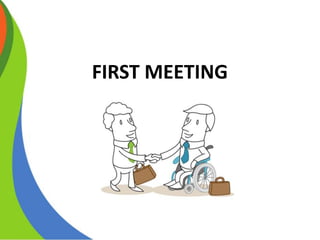
FIRST MEETING
First Meeting
RESEARCH RESEARCH RESEARCH!!
 Company Background
 Headline numbers
 Sites and geographical locations etc.
 Up to date news
 The background of the person you’re visiting
 Objectives / Goals of meeting
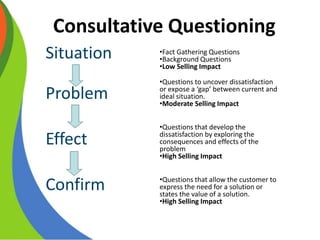
Consultative Questioning
Situation
Problem
Effect
Confirm
•Fact Gathering Questions
•Background Questions
•Low Selling Impact
•Questions to uncover dissatisfaction
or expose a ‘gap’ between current and
ideal situation.
•Moderate Selling Impact
•Questions that develop the
dissatisfaction by exploring the
consequences and effects of the
problem
•High Selling Impact
•Questions that allow the customer to
express the need for a solution or
states the value of a solution.
•High Selling Impact
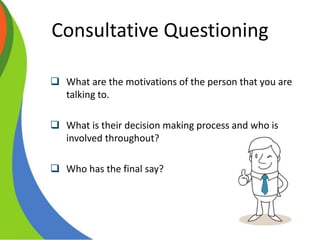
Consultative Questioning
•Multi level selling
 What are the motivations of the person that you are
talking to.
 What is their decision making process and who is
involved throughout?
 Who has the final say?
Consultative Questioning
 Find the ‘Key motivator’ of the person you are dealing
with
 Develop the ‘Gap’
 Telling is not selling, forget the ‘Tell’, develop the ‘Ask’
 Avoid a series of linked statements – make statements
that end in a question.
 Keep control – sometimes you need to give control to
keep control i.e... Tell me about… Describe for me..
 And remember that action is only ever the outcome of
motivation.
Key Motivators
Stage 1
• Identify current issues. What does s/he want
• Build upon their desire for a solution.. “What difference would
it make if you could… “
Stage 2
• Match the product or service to their issues
• Demonstrate how and why this solution works
• Translate their desire for ‘a’ solution for a desire for ‘our’
solution!
What skills are needed for sales?
• Technical knowledge
• Interpersonal and rapport building skills
• Closing skills – Example of LACPAAC later
• Over coming objections and query handling
Technical Knowledge v Sales Skills
• How important do you think product/technical
knowledge is?
• Does technical knowledge alone allow a person to be
the a great sales person?
Technical knowledge is important as it gives people belief
and enhances your credibility. However, if unbalanced
focus in put on this, the danger is that you will end up with
well educated prospects but no customers!
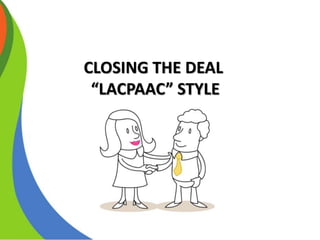
CLOSING THE DEAL
“LACPAAC” STYLE
Closing & LACPAAC
Core Selling Skills
 You’ve built their desire by matching correctly
 You’re confident its what the customer wants
 The customer is confident its what they want
When the above is done successfully you
can get the order but what if there is a mismatch?
This is the time to use ‘LACPAAC’
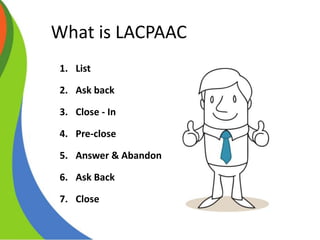
What is LACPAAC
1. List
2. Ask back
3. Close - In
4. Pre-close
5. Answer & Abandon
6. Ask Back
7. Close
LACPAAC
The most common response that people come up
against whilst selling is…. I want to think about it
Try following with “ I agree you should think about it but
usually when someone says that it is because they are
unsure of certain points. Would you agree with that?”
This hopefully will result in…
“ Yes, That’s what I want to think about”
This leads us into Phase 1 of LACPAAC
LACPAAC
List “Fine, let’s jot them down so we can see what we are looking at”
On a clean A4 pad list 1 to 10 whilst saying them quietly. This is
important for 4 reasons (Psychology)
 Proves you are knowledgeable and can answer lots of points
(Respect)
 Everyone must have lots of points, so client is not unusual
 List encourages him to list all his queries
 Everything in the open – no pressure
LACPAAC
Ask Back
• We say “What Points are you unsure of”
The customer tells us and we jot them down on the list
• Four guidelines
• Try to capture in one word if possible
• Don’t answer mismatch at this time
• Only write things down you understand. If unsure, ask!
• Don’t let on if it’s a common objection
LACPAAC
Close – In
As the name suggests we are now going to draw the
discussions to a focal point.
• We say “Are those all the points you have?”
• When client says yes draw a line across the page
Do not under any circumstances attempt to answer the
objections at this point!
LACPAAC
Pre – Close
A pre-close is a ‘conditional close’ We therefore close the
business on the condition we can later handle the mismatch.
The key word here is ‘IF’
“If I am able to deal with each of these points to your complete
satisfaction then may I assume that you will proceed”
The Pre-Close is one of the most important selling skills in itself!
LACPAAC
Answer
1. Answer each point raised individually
2. Check that we have dealt with it to the clients
satisfaction
3. Cross it out
If we are unable to handle ALL of the points, we abandon
LACPAAC for the time being at phase 5.
LACPAAC
Ask Back
Stage 6 is a professional courtesy.
Double check on the conditional close “Did I deal with
each of those points to your complete satisfaction?”
In front of him on the list they are all crossed out and at
each stage he agreed that we answered them satisfactorily.
Therefore his only answer can be ‘YES’
LACPAAC
Close
Be assumptive “Great we are in business!”
Do not close again i.e.
“You want to go ahead now don’t you?”
The sale was closed at phase 4 – conditionally.
OBJECTION HANDLING
Handling objections
Ask back
• In relation/comparison to what?
• What exactly do you mean by that?
• Just to clarify my thinking why is that important to you?
Agree
• People buy people first and everything else second!
• Don’t “Yes but!”
• Fine, I can understand that, however…
Answer their concerns
Price
Nobody ever buys price!
People buy value
Sell superiority
List matching F&B’s
And Me!
Funny Money
How much more etc…?
Compare to what they make/sell
I can buy cheaper elsewhere/Most Expensive
Yes we are!!
Choice – Best or Just enough
Credibility/Competition
“I've Never done business with you. How do I know?”
• Supposing a director of another major company was in here
would you be guided by them?
• Testimonials – Get them.
Delivery
They want it next week, we can’t do it for 4 weeks! –
Impasse?
• Change primary criteria for ordering
• Surely in the long term the fact that you are ordering the best
solution must be a decisive factor.
Summary
To be successful at sales you need:
Technical/Product Knowledge
Plus
Sales Skills – Selling is an art and a science
Plus
The ‘YOU’ Factor
Plus
Perseverance

Pathway sales training january 2016

  • 1.
    Science of Salesand Selling
  • 2.
    HOW WOULD YOUDEFINE SALES? DO WE NEED SALES PEOPLE?
  • 3.
    Lets look atthe Sales Process  Preparation  Opportunity Identification  Telephone  Probing/Questioning  Proposals  Closing  Objection Handling
  • 4.
    How to identifyopportunities •Where do you get new clients from?  Marketing  Networking  Recommendations from existing clients  Cold Calling  What others can you think of?
  • 5.
    When Cold Calling Rememberyou will need to be prepared for both the gate keeper: • Gathering basic information • Attempting to be put through to the decision maker … and the decision maker: • You will have around 20 seconds before they decide whether or not they will continue the call.
  • 6.
    Can you warmup your call? With todays excellent networking sites it is quite possible to make connections online and create a reason to be calling them…. “I just wanted to say thankyou for connecting with me on linked in… Id like to let you know… “ “I have some information to send through to you but am in your area on xyz date so was hoping I could go through it with you personally”
  • 7.
  • 8.
    First Meeting RESEARCH RESEARCHRESEARCH!!  Company Background  Headline numbers  Sites and geographical locations etc.  Up to date news  The background of the person you’re visiting  Objectives / Goals of meeting
  • 9.
    Consultative Questioning Situation Problem Effect Confirm •Fact GatheringQuestions •Background Questions •Low Selling Impact •Questions to uncover dissatisfaction or expose a ‘gap’ between current and ideal situation. •Moderate Selling Impact •Questions that develop the dissatisfaction by exploring the consequences and effects of the problem •High Selling Impact •Questions that allow the customer to express the need for a solution or states the value of a solution. •High Selling Impact
  • 10.
    Consultative Questioning •Multi levelselling  What are the motivations of the person that you are talking to.  What is their decision making process and who is involved throughout?  Who has the final say?
  • 11.
    Consultative Questioning  Findthe ‘Key motivator’ of the person you are dealing with  Develop the ‘Gap’  Telling is not selling, forget the ‘Tell’, develop the ‘Ask’  Avoid a series of linked statements – make statements that end in a question.  Keep control – sometimes you need to give control to keep control i.e... Tell me about… Describe for me..  And remember that action is only ever the outcome of motivation.
  • 12.
    Key Motivators Stage 1 •Identify current issues. What does s/he want • Build upon their desire for a solution.. “What difference would it make if you could… “ Stage 2 • Match the product or service to their issues • Demonstrate how and why this solution works • Translate their desire for ‘a’ solution for a desire for ‘our’ solution!
  • 13.
    What skills areneeded for sales? • Technical knowledge • Interpersonal and rapport building skills • Closing skills – Example of LACPAAC later • Over coming objections and query handling
  • 14.
    Technical Knowledge vSales Skills • How important do you think product/technical knowledge is? • Does technical knowledge alone allow a person to be the a great sales person? Technical knowledge is important as it gives people belief and enhances your credibility. However, if unbalanced focus in put on this, the danger is that you will end up with well educated prospects but no customers!
  • 15.
  • 16.
    Closing & LACPAAC CoreSelling Skills  You’ve built their desire by matching correctly  You’re confident its what the customer wants  The customer is confident its what they want When the above is done successfully you can get the order but what if there is a mismatch? This is the time to use ‘LACPAAC’
  • 17.
    What is LACPAAC 1.List 2. Ask back 3. Close - In 4. Pre-close 5. Answer & Abandon 6. Ask Back 7. Close
  • 18.
    LACPAAC The most commonresponse that people come up against whilst selling is…. I want to think about it Try following with “ I agree you should think about it but usually when someone says that it is because they are unsure of certain points. Would you agree with that?” This hopefully will result in… “ Yes, That’s what I want to think about” This leads us into Phase 1 of LACPAAC
  • 19.
    LACPAAC List “Fine, let’sjot them down so we can see what we are looking at” On a clean A4 pad list 1 to 10 whilst saying them quietly. This is important for 4 reasons (Psychology)  Proves you are knowledgeable and can answer lots of points (Respect)  Everyone must have lots of points, so client is not unusual  List encourages him to list all his queries  Everything in the open – no pressure
  • 20.
    LACPAAC Ask Back • Wesay “What Points are you unsure of” The customer tells us and we jot them down on the list • Four guidelines • Try to capture in one word if possible • Don’t answer mismatch at this time • Only write things down you understand. If unsure, ask! • Don’t let on if it’s a common objection
  • 21.
    LACPAAC Close – In Asthe name suggests we are now going to draw the discussions to a focal point. • We say “Are those all the points you have?” • When client says yes draw a line across the page Do not under any circumstances attempt to answer the objections at this point!
  • 22.
    LACPAAC Pre – Close Apre-close is a ‘conditional close’ We therefore close the business on the condition we can later handle the mismatch. The key word here is ‘IF’ “If I am able to deal with each of these points to your complete satisfaction then may I assume that you will proceed” The Pre-Close is one of the most important selling skills in itself!
  • 23.
    LACPAAC Answer 1. Answer eachpoint raised individually 2. Check that we have dealt with it to the clients satisfaction 3. Cross it out If we are unable to handle ALL of the points, we abandon LACPAAC for the time being at phase 5.
  • 24.
    LACPAAC Ask Back Stage 6is a professional courtesy. Double check on the conditional close “Did I deal with each of those points to your complete satisfaction?” In front of him on the list they are all crossed out and at each stage he agreed that we answered them satisfactorily. Therefore his only answer can be ‘YES’
  • 25.
    LACPAAC Close Be assumptive “Greatwe are in business!” Do not close again i.e. “You want to go ahead now don’t you?” The sale was closed at phase 4 – conditionally.
  • 26.
  • 27.
    Handling objections Ask back •In relation/comparison to what? • What exactly do you mean by that? • Just to clarify my thinking why is that important to you? Agree • People buy people first and everything else second! • Don’t “Yes but!” • Fine, I can understand that, however… Answer their concerns
  • 28.
    Price Nobody ever buysprice! People buy value Sell superiority List matching F&B’s And Me! Funny Money How much more etc…? Compare to what they make/sell I can buy cheaper elsewhere/Most Expensive Yes we are!! Choice – Best or Just enough
  • 29.
    Credibility/Competition “I've Never donebusiness with you. How do I know?” • Supposing a director of another major company was in here would you be guided by them? • Testimonials – Get them.
  • 30.
    Delivery They want itnext week, we can’t do it for 4 weeks! – Impasse? • Change primary criteria for ordering • Surely in the long term the fact that you are ordering the best solution must be a decisive factor.
  • 31.
    Summary To be successfulat sales you need: Technical/Product Knowledge Plus Sales Skills – Selling is an art and a science Plus The ‘YOU’ Factor Plus Perseverance

Editor's Notes

  • #3 Definition – Professionally helping someone to buy
  • #4 Everything involved. Normally training is 2 fold – Product/service knowledge Sales training – like today I add a third dimension – You What do I mean by that – State of mind is key. Normal sales value – everyone comfortable 100 times – not so. Exaggerating to make point. Up there something happens Suddenly more people are involved. Process is longer. It’s a myth! Same skills which closed x pounds closes 100 x pounds! Wood 4 by 2 The only difference is the way we think about it, our attitude, the way we think about it It’s the 3rd element - YOU
  • #6 When arranging appointment offer 2 alternatives. Prospect is then thinking ‘which’ not ‘should I?’
  • #7 When arranging appointment offer 2 alternatives. Prospect is then thinking ‘which’ not ‘should I?’
  • #8 Heavily into Sales Psychology
  • #10 Tell Lighting Story
  • #12 Motivation v Manipulation Manipulation – Getting the client to do what we want Motivation – Getting the client to do what he wants!!
  • #13 Desire – 2 stages 1 for a solution to a problem 2 for OUR solution to the problem
  • #14 What we have done so far is a collective process that will make it more likely that you will get the order when you ask for it. However, we don’t live in a perfect world. So we are now we going to move on to the really exciting bit. Closing and objection handling 2 totally different skills – not to be confused.
  • #18 LACPAAC is a closing technique for solving residual mismatch Usually polite way of saying I am not sure about something
  • #19 You will Love this. I have used this for years. It works! So much so that I love it when someone says ‘I want to think about it! And so will you!
  • #23 Conditional close – If I will you!!
  • #30 Testimonials/Recommendations – Ring a bell I said during the LinkedIn sessions that what you learned then would hold you in good stead in other areas.