May 2020
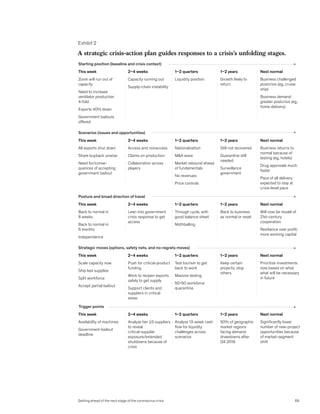
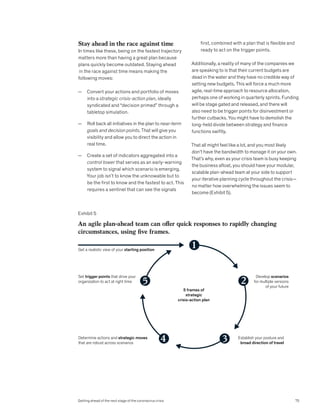
The path to the
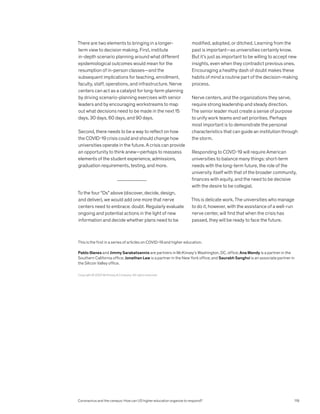
next normal
Leading with resolve through the
coronavirus pandemic
Cover image:
© Cultura RF/Getty Images
Copyright © 2020 McKinsey &
Company. All rights reserved.
This publication is not intended to
be used as the basis for trading in
the shares of any company or for
undertaking any other complex or
significant financial transaction
without consulting appropriate
professional advisers.
No part of this publication may be
copied or redistributed in any form
without the prior written consent of
McKinsey & Company.
May 2020
The path to the
next normal
Leading with resolve through the
coronavirus pandemic
On March 11, 2020, the World Health Organization formally declared COVID-19 a pandemic, underscoring
the precipitous global uncertainty that had plunged lives and livelihoods into a still-unfolding crisis.
Just two months later, daily reports of outbreaks—and of waxing and waning infection and mortality rates—
continue to heighten anxiety, stir grief, and cast into question the contours of our collective social and
economic future. Never in modern history have countries had to ask citizens around the world to stay home,
curb travel, and maintain physical distance to preserve the health of families, colleagues, neighbors, and
friends. And never have we seen job loss spike so fast, nor the threat of economic distress loom so large.
In this unprecedented reality, we are also witnessing the beginnings of a dramatic restructuring of the
social and economic order—the emergence of a new era that we view as the “next normal.” Dialogue and
debate have only just begun on the shape this next normal will take. But since the onset of the pandemic,
McKinsey has published a rapidly growing collection of insights (at least 250, at this two-month mark)
on the impact of COVID-19 on the economy, the workforce, and the gamut of functions and industries,
both globally and in specific regions across the world. We have collected and curated the first 100 of
these articles into four compendiums, organized by the initial stages of the path we see as leading from
the current crisis to the post-pandemic era—the next normal that will materialize after the battle against
coronavirus has been won.
These initial stages are Resolve, Resilience, and Return; as we progress, they will be followed by
Reimagination and Reform.
In this first compendium, The path to the next normal, we curate a selection of articles related to the initial
stage, Resolve: how to confront the crisis, lead with purpose, and determine the scale and pace of action
necessary to navigate toward greater resilience. We set forth strategies for keeping businesses and other
institutions running—organizing a nerve center, for example, and enabling communities to work, and
learn, remotely. And we offer examples to mobilize leaders across boards and the C-suite. At the time of
this publication, the course of the pandemic remains unclear, and safeguarding both lives and livelihoods
remains an exigent priority. We hope these insights begin to illuminate the path toward a future still in flux—
and inspire leaders with the necessary resolve to help forge the next normal.
You can download this and three other compendiums at McKinsey.com/pathbeyondcovid-19, as well as
find these and our entire collection of individual insights at McKinsey.com/covid-19.
We look forward to your feedback at Crisis_Feedback@McKinsey.com.
Introduction
Raju Narisetti
Global Publishing Director Elect
McKinsey Publishing
2
Contents
Charting a purposeful
path to the next normal
Beyond coronavirus: The path
to the next normal
Demonstrating corporate
purpose in the time of
coronavirus
6
11
Organizing the
response
Responding to coronavirus:
The minimum viable nerve center
Getting ahead of the next stage
of the coronavirus crisis
To weather a crisis, build a
network of teams
58
66
77
Mobilizing the
C-suite
Boards in the time of coronavirus
The CFO’s role in helping
companies navigate the
coronavirus crisis
When investors call: How your
business should talk about
coronavirus
The CIO’s moment: Leadership
through the first wave of the
coronavirus crisis
Driving digital change during a
crisis: The chief digital officer and
COVID-19
How chief data officers can
navigate the COVID-19 response
and beyond
Leading with purpose: How
marketing and sales leaders can
shape the next normal
140
146
152
156
162
168
174
Leading with resolve
Leadership in a crisis:
Responding to the coronavirus
outbreak and future challenges
A leader’s guide: Communicating
with teams, stakeholders, and
communities during COVID-19
Decision making in uncertain
times
Applying past leadership lessons
to the coronavirus pandemic
Positive leadership in uncertain
times
Re-energizing through the
epidemic: Stories from China
18
24
32
38
44
47
Working remotely
Revisiting agile teams after an
abrupt shift to remote
When governments go remote
Adapting workplace learning in
the time of coronavirus
A blueprint for remote working:
Lesson from China
86
94
98
104
Experimenting
with remote education
at scale
Coronavirus and the campus:
How can US higher education
organize to respond?
Coronavirus: How should US
higher education plan for an
uncertain future?
Getting the next phase of remote
learning right in higher education
School system priorities in the
age of coronavirus
114
120
126
131
3
Charting
a purposeful
path to the
next normal
6
Beyond coronavirus: The
path to the next normal
11
Demonstrating corporate
purpose in the time of the
coronavirus
4
5
Beyond coronavirus: The
path to the next normal
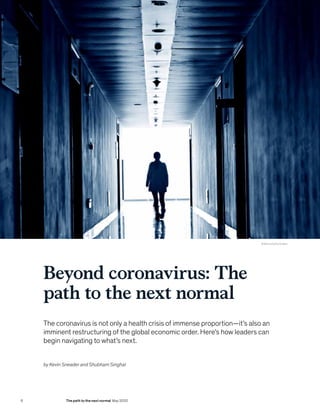
The coronavirus is not only a health crisis of immense proportion—it’s also an
imminent restructuring of the global economic order. Here’s how leaders can
begin navigating to what’s next.
© Baona/Getty Images
by Kevin Sneader and Shubham Singhal
6 The path to the next normal May 2020
“For some organizations, near-term survival is the
only agenda item. Others are peering through the
fog of uncertainty, thinking about how to position
themselves once the crisis has passed and things
return to normal. The question is, ‘What will normal
look like?’ While no one can say how long the crisis
will last, what we find on the other side will not look
like the normal of recent years.”
These words were written 11 years ago, amid the
last global financial crisis, by one of our former
managing partners, Ian Davis. They ring true today
but if anything, understate the reality the world is
currently facing.
It is increasingly clear our era will be defined by a
fundamental schism: the period before COVID-19
and the new normal that will emerge in the post-viral
era: the “next normal.” In this unprecedented new
reality, we will witness a dramatic restructuring of
the economic and social order in which business and
society have traditionally operated. And in the near
future, we will see the beginning of discussion and
debate about what the next normal could entail and
how sharply its contours will diverge from those that
previously shaped our lives.
Here, we attempt to answer the question being
posed by leaders across the public, private, and
social sectors: What will it take to navigate this crisis,
now that our traditional metrics and assumptions
have been rendered irrelevant? More simply put, it’s
our turn to answer a question that many of us once
asked of our grandparents: What did you do during
the war?
Our answer is a call to act across five stages, leading
from the crisis of today to the next normal that
will emerge after the battle against coronavirus
has been won: Resolve, Resilience, Return,
Reimagination, and Reform.
The duration of each stage will vary based on
geographic and industry context, and institutions
may find themselves operating in more than one
stage simultaneously. Today, on McKinsey.com, a
group of colleagues published “Safeguarding our
lives and our livelihoods: The imperative of our time,”
which emphasizes the urgency of solving now for the
virus and the economy, and thereby precedes our
focus here on reimagining the future, post-pandemic.
Collectively, these five stages represent the
imperative of our time: the battle against COVID-19
is one that leaders today must win if we are to find
an economically and socially viable path to the
next normal.
Resolve
In almost all countries, crisis-response efforts
are in full motion. A large array of public-health
interventions has been deployed. Healthcare
systems are—explicitly—on a war footing to
increase their capacity of beds, supplies, and
trained workers. Efforts are under way to
alleviate shortages of much-needed medical
supplies. Business-continuity and employee-
safety plans have been escalated, with remote
work established as the default operating mode.
Many are dealing with acute slowdowns in their
The shock to our livelihoods from the
economic impact of virus-suppression
efforts could be the biggest in nearly
a century.
Beyond coronavirus: The path to the next normal 7
operations, while some seek to accelerate to meet
demand in critical areas spanning food, household
supplies, and paper goods. Educational institutions
are moving online to provide ongoing learning
opportunities as physical classrooms shut down.
This is the stage on which leaders are currently
focused. For more, please see “Coronavirus:
Leading through the crisis” on McKinsey.com.
And yet, a toxic combination of inaction and paralysis
remains, stymying choices that must be made:
lockdown or not; isolation or quarantine; shut down
the factory now or wait for an order from above. That
is why we have called this first stage Resolve: the
need to determine the scale, pace, and depth of
action required at the state and business levels. As
one CEO told us: “I know what to do. I just need to
decide whether those who need to act share my
resolve to do so.”
Resilience
The pandemic has metastasized into a burgeoning
crisis for the economy and financial system. The
acute pullback in economic activity, necessary
to protect public health, is simultaneously
jeopardizing the economic well-being of citizens
and institutions. The rapid succession of liquidity
and solvency challenges hitting multiple industries
is proving resistant to the efforts of central banks
and governments to keep the financial system
functioning. A health crisis is turning into a financial
crisis as uncertainty about the size, duration, and
shape of the decline in GDP and employment
undermines what remains of business confidence.
A McKinsey Global Institute analysis, based on
multiple sources, indicates that the shock to our
livelihoods from the economic impact of virus-
suppression efforts could be the biggest in nearly
a century. In Europe and the United States, this is
likely to lead to a decline in economic activity in a
single quarter that proves far greater than the loss
of income experienced during the Great Depression.
In the face of these challenges, resilience is a vital
necessity. Near-term issues of cash management
for liquidity and solvency are clearly paramount.
But soon afterward, businesses will need to
act on broader resilience plans as the shock
begins to upturn established industry structures,
resetting competitive positions forever. Much of
the population will experience uncertainty and
personal financial stress. Public-, private-, and
social-sector leaders will need to make difficult
“through cycle” decisions that balance economic
and social sustainability, given that social
cohesion is already under severe pressure
from populism and other challenges that
existed pre-coronavirus.
Return
Returning businesses to operational health after a
severe shutdown is extremely challenging, as China
is finding even as it slowly returns to work. Most
industries will need to reactivate their entire supply
chain, even as the differential scale and timing of
the impact of coronavirus mean that global supply
chains face disruption in multiple geographies.
The weakest point in the chain will determine
the success or otherwise of a return to rehiring,
training, and attaining previous levels of workforce
productivity. Leaders must therefore reassess their
entire business system and plan for contingent
actions in order to return their business to effective
production at pace and at scale.
Compounding the challenge, winter will bring
renewed crisis for many countries. Without a
vaccine or effective prophylactic treatment, a rapid
return to a rising spread of the virus is a genuine
threat. In such a situation, government leaders
may face an acutely painful “Sophie’s choice”:
mitigating the resurgent risk to lives versus the risk
to the population’s health that could follow another
sharp economic pullback. Return may therefore
require using the hoped-for—but by no means
certain—temporary virus “cease-fire” over the
Northern Hemisphere’s summer months to expand
testing and surveillance capabilities, health-system
capacity, and vaccine and treatment development
to deal with a second surge. For more, see “Bubbles
pop, downturns stop” on McKinsey.com.
8 The path to the next normal May 2020
Reimagination
A shock of this scale will create a discontinuous shift
in the preferences and expectations of individuals
as citizens, as employees, and as consumers. These
shifts and their impact on how we live, how we work,
and how we use technology will emerge more clearly
over the coming weeks and months. Institutions
that reinvent themselves to make the most of better
insight and foresight, as preferences evolve, will
disproportionally succeed. Clearly, the online world
of contactless commerce could be bolstered in ways
that reshape consumer behavior forever. But other
effects could prove even more significant as the
pursuit of efficiency gives way to the requirement of
resilience—the end of supply-chain globalization, for
example, if production and sourcing move closer to
the end user.
The crisis will reveal not just vulnerabilities but
opportunities to improve the performance of
businesses. Leaders will need to reconsider
which costs are truly fixed versus variable, as the
shutting down of huge swaths of production sheds
light on what is ultimately required versus nice to
have. Decisions about how far to flex operations
without loss of efficiency will likewise be informed
by the experience of closing down much of global
production. Opportunities to push the envelope of
technology adoption will be accelerated by rapid
learning about what it takes to drive productivity
when labor is unavailable. The result: a stronger
sense of what makes business more resilient to
shocks, more productive, and better able to deliver
to customers.
Reform
The world now has a much sharper definition of
what constitutes a black-swan event. This shock
will likely give way to a desire to restrict some
factors that helped make the coronavirus a global
challenge, rather than a local issue to be managed.
Governments are likely to feel emboldened and
supported by their citizens to take a more active
role in shaping economic activity. Business
leaders need to anticipate popularly supported
changes to policies and regulations as society
seeks to avoid, mitigate, and preempt a future
health crisis of the kind we are experiencing today.
In most economies, a healthcare system little
changed since its creation post–World War II will
need to determine how to meet such a rapid
surge in patient volume, managing seamlessly
across in-person and virtual care. Public-
health approaches, in an interconnected and
highly mobile world, must rethink the speed
and global coordination with which they
need to react. Policies on critical healthcare
infrastructure, strategic reserves of key supplies,
and contingency production facilities for critical
medical equipment will all need to be addressed.
Managers of the financial system and the
economy, having learned from the economically
Government leaders may face an acutely
painful “Sophie’s choice”: mitigating the
resurgent risk to lives versus the risk to
the population’s health that could follow
another sharp economic pullback.
Beyond coronavirus: The path to the next normal 9
induced failures of the last global financial crisis,
must now contend with strengthening the system
to withstand acute and global exogenous shocks,
such as this pandemic’s impact. Educational
institutions will need to consider modernizing to
integrate classroom and distance learning. The list
goes on.
The aftermath of the pandemic will also provide
an opportunity to learn from a plethora of social
innovations and experiments, ranging from
working from home to large-scale surveillance.
With this will come an understanding of which
innovations, if adopted permanently, might provide
substantial uplift to economic and social welfare—
and which would ultimately inhibit the broader
betterment of society, even if helpful in halting or
limiting the spread of the virus.
As we consider the scale of change that the
coronavirus has engendered—and will continue
to engender in the weeks and months ahead—we
feel compelled to reflect not just on a health crisis
of immense proportion but also on an imminent
restructuring of the global economic order. How
exactly this crisis evolves remains to be seen. But the
five stages described here offer leaders a clear path
to begin navigating to the next normal—a normal
that looks unlike any in the years preceding the
coronavirus, the pandemic that changed everything.
Copyright © 2020 McKinsey & Company. All rights reserved.
Kevin Sneader is the global managing partner of McKinsey & Company and is based in Hong Kong. Shubham Singhal is a
senior partner in McKinsey’s Detroit office and the global leader of the Healthcare Systems & Services Practice.
10 The path to the next normal May 2020
Demonstrating corporate
purpose in the time of the
coronavirus
Companies will define what they do in the crucible of COVID-19
response—or be defined by it. Here’s how to frame the challenge.
© Westend61/Getty Images
by Bill Schaninger, Bruce Simpson, Han Zhang, and Chris Zhu
Demonstrating corporate purpose in the time of the coronavirus 11
What should a company’s purpose be when the
purpose of so many, right now, is survival?
For years, enlightened executives have sought
the sweet spot between their responsibility to
maximize profits on behalf of shareholders and
their desire to find a purpose across environment,
social, and governance (ESG) themes on behalf of a
broad range of stakeholders, including customers,
employees, and communities. Then COVID-19 came.
As businesses large and small shut their doors, and
millions retreat to enforced isolation, the magnitude
of the coronavirus crisis confronts corporate
leaders with the economic challenge of a lifetime.
It also demands of them a moment of existential
introspection: What defines their company’s
purpose—its core reason for being and its impact on
the world?
In boardrooms real and virtual, frantic questions
have the floor. How long will this last? How will we
pay furloughed workers? What are our peers doing?
What should we do first? Global corporations have
never had as much power as they do right now to
leverage their scale to benefit society in a time
of global crisis. Executives have also never had a
more intense spotlight trained on their behaviors
and actions. In moments of crisis, the default
expectation is that businesses will hunker down
and focus on bottom-line fundamentals. Indeed,
many CEOs feel constrained to making defensive
moves to protect their businesses. But in this crisis,
stakeholder needs are already so acute that the
opportunity for businesses to make an indelible
mark with human support, empathy, and purpose is
greater than it has ever been.
Lessons from the past loom large. During what feels
like a war, the words and images of wartime leaders
echo in our consciousness as icons of resilience and
human concern. In previous periods of economic
shock, executives’ actions, both good and bad,
lodged in company histories and forged perceptions
that have endured for years. Decisions made during
this crisis will likewise shape a corporation’s identity
and tell a story that will leave traces long after
COVID-19 has been quelled.
In this crisis, executives will choose either to stay on
the sidelines or to engage and, if engaging, either
to lead or to follow. Those who have carefully honed
a sense of company purpose will find a foundation
and set of values that can guide critical and decisive
action. For others, this moment can represent
the first steps toward defining their corporate
purpose in a deliberate way. Is this the moment
when purposeful companies demonstrate how to
use profits for good or that shows how everything a
company does can be for good?
As boardrooms become war rooms, a handful of
principles can help guide executives in shaping a
critical course of action and building a powerful
sense of identity and purpose that will long outlast
the immediate crisis.
Understand how acute your
stakeholders’ needs are now
Examine exactly what is at stake for your employees,
communities, customers, partners, and owners.
All will have urgent, rapidly evolving needs that
you should fully understand and prioritize. Some
of these needs will be new and require creative
thinking. Listen carefully to stakeholders that
are well placed to inform you. Among grocers, for
example, the needs of employees, customers,
and service to broader society often stand front
and center. Nonetheless, stories of some grocers
gouging prices have surfaced as the crisis has
intensified. Others, such as Canadian grocer
Loblaws, moved quickly, as physical-distancing
measures spread, to open stores early for elderly
shoppers while also increasing compensation for
frontline workers and pledging to keep prices at
prepandemic levels.
Prepare for tension, too, as trade-offs arise among
stakeholder groups, each with their own important
needs. For example, increasing the pay of frontline
workers might raise the prospect of cutting back
on supplier bills. For retailers and delivery services,
shutting down warehouses temporarily to keep
workers safe might mean customers have to wait
longer for deliveries.
12 The path to the next normal May 2020
Bring your greatest strengths to bear
Whatstrengthsdoesyourorganizationpossessthat
youcanapplytomakethebiggestdifferenceforyour
stakeholders?Astrongbalancesheetmightbethe
meanstosustainworkersthroughthecrisis.Aunique
logisticsnetworkcouldbeusedtobringaidtopeople
inneed.Amanufacturingfacilitycouldshiftproduction
tocreatingurgentlyneededmedicalsupplies.Resist
goingitalone.Collaboratecloselywithyourecosystem
ofsuppliersandcustomers—theymightidentify
strengthsyoudidn’tevenknowyouhad.
Small businesses and large corporations alike
are redeploying their capabilities to respond to
this crisis: a wedding-dress boutique in New York
responded to postponed orders by shifting to
produce protective masks for healthcare workers,
while French perfume makers have retooled to
pump out hand sanitizer. Automobile and car-parts
makers have turned to building ventilators. Past
lessons can inform creative thinking: when rural
Tanzania needed critical medical supplies in 2010,
Coca-Cola used its extensive last-mile delivery
system to reduce delivery times to five days, from
30. Stepping into the public sphere in the heat of
a crisis can unleash unique synergies and creative
solutions that will linger.
Test your decisions against
your purpose
At a time of great uncertainty, “gut check” your
decisions against your values as a leader and as
an organization. Do your choices align with your
identity? Everything you do now will be analyzed
after the dust settles. Will your actions and identity
be seen as consistent?
Communicate not only your decisions but also
the rationale for them—and the trade-offs you
considered—clearly. Can you explain decisions
to skeptics? Will what you decided be a source of
pride? In the financial-services industry, many bank
executives report credit loss as their most acute
concern, followed by liquidity and funding. But
banks also have a long-standing social commitment
to support households and businesses with credit.
Banks that pull funds away during a crisis will be
defining themselves for future interactions in the
communities where they operate.
Finally, if you have embraced initiatives in ESG
areas, don’t borrow from one to support another—
don’t risk appearing to “rob Peter to pay Paul.” The
temptation may be to scale back environmental
programs to support acute social needs better
in this crisis. But beware of seeming to abandon
deeply held stakeholder causes; supporters will
have long memories.
Involve your employees in the solution
Any crisis provides an opportunity to build a
common sense of purpose with your employees,
who will be looking for leadership and ways to
engage themselves. It can also deliver the benefit
Collaborate closely with your ecosystem
of suppliers and customers—they might
identify strengths you didn’t even
know you had.
Demonstrating corporate purpose in the time of the coronavirus 13
of bringing a new generation of leaders to the fore.
It may be tempting to withdraw into small, tight
decision-making task forces to make key decisions
as quickly as possible. But purposeful leaders will
want to share execution plans broadly with staff to
solicit input and engage them on the challenges the
organization faces—including the difficult trade-offs
to be made.
Many employees and their families are suffering
from isolation and loss of income, leaving them
thinking about what is truly important. Crisis leaders’
actions now can foster collective unity and a sense
of belonging. When those decisions derive from the
principles and purpose that an organization stands
for it will make it easier to convey confidence in
positive outcomes, even when decisions are
painful ones.
There is also a benefit in drawing employees
together to tackle problems in new ways. For
example, forming cross-cutting teams to address
problems can break the mold of years of siloed
thinking. As Hurricane Katrina took its toll on the
United States in 2005, Walmart stepped up to
support disaster relief and asked some employees
to deliver supplies in hard-to-reach areas. At
the same time, the company guaranteed that all
employees in disaster locations would keep their
jobs at other locations during and after the disaster.
When Hurricane Harvey landed in Houston in
2017, Texas Mutual Insurance took immediate
steps to ensure the safety of its employees by
shutting down its offices and providing supplies and
company cars to affected staff. The company
also supported its larger community, providing
$10 million in grants to help policyholders rebuild.
Lead from the front
Leading in a crisis is never easy, but hard times
leave the most indelible imprints on a company’s
identity. Credibility is a both essential and fragile
element of effective leadership. In a recent
McKinsey survey of US workers, 82 percent of
the more than 1,000 respondents affirmed the
importance of corporate purpose, but only
42 percent reported that their company’s stated
purpose had much effect. This is a cautionary
tale about the generic nature of most companies’
statements on identity but also the identification
of an opportunity to surprise and sway skeptical
stakeholders. Authentic actions will demonstrate
to employees a company’s genuine commitment to
social purpose.
Communicate early and frequently, even with
incomplete information. Remember that, right
now, suffering stakeholders seek empathy but
are also looking to leaders to face facts bluntly,
without sugarcoating them. Stay nimble as
situations change, which they certainly will. Adapt
to changing conditions and new information
rather than returning to a static playbook. Offer
perspectives on today’s crisis details, with a
microscopic perspective to reassure stakeholders
Leading in a crisis is never easy,
but hard times leave the most indelible
imprints on a company’s identity.
14 The path to the next normal May 2020
of competence. However, also take a telescopic view
of what recovery may look like in the future. At some
point, the COVID-19 crisis will pass. Households and
companies alike will take stock of their losses
and begin to rebuild. Acting in concert with the
tenets of your organization’s purpose will help
balance these perspectives and demonstrate
confidence in your company’s ability to deliver
a good outcome.
Executives are uniquely poised at this pivotal time
to bring corporate power, guided by social purpose,
to the aid of millions of dislodged and vulnerable
lives. Done well, their actions in this crisis can
bridge, in unprecedented ways, the divide between
shareholders and stakeholders in the communities
they serve—and leave a lasting, positive legacy on
their corporate identity.
Copyright © 2020 McKinsey & Company. All rights reserved.
Bill Schaninger is a senior partner in McKinsey’s Philadelphia office, and Bruce Simpson is a senior partner in the Toronto
office, where Han Zhang and Chris Zhu are both consultants.
The authors wish to thank Arne Gast, Sufanah Hamza, Pablo Illanes, Abi Kulshreshtha, Sebastian Leape, Robin Nuttall, Richard
Steele, Matt Stone, and Lynn Taliento for their contributions to this article.
Demonstrating corporate purpose in the time of the coronavirus 15
16
Leading
with
resolve 18
Leadership in a crisis:
Responding to the
coronavirus outbreak and
future challenges
24
A leader’s guide:
Communicating with
teams, stakeholders,
and communities during
COVID-19
32
Decision-making in
uncertain times
38
Applying past leadership
lessons to the coronavirus
pandemic
44
Positive leadership in
uncertain times
47
Re-energizing through
the epidemic: Stories
from China
17
Leadership in a crisis:
Responding to the
coronavirus outbreak and
future challenges
For many executives, the coronavirus pandemic is a crisis unlike any other in
recent times. Five leadership practices can help you respond effectively.
© Jonathan Knowles/Getty Images
by Gemma D’Auria and Aaron De Smet
18 The path to the next normal May 2020
The coronavirus pandemic has placed
extraordinary demands on leaders in business
and beyond. The humanitarian toll taken by
COVID-19 creates fear among employees and other
stakeholders. The massive scale of the outbreak
and its sheer unpredictability make it challenging
for executives to respond. Indeed, the outbreak
has the hallmarks of a “landscape scale” crisis:
an unexpected event or sequence of events of
enormous scale and overwhelming speed, resulting
in a high degree of uncertainty that gives rise to
disorientation, a feeling of lost control, and strong
emotional disturbance.1
Recognizing that a company faces a crisis is the first
thing leaders must do. It is a difficult step, especially
during the onset of crises that do not arrive suddenly
but grow out of familiar circumstances that mask
their nature.2
Examples of such crises include
the SARS outbreak of 2002–03 and now the
coronavirus pandemic. Seeing a slow-developing
crisis for what it might become requires leaders to
overcome the normalcy bias, which can cause them
to underestimate both the possibility of a crisis and
the impact that it could have.3
Once leaders recognize a crisis as such, they can
begin to mount a response. But they cannot respond
as they would in a routine emergency, by following
plans that had been drawn up in advance. During a
crisis, which is ruled by unfamiliarity and uncertainty,
effective responses are largely improvised.4
They might span a wide range of actions: not just
temporary moves (for example, instituting work-
from-home policies) but also adjustments to ongoing
business practices (such as the adoption of new
tools to aid collaboration), which can be beneficial to
maintain even after the crisis has passed.
What leaders need during a crisis is not a
predefined response plan but behaviors and
mindsets that will prevent them from overreacting
to yesterday’s developments and help them
look ahead. In this article, we explore five such
behaviors and accompanying mindsets that can
help leaders navigate the coronavirus pandemic
and future crises.
Organizing to respond to crises: The
network of teams
During a crisis, leaders must relinquish the belief
that a top-down response will engender stability.
In routine emergencies, the typical company
can rely on its command-and-control structure
to manage operations well by carrying out a
scripted response. But in crises characterized
by uncertainty, leaders face problems that are
unfamiliar and poorly understood. A small group
of executives at an organization’s highest level
cannot collect information or make decisions
quickly enough to respond effectively. Leaders
1
Arnold M. Howitt and Herman B. Leonard, “Against desperate peril: High performance in emergency preparation and response,” in Deborah
E. Gibbons, ed, Communicable Crises: Prevention, Response, and Recovery in the Global Arena, first edition, Charlotte, NC: Information Age
Publishing, 2007.
2
Arnold Howitt and Herman B. Leonard, eds, Managing Crises: Responses to Large-Scale Emergencies, first edition, Washington, DC: CQ
Press, 2009.
3
Nahman Alon and Haim Omer, “The continuity principle: A unified approach to disaster and trauma,” American Journal of Community 		
Psychology, 1994, Volume 22, Number 2, pp. 273–87.
4
Howitt and Leonard, Managing Crises.
What leaders need during a crisis is
not a predefined response plan but
behaviors and mindsets that will prevent
them from overreacting to yesterday’s
developments and help them look ahead.
Leadership in a crisis: Responding to the coronavirus outbreak and future challenges 19
5
Tantum Collins, Chris Fussell, Gen. Stanley McChrystal, and David Silverman, Team of Teams: New Rules of Engagement for a Complex World,
first edition, New York, NY: Portfolio/Penguin, 2015.
can better mobilize their organizations by setting
clear priorities for the response and empowering
others to discover and implement solutions that
serve those priorities.
To promote rapid problem solving and execution
under high-stress, chaotic conditions, leaders can
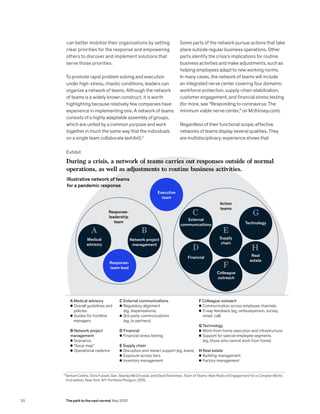
organize a network of teams. Although the network
of teams is a widely known construct, it is worth
highlighting because relatively few companies have
experience in implementing one. A network of teams
consists of a highly adaptable assembly of groups,
which are united by a common purpose and work
together in much the same way that the individuals
on a single team collaborate (exhibit).5
Some parts of the network pursue actions that take
place outside regular business operations. Other
parts identify the crisis’s implications for routine
business activities and make adjustments, such as
helping employees adapt to new working norms.
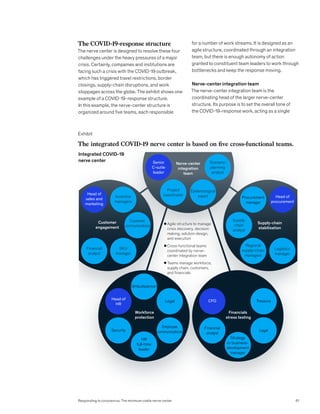
In many cases, the network of teams will include
an integrated nerve center covering four domains:
workforce protection, supply-chain stabilization,
customer engagement, and financial stress testing
(for more, see “Responding to coronavirus: The
minimum viable nerve center,” on McKinsey.com).
Regardless of their functional scope, effective
networks of teams display several qualities. They
are multidisciplinary: experience shows that
Exhibit
A Medical advisory
● Overall guidelines and
policies
● Guides for frontline
managers
B Network project
management
● Scenarios
● “Issue map”
● Operational cadence
C External communications
● Regulatory alignment
(eg, dispensations)
● 3rd-party communications
(eg, to partners)
D Financial
● Financial stress testing
E Supply chain
● Disruption and restart support (eg, loans)
● Exposure across tiers
● Inventory management
F Colleague outreach
● Communication across employee channels
● 2-way feedback (eg, ombudsperson, survey,
email, call)
G Technology
● Work-from-home execution and infrastructure
● Support for special employee segments
(eg, those who cannot work from home)
H Real estate
● Building management
● Factory management
Executive
team
Supply
chain
Action
teams
Response-
leadership
team
Real
estate
Technology
Financial
Colleague
outreach
Response-
team lead
External
communications
Medical
advisory
Network project
management
A B
C
H
G
D
E
F
GES 2020
Leadership Crisis
Exhibit 1 of 1
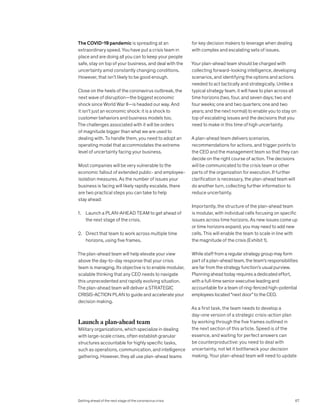
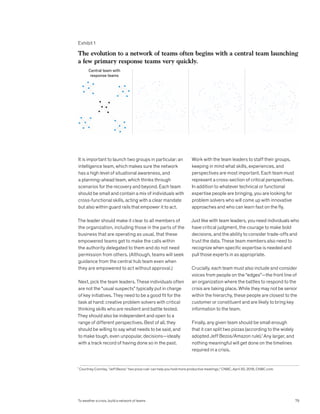
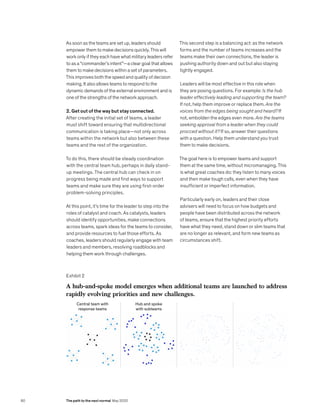
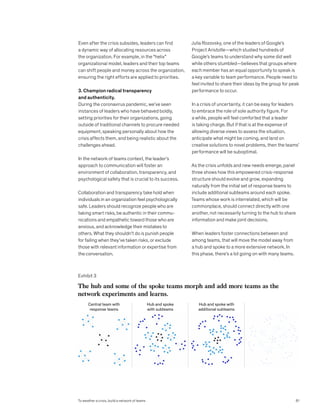
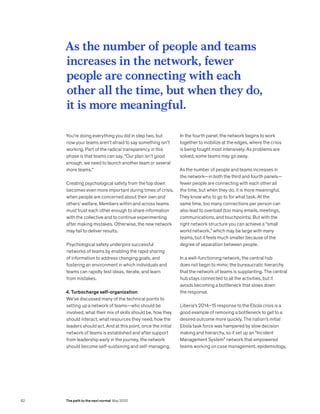
During a crisis, a network of teams carries out responses outside of normal
operations, as well as adjustments to routine business activities.
Illustrative network of teams
for a pandemic response
20 The path to the next normal May 2020
crises present a degree of complexity that makes
it necessary to engage experts from different
fields. They are designed to act. Merely soliciting
experts’ ideas is not enough; experts must gather
information, devise solutions, put them into practice,
and refine them as they go. And they are adaptable,
reorganizing, expanding, or contracting as teams
learn more about the crisis and as conditions change.
Leaders should foster collaboration and
transparency across the network of teams. One
way they do this is by distributing authority and
sharing information: in other words, demonstrating
how the teams themselves should operate. In crisis
situations, a leader’s instinct might be to consolidate
decision-making authority and control information,
providing it on a strictly need-to-know basis. Doing
the opposite will encourage teams to follow suit.
Another crucial part of the leader’s role, especially in
the emotional, tense environment that characterizes
a crisis, is promoting psychological safety so people
can openly discuss ideas, questions, and concerns
without fear of repercussions. This allows the
network of teams to make sense of the situation,
and how to handle it, through healthy debate.
Elevating leaders during a crisis:
The value of ‘deliberate calm’ and
‘bounded optimism’
Just as an organization’s senior executives must be
prepared to temporarily shift some responsibilities
from their command-and-control hierarchy to a
network of teams, they must also empower others
to direct many aspects of the organization’s crisis
response. This involves granting them the authority
to make and implement decisions without having
to gain approval. One important function of senior
executives is to quickly establish an architecture
for decision making, so that accountability is clear
and decisions are made by appropriate people at
different levels.
Senior leaders must also make sure that they
empower the right people to make crisis-response
decisions across the network of teams. Since
decision makers will probably make some mistakes,
they must be able to learn quickly and make
corrections without overreacting or paralyzing the
organization. At the start of a crisis, senior leaders
will have to appoint decision makers to direct the
crisis response. But as the crisis evolves, new crisis-
response leaders will naturally emerge in a network-
of-teams construct, and those crisis-response
leaders won’t always be senior executives.
In routine emergencies, experience is perhaps the
most valuable quality that leaders bring. But in
novel, landscape-scale crises, character is of the
utmost importance. Crisis-response leaders must
be able to unify teams behind a single purpose and
frame questions for them to investigate. The best
will display several qualities. One is “deliberate
calm,” the ability to detach from a fraught situation
and think clearly about how one will navigate
it.6
Deliberate calm is most often found in well-
grounded individuals who possess humility but
not helplessness.
Another important quality is “bounded optimism,”
or confidence combined with realism. Early in a
crisis, if leaders display excessive confidence in
spite of obviously difficult conditions, they can lose
credibility. It is more effective for leaders to project
confidence that the organization will find a way
through its tough situation but also show that they
recognize the crisis’s uncertainty and have begun to
grapple with it by collecting more information. When
the crisis has passed, then optimism will be more
beneficial (and can be far less bounded).
Making decisions amid uncertainty:
Pause to assess and anticipate, then act
Waiting for a full set of facts to emerge before
determining what to do is another common mistake
that leaders make during crises. Because a crisis
involves many unknowns and surprises, facts may
not become clear within the necessary decision-
making time frame. But leaders should not resort to
using their intuition alone. Leaders can better cope
with uncertainty and the feeling of jamais vu (déjà
vu’s opposite) by continually collecting information
6
Helio Fred Garcia, “Effective leadership response to crisis,” Strategy & Leadership, 2006, Volume 34, Number 1, pp. 4–10.
Leadership in a crisis: Responding to the coronavirus outbreak and future challenges 21
as the crisis unfolds and observing how well their
responses work.
In practice, this means frequently pausing from crisis
management, assessing the situation from multiple
vantage points, anticipating what may happen next,
and then acting. The pause-assess-anticipate-act
cycle should be ongoing, for it helps leaders maintain
a state of deliberate calm and avoid overreacting to
new information as it comes in. While some moments
during the crisis will call for immediate action, with no
time to assess or anticipate, leaders will eventually
find occasions to stop, reflect, and think ahead
before making further moves.
Two cognitive behaviors can aid leaders as they
assess and anticipate. One, called updating,
involves revising ideas based on new information
teams collect and knowledge they develop. The
second, doubting, helps leaders consider ongoing
and potential actions critically and decide whether
they need to be modified, adopted, or discarded.
Updating and doubting help leaders mediate their
dueling impulses to conceive solutions based on
what they’ve done previously and to make up new
solutions without drawing on past lessons. Instead,
leaders bring their experiences to bear while
accepting new insights as they emerge.
Once leaders decide what to do, they must act
with resolve. Visible decisiveness not only builds
the organization’s confidence in leaders; it also
motivates the network of teams to sustain its
search for solutions to the challenges that the
organization faces.
Demonstrating empathy: Deal with the
human tragedy as a first priority
In a landscape-scale crisis, people’s minds turn first
to their own survival and other basic needs. Will I
be sickened or hurt? Will my family? What happens
then? Who will care for us? Leaders shouldn’t assign
communications or legal staff to address these
questions. A crisis is when it is most important for
leaders to uphold a vital aspect of their role: making
a positive difference in people’s lives.
Doing this requires leaders to acknowledge
the personal and professional challenges that
employees and their loved ones experience during
a crisis. By mid-March 2020, COVID-19 had
visited tragedy on countless people by claiming
thousands of lives. More than 100,000 cases had
been confirmed; many more were being projected.
The pandemic had also triggered powerful
second-order effects. Governments instituted
travel bans and quarantine requirements, which
are important for safeguarding public health but
can also keep people from aiding relatives and
friends or seeking comfort in community groups
or places of worship. School closures in many
jurisdictions put strain on working parents. Since
each crisis will affect people in particular ways,
leaders should pay careful attention to how people
are struggling and take corresponding measures
to support them.
Lastly, it is vital that leaders not only demonstrate
empathy but open themselves to empathy from
others and remain attentive to their own well-being.
As stress, fatigue, and uncertainty build up during
a crisis, leaders might find that their abilities to
process information, to remain levelheaded, and to
exercise good judgment diminish. They will stand
a better chance of countering functional declines
if they encourage colleagues to express concern—
and heed the warnings they are given. Investing time
in their well-being will enable leaders to sustain their
effectiveness over the weeks and months that a
crisis can entail.
Communicating effectively:
Maintain transparency and provide
frequent updates
Crisis communications from leaders often hit the
wrong notes. Time and again, we see leaders taking
an overconfident, upbeat tone in the early stages
of a crisis—and raising stakeholders’ suspicions
about what leaders know and how well they are
handling the crisis. Authority figures are also prone
to suspend announcements for long stretches while
they wait for more facts to emerge and decisions to
be made.
22 The path to the next normal May 2020
Neither approach is reassuring. As Amy Edmondson
recently wrote, “Transparency is ‘job one’ for leaders
in a crisis. Be clear what you know, what you don’t
know, and what you are doing to learn more.”7
Thoughtful, frequent communication shows that
leaders are following the situation and adjusting
their responses as they learn more. This helps them
reassure stakeholders that they are confronting the
crisis. Leaders should take special care to see that
each audience’s concerns, questions, and interests
are addressed. Having members of the crisis-
response team speak firsthand about what they are
doing can be particularly effective.
Communications shouldn’t stop once the crisis has
passed. Offering an optimistic, realistic outlook
can have a powerful effect on employees and
other stakeholders, inspiring them to support the
company’s recovery.
The coronavirus pandemic is testing the leaders
of companies and organizations in every sector
around the world. Its consequences could last
for longer and present greater difficulties than
anyone anticipates. The prolonged uncertainty
is all the more reason for leaders to embrace the
practices described in this article. Those who
do will help establish or reinforce behaviors and
values that can support their organizations and
communities during this crisis, however long it
continues, and prepare them well for the next
large-scale challenge.
7
Amy C. Edmondson, “Don’t hide bad news in times of crisis”, Harvard Business Review, March 6, 2020, hbr.org.
Copyright © 2020 McKinsey & Company. All rights reserved.
Gemma D’Auria is a senior partner in McKinsey’s Dubai office, and Aaron De Smet is a senior partner in the Houston office.
The authors wish to thank Ruth Imose, Ana Mendy, Monica Murarka, Mihir Mysore, and Ophelia Usher for their contributions to
this article.
Leadership in a crisis: Responding to the coronavirus outbreak and future challenges 23
A leader’s guide:
Communicating with teams,
stakeholders, and communities
during COVID-19
COVID-19’s speed and scale breed uncertainty and emotional disruption.
How organizations communicate about it can create clarity, build resilience, and
catalyze positive change.
© Ewg3D/Getty Images
by Ana Mendy, Mary Lass Stewart, and Kate VanAkin
24 The path to the next normal May 2020
Crises come in different intensities. As a “land-
scape scale” event,1
the coronavirus has created
great uncertainty, elevated stress and anxiety, and
prompted tunnel vision, in which people focus only
on the present rather than toward the future. During
such a crisis, when information is unavailable or
inconsistent, and when people feel unsure about
what they know (or anyone knows), behavioral
science points to an increased human desire for
transparency, guidance, and making sense out of
what has happened.
At such times, a leader’s words and actions can
help keep people safe, help them adjust and
cope emotionally, and finally, help them put their
experience into context—and draw meaning from
it. But as this crisis leaps from life-and-death
direction on public health and workplace safety to
existential matters of business continuity, job loss,
and radically different ways of working, an end point
may not be apparent. While some may already be
seeking meaning from the crisis and moving into
the “next normal,” others, feeling rising uncertainty
and worried about the future, may not yet be ready
for hope.
COVID-19’s parallel unfolding crises present leaders
with infinitely complicated challenges and no easy
answers. Tough trade-offs abound, and with them,
tough decisions about communicating complex
issues to diverse audiences. Never have executives
been put under such an intense spotlight by a
skeptical public gauging the care, authenticity, and
purpose that companies demonstrate. Leaders lack
a clear playbook to quickly connect with rattled
employees and communities about immediate
matters of great importance, much less reassure
them as they ponder the future.
Against this frenzied backdrop, it would be easy
for leaders to reflexively plunge into the maelstrom
of social-media misinformation, copy what others
are doing, or seek big, one-off, bold gestures. It is
also true that crises can produce great leaders and
communicators, those whose words and actions
comfort in the present, restore faith in the long
term, and are remembered long after the crisis has
been quelled.
So we counsel this: pause, take a breath. The good
news is that the fundamental tools of effective
communication still work. Define and point to
long-term goals, listen to and understand your
stakeholders, and create openings for dialogue. Be
proactive. But don’t stop there. In this crisis leaders
can draw on a wealth of research, precedent, and
experience to build organizational resilience through
an extended period of uncertainty, and even turn a
crisis into a catalyst for positive change. Superior
crisis communicators tend to do five things well:
1. Give people what they need, when they need
it. People’s information needs evolve in a crisis.
So should a good communicator’s messaging.
Different forms of information can help listeners
to stay safe, cope mentally, and connect to a
deeper sense of purpose and stability.
2. Communicate clearly, simply, frequently. A crisis
limits people’s capacity to absorb information in
the early days. Focus on keeping listeners safe
and healthy. Then repeat, repeat, repeat.
3. Choose candor over charisma. Trust is never
more important than in a crisis. Be honest about
where things stand, don’t be afraid to show
vulnerability, and maintain transparency to build
loyalty and lead more effectively.
4. Revitalize resilience. As the health crisis
metastasizes into an economic crisis, accentuate
the positive and strengthen communal bonds to
restore confidence.
5. Distill meaning from chaos. The crisis will
end. Help people make sense of all that has
happened. Establish a clear vision, or mantra, for
how the organization and its people will emerge.
1
Herman B. Leonard, “Against desperate peril: High performance in emergency preparation and response,” in Communicable Crises: 		
Prevention, Response, and Recovery in the Global Arena, Deborah E. Gibbons, ed., Charlotte, NC: Information Age Publishing, 2007.
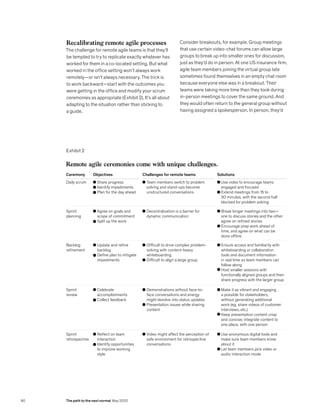
A leader’s guide: Communicating with teams, stakeholders, and communities during COVID-19 25
2
McKinsey surveyed senior executives of large Chinese companies, along with employees from those organizations, in eight industries, from
March 12–18, 2020; 1,300 people responded to the survey.
3
Adapted from David L Sturges’s seminal 1994 work on crisis communication, “Communicating through crisis: A strategy for organizational
survival,” Management Communication Quarterly, February 1, 1994, Volume 7, Issue 3, pp. 297–316.
Give people what they need, when
they need it
Every crisis has a life cycle, and emotional states
and needs vary with the cycle’s stages. In a recent
article, our colleagues framed the COVID-19 crisis in
five stages: resolve, resilience, return, reimagination,
and reform. These stages span the crisis of today
to the next normal that will emerge after COVID-19
has been controlled. The duration of each stage
may vary based on geographic and industry context,
and organizations may find themselves operating in
more than one stage simultaneously (exhibit).
With such variation in mind, communicators should
be thoughtful about what matters most in the
given moment.
— In a crisis’s early stages, communicators must
provide instructing information to encourage
calm; how to stay safe is fundamental. In
COVID-19, governments and major media
outlets first focused on clear, simple instructions
about physical distancing and “lockdown”
guidelines. Companies focused on new opera-
tional rules regarding time off, overtime, and
operational changes.
— As people begin to follow safety instructions,
communication can shift to a focus on adjusting
to change and uncertainty. Asia, where
COVID-19 struck early, offers some helpful
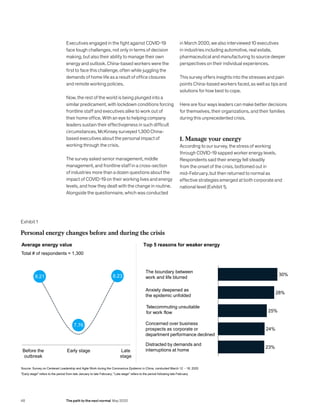
insights. One survey in China, for example,
showed that a marked decline in people’s energy
during the early stages of the epidemic reversed
as they acclimated to increased anxiety and the
blurring of work- and home-life boundaries.2
Savvy communications directors responded by
evolving their messaging from health basics to
business recovery.
— Finally, as the crisis’s end comes into view, ramp
up internalizing information to help people make
sense of the crisis and its impact. For the current
public-health crisis, it’s still too early to glean
the shape of this broader perspective, although
“silver lining” articles about families drawing
closer together and other topics have been
making their way into the media.
The COVID-19 outbreak is a complex crisis made
up of multiple trigger points—health, policy,
the economy—and leaders should tailor their
communications to the stage of the crisis their
stakeholders are experiencing,and to what people
need most in the moment (see sidebar, “Want to
know what people need? Ask them”).3
Scenario
planning becomes important to help anticipate
where employees and communities may be
in dealing with the crisis, and the appropriate
messaging that can help them as the crisis unfolds.
Every crisis has a life cycle, and
emotional states and needs vary with
the cycle’s stages.
26 The path to the next normal May 2020
Communicate clearly,
simply, frequently
At a crisis’s onset, audience attention is finite;
new, disruptive inputs overwhelm a person’s
ability to process information. High levels of
uncertainty, perceived threats, and fear can even
lead to “cognitive freezing.”4
Put simply: the more
complicated, abstract, or extraneous information is
right now, the more difficult it will be for people to
process it.
Leaders may be inclined to defer to governments
and media outlets for clear and simple safety
instructions. Don’t. Employers often underestimate
how much their employees depend on them
as trusted sources. When public-relations firm
Edelman asked workers in ten countries what they
considered the most credible source of information
about the coronavirus, 63 percent of respondents
said that they would believe information about
the virus from their employer, versus 58 percent
that trusted government websites or 51 percent that
trusted the traditional media.5
Exhibit
A leader's guide: Communicating with teams, stakeholders, and communities during COVID-19
Exhibit 1 of 1
Adjust your communication mix by your current crisis stage.
Crisis communication life cycle, illustrative
Mix of
information to
communicate,
by type, %
Employees
are feeling
Crisis stage
Uneasy
Worn down
Confused
Anxious
Ready for change
A sense of loss
Instructing
Adjusting
Internalizing
Resilience
Return/
Reimagination/
Reform
Resolve
What they need Clarity on longer-
term plans
Positive stories
Chances to connect
Facts, not speculation
Clear instructions for
how to protect their
safety
A new vision for the
future
A chance to grieve
4
A body of research shows that people generally suffer from information overload; for more, see Martin J. Eppler and Jeanne Mengis, “The
concept of information overload: A review of literature from organization science, accounting, marketing, MIS, and related disciplines,”
Information Society, 2004, Volume 20, Number 5.
5
Edelman trust barometer 2020 special report: Trust and the coronavirus, Daniel J. Edelman Holdings, 2020, edelman.com.
A leader’s guide: Communicating with teams, stakeholders, and communities during COVID-19 27
To convey crucial information to employees, keep
messages simple, to the point, and actionable.
Walmart published its 6-20-100 guidance: stand six
feet away to maintain a safe physical distance, take
20 seconds for good hand washing, consider a body
temperature of 100 degrees Fahrenheit the signal
to stay home from public activity. Slack CEO Stewart
Butterfield focused on personal care in reassuring
employees stressed over work. “We got this,” he
said. “Take care of yourselves, take care of your
families, be a good partner.”6
When communicating clear, simple messages,
framing and frequency matter:
Dos, not don’ts. People tend to pay more attention
to positively framed information; negative
information can erode trust. Frame instructions
as “dos” (best practices and benefits) rather than
“don’ts” (what people shouldn’t do, or debunking
myths).7
In previous epidemic outbreaks, such as
Zika, yellow fever, and West Nile virus, research
shows that interventions highlighting best practices
were more effective than those focused on
countering misinformation or conspiracies.
Repeat, repeat, repeat. Communicators regularly
underestimate how frequently messages must be
repeated and reinforced. In a health crisis, repetition
becomes even more critical: one study showed that
an audience needs to hear a health-risk-related
message nine to 21 times to maximize its perception
of that risk.8
Fortunately, employee appetite for
regular, trusted information from employers during
COVID-19 is high. In one study, some 63 percent
asked for daily updates and 20 percent wanted
communications several times a day.9
So, establish
a steady cadence, repeat the same messages
frequently, and try mantras, rhyming, and alliteration
to improve message “stickiness.”
Want to know what people need? Ask them.
Standard tools and serendipitous
conversations and moments of
connection can help leaders check in
on their people:
Schedule unstructured time. Add 15 to 30
minutes at the beginning or end of a meet-
ing to tap into what’s on employees’ minds.
Run a quick pulse survey. Ask one simple
question: How are you feeling? Include a
comments box for elaborating.
Invite input on big decisions. When
possible, include people in the process
of choosing paths forward. Offer options.
Community dialogue can shape the
right decision.
Use digital and analytics tools. Two-way
listening solutions enable employees to
share concerns over email or text. Natural-
language software then produces major
themes for managers to review, act on,
and monitor.
Host “well-being check-ins.” Schedule
time for people to come together. These
sessions can host up to 150 people at a
time. Breakout features in some apps
can create smaller groups for more
in-depth conversation.
Solicit questions. When preparing town
halls, give employees a chance to submit
questions in advance (anonymously is ideal).
Or offer the community the option to “vote
up” the questions they most want answered.
Use chat functionality to allow questions.
Engage change agents. If you’ve identified
influencers or change agents, deploy them.
Provide forums for them to hear from peers.
Adjust your communications to reflect this
new input.
6
Catherine Clifford, “CEO of multibillion-dollar company Slack to employees amid coronavirus: ‘Don’t stress about work,’” CNBC,
March 26, 2020, cnbc.com.
7
Building on Daniel Kahneman and Amos Tversky’s seminal 1979 prospect theory, more recent research has examined the impact of 		
highlighting gains and benefits when communicating health information.
8
Lu Liu, Xi Lu, and Xiaofei Xie, “Inverted U-shaped model: How frequent repetition affects perceived risk,” Judgment and Decision Making,
2015, Volume 10, Number 3.
9
Edelman trust barometer 2020 special report: Trust and the coronavirus, Daniel J. Edelman Holdings, 2020, edelman.com.
28 The path to the next normal May 2020
The CEO doesn’t have to be the chief delivery officer.
During a crisis, it’s best if the message comes from
the person viewed as an authority on the subject. For
business continuity, that person may well be the CEO.
But for other topics, people may prefer to hear from a
health expert, the leader of the organization’s crisis-
response team, or even their own manager. Provide
common talking points for all leaders and empower
communication—via town halls, through email, text
messaging or internal social media platforms.
Choose candor over charisma
After establishing baseline safety requirements,
leaders must help individuals cope emotionally
with the trauma of sudden change and adjustment
to a new, postcrisis normal. (COVID-19 threats to
health and safety are likely to linger for some time,
so new messages should be layered atop regular
safety reminders.)
Leaders trying to help employees adjust after
trauma need a reservoir of trust. Those who fail to
build trust quickly in crises lose their employees’
confidence. People expect credible and relevant
information; when stakeholders believe they are
being misled or that risks are being downplayed,
they lose confidence. To build trust, leaders should
do the following:
Focus on facts—without sugar coating.
Differentiate clearly between what is known and
unknown, and don’t minimize or speculate. In crises
like the one we’re facing now, “the facts” may
include bad news about the state of the organization
or changes that will be painful for people. Research
shows that some leaders, used to feeling highly
effective and in control, avoid acknowledging
uncertainty and bad news because they find it
stressful or guilt inducing, or they fear negative
reactions from an audience.10
But unfounded
optimism can backfire. In 1990, during the United
Kingdom’s mad-cow-disease crisis, a government
minister fed his daughter a hamburger in front of TV
cameras and declared that British beef had never
been safer, despite evidence to the contrary. Rather
than boost morale, this effort only further eroded
public trust in the government’s response.11
When you are not able to communicate with
certainty—for example, about when physical
distancing and travel restrictions will be lifted—
avoid hard and fast estimates (for example, “There’s
a 60 percent chance that we’ll be back to normal by
September.”). Instead, be explicit that you’re sharing
an opinion, acknowledge uncertainty, and give the
criteria you will use to determine a course of action
(“It’s my hope that we are back online in the fall;
however, that is far from certain. We will be following
government guidance when making decisions for
our business.”)
Be transparent. Transparency builds trust. Research
shows that transparent operations improve
perceptions of trust and that communicators
perceived to have good intentions are more likely
to be trusted, even if their decisions ultimately turn
out to be wrong. Give people a behind-the-scenes
view of the different options you are considering. For
example, many governments, including Canada and
the Netherlands, have begun publishing extended
timelines during which protective measures will be
in place. Whether or not those timelines hold true,
such difficult messages to deliver ultimately serve to
build greater trust among listeners.
Involve your audience in decision making. When
making operational decisions, involve stakeholders.
For example, many universities have informed
students that commencement this year will not
take place as planned. Rather than canceling
commencement outright, several universities
have instead used short, simple communication to
elicit students’ ideas for staging commencement
differently, preserving some of commencement’s
positive energy.
Demonstrate vulnerability. Judiciously share
your own feelings and acknowledge the personal
effects of emotional turmoil. Research shows that
demonstrating vulnerability, such as grief over
shared losses or authentic feelings about the impact
of changes on employees, can help build trust.
10
Research shows that leaders are often uncomfortable giving bad news; for more, see Robert J. Bies, “The delivery of bad news in 		
organizations: A framework for analysis, Journal of Management, 2013, Volume 39, Number 1, pp. 136–62.
11
David Robson, “Covid-19: What makes a good leader during a crisis?,” BBC, March 27, 2020, bbc.com.
A leader’s guide: Communicating with teams, stakeholders, and communities during COVID-19 29
Mind what you model. What you do matters as
much as what you say in building trust, and scrutiny
of leaders’ actions is magnified during a crisis.
Recently, some leaders have been called out for
setting “do as I say, not as I do” examples. Scotland’s
chief medical officer resigned after public uproar
when she was caught visiting her second home
during lockdown. Hosting a videoconference from
the office might seem like a good way to project
normalcy—but won’t for those attending who are
locked down at home.
Build resilience
As the COVID-19 health crisis turns into a lingering
financial and economic crisis, uncertainty and
doubt will challenge efforts to restore business
confidence. Leaders will face a critical period in
which they will need to instill resilience in people and
tap sources of hope, trust, and optimism in order to
unlock creativity and build momentum for the future.
Channeling positive sentiments and encouraging a
sense of broader community will be critical elements
in building that momentum.12
Celebrate the positives. Sharing positive stories and
creating uplifting moments are important building
blocks in reigniting resilient spirits. It may seem
counterintuitive, but often this approach begins by
acknowledging loss. Denying or averting loss can
make it more likely that people focus on negatives,
especially in times of crisis. However, it is possible to
counterbalance the negative effects of stress and
loss by channeling positive emotions.
Highlight how your organization is responding to the
crisis with stories about how people are adapting
to new ways of working. Or recount how your
organization is contributing to the global COVID-19
response. Show appreciation for the challenges
people face. For example, the “Clap for our carers”
movement in the United Kingdom is a public display
of appreciation for the National Health Service
(NHS), which is now being replicated every night at
7 p.m. in New York City. Many companies have
posted videos on social media thanking their
employees. Especially important is expressing
gratitude to those in the organization who are
leading frontline responses or who face threats
to their safety. In addition to acknowledging them
publicly, having one-on-one conversations with
them or sending personal thank-you notes can
go a long way toward making people feel part of
something important and meaningful, which in turn
helps build resilience.
Help people to help. Helping others is a great way
to improve well-being and reduce stress.13
Amid
crisis, people look for ways to contribute. For
example, following the 9/11 attacks, Dell connected
with employees by channeling their desire to offer
help. Service and response teams worked around
the clock, drawing on Dell’s customer purchase
records, to offer customers immediate assistance
in replacing lost computers and equipment. Such
steps helped employees struggling with grief and
anger to focus on others, give back, and link the
customer’s experience to everyday work.
Build community. It’s important to rebuild a common
social identity and a sense of belonging based
on shared values, norms, and habits.14
Research
suggests that social bonds grow stronger during
times of great uncertainty. Leaders encourage
people to come together under common values of
mutual support and achievement. Queen Elizabeth II
has called upon all Britons to unify and identify—in
discipline, resolve, and fellowship—in the face of
COVID-19. “The pride in who we are is not a part of
our past, it defines our present and our future,”
she said.15
Any effort to create a shared social identity must be
grounded in a sense of support for others. Practical
ways to encourage this when people are working
remotely include book clubs, pub quizzes, happy
hours, exercise classes, chat groups, competitions,
and so on. Complement this kind of broad outreach
with one-to-one communication via phone, email, or
video to individuals or small teams. Arrange a virtual
breakfast, an end-of-week celebration, or even
video “tours” of each other’s workspaces.
12
For more on positive psychology in the workplace, see Fred Luthan and Carolyn M. Youssef, “Positive organizational behavior in the workplace:
The impact of hope, optimism, and resilience, Journal of Management, 2007, Volume 33, Number 5, pp. 774–800.
13
Adam Grant, Give and Take: Why Helping Others Drives Our Success, New York: Viking, 2013.
14
For more on leadership and shared identity, see S. Alexander Haslam, Michael J. Platow, and Stephen D. Reicher, “The New Psychology of
Leadership: Identity, Influence and Power,” Routledge, 2010.
15
“The Queen’s coronavirus speech transcript: ‘We will succeed and better days will come,’” Telegraph, April 5, 2020, telegraph.co.uk.
30 The path to the next normal May 2020
Out of chaos, meaning
As people adapt, effective leaders increasingly
focus on helping people to make sense of events.16
The search for meaning is intrinsic to recovery from
trauma and crisis. For many, the workplace is a
powerful source of identity and meaning. Research
has shown that meaning and associated well-being
can explain up to 25 percent of performance.17
Leaders can shape a meaningful story for the
organization and help people build their own stories,
invoking common culture and values as touchstones
for healing and strength. In their messaging, they
underscore a shared sense of purpose, point to how
the organization can rally at a generation-defining
moment, and indicate new paths to the future.
Leaders can take the following steps to help people
move from making sense of events to deriving
meaning from them:
Set clear goals and ‘walk the talk.’ Early on, be clear
about what your organization will achieve during
this crisis. Set a memorable “mantra”—the two or
three simple goals around which people should rally.
Then take actions to realize those goals, because
you communicate by what you do as much as by
what you say. For example, during the COVID-19
crisis, Best Buy has defined a dual goal to protect
employees while serving customers who rely on
the company for increasingly vital technology. The
company has made clear that employees should
only work when healthy, and that those who feel
sick should stay at home, with pay. US stores have
instituted “contactless” curbside service or free
doorstep delivery.18
Connect to a deeper sense of purpose. Explore
ways to connect the disruption employees face to
something bigger. For some organizations, this may
dovetail with the goals of an ongoing transformation,
such as serving customers in new ways. For others,
meaning can be found in a deeper, more collective
sense of purpose or mission. For example, the
chief surgeon at one New York hospital closed an
all-staff memo by reminding people that “[patients]
survive because we don’t give up.”19
In the United
Kingdom, the government appeals to strong
national sentiments with the simple message: “Stay
home, protect the NHS [National Health Service],
save lives.”
Foster organizational dialogue. While it’s important
to shape a story of meaning for your organization,
it’s equally important to create a space where others
can do the same for themselves. Ask people what
conclusions they are drawing from this crisis and
listen deeply. Some possible questions: Have there
been unexpected positive outcomes of this crisis for
you? What changes have you made that you would
like to keep once the crisis has ended?
The immediacy and uncertainty of the coronavirus
crisis tempts leaders to “shoot from the hip” in
communicating with anxious stakeholders or
making strategic moves. Effective communicators
will take a deep breath and remember the basics
while acknowledging what is unique about this
moment. Relying on these practices will help team
members stay safe and infuse understanding
and meaning in communities, helping to carry the
organization through the pandemic with a renewed
sense of purpose and trust.
16
For more on sensemaking, including the importance of leadership, see Marlys Christianson and Sally Maitlis, “Sensemaking in organizations:
Taking stock and moving forward,” Academy of Management Annals, 2014, Volume 8, Issue 1, pp. 57–125.
17
Thomas A. Wright, “More than meets the eye: The role of employee well-being in organizational research,” Oxford Handbook of Positive
Psychology and Work, Oxford University Press, 2009, pp. 143–54, oxfordhandbooks.com.
18
“Best Buy committed to providing products people need,” Business Wire, March 21, 2020, businesswire.com.
19
Craig Smith, “COVID-19 Update from Dr. Smith,” Columbia University Irving Medical Center, March 27, 2020, columbiasurgery.org.
A leader’s guide: Communicating with teams, stakeholders, and communities during COVID-19
Copyright © 2020 McKinsey & Company. All rights reserved.
Ana Mendy is a partner in McKinsey’s Southern California office, Mary Lass Stewart is an expert in the Chicago office, and
Kate VanAkin is an expert in the London office.
The authors wish to thank Aaron De Smet, Wojciech Kurda, Carlos Miranda, Mihir Mysore, Joe Spratt, Mrinalini Reddy, and
Andrew Samo for their contributions to this article.
31
Decision making in
uncertain times
The timeline for companies to react to the coronavirus has shrunk dramatically.
Here are five principles that leaders can follow to make smart decisions quickly
during the pandemic.
© TwilightEye/Getty Images
by Andrea Alexander, Aaron De Smet, and Leigh Weiss
32 The path to the next normal May 2020
Leaders know that making good, fast decisions
is challenging under the best of circumstances. But
the trickiest are those we call “big bets”—unfamiliar,
high-stakes decisions. When you have a crisis of
uncertainty such as the COVID-19 pandemic, which
arrived at overwhelming speed and enormous scale,
organizations face a potentially paralyzing volume of
these big-bet decisions.
The typical approach of many companies, big
and small, will be far too slow to keep up in such
turbulence. Postponing decisions to wait for more
information might make sense during business as
usual. But when the environment is uncertain—and
defined by urgency and imperfect information—
waiting to decide is a decision in itself. For instance,
delaying the decision to cancel noncritical surgeries
can mean not freeing up physician and hospital
capacity now and potentially exposing or infecting
more people.
To make bold decisions quickly in these uncertain
times, leaders can follow these five principles.
1. Take a breath
Pause and take a breath—literally. Giving yourself
a moment to step back, take stock, anticipate,
and prioritize may seem counterintuitive, but it’s
essential now.
When asked what makes a great hockey player,
Wayne Gretzky is said to have answered, “A good
hockey player plays where the puck is. A great
hockey player plays where the puck is going to be.”
That is easier said than done. In a crisis atmosphere,
it is tempting to jump from one urgent task to the
next, to take charge of what’s right in front of you—
to just execute. Yet this can be a tragic mistake.
Research shows that the simple act of pausing, even
for as little as 50 to 100 milliseconds, allows the
brain to focus on the most relevant information.1
A dramatic example of a leader who paused
during a landscape-scale crisis is Captain Chesley
Sullenberger. After a bird strike caused both of his
plane’s engines to fail shortly after takeoff from
LaGuardia Airport in January 2009, he had very
little time to decide whether to try to land at a nearby
airport, as the control tower was urging, or to aim for
a water landing. With no training for such a scenario,
he stopped and reflected for a matter of seconds—all
that he could afford—to determine if he could get to
the airport safely and instead pivoted to the Hudson
River for landing.2
All 155 people on board survived.
There are several ways decision makers can take
a breath:
— After telling your team you need a moment to
think, try to gain a broader perspective.
— Imagine yourself above the fray, observing the
landscape from above. This is what leadership
expert Ronald Heifetz calls a “balcony”
perspective. Despite the “fog of war” that might
obscure much of the current state of play, do
your best to take a broader view.
— Ask yourself and your team these questions:
What is most important right now? What might
we be missing? How might things unfold from
here, and what could we influence now that
could pay off later?
This ability to anticipate how things might unfold—
and to begin to act accordingly—can help avoid
knee-jerk reactions that lead to poor outcomes.
In the coronavirus context, if you are a leader of
a grocery-store chain, you are seeing a drastic
increase in purchases. You must think about your
supply chains, whether to ration items, and how
to put safety protocols in place for customers.
In addition, there are the questions of whether to
modify store hours, whether to limit service
to curbside pickup and delivery only, and how to
handle staffing. All of these decisions are related,
so you must pause and prioritize the most pressing
issues first. That also means having the discipline to
ignore distractions.
1
Vincent P. Ferrera, Jack Grinband, and Tobias Teichert, “Humans optimize decision-making by delaying decision onset,” PLOS ONE,
March 5, 2014, Volume 9, Number 3, journals.plos.org.
2
For more information on the US Air Force’s observe, orient, decide, and act (OODA) loop, see Mark Bonchek and Chris Fussell, “Decision
making, Top Gun style,” Harvard Business Review, September 12, 2013, hbr.org.
Decision making in uncertain times 33
2. Involve more people
Amid uncertainty generated by a crisis, leaders
often feel an urge to limit authority to those at the
top, with a small team making the big decisions
while huddled behind closed doors. They should
reject the hierarchical model that they might be
more comfortable with in normal times and instead
involve many more stakeholders and encourage
different views and debate. This approach can lead
to smarter decisions without sacrificing speed.
Specifically, leaders can use a so-called fishbowl
model in which decision makers and key experts sit
around a table—or virtual table—to make a decision
(exhibit). At the table are one or two decision makers,
multiple experts, and one or two “empty seats”
for other relevant stakeholders in the gallery to
rotate in as they have points to share. A majority of
stakeholders observes the meeting, which builds
understanding without having to make an extra
communication step afterward.
In an in-person meeting, stakeholders watching the
fishbowl can contribute information and ideas by
temporarily taking one of the empty seats, briefly
participating in the meeting, and then returning to
the gallery. In a virtual meeting, the stakeholders are
on mute but can participate by “raising their hand,”
with a moderator inviting them in and unmuting them.
There are several steps leaders can take to involve
more people:
1. Clarify the decisions to be made.
2. Identify a small number of decision makers.
3. Identify who should have a voice, including
relevant stakeholders and experts, and those
who will implement decisions.
4. Create a forum for rapid debate to take place. Be
clear that everyone has a voice but not a vote.
When following this approach, it is possible to
involve a large number of stakeholders and experts
without sacrificing speed. Especially when things
are unfamiliar and the decisions you are considering
are bold, you need many points of view to make sure
the decision makers aren’t missing something.
Once decisions are made, you can quickly pivot and
speak to those who will be executing the decisions
to clarify the actions to be taken, timelines, and
accountabilities and answer any questions they
have about what comes next. This not only saves
time, by removing a communication step, but it can
also enhance the potency of the message itself.
In today’s crisis atmosphere, waste-management
leaders are likely experiencing a big shift in
demand for their services. There is more household
waste that needs pickup and less waste from
office buildings and restaurants. How can these
companies better accommodate the shift in
demand? This decision should include a wide range
of stakeholders, including representatives of the
Exhibit
[COVID-19] Decision making in
uncertain times
Exhibit 1 of 1
Involve more people and move faster
using a ‘fishbowl’ format.
Digital
decision-
making
table
Decision
maker
“Empty
seat”
Expert Relevant
stakeholder
34 The path to the next normal May 2020
frontline employees (who may have good ideas
about routes and which employees to deploy for
which shifts) and the customers.
3. Make the critical small choices
Some small choices that leaders make in the short
run could loom very large over the long term as the
crisis unfolds. They can be hard to spot, but leaders
must look for them.
In the normal course of business, many big-bet
decisions are obvious. There’s a large cost or major
impact, such as acquiring a company, marketing
a product in a new geography, or shutting down a
factory, with these decisions. But some decisions
that seem small or routine at first can have large
long-term strategic implications.
In an example related to coronavirus, Netflix has
gone to lower-resolution streaming in some locations
to ease the data load on information networks. While
most people won’t notice the difference in quality,
the decision could mean that the internet doesn’t
crash, which would be a big problem when so many
are working from home and children are relying on
the internet to do their schoolwork.
There are several steps leaders can take to make
critical small choices:
1. Anticipate multiple possible scenarios for how
things might unfold over time. No one has a
crystal ball, and detailed, precise predictions
are likely to be wrong because things are in flux.
Anticipating a range of possible pathways and
general scenarios can be extremely helpful in
thinking through what might happen.
2. Make a list of five to ten choices or actions
that making today might, depending on what
happens, make a difference later. If we fast-
forwarded six months and identified a small
decision or action that would have made all the
difference if we had taken it, what might that
decision or action be?
3. Engage others to help identify which small
decisions or actions you should address now, in
case they become the difference makers down
the road. Which of these should you spend
time on today? Which should you monitor and
reconsider later? These decisions could range
from actions to save cash and ensure liquidity to
actions to beef up the resilience of your supply
chain by quickly exploring alternative suppliers.
The response to the Boston Marathon bombings in
2013 is a good example of a critical small choice that
made a big difference. The decision was made to
disperse severely injured people to eight different
hospitals. While some of those hospitals were
farther from the bombing site, vascular surgeons
were called to those locations to begin operating
right away. If victims had been sent only to the
closest hospitals, many would have had to wait for
surgery and possibly bled to death.
4. Set up a nerve center
In stressful times, leaders will have to make
more big-bet decisions than before and also will
be worried about their people. When making a
high-stakes decision, it’s important to be able to
focus attention on the issue at hand. That means
minimizing distractions. If a leader is too frenzied,
they are likely to make errors in judgment. Creating a
nerve center can help leaders focus on the strategic
decisions rather than the tactical ones.
A strategic decision comes with a high degree
of uncertainty, a large likelihood that things will
change, difficulty in assessing costs and benefits,
and a result of several simultaneous outcomes. A
tactical decision comes with a clear objective, a low
degree of uncertainty, and relatively clear costs
and benefits. Tactical decisions are important—
sometimes crucial. Yet they are often better left to
those on the edges of an organization who can act
effectively without raising issues to higher levels.
One way to ensure that the right people will be
the ones making tactical decisions is to set up a
Decision making in uncertain times 35
Leaders with the right temperament
and character are necessary during
times of uncertainty. They stay curious
and flexible but can still make the tough
calls, even if that makes them unpopular.
In wartime, you want a Winston
Churchill, not a Neville Chamberlain.
nerve center. This is a network of cross-functional
teams with clear mandates connected by an
integration team that sees that decision making
occurs thoughtfully and quickly. Each team focuses
on a single area or scope; often, the teams are
for workforce protection, supply chain, customer
engagement, and financial stress testing. There is a
central team that keeps everyone coordinated and
ensures collaboration and transparency. In a crisis,
leaders should set up the nerve center quickly and
with the knowledge that it won’t be perfect.
Hospitals deal with emergencies all the time
and are well equipped to do so. However, the
COVID-19 pandemic is different. It requires setting
up a nerve center so that decisions on staffing and
the allocation of scarce resources can be made
more quickly and by the right people. Some tactical
decisions that might have been made in the nerve
center, such as the allocation of ventilators and
the scheduling of elective surgery, will now need
to be considered strategic decisions. It might be
a strategic decision to convert a university dorm
or hotel to a hospital space, but making sure the
space is functional is a tactical decision for the
nerve center.
5. Empower leaders with judgment
and character
During business as usual, some people who get
ahead are of a certain type. They say the right
things, don’t ruffle feathers, know how to navigate
the system, and manage messages so that people
hear what they want to hear. Many of these usual
suspects, who typically are tapped to lead special
initiatives, are ill suited to lead in a landscape crisis
of uncertainty.
Leaders with the right temperament and character
are necessary during times of uncertainty. They
stay curious and flexible but can still make the tough
calls, even if that makes them unpopular. They
gather differing perspectives and then make the
decisions, with the best interests of the organization
(not their careers) in mind, without needing a full
consensus. For decisions within their delegated
authority, they escalate only the trickiest problems
for input or approval. In wartime, you want a Winston
Churchill, not a Neville Chamberlain.
When making the move to empower other leaders,
don’t just pick the usual suspects to lead your
36 The path to the next normal May 2020
response—some of them will be cut out for duty
in times of uncertainty, but some will not. When
choosing leaders, identify people who have done
as many of the three following things as possible to
increase the likelihood of them being successful in
the current times of uncertainty:
— lived through a crisis (personal or professional)
and shown their mettle and personal resilience
— made a tough, unpopular decision because it
was the right thing to do, despite the fact that
they took heat for it and potentially burned
bridges or spent social capital
— willingly given bad news up the chain of
command to leaders who didn’t want to hear it
You may not be able to find enough leaders in your
organization who meet all three criteria but beware if
you empower leaders who meet none of them.
Once you have identified these leaders, encourage
them to find their inner Churchill: remind empowered
leaders that you expect them to make decisions
with imperfect information. They should not strive to
be perfect, as perfect is the enemy of speed. Make
mistakes and learn from them. Do what is right, even
when it is not popular.
Go big or go home
Unprecedented crises demand unprecedented
actions. Lessons from past crises suggest that
leaders are more likely to underreact. What is
necessary is to take the bold and rapid actions that
would feel too risky in normal times.
Denmark recently made such a decision when
it froze the economy to head off a recession—or
worse. The Danish government agreed to pay 75
percent of private-company employees’ salaries,
provided the companies don’t lay off workers. The
government is paying workers to stay home and not
work, spending 13 percent of the national economy
in three months. We don’t know yet whether this
policy will accomplish its objectives, but it does offer
an example of the kind of bold decision in a crisis
that leaders may wish, down the road, that they had
made or at least considered.
Lest businesses think such a bold reaction isn’t
relevant to them, we are already seeing corporate
examples. The National Basketball Association
decided early on that it would shut down its season,
leading other sports to take similar actions. Apple
was among the first large retailers to close most of
its stores globally in response to the coronavirus.
Emirates has decided to suspend most of its
flights until “travel confidence returns.” And some
Hollywood studios are releasing current movies
straight to streaming platforms, acknowledging this
new reality for us all.
Decision making amid uncertainty is not easy.
Business leaders cannot afford to wait when events
are moving as fast as they are right now. We believe
these five principles of decision making can help
leaders make smart decisions quickly to guide their
organizations through this crisis. Embrace them, and
continue to learn as you go.
Copyright © 2020 McKinsey & Company. All rights reserved.
Andrea Alexander is an associate partner in McKinsey’s Houston office, where Aaron De Smet is a senior partner; Leigh
Weiss is a senior expert in the Boston office.
The authors wish to thank Chris Gagnon, David Mendelsohn, and Vanessa Monasterio for their contributions to this article.
Decision making in uncertain times 37
Applying past leadership
lessons to the coronavirus
pandemic
Three seasoned leaders describe what they learned from managing through
past crises.
© Gearstd/Getty Images
by Hugo Bague, Jeff Cava, and Manley Hopkinson
38 The path to the next normal May 2020
Savvy managers understand the fundamentals of
crisis management, at least on the theoretical level.
Their careers rise and fall on an individual’s ability
to rally their teams, project deliberate calm and
empathy, take decisive action, and communicate
effectively. The most fortunate among them
have not had to face a crisis like the coronavirus
pandemic now rampaging through the global
community to devastating effect.
But there are managers out there whose stories
and experiences of leadership in moments of
disruption and upheaval can be instructive. To
learn more, we spoke with three senior advisers to
McKinsey with just such experience. Hugo Bague
was group executive of organizational resources
at Rio Tinto during the Ebola crisis in 2015–16. Jeff
Cava was chief human-resources officer (CHRO) at
Nike during two major economic crises, executive
vice president, administration, at Wendy’s in 2003,
during the SARS outbreak, and CHRO for Starwood
Hotels and Resorts during the financial and swine-
flu crises of 2009. And Manley Hopkinson served
as an officer in the Royal Navy during the first
Gulf War, set a record skiing to the magnetic north
pole, and has sat on the board of directors at Atlas
Consortium, Hewlett Packard Defence UK, and Ark
Data Centres. We spoke with them individually but
present their comments here in a virtual roundtable
format.
McKinsey: During a crisis, top-down leadership
doesn’t always engender stability. What’s your
experience at balancing central control with
delegating responsibility locally?
Manley Hopkinson: It is vital that a leader resist
centralizing control. The temptation in a time of crisis
is for leaders to put themselves at the center of all
activity. It’s an understandable desire to ensure all is
well, even though precisely the opposite is needed.
To decentralize and create a network of teams
requires absolute clarity on intent and priority. A
leader cannot empower a team if there is any
uncertainty in direction or priority. And even while
prioritizing short term and making priorities crystal
clear, leaders still need to keep the long-term
direction and purpose in mind. On my race to the
north pole, in our team of three, one person focused
on the near and tactical, ensuring that we crossed
each crevasse safely. A second person took the lead
role and focused on the far horizon, making sure we
did not go around in circles. The “leader” is not in
front, making all the immediate decisions. They are
following, navigating a course to the future.
Now, for example, I advise a number of organizations
whose work is critical to the functioning of the
United Kingdom’s national infrastructure. For
them, the safety of their people is paramount, but
subservient to the integrity of the nation’s ability
to operate. This clarity of purpose, intent, and
priority, long term and immediate, allows teams and
individuals to be fully empowered. It enables teams
of teams to make the right decisions, and it enables
decisions to be made where the information lies.
That is key.
Hugo Bague: Not every decision should be made
by the central office headquarters. Local teams
are often the best positioned to judge the situation
on the ground—and their decisions should not be
second-guessed. For example, in 2015, we had
4,000 employees in Guinea during the Ebola crisis.
The mortality rate was high, so naturally we had to
decide if we should send home all the expatriate
employees—knowing that they would then lose
all credibility and never be able to go back? We
delegated that to the team. We said, “You are
the best to make that assessment, because we
can’t judge the health risk on the ground for you
as expats.” And the team decided that the expats
themselves would stay, but their families went
home. After six months, we established a rotation
so that expats could go visit their families even while
maintaining skilled leadership on the ground.
Corporate couldn’t have made that call. They
would probably have brought everybody home.
But let’s be careful with words: autonomy doesn’t
mean in isolation. We said clearly, whether you stay
Applying past leadership lessons to the coronavirus pandemic 39
in Guinea or not is your call. But we want to have a
discussion with you to ensure that you’ve looked
at it at every angle. And in the end, no employees
contracted Ebola.
McKinsey: That kind of collaboration takes work.
What kinds of teams can do it?
Hugo Bague: A team with defined roles and
responsibilities can do it, but decision making
must be even more clear and concise in a crisis
than in other situations. There also needs to be
accountability, so that even when there are different
people and different departments giving input, at
the end of the day, there is a single decision maker.
That needs to be clear. And the whole leadership
team should maintain discipline in speaking as
one around a decision. There can’t be any internal
criticism or questions around decisions, because in
a crisis the organization is fragile.
Jeff Cava: If there is a thin veneer of cooperation
and collaboration, it will be immediately exposed.
If, on the other hand, there are genuine, honest
relationships among senior leaders, you’re going
to have a much better functioning crisis team. If
there are weaknesses, if there are cracks in the
team functioning, it will fray quickly in times of
stress. It sounds obvious, but many leaders don’t
understand that when people are under extreme
pressure, they revert to interpersonal styles that
tend toward preservation over collaboration. If your
team dynamics aren’t in a decent shape, crises will
amplify the dysfunction.
At Wendy’s during the SARS crisis, we made
decisions informed by people on the front lines. The
way we were structured helped us. Our organization
was structured in a way that allowed for the efficient
communication of information from the stores up
the chain to the C-suite. We had store managers
who were all connected to district managers who
were connected to division managers who in
turn were connected to the head of operations.
We had a good communication network and
we received great input. In the C-suite in larger
corporations, we tend to focus on strategy, big ideas,
in the abstract. But in these situations, we needed
tactical decisions, and needed them quickly. We
needed to address the issues in a way that makes
sense in the environment of the store.
Manley Hopkinson: A coherent culture creates
the environment that allows teams to work
independently and with each other. A common
understanding and common language of the tools of
leadership and collaboration are vital. For example,
when the whole organization uses a consistent
tool for delegation, then delegation is consistently
effective. It comes back to clarity again.
There also needs to be accountability,
so that even when there are different
people and different departments giving
input, at the end of the day, there is a
single decision maker.
40 The path to the next normal May 2020
McKinsey: Leaders want to come across as
grounded and reassuring. But there’s a fine line
between reassuring and saying something that’s
overly optimistic. How does that play out in real-life
communications?
Manley Hopkinson: I love the expression
“deliberate calm,” recognizing the work of
Albert Mehrabian on the emotional context of
communication. As he quantified it, communication
is 55 percent visual, 38 percent tone, and only
7 percent what you say. It takes a great deal of
consciousness from leaders in the midst of crisis
and upheaval to maintain a balance that is neither
too negative nor overly optimistic. They need
to recognize that they are always on stage but
accept that they, too, are still human and can make
mistakes. In a time of crisis, we need leaders to raise
their levels of consciousness and be acutely aware
of how they are being perceived.
Jeff Cava: At different times, we’ve had to make
pretty sizable reductions in force. During the
2008 financial crisis, we reduced our nonproperty
head count at Starwood by a substantial amount.
After we did the first round, everyone wanted to
say, “That’s it, no more, you can all go back to your
jobs—everything is great.” I, along with others,
strongly urged against that, and we didn’t make that
commitment. Because we didn’t know what was
going to happen. And indeed the economic situation
did worsen before we finally stabilized and began
recovering. People depend upon our statements
as leaders and often plan important decisions
based on the information we give them. To make a
commitment of that importance and then not follow
through destroys the trust that we strive to create
with our associates.
It comes down to the old adage: honesty is the best
policy. Ask yourself, “Is my statement absolutely
true? If I’m required to do something to make it true,
can I do it?” We couldn’t promise uninterrupted
employment, because we didn’t know what was
going to happen in the economy. This was an
unprecedented economic disaster. The desire was
to give people relief and confidence. But you can’t
give them false relief and false confidence. That’s
hard for a compassionate leadership team, but you
have to push yourself.
Hugo Bague: In times of crisis and uncertainty,
you need leadership to show stability. There are
many things you don’t know, but you can still
bring stability by structure. We had daily calls and
daily communications at a fixed time with all the
employees through mobile phone—and we did
that daily for 18 months. Bringing structure into the
lives of people, you take things under your control.
That helps with the mental health and stability of
employees, which one should not underestimate in
a time of crisis. People have questions around their
families, their jobs, and many topics, so any stability
you can provide is quite important.
It takes a great deal of consciousness
from leaders in the midst of crisis
and upheaval to maintain a balance
that is neither too negative nor
overly optimistic.
Applying past leadership lessons to the coronavirus pandemic 41
Concern for employees and the
communities within which companies
do business doesn’t need to be in
conflict with concern for ensuring
a going commercial enterprise.
Jeff Cava: At Starwood, I believe we were well
positioned to communicate using all modalities. This
was an internal capability we had built up over time—
quick group videoconferences, real-time video
clips that we could send throughout the world, well-
crafted talking points and FAQs, local in-person
group meetings with our CEO. We integrated
communications in the internal machinations of
the business. We didn’t just call when we needed
to communicate; our communications experts
were part of the ongoing business operations and
leadership team.
We had practiced crisis communications
regularly throughout the year. We would bring
representatives from the organization to participate
in a simulated crisis and work together to resolve
it in real time. That allowed us to do two things:
pressure test our ability to communicate and the
content of our messaging. But more important, it
let us pressure test the personal and interpersonal
relationships among the crisis-management teams
before we were in crisis.
McKinsey: Companies want to protect their
customers and their employees but also be fair to
investors and shareholders. How do you balance
those objectives?
Jeff Cava: Concern for employees and the
communities within which companies do business
doesn’t need to be in conflict with concern for
ensuring a going commercial enterprise. Boards in
particular are concerned with both. Obviously, they
have a financial duty to their shareholders and as
importantly have a genuine concern for how their
and the company’s reputation are perceived. At the
end of a crisis, management and the board will be
judged by how well they balance this relationship.
Successful solutions look for actions that can
combine the best interests of both.
At both Wendy’s or Starwood, the goal was to
preserve the workforce. Both industries have
high staff turnover. Employees often work hourly
and have a lot of financial pressure. We needed to
preserve our connection with them so they would
continue to feel connected to the company. Hourly
workers can migrate quickly. If you don’t create
a genuine relationship between them and the
business, they will lose and you will lose in the long
term. I think boards need to keep that as a central
theme in their considerations.
McKinsey: Can you say more about how boards
of directors balance concern for the humanitarian
side of the crisis with their responsibilities to
shareholders?
Jeff Cava: Sometimes they can do both. But
sometimes people get their goals and motives
confused. A corporate board is very concerned
with protecting its reputation. It wants a sensible
business solution, operating in a constructive
economic reality. But at the same time, it wants to
be seen as altruistic to the general public.
42 The path to the next normal May 2020
As a leader, you have to be able to meet both
objectives. You have to be able to present that
you’re not just concerned about your profits and
balance sheet but also that you’re concerned
because it serves the greater good of those
200,000 employees. Because you’ll need them
and you’re also concerned about the investment
you’ve made in these people and that they’ve made
in the company. This is going to serve your economic
interests and well as their personal interests. This
is the way the whole communication process and
problem-solving process needs to be structured.
CEOs don’t need to be bleeding hearts. On the
other hand, they also shouldn’t be so mercenary
so they forget they’re part of a system—of people,
customers, and economic outcomes. They need
to approach the problem that way. Net–net for us,
whether Wendy’s or Starwood, a really important
goal, as I said earlier, was to preserve the workforce.
We needed to preserve them so they could preserve
us, whether at hotels or restaurants. If you don’t
create stickiness between your associates and the
business, they will lose and you will lose over the long
term. I think the board needs to understand that.
Manley Hopkinson: Leadership based on
understanding and not control—trusting that
people know what to do—allows companies to turn
a crisis around into an opportunity to shake things
up. It allows them to challenge existing ways of
doing things, to develop your people and let them
take more responsibility. There’s an opportunity
to nurture a greater sense of empowerment and
ensure the leader’s thinking continues to include
people’s needs and growth.
Leaders in a crisis tend to stop what they consider
to be peripheral activities to focus on survival.
I’ve seen leaders who immediately stopped any
leadership or personal development at exactly the
point when their people were under most stress
and most pressure, when their performance would
be even more important. That is a fundamentally
flawed way of thinking. People development and
team building are not peripheral activities. They are
key. It is in a time of crisis that you need to ask more
of people. You need their commitment and energy,
both to tackle the crisis and to continue a journey of
growth when it’s over. I have always been pleasantly
surprised how people react and grow in crisis if they
feel valued and empowered and if we can ensure, as
leaders, that our actions reinforce that reality.
Copyright © 2020 McKinsey & Company. All rights reserved.
Hugo Bague is a senior adviser in McKinsey’s Zurich office, Jeff Cava is a senior adviser in the Boston office, and Manley
Hopkinson is a senior adviser in the London office.
This article represents edited comments from phone and video interviews moderated by Gila Tolub, a partner in McKinsey’s
Tel Aviv office.
Applying past leadership lessons to the coronavirus pandemic 43
Positive leadership in
uncertain times
Most leaders are struggling to find the right path through the COVID-19
crisis. Acting on three imperatives can help pave the way.
© marrio31/Getty Images
by Liz Hilton Segel
44 The path to the next normal May 2020
For business leaders, the COVID-19 pandemic
has accelerated unprecedented change. More
than ever, the health of businesses is urgently and
visibly linked with the health of workforces, the
health of our society, and the health of our planet.
Previously unimaginable shifts in our daily lives
are compelling companies to adapt quickly and
identify creative, unconventional ways to operate
and survive. Worldwide uncertainty makes it
more difficult for leaders to find their footing—and
those who like to operate from a place of clarity are
finding few ports in this global storm.
The question most leaders are facing, then, is this:
How do we move forward in such uniquely uncertain
circumstances? Positive, effective leadership helps
us navigate crises, rebuild communities, and forge
ahead in moments of ambiguity. But with so many
challenges colliding at once, many leaders may be
struggling to chart a clear way forward.
To gain that foothold and respond effectively,
leaders should act on three imperatives:
clarifying your purpose, supporting your
stakeholders, and bolstering your emotional
and organizational resilience.
The first step is to rediscover or reemphasize your
purpose. The temptation for businesses in moments
of crisis is often to get small, to hunker down and
zero in on bottom-line fundamentals and metrics.
Now, instead of narrowing their focus, leaders in a
crisis should consider pulling back and reminding
themselves of their guiding principles. Emphasizing
purpose will also signal your intentions to the wider
world, instilling confidence and goodwill among
stakeholders who share your principles. In times of
change, workers, consumers, and investors alike
will gravitate toward organizations whose purpose
reflects their personal values and beliefs.
The second step is to ask what actions you can
take to protect and support those who rely on
you and the organization—especially those
who may be particularly vulnerable or whose
needs are becoming increasingly acute. That
means taking stock of who your stakeholders
are—from customers and investors to employees,
communities, and society as a whole. It means
identifying what they need—and recognizing
that these needs may differ in each case. And
it means determining how you can serve them
most effectively, from short-term decisions like
how to continue operations at a time of physical
distancing, to long-term considerations such as
whether to prioritize employees’ current wages
or equity for retirement. It may also include
potentially redesigning supply chains to support
local employment while also strengthening the
resiliency of operations. Your stakeholders are
the people who drive and measure your success,
and particularly when success feels elusive,
recommitting to them can galvanize the trust,
confidence, and morale required to forge ahead.
The third step is to prioritize your emotional and
organizational resilience. Even with a strong
purpose and a plan to serve your extended
community, your progress may not be immediately
apparent. You will need to marshal resolve in
order to stay the course—and to handle the
kind of attention that comes from doing so. To
make that adjustment, identify and access the
actions and behaviors that make you a more
thoughtful and capable leader—whether that
involves making time for activities that restore your
energy, pursuing the space you need to gain
perspective, or simply ensuring that you are
getting the sleep you need. In short, find balance.
Worldwide uncertainty makes it more
difficult for leaders to find their footing.
Positive leadership in uncertain times 45
Equally important is empowering the right teams.
When faced with an overwhelming volume of
critical decisions, leaders may feel the urge to limit
authority and tighten control. But organizational
resilience depends on more stakeholders and
perspectives, organized across a network of cross-
functional teams with clear mandates. Empowering
leaders with the right temperament and character—
those who stay curious and flexible and are willing
to make the tough, even unpopular calls—is vital for
thoughtful and swift decision making.
Every step involves choices that are tough to make
even in good times, let alone in uncertain ones,
but the same instincts and actions that will see us
through this current global crisis will also make
us stronger as we face longer-term challenges.
The ability to understand who we are and what
we value, recognize our responsibilities and our
opportunities, and chart a course based on our
most fundamental goals while supporting our own
emotional resilience and that of our organization—
these are skills that will fortify us in the years and
decades ahead. As we navigate an uncertain road
today, our approach to this moment will inform the
way we lead tomorrow.
Copyright © 2020 McKinsey & Company. All rights reserved.
Liz Hilton Segel is a senior partner in McKinsey’s New York office.
This essay first appeared in the Milken Institute’s Power of Ideas collection focused on building and rebuilding lives in the face
of the COVID-19 pandemic. The essay series features insights from thought leaders across industries. Read their contributions
and share your thoughts using #PowerofIdeas. Find more coverage on the Milken Institute LinkedIn page.
46 The path to the next normal May 2020
Re-energizing through the
epidemic: Stories from China
A survey of China-based executives sheds light on the personal impact of
working through the COVID-19 crisis.
© Prasit photo/Getty Images
by Haimeng Zhang, Tianwen Yu, Bernie Yang, Lihong Pan
Re-energizing through the epidemic: Stories from China 47
Personal energy changes before and during the crisis
Total # of respondents = 1,300
Average energy value
24%
23%
Concerned over business
prospects as corporate or
department performance declined
Anxiety deepened as
the epidemic unfolded
30%
The boundary between
work and life blurred
25%
Distracted by demands and
interruptions at home
28%
Top 5 reasons for weaker energy
Source: Survey on Centered Leadership and Agile Work during the Coronavirus Epidemic in China, conducted March 12 - 18, 2020
"Early stage" refers to the period from late January to late February; "Late stage" refers to the period following late February
Telecommuting unsuitable
for work flow
8.21 8.23
7.76
Before the
outbreak
Early stage Late
stage
Exhibit 1
Personal energy changes before and during the crisis
Executives engaged in the fight against COVID-19
face tough challenges, not only in terms of decision
making, but also their ability to manage their own
energy and outlook. China-based workers were the
first to face this challenge, often while juggling the
demands of home life as a result of office closures
and remote working policies.
Now, the rest of the world is being plunged into a
similar predicament, with lockdown conditions forcing
frontline staff and executives alike to work out of
their home office. With an eye to helping company
leaders sustain their effectivqeness in such difficult
circumstances, McKinsey surveyed 1,300 China-
based executives about the personal impact of
working through the crisis.
The survey asked senior management, middle
management, and frontline staff in a cross-section
of industries more than a dozen questions about the
impact of COVID-19 on their working lives and energy
levels, and how they dealt with the change in routine.
Alongside the questionnaire, which was conducted
in March 2020, we also interviewed 10 executives
in industries including automotive, real estate,
pharmaceutical and manufacturing to source deeper
perspectives on their individual experiences.
This survey offers insights into the stresses and pain
points China-based workers faced, as well as tips and
solutions for how best to cope.
Here are four ways leaders can make better decisions
for themselves, their organizations, and their families
during this unprecedented crisis.
1. Manage your energy
According to our survey, the stress of working
through COVID-19 sapped worker energy levels.
Respondents said their energy fell steadily
from the onset of the crisis, bottomed out in
mid-February, but then returned to normal as
effective strategies emerged at both corporate and
national level (Exhibit 1).
48 The path to the next normal May 2020
Effective approaches to personal energy management
53%
48%
46%
38%
33%
28%
26%
24%
18%
16%
7%
2%
Shift perspectives, accept and convert negative emotions while actively
seeking new breakthroughs or reinventing ways of work
Set time for interactions with family members, deepen relations with
them and differentiate the time for family from that for working
Communicate with family members fully and candidly
to understand and support each other's needs and emotions
Ensure smooth communication with customers and listen to their demands
Manage physical and mental energy through reading, exercising, and resting
Use new media to collaborate remotely with colleagues
Show care for colleagues and deepen mutual trust
Create new opportunities for professional development based on own advantages
Make and follow a regular work plan, and switch your role by changing what you wear
Participate in philanthropic activities to support epidemic control
Purchase new gadgets for working from home
Others
Approaches to energy management
Total # of respondents = 1,300
Source: Survey on Centered Leadership and Agile Work during the Coronavirus Epidemic in China, conducted March 12 -18, 2020
Exhibit 2
Effective approaches to energy management
The blurring of work and home life was the leading
cause of lower energy levels (30 percent), followed by
pandemic-related anxiety (28 percent).
Business leaders outside China are likely suffering
similar stresses, and are potentially in danger of
experiencing fatigue, having difficulty concentrating,
or suffering from burnout. Fortunately, it is possible
to maintain energy levels and reduce the negative
impacts of working from home by applying the
following principles, beginning with techniques to
manage your energy and maintain a positive outlook:
(Exhibit 2).
Energize the body
Almost half of respondents said they sustained
energy levels by taking small breaks to exercise, read,
or rest. Other “micro recovery” techniques include
10-minute meditation sessions in the mornings and
evenings. These aim to identify physical discomfort
by mentally scanning the body, allowing breathing
to deepen and relax, as you check each part of
yourself in sequence. Whatever technique you use,
it is essential to have a means of breaking from the
working routine while keeping yourself active.
Communicate with family
Aside from keeping yourself in shape, open and
honest communication with family helps sustain
emotional energy, according to 46 percent of our
sample. Almost all respondents said that the quality
of communication and intimacy with their family
(spouse, parents, and children) greatly improved in
the mid- and late-stages of the epidemic.
Conserve mental energy
Focusing intensely on the epidemic, whether it’s
monitoring the latest news or government measures,
or even discussing the impact of the crisis with
friends, can be mentally and emotionally exhausting.
Over time, your ability to concentrate on epidemic-
related work will weaken as your mind seeks respite.
Re-energizing through the epidemic: Stories from China 49
When this happens, take 10-12 minutes to exercise,
listen to music, or watch an entertaining or relaxing
video. Doing this periodically can help declutter
your mind and allow you to concentrate for longer
stretches of time.
2. Find meaning
Aside from replenishing your physical, mental, and
emotional energies, it’s also helpful to tap into the
meaning you derive from your work. McKinsey
research identifies five sources of meaning in work:
societal, organizational/corporate, client/target,
team, and personal. Usually, company leaders
focus on society and the organization, while their
employees identify more closely with the latter
three elements.
However, our research suggests the COVID-19
pandemic is galvanizing entire organizations as their
work becomes essential to keeping society and the
economy afloat. The sense of purpose and drive many
are finding as a result of the outbreak, whether it be
working on the frontlines of the healthcare response,
or around the clock to keep companies in business
and staff employed, instills the motivation to rise to
crisis-related challenges.
Stories from the frontlines:
Finding value in remote work
While working from home, the sales
vice president of a large real estate
company gained a unique opportunity
to communicate more deeply with her
husband, children, and parents. Sharing
views on the news while keeping each
other going during the outbreak deepened
their family bonds. Moreover, she believes
that while business suffered during the
lockdown period, her company will take
For example, the CEO of a leading pharmaceutical
company said that when the Hubei province capital
of Wuhan was locked down, she organized a cross-
divisional emergency team to fight the epidemic.
The team helped fast-track approval of a drug that
improves immune systems, and mobilized supply
chain resources to ensure patients in Wuhan could
receive essential drugs. They also cooperated with
digital companies to build free, online virtual clinics,
enabling remote diagnosis and treatment. “The
outbreak highlighted our value to the public, making
me proud to be part of the healthcare industry,” she
said, adding that the sense of meaning inspired by the
battle against the epidemic also made her team more
passionate, and brought them closer together.
Pursue meaningful work
The CEO found a sense of meaning and spiritual
energy from epidemic-fighting and charity work.
If you want to identify the meaning of your work,
try posing this question: “Where does my sense
of meaning/value come from?” Look back on your
career and recall the moments that you are most
proud of, or that made you feel most accomplished
or content. Try recalling the details: What did you
do? What did others say to you? How did you
feel? Deep dive into the key factors that make you
positives from the experience: “We’ve
established a habit of working online and
communicating remotely, which will save
us a lot of time and travel-related expense
in future,” she said. “Even frontline sales
teams forced to deal with clients online
achieved impressive results, instilling
the confidence to continue with the remote
model after the epidemic. here at the
very end, so like this: ....model after
the epidemic.
50 The path to the next normal May 2020
opportunity to lift company morale and motivation.
In the late- and post-epidemic stages, it is worth
considering how to position your organization so that
it continues to contribute to society and community,
in the process offering a source of spiritual energy for
you and your team.
Our survey indicates that a majority of China-based
employees are aware of or have participated in
corporate social responsibility activities related
to the COVID-19 outbreak, including giving donations
or providing volunteer services. Senior executives
tend to engage most deeply in such activities
(Exhibit 3). The challenge is to disseminate the sense
of meaning and value derived from that participation
as deeply as possible through the company.
proud or fulfilled: Is it being recognized, deploying
your capabilities and strengths, building sincere
relationships, or contributing to the welfare and
development of others?
Once the source of meaning is identified, consider
whether you have devoted enough time and energy
into work that delivers this sense of meaning. If not,
formulate a plan to adjust your way of working to
make sure you feel fulfilled.
Create meaning
This example illustrates a larger truth: that employees
can derive a sense of meaning in their work once
they realize the contribution their company makes to
society. The epidemic consequently represents an
Three tips to reduce negative
emotional energy:
1.	Create a separate workspace: In order
to keep the boundary between work and
life distinct, try to confine work to a study
space during normal office hours, while
enjoying “me time” and recreational
activities that help you relax, such as
reading and listening to music, in the rest
of the house.
2.	Maintain open communication: Openly
communicate your work responsibilities
and pressures, explain the familial
support you might need, and actively
seek and suggest ideas for how you
can support your family in turn. For
example, help your family understand
that 8:00 -12:00 and 13:30- 18:00
are working hours; but the hour after
lunch and dinner is free for discussion,
relaxation, or helping with housework.
3.	Set clear priorities: Despite these
boundaries, being distracted at home is
inevitable. One of the best techniques to
maintain energy and work efficiency is
to focus on priorities. Set priorities when
several tasks arrive at the same time, so
you can focus on one task at a time, and
avoid becoming confused and exhausted
by trying to manage them concurrently.
A majority of China-based employees
are aware of or have participated in
corporate social responsibility activities
related to the COVID-19 outbreak.
Re-energizing through the epidemic: Stories from China 51
3. Get creative
Accepting negative emotions and channeling
them into new ways of thinking was the primary
means by which China-based workers maintained
their energy amid the epidemic, according to
our survey. However, processing the torrent of
epidemic-related information limits our capability
to change perspective. Follow these tips to
maintain a positive outlook:
Focus on solutions
Seeking the reasons for why something happened,
who was to blame, or which procedures failed, only
serves to limit our thinking and generate negative
energy. Instead, ask solution-based questions to
help change perspective. These might include, “What
can I do to improve epidemic-prevention measures,
prepare the company to resume work, or marshal
resources to address the problem?” Assessing what
Exhibit 3
Corporate Social Responsibility (CSR) initiatives during the COVID-19 outbreak in China
Total # of respondents = 1,300
Avg.
75%
31%
3%
41%
9%
Senior
management
39%
28%
4%
40%
31%
Middle
management
1%
45%
29%
Frontline
staff
76% 75% 75%
Q: Has your company taken actions to perform its social responsibilities during the outbreak, such as giving
donations and providing volunteer services? What about yourself?
Participated in individual
philanthropic activities
Limited participation in philanthropic
activities organized by the company
Deep participation in philanthropic
activities organized by the company
Source: Survey on Centered Leadership and Agile Work during the Coronavirus Epidemic in China conducted on March 12 - 18, 2020
Most respondents said their companies engaged in CSR actions related to the outbreak; senior
executives engaged most deeply
52 The path to the next normal May 2020
Stories from the frontlines: Coordinating
an epidemic response from home
At 5 p.m. on Monday, February 17, the head
of the passenger vehicle department of
a large auto group was under pressure to
keep his staff safe, and arrest a significant
slide in performance related to the COVID-
19 outbreak. “We had six colleagues in
Hubei whose work was severely impacted,
and we were very concerned about their
health and safety, as well as that of their
families,” the department head said. “I had
a call with the company president the night
before the meeting, but we failed to pin
down a recovery strategy. Colleagues were
also anxious about the prospects for the
company and our department.” Meanwhile,
as he prepared to lead a video conference
call on epidemic response and management
with his team, the remote working model
imposed as a result of China’s nationwide
lockdown posed challenges of a different
nature. “My son, who is in first grade, would
interrupt me; my wife was also occupied
with remote work; and my parents, who
had come to Shanghai for the Lunar New
Year, were unhappy that I had locked myself
in the study, and did not have time to do
house work or communicate with them. ...or
communicate with them.
you can do as an individual, and what support you
might need to hit your target—not to mention what
you might learn from the experience of accomplishing
the task at hand—all help develop a positive attitude.
4. Engage and connect
The daily deluge of COVID-19 news is distracting,
making it easy to lose track of your priorities.
However, the following process can help you define
meaningful work targets, and stay on track to
achieving them.
Set positive aspirations
We often respond to our environments instead
of taking active control of our lives because we
are unable or unwilling to identify our aspirations
for life and work. Try to understand your aspirations
more clearly by asking yourself the question,
“What do I want today?” or “What do I want
from tomorrow?”
Stay focused
Frequently review what you are focusing on, and
whether this aligns with your aspirations. For
example, did you spend a lot of time on menial work
instead of addressing a harder but more rewarding
task? If you stray off course, ask what can you do to
rectify the problem. Over time, this process should
become a habit that keeps you safe from distraction.
Build relationships
In the midst of the COVID-19 pandemic, employees
will inevitably feel anxious and insecure about their
job prospects. Such circumstances provide a perfect
opportunity for leaders to reframe a potentially
difficult time as an opportunity to build deeper trust
with staff, customers, and family.
Re-energizing through the epidemic: Stories from China 53
Changes in family relations during the crisis
Total # of respondents = 1,300
Q: What changes did you experience in your relationships with your family during the outbreak, compared with
before the epidemic?
I have spent more time accompanying them I have got more
time to communicate with them and show my care for them
Life has become easier Our understanding of each other's
working state and pain points has deepened
I have found it pleasing to handle trifles/watch TV with them/be
with my kids
I have become aware that families come to the fore as my life
and health are threatened
We lack a sense of distance
Helping kids with their homework is tiresome I have to make
meals for my family every day, which is energy consuming
Different roles I need to play have pressured me and worsened
my mood, which is easy to hurt my relations with my family
My husband and I are both working from home, and our
differences in looking after the elderly and our kids have
widened
Source: Survey on Centered Leadership and Agile Work amid the Coronavirus Epidemic in China, conducted March 12 - 18, 2020
35.0
60.0
5.0
Closer
As usual
Less close
Exhibit 4
Changes in family relationships during the COVID-19 crisis
With the widespread imposition of remote working
policies, 53 percent said they had spent more time
with their families than they usually would, with
the tendency most pronounced among senior
management (73 percent). Twenty percent said they
had spent less time with family.
The impact on family relationships was primarily
positive, with 35 percent of respondents suggesting
they have become closer to their families than
before the outbreak. They said the experience
deepened mutual understanding of working roles and
difficulties, while providing more scope to care for
and play with loved ones. The threat to health posed
by the outbreak also reinforced the importance
of family (Exhibit 4).
In the midst of the COVID-19 pandemic,
employees will inevitably feel anxious
and insecure about their job prospects.
54 The path to the next normal May 2020
Haimeng Zhang is a senior partner in McKinsey’s Hong Kong office; Tianwen Yu is an expert associate
partner in the organization practice; Bernie Yang is an OrgSolution senior coach in McKinsey’s Shanghai
office, where Lihong Pan is an organization expert.
The authors also wish to thank Glenn Leibowitz, Bo Peng, John Qu, Vera Tang, Arthur Wang, Pin Wang,
Fangning Zhang, and Gaobo Zhou.
However, working from home is not without its
challenges. “My son, who is in first grade, would
interrupt me; my wife was also occupied with
remote work; and my parents, who had come to
Shanghai for the Lunar New Year, were unhappy
that I had locked myself in the study, and did
not have time to do house work or communicate
with them,” said the head of the passenger vehicle
department of a large auto group.
Navigating the COVID-19 crisis will likely be among
the sternest test company leaders have ever faced
in their working lives, demanding an unprecedented
degree of personal discipline and focus. By following
the steps outlined here, business leaders may be
better equipped to navigate the crisis.
Re-energizing through the epidemic: Stories from China
Copyright © 2020 McKinsey  Company. All rights reserved.
55
56
Organizing
the response 58
Responding to coronavirus:
The minimum viable
nerve center
66
Getting ahead of the
next stage of the
oronavirus crisis
77
To weather a crisis, build a
network of teams
57
Responding to coronavirus:
The minimum viable nerve
center
Amid the coronavirus pandemic, companies need a crisis response coordinated
by top management that gives experts and managers the autonomy to implement
creative, pragmatic solutions.
by Mihir Mysore and Ophelia Usher
© ThomasVogel/Getty Images
58 The path to the next normal May 2020
The COVID-19 outbreak, caused by the coronavirus
(SARS-CoV-2), is a deep humanitarian crisis that
has also gravely affected the global economy. It is
posing difficult—even unprecedented—challenges
for business leaders. They are finding that the fast-
moving situation is impervious to familiar remedial
actions. By the time a response is mounted, the
situation has changed, and the scale, speed, and
impact of issues have unexpectedly intensified.
Leaders everywhere have experienced some
form of such disruption, though the magnitude of
the present crisis is trying the lessons of human
experience. The struggle to avoid ineffective,
reactive approaches has consequently been all the
more difficult.
Together with many leading companies, we have
developed a better approach—a flexible structure
for guiding the work—called the integrated nerve
center. In an unfamiliar crisis, such as the COVID-19
outbreak, the nerve center concentrates crucial
leadership skills and organizational capabilities and
gives leaders the best chance of getting ahead of
events rather than reacting to them.
The integrated nerve center is not a formulaic
panacea. It is, rather, an efficient means of
coordinating an organization’s active response to
a major crisis. It is endowed with enterprise-wide
authority and enables leaders and experts to test
approaches quickly, preserve and deepen the
most effective solutions, and move on ahead of the
changing environment. In hundreds of discussions
conducted in the past few weeks, we have looked at
the efforts of many companies now in the process
of building COVID-19 nerve centers. We feel that the
insights of this common experience are of wide and
pressing importance.
Discover, decide, design, deliver:
Lessons from past crises
Common crisis-management failures arise
according to the demands of the crisis, which can
be understood in a fourfold manner. The first task
of crisis management is to discover the current
situation and form an accurate view of how it might
evolve, deriving implications for the organization.
From discovery, leaders must move on to decide on
and design the necessary immediate and strategic
actions, speedily establishing a pragmatic, flexible
operating model. This model is ideally based
on adequate stress testing of contextualized
hypotheses and scenarios. It should also adhere to
company and societal values. Finally, companies
must deliver the solutions in a disciplined and
efficient way, with enough built-in flexibility to
accommodate late pivotal changes. In real crises,
things go awry in each of these four categories:
— Inadequate discovery. This is a failure to
invest in an accurate, full determination of
In an unfamiliar crisis, the nerve center
concentrates crucial leadership skills
and organizational capabilities and
gives leaders the best chance of getting
ahead of events rather than reacting
to them.
59
Responding to coronavirus: The minimum viable nerve center
the depth, extent, and velocity of the crisis.
Companies typically reflect an optimist bias in
initial assessments, for example, and then in
subsequent reassessments as well. Eventually
the false hopes embodied in these inaccurate
assessments become obviously insupportable,
at which point, however, the crisis has worsened,
and much valuable time and resources have
been wasted.
— Poor decision making. Most poorly handled
crises are defined by poor decision making. Bad
decisions can result from many causes, such as
acting on incomplete information (action bias).
In our experience, reluctance to act until “all
the facts are in” is a more common fallacy. The
tendency for decision makers to analogize a
new and unfamiliar situation to past experience
(pattern recognition) is another serious pitfall.
Groupthink and political pressure commonly
lead decision makers astray. Reputations—and
sometimes, compensatory incentives—are
often at stake in large, expensive projects.
Consequently, undue pressure can be exerted
to push through an unforeseen problem
whose resolution is disregarded or seen as
insufficiently important to revise timelines and
budgets. Relatively minor arising technical
issues can, by this dynamic, become major
problems and even lead to catastrophic failures.
— Constrained solution design. Many crises
have one or more technical causes—the
problem in itself—that must be addressed
with tailored solutions. These solutions must
be either newly invented or imported to a new
domain. Responding organizations must not
allow themselves to be constrained by poor or
inadequate solution designs. The immediate
technical solution for diagnosing COVID-19—
the starting point for treatment solutions—is
the effective test. A type of test known as
polymerase-chain-reaction (PCR) testing,
developed in China, Europe, and South Korea
for the disease, has become the standard for
effective testing and is now being produced
at scale around the world. The test was first
produced in Germany in January 2020, not long
after COVID-19 appeared in China. Yet in the
United States, the presence of an ineffective test
delayed the adoption of the effective one for a
crucial early period in the spread of the virus.
— Delivery failure. For anyone with actual
experience in handling a crisis, execution failure
is a constant risk. Small contingent (random)
failures can cause larger failures of the most
well-thought-out plans. Faulty solutions
can command undue loyalty from managers
suffering from “operations addiction”: instead
of recognizing the root problem, responsible
parties look for patches to preserve the flawed
response. Chaotic conditions will necessarily
cause disruptions, but the presence of
accountable leaders with good judgment and
the freedom to act and improvise as needed can
minimize execution delays and failures.
Responding organizations must not
allow themselves to be constrained by
poor or inadequate solution designs.
60 The path to the next normal May 2020
The COVID-19-response structure
The nerve center is designed to resolve these four
challenges under the heavy pressures of a major
crisis. Certainly, companies and institutions are
facing such a crisis with the COVID-19 outbreak,
which has triggered travel restrictions, border
closings, supply-chain disruptions, and work
stoppages across the globe. The exhibit shows one
example of a COVID-19-response structure.
In this example, the nerve-center structure is
organized around five teams, each responsible
for a number of work streams. It is designed as an
agile structure, coordinated through an integration
team, but there is enough autonomy of action
granted to constituent team leaders to work through
bottlenecks and keep the response moving.
Nerve-center integration team
The nerve-center integration team is the
coordinating head of the larger nerve-center
structure. Its purpose is to set the overall tone of
the COVID-19-response work, acting as a single
Exhibit
GES 2020
Nerve Center (COVID)
Exhibit 1 of 1
The integrated COVID-19 nerve center is based on five cross-functional teams.
CFO
Financial
analyst
Legal
Treasury
Financials
stress testing
Strategy
or business-
development
manager
Head of
HR
Workforce
protection
Head of
procurement
Procurement
manager
Regional
supply-chain
managers
Logistics
manager
Supply-chain
stabilization
Supply-
chain
analyst
Employee
communications
HR
full-time
leader
Head of
sales and
marketing
Incentive
managers
Financial
analyst
Customer
communications
SKU
manager
Customer
engagement
Project
coordinator
Scenario-
planning
analyst
Senior
C-suite
leader
Epidemiological
expert
Nerve-center
integration
team
Legal
Security
Ombudsperson
Agile structure to manage
crisis discovery, decision
making, solution design,
and execution
Cross-functional teams
coordinated by nerve-
center integration team
Teams manage workforce,
supply chain, customers,
and financials
Integrated COVID-19
nerve center
61
Responding to coronavirus: The minimum viable nerve center
source of truth, in real time, for all information and
actions related to the outbreak and response. It
must maintain close two-way communication with
all teams. It is headed by a senior C-suite leader
and includes an epidemiological expert, a project
coordinator, and a scenario-planning analyst. The
organization should empower this team to command
whatever resources it deems are necessary to
integrate closely and accomplish the work of the
other four teams. The team’s responsibilities can be
summarized as follows:
— acting as the single source of truth for
issue resolution
— ensuring that sufficient resources are deployed
where and when needed
— coordinating the portfolio of remedial actions
across the work streams of all teams, based on
scenarios and triggers
— aligning team leaders on scenarios, with
the help of roundtables and other exercises
as needed
Workforce protection
For most organizations, business as usual cannot
be expected to reign during the COVID-19 outbreak.
Organizations need to develop a plan to support
employees that is consistent with conservative
health and safety guidelines. The plan must be
flexible enough to accommodate policy changes
as needed through the outbreak. It is useful for
companies to compare their efforts in this domain
with the actions that other organizations of similar
size are taking, to determine the right policies and
levels of support for their people.
The most helpful workforce-protection models
provide clear, simple language to local managers on
how to deal with COVID-19 that is consistent with
the guidelines provided by WHO, national health
organizations (such as the US Centers for Disease
Control and Prevention), and local health agencies.
The model should provide managers with a degree
of autonomy sufficient to allow them to deal with
any quickly evolving situation. Free two-way
communication is also important so that managers
can monitor adherence to policies as they evolve
and employees can safely express their reservations
about personal safety, as well as any other concerns.
The recommended workforce-protection team
includes the head of HR (team leader); the HR full-
time leader; representatives from security, legal, and
employee communications; and the ombudsperson.
The workforce-protection team is charged with the
following work streams:
— developing brief policy papers, issue-escalation
criteria and call trees, and actions (including
preventative actions), as needed
— managing multichannel communications,
including confidential feedback and
reporting channels
— aligning policies and incentives for third-party
and real-estate contractors
— establishing or maintaining communications
platforms to enable employees to work from
home (necessary infrastructure includes
a virtual private network, telephony, and
broadband readiness), including, as appropriate,
deployment of collaborative software tools to
enable video and audio conferencing, screen
sharing, “whiteboarding,” polling, chat, and
other interactive capabilities
— helping manage productivity, using such means
as staggered work times; respecting social-
distancing norms; and instituting health checks
— developing “issue maps” and clear ownership
and deadlines for issue resolution
— engaging with local, state, and national political
leaders and health officials
Supply-chain stabilization
Companies need to define the extent and likely
duration of their supply-chain (including tier-one,
-two, and -three suppliers) exposure to areas that
62 The path to the next normal May 2020
are experiencing community transmission and
their inventory levels. Most companies are now
primarily focused on immediate stabilization, given
that, in China (where few new COVID-19 cases are
being reported), most plants are now restarting. In
addition to supporting supplier restarts, companies
should explore bridging strategies, including
supply rationing, prebooking logistics capacity
(shipping, rail, and airfreight), using after-sales
stock, and gaining higher-priority status from
suppliers. Companies should plan to manage
supply for products that may be subject to unusual
spikes in demand as they come back on line. In
some cases, longer-term stabilization strategies
may be necessary. Here, companies will have
to use updated demand planning, optimize their
networks further, and identify new suppliers. These
approaches may be generally warranted to ensure
enduring supply-chain resilience against risks
beyond COVID-19, once the crisis is over.
The supply-chain-stabilization team will include the
head of procurement (team leader), the procurement
manager, a supply-chain analyst, the regional
supply-chain managers, and the logistics manager.
This team will manage four work streams:
— ensuring risk transparency across tier-one,
-two, and -three suppliers; supporting supplier
restarts; managing orders; and ensuring the
qualifications of new suppliers
— managing ports, prebooking logistics capacity,
and optimizing routes
— identifying critical parts, rationing parts as
needed, and optimizing locations
— developing scenario-based sales and operations
planning for SKU-level demand and managing
the planning for production and sourcing
Customer engagement
Companies that truly navigate through disruptions
often succeed because they invest in their core
customer segments and anticipate those segments’
needs and actions. In China today, for example,
while consumer demand is down, it has not
disappeared—far from it. People have dramatically
shifted toward online shopping and ordering for
all types of goods, including for food and produce
delivery. Companies should invest more in online
channels as part of their push for multichannel
distribution. The investment should include ensuring
the quality and delivery of goods sold online. Keep in
mind, too, that changing customer preferences may
not return to preoutbreak norms.
The customer-engagement team will include
the head of sales and marketing (team leader), a
financial analyst, and managers for customer
communications, customer incentives, and SKUs.
The customer-engagement team will manage
three work streams:
— communicating to B2B customers (through a
dedicated site) and developing scenario-based
risk communications
— intervening as needed across the customer
journey to prevent leakage, training customer-
facing employees, and monitoring customer-
service execution
— developing customer communications about
COVID-19 situations and practices, as well as
fact-based reports on COVID-19-related issues
Financials stress testing
Companies need to develop business scenarios
tailored to their own contexts. Experts using
analytics can define the values for the critical
variables that will affect revenue and cost.
Companies should model their financials (cash flow,
profit and loss, and balance sheet) in each scenario
and identify triggers that might significantly
impair liquidity. For each trigger in each scenario,
companies should define moves to stabilize the
organization. Such moves could include optimizing
accounts payable and receivable, cost-reduction
measures, and divestment or MA actions.
The financials-stress-testing team will include
the CFO (team leader), the leader of strategy or
63
Responding to coronavirus: The minimum viable nerve center
business development, the leader of treasury, a
representative from legal, and one or more financial
analysts. The team will manage two work streams:
— developing relevant scenarios based on the
latest epidemiological and economic outlooks
— assembling relevant financials data according
to different scenarios, especially working-
capital requirements
Getting started quickly: The minimal
viable nerve center
A common pitfall in nerve-center design is needless
complexity. A good way of avoiding this is to aim at
a minimal viable nerve center. Companies taking
this approach quickly assemble the bare essentials
needed to get operations up and running. The core
nerve-center group, which might include all the team
heads, will shape the structure, as needed, as the
crisis evolves. Experience points to four essential
elements that should be put in place right away.
Nerve-center organization
The teams need to be staffed quickly, with
individual roles, responsibilities, and
accountabilities made clear. Flexibility will be an
important principle, since roles will change over
time, sometimes quite rapidly. Also important
is that nerve-center leaders be authorized to
make timely decisions, sometimes without the
opportunity to syndicate with other leaders.
Operating cadence
Meetings should be limited to those in which vital
deliberations are conducted and actions decided
on. They should, however, be frequent enough to
foster collaboration. Ensure that meetings address
essential topics and elicit the best thinking for the
relevant work streams. The responsible members
for each work stream should have the opportunity to
seek input from the coordinating leaders. Solutions
should be tested and decisions made to commit to
effective methods and set aside ineffective ones.
Select meeting attendees with care: Meetings
of only senior leaders tend to encourage purely
upward reporting rather than constructive debate
and real problem solving. Meetings with too many
frontline managers and individual contributors can
become overly focused on tactical issues rather
than the central problems. The difficulty of a high-
quality operating cadence lies in maintaining a basic
underlying structure and then allowing flexibility so
that the organization can pivot when it needs to.
Issue identification
The nerve center will first identify the critical issues
present in each work stream, with the expectation
that these will evolve over time. Issues should be
described in an issue map for risks and threats. In
their totality, these maps will represent the core
problem statement for the crisis situation and allow
the group to articulate and address the challenges
clearly and relatively quickly. The mapping can be
divided between immediate, addressable risks and
unforeseen, arising threats. Risk maps can be longer
and more comprehensive; threat maps, however,
can address the biggest issues—those that could
drive significant disruption as the crisis continues.
Some known COVID-19 risks, such as those
posed to traveling employees, could be readily
addressed with policies (such as travel restrictions).
Unforeseen threats that could arise as the crisis
continues can be anticipated in “premortem”
workshops. Nerve-center teams therein work
out possible responses—ones to take if, for
example, a sudden gap should open in the supply
chain because of policies imposed beyond the
company’s control.
Once companies establish a good understanding of
the critical issues across all work streams, they will
find it helpful to run financial calculations (balance
sheet, cash flow, and profit and loss) on issues and
responses. This will project scenarios for particular
issues, allowing companies to form views on issue
likelihood, timing, and magnitude.
Response plan
Leaders can find it extremely difficult to craft
sensible goals during a crisis. Many trade-offs
usually have to be made between ideal outcomes
64 The path to the next normal May 2020
Copyright © 2020 McKinsey  Company. All rights reserved.
Mihir Mysore is a partner in McKinsey’s Houston office; Ophelia Usher is an expert in the New York office.
The authors wish to thank Kevin Carmody for his contributions to this article.
and the many real constraints the organization
faces. Once more realistic goals reflecting the
trade-offs are arrived at, they can be assigned a few
milestones and key performance indicators (KPIs)
so that progress toward them can be tracked in
simple ways.
Additional elements
A few other elements can become helpful as the
nerve center evolves. For the COVID-19 crisis,
these could include common operating pictures,
giving a single view on the current status of the
response; KPI dashboards, to confirm whether or
not hoped-for outcomes are being achieved; and
listening posts, which are early-warning indicators
that can point out forthcoming changes in the
trajectory of a crisis.
The cultural challenge
The hard truth about effective business leadership
is that leaders operate within powerful cultural and
social contexts. The largest organizations, with
hundreds of thousands of employees, might appear,
in normal business conditions, to operate according
to a command-and-control structure. The reality is
more complex. While large organizations use many
top-down, pyramid-like structures and processes,
these work only when outcomes are predictable. On
the other hand, routinized ways of working impede
the creativity and flexibility that organizations need
to respond at speed amid a crisis.
The exhibit of the integrated-nerve-center structure
we have offered is not meant as a precise instruction
manual. It is a general outline in need of contextual
tailoring from organization to organization. The form
described is most applicable to large corporations
with global supply chains. For financial institutions,
the structure would give little prominence to
supply-chain stabilization and much more weight to
financials stress testing. The structure is, however,
adaptable for any large organization and can be
effectively deployed in any crisis. From a business
standpoint, the COVID-19 outbreak is a particular
kind of crisis, quite different from those affecting
a single large, multinational company. Rather, it is
more like the financial crisis of 2008 to 2009, in
that it presents as a shock to the greater part of all
global economic activity: all the more reason that
organizations need to concentrate leadership and
capabilities in a fast-acting, integrated nerve center.
With senior-leadership support and participation,
the nerve-center structure can provide the
organizational parameters that companies need
to navigate through the disruptions caused by
the COVID-19 outbreak. The approach works
because it enables a coordinated response led
by top management while also giving experts and
managers the autonomy they need to implement
creative, pragmatic solutions.
65
Responding to coronavirus: The minimum viable nerve center
Getting ahead of the next
stage of the coronavirus crisis
First the virus, now the economic fallout—you need to launch your
plan-ahead team.
by Martin Hirt, Sven Smit, Chris Bradley, Robert Uhlaner, Mihir Mysore, Yuval Atsmon, and Nicholas Northcote
© Cavan Images/Getty Images
66 The path to the next normal May 2020
The COVID-19 pandemic is spreading at an
extraordinary speed. You have put a crisis team in
place and are doing all you can to keep your people
safe, stay on top of your business, and deal with the
uncertainty amid constantly changing conditions.
However, that isn’t likely to be good enough.
Close on the heels of the coronavirus outbreak, the
next wave of disruption—the biggest economic
shock since World War II—is headed our way. And
it isn’t just an economic shock: it is a shock to
customer behaviors and business models too.
The challenges associated with it will be orders
of magnitude bigger than what we are used to
dealing with. To handle them, you need to adopt an
operating model that accommodates the extreme
level of uncertainty facing your business.
Most companies will be very vulnerable to the
economic fallout of extended public- and employee-
isolation measures. As the number of issues your
business is facing will likely rapidly escalate, there
are two practical steps you can take to help
stay ahead:
1. Launch a PLAN-AHEAD TEAM to get ahead of
the next stage of the crisis.
2. Direct that team to work across multiple time
horizons, using five frames.
The plan-ahead team will help elevate your view
above the day-to-day response that your crisis
team is managing. Its objective is to enable modular,
scalable thinking that any CEO needs to navigate
this unprecedented and rapidly evolving situation.
The plan-ahead team will deliver a STRATEGIC
CRISIS-ACTION PLAN to guide and accelerate your
decision making.
Launch a plan-ahead team
Military organizations, which specialize in dealing
with large-scale crises, often establish granular
structures accountable for highly specific tasks,
such as operations, communication, and intelligence
gathering. However, they all use plan-ahead teams
for key decision makers to leverage when dealing
with complex and escalating sets of issues.
Your plan-ahead team should be charged with
collecting forward-looking intelligence, developing
scenarios, and identifying the options and actions
needed to act tactically and strategically. Unlike a
typical strategy team, it will have to plan across all
time horizons (two, four, and seven days; two and
four weeks; one and two quarters; one and two
years; and the next normal) to enable you to stay on
top of escalating issues and the decisions that you
need to make in this time of high uncertainty.
A plan-ahead team delivers scenarios,
recommendations for actions, and trigger points to
the CEO and the management team so that they can
decide on the right course of action. The decisions
will be communicated to the crisis team or other
parts of the organization for execution. If further
clarification is necessary, the plan-ahead team will
do another turn, collecting further information to
reduce uncertainty.
Importantly, the structure of the plan-ahead team
is modular, with individual cells focusing on specific
issues across time horizons. As new issues come up
or time horizons expand, you may need to add new
cells. This will enable the team to scale in line with
the magnitude of the crisis (Exhibit 1).
While staff from a regular strategy group may form
part of a plan-ahead team, the team’s responsibilities
are far from the strategy function’s usual purview.
Planning ahead today requires a dedicated effort,
with a full-time senior executive leading and
accountable for a team of ring-fenced high-potential
employees located “next door” to the CEO.
As a first task, the team needs to develop a
day-one version of a strategic crisis-action plan
by working through the five frames outlined in
the next section of this article. Speed is of the
essence, and waiting for perfect answers can
be counterproductive: you need to deal with
uncertainty, not let it bottleneck your decision
making. Your plan-ahead team will need to update
67
Getting ahead of the next stage of the coronavirus crisis
and improve plans continually by integrating new
intelligence as it becomes available.
Work across multiple time horizons
using five frames
The best response to navigating through the
COVID-19 crisis and the subsequent recovery will
differ based on a company’s circumstances. For
some, simply staying calm and carrying on will
be the optimal approach. Others may need to
undertake radical restructuring of their cost bases
and business models immediately.
Even as you assess the best course forward, the one
thing you shouldn’t do is rely on what we frequently
see in regular strategic-planning processes:
ducking uncertainty altogether or relegating it to a
risk analysis at the back of the presentation deck.
You can use a strategic crisis-action plan to guide
your response through the next stages of the crisis
as events unfold (Exhibit 2).
To produce this plan, you need to confront
uncertainty head on. Your plan-ahead team needs
to work through the following five frames:
1. Gain a realistic view of your starting position.
2. Develop scenarios for multiple versions of
your future.
3. Establish your posture and broad direction
of travel.
4. Determine actions and strategic moves that are
robust across scenarios.
5. Set trigger points that drive your organization to
act at the right time.
Exhibit 1
COVID Getting ahead
Exhibit 1 of 5
A plan-ahead team is modular, with cells focusing on specific issues across
time horizons.
Immediate response to COVID-19 crisis:
Safeguard your day-to-day business
Getting ahead of next stage of crisis:
Launch your plan-ahead team
COVID-19 crisis team COVID-19 crisis team COVID-19 plan-ahead team
WG WG
WG WG
WG WG
WG WG
PG PG
PG
WG
PG
Work from home Business continuity
Supply
chain
Working group (WG) for issue Modular, scalable planning group (PG) for issue
Client
support
68 The path to the next normal May 2020
Exhibit 2
Getting Ahead COVID
Exhibit 2 of 5
A strategic crisis-action plan guides responses to a crisis’s unfolding stages.
Starting position (baseline and crisis context)
This week
Zoom will run out of
capacity
Need to increase
ventilator production
4-fold
Exports 40% down
Government bailouts
offered
2–4 weeks
Capacity running out
Supply-chain instability
1–2 quarters
Liquidity position
1–2 years
Growth likely to
return
Next normal
Business challenged
postcrisis (eg, cruise
ship)
Business demand
greater postcrisis (eg,
home delivery)
Scenarios (issues and opportunities)
This week
All exports shut down
Share buyback unwise
Need for/conse-
quences of accepting
government bailout
2–4 weeks
Access and nonaccess
Claims on production
Collaboration across
players
1–2 quarters
Nationalization
MA wave
Market rebound ahead
of fundamentals
No revenues
Price controls
1–2 years
Still not recovered
Quarantine still
needed
Surveillance
government
Next normal
Business returns to
normal because of
testing (eg, hotels)
Drug approvals much
faster
Pace of all delivery
expected to stay at
crisis-level pace
Posture and broad direction of travel
This week
Back to normal in
8 weeks
Back to normal in
6 months
Independence
2–4 weeks
Lean into government
crisis response to get
access
1–2 quarters
Through cycle, with
good balance sheet
Mothballing
1–2 years
Back to business
as normal or reset
Next normal
Will now be model of
21st-century
cooperation
Resilience over profit;
more working capital
Strategic moves (options, safety nets, and no-regrets moves)
This week
Scale capacity now
Ship last supplies
Split workforce
Accept partial bailout
2–4 weeks
Push for critical-product
funding
Work to reopen exports
safely to get supply
Support clients and
suppliers in critical
areas
1–2 quarters
Test tourism to get
back to work
Massive testing
50-50 workforce
quarantine
1–2 years
Keep certain
projects; stop
others
Next normal
Prioritize investments
now based on what
what will be necessary
in future
Trigger points
This week
Availability of machines
Government-bailout
deadline
2–4 weeks
Analyze tier ≥3 suppliers
to reveal
critical-supplier
exposure/extended
shutdowns because of
crisis
1–2 quarters
Analyze 13-week cash
flow for liquidity
challenges across
scenarios
1–2 years
50% of geographic
market regions
facing demand
drawdowns after
Q4 2019
Next normal
Significantly lower
number of new-project
opportunities because
of market-segment
shift
69
Getting ahead of the next stage of the coronavirus crisis
We can’t stress the idea enough: speed is of the
essence. Your plan-ahead team must move fast,
give you the day-one answer tomorrow, and iterate
at high velocity. If new issues or opportunities come
up, add modules for your plan-ahead team; don’t
slow down. The next few weeks and months will
shape the future of your company—and possibly,
your industry.
1. Gain a realistic view of your starting position
In times of extreme uncertainty, you should start
by developing a clear baseline of your company’s
last-known position. Think of it as doing a “system
restore” back to January. You don’t have time for a
cleansheet exercise; your existing strategy can be
an anchor to use in systematically assessing what
has changed.
Your plan-ahead team should take stock in three
main areas: your financial assumptions, your
ongoing initiatives, and your big strategic choices.
Referring to a three-year plan and cataloging the
planning assumptions made in that document
will help determine what drives the financial
performance of the company. Those factors
should be sorted into three buckets: those that still
seem about right, those that are wrong, and those
about which you are unsure. If possible, do a quick
sensitivity analysis to assess which assumptions
matter most.
The next task is to list the big ongoing initiatives,
starting with major projects on the capital-
expenditure list, and organize them into the same
bucket categories. The final step is to list the big
strategic choices that underpin your company’s
business model—for example, sustain a price
premium, keep investing in a physical network, and
invest faster than the competition. Sort those into
the three buckets too. You have now clarified the
starting picture and brought the critical issues to
the foreground.
2. Develop scenarios for multiple versions of
your future
The traditional approach to strategic planning too
often either adopts a head-in-the-sand position
(assuming away uncertainty) or suffers from “deer
in the headlights” syndrome (being paralyzed by
unpredictability).1
Now more than ever, you can’t
get rid of uncertainty; you have to confront it. A
good way of doing this is to build scenarios, and
McKinsey’s global COVID-19 scenarios are a useful
starting point (Exhibit 3).2
We took the two biggest uncertainties associated
with the crisis—the virus spread (and the
associated health response) and the economic
knock-on effects (along with the public-policy
response)—and combined them into potential
macroeconomic outcomes.
The aim isn’t to debate which scenarios are more
likely but rather to explore what is possible—and
to ready yourself for anything that looks plausible.
Chopping off “the tails” to eliminate the most
extreme eventualities is where scenario analyses
often fail, resulting in mere variants of a base
case. While some scenarios may seem too awful
to contemplate, that doesn’t mean they should be
disregarded. Your plan-ahead team should develop
at least four scenarios. If you only have three, it is
all too tempting to default to a middle option as the
base case.3
We can’t stress the idea enough: speed
is of the essence.
1
Hugh Courtney, Jane Kirkland, and Patrick Viguerie, “Strategy under uncertainty,” Harvard Business Review, November–December 1997, pp.
66–81, hbr.org.
2
Kevin Buehler, Ezra Greenberg, Arvind Govindarajan, Martin Hirt, Susan Lund, and Sven Smit, “Safeguarding our lives and our livelihoods: The
imperative of our time,” March 2020, McKinsey.com.
3
For more on scenario building, see Charles Roxburgh, “The use and abuse of scenarios,” November 2009, McKinsey.com.
70 The path to the next normal May 2020
Next, your plan-ahead team should stress-test your
company’s performance and strategy against each
scenario by translating them into modeled business
outcomes. Identify where your business is most
at risk and where it is most resilient; estimate your
capital “headroom” (or shortfall) in the worst-case
scenario. Then assess your current slate of strategic
initiatives against each scenario, determining
whether each initiative should continue as planned,
accelerate, or stop.
Developing scenarios brings immediate benefits.
It allows you to bound uncertainty into manageable
and measurable boxes, reducing confusion, and
to sort out what is truly unknown and what really
matters. You can identify, with confidence, the
no-regret moves with which you should promptly
proceed while creating a clear structure to use
when working through options to handle a range
of possible outcomes. Finally, it enables you to
identify the signals that will be early markers that a
scenario is coming to pass.
Exhibit 3
Getting Ahead COVID
Exhibit 3 of 5
Scenarios for the economic impact of the COVID-19 crisis are useful as
starting points.
GDP impact of COVID-19 spread, public-health response, and economic policies
GDP
Time
Virus contained but
sector damaged; lower
long-term trend growth
Virus recurrence; slow
long-term growth
Rapid and effective
control of virus spread
Strong public-health
response succeeds in
controlling spread in
each country within
2–3 months
Ineffective
interventions
Self-reinforcing recession
dynamics kick in;
widespread bankruptcies
and credit defaults;
potential banking crisis
Partially effective
interventions
Policy responses
partially offset economic
damage; banking crisis
avoided; recovery
levels muted
Effective
interventions
Strong policy response
prevents structural
damage; recovery to
precrisis fundamentals
and momentum
Effective response,
but virus recurs
Public-health response
succeeds but measures
are not sufficient to
prevent recurrence,
so physical distancing
continues (regionally)
for several months
Virus spread
and public-
health
response
Effectiveness
of public-
health
response
Knock-on effects and economic-policy response
Effectiveness of government economic policy
Broad failure of
public-health
interventions
Public-health response
fails to control the
spread of the virus for
an extended period of
time (eg, until vaccines
are available)
Worse
Better
Better
Worse
Virus contained;
slow recovery
Virus contained; strong
growth rebound
Virus recurrence; slow
long-term growth,
muted world recovery
Virus recurrence; return
to trend growth,
strong world rebound
A4
A3
B1
A2
A1
B2
B5
B4
B3
Pandemic escalation;
prolonged downturn
without economic recovery
Pandemic escalation;
slow progression toward
economic recovery
Pandemic escalation;
delayed but full economic
recovery
71
Getting ahead of the next stage of the coronavirus crisis
It is extremely important that a plan-ahead team
considers multiple scenarios as input and converts
them to tangible ideas for action. However, it is
also important that the team has a set of planning
assumptions provided as an input to delivery
teams. If the plan-ahead team believes that the
company needs to operate under an assumption
of an 8 percent drop in GDP, then the team that is
constructing the financial portfolio can’t make an
assumption that is different than that.
One approach we have found useful is to start by
developing a clear view on how the primary threat or
opportunity that you face (for example, macrolevel
and industry trends, operations, and regulation)
could evolve. Then think through how the evolution
of that threat or opportunity could affect your
business performance. Running this loop a few
times helps you acquire a nuanced view of how the
environment is likely to change.
A plan-ahead team is in the best position to define
the inputs that are necessary for an organization’s
scenario-development and decision-making
processes because it is the team responsible for
gathering pertinent, high-quality information for
the organization. The reason is simple: gathering
high-quality information about the environment
is a costly exercise that usually requires a lot of
nuance and judgment. It is far more involved than a
simple exercise of analyzing positive and negative
sentiments on Twitter.
3. Establish your posture and broad direction
of travel
One of the key responsibilities of a plan-ahead team
is to determine the best response to an evolving
situation based on the company’s circumstances
after the immediate crisis passes. While some
companies may need to enter a long and difficult
period of slow rebuilding, others will find near-
term opportunities in big, strategic moves and
innovations. The point isn’t to develop detailed
plans but rather to figure out your broad direction
of travel—the big thematic idea around which
you can form a strategic response. In a world full
of uncertainty, you have to stand for a goal that
will matter above all else. This big idea will bring
coherence and determination to your evolving
tactical response.
In a disruption of the magnitude of the COVID-19
pandemic, a point of view on what has changed
permanently is essential. It helps you avoid a
hedging approach to the future in which you spread
your resources like peanut butter across a range of
opportunities without really taking a clear stance.
Many successful companies have confronted
these moments when they have had to commit to a
vision of the future. In the 1980s, for example, Bill
Gates didn’t know which operating system would
emerge as dominant, but he did know that, in all
scenarios, personal computing would be the next
big thing and computers would run on graphical user
interfaces. He also knew that it was likely that the
winners would take all. This led Microsoft to adopt
a clear posture of trying to win the race for the PC
operating system.
Coming out of developing your scenarios, you will
have thought through how the dual shocks to your
demand and your business model might play out.
You might see a few possible versions of the next
normal. While you are staying open to multiple
possibilities, it might help to consider in which
direction you need to establish your broad direction
of travel (Exhibit 4).
In a world full of uncertainty, you
have to stand for a goal that will matter
above all else.
72 The path to the next normal May 2020
With the COVID-19 crisis, hardly anyone will
be in the bottom corner of the map shown in
Exhibit 4, as the challenge is so ubiquitous. Some
businesses will have a dominant imperative to
sustain, as they will return in similar form but
at different recovery speeds (for example, with
essential subscription services, such as core
consumer telephony and electricity retailing).
Others will primarily orient to restructure to
match a much leaner demand environment (for
example, the cases of airlines and cruise ships).
Other companies will have less severe demand
shocks but will face radically different customer
behaviors. They will have to shift their business
models. Yet other companies and industries will
find themselves in a completely different territory
on both the axes shown in Exhibit 4, and they will
have to shape entirely new businesses.
One notable feature of the COVID-19 crisis is a
radical shift to distance business models. In a matter
of days, people massively stepped up their use of
technologies that enable remote learning, working,
services, and consumption. Will that adoption
recede postcrisis, or will we move to a new status
quo? As a result, should you now accelerate your
investments in a digital business model? Do you
need to scale back your capital-investment plans
focused on increasing your physical footprint and
instead secure bandwidth to host your virtualized
business? Given the level of uncertainty, you can’t
put all your eggs in one basket or bet on hope. The
critical output of this frame is to establish conviction
on future themes before defining any initiatives.
4. Determine actions and strategic moves that
are robust across scenarios
In a world of extreme uncertainty, a rigid,
deterministic plan won’t be right for very long. But
making everything flexible can be an expensive path
to nowhere. Rather, you need to think about building
a portfolio of strategic moves that will perform
relatively well as a collective across all likely scenarios,
even if every move isn’t a winner on its own.
Exhibit 4
Getting Ahead COVID
Exhibit 4 of 5
Choose a strategic direction based on shifting disruption and options.
Broad direction of travel toward next normal
Extent of
business-
model
disruption
Depth and length of industry-
demand disruption
Less
More
More
Shift your
business
model
Shape
a new
business
Sustain your
business and
restore
operations
Restructure
your company
and/or
industry
Hardly
anyone
73
Getting ahead of the next stage of the coronavirus crisis
A tried-and-tested approach is to work through
one scenario at a time, defining the optimal set of
moves you would make if you knew for sure that
the scenario would pan out. Start with your list of
existing initiatives—those that were on the slate
before the crisis—then scan widely for opportunities
and threats before deciding which initiatives to cull
and which new ones to add. Then check for the big
commonalities and differences among the scenario-
specific strategies.
Some initiatives will make sense in all scenarios;
those are no-regret moves with which you can
proceed with confidence. Others will pay off big
in some scenarios but may hurt in others; those
are big bets, and the key here is to gather as much
information as possible before making a go/no-go
decision. If possible, you should try to break them
down into smaller parts, investing in phases to
reduce the risk associated with a large, one-off
investment under high uncertainty.
Other moves are about buying the right to act
preferentially later–real options. Options are worth
a lot more money when volatility is high, so now is
a good time to create optionality where you can.
Companies in oil and gas exploration and movie
studios, for instance, do this as part of everyday
business, but real options can be everywhere in
your business when you look for them. Finally, there
are moves you could consider that mostly protect
you from the downside. You can’t avoid risk, but
these safety nets help you make sure your risk
exposure is smart and offers a good upside, with a
protected downside.
The outcome of this frame needs to be a portfolio
of several dozen strategic moves, ranging from
no-regret moves to point-of-no-return moves
that can irreversibly alter the future of a company.
Ensure that the moves on each topic are thoroughly
syndicated with major decision makers and
stakeholders, inside and outside the organization.
Ideally, you do this through tabletop exercises or
workshops that force decision makers to engage
on the very real possibility of pulling the trigger on
moves that may appear unlikely at the moment.
5. Set trigger points that drive your organization
to act at the right time
In an environment as uncertain as the one with
COVID-19, the passing of time will make a rigid
plan rapidly outdated. The world is going to evolve
fast. You don’t yet know which scenario we are
approaching. But you need to try to be the best
learner (the first to know where the world is going)
and the best adapter (the one making the best
decisions and iterating the plan). It isn’t about
starting with the perfect plan: it’s about being on
the fastest improvement trajectory. In a fast-moving
world, that will matter most, as even a great plan will
become obsolete.
As discussed, the majority of the moves we describe
will only make sense to make under a certain set
of circumstances. However, many companies that
face disruption only start to debate those moves
once the circumstances clearly present themselves.
This, together with high emotive and potentially
consensus-driven decision making, is the root
of the delayed or lack of action that befalls many
management teams.
To avoid such an issue, it is extremely important
to ensure that every move comes with a clearly
articulated set of trigger points for when the
organization should begin detailed planning and
execution for that move. That point, or the trip wire, is
the time at which the probability of that move being
necessary has increased and it makes sense to
invest a team in ensuring that the organization can
act quickly. Making a decision on when trigger points
have been reached—and when detailed planning
and execution should commence—is a key role of the
CEO, in conjunction with the plan-ahead team.
74 The path to the next normal May 2020
Stay ahead in the race against time
In times like these, being on the fastest trajectory
matters more than having a great plan because
plans quickly become outdated. Staying ahead
in the race against time means making the
following moves:
— Convert your actions and portfolio of moves
into a strategic crisis-action plan, ideally
syndicated and “decision primed” through a
tabletop simulation.
— Roll back all initiatives in the plan to near-term
goals and decision points. That will give you
visibility and allow you to direct the action in
real time.
— Create a set of indicators aggregated into a
control tower that serves as an early-warning
system to signal which scenario is emerging.
Your job isn’t to know the unknowable but to
be the first to know and the fastest to act. This
requires a sentinel that can see the signals
first, combined with a plan that is flexible and
ready to act on the trigger points.
Additionally, a reality of many of the companies we
are speaking to is that their current budgets are
dead in the water and they have no credible way of
setting new budgets. This will force a much more
agile, real-time approach to resource allocation,
perhaps one of working in quarterly sprints. Funding
will be stage gated and released, and there will
also need to be trigger points for disinvestment or
further cutbacks. You might have to demolish the
long-held divide between strategy and finance
functions swiftly.
That all might feel like a lot, and you most likely
don’t have the bandwidth to manage it on your own.
That’s why, even as your crisis team is busy keeping
the business afloat, you should have your modular,
scalable plan-ahead team at your side to support
your iterative planning cycle throughout the crisis—
no matter how overwhelming the issues seem to
become (Exhibit 5).
Exhibit 5
5 frames of
strategic
crisis-action plan
Get a realistic view of your starting position
Develop scenarios
for multiple versions
of your future
Set trigger points that drive your
organization to act at right time
Establish your posture and
broad direction of travel
Determine actions and strategic moves
that are robust across scenarios
1
2
3
4
5
GES 2020
Getting Ahead COVID
Exhibit 5 of 5
An agile plan-ahead team can offer quick responses to rapidly changing
circumstances, using five frames.
75
Getting ahead of the next stage of the coronavirus crisis
Under high levels of uncertainty, you need to
operate at high speeds. You will need to cycle
through the playbook regularly. Bias toward speed
rather than perfection; and the sooner you start,
the better. Accept that the first pass won’t be 100
percent right but that you are going to get better
answers after each iteration. Scenarios will be
refined and refreshed, and more information will
surface as time unfolds. Some things will drop out;
others will be accelerated. Evolve your way to a more
sophisticated answer.
When an escalating set of issues triggered by the
next wave of the COVID-19 crisis hits you, your plan-
ahead team will be what keeps your sights above the
fray and what helps you win the race against time. To
get ahead of the next stage of the crisis, launch your
plan-ahead team now.
Copyright © 2020 McKinsey  Company. All rights reserved.
Martin Hirt is a senior partner in McKinsey’s Taipei office, Sven Smit is a senior partner in the Amsterdam office, Chris
Bradley is a senior partner in the Sydney office, Robert Uhlaner is a senior partner in the San Francisco office, Mihir Mysore is
a partner in the Houston office, Yuval Atsmon is a senior partner in the London office, and Nicholas Northcote is a director of
strategy and corporate finance in the Brussels office.
76 The path to the next normal May 2020
To weather a crisis,
build a network of teams
This dynamic and collaborative team structure can tackle an organization’s most
pressing problems quickly. Here are four steps to make it happen.
by Andrea Alexander, Aaron De Smet, Sarah Kleinman, and Marino Mugayar-Baldocchi
© Capchure/Getty Images
77
To weather a crisis, build a network of teams
Imagine you are a tenured CEO of a utility company.
You have led your organization through hurricanes
and other extreme-weather events. You have
followed a playbook, and moved to a “command
and control” style to address the cascading effects
of natural disasters. But now you’re dealing with
COVID-19, a crisis unlike anything you’ve ever
experienced. There is no coronavirus playbook.
That utility CEO is not alone. Leaders across
industries can’t treat this pandemic like other events
they have experienced or trained for. First, no single
executive has the answer. In fact, to understand the
current situation—let alone make decisions about
how to respond—you will need to involve more
people than you’re accustomed to.
In this rapidly changing environment, your people
need to respond with urgency, without senior
executives and traditional governance slowing
things down. Waiting to decide, or even waiting
for approval, is the worst thing they can do. Yet
some level of coordination across teams and
activities is crucial for your organization’s response
to be effective. How do you do this? How do you
accomplish the seemingly impossible?
The answer: create a robust network of teams
that is empowered to operate outside of the
current hierarchy and bureaucratic structures of
the organization.
In response to the coronavirus, organizations of all
shapes and sizes are moving in this direction. They
are setting up “control towers,” “nerve centers”—
which take over some of the company’s critical
operations—and other crisis-response teams to deal
with rapidly shifting priorities and challenges. They
see that these teams make faster, better decisions,
and many are wondering how they can replicate this
effort in other parts of their organization.
Creating a central “rapid response” group is the right
first move, but leaders shouldn’t stop there. In this
article, we will focus on the steps leaders should
take to create a cohesive and adaptable network of
teams, united by a common purpose, that gathers
information, devises solutions, puts them into
practice, refines outcomes—and does it all fast.
Four steps to creating a network
of teams
1. Launch teams fast and build as you go.
Create teams that will tackle current strategic
priorities and key challenges facing the organization.
That’s job number one—everything flows from it.
But leaders should also understand that mistakes
will be made. Maybe these teams won’t be the right
ones a month down the road, but the model is built
to be flexible and to shift when that happens. Teams
have to make the best decisions they can with the
information that’s available. Don’t worry about
perfection; the key is to stand up teams and let them
course-correct quickly.
The network itself must be built to learn, using
information to update actions and strategies.
In a crisis of uncertainty, the network spurs
experimentation, innovation, and learning
simultaneously among many teams, much like a
neural network in which the whole “brain” is vastly
smarter than the sum of its parts. There is also
spontaneous learning in the face of challenges and
opportunities at the individual, team, and network-
wide levels.
The evolution begins when the senior executive
team—or a kitchen cabinet of the leader’s trusted
advisers —creates a central hub that directs and
coordinates the response while a handful of related
teams operate as the spokes. These teams bubble
up the challenges so the central team can prioritize
them. In the context of the COVID-19 crisis, initial
teams might focus on workforce protection, supply-
chain risks, customer engagement, and financial
stress testing.
The model makes it easy to add a team later when
you identify a need, or to disband a team when it’s
no longer necessary or has accomplished its goal.
78 The path to the next normal May 2020
It is important to launch two groups in particular: an
intelligence team, which makes sure the network
has a high level of situational awareness, and
a planning-ahead team, which thinks through
scenarios for the recovery and beyond. Each team
should be small and contain a mix of individuals with
cross-functional skills, acting with a clear mandate
but also within guard rails that empower it to act.
The leader should make it clear to all members of
the organization, including those in the parts of the
business that are operating as usual, that these
empowered teams get to make the calls within
the authority delegated to them and do not need
permission from others. (Although, teams will seek
guidance from the central hub team even when
they are empowered to act without approval.)
Next, pick the team leaders. These individuals often
are not the “usual suspects” typically put in charge
of key initiatives. They need to be a good fit for the
task at hand: creative problem solvers with critical
thinking skills who are resilient and battle tested.
They should also be independent and open to a
range of different perspectives. Best of all, they
should be willing to say what needs to be said, and
to make tough, even unpopular, decisions—ideally
with a track record of having done so in the past.
Work with the team leaders to staff their groups,
keeping in mind what skills, experiences, and
perspectives are most important. Each team must
represent a cross-section of critical perspectives.
In addition to whatever technical or functional
expertise people are bringing, you are looking for
problem solvers who will come up with innovative
approaches and who can learn fast on the fly.
Just like with team leaders, you need individuals who
have critical judgment, the courage to make bold
decisions, and the ability to consider trade-offs and
trust the data. These team members also need to
recognize when specific expertise is needed and
pull those experts in as appropriate.
Crucially, each team must also include and consider
voices from people on the “edges”—the front line of
an organization where the battles to respond to the
crisis are taking place. While they may not be senior
within the hierarchy, these people are closest to the
customer or constituent and are likely to bring key
information to the team.
Finally, any given team should be small enough
that it can split two pizzas (according to the widely
adopted Jeff Bezos/Amazon rule).1
Any larger, and
nothing meaningful will get done on the timelines
required in a crisis.
Exhibit 1
To weather a crisis, build a network of teams
Exhibit 1 of 4
The evolution to a network of teams often begins with a central team launching
a few primary response teams very quickly.
Central team with
response teams
1
Courtney Connley, “Jeff Bezos’ ‘two pizza rule’ can help you hold more productive meetings,” CNBC, April 30, 2018, CNBC.com.
79
To weather a crisis, build a network of teams
As soon as the teams are set up, leaders should
empower them to make decisions quickly. This will
work only if they each have what military leaders refer
to as a “commander’s intent”—a clear goal that allows
them to make decisions within a set of parameters.
This improves both the speed and quality of decision
making. It also allows teams to respond to the
dynamic demands of the external environment and is
one of the strengths of the network approach.
2. Get out of the way but stay connected.
After creating the initial set of teams, a leader
must shift toward ensuring that multidirectional
communication is taking place—not only across
teams within the network but also between these
teams and the rest of the organization.
To do this, there should be steady coordination
with the central team hub, perhaps in daily stand-
up meetings. The central hub can check in on
progress being made and find ways to support
teams and make sure they are using first-order
problem-solving principles.
At this point, it’s time for the leader to step into the
roles of catalyst and coach. As catalysts, leaders
should identify opportunities, make connections
across teams, spark ideas for the teams to consider,
and provide resources to fuel those efforts. As
coaches, leaders should regularly engage with team
leaders and members, resolving roadblocks and
helping them work through challenges.
This second step is a balancing act: as the network
forms and the number of teams increases and the
teams make their own connections, the leader is
pushing authority down and out but also staying
tightly engaged.
Leaders will be most effective in this role when
they are posing questions. For example: Is the hub
leader effectively leading and supporting the team?
If not, help them improve or replace them. Are the
voices from the edges being sought and heard? If
not, embolden the edges even more. Are the teams
seeking approval from a leader when they could
procced without it? If so, answer their questions
with a question. Help them understand you trust
them to make decisions.
The goal here is to empower teams and support
them at the same time, without micromanaging. This
is what great coaches do: they listen to many voices
and then make tough calls, even when they have
insufficient or imperfect information.
Particularly early on, leaders and their close
advisers will need to focus on how budgets and
people have been distributed across the network
of teams, ensure that the highest priority efforts
have what they need, stand down or slim teams that
are no longer as relevant, and form new teams as
circumstances shift.
Exhibit 2
GES 2020
To weather a crisis, build a network of teams
Exhibit 2 of 4
A hub-and-spoke model emerges when additional teams are launched to address
rapidly evolving priorities and new challenges.
Central team with
response teams
Hub and spoke
with subteams
80 The path to the next normal May 2020
Even after the crisis subsides, leaders can find
a dynamic way of allocating resources across
the organization. For example, in the “helix”
organizational model, leaders and their top teams
can shift people and money across the organization,
ensuring the right efforts are applied to priorities.
3. Champion radical transparency
and authenticity.
During the coronavirus pandemic, we’ve seen
instances of leaders who have behaved boldly,
setting priorities for their organizations, going
outside of traditional channels to procure needed
equipment, speaking personally about how the
crisis affects them, and being realistic about the
challenges ahead.
In the network of teams context, the leader’s
approach to communication will foster an
environment of collaboration, transparency, and
psychological safety that is crucial to its success.
Collaboration and transparency take hold when
individuals in an organization feel psychologically
safe. Leaders should recognize people who are
taking smart risks, be authentic in their commu-
nications and empathetic toward those who are
anxious, and acknowledge their mistakes to
others. What they shouldn’t do is punish people
for failing when they’ve taken risks, or exclude
those with relevant information or expertise from
the conversation.
Julia Rozovsky, one of the leaders of Google’s
Project Aristotle—which studied hundreds of
Google’s teams to understand why some did well
while others stumbled—believes that groups where
each member has an equal opportunity to speak is
a key variable to team performance. People need to
feel invited to share their ideas by the group for peak
performance to occur.
In a crisis of uncertainty, it can be easy for leaders
to embrace the role of sole authority figure. For
a while, people will feel comforted that a leader
is taking charge. But if that is at the expense of
allowing diverse views to assess the situation,
anticipate what might be coming, and land on
creative solutions to novel problems, then the teams’
performance will be suboptimal.
As the crisis unfolds and new needs emerge, panel
three shows how this empowered crisis-response
structure should evolve and grow, expanding
naturally from the initial set of response teams to
include additional subteams around each spoke.
Teams whose work is interrelated, which will be
commonplace, should connect directly with one
another, not necessarily turning to the hub to share
information and make joint decisions.
When leaders foster connections between and
among teams, that will move the model away from
a hub and spoke to a more extensive network. In
this phase, there’s a lot going on with many teams.
Exhibit 3
GES 2020
To weather a crisis, build a network of teams
Exhibit 3 of 4
The hub and some of the spoke teams morph and add more teams as the
network experiments and learns.
Central team with
response teams
Hub and spoke
with subteams
Hub and spoke with
additional subteams
81
To weather a crisis, build a network of teams
You’re doing everything you did in step two, but
now your teams aren’t afraid to say something isn’t
working. Part of the radical transparency in this
phase is that teams can say, “Our plan isn’t good
enough, we need to launch another team or several
more teams.”
Creating psychological safety from the top down
becomes even more important during times of crisis,
when people are concerned about their own and
others’ welfare. Members within and across teams
must trust each other enough to share information
with the collective and to continue experimenting
after making mistakes. Otherwise, the new network
may fail to deliver results.
Psychological safety underpins successful
networks of teams by enabling the rapid sharing
of information to address changing goals, and
fostering an environment in which individuals and
teams can rapidly test ideas, iterate, and learn
from mistakes.
4. Turbocharge self-organization
We’ve discussed many of the technical points to
setting up a network of teams—who should be
involved, what their mix of skills should be, how they
should interact, what resources they need, how the
leaders should act. And at this point, once the initial
network of teams is established and after support
from leadership early in the journey, the network
should become self-sustaining and self-managing.
In the fourth panel, the network begins to work
together to mobilize at the edges, where the crisis
is being fought most intensively. As problems are
solved, some teams may go away.
As the number of people and teams increases in
the network—in both the third and fourth panels—
fewer people are connecting with each other all
the time, but when they do, it is more meaningful.
They know who to go to for what task. At the
same time, too many connections per person can
also lead to overload (too many emails, meetings,
communications, and touchpoints). But with the
right network structure you can achieve a “small
world network,” which may be large with many
teams, but it feels much smaller because of the
degree of separation between people.
In a well-functioning network, the central hub
does not begin to mimic the bureaucratic hierarchy
that the network of teams is supplanting. The central
hub stays connected to all the activities, but it
avoids becoming a bottleneck that slows down
the response.
Liberia’s 2014–15 response to the Ebola crisis is a
good example of removing a bottleneck to get to a
desired outcome more quickly. The nation’s initial
Ebola task force was hampered by slow decision
making and hierarchy, so it set up an “Incident
Management System” network that empowered
teams working on case management, epidemiology,
As the number of people and teams
increases in the network, fewer
people are connecting with each
other all the time, but when they do,
it is more meaningful.
82 The path to the next normal May 2020
safe burials, and other related issues.2
Liberia’s
president interacted directly with the incident
manager and convened a small group of advisers
who provided advice on policy and sensitive matters.
It’s important to note that the empowered network
of teams won’t encompass all of the organization’s
activities; this is not a re-org. There is still a core set
of functions operating in the more traditional way,
where the normal organizational structures are still
operating and performing their typical duties in a
more or less traditional way.
Even though the evolution often happens
organically in a successful network, it’s still crucial
that leaders do their part to keep it going. They
should encourage connections between teams.
When a team comes to the executive team asking
for support or expertise, the team should encourage
the two groups to connect directly.
The centrality of the leadership hub that launched
the teams will also decline. The importance of the
respective teams and the leaders within the teams
will evolve based on changes in the environment not
on the designation of the leadership.
But even as you interact with individual teams less,
your role becomes more important. You should
continue setting the tone, modeling the actions
you want to see, recognizing others who are taking
risks and making real change, removing roadblocks
for teams, and connecting people across the
network. Finally, communicate widely, transparently,
and authentically about your experience and the
implications for others around you.
These tasks are a tall order for any leader who is
working without a playbook. But a network can
help by infusing the organization with a common
purpose that allows it to respond more quickly to
the challenges unleashed by the pandemic. It can
also highlight important behaviors like empathy,
communication, and clear decision making, and
point the way to becoming a more dynamic, agile
organization down the road.
These uncertain times can also spur leaders to
reflect on what kind of organization, culture, and
operating model they want to put in place, so they
can avoid returning to previous patterns of behavior
and instead embrace the next normal.
2
Tolbert G. Nyenswah et al., “Ebola and its control in Liberia, 2014–2015,” Emerging Infectious Diseases, Volume 22, Number 2, February 2016,
pp. 169–77, cdc.gov.
Copyright © 2020 McKinsey  Company. All rights reserved.
Andrea Alexander is an associate partner in McKinsey’s Houston office, where Aaron De Smet is a senior partner; Sarah
Kleinman is a partner in the Washington, DC, office; and Marino Mugayar-Baldocchi is a research and knowledge fellow in
the New York office.
The authors wish to thank Christopher Handscomb, Ana Mendy, Mihir Mysore, and Jane Qu for their contributions to this article.
83
To weather a crisis, build a network of teams
Working
remotely 86
Revisiting agile teams after
an abrupt shift to remote
94
When governments
go remote
98
Adapting workplace
learning in the time of
coronavirus
104
A blueprint for remote
working: Lessons from
China
84
85
Revisiting agile teams after
an abrupt shift to remote
Agile teams traditionally excel when their members are co-located. Here’s how to
ensure they’re effective now that COVID-19 has forced them to work remotely.
by Santiago Comella-Dorda, Lavkesh Garg, Suman Thareja, and Belkis Vasquez-McCall
© AleksandarNakic/Getty Images
86 The path to the next normal May 2020
Exhibit 1
GES 2020
Revisiting agile teams after an abrupt shift to remote
Exhibit 1 of 3
The experience of remote working can lead to inefficiency and reduced cohesion.
Experience of remote work, % of respondents
Source: Harvard Business Review; Workplace Trends; Zoltán Lippényi and Tanja van der Lippe, “Co-workers working from home and
individual and team performance,” New Technology, Work and Employment, March 2020, Volume 35, Issue 1, pp. 60–79
said they would have
better relationships
with more frequent
team communications
80%
said that more face
time would help them
develop deeper
relationships with
team members
43%
said didn’t feel as
though they were
treated equally by
their colleagues
52%
said that workplace
challenges or concerns
dragged on for a few
days or more
84%
believed that
colleagues said bad
things behind their
backs vs 31% of
co-located workers
41%
As organizations adapt to the ongoing COVID-19
crisis, their agile teams can be a real source of
competitive advantage. Such teams1
are typically
well suited to periods of disruption, given their
ability to adapt to fast-changing business priorities,
disruptive technology, and digitization.
But the abrupt shift to remote working in response
to the coronavirus has challenged the typical
approach to managing agile teams. Traditionally,
such teams thrive when team members are
co-located, with close-knit groups all working in the
same place. Co-location allows frequent in-person
contact, quickly builds trust, simplifies problem
solving, encourages instant communication, and
enables fast-paced decision making.2
And while we
know from experience that agile teams that have
worked remotely from the start can be as effective,
the sudden transition of co-located teams to a fully
remote approach can reduce cohesion and increase
inefficiency (Exhibit 1).
The good news is that while it takes real work, much
of what leads agile teams to lose productivity when
they go remote can be addressed. In fact, if the
necessary technology is in place, a talented remote
team can deliver just as much value as co-located
teams. Assuming a firm’s IT function will handle the
organization’s technology, we’ll focus here on the
kinds of targeted actions agile leaders can take
to sustain their people and culture and recalibrate
their processes.
Sustaining the people and culture
of a remote agile team
Remote work for agile teams requires a
considerable shift in work culture. Without the
seamless access to colleagues afforded by frequent,
in-person team events, meals, and coffee chats, it
can be harder to sustain the kind of camaraderie,
community, and trust that comes more easily to
co-located teams. It also takes more purposeful
effort to create a unified one-team experience,
encourage bonding among existing team members,
or onboard new ones, or even to track and develop
the very spontaneous ideas and innovation
that makes agile so powerful to begin with. And
these challenges are complicated by the unique
circumstances of the current health crisis. Teams
working from their living rooms or their dining-room
tables are often sharing that space with children or
other family members also working remotely.
Teams already operating remotely before the
crisis are less likely to struggle, given their ability
to handle ambiguity without losing focus and to
concentrate on outcomes over processes. But many
1
Small, independent, multidisciplinary organizational units focused on agile, high-value, project-based work.
2
Daniel Brosseau, Sherina Ebrahim, Chistopher Handscomb, and Shail Thaker, “The journey to an agile organization,” May 2019, McKinsey.com.
87
Revisiting agile teams after an abrupt shift to remote
teams that just switched to a remote way of working
are facing new challenges, which may require
revisiting team norms, cultivating morale, and
adapting a team’s approach to coaching.
Revisit the norms and ground rules for
interaction
Virtual whiteboards, instant chat, and video-
conferencing tools can be a boon to collaborative
exercises and usually promote participation. But
they can also require teams to reconsider existing
norms and agreed-upon ground rules.
Some challenges may require team members to
adjust to the tools themselves: team members
should be generous with one another in offering
practical support on navigating virtual tools—such
as help formatting or recording presentations or
informing the host about any technology issues.
Teams need to get up to speed quickly on visual
management and virtual whiteboarding and tailor
established ceremonies into standard virtual
routines. New ground rules for communication
may be needed to keep people who are interacting
virtually from talking over one another. For example,
something as simple as asking each speaker to
“pass the ball” by calling out the next presenter by
name can help.
Other team norms may also need to be revisited—
and revised. On an agile team, everyone needs to
take responsibility for capturing spontaneous ideas
and putting up blockers to avoid losing them. When
using virtual whiteboards, for example, teams need
to make extra effort to capture the collective view,
especially in larger remote teams. That will help
avoid ambiguity and confusion in individual priorities.
Similarly, when brainstorming in person, it’s easy to
organize and reorganize sticky notes in columns on
a whiteboard. That’s not always something that’s
easy to replicate using virtual-collaboration tools.
And while teams should put a premium on personal
productivity and allow time for it, they may also need
to make a conscious point of allowing themselves
and others to have more personal interactions. For
example, some teams will leave a video feed turned
on for longer periods of time; this conveys visual
cues that aid in coaching and collaboration and helps
team members maintain a face-to-face relationship.
Importantly, teams need to be respectful of personal
choices. Working from home blurs the lines between
professional and personal lives. Team members may
feel added stress about the impression they create
on video, whether because of the appearance of
their home workspace, interruptions from young
children, or even family members sharing the same
workspace. Teams should accept these limitations
and interruptions graciously—and team members
should feel free to set their own boundaries around
scheduling and use of video.
Cultivate bonding and morale
Many of the kinds of activities that nurture morale
for co-located agile teams—such as casual lunches,
impromptu coffee breaks, or after-work social
activities—are not possible in a virtual environment.
Team members should encourage one another
to introduce their pets and family members and
Working from home blurs the lines
between professional and personal lives.
88 The path to the next normal May 2020
to show any meaningful items in their working
space. Working remotely, teams need to make a
more conscious effort to be social, polite, precise,
and tactful—to ensure everyone feels just as safe
contributing remotely as they did in person.
For many teams working remotely, some
approaches to cohesion and comradery have grown
quickly familiar. At one bank in the United States, for
example, one agile team established virtual happy
hours. Squad members join a videoconference call
for a half-hour every week, sharing the beverage of
their choice and talking about whatever comes up—
other than work. Another team uses a website that
generates quick and easy surveys. A designated
team member (usually one appointed by the scrum
master) sets up each poll with trivia questions to
test team members’ knowledge of one another. The
whole activity takes under ten minutes, is easy to
do, and winners get bragging rights. These activities
might sound silly, but they’re also fun—and a useful
way of supporting morale and shaping a shared
experience virtually.
Agile teams working remotely may also require a
more deliberative focus on empathy, openness,
respect, and courage. For example, team members
may need to remind themselves to create and
receive communications with a collaborative
mindset and always to assume the best possible
motivation from their colleagues. This practice
is important to agile teams in general but to
remote agile teams in particular, given how easily
electronic communications can be misunderstood.
For example, an agile team at one retail company
has an explicit agreement that team members
will always assume that the contributions of
others are made with positive intent. Especially in
written interactions and brief chat messages, the
agreement observes that a comment that may
seem appropriate to one team might not seem so
to another. Assuming positive intent can create
a safe space for team members to play a role as
custodians of the culture, flagging such comments
and negotiating new rules for collaborating. The
person who flags an inappropriate comment can
bring it up with the person who made it directly or
with the scrum master to resolve it. Or if needed, a
small group could stay on the line after a stand-
up meeting to discuss. To ensure that team
members feel psychologically safe to voice their
concerns, one US insurance company conducts an
anonymous biweekly survey to solicit input. Tribe
leaders and scrum masters use the survey to take
the team’s pulse—for example, on whether they’re
feeling overworked, how motivated they are, how
many things they are being pulled into each day,
whether and how processes are working, and what
professional-development concerns they might
have. The scrum masters and tribe leaders then
agree on a benchmark goal and identify a list of two
or three tangible actions to take over the coming
weeks to improve—which might include visible
teamwide actions or more personal one-on-one
conversations. All of these are good practices even
in a co-located setting, but they become even more
critical in a remote setting.
Adapt coaching and development.
With coaching, agile teams should aspire to model
remotely everything they would have done in
person—but more frequently, given the abruptness
of the switch to remote format. If you would do one-
on-one coaching over coffee, try doing it remotely—
while actually having coffee over video. Encourage
all team members to turn on their video and actively
monitor body language during group meetings,
especially those in the role of coach.
At one US insurance company, for example, coaches
observed meetings while scrum masters led them.
Then the two got together afterward to compare
notes, and the scrum master followed up with team
members individually. Coaches also increased the
frequency of feedback—with a regular cadence
that included a short meeting every day or every
other day. Some even kept a chat window open
during ceremonies, to give people they were
coaching real-time feedback. Coaches would also
host open meetings, so that team members had an
informal forum to seek impromptu support on an
as-needed basis.
89
Revisiting agile teams after an abrupt shift to remote
Recalibrating remote agile processes
The challenge for remote agile teams is that they’ll
be tempted to try to replicate exactly whatever has
worked for them in a co-located setting. But what
worked in the office setting won’t always work
remotely—or isn’t always necessary. The trick is
to work backward—start with the outcomes you
were getting in the office and modify your scrum
ceremonies as appropriate (Exhibit 2). It’s all about
adapting to the situation rather than sticking to
a guide.
Consider breakouts, for example. Group meetings
that use certain video-chat forums can allow large
groups to break up into smaller ones for discussion,
just as they’d do in person. At one US insurance firm,
agile team members joining the virtual group late
sometimes found themselves in an empty chat room
because everyone else was in a breakout. Their
teams were taking more time than they took during
in-person meetings to cover the same ground. And
they would often return to the general group without
having assigned a spokesperson. In person, they’d
Exhibit 2
GES 2020
Revisiting agile teams after an abrupt shift to remote
Exhibit 2 of 3
Remote agile ceremonies come with unique challenges.
Ceremony Objectives Challenges for remote teams Solutions
Daily scrum Share progress
Identify impediments
Plan for the day ahead
Team members switch to problem
solving and stand-ups become
unstructured conversations
Use video to encourage teams
engaged and focused
Extend meetings from 15 to
30 minutes, with the second half
blocked for problem solving
Sprint
planning
Agree on goals and
scope of commitment
Split up the work
Decentralization is a barrier for
dynamic communication
Break longer meetings into two—
one to discuss stories and the other
agree on refined stories
Encourage prep work ahead of
time, and agree on what can be
done offline
Backlog
refinement
Update and refine
backlog
Define plan to mitigate
impediments
Difficult to drive complex problem-
solving with content-heavy
whiteboarding
Difficult to align a large group
Ensure access and familiarity with
whiteboarding or collaboration
tools and document information
in real time so team members can
follow along
Host smaller sessions with
functionally aligned groups and then
share progress with the larger group
Sprint
review
Celebrate
accomplishments
Collect feedback
Demonstrations without face-to-
face conversations and energy
might devolve into status updates
Presentation issues while sharing
content
Make it as vibrant and engaging
a possible for stakeholders,
without generating additional
work (eg, share videos of customer
interviews, etc.)
Keep presentation content crisp
and concise; integrate content to
one place, with one person
Sprint
retrospective
Reflect on team
interaction
Identify opportunities
to improve working
style
Video might affect the perception of
safe environment for retrospective
conversations
Use anonymous digital tools and
make sure team members know
about it
Let team members pick video or
audio interaction mode
90 The path to the next normal May 2020
have had a host or group of hosts going back and
forth to different breakouts to check progress,
direct latecomers to the right room, and then call
everyone back to the main room. They soon realized
that in a virtual meeting, they’d need someone
performing those same logistical functions. Teams
may need to adapt their norms to let individual team
members jump in as support, which isn’t possible in
a live setting.
Remote work may also require new ceremonies. For
example, keeping teams aligned with organizational
objectives can be even more challenging. This is
easier for teams working together in person, where
they can lean more heavily on organic interactions.
But working remotely requires more purposeful and
structured communication. To navigate that, agile
teams at one company adopted biweekly division-
wide meetings to identify and agree on objectives
for the following weeks.
As performance stabilizes and teams grow more
comfortable with working remotely, they may
eventually be able to trim down the ceremonies and
make them more organic. When an agile team at
one insurance company first transitioned to remote
working, team members found it necessary to
double down on backlog-refinement sessions and
documentation because the output of conversations
was getting lost. Over time, they’re seeing more
organic conversations and collaboration and are
beginning to refine ceremonies so that they’re
more lightweight.
Establish a single source of truth
Agile team processes are fairly informal when
working in person, and there’s little need for
capturing notes and documenting agreements.
Conversations are organic and in real time. Take
morning stand-up meetings, for example. This is
the daily huddle that keeps teams informed,
connected, and aligned—and in person it usually
takes 15 minutes of discussion. Teams make
decisions with everyone in the room, so there’s
little need to record them.
Working remotely, teams may need to consider
a different approach to documenting team
discussion—producing a so-called single source
of truth to memorialize agreements. This can then
be kept in a single shared workspace. A remote
stand-up can be more involved than an in-person
one, depending on a team’s cohesiveness and its
maturity. If team members don’t all participate in the
event—or if there’s a risk that they’ll be distracted
during the call—then it’s important to calibrate
the process to the context. The right approach
is likely to be team specific, depending on team
maturity and existing norms. Others might find it
sufficient to simply submit their notes to a shared
online workspace, with a bot to collect and compile
everything for the records.
Similarly, most agile teams find that the importance
of keeping their backlog clean, up to date, and well
documented increases when working remotely.
A user story inadvertently left active would be a
minor matter for a team working in the same room,
because a team member could quickly confirm its
status verbally. But working in a remote setting, team
members might work on a story for hours before
getting an alert that it should have been closed.
Adjust to asynchronous collaboration
Asynchronous communication, such as messaging
boards and chat, can be effective means to
coordinate agile teams working remotely. In fact,
we have already seen some teams replacing
certain traditional ceremonies with asynchronous
communication. For example, a team in a services
institution has replaced some of the daily huddles
by a dedicated messaging channel to which
team members submit their updates and identify
impediments to further work. This has the benefit
of allowing team members to raise red flags at any
point during the day, and it serves as the registry of
concerns that have been raised and addressed.
Note that asynchronous communication needs to
be used carefully. Teams that grow overly reliant on
asynchronous channels may see team members
feeling isolated, and the trust among them may suffer.
91
Revisiting agile teams after an abrupt shift to remote
Keep teams engaged during long ceremonies
A remote-working arrangement creates new
challenges to keeping agile teams motivated and
avoiding burnout. Working in isolation is hard for any
person, but particularly for agile teams accustomed
to face-to-face communication and frequent
interpersonal engagement. Multitasking and home-
based distractions also take a toll, depending on
how things are set up.
But approaches to keep team members engaged
aren’t unique to agile teams, even if the imperative
may be more acutely felt. At one US financial
institution, for example, a scrum master realized that
staring at a video screen for more than a couple of
hours was draining without the dynamic interaction
of an in-person workshop. Her solution? For longer
meetings, she began to schedule in a ten- to
15-minute exercise break every 90 minutes—with
a shared videoconference tool to recommend
different exercises.
Adapting leadership approach
The core mission of leadership stays the same,
whether co-located or remote. But leaders need to
be more deliberate when engaging with customers
and teams, especially when you have limited
in-person interaction. Leaders in this context can
be anyone on the team, whether product owners,
scrum masters, or even a developer demonstrating
leadership. Working in the same location, agile team
leaders often empower teams to push work forward.
Working remotely, they need to be closer to—and
more proactive at—guiding their own team members.
They also need to be purposeful at engaging
external customers and stakeholders. They must be
transparent and reassuring in their communication
about team performance and objectives. The
tools and approaches can vary (Exhibit 3). But the
individuals and interactions should be the main
consideration. Leaders need to show, in their tone
and approach, that everyone is in this together.
At one insurance company, for example, the product
owner does five-minute individual check-ins with
her team members throughout the week, asking if
there’s anything she can assist with or any problems
she can help trouble shoot. She’s also scheduled
sessions with customers and stakeholders every
Exhibit 3
GES 2020
Revisiting agile teams after an abrupt shift to remote
Exhibit 3 of 3
Various approaches can help teams engage customers and external stakeholders.
Challenges Engaging purposefully Providing transparency
Tools Virtual sessions to continue to
engage and solicit feedback from
individual customers, focus
groups, suppliers, partners, and
other stakeholders
Proactive sprint demos
Offering specialized perks and
services
Emails and broadcast messaging
Social media
Live portals for updated health,
operations, and engagement
guidelines
Rethinking customer and external
stakeholder engagement model
Simplified surveys and polls, that
help provide deeper insights
1–1 calls with customers and
partners
Effective collaboration
92 The path to the next normal May 2020
week, in addition to the usual sprint ceremonies,
to see if there’s anything more the team should
be doing to get their feedback. Too much
communication can overwhelm people working
remotely with emails and instant messages. So it’s
worth putting extra emphasis on making sure they
feel heard without overwhelming them further.
The abrupt shift to a remote-working environment
was a dramatic change that particularly affected
agile teams. The hope is that these changes won’t
be permanent. But for now, teams can reinforce
productivity by taking a purposeful approach to
sustaining an agile culture and by recalibrating
processes to support agile objectives while
working remotely.
Copyright © 2020 McKinsey  Company. All rights reserved.
Santiago Comella-Dorda is a partner in McKinsey’s Boston office, Lavkesh Garg is an associate partner in the Silicon Valley
office, and Suman Thareja and Belkis Vasquez-McCall are partners in the New Jersey office.
The authors wish to thank Geet Chandratre, Alex Guo, Ashok Mohanty, Ahmad Zaidi, and the McKinsey Agile Tribe for their
contributions to this article.
93
Revisiting agile teams after an abrupt shift to remote
When governments
go remote
As COVID-19 forces government organizations to embrace virtual work, leaders
must reimagine how they engage and collaborate with their colleagues.
by Jonathan Dimson, Elizabeth Foote, Jesper Ludolph, and Christoforos Nikitas
© Cavan Images/Getty Images
94 The path to the next normal May 2020
— Establish a help line consisting of super users
who can help colleagues access the virtual
private network and navigate other elements of
the basic infrastructure
Governments will need to work closely with their
procurement and IT functions to quickly identify
their needs and set priorities.
Virtual work and collaboration
Now that governments’ workforces have been
suddenly dispersed and must interact online or by
phone, the organizations must ensure they have
ground rules for how to engage in place. A focus
on three areas can help organizations establish
the structure, processes, and culture needed
to succeed.
1. Divide teams into effective remote units
Traditionally, many government organizations have
had somewhat siloed structures and, to gain buy-in,
have included large numbers of people in meetings
and review processes. Such approaches are less
effective when attempting to accelerate the pace
of decision making and when teams are virtual. For
remote working, governments must implement a
new team structure, one that is smaller and cross-
functional (Exhibit 1). Each team should have all of
the areas of competence and expertise that are
necessary to complete its tasks. A clear hierarchy
and decision-making authority support discussion
within teams and collaboration among team leads.¹
In addition to being more discerning about who
attends meetings, team leads now need to adopt
a more formal approach to meetings, including
sending out agendas in advance.
Shifting from in-person collaboration and problem
solving to remote engagement requires leaders
to embrace new ways of working to ensure
that remote teams are pursuing common goals.
Department heads should keep their employees
engaged and accelerate the pace of action. In
addition, they should communicate with remote
teams frequently, to understand roadblocks and
The COVID-19 outbreak has forced a sudden shift
in how governments around the world function by
presenting them with an unprecedented peacetime
challenge. The crisis has significantly added to
governments’ responsibilities and workloads: in
addition to leading the response and coordinating
efforts across the public and private sectors,
governments have to, among other urgent tasks,
steer economic policy and manage a spike in
unemployment claims. Government organizations
must balance these competing priorities while
accommodating stay-at-home orders and physical
distancing for their workforce.
To adapt to the current environment, governments
first need to ensure that their employees have the
tools to support remote working. The organizations
must then implement new approaches to
management, collaboration, and culture to create a
supportive environment for their workforce. Since
the world is unlikely to ever return completely to its
pre-pandemic ways, the public sector should seek
to rapidly change how it works, including improving
its agility and productivity, in lasting ways.
Basic tools for remote working
While some people in government functions,
including first responders, cannot work remotely,
others can more easily make the transition.
Government organizations have invested in
technology and systems to enable a minority of
their employees to work from home. In response
to the pandemic, many government leaders now
need to ramp up the capacity, to support their entire
departments, by doing the following:
— Set up an infrastructure for communications,
such as conference calls and videoconferencing,
and ensure that all users know how to access it
— Agree on a file-sharing method for remote
working that includes version control and
accounts for relevant security concerns (using,
for example, a government-approved file-
sharing service and email system)
1

For more on building effective teams, see Andrea Alexander, Aaron De Smet, Sarah Kleinman, and Marino Mugayar-Baldocchi, “To weather a
crisis, build a network of teams,” April 2020, on McKinsey.com.
95
When governments go remote
monitor progress, proactively offer assistance,
and participate in problem solving when it would
be valuable. By managing the interdependencies
of each work stream, the most effective leaders
ensure that the right teams are connected and can
solve problems together.
2. Shift to leading teams based on weekly
outputs and goals
To accelerate progress and decision making, teams
should adopt tools from agile ways of working. For
example, more regular and frequent meetings, well-
defined goals, and a digital team room or dashboard
for tracking progress can ensure that the entire
team is aligned on next steps and timelines. A virtual
schedule should always be visible and accessible to
all team members. For frequency, we suggest using
recurring and planned touchpoints multiple times a
day (Exhibit 2). These check-ins can be short—about
15 minutes each—and include a morning kickoff, a
midday meeting, and an end-of-the-day checkout.
To complement this cadence, team members should
reserve regular time slots that allow for virtual
collaboration with one another.
Leaders also need to establish processes for solving
different types of problems. Top-priority issues,
for example, might require fast-track approval and
a process for escalating them. In addition, cross-
department collaboration must be supported by
clear guidelines for how team members reach
out for help, to avoid multiple parties sending the
same request.
3. Implement best practices for effective
team performance
Many government organizations reinforce culture—
values, rules, norms, and structure—through
interactions at the office, with leaders setting
the tone. The shift to remote working requires
organizations to make a sustained investment in
culture in several ways. First, leaders must make
culture a high priority and establish team norms that
provide the underpinnings of a healthy team culture.
Second, employees must address how they can still
feel like a team without interacting face-to-face at
the office. They might, for example, carve out time
in recurring meetings for social interactions and
encourage their colleagues to connect with each
other outside of business tasks.
The structure and processes that work so naturally
in an office need to be replaced with new guidelines
and expectations. To reach team agreement on its
Exhibit 1
When governments go remote
Exhibit 1 of 2
Small, cross-functional teams are essential to getting work done while reducing communication
needs to manageable levels.
Role 1 Role 2 Role 3
Principles of small, cross-
functional team setup
In office:
Large team, 20 people
Escalate path
for info sync
From home:
Small, cross-functional
team setup
Define clear, measurable
organization objectives;
set small team size: no fewer
than 5, no more than 9
Minimize each team’s
dependence on
other teams
Include on team all
types of competence
necessary to complete work
96 The path to the next normal May 2020
working hours and meeting times and frequency,
leaders might explicitly ask team members
about their obligations and preferred schedules.
Teams must also agree on their collaboration and
communication tools and on how to receive and
provide feedback. From a process standpoint, each
team should appoint a meeting “owner” to help
focus the team members’ interaction and lay out a
path for escalating issues when necessary.
High-functioning governments are essential to
helping the private sector, and society as a whole,
weather the current crisis. The agile practices
described here can help government organizations
quickly adjust to remote working as well as set
them up to accelerate their decision making and
increase their collaboration now as well as over the
longer term.
Copyright © 2020 McKinsey  Company. All rights reserved.
Jonathan Dimson is a senior partner in McKinsey’s London office, where Elizabeth Foote, Jesper Ludolph, and
Christoforos Nikitas are associate partners.
Exhibit 2
When governments go remote
Exhibit 2 of 2
Teams should set up clear daily and weekly collaboration schedules.
9 a.m.
start of day
Team
leader
Team
members
Check-in with team
leader and members
to plan the workday,
via conference call
or video
Phone availability for
urgent updates and
frequent checkpoints
Email management
for routine activities
To-do list review and setup
of priorities for next day
Team progress monitoring,
via update tracking tools
Weekly status updates
with leadership for
overall alignment (eg,
jour fixé)
Daily team checkout,
via conference call
or video:
• Task review
• Next-day prioritization
Dedicated feedback
sessions
Start-of-day
alignment with
team leader
and members
Virtual collaboration
to carry out
work-group activities
by team members
Individual work sessions
Virtual get-togethers
and progress sharing,
via cloud computing and
shared team folders
11 a.m.
morning
2 p.m.
early afternoon
4 p.m.
afternoon
6 p.m.
end of day
97
When governments go remote
Adapting workplace learning
in the time of coronavirus
Managers can’t push the pause button on capability building, so the moment
belongs to virtual learning. Some tactics and strategies can help.
by Alok Kshirsagar, Tarek Mansour, Liz McNally, and Marc Metakis
© Jose Luis Pelaez Inc/Getty Images
98 The path to the next normal May 2020
As businesses around the world postpone and
cancel in-person meetings in response to the novel
coronavirus (or SARS-CoV-2), which causes the
COVID-19 disease, workplace learning is emerging
as one of the earliest and hardest-hit business
activities. Based on our observations as of early
March, roughly one-half of in-person programs
through June 30, 2020, have been postponed or
canceled in North America; in parts of Asia and
Europe, the figure is closer to 100 percent.
However, businesses can’t afford to put capability
building on hold. Whether the effort is reskilling
at the business-unit level or a company-wide
aspirational transformation, companies can’t
simply push the pause button on critical workplace
learning, even as they move rapidly to put employee
safety first.
To continue enabling and delivering value-creating
efforts, learning leaders have a number of tactical
steps they can consider to protect employees,
adapt programs and delivery, and establish and
expand virtual live learning. Digital and virtual
learning programs were already on the rise before
COVID-19 struck, and we already see a marked
increase in such learning programs, which many
younger employees embrace.
Beyond tactical steps, there are strategic measures,
such as exploring alternative digital learning
strategies, that managers can develop during this
time of social distancing. The stronger learning
capabilities that emerge could stand as a positive
long-term outcome from this sobering period.1
Six best-practice actions, ranging from the
immediate and tactical to the strategic, can help
maintain the momentum and benefits of workplace-
learning programs and help build a new foundation
for effective virtual learning. These actions are
establishing a learning-response team, protecting
employees in in-person programs, adapting delivery,
promoting digital learning, exploring alternative
digital strategies, and practicing and preparing for
multiple outcomes.
Set up a COVID-19 learning-
response team
To create a comprehensive picture of learning
offerings and how to adapt them to this new
environment, build a cross-functional response
team composed of members from all relevant
stakeholder groups. These include HR business
partners, learning-delivery personnel, IT and
platform technologists, and vendors. Establish a
regular operating cadence, and coordinate work
with the company’s broader COVID-19-response
effort. Define clear decision points and be trans-
parent about the criteria for canceling or deferring
a program, including who will make the calls.
Line up the entire team on how communication of
these decisions will happen—for example, centrally
or locally.
Conduct a rapid triage of the entire portfolio of
learning offerings, and set priorities for what will be
necessary to adapt to a virtual or digital-only format.
Once you have a clear view of the entire portfolio,
prioritize what to build. This is important because
you can’t create digital versions of everything, and
you need to be strategic about the allocation of
scarce design resources. Set triage criteria around
a combination of impact metrics (How critical is the
topic? How soon will effects be felt? How many will
be affected?) and feasibility (How suitable is the
topic for digital delivery?). Right out of the gate, give
priority to must-have programs (such as employee
onboarding), and then roll out topical programs
(such as teaching remote-working skills, remote-
management skills, and leadership skills in time
of crisis).
Good decision making in this initial period requires
appropriate information and data. We recommend
developing several minimum viable products: a
rolling six-week calendar of upcoming programs
and milestones, an exposure heat map (for example,
the number of affected participants by region or
program type), a prioritized list of programs for
redesigning, and a dashboard showing progress,
key indicators, and decision triggers.
1
This article reflects a contemporaneous perspective on how COVID-19 could and should impact workplace learning. It is based on McKinsey’s
experience in delivering learning programs to our global workforce, as in well as our work supporting clients through McKinsey Academy, which
is our entity for client-facing leadership development and functional capability building.
99
Adapting workplace learning in the time of coronavirus
Protect employees in
in-person programs
Start by designing and executing a plan to support
employees that is consistent with the most
conservative guidelines available from leading
local and global health authorities, such as the
US Centers for Disease Control and Prevention
and WHO. Communicate clearly and often with
employees on upcoming learning programs and
include specific criteria for when programs will be
deferred, modified, and canceled.
If you are moving ahead with in-person learning
programs, communicate in advance the precautions
you will take, such as social distancing, alternatives
to shaking hands, and enhanced cleaning and
sanitization procedures. For those participating
remotely, ensure that they have—and are familiar
with—the available virtual collaboration tools,
including videoconferencing and cloud-based
document sharing.
Adapt in-person learning delivery
For those ongoing learning programs with
an in-person delivery component, adapt the
delivery to reduce participant risk. For example,
consider decentralizing in-person events. This
might mean replacing global kickoff events with
multiple regional kickoff events or replacing a
large in-person event with multiple small-group
videoconferencing sessions.
If travel restrictions mean corporate in-person
facilitation teams are unavailable, consider using
local employees, such as managers or alumni of
previous programs. Prepare them by using a train-
the-trainer approach. This entails would-be trainers
first going through the program as participants,
being trained on how best to facilitate the sessions,
and finally receiving feedback from an experienced
trainer after their first facilitating experience.
Recognize that there are limits to what can be
addressed when using virtual live sessions such
as webcasts, virtual classrooms, and video- and
audioconferencing. For example, such platforms
may not work well for deep socioemotional- and
interpersonal-skill building. To address this shortfall,
consider what you can do before, during, and after
the session to maximize its impact (exhibit).
Exhibit
Insights 2020
Adapting workplace learning in the time of coronavirus
Exhibit 1 of 1
Creating engagement and community feel in virtual live sessions requires
planning and follow-up.
Tips for delivering an “in person” feel
Learning and collaboration technologies for virtual delivery
Before the session
• Ensure you are comfortable with,
and have tested, the technology
• Make participation easy by
providing local-access dial-ins, as
needed, in addition to any weblink
• Dedicate a moderator to manage
speakers and discussion
• Send materials in advance via file
sharing, and remind participants
prior to starting
After the session
• Distribute any work products or
follow-up information as needed
• Solicit participant feedback
on content, delivery, and
technical experience
• Escalate any technical issues and
identify workarounds or solutions
During the session
• Leverage technology features to
keep participants engaged
• Keep video on, look at the webcam,
and use gestures as in person
• Use online tools such as polling
and chat to gather input
• Consider features such as virtual
breakout rooms to encourage
participation
Virtual
classrooms
Webcasts Video- and audio-
conferencing
Virtual
coaching
File
sharing
Content
co-creation
(eg, whiteboards)
100 The path to the next normal May 2020
Good learning sessions of all types begin with a good
participant experience. Ensure that the technology
has been tested, local dial-in numbers are provided
as needed, roles are clear (consider assigning a
moderator to manage speakers and participants),
and prereading materials are distributed well in
advance. During the session, use technology to
keep participants engaged and energized. For
instance, keep the video option on participants’
computers active to create a community feel, set
ground rules up front, and use online input tools to
facilitate engagement, such as chat and polling. Also
consider features such as virtual breakout rooms
and postsession feedback to simulate the in-person
experience as much as possible.
Promote and enhance digital learning
A substantial increase in the use of digital delivery
globally is under way across all segments of the
workforce, from frontline managers to senior
leaders. In regions such as Asia, where travel
restrictions and work-from-home policies
have been in place for weeks, digitally enabled
experiences have also created new benefits.
These include an increased sense of community,
purpose, and focus for people who are no longer
connecting with their colleagues in a co-located
workplace. Around the world, organizations are
using digital learning to increase collaboration
among teams that are working either remotely or
across different time zones, as they take courses
together and collaborate in virtual formats (such as
videoconferencing and instant messaging). These
are good arguments for placing additional emphasis
on digital learning as the number of people working
remotely because of COVID-19 increases.
It is too early to say how COVID-19 will ultimately
affect the accelerated adoption of digital learning.
What is clearly different today is that keeping people
safe and reducing risk has, for now, displaced
cost as the key driver behind digital learning. For
learning leaders, that opens an opportunity to
promote existing digitally enabled portfolios of
learning offerings as a way to help colleagues during
challenging times. Targeted communication that
reminds employees that learning doesn’t stop when
travel is curtailed, for example, may boost attention
to available digital offerings.
The uptake in virtual delivery also provides learning
leaders with an opportunity to enhance the digital
experience of employee learners. One way is
for leaders to tie communication to the learners’
individual motivations, such as a sense of personal,
community, or company purpose. Another is to
have senior leaders model desired behaviors
through active participation in digital courses.
When possible, include social-learning components.
These can include discussion boards, along with
participant journeys that focus on cohorts of
people undertaking programs together on a set
schedule rather than on individuals working at their
What is clearly different today is that
keeping people safe and reducing risk
has, for now, displaced cost as the key
driver behind digital learning.
101
Adapting workplace learning in the time of coronavirus
own pace. Also consider small (potentially virtual)
group projects to drive engagement, connectivity,
and application.
Finally, it is important in these rapidly evolving times
to reinforce the link between business outcomes
and longer-term capability building. Learning
doesn’t occur only in one-off, discrete events; it
should be thought of as part of broader learning
journeys that last 12 to 18 months and tie clearly to
business outcomes. Travel restrictions may affect
in-person learning programs in today’s environment,
but capability building needs to continue in order to
advance long-term goals.
Explore alternative digital-
learning strategies
As organizations increasingly promote their existing
portfolios of digital-learning options, a handful
indicate that they are also considering migrating
some existing in-person training programs to an
all-digital format. Such efforts go beyond merely
applying existing technology solutions to offer
virtual classrooms. Rather, they represent a more
fundamental rethinking of the learning experience
to enable collaborative, interactive social-learning
experiences for groups of learners. Digital-learning
providers recognize that COVID-19 is a catalyst for
this transition and are looking to help their corporate
customers accelerate their transformation. Some
are even offering reduced or complimentary
services to help encourage new customers to
accelerate such a transition.
Adhering to several principles can help migrate an
in-person course to a fully digital experience. Start
by reframing the “learning problem” as a design
opportunity and rethink the learner’s end-to-end
experience as a designer would. Set priorities for
the essential learning objectives and focus intently
on selecting the content that will meet them. Design
for shorter interactions and provide more time
between sessions to strengthen learning. Focus on
human connections whenever possible, creating
intentional, meaningful interactions. Finally, support
a seamless learning experience from first contact to
last and ensure the same learning experience for
all participants.
As organizations explore the longer-term impli-
cations of an increasingly digital environment for
workplace learning, it may be worth considering
(or reconsidering) nonmainstream technology
solutions that could reduce the need for face-to-face
interaction. Some examples include virtual-reality
training simulations and higher-end moderated
virtual classrooms. All of these can enable new and
different ways to engage learners. Implementing
such solutions may take longer than other action
items we previously listed, and companies will have
to weigh possible outcomes against the evolving
long-term implications of events such as COVID-19
on their workplace learning.
Practice and prepare for
multiple outcomes
In any extraordinarily uncertain environment,
scenario-planning techniques should be part
of any approach. A cross-functional COVID-19
learning-response team should focus on practicing
decision making and communication under a
variety of potential scenarios. Is the virus seasonal?
Is it possible that travel restrictions may be lifted
by May or so? If so, the team might consider
prebooking post-May capacity to deliver programs
then—perhaps with generous cancellation policies
attached. Similarly, if demand for digitally delivered
learning shows a sustained increase, the team
should make sure it understands the underlying
capacity needs to deliver it and to address any
technology limitations in advance.
To get a sense of how such planning can play out,
consider evaluating the scenarios described in
102 The path to the next normal May 2020
“COVID-19: Implications for business,” available
on McKinsey.com, and establish a plan for what
workplace learning looks like under each. Practicing
responses under different assumptions will enable
teams to pressure test response plans for COVID-19
and may boost confidence when the time comes to
execute them.
Learning leaders who implement a thoughtful
response plan for COVID-19 can minimize the
disease’s impact on capability building and
ensure the safety of learners. Expanding learning
opportunities—and improving learning overall—
can also ultimately serve as a bright spot for
organizations through this difficult period.
Copyright © 2020 McKinsey  Company. All rights reserved.
Alok Kshirsagar is a senior partner in McKinsey’s Mumbai office; Tarek Mansour is a senior partner in the Dubai office; and
Liz McNally is a partner in the New York office, where Marc Metakis is an associate partner.
103
Adapting workplace learning in the time of coronavirus
A blueprint for remote
working: Lessons from China
As home to some of the world’s largest firms, China offers lessons
for those that are just now starting to embrace the shift to remote working.
by Raphael Bick, Michael Chang, Kevin Wei Wang, Tianwen Yu
© Oscar Wong/Getty Images
104 The path to the next normal May 2020
From Alibaba to Ping An and Google to Ford,
companies around the globe are telling staff to work
from home1
in a bid to stem the spread of COVID-19.
Such remote working at scale is unprecedented and
will leave a lasting impression on the way people
live and work for many years to come. China, which
felt the first impact of the pandemic2
, was an early
mover in this space. As home to some of the world’s
largest firms, it offers lessons for those that are just
now starting to embrace the shift.
Working from home sky-rocketed in China3
in the
wake of the COVID-19 crisis as companies told their
employees to stay home. Around 200 million people4
were working remotely by the end of the Chinese
New Year holiday. While this arrangement has some
benefits, such as avoiding long commutes, many
employees and companies found it challenging. One
employee at an internet company quipped his work
day changed from ‘996’ to ‘007’, meaning from nine
to nine, 6 days a week, to all the time. On the personal
front, employees found it difficult to manage
kids’ home-schooling via video conference while
coordinating with remote colleagues. At a company
level, many felt that productivity rapidly tailed off if
not managed properly.
This article brings together our experience helping
clients navigate remote working, in-house analysis,
and insights from conversations with executives
in China as they responded to the situation and
addressed the challenges.
Done right, remote working can boost productivity
and morale; done badly, it can breed inefficiency,
damage work relationships, and demotivate
employees. Here are eight learnings from China that
may be applicable around the world, depending on
the circumstances:
1. Designing an effective structure
Teams or whole business units working remotely
can quickly result in confusion and a lack of clarity.
Being isolated leads to uncertainty about who to
talk to on specific issues and how and when to
approach them, leading to hold-ups and delays.
That’s why establishing a structure and architecture
for decision making and effective communication
is key. Here, smaller cross-functional teams can be
helpful, each with a clear mission and reporting line,
where directions and tasks are easy to implement.
This also simplifies onboarding new hires, who can
integrate faster in a tight-knit group, at a time when
the broad sweep of the organization isn’t visible or
easy to feel. With fewer in each team, there is more
time to get to know each other and build the trust
that would grow more organically in the office.
At Ping An Insurance, workers are typically grouped
in project teams of, at most, 30 members, while
larger business units are divided up to help them
stay agile.
Strong company-wide foundations underpin this,
such as having a common purpose and unified goals.
Providing clarity on what decisions to escalate and
which ones can be tackled at team level helps
drive progress.
To mitigate the effects of closed retail stores, one
leading fashion company set up a strategy control
room and redeployed staff into four cross-functional
squads to support its front-line. It designed
standard ways for live broadcasting and established
internal best practices to encourage front-line staff
to use new retail tools to drive sales remotely.
The lesson: Setting up small, cross-functional
teams with clear objectives and a common
purpose keeps everyone on the same
strategic course.
1
https://www.ft.com/content/1d54d08a-6555-11ea-b3f3-fe4680ea68b5
2
https://www.who.int/health-topics/coronavirus
3
https://www.bbc.com/worklife/article/20200309-coronavirus-covid-19-advice-chinas-work-at-home-experiment
4
ttps://m.chinanews.com/wap/detail/zw/business/2020/02-03/9077412.shtml
105
A blueprint for remote working: Lessons from China
5
		https://www.mckinsey.com/business-functions/organization/our-insights/leadership-in-a-crisis-responding-to-the-coronavirus-outbreak-
and-future-challenges
6
		https://www.prnewswire.com/news-releases/wesure-launches-novel-coronavirus-pneumonia-insurance-covering-15-million-people-
against-outbreak-of-covid-19-301005341.html
7
		https://www.mckinsey.com/business-functions/mckinsey-digital/our-insights/the-cios-moment-leadership-through-the-first-wave-of-the-
coronavirus-crisis
8
		https://www.mckinsey.com/business-functions/mckinsey-digital/our-insights/the-cios-moment-leadership-through-the-first-wave-of-the-
coronavirus-crisis
2. Leading from afar
Managing people is one of the most difficult
elements of remote working, not least because
everyone will respond differently to the cultural shift
and challenges of the home-working environment.
Leaders need to energize the whole company by
setting a clear direction and communicating5
it
effectively. Offering a strong vision and a realistic
outlook can have a powerful effect on motivation
across the organization. It’s essential to foster
an outcome-driven culture that empowers and
holds teams accountable for getting things done,
while encouraging open, honest and productive
communication.
Empowering your team in this way pays dividends.
WeSure, part of leading internet company Tencent,
assembled a COVID-19 response team6
at the
start of the year to offer insurance coverage, free
of charge, to front-line medical workers. Alan Lau,
CEO of WeSure, credited his team, saying they
had worked non-stop, many from remote locations
while on leave during the Chinese New Year break,
demonstrating how responsive they were to
the vision.
For managers, the challenge is to lead, inspire
and direct their team in their daily course of work,
while being physically remote. Upping the levels of
interaction can also work well here.
One chief information officer, responding to a
McKinsey survey7
, said he’s texting the entire
company with regular updates because it’s a more
human way of communicating than via the official
corporate channels.
When working within distributed teams,
e-commerce giant Alibaba increases the frequency
of its one-to-one communications with employees
to a weekly basis and, in some teams, members
submit a weekly report for their colleagues,
complete with plans for the week ahead. Alibaba’s
productivity app DingTalk (Ding Ding) has features
built-in to facilitate this by allowing managers to
send voice-to-text messages to their teams, and to
check in on progress.
The lesson: Determining how you communicate
is just as important as what’s being said, and it
needs to be done confidently, consistently,
and reliably8
.
3. Instilling a caring culture
As companies transition to the new normal, it’s
important to acknowledge that some employees
may be facing other pressures at home, including
caring for their children when schools are shut,
leading to feelings of isolation and insecurity.
Business leaders need to respect and address
these additional needs.
Empathy is a crucial tool here, offering a way to
connect, promote inclusiveness, and create a
sense of community in a void of physical interaction.
Increasing social interactions within the team,
particularly through one-on-one catchups, guards
against feelings of isolation and demoralization and
creates space for people to speak up and share
their thoughts. By creating a sense of psychological
safety for their colleagues, being inclusive in
decision making, and offering perspective in
challenging moments, managers can stay closer
to what is going on, surface issues, and help their
teams solve problems effectively.
A similar approach is important when dealing with
customers and clients, providing valuable stability
and enabling them to navigate unknown waters with
confidence. For example, one global bank asked
their relationship managers to connect with small
business customers via WeChat and video-calls to
understand their situation and help them weather
the crisis. To do so effectively at scale, the managers
106 The path to the next normal May 2020
are supported through dedicated product programs,
online articles, scripts for communicating with
clients, and internal trainings.
Inclusion is the ultimate show of empathy. Creating
outlets for sharing best practices, success stories,
challenges, and water-cooler chat are vital to create
a human connection. Giving employees space to
pursue personal or social endeavors, providing a
clear span of control, and assigning meaningful
tasks can also spur motivation.
The lesson: Connecting on a personal level and
instilling empathy within the culture is doubly
important when working remotely.
4. Finding a new routine
Moving to remote working risks disrupting the
office-based flows and rhythms and it can be easy
to hit the wrong note or miss important virtual
meetings due to packed schedules. Spend time with
your team addressing the nuts and bolts of how you
will work together. Cover the daily rhythm, individual
constraints, and specific norms you will commit to
and anticipate what might go wrong and how you will
mitigate it.
How companies plan and review their workflows
needs to change to reflect this. The challenges
of the new working pattern and of not being in
one room together can be overcome by creating
a digitally facilitated cadence of meetings. One
leading insurance company adopted agile practices
across its teams, with a daily and weekly ritual of
check-ins, sprint planning, and review sessions.
As Alibaba embraced remote working, it also made
sure its meetings were more tightly run. One person
is assigned to track time and manage the outcomes.
Team members can rate a meeting’s usefulness
using a five-star system that offers immediate
feedback and positive ways forward.
To address the challenge of launching a digital
business with a large remote team, one company
created a new workflow for product requirements
that clearly outlined use of digital tools, roles and
responsibilities as requirements moved from
ideation to validation to delivery stages. Reiteration
of decision-making structures like this isn’t always
necessary when people can communicate directly,
but their absence can be keenly felt when remote
working kicks in.
The lesson: Establishing robust working norms,
workflows and lines of authority is critical, but all
too easy to skimp on.
5. Supercharging ways of
communicating
Poor communication is one of the key reasons
remote offices are not productive.
How staff interact needs to be completely
rethought using a full arsenal of channels and tools
(Exhibit 1). Getting it right is tricky and requires
experimentation.
Choosing the right channel matters. Video
conferences are great for discussing complicated
topics in real-time and for creating a sense of
community, but they require team-wide coordination
and focus. Channel (chat) based collaboration
software is great for quick synchronization or easily
answered questions, while email can be used to
record outcomes and communicate more formally.
Backlog management tools can be used to keep on
top of tasks and process.
From McKinsey’s remote work with clients, we know
how effective video conferences can be, if a few
simple rules are followed. Firstly, you need a clear
agenda and moderator to keep the discussion on
track. Having the camera turned on throughout the
meeting is essential to build relationships and pick
up non-verbal cues. In case the home office is not
presentable on camera, most VC software offer
virtual or blurred backgrounds. For joint problem
solving, it is particularly useful to use screenshare or
virtual whiteboards to co-edit documents.
Many teams find it useful to create channels for
real-time communication (Exhibit 2)—for example
on DingTalk, WeChat, Microsoft Teams or Slack—
with a simple rule to jump on a video conference if
a complex topic requires face-to-face interaction.
However, continuously switching between
messages, tasks, and projects is a productivity killer
107
A blueprint for remote working: Lessons from China
Exhibit 1
Communication channels are crucial for remote working
图 1
Communication channels are crucial for remote working
Source: McKinsey  Company analysis
Best for…
Channel
Communication
considerations
Time to create vs time
to process information
Synchronous vs
Asynchronous
1:1, 1:N, or N:N
Structured vs stream
Formal vs chatty
Urgent vs important
Visual vs spoken vs
written vs non-verbal
clues
1:1 Call / VC Ÿ Individual catch-ups and building relationships
Ÿ Discussing sensitive and difficult topics
Video
conference
Ÿ Problem solving and co-creation using shared screen or
whiteboard
Ÿ Weekly planning and review sessions
Ÿ Decision meetings
Ÿ Workshops and trainings
Ÿ Team talks and retrospectives
Chat Ÿ Process syndication
Ÿ Urgent questions and seeking guidance
Ÿ Keeping up to date in real-time
Ÿ Social team talk
Video captures
 voice notes
Ÿ Showcasing and explaining work
Ÿ Guidance to the team from managers with limited time
Ÿ Debriefs after meetings that some may have missed
eMail Ÿ Updates and status to large groups of people
Ÿ Formal communication inside and outside the company
108 The path to the next normal May 2020
图 2
Technology: using digital tools effectively
Many tools can be integrated with each other through single sign-on and content sync
Choosing the right tools for the company requires close collaboration between Business, IT  Security
Rolling them out effectively is a change management effort – from training to adapting ways of working
Example tools
Content
creation
Ÿ Joint document creation
Ÿ Live co-editing
Ÿ Joint white-boarding
Ÿ Central knowledge space
Ÿ Office 365
Ÿ Google Docs (G Suite)
Ÿ Confluence
Ÿ Miro
Video
conferencing
Ÿ Problem solving and co-creation using shared
screen or whiteboard
Ÿ Weekly planning and review sessions
Ÿ Decision meetings
Ÿ Workshops and trainings
Ÿ Zoom
Ÿ Tencent Conference
Ÿ Ding Talk
Ÿ Webex
Ÿ Microsoft Teams
Document
sharing
Ÿ Sharing files and documents
Ÿ Structured repository of information
Ÿ Version control management
Ÿ Access across organizations
Ÿ Box
Ÿ Sharepoint
Ÿ Dropbox Business
Ÿ Baidu Cloud Disk
Ÿ Google Drive
Channel-based
communication
Ÿ Process syndication
Ÿ Urgent questions and seeking guidance
Ÿ Keeping up to date in real-time
Ÿ Social team talk
Ÿ Stream-based repository of knowledge
Ÿ Ding Talk
Ÿ WeChat Business
Ÿ Slack
Ÿ Microsoft Teams
Ÿ Basecamp
Ÿ Hipchat
Ÿ Google Hangouts
Task
management
Ÿ Keeping track of and assigning tasks
Ÿ Backlog prioritization
Ÿ Performance management
Ÿ Project management
Ÿ Checklists
Ÿ Single source of status
Ÿ Trello
Ÿ Jira
Ÿ Asana
Ÿ Smartsheet
Ÿ Microsoft Planner
Ÿ Basecamp
Polling Ÿ Interactive presentations
Ÿ Retrospectives and team learnings
Ÿ Interactive QA
Ÿ Engagement
Ÿ Polls
Ÿ Kahoot
Ÿ Ideaboardz
Ÿ Slido
Ÿ Poll everywhere
Ÿ Mentimeter
Best for
Exhibit 2
Technology: using digital tools effectively
109
A blueprint for remote working: Lessons from China
and team members need to understand how quickly
they’re expected to respond: is it urgent or can it
wait? Turning off notifications and really focusing on
one thing at a time can sometimes be the best way
to get work done.
The lesson: Choosing the right channel is critical
to getting it right. If you pull your employees from
topic to topic, you’ll interrupt their workflow and
drive down productivity.
6. Harnessing the power of technology
Effective remote working starts with the
basics—including a fast, stable, and secure internet
connection, as well as setting up an ergonomic
home office environment. Expanding VPN
(virtual private network) access and bandwidth is
one of the first steps many CIOs took to enable their
employees to access systems remotely. Remote
working is also empowered by a suite of SaaS
(Software as a Service) technology tools that allow
teams to effectively co-create, communicate, share
documents, and manage processes.
A single, digitally accessible—be it a performance
dashboard, sprint backlog, or business plan—keeps
everybody aligned.
Many Chinese companies have rapidly adopted local
productivity solutions such as Alibaba’s DingTalk or
WeChat Work to communicate and deliver weekly
meetings, training, and lectures. For example, as
COVID-19 spread, monthly active users of DingTalk
jumped by 66 percent to more than 125 million.
Many multinational firms accelerated roll-out of
productivity solutions they were already using
elsewhere, like Slack, Microsoft Teams, or Zoom.
Effective use of these tools required a change
management effort including training teams on
how to use them and defining new ways of working.
Defining new ways of working with digital tools
by collating best practices from various teams in
the company can help to speed up adoption. At
McKinsey, we created an internal portal on great
remote working that brought together learnings
from across the company, from how to run
collaborative problem-solving sessions to effective
decision meetings with clients while on VC.
In addition, many companies created special
applications to allow their front-line teams to remain
effective during remote work. For example, one big-
four bank created a special WeChat mini-program
to enable their relationship managers to interact
with customers and generate leads. They then used
bank-approved programs to engage with customers,
and access bank systems from their laptops.
Trip.com, China’s largest online travel agency, has
long enabled its contact-center staff to work from
home, which paid off in the recent crisis as it was
able to deliver a high quality of service during
widespread travel disruptions.
The lesson: Using technology can be vital in
keeping everyone on track, but it’s important to
get the basics right.
7. Taking security seriously
Security concerns add a layer of complexity to
the technological side of remote working and can
have serious consequences, in particular when
employees are not aware of safe practices or switch
to unauthorized tools to get their work done.
Adopting a strong yet practical approach is not easy.
Doing it right requires giving employees the tools
they need to be productive while managing data
confidentiality and access.
Leading players such as Ping An have addressed
the security issue head-on through a set of
mechanisms: establishing a confidentiality culture,
mandating awareness training, and limiting data
access to a need-to-know basis. For example,
sensitive information such as customer data can
be displayed with watermarks so that any leaks are
traceable. Alibaba uses its own software Alilang to
manage network and device security.
The lesson: Make it easy for employees to comply
with security requirements while investing in
strong safeguards.
110 The path to the next normal May 2020
8. Adopting a ‘test and learn’ mentality
The final lesson: Being ready to recognize what isn’t
working and changing it fast.
Leadership teams that continuously learn,
actively identify best practices, and rapidly set up
mechanisms to share ideas across the organization
tend to be most successful in the long run. RD
teams at one leading high-tech manufacturer
created a productivity target for remote work by
estimating their productivity each week relative
to onsite work and identifying levers to improve
it. Within 4 weeks, they had progressed from 50
percent to 88 percent of their baseline.
As China’s workforce begins to return to offices,
these lessons from some of its leading companies
help to illustrate how—with the right structure,
culture, processes, and technology—working
remotely can boost productivity and morale.
Employees who spend less time travelling or
commuting and have a better work-life balance are
likely to be happier, more motivated, and ready to
mobilize in extreme situations.
Embracing remote working allows companies to
define a new normal that drives productivity and
employee satisfaction into the future. Alibaba
launched TaoBao, by now the world’s biggest
e-Commerce website, while staff were working
remotely on quarantine during the 2003 SARS
outbreak. For Trip.com, a remote working
experiment in 20149
established the foundations
for great customer service and flexible working
culture. Hence, bringing together all the elements
can enable a new way of working that will make your
company fit for the future—whatever that may hold.
9
https://hbr.org/2014/01/to-raise-productivity-let-more-employees-work-from-home
Raphael Bick is a partner in McKinsey  Company’s Shanghai office, where Tianwen Yu is an associate partner.
Michael Chang is an associate partner in McKinsey’s Beijing office. Kevin Wei Wang is a senior partner in McKinsey’s
Hong Kong office.
The authors wish to thank Lihong Pan and Glenn Leibowitz for their contributions to this article. They’d also like to thank
Enoch Chan, Natalie Chu, Karel Eloot, Jeff Galvin, Xu Lei, Nick Leung, Liesje Meijknecht, Kate Smaje, Hugo Sarrazin, Anand
Swaminathan, Sha Sha, Gregor Theisen, Rodney Zemmel, and Haimeng Zhang for their insights.
Copyright © 2020 McKinsey  Company. All rights reserved.
111
A blueprint for remote working: Lessons from China
112
Experimenting
with remote
education at
scale
114
Coronavirus and the
campus: How can US
higher education organize
to respond?
120
Coronavirus: How should US
higher education plan for an
uncertain future?
126
Getting the next phase of
remote learning right in
higher education
131
School system priorities in
the age of coronavirus
113
Coronavirus and the campus:
How can US higher education
organize to respond?
Although most students have gone home, colleges and universities still have
decisions to make. An integrated nerve center can help.
© Thelinke/Getty Images
by Pablo Illanes, Jonathan Law, Ana Mendy, Saurabh Sanghvi, and Jimmy Sarakatsannis
114 The path to the next normal May 2020
In the wake of 9/11, SARS, natural disasters, and
campus violence, many American universities set
up emergency-response teams to prepare for the
unexpected. The emergence of the COVID-19
pandemic has revealed the limits of these efforts.
Although universities were at the forefront of some of
the most proactive responses to the virus—quick to
empty dorms and move classes online—the process
was challenging, and many are still scrambling.
Coping with COVID-19 is particularly complicated
for universities, because they serve such a wide
variety of functions. First and foremost, they are
educational institutions, where undergraduate and
postgraduate students learn and where faculty
teach and conduct research. In addition, they
function as small cities, complete with police forces,
energy plants, sports facilities, and other civic
institutions. They are also major local employers and
important drivers of local and regional economies.
Finally, many operate hospitals, placing them at the
front line of the local healthcare system.
These disparate identities mean that universities
have a large number of stakeholders. And US
universities also have a complicated revenue
model—tuition, government grants, alumni
donations, endowment revenue, and even ticket
sales and television contracts. Coming to grips with
something like COVID-19, then, was never going to
be easy.
Even though most students have left campus,
the problems wrought by COVID-19 have not.
Employees—from faculty to facilities staff—are
worried about their future. Research projects are
in limbo. Admissions and faculty recruitment are
unsettled. And students have urgent questions:
How will academic credit be determined? Will I
get reimbursed for unused room and board? Will
there be a commencement ceremony? How will this
affect my athletic scholarship? Can I even stay in
the country if my student visa is revoked? In short,
universities still have many decisions to make, and
to communicate.
Creating an organization that provides a framework
to these decisions can help—and is better done
sooner rather than later. In working with higher-
education institutions as well as businesses
and public-sector agencies, we have seen
how integrated nerve centers can help these
organizations to set a course and follow through.
In this article, we explain what a nerve center is, how
it could help, and the most important questions
American universities should bear in mind as they
navigate the COVID-19 pandemic. The goal is to
create an organization that can ensure safety and
keep essential operations going, while establishing
more effective and strategic decision-making
systems for the future.
Characteristics of an integrated
nerve center
Integrated nerve centers are a special kind of
organization that go into action when institutions
must respond to major, fast-moving, and disruptive
crises. Coronavirus qualifies on all counts.
An integrated nerve center is a simple, flexible,
multidisciplinary construct that is designed to adapt
to fast-changing conditions. In broad terms, it takes
four kinds of actions:
— Discover. Form an accurate view of the situation
and how it is changing, while integrating the
latest epidemiological, economic, and political
information. Seek input from senior leaders,
students, faculty, staff, parents, alumni, and
other stakeholders.
— Decide what to do, quickly, while ensuring
adequate stress-testing of hypotheses and
adherence to university and community values.
Do not wait until all the facts are in—they may
never be—to act. In a crisis, good now is better
than perfect later.
Coronavirus and the campus: How can US higher education organize to respond? 115
— Design a portfolio of actions, immediate
and strategic, that minimizes false optimism,
maximizes speed, and installs a pragmatic
operating model. Be ready to change timelines
and budgets as circumstances change.
— Deliver solutions in a disciplined, efficient way.
Remember that small failures can lead to bigger
ones, so stay flexible.
The overall goal is for the institution to be capable of
getting ahead of events, and to react skillfully and
strategically.
Nerve centers are organized around work teams that
have specific areas of responsibility. An integration
team, headed by a senior leader, coordinates the
actions of the rest to ensure that the work teams
do not trip over each other and that they get the
resources they need. The integration team should be
kept small, including members who bring strengths
in project management, decision making, scenario
planning, communications, and campus culture. The
trust of senior leadership is essential. Given the
pandemic, a COVID-19 nerve center should also
ensure it is informed by the latest epidemiological
expertise. Because no two universities are alike,
neither will any two nerve centers be. All of them,
however, will need to have work teams that address
health and safety, student experience, teaching
and research, faculty and staff, campus operations,
finance and legal, and communications (exhibit).
Nerve centers may also create temporary teams
assigned to bring critical items to closure (for
instance, incident management and the acquisition
of personal protective equipment).
In times of crisis, leaders may be tempted to
centralize decision making and to keep tight
control of information. They should think twice.
Leadership from the top is essential, but not nearly
enough: one or two or even half a dozen leaders
cannot know enough, fast enough, to make all
the necessary decisions in these circumstances.
Conversely, a proliferation of subteams with joint
ownership will not lead to fast-enough results.
Universities, which are often known for seeking
consensus and sharing decision making, might
find this especially difficult. Nerve centers are a
way to widen and hasten decision making, while
setting appropriate boundaries and enforcing
accountability. They set priorities and give others
the authority to act—indeed, to do so on incomplete
information. Constant communication is critical, with
daily meetings ensuring consistency across the
workstreams.
Tactically, operationalizing a nerve center means
assigning a senior sponsor and leader to each
workstream, and then launching a regular cadence
of interaction between the nerve center and the
workstreams. Select meeting attendees with care;
if meetings are kept to only the senior sponsors and
the nerve center, they often result in purely upward
reporting rather than constructive debate and
real problem solving. If meetings involve too many
Do not wait until all the facts are in—
they may never be—to act. In a crisis,
good now is better than perfect later.
116 The path to the next normal May 2020
Exhibit
Coronavirus and the campus: How can US higher education organize to respond?
Exhibit 1 of 1
A possible framework for a COVID-19 integrated nerve center demonstrates
areas of responsibility.
COVID-19 nerve-center actions
1
Federal Emergency Management Agency.
COVID-19
nerve center
l Decide operating cadence and
project management
l Create an issue map and portfolio of
actions
l Implement scenario-planning process
l Benchmark actions against peers
l Launch and continue
communications
Students
l Health and safety
l Credit and graduation
l Support services
l Outcomes, including
retention, completion, and
placement
1
Campus operations
l Incident management
l Technology (including work-
from-home and online delivery)
l Business and campus access
l Auxiliary operations
l Sports
4
Teaching and research
l Faculty training and
engagement
l Online-course design
l Research policies
l Local research impact
and partnerships
2
External communications
l Government relations
l External relations, including
with local community
l Alumni
6
Faculty and staff
l Health and safety
l Workforce policies
l Work-from-home guidelines
l Workplace norms
l Internal communications
3
Finance and legal
l Financial stress-testing
l Multiyear scenario planning
l FEMA¹ accounting and reporting
l Cash management
l Endowment
l Advancement
5
frontline managers within the workstreams, they
may become overly tactical. The right mix is often
the senior sponsor and leader of each stream, along
with the nerve-center head and integration team.
While the exact cadence will vary by university, we
recommend holding daily huddles at a regular, set
time (typically first thing in the morning) to focus on
key decisions that need to be made that day, outputs
for the day, and other priorities for the week. These
daily touchpoints can be run virtually, with a project
manager capturing each of the priorities and using
the exact same document and agenda every day
to foment tight coordination, communication, and
collaboration. At the end of each day, the nerve-
center leader should prepare a concise briefing
Coronavirus and the campus: How can US higher education organize to respond? 117
to communicate the highlights of the day and to
escalate key decisions that have not yet been
resolved to the president and senior-leadership team.
Principles to guide decision making
for a university nerve center
Much of the discussion so far applies widely—to
private-sector organizations, governments, and
higher-education institutions alike. But because
universities have unique characteristics, four
additional guiding principles should inform how they
use the nerve center and make decisions.
Bring an equity lens to every decision. Many of
the actions universities take to slow the spread
of the virus and safeguard health will likely have
a disproportionate effect on already vulnerable
populations. For example, lower-income students
may not have the devices or internet speed at home
to get set up for online coursework. They are also
more likely to depend on campus employment for
living expenses. For students who were struggling
academically, the transition to online learning could
be incredibly disruptive and threaten completion.
Some international students may not be able to
get home, and if they do, may not have access to
the internet; others may not be able to stay in the
country given visa and work-authorization rules.
Some students may have no home to go to.
In terms of the staff, many of those who provide the
operational backbone of the campus—everyone
from faculty to janitors and food-service workers—
may lack a financial cushion if they are laid off or
go unpaid during campus closure. Local vendors
may depend on university business. Universities
have their own financial concerns, but to the extent
possible, they must nevertheless incorporate a
sense of equity—favoring the more vulnerable over
the more affluent—into how they make decisions.
Stay in close touch with students, faculty, and
alumni. As COVID-19 spread, universities had to
act quickly, focusing largely on health and safety.
As the consequences linger on, universities need
to understand the concerns of their students and
other stakeholders—and then respond effectively.
Both academic and nonacademic concerns are
important; for example, plans for commencement
and for supporting graduating seniors as they enter
an uncertain employment market. Part of this effort
needs to be directed at supporting the mental
health of students and faculty who are now spread
out, and possibly dealing with loss, shock, isolation,
and difficult family situations. Engagement doesn’t
stop with current students. Alumni will be critical
to bouncing back from the financial stress of the
outbreak. If there is a recession, alumni donations
might falter, but an “early and often” approach to
alumni communication might pay dividends down
the road—both financial and nonfinancial.
Think beyond your walls. No university is alone
in coping with COVID-19. Peer institutions are
grappling with the same issues at the same time.
This represents a unique opportunity to learn
from each other in real time, and to collaborate.
One example might be to create educational
partnerships, such as small colleges banding
together to provide online learning, or piggy-
backing off a larger institution’s capabilities. There
may also be a way to create strategic partnerships—
joining together to advocate certain policies or to
coordinate communications or workforce initiatives.
This is a time for universities to embrace the idea of
being peers in a common educational mission—not
just as competitors for students and staff and for
athletic glory. Finally, it is important to remember
the role of the university in the broader community.
As campuses go quiet, universities are sitting on
physical assets that could prove critical in helping
local governments and healthcare workers respond.
Act with urgency, but with perspective. The
immediate focus will of course be safety and
operations, and with good reason. But it is important
not to stop there. While the immediate issues can
easily consume senior-leadership bandwidth,
equally important to the success of the response will
be longer-term planning for recovery.
118 The path to the next normal May 2020
There are two elements to bringing in a longer-
term view to decision making. First, institute
in-depth scenario planning around what different
epidemiological outcomes would mean for the
resumption of in-person classes—and the
subsequent implications for teaching, enrollment,
faculty, staff, operations, and infrastructure. Nerve
centers can act as a catalyst for long-term planning
by driving scenario-planning exercises with senior
leaders and by encouraging workstreams to map
out what decisions need to be made in the next 15
days, 30 days, 60 days, and 90 days.
Second, there needs to be a way to reflect on how
the COVID-19 crisis could and should change how
universities operate in the future. A crisis can provide
an opportunity to think anew—perhaps to reassess
elements of the student experience, admissions,
graduation requirements, testing, and more.
To the four “Ds” above (discover, decide, design,
and deliver), we would add one more that nerve
centers need to embrace: doubt. Regularly evaluate
ongoing and potential actions in the light of new
information and decide whether plans need to be
modified, adopted, or ditched. Learning from the
past is important—as universities certainly know.
But it’s just as important to be willing to accept new
insights, even when they contradict previous ones.
Encouraging a healthy dash of doubt makes these
habits of mind a routine part of the decision-making
process.
Nerve centers, and the organizations they serve,
require strong leadership and steady direction.
The senior leader must create a sense of purpose
to unify work teams and set priorities. Perhaps
most important is to demonstrate the personal
characteristics that can guide an institution through
the storm.
Responding to COVD-19 will require American
universities to balance many things: short-term
needs with the long-term future, the role of the
university itself with that of the broader community,
finances with equity, and the need to be decisive
with the desire to be collegial.
This is delicate work. The universities who manage
to do it, however, with the assistance of a well-run
nerve center, will find that when the crisis has
passed, they will be ready to face the future.
Copyright © 2020 McKinsey  Company. All rights reserved.
This is the first in a series of articles on COVID-19 and higher education.
Pablo Illanes and Jimmy Sarakatsannis are partners in McKinsey’s Washington, DC, office; Ana Mendy is a partner in the
Southern California office; Jonathan Law is a partner in the New York office; and Saurabh Sanghvi is an associate partner in
the Silicon Valley office.
Coronavirus and the campus: How can US higher education organize to respond? 119
Coronavirus: How should US
higher education plan for an
uncertain future?
With American campuses largely empty of students, higher-education leaders
need to shift their thinking to what happens next.
© Timur Alexandrov/EyeEm/Getty Images
by Frankki Bevins, Jake Bryant, Charag Krishnan, and Jonathan Law
120 The path to the next normal May 2020
Exhibit 1
GES 2020
Coronavirus How should US higher education plan for an uncertain future
Exhibit 1 of 2
Depending on the scenario, normal operations may not resume for US higher-
education institutions until summer 2021.
Online learning predominates through
spring and summer 2020; face-to-face
instruction resumes in fall 2020
Programs are disrupted through summer,
hurting major auxiliary revenue streams;
2020–21 school year operates almost
normally, but new health controls stay in
place; there is some disruption to
international-student enrollment
Online learning occurs through fall 2020;
face-to-face instruction resumes by
January 2021
Programs start 2020–21 school year
online, resulting in major decline in
auxiliary revenues; programs with strong
brands and online capabilities stand to
gain enrollment amid spike in attrition
and switching
Online learning occurs through 2020;
face-to-face instruction resumes as late
as fall 2021
Programs operate online only for at least
first full semester of 2020–21 school
year; there is continued switching to
schools with strong online capabilities;
there is significant disruption to
international-student enrollment
Rapid and effective
control: virus contained
Effective response but
(regional) virus resurgence:
virus recurrence
Broad failure of public-
health interventions:
pandemic escalation
The COVID-19 challenge is unprecedented;
its scale still is not understood. Colleges and
universities in the United States cannot know
when they will open again to normal activity or to
what extent education as usual will resume. But
even though higher-education leaders cannot
know the answers, given the uncertainty in the
epidemiological and economic outlooks, they
must start asking themselves questions about the
medium- and long-term implications for teaching,
learning, the student experience, infrastructure,
operations, and staff. Disciplined scenario planning
can help.
In this article, we consider three broad epidemio-
logical and public-health scenarios (Exhibit 1). All of
these represent a degree of economic disruption few
adults in the United States have ever experienced.
In the first scenario (virus contained), COVID-19
is contained in the next two to three months. In
the second, more pessimistic scenario (virus
recurrence), physical distancing and other
restrictive measures last in some regions for
several more months. In the final, most extreme
scenario (pandemic escalation), the public-health
response fails to control the spread of the virus for
an extended period of time, likely until vaccines are
widely available.
On the basis of these scenarios, we examine
different ways in which the COVID-19 crisis could
play out for US higher education (part 1). Then we
suggest how institutions could respond to the
unfolding conditions in both the near and medium
terms (part 2).
Part 1: How the scenarios could play
out for higher education
The only certainty is uncertainty. However, given the
mission and function of universities, they need to
examine the possibilities across everything they do.
Implications for teaching and learning
In the virus-contained scenario, we envision that
most students will complete the current semester
online, and the class of 2020 will graduate virtually—
that is, without a formal on-campus ceremony.
Beginning in the summer, rules on travel and events
will loosen to some extent, although study-abroad
programs might not resume just yet. Although
additional health safeguards will be necessary,
students will be able to return to class for the fall
semester. However, restrictions will remain for some
international students, and many members of the
incoming class will have had disruption in the last
months of their high-school educations.
Coronavirus: How should US higher education plan for an uncertain future? 121
Even this relatively optimistic outlook is likely to
pose significant challenges to higher education.
The sudden shift to online learning is already
stretching existing infrastructure; faculty with little
or no experience in teaching in this environment
may struggle. Courses with a high level of hands-
on components—such as clinical practicums, labs,
and performing arts—will be particularly disrupted,
and students in these fields may have to delay
graduation to fulfill requirements. Exams will have
to be held online, making it impossible to administer
closed-book tests.
In the other two, more pessimistic scenarios, most
schools will be exclusively online through 2020 and
into 2021. Travel will be greatly limited, and large
events will not take place. Study-abroad programs
will be canceled through 2021. The incoming class
of first-year students will start college without an
on-campus orientation. Faculty will have to make
longer-term changes to their curricula and teaching
approaches. A notable share of the class of 2021 will
not graduate that year.
Implications for student enrollment, equity,
and experience
In the virus-contained scenario, the main impact
will be on persistence, as students and faculty will
struggle to adapt to online coursework. Institutions
with limited records of creating a compelling online
experience could be hurt if their current students
are dissatisfied with their digital offerings and
decide to go elsewhere. Students might also delay
returning until campus life is back to something
close to normal.
In terms of equity, lower-income students will
suffer disproportionately. They are less likely to
have the resources, such as PCs and high-speed-
internet access, to enable them to succeed in an
online-learning environment. They will also face the
most immediate financial challenges, with many
industries laying off employees and on-campus
employment mostly ended.
As for the student experience, hunkering down at
home with a laptop and a phone is a world away from
the rich on-campus life that existed in February.
In the virus-recurrence and pandemic-escalation
scenarios, higher-education institutions could see
much less predictable yield rates (the percentage
of those admitted who attend) if would-be
first-year students decide to take a gap year
or attend somewhere closer to home (and less
costly) because of the expectation of longer-term
financial challenges for their families. International
enrollment could be severely hit because of ongoing
travel restrictions and fear. Both trends would
depress enrollment.
On the other hand, higher-education enrollment
has traditionally increased during recessions.
For example, during the global financial crisis
of 2008–09, US undergraduate and graduate
enrollment grew by about 5 percent and 10 percent
a year, respectively, until 2011, netting a trough-
to-peak addition of almost three million students.1
There could also be a rebalancing of students
between schools. Specifically, schools that are
more affordable and those that have a strong, well-
developed online-learning infrastructure could
see enrollment rise. Almost half of US colleges
and universities had no formal online-education
programs in 20182
; they may find it more difficult to
attract and keep students.
Implications for faculty and staff
In any scenario, faculty will be under intense pressure
to develop and deliver online courses. Beyond that,
cancellation of kindergarten through 12th grade
could affect faculty members with children and
compromise the availability of staff services. Mental-
health resources could see greater demand. And
with campuses shut down, it would not be easy to
know what to do about staff whose services are
not needed as much but who are members of the
community and rely upon that income.
1
Enrollment on a full-time-equivalent basis in 2008 compared with 2011, from the National Center for Education Statistics (NCES) Integrated
Postsecondary Education Data System (IPEDS).
2
As of fall 2018 (the most recent data available from NCES IPEDS), more than 3,000 of the 6,352 institutions reporting to IPEDS had no students
in “exclusively distance learning” or “some but not all distance education courses.”
122 The path to the next normal May 2020
In the virus-recurrence scenario, scientific and
medical research will be difficult to continue, and
a poor economy would likely mean fewer grants.
Finally, even if downsizing has been avoided through
the summer, it may become inevitable in this
scenario. Many higher-education institutions simply
will not be able to keep paying all their personnel in
full when there are no students on campus.
Implications for infrastructure
In the few cases in which students remain on
campus, they need to be kept healthy and physically
distanced. Even when there are few or no students
around, universities must continue to support
faculty and staff. In both cases, campus health
systems may be feeling the stress. Universities with
academic medical centers are on the front lines of
care for their communities. If the number of COVID-
19 cases requiring intensive care and ventilators
rises steeply, academic medical centers could find
themselves in dire straits.
In the virus-recurrence and pandemic-escalation
scenarios, dorms and other infrastructure will
remain empty through 2020 or beyond. In both
scenarios, that infrastructure might be used by
healthcare authorities for medical staff or for
quarantine. Meanwhile, IT infrastructure will need
upgrading, including the integration of new learning
software and tools to maintain teaching standards,
as courses move online.
Implications for finances
For most colleges and universities, COVID-19-
related developments will put their budgets under
even more pressure. In the virus-contained scenario,
current-year tuition revenues will likely fall, given
refunds for study-abroad programs and the likely
reduced persistence of students. Also, because
online programs have traditionally been cheaper,
universities are already facing calls to refund
portions of regular tuition. Next year will likely see
fewer international students enrolled. Auxiliary
revenues (room, board, athletics, rentals, grants,
and other nontuition revenue sources) will erode
as refunds or vouchers for next year are issued
for housing, meals, and parking—and if summer
programming is disrupted or canceled.
In the virus-recurrence scenario, the situation would
be worse for both tuition and nontuition revenues.
Tuition revenues will dip for many schools, with
reductions in international-student enrollment,
cancellation of study-abroad programs, and
increases in attrition, especially for schools with
limited online-delivery capabilities. Nontuition
revenues will also remain low, with all large events
and conferences postponed and fall sports
canceled. Fundraising will also be challenged in the
context of a broad economic downturn. If the stock
market stays weak, the value of endowments will fall.
In the pandemic-escalation scenario, all of those
pressures will intensify further as the duration of
online learning extends.
To understand better how the unfolding COVID-19
pandemic could affect the economics of higher
education, we constructed an economic model,
based on how long online programming remains the
primary operating model (Exhibit 2).
Even under the more modest virus-contained
scenario, 25 percent of public four-year institutions
and almost half of private not-for-profit four-year
institutions could suffer budgetary shortfalls
of more than 5 percent, absent a public or
philanthropic intervention. In the pandemic-
escalation scenario, the percentage of US higher-
education institutions experiencing budgetary
shortfalls of more than 5 percent will increase to
more than half. For private not-for-profit four-year
colleges, that percentage will rise to 77 percent.
In addition, more than 800 higher-education
institutions of all kinds could suffer a 20 percent or
greater budgetary shortfall (assuming costs stay the
same). Some will be able to deal with the shortfall by
drawing capital from their endowments; one out of
three private not-for-profit schools with a 5 percent
budget shortfall could cover it with draws of up to
10 percent of their endowments. That, however, is a
stopgap, not a strategy (see sidebar, “COVID-19 and
historically black colleges and universities”).
Coronavirus: How should US higher education plan for an uncertain future? 123
Part 2: What colleges and
universities can do
Higher-education institutions in the United States
have already taken dramatic first steps to keep their
people safe and to keep learning alive. Here are
some other actions they can consider in the weeks
and months ahead:
— Now: Set up a nerve center. An integrated nerve
center can help higher-education leaders plan
and manage their response to COVID-19 by
establishing work teams with specific areas of
responsibility. The work has four parts. First,
discover an accurate view of the situation—on
campus, in virtual classrooms, and in the broader
community—and derive implications from that
view. Second, decide what to do quickly—but
after stress-testing hypotheses and alternatives
and ensuring adherence to university and local
community values. Third, design a portfolio of
actions—for both the short and long terms—
with a pragmatic operating model, to develop
detailed plans and act on them. Finally, deliver
plans and responses in an efficient, flexible
manner. Nerve centers must meet regularly—at
least once (and better twice) a day—and enforce
Exhibit 2
GES 2020
Coronavirus How should US higher education plan for an uncertain future
Exhibit 2 of 2
US higher-education institutions could face budget shortfalls as auxiliary and
investment income falls and some students switch schools.
Note: Figures may not sum to totals listed, because of rounding.
1
Public, 4 years, n = 747; private, not for profit, 4 years, n = 1,606; public, ≤2 years, n = 1,179; for profit, n = 2,366.
Source: Expert interviews; Integrated Postsecondary Education Data System; McKinsey analysis
Share of higher-education institutions facing
potential gap of ≥5% between revenues and
costs in 2020–21, %1
Public,
4 years
Public,
≤2 years
Private,
not for
profit,
4 years
Virus contained
(online until fall 2020)
Virus recurrence
(online until January 2021)
Pandemic escalation
(online until summer/fall 2021)
For
profit
Public,
4 years
Public,
≤2 years
Private,
not for
profit,
4 years
For
profit
Public,
4 years
Public,
≤2 years
Private,
not for
profit,
4 years
For
profit
17
6
3
17
16
14
10
6
5
13
12
15
25
100%
21
47
39
22
19
4
15
25
26
12
8
5
13
12
15
45
26
66
40
20
26
11
10
24
43
15
11
6
11
23
25
57
33
77
Gap between projected revenues and
historical costs
60
20% 10–20% 5–10%
124 The path to the next normal May 2020
accountability by tracking what is being done,
when, and by whom.
— Near term (April to May): Focus on students,
financial resilience, and support of faculty and
staff. Start with ensuring that students have all
necessary assistance, including mental-health
services, and that educational standards are
maintained. Faculty should receive the support
required to continue their research and to learn
how to teach effectively in an online environment.
For nonessential staff, make quick decisions
about sick-pay and employment policies. Finally,
institutions must figure out where they are with
their finances. Given the continued uncertainty,
they should evaluate a range of scenarios, and
seek to understand their sensitivities to certain
revenue streams. We will expand on specific
actions to consider in future articles.
— Medium term (June to September): Focus
on enrollment, persistence, and operations.
Institutions should plan for the next school
year. Establish a command center to manage
yield actively, particularly regarding students
at higher risk of not enrolling, such as
international and lower-income students.
Universities should also consider whether and
how to make significant changes to current
teaching models, making them more scalable,
more flexible, lower cost, and, importantly,
more engaging. They also need to plan for
appropriate remediation for the significant
disruptions to teaching and learning that all
students will have experienced.
Crises can create paralysis and fear. Rigorous
scenario planning can help leaders map the
potential damage and devise ways to deal with it.
Universities need to look beyond the immediate
crisis to create effective long-term strategies both
to get through the present and to safeguard their
futures in the new normal that will follow.
COVID-19 and historically black colleges and universities
The coronavirus could pose a particular
challenge to historically black colleges and
universities (HBCUs), which play a critical
role in the advancement of the African
American community and serve a signifi-
cant number of low-income and first-
generation students. Of the 101 HBCUs
in the United States, 25 did not serve any
students online as of 2018, and another 61
had relatively few students in fully online
environments.1
These institutions might
find it difficult to shift to remote learning,
especially in a pandemic escalation sce-
nario in which students need to be served
online through summer 2021. Moreover,
many HBCUs emphasize the value of the
on-campus experience; it may be difficult
for them to foster this sense of connected-
ness in a digital setting.
1
As of fall 2018, the most recent data available from the National Center for Education Statistics Integrated Postsecondary Education Data System, 61 historically black 		
colleges and universities had 400 or fewer students in fully online programs.
Coronavirus: How should US higher education plan for an uncertain future?
Copyright © 2020 McKinsey  Company. All rights reserved.
Frankki Bevins is a partner in McKinsey’s Denver office; Jake Bryant is an associate partner in the Washington, DC, office;
Charag Krishnan is associate partner in the New Jersey office; and Jonathan Law is a partner in the New York office.
125
Getting the next phase
of remote learning right in
higher education
Because of the coronavirus, American colleges and universities are entering new
educational territory. Here are some practical ways to deliver excellence.
© Vladimir Vladimirov/Getty Images
by Christine Heitz, Martha Laboissiere, Saurabh Sanghvi, and Jimmy Sarakatsannis
126 The path to the next normal May 2020
For higher-education institutions, the first frantic
rush of transitioning from in-person to remote
learning is behind them—not that the process is
complete. Most faculty members have managed
to establish new routines. Others are still working
out how to teach courses designed for a physical
classroom through online platforms that they may
still be learning to master.
Students are also having to adjust, expected to
learn as much without the ready social connection
and energy of a residential and in-person learning
environment. It didn’t help that until the COVID-19
crisis, online learning comprised a relatively small
share of higher education. Fewer than one in five (18
percent) of US tertiary-level students learned online
exclusively; as of fall 2018, about a third had taken at
least one course online.1
Now that the first phase has passed, what comes
next? This article details five specific actions
universities could take in the next few months
to help improve student learning, engagement,
and experience while operating remotely. Whether
students are able to return to campus for the fall
term or remain remote for longer, these moves
may inspire institutions to pilot new initiatives,
learn what works, iterate, and position them-
selves to create capabilities that will enhance
instruction permanently.
Focus on access and equity. Moving from
on-campus to remote learning raises issues related
to access and equity. There are the immediate
logistical challenges of ensuring students have
the basic technology they need to learn remotely.
One response has been for institutions to offer
stipends for internet access and laptop rentals or
purchases. Others have loaned equipment and
procured additional laptops and hot spots for under-
resourced students; this may get equipment to them
faster and at an accessible cost. The University of
Washington-Bothell, for example, has increased its
equipment loan service and bought laptops and hot
spots for students who need them.
Universities can be an effective central coordinating
resource to share the free options becoming
available. Hundreds of internet and telephone
service providers have signed the FCC Keep
Americans Connected Pledge and are providing
benefits like free hot spots with no data caps to
support distance learning. Universities can also
work with state and local providers and agencies to
advocate for government support.
In addition to these technical issues, there are a
range of social, emotional, and human needs that
need to be addressed to enable students to learn.
Some are basic: food, housing, and money. Without
access to dorms and on-campus food services,
lower-income students can struggle just to get
through the day. Universities can work to connect
them to social service organizations; they can also
think creatively about providing food service and
residential support for those most in need. Some
universities, such as Mississippi State, are also
getting creative about keeping campuses partially
open in a controlled, physically distant way.
Mental health services on campuses have been
expanding, and the need for them could grow—
for students, faculty, and staff alike—given the
anxiety and distress caused by COVID-19. With
fewer people on campus, institutions are starting
or scaling up outreach, including video options for
mental health professionals, partnerships with tele-
health and tele-counseling providers, and access to
online mindfulness classes and applications.
Those with learning disabilities or accessibility
needs require particular attention. On many
campuses, there are offices that help to ensure that
learning is visually, aurally, and tactilely accessible.
The shift to remote learning, however, could
overwhelm these resources. The priority should be
to design specific approaches to suit each need. For
example, institutions can record courses and add
closed captioning, so that students who are hearing
impaired or have auditory processing delays can
keep up.
1
This article distinguishes between remote learning and online learning. “Remote learning” refers to the temporary move of in-person or hybrid
courses to an online teaching and learning format. “Online learning” refers to instruction designed specifically for use in an online format.
Getting the next phase of remote learning right in higher education 127
Support faculty. Most professors are working hard
to respond creatively to teach their students to
the same standards, even as their own lives are
disrupted. What methods work best in a remote
environment will differ by discipline and the
technology available. That said, there are a few
broad ways that institutions can help.
Offer more teaching support. Many institutions
have centers that offer support to faculty in their
teaching; these should be scaled up as much as
possible and shift their orientation from “wait
until asked” toward outreach, engagement, and
sitting in to observe remote courses.
Use social media and online forums so that
faculty can share best practices. Collaboration
forums can get early momentum when
“seeded” with ideas from influential professors.
Highlighting and explaining successful remote-
teaching practices during faculty meetings
can cultivate a sense of camaraderie, as well
as a culture of sharing and improving. Faculty
will inevitably start from different points in
their comfort and skill with remote teaching,
but institutions that cultivate a culture of
improvement will benefit both their students and
the faculty themselves.
Set up a structure so that faculty can get regular
feedback on their remote teaching. There
are two sources to draw from—short student
surveys and engagement data derived from
the school’s learning-management system.
Effective student surveys are short and ask
specific, pertinent questions, such as how well
professors explain the concepts or cultivate a
sense of connection. These surveys should be
used not to judge professors, but to give them
information on how students are responding and
where they can improve. Survey results can also
give administrators a sense of where they might
need to intervene to support student learning.
Invest in capabilities over the summer. As
institutions consider whether they will extend
remote learning through the fall semester, they
can spend the summer months training faculty
and refining courses for an online format.
Universities could consider holding remote-
learning “bootcamps” and hiring more online
curriculum designers. In addition, universities
can use summer months to explore and test new
technologies to meet specialized needs, such as
simulation software to mimic a lab experience
or accessibility options to better serve students
with disabilities.
Move the quad online, too. For many full-time
students, the value of higher education comes
not only through academic coursework, but also
from the vibrancy of campus life, from late-night
conversations, to interactions in the dining hall,
to serendipitous moments of engagement. As
institutions move to remote learning, they can
think about how to use existing tools to move
Institutions that cultivate a culture
of improvement will benefit both
their students and their faculty.
128 The path to the next normal May 2020
in-person gatherings online and open up spaces
for discussions, events, wellness classes, and other
interests. The idea is to offer virtual spaces in lieu of
physical ones to enable the university community to
continue to connect.
One way to think about it is to ask how to create
a single, central place—a kind of online student
center—with live staff and consistent hours. The
University of Florida has started a “student plaza,”
where it is possible to organize study groups and
connect with academic advisers. It is also possible
to build virtual tutoring networks that allow tutors
to connect with students. Universities could also
consider creating “virtual homerooms” based on
geography or affinity groups to enable continued
student engagement.
To keep organizations going, university leaders
could consult student leaders to agree on common
goals and priorities and to discuss what needs to
happen in terms of technology access, learning, and
engagement. Consider how to create spaces for
established and new student groups to continue to
operate in some way. For example, universities could
work with students and use university resources to
offer a hub for volunteers looking to help with the
crisis. Students across the nation created a virtual
teach-in on climate change with 52 simultaneous
university-hosted statewide webinars. In lieu of
guest lecturers filling a hall, bring in speakers
remotely, including live discussion. Indeed, one of
the advantages of remote learning is the ability to
invite guests from anywhere in the world. It will not
be possible to put on a full theater production, but
virtual play readings are certainly doable.
Activate stakeholders. Big or small, public or
private, colleges and universities are alike in one
way: they are rich in human talent. To succeed in
this brave new virtual world, the key is to empower
and redeploy this talent to address the most
pressing needs.
One way to start is by identifying and activating
tech-savvy students and staff to coach faculty and
other students to use online tools. At Pennsylvania’s
Muhlenberg College, eight digital learning
assistants—students with expertise in digital
technologies and practices—are holding remote
drop-in hours for four hours a day. They are also
supporting other members of the digital learning
team, including designers and librarians, through
the transition to remote learning. Another possibility
is to ask alumni and community members to provide
remote mentorship and coaching to support
students with remote learning, career discussions,
and virtual internships.
Invest in cybersecurity to ensure the continuity
of teaching and learning. The rushed efforts to
move learning online have increased the risks of
cyberthreats. Universities have already endured
cyberattacks in which unwelcome users have
disrupted classes. Universities can prevent such
problems by ensuring their cybersecurity teams
are up to the task, closing the gaps that attackers
can exploit, and making investments required to
ensure security and data privacy while enabling
teaching and learning to go on. Areas for stepped-
up monitoring include remote-learning platforms
and collaboration tools, monitoring networks
for malware, and monitoring student and faculty
endpoints to catch data-related incidents before
they become serious problems.
Security and technology risk teams can take the
following actions to support online learning.
Secure the tools used for teaching and learning
by implementing safe remote-learning protocols
including scaling virtual private networks
(VPNs) for data transmissions by students and
faculty implementing multifactor authentication
for learning applications, enforcing antivirus
software, limiting access to learning
applications to verified student and faculty
members, and ensuring adequate cloud storage
for recorded lectures. Example: Yale University’s
IT department has created a coronavirus
technology update service that highlights VPN
and multifactor authentication protocols, as well
as supporting online learning.
Getting the next phase of remote learning right in higher education 129
Build a resilient faculty and student body
through education about phishing and malware
attacks, particularly those that are trying to
take advantage of fears around COVID-19.
Example: Kean University in New Jersey
has created specific resources to inform its
community about cybersecurity resources
related to COVID-19.
Adapt how the university works, teaches,
and secures its learning capabilities by adding
support capacity for the information-technology
help desk, testing and clarifying incident-
response protocols, and confirming the
security of third-party tools used for learning
and teaching.
Often with limited experience and training, US
higher education institutions have hustled to shift
to remote learning and teaching. Many have done
so in an exemplary manner; others have not been as
successful, at least so far. All of them, though, have
more to do to achieve the excellence and collegiality
that should define the university experience.
This forced and abrupt move to remote learning has
not been easy. However, it can provide institutions
with an opportunity to experiment and innovate.
Piloting new approaches and building on practices
that are proved to work can help create positive
and enduring changes. Universities may find that
they have a new remote-learning capability that
can be integrated with on-campus instruction, to
everyone’s benefit, when this crisis has passed.
Copyright © 2020 McKinsey  Company. All rights reserved.
Christine Heitz is a consultant in McKinsey’s Denver office, Martha Laboissiere is an associate partner in the San Francisco
office, Saurabh Sanghvi is an associate partner in the Silicon Valley office, and Jimmy Sarakatsannis is a partner in the
Washington, DC, office.
The authors wish to thank Jake Bryant, Emma Dorn, and Jonathan Law for their contributions to this article.
130 The path to the next normal May 2020
School-system priorities in
the age of coronavirus
Now that the immediate rush of closing K–12 schools is over, school systems
must focus on four major priorities—and put equity front and center.
© Adamkaz/Getty Images
by Jake Bryant, Li-Kai Chen, Emma Dorn, and Stephen Hall
School-system priorities in the age of coronavirus 131
Exhibit 1
GES 2020
COVID School Priorities
Exhibit 1 of 2
As of April 15, 191 governments had closed K–12 schools in response to the
coronavirus.
Source: UNESCO
School closures
1.6 billion
children affected
Country-wide school closure
Local school closure
As of mid-April, 191 countries had shut down all
their primary and secondary schools, affecting
almost 1.6 billion children (Exhibit 1). The shift to
remote learning has been uneven. Some systems
were able to train teachers, roll out remote learning,
and put in place student support services in less
than a week. Others are still struggling, constrained
by lack of access to technology or expertise. The
disparity is obviously true between countries; it is
also true within them. Given that K–12 education
in many countries is predominantly a local
responsibility, students can live relatively near each
other yet face very different prospects.
Addressing these inequities in a remote-learning
environment is a complex challenge. School systems
need to adapt across many dimensions, while
serving students from a variety of backgrounds.
Vulnerability comes in many forms; low-income
students, immigrant students, ethnic or religious
minorities, students with special needs, students
in remote rural areas, and those in risky home
situations all need tailored strategies.
Furthermore, there is no clear picture of how long a
model of predominantly remote learning will need to
continue. Some children could be back at their desks
by late April; for others, it could be much later (see
sidebar, “The 5 Rs of getting back to school”).
There are four priorities for school systems:
maintaining health and safety of students, staff
and the community; maximizing student learning
and thriving; supporting teachers and staff; and
establishing a sound operational and financial
foundation. In each case, we believe that issues
regarding equity—that is, ensuring that the needs
of the most vulnerable are met—should be front and
center, both during the closure and after students
return to school.
132 The path to the next normal May 2020
Maintain health and safety. The coronavirus is not
the only threat to student health and safety. Low-
income students often depend upon schools for
basic nutrition. Home may not be a safe place for
others. And the combination of concern over the
viral threat and social isolation presents a challenge
to the mental health of students and staff alike.
There is much that school systems can do to help.
Many US school districts, including those in Los
Angeles, New York, and Seattle have repurposed
closed schools and community centers to offer
lunch to needy students. The British and Spanish
governments are providing vouchers or redeemable
credit cards to students. The next step is to work
with community organizations to extend nutrition
and other services to the whole family. The UN’s
World Food Programme (WFP) is working with
developing-country governments so that students
and their families receive food through take-home
rations, home delivery of meals, and vouchers.
Schools also provide other forms of support. One
British school calls vulnerable children every day,
and visits (keeping physical distance) in person if
there is no answer. Other systems are collaborating
closely with local law enforcement and social
services to ensure child safety.
To support student mental health, it isn’t enough
to shift existing counseling services online, though
that is a good start. For the highest-risk students,
there needs to be continuous evaluation and
monitoring, and outreach is essential to identify and
serve new cases. In the United States, the Centers
for Disease Control and Prevention (CDC) and
the National Association of School Psychologists
have released resources including checklists for
behaviors and reactions to be aware of, as well as
methods to reduce stress and anxiety. If needs grow,
governments may want to consider contracting
with private providers for additional capacity to
provide mental health support. Community-building
activities can also maintain social connections
between students. One California elementary
school district created a “sidewalk chalk walk”;
the school encouraged students to decorate
their sidewalk, then provided a map to walk the
neighborhood and admire their friends’ art.
As the initial coronavirus curve flattens,
governments and school systems need to make
hard choices on when and how to reopen schools,
for which subpopulations, and with what set of
health and safety protocols. As they do this, a
different set of vulnerable students and staff may
emerge—those living with elderly or immune-
compromised families, for example, and those who
are particularly susceptive to infection themselves.
Some form of remote learning will therefore
probably need to be sustained, even after schools
open their doors again. Perhaps older or immune-
compromised teachers can continue working safely
from home to maintain remote learning for students
who are not able to return to school.
The 5 Rs of getting back to school
McKinsey has previously set out five
steps to move through and beyond the
coronavirus virus. These can also be
applied to K–12 education.
1. Resolve focuses on the immediate
health threat that COVID-19 poses
to students, teachers, staff, and
the community.
2. Resilience: educators address near-
term challenges, such as setting
up remote learning and supporting
vulnerable students.
3. Return is about reopening schools
and ensuring remediation for
lost learning.
4. Reimagine: leaders think what
the “next normal” could be like,
and how education systems could
re-invent themselves.
5. Reform: educators reconsider
education priorities in light of
lessons learned.
School-system priorities in the age of coronavirus 133
Student and staff health needs will not end with the
virus—schools should plan to deal with heightened
mental and physical health issues long after the
pandemic subsides. With many parents out of work
or forced into debt, schools may also have to deal
with broader economic vulnerabilities, and respond
through specific programs for homeless students,
clothing closets, and the like.
Maximize student learning and thriving. Even
in times of crisis, education matters. Delivering
quality instruction is clearly a challenge in current
circumstances; the magnitude of the challenge,
however, varies widely. Technologically-advanced
systems have been able to roll out synchronous and
asynchronous online learning; less developed ones
are using a combination of television, radio, paper
packets, and cell phones. Some are struggling
to deliver even that, and their students will have
considerable catching up to do.
The imperative right now is to get remote learning to
as many students as possible, with special attention to
the most vulnerable students and schools. In districts
where resources, expertise, and leadership are
available, it is possible at least to get started in as little
as one to two weeks, and then to create processes to
foster continuous improvement (Exhibit 2).
Access to devices and internet connectivity is
uneven even in affluent districts in developed
systems. Addressing that is a critical first step
to ensure equity. France is lending devices and
providing printed assignments to students who
don’t have access to computers or the internet,
while China is offering mobile data packages and
telecom subsidies; it has also repurposed segments
of the state-run television channel to air lesson
plans for K–12 education in remote regions. South
Carolina schools have deployed mobile hot spots
to low-income neighborhoods by equipping school
Exhibit 2
GES 2020
COVID School Priorities
Exhibit 2 of 2
Scaling up remote learning can happen quickly, but requires constant
monitoring for improvement.
Scaling timeline
Set up agile team to
lead project management
and stakeholder
communication
Align with leadership on
the vision for remote
learning, guardrails for
success, and necessary
trade-offs
Assess the current state
of infrastructure (eg,
student access to
broadband and devices)
and fill major gaps to
ensure equity among all
students
Determine the platform
and devices required for
delivering content/
instructional material
Agree on curriculum-
aligned content sources
to be leveraged by grade
level
Roll out the platform and
process in waves to
teachers, with rapid
training and expectation
setting
Roll out the platform,
devices, internet
connection, expectation,
training and content in
waves to students and
parents/families
Identify and monitor key
indicators to track
implementation (adoption,
satisfaction, test scores)
Launch initiatives to
ensure equity among
vulnerable students
(eg, low-income, special
education, immigrant)
Make critical policy
decisions around
assessment, grading
and progression
Align and enable
Establish a clear vision
and create conditions for
success (1–2 days)
Design and setup
Make key design choices
around platform, content,
and devices (2–3 days)
Pilot
Roll out remote learning
in phases to teachers and
students (2–3 days)
Monitor and adjust
Continuously improve in
response to feedback
(ongoing)
134 The path to the next normal May 2020
buses with Wi-Fi. In Portugal, the government is
pursuing a partnership with the post office to deliver
worksheets for students with no internet access.
Where expanding access to devices and broadband
are not an option, then design and setup of remote
learning needs to be adapted to the technology that
does exist—be that television, radio, cellphones, or
paper-packet delivery.
Providing access to all is only a start. Some
students need more support, for example because
of language barriers, working parents, or learning
or physical disabilities. To narrow this equity gap,
resources need to be disproportionately directed to
those with the greatest needs. Supporting parents
is a critical piece of this puzzle. Many parents are
balancing their own remote work responsibilities
with helping children with schoolwork; others
have lost their jobs and are struggling to remain
afloat. Schools can help by making things simple
for parents: clear communications with what is
expected and required, and step-by-step guidelines
are most useful. Long lists of online resources, tools,
and activities are helpful additions, but only in
so far as they don’t cause overburdening or
unrealistic expectations.
To provide more direct student support, schools can
start internally, planning academic interventions
in small groups for those with specific needs.
Eventually, partnerships with external providers and
nonprofits may be required. In the United States, a
nonprofit tutoring network, UPchieve, has expanded
access to offer free online math tutoring for low-
income high-school students; the New York Public
Library is working with a virtual tutoring network
to offer help in both English and Spanish. Parents
can also be part of the answer. The Los Altos
School District in California has set up a parent-led
tech-team within each school to provide technical
support to students and their families.
Another vexing issue is what to do about
assessments and grading, given that end-of-term
examinations have been largely cancelled. For
students struggling with the prerequisites of remote
learning, including just finding a quiet place to study,
figuring out what constitutes a fair grading system
will not be easy. Systems are experimenting with a
variety of options.
The United Kingdom has announced that students
will get “calculated grades” based on their prior
attainment and teacher assessment. The United
States has exempted states from federal testing
requirements for the rest of this academic year; the
states themselves can decide whether to cancel other
assessments and address the needs of students who
have not met graduation requirements—for example,
through a portfolio appeals process. In Australia,
the state of New South Wales is proceeding with its
higher school certificate but is giving greater flexibility
to schools to decide how assessments are carried
out. Whatever approach is taken, equity must be
part of the process and care should be taken not to
institutionalize existing biases. For example, a number
of studies have shown that teacher assessments
systematically underestimate scores for minority
students—and artificial-intelligence (AI) systems are
only as good as the data entered into them.
To provide more direct student support,
schools can start internally, planning
academic interventions in small groups
for those with specific needs.
School-system priorities in the age of coronavirus 135
The depth and breadth of these and other inequities
will become apparent once students return to
school. Remediation will be particularly challenging
if school budgets are cut due to lower tax revenues
and growth. This is not a reason to lose hope. After
the Ebola epidemic, Sierra Leone put in place a
rapid-cycle program to get students back to grade
level. There were special programs for pregnant
teenagers, concerted efforts to build confidence in
health and safety measures, psychosocial training
for teachers, and simplified lesson plans focusing on
the most critical elements of the curriculum.
Adjusting the school calendar might help: school
boards in India are already devising different
academic calendars to compensate for lost learning,
and some US states are investigating such options
as expanding summer school or starting the 2021
school year earlier. Systems may face difficulties
around teacher contracts, parent consent, and
student motivation, but these can be anticipated
and then overcome. These are not ordinary times,
and ordinary measures will not suffice to protect
needy students from learning loss and keep them on
a path toward graduation and employment.
Support teachers and staff. Much is being
demanded of teachers, many of whom have young
children of their own to look after even as they are
learning whole new ways of teaching. They deserve—
and need—the support of their school systems.
The type of support needed will depend greatly
on the maturity of the school system. Teachers in
countries at the “poor-to-fair” stage (with PISA1
scores under 480) will need more guidance, and
would benefit from having centrally provided
content for their students. Teachers in countries
at the great-to-excellent level (with PISA scores
over 520) could use a more cooperative approach,
getting tools and resources, but shaping them to
meet their students’ needs. Collaborations with
other teachers, too, will be critical, both within
specific schools and more broadly. In South Korea,
the Education and Research Information Service
offers an online platform to facilitate sharing of
materials by teachers. In the United States, many
existing teacher-collaboration platforms including
Teachers Pay Teachers and BetterLesson are
sharing tips for remote teaching.
Some schools will need more support than others,
depending on their academic performance, history,
and number of vulnerable students. Effective
government intervention can help to narrow social
inequities between schools in the same system by
both channeling financial resources, and offering
intensive support to high-need schools.
Meanwhile, students are not the only vulnerable
populations within school systems. Many of
the operational staff employed by schools—
janitors, food-service staff, and bus drivers, for
example—live paycheck to paycheck. As many of
these positions are no longer needed for remote
schooling, schools face the difficulty of balancing
fairness to their workers with the need to preserve
budgets for student learning. These needn’t
always be a zero-sum game. Some systems are
redeploying nonutilized staff to deliver meals
and perform tasks related to health and safety
requirements. Staff in one rural Oregon school
Remediation will be particularly
challenging if school budgets are cut
due to lower tax revenues and growth.
1
Programme for International Student Assessment.
136 The path to the next normal May 2020
district prepare 750 breakfast and lunches per
day, which are then delivered by bus drivers as
they travel their typical routes. Other systems
are redeploying school inspectors as coaches or
curriculum advisors.
Ensure a strong operational and financial future.
School systems need to start planning for different
epidemiological and economic scenarios, and
be ready to adapt if their budgets are cut. Hard
decisions are going to have to be made at every level.
There are no easy answers. However, even if funding
falls, it will remain important to keep these equity
issues front of mind.
There are some things that schools can start doing
now—for example, looking for savings in areas
such as utilities and transportation, and asking
vendors for discounts. There is a limit to what
schools and school districts can do alone however.
Many will have to seek additional funds to help
their students recover, whether from governments,
bilateral donors, or philanthropists. Creating post-
coronavirus budgets needs to be a joint process
between schools, which understand the needs
on the ground, and district, state, and federal
governments, which may be able to provide access
to resources. Collaboration across the public,
private, and nonprofit sectors may become easier
to achieve.
Crises can be a spur to creative problem solving.
Under the pressure of the COVID-19 crisis, school
systems can take the chance to rethink some of their
traditional ways of doing things. As school systems
emerge from the pandemic, it will be important to
identify innovations that can be sustained into
the “next normal”; innovations that can improve
student learning, but also contribute to a firmer
financial foundation.
In the last few hectic weeks, school systems have
worked hard to meet the immediate challenge
of continuing to educate their students. Much
remains to be done, and different systems are at
very different stages of the crisis—from resolve
to resilience to beginning to return. Across all five
steps, school systems should think in integrated
ways about how to support the neediest students.
By devising ways to narrow these equity gaps,
school systems can play an important role in helping
societies pull together, not apart.
Copyright © 2020 McKinsey  Company. All rights reserved.
Jake Bryant is an associate partner in McKinsey’s Washington, DC, office; Li-Kai Chen is a partner in the Kuala Lumpur office;
Emma Dorn is the global education practice manager in the Silicon Valley office, and Stephen Hall is an associate partner in
the Dubai office.
School-system priorities in the age of coronavirus 137
Mobilizing
the C-suite 140
Boards in the time of
coronavirus
146
The CFO’s role in helping
companies navigate the
coronavirus crisis
152
When investors call: How
your business should talk
about coronavirus
156
The CIO’s moment:
Leadership through the first
wave of the coronavirus
crisis
162
Driving digital change
during a crisis: The chief
digital officer and COVID-19
168
How chief data officers
can navigate the COVID-19
response and beyond
174
Leading with purpose: How
marketing and sales leaders
can shape the next normal
138
139
Boards in the time
of coronavirus
Boards need to step up their game and guide their organizations toward the
next normal.
© Klaus Vedfelt/Getty Images
by Martin Hirt, Celia Huber, Frithjof Lund, and Nina Spielmann
140 The path to the next normal May 2020
NeverbeforehaveCEOsandtheirteamsbeen
moreinneedoftheforesightandseasonedjudgment
thatawell-functioningboardofdirectorscanprovide.
Likewise,neverbeforehaveboardsneededmore
carefullytobalanceprovidingsupporttomanagement
teamsoperatinginhighlystressfulconditionswith
challengingthemtoensurethattheymakethebest
decisionsthroughoutacrisisforwhichnoplaybook
exists.Thismaywellturnouttobethemomentwhen
yourboardprovesitsvalue—orshowsitsflaws.
In a recent article, our colleagues have called on
management to act across five stages—Resolve,
Resilience, Return, Reimagination, and Reform—
both to address the immediate crisis and to
prepare for the next normal after the battle against
coronavirus has been won.1
At the same time, many
board chairs and CEOs are looking for guidance on
what role boards should play in these challenging
times (for highlights, see “Boards of directors in the
tunnel of the coronavirus crisis” on McKinsey.com).
Just as every organization faces different challenges
during this crisis—some are reaching new levels of
growth, while others are struggling to survive—there
is no one-size-fits-all answer for what a board should
do. While management teams focus on making rapid
decisions to protect employees, address customers’
needs, and communicate with stakeholders, boards
need to balance oversight of the crisis response with
thinking beyond the immediate challenges. Time is
a scarce asset for most board directors, requiring
them to make deliberate choices about where they
focus their attention.
In hindsight, the early 21st century may be seen
as divided into two periods: the time before the
coronavirus outbreak and the postpandemic
era.2
That era could be characterized by different
consumer behaviors, new ways of working, altered
industry structures, and value pools redistributed
across existing and new ecosystems. What does
that imply for your organization and for your board?
Resolve and Resilience: Support
through the crisis
Everyone is looking to an organization’s leaders to
serve as role models in protecting people’s health
and safety while acting decisively and with purpose
amid chaos. The board’s priority should be to
support the management team’s crisis response
without encroaching on its operating role while
also safeguarding longer-term shareholder and
stakeholder interests. Management needs board
directors to act as both sparring partners and
empathetic counselors at a time when many leaders
are seeking candid advice and personal support.
Ensure that management adopts a scalable crisis
operating model
Your organization likely already has a crisis-
response team in place. The team takes care of
employee safety, shores up the balance sheet, and
interacts with suppliers and customers to ensure
business continuity.3
But that is not enough. The
scale of the economic crisis that is unfolding is
unprecedented in living memory. Organizations
need a crisis operating model that can scale as
issues escalate, with a plan-ahead team that
develops strategic responses to multiple scenarios
across all time horizons. Boards should frequently
review and discuss the strategic crisis-action plans
that plan-ahead teams develop to stay ahead of the
evolving crisis.4
Augment leadership capacity
A board can ease the pressure on the management
team by reviewing communication plans and
reputation-management strategies and engaging
with select external stakeholders. Importantly,
directors should help manage investor expectations
in light of financial decisions, such as dividend cuts
and changes to share-buyback programs, that
may draw negative reactions. And since COVID-19
may affect board directors or managers personally,
establishing clear succession and leadership
contingency plans is more critical than ever.
1
Kevin Sneader and Shubham Singhal, “Beyond coronavirus: The path to the next normal,” March 2020, McKinsey.com.
2
See Kevin Buehler, Ezra Greenberg, Arvind Govindarajan, Martin Hirt, Susan Lund, and Sven Smit, “Safeguarding our lives and our livelihoods:
The imperative of our time,” March 2020, McKinsey.com.
3
See Mihir Mysore and Ophelia Usher, “Responding to coronavirus: The minimum viable nerve center,” March 2020, McKinsey.com.
4
See Yuval Atsmon, Chris Bradley, Martin Hirt, Mihir Mysore, Nicholas Northcote, Sven Smit, and Robert Uhlaner, “Getting ahead of the next
stage of the coronavirus crisis,” April 2020, McKinsey.com.
Boards in the time of coronavirus 141
5
See the Bias Busters collection on McKinsey.com.
Strengthen decision making by sharing crisis-
management experience
Board directors with experience in managing
external shocks, such as the aftermath of the 9/11
attacks and the 2008–09 financial crisis, will
be particularly valuable sounding boards for a
management team as it crafts response plans amid
high uncertainty. Board directors’ insights from
earlier crisis situations can help them constructively
challenge business-continuity plans, for example,
or supply-chain strategies. That said, the current
crisis is uncharted terrain for all executives, making
intuition and experience unreliable guides and
cognitive biases particularly dangerous. As such,
boards should urge management to use techniques
such as red and blue teams or premortems to ensure
that their decisions weigh all relevant factors.5
Balance short-term and long-term priorities
While a board needs to protect all shareholders’
and stakeholders’ interests by weighing key
operational risks and ensuring effective cash
management and financial stability, it cannot lose
sight of the organization’s long-term priorities,
even as it focuses on short-term crisis response.
Preserving the foundation of the organization’s
competitive advantage, such as maintaining
investments in a digital transformation or customer-
experience improvements, should be a key point of
board attention.
Return: Lead into the reconstruction phase
As business conditions start to stabilize, a board
should strive to lift management’s ambitions and
Long-term implications for a board’s operating model
The changes to a board’s mode of opera-
tion ushered in by the COVID-19 pandem-
ic may have a lasting impact. Here are
some examples:
— Board agenda. The pressure
to become more involved in
forward-looking strategic activities
immediately may permanently
change a board’s agenda. The
board may appreciate the increased
impact it can achieve through regular
involvement in strategy development
or early succession planning, for
example, while management
may value the ongoing input and
challenge from the board.
— Time commitment. The realization
that board directors need to spend
more time on board work may lead
to a reduction in the number of
boards an individual can sit on and
may affect director remuneration.
The additional time commitment
may come in the form of new ad hoc
committees or a general increase
in a board’s involvement in forward-
looking activities, both within the
organization and with outside
stakeholders.
— Virtual board meetings. Boards may
start to recognize the advantage of
holding at least some board meetings
virtually, which may broaden the pool
of prospective directors.
— Team dynamics. The heightened
collaboration and trust between
a board and management team
required to navigate the current crisis
may produce a lasting shift in their
dynamics, such as more informal
information exchanges.1
— Diverse board composition. Boards
with diverse experiences and
backgrounds drawn from a variety of
industries, functions, and geographic
areas will have a distinct edge in
effectively leading organizations
through the current crisis. As a
result, enhancing board diversity may
become a high corporate priority.
1
Robyn Bew, Linda Liu, and Friso van der Oord, “Building board-management dynamics to withstand a crisis: Addressing the fault lines,” September 2019, McKinsey.com.
142 The path to the next normal May 2020
position the organization to ride the waves of
uncertainty rather than be overpowered by them.
The severity of the disruption of this crisis suggests
that the path out will feel more like a reconstruction
than a recovery. Boards can add value by pushing
early for scenarios and robust plans to be prepared
for the reconstruction phase.
Engage on major decisions
As employees start coming back to work, a board
should confirm that effective health and safety
protocols are in place and continue to oversee
management’s integrated action plans. Some
decisions are more complicated than they at first
seem—for example, a government stimulus package
may seem like a boon, but it can dilute shareholders’
equity and come with unexpected strings attached.
The board should also closely monitor the
management team’s evolving plans (such as slowing
down new-product introductions and capacity
expansions or accelerating resource reallocation)
to ensure, for example, that these decisions do not
overly weaken the balance sheet amid challenging
capital-market conditions.
Catalyze a strategy review
Manyorganizationswillhavetorethinktheirproduct-
marketfocus,customerengagement,orpaceof
technologicalinnovation.Duringthisperiod,aboard
shouldencouragemanagementtoundertakeabroad
strategicreevaluationthatcouldentailembracingsome
boldmoves.6
Itcanfosterthisprocessbyrequesting
regular,jointstrategysessionswithmanagementto
discussvariousalternativesandscenarios.
Review the operating model
A new strategy may require a broad review of an
organization’s operations. The board should trigger
the discussion, share external perspectives on the
operating models of comparable organizations,
and provide constructive challenges. It should also
encourage management to match critical talent to
key strategic initiatives, especially new leadership
talent that may emerge during the current crisis.
Help manage shareholder and broader
stakeholder commitments
Maintaining an ongoing, open dialogue with key
shareholders and other stakeholders should be
a key board responsibility as business conditions
change. Managing interactions with governments
and regulators may be particularly vital at this
time, especially if an organization receives a
stimulus package or other public assistance that
entails commitments. Major investors, including
activists, may also offer ideas for repositioning
the organization for the postpandemic era that the
board and management should consider.
Reimagination and Reform: Stay ahead
of the next normal
As businesses will shift focus on preparing
themselves for the next normal, some changes
A clear division of roles and mandates
between a board and management
is paramount to make collaboration
seamless and avoid the distraction of
unnecessary conflicts.
6
Chris Bradley, Martin Hirt, and Sven Smit, “Strategy to beat the odds,” McKinsey Quarterly, February 2018, McKinsey.com.
Boards in the time of coronavirus 143
adopted during the current crisis may become
permanent. This might well have implications for the
purpose and overall positioning of the organization
that a board should closely monitor.
Reassess the organization’s purpose and
value proposition
Our world will almost certainly look different
after the coronavirus crisis. Industries and supply
chains will be reshaped, value pools will have
shifted (some irreversibly), and new behaviors
may become the norm. Getting ahead of such
trends by developing privileged insights can
make the difference between leading or lagging
in an industry for the subsequent decade. These
changes may be profound enough to require
a reassessment of an organization’s value
proposition—and even its fundamental purpose.
The board should also closely monitor how
competitors are evolving and where they are
investing (for example, in vertically integrated
supply chains to fill gaps left by bankrupt
suppliers) and make sure these realignments are
factored into management’s long-term plans. By
connecting management teams with the larger
ecosystem of innovative players (including ones
outside the organization’s traditional business),
the board can widen leaders’ understanding of
shifting business conditions.
Plan for the next crisis
It is never too early to plan a response to future
shocks. A board’s role makes it well positioned
to ensure that key lessons from the current crisis
are captured and synthesized. The importance
of remote-working technology and enterprise-
wide action plans, for example, can guide new
governance measures that make organizations
more resilient during future disruptions (including
potential later waves of the COVID-19 outbreak).
Importantly, a board should challenge the
management team to address a critical
question: Is the risk-management approach
sufficiently robust to respond to another “black
swan” event?7
Operating the board during the crisis
The current crisis sheds light on the vital importance of
a diverse board. A group with a breadth of experience,
relevant industry and functional expertise, and a
range of ages, genders, and backgrounds enables
an organization to assess challenges from a variety
of perspectives. Here is how a board can effectively
play its role (see sidebar, “Long-term implications for a
board’s operating model”).
Reconfirm the board’s role and accountabilities
A clear division of roles and mandates between
a board and management is paramount to make
collaboration seamless and avoid the distraction of
unnecessary conflicts.8
While the level of stress and
pressure every individual is facing during the current
crisis can be draining, a board needs to remain calm
and focused. Some decisions that take years of
alignment in normal times may have to be passed
in a matter of hours. All this will be difficult unless
boards and management teams embrace seamless
teamwork, trust, and mutual support. During this
time, boards should make explicit that they are fully
behind the management teams as they make some
of the most difficult decisions of their careers.
Adapt the board’s operating model to the crisis
During a crisis, a board has no choice but to adapt
its working mode to the speed of events, requiring
directors to invest significantly more time than
normal and relax the annual agenda. Ongoing
communication between boards and management
teams is necessary for quick action on contingency
planning, public announcements, strategy
development, and other urgent matters. An ad hoc
board-level crisis committee can help directors
engage regularly with the crisis leader who reports
to the CEO. While some of the board’s heightened
responsibilities—such as more frequent risk or
policy reviews, financial-stability assessments,
and governance-structure changes—can be
absorbed by standing committees (including those
for audit, risk, nomination and governance, and
compensation), assessing the crisis’s strategic
implications and the organization’s future direction
7
Martin Hirt, Kevin Laczkowski, and Mihir Mysore, “Bubbles pop, downturns stop,” McKinsey Quarterly, May 2019, McKinsey.com.
8
Robyn Bew, Linda Liu, and Friso van der Oord, “Building board-management dynamics to withstand a crisis: Addressing the fault lines,”
September 2019, McKinsey.com.
144 The path to the next normal May 2020
needs to be handled jointly by the entire board, with
collective accountability and frequent interaction.
The coronavirus pandemic is, first and foremost,
an urgent health crisis affecting countless people
around the globe. The scale of change—social,
political, economic, and cultural—it may bring is
immense. To manage a crisis of this magnitude
successfully, boards need to help management
balance short-term priorities with long-term
goals, actively engage with shareholders and other
stakeholders, and support a fundamental rethinking
of long-term strategies. Management teams may
need boards to extend them a greater-than-normal
level of trust so that leaders can rapidly respond to
unprecedented conditions.
While oversight and control remain vital, board
directors’ wisdom, insights, and experience have
never been more important. Boards should seize
this moment to step up their game and provide
critically needed guidance to their organizations.
Copyright © 2020 McKinsey  Company. All rights reserved.
Martin Hirt is a senior partner in McKinsey’s Greater China office, Celia Huber is a senior partner in the Silicon Valley office,
Frithjof Lund is a senior partner in the Oslo office, and Nina Spielmann is a senior expert in the Zurich office.
The authors wish to thank Peter Bisson, Ian Davis, Conor Kehoe, Sajal Kohli, Jean-Christophe Mieszala, Asutosh Padhi,
Thomas Seitz, Shubham Singhal, Sven Smit, Kevin Sneader, Ramesh Srinivasan, and Bob Sternfels for their contributions to
this article.
Boards in the time of coronavirus 145
© Stevanovicigor/Getty Images
The CFO’s role in helping
companies navigate
the coronavirus crisis
Strong, steady leadership from the finance organization is critical for addressing
immediate concerns about safety and survival, stabilizing the business in the near
term, and positioning it for recovery.
by Ankur Agrawal, Kevin Carmody, Kevin Laczkowski, and Ishaan Seth
146 The path to the next normal May 2020
The spread of the novel coronavirus has created
a worldwide humanitarian and economic crisis.
The events we are living through are in many ways
unprecedented, with large-scale quarantines,
border closings, school closings, and physical
distancing. Governments and communities have
been jolted into action to “flatten the curve.”
Organizations, too, have needed to accelerate
their actions to protect employees, customers,
suppliers, and financial results. The challenges are
many and varied: with some companies losing up
to 75 percent of their revenues in a single quarter,
cash isn’t just king—it’s now critical for survival.
While always important, digital connectivity is
now fundamental to the continuity of business
operations, as remote work becomes the norm
across much of the globe. The need for frequent,
transparent communication with colleagues and
investors has only ramped up in importance as
business conditions, epidemiological forecasts,
and rules of conduct change daily, if not hourly.
Amid all this uncertainty, the CFO can play a
strong, central role, alongside executive peers, in
stabilizing the business and positioning it to thrive
when conditions improve. The CFO is the leader,
after all, who day to day most directly contributes
to a company’s financial health and organizational
resilience. Our experience in helping clients through
both internal and external crises offers lessons
about the actions that CFOs should take in the
wake of the pandemic to put their companies on
a sound financial footing and help reduce some of
the fear and uncertainty. We share those lessons
in this article, outlining the critical steps CFOs
and finance organizations can take across three
horizons: immediate safety and survival, near-term
stabilization of the business in anticipation of “the
next normal,” and longer-term preparations for the
company to make bold moves during recovery.1
Our guidance is based partly on empirical research
McKinsey has conducted on companies that
outperformed competitors coming out of previous
crisis points and recessions.2
Resolve and resilience: Addressing
the immediate crisis
Economically, the COVID-19 crisis is most imme-
diately one of liquidity and resulting financial
stress. As the coronavirus has spread, thousands of
companies have had to close their doors temporarily.
Their supply chains have been disrupted. Consumers
can no longer make many discretionary purchases.
The finance leader’s top priority, then, has to be
optimizing cash reserves, as the magnitude and
duration of the crisis remain unclear. Specifically,
the CFO should focus on assessing the company’s
liquidity, launching a centralized cash war room,
developing different scenarios based on potential
paths of the virus’s spread, and rolling out an
internal and external communications plan.
Launch a cash war room
Most CFOs are already moving quickly to quantify
their companies’ cash on hand as well as any
incremental capital they can access. Finance
leaders will need to forecast cash collections
associated with the latest sales projections. With
many customers delaying payments, however,
some companies may need to double down on
collections to remain solvent. When working capital
is no longer sufficient, CFOs should consider
tapping lines of credit and other options while
reviewing opportunities to raise capital, such as
through divestitures or joint ventures. If necessary,
they should also seek relief on debt covenants as
early as possible to strengthen the balance sheet
before doing so becomes a matter of survival. In
such times of crisis, when a cash shortage is a
distinct possibility and conditions are changing
constantly, setting up a cash war room can help
CFOs implement aggressive curbs on spending
throughout the organization. Additionally, CFOs can
use various tools or mechanisms—what some would
call a “spend control tower”—to prioritize payments
and impose clear reporting metrics that track
liquidity in real time.
1
For regularly updated articles on the business implications of the coronavirus pandemic and how organizations can respond, see McKinsey’s
collection, “Coronavirus: Leading through the crisis,” on McKinsey.com.
2
Martin Hirt, Kevin Laczkowski, and Mihir Mysore, “Bubbles pop, downturns stop,” McKinsey Quarterly, May 2019, McKinsey.com.
The CFO’s role in helping companies navigate the coronavirus crisis 147
3
“Economic Conditions Snapshot, March 2020: McKinsey Global Survey results,” May 2020, McKinsey.com.
4
For more on communicating with investors during this crisis, see Tom Kolaja and Tim Koller, “When investors call: How your business should talk
about coronavirus,” March 2020, McKinsey.com.
Develop scenarios
Amid this period of heightened uncertainty,
finance and strategy teams will need to rely on a
range of scenarios rather than on individual time-
horizon–based frameworks.3
The finance leader
should develop a point of view about two or three
integrated scenarios that encompass multiple
eventualities—for instance, which paths might the
pandemic take, and which geographies or industries
are poised for faster recovery than others? The CFO
should also articulate clear thresholds or trigger
points that suggest what financial actions the
company will take and when. The financial planning
and analysis (FPA) group is uniquely positioned
to help in this regard, as it works closely with the
business units and can help project the effects of
the pandemic on various aspects of demand and
supply. Rolling forecasts should incorporate both
macroeconomic and company-specific data to
identify major areas of EBITDA risk. The forecasts
should also identify second-order impacts, such as
geographical supply-chain disruption and employee
dislocation, as well as likely sources of cash leakage
and customer-liquidity projections.
Once all this is in place, the CFO should guide the
creation of a framework that a small executive team
can use to make business decisions (to rationalize
projects, for example) and monitor conditions (for
triggers that might cause various scenarios to
unfold, for instance). The CFO will need to track in
real time the effect that cash decisions are having
on the company’s ability to ride out the downturn
and resume business operations once demand
begins to bounce back.
Institute a communications plan
The CFO must take a lead role in the financial
and strategic aspects of crisis management. As
mentioned previously, the company’s primary
finance focus during this period will be on
implementing a “cash culture”—that is, preserving
cash and deploying it dynamically. The CFO
must communicate this priority throughout the
organization and help establish incentives to
reinforce it so that all departments and business
units understand “why this matters now” and what
their specific role is in helping optimize cash.
It is equally critical to communicate proactively with
boards of directors and investors. The message
to both should focus on the crisis’s actual and
projected effects on the company, the actions being
taken to protect the business, the liquidity situation,
and any changes to earlier earnings commitments.
In addition, the CFO would be wise to increase the
frequency of investor communications after the
first few months of upheaval, particularly when
new information is available. Such connections are
essential for demonstrating that executives are
taking fast and resolute action based on their best
understanding of the situation.4
The CFO should guide the creation of a
framework that a small executive team
can use to make business decisions and
monitor conditions.
148 The path to the next normal May 2020
Return: Stabilizing the business
Once concerns about cash preservation have
been addressed, the CFO needs to ensure that
the company is positioned to operate effectively
in this next normal. The finance leader’s critical
tasks here will include making operational improve-
ments to bolster productivity, reevaluating the
investment portfolio, and investing in the finance
function’s capabilities.
Bolster productivity
Our research shows that, during the last economic
crisis, a small subset of leading companies (we
call them “resilients”) pursued productivity
improvements more often and more frequently
than others, creating the capacity for growth
during recovery.5
As a result, they outperformed
competitors, doubling their generation of TRS
over the subsequent decade. What’s more, when
compared with peers, the resilient companies
reduced their operating costs by three times as
much—and they made the moves to do so 12 to
24 months earlier than peers did.
The CFO and the finance organization can make
several operational moves to support near-term
performance improvements. For instance, to
shore up revenues, the CFO can promote the
development of new products and services that will
assist customers who are experiencing financial
difficulties, thereby promoting loyalty from valuable
customer cohorts. The CFO can actively reallocate
resources to businesses with strong existing
revenue streams and optimize the company’s use
of alternative sales and delivery channels, such
as e-commerce.
With much of the world in lockdown and demand
falling, it will be necessary for finance leaders to
take decisive actions for reducing operating costs,
but it will also be critical for CFOs to maintain some
flexibility and to balance those reductions against
the eventual need to scale operations back up as
the economy recovers. In the meantime, the CFO
and finance team can also bring some rigor to
spending management by implementing rapid zero-
based budgeting for all discretionary expenditures,
such as indirect procurement.
Reevaluate investments and strengthen the
balance sheet
CFOs should use this period of crisis as an
opportunity to perform a deep diagnostic on the
balance sheet—for instance, reviewing goodwill
impairments; refinancing debt; reducing inventory,
accounts-payable, and accounts-receivable terms;
and so on. This sort of balance-sheet cleanup can
extend the company’s financial flexibility while
keeping everyone focused on key metrics at a
chaotic time. Additionally, CFOs should guide peer
executives in a review of major RD, IT, and capital
allocations and use the opportunity to optimize
the company’s investment portfolio. It is very likely
that business units’ initial projected returns on
investments will have changed significantly as a
result of the pandemic. Finance leaders will need
to quickly shift human and financial resources to
higher-yielding projects and the initiatives most
valuable to the company’s future.
Turbocharge the role of financial planning
and analysis
Under crisis conditions, the FPA team must
accelerate its budgeting and forecasting work,
providing continually updated business information
that the CFO and the finance organization can
then incorporate into an integrated forecast. The
FPA team should use collaborative tools to
monitor and manage key performance indicators;
in a crisis period, issues with data latency will not
be acceptable. And the team’s updates need to
become a true rolling forecast, supported by a
“decision cockpit”—a real-time dashboard business
leaders can use to focus on the seven to ten key
metrics that will guide the organization’s operations
through the coming months.
Some finance organizations may lack executives
with the skills necessary to elevate the FPA team
into such a role—those with analytics and business
5
Martin Hirt, Kevin Laczkowski, and Mihir Mysore, “Bubbles pop, downturns stop,” McKinsey Quarterly, May 2019, McKinsey.com.
The CFO’s role in helping companies navigate the coronavirus crisis 149
backgrounds may be in particularly short supply. To
build up the finance bench, the CFO will need to
scout for dynamic, proactive individuals; explicitly
recognize their performance; and support their
experiments with new tasks and new roles on the
fly. Additionally, with the likely sudden and dramatic
rates of unemployment in many sectors (such as
hospitality and travel), finance organizations may be
able to recruit top talent with some combination of
the digital, finance, and business expertise required
but that had previously been harder to find.
Reimagine and reform: Thriving in
the next normal
Once the crisis abates, senior management will want
to move forward. To enable the company’s pursuit
of bold strategic moves, the CFO and peer execu-
tives should convene a small group of talented
executives whose mandate is to focus on strategic
planning, with oversight and support from senior
management and the board. The team will set the
game plan for investments, portfolio shifts, and
major productivity initiatives that will position the
company to win after the pandemic.
There are five big moves that our research shows
have the greatest impact on a company’s ability
to significantly outperform the market: dynamic
resource reallocation, programmatic MA, strong
capital expenditure, productivity breakthroughs,
and differentiation improvement.6
All are important,
but in the current crisis, reallocating resources
for future growth, realigning the portfolio through
acquisitions and divestitures, and boosting
productivity are the most critical.
Adopt a transformation mindset when
reallocating resources
Crises are often opportune times to restructure
parts of the business that require transformation
(and to take the related charges). This one is
no different. The CFO and finance organization
would be well served to adopt a transformation
mindset when they are setting targets, managing
performance, constructing budgets, or challenging
their business on growth or expense actions. The
finance team should launch a review of the portfolio,
with a focus on achieving the full potential of each
business unit. This is a time to shelve incremental
thinking and seek out transformational plans that
could boost revenues or reduce costs—not by 5 to
10 percent but by 30 to 40 percent.
Consider how MA and divestitures could
improve the portfolio
Roiled markets and plummeting valuations can
create a ripe environment for MA. CFOs should
be a leading voice in determining how to use MA
as a tool to manage the crisis (through divestitures,
for instance) and to reallocate capital toward
high-priority needs (through product, geography,
or supply-chain acquisitions, for instance). A
programmatic approach to MA—where
companies pursue frequent small and medium-
size acquisitions—may hold some promise during
this disruptive period.7
Consider that during the
last financial crisis, companies that maintained a
programmatic approach to MA outperformed
through the downturn and maintained excess TRS
through the recovery. In fact, the top-performing
companies through the downturn (those with
top-quartile TRS) had the highest average
volume of annual transactions during that time
period and returned roughly six times that of the
bottom-quartile performers. Similarly, resilient
companies divested assets 1.5 times more than their
nonresilient peers.
Boost productivity through digitization
This is the first economic disruption that requires
a large part of the global workforce to perform
their duties remotely, making digital-collaboration
tools necessary to keep the business functioning.
But the finance team’s use of digitization to help
the company manage the crisis should not be
considered a onetime event. Digital initiatives
that once seemed out of reach—from automated
closings to real-time forecasts—are now business
critical. The CFO and finance team should take a
leadership position in advocating for the use of
digitization across the organization, long after the
6
Chris Bradley, Martin Hirt, and Sven Smit, “Strategy to beat the odds,” McKinsey Quarterly, February 2018, McKinsey.com.
7
Jeff Rudnicki, Kate Siegel, and Andy West, “How lots of small MA deals add up to big value,” McKinsey Quarterly, July 2019, McKinsey.com.
150 The path to the next normal May 2020
crisis has passed. The CFO and finance team can
codify the solutions they have developed—the
cash war room, rolling forecasts, and collaborative
dashboards, for instance—and help scale them
throughout the organization. This active, informed
embrace of digitization will be invaluable for
ensuring accurate reporting, informed decision
making, and business continuity in any future crises.
Meanwhile, much attention has been paid to
the massive disruptions to global supply chains.
These disruptions have changed business leaders’
ROI calculus overnight—from being solely focused
on efficiency to now accounting for resilience
and stability. Consider how business-process-
outsourcing centers worldwide are reeling from
lockdowns and limited bandwidth in their own
countries (India and the Philippines, for instance),
and think about the degree to which many of the
critical processes they support have been disrupted.
CFOs will need to do the hard of work of digitizing
and automating core business processes to
reduce their exposure to exogenous shocks and
to create resilience.
In the coming days, weeks, and months, as
employees are struggling with anxiety about their
health, their future, and their loved ones, finance
leaders must demonstrate empathy—but also
bounded optimism that the organization and its
people will find a way through the crisis.
The CFO can back up this view with clear actions
and decisions. Regular communication is critical:
the CFO must be forthcoming about the “knowns”
and the “unknowns.” This will help ease misgivings,
decrease distraction, and keep people motivated.
Also critical is empowering others in the finance
organization to direct aspects of the crisis response
while establishing a financial decision-making
framework that will help executive peers make
necessary trade-offs.
No one knows how long the pandemic will last,
but in time, business and daily life will find a new
equilibrium. CFOs are key to ensuring that their
organizations not only survive the current crisis but
thrive in the next normal.
Copyright © 2020 McKinsey  Company. All rights reserved.
Ankur Agrawal is a partner in McKinsey’s New York office, where Ishaan Seth is a senior partner; Kevin Carmody and Kevin
Laczkowski are both senior partners in the Chicago office.
The authors wish to thank Priyanka Chandanassery Prakash, Patrick McCurdy, Jonathan Slonim, and Marc Tellier for their
contributions to this article.
The CFO’s role in helping companies navigate the coronavirus crisis 151
© Yellow Dog Productions/Getty Images
When investors call: How
your business should talk
about coronavirus
As the next earnings season approaches, CFOs and other senior leaders will
need to focus on addressing immediate concerns associated with the pandemic
while resetting expectations.
by Tom Kolaja and Tim Koller
152 The path to the next normal May 2020
The rapid spread of the novel coronavirus has sent
governments, markets, and communities worldwide
on a fervid search for answers—how long, how many,
how much? Investors, too, are seeking facts about,
among other things, how the global pandemic is
affecting business operations, what companies are
doing to protect employees and suppliers, what
companies’ recovery plans entail, and whether
companies have enough liquidity to withstand
the pandemic. The markets are volatile, so
companies’ responses to these queries could carry
considerable weight with critical intrinsic investors
and materially affect companies’ recovery plans
and capitalization. To address investors’ immediate
concerns and reset their expectations, CFOs and
other senior business leaders should be prepared to
answer the following questions.
What exactly is COVID-19 doing
to your business?
Be prepared to give investors a clear and detailed
accounting of all the ways the pandemic has
affected business operations and financials. This
is clearly not business as usual. Depending on the
industry, the company may be experiencing severe
supply-chain issues—think of the unexpected
peak demand for medical supplies and the parts
shortages because of factory closures. Or the
company may be facing a deep decline in demand
for products or services because of quarantining
and shelter-in-place mandates, as we’ve seen in
tourism and hospitality.
To help investors put commercial and operational
disruptions into context, CFOs should perform
diagnostics on company demand and supply and
give investors a preliminary outlook on each. It would
be helpful to provide investors with a breakdown of
revenue and EBITDA by region, with a comparison
of numbers from these markets before, during, and
after the virus. What earnings-recovery measures
have been implemented in which regions? Are
competitors taking similar or other actions? Sharing
this information with investors can demonstrate that
senior leaders are attempting to stay ahead of the
curve and anticipating impacts from the coronavirus
across all regions, even those that haven’t been
severely affected yet. CFOs should also prepare
a few scenarios, from conservative to worst case,
to suggest how the company expects business
performance to unfold and how the company might
respond under each circumstance.
What specific actions are you taking
to protect the business?
It is important to acknowledge the ways in which
the company is heeding and communicating the
advice of leading healthcare organizations, such as
the Centers for Disease Control and Prevention and
WHO. It is also critical to clearly outline the direct
steps the company is taking to keep employees,
vendors, suppliers, and other key stakeholders safe
and healthy in the wake of COVID-19, whether that
involves providing health support to those affected,
mandating that employees work from home, or
monitoring the actions and safety of vendors,
suppliers, and those who cannot work from home.
It can be helpful to provide general time frames
for when employees may return to work. Investors
should also be reassured that the company has
established a clear business-continuity plan,
including contingencies for leadership succession
should senior executives contract coronavirus
(particularly those over age 60). Such plans will
obviously look different depending on company
and industry. Additionally, it would be helpful for
investors to know that a central nerve center has
been established to coordinate liquidity forecasting,
strategy and operations, and the mobilization of
recovery measures.
Does the business have enough
liquidity to survive?
Investors need a detailed description of the
company’s liquidity position, explaining how
When investors call: How your business should talk about coronavirus 153
well the company could withstand a prolonged
downturn as well as how decreased earnings could
affect any refinancing plans or other major long-
term decisions. The CFO should set the context
properly—providing a sense of what the liquidity
position is now and where it may be in three months,
six months, and 12 months. If there are concerns,
the finance leader should share them up front.
Investors need to understand how the company
plans to generate cash in this period of uncertainty.
Depending on the industry, the CFO and finance
team may need to weigh options to divest assets,
delay capital expenditures, reduce working capital,
or deploy cost-cutting programs. It is important
to share those options and the timing of their
implementation with investors, as well as the logic
for why the company has decided to emphasize one
course of action over another. Conversely, if the
company has high levels of cash, investors should
understand what the capital-allocation plan will
be. Given the current market, CFOs should not be
surprised if investors express their preference that
excess cash be returned.
Critically, the CFO should describe in detail for
investors the internal and external resources the
company may access in this time of crisis, even if
just as a precaution—for instance, government aid,
credit lines and commitments from banks, potential
sale of real estate or other assets, or expediting
any established cost-cutting or restructuring
programs. Conversely, if the company is fortunate
and operating from a position of strength, it is
helpful to share with investors any bold plans to
seize opportunities that may appear during the
crisis period. The CFO must convey the company’s
preparedness for a range of possible outcomes in
these discussions; investors will be looking for signs
of critical thinking.
Can you provide estimates?
Report to investors any changes in the company’s
capital-allocation plans, particularly any changes
in policies for dividends, capital expenditures, and
MA. It is not prudent to offer predictions for the
rest of the financial year. In uncertain times like
this one, promising a bottom-line number for next
year’s earnings can raise questions about how the
company will get there. The “how”—or the actions
you are taking—will be far more important to
investors than the actual numbers.
If guidance assumptions have changed as a result
of COVID-19, share that information—and describe
the challenges with the same level of detail you
would use during your company’s Capital Markets
Day, in which the nitty-gritty of strategy and
business-development plans take center stage.
Remember that it is better to be conservative
If guidance assumptions have
changed as a result of COVID-19,
share that information—and describe
the challenges in thorough detail.
154 The path to the next normal May 2020
in your messaging: it is always easier to deliver
unexpectedly good news to investors than to ask
them to revise high expectations downward. Plus,
the options available now, as the pandemic evolves
and before the full economic impact is felt, will likely
be more palatable than those available later.
Particularly in times of crisis, it behooves CFOs
and executive teams to show leadership and to
be transparent with investors about all bad news
and potential risks. It is critical to communicate
quickly about tough decisions—for instance, cost
reductions or facility closures—to ensure that
investors, employees, and customers see leaders
taking clear, resolute action to right the ship.
Copyright © 2020 McKinsey  Company. All rights reserved.
Tom Kolaja is a partner in McKinsey’s London office, and Tim Koller is a partner in the Stamford office.
The authors wish to thank Carsten Hirschberg, Stefan Kemmer, and Werner Rehm for their contributions to this article.
When investors call: How your business should talk about coronavirus 155
The CIO’s moment:
Leadership through the
first wave of the
coronavirus crisis
by Aamer Baig, Klemens Hjartar, and Steve Van Kuiken
© TommL/Getty Images
It’s already clear that CIOs during the coronavirus outbreak are playing a central
role in navigating the crisis, even as companies grapple with the implications.
156 The path to the next normal May 2020
That quote from a banking chief information
officer (CIO) reflects some of the urgency and
pres­sure tech leaders are feeling. CIOs are facing
the greatest challenge of their careers. We are
seeing infrastructure breakdowns, denial-of-
service attacks, and sites going down because
of traffic load. Even as companies grapple with
the implications of the COVID-19 pandemic, it is
already clear that CIOs are playing a central role in
navigating the crisis.
The COVID-19 pandemic is first and foremost a
human tragedy, and technology is on the front lines
of this crisis. Many of the changes reshaping how
we work and live—from employees working remotely
to consumers shifting their shopping online—
rely on technology. And because technology ties
so much of every company together, CIOs
have a unique view into what’s really going on
and how to manage it.
COVID-19 is a global phenomenon, and companies
from Asia to Europe to the Americas are at different
stages of how they are reacting to the crisis. We
see the crisis playing out broadly across three waves:
Wave 1, ensuring stability and business continuity
while containing the crisis; Wave 2, insti­tutionalizing
new ways of working; and Wave 3, using learning
from the crisis to prioritize tech trans­formation
for resilience.
The focus of this article is on how CIOs can navigate
the first wave and begin shifting from reacting
to the crisis to starting to get ahead of it. We believe
that CIOs who successfully guide their companies
through the first wave can not only stabilize
core business operations but also emerge with
a reputation for effective leadership.
In the past months, we’ve spoken with more than
100 CIOs at global companies. Based on these
conver­sations and our experience helping businesses
through previous economic crises, CIOs should
focus their energies in the next 60 to 90 days on the
following ten actions:
Focus on what matters now
1. Take care of your people. The CIO’s first order
of business is to take care of her employees. It’s
important to acknowledge that people are focused
on caring for loved ones, managing their kids who
are no longer in school, stocking up on necessities,
and trying to stay healthy, all while trying to do their
jobs. This requires empathy and flexibility from CIOs.
CIOs are moving to provide flexible work arrange­
ments—working remotely, in flexible shifts,
and preparing for absences. One CIO recognized
that employees working from home will be
affected by school closures and quickly designed
a backup support model for each essential
individual. One global company has committed to
paying employees who contract COVID-19 so they
can take the time to get healthy without worrying
over lost pay.
“
All eyes are on me. And I’m trying to
deal with exploding online loads, peo-
ple working remotely, new cyberthreats.
Everyday it’s something new.”
The CIO’s moment: Leadership through the first wave of the coronavirus crisis 157
For those people who still need to come into
work, CIOs have a responsibility to make the work
environment safe. One company, for example, has
created six work zones. People cannot cross
from one zone into another. If someone gets sick
in one zone, they can isolate it from the other zones
quickly. At one European financial organization,
leadership has organized shifts so that key leaders
are not in the same room and has identified backups
for executives and key managers.
That focus on people also extends to working
with contingent workers and vendors, many of
whom work on site. Another banking CIO contacted
all vendors to ask where each individual had been
physically during the previous two weeks, what they
had been doing, and what their plans were for
the following week. This helped him understand who
was truly needed on the premises and who wasn’t,
to reduce exposure for his own people.
A CIO’s success in helping their people through
this crisis is likely to have a significant effect on
employee loyalty and retention in the future.
2. Communicate confidently, consistently, and
reliably. Uncertainty breeds fear and confusion. CIOs
have to combat this reality by developing a crisis-
communication program based on being transparent
with both the C-suite and employees about what
the current situation is and the steps being taken to
address issues. Setting up regular briefings
create a certain routine, which builds trust and con­
fidence. Any delays to major deployments need to
be planned for and communicated.
The “how” can be as important as the “what.” One
CIO, for example, is texting the entire company with
regular updates because he believes it matters
more that the communication is human rather than
coming from more “official” corporate channels.
Listening and learning are also crucial. Given how
fast the situation is moving, the CIO needs to be
the chief “learner” in these situations to help the rest
of the group to keep getting better and better
as things change. Just pushing out tech won’t work.
CIOs need to prioritize reaching out to different
stakeholders to understand their needs and the pres­
sures they’re managing in order to provide the
right solutions. In addition, CIOs should consider
lightly surveying remote workers to understand what
is and isn’t working to help refine capabilities and
support levels.
3. Get beyond the tech to make work-from-home
work. The sudden shift to employees working from
home—one European institution saw its remote
workforce increase by 15 times literally overnight—
has created a host of issues, from inadequate
videoconferencing capabilities to poor internet
connectivity at employee’s homes. CIOs need
to move quickly to advise the CEO and direct
the company on how best to work remotely before
every department goes off and picks its own
collab­o­ration tools. Many CIOs are already buying
additional licenses and upgrading network to
increase access. CIOs can address ISP capacity in
employees’ homes by distributing 4G/5G modems
or reim­bursing upgraded internet plans.
In the end, however, tech is just an enabler. New
ways of working require a culture change. CIOs can
help to drive the cultural change by sharing best
practices and providing effective learning sessions.
They can drive testing and learning from different
approaches and communicating them back to the
business. Crisis management is a cross-functional
game and the CIO is perfectly placed to facilitate the
new way of working.
4. Drive adoption of new ways of working. As
employees shift their work behaviors, many of them
are confronting what can seem like a dizzying
array of tools with little experience of how to use
them effectively. As one CIO confessed, “ensuring
adoption of new tools and protocols has been the
most frustrating part of the process so far.”
New behaviors typically take about 30 days to
take hold, so CIOs need to promote them assertively
over the next month. As a rule of thumb, we’ve
found that getting a tool adopted requires twice
the investment of having it developed in the
first place. So while it’s necessary to provide clear
guidance on tools and routines (for instance,
downloading necessary apps or using multifactor
authentication), it’s crucial to invest in
behavioral-nudging techniques, advanced
training semi­nars, and certification to
158 The path to the next normal May 2020
ensure that tools aren’t just adopted but that they
actually help people do their work.
Role modeling is also an important way to
influence behavior, such as communicating through
collaboration tools, holding meetings on Zoom,
Skype, or Webex, and asking every participant to
turn on video. One CEO of a large pharma
company has required everyone on video conference
calls to “turn on” their cameras.
5. Be proactive on security. Threat actors are
already stepping up cyberattacks to exploit
confusion and uncertainty. We’ve seen attackers
launch email-phishing campaigns posing
as corporate help-desk teams asking workers
to validate credentials using text (also known as
“smishing”). In addition, remote working creates
additional risks: employees may try to bypass
security controls to get their job done remotely,
unprecedented virtual-private-network (VPN)
usage complicates security monitoring, and
remote working may weaken deterrents against
inside threats.
In response, CIOs, working closely with their chief
information-security officers, must focus on security
operations, especially de-risking the opening
of remote access to sensitive data or to software-
development environments, and implementing
multifactor authentication to enable work from
home. In addition, companies need to focus
employees on both safe remote-working protocols
and threat-identification and escalation procedures.
Security plans (for example, disaster recovery,
vendor succession, technology risk backup),
should be tested immediately. If those plans don’t
exist, they should be created and tested. CIOs
should muster resources to help with monitoring
(for example, network availability, new strains of
malware, endpoint data access) to shorten risk-
response times.
Stabilize core systems and operations
6. Stabilize critical infrastructure, systems, and
processes. Massive shifts in employee work
and customer-behavior patterns are putting
unprecedented strains on each institution’s
infrastructure. Internet service providers in heavily
affected areas are experiencing degradation
of service due to overloads from remote workers.
There are also much longer than normal lead
times for infrastructure components (such as,
servers, storage, parts, networking gear) given the
disruptions to Asian supply chains.
In the fever to act quickly, it’s easy to get caught in
a “whack a mole” situation—reacting to the latest
issue. CIOs should take a step back and develop
a clear perspective about which systems and
applications are most critical to stabilize, and then
prioritize that work. That includes scenario planning
to help prepare for issues lying ahead, such as
building up a supply of needed parts and hardware
(for example, PCs, iPhones) and a distribution
process for getting them where they need to go.
Besides addressing key issues (such as,
rapidly scaling up infrastructure capacity, network
bandwidth, VPN access), CIOs should be thinking
through second and third order effects.
They should also identify and test for a range of
scenarios, including extreme use cases. One CIO
The CIO’s moment: Leadership through the first wave of the coronavirus crisis 159
1
	McKinsey survey of 1,249 people across 46 cities in China, February 2020.
2
	Expert interviews; “Coronavirus Nuovi dati sulle vendite della gdo in store e online,” GDOWeek, March 6, 2020, gdoweek.it.
did a holistic infrastructure and network test to
determine how their company would operate under
different levels of capacity needs. Another did a
preemptive one-day stress test to remotely monitor
and manage all core systems in case no personnel
could come to work. Developing use cases will help
to scope this work, for instance, how much network
capacity to upgrade and how many licenses to
secure. Another CIO determined that bandwidth
constraints were so severe that all communications
must be via audio rather than videoconferencing.
Finally, CIOs also need to partner with their
colleagues in other critical business functions to
evaluate system needs and prepare for changes
and support requirements. As the organization goes
virtual, for example, CIOs can stress test the
payroll process under various scenarios to ensure
employees are paid.
7. Enable the shift in business processes. Stress
on the system has come from spikes in a number of
specific channels: call center, help desk, websites,
and consumer-facing apps. In one McKinsey
survey of Chinese consumers from three weeks ago,
online penetration has increased significantly
(+15 to 20 percentage points), in particular for cate­
gories with higher purchasing frequency.1
In Italy,
e-commerce went up from the last week of February
by 81 percent.2
CIOs should upgrade capacity to handle more traffic
loads on consumer-facing websites and apps,
roll out self-service tools and interactive-voice-
response capabilities for customer-support needs.
They can also increase dedicated lines to manage
COVID-19-related calls, extend systems to enable
customer-service employees to work remotely,
and ensure sufficient coverage in user help desk to
cover increase in ticket volume. CIOs should
also organize and group queries received by their
help desk and call centers to find patterns and
see if additional actions are needed.
Start anticipating what’s next
8. Stay the course on key priorities. In this high-stress
situation, the natural instinct is to think about what
programs to cut and revert back to old ways of work­
ing. It’s important, of course, to reevaluate priorities,
shift resources, and track progress closely. But
it’s also crucial to see that this current crisis is a major
turning point and a competitive situation. We know
from past crises, in fact, that companies that take a
slash-and-hold approach fare worse than those that
both prune and thoughtfully invest.
CIOs need to take a through-cycle view and stay
committed to broader transformation goals they’ve
been leading such as programs on data, cloud, and
agile. Cloud migration provides the flexi­bility to
It’s important to reevaluate priorities,
shift resources, and track progress.
Companies that take a slash-and-hold
approach fare worse than those that
both prune and thoughtfully invest.
160 The path to the next normal May 2020
manage the current spikes and changing employee
and customer needs rapidly and cost effectively.
The goal for CIOs is to emerge from this not having
just “managed” the crisis but being stronger
because of it.
For this reason, it’s important for CIOs to keep
a steady hand on initiatives and programs that can
help the business become tech forward.
9. Stay focused on customers. Amid the frantic
activity to ensure business continuity, it’s easy to
lose track of customers. Customer behavior
is shifting radically during this time, and in many
situations, to digital channels. There will likely
be a residual stickiness of these learned behaviors,
as with the explosion of Chinese e-commerce
following the severe acute respiratory syndrome,
or SARS, epidemic.
At the same time, there is reason to believe that
there will be pent-up demand when the worst of the
crisis is past. A recent McKinsey survey of Chinese
consumers revealed that they are optimistic about
overall economic recovery post-COVID-19, and
more than 80 percent of them expected to purchase
at the same levels or more as before the outbreak.
And they’re much more likely to continue to spend
through digital channels.
CIOs should accelerate investments that create
competitive distance for their companies. One
fintech CIO who focuses on online payments took
this opportunity to aggressively test and market the
com­pany’s product, recognizing that it was “now or
never” to get the product to succeed at scale. CIOs
need to support business leaders to design new
business models with the help of technology and
make it happen quickly; for instance, grocery
stores will need to enable online order and home
delivery to support affected populations.
10. Understand implications of the “new normal.”
While the economic consequences of COVID-19
are still far from clear, we believe that the end of the
crisis will not mean a return to business as usual. The
business impact of COVID-19 will inevitably require
CIOs to cut costs, particularly in the short term. That
includes, for example, evaluating fixed capacity
that’s not being used and deprioritizing initiatives.
As CIOs work to mitigate downturn impact from
this outbreak, they should also start to identify ways
to drive productivity.
More important, CIOs will need to understand
what that shift means and what the new tech-enabled
operating model can look like. Some CIOs have
started thinking about these new ways of working
to lock in new behaviors, such as eliminating attach­
ments for internal emails and only using Slack for
communications. Some also see the opportunity
to build improved routines around work intake and
demand management to ensure the ability to
pivot toward only the most essential and valuable
work in a time of crisis or reduced capacity.
CIOs have the opportunity to become leaders of
innovation, rather than merely effective managers
of the downside.
How companies react to the new employee and
customer needs will likely shape their competitive­
ness in the years to come.
We know that in many places things are likely to get
worse before they get better, and there are still
many unknowns. However, we also believe that for
those CIOs who can manage and lead effectively,
this can become their moment to shine.
Copyright © 2020 McKinsey  Company. All rights reserved.
Aamer Baig is a senior partner in McKinsey’s Chicago office, Klemens Hjartar is a senior partner in the Copenhagen office,
and Steve Van Kuiken is a senior partner in the New Jersey office.
The authors wish to thank Robert Levin and Rahil Jogani for their contributions to this article. They’d also like to thank Ritesh
Agarwal, Alessio Botta, Rob Cain, Isha Gill, James Kaplan, Gérard Richter, Kate Smaje, Marc Sorel, Hugo Sarrazin, Kevin Wei
Wang, and Rodney Zemmel for their insights.
The CIO’s moment: Leadership through the first wave of the coronavirus crisis 161
© Getty Images
Driving digital change
during a crisis: The chief
digital officer and COVID-19
Chief digital officers play a crucial role in driving the digital changes needed for
their organizations to respond to the crisis and prepare for the next normal.
by Tarik Alatovic, Meraj Chhaya, Shweta Juneja, Kate Smaje, and Alex Sukharevsky
162 The path to the next normal April 2020
Amid the humanitarian crisis that has upended
lives and cast a veil of uncertainty over the future,
one thing is clear: we are living in a much more
digital world. As governments around the world
institute nationwide lockdowns, the demand
for digital services and products, from both
customers and employees stuck at home, has hit
record levels.
McKinsey’s consumer-sentiment surveys have
shown how significantly online sales have
increased across the globe, with new digital
activities—from ordering groceries online to
telemedicine—becoming standard behavior. At
the same time, hundreds of millions of remote
employees are relying on collaboration tools and
online processes to get work done.
This new digital reality presents a unique
challenge for chief digital officers (CDOs). Often
the most digital person in the organization, the
CDO, as “transformer in chief,” is charged with
leading a business’s digital transformation while
working closely with the CEO and the C-suite
to help shape the business response to the
crisis. Since the CDO role is relatively new, this
is also likely to be the first major crisis he or she
has faced. As such, the CDO now also has a true
opportunity to demonstrate resilience in a crisis
by driving the digital changes a business needs to
survive.
Having spoken to many CDOs since the crisis
began, and relying on our experience in helping
businesses navigate crises and drive digital
transformations, we believe CDOs can lead their
companies’ digital response across four dimensions:
resilient leadership; recrafting the digital strategy
and rebalancing the product road map; engaging
with customers; and updating agile practices to
accelerate remote delivery (exhibit).
1. Be a resilient leader for the organization and
your people
The coronavirus is a humanitarian crisis that is
wreaking havoc on people’s lives. Amid the fear,
confusion, and disruption, CDOs have a leading role
to play in supporting their people by reassuring them
with empathy and clear action.
The shift to working remotely and the “all-hands-
on-deck” demands to manage the crisis have put
incredible pressure on people. If poorly managed,
this situation could lead to burnout. CDOs should
Driving digital change during a crisis: The chief digital officer and COVID-19 163
Exhibit
To lead their companies’ digital response to the crisis, chief digital officers must
act across four dimensions.
Web year
article slug
Exhibit x of y
To lead their companies’ digital response to the crisis, chief digital officers
must act across four dimensions.
Scale the use of agile and tools
for accelerated remote delivery
Be a resilient leader for the
organization and your people
Engage with customers now
and prepare for the next normal
Recraft the digital strategy and
rebalance the product road map
Four dimensions of
CDO leadership
during a crisis
1
2
3
4
be considering how to build in work flexibility to
account for employees taking care of kids at home
by, for example, shifting schedules; ensure access
to resources such as tools and information-sharing
intranets; educate less digitally fluent colleagues
so they don’t feel overmatched by new demands
with, for example, brief training sessions; and have
frequent touchpoints such as digital town halls
and pulse surveys, to gauge people’s mental and
physical well-being. This goes beyond the typical
work check-ins and is absolutely necessary to help
employees deal with the unprecedented stress of
this current environment. People are a company’s
most precious resource, and how successful a
CDO is in making sure that his or her employees
are as healthy and supported as possible will be a
testament to his or her true leadership skills.
That focus on connecting with people extends, of
course, to the C-suite. Given the cross-functional
nature of digital transformations, the CDO should
be in constant communication with key leaders to
help them navigate the crisis and prepare for the
recovery. That could mean working with the CFO
to identify digital initiatives that can help build up
cash reserves, aligning with the CIO on technology
priorities to support prioritized digital programs,
working with the CHRO to determine talent needs
given accelerated digital programs, and, of course,
working with the CEO to mobilize the organization
around concepts that, in many cases, are new or
not particularly well known to him or her, such as
digital elements of the operating model or digitally
driven business models.
2. Recraft the digital strategy and rebalance the
product road map
To meet the surge in use of digital channels by
employees and customers, CDOs need to focus
both on short-term needs and on developing a
clear perspective of the business’s longer-term
digital future.
Our previous research has made it clear that
the best-performing companies have a digital
strategy that’s tightly aligned with the business’s
overall strategy. While the COVID-19 crisis has
introduced significant uncertainty about what
the future holds, CDOs can help to develop digital
strategies based on scenarios detailing customer
behavior shifts, business-model opportunities,
and their implications on digital and technology
choices. They can help determine where potential
sources of value might lie and determine which
assets the business has—such as data, ecosystem
collaborations, and platforms—and which business
models to develop to help capture that value.
At the same time, the CDO should work closely with
his or her product leads as well as with the CMO
and CIO to shift product road-map priorities so
that resources are available to address the most
pressing needs, such as the following:
— How to serve customers in a manner that
safeguards their health, such as launching
QR payments or building contactless product-
delivery capabilities. In the United States,
Walgreens has launched a service where
associates assemble orders and deliver them to
customers at a drive-through window.
— How to digitize interactions that used to be
handled in person, such as renewing debit
cards or ensuring services. China-based
Ping An Bank rolled out new “Do It At Home”
functionality, which resulted in more than
eight million page views and nearly 12 million
transactions in two weeks. Singapore-based
DBS used the CamelONE portal to settle trade-
financing transactions.¹
— How to help transition customers from offline
to online channels, such as creating incentives
and support infrastructure (for example, scaling
up help desks).
1
“DBS accelerates trade digitalization efforts with more ‘industry firsts’ to drive greater efficiencies for customers,” DBS, March 2, 2020, dbs.com.
164 The path to the next normal May 2020
— Identifying back-office tasks that can be
digitized and automated to support employees
working from home, such as code tests and
expense approvals.
— How innovative solutions can be rapidly
delivered as minimum viable products (MVPs)
to meet immediate customer demands, such
as apps for access to healthcare or food
delivery. Certain mobile-network operators are
providing online coupons to customers for free
mobile data for up to two months, while some
media companies are offering free e-book and
e-magazine subscriptions.
— How to work with regulators to help solve
pressing customer issues. In telemedicine,
for example, some regulations have been
temporarily sidelined in an effort to accelerate
how doctors help patients during the COVID-19
crisis. CDOs have a natural role in bringing
together relevant parties from different
functions across the business to be prepared to
act in the case of changes to regulations.
— What infrastructure needs to be in place
to support the development of new digital
channels and customer experiences, such
as using microservices or migrating particular
capabilities to the cloud to enable rapid
provisioning and load balancing.
Additional capacity will be necessary to deliver
on this changing road map. The CDO should work
closely with teams to temporarily reallocate digital
staff and use outsourcing options for temporary
staff augmentation. In the case where new people
are needed, the CDO should work with the CHRO
to create a plan for hiring people in the short
term, including understanding how to find talent
in previously unexplored geographies and use
videoconferencing tools to conduct interviews
remotely. Furthermore, given the paramount
importance of talent, the CDO should develop a
perspective on what sorts of talent will be needed
in the future when the recovery comes.
3. Engage with customers now and prepare for
the next normal
The best CDOs act as the voice of the customer
and ensure that the customer is at the heart of all
decisions. In the current environment, that means
developing a clear view of how customer habits and
behaviors are changing, which of them are likely to
stick, and what the implications are for the business.
This customer perspective should be communicated
to both the C-suite and the entire organization.
Since customer behavior is in the midst of a
massive shift, CDOs cannot rely on past truths.
What’s crucial is putting in place practices that
allow for a continuous reevaluation of customers’
priorities through test-and-learn exercises,
close monitoring, and data analysis. A caring
organization will also engage with customers for
feedback beyond the usual channels.
CDOs should emphasize design-thinking principles,
which are predicated on building empathy with
customers, to understand their motivations. We
know of CDOs who are reaching out to customers
for one-on-one conversations, leading customer
interviews, and compiling surveys to better
understand the challenges that customers face.
As companies test new offers, channels, and
communications, which have been necessitated
by the crisis, the CDO needs to have in place
a sensitive tracking and analysis capability to
understand what’s working and what’s not so he
or she can double down on those that are effective
and eliminate those that aren’t. To institutionalize
this capability, CDOs should consider creating
a dedicated squad whose sole responsibility is
developing a deep understanding of customers.
Surveys, conversations, and detailed data analysis
Driving digital change during a crisis: The chief digital officer and COVID-19 165
on channel behavior—in social media, online ads,
and search engines—using updated algorithms that
don’t rely on outdated pattern recognition need to
be part of a customer understanding “reset.” The
customer insights gathered should drive priorities
in recrafting the product road map for product
improvements and feature development.
The CDO of a major mining corporation, for example,
learned that upstream partners were frustrated
about the lack of visibility into production. So he
created an online portal to ensure transparency. In
another example, noting the concerns customers
had around the coronavirus, the CDO of a leading
bank launched a digital campaign to inform
customers of the steps it was taking to stop the
spread of the virus and offering digital options to
support banking transactions.
4. Scale use of agile and collaboration tools for
accelerated remote delivery
Agile working has been a well-established model
for teams looking to work quickly and efficiently.
In the past, however, the key issue has been how
to scale. With remote working conditions the
new standard, CDOs can use the moment as an
opportunity to better understand what it takes to
scale agile.
While co-locating agile teams has traditionally
been the most productive working model, the
necessity of remote working is putting that
experience to the test. The first element of
effective remote agile is just ensuring that
established ceremonies are followed, such as the
daily stand-up, sprint refinement and grooming,
sprint planning, sprint demo and review, and
sprint retrospective. Additionally, squads should
have ad hoc huddles as needed for design and
development, facilitated by the scrum master.
Ensuring that people can collaborate remotely
is crucial for this new agile model to work. In
the case of developers, for example, providing
environments so they can contribute remotely and
frequent automated deployments can take place
should be a priority for the CDO. Many Chinese
companies have rapidly adopted local productivity
solutions, such as Alibaba’s DingTalk or WeChat
Work to communicate and deliver weekly meetings,
training, and lectures.
Additionally, collaboration tools must be selected
based primarily on their familiarity to employees
and ease of integration, as opposed to cost,
while also ensuring proper security protocols
are followed. CDOs will need to collaborate with
information security and risk departments to
fast-track their approval, and take necessary
precautions to safeguard corporate data, such
as requiring the use of multifactor authentication,
virtual private networks (VPNs), and regular
automated backups. The CDO will also need to
closely collaborate with the CIO in making the tools
easily available to the digital employees.
Many of the tools are scalable because they live on
the cloud. CDOs, however, will need to implement
change-management efforts, including training
teams on how to use them and defining new ways
of working so that the tools are used properly—and
actually help. A crucial component of this effort
is for the CDO to be a role model. This includes
communication of the importance of punctuality,
of scheduling ceremonies consistently, and of
motivating employees so that they always appear on
video. Surprise “visits” by the the CDO to ceremonies
can also help to motivate all tribes and squads.
Since teams are actively and continually learning
from these new ways of working, CDOs should put in
place systems to help share that learning across the
organization. Sprint retrospective sessions should,
in part, be used to determine how the new remote
way of working fits the organization and to codify
best practices. Gamification can help, through
posting leaderboards and by rewarding those who
contribute the most learnings to the organization.
166 The path to the next normal May 2020
Perhaps most important, the CDO has a critical role
to play to ensure that a culture of experimentation
is maintained. The best learning comes from doing,
and trying something new inevitably results in
failures. If people are afraid of being punished for
failing, they won’t experiment. This nervousness
about failing is likely to be exacerbated during
this time of uncertainty, so the CDO has to take
a strong role in celebrating learnings based on
failures, pointing out his or her own failures and
learnings from them, and protecting people who
are willing to experiment.
Leading an organization in a time of crisis is one
of the greatest challenges a CDO can face. But by
demonstrating resilient leadership and a clear view
of how to use digital to navigate the crisis, CDOs
can help the business not just to survive but also to
be ready for the next normal.
Copyright © 2020 McKinsey  Company. All rights reserved.
Tarik Alatovic is a partner in McKinsey’s Johannesburg office, where Meraj Chhaya is a specialist and Shweta Juneja is an
expert associate partner; Kate Smaje is a senior partner in the London office; and Alex Sukharevsky is a senior partner in the
Moscow office.
The authors wish to thank Raphael Bick, Ralf Dreischmeier, Ari Libarikian, Barr Seitz, Joydeep Sengupta, and Belkis Vasquez-
McCall for their contributions to this article.
Driving digital change during a crisis: The chief digital officer and COVID-19 167
168 The path to the next normal May 2020
© Getty Images
How chief data officers
can navigate the COVID-19
response and beyond
Chief data officers play a pivotal role in enabling data-driven decision making that
will help their organizations respond to COVID-19 and emerge from the crisis in a
position of strength.
This article is written collaboratively by global
leaders of McKinsey Technology including Kevin
Buehler, Holger Harreis, Jorge Machado, Satyajit
Parekh, Kayvaun Rowshankish, Asin Tavakoli, and
Allen Weinberg. We integrate deep expertise and
thought leadership from the best of McKinsey’s
experience in this unprecedented COVID-19
crisis to explore how data leaders can act across
three horizons to shape the way forward: ensure
data teams—and the whole organization—remain
operational, lead solutions to crisis-related
challenges to come, and adapt to the next normal.
As the COVID-19 pandemic spreads across the
globe, so too does its extraordinary impact on
nearly every country, business, and individual. Each
day, the world wakes up to rising case counts and
reports of unprecedented government efforts
to both keep citizens safe and stem economic
impacts—efforts that rely on access to trusted,
quality data.
Industries at the forefront of the crisis are also
relying on data in innumerable ways to inform their
response to the crisis. Healthcare providers, for
instance, are leveraging data from countries that
were affected earlier by COVID-19 to forecast needs
for hospital beds, masks, and ventilators. Grocery
chains are using sales data to help distributors
identify and ship the items most important to their
customers. Meanwhile, the sectors we rely on to
keep the wheels of the economy moving are using
data to inform their operations. Telecom players,
for example, are using network traffic data to
decide where to upgrade capacity in response to
the tremendous demand for bandwidth from an
increasingly remote workforce.
Chief data officers (CDOs) in every industry will play
a critical role in crisis response and the next normal
that follows. In today’s high-stakes environment,
where misinformation proliferates and organizations
must make decisions at a rapid pace, there’s
arguably never been such an imperative for CDOs to
provide organizations with timely and accurate data.
Senior executives will need ready access to both
new and newly critical data to make unprecedented
decisions in the short term and inform adjustments
to their business strategies and operational plans
in the medium to long term. Banks, for example, will
need to rethink credit models. Manufacturers will
need to reconfigure supply chains. CDOs must not
only lead the way in sourcing, storing, and serving
up the necessary data but also work alongside
business and functional heads to identify and drive
these new priorities. All the while, they’ll tackle other
mission-critical responsibilities such as enabling
rapid reporting, mitigating new data-related
risks, and helping their organizations shift to a
predominantly digital operating model.
In this article, we highlight three waves of actions
CDOs should consider to help their organizations
navigate the crisis and the uncertain landscape that
lies ahead:
— ensure data teams—and the whole
organization—remain operational
— lead solutions to crisis-triggered challenges
to come
— prepare for the next normal (and execute soon)
These insights are based on our discussions with
data leaders across industries over the past few
weeks and our experience from previous crises,
both financial and health related.
Ensure data teams—and the whole
organization—remain operational
The priority for CDOs is to take steps to protect
employees and help keep the organization up and
running, safeguarding data as companies move fast
to respond to the crisis.
Enable business continuity. Many institutions have
data technology or operations in multiple locations,
including offshore, which must remain closed or
operate with skeletal capacity. CDOs must continue
to provide for the health and safety of their team
members and colleagues first and foremost. As the
situation develops and shifts, data leaders should
continue to revisit the business-continuity plans for
How chief data officers can navigate the COVID-19 response and beyond 169
their data operations to ensure that there is adequate
support on core data platforms, identifying key
personnel and obtaining the required government
waivers for maintaining the critical infrastructure.
Set up a dedicated COVID-19 data nerve center.
The COVID-19 data nerve-center team should
include report owners, data stewards, data
engineers, data scientists, and data-visualization
specialists. This group should be tightly integrated
with the enterprise-wide COVID-19 response team
that is likely already in place and drive data efforts
that address the broader team’s needs as well as
those of other leaders, such as rapid development of
executive dashboards and daily reports on company
performance. In response to these urgent requests,
we’re seeing companies quickly adopt tools such as
robotic process automation to ingest and process
data much more rapidly than they could in the past.
Ensure data protection and privacy. Organizations
are being forced to operate in ways they have never
had to consider, such as having a large portion of
their staff working remotely for extended periods
of time. As organizations rapidly adapt to these
changing needs, they are exposing their data
assets to a variety of new attack vectors as well as
increasingly aggressive versions of existing foes
(bad actors that deploy ransomware, for example,
know hospitals do not have time for lengthy
negotiations). There are also rising data-security
concerns around providing riskier employees with
remote access to personally identifiable information
(PII), since traditional data controls may not work.
CDOs need to work with their information-security
peers to update the controls in place, particularly
on their key data assets by, for example, limiting
the ability to export data. CDOs could also update
policies to incorporate the remote-worker role with
limited permissions, for example, to take and print
screenshots or use external storage devices.
Lead solutions to crisis-triggered
challenges to come
Organizations will face a vast number of challenges
in the coming months as they adjust to new ways
of working and serving customers, and potentially
confront additional waves of the virus’s spread.
CDOs can help in several areas.
Plan for likely stress scenarios. During the 2008
financial crisis, banks struggled to aggregate the
data needed to prepare reports for mitigating risk.
Since then, many banks have invested in these
capabilities—driven in part by the regulatory push
of the Basel Committee on Banking Supervision
regulation 239 (BCBS 239) principles—an
investment that’s paying dividends in the face
of the COVID-19 crisis. CDOs in other industries
should adopt similar practices in an effort that
supports their company’s plan-ahead team. The
effort should begin with identifying the probable
stress scenarios—such as another rapid increase
in the infection rate, geopolitical events, or
bankruptcies—defining the types of reports
CDOs need to work with their
information-security peers to update the
controls in place, particularly on their
key data assets.
170 The path to the next normal May 2020
required to monitor each of them and surfacing
the data needed to build them. They will also need
to adjust data processes to adapt to the typical
challenges observed during times of stress—
for example, “shutting off” or at least limiting
nonmaterial data streams to reduce the load in an
environment where key employees might be absent
or redeployed on crisis-related projects.
Proactively tap new data sources. During this
time, the CDO should become the go-to person for
all data needed across the organization—not just
existing sources, but also new and alternative ones,
such as video, audio, and geospatial. Some retailers,
for example, are using state-level
COVID-19 trends to manage inventory, categorizing
their merchandise into two buckets: essential or
nice to have. To guide their data sourcing, CDOs
should proactively engage business leaders now to
understand the challenges likely to arise throughout
the phases of the crisis and its aftermath so that
the data is on hand when it’s needed. In addition
to helping to identify and provide data, we see
CDOs in some industries supporting the execution
of analytics use cases such as store-closure
prediction, sentiment analysis, or supply simulation.
Forward thinkers are proactively setting up data
labs to identify indicators of economic recovery
from customer, supplier, and vendor signals.
Contribute to data ecosystems for public good.
Evaluate opportunities to exchange data (including
that which may not have been deemed useful earlier)
with peers at adjacent companies, government
agencies, and nongovernmental organizations
(NGOs) to help solve societal problems related to
the current crisis. An alliance of researchers and
technology leaders recently launched the COVID-
19 Open Research Dataset (CORD-19) and were
supported by the White House in issuing a call
to action to develop new text- and data-mining
capabilities to help answer questions about the
disease. The European Commission is convening
a group of leading telecoms in Europe to leverage
anonymized cell-tower data to enable cross-country
relief efforts for impacted regions. Participating
in data ecosystems will not only help citizens but
also help organizations develop the ecosystem-
building capabilities and partnerships they’ll need
to compete going forward as industry boundaries
continue to blur.
Prepare to reduce cost surgically. Take a
“reprioritize and invest” approach to the current
portfolio of data initiatives rather than a “slash
and hold” approach. Organizations that radically
reduced their portfolios during previous crises
came out on the other side of them markedly less
prepared than those that did not. In the automotive
industry, for instance, investing in digital sales
channels is critical for success in the long run (and
also helps in the nearer term by bypassing complex
dealer structures affected by COVID-19). Cost
reduction is an important priority, but adapting the
business model through data and analytics in the
longer term is as well.
Prepare for the next normal (and
execute soon)
CDOs should begin planning and executing
initiatives that allow their firms to emerge from
the crisis with better data capabilities and
organizational resiliency.
Leverage momentum to invest in the future.
Chances are that CDOs will build out new
capabilities or showcase the value of existing
ones as they contribute to the crisis response.
Some of these could serve as the building blocks
for long-deferred initiatives, such as developing
a 360-degree view of the customer, adopting
consistent tool sets and processes, or modernizing
their data architecture and moving to the cloud.
They can also serve as a catalyst to recommit to—or
perhaps even set bolder—organizational aspirations
to become data driven. Businesses are likely
getting even more practice using data as they make
decisions on the back of crisis-related data. Build on
these efforts by setting stretch goals such as having
How chief data officers can navigate the COVID-19 response and beyond 171
all meetings and key decisions backed by data.
While implementation of these initiatives will require
time, they have the potential to shore up the health
of the organization and prepare it for the future.
Review and revamp offerings. The crisis will force
CDOs to review their offerings based on new needs
arising from the next normal, which is likely to be
more digitized than ever before. Risk reports and
other business intelligence will likely change along
with the data that populate them. Data and models
for churn or attrition, workforce management,
relationship deepening, digital marketing, and
supply-chain and market analytics will all need to be
refreshed. This will be an intensive and significant
undertaking for the entire organization, requiring
visionary and communicative CDO leadership.
Hire and retain top talent. Good data employees can
be hard to replace, so finding ways to protect them
should be a top priority for the CDO. Additionally, as
smaller organizations and start-ups face financial
instability through the crisis, top data talent may be
looking for work. Make it a priority to hire this talent
for the betterment of society, the economy, and your
team. Some companies have already taken measures
to establish themselves as a “safe-harbor brand” on
the talent market and are bringing in top talent who
were previously not interested in joining. They are
using this momentum to transform their culture and
ensure that top-tier talent remains onboard.
Build resiliency for future crises. Invest in additional
capabilities that will allow the organization to create
more flexibility and timeliness in data aggregation
and reporting. One example would be to proactively
conduct “drills” to simulate a scenario and produce
and discuss ad hoc reports. By strengthening this
muscle, we expect that organizations will be much
better prepared for any subsequent outbreaks
or other crises—which are likely throughout the
coming decades.
Rethink and digitize physical processes and
footprints. Many organizations will need to rapidly
reinvent processes that previously required physical
documents, to become paperless. Enabling the
submission of scanned copies for document
verification and supporting contactless servicing
capabilities (for example, by creating digital forms
to replace physical forms and enabling electronic-
signature capture) will likely be key priorities.
Organizations finding rapid success in these areas
are adapting solutions that are already used by other
business units or for other products. Any entirely
new processes that are developed will require ample
time for testing.
For sectors with a significant physical footprint,
such as brick-and-mortar retail, CDOs should lead
the way in enabling key decisions—for example, by
crossing geospatial data for their stores with data
on propagation of the virus to help leaders decide
CDOs should proactively engage
business leaders now to understand the
challenges likely to arise throughout the
phases of the crisis and its aftermath so
that the data is on hand when it’s needed.
The path to the next normal May 2020
172
on physical-store closures and where to employ
augmented-staffing models.
Reinforce the ethical use of data. As organizations
make these new pushes, it will be important for
CDOs to drive home the tenets of data governance
and ethical data usage to all data citizens across
the company. Although crises often require rapid
action, the cornerstones of any data initiative
should continue to be data risk, privacy rights,
and ethics. While the crisis lasts, CDOs might
have to employ quick-hit tactics, such as defining
and circulating ethical data-usage principles
and educating teams new to using data on the fly.
Leveraging programs such as data and analytics
academies and making significant use of online
learning can make this type of important education
ongoing and give it greater depth.
This is a difficult time for everyone—corporations,
governments, customers, and employees. While
CDOs’ near-term focus should overwhelmingly be
the health and safety of employees and enabling
crisis response, as the situation stabilizes, they must
step up and make a big contribution to the long-
term viability of their organization by empowering it
to make effective data-driven decisions.
Copyright © 2020 McKinsey  Company. All rights reserved.
Kevin Buehler and Allen Weinberg are senior partners in McKinsey’s New York office, where Jorge Machado and Kayvaun
Rowshankish are partners; Holger Harreis is a senior partner in the Düsseldorf office, where Asin Tavakoli is an associate
partner; and Satyajit Parekh is an expert in the Waltham office.
How chief data officers can navigate the COVID-19 response and beyond 173
© Getty Images
174 The path to the next normal May 2020
Leading with purpose: How
marketing and sales leaders can
shape the next normal
Chief marketing and sales officers have a defining role to play in navigating the
current crisis—and in steering their companies’ success in the world that emerges
from it.
by Brian Gregg, Aimee Kim, and Jesko Perrey
This article was written collaboratively by all the
global leaders of the McKinsey Marketing  Sales
Practice, a group that spans all our regions and
includes: Tjark Freundt, Bruno Furtado, Brian
Gregg, Damian Hattingh, Eric Hazan, Rock Khanna,
Aimee Kim, Jesko Perrey, Brian Ruwadi, and
Dennis Spillecke.
“Without empathy, nothing works.”¹ That quote,
from José Andrés, a celebrity chef who also
founded and runs the nonprofit World Central
Kitchen, highlights the reasoning behind the
organization’s mission: to feed the world by being
the first food responders in devastated areas. In
the COVID-19 crisis, he has quickly mobilized field
kitchens to provide fresh and nourishing meals to
those in need in stricken parts of the world.
As an exemplar of purpose-led leadership, Andrés
provides chief marketing and sales officers
(CMSOs) as well as growth executives with a
reference point for how to lead in the midst of
this crisis.
As the pandemic continues to threaten millions of
lives around the world, global economic realities
are significantly impacting every aspect of our
lives, from how we work and communicate, to
how and what we buy. In this unprecedented new
reality, the massive changes in customer behavior
and business outlook have put growth officers
and CMSOs on the front lines. To chart a path
forward, leaders must anchor on what matters
and do multiple things well simultaneously. This
means, first and foremost, that they must lead
with purpose by taking care of their people, their
customers, and their communities. At the same
time, they must focus on three horizons to shape
the way forward: navigate the now, plan for
recovery, and lead in the next normal.
The new reality
Lockdowns have led to near collapse in many
business sectors, while also creating significant
shifts in both customer and consumer behavior.
While we will continue to see major shifts and
swings, we believe the following are already
important for marketing and sales leaders to
understand:
Digital adoption at breathtaking rates
Our Global Consumer Sentiment Surveys show
consumers are turning to online consumption in
record numbers (though for many businesses,
this boom has not offset the deep losses offline).
More than 50 percent of Chinese consumers
show a pronounced move to digital, especially
on work-related activities. We’re also seeing
an uptick in first-time users and in established
customers’ usage across several categories, such
as entertainment streaming, e-sports, restaurant
and grocery delivery, online education, and online
fitness. While this trend is not yet as evident in
Europe due to limited home-delivery options,
confinement is driving significant trialing of new
online ways of shopping.
This change is also pronounced in B2B businesses.
According to our latest B2B Decision-Maker Pulse
Survey, sellers indicated that digitally enabled
sales interactions are now more than twice
as important as traditional sales interactions,
compared with rough equivalency before COVID-
19. Nearly four in five B2B sales teams have already
shifted to videoconference or phone.
More importantly, many of these behaviors are
likely to become permanent. Data shows European
consumers’ shift to digital is likely to stick after the
crisis abates, especially in countries where online
penetration was higher to begin with. Some 55
percent of Chinese consumers have indicated they
are likely to permanently shop online for groceries.
Consumers and customers have significant
concerns about the economy
While US consumers, like their Chinese and Indian
counterparts, expect the economy to rebound
within two to three months, European consumers
are less optimistic (ranging from 8 percent in
Portugal to 27 percent in Germany) (Exhibit 1).
1
Sean Gregory, “ ‘Without empathy, nothing works.’ Chef José Andrés wants to feed the world through the pandemic,” TIME, March 26, 2020.
Leading with purpose: How marketing and sales leaders can shape the next normal 175
Consumers with higher incomes (those making
more than $100,000 per year) showed higher
levels of optimism.
Those concerns are reflected in lowered expected
spend levels. In the US, 44 percent of consumers
said they will reduce their spending over the next
two weeks, while 43 percent said they are delaying
purchases due to the uncertain economic outlook.
In South Korea, which has managed to slow the
spread of the virus, only 25 percent of consumers
said they are confident of a quick rebound, and
about half said they expected a decline in their
personal financial situations.
Huge market uncertainty
Although several sectors have performed well,
many have collapsed. We estimate that consumers
might cut back as much as 40 to 50 percent
of discretionary spending, which translates to
roughly a 10 percent reduction in GDP—and more,
if you consider second- and third-order effects.
Newspapers are rife with disturbing news about
precipitous declines in travel and hospitality, oil,
retail, and many other sectors. In B2B, nearly 50
percent of companies have cut their short-term
spending in response to the crisis and declining
demand, and a similar portion expect to reduce
their long-term budgets as well.
Web year
article slug
Exhibit x of y
The US is more optimistic than European countries but less optimistic than
India or China.
Source: McKinsey  Company COVID-19 Consumer Pulse Survey (China n = 1,048 including Hubei province), (South Korea n = 600), (Japan n = 600),
(India n = 582), (US n = 1,063), (Brazil n = 1,311), (UK n = 1,000), (Germany n = 1,002), (France n = 1,003), (Spain n = 1,003), (Italy n = 1,005), (Portugal n = 601),
(South Africa n = 535)
Q: How is your overall confidence level on economic conditions after the COVID-19 situation? Rated from 1 “very optimistic” to 6 “very pessimistic”; figures may
not sum to 100%, because of rounding.
1
1
Confidence in own country’s economic recovery after COVID-19, % of respondents
36
46
16
56
33
11
53
45
28
49
23
24
64
12
23
59
19
35
58
27
32
45
40
15 15
15 14 11
46
50
28
61
54
50
US
4/6-12
India
4/3-6
China
4/1-6
S. Africa
3/24-26
Germany
4/2-5
Brazil
4/2-5
UK
4/3-5
Spain
4/2-5
France
4/2-5
Italy
4/2-5
S. Korea
4/3-6
Japan
4/3-5
Optimistic: The economy will rebound
within 2–3 months and grow just as
strong as or stronger than it was
before COVID-19
Unsure: The economy will be
impacted for 6–12 months or
longer and will stagnate or show
slow growth thereafter
Pessimistic: COVID-19 will have
lasting impact on the economy
and show regression/fall into
lengthy recession
2
4
Exhibit 1
The US is more optimistic than European countries but less optimistic than India
or China.
176 The path to the next normal May 2020
The outlook isn’t universally dour, however. Some
B2B decision makers are relatively optimistic that
their companies will be able to stay in business
(Exhibit 2).
Given the shifts in economics and the suddenness
of the downturn, we expect to see big shifts in
marketplace dynamics, from business closures
to consolidations, and from new business and
partnership models to innovations that address
emerging opportunities.
Three main lessons from recent
downturns
While this crisis is significantly different from any
other disruptions we have experienced in the past
50 years, we believe there are three lessons from
recent downturns that leaders can learn from:²
1. Optimize for lean
Resilient companies (resilients) that focused on
thoughtfully getting lean before and during the
downturns in 2001 and 2008–9 were able to
Web 2020
Leading with purpose: How marketing and sales leaders can shape the next normal
Exhibit 2 of 4
Impact on spend changes by category: ~40-50% of B2Bs predict spending
stability/increases across product and service categories.
Source: McKinsey B2B Decision Maker Pulse Survey, April 2020 (n = 3619)
Figures may not sum to 100%, because of rounding
Sum of % of spending changes in “Increase 11%+ category, “Increase 4—10% category, and “About the same”
Sum of % of spending changes in Reduce 11%+ category and Reduce 4—10% category
1
2
3
Software  telecom
Real estate
Banking  insurance
Capital equipment
Specialty inputs
Packaging
Energy
IT hardware
Commodity inputs
Vehicles
Processing supplies
Distribution  transport
Finished goods
50%
48%
48%
47%
46%
45%
45%
44%
42%
41%
41%
40%
40%
50%
52%
52%
53%
54%
55%
55%
56%
58%
59%
59%
60%
60%
A Total % of maintenance/increases
B Total % decreases
How has the coronavirus (COVID-19) situation affected your company’s budget for the following
areas? % of spending changes
A B
Reduced more than 25%
Reduced 11-25%
Reduced 4-10%
About the same (within ±3%)
Increased 4-10%
Increased 11-25%
Increased more than 25%
2
3
1
8 17 26 30 12 5
12 16 23 30 11 5
8 16 28 28 11 5 4
10 17 26 29 10 6
10 17 28 28 10 6
10 18 26 26 11 6
10 17 28 25 11 6
8 19 29 26 11 4
11 20 27 24 10 5
14 19 25 24 10 5
11 20 28 23 12 4
11 21 27 20 11 6
13 19 29 22 11 4
3
2
2
2
2
2
2
3
3
3
3
3
Exhibit 2
Impact on spend changes by category: ~40-50% of B2Bs predict spending stability/
increases across product and service categories.
2
For more, read Martin Hirt, Kevin Laczkowski, and Mihir Mysore, “Bubbles pop, downturns stop,” McKinsey Quarterly, May 2019.
Leading with purpose: How marketing and sales leaders can shape the next normal 177
manage the downturn and come out in better
shape than their peers. This lean mindset extended
to decision making as well. During the 2008–9
financial crisis, organizational “nerve centers,”
which brought together top executives and top
talent into a single team, were used to accelerate
decision making and drive rapid execution.
2. Marshal resources
During the 2008 financial crisis, resilient
companies were 27 percent more likely than less
resilient companies to divest slow- or no-growth
assets. Among other benefits, this approach
allowed them to look for strategic investments and
advance new market opportunities.
3. Be bold and maintain a through-cycle
growth mindset
Our data shows that resilient companies on
average increased their selling and general
and administrative spend by 1.5 percent (as a
percentage of 2007 revenue) during the downturn,
while nonresilients remained flat. Winners also
continued to reallocate resources thoughtfully by
investing in crucial capabilities such as reading
demand signals to determine where and how
customers would shift their spending.
How leaders can shape the future
across three horizons
Given the current crisis, it’s crucial that marketing
and sales leaders act decisively to help stabilize
the business and, in some cases, fight to stay
afloat. But it’s important to look ahead as well. We
have found that the best leaders have the agility
to actively shape the future of their organizations
across three horizons: the crisis and downturn
(now), the recovery, and the next normal.
Navigate the now
We are in uncharted territory, forcing CMSOs
to simultaneously address both the immediate
COVID-19 crisis and the resulting economic
downturn. Among the many levers they need
to utilize, we believe they should prioritize the
following:
1. Lead with purpose
In a time when people are frightened, unsure, and
facing dire economic conditions, brands have an
outsized role to play in their communities. This
includes corporate social-responsibility initiatives
designed to meaningfully support your customers
and the community. While any assistance is
important, we believe that those contributions that
are authentic, brand appropriate, and truly helpful
are more likely to not only be appreciated but also
to have a positive and lasting impact on customers.
We are inspired by the many examples of
companies stepping up to help, from Starbucks
providing front-line healthcare workers with free
coffee, to LVMH and Estée Lauder repurposing
facilities to make hand sanitizer. Other leading
brands have worked closely with governments
to fast-track regulatory approvals to retool
manufacturing assets to make ventilators.
2. Take care of employees and customers
Safeguarding the well-being and safety of
employees and customers is a top priority.
Companies such as Domino’s and DoorDash
have invested in employees’ safety by creating
contactless delivery, while Apple, Bank of America,
and Patagonia have committed to a no-layoff
policy, despite temporary store closures. One
CMO personally flew hand sanitizer and masks to
employees to ensure their safety and security.
Great examples of companies that are taking
care of their customers include Google, which
has pledged $340 million in ad credits for small
and medium businesses (SMBs), while Zoom and
Cisco’s Webex have massively expanded free
access to their videoconferencing technology.
Utilities such as Con Ed and telco giants such as
Verizon and T-Mobile are reducing or waiving late
fees to ensure their customers stay connected.
178 The path to the next normal May 2020
As lockdowns eventually subside, explicit messaging,
including signage and operating procedures, may
be needed to signal safety for both employees and
customers. In addition to having staff wear masks
and deploying hand sanitizer at high-traffic/touch
locations, communicating how often the facility has
been sanitized will go a long way. Providing masks for
employees and disposable gloves for shoppers using
carts is already quite common in Asia.
3. Build up cash reserves
The sharp declines in demand that we’re seeing
in many sectors may last for an extended period
of time. That’s why it’s important to be strategic in
looking for ways to make cuts through, for example,
marketing-spend efficiency, optimizing markdowns,
and better managing inventory. Managing pricing
in particular is crucial to avoiding discounting that
destroys value.
At the same time, CMSOs can go beyond making
cuts to generate cash by reallocating spending
to programs that deliver “stacked wins” in both
savings and revenue. Targeted personalization
and customer experience initiatives can also
fuel growth while improving customer loyalty
and building long-term trust. For example, Tesla,
relying on its virtual customer-experience
capabilities, has increased its sales in China by
40 percent during the crisis, demonstrating that
online-only can work and drive growth.
Plan for the recovery
Leaders need to be ready to capture mindshare
and demand from the old game board when the
recovery starts. Our research has shown that
forward-thinking leaders in advanced industries
and consumer/retail companies will likely increase
spend in the long term after short-term budget
cuts. Effective spending in marketing and sales,
however, means not just pulling out the old
playbook, but rethinking how to better use tools
and capabilities to connect with customers.
1. Accelerate digital ambition and
analytics engines
E-commerce is already proving its importance
and will likely retain it through the recovery. For
B2B customers, the use of digital channels
when ordering from suppliers has increased in
importance from 2019 to 2020 (Exhibit 3).
The rapid shift to digital has served as an
unwelcome wake-up call, however, for some
businesses. As one CIO recently said, “We’re not as
digital as we thought we were.” In another example,
one international consumer packaged-goods
(CPG) company was unable to fulfill the massive
surge in orders that came through its website.
CMSOs will need to make urgent investments in
digital tools and capabilities and upgrade analytics
engines. That focus is reflected across B2B
categories where spend in software and telecom
will likely increase in the long term despite to short-
term budget cuts.³ Investing in data and analytics
operations, in particular—predictive analytics,
virtual sales, pricing and promo thresholds, sales
effectiveness—along with raising ambitions for
digital, have the potential to substantially improve
the ability to personalize offers to customers,
prioritize sales pipelines, and improve sales
activities. This includes rethinking omnichannel
and redesigning frontline sales-force processes for
today’s remote-work environment.
2. Be ready to capture early demand
We see small indications in some categories of
possible demand pickup. For example, in luxury
fashion, certain markets, such as China and
South Korea, are already demonstrating faster
recovery rates than expected. Momentum still
varies by luxury brand and store location, but
retailers’ ability to redirect merchandise to retail
sites can make a difference, such as reallocation
of inventory between offline locations or between
offline and online.
3
McKinsey B2B Decision-Maker Pulse Survey, April 2020 (n=622).
Leading with purpose: How marketing and sales leaders can shape the next normal 179
To be ready for demand when it picks up, CMSOs
will need to zero-base their marketing and sales
strategies and develop a clear view of what their
customers value. B2B customers, for example,
have indicated that they value the ability to use
a mobile app when ordering from suppliers.
Unbundling products and services to tailor them
more closely to customer needs or restructuring
payments—by moving to a recurring revenue or
subscription model, or lowering up-front fees to
better reduce customers’ near-term outflows—can
help win customers. Investing in value-selling
capabilities as well as continuous reviews of sales
incentives and pricing targets will be crucial to
making sure companies are both relevant—and
sensitive—to their customers.
Past behaviors and habits won’t necessarily be
what consumers and customers want when the
crisis ends, so developing a clear perspective
on which habits will stick, which won’t, and for
which segments will be crucial. That reality is
Web year
article slug
Exhibit x of y
When ordering from suppliers, B2B customers highly value digital self-serve.
Which of the following methods do you/would you most prefer to use when submitting your order?
Please rank up to 3 that would be most beneficial.
% of respondents ranking in top 3
2019 2020
Digital self-serve Digital
directed²
Traditional
directed²
Traditional self-serve
% YoY change
0% N/A 254% -17% -39% -38% -24% -42%
X%
53 53 N/A 39 11 37 46 39 50 31 53 33 39 30 47 27
Using a
supplier’s
website
Using my
company’s
e-procurement
portal³
Using a
mobile app
Emailing a
sales rep
Using my
company’s
procurement
department
Calling
sales rep
Using call
center/customer
service
Ordering
from sales
rep in-person
Source: McKinsey B2B Decision-Maker Pulse Survey, April 2020 (n = 622); 2019 McKinsey B2B Decision-Maker Survey
Results for Top 1 responses are consistent with Top 3. A free-response option was given, but 1% of respondents filled it out.
Directed interactions engage sales reps.
Question not asked in 2019.
1
3
1
2
Lorem ipsum
Exhibit 3
When ordering from suppliers, B2B customers highly value digital self-serve.
180 The path to the next normal May 2020
particularly important to consider with algorithms
and advanced analytics that generally rely on
past behaviors. Those will need to be retrained on
new behaviors and patterns to help give CMSOs
a more accurate picture of developing demand.
Market price tests can become obsolete after just
a few months in volatile markets, for example, so
pricing-sensitivity research and tests need to run
frequently when setting price points.
The COVID-19 crisis has led to an increased
customer propensity for trying new brands. Our
latest McKinsey survey shows that about 33
percent of Chinese consumers have switched
brands based on convenience and promotions, and
20 percent of that group intend to stick with the
new brands they’ve tried. Because our analysis of
consumer decision-journey behaviors has shown
that winning the battle for brand awareness is the
most important determinant of purchase intent,
this development has the potential to significantly
open up additional segments. Indeed, we believe
such behavior could be even more prevalent, given
the scale and nature of this disruption. Marketers
should begin revisiting what the brand is and what
it means to customers.
Lead in the next normal
No one can predict what the next normal will look
like, but the size and speed of the coronavirus
disruption hints at big changes ahead. We have
seen tantalizing glimpses of the contours of that
change in the use of AI to better predict the spread
of COVID-19, in the spirit of innovation unleashed
to find a cure, and in the remarkable advances in
telemedicine. To succeed in this world, CMSOs will
need to think through new capabilities, processes,
and ways of working.
1. Rethink ecosystems
Connected ecosystems through trusted outsourcing
and partnerships can rapidly scale capabilities
and ensure more integrated, seamless customer
experiences. Leaders must take a wide view of profit
pools to re-engineer value chains for flexibility, near-
and on-shoring, inventory pooling, and rebalancing
across channels. Building a resilient ecosystem with
clear visibility into which parts and products will be
affected by new behaviors and business models can
minimize risk to your brand as well as disturbances
to your customers.
2. Virtualization
As customers have become more comfortable
with virtual platforms, from visiting properties to
“trialing” cars, their behavior suggests potential
new business models. New ways of ways of
working, connecting (virtual trial, virtual sales),
and accessing and consuming information in
connected homes and AI-enabled services will
require fundamental business-system redesign.
How growth leaders can SHAPE their
strategies
For leaders to effectively manage dynamic and
unpredictable challenges, we believe they need to
focus on five specific capabilities (Exhibit 4):
— Start-up mindset. The current uncertainty
favors companies with a start-up mindset,
which allows them to embrace change,
flexibility, innovation, and purpose. This
attitude leads to questioning accepted
wisdom, obsessing over cash, driving a test-
learn-adapt way of operating, and a bias
toward action over research. This resilient
spirit can propel a company into the recovery
and the next normal with more innovative,
agile thinking across new business models
centered on analytics, platforms, and changing
customer needs.
— Human at the core. CMSOs will need to invest
in their people and how to support them
through the crisis. They will also need the
discipline to think ahead about their talent
needs. The next normal will clearly require a
new set of skills and capabilities, and CMSOs
will need to work closely with HR to innovate
in finding new talent and keeping what they
already have by developing new career paths
and creating more flexible relationships with
agencies and remote workers. In tandem,
companies should look to rapidly upskill front-
Leading with purpose: How marketing and sales leaders can shape the next normal 181
line work-from-home sales and marketing
talent to capitalize on new pockets and pools
of talent that are suddenly available in a full-
remote operating model.
— Accelerated digital, tech, and analytics. The
crisis represents a permanent inflection point
in the shift to digital. This reality demands a
tech-based response, with CMSOs leading
the drive to develop better analytics to
understand customers at scale, a more flexible
and scalable tech stack to drive business
innovation and channel rollout, and digitized
processes to accelerate and improve decision
making. Many B2B companies, for example,
have found that advanced analytics provide a
Web year
article slug
Exhibit x of y
SHAPE your response to the post-COVID-19 world.
Start-up, resilient
mindset
Human-centered
responses and
interactions
Obsess over cash
Build scenarios, focus on
base-case and no-regrets
moves
Create a dashboard and track
Mine granular data sets
to identify opportunities
and fine-tune approaches
Focus on capturing early
demand quickly
Inject dynamic decision
making to meet changing
behaviors
Align investments against
new opportunities
Accelerated digital
and tech
Purpose-driven
customer playbook
Ecosystems to
drive resilience
Leaders need:
Navigate the NOW
Lead with purpose
Plan the RECOVERY
Capture every demand
on old game board
Lead the NEXT NORMAL
Accelerate new business
models
Prioritize safety of people and
customers, work from home,
masks/sanitizer
Do good to do well in
communities
Upskill your employees
with next-gen skills
Support virtual work and
wellness programs
Rev up next-gen talent
model, eg, new HR
processes across recruiting,
retention, engagements
Maximize digital sales
Enhance digital capabilities to
drive core processes, eg,
predictive trigger analytics
Radically accelerate
analytics, eg, updated
pricing/promo thresholds,
triggers
Create digital consumer
decision journey and
sales journey processes,
eg, omnichannel,
virtual sales, digital trial
Integrate data at scale and
AI across your entire
organization
Leverage digital efficiencies
to restructure operations
Meet the moment with
messaging and actions
Tailor messages to new
consumer decision journey
and near-term needs
Connect with brand
loyalists
Tie community-based
messaging to brand
Engage beyond the
transaction
Redesign value
propositions for new reality
Power up customer
experience in line with
purpose
Expand connections with
customers, eg, content
Assess profit pools to
optimize value chains
De-risk supply chain and
focus on plans to meet
demand, eg, outsourcing,
flexible inventory
Power up innovation engine
Identify opportunities to
rethink entire value chain,
eg, acquisitions,
outsourcing, partnerships
•
•
•
•
•
•
•
•
•
•
•
•
•
•
•
•
•
•
•
•
•
•
•
•
•
•
•
•
•
•
Exhibit 4
SHAPE your response to the post-COVID world.
182 The path to the next normal May 2020
Copyright © 2020 McKinsey  Company. All rights reserved.
Brian Gregg is a senior partner in McKinsey’s San Francisco office, Aimee Kim is a senior partner in the Seoul office, and
Jesko Perrey is a senior partner in the Düsseldorf office.
far more objective and dynamic assessment
of the quality of a commercial offering than
traditional methods.
— Purpose-driven customer playbook. Amidst
uncertainty, the power of a brand as a
known quantity is a tremendous asset. The
current crisis has brought into stark relief the
importance of brands meeting the moment
with authenticity. Companies will need to
revisit what their brands stand for and their
value propositions to their customers. The
playbook has changed, and leaders will need
to build purpose-driven customer decision
journeys that create trust, confidence, loyalty,
and a differentiated experience wherever
they are.
— Ecosystems to drive adaptability. The
disruptions in supply chains and offline
buying channels have made adaptability
crucial not just to survival but to accessing
opportunities quickly. This will require new
partnerships, new models of “co-opitition,”
strategic MA, and in-house builds.
While there are many unknowns about the full
implications of COVID-19, one thing is clear:
we are in a generation-shaping moment from
which a significantly different world will emerge.
CMSOs have a defining role in determining
whether their businesses can succeed in it.
Leading with purpose: How marketing and sales leaders can shape the next normal 183
Acknowledgments
McKinsey Publishing would like to thank, first and
foremost, the many authors of these articles, for
their insights into and analysis of this global crisis.
A special thank-you to senior partner Peter
Dahlstrom, whose leadership of McKinsey
Publishing and Communications inspired us to reach
for—and achieve—the next normal in publishing.
And we want to acknowledge the many direct
contributors who offered vital energy and expertise—
under extraordinary personal and professional
circumstances—to the development, editing, risk
review, copyediting, fact checking, data visualization,
design, production, and dissemination of our
coronavirus-related output.
McKinsey Publishing
Leadership
Rik Kirkland
Raju Narisetti
Editorial
Mike Borruso, Diane Brady, Richard Bucci, Roberta
Fusaro, Eileen Hannigan, Heather Hanselman,
David Hunter, Justine Jablonska, Bill Javetski, Cait
Murphy, Lucia Rahilly, Josh Rosenfield, Daniella
Seiler, Mark Staples, Dennis Swinford, Barbara
Tierney, and Monica Toriello
Copy desk
Elizabeth Brown, Heather Byer, Nancy Cohn,
Roger Draper, Pamela Norton, Katya Petriwsky, and
John C. Sanchez
Design and data visualization
Victor Cuevas, Nicole Esquerre, Richard Johnson,
Dan Redding, Jonathon Rivait, and Nathan Wilson
Editorial and digital production
Andrew Cha, Paromita Ghosh, Gwyn Herbein,
Chris Konnari, Milva Mantilla, Philip Mathew,
Charmaine Rice, Dana Sand, Venetia Simcock,
Sneha Vats, Pooja Yadav, and Belinda Yu
McKinsey.com/Insights app/Social Media
Nicole Adams, Devin Brown, Torea Frey, Stephanie
Grayson, Mary Halpin, Mona Hamouly, Lauren
Holmes, Eleni Kostopoulos, Simon London, and
Kathleen O’Leary
McKinsey Quarterly
Julia Arnous, Frank Comes, Lang Davison, Tom
Fleming, Drew Holzfeind, Jason Li, Mary Reddy,
Astrid Sandoval, David Schwartz, Holly Skillin,
Rick Tetzeli, and Allen Webb
McKinsey colleagues
Missy Babcock, Charlie Barthold, Zavie Berenbaum,
Anne Blackman, Marianne Blum, Daniel Bocian,
Adriana Clemens, Julie Coppo, Elliot Cravitz,
Rafael Daraya, David DeLallo, Paula Duran, Daniel
Eisenberg, Paul Feldman, Michelle Forrest, Cabe
Franklin, Marcelo Garza, Jane Goehring, Vasudha
Gupta, Christen Hammersley, Keri Hattich, Kate
Hegarty, Andria Hutchins, Michael Idinopulos,
Kristen Jennings, Christian Johnson, Sue Lavin
Jones, Connie Jordan, Ben Ko, Steve Lackey, Glenn
Leibowitz, Frank Lenhart, Rob Mathis, Hannah
McGee, Kelly McLaughlin, Kerry Naidoo, Elizabeth
Newman, Joe Paganucci, Cuckoo Paul, John Pratt,
Lisa Renaud, Rebeca Robboy, Marcel Rogowski,
Jesse Salazar, Alison Segura, Barr Seitz, Michelle
Sing, Holly Skillin, Margaret Swink, Natasha Wig,
and Leah Zennario
Editorial partners
Colin Douglas, Uma Khan, Mary Kuntz, Joanna
Pachner, Darby Films, and Leff
Interior photography Getty images: Chatuporn
Sornlampoo / EyeEm, FG Trade, Kathrin Ziegler,
Westend61, Klaus Vedfelt, Westend61
184 The path to the next normal May 2020
Copyright © McKinsey  Company. All rights reserved.
McKinsey.com

Path to the next normal collection McKinsey

  • 1.
    May 2020 The pathto the next normal Leading with resolve through the coronavirus pandemic
  • 2.
    Cover image: © CulturaRF/Getty Images Copyright © 2020 McKinsey & Company. All rights reserved. This publication is not intended to be used as the basis for trading in the shares of any company or for undertaking any other complex or significant financial transaction without consulting appropriate professional advisers. No part of this publication may be copied or redistributed in any form without the prior written consent of McKinsey & Company.
  • 3.
    May 2020 The pathto the next normal Leading with resolve through the coronavirus pandemic
  • 4.
    On March 11,2020, the World Health Organization formally declared COVID-19 a pandemic, underscoring the precipitous global uncertainty that had plunged lives and livelihoods into a still-unfolding crisis. Just two months later, daily reports of outbreaks—and of waxing and waning infection and mortality rates— continue to heighten anxiety, stir grief, and cast into question the contours of our collective social and economic future. Never in modern history have countries had to ask citizens around the world to stay home, curb travel, and maintain physical distance to preserve the health of families, colleagues, neighbors, and friends. And never have we seen job loss spike so fast, nor the threat of economic distress loom so large. In this unprecedented reality, we are also witnessing the beginnings of a dramatic restructuring of the social and economic order—the emergence of a new era that we view as the “next normal.” Dialogue and debate have only just begun on the shape this next normal will take. But since the onset of the pandemic, McKinsey has published a rapidly growing collection of insights (at least 250, at this two-month mark) on the impact of COVID-19 on the economy, the workforce, and the gamut of functions and industries, both globally and in specific regions across the world. We have collected and curated the first 100 of these articles into four compendiums, organized by the initial stages of the path we see as leading from the current crisis to the post-pandemic era—the next normal that will materialize after the battle against coronavirus has been won. These initial stages are Resolve, Resilience, and Return; as we progress, they will be followed by Reimagination and Reform. In this first compendium, The path to the next normal, we curate a selection of articles related to the initial stage, Resolve: how to confront the crisis, lead with purpose, and determine the scale and pace of action necessary to navigate toward greater resilience. We set forth strategies for keeping businesses and other institutions running—organizing a nerve center, for example, and enabling communities to work, and learn, remotely. And we offer examples to mobilize leaders across boards and the C-suite. At the time of this publication, the course of the pandemic remains unclear, and safeguarding both lives and livelihoods remains an exigent priority. We hope these insights begin to illuminate the path toward a future still in flux— and inspire leaders with the necessary resolve to help forge the next normal. You can download this and three other compendiums at McKinsey.com/pathbeyondcovid-19, as well as find these and our entire collection of individual insights at McKinsey.com/covid-19. We look forward to your feedback at Crisis_Feedback@McKinsey.com. Introduction Raju Narisetti Global Publishing Director Elect McKinsey Publishing 2
  • 5.
    Contents Charting a purposeful pathto the next normal Beyond coronavirus: The path to the next normal Demonstrating corporate purpose in the time of coronavirus 6 11 Organizing the response Responding to coronavirus: The minimum viable nerve center Getting ahead of the next stage of the coronavirus crisis To weather a crisis, build a network of teams 58 66 77 Mobilizing the C-suite Boards in the time of coronavirus The CFO’s role in helping companies navigate the coronavirus crisis When investors call: How your business should talk about coronavirus The CIO’s moment: Leadership through the first wave of the coronavirus crisis Driving digital change during a crisis: The chief digital officer and COVID-19 How chief data officers can navigate the COVID-19 response and beyond Leading with purpose: How marketing and sales leaders can shape the next normal 140 146 152 156 162 168 174 Leading with resolve Leadership in a crisis: Responding to the coronavirus outbreak and future challenges A leader’s guide: Communicating with teams, stakeholders, and communities during COVID-19 Decision making in uncertain times Applying past leadership lessons to the coronavirus pandemic Positive leadership in uncertain times Re-energizing through the epidemic: Stories from China 18 24 32 38 44 47 Working remotely Revisiting agile teams after an abrupt shift to remote When governments go remote Adapting workplace learning in the time of coronavirus A blueprint for remote working: Lesson from China 86 94 98 104 Experimenting with remote education at scale Coronavirus and the campus: How can US higher education organize to respond? Coronavirus: How should US higher education plan for an uncertain future? Getting the next phase of remote learning right in higher education School system priorities in the age of coronavirus 114 120 126 131 3
  • 6.
    Charting a purposeful path tothe next normal 6 Beyond coronavirus: The path to the next normal 11 Demonstrating corporate purpose in the time of the coronavirus 4
  • 7.
  • 8.
    Beyond coronavirus: The pathto the next normal The coronavirus is not only a health crisis of immense proportion—it’s also an imminent restructuring of the global economic order. Here’s how leaders can begin navigating to what’s next. © Baona/Getty Images by Kevin Sneader and Shubham Singhal 6 The path to the next normal May 2020
  • 9.
    “For some organizations,near-term survival is the only agenda item. Others are peering through the fog of uncertainty, thinking about how to position themselves once the crisis has passed and things return to normal. The question is, ‘What will normal look like?’ While no one can say how long the crisis will last, what we find on the other side will not look like the normal of recent years.” These words were written 11 years ago, amid the last global financial crisis, by one of our former managing partners, Ian Davis. They ring true today but if anything, understate the reality the world is currently facing. It is increasingly clear our era will be defined by a fundamental schism: the period before COVID-19 and the new normal that will emerge in the post-viral era: the “next normal.” In this unprecedented new reality, we will witness a dramatic restructuring of the economic and social order in which business and society have traditionally operated. And in the near future, we will see the beginning of discussion and debate about what the next normal could entail and how sharply its contours will diverge from those that previously shaped our lives. Here, we attempt to answer the question being posed by leaders across the public, private, and social sectors: What will it take to navigate this crisis, now that our traditional metrics and assumptions have been rendered irrelevant? More simply put, it’s our turn to answer a question that many of us once asked of our grandparents: What did you do during the war? Our answer is a call to act across five stages, leading from the crisis of today to the next normal that will emerge after the battle against coronavirus has been won: Resolve, Resilience, Return, Reimagination, and Reform. The duration of each stage will vary based on geographic and industry context, and institutions may find themselves operating in more than one stage simultaneously. Today, on McKinsey.com, a group of colleagues published “Safeguarding our lives and our livelihoods: The imperative of our time,” which emphasizes the urgency of solving now for the virus and the economy, and thereby precedes our focus here on reimagining the future, post-pandemic. Collectively, these five stages represent the imperative of our time: the battle against COVID-19 is one that leaders today must win if we are to find an economically and socially viable path to the next normal. Resolve In almost all countries, crisis-response efforts are in full motion. A large array of public-health interventions has been deployed. Healthcare systems are—explicitly—on a war footing to increase their capacity of beds, supplies, and trained workers. Efforts are under way to alleviate shortages of much-needed medical supplies. Business-continuity and employee- safety plans have been escalated, with remote work established as the default operating mode. Many are dealing with acute slowdowns in their The shock to our livelihoods from the economic impact of virus-suppression efforts could be the biggest in nearly a century. Beyond coronavirus: The path to the next normal 7
  • 10.
    operations, while someseek to accelerate to meet demand in critical areas spanning food, household supplies, and paper goods. Educational institutions are moving online to provide ongoing learning opportunities as physical classrooms shut down. This is the stage on which leaders are currently focused. For more, please see “Coronavirus: Leading through the crisis” on McKinsey.com. And yet, a toxic combination of inaction and paralysis remains, stymying choices that must be made: lockdown or not; isolation or quarantine; shut down the factory now or wait for an order from above. That is why we have called this first stage Resolve: the need to determine the scale, pace, and depth of action required at the state and business levels. As one CEO told us: “I know what to do. I just need to decide whether those who need to act share my resolve to do so.” Resilience The pandemic has metastasized into a burgeoning crisis for the economy and financial system. The acute pullback in economic activity, necessary to protect public health, is simultaneously jeopardizing the economic well-being of citizens and institutions. The rapid succession of liquidity and solvency challenges hitting multiple industries is proving resistant to the efforts of central banks and governments to keep the financial system functioning. A health crisis is turning into a financial crisis as uncertainty about the size, duration, and shape of the decline in GDP and employment undermines what remains of business confidence. A McKinsey Global Institute analysis, based on multiple sources, indicates that the shock to our livelihoods from the economic impact of virus- suppression efforts could be the biggest in nearly a century. In Europe and the United States, this is likely to lead to a decline in economic activity in a single quarter that proves far greater than the loss of income experienced during the Great Depression. In the face of these challenges, resilience is a vital necessity. Near-term issues of cash management for liquidity and solvency are clearly paramount. But soon afterward, businesses will need to act on broader resilience plans as the shock begins to upturn established industry structures, resetting competitive positions forever. Much of the population will experience uncertainty and personal financial stress. Public-, private-, and social-sector leaders will need to make difficult “through cycle” decisions that balance economic and social sustainability, given that social cohesion is already under severe pressure from populism and other challenges that existed pre-coronavirus. Return Returning businesses to operational health after a severe shutdown is extremely challenging, as China is finding even as it slowly returns to work. Most industries will need to reactivate their entire supply chain, even as the differential scale and timing of the impact of coronavirus mean that global supply chains face disruption in multiple geographies. The weakest point in the chain will determine the success or otherwise of a return to rehiring, training, and attaining previous levels of workforce productivity. Leaders must therefore reassess their entire business system and plan for contingent actions in order to return their business to effective production at pace and at scale. Compounding the challenge, winter will bring renewed crisis for many countries. Without a vaccine or effective prophylactic treatment, a rapid return to a rising spread of the virus is a genuine threat. In such a situation, government leaders may face an acutely painful “Sophie’s choice”: mitigating the resurgent risk to lives versus the risk to the population’s health that could follow another sharp economic pullback. Return may therefore require using the hoped-for—but by no means certain—temporary virus “cease-fire” over the Northern Hemisphere’s summer months to expand testing and surveillance capabilities, health-system capacity, and vaccine and treatment development to deal with a second surge. For more, see “Bubbles pop, downturns stop” on McKinsey.com. 8 The path to the next normal May 2020
  • 11.
    Reimagination A shock ofthis scale will create a discontinuous shift in the preferences and expectations of individuals as citizens, as employees, and as consumers. These shifts and their impact on how we live, how we work, and how we use technology will emerge more clearly over the coming weeks and months. Institutions that reinvent themselves to make the most of better insight and foresight, as preferences evolve, will disproportionally succeed. Clearly, the online world of contactless commerce could be bolstered in ways that reshape consumer behavior forever. But other effects could prove even more significant as the pursuit of efficiency gives way to the requirement of resilience—the end of supply-chain globalization, for example, if production and sourcing move closer to the end user. The crisis will reveal not just vulnerabilities but opportunities to improve the performance of businesses. Leaders will need to reconsider which costs are truly fixed versus variable, as the shutting down of huge swaths of production sheds light on what is ultimately required versus nice to have. Decisions about how far to flex operations without loss of efficiency will likewise be informed by the experience of closing down much of global production. Opportunities to push the envelope of technology adoption will be accelerated by rapid learning about what it takes to drive productivity when labor is unavailable. The result: a stronger sense of what makes business more resilient to shocks, more productive, and better able to deliver to customers. Reform The world now has a much sharper definition of what constitutes a black-swan event. This shock will likely give way to a desire to restrict some factors that helped make the coronavirus a global challenge, rather than a local issue to be managed. Governments are likely to feel emboldened and supported by their citizens to take a more active role in shaping economic activity. Business leaders need to anticipate popularly supported changes to policies and regulations as society seeks to avoid, mitigate, and preempt a future health crisis of the kind we are experiencing today. In most economies, a healthcare system little changed since its creation post–World War II will need to determine how to meet such a rapid surge in patient volume, managing seamlessly across in-person and virtual care. Public- health approaches, in an interconnected and highly mobile world, must rethink the speed and global coordination with which they need to react. Policies on critical healthcare infrastructure, strategic reserves of key supplies, and contingency production facilities for critical medical equipment will all need to be addressed. Managers of the financial system and the economy, having learned from the economically Government leaders may face an acutely painful “Sophie’s choice”: mitigating the resurgent risk to lives versus the risk to the population’s health that could follow another sharp economic pullback. Beyond coronavirus: The path to the next normal 9
  • 12.
    induced failures ofthe last global financial crisis, must now contend with strengthening the system to withstand acute and global exogenous shocks, such as this pandemic’s impact. Educational institutions will need to consider modernizing to integrate classroom and distance learning. The list goes on. The aftermath of the pandemic will also provide an opportunity to learn from a plethora of social innovations and experiments, ranging from working from home to large-scale surveillance. With this will come an understanding of which innovations, if adopted permanently, might provide substantial uplift to economic and social welfare— and which would ultimately inhibit the broader betterment of society, even if helpful in halting or limiting the spread of the virus. As we consider the scale of change that the coronavirus has engendered—and will continue to engender in the weeks and months ahead—we feel compelled to reflect not just on a health crisis of immense proportion but also on an imminent restructuring of the global economic order. How exactly this crisis evolves remains to be seen. But the five stages described here offer leaders a clear path to begin navigating to the next normal—a normal that looks unlike any in the years preceding the coronavirus, the pandemic that changed everything. Copyright © 2020 McKinsey & Company. All rights reserved. Kevin Sneader is the global managing partner of McKinsey & Company and is based in Hong Kong. Shubham Singhal is a senior partner in McKinsey’s Detroit office and the global leader of the Healthcare Systems & Services Practice. 10 The path to the next normal May 2020
  • 13.
    Demonstrating corporate purpose inthe time of the coronavirus Companies will define what they do in the crucible of COVID-19 response—or be defined by it. Here’s how to frame the challenge. © Westend61/Getty Images by Bill Schaninger, Bruce Simpson, Han Zhang, and Chris Zhu Demonstrating corporate purpose in the time of the coronavirus 11
  • 14.
    What should acompany’s purpose be when the purpose of so many, right now, is survival? For years, enlightened executives have sought the sweet spot between their responsibility to maximize profits on behalf of shareholders and their desire to find a purpose across environment, social, and governance (ESG) themes on behalf of a broad range of stakeholders, including customers, employees, and communities. Then COVID-19 came. As businesses large and small shut their doors, and millions retreat to enforced isolation, the magnitude of the coronavirus crisis confronts corporate leaders with the economic challenge of a lifetime. It also demands of them a moment of existential introspection: What defines their company’s purpose—its core reason for being and its impact on the world? In boardrooms real and virtual, frantic questions have the floor. How long will this last? How will we pay furloughed workers? What are our peers doing? What should we do first? Global corporations have never had as much power as they do right now to leverage their scale to benefit society in a time of global crisis. Executives have also never had a more intense spotlight trained on their behaviors and actions. In moments of crisis, the default expectation is that businesses will hunker down and focus on bottom-line fundamentals. Indeed, many CEOs feel constrained to making defensive moves to protect their businesses. But in this crisis, stakeholder needs are already so acute that the opportunity for businesses to make an indelible mark with human support, empathy, and purpose is greater than it has ever been. Lessons from the past loom large. During what feels like a war, the words and images of wartime leaders echo in our consciousness as icons of resilience and human concern. In previous periods of economic shock, executives’ actions, both good and bad, lodged in company histories and forged perceptions that have endured for years. Decisions made during this crisis will likewise shape a corporation’s identity and tell a story that will leave traces long after COVID-19 has been quelled. In this crisis, executives will choose either to stay on the sidelines or to engage and, if engaging, either to lead or to follow. Those who have carefully honed a sense of company purpose will find a foundation and set of values that can guide critical and decisive action. For others, this moment can represent the first steps toward defining their corporate purpose in a deliberate way. Is this the moment when purposeful companies demonstrate how to use profits for good or that shows how everything a company does can be for good? As boardrooms become war rooms, a handful of principles can help guide executives in shaping a critical course of action and building a powerful sense of identity and purpose that will long outlast the immediate crisis. Understand how acute your stakeholders’ needs are now Examine exactly what is at stake for your employees, communities, customers, partners, and owners. All will have urgent, rapidly evolving needs that you should fully understand and prioritize. Some of these needs will be new and require creative thinking. Listen carefully to stakeholders that are well placed to inform you. Among grocers, for example, the needs of employees, customers, and service to broader society often stand front and center. Nonetheless, stories of some grocers gouging prices have surfaced as the crisis has intensified. Others, such as Canadian grocer Loblaws, moved quickly, as physical-distancing measures spread, to open stores early for elderly shoppers while also increasing compensation for frontline workers and pledging to keep prices at prepandemic levels. Prepare for tension, too, as trade-offs arise among stakeholder groups, each with their own important needs. For example, increasing the pay of frontline workers might raise the prospect of cutting back on supplier bills. For retailers and delivery services, shutting down warehouses temporarily to keep workers safe might mean customers have to wait longer for deliveries. 12 The path to the next normal May 2020
  • 15.
    Bring your greateststrengths to bear Whatstrengthsdoesyourorganizationpossessthat youcanapplytomakethebiggestdifferenceforyour stakeholders?Astrongbalancesheetmightbethe meanstosustainworkersthroughthecrisis.Aunique logisticsnetworkcouldbeusedtobringaidtopeople inneed.Amanufacturingfacilitycouldshiftproduction tocreatingurgentlyneededmedicalsupplies.Resist goingitalone.Collaboratecloselywithyourecosystem ofsuppliersandcustomers—theymightidentify strengthsyoudidn’tevenknowyouhad. Small businesses and large corporations alike are redeploying their capabilities to respond to this crisis: a wedding-dress boutique in New York responded to postponed orders by shifting to produce protective masks for healthcare workers, while French perfume makers have retooled to pump out hand sanitizer. Automobile and car-parts makers have turned to building ventilators. Past lessons can inform creative thinking: when rural Tanzania needed critical medical supplies in 2010, Coca-Cola used its extensive last-mile delivery system to reduce delivery times to five days, from 30. Stepping into the public sphere in the heat of a crisis can unleash unique synergies and creative solutions that will linger. Test your decisions against your purpose At a time of great uncertainty, “gut check” your decisions against your values as a leader and as an organization. Do your choices align with your identity? Everything you do now will be analyzed after the dust settles. Will your actions and identity be seen as consistent? Communicate not only your decisions but also the rationale for them—and the trade-offs you considered—clearly. Can you explain decisions to skeptics? Will what you decided be a source of pride? In the financial-services industry, many bank executives report credit loss as their most acute concern, followed by liquidity and funding. But banks also have a long-standing social commitment to support households and businesses with credit. Banks that pull funds away during a crisis will be defining themselves for future interactions in the communities where they operate. Finally, if you have embraced initiatives in ESG areas, don’t borrow from one to support another— don’t risk appearing to “rob Peter to pay Paul.” The temptation may be to scale back environmental programs to support acute social needs better in this crisis. But beware of seeming to abandon deeply held stakeholder causes; supporters will have long memories. Involve your employees in the solution Any crisis provides an opportunity to build a common sense of purpose with your employees, who will be looking for leadership and ways to engage themselves. It can also deliver the benefit Collaborate closely with your ecosystem of suppliers and customers—they might identify strengths you didn’t even know you had. Demonstrating corporate purpose in the time of the coronavirus 13
  • 16.
    of bringing anew generation of leaders to the fore. It may be tempting to withdraw into small, tight decision-making task forces to make key decisions as quickly as possible. But purposeful leaders will want to share execution plans broadly with staff to solicit input and engage them on the challenges the organization faces—including the difficult trade-offs to be made. Many employees and their families are suffering from isolation and loss of income, leaving them thinking about what is truly important. Crisis leaders’ actions now can foster collective unity and a sense of belonging. When those decisions derive from the principles and purpose that an organization stands for it will make it easier to convey confidence in positive outcomes, even when decisions are painful ones. There is also a benefit in drawing employees together to tackle problems in new ways. For example, forming cross-cutting teams to address problems can break the mold of years of siloed thinking. As Hurricane Katrina took its toll on the United States in 2005, Walmart stepped up to support disaster relief and asked some employees to deliver supplies in hard-to-reach areas. At the same time, the company guaranteed that all employees in disaster locations would keep their jobs at other locations during and after the disaster. When Hurricane Harvey landed in Houston in 2017, Texas Mutual Insurance took immediate steps to ensure the safety of its employees by shutting down its offices and providing supplies and company cars to affected staff. The company also supported its larger community, providing $10 million in grants to help policyholders rebuild. Lead from the front Leading in a crisis is never easy, but hard times leave the most indelible imprints on a company’s identity. Credibility is a both essential and fragile element of effective leadership. In a recent McKinsey survey of US workers, 82 percent of the more than 1,000 respondents affirmed the importance of corporate purpose, but only 42 percent reported that their company’s stated purpose had much effect. This is a cautionary tale about the generic nature of most companies’ statements on identity but also the identification of an opportunity to surprise and sway skeptical stakeholders. Authentic actions will demonstrate to employees a company’s genuine commitment to social purpose. Communicate early and frequently, even with incomplete information. Remember that, right now, suffering stakeholders seek empathy but are also looking to leaders to face facts bluntly, without sugarcoating them. Stay nimble as situations change, which they certainly will. Adapt to changing conditions and new information rather than returning to a static playbook. Offer perspectives on today’s crisis details, with a microscopic perspective to reassure stakeholders Leading in a crisis is never easy, but hard times leave the most indelible imprints on a company’s identity. 14 The path to the next normal May 2020
  • 17.
    of competence. However,also take a telescopic view of what recovery may look like in the future. At some point, the COVID-19 crisis will pass. Households and companies alike will take stock of their losses and begin to rebuild. Acting in concert with the tenets of your organization’s purpose will help balance these perspectives and demonstrate confidence in your company’s ability to deliver a good outcome. Executives are uniquely poised at this pivotal time to bring corporate power, guided by social purpose, to the aid of millions of dislodged and vulnerable lives. Done well, their actions in this crisis can bridge, in unprecedented ways, the divide between shareholders and stakeholders in the communities they serve—and leave a lasting, positive legacy on their corporate identity. Copyright © 2020 McKinsey & Company. All rights reserved. Bill Schaninger is a senior partner in McKinsey’s Philadelphia office, and Bruce Simpson is a senior partner in the Toronto office, where Han Zhang and Chris Zhu are both consultants. The authors wish to thank Arne Gast, Sufanah Hamza, Pablo Illanes, Abi Kulshreshtha, Sebastian Leape, Robin Nuttall, Richard Steele, Matt Stone, and Lynn Taliento for their contributions to this article. Demonstrating corporate purpose in the time of the coronavirus 15
  • 18.
  • 19.
    Leading with resolve 18 Leadership ina crisis: Responding to the coronavirus outbreak and future challenges 24 A leader’s guide: Communicating with teams, stakeholders, and communities during COVID-19 32 Decision-making in uncertain times 38 Applying past leadership lessons to the coronavirus pandemic 44 Positive leadership in uncertain times 47 Re-energizing through the epidemic: Stories from China 17
  • 20.
    Leadership in acrisis: Responding to the coronavirus outbreak and future challenges For many executives, the coronavirus pandemic is a crisis unlike any other in recent times. Five leadership practices can help you respond effectively. © Jonathan Knowles/Getty Images by Gemma D’Auria and Aaron De Smet 18 The path to the next normal May 2020
  • 21.
    The coronavirus pandemichas placed extraordinary demands on leaders in business and beyond. The humanitarian toll taken by COVID-19 creates fear among employees and other stakeholders. The massive scale of the outbreak and its sheer unpredictability make it challenging for executives to respond. Indeed, the outbreak has the hallmarks of a “landscape scale” crisis: an unexpected event or sequence of events of enormous scale and overwhelming speed, resulting in a high degree of uncertainty that gives rise to disorientation, a feeling of lost control, and strong emotional disturbance.1 Recognizing that a company faces a crisis is the first thing leaders must do. It is a difficult step, especially during the onset of crises that do not arrive suddenly but grow out of familiar circumstances that mask their nature.2 Examples of such crises include the SARS outbreak of 2002–03 and now the coronavirus pandemic. Seeing a slow-developing crisis for what it might become requires leaders to overcome the normalcy bias, which can cause them to underestimate both the possibility of a crisis and the impact that it could have.3 Once leaders recognize a crisis as such, they can begin to mount a response. But they cannot respond as they would in a routine emergency, by following plans that had been drawn up in advance. During a crisis, which is ruled by unfamiliarity and uncertainty, effective responses are largely improvised.4 They might span a wide range of actions: not just temporary moves (for example, instituting work- from-home policies) but also adjustments to ongoing business practices (such as the adoption of new tools to aid collaboration), which can be beneficial to maintain even after the crisis has passed. What leaders need during a crisis is not a predefined response plan but behaviors and mindsets that will prevent them from overreacting to yesterday’s developments and help them look ahead. In this article, we explore five such behaviors and accompanying mindsets that can help leaders navigate the coronavirus pandemic and future crises. Organizing to respond to crises: The network of teams During a crisis, leaders must relinquish the belief that a top-down response will engender stability. In routine emergencies, the typical company can rely on its command-and-control structure to manage operations well by carrying out a scripted response. But in crises characterized by uncertainty, leaders face problems that are unfamiliar and poorly understood. A small group of executives at an organization’s highest level cannot collect information or make decisions quickly enough to respond effectively. Leaders 1 Arnold M. Howitt and Herman B. Leonard, “Against desperate peril: High performance in emergency preparation and response,” in Deborah E. Gibbons, ed, Communicable Crises: Prevention, Response, and Recovery in the Global Arena, first edition, Charlotte, NC: Information Age Publishing, 2007. 2 Arnold Howitt and Herman B. Leonard, eds, Managing Crises: Responses to Large-Scale Emergencies, first edition, Washington, DC: CQ Press, 2009. 3 Nahman Alon and Haim Omer, “The continuity principle: A unified approach to disaster and trauma,” American Journal of Community Psychology, 1994, Volume 22, Number 2, pp. 273–87. 4 Howitt and Leonard, Managing Crises. What leaders need during a crisis is not a predefined response plan but behaviors and mindsets that will prevent them from overreacting to yesterday’s developments and help them look ahead. Leadership in a crisis: Responding to the coronavirus outbreak and future challenges 19
  • 22.
    5 Tantum Collins, ChrisFussell, Gen. Stanley McChrystal, and David Silverman, Team of Teams: New Rules of Engagement for a Complex World, first edition, New York, NY: Portfolio/Penguin, 2015. can better mobilize their organizations by setting clear priorities for the response and empowering others to discover and implement solutions that serve those priorities. To promote rapid problem solving and execution under high-stress, chaotic conditions, leaders can organize a network of teams. Although the network of teams is a widely known construct, it is worth highlighting because relatively few companies have experience in implementing one. A network of teams consists of a highly adaptable assembly of groups, which are united by a common purpose and work together in much the same way that the individuals on a single team collaborate (exhibit).5 Some parts of the network pursue actions that take place outside regular business operations. Other parts identify the crisis’s implications for routine business activities and make adjustments, such as helping employees adapt to new working norms. In many cases, the network of teams will include an integrated nerve center covering four domains: workforce protection, supply-chain stabilization, customer engagement, and financial stress testing (for more, see “Responding to coronavirus: The minimum viable nerve center,” on McKinsey.com). Regardless of their functional scope, effective networks of teams display several qualities. They are multidisciplinary: experience shows that Exhibit A Medical advisory ● Overall guidelines and policies ● Guides for frontline managers B Network project management ● Scenarios ● “Issue map” ● Operational cadence C External communications ● Regulatory alignment (eg, dispensations) ● 3rd-party communications (eg, to partners) D Financial ● Financial stress testing E Supply chain ● Disruption and restart support (eg, loans) ● Exposure across tiers ● Inventory management F Colleague outreach ● Communication across employee channels ● 2-way feedback (eg, ombudsperson, survey, email, call) G Technology ● Work-from-home execution and infrastructure ● Support for special employee segments (eg, those who cannot work from home) H Real estate ● Building management ● Factory management Executive team Supply chain Action teams Response- leadership team Real estate Technology Financial Colleague outreach Response- team lead External communications Medical advisory Network project management A B C H G D E F GES 2020 Leadership Crisis Exhibit 1 of 1 During a crisis, a network of teams carries out responses outside of normal operations, as well as adjustments to routine business activities. Illustrative network of teams for a pandemic response 20 The path to the next normal May 2020
  • 23.
    crises present adegree of complexity that makes it necessary to engage experts from different fields. They are designed to act. Merely soliciting experts’ ideas is not enough; experts must gather information, devise solutions, put them into practice, and refine them as they go. And they are adaptable, reorganizing, expanding, or contracting as teams learn more about the crisis and as conditions change. Leaders should foster collaboration and transparency across the network of teams. One way they do this is by distributing authority and sharing information: in other words, demonstrating how the teams themselves should operate. In crisis situations, a leader’s instinct might be to consolidate decision-making authority and control information, providing it on a strictly need-to-know basis. Doing the opposite will encourage teams to follow suit. Another crucial part of the leader’s role, especially in the emotional, tense environment that characterizes a crisis, is promoting psychological safety so people can openly discuss ideas, questions, and concerns without fear of repercussions. This allows the network of teams to make sense of the situation, and how to handle it, through healthy debate. Elevating leaders during a crisis: The value of ‘deliberate calm’ and ‘bounded optimism’ Just as an organization’s senior executives must be prepared to temporarily shift some responsibilities from their command-and-control hierarchy to a network of teams, they must also empower others to direct many aspects of the organization’s crisis response. This involves granting them the authority to make and implement decisions without having to gain approval. One important function of senior executives is to quickly establish an architecture for decision making, so that accountability is clear and decisions are made by appropriate people at different levels. Senior leaders must also make sure that they empower the right people to make crisis-response decisions across the network of teams. Since decision makers will probably make some mistakes, they must be able to learn quickly and make corrections without overreacting or paralyzing the organization. At the start of a crisis, senior leaders will have to appoint decision makers to direct the crisis response. But as the crisis evolves, new crisis- response leaders will naturally emerge in a network- of-teams construct, and those crisis-response leaders won’t always be senior executives. In routine emergencies, experience is perhaps the most valuable quality that leaders bring. But in novel, landscape-scale crises, character is of the utmost importance. Crisis-response leaders must be able to unify teams behind a single purpose and frame questions for them to investigate. The best will display several qualities. One is “deliberate calm,” the ability to detach from a fraught situation and think clearly about how one will navigate it.6 Deliberate calm is most often found in well- grounded individuals who possess humility but not helplessness. Another important quality is “bounded optimism,” or confidence combined with realism. Early in a crisis, if leaders display excessive confidence in spite of obviously difficult conditions, they can lose credibility. It is more effective for leaders to project confidence that the organization will find a way through its tough situation but also show that they recognize the crisis’s uncertainty and have begun to grapple with it by collecting more information. When the crisis has passed, then optimism will be more beneficial (and can be far less bounded). Making decisions amid uncertainty: Pause to assess and anticipate, then act Waiting for a full set of facts to emerge before determining what to do is another common mistake that leaders make during crises. Because a crisis involves many unknowns and surprises, facts may not become clear within the necessary decision- making time frame. But leaders should not resort to using their intuition alone. Leaders can better cope with uncertainty and the feeling of jamais vu (déjà vu’s opposite) by continually collecting information 6 Helio Fred Garcia, “Effective leadership response to crisis,” Strategy & Leadership, 2006, Volume 34, Number 1, pp. 4–10. Leadership in a crisis: Responding to the coronavirus outbreak and future challenges 21
  • 24.
    as the crisisunfolds and observing how well their responses work. In practice, this means frequently pausing from crisis management, assessing the situation from multiple vantage points, anticipating what may happen next, and then acting. The pause-assess-anticipate-act cycle should be ongoing, for it helps leaders maintain a state of deliberate calm and avoid overreacting to new information as it comes in. While some moments during the crisis will call for immediate action, with no time to assess or anticipate, leaders will eventually find occasions to stop, reflect, and think ahead before making further moves. Two cognitive behaviors can aid leaders as they assess and anticipate. One, called updating, involves revising ideas based on new information teams collect and knowledge they develop. The second, doubting, helps leaders consider ongoing and potential actions critically and decide whether they need to be modified, adopted, or discarded. Updating and doubting help leaders mediate their dueling impulses to conceive solutions based on what they’ve done previously and to make up new solutions without drawing on past lessons. Instead, leaders bring their experiences to bear while accepting new insights as they emerge. Once leaders decide what to do, they must act with resolve. Visible decisiveness not only builds the organization’s confidence in leaders; it also motivates the network of teams to sustain its search for solutions to the challenges that the organization faces. Demonstrating empathy: Deal with the human tragedy as a first priority In a landscape-scale crisis, people’s minds turn first to their own survival and other basic needs. Will I be sickened or hurt? Will my family? What happens then? Who will care for us? Leaders shouldn’t assign communications or legal staff to address these questions. A crisis is when it is most important for leaders to uphold a vital aspect of their role: making a positive difference in people’s lives. Doing this requires leaders to acknowledge the personal and professional challenges that employees and their loved ones experience during a crisis. By mid-March 2020, COVID-19 had visited tragedy on countless people by claiming thousands of lives. More than 100,000 cases had been confirmed; many more were being projected. The pandemic had also triggered powerful second-order effects. Governments instituted travel bans and quarantine requirements, which are important for safeguarding public health but can also keep people from aiding relatives and friends or seeking comfort in community groups or places of worship. School closures in many jurisdictions put strain on working parents. Since each crisis will affect people in particular ways, leaders should pay careful attention to how people are struggling and take corresponding measures to support them. Lastly, it is vital that leaders not only demonstrate empathy but open themselves to empathy from others and remain attentive to their own well-being. As stress, fatigue, and uncertainty build up during a crisis, leaders might find that their abilities to process information, to remain levelheaded, and to exercise good judgment diminish. They will stand a better chance of countering functional declines if they encourage colleagues to express concern— and heed the warnings they are given. Investing time in their well-being will enable leaders to sustain their effectiveness over the weeks and months that a crisis can entail. Communicating effectively: Maintain transparency and provide frequent updates Crisis communications from leaders often hit the wrong notes. Time and again, we see leaders taking an overconfident, upbeat tone in the early stages of a crisis—and raising stakeholders’ suspicions about what leaders know and how well they are handling the crisis. Authority figures are also prone to suspend announcements for long stretches while they wait for more facts to emerge and decisions to be made. 22 The path to the next normal May 2020
  • 25.
    Neither approach isreassuring. As Amy Edmondson recently wrote, “Transparency is ‘job one’ for leaders in a crisis. Be clear what you know, what you don’t know, and what you are doing to learn more.”7 Thoughtful, frequent communication shows that leaders are following the situation and adjusting their responses as they learn more. This helps them reassure stakeholders that they are confronting the crisis. Leaders should take special care to see that each audience’s concerns, questions, and interests are addressed. Having members of the crisis- response team speak firsthand about what they are doing can be particularly effective. Communications shouldn’t stop once the crisis has passed. Offering an optimistic, realistic outlook can have a powerful effect on employees and other stakeholders, inspiring them to support the company’s recovery. The coronavirus pandemic is testing the leaders of companies and organizations in every sector around the world. Its consequences could last for longer and present greater difficulties than anyone anticipates. The prolonged uncertainty is all the more reason for leaders to embrace the practices described in this article. Those who do will help establish or reinforce behaviors and values that can support their organizations and communities during this crisis, however long it continues, and prepare them well for the next large-scale challenge. 7 Amy C. Edmondson, “Don’t hide bad news in times of crisis”, Harvard Business Review, March 6, 2020, hbr.org. Copyright © 2020 McKinsey & Company. All rights reserved. Gemma D’Auria is a senior partner in McKinsey’s Dubai office, and Aaron De Smet is a senior partner in the Houston office. The authors wish to thank Ruth Imose, Ana Mendy, Monica Murarka, Mihir Mysore, and Ophelia Usher for their contributions to this article. Leadership in a crisis: Responding to the coronavirus outbreak and future challenges 23
  • 26.
    A leader’s guide: Communicatingwith teams, stakeholders, and communities during COVID-19 COVID-19’s speed and scale breed uncertainty and emotional disruption. How organizations communicate about it can create clarity, build resilience, and catalyze positive change. © Ewg3D/Getty Images by Ana Mendy, Mary Lass Stewart, and Kate VanAkin 24 The path to the next normal May 2020
  • 27.
    Crises come indifferent intensities. As a “land- scape scale” event,1 the coronavirus has created great uncertainty, elevated stress and anxiety, and prompted tunnel vision, in which people focus only on the present rather than toward the future. During such a crisis, when information is unavailable or inconsistent, and when people feel unsure about what they know (or anyone knows), behavioral science points to an increased human desire for transparency, guidance, and making sense out of what has happened. At such times, a leader’s words and actions can help keep people safe, help them adjust and cope emotionally, and finally, help them put their experience into context—and draw meaning from it. But as this crisis leaps from life-and-death direction on public health and workplace safety to existential matters of business continuity, job loss, and radically different ways of working, an end point may not be apparent. While some may already be seeking meaning from the crisis and moving into the “next normal,” others, feeling rising uncertainty and worried about the future, may not yet be ready for hope. COVID-19’s parallel unfolding crises present leaders with infinitely complicated challenges and no easy answers. Tough trade-offs abound, and with them, tough decisions about communicating complex issues to diverse audiences. Never have executives been put under such an intense spotlight by a skeptical public gauging the care, authenticity, and purpose that companies demonstrate. Leaders lack a clear playbook to quickly connect with rattled employees and communities about immediate matters of great importance, much less reassure them as they ponder the future. Against this frenzied backdrop, it would be easy for leaders to reflexively plunge into the maelstrom of social-media misinformation, copy what others are doing, or seek big, one-off, bold gestures. It is also true that crises can produce great leaders and communicators, those whose words and actions comfort in the present, restore faith in the long term, and are remembered long after the crisis has been quelled. So we counsel this: pause, take a breath. The good news is that the fundamental tools of effective communication still work. Define and point to long-term goals, listen to and understand your stakeholders, and create openings for dialogue. Be proactive. But don’t stop there. In this crisis leaders can draw on a wealth of research, precedent, and experience to build organizational resilience through an extended period of uncertainty, and even turn a crisis into a catalyst for positive change. Superior crisis communicators tend to do five things well: 1. Give people what they need, when they need it. People’s information needs evolve in a crisis. So should a good communicator’s messaging. Different forms of information can help listeners to stay safe, cope mentally, and connect to a deeper sense of purpose and stability. 2. Communicate clearly, simply, frequently. A crisis limits people’s capacity to absorb information in the early days. Focus on keeping listeners safe and healthy. Then repeat, repeat, repeat. 3. Choose candor over charisma. Trust is never more important than in a crisis. Be honest about where things stand, don’t be afraid to show vulnerability, and maintain transparency to build loyalty and lead more effectively. 4. Revitalize resilience. As the health crisis metastasizes into an economic crisis, accentuate the positive and strengthen communal bonds to restore confidence. 5. Distill meaning from chaos. The crisis will end. Help people make sense of all that has happened. Establish a clear vision, or mantra, for how the organization and its people will emerge. 1 Herman B. Leonard, “Against desperate peril: High performance in emergency preparation and response,” in Communicable Crises: Prevention, Response, and Recovery in the Global Arena, Deborah E. Gibbons, ed., Charlotte, NC: Information Age Publishing, 2007. A leader’s guide: Communicating with teams, stakeholders, and communities during COVID-19 25
  • 28.
    2 McKinsey surveyed seniorexecutives of large Chinese companies, along with employees from those organizations, in eight industries, from March 12–18, 2020; 1,300 people responded to the survey. 3 Adapted from David L Sturges’s seminal 1994 work on crisis communication, “Communicating through crisis: A strategy for organizational survival,” Management Communication Quarterly, February 1, 1994, Volume 7, Issue 3, pp. 297–316. Give people what they need, when they need it Every crisis has a life cycle, and emotional states and needs vary with the cycle’s stages. In a recent article, our colleagues framed the COVID-19 crisis in five stages: resolve, resilience, return, reimagination, and reform. These stages span the crisis of today to the next normal that will emerge after COVID-19 has been controlled. The duration of each stage may vary based on geographic and industry context, and organizations may find themselves operating in more than one stage simultaneously (exhibit). With such variation in mind, communicators should be thoughtful about what matters most in the given moment. — In a crisis’s early stages, communicators must provide instructing information to encourage calm; how to stay safe is fundamental. In COVID-19, governments and major media outlets first focused on clear, simple instructions about physical distancing and “lockdown” guidelines. Companies focused on new opera- tional rules regarding time off, overtime, and operational changes. — As people begin to follow safety instructions, communication can shift to a focus on adjusting to change and uncertainty. Asia, where COVID-19 struck early, offers some helpful insights. One survey in China, for example, showed that a marked decline in people’s energy during the early stages of the epidemic reversed as they acclimated to increased anxiety and the blurring of work- and home-life boundaries.2 Savvy communications directors responded by evolving their messaging from health basics to business recovery. — Finally, as the crisis’s end comes into view, ramp up internalizing information to help people make sense of the crisis and its impact. For the current public-health crisis, it’s still too early to glean the shape of this broader perspective, although “silver lining” articles about families drawing closer together and other topics have been making their way into the media. The COVID-19 outbreak is a complex crisis made up of multiple trigger points—health, policy, the economy—and leaders should tailor their communications to the stage of the crisis their stakeholders are experiencing,and to what people need most in the moment (see sidebar, “Want to know what people need? Ask them”).3 Scenario planning becomes important to help anticipate where employees and communities may be in dealing with the crisis, and the appropriate messaging that can help them as the crisis unfolds. Every crisis has a life cycle, and emotional states and needs vary with the cycle’s stages. 26 The path to the next normal May 2020
  • 29.
    Communicate clearly, simply, frequently Ata crisis’s onset, audience attention is finite; new, disruptive inputs overwhelm a person’s ability to process information. High levels of uncertainty, perceived threats, and fear can even lead to “cognitive freezing.”4 Put simply: the more complicated, abstract, or extraneous information is right now, the more difficult it will be for people to process it. Leaders may be inclined to defer to governments and media outlets for clear and simple safety instructions. Don’t. Employers often underestimate how much their employees depend on them as trusted sources. When public-relations firm Edelman asked workers in ten countries what they considered the most credible source of information about the coronavirus, 63 percent of respondents said that they would believe information about the virus from their employer, versus 58 percent that trusted government websites or 51 percent that trusted the traditional media.5 Exhibit A leader's guide: Communicating with teams, stakeholders, and communities during COVID-19 Exhibit 1 of 1 Adjust your communication mix by your current crisis stage. Crisis communication life cycle, illustrative Mix of information to communicate, by type, % Employees are feeling Crisis stage Uneasy Worn down Confused Anxious Ready for change A sense of loss Instructing Adjusting Internalizing Resilience Return/ Reimagination/ Reform Resolve What they need Clarity on longer- term plans Positive stories Chances to connect Facts, not speculation Clear instructions for how to protect their safety A new vision for the future A chance to grieve 4 A body of research shows that people generally suffer from information overload; for more, see Martin J. Eppler and Jeanne Mengis, “The concept of information overload: A review of literature from organization science, accounting, marketing, MIS, and related disciplines,” Information Society, 2004, Volume 20, Number 5. 5 Edelman trust barometer 2020 special report: Trust and the coronavirus, Daniel J. Edelman Holdings, 2020, edelman.com. A leader’s guide: Communicating with teams, stakeholders, and communities during COVID-19 27
  • 30.
    To convey crucialinformation to employees, keep messages simple, to the point, and actionable. Walmart published its 6-20-100 guidance: stand six feet away to maintain a safe physical distance, take 20 seconds for good hand washing, consider a body temperature of 100 degrees Fahrenheit the signal to stay home from public activity. Slack CEO Stewart Butterfield focused on personal care in reassuring employees stressed over work. “We got this,” he said. “Take care of yourselves, take care of your families, be a good partner.”6 When communicating clear, simple messages, framing and frequency matter: Dos, not don’ts. People tend to pay more attention to positively framed information; negative information can erode trust. Frame instructions as “dos” (best practices and benefits) rather than “don’ts” (what people shouldn’t do, or debunking myths).7 In previous epidemic outbreaks, such as Zika, yellow fever, and West Nile virus, research shows that interventions highlighting best practices were more effective than those focused on countering misinformation or conspiracies. Repeat, repeat, repeat. Communicators regularly underestimate how frequently messages must be repeated and reinforced. In a health crisis, repetition becomes even more critical: one study showed that an audience needs to hear a health-risk-related message nine to 21 times to maximize its perception of that risk.8 Fortunately, employee appetite for regular, trusted information from employers during COVID-19 is high. In one study, some 63 percent asked for daily updates and 20 percent wanted communications several times a day.9 So, establish a steady cadence, repeat the same messages frequently, and try mantras, rhyming, and alliteration to improve message “stickiness.” Want to know what people need? Ask them. Standard tools and serendipitous conversations and moments of connection can help leaders check in on their people: Schedule unstructured time. Add 15 to 30 minutes at the beginning or end of a meet- ing to tap into what’s on employees’ minds. Run a quick pulse survey. Ask one simple question: How are you feeling? Include a comments box for elaborating. Invite input on big decisions. When possible, include people in the process of choosing paths forward. Offer options. Community dialogue can shape the right decision. Use digital and analytics tools. Two-way listening solutions enable employees to share concerns over email or text. Natural- language software then produces major themes for managers to review, act on, and monitor. Host “well-being check-ins.” Schedule time for people to come together. These sessions can host up to 150 people at a time. Breakout features in some apps can create smaller groups for more in-depth conversation. Solicit questions. When preparing town halls, give employees a chance to submit questions in advance (anonymously is ideal). Or offer the community the option to “vote up” the questions they most want answered. Use chat functionality to allow questions. Engage change agents. If you’ve identified influencers or change agents, deploy them. Provide forums for them to hear from peers. Adjust your communications to reflect this new input. 6 Catherine Clifford, “CEO of multibillion-dollar company Slack to employees amid coronavirus: ‘Don’t stress about work,’” CNBC, March 26, 2020, cnbc.com. 7 Building on Daniel Kahneman and Amos Tversky’s seminal 1979 prospect theory, more recent research has examined the impact of highlighting gains and benefits when communicating health information. 8 Lu Liu, Xi Lu, and Xiaofei Xie, “Inverted U-shaped model: How frequent repetition affects perceived risk,” Judgment and Decision Making, 2015, Volume 10, Number 3. 9 Edelman trust barometer 2020 special report: Trust and the coronavirus, Daniel J. Edelman Holdings, 2020, edelman.com. 28 The path to the next normal May 2020
  • 31.
    The CEO doesn’thave to be the chief delivery officer. During a crisis, it’s best if the message comes from the person viewed as an authority on the subject. For business continuity, that person may well be the CEO. But for other topics, people may prefer to hear from a health expert, the leader of the organization’s crisis- response team, or even their own manager. Provide common talking points for all leaders and empower communication—via town halls, through email, text messaging or internal social media platforms. Choose candor over charisma After establishing baseline safety requirements, leaders must help individuals cope emotionally with the trauma of sudden change and adjustment to a new, postcrisis normal. (COVID-19 threats to health and safety are likely to linger for some time, so new messages should be layered atop regular safety reminders.) Leaders trying to help employees adjust after trauma need a reservoir of trust. Those who fail to build trust quickly in crises lose their employees’ confidence. People expect credible and relevant information; when stakeholders believe they are being misled or that risks are being downplayed, they lose confidence. To build trust, leaders should do the following: Focus on facts—without sugar coating. Differentiate clearly between what is known and unknown, and don’t minimize or speculate. In crises like the one we’re facing now, “the facts” may include bad news about the state of the organization or changes that will be painful for people. Research shows that some leaders, used to feeling highly effective and in control, avoid acknowledging uncertainty and bad news because they find it stressful or guilt inducing, or they fear negative reactions from an audience.10 But unfounded optimism can backfire. In 1990, during the United Kingdom’s mad-cow-disease crisis, a government minister fed his daughter a hamburger in front of TV cameras and declared that British beef had never been safer, despite evidence to the contrary. Rather than boost morale, this effort only further eroded public trust in the government’s response.11 When you are not able to communicate with certainty—for example, about when physical distancing and travel restrictions will be lifted— avoid hard and fast estimates (for example, “There’s a 60 percent chance that we’ll be back to normal by September.”). Instead, be explicit that you’re sharing an opinion, acknowledge uncertainty, and give the criteria you will use to determine a course of action (“It’s my hope that we are back online in the fall; however, that is far from certain. We will be following government guidance when making decisions for our business.”) Be transparent. Transparency builds trust. Research shows that transparent operations improve perceptions of trust and that communicators perceived to have good intentions are more likely to be trusted, even if their decisions ultimately turn out to be wrong. Give people a behind-the-scenes view of the different options you are considering. For example, many governments, including Canada and the Netherlands, have begun publishing extended timelines during which protective measures will be in place. Whether or not those timelines hold true, such difficult messages to deliver ultimately serve to build greater trust among listeners. Involve your audience in decision making. When making operational decisions, involve stakeholders. For example, many universities have informed students that commencement this year will not take place as planned. Rather than canceling commencement outright, several universities have instead used short, simple communication to elicit students’ ideas for staging commencement differently, preserving some of commencement’s positive energy. Demonstrate vulnerability. Judiciously share your own feelings and acknowledge the personal effects of emotional turmoil. Research shows that demonstrating vulnerability, such as grief over shared losses or authentic feelings about the impact of changes on employees, can help build trust. 10 Research shows that leaders are often uncomfortable giving bad news; for more, see Robert J. Bies, “The delivery of bad news in organizations: A framework for analysis, Journal of Management, 2013, Volume 39, Number 1, pp. 136–62. 11 David Robson, “Covid-19: What makes a good leader during a crisis?,” BBC, March 27, 2020, bbc.com. A leader’s guide: Communicating with teams, stakeholders, and communities during COVID-19 29
  • 32.
    Mind what youmodel. What you do matters as much as what you say in building trust, and scrutiny of leaders’ actions is magnified during a crisis. Recently, some leaders have been called out for setting “do as I say, not as I do” examples. Scotland’s chief medical officer resigned after public uproar when she was caught visiting her second home during lockdown. Hosting a videoconference from the office might seem like a good way to project normalcy—but won’t for those attending who are locked down at home. Build resilience As the COVID-19 health crisis turns into a lingering financial and economic crisis, uncertainty and doubt will challenge efforts to restore business confidence. Leaders will face a critical period in which they will need to instill resilience in people and tap sources of hope, trust, and optimism in order to unlock creativity and build momentum for the future. Channeling positive sentiments and encouraging a sense of broader community will be critical elements in building that momentum.12 Celebrate the positives. Sharing positive stories and creating uplifting moments are important building blocks in reigniting resilient spirits. It may seem counterintuitive, but often this approach begins by acknowledging loss. Denying or averting loss can make it more likely that people focus on negatives, especially in times of crisis. However, it is possible to counterbalance the negative effects of stress and loss by channeling positive emotions. Highlight how your organization is responding to the crisis with stories about how people are adapting to new ways of working. Or recount how your organization is contributing to the global COVID-19 response. Show appreciation for the challenges people face. For example, the “Clap for our carers” movement in the United Kingdom is a public display of appreciation for the National Health Service (NHS), which is now being replicated every night at 7 p.m. in New York City. Many companies have posted videos on social media thanking their employees. Especially important is expressing gratitude to those in the organization who are leading frontline responses or who face threats to their safety. In addition to acknowledging them publicly, having one-on-one conversations with them or sending personal thank-you notes can go a long way toward making people feel part of something important and meaningful, which in turn helps build resilience. Help people to help. Helping others is a great way to improve well-being and reduce stress.13 Amid crisis, people look for ways to contribute. For example, following the 9/11 attacks, Dell connected with employees by channeling their desire to offer help. Service and response teams worked around the clock, drawing on Dell’s customer purchase records, to offer customers immediate assistance in replacing lost computers and equipment. Such steps helped employees struggling with grief and anger to focus on others, give back, and link the customer’s experience to everyday work. Build community. It’s important to rebuild a common social identity and a sense of belonging based on shared values, norms, and habits.14 Research suggests that social bonds grow stronger during times of great uncertainty. Leaders encourage people to come together under common values of mutual support and achievement. Queen Elizabeth II has called upon all Britons to unify and identify—in discipline, resolve, and fellowship—in the face of COVID-19. “The pride in who we are is not a part of our past, it defines our present and our future,” she said.15 Any effort to create a shared social identity must be grounded in a sense of support for others. Practical ways to encourage this when people are working remotely include book clubs, pub quizzes, happy hours, exercise classes, chat groups, competitions, and so on. Complement this kind of broad outreach with one-to-one communication via phone, email, or video to individuals or small teams. Arrange a virtual breakfast, an end-of-week celebration, or even video “tours” of each other’s workspaces. 12 For more on positive psychology in the workplace, see Fred Luthan and Carolyn M. Youssef, “Positive organizational behavior in the workplace: The impact of hope, optimism, and resilience, Journal of Management, 2007, Volume 33, Number 5, pp. 774–800. 13 Adam Grant, Give and Take: Why Helping Others Drives Our Success, New York: Viking, 2013. 14 For more on leadership and shared identity, see S. Alexander Haslam, Michael J. Platow, and Stephen D. Reicher, “The New Psychology of Leadership: Identity, Influence and Power,” Routledge, 2010. 15 “The Queen’s coronavirus speech transcript: ‘We will succeed and better days will come,’” Telegraph, April 5, 2020, telegraph.co.uk. 30 The path to the next normal May 2020
  • 33.
    Out of chaos,meaning As people adapt, effective leaders increasingly focus on helping people to make sense of events.16 The search for meaning is intrinsic to recovery from trauma and crisis. For many, the workplace is a powerful source of identity and meaning. Research has shown that meaning and associated well-being can explain up to 25 percent of performance.17 Leaders can shape a meaningful story for the organization and help people build their own stories, invoking common culture and values as touchstones for healing and strength. In their messaging, they underscore a shared sense of purpose, point to how the organization can rally at a generation-defining moment, and indicate new paths to the future. Leaders can take the following steps to help people move from making sense of events to deriving meaning from them: Set clear goals and ‘walk the talk.’ Early on, be clear about what your organization will achieve during this crisis. Set a memorable “mantra”—the two or three simple goals around which people should rally. Then take actions to realize those goals, because you communicate by what you do as much as by what you say. For example, during the COVID-19 crisis, Best Buy has defined a dual goal to protect employees while serving customers who rely on the company for increasingly vital technology. The company has made clear that employees should only work when healthy, and that those who feel sick should stay at home, with pay. US stores have instituted “contactless” curbside service or free doorstep delivery.18 Connect to a deeper sense of purpose. Explore ways to connect the disruption employees face to something bigger. For some organizations, this may dovetail with the goals of an ongoing transformation, such as serving customers in new ways. For others, meaning can be found in a deeper, more collective sense of purpose or mission. For example, the chief surgeon at one New York hospital closed an all-staff memo by reminding people that “[patients] survive because we don’t give up.”19 In the United Kingdom, the government appeals to strong national sentiments with the simple message: “Stay home, protect the NHS [National Health Service], save lives.” Foster organizational dialogue. While it’s important to shape a story of meaning for your organization, it’s equally important to create a space where others can do the same for themselves. Ask people what conclusions they are drawing from this crisis and listen deeply. Some possible questions: Have there been unexpected positive outcomes of this crisis for you? What changes have you made that you would like to keep once the crisis has ended? The immediacy and uncertainty of the coronavirus crisis tempts leaders to “shoot from the hip” in communicating with anxious stakeholders or making strategic moves. Effective communicators will take a deep breath and remember the basics while acknowledging what is unique about this moment. Relying on these practices will help team members stay safe and infuse understanding and meaning in communities, helping to carry the organization through the pandemic with a renewed sense of purpose and trust. 16 For more on sensemaking, including the importance of leadership, see Marlys Christianson and Sally Maitlis, “Sensemaking in organizations: Taking stock and moving forward,” Academy of Management Annals, 2014, Volume 8, Issue 1, pp. 57–125. 17 Thomas A. Wright, “More than meets the eye: The role of employee well-being in organizational research,” Oxford Handbook of Positive Psychology and Work, Oxford University Press, 2009, pp. 143–54, oxfordhandbooks.com. 18 “Best Buy committed to providing products people need,” Business Wire, March 21, 2020, businesswire.com. 19 Craig Smith, “COVID-19 Update from Dr. Smith,” Columbia University Irving Medical Center, March 27, 2020, columbiasurgery.org. A leader’s guide: Communicating with teams, stakeholders, and communities during COVID-19 Copyright © 2020 McKinsey & Company. All rights reserved. Ana Mendy is a partner in McKinsey’s Southern California office, Mary Lass Stewart is an expert in the Chicago office, and Kate VanAkin is an expert in the London office. The authors wish to thank Aaron De Smet, Wojciech Kurda, Carlos Miranda, Mihir Mysore, Joe Spratt, Mrinalini Reddy, and Andrew Samo for their contributions to this article. 31
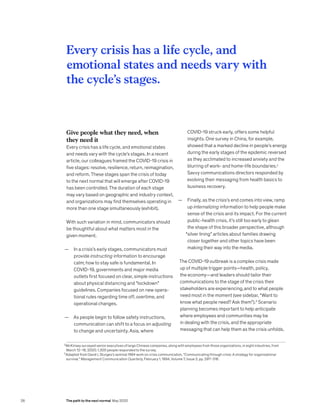
  • 34.
    Decision making in uncertaintimes The timeline for companies to react to the coronavirus has shrunk dramatically. Here are five principles that leaders can follow to make smart decisions quickly during the pandemic. © TwilightEye/Getty Images by Andrea Alexander, Aaron De Smet, and Leigh Weiss 32 The path to the next normal May 2020
  • 35.
    Leaders know thatmaking good, fast decisions is challenging under the best of circumstances. But the trickiest are those we call “big bets”—unfamiliar, high-stakes decisions. When you have a crisis of uncertainty such as the COVID-19 pandemic, which arrived at overwhelming speed and enormous scale, organizations face a potentially paralyzing volume of these big-bet decisions. The typical approach of many companies, big and small, will be far too slow to keep up in such turbulence. Postponing decisions to wait for more information might make sense during business as usual. But when the environment is uncertain—and defined by urgency and imperfect information— waiting to decide is a decision in itself. For instance, delaying the decision to cancel noncritical surgeries can mean not freeing up physician and hospital capacity now and potentially exposing or infecting more people. To make bold decisions quickly in these uncertain times, leaders can follow these five principles. 1. Take a breath Pause and take a breath—literally. Giving yourself a moment to step back, take stock, anticipate, and prioritize may seem counterintuitive, but it’s essential now. When asked what makes a great hockey player, Wayne Gretzky is said to have answered, “A good hockey player plays where the puck is. A great hockey player plays where the puck is going to be.” That is easier said than done. In a crisis atmosphere, it is tempting to jump from one urgent task to the next, to take charge of what’s right in front of you— to just execute. Yet this can be a tragic mistake. Research shows that the simple act of pausing, even for as little as 50 to 100 milliseconds, allows the brain to focus on the most relevant information.1 A dramatic example of a leader who paused during a landscape-scale crisis is Captain Chesley Sullenberger. After a bird strike caused both of his plane’s engines to fail shortly after takeoff from LaGuardia Airport in January 2009, he had very little time to decide whether to try to land at a nearby airport, as the control tower was urging, or to aim for a water landing. With no training for such a scenario, he stopped and reflected for a matter of seconds—all that he could afford—to determine if he could get to the airport safely and instead pivoted to the Hudson River for landing.2 All 155 people on board survived. There are several ways decision makers can take a breath: — After telling your team you need a moment to think, try to gain a broader perspective. — Imagine yourself above the fray, observing the landscape from above. This is what leadership expert Ronald Heifetz calls a “balcony” perspective. Despite the “fog of war” that might obscure much of the current state of play, do your best to take a broader view. — Ask yourself and your team these questions: What is most important right now? What might we be missing? How might things unfold from here, and what could we influence now that could pay off later? This ability to anticipate how things might unfold— and to begin to act accordingly—can help avoid knee-jerk reactions that lead to poor outcomes. In the coronavirus context, if you are a leader of a grocery-store chain, you are seeing a drastic increase in purchases. You must think about your supply chains, whether to ration items, and how to put safety protocols in place for customers. In addition, there are the questions of whether to modify store hours, whether to limit service to curbside pickup and delivery only, and how to handle staffing. All of these decisions are related, so you must pause and prioritize the most pressing issues first. That also means having the discipline to ignore distractions. 1 Vincent P. Ferrera, Jack Grinband, and Tobias Teichert, “Humans optimize decision-making by delaying decision onset,” PLOS ONE, March 5, 2014, Volume 9, Number 3, journals.plos.org. 2 For more information on the US Air Force’s observe, orient, decide, and act (OODA) loop, see Mark Bonchek and Chris Fussell, “Decision making, Top Gun style,” Harvard Business Review, September 12, 2013, hbr.org. Decision making in uncertain times 33
  • 36.
    2. Involve morepeople Amid uncertainty generated by a crisis, leaders often feel an urge to limit authority to those at the top, with a small team making the big decisions while huddled behind closed doors. They should reject the hierarchical model that they might be more comfortable with in normal times and instead involve many more stakeholders and encourage different views and debate. This approach can lead to smarter decisions without sacrificing speed. Specifically, leaders can use a so-called fishbowl model in which decision makers and key experts sit around a table—or virtual table—to make a decision (exhibit). At the table are one or two decision makers, multiple experts, and one or two “empty seats” for other relevant stakeholders in the gallery to rotate in as they have points to share. A majority of stakeholders observes the meeting, which builds understanding without having to make an extra communication step afterward. In an in-person meeting, stakeholders watching the fishbowl can contribute information and ideas by temporarily taking one of the empty seats, briefly participating in the meeting, and then returning to the gallery. In a virtual meeting, the stakeholders are on mute but can participate by “raising their hand,” with a moderator inviting them in and unmuting them. There are several steps leaders can take to involve more people: 1. Clarify the decisions to be made. 2. Identify a small number of decision makers. 3. Identify who should have a voice, including relevant stakeholders and experts, and those who will implement decisions. 4. Create a forum for rapid debate to take place. Be clear that everyone has a voice but not a vote. When following this approach, it is possible to involve a large number of stakeholders and experts without sacrificing speed. Especially when things are unfamiliar and the decisions you are considering are bold, you need many points of view to make sure the decision makers aren’t missing something. Once decisions are made, you can quickly pivot and speak to those who will be executing the decisions to clarify the actions to be taken, timelines, and accountabilities and answer any questions they have about what comes next. This not only saves time, by removing a communication step, but it can also enhance the potency of the message itself. In today’s crisis atmosphere, waste-management leaders are likely experiencing a big shift in demand for their services. There is more household waste that needs pickup and less waste from office buildings and restaurants. How can these companies better accommodate the shift in demand? This decision should include a wide range of stakeholders, including representatives of the Exhibit [COVID-19] Decision making in uncertain times Exhibit 1 of 1 Involve more people and move faster using a ‘fishbowl’ format. Digital decision- making table Decision maker “Empty seat” Expert Relevant stakeholder 34 The path to the next normal May 2020
  • 37.
    frontline employees (whomay have good ideas about routes and which employees to deploy for which shifts) and the customers. 3. Make the critical small choices Some small choices that leaders make in the short run could loom very large over the long term as the crisis unfolds. They can be hard to spot, but leaders must look for them. In the normal course of business, many big-bet decisions are obvious. There’s a large cost or major impact, such as acquiring a company, marketing a product in a new geography, or shutting down a factory, with these decisions. But some decisions that seem small or routine at first can have large long-term strategic implications. In an example related to coronavirus, Netflix has gone to lower-resolution streaming in some locations to ease the data load on information networks. While most people won’t notice the difference in quality, the decision could mean that the internet doesn’t crash, which would be a big problem when so many are working from home and children are relying on the internet to do their schoolwork. There are several steps leaders can take to make critical small choices: 1. Anticipate multiple possible scenarios for how things might unfold over time. No one has a crystal ball, and detailed, precise predictions are likely to be wrong because things are in flux. Anticipating a range of possible pathways and general scenarios can be extremely helpful in thinking through what might happen. 2. Make a list of five to ten choices or actions that making today might, depending on what happens, make a difference later. If we fast- forwarded six months and identified a small decision or action that would have made all the difference if we had taken it, what might that decision or action be? 3. Engage others to help identify which small decisions or actions you should address now, in case they become the difference makers down the road. Which of these should you spend time on today? Which should you monitor and reconsider later? These decisions could range from actions to save cash and ensure liquidity to actions to beef up the resilience of your supply chain by quickly exploring alternative suppliers. The response to the Boston Marathon bombings in 2013 is a good example of a critical small choice that made a big difference. The decision was made to disperse severely injured people to eight different hospitals. While some of those hospitals were farther from the bombing site, vascular surgeons were called to those locations to begin operating right away. If victims had been sent only to the closest hospitals, many would have had to wait for surgery and possibly bled to death. 4. Set up a nerve center In stressful times, leaders will have to make more big-bet decisions than before and also will be worried about their people. When making a high-stakes decision, it’s important to be able to focus attention on the issue at hand. That means minimizing distractions. If a leader is too frenzied, they are likely to make errors in judgment. Creating a nerve center can help leaders focus on the strategic decisions rather than the tactical ones. A strategic decision comes with a high degree of uncertainty, a large likelihood that things will change, difficulty in assessing costs and benefits, and a result of several simultaneous outcomes. A tactical decision comes with a clear objective, a low degree of uncertainty, and relatively clear costs and benefits. Tactical decisions are important— sometimes crucial. Yet they are often better left to those on the edges of an organization who can act effectively without raising issues to higher levels. One way to ensure that the right people will be the ones making tactical decisions is to set up a Decision making in uncertain times 35
  • 38.
    Leaders with theright temperament and character are necessary during times of uncertainty. They stay curious and flexible but can still make the tough calls, even if that makes them unpopular. In wartime, you want a Winston Churchill, not a Neville Chamberlain. nerve center. This is a network of cross-functional teams with clear mandates connected by an integration team that sees that decision making occurs thoughtfully and quickly. Each team focuses on a single area or scope; often, the teams are for workforce protection, supply chain, customer engagement, and financial stress testing. There is a central team that keeps everyone coordinated and ensures collaboration and transparency. In a crisis, leaders should set up the nerve center quickly and with the knowledge that it won’t be perfect. Hospitals deal with emergencies all the time and are well equipped to do so. However, the COVID-19 pandemic is different. It requires setting up a nerve center so that decisions on staffing and the allocation of scarce resources can be made more quickly and by the right people. Some tactical decisions that might have been made in the nerve center, such as the allocation of ventilators and the scheduling of elective surgery, will now need to be considered strategic decisions. It might be a strategic decision to convert a university dorm or hotel to a hospital space, but making sure the space is functional is a tactical decision for the nerve center. 5. Empower leaders with judgment and character During business as usual, some people who get ahead are of a certain type. They say the right things, don’t ruffle feathers, know how to navigate the system, and manage messages so that people hear what they want to hear. Many of these usual suspects, who typically are tapped to lead special initiatives, are ill suited to lead in a landscape crisis of uncertainty. Leaders with the right temperament and character are necessary during times of uncertainty. They stay curious and flexible but can still make the tough calls, even if that makes them unpopular. They gather differing perspectives and then make the decisions, with the best interests of the organization (not their careers) in mind, without needing a full consensus. For decisions within their delegated authority, they escalate only the trickiest problems for input or approval. In wartime, you want a Winston Churchill, not a Neville Chamberlain. When making the move to empower other leaders, don’t just pick the usual suspects to lead your 36 The path to the next normal May 2020
  • 39.
    response—some of themwill be cut out for duty in times of uncertainty, but some will not. When choosing leaders, identify people who have done as many of the three following things as possible to increase the likelihood of them being successful in the current times of uncertainty: — lived through a crisis (personal or professional) and shown their mettle and personal resilience — made a tough, unpopular decision because it was the right thing to do, despite the fact that they took heat for it and potentially burned bridges or spent social capital — willingly given bad news up the chain of command to leaders who didn’t want to hear it You may not be able to find enough leaders in your organization who meet all three criteria but beware if you empower leaders who meet none of them. Once you have identified these leaders, encourage them to find their inner Churchill: remind empowered leaders that you expect them to make decisions with imperfect information. They should not strive to be perfect, as perfect is the enemy of speed. Make mistakes and learn from them. Do what is right, even when it is not popular. Go big or go home Unprecedented crises demand unprecedented actions. Lessons from past crises suggest that leaders are more likely to underreact. What is necessary is to take the bold and rapid actions that would feel too risky in normal times. Denmark recently made such a decision when it froze the economy to head off a recession—or worse. The Danish government agreed to pay 75 percent of private-company employees’ salaries, provided the companies don’t lay off workers. The government is paying workers to stay home and not work, spending 13 percent of the national economy in three months. We don’t know yet whether this policy will accomplish its objectives, but it does offer an example of the kind of bold decision in a crisis that leaders may wish, down the road, that they had made or at least considered. Lest businesses think such a bold reaction isn’t relevant to them, we are already seeing corporate examples. The National Basketball Association decided early on that it would shut down its season, leading other sports to take similar actions. Apple was among the first large retailers to close most of its stores globally in response to the coronavirus. Emirates has decided to suspend most of its flights until “travel confidence returns.” And some Hollywood studios are releasing current movies straight to streaming platforms, acknowledging this new reality for us all. Decision making amid uncertainty is not easy. Business leaders cannot afford to wait when events are moving as fast as they are right now. We believe these five principles of decision making can help leaders make smart decisions quickly to guide their organizations through this crisis. Embrace them, and continue to learn as you go. Copyright © 2020 McKinsey & Company. All rights reserved. Andrea Alexander is an associate partner in McKinsey’s Houston office, where Aaron De Smet is a senior partner; Leigh Weiss is a senior expert in the Boston office. The authors wish to thank Chris Gagnon, David Mendelsohn, and Vanessa Monasterio for their contributions to this article. Decision making in uncertain times 37
  • 40.
    Applying past leadership lessonsto the coronavirus pandemic Three seasoned leaders describe what they learned from managing through past crises. © Gearstd/Getty Images by Hugo Bague, Jeff Cava, and Manley Hopkinson 38 The path to the next normal May 2020
  • 41.
    Savvy managers understandthe fundamentals of crisis management, at least on the theoretical level. Their careers rise and fall on an individual’s ability to rally their teams, project deliberate calm and empathy, take decisive action, and communicate effectively. The most fortunate among them have not had to face a crisis like the coronavirus pandemic now rampaging through the global community to devastating effect. But there are managers out there whose stories and experiences of leadership in moments of disruption and upheaval can be instructive. To learn more, we spoke with three senior advisers to McKinsey with just such experience. Hugo Bague was group executive of organizational resources at Rio Tinto during the Ebola crisis in 2015–16. Jeff Cava was chief human-resources officer (CHRO) at Nike during two major economic crises, executive vice president, administration, at Wendy’s in 2003, during the SARS outbreak, and CHRO for Starwood Hotels and Resorts during the financial and swine- flu crises of 2009. And Manley Hopkinson served as an officer in the Royal Navy during the first Gulf War, set a record skiing to the magnetic north pole, and has sat on the board of directors at Atlas Consortium, Hewlett Packard Defence UK, and Ark Data Centres. We spoke with them individually but present their comments here in a virtual roundtable format. McKinsey: During a crisis, top-down leadership doesn’t always engender stability. What’s your experience at balancing central control with delegating responsibility locally? Manley Hopkinson: It is vital that a leader resist centralizing control. The temptation in a time of crisis is for leaders to put themselves at the center of all activity. It’s an understandable desire to ensure all is well, even though precisely the opposite is needed. To decentralize and create a network of teams requires absolute clarity on intent and priority. A leader cannot empower a team if there is any uncertainty in direction or priority. And even while prioritizing short term and making priorities crystal clear, leaders still need to keep the long-term direction and purpose in mind. On my race to the north pole, in our team of three, one person focused on the near and tactical, ensuring that we crossed each crevasse safely. A second person took the lead role and focused on the far horizon, making sure we did not go around in circles. The “leader” is not in front, making all the immediate decisions. They are following, navigating a course to the future. Now, for example, I advise a number of organizations whose work is critical to the functioning of the United Kingdom’s national infrastructure. For them, the safety of their people is paramount, but subservient to the integrity of the nation’s ability to operate. This clarity of purpose, intent, and priority, long term and immediate, allows teams and individuals to be fully empowered. It enables teams of teams to make the right decisions, and it enables decisions to be made where the information lies. That is key. Hugo Bague: Not every decision should be made by the central office headquarters. Local teams are often the best positioned to judge the situation on the ground—and their decisions should not be second-guessed. For example, in 2015, we had 4,000 employees in Guinea during the Ebola crisis. The mortality rate was high, so naturally we had to decide if we should send home all the expatriate employees—knowing that they would then lose all credibility and never be able to go back? We delegated that to the team. We said, “You are the best to make that assessment, because we can’t judge the health risk on the ground for you as expats.” And the team decided that the expats themselves would stay, but their families went home. After six months, we established a rotation so that expats could go visit their families even while maintaining skilled leadership on the ground. Corporate couldn’t have made that call. They would probably have brought everybody home. But let’s be careful with words: autonomy doesn’t mean in isolation. We said clearly, whether you stay Applying past leadership lessons to the coronavirus pandemic 39
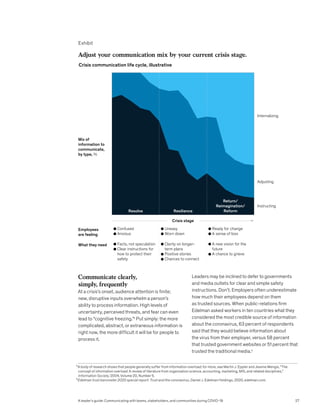
  • 42.
    in Guinea ornot is your call. But we want to have a discussion with you to ensure that you’ve looked at it at every angle. And in the end, no employees contracted Ebola. McKinsey: That kind of collaboration takes work. What kinds of teams can do it? Hugo Bague: A team with defined roles and responsibilities can do it, but decision making must be even more clear and concise in a crisis than in other situations. There also needs to be accountability, so that even when there are different people and different departments giving input, at the end of the day, there is a single decision maker. That needs to be clear. And the whole leadership team should maintain discipline in speaking as one around a decision. There can’t be any internal criticism or questions around decisions, because in a crisis the organization is fragile. Jeff Cava: If there is a thin veneer of cooperation and collaboration, it will be immediately exposed. If, on the other hand, there are genuine, honest relationships among senior leaders, you’re going to have a much better functioning crisis team. If there are weaknesses, if there are cracks in the team functioning, it will fray quickly in times of stress. It sounds obvious, but many leaders don’t understand that when people are under extreme pressure, they revert to interpersonal styles that tend toward preservation over collaboration. If your team dynamics aren’t in a decent shape, crises will amplify the dysfunction. At Wendy’s during the SARS crisis, we made decisions informed by people on the front lines. The way we were structured helped us. Our organization was structured in a way that allowed for the efficient communication of information from the stores up the chain to the C-suite. We had store managers who were all connected to district managers who were connected to division managers who in turn were connected to the head of operations. We had a good communication network and we received great input. In the C-suite in larger corporations, we tend to focus on strategy, big ideas, in the abstract. But in these situations, we needed tactical decisions, and needed them quickly. We needed to address the issues in a way that makes sense in the environment of the store. Manley Hopkinson: A coherent culture creates the environment that allows teams to work independently and with each other. A common understanding and common language of the tools of leadership and collaboration are vital. For example, when the whole organization uses a consistent tool for delegation, then delegation is consistently effective. It comes back to clarity again. There also needs to be accountability, so that even when there are different people and different departments giving input, at the end of the day, there is a single decision maker. 40 The path to the next normal May 2020
  • 43.
    McKinsey: Leaders wantto come across as grounded and reassuring. But there’s a fine line between reassuring and saying something that’s overly optimistic. How does that play out in real-life communications? Manley Hopkinson: I love the expression “deliberate calm,” recognizing the work of Albert Mehrabian on the emotional context of communication. As he quantified it, communication is 55 percent visual, 38 percent tone, and only 7 percent what you say. It takes a great deal of consciousness from leaders in the midst of crisis and upheaval to maintain a balance that is neither too negative nor overly optimistic. They need to recognize that they are always on stage but accept that they, too, are still human and can make mistakes. In a time of crisis, we need leaders to raise their levels of consciousness and be acutely aware of how they are being perceived. Jeff Cava: At different times, we’ve had to make pretty sizable reductions in force. During the 2008 financial crisis, we reduced our nonproperty head count at Starwood by a substantial amount. After we did the first round, everyone wanted to say, “That’s it, no more, you can all go back to your jobs—everything is great.” I, along with others, strongly urged against that, and we didn’t make that commitment. Because we didn’t know what was going to happen. And indeed the economic situation did worsen before we finally stabilized and began recovering. People depend upon our statements as leaders and often plan important decisions based on the information we give them. To make a commitment of that importance and then not follow through destroys the trust that we strive to create with our associates. It comes down to the old adage: honesty is the best policy. Ask yourself, “Is my statement absolutely true? If I’m required to do something to make it true, can I do it?” We couldn’t promise uninterrupted employment, because we didn’t know what was going to happen in the economy. This was an unprecedented economic disaster. The desire was to give people relief and confidence. But you can’t give them false relief and false confidence. That’s hard for a compassionate leadership team, but you have to push yourself. Hugo Bague: In times of crisis and uncertainty, you need leadership to show stability. There are many things you don’t know, but you can still bring stability by structure. We had daily calls and daily communications at a fixed time with all the employees through mobile phone—and we did that daily for 18 months. Bringing structure into the lives of people, you take things under your control. That helps with the mental health and stability of employees, which one should not underestimate in a time of crisis. People have questions around their families, their jobs, and many topics, so any stability you can provide is quite important. It takes a great deal of consciousness from leaders in the midst of crisis and upheaval to maintain a balance that is neither too negative nor overly optimistic. Applying past leadership lessons to the coronavirus pandemic 41
  • 44.
    Concern for employeesand the communities within which companies do business doesn’t need to be in conflict with concern for ensuring a going commercial enterprise. Jeff Cava: At Starwood, I believe we were well positioned to communicate using all modalities. This was an internal capability we had built up over time— quick group videoconferences, real-time video clips that we could send throughout the world, well- crafted talking points and FAQs, local in-person group meetings with our CEO. We integrated communications in the internal machinations of the business. We didn’t just call when we needed to communicate; our communications experts were part of the ongoing business operations and leadership team. We had practiced crisis communications regularly throughout the year. We would bring representatives from the organization to participate in a simulated crisis and work together to resolve it in real time. That allowed us to do two things: pressure test our ability to communicate and the content of our messaging. But more important, it let us pressure test the personal and interpersonal relationships among the crisis-management teams before we were in crisis. McKinsey: Companies want to protect their customers and their employees but also be fair to investors and shareholders. How do you balance those objectives? Jeff Cava: Concern for employees and the communities within which companies do business doesn’t need to be in conflict with concern for ensuring a going commercial enterprise. Boards in particular are concerned with both. Obviously, they have a financial duty to their shareholders and as importantly have a genuine concern for how their and the company’s reputation are perceived. At the end of a crisis, management and the board will be judged by how well they balance this relationship. Successful solutions look for actions that can combine the best interests of both. At both Wendy’s or Starwood, the goal was to preserve the workforce. Both industries have high staff turnover. Employees often work hourly and have a lot of financial pressure. We needed to preserve our connection with them so they would continue to feel connected to the company. Hourly workers can migrate quickly. If you don’t create a genuine relationship between them and the business, they will lose and you will lose in the long term. I think boards need to keep that as a central theme in their considerations. McKinsey: Can you say more about how boards of directors balance concern for the humanitarian side of the crisis with their responsibilities to shareholders? Jeff Cava: Sometimes they can do both. But sometimes people get their goals and motives confused. A corporate board is very concerned with protecting its reputation. It wants a sensible business solution, operating in a constructive economic reality. But at the same time, it wants to be seen as altruistic to the general public. 42 The path to the next normal May 2020
  • 45.
    As a leader,you have to be able to meet both objectives. You have to be able to present that you’re not just concerned about your profits and balance sheet but also that you’re concerned because it serves the greater good of those 200,000 employees. Because you’ll need them and you’re also concerned about the investment you’ve made in these people and that they’ve made in the company. This is going to serve your economic interests and well as their personal interests. This is the way the whole communication process and problem-solving process needs to be structured. CEOs don’t need to be bleeding hearts. On the other hand, they also shouldn’t be so mercenary so they forget they’re part of a system—of people, customers, and economic outcomes. They need to approach the problem that way. Net–net for us, whether Wendy’s or Starwood, a really important goal, as I said earlier, was to preserve the workforce. We needed to preserve them so they could preserve us, whether at hotels or restaurants. If you don’t create stickiness between your associates and the business, they will lose and you will lose over the long term. I think the board needs to understand that. Manley Hopkinson: Leadership based on understanding and not control—trusting that people know what to do—allows companies to turn a crisis around into an opportunity to shake things up. It allows them to challenge existing ways of doing things, to develop your people and let them take more responsibility. There’s an opportunity to nurture a greater sense of empowerment and ensure the leader’s thinking continues to include people’s needs and growth. Leaders in a crisis tend to stop what they consider to be peripheral activities to focus on survival. I’ve seen leaders who immediately stopped any leadership or personal development at exactly the point when their people were under most stress and most pressure, when their performance would be even more important. That is a fundamentally flawed way of thinking. People development and team building are not peripheral activities. They are key. It is in a time of crisis that you need to ask more of people. You need their commitment and energy, both to tackle the crisis and to continue a journey of growth when it’s over. I have always been pleasantly surprised how people react and grow in crisis if they feel valued and empowered and if we can ensure, as leaders, that our actions reinforce that reality. Copyright © 2020 McKinsey & Company. All rights reserved. Hugo Bague is a senior adviser in McKinsey’s Zurich office, Jeff Cava is a senior adviser in the Boston office, and Manley Hopkinson is a senior adviser in the London office. This article represents edited comments from phone and video interviews moderated by Gila Tolub, a partner in McKinsey’s Tel Aviv office. Applying past leadership lessons to the coronavirus pandemic 43
  • 46.
    Positive leadership in uncertaintimes Most leaders are struggling to find the right path through the COVID-19 crisis. Acting on three imperatives can help pave the way. © marrio31/Getty Images by Liz Hilton Segel 44 The path to the next normal May 2020
  • 47.
    For business leaders,the COVID-19 pandemic has accelerated unprecedented change. More than ever, the health of businesses is urgently and visibly linked with the health of workforces, the health of our society, and the health of our planet. Previously unimaginable shifts in our daily lives are compelling companies to adapt quickly and identify creative, unconventional ways to operate and survive. Worldwide uncertainty makes it more difficult for leaders to find their footing—and those who like to operate from a place of clarity are finding few ports in this global storm. The question most leaders are facing, then, is this: How do we move forward in such uniquely uncertain circumstances? Positive, effective leadership helps us navigate crises, rebuild communities, and forge ahead in moments of ambiguity. But with so many challenges colliding at once, many leaders may be struggling to chart a clear way forward. To gain that foothold and respond effectively, leaders should act on three imperatives: clarifying your purpose, supporting your stakeholders, and bolstering your emotional and organizational resilience. The first step is to rediscover or reemphasize your purpose. The temptation for businesses in moments of crisis is often to get small, to hunker down and zero in on bottom-line fundamentals and metrics. Now, instead of narrowing their focus, leaders in a crisis should consider pulling back and reminding themselves of their guiding principles. Emphasizing purpose will also signal your intentions to the wider world, instilling confidence and goodwill among stakeholders who share your principles. In times of change, workers, consumers, and investors alike will gravitate toward organizations whose purpose reflects their personal values and beliefs. The second step is to ask what actions you can take to protect and support those who rely on you and the organization—especially those who may be particularly vulnerable or whose needs are becoming increasingly acute. That means taking stock of who your stakeholders are—from customers and investors to employees, communities, and society as a whole. It means identifying what they need—and recognizing that these needs may differ in each case. And it means determining how you can serve them most effectively, from short-term decisions like how to continue operations at a time of physical distancing, to long-term considerations such as whether to prioritize employees’ current wages or equity for retirement. It may also include potentially redesigning supply chains to support local employment while also strengthening the resiliency of operations. Your stakeholders are the people who drive and measure your success, and particularly when success feels elusive, recommitting to them can galvanize the trust, confidence, and morale required to forge ahead. The third step is to prioritize your emotional and organizational resilience. Even with a strong purpose and a plan to serve your extended community, your progress may not be immediately apparent. You will need to marshal resolve in order to stay the course—and to handle the kind of attention that comes from doing so. To make that adjustment, identify and access the actions and behaviors that make you a more thoughtful and capable leader—whether that involves making time for activities that restore your energy, pursuing the space you need to gain perspective, or simply ensuring that you are getting the sleep you need. In short, find balance. Worldwide uncertainty makes it more difficult for leaders to find their footing. Positive leadership in uncertain times 45
  • 48.
    Equally important isempowering the right teams. When faced with an overwhelming volume of critical decisions, leaders may feel the urge to limit authority and tighten control. But organizational resilience depends on more stakeholders and perspectives, organized across a network of cross- functional teams with clear mandates. Empowering leaders with the right temperament and character— those who stay curious and flexible and are willing to make the tough, even unpopular calls—is vital for thoughtful and swift decision making. Every step involves choices that are tough to make even in good times, let alone in uncertain ones, but the same instincts and actions that will see us through this current global crisis will also make us stronger as we face longer-term challenges. The ability to understand who we are and what we value, recognize our responsibilities and our opportunities, and chart a course based on our most fundamental goals while supporting our own emotional resilience and that of our organization— these are skills that will fortify us in the years and decades ahead. As we navigate an uncertain road today, our approach to this moment will inform the way we lead tomorrow. Copyright © 2020 McKinsey & Company. All rights reserved. Liz Hilton Segel is a senior partner in McKinsey’s New York office. This essay first appeared in the Milken Institute’s Power of Ideas collection focused on building and rebuilding lives in the face of the COVID-19 pandemic. The essay series features insights from thought leaders across industries. Read their contributions and share your thoughts using #PowerofIdeas. Find more coverage on the Milken Institute LinkedIn page. 46 The path to the next normal May 2020
  • 49.
    Re-energizing through the epidemic:Stories from China A survey of China-based executives sheds light on the personal impact of working through the COVID-19 crisis. © Prasit photo/Getty Images by Haimeng Zhang, Tianwen Yu, Bernie Yang, Lihong Pan Re-energizing through the epidemic: Stories from China 47
  • 50.
    Personal energy changesbefore and during the crisis Total # of respondents = 1,300 Average energy value 24% 23% Concerned over business prospects as corporate or department performance declined Anxiety deepened as the epidemic unfolded 30% The boundary between work and life blurred 25% Distracted by demands and interruptions at home 28% Top 5 reasons for weaker energy Source: Survey on Centered Leadership and Agile Work during the Coronavirus Epidemic in China, conducted March 12 - 18, 2020 "Early stage" refers to the period from late January to late February; "Late stage" refers to the period following late February Telecommuting unsuitable for work flow 8.21 8.23 7.76 Before the outbreak Early stage Late stage Exhibit 1 Personal energy changes before and during the crisis Executives engaged in the fight against COVID-19 face tough challenges, not only in terms of decision making, but also their ability to manage their own energy and outlook. China-based workers were the first to face this challenge, often while juggling the demands of home life as a result of office closures and remote working policies. Now, the rest of the world is being plunged into a similar predicament, with lockdown conditions forcing frontline staff and executives alike to work out of their home office. With an eye to helping company leaders sustain their effectivqeness in such difficult circumstances, McKinsey surveyed 1,300 China- based executives about the personal impact of working through the crisis. The survey asked senior management, middle management, and frontline staff in a cross-section of industries more than a dozen questions about the impact of COVID-19 on their working lives and energy levels, and how they dealt with the change in routine. Alongside the questionnaire, which was conducted in March 2020, we also interviewed 10 executives in industries including automotive, real estate, pharmaceutical and manufacturing to source deeper perspectives on their individual experiences. This survey offers insights into the stresses and pain points China-based workers faced, as well as tips and solutions for how best to cope. Here are four ways leaders can make better decisions for themselves, their organizations, and their families during this unprecedented crisis. 1. Manage your energy According to our survey, the stress of working through COVID-19 sapped worker energy levels. Respondents said their energy fell steadily from the onset of the crisis, bottomed out in mid-February, but then returned to normal as effective strategies emerged at both corporate and national level (Exhibit 1). 48 The path to the next normal May 2020
  • 51.
    Effective approaches topersonal energy management 53% 48% 46% 38% 33% 28% 26% 24% 18% 16% 7% 2% Shift perspectives, accept and convert negative emotions while actively seeking new breakthroughs or reinventing ways of work Set time for interactions with family members, deepen relations with them and differentiate the time for family from that for working Communicate with family members fully and candidly to understand and support each other's needs and emotions Ensure smooth communication with customers and listen to their demands Manage physical and mental energy through reading, exercising, and resting Use new media to collaborate remotely with colleagues Show care for colleagues and deepen mutual trust Create new opportunities for professional development based on own advantages Make and follow a regular work plan, and switch your role by changing what you wear Participate in philanthropic activities to support epidemic control Purchase new gadgets for working from home Others Approaches to energy management Total # of respondents = 1,300 Source: Survey on Centered Leadership and Agile Work during the Coronavirus Epidemic in China, conducted March 12 -18, 2020 Exhibit 2 Effective approaches to energy management The blurring of work and home life was the leading cause of lower energy levels (30 percent), followed by pandemic-related anxiety (28 percent). Business leaders outside China are likely suffering similar stresses, and are potentially in danger of experiencing fatigue, having difficulty concentrating, or suffering from burnout. Fortunately, it is possible to maintain energy levels and reduce the negative impacts of working from home by applying the following principles, beginning with techniques to manage your energy and maintain a positive outlook: (Exhibit 2). Energize the body Almost half of respondents said they sustained energy levels by taking small breaks to exercise, read, or rest. Other “micro recovery” techniques include 10-minute meditation sessions in the mornings and evenings. These aim to identify physical discomfort by mentally scanning the body, allowing breathing to deepen and relax, as you check each part of yourself in sequence. Whatever technique you use, it is essential to have a means of breaking from the working routine while keeping yourself active. Communicate with family Aside from keeping yourself in shape, open and honest communication with family helps sustain emotional energy, according to 46 percent of our sample. Almost all respondents said that the quality of communication and intimacy with their family (spouse, parents, and children) greatly improved in the mid- and late-stages of the epidemic. Conserve mental energy Focusing intensely on the epidemic, whether it’s monitoring the latest news or government measures, or even discussing the impact of the crisis with friends, can be mentally and emotionally exhausting. Over time, your ability to concentrate on epidemic- related work will weaken as your mind seeks respite. Re-energizing through the epidemic: Stories from China 49
  • 52.
    When this happens,take 10-12 minutes to exercise, listen to music, or watch an entertaining or relaxing video. Doing this periodically can help declutter your mind and allow you to concentrate for longer stretches of time. 2. Find meaning Aside from replenishing your physical, mental, and emotional energies, it’s also helpful to tap into the meaning you derive from your work. McKinsey research identifies five sources of meaning in work: societal, organizational/corporate, client/target, team, and personal. Usually, company leaders focus on society and the organization, while their employees identify more closely with the latter three elements. However, our research suggests the COVID-19 pandemic is galvanizing entire organizations as their work becomes essential to keeping society and the economy afloat. The sense of purpose and drive many are finding as a result of the outbreak, whether it be working on the frontlines of the healthcare response, or around the clock to keep companies in business and staff employed, instills the motivation to rise to crisis-related challenges. Stories from the frontlines: Finding value in remote work While working from home, the sales vice president of a large real estate company gained a unique opportunity to communicate more deeply with her husband, children, and parents. Sharing views on the news while keeping each other going during the outbreak deepened their family bonds. Moreover, she believes that while business suffered during the lockdown period, her company will take For example, the CEO of a leading pharmaceutical company said that when the Hubei province capital of Wuhan was locked down, she organized a cross- divisional emergency team to fight the epidemic. The team helped fast-track approval of a drug that improves immune systems, and mobilized supply chain resources to ensure patients in Wuhan could receive essential drugs. They also cooperated with digital companies to build free, online virtual clinics, enabling remote diagnosis and treatment. “The outbreak highlighted our value to the public, making me proud to be part of the healthcare industry,” she said, adding that the sense of meaning inspired by the battle against the epidemic also made her team more passionate, and brought them closer together. Pursue meaningful work The CEO found a sense of meaning and spiritual energy from epidemic-fighting and charity work. If you want to identify the meaning of your work, try posing this question: “Where does my sense of meaning/value come from?” Look back on your career and recall the moments that you are most proud of, or that made you feel most accomplished or content. Try recalling the details: What did you do? What did others say to you? How did you feel? Deep dive into the key factors that make you positives from the experience: “We’ve established a habit of working online and communicating remotely, which will save us a lot of time and travel-related expense in future,” she said. “Even frontline sales teams forced to deal with clients online achieved impressive results, instilling the confidence to continue with the remote model after the epidemic. here at the very end, so like this: ....model after the epidemic. 50 The path to the next normal May 2020
  • 53.
    opportunity to liftcompany morale and motivation. In the late- and post-epidemic stages, it is worth considering how to position your organization so that it continues to contribute to society and community, in the process offering a source of spiritual energy for you and your team. Our survey indicates that a majority of China-based employees are aware of or have participated in corporate social responsibility activities related to the COVID-19 outbreak, including giving donations or providing volunteer services. Senior executives tend to engage most deeply in such activities (Exhibit 3). The challenge is to disseminate the sense of meaning and value derived from that participation as deeply as possible through the company. proud or fulfilled: Is it being recognized, deploying your capabilities and strengths, building sincere relationships, or contributing to the welfare and development of others? Once the source of meaning is identified, consider whether you have devoted enough time and energy into work that delivers this sense of meaning. If not, formulate a plan to adjust your way of working to make sure you feel fulfilled. Create meaning This example illustrates a larger truth: that employees can derive a sense of meaning in their work once they realize the contribution their company makes to society. The epidemic consequently represents an Three tips to reduce negative emotional energy: 1. Create a separate workspace: In order to keep the boundary between work and life distinct, try to confine work to a study space during normal office hours, while enjoying “me time” and recreational activities that help you relax, such as reading and listening to music, in the rest of the house. 2. Maintain open communication: Openly communicate your work responsibilities and pressures, explain the familial support you might need, and actively seek and suggest ideas for how you can support your family in turn. For example, help your family understand that 8:00 -12:00 and 13:30- 18:00 are working hours; but the hour after lunch and dinner is free for discussion, relaxation, or helping with housework. 3. Set clear priorities: Despite these boundaries, being distracted at home is inevitable. One of the best techniques to maintain energy and work efficiency is to focus on priorities. Set priorities when several tasks arrive at the same time, so you can focus on one task at a time, and avoid becoming confused and exhausted by trying to manage them concurrently. A majority of China-based employees are aware of or have participated in corporate social responsibility activities related to the COVID-19 outbreak. Re-energizing through the epidemic: Stories from China 51
  • 54.
    3. Get creative Acceptingnegative emotions and channeling them into new ways of thinking was the primary means by which China-based workers maintained their energy amid the epidemic, according to our survey. However, processing the torrent of epidemic-related information limits our capability to change perspective. Follow these tips to maintain a positive outlook: Focus on solutions Seeking the reasons for why something happened, who was to blame, or which procedures failed, only serves to limit our thinking and generate negative energy. Instead, ask solution-based questions to help change perspective. These might include, “What can I do to improve epidemic-prevention measures, prepare the company to resume work, or marshal resources to address the problem?” Assessing what Exhibit 3 Corporate Social Responsibility (CSR) initiatives during the COVID-19 outbreak in China Total # of respondents = 1,300 Avg. 75% 31% 3% 41% 9% Senior management 39% 28% 4% 40% 31% Middle management 1% 45% 29% Frontline staff 76% 75% 75% Q: Has your company taken actions to perform its social responsibilities during the outbreak, such as giving donations and providing volunteer services? What about yourself? Participated in individual philanthropic activities Limited participation in philanthropic activities organized by the company Deep participation in philanthropic activities organized by the company Source: Survey on Centered Leadership and Agile Work during the Coronavirus Epidemic in China conducted on March 12 - 18, 2020 Most respondents said their companies engaged in CSR actions related to the outbreak; senior executives engaged most deeply 52 The path to the next normal May 2020
  • 55.
    Stories from thefrontlines: Coordinating an epidemic response from home At 5 p.m. on Monday, February 17, the head of the passenger vehicle department of a large auto group was under pressure to keep his staff safe, and arrest a significant slide in performance related to the COVID- 19 outbreak. “We had six colleagues in Hubei whose work was severely impacted, and we were very concerned about their health and safety, as well as that of their families,” the department head said. “I had a call with the company president the night before the meeting, but we failed to pin down a recovery strategy. Colleagues were also anxious about the prospects for the company and our department.” Meanwhile, as he prepared to lead a video conference call on epidemic response and management with his team, the remote working model imposed as a result of China’s nationwide lockdown posed challenges of a different nature. “My son, who is in first grade, would interrupt me; my wife was also occupied with remote work; and my parents, who had come to Shanghai for the Lunar New Year, were unhappy that I had locked myself in the study, and did not have time to do house work or communicate with them. ...or communicate with them. you can do as an individual, and what support you might need to hit your target—not to mention what you might learn from the experience of accomplishing the task at hand—all help develop a positive attitude. 4. Engage and connect The daily deluge of COVID-19 news is distracting, making it easy to lose track of your priorities. However, the following process can help you define meaningful work targets, and stay on track to achieving them. Set positive aspirations We often respond to our environments instead of taking active control of our lives because we are unable or unwilling to identify our aspirations for life and work. Try to understand your aspirations more clearly by asking yourself the question, “What do I want today?” or “What do I want from tomorrow?” Stay focused Frequently review what you are focusing on, and whether this aligns with your aspirations. For example, did you spend a lot of time on menial work instead of addressing a harder but more rewarding task? If you stray off course, ask what can you do to rectify the problem. Over time, this process should become a habit that keeps you safe from distraction. Build relationships In the midst of the COVID-19 pandemic, employees will inevitably feel anxious and insecure about their job prospects. Such circumstances provide a perfect opportunity for leaders to reframe a potentially difficult time as an opportunity to build deeper trust with staff, customers, and family. Re-energizing through the epidemic: Stories from China 53
  • 56.
    Changes in familyrelations during the crisis Total # of respondents = 1,300 Q: What changes did you experience in your relationships with your family during the outbreak, compared with before the epidemic? I have spent more time accompanying them I have got more time to communicate with them and show my care for them Life has become easier Our understanding of each other's working state and pain points has deepened I have found it pleasing to handle trifles/watch TV with them/be with my kids I have become aware that families come to the fore as my life and health are threatened We lack a sense of distance Helping kids with their homework is tiresome I have to make meals for my family every day, which is energy consuming Different roles I need to play have pressured me and worsened my mood, which is easy to hurt my relations with my family My husband and I are both working from home, and our differences in looking after the elderly and our kids have widened Source: Survey on Centered Leadership and Agile Work amid the Coronavirus Epidemic in China, conducted March 12 - 18, 2020 35.0 60.0 5.0 Closer As usual Less close Exhibit 4 Changes in family relationships during the COVID-19 crisis With the widespread imposition of remote working policies, 53 percent said they had spent more time with their families than they usually would, with the tendency most pronounced among senior management (73 percent). Twenty percent said they had spent less time with family. The impact on family relationships was primarily positive, with 35 percent of respondents suggesting they have become closer to their families than before the outbreak. They said the experience deepened mutual understanding of working roles and difficulties, while providing more scope to care for and play with loved ones. The threat to health posed by the outbreak also reinforced the importance of family (Exhibit 4). In the midst of the COVID-19 pandemic, employees will inevitably feel anxious and insecure about their job prospects. 54 The path to the next normal May 2020
  • 57.
    Haimeng Zhang isa senior partner in McKinsey’s Hong Kong office; Tianwen Yu is an expert associate partner in the organization practice; Bernie Yang is an OrgSolution senior coach in McKinsey’s Shanghai office, where Lihong Pan is an organization expert. The authors also wish to thank Glenn Leibowitz, Bo Peng, John Qu, Vera Tang, Arthur Wang, Pin Wang, Fangning Zhang, and Gaobo Zhou. However, working from home is not without its challenges. “My son, who is in first grade, would interrupt me; my wife was also occupied with remote work; and my parents, who had come to Shanghai for the Lunar New Year, were unhappy that I had locked myself in the study, and did not have time to do house work or communicate with them,” said the head of the passenger vehicle department of a large auto group. Navigating the COVID-19 crisis will likely be among the sternest test company leaders have ever faced in their working lives, demanding an unprecedented degree of personal discipline and focus. By following the steps outlined here, business leaders may be better equipped to navigate the crisis. Re-energizing through the epidemic: Stories from China Copyright © 2020 McKinsey Company. All rights reserved. 55
  • 58.
  • 59.
    Organizing the response 58 Respondingto coronavirus: The minimum viable nerve center 66 Getting ahead of the next stage of the oronavirus crisis 77 To weather a crisis, build a network of teams 57
  • 60.
    Responding to coronavirus: Theminimum viable nerve center Amid the coronavirus pandemic, companies need a crisis response coordinated by top management that gives experts and managers the autonomy to implement creative, pragmatic solutions. by Mihir Mysore and Ophelia Usher © ThomasVogel/Getty Images 58 The path to the next normal May 2020
  • 61.
    The COVID-19 outbreak,caused by the coronavirus (SARS-CoV-2), is a deep humanitarian crisis that has also gravely affected the global economy. It is posing difficult—even unprecedented—challenges for business leaders. They are finding that the fast- moving situation is impervious to familiar remedial actions. By the time a response is mounted, the situation has changed, and the scale, speed, and impact of issues have unexpectedly intensified. Leaders everywhere have experienced some form of such disruption, though the magnitude of the present crisis is trying the lessons of human experience. The struggle to avoid ineffective, reactive approaches has consequently been all the more difficult. Together with many leading companies, we have developed a better approach—a flexible structure for guiding the work—called the integrated nerve center. In an unfamiliar crisis, such as the COVID-19 outbreak, the nerve center concentrates crucial leadership skills and organizational capabilities and gives leaders the best chance of getting ahead of events rather than reacting to them. The integrated nerve center is not a formulaic panacea. It is, rather, an efficient means of coordinating an organization’s active response to a major crisis. It is endowed with enterprise-wide authority and enables leaders and experts to test approaches quickly, preserve and deepen the most effective solutions, and move on ahead of the changing environment. In hundreds of discussions conducted in the past few weeks, we have looked at the efforts of many companies now in the process of building COVID-19 nerve centers. We feel that the insights of this common experience are of wide and pressing importance. Discover, decide, design, deliver: Lessons from past crises Common crisis-management failures arise according to the demands of the crisis, which can be understood in a fourfold manner. The first task of crisis management is to discover the current situation and form an accurate view of how it might evolve, deriving implications for the organization. From discovery, leaders must move on to decide on and design the necessary immediate and strategic actions, speedily establishing a pragmatic, flexible operating model. This model is ideally based on adequate stress testing of contextualized hypotheses and scenarios. It should also adhere to company and societal values. Finally, companies must deliver the solutions in a disciplined and efficient way, with enough built-in flexibility to accommodate late pivotal changes. In real crises, things go awry in each of these four categories: — Inadequate discovery. This is a failure to invest in an accurate, full determination of In an unfamiliar crisis, the nerve center concentrates crucial leadership skills and organizational capabilities and gives leaders the best chance of getting ahead of events rather than reacting to them. 59 Responding to coronavirus: The minimum viable nerve center
  • 62.
    the depth, extent,and velocity of the crisis. Companies typically reflect an optimist bias in initial assessments, for example, and then in subsequent reassessments as well. Eventually the false hopes embodied in these inaccurate assessments become obviously insupportable, at which point, however, the crisis has worsened, and much valuable time and resources have been wasted. — Poor decision making. Most poorly handled crises are defined by poor decision making. Bad decisions can result from many causes, such as acting on incomplete information (action bias). In our experience, reluctance to act until “all the facts are in” is a more common fallacy. The tendency for decision makers to analogize a new and unfamiliar situation to past experience (pattern recognition) is another serious pitfall. Groupthink and political pressure commonly lead decision makers astray. Reputations—and sometimes, compensatory incentives—are often at stake in large, expensive projects. Consequently, undue pressure can be exerted to push through an unforeseen problem whose resolution is disregarded or seen as insufficiently important to revise timelines and budgets. Relatively minor arising technical issues can, by this dynamic, become major problems and even lead to catastrophic failures. — Constrained solution design. Many crises have one or more technical causes—the problem in itself—that must be addressed with tailored solutions. These solutions must be either newly invented or imported to a new domain. Responding organizations must not allow themselves to be constrained by poor or inadequate solution designs. The immediate technical solution for diagnosing COVID-19— the starting point for treatment solutions—is the effective test. A type of test known as polymerase-chain-reaction (PCR) testing, developed in China, Europe, and South Korea for the disease, has become the standard for effective testing and is now being produced at scale around the world. The test was first produced in Germany in January 2020, not long after COVID-19 appeared in China. Yet in the United States, the presence of an ineffective test delayed the adoption of the effective one for a crucial early period in the spread of the virus. — Delivery failure. For anyone with actual experience in handling a crisis, execution failure is a constant risk. Small contingent (random) failures can cause larger failures of the most well-thought-out plans. Faulty solutions can command undue loyalty from managers suffering from “operations addiction”: instead of recognizing the root problem, responsible parties look for patches to preserve the flawed response. Chaotic conditions will necessarily cause disruptions, but the presence of accountable leaders with good judgment and the freedom to act and improvise as needed can minimize execution delays and failures. Responding organizations must not allow themselves to be constrained by poor or inadequate solution designs. 60 The path to the next normal May 2020
  • 63.
    The COVID-19-response structure Thenerve center is designed to resolve these four challenges under the heavy pressures of a major crisis. Certainly, companies and institutions are facing such a crisis with the COVID-19 outbreak, which has triggered travel restrictions, border closings, supply-chain disruptions, and work stoppages across the globe. The exhibit shows one example of a COVID-19-response structure. In this example, the nerve-center structure is organized around five teams, each responsible for a number of work streams. It is designed as an agile structure, coordinated through an integration team, but there is enough autonomy of action granted to constituent team leaders to work through bottlenecks and keep the response moving. Nerve-center integration team The nerve-center integration team is the coordinating head of the larger nerve-center structure. Its purpose is to set the overall tone of the COVID-19-response work, acting as a single Exhibit GES 2020 Nerve Center (COVID) Exhibit 1 of 1 The integrated COVID-19 nerve center is based on five cross-functional teams. CFO Financial analyst Legal Treasury Financials stress testing Strategy or business- development manager Head of HR Workforce protection Head of procurement Procurement manager Regional supply-chain managers Logistics manager Supply-chain stabilization Supply- chain analyst Employee communications HR full-time leader Head of sales and marketing Incentive managers Financial analyst Customer communications SKU manager Customer engagement Project coordinator Scenario- planning analyst Senior C-suite leader Epidemiological expert Nerve-center integration team Legal Security Ombudsperson Agile structure to manage crisis discovery, decision making, solution design, and execution Cross-functional teams coordinated by nerve- center integration team Teams manage workforce, supply chain, customers, and financials Integrated COVID-19 nerve center 61 Responding to coronavirus: The minimum viable nerve center
  • 64.
    source of truth,in real time, for all information and actions related to the outbreak and response. It must maintain close two-way communication with all teams. It is headed by a senior C-suite leader and includes an epidemiological expert, a project coordinator, and a scenario-planning analyst. The organization should empower this team to command whatever resources it deems are necessary to integrate closely and accomplish the work of the other four teams. The team’s responsibilities can be summarized as follows: — acting as the single source of truth for issue resolution — ensuring that sufficient resources are deployed where and when needed — coordinating the portfolio of remedial actions across the work streams of all teams, based on scenarios and triggers — aligning team leaders on scenarios, with the help of roundtables and other exercises as needed Workforce protection For most organizations, business as usual cannot be expected to reign during the COVID-19 outbreak. Organizations need to develop a plan to support employees that is consistent with conservative health and safety guidelines. The plan must be flexible enough to accommodate policy changes as needed through the outbreak. It is useful for companies to compare their efforts in this domain with the actions that other organizations of similar size are taking, to determine the right policies and levels of support for their people. The most helpful workforce-protection models provide clear, simple language to local managers on how to deal with COVID-19 that is consistent with the guidelines provided by WHO, national health organizations (such as the US Centers for Disease Control and Prevention), and local health agencies. The model should provide managers with a degree of autonomy sufficient to allow them to deal with any quickly evolving situation. Free two-way communication is also important so that managers can monitor adherence to policies as they evolve and employees can safely express their reservations about personal safety, as well as any other concerns. The recommended workforce-protection team includes the head of HR (team leader); the HR full- time leader; representatives from security, legal, and employee communications; and the ombudsperson. The workforce-protection team is charged with the following work streams: — developing brief policy papers, issue-escalation criteria and call trees, and actions (including preventative actions), as needed — managing multichannel communications, including confidential feedback and reporting channels — aligning policies and incentives for third-party and real-estate contractors — establishing or maintaining communications platforms to enable employees to work from home (necessary infrastructure includes a virtual private network, telephony, and broadband readiness), including, as appropriate, deployment of collaborative software tools to enable video and audio conferencing, screen sharing, “whiteboarding,” polling, chat, and other interactive capabilities — helping manage productivity, using such means as staggered work times; respecting social- distancing norms; and instituting health checks — developing “issue maps” and clear ownership and deadlines for issue resolution — engaging with local, state, and national political leaders and health officials Supply-chain stabilization Companies need to define the extent and likely duration of their supply-chain (including tier-one, -two, and -three suppliers) exposure to areas that 62 The path to the next normal May 2020
  • 65.
    are experiencing communitytransmission and their inventory levels. Most companies are now primarily focused on immediate stabilization, given that, in China (where few new COVID-19 cases are being reported), most plants are now restarting. In addition to supporting supplier restarts, companies should explore bridging strategies, including supply rationing, prebooking logistics capacity (shipping, rail, and airfreight), using after-sales stock, and gaining higher-priority status from suppliers. Companies should plan to manage supply for products that may be subject to unusual spikes in demand as they come back on line. In some cases, longer-term stabilization strategies may be necessary. Here, companies will have to use updated demand planning, optimize their networks further, and identify new suppliers. These approaches may be generally warranted to ensure enduring supply-chain resilience against risks beyond COVID-19, once the crisis is over. The supply-chain-stabilization team will include the head of procurement (team leader), the procurement manager, a supply-chain analyst, the regional supply-chain managers, and the logistics manager. This team will manage four work streams: — ensuring risk transparency across tier-one, -two, and -three suppliers; supporting supplier restarts; managing orders; and ensuring the qualifications of new suppliers — managing ports, prebooking logistics capacity, and optimizing routes — identifying critical parts, rationing parts as needed, and optimizing locations — developing scenario-based sales and operations planning for SKU-level demand and managing the planning for production and sourcing Customer engagement Companies that truly navigate through disruptions often succeed because they invest in their core customer segments and anticipate those segments’ needs and actions. In China today, for example, while consumer demand is down, it has not disappeared—far from it. People have dramatically shifted toward online shopping and ordering for all types of goods, including for food and produce delivery. Companies should invest more in online channels as part of their push for multichannel distribution. The investment should include ensuring the quality and delivery of goods sold online. Keep in mind, too, that changing customer preferences may not return to preoutbreak norms. The customer-engagement team will include the head of sales and marketing (team leader), a financial analyst, and managers for customer communications, customer incentives, and SKUs. The customer-engagement team will manage three work streams: — communicating to B2B customers (through a dedicated site) and developing scenario-based risk communications — intervening as needed across the customer journey to prevent leakage, training customer- facing employees, and monitoring customer- service execution — developing customer communications about COVID-19 situations and practices, as well as fact-based reports on COVID-19-related issues Financials stress testing Companies need to develop business scenarios tailored to their own contexts. Experts using analytics can define the values for the critical variables that will affect revenue and cost. Companies should model their financials (cash flow, profit and loss, and balance sheet) in each scenario and identify triggers that might significantly impair liquidity. For each trigger in each scenario, companies should define moves to stabilize the organization. Such moves could include optimizing accounts payable and receivable, cost-reduction measures, and divestment or MA actions. The financials-stress-testing team will include the CFO (team leader), the leader of strategy or 63 Responding to coronavirus: The minimum viable nerve center
  • 66.
    business development, theleader of treasury, a representative from legal, and one or more financial analysts. The team will manage two work streams: — developing relevant scenarios based on the latest epidemiological and economic outlooks — assembling relevant financials data according to different scenarios, especially working- capital requirements Getting started quickly: The minimal viable nerve center A common pitfall in nerve-center design is needless complexity. A good way of avoiding this is to aim at a minimal viable nerve center. Companies taking this approach quickly assemble the bare essentials needed to get operations up and running. The core nerve-center group, which might include all the team heads, will shape the structure, as needed, as the crisis evolves. Experience points to four essential elements that should be put in place right away. Nerve-center organization The teams need to be staffed quickly, with individual roles, responsibilities, and accountabilities made clear. Flexibility will be an important principle, since roles will change over time, sometimes quite rapidly. Also important is that nerve-center leaders be authorized to make timely decisions, sometimes without the opportunity to syndicate with other leaders. Operating cadence Meetings should be limited to those in which vital deliberations are conducted and actions decided on. They should, however, be frequent enough to foster collaboration. Ensure that meetings address essential topics and elicit the best thinking for the relevant work streams. The responsible members for each work stream should have the opportunity to seek input from the coordinating leaders. Solutions should be tested and decisions made to commit to effective methods and set aside ineffective ones. Select meeting attendees with care: Meetings of only senior leaders tend to encourage purely upward reporting rather than constructive debate and real problem solving. Meetings with too many frontline managers and individual contributors can become overly focused on tactical issues rather than the central problems. The difficulty of a high- quality operating cadence lies in maintaining a basic underlying structure and then allowing flexibility so that the organization can pivot when it needs to. Issue identification The nerve center will first identify the critical issues present in each work stream, with the expectation that these will evolve over time. Issues should be described in an issue map for risks and threats. In their totality, these maps will represent the core problem statement for the crisis situation and allow the group to articulate and address the challenges clearly and relatively quickly. The mapping can be divided between immediate, addressable risks and unforeseen, arising threats. Risk maps can be longer and more comprehensive; threat maps, however, can address the biggest issues—those that could drive significant disruption as the crisis continues. Some known COVID-19 risks, such as those posed to traveling employees, could be readily addressed with policies (such as travel restrictions). Unforeseen threats that could arise as the crisis continues can be anticipated in “premortem” workshops. Nerve-center teams therein work out possible responses—ones to take if, for example, a sudden gap should open in the supply chain because of policies imposed beyond the company’s control. Once companies establish a good understanding of the critical issues across all work streams, they will find it helpful to run financial calculations (balance sheet, cash flow, and profit and loss) on issues and responses. This will project scenarios for particular issues, allowing companies to form views on issue likelihood, timing, and magnitude. Response plan Leaders can find it extremely difficult to craft sensible goals during a crisis. Many trade-offs usually have to be made between ideal outcomes 64 The path to the next normal May 2020
  • 67.
    Copyright © 2020McKinsey Company. All rights reserved. Mihir Mysore is a partner in McKinsey’s Houston office; Ophelia Usher is an expert in the New York office. The authors wish to thank Kevin Carmody for his contributions to this article. and the many real constraints the organization faces. Once more realistic goals reflecting the trade-offs are arrived at, they can be assigned a few milestones and key performance indicators (KPIs) so that progress toward them can be tracked in simple ways. Additional elements A few other elements can become helpful as the nerve center evolves. For the COVID-19 crisis, these could include common operating pictures, giving a single view on the current status of the response; KPI dashboards, to confirm whether or not hoped-for outcomes are being achieved; and listening posts, which are early-warning indicators that can point out forthcoming changes in the trajectory of a crisis. The cultural challenge The hard truth about effective business leadership is that leaders operate within powerful cultural and social contexts. The largest organizations, with hundreds of thousands of employees, might appear, in normal business conditions, to operate according to a command-and-control structure. The reality is more complex. While large organizations use many top-down, pyramid-like structures and processes, these work only when outcomes are predictable. On the other hand, routinized ways of working impede the creativity and flexibility that organizations need to respond at speed amid a crisis. The exhibit of the integrated-nerve-center structure we have offered is not meant as a precise instruction manual. It is a general outline in need of contextual tailoring from organization to organization. The form described is most applicable to large corporations with global supply chains. For financial institutions, the structure would give little prominence to supply-chain stabilization and much more weight to financials stress testing. The structure is, however, adaptable for any large organization and can be effectively deployed in any crisis. From a business standpoint, the COVID-19 outbreak is a particular kind of crisis, quite different from those affecting a single large, multinational company. Rather, it is more like the financial crisis of 2008 to 2009, in that it presents as a shock to the greater part of all global economic activity: all the more reason that organizations need to concentrate leadership and capabilities in a fast-acting, integrated nerve center. With senior-leadership support and participation, the nerve-center structure can provide the organizational parameters that companies need to navigate through the disruptions caused by the COVID-19 outbreak. The approach works because it enables a coordinated response led by top management while also giving experts and managers the autonomy they need to implement creative, pragmatic solutions. 65 Responding to coronavirus: The minimum viable nerve center
  • 68.
    Getting ahead ofthe next stage of the coronavirus crisis First the virus, now the economic fallout—you need to launch your plan-ahead team. by Martin Hirt, Sven Smit, Chris Bradley, Robert Uhlaner, Mihir Mysore, Yuval Atsmon, and Nicholas Northcote © Cavan Images/Getty Images 66 The path to the next normal May 2020
  • 69.
    The COVID-19 pandemicis spreading at an extraordinary speed. You have put a crisis team in place and are doing all you can to keep your people safe, stay on top of your business, and deal with the uncertainty amid constantly changing conditions. However, that isn’t likely to be good enough. Close on the heels of the coronavirus outbreak, the next wave of disruption—the biggest economic shock since World War II—is headed our way. And it isn’t just an economic shock: it is a shock to customer behaviors and business models too. The challenges associated with it will be orders of magnitude bigger than what we are used to dealing with. To handle them, you need to adopt an operating model that accommodates the extreme level of uncertainty facing your business. Most companies will be very vulnerable to the economic fallout of extended public- and employee- isolation measures. As the number of issues your business is facing will likely rapidly escalate, there are two practical steps you can take to help stay ahead: 1. Launch a PLAN-AHEAD TEAM to get ahead of the next stage of the crisis. 2. Direct that team to work across multiple time horizons, using five frames. The plan-ahead team will help elevate your view above the day-to-day response that your crisis team is managing. Its objective is to enable modular, scalable thinking that any CEO needs to navigate this unprecedented and rapidly evolving situation. The plan-ahead team will deliver a STRATEGIC CRISIS-ACTION PLAN to guide and accelerate your decision making. Launch a plan-ahead team Military organizations, which specialize in dealing with large-scale crises, often establish granular structures accountable for highly specific tasks, such as operations, communication, and intelligence gathering. However, they all use plan-ahead teams for key decision makers to leverage when dealing with complex and escalating sets of issues. Your plan-ahead team should be charged with collecting forward-looking intelligence, developing scenarios, and identifying the options and actions needed to act tactically and strategically. Unlike a typical strategy team, it will have to plan across all time horizons (two, four, and seven days; two and four weeks; one and two quarters; one and two years; and the next normal) to enable you to stay on top of escalating issues and the decisions that you need to make in this time of high uncertainty. A plan-ahead team delivers scenarios, recommendations for actions, and trigger points to the CEO and the management team so that they can decide on the right course of action. The decisions will be communicated to the crisis team or other parts of the organization for execution. If further clarification is necessary, the plan-ahead team will do another turn, collecting further information to reduce uncertainty. Importantly, the structure of the plan-ahead team is modular, with individual cells focusing on specific issues across time horizons. As new issues come up or time horizons expand, you may need to add new cells. This will enable the team to scale in line with the magnitude of the crisis (Exhibit 1). While staff from a regular strategy group may form part of a plan-ahead team, the team’s responsibilities are far from the strategy function’s usual purview. Planning ahead today requires a dedicated effort, with a full-time senior executive leading and accountable for a team of ring-fenced high-potential employees located “next door” to the CEO. As a first task, the team needs to develop a day-one version of a strategic crisis-action plan by working through the five frames outlined in the next section of this article. Speed is of the essence, and waiting for perfect answers can be counterproductive: you need to deal with uncertainty, not let it bottleneck your decision making. Your plan-ahead team will need to update 67 Getting ahead of the next stage of the coronavirus crisis
  • 70.
    and improve planscontinually by integrating new intelligence as it becomes available. Work across multiple time horizons using five frames The best response to navigating through the COVID-19 crisis and the subsequent recovery will differ based on a company’s circumstances. For some, simply staying calm and carrying on will be the optimal approach. Others may need to undertake radical restructuring of their cost bases and business models immediately. Even as you assess the best course forward, the one thing you shouldn’t do is rely on what we frequently see in regular strategic-planning processes: ducking uncertainty altogether or relegating it to a risk analysis at the back of the presentation deck. You can use a strategic crisis-action plan to guide your response through the next stages of the crisis as events unfold (Exhibit 2). To produce this plan, you need to confront uncertainty head on. Your plan-ahead team needs to work through the following five frames: 1. Gain a realistic view of your starting position. 2. Develop scenarios for multiple versions of your future. 3. Establish your posture and broad direction of travel. 4. Determine actions and strategic moves that are robust across scenarios. 5. Set trigger points that drive your organization to act at the right time. Exhibit 1 COVID Getting ahead Exhibit 1 of 5 A plan-ahead team is modular, with cells focusing on specific issues across time horizons. Immediate response to COVID-19 crisis: Safeguard your day-to-day business Getting ahead of next stage of crisis: Launch your plan-ahead team COVID-19 crisis team COVID-19 crisis team COVID-19 plan-ahead team WG WG WG WG WG WG WG WG PG PG PG WG PG Work from home Business continuity Supply chain Working group (WG) for issue Modular, scalable planning group (PG) for issue Client support 68 The path to the next normal May 2020
  • 71.
    Exhibit 2 Getting AheadCOVID Exhibit 2 of 5 A strategic crisis-action plan guides responses to a crisis’s unfolding stages. Starting position (baseline and crisis context) This week Zoom will run out of capacity Need to increase ventilator production 4-fold Exports 40% down Government bailouts offered 2–4 weeks Capacity running out Supply-chain instability 1–2 quarters Liquidity position 1–2 years Growth likely to return Next normal Business challenged postcrisis (eg, cruise ship) Business demand greater postcrisis (eg, home delivery) Scenarios (issues and opportunities) This week All exports shut down Share buyback unwise Need for/conse- quences of accepting government bailout 2–4 weeks Access and nonaccess Claims on production Collaboration across players 1–2 quarters Nationalization MA wave Market rebound ahead of fundamentals No revenues Price controls 1–2 years Still not recovered Quarantine still needed Surveillance government Next normal Business returns to normal because of testing (eg, hotels) Drug approvals much faster Pace of all delivery expected to stay at crisis-level pace Posture and broad direction of travel This week Back to normal in 8 weeks Back to normal in 6 months Independence 2–4 weeks Lean into government crisis response to get access 1–2 quarters Through cycle, with good balance sheet Mothballing 1–2 years Back to business as normal or reset Next normal Will now be model of 21st-century cooperation Resilience over profit; more working capital Strategic moves (options, safety nets, and no-regrets moves) This week Scale capacity now Ship last supplies Split workforce Accept partial bailout 2–4 weeks Push for critical-product funding Work to reopen exports safely to get supply Support clients and suppliers in critical areas 1–2 quarters Test tourism to get back to work Massive testing 50-50 workforce quarantine 1–2 years Keep certain projects; stop others Next normal Prioritize investments now based on what what will be necessary in future Trigger points This week Availability of machines Government-bailout deadline 2–4 weeks Analyze tier ≥3 suppliers to reveal critical-supplier exposure/extended shutdowns because of crisis 1–2 quarters Analyze 13-week cash flow for liquidity challenges across scenarios 1–2 years 50% of geographic market regions facing demand drawdowns after Q4 2019 Next normal Significantly lower number of new-project opportunities because of market-segment shift 69 Getting ahead of the next stage of the coronavirus crisis
  • 72.
    We can’t stressthe idea enough: speed is of the essence. Your plan-ahead team must move fast, give you the day-one answer tomorrow, and iterate at high velocity. If new issues or opportunities come up, add modules for your plan-ahead team; don’t slow down. The next few weeks and months will shape the future of your company—and possibly, your industry. 1. Gain a realistic view of your starting position In times of extreme uncertainty, you should start by developing a clear baseline of your company’s last-known position. Think of it as doing a “system restore” back to January. You don’t have time for a cleansheet exercise; your existing strategy can be an anchor to use in systematically assessing what has changed. Your plan-ahead team should take stock in three main areas: your financial assumptions, your ongoing initiatives, and your big strategic choices. Referring to a three-year plan and cataloging the planning assumptions made in that document will help determine what drives the financial performance of the company. Those factors should be sorted into three buckets: those that still seem about right, those that are wrong, and those about which you are unsure. If possible, do a quick sensitivity analysis to assess which assumptions matter most. The next task is to list the big ongoing initiatives, starting with major projects on the capital- expenditure list, and organize them into the same bucket categories. The final step is to list the big strategic choices that underpin your company’s business model—for example, sustain a price premium, keep investing in a physical network, and invest faster than the competition. Sort those into the three buckets too. You have now clarified the starting picture and brought the critical issues to the foreground. 2. Develop scenarios for multiple versions of your future The traditional approach to strategic planning too often either adopts a head-in-the-sand position (assuming away uncertainty) or suffers from “deer in the headlights” syndrome (being paralyzed by unpredictability).1 Now more than ever, you can’t get rid of uncertainty; you have to confront it. A good way of doing this is to build scenarios, and McKinsey’s global COVID-19 scenarios are a useful starting point (Exhibit 3).2 We took the two biggest uncertainties associated with the crisis—the virus spread (and the associated health response) and the economic knock-on effects (along with the public-policy response)—and combined them into potential macroeconomic outcomes. The aim isn’t to debate which scenarios are more likely but rather to explore what is possible—and to ready yourself for anything that looks plausible. Chopping off “the tails” to eliminate the most extreme eventualities is where scenario analyses often fail, resulting in mere variants of a base case. While some scenarios may seem too awful to contemplate, that doesn’t mean they should be disregarded. Your plan-ahead team should develop at least four scenarios. If you only have three, it is all too tempting to default to a middle option as the base case.3 We can’t stress the idea enough: speed is of the essence. 1 Hugh Courtney, Jane Kirkland, and Patrick Viguerie, “Strategy under uncertainty,” Harvard Business Review, November–December 1997, pp. 66–81, hbr.org. 2 Kevin Buehler, Ezra Greenberg, Arvind Govindarajan, Martin Hirt, Susan Lund, and Sven Smit, “Safeguarding our lives and our livelihoods: The imperative of our time,” March 2020, McKinsey.com. 3 For more on scenario building, see Charles Roxburgh, “The use and abuse of scenarios,” November 2009, McKinsey.com. 70 The path to the next normal May 2020
  • 73.
    Next, your plan-aheadteam should stress-test your company’s performance and strategy against each scenario by translating them into modeled business outcomes. Identify where your business is most at risk and where it is most resilient; estimate your capital “headroom” (or shortfall) in the worst-case scenario. Then assess your current slate of strategic initiatives against each scenario, determining whether each initiative should continue as planned, accelerate, or stop. Developing scenarios brings immediate benefits. It allows you to bound uncertainty into manageable and measurable boxes, reducing confusion, and to sort out what is truly unknown and what really matters. You can identify, with confidence, the no-regret moves with which you should promptly proceed while creating a clear structure to use when working through options to handle a range of possible outcomes. Finally, it enables you to identify the signals that will be early markers that a scenario is coming to pass. Exhibit 3 Getting Ahead COVID Exhibit 3 of 5 Scenarios for the economic impact of the COVID-19 crisis are useful as starting points. GDP impact of COVID-19 spread, public-health response, and economic policies GDP Time Virus contained but sector damaged; lower long-term trend growth Virus recurrence; slow long-term growth Rapid and effective control of virus spread Strong public-health response succeeds in controlling spread in each country within 2–3 months Ineffective interventions Self-reinforcing recession dynamics kick in; widespread bankruptcies and credit defaults; potential banking crisis Partially effective interventions Policy responses partially offset economic damage; banking crisis avoided; recovery levels muted Effective interventions Strong policy response prevents structural damage; recovery to precrisis fundamentals and momentum Effective response, but virus recurs Public-health response succeeds but measures are not sufficient to prevent recurrence, so physical distancing continues (regionally) for several months Virus spread and public- health response Effectiveness of public- health response Knock-on effects and economic-policy response Effectiveness of government economic policy Broad failure of public-health interventions Public-health response fails to control the spread of the virus for an extended period of time (eg, until vaccines are available) Worse Better Better Worse Virus contained; slow recovery Virus contained; strong growth rebound Virus recurrence; slow long-term growth, muted world recovery Virus recurrence; return to trend growth, strong world rebound A4 A3 B1 A2 A1 B2 B5 B4 B3 Pandemic escalation; prolonged downturn without economic recovery Pandemic escalation; slow progression toward economic recovery Pandemic escalation; delayed but full economic recovery 71 Getting ahead of the next stage of the coronavirus crisis
  • 74.
    It is extremelyimportant that a plan-ahead team considers multiple scenarios as input and converts them to tangible ideas for action. However, it is also important that the team has a set of planning assumptions provided as an input to delivery teams. If the plan-ahead team believes that the company needs to operate under an assumption of an 8 percent drop in GDP, then the team that is constructing the financial portfolio can’t make an assumption that is different than that. One approach we have found useful is to start by developing a clear view on how the primary threat or opportunity that you face (for example, macrolevel and industry trends, operations, and regulation) could evolve. Then think through how the evolution of that threat or opportunity could affect your business performance. Running this loop a few times helps you acquire a nuanced view of how the environment is likely to change. A plan-ahead team is in the best position to define the inputs that are necessary for an organization’s scenario-development and decision-making processes because it is the team responsible for gathering pertinent, high-quality information for the organization. The reason is simple: gathering high-quality information about the environment is a costly exercise that usually requires a lot of nuance and judgment. It is far more involved than a simple exercise of analyzing positive and negative sentiments on Twitter. 3. Establish your posture and broad direction of travel One of the key responsibilities of a plan-ahead team is to determine the best response to an evolving situation based on the company’s circumstances after the immediate crisis passes. While some companies may need to enter a long and difficult period of slow rebuilding, others will find near- term opportunities in big, strategic moves and innovations. The point isn’t to develop detailed plans but rather to figure out your broad direction of travel—the big thematic idea around which you can form a strategic response. In a world full of uncertainty, you have to stand for a goal that will matter above all else. This big idea will bring coherence and determination to your evolving tactical response. In a disruption of the magnitude of the COVID-19 pandemic, a point of view on what has changed permanently is essential. It helps you avoid a hedging approach to the future in which you spread your resources like peanut butter across a range of opportunities without really taking a clear stance. Many successful companies have confronted these moments when they have had to commit to a vision of the future. In the 1980s, for example, Bill Gates didn’t know which operating system would emerge as dominant, but he did know that, in all scenarios, personal computing would be the next big thing and computers would run on graphical user interfaces. He also knew that it was likely that the winners would take all. This led Microsoft to adopt a clear posture of trying to win the race for the PC operating system. Coming out of developing your scenarios, you will have thought through how the dual shocks to your demand and your business model might play out. You might see a few possible versions of the next normal. While you are staying open to multiple possibilities, it might help to consider in which direction you need to establish your broad direction of travel (Exhibit 4). In a world full of uncertainty, you have to stand for a goal that will matter above all else. 72 The path to the next normal May 2020
  • 75.
    With the COVID-19crisis, hardly anyone will be in the bottom corner of the map shown in Exhibit 4, as the challenge is so ubiquitous. Some businesses will have a dominant imperative to sustain, as they will return in similar form but at different recovery speeds (for example, with essential subscription services, such as core consumer telephony and electricity retailing). Others will primarily orient to restructure to match a much leaner demand environment (for example, the cases of airlines and cruise ships). Other companies will have less severe demand shocks but will face radically different customer behaviors. They will have to shift their business models. Yet other companies and industries will find themselves in a completely different territory on both the axes shown in Exhibit 4, and they will have to shape entirely new businesses. One notable feature of the COVID-19 crisis is a radical shift to distance business models. In a matter of days, people massively stepped up their use of technologies that enable remote learning, working, services, and consumption. Will that adoption recede postcrisis, or will we move to a new status quo? As a result, should you now accelerate your investments in a digital business model? Do you need to scale back your capital-investment plans focused on increasing your physical footprint and instead secure bandwidth to host your virtualized business? Given the level of uncertainty, you can’t put all your eggs in one basket or bet on hope. The critical output of this frame is to establish conviction on future themes before defining any initiatives. 4. Determine actions and strategic moves that are robust across scenarios In a world of extreme uncertainty, a rigid, deterministic plan won’t be right for very long. But making everything flexible can be an expensive path to nowhere. Rather, you need to think about building a portfolio of strategic moves that will perform relatively well as a collective across all likely scenarios, even if every move isn’t a winner on its own. Exhibit 4 Getting Ahead COVID Exhibit 4 of 5 Choose a strategic direction based on shifting disruption and options. Broad direction of travel toward next normal Extent of business- model disruption Depth and length of industry- demand disruption Less More More Shift your business model Shape a new business Sustain your business and restore operations Restructure your company and/or industry Hardly anyone 73 Getting ahead of the next stage of the coronavirus crisis
  • 76.
    A tried-and-tested approachis to work through one scenario at a time, defining the optimal set of moves you would make if you knew for sure that the scenario would pan out. Start with your list of existing initiatives—those that were on the slate before the crisis—then scan widely for opportunities and threats before deciding which initiatives to cull and which new ones to add. Then check for the big commonalities and differences among the scenario- specific strategies. Some initiatives will make sense in all scenarios; those are no-regret moves with which you can proceed with confidence. Others will pay off big in some scenarios but may hurt in others; those are big bets, and the key here is to gather as much information as possible before making a go/no-go decision. If possible, you should try to break them down into smaller parts, investing in phases to reduce the risk associated with a large, one-off investment under high uncertainty. Other moves are about buying the right to act preferentially later–real options. Options are worth a lot more money when volatility is high, so now is a good time to create optionality where you can. Companies in oil and gas exploration and movie studios, for instance, do this as part of everyday business, but real options can be everywhere in your business when you look for them. Finally, there are moves you could consider that mostly protect you from the downside. You can’t avoid risk, but these safety nets help you make sure your risk exposure is smart and offers a good upside, with a protected downside. The outcome of this frame needs to be a portfolio of several dozen strategic moves, ranging from no-regret moves to point-of-no-return moves that can irreversibly alter the future of a company. Ensure that the moves on each topic are thoroughly syndicated with major decision makers and stakeholders, inside and outside the organization. Ideally, you do this through tabletop exercises or workshops that force decision makers to engage on the very real possibility of pulling the trigger on moves that may appear unlikely at the moment. 5. Set trigger points that drive your organization to act at the right time In an environment as uncertain as the one with COVID-19, the passing of time will make a rigid plan rapidly outdated. The world is going to evolve fast. You don’t yet know which scenario we are approaching. But you need to try to be the best learner (the first to know where the world is going) and the best adapter (the one making the best decisions and iterating the plan). It isn’t about starting with the perfect plan: it’s about being on the fastest improvement trajectory. In a fast-moving world, that will matter most, as even a great plan will become obsolete. As discussed, the majority of the moves we describe will only make sense to make under a certain set of circumstances. However, many companies that face disruption only start to debate those moves once the circumstances clearly present themselves. This, together with high emotive and potentially consensus-driven decision making, is the root of the delayed or lack of action that befalls many management teams. To avoid such an issue, it is extremely important to ensure that every move comes with a clearly articulated set of trigger points for when the organization should begin detailed planning and execution for that move. That point, or the trip wire, is the time at which the probability of that move being necessary has increased and it makes sense to invest a team in ensuring that the organization can act quickly. Making a decision on when trigger points have been reached—and when detailed planning and execution should commence—is a key role of the CEO, in conjunction with the plan-ahead team. 74 The path to the next normal May 2020
  • 77.
    Stay ahead inthe race against time In times like these, being on the fastest trajectory matters more than having a great plan because plans quickly become outdated. Staying ahead in the race against time means making the following moves: — Convert your actions and portfolio of moves into a strategic crisis-action plan, ideally syndicated and “decision primed” through a tabletop simulation. — Roll back all initiatives in the plan to near-term goals and decision points. That will give you visibility and allow you to direct the action in real time. — Create a set of indicators aggregated into a control tower that serves as an early-warning system to signal which scenario is emerging. Your job isn’t to know the unknowable but to be the first to know and the fastest to act. This requires a sentinel that can see the signals first, combined with a plan that is flexible and ready to act on the trigger points. Additionally, a reality of many of the companies we are speaking to is that their current budgets are dead in the water and they have no credible way of setting new budgets. This will force a much more agile, real-time approach to resource allocation, perhaps one of working in quarterly sprints. Funding will be stage gated and released, and there will also need to be trigger points for disinvestment or further cutbacks. You might have to demolish the long-held divide between strategy and finance functions swiftly. That all might feel like a lot, and you most likely don’t have the bandwidth to manage it on your own. That’s why, even as your crisis team is busy keeping the business afloat, you should have your modular, scalable plan-ahead team at your side to support your iterative planning cycle throughout the crisis— no matter how overwhelming the issues seem to become (Exhibit 5). Exhibit 5 5 frames of strategic crisis-action plan Get a realistic view of your starting position Develop scenarios for multiple versions of your future Set trigger points that drive your organization to act at right time Establish your posture and broad direction of travel Determine actions and strategic moves that are robust across scenarios 1 2 3 4 5 GES 2020 Getting Ahead COVID Exhibit 5 of 5 An agile plan-ahead team can offer quick responses to rapidly changing circumstances, using five frames. 75 Getting ahead of the next stage of the coronavirus crisis
  • 78.
    Under high levelsof uncertainty, you need to operate at high speeds. You will need to cycle through the playbook regularly. Bias toward speed rather than perfection; and the sooner you start, the better. Accept that the first pass won’t be 100 percent right but that you are going to get better answers after each iteration. Scenarios will be refined and refreshed, and more information will surface as time unfolds. Some things will drop out; others will be accelerated. Evolve your way to a more sophisticated answer. When an escalating set of issues triggered by the next wave of the COVID-19 crisis hits you, your plan- ahead team will be what keeps your sights above the fray and what helps you win the race against time. To get ahead of the next stage of the crisis, launch your plan-ahead team now. Copyright © 2020 McKinsey Company. All rights reserved. Martin Hirt is a senior partner in McKinsey’s Taipei office, Sven Smit is a senior partner in the Amsterdam office, Chris Bradley is a senior partner in the Sydney office, Robert Uhlaner is a senior partner in the San Francisco office, Mihir Mysore is a partner in the Houston office, Yuval Atsmon is a senior partner in the London office, and Nicholas Northcote is a director of strategy and corporate finance in the Brussels office. 76 The path to the next normal May 2020
  • 79.
    To weather acrisis, build a network of teams This dynamic and collaborative team structure can tackle an organization’s most pressing problems quickly. Here are four steps to make it happen. by Andrea Alexander, Aaron De Smet, Sarah Kleinman, and Marino Mugayar-Baldocchi © Capchure/Getty Images 77 To weather a crisis, build a network of teams
  • 80.
    Imagine you area tenured CEO of a utility company. You have led your organization through hurricanes and other extreme-weather events. You have followed a playbook, and moved to a “command and control” style to address the cascading effects of natural disasters. But now you’re dealing with COVID-19, a crisis unlike anything you’ve ever experienced. There is no coronavirus playbook. That utility CEO is not alone. Leaders across industries can’t treat this pandemic like other events they have experienced or trained for. First, no single executive has the answer. In fact, to understand the current situation—let alone make decisions about how to respond—you will need to involve more people than you’re accustomed to. In this rapidly changing environment, your people need to respond with urgency, without senior executives and traditional governance slowing things down. Waiting to decide, or even waiting for approval, is the worst thing they can do. Yet some level of coordination across teams and activities is crucial for your organization’s response to be effective. How do you do this? How do you accomplish the seemingly impossible? The answer: create a robust network of teams that is empowered to operate outside of the current hierarchy and bureaucratic structures of the organization. In response to the coronavirus, organizations of all shapes and sizes are moving in this direction. They are setting up “control towers,” “nerve centers”— which take over some of the company’s critical operations—and other crisis-response teams to deal with rapidly shifting priorities and challenges. They see that these teams make faster, better decisions, and many are wondering how they can replicate this effort in other parts of their organization. Creating a central “rapid response” group is the right first move, but leaders shouldn’t stop there. In this article, we will focus on the steps leaders should take to create a cohesive and adaptable network of teams, united by a common purpose, that gathers information, devises solutions, puts them into practice, refines outcomes—and does it all fast. Four steps to creating a network of teams 1. Launch teams fast and build as you go. Create teams that will tackle current strategic priorities and key challenges facing the organization. That’s job number one—everything flows from it. But leaders should also understand that mistakes will be made. Maybe these teams won’t be the right ones a month down the road, but the model is built to be flexible and to shift when that happens. Teams have to make the best decisions they can with the information that’s available. Don’t worry about perfection; the key is to stand up teams and let them course-correct quickly. The network itself must be built to learn, using information to update actions and strategies. In a crisis of uncertainty, the network spurs experimentation, innovation, and learning simultaneously among many teams, much like a neural network in which the whole “brain” is vastly smarter than the sum of its parts. There is also spontaneous learning in the face of challenges and opportunities at the individual, team, and network- wide levels. The evolution begins when the senior executive team—or a kitchen cabinet of the leader’s trusted advisers —creates a central hub that directs and coordinates the response while a handful of related teams operate as the spokes. These teams bubble up the challenges so the central team can prioritize them. In the context of the COVID-19 crisis, initial teams might focus on workforce protection, supply- chain risks, customer engagement, and financial stress testing. The model makes it easy to add a team later when you identify a need, or to disband a team when it’s no longer necessary or has accomplished its goal. 78 The path to the next normal May 2020
  • 81.
    It is importantto launch two groups in particular: an intelligence team, which makes sure the network has a high level of situational awareness, and a planning-ahead team, which thinks through scenarios for the recovery and beyond. Each team should be small and contain a mix of individuals with cross-functional skills, acting with a clear mandate but also within guard rails that empower it to act. The leader should make it clear to all members of the organization, including those in the parts of the business that are operating as usual, that these empowered teams get to make the calls within the authority delegated to them and do not need permission from others. (Although, teams will seek guidance from the central hub team even when they are empowered to act without approval.) Next, pick the team leaders. These individuals often are not the “usual suspects” typically put in charge of key initiatives. They need to be a good fit for the task at hand: creative problem solvers with critical thinking skills who are resilient and battle tested. They should also be independent and open to a range of different perspectives. Best of all, they should be willing to say what needs to be said, and to make tough, even unpopular, decisions—ideally with a track record of having done so in the past. Work with the team leaders to staff their groups, keeping in mind what skills, experiences, and perspectives are most important. Each team must represent a cross-section of critical perspectives. In addition to whatever technical or functional expertise people are bringing, you are looking for problem solvers who will come up with innovative approaches and who can learn fast on the fly. Just like with team leaders, you need individuals who have critical judgment, the courage to make bold decisions, and the ability to consider trade-offs and trust the data. These team members also need to recognize when specific expertise is needed and pull those experts in as appropriate. Crucially, each team must also include and consider voices from people on the “edges”—the front line of an organization where the battles to respond to the crisis are taking place. While they may not be senior within the hierarchy, these people are closest to the customer or constituent and are likely to bring key information to the team. Finally, any given team should be small enough that it can split two pizzas (according to the widely adopted Jeff Bezos/Amazon rule).1 Any larger, and nothing meaningful will get done on the timelines required in a crisis. Exhibit 1 To weather a crisis, build a network of teams Exhibit 1 of 4 The evolution to a network of teams often begins with a central team launching a few primary response teams very quickly. Central team with response teams 1 Courtney Connley, “Jeff Bezos’ ‘two pizza rule’ can help you hold more productive meetings,” CNBC, April 30, 2018, CNBC.com. 79 To weather a crisis, build a network of teams
  • 82.
    As soon asthe teams are set up, leaders should empower them to make decisions quickly. This will work only if they each have what military leaders refer to as a “commander’s intent”—a clear goal that allows them to make decisions within a set of parameters. This improves both the speed and quality of decision making. It also allows teams to respond to the dynamic demands of the external environment and is one of the strengths of the network approach. 2. Get out of the way but stay connected. After creating the initial set of teams, a leader must shift toward ensuring that multidirectional communication is taking place—not only across teams within the network but also between these teams and the rest of the organization. To do this, there should be steady coordination with the central team hub, perhaps in daily stand- up meetings. The central hub can check in on progress being made and find ways to support teams and make sure they are using first-order problem-solving principles. At this point, it’s time for the leader to step into the roles of catalyst and coach. As catalysts, leaders should identify opportunities, make connections across teams, spark ideas for the teams to consider, and provide resources to fuel those efforts. As coaches, leaders should regularly engage with team leaders and members, resolving roadblocks and helping them work through challenges. This second step is a balancing act: as the network forms and the number of teams increases and the teams make their own connections, the leader is pushing authority down and out but also staying tightly engaged. Leaders will be most effective in this role when they are posing questions. For example: Is the hub leader effectively leading and supporting the team? If not, help them improve or replace them. Are the voices from the edges being sought and heard? If not, embolden the edges even more. Are the teams seeking approval from a leader when they could procced without it? If so, answer their questions with a question. Help them understand you trust them to make decisions. The goal here is to empower teams and support them at the same time, without micromanaging. This is what great coaches do: they listen to many voices and then make tough calls, even when they have insufficient or imperfect information. Particularly early on, leaders and their close advisers will need to focus on how budgets and people have been distributed across the network of teams, ensure that the highest priority efforts have what they need, stand down or slim teams that are no longer as relevant, and form new teams as circumstances shift. Exhibit 2 GES 2020 To weather a crisis, build a network of teams Exhibit 2 of 4 A hub-and-spoke model emerges when additional teams are launched to address rapidly evolving priorities and new challenges. Central team with response teams Hub and spoke with subteams 80 The path to the next normal May 2020
  • 83.
    Even after thecrisis subsides, leaders can find a dynamic way of allocating resources across the organization. For example, in the “helix” organizational model, leaders and their top teams can shift people and money across the organization, ensuring the right efforts are applied to priorities. 3. Champion radical transparency and authenticity. During the coronavirus pandemic, we’ve seen instances of leaders who have behaved boldly, setting priorities for their organizations, going outside of traditional channels to procure needed equipment, speaking personally about how the crisis affects them, and being realistic about the challenges ahead. In the network of teams context, the leader’s approach to communication will foster an environment of collaboration, transparency, and psychological safety that is crucial to its success. Collaboration and transparency take hold when individuals in an organization feel psychologically safe. Leaders should recognize people who are taking smart risks, be authentic in their commu- nications and empathetic toward those who are anxious, and acknowledge their mistakes to others. What they shouldn’t do is punish people for failing when they’ve taken risks, or exclude those with relevant information or expertise from the conversation. Julia Rozovsky, one of the leaders of Google’s Project Aristotle—which studied hundreds of Google’s teams to understand why some did well while others stumbled—believes that groups where each member has an equal opportunity to speak is a key variable to team performance. People need to feel invited to share their ideas by the group for peak performance to occur. In a crisis of uncertainty, it can be easy for leaders to embrace the role of sole authority figure. For a while, people will feel comforted that a leader is taking charge. But if that is at the expense of allowing diverse views to assess the situation, anticipate what might be coming, and land on creative solutions to novel problems, then the teams’ performance will be suboptimal. As the crisis unfolds and new needs emerge, panel three shows how this empowered crisis-response structure should evolve and grow, expanding naturally from the initial set of response teams to include additional subteams around each spoke. Teams whose work is interrelated, which will be commonplace, should connect directly with one another, not necessarily turning to the hub to share information and make joint decisions. When leaders foster connections between and among teams, that will move the model away from a hub and spoke to a more extensive network. In this phase, there’s a lot going on with many teams. Exhibit 3 GES 2020 To weather a crisis, build a network of teams Exhibit 3 of 4 The hub and some of the spoke teams morph and add more teams as the network experiments and learns. Central team with response teams Hub and spoke with subteams Hub and spoke with additional subteams 81 To weather a crisis, build a network of teams
  • 84.
    You’re doing everythingyou did in step two, but now your teams aren’t afraid to say something isn’t working. Part of the radical transparency in this phase is that teams can say, “Our plan isn’t good enough, we need to launch another team or several more teams.” Creating psychological safety from the top down becomes even more important during times of crisis, when people are concerned about their own and others’ welfare. Members within and across teams must trust each other enough to share information with the collective and to continue experimenting after making mistakes. Otherwise, the new network may fail to deliver results. Psychological safety underpins successful networks of teams by enabling the rapid sharing of information to address changing goals, and fostering an environment in which individuals and teams can rapidly test ideas, iterate, and learn from mistakes. 4. Turbocharge self-organization We’ve discussed many of the technical points to setting up a network of teams—who should be involved, what their mix of skills should be, how they should interact, what resources they need, how the leaders should act. And at this point, once the initial network of teams is established and after support from leadership early in the journey, the network should become self-sustaining and self-managing. In the fourth panel, the network begins to work together to mobilize at the edges, where the crisis is being fought most intensively. As problems are solved, some teams may go away. As the number of people and teams increases in the network—in both the third and fourth panels— fewer people are connecting with each other all the time, but when they do, it is more meaningful. They know who to go to for what task. At the same time, too many connections per person can also lead to overload (too many emails, meetings, communications, and touchpoints). But with the right network structure you can achieve a “small world network,” which may be large with many teams, but it feels much smaller because of the degree of separation between people. In a well-functioning network, the central hub does not begin to mimic the bureaucratic hierarchy that the network of teams is supplanting. The central hub stays connected to all the activities, but it avoids becoming a bottleneck that slows down the response. Liberia’s 2014–15 response to the Ebola crisis is a good example of removing a bottleneck to get to a desired outcome more quickly. The nation’s initial Ebola task force was hampered by slow decision making and hierarchy, so it set up an “Incident Management System” network that empowered teams working on case management, epidemiology, As the number of people and teams increases in the network, fewer people are connecting with each other all the time, but when they do, it is more meaningful. 82 The path to the next normal May 2020
  • 85.
    safe burials, andother related issues.2 Liberia’s president interacted directly with the incident manager and convened a small group of advisers who provided advice on policy and sensitive matters. It’s important to note that the empowered network of teams won’t encompass all of the organization’s activities; this is not a re-org. There is still a core set of functions operating in the more traditional way, where the normal organizational structures are still operating and performing their typical duties in a more or less traditional way. Even though the evolution often happens organically in a successful network, it’s still crucial that leaders do their part to keep it going. They should encourage connections between teams. When a team comes to the executive team asking for support or expertise, the team should encourage the two groups to connect directly. The centrality of the leadership hub that launched the teams will also decline. The importance of the respective teams and the leaders within the teams will evolve based on changes in the environment not on the designation of the leadership. But even as you interact with individual teams less, your role becomes more important. You should continue setting the tone, modeling the actions you want to see, recognizing others who are taking risks and making real change, removing roadblocks for teams, and connecting people across the network. Finally, communicate widely, transparently, and authentically about your experience and the implications for others around you. These tasks are a tall order for any leader who is working without a playbook. But a network can help by infusing the organization with a common purpose that allows it to respond more quickly to the challenges unleashed by the pandemic. It can also highlight important behaviors like empathy, communication, and clear decision making, and point the way to becoming a more dynamic, agile organization down the road. These uncertain times can also spur leaders to reflect on what kind of organization, culture, and operating model they want to put in place, so they can avoid returning to previous patterns of behavior and instead embrace the next normal. 2 Tolbert G. Nyenswah et al., “Ebola and its control in Liberia, 2014–2015,” Emerging Infectious Diseases, Volume 22, Number 2, February 2016, pp. 169–77, cdc.gov. Copyright © 2020 McKinsey Company. All rights reserved. Andrea Alexander is an associate partner in McKinsey’s Houston office, where Aaron De Smet is a senior partner; Sarah Kleinman is a partner in the Washington, DC, office; and Marino Mugayar-Baldocchi is a research and knowledge fellow in the New York office. The authors wish to thank Christopher Handscomb, Ana Mendy, Mihir Mysore, and Jane Qu for their contributions to this article. 83 To weather a crisis, build a network of teams
  • 86.
    Working remotely 86 Revisiting agileteams after an abrupt shift to remote 94 When governments go remote 98 Adapting workplace learning in the time of coronavirus 104 A blueprint for remote working: Lessons from China 84
  • 87.
  • 88.
    Revisiting agile teamsafter an abrupt shift to remote Agile teams traditionally excel when their members are co-located. Here’s how to ensure they’re effective now that COVID-19 has forced them to work remotely. by Santiago Comella-Dorda, Lavkesh Garg, Suman Thareja, and Belkis Vasquez-McCall © AleksandarNakic/Getty Images 86 The path to the next normal May 2020
  • 89.
    Exhibit 1 GES 2020 Revisitingagile teams after an abrupt shift to remote Exhibit 1 of 3 The experience of remote working can lead to inefficiency and reduced cohesion. Experience of remote work, % of respondents Source: Harvard Business Review; Workplace Trends; Zoltán Lippényi and Tanja van der Lippe, “Co-workers working from home and individual and team performance,” New Technology, Work and Employment, March 2020, Volume 35, Issue 1, pp. 60–79 said they would have better relationships with more frequent team communications 80% said that more face time would help them develop deeper relationships with team members 43% said didn’t feel as though they were treated equally by their colleagues 52% said that workplace challenges or concerns dragged on for a few days or more 84% believed that colleagues said bad things behind their backs vs 31% of co-located workers 41% As organizations adapt to the ongoing COVID-19 crisis, their agile teams can be a real source of competitive advantage. Such teams1 are typically well suited to periods of disruption, given their ability to adapt to fast-changing business priorities, disruptive technology, and digitization. But the abrupt shift to remote working in response to the coronavirus has challenged the typical approach to managing agile teams. Traditionally, such teams thrive when team members are co-located, with close-knit groups all working in the same place. Co-location allows frequent in-person contact, quickly builds trust, simplifies problem solving, encourages instant communication, and enables fast-paced decision making.2 And while we know from experience that agile teams that have worked remotely from the start can be as effective, the sudden transition of co-located teams to a fully remote approach can reduce cohesion and increase inefficiency (Exhibit 1). The good news is that while it takes real work, much of what leads agile teams to lose productivity when they go remote can be addressed. In fact, if the necessary technology is in place, a talented remote team can deliver just as much value as co-located teams. Assuming a firm’s IT function will handle the organization’s technology, we’ll focus here on the kinds of targeted actions agile leaders can take to sustain their people and culture and recalibrate their processes. Sustaining the people and culture of a remote agile team Remote work for agile teams requires a considerable shift in work culture. Without the seamless access to colleagues afforded by frequent, in-person team events, meals, and coffee chats, it can be harder to sustain the kind of camaraderie, community, and trust that comes more easily to co-located teams. It also takes more purposeful effort to create a unified one-team experience, encourage bonding among existing team members, or onboard new ones, or even to track and develop the very spontaneous ideas and innovation that makes agile so powerful to begin with. And these challenges are complicated by the unique circumstances of the current health crisis. Teams working from their living rooms or their dining-room tables are often sharing that space with children or other family members also working remotely. Teams already operating remotely before the crisis are less likely to struggle, given their ability to handle ambiguity without losing focus and to concentrate on outcomes over processes. But many 1 Small, independent, multidisciplinary organizational units focused on agile, high-value, project-based work. 2 Daniel Brosseau, Sherina Ebrahim, Chistopher Handscomb, and Shail Thaker, “The journey to an agile organization,” May 2019, McKinsey.com. 87 Revisiting agile teams after an abrupt shift to remote
  • 90.
    teams that justswitched to a remote way of working are facing new challenges, which may require revisiting team norms, cultivating morale, and adapting a team’s approach to coaching. Revisit the norms and ground rules for interaction Virtual whiteboards, instant chat, and video- conferencing tools can be a boon to collaborative exercises and usually promote participation. But they can also require teams to reconsider existing norms and agreed-upon ground rules. Some challenges may require team members to adjust to the tools themselves: team members should be generous with one another in offering practical support on navigating virtual tools—such as help formatting or recording presentations or informing the host about any technology issues. Teams need to get up to speed quickly on visual management and virtual whiteboarding and tailor established ceremonies into standard virtual routines. New ground rules for communication may be needed to keep people who are interacting virtually from talking over one another. For example, something as simple as asking each speaker to “pass the ball” by calling out the next presenter by name can help. Other team norms may also need to be revisited— and revised. On an agile team, everyone needs to take responsibility for capturing spontaneous ideas and putting up blockers to avoid losing them. When using virtual whiteboards, for example, teams need to make extra effort to capture the collective view, especially in larger remote teams. That will help avoid ambiguity and confusion in individual priorities. Similarly, when brainstorming in person, it’s easy to organize and reorganize sticky notes in columns on a whiteboard. That’s not always something that’s easy to replicate using virtual-collaboration tools. And while teams should put a premium on personal productivity and allow time for it, they may also need to make a conscious point of allowing themselves and others to have more personal interactions. For example, some teams will leave a video feed turned on for longer periods of time; this conveys visual cues that aid in coaching and collaboration and helps team members maintain a face-to-face relationship. Importantly, teams need to be respectful of personal choices. Working from home blurs the lines between professional and personal lives. Team members may feel added stress about the impression they create on video, whether because of the appearance of their home workspace, interruptions from young children, or even family members sharing the same workspace. Teams should accept these limitations and interruptions graciously—and team members should feel free to set their own boundaries around scheduling and use of video. Cultivate bonding and morale Many of the kinds of activities that nurture morale for co-located agile teams—such as casual lunches, impromptu coffee breaks, or after-work social activities—are not possible in a virtual environment. Team members should encourage one another to introduce their pets and family members and Working from home blurs the lines between professional and personal lives. 88 The path to the next normal May 2020
  • 91.
    to show anymeaningful items in their working space. Working remotely, teams need to make a more conscious effort to be social, polite, precise, and tactful—to ensure everyone feels just as safe contributing remotely as they did in person. For many teams working remotely, some approaches to cohesion and comradery have grown quickly familiar. At one bank in the United States, for example, one agile team established virtual happy hours. Squad members join a videoconference call for a half-hour every week, sharing the beverage of their choice and talking about whatever comes up— other than work. Another team uses a website that generates quick and easy surveys. A designated team member (usually one appointed by the scrum master) sets up each poll with trivia questions to test team members’ knowledge of one another. The whole activity takes under ten minutes, is easy to do, and winners get bragging rights. These activities might sound silly, but they’re also fun—and a useful way of supporting morale and shaping a shared experience virtually. Agile teams working remotely may also require a more deliberative focus on empathy, openness, respect, and courage. For example, team members may need to remind themselves to create and receive communications with a collaborative mindset and always to assume the best possible motivation from their colleagues. This practice is important to agile teams in general but to remote agile teams in particular, given how easily electronic communications can be misunderstood. For example, an agile team at one retail company has an explicit agreement that team members will always assume that the contributions of others are made with positive intent. Especially in written interactions and brief chat messages, the agreement observes that a comment that may seem appropriate to one team might not seem so to another. Assuming positive intent can create a safe space for team members to play a role as custodians of the culture, flagging such comments and negotiating new rules for collaborating. The person who flags an inappropriate comment can bring it up with the person who made it directly or with the scrum master to resolve it. Or if needed, a small group could stay on the line after a stand- up meeting to discuss. To ensure that team members feel psychologically safe to voice their concerns, one US insurance company conducts an anonymous biweekly survey to solicit input. Tribe leaders and scrum masters use the survey to take the team’s pulse—for example, on whether they’re feeling overworked, how motivated they are, how many things they are being pulled into each day, whether and how processes are working, and what professional-development concerns they might have. The scrum masters and tribe leaders then agree on a benchmark goal and identify a list of two or three tangible actions to take over the coming weeks to improve—which might include visible teamwide actions or more personal one-on-one conversations. All of these are good practices even in a co-located setting, but they become even more critical in a remote setting. Adapt coaching and development. With coaching, agile teams should aspire to model remotely everything they would have done in person—but more frequently, given the abruptness of the switch to remote format. If you would do one- on-one coaching over coffee, try doing it remotely— while actually having coffee over video. Encourage all team members to turn on their video and actively monitor body language during group meetings, especially those in the role of coach. At one US insurance company, for example, coaches observed meetings while scrum masters led them. Then the two got together afterward to compare notes, and the scrum master followed up with team members individually. Coaches also increased the frequency of feedback—with a regular cadence that included a short meeting every day or every other day. Some even kept a chat window open during ceremonies, to give people they were coaching real-time feedback. Coaches would also host open meetings, so that team members had an informal forum to seek impromptu support on an as-needed basis. 89 Revisiting agile teams after an abrupt shift to remote
  • 92.
    Recalibrating remote agileprocesses The challenge for remote agile teams is that they’ll be tempted to try to replicate exactly whatever has worked for them in a co-located setting. But what worked in the office setting won’t always work remotely—or isn’t always necessary. The trick is to work backward—start with the outcomes you were getting in the office and modify your scrum ceremonies as appropriate (Exhibit 2). It’s all about adapting to the situation rather than sticking to a guide. Consider breakouts, for example. Group meetings that use certain video-chat forums can allow large groups to break up into smaller ones for discussion, just as they’d do in person. At one US insurance firm, agile team members joining the virtual group late sometimes found themselves in an empty chat room because everyone else was in a breakout. Their teams were taking more time than they took during in-person meetings to cover the same ground. And they would often return to the general group without having assigned a spokesperson. In person, they’d Exhibit 2 GES 2020 Revisiting agile teams after an abrupt shift to remote Exhibit 2 of 3 Remote agile ceremonies come with unique challenges. Ceremony Objectives Challenges for remote teams Solutions Daily scrum Share progress Identify impediments Plan for the day ahead Team members switch to problem solving and stand-ups become unstructured conversations Use video to encourage teams engaged and focused Extend meetings from 15 to 30 minutes, with the second half blocked for problem solving Sprint planning Agree on goals and scope of commitment Split up the work Decentralization is a barrier for dynamic communication Break longer meetings into two— one to discuss stories and the other agree on refined stories Encourage prep work ahead of time, and agree on what can be done offline Backlog refinement Update and refine backlog Define plan to mitigate impediments Difficult to drive complex problem- solving with content-heavy whiteboarding Difficult to align a large group Ensure access and familiarity with whiteboarding or collaboration tools and document information in real time so team members can follow along Host smaller sessions with functionally aligned groups and then share progress with the larger group Sprint review Celebrate accomplishments Collect feedback Demonstrations without face-to- face conversations and energy might devolve into status updates Presentation issues while sharing content Make it as vibrant and engaging a possible for stakeholders, without generating additional work (eg, share videos of customer interviews, etc.) Keep presentation content crisp and concise; integrate content to one place, with one person Sprint retrospective Reflect on team interaction Identify opportunities to improve working style Video might affect the perception of safe environment for retrospective conversations Use anonymous digital tools and make sure team members know about it Let team members pick video or audio interaction mode 90 The path to the next normal May 2020
  • 93.
    have had ahost or group of hosts going back and forth to different breakouts to check progress, direct latecomers to the right room, and then call everyone back to the main room. They soon realized that in a virtual meeting, they’d need someone performing those same logistical functions. Teams may need to adapt their norms to let individual team members jump in as support, which isn’t possible in a live setting. Remote work may also require new ceremonies. For example, keeping teams aligned with organizational objectives can be even more challenging. This is easier for teams working together in person, where they can lean more heavily on organic interactions. But working remotely requires more purposeful and structured communication. To navigate that, agile teams at one company adopted biweekly division- wide meetings to identify and agree on objectives for the following weeks. As performance stabilizes and teams grow more comfortable with working remotely, they may eventually be able to trim down the ceremonies and make them more organic. When an agile team at one insurance company first transitioned to remote working, team members found it necessary to double down on backlog-refinement sessions and documentation because the output of conversations was getting lost. Over time, they’re seeing more organic conversations and collaboration and are beginning to refine ceremonies so that they’re more lightweight. Establish a single source of truth Agile team processes are fairly informal when working in person, and there’s little need for capturing notes and documenting agreements. Conversations are organic and in real time. Take morning stand-up meetings, for example. This is the daily huddle that keeps teams informed, connected, and aligned—and in person it usually takes 15 minutes of discussion. Teams make decisions with everyone in the room, so there’s little need to record them. Working remotely, teams may need to consider a different approach to documenting team discussion—producing a so-called single source of truth to memorialize agreements. This can then be kept in a single shared workspace. A remote stand-up can be more involved than an in-person one, depending on a team’s cohesiveness and its maturity. If team members don’t all participate in the event—or if there’s a risk that they’ll be distracted during the call—then it’s important to calibrate the process to the context. The right approach is likely to be team specific, depending on team maturity and existing norms. Others might find it sufficient to simply submit their notes to a shared online workspace, with a bot to collect and compile everything for the records. Similarly, most agile teams find that the importance of keeping their backlog clean, up to date, and well documented increases when working remotely. A user story inadvertently left active would be a minor matter for a team working in the same room, because a team member could quickly confirm its status verbally. But working in a remote setting, team members might work on a story for hours before getting an alert that it should have been closed. Adjust to asynchronous collaboration Asynchronous communication, such as messaging boards and chat, can be effective means to coordinate agile teams working remotely. In fact, we have already seen some teams replacing certain traditional ceremonies with asynchronous communication. For example, a team in a services institution has replaced some of the daily huddles by a dedicated messaging channel to which team members submit their updates and identify impediments to further work. This has the benefit of allowing team members to raise red flags at any point during the day, and it serves as the registry of concerns that have been raised and addressed. Note that asynchronous communication needs to be used carefully. Teams that grow overly reliant on asynchronous channels may see team members feeling isolated, and the trust among them may suffer. 91 Revisiting agile teams after an abrupt shift to remote
  • 94.
    Keep teams engagedduring long ceremonies A remote-working arrangement creates new challenges to keeping agile teams motivated and avoiding burnout. Working in isolation is hard for any person, but particularly for agile teams accustomed to face-to-face communication and frequent interpersonal engagement. Multitasking and home- based distractions also take a toll, depending on how things are set up. But approaches to keep team members engaged aren’t unique to agile teams, even if the imperative may be more acutely felt. At one US financial institution, for example, a scrum master realized that staring at a video screen for more than a couple of hours was draining without the dynamic interaction of an in-person workshop. Her solution? For longer meetings, she began to schedule in a ten- to 15-minute exercise break every 90 minutes—with a shared videoconference tool to recommend different exercises. Adapting leadership approach The core mission of leadership stays the same, whether co-located or remote. But leaders need to be more deliberate when engaging with customers and teams, especially when you have limited in-person interaction. Leaders in this context can be anyone on the team, whether product owners, scrum masters, or even a developer demonstrating leadership. Working in the same location, agile team leaders often empower teams to push work forward. Working remotely, they need to be closer to—and more proactive at—guiding their own team members. They also need to be purposeful at engaging external customers and stakeholders. They must be transparent and reassuring in their communication about team performance and objectives. The tools and approaches can vary (Exhibit 3). But the individuals and interactions should be the main consideration. Leaders need to show, in their tone and approach, that everyone is in this together. At one insurance company, for example, the product owner does five-minute individual check-ins with her team members throughout the week, asking if there’s anything she can assist with or any problems she can help trouble shoot. She’s also scheduled sessions with customers and stakeholders every Exhibit 3 GES 2020 Revisiting agile teams after an abrupt shift to remote Exhibit 3 of 3 Various approaches can help teams engage customers and external stakeholders. Challenges Engaging purposefully Providing transparency Tools Virtual sessions to continue to engage and solicit feedback from individual customers, focus groups, suppliers, partners, and other stakeholders Proactive sprint demos Offering specialized perks and services Emails and broadcast messaging Social media Live portals for updated health, operations, and engagement guidelines Rethinking customer and external stakeholder engagement model Simplified surveys and polls, that help provide deeper insights 1–1 calls with customers and partners Effective collaboration 92 The path to the next normal May 2020
  • 95.
    week, in additionto the usual sprint ceremonies, to see if there’s anything more the team should be doing to get their feedback. Too much communication can overwhelm people working remotely with emails and instant messages. So it’s worth putting extra emphasis on making sure they feel heard without overwhelming them further. The abrupt shift to a remote-working environment was a dramatic change that particularly affected agile teams. The hope is that these changes won’t be permanent. But for now, teams can reinforce productivity by taking a purposeful approach to sustaining an agile culture and by recalibrating processes to support agile objectives while working remotely. Copyright © 2020 McKinsey Company. All rights reserved. Santiago Comella-Dorda is a partner in McKinsey’s Boston office, Lavkesh Garg is an associate partner in the Silicon Valley office, and Suman Thareja and Belkis Vasquez-McCall are partners in the New Jersey office. The authors wish to thank Geet Chandratre, Alex Guo, Ashok Mohanty, Ahmad Zaidi, and the McKinsey Agile Tribe for their contributions to this article. 93 Revisiting agile teams after an abrupt shift to remote
  • 96.
    When governments go remote AsCOVID-19 forces government organizations to embrace virtual work, leaders must reimagine how they engage and collaborate with their colleagues. by Jonathan Dimson, Elizabeth Foote, Jesper Ludolph, and Christoforos Nikitas © Cavan Images/Getty Images 94 The path to the next normal May 2020
  • 97.
    — Establish ahelp line consisting of super users who can help colleagues access the virtual private network and navigate other elements of the basic infrastructure Governments will need to work closely with their procurement and IT functions to quickly identify their needs and set priorities. Virtual work and collaboration Now that governments’ workforces have been suddenly dispersed and must interact online or by phone, the organizations must ensure they have ground rules for how to engage in place. A focus on three areas can help organizations establish the structure, processes, and culture needed to succeed. 1. Divide teams into effective remote units Traditionally, many government organizations have had somewhat siloed structures and, to gain buy-in, have included large numbers of people in meetings and review processes. Such approaches are less effective when attempting to accelerate the pace of decision making and when teams are virtual. For remote working, governments must implement a new team structure, one that is smaller and cross- functional (Exhibit 1). Each team should have all of the areas of competence and expertise that are necessary to complete its tasks. A clear hierarchy and decision-making authority support discussion within teams and collaboration among team leads.¹ In addition to being more discerning about who attends meetings, team leads now need to adopt a more formal approach to meetings, including sending out agendas in advance. Shifting from in-person collaboration and problem solving to remote engagement requires leaders to embrace new ways of working to ensure that remote teams are pursuing common goals. Department heads should keep their employees engaged and accelerate the pace of action. In addition, they should communicate with remote teams frequently, to understand roadblocks and The COVID-19 outbreak has forced a sudden shift in how governments around the world function by presenting them with an unprecedented peacetime challenge. The crisis has significantly added to governments’ responsibilities and workloads: in addition to leading the response and coordinating efforts across the public and private sectors, governments have to, among other urgent tasks, steer economic policy and manage a spike in unemployment claims. Government organizations must balance these competing priorities while accommodating stay-at-home orders and physical distancing for their workforce. To adapt to the current environment, governments first need to ensure that their employees have the tools to support remote working. The organizations must then implement new approaches to management, collaboration, and culture to create a supportive environment for their workforce. Since the world is unlikely to ever return completely to its pre-pandemic ways, the public sector should seek to rapidly change how it works, including improving its agility and productivity, in lasting ways. Basic tools for remote working While some people in government functions, including first responders, cannot work remotely, others can more easily make the transition. Government organizations have invested in technology and systems to enable a minority of their employees to work from home. In response to the pandemic, many government leaders now need to ramp up the capacity, to support their entire departments, by doing the following: — Set up an infrastructure for communications, such as conference calls and videoconferencing, and ensure that all users know how to access it — Agree on a file-sharing method for remote working that includes version control and accounts for relevant security concerns (using, for example, a government-approved file- sharing service and email system) 1 For more on building effective teams, see Andrea Alexander, Aaron De Smet, Sarah Kleinman, and Marino Mugayar-Baldocchi, “To weather a crisis, build a network of teams,” April 2020, on McKinsey.com. 95 When governments go remote
  • 98.
    monitor progress, proactivelyoffer assistance, and participate in problem solving when it would be valuable. By managing the interdependencies of each work stream, the most effective leaders ensure that the right teams are connected and can solve problems together. 2. Shift to leading teams based on weekly outputs and goals To accelerate progress and decision making, teams should adopt tools from agile ways of working. For example, more regular and frequent meetings, well- defined goals, and a digital team room or dashboard for tracking progress can ensure that the entire team is aligned on next steps and timelines. A virtual schedule should always be visible and accessible to all team members. For frequency, we suggest using recurring and planned touchpoints multiple times a day (Exhibit 2). These check-ins can be short—about 15 minutes each—and include a morning kickoff, a midday meeting, and an end-of-the-day checkout. To complement this cadence, team members should reserve regular time slots that allow for virtual collaboration with one another. Leaders also need to establish processes for solving different types of problems. Top-priority issues, for example, might require fast-track approval and a process for escalating them. In addition, cross- department collaboration must be supported by clear guidelines for how team members reach out for help, to avoid multiple parties sending the same request. 3. Implement best practices for effective team performance Many government organizations reinforce culture— values, rules, norms, and structure—through interactions at the office, with leaders setting the tone. The shift to remote working requires organizations to make a sustained investment in culture in several ways. First, leaders must make culture a high priority and establish team norms that provide the underpinnings of a healthy team culture. Second, employees must address how they can still feel like a team without interacting face-to-face at the office. They might, for example, carve out time in recurring meetings for social interactions and encourage their colleagues to connect with each other outside of business tasks. The structure and processes that work so naturally in an office need to be replaced with new guidelines and expectations. To reach team agreement on its Exhibit 1 When governments go remote Exhibit 1 of 2 Small, cross-functional teams are essential to getting work done while reducing communication needs to manageable levels. Role 1 Role 2 Role 3 Principles of small, cross- functional team setup In office: Large team, 20 people Escalate path for info sync From home: Small, cross-functional team setup Define clear, measurable organization objectives; set small team size: no fewer than 5, no more than 9 Minimize each team’s dependence on other teams Include on team all types of competence necessary to complete work 96 The path to the next normal May 2020
  • 99.
    working hours andmeeting times and frequency, leaders might explicitly ask team members about their obligations and preferred schedules. Teams must also agree on their collaboration and communication tools and on how to receive and provide feedback. From a process standpoint, each team should appoint a meeting “owner” to help focus the team members’ interaction and lay out a path for escalating issues when necessary. High-functioning governments are essential to helping the private sector, and society as a whole, weather the current crisis. The agile practices described here can help government organizations quickly adjust to remote working as well as set them up to accelerate their decision making and increase their collaboration now as well as over the longer term. Copyright © 2020 McKinsey Company. All rights reserved. Jonathan Dimson is a senior partner in McKinsey’s London office, where Elizabeth Foote, Jesper Ludolph, and Christoforos Nikitas are associate partners. Exhibit 2 When governments go remote Exhibit 2 of 2 Teams should set up clear daily and weekly collaboration schedules. 9 a.m. start of day Team leader Team members Check-in with team leader and members to plan the workday, via conference call or video Phone availability for urgent updates and frequent checkpoints Email management for routine activities To-do list review and setup of priorities for next day Team progress monitoring, via update tracking tools Weekly status updates with leadership for overall alignment (eg, jour fixé) Daily team checkout, via conference call or video: • Task review • Next-day prioritization Dedicated feedback sessions Start-of-day alignment with team leader and members Virtual collaboration to carry out work-group activities by team members Individual work sessions Virtual get-togethers and progress sharing, via cloud computing and shared team folders 11 a.m. morning 2 p.m. early afternoon 4 p.m. afternoon 6 p.m. end of day 97 When governments go remote
  • 100.
    Adapting workplace learning inthe time of coronavirus Managers can’t push the pause button on capability building, so the moment belongs to virtual learning. Some tactics and strategies can help. by Alok Kshirsagar, Tarek Mansour, Liz McNally, and Marc Metakis © Jose Luis Pelaez Inc/Getty Images 98 The path to the next normal May 2020
  • 101.
    As businesses aroundthe world postpone and cancel in-person meetings in response to the novel coronavirus (or SARS-CoV-2), which causes the COVID-19 disease, workplace learning is emerging as one of the earliest and hardest-hit business activities. Based on our observations as of early March, roughly one-half of in-person programs through June 30, 2020, have been postponed or canceled in North America; in parts of Asia and Europe, the figure is closer to 100 percent. However, businesses can’t afford to put capability building on hold. Whether the effort is reskilling at the business-unit level or a company-wide aspirational transformation, companies can’t simply push the pause button on critical workplace learning, even as they move rapidly to put employee safety first. To continue enabling and delivering value-creating efforts, learning leaders have a number of tactical steps they can consider to protect employees, adapt programs and delivery, and establish and expand virtual live learning. Digital and virtual learning programs were already on the rise before COVID-19 struck, and we already see a marked increase in such learning programs, which many younger employees embrace. Beyond tactical steps, there are strategic measures, such as exploring alternative digital learning strategies, that managers can develop during this time of social distancing. The stronger learning capabilities that emerge could stand as a positive long-term outcome from this sobering period.1 Six best-practice actions, ranging from the immediate and tactical to the strategic, can help maintain the momentum and benefits of workplace- learning programs and help build a new foundation for effective virtual learning. These actions are establishing a learning-response team, protecting employees in in-person programs, adapting delivery, promoting digital learning, exploring alternative digital strategies, and practicing and preparing for multiple outcomes. Set up a COVID-19 learning- response team To create a comprehensive picture of learning offerings and how to adapt them to this new environment, build a cross-functional response team composed of members from all relevant stakeholder groups. These include HR business partners, learning-delivery personnel, IT and platform technologists, and vendors. Establish a regular operating cadence, and coordinate work with the company’s broader COVID-19-response effort. Define clear decision points and be trans- parent about the criteria for canceling or deferring a program, including who will make the calls. Line up the entire team on how communication of these decisions will happen—for example, centrally or locally. Conduct a rapid triage of the entire portfolio of learning offerings, and set priorities for what will be necessary to adapt to a virtual or digital-only format. Once you have a clear view of the entire portfolio, prioritize what to build. This is important because you can’t create digital versions of everything, and you need to be strategic about the allocation of scarce design resources. Set triage criteria around a combination of impact metrics (How critical is the topic? How soon will effects be felt? How many will be affected?) and feasibility (How suitable is the topic for digital delivery?). Right out of the gate, give priority to must-have programs (such as employee onboarding), and then roll out topical programs (such as teaching remote-working skills, remote- management skills, and leadership skills in time of crisis). Good decision making in this initial period requires appropriate information and data. We recommend developing several minimum viable products: a rolling six-week calendar of upcoming programs and milestones, an exposure heat map (for example, the number of affected participants by region or program type), a prioritized list of programs for redesigning, and a dashboard showing progress, key indicators, and decision triggers. 1 This article reflects a contemporaneous perspective on how COVID-19 could and should impact workplace learning. It is based on McKinsey’s experience in delivering learning programs to our global workforce, as in well as our work supporting clients through McKinsey Academy, which is our entity for client-facing leadership development and functional capability building. 99 Adapting workplace learning in the time of coronavirus
  • 102.
    Protect employees in in-personprograms Start by designing and executing a plan to support employees that is consistent with the most conservative guidelines available from leading local and global health authorities, such as the US Centers for Disease Control and Prevention and WHO. Communicate clearly and often with employees on upcoming learning programs and include specific criteria for when programs will be deferred, modified, and canceled. If you are moving ahead with in-person learning programs, communicate in advance the precautions you will take, such as social distancing, alternatives to shaking hands, and enhanced cleaning and sanitization procedures. For those participating remotely, ensure that they have—and are familiar with—the available virtual collaboration tools, including videoconferencing and cloud-based document sharing. Adapt in-person learning delivery For those ongoing learning programs with an in-person delivery component, adapt the delivery to reduce participant risk. For example, consider decentralizing in-person events. This might mean replacing global kickoff events with multiple regional kickoff events or replacing a large in-person event with multiple small-group videoconferencing sessions. If travel restrictions mean corporate in-person facilitation teams are unavailable, consider using local employees, such as managers or alumni of previous programs. Prepare them by using a train- the-trainer approach. This entails would-be trainers first going through the program as participants, being trained on how best to facilitate the sessions, and finally receiving feedback from an experienced trainer after their first facilitating experience. Recognize that there are limits to what can be addressed when using virtual live sessions such as webcasts, virtual classrooms, and video- and audioconferencing. For example, such platforms may not work well for deep socioemotional- and interpersonal-skill building. To address this shortfall, consider what you can do before, during, and after the session to maximize its impact (exhibit). Exhibit Insights 2020 Adapting workplace learning in the time of coronavirus Exhibit 1 of 1 Creating engagement and community feel in virtual live sessions requires planning and follow-up. Tips for delivering an “in person” feel Learning and collaboration technologies for virtual delivery Before the session • Ensure you are comfortable with, and have tested, the technology • Make participation easy by providing local-access dial-ins, as needed, in addition to any weblink • Dedicate a moderator to manage speakers and discussion • Send materials in advance via file sharing, and remind participants prior to starting After the session • Distribute any work products or follow-up information as needed • Solicit participant feedback on content, delivery, and technical experience • Escalate any technical issues and identify workarounds or solutions During the session • Leverage technology features to keep participants engaged • Keep video on, look at the webcam, and use gestures as in person • Use online tools such as polling and chat to gather input • Consider features such as virtual breakout rooms to encourage participation Virtual classrooms Webcasts Video- and audio- conferencing Virtual coaching File sharing Content co-creation (eg, whiteboards) 100 The path to the next normal May 2020
  • 103.
    Good learning sessionsof all types begin with a good participant experience. Ensure that the technology has been tested, local dial-in numbers are provided as needed, roles are clear (consider assigning a moderator to manage speakers and participants), and prereading materials are distributed well in advance. During the session, use technology to keep participants engaged and energized. For instance, keep the video option on participants’ computers active to create a community feel, set ground rules up front, and use online input tools to facilitate engagement, such as chat and polling. Also consider features such as virtual breakout rooms and postsession feedback to simulate the in-person experience as much as possible. Promote and enhance digital learning A substantial increase in the use of digital delivery globally is under way across all segments of the workforce, from frontline managers to senior leaders. In regions such as Asia, where travel restrictions and work-from-home policies have been in place for weeks, digitally enabled experiences have also created new benefits. These include an increased sense of community, purpose, and focus for people who are no longer connecting with their colleagues in a co-located workplace. Around the world, organizations are using digital learning to increase collaboration among teams that are working either remotely or across different time zones, as they take courses together and collaborate in virtual formats (such as videoconferencing and instant messaging). These are good arguments for placing additional emphasis on digital learning as the number of people working remotely because of COVID-19 increases. It is too early to say how COVID-19 will ultimately affect the accelerated adoption of digital learning. What is clearly different today is that keeping people safe and reducing risk has, for now, displaced cost as the key driver behind digital learning. For learning leaders, that opens an opportunity to promote existing digitally enabled portfolios of learning offerings as a way to help colleagues during challenging times. Targeted communication that reminds employees that learning doesn’t stop when travel is curtailed, for example, may boost attention to available digital offerings. The uptake in virtual delivery also provides learning leaders with an opportunity to enhance the digital experience of employee learners. One way is for leaders to tie communication to the learners’ individual motivations, such as a sense of personal, community, or company purpose. Another is to have senior leaders model desired behaviors through active participation in digital courses. When possible, include social-learning components. These can include discussion boards, along with participant journeys that focus on cohorts of people undertaking programs together on a set schedule rather than on individuals working at their What is clearly different today is that keeping people safe and reducing risk has, for now, displaced cost as the key driver behind digital learning. 101 Adapting workplace learning in the time of coronavirus
  • 104.
    own pace. Alsoconsider small (potentially virtual) group projects to drive engagement, connectivity, and application. Finally, it is important in these rapidly evolving times to reinforce the link between business outcomes and longer-term capability building. Learning doesn’t occur only in one-off, discrete events; it should be thought of as part of broader learning journeys that last 12 to 18 months and tie clearly to business outcomes. Travel restrictions may affect in-person learning programs in today’s environment, but capability building needs to continue in order to advance long-term goals. Explore alternative digital- learning strategies As organizations increasingly promote their existing portfolios of digital-learning options, a handful indicate that they are also considering migrating some existing in-person training programs to an all-digital format. Such efforts go beyond merely applying existing technology solutions to offer virtual classrooms. Rather, they represent a more fundamental rethinking of the learning experience to enable collaborative, interactive social-learning experiences for groups of learners. Digital-learning providers recognize that COVID-19 is a catalyst for this transition and are looking to help their corporate customers accelerate their transformation. Some are even offering reduced or complimentary services to help encourage new customers to accelerate such a transition. Adhering to several principles can help migrate an in-person course to a fully digital experience. Start by reframing the “learning problem” as a design opportunity and rethink the learner’s end-to-end experience as a designer would. Set priorities for the essential learning objectives and focus intently on selecting the content that will meet them. Design for shorter interactions and provide more time between sessions to strengthen learning. Focus on human connections whenever possible, creating intentional, meaningful interactions. Finally, support a seamless learning experience from first contact to last and ensure the same learning experience for all participants. As organizations explore the longer-term impli- cations of an increasingly digital environment for workplace learning, it may be worth considering (or reconsidering) nonmainstream technology solutions that could reduce the need for face-to-face interaction. Some examples include virtual-reality training simulations and higher-end moderated virtual classrooms. All of these can enable new and different ways to engage learners. Implementing such solutions may take longer than other action items we previously listed, and companies will have to weigh possible outcomes against the evolving long-term implications of events such as COVID-19 on their workplace learning. Practice and prepare for multiple outcomes In any extraordinarily uncertain environment, scenario-planning techniques should be part of any approach. A cross-functional COVID-19 learning-response team should focus on practicing decision making and communication under a variety of potential scenarios. Is the virus seasonal? Is it possible that travel restrictions may be lifted by May or so? If so, the team might consider prebooking post-May capacity to deliver programs then—perhaps with generous cancellation policies attached. Similarly, if demand for digitally delivered learning shows a sustained increase, the team should make sure it understands the underlying capacity needs to deliver it and to address any technology limitations in advance. To get a sense of how such planning can play out, consider evaluating the scenarios described in 102 The path to the next normal May 2020
  • 105.
    “COVID-19: Implications forbusiness,” available on McKinsey.com, and establish a plan for what workplace learning looks like under each. Practicing responses under different assumptions will enable teams to pressure test response plans for COVID-19 and may boost confidence when the time comes to execute them. Learning leaders who implement a thoughtful response plan for COVID-19 can minimize the disease’s impact on capability building and ensure the safety of learners. Expanding learning opportunities—and improving learning overall— can also ultimately serve as a bright spot for organizations through this difficult period. Copyright © 2020 McKinsey Company. All rights reserved. Alok Kshirsagar is a senior partner in McKinsey’s Mumbai office; Tarek Mansour is a senior partner in the Dubai office; and Liz McNally is a partner in the New York office, where Marc Metakis is an associate partner. 103 Adapting workplace learning in the time of coronavirus
  • 106.
    A blueprint forremote working: Lessons from China As home to some of the world’s largest firms, China offers lessons for those that are just now starting to embrace the shift to remote working. by Raphael Bick, Michael Chang, Kevin Wei Wang, Tianwen Yu © Oscar Wong/Getty Images 104 The path to the next normal May 2020
  • 107.
    From Alibaba toPing An and Google to Ford, companies around the globe are telling staff to work from home1 in a bid to stem the spread of COVID-19. Such remote working at scale is unprecedented and will leave a lasting impression on the way people live and work for many years to come. China, which felt the first impact of the pandemic2 , was an early mover in this space. As home to some of the world’s largest firms, it offers lessons for those that are just now starting to embrace the shift. Working from home sky-rocketed in China3 in the wake of the COVID-19 crisis as companies told their employees to stay home. Around 200 million people4 were working remotely by the end of the Chinese New Year holiday. While this arrangement has some benefits, such as avoiding long commutes, many employees and companies found it challenging. One employee at an internet company quipped his work day changed from ‘996’ to ‘007’, meaning from nine to nine, 6 days a week, to all the time. On the personal front, employees found it difficult to manage kids’ home-schooling via video conference while coordinating with remote colleagues. At a company level, many felt that productivity rapidly tailed off if not managed properly. This article brings together our experience helping clients navigate remote working, in-house analysis, and insights from conversations with executives in China as they responded to the situation and addressed the challenges. Done right, remote working can boost productivity and morale; done badly, it can breed inefficiency, damage work relationships, and demotivate employees. Here are eight learnings from China that may be applicable around the world, depending on the circumstances: 1. Designing an effective structure Teams or whole business units working remotely can quickly result in confusion and a lack of clarity. Being isolated leads to uncertainty about who to talk to on specific issues and how and when to approach them, leading to hold-ups and delays. That’s why establishing a structure and architecture for decision making and effective communication is key. Here, smaller cross-functional teams can be helpful, each with a clear mission and reporting line, where directions and tasks are easy to implement. This also simplifies onboarding new hires, who can integrate faster in a tight-knit group, at a time when the broad sweep of the organization isn’t visible or easy to feel. With fewer in each team, there is more time to get to know each other and build the trust that would grow more organically in the office. At Ping An Insurance, workers are typically grouped in project teams of, at most, 30 members, while larger business units are divided up to help them stay agile. Strong company-wide foundations underpin this, such as having a common purpose and unified goals. Providing clarity on what decisions to escalate and which ones can be tackled at team level helps drive progress. To mitigate the effects of closed retail stores, one leading fashion company set up a strategy control room and redeployed staff into four cross-functional squads to support its front-line. It designed standard ways for live broadcasting and established internal best practices to encourage front-line staff to use new retail tools to drive sales remotely. The lesson: Setting up small, cross-functional teams with clear objectives and a common purpose keeps everyone on the same strategic course. 1 https://www.ft.com/content/1d54d08a-6555-11ea-b3f3-fe4680ea68b5 2 https://www.who.int/health-topics/coronavirus 3 https://www.bbc.com/worklife/article/20200309-coronavirus-covid-19-advice-chinas-work-at-home-experiment 4 ttps://m.chinanews.com/wap/detail/zw/business/2020/02-03/9077412.shtml 105 A blueprint for remote working: Lessons from China
  • 108.
    5 https://www.mckinsey.com/business-functions/organization/our-insights/leadership-in-a-crisis-responding-to-the-coronavirus-outbreak- and-future-challenges 6 https://www.prnewswire.com/news-releases/wesure-launches-novel-coronavirus-pneumonia-insurance-covering-15-million-people- against-outbreak-of-covid-19-301005341.html 7 https://www.mckinsey.com/business-functions/mckinsey-digital/our-insights/the-cios-moment-leadership-through-the-first-wave-of-the- coronavirus-crisis 8 https://www.mckinsey.com/business-functions/mckinsey-digital/our-insights/the-cios-moment-leadership-through-the-first-wave-of-the- coronavirus-crisis 2. Leading fromafar Managing people is one of the most difficult elements of remote working, not least because everyone will respond differently to the cultural shift and challenges of the home-working environment. Leaders need to energize the whole company by setting a clear direction and communicating5 it effectively. Offering a strong vision and a realistic outlook can have a powerful effect on motivation across the organization. It’s essential to foster an outcome-driven culture that empowers and holds teams accountable for getting things done, while encouraging open, honest and productive communication. Empowering your team in this way pays dividends. WeSure, part of leading internet company Tencent, assembled a COVID-19 response team6 at the start of the year to offer insurance coverage, free of charge, to front-line medical workers. Alan Lau, CEO of WeSure, credited his team, saying they had worked non-stop, many from remote locations while on leave during the Chinese New Year break, demonstrating how responsive they were to the vision. For managers, the challenge is to lead, inspire and direct their team in their daily course of work, while being physically remote. Upping the levels of interaction can also work well here. One chief information officer, responding to a McKinsey survey7 , said he’s texting the entire company with regular updates because it’s a more human way of communicating than via the official corporate channels. When working within distributed teams, e-commerce giant Alibaba increases the frequency of its one-to-one communications with employees to a weekly basis and, in some teams, members submit a weekly report for their colleagues, complete with plans for the week ahead. Alibaba’s productivity app DingTalk (Ding Ding) has features built-in to facilitate this by allowing managers to send voice-to-text messages to their teams, and to check in on progress. The lesson: Determining how you communicate is just as important as what’s being said, and it needs to be done confidently, consistently, and reliably8 . 3. Instilling a caring culture As companies transition to the new normal, it’s important to acknowledge that some employees may be facing other pressures at home, including caring for their children when schools are shut, leading to feelings of isolation and insecurity. Business leaders need to respect and address these additional needs. Empathy is a crucial tool here, offering a way to connect, promote inclusiveness, and create a sense of community in a void of physical interaction. Increasing social interactions within the team, particularly through one-on-one catchups, guards against feelings of isolation and demoralization and creates space for people to speak up and share their thoughts. By creating a sense of psychological safety for their colleagues, being inclusive in decision making, and offering perspective in challenging moments, managers can stay closer to what is going on, surface issues, and help their teams solve problems effectively. A similar approach is important when dealing with customers and clients, providing valuable stability and enabling them to navigate unknown waters with confidence. For example, one global bank asked their relationship managers to connect with small business customers via WeChat and video-calls to understand their situation and help them weather the crisis. To do so effectively at scale, the managers 106 The path to the next normal May 2020
  • 109.
    are supported throughdedicated product programs, online articles, scripts for communicating with clients, and internal trainings. Inclusion is the ultimate show of empathy. Creating outlets for sharing best practices, success stories, challenges, and water-cooler chat are vital to create a human connection. Giving employees space to pursue personal or social endeavors, providing a clear span of control, and assigning meaningful tasks can also spur motivation. The lesson: Connecting on a personal level and instilling empathy within the culture is doubly important when working remotely. 4. Finding a new routine Moving to remote working risks disrupting the office-based flows and rhythms and it can be easy to hit the wrong note or miss important virtual meetings due to packed schedules. Spend time with your team addressing the nuts and bolts of how you will work together. Cover the daily rhythm, individual constraints, and specific norms you will commit to and anticipate what might go wrong and how you will mitigate it. How companies plan and review their workflows needs to change to reflect this. The challenges of the new working pattern and of not being in one room together can be overcome by creating a digitally facilitated cadence of meetings. One leading insurance company adopted agile practices across its teams, with a daily and weekly ritual of check-ins, sprint planning, and review sessions. As Alibaba embraced remote working, it also made sure its meetings were more tightly run. One person is assigned to track time and manage the outcomes. Team members can rate a meeting’s usefulness using a five-star system that offers immediate feedback and positive ways forward. To address the challenge of launching a digital business with a large remote team, one company created a new workflow for product requirements that clearly outlined use of digital tools, roles and responsibilities as requirements moved from ideation to validation to delivery stages. Reiteration of decision-making structures like this isn’t always necessary when people can communicate directly, but their absence can be keenly felt when remote working kicks in. The lesson: Establishing robust working norms, workflows and lines of authority is critical, but all too easy to skimp on. 5. Supercharging ways of communicating Poor communication is one of the key reasons remote offices are not productive. How staff interact needs to be completely rethought using a full arsenal of channels and tools (Exhibit 1). Getting it right is tricky and requires experimentation. Choosing the right channel matters. Video conferences are great for discussing complicated topics in real-time and for creating a sense of community, but they require team-wide coordination and focus. Channel (chat) based collaboration software is great for quick synchronization or easily answered questions, while email can be used to record outcomes and communicate more formally. Backlog management tools can be used to keep on top of tasks and process. From McKinsey’s remote work with clients, we know how effective video conferences can be, if a few simple rules are followed. Firstly, you need a clear agenda and moderator to keep the discussion on track. Having the camera turned on throughout the meeting is essential to build relationships and pick up non-verbal cues. In case the home office is not presentable on camera, most VC software offer virtual or blurred backgrounds. For joint problem solving, it is particularly useful to use screenshare or virtual whiteboards to co-edit documents. Many teams find it useful to create channels for real-time communication (Exhibit 2)—for example on DingTalk, WeChat, Microsoft Teams or Slack— with a simple rule to jump on a video conference if a complex topic requires face-to-face interaction. However, continuously switching between messages, tasks, and projects is a productivity killer 107 A blueprint for remote working: Lessons from China
  • 110.
    Exhibit 1 Communication channelsare crucial for remote working 图 1 Communication channels are crucial for remote working Source: McKinsey Company analysis Best for… Channel Communication considerations Time to create vs time to process information Synchronous vs Asynchronous 1:1, 1:N, or N:N Structured vs stream Formal vs chatty Urgent vs important Visual vs spoken vs written vs non-verbal clues 1:1 Call / VC Ÿ Individual catch-ups and building relationships Ÿ Discussing sensitive and difficult topics Video conference Ÿ Problem solving and co-creation using shared screen or whiteboard Ÿ Weekly planning and review sessions Ÿ Decision meetings Ÿ Workshops and trainings Ÿ Team talks and retrospectives Chat Ÿ Process syndication Ÿ Urgent questions and seeking guidance Ÿ Keeping up to date in real-time Ÿ Social team talk Video captures voice notes Ÿ Showcasing and explaining work Ÿ Guidance to the team from managers with limited time Ÿ Debriefs after meetings that some may have missed eMail Ÿ Updates and status to large groups of people Ÿ Formal communication inside and outside the company 108 The path to the next normal May 2020
  • 111.
    图 2 Technology: usingdigital tools effectively Many tools can be integrated with each other through single sign-on and content sync Choosing the right tools for the company requires close collaboration between Business, IT Security Rolling them out effectively is a change management effort – from training to adapting ways of working Example tools Content creation Ÿ Joint document creation Ÿ Live co-editing Ÿ Joint white-boarding Ÿ Central knowledge space Ÿ Office 365 Ÿ Google Docs (G Suite) Ÿ Confluence Ÿ Miro Video conferencing Ÿ Problem solving and co-creation using shared screen or whiteboard Ÿ Weekly planning and review sessions Ÿ Decision meetings Ÿ Workshops and trainings Ÿ Zoom Ÿ Tencent Conference Ÿ Ding Talk Ÿ Webex Ÿ Microsoft Teams Document sharing Ÿ Sharing files and documents Ÿ Structured repository of information Ÿ Version control management Ÿ Access across organizations Ÿ Box Ÿ Sharepoint Ÿ Dropbox Business Ÿ Baidu Cloud Disk Ÿ Google Drive Channel-based communication Ÿ Process syndication Ÿ Urgent questions and seeking guidance Ÿ Keeping up to date in real-time Ÿ Social team talk Ÿ Stream-based repository of knowledge Ÿ Ding Talk Ÿ WeChat Business Ÿ Slack Ÿ Microsoft Teams Ÿ Basecamp Ÿ Hipchat Ÿ Google Hangouts Task management Ÿ Keeping track of and assigning tasks Ÿ Backlog prioritization Ÿ Performance management Ÿ Project management Ÿ Checklists Ÿ Single source of status Ÿ Trello Ÿ Jira Ÿ Asana Ÿ Smartsheet Ÿ Microsoft Planner Ÿ Basecamp Polling Ÿ Interactive presentations Ÿ Retrospectives and team learnings Ÿ Interactive QA Ÿ Engagement Ÿ Polls Ÿ Kahoot Ÿ Ideaboardz Ÿ Slido Ÿ Poll everywhere Ÿ Mentimeter Best for Exhibit 2 Technology: using digital tools effectively 109 A blueprint for remote working: Lessons from China
  • 112.
    and team membersneed to understand how quickly they’re expected to respond: is it urgent or can it wait? Turning off notifications and really focusing on one thing at a time can sometimes be the best way to get work done. The lesson: Choosing the right channel is critical to getting it right. If you pull your employees from topic to topic, you’ll interrupt their workflow and drive down productivity. 6. Harnessing the power of technology Effective remote working starts with the basics—including a fast, stable, and secure internet connection, as well as setting up an ergonomic home office environment. Expanding VPN (virtual private network) access and bandwidth is one of the first steps many CIOs took to enable their employees to access systems remotely. Remote working is also empowered by a suite of SaaS (Software as a Service) technology tools that allow teams to effectively co-create, communicate, share documents, and manage processes. A single, digitally accessible—be it a performance dashboard, sprint backlog, or business plan—keeps everybody aligned. Many Chinese companies have rapidly adopted local productivity solutions such as Alibaba’s DingTalk or WeChat Work to communicate and deliver weekly meetings, training, and lectures. For example, as COVID-19 spread, monthly active users of DingTalk jumped by 66 percent to more than 125 million. Many multinational firms accelerated roll-out of productivity solutions they were already using elsewhere, like Slack, Microsoft Teams, or Zoom. Effective use of these tools required a change management effort including training teams on how to use them and defining new ways of working. Defining new ways of working with digital tools by collating best practices from various teams in the company can help to speed up adoption. At McKinsey, we created an internal portal on great remote working that brought together learnings from across the company, from how to run collaborative problem-solving sessions to effective decision meetings with clients while on VC. In addition, many companies created special applications to allow their front-line teams to remain effective during remote work. For example, one big- four bank created a special WeChat mini-program to enable their relationship managers to interact with customers and generate leads. They then used bank-approved programs to engage with customers, and access bank systems from their laptops. Trip.com, China’s largest online travel agency, has long enabled its contact-center staff to work from home, which paid off in the recent crisis as it was able to deliver a high quality of service during widespread travel disruptions. The lesson: Using technology can be vital in keeping everyone on track, but it’s important to get the basics right. 7. Taking security seriously Security concerns add a layer of complexity to the technological side of remote working and can have serious consequences, in particular when employees are not aware of safe practices or switch to unauthorized tools to get their work done. Adopting a strong yet practical approach is not easy. Doing it right requires giving employees the tools they need to be productive while managing data confidentiality and access. Leading players such as Ping An have addressed the security issue head-on through a set of mechanisms: establishing a confidentiality culture, mandating awareness training, and limiting data access to a need-to-know basis. For example, sensitive information such as customer data can be displayed with watermarks so that any leaks are traceable. Alibaba uses its own software Alilang to manage network and device security. The lesson: Make it easy for employees to comply with security requirements while investing in strong safeguards. 110 The path to the next normal May 2020
  • 113.
    8. Adopting a‘test and learn’ mentality The final lesson: Being ready to recognize what isn’t working and changing it fast. Leadership teams that continuously learn, actively identify best practices, and rapidly set up mechanisms to share ideas across the organization tend to be most successful in the long run. RD teams at one leading high-tech manufacturer created a productivity target for remote work by estimating their productivity each week relative to onsite work and identifying levers to improve it. Within 4 weeks, they had progressed from 50 percent to 88 percent of their baseline. As China’s workforce begins to return to offices, these lessons from some of its leading companies help to illustrate how—with the right structure, culture, processes, and technology—working remotely can boost productivity and morale. Employees who spend less time travelling or commuting and have a better work-life balance are likely to be happier, more motivated, and ready to mobilize in extreme situations. Embracing remote working allows companies to define a new normal that drives productivity and employee satisfaction into the future. Alibaba launched TaoBao, by now the world’s biggest e-Commerce website, while staff were working remotely on quarantine during the 2003 SARS outbreak. For Trip.com, a remote working experiment in 20149 established the foundations for great customer service and flexible working culture. Hence, bringing together all the elements can enable a new way of working that will make your company fit for the future—whatever that may hold. 9 https://hbr.org/2014/01/to-raise-productivity-let-more-employees-work-from-home Raphael Bick is a partner in McKinsey Company’s Shanghai office, where Tianwen Yu is an associate partner. Michael Chang is an associate partner in McKinsey’s Beijing office. Kevin Wei Wang is a senior partner in McKinsey’s Hong Kong office. The authors wish to thank Lihong Pan and Glenn Leibowitz for their contributions to this article. They’d also like to thank Enoch Chan, Natalie Chu, Karel Eloot, Jeff Galvin, Xu Lei, Nick Leung, Liesje Meijknecht, Kate Smaje, Hugo Sarrazin, Anand Swaminathan, Sha Sha, Gregor Theisen, Rodney Zemmel, and Haimeng Zhang for their insights. Copyright © 2020 McKinsey Company. All rights reserved. 111 A blueprint for remote working: Lessons from China
  • 114.
  • 115.
    Experimenting with remote education at scale 114 Coronavirusand the campus: How can US higher education organize to respond? 120 Coronavirus: How should US higher education plan for an uncertain future? 126 Getting the next phase of remote learning right in higher education 131 School system priorities in the age of coronavirus 113
  • 116.
    Coronavirus and thecampus: How can US higher education organize to respond? Although most students have gone home, colleges and universities still have decisions to make. An integrated nerve center can help. © Thelinke/Getty Images by Pablo Illanes, Jonathan Law, Ana Mendy, Saurabh Sanghvi, and Jimmy Sarakatsannis 114 The path to the next normal May 2020
  • 117.
    In the wakeof 9/11, SARS, natural disasters, and campus violence, many American universities set up emergency-response teams to prepare for the unexpected. The emergence of the COVID-19 pandemic has revealed the limits of these efforts. Although universities were at the forefront of some of the most proactive responses to the virus—quick to empty dorms and move classes online—the process was challenging, and many are still scrambling. Coping with COVID-19 is particularly complicated for universities, because they serve such a wide variety of functions. First and foremost, they are educational institutions, where undergraduate and postgraduate students learn and where faculty teach and conduct research. In addition, they function as small cities, complete with police forces, energy plants, sports facilities, and other civic institutions. They are also major local employers and important drivers of local and regional economies. Finally, many operate hospitals, placing them at the front line of the local healthcare system. These disparate identities mean that universities have a large number of stakeholders. And US universities also have a complicated revenue model—tuition, government grants, alumni donations, endowment revenue, and even ticket sales and television contracts. Coming to grips with something like COVID-19, then, was never going to be easy. Even though most students have left campus, the problems wrought by COVID-19 have not. Employees—from faculty to facilities staff—are worried about their future. Research projects are in limbo. Admissions and faculty recruitment are unsettled. And students have urgent questions: How will academic credit be determined? Will I get reimbursed for unused room and board? Will there be a commencement ceremony? How will this affect my athletic scholarship? Can I even stay in the country if my student visa is revoked? In short, universities still have many decisions to make, and to communicate. Creating an organization that provides a framework to these decisions can help—and is better done sooner rather than later. In working with higher- education institutions as well as businesses and public-sector agencies, we have seen how integrated nerve centers can help these organizations to set a course and follow through. In this article, we explain what a nerve center is, how it could help, and the most important questions American universities should bear in mind as they navigate the COVID-19 pandemic. The goal is to create an organization that can ensure safety and keep essential operations going, while establishing more effective and strategic decision-making systems for the future. Characteristics of an integrated nerve center Integrated nerve centers are a special kind of organization that go into action when institutions must respond to major, fast-moving, and disruptive crises. Coronavirus qualifies on all counts. An integrated nerve center is a simple, flexible, multidisciplinary construct that is designed to adapt to fast-changing conditions. In broad terms, it takes four kinds of actions: — Discover. Form an accurate view of the situation and how it is changing, while integrating the latest epidemiological, economic, and political information. Seek input from senior leaders, students, faculty, staff, parents, alumni, and other stakeholders. — Decide what to do, quickly, while ensuring adequate stress-testing of hypotheses and adherence to university and community values. Do not wait until all the facts are in—they may never be—to act. In a crisis, good now is better than perfect later. Coronavirus and the campus: How can US higher education organize to respond? 115
  • 118.
    — Design aportfolio of actions, immediate and strategic, that minimizes false optimism, maximizes speed, and installs a pragmatic operating model. Be ready to change timelines and budgets as circumstances change. — Deliver solutions in a disciplined, efficient way. Remember that small failures can lead to bigger ones, so stay flexible. The overall goal is for the institution to be capable of getting ahead of events, and to react skillfully and strategically. Nerve centers are organized around work teams that have specific areas of responsibility. An integration team, headed by a senior leader, coordinates the actions of the rest to ensure that the work teams do not trip over each other and that they get the resources they need. The integration team should be kept small, including members who bring strengths in project management, decision making, scenario planning, communications, and campus culture. The trust of senior leadership is essential. Given the pandemic, a COVID-19 nerve center should also ensure it is informed by the latest epidemiological expertise. Because no two universities are alike, neither will any two nerve centers be. All of them, however, will need to have work teams that address health and safety, student experience, teaching and research, faculty and staff, campus operations, finance and legal, and communications (exhibit). Nerve centers may also create temporary teams assigned to bring critical items to closure (for instance, incident management and the acquisition of personal protective equipment). In times of crisis, leaders may be tempted to centralize decision making and to keep tight control of information. They should think twice. Leadership from the top is essential, but not nearly enough: one or two or even half a dozen leaders cannot know enough, fast enough, to make all the necessary decisions in these circumstances. Conversely, a proliferation of subteams with joint ownership will not lead to fast-enough results. Universities, which are often known for seeking consensus and sharing decision making, might find this especially difficult. Nerve centers are a way to widen and hasten decision making, while setting appropriate boundaries and enforcing accountability. They set priorities and give others the authority to act—indeed, to do so on incomplete information. Constant communication is critical, with daily meetings ensuring consistency across the workstreams. Tactically, operationalizing a nerve center means assigning a senior sponsor and leader to each workstream, and then launching a regular cadence of interaction between the nerve center and the workstreams. Select meeting attendees with care; if meetings are kept to only the senior sponsors and the nerve center, they often result in purely upward reporting rather than constructive debate and real problem solving. If meetings involve too many Do not wait until all the facts are in— they may never be—to act. In a crisis, good now is better than perfect later. 116 The path to the next normal May 2020
  • 119.
    Exhibit Coronavirus and thecampus: How can US higher education organize to respond? Exhibit 1 of 1 A possible framework for a COVID-19 integrated nerve center demonstrates areas of responsibility. COVID-19 nerve-center actions 1 Federal Emergency Management Agency. COVID-19 nerve center l Decide operating cadence and project management l Create an issue map and portfolio of actions l Implement scenario-planning process l Benchmark actions against peers l Launch and continue communications Students l Health and safety l Credit and graduation l Support services l Outcomes, including retention, completion, and placement 1 Campus operations l Incident management l Technology (including work- from-home and online delivery) l Business and campus access l Auxiliary operations l Sports 4 Teaching and research l Faculty training and engagement l Online-course design l Research policies l Local research impact and partnerships 2 External communications l Government relations l External relations, including with local community l Alumni 6 Faculty and staff l Health and safety l Workforce policies l Work-from-home guidelines l Workplace norms l Internal communications 3 Finance and legal l Financial stress-testing l Multiyear scenario planning l FEMA¹ accounting and reporting l Cash management l Endowment l Advancement 5 frontline managers within the workstreams, they may become overly tactical. The right mix is often the senior sponsor and leader of each stream, along with the nerve-center head and integration team. While the exact cadence will vary by university, we recommend holding daily huddles at a regular, set time (typically first thing in the morning) to focus on key decisions that need to be made that day, outputs for the day, and other priorities for the week. These daily touchpoints can be run virtually, with a project manager capturing each of the priorities and using the exact same document and agenda every day to foment tight coordination, communication, and collaboration. At the end of each day, the nerve- center leader should prepare a concise briefing Coronavirus and the campus: How can US higher education organize to respond? 117
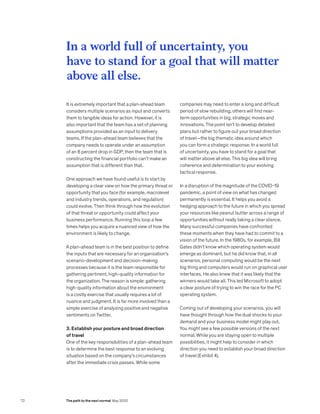
  • 120.
    to communicate thehighlights of the day and to escalate key decisions that have not yet been resolved to the president and senior-leadership team. Principles to guide decision making for a university nerve center Much of the discussion so far applies widely—to private-sector organizations, governments, and higher-education institutions alike. But because universities have unique characteristics, four additional guiding principles should inform how they use the nerve center and make decisions. Bring an equity lens to every decision. Many of the actions universities take to slow the spread of the virus and safeguard health will likely have a disproportionate effect on already vulnerable populations. For example, lower-income students may not have the devices or internet speed at home to get set up for online coursework. They are also more likely to depend on campus employment for living expenses. For students who were struggling academically, the transition to online learning could be incredibly disruptive and threaten completion. Some international students may not be able to get home, and if they do, may not have access to the internet; others may not be able to stay in the country given visa and work-authorization rules. Some students may have no home to go to. In terms of the staff, many of those who provide the operational backbone of the campus—everyone from faculty to janitors and food-service workers— may lack a financial cushion if they are laid off or go unpaid during campus closure. Local vendors may depend on university business. Universities have their own financial concerns, but to the extent possible, they must nevertheless incorporate a sense of equity—favoring the more vulnerable over the more affluent—into how they make decisions. Stay in close touch with students, faculty, and alumni. As COVID-19 spread, universities had to act quickly, focusing largely on health and safety. As the consequences linger on, universities need to understand the concerns of their students and other stakeholders—and then respond effectively. Both academic and nonacademic concerns are important; for example, plans for commencement and for supporting graduating seniors as they enter an uncertain employment market. Part of this effort needs to be directed at supporting the mental health of students and faculty who are now spread out, and possibly dealing with loss, shock, isolation, and difficult family situations. Engagement doesn’t stop with current students. Alumni will be critical to bouncing back from the financial stress of the outbreak. If there is a recession, alumni donations might falter, but an “early and often” approach to alumni communication might pay dividends down the road—both financial and nonfinancial. Think beyond your walls. No university is alone in coping with COVID-19. Peer institutions are grappling with the same issues at the same time. This represents a unique opportunity to learn from each other in real time, and to collaborate. One example might be to create educational partnerships, such as small colleges banding together to provide online learning, or piggy- backing off a larger institution’s capabilities. There may also be a way to create strategic partnerships— joining together to advocate certain policies or to coordinate communications or workforce initiatives. This is a time for universities to embrace the idea of being peers in a common educational mission—not just as competitors for students and staff and for athletic glory. Finally, it is important to remember the role of the university in the broader community. As campuses go quiet, universities are sitting on physical assets that could prove critical in helping local governments and healthcare workers respond. Act with urgency, but with perspective. The immediate focus will of course be safety and operations, and with good reason. But it is important not to stop there. While the immediate issues can easily consume senior-leadership bandwidth, equally important to the success of the response will be longer-term planning for recovery. 118 The path to the next normal May 2020
  • 121.
    There are twoelements to bringing in a longer- term view to decision making. First, institute in-depth scenario planning around what different epidemiological outcomes would mean for the resumption of in-person classes—and the subsequent implications for teaching, enrollment, faculty, staff, operations, and infrastructure. Nerve centers can act as a catalyst for long-term planning by driving scenario-planning exercises with senior leaders and by encouraging workstreams to map out what decisions need to be made in the next 15 days, 30 days, 60 days, and 90 days. Second, there needs to be a way to reflect on how the COVID-19 crisis could and should change how universities operate in the future. A crisis can provide an opportunity to think anew—perhaps to reassess elements of the student experience, admissions, graduation requirements, testing, and more. To the four “Ds” above (discover, decide, design, and deliver), we would add one more that nerve centers need to embrace: doubt. Regularly evaluate ongoing and potential actions in the light of new information and decide whether plans need to be modified, adopted, or ditched. Learning from the past is important—as universities certainly know. But it’s just as important to be willing to accept new insights, even when they contradict previous ones. Encouraging a healthy dash of doubt makes these habits of mind a routine part of the decision-making process. Nerve centers, and the organizations they serve, require strong leadership and steady direction. The senior leader must create a sense of purpose to unify work teams and set priorities. Perhaps most important is to demonstrate the personal characteristics that can guide an institution through the storm. Responding to COVD-19 will require American universities to balance many things: short-term needs with the long-term future, the role of the university itself with that of the broader community, finances with equity, and the need to be decisive with the desire to be collegial. This is delicate work. The universities who manage to do it, however, with the assistance of a well-run nerve center, will find that when the crisis has passed, they will be ready to face the future. Copyright © 2020 McKinsey Company. All rights reserved. This is the first in a series of articles on COVID-19 and higher education. Pablo Illanes and Jimmy Sarakatsannis are partners in McKinsey’s Washington, DC, office; Ana Mendy is a partner in the Southern California office; Jonathan Law is a partner in the New York office; and Saurabh Sanghvi is an associate partner in the Silicon Valley office. Coronavirus and the campus: How can US higher education organize to respond? 119
  • 122.
    Coronavirus: How shouldUS higher education plan for an uncertain future? With American campuses largely empty of students, higher-education leaders need to shift their thinking to what happens next. © Timur Alexandrov/EyeEm/Getty Images by Frankki Bevins, Jake Bryant, Charag Krishnan, and Jonathan Law 120 The path to the next normal May 2020
  • 123.
    Exhibit 1 GES 2020 CoronavirusHow should US higher education plan for an uncertain future Exhibit 1 of 2 Depending on the scenario, normal operations may not resume for US higher- education institutions until summer 2021. Online learning predominates through spring and summer 2020; face-to-face instruction resumes in fall 2020 Programs are disrupted through summer, hurting major auxiliary revenue streams; 2020–21 school year operates almost normally, but new health controls stay in place; there is some disruption to international-student enrollment Online learning occurs through fall 2020; face-to-face instruction resumes by January 2021 Programs start 2020–21 school year online, resulting in major decline in auxiliary revenues; programs with strong brands and online capabilities stand to gain enrollment amid spike in attrition and switching Online learning occurs through 2020; face-to-face instruction resumes as late as fall 2021 Programs operate online only for at least first full semester of 2020–21 school year; there is continued switching to schools with strong online capabilities; there is significant disruption to international-student enrollment Rapid and effective control: virus contained Effective response but (regional) virus resurgence: virus recurrence Broad failure of public- health interventions: pandemic escalation The COVID-19 challenge is unprecedented; its scale still is not understood. Colleges and universities in the United States cannot know when they will open again to normal activity or to what extent education as usual will resume. But even though higher-education leaders cannot know the answers, given the uncertainty in the epidemiological and economic outlooks, they must start asking themselves questions about the medium- and long-term implications for teaching, learning, the student experience, infrastructure, operations, and staff. Disciplined scenario planning can help. In this article, we consider three broad epidemio- logical and public-health scenarios (Exhibit 1). All of these represent a degree of economic disruption few adults in the United States have ever experienced. In the first scenario (virus contained), COVID-19 is contained in the next two to three months. In the second, more pessimistic scenario (virus recurrence), physical distancing and other restrictive measures last in some regions for several more months. In the final, most extreme scenario (pandemic escalation), the public-health response fails to control the spread of the virus for an extended period of time, likely until vaccines are widely available. On the basis of these scenarios, we examine different ways in which the COVID-19 crisis could play out for US higher education (part 1). Then we suggest how institutions could respond to the unfolding conditions in both the near and medium terms (part 2). Part 1: How the scenarios could play out for higher education The only certainty is uncertainty. However, given the mission and function of universities, they need to examine the possibilities across everything they do. Implications for teaching and learning In the virus-contained scenario, we envision that most students will complete the current semester online, and the class of 2020 will graduate virtually— that is, without a formal on-campus ceremony. Beginning in the summer, rules on travel and events will loosen to some extent, although study-abroad programs might not resume just yet. Although additional health safeguards will be necessary, students will be able to return to class for the fall semester. However, restrictions will remain for some international students, and many members of the incoming class will have had disruption in the last months of their high-school educations. Coronavirus: How should US higher education plan for an uncertain future? 121
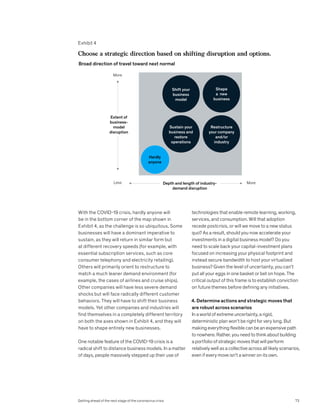
  • 124.
    Even this relativelyoptimistic outlook is likely to pose significant challenges to higher education. The sudden shift to online learning is already stretching existing infrastructure; faculty with little or no experience in teaching in this environment may struggle. Courses with a high level of hands- on components—such as clinical practicums, labs, and performing arts—will be particularly disrupted, and students in these fields may have to delay graduation to fulfill requirements. Exams will have to be held online, making it impossible to administer closed-book tests. In the other two, more pessimistic scenarios, most schools will be exclusively online through 2020 and into 2021. Travel will be greatly limited, and large events will not take place. Study-abroad programs will be canceled through 2021. The incoming class of first-year students will start college without an on-campus orientation. Faculty will have to make longer-term changes to their curricula and teaching approaches. A notable share of the class of 2021 will not graduate that year. Implications for student enrollment, equity, and experience In the virus-contained scenario, the main impact will be on persistence, as students and faculty will struggle to adapt to online coursework. Institutions with limited records of creating a compelling online experience could be hurt if their current students are dissatisfied with their digital offerings and decide to go elsewhere. Students might also delay returning until campus life is back to something close to normal. In terms of equity, lower-income students will suffer disproportionately. They are less likely to have the resources, such as PCs and high-speed- internet access, to enable them to succeed in an online-learning environment. They will also face the most immediate financial challenges, with many industries laying off employees and on-campus employment mostly ended. As for the student experience, hunkering down at home with a laptop and a phone is a world away from the rich on-campus life that existed in February. In the virus-recurrence and pandemic-escalation scenarios, higher-education institutions could see much less predictable yield rates (the percentage of those admitted who attend) if would-be first-year students decide to take a gap year or attend somewhere closer to home (and less costly) because of the expectation of longer-term financial challenges for their families. International enrollment could be severely hit because of ongoing travel restrictions and fear. Both trends would depress enrollment. On the other hand, higher-education enrollment has traditionally increased during recessions. For example, during the global financial crisis of 2008–09, US undergraduate and graduate enrollment grew by about 5 percent and 10 percent a year, respectively, until 2011, netting a trough- to-peak addition of almost three million students.1 There could also be a rebalancing of students between schools. Specifically, schools that are more affordable and those that have a strong, well- developed online-learning infrastructure could see enrollment rise. Almost half of US colleges and universities had no formal online-education programs in 20182 ; they may find it more difficult to attract and keep students. Implications for faculty and staff In any scenario, faculty will be under intense pressure to develop and deliver online courses. Beyond that, cancellation of kindergarten through 12th grade could affect faculty members with children and compromise the availability of staff services. Mental- health resources could see greater demand. And with campuses shut down, it would not be easy to know what to do about staff whose services are not needed as much but who are members of the community and rely upon that income. 1 Enrollment on a full-time-equivalent basis in 2008 compared with 2011, from the National Center for Education Statistics (NCES) Integrated Postsecondary Education Data System (IPEDS). 2 As of fall 2018 (the most recent data available from NCES IPEDS), more than 3,000 of the 6,352 institutions reporting to IPEDS had no students in “exclusively distance learning” or “some but not all distance education courses.” 122 The path to the next normal May 2020
  • 125.
    In the virus-recurrencescenario, scientific and medical research will be difficult to continue, and a poor economy would likely mean fewer grants. Finally, even if downsizing has been avoided through the summer, it may become inevitable in this scenario. Many higher-education institutions simply will not be able to keep paying all their personnel in full when there are no students on campus. Implications for infrastructure In the few cases in which students remain on campus, they need to be kept healthy and physically distanced. Even when there are few or no students around, universities must continue to support faculty and staff. In both cases, campus health systems may be feeling the stress. Universities with academic medical centers are on the front lines of care for their communities. If the number of COVID- 19 cases requiring intensive care and ventilators rises steeply, academic medical centers could find themselves in dire straits. In the virus-recurrence and pandemic-escalation scenarios, dorms and other infrastructure will remain empty through 2020 or beyond. In both scenarios, that infrastructure might be used by healthcare authorities for medical staff or for quarantine. Meanwhile, IT infrastructure will need upgrading, including the integration of new learning software and tools to maintain teaching standards, as courses move online. Implications for finances For most colleges and universities, COVID-19- related developments will put their budgets under even more pressure. In the virus-contained scenario, current-year tuition revenues will likely fall, given refunds for study-abroad programs and the likely reduced persistence of students. Also, because online programs have traditionally been cheaper, universities are already facing calls to refund portions of regular tuition. Next year will likely see fewer international students enrolled. Auxiliary revenues (room, board, athletics, rentals, grants, and other nontuition revenue sources) will erode as refunds or vouchers for next year are issued for housing, meals, and parking—and if summer programming is disrupted or canceled. In the virus-recurrence scenario, the situation would be worse for both tuition and nontuition revenues. Tuition revenues will dip for many schools, with reductions in international-student enrollment, cancellation of study-abroad programs, and increases in attrition, especially for schools with limited online-delivery capabilities. Nontuition revenues will also remain low, with all large events and conferences postponed and fall sports canceled. Fundraising will also be challenged in the context of a broad economic downturn. If the stock market stays weak, the value of endowments will fall. In the pandemic-escalation scenario, all of those pressures will intensify further as the duration of online learning extends. To understand better how the unfolding COVID-19 pandemic could affect the economics of higher education, we constructed an economic model, based on how long online programming remains the primary operating model (Exhibit 2). Even under the more modest virus-contained scenario, 25 percent of public four-year institutions and almost half of private not-for-profit four-year institutions could suffer budgetary shortfalls of more than 5 percent, absent a public or philanthropic intervention. In the pandemic- escalation scenario, the percentage of US higher- education institutions experiencing budgetary shortfalls of more than 5 percent will increase to more than half. For private not-for-profit four-year colleges, that percentage will rise to 77 percent. In addition, more than 800 higher-education institutions of all kinds could suffer a 20 percent or greater budgetary shortfall (assuming costs stay the same). Some will be able to deal with the shortfall by drawing capital from their endowments; one out of three private not-for-profit schools with a 5 percent budget shortfall could cover it with draws of up to 10 percent of their endowments. That, however, is a stopgap, not a strategy (see sidebar, “COVID-19 and historically black colleges and universities”). Coronavirus: How should US higher education plan for an uncertain future? 123
  • 126.
    Part 2: Whatcolleges and universities can do Higher-education institutions in the United States have already taken dramatic first steps to keep their people safe and to keep learning alive. Here are some other actions they can consider in the weeks and months ahead: — Now: Set up a nerve center. An integrated nerve center can help higher-education leaders plan and manage their response to COVID-19 by establishing work teams with specific areas of responsibility. The work has four parts. First, discover an accurate view of the situation—on campus, in virtual classrooms, and in the broader community—and derive implications from that view. Second, decide what to do quickly—but after stress-testing hypotheses and alternatives and ensuring adherence to university and local community values. Third, design a portfolio of actions—for both the short and long terms— with a pragmatic operating model, to develop detailed plans and act on them. Finally, deliver plans and responses in an efficient, flexible manner. Nerve centers must meet regularly—at least once (and better twice) a day—and enforce Exhibit 2 GES 2020 Coronavirus How should US higher education plan for an uncertain future Exhibit 2 of 2 US higher-education institutions could face budget shortfalls as auxiliary and investment income falls and some students switch schools. Note: Figures may not sum to totals listed, because of rounding. 1 Public, 4 years, n = 747; private, not for profit, 4 years, n = 1,606; public, ≤2 years, n = 1,179; for profit, n = 2,366. Source: Expert interviews; Integrated Postsecondary Education Data System; McKinsey analysis Share of higher-education institutions facing potential gap of ≥5% between revenues and costs in 2020–21, %1 Public, 4 years Public, ≤2 years Private, not for profit, 4 years Virus contained (online until fall 2020) Virus recurrence (online until January 2021) Pandemic escalation (online until summer/fall 2021) For profit Public, 4 years Public, ≤2 years Private, not for profit, 4 years For profit Public, 4 years Public, ≤2 years Private, not for profit, 4 years For profit 17 6 3 17 16 14 10 6 5 13 12 15 25 100% 21 47 39 22 19 4 15 25 26 12 8 5 13 12 15 45 26 66 40 20 26 11 10 24 43 15 11 6 11 23 25 57 33 77 Gap between projected revenues and historical costs 60 20% 10–20% 5–10% 124 The path to the next normal May 2020
  • 127.
    accountability by trackingwhat is being done, when, and by whom. — Near term (April to May): Focus on students, financial resilience, and support of faculty and staff. Start with ensuring that students have all necessary assistance, including mental-health services, and that educational standards are maintained. Faculty should receive the support required to continue their research and to learn how to teach effectively in an online environment. For nonessential staff, make quick decisions about sick-pay and employment policies. Finally, institutions must figure out where they are with their finances. Given the continued uncertainty, they should evaluate a range of scenarios, and seek to understand their sensitivities to certain revenue streams. We will expand on specific actions to consider in future articles. — Medium term (June to September): Focus on enrollment, persistence, and operations. Institutions should plan for the next school year. Establish a command center to manage yield actively, particularly regarding students at higher risk of not enrolling, such as international and lower-income students. Universities should also consider whether and how to make significant changes to current teaching models, making them more scalable, more flexible, lower cost, and, importantly, more engaging. They also need to plan for appropriate remediation for the significant disruptions to teaching and learning that all students will have experienced. Crises can create paralysis and fear. Rigorous scenario planning can help leaders map the potential damage and devise ways to deal with it. Universities need to look beyond the immediate crisis to create effective long-term strategies both to get through the present and to safeguard their futures in the new normal that will follow. COVID-19 and historically black colleges and universities The coronavirus could pose a particular challenge to historically black colleges and universities (HBCUs), which play a critical role in the advancement of the African American community and serve a signifi- cant number of low-income and first- generation students. Of the 101 HBCUs in the United States, 25 did not serve any students online as of 2018, and another 61 had relatively few students in fully online environments.1 These institutions might find it difficult to shift to remote learning, especially in a pandemic escalation sce- nario in which students need to be served online through summer 2021. Moreover, many HBCUs emphasize the value of the on-campus experience; it may be difficult for them to foster this sense of connected- ness in a digital setting. 1 As of fall 2018, the most recent data available from the National Center for Education Statistics Integrated Postsecondary Education Data System, 61 historically black colleges and universities had 400 or fewer students in fully online programs. Coronavirus: How should US higher education plan for an uncertain future? Copyright © 2020 McKinsey Company. All rights reserved. Frankki Bevins is a partner in McKinsey’s Denver office; Jake Bryant is an associate partner in the Washington, DC, office; Charag Krishnan is associate partner in the New Jersey office; and Jonathan Law is a partner in the New York office. 125
  • 128.
    Getting the nextphase of remote learning right in higher education Because of the coronavirus, American colleges and universities are entering new educational territory. Here are some practical ways to deliver excellence. © Vladimir Vladimirov/Getty Images by Christine Heitz, Martha Laboissiere, Saurabh Sanghvi, and Jimmy Sarakatsannis 126 The path to the next normal May 2020
  • 129.
    For higher-education institutions,the first frantic rush of transitioning from in-person to remote learning is behind them—not that the process is complete. Most faculty members have managed to establish new routines. Others are still working out how to teach courses designed for a physical classroom through online platforms that they may still be learning to master. Students are also having to adjust, expected to learn as much without the ready social connection and energy of a residential and in-person learning environment. It didn’t help that until the COVID-19 crisis, online learning comprised a relatively small share of higher education. Fewer than one in five (18 percent) of US tertiary-level students learned online exclusively; as of fall 2018, about a third had taken at least one course online.1 Now that the first phase has passed, what comes next? This article details five specific actions universities could take in the next few months to help improve student learning, engagement, and experience while operating remotely. Whether students are able to return to campus for the fall term or remain remote for longer, these moves may inspire institutions to pilot new initiatives, learn what works, iterate, and position them- selves to create capabilities that will enhance instruction permanently. Focus on access and equity. Moving from on-campus to remote learning raises issues related to access and equity. There are the immediate logistical challenges of ensuring students have the basic technology they need to learn remotely. One response has been for institutions to offer stipends for internet access and laptop rentals or purchases. Others have loaned equipment and procured additional laptops and hot spots for under- resourced students; this may get equipment to them faster and at an accessible cost. The University of Washington-Bothell, for example, has increased its equipment loan service and bought laptops and hot spots for students who need them. Universities can be an effective central coordinating resource to share the free options becoming available. Hundreds of internet and telephone service providers have signed the FCC Keep Americans Connected Pledge and are providing benefits like free hot spots with no data caps to support distance learning. Universities can also work with state and local providers and agencies to advocate for government support. In addition to these technical issues, there are a range of social, emotional, and human needs that need to be addressed to enable students to learn. Some are basic: food, housing, and money. Without access to dorms and on-campus food services, lower-income students can struggle just to get through the day. Universities can work to connect them to social service organizations; they can also think creatively about providing food service and residential support for those most in need. Some universities, such as Mississippi State, are also getting creative about keeping campuses partially open in a controlled, physically distant way. Mental health services on campuses have been expanding, and the need for them could grow— for students, faculty, and staff alike—given the anxiety and distress caused by COVID-19. With fewer people on campus, institutions are starting or scaling up outreach, including video options for mental health professionals, partnerships with tele- health and tele-counseling providers, and access to online mindfulness classes and applications. Those with learning disabilities or accessibility needs require particular attention. On many campuses, there are offices that help to ensure that learning is visually, aurally, and tactilely accessible. The shift to remote learning, however, could overwhelm these resources. The priority should be to design specific approaches to suit each need. For example, institutions can record courses and add closed captioning, so that students who are hearing impaired or have auditory processing delays can keep up. 1 This article distinguishes between remote learning and online learning. “Remote learning” refers to the temporary move of in-person or hybrid courses to an online teaching and learning format. “Online learning” refers to instruction designed specifically for use in an online format. Getting the next phase of remote learning right in higher education 127
  • 130.
    Support faculty. Mostprofessors are working hard to respond creatively to teach their students to the same standards, even as their own lives are disrupted. What methods work best in a remote environment will differ by discipline and the technology available. That said, there are a few broad ways that institutions can help. Offer more teaching support. Many institutions have centers that offer support to faculty in their teaching; these should be scaled up as much as possible and shift their orientation from “wait until asked” toward outreach, engagement, and sitting in to observe remote courses. Use social media and online forums so that faculty can share best practices. Collaboration forums can get early momentum when “seeded” with ideas from influential professors. Highlighting and explaining successful remote- teaching practices during faculty meetings can cultivate a sense of camaraderie, as well as a culture of sharing and improving. Faculty will inevitably start from different points in their comfort and skill with remote teaching, but institutions that cultivate a culture of improvement will benefit both their students and the faculty themselves. Set up a structure so that faculty can get regular feedback on their remote teaching. There are two sources to draw from—short student surveys and engagement data derived from the school’s learning-management system. Effective student surveys are short and ask specific, pertinent questions, such as how well professors explain the concepts or cultivate a sense of connection. These surveys should be used not to judge professors, but to give them information on how students are responding and where they can improve. Survey results can also give administrators a sense of where they might need to intervene to support student learning. Invest in capabilities over the summer. As institutions consider whether they will extend remote learning through the fall semester, they can spend the summer months training faculty and refining courses for an online format. Universities could consider holding remote- learning “bootcamps” and hiring more online curriculum designers. In addition, universities can use summer months to explore and test new technologies to meet specialized needs, such as simulation software to mimic a lab experience or accessibility options to better serve students with disabilities. Move the quad online, too. For many full-time students, the value of higher education comes not only through academic coursework, but also from the vibrancy of campus life, from late-night conversations, to interactions in the dining hall, to serendipitous moments of engagement. As institutions move to remote learning, they can think about how to use existing tools to move Institutions that cultivate a culture of improvement will benefit both their students and their faculty. 128 The path to the next normal May 2020
  • 131.
    in-person gatherings onlineand open up spaces for discussions, events, wellness classes, and other interests. The idea is to offer virtual spaces in lieu of physical ones to enable the university community to continue to connect. One way to think about it is to ask how to create a single, central place—a kind of online student center—with live staff and consistent hours. The University of Florida has started a “student plaza,” where it is possible to organize study groups and connect with academic advisers. It is also possible to build virtual tutoring networks that allow tutors to connect with students. Universities could also consider creating “virtual homerooms” based on geography or affinity groups to enable continued student engagement. To keep organizations going, university leaders could consult student leaders to agree on common goals and priorities and to discuss what needs to happen in terms of technology access, learning, and engagement. Consider how to create spaces for established and new student groups to continue to operate in some way. For example, universities could work with students and use university resources to offer a hub for volunteers looking to help with the crisis. Students across the nation created a virtual teach-in on climate change with 52 simultaneous university-hosted statewide webinars. In lieu of guest lecturers filling a hall, bring in speakers remotely, including live discussion. Indeed, one of the advantages of remote learning is the ability to invite guests from anywhere in the world. It will not be possible to put on a full theater production, but virtual play readings are certainly doable. Activate stakeholders. Big or small, public or private, colleges and universities are alike in one way: they are rich in human talent. To succeed in this brave new virtual world, the key is to empower and redeploy this talent to address the most pressing needs. One way to start is by identifying and activating tech-savvy students and staff to coach faculty and other students to use online tools. At Pennsylvania’s Muhlenberg College, eight digital learning assistants—students with expertise in digital technologies and practices—are holding remote drop-in hours for four hours a day. They are also supporting other members of the digital learning team, including designers and librarians, through the transition to remote learning. Another possibility is to ask alumni and community members to provide remote mentorship and coaching to support students with remote learning, career discussions, and virtual internships. Invest in cybersecurity to ensure the continuity of teaching and learning. The rushed efforts to move learning online have increased the risks of cyberthreats. Universities have already endured cyberattacks in which unwelcome users have disrupted classes. Universities can prevent such problems by ensuring their cybersecurity teams are up to the task, closing the gaps that attackers can exploit, and making investments required to ensure security and data privacy while enabling teaching and learning to go on. Areas for stepped- up monitoring include remote-learning platforms and collaboration tools, monitoring networks for malware, and monitoring student and faculty endpoints to catch data-related incidents before they become serious problems. Security and technology risk teams can take the following actions to support online learning. Secure the tools used for teaching and learning by implementing safe remote-learning protocols including scaling virtual private networks (VPNs) for data transmissions by students and faculty implementing multifactor authentication for learning applications, enforcing antivirus software, limiting access to learning applications to verified student and faculty members, and ensuring adequate cloud storage for recorded lectures. Example: Yale University’s IT department has created a coronavirus technology update service that highlights VPN and multifactor authentication protocols, as well as supporting online learning. Getting the next phase of remote learning right in higher education 129
  • 132.
    Build a resilientfaculty and student body through education about phishing and malware attacks, particularly those that are trying to take advantage of fears around COVID-19. Example: Kean University in New Jersey has created specific resources to inform its community about cybersecurity resources related to COVID-19. Adapt how the university works, teaches, and secures its learning capabilities by adding support capacity for the information-technology help desk, testing and clarifying incident- response protocols, and confirming the security of third-party tools used for learning and teaching. Often with limited experience and training, US higher education institutions have hustled to shift to remote learning and teaching. Many have done so in an exemplary manner; others have not been as successful, at least so far. All of them, though, have more to do to achieve the excellence and collegiality that should define the university experience. This forced and abrupt move to remote learning has not been easy. However, it can provide institutions with an opportunity to experiment and innovate. Piloting new approaches and building on practices that are proved to work can help create positive and enduring changes. Universities may find that they have a new remote-learning capability that can be integrated with on-campus instruction, to everyone’s benefit, when this crisis has passed. Copyright © 2020 McKinsey Company. All rights reserved. Christine Heitz is a consultant in McKinsey’s Denver office, Martha Laboissiere is an associate partner in the San Francisco office, Saurabh Sanghvi is an associate partner in the Silicon Valley office, and Jimmy Sarakatsannis is a partner in the Washington, DC, office. The authors wish to thank Jake Bryant, Emma Dorn, and Jonathan Law for their contributions to this article. 130 The path to the next normal May 2020
  • 133.
    School-system priorities in theage of coronavirus Now that the immediate rush of closing K–12 schools is over, school systems must focus on four major priorities—and put equity front and center. © Adamkaz/Getty Images by Jake Bryant, Li-Kai Chen, Emma Dorn, and Stephen Hall School-system priorities in the age of coronavirus 131
  • 134.
    Exhibit 1 GES 2020 COVIDSchool Priorities Exhibit 1 of 2 As of April 15, 191 governments had closed K–12 schools in response to the coronavirus. Source: UNESCO School closures 1.6 billion children affected Country-wide school closure Local school closure As of mid-April, 191 countries had shut down all their primary and secondary schools, affecting almost 1.6 billion children (Exhibit 1). The shift to remote learning has been uneven. Some systems were able to train teachers, roll out remote learning, and put in place student support services in less than a week. Others are still struggling, constrained by lack of access to technology or expertise. The disparity is obviously true between countries; it is also true within them. Given that K–12 education in many countries is predominantly a local responsibility, students can live relatively near each other yet face very different prospects. Addressing these inequities in a remote-learning environment is a complex challenge. School systems need to adapt across many dimensions, while serving students from a variety of backgrounds. Vulnerability comes in many forms; low-income students, immigrant students, ethnic or religious minorities, students with special needs, students in remote rural areas, and those in risky home situations all need tailored strategies. Furthermore, there is no clear picture of how long a model of predominantly remote learning will need to continue. Some children could be back at their desks by late April; for others, it could be much later (see sidebar, “The 5 Rs of getting back to school”). There are four priorities for school systems: maintaining health and safety of students, staff and the community; maximizing student learning and thriving; supporting teachers and staff; and establishing a sound operational and financial foundation. In each case, we believe that issues regarding equity—that is, ensuring that the needs of the most vulnerable are met—should be front and center, both during the closure and after students return to school. 132 The path to the next normal May 2020
  • 135.
    Maintain health andsafety. The coronavirus is not the only threat to student health and safety. Low- income students often depend upon schools for basic nutrition. Home may not be a safe place for others. And the combination of concern over the viral threat and social isolation presents a challenge to the mental health of students and staff alike. There is much that school systems can do to help. Many US school districts, including those in Los Angeles, New York, and Seattle have repurposed closed schools and community centers to offer lunch to needy students. The British and Spanish governments are providing vouchers or redeemable credit cards to students. The next step is to work with community organizations to extend nutrition and other services to the whole family. The UN’s World Food Programme (WFP) is working with developing-country governments so that students and their families receive food through take-home rations, home delivery of meals, and vouchers. Schools also provide other forms of support. One British school calls vulnerable children every day, and visits (keeping physical distance) in person if there is no answer. Other systems are collaborating closely with local law enforcement and social services to ensure child safety. To support student mental health, it isn’t enough to shift existing counseling services online, though that is a good start. For the highest-risk students, there needs to be continuous evaluation and monitoring, and outreach is essential to identify and serve new cases. In the United States, the Centers for Disease Control and Prevention (CDC) and the National Association of School Psychologists have released resources including checklists for behaviors and reactions to be aware of, as well as methods to reduce stress and anxiety. If needs grow, governments may want to consider contracting with private providers for additional capacity to provide mental health support. Community-building activities can also maintain social connections between students. One California elementary school district created a “sidewalk chalk walk”; the school encouraged students to decorate their sidewalk, then provided a map to walk the neighborhood and admire their friends’ art. As the initial coronavirus curve flattens, governments and school systems need to make hard choices on when and how to reopen schools, for which subpopulations, and with what set of health and safety protocols. As they do this, a different set of vulnerable students and staff may emerge—those living with elderly or immune- compromised families, for example, and those who are particularly susceptive to infection themselves. Some form of remote learning will therefore probably need to be sustained, even after schools open their doors again. Perhaps older or immune- compromised teachers can continue working safely from home to maintain remote learning for students who are not able to return to school. The 5 Rs of getting back to school McKinsey has previously set out five steps to move through and beyond the coronavirus virus. These can also be applied to K–12 education. 1. Resolve focuses on the immediate health threat that COVID-19 poses to students, teachers, staff, and the community. 2. Resilience: educators address near- term challenges, such as setting up remote learning and supporting vulnerable students. 3. Return is about reopening schools and ensuring remediation for lost learning. 4. Reimagine: leaders think what the “next normal” could be like, and how education systems could re-invent themselves. 5. Reform: educators reconsider education priorities in light of lessons learned. School-system priorities in the age of coronavirus 133
  • 136.
    Student and staffhealth needs will not end with the virus—schools should plan to deal with heightened mental and physical health issues long after the pandemic subsides. With many parents out of work or forced into debt, schools may also have to deal with broader economic vulnerabilities, and respond through specific programs for homeless students, clothing closets, and the like. Maximize student learning and thriving. Even in times of crisis, education matters. Delivering quality instruction is clearly a challenge in current circumstances; the magnitude of the challenge, however, varies widely. Technologically-advanced systems have been able to roll out synchronous and asynchronous online learning; less developed ones are using a combination of television, radio, paper packets, and cell phones. Some are struggling to deliver even that, and their students will have considerable catching up to do. The imperative right now is to get remote learning to as many students as possible, with special attention to the most vulnerable students and schools. In districts where resources, expertise, and leadership are available, it is possible at least to get started in as little as one to two weeks, and then to create processes to foster continuous improvement (Exhibit 2). Access to devices and internet connectivity is uneven even in affluent districts in developed systems. Addressing that is a critical first step to ensure equity. France is lending devices and providing printed assignments to students who don’t have access to computers or the internet, while China is offering mobile data packages and telecom subsidies; it has also repurposed segments of the state-run television channel to air lesson plans for K–12 education in remote regions. South Carolina schools have deployed mobile hot spots to low-income neighborhoods by equipping school Exhibit 2 GES 2020 COVID School Priorities Exhibit 2 of 2 Scaling up remote learning can happen quickly, but requires constant monitoring for improvement. Scaling timeline Set up agile team to lead project management and stakeholder communication Align with leadership on the vision for remote learning, guardrails for success, and necessary trade-offs Assess the current state of infrastructure (eg, student access to broadband and devices) and fill major gaps to ensure equity among all students Determine the platform and devices required for delivering content/ instructional material Agree on curriculum- aligned content sources to be leveraged by grade level Roll out the platform and process in waves to teachers, with rapid training and expectation setting Roll out the platform, devices, internet connection, expectation, training and content in waves to students and parents/families Identify and monitor key indicators to track implementation (adoption, satisfaction, test scores) Launch initiatives to ensure equity among vulnerable students (eg, low-income, special education, immigrant) Make critical policy decisions around assessment, grading and progression Align and enable Establish a clear vision and create conditions for success (1–2 days) Design and setup Make key design choices around platform, content, and devices (2–3 days) Pilot Roll out remote learning in phases to teachers and students (2–3 days) Monitor and adjust Continuously improve in response to feedback (ongoing) 134 The path to the next normal May 2020
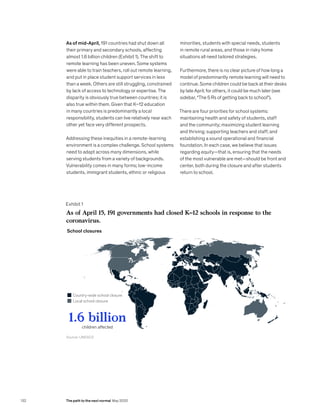
  • 137.
    buses with Wi-Fi.In Portugal, the government is pursuing a partnership with the post office to deliver worksheets for students with no internet access. Where expanding access to devices and broadband are not an option, then design and setup of remote learning needs to be adapted to the technology that does exist—be that television, radio, cellphones, or paper-packet delivery. Providing access to all is only a start. Some students need more support, for example because of language barriers, working parents, or learning or physical disabilities. To narrow this equity gap, resources need to be disproportionately directed to those with the greatest needs. Supporting parents is a critical piece of this puzzle. Many parents are balancing their own remote work responsibilities with helping children with schoolwork; others have lost their jobs and are struggling to remain afloat. Schools can help by making things simple for parents: clear communications with what is expected and required, and step-by-step guidelines are most useful. Long lists of online resources, tools, and activities are helpful additions, but only in so far as they don’t cause overburdening or unrealistic expectations. To provide more direct student support, schools can start internally, planning academic interventions in small groups for those with specific needs. Eventually, partnerships with external providers and nonprofits may be required. In the United States, a nonprofit tutoring network, UPchieve, has expanded access to offer free online math tutoring for low- income high-school students; the New York Public Library is working with a virtual tutoring network to offer help in both English and Spanish. Parents can also be part of the answer. The Los Altos School District in California has set up a parent-led tech-team within each school to provide technical support to students and their families. Another vexing issue is what to do about assessments and grading, given that end-of-term examinations have been largely cancelled. For students struggling with the prerequisites of remote learning, including just finding a quiet place to study, figuring out what constitutes a fair grading system will not be easy. Systems are experimenting with a variety of options. The United Kingdom has announced that students will get “calculated grades” based on their prior attainment and teacher assessment. The United States has exempted states from federal testing requirements for the rest of this academic year; the states themselves can decide whether to cancel other assessments and address the needs of students who have not met graduation requirements—for example, through a portfolio appeals process. In Australia, the state of New South Wales is proceeding with its higher school certificate but is giving greater flexibility to schools to decide how assessments are carried out. Whatever approach is taken, equity must be part of the process and care should be taken not to institutionalize existing biases. For example, a number of studies have shown that teacher assessments systematically underestimate scores for minority students—and artificial-intelligence (AI) systems are only as good as the data entered into them. To provide more direct student support, schools can start internally, planning academic interventions in small groups for those with specific needs. School-system priorities in the age of coronavirus 135
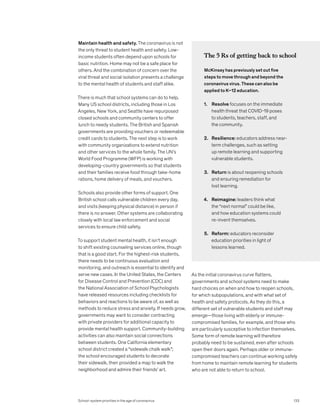
  • 138.
    The depth andbreadth of these and other inequities will become apparent once students return to school. Remediation will be particularly challenging if school budgets are cut due to lower tax revenues and growth. This is not a reason to lose hope. After the Ebola epidemic, Sierra Leone put in place a rapid-cycle program to get students back to grade level. There were special programs for pregnant teenagers, concerted efforts to build confidence in health and safety measures, psychosocial training for teachers, and simplified lesson plans focusing on the most critical elements of the curriculum. Adjusting the school calendar might help: school boards in India are already devising different academic calendars to compensate for lost learning, and some US states are investigating such options as expanding summer school or starting the 2021 school year earlier. Systems may face difficulties around teacher contracts, parent consent, and student motivation, but these can be anticipated and then overcome. These are not ordinary times, and ordinary measures will not suffice to protect needy students from learning loss and keep them on a path toward graduation and employment. Support teachers and staff. Much is being demanded of teachers, many of whom have young children of their own to look after even as they are learning whole new ways of teaching. They deserve— and need—the support of their school systems. The type of support needed will depend greatly on the maturity of the school system. Teachers in countries at the “poor-to-fair” stage (with PISA1 scores under 480) will need more guidance, and would benefit from having centrally provided content for their students. Teachers in countries at the great-to-excellent level (with PISA scores over 520) could use a more cooperative approach, getting tools and resources, but shaping them to meet their students’ needs. Collaborations with other teachers, too, will be critical, both within specific schools and more broadly. In South Korea, the Education and Research Information Service offers an online platform to facilitate sharing of materials by teachers. In the United States, many existing teacher-collaboration platforms including Teachers Pay Teachers and BetterLesson are sharing tips for remote teaching. Some schools will need more support than others, depending on their academic performance, history, and number of vulnerable students. Effective government intervention can help to narrow social inequities between schools in the same system by both channeling financial resources, and offering intensive support to high-need schools. Meanwhile, students are not the only vulnerable populations within school systems. Many of the operational staff employed by schools— janitors, food-service staff, and bus drivers, for example—live paycheck to paycheck. As many of these positions are no longer needed for remote schooling, schools face the difficulty of balancing fairness to their workers with the need to preserve budgets for student learning. These needn’t always be a zero-sum game. Some systems are redeploying nonutilized staff to deliver meals and perform tasks related to health and safety requirements. Staff in one rural Oregon school Remediation will be particularly challenging if school budgets are cut due to lower tax revenues and growth. 1 Programme for International Student Assessment. 136 The path to the next normal May 2020
  • 139.
    district prepare 750breakfast and lunches per day, which are then delivered by bus drivers as they travel their typical routes. Other systems are redeploying school inspectors as coaches or curriculum advisors. Ensure a strong operational and financial future. School systems need to start planning for different epidemiological and economic scenarios, and be ready to adapt if their budgets are cut. Hard decisions are going to have to be made at every level. There are no easy answers. However, even if funding falls, it will remain important to keep these equity issues front of mind. There are some things that schools can start doing now—for example, looking for savings in areas such as utilities and transportation, and asking vendors for discounts. There is a limit to what schools and school districts can do alone however. Many will have to seek additional funds to help their students recover, whether from governments, bilateral donors, or philanthropists. Creating post- coronavirus budgets needs to be a joint process between schools, which understand the needs on the ground, and district, state, and federal governments, which may be able to provide access to resources. Collaboration across the public, private, and nonprofit sectors may become easier to achieve. Crises can be a spur to creative problem solving. Under the pressure of the COVID-19 crisis, school systems can take the chance to rethink some of their traditional ways of doing things. As school systems emerge from the pandemic, it will be important to identify innovations that can be sustained into the “next normal”; innovations that can improve student learning, but also contribute to a firmer financial foundation. In the last few hectic weeks, school systems have worked hard to meet the immediate challenge of continuing to educate their students. Much remains to be done, and different systems are at very different stages of the crisis—from resolve to resilience to beginning to return. Across all five steps, school systems should think in integrated ways about how to support the neediest students. By devising ways to narrow these equity gaps, school systems can play an important role in helping societies pull together, not apart. Copyright © 2020 McKinsey Company. All rights reserved. Jake Bryant is an associate partner in McKinsey’s Washington, DC, office; Li-Kai Chen is a partner in the Kuala Lumpur office; Emma Dorn is the global education practice manager in the Silicon Valley office, and Stephen Hall is an associate partner in the Dubai office. School-system priorities in the age of coronavirus 137
  • 140.
    Mobilizing the C-suite 140 Boardsin the time of coronavirus 146 The CFO’s role in helping companies navigate the coronavirus crisis 152 When investors call: How your business should talk about coronavirus 156 The CIO’s moment: Leadership through the first wave of the coronavirus crisis 162 Driving digital change during a crisis: The chief digital officer and COVID-19 168 How chief data officers can navigate the COVID-19 response and beyond 174 Leading with purpose: How marketing and sales leaders can shape the next normal 138
  • 141.
  • 142.
    Boards in thetime of coronavirus Boards need to step up their game and guide their organizations toward the next normal. © Klaus Vedfelt/Getty Images by Martin Hirt, Celia Huber, Frithjof Lund, and Nina Spielmann 140 The path to the next normal May 2020
  • 143.
    NeverbeforehaveCEOsandtheirteamsbeen moreinneedoftheforesightandseasonedjudgment thatawell-functioningboardofdirectorscanprovide. Likewise,neverbeforehaveboardsneededmore carefullytobalanceprovidingsupporttomanagement teamsoperatinginhighlystressfulconditionswith challengingthemtoensurethattheymakethebest decisionsthroughoutacrisisforwhichnoplaybook exists.Thismaywellturnouttobethemomentwhen yourboardprovesitsvalue—orshowsitsflaws. In a recentarticle, our colleagues have called on management to act across five stages—Resolve, Resilience, Return, Reimagination, and Reform— both to address the immediate crisis and to prepare for the next normal after the battle against coronavirus has been won.1 At the same time, many board chairs and CEOs are looking for guidance on what role boards should play in these challenging times (for highlights, see “Boards of directors in the tunnel of the coronavirus crisis” on McKinsey.com). Just as every organization faces different challenges during this crisis—some are reaching new levels of growth, while others are struggling to survive—there is no one-size-fits-all answer for what a board should do. While management teams focus on making rapid decisions to protect employees, address customers’ needs, and communicate with stakeholders, boards need to balance oversight of the crisis response with thinking beyond the immediate challenges. Time is a scarce asset for most board directors, requiring them to make deliberate choices about where they focus their attention. In hindsight, the early 21st century may be seen as divided into two periods: the time before the coronavirus outbreak and the postpandemic era.2 That era could be characterized by different consumer behaviors, new ways of working, altered industry structures, and value pools redistributed across existing and new ecosystems. What does that imply for your organization and for your board? Resolve and Resilience: Support through the crisis Everyone is looking to an organization’s leaders to serve as role models in protecting people’s health and safety while acting decisively and with purpose amid chaos. The board’s priority should be to support the management team’s crisis response without encroaching on its operating role while also safeguarding longer-term shareholder and stakeholder interests. Management needs board directors to act as both sparring partners and empathetic counselors at a time when many leaders are seeking candid advice and personal support. Ensure that management adopts a scalable crisis operating model Your organization likely already has a crisis- response team in place. The team takes care of employee safety, shores up the balance sheet, and interacts with suppliers and customers to ensure business continuity.3 But that is not enough. The scale of the economic crisis that is unfolding is unprecedented in living memory. Organizations need a crisis operating model that can scale as issues escalate, with a plan-ahead team that develops strategic responses to multiple scenarios across all time horizons. Boards should frequently review and discuss the strategic crisis-action plans that plan-ahead teams develop to stay ahead of the evolving crisis.4 Augment leadership capacity A board can ease the pressure on the management team by reviewing communication plans and reputation-management strategies and engaging with select external stakeholders. Importantly, directors should help manage investor expectations in light of financial decisions, such as dividend cuts and changes to share-buyback programs, that may draw negative reactions. And since COVID-19 may affect board directors or managers personally, establishing clear succession and leadership contingency plans is more critical than ever. 1 Kevin Sneader and Shubham Singhal, “Beyond coronavirus: The path to the next normal,” March 2020, McKinsey.com. 2 See Kevin Buehler, Ezra Greenberg, Arvind Govindarajan, Martin Hirt, Susan Lund, and Sven Smit, “Safeguarding our lives and our livelihoods: The imperative of our time,” March 2020, McKinsey.com. 3 See Mihir Mysore and Ophelia Usher, “Responding to coronavirus: The minimum viable nerve center,” March 2020, McKinsey.com. 4 See Yuval Atsmon, Chris Bradley, Martin Hirt, Mihir Mysore, Nicholas Northcote, Sven Smit, and Robert Uhlaner, “Getting ahead of the next stage of the coronavirus crisis,” April 2020, McKinsey.com. Boards in the time of coronavirus 141
  • 144.
    5 See the BiasBusters collection on McKinsey.com. Strengthen decision making by sharing crisis- management experience Board directors with experience in managing external shocks, such as the aftermath of the 9/11 attacks and the 2008–09 financial crisis, will be particularly valuable sounding boards for a management team as it crafts response plans amid high uncertainty. Board directors’ insights from earlier crisis situations can help them constructively challenge business-continuity plans, for example, or supply-chain strategies. That said, the current crisis is uncharted terrain for all executives, making intuition and experience unreliable guides and cognitive biases particularly dangerous. As such, boards should urge management to use techniques such as red and blue teams or premortems to ensure that their decisions weigh all relevant factors.5 Balance short-term and long-term priorities While a board needs to protect all shareholders’ and stakeholders’ interests by weighing key operational risks and ensuring effective cash management and financial stability, it cannot lose sight of the organization’s long-term priorities, even as it focuses on short-term crisis response. Preserving the foundation of the organization’s competitive advantage, such as maintaining investments in a digital transformation or customer- experience improvements, should be a key point of board attention. Return: Lead into the reconstruction phase As business conditions start to stabilize, a board should strive to lift management’s ambitions and Long-term implications for a board’s operating model The changes to a board’s mode of opera- tion ushered in by the COVID-19 pandem- ic may have a lasting impact. Here are some examples: — Board agenda. The pressure to become more involved in forward-looking strategic activities immediately may permanently change a board’s agenda. The board may appreciate the increased impact it can achieve through regular involvement in strategy development or early succession planning, for example, while management may value the ongoing input and challenge from the board. — Time commitment. The realization that board directors need to spend more time on board work may lead to a reduction in the number of boards an individual can sit on and may affect director remuneration. The additional time commitment may come in the form of new ad hoc committees or a general increase in a board’s involvement in forward- looking activities, both within the organization and with outside stakeholders. — Virtual board meetings. Boards may start to recognize the advantage of holding at least some board meetings virtually, which may broaden the pool of prospective directors. — Team dynamics. The heightened collaboration and trust between a board and management team required to navigate the current crisis may produce a lasting shift in their dynamics, such as more informal information exchanges.1 — Diverse board composition. Boards with diverse experiences and backgrounds drawn from a variety of industries, functions, and geographic areas will have a distinct edge in effectively leading organizations through the current crisis. As a result, enhancing board diversity may become a high corporate priority. 1 Robyn Bew, Linda Liu, and Friso van der Oord, “Building board-management dynamics to withstand a crisis: Addressing the fault lines,” September 2019, McKinsey.com. 142 The path to the next normal May 2020
  • 145.
    position the organizationto ride the waves of uncertainty rather than be overpowered by them. The severity of the disruption of this crisis suggests that the path out will feel more like a reconstruction than a recovery. Boards can add value by pushing early for scenarios and robust plans to be prepared for the reconstruction phase. Engage on major decisions As employees start coming back to work, a board should confirm that effective health and safety protocols are in place and continue to oversee management’s integrated action plans. Some decisions are more complicated than they at first seem—for example, a government stimulus package may seem like a boon, but it can dilute shareholders’ equity and come with unexpected strings attached. The board should also closely monitor the management team’s evolving plans (such as slowing down new-product introductions and capacity expansions or accelerating resource reallocation) to ensure, for example, that these decisions do not overly weaken the balance sheet amid challenging capital-market conditions. Catalyze a strategy review Manyorganizationswillhavetorethinktheirproduct- marketfocus,customerengagement,orpaceof technologicalinnovation.Duringthisperiod,aboard shouldencouragemanagementtoundertakeabroad strategicreevaluationthatcouldentailembracingsome boldmoves.6 Itcanfosterthisprocessbyrequesting regular,jointstrategysessionswithmanagementto discussvariousalternativesandscenarios. Review the operating model A new strategy may require a broad review of an organization’s operations. The board should trigger the discussion, share external perspectives on the operating models of comparable organizations, and provide constructive challenges. It should also encourage management to match critical talent to key strategic initiatives, especially new leadership talent that may emerge during the current crisis. Help manage shareholder and broader stakeholder commitments Maintaining an ongoing, open dialogue with key shareholders and other stakeholders should be a key board responsibility as business conditions change. Managing interactions with governments and regulators may be particularly vital at this time, especially if an organization receives a stimulus package or other public assistance that entails commitments. Major investors, including activists, may also offer ideas for repositioning the organization for the postpandemic era that the board and management should consider. Reimagination and Reform: Stay ahead of the next normal As businesses will shift focus on preparing themselves for the next normal, some changes A clear division of roles and mandates between a board and management is paramount to make collaboration seamless and avoid the distraction of unnecessary conflicts. 6 Chris Bradley, Martin Hirt, and Sven Smit, “Strategy to beat the odds,” McKinsey Quarterly, February 2018, McKinsey.com. Boards in the time of coronavirus 143
  • 146.
    adopted during thecurrent crisis may become permanent. This might well have implications for the purpose and overall positioning of the organization that a board should closely monitor. Reassess the organization’s purpose and value proposition Our world will almost certainly look different after the coronavirus crisis. Industries and supply chains will be reshaped, value pools will have shifted (some irreversibly), and new behaviors may become the norm. Getting ahead of such trends by developing privileged insights can make the difference between leading or lagging in an industry for the subsequent decade. These changes may be profound enough to require a reassessment of an organization’s value proposition—and even its fundamental purpose. The board should also closely monitor how competitors are evolving and where they are investing (for example, in vertically integrated supply chains to fill gaps left by bankrupt suppliers) and make sure these realignments are factored into management’s long-term plans. By connecting management teams with the larger ecosystem of innovative players (including ones outside the organization’s traditional business), the board can widen leaders’ understanding of shifting business conditions. Plan for the next crisis It is never too early to plan a response to future shocks. A board’s role makes it well positioned to ensure that key lessons from the current crisis are captured and synthesized. The importance of remote-working technology and enterprise- wide action plans, for example, can guide new governance measures that make organizations more resilient during future disruptions (including potential later waves of the COVID-19 outbreak). Importantly, a board should challenge the management team to address a critical question: Is the risk-management approach sufficiently robust to respond to another “black swan” event?7 Operating the board during the crisis The current crisis sheds light on the vital importance of a diverse board. A group with a breadth of experience, relevant industry and functional expertise, and a range of ages, genders, and backgrounds enables an organization to assess challenges from a variety of perspectives. Here is how a board can effectively play its role (see sidebar, “Long-term implications for a board’s operating model”). Reconfirm the board’s role and accountabilities A clear division of roles and mandates between a board and management is paramount to make collaboration seamless and avoid the distraction of unnecessary conflicts.8 While the level of stress and pressure every individual is facing during the current crisis can be draining, a board needs to remain calm and focused. Some decisions that take years of alignment in normal times may have to be passed in a matter of hours. All this will be difficult unless boards and management teams embrace seamless teamwork, trust, and mutual support. During this time, boards should make explicit that they are fully behind the management teams as they make some of the most difficult decisions of their careers. Adapt the board’s operating model to the crisis During a crisis, a board has no choice but to adapt its working mode to the speed of events, requiring directors to invest significantly more time than normal and relax the annual agenda. Ongoing communication between boards and management teams is necessary for quick action on contingency planning, public announcements, strategy development, and other urgent matters. An ad hoc board-level crisis committee can help directors engage regularly with the crisis leader who reports to the CEO. While some of the board’s heightened responsibilities—such as more frequent risk or policy reviews, financial-stability assessments, and governance-structure changes—can be absorbed by standing committees (including those for audit, risk, nomination and governance, and compensation), assessing the crisis’s strategic implications and the organization’s future direction 7 Martin Hirt, Kevin Laczkowski, and Mihir Mysore, “Bubbles pop, downturns stop,” McKinsey Quarterly, May 2019, McKinsey.com. 8 Robyn Bew, Linda Liu, and Friso van der Oord, “Building board-management dynamics to withstand a crisis: Addressing the fault lines,” September 2019, McKinsey.com. 144 The path to the next normal May 2020
  • 147.
    needs to behandled jointly by the entire board, with collective accountability and frequent interaction. The coronavirus pandemic is, first and foremost, an urgent health crisis affecting countless people around the globe. The scale of change—social, political, economic, and cultural—it may bring is immense. To manage a crisis of this magnitude successfully, boards need to help management balance short-term priorities with long-term goals, actively engage with shareholders and other stakeholders, and support a fundamental rethinking of long-term strategies. Management teams may need boards to extend them a greater-than-normal level of trust so that leaders can rapidly respond to unprecedented conditions. While oversight and control remain vital, board directors’ wisdom, insights, and experience have never been more important. Boards should seize this moment to step up their game and provide critically needed guidance to their organizations. Copyright © 2020 McKinsey Company. All rights reserved. Martin Hirt is a senior partner in McKinsey’s Greater China office, Celia Huber is a senior partner in the Silicon Valley office, Frithjof Lund is a senior partner in the Oslo office, and Nina Spielmann is a senior expert in the Zurich office. The authors wish to thank Peter Bisson, Ian Davis, Conor Kehoe, Sajal Kohli, Jean-Christophe Mieszala, Asutosh Padhi, Thomas Seitz, Shubham Singhal, Sven Smit, Kevin Sneader, Ramesh Srinivasan, and Bob Sternfels for their contributions to this article. Boards in the time of coronavirus 145
  • 148.
    © Stevanovicigor/Getty Images TheCFO’s role in helping companies navigate the coronavirus crisis Strong, steady leadership from the finance organization is critical for addressing immediate concerns about safety and survival, stabilizing the business in the near term, and positioning it for recovery. by Ankur Agrawal, Kevin Carmody, Kevin Laczkowski, and Ishaan Seth 146 The path to the next normal May 2020
  • 149.
    The spread ofthe novel coronavirus has created a worldwide humanitarian and economic crisis. The events we are living through are in many ways unprecedented, with large-scale quarantines, border closings, school closings, and physical distancing. Governments and communities have been jolted into action to “flatten the curve.” Organizations, too, have needed to accelerate their actions to protect employees, customers, suppliers, and financial results. The challenges are many and varied: with some companies losing up to 75 percent of their revenues in a single quarter, cash isn’t just king—it’s now critical for survival. While always important, digital connectivity is now fundamental to the continuity of business operations, as remote work becomes the norm across much of the globe. The need for frequent, transparent communication with colleagues and investors has only ramped up in importance as business conditions, epidemiological forecasts, and rules of conduct change daily, if not hourly. Amid all this uncertainty, the CFO can play a strong, central role, alongside executive peers, in stabilizing the business and positioning it to thrive when conditions improve. The CFO is the leader, after all, who day to day most directly contributes to a company’s financial health and organizational resilience. Our experience in helping clients through both internal and external crises offers lessons about the actions that CFOs should take in the wake of the pandemic to put their companies on a sound financial footing and help reduce some of the fear and uncertainty. We share those lessons in this article, outlining the critical steps CFOs and finance organizations can take across three horizons: immediate safety and survival, near-term stabilization of the business in anticipation of “the next normal,” and longer-term preparations for the company to make bold moves during recovery.1 Our guidance is based partly on empirical research McKinsey has conducted on companies that outperformed competitors coming out of previous crisis points and recessions.2 Resolve and resilience: Addressing the immediate crisis Economically, the COVID-19 crisis is most imme- diately one of liquidity and resulting financial stress. As the coronavirus has spread, thousands of companies have had to close their doors temporarily. Their supply chains have been disrupted. Consumers can no longer make many discretionary purchases. The finance leader’s top priority, then, has to be optimizing cash reserves, as the magnitude and duration of the crisis remain unclear. Specifically, the CFO should focus on assessing the company’s liquidity, launching a centralized cash war room, developing different scenarios based on potential paths of the virus’s spread, and rolling out an internal and external communications plan. Launch a cash war room Most CFOs are already moving quickly to quantify their companies’ cash on hand as well as any incremental capital they can access. Finance leaders will need to forecast cash collections associated with the latest sales projections. With many customers delaying payments, however, some companies may need to double down on collections to remain solvent. When working capital is no longer sufficient, CFOs should consider tapping lines of credit and other options while reviewing opportunities to raise capital, such as through divestitures or joint ventures. If necessary, they should also seek relief on debt covenants as early as possible to strengthen the balance sheet before doing so becomes a matter of survival. In such times of crisis, when a cash shortage is a distinct possibility and conditions are changing constantly, setting up a cash war room can help CFOs implement aggressive curbs on spending throughout the organization. Additionally, CFOs can use various tools or mechanisms—what some would call a “spend control tower”—to prioritize payments and impose clear reporting metrics that track liquidity in real time. 1 For regularly updated articles on the business implications of the coronavirus pandemic and how organizations can respond, see McKinsey’s collection, “Coronavirus: Leading through the crisis,” on McKinsey.com. 2 Martin Hirt, Kevin Laczkowski, and Mihir Mysore, “Bubbles pop, downturns stop,” McKinsey Quarterly, May 2019, McKinsey.com. The CFO’s role in helping companies navigate the coronavirus crisis 147
  • 150.
    3 “Economic Conditions Snapshot,March 2020: McKinsey Global Survey results,” May 2020, McKinsey.com. 4 For more on communicating with investors during this crisis, see Tom Kolaja and Tim Koller, “When investors call: How your business should talk about coronavirus,” March 2020, McKinsey.com. Develop scenarios Amid this period of heightened uncertainty, finance and strategy teams will need to rely on a range of scenarios rather than on individual time- horizon–based frameworks.3 The finance leader should develop a point of view about two or three integrated scenarios that encompass multiple eventualities—for instance, which paths might the pandemic take, and which geographies or industries are poised for faster recovery than others? The CFO should also articulate clear thresholds or trigger points that suggest what financial actions the company will take and when. The financial planning and analysis (FPA) group is uniquely positioned to help in this regard, as it works closely with the business units and can help project the effects of the pandemic on various aspects of demand and supply. Rolling forecasts should incorporate both macroeconomic and company-specific data to identify major areas of EBITDA risk. The forecasts should also identify second-order impacts, such as geographical supply-chain disruption and employee dislocation, as well as likely sources of cash leakage and customer-liquidity projections. Once all this is in place, the CFO should guide the creation of a framework that a small executive team can use to make business decisions (to rationalize projects, for example) and monitor conditions (for triggers that might cause various scenarios to unfold, for instance). The CFO will need to track in real time the effect that cash decisions are having on the company’s ability to ride out the downturn and resume business operations once demand begins to bounce back. Institute a communications plan The CFO must take a lead role in the financial and strategic aspects of crisis management. As mentioned previously, the company’s primary finance focus during this period will be on implementing a “cash culture”—that is, preserving cash and deploying it dynamically. The CFO must communicate this priority throughout the organization and help establish incentives to reinforce it so that all departments and business units understand “why this matters now” and what their specific role is in helping optimize cash. It is equally critical to communicate proactively with boards of directors and investors. The message to both should focus on the crisis’s actual and projected effects on the company, the actions being taken to protect the business, the liquidity situation, and any changes to earlier earnings commitments. In addition, the CFO would be wise to increase the frequency of investor communications after the first few months of upheaval, particularly when new information is available. Such connections are essential for demonstrating that executives are taking fast and resolute action based on their best understanding of the situation.4 The CFO should guide the creation of a framework that a small executive team can use to make business decisions and monitor conditions. 148 The path to the next normal May 2020
  • 151.
    Return: Stabilizing thebusiness Once concerns about cash preservation have been addressed, the CFO needs to ensure that the company is positioned to operate effectively in this next normal. The finance leader’s critical tasks here will include making operational improve- ments to bolster productivity, reevaluating the investment portfolio, and investing in the finance function’s capabilities. Bolster productivity Our research shows that, during the last economic crisis, a small subset of leading companies (we call them “resilients”) pursued productivity improvements more often and more frequently than others, creating the capacity for growth during recovery.5 As a result, they outperformed competitors, doubling their generation of TRS over the subsequent decade. What’s more, when compared with peers, the resilient companies reduced their operating costs by three times as much—and they made the moves to do so 12 to 24 months earlier than peers did. The CFO and the finance organization can make several operational moves to support near-term performance improvements. For instance, to shore up revenues, the CFO can promote the development of new products and services that will assist customers who are experiencing financial difficulties, thereby promoting loyalty from valuable customer cohorts. The CFO can actively reallocate resources to businesses with strong existing revenue streams and optimize the company’s use of alternative sales and delivery channels, such as e-commerce. With much of the world in lockdown and demand falling, it will be necessary for finance leaders to take decisive actions for reducing operating costs, but it will also be critical for CFOs to maintain some flexibility and to balance those reductions against the eventual need to scale operations back up as the economy recovers. In the meantime, the CFO and finance team can also bring some rigor to spending management by implementing rapid zero- based budgeting for all discretionary expenditures, such as indirect procurement. Reevaluate investments and strengthen the balance sheet CFOs should use this period of crisis as an opportunity to perform a deep diagnostic on the balance sheet—for instance, reviewing goodwill impairments; refinancing debt; reducing inventory, accounts-payable, and accounts-receivable terms; and so on. This sort of balance-sheet cleanup can extend the company’s financial flexibility while keeping everyone focused on key metrics at a chaotic time. Additionally, CFOs should guide peer executives in a review of major RD, IT, and capital allocations and use the opportunity to optimize the company’s investment portfolio. It is very likely that business units’ initial projected returns on investments will have changed significantly as a result of the pandemic. Finance leaders will need to quickly shift human and financial resources to higher-yielding projects and the initiatives most valuable to the company’s future. Turbocharge the role of financial planning and analysis Under crisis conditions, the FPA team must accelerate its budgeting and forecasting work, providing continually updated business information that the CFO and the finance organization can then incorporate into an integrated forecast. The FPA team should use collaborative tools to monitor and manage key performance indicators; in a crisis period, issues with data latency will not be acceptable. And the team’s updates need to become a true rolling forecast, supported by a “decision cockpit”—a real-time dashboard business leaders can use to focus on the seven to ten key metrics that will guide the organization’s operations through the coming months. Some finance organizations may lack executives with the skills necessary to elevate the FPA team into such a role—those with analytics and business 5 Martin Hirt, Kevin Laczkowski, and Mihir Mysore, “Bubbles pop, downturns stop,” McKinsey Quarterly, May 2019, McKinsey.com. The CFO’s role in helping companies navigate the coronavirus crisis 149
  • 152.
    backgrounds may bein particularly short supply. To build up the finance bench, the CFO will need to scout for dynamic, proactive individuals; explicitly recognize their performance; and support their experiments with new tasks and new roles on the fly. Additionally, with the likely sudden and dramatic rates of unemployment in many sectors (such as hospitality and travel), finance organizations may be able to recruit top talent with some combination of the digital, finance, and business expertise required but that had previously been harder to find. Reimagine and reform: Thriving in the next normal Once the crisis abates, senior management will want to move forward. To enable the company’s pursuit of bold strategic moves, the CFO and peer execu- tives should convene a small group of talented executives whose mandate is to focus on strategic planning, with oversight and support from senior management and the board. The team will set the game plan for investments, portfolio shifts, and major productivity initiatives that will position the company to win after the pandemic. There are five big moves that our research shows have the greatest impact on a company’s ability to significantly outperform the market: dynamic resource reallocation, programmatic MA, strong capital expenditure, productivity breakthroughs, and differentiation improvement.6 All are important, but in the current crisis, reallocating resources for future growth, realigning the portfolio through acquisitions and divestitures, and boosting productivity are the most critical. Adopt a transformation mindset when reallocating resources Crises are often opportune times to restructure parts of the business that require transformation (and to take the related charges). This one is no different. The CFO and finance organization would be well served to adopt a transformation mindset when they are setting targets, managing performance, constructing budgets, or challenging their business on growth or expense actions. The finance team should launch a review of the portfolio, with a focus on achieving the full potential of each business unit. This is a time to shelve incremental thinking and seek out transformational plans that could boost revenues or reduce costs—not by 5 to 10 percent but by 30 to 40 percent. Consider how MA and divestitures could improve the portfolio Roiled markets and plummeting valuations can create a ripe environment for MA. CFOs should be a leading voice in determining how to use MA as a tool to manage the crisis (through divestitures, for instance) and to reallocate capital toward high-priority needs (through product, geography, or supply-chain acquisitions, for instance). A programmatic approach to MA—where companies pursue frequent small and medium- size acquisitions—may hold some promise during this disruptive period.7 Consider that during the last financial crisis, companies that maintained a programmatic approach to MA outperformed through the downturn and maintained excess TRS through the recovery. In fact, the top-performing companies through the downturn (those with top-quartile TRS) had the highest average volume of annual transactions during that time period and returned roughly six times that of the bottom-quartile performers. Similarly, resilient companies divested assets 1.5 times more than their nonresilient peers. Boost productivity through digitization This is the first economic disruption that requires a large part of the global workforce to perform their duties remotely, making digital-collaboration tools necessary to keep the business functioning. But the finance team’s use of digitization to help the company manage the crisis should not be considered a onetime event. Digital initiatives that once seemed out of reach—from automated closings to real-time forecasts—are now business critical. The CFO and finance team should take a leadership position in advocating for the use of digitization across the organization, long after the 6 Chris Bradley, Martin Hirt, and Sven Smit, “Strategy to beat the odds,” McKinsey Quarterly, February 2018, McKinsey.com. 7 Jeff Rudnicki, Kate Siegel, and Andy West, “How lots of small MA deals add up to big value,” McKinsey Quarterly, July 2019, McKinsey.com. 150 The path to the next normal May 2020
  • 153.
    crisis has passed.The CFO and finance team can codify the solutions they have developed—the cash war room, rolling forecasts, and collaborative dashboards, for instance—and help scale them throughout the organization. This active, informed embrace of digitization will be invaluable for ensuring accurate reporting, informed decision making, and business continuity in any future crises. Meanwhile, much attention has been paid to the massive disruptions to global supply chains. These disruptions have changed business leaders’ ROI calculus overnight—from being solely focused on efficiency to now accounting for resilience and stability. Consider how business-process- outsourcing centers worldwide are reeling from lockdowns and limited bandwidth in their own countries (India and the Philippines, for instance), and think about the degree to which many of the critical processes they support have been disrupted. CFOs will need to do the hard of work of digitizing and automating core business processes to reduce their exposure to exogenous shocks and to create resilience. In the coming days, weeks, and months, as employees are struggling with anxiety about their health, their future, and their loved ones, finance leaders must demonstrate empathy—but also bounded optimism that the organization and its people will find a way through the crisis. The CFO can back up this view with clear actions and decisions. Regular communication is critical: the CFO must be forthcoming about the “knowns” and the “unknowns.” This will help ease misgivings, decrease distraction, and keep people motivated. Also critical is empowering others in the finance organization to direct aspects of the crisis response while establishing a financial decision-making framework that will help executive peers make necessary trade-offs. No one knows how long the pandemic will last, but in time, business and daily life will find a new equilibrium. CFOs are key to ensuring that their organizations not only survive the current crisis but thrive in the next normal. Copyright © 2020 McKinsey Company. All rights reserved. Ankur Agrawal is a partner in McKinsey’s New York office, where Ishaan Seth is a senior partner; Kevin Carmody and Kevin Laczkowski are both senior partners in the Chicago office. The authors wish to thank Priyanka Chandanassery Prakash, Patrick McCurdy, Jonathan Slonim, and Marc Tellier for their contributions to this article. The CFO’s role in helping companies navigate the coronavirus crisis 151
  • 154.
    © Yellow DogProductions/Getty Images When investors call: How your business should talk about coronavirus As the next earnings season approaches, CFOs and other senior leaders will need to focus on addressing immediate concerns associated with the pandemic while resetting expectations. by Tom Kolaja and Tim Koller 152 The path to the next normal May 2020
  • 155.
    The rapid spreadof the novel coronavirus has sent governments, markets, and communities worldwide on a fervid search for answers—how long, how many, how much? Investors, too, are seeking facts about, among other things, how the global pandemic is affecting business operations, what companies are doing to protect employees and suppliers, what companies’ recovery plans entail, and whether companies have enough liquidity to withstand the pandemic. The markets are volatile, so companies’ responses to these queries could carry considerable weight with critical intrinsic investors and materially affect companies’ recovery plans and capitalization. To address investors’ immediate concerns and reset their expectations, CFOs and other senior business leaders should be prepared to answer the following questions. What exactly is COVID-19 doing to your business? Be prepared to give investors a clear and detailed accounting of all the ways the pandemic has affected business operations and financials. This is clearly not business as usual. Depending on the industry, the company may be experiencing severe supply-chain issues—think of the unexpected peak demand for medical supplies and the parts shortages because of factory closures. Or the company may be facing a deep decline in demand for products or services because of quarantining and shelter-in-place mandates, as we’ve seen in tourism and hospitality. To help investors put commercial and operational disruptions into context, CFOs should perform diagnostics on company demand and supply and give investors a preliminary outlook on each. It would be helpful to provide investors with a breakdown of revenue and EBITDA by region, with a comparison of numbers from these markets before, during, and after the virus. What earnings-recovery measures have been implemented in which regions? Are competitors taking similar or other actions? Sharing this information with investors can demonstrate that senior leaders are attempting to stay ahead of the curve and anticipating impacts from the coronavirus across all regions, even those that haven’t been severely affected yet. CFOs should also prepare a few scenarios, from conservative to worst case, to suggest how the company expects business performance to unfold and how the company might respond under each circumstance. What specific actions are you taking to protect the business? It is important to acknowledge the ways in which the company is heeding and communicating the advice of leading healthcare organizations, such as the Centers for Disease Control and Prevention and WHO. It is also critical to clearly outline the direct steps the company is taking to keep employees, vendors, suppliers, and other key stakeholders safe and healthy in the wake of COVID-19, whether that involves providing health support to those affected, mandating that employees work from home, or monitoring the actions and safety of vendors, suppliers, and those who cannot work from home. It can be helpful to provide general time frames for when employees may return to work. Investors should also be reassured that the company has established a clear business-continuity plan, including contingencies for leadership succession should senior executives contract coronavirus (particularly those over age 60). Such plans will obviously look different depending on company and industry. Additionally, it would be helpful for investors to know that a central nerve center has been established to coordinate liquidity forecasting, strategy and operations, and the mobilization of recovery measures. Does the business have enough liquidity to survive? Investors need a detailed description of the company’s liquidity position, explaining how When investors call: How your business should talk about coronavirus 153
  • 156.
    well the companycould withstand a prolonged downturn as well as how decreased earnings could affect any refinancing plans or other major long- term decisions. The CFO should set the context properly—providing a sense of what the liquidity position is now and where it may be in three months, six months, and 12 months. If there are concerns, the finance leader should share them up front. Investors need to understand how the company plans to generate cash in this period of uncertainty. Depending on the industry, the CFO and finance team may need to weigh options to divest assets, delay capital expenditures, reduce working capital, or deploy cost-cutting programs. It is important to share those options and the timing of their implementation with investors, as well as the logic for why the company has decided to emphasize one course of action over another. Conversely, if the company has high levels of cash, investors should understand what the capital-allocation plan will be. Given the current market, CFOs should not be surprised if investors express their preference that excess cash be returned. Critically, the CFO should describe in detail for investors the internal and external resources the company may access in this time of crisis, even if just as a precaution—for instance, government aid, credit lines and commitments from banks, potential sale of real estate or other assets, or expediting any established cost-cutting or restructuring programs. Conversely, if the company is fortunate and operating from a position of strength, it is helpful to share with investors any bold plans to seize opportunities that may appear during the crisis period. The CFO must convey the company’s preparedness for a range of possible outcomes in these discussions; investors will be looking for signs of critical thinking. Can you provide estimates? Report to investors any changes in the company’s capital-allocation plans, particularly any changes in policies for dividends, capital expenditures, and MA. It is not prudent to offer predictions for the rest of the financial year. In uncertain times like this one, promising a bottom-line number for next year’s earnings can raise questions about how the company will get there. The “how”—or the actions you are taking—will be far more important to investors than the actual numbers. If guidance assumptions have changed as a result of COVID-19, share that information—and describe the challenges with the same level of detail you would use during your company’s Capital Markets Day, in which the nitty-gritty of strategy and business-development plans take center stage. Remember that it is better to be conservative If guidance assumptions have changed as a result of COVID-19, share that information—and describe the challenges in thorough detail. 154 The path to the next normal May 2020
  • 157.
    in your messaging:it is always easier to deliver unexpectedly good news to investors than to ask them to revise high expectations downward. Plus, the options available now, as the pandemic evolves and before the full economic impact is felt, will likely be more palatable than those available later. Particularly in times of crisis, it behooves CFOs and executive teams to show leadership and to be transparent with investors about all bad news and potential risks. It is critical to communicate quickly about tough decisions—for instance, cost reductions or facility closures—to ensure that investors, employees, and customers see leaders taking clear, resolute action to right the ship. Copyright © 2020 McKinsey Company. All rights reserved. Tom Kolaja is a partner in McKinsey’s London office, and Tim Koller is a partner in the Stamford office. The authors wish to thank Carsten Hirschberg, Stefan Kemmer, and Werner Rehm for their contributions to this article. When investors call: How your business should talk about coronavirus 155
  • 158.
    The CIO’s moment: Leadershipthrough the first wave of the coronavirus crisis by Aamer Baig, Klemens Hjartar, and Steve Van Kuiken © TommL/Getty Images It’s already clear that CIOs during the coronavirus outbreak are playing a central role in navigating the crisis, even as companies grapple with the implications. 156 The path to the next normal May 2020
  • 159.
    That quote froma banking chief information officer (CIO) reflects some of the urgency and pres­sure tech leaders are feeling. CIOs are facing the greatest challenge of their careers. We are seeing infrastructure breakdowns, denial-of- service attacks, and sites going down because of traffic load. Even as companies grapple with the implications of the COVID-19 pandemic, it is already clear that CIOs are playing a central role in navigating the crisis. The COVID-19 pandemic is first and foremost a human tragedy, and technology is on the front lines of this crisis. Many of the changes reshaping how we work and live—from employees working remotely to consumers shifting their shopping online— rely on technology. And because technology ties so much of every company together, CIOs have a unique view into what’s really going on and how to manage it. COVID-19 is a global phenomenon, and companies from Asia to Europe to the Americas are at different stages of how they are reacting to the crisis. We see the crisis playing out broadly across three waves: Wave 1, ensuring stability and business continuity while containing the crisis; Wave 2, insti­tutionalizing new ways of working; and Wave 3, using learning from the crisis to prioritize tech trans­formation for resilience. The focus of this article is on how CIOs can navigate the first wave and begin shifting from reacting to the crisis to starting to get ahead of it. We believe that CIOs who successfully guide their companies through the first wave can not only stabilize core business operations but also emerge with a reputation for effective leadership. In the past months, we’ve spoken with more than 100 CIOs at global companies. Based on these conver­sations and our experience helping businesses through previous economic crises, CIOs should focus their energies in the next 60 to 90 days on the following ten actions: Focus on what matters now 1. Take care of your people. The CIO’s first order of business is to take care of her employees. It’s important to acknowledge that people are focused on caring for loved ones, managing their kids who are no longer in school, stocking up on necessities, and trying to stay healthy, all while trying to do their jobs. This requires empathy and flexibility from CIOs. CIOs are moving to provide flexible work arrange­ ments—working remotely, in flexible shifts, and preparing for absences. One CIO recognized that employees working from home will be affected by school closures and quickly designed a backup support model for each essential individual. One global company has committed to paying employees who contract COVID-19 so they can take the time to get healthy without worrying over lost pay. “ All eyes are on me. And I’m trying to deal with exploding online loads, peo- ple working remotely, new cyberthreats. Everyday it’s something new.” The CIO’s moment: Leadership through the first wave of the coronavirus crisis 157
  • 160.
    For those peoplewho still need to come into work, CIOs have a responsibility to make the work environment safe. One company, for example, has created six work zones. People cannot cross from one zone into another. If someone gets sick in one zone, they can isolate it from the other zones quickly. At one European financial organization, leadership has organized shifts so that key leaders are not in the same room and has identified backups for executives and key managers. That focus on people also extends to working with contingent workers and vendors, many of whom work on site. Another banking CIO contacted all vendors to ask where each individual had been physically during the previous two weeks, what they had been doing, and what their plans were for the following week. This helped him understand who was truly needed on the premises and who wasn’t, to reduce exposure for his own people. A CIO’s success in helping their people through this crisis is likely to have a significant effect on employee loyalty and retention in the future. 2. Communicate confidently, consistently, and reliably. Uncertainty breeds fear and confusion. CIOs have to combat this reality by developing a crisis- communication program based on being transparent with both the C-suite and employees about what the current situation is and the steps being taken to address issues. Setting up regular briefings create a certain routine, which builds trust and con­ fidence. Any delays to major deployments need to be planned for and communicated. The “how” can be as important as the “what.” One CIO, for example, is texting the entire company with regular updates because he believes it matters more that the communication is human rather than coming from more “official” corporate channels. Listening and learning are also crucial. Given how fast the situation is moving, the CIO needs to be the chief “learner” in these situations to help the rest of the group to keep getting better and better as things change. Just pushing out tech won’t work. CIOs need to prioritize reaching out to different stakeholders to understand their needs and the pres­ sures they’re managing in order to provide the right solutions. In addition, CIOs should consider lightly surveying remote workers to understand what is and isn’t working to help refine capabilities and support levels. 3. Get beyond the tech to make work-from-home work. The sudden shift to employees working from home—one European institution saw its remote workforce increase by 15 times literally overnight— has created a host of issues, from inadequate videoconferencing capabilities to poor internet connectivity at employee’s homes. CIOs need to move quickly to advise the CEO and direct the company on how best to work remotely before every department goes off and picks its own collab­o­ration tools. Many CIOs are already buying additional licenses and upgrading network to increase access. CIOs can address ISP capacity in employees’ homes by distributing 4G/5G modems or reim­bursing upgraded internet plans. In the end, however, tech is just an enabler. New ways of working require a culture change. CIOs can help to drive the cultural change by sharing best practices and providing effective learning sessions. They can drive testing and learning from different approaches and communicating them back to the business. Crisis management is a cross-functional game and the CIO is perfectly placed to facilitate the new way of working. 4. Drive adoption of new ways of working. As employees shift their work behaviors, many of them are confronting what can seem like a dizzying array of tools with little experience of how to use them effectively. As one CIO confessed, “ensuring adoption of new tools and protocols has been the most frustrating part of the process so far.” New behaviors typically take about 30 days to take hold, so CIOs need to promote them assertively over the next month. As a rule of thumb, we’ve found that getting a tool adopted requires twice the investment of having it developed in the first place. So while it’s necessary to provide clear guidance on tools and routines (for instance, downloading necessary apps or using multifactor authentication), it’s crucial to invest in behavioral-nudging techniques, advanced training semi­nars, and certification to 158 The path to the next normal May 2020
  • 161.
    ensure that toolsaren’t just adopted but that they actually help people do their work. Role modeling is also an important way to influence behavior, such as communicating through collaboration tools, holding meetings on Zoom, Skype, or Webex, and asking every participant to turn on video. One CEO of a large pharma company has required everyone on video conference calls to “turn on” their cameras. 5. Be proactive on security. Threat actors are already stepping up cyberattacks to exploit confusion and uncertainty. We’ve seen attackers launch email-phishing campaigns posing as corporate help-desk teams asking workers to validate credentials using text (also known as “smishing”). In addition, remote working creates additional risks: employees may try to bypass security controls to get their job done remotely, unprecedented virtual-private-network (VPN) usage complicates security monitoring, and remote working may weaken deterrents against inside threats. In response, CIOs, working closely with their chief information-security officers, must focus on security operations, especially de-risking the opening of remote access to sensitive data or to software- development environments, and implementing multifactor authentication to enable work from home. In addition, companies need to focus employees on both safe remote-working protocols and threat-identification and escalation procedures. Security plans (for example, disaster recovery, vendor succession, technology risk backup), should be tested immediately. If those plans don’t exist, they should be created and tested. CIOs should muster resources to help with monitoring (for example, network availability, new strains of malware, endpoint data access) to shorten risk- response times. Stabilize core systems and operations 6. Stabilize critical infrastructure, systems, and processes. Massive shifts in employee work and customer-behavior patterns are putting unprecedented strains on each institution’s infrastructure. Internet service providers in heavily affected areas are experiencing degradation of service due to overloads from remote workers. There are also much longer than normal lead times for infrastructure components (such as, servers, storage, parts, networking gear) given the disruptions to Asian supply chains. In the fever to act quickly, it’s easy to get caught in a “whack a mole” situation—reacting to the latest issue. CIOs should take a step back and develop a clear perspective about which systems and applications are most critical to stabilize, and then prioritize that work. That includes scenario planning to help prepare for issues lying ahead, such as building up a supply of needed parts and hardware (for example, PCs, iPhones) and a distribution process for getting them where they need to go. Besides addressing key issues (such as, rapidly scaling up infrastructure capacity, network bandwidth, VPN access), CIOs should be thinking through second and third order effects. They should also identify and test for a range of scenarios, including extreme use cases. One CIO The CIO’s moment: Leadership through the first wave of the coronavirus crisis 159
  • 162.
    1 McKinsey survey of1,249 people across 46 cities in China, February 2020. 2 Expert interviews; “Coronavirus Nuovi dati sulle vendite della gdo in store e online,” GDOWeek, March 6, 2020, gdoweek.it. did a holistic infrastructure and network test to determine how their company would operate under different levels of capacity needs. Another did a preemptive one-day stress test to remotely monitor and manage all core systems in case no personnel could come to work. Developing use cases will help to scope this work, for instance, how much network capacity to upgrade and how many licenses to secure. Another CIO determined that bandwidth constraints were so severe that all communications must be via audio rather than videoconferencing. Finally, CIOs also need to partner with their colleagues in other critical business functions to evaluate system needs and prepare for changes and support requirements. As the organization goes virtual, for example, CIOs can stress test the payroll process under various scenarios to ensure employees are paid. 7. Enable the shift in business processes. Stress on the system has come from spikes in a number of specific channels: call center, help desk, websites, and consumer-facing apps. In one McKinsey survey of Chinese consumers from three weeks ago, online penetration has increased significantly (+15 to 20 percentage points), in particular for cate­ gories with higher purchasing frequency.1 In Italy, e-commerce went up from the last week of February by 81 percent.2 CIOs should upgrade capacity to handle more traffic loads on consumer-facing websites and apps, roll out self-service tools and interactive-voice- response capabilities for customer-support needs. They can also increase dedicated lines to manage COVID-19-related calls, extend systems to enable customer-service employees to work remotely, and ensure sufficient coverage in user help desk to cover increase in ticket volume. CIOs should also organize and group queries received by their help desk and call centers to find patterns and see if additional actions are needed. Start anticipating what’s next 8. Stay the course on key priorities. In this high-stress situation, the natural instinct is to think about what programs to cut and revert back to old ways of work­ ing. It’s important, of course, to reevaluate priorities, shift resources, and track progress closely. But it’s also crucial to see that this current crisis is a major turning point and a competitive situation. We know from past crises, in fact, that companies that take a slash-and-hold approach fare worse than those that both prune and thoughtfully invest. CIOs need to take a through-cycle view and stay committed to broader transformation goals they’ve been leading such as programs on data, cloud, and agile. Cloud migration provides the flexi­bility to It’s important to reevaluate priorities, shift resources, and track progress. Companies that take a slash-and-hold approach fare worse than those that both prune and thoughtfully invest. 160 The path to the next normal May 2020
  • 163.
    manage the currentspikes and changing employee and customer needs rapidly and cost effectively. The goal for CIOs is to emerge from this not having just “managed” the crisis but being stronger because of it. For this reason, it’s important for CIOs to keep a steady hand on initiatives and programs that can help the business become tech forward. 9. Stay focused on customers. Amid the frantic activity to ensure business continuity, it’s easy to lose track of customers. Customer behavior is shifting radically during this time, and in many situations, to digital channels. There will likely be a residual stickiness of these learned behaviors, as with the explosion of Chinese e-commerce following the severe acute respiratory syndrome, or SARS, epidemic. At the same time, there is reason to believe that there will be pent-up demand when the worst of the crisis is past. A recent McKinsey survey of Chinese consumers revealed that they are optimistic about overall economic recovery post-COVID-19, and more than 80 percent of them expected to purchase at the same levels or more as before the outbreak. And they’re much more likely to continue to spend through digital channels. CIOs should accelerate investments that create competitive distance for their companies. One fintech CIO who focuses on online payments took this opportunity to aggressively test and market the com­pany’s product, recognizing that it was “now or never” to get the product to succeed at scale. CIOs need to support business leaders to design new business models with the help of technology and make it happen quickly; for instance, grocery stores will need to enable online order and home delivery to support affected populations. 10. Understand implications of the “new normal.” While the economic consequences of COVID-19 are still far from clear, we believe that the end of the crisis will not mean a return to business as usual. The business impact of COVID-19 will inevitably require CIOs to cut costs, particularly in the short term. That includes, for example, evaluating fixed capacity that’s not being used and deprioritizing initiatives. As CIOs work to mitigate downturn impact from this outbreak, they should also start to identify ways to drive productivity. More important, CIOs will need to understand what that shift means and what the new tech-enabled operating model can look like. Some CIOs have started thinking about these new ways of working to lock in new behaviors, such as eliminating attach­ ments for internal emails and only using Slack for communications. Some also see the opportunity to build improved routines around work intake and demand management to ensure the ability to pivot toward only the most essential and valuable work in a time of crisis or reduced capacity. CIOs have the opportunity to become leaders of innovation, rather than merely effective managers of the downside. How companies react to the new employee and customer needs will likely shape their competitive­ ness in the years to come. We know that in many places things are likely to get worse before they get better, and there are still many unknowns. However, we also believe that for those CIOs who can manage and lead effectively, this can become their moment to shine. Copyright © 2020 McKinsey Company. All rights reserved. Aamer Baig is a senior partner in McKinsey’s Chicago office, Klemens Hjartar is a senior partner in the Copenhagen office, and Steve Van Kuiken is a senior partner in the New Jersey office. The authors wish to thank Robert Levin and Rahil Jogani for their contributions to this article. They’d also like to thank Ritesh Agarwal, Alessio Botta, Rob Cain, Isha Gill, James Kaplan, Gérard Richter, Kate Smaje, Marc Sorel, Hugo Sarrazin, Kevin Wei Wang, and Rodney Zemmel for their insights. The CIO’s moment: Leadership through the first wave of the coronavirus crisis 161
  • 164.
    © Getty Images Drivingdigital change during a crisis: The chief digital officer and COVID-19 Chief digital officers play a crucial role in driving the digital changes needed for their organizations to respond to the crisis and prepare for the next normal. by Tarik Alatovic, Meraj Chhaya, Shweta Juneja, Kate Smaje, and Alex Sukharevsky 162 The path to the next normal April 2020
  • 165.
    Amid the humanitariancrisis that has upended lives and cast a veil of uncertainty over the future, one thing is clear: we are living in a much more digital world. As governments around the world institute nationwide lockdowns, the demand for digital services and products, from both customers and employees stuck at home, has hit record levels. McKinsey’s consumer-sentiment surveys have shown how significantly online sales have increased across the globe, with new digital activities—from ordering groceries online to telemedicine—becoming standard behavior. At the same time, hundreds of millions of remote employees are relying on collaboration tools and online processes to get work done. This new digital reality presents a unique challenge for chief digital officers (CDOs). Often the most digital person in the organization, the CDO, as “transformer in chief,” is charged with leading a business’s digital transformation while working closely with the CEO and the C-suite to help shape the business response to the crisis. Since the CDO role is relatively new, this is also likely to be the first major crisis he or she has faced. As such, the CDO now also has a true opportunity to demonstrate resilience in a crisis by driving the digital changes a business needs to survive. Having spoken to many CDOs since the crisis began, and relying on our experience in helping businesses navigate crises and drive digital transformations, we believe CDOs can lead their companies’ digital response across four dimensions: resilient leadership; recrafting the digital strategy and rebalancing the product road map; engaging with customers; and updating agile practices to accelerate remote delivery (exhibit). 1. Be a resilient leader for the organization and your people The coronavirus is a humanitarian crisis that is wreaking havoc on people’s lives. Amid the fear, confusion, and disruption, CDOs have a leading role to play in supporting their people by reassuring them with empathy and clear action. The shift to working remotely and the “all-hands- on-deck” demands to manage the crisis have put incredible pressure on people. If poorly managed, this situation could lead to burnout. CDOs should Driving digital change during a crisis: The chief digital officer and COVID-19 163 Exhibit To lead their companies’ digital response to the crisis, chief digital officers must act across four dimensions. Web year article slug Exhibit x of y To lead their companies’ digital response to the crisis, chief digital officers must act across four dimensions. Scale the use of agile and tools for accelerated remote delivery Be a resilient leader for the organization and your people Engage with customers now and prepare for the next normal Recraft the digital strategy and rebalance the product road map Four dimensions of CDO leadership during a crisis 1 2 3 4
  • 166.
    be considering howto build in work flexibility to account for employees taking care of kids at home by, for example, shifting schedules; ensure access to resources such as tools and information-sharing intranets; educate less digitally fluent colleagues so they don’t feel overmatched by new demands with, for example, brief training sessions; and have frequent touchpoints such as digital town halls and pulse surveys, to gauge people’s mental and physical well-being. This goes beyond the typical work check-ins and is absolutely necessary to help employees deal with the unprecedented stress of this current environment. People are a company’s most precious resource, and how successful a CDO is in making sure that his or her employees are as healthy and supported as possible will be a testament to his or her true leadership skills. That focus on connecting with people extends, of course, to the C-suite. Given the cross-functional nature of digital transformations, the CDO should be in constant communication with key leaders to help them navigate the crisis and prepare for the recovery. That could mean working with the CFO to identify digital initiatives that can help build up cash reserves, aligning with the CIO on technology priorities to support prioritized digital programs, working with the CHRO to determine talent needs given accelerated digital programs, and, of course, working with the CEO to mobilize the organization around concepts that, in many cases, are new or not particularly well known to him or her, such as digital elements of the operating model or digitally driven business models. 2. Recraft the digital strategy and rebalance the product road map To meet the surge in use of digital channels by employees and customers, CDOs need to focus both on short-term needs and on developing a clear perspective of the business’s longer-term digital future. Our previous research has made it clear that the best-performing companies have a digital strategy that’s tightly aligned with the business’s overall strategy. While the COVID-19 crisis has introduced significant uncertainty about what the future holds, CDOs can help to develop digital strategies based on scenarios detailing customer behavior shifts, business-model opportunities, and their implications on digital and technology choices. They can help determine where potential sources of value might lie and determine which assets the business has—such as data, ecosystem collaborations, and platforms—and which business models to develop to help capture that value. At the same time, the CDO should work closely with his or her product leads as well as with the CMO and CIO to shift product road-map priorities so that resources are available to address the most pressing needs, such as the following: — How to serve customers in a manner that safeguards their health, such as launching QR payments or building contactless product- delivery capabilities. In the United States, Walgreens has launched a service where associates assemble orders and deliver them to customers at a drive-through window. — How to digitize interactions that used to be handled in person, such as renewing debit cards or ensuring services. China-based Ping An Bank rolled out new “Do It At Home” functionality, which resulted in more than eight million page views and nearly 12 million transactions in two weeks. Singapore-based DBS used the CamelONE portal to settle trade- financing transactions.¹ — How to help transition customers from offline to online channels, such as creating incentives and support infrastructure (for example, scaling up help desks). 1 “DBS accelerates trade digitalization efforts with more ‘industry firsts’ to drive greater efficiencies for customers,” DBS, March 2, 2020, dbs.com. 164 The path to the next normal May 2020
  • 167.
    — Identifying back-officetasks that can be digitized and automated to support employees working from home, such as code tests and expense approvals. — How innovative solutions can be rapidly delivered as minimum viable products (MVPs) to meet immediate customer demands, such as apps for access to healthcare or food delivery. Certain mobile-network operators are providing online coupons to customers for free mobile data for up to two months, while some media companies are offering free e-book and e-magazine subscriptions. — How to work with regulators to help solve pressing customer issues. In telemedicine, for example, some regulations have been temporarily sidelined in an effort to accelerate how doctors help patients during the COVID-19 crisis. CDOs have a natural role in bringing together relevant parties from different functions across the business to be prepared to act in the case of changes to regulations. — What infrastructure needs to be in place to support the development of new digital channels and customer experiences, such as using microservices or migrating particular capabilities to the cloud to enable rapid provisioning and load balancing. Additional capacity will be necessary to deliver on this changing road map. The CDO should work closely with teams to temporarily reallocate digital staff and use outsourcing options for temporary staff augmentation. In the case where new people are needed, the CDO should work with the CHRO to create a plan for hiring people in the short term, including understanding how to find talent in previously unexplored geographies and use videoconferencing tools to conduct interviews remotely. Furthermore, given the paramount importance of talent, the CDO should develop a perspective on what sorts of talent will be needed in the future when the recovery comes. 3. Engage with customers now and prepare for the next normal The best CDOs act as the voice of the customer and ensure that the customer is at the heart of all decisions. In the current environment, that means developing a clear view of how customer habits and behaviors are changing, which of them are likely to stick, and what the implications are for the business. This customer perspective should be communicated to both the C-suite and the entire organization. Since customer behavior is in the midst of a massive shift, CDOs cannot rely on past truths. What’s crucial is putting in place practices that allow for a continuous reevaluation of customers’ priorities through test-and-learn exercises, close monitoring, and data analysis. A caring organization will also engage with customers for feedback beyond the usual channels. CDOs should emphasize design-thinking principles, which are predicated on building empathy with customers, to understand their motivations. We know of CDOs who are reaching out to customers for one-on-one conversations, leading customer interviews, and compiling surveys to better understand the challenges that customers face. As companies test new offers, channels, and communications, which have been necessitated by the crisis, the CDO needs to have in place a sensitive tracking and analysis capability to understand what’s working and what’s not so he or she can double down on those that are effective and eliminate those that aren’t. To institutionalize this capability, CDOs should consider creating a dedicated squad whose sole responsibility is developing a deep understanding of customers. Surveys, conversations, and detailed data analysis Driving digital change during a crisis: The chief digital officer and COVID-19 165
  • 168.
    on channel behavior—insocial media, online ads, and search engines—using updated algorithms that don’t rely on outdated pattern recognition need to be part of a customer understanding “reset.” The customer insights gathered should drive priorities in recrafting the product road map for product improvements and feature development. The CDO of a major mining corporation, for example, learned that upstream partners were frustrated about the lack of visibility into production. So he created an online portal to ensure transparency. In another example, noting the concerns customers had around the coronavirus, the CDO of a leading bank launched a digital campaign to inform customers of the steps it was taking to stop the spread of the virus and offering digital options to support banking transactions. 4. Scale use of agile and collaboration tools for accelerated remote delivery Agile working has been a well-established model for teams looking to work quickly and efficiently. In the past, however, the key issue has been how to scale. With remote working conditions the new standard, CDOs can use the moment as an opportunity to better understand what it takes to scale agile. While co-locating agile teams has traditionally been the most productive working model, the necessity of remote working is putting that experience to the test. The first element of effective remote agile is just ensuring that established ceremonies are followed, such as the daily stand-up, sprint refinement and grooming, sprint planning, sprint demo and review, and sprint retrospective. Additionally, squads should have ad hoc huddles as needed for design and development, facilitated by the scrum master. Ensuring that people can collaborate remotely is crucial for this new agile model to work. In the case of developers, for example, providing environments so they can contribute remotely and frequent automated deployments can take place should be a priority for the CDO. Many Chinese companies have rapidly adopted local productivity solutions, such as Alibaba’s DingTalk or WeChat Work to communicate and deliver weekly meetings, training, and lectures. Additionally, collaboration tools must be selected based primarily on their familiarity to employees and ease of integration, as opposed to cost, while also ensuring proper security protocols are followed. CDOs will need to collaborate with information security and risk departments to fast-track their approval, and take necessary precautions to safeguard corporate data, such as requiring the use of multifactor authentication, virtual private networks (VPNs), and regular automated backups. The CDO will also need to closely collaborate with the CIO in making the tools easily available to the digital employees. Many of the tools are scalable because they live on the cloud. CDOs, however, will need to implement change-management efforts, including training teams on how to use them and defining new ways of working so that the tools are used properly—and actually help. A crucial component of this effort is for the CDO to be a role model. This includes communication of the importance of punctuality, of scheduling ceremonies consistently, and of motivating employees so that they always appear on video. Surprise “visits” by the the CDO to ceremonies can also help to motivate all tribes and squads. Since teams are actively and continually learning from these new ways of working, CDOs should put in place systems to help share that learning across the organization. Sprint retrospective sessions should, in part, be used to determine how the new remote way of working fits the organization and to codify best practices. Gamification can help, through posting leaderboards and by rewarding those who contribute the most learnings to the organization. 166 The path to the next normal May 2020
  • 169.
    Perhaps most important,the CDO has a critical role to play to ensure that a culture of experimentation is maintained. The best learning comes from doing, and trying something new inevitably results in failures. If people are afraid of being punished for failing, they won’t experiment. This nervousness about failing is likely to be exacerbated during this time of uncertainty, so the CDO has to take a strong role in celebrating learnings based on failures, pointing out his or her own failures and learnings from them, and protecting people who are willing to experiment. Leading an organization in a time of crisis is one of the greatest challenges a CDO can face. But by demonstrating resilient leadership and a clear view of how to use digital to navigate the crisis, CDOs can help the business not just to survive but also to be ready for the next normal. Copyright © 2020 McKinsey Company. All rights reserved. Tarik Alatovic is a partner in McKinsey’s Johannesburg office, where Meraj Chhaya is a specialist and Shweta Juneja is an expert associate partner; Kate Smaje is a senior partner in the London office; and Alex Sukharevsky is a senior partner in the Moscow office. The authors wish to thank Raphael Bick, Ralf Dreischmeier, Ari Libarikian, Barr Seitz, Joydeep Sengupta, and Belkis Vasquez- McCall for their contributions to this article. Driving digital change during a crisis: The chief digital officer and COVID-19 167
  • 170.
    168 The pathto the next normal May 2020 © Getty Images How chief data officers can navigate the COVID-19 response and beyond Chief data officers play a pivotal role in enabling data-driven decision making that will help their organizations respond to COVID-19 and emerge from the crisis in a position of strength.
  • 171.
    This article iswritten collaboratively by global leaders of McKinsey Technology including Kevin Buehler, Holger Harreis, Jorge Machado, Satyajit Parekh, Kayvaun Rowshankish, Asin Tavakoli, and Allen Weinberg. We integrate deep expertise and thought leadership from the best of McKinsey’s experience in this unprecedented COVID-19 crisis to explore how data leaders can act across three horizons to shape the way forward: ensure data teams—and the whole organization—remain operational, lead solutions to crisis-related challenges to come, and adapt to the next normal. As the COVID-19 pandemic spreads across the globe, so too does its extraordinary impact on nearly every country, business, and individual. Each day, the world wakes up to rising case counts and reports of unprecedented government efforts to both keep citizens safe and stem economic impacts—efforts that rely on access to trusted, quality data. Industries at the forefront of the crisis are also relying on data in innumerable ways to inform their response to the crisis. Healthcare providers, for instance, are leveraging data from countries that were affected earlier by COVID-19 to forecast needs for hospital beds, masks, and ventilators. Grocery chains are using sales data to help distributors identify and ship the items most important to their customers. Meanwhile, the sectors we rely on to keep the wheels of the economy moving are using data to inform their operations. Telecom players, for example, are using network traffic data to decide where to upgrade capacity in response to the tremendous demand for bandwidth from an increasingly remote workforce. Chief data officers (CDOs) in every industry will play a critical role in crisis response and the next normal that follows. In today’s high-stakes environment, where misinformation proliferates and organizations must make decisions at a rapid pace, there’s arguably never been such an imperative for CDOs to provide organizations with timely and accurate data. Senior executives will need ready access to both new and newly critical data to make unprecedented decisions in the short term and inform adjustments to their business strategies and operational plans in the medium to long term. Banks, for example, will need to rethink credit models. Manufacturers will need to reconfigure supply chains. CDOs must not only lead the way in sourcing, storing, and serving up the necessary data but also work alongside business and functional heads to identify and drive these new priorities. All the while, they’ll tackle other mission-critical responsibilities such as enabling rapid reporting, mitigating new data-related risks, and helping their organizations shift to a predominantly digital operating model. In this article, we highlight three waves of actions CDOs should consider to help their organizations navigate the crisis and the uncertain landscape that lies ahead: — ensure data teams—and the whole organization—remain operational — lead solutions to crisis-triggered challenges to come — prepare for the next normal (and execute soon) These insights are based on our discussions with data leaders across industries over the past few weeks and our experience from previous crises, both financial and health related. Ensure data teams—and the whole organization—remain operational The priority for CDOs is to take steps to protect employees and help keep the organization up and running, safeguarding data as companies move fast to respond to the crisis. Enable business continuity. Many institutions have data technology or operations in multiple locations, including offshore, which must remain closed or operate with skeletal capacity. CDOs must continue to provide for the health and safety of their team members and colleagues first and foremost. As the situation develops and shifts, data leaders should continue to revisit the business-continuity plans for How chief data officers can navigate the COVID-19 response and beyond 169
  • 172.
    their data operationsto ensure that there is adequate support on core data platforms, identifying key personnel and obtaining the required government waivers for maintaining the critical infrastructure. Set up a dedicated COVID-19 data nerve center. The COVID-19 data nerve-center team should include report owners, data stewards, data engineers, data scientists, and data-visualization specialists. This group should be tightly integrated with the enterprise-wide COVID-19 response team that is likely already in place and drive data efforts that address the broader team’s needs as well as those of other leaders, such as rapid development of executive dashboards and daily reports on company performance. In response to these urgent requests, we’re seeing companies quickly adopt tools such as robotic process automation to ingest and process data much more rapidly than they could in the past. Ensure data protection and privacy. Organizations are being forced to operate in ways they have never had to consider, such as having a large portion of their staff working remotely for extended periods of time. As organizations rapidly adapt to these changing needs, they are exposing their data assets to a variety of new attack vectors as well as increasingly aggressive versions of existing foes (bad actors that deploy ransomware, for example, know hospitals do not have time for lengthy negotiations). There are also rising data-security concerns around providing riskier employees with remote access to personally identifiable information (PII), since traditional data controls may not work. CDOs need to work with their information-security peers to update the controls in place, particularly on their key data assets by, for example, limiting the ability to export data. CDOs could also update policies to incorporate the remote-worker role with limited permissions, for example, to take and print screenshots or use external storage devices. Lead solutions to crisis-triggered challenges to come Organizations will face a vast number of challenges in the coming months as they adjust to new ways of working and serving customers, and potentially confront additional waves of the virus’s spread. CDOs can help in several areas. Plan for likely stress scenarios. During the 2008 financial crisis, banks struggled to aggregate the data needed to prepare reports for mitigating risk. Since then, many banks have invested in these capabilities—driven in part by the regulatory push of the Basel Committee on Banking Supervision regulation 239 (BCBS 239) principles—an investment that’s paying dividends in the face of the COVID-19 crisis. CDOs in other industries should adopt similar practices in an effort that supports their company’s plan-ahead team. The effort should begin with identifying the probable stress scenarios—such as another rapid increase in the infection rate, geopolitical events, or bankruptcies—defining the types of reports CDOs need to work with their information-security peers to update the controls in place, particularly on their key data assets. 170 The path to the next normal May 2020
  • 173.
    required to monitoreach of them and surfacing the data needed to build them. They will also need to adjust data processes to adapt to the typical challenges observed during times of stress— for example, “shutting off” or at least limiting nonmaterial data streams to reduce the load in an environment where key employees might be absent or redeployed on crisis-related projects. Proactively tap new data sources. During this time, the CDO should become the go-to person for all data needed across the organization—not just existing sources, but also new and alternative ones, such as video, audio, and geospatial. Some retailers, for example, are using state-level COVID-19 trends to manage inventory, categorizing their merchandise into two buckets: essential or nice to have. To guide their data sourcing, CDOs should proactively engage business leaders now to understand the challenges likely to arise throughout the phases of the crisis and its aftermath so that the data is on hand when it’s needed. In addition to helping to identify and provide data, we see CDOs in some industries supporting the execution of analytics use cases such as store-closure prediction, sentiment analysis, or supply simulation. Forward thinkers are proactively setting up data labs to identify indicators of economic recovery from customer, supplier, and vendor signals. Contribute to data ecosystems for public good. Evaluate opportunities to exchange data (including that which may not have been deemed useful earlier) with peers at adjacent companies, government agencies, and nongovernmental organizations (NGOs) to help solve societal problems related to the current crisis. An alliance of researchers and technology leaders recently launched the COVID- 19 Open Research Dataset (CORD-19) and were supported by the White House in issuing a call to action to develop new text- and data-mining capabilities to help answer questions about the disease. The European Commission is convening a group of leading telecoms in Europe to leverage anonymized cell-tower data to enable cross-country relief efforts for impacted regions. Participating in data ecosystems will not only help citizens but also help organizations develop the ecosystem- building capabilities and partnerships they’ll need to compete going forward as industry boundaries continue to blur. Prepare to reduce cost surgically. Take a “reprioritize and invest” approach to the current portfolio of data initiatives rather than a “slash and hold” approach. Organizations that radically reduced their portfolios during previous crises came out on the other side of them markedly less prepared than those that did not. In the automotive industry, for instance, investing in digital sales channels is critical for success in the long run (and also helps in the nearer term by bypassing complex dealer structures affected by COVID-19). Cost reduction is an important priority, but adapting the business model through data and analytics in the longer term is as well. Prepare for the next normal (and execute soon) CDOs should begin planning and executing initiatives that allow their firms to emerge from the crisis with better data capabilities and organizational resiliency. Leverage momentum to invest in the future. Chances are that CDOs will build out new capabilities or showcase the value of existing ones as they contribute to the crisis response. Some of these could serve as the building blocks for long-deferred initiatives, such as developing a 360-degree view of the customer, adopting consistent tool sets and processes, or modernizing their data architecture and moving to the cloud. They can also serve as a catalyst to recommit to—or perhaps even set bolder—organizational aspirations to become data driven. Businesses are likely getting even more practice using data as they make decisions on the back of crisis-related data. Build on these efforts by setting stretch goals such as having How chief data officers can navigate the COVID-19 response and beyond 171
  • 174.
    all meetings andkey decisions backed by data. While implementation of these initiatives will require time, they have the potential to shore up the health of the organization and prepare it for the future. Review and revamp offerings. The crisis will force CDOs to review their offerings based on new needs arising from the next normal, which is likely to be more digitized than ever before. Risk reports and other business intelligence will likely change along with the data that populate them. Data and models for churn or attrition, workforce management, relationship deepening, digital marketing, and supply-chain and market analytics will all need to be refreshed. This will be an intensive and significant undertaking for the entire organization, requiring visionary and communicative CDO leadership. Hire and retain top talent. Good data employees can be hard to replace, so finding ways to protect them should be a top priority for the CDO. Additionally, as smaller organizations and start-ups face financial instability through the crisis, top data talent may be looking for work. Make it a priority to hire this talent for the betterment of society, the economy, and your team. Some companies have already taken measures to establish themselves as a “safe-harbor brand” on the talent market and are bringing in top talent who were previously not interested in joining. They are using this momentum to transform their culture and ensure that top-tier talent remains onboard. Build resiliency for future crises. Invest in additional capabilities that will allow the organization to create more flexibility and timeliness in data aggregation and reporting. One example would be to proactively conduct “drills” to simulate a scenario and produce and discuss ad hoc reports. By strengthening this muscle, we expect that organizations will be much better prepared for any subsequent outbreaks or other crises—which are likely throughout the coming decades. Rethink and digitize physical processes and footprints. Many organizations will need to rapidly reinvent processes that previously required physical documents, to become paperless. Enabling the submission of scanned copies for document verification and supporting contactless servicing capabilities (for example, by creating digital forms to replace physical forms and enabling electronic- signature capture) will likely be key priorities. Organizations finding rapid success in these areas are adapting solutions that are already used by other business units or for other products. Any entirely new processes that are developed will require ample time for testing. For sectors with a significant physical footprint, such as brick-and-mortar retail, CDOs should lead the way in enabling key decisions—for example, by crossing geospatial data for their stores with data on propagation of the virus to help leaders decide CDOs should proactively engage business leaders now to understand the challenges likely to arise throughout the phases of the crisis and its aftermath so that the data is on hand when it’s needed. The path to the next normal May 2020 172
  • 175.
    on physical-store closuresand where to employ augmented-staffing models. Reinforce the ethical use of data. As organizations make these new pushes, it will be important for CDOs to drive home the tenets of data governance and ethical data usage to all data citizens across the company. Although crises often require rapid action, the cornerstones of any data initiative should continue to be data risk, privacy rights, and ethics. While the crisis lasts, CDOs might have to employ quick-hit tactics, such as defining and circulating ethical data-usage principles and educating teams new to using data on the fly. Leveraging programs such as data and analytics academies and making significant use of online learning can make this type of important education ongoing and give it greater depth. This is a difficult time for everyone—corporations, governments, customers, and employees. While CDOs’ near-term focus should overwhelmingly be the health and safety of employees and enabling crisis response, as the situation stabilizes, they must step up and make a big contribution to the long- term viability of their organization by empowering it to make effective data-driven decisions. Copyright © 2020 McKinsey Company. All rights reserved. Kevin Buehler and Allen Weinberg are senior partners in McKinsey’s New York office, where Jorge Machado and Kayvaun Rowshankish are partners; Holger Harreis is a senior partner in the Düsseldorf office, where Asin Tavakoli is an associate partner; and Satyajit Parekh is an expert in the Waltham office. How chief data officers can navigate the COVID-19 response and beyond 173
  • 176.
    © Getty Images 174The path to the next normal May 2020 Leading with purpose: How marketing and sales leaders can shape the next normal Chief marketing and sales officers have a defining role to play in navigating the current crisis—and in steering their companies’ success in the world that emerges from it. by Brian Gregg, Aimee Kim, and Jesko Perrey
  • 177.
    This article waswritten collaboratively by all the global leaders of the McKinsey Marketing Sales Practice, a group that spans all our regions and includes: Tjark Freundt, Bruno Furtado, Brian Gregg, Damian Hattingh, Eric Hazan, Rock Khanna, Aimee Kim, Jesko Perrey, Brian Ruwadi, and Dennis Spillecke. “Without empathy, nothing works.”¹ That quote, from José Andrés, a celebrity chef who also founded and runs the nonprofit World Central Kitchen, highlights the reasoning behind the organization’s mission: to feed the world by being the first food responders in devastated areas. In the COVID-19 crisis, he has quickly mobilized field kitchens to provide fresh and nourishing meals to those in need in stricken parts of the world. As an exemplar of purpose-led leadership, Andrés provides chief marketing and sales officers (CMSOs) as well as growth executives with a reference point for how to lead in the midst of this crisis. As the pandemic continues to threaten millions of lives around the world, global economic realities are significantly impacting every aspect of our lives, from how we work and communicate, to how and what we buy. In this unprecedented new reality, the massive changes in customer behavior and business outlook have put growth officers and CMSOs on the front lines. To chart a path forward, leaders must anchor on what matters and do multiple things well simultaneously. This means, first and foremost, that they must lead with purpose by taking care of their people, their customers, and their communities. At the same time, they must focus on three horizons to shape the way forward: navigate the now, plan for recovery, and lead in the next normal. The new reality Lockdowns have led to near collapse in many business sectors, while also creating significant shifts in both customer and consumer behavior. While we will continue to see major shifts and swings, we believe the following are already important for marketing and sales leaders to understand: Digital adoption at breathtaking rates Our Global Consumer Sentiment Surveys show consumers are turning to online consumption in record numbers (though for many businesses, this boom has not offset the deep losses offline). More than 50 percent of Chinese consumers show a pronounced move to digital, especially on work-related activities. We’re also seeing an uptick in first-time users and in established customers’ usage across several categories, such as entertainment streaming, e-sports, restaurant and grocery delivery, online education, and online fitness. While this trend is not yet as evident in Europe due to limited home-delivery options, confinement is driving significant trialing of new online ways of shopping. This change is also pronounced in B2B businesses. According to our latest B2B Decision-Maker Pulse Survey, sellers indicated that digitally enabled sales interactions are now more than twice as important as traditional sales interactions, compared with rough equivalency before COVID- 19. Nearly four in five B2B sales teams have already shifted to videoconference or phone. More importantly, many of these behaviors are likely to become permanent. Data shows European consumers’ shift to digital is likely to stick after the crisis abates, especially in countries where online penetration was higher to begin with. Some 55 percent of Chinese consumers have indicated they are likely to permanently shop online for groceries. Consumers and customers have significant concerns about the economy While US consumers, like their Chinese and Indian counterparts, expect the economy to rebound within two to three months, European consumers are less optimistic (ranging from 8 percent in Portugal to 27 percent in Germany) (Exhibit 1). 1 Sean Gregory, “ ‘Without empathy, nothing works.’ Chef José Andrés wants to feed the world through the pandemic,” TIME, March 26, 2020. Leading with purpose: How marketing and sales leaders can shape the next normal 175
  • 178.
    Consumers with higherincomes (those making more than $100,000 per year) showed higher levels of optimism. Those concerns are reflected in lowered expected spend levels. In the US, 44 percent of consumers said they will reduce their spending over the next two weeks, while 43 percent said they are delaying purchases due to the uncertain economic outlook. In South Korea, which has managed to slow the spread of the virus, only 25 percent of consumers said they are confident of a quick rebound, and about half said they expected a decline in their personal financial situations. Huge market uncertainty Although several sectors have performed well, many have collapsed. We estimate that consumers might cut back as much as 40 to 50 percent of discretionary spending, which translates to roughly a 10 percent reduction in GDP—and more, if you consider second- and third-order effects. Newspapers are rife with disturbing news about precipitous declines in travel and hospitality, oil, retail, and many other sectors. In B2B, nearly 50 percent of companies have cut their short-term spending in response to the crisis and declining demand, and a similar portion expect to reduce their long-term budgets as well. Web year article slug Exhibit x of y The US is more optimistic than European countries but less optimistic than India or China. Source: McKinsey Company COVID-19 Consumer Pulse Survey (China n = 1,048 including Hubei province), (South Korea n = 600), (Japan n = 600), (India n = 582), (US n = 1,063), (Brazil n = 1,311), (UK n = 1,000), (Germany n = 1,002), (France n = 1,003), (Spain n = 1,003), (Italy n = 1,005), (Portugal n = 601), (South Africa n = 535) Q: How is your overall confidence level on economic conditions after the COVID-19 situation? Rated from 1 “very optimistic” to 6 “very pessimistic”; figures may not sum to 100%, because of rounding. 1 1 Confidence in own country’s economic recovery after COVID-19, % of respondents 36 46 16 56 33 11 53 45 28 49 23 24 64 12 23 59 19 35 58 27 32 45 40 15 15 15 14 11 46 50 28 61 54 50 US 4/6-12 India 4/3-6 China 4/1-6 S. Africa 3/24-26 Germany 4/2-5 Brazil 4/2-5 UK 4/3-5 Spain 4/2-5 France 4/2-5 Italy 4/2-5 S. Korea 4/3-6 Japan 4/3-5 Optimistic: The economy will rebound within 2–3 months and grow just as strong as or stronger than it was before COVID-19 Unsure: The economy will be impacted for 6–12 months or longer and will stagnate or show slow growth thereafter Pessimistic: COVID-19 will have lasting impact on the economy and show regression/fall into lengthy recession 2 4 Exhibit 1 The US is more optimistic than European countries but less optimistic than India or China. 176 The path to the next normal May 2020
  • 179.
    The outlook isn’tuniversally dour, however. Some B2B decision makers are relatively optimistic that their companies will be able to stay in business (Exhibit 2). Given the shifts in economics and the suddenness of the downturn, we expect to see big shifts in marketplace dynamics, from business closures to consolidations, and from new business and partnership models to innovations that address emerging opportunities. Three main lessons from recent downturns While this crisis is significantly different from any other disruptions we have experienced in the past 50 years, we believe there are three lessons from recent downturns that leaders can learn from:² 1. Optimize for lean Resilient companies (resilients) that focused on thoughtfully getting lean before and during the downturns in 2001 and 2008–9 were able to Web 2020 Leading with purpose: How marketing and sales leaders can shape the next normal Exhibit 2 of 4 Impact on spend changes by category: ~40-50% of B2Bs predict spending stability/increases across product and service categories. Source: McKinsey B2B Decision Maker Pulse Survey, April 2020 (n = 3619) Figures may not sum to 100%, because of rounding Sum of % of spending changes in “Increase 11%+ category, “Increase 4—10% category, and “About the same” Sum of % of spending changes in Reduce 11%+ category and Reduce 4—10% category 1 2 3 Software telecom Real estate Banking insurance Capital equipment Specialty inputs Packaging Energy IT hardware Commodity inputs Vehicles Processing supplies Distribution transport Finished goods 50% 48% 48% 47% 46% 45% 45% 44% 42% 41% 41% 40% 40% 50% 52% 52% 53% 54% 55% 55% 56% 58% 59% 59% 60% 60% A Total % of maintenance/increases B Total % decreases How has the coronavirus (COVID-19) situation affected your company’s budget for the following areas? % of spending changes A B Reduced more than 25% Reduced 11-25% Reduced 4-10% About the same (within ±3%) Increased 4-10% Increased 11-25% Increased more than 25% 2 3 1 8 17 26 30 12 5 12 16 23 30 11 5 8 16 28 28 11 5 4 10 17 26 29 10 6 10 17 28 28 10 6 10 18 26 26 11 6 10 17 28 25 11 6 8 19 29 26 11 4 11 20 27 24 10 5 14 19 25 24 10 5 11 20 28 23 12 4 11 21 27 20 11 6 13 19 29 22 11 4 3 2 2 2 2 2 2 3 3 3 3 3 Exhibit 2 Impact on spend changes by category: ~40-50% of B2Bs predict spending stability/ increases across product and service categories. 2 For more, read Martin Hirt, Kevin Laczkowski, and Mihir Mysore, “Bubbles pop, downturns stop,” McKinsey Quarterly, May 2019. Leading with purpose: How marketing and sales leaders can shape the next normal 177
  • 180.
    manage the downturnand come out in better shape than their peers. This lean mindset extended to decision making as well. During the 2008–9 financial crisis, organizational “nerve centers,” which brought together top executives and top talent into a single team, were used to accelerate decision making and drive rapid execution. 2. Marshal resources During the 2008 financial crisis, resilient companies were 27 percent more likely than less resilient companies to divest slow- or no-growth assets. Among other benefits, this approach allowed them to look for strategic investments and advance new market opportunities. 3. Be bold and maintain a through-cycle growth mindset Our data shows that resilient companies on average increased their selling and general and administrative spend by 1.5 percent (as a percentage of 2007 revenue) during the downturn, while nonresilients remained flat. Winners also continued to reallocate resources thoughtfully by investing in crucial capabilities such as reading demand signals to determine where and how customers would shift their spending. How leaders can shape the future across three horizons Given the current crisis, it’s crucial that marketing and sales leaders act decisively to help stabilize the business and, in some cases, fight to stay afloat. But it’s important to look ahead as well. We have found that the best leaders have the agility to actively shape the future of their organizations across three horizons: the crisis and downturn (now), the recovery, and the next normal. Navigate the now We are in uncharted territory, forcing CMSOs to simultaneously address both the immediate COVID-19 crisis and the resulting economic downturn. Among the many levers they need to utilize, we believe they should prioritize the following: 1. Lead with purpose In a time when people are frightened, unsure, and facing dire economic conditions, brands have an outsized role to play in their communities. This includes corporate social-responsibility initiatives designed to meaningfully support your customers and the community. While any assistance is important, we believe that those contributions that are authentic, brand appropriate, and truly helpful are more likely to not only be appreciated but also to have a positive and lasting impact on customers. We are inspired by the many examples of companies stepping up to help, from Starbucks providing front-line healthcare workers with free coffee, to LVMH and Estée Lauder repurposing facilities to make hand sanitizer. Other leading brands have worked closely with governments to fast-track regulatory approvals to retool manufacturing assets to make ventilators. 2. Take care of employees and customers Safeguarding the well-being and safety of employees and customers is a top priority. Companies such as Domino’s and DoorDash have invested in employees’ safety by creating contactless delivery, while Apple, Bank of America, and Patagonia have committed to a no-layoff policy, despite temporary store closures. One CMO personally flew hand sanitizer and masks to employees to ensure their safety and security. Great examples of companies that are taking care of their customers include Google, which has pledged $340 million in ad credits for small and medium businesses (SMBs), while Zoom and Cisco’s Webex have massively expanded free access to their videoconferencing technology. Utilities such as Con Ed and telco giants such as Verizon and T-Mobile are reducing or waiving late fees to ensure their customers stay connected. 178 The path to the next normal May 2020
  • 181.
    As lockdowns eventuallysubside, explicit messaging, including signage and operating procedures, may be needed to signal safety for both employees and customers. In addition to having staff wear masks and deploying hand sanitizer at high-traffic/touch locations, communicating how often the facility has been sanitized will go a long way. Providing masks for employees and disposable gloves for shoppers using carts is already quite common in Asia. 3. Build up cash reserves The sharp declines in demand that we’re seeing in many sectors may last for an extended period of time. That’s why it’s important to be strategic in looking for ways to make cuts through, for example, marketing-spend efficiency, optimizing markdowns, and better managing inventory. Managing pricing in particular is crucial to avoiding discounting that destroys value. At the same time, CMSOs can go beyond making cuts to generate cash by reallocating spending to programs that deliver “stacked wins” in both savings and revenue. Targeted personalization and customer experience initiatives can also fuel growth while improving customer loyalty and building long-term trust. For example, Tesla, relying on its virtual customer-experience capabilities, has increased its sales in China by 40 percent during the crisis, demonstrating that online-only can work and drive growth. Plan for the recovery Leaders need to be ready to capture mindshare and demand from the old game board when the recovery starts. Our research has shown that forward-thinking leaders in advanced industries and consumer/retail companies will likely increase spend in the long term after short-term budget cuts. Effective spending in marketing and sales, however, means not just pulling out the old playbook, but rethinking how to better use tools and capabilities to connect with customers. 1. Accelerate digital ambition and analytics engines E-commerce is already proving its importance and will likely retain it through the recovery. For B2B customers, the use of digital channels when ordering from suppliers has increased in importance from 2019 to 2020 (Exhibit 3). The rapid shift to digital has served as an unwelcome wake-up call, however, for some businesses. As one CIO recently said, “We’re not as digital as we thought we were.” In another example, one international consumer packaged-goods (CPG) company was unable to fulfill the massive surge in orders that came through its website. CMSOs will need to make urgent investments in digital tools and capabilities and upgrade analytics engines. That focus is reflected across B2B categories where spend in software and telecom will likely increase in the long term despite to short- term budget cuts.³ Investing in data and analytics operations, in particular—predictive analytics, virtual sales, pricing and promo thresholds, sales effectiveness—along with raising ambitions for digital, have the potential to substantially improve the ability to personalize offers to customers, prioritize sales pipelines, and improve sales activities. This includes rethinking omnichannel and redesigning frontline sales-force processes for today’s remote-work environment. 2. Be ready to capture early demand We see small indications in some categories of possible demand pickup. For example, in luxury fashion, certain markets, such as China and South Korea, are already demonstrating faster recovery rates than expected. Momentum still varies by luxury brand and store location, but retailers’ ability to redirect merchandise to retail sites can make a difference, such as reallocation of inventory between offline locations or between offline and online. 3 McKinsey B2B Decision-Maker Pulse Survey, April 2020 (n=622). Leading with purpose: How marketing and sales leaders can shape the next normal 179
  • 182.
    To be readyfor demand when it picks up, CMSOs will need to zero-base their marketing and sales strategies and develop a clear view of what their customers value. B2B customers, for example, have indicated that they value the ability to use a mobile app when ordering from suppliers. Unbundling products and services to tailor them more closely to customer needs or restructuring payments—by moving to a recurring revenue or subscription model, or lowering up-front fees to better reduce customers’ near-term outflows—can help win customers. Investing in value-selling capabilities as well as continuous reviews of sales incentives and pricing targets will be crucial to making sure companies are both relevant—and sensitive—to their customers. Past behaviors and habits won’t necessarily be what consumers and customers want when the crisis ends, so developing a clear perspective on which habits will stick, which won’t, and for which segments will be crucial. That reality is Web year article slug Exhibit x of y When ordering from suppliers, B2B customers highly value digital self-serve. Which of the following methods do you/would you most prefer to use when submitting your order? Please rank up to 3 that would be most beneficial. % of respondents ranking in top 3 2019 2020 Digital self-serve Digital directed² Traditional directed² Traditional self-serve % YoY change 0% N/A 254% -17% -39% -38% -24% -42% X% 53 53 N/A 39 11 37 46 39 50 31 53 33 39 30 47 27 Using a supplier’s website Using my company’s e-procurement portal³ Using a mobile app Emailing a sales rep Using my company’s procurement department Calling sales rep Using call center/customer service Ordering from sales rep in-person Source: McKinsey B2B Decision-Maker Pulse Survey, April 2020 (n = 622); 2019 McKinsey B2B Decision-Maker Survey Results for Top 1 responses are consistent with Top 3. A free-response option was given, but 1% of respondents filled it out. Directed interactions engage sales reps. Question not asked in 2019. 1 3 1 2 Lorem ipsum Exhibit 3 When ordering from suppliers, B2B customers highly value digital self-serve. 180 The path to the next normal May 2020
  • 183.
    particularly important toconsider with algorithms and advanced analytics that generally rely on past behaviors. Those will need to be retrained on new behaviors and patterns to help give CMSOs a more accurate picture of developing demand. Market price tests can become obsolete after just a few months in volatile markets, for example, so pricing-sensitivity research and tests need to run frequently when setting price points. The COVID-19 crisis has led to an increased customer propensity for trying new brands. Our latest McKinsey survey shows that about 33 percent of Chinese consumers have switched brands based on convenience and promotions, and 20 percent of that group intend to stick with the new brands they’ve tried. Because our analysis of consumer decision-journey behaviors has shown that winning the battle for brand awareness is the most important determinant of purchase intent, this development has the potential to significantly open up additional segments. Indeed, we believe such behavior could be even more prevalent, given the scale and nature of this disruption. Marketers should begin revisiting what the brand is and what it means to customers. Lead in the next normal No one can predict what the next normal will look like, but the size and speed of the coronavirus disruption hints at big changes ahead. We have seen tantalizing glimpses of the contours of that change in the use of AI to better predict the spread of COVID-19, in the spirit of innovation unleashed to find a cure, and in the remarkable advances in telemedicine. To succeed in this world, CMSOs will need to think through new capabilities, processes, and ways of working. 1. Rethink ecosystems Connected ecosystems through trusted outsourcing and partnerships can rapidly scale capabilities and ensure more integrated, seamless customer experiences. Leaders must take a wide view of profit pools to re-engineer value chains for flexibility, near- and on-shoring, inventory pooling, and rebalancing across channels. Building a resilient ecosystem with clear visibility into which parts and products will be affected by new behaviors and business models can minimize risk to your brand as well as disturbances to your customers. 2. Virtualization As customers have become more comfortable with virtual platforms, from visiting properties to “trialing” cars, their behavior suggests potential new business models. New ways of ways of working, connecting (virtual trial, virtual sales), and accessing and consuming information in connected homes and AI-enabled services will require fundamental business-system redesign. How growth leaders can SHAPE their strategies For leaders to effectively manage dynamic and unpredictable challenges, we believe they need to focus on five specific capabilities (Exhibit 4): — Start-up mindset. The current uncertainty favors companies with a start-up mindset, which allows them to embrace change, flexibility, innovation, and purpose. This attitude leads to questioning accepted wisdom, obsessing over cash, driving a test- learn-adapt way of operating, and a bias toward action over research. This resilient spirit can propel a company into the recovery and the next normal with more innovative, agile thinking across new business models centered on analytics, platforms, and changing customer needs. — Human at the core. CMSOs will need to invest in their people and how to support them through the crisis. They will also need the discipline to think ahead about their talent needs. The next normal will clearly require a new set of skills and capabilities, and CMSOs will need to work closely with HR to innovate in finding new talent and keeping what they already have by developing new career paths and creating more flexible relationships with agencies and remote workers. In tandem, companies should look to rapidly upskill front- Leading with purpose: How marketing and sales leaders can shape the next normal 181
  • 184.
    line work-from-home salesand marketing talent to capitalize on new pockets and pools of talent that are suddenly available in a full- remote operating model. — Accelerated digital, tech, and analytics. The crisis represents a permanent inflection point in the shift to digital. This reality demands a tech-based response, with CMSOs leading the drive to develop better analytics to understand customers at scale, a more flexible and scalable tech stack to drive business innovation and channel rollout, and digitized processes to accelerate and improve decision making. Many B2B companies, for example, have found that advanced analytics provide a Web year article slug Exhibit x of y SHAPE your response to the post-COVID-19 world. Start-up, resilient mindset Human-centered responses and interactions Obsess over cash Build scenarios, focus on base-case and no-regrets moves Create a dashboard and track Mine granular data sets to identify opportunities and fine-tune approaches Focus on capturing early demand quickly Inject dynamic decision making to meet changing behaviors Align investments against new opportunities Accelerated digital and tech Purpose-driven customer playbook Ecosystems to drive resilience Leaders need: Navigate the NOW Lead with purpose Plan the RECOVERY Capture every demand on old game board Lead the NEXT NORMAL Accelerate new business models Prioritize safety of people and customers, work from home, masks/sanitizer Do good to do well in communities Upskill your employees with next-gen skills Support virtual work and wellness programs Rev up next-gen talent model, eg, new HR processes across recruiting, retention, engagements Maximize digital sales Enhance digital capabilities to drive core processes, eg, predictive trigger analytics Radically accelerate analytics, eg, updated pricing/promo thresholds, triggers Create digital consumer decision journey and sales journey processes, eg, omnichannel, virtual sales, digital trial Integrate data at scale and AI across your entire organization Leverage digital efficiencies to restructure operations Meet the moment with messaging and actions Tailor messages to new consumer decision journey and near-term needs Connect with brand loyalists Tie community-based messaging to brand Engage beyond the transaction Redesign value propositions for new reality Power up customer experience in line with purpose Expand connections with customers, eg, content Assess profit pools to optimize value chains De-risk supply chain and focus on plans to meet demand, eg, outsourcing, flexible inventory Power up innovation engine Identify opportunities to rethink entire value chain, eg, acquisitions, outsourcing, partnerships • • • • • • • • • • • • • • • • • • • • • • • • • • • • • • Exhibit 4 SHAPE your response to the post-COVID world. 182 The path to the next normal May 2020
  • 185.
    Copyright © 2020McKinsey Company. All rights reserved. Brian Gregg is a senior partner in McKinsey’s San Francisco office, Aimee Kim is a senior partner in the Seoul office, and Jesko Perrey is a senior partner in the Düsseldorf office. far more objective and dynamic assessment of the quality of a commercial offering than traditional methods. — Purpose-driven customer playbook. Amidst uncertainty, the power of a brand as a known quantity is a tremendous asset. The current crisis has brought into stark relief the importance of brands meeting the moment with authenticity. Companies will need to revisit what their brands stand for and their value propositions to their customers. The playbook has changed, and leaders will need to build purpose-driven customer decision journeys that create trust, confidence, loyalty, and a differentiated experience wherever they are. — Ecosystems to drive adaptability. The disruptions in supply chains and offline buying channels have made adaptability crucial not just to survival but to accessing opportunities quickly. This will require new partnerships, new models of “co-opitition,” strategic MA, and in-house builds. While there are many unknowns about the full implications of COVID-19, one thing is clear: we are in a generation-shaping moment from which a significantly different world will emerge. CMSOs have a defining role in determining whether their businesses can succeed in it. Leading with purpose: How marketing and sales leaders can shape the next normal 183
  • 186.
    Acknowledgments McKinsey Publishing wouldlike to thank, first and foremost, the many authors of these articles, for their insights into and analysis of this global crisis. A special thank-you to senior partner Peter Dahlstrom, whose leadership of McKinsey Publishing and Communications inspired us to reach for—and achieve—the next normal in publishing. And we want to acknowledge the many direct contributors who offered vital energy and expertise— under extraordinary personal and professional circumstances—to the development, editing, risk review, copyediting, fact checking, data visualization, design, production, and dissemination of our coronavirus-related output. McKinsey Publishing Leadership Rik Kirkland Raju Narisetti Editorial Mike Borruso, Diane Brady, Richard Bucci, Roberta Fusaro, Eileen Hannigan, Heather Hanselman, David Hunter, Justine Jablonska, Bill Javetski, Cait Murphy, Lucia Rahilly, Josh Rosenfield, Daniella Seiler, Mark Staples, Dennis Swinford, Barbara Tierney, and Monica Toriello Copy desk Elizabeth Brown, Heather Byer, Nancy Cohn, Roger Draper, Pamela Norton, Katya Petriwsky, and John C. Sanchez Design and data visualization Victor Cuevas, Nicole Esquerre, Richard Johnson, Dan Redding, Jonathon Rivait, and Nathan Wilson Editorial and digital production Andrew Cha, Paromita Ghosh, Gwyn Herbein, Chris Konnari, Milva Mantilla, Philip Mathew, Charmaine Rice, Dana Sand, Venetia Simcock, Sneha Vats, Pooja Yadav, and Belinda Yu McKinsey.com/Insights app/Social Media Nicole Adams, Devin Brown, Torea Frey, Stephanie Grayson, Mary Halpin, Mona Hamouly, Lauren Holmes, Eleni Kostopoulos, Simon London, and Kathleen O’Leary McKinsey Quarterly Julia Arnous, Frank Comes, Lang Davison, Tom Fleming, Drew Holzfeind, Jason Li, Mary Reddy, Astrid Sandoval, David Schwartz, Holly Skillin, Rick Tetzeli, and Allen Webb McKinsey colleagues Missy Babcock, Charlie Barthold, Zavie Berenbaum, Anne Blackman, Marianne Blum, Daniel Bocian, Adriana Clemens, Julie Coppo, Elliot Cravitz, Rafael Daraya, David DeLallo, Paula Duran, Daniel Eisenberg, Paul Feldman, Michelle Forrest, Cabe Franklin, Marcelo Garza, Jane Goehring, Vasudha Gupta, Christen Hammersley, Keri Hattich, Kate Hegarty, Andria Hutchins, Michael Idinopulos, Kristen Jennings, Christian Johnson, Sue Lavin Jones, Connie Jordan, Ben Ko, Steve Lackey, Glenn Leibowitz, Frank Lenhart, Rob Mathis, Hannah McGee, Kelly McLaughlin, Kerry Naidoo, Elizabeth Newman, Joe Paganucci, Cuckoo Paul, John Pratt, Lisa Renaud, Rebeca Robboy, Marcel Rogowski, Jesse Salazar, Alison Segura, Barr Seitz, Michelle Sing, Holly Skillin, Margaret Swink, Natasha Wig, and Leah Zennario Editorial partners Colin Douglas, Uma Khan, Mary Kuntz, Joanna Pachner, Darby Films, and Leff Interior photography Getty images: Chatuporn Sornlampoo / EyeEm, FG Trade, Kathrin Ziegler, Westend61, Klaus Vedfelt, Westend61 184 The path to the next normal May 2020
  • 188.
    Copyright © McKinsey Company. All rights reserved. McKinsey.com