FOUNDERS LEADING
THROUGH COVID-19
March 17, 2020
DAVID BURT | PHIL HAYES ST CLAIR
DISCLAIMER: The details and opinions contained in this report and audio recording are made in a personal
capacity. This is not advice and you should not rely on it. It is an effort by two entrepreneurs to pay it forward.
DAVID BURT
LINKEDIN
PHIL HAYES ST CLAIR
LINKEDIN
To help you understand, plan and lead through
the uncertainty generated from COVID-19
• Build your awareness of the current situation
• Increase your understanding of what might happen next
• Increase your confidence to make decisions this week
that will help your business survive and grow
• Help you have this conversation with your team
4
1. COVID-19 101
2. Current State of COVID-19
3. Probabilities of what might happen next
4. Worst case scenario (for your business)
5. Decisions you make now to mitigate risk
6. Finding the rainbow in the storm clouds
7. How you talk about this with your team
8. We discuss your questions
5
COVID-19 101
• A virus that causes a respiratory infection with pneumonia-
like symptoms of fever, fatigue, sore throat, cough and
shortness of breath
• Highly infectious. People can be infected and
asymptomatic (for days) and still easily infect others
• A significant minority of cases (10%+) are serious and will
require hospital treatment for acute respiratory distress
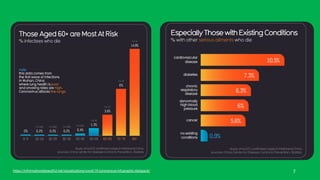
• Advanced age and co-morbidity are key risk factors for
becoming a serious case, however previously healthy young
adults can die from COVID-19
ACTION FOR
FOUNDERS:
Understand and
be conversant in
what COVID-19 is
as your team IS
looking to you to
make sense of this
6
7https://informationisbeautiful.net/visualizations/covid-19-coronavirus-infographic-datapack/
Current State of COVID-19
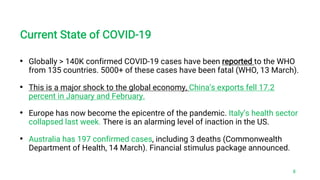
• Globally > 140K confirmed COVID-19 cases have been reported to the WHO
from 135 countries. 5000+ of these cases have been fatal (WHO, 13 March).
• This is a major shock to the global economy, China’s exports fell 17.2
percent in January and February.
• Europe has now become the epicentre of the pandemic. Italy’s health sector
collapsed last week. There is an alarming level of inaction in the US.
• Australia has 197 confirmed cases, including 3 deaths (Commonwealth
Department of Health, 14 March). Financial stimulus package announced.
8
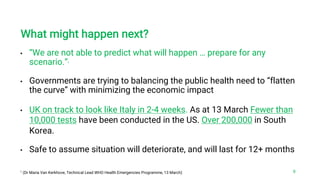
• “We are not able to predict what will happen … prepare for any
scenario.”1
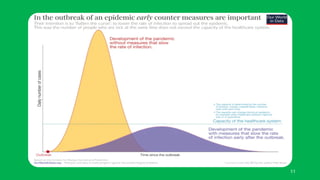
• Governments are trying to balancing the public health need to “flatten
the curve” with minimizing the economic impact
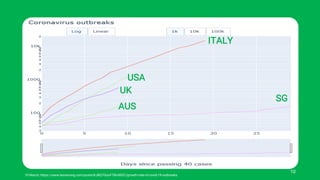
• UK on track to look like Italy in 2-4 weeks. As at 13 March Fewer than
10,000 tests have been conducted in the US. Over 200,000 in South
Korea.
• Safe to assume situation will deteriorate, and will last for 12+ months
What might happen next?
1
(Dr Maria Van Kerkhove, Technical Lead WHO Health Emergencies Programme, 13 March) 9
ITALY
USA
UK
AUS
SG
10
10 March; https://www.lesswrong.com/posts/KJBQ7GiyvFTBnSEEC/growth-rate-of-covid-19-outbreaks
11
• A quick recovery, a global slowdown, and a pandemic-
driven recession
• Small and mid-size companies acutely affected
• Consumer retail and service sectors, including aviation,
travel, and tourism likely to be hardest hit
• Expect each region to announce more fiscal stimulus
packages
What might happen next (economically)?
12
Worst Case Scenarios
Four factors will drive redeployment of attention
and significantly impact momentum:
1. Critical Infrastructure
2. Supply Chain
3. Customer
4. Capital
KEY TAKEAWAY:
Plan for a
24 month impact
13
KEY TAKEAWAY:
Returning to a
‘new normal’ is
12 month’s away
Critical Infrastructure
• Hospital infrastructure is overwhelmed (including
human resources and critical care medication) and
collapses
• Death rates skyrocket including in lower age ranges
• Internet infrastructure and power fails
• Transport & education facilitations close, avoided or
significantly disrupted for 6+ months
14
Supply Chains
• Manufacturing-based supply chains take 12 months
to start operating at 25% of previous capacity
• Technology infrastructure (AWS, Telstra) reduce
support services and slower to react to outages
• Communications from suppliers becomes more
general as relationship based channels become
overwhelmed
• Economic impacts drive suppliers to change
payment terms
KEY TAKEAWAY:
Build redundancy
into supply chains
and vertically
integrate where
possible
15
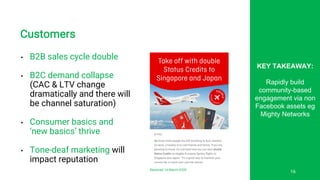
Customers
• B2B sales cycle double
• B2C demand collapse
(CAC & LTV change
dramatically and there will
be channel saturation)
• Consumer basics and
‘new basics’ thrive
• Tone-deaf marketing will
impact reputation
KEY TAKEAWAY:
Rapidly build
community-based
engagement via non
Facebook assets eg
Mighty Networks
16Received 14 March 2020
Capital
• Seed capital markets freeze
• Time to close series A financing doubles
• Credit facilities become unavailable to actors in
your value chain
• Strength of customer relationships (B2C & B2B)
will determine competitiveness
KEY TAKEAWAY:
Move your board
and investors
to adopt a plan
to secure a
12-month runway
17
Decisions you make now to mitigate risk
1. Over communicate
2. Implement remote working (with wellness) and rush to a new drum beat
3. Ensure sufficient liquidity to weather the storm and defer all discretionary
spent (including consumer marketing acquisition)
4. Conduct realistic scenario planning with the team (and then runway
strategies with the board)
5. Dial up engagement with suppliers and collaboration partners to see how
you can help them
6. Deepen customer relationships through community 18
Finding the rainbow in the storm clouds
• Never waste a crisis!
• Build tight-knit virtual communities for users, customers and
prospective customers
• Redefine marketing to be empathetic to the situation
• Be first into the gap created by this crisis with a virtual product
19
How to talk about this with your team
1. Take care of your team, empathize with their realities
2. Demonstrate purpose
3. Announce no-regret decisions fast
4. Honest conversation about reality
5. Find the rainbow with your team
20
What decisions did you make this week?
Email them to Phil and David here!
Resources for further information
• Understanding COVID-19 and who’s at risk:
https://www.health.gov.au/health-topics/novel-coronavirus-
2019-ncov & https://youtu.be/vpALWJBQq2M
• The latest updates and guidance about Coronavirus Disease
curated by the Harvard School of Public Health:
https://www.hsph.harvard.edu/news/hsph-in-the-news/the-
latest-on-the-coronavirus/
• Real time tracker of disclosed COVID-19 infections and
deaths: https://vac-lshtm.shinyapps.io/ncov_tracker/
22
• Singapore Guidelines for Business Continuity Planning for
CoVid19 https://www.enterprisesg.gov.sg/-
/media/esg/files/media-centre/media-releases/2020/jan-
2020/guide-on-business-continuity-planning-for-wuhan-
coronavirus.pdf?la=en
• Speed > perfection:
https://www.youtube.com/watch?v=Gi69S1UNAVA&feature=y
outu.be&t=1852
Resources for further information
23
Presentation and audio recording available at:
https://philhsc.com/webinars/covid19

Founders Leading Through COVID-19

  • 1.
    FOUNDERS LEADING THROUGH COVID-19 March17, 2020 DAVID BURT | PHIL HAYES ST CLAIR
  • 2.
    DISCLAIMER: The detailsand opinions contained in this report and audio recording are made in a personal capacity. This is not advice and you should not rely on it. It is an effort by two entrepreneurs to pay it forward.
  • 3.
  • 4.
    To help youunderstand, plan and lead through the uncertainty generated from COVID-19 • Build your awareness of the current situation • Increase your understanding of what might happen next • Increase your confidence to make decisions this week that will help your business survive and grow • Help you have this conversation with your team 4
  • 5.
    1. COVID-19 101 2.Current State of COVID-19 3. Probabilities of what might happen next 4. Worst case scenario (for your business) 5. Decisions you make now to mitigate risk 6. Finding the rainbow in the storm clouds 7. How you talk about this with your team 8. We discuss your questions 5
  • 6.
    COVID-19 101 • Avirus that causes a respiratory infection with pneumonia- like symptoms of fever, fatigue, sore throat, cough and shortness of breath • Highly infectious. People can be infected and asymptomatic (for days) and still easily infect others • A significant minority of cases (10%+) are serious and will require hospital treatment for acute respiratory distress • Advanced age and co-morbidity are key risk factors for becoming a serious case, however previously healthy young adults can die from COVID-19 ACTION FOR FOUNDERS: Understand and be conversant in what COVID-19 is as your team IS looking to you to make sense of this 6
  • 7.
  • 8.
    Current State ofCOVID-19 • Globally > 140K confirmed COVID-19 cases have been reported to the WHO from 135 countries. 5000+ of these cases have been fatal (WHO, 13 March). • This is a major shock to the global economy, China’s exports fell 17.2 percent in January and February. • Europe has now become the epicentre of the pandemic. Italy’s health sector collapsed last week. There is an alarming level of inaction in the US. • Australia has 197 confirmed cases, including 3 deaths (Commonwealth Department of Health, 14 March). Financial stimulus package announced. 8
  • 9.
    • “We arenot able to predict what will happen … prepare for any scenario.”1 • Governments are trying to balancing the public health need to “flatten the curve” with minimizing the economic impact • UK on track to look like Italy in 2-4 weeks. As at 13 March Fewer than 10,000 tests have been conducted in the US. Over 200,000 in South Korea. • Safe to assume situation will deteriorate, and will last for 12+ months What might happen next? 1 (Dr Maria Van Kerkhove, Technical Lead WHO Health Emergencies Programme, 13 March) 9
  • 10.
  • 11.
  • 12.
    • A quickrecovery, a global slowdown, and a pandemic- driven recession • Small and mid-size companies acutely affected • Consumer retail and service sectors, including aviation, travel, and tourism likely to be hardest hit • Expect each region to announce more fiscal stimulus packages What might happen next (economically)? 12
  • 13.
    Worst Case Scenarios Fourfactors will drive redeployment of attention and significantly impact momentum: 1. Critical Infrastructure 2. Supply Chain 3. Customer 4. Capital KEY TAKEAWAY: Plan for a 24 month impact 13
  • 14.
    KEY TAKEAWAY: Returning toa ‘new normal’ is 12 month’s away Critical Infrastructure • Hospital infrastructure is overwhelmed (including human resources and critical care medication) and collapses • Death rates skyrocket including in lower age ranges • Internet infrastructure and power fails • Transport & education facilitations close, avoided or significantly disrupted for 6+ months 14
  • 15.
    Supply Chains • Manufacturing-basedsupply chains take 12 months to start operating at 25% of previous capacity • Technology infrastructure (AWS, Telstra) reduce support services and slower to react to outages • Communications from suppliers becomes more general as relationship based channels become overwhelmed • Economic impacts drive suppliers to change payment terms KEY TAKEAWAY: Build redundancy into supply chains and vertically integrate where possible 15
  • 16.
    Customers • B2B salescycle double • B2C demand collapse (CAC & LTV change dramatically and there will be channel saturation) • Consumer basics and ‘new basics’ thrive • Tone-deaf marketing will impact reputation KEY TAKEAWAY: Rapidly build community-based engagement via non Facebook assets eg Mighty Networks 16Received 14 March 2020
  • 17.
    Capital • Seed capitalmarkets freeze • Time to close series A financing doubles • Credit facilities become unavailable to actors in your value chain • Strength of customer relationships (B2C & B2B) will determine competitiveness KEY TAKEAWAY: Move your board and investors to adopt a plan to secure a 12-month runway 17
  • 18.
    Decisions you makenow to mitigate risk 1. Over communicate 2. Implement remote working (with wellness) and rush to a new drum beat 3. Ensure sufficient liquidity to weather the storm and defer all discretionary spent (including consumer marketing acquisition) 4. Conduct realistic scenario planning with the team (and then runway strategies with the board) 5. Dial up engagement with suppliers and collaboration partners to see how you can help them 6. Deepen customer relationships through community 18
  • 19.
    Finding the rainbowin the storm clouds • Never waste a crisis! • Build tight-knit virtual communities for users, customers and prospective customers • Redefine marketing to be empathetic to the situation • Be first into the gap created by this crisis with a virtual product 19
  • 20.
    How to talkabout this with your team 1. Take care of your team, empathize with their realities 2. Demonstrate purpose 3. Announce no-regret decisions fast 4. Honest conversation about reality 5. Find the rainbow with your team 20
  • 21.
    What decisions didyou make this week? Email them to Phil and David here!
  • 22.
    Resources for furtherinformation • Understanding COVID-19 and who’s at risk: https://www.health.gov.au/health-topics/novel-coronavirus- 2019-ncov & https://youtu.be/vpALWJBQq2M • The latest updates and guidance about Coronavirus Disease curated by the Harvard School of Public Health: https://www.hsph.harvard.edu/news/hsph-in-the-news/the- latest-on-the-coronavirus/ • Real time tracker of disclosed COVID-19 infections and deaths: https://vac-lshtm.shinyapps.io/ncov_tracker/ 22
  • 23.
    • Singapore Guidelinesfor Business Continuity Planning for CoVid19 https://www.enterprisesg.gov.sg/- /media/esg/files/media-centre/media-releases/2020/jan- 2020/guide-on-business-continuity-planning-for-wuhan- coronavirus.pdf?la=en • Speed > perfection: https://www.youtube.com/watch?v=Gi69S1UNAVA&feature=y outu.be&t=1852 Resources for further information 23
  • 24.
    Presentation and audiorecording available at: https://philhsc.com/webinars/covid19