Eric Hanscom          Joe Donoghue
InterContinental IP   Leardon Solutions
Patents

Eric Hanscom
 InterContinental IP
Patent v. Prototype


o   Prototypes: How to show that an invention works and can
    be effectively mass-produced.


o   Patents: How to protect an invention.
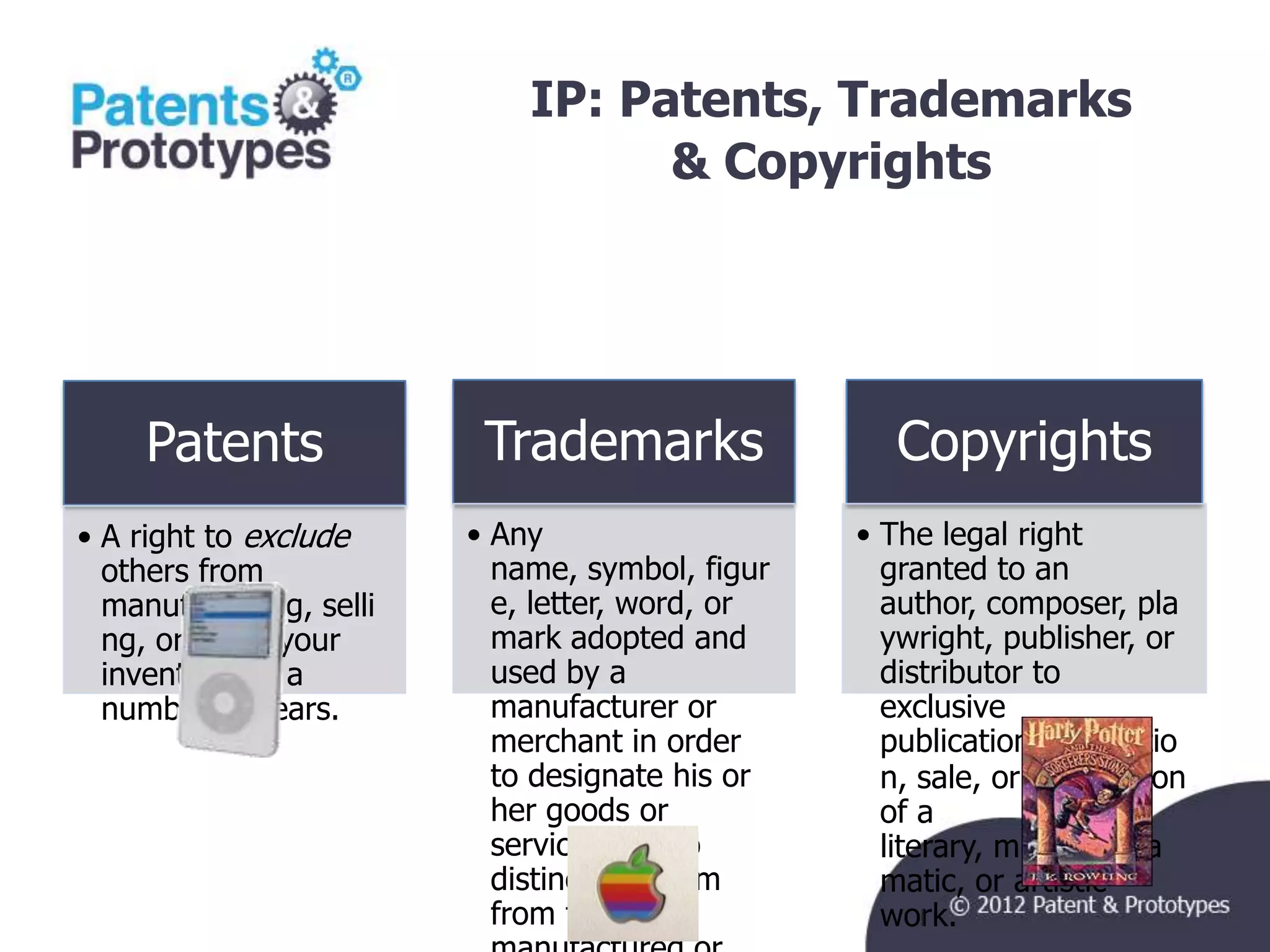
IP: Patents, Trademarks
                                   & Copyrights


     Patents              Trademarks                Copyrights
• A right to exclude     • Any                   • The legal right
  others from              name, symbol, figur     granted to an
  manufacturing, selli     e, letter, word, or     author, composer, pla
  ng, or using your        mark adopted and        ywright, publisher, or
  invention for a          used by a               distributor to
  number of years.         manufacturer or         exclusive
                           merchant in order       publication, productio
                           to designate his or     n, sale, or distribution
                           her goods or            of a
                           services and to         literary, musical, dra
                           distinguish them        matic, or artistic
                           from those              work.
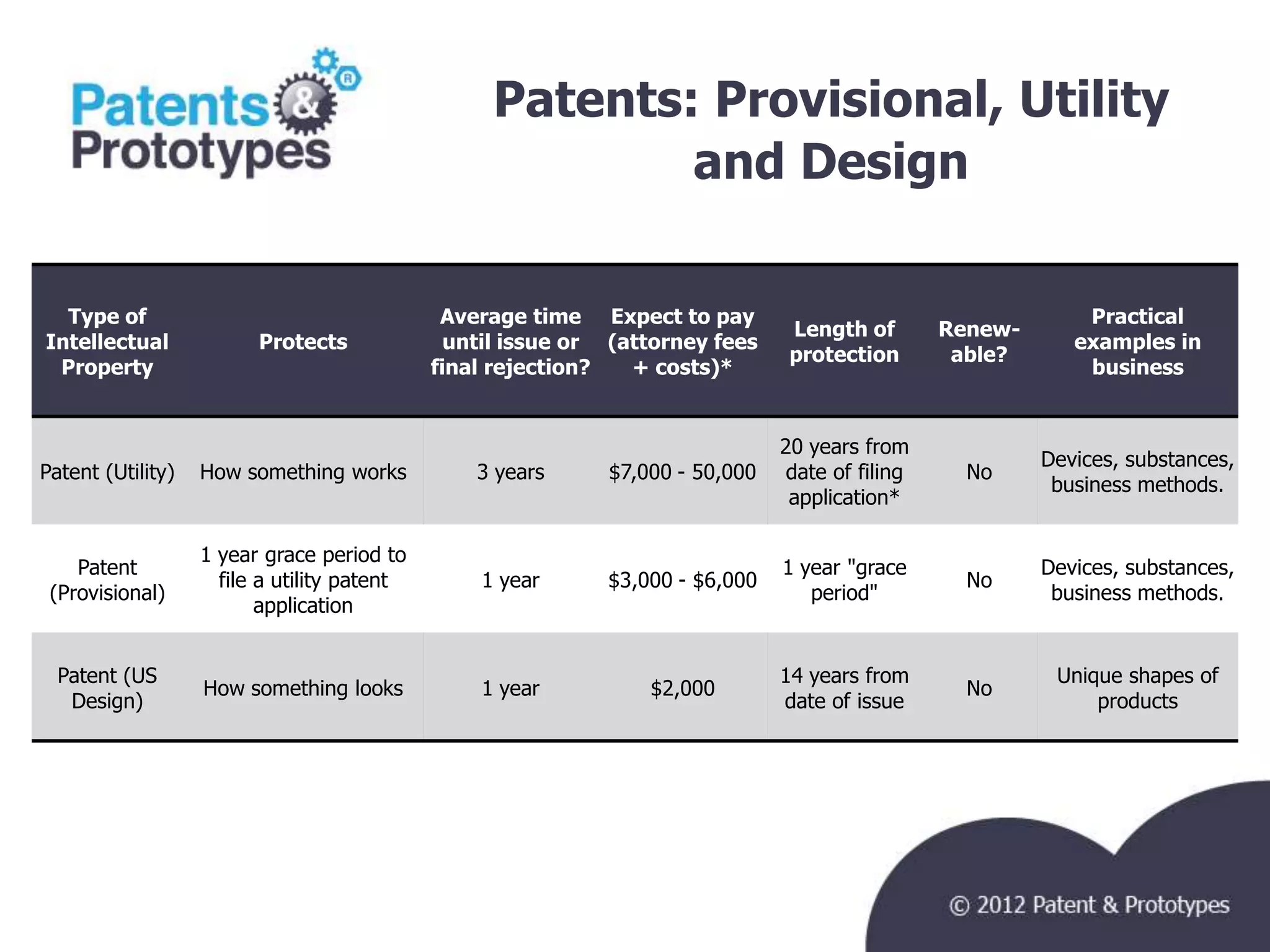
Patents: Provisional, Utility
                                                          and Design

  Type of                                     Average time Expect to pay                                      Practical
                                                                                Length of        Renew-
Intellectual             Protects              until issue or (attorney fees                                 examples in
                                                                                protection        able?
 Property                                    final rejection?   + costs)*                                     business


                                                                               20 years from
                                                                                                          Devices, substances,
Patent (Utility)   How something works           3 years     $7,000 - 50,000    date of filing     No
                                                                                                           business methods.
                                                                                application*

                   1 year grace period to
    Patent                                                                     1 year "grace              Devices, substances,
                     file a utility patent       1 year      $3,000 - $6,000                       No
 (Provisional)                                                                    period"                  business methods.
                          application


  Patent (US                                                                   14 years from               Unique shapes of
                   How something looks           1 year          $2,000                            No
   Design)                                                                     date of issue                   products
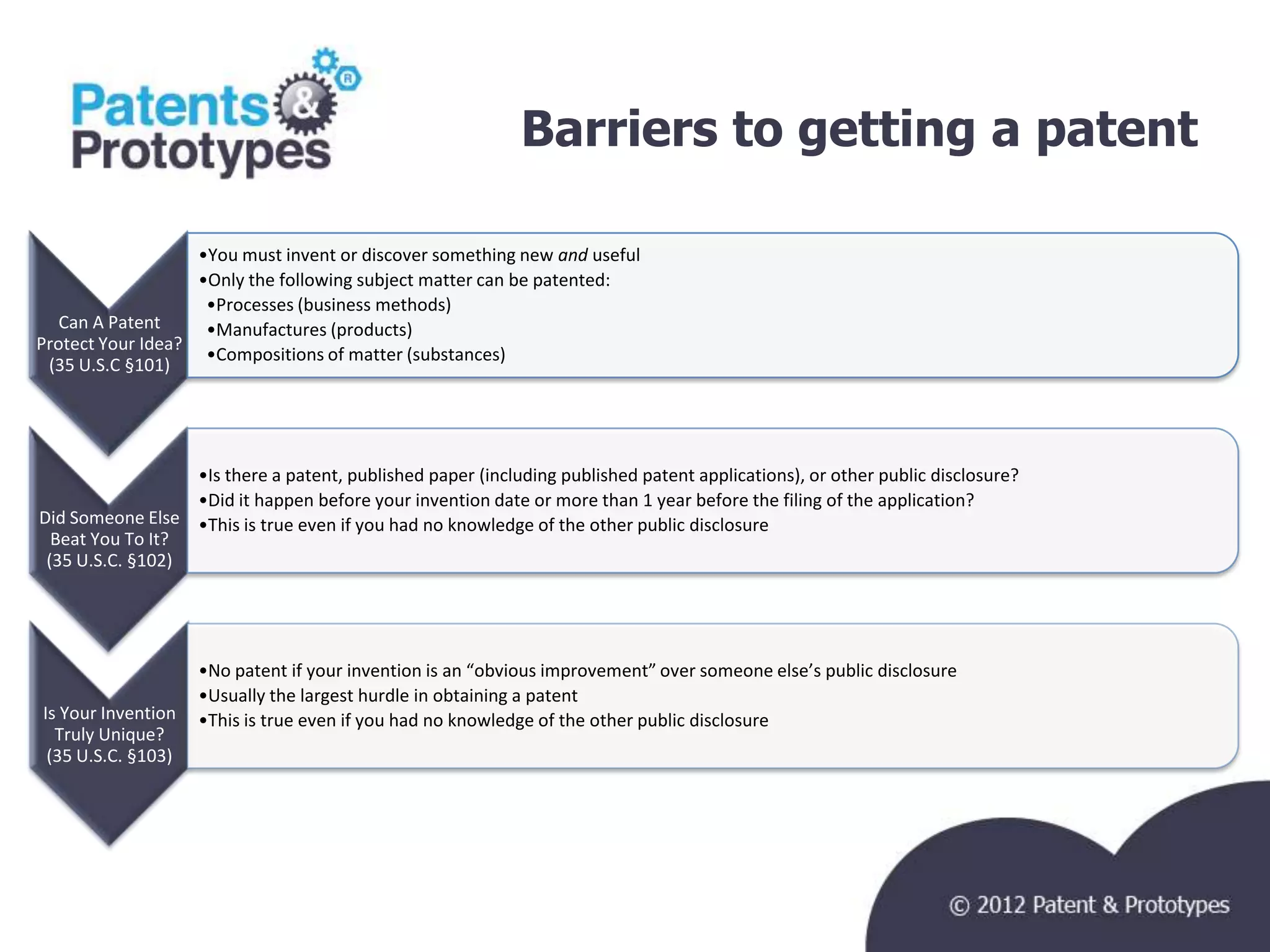
Barriers to getting a patent

                   •You must invent or discover something new and useful
                   •Only the following subject matter can be patented:
                    •Processes (business methods)
   Can A Patent     •Manufactures (products)
Protect Your Idea?
                    •Compositions of matter (substances)
 (35 U.S.C §101)


                  •Is there a patent, published paper (including published patent applications), or other public disclosure?
                  •Did it happen before your invention date or more than 1 year before the filing of the application?
Did Someone Else •This is true even if you had no knowledge of the other public disclosure
  Beat You To It?
 (35 U.S.C. §102)


                    •No patent if your invention is an “obvious improvement” over someone else’s public disclosure
                    •Usually the largest hurdle in obtaining a patent
Is Your Invention   •This is true even if you had no knowledge of the other public disclosure
  Truly Unique?
 (35 U.S.C. §103)
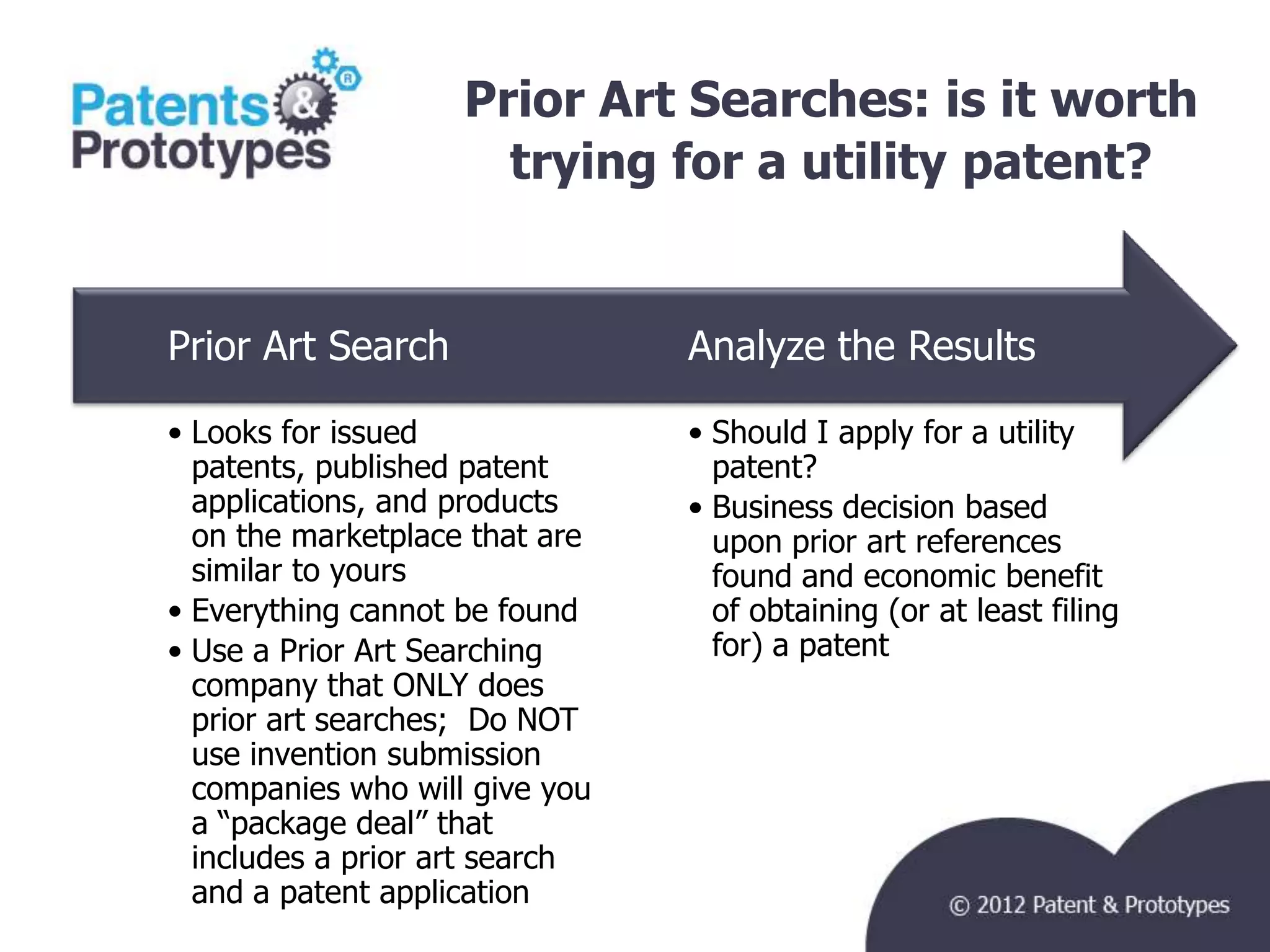
Prior Art Searches: is it worth
                      trying for a utility patent?


Prior Art Search                Analyze the Results

• Looks for issued              • Should I apply for a utility
  patents, published patent       patent?
  applications, and products    • Business decision based
  on the marketplace that are     upon prior art references
  similar to yours                found and economic benefit
• Everything cannot be found      of obtaining (or at least filing
• Use a Prior Art Searching       for) a patent
  company that ONLY does
  prior art searches; Do NOT
  use invention submission
  companies who will give you
  a “package deal” that
  includes a prior art search
  and a patent application
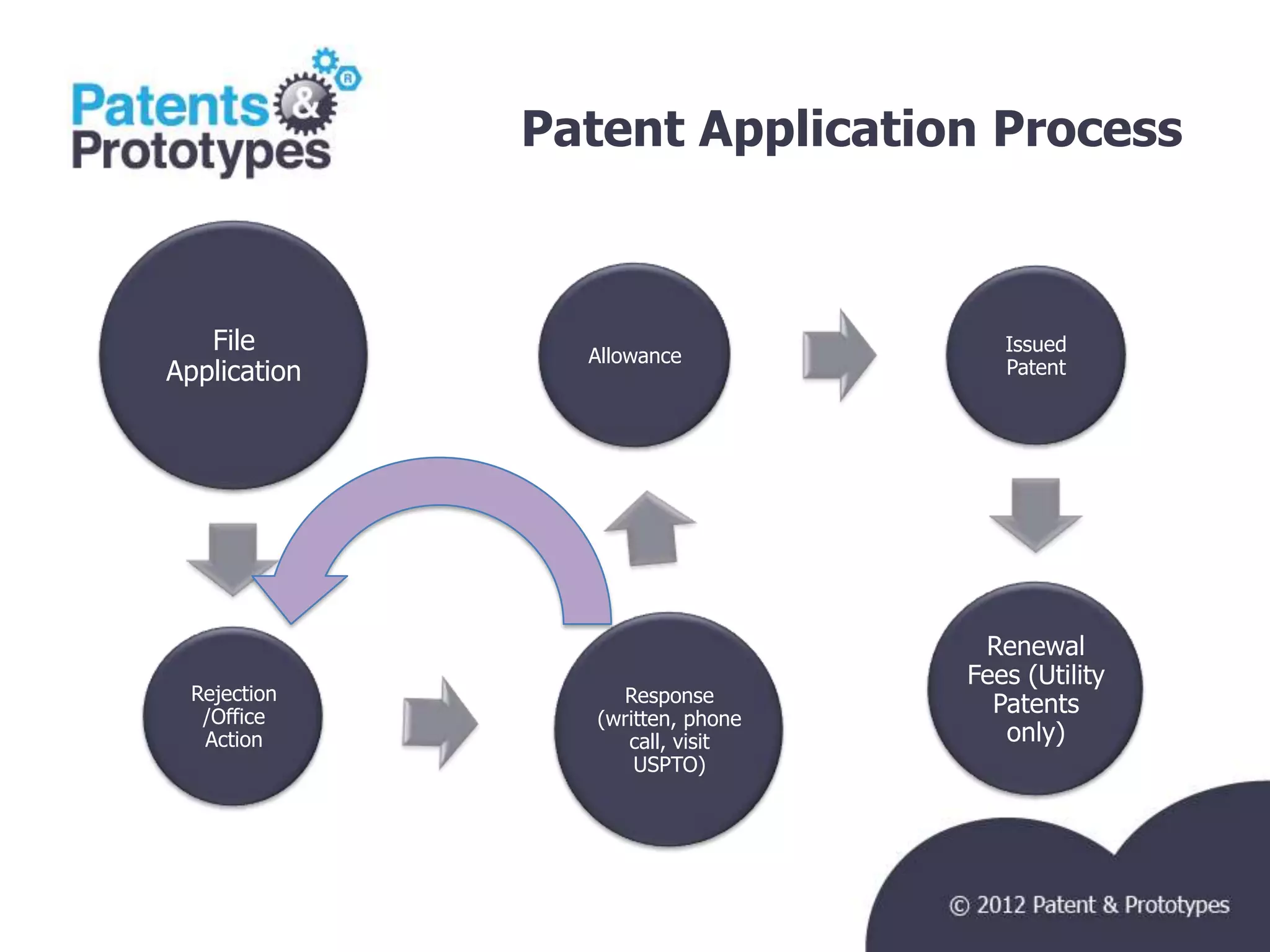
Patent Application Process


   File         Allowance
                                      Issued
Application                           Patent


                                    Renewal
                                   Fees (Utility
  Rejection         Response
   /Office       (written, phone
                                     Patents
   Action           call, visit       only)
                     USPTO)
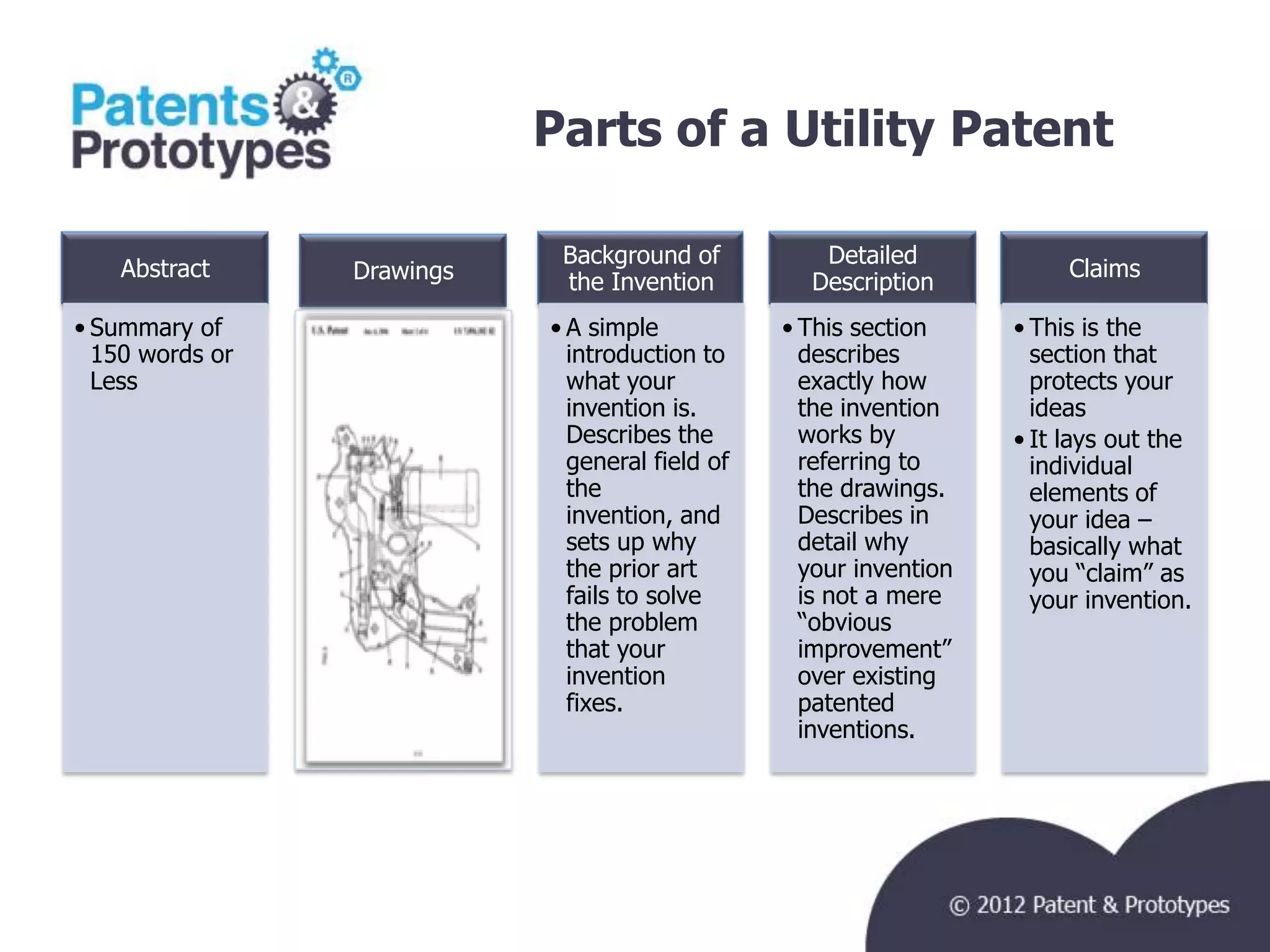
Parts of a Utility Patent

                             Background of          Detailed
    Abstract     Drawings                                                Claims
                             the Invention         Description
• Summary of                • A simple           • This section     • This is the
  150 words or                introduction to      describes          section that
  Less                        what your            exactly how        protects your
                              invention is.        the invention      ideas
                              Describes the        works by         • It lays out the
                              general field of     referring to       individual
                              the                  the drawings.      elements of
                              invention, and       Describes in       your idea –
                              sets up why          detail why         basically what
                              the prior art        your invention     you “claim” as
                              fails to solve       is not a mere      your invention.
                              the problem          “obvious
                              that your            improvement”
                              invention            over existing
                              fixes.               patented
                                                   inventions.
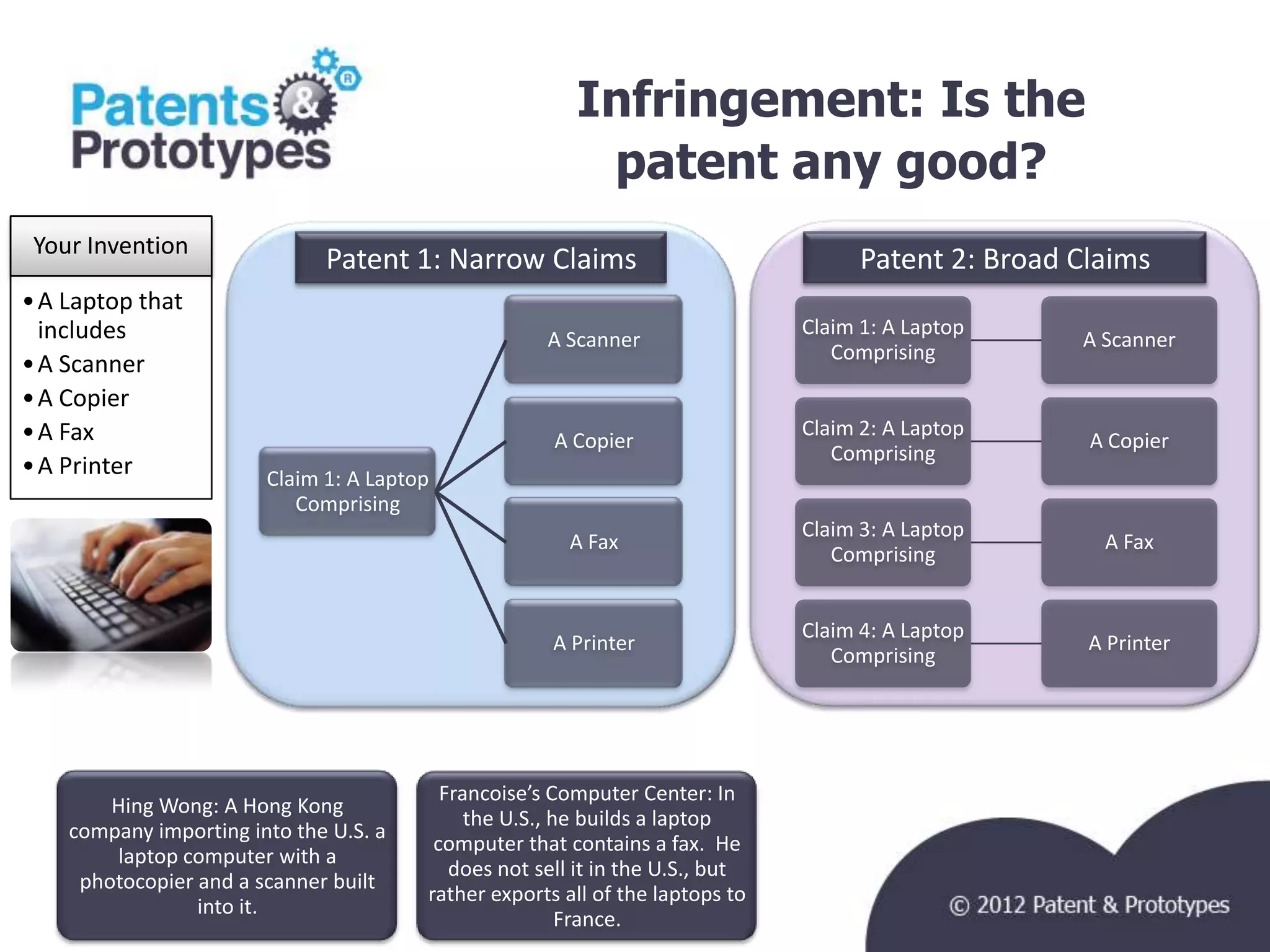
Infringement: Is the
                                                         patent any good?
 Your Invention
                              Patent 1: Narrow Claims                                Patent 2: Broad Claims
• A Laptop that
  includes                                                                     Claim 1: A Laptop
                                                     A Scanner                                       A Scanner
                                                                                  Comprising
• A Scanner
• A Copier
• A Fax                                                                        Claim 2: A Laptop
                                                      A Copier                                        A Copier
                                                                                  Comprising
• A Printer             Claim 1: A Laptop
                           Comprising
                                                                               Claim 3: A Laptop
                                                        A Fax                                          A Fax
                                                                                  Comprising


                                                                               Claim 4: A Laptop
                                                      A Printer                                       A Printer
                                                                                  Comprising


                                          Francoise’s Computer Center: In
        Hing Wong: A Hong Kong
                                             the U.S., he builds a laptop
    company importing into the U.S. a
                                         computer that contains a fax. He
        laptop computer with a
                                           does not sell it in the U.S., but
     photocopier and a scanner built
                                        rather exports all of the laptops to
                 into it.
                                                        France.
Prototypes

Joe Donoghue
 Leardon Solutions
Why a Prototype?               TM


o   Use for obtaining intellectual property

o   Validation and feasibility of idea

o   Show to investors for raising money

o   Work out the design and manufacturing details

o   Validate functionality and qualify design

o   Feedback from distributors, buyers, and retailers

o   Obtain customer feedback from beta units
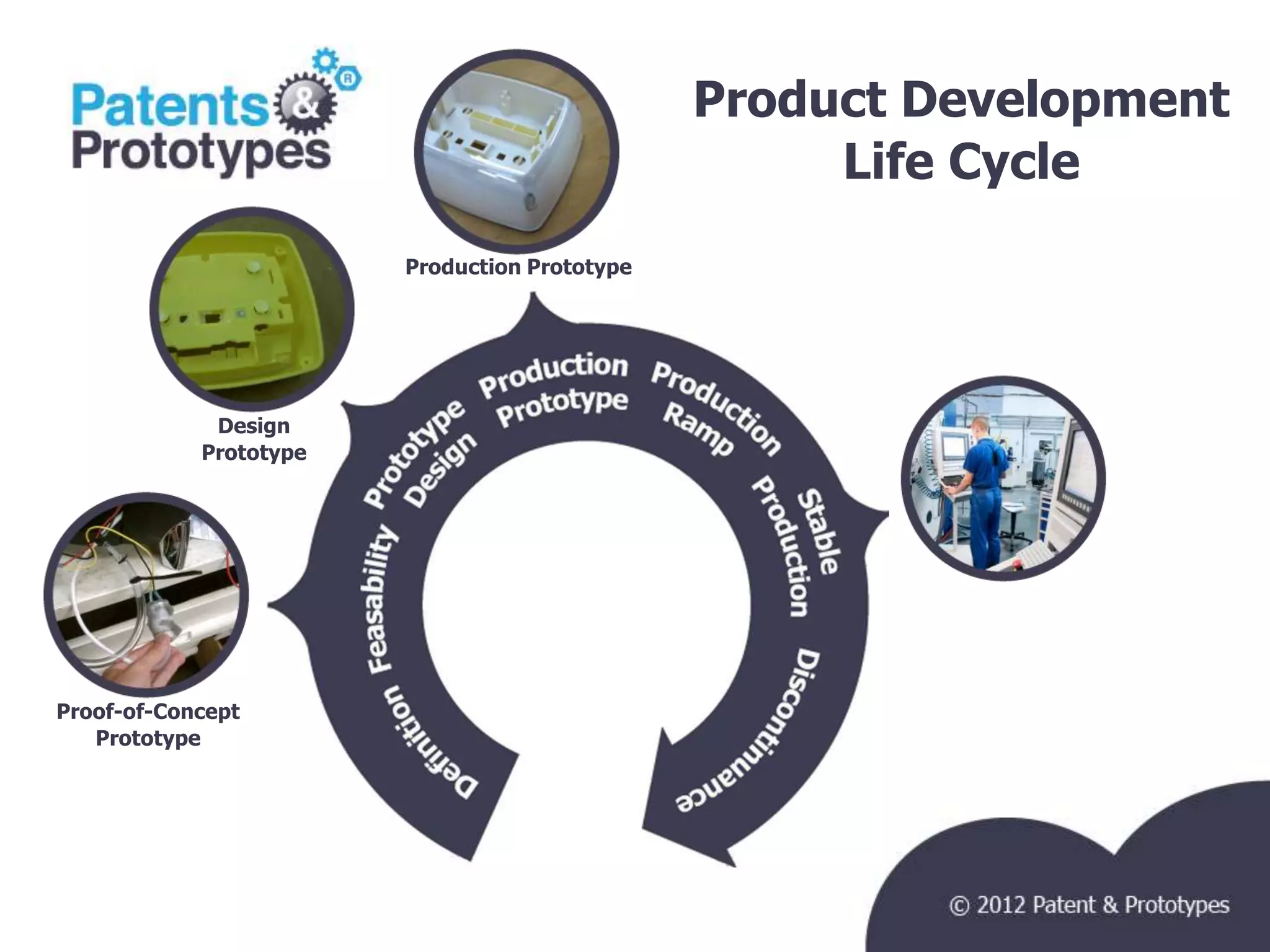
Product Development
                                                    Life Cycle
                        Production Prototype


             Design
            Prototype


Proof-of-Concept
   Prototype
Three Types of Prototypes
                                         TM


o   Proof-of-Concept Prototype

o   Design Prototype

o   Production Prototype
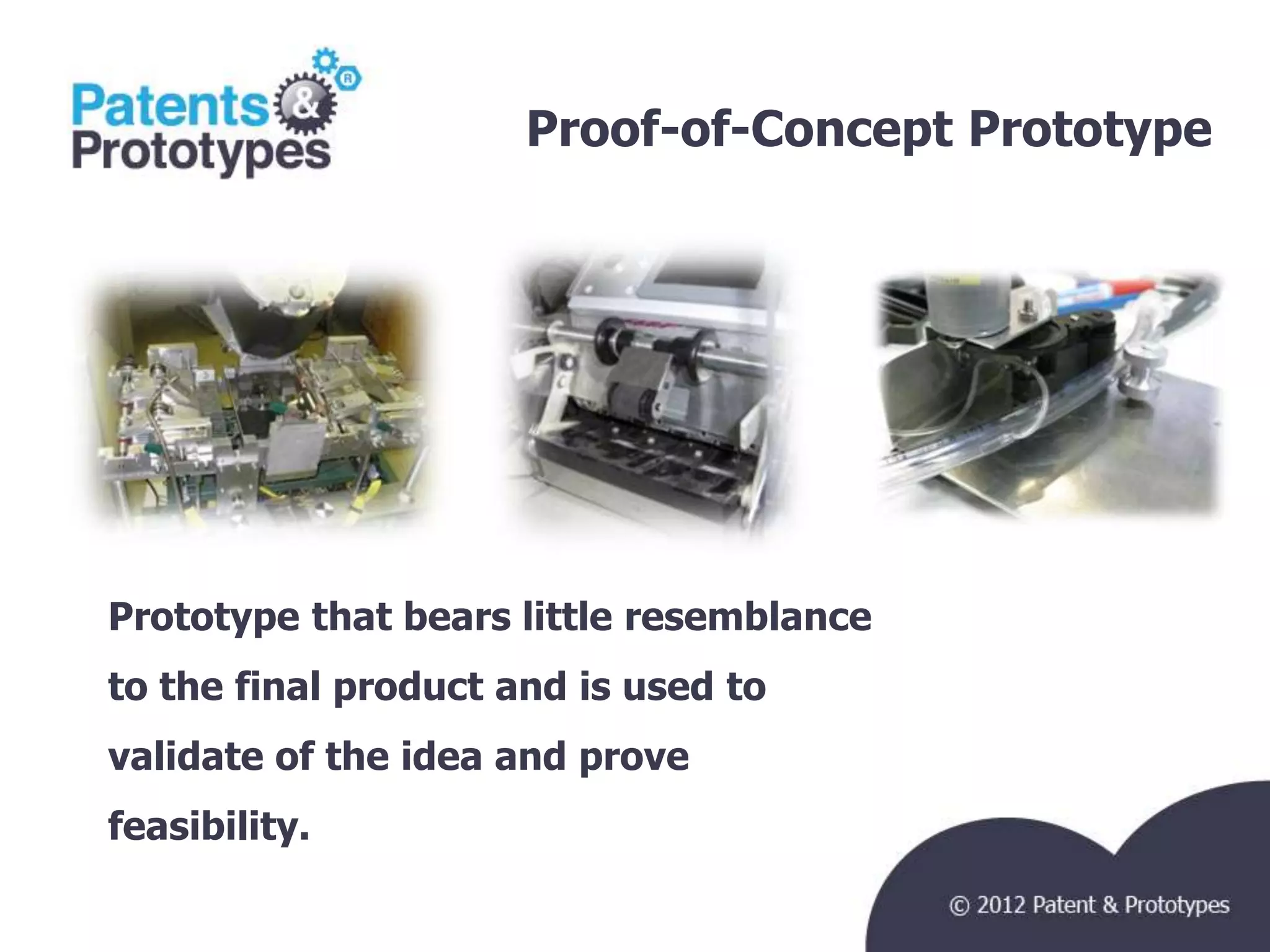
Proof-of-Concept Prototype
                                            TM


Prototype that bears little resemblance
to the final product and is used to
validate of the idea and prove
feasibility.
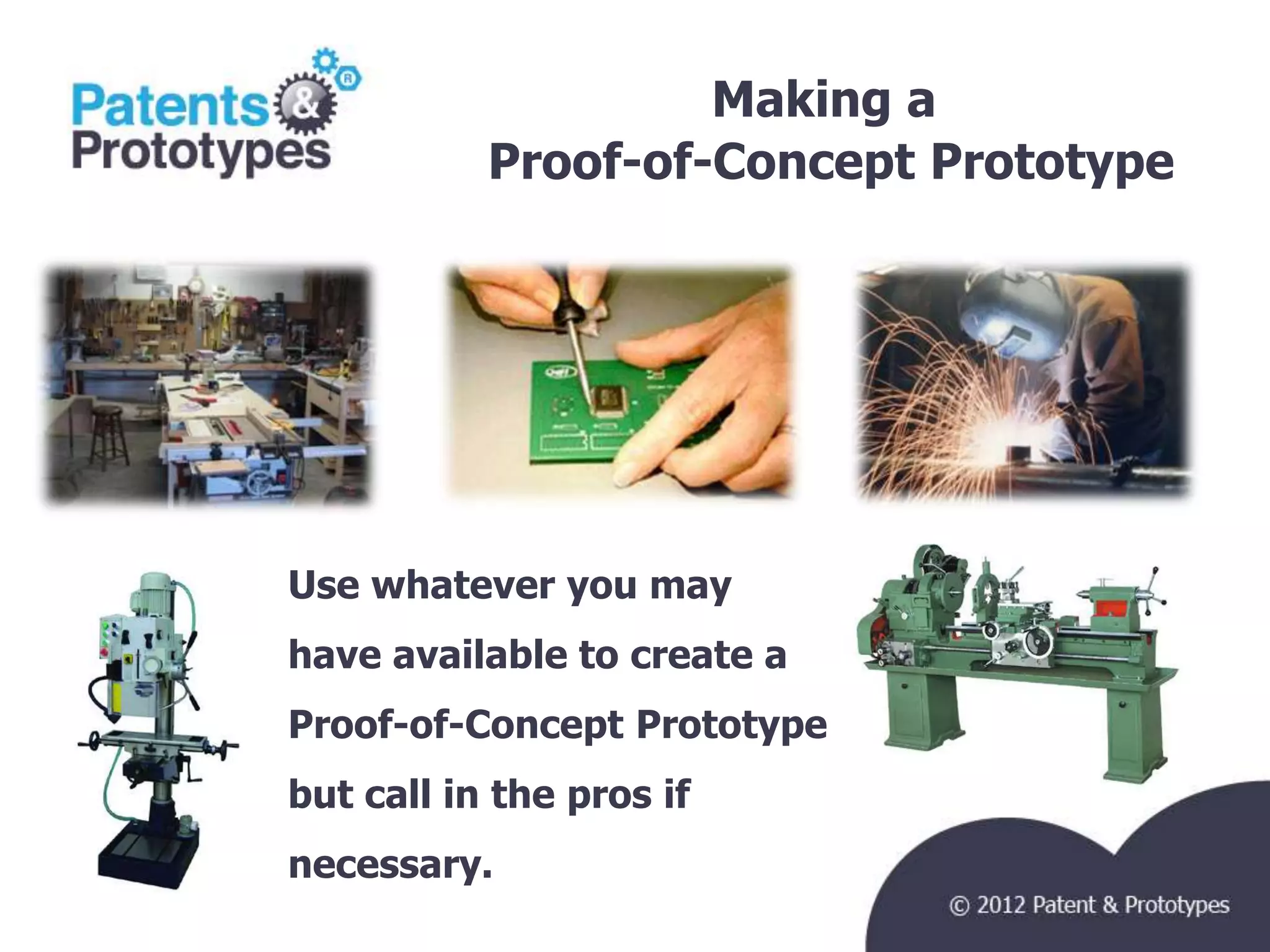
Making a
           Proof-of-Concept Prototype
                                   TM


Use whatever you may
have available to create a
Proof-of-Concept Prototype
but call in the pros if
necessary.
Design Prototype   TM


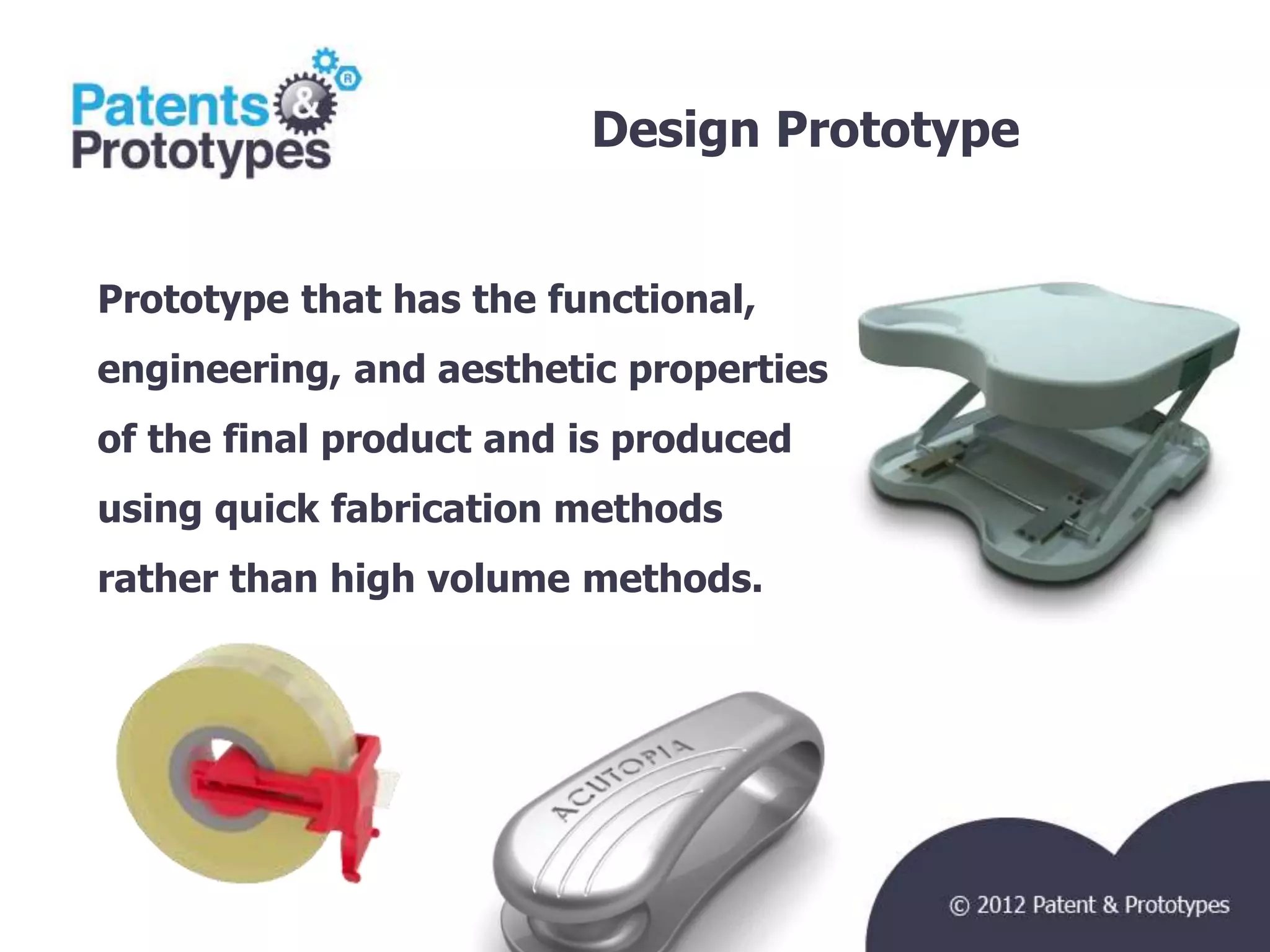
Prototype that has the functional,
engineering, and aesthetic properties
of the final product and is produced
using quick fabrication methods
rather than high volume methods.
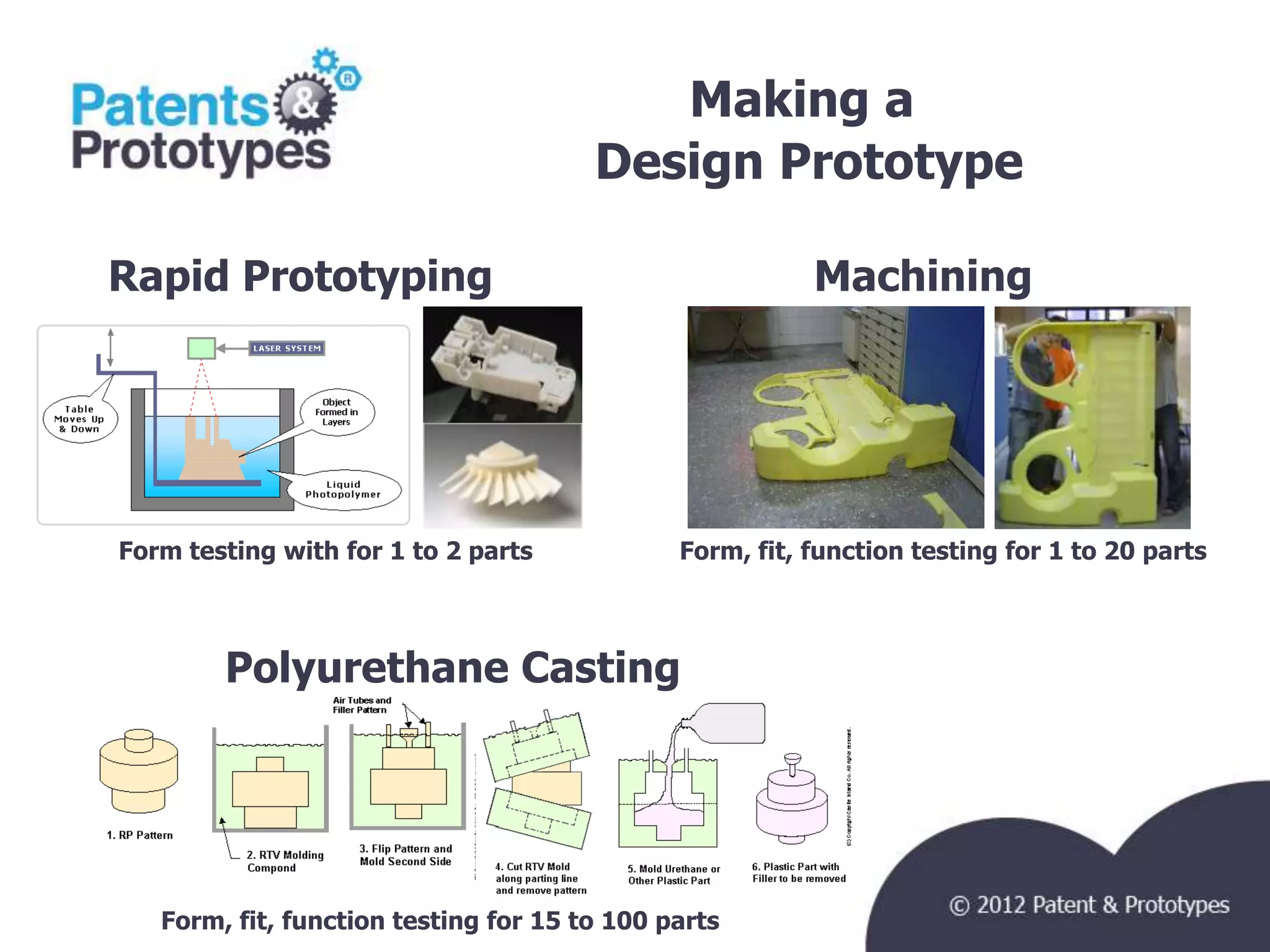
Making a
                                       Design Prototype
                                                                                   TM


Rapid Prototyping                                        Machining


Form testing with for 1 to 2 parts            Form, fit, function testing for 1 to 20 parts


        Polyurethane Casting


   Form, fit, function testing for 15 to 100 parts
Production Prototype   TM


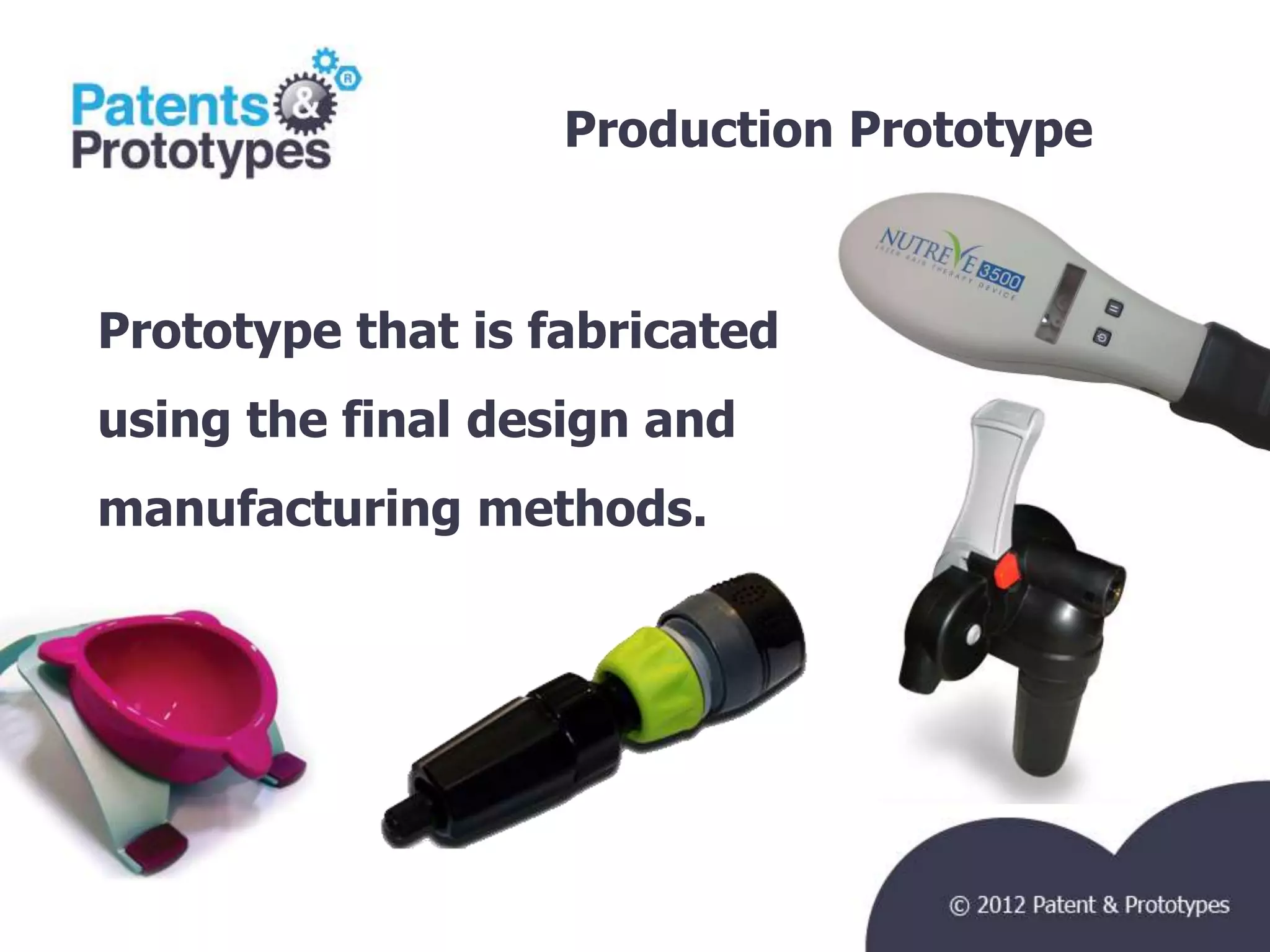
Prototype that is fabricated
using the final design and
manufacturing methods.
Making a
                         Production Prototype
                                                TM


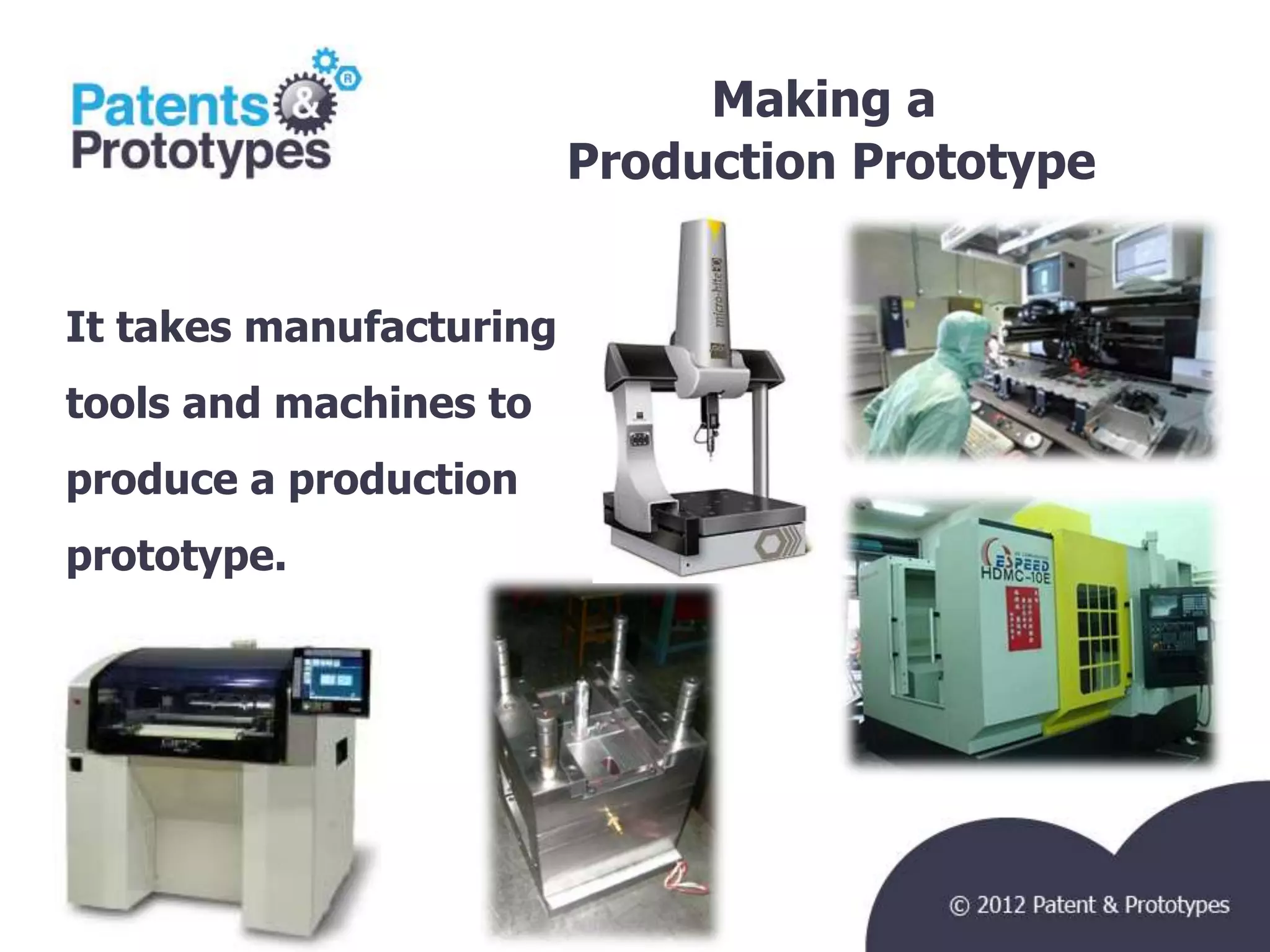
It takes manufacturing
tools and machines to
produce a production
prototype.
Eric Hanscom,         Managing Attorney
InterContinental IP
www.iciplaw.com
eric@iciplaw.com

Joe Donoghue,          President & CEO
Leardon Solutions
www.leardon.com
joseph.donoghue@leardon.com

Patents & Prototypes

  • 1.
    Eric Hanscom Joe Donoghue InterContinental IP Leardon Solutions
  • 2.
  • 3.
    Patent v. Prototype o Prototypes: How to show that an invention works and can be effectively mass-produced. o Patents: How to protect an invention.
  • 4.
    IP: Patents, Trademarks & Copyrights Patents Trademarks Copyrights • A right to exclude • Any • The legal right others from name, symbol, figur granted to an manufacturing, selli e, letter, word, or author, composer, pla ng, or using your mark adopted and ywright, publisher, or invention for a used by a distributor to number of years. manufacturer or exclusive merchant in order publication, productio to designate his or n, sale, or distribution her goods or of a services and to literary, musical, dra distinguish them matic, or artistic from those work.
  • 5.
    Patents: Provisional, Utility and Design Type of Average time Expect to pay Practical Length of Renew- Intellectual Protects until issue or (attorney fees examples in protection able? Property final rejection? + costs)* business 20 years from Devices, substances, Patent (Utility) How something works 3 years $7,000 - 50,000 date of filing No business methods. application* 1 year grace period to Patent 1 year "grace Devices, substances, file a utility patent 1 year $3,000 - $6,000 No (Provisional) period" business methods. application Patent (US 14 years from Unique shapes of How something looks 1 year $2,000 No Design) date of issue products
  • 6.
    Barriers to gettinga patent •You must invent or discover something new and useful •Only the following subject matter can be patented: •Processes (business methods) Can A Patent •Manufactures (products) Protect Your Idea? •Compositions of matter (substances) (35 U.S.C §101) •Is there a patent, published paper (including published patent applications), or other public disclosure? •Did it happen before your invention date or more than 1 year before the filing of the application? Did Someone Else •This is true even if you had no knowledge of the other public disclosure Beat You To It? (35 U.S.C. §102) •No patent if your invention is an “obvious improvement” over someone else’s public disclosure •Usually the largest hurdle in obtaining a patent Is Your Invention •This is true even if you had no knowledge of the other public disclosure Truly Unique? (35 U.S.C. §103)
  • 7.
    Prior Art Searches:is it worth trying for a utility patent? Prior Art Search Analyze the Results • Looks for issued • Should I apply for a utility patents, published patent patent? applications, and products • Business decision based on the marketplace that are upon prior art references similar to yours found and economic benefit • Everything cannot be found of obtaining (or at least filing • Use a Prior Art Searching for) a patent company that ONLY does prior art searches; Do NOT use invention submission companies who will give you a “package deal” that includes a prior art search and a patent application
  • 8.
    Patent Application Process File Allowance Issued Application Patent Renewal Fees (Utility Rejection Response /Office (written, phone Patents Action call, visit only) USPTO)
  • 9.
    Parts of aUtility Patent Background of Detailed Abstract Drawings Claims the Invention Description • Summary of • A simple • This section • This is the 150 words or introduction to describes section that Less what your exactly how protects your invention is. the invention ideas Describes the works by • It lays out the general field of referring to individual the the drawings. elements of invention, and Describes in your idea – sets up why detail why basically what the prior art your invention you “claim” as fails to solve is not a mere your invention. the problem “obvious that your improvement” invention over existing fixes. patented inventions.
  • 10.
    Infringement: Is the patent any good? Your Invention Patent 1: Narrow Claims Patent 2: Broad Claims • A Laptop that includes Claim 1: A Laptop A Scanner A Scanner Comprising • A Scanner • A Copier • A Fax Claim 2: A Laptop A Copier A Copier Comprising • A Printer Claim 1: A Laptop Comprising Claim 3: A Laptop A Fax A Fax Comprising Claim 4: A Laptop A Printer A Printer Comprising Francoise’s Computer Center: In Hing Wong: A Hong Kong the U.S., he builds a laptop company importing into the U.S. a computer that contains a fax. He laptop computer with a does not sell it in the U.S., but photocopier and a scanner built rather exports all of the laptops to into it. France.
  • 11.
  • 12.
    Why a Prototype? TM o Use for obtaining intellectual property o Validation and feasibility of idea o Show to investors for raising money o Work out the design and manufacturing details o Validate functionality and qualify design o Feedback from distributors, buyers, and retailers o Obtain customer feedback from beta units
  • 13.
    Product Development Life Cycle Production Prototype Design Prototype Proof-of-Concept Prototype
  • 14.
    Three Types ofPrototypes TM o Proof-of-Concept Prototype o Design Prototype o Production Prototype
  • 15.
    Proof-of-Concept Prototype TM Prototype that bears little resemblance to the final product and is used to validate of the idea and prove feasibility.
  • 16.
    Making a Proof-of-Concept Prototype TM Use whatever you may have available to create a Proof-of-Concept Prototype but call in the pros if necessary.
  • 17.
    Design Prototype TM Prototype that has the functional, engineering, and aesthetic properties of the final product and is produced using quick fabrication methods rather than high volume methods.
  • 18.
    Making a Design Prototype TM Rapid Prototyping Machining Form testing with for 1 to 2 parts Form, fit, function testing for 1 to 20 parts Polyurethane Casting Form, fit, function testing for 15 to 100 parts
  • 19.
    Production Prototype TM Prototype that is fabricated using the final design and manufacturing methods.
  • 20.
    Making a Production Prototype TM It takes manufacturing tools and machines to produce a production prototype.
  • 21.
    Eric Hanscom, Managing Attorney InterContinental IP www.iciplaw.com eric@iciplaw.com Joe Donoghue, President & CEO Leardon Solutions www.leardon.com joseph.donoghue@leardon.com