Brief Overview of  U.S. Utility Patent Law and Practice Kristine H. Johnson MacMillan, Sobanski & Todd, LLC [email_address]
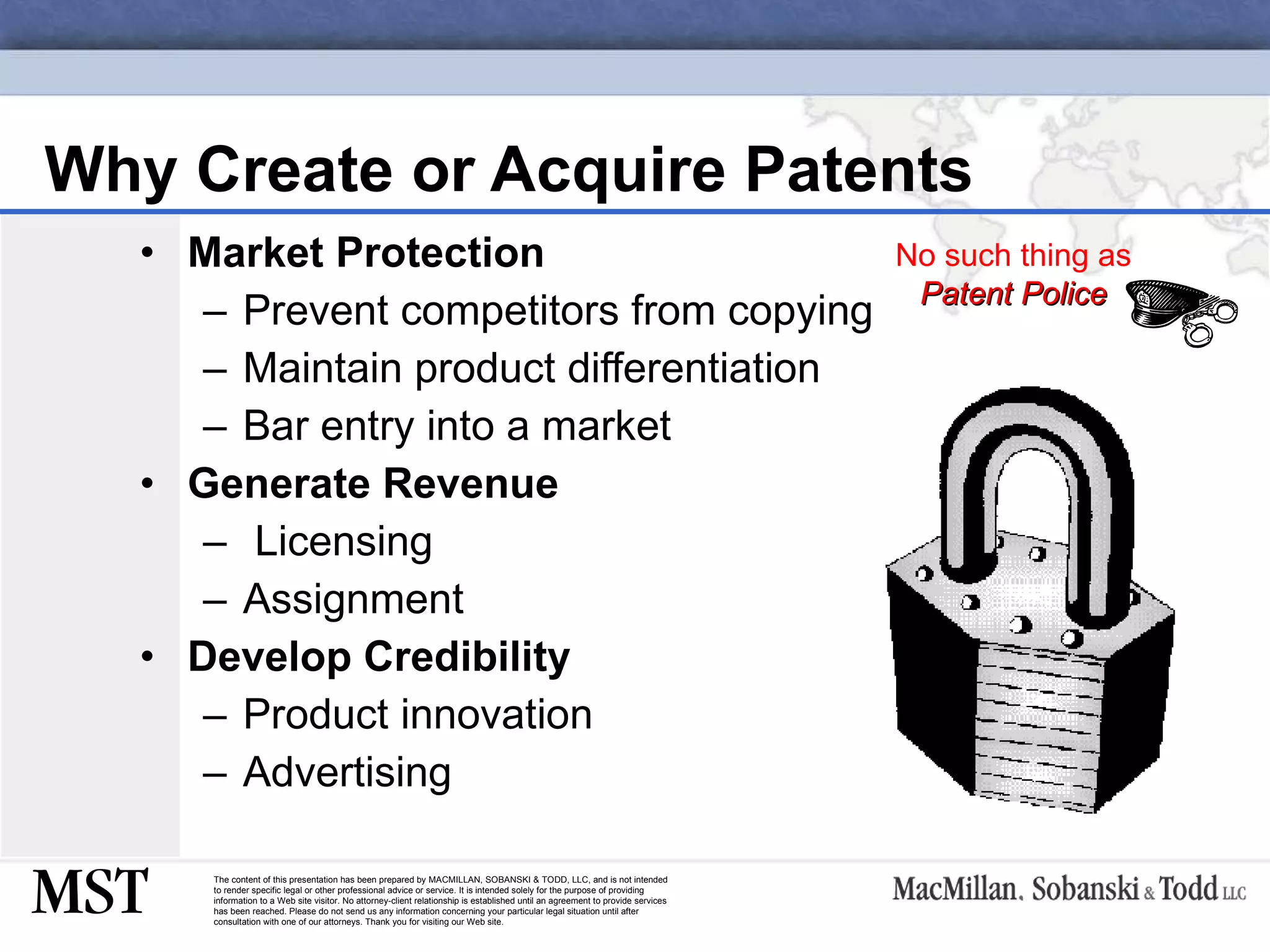
Why Create or Acquire Patents   Market Protection Prevent competitors from copying Maintain product differentiation Bar entry into a market Generate Revenue Licensing Assignment Develop Credibility Product innovation Advertising No such thing as  Patent Police
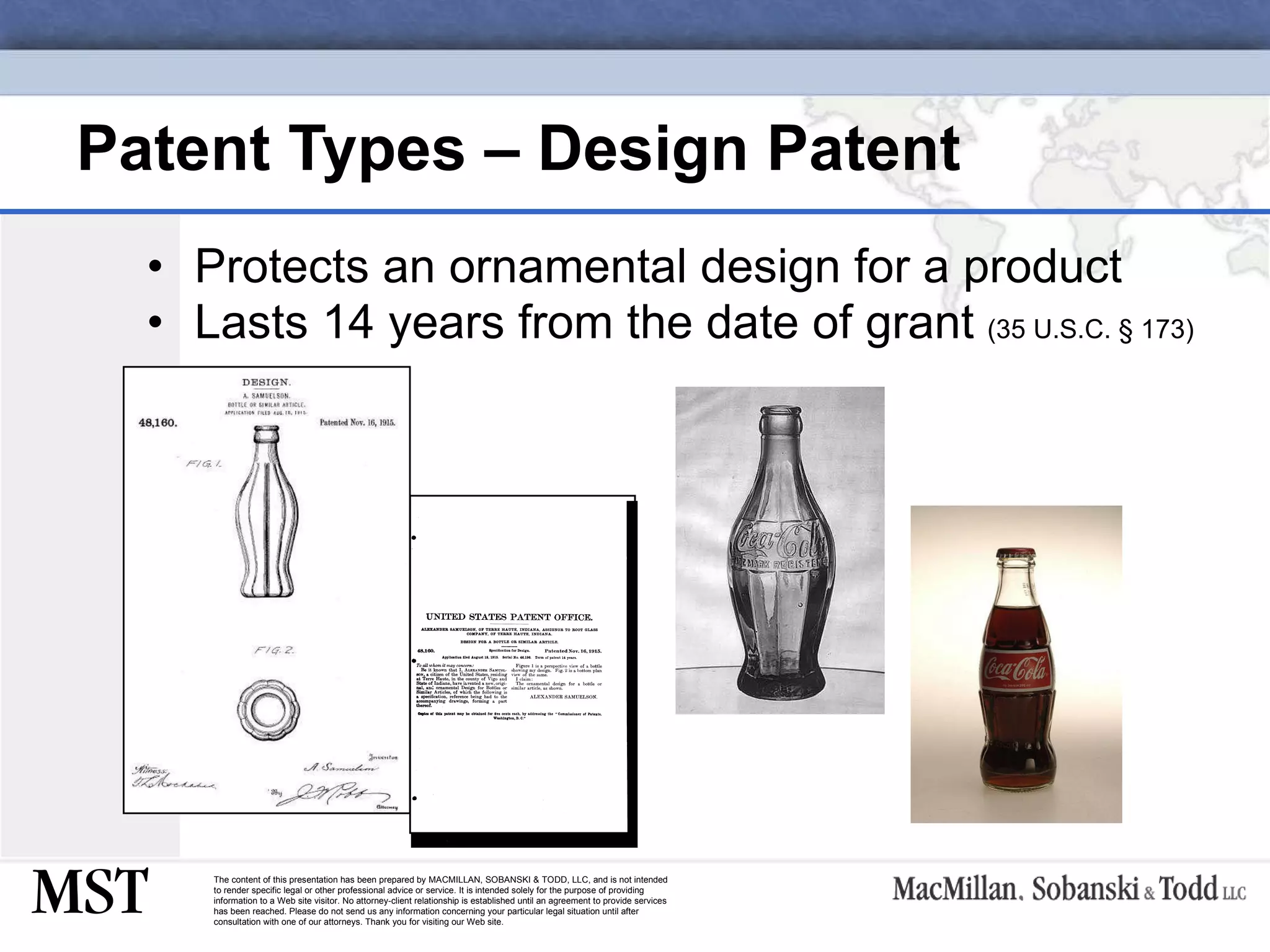
Patent Types – Design Patent Protects an ornamental design for a product Lasts 14 years from the date of grant  (35 U.S.C.  § 173)
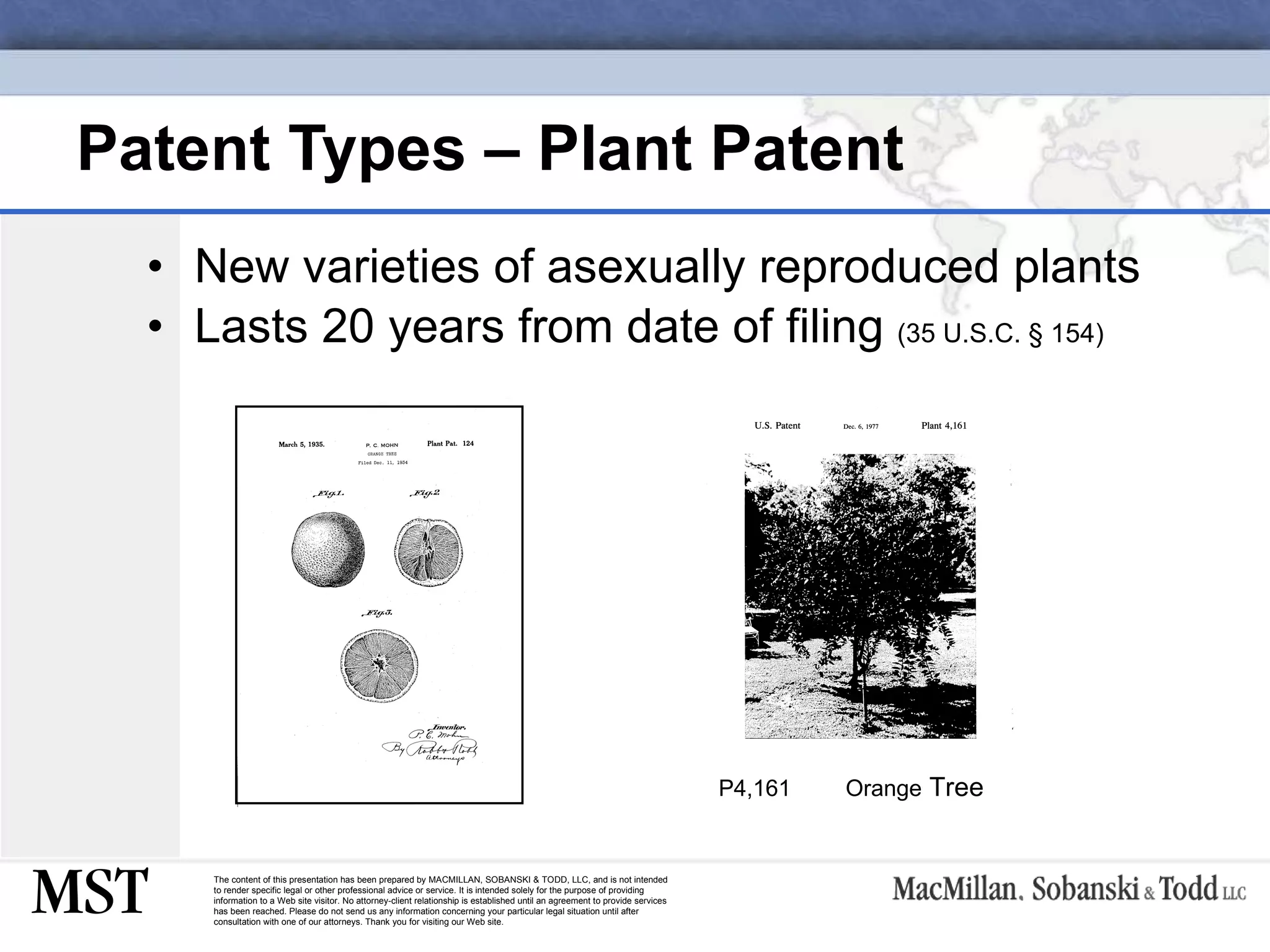
Patent Types – Plant Patent New varieties of asexually reproduced plants Lasts 20 years from date of filing  (35 U.S.C.  § 154) P4,161 Orange  Tree
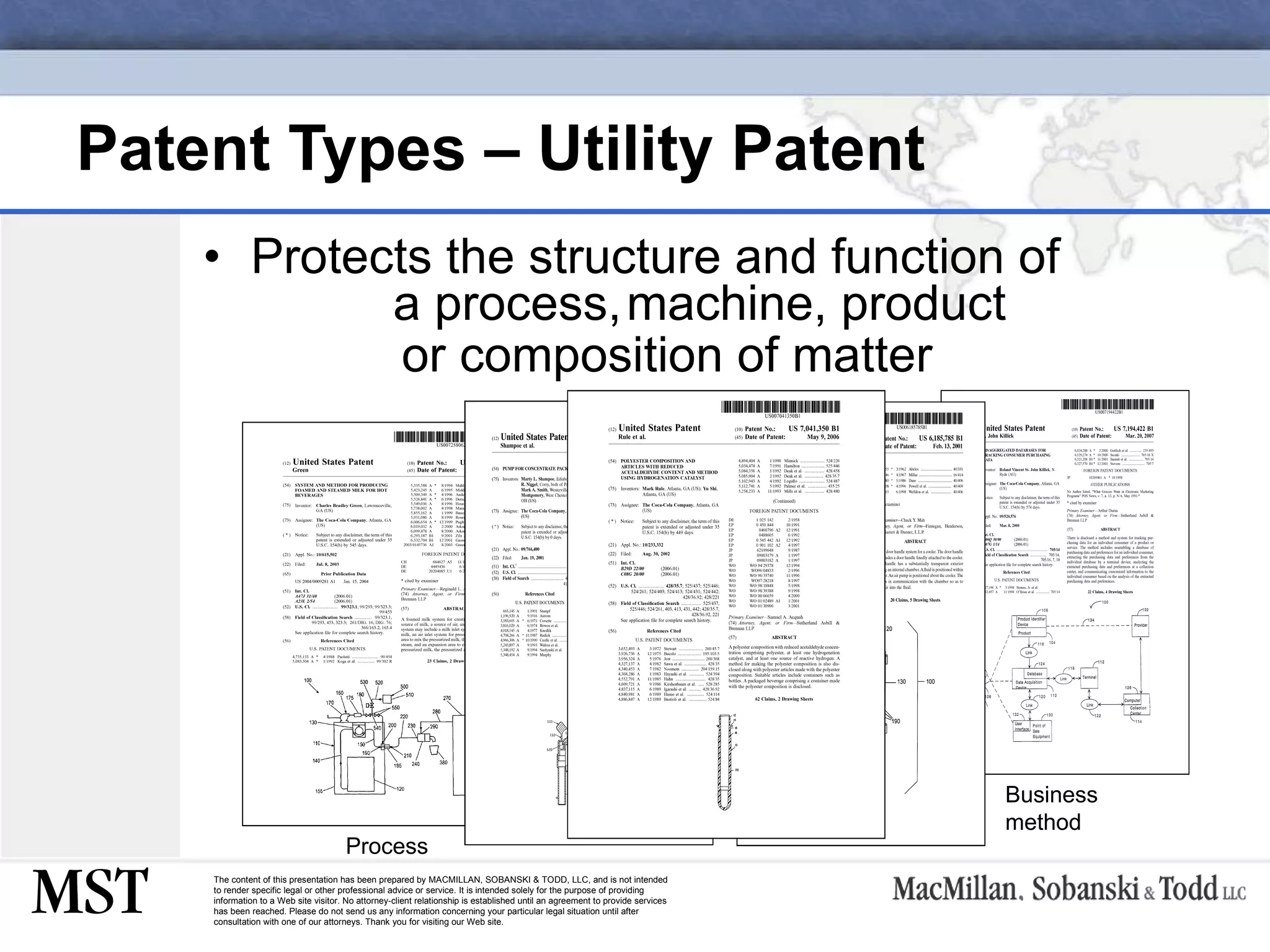
Patent Types – Utility Patent Protects the structure and function of  machine, product or composition of matter a process, Business method Process
Non-US Patents No such thing as a “worldwide patent” Patents are issued by each sovereign country May file regional applications via treaties Patent Cooperation Treaty (PCT) European Patent Convention (EPC) Must designate the specific countries to examine the application Each country issues a patent and charges a fee Some regional applications give a “discount”
Overview - Basic Patenting Timeline   Document the invention – the date of conception and reduction to practice File a patent application – disclosing and claiming the invention  The application is examined at the PTO Further action – argue, amend or appeal Issue or abandon
“ Provisional” Applications Not a patent, but a type of application Idea disclosure to preserve a filing date  Not published or examined No claims required Provides no legal protection of an invention UNTIL Filed as a utility application AND issues as a patent  Lasts up to one year Must file a utility application or it becomes abandoned Allows time to develop or clarify other aspects of an invention  Useful in a highly competitive area Preserving the filing date limits what counts as “prior art”
Who can file a Patent Application? The inventor or inventors An assignee, on an inventor’s behalf Must have a writing, such as An assignment document Employment contract agreeing to convey rights
What is “Patent Prosecution?” Happens during the “examination” process Process of “negotiation” with the Patent Office Responding to Examiner rejections Distinguishing the claimed invention from the prior art Refining the scope of the presented claims based on the cited prior art and what you have disclosed in the application, or Abandoning the application completely
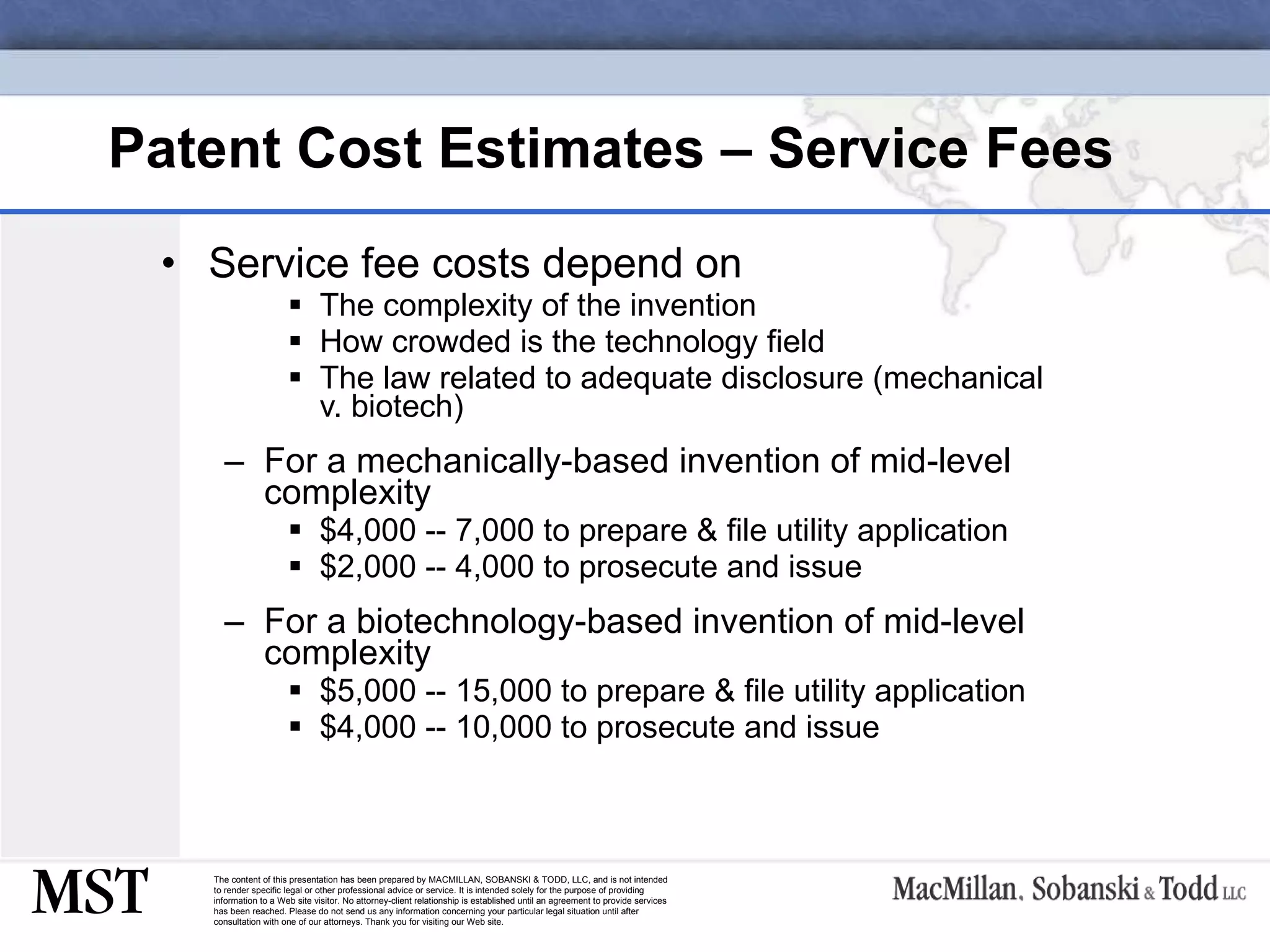
Patent Cost Estimates – Service Fees Service fee costs depend on  The complexity of the invention How crowded is the technology field The law related to adequate disclosure (mechanical v. biotech) For a mechanically-based invention of mid-level complexity $4,000 -- 7,000 to prepare & file utility application  $2,000 -- 4,000 to prosecute and issue For a biotechnology-based invention of mid-level complexity $5,000 -- 15,000 to prepare & file utility application  $4,000 -- 10,000 to prosecute and issue
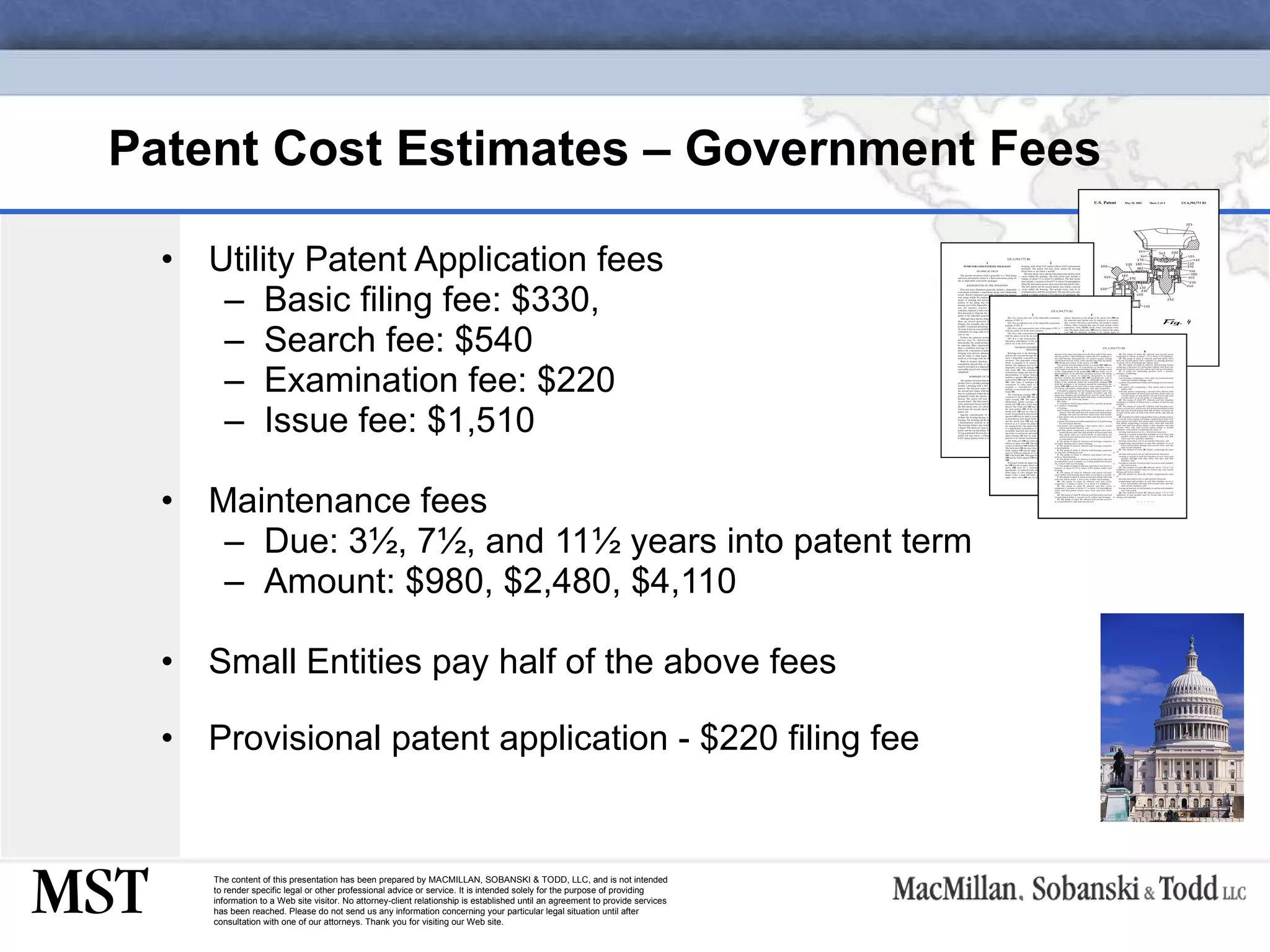
Patent Cost Estimates – Government Fees Utility Patent Application fees Basic filing fee: $330,  Search fee: $540 Examination fee: $220 Issue fee: $1,510 Maintenance fees Due: 3 ½ , 7 ½ , and 11 ½  years into patent term Amount: $980, $2,480, $4,110 Small Entities pay half of the above fees Provisional patent application - $220 filing fee
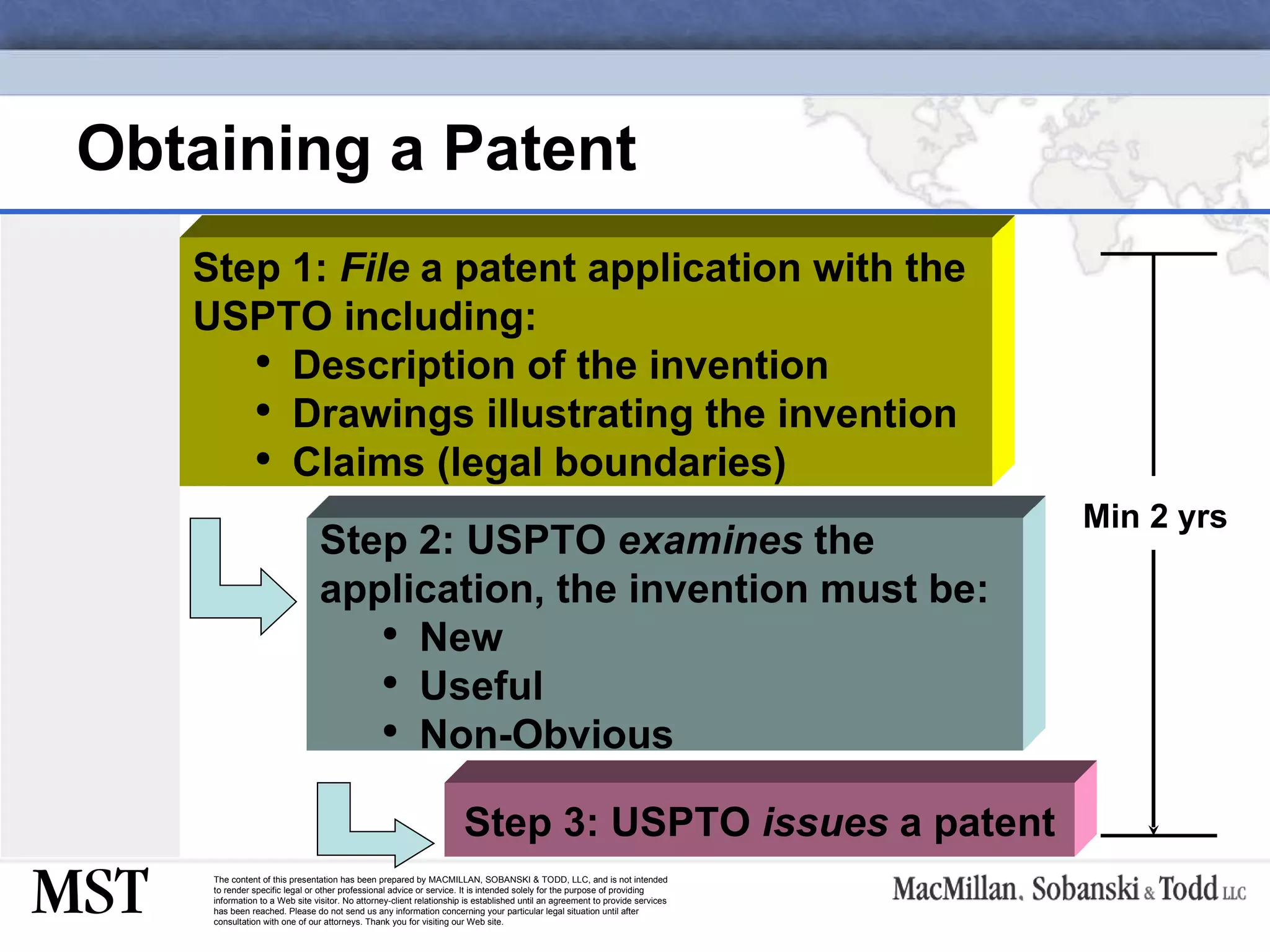
Obtaining a Patent Min 2 yrs Step 1:  File  a patent application with the  USPTO including: Description of the invention Drawings illustrating the invention Claims (legal boundaries) Step 2: USPTO  examines  the  application, the invention must be: New Useful Non-Obvious Step 3: USPTO  issues  a patent
Patentability Requirements In order for a patent to issue on your application the Examiner must find that the invention: Has utility (is useful) Is novel (is new) Is not obvious
Utility – 35 USC  §101 Whoever invents or discovers any new and  useful  process, machine, manufacture, or composition of matter, or any new and  useful  improvement thereof, may obtain a patent therefor, subject to the conditions and requirements of this title. Based on constitutional language
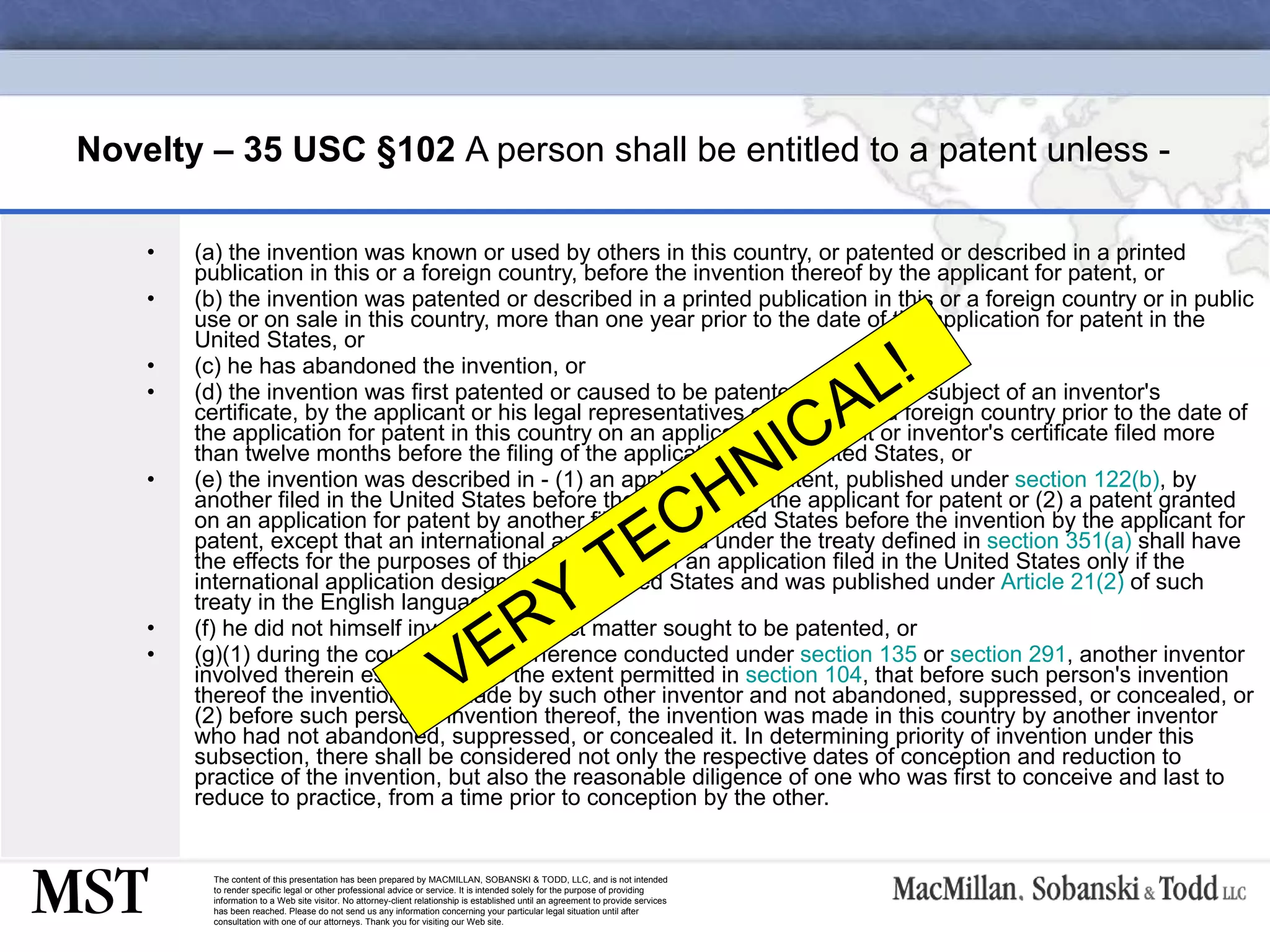
Novelty – 35 USC  § 102  A person shall be entitled to a patent unless - (a) the invention was known or used by others in this country, or patented or described in a printed publication in this or a foreign country, before the invention thereof by the applicant for patent, or (b) the invention was patented or described in a printed publication in this or a foreign country or in public use or on sale in this country, more than one year prior to the date of the application for patent in the United States, or (c) he has abandoned the invention, or (d) the invention was first patented or caused to be patented, or was the subject of an inventor's certificate, by the applicant or his legal representatives or assigns in a foreign country prior to the date of the application for patent in this country on an application for patent or inventor's certificate filed more than twelve months before the filing of the application in the United States, or (e) the invention was described in - (1) an application for patent, published under  section 122(b) , by another filed in the United States before the invention by the applicant for patent or (2) a patent granted on an application for patent by another filed in the United States before the invention by the applicant for patent, except that an international application filed under the treaty defined in  section 351(a)  shall have the effects for the purposes of this subsection of an application filed in the United States only if the international application designated the United States and was published under  Article 21(2)  of such treaty in the English language; or (f) he did not himself invent the subject matter sought to be patented, or (g)(1) during the course of an interference conducted under  section 135  or  section 291 , another inventor involved therein establishes, to the extent permitted in  section 104 , that before such person's invention thereof the invention was made by such other inventor and not abandoned, suppressed, or concealed, or (2) before such person's invention thereof, the invention was made in this country by another inventor who had not abandoned, suppressed, or concealed it. In determining priority of invention under this subsection, there shall be considered not only the respective dates of conception and reduction to practice of the invention, but also the reasonable diligence of one who was first to conceive and last to reduce to practice, from a time prior to conception by the other. VERY TECHNICAL!
A Few Bars to Novelty: Timeline-based Watch out for these common types of “Prior Art” Before conception of invention, the invention was: described in a patent or printed publication anywhere -or- More than one year before filing a U.S. patent application, the invention was: described in any publication used publicly in US offered for sale in US
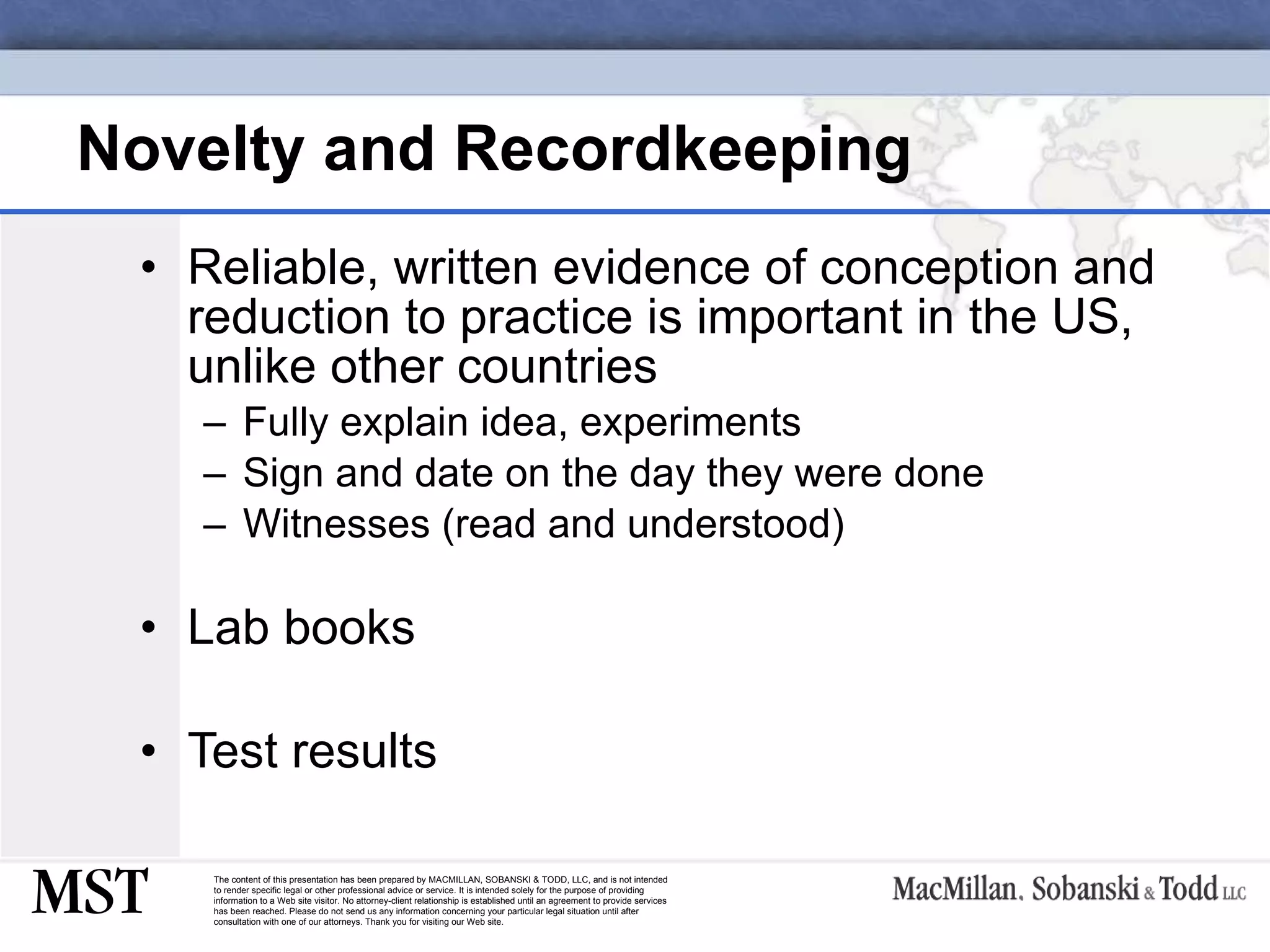
Novelty and Recordkeeping Reliable, written evidence of conception and reduction to practice is important in the US, unlike other countries Fully explain idea, experiments Sign and date on the day they were done Witnesses (read and understood) Lab books Test results
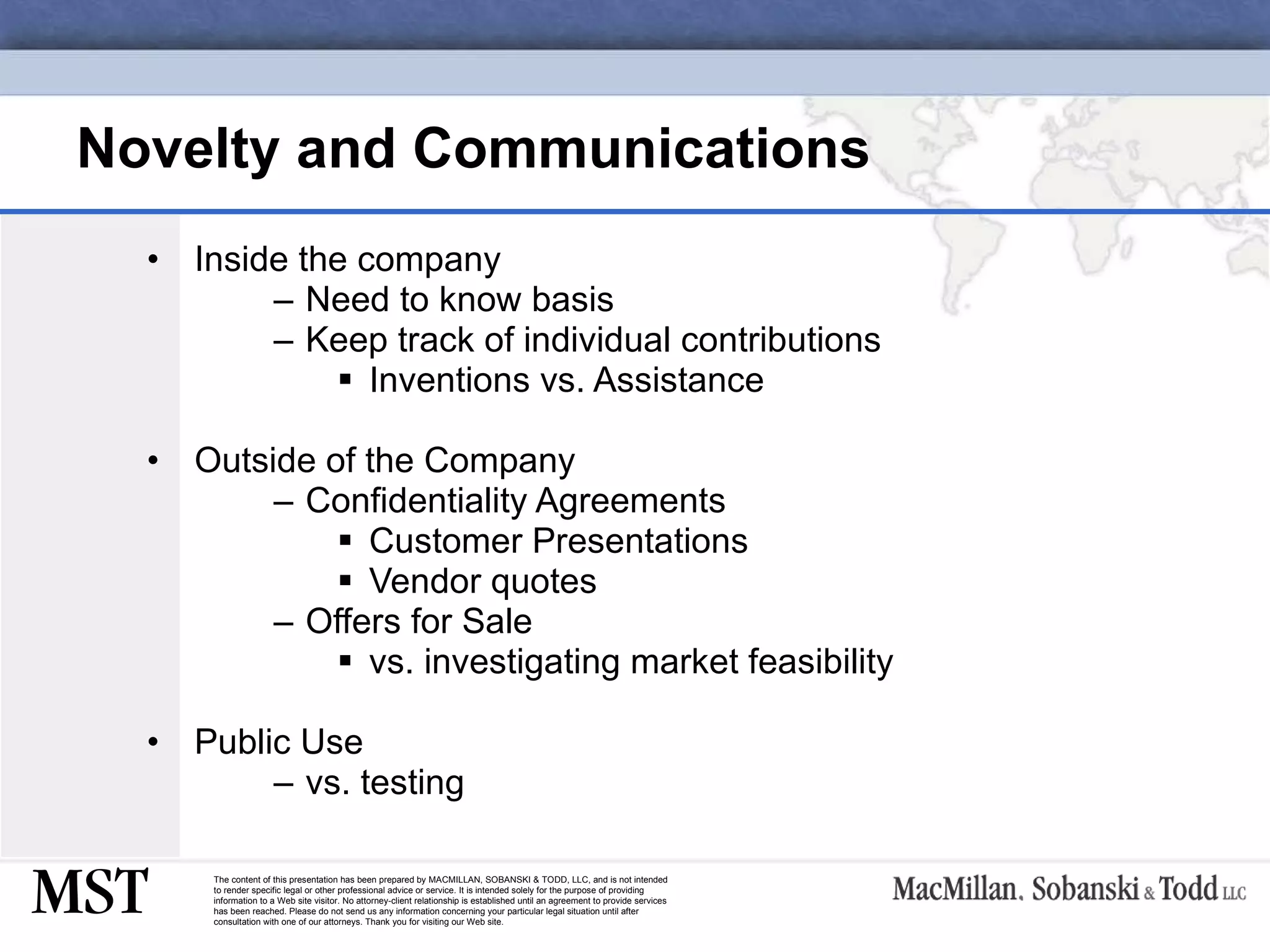
Novelty and Communications Inside the company Need to know basis Keep track of individual contributions Inventions vs. Assistance Outside of the Company Confidentiality Agreements Customer Presentations Vendor quotes Offers for Sale vs. investigating market feasibility Public Use vs. testing
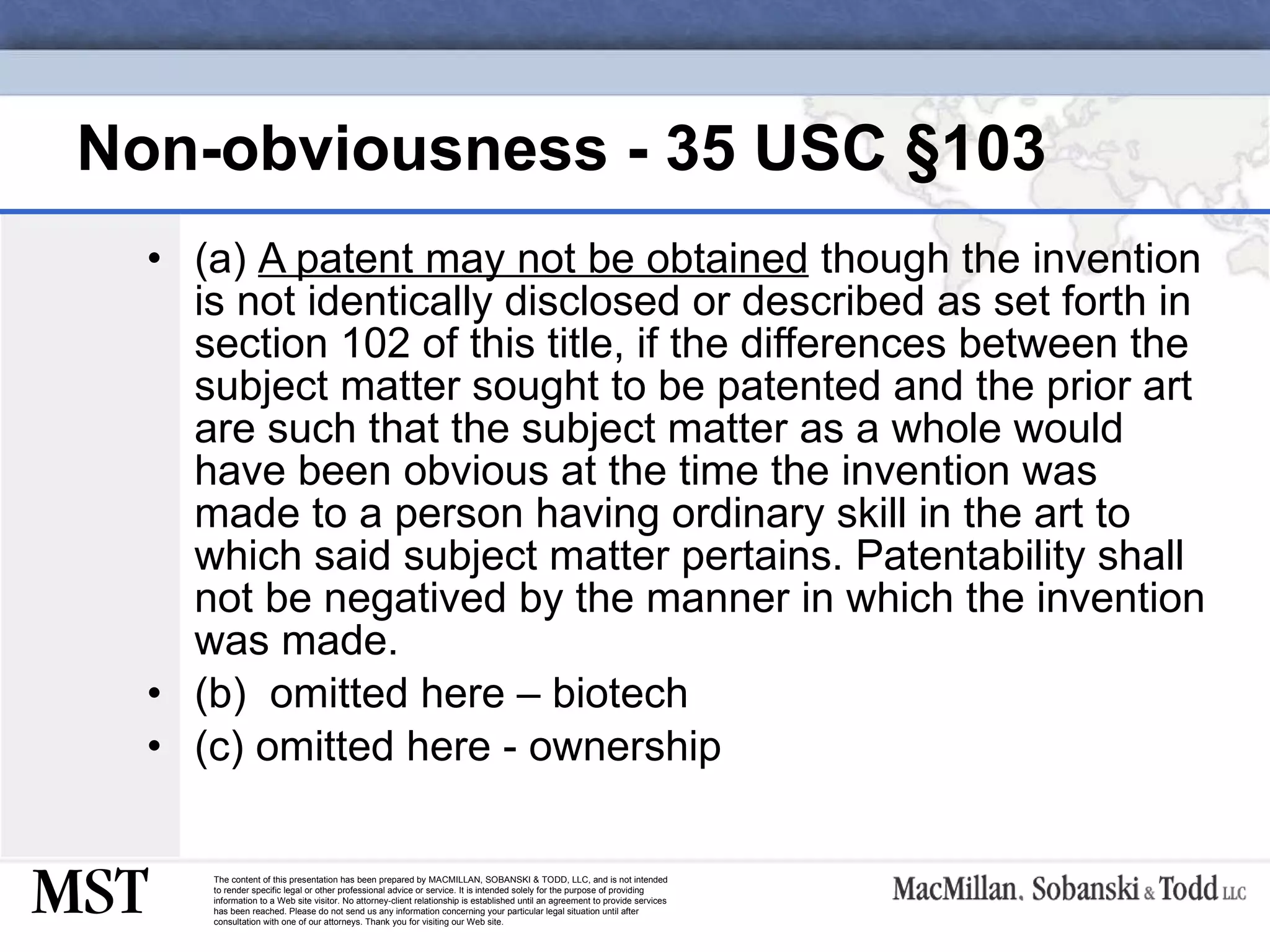
Non-obviousness - 35 USC  §103 (a)  A patent may not be obtained  though the invention is not identically disclosed or described as set forth in section 102 of this title, if the differences between the subject matter sought to be patented and the prior art are such that the subject matter as a whole would have been obvious at the time the invention was made to a person having ordinary skill in the art to which said subject matter pertains. Patentability shall not be negatived by the manner in which the invention was made. (b)  omitted here – biotech (c) omitted here - ownership
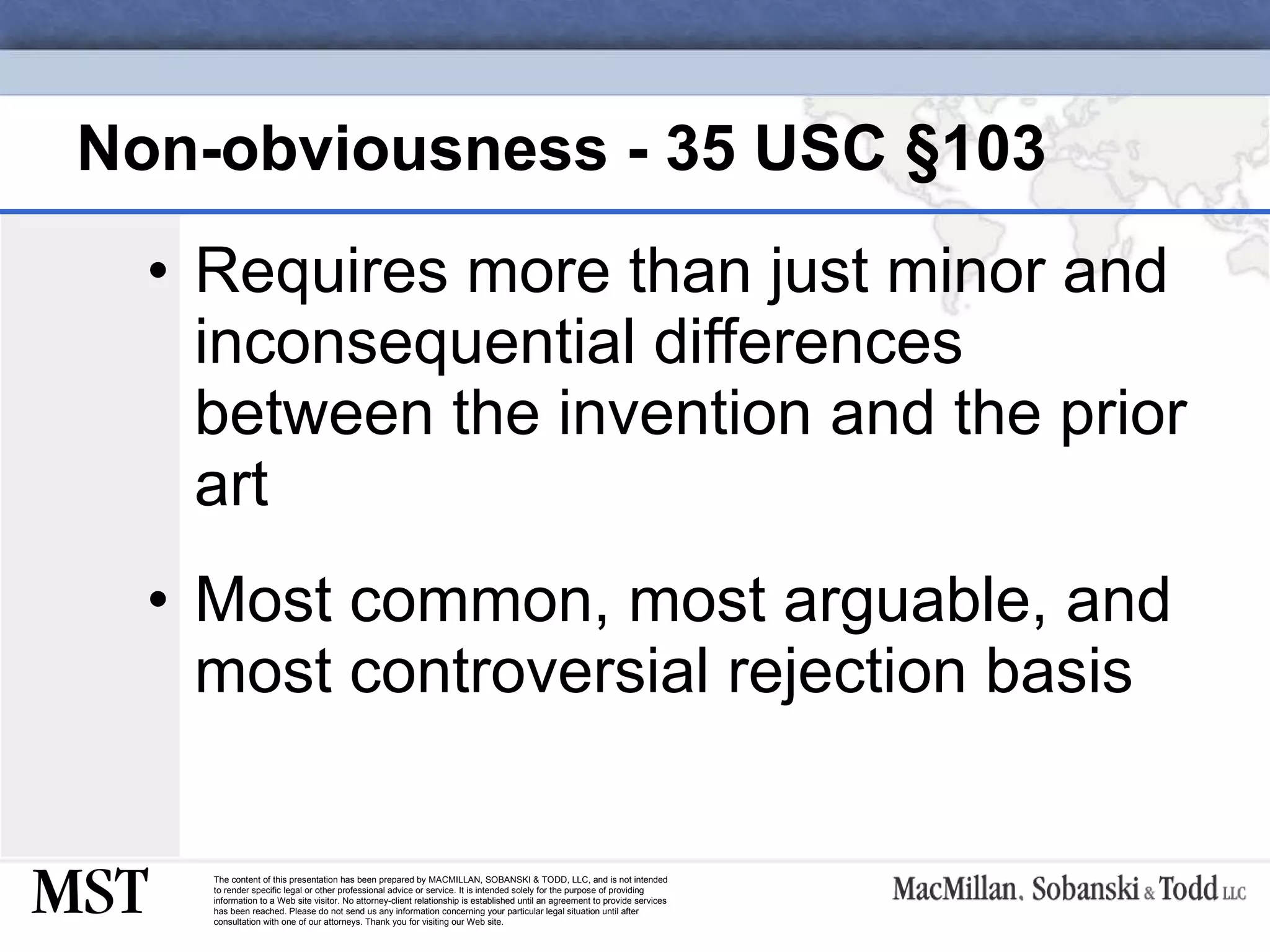
Non-obviousness - 35 USC  §103 Requires more than just minor and inconsequential differences between the invention and the prior art  Most common, most arguable, and most controversial rejection basis
Disclosure Requirements- 35 USC  § 112 What does the Patent need to disclose? The Invention “… in such full, clear, concise, and exact terms…” Enablement “… as to enable any person skilled in the art to which it pertains…to make and use same…” Best Mode “… and shall set forth the best mode contemplated by the inventor of carrying out his invention.” Concealing the “best mode” may result in an invalid patent see  Chemcast Corp. v. ARCO Industries Corp. , 913 F.2d 923
Overview - Basic Patent Strategy   Document the invention – the date of conception and reduction to practice File a patent application – disclosing and claiming the invention  The application is examined at the PTO Further action – argue, amend or abandon Issue
Enforcing Patent Rights Infringement Actions Notice and damages An infringer must be “put on notice” Marking products - 35 U.S.C.  § 287(a) “ Patent” or “Pat.” and the Patent Number On the article and on the package “ Patent Pending” Only a psychological deterrent No legal significance False Marking (35 U.S.C. § 292) Includes marking Patent and Patent Pending
Enforcing Patent Rights Infringement Actions Defenses Non infringement Invalidity On-Sale Bar Public Use Inequitable Conduct Obviousness
Questions? Thank you to Ms. Jenna Cogswell at MST who helped prepare these slides! Contact us at  [email_address]  or 419.255.5900 for permission to use these slides, or to ask questions.  We are happy to let others use these slides, but we would like to know who they helped.

03-Brief Overview of U.S. Utility Patent Law and Practice

  • 1.
    Brief Overview of U.S. Utility Patent Law and Practice Kristine H. Johnson MacMillan, Sobanski & Todd, LLC [email_address]
  • 2.
    Why Create orAcquire Patents Market Protection Prevent competitors from copying Maintain product differentiation Bar entry into a market Generate Revenue Licensing Assignment Develop Credibility Product innovation Advertising No such thing as Patent Police
  • 3.
    Patent Types –Design Patent Protects an ornamental design for a product Lasts 14 years from the date of grant (35 U.S.C. § 173)
  • 4.
    Patent Types –Plant Patent New varieties of asexually reproduced plants Lasts 20 years from date of filing (35 U.S.C. § 154) P4,161 Orange Tree
  • 5.
    Patent Types –Utility Patent Protects the structure and function of machine, product or composition of matter a process, Business method Process
  • 6.
    Non-US Patents Nosuch thing as a “worldwide patent” Patents are issued by each sovereign country May file regional applications via treaties Patent Cooperation Treaty (PCT) European Patent Convention (EPC) Must designate the specific countries to examine the application Each country issues a patent and charges a fee Some regional applications give a “discount”
  • 7.
    Overview - BasicPatenting Timeline Document the invention – the date of conception and reduction to practice File a patent application – disclosing and claiming the invention The application is examined at the PTO Further action – argue, amend or appeal Issue or abandon
  • 8.
    “ Provisional” ApplicationsNot a patent, but a type of application Idea disclosure to preserve a filing date Not published or examined No claims required Provides no legal protection of an invention UNTIL Filed as a utility application AND issues as a patent Lasts up to one year Must file a utility application or it becomes abandoned Allows time to develop or clarify other aspects of an invention Useful in a highly competitive area Preserving the filing date limits what counts as “prior art”
  • 9.
    Who can filea Patent Application? The inventor or inventors An assignee, on an inventor’s behalf Must have a writing, such as An assignment document Employment contract agreeing to convey rights
  • 10.
    What is “PatentProsecution?” Happens during the “examination” process Process of “negotiation” with the Patent Office Responding to Examiner rejections Distinguishing the claimed invention from the prior art Refining the scope of the presented claims based on the cited prior art and what you have disclosed in the application, or Abandoning the application completely
  • 11.
    Patent Cost Estimates– Service Fees Service fee costs depend on The complexity of the invention How crowded is the technology field The law related to adequate disclosure (mechanical v. biotech) For a mechanically-based invention of mid-level complexity $4,000 -- 7,000 to prepare & file utility application $2,000 -- 4,000 to prosecute and issue For a biotechnology-based invention of mid-level complexity $5,000 -- 15,000 to prepare & file utility application $4,000 -- 10,000 to prosecute and issue
  • 12.
    Patent Cost Estimates– Government Fees Utility Patent Application fees Basic filing fee: $330, Search fee: $540 Examination fee: $220 Issue fee: $1,510 Maintenance fees Due: 3 ½ , 7 ½ , and 11 ½ years into patent term Amount: $980, $2,480, $4,110 Small Entities pay half of the above fees Provisional patent application - $220 filing fee
  • 13.
    Obtaining a PatentMin 2 yrs Step 1: File a patent application with the USPTO including: Description of the invention Drawings illustrating the invention Claims (legal boundaries) Step 2: USPTO examines the application, the invention must be: New Useful Non-Obvious Step 3: USPTO issues a patent
  • 14.
    Patentability Requirements Inorder for a patent to issue on your application the Examiner must find that the invention: Has utility (is useful) Is novel (is new) Is not obvious
  • 15.
    Utility – 35USC §101 Whoever invents or discovers any new and useful process, machine, manufacture, or composition of matter, or any new and useful improvement thereof, may obtain a patent therefor, subject to the conditions and requirements of this title. Based on constitutional language
  • 16.
    Novelty – 35USC § 102 A person shall be entitled to a patent unless - (a) the invention was known or used by others in this country, or patented or described in a printed publication in this or a foreign country, before the invention thereof by the applicant for patent, or (b) the invention was patented or described in a printed publication in this or a foreign country or in public use or on sale in this country, more than one year prior to the date of the application for patent in the United States, or (c) he has abandoned the invention, or (d) the invention was first patented or caused to be patented, or was the subject of an inventor's certificate, by the applicant or his legal representatives or assigns in a foreign country prior to the date of the application for patent in this country on an application for patent or inventor's certificate filed more than twelve months before the filing of the application in the United States, or (e) the invention was described in - (1) an application for patent, published under section 122(b) , by another filed in the United States before the invention by the applicant for patent or (2) a patent granted on an application for patent by another filed in the United States before the invention by the applicant for patent, except that an international application filed under the treaty defined in section 351(a) shall have the effects for the purposes of this subsection of an application filed in the United States only if the international application designated the United States and was published under Article 21(2) of such treaty in the English language; or (f) he did not himself invent the subject matter sought to be patented, or (g)(1) during the course of an interference conducted under section 135 or section 291 , another inventor involved therein establishes, to the extent permitted in section 104 , that before such person's invention thereof the invention was made by such other inventor and not abandoned, suppressed, or concealed, or (2) before such person's invention thereof, the invention was made in this country by another inventor who had not abandoned, suppressed, or concealed it. In determining priority of invention under this subsection, there shall be considered not only the respective dates of conception and reduction to practice of the invention, but also the reasonable diligence of one who was first to conceive and last to reduce to practice, from a time prior to conception by the other. VERY TECHNICAL!
  • 17.
    A Few Barsto Novelty: Timeline-based Watch out for these common types of “Prior Art” Before conception of invention, the invention was: described in a patent or printed publication anywhere -or- More than one year before filing a U.S. patent application, the invention was: described in any publication used publicly in US offered for sale in US
  • 18.
    Novelty and RecordkeepingReliable, written evidence of conception and reduction to practice is important in the US, unlike other countries Fully explain idea, experiments Sign and date on the day they were done Witnesses (read and understood) Lab books Test results
  • 19.
    Novelty and CommunicationsInside the company Need to know basis Keep track of individual contributions Inventions vs. Assistance Outside of the Company Confidentiality Agreements Customer Presentations Vendor quotes Offers for Sale vs. investigating market feasibility Public Use vs. testing
  • 20.
    Non-obviousness - 35USC §103 (a) A patent may not be obtained though the invention is not identically disclosed or described as set forth in section 102 of this title, if the differences between the subject matter sought to be patented and the prior art are such that the subject matter as a whole would have been obvious at the time the invention was made to a person having ordinary skill in the art to which said subject matter pertains. Patentability shall not be negatived by the manner in which the invention was made. (b) omitted here – biotech (c) omitted here - ownership
  • 21.
    Non-obviousness - 35USC §103 Requires more than just minor and inconsequential differences between the invention and the prior art Most common, most arguable, and most controversial rejection basis
  • 22.
    Disclosure Requirements- 35USC § 112 What does the Patent need to disclose? The Invention “… in such full, clear, concise, and exact terms…” Enablement “… as to enable any person skilled in the art to which it pertains…to make and use same…” Best Mode “… and shall set forth the best mode contemplated by the inventor of carrying out his invention.” Concealing the “best mode” may result in an invalid patent see Chemcast Corp. v. ARCO Industries Corp. , 913 F.2d 923
  • 23.
    Overview - BasicPatent Strategy Document the invention – the date of conception and reduction to practice File a patent application – disclosing and claiming the invention The application is examined at the PTO Further action – argue, amend or abandon Issue
  • 24.
    Enforcing Patent RightsInfringement Actions Notice and damages An infringer must be “put on notice” Marking products - 35 U.S.C. § 287(a) “ Patent” or “Pat.” and the Patent Number On the article and on the package “ Patent Pending” Only a psychological deterrent No legal significance False Marking (35 U.S.C. § 292) Includes marking Patent and Patent Pending
  • 25.
    Enforcing Patent RightsInfringement Actions Defenses Non infringement Invalidity On-Sale Bar Public Use Inequitable Conduct Obviousness
  • 26.
    Questions? Thank youto Ms. Jenna Cogswell at MST who helped prepare these slides! Contact us at [email_address] or 419.255.5900 for permission to use these slides, or to ask questions. We are happy to let others use these slides, but we would like to know who they helped.

Editor's Notes