Learning Objectives Define a partnership and the major attributes of a partnership State the advantages  and main characteristics  of the partnership structure of business Explain the purpose of a partnership agreement and describe its typical contents Describe the special features  applicable to accounting for partnerships
Learning Objectives  (cont’d) Explain the accounting entries for the formation of a partnership Explain the accounting entries for the allocation of profits and losses of a partnership  Explain the accounting entries for drawings  and advances or loans  made by partners Describe content of the financial statements of a partnership
Partnership  Defined Partnership Act: the relationship  that   ‘ subsists between persons carrying on a business in common, with a view to profit ’ Necessary attributes Must be an agreement View to earning a profit Co-ownership of the business
Advantages Pooling of resources Low cost Formed at little or no cost Subject to little regulation Not required to publish financial statements Taxation
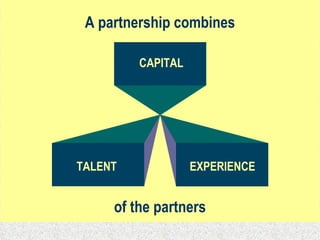
A partnership combines of the partners CAPITAL TALENT EXPERIENCE
Characteristics Mutual Agency E ach partner: A cts as agent for the partnership H as authority to act on behalf of the partnership Unlimited liability Each partner personally responsible for all the debts of the business No limit to liability Personal assets are exposed Unattractive to wealthy individuals
Characteristics  (cont’d) Limited life Ended if member dies, withdraws or retires, or becomes incapacitated Ended on the admission of a new member Ended via bankruptcy Ended if formation purpose is over Transfer of partnership interest Capital interest is personal asset
Partnership Agreement Agreement covers: Name, location and nature Name, investment and duties of each partner Sharing of profits and losses Administrative details Withdrawals (drawings) Dispute resolution Admission/withdrawal of partners Partnership liquidation
Accounting for a Partnership Formation Drawings Distribution of profits Change in partnership members Liquidation
Accounting for a Partnership  (cont’d) Method 1:  Capital accounts which include profits and losses Capital a/c credited with investments Drawings a/c debited with withdrawal of assets or personal expenses Drawings a/c closed to capital  P&L summary closed to profit distribution and allocated to capital a/c’s
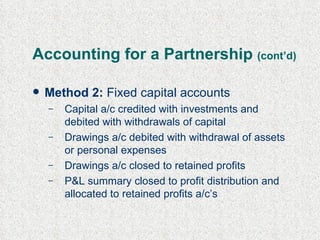
Accounting for a Partnership  (cont’d) Method 2:  Fixed capital accounts Capital a/c credited with investments and debited with withdrawals of capital Drawings a/c debited with withdrawal of assets or personal expenses Drawings a/c closed to retained profits P&L summary closed to profit distribution and allocated to retained profits a/c’s
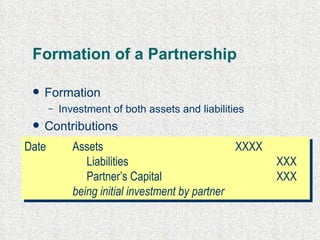
Formation of a Partnership Formation  Investment of both assets and liabilities Contributions Recorded as for sole trader Date Assets XXXX Liabilities XXX Partner’s Capital XXX being initial investment by partner
Allocation of Partnership  Profits and Losses Consider for each partner: services performed capital invested business risk assumed  Common methods fixed ratio fixed ratio based on capital balances fixed ratio allowing for interest and salary
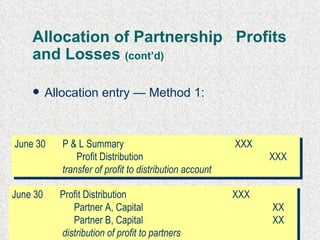
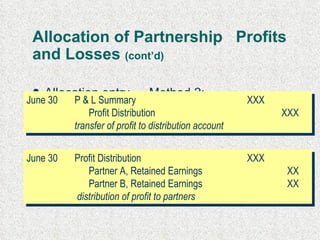
Allocation of Partnership  Profits and Losses  (cont’d) Allocation entry  —   Method 1 : June 30 P & L Summary XXX Profit Distribution XXX transfer of profit to distribution account June 30 Profit Distribution XXX Partner A,  Capital XX Partner B,  Capital XX   distribution of profit to partners
Allocation of Partnership  Profits and Losses  (cont’d) Allocation entry  —   Method 2 : June 30 P & L Summary XXX Profit Distribution XXX transfer of profit to distribution account June 30 Profit Distribution XXX Partner A, Retained Earnings XX Partner B, Retained Earnings XX   distribution of profit to partners
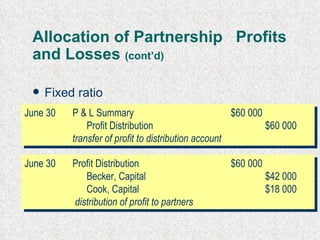
Allocation of Partnership  Profits and Losses  (cont’d) Fixed ratio split based as stated e.g. 7:3, say profit of $60 000  June 30 P & L Summary $60 000 Profit Distribution $60 000 transfer of profit to distribution account June 30 Profit Distribution $60 000 Becker, Capital  $42 000 Cook, Capital  $18 000   distribution of profit to partners
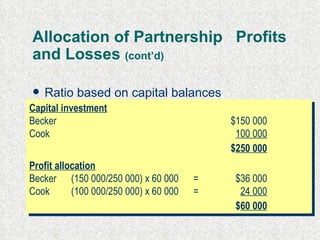
Allocation of Partnership  Profits and Losses  (cont’d) Ratio based on capital balances profit of $60 000 Capital investment Becker $150 000 Cook 100 000 $ 250 000 Profit allocation Becker (150 000/250 000) x 60 000  = $36 000 Cook (100 000/250 000) x 60 000  = 24 000 $ 60 000
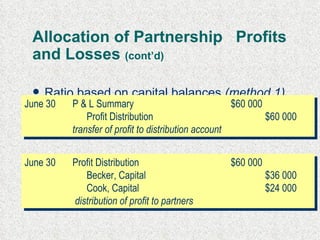
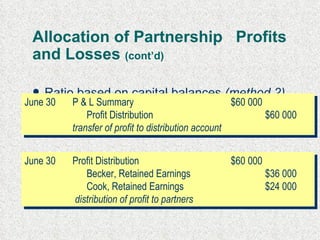
Allocation of Partnership  Profits and Losses  (cont’d) Ratio based on capital balances   (method 1) June 30 P & L Summary $60 000 Profit Distribution $60 000 transfer of profit to distribution account June 30 Profit Distribution $60 000 Becker, Capital $36 000 Cook, Capital  $24 000   distribution of profit to partners
Allocation of Partnership  Profits and Losses  (cont’d) Ratio based on capital balances   (method 2) June 30 P & L Summary $60 000 Profit Distribution $60 000 transfer of profit to distribution account June 30 Profit Distribution $60 000 Becker,  Retained Earnings $36 000 Cook,  Retained Earnings $24 000   distribution of profit to partners
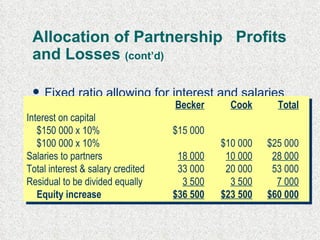
Allocation of Partnership  Profits and Losses  (cont’d) Fixed ratio allowing for interest and salaries Becker Cook Total Interest on capital $150 000 x 10% $15 000 $100 000 x 10% $10 000 $25 000 Salaries to partners 18 000 10 000 28 000 Total interest & salary credited 33 000 20 000 53 000 Residual to be divided equally 3 500 3 500 7 000 Equity increase $36 500 $23 500 $60 000
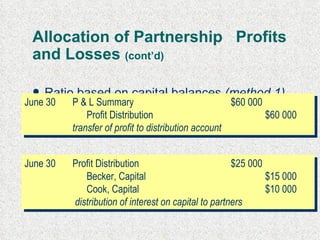
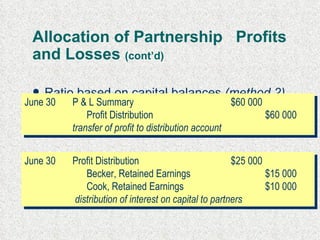
Allocation of Partnership  Profits and Losses  (cont’d) Ratio based on capital balances   (method 1) June 30 P & L Summary $60 000 Profit Distribution $60 000 transfer of profit to distribution account June 30 Profit Distribution $ 25  000 Becker, Capital $ 15 0 00 Cook, Capital $ 10 0 00   distribution of  interest on capital  to partners
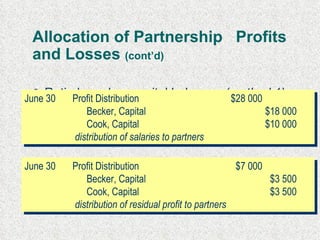
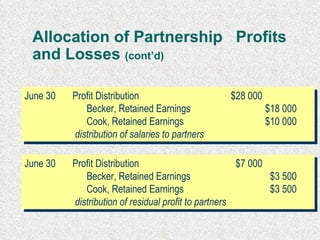
Allocation of Partnership  Profits and Losses  (cont’d) Ratio based on capital balances   (method 1) June 30 Profit Distribution $ 7  000 Becker, Capital $ 3 50 0 Cook, Capital $ 3 500   distribution of  residual profit  to partners June 30 Profit Distribution $ 28  000 Becker, Capital $ 18 0 00 Cook, Capital $ 10 0 00   distribution of  salaries  to partners
Allocation of Partnership  Profits and Losses  (cont’d) Ratio based on capital balances   (method 2) June 30 P & L Summary $60 000 Profit Distribution $60 000 transfer of profit to distribution account June 30 Profit Distribution $ 25  000 Becker,  Retained Earnings $ 15 0 00 Cook,  Retained Earnings $ 10 0 00   distribution of  interest on capital  to partners
Allocation of Partnership  Profits and Losses  (cont’d) Ratio based on capital balances   (method 2) June 30 Profit Distribution $ 7  000 Becker,  Retained Earnings  $ 3 50 0 Cook,  Retained Earnings  $ 3 500   distribution of  residual profit  to partners June 30 Profit Distribution $ 28  000 Becker,  Retained Earnings $ 18 0 00 Cook,  Retained Earnings  $ 10 0 00   distribution of  salaries  to partners
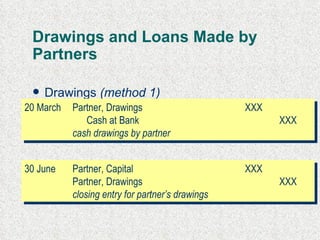
Drawings  and Loans Made by  Partners Drawings  (method 1) 20 March Partner , Drawings XXX Cash at Bank XXX cash drawings by partner 30 June Partner , Capital XXX Partner , Drawings XXX closing entry for  partner’s  drawings
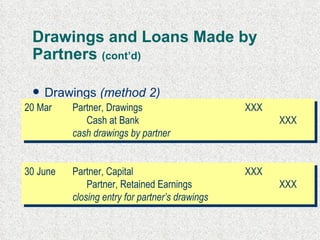
Drawings  and Loans Made by  Partners  (cont’d) Drawings  (method 2) 20 Mar Partner , Drawings XXX Cash at Bank XXX cash drawings by partner 30 June Partner , Capital XXX Partner ,  Retained Earnings XXX closing entry for  partner’s  drawings
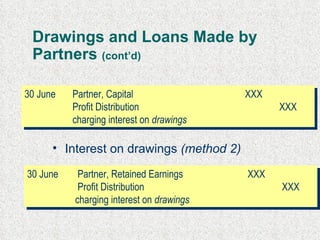
Drawings  and Loans Made by  Partners  (cont’d) Interest on drawings  (method 1) 30 June Partner , Capital XXX Profit Distribution XXX charging interest on  drawings   Interest on drawings  (method 2) 30 June  Partner, Retained Earnings XXX   Profit Distribution   XXX charging interest on  drawings
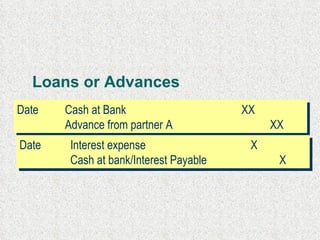
Loans or Advances Date Cash at Bank XX Advance from partner A XX   Date  Interest expense X   Cash at bank/Interest Payable  X
Financial Statements General-purpose or special-purpose report? Each partner’s equity reported separately on the Balance Sheet Salaries, interest on capital and interest on drawings are  not  expenses
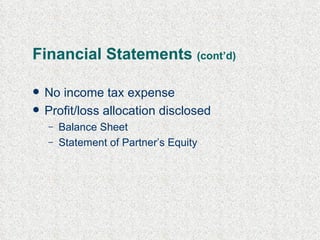
Financial Statements  (cont’d) No income tax expense Profit/loss allocation disclosed Balance Sheet Statement of Partner’s Equity

Partnership

  • 1.
    Learning Objectives Definea partnership and the major attributes of a partnership State the advantages and main characteristics of the partnership structure of business Explain the purpose of a partnership agreement and describe its typical contents Describe the special features applicable to accounting for partnerships
  • 2.
    Learning Objectives (cont’d) Explain the accounting entries for the formation of a partnership Explain the accounting entries for the allocation of profits and losses of a partnership Explain the accounting entries for drawings and advances or loans made by partners Describe content of the financial statements of a partnership
  • 3.
    Partnership DefinedPartnership Act: the relationship that ‘ subsists between persons carrying on a business in common, with a view to profit ’ Necessary attributes Must be an agreement View to earning a profit Co-ownership of the business
  • 4.
    Advantages Pooling ofresources Low cost Formed at little or no cost Subject to little regulation Not required to publish financial statements Taxation
  • 5.
    A partnership combinesof the partners CAPITAL TALENT EXPERIENCE
  • 6.
    Characteristics Mutual AgencyE ach partner: A cts as agent for the partnership H as authority to act on behalf of the partnership Unlimited liability Each partner personally responsible for all the debts of the business No limit to liability Personal assets are exposed Unattractive to wealthy individuals
  • 7.
    Characteristics (cont’d)Limited life Ended if member dies, withdraws or retires, or becomes incapacitated Ended on the admission of a new member Ended via bankruptcy Ended if formation purpose is over Transfer of partnership interest Capital interest is personal asset
  • 8.
    Partnership Agreement Agreementcovers: Name, location and nature Name, investment and duties of each partner Sharing of profits and losses Administrative details Withdrawals (drawings) Dispute resolution Admission/withdrawal of partners Partnership liquidation
  • 9.
    Accounting for aPartnership Formation Drawings Distribution of profits Change in partnership members Liquidation
  • 10.
    Accounting for aPartnership (cont’d) Method 1: Capital accounts which include profits and losses Capital a/c credited with investments Drawings a/c debited with withdrawal of assets or personal expenses Drawings a/c closed to capital P&L summary closed to profit distribution and allocated to capital a/c’s
  • 11.
    Accounting for aPartnership (cont’d) Method 2: Fixed capital accounts Capital a/c credited with investments and debited with withdrawals of capital Drawings a/c debited with withdrawal of assets or personal expenses Drawings a/c closed to retained profits P&L summary closed to profit distribution and allocated to retained profits a/c’s
  • 12.
    Formation of aPartnership Formation Investment of both assets and liabilities Contributions Recorded as for sole trader Date Assets XXXX Liabilities XXX Partner’s Capital XXX being initial investment by partner
  • 13.
    Allocation of Partnership Profits and Losses Consider for each partner: services performed capital invested business risk assumed Common methods fixed ratio fixed ratio based on capital balances fixed ratio allowing for interest and salary
  • 14.
    Allocation of Partnership Profits and Losses (cont’d) Allocation entry — Method 1 : June 30 P & L Summary XXX Profit Distribution XXX transfer of profit to distribution account June 30 Profit Distribution XXX Partner A, Capital XX Partner B, Capital XX distribution of profit to partners
  • 15.
    Allocation of Partnership Profits and Losses (cont’d) Allocation entry — Method 2 : June 30 P & L Summary XXX Profit Distribution XXX transfer of profit to distribution account June 30 Profit Distribution XXX Partner A, Retained Earnings XX Partner B, Retained Earnings XX distribution of profit to partners
  • 16.
    Allocation of Partnership Profits and Losses (cont’d) Fixed ratio split based as stated e.g. 7:3, say profit of $60 000 June 30 P & L Summary $60 000 Profit Distribution $60 000 transfer of profit to distribution account June 30 Profit Distribution $60 000 Becker, Capital $42 000 Cook, Capital $18 000 distribution of profit to partners
  • 17.
    Allocation of Partnership Profits and Losses (cont’d) Ratio based on capital balances profit of $60 000 Capital investment Becker $150 000 Cook 100 000 $ 250 000 Profit allocation Becker (150 000/250 000) x 60 000 = $36 000 Cook (100 000/250 000) x 60 000 = 24 000 $ 60 000
  • 18.
    Allocation of Partnership Profits and Losses (cont’d) Ratio based on capital balances (method 1) June 30 P & L Summary $60 000 Profit Distribution $60 000 transfer of profit to distribution account June 30 Profit Distribution $60 000 Becker, Capital $36 000 Cook, Capital $24 000 distribution of profit to partners
  • 19.
    Allocation of Partnership Profits and Losses (cont’d) Ratio based on capital balances (method 2) June 30 P & L Summary $60 000 Profit Distribution $60 000 transfer of profit to distribution account June 30 Profit Distribution $60 000 Becker, Retained Earnings $36 000 Cook, Retained Earnings $24 000 distribution of profit to partners
  • 20.
    Allocation of Partnership Profits and Losses (cont’d) Fixed ratio allowing for interest and salaries Becker Cook Total Interest on capital $150 000 x 10% $15 000 $100 000 x 10% $10 000 $25 000 Salaries to partners 18 000 10 000 28 000 Total interest & salary credited 33 000 20 000 53 000 Residual to be divided equally 3 500 3 500 7 000 Equity increase $36 500 $23 500 $60 000
  • 21.
    Allocation of Partnership Profits and Losses (cont’d) Ratio based on capital balances (method 1) June 30 P & L Summary $60 000 Profit Distribution $60 000 transfer of profit to distribution account June 30 Profit Distribution $ 25 000 Becker, Capital $ 15 0 00 Cook, Capital $ 10 0 00 distribution of interest on capital to partners
  • 22.
    Allocation of Partnership Profits and Losses (cont’d) Ratio based on capital balances (method 1) June 30 Profit Distribution $ 7 000 Becker, Capital $ 3 50 0 Cook, Capital $ 3 500 distribution of residual profit to partners June 30 Profit Distribution $ 28 000 Becker, Capital $ 18 0 00 Cook, Capital $ 10 0 00 distribution of salaries to partners
  • 23.
    Allocation of Partnership Profits and Losses (cont’d) Ratio based on capital balances (method 2) June 30 P & L Summary $60 000 Profit Distribution $60 000 transfer of profit to distribution account June 30 Profit Distribution $ 25 000 Becker, Retained Earnings $ 15 0 00 Cook, Retained Earnings $ 10 0 00 distribution of interest on capital to partners
  • 24.
    Allocation of Partnership Profits and Losses (cont’d) Ratio based on capital balances (method 2) June 30 Profit Distribution $ 7 000 Becker, Retained Earnings $ 3 50 0 Cook, Retained Earnings $ 3 500 distribution of residual profit to partners June 30 Profit Distribution $ 28 000 Becker, Retained Earnings $ 18 0 00 Cook, Retained Earnings $ 10 0 00 distribution of salaries to partners
  • 25.
    Drawings andLoans Made by Partners Drawings (method 1) 20 March Partner , Drawings XXX Cash at Bank XXX cash drawings by partner 30 June Partner , Capital XXX Partner , Drawings XXX closing entry for partner’s drawings
  • 26.
    Drawings andLoans Made by Partners (cont’d) Drawings (method 2) 20 Mar Partner , Drawings XXX Cash at Bank XXX cash drawings by partner 30 June Partner , Capital XXX Partner , Retained Earnings XXX closing entry for partner’s drawings
  • 27.
    Drawings andLoans Made by Partners (cont’d) Interest on drawings (method 1) 30 June Partner , Capital XXX Profit Distribution XXX charging interest on drawings Interest on drawings (method 2) 30 June Partner, Retained Earnings XXX Profit Distribution XXX charging interest on drawings
  • 28.
    Loans or AdvancesDate Cash at Bank XX Advance from partner A XX Date Interest expense X Cash at bank/Interest Payable X
  • 29.
    Financial Statements General-purposeor special-purpose report? Each partner’s equity reported separately on the Balance Sheet Salaries, interest on capital and interest on drawings are not expenses
  • 30.
    Financial Statements (cont’d) No income tax expense Profit/loss allocation disclosed Balance Sheet Statement of Partner’s Equity