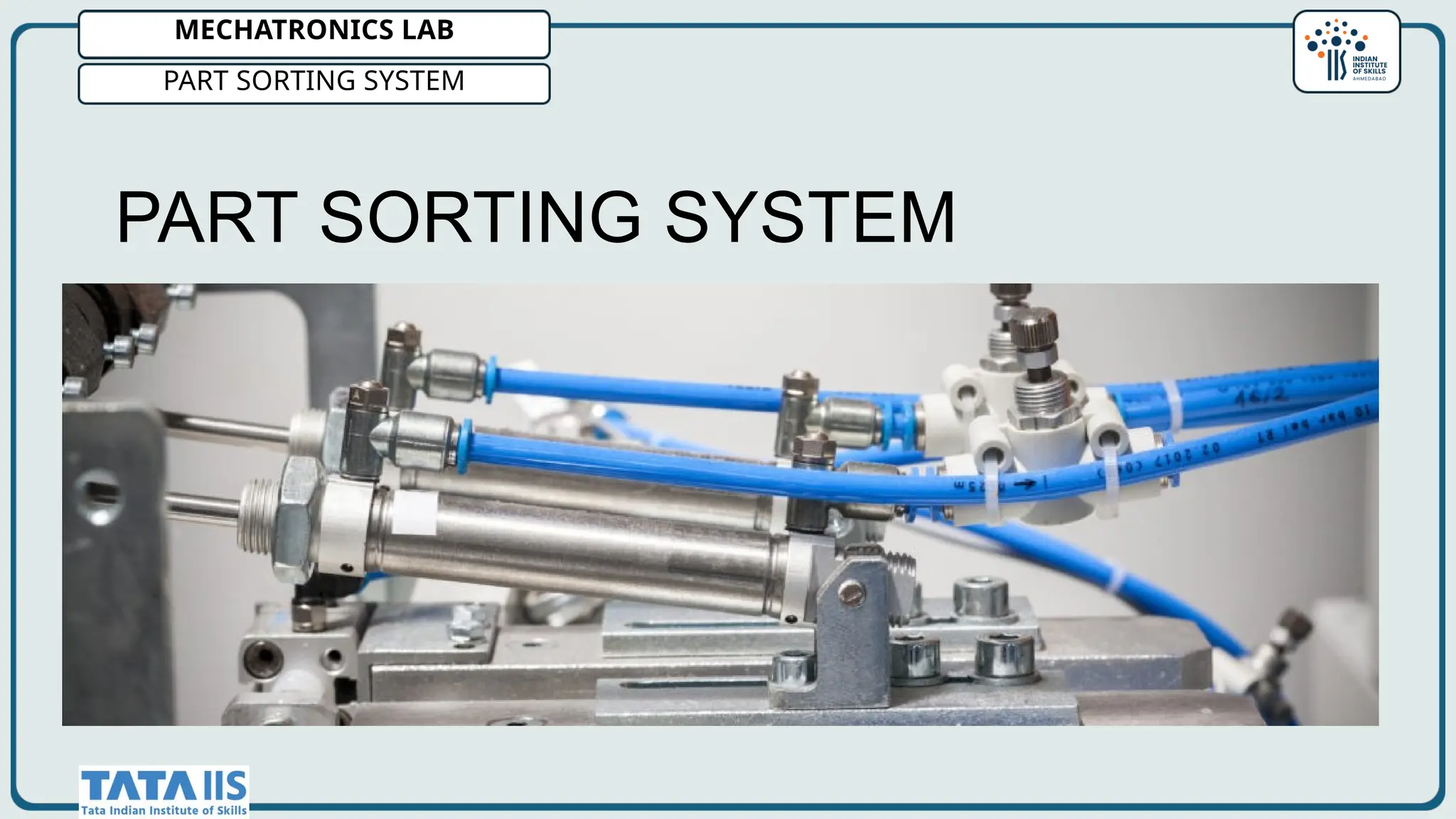
PART SORTING SYSTEM
MECHATRONICS LAB
PART SORTING SYSTEM
MECHATRONICS LAB
PART SORTING SYSTEM
SHUBHAM
RATHOD
NITESH
UTTARWAR
AKSHAY BILVAL DINESH SINGH PRUTHVIRAJ SINH
ZALA
TEAM MEMBERS
MECHATRONICS LAB
PART SORTING SYSTEM
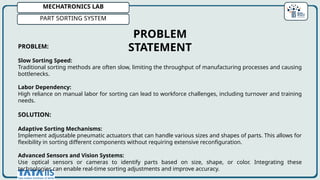
PROBLEM:
Slow Sorting Speed:
Traditional sorting methods are often slow, limiting the throughput of manufacturing processes and causing
bottlenecks.
Labor Dependency:
High reliance on manual labor for sorting can lead to workforce challenges, including turnover and training
needs.
SOLUTION:
Adaptive Sorting Mechanisms:
Implement adjustable pneumatic actuators that can handle various sizes and shapes of parts. This allows for
flexibility in sorting different components without requiring extensive reconfiguration.
Advanced Sensors and Vision Systems:
Use optical sensors or cameras to identify parts based on size, shape, or color. Integrating these
technologies can enable real-time sorting adjustments and improve accuracy.
PROBLEM
STATEMENT
MECHATRONICS LAB
PART SORTING SYSTEM
MECHATRONICS LAB
TRAFFIC LIGHT SYSTEM
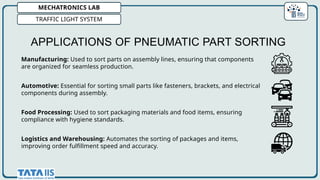
APPLICATIONS OF PNEUMATIC PART SORTING
Manufacturing: Used to sort parts on assembly lines, ensuring that components
are organized for seamless production.
Automotive: Essential for sorting small parts like fasteners, brackets, and electrical
components during assembly.
Food Processing: Used to sort packaging materials and food items, ensuring
compliance with hygiene standards.
Logistics and Warehousing: Automates the sorting of packages and items,
improving order fulfillment speed and accuracy.
MECHATRONICS LAB
PART SORTING SYSTEM
ADVANTAGES OF PNEUMATIC PART SORTING
Speed: Pneumatic systems can move parts quickly, improving overall sorting efficiency and
reducing cycle times.
Precision: With proper design, these systems can accurately sort and direct parts to
specific locations.
Flexibility: Pneumatic sorting systems can be easily reconfigured to accommodate different part
sizes and shapes.
Reduced Labor Costs: Automating the sorting process minimizes the need of labour, lowering
operational costs.
Scalability: It’s easy to expand or modify pneumatic systems to handle increased
production volumes.
MECHATRONICS LAB
PART SORTING SYSTEM
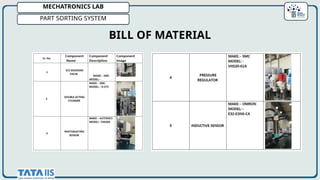
BILL OF MATERIAL
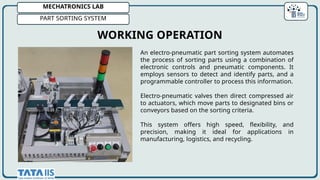
An electro-pneumatic part sorting system automates
the process of sorting parts using a combination of
electronic controls and pneumatic components. It
employs sensors to detect and identify parts, and a
programmable controller to process this information.
Electro-pneumatic valves then direct compressed air
to actuators, which move parts to designated bins or
conveyors based on the sorting criteria.
This system offers high speed, flexibility, and
precision, making it ideal for applications in
manufacturing, logistics, and recycling.
WORKING OPERATION
MECHATRONICS LAB
PART SORTING SYSTEM
MECHATRONICS LAB
PART SORTING SYSTEM
The productivity of a pneumatic-based part sorting system is typically assessed by its sorting
speed, accuracy, and reliability. Key productivity metrics include:
1.Sorting Speed: Measured by cycle time and throughput.
2.Accuracy: Determined by sorting precision and error rates.
3.Reliability: Affected by failure rates and downtime.
4.Flexibility: Includes adaptability to different parts and ease of reconfiguration.
5.Operational Efficiency: Includes energy consumption and space utilization.
In essence, high productivity in such systems means efficiently sorting parts quickly and
accurately with minimal downtime and maintenance.
PRODUCTIVITY OF PNEUMATIC PART SORTING
MECHATRONICS LAB
PART SORTING SYSTEM
Skills demonstrated in a pneumatic-based part sorting system include:
1.Pneumatic Expertise: Understanding and working with pneumatic components and principles.
2.Mechanical Proficiency: Installing, maintaining, and troubleshooting mechanical parts.
3.Automation Knowledge: Programming and configuring control systems (e.g., PLCs).
4.Problem-Solving: Diagnosing issues and optimizing system performance.
5.Attention to Detail: Ensuring accurate sorting and system adjustments.
6.Safety Awareness: Implementing safety protocols and complying with regulations.
7.Teamwork: Collaborating effectively with others and documenting system activities.
SKILLS OF PNEUMATIC PART SORTING

PART SORTING SYSYTEM.pptx_20241017_092216_0000.pptx

  • 1.
    PART SORTING SYSTEM MECHATRONICSLAB PART SORTING SYSTEM
  • 2.
    MECHATRONICS LAB PART SORTINGSYSTEM SHUBHAM RATHOD NITESH UTTARWAR AKSHAY BILVAL DINESH SINGH PRUTHVIRAJ SINH ZALA TEAM MEMBERS
  • 3.
    MECHATRONICS LAB PART SORTINGSYSTEM PROBLEM: Slow Sorting Speed: Traditional sorting methods are often slow, limiting the throughput of manufacturing processes and causing bottlenecks. Labor Dependency: High reliance on manual labor for sorting can lead to workforce challenges, including turnover and training needs. SOLUTION: Adaptive Sorting Mechanisms: Implement adjustable pneumatic actuators that can handle various sizes and shapes of parts. This allows for flexibility in sorting different components without requiring extensive reconfiguration. Advanced Sensors and Vision Systems: Use optical sensors or cameras to identify parts based on size, shape, or color. Integrating these technologies can enable real-time sorting adjustments and improve accuracy. PROBLEM STATEMENT
  • 4.
  • 5.
    MECHATRONICS LAB TRAFFIC LIGHTSYSTEM APPLICATIONS OF PNEUMATIC PART SORTING Manufacturing: Used to sort parts on assembly lines, ensuring that components are organized for seamless production. Automotive: Essential for sorting small parts like fasteners, brackets, and electrical components during assembly. Food Processing: Used to sort packaging materials and food items, ensuring compliance with hygiene standards. Logistics and Warehousing: Automates the sorting of packages and items, improving order fulfillment speed and accuracy.
  • 6.
    MECHATRONICS LAB PART SORTINGSYSTEM ADVANTAGES OF PNEUMATIC PART SORTING Speed: Pneumatic systems can move parts quickly, improving overall sorting efficiency and reducing cycle times. Precision: With proper design, these systems can accurately sort and direct parts to specific locations. Flexibility: Pneumatic sorting systems can be easily reconfigured to accommodate different part sizes and shapes. Reduced Labor Costs: Automating the sorting process minimizes the need of labour, lowering operational costs. Scalability: It’s easy to expand or modify pneumatic systems to handle increased production volumes.
  • 7.
    MECHATRONICS LAB PART SORTINGSYSTEM BILL OF MATERIAL
  • 8.
    An electro-pneumatic partsorting system automates the process of sorting parts using a combination of electronic controls and pneumatic components. It employs sensors to detect and identify parts, and a programmable controller to process this information. Electro-pneumatic valves then direct compressed air to actuators, which move parts to designated bins or conveyors based on the sorting criteria. This system offers high speed, flexibility, and precision, making it ideal for applications in manufacturing, logistics, and recycling. WORKING OPERATION MECHATRONICS LAB PART SORTING SYSTEM
  • 9.
    MECHATRONICS LAB PART SORTINGSYSTEM The productivity of a pneumatic-based part sorting system is typically assessed by its sorting speed, accuracy, and reliability. Key productivity metrics include: 1.Sorting Speed: Measured by cycle time and throughput. 2.Accuracy: Determined by sorting precision and error rates. 3.Reliability: Affected by failure rates and downtime. 4.Flexibility: Includes adaptability to different parts and ease of reconfiguration. 5.Operational Efficiency: Includes energy consumption and space utilization. In essence, high productivity in such systems means efficiently sorting parts quickly and accurately with minimal downtime and maintenance. PRODUCTIVITY OF PNEUMATIC PART SORTING
  • 10.
    MECHATRONICS LAB PART SORTINGSYSTEM Skills demonstrated in a pneumatic-based part sorting system include: 1.Pneumatic Expertise: Understanding and working with pneumatic components and principles. 2.Mechanical Proficiency: Installing, maintaining, and troubleshooting mechanical parts. 3.Automation Knowledge: Programming and configuring control systems (e.g., PLCs). 4.Problem-Solving: Diagnosing issues and optimizing system performance. 5.Attention to Detail: Ensuring accurate sorting and system adjustments. 6.Safety Awareness: Implementing safety protocols and complying with regulations. 7.Teamwork: Collaborating effectively with others and documenting system activities. SKILLS OF PNEUMATIC PART SORTING