Software Processes
• Software process models
• Process activities
• Coping with change
• Process improvement
The software process
 A structured set of activities required to develop a
software system.
 Many different software processes but all involve:
 Specification – defining what the system should do;
 Design and implementation – defining the organization of the system and
implementing the system;
 Validation – checking that it does what the customer wants;
 Evolution – changing the system in response to changing customer needs.
 A software process model is an abstract representation of a process. It
presents a description of a process from some particular perspective.
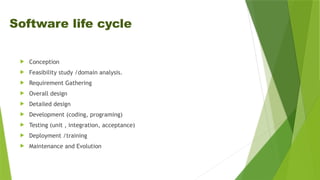
Software life cycle
 Conception
 Feasibility study /domain analysis.
 Requirement Gathering
 Overall design
 Detailed design
 Development (coding, programing)
 Testing (unit , integration, acceptance)
 Deployment /training
 Maintenance and Evolution
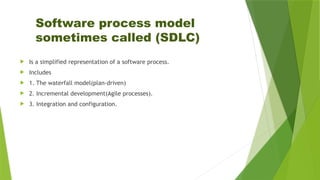
Software process model
sometimes called (SDLC)
 Is a simplified representation of a software process.
 Includes
 1. The waterfall model(plan-driven)
 2. Incremental development(Agile processes).
 3. Integration and configuration.
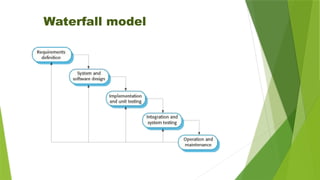
Waterfall model
1-Waterfall strengths
 Easy to understand ,easy to use.
 Provide structure to inexperienced staff.
 Milestone are well understood.
 Sets requirement stability.
 Good for management control (plan ,staff ,track).
Waterfall deficiencies
 All requirement must be known upfront.
 Deliverables created for each phase are considered frozen inhabits flexibility.
 Can give a false impression of progress.
 Does not reflect problem solving nature of software development iterations of
phases.
 Integration is a big bang at the end.
 Little opportunity for customer to preview the system(until it may be late).
When to use waterfall model
 Requirements are very well known.
 Product definition is stable.
 Technology is Understood.
 New version of an existing product.
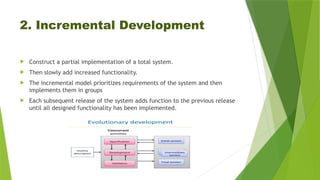
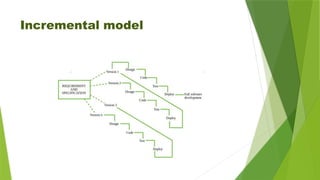
2. Incremental Development
 Construct a partial implementation of a total system.
 Then slowly add increased functionality.
 The incremental model prioritizes requirements of the system and then
implements them in groups
 Each subsequent release of the system adds function to the previous release
until all designed functionality has been implemented.
Incremental Model Strengths
 Develop high-risk or major functions first.
 Each release delivers an operational product customer can respond to each
build.
 Uses divide and conquer breakdown of tasks.
 Lowers initial delivery cost.
 Initial product delivery is fast.
 Customer get important functionality early.
 Risk of changing requirements is reduced.
Incremental model
Incremental model weakness
 Require good planning and design.
 Require early definition of a complete and fully functional system to allow for
the definition of increments.
 Well-defined module interfaces are required (some will be developed long
before others).
 Total cost of the complete system is not lower.
When to use incremental model
 Rusk ,funding ,schedule ,program complexity or need for early realization of
benefits.
 Most of the requirements are known up-front but are expected to evolve over
time.
 A need to get basic functionality to the market early.
 On projects which have lengthy development schedule.
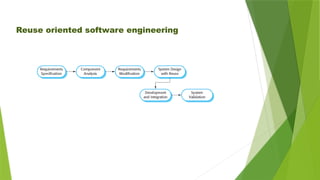
Integration and configuration(Reuse
oriented software engineering)
 Based on systematic reuse where system are integrated from existing
components or cots (commercial-off-the-shelf)system.
 Process stages
 Component analysis.
 Requirement modification
 System design with reuse.
 Development and integration
Reuse is now the standard approach for building many types of business system.
Reuse oriented software engineering
Types of software component
 Web services that are developed according to service standards and which are
available for remote invocation.
 Collection of objects that are developed as a package to be integrated with a
component framework such as .NET.
 Stand-alone software systems(COTS) that are configured for use in particular
environment.
Process Activities
 Real software processes are interleaved sequences of technical, collaborative,
and managerial activities with the overall goal of specifying, designing,
implementing, and testing a software system.
 The four basic process activities of specification, development, validation,
and evolution are organized differently in different development processes.
 In the waterfall model, they are organized in sequence, whereas in
incremental development they are interleaved.
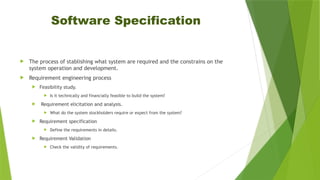
Software Specification
 The process of stablishing what system are required and the constrains on the
system operation and development.
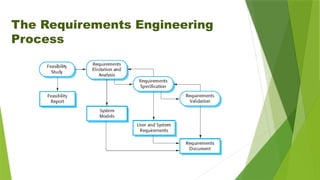
 Requirement engineering process
 Feasibility study.
 Is it technically and financially feasible to build the system?
 Requirement elicitation and analysis.
 What do the system stockholders require or expect from the system?
 Requirement specification
 Define the requirements in details.
 Requirement Validation
 Check the validity of requirements.
The Requirements Engineering
Process
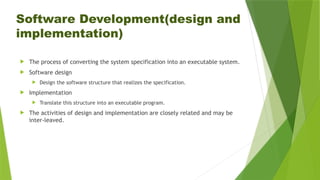
Software Development(design and
implementation)
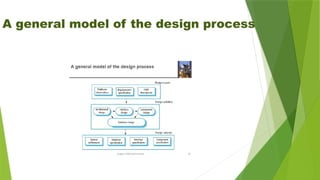
 The process of converting the system specification into an executable system.
 Software design
 Design the software structure that realizes the specification.
 Implementation
 Translate this structure into an executable program.
 The activities of design and implementation are closely related and may be
inter-leaved.
A general model of the design process
Software Validation (Testing)
 Verification and validation (V&V)is intended to show that system conforms to
its specification and meets the requirements of the system customer.
 Involves checking and review processes and system testing.
 System testing involves executing the system with test cases that are derived
from the specification of the real data to be processed by the system.
 Testing the most commonly used V&V activity.
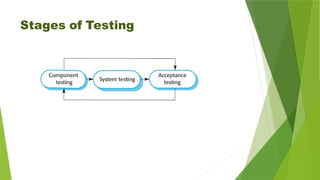
Stages of Testing
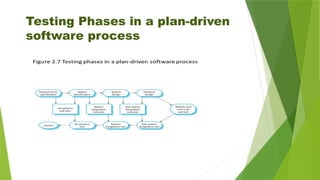
Testing Phases in a plan-driven
software process
Software Evolution
 Software is inherently flexible and can change.
 As requirements change through changing business circumstances , the
software that supports the business must also evolve and change.
 Although there has been a demarcation between development and evolution
(maintenance) this is increasingly irrelevant as fewer and fewer systems are
completely new.

Part 1_Software processessses111111.pptx

  • 1.
    Software Processes • Softwareprocess models • Process activities • Coping with change • Process improvement
  • 2.
    The software process A structured set of activities required to develop a software system.  Many different software processes but all involve:  Specification – defining what the system should do;  Design and implementation – defining the organization of the system and implementing the system;  Validation – checking that it does what the customer wants;  Evolution – changing the system in response to changing customer needs.  A software process model is an abstract representation of a process. It presents a description of a process from some particular perspective.
  • 3.
    Software life cycle Conception  Feasibility study /domain analysis.  Requirement Gathering  Overall design  Detailed design  Development (coding, programing)  Testing (unit , integration, acceptance)  Deployment /training  Maintenance and Evolution
  • 4.
    Software process model sometimescalled (SDLC)  Is a simplified representation of a software process.  Includes  1. The waterfall model(plan-driven)  2. Incremental development(Agile processes).  3. Integration and configuration.
  • 5.
  • 6.
    1-Waterfall strengths  Easyto understand ,easy to use.  Provide structure to inexperienced staff.  Milestone are well understood.  Sets requirement stability.  Good for management control (plan ,staff ,track).
  • 7.
    Waterfall deficiencies  Allrequirement must be known upfront.  Deliverables created for each phase are considered frozen inhabits flexibility.  Can give a false impression of progress.  Does not reflect problem solving nature of software development iterations of phases.  Integration is a big bang at the end.  Little opportunity for customer to preview the system(until it may be late).
  • 8.
    When to usewaterfall model  Requirements are very well known.  Product definition is stable.  Technology is Understood.  New version of an existing product.
  • 9.
    2. Incremental Development Construct a partial implementation of a total system.  Then slowly add increased functionality.  The incremental model prioritizes requirements of the system and then implements them in groups  Each subsequent release of the system adds function to the previous release until all designed functionality has been implemented.
  • 10.
    Incremental Model Strengths Develop high-risk or major functions first.  Each release delivers an operational product customer can respond to each build.  Uses divide and conquer breakdown of tasks.  Lowers initial delivery cost.  Initial product delivery is fast.  Customer get important functionality early.  Risk of changing requirements is reduced.
  • 11.
  • 12.
    Incremental model weakness Require good planning and design.  Require early definition of a complete and fully functional system to allow for the definition of increments.  Well-defined module interfaces are required (some will be developed long before others).  Total cost of the complete system is not lower.
  • 13.
    When to useincremental model  Rusk ,funding ,schedule ,program complexity or need for early realization of benefits.  Most of the requirements are known up-front but are expected to evolve over time.  A need to get basic functionality to the market early.  On projects which have lengthy development schedule.
  • 14.
    Integration and configuration(Reuse orientedsoftware engineering)  Based on systematic reuse where system are integrated from existing components or cots (commercial-off-the-shelf)system.  Process stages  Component analysis.  Requirement modification  System design with reuse.  Development and integration Reuse is now the standard approach for building many types of business system.
  • 15.
  • 16.
    Types of softwarecomponent  Web services that are developed according to service standards and which are available for remote invocation.  Collection of objects that are developed as a package to be integrated with a component framework such as .NET.  Stand-alone software systems(COTS) that are configured for use in particular environment.
  • 17.
    Process Activities  Realsoftware processes are interleaved sequences of technical, collaborative, and managerial activities with the overall goal of specifying, designing, implementing, and testing a software system.  The four basic process activities of specification, development, validation, and evolution are organized differently in different development processes.  In the waterfall model, they are organized in sequence, whereas in incremental development they are interleaved.
  • 18.
    Software Specification  Theprocess of stablishing what system are required and the constrains on the system operation and development.  Requirement engineering process  Feasibility study.  Is it technically and financially feasible to build the system?  Requirement elicitation and analysis.  What do the system stockholders require or expect from the system?  Requirement specification  Define the requirements in details.  Requirement Validation  Check the validity of requirements.
  • 19.
  • 20.
    Software Development(design and implementation) The process of converting the system specification into an executable system.  Software design  Design the software structure that realizes the specification.  Implementation  Translate this structure into an executable program.  The activities of design and implementation are closely related and may be inter-leaved.
  • 21.
    A general modelof the design process
  • 22.
    Software Validation (Testing) Verification and validation (V&V)is intended to show that system conforms to its specification and meets the requirements of the system customer.  Involves checking and review processes and system testing.  System testing involves executing the system with test cases that are derived from the specification of the real data to be processed by the system.  Testing the most commonly used V&V activity.
  • 23.
  • 24.
    Testing Phases ina plan-driven software process
  • 25.
    Software Evolution  Softwareis inherently flexible and can change.  As requirements change through changing business circumstances , the software that supports the business must also evolve and change.  Although there has been a demarcation between development and evolution (maintenance) this is increasingly irrelevant as fewer and fewer systems are completely new.