Paraphillas &
Paraphillic Disorders
Abnormal Psychology
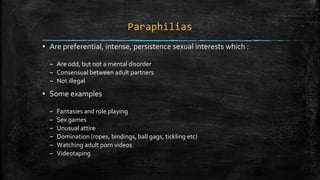
Paraphilias
▪ Are preferential, intense, persistence sexual interests which :
– Are odd, but not a mental disorder
– Consensual between adult partners
– Not illegal
▪ Some examples
– Fantasies and role playing
– Sex games
– Unusual attire
– Domination (ropes, bindings, ball gags, tickling etc)
– Watching adult porn videos
– Videotaping
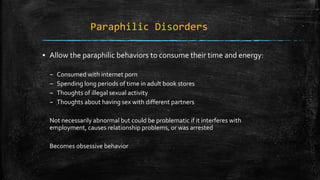
Paraphilic Disorders
▪ Allow the paraphilic behaviors to consume their time and energy:
– Consumed with internet porn
– Spending long periods of time in adult book stores
– Thoughts of illegal sexual activity
– Thoughts about having sex with different partners
Not necessarily abnormal but could be problematic if it interferes with
employment, causes relationship problems, or was arrested
Becomes obsessive behavior
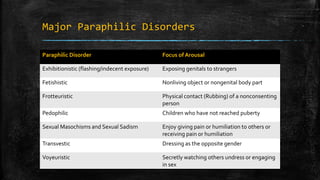
Major Paraphilic Disorders
Paraphilic Disorder Focus of Arousal
Exhibitionistic (flashing/indecent exposure) Exposing genitals to strangers
Fetishistic Nonliving object or nongenital body part
Frotteuristic Physical contact (Rubbing) of a nonconsenting
person
Pedophilic Children who have not reached puberty
Sexual Masochisms and Sexual Sadism Enjoy giving pain or humiliation to others or
receiving pain or humiliation
Transvestic Dressing as the opposite gender
Voyeuristic Secretly watching others undress or engaging
in sex
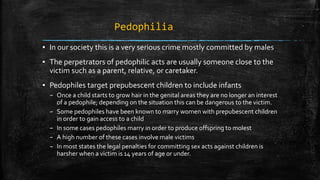
Pedophilia
▪ In our society this is a very serious crime mostly committed by males
▪ The perpetrators of pedophilic acts are usually someone close to the
victim such as a parent, relative, or caretaker.
▪ Pedophiles target prepubescent children to include infants
– Once a child starts to grow hair in the genital areas they are no longer an interest
of a pedophile; depending on the situation this can be dangerous to the victim.
– Some pedophiles have been known to marry women with prepubescent children
in order to gain access to a child
– In some cases pedophiles marry in order to produce offspring to molest
– A high number of these cases involve male victims
– In most states the legal penalties for committing sex acts against children is
harsher when a victim is 14 years of age or under.
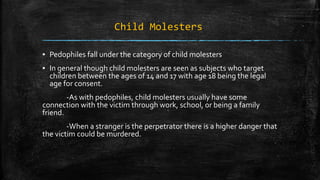
Child Molesters
▪ Pedophiles fall under the category of child molesters
▪ In general though child molesters are seen as subjects who target
children between the ages of 14 and 17 with age 18 being the legal
age for consent.
-As with pedophiles, child molesters usually have some
connection with the victim through work, school, or being a family
friend.
-When a stranger is the perpetrator there is a higher danger that
the victim could be murdered.
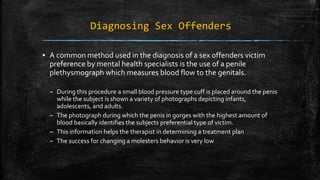
Diagnosing Sex Offenders
▪ A common method used in the diagnosis of a sex offenders victim
preference by mental health specialists is the use of a penile
plethysmograph which measures blood flow to the genitals.
– During this procedure a small blood pressure type cuff is placed around the penis
while the subject is shown a variety of photographs depicting infants,
adolescents, and adults.
– The photograph during which the penis in gorges with the highest amount of
blood basically identifies the subjects preferential type of victim.
– This information helps the therapist in determining a treatment plan
– The success for changing a molesters behavior is very low
Some Atypical Paraphilic Disoders
Paraphilia disorder Focus of arousal
Autagonistophilia Being observed, filmed, or on stage
Autoenpiophia Pretending to be a baby in diapers
Kleptophilia Stealing
Klismaphila Enemas
Necrophilia Sexual contact with dead bodies
Partialism Specific body parts (hair, feet, toes, etc)
Troilism Involvement of a third person in sex
Urophilia and Coprophilia Urine and feces
Zoophilia Animals
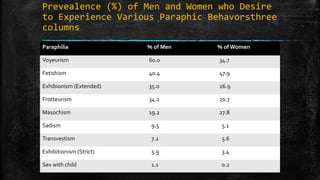
Prevealence (%) of Men and Women who Desire
to Experience Various Paraphic Behavorsthree
columns
Paraphilia % of Men % of Women
Voyeurism 60.0 34.7
Fetishism 40.4 47.9
Exhibionism (Extended) 35.0 26.9
Frotteurism 34.2 20.7
Masochism 19.2 27.8
Sadism 9.5 5.1
Transvestism 7.2 5.6
Exhibitionism (Strict) 5.9 3.4
Sex with child 1.1 0.2
Sexual Battery/Rape
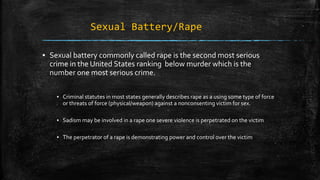
▪ Sexual battery commonly called rape is the second most serious
crime in the United States ranking below murder which is the
number one most serious crime.
▪ Criminal statutes in most states generally describes rape as a using some type of force
or threats of force (physical/weapon) against a nonconsenting victim for sex.
▪ Sadism may be involved in a rape one severe violence is perpetrated on the victim
▪ The perpetrator of a rape is demonstrating power and control over the victim
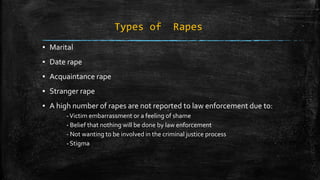
Types of Rapes
▪ Marital
▪ Date rape
▪ Acquaintance rape
▪ Stranger rape
▪ A high number of rapes are not reported to law enforcement due to:
-Victim embarrassment or a feeling of shame
- Belief that nothing will be done by law enforcement
- Not wanting to be involved in the criminal justice process
- Stigma
Next Lecture
▪ In our next lecture on this topic we will discuss the causes and
prevention of paraphilic disorders looking at:
– Biological Risk Factors
– Environmental Risk Factors
– Cultural Factors
– Prevention

Tim Redmond: Bb LectureParaphillas and paraphillic disorders

  • 1.
  • 2.
    Paraphilias ▪ Are preferential,intense, persistence sexual interests which : – Are odd, but not a mental disorder – Consensual between adult partners – Not illegal ▪ Some examples – Fantasies and role playing – Sex games – Unusual attire – Domination (ropes, bindings, ball gags, tickling etc) – Watching adult porn videos – Videotaping
  • 3.
    Paraphilic Disorders ▪ Allowthe paraphilic behaviors to consume their time and energy: – Consumed with internet porn – Spending long periods of time in adult book stores – Thoughts of illegal sexual activity – Thoughts about having sex with different partners Not necessarily abnormal but could be problematic if it interferes with employment, causes relationship problems, or was arrested Becomes obsessive behavior
  • 4.
    Major Paraphilic Disorders ParaphilicDisorder Focus of Arousal Exhibitionistic (flashing/indecent exposure) Exposing genitals to strangers Fetishistic Nonliving object or nongenital body part Frotteuristic Physical contact (Rubbing) of a nonconsenting person Pedophilic Children who have not reached puberty Sexual Masochisms and Sexual Sadism Enjoy giving pain or humiliation to others or receiving pain or humiliation Transvestic Dressing as the opposite gender Voyeuristic Secretly watching others undress or engaging in sex
  • 5.
    Pedophilia ▪ In oursociety this is a very serious crime mostly committed by males ▪ The perpetrators of pedophilic acts are usually someone close to the victim such as a parent, relative, or caretaker. ▪ Pedophiles target prepubescent children to include infants – Once a child starts to grow hair in the genital areas they are no longer an interest of a pedophile; depending on the situation this can be dangerous to the victim. – Some pedophiles have been known to marry women with prepubescent children in order to gain access to a child – In some cases pedophiles marry in order to produce offspring to molest – A high number of these cases involve male victims – In most states the legal penalties for committing sex acts against children is harsher when a victim is 14 years of age or under.
  • 6.
    Child Molesters ▪ Pedophilesfall under the category of child molesters ▪ In general though child molesters are seen as subjects who target children between the ages of 14 and 17 with age 18 being the legal age for consent. -As with pedophiles, child molesters usually have some connection with the victim through work, school, or being a family friend. -When a stranger is the perpetrator there is a higher danger that the victim could be murdered.
  • 7.
    Diagnosing Sex Offenders ▪A common method used in the diagnosis of a sex offenders victim preference by mental health specialists is the use of a penile plethysmograph which measures blood flow to the genitals. – During this procedure a small blood pressure type cuff is placed around the penis while the subject is shown a variety of photographs depicting infants, adolescents, and adults. – The photograph during which the penis in gorges with the highest amount of blood basically identifies the subjects preferential type of victim. – This information helps the therapist in determining a treatment plan – The success for changing a molesters behavior is very low
  • 8.
    Some Atypical ParaphilicDisoders Paraphilia disorder Focus of arousal Autagonistophilia Being observed, filmed, or on stage Autoenpiophia Pretending to be a baby in diapers Kleptophilia Stealing Klismaphila Enemas Necrophilia Sexual contact with dead bodies Partialism Specific body parts (hair, feet, toes, etc) Troilism Involvement of a third person in sex Urophilia and Coprophilia Urine and feces Zoophilia Animals
  • 9.
    Prevealence (%) ofMen and Women who Desire to Experience Various Paraphic Behavorsthree columns Paraphilia % of Men % of Women Voyeurism 60.0 34.7 Fetishism 40.4 47.9 Exhibionism (Extended) 35.0 26.9 Frotteurism 34.2 20.7 Masochism 19.2 27.8 Sadism 9.5 5.1 Transvestism 7.2 5.6 Exhibitionism (Strict) 5.9 3.4 Sex with child 1.1 0.2
  • 10.
    Sexual Battery/Rape ▪ Sexualbattery commonly called rape is the second most serious crime in the United States ranking below murder which is the number one most serious crime. ▪ Criminal statutes in most states generally describes rape as a using some type of force or threats of force (physical/weapon) against a nonconsenting victim for sex. ▪ Sadism may be involved in a rape one severe violence is perpetrated on the victim ▪ The perpetrator of a rape is demonstrating power and control over the victim
  • 11.
    Types of Rapes ▪Marital ▪ Date rape ▪ Acquaintance rape ▪ Stranger rape ▪ A high number of rapes are not reported to law enforcement due to: -Victim embarrassment or a feeling of shame - Belief that nothing will be done by law enforcement - Not wanting to be involved in the criminal justice process - Stigma
  • 12.
    Next Lecture ▪ Inour next lecture on this topic we will discuss the causes and prevention of paraphilic disorders looking at: – Biological Risk Factors – Environmental Risk Factors – Cultural Factors – Prevention