Pak.j.stat.oper.res. Vol.X No.2 2014 pp189-204
Ranking of Companies Considering TOPSIS-DEA Approach Methods
(Evidence from Cement Industry in Tehran Stock Exchange)
Ali Mansouri
Accounting and Management Department
University of Zanjan, Zanjan, Iran
alli_mansory@yahoo.com
Naser Ebrahimi
Department of Accounting and Management
Zanjan Branch, Islamic Azad University, Zanjan, Iran
mor_ram_2005@yahoo.com
Morteza Ramazani
Department of Accounting and Management
Zanjan Branch, Islamic Azad University, Zanjan, Iran
mortezaramazani@ymail.com
Abstract
Ranking techniques has always been the main concerns of managers. There are a lot of qualitative and
quantitative approaches for ranking. However most of the approaches to ranking corporations in stock
market suffer from low validity thus the obtained results will be invalid. When the evaluation carried out
merely through qualitative or quantitative approaches alone, the advantages of integration will be ignored.
Thus logically the efficiency of result will be questionable. Therefore in this paper the advantages of
qualitative and quantitative approaches are integrated to bring about more precision in values of input and
output indices. Hence in this paper integrated approach, Technique for Order Preference by Similarity to
the Ideal Solution (TOPSIS) and Data Envelopment Analysis (DEA), have been introduced to rate active
companies in cement industry accepted in Tehran Stock Market. The approach adopted in this paper is
applicable at any condition to stock ranking. The research carried out during 2006-2012 and the population
of the research includes accepted companies in stock market in cement industry (28 companies). Finally a
precise ranking of the companies is presented by hybridized technique. When the result presented to stock
market experts, the majority of participants admired integrated approach to companies ranking.
Keywords: Ranking Companies, Cement industry, DEA, TOPSIS, DEA-TOPSIS.
1. Introduction
Investment is an important matter which brings about development and advancement to
all countries. While investment is injected into proper areas it will be valuable otherwise
it will be useless. Stock market is one of the proper areas for investment (Mehrghan,
2004). In the modern world, economic development owes to stock market and activities
of capital market. Stock market is an official and organized market in which the bonds
accepted in it are traded between buyers and sellers based on specific rules. Regarding
vast volume of transactions, stock market seems to be among the main investment
centers. Thus the extent of accepted companies in stock market somehow brings about
astonishment among investors (Shahrabadi, 2010). Correct evaluation of companies in
industries can reflect the status of various companies considering their rivals, specific
pros and cons, opportunities and threats of companies. Firm evaluation plays prominent
role in industry. Investors are always looking for the best area to invest in order to gain
Ali Mansouri, Naser Ebrahimi, Morteza Ramazani
Pak.j.stat.oper.res. Vol.X No.2 2014 pp189-204190
more interests. Thus they always try to evaluate and separate successful and unsuccessful
companies. Regarding the weak performance of ranking approaches adopted in Tehran
stock market, offering an efficient, reliable and capable approach is matter of tremendous
importance (Danesh Shakib et al, 2009).
The DEA approach is an important technique through which relative efficiency of
companies is evaluated. This approach can offer for investors to reinforce decision
making. The DEA approach is a technique which utilizes several real inputs and outputs
and using them it can obtain various types of efficiency such as assignment and technical
efficiency and so on for any companies. Using this approach also they can determine
whether the development of the firm has been successful or firm should reduce the
volume of its activities in the current situation. This circumstance can be determined
through increasing return to scale or decreasing return to scale which determined by DEA
(Banker and Cooper, 1984).
However the DEA approach has some fundamental difficulties which has been result not
to be dependable in the most cases (Mansoury et al, 2012). Hence in this paper through
TOPSIS approach which is one of the best for decision making, we have tried to
overcome its inadequacies and consequently offer the most efficient approach to grading
companies through integration of techniques.
2. Research Backgrounds
Saeed Samadi et al. studied the relationship between development of economic markets
and economic growth in Iran and 13 other countries during the years of 1988- 2003
through three approaches; Granger, ARDL test and the approach of estimating Panel
Data. Estimating causality relationship between the size of stock market and production
growth indicated that bank and stock market in Iran do not have considerable effect on
economic growth. However the effect of economic growth on stocks is positive and
meaningful. The results showed that in all countries, which studied, in very real sense
investment and work force status have a positive and meaningful effect on economic
growth. In the monetary section on economic growth, the effect of banks is positive and
meaningful. Although the effect of stock on economic growth was positive but wasn’t
considerably meaningful. The results of ARDL test for Iran between the years 1976–2003
indicated that there isn’t long term positive relationship between financial markets and
economic growth. Generally long term relationship between financial market and
economic growth was negative which means that there is no long term meaningful
relationship between capital market and economic growth. Rafiee (2008) has evaluated
the effect of financial mediators on economic growth and thus applied an intuitive growth
pattern by means of auto- regressive. The results obtained from the pattern indicates that
the relationship between financial intermediaries and economic growth in Iran is negative
and its impact on Iran’s economic growth is meager and there is not a tight relationship
between financial intermediaries and economic growth in Iran but they may affected by
financial intermediaries through efficient financial market. Düzakın and Düzakın (2007) in
his research has tried to evaluate the performance of different industrial sections of Turkey. He
considered 3 factors of net assets, number of employees and gross added value as the input and
two factors including the interest prior to cutting taxes and export revenues of each section as the
Ranking of Companies Considering TOPSIS-DEA Approach Methods (Evidence from Cement Industry in ……
Pak.j.stat.oper.res. Vol.X No.2 2014 pp189-204 191
output for evaluation of all companies. The results indicate that during 2003 only 65companies
from among all of the companies had operated efficiently. 278 companies have also been
identified as the most inefficient companies that had worked far less than average. Other research
conducted under the title of utilizing the DEA approach in selecting bonds in a big market by
Aparicio and et al (2005). This research applied DEA technique to choose portfolio or proper
bonds out of a list of 185 cases. This selection process includes application of research in
operations and reflects efficiency of decision making units. This analysis considers
appropriateness of many ratios in relation to stocks such as income efficiency and risk. The result
revealed that out of 185 stocks were analyzed, 14 were considered more appropriate and from
among these 14 efficient stocks several were resistant to inappropriate changes while the rest
were not. In this paper the Duk and Canon companies were among the ones with high rate
efficiency. In the United States a research was conducted by Redman and et al (2000) on seven
portfolios using SHARP indices, Trainor and Jensen's alpha. The results of their research during
two periods of time; 1985-1989 and 1990-1994 showed that the ranking obtained from two
criteria of SHARP and Trainor for 4 portfolios is identical. This fact showed that the results
obtained are similar to total risk and systematic risk. Thus the total risk was close to systematic
one. In their research, Johnson and Soenen (2003), concluded that there are meaningful
relationship between ranking companies based on performance criteria of economic added value,
ratio of SHARP and Jensen's alpha and some other financial criteria such as firm size, the ratio of
asset value to the value of stock market, growth of sale rate, capital structure, liquidity, cash
cycle, profitability changes and the rate of the efficiency of assets. Another study was conducted
by Mohanram (2005) which titled separating successful companies from unsuccessful ones. The
results indicated that the strategy of combining fundamental signs for companies with office
value at the market with low value could lead to unconventional efficiency. A research was
implemented by Sabetisaleh (2009) under the title of “Offering fuzzy multi-criteria decision
making model in order to grade the companies” which applied to financial support from banks. In
their work, the researcher has tried to identify the most important indices having an impact on
firm stock from the viewpoint of credit assigner (banks and financial institutions) and rate top 50
stocks in Tehran’s stock market through the fundamental analysis in fuzzy environment. Thus the
researcher has put forth a comprehensive model for choosing appropriate options for financial
support from financial point of view. Therefore the researcher in the first step of their studies
utilized the analysis approach to detect the main factors (questionnaire issued to stock experts)
which may identify fundamental indices having an impact on ranking stock and in order to
analyze the questionnaire, non-parametric approach utilized. In the next step the researcher took
advantages of fuzzy ANP technique to determine the value of identified indices. In this step
viewpoints of stock experts about importance of indices and their value were solicited through
questionnaire. Finally after gathering the data relevant to fundamental indices, identified 50 top
companies in Tehran stock market. They used TOPSIS technique to rate and determine
companies priorities too. Regarding the results obtained from this research; Mines and Industries
Firm ranked at top, Egtesade Novin Bank at second, Mehvarsazan firm at third and Saipa Dizel
firm stood at 50th
positions. Tavakkoli et.al.(2010) used fuzzy logic to evaluate financial
performance of companies under uncertain condition and used verbal measures to achieve
their objectives. However integrating quantitative and qualitative techniques is new approach to
ranking that considered in this paper.
Ali Mansouri, Naser Ebrahimi, Morteza Ramazani
Pak.j.stat.oper.res. Vol.X No.2 2014 pp189-204192
2.1 The DEA model
The DEA approach is one of the basic non-parametric approaches which is employed to
measure efficiency and productivity of units. The DEA is a linear programming
technique to evaluate decision making units having homogeneous inputs to yield
homogeneous outputs. In this approach an identical production curve of observed points
in the comparison group is obtained which indicates efficiency frontier for group and
efficiency of other units in relation to this frontier of efficiency is measured. DEA
considers the most appropriate weight for each decision making unit. That is a set of
weights which maximize efficiency of a decision making unit without raising efficiency
of other decision making units. In other words DEA helps decision makers to classify
decision making units into two groups of efficient and inefficient units (Mansoury et al,
2012).
Generally the DEA analytic models are divided into two groups of input-oriented and
output-oriented. Input-oriented models are those that utilize given input to obtain the
maximum amount of output but output-oriented models obtain less input without any
change in output rate. (Momeni, 2011).
In this paper the input-oriented CCR1
model is used. In an input-oriented model, a unit is
inefficient if the possibility of raising each one of the outputs will exist without raising an
input or reducing an output. A unit is efficient only when the case mentioned above
cannot happen. Efficiency of less than one for a unit means that linear combination of
other units can create the same output by utilizing less input.
An output-oriented model conveys this meaning more assertively. A unit under
examination is efficient only when no convex combination out of the other units








   
n
j
n
j
jiojjo yyxx
1 1
,  , in which jx is a vector that demonstrate jth
DMU’s
input value and 1
1

n
j which means that the inputs of under examination DMU cab
be defined as a convex combination of all DMUs and similarly jy is a output vector
which related to jth
DMU and this means that output of under examination DMU cab be
defined as a convex combination of all n DMUs, can produce more output in relation to
the unit under examination by consuming same resources (inputs). Parameter , as
defined at bottom, indicates relative reduction of the inputs of objective unit while output
is steady. This reduction is simultaneously applied to all inputs and leads to radial
movement along with frontier line and consequently in order to rationalize the units
under examination according to the image of the border, it determines slack variables in a
way so that the point of objective unit is driven towards the image on the border. For this
purpose the following conditions should be considered:
1. The value of , optimal value of first stage dual DEA model, must equals one.
2. All slack variables must equal zero (Cooper et al, 1999).
1. The CCR model was the first developed by Charnes Cooper and Rhodes in 1978.
Ranking of Companies Considering TOPSIS-DEA Approach Methods (Evidence from Cement Industry in ……
Pak.j.stat.oper.res. Vol.X No.2 2014 pp189-204 193
Primary multiple output-oriented model of BCC2
is according to the following:
0,
0
1
:
1 1
1
1
0




 


 


ir
m
i
s
r
rjiiji
s
r
ror
m
i
ioi
vu
wyuxv
yu
St
wxvMinZ
If we can supposes that the above model can modify to a BCC model
which is input-oriented. Secondary model is as the following:










n
j
j
n
j
rorjj
n
j
ioijj
nj
sryy
mixx
St
MaxZ
1
1
1
),...2,1(1
),....2,1(
),...,2,1(
:




And free in sign;
The objective of this model is to maximize in order to achieve maximum output. The
secondary shield model is modified when and if it is supposed achieved in
the first model;
0,
),...2,1(1
),...2,1(
),...,2,1(
:
)(
,
1
1
1
11



















rij
n
i
i
ror
n
j
jrj
ioi
n
j
jij
s
r
r
m
i
i
SS
nj
SrySy
mixSx
St
SSZMax





2. Introduced by Banker, Chames and Cooper (1984), this model measures technical efficiency as the convexity constraint ensures that
the composite unit is of similar scale size as the unit being measured.
Ali Mansouri, Naser Ebrahimi, Morteza Ramazani
Pak.j.stat.oper.res. Vol.X No.2 2014 pp189-204194
In which 
iS and 
rS are surplus and slack variable respectively i and r shows the number
of inputs and outputs of model respectively.
2.2 TOPSIS model
This model was proposed by Hwang Yoon in 1981. This model is one of the best multi-
criteria decision making models which is used more often. In this model m options by n
indices evaluates. This model is based on the notion that the options must have the least
distance with the positive ideal and the most distance with the negative ones. The
solution process through this model requires following steps:
1. Identifying scale less Matrix (N): Scale less matrix will be obtained by making scale
less norm.


n
i
ij
ij
ij
a
a
n
1
2
2. Defining normalized Matrix (V): Normalized scale less matrix will obtained through
multiplication of Matrix (N) and weight matrix ( ) as following:
nxnWNV 
In order to obtain normalized scale less matrix, it is essential to consider indices. For this
purpose we computed the weights of indices by means of Shannon Entropy. These
weights obtained through the following steps:
First step: calculation of
Second step: Computing of the value of entropy which denoted as
Third step: Calculation of the deviation which denoted as :
Forth step: determining of weights which denoted as :


m
i
ij
ij
ij
a
a
p
1
  jppkEj
m
i
ijij  
,ln
1
jjj Ed  ,1
jn
j
j
j
j
d
d
W 

,
1
Ranking of Companies Considering TOPSIS-DEA Approach Methods (Evidence from Cement Industry in ……
Pak.j.stat.oper.res. Vol.X No.2 2014 pp189-204 195
Fifth step: Calculation of normalized weights which denoted as
is the pre-selected weights by any expert which determined by 12 industry expert
independently that not only used for determining weights but also for computing standard
deviation of weights (
iu
 ,
jv
 ) to confidence interval controlling .
These weights were entered to DEA model as iu and jv controller.
2.3 Integrating DEA and TOPSIS
As mentioned before the DEA technique regardless of its orientation tries assign the
maximum or minimum value to iu and jv , regardless of their initial values, accomplishes
the best value for objective function and as clearly realizable objective function
demonstrate the DMUs’ various efficiencies. This means that DEA analysis does not
consider the initial values of inputs and outputs variables thus the final value of objective
function will be questionable. Solving this dilemma in this study TOPSIS’s used to
consider initial values of inputs and outputs variables. Since the final ranking of
alternatives will take advantage of sustainability.
3. Research Design
In this section we deal with analytic model of the research first and then describe research
variables separately according to input and output.
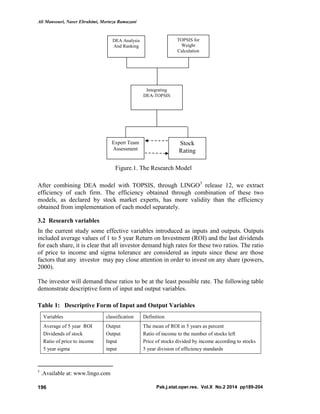
3.1 Research Model
This research is conducted to attain a foundation for ranking cement’s companies in
Tehran stock market. The number of active cement companies in stock market is 28
which operate during the years 2008- 2012. In order to rate the companies through DEA
model, efficiency of each unit has been measured. Since there are some defects in DEA
model and as mentioned before it may give incorrect values to the input and output
variables to achieve maximum efficiency value for target decision making unit and thus
may result in unreal efficiency value. Therefore in order to overcome this obstacle and
control the inputs and outputs variable values, we have employed the TOPSIS model with
above mentioned specifications. Consequently the analytic model of the research is as
follows:

 n
j
jj
jj
j
W
W
W
1


Ali Mansouri, Naser Ebrahimi, Morteza Ramazani
Pak.j.stat.oper.res. Vol.X No.2 2014 pp189-204196
After combining DEA model with TOPSIS, through LINGO3
release 12, we extract
efficiency of each firm. The efficiency obtained through combination of these two
models, as declared by stock market experts, has more validity than the efficiency
obtained from implementation of each model separately.
3.2 Research variables
In the current study some effective variables introduced as inputs and outputs. Outputs
included average values of 1 to 5 year Return on Investment (ROI) and the last dividends
for each share, it is clear that all investor demand high rates for these two ratios. The ratio
of price to income and sigma tolerance are considered as inputs since these are those
factors that any investor may pay close attention in order to invest on any share (powers,
2000).
The investor will demand these ratios to be at the least possible rate. The following table
demonstrate descriptive form of input and output variables.
Table 1: Descriptive Form of Input and Output Variables
Variables classification Definition
Average of 5 year ROI
Dividends of stock
Ratio of price to income
5 year sigma
Output
Output
Input
input
The mean of ROI in 5 years as percent
Ratio of income to the number of stocks left
Price of stocks divided by income according to stocks
5 year division of efficiency standards
3
.Available at: www.lingo.com
DEA Analysis
And Ranking
TOPSIS for
Weight
Calculation
Stock
Rating
Expert Team
Assessment
Integrating
DEA-TOPSIS
Figure.1. The Research Model
Ranking of Companies Considering TOPSIS-DEA Approach Methods (Evidence from Cement Industry in ……
Pak.j.stat.oper.res. Vol.X No.2 2014 pp189-204 197
4. Data analysis
We used the following methods so that the research has a high level of credibility
 DEA model with variable return to scale efficiency using CCR scale.
 The integrative TOPSIS-DEA model based on steady weights.
 The integrative TOPSIS-DEA model based on variable weights.
 Comparing three approaches result by stock market expert.
4.1 DEA model with variable return to scale efficiency using CCR scale
This model which is also known as DEA, variable return to scale, applied to calculate
efficiency of any DMU. For this purpose Win4deep4
was utilized and the following
results extracted:
Table 2: Calculated Efficiency through Traditional DEA based on CCR approach
EfficiencyCompany CementRow
1Hormozghan1
1Khazar2
0.809Urmia3
0.413Bojnourd4
1Kordestan5
0.768Behbaha6
0.639Sofiyan7
0903Tehran8
0.908Shomal9
0.576Doroud10
0.812Sepahan11
0.700Heghmatan12
1Kerman13
0.755Fars and Khozestan14
0.558Shahroud15
0.089Gharb16
0.798Sefide Neyriz17
0.194Fars18
1Dashtestan19
0.717Shargh20
0420Ardabil21
0.296Esfahan22
0.710Ghaen23
1Khash24
1Darab25
0.654Ilam26
1Karoun27
0.516Mazandaran28
0.723Average
As shown at then the table above, there are many companies that graded as the most
efficient companies with the high efficiency which criticized by most of experts is.
4
. Available at:win4deap.software.informer.com/1.1/
Ali Mansouri, Naser Ebrahimi, Morteza Ramazani
Pak.j.stat.oper.res. Vol.X No.2 2014 pp189-204198
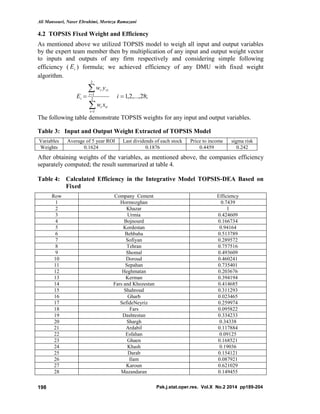
4.2 TOPSIS Fixed Weight and Efficiency
As mentioned above we utilized TOPSIS model to weigh all input and output variables
by the expert team member then by multiplication of any input and output weight vector
to inputs and outputs of any firm respectively and considering simple following
efficiency ( iE ) formula; we achieved efficiency of any DMU with fixed weight
algorithm.
;28,...,2,12
1
2
1





i
xw
yw
E
t
tit
r
rir
i
The following table demonstrate TOPSIS weights for any input and output variables.
Table 3: Input and Output Weight Extracted of TOPSIS Model
Variables Average of 5 year ROI Last dividends of each stock Price to income sigma risk
Weights 0.1624 0.1876 0.4459 0.242
After obtaining weights of the variables, as mentioned above, the companies efficiency
separately computed; the result summarized at table 4.
Table 4: Calculated Efficiency in the Integrative Model TOPSIS-DEA Based on
Fixed
EfficiencyCompany CementRow
0.7439Hormozghan1
1Khazar2
0.424609Urmia3
0.166734Bojnourd4
0.94164Kordestan5
0.513789Behbaha6
0.289572Sofiyan7
0.757516Tehran8
0.493609Shomal9
0.460241Doroud10
0.735401Sepahan11
0.203676Heghmatan12
0.394194Kerman13
0.414685Fars and Khozestan14
0.311293Shahroud15
0.023465Gharb16
0.259974SefideNeyriz17
0.095822Fars18
0.334233Dashtestan19
0.34338Shargh20
0.117884Ardabil21
0.09125Esfahan22
0.168521Ghaen23
0.19036Khash24
0.154121Darab25
0.087921Ilam26
0.621029Karoun27
0.149455Mazandaran28
Ranking of Companies Considering TOPSIS-DEA Approach Methods (Evidence from Cement Industry in ……
Pak.j.stat.oper.res. Vol.X No.2 2014 pp189-204 199
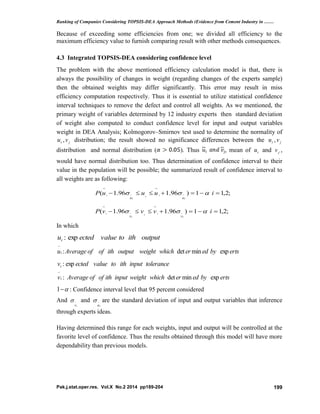
Because of exceeding some efficiencies from one; we divided all efficiency to the
maximum efficiency value to furnish comparing result with other methods consequences.
4.3 Integrated TOPSIS-DEA considering confidence level
The problem with the above mentioned efficiency calculation model is that, there is
always the possibility of changes in weight (regarding changes of the experts sample)
then the obtained weights may differ significantly. This error may result in miss
efficiency computation respectively. Thus it is essential to utilize statistical confidence
interval techniques to remove the defect and control all weights. As we mentioned, the
primary weight of variables determined by 12 industry experts then standard deviation
of weight also computed to conduct confidence level for input and output variables
weight in DEA Analysis; Kolmogorov–Smirnov test used to determine the normality of
iu , jv distribution; the result showed no significance differences between the iu , jv
distribution and normal distribution ( ). Thus i j, mean of iu and jv ,
would have normal distribution too. Thus determination of confidence interval to their
value in the population will be possible; the summarized result of confidence interval to
all weights are as following:
;2,11)96.196.1(  

iuuuP
i
ii
i
i
uu

;2,11)96.196.1(  

ivvvP
i
ii
i
i
vv

In which
outputithtovalueectedui exp:
ertsbyederwhichweightoutputithofofAverageui expmindet:

toleranceinputithtovalueectedvi exp:
ertsbyederwhichweightinputithofofAveragevi expmindet:

1 : Confidence interval level that 95 percent considered
And
iv
 and
iu
 are the standard deviation of input and output variables that inference
through experts ideas.
Having determined this range for each weights, input and output will be controlled at the
favorite level of confidence. Thus the results obtained through this model will have more
dependability than previous models.
Ali Mansouri, Naser Ebrahimi, Morteza Ramazani
Pak.j.stat.oper.res. Vol.X No.2 2014 pp189-204200
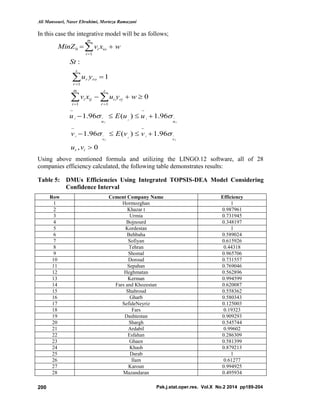
In this case the integrative model will be as follows;
0,
96.1)(96.1
96.1)(96.1
0
1
:
1 1
1
1
0










 


 


ir
vv
uu
m
i
s
r
rjiiji
s
r
ror
m
i
ioi
vu
vvEv
uuEu
wyuxv
yu
St
wxvMinZ
i
ii
i
i
i
ii
i
i


Using above mentioned formula and utilizing the LINGO.12 software, all of 28
companies efficiency calculated, the following table demonstrates results:
Table 5: DMUs Efficiencies Using Integrated TOPSIS-DEA Model Considering
Confidence Interval
EfficiencyCement Company NameRow
1Hormozghan1
0.987961Khazar t2
0.731945Urmia3
0.348197Bojnourd4
1Kordestan5
0.589024Behbaha6
0.615926Sofiyan7
0.44318Tehran8
0.965706Shomal9
0.731557Doroud10
0.769046Sepahan11
0.562896Heghmatan12
0.994599Kerman13
0.620087Fars and Khozestan14
0.558362Shahroud15
0.580343Gharb16
0.125003SefideNeyriz17
0.19323Fars18
0.909293Dashtestan19
0.545744Shargh20
0.99602Ardabil21
0.286309Esfahan22
0.581399Ghaen23
0.879213Khash24
1Darab25
0.61277Ilam26
0.994925Karoun27
0.495934Mazandaran28
Ranking of Companies Considering TOPSIS-DEA Approach Methods (Evidence from Cement Industry in ……
Pak.j.stat.oper.res. Vol.X No.2 2014 pp189-204 201
As shown at the table 5, among 28 companies only 3 have maximum efficiency equal to
1 and Sefide Neyriz with 0.125003 efficiency level located at the bottom. Statistical
confidence interval ensures that the variable weight will not exceed from its real worth
with 95 percent of confidence.
5. Result Analysis
As observed in previous sections we have calculated selected companies efficiency by
three fairly different ways. Now it is time to compare the result of them and conclude,
which of them have greater validity among them. For this purpose at the first step the
differences in efficiency by three ways compared. Facilitating analysis the efficiencies
classified into three group including:
a) Data envelopment analysis CCR efficiencies
b) Integrative TOPSIS-DEA method considering fix weight
c) Integrative TOPSIS-DEA method considering confidence interval
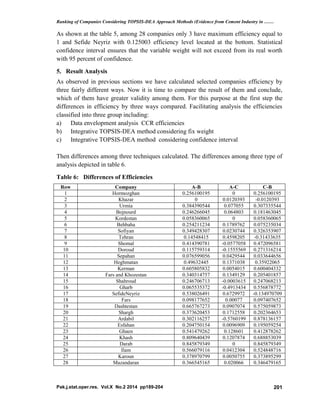
Then differences among three techniques calculated. The differences among three type of
analysis depicted in table 6.
Table 6: Differences of Efficiencies
C-BA-CA-BCompanyRow
0.25610019500.256100195Hormozghan1
-0.01203930.01203930Khazar2
0.3073355440.0770550.384390544Urmia3
0.1814630450.0648030.246266045Bojnourd4
0.05836006500.058360065Kordestan5
0.0752350340.17897620.254211234Behbaha6
0.3263539070.02307440.349428307Sofiyan7
-0.314336350.45982050.14548415Tehran8
0.472096581-0.05770580.414390781Shomal9
0.271316214-0.15555690.115759314Doroud10
0.0336446560.04295440.076599056Sepahan11
0.359220650.13710380.49632445Heghmatan12
0.6004043320.00540150.605805832Kerman13
0.2054018570.13491290.340314757Fars and Khozestan14
0.247068213-0.00036150.246706713Shahroud15
0.556878772-0.49134340.065535372Gharb16
-0.1349707090.67299720.538026491SefideNeyriz17
0.0974076520.000770.098177652Fars18
0.5750598730.09070740.665767273Dashtestan19
0.2023646530.17125580.373620453Shargh20
0.878136157-0.57601990.302116257Ardabil21
0.1950592540.00969090.204750154Esfahan22
0.4128782620.1286010.541479262Ghaen23
0.6888530390.12078740.809640439Khash24
0.84587934900.845879349Darab25
0.5248487160.04123040.566079116Ilam26
0.3738952990.00507550.378970799Karoun27
0.3464791650.0200660.366545165Mazandaran28
Ali Mansouri, Naser Ebrahimi, Morteza Ramazani
Pak.j.stat.oper.res. Vol.X No.2 2014 pp189-204202
Comparing the results shows that there are considerable differences between the
efficiency evaluated through three mentioned methods. The significant difference rise a
question that which of them take advantage of high validity. The answer to this critical
question can be given only by focusing on foundation and structure of three models.
As mentioned before the DEA techniques regardless of its orientation tries assign the
maximum or minimum value to iu and jv accomplish the best value for DMU’s
objective function and as clearly realizable, objective function demonstrate the DMUs’
efficiencies. This means that DEA analysis does not consider the initial values of inputs
and outputs variables and it may be some inputs or outputs with low value get weights
greater than their worth. Thus the final value of objective function will be questionable.
Solving this dilemma in this study we used TOPSIS’s ’s weights to consider initial
values of inputs and outputs variables; But as explained before using fixed mean weights
due to expert team ideas will be unsteady since any changes among experts or selecting
new expert team will result in new weights and thereinafter bring about new efficiency.
But setting confidence interval for weights according to experts idea remove both
difficulties. Thus third model take advantages of great sustainability against other two
models. In addition, we asked 12 stock market experts to contribute ideas again, after
ranking companies, which majority of them admired TOPSIS- DEA with confidence
interval approach results for grading and ranking closeness to reality. Table 6 below
demonstrate the geometric mean of three approaches consistency to real condition
according to experts ideas.
Table 6: Geometric mean of three approaches consistency to real condition
Approaches CCR-DEA
TOPSIS-DEA
with Steady Weights
TOPSIS-DEA
Considering Confidence Interval
Consistency
Rate(Percent)
54.7 84.5 87.3
As seen, from the table above, the TOPSIS-DEA considering confidence interval
approach gain the highest consistency.
Furthermore regarding what was mentioned above in the cited research the Kolmogorov-
Smirnov test was employed to test unity distribution of differences. The results
concerning the difference of efficiency are as follows:
a) Comparison of the results obtained from prioritizing DEA and integrative method
TOPSIS-DEA based on fix weights according to Kolmogorov-Smirnov test revealed
that distribution of differences in these two methods is significantly different
(α<0.05). This means that ranking by two model have considerable differences at 95
percent confidence level.
b) Comparison of the results obtained from DEA prioritizing and integrative TOPSIS-
DEA considering confidence level according to Kolmogorov-Smirnov test showed
that distribution of differences in these two methods is significantly different too
(α<0.05). This means that ranking by two model does not have unity distribution and
have considerable differences at 95 percent confidence level.
Ranking of Companies Considering TOPSIS-DEA Approach Methods (Evidence from Cement Industry in ……
Pak.j.stat.oper.res. Vol.X No.2 2014 pp189-204 203
c) Comparison of the results obtained from prioritizing TOPSIS-DEA considering fix
weights and TOPSIS-DEA considering confidence level according to Kolmogorov-
Smirnov test showed that distribution of differences in these two methods don’t
have significantly differences (α>0.05). This means that ranking by two models does
not have considerable differences at 95 percent confidence level. However the
foundation of confidence interval strengthening the third one.
5. Conclusion
Weighing and ranking all companies in stock exchange market is advantageous to many
organizations, companies president, investor, credit assigner and so on. In this paper we
suggested three way for weighing and ranking companies. As mentioned before the
reliability and infrastructure organization of integrative DEA-TOPSIS considering
confidence level is highly dependable. However, comparison of differences between two
integrative model didn’t show significant difference but this doesn’t mean these model
have same value in ranking and weighing companies since volatile of result in fix weight
approach due to expert team considerably affects the result; this difficulty not only takes
the finding under question but also may change the result of comparison between two
integrative model consequences. Finally we propose that integrative DEA-TOPSIS model
considering confidence interval for weighing and ranking of DMUs rather than two other
models. However there were some limitation. In the first place, some of input and output
variables may be affected by social and political changes differently. In the second place,
because of weak database we couldn’t select some other important factors such The mean
of ROI in 10 years and Bata risk.
References
1. Aparicio, J., Ruiz, J. L. and Sirvent, I. (2005). Closest targets and minimum
distance to the efficient frontier in DEA. Centro de Investigación Operativa,
Universidad Miguel Hernández de Elche.
2. Banker, R. D., Charnes, A., Cooper, W. W. (1984). Some models for estimating
technical and scale inefficiencies in data envelopment analysis. Management
science, 30(9), 1078-1092.
3. Cooper, W. W., Park, K. S., Pastor, J. T. (1999). RAM: a range adjusted measure
of inefficiency for use with additive models, and relations to other models and
measures in DEA. Journal of Productivity Analysis, 11(1), 5-42.
4. Danesh Shakib, M. and Fazli, S. (2009). Rating cement firms in Tehran stock
market using integrative approach (TOPSIS_AHP). Cheshmandaz-e-Modiryat,
32(3), 109-129.
5. Düzakın, E., and Düzakın, H. (2007). Measuring the performance of
manufacturing firms with super slacks based model of data envelopment analysis:
An application of 500 major industrial enterprises in Turkey. European Journal of
Operational Research, 182(3), 1412-1432.
6. Johnson, R., and Soenen, L. (2003). Indicators of successful companies.
European Management Journal, 21(3), 364-369.
Ali Mansouri, Naser Ebrahimi, Morteza Ramazani
Pak.j.stat.oper.res. Vol.X No.2 2014 pp189-204204
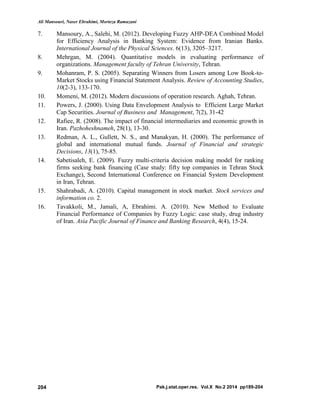
7. Mansoury, A., Salehi, M. (2012). Developing Fuzzy AHP-DEA Combined Model
for Efficiency Analysis in Banking System: Evidence from Iranian Banks.
International Journal of the Physical Sciences. 6(13), 3205–3217.
8. Mehrgan, M. (2004). Quantitative models in evaluating performance of
organizations. Management faculty of Tehran University, Tehran.
9. Mohanram, P. S. (2005). Separating Winners from Losers among Low Book-to-
Market Stocks using Financial Statement Analysis. Review of Accounting Studies,
10(2-3), 133-170.
10. Momeni, M. (2012). Modern discussions of operation research. Aghah, Tehran.
11. Powers, J. (2000). Using Data Envelopment Analysis to Efficient Large Market
Cap Securities. Journal of Business and Management, 7(2), 31-42
12. Rafiee, R. (2008). The impact of financial intermediaries and economic growth in
Iran. Pazhoheshnameh, 28(1), 13-30.
13. Redman, A. L., Gullett, N. S., and Manakyan, H. (2000). The performance of
global and international mutual funds. Journal of Financial and strategic
Decisions, 13(1), 75-85.
14. Sabetisaleh, E. (2009). Fuzzy multi-criteria decision making model for ranking
firms seeking bank financing (Case study: fifty top companies in Tehran Stock
Exchange), Second International Conference on Financial System Development
in Iran, Tehran.
15. Shahrabadi, A. (2010). Capital management in stock market. Stock services and
information co. 2.
16. Tavakkoli, M., Jamali, A, Ebrahimi. A. (2010). New Method to Evaluate
Financial Performance of Companies by Fuzzy Logic: case study, drug industry
of Iran. Asia Pacific Journal of Finance and Banking Research, 4(4), 15-24.

Paper 4 (ali mansouri)

  • 1.
    Pak.j.stat.oper.res. Vol.X No.22014 pp189-204 Ranking of Companies Considering TOPSIS-DEA Approach Methods (Evidence from Cement Industry in Tehran Stock Exchange) Ali Mansouri Accounting and Management Department University of Zanjan, Zanjan, Iran alli_mansory@yahoo.com Naser Ebrahimi Department of Accounting and Management Zanjan Branch, Islamic Azad University, Zanjan, Iran mor_ram_2005@yahoo.com Morteza Ramazani Department of Accounting and Management Zanjan Branch, Islamic Azad University, Zanjan, Iran mortezaramazani@ymail.com Abstract Ranking techniques has always been the main concerns of managers. There are a lot of qualitative and quantitative approaches for ranking. However most of the approaches to ranking corporations in stock market suffer from low validity thus the obtained results will be invalid. When the evaluation carried out merely through qualitative or quantitative approaches alone, the advantages of integration will be ignored. Thus logically the efficiency of result will be questionable. Therefore in this paper the advantages of qualitative and quantitative approaches are integrated to bring about more precision in values of input and output indices. Hence in this paper integrated approach, Technique for Order Preference by Similarity to the Ideal Solution (TOPSIS) and Data Envelopment Analysis (DEA), have been introduced to rate active companies in cement industry accepted in Tehran Stock Market. The approach adopted in this paper is applicable at any condition to stock ranking. The research carried out during 2006-2012 and the population of the research includes accepted companies in stock market in cement industry (28 companies). Finally a precise ranking of the companies is presented by hybridized technique. When the result presented to stock market experts, the majority of participants admired integrated approach to companies ranking. Keywords: Ranking Companies, Cement industry, DEA, TOPSIS, DEA-TOPSIS. 1. Introduction Investment is an important matter which brings about development and advancement to all countries. While investment is injected into proper areas it will be valuable otherwise it will be useless. Stock market is one of the proper areas for investment (Mehrghan, 2004). In the modern world, economic development owes to stock market and activities of capital market. Stock market is an official and organized market in which the bonds accepted in it are traded between buyers and sellers based on specific rules. Regarding vast volume of transactions, stock market seems to be among the main investment centers. Thus the extent of accepted companies in stock market somehow brings about astonishment among investors (Shahrabadi, 2010). Correct evaluation of companies in industries can reflect the status of various companies considering their rivals, specific pros and cons, opportunities and threats of companies. Firm evaluation plays prominent role in industry. Investors are always looking for the best area to invest in order to gain
  • 2.
    Ali Mansouri, NaserEbrahimi, Morteza Ramazani Pak.j.stat.oper.res. Vol.X No.2 2014 pp189-204190 more interests. Thus they always try to evaluate and separate successful and unsuccessful companies. Regarding the weak performance of ranking approaches adopted in Tehran stock market, offering an efficient, reliable and capable approach is matter of tremendous importance (Danesh Shakib et al, 2009). The DEA approach is an important technique through which relative efficiency of companies is evaluated. This approach can offer for investors to reinforce decision making. The DEA approach is a technique which utilizes several real inputs and outputs and using them it can obtain various types of efficiency such as assignment and technical efficiency and so on for any companies. Using this approach also they can determine whether the development of the firm has been successful or firm should reduce the volume of its activities in the current situation. This circumstance can be determined through increasing return to scale or decreasing return to scale which determined by DEA (Banker and Cooper, 1984). However the DEA approach has some fundamental difficulties which has been result not to be dependable in the most cases (Mansoury et al, 2012). Hence in this paper through TOPSIS approach which is one of the best for decision making, we have tried to overcome its inadequacies and consequently offer the most efficient approach to grading companies through integration of techniques. 2. Research Backgrounds Saeed Samadi et al. studied the relationship between development of economic markets and economic growth in Iran and 13 other countries during the years of 1988- 2003 through three approaches; Granger, ARDL test and the approach of estimating Panel Data. Estimating causality relationship between the size of stock market and production growth indicated that bank and stock market in Iran do not have considerable effect on economic growth. However the effect of economic growth on stocks is positive and meaningful. The results showed that in all countries, which studied, in very real sense investment and work force status have a positive and meaningful effect on economic growth. In the monetary section on economic growth, the effect of banks is positive and meaningful. Although the effect of stock on economic growth was positive but wasn’t considerably meaningful. The results of ARDL test for Iran between the years 1976–2003 indicated that there isn’t long term positive relationship between financial markets and economic growth. Generally long term relationship between financial market and economic growth was negative which means that there is no long term meaningful relationship between capital market and economic growth. Rafiee (2008) has evaluated the effect of financial mediators on economic growth and thus applied an intuitive growth pattern by means of auto- regressive. The results obtained from the pattern indicates that the relationship between financial intermediaries and economic growth in Iran is negative and its impact on Iran’s economic growth is meager and there is not a tight relationship between financial intermediaries and economic growth in Iran but they may affected by financial intermediaries through efficient financial market. Düzakın and Düzakın (2007) in his research has tried to evaluate the performance of different industrial sections of Turkey. He considered 3 factors of net assets, number of employees and gross added value as the input and two factors including the interest prior to cutting taxes and export revenues of each section as the
  • 3.
    Ranking of CompaniesConsidering TOPSIS-DEA Approach Methods (Evidence from Cement Industry in …… Pak.j.stat.oper.res. Vol.X No.2 2014 pp189-204 191 output for evaluation of all companies. The results indicate that during 2003 only 65companies from among all of the companies had operated efficiently. 278 companies have also been identified as the most inefficient companies that had worked far less than average. Other research conducted under the title of utilizing the DEA approach in selecting bonds in a big market by Aparicio and et al (2005). This research applied DEA technique to choose portfolio or proper bonds out of a list of 185 cases. This selection process includes application of research in operations and reflects efficiency of decision making units. This analysis considers appropriateness of many ratios in relation to stocks such as income efficiency and risk. The result revealed that out of 185 stocks were analyzed, 14 were considered more appropriate and from among these 14 efficient stocks several were resistant to inappropriate changes while the rest were not. In this paper the Duk and Canon companies were among the ones with high rate efficiency. In the United States a research was conducted by Redman and et al (2000) on seven portfolios using SHARP indices, Trainor and Jensen's alpha. The results of their research during two periods of time; 1985-1989 and 1990-1994 showed that the ranking obtained from two criteria of SHARP and Trainor for 4 portfolios is identical. This fact showed that the results obtained are similar to total risk and systematic risk. Thus the total risk was close to systematic one. In their research, Johnson and Soenen (2003), concluded that there are meaningful relationship between ranking companies based on performance criteria of economic added value, ratio of SHARP and Jensen's alpha and some other financial criteria such as firm size, the ratio of asset value to the value of stock market, growth of sale rate, capital structure, liquidity, cash cycle, profitability changes and the rate of the efficiency of assets. Another study was conducted by Mohanram (2005) which titled separating successful companies from unsuccessful ones. The results indicated that the strategy of combining fundamental signs for companies with office value at the market with low value could lead to unconventional efficiency. A research was implemented by Sabetisaleh (2009) under the title of “Offering fuzzy multi-criteria decision making model in order to grade the companies” which applied to financial support from banks. In their work, the researcher has tried to identify the most important indices having an impact on firm stock from the viewpoint of credit assigner (banks and financial institutions) and rate top 50 stocks in Tehran’s stock market through the fundamental analysis in fuzzy environment. Thus the researcher has put forth a comprehensive model for choosing appropriate options for financial support from financial point of view. Therefore the researcher in the first step of their studies utilized the analysis approach to detect the main factors (questionnaire issued to stock experts) which may identify fundamental indices having an impact on ranking stock and in order to analyze the questionnaire, non-parametric approach utilized. In the next step the researcher took advantages of fuzzy ANP technique to determine the value of identified indices. In this step viewpoints of stock experts about importance of indices and their value were solicited through questionnaire. Finally after gathering the data relevant to fundamental indices, identified 50 top companies in Tehran stock market. They used TOPSIS technique to rate and determine companies priorities too. Regarding the results obtained from this research; Mines and Industries Firm ranked at top, Egtesade Novin Bank at second, Mehvarsazan firm at third and Saipa Dizel firm stood at 50th positions. Tavakkoli et.al.(2010) used fuzzy logic to evaluate financial performance of companies under uncertain condition and used verbal measures to achieve their objectives. However integrating quantitative and qualitative techniques is new approach to ranking that considered in this paper.
  • 4.
    Ali Mansouri, NaserEbrahimi, Morteza Ramazani Pak.j.stat.oper.res. Vol.X No.2 2014 pp189-204192 2.1 The DEA model The DEA approach is one of the basic non-parametric approaches which is employed to measure efficiency and productivity of units. The DEA is a linear programming technique to evaluate decision making units having homogeneous inputs to yield homogeneous outputs. In this approach an identical production curve of observed points in the comparison group is obtained which indicates efficiency frontier for group and efficiency of other units in relation to this frontier of efficiency is measured. DEA considers the most appropriate weight for each decision making unit. That is a set of weights which maximize efficiency of a decision making unit without raising efficiency of other decision making units. In other words DEA helps decision makers to classify decision making units into two groups of efficient and inefficient units (Mansoury et al, 2012). Generally the DEA analytic models are divided into two groups of input-oriented and output-oriented. Input-oriented models are those that utilize given input to obtain the maximum amount of output but output-oriented models obtain less input without any change in output rate. (Momeni, 2011). In this paper the input-oriented CCR1 model is used. In an input-oriented model, a unit is inefficient if the possibility of raising each one of the outputs will exist without raising an input or reducing an output. A unit is efficient only when the case mentioned above cannot happen. Efficiency of less than one for a unit means that linear combination of other units can create the same output by utilizing less input. An output-oriented model conveys this meaning more assertively. A unit under examination is efficient only when no convex combination out of the other units             n j n j jiojjo yyxx 1 1 ,  , in which jx is a vector that demonstrate jth DMU’s input value and 1 1  n j which means that the inputs of under examination DMU cab be defined as a convex combination of all DMUs and similarly jy is a output vector which related to jth DMU and this means that output of under examination DMU cab be defined as a convex combination of all n DMUs, can produce more output in relation to the unit under examination by consuming same resources (inputs). Parameter , as defined at bottom, indicates relative reduction of the inputs of objective unit while output is steady. This reduction is simultaneously applied to all inputs and leads to radial movement along with frontier line and consequently in order to rationalize the units under examination according to the image of the border, it determines slack variables in a way so that the point of objective unit is driven towards the image on the border. For this purpose the following conditions should be considered: 1. The value of , optimal value of first stage dual DEA model, must equals one. 2. All slack variables must equal zero (Cooper et al, 1999). 1. The CCR model was the first developed by Charnes Cooper and Rhodes in 1978.
  • 5.
    Ranking of CompaniesConsidering TOPSIS-DEA Approach Methods (Evidence from Cement Industry in …… Pak.j.stat.oper.res. Vol.X No.2 2014 pp189-204 193 Primary multiple output-oriented model of BCC2 is according to the following: 0, 0 1 : 1 1 1 1 0             ir m i s r rjiiji s r ror m i ioi vu wyuxv yu St wxvMinZ If we can supposes that the above model can modify to a BCC model which is input-oriented. Secondary model is as the following:           n j j n j rorjj n j ioijj nj sryy mixx St MaxZ 1 1 1 ),...2,1(1 ),....2,1( ),...,2,1( :     And free in sign; The objective of this model is to maximize in order to achieve maximum output. The secondary shield model is modified when and if it is supposed achieved in the first model; 0, ),...2,1(1 ),...2,1( ),...,2,1( : )( , 1 1 1 11                    rij n i i ror n j jrj ioi n j jij s r r m i i SS nj SrySy mixSx St SSZMax      2. Introduced by Banker, Chames and Cooper (1984), this model measures technical efficiency as the convexity constraint ensures that the composite unit is of similar scale size as the unit being measured.
  • 6.
    Ali Mansouri, NaserEbrahimi, Morteza Ramazani Pak.j.stat.oper.res. Vol.X No.2 2014 pp189-204194 In which  iS and  rS are surplus and slack variable respectively i and r shows the number of inputs and outputs of model respectively. 2.2 TOPSIS model This model was proposed by Hwang Yoon in 1981. This model is one of the best multi- criteria decision making models which is used more often. In this model m options by n indices evaluates. This model is based on the notion that the options must have the least distance with the positive ideal and the most distance with the negative ones. The solution process through this model requires following steps: 1. Identifying scale less Matrix (N): Scale less matrix will be obtained by making scale less norm.   n i ij ij ij a a n 1 2 2. Defining normalized Matrix (V): Normalized scale less matrix will obtained through multiplication of Matrix (N) and weight matrix ( ) as following: nxnWNV  In order to obtain normalized scale less matrix, it is essential to consider indices. For this purpose we computed the weights of indices by means of Shannon Entropy. These weights obtained through the following steps: First step: calculation of Second step: Computing of the value of entropy which denoted as Third step: Calculation of the deviation which denoted as : Forth step: determining of weights which denoted as :   m i ij ij ij a a p 1   jppkEj m i ijij   ,ln 1 jjj Ed  ,1 jn j j j j d d W   , 1
  • 7.
    Ranking of CompaniesConsidering TOPSIS-DEA Approach Methods (Evidence from Cement Industry in …… Pak.j.stat.oper.res. Vol.X No.2 2014 pp189-204 195 Fifth step: Calculation of normalized weights which denoted as is the pre-selected weights by any expert which determined by 12 industry expert independently that not only used for determining weights but also for computing standard deviation of weights ( iu  , jv  ) to confidence interval controlling . These weights were entered to DEA model as iu and jv controller. 2.3 Integrating DEA and TOPSIS As mentioned before the DEA technique regardless of its orientation tries assign the maximum or minimum value to iu and jv , regardless of their initial values, accomplishes the best value for objective function and as clearly realizable objective function demonstrate the DMUs’ various efficiencies. This means that DEA analysis does not consider the initial values of inputs and outputs variables thus the final value of objective function will be questionable. Solving this dilemma in this study TOPSIS’s used to consider initial values of inputs and outputs variables. Since the final ranking of alternatives will take advantage of sustainability. 3. Research Design In this section we deal with analytic model of the research first and then describe research variables separately according to input and output. 3.1 Research Model This research is conducted to attain a foundation for ranking cement’s companies in Tehran stock market. The number of active cement companies in stock market is 28 which operate during the years 2008- 2012. In order to rate the companies through DEA model, efficiency of each unit has been measured. Since there are some defects in DEA model and as mentioned before it may give incorrect values to the input and output variables to achieve maximum efficiency value for target decision making unit and thus may result in unreal efficiency value. Therefore in order to overcome this obstacle and control the inputs and outputs variable values, we have employed the TOPSIS model with above mentioned specifications. Consequently the analytic model of the research is as follows:   n j jj jj j W W W 1  
  • 8.
    Ali Mansouri, NaserEbrahimi, Morteza Ramazani Pak.j.stat.oper.res. Vol.X No.2 2014 pp189-204196 After combining DEA model with TOPSIS, through LINGO3 release 12, we extract efficiency of each firm. The efficiency obtained through combination of these two models, as declared by stock market experts, has more validity than the efficiency obtained from implementation of each model separately. 3.2 Research variables In the current study some effective variables introduced as inputs and outputs. Outputs included average values of 1 to 5 year Return on Investment (ROI) and the last dividends for each share, it is clear that all investor demand high rates for these two ratios. The ratio of price to income and sigma tolerance are considered as inputs since these are those factors that any investor may pay close attention in order to invest on any share (powers, 2000). The investor will demand these ratios to be at the least possible rate. The following table demonstrate descriptive form of input and output variables. Table 1: Descriptive Form of Input and Output Variables Variables classification Definition Average of 5 year ROI Dividends of stock Ratio of price to income 5 year sigma Output Output Input input The mean of ROI in 5 years as percent Ratio of income to the number of stocks left Price of stocks divided by income according to stocks 5 year division of efficiency standards 3 .Available at: www.lingo.com DEA Analysis And Ranking TOPSIS for Weight Calculation Stock Rating Expert Team Assessment Integrating DEA-TOPSIS Figure.1. The Research Model
  • 9.
    Ranking of CompaniesConsidering TOPSIS-DEA Approach Methods (Evidence from Cement Industry in …… Pak.j.stat.oper.res. Vol.X No.2 2014 pp189-204 197 4. Data analysis We used the following methods so that the research has a high level of credibility  DEA model with variable return to scale efficiency using CCR scale.  The integrative TOPSIS-DEA model based on steady weights.  The integrative TOPSIS-DEA model based on variable weights.  Comparing three approaches result by stock market expert. 4.1 DEA model with variable return to scale efficiency using CCR scale This model which is also known as DEA, variable return to scale, applied to calculate efficiency of any DMU. For this purpose Win4deep4 was utilized and the following results extracted: Table 2: Calculated Efficiency through Traditional DEA based on CCR approach EfficiencyCompany CementRow 1Hormozghan1 1Khazar2 0.809Urmia3 0.413Bojnourd4 1Kordestan5 0.768Behbaha6 0.639Sofiyan7 0903Tehran8 0.908Shomal9 0.576Doroud10 0.812Sepahan11 0.700Heghmatan12 1Kerman13 0.755Fars and Khozestan14 0.558Shahroud15 0.089Gharb16 0.798Sefide Neyriz17 0.194Fars18 1Dashtestan19 0.717Shargh20 0420Ardabil21 0.296Esfahan22 0.710Ghaen23 1Khash24 1Darab25 0.654Ilam26 1Karoun27 0.516Mazandaran28 0.723Average As shown at then the table above, there are many companies that graded as the most efficient companies with the high efficiency which criticized by most of experts is. 4 . Available at:win4deap.software.informer.com/1.1/
  • 10.
    Ali Mansouri, NaserEbrahimi, Morteza Ramazani Pak.j.stat.oper.res. Vol.X No.2 2014 pp189-204198 4.2 TOPSIS Fixed Weight and Efficiency As mentioned above we utilized TOPSIS model to weigh all input and output variables by the expert team member then by multiplication of any input and output weight vector to inputs and outputs of any firm respectively and considering simple following efficiency ( iE ) formula; we achieved efficiency of any DMU with fixed weight algorithm. ;28,...,2,12 1 2 1      i xw yw E t tit r rir i The following table demonstrate TOPSIS weights for any input and output variables. Table 3: Input and Output Weight Extracted of TOPSIS Model Variables Average of 5 year ROI Last dividends of each stock Price to income sigma risk Weights 0.1624 0.1876 0.4459 0.242 After obtaining weights of the variables, as mentioned above, the companies efficiency separately computed; the result summarized at table 4. Table 4: Calculated Efficiency in the Integrative Model TOPSIS-DEA Based on Fixed EfficiencyCompany CementRow 0.7439Hormozghan1 1Khazar2 0.424609Urmia3 0.166734Bojnourd4 0.94164Kordestan5 0.513789Behbaha6 0.289572Sofiyan7 0.757516Tehran8 0.493609Shomal9 0.460241Doroud10 0.735401Sepahan11 0.203676Heghmatan12 0.394194Kerman13 0.414685Fars and Khozestan14 0.311293Shahroud15 0.023465Gharb16 0.259974SefideNeyriz17 0.095822Fars18 0.334233Dashtestan19 0.34338Shargh20 0.117884Ardabil21 0.09125Esfahan22 0.168521Ghaen23 0.19036Khash24 0.154121Darab25 0.087921Ilam26 0.621029Karoun27 0.149455Mazandaran28
  • 11.
    Ranking of CompaniesConsidering TOPSIS-DEA Approach Methods (Evidence from Cement Industry in …… Pak.j.stat.oper.res. Vol.X No.2 2014 pp189-204 199 Because of exceeding some efficiencies from one; we divided all efficiency to the maximum efficiency value to furnish comparing result with other methods consequences. 4.3 Integrated TOPSIS-DEA considering confidence level The problem with the above mentioned efficiency calculation model is that, there is always the possibility of changes in weight (regarding changes of the experts sample) then the obtained weights may differ significantly. This error may result in miss efficiency computation respectively. Thus it is essential to utilize statistical confidence interval techniques to remove the defect and control all weights. As we mentioned, the primary weight of variables determined by 12 industry experts then standard deviation of weight also computed to conduct confidence level for input and output variables weight in DEA Analysis; Kolmogorov–Smirnov test used to determine the normality of iu , jv distribution; the result showed no significance differences between the iu , jv distribution and normal distribution ( ). Thus i j, mean of iu and jv , would have normal distribution too. Thus determination of confidence interval to their value in the population will be possible; the summarized result of confidence interval to all weights are as following: ;2,11)96.196.1(    iuuuP i ii i i uu  ;2,11)96.196.1(    ivvvP i ii i i vv  In which outputithtovalueectedui exp: ertsbyederwhichweightoutputithofofAverageui expmindet:  toleranceinputithtovalueectedvi exp: ertsbyederwhichweightinputithofofAveragevi expmindet:  1 : Confidence interval level that 95 percent considered And iv  and iu  are the standard deviation of input and output variables that inference through experts ideas. Having determined this range for each weights, input and output will be controlled at the favorite level of confidence. Thus the results obtained through this model will have more dependability than previous models.
  • 12.
    Ali Mansouri, NaserEbrahimi, Morteza Ramazani Pak.j.stat.oper.res. Vol.X No.2 2014 pp189-204200 In this case the integrative model will be as follows; 0, 96.1)(96.1 96.1)(96.1 0 1 : 1 1 1 1 0                   ir vv uu m i s r rjiiji s r ror m i ioi vu vvEv uuEu wyuxv yu St wxvMinZ i ii i i i ii i i   Using above mentioned formula and utilizing the LINGO.12 software, all of 28 companies efficiency calculated, the following table demonstrates results: Table 5: DMUs Efficiencies Using Integrated TOPSIS-DEA Model Considering Confidence Interval EfficiencyCement Company NameRow 1Hormozghan1 0.987961Khazar t2 0.731945Urmia3 0.348197Bojnourd4 1Kordestan5 0.589024Behbaha6 0.615926Sofiyan7 0.44318Tehran8 0.965706Shomal9 0.731557Doroud10 0.769046Sepahan11 0.562896Heghmatan12 0.994599Kerman13 0.620087Fars and Khozestan14 0.558362Shahroud15 0.580343Gharb16 0.125003SefideNeyriz17 0.19323Fars18 0.909293Dashtestan19 0.545744Shargh20 0.99602Ardabil21 0.286309Esfahan22 0.581399Ghaen23 0.879213Khash24 1Darab25 0.61277Ilam26 0.994925Karoun27 0.495934Mazandaran28
  • 13.
    Ranking of CompaniesConsidering TOPSIS-DEA Approach Methods (Evidence from Cement Industry in …… Pak.j.stat.oper.res. Vol.X No.2 2014 pp189-204 201 As shown at the table 5, among 28 companies only 3 have maximum efficiency equal to 1 and Sefide Neyriz with 0.125003 efficiency level located at the bottom. Statistical confidence interval ensures that the variable weight will not exceed from its real worth with 95 percent of confidence. 5. Result Analysis As observed in previous sections we have calculated selected companies efficiency by three fairly different ways. Now it is time to compare the result of them and conclude, which of them have greater validity among them. For this purpose at the first step the differences in efficiency by three ways compared. Facilitating analysis the efficiencies classified into three group including: a) Data envelopment analysis CCR efficiencies b) Integrative TOPSIS-DEA method considering fix weight c) Integrative TOPSIS-DEA method considering confidence interval Then differences among three techniques calculated. The differences among three type of analysis depicted in table 6. Table 6: Differences of Efficiencies C-BA-CA-BCompanyRow 0.25610019500.256100195Hormozghan1 -0.01203930.01203930Khazar2 0.3073355440.0770550.384390544Urmia3 0.1814630450.0648030.246266045Bojnourd4 0.05836006500.058360065Kordestan5 0.0752350340.17897620.254211234Behbaha6 0.3263539070.02307440.349428307Sofiyan7 -0.314336350.45982050.14548415Tehran8 0.472096581-0.05770580.414390781Shomal9 0.271316214-0.15555690.115759314Doroud10 0.0336446560.04295440.076599056Sepahan11 0.359220650.13710380.49632445Heghmatan12 0.6004043320.00540150.605805832Kerman13 0.2054018570.13491290.340314757Fars and Khozestan14 0.247068213-0.00036150.246706713Shahroud15 0.556878772-0.49134340.065535372Gharb16 -0.1349707090.67299720.538026491SefideNeyriz17 0.0974076520.000770.098177652Fars18 0.5750598730.09070740.665767273Dashtestan19 0.2023646530.17125580.373620453Shargh20 0.878136157-0.57601990.302116257Ardabil21 0.1950592540.00969090.204750154Esfahan22 0.4128782620.1286010.541479262Ghaen23 0.6888530390.12078740.809640439Khash24 0.84587934900.845879349Darab25 0.5248487160.04123040.566079116Ilam26 0.3738952990.00507550.378970799Karoun27 0.3464791650.0200660.366545165Mazandaran28
  • 14.
    Ali Mansouri, NaserEbrahimi, Morteza Ramazani Pak.j.stat.oper.res. Vol.X No.2 2014 pp189-204202 Comparing the results shows that there are considerable differences between the efficiency evaluated through three mentioned methods. The significant difference rise a question that which of them take advantage of high validity. The answer to this critical question can be given only by focusing on foundation and structure of three models. As mentioned before the DEA techniques regardless of its orientation tries assign the maximum or minimum value to iu and jv accomplish the best value for DMU’s objective function and as clearly realizable, objective function demonstrate the DMUs’ efficiencies. This means that DEA analysis does not consider the initial values of inputs and outputs variables and it may be some inputs or outputs with low value get weights greater than their worth. Thus the final value of objective function will be questionable. Solving this dilemma in this study we used TOPSIS’s ’s weights to consider initial values of inputs and outputs variables; But as explained before using fixed mean weights due to expert team ideas will be unsteady since any changes among experts or selecting new expert team will result in new weights and thereinafter bring about new efficiency. But setting confidence interval for weights according to experts idea remove both difficulties. Thus third model take advantages of great sustainability against other two models. In addition, we asked 12 stock market experts to contribute ideas again, after ranking companies, which majority of them admired TOPSIS- DEA with confidence interval approach results for grading and ranking closeness to reality. Table 6 below demonstrate the geometric mean of three approaches consistency to real condition according to experts ideas. Table 6: Geometric mean of three approaches consistency to real condition Approaches CCR-DEA TOPSIS-DEA with Steady Weights TOPSIS-DEA Considering Confidence Interval Consistency Rate(Percent) 54.7 84.5 87.3 As seen, from the table above, the TOPSIS-DEA considering confidence interval approach gain the highest consistency. Furthermore regarding what was mentioned above in the cited research the Kolmogorov- Smirnov test was employed to test unity distribution of differences. The results concerning the difference of efficiency are as follows: a) Comparison of the results obtained from prioritizing DEA and integrative method TOPSIS-DEA based on fix weights according to Kolmogorov-Smirnov test revealed that distribution of differences in these two methods is significantly different (α<0.05). This means that ranking by two model have considerable differences at 95 percent confidence level. b) Comparison of the results obtained from DEA prioritizing and integrative TOPSIS- DEA considering confidence level according to Kolmogorov-Smirnov test showed that distribution of differences in these two methods is significantly different too (α<0.05). This means that ranking by two model does not have unity distribution and have considerable differences at 95 percent confidence level.
  • 15.
    Ranking of CompaniesConsidering TOPSIS-DEA Approach Methods (Evidence from Cement Industry in …… Pak.j.stat.oper.res. Vol.X No.2 2014 pp189-204 203 c) Comparison of the results obtained from prioritizing TOPSIS-DEA considering fix weights and TOPSIS-DEA considering confidence level according to Kolmogorov- Smirnov test showed that distribution of differences in these two methods don’t have significantly differences (α>0.05). This means that ranking by two models does not have considerable differences at 95 percent confidence level. However the foundation of confidence interval strengthening the third one. 5. Conclusion Weighing and ranking all companies in stock exchange market is advantageous to many organizations, companies president, investor, credit assigner and so on. In this paper we suggested three way for weighing and ranking companies. As mentioned before the reliability and infrastructure organization of integrative DEA-TOPSIS considering confidence level is highly dependable. However, comparison of differences between two integrative model didn’t show significant difference but this doesn’t mean these model have same value in ranking and weighing companies since volatile of result in fix weight approach due to expert team considerably affects the result; this difficulty not only takes the finding under question but also may change the result of comparison between two integrative model consequences. Finally we propose that integrative DEA-TOPSIS model considering confidence interval for weighing and ranking of DMUs rather than two other models. However there were some limitation. In the first place, some of input and output variables may be affected by social and political changes differently. In the second place, because of weak database we couldn’t select some other important factors such The mean of ROI in 10 years and Bata risk. References 1. Aparicio, J., Ruiz, J. L. and Sirvent, I. (2005). Closest targets and minimum distance to the efficient frontier in DEA. Centro de Investigación Operativa, Universidad Miguel Hernández de Elche. 2. Banker, R. D., Charnes, A., Cooper, W. W. (1984). Some models for estimating technical and scale inefficiencies in data envelopment analysis. Management science, 30(9), 1078-1092. 3. Cooper, W. W., Park, K. S., Pastor, J. T. (1999). RAM: a range adjusted measure of inefficiency for use with additive models, and relations to other models and measures in DEA. Journal of Productivity Analysis, 11(1), 5-42. 4. Danesh Shakib, M. and Fazli, S. (2009). Rating cement firms in Tehran stock market using integrative approach (TOPSIS_AHP). Cheshmandaz-e-Modiryat, 32(3), 109-129. 5. Düzakın, E., and Düzakın, H. (2007). Measuring the performance of manufacturing firms with super slacks based model of data envelopment analysis: An application of 500 major industrial enterprises in Turkey. European Journal of Operational Research, 182(3), 1412-1432. 6. Johnson, R., and Soenen, L. (2003). Indicators of successful companies. European Management Journal, 21(3), 364-369.
  • 16.
    Ali Mansouri, NaserEbrahimi, Morteza Ramazani Pak.j.stat.oper.res. Vol.X No.2 2014 pp189-204204 7. Mansoury, A., Salehi, M. (2012). Developing Fuzzy AHP-DEA Combined Model for Efficiency Analysis in Banking System: Evidence from Iranian Banks. International Journal of the Physical Sciences. 6(13), 3205–3217. 8. Mehrgan, M. (2004). Quantitative models in evaluating performance of organizations. Management faculty of Tehran University, Tehran. 9. Mohanram, P. S. (2005). Separating Winners from Losers among Low Book-to- Market Stocks using Financial Statement Analysis. Review of Accounting Studies, 10(2-3), 133-170. 10. Momeni, M. (2012). Modern discussions of operation research. Aghah, Tehran. 11. Powers, J. (2000). Using Data Envelopment Analysis to Efficient Large Market Cap Securities. Journal of Business and Management, 7(2), 31-42 12. Rafiee, R. (2008). The impact of financial intermediaries and economic growth in Iran. Pazhoheshnameh, 28(1), 13-30. 13. Redman, A. L., Gullett, N. S., and Manakyan, H. (2000). The performance of global and international mutual funds. Journal of Financial and strategic Decisions, 13(1), 75-85. 14. Sabetisaleh, E. (2009). Fuzzy multi-criteria decision making model for ranking firms seeking bank financing (Case study: fifty top companies in Tehran Stock Exchange), Second International Conference on Financial System Development in Iran, Tehran. 15. Shahrabadi, A. (2010). Capital management in stock market. Stock services and information co. 2. 16. Tavakkoli, M., Jamali, A, Ebrahimi. A. (2010). New Method to Evaluate Financial Performance of Companies by Fuzzy Logic: case study, drug industry of Iran. Asia Pacific Journal of Finance and Banking Research, 4(4), 15-24.