PANGASINAN
LANGUAGE
BY: SHERILYN E. NUESCA
PANANGIGALANG
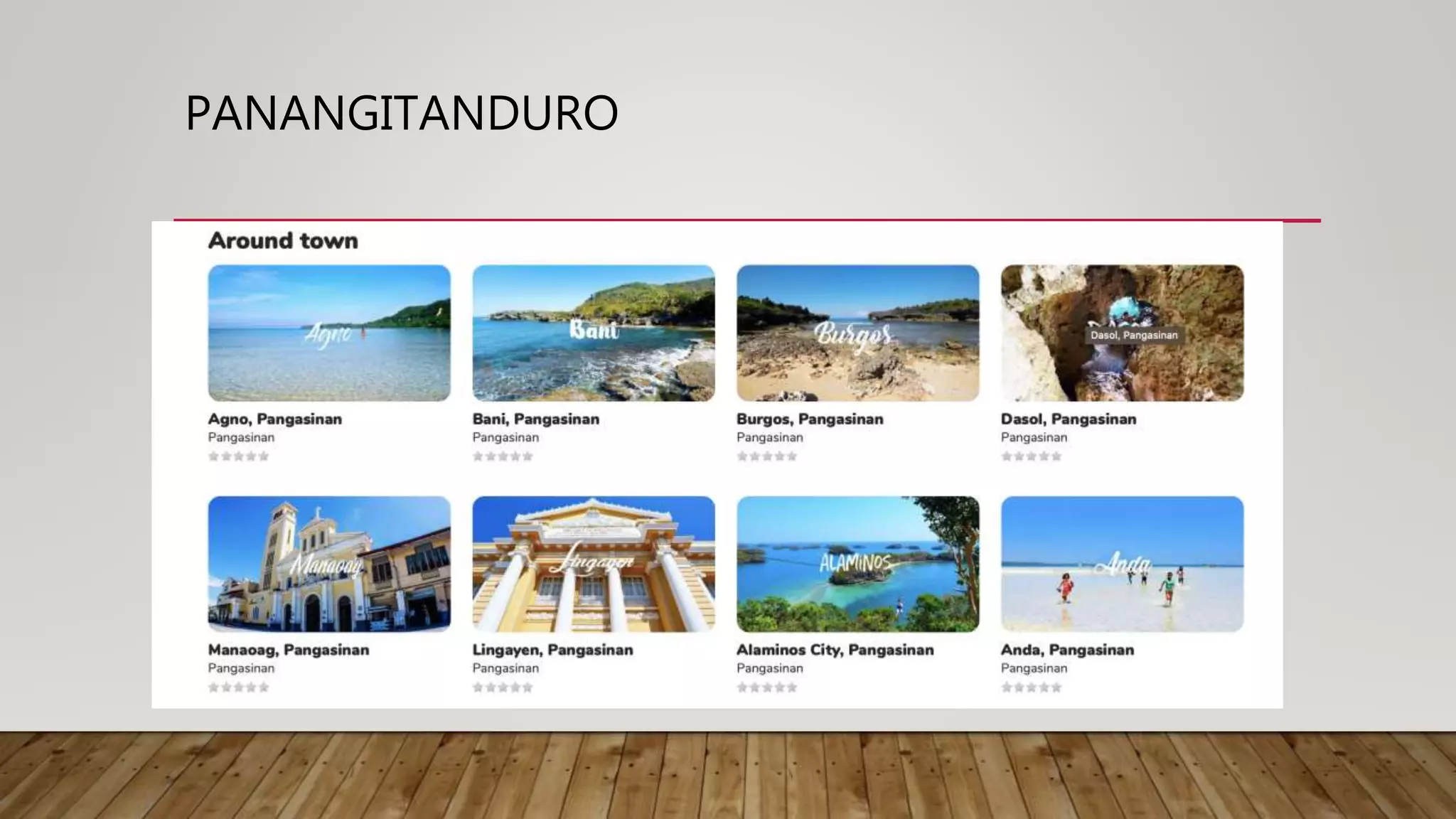
PANANGITANDURO
PANGASINAN LANGUAGE
• The Pangasinan language is one of the eight major languages
of the Philippines. It is the primary and predominant language
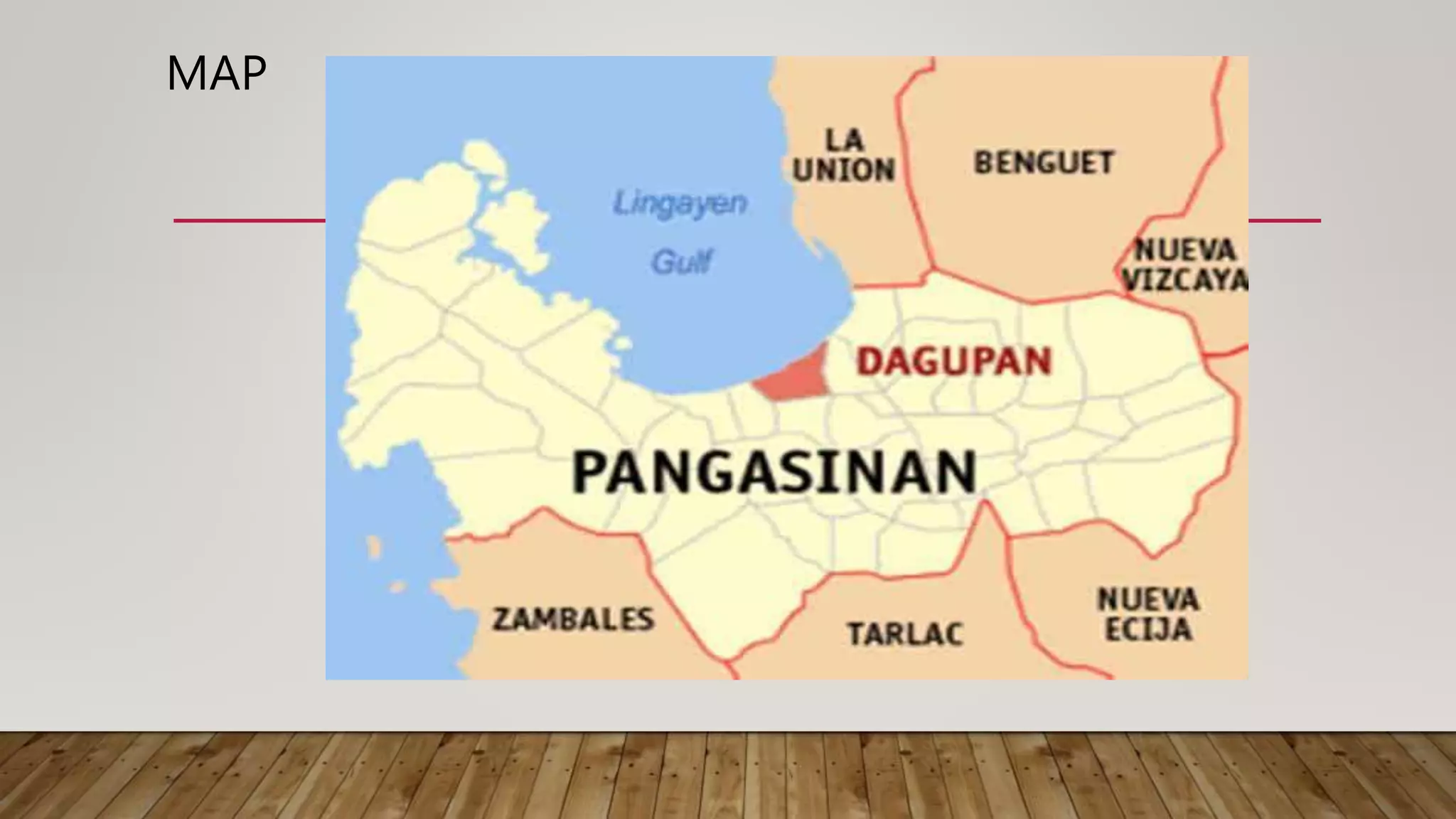
of the entire province of Pangasinan and northern Tarlac, on the
northern part of Luzon's central plains geographic region, most
of whom belong to the Pangasinan ethnic group. Pangasinan is
also spoken in southwestern La Union, as well as in the
municipalities of Benguet, Nueva Vizcaya, Nueva Ecija,
and Zambales that border Pangasinan. A few Aeta groups in
Central Luzon's northern part also understand and even speak
Pangasinan as well.
MAP
TRIVIA
• The province of Pangasinan is on the islands of Luzon. Its capital
is Lingayen. There are 2.5 million Filipinos living in Pangasinan,
of which 1.5 million speak the Pangasinan language.
• The name Pangasinan means "land of salt." (The word for "salt"
is asin.) Pangasinan is a major producer of salt in the
Philippines.
• Pangasinan is the birthplace of former Philippine president Fidel
V. Ramos and Speaker Jose de Venecia, Jr.
CLASSIFICATION
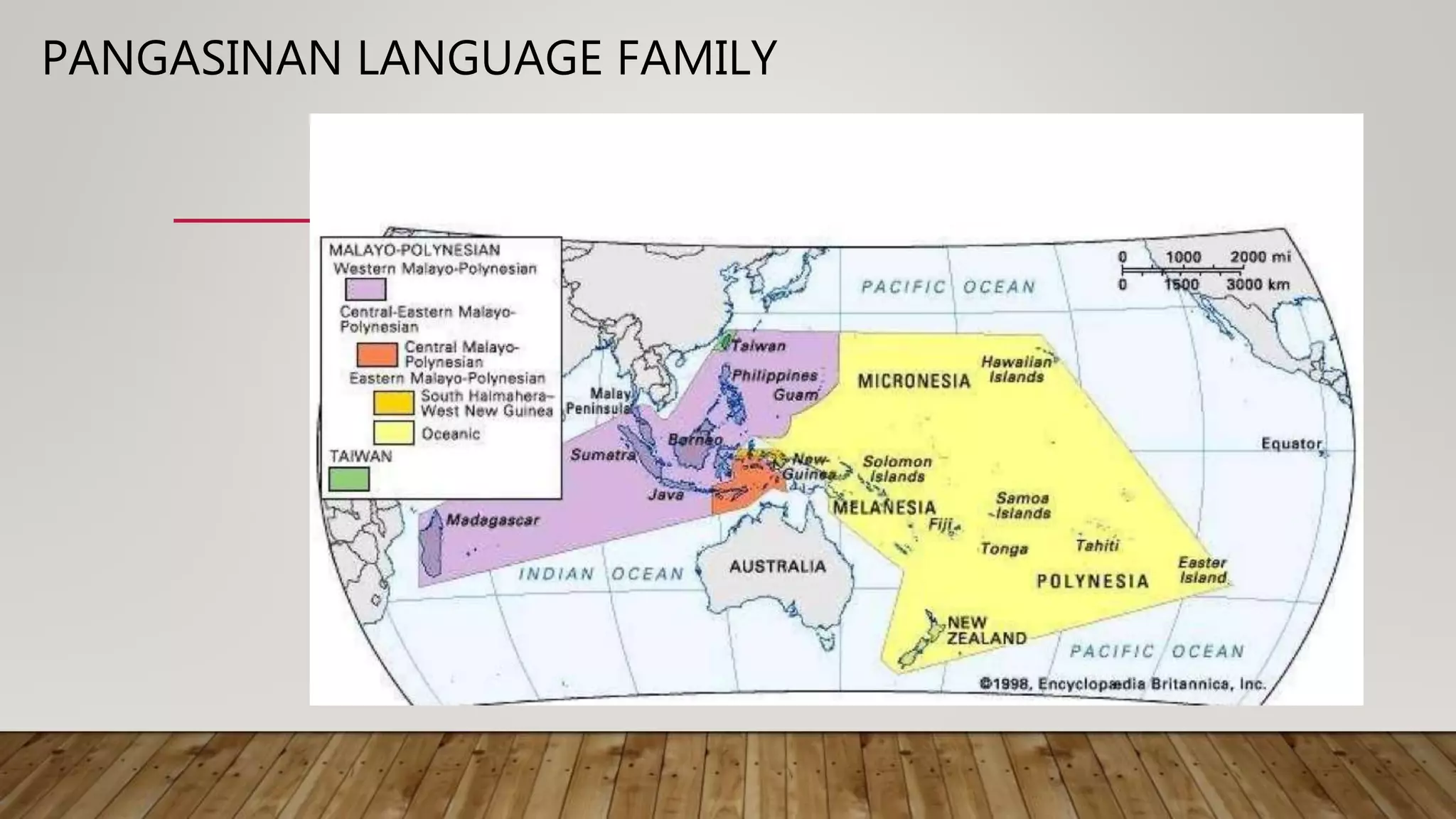
• The Pangasinan language belongs to the Malayo-Polynesian languages branch of
the Austronesian languages family. Pangasinan is similar to other closely
related Philippine
languages, Malay in Malaysia (as Malaysian), Indonesia (as Indonesian), Brunei,
and Singapore, Hawaiian in Hawaiiand Malagasy in Madagascar.The Pangasinan
language is very closely related to the Ibaloi language spoken in the neighboring
province of Benguet, located north of Pangasinan. Pangasinan is classified under the
Pangasinic group of languages.[8]
• The other Pangasinic languages are:
• Ibaloi
• Karao
• Iwaak
• Kalanguya
• Kallahan
PANGASINAN LANGUAGE FAMILY
GEOGRAPHICAL DISTRIBUTION
• Pangasinan is the official language of the province of Pangasinan,
located on the west central area of the island
of Luzon along Lingayen Gulf. The people of Pangasinan are also
referred to as Pangasinense. The province has a total population
of 2,343,086 (2000), of which 2 million speak Pangasinan.
Pangasinan is spoken in other Pangasinan communities in the
Philippines, mostly in the neighboring provinces of Benguet, La
Union, Nueva Ecija, Tarlac, Zambales, and Nueva Vizcaya.
HISTORY
• Austronesian speakers settled in Maritime Southeast
Asia during prehistoric times, perhaps more than 5,000
years ago. The indigenous speakers of Pangasinan are
descendants of these settlers, who were probably part of a
wave of prehistoric human migration that is widely
believed to have originated from Southern
China via Taiwan between 10 and 6 thousand years ago.
HISTORY
• The word Pangasinan, means “land of salt” or “place of
salt-making”; it is derived from the root word asin, the
word for "salt" in Pangasinan. Pangasinan could also refer
to a “container of salt or salted-products”; it refers to the
ceramic jar for storage of salt or salted-products or its
contents.
LITERATURE
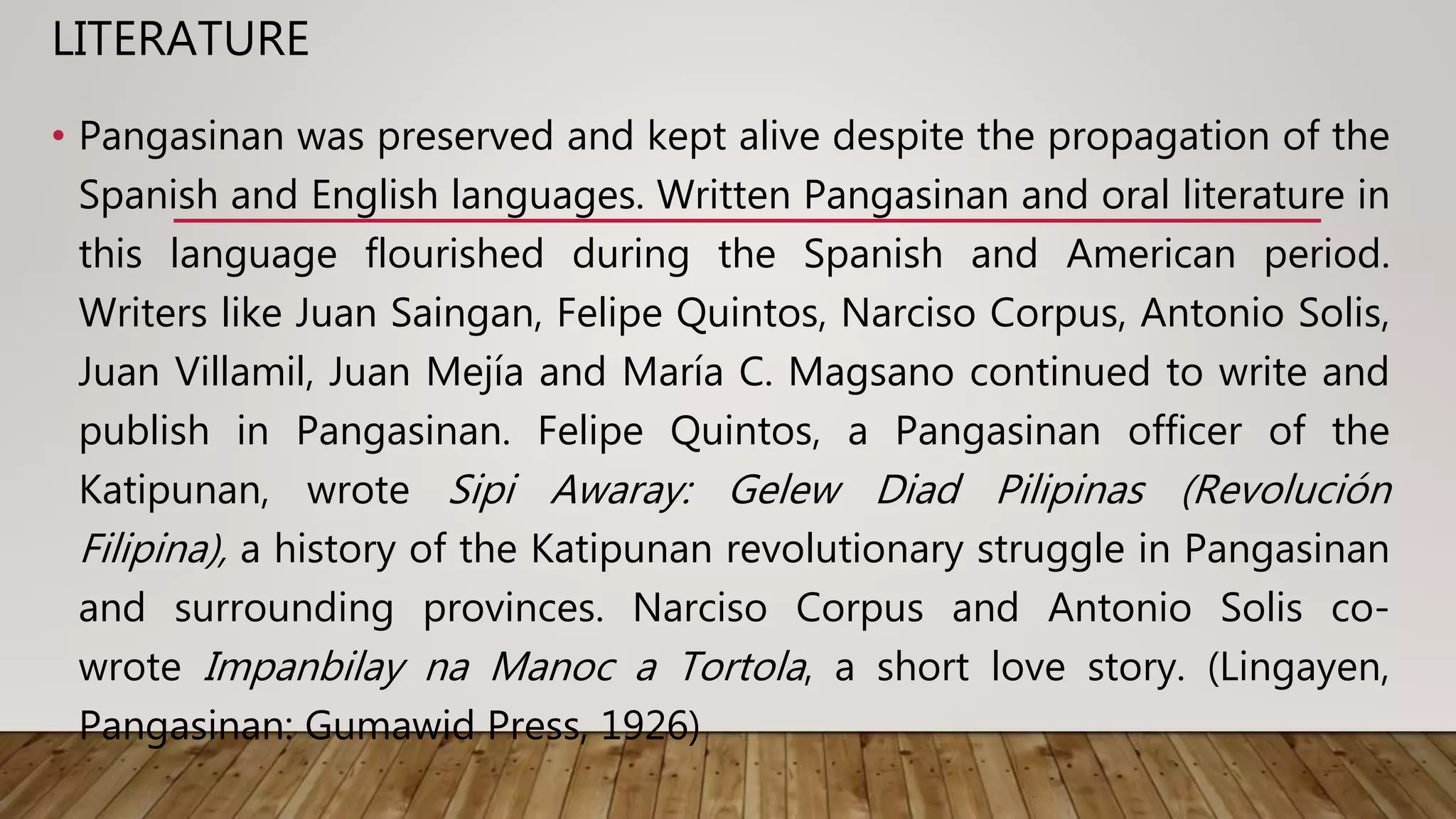
• Pangasinan was preserved and kept alive despite the propagation of the
Spanish and English languages. Written Pangasinan and oral literature in
this language flourished during the Spanish and American period.
Writers like Juan Saingan, Felipe Quintos, Narciso Corpus, Antonio Solis,
Juan Villamil, Juan Mejía and María C. Magsano continued to write and
publish in Pangasinan. Felipe Quintos, a Pangasinan officer of the
Katipunan, wrote Sipi Awaray: Gelew Diad Pilipinas (Revolución
Filipina), a history of the Katipunan revolutionary struggle in Pangasinan
and surrounding provinces. Narciso Corpus and Antonio Solis co-
wrote Impanbilay na Manoc a Tortola, a short love story. (Lingayen,
Pangasinan: Gumawid Press, 1926)
LITERATURE
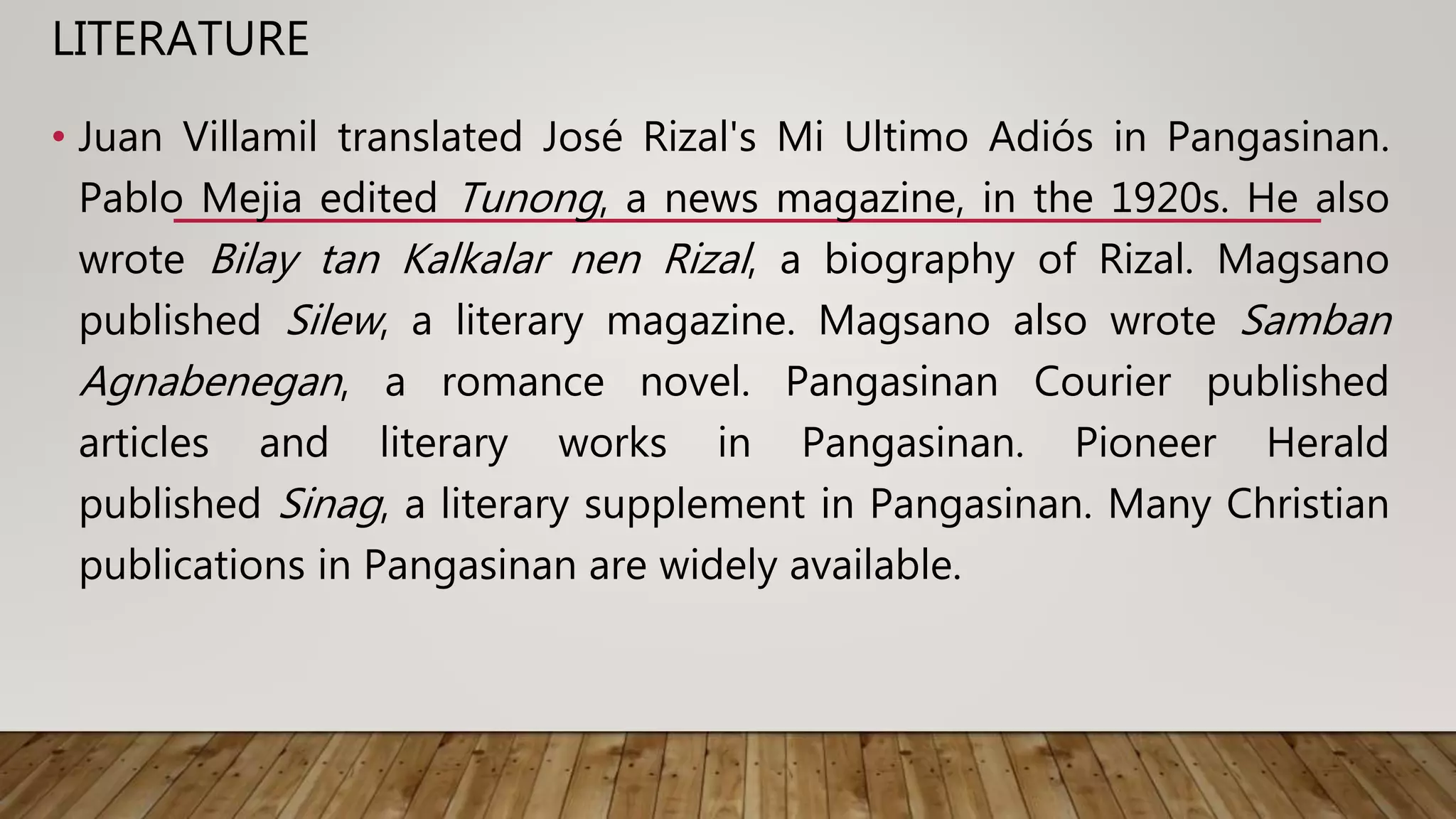
• Juan Villamil translated José Rizal's Mi Ultimo Adiós in Pangasinan.
Pablo Mejia edited Tunong, a news magazine, in the 1920s. He also
wrote Bilay tan Kalkalar nen Rizal, a biography of Rizal. Magsano
published Silew, a literary magazine. Magsano also wrote Samban
Agnabenegan, a romance novel. Pangasinan Courier published
articles and literary works in Pangasinan. Pioneer Herald
published Sinag, a literary supplement in Pangasinan. Many Christian
publications in Pangasinan are widely available.
LITERATURE
• Many Pangasinan are multilingual and proficient in English, Filipino,
and Ilocano. However, the spread and influence of the other
languages is contributing to the decline of the Pangasinan. Many
Pangasinan people, especially the native speakers are promoting the
use of Pangasinan in the print and broadcast media, Internet, local
governments, courts, public facilities and schools in Pangasinan. In
April 2006, the creation of Pangasinan Wikipedia was proposed, which
the Wikimedia Foundation approved for publication in the Internet.
FOLKSONG
PANGASINAN WIKEPEDIA
VOWELS
CONSONANTS
GRAMMAR
WRITING SYSTEM
• The ancient people of Pangasinan used an indigenous writing system. The
ancient Pangasinan script, which is related to the Tagalog Baybayin script,
was derived from the Javanese Kawi scriptof Indonesia and
the Vatteluttu or Pallava script of South India.
• The Latin script was introduced during the Spanish colonial period.
Pangasinan literature, using the indigenous syllabary and the Latin
alphabet, continued to flourish during the Spanish and American colonial
period. Pangasinan acquired many Spanish and English words, and some
indigenous words were Hispanicized or Anglicized. However, use of the
ancient syllabary has declined, and not much literature written in it has
survived.
Loanwords
• Most of the loan words in Pangasinan are Spanish, as the Philippines was ruled by
Spain for more than 300 years. Examples are lugar (place), podir (power,
care), kontra (from contra, against), birdi (verde, green), ispiritu ("espíritu", spirit),
and santo (holy, saint).
PRACTICE
MORE PRACTICE
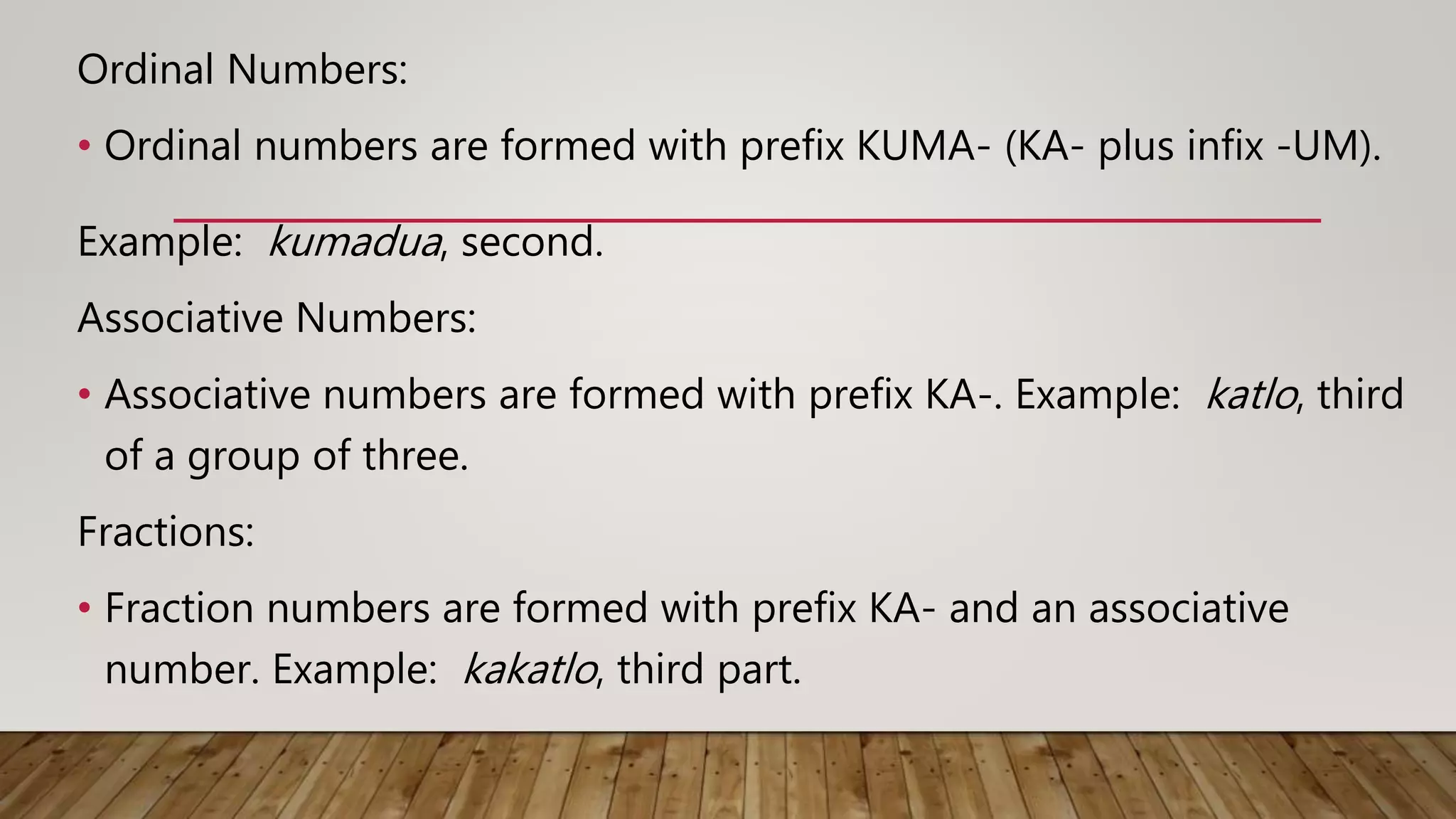
Ordinal Numbers:
• Ordinal numbers are formed with prefix KUMA- (KA- plus infix -UM).
Example: kumadua, second.
Associative Numbers:
• Associative numbers are formed with prefix KA-. Example: katlo, third
of a group of three.
Fractions:
• Fraction numbers are formed with prefix KA- and an associative
number. Example: kakatlo, third part.
Multiplicatives:
• Multiplicative ordinal numbers are formed with prefix PI- and a
cardinal
number from two to four or PIN- for other numbers except for number
one. Example: kaisa, first time; pidua, second time; pinlima, fifth time.
• Multiplicative cardinal numbers are formed with prefix MAN- (MAMI-
or MAMIN- for present or future tense, and AMI- or AMIN- for the
past tense) to the corresponding multiplicative ordinal number.
Example: aminsan, once; amidua, twice; mamitlo, thrice.
Distributives:
• Distributive cardinal numbers are formed with prefixes SAN-, TAG-, or
TUNGGAL and a cardinal number. Example: sansakey, one
each; sanderua, two each.
• Distributive multiplicative numbers are formed with prefix MAGSI-,
TUNGGAL, or BALANGSAKEY and a multiplicative cardinal number.
Example: tunggal pamidua, twice each; magsi-pamidua, each twice.
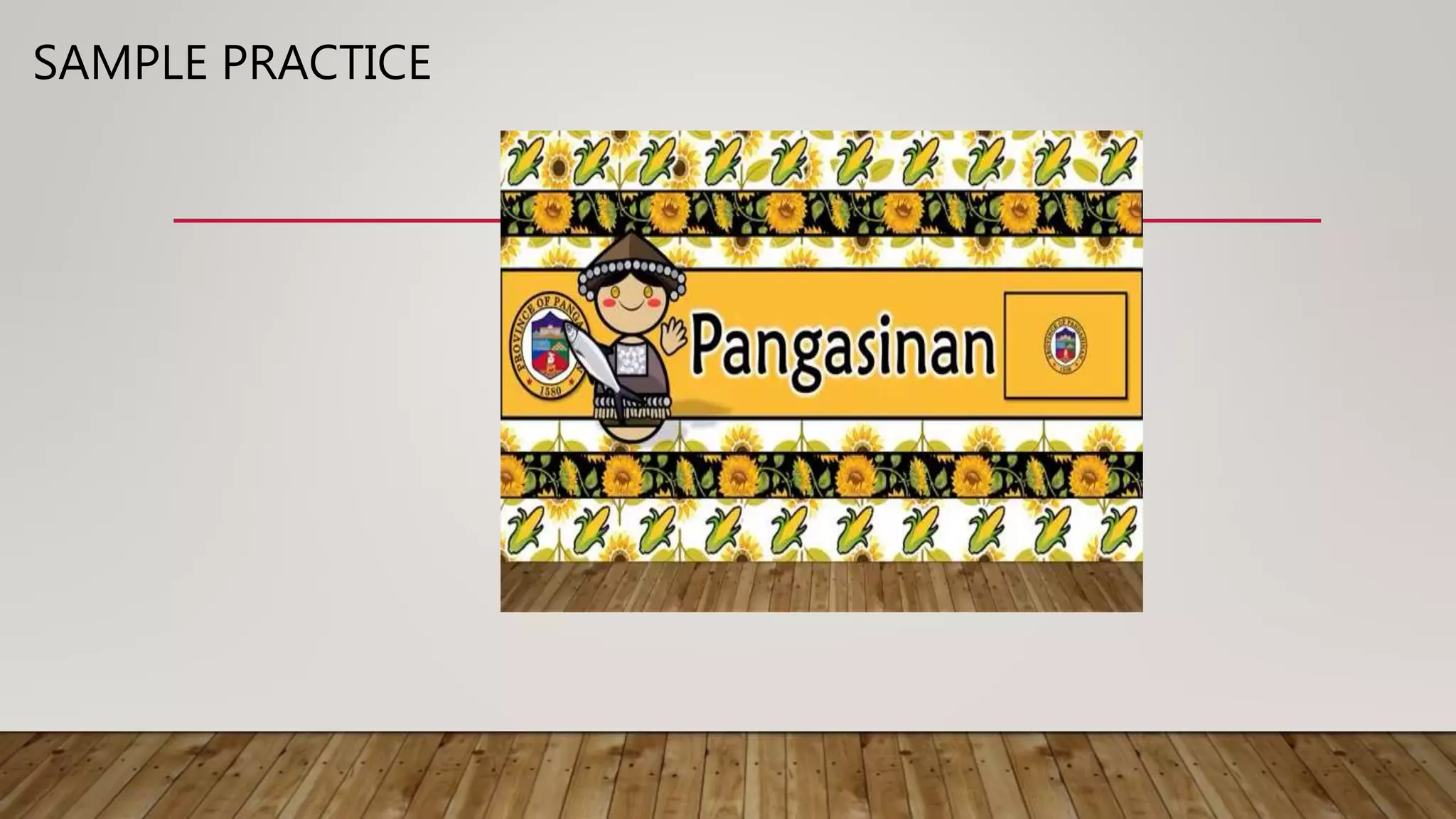
SAMPLE PRACTICE
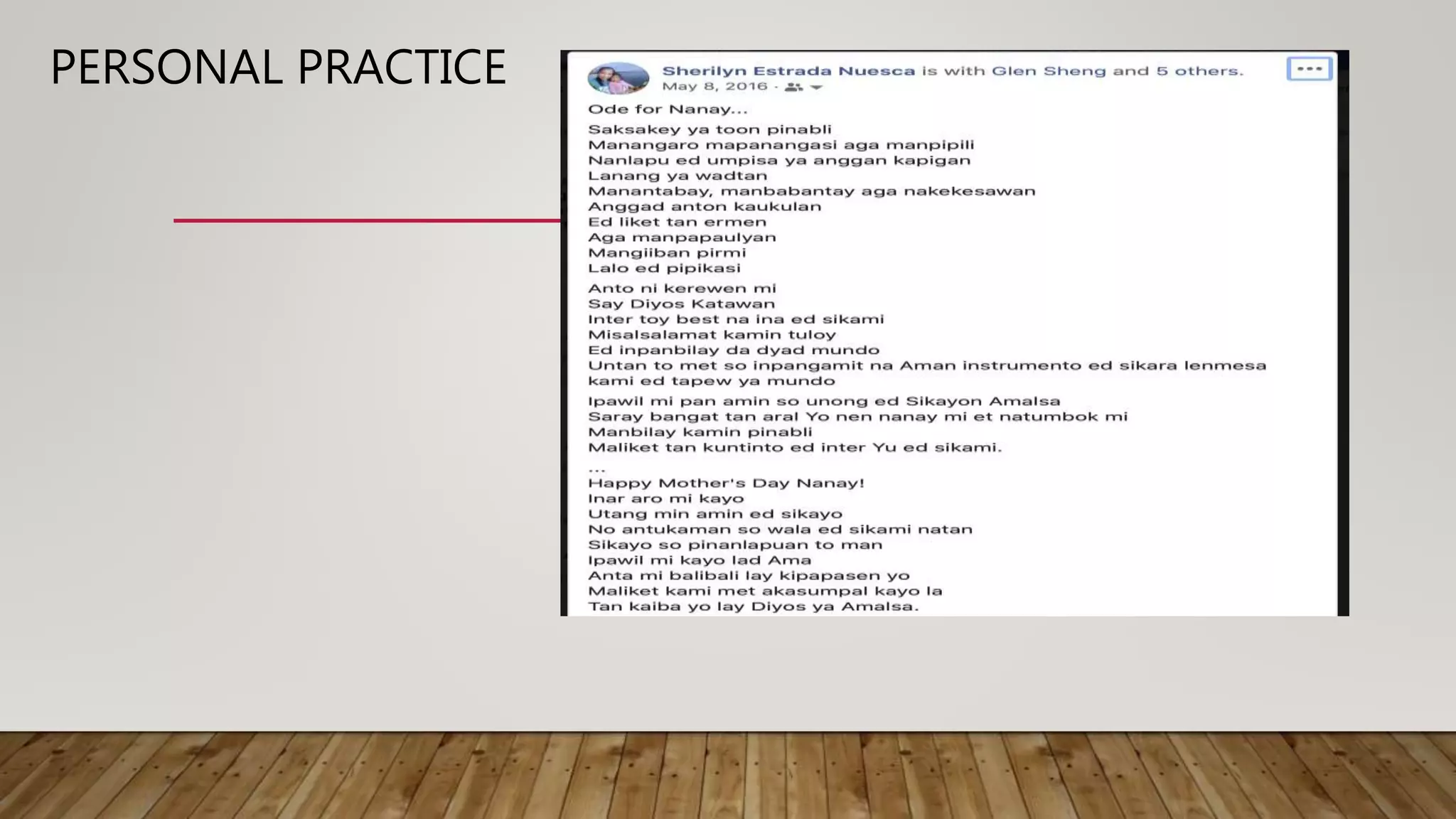
PERSONAL PRACTICE
REFLECTION
• Pangasinan language is a very rich and culture filled
language
among Pangasinenses. It mirrors its traditions, beliefs and
other practices common to Pangasinenses. However, it is a
saddening idea to know that the language that the province
is proud of is close to being endangered. I for one, is close to
losing it due to some reasons like intermarriage to non-
Pangasinan speaker, getting away from my home language
and the notion on language about lose it when you don’t use
it.
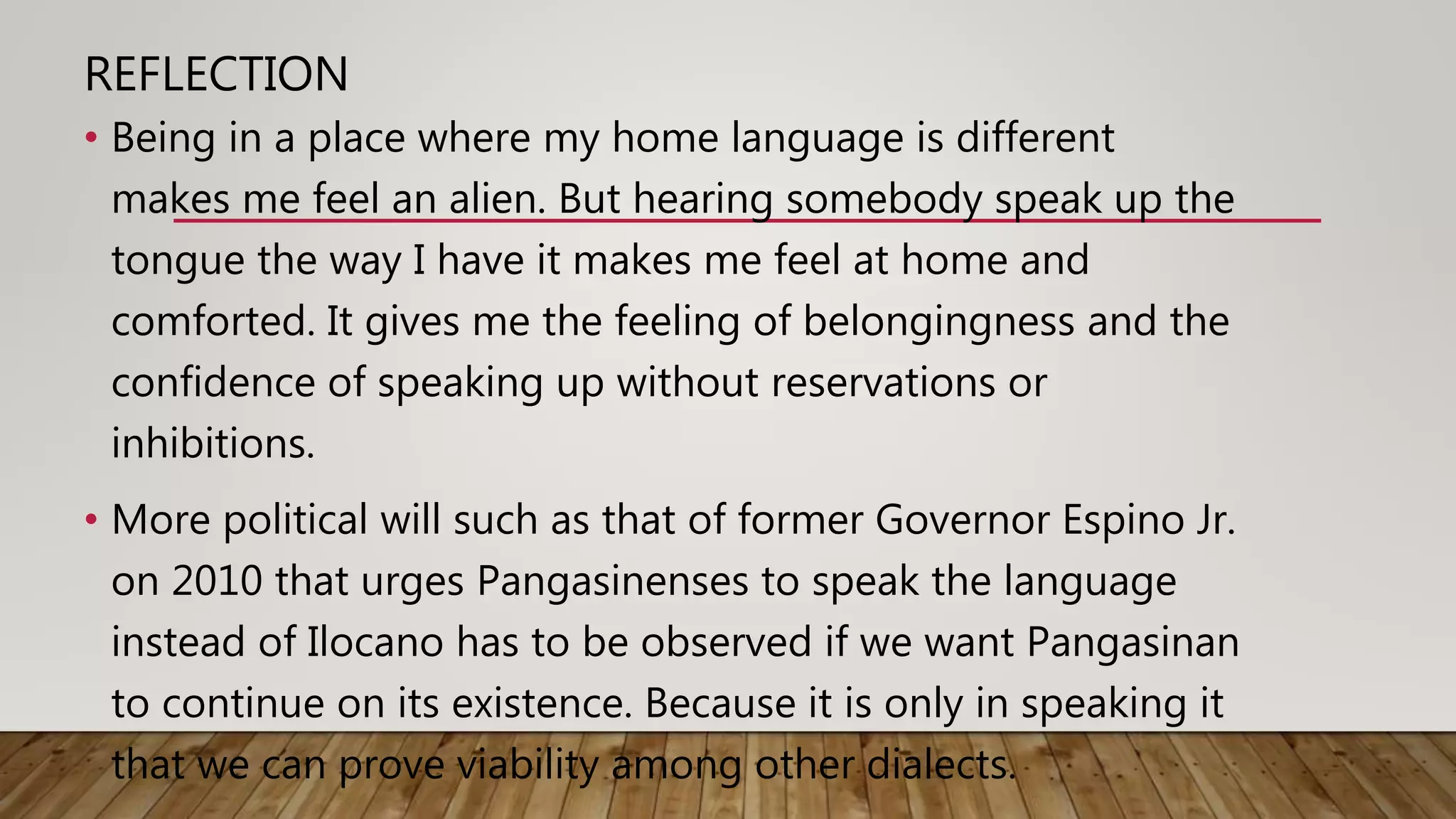
REFLECTION
• Being in a place where my home language is different
makes me feel an alien. But hearing somebody speak up the
tongue the way I have it makes me feel at home and
comforted. It gives me the feeling of belongingness and the
confidence of speaking up without reservations or
inhibitions.
• More political will such as that of former Governor Espino Jr.
on 2010 that urges Pangasinenses to speak the language
instead of Ilocano has to be observed if we want Pangasinan
to continue on its existence. Because it is only in speaking it
that we can prove viability among other dialects.
• I hope to see more political will such as that of former
Governor Espino Jr. on 2010 that urges Pangasinenses to
speak the language instead of Ilocano on its own province.
Also, it is in its people that if we want Pangasinan to
continue on its existence, speaking and using it is an answer
to prove viability among other language.
SAMPLE VIDEOCLIP
Pangasinan Language
Pangasinan Language

Pangasinan Language

  • 1.
  • 2.
  • 3.
  • 4.
    PANGASINAN LANGUAGE • ThePangasinan language is one of the eight major languages of the Philippines. It is the primary and predominant language of the entire province of Pangasinan and northern Tarlac, on the northern part of Luzon's central plains geographic region, most of whom belong to the Pangasinan ethnic group. Pangasinan is also spoken in southwestern La Union, as well as in the municipalities of Benguet, Nueva Vizcaya, Nueva Ecija, and Zambales that border Pangasinan. A few Aeta groups in Central Luzon's northern part also understand and even speak Pangasinan as well.
  • 5.
  • 6.
    TRIVIA • The provinceof Pangasinan is on the islands of Luzon. Its capital is Lingayen. There are 2.5 million Filipinos living in Pangasinan, of which 1.5 million speak the Pangasinan language. • The name Pangasinan means "land of salt." (The word for "salt" is asin.) Pangasinan is a major producer of salt in the Philippines. • Pangasinan is the birthplace of former Philippine president Fidel V. Ramos and Speaker Jose de Venecia, Jr.
  • 7.
    CLASSIFICATION • The Pangasinanlanguage belongs to the Malayo-Polynesian languages branch of the Austronesian languages family. Pangasinan is similar to other closely related Philippine languages, Malay in Malaysia (as Malaysian), Indonesia (as Indonesian), Brunei, and Singapore, Hawaiian in Hawaiiand Malagasy in Madagascar.The Pangasinan language is very closely related to the Ibaloi language spoken in the neighboring province of Benguet, located north of Pangasinan. Pangasinan is classified under the Pangasinic group of languages.[8] • The other Pangasinic languages are: • Ibaloi • Karao • Iwaak • Kalanguya • Kallahan
  • 8.
  • 9.
    GEOGRAPHICAL DISTRIBUTION • Pangasinanis the official language of the province of Pangasinan, located on the west central area of the island of Luzon along Lingayen Gulf. The people of Pangasinan are also referred to as Pangasinense. The province has a total population of 2,343,086 (2000), of which 2 million speak Pangasinan. Pangasinan is spoken in other Pangasinan communities in the Philippines, mostly in the neighboring provinces of Benguet, La Union, Nueva Ecija, Tarlac, Zambales, and Nueva Vizcaya.
  • 10.
    HISTORY • Austronesian speakerssettled in Maritime Southeast Asia during prehistoric times, perhaps more than 5,000 years ago. The indigenous speakers of Pangasinan are descendants of these settlers, who were probably part of a wave of prehistoric human migration that is widely believed to have originated from Southern China via Taiwan between 10 and 6 thousand years ago.
  • 11.
    HISTORY • The wordPangasinan, means “land of salt” or “place of salt-making”; it is derived from the root word asin, the word for "salt" in Pangasinan. Pangasinan could also refer to a “container of salt or salted-products”; it refers to the ceramic jar for storage of salt or salted-products or its contents.
  • 12.
    LITERATURE • Pangasinan waspreserved and kept alive despite the propagation of the Spanish and English languages. Written Pangasinan and oral literature in this language flourished during the Spanish and American period. Writers like Juan Saingan, Felipe Quintos, Narciso Corpus, Antonio Solis, Juan Villamil, Juan Mejía and María C. Magsano continued to write and publish in Pangasinan. Felipe Quintos, a Pangasinan officer of the Katipunan, wrote Sipi Awaray: Gelew Diad Pilipinas (Revolución Filipina), a history of the Katipunan revolutionary struggle in Pangasinan and surrounding provinces. Narciso Corpus and Antonio Solis co- wrote Impanbilay na Manoc a Tortola, a short love story. (Lingayen, Pangasinan: Gumawid Press, 1926)
  • 13.
    LITERATURE • Juan Villamiltranslated José Rizal's Mi Ultimo Adiós in Pangasinan. Pablo Mejia edited Tunong, a news magazine, in the 1920s. He also wrote Bilay tan Kalkalar nen Rizal, a biography of Rizal. Magsano published Silew, a literary magazine. Magsano also wrote Samban Agnabenegan, a romance novel. Pangasinan Courier published articles and literary works in Pangasinan. Pioneer Herald published Sinag, a literary supplement in Pangasinan. Many Christian publications in Pangasinan are widely available.
  • 14.
    LITERATURE • Many Pangasinanare multilingual and proficient in English, Filipino, and Ilocano. However, the spread and influence of the other languages is contributing to the decline of the Pangasinan. Many Pangasinan people, especially the native speakers are promoting the use of Pangasinan in the print and broadcast media, Internet, local governments, courts, public facilities and schools in Pangasinan. In April 2006, the creation of Pangasinan Wikipedia was proposed, which the Wikimedia Foundation approved for publication in the Internet.
  • 15.
  • 16.
  • 19.
  • 20.
  • 21.
  • 22.
  • 23.
    • The ancientpeople of Pangasinan used an indigenous writing system. The ancient Pangasinan script, which is related to the Tagalog Baybayin script, was derived from the Javanese Kawi scriptof Indonesia and the Vatteluttu or Pallava script of South India. • The Latin script was introduced during the Spanish colonial period. Pangasinan literature, using the indigenous syllabary and the Latin alphabet, continued to flourish during the Spanish and American colonial period. Pangasinan acquired many Spanish and English words, and some indigenous words were Hispanicized or Anglicized. However, use of the ancient syllabary has declined, and not much literature written in it has survived.
  • 24.
    Loanwords • Most ofthe loan words in Pangasinan are Spanish, as the Philippines was ruled by Spain for more than 300 years. Examples are lugar (place), podir (power, care), kontra (from contra, against), birdi (verde, green), ispiritu ("espíritu", spirit), and santo (holy, saint).
  • 26.
  • 27.
  • 28.
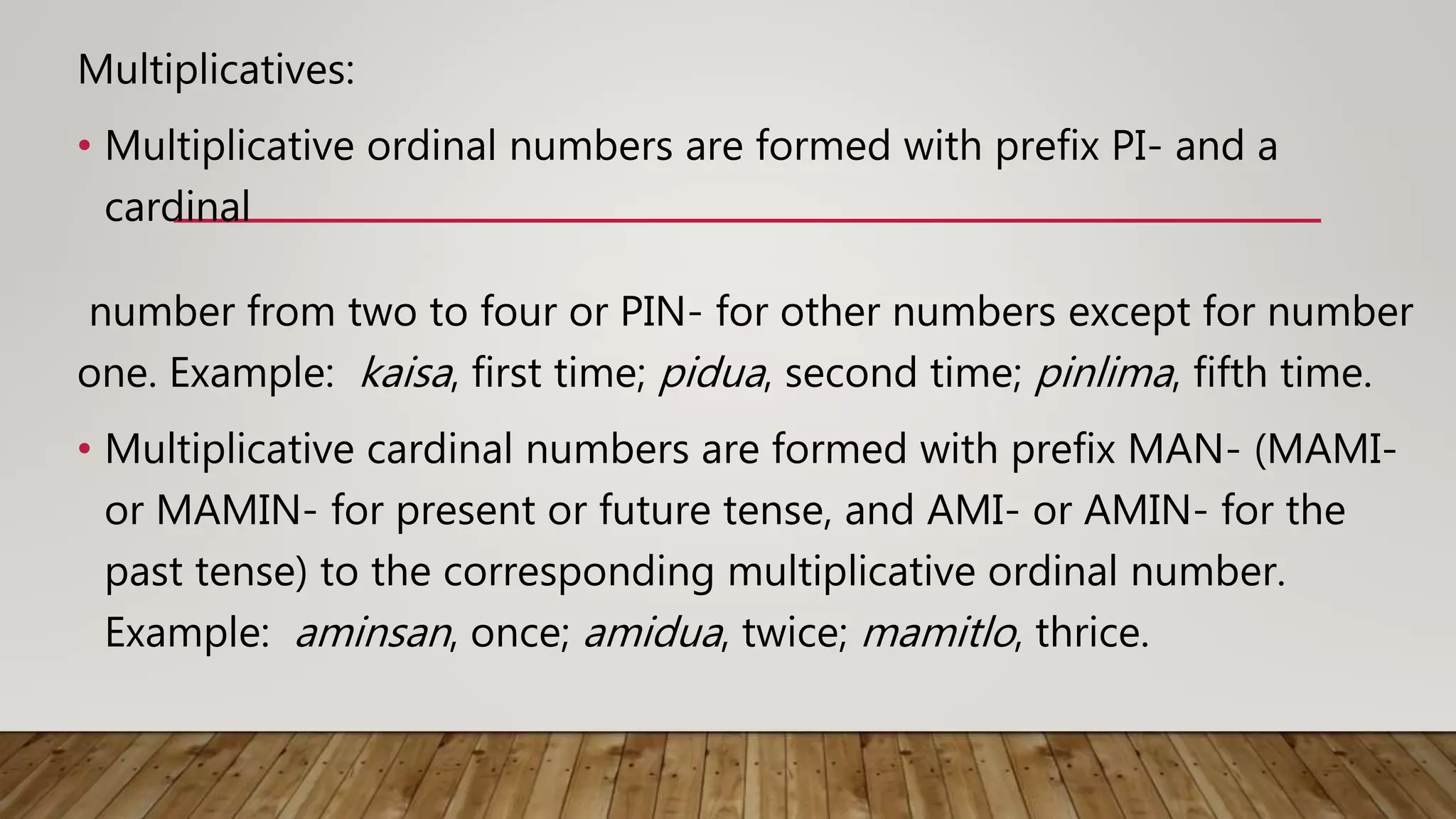
    Ordinal Numbers: • Ordinalnumbers are formed with prefix KUMA- (KA- plus infix -UM). Example: kumadua, second. Associative Numbers: • Associative numbers are formed with prefix KA-. Example: katlo, third of a group of three. Fractions: • Fraction numbers are formed with prefix KA- and an associative number. Example: kakatlo, third part.
  • 29.
    Multiplicatives: • Multiplicative ordinalnumbers are formed with prefix PI- and a cardinal number from two to four or PIN- for other numbers except for number one. Example: kaisa, first time; pidua, second time; pinlima, fifth time. • Multiplicative cardinal numbers are formed with prefix MAN- (MAMI- or MAMIN- for present or future tense, and AMI- or AMIN- for the past tense) to the corresponding multiplicative ordinal number. Example: aminsan, once; amidua, twice; mamitlo, thrice.
  • 30.
    Distributives: • Distributive cardinalnumbers are formed with prefixes SAN-, TAG-, or TUNGGAL and a cardinal number. Example: sansakey, one each; sanderua, two each. • Distributive multiplicative numbers are formed with prefix MAGSI-, TUNGGAL, or BALANGSAKEY and a multiplicative cardinal number. Example: tunggal pamidua, twice each; magsi-pamidua, each twice.
  • 31.
  • 32.
  • 33.
    REFLECTION • Pangasinan languageis a very rich and culture filled language among Pangasinenses. It mirrors its traditions, beliefs and other practices common to Pangasinenses. However, it is a saddening idea to know that the language that the province is proud of is close to being endangered. I for one, is close to losing it due to some reasons like intermarriage to non- Pangasinan speaker, getting away from my home language and the notion on language about lose it when you don’t use it.
  • 34.
    REFLECTION • Being ina place where my home language is different makes me feel an alien. But hearing somebody speak up the tongue the way I have it makes me feel at home and comforted. It gives me the feeling of belongingness and the confidence of speaking up without reservations or inhibitions. • More political will such as that of former Governor Espino Jr. on 2010 that urges Pangasinenses to speak the language instead of Ilocano has to be observed if we want Pangasinan to continue on its existence. Because it is only in speaking it that we can prove viability among other dialects.
  • 35.
    • I hopeto see more political will such as that of former Governor Espino Jr. on 2010 that urges Pangasinenses to speak the language instead of Ilocano on its own province. Also, it is in its people that if we want Pangasinan to continue on its existence, speaking and using it is an answer to prove viability among other language.
  • 36.