THE ILOKANO LANGUAGE AS THE
MOTHER TONGUE
 The Nature of the Ilokano Language
 Ilokano Literature
REVIEW
This course includes both the content and the pedagogy
of the mother tongue as well as its underlying theoretical
assumptions and frameworks that support its being a foundation
for learning of the additional languages of Filipino and English and
developing stronger literacy skills of learners. The subject matter
content includes the structure of the mother tongue as a
language, literature in the mother tongue, methods and
techniques of teaching the language, development of
instructional materials and assessment. Ultimately, the course
will develop prospective teachers’ pedagogical content
knowledge of the mother tongue which is necessary for the
effective implementation of the Mother Tongue-Based
Multilingual Education (MTB-MLE) Program of the Department of
Education
 Theoretical
assumptions
and frameworks
 Literature
 Content &
structure
 Pedagogy
 Development of
instructional
materials
 Assessment
techniques
 Peer teaching
ILOKANO AS A MOTHER TONGUE
 DepEd order No. 74, s. 2009
Institutionalizing Mother Tongue-
Based Multilingual Education (MLE)
(July 14, 2009)
 RA 10157 (Kindergarten Education Act)
 RA 10533 (Enhanced Basic
Education Act of 2013)
ILOKANO AS A MOTHER TONGUE
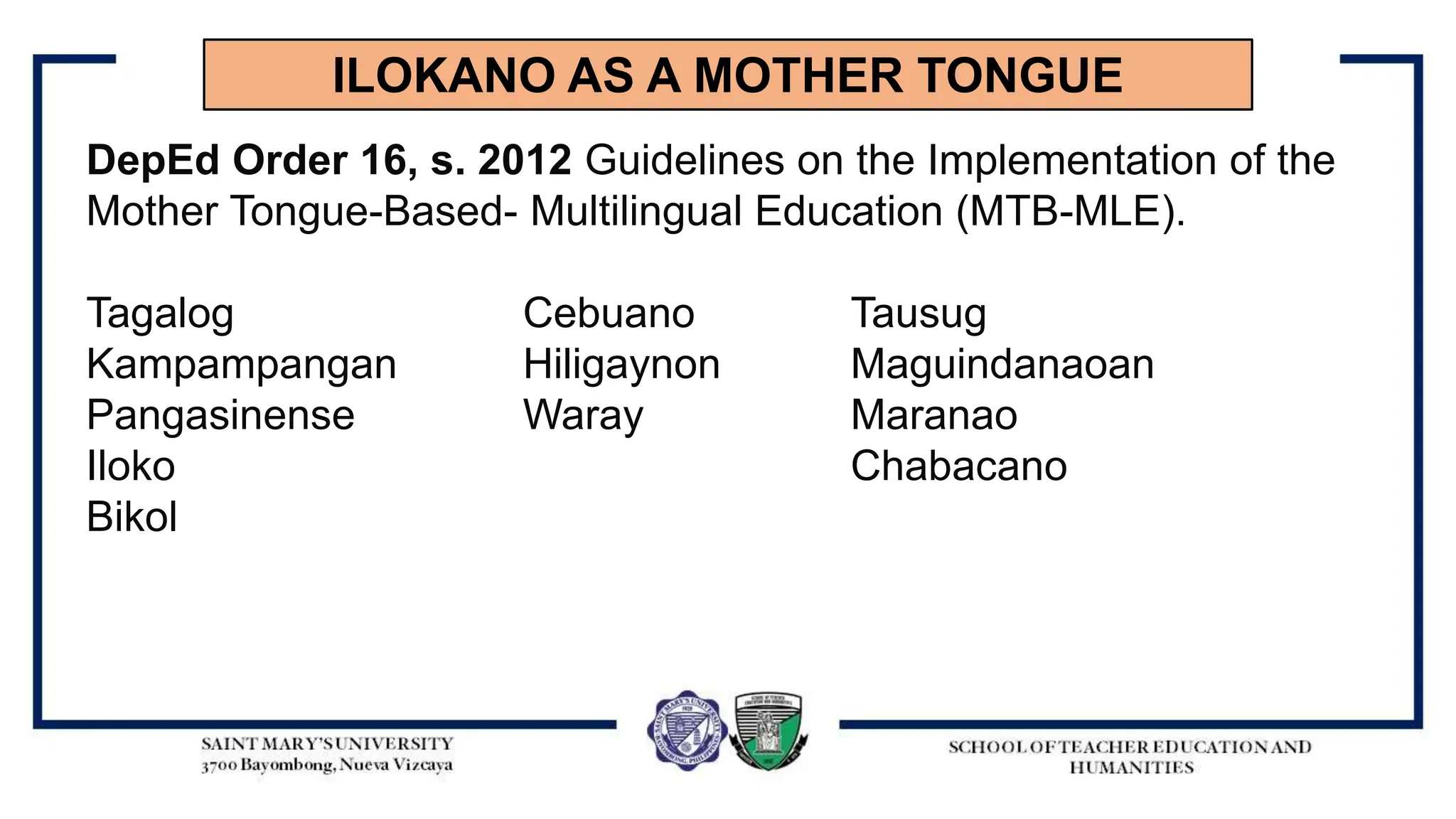
DepEd Order 16, s. 2012 Guidelines on the Implementation of the
Mother Tongue-Based- Multilingual Education (MTB-MLE).
Tagalog Cebuano Tausug
Kampampangan Hiligaynon Maguindanaoan
Pangasinense Waray Maranao
Iloko Chabacano
Bikol
ILOKANO AS A MOTHER TONGUE
DepEd Order No. 28, s. 2013 Additional Guidelines to DEPEd Order
No. 16, s. 2012
Ybanag (Tuguegarao City, Cagayan, Isabela)
Ivatan (Batanes group of Islands)
Sambal (Zambales)
Akianon- Aklan, Capiz
Kinaray-a (Capiz, Aklan)
Yakan (Basilan Province), and
Surigaonon (Surigao City and Provinces)
Susan Malone (2013)
https://www.sil.org/sites/default/files/fil
es/essential_components_of_mtb_mle
_programs.pdf
ILOCO LANGUAGE AS
THE MOTHER TONGUE
 Nature of the Ilokano language
 Ilokano literature
https://www.youtube.com/embed/zzishsRWhg8
Ilokano speaking
Canadian vlogger,
Firth Mceachern
// Love All
Languages
• Ilocano (also spelled Ilokano, Iloko or Iloco,)
• a member of the Malayo-Polynesian branch of
the Austronesian language family
• the third largest ethnolinguistic group in the Philippines
after Tagalog and English.
• spoken by roughly 10 million people
NATURE OF THE ILOKANO LANGUAGE
There are some 120 to 187 languages spoken in the Philippines, depending
on the method of classification
https://en.wikipedia.org/wiki/Languages_of_the_Philippines
• The inhabitants of Ilocos (then called "Samtoy") were
living in large villages at sheltered coves or
rivermouths were trading with the Chinese and
Japanese.
• SAMTOY : meaning "Sao mi ditoy" (Our Language)
NATURE OF THE ILOKANO LANGUAGE
• The name Ilocano come from i– ‘from’ + looc ‘bay’ + -
ano, Spanish “native of,” therefore literally means
“people of the bay.”
NATURE OF THE ILOKANO LANGUAGE
• The original Ilocano homeland is in Northwest Luzon
(the provinces of Ilocos Norte, Ilocos Sur, Abra, and La
Union)
• Migrated to new lands such as Nueva Ecija, Pangasinan,
Tarlac, and Benguet
• There are also sizable communities of Ilocanos
throughout the United States, most notably in Hawaii
and California where the language is taught in certain
schools
Where are the Ilocanos?
ILOKANO CULTURE
Ilocano literature pertains to the literary
works of writers of Ilocano ancestry
regardless of the language used – be it
Ilokano, English, Spanish or other foreign
and Philippine languages. Ilocano
literature, next to the Tagalog, is believed
by scholars to be the richest and most
highly developed in the Philippines. Ilocano
literature can be traced back at least to the
early 17th century.
There are a large number of
religious documents, poems, riddles
(burburcha), proverbs, epic stories,
folksongs, and other literary works
that belong to this tradition. Today,
there is a sizable body of Ilocano
literature, including newspapers and
periodicals like the Bannawag.
(Saculles, 2018)
Precolonial times to the 19th century
 Pre-colonial Iloko literature were composed of folk songs, riddles,
proverbs, lamentations called dung-aw, and epic stories in written
or oral form.
 Ancient Ilokano poets expressed themselves in folk and war songs
as well as the dallot, an improvised, versified and at times
impromptu long poem delivered in a sing-song manner.
https://en.wikipedia.org/wiki/Ilocano_literature
Spanish Regime
 During the Spanish regime, Iloko
poetry was generally patterned after
Spanish models.
 Francisco Lopez published his own
Iloko translation of the Doctrina
Cristiana by Cardinal Bellarmine, the
first book to be printed in Iloko in
1621.
https://en.wikipedia.org/wiki/Ilocano_literature
Spanish Regime
 A study of Iloko poetry could be found in
the Gramatica Ilokana, published in 1895,
based on Lopez's Arte de la Lengua Iloca,
earlier published in 1627, but was
probably written before 1606.
https://en.wikipedia.org/wiki/Ilocano_literature
Pedro Bucaneg
 Father of Ilokano poetry and Literature
 First known Ilokano poet
 first Filipino literary man to achieve more than
national renown. His fame spread beyond the
nation's boundaries, reaching even as far as Madrid
and Rome..
 This poet and philosopher was born towards the end
of the sixteenth century.
 The Bukanegan which is the Ilocano equivalent of the
Balagtasan was termed after him.
 Blind since childhood
 Authored the popular epic known as Biag ni Lam-
ang ("Life of Lam-ang") written in the 17th century
https://kahimyang.com/kauswagan/articles/1713/the-ilocano-epic-the-life-of-lam-ang
https://en.wikipedia.org/wiki/Ilocano_literature
Leonora Florentino – 19th century
https://en.wikipedia.org/wiki/Ilocano_literature
 Was a Filipino poet in the Spanish and
Ilocano languages
 Considered by some as the "National
Poetess of the Philippines“ or "mother of
Philippine women's literature" and the
"bridge from oral to literary tradition".
 She started to love writing at a young age.
Her best poems in Ilokano were As-Asug Ti
Maysa A Napaay (Blasted Hopes) and
Naangawan A Kablaaw (A Jolly Birthday
Greeting).
Monument situated at Vigan, Ilocos Sur
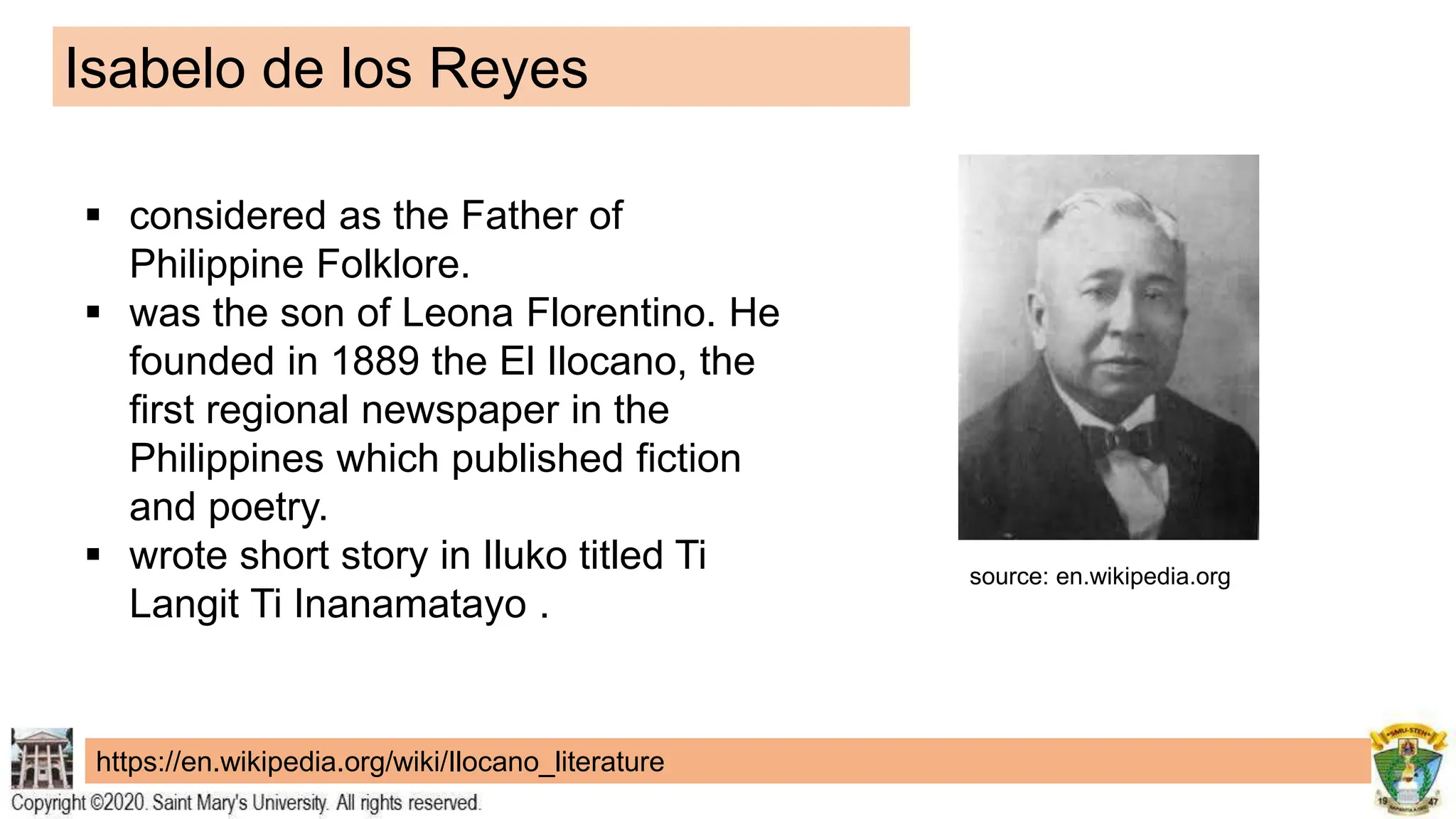
Isabelo de los Reyes
https://en.wikipedia.org/wiki/Ilocano_literature
 considered as the Father of
Philippine Folklore.
 was the son of Leona Florentino. He
founded in 1889 the El Ilocano, the
first regional newspaper in the
Philippines which published fiction
and poetry.
 wrote short story in Iluko titled Ti
Langit Ti Inanamatayo .
source: en.wikipedia.org
Fr. Justo Claudio Fojas
https://en.wikipedia.org/wiki/Ilocano_literature
an Ilokano secular priest who wrote
novenas, prayerbooks, catechism,
metrical romances, dramas,
biographies, a Spanish grammar and
an Iloko-Spanish dictionary, was Leona
Florentino's contemporary.
The GUMIL Filipinas
(Gunglo dagiti Mannurat nga Ilokano iti Filipinas)
This was organized in Baguio on
October 19, 1968. Arturo M. Padua,
then mayor of Sison, Pangasinan,
was elected president.
Bannawag has played and
still plays a major role in
the development of Iloko
literature. At present, it
publishes poems (daniw),
short stories (sarita), novels
(nobela), essays
(salaysay), comics,
biographies, folktales and
many others including what
some call avant garde
literary output. It is the only
magazine where Ilokano
writers hope to publish
most of their writings.
Iloko Literature: Today and Tomorrow
Carlos Bulosan
Francisco Sionil Jose
Reynaldo A. Duque
Ricarte Agnes
Aurelio S. Agcaoili
Lorenzo G. Tabin
Jaime M. Agpalo Jr.
Prescillano N. Bermudez
William V. Alvarado
Maria Fres-Felix
Clarito G. de Francia
Arnold Pascual Jose
Eden Aquino Alvia
Severino Pablo
Ariel S. Tabag
Daniel L. Nesperos
Roy V. Aragon
Danilo Antalan
Joel B. Manuel
Bernardo D. Tabbad
Noli S. Dumlao and others.
Forms of Ilokano
Literature
Ti bassít a káyo nalaká a lintegén,
ngem no dakkél narigáten.
A young tree is easy to straighten,
but when it's big it is difficult.
Ti táo nga mannaríta, awán ti ania
nga magapuánIlonna.
A man that talks too much
accomplishes little.
PAGSASAO (Ilokano Proverbs & Sayings)
Ti táo a manákem, dína makíta ti
panagdissó ti sakána ití dagá.
Kitáenna ketdi ti sumarunó a
baddekánna.
A wise man doesn't see his foot on
the ground, he watches his next
step.
Tay áso nga taol nga taol saán a
makakagát ken makadunor.
Barking dogs seldom bite.
Awán kas iti sursúro a sanikuá, ta
daytá awán makatákaw kenká.
Knowledge is wealth that can't be
stolen.
PAGSASAO (Ilokano Proverbs & Sayings)
No trabáho, gulpién, no kanén, in-
inúten.
If it's work, do it fast. If it's food,
eat it little by little.
What is easily acquired is easily
lost.
Ti kukuá masapúlan ngem ti pintas
saán.
Ti kukuá masapúlan ngem ti pintas
saán.
Wealth can be acquired but beauty
cannot.
Ti agkuták, isú't nagitlóg.
He who cackles laid the egg (he
who talks first is the guilty party).
PAGSASAO (Ilokano Proverbs & Sayings)
No addá sabsábong, agaarák
dagití kulibangbáng.
Where there are flowers there
are butterflies (young women
attract young men)
Ti kamátis, di agbúnga ti
manggá.
The tomato plant doesn't grow
mangos. (A good person doesn't
come from a bad family)
Puráwto ti wáken, nangísittó diay
kannawyen.
The crow will turn white and the
heron black (said to express
impossibility)
Ti útang mabayádan, ngem ti
naimbág a nákem saán.
A debt can be paid, but a kind act
cannot.
PAGSASAO (Ilokano Proverbs & Sayings)
Kugtár ni kabaián, ilot ni
kalantangan.
The kick of a female carabao, the
massage of the male. (women can't
hurt men physically)
Aniánto pay serbí diay rúot no
natáyto met diay kabálion?
Of what use is grass when the
horse is dead? (said to misers)
Naababa a sarita (short stories)/Nobela
DANIW (Poems)
Tubayem ti kinatao iti naimbag a kababalin
Tapno di mapukaw natakneng a pannakilangen;
Ken iwardasmo a naimbag ti puso ken nakem
Iti aramid a rumbeng, saan a makaidukem.
Punasem pay iti muging ti siasino man
Daan a pammati nga awanan kaeskan;
Ket silawam dagiti nalidem a panunot
Tapno dagiti rumbeng laeng ti masurot.
ni Pedro L. Limos,
Bannawag, 19 Oktubre 1959
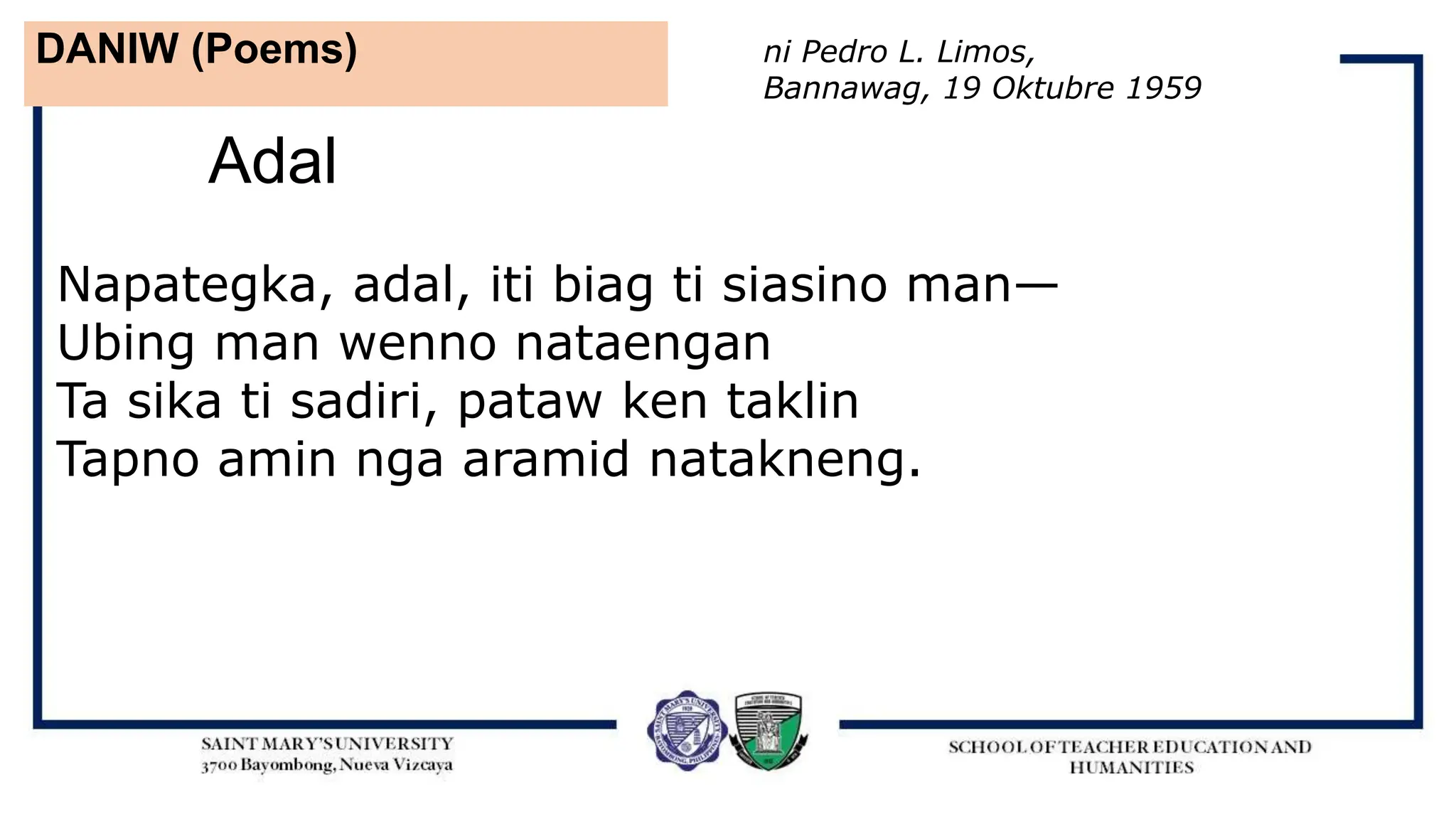
Adal
DANIW (Poems)
Napategka, adal, iti biag ti siasino man—
Ubing man wenno nataengan
Ta sika ti sadiri, pataw ken taklin
Tapno amin nga aramid natakneng.
Sika, adal, ti nangayed a lawag iti biag
A mangibayog wagayway ti kinaimbag;
Sika ti bagnos kadagiti natakneng a wagas
Ti aramid, sao, uray pay iti panagayat
ni Pedro L. Limos,
Bannawag, 19 Oktubre 1959
Adal
DANIW (Poems)
Napategka, adal, iti biag ti siasino man—
Ubing man wenno nataengan
Ta sika ti sadiri, pataw ken taklin
Tapno amin nga aramid natakneng.
ni Pedro L. Limos,
Bannawag, 19 Oktubre 1959
Adal
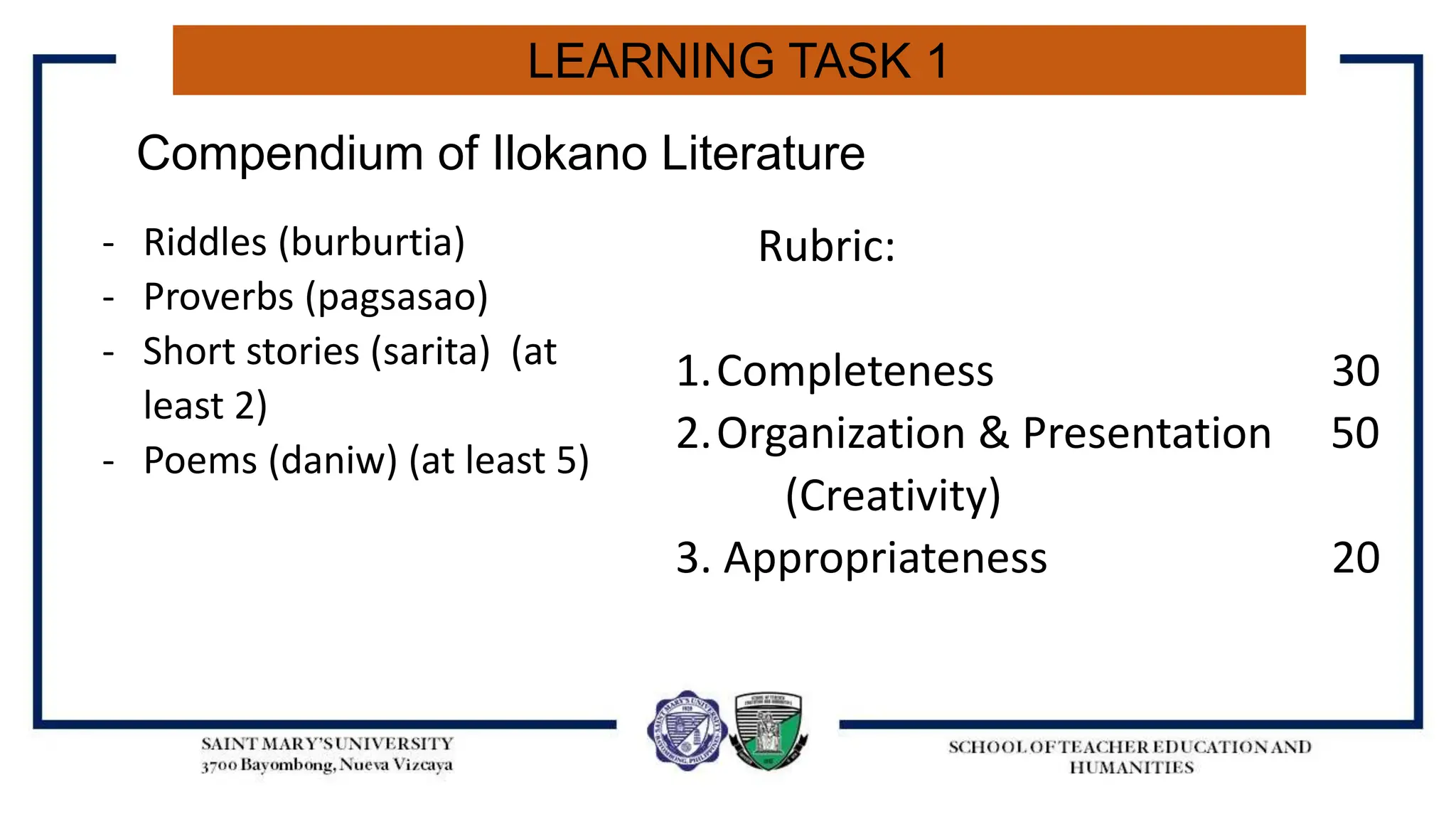
- Riddles (burburtia)
- Proverbs (pagsasao)
- Short stories (sarita) (at
least 2)
- Poems (daniw) (at least 5)
LEARNING TASK 1
Compendium of Ilokano Literature
Rubric:
1.Completeness 30
2.Organization & Presentation 50
(Creativity)
3. Appropriateness 20
1-Ilokano-as-a-Mother-Tongue-Literature.pptx

1-Ilokano-as-a-Mother-Tongue-Literature.pptx

  • 1.
    THE ILOKANO LANGUAGEAS THE MOTHER TONGUE  The Nature of the Ilokano Language  Ilokano Literature
  • 2.
    REVIEW This course includesboth the content and the pedagogy of the mother tongue as well as its underlying theoretical assumptions and frameworks that support its being a foundation for learning of the additional languages of Filipino and English and developing stronger literacy skills of learners. The subject matter content includes the structure of the mother tongue as a language, literature in the mother tongue, methods and techniques of teaching the language, development of instructional materials and assessment. Ultimately, the course will develop prospective teachers’ pedagogical content knowledge of the mother tongue which is necessary for the effective implementation of the Mother Tongue-Based Multilingual Education (MTB-MLE) Program of the Department of Education  Theoretical assumptions and frameworks  Literature  Content & structure  Pedagogy  Development of instructional materials  Assessment techniques  Peer teaching
  • 3.
    ILOKANO AS AMOTHER TONGUE  DepEd order No. 74, s. 2009 Institutionalizing Mother Tongue- Based Multilingual Education (MLE) (July 14, 2009)  RA 10157 (Kindergarten Education Act)  RA 10533 (Enhanced Basic Education Act of 2013)
  • 4.
    ILOKANO AS AMOTHER TONGUE DepEd Order 16, s. 2012 Guidelines on the Implementation of the Mother Tongue-Based- Multilingual Education (MTB-MLE). Tagalog Cebuano Tausug Kampampangan Hiligaynon Maguindanaoan Pangasinense Waray Maranao Iloko Chabacano Bikol
  • 5.
    ILOKANO AS AMOTHER TONGUE DepEd Order No. 28, s. 2013 Additional Guidelines to DEPEd Order No. 16, s. 2012 Ybanag (Tuguegarao City, Cagayan, Isabela) Ivatan (Batanes group of Islands) Sambal (Zambales) Akianon- Aklan, Capiz Kinaray-a (Capiz, Aklan) Yakan (Basilan Province), and Surigaonon (Surigao City and Provinces)
  • 6.
  • 7.
    ILOCO LANGUAGE AS THEMOTHER TONGUE  Nature of the Ilokano language  Ilokano literature
  • 8.
  • 9.
    • Ilocano (alsospelled Ilokano, Iloko or Iloco,) • a member of the Malayo-Polynesian branch of the Austronesian language family • the third largest ethnolinguistic group in the Philippines after Tagalog and English. • spoken by roughly 10 million people NATURE OF THE ILOKANO LANGUAGE There are some 120 to 187 languages spoken in the Philippines, depending on the method of classification https://en.wikipedia.org/wiki/Languages_of_the_Philippines
  • 10.
    • The inhabitantsof Ilocos (then called "Samtoy") were living in large villages at sheltered coves or rivermouths were trading with the Chinese and Japanese. • SAMTOY : meaning "Sao mi ditoy" (Our Language) NATURE OF THE ILOKANO LANGUAGE
  • 11.
    • The nameIlocano come from i– ‘from’ + looc ‘bay’ + - ano, Spanish “native of,” therefore literally means “people of the bay.” NATURE OF THE ILOKANO LANGUAGE
  • 12.
    • The originalIlocano homeland is in Northwest Luzon (the provinces of Ilocos Norte, Ilocos Sur, Abra, and La Union) • Migrated to new lands such as Nueva Ecija, Pangasinan, Tarlac, and Benguet • There are also sizable communities of Ilocanos throughout the United States, most notably in Hawaii and California where the language is taught in certain schools Where are the Ilocanos?
  • 13.
  • 14.
    Ilocano literature pertainsto the literary works of writers of Ilocano ancestry regardless of the language used – be it Ilokano, English, Spanish or other foreign and Philippine languages. Ilocano literature, next to the Tagalog, is believed by scholars to be the richest and most highly developed in the Philippines. Ilocano literature can be traced back at least to the early 17th century.
  • 15.
    There are alarge number of religious documents, poems, riddles (burburcha), proverbs, epic stories, folksongs, and other literary works that belong to this tradition. Today, there is a sizable body of Ilocano literature, including newspapers and periodicals like the Bannawag. (Saculles, 2018)
  • 16.
    Precolonial times tothe 19th century  Pre-colonial Iloko literature were composed of folk songs, riddles, proverbs, lamentations called dung-aw, and epic stories in written or oral form.  Ancient Ilokano poets expressed themselves in folk and war songs as well as the dallot, an improvised, versified and at times impromptu long poem delivered in a sing-song manner. https://en.wikipedia.org/wiki/Ilocano_literature
  • 17.
    Spanish Regime  Duringthe Spanish regime, Iloko poetry was generally patterned after Spanish models.  Francisco Lopez published his own Iloko translation of the Doctrina Cristiana by Cardinal Bellarmine, the first book to be printed in Iloko in 1621. https://en.wikipedia.org/wiki/Ilocano_literature
  • 18.
    Spanish Regime  Astudy of Iloko poetry could be found in the Gramatica Ilokana, published in 1895, based on Lopez's Arte de la Lengua Iloca, earlier published in 1627, but was probably written before 1606. https://en.wikipedia.org/wiki/Ilocano_literature
  • 19.
    Pedro Bucaneg  Fatherof Ilokano poetry and Literature  First known Ilokano poet  first Filipino literary man to achieve more than national renown. His fame spread beyond the nation's boundaries, reaching even as far as Madrid and Rome..  This poet and philosopher was born towards the end of the sixteenth century.  The Bukanegan which is the Ilocano equivalent of the Balagtasan was termed after him.  Blind since childhood  Authored the popular epic known as Biag ni Lam- ang ("Life of Lam-ang") written in the 17th century https://kahimyang.com/kauswagan/articles/1713/the-ilocano-epic-the-life-of-lam-ang https://en.wikipedia.org/wiki/Ilocano_literature
  • 20.
    Leonora Florentino –19th century https://en.wikipedia.org/wiki/Ilocano_literature  Was a Filipino poet in the Spanish and Ilocano languages  Considered by some as the "National Poetess of the Philippines“ or "mother of Philippine women's literature" and the "bridge from oral to literary tradition".  She started to love writing at a young age. Her best poems in Ilokano were As-Asug Ti Maysa A Napaay (Blasted Hopes) and Naangawan A Kablaaw (A Jolly Birthday Greeting). Monument situated at Vigan, Ilocos Sur
  • 21.
    Isabelo de losReyes https://en.wikipedia.org/wiki/Ilocano_literature  considered as the Father of Philippine Folklore.  was the son of Leona Florentino. He founded in 1889 the El Ilocano, the first regional newspaper in the Philippines which published fiction and poetry.  wrote short story in Iluko titled Ti Langit Ti Inanamatayo . source: en.wikipedia.org
  • 22.
    Fr. Justo ClaudioFojas https://en.wikipedia.org/wiki/Ilocano_literature an Ilokano secular priest who wrote novenas, prayerbooks, catechism, metrical romances, dramas, biographies, a Spanish grammar and an Iloko-Spanish dictionary, was Leona Florentino's contemporary.
  • 23.
    The GUMIL Filipinas (Gunglodagiti Mannurat nga Ilokano iti Filipinas) This was organized in Baguio on October 19, 1968. Arturo M. Padua, then mayor of Sison, Pangasinan, was elected president.
  • 24.
    Bannawag has playedand still plays a major role in the development of Iloko literature. At present, it publishes poems (daniw), short stories (sarita), novels (nobela), essays (salaysay), comics, biographies, folktales and many others including what some call avant garde literary output. It is the only magazine where Ilokano writers hope to publish most of their writings.
  • 27.
    Iloko Literature: Todayand Tomorrow Carlos Bulosan Francisco Sionil Jose Reynaldo A. Duque Ricarte Agnes Aurelio S. Agcaoili Lorenzo G. Tabin Jaime M. Agpalo Jr. Prescillano N. Bermudez William V. Alvarado Maria Fres-Felix Clarito G. de Francia Arnold Pascual Jose Eden Aquino Alvia Severino Pablo Ariel S. Tabag Daniel L. Nesperos Roy V. Aragon Danilo Antalan Joel B. Manuel Bernardo D. Tabbad Noli S. Dumlao and others.
  • 28.
  • 30.
    Ti bassít akáyo nalaká a lintegén, ngem no dakkél narigáten. A young tree is easy to straighten, but when it's big it is difficult. Ti táo nga mannaríta, awán ti ania nga magapuánIlonna. A man that talks too much accomplishes little. PAGSASAO (Ilokano Proverbs & Sayings) Ti táo a manákem, dína makíta ti panagdissó ti sakána ití dagá. Kitáenna ketdi ti sumarunó a baddekánna. A wise man doesn't see his foot on the ground, he watches his next step.
  • 31.
    Tay áso ngataol nga taol saán a makakagát ken makadunor. Barking dogs seldom bite. Awán kas iti sursúro a sanikuá, ta daytá awán makatákaw kenká. Knowledge is wealth that can't be stolen. PAGSASAO (Ilokano Proverbs & Sayings) No trabáho, gulpién, no kanén, in- inúten. If it's work, do it fast. If it's food, eat it little by little. What is easily acquired is easily lost. Ti kukuá masapúlan ngem ti pintas saán.
  • 32.
    Ti kukuá masapúlanngem ti pintas saán. Wealth can be acquired but beauty cannot. Ti agkuták, isú't nagitlóg. He who cackles laid the egg (he who talks first is the guilty party). PAGSASAO (Ilokano Proverbs & Sayings) No addá sabsábong, agaarák dagití kulibangbáng. Where there are flowers there are butterflies (young women attract young men) Ti kamátis, di agbúnga ti manggá. The tomato plant doesn't grow mangos. (A good person doesn't come from a bad family)
  • 33.
    Puráwto ti wáken,nangísittó diay kannawyen. The crow will turn white and the heron black (said to express impossibility) Ti útang mabayádan, ngem ti naimbág a nákem saán. A debt can be paid, but a kind act cannot. PAGSASAO (Ilokano Proverbs & Sayings) Kugtár ni kabaián, ilot ni kalantangan. The kick of a female carabao, the massage of the male. (women can't hurt men physically) Aniánto pay serbí diay rúot no natáyto met diay kabálion? Of what use is grass when the horse is dead? (said to misers)
  • 34.
    Naababa a sarita(short stories)/Nobela
  • 35.
    DANIW (Poems) Tubayem tikinatao iti naimbag a kababalin Tapno di mapukaw natakneng a pannakilangen; Ken iwardasmo a naimbag ti puso ken nakem Iti aramid a rumbeng, saan a makaidukem. Punasem pay iti muging ti siasino man Daan a pammati nga awanan kaeskan; Ket silawam dagiti nalidem a panunot Tapno dagiti rumbeng laeng ti masurot. ni Pedro L. Limos, Bannawag, 19 Oktubre 1959 Adal
  • 36.
    DANIW (Poems) Napategka, adal,iti biag ti siasino man— Ubing man wenno nataengan Ta sika ti sadiri, pataw ken taklin Tapno amin nga aramid natakneng. Sika, adal, ti nangayed a lawag iti biag A mangibayog wagayway ti kinaimbag; Sika ti bagnos kadagiti natakneng a wagas Ti aramid, sao, uray pay iti panagayat ni Pedro L. Limos, Bannawag, 19 Oktubre 1959 Adal
  • 37.
    DANIW (Poems) Napategka, adal,iti biag ti siasino man— Ubing man wenno nataengan Ta sika ti sadiri, pataw ken taklin Tapno amin nga aramid natakneng. ni Pedro L. Limos, Bannawag, 19 Oktubre 1959 Adal
  • 38.
    - Riddles (burburtia) -Proverbs (pagsasao) - Short stories (sarita) (at least 2) - Poems (daniw) (at least 5) LEARNING TASK 1 Compendium of Ilokano Literature Rubric: 1.Completeness 30 2.Organization & Presentation 50 (Creativity) 3. Appropriateness 20

Editor's Notes

  • #4 institutionalizes the use of the mother tongue based multilingual education in all schools, both private and public. “the first stage of compulsory and mandatory formal education.” The mother tongue of the learner shall be the primary medium of instruction for teaching and learning in the kindergarten level. expanded the years of schooling in basic education from 10 years to 12 years. For kindergarten and the first three (3) years of elementary education, instruction, teaching materials and assessment shall be in the regional or native language of the learners.