PANDEMIC INFLUENZA
Fighting uncertain future
-presented by Khushboo Rohra
This presentation will cover
 What is Influenza
 Influenza Virus
 Antigenic shift and antigenic drift
 Epidemiology of H1N1 Influenza
 Epidemiological Burden (Global, Regional
and National)
 Epidemiological Determinants (Agent, Host
& Env Factors)
 Mode of Transmission
 Clinical Features
 Diagnosis
 Management
 Prevention & Control
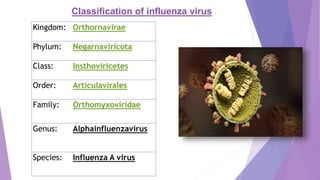
Kingdom: Orthornavirae
Phylum: Negarnaviricota
Class: Insthoviricetes
Order: Articulavirales
Family: Orthomyxoviridae
Genus: Alphainfluenzavirus
Species: Influenza A virus
Classification of influenza virus
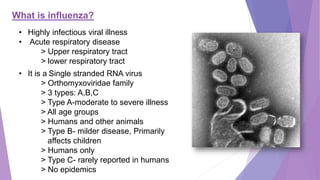
What is influenza?
• Highly infectious viral illness
• Acute respiratory disease
> Upper respiratory tract
> lower respiratory tract
• It is a Single stranded RNA virus
> Orthomyxoviridae family
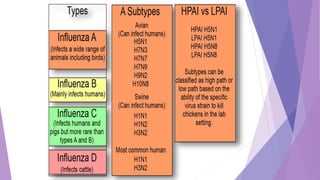
> 3 types: A,B,C
> Type A-moderate to severe illness
> All age groups
> Humans and other animals
> Type B- milder disease, Primarily
affects children
> Humans only
> Type C- rarely reported in humans
> No epidemics
Influenza A Virus
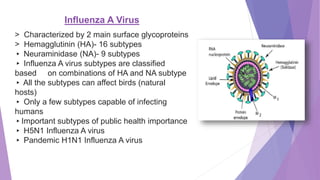
> Characterized by 2 main surface glycoproteins
> Hemagglutinin (HA)- 16 subtypes
▸ Neuraminidase (NA)- 9 subtypes
▸ Influenza A virus subtypes are classified
based on combinations of HA and NA subtype
▸ All the subtypes can affect birds (natural
hosts)
▸ Only a few subtypes capable of infecting
humans
▸Important subtypes of public health importance
▸ H5N1 Influenza A virus
▸ Pandemic H1N1 Influenza A virus
Antigenic Shift and Antigenic Drift
▸ Influenza A viruses are dynamic and can evolve by
two processes:
▸ Antigenic drift
> Occurs by point mutations in the two genes
coding for HA and NA
▸ Causes minor changes in surface proteins
▸ leads to a new strain that is not recognized by
antibodies to previous influenza strains.
▸ Antigenic shift
▸ Major change through genetic reassortment
▸ Produces a novel influenza A subtype in humans
▸ Occurs through the mixing of human and animal
influenza A virus genes or by an animal to human
transmission
▸ May cause pandemics
H1N1 Influenza (swine flu)
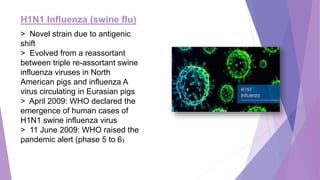
> Novel strain due to antigenic
shift
> Evolved from a reassortant
between triple re-assortant swine
influenza viruses in North
American pigs and influenza A
virus circulating in Eurasian pigs
> April 2009: WHO declared the
emergence of human cases of
H1N1 swine influenza virus
> 11 June 2009: WHO raised the
pandemic alert (phase 5 to 6)
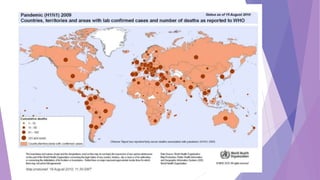
Epidemiological Burden
• Global
• Till May 2010: >214 countries reported lab-confirmed
pandemic influenza H1N1 2009, including over 18097
death (source WHO)
• SEAR
• Till May 2010: 1808 deaths As of 19 October 2009, in the
WHO Southeast Asia region, 10 of 11 member countries
have reported 41 513 cases of H1N1 virus infection and 573
deaths. The 3 hardest hit countries in the region were
Thailand, India, and Indonesia (Source WHO)
• Nepal
• June 2009: First detection in a human specimen collected at
TIA Till May 2010: Total no. of confirmed positive cases-172
Till May 2010: Total death cases -3. All were Female patients
(Source NPHL)
Epidemiological Determinants
▸ Causative agent: Pandemic H1N1 (2009) Influenza A virus
> Host Factors
▸ Occurs in every age group. The population does not have
immunity to the virus
> Complications are higher in people with underlying
diseases such as asthma, cardiac diseases, renal diseases, and
in pregnancy
> Obesity has also been found to predispose to severe disease
Environment
▸ Influenza viruses are highly resilient in the
environment.
▸ Low temperature and low humidity favor aerosol
transmission, explaining the seasonal nature of
influenza in temperate climates. In tropical
climates, influenza infections are associated with
increased rainfall
> The best environment for a novel virus is a
population without pre-existing immunity to it,
enabling it to spread pandemically
Mode of Transmission
▸ Through droplets from coughing or sneezing, and Through
direct or indirect contact with the respiratory secretions of an
infected person
▸ Food is not yet known to be a vehicle for transmission The
secondary attack rate in households is 18% to 30%
Incubation Period
▸ Between 1 and 7 days periods of Communicability
▸ From a day prior to the onset of symptoms till after 24 hours
after symptoms have subsided.
Clinical Features
Explore
> Ranging from mild self-limiting upper respiratory illness to
lower respiratory infection including ARDS, cardiac
involvement, neurological involvement, multiorgan failure,
septicemia, and death.
> Common features: mild respiratory illness with fever,
cough, sore throat, dyspnea, rhinorrhea, myalgias, chills,
headache, and fatigue. Diarrhea and vomiting are more
commonly seen than seasonal flu.
> Reported complications: myocarditis, pericarditis,
encephalitis, seizures, myositis, multiorgan failure and toxic
shock syndrome
Diagnosis
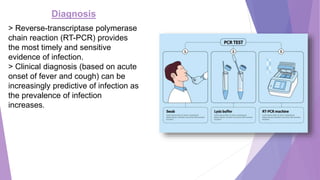
> Reverse-transcriptase polymerase
chain reaction (RT-PCR) provides
the most timely and sensitive
evidence of infection.
> Clinical diagnosis (based on acute
onset of fever and cough) can be
increasingly predictive of infection as
the prevalence of infection
increases.
Case Management
> Hospitalization and antiviral therapy are not required for most
patients
> Supportive care includes antipyretics such as paracetamol
acetaminophen, for fever or pain, and fluids, as needed.
>The virus is currently susceptible to neuraminidase inhibitors
(oseltamivir and zanamivir). Oseltamivir is believed to reduce the
severity and duration of the illness and might contribute to
preventing its progression to severe disease and death.
> Antiviral therapy may be beneficial, especially for pregnant
patients, patients with progressive lower respiratory tract disease
or pneumonia, and those with underlying medical conditions
Prevention and Control measures-Pharmacological
Interventions
> Personal protective measures shielding one's mouth and nose
while coughing or sneezing
> Frequently washing one's hands with soap
> Isolation and social distancing
> Home quarantine
> School closure and cancellation of mass gathering
Pharmacological Interventions Chemoprophylaxis If the likelihood
of complications is high, oseltamivir or zanamivir may be used as
post-exposure chemoprophylaxis for affected individuals,
especially healthcare workers
Prevention and Control Measures continued
> Pharmacological Interventions
> Vaccination
> Vaccine against the H1N1 virus is presently available
in a few countries.
> Commercial production is about to commence.
> The priority of all countries should be to immunize their
healthcare workers next priority should be pregnant
women. Inactivated non-adjuvant vaccines similar to
most seasonal influenza vaccines are considered the
preferred option.
References
Narain JP. Kumar R, Bhatia R. Pandemic (H1N1) 2009:
epidemiological, clinical and prevention aspects. The National
Medical Journal of India 2009:22(5). Gularia R, Kumar J,
Mohan A, Wig N. Influenza A: From highly pathogenic H5N1 to
pandemic 2009 HINI. Epidemiology and clinical features.
Indian Journal of Microbiology. 2009;49:315-19. 2Mpolya EA,
ruse Y, Nukiwa N, Suzuki A, Kamigaki T, Oshitani H. Pandemic
(H1N1) 2009 Virus Viewed from an Epidemiological Triangle
Model, Journal of Disaster Research. 2009;4(5):1-7WHO.
Pandemic (H1N1) 2009 update 101. [cited 2016 Sep 3].
Available fromhttp://www.who.int/csr/don/2010.05.21/en/
Influenza,CDC.[cited2016http://www.cdc.gov/vaccines/pubs/pi
nkbook//lu.htmlSep31.Availablefrom22
THANK YOU!

Pandemic influenza.pptx

  • 1.
    PANDEMIC INFLUENZA Fighting uncertainfuture -presented by Khushboo Rohra
  • 2.
    This presentation willcover  What is Influenza  Influenza Virus  Antigenic shift and antigenic drift  Epidemiology of H1N1 Influenza  Epidemiological Burden (Global, Regional and National)  Epidemiological Determinants (Agent, Host & Env Factors)  Mode of Transmission  Clinical Features  Diagnosis  Management  Prevention & Control
  • 3.
    Kingdom: Orthornavirae Phylum: Negarnaviricota Class:Insthoviricetes Order: Articulavirales Family: Orthomyxoviridae Genus: Alphainfluenzavirus Species: Influenza A virus Classification of influenza virus
  • 4.
    What is influenza? •Highly infectious viral illness • Acute respiratory disease > Upper respiratory tract > lower respiratory tract • It is a Single stranded RNA virus > Orthomyxoviridae family > 3 types: A,B,C > Type A-moderate to severe illness > All age groups > Humans and other animals > Type B- milder disease, Primarily affects children > Humans only > Type C- rarely reported in humans > No epidemics
  • 6.
    Influenza A Virus >Characterized by 2 main surface glycoproteins > Hemagglutinin (HA)- 16 subtypes ▸ Neuraminidase (NA)- 9 subtypes ▸ Influenza A virus subtypes are classified based on combinations of HA and NA subtype ▸ All the subtypes can affect birds (natural hosts) ▸ Only a few subtypes capable of infecting humans ▸Important subtypes of public health importance ▸ H5N1 Influenza A virus ▸ Pandemic H1N1 Influenza A virus
  • 7.
    Antigenic Shift andAntigenic Drift ▸ Influenza A viruses are dynamic and can evolve by two processes: ▸ Antigenic drift > Occurs by point mutations in the two genes coding for HA and NA ▸ Causes minor changes in surface proteins ▸ leads to a new strain that is not recognized by antibodies to previous influenza strains. ▸ Antigenic shift ▸ Major change through genetic reassortment ▸ Produces a novel influenza A subtype in humans ▸ Occurs through the mixing of human and animal influenza A virus genes or by an animal to human transmission ▸ May cause pandemics
  • 8.
    H1N1 Influenza (swineflu) > Novel strain due to antigenic shift > Evolved from a reassortant between triple re-assortant swine influenza viruses in North American pigs and influenza A virus circulating in Eurasian pigs > April 2009: WHO declared the emergence of human cases of H1N1 swine influenza virus > 11 June 2009: WHO raised the pandemic alert (phase 5 to 6)
  • 9.
    Epidemiological Burden • Global •Till May 2010: >214 countries reported lab-confirmed pandemic influenza H1N1 2009, including over 18097 death (source WHO) • SEAR • Till May 2010: 1808 deaths As of 19 October 2009, in the WHO Southeast Asia region, 10 of 11 member countries have reported 41 513 cases of H1N1 virus infection and 573 deaths. The 3 hardest hit countries in the region were Thailand, India, and Indonesia (Source WHO) • Nepal • June 2009: First detection in a human specimen collected at TIA Till May 2010: Total no. of confirmed positive cases-172 Till May 2010: Total death cases -3. All were Female patients (Source NPHL)
  • 11.
    Epidemiological Determinants ▸ Causativeagent: Pandemic H1N1 (2009) Influenza A virus > Host Factors ▸ Occurs in every age group. The population does not have immunity to the virus > Complications are higher in people with underlying diseases such as asthma, cardiac diseases, renal diseases, and in pregnancy > Obesity has also been found to predispose to severe disease
  • 12.
    Environment ▸ Influenza virusesare highly resilient in the environment. ▸ Low temperature and low humidity favor aerosol transmission, explaining the seasonal nature of influenza in temperate climates. In tropical climates, influenza infections are associated with increased rainfall > The best environment for a novel virus is a population without pre-existing immunity to it, enabling it to spread pandemically
  • 13.
    Mode of Transmission ▸Through droplets from coughing or sneezing, and Through direct or indirect contact with the respiratory secretions of an infected person ▸ Food is not yet known to be a vehicle for transmission The secondary attack rate in households is 18% to 30% Incubation Period ▸ Between 1 and 7 days periods of Communicability ▸ From a day prior to the onset of symptoms till after 24 hours after symptoms have subsided.
  • 14.
    Clinical Features Explore > Rangingfrom mild self-limiting upper respiratory illness to lower respiratory infection including ARDS, cardiac involvement, neurological involvement, multiorgan failure, septicemia, and death. > Common features: mild respiratory illness with fever, cough, sore throat, dyspnea, rhinorrhea, myalgias, chills, headache, and fatigue. Diarrhea and vomiting are more commonly seen than seasonal flu. > Reported complications: myocarditis, pericarditis, encephalitis, seizures, myositis, multiorgan failure and toxic shock syndrome
  • 15.
    Diagnosis > Reverse-transcriptase polymerase chainreaction (RT-PCR) provides the most timely and sensitive evidence of infection. > Clinical diagnosis (based on acute onset of fever and cough) can be increasingly predictive of infection as the prevalence of infection increases.
  • 16.
    Case Management > Hospitalizationand antiviral therapy are not required for most patients > Supportive care includes antipyretics such as paracetamol acetaminophen, for fever or pain, and fluids, as needed. >The virus is currently susceptible to neuraminidase inhibitors (oseltamivir and zanamivir). Oseltamivir is believed to reduce the severity and duration of the illness and might contribute to preventing its progression to severe disease and death. > Antiviral therapy may be beneficial, especially for pregnant patients, patients with progressive lower respiratory tract disease or pneumonia, and those with underlying medical conditions
  • 17.
    Prevention and Controlmeasures-Pharmacological Interventions > Personal protective measures shielding one's mouth and nose while coughing or sneezing > Frequently washing one's hands with soap > Isolation and social distancing > Home quarantine > School closure and cancellation of mass gathering Pharmacological Interventions Chemoprophylaxis If the likelihood of complications is high, oseltamivir or zanamivir may be used as post-exposure chemoprophylaxis for affected individuals, especially healthcare workers
  • 18.
    Prevention and ControlMeasures continued > Pharmacological Interventions > Vaccination > Vaccine against the H1N1 virus is presently available in a few countries. > Commercial production is about to commence. > The priority of all countries should be to immunize their healthcare workers next priority should be pregnant women. Inactivated non-adjuvant vaccines similar to most seasonal influenza vaccines are considered the preferred option.
  • 19.
    References Narain JP. KumarR, Bhatia R. Pandemic (H1N1) 2009: epidemiological, clinical and prevention aspects. The National Medical Journal of India 2009:22(5). Gularia R, Kumar J, Mohan A, Wig N. Influenza A: From highly pathogenic H5N1 to pandemic 2009 HINI. Epidemiology and clinical features. Indian Journal of Microbiology. 2009;49:315-19. 2Mpolya EA, ruse Y, Nukiwa N, Suzuki A, Kamigaki T, Oshitani H. Pandemic (H1N1) 2009 Virus Viewed from an Epidemiological Triangle Model, Journal of Disaster Research. 2009;4(5):1-7WHO. Pandemic (H1N1) 2009 update 101. [cited 2016 Sep 3]. Available fromhttp://www.who.int/csr/don/2010.05.21/en/ Influenza,CDC.[cited2016http://www.cdc.gov/vaccines/pubs/pi nkbook//lu.htmlSep31.Availablefrom22
  • 20.