PALLIATIVE CARE
DR ATMARAM CHOUDHARI
Gmc nagpur radiation oncolgy
gG
DEFINITION
An Approach That Improves Quality Of
Life Of Patient And Their Families Facing
The Life- Threating Illness , Through The
The Prevention And Relief Of Suffering By
Means Of Early Identification And
Impeccable Assessment And Treatment
Of Pain And Other Problems , physical
Psychosocial Spiritual.
DEFINITION OF QUALITY OF LIFE
• The Standard of Health, Comfort, and
Happiness Experienced by an Individual or
Group.
• The highest quality of life attainable for any
person is achievement of optimal function
Resulting in using all of the assets that each
person has.
by Prof. federick kottke.
DIFFERENCE BETWEEN CURE &
TREATMENT
• The term “cure” means that, after medical
treatment, the patient no longer has that
particular condition anymore.
• Some diseases can be cured. Others,
like hepatitis B , have no cure. The person will
always have the condition, but medical
treatments can help to manage the disease.
• Use Medicine, Therapy, Surgery, And Other
Treatments To Help Lessen The Symptoms And
Effects Of A Disease.
• When a disease can’t be cured , often use
treatments to help control it.
• For example, once diabetes happens when
the pancreas does not make enough insulin to
get glucose into cells where it’s needed.
• We Treat this people with diabetes using
insulin injections and other methods so they
can continue to live normal lives. but right
now there’s no cure for diabetes. so some
people need insulin treatments for the rest of
their lives.
• Researchers are constantly coming up with
advances in medicine. so it’s possible that a
disease that can be treated but not cured
today may be cured in the future.
• Palliative Care Is A Term Derived From Latin
Palliare , "To Cloak.“ To Cover.
• Palliative Care Is A Multidisciplinary Approach
And Specialized Medical Care For People With
Serious Illness.
• The Goal Of Therapy Is To Improve The Quality
Of The Life.
AIMS
• Provides relief from pain, shortness of breath
nausea, vomiting & other distressing
symptom.
• Affirms life & regards dying as normal process.
• Intends neither to hasten nor to postpone the
death.
• Integrates the psychological & spiritual
aspects of patients care.
• Offers a support system to help patients to live
as actively as possible.
• Offers a support system to help the family to
to cope.
• Use team approach to address the needs of
patients and their families.
• Will enhance quality of life.
• Is applicable early in the course of illness ,in
conjunction with other Therapies that are
intended to prolong life such as chemotherapy
or radiotherapy.
GOALS
• Relief from suffering
• Treatment of pain & other distressing
symptoms.
• Psychological & spiritual care.
• A support System to help the individual to live
as actively as possible.
• A support System to sustain & rehabilitate the
the individuals family.
• Its estimated that there is prevalence of 2.3 to 3
million cancer cases in India at any point
in time , who are in needs of palliative care in
India.
• A lot of experience is required to understand
their unique suffering. this has to be assessed
by
trained multi professional team.
MANAGEMENT OF COMMON
SYMPTOMS
PAIN
• Assessment- What makes It Better ?
• Provocative factor- What makes It worse ?
• Quality- what is like ? i.e burning , pricking.
• Radiation-does it radiate anywhere ?
• Severity- how severe it is? Mild moderate
severe.
• How much does it affect your life ?
• Temporal factors- time of day continuous or
intermittent .
TYPES OF PAIN
Breakthrough pain-
• A sudden increase in pain that may occur in
patients who already have chronic pain from
cancer, arthritis, fibromyalgia, or other
conditions. Breakthrough pain usually lasts for a
short time.
• During breakthrough pain, the level of pain may
be severe but the type of pain and where it is in
the body are usually the same as the patient’s
chronic pain..
• Morphine, oxycodone, and other narcotics can
also be used for Breakthrough pain relief.
INCIDENT PAIN
• Incident pain is a subtype of breakthrough
pain that occurs as the result of normal
voluntary or involuntary movement but does
not typically occur at rest. Incident pain often
occurs predictably in response to identified
triggers.
• Consequently, it may be possible to provide
prophylactic pain control for these episodes.
END OF DOSE PAIN
• Persons with chronic pain on around-the-
clock (ATC) opioids experience increased pain
occurring at the end of a scheduled dose, also
known as end-of-dose pain.
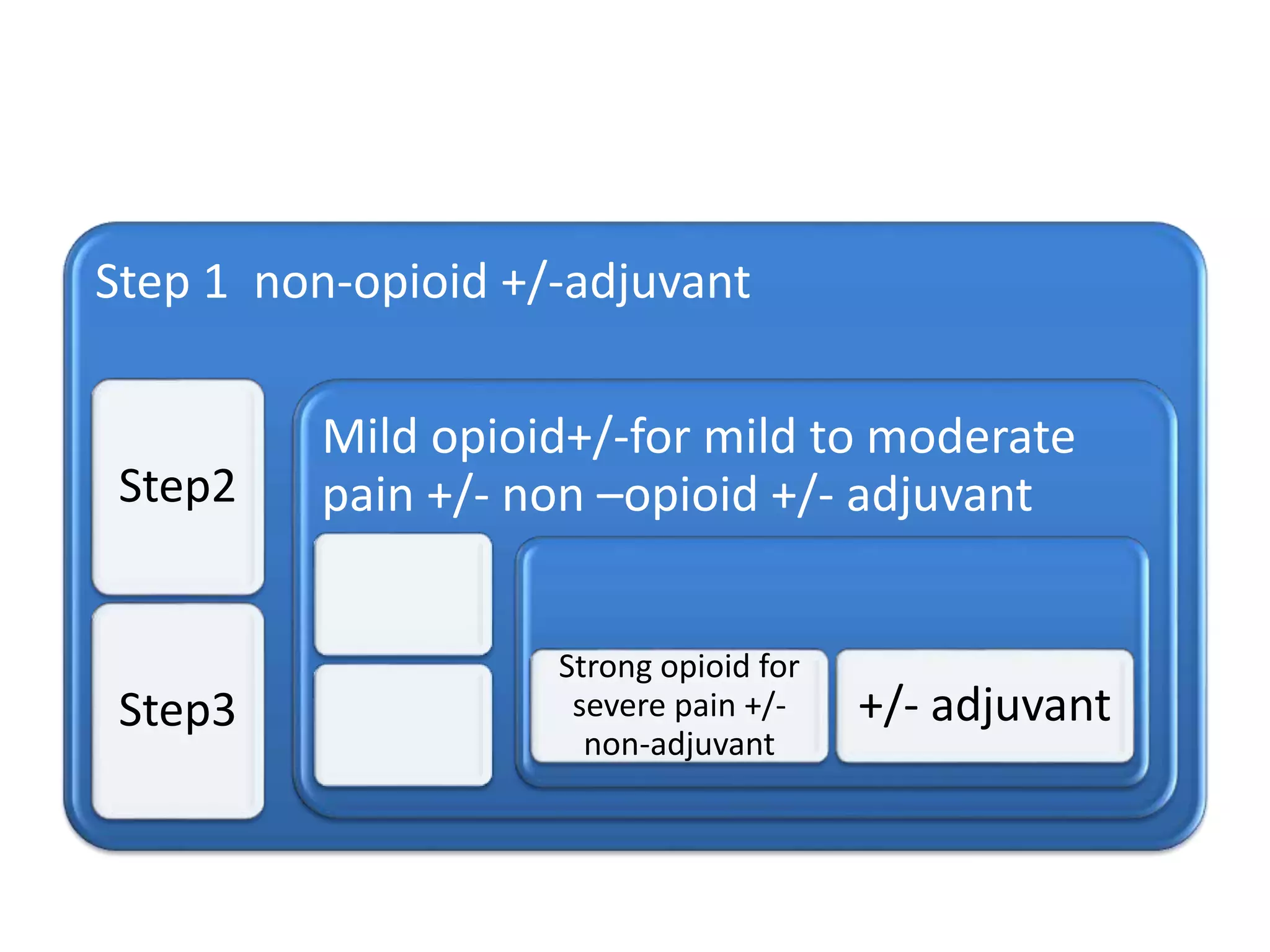
Step 1 non-opioid +/-adjuvant
Step2
Step3
Mild opioid+/-for mild to moderate
pain +/- non –opioid +/- adjuvant
Strong opioid for
severe pain +/-
non-adjuvant
+/- adjuvant
NAUSEA & VOMITING
• Important to assess the cause of vomiting to
be able to treat accurately.
• Comprehensive history & physical
examination
• Minimum investigation.
RECEPTORS STIMULATED TO INDUCE
VOMITING & DRUGS ACTING ON
RECETORS
MALIGNANT BOWEL OBSTRUCTION
• For single site can be surgically resected to relieve
the obstruction
• If multiple sites SX not an option ,symptomatic
medical MX.
Ct scan abdomen/erect abd.Xray.
dexamethasone 16mg/day iv to reduce
bowel edema
• Metoclopromide 10-30mg q6hr iv for vomiting
avoid if colicky pain
• Octreotide to reduce secretion 100mg/q6hr
s/c.
• Hyoscine butyl bromide 20mg q6 hr/sc or
dicyclomine 10-20mg q6-8hr sc for colicky
pain
COMPLETE IRREVERSIBLE –BOWEL
SOUNDS ABSENT(TERMINAL CARE)
• Inj. Morphine by sc 10mg q4hr (help to relax
the bowel).
• Inj. haloperidol 1-2 mg sc/24 hr or octerotide
100mg sc q 6hr (to control vomiting).
• If high obstruction-venting gastrostomy can be
considered.
CONSTIPATION
• Commonly due to drugs ,reduced oral intake
vomiting , lack of exercise.
GENERAL MEASURES-
• good general symptom control.
• Encourage activity.
• Maintain oral fluid intake.
• Maximize the fiber content of the diet.
• Anticipate constipating effects of drugs
• Altering T/t or starting laxatives prophylactically.
DRUGS
Predominantly stool softening predominantly
sodium docusate peristalsis
osmotic-lactulose stimulating
bulking agent-methyl senna, dantron
cellulose. Bisacodyl
lubricants-liquid paraffin
• Combination found to be more effective.
e.g cremaffin plus(liquid paraffin+milk of
magnesia + sodium
picosulphate )
DYSPNOEA
• Reverse the cause where possible, e.g pleural
tapping , correct severe anemia, treat
infection & pain.
• Where above is not feasible ,e.g lung
metastasis.
• Non-pharmacological-repositioning, breathing
exercises , yoga, ventilation i.e opening
window .
avoiding compression of chest
relaxation techniques-massage , music
therapies ,diversion.
offer psychological support & counseling.
PHARMACOLOGICAL
• Corticosteroides indicated in presence of
bronchial obstruction , svc.
• Dexamethasone-8-24mg p/o daily depending
upon severity.
• Bronchodilators-salbutamol 4 mg tds,
deriphylline 100mg tds.
nebulize with salbutamol 4 mg tds
• Management of terminal breathlessness
opioids-morphine 5-10 mg p/o q4h
• Benzodiazepines- for severe anxiety &
respiratory panic attacks.
Lorazepam 0.5-2mg iv in anxious pt.
OXYGEN DEBETABLE
• Only Helpful –IF there is hypoxia ,cyanosis
• May helpful in sudden episodes of
hyperventilation due to panic ,pulmonary
edema , COPD .
• Care of mouth , back ,bowel , bladder & eyes
in an unconscious pt.
• Diet , regular exercise.
• General hygiene
• Care of tracheostomy tube, urinary drainage .
MX OF FUNGATING WOUND
• Malignant ulcer or wounds caused by direct
invasion of skin by a primary tumour or by
metastasis to skin.
• These wounds have both ulcerative &
fungating features. odour & discharge are
common problems with malignant wounds,
pain ,infection , bleeding can occur.
MX
• TIME principle-t- tissue , i-
inflammation/infection ,m- moisture , e-edge.
• Wound cleaning with normal saline local
debridement by very gentle scrubbing the
the necrotic areas with normal saline gauge.
• Dressing should change 1-2 times per day
depending upon amount of exudates and
odour .
• For infected wound any antimicrobial can be
used.
• For fungating wounds for anaerobic bacteria
infection metronidazole gel is used topically.
• if bleeding persist apply direct pressure for 10-15
min . local ice packs 1.1000 adrenaline soaked
gauze. pressure dressing required if bleeding is
severe.
crushed ethamsylate tablets or botrclot can be
used.
MX OF MAGGOTS
• A /w necrotic wounds.
• Daily dressing wound should be covered all
the time to prevent the flies.
• Apply turpentine oil 1.10 conc.
• Remove stunned maggots with forceps, repeat
for 3-4 days.
Psychological care
• Psychological care & emotional support are
extremely essential part of palliative care.
• It offers a support system to help pt live as
actively as possible until death & help the
family cope during the pt illness in their home.
PRINCIPLE GUIDELINES FOR
PSYCHOLOGICAL CARE
• Psychological wellbeing , reactions to current
losses , support system & coping of pts & care
givers should be assessed explicitly at the
time of consultation.
• Privacy & confidentiality should be maintained
while Psychological assessment &
interventions. Psychological include mood,
feelings , social support , impact of illness on
day to day life and work.
• Pt & care giver both should be evaluated
during assessment & interventions.
• Multidisciplinary professionals should work
together for care of pt should assess intervene
pt appropriately.
• Psychological support provided through
intimate care & positive communication skills
during difficult situations.
• Pts & caregivers with significant level of
psychological distress & premorbid psychiatric
issues should referred to psychiatrist.
• Psychological needs & problems of staff
caring should be assessed adequately to
improve quality of life.
SOCIAL CARE
• Social care to understand pts
• Social status
• SWOT analysis of pt & families to help them
sustain advance phases of life .
• Interventions :
• Addressing economic concern of families.e.g
free medicines , monthly ration , & taking care
educational needs of childrens.
• Empowering & educating families to combat
fear of contagion, stigma & isolation.
• Linking families for with local resources &
various schemes of government.
• Continuous support & availability of families
through telephonic helplines .
• Fulfilling last wishes of children through a
make wish foundation.
HOSPICE CARE
• A care designed to give supportive care to
people in the final phase of a terminal illness
and focus on comfort and quality of life, rather
than cure.
• The goal is to enable patients to be
comfortable and free of pain, so that they live
each day as fully as possible.
THANK YOU
Pallative care

Pallative care

  • 1.
    PALLIATIVE CARE DR ATMARAMCHOUDHARI Gmc nagpur radiation oncolgy gG
  • 2.
    DEFINITION An Approach ThatImproves Quality Of Life Of Patient And Their Families Facing The Life- Threating Illness , Through The The Prevention And Relief Of Suffering By Means Of Early Identification And Impeccable Assessment And Treatment Of Pain And Other Problems , physical Psychosocial Spiritual.
  • 3.
    DEFINITION OF QUALITYOF LIFE • The Standard of Health, Comfort, and Happiness Experienced by an Individual or Group. • The highest quality of life attainable for any person is achievement of optimal function Resulting in using all of the assets that each person has. by Prof. federick kottke.
  • 4.
    DIFFERENCE BETWEEN CURE& TREATMENT • The term “cure” means that, after medical treatment, the patient no longer has that particular condition anymore. • Some diseases can be cured. Others, like hepatitis B , have no cure. The person will always have the condition, but medical treatments can help to manage the disease.
  • 5.
    • Use Medicine,Therapy, Surgery, And Other Treatments To Help Lessen The Symptoms And Effects Of A Disease. • When a disease can’t be cured , often use treatments to help control it. • For example, once diabetes happens when the pancreas does not make enough insulin to get glucose into cells where it’s needed.
  • 6.
    • We Treatthis people with diabetes using insulin injections and other methods so they can continue to live normal lives. but right now there’s no cure for diabetes. so some people need insulin treatments for the rest of their lives. • Researchers are constantly coming up with advances in medicine. so it’s possible that a disease that can be treated but not cured today may be cured in the future.
  • 7.
    • Palliative CareIs A Term Derived From Latin Palliare , "To Cloak.“ To Cover. • Palliative Care Is A Multidisciplinary Approach And Specialized Medical Care For People With Serious Illness. • The Goal Of Therapy Is To Improve The Quality Of The Life.
  • 8.
    AIMS • Provides relieffrom pain, shortness of breath nausea, vomiting & other distressing symptom. • Affirms life & regards dying as normal process. • Intends neither to hasten nor to postpone the death. • Integrates the psychological & spiritual aspects of patients care.
  • 9.
    • Offers asupport system to help patients to live as actively as possible. • Offers a support system to help the family to to cope. • Use team approach to address the needs of patients and their families. • Will enhance quality of life. • Is applicable early in the course of illness ,in conjunction with other Therapies that are intended to prolong life such as chemotherapy or radiotherapy.
  • 10.
    GOALS • Relief fromsuffering • Treatment of pain & other distressing symptoms. • Psychological & spiritual care. • A support System to help the individual to live as actively as possible. • A support System to sustain & rehabilitate the the individuals family.
  • 11.
    • Its estimatedthat there is prevalence of 2.3 to 3 million cancer cases in India at any point in time , who are in needs of palliative care in India. • A lot of experience is required to understand their unique suffering. this has to be assessed by trained multi professional team.
  • 13.
    MANAGEMENT OF COMMON SYMPTOMS PAIN •Assessment- What makes It Better ? • Provocative factor- What makes It worse ? • Quality- what is like ? i.e burning , pricking. • Radiation-does it radiate anywhere ? • Severity- how severe it is? Mild moderate severe. • How much does it affect your life ? • Temporal factors- time of day continuous or intermittent .
  • 14.
    TYPES OF PAIN Breakthroughpain- • A sudden increase in pain that may occur in patients who already have chronic pain from cancer, arthritis, fibromyalgia, or other conditions. Breakthrough pain usually lasts for a short time. • During breakthrough pain, the level of pain may be severe but the type of pain and where it is in the body are usually the same as the patient’s chronic pain.. • Morphine, oxycodone, and other narcotics can also be used for Breakthrough pain relief.
  • 16.
    INCIDENT PAIN • Incidentpain is a subtype of breakthrough pain that occurs as the result of normal voluntary or involuntary movement but does not typically occur at rest. Incident pain often occurs predictably in response to identified triggers. • Consequently, it may be possible to provide prophylactic pain control for these episodes.
  • 18.
    END OF DOSEPAIN • Persons with chronic pain on around-the- clock (ATC) opioids experience increased pain occurring at the end of a scheduled dose, also known as end-of-dose pain.
  • 19.
    Step 1 non-opioid+/-adjuvant Step2 Step3 Mild opioid+/-for mild to moderate pain +/- non –opioid +/- adjuvant Strong opioid for severe pain +/- non-adjuvant +/- adjuvant
  • 20.
    NAUSEA & VOMITING •Important to assess the cause of vomiting to be able to treat accurately. • Comprehensive history & physical examination • Minimum investigation.
  • 21.
    RECEPTORS STIMULATED TOINDUCE VOMITING & DRUGS ACTING ON RECETORS
  • 23.
    MALIGNANT BOWEL OBSTRUCTION •For single site can be surgically resected to relieve the obstruction • If multiple sites SX not an option ,symptomatic medical MX. Ct scan abdomen/erect abd.Xray. dexamethasone 16mg/day iv to reduce bowel edema
  • 24.
    • Metoclopromide 10-30mgq6hr iv for vomiting avoid if colicky pain • Octreotide to reduce secretion 100mg/q6hr s/c. • Hyoscine butyl bromide 20mg q6 hr/sc or dicyclomine 10-20mg q6-8hr sc for colicky pain
  • 25.
    COMPLETE IRREVERSIBLE –BOWEL SOUNDSABSENT(TERMINAL CARE) • Inj. Morphine by sc 10mg q4hr (help to relax the bowel). • Inj. haloperidol 1-2 mg sc/24 hr or octerotide 100mg sc q 6hr (to control vomiting). • If high obstruction-venting gastrostomy can be considered.
  • 27.
    CONSTIPATION • Commonly dueto drugs ,reduced oral intake vomiting , lack of exercise. GENERAL MEASURES- • good general symptom control. • Encourage activity. • Maintain oral fluid intake. • Maximize the fiber content of the diet. • Anticipate constipating effects of drugs • Altering T/t or starting laxatives prophylactically.
  • 28.
    DRUGS Predominantly stool softeningpredominantly sodium docusate peristalsis osmotic-lactulose stimulating bulking agent-methyl senna, dantron cellulose. Bisacodyl lubricants-liquid paraffin
  • 29.
    • Combination foundto be more effective. e.g cremaffin plus(liquid paraffin+milk of magnesia + sodium picosulphate )
  • 30.
    DYSPNOEA • Reverse thecause where possible, e.g pleural tapping , correct severe anemia, treat infection & pain. • Where above is not feasible ,e.g lung metastasis.
  • 31.
    • Non-pharmacological-repositioning, breathing exercises, yoga, ventilation i.e opening window . avoiding compression of chest relaxation techniques-massage , music therapies ,diversion. offer psychological support & counseling.
  • 32.
    PHARMACOLOGICAL • Corticosteroides indicatedin presence of bronchial obstruction , svc. • Dexamethasone-8-24mg p/o daily depending upon severity. • Bronchodilators-salbutamol 4 mg tds, deriphylline 100mg tds. nebulize with salbutamol 4 mg tds
  • 33.
    • Management ofterminal breathlessness opioids-morphine 5-10 mg p/o q4h • Benzodiazepines- for severe anxiety & respiratory panic attacks. Lorazepam 0.5-2mg iv in anxious pt.
  • 34.
    OXYGEN DEBETABLE • OnlyHelpful –IF there is hypoxia ,cyanosis • May helpful in sudden episodes of hyperventilation due to panic ,pulmonary edema , COPD .
  • 35.
    • Care ofmouth , back ,bowel , bladder & eyes in an unconscious pt. • Diet , regular exercise. • General hygiene • Care of tracheostomy tube, urinary drainage .
  • 36.
    MX OF FUNGATINGWOUND • Malignant ulcer or wounds caused by direct invasion of skin by a primary tumour or by metastasis to skin. • These wounds have both ulcerative & fungating features. odour & discharge are common problems with malignant wounds, pain ,infection , bleeding can occur.
  • 37.
    MX • TIME principle-t-tissue , i- inflammation/infection ,m- moisture , e-edge. • Wound cleaning with normal saline local debridement by very gentle scrubbing the the necrotic areas with normal saline gauge. • Dressing should change 1-2 times per day depending upon amount of exudates and odour .
  • 38.
    • For infectedwound any antimicrobial can be used. • For fungating wounds for anaerobic bacteria infection metronidazole gel is used topically. • if bleeding persist apply direct pressure for 10-15 min . local ice packs 1.1000 adrenaline soaked gauze. pressure dressing required if bleeding is severe. crushed ethamsylate tablets or botrclot can be used.
  • 39.
    MX OF MAGGOTS •A /w necrotic wounds. • Daily dressing wound should be covered all the time to prevent the flies. • Apply turpentine oil 1.10 conc. • Remove stunned maggots with forceps, repeat for 3-4 days.
  • 40.
    Psychological care • Psychologicalcare & emotional support are extremely essential part of palliative care. • It offers a support system to help pt live as actively as possible until death & help the family cope during the pt illness in their home.
  • 41.
    PRINCIPLE GUIDELINES FOR PSYCHOLOGICALCARE • Psychological wellbeing , reactions to current losses , support system & coping of pts & care givers should be assessed explicitly at the time of consultation. • Privacy & confidentiality should be maintained while Psychological assessment & interventions. Psychological include mood, feelings , social support , impact of illness on day to day life and work.
  • 42.
    • Pt &care giver both should be evaluated during assessment & interventions. • Multidisciplinary professionals should work together for care of pt should assess intervene pt appropriately. • Psychological support provided through intimate care & positive communication skills during difficult situations.
  • 43.
    • Pts &caregivers with significant level of psychological distress & premorbid psychiatric issues should referred to psychiatrist. • Psychological needs & problems of staff caring should be assessed adequately to improve quality of life.
  • 44.
    SOCIAL CARE • Socialcare to understand pts • Social status • SWOT analysis of pt & families to help them sustain advance phases of life . • Interventions : • Addressing economic concern of families.e.g free medicines , monthly ration , & taking care educational needs of childrens.
  • 45.
    • Empowering &educating families to combat fear of contagion, stigma & isolation. • Linking families for with local resources & various schemes of government. • Continuous support & availability of families through telephonic helplines . • Fulfilling last wishes of children through a make wish foundation.
  • 49.
    HOSPICE CARE • Acare designed to give supportive care to people in the final phase of a terminal illness and focus on comfort and quality of life, rather than cure. • The goal is to enable patients to be comfortable and free of pain, so that they live each day as fully as possible.
  • 51.